Introduction to MrBayes
Fred(rik) Ronquist
Dept. Bioinformatics and Genetics
Swedish Museum of Natural History, Stockholm, Sweden
Installing MrBayes
! Two options:
! Go to mrbayes.net, click Download and
follow the instructions to download the
current release (3.2.6)
!
OR go to https://github.com/
NBISweden/MrBayes/releases to
download the prerelease of the next version
(3.2.7) (but you have to compile this yourself
on your machine)
Running MrBayes
! Use execute to bring data in a Nexus file into
MrBayes
! Set the model and priors using lset and prset
! Run the chain using mcmc; results in a set of .p
and .t files
! The .t files contain tree samples in Nexus format
! The .p files contain tab-delimited samples of the
model parameters
! Summarize the parameter samples using sump
! Summarize the tree samples using sumt
Convergence Diagnostics
! By default, MrBayes performs two independent
analyses starting from different random trees (mcmc
nruns=2)
! Average standard deviation of split frequencies
calculated and presented during the run (mcmc
mcmcdiagn=yes diagnfreq=5000) and written to file
(.mcmc). Suggested target < 0.05.
! Standard deviation of each clade frequency and
potential scale reduction for branch lengths
calculated with sumt
! Potential scale reduction calculated for all
substitution model parameters with sump
! Other tools: Awty and Tracer
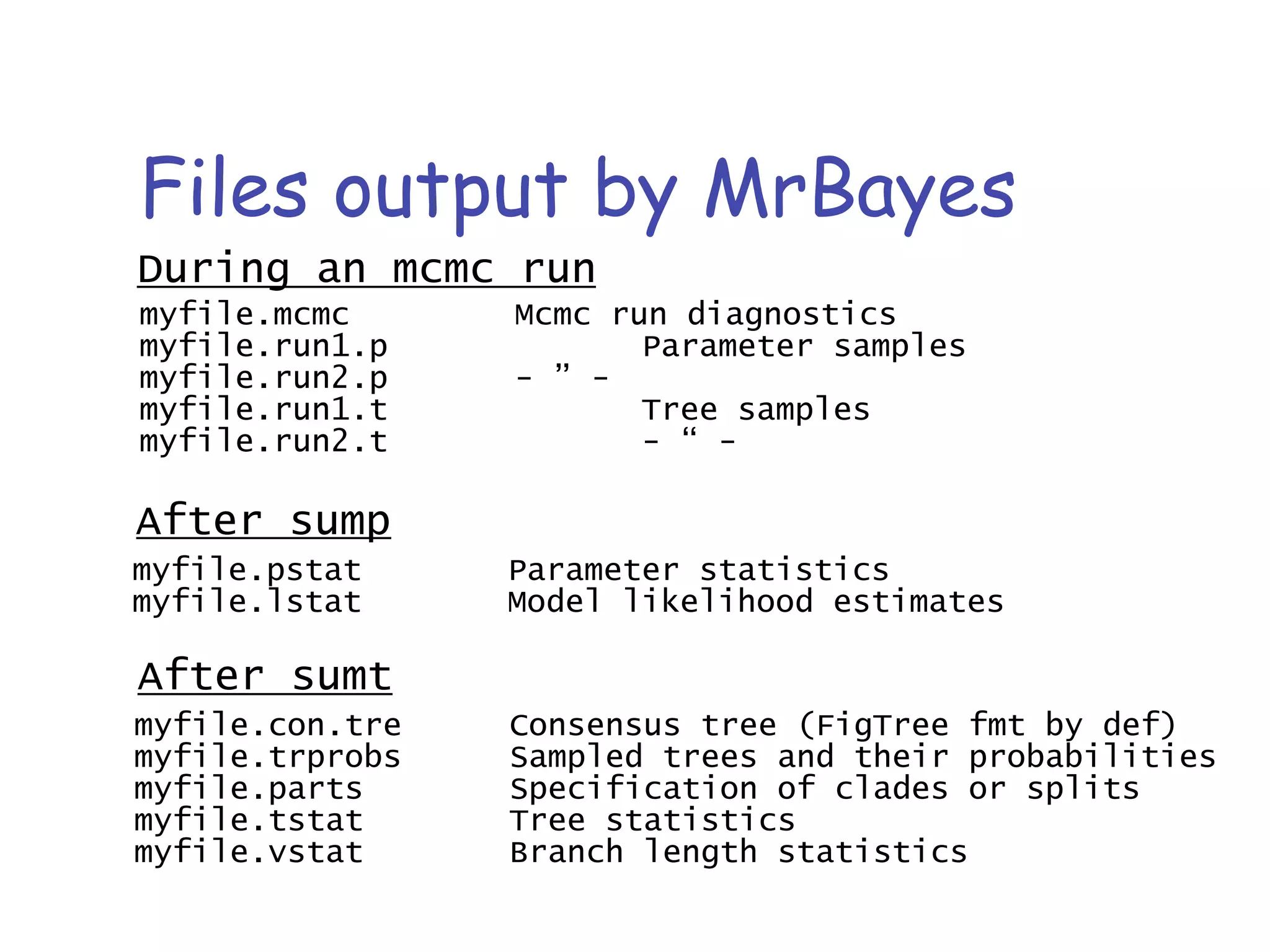
Files output by MrBayes
During an mcmc run
myfile.mcmc Mcmc run diagnostics
myfile.run1.p Parameter samples
myfile.run2.p - ” -
myfile.run1.t Tree samples
myfile.run2.t - “ -
After sump
myfile.pstat Parameter statistics
myfile.lstat Model likelihood estimates
After sumt
myfile.con.tre Consensus tree (FigTree fmt by def)
myfile.trprobs Sampled trees and their probabilities
myfile.parts Specification of clades or splits
myfile.tstat Tree statistics
myfile.vstat Branch length statistics
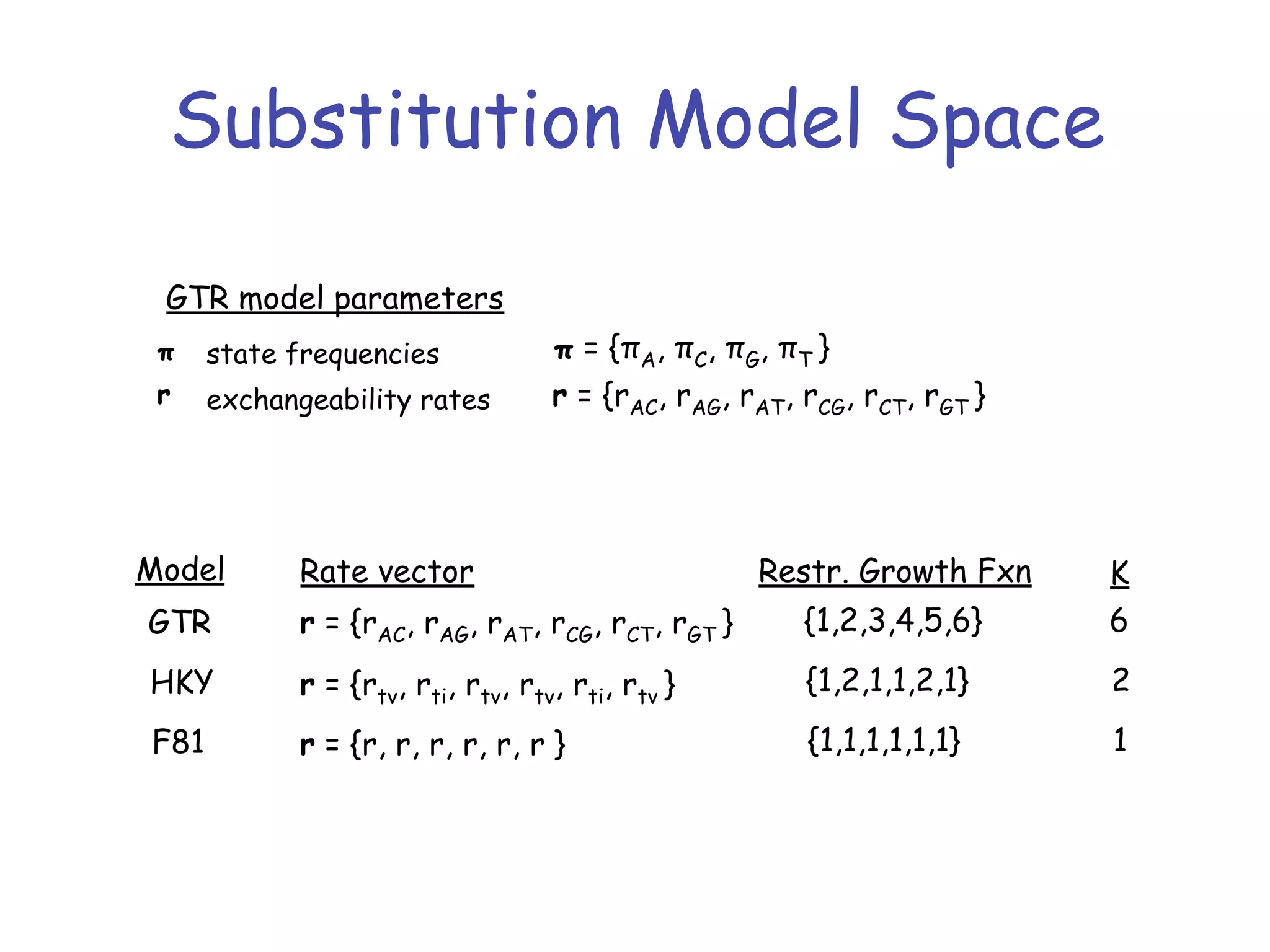
MrBayes 3.2 additions
! Use combinations of hard, negative, and partial
(backbone) constraints on topologies
! Relaxed clocks and dating
! Multi-species coalescent (the BEST model)
! Model jumping across the GTR subspace
! Estimate Bayes factors using stepping-stone
sampling
! New tree proposals
! Faster likelihood calculation
Substitution Model Space
π state frequencies
r exchangeability rates
GTR model parameters
π = {πA, πC, πG, πT }
r = {rAC, rAG, rAT, rCG, rCT, rGT }
r = {rtv, rti, rtv, rtv, rti, rtv }
r = {r, r, r, r, r, r }
Model Rate vector Restr. Growth Fxn K
{1,2,3,4,5,6}
{1,2,1,1,2,1}
{1,1,1,1,1,1}
6
2
1
GTR
HKY
F81
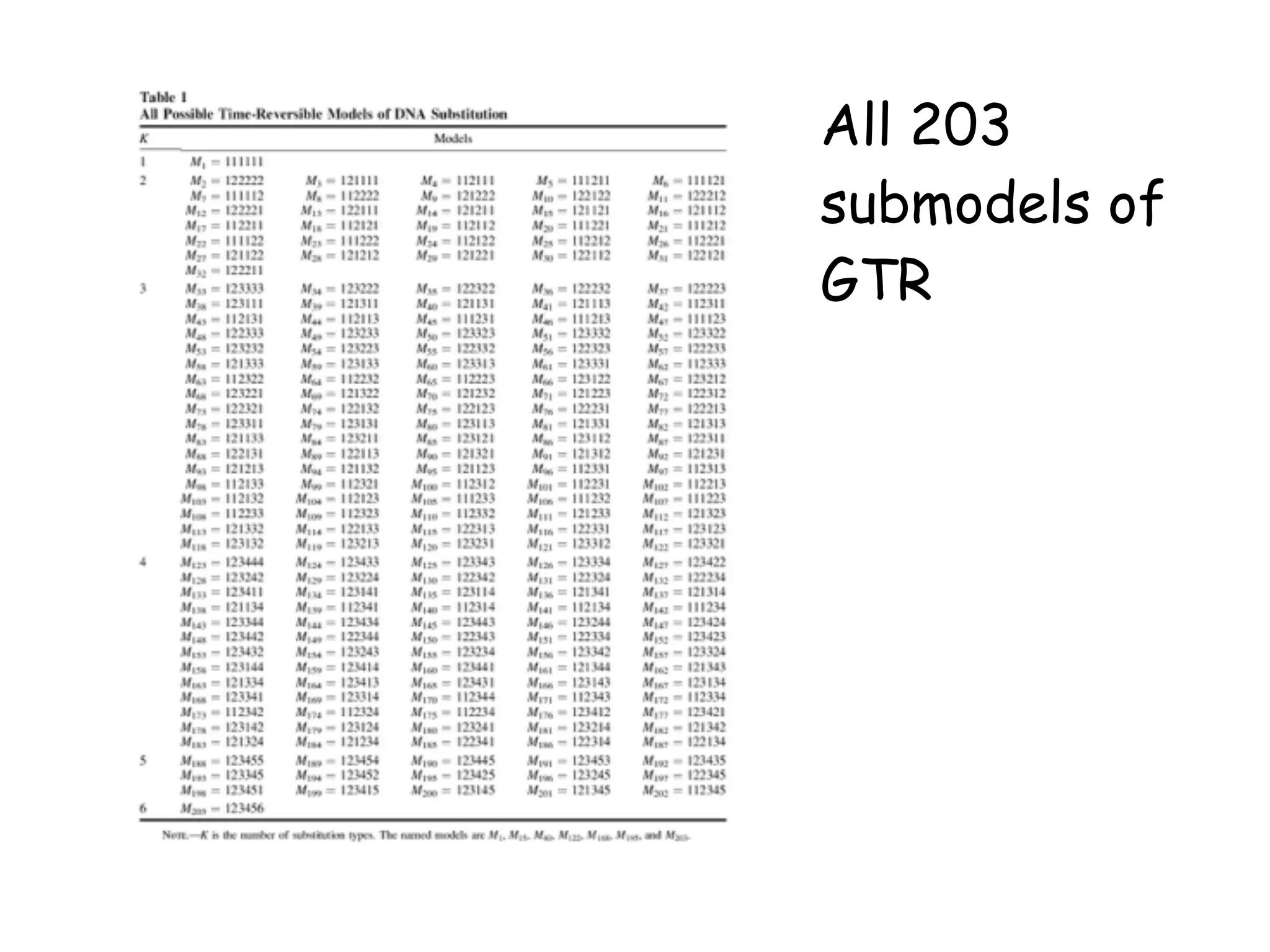
All 203
submodels of
GTR
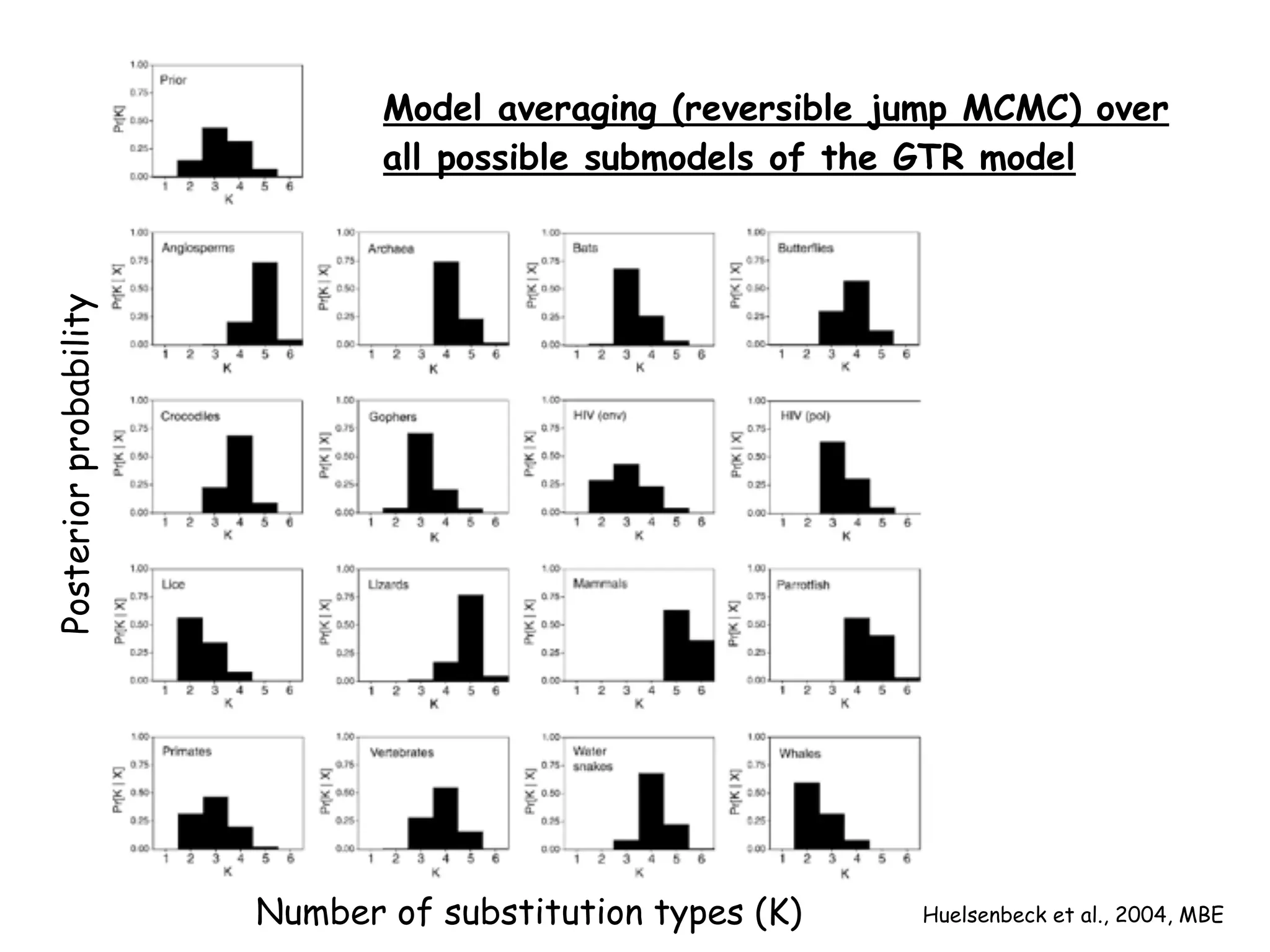
Number of substitution types (K)
Posteriorprobability
Model averaging (reversible jump MCMC) over
all possible submodels of the GTR model
Huelsenbeck et al., 2004, MBE
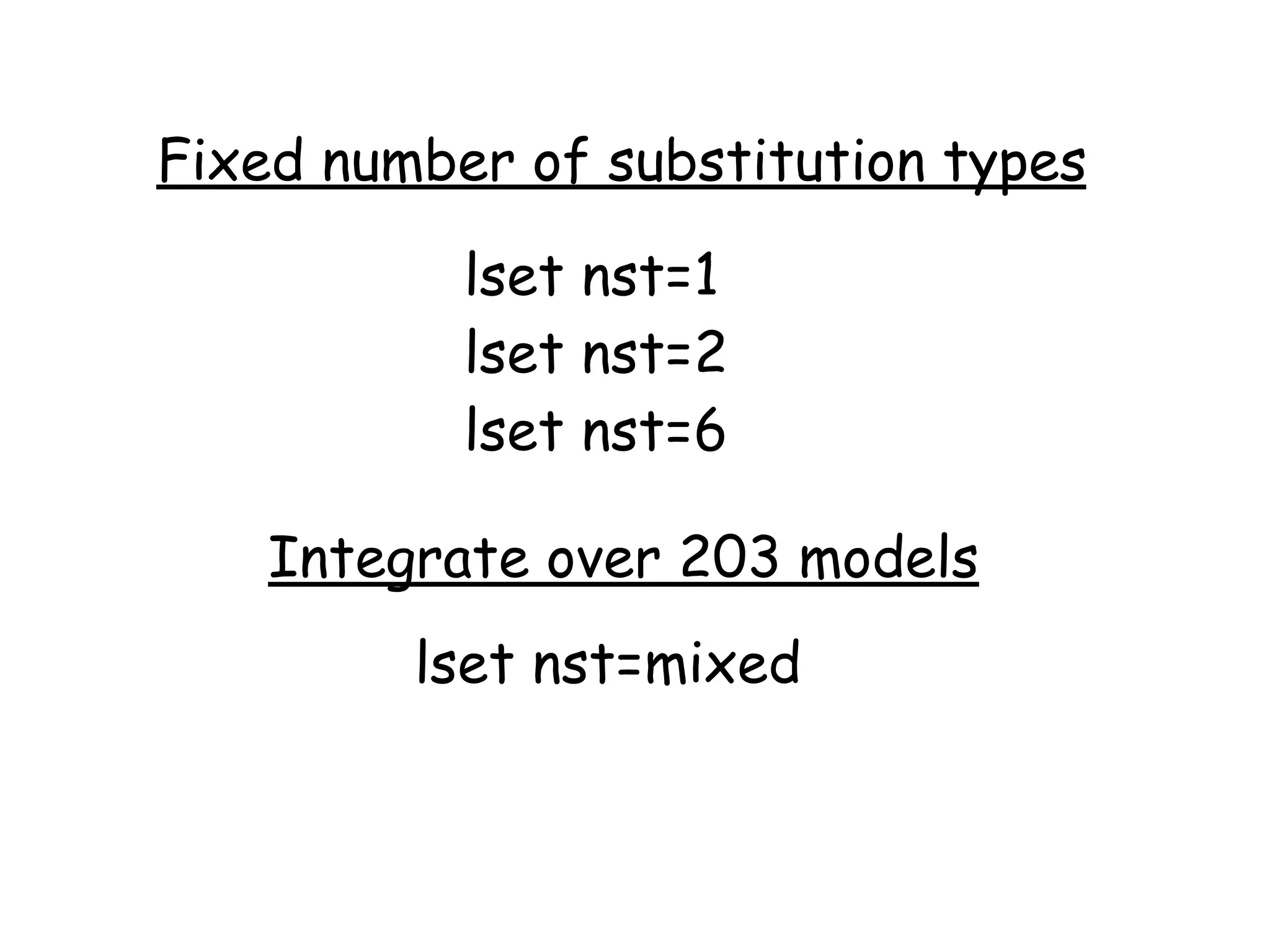
lset nst=1
lset nst=2
lset nst=6
Fixed number of substitution types
lset nst=mixed
Integrate over 203 models
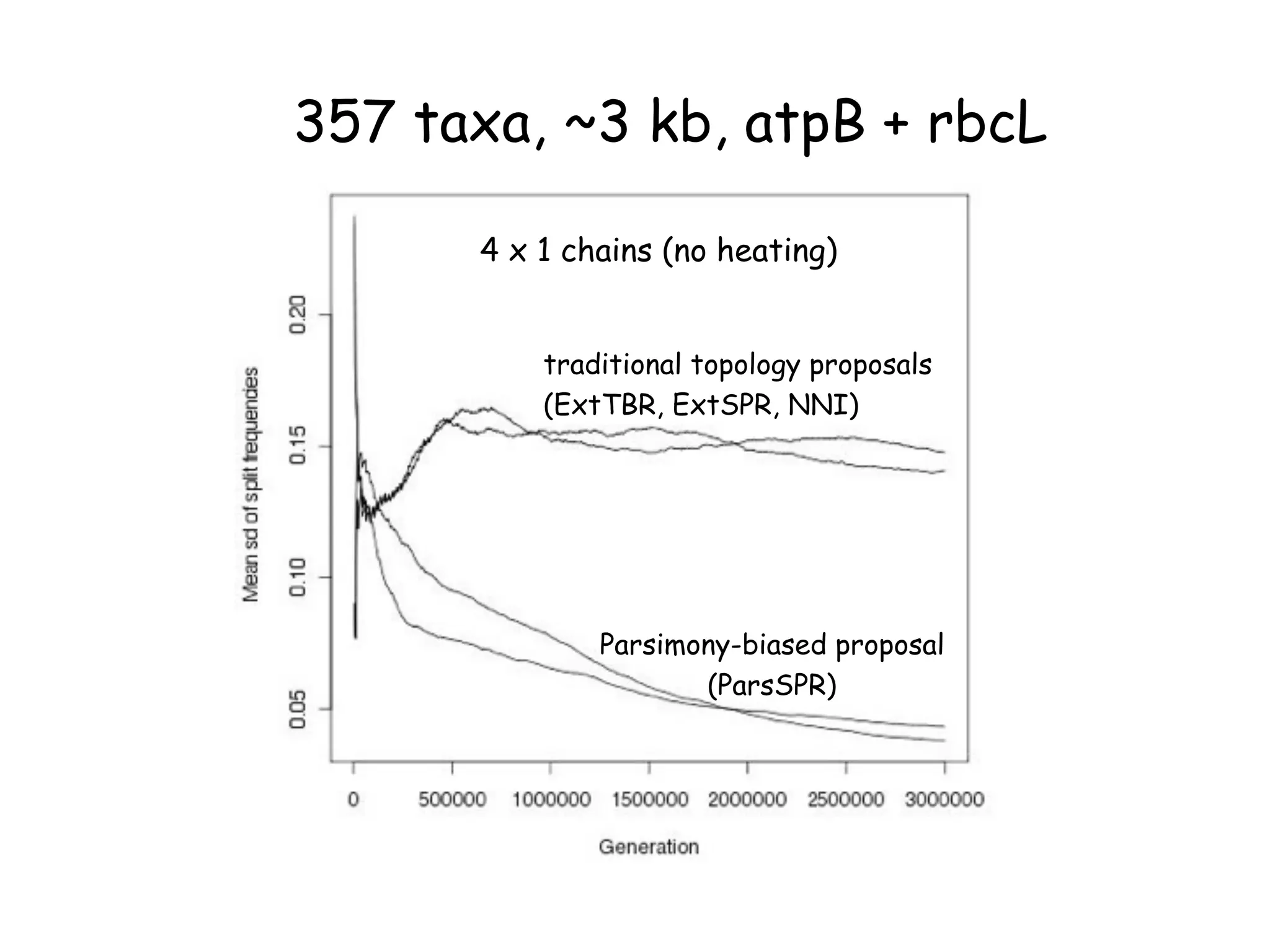
357 taxa, ~3 kb, atpB + rbcL
4 x 1 chains (no heating)
traditional topology proposals
(ExtTBR, ExtSPR, NNI)
Parsimony-biased proposal
(ParsSPR)
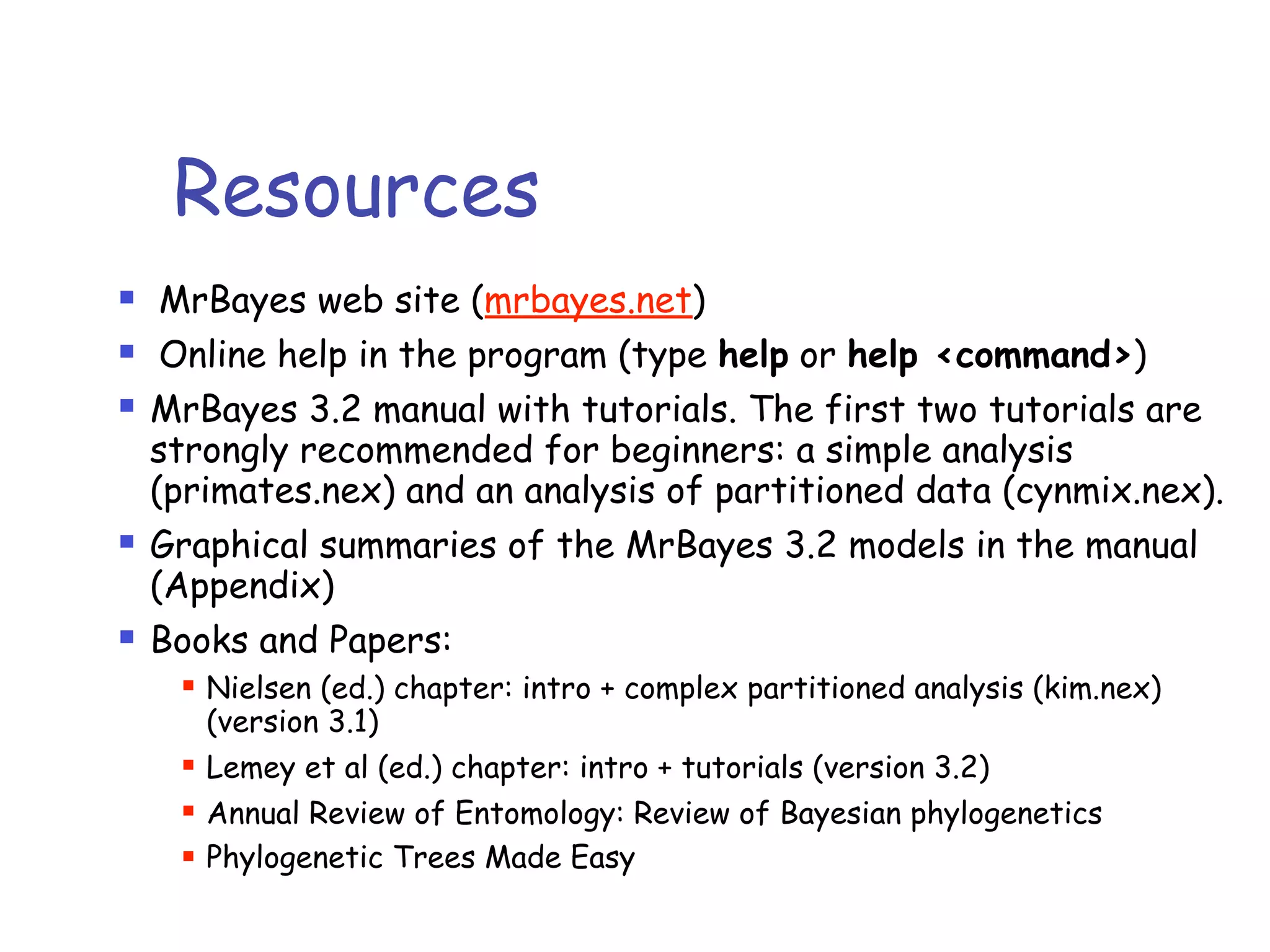
Resources
! MrBayes web site (mrbayes.net)
! Online help in the program (type help or help <command>)
! MrBayes 3.2 manual with tutorials. The first two tutorials are
strongly recommended for beginners: a simple analysis
(primates.nex) and an analysis of partitioned data (cynmix.nex).
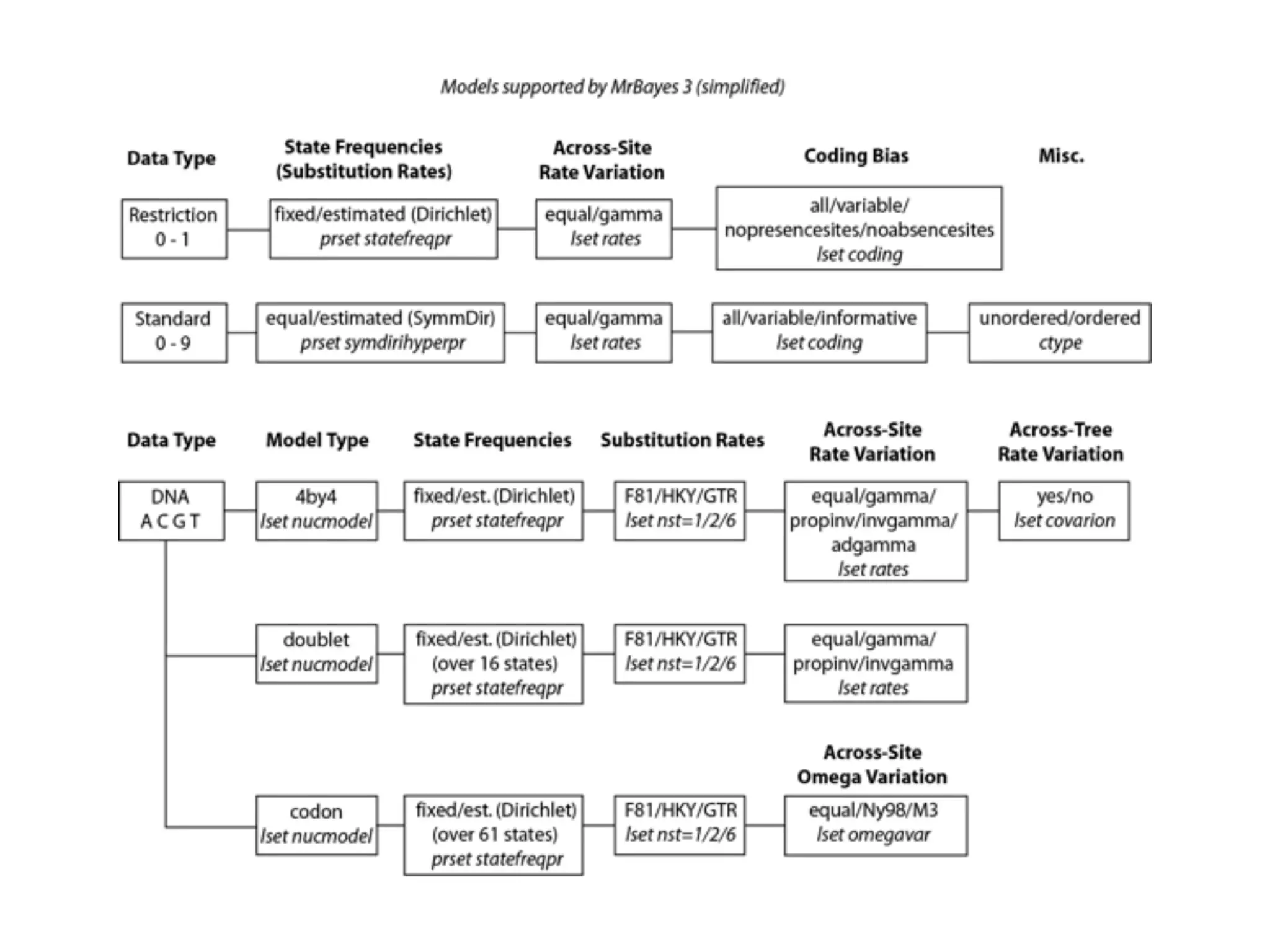
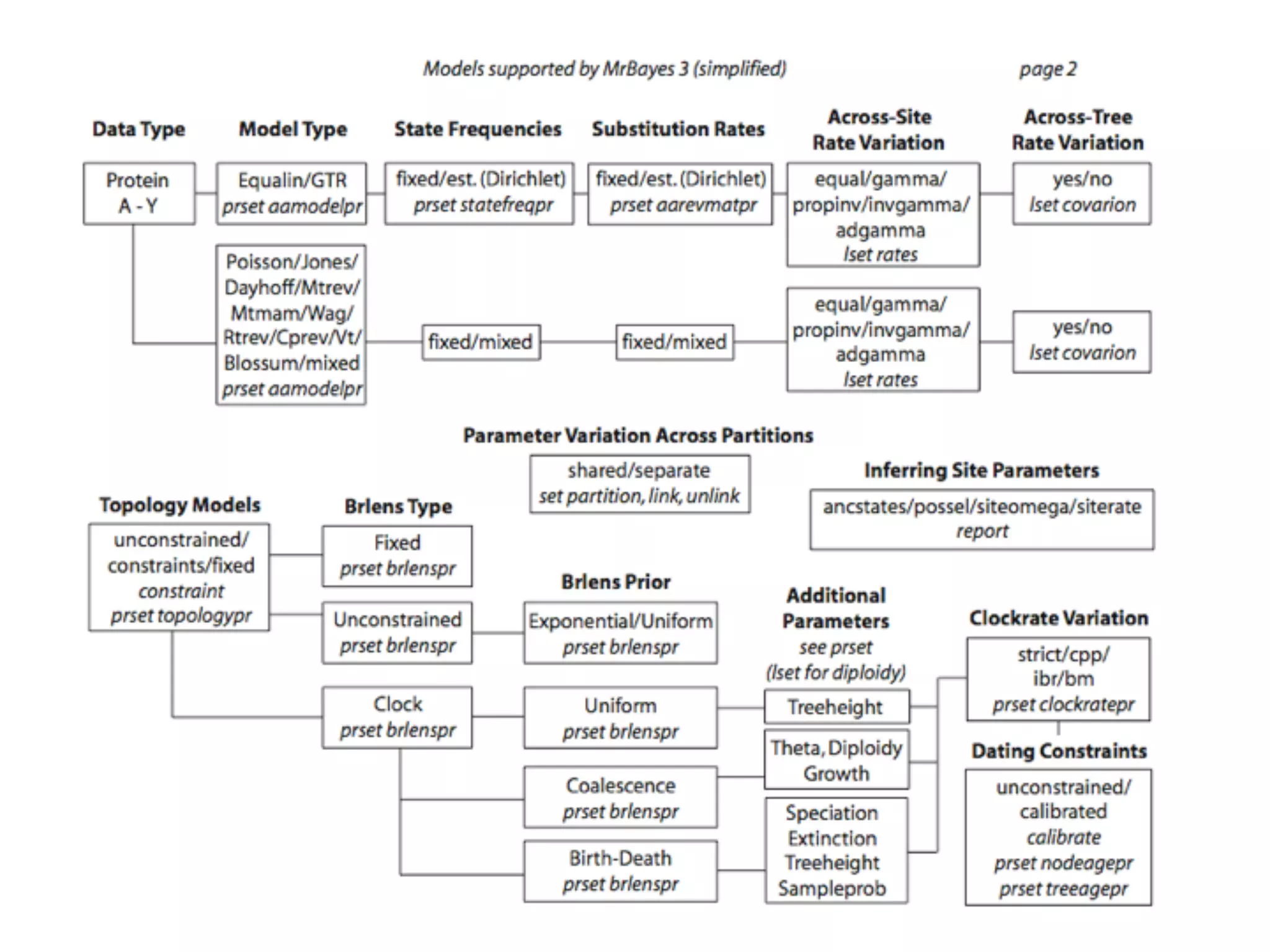
! Graphical summaries of the MrBayes 3.2 models in the manual
(Appendix)
! Books and Papers:
! Nielsen (ed.) chapter: intro + complex partitioned analysis (kim.nex)
(version 3.1)
! Lemey et al (ed.) chapter: intro + tutorials (version 3.2)
! Annual Review of Entomology: Review of Bayesian phylogenetics
! Phylogenetic Trees Made Easy
Some Advice
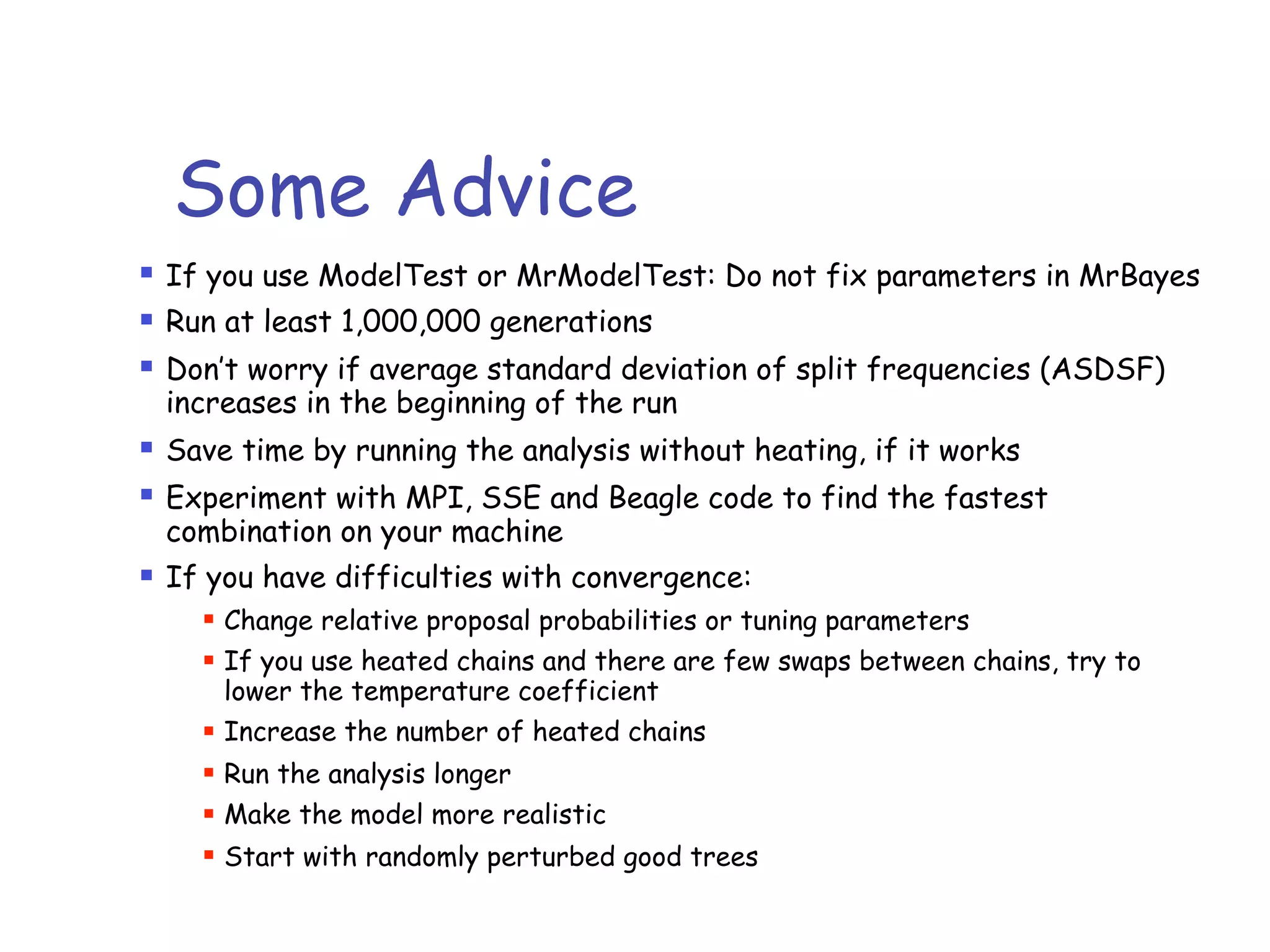
! If you use ModelTest or MrModelTest: Do not fix parameters in MrBayes
! Run at least 1,000,000 generations
! Don’t worry if average standard deviation of split frequencies (ASDSF)
increases in the beginning of the run
! Save time by running the analysis without heating, if it works
! Experiment with MPI, SSE and Beagle code to find the fastest
combination on your machine
! If you have difficulties with convergence:
! Change relative proposal probabilities or tuning parameters
! If you use heated chains and there are few swaps between chains, try to
lower the temperature coefficient
! Increase the number of heated chains
! Run the analysis longer
! Make the model more realistic
! Start with randomly perturbed good trees

MrBayes_intro_big4ws_2016-10-10

  • 1.
    Introduction to MrBayes Fred(rik)Ronquist Dept. Bioinformatics and Genetics Swedish Museum of Natural History, Stockholm, Sweden
  • 2.
    Installing MrBayes ! Twooptions: ! Go to mrbayes.net, click Download and follow the instructions to download the current release (3.2.6) ! OR go to https://github.com/ NBISweden/MrBayes/releases to download the prerelease of the next version (3.2.7) (but you have to compile this yourself on your machine)
  • 3.
    Running MrBayes ! Useexecute to bring data in a Nexus file into MrBayes ! Set the model and priors using lset and prset ! Run the chain using mcmc; results in a set of .p and .t files ! The .t files contain tree samples in Nexus format ! The .p files contain tab-delimited samples of the model parameters ! Summarize the parameter samples using sump ! Summarize the tree samples using sumt
  • 4.
    Convergence Diagnostics ! Bydefault, MrBayes performs two independent analyses starting from different random trees (mcmc nruns=2) ! Average standard deviation of split frequencies calculated and presented during the run (mcmc mcmcdiagn=yes diagnfreq=5000) and written to file (.mcmc). Suggested target < 0.05. ! Standard deviation of each clade frequency and potential scale reduction for branch lengths calculated with sumt ! Potential scale reduction calculated for all substitution model parameters with sump ! Other tools: Awty and Tracer
  • 5.
    Files output byMrBayes During an mcmc run myfile.mcmc Mcmc run diagnostics myfile.run1.p Parameter samples myfile.run2.p - ” - myfile.run1.t Tree samples myfile.run2.t - “ - After sump myfile.pstat Parameter statistics myfile.lstat Model likelihood estimates After sumt myfile.con.tre Consensus tree (FigTree fmt by def) myfile.trprobs Sampled trees and their probabilities myfile.parts Specification of clades or splits myfile.tstat Tree statistics myfile.vstat Branch length statistics
  • 6.
    MrBayes 3.2 additions !Use combinations of hard, negative, and partial (backbone) constraints on topologies ! Relaxed clocks and dating ! Multi-species coalescent (the BEST model) ! Model jumping across the GTR subspace ! Estimate Bayes factors using stepping-stone sampling ! New tree proposals ! Faster likelihood calculation
  • 7.
    Substitution Model Space πstate frequencies r exchangeability rates GTR model parameters π = {πA, πC, πG, πT } r = {rAC, rAG, rAT, rCG, rCT, rGT } r = {rAC, rAG, rAT, rCG, rCT, rGT } r = {rtv, rti, rtv, rtv, rti, rtv } r = {r, r, r, r, r, r } Model Rate vector Restr. Growth Fxn K {1,2,3,4,5,6} {1,2,1,1,2,1} {1,1,1,1,1,1} 6 2 1 GTR HKY F81
  • 8.
  • 9.
    Number of substitutiontypes (K) Posteriorprobability Model averaging (reversible jump MCMC) over all possible submodels of the GTR model Huelsenbeck et al., 2004, MBE
  • 10.
    lset nst=1 lset nst=2 lsetnst=6 Fixed number of substitution types lset nst=mixed Integrate over 203 models
  • 11.
    357 taxa, ~3kb, atpB + rbcL 4 x 1 chains (no heating) traditional topology proposals (ExtTBR, ExtSPR, NNI) Parsimony-biased proposal (ParsSPR)
  • 12.
    Resources ! MrBayes website (mrbayes.net) ! Online help in the program (type help or help <command>) ! MrBayes 3.2 manual with tutorials. The first two tutorials are strongly recommended for beginners: a simple analysis (primates.nex) and an analysis of partitioned data (cynmix.nex). ! Graphical summaries of the MrBayes 3.2 models in the manual (Appendix) ! Books and Papers: ! Nielsen (ed.) chapter: intro + complex partitioned analysis (kim.nex) (version 3.1) ! Lemey et al (ed.) chapter: intro + tutorials (version 3.2) ! Annual Review of Entomology: Review of Bayesian phylogenetics ! Phylogenetic Trees Made Easy
  • 15.
    Some Advice ! Ifyou use ModelTest or MrModelTest: Do not fix parameters in MrBayes ! Run at least 1,000,000 generations ! Don’t worry if average standard deviation of split frequencies (ASDSF) increases in the beginning of the run ! Save time by running the analysis without heating, if it works ! Experiment with MPI, SSE and Beagle code to find the fastest combination on your machine ! If you have difficulties with convergence: ! Change relative proposal probabilities or tuning parameters ! If you use heated chains and there are few swaps between chains, try to lower the temperature coefficient ! Increase the number of heated chains ! Run the analysis longer ! Make the model more realistic ! Start with randomly perturbed good trees