Tuesday, May 10, 2016CENTER OF EARTH AND ENVIRONMENTAL SCIENCES, UNIVERSITY OF THE PUNJAB 1
Presenter: Atiqa Ijaz Khan
Advisor: Prof. Dr. Sajid Rashid Ahmed
M.Sc. (Pb), M.Sc. (Canada), Ph.D. (Canada)
Co-supervisor: Dr. M.Hassan Ali Baig
M.Sc. (China) Ph. D (China)
Presented To: M.Phil. Geomatics Thesis Committee, CEES,
University of the Punjab.
Dated: Tuesday, May 10, 2016
M.PHIL. GEOMATICS DEFENSE
Application of TCT as a Remote Sensing
Change Detection Technique: A
Temporal Case Study of Lahore District -
Pakistan
AGENDA
• Objectives Of This Study
• What Others Have Done?
• Study Area For Research
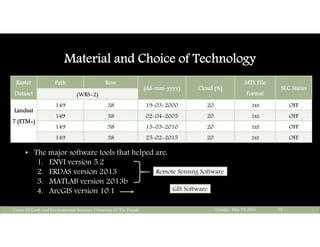
• Material and Choice of Technology
• Methodology
• Results and Major Findings
• Recommendations
• References
Tuesday, May 10, 2016Center of Earth and Environmental Sciences, University of the Punjab 3
Description Of Problem That Lead To
Research
 Not a single research has been conducted on this topic in Pakistan
 Used as an initial input for many advance techniques like machine
learning. Including:
 SVM (Support Vector Machine)
 RF Classifiers (Radom Forest)
 ANN (Artificial Neural Network)
 Also along with PCA (Principal Component Analysis) and CVA (Change
Vector Analysis).
Tuesday, May 10, 2016Center of Earth and Environmental Sciences, University of the Punjab 4
Objectives Of This Study
 My aim is to check the accuracy of Tasseled Cap over a “Highly
Populated” area using its counter techniques, like:
1. Greenness component with NDVI (Normalized Difference
Vegetation Index)
2. Brightness component with BI (Bare Soil Index)
3. And to find any relation between Brightness component with
urbanization trend.
Tuesday, May 10, 2016Center Of Earth And Environmental Sciences, University Of The Punjab 5
What Others Have Done?
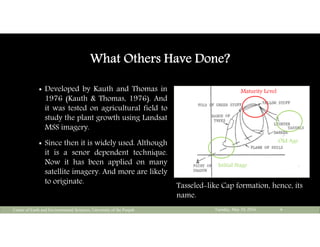
 Developed by Kauth and Thomas in
1976 (Kauth & Thomas, 1976). And
it was tested on agricultural field to
study the plant growth using Landsat
MSS imagery.
 Since then it is widely used. Although
it is a senor dependent technique.
Now it has been applied on many
satellite imagery. And more are likely
to originate.
Tuesday, May 10, 2016Center of Earth and Environmental Sciences, University of the Punjab 6
Tasseled-like Cap formation, hence, its
name.
Maturity Level
Initial Stage
Old Age
Tuesday, May 10, 2016Center Of Earth And Environmental Sciences, University Of The Punjab 7
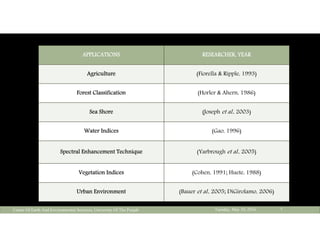
APPLICATIONS RESEARCHER, YEAR
Agriculture (Fiorella & Ripple, 1993)
Forest Classification (Horler & Ahern, 1986)
Sea Shore (Joseph et al., 2003)
Water Indices (Gao, 1996)
Spectral Enhancement Technique (Yarbrough et al., 2005)
Vegetation Indices (Cohen, 1991; Huete, 1988)
Urban Environment (Bauer et al., 2005; DiGirolamo, 2006)
Tuesday, May 10, 2016Center Of Earth And Environmental Sciences, University Of The Punjab 8
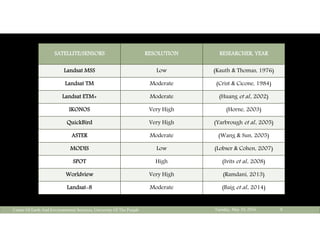
SATELLITE/SENSORS RESOLUTION RESEARCHER, YEAR
Landsat MSS Low (Kauth & Thomas, 1976)
Landsat TM Moderate (Crist & Cicone, 1984)
Landsat ETM+ Moderate (Huang et al., 2002)
IKONOS Very High (Horne, 2003)
QuickBird Very High (Yarbrough et al., 2005)
ASTER Moderate (Wang & Sun, 2005)
MODIS Low (Lobser & Cohen, 2007)
SPOT High (Ivits et al., 2008)
Worldview Very High (Ramdani, 2013)
Landsat-8 Moderate (Baig et al., 2014)
Study Area For Research
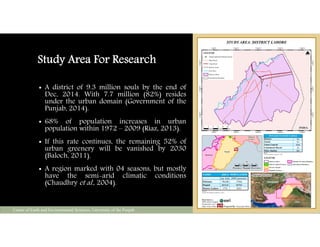
 A district of 9.3 million souls by the end of
Dec, 2014. With 7.7 million (82%) resides
under the urban domain (Government of the
Punjab, 2014).
 68% of population increases in urban
population within 1972 – 2009 (Riaz, 2013).
 If this rate continues, the remaining 52% of
urban greenery will be vanished by 2030
(Baloch, 2011).
 A region marked with 04 seasons, but mostly
have the semi-arid climatic conditions
(Chaudhry et al., 2004).
Tuesday, May 10, 2016Center of Earth and Environmental Sciences, University of the Punjab 9
[·
74°40'0"E
74°40'0"E
74°30'0"E
74°30'0"E
74°20'0"E
74°20'0"E
74°10'0"E
74°10'0"E
74°0'0"E
74°0'0"E
31°40'0"N
31°40'0"N
31°30'0"N
31°30'0"N
31°20'0"N
31°20'0"N
STUDYAREA: DISTRICT LAHORE
Balochistan
Fata
KPK
Sindh
AJK
Disputed
Territory
Punjab
Source:
Punjab Development Statistics, 2014
Data Sources:
ESRI Online Imagery
Nespak (pvt) Ltd.
Open Source Data
μ
LEGEND
[· Allama Iqbal International Airport
Major Road
Trunk Road
Railway Track
River Ravi
District Lahore
International Boundary
LEGEND
District Lahore
Federal Capital Territory
Province Punjab
Disputed Territory
Pakistan Provincial Boundary
International Boundary
INDIA0 4 8 12 16 20
km
0 100 200 300 400 500
km
Province Punjab Overview
Pakistan Overview
N
AFGHANISTAN
INDIA
CHINA
Prepared By: Atiqa Ijaz Khan
μNAME AREA POPULATION
(sq. km) (000' persons)
Pakistan 796100 17956
Punjab 205345 99794
District Lahore 1772 9253
Districts 36
Tehsils 141
Union Councils 3646
Cantonment Boards 20
Police Stations 708
PUNJAB STATITICS (2014)
Source:
Punjab Development Statistics, 2014
Material and Choice of Technology
Tuesday, May 10, 2016Center Of Earth And Environmental Sciences, University Of The Punjab 10
Raster
Dataset
Path Row
(dd-mm-yyyy) Cloud (%)
MTL File
Format
SLC Status
(WRS-2)
Landsat
7 (ETM+)
149 38 19-03-2000 20 .txt OFF
149 38 02-04-2005 20 .txt OFF
149 38 15-03-2010 20 .txt OFF
149 38 25-02-2015 20 .txt OFF
• The major software tools that helped are:
1. ENVI version 5.2
2. ERDAS version 2013
3. MATLAB version 2013b
4. ArcGIS version 10.1
Remote Sensing Software
GIS Software
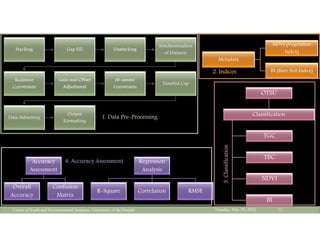
METHODOLOGY
Tuesday, May 10, 2016Center Of Earth And Environmental Sciences, University Of The Punjab 11
Tuesday, May 10, 2016Center of Earth and Environmental Sciences, University of the Punjab 12
Stacking Gap Fill Unstacking
Synchronization
of Datasets
Radiance
Conversion
Gain and Offset
Adjustment
At-sensor
Conversion
Tasseled Cap
Data Subsetting
Output
Formatting
Metadata
NDVI (Vegetation
Index)
BI (Bare Soil Index)
OTSU
Classification
TGC
TBC
NDVI
BI
Accuracy
Assessment
Overall
Accuracy
Confusion
Matrix
Regression
Analysis
R-Square Correlation RMSE
1. Data Pre-Processing
4. Accuracy Assessment
3.Classification
2. Indices
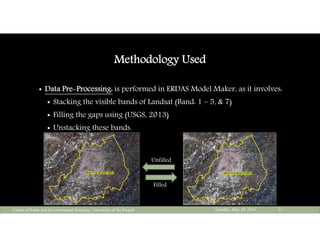
Methodology Used
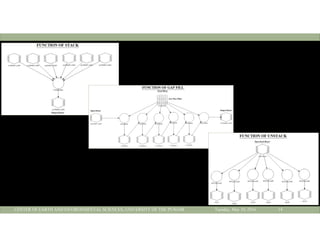
 Data Pre-Processing: is performed in ERDAS Model Maker, as it involves:
 Stacking the visible bands of Landsat (Band: 1 – 5, & 7)
 Filling the gaps using (USGS, 2013)
 Unstacking these bands.
Tuesday, May 10, 2016Center of Earth and Environmental Sciences, University of the Punjab 13
Unfilled
Filled
Tuesday, May 10, 2016CENTER OF EARTH AND ENVIRONMENTAL SCIENCES, UNIVERSITY OF THE PUNJAB 14
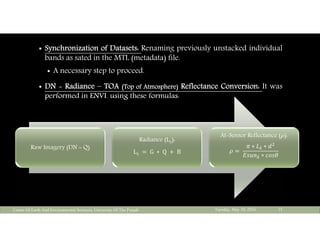
 Synchronization of Datasets: Renaming previously unstacked individual
bands as sated in the MTL (metadata) file.
 A necessary step to proceed.
 DN - Radiance – TOA (Top of Atmosphere) Reflectance Conversion: It was
performed in ENVI. using these formulas:
Tuesday, May 10, 2016Center Of Earth And Environmental Sciences, University Of The Punjab 15
Raw Imagery (DN = Q)
Radiance (Lλ):
Lλ	 	G	 ∗ 	Q	 	B
At-Sensor Reflectance ( ):
	
∗ ∗
∗
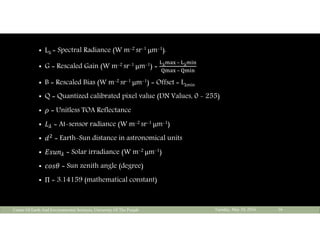
 Lλ = Spectral Radiance (W m-2 sr-1 μm-1).
 G = Rescaled Gain (W m-2 sr-1 μm-1) = λ 	–	 λ
	–	
 B = Rescaled Bias (W m-2 sr-1 μm-1) = Offset = Lλmin
 Q = Quantized calibrated pixel value (DN Values, 0 - 255)
 = Unitless TOA Reflectance
 = At-sensor radiance (W m-2 sr-1 μm-1)
 = Earth-Sun distance in astronomical units
 = Solar irradiance (W m-2 μm-1)
 = Sun zenith angle (degree)
 Π = 3.14159 (mathematical constant)
Tuesday, May 10, 2016Center Of Earth And Environmental Sciences, University Of The Punjab 16
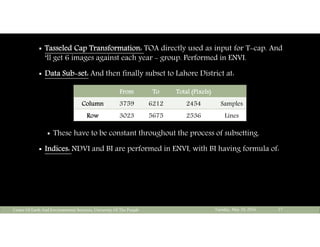
 Tasseled Cap Transformation: TOA directly used as input for T-cap. And
‘ll get 6 images against each year - group. Performed in ENVI.
 Data Sub-set: And then finally subset to Lahore District at:
 These have to be constant throughout the process of subsetting.
 Indices: NDVI and BI are performed in ENVI, with BI having formula of:
Tuesday, May 10, 2016Center Of Earth And Environmental Sciences, University Of The Punjab 17
From To Total (Pixels)
Column 3759 6212 2454 Samples
Row 3023 5675 2536 Lines
 Classification: Initial values were estimated through OTSU algorithm in
MATLAB. These estimated values were then tested visually against each
other in 10 pairs of range.
 Accuracy Assessment: Accuracy was assessed by confusion matrix. It
was performed in ENVI.
 Regression Analysis: It includes Co-efficient of determination (R-
Square), RMSE (Root Mean Square Error), and Correlation. It was
performed in MATLAB.
Tuesday, May 10, 2016Center Of Earth And Environmental Sciences, University Of The Punjab 18
RESULTS AND MAJOR FINDINGS
Tuesday, May 10, 2016Center Of Earth And Environmental Sciences, University Of The Punjab 19
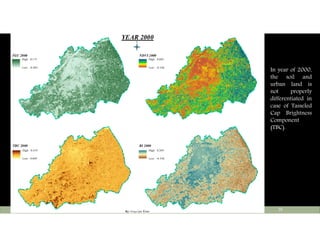
TGC 2000
TBC 2000
NDVI 2000
BI 2000
High : 0.173
Low : -0.083
High : 0.419
Low : 0.049
High : 0.602
Low : -0.546
High : 0.269
Low : -0.356
YEAR 2000
Ü
By:Atiqa Ijaz Khan
Tuesday, May 10, 2016Center Of Earth And Environmental Sciences, University Of The Punjab 20
In year of 2000,
the soil and
urban land is
not properly
differentiated in
case of Tasseled
Cap Brightness
Component
(TBC).
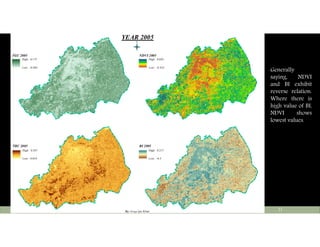
TGC 2005
TBC 2005
NDVI 2005
BI 2005
High : 0.173
Low : -0.083
High : 0.587
Low : 0.054
High : 0.692
Low : -0.425
High : 0.217
Low : -0.5
YEAR 2005
Ü
By:Atiqa Ijaz Khan
Tuesday, May 10, 2016Center Of Earth And Environmental Sciences, University Of The Punjab 21
Generally
saying, NDVI
and BI exhibit
reverse relation.
Where there is
high value of BI,
NDVI shows
lowest values.
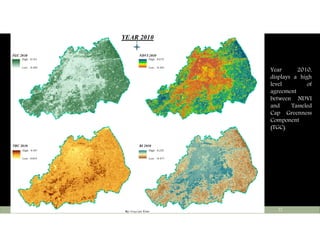
TGC 2010
TBC 2010
NDVI 2010
BI 2010
High : 0.161
Low : -0.095
High : 0.587
Low : 0.054
High : 0.679
Low : -0.401
High : 0.229
Low : -0.477
YEAR 2010
Ü
By:Atiqa Ijaz Khan
Tuesday, May 10, 2016Center Of Earth And Environmental Sciences, University Of The Punjab 22
Year 2010,
displays a high
level of
agreement
between NDVI
and Tasseled
Cap Greenness
Component
(TGC).
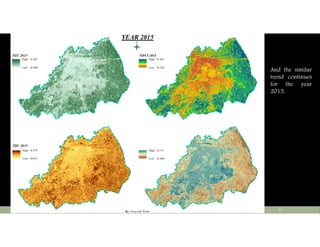
TGC 2015
TBC 2015
NDVI 2015
High : 0.160
Low : -0.098
High : 0.570
Low : 0.039
High : 0.765
Low : -0.224
High : 0.141
Low : -0.606
YEAR 2015
Ü
By:Atiqa Ijaz Khan
Tuesday, May 10, 2016Center Of Earth And Environmental Sciences, University Of The Punjab 23
And the similar
trend continues
for the year
2015.
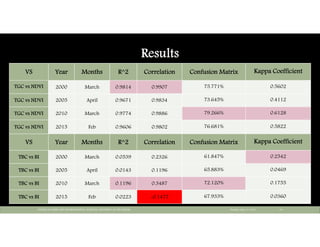
Results
Tuesday, May 10, 2016CENTER OF EARTH AND ENVIRONMENTAL SCIENCES, UNIVERSITY OF THE PUNJAB 24
VS Year Months R^2 Correlation Confusion Matrix Kappa Coefficient
TGC vs NDVI 2000 March 0.9814 0.9907 75.771% 0.5602
TGC vs NDVI 2005 April 0.9671 0.9834 73.645% 0.4112
TGC vs NDVI 2010 March 0.9774 0.9886 79.266% 0.6128
TGC vs NDVI 2015 Feb 0.9606 0.9802 76.681% 0.5822
VS Year Months R^2 Correlation Confusion Matrix Kappa Coefficient
TBC vs BI 2000 March 0.0539 0.2326 61.847% 0.2542
TBC vs BI 2005 April 0.0143 0.1196 65.883% 0.0469
TBC vs BI 2010 March 0.1196 0.3487 72.120% 0.1755
TBC vs BI 2015 Feb 0.0223 -0.1477 67.933% 0.0360
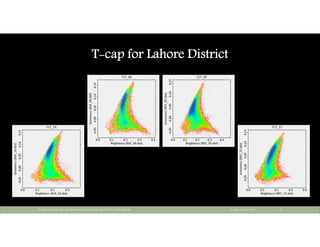
T-cap for Lahore District
Tuesday, May 10, 2016CENTER OF EARTH AND ENVIRONMENTAL SCIENCES, UNIVERSITY OF THE PUNJAB 25
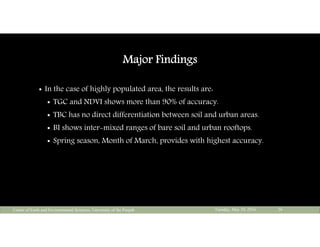
Major Findings
 In the case of highly populated area, the results are:
 TGC and NDVI shows more than 90% of accuracy.
 TBC has no direct differentiation between soil and urban areas.
 BI shows inter-mixed ranges of bare soil and urban rooftops.
 Spring season, Month of March, provides with highest accuracy.
Tuesday, May 10, 2016Center of Earth and Environmental Sciences, University of the Punjab 26
Tuesday, May 10, 2016Center Of Earth And Environmental Sciences, University Of The Punjab 27
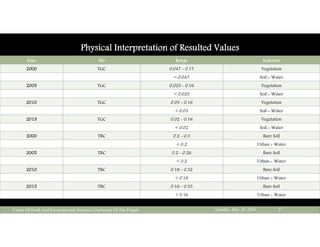
Year File Range Indicator
2000 TGC 0.047 - 0.17 Vegetation
< 0.047 Soil + Water
2005 TGC 0.025 - 0.16 Vegetation
< 0.025 Soil + Water
2010 TGC 0.03 - 0.16 Vegetation
< 0.03 Soil + Water
2015 TGC 0.02 - 0.16 Vegetation
< 0.02 Soil + Water
2000 TBC 0.2 - 0.3 Bare Soil
< 0.2 Urban + Water
2005 TBC 0.2 - 0.26 Bare Soil
< 0.2 Urban + Water
2010 TBC 0.18 - 0.32 Bare Soil
< 0.18 Urban + Water
2015 TBC 0.16 - 0.33 Bare Soil
< 0.16 Urban + Water
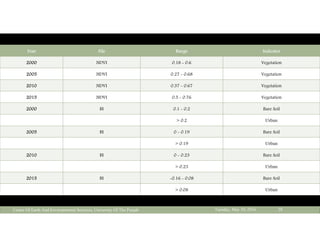
Physical Interpretation of Resulted Values
Year File Range Indicator
2000 NDVI 0.18 - 0.6 Vegetation
2005 NDVI 0.27 - 0.68 Vegetation
2010 NDVI 0.37 - 0.67 Vegetation
2015 NDVI 0.5 - 0.76 Vegetation
2000 BI 0.1 - 0.2 Bare Soil
> 0.2 Urban
2005 BI 0 - 0.19 Bare Soil
> 0.19 Urban
2010 BI 0 - 0.23 Bare Soil
> 0.23 Urban
2015 BI -0.16 - 0.08 Bare Soil
> 0.08 Urban
Tuesday, May 10, 2016Center Of Earth And Environmental Sciences, University Of The Punjab 28
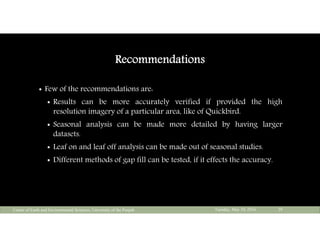
Recommendations
 Few of the recommendations are:
 Results can be more accurately verified if provided the high
resolution imagery of a particular area, like of Quickbird.
 Seasonal analysis can be made more detailed by having larger
datasets.
 Leaf on and leaf off analysis can be made out of seasonal studies.
 Different methods of gap fill can be tested, if it effects the accuracy.
Tuesday, May 10, 2016Center of Earth and Environmental Sciences, University of the Punjab 29
References
1. Baig, M. H. A., Zhang, L., Shuai, T., & Tong, Q. (2014). Derivation of a Tasselled Cap Transformation
Based on Landsat 8 at-Satellite Reflectance. Remote Sensing Letters, 5(5), 423-431.
2. Baloch, A. A. (2011). Urbanization of Arable Land in Lahore City in Pakistan: A Case-Study.
Canadian Social Science, 7(4), P58-66.
3. Bauer, M., Loeffelholz, B., & Wilson, B. (2005). Estimation, Mapping and Change Analysis of
Impervious Surface Area by Landsat Remote Sensing. Paper presented at the Proceedings, Pecora 16
Conference.
4. Chaudhry, Q., Mahmood, A., Rasul, G., & Azfal, M. (2004). Agroclimatic Classification of Pakistan.
Science Vision, 9(3-4), 59-66.
5. Cohen, W. B. (1991). Response of Vegetation Indices to Changes in Three Measures of Leaf Water
Stress. Photogrammetric engineering and remote sensing (USA).
6. Crist, E. P., & Cicone, R. C. (1984). Application of the Tasseled Cap Concept to Simulated Thematic
Mapper Data(Transformation for Mss Crop and Soil Imagery). Photogrammetric Engineering and
Remote Sensing, 50, 343-352.
Tuesday, May 10, 2016Center Of Earth And Environmental Sciences, University Of The Punjab 30
7. DiGirolamo, P. A. (2006). A Comparison of Change Detection Methods in an Urban
Environment Using Landsat Tm and Etm+ Satellite Imagery: A Multi-Temporal, Multi-
Spectral Analysis of Gwinnett County, Ga 1991-2000.
8. Fiorella, M., & Ripple, W. J. (1993). Determining Successional Stage of Temperate
Coniferous Forests with Landsat Satellite Data. Photogrammetric Engineering and Remote
Sensing;(United States), 59(2).
9. Gao, B.-C. (1996). Ndwi—a Normalized Difference Water Index for Remote Sensing of
Vegetation Liquid Water from Space. Remote Sensing of Environment, 58(3), 257-266.
10. Government of the Punjab. (2014). Punjab Development Statistics. Lahore.
11. Horler, D., & Ahern, F. (1986). Forestry Information Content of Thematic Mapper Data.
International Journal of Remote Sensing, 7(3), 405-428.
12. Horne, J. H. (2003). A Tasseled Cap Transformation for Ikonos Images. Paper presented at
the ASPRS 2003 Annual conference proceedings.
13. Huang, C., Wylie, B., Yang, L., Homer, C., & Zylstra, G. (2002). Derivation of a Tasselled
Cap Transformation Based on Landsat 7 at-Satellite Reflectance. International Journal of
Remote Sensing, 23(8), 1741-1748.
Tuesday, May 10, 2016Center Of Earth And Environmental Sciences, University Of The Punjab 31
14. Huete, A. R. (1988). A Soil-Adjusted Vegetation Index (Savi). Remote Sensing of Environment, 25(3),
295-309.
15. Ivits, E., Lamb, A., Langar, F., Hemphill, S., & Koch, B. (2008). Orthogonal Transformation of
Segmented Spot5 Images. Photogrammetric Engineering & Remote Sensing, 74(11), 1351-1364.
16. Joseph, W. S., Laurence, R. M., William, M. H., & Mathew, D. R. (2003). Using the Landsat 7
Enhanced Thematic Mapper Tasseled Cap Transformation to Extract Shoreline (pp. 14). USA: U.S.
Geological Survey.
17. Kauth, R. J., & Thomas, G. S. (1976). The Tasselled Cap--a Graphic Description of the Spectral-
Temporal Development of Agricultural Crops as Seen by Landsat. Paper presented at the LARS
Symposia.
18. Lobser, S., & Cohen, W. (2007). Modis Tasselled Cap: Land Cover Characteristics Expressed through
Transformed Modis Data. International Journal of Remote Sensing, 28(22), 5079-5101.
19. Mellor, A., Haywood, A., Stone, C., & Jones, S. (2013). The Performance of Random Forests in an
Operational Setting for Large Area Sclerophyll Forest Classification. Remote Sensing, 5(6), 2838-
2856.
20. Ramdani, F. (2013). Extraction of Urban Vegetation in Highly Dense Urban Environment with
Application to Measure Inhabitants’ Satisfaction of Urban Green Space.
Tuesday, May 10, 2016Center Of Earth And Environmental Sciences, University Of The Punjab 32
21. Riaz, O. (2013). Urban Change Detection of Lahore (Pakistan) Using a
Time Series of Satellite Images since 1972. Asian journal of natural
and applied sciences, 2(4), 100-104.
22. USGS. (2013). Landsat 7 Slc-Off Gap-Filled Data Sources. Filling the
Gaps to use in Scientific Analysis. 2016, from
http://landsat.usgs.gov/sci_an.php#2
23. Wang, Y., & Sun, D. (2005). The Aster Tasseled Cap Interactive
Transformation Using Gramm-Schmidt Method. Paper presented at
the MIPPR 2005 SAR and Multispectral Image Processing.
24. Yarbrough, L. D., Easson, G., & Kuszmaul, J. S. (2005). Quickbird 2
Tasseled Cap Transform Coefficients: A Comparison of Derivation
Methods. Paper presented at the Pecora, Sioux Falls, South Dakota
Tuesday, May 10, 2016Center Of Earth And Environmental Sciences, University Of The Punjab 33
Tuesday, May 10, 2016Center Of Earth And Environmental Sciences, University Of The Punjab 34
₸ῌẽ ὲῆᶁ

M.Phil Geomatics Defense (10May2016)

  • 1.
    Tuesday, May 10,2016CENTER OF EARTH AND ENVIRONMENTAL SCIENCES, UNIVERSITY OF THE PUNJAB 1 Presenter: Atiqa Ijaz Khan Advisor: Prof. Dr. Sajid Rashid Ahmed M.Sc. (Pb), M.Sc. (Canada), Ph.D. (Canada) Co-supervisor: Dr. M.Hassan Ali Baig M.Sc. (China) Ph. D (China) Presented To: M.Phil. Geomatics Thesis Committee, CEES, University of the Punjab. Dated: Tuesday, May 10, 2016
  • 2.
    M.PHIL. GEOMATICS DEFENSE Applicationof TCT as a Remote Sensing Change Detection Technique: A Temporal Case Study of Lahore District - Pakistan
  • 3.
    AGENDA • Objectives OfThis Study • What Others Have Done? • Study Area For Research • Material and Choice of Technology • Methodology • Results and Major Findings • Recommendations • References Tuesday, May 10, 2016Center of Earth and Environmental Sciences, University of the Punjab 3
  • 4.
    Description Of ProblemThat Lead To Research  Not a single research has been conducted on this topic in Pakistan  Used as an initial input for many advance techniques like machine learning. Including:  SVM (Support Vector Machine)  RF Classifiers (Radom Forest)  ANN (Artificial Neural Network)  Also along with PCA (Principal Component Analysis) and CVA (Change Vector Analysis). Tuesday, May 10, 2016Center of Earth and Environmental Sciences, University of the Punjab 4
  • 5.
    Objectives Of ThisStudy  My aim is to check the accuracy of Tasseled Cap over a “Highly Populated” area using its counter techniques, like: 1. Greenness component with NDVI (Normalized Difference Vegetation Index) 2. Brightness component with BI (Bare Soil Index) 3. And to find any relation between Brightness component with urbanization trend. Tuesday, May 10, 2016Center Of Earth And Environmental Sciences, University Of The Punjab 5
  • 6.
    What Others HaveDone?  Developed by Kauth and Thomas in 1976 (Kauth & Thomas, 1976). And it was tested on agricultural field to study the plant growth using Landsat MSS imagery.  Since then it is widely used. Although it is a senor dependent technique. Now it has been applied on many satellite imagery. And more are likely to originate. Tuesday, May 10, 2016Center of Earth and Environmental Sciences, University of the Punjab 6 Tasseled-like Cap formation, hence, its name. Maturity Level Initial Stage Old Age
  • 7.
    Tuesday, May 10,2016Center Of Earth And Environmental Sciences, University Of The Punjab 7 APPLICATIONS RESEARCHER, YEAR Agriculture (Fiorella & Ripple, 1993) Forest Classification (Horler & Ahern, 1986) Sea Shore (Joseph et al., 2003) Water Indices (Gao, 1996) Spectral Enhancement Technique (Yarbrough et al., 2005) Vegetation Indices (Cohen, 1991; Huete, 1988) Urban Environment (Bauer et al., 2005; DiGirolamo, 2006)
  • 8.
    Tuesday, May 10,2016Center Of Earth And Environmental Sciences, University Of The Punjab 8 SATELLITE/SENSORS RESOLUTION RESEARCHER, YEAR Landsat MSS Low (Kauth & Thomas, 1976) Landsat TM Moderate (Crist & Cicone, 1984) Landsat ETM+ Moderate (Huang et al., 2002) IKONOS Very High (Horne, 2003) QuickBird Very High (Yarbrough et al., 2005) ASTER Moderate (Wang & Sun, 2005) MODIS Low (Lobser & Cohen, 2007) SPOT High (Ivits et al., 2008) Worldview Very High (Ramdani, 2013) Landsat-8 Moderate (Baig et al., 2014)
  • 9.
    Study Area ForResearch  A district of 9.3 million souls by the end of Dec, 2014. With 7.7 million (82%) resides under the urban domain (Government of the Punjab, 2014).  68% of population increases in urban population within 1972 – 2009 (Riaz, 2013).  If this rate continues, the remaining 52% of urban greenery will be vanished by 2030 (Baloch, 2011).  A region marked with 04 seasons, but mostly have the semi-arid climatic conditions (Chaudhry et al., 2004). Tuesday, May 10, 2016Center of Earth and Environmental Sciences, University of the Punjab 9 [· 74°40'0"E 74°40'0"E 74°30'0"E 74°30'0"E 74°20'0"E 74°20'0"E 74°10'0"E 74°10'0"E 74°0'0"E 74°0'0"E 31°40'0"N 31°40'0"N 31°30'0"N 31°30'0"N 31°20'0"N 31°20'0"N STUDYAREA: DISTRICT LAHORE Balochistan Fata KPK Sindh AJK Disputed Territory Punjab Source: Punjab Development Statistics, 2014 Data Sources: ESRI Online Imagery Nespak (pvt) Ltd. Open Source Data μ LEGEND [· Allama Iqbal International Airport Major Road Trunk Road Railway Track River Ravi District Lahore International Boundary LEGEND District Lahore Federal Capital Territory Province Punjab Disputed Territory Pakistan Provincial Boundary International Boundary INDIA0 4 8 12 16 20 km 0 100 200 300 400 500 km Province Punjab Overview Pakistan Overview N AFGHANISTAN INDIA CHINA Prepared By: Atiqa Ijaz Khan μNAME AREA POPULATION (sq. km) (000' persons) Pakistan 796100 17956 Punjab 205345 99794 District Lahore 1772 9253 Districts 36 Tehsils 141 Union Councils 3646 Cantonment Boards 20 Police Stations 708 PUNJAB STATITICS (2014) Source: Punjab Development Statistics, 2014
  • 10.
    Material and Choiceof Technology Tuesday, May 10, 2016Center Of Earth And Environmental Sciences, University Of The Punjab 10 Raster Dataset Path Row (dd-mm-yyyy) Cloud (%) MTL File Format SLC Status (WRS-2) Landsat 7 (ETM+) 149 38 19-03-2000 20 .txt OFF 149 38 02-04-2005 20 .txt OFF 149 38 15-03-2010 20 .txt OFF 149 38 25-02-2015 20 .txt OFF • The major software tools that helped are: 1. ENVI version 5.2 2. ERDAS version 2013 3. MATLAB version 2013b 4. ArcGIS version 10.1 Remote Sensing Software GIS Software
  • 11.
    METHODOLOGY Tuesday, May 10,2016Center Of Earth And Environmental Sciences, University Of The Punjab 11
  • 12.
    Tuesday, May 10,2016Center of Earth and Environmental Sciences, University of the Punjab 12 Stacking Gap Fill Unstacking Synchronization of Datasets Radiance Conversion Gain and Offset Adjustment At-sensor Conversion Tasseled Cap Data Subsetting Output Formatting Metadata NDVI (Vegetation Index) BI (Bare Soil Index) OTSU Classification TGC TBC NDVI BI Accuracy Assessment Overall Accuracy Confusion Matrix Regression Analysis R-Square Correlation RMSE 1. Data Pre-Processing 4. Accuracy Assessment 3.Classification 2. Indices
  • 13.
    Methodology Used  DataPre-Processing: is performed in ERDAS Model Maker, as it involves:  Stacking the visible bands of Landsat (Band: 1 – 5, & 7)  Filling the gaps using (USGS, 2013)  Unstacking these bands. Tuesday, May 10, 2016Center of Earth and Environmental Sciences, University of the Punjab 13 Unfilled Filled
  • 14.
    Tuesday, May 10,2016CENTER OF EARTH AND ENVIRONMENTAL SCIENCES, UNIVERSITY OF THE PUNJAB 14
  • 15.
     Synchronization ofDatasets: Renaming previously unstacked individual bands as sated in the MTL (metadata) file.  A necessary step to proceed.  DN - Radiance – TOA (Top of Atmosphere) Reflectance Conversion: It was performed in ENVI. using these formulas: Tuesday, May 10, 2016Center Of Earth And Environmental Sciences, University Of The Punjab 15 Raw Imagery (DN = Q) Radiance (Lλ): Lλ G ∗ Q B At-Sensor Reflectance ( ): ∗ ∗ ∗
  • 16.
     Lλ =Spectral Radiance (W m-2 sr-1 μm-1).  G = Rescaled Gain (W m-2 sr-1 μm-1) = λ – λ –  B = Rescaled Bias (W m-2 sr-1 μm-1) = Offset = Lλmin  Q = Quantized calibrated pixel value (DN Values, 0 - 255)  = Unitless TOA Reflectance  = At-sensor radiance (W m-2 sr-1 μm-1)  = Earth-Sun distance in astronomical units  = Solar irradiance (W m-2 μm-1)  = Sun zenith angle (degree)  Π = 3.14159 (mathematical constant) Tuesday, May 10, 2016Center Of Earth And Environmental Sciences, University Of The Punjab 16
  • 17.
     Tasseled CapTransformation: TOA directly used as input for T-cap. And ‘ll get 6 images against each year - group. Performed in ENVI.  Data Sub-set: And then finally subset to Lahore District at:  These have to be constant throughout the process of subsetting.  Indices: NDVI and BI are performed in ENVI, with BI having formula of: Tuesday, May 10, 2016Center Of Earth And Environmental Sciences, University Of The Punjab 17 From To Total (Pixels) Column 3759 6212 2454 Samples Row 3023 5675 2536 Lines
  • 18.
     Classification: Initialvalues were estimated through OTSU algorithm in MATLAB. These estimated values were then tested visually against each other in 10 pairs of range.  Accuracy Assessment: Accuracy was assessed by confusion matrix. It was performed in ENVI.  Regression Analysis: It includes Co-efficient of determination (R- Square), RMSE (Root Mean Square Error), and Correlation. It was performed in MATLAB. Tuesday, May 10, 2016Center Of Earth And Environmental Sciences, University Of The Punjab 18
  • 19.
    RESULTS AND MAJORFINDINGS Tuesday, May 10, 2016Center Of Earth And Environmental Sciences, University Of The Punjab 19
  • 20.
    TGC 2000 TBC 2000 NDVI2000 BI 2000 High : 0.173 Low : -0.083 High : 0.419 Low : 0.049 High : 0.602 Low : -0.546 High : 0.269 Low : -0.356 YEAR 2000 Ü By:Atiqa Ijaz Khan Tuesday, May 10, 2016Center Of Earth And Environmental Sciences, University Of The Punjab 20 In year of 2000, the soil and urban land is not properly differentiated in case of Tasseled Cap Brightness Component (TBC).
  • 21.
    TGC 2005 TBC 2005 NDVI2005 BI 2005 High : 0.173 Low : -0.083 High : 0.587 Low : 0.054 High : 0.692 Low : -0.425 High : 0.217 Low : -0.5 YEAR 2005 Ü By:Atiqa Ijaz Khan Tuesday, May 10, 2016Center Of Earth And Environmental Sciences, University Of The Punjab 21 Generally saying, NDVI and BI exhibit reverse relation. Where there is high value of BI, NDVI shows lowest values.
  • 22.
    TGC 2010 TBC 2010 NDVI2010 BI 2010 High : 0.161 Low : -0.095 High : 0.587 Low : 0.054 High : 0.679 Low : -0.401 High : 0.229 Low : -0.477 YEAR 2010 Ü By:Atiqa Ijaz Khan Tuesday, May 10, 2016Center Of Earth And Environmental Sciences, University Of The Punjab 22 Year 2010, displays a high level of agreement between NDVI and Tasseled Cap Greenness Component (TGC).
  • 23.
    TGC 2015 TBC 2015 NDVI2015 High : 0.160 Low : -0.098 High : 0.570 Low : 0.039 High : 0.765 Low : -0.224 High : 0.141 Low : -0.606 YEAR 2015 Ü By:Atiqa Ijaz Khan Tuesday, May 10, 2016Center Of Earth And Environmental Sciences, University Of The Punjab 23 And the similar trend continues for the year 2015.
  • 24.
    Results Tuesday, May 10,2016CENTER OF EARTH AND ENVIRONMENTAL SCIENCES, UNIVERSITY OF THE PUNJAB 24 VS Year Months R^2 Correlation Confusion Matrix Kappa Coefficient TGC vs NDVI 2000 March 0.9814 0.9907 75.771% 0.5602 TGC vs NDVI 2005 April 0.9671 0.9834 73.645% 0.4112 TGC vs NDVI 2010 March 0.9774 0.9886 79.266% 0.6128 TGC vs NDVI 2015 Feb 0.9606 0.9802 76.681% 0.5822 VS Year Months R^2 Correlation Confusion Matrix Kappa Coefficient TBC vs BI 2000 March 0.0539 0.2326 61.847% 0.2542 TBC vs BI 2005 April 0.0143 0.1196 65.883% 0.0469 TBC vs BI 2010 March 0.1196 0.3487 72.120% 0.1755 TBC vs BI 2015 Feb 0.0223 -0.1477 67.933% 0.0360
  • 25.
    T-cap for LahoreDistrict Tuesday, May 10, 2016CENTER OF EARTH AND ENVIRONMENTAL SCIENCES, UNIVERSITY OF THE PUNJAB 25
  • 26.
    Major Findings  Inthe case of highly populated area, the results are:  TGC and NDVI shows more than 90% of accuracy.  TBC has no direct differentiation between soil and urban areas.  BI shows inter-mixed ranges of bare soil and urban rooftops.  Spring season, Month of March, provides with highest accuracy. Tuesday, May 10, 2016Center of Earth and Environmental Sciences, University of the Punjab 26
  • 27.
    Tuesday, May 10,2016Center Of Earth And Environmental Sciences, University Of The Punjab 27 Year File Range Indicator 2000 TGC 0.047 - 0.17 Vegetation < 0.047 Soil + Water 2005 TGC 0.025 - 0.16 Vegetation < 0.025 Soil + Water 2010 TGC 0.03 - 0.16 Vegetation < 0.03 Soil + Water 2015 TGC 0.02 - 0.16 Vegetation < 0.02 Soil + Water 2000 TBC 0.2 - 0.3 Bare Soil < 0.2 Urban + Water 2005 TBC 0.2 - 0.26 Bare Soil < 0.2 Urban + Water 2010 TBC 0.18 - 0.32 Bare Soil < 0.18 Urban + Water 2015 TBC 0.16 - 0.33 Bare Soil < 0.16 Urban + Water Physical Interpretation of Resulted Values
  • 28.
    Year File RangeIndicator 2000 NDVI 0.18 - 0.6 Vegetation 2005 NDVI 0.27 - 0.68 Vegetation 2010 NDVI 0.37 - 0.67 Vegetation 2015 NDVI 0.5 - 0.76 Vegetation 2000 BI 0.1 - 0.2 Bare Soil > 0.2 Urban 2005 BI 0 - 0.19 Bare Soil > 0.19 Urban 2010 BI 0 - 0.23 Bare Soil > 0.23 Urban 2015 BI -0.16 - 0.08 Bare Soil > 0.08 Urban Tuesday, May 10, 2016Center Of Earth And Environmental Sciences, University Of The Punjab 28
  • 29.
    Recommendations  Few ofthe recommendations are:  Results can be more accurately verified if provided the high resolution imagery of a particular area, like of Quickbird.  Seasonal analysis can be made more detailed by having larger datasets.  Leaf on and leaf off analysis can be made out of seasonal studies.  Different methods of gap fill can be tested, if it effects the accuracy. Tuesday, May 10, 2016Center of Earth and Environmental Sciences, University of the Punjab 29
  • 30.
    References 1. Baig, M.H. A., Zhang, L., Shuai, T., & Tong, Q. (2014). Derivation of a Tasselled Cap Transformation Based on Landsat 8 at-Satellite Reflectance. Remote Sensing Letters, 5(5), 423-431. 2. Baloch, A. A. (2011). Urbanization of Arable Land in Lahore City in Pakistan: A Case-Study. Canadian Social Science, 7(4), P58-66. 3. Bauer, M., Loeffelholz, B., & Wilson, B. (2005). Estimation, Mapping and Change Analysis of Impervious Surface Area by Landsat Remote Sensing. Paper presented at the Proceedings, Pecora 16 Conference. 4. Chaudhry, Q., Mahmood, A., Rasul, G., & Azfal, M. (2004). Agroclimatic Classification of Pakistan. Science Vision, 9(3-4), 59-66. 5. Cohen, W. B. (1991). Response of Vegetation Indices to Changes in Three Measures of Leaf Water Stress. Photogrammetric engineering and remote sensing (USA). 6. Crist, E. P., & Cicone, R. C. (1984). Application of the Tasseled Cap Concept to Simulated Thematic Mapper Data(Transformation for Mss Crop and Soil Imagery). Photogrammetric Engineering and Remote Sensing, 50, 343-352. Tuesday, May 10, 2016Center Of Earth And Environmental Sciences, University Of The Punjab 30
  • 31.
    7. DiGirolamo, P.A. (2006). A Comparison of Change Detection Methods in an Urban Environment Using Landsat Tm and Etm+ Satellite Imagery: A Multi-Temporal, Multi- Spectral Analysis of Gwinnett County, Ga 1991-2000. 8. Fiorella, M., & Ripple, W. J. (1993). Determining Successional Stage of Temperate Coniferous Forests with Landsat Satellite Data. Photogrammetric Engineering and Remote Sensing;(United States), 59(2). 9. Gao, B.-C. (1996). Ndwi—a Normalized Difference Water Index for Remote Sensing of Vegetation Liquid Water from Space. Remote Sensing of Environment, 58(3), 257-266. 10. Government of the Punjab. (2014). Punjab Development Statistics. Lahore. 11. Horler, D., & Ahern, F. (1986). Forestry Information Content of Thematic Mapper Data. International Journal of Remote Sensing, 7(3), 405-428. 12. Horne, J. H. (2003). A Tasseled Cap Transformation for Ikonos Images. Paper presented at the ASPRS 2003 Annual conference proceedings. 13. Huang, C., Wylie, B., Yang, L., Homer, C., & Zylstra, G. (2002). Derivation of a Tasselled Cap Transformation Based on Landsat 7 at-Satellite Reflectance. International Journal of Remote Sensing, 23(8), 1741-1748. Tuesday, May 10, 2016Center Of Earth And Environmental Sciences, University Of The Punjab 31
  • 32.
    14. Huete, A.R. (1988). A Soil-Adjusted Vegetation Index (Savi). Remote Sensing of Environment, 25(3), 295-309. 15. Ivits, E., Lamb, A., Langar, F., Hemphill, S., & Koch, B. (2008). Orthogonal Transformation of Segmented Spot5 Images. Photogrammetric Engineering & Remote Sensing, 74(11), 1351-1364. 16. Joseph, W. S., Laurence, R. M., William, M. H., & Mathew, D. R. (2003). Using the Landsat 7 Enhanced Thematic Mapper Tasseled Cap Transformation to Extract Shoreline (pp. 14). USA: U.S. Geological Survey. 17. Kauth, R. J., & Thomas, G. S. (1976). The Tasselled Cap--a Graphic Description of the Spectral- Temporal Development of Agricultural Crops as Seen by Landsat. Paper presented at the LARS Symposia. 18. Lobser, S., & Cohen, W. (2007). Modis Tasselled Cap: Land Cover Characteristics Expressed through Transformed Modis Data. International Journal of Remote Sensing, 28(22), 5079-5101. 19. Mellor, A., Haywood, A., Stone, C., & Jones, S. (2013). The Performance of Random Forests in an Operational Setting for Large Area Sclerophyll Forest Classification. Remote Sensing, 5(6), 2838- 2856. 20. Ramdani, F. (2013). Extraction of Urban Vegetation in Highly Dense Urban Environment with Application to Measure Inhabitants’ Satisfaction of Urban Green Space. Tuesday, May 10, 2016Center Of Earth And Environmental Sciences, University Of The Punjab 32
  • 33.
    21. Riaz, O.(2013). Urban Change Detection of Lahore (Pakistan) Using a Time Series of Satellite Images since 1972. Asian journal of natural and applied sciences, 2(4), 100-104. 22. USGS. (2013). Landsat 7 Slc-Off Gap-Filled Data Sources. Filling the Gaps to use in Scientific Analysis. 2016, from http://landsat.usgs.gov/sci_an.php#2 23. Wang, Y., & Sun, D. (2005). The Aster Tasseled Cap Interactive Transformation Using Gramm-Schmidt Method. Paper presented at the MIPPR 2005 SAR and Multispectral Image Processing. 24. Yarbrough, L. D., Easson, G., & Kuszmaul, J. S. (2005). Quickbird 2 Tasseled Cap Transform Coefficients: A Comparison of Derivation Methods. Paper presented at the Pecora, Sioux Falls, South Dakota Tuesday, May 10, 2016Center Of Earth And Environmental Sciences, University Of The Punjab 33
  • 34.
    Tuesday, May 10,2016Center Of Earth And Environmental Sciences, University Of The Punjab 34 ₸ῌẽ ὲῆᶁ