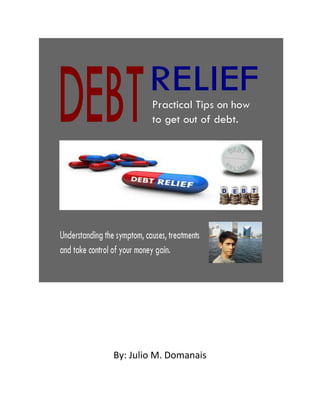
By: Julio M. Domanais
Disclaimer & Uncopyrights
Please note that information in this e-Book should be
used only as a general guide. While the author of this
book has taken reasonable efforts to ensure the
accuracy and timeliness of the information contained
within this e-book, author assumes no liability with
respect to losses or damages related to information in
this e-book. Information provided in this e-book is my
personal opinions and isn’t guaranteed to be accurate, so
please use your best judgment while implementing
them.
Author is not engaged in providing any legal, financial or
other professional services. Seek an expert's help if
needed. Individual results may vary.
This is an original work by the author. However, you can
freely distribute this e-book in any form you wish. You
can also recommend others to grab a free copy of this e-
book by referring them.
2015 @ Julio M. Domanais – All Rights Reserved
About me
Hi, let me quickly introduce myself.
I am Julio M. Domanais, an Marine Technician by
profession, personal development enthusiast, a blogger,
search engine optimization expert and web designer.
Predominantly, I have been associated with the
automation industry for over one decade now. My life
was never a smooth journey. With constant challenges
(now I realize that they were the stepping stone for the
growth) in my career and personal life, there was a time
when I was not getting anywhere. It was the eye opening
information about self development and self
improvement that helped me to overcome the obstacles
and eventually achieve success. Needless to mention, I
followed my passion and converted information into
practices, and in turn, into habits.
I now live a happier life and enjoy what I am doing. What
helped me for this transformation was my self-
realization and actions towards personal growth.
Why did I write this eBook? It's because I want to help
you. I want you to follow your passion, excel in your
career, live a content life and to have a financially
literate.
Over the period of the past 20 years, I have collected a
handful of practical tips and strategies for career and life
that I have been sharing so far with other people through
my verbal interactions. I felt that I can reach out to a
wider audience if I created an eBook on these
experiences and tips.
So, I am here with this eBook, through which I will be
sharing my thoughts and experiences with you. I am sure
this book will interest you in some ways and I will be
more than delighted if, at least some of the tips within
this e-book benefit you.
This e-book will dedicate to everyone.
/ cre8tivetools.wordpress.com
/ Julio m. Domanais
Table of Contents
What are the Symptoms Serious of Debt? 1
A Leading Cause of Debt: Overspending 3
Financial First Aid: How to Handle Creditors
and Collectors 6
The Cure: How to Design a Realistic Budget
You can Live with 8
Financial Well Being: How to cope with
The stress of owing money 11
Preventive Measures: The Rules for Staying
Out of Debt Forever 13
What are this Symptoms of Serious Debt?
Here’s are the common warning signs of deep debt
include a tendency to:
Run out of cash between pay cheques
Have no money in your bank account
Pay bills late, or not at all
Use 3 or more credit cards
Always run an overdraft on your bank account
Pay only the minimum payment on your credit
card(s)
Approach or reach your credit card maximum
Not know how much you owe money
Not know what purchases are on your credit card
Skip payments on some bills in order to pay others
Miss mortgage payments
Bounce cheques on a regular basis
Receive calls from collection agencies
Ask friends and family members for loans
Have your utilities (telephone bill, and many more)
cut off
1
Cut back on regular expenses, including necessities
like food
Use your credit cards and retirement or emergency
savings for daily expenses
Consider taking a second job to help pay your bills
Panic when faced with an unexpected expense, such
as a car repair or some emergencies
Argue with your partner about money
Are afraid to talk to your partner about money
Hide purchases from your family
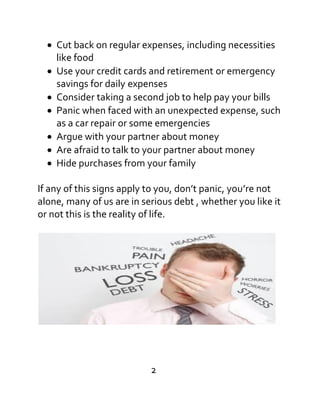
If any of this signs apply to you, don’t panic, you’re not
alone, many of us are in serious debt , whether you like it
or not this is the reality of life.
2
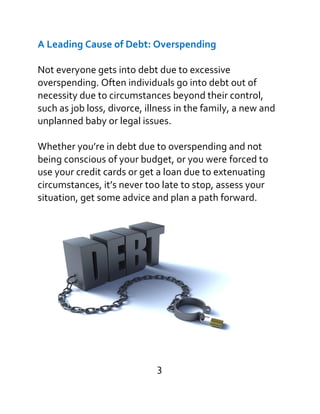
A Leading Cause of Debt: Overspending
Not everyone gets into debt due to excessive
overspending. Often individuals go into debt out of
necessity due to circumstances beyond their control,
such as job loss, divorce, illness in the family, a new and
unplanned baby or legal issues.
Whether you’re in debt due to overspending and not
being conscious of your budget, or you were forced to
use your credit cards or get a loan due to extenuating
circumstances, it’s never too late to stop, assess your
situation, get some advice and plan a path forward.
3
Tips to identify ways to reduce your spending so you can
put more money toward repaying your debt.

Every time you buy collect your receipts: Keep the
receipts from every purchase you make, including
online shopping, for a 30 or 60 day period.
Be sure to categorize your bills: Gather similar
receipts together, including groceries, restaurants,
gas, clothing, home maintenance and
entertainment.
It’s better to track your spending: Review your
spending per category for a high level view of where
your money goes.
Just dig deeper: As you review each item on each
receipt, ask yourself, Did I need this? Did I use it? Did I
really want it? Was it worth the cost? Be honest and
note your findings as you judge whether your hard-
earned money were well-spent or wasted.
4
Keep cutting as needed: Find ways to free up more
money to pay off your debt. Cancel your cable TV or
switch to a more affordable mobile plan until you
wipe out your debt.
Ask someone else: Reach out to a trusted friend or
hire a financial advisor to review your spending over
the past few months. By working with a neutral,
supportive outsider, you can gain a new perspective
on how to correct your spending blind spots.
Commit: Think about what you really want out of
life. Make a decision to responsibly align your
spending with your personal goals.
Special Note:
Gaining awareness of your spending habits takes courage
and represents a major step toward taking control of your
finances. Be gentle with yourself and avoid making
excuses for your behavior.
5
You’re getting started on the right track.
To rein in your spending, try to buy only necessities and the
most essential useful items. Limit your spending on nice-
to-haves and luxuries.
Financial First Aid: How to Handle Creditors and
Collectors
To deal with this situation use the following:

Be honest: Let your creditors know if you have
recently experienced financial disaster – and what
you are doing to get your finances back on track.
Stay calm: Stay as poised and composed as possible
when you talk to creditors. If you feel ready to lose
your temper, tell the collector you will talk to them
later. Call back when you feel more peaceful.
6
Take notes: Keep a record of the individuals you
speak to, which company they represent, the date
and what you discussed. Focusing on the facts will
help to take emotion out of the situation.
Gather all correspondence: Read, save and collect
all mail and emails from creditors. Keep them all in
one place.
Know your numbers: Review your income and
expenses so you can calculate what you are able to
afford. By knowing your numbers, you can protect
yourself by only agreeing to pay a realistic amount.
Deal with creditors: Whenever possible, try to work
out an agreement directly with creditors before they
send your bill to a collections agency.
Ask questions: Ask for specific details related to the
repayment options, amounts and timelines.
Get it in writing: Once you do agree on a payment
plan, get it in writing before you pay anything.
Having written proof protects you by preventing the
terms from changing.
7

Keep cash on hand: Creditors are more willing to
take an offer of cash today rather than waiting for
multiple small payments over time.
Get a clean slate: To improve your credit rating, ask
creditors to remove the late payments on your
account. If they refuse, you can always build better
credit once you resolve your debts.
The Cure: How to Design a Realistic Budget You Can
Live With
Getting out of debt requires a budget, which is an
estimate of your income and expenses over a period,
usually a year.
Here are some tips to create a budget that fits to your
unique financial circumstances:

List it: Make a list of all the debt you owe. Include
credit cards, lines of credit, automobile financing,
8
student loans, loans from family and taxes owing.
Use the current balance from your latest
statements, as well as the interest rate.
Rank it: Rank your debts from the greatest to the
smallest interest rate, as this will save you the most
money. (Some people like to pay off their smallest
debts first to build momentum and confidence;
however, it’s smarter to tackle the big amounts first
to save you the most interest.)
Calculate it: Figure out how much extra money you
have each month to pay toward your debt. You may
need to cut your expenses, earn more money or put
any money you receive from gifts, bonuses or tax
returns to pay off your debt. There are also many
mobile apps that will keep your running tab easily
accessible on your iPhone or Android.
Share it: Tell someone your plan. By making
yourself accountable, you will feel motivated to stick
with your plan.
9
Pay it: Use the “Snowball Strategy” for debt
repayment. Pay all the extra money on the first debt
on your list while paying the minimum on all other
amounts owing. Paying off one source of debt often
gives you the momentum to continue on your debt
repayment plan.
Save it: Once you have paid off your debts, put
most of your extra money into savings so your
money will work for you. To avoid getting into debt
again, cut up and cancel your credit cards, too.
Of course the best way to repay debt is to earn more
income so you have more money to allocate toward
reducing your debt.
Here are some Ways to Earn More Money
Find a higher-paying job
Take on a second job or part-time job
Sell your personal items on eBay, Craig’s List
Tutor others
Clean homes
Rent out a room in your home
9
Babysitting
Sell your gold and silver
Mobile loading
It’s true that “a penny saved is a penny earned.” When
you’re looking to pay off debt, each money you save
helps you chisel down and conquer your mountain of
debt.
Here are some Ways to Save Money
Stock up when there’s a sale on your favorite
groceries or household items
Make your own coffee at home not in expensive
coffee shop
Cancel your landline phone service and replace it
with an internet-based service, or cut cable and
replace it with Netflix, a similar subscription service
or even antenna.
Buy a quality used car instead of a new one
Downsize to only one car for your household
Walk, cycle or take public transit instead of driving
Always pay more than your minimum payments to
10
save interest and finance fees
Cook at home rather than paying premium prices for
takeout or restaurants
Cancel your magazine and newspaper subscriptions
Cancel your gym membership and take up jogging
instead
Financial Well Being: How to Cope with the Stress of
Owing Money
When you’re in debt, it’s common to suffer from
stress, anxiety and even depression. Debt can also
lead to tension and arguments with loved ones.
Achieving financial fitness takes time, effort and
dedication. Just like physical fitness, there is neither
a magic pill nor overnight success.
Use these tips to relax and counter the stress of owing
money:
Accept that you have debt: The sooner you
recognize that there’s a problem, the sooner you
can start solving it.
11
Talk it out: Suffering all by yourself due to fear and
shame compounds the problem. Instead of
isolating, talk to someone you trust, including your
partner, trusted friends or family members who will
encourage you as you face your finances.
Reach out for more help: Consider talking to a
trustee who specializes in eliminating debts. Their
professional debt advice may give you options you
never considered. They will listen to you and provide
practical tips to help you deal with your debt.
Take action: Start wherever you are. Face your bills,
start speaking to creditors and start paying what
you can. The sooner you deal with your debt, the
sooner you’ll resolve your problem.
Be good to yourself: To boost your energy and
endurance as you take care of your financial health,
eat nutritious foods, exercise and get enough sleep.
12
Believing that you will get through this period will
help you to stay positive and patient.
Preventative Measures: The Rules for Staying Out of
Debt Forever
Stick to a budget: Since you only have a finite amount of
money to go around, proactively plan where you want it
to go by creating a budget that meets your needs and
goals. Commit to sticking to your budget. Don’t go when
you see a magic word SALE, because if you don’t have
enough money just wait if you have extra money aside
from your budget.
Live within your means: Why burden yourself with debt
by trying to “keep up with the Joneses”? Don’t buy
anything unless you have the money. Find ways to spend
less than you earn. Create healthy money habits to will
protect your hard-earned money.
Pay yourself first: Set savings goals to motivate yourself
to save up for things you truly want. Once you reach
your savings goal, you can purchase the item outright
and avoid incurring interest charges.
13
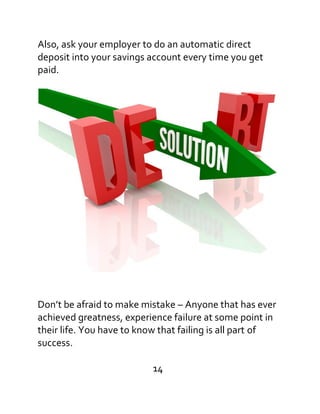
Also, ask your employer to do an automatic direct
deposit into your savings account every time you get
paid.
Don’t be afraid to make mistake – Anyone that has ever
achieved greatness, experience failure at some point in
their life. You have to know that failing is all part of
success.
14
Change will make you stronger – you can’t grow or learn
without change, something has to change for you to
reach the next level.
You were born to create the life that you want to live.
Everything that you have accumulative and achieved in
your life leading up to today has been created by you
through your thoughts, behavior and action. The car you
drive, the relationship you have, the house you live in,
the moments you have “created” in your life. That was
you.
15
That in itself should motivate the flying freak out of you
to move, to act, feel, jump and run the fricken show.
Thanks and Happy Learning Everyone !
/ crea8tivetools.wordpress.com
/ Julio M. Domanais
16

Debt relief

  • 1.
    By: Julio M.Domanais
  • 2.
    Disclaimer & Uncopyrights Pleasenote that information in this e-Book should be used only as a general guide. While the author of this book has taken reasonable efforts to ensure the accuracy and timeliness of the information contained within this e-book, author assumes no liability with respect to losses or damages related to information in this e-book. Information provided in this e-book is my personal opinions and isn’t guaranteed to be accurate, so please use your best judgment while implementing them. Author is not engaged in providing any legal, financial or other professional services. Seek an expert's help if needed. Individual results may vary. This is an original work by the author. However, you can freely distribute this e-book in any form you wish. You can also recommend others to grab a free copy of this e- book by referring them. 2015 @ Julio M. Domanais – All Rights Reserved
  • 3.
    About me Hi, letme quickly introduce myself. I am Julio M. Domanais, an Marine Technician by profession, personal development enthusiast, a blogger, search engine optimization expert and web designer. Predominantly, I have been associated with the automation industry for over one decade now. My life was never a smooth journey. With constant challenges (now I realize that they were the stepping stone for the growth) in my career and personal life, there was a time when I was not getting anywhere. It was the eye opening information about self development and self improvement that helped me to overcome the obstacles and eventually achieve success. Needless to mention, I followed my passion and converted information into practices, and in turn, into habits.
  • 4.
    I now livea happier life and enjoy what I am doing. What helped me for this transformation was my self- realization and actions towards personal growth. Why did I write this eBook? It's because I want to help you. I want you to follow your passion, excel in your career, live a content life and to have a financially literate. Over the period of the past 20 years, I have collected a handful of practical tips and strategies for career and life that I have been sharing so far with other people through my verbal interactions. I felt that I can reach out to a wider audience if I created an eBook on these experiences and tips. So, I am here with this eBook, through which I will be sharing my thoughts and experiences with you. I am sure this book will interest you in some ways and I will be more than delighted if, at least some of the tips within this e-book benefit you. This e-book will dedicate to everyone. / cre8tivetools.wordpress.com / Julio m. Domanais
  • 5.
    Table of Contents Whatare the Symptoms Serious of Debt? 1 A Leading Cause of Debt: Overspending 3 Financial First Aid: How to Handle Creditors and Collectors 6 The Cure: How to Design a Realistic Budget You can Live with 8 Financial Well Being: How to cope with The stress of owing money 11 Preventive Measures: The Rules for Staying Out of Debt Forever 13
  • 6.
    What are thisSymptoms of Serious Debt? Here’s are the common warning signs of deep debt include a tendency to: Run out of cash between pay cheques Have no money in your bank account Pay bills late, or not at all Use 3 or more credit cards Always run an overdraft on your bank account Pay only the minimum payment on your credit card(s) Approach or reach your credit card maximum Not know how much you owe money Not know what purchases are on your credit card Skip payments on some bills in order to pay others Miss mortgage payments Bounce cheques on a regular basis Receive calls from collection agencies Ask friends and family members for loans Have your utilities (telephone bill, and many more) cut off 1
  • 7.
    Cut back onregular expenses, including necessities like food Use your credit cards and retirement or emergency savings for daily expenses Consider taking a second job to help pay your bills Panic when faced with an unexpected expense, such as a car repair or some emergencies Argue with your partner about money Are afraid to talk to your partner about money Hide purchases from your family If any of this signs apply to you, don’t panic, you’re not alone, many of us are in serious debt , whether you like it or not this is the reality of life. 2
  • 8.
    A Leading Causeof Debt: Overspending Not everyone gets into debt due to excessive overspending. Often individuals go into debt out of necessity due to circumstances beyond their control, such as job loss, divorce, illness in the family, a new and unplanned baby or legal issues. Whether you’re in debt due to overspending and not being conscious of your budget, or you were forced to use your credit cards or get a loan due to extenuating circumstances, it’s never too late to stop, assess your situation, get some advice and plan a path forward. 3
  • 9.
    Tips to identifyways to reduce your spending so you can put more money toward repaying your debt.  Every time you buy collect your receipts: Keep the receipts from every purchase you make, including online shopping, for a 30 or 60 day period. Be sure to categorize your bills: Gather similar receipts together, including groceries, restaurants, gas, clothing, home maintenance and entertainment. It’s better to track your spending: Review your spending per category for a high level view of where your money goes. Just dig deeper: As you review each item on each receipt, ask yourself, Did I need this? Did I use it? Did I really want it? Was it worth the cost? Be honest and note your findings as you judge whether your hard- earned money were well-spent or wasted. 4
  • 10.
    Keep cutting asneeded: Find ways to free up more money to pay off your debt. Cancel your cable TV or switch to a more affordable mobile plan until you wipe out your debt. Ask someone else: Reach out to a trusted friend or hire a financial advisor to review your spending over the past few months. By working with a neutral, supportive outsider, you can gain a new perspective on how to correct your spending blind spots. Commit: Think about what you really want out of life. Make a decision to responsibly align your spending with your personal goals. Special Note: Gaining awareness of your spending habits takes courage and represents a major step toward taking control of your finances. Be gentle with yourself and avoid making excuses for your behavior. 5
  • 11.
    You’re getting startedon the right track. To rein in your spending, try to buy only necessities and the most essential useful items. Limit your spending on nice- to-haves and luxuries. Financial First Aid: How to Handle Creditors and Collectors To deal with this situation use the following:  Be honest: Let your creditors know if you have recently experienced financial disaster – and what you are doing to get your finances back on track. Stay calm: Stay as poised and composed as possible when you talk to creditors. If you feel ready to lose your temper, tell the collector you will talk to them later. Call back when you feel more peaceful. 6
  • 12.
    Take notes: Keepa record of the individuals you speak to, which company they represent, the date and what you discussed. Focusing on the facts will help to take emotion out of the situation. Gather all correspondence: Read, save and collect all mail and emails from creditors. Keep them all in one place. Know your numbers: Review your income and expenses so you can calculate what you are able to afford. By knowing your numbers, you can protect yourself by only agreeing to pay a realistic amount. Deal with creditors: Whenever possible, try to work out an agreement directly with creditors before they send your bill to a collections agency. Ask questions: Ask for specific details related to the repayment options, amounts and timelines. Get it in writing: Once you do agree on a payment plan, get it in writing before you pay anything. Having written proof protects you by preventing the terms from changing. 7
  • 13.
     Keep cash onhand: Creditors are more willing to take an offer of cash today rather than waiting for multiple small payments over time. Get a clean slate: To improve your credit rating, ask creditors to remove the late payments on your account. If they refuse, you can always build better credit once you resolve your debts. The Cure: How to Design a Realistic Budget You Can Live With Getting out of debt requires a budget, which is an estimate of your income and expenses over a period, usually a year. Here are some tips to create a budget that fits to your unique financial circumstances:  List it: Make a list of all the debt you owe. Include credit cards, lines of credit, automobile financing, 8
  • 14.
    student loans, loansfrom family and taxes owing. Use the current balance from your latest statements, as well as the interest rate. Rank it: Rank your debts from the greatest to the smallest interest rate, as this will save you the most money. (Some people like to pay off their smallest debts first to build momentum and confidence; however, it’s smarter to tackle the big amounts first to save you the most interest.) Calculate it: Figure out how much extra money you have each month to pay toward your debt. You may need to cut your expenses, earn more money or put any money you receive from gifts, bonuses or tax returns to pay off your debt. There are also many mobile apps that will keep your running tab easily accessible on your iPhone or Android. Share it: Tell someone your plan. By making yourself accountable, you will feel motivated to stick with your plan. 9
  • 15.
    Pay it: Usethe “Snowball Strategy” for debt repayment. Pay all the extra money on the first debt on your list while paying the minimum on all other amounts owing. Paying off one source of debt often gives you the momentum to continue on your debt repayment plan. Save it: Once you have paid off your debts, put most of your extra money into savings so your money will work for you. To avoid getting into debt again, cut up and cancel your credit cards, too. Of course the best way to repay debt is to earn more income so you have more money to allocate toward reducing your debt. Here are some Ways to Earn More Money Find a higher-paying job Take on a second job or part-time job Sell your personal items on eBay, Craig’s List Tutor others Clean homes Rent out a room in your home 9
  • 16.
    Babysitting Sell your goldand silver Mobile loading It’s true that “a penny saved is a penny earned.” When you’re looking to pay off debt, each money you save helps you chisel down and conquer your mountain of debt. Here are some Ways to Save Money Stock up when there’s a sale on your favorite groceries or household items Make your own coffee at home not in expensive coffee shop Cancel your landline phone service and replace it with an internet-based service, or cut cable and replace it with Netflix, a similar subscription service or even antenna. Buy a quality used car instead of a new one Downsize to only one car for your household Walk, cycle or take public transit instead of driving Always pay more than your minimum payments to 10
  • 17.
    save interest andfinance fees Cook at home rather than paying premium prices for takeout or restaurants Cancel your magazine and newspaper subscriptions Cancel your gym membership and take up jogging instead Financial Well Being: How to Cope with the Stress of Owing Money When you’re in debt, it’s common to suffer from stress, anxiety and even depression. Debt can also lead to tension and arguments with loved ones. Achieving financial fitness takes time, effort and dedication. Just like physical fitness, there is neither a magic pill nor overnight success. Use these tips to relax and counter the stress of owing money: Accept that you have debt: The sooner you recognize that there’s a problem, the sooner you can start solving it. 11
  • 18.
    Talk it out:Suffering all by yourself due to fear and shame compounds the problem. Instead of isolating, talk to someone you trust, including your partner, trusted friends or family members who will encourage you as you face your finances. Reach out for more help: Consider talking to a trustee who specializes in eliminating debts. Their professional debt advice may give you options you never considered. They will listen to you and provide practical tips to help you deal with your debt. Take action: Start wherever you are. Face your bills, start speaking to creditors and start paying what you can. The sooner you deal with your debt, the sooner you’ll resolve your problem. Be good to yourself: To boost your energy and endurance as you take care of your financial health, eat nutritious foods, exercise and get enough sleep. 12
  • 19.
    Believing that youwill get through this period will help you to stay positive and patient. Preventative Measures: The Rules for Staying Out of Debt Forever Stick to a budget: Since you only have a finite amount of money to go around, proactively plan where you want it to go by creating a budget that meets your needs and goals. Commit to sticking to your budget. Don’t go when you see a magic word SALE, because if you don’t have enough money just wait if you have extra money aside from your budget. Live within your means: Why burden yourself with debt by trying to “keep up with the Joneses”? Don’t buy anything unless you have the money. Find ways to spend less than you earn. Create healthy money habits to will protect your hard-earned money. Pay yourself first: Set savings goals to motivate yourself to save up for things you truly want. Once you reach your savings goal, you can purchase the item outright and avoid incurring interest charges. 13
  • 20.
    Also, ask youremployer to do an automatic direct deposit into your savings account every time you get paid. Don’t be afraid to make mistake – Anyone that has ever achieved greatness, experience failure at some point in their life. You have to know that failing is all part of success. 14
  • 21.
    Change will makeyou stronger – you can’t grow or learn without change, something has to change for you to reach the next level. You were born to create the life that you want to live. Everything that you have accumulative and achieved in your life leading up to today has been created by you through your thoughts, behavior and action. The car you drive, the relationship you have, the house you live in, the moments you have “created” in your life. That was you. 15
  • 22.
    That in itselfshould motivate the flying freak out of you to move, to act, feel, jump and run the fricken show. Thanks and Happy Learning Everyone ! / crea8tivetools.wordpress.com / Julio M. Domanais 16