2015ANNUALREPORTNEXTGENERATIONSOLUTIONSTOHUNGERANDFOODWASTE
2
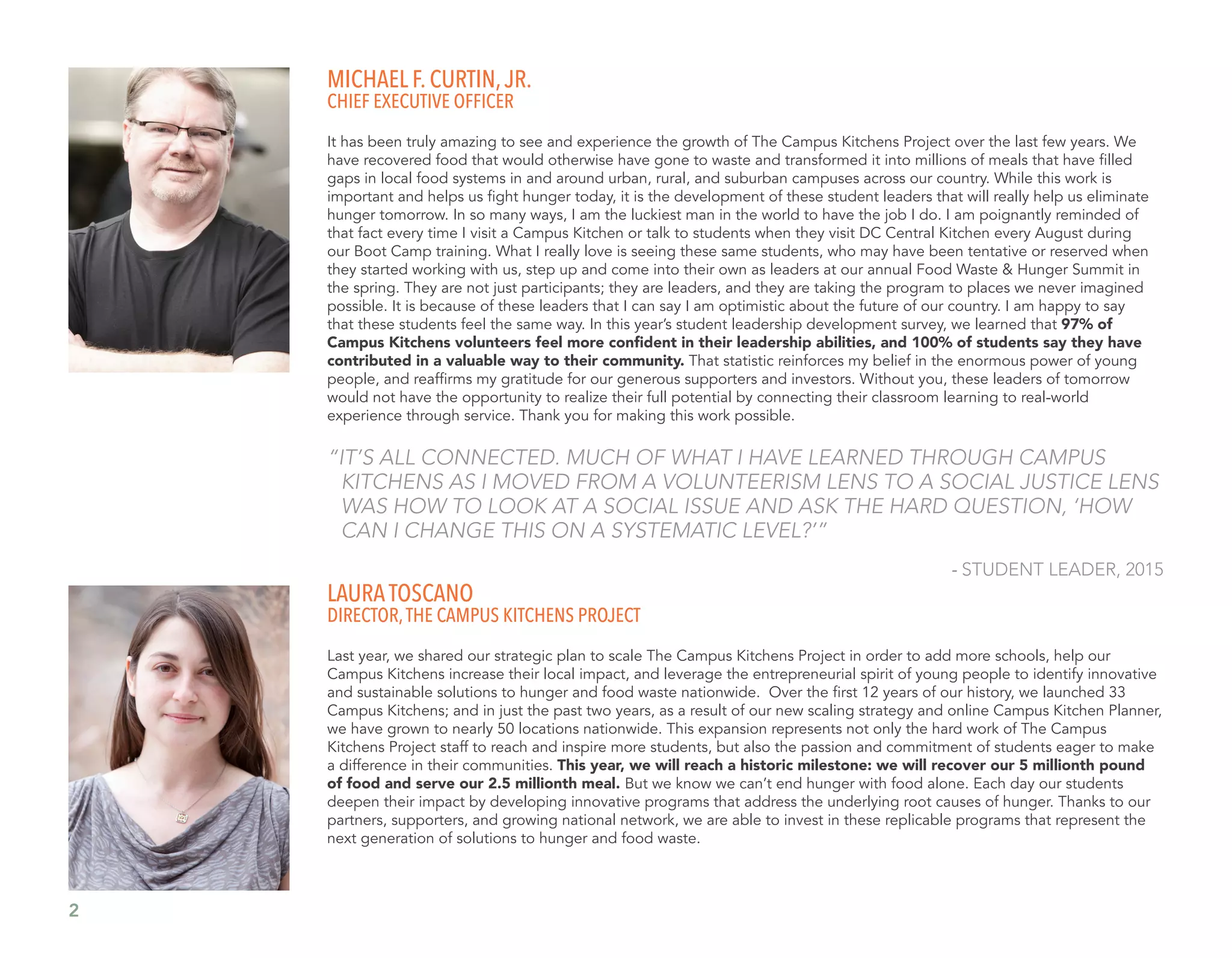
MICHAEL F. CURTIN,JR.
CHIEF EXECUTIVE OFFICER
It has been truly amazing to see and experience the growth of The Campus Kitchens Project over the last few years. We
have recovered food that would otherwise have gone to waste and transformed it into millions of meals that have filled
gaps in local food systems in and around urban, rural, and suburban campuses across our country. While this work is
important and helps us fight hunger today, it is the development of these student leaders that will really help us eliminate
hunger tomorrow. In so many ways, I am the luckiest man in the world to have the job I do. I am poignantly reminded of
that fact every time I visit a Campus Kitchen or talk to students when they visit DC Central Kitchen every August during
our Boot Camp training. What I really love is seeing these same students, who may have been tentative or reserved when
they started working with us, step up and come into their own as leaders at our annual Food Waste & Hunger Summit in
the spring. They are not just participants; they are leaders, and they are taking the program to places we never imagined
possible. It is because of these leaders that I can say I am optimistic about the future of our country. I am happy to say
that these students feel the same way. In this year’s student leadership development survey, we learned that 97% of
Campus Kitchens volunteers feel more confident in their leadership abilities, and 100% of students say they have
contributed in a valuable way to their community. That statistic reinforces my belief in the enormous power of young
people, and reaffirms my gratitude for our generous supporters and investors. Without you, these leaders of tomorrow
would not have the opportunity to realize their full potential by connecting their classroom learning to real-world
experience through service. Thank you for making this work possible.
LAURATOSCANO
DIRECTOR,THE CAMPUS KITCHENS PROJECT
Last year, we shared our strategic plan to scale The Campus Kitchens Project in order to add more schools, help our
Campus Kitchens increase their local impact, and leverage the entrepreneurial spirit of young people to identify innovative
and sustainable solutions to hunger and food waste nationwide. Over the first 12 years of our history, we launched 33
Campus Kitchens; and in just the past two years, as a result of our new scaling strategy and online Campus Kitchen Planner,
we have grown to nearly 50 locations nationwide. This expansion represents not only the hard work of The Campus
Kitchens Project staff to reach and inspire more students, but also the passion and commitment of students eager to make
a difference in their communities. This year, we will reach a historic milestone: we will recover our 5 millionth pound
of food and serve our 2.5 millionth meal. But we know we can’t end hunger with food alone. Each day our students
deepen their impact by developing innovative programs that address the underlying root causes of hunger. Thanks to our
partners, supporters, and growing national network, we are able to invest in these replicable programs that represent the
next generation of solutions to hunger and food waste.
“IT’S ALL CONNECTED. MUCH OF WHAT I HAVE LEARNED THROUGH CAMPUS
KITCHENS AS I MOVED FROM A VOLUNTEERISM LENS TO A SOCIAL JUSTICE LENS
WAS HOW TO LOOK AT A SOCIAL ISSUE AND ASK THE HARD QUESTION, ‘HOW
CAN I CHANGE THIS ON A SYSTEMATIC LEVEL?’”
- STUDENT LEADER, 2015
3
The Campus Kitchens Project is empowering students to create sustainable solutions to food waste and hunger.
THE CAMPUS KITCHENS PROJECT
Saint Louis University
Saint Louis, MO
Northwestern University
Evanston, IL
Augsburg College
Minneapolis, MN
MarqueƩe University
Milwaukee, WI
Gonzaga University
Spokane, WA
Gonzaga College High School
Washington, DC
Minnesota State University Mankato
Mankato, MN
Wake Forest University
Winston-Salem, NC
Washington and Lee University
Lexington, VA
University of Nebraska Kearney
Kearney, NE
College of William and Mary
Williamsburg, VA
GeƩysburg College
GeƩysburg, PA
University of Maryland Eastern Shore
Rockville, MD
University of Vermont
Burlington, VT
Baylor University
Waco, TX
Johns Hopkins University
BalƟmore, MD
University of Florida
Gainesville, FL
University of Wisconsin-Eau Claire
Eau Claire, WI
Lee University
Cleveland, TN
Washington University in St. Louis
St. Louis, MO
St. Lawrence University
Canton, NY
University of MassachuseƩs Boston
Boston, MA
University of Virginia
CharloƩesville, VA
East Carolina University
Greenville, NC
Union College
Schenectady, NY
University of Detroit Mercy
Detroit, MI
Elon University
Elon, NC
Kent State University
Kent, OH
Auburn University
Auburn, AL
The Campus Kitchens
Project Network
campuskitchens.org
St. Andrew’s Episcopal School
Potomac, MD
AtlanƟc City
AtlanƟc City, NJ
Washington, DC
Washington, DC
University of Georgia
Athens, GA
Meredith College
Raleigh, NC
Georgia Tech
Atlanta, GA
University of Wisconsin-Green Bay
Green Bay, WI
IUPUI
Indianapolis, IN
Southern Illinois University Edwardsville
Edwardsville, IL
St. Peter’s University
Jersey City, NJ
Troy University
Troy, AL
University of Kentucky
Lexington, KY
Emory University
Atlanta, GA
Sacred Heart Prep School
Atherton, CA
Walsh University
North Canton, OH
University of Wisconsin-Madison
Madison, WI
Thank you to all our Campus
Kitchens whose photos
are featured in this Annual
Report. Cover photo:
Student volunteers deliver
fresh vegetables through
the Campus Kitchen at
Gettysburg College’s
Green Goodies initiative.
4
5
6
THE ISSUE: RURAL HUNGER
Students involved with The Campus Kitchens Project not only prepare and deliver meals, but develop new and innovative solutions to some of the nation’s most
difficult food security issues. One of the critical challenges facing our country is the prevalence of hunger in rural areas, and the technical difficulty of addressing
this problem in a sustainable way. In many rural communities, traditional food bank distribution efforts are too costly due to infrastructure and transportation
challenges. At the same time, these are the regions producing our food in the first place. This year, we invested in the efforts of several Campus Kitchens with
innovative approaches and new solutions that can be replicated in rural communities nationwide. From Elon University’s strong partnerships with neighboring
farms, to Washington & Lee University’s Mobile Food Pantry, to Gettysburg College’s innovative distribution of free CSA shares, these campuses serve as the
ideal “test kitchen” for more sustainable solutions to hunger—connecting existing assets on campus, on surrounding farms, and in the community.
“I apply the skills I have developed while volunteering with the Campus Kitchen every day as I interact with people in my community
- both educating others and serving others.” - Student Leader, 2015
2,580
rural clients served
each month
47,500
meals served
to rural clients
BEYOND THE
MEAL SOLUTION:
IMPROVED
ACCESS TO
HEALTHY LOCAL
FOOD
This year, we launched a partnership with
the rural development experts at CoBank to
expand our services in rural communities.
7
THE ISSUE: WASTED FOOD
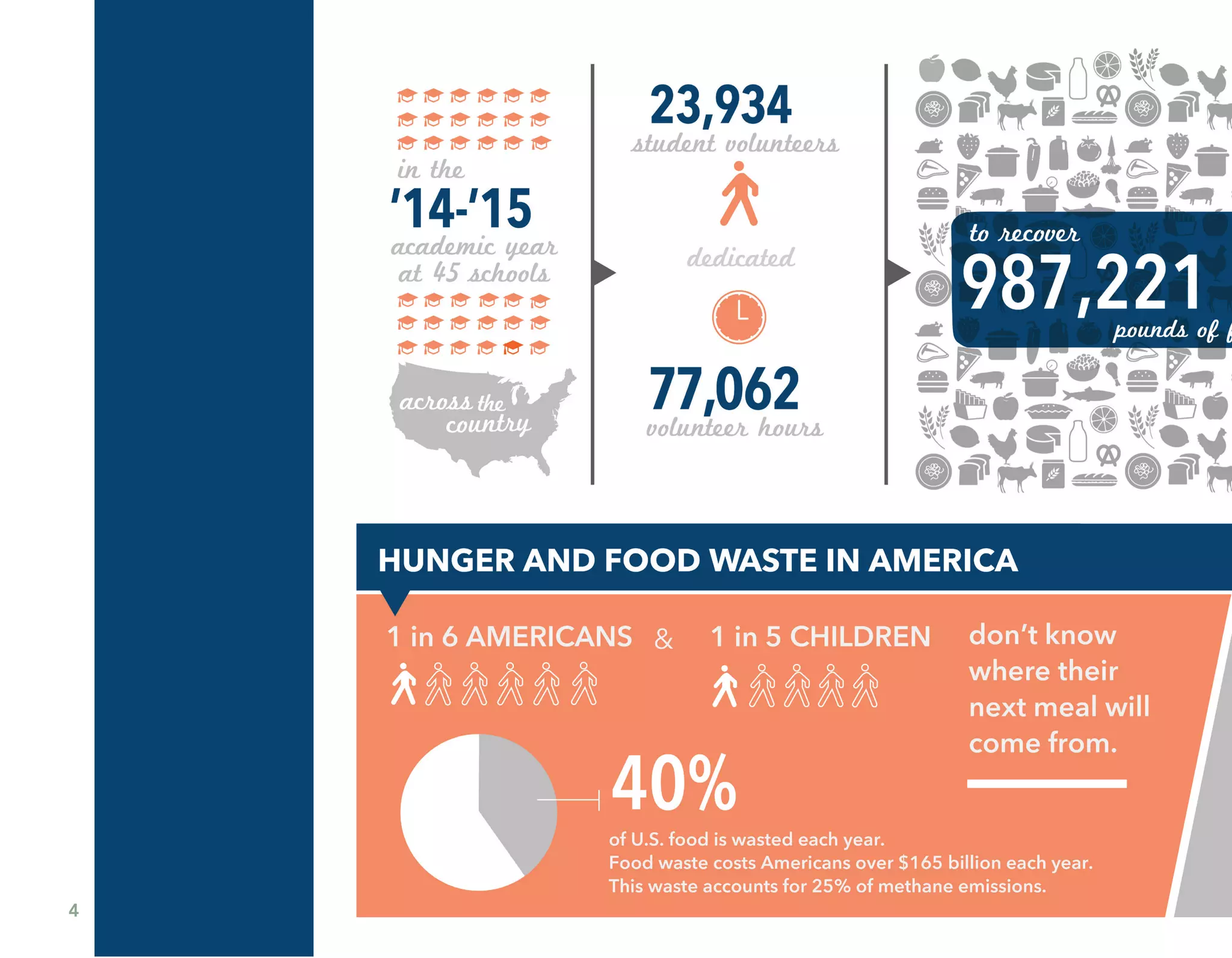
Over 40% of all the food we produce in America goes to waste. To the next generation of student leaders, it’s clear that all this wasted food has enormous potential
to feed the millions of Americans struggling with food insecurity.
“I worked in the dining halls and was responsible for throwing away leftover food at the end of the night...then I’d walk past hungry,
homeless people on the street...there was an obvious disconnect.” - Student Leader, 2015
“I realized how important what we do is for the community and the environment combined. We are changing the way America deals
with food one meal at a time.” - Student Leader, 2015
What sets The Campus Kitchens Project apart is our focus on transforming wasted food into complete, balanced meals. It’s simply not enough to deliver leftover
food as is, when it’s available. To have a real and measurable impact on the food security of our clients, our students work with community partners to provide a set
number of balanced, nutritious meals on a regular schedule. They not only rescue extra food from dining halls on campus, but also seek out partnerships with local
grocery stores, farms, restaurants and farmers markets to recover more fresh local produce so they can always deliver a healthy meal.
17,042,818
gallons of water used to
produce food would have
otherwise been wasted**
95,557,998
lbs of CO2 emissions prevented*
987,221
lbs of food recovered
*FAO UN Report on Food Waste [97 pounds of CO2 ≈ 1 pound of food]
**World Resources Institute [~17.3 gallons of water ≈ 1 pound of food]
8
THE ISSUE: YOUTH HUNGER
“I got involved with the Campus Kitchen when I started a Master in Nutrition Program. I was interested in providing
opportunities for kids to have healthy meals in food insecure areas.”
- Student Leader, 2015
BEYOND THE
MEAL SOLUTION:
EFFECTIVE
NUTRITION
EDUCATION
CURRICULUM
A critical lesson of the childhood obesity epidemic is that food insecurity is about more than not having enough
to eat. We need to not only eat enough, but make healthy choices and eat the right kinds of foods. Eating
balanced meals with all of the essential nutrients for a child’s growth is a recipe for lifelong health. In order to
meet this need among food insecure children in communities around the country, The Campus Kitchens Project
has made nutrition education a focus across the network.
Our student leaders are committed to going beyond simply providing meals. When working with youth who
are at risk for hunger, they develop engaging nutrition education programs that teach children the importance
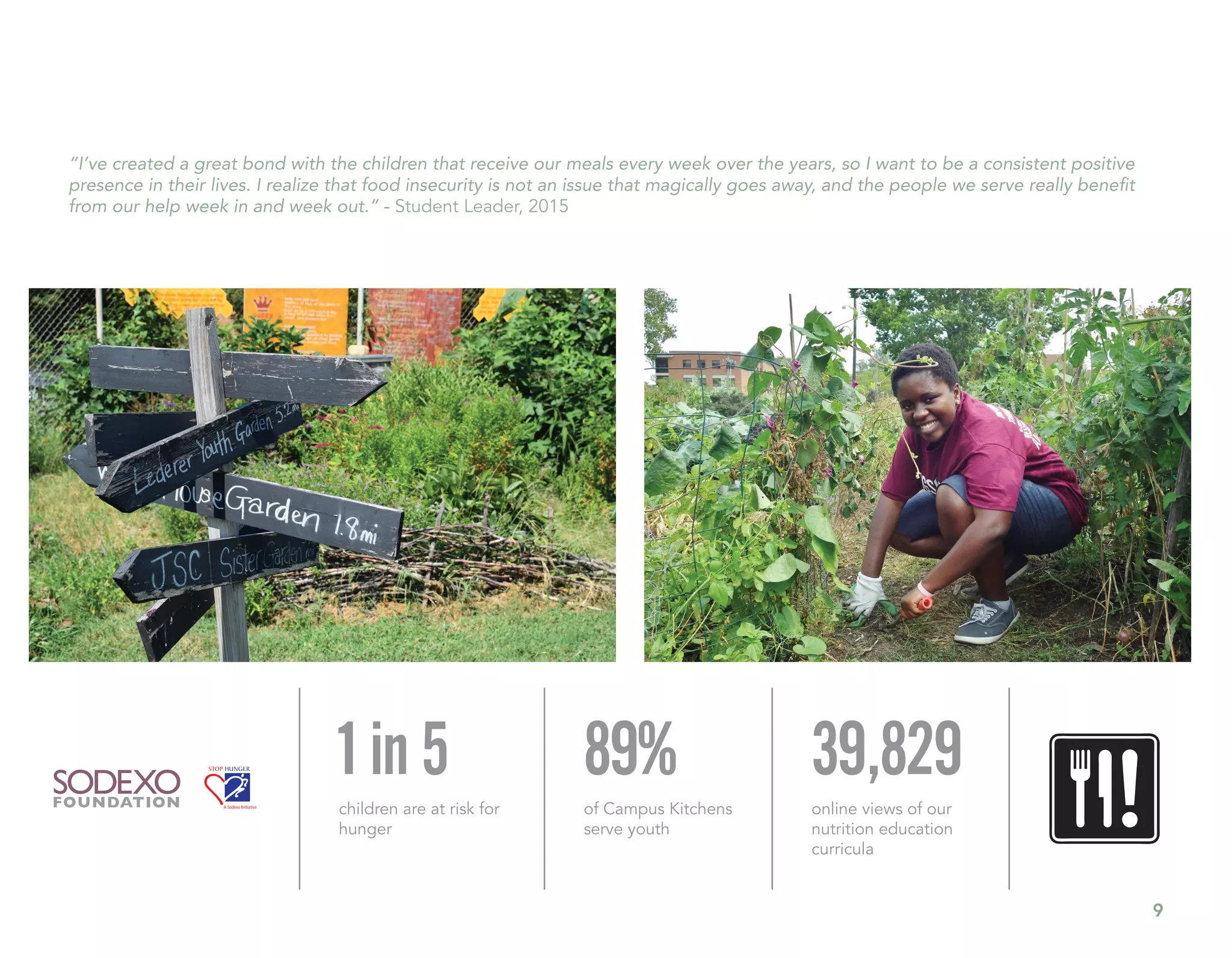
of eating right. This year, we created Sowing Seeds for Healthy Kids, a 6-week nutrition education module
that is designed to take place in a garden and to complement our original Building Blocks for Healthy Kids
curriculum. To encourage the replication of these successful programs nationwide, we shared these lessons
on our website at campuskitchens.org/curricula.
9
“I’ve created a great bond with the children that receive our meals every week over the years, so I want to be a consistent positive
presence in their lives. I realize that food insecurity is not an issue that magically goes away, and the people we serve really benefit
from our help week in and week out.” - Student Leader, 2015
39,829
online views of our
nutrition education
curricula
89%
of Campus Kitchens
serve youth
1 in 5
children are at risk for
hunger
10
THE ISSUE: OLDER ADULT HUNGER
“This has been an incredibly eye-opening and enjoyable experience. I have always appreciated and admired
elders, but I have developed a newfound outlook after volunteering for this program!”
- Student Leader, 2015
BEYOND THE
MEAL SOLUTION:
ANTI-ISOLATION
PROGRAMS FOR
SENIORS
We have always encouraged our student leaders to focus on serving older adults in their communities, and now,
with more than eight million Baby Boomers aged 50 to 64 turning to charitable food assistance to make ends
meet, our work is needed more than ever before.
One of the most powerful testaments to our work is our partnership with AARP Foundation. Their focus on
older adult hunger, like ours, relies not only on the provision of nutritious meals today, but also on the creation
of innovative programs that address the underlying root causes of hunger to break this cycle for good. Student
volunteers at Campus Kitchens provide meals, lead nutrition and wellness classes, and create opportunities for
friendship and community engagement in order to reduce the isolation that many seniors experience.
11
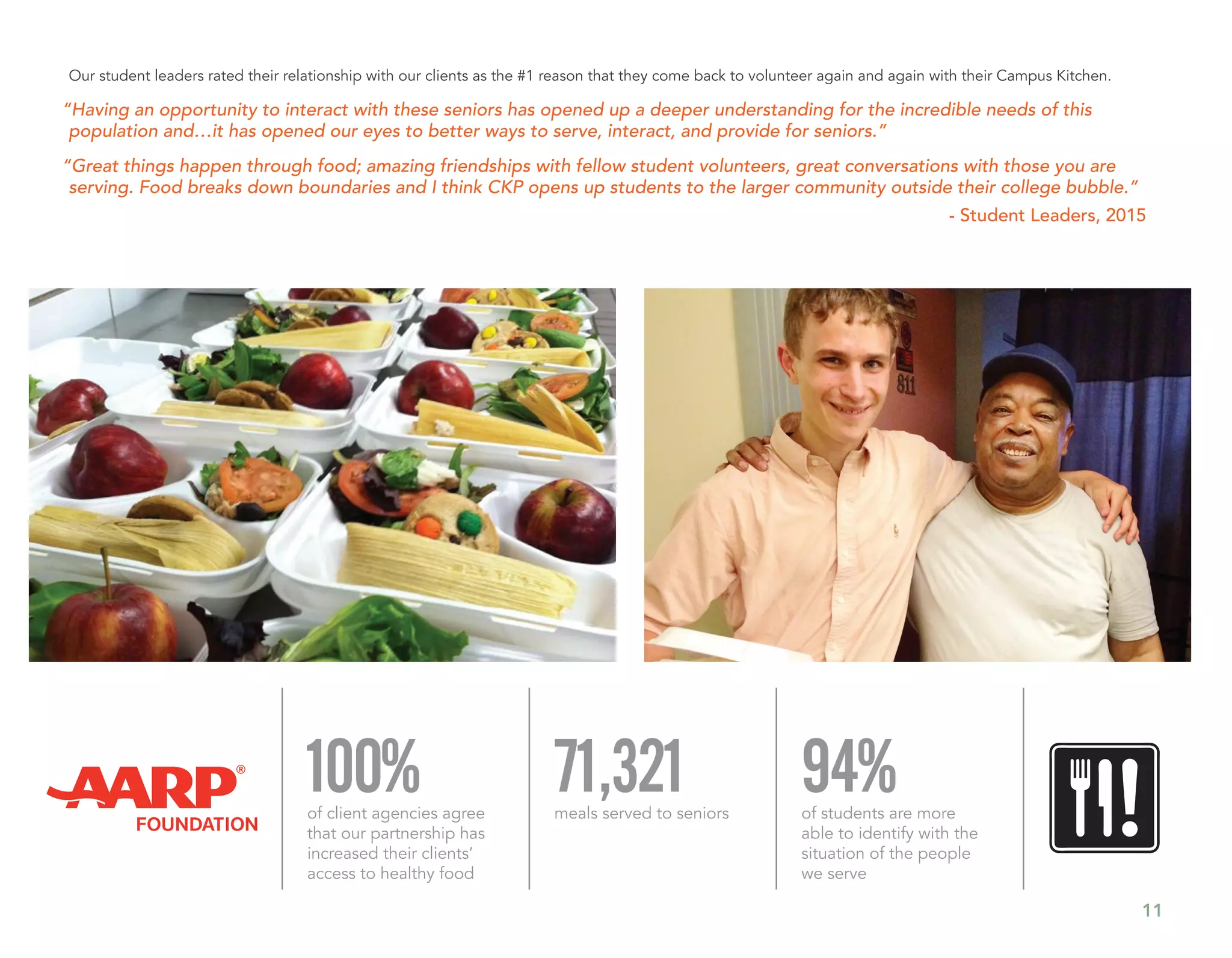
Our student leaders rated their relationship with our clients as the #1 reason that they come back to volunteer again and again with their Campus Kitchen.
“Having an opportunity to interact with these seniors has opened up a deeper understanding for the incredible needs of this
population and…it has opened our eyes to better ways to serve, interact, and provide for seniors.”
“Great things happen through food; amazing friendships with fellow student volunteers, great conversations with those you are
serving. Food breaks down boundaries and I think CKP opens up students to the larger community outside their college bubble.”
- Student Leaders, 2015
94%of students are more
able to identify with the
situation of the people
we serve
71,321meals served to seniors
100%of client agencies agree
that our partnership has
increased their clients’
access to healthy food
12
DEVELOPING STUDENT LEADERS
“Before starting with Campus Kitchens, all I knew was that I wanted to be a doctor. Afterwards, I still realized that that’s what I wanted to do, but it made
me realize the importance of good food for good health. Now I know that to become a great physician, I need to address hunger as a medical issue.”
“I can use the food preparation skills in my nutrition major, the nonprofit skills in my entrepreneurship major, and my leadership skills in life.”
- Student Leaders, 2015
DEVELOPING
STUDENT LEADERS:
THE NEXT
GENERATION
IN THE FIGHT
AGAINST HUNGER
When institutions of higher education partner with established national nonprofits like The Campus Kitchens
Project, they see profound results not only in community engagement, but also in student leadership development.
Students are searching for colleges and universities that allow them to go beyond learning in the classroom and
engage in meaningful service that connects their studies to real-world experience.
As a result of their service experiences, 97% of our student volunteers report that they are more confident in their
leadership abilities, and 91% believe they have acquired skills that will make them more likely to find a job after
graduation.
No matter what field our students go into after graduation, they are gaining entrepreneurial and leadership skills
that they will carry with them into future careers.
13
START A CAMPUS KITCHEN
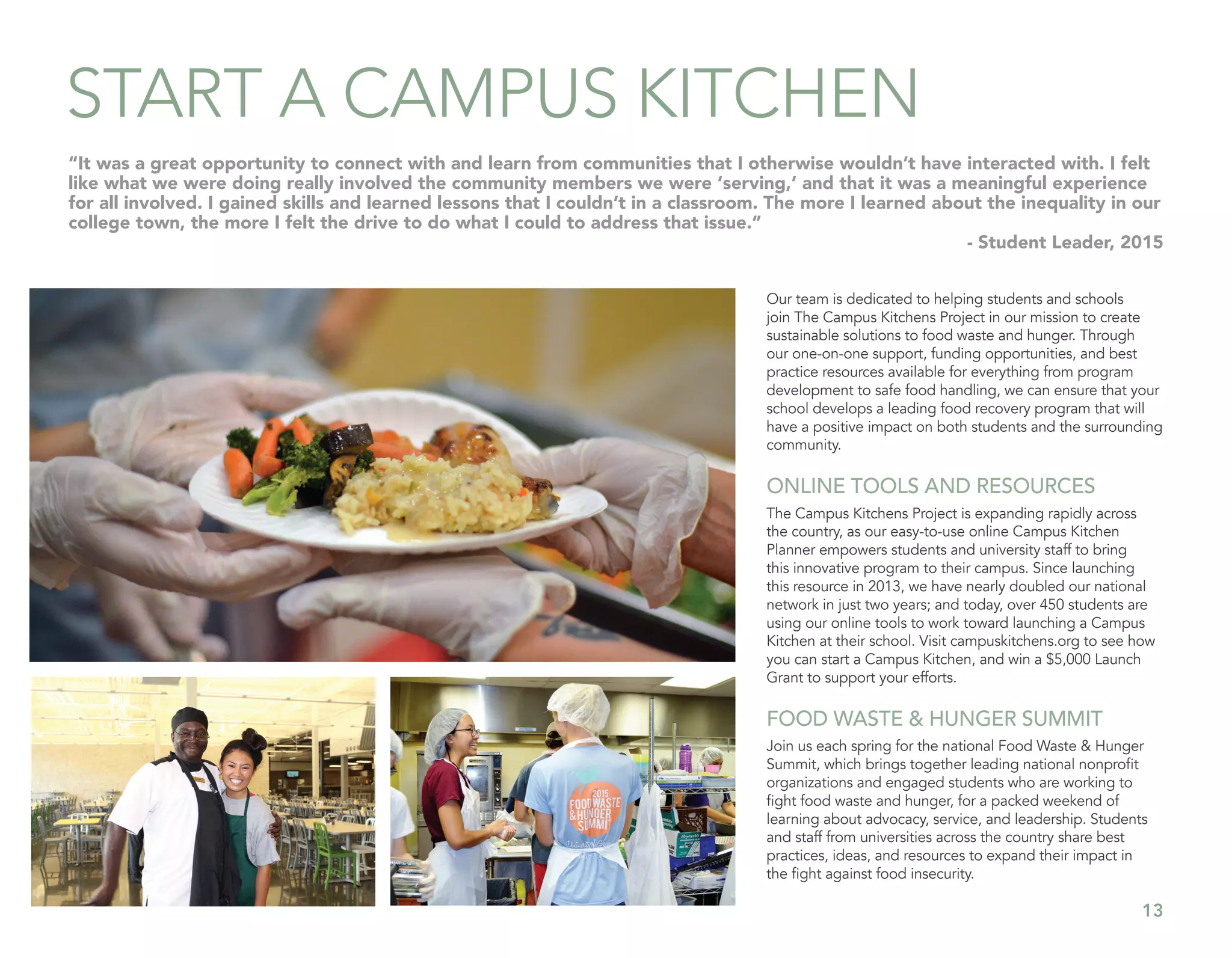
Our team is dedicated to helping students and schools
join The Campus Kitchens Project in our mission to create
sustainable solutions to food waste and hunger. Through
our one-on-one support, funding opportunities, and best
practice resources available for everything from program
development to safe food handling, we can ensure that your
school develops a leading food recovery program that will
have a positive impact on both students and the surrounding
community.
ONLINE TOOLS AND RESOURCES
The Campus Kitchens Project is expanding rapidly across
the country, as our easy-to-use online Campus Kitchen
Planner empowers students and university staff to bring
this innovative program to their campus. Since launching
this resource in 2013, we have nearly doubled our national
network in just two years; and today, over 450 students are
using our online tools to work toward launching a Campus
Kitchen at their school. Visit campuskitchens.org to see how
you can start a Campus Kitchen, and win a $5,000 Launch
Grant to support your efforts.
FOOD WASTE & HUNGER SUMMIT
Join us each spring for the national Food Waste & Hunger
Summit, which brings together leading national nonprofit
organizations and engaged students who are working to
fight food waste and hunger, for a packed weekend of
learning about advocacy, service, and leadership. Students
and staff from universities across the country share best
practices, ideas, and resources to expand their impact in
the fight against food insecurity.
“It was a great opportunity to connect with and learn from communities that I otherwise wouldn’t have interacted with. I felt
like what we were doing really involved the community members we were ‘serving,’ and that it was a meaningful experience
for all involved. I gained skills and learned lessons that I couldn’t in a classroom. The more I learned about the inequality in our
college town, the more I felt the drive to do what I could to address that issue.”
- Student Leader, 2015
14
2015 FINANCIAL HIGHLIGHTS
Board of Directors
Will Artley
Nonna’s Kitchen
Todd Cohen
AtSite, Inc.
Doron Ezickson
Cadwalader, Wickersham, & Taft LLP
Dev Ganesan
Fishbowl Marketing
Michael Golden
Wells Fargo Bank
Sara Guthrie
Clark Construction
Ellen Haas
Podesta Group
Kathy Hollinger
Restaurant Association of Metropolitan Washington
Ryland Johnson
Ambit Energy
Glenn Katz
Comcast Business Enterprise Services
Solomon Keene, Jr.
The Hotel Association of Washington DC
Damon Lester
National Association of Minority Automobile Dealers
Anthony Lombardo
The Hamilton
Winston Bao Lord
Venga
Lisa McGovern
Congressional Families Cancer Prevention Program
Micheline Mendelsohn
Good Stuff Eatery
Mark Michael
Occasions Catering
Elizabeth Mullins
The Ritz-Carlton
George Munz
The Ritz-Carlton
Tracy O’Grady
Chef and Restaurateur
Thomas Penny
Courtyard by Marriott Convention Center
Don Shapiro
Ronald Reagan Building and International Trade Center
Claudia Sherman
Wayne Swann
SL Swann Enterprises, LLC
Jerald Thomas
DCCK Culinary Job Training Program Graduate
Samuel Thomas
Events DC
Mark Toigo
Toigo Orchards
Sarah Tyree (Chair)
CoBank
Bernard Wood
Area General Manager, Sodexo
Chairs Emeritus
José Andrés, ThinkFoodGroup, Inc.
Rob Wilder, ThinkFoodGroup, Inc.
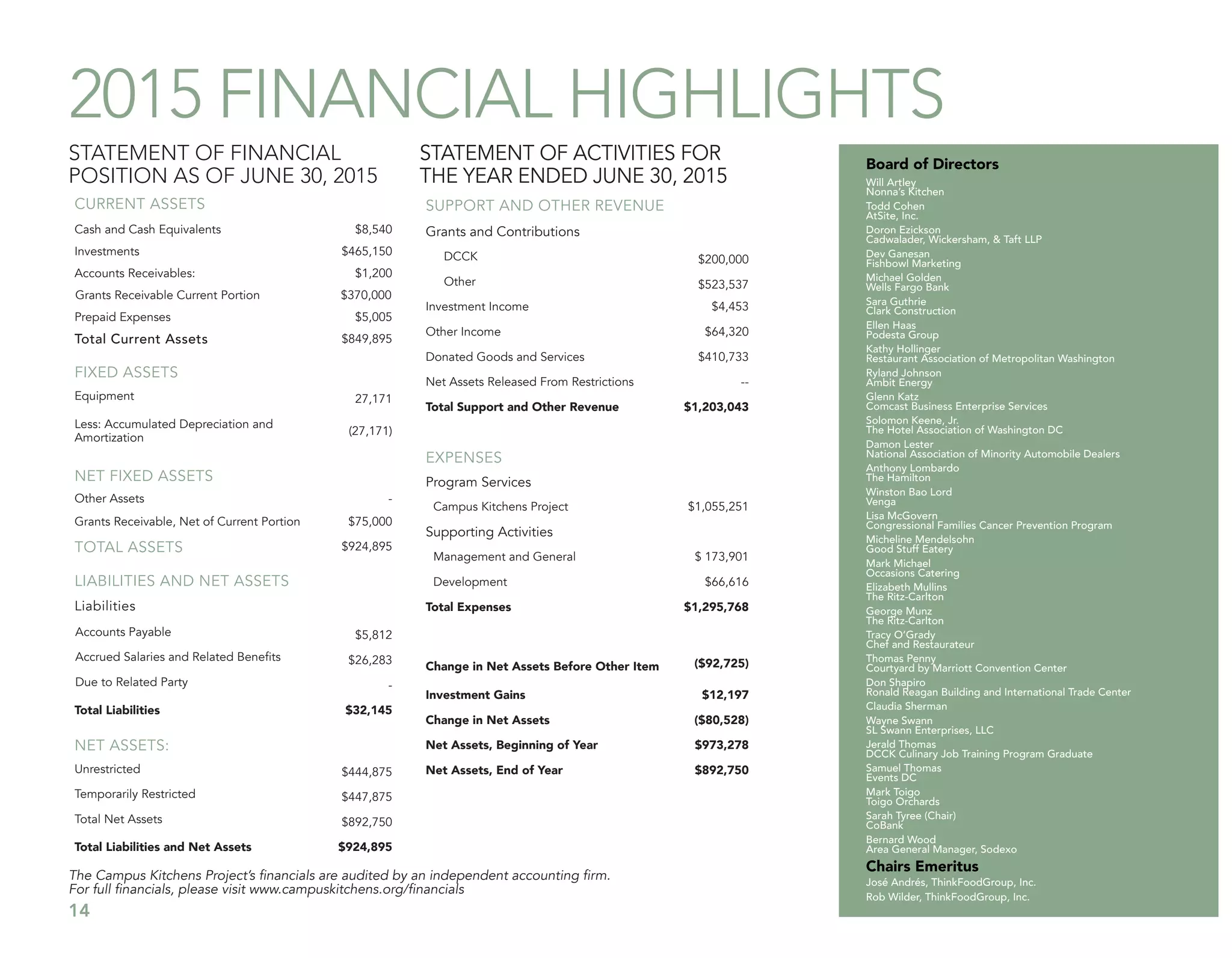
CURRENT ASSETS
Cash and Cash Equivalents $8,540
Investments $465,150
Accounts Receivables: $1,200
Grants Receivable Current Portion $370,000
Prepaid Expenses $5,005
Total Current Assets $849,895
FIXED ASSETS
Equipment 27,171
Less: Accumulated Depreciation and
Amortization
(27,171)
NET FIXED ASSETS
Other Assets -
Grants Receivable, Net of Current Portion $75,000
TOTAL ASSETS $924,895
LIABILITIES AND NET ASSETS
Liabilities
Accounts Payable $5,812
Accrued Salaries and Related Benefits $26,283
Due to Related Party -
Total Liabilities $32,145
NET ASSETS:
Unrestricted $444,875
Temporarily Restricted $447,875
Total Net Assets $892,750
Total Liabilities and Net Assets $924,895
SUPPORT AND OTHER REVENUE
Grants and Contributions
DCCK $200,000
Other $523,537
Investment Income $4,453
Other Income $64,320
Donated Goods and Services $410,733
Net Assets Released From Restrictions --
Total Support and Other Revenue $1,203,043
EXPENSES
Program Services
Campus Kitchens Project $1,055,251
Supporting Activities
Management and General $ 173,901
Development $66,616
Total Expenses $1,295,768
Change in Net Assets Before Other Item ($92,725)
Investment Gains $12,197
Change in Net Assets ($80,528)
Net Assets, Beginning of Year $973,278
Net Assets, End of Year $892,750
STATEMENT OF FINANCIAL
POSITION AS OF JUNE 30, 2015
STATEMENT OF ACTIVITIES FOR
THE YEAR ENDED JUNE 30, 2015
The Campus Kitchens Project’s financials are audited by an independent accounting firm.
For full financials, please visit www.campuskitchens.org/financials
15
2015 SUPPORTERS
$150,000 AND ABOVE
AARP Foundation
J. Willard and Alice S. Marriott Foundation
Sodexo Foundation
$50,000-$149,999
CoBank
General Mills
$10,000-$49,999
Ameriprise Financial, Inc.
Evangelical Lutheran Church in America
The Saigh Foundation
$5,000-$9,999
George M. Eisenberg Foundation for Charities
Johnston-Hanson Foundation
National Dairy Council
Second Harvest Heartland
$1,000-$4,999
Clif Bar Family Foundation
Herman T. and Phenie R. Pott Foundation
The Schnarr Family
Farm Journal Agricultural Foundation
Entertainment Industry Foundation
Gambino Family Fund
Shirley Roderfeld
ADDITIONAL SUPPORTERS
Abcam
AmazonSmile Foundation
America’s Charities
Angel Sharma
Angela Comte
Bernice Carp
Cambridge Apartments Corp.
Cara Gitchos
Chaminade College Preparatory School
Charlotte Williams
Chartwells, Saint Louis University
Cherie Ennis
Claire Jackson
Claudia Lane
Cynthia Ann Hedin
Diana Byrne
Dick Iverson
Don Korpos
DonateWell
Donna Myers
Edward Reichert
Eric Muir
Evanston High School, District #202
Frontstream c/o Visa Givingstation
Geralyn Singer
Gettysburg College
GoodSearch
Gregory Rise
Heather Stout
Inland Imaging LLC
James Klenke
James Whalen
Jeff McCarthy
Jeffery Strader
John Mayer
Julianna Schneider
Karen Myers
Karla Meshey
Kate Johnston
Kathleen Hargrave
Kathryn King
Kathy Barbeau
Kavitha Krishnarao
Kenneth Martin
Kevin Donovan
Kimberlie Dayot
Kine Walker
Krista Karwoski-Siebert
Lin Li
Linda Morales
Lisa Mitchell
Marquette University, Finance Department
Mary Corkery
Maryann Kelley
Michael Moloney
Network For Good
Pat Roberts
Patricia Mazzuca
Paul Schimmele
R. J. Simon
Rebecca Baker
Richard Ohs
Rita Stites
Robert Johnston
Robin Schneider
Roger Stephens
Schnucks
Stephen Supica
Sylvia Barry
The Nutman Company USA, Inc.
The Prudential Foundation Matching Gifts
Program
The Stratfield Fund
Thomas Cohoon
Tiffany Goss
Truist
University of Massachusetts, UMass Medical School
19 EYE STREET NW, WASHINGTON, DC 20001 | PHONE: 202-789-5979 | FAX: 202-789-5977
CAMPUSKITCHENS.ORG | @CAMPUSKITCHENS

2015 Annual Report

  • 1.
  • 2.
    2 MICHAEL F. CURTIN,JR. CHIEFEXECUTIVE OFFICER It has been truly amazing to see and experience the growth of The Campus Kitchens Project over the last few years. We have recovered food that would otherwise have gone to waste and transformed it into millions of meals that have filled gaps in local food systems in and around urban, rural, and suburban campuses across our country. While this work is important and helps us fight hunger today, it is the development of these student leaders that will really help us eliminate hunger tomorrow. In so many ways, I am the luckiest man in the world to have the job I do. I am poignantly reminded of that fact every time I visit a Campus Kitchen or talk to students when they visit DC Central Kitchen every August during our Boot Camp training. What I really love is seeing these same students, who may have been tentative or reserved when they started working with us, step up and come into their own as leaders at our annual Food Waste & Hunger Summit in the spring. They are not just participants; they are leaders, and they are taking the program to places we never imagined possible. It is because of these leaders that I can say I am optimistic about the future of our country. I am happy to say that these students feel the same way. In this year’s student leadership development survey, we learned that 97% of Campus Kitchens volunteers feel more confident in their leadership abilities, and 100% of students say they have contributed in a valuable way to their community. That statistic reinforces my belief in the enormous power of young people, and reaffirms my gratitude for our generous supporters and investors. Without you, these leaders of tomorrow would not have the opportunity to realize their full potential by connecting their classroom learning to real-world experience through service. Thank you for making this work possible. LAURATOSCANO DIRECTOR,THE CAMPUS KITCHENS PROJECT Last year, we shared our strategic plan to scale The Campus Kitchens Project in order to add more schools, help our Campus Kitchens increase their local impact, and leverage the entrepreneurial spirit of young people to identify innovative and sustainable solutions to hunger and food waste nationwide. Over the first 12 years of our history, we launched 33 Campus Kitchens; and in just the past two years, as a result of our new scaling strategy and online Campus Kitchen Planner, we have grown to nearly 50 locations nationwide. This expansion represents not only the hard work of The Campus Kitchens Project staff to reach and inspire more students, but also the passion and commitment of students eager to make a difference in their communities. This year, we will reach a historic milestone: we will recover our 5 millionth pound of food and serve our 2.5 millionth meal. But we know we can’t end hunger with food alone. Each day our students deepen their impact by developing innovative programs that address the underlying root causes of hunger. Thanks to our partners, supporters, and growing national network, we are able to invest in these replicable programs that represent the next generation of solutions to hunger and food waste. “IT’S ALL CONNECTED. MUCH OF WHAT I HAVE LEARNED THROUGH CAMPUS KITCHENS AS I MOVED FROM A VOLUNTEERISM LENS TO A SOCIAL JUSTICE LENS WAS HOW TO LOOK AT A SOCIAL ISSUE AND ASK THE HARD QUESTION, ‘HOW CAN I CHANGE THIS ON A SYSTEMATIC LEVEL?’” - STUDENT LEADER, 2015
  • 3.
    3 The Campus KitchensProject is empowering students to create sustainable solutions to food waste and hunger. THE CAMPUS KITCHENS PROJECT Saint Louis University Saint Louis, MO Northwestern University Evanston, IL Augsburg College Minneapolis, MN MarqueƩe University Milwaukee, WI Gonzaga University Spokane, WA Gonzaga College High School Washington, DC Minnesota State University Mankato Mankato, MN Wake Forest University Winston-Salem, NC Washington and Lee University Lexington, VA University of Nebraska Kearney Kearney, NE College of William and Mary Williamsburg, VA GeƩysburg College GeƩysburg, PA University of Maryland Eastern Shore Rockville, MD University of Vermont Burlington, VT Baylor University Waco, TX Johns Hopkins University BalƟmore, MD University of Florida Gainesville, FL University of Wisconsin-Eau Claire Eau Claire, WI Lee University Cleveland, TN Washington University in St. Louis St. Louis, MO St. Lawrence University Canton, NY University of MassachuseƩs Boston Boston, MA University of Virginia CharloƩesville, VA East Carolina University Greenville, NC Union College Schenectady, NY University of Detroit Mercy Detroit, MI Elon University Elon, NC Kent State University Kent, OH Auburn University Auburn, AL The Campus Kitchens Project Network campuskitchens.org St. Andrew’s Episcopal School Potomac, MD AtlanƟc City AtlanƟc City, NJ Washington, DC Washington, DC University of Georgia Athens, GA Meredith College Raleigh, NC Georgia Tech Atlanta, GA University of Wisconsin-Green Bay Green Bay, WI IUPUI Indianapolis, IN Southern Illinois University Edwardsville Edwardsville, IL St. Peter’s University Jersey City, NJ Troy University Troy, AL University of Kentucky Lexington, KY Emory University Atlanta, GA Sacred Heart Prep School Atherton, CA Walsh University North Canton, OH University of Wisconsin-Madison Madison, WI Thank you to all our Campus Kitchens whose photos are featured in this Annual Report. Cover photo: Student volunteers deliver fresh vegetables through the Campus Kitchen at Gettysburg College’s Green Goodies initiative.
  • 4.
  • 5.
  • 6.
    6 THE ISSUE: RURALHUNGER Students involved with The Campus Kitchens Project not only prepare and deliver meals, but develop new and innovative solutions to some of the nation’s most difficult food security issues. One of the critical challenges facing our country is the prevalence of hunger in rural areas, and the technical difficulty of addressing this problem in a sustainable way. In many rural communities, traditional food bank distribution efforts are too costly due to infrastructure and transportation challenges. At the same time, these are the regions producing our food in the first place. This year, we invested in the efforts of several Campus Kitchens with innovative approaches and new solutions that can be replicated in rural communities nationwide. From Elon University’s strong partnerships with neighboring farms, to Washington & Lee University’s Mobile Food Pantry, to Gettysburg College’s innovative distribution of free CSA shares, these campuses serve as the ideal “test kitchen” for more sustainable solutions to hunger—connecting existing assets on campus, on surrounding farms, and in the community. “I apply the skills I have developed while volunteering with the Campus Kitchen every day as I interact with people in my community - both educating others and serving others.” - Student Leader, 2015 2,580 rural clients served each month 47,500 meals served to rural clients BEYOND THE MEAL SOLUTION: IMPROVED ACCESS TO HEALTHY LOCAL FOOD This year, we launched a partnership with the rural development experts at CoBank to expand our services in rural communities.
  • 7.
    7 THE ISSUE: WASTEDFOOD Over 40% of all the food we produce in America goes to waste. To the next generation of student leaders, it’s clear that all this wasted food has enormous potential to feed the millions of Americans struggling with food insecurity. “I worked in the dining halls and was responsible for throwing away leftover food at the end of the night...then I’d walk past hungry, homeless people on the street...there was an obvious disconnect.” - Student Leader, 2015 “I realized how important what we do is for the community and the environment combined. We are changing the way America deals with food one meal at a time.” - Student Leader, 2015 What sets The Campus Kitchens Project apart is our focus on transforming wasted food into complete, balanced meals. It’s simply not enough to deliver leftover food as is, when it’s available. To have a real and measurable impact on the food security of our clients, our students work with community partners to provide a set number of balanced, nutritious meals on a regular schedule. They not only rescue extra food from dining halls on campus, but also seek out partnerships with local grocery stores, farms, restaurants and farmers markets to recover more fresh local produce so they can always deliver a healthy meal. 17,042,818 gallons of water used to produce food would have otherwise been wasted** 95,557,998 lbs of CO2 emissions prevented* 987,221 lbs of food recovered *FAO UN Report on Food Waste [97 pounds of CO2 ≈ 1 pound of food] **World Resources Institute [~17.3 gallons of water ≈ 1 pound of food]
  • 8.
    8 THE ISSUE: YOUTHHUNGER “I got involved with the Campus Kitchen when I started a Master in Nutrition Program. I was interested in providing opportunities for kids to have healthy meals in food insecure areas.” - Student Leader, 2015 BEYOND THE MEAL SOLUTION: EFFECTIVE NUTRITION EDUCATION CURRICULUM A critical lesson of the childhood obesity epidemic is that food insecurity is about more than not having enough to eat. We need to not only eat enough, but make healthy choices and eat the right kinds of foods. Eating balanced meals with all of the essential nutrients for a child’s growth is a recipe for lifelong health. In order to meet this need among food insecure children in communities around the country, The Campus Kitchens Project has made nutrition education a focus across the network. Our student leaders are committed to going beyond simply providing meals. When working with youth who are at risk for hunger, they develop engaging nutrition education programs that teach children the importance of eating right. This year, we created Sowing Seeds for Healthy Kids, a 6-week nutrition education module that is designed to take place in a garden and to complement our original Building Blocks for Healthy Kids curriculum. To encourage the replication of these successful programs nationwide, we shared these lessons on our website at campuskitchens.org/curricula.
  • 9.
    9 “I’ve created agreat bond with the children that receive our meals every week over the years, so I want to be a consistent positive presence in their lives. I realize that food insecurity is not an issue that magically goes away, and the people we serve really benefit from our help week in and week out.” - Student Leader, 2015 39,829 online views of our nutrition education curricula 89% of Campus Kitchens serve youth 1 in 5 children are at risk for hunger
  • 10.
    10 THE ISSUE: OLDERADULT HUNGER “This has been an incredibly eye-opening and enjoyable experience. I have always appreciated and admired elders, but I have developed a newfound outlook after volunteering for this program!” - Student Leader, 2015 BEYOND THE MEAL SOLUTION: ANTI-ISOLATION PROGRAMS FOR SENIORS We have always encouraged our student leaders to focus on serving older adults in their communities, and now, with more than eight million Baby Boomers aged 50 to 64 turning to charitable food assistance to make ends meet, our work is needed more than ever before. One of the most powerful testaments to our work is our partnership with AARP Foundation. Their focus on older adult hunger, like ours, relies not only on the provision of nutritious meals today, but also on the creation of innovative programs that address the underlying root causes of hunger to break this cycle for good. Student volunteers at Campus Kitchens provide meals, lead nutrition and wellness classes, and create opportunities for friendship and community engagement in order to reduce the isolation that many seniors experience.
  • 11.
    11 Our student leadersrated their relationship with our clients as the #1 reason that they come back to volunteer again and again with their Campus Kitchen. “Having an opportunity to interact with these seniors has opened up a deeper understanding for the incredible needs of this population and…it has opened our eyes to better ways to serve, interact, and provide for seniors.” “Great things happen through food; amazing friendships with fellow student volunteers, great conversations with those you are serving. Food breaks down boundaries and I think CKP opens up students to the larger community outside their college bubble.” - Student Leaders, 2015 94%of students are more able to identify with the situation of the people we serve 71,321meals served to seniors 100%of client agencies agree that our partnership has increased their clients’ access to healthy food
  • 12.
    12 DEVELOPING STUDENT LEADERS “Beforestarting with Campus Kitchens, all I knew was that I wanted to be a doctor. Afterwards, I still realized that that’s what I wanted to do, but it made me realize the importance of good food for good health. Now I know that to become a great physician, I need to address hunger as a medical issue.” “I can use the food preparation skills in my nutrition major, the nonprofit skills in my entrepreneurship major, and my leadership skills in life.” - Student Leaders, 2015 DEVELOPING STUDENT LEADERS: THE NEXT GENERATION IN THE FIGHT AGAINST HUNGER When institutions of higher education partner with established national nonprofits like The Campus Kitchens Project, they see profound results not only in community engagement, but also in student leadership development. Students are searching for colleges and universities that allow them to go beyond learning in the classroom and engage in meaningful service that connects their studies to real-world experience. As a result of their service experiences, 97% of our student volunteers report that they are more confident in their leadership abilities, and 91% believe they have acquired skills that will make them more likely to find a job after graduation. No matter what field our students go into after graduation, they are gaining entrepreneurial and leadership skills that they will carry with them into future careers.
  • 13.
    13 START A CAMPUSKITCHEN Our team is dedicated to helping students and schools join The Campus Kitchens Project in our mission to create sustainable solutions to food waste and hunger. Through our one-on-one support, funding opportunities, and best practice resources available for everything from program development to safe food handling, we can ensure that your school develops a leading food recovery program that will have a positive impact on both students and the surrounding community. ONLINE TOOLS AND RESOURCES The Campus Kitchens Project is expanding rapidly across the country, as our easy-to-use online Campus Kitchen Planner empowers students and university staff to bring this innovative program to their campus. Since launching this resource in 2013, we have nearly doubled our national network in just two years; and today, over 450 students are using our online tools to work toward launching a Campus Kitchen at their school. Visit campuskitchens.org to see how you can start a Campus Kitchen, and win a $5,000 Launch Grant to support your efforts. FOOD WASTE & HUNGER SUMMIT Join us each spring for the national Food Waste & Hunger Summit, which brings together leading national nonprofit organizations and engaged students who are working to fight food waste and hunger, for a packed weekend of learning about advocacy, service, and leadership. Students and staff from universities across the country share best practices, ideas, and resources to expand their impact in the fight against food insecurity. “It was a great opportunity to connect with and learn from communities that I otherwise wouldn’t have interacted with. I felt like what we were doing really involved the community members we were ‘serving,’ and that it was a meaningful experience for all involved. I gained skills and learned lessons that I couldn’t in a classroom. The more I learned about the inequality in our college town, the more I felt the drive to do what I could to address that issue.” - Student Leader, 2015
  • 14.
    14 2015 FINANCIAL HIGHLIGHTS Boardof Directors Will Artley Nonna’s Kitchen Todd Cohen AtSite, Inc. Doron Ezickson Cadwalader, Wickersham, & Taft LLP Dev Ganesan Fishbowl Marketing Michael Golden Wells Fargo Bank Sara Guthrie Clark Construction Ellen Haas Podesta Group Kathy Hollinger Restaurant Association of Metropolitan Washington Ryland Johnson Ambit Energy Glenn Katz Comcast Business Enterprise Services Solomon Keene, Jr. The Hotel Association of Washington DC Damon Lester National Association of Minority Automobile Dealers Anthony Lombardo The Hamilton Winston Bao Lord Venga Lisa McGovern Congressional Families Cancer Prevention Program Micheline Mendelsohn Good Stuff Eatery Mark Michael Occasions Catering Elizabeth Mullins The Ritz-Carlton George Munz The Ritz-Carlton Tracy O’Grady Chef and Restaurateur Thomas Penny Courtyard by Marriott Convention Center Don Shapiro Ronald Reagan Building and International Trade Center Claudia Sherman Wayne Swann SL Swann Enterprises, LLC Jerald Thomas DCCK Culinary Job Training Program Graduate Samuel Thomas Events DC Mark Toigo Toigo Orchards Sarah Tyree (Chair) CoBank Bernard Wood Area General Manager, Sodexo Chairs Emeritus José Andrés, ThinkFoodGroup, Inc. Rob Wilder, ThinkFoodGroup, Inc. CURRENT ASSETS Cash and Cash Equivalents $8,540 Investments $465,150 Accounts Receivables: $1,200 Grants Receivable Current Portion $370,000 Prepaid Expenses $5,005 Total Current Assets $849,895 FIXED ASSETS Equipment 27,171 Less: Accumulated Depreciation and Amortization (27,171) NET FIXED ASSETS Other Assets - Grants Receivable, Net of Current Portion $75,000 TOTAL ASSETS $924,895 LIABILITIES AND NET ASSETS Liabilities Accounts Payable $5,812 Accrued Salaries and Related Benefits $26,283 Due to Related Party - Total Liabilities $32,145 NET ASSETS: Unrestricted $444,875 Temporarily Restricted $447,875 Total Net Assets $892,750 Total Liabilities and Net Assets $924,895 SUPPORT AND OTHER REVENUE Grants and Contributions DCCK $200,000 Other $523,537 Investment Income $4,453 Other Income $64,320 Donated Goods and Services $410,733 Net Assets Released From Restrictions -- Total Support and Other Revenue $1,203,043 EXPENSES Program Services Campus Kitchens Project $1,055,251 Supporting Activities Management and General $ 173,901 Development $66,616 Total Expenses $1,295,768 Change in Net Assets Before Other Item ($92,725) Investment Gains $12,197 Change in Net Assets ($80,528) Net Assets, Beginning of Year $973,278 Net Assets, End of Year $892,750 STATEMENT OF FINANCIAL POSITION AS OF JUNE 30, 2015 STATEMENT OF ACTIVITIES FOR THE YEAR ENDED JUNE 30, 2015 The Campus Kitchens Project’s financials are audited by an independent accounting firm. For full financials, please visit www.campuskitchens.org/financials
  • 15.
    15 2015 SUPPORTERS $150,000 ANDABOVE AARP Foundation J. Willard and Alice S. Marriott Foundation Sodexo Foundation $50,000-$149,999 CoBank General Mills $10,000-$49,999 Ameriprise Financial, Inc. Evangelical Lutheran Church in America The Saigh Foundation $5,000-$9,999 George M. Eisenberg Foundation for Charities Johnston-Hanson Foundation National Dairy Council Second Harvest Heartland $1,000-$4,999 Clif Bar Family Foundation Herman T. and Phenie R. Pott Foundation The Schnarr Family Farm Journal Agricultural Foundation Entertainment Industry Foundation Gambino Family Fund Shirley Roderfeld ADDITIONAL SUPPORTERS Abcam AmazonSmile Foundation America’s Charities Angel Sharma Angela Comte Bernice Carp Cambridge Apartments Corp. Cara Gitchos Chaminade College Preparatory School Charlotte Williams Chartwells, Saint Louis University Cherie Ennis Claire Jackson Claudia Lane Cynthia Ann Hedin Diana Byrne Dick Iverson Don Korpos DonateWell Donna Myers Edward Reichert Eric Muir Evanston High School, District #202 Frontstream c/o Visa Givingstation Geralyn Singer Gettysburg College GoodSearch Gregory Rise Heather Stout Inland Imaging LLC James Klenke James Whalen Jeff McCarthy Jeffery Strader John Mayer Julianna Schneider Karen Myers Karla Meshey Kate Johnston Kathleen Hargrave Kathryn King Kathy Barbeau Kavitha Krishnarao Kenneth Martin Kevin Donovan Kimberlie Dayot Kine Walker Krista Karwoski-Siebert Lin Li Linda Morales Lisa Mitchell Marquette University, Finance Department Mary Corkery Maryann Kelley Michael Moloney Network For Good Pat Roberts Patricia Mazzuca Paul Schimmele R. J. Simon Rebecca Baker Richard Ohs Rita Stites Robert Johnston Robin Schneider Roger Stephens Schnucks Stephen Supica Sylvia Barry The Nutman Company USA, Inc. The Prudential Foundation Matching Gifts Program The Stratfield Fund Thomas Cohoon Tiffany Goss Truist University of Massachusetts, UMass Medical School
  • 16.
    19 EYE STREETNW, WASHINGTON, DC 20001 | PHONE: 202-789-5979 | FAX: 202-789-5977 CAMPUSKITCHENS.ORG | @CAMPUSKITCHENS