December 2016
with John Russell
www.miinlondon.org / miclub@miinlondon.org
Follow us on Twitter @miinlondon / Tweet #miinlondon
1	
Topic: The 4 MI Processes
Welcome to MI Club
Four MI Processes
2	
Aims	and	
Objec0ves
3	
Aims of today
1.  To recognise the 4 processes in MI.
2.  To learn how to flow through each process
and recognise they are not always linear.
3.  To practise open questions in each process.
4.  To watch a trainer demonstration.
5.  Have a laugh! This is a safe place to practise.
Objectives
4	
•  18:00 – 4 Processes (Ps): Your experience
•  18:10 – 4 Ps: What are they / Why use them?
•  18:20 – Practise (yay!)
•  18:40 – Trainer Demonstration
•  18:50 – Debrief
Four MI Processes
5	
What	does	
good	look				
like?
6	
Think about a time when someone
tries to make a plan or set a goal
with you, but you’re not ready to.
1.  How do you react?
2.  Have you ever tried to make a plan with someone who
you thought was ready but wasn’t. How did this go?
3.  Talk to the person/people next to you to discuss (5 mins)
4.  Then we’ll all have the chance to feedback as a group
Send us a Tweet: @MIinlondon
Four MI Processes
7	
What	does	MI	
literature	say?
8	
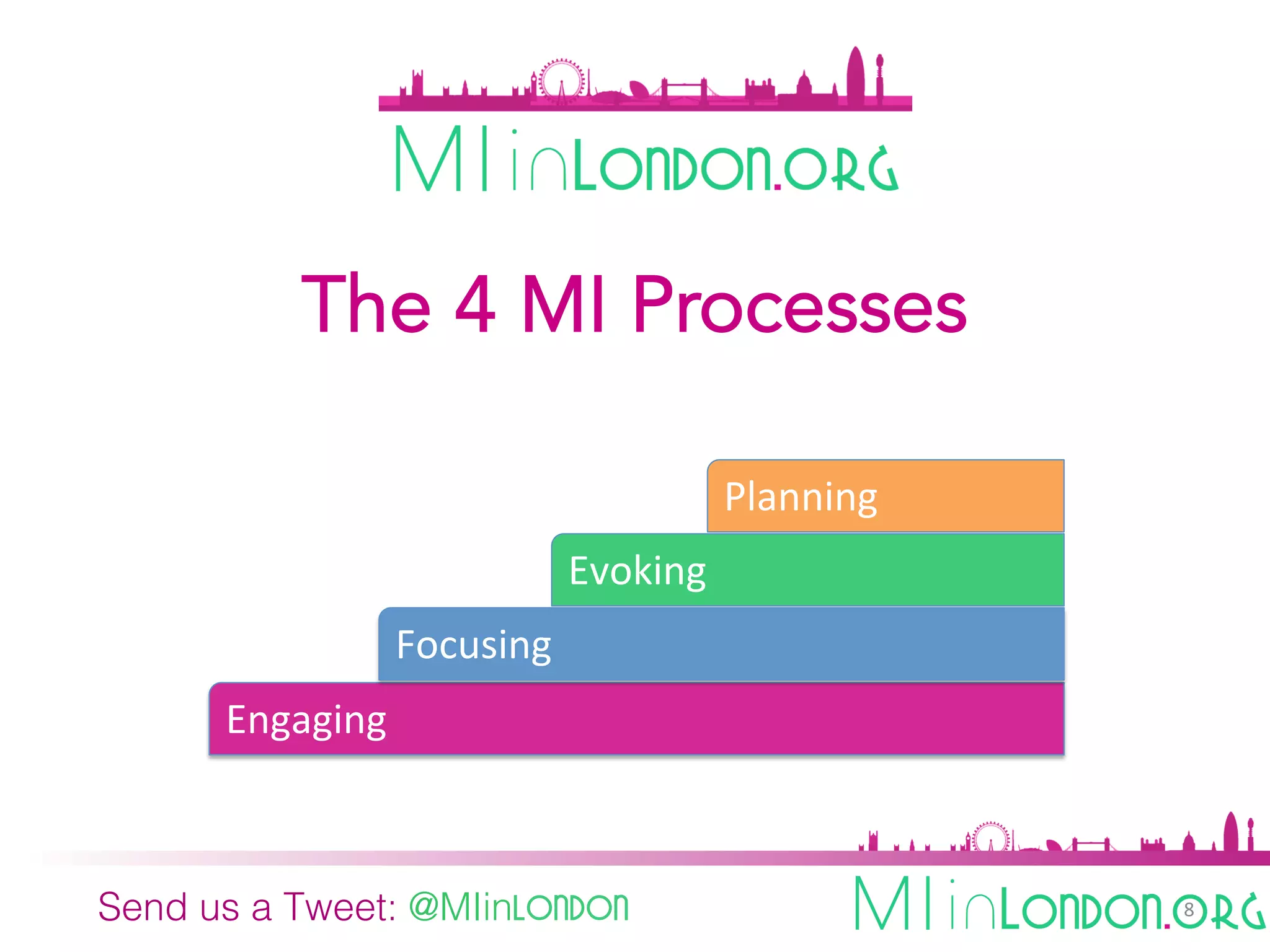
The 4 MI Processes
Send us a Tweet: @MIinlondon
Engaging	
Focusing	
Evoking	
Planning
9	
The 4 MI Processes
Send us a Tweet: @MIinlondon
Following the 4 MI Processes set’s an informal
structure of where to guide your client.
We may use different uses of OARS throughout.
Today we’ll focus on open questions, and how
these may differ through each of the processes.
10	
Process 1: Engaging
“Engaging is the process by which
both parties establish a helpful
connection and a working relationship”
– Miller and Rollnick, 2012
Send us a Tweet: @MIinlondon
TIP
11	
Remove the ‘Chat Trap’
“In one treatment study, higher
levels of in-session informal chat
predicted lower levels of client
motivation for change”
(Bamatter et al., 2010)
12	
Process 1: Engaging
WHAT MIGHT YOU BE ASKING IN THIS PROCESS
“What is is that’s brought you here today?”
“What’s been your experience of XYZ condition?”
“I’m wondering how things have gone for you since we
spoke?”
NEXT: FOCUSING
Send us a Tweet: @MIinlondon
13	
Process 2: Focusing
“Focusing is the process by which you
develop and maintain a specific
direction in the conversation about
change” – Miller and Rollnick, 2012
Send us a Tweet: @MIinlondon
14	Send us a Tweet: @MIinlondon
15	
Process 2: Focusing
WHAT MIGHT YOU BE ASKING IN THIS PROCESS
“Would you be willing to go thorugh an agenda map?”
“I have some things I’d like to chat about today [such as
XYZ], what are some of the things you might like to
discuss?”
NEXT: EVOKING
Send us a Tweet: @MIinlondon
16	
Process 3: Evoking
“Evoking is having the person voice
the arguments for change” – Miller and
Rollnick, 2012
Send us a Tweet: @MIinlondon
17	
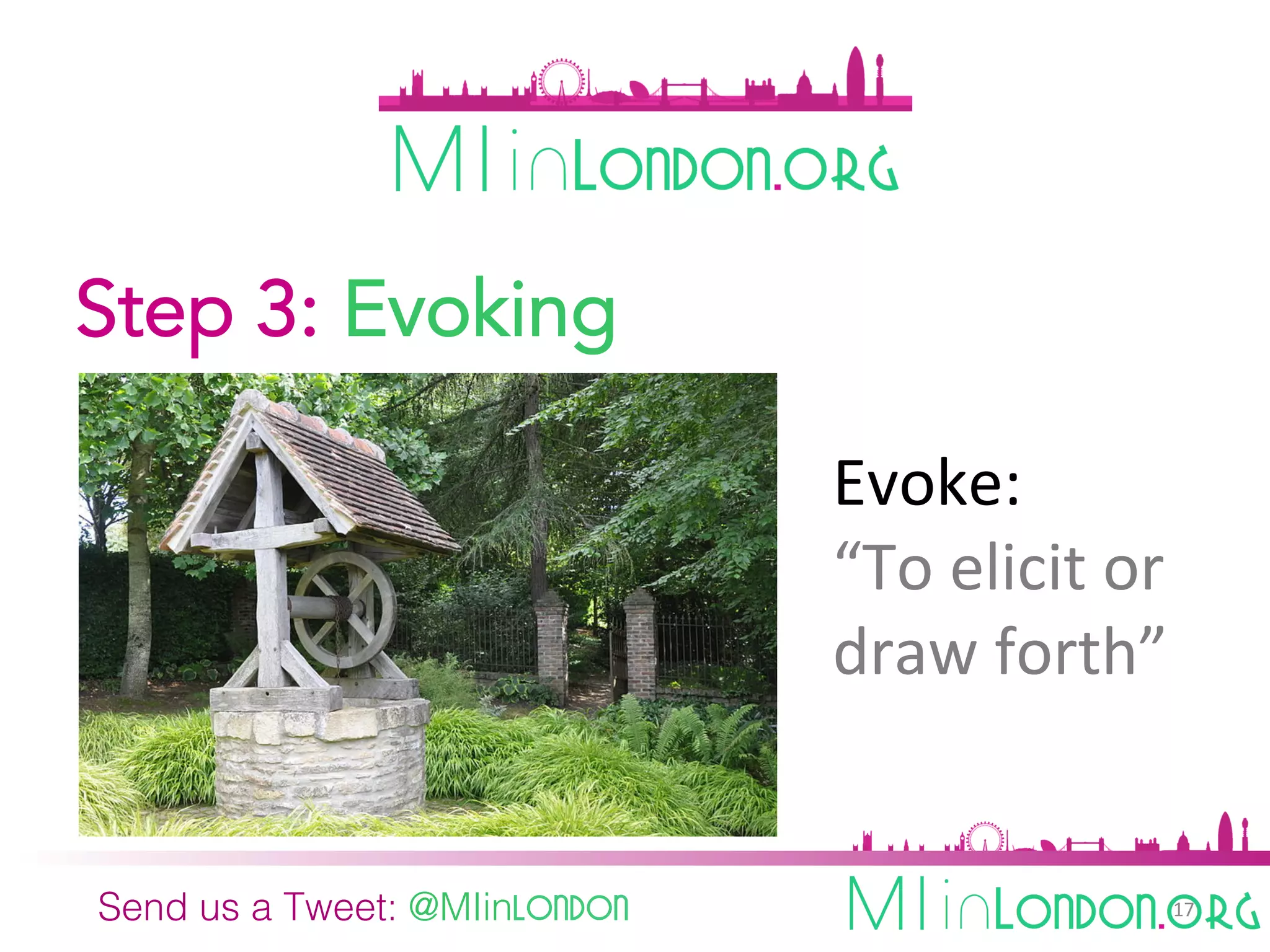
Step 3: Evoking
Send us a Tweet: @MIinlondon
Evoke:	
“To	elicit	or	
draw	forth”
18	
Step 3: Evoking
WHAT MIGHT YOU BE ASKING IN THIS PROCESS
“Would would some advantages be of XYZ change?”
“What might get worse if things stayed the same?”
“How might life be different for you if you did change?”
NEXT: PLANNING
Send us a Tweet: @MIinlondon
19	
Process 4: Planning
“Planning is a process of negotiation
and collaboration drawing on the
client's expertise (as well as your
own).” – Miller and Rollnick, 2012
Send us a Tweet: @MIinlondon
TIP
20	
Don’t plan too soon!
“If you try to develop a change plan
before the client is sufficiently ready
you may undo whatever progress you
have made through engaging, focusing
and evoking.”
21	
Process 4: Planning
WHAT MIGHT YOU BE ASKING IN THIS PROCESS
“What do you think would be some ways to take this
forward?”
NEXT: LET’S PRACTISE
Send us a Tweet: @MIinlondon
Four MI Processes
22	
MI	Skills	
Prac0se
MI Snakes and
Ladders
(MI is 10% theory, 90% practise)
23	Send us a Tweet: @MIinlondon
10 minutes group practise.
Using open questions
•  Please get into groups of 3!
24
4 Processes Snakes & Ladders:
1.  Receive a game board & one set of colours
2.  Choose a counter per person
3.  Choose who goes first, this is the person
whose birthday is nearest to Christmas!
4.  This person is player 1, to the left of you is
player 2, to the next left is player 3.
25
4 Processes Snakes & Ladders:
1.  I will draw two cards in place of dice, these
added together will be the number of
squares moved by whomever’s go is next.
2.  We will then go to player 2 and repeat, etc.
3.  This will continue until we have a winner
from each team!
26
Debrief in your groups
Discuss:
1.  Did you find any one process more
difficult the others?
2.  How might you work on that in the
future?
27
Debrief as a full team
What comments, questions or
observations do you have?
28
Four MI Processes
29	
Trainer	
Demonstra0on
Live Trainer Demo
Can I have a volunteer?
4 Processes on next slide…
30	Send us a Tweet: @MIinlondon
31	
The 4 MI Processes
Send us a Tweet: @MIinlondon
Engaging	
Focusing	
Evoking	
Planning
Four MI Processes
32	
Summary	of	
today	+	
Ques0ons
Ques1ons

Q: How do you know when the right 1me is go towards the planning stage?
A: Whilst there are always opportune moments to veer towards the collabora1ve joy that is the
planning there are plenty of piDalls to avoid. As we discussed during the ‘mul1ple op1ons’ during
the trainer demonstra1on today, trying to planning too soon, and on the interviewers agenda can
set the conversa1on back and cause the other person to withdraw. 
Moving towards planning can be achieved through the process of recapitula1on, the art of giving
a skilled transi1onal summary that is awash with change talk. This allows you to ‘test the water’
and offer a key ques1on (one that is open, searching but noncommiMal in nature). Such as
“where does this leave you” or “What do you think of all this”, “I wonder what you might decide
to do?”, “What might someone in your situa1on do next?”, “What’s in your mind at the
moment?”, “What are you thinking about at this point?”. Let the person decide what is next for
them, let them tell you.
33	Send us a Tweet: @MIinlondon
34	
Merry Christmas!
Have a one.
35	
See you on Tuesday
7th February 2017
Thanks for coming!
Send us an email: miclub@miinlondon.org

Motivational Interviewing (MI) Club - The 4 MI Processes

  • 1.
    December 2016 with JohnRussell www.miinlondon.org / miclub@miinlondon.org Follow us on Twitter @miinlondon / Tweet #miinlondon 1 Topic: The 4 MI Processes Welcome to MI Club
  • 2.
  • 3.
    3 Aims of today 1. To recognise the 4 processes in MI. 2.  To learn how to flow through each process and recognise they are not always linear. 3.  To practise open questions in each process. 4.  To watch a trainer demonstration. 5.  Have a laugh! This is a safe place to practise.
  • 4.
    Objectives 4 •  18:00 –4 Processes (Ps): Your experience •  18:10 – 4 Ps: What are they / Why use them? •  18:20 – Practise (yay!) •  18:40 – Trainer Demonstration •  18:50 – Debrief
  • 5.
  • 6.
    6 Think about atime when someone tries to make a plan or set a goal with you, but you’re not ready to. 1.  How do you react? 2.  Have you ever tried to make a plan with someone who you thought was ready but wasn’t. How did this go? 3.  Talk to the person/people next to you to discuss (5 mins) 4.  Then we’ll all have the chance to feedback as a group Send us a Tweet: @MIinlondon
  • 7.
  • 8.
    8 The 4 MIProcesses Send us a Tweet: @MIinlondon Engaging Focusing Evoking Planning
  • 9.
    9 The 4 MIProcesses Send us a Tweet: @MIinlondon Following the 4 MI Processes set’s an informal structure of where to guide your client. We may use different uses of OARS throughout. Today we’ll focus on open questions, and how these may differ through each of the processes.
  • 10.
    10 Process 1: Engaging “Engagingis the process by which both parties establish a helpful connection and a working relationship” – Miller and Rollnick, 2012 Send us a Tweet: @MIinlondon
  • 11.
    TIP 11 Remove the ‘ChatTrap’ “In one treatment study, higher levels of in-session informal chat predicted lower levels of client motivation for change” (Bamatter et al., 2010)
  • 12.
    12 Process 1: Engaging WHATMIGHT YOU BE ASKING IN THIS PROCESS “What is is that’s brought you here today?” “What’s been your experience of XYZ condition?” “I’m wondering how things have gone for you since we spoke?” NEXT: FOCUSING Send us a Tweet: @MIinlondon
  • 13.
    13 Process 2: Focusing “Focusingis the process by which you develop and maintain a specific direction in the conversation about change” – Miller and Rollnick, 2012 Send us a Tweet: @MIinlondon
  • 14.
    14 Send us aTweet: @MIinlondon
  • 15.
    15 Process 2: Focusing WHATMIGHT YOU BE ASKING IN THIS PROCESS “Would you be willing to go thorugh an agenda map?” “I have some things I’d like to chat about today [such as XYZ], what are some of the things you might like to discuss?” NEXT: EVOKING Send us a Tweet: @MIinlondon
  • 16.
    16 Process 3: Evoking “Evokingis having the person voice the arguments for change” – Miller and Rollnick, 2012 Send us a Tweet: @MIinlondon
  • 17.
    17 Step 3: Evoking Sendus a Tweet: @MIinlondon Evoke: “To elicit or draw forth”
  • 18.
    18 Step 3: Evoking WHATMIGHT YOU BE ASKING IN THIS PROCESS “Would would some advantages be of XYZ change?” “What might get worse if things stayed the same?” “How might life be different for you if you did change?” NEXT: PLANNING Send us a Tweet: @MIinlondon
  • 19.
    19 Process 4: Planning “Planningis a process of negotiation and collaboration drawing on the client's expertise (as well as your own).” – Miller and Rollnick, 2012 Send us a Tweet: @MIinlondon
  • 20.
    TIP 20 Don’t plan toosoon! “If you try to develop a change plan before the client is sufficiently ready you may undo whatever progress you have made through engaging, focusing and evoking.”
  • 21.
    21 Process 4: Planning WHATMIGHT YOU BE ASKING IN THIS PROCESS “What do you think would be some ways to take this forward?” NEXT: LET’S PRACTISE Send us a Tweet: @MIinlondon
  • 22.
  • 23.
    MI Snakes and Ladders (MIis 10% theory, 90% practise) 23 Send us a Tweet: @MIinlondon
  • 24.
    10 minutes grouppractise. Using open questions •  Please get into groups of 3! 24
  • 25.
    4 Processes Snakes& Ladders: 1.  Receive a game board & one set of colours 2.  Choose a counter per person 3.  Choose who goes first, this is the person whose birthday is nearest to Christmas! 4.  This person is player 1, to the left of you is player 2, to the next left is player 3. 25
  • 26.
    4 Processes Snakes& Ladders: 1.  I will draw two cards in place of dice, these added together will be the number of squares moved by whomever’s go is next. 2.  We will then go to player 2 and repeat, etc. 3.  This will continue until we have a winner from each team! 26
  • 27.
    Debrief in yourgroups Discuss: 1.  Did you find any one process more difficult the others? 2.  How might you work on that in the future? 27
  • 28.
    Debrief as afull team What comments, questions or observations do you have? 28
  • 29.
  • 30.
    Live Trainer Demo CanI have a volunteer? 4 Processes on next slide… 30 Send us a Tweet: @MIinlondon
  • 31.
    31 The 4 MIProcesses Send us a Tweet: @MIinlondon Engaging Focusing Evoking Planning
  • 32.
  • 33.
    Ques1ons Q: How doyou know when the right 1me is go towards the planning stage? A: Whilst there are always opportune moments to veer towards the collabora1ve joy that is the planning there are plenty of piDalls to avoid. As we discussed during the ‘mul1ple op1ons’ during the trainer demonstra1on today, trying to planning too soon, and on the interviewers agenda can set the conversa1on back and cause the other person to withdraw. Moving towards planning can be achieved through the process of recapitula1on, the art of giving a skilled transi1onal summary that is awash with change talk. This allows you to ‘test the water’ and offer a key ques1on (one that is open, searching but noncommiMal in nature). Such as “where does this leave you” or “What do you think of all this”, “I wonder what you might decide to do?”, “What might someone in your situa1on do next?”, “What’s in your mind at the moment?”, “What are you thinking about at this point?”. Let the person decide what is next for them, let them tell you. 33 Send us a Tweet: @MIinlondon
  • 34.
  • 35.
    35 See you onTuesday 7th February 2017 Thanks for coming! Send us an email: miclub@miinlondon.org