Advanced Practice in Group
Facilitation
Integrating Motivational Skills and Strategies
Dr. Marilyn Herie PhD, RSW
Brain Tumour Support Group Facilitator and Convenor Workshop
April 13, 2013
Brain Tumour Foundation of Canada
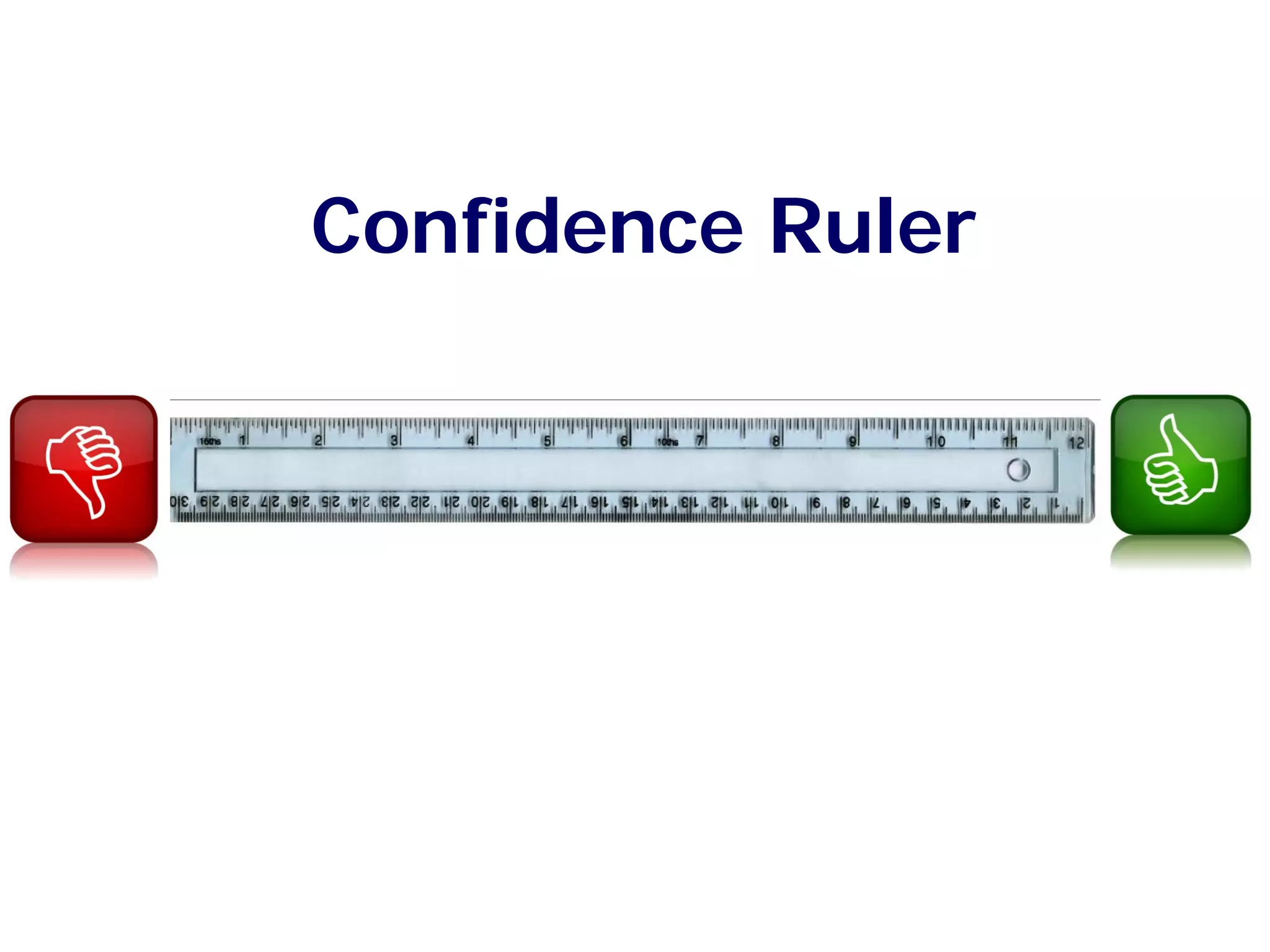
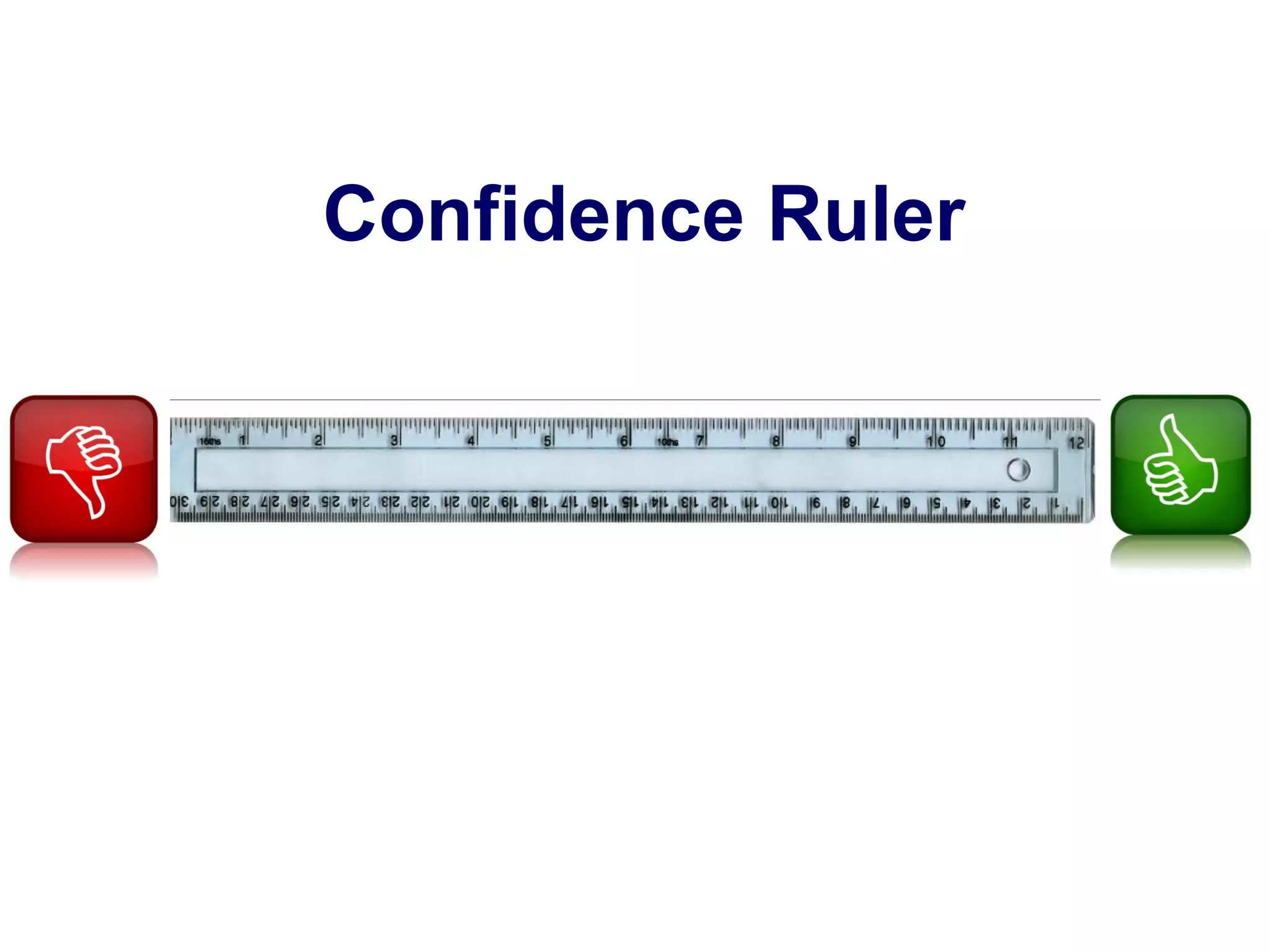
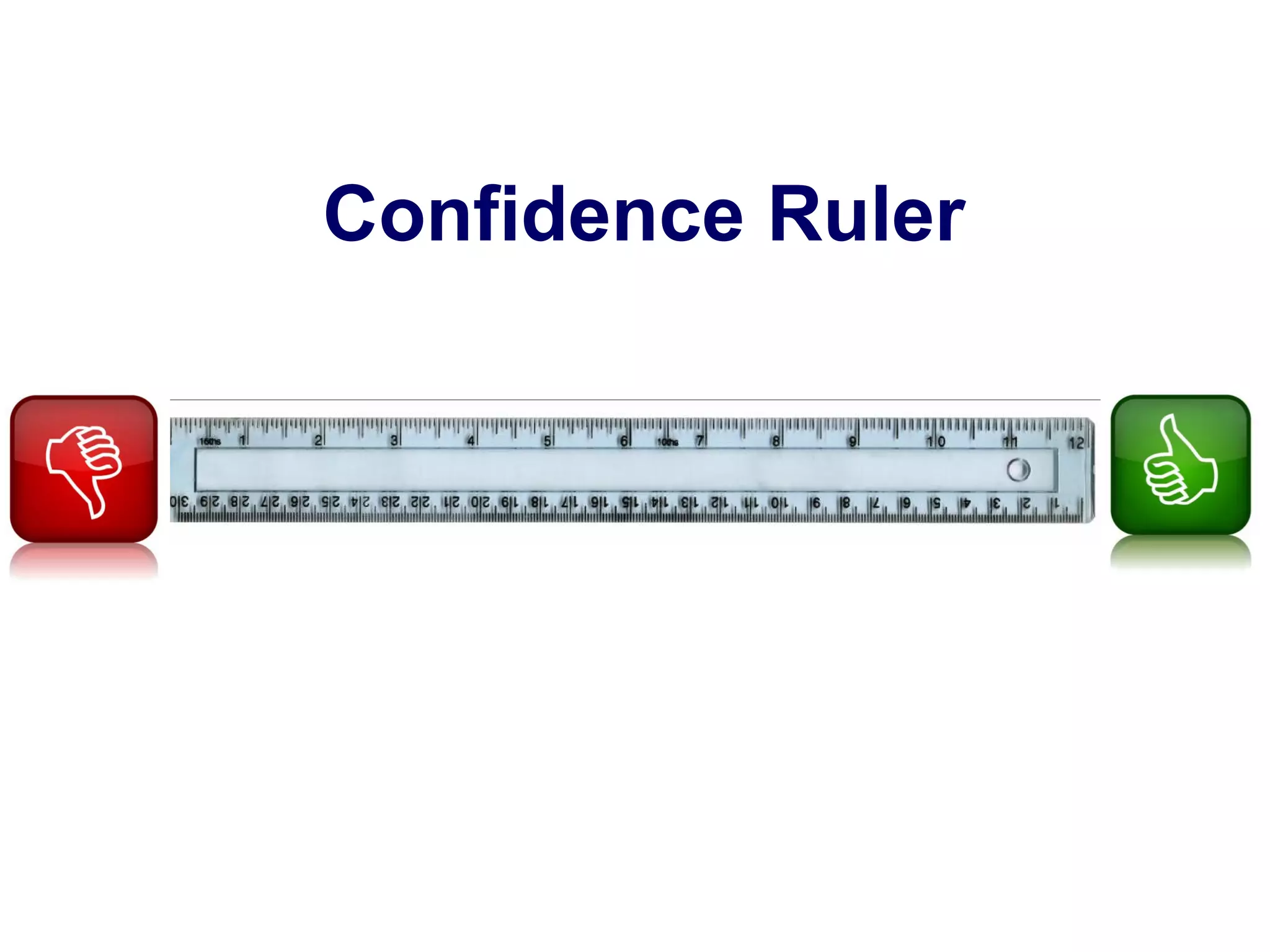
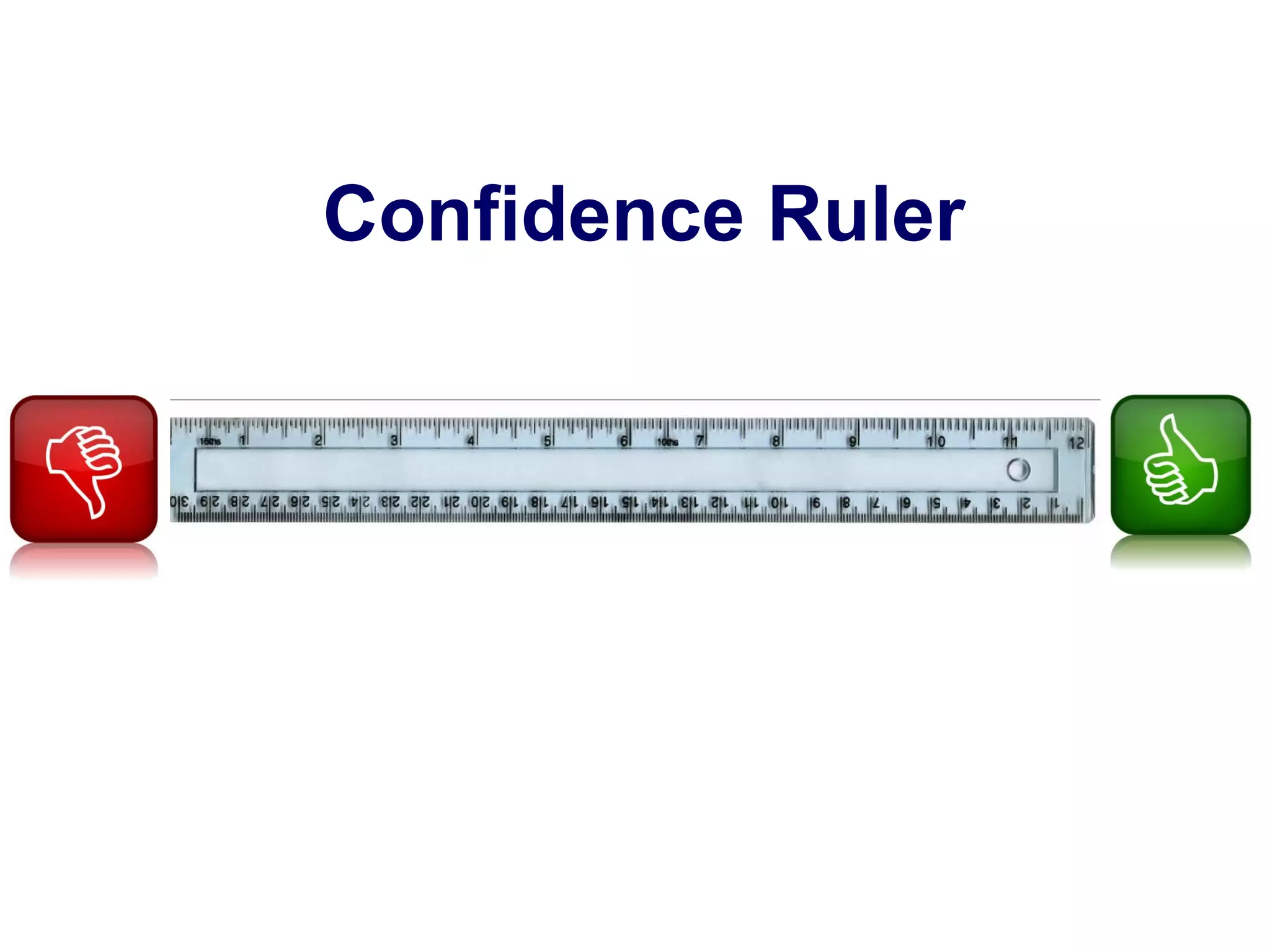
Confidence Ruler
What do you most want to take away from today?
• Turn to the person next to you and
share your responses
• One or more key things you would
like to take away from this workshop?
• We will check in as a large group in 5
minutes
Learning Objectives
At the end of this session, you will be able to…
1. Resist the “righting reflex” in favour of “PACE”
(Partnership, Acceptance, Compassion, Evocation)
2. Practice the foundation skills of Motivational Interviewing
(Open questions, Affirmations, Reflections, Summaries,
Information)
3. Apply the foundation skills in shaping group conversation
and engaging with challenging group members
4. Adapt motivational group activities for your own groups
5. Identify your preferred facilitation style, and increase
flexibility in incorporating other styles.
“Group Dynamics 101”
Quick Review
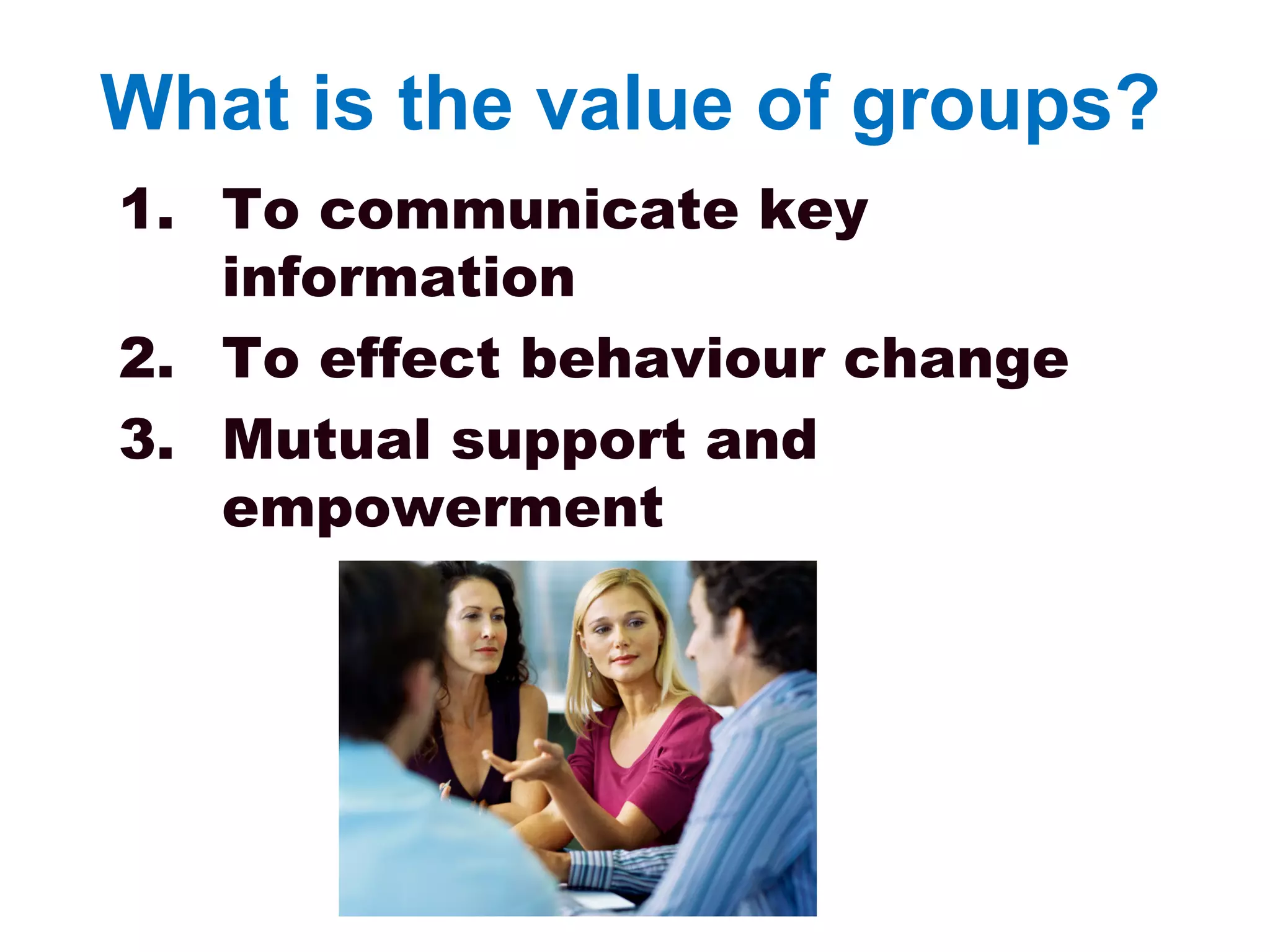
What is the value of groups?
1. To communicate key
information
2. To effect behaviour change
3. Mutual support and
empowerment
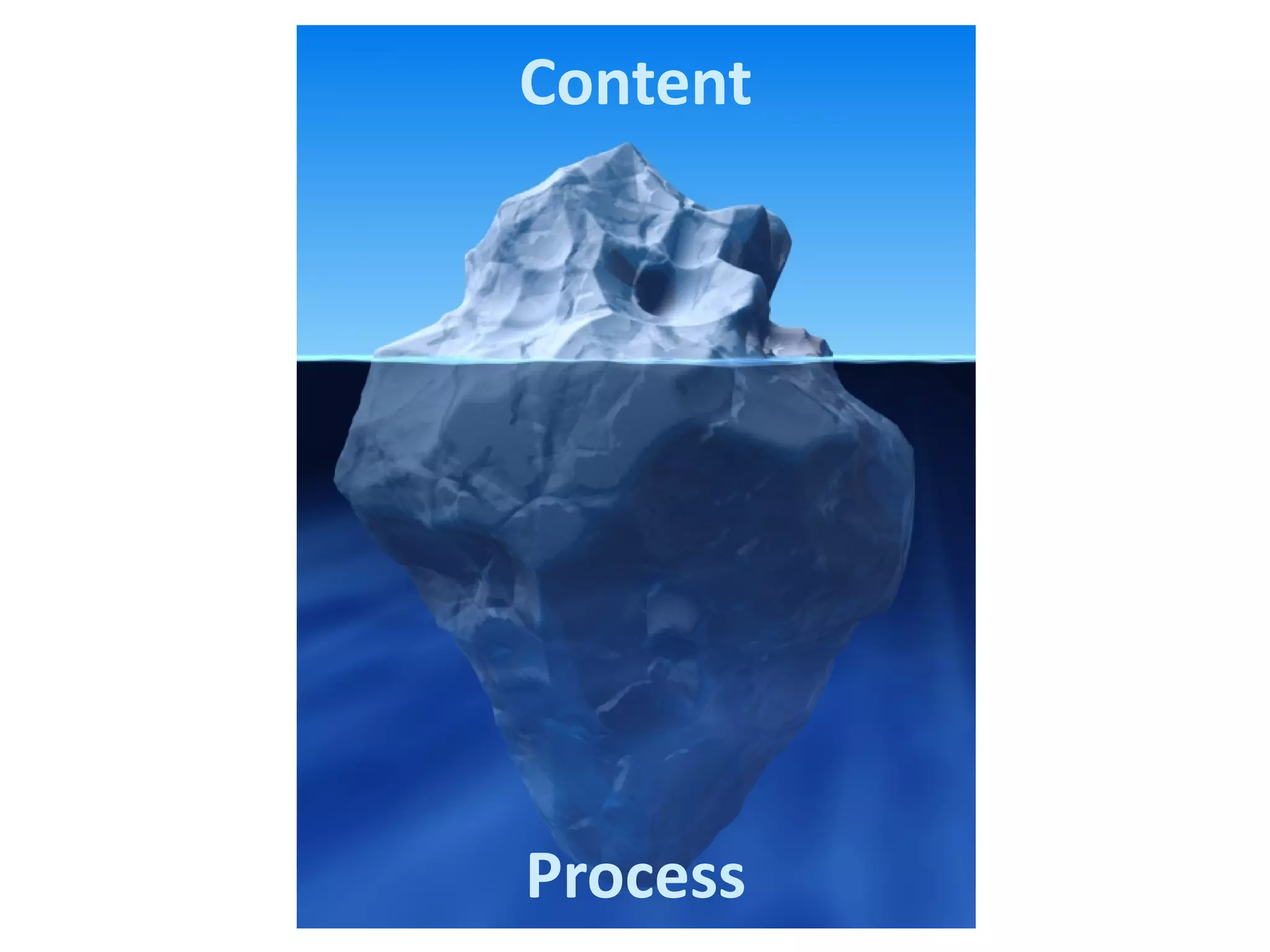
Content
Process
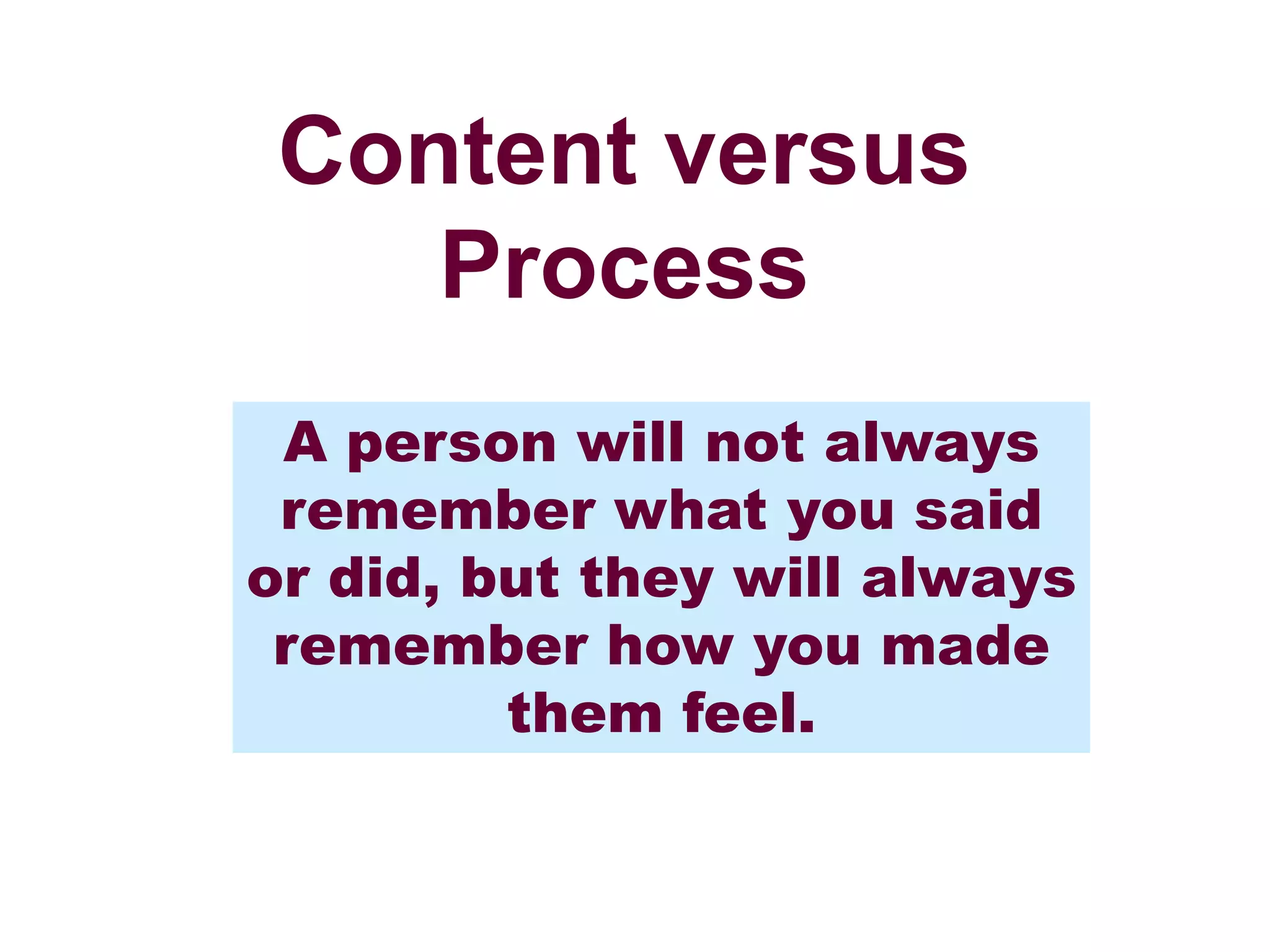
Content versus
Process
A person will not always
remember what you said
or did, but they will always
remember how you made
them feel.
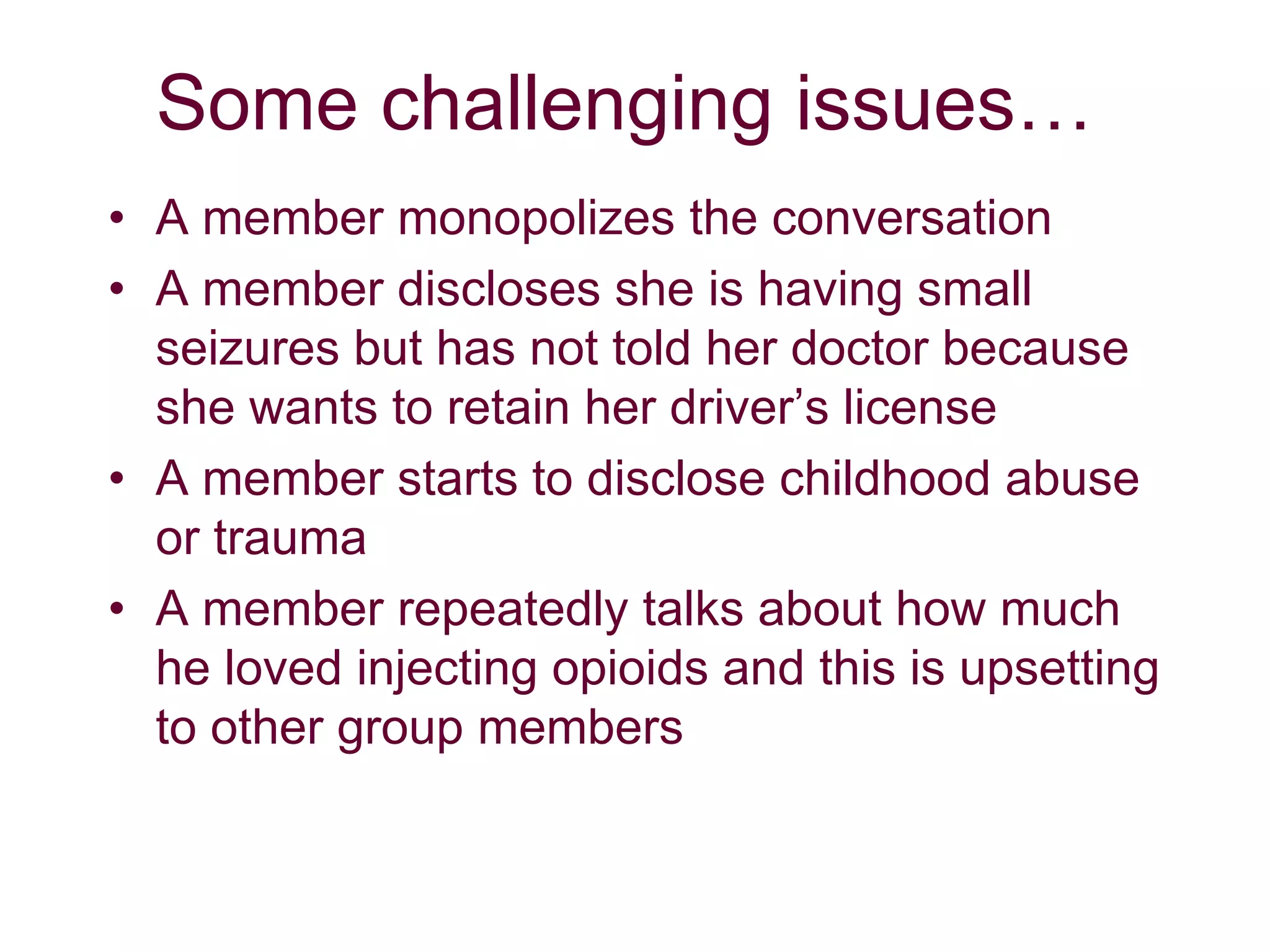
Some challenging issues…
• A member monopolizes the conversation
• A member discloses she is having small
seizures but has not told her doctor because
she wants to retain her driver’s license
• A member starts to disclose childhood abuse
or trauma
• A member repeatedly talks about how much
he loved injecting opioids and this is upsetting
to other group members
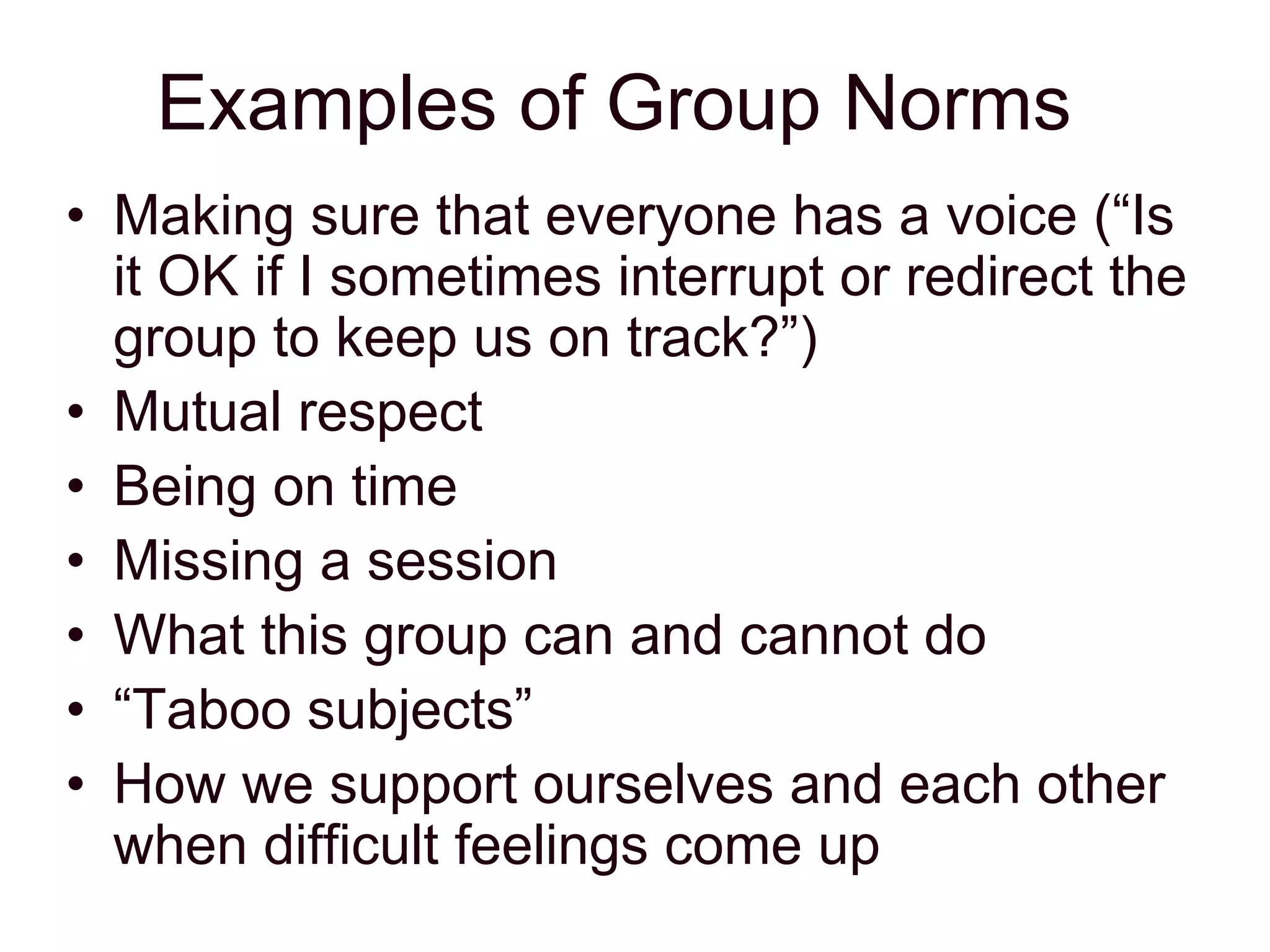
Examples of Group Norms
• Making sure that everyone has a voice (“Is
it OK if I sometimes interrupt or redirect the
group to keep us on track?”)
• Mutual respect
• Being on time
• Missing a session
• What this group can and cannot do
• “Taboo subjects”
• How we support ourselves and each other
when difficult feelings come up
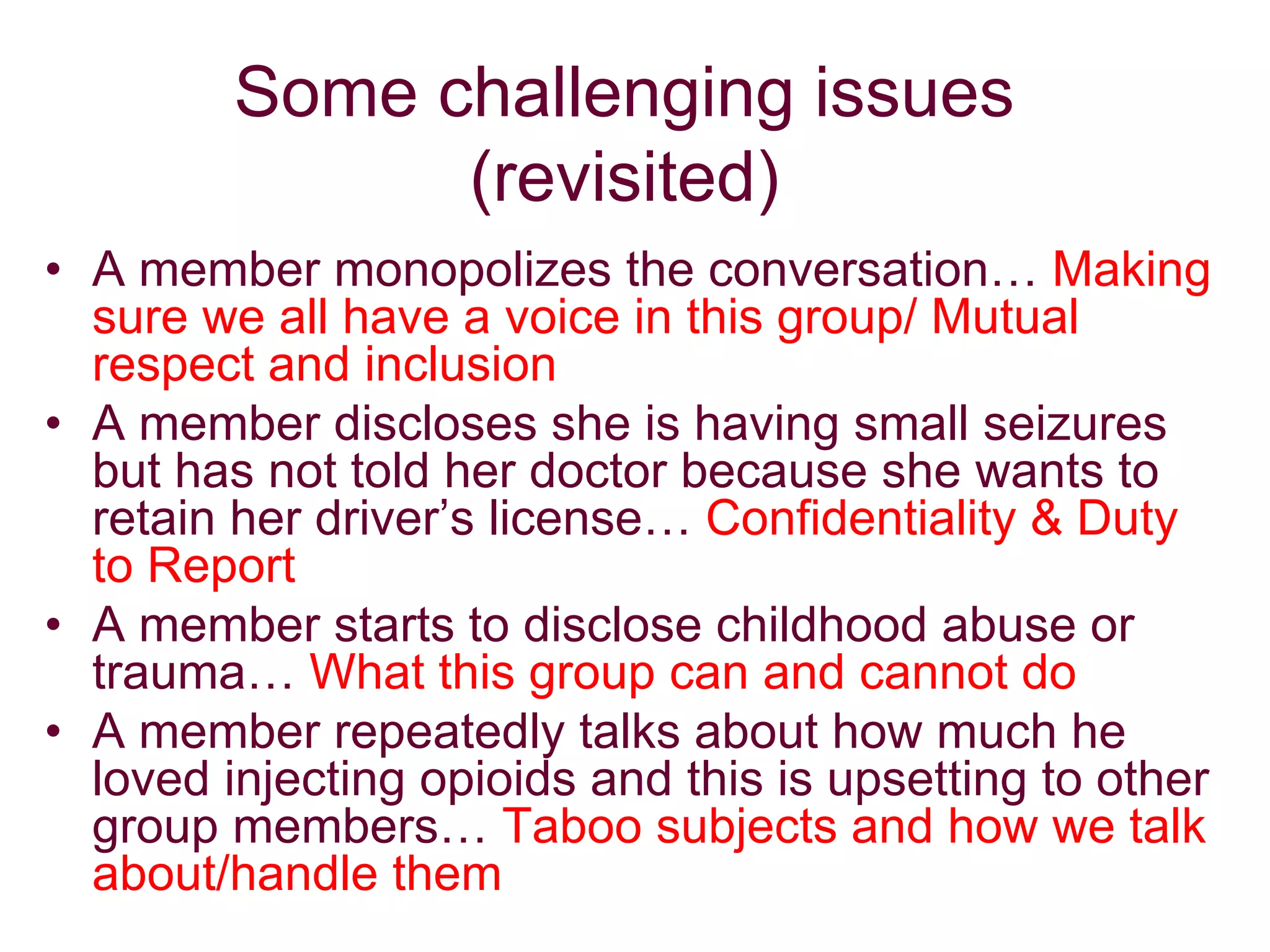
Some challenging issues
(revisited)
• A member monopolizes the conversation… Making
sure we all have a voice in this group/ Mutual
respect and inclusion
• A member discloses she is having small seizures
but has not told her doctor because she wants to
retain her driver’s license… Confidentiality & Duty
to Report
• A member starts to disclose childhood abuse or
trauma… What this group can and cannot do
• A member repeatedly talks about how much he
loved injecting opioids and this is upsetting to other
group members… Taboo subjects and how we talk
about/handle them
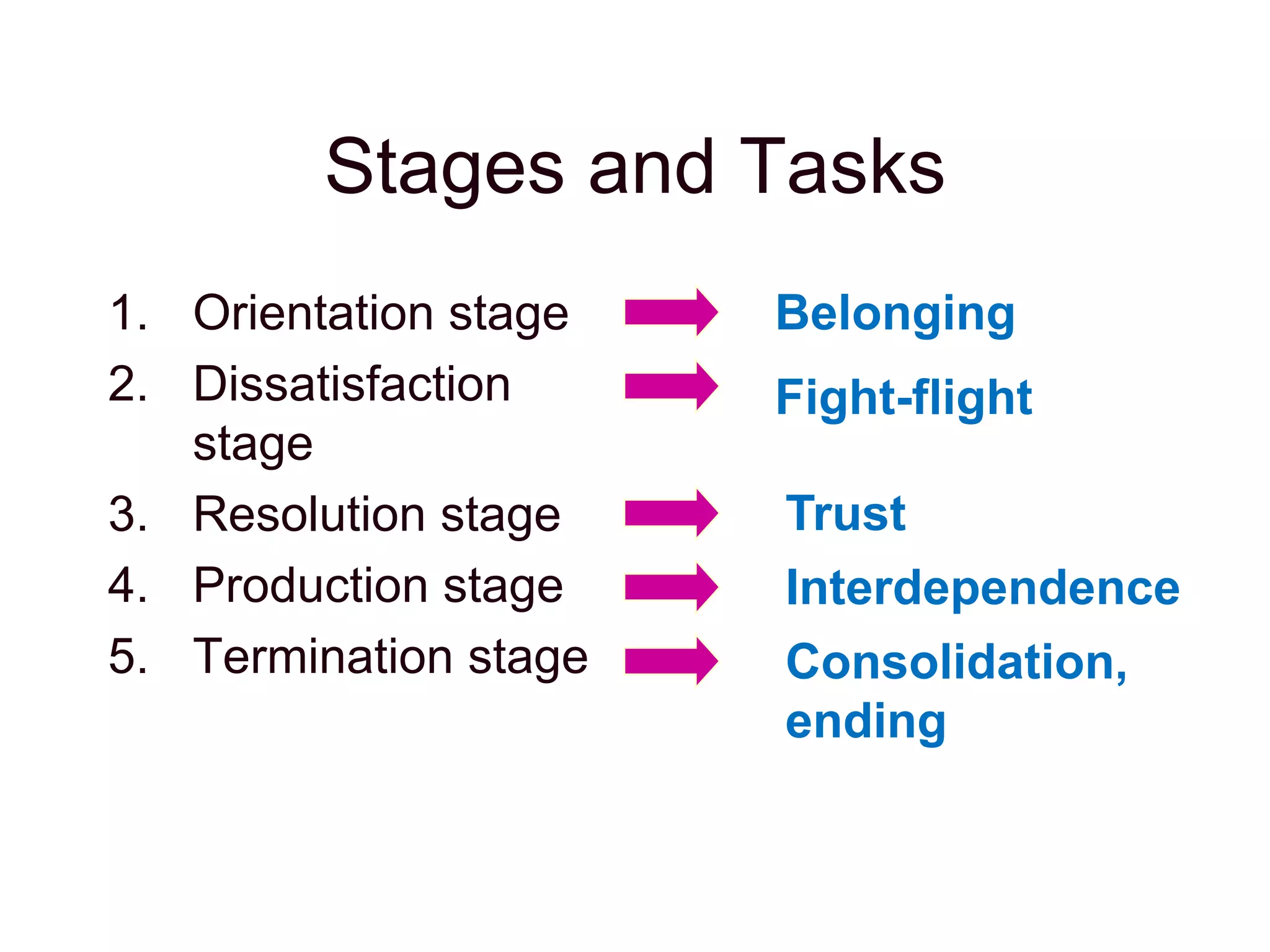
Stages and Tasks
1. Orientation stage
2. Dissatisfaction
stage
3. Resolution stage
4. Production stage
5. Termination stage
Belonging
Fight-flight
Trust
Consolidation,
ending
Interdependence
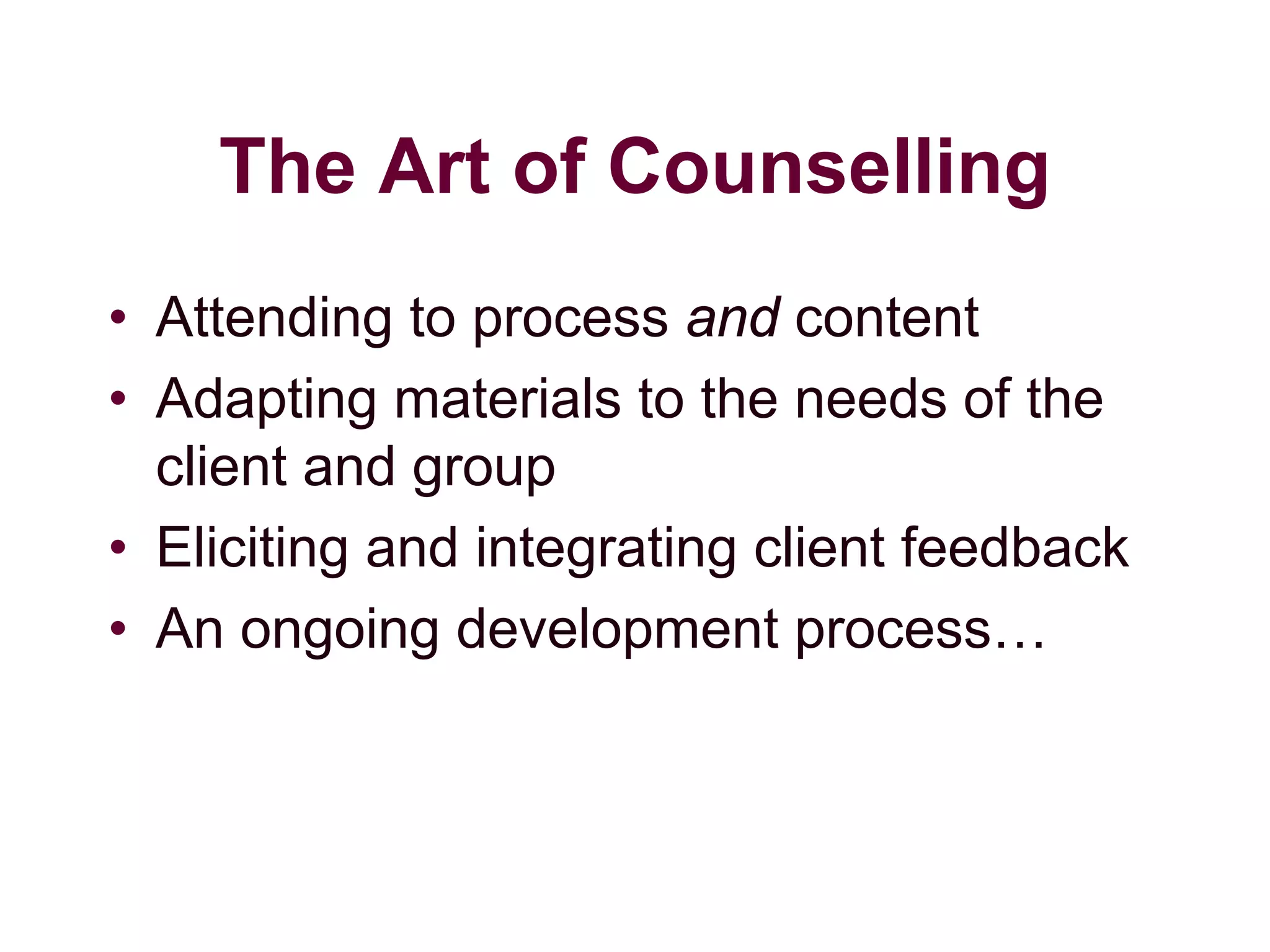
The Art of Counselling
• Attending to process and content
• Adapting materials to the needs of the
client and group
• Eliciting and integrating client feedback
• An ongoing development process…
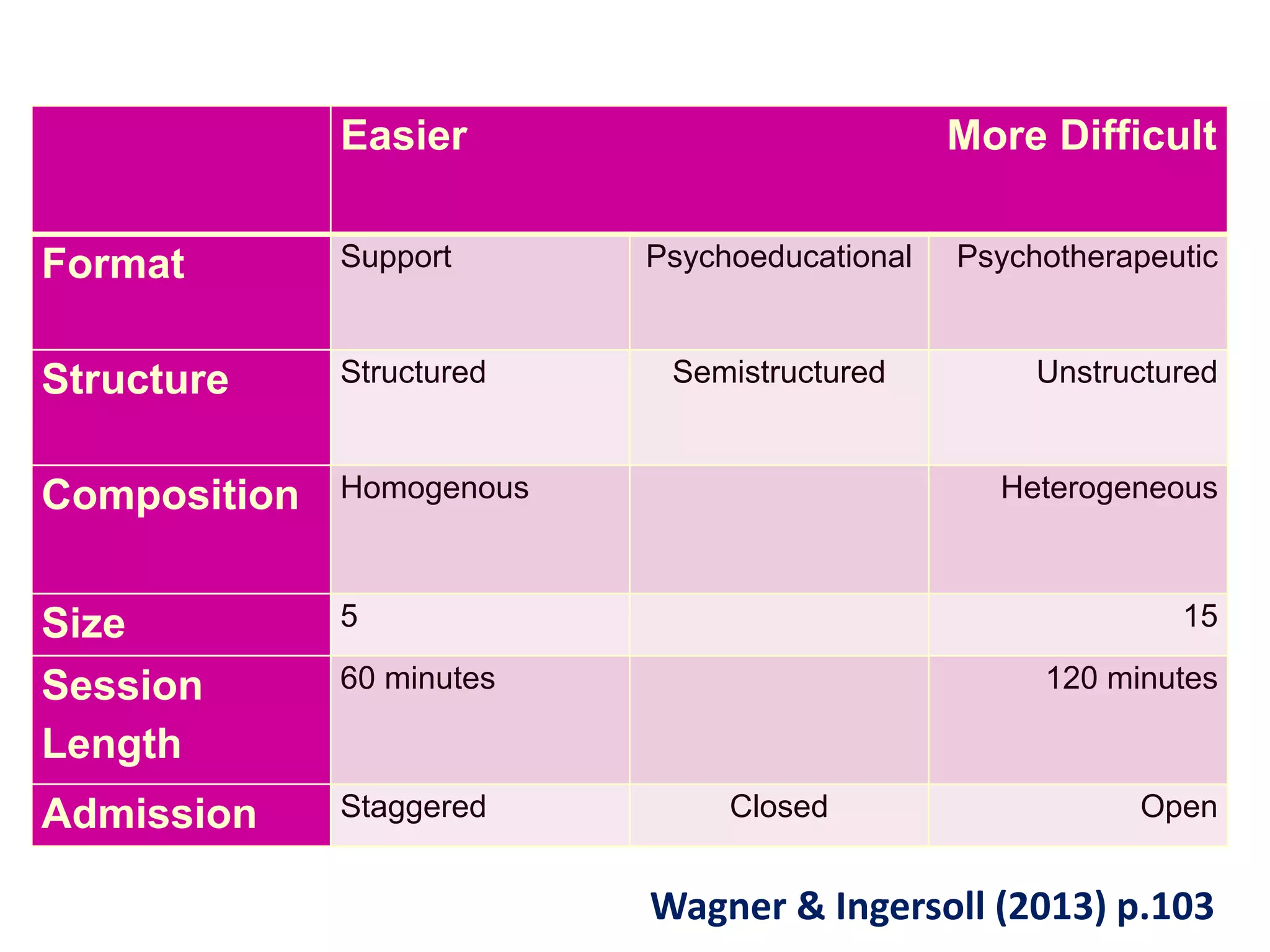
Easier More Difficult
Format Support Psychoeducational Psychotherapeutic
Structure Structured Semistructured Unstructured
Composition Homogenous Heterogeneous
Size 5 15
Session
Length
60 minutes 120 minutes
Admission Staggered Closed Open
Wagner & Ingersoll (2013) p.103
Confidence Ruler
Best Practices in Group
Facilitation
2013
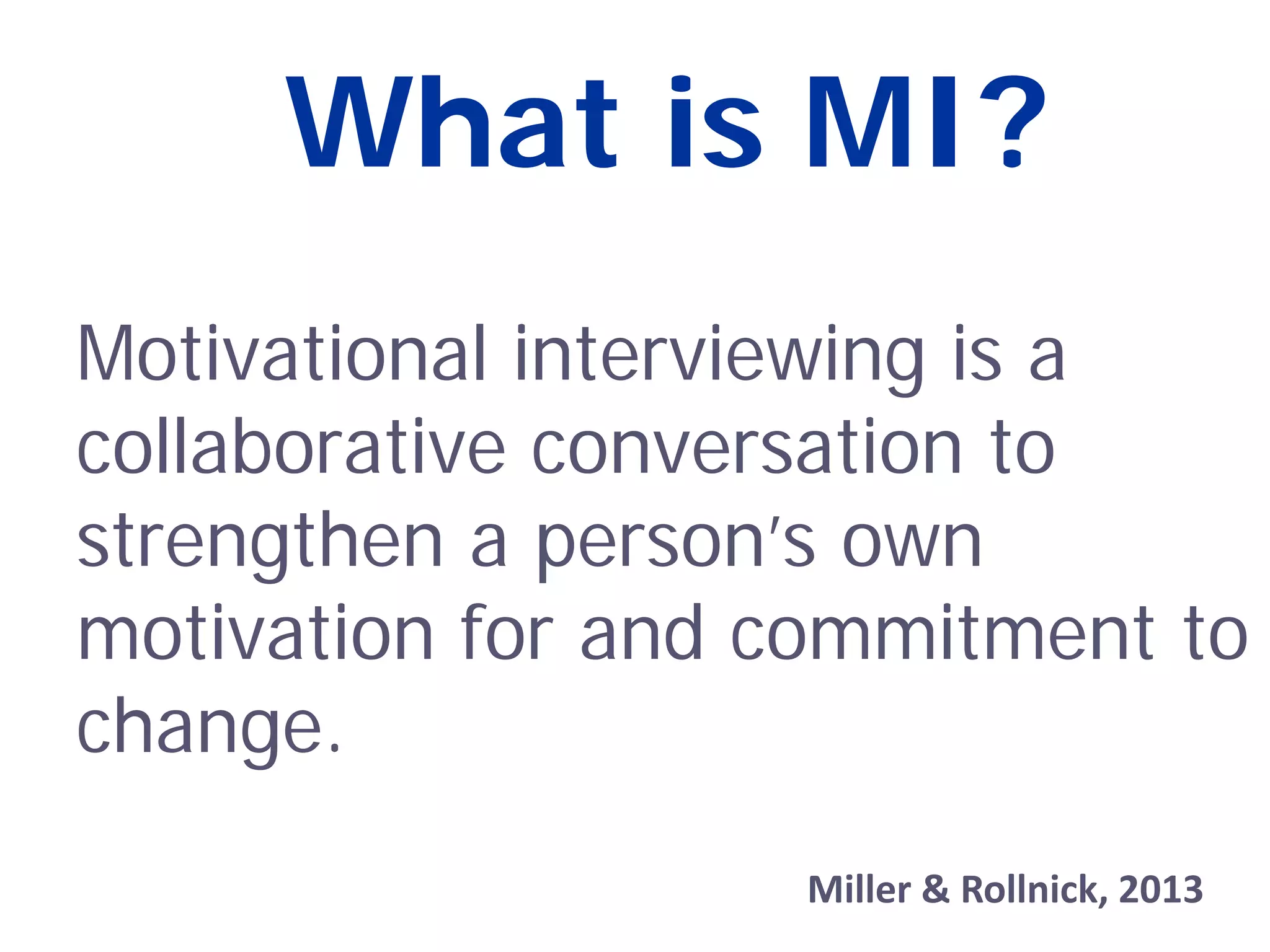
What is MI?
Motivational interviewing is a
collaborative conversation to
strengthen a person’s own
motivation for and commitment to
change.
Miller & Rollnick, 2013
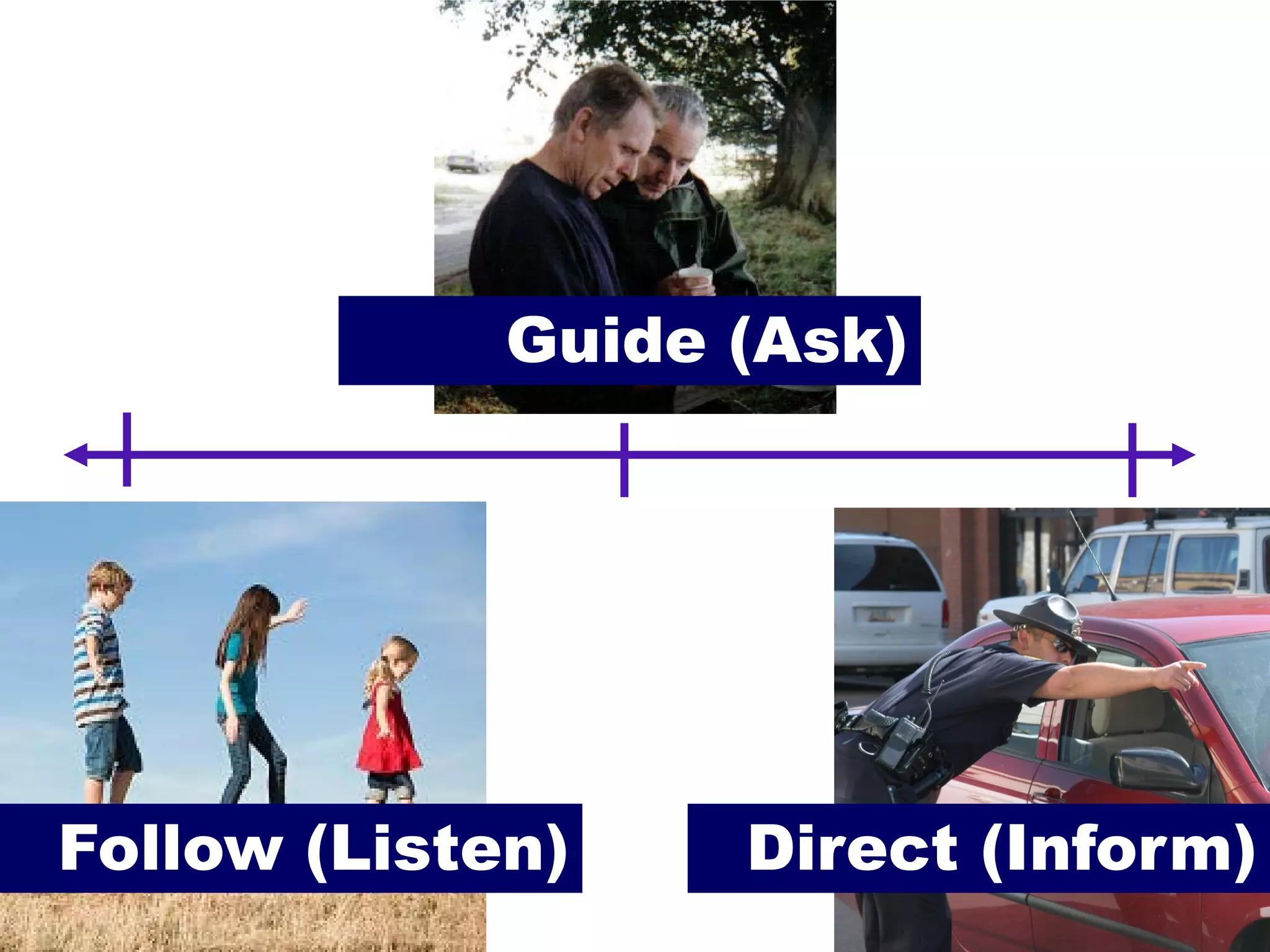
Follow (Listen) Direct (Inform)
Guide (Ask)
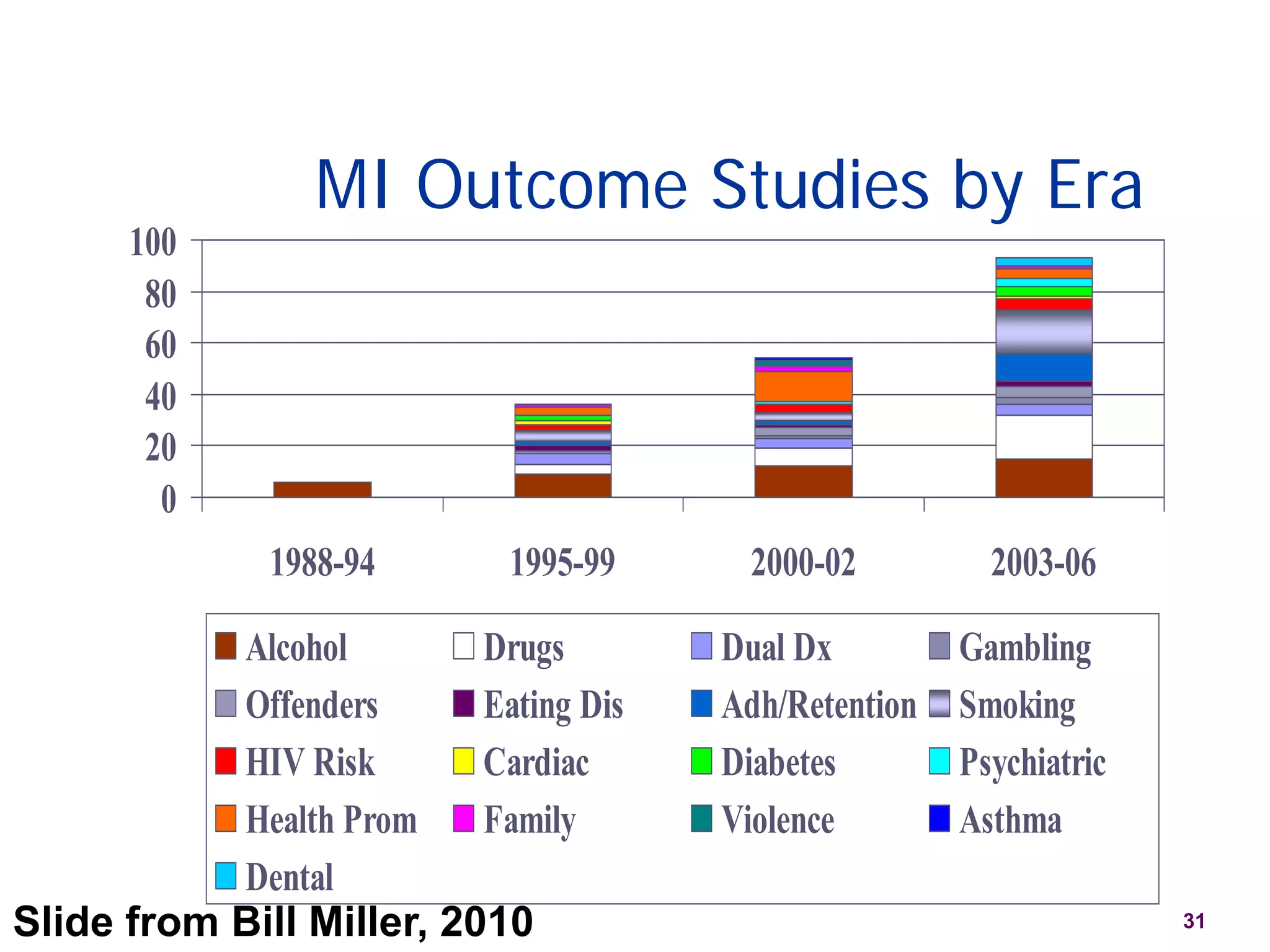
Research publications evaluating MI
effectiveness have been doubling every
three years.
www.motivationalinterview.org
MI Outcome Studies by Era
0
20
40
60
80
100
1988-94 1995-99 2000-02 2003-06
Alcohol Drugs Dual Dx Gambling
Offenders Eating Dis Adh/Retention Smoking
HIV Risk Cardiac Diabetes Psychiatric
Health Prom Family Violence Asthma
Dental
31Slide from Bill Miller, 2010
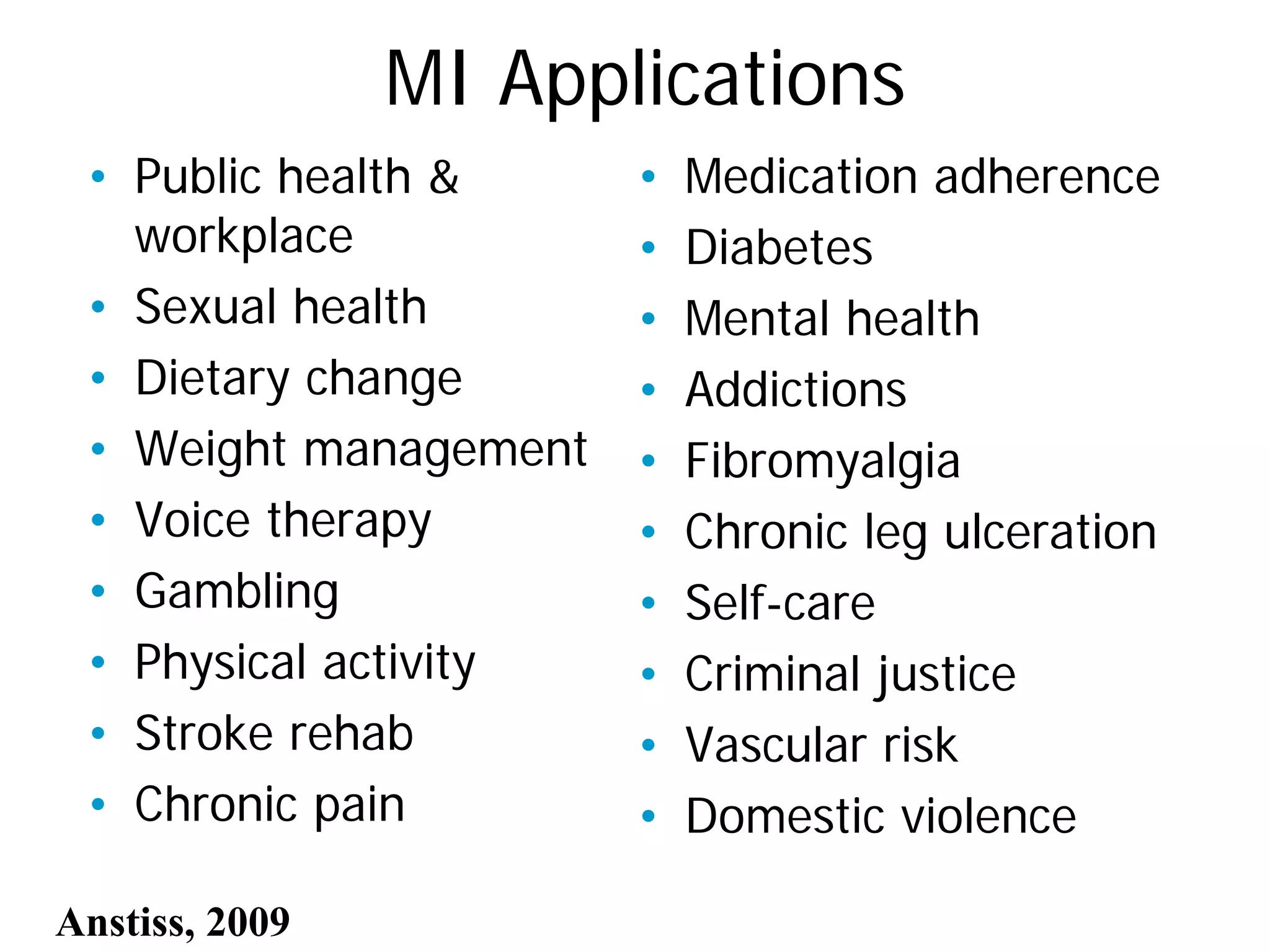
MI Applications
• Public health &
workplace
• Sexual health
• Dietary change
• Weight management
• Voice therapy
• Gambling
• Physical activity
• Stroke rehab
• Chronic pain
• Medication adherence
• Diabetes
• Mental health
• Addictions
• Fibromyalgia
• Chronic leg ulceration
• Self-care
• Criminal justice
• Vascular risk
• Domestic violence
Anstiss, 2009
Spirit of MI
http://tinyurl.com/c5gamll
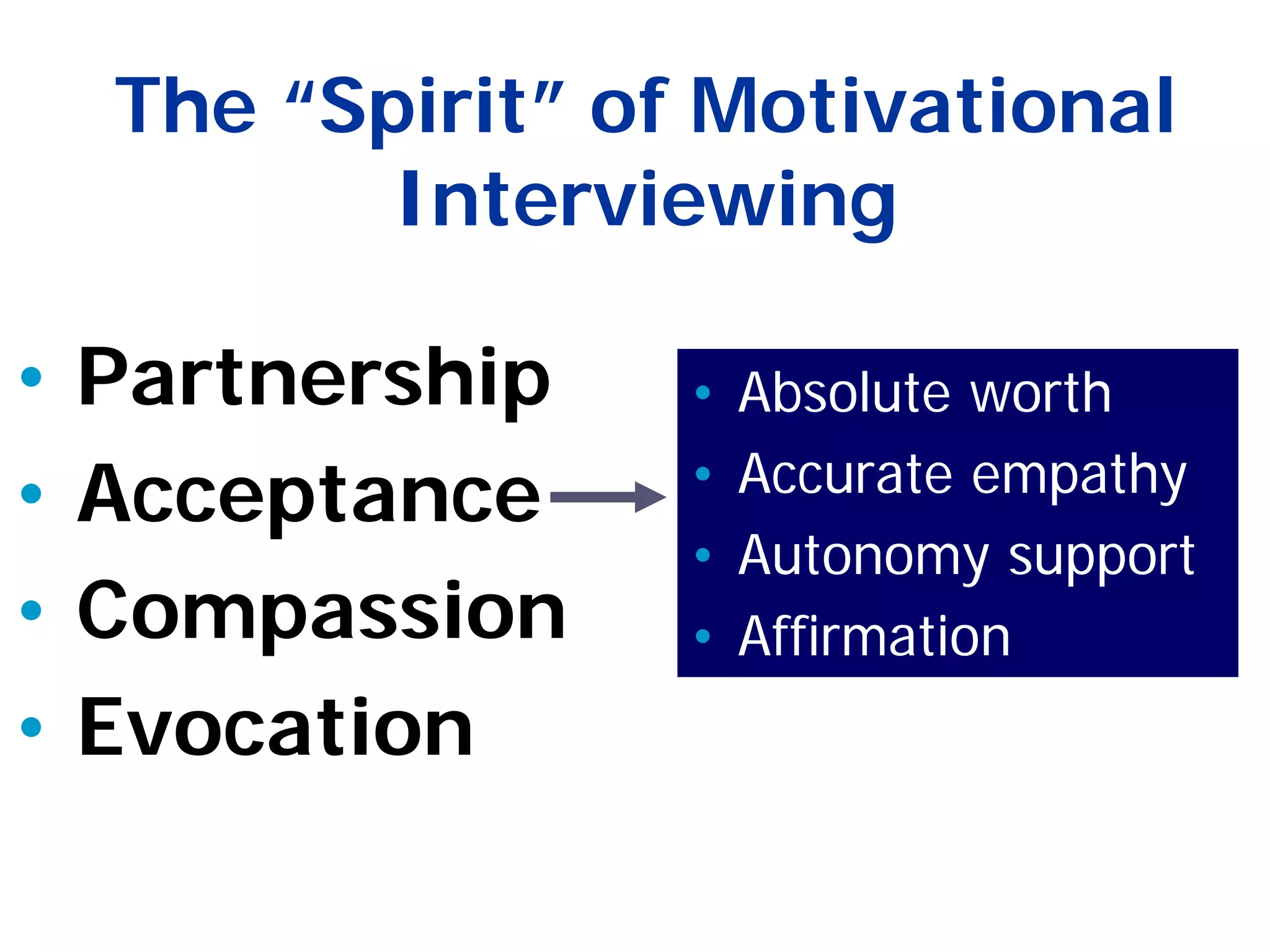
The “Spirit” of Motivational
Interviewing
• Partnership
• Acceptance
• Compassion
• Evocation
• Absolute worth
• Accurate empathy
• Autonomy support
• Affirmation
36
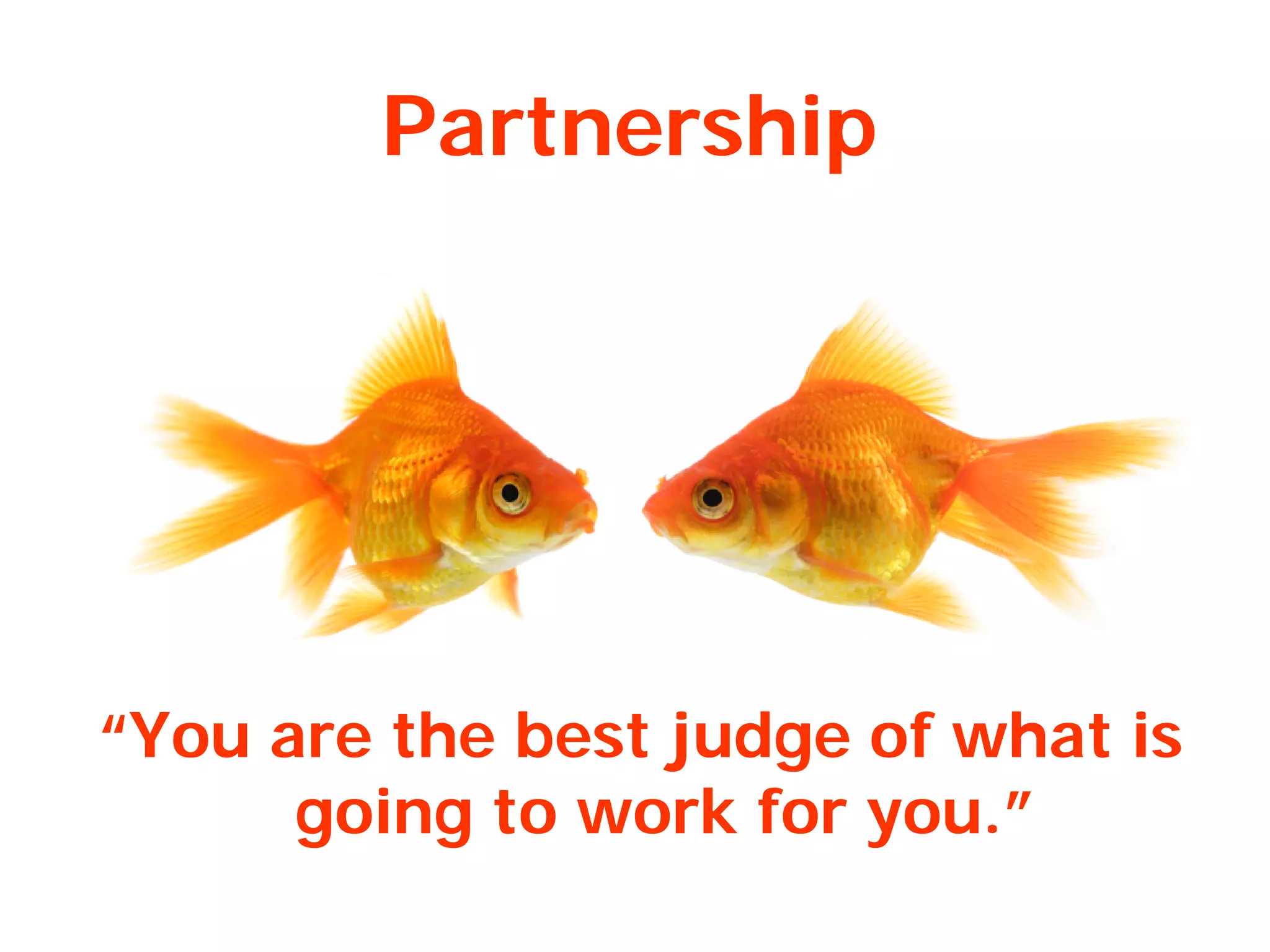
Partnership
“You are the best judge of what is
going to work for you.”
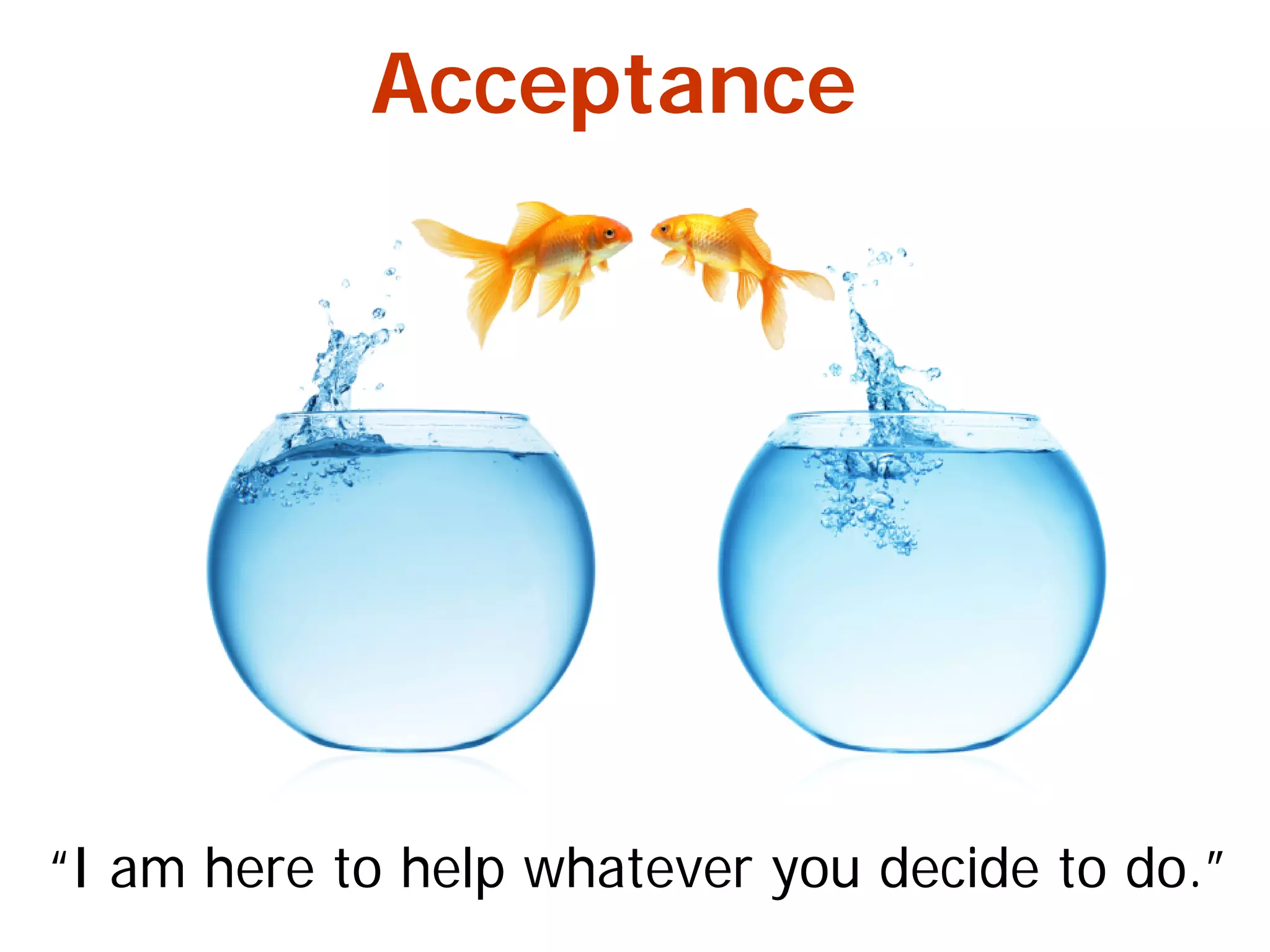
Acceptance
“I am here to help whatever you decide to do.”
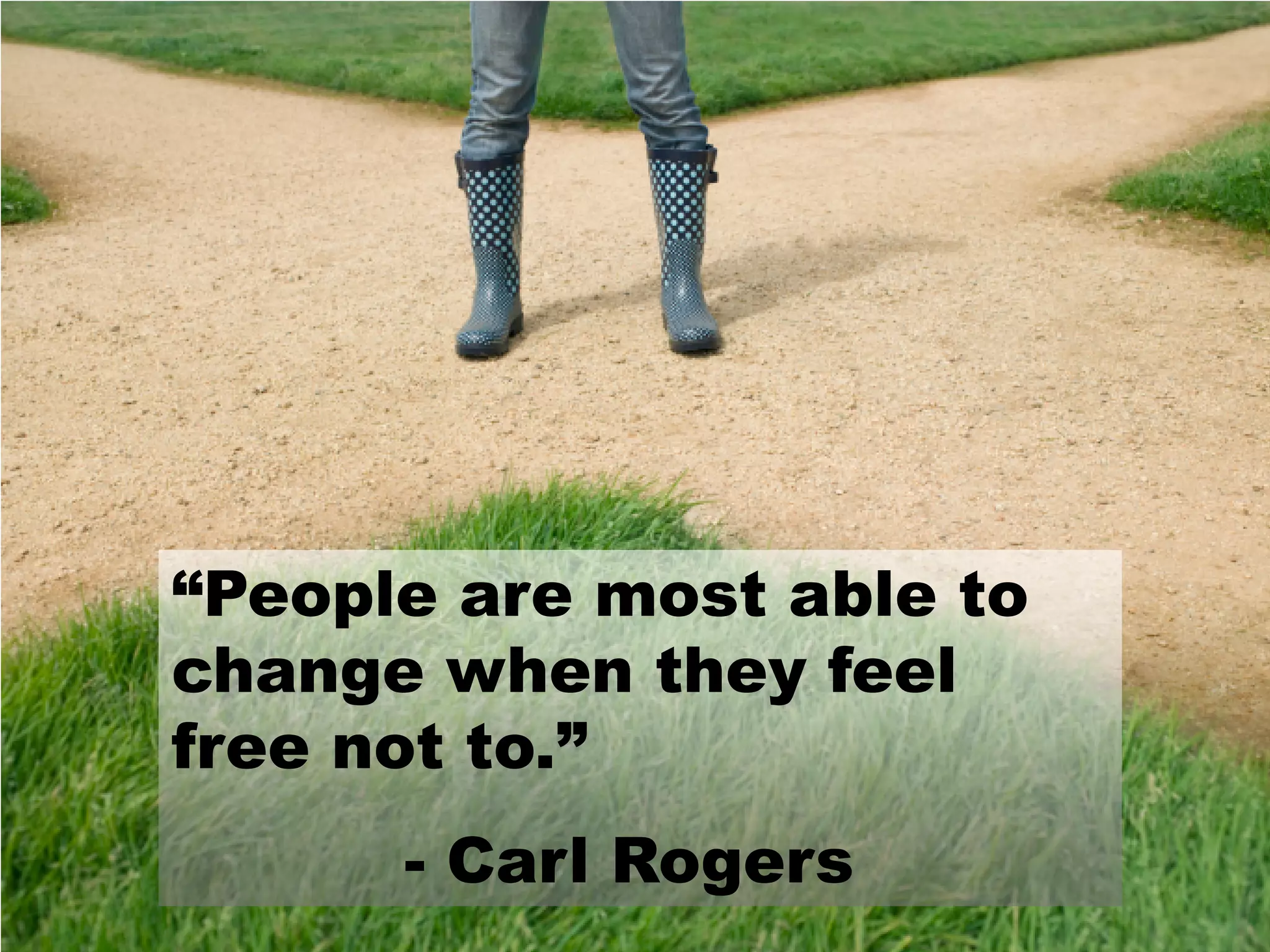
“People are most able to
change when they feel
free not to.”
- Carl Rogers
Compassion
Guide me to be a patient companion,
to listen with a heart as open as the
sky. Grant me vision to see through
his eyes, and eager ears to hear his
story…Let me honour and respect his
choosing of his own path.
Adapted from Miller, 2013, “A Meditative Preparation” (p.24)
Evocation
“What were you hoping for by coming here
today?”
“A Psychological Law”
I learn what I believe
as I hear myself speak.
Bill Miller (Based on D. Bem, 1967, “Self-Perception: An
alternative interpretation of cognitive dissonance
phenomena”)
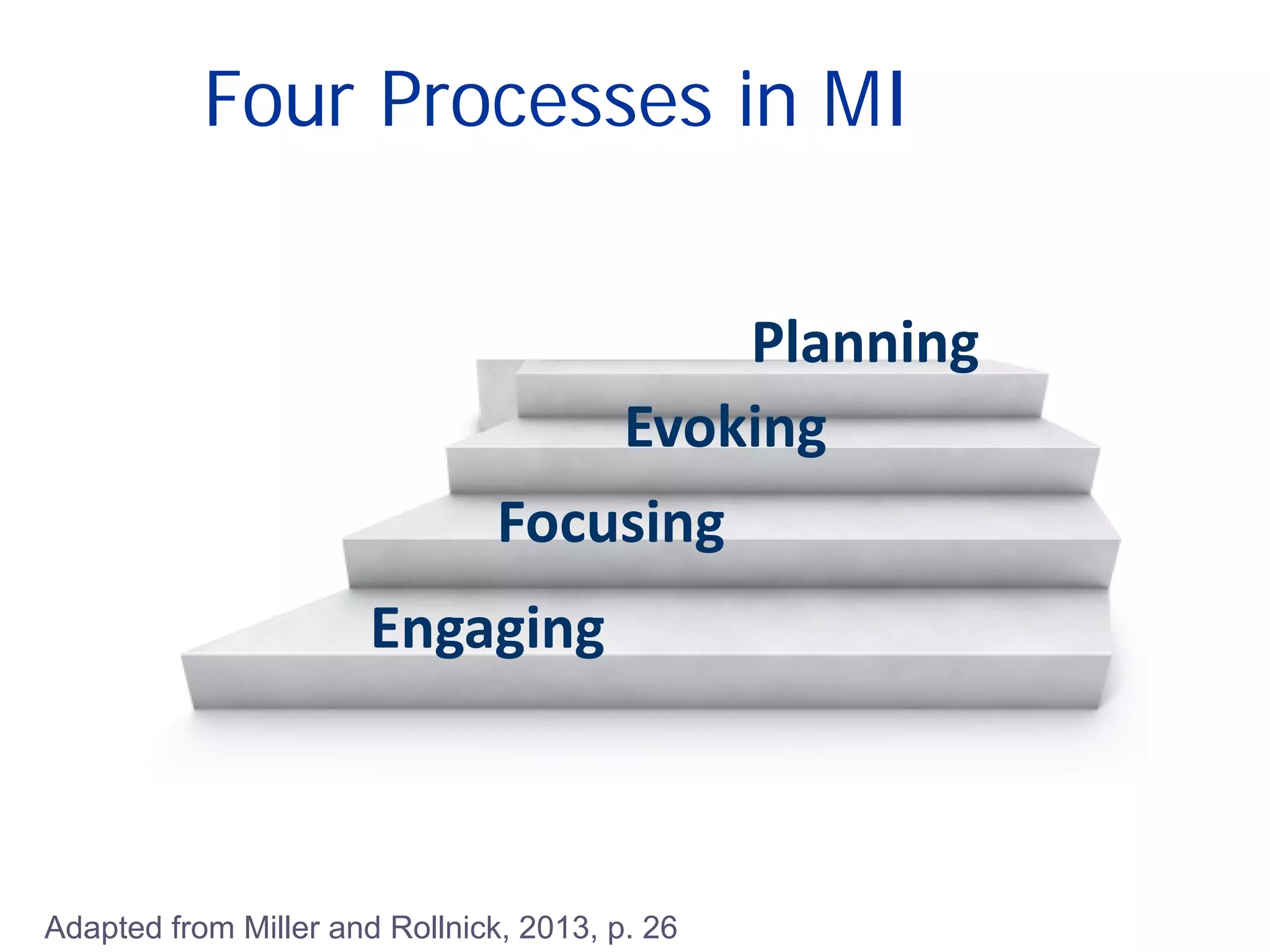
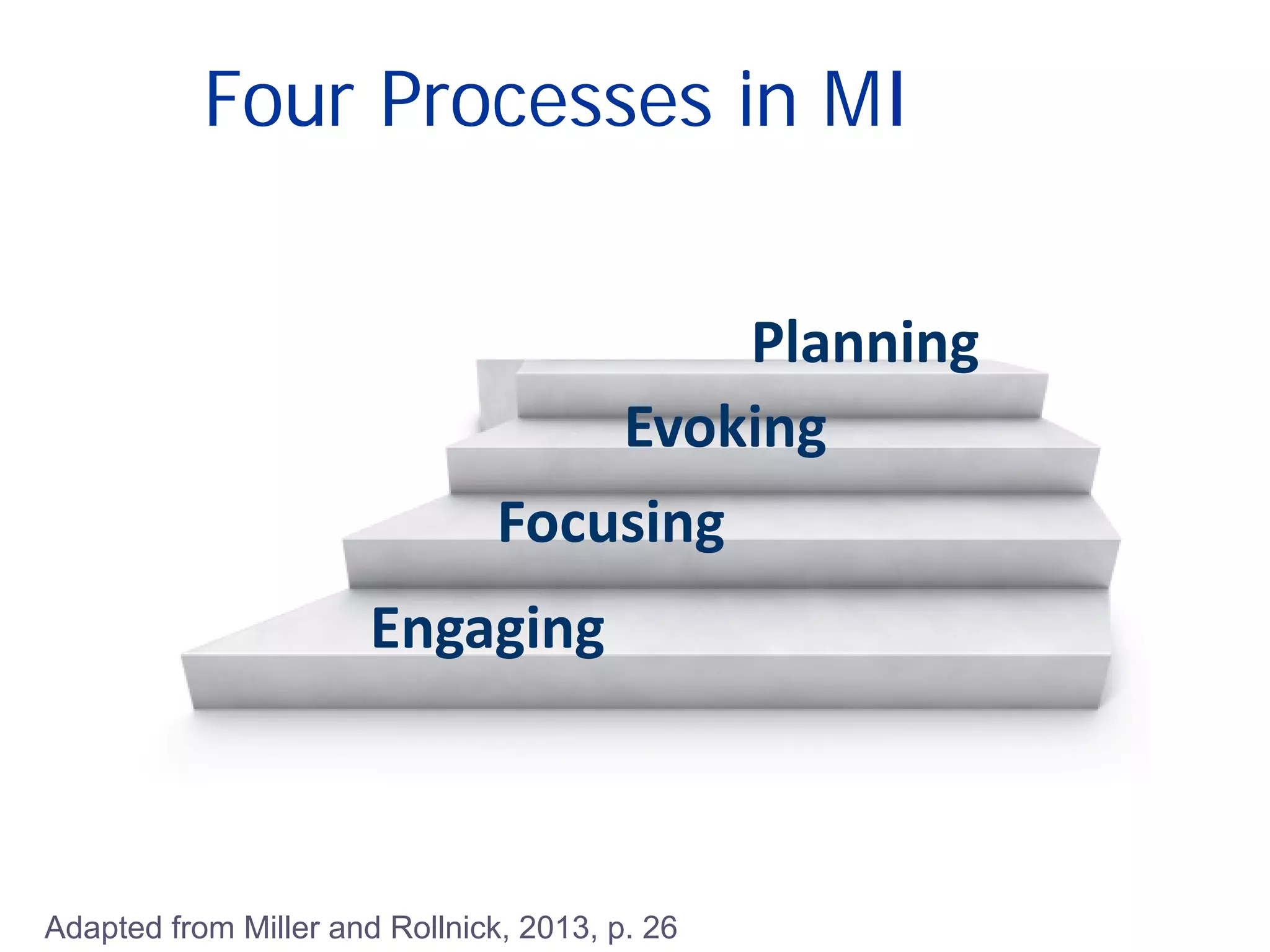
Engaging
Focusing
Evoking
Planning
Four Processes in MI
Adapted from Miller and Rollnick, 2013, p. 26
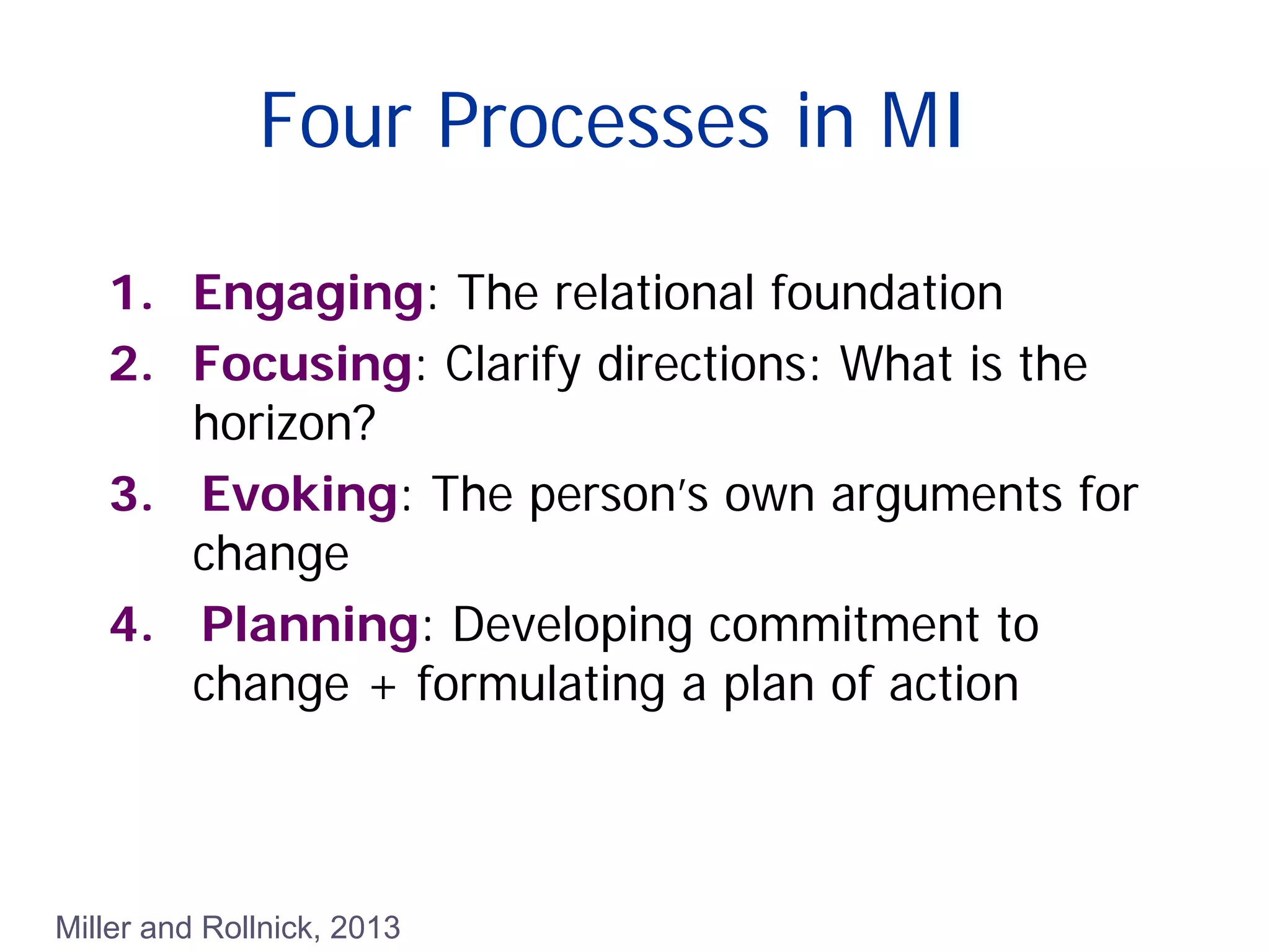
Four Processes in MI
1. Engaging: The relational foundation
2. Focusing: Clarify directions: What is the
horizon?
3. Evoking: The person’s own arguments for
change
4. Planning: Developing commitment to
change + formulating a plan of action
Miller and Rollnick, 2013
Engaging
• Opening check-in
• Attention to content
(e.g. what people
say) and process
(e.g. how they say it
& others’
responses)
• Openness and
flexibility – what
does the group
want or need?
Focusing
• What are we
covering in this
session?
• Therapist session
checklist and
group input
Agenda-Mapping
So many choices, so little time…
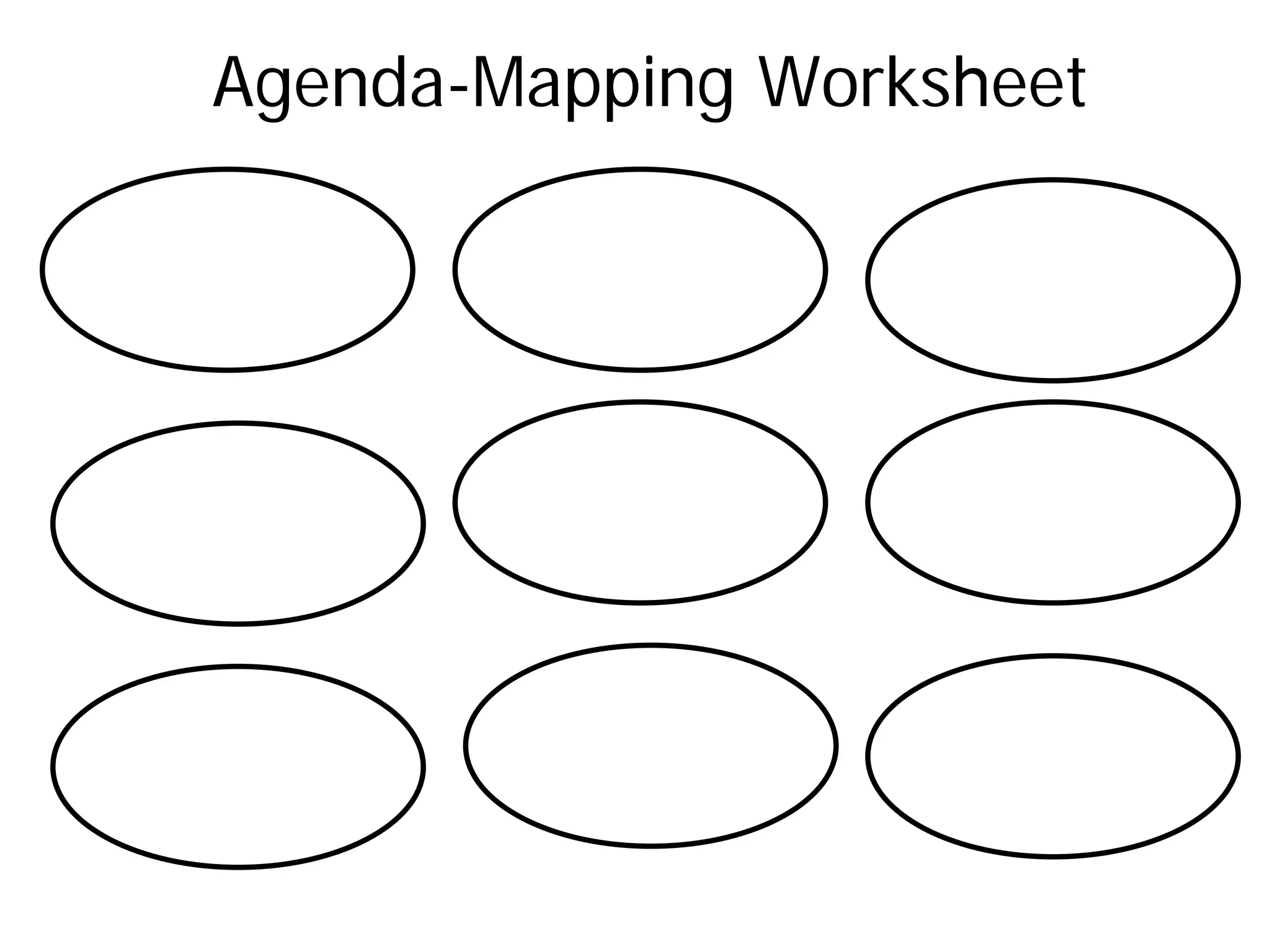
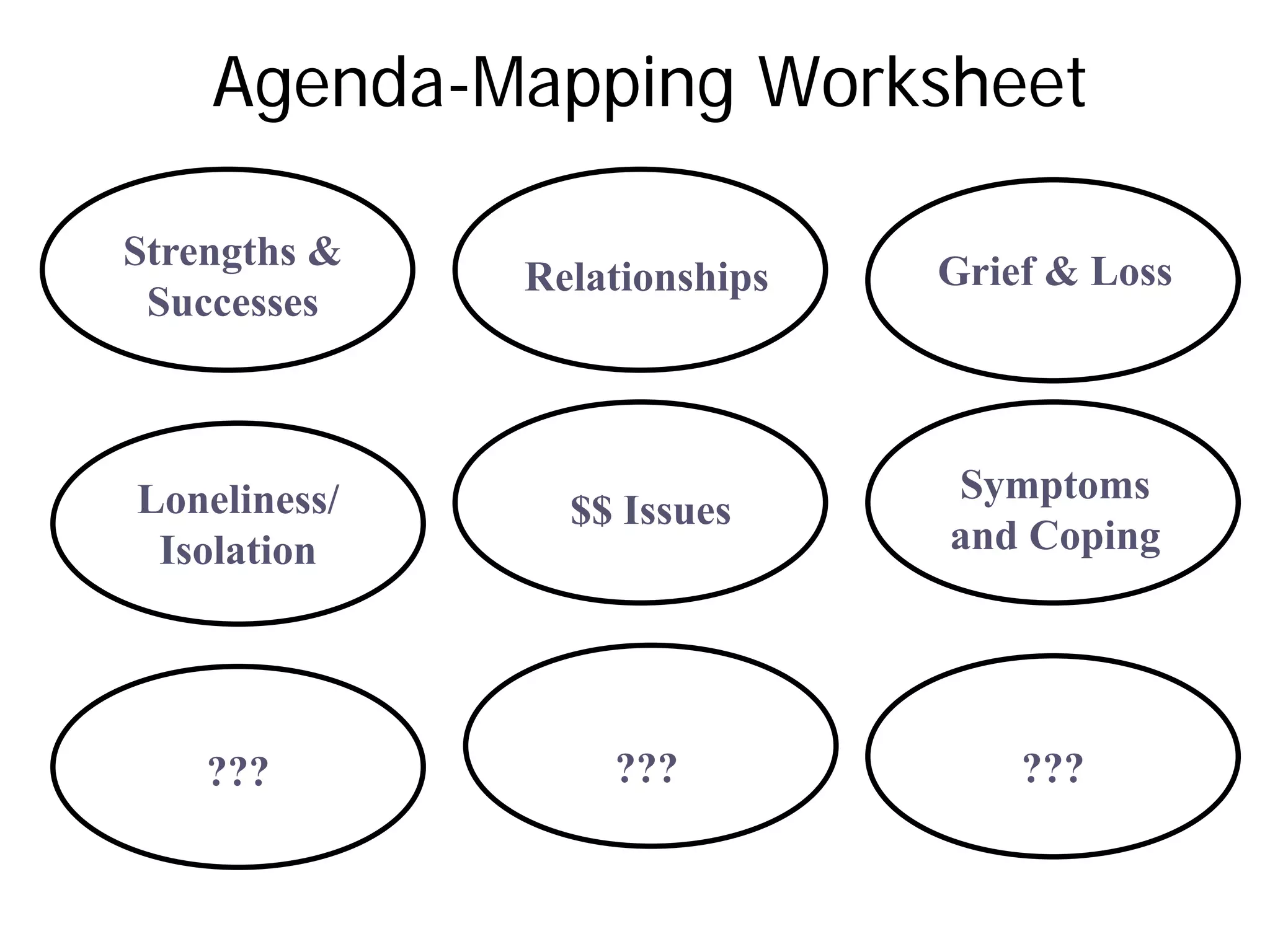
Agenda-Mapping Worksheet
Priorities
Agenda-Mapping Worksheet
Priorities
Strengths &
Successes
Relationships Grief & Loss
Loneliness/
Isolation
$$ Issues
Symptoms
and Coping
??? ??? ???
“Given these possible areas of focus,
what would should we talk about in our
time here today?”
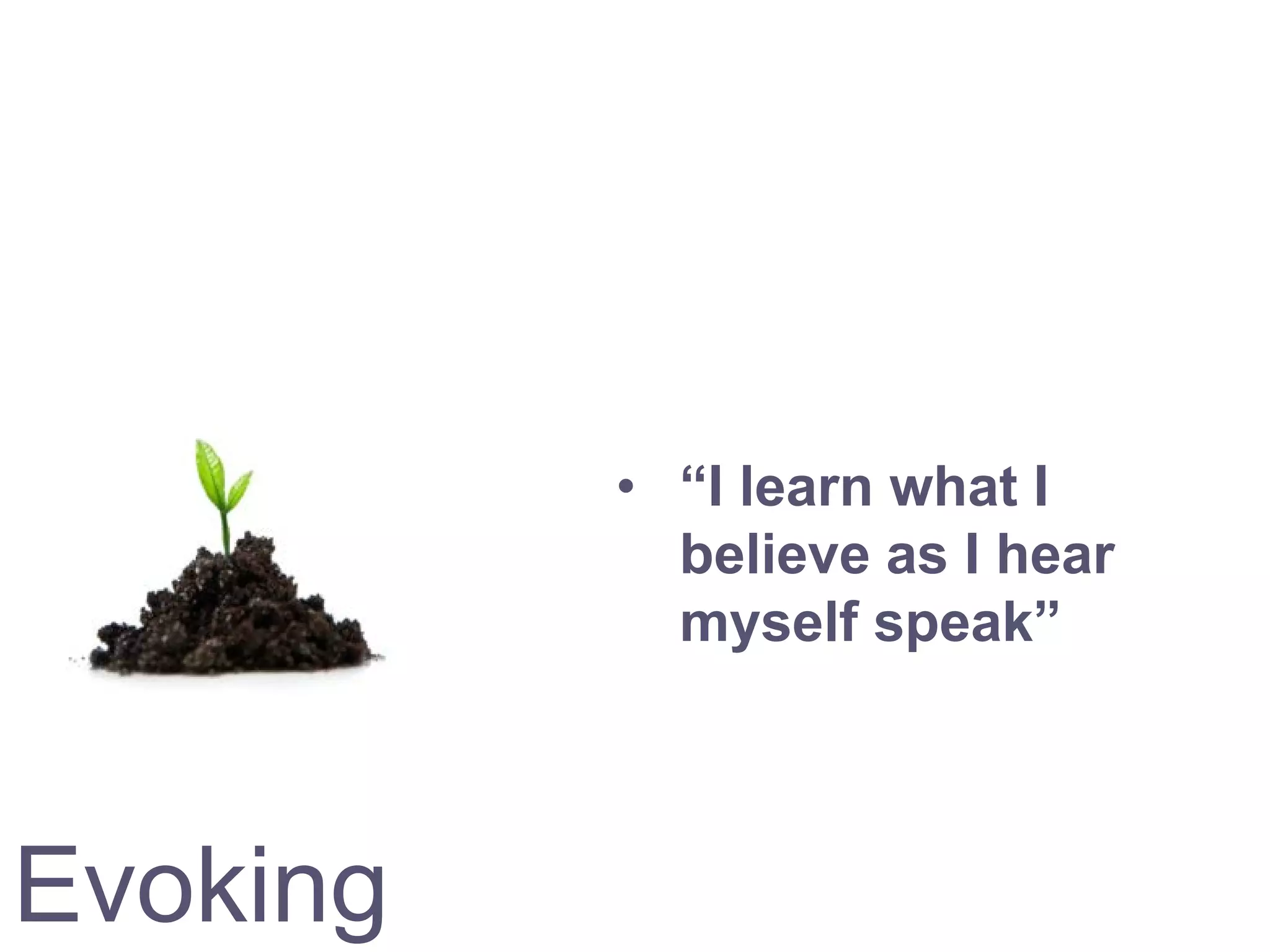
Evoking
• “I learn what I
believe as I hear
myself speak”
Planning
What is on the
horizon?
What is the person
working towards
changing?
Engaging
Focusing
Evoking
Planning
Four Processes in MI
Adapted from Miller and Rollnick, 2013, p. 26
Confidence Ruler
Foundation Skills:
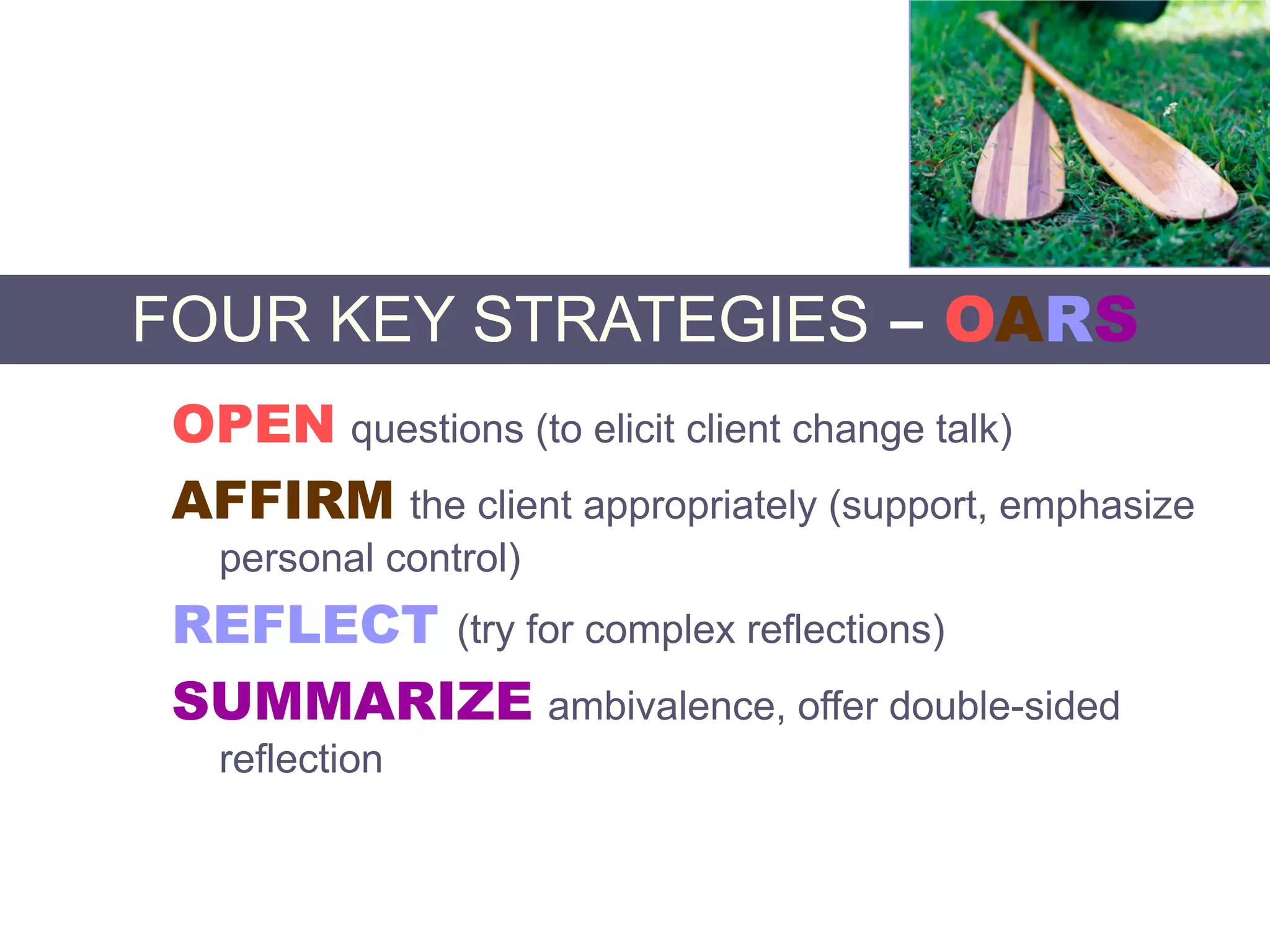
O A R S
FOUR KEY STRATEGIES – OARS
OPEN questions (to elicit client change talk)
AFFIRM the client appropriately (support, emphasize
personal control)
REFLECT (try for complex reflections)
SUMMARIZE ambivalence, offer double-sided
reflection
Open Questions
always the beautiful
answer
who asks a more beautiful
question
- e.e. cummings
Open versus Closed Questions
• CLOSED questions invite a “yes/no”,
one- word or very limited answer
• OPEN questions encourage elaboration –
they evoke the group’s ideas, opinions,
hopes, concerns, etc.
Open versus Closed
Questions
Read the following sample questions,
and “vote” for whether each one is
OPEN or CLOSED
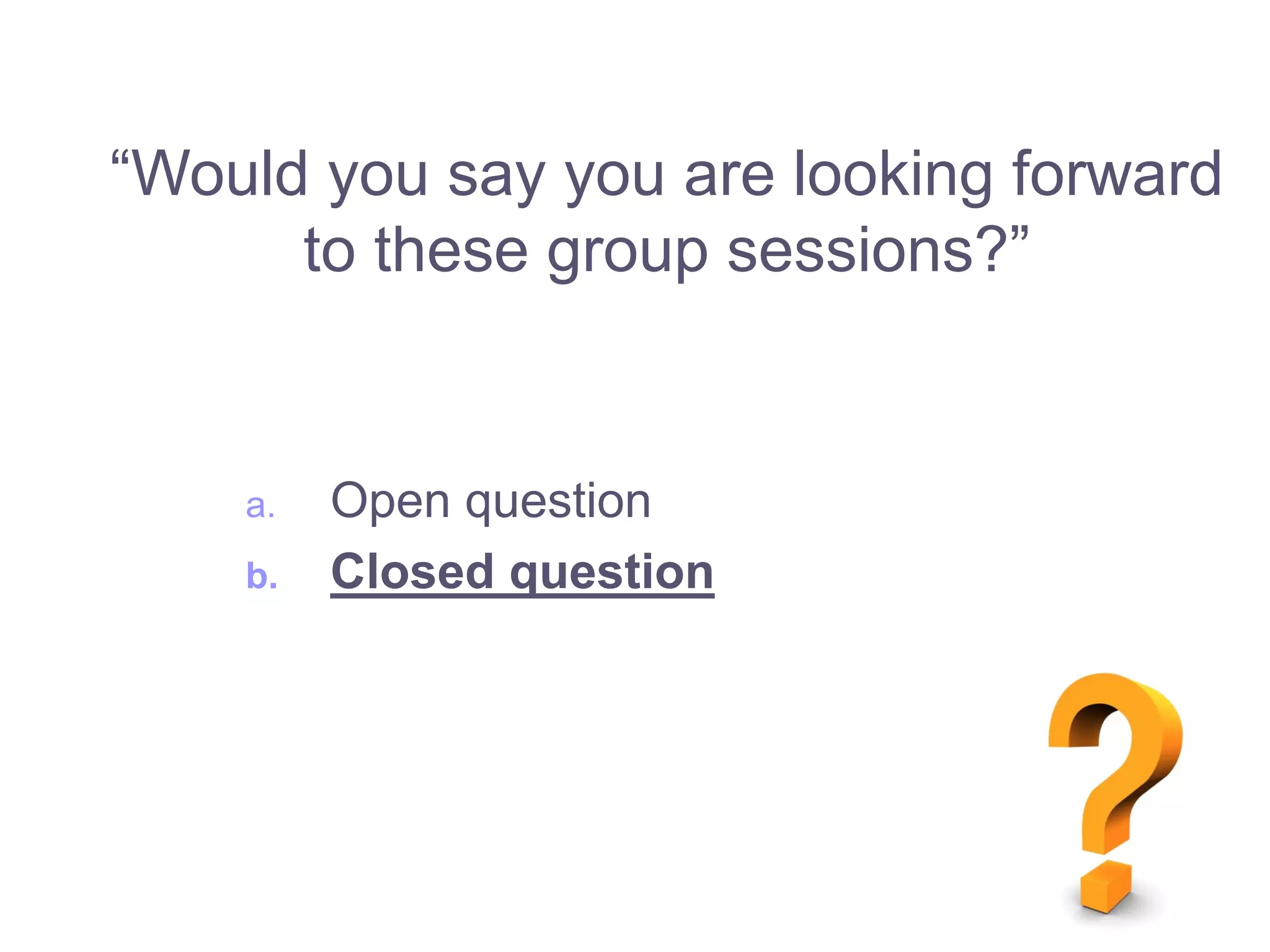
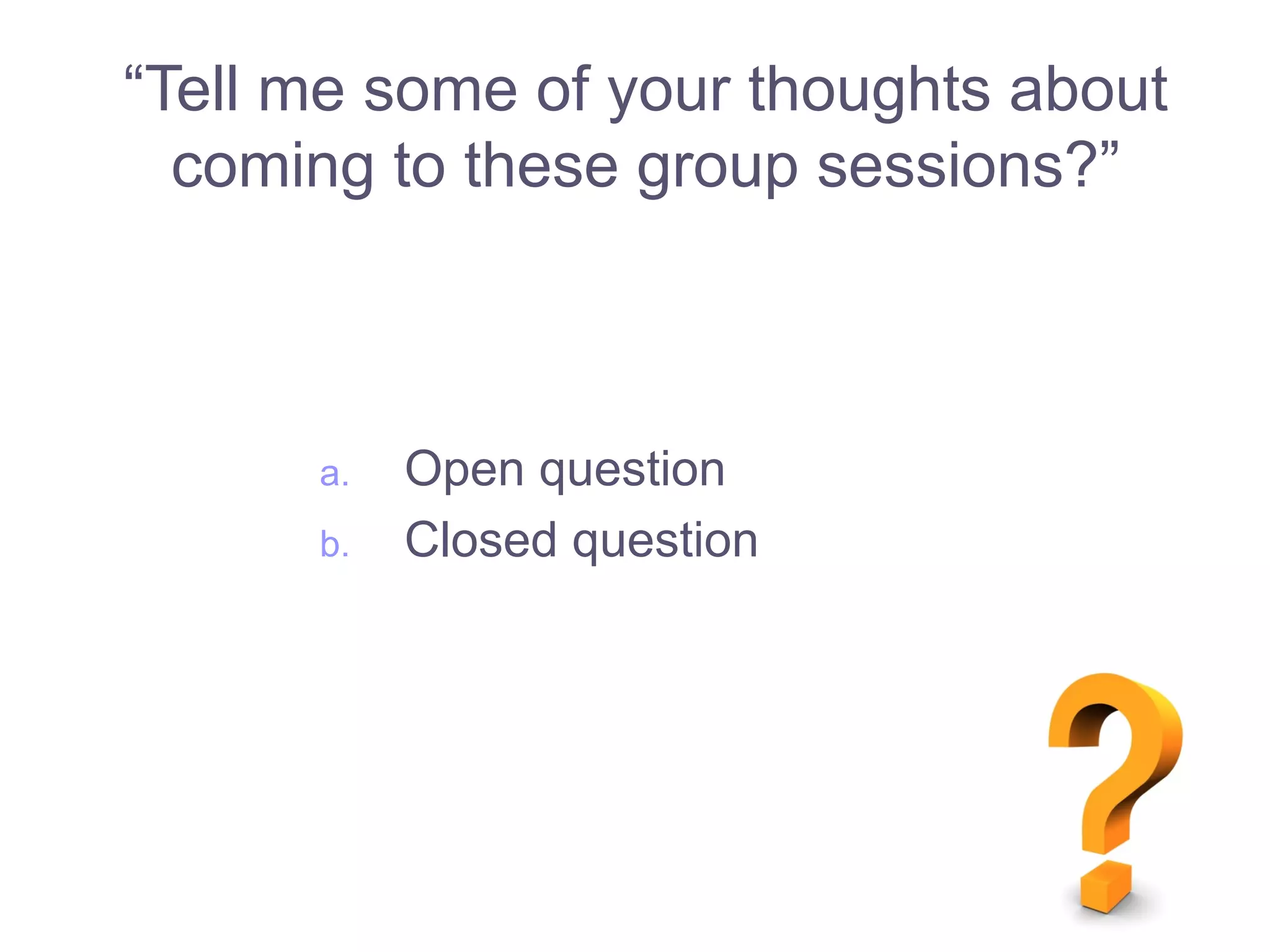
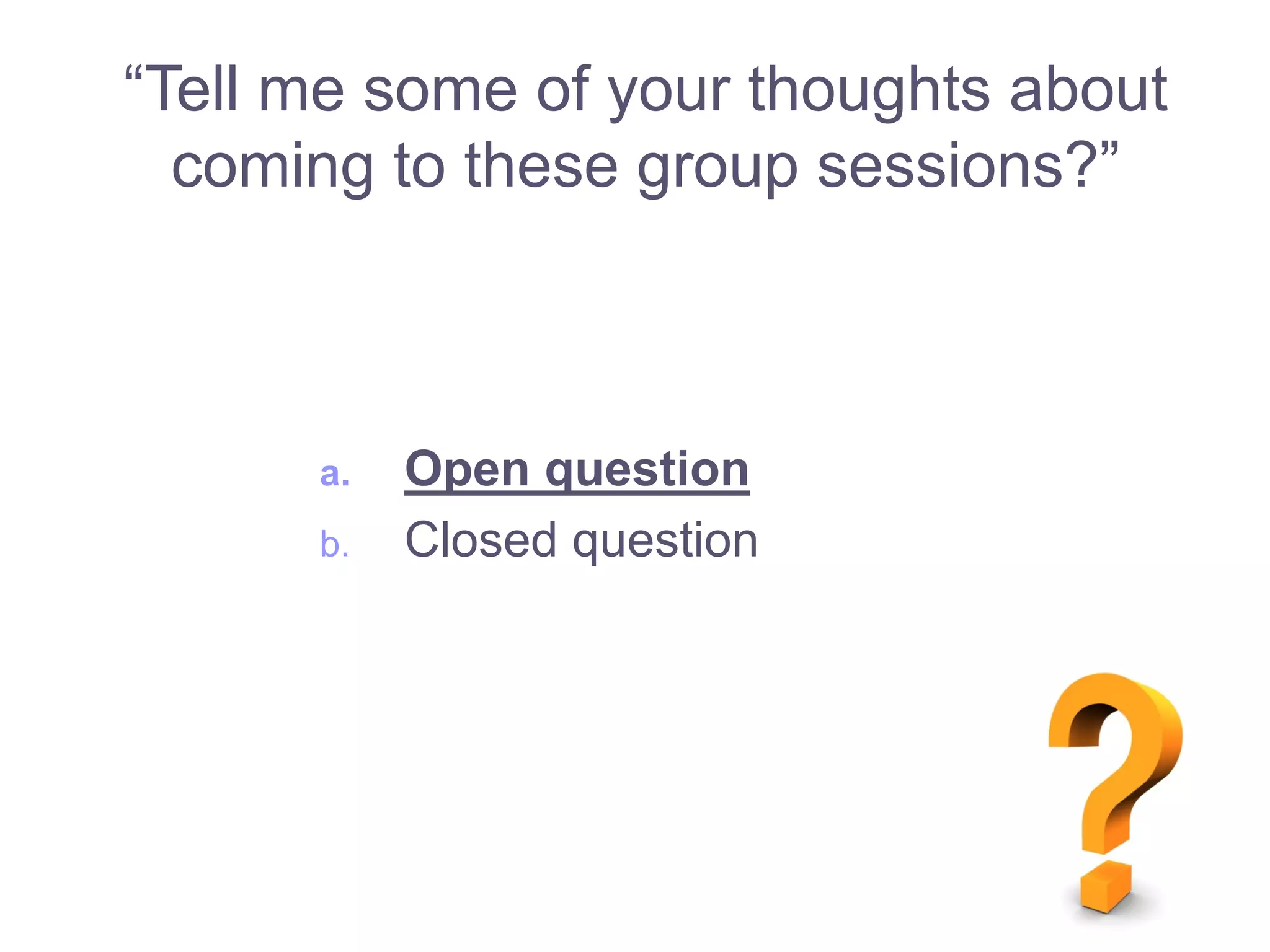
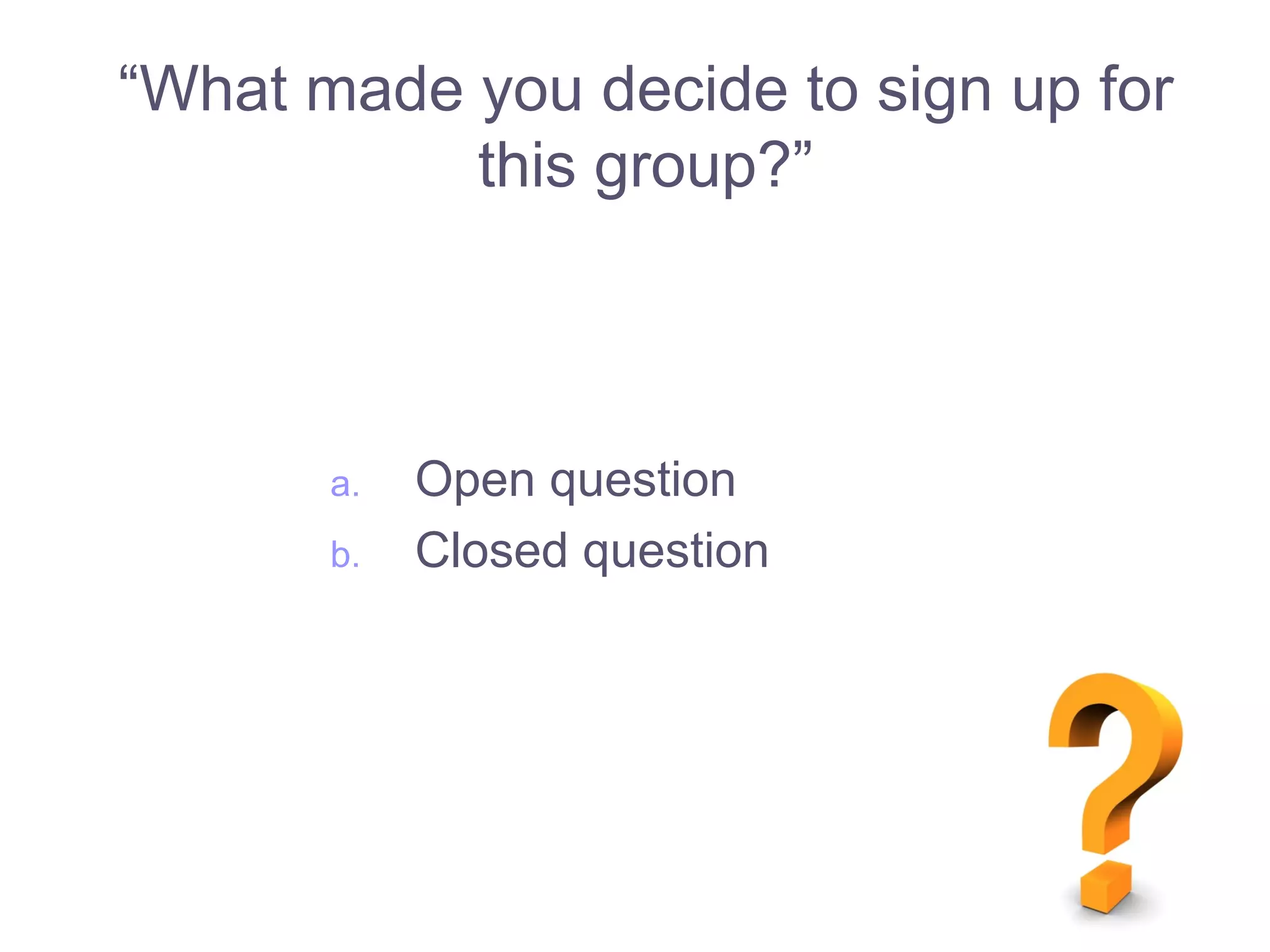
a. Open question
b. Closed question
“Would you say you are looking forward
to these group sessions?”
a. Open question
b. Closed question
“Would you say you are looking forward
to these group sessions?”
a. Open question
b. Closed question
“Tell me some of your thoughts about
coming to these group sessions?”
a. Open question
b. Closed question
“Tell me some of your thoughts about
coming to these group sessions?”
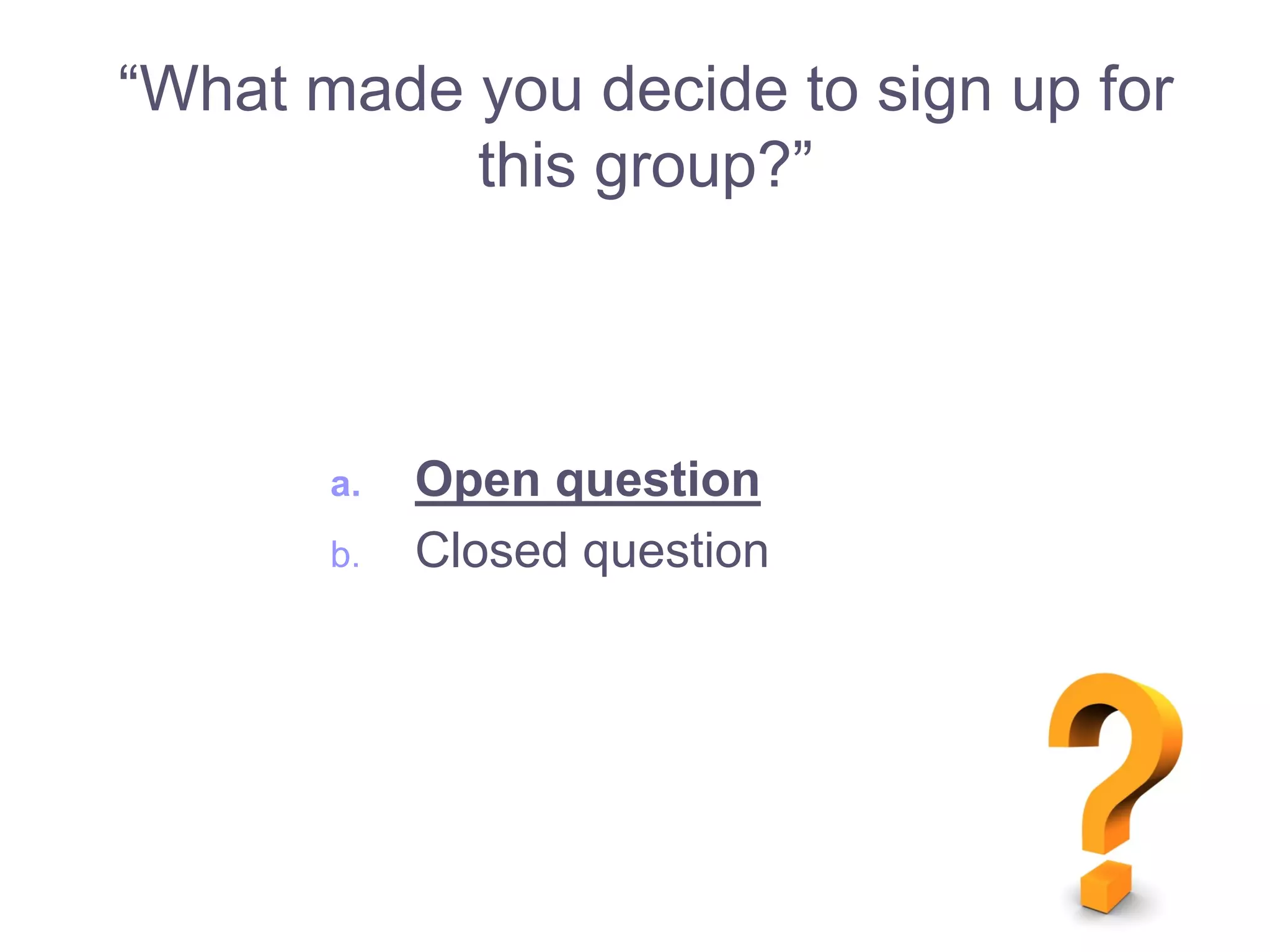
“What made you decide to sign up for
this group?”
a. Open question
b. Closed question
a. Open question
b. Closed question
“What made you decide to sign up for
this group?”
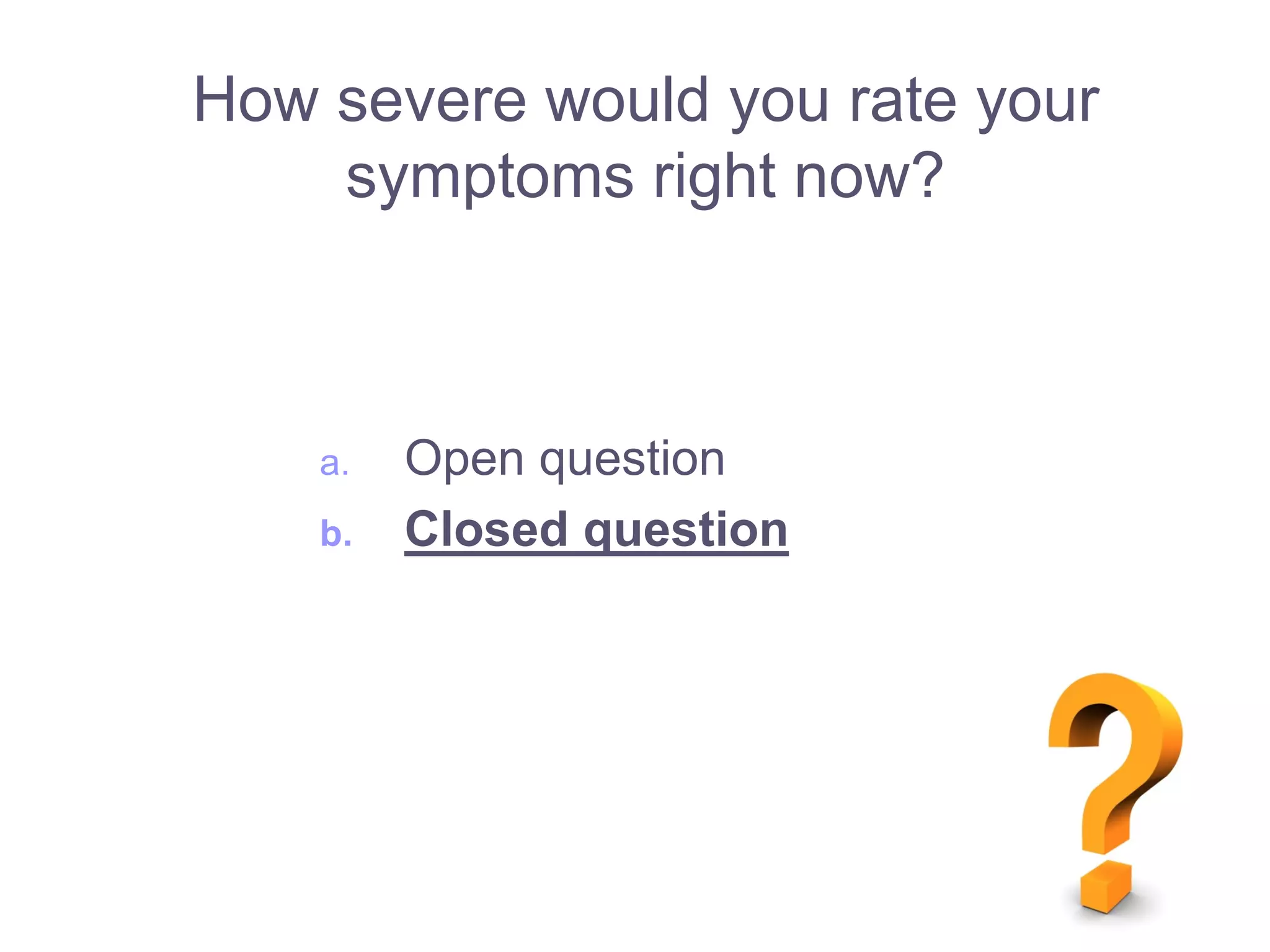
How severe would you rate your
symptoms right now?
a. Open question
b. Closed question
a. Open question
b. Closed question
How severe would you rate your
symptoms right now?
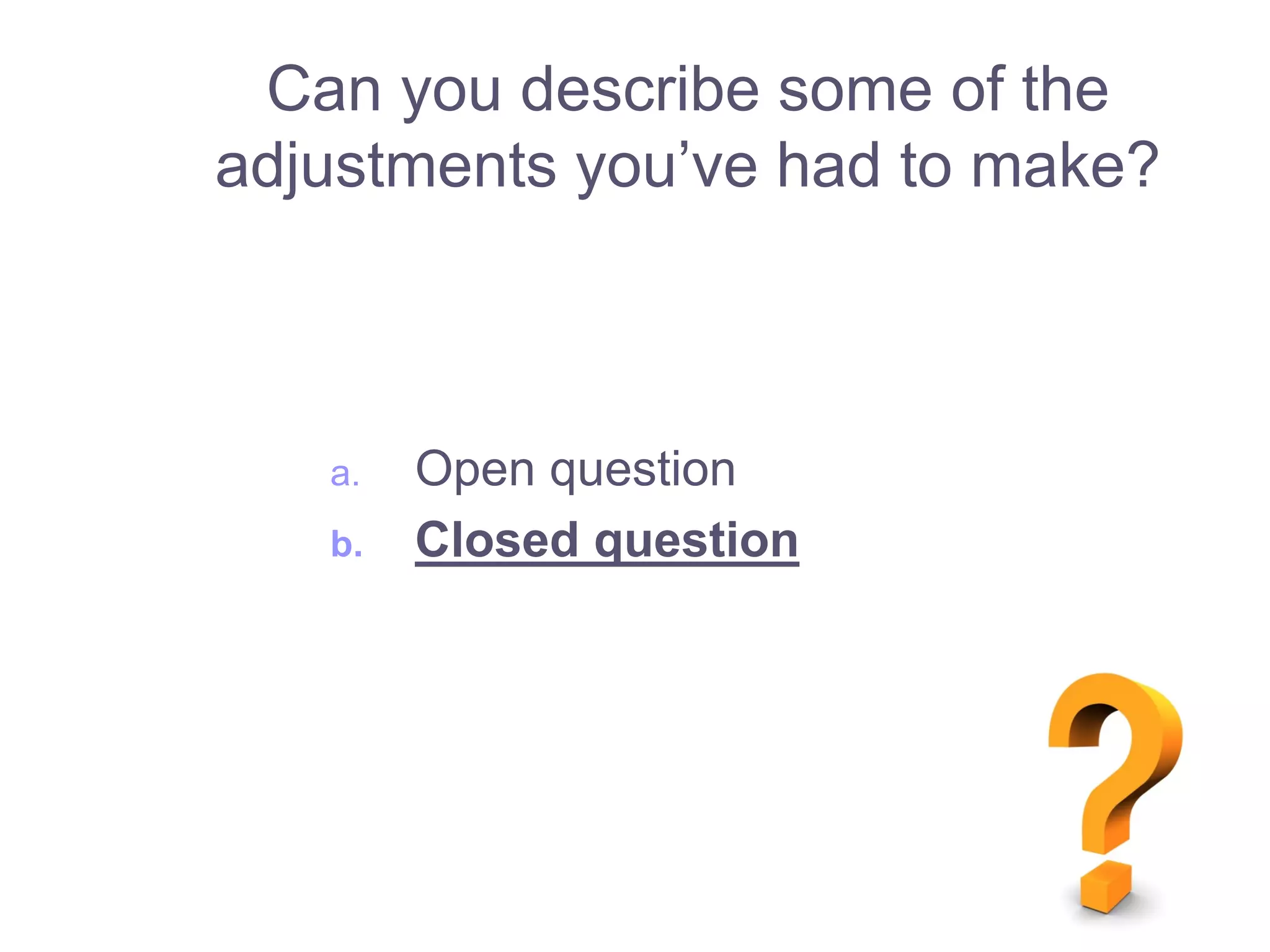
Can you describe some of the
adjustments you’ve had to make?
a. Open question
b. Closed question
a. Open question
b. Closed question
Can you describe some of the
adjustments you’ve had to make?
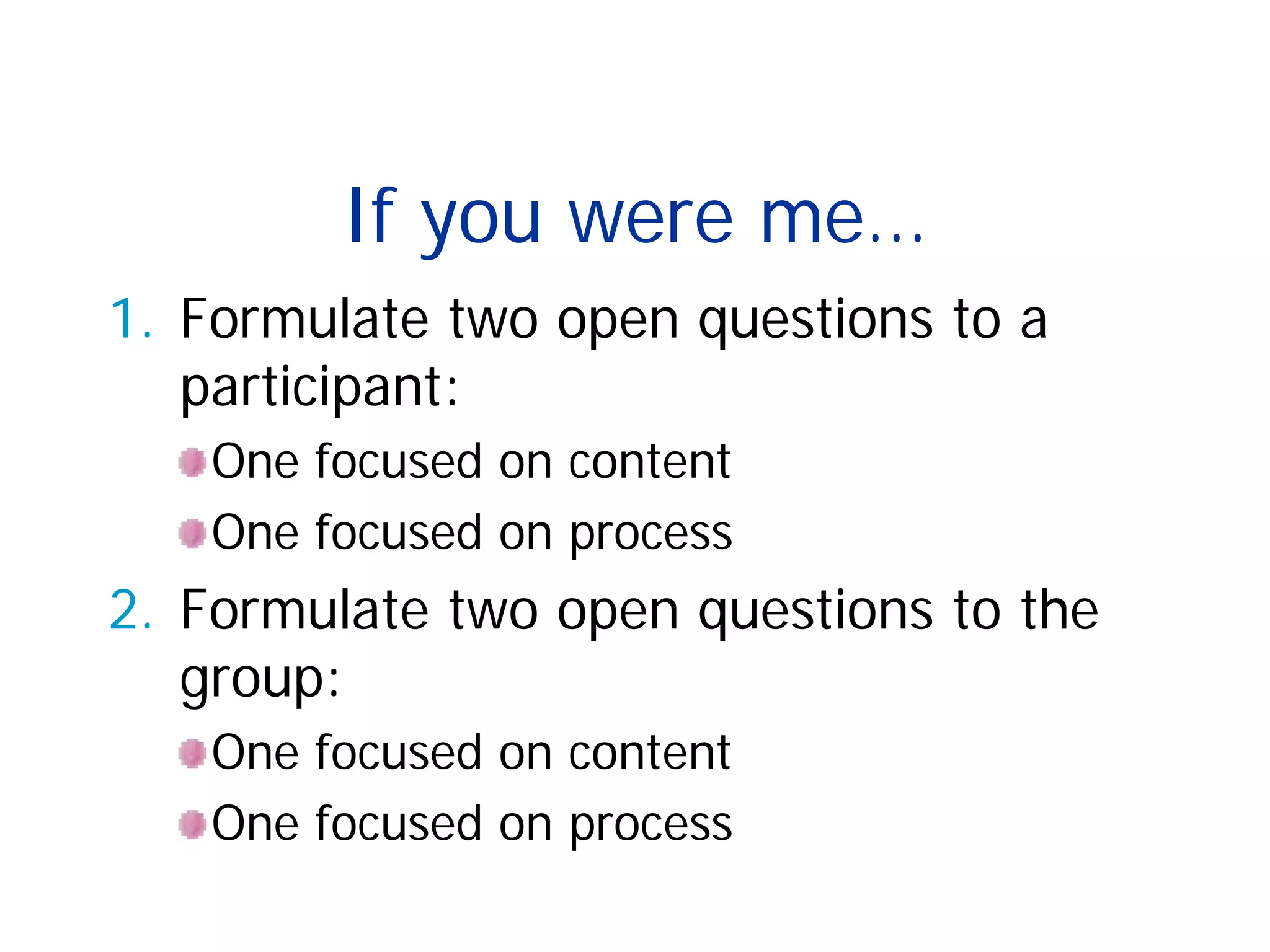
If you were me…
1. Formulate two open questions to a
participant:
One focused on content
One focused on process
2. Formulate two open questions to the
group:
One focused on content
One focused on process
When you are not sure where to
go next…
“Tell me more…Tell me more…”
Affirmations
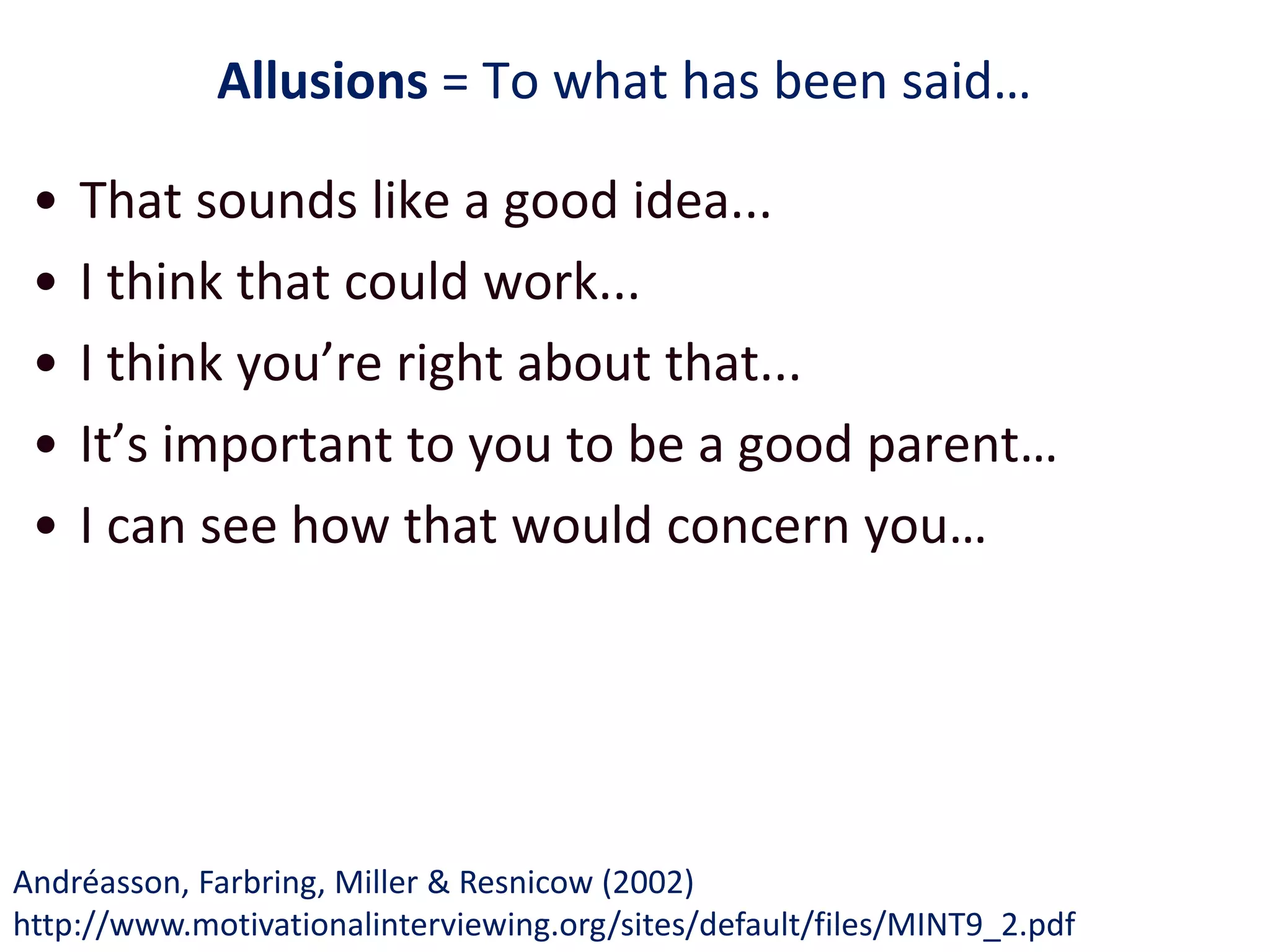
Allusions = To what has been said…
• That sounds like a good idea...
• I think that could work...
• I think you’re right about that...
• It’s important to you to be a good parent…
• I can see how that would concern you…
Andréasson, Farbring, Miller & Resnicow (2002)
http://www.motivationalinterviewing.org/sites/default/files/MINT9_2.pdf
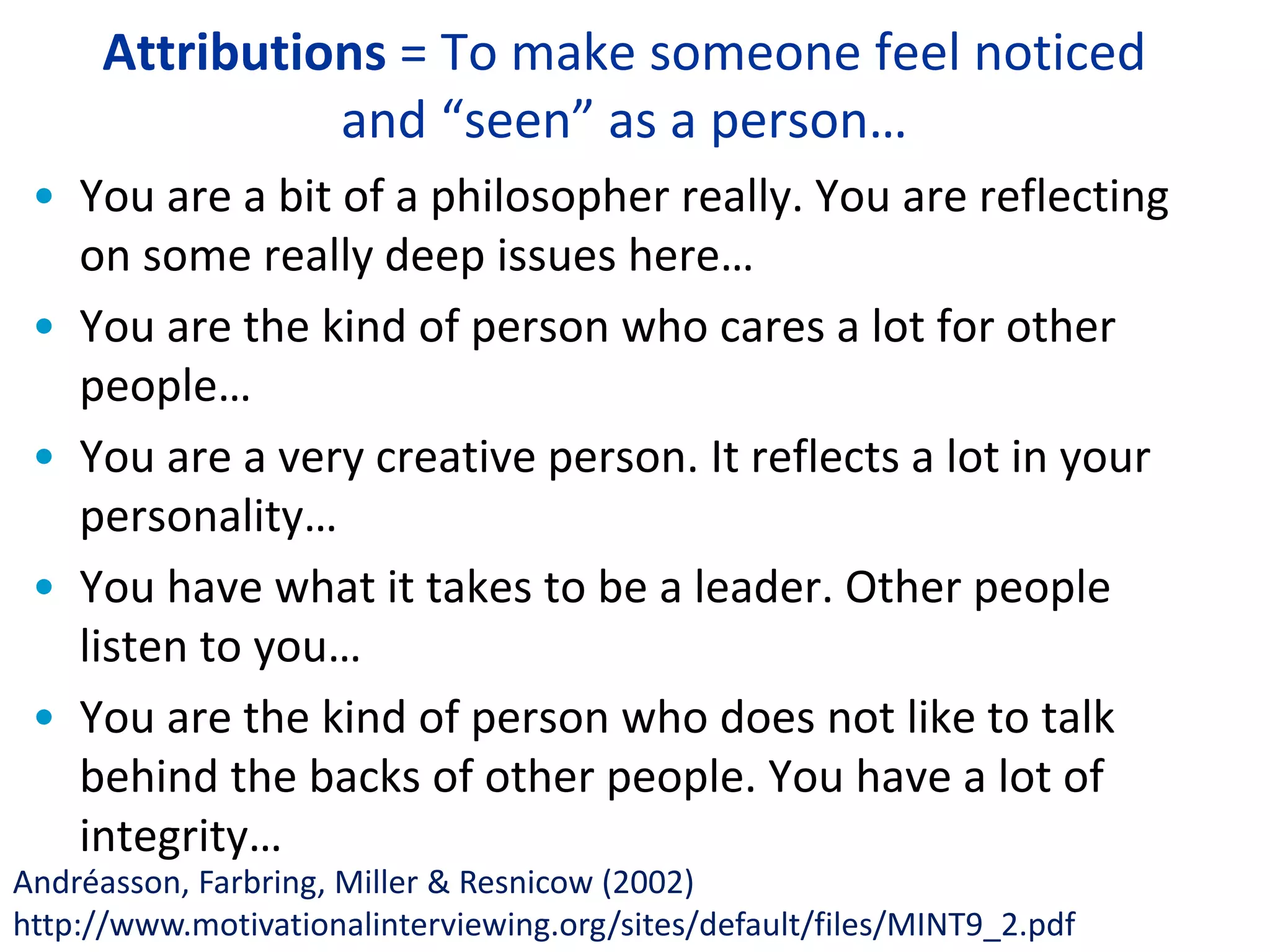
Attributions = To make someone feel noticed
and “seen” as a person…
• You are a bit of a philosopher really. You are reflecting
on some really deep issues here…
• You are the kind of person who cares a lot for other
people…
• You are a very creative person. It reflects a lot in your
personality…
• You have what it takes to be a leader. Other people
listen to you…
• You are the kind of person who does not like to talk
behind the backs of other people. You have a lot of
integrity…
Andréasson, Farbring, Miller & Resnicow (2002)
http://www.motivationalinterviewing.org/sites/default/files/MINT9_2.pdf
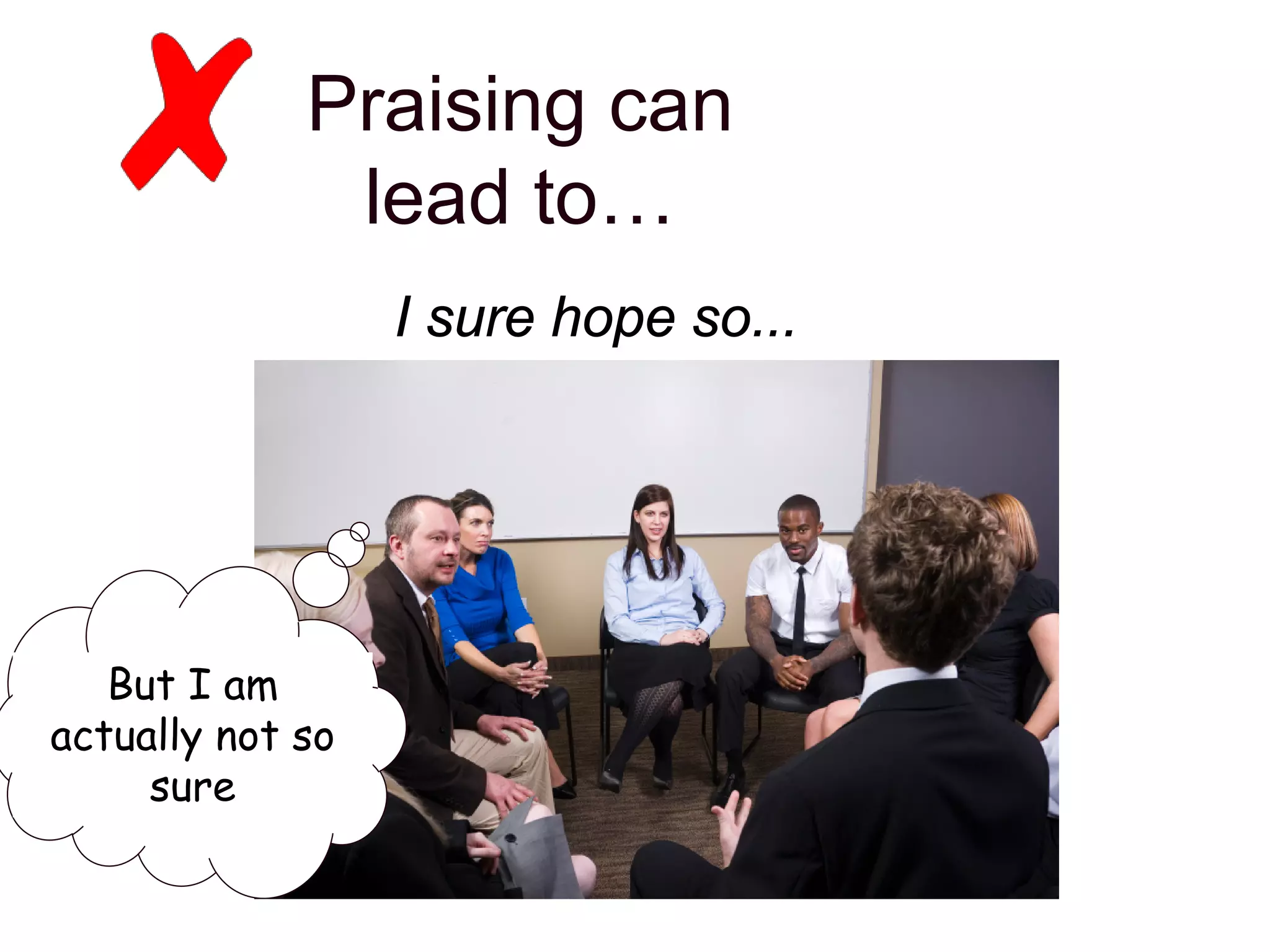
Example of
Praising:
Look how far
you’ve come! I
know you can
do this.
I sure hope so...
Praising can
lead to…
But I am
actually not so
sure
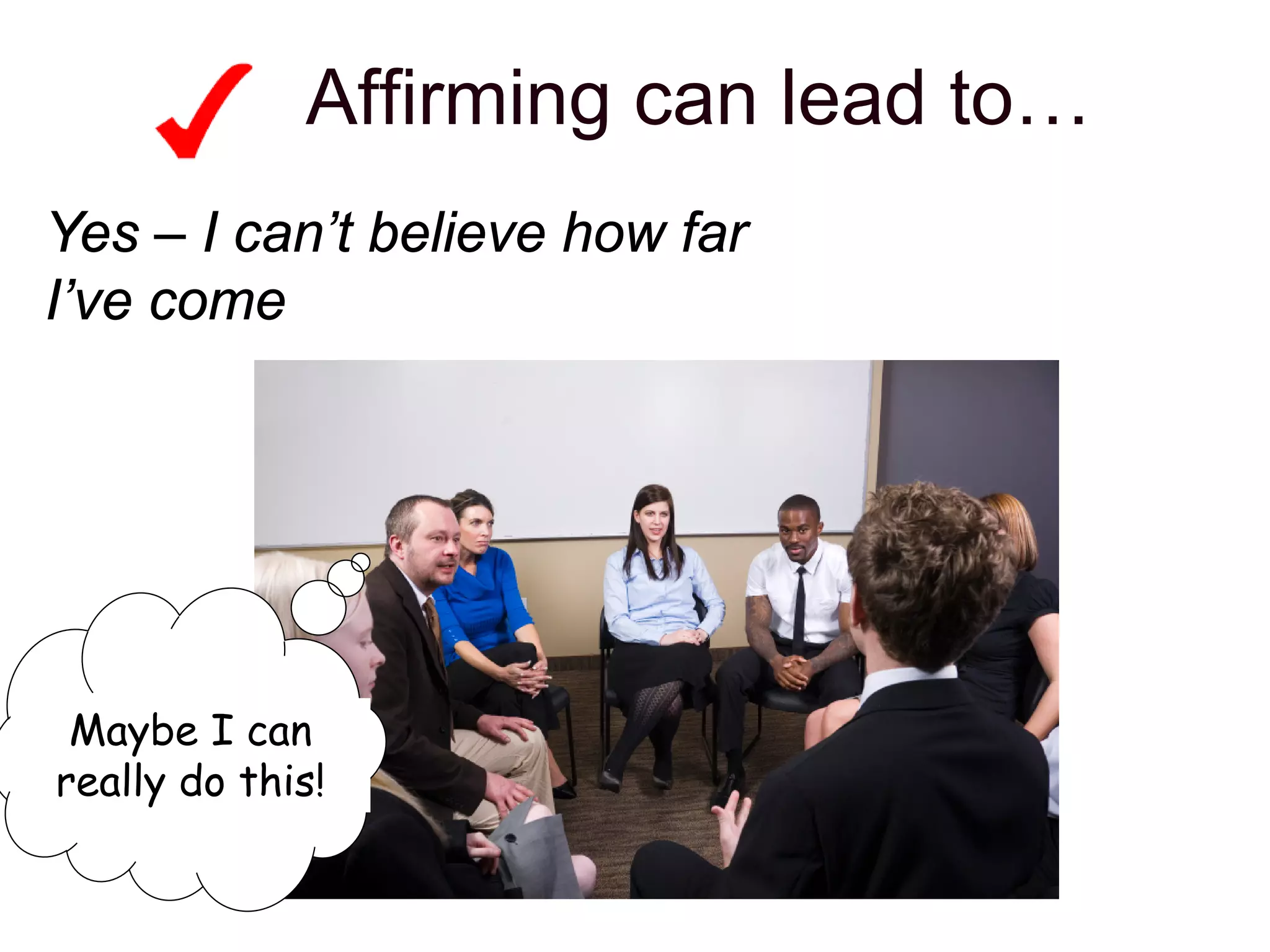
Example of Affirming
You have hung in there even
though things have been very
stressful.
Affirming can lead to…
Yes – I can’t believe how far
I’ve come
Maybe I can
really do this!
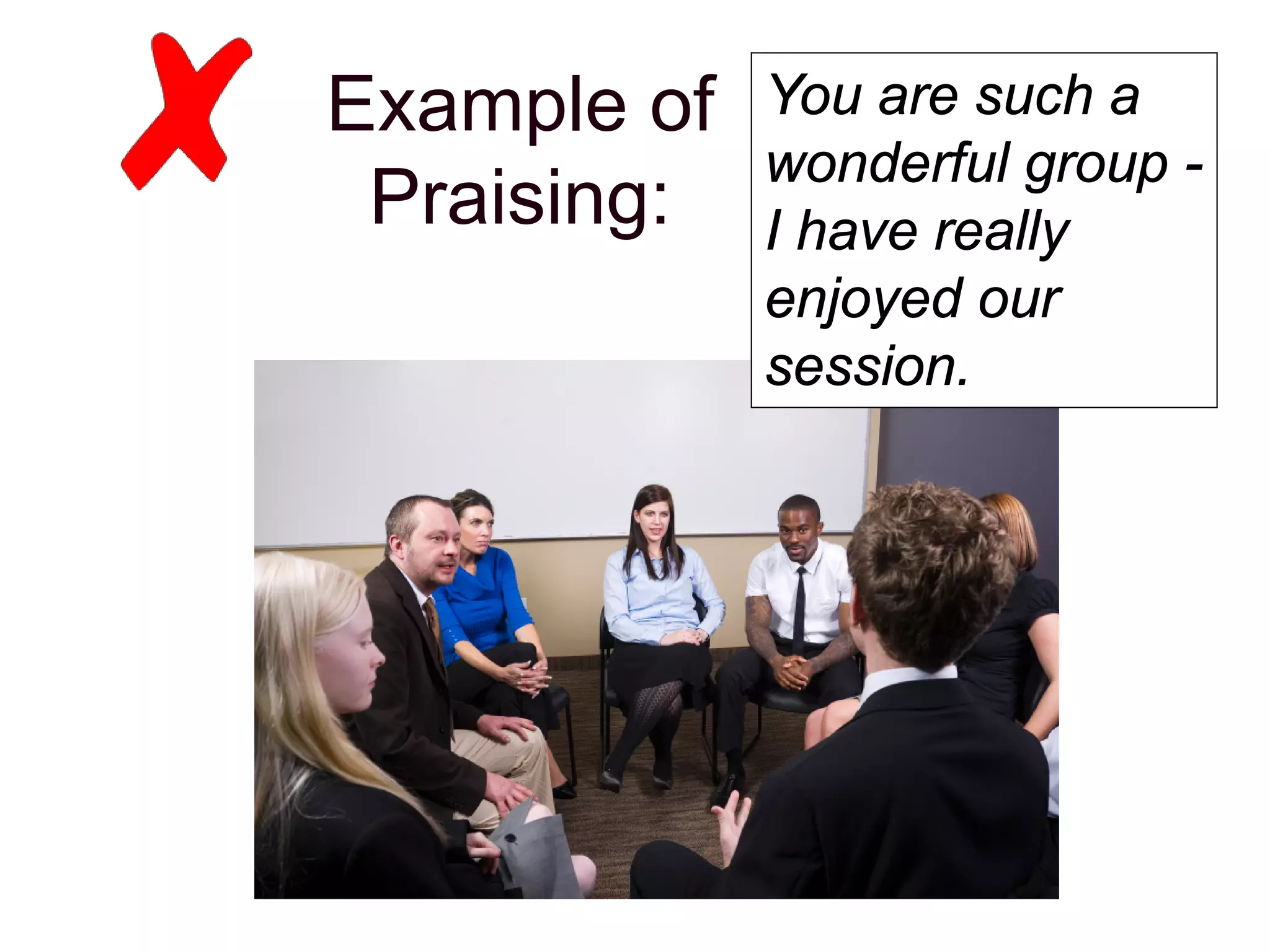
Example of
Praising:
You are such a
wonderful group -
I have really
enjoyed our
session.
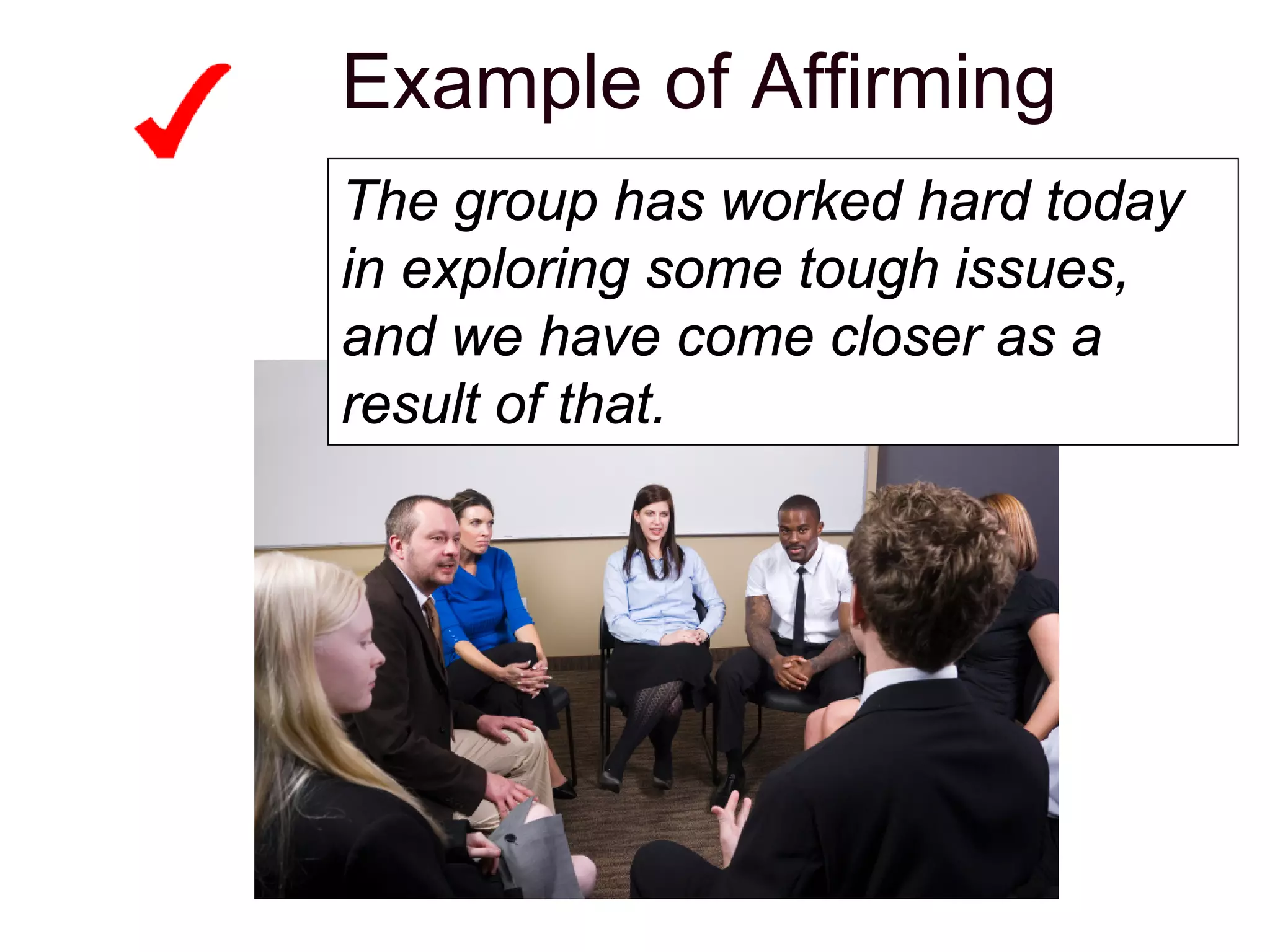
Example of Affirming
The group has worked hard today
in exploring some tough issues,
and we have come closer as a
result of that.
Choose one of your most
challenging groups – and
come up with an affirmation
that you could offer
Reflections
EAR
EYES
UNDIVIDED
ATTENTION
HEART
“To Listen”
IMPERIAL
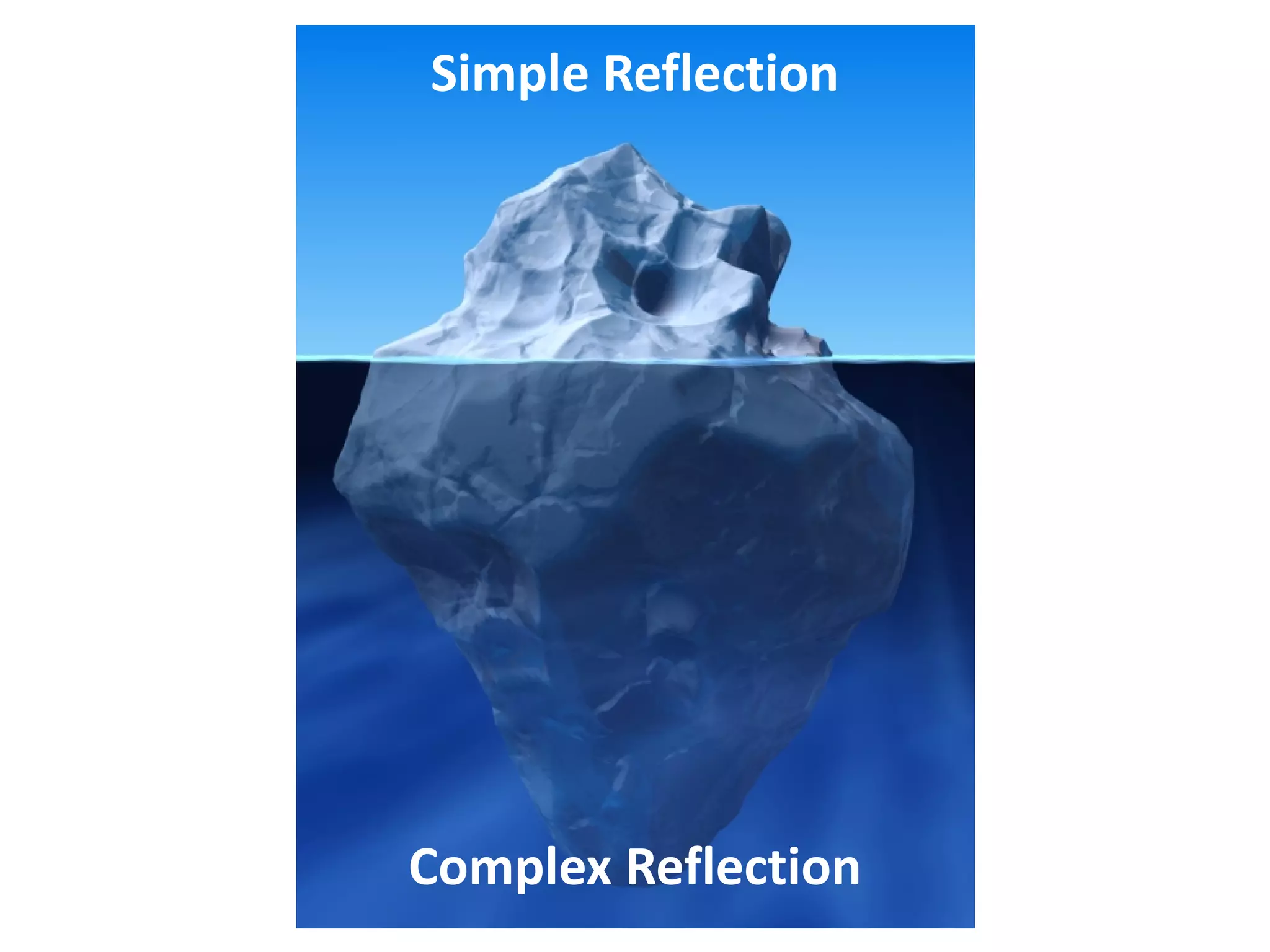
Simple Reflection
Complex Reflection
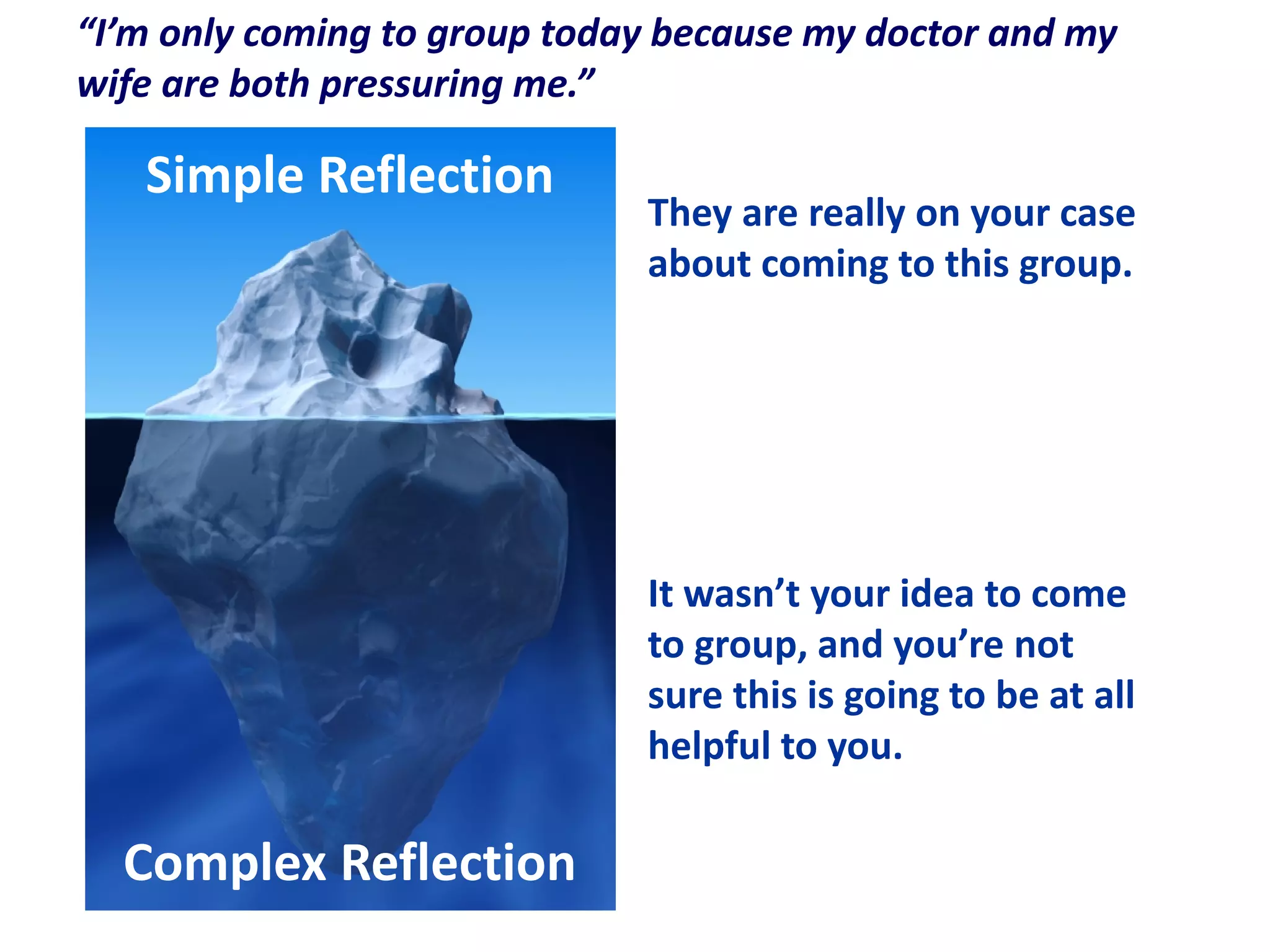
Simple Reflection
Complex Reflection
They are really on your case
about coming to this group.
It wasn’t your idea to come
to group, and you’re not
sure this is going to be at all
helpful to you.
“I’m only coming to group today because my doctor and my
wife are both pressuring me.”
Practicing Reflective
Listening
Individually, take a moment to write
down an example of a simple and a
complex reflection for the following
statement (coming up – next slide).
Then compare what you wrote with
others at your table. As a group,
choose the best examples to share with
the larger group.
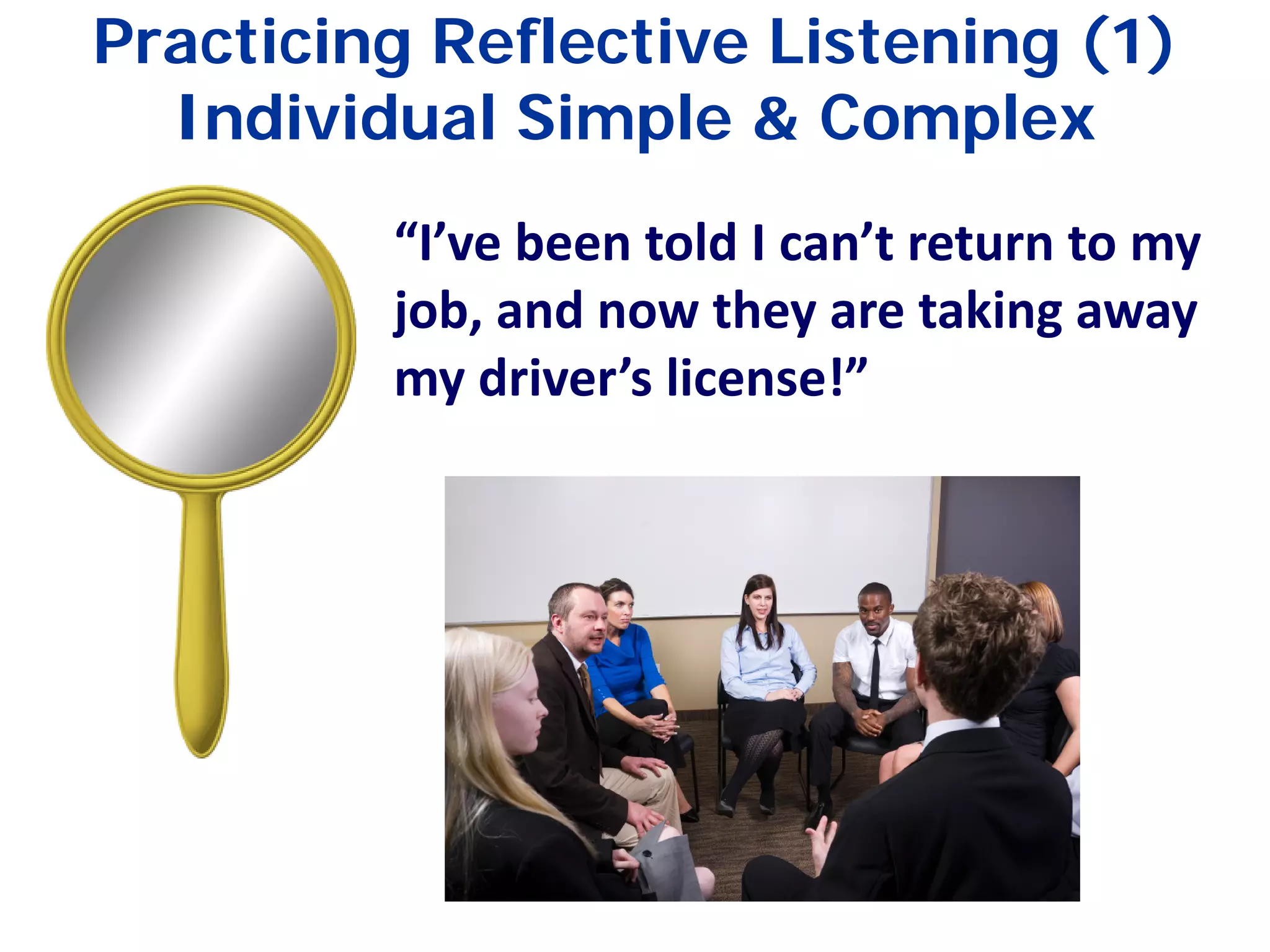
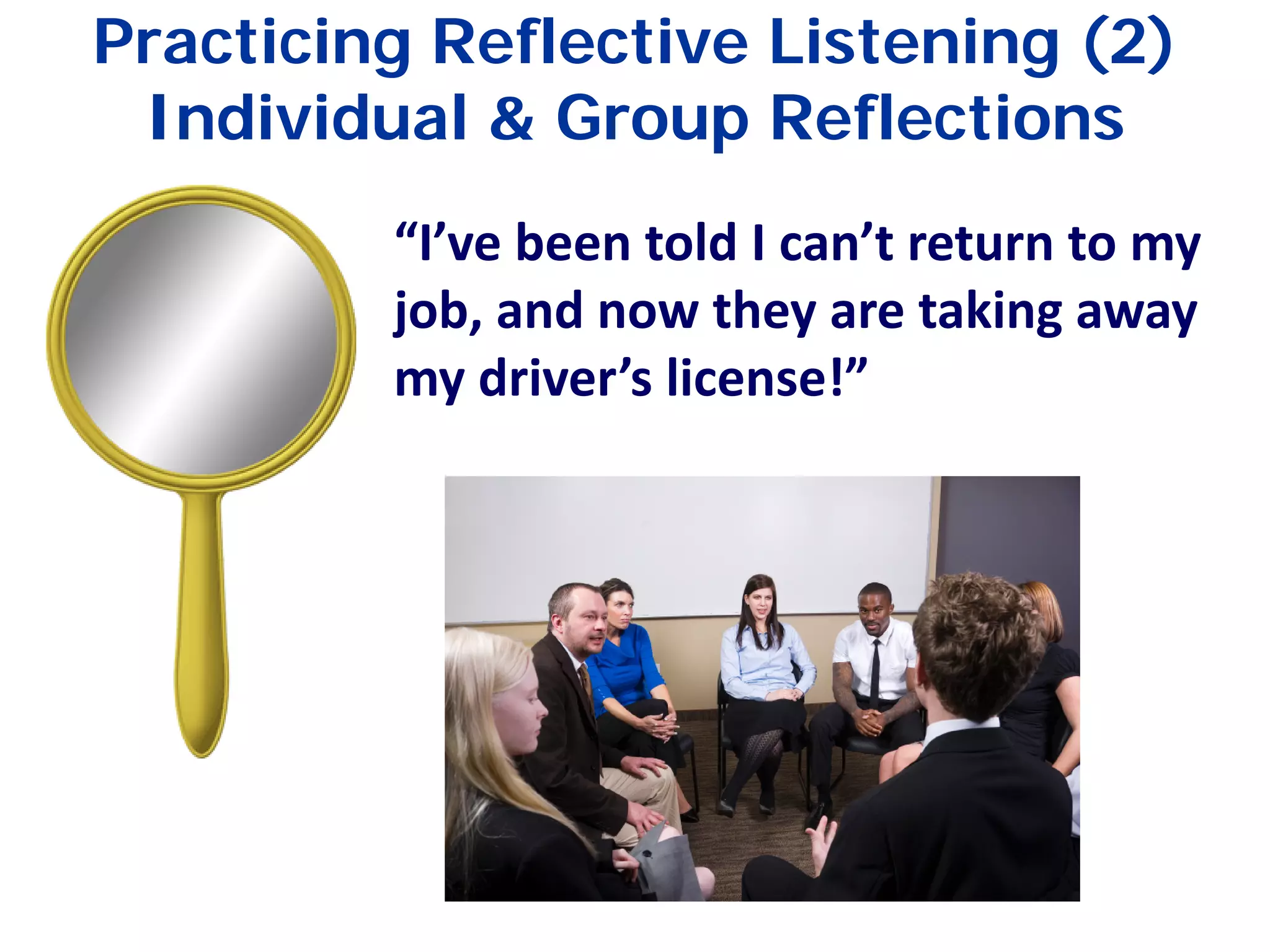
Practicing Reflective Listening (1)
Individual Simple & Complex
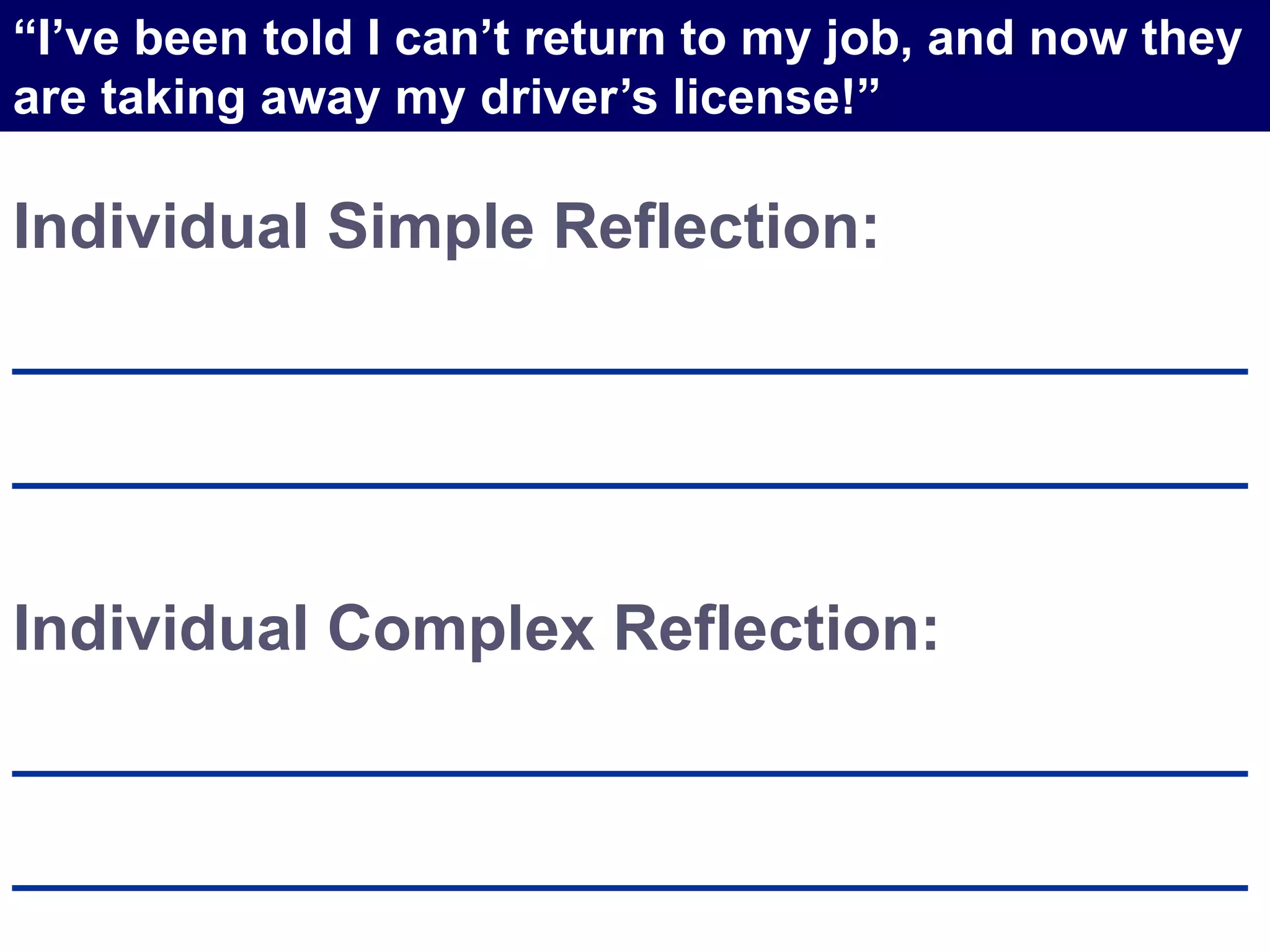
“I’ve been told I can’t return to my
job, and now they are taking away
my driver’s license!”
Individual Simple Reflection:
___________________________________
___________________________________
Individual Complex Reflection:
___________________________________
___________________________________
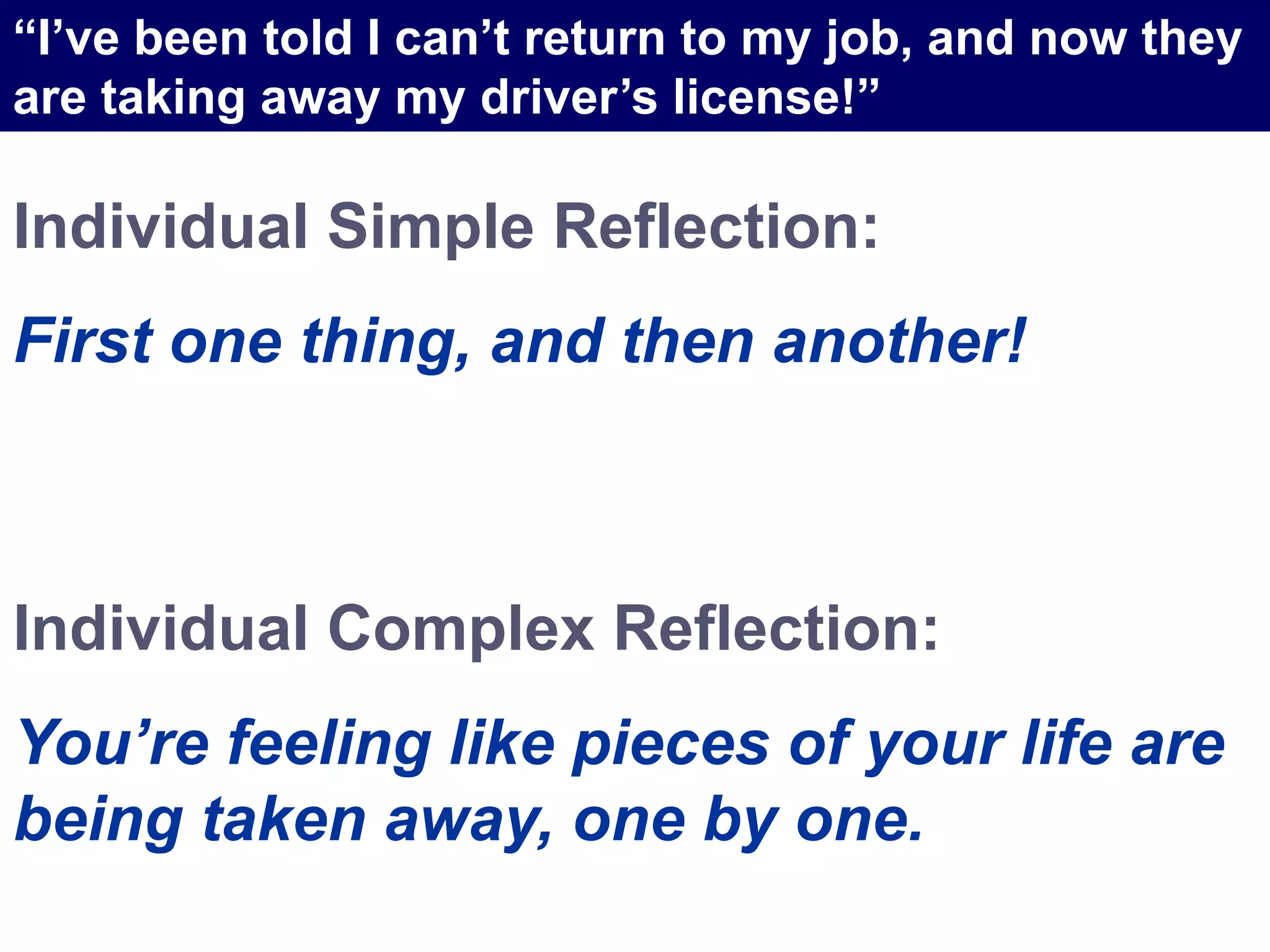
“I’ve been told I can’t return to my job, and now they
are taking away my driver’s license!”
Individual Simple Reflection:
First one thing, and then another!
Individual Complex Reflection:
You’re feeling like pieces of your life are
being taken away, one by one.
“I’ve been told I can’t return to my job, and now they
are taking away my driver’s license!”
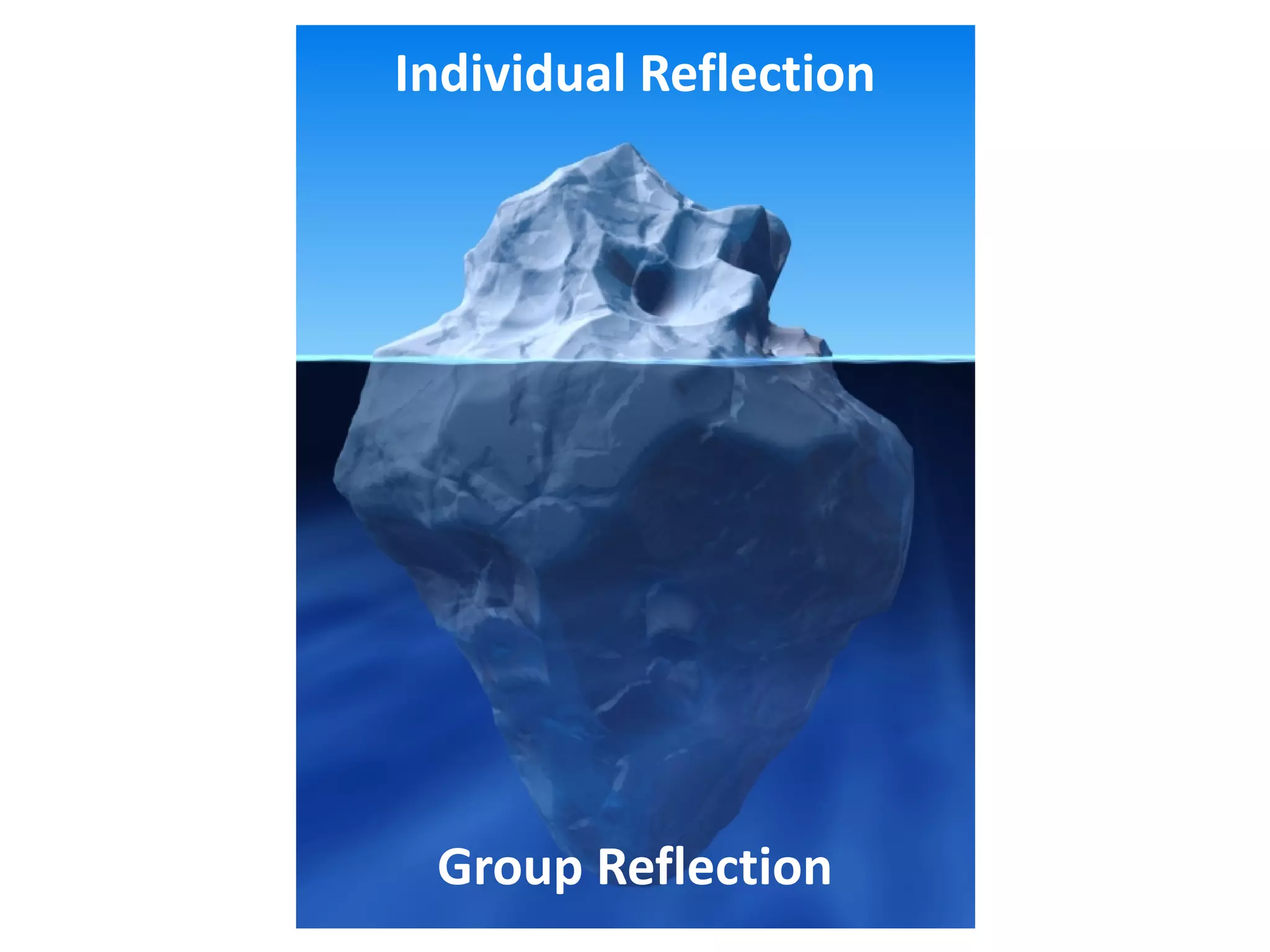
Individual Reflection
Group Reflection
Individual Reflection
Group Reflection
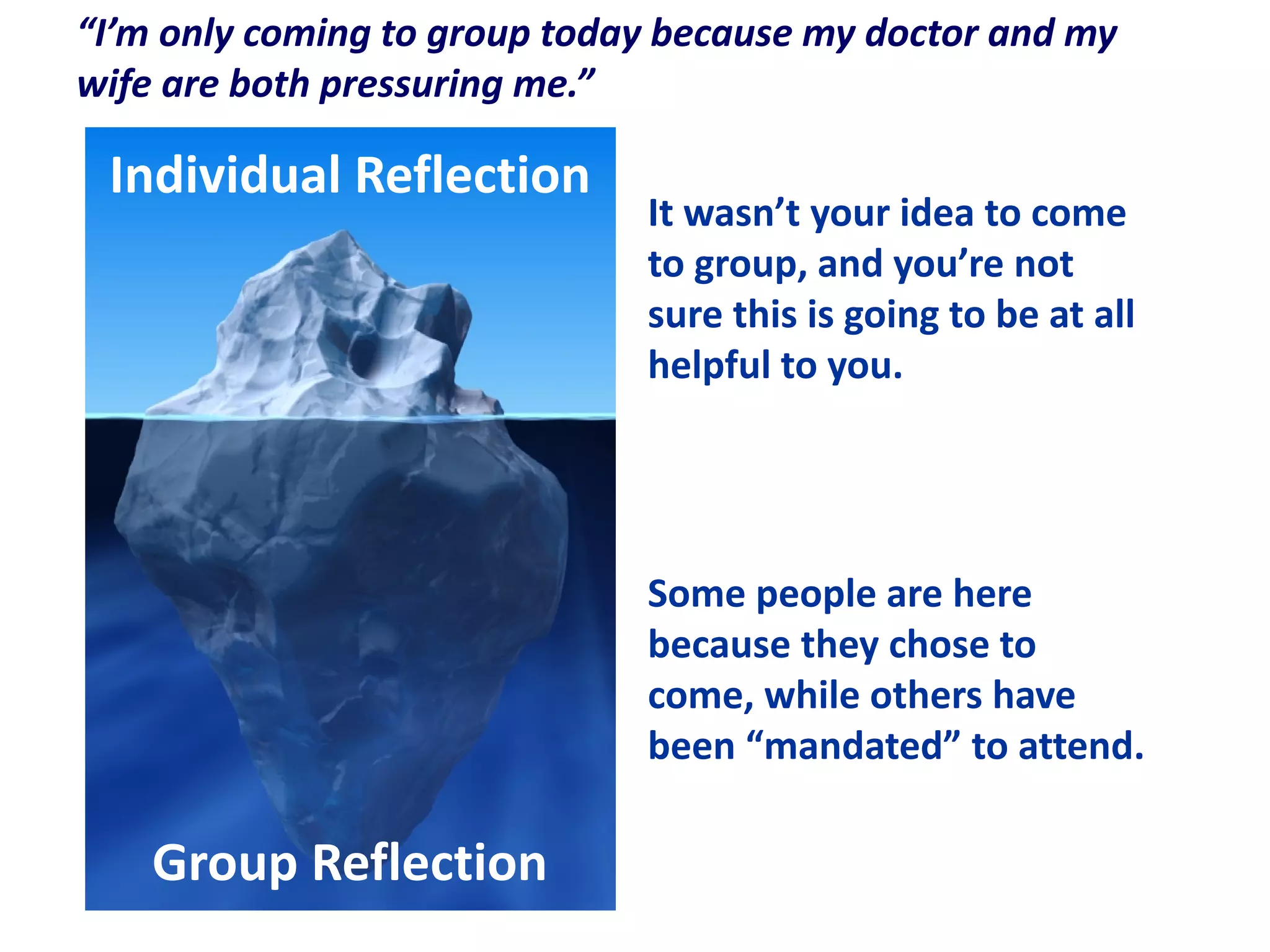
“I’m only coming to group today because my doctor and my
wife are both pressuring me.”
Some people are here
because they chose to
come, while others have
been “mandated” to attend.
It wasn’t your idea to come
to group, and you’re not
sure this is going to be at all
helpful to you.
Practicing Reflective Listening (2)
Individual & Group Reflections
“I’ve been told I can’t return to my
job, and now they are taking away
my driver’s license!”
Individual Reflection:
___________________________________
___________________________________
Group Reflection:
___________________________________
___________________________________
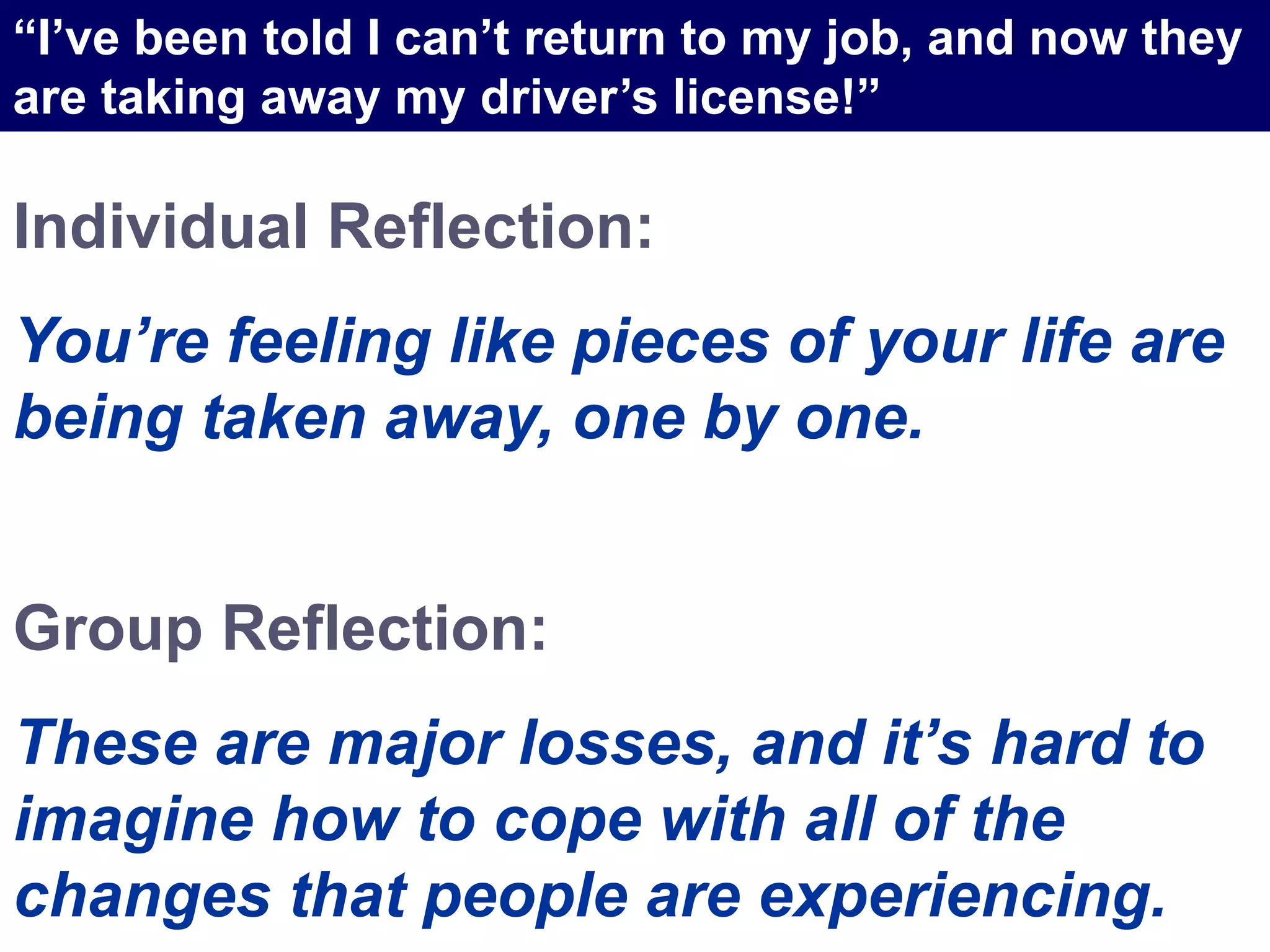
“I’ve been told I can’t return to my job, and now they
are taking away my driver’s license!”
Individual Reflection:
You’re feeling like pieces of your life are
being taken away, one by one.
Group Reflection:
These are major losses, and it’s hard to
imagine how to cope with all of the
changes that people are experiencing.
“I’ve been told I can’t return to my job, and now they
are taking away my driver’s license!”
Group Simple Reflection:
___________________________________
___________________________________
Group Complex Reflection:
___________________________________
___________________________________
“I’ve been told I can’t return to my job, and now they
are taking away my driver’s license!”
Group Simple Reflection:
Everyone is experiencing major losses
and change.
Group Complex Reflection:
These are major losses, and it’s hard to
imagine how to cope with all of the
changes that people are experiencing.
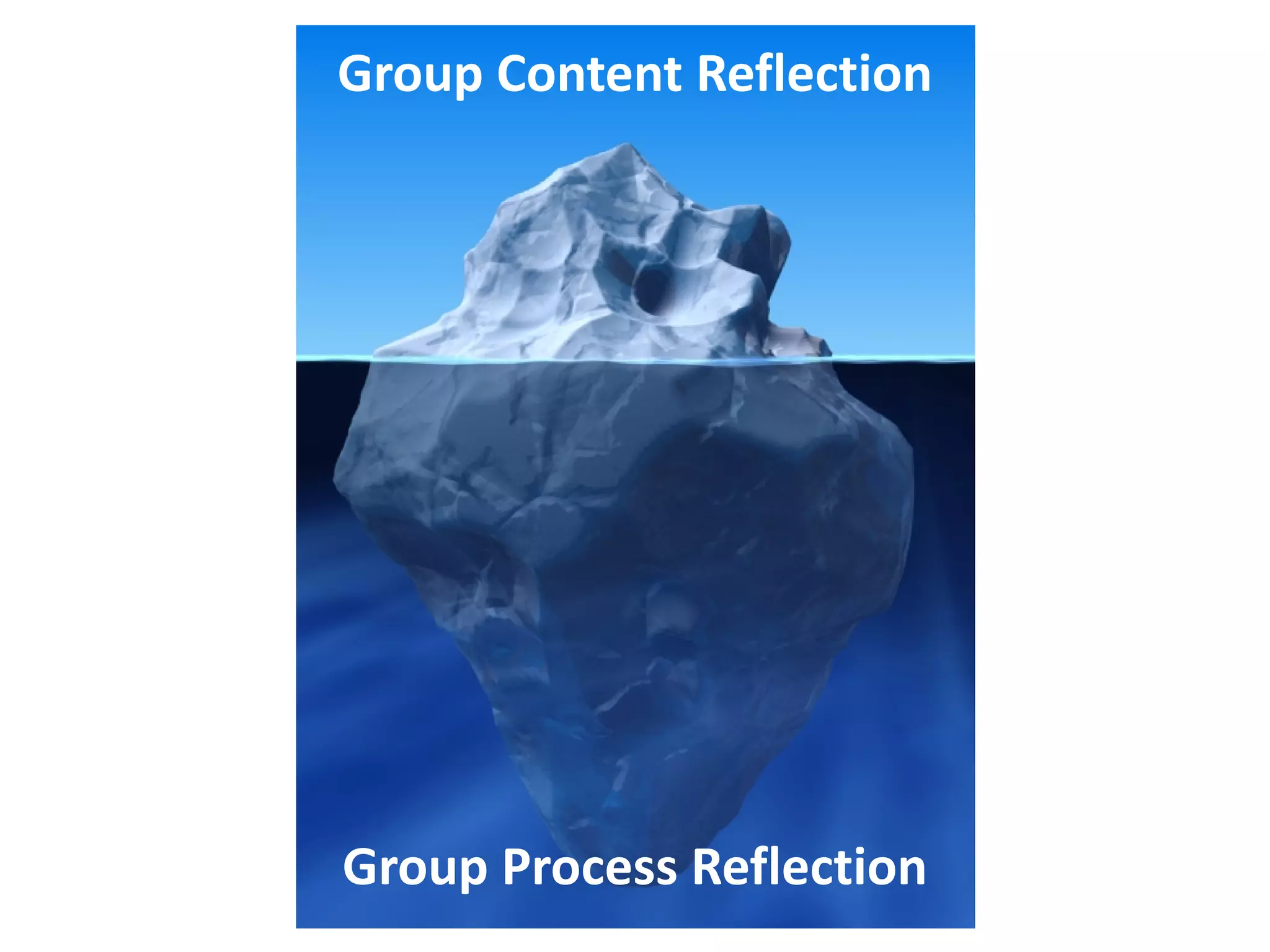
“I’ve been told I can’t return to my job, and now they
are taking away my driver’s license!”
Group Content Reflection
Group Process Reflection
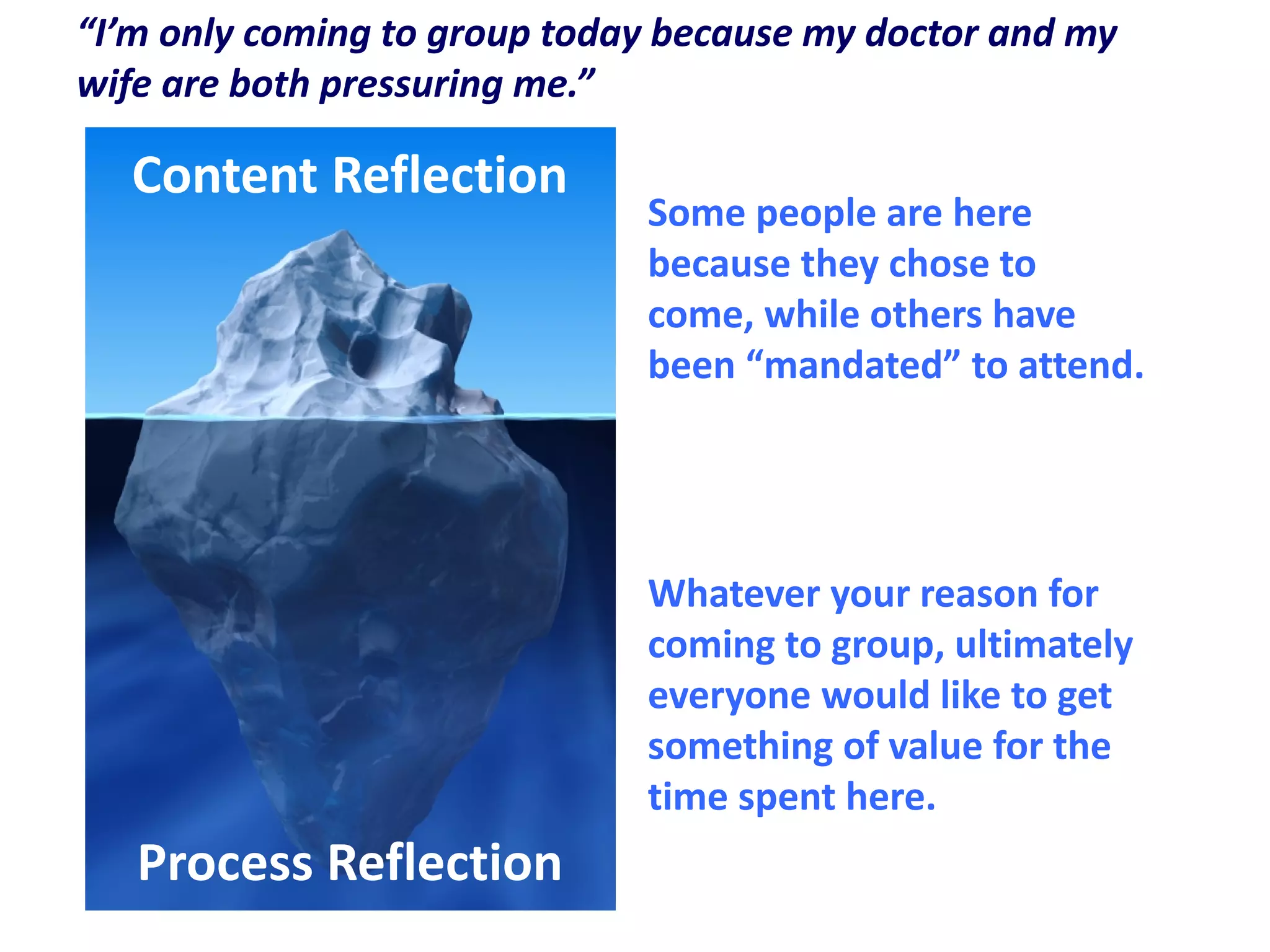
Content Reflection
Process Reflection
Whatever your reason for
coming to group, ultimately
everyone would like to get
something of value for the
time spent here.
Some people are here
because they chose to
come, while others have
been “mandated” to attend.
“I’m only coming to group today because my doctor and my
wife are both pressuring me.”
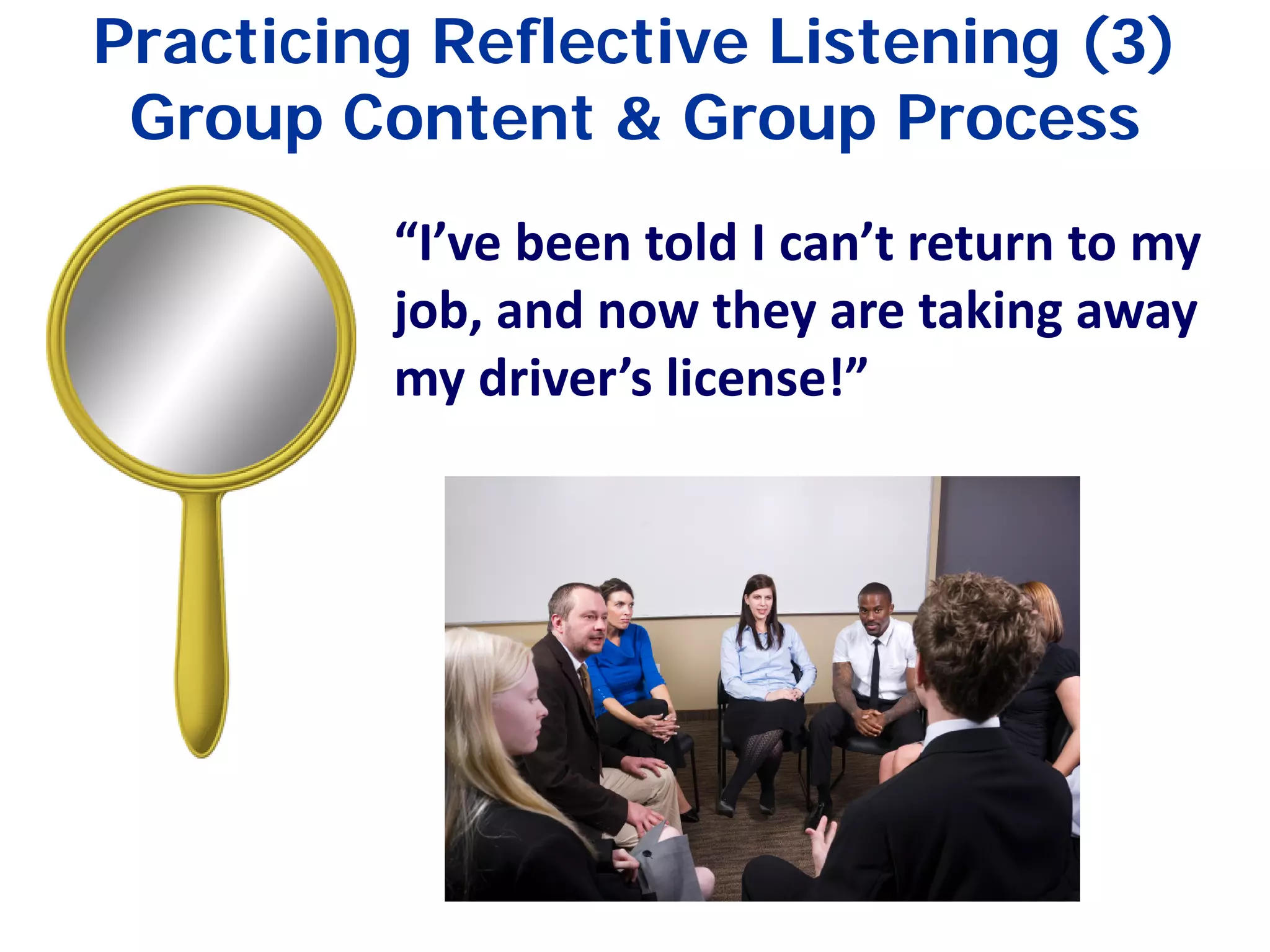
Practicing Reflective Listening (3)
Group Content & Group Process
“I’ve been told I can’t return to my
job, and now they are taking away
my driver’s license!”
Content Reflection:
___________________________________
___________________________________
Process Reflection:
___________________________________
___________________________________
“I’ve been told I can’t return to my job, and now they
are taking away my driver’s license!”
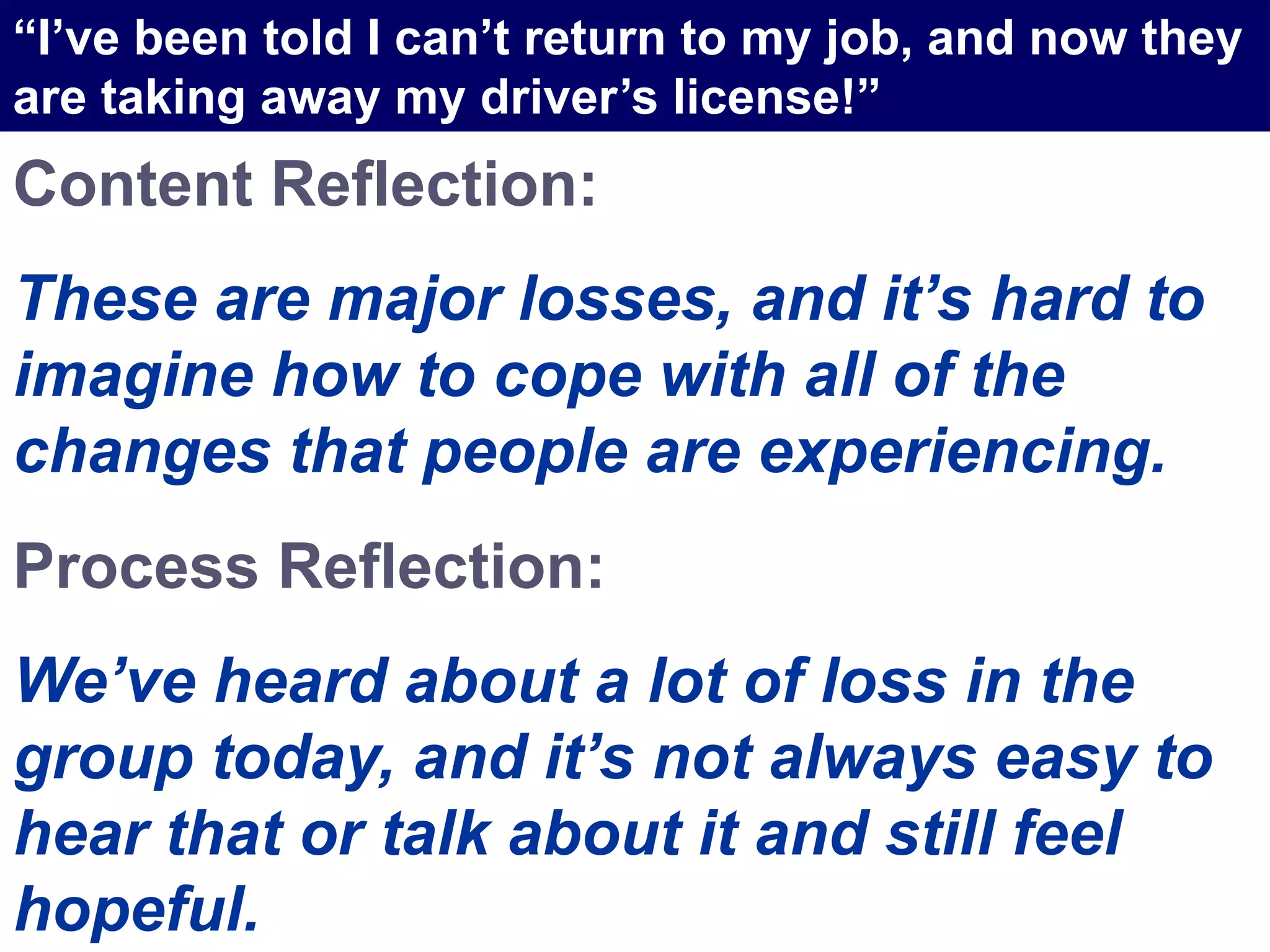
Content Reflection:
These are major losses, and it’s hard to
imagine how to cope with all of the
changes that people are experiencing.
Process Reflection:
We’ve heard about a lot of loss in the
group today, and it’s not always easy to
hear that or talk about it and still feel
hopeful.
“I’ve been told I can’t return to my job, and now they
are taking away my driver’s license!”
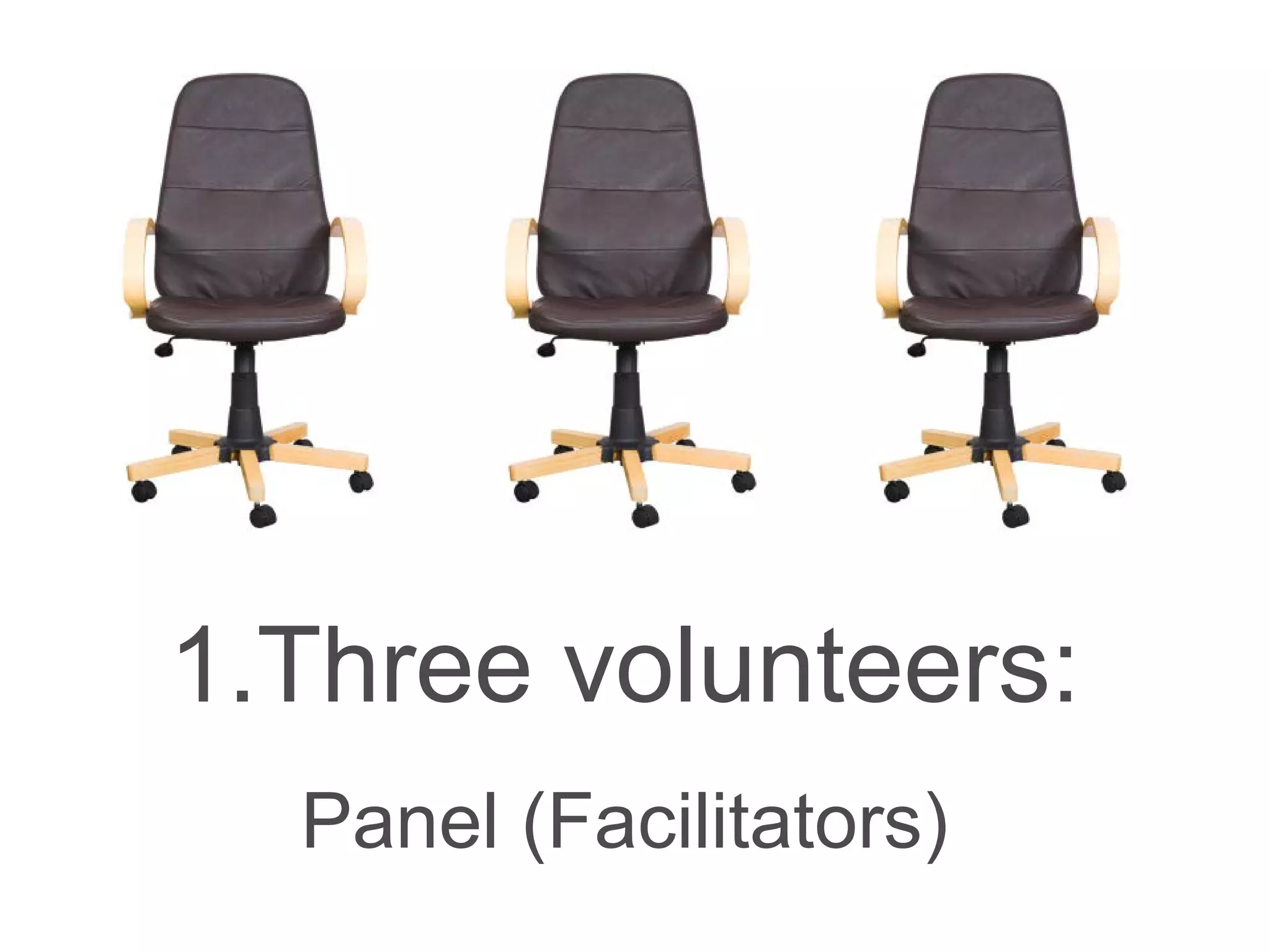
Reflecting Panel
1.Three volunteers:
Panel (Facilitators)
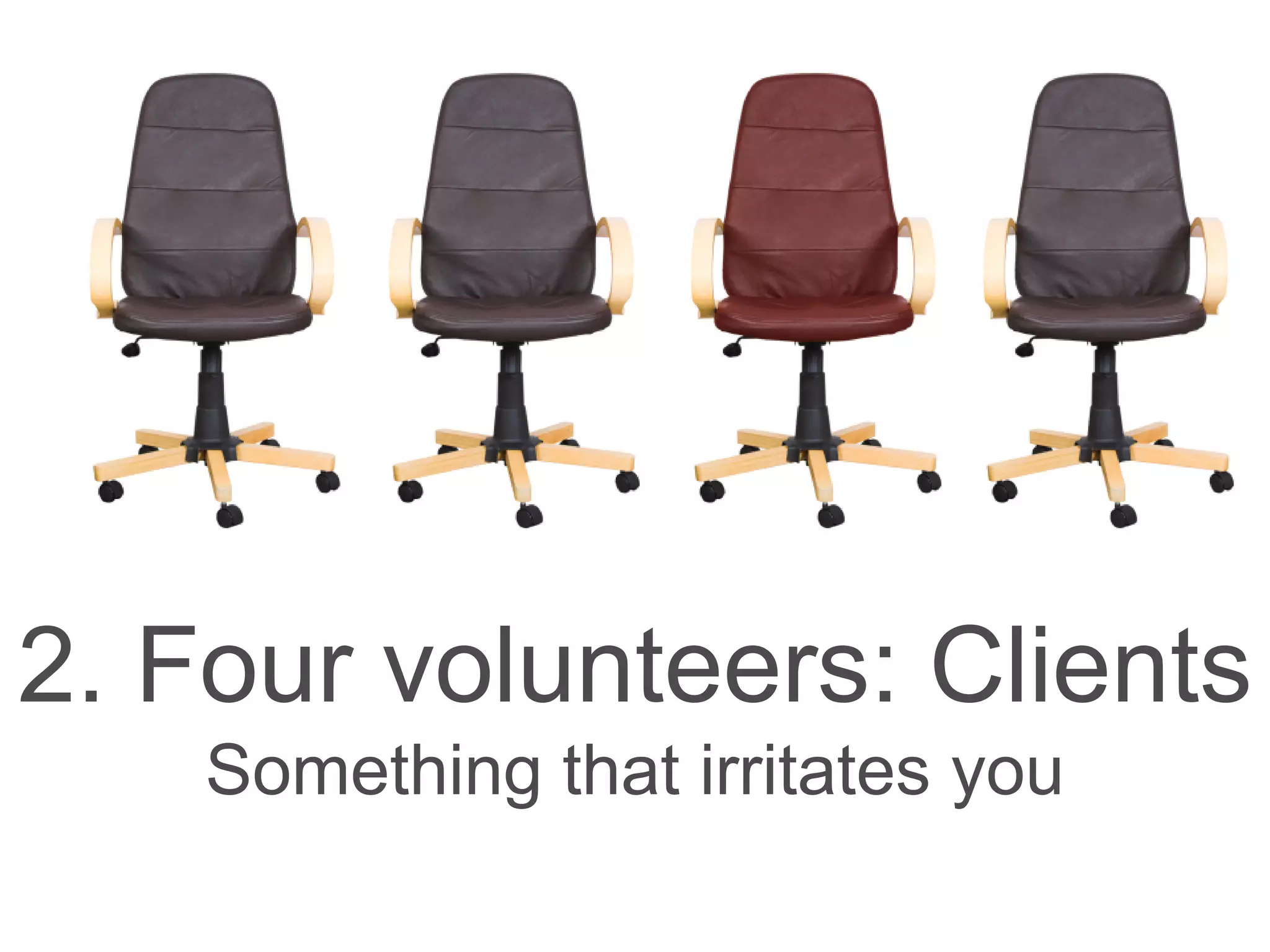
2. Four volunteers: Clients
Something that irritates you
3. One volunteer: Coach
A sounding board for the group
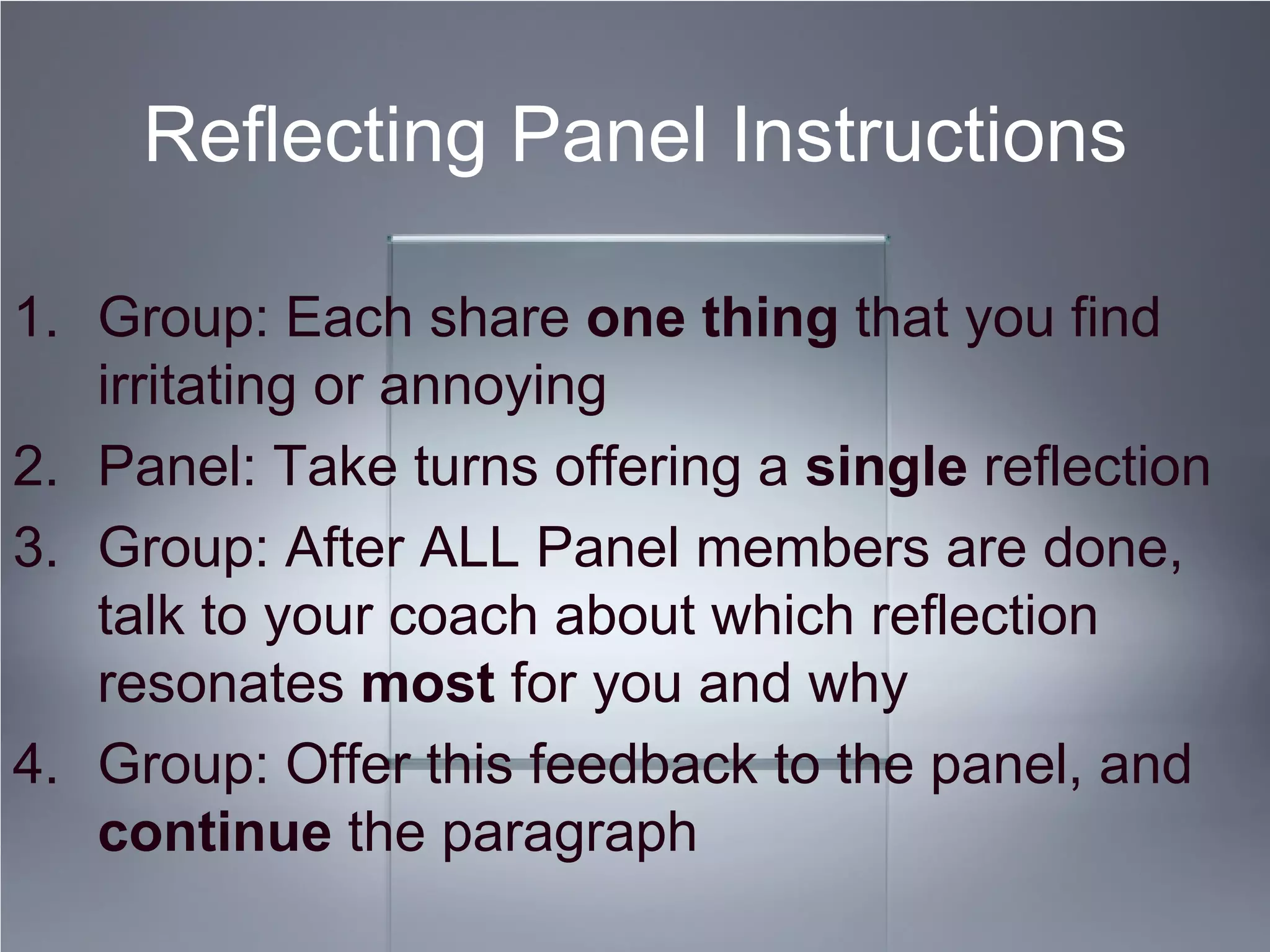
Reflecting Panel Instructions
1. Group: Each share one thing that you find
irritating or annoying
2. Panel: Take turns offering a single reflection
3. Group: After ALL Panel members are done,
talk to your coach about which reflection
resonates most for you and why
4. Group: Offer this feedback to the panel, and
continue the paragraph
Individual Reflection:
Simple or complex
Group Reflection:
Simple or complex
Group Content or Group
Process Reflection
Confidence Ruler
http://tinyurl.com/ara93vh
…and the day came when the risk it took
to remain tightly closed in a bud was more
painful than the risk it took to bloom.
(Anais Nin)
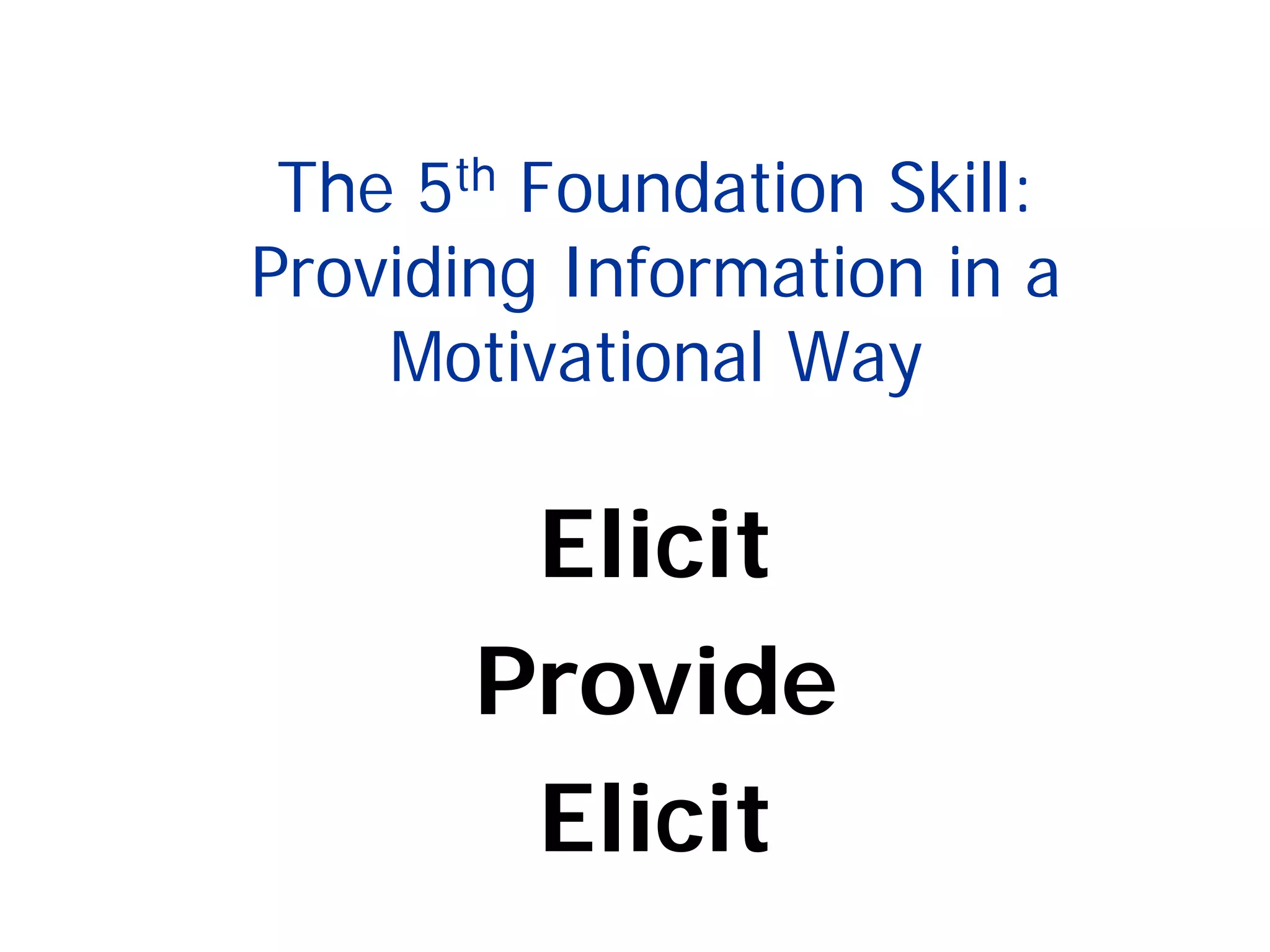
The 5th Foundation Skill:
Providing Information in a
Motivational Way
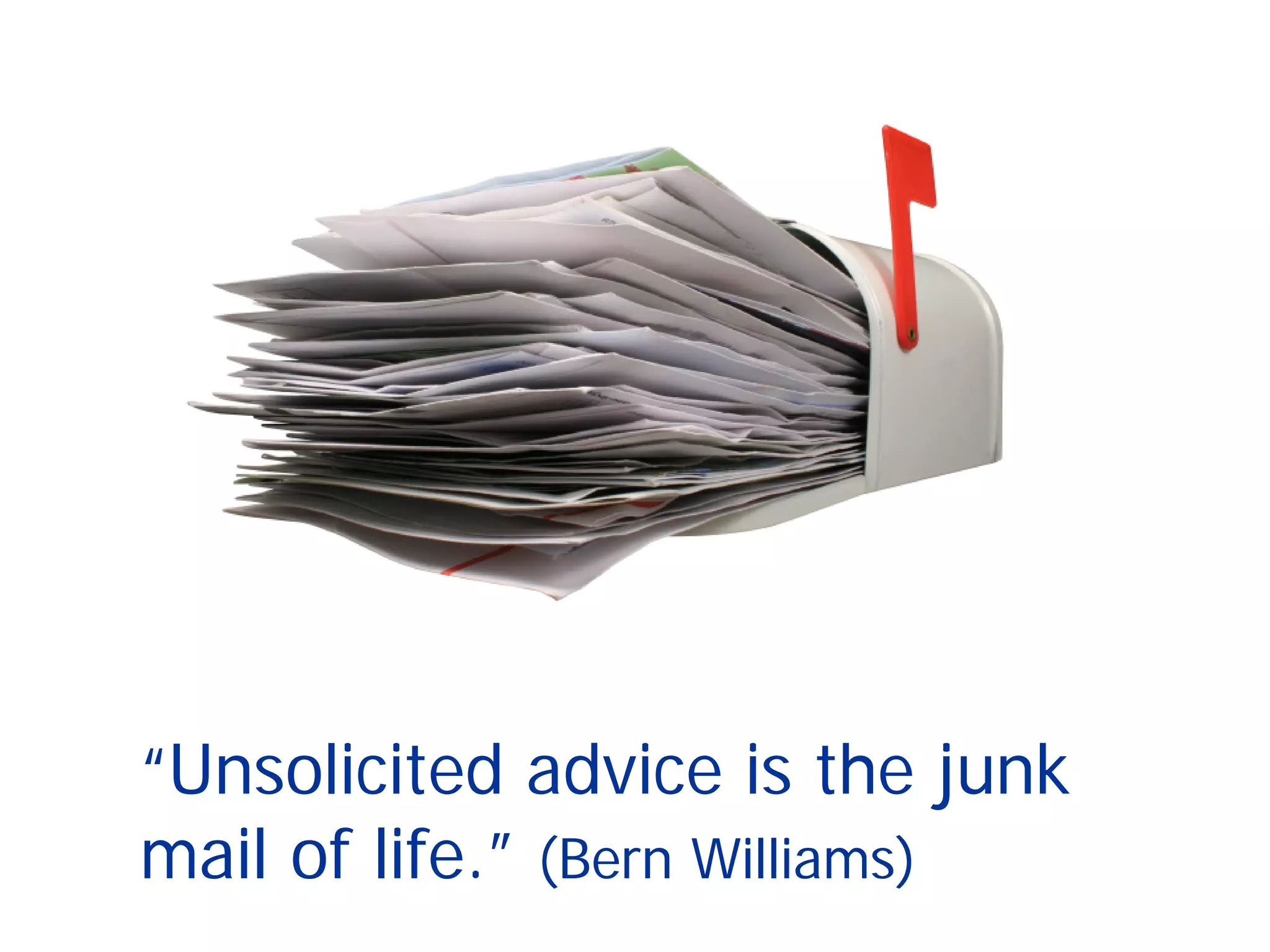
“Unsolicited advice is the junk
mail of life.” (Bern Williams)
The 5th Foundation Skill:
Providing Information in a
Motivational Way
Elicit
Provide
Elicit
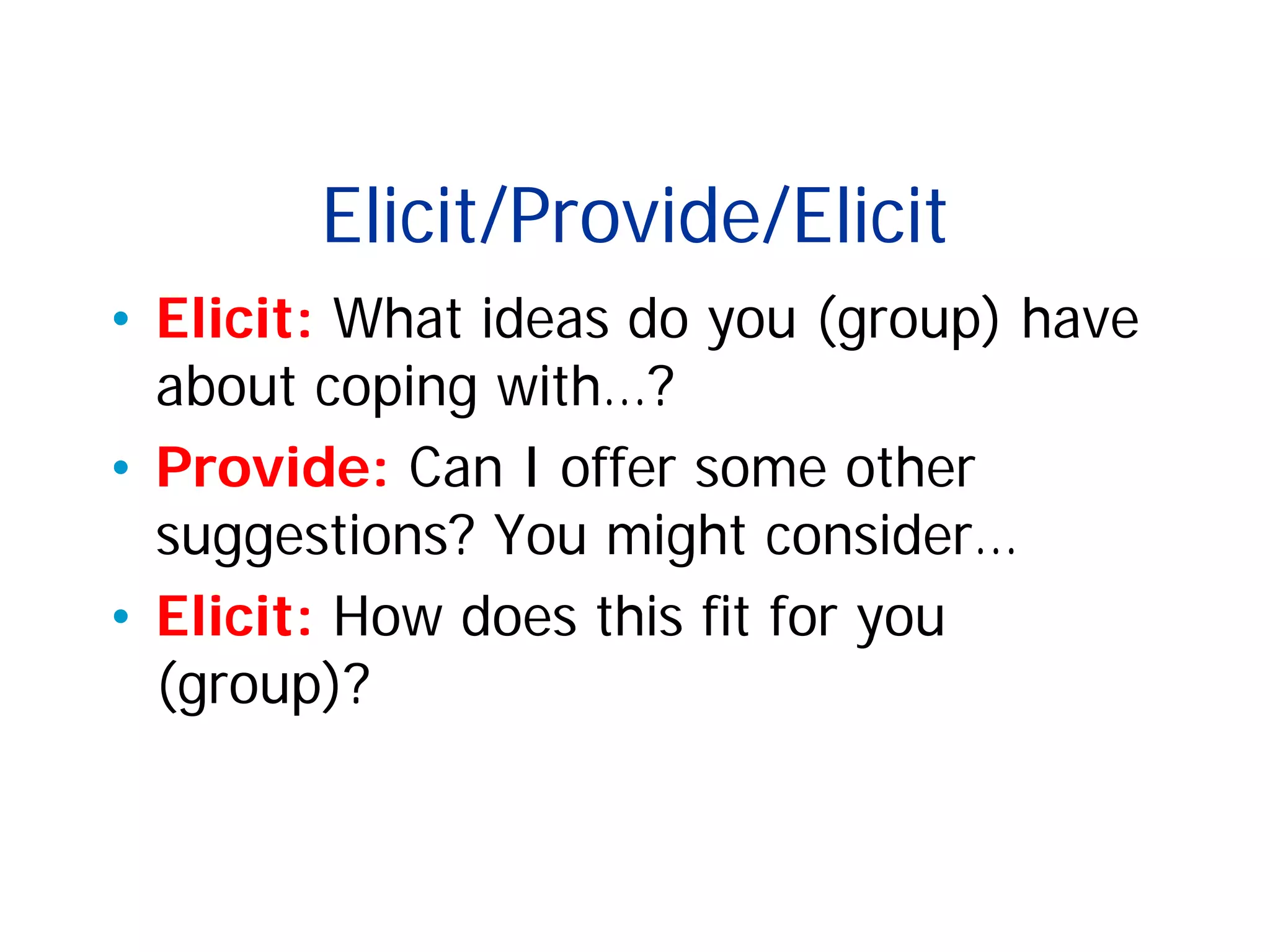
Elicit/Provide/Elicit
• Elicit: What ideas do you (group) have
about coping with…?
• Provide: Can I offer some other
suggestions? You might consider…
• Elicit: How does this fit for you
(group)?
Mark Twain
Habit is habit, and not to be
flung out of the window by any
[one], but coaxed down the
stairs a step at a time.
Critical Issues in Group
Facilitation
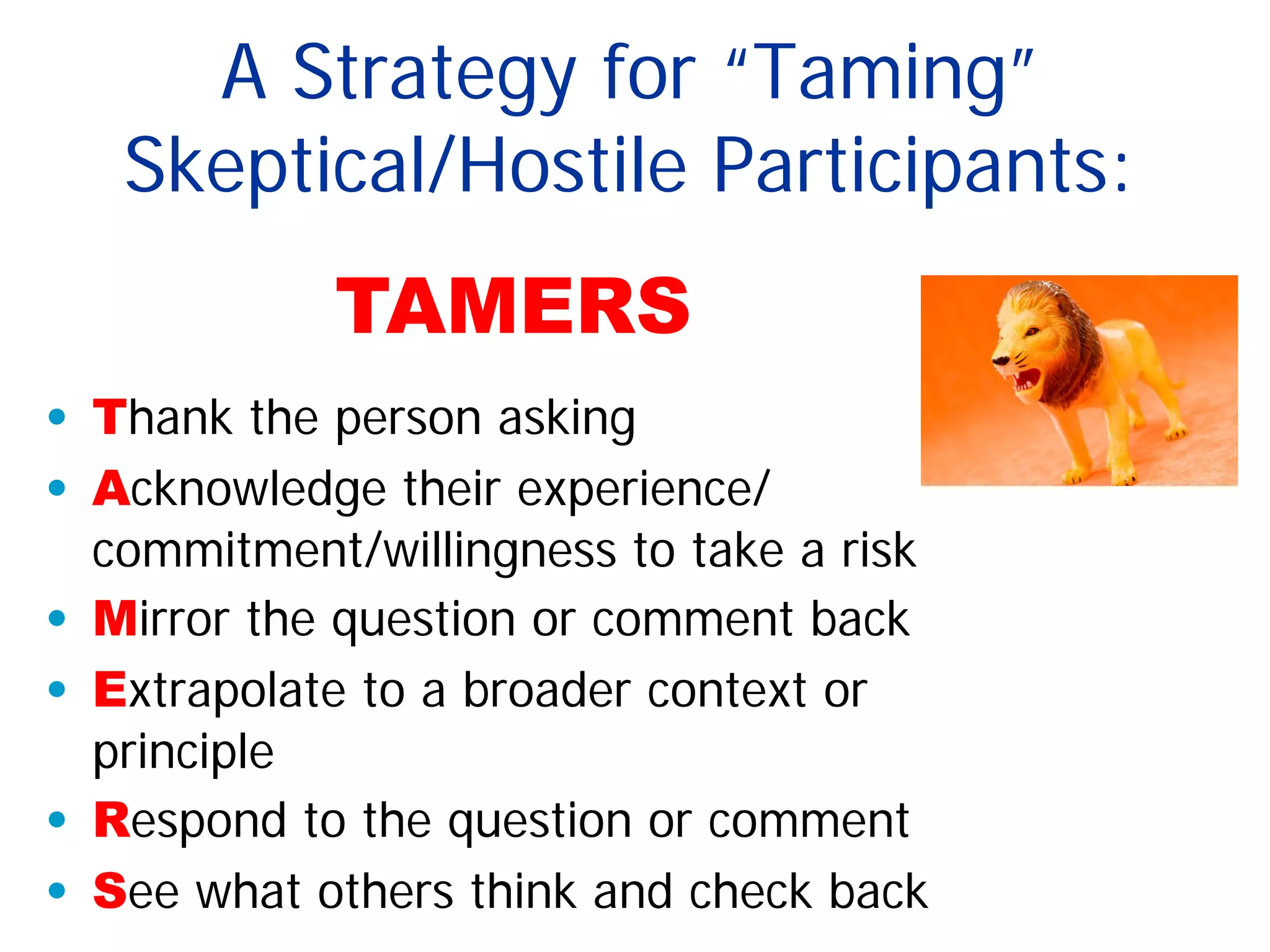
A Strategy for “Taming”
Skeptical/Hostile Participants:
• Thank the person asking
• Acknowledge their experience/
commitment/willingness to take a risk
• Mirror the question or comment back
• Extrapolate to a broader context or
principle
• Respond to the question or comment
• See what others think and check back
TAMERS
“I don’t really need to be here”
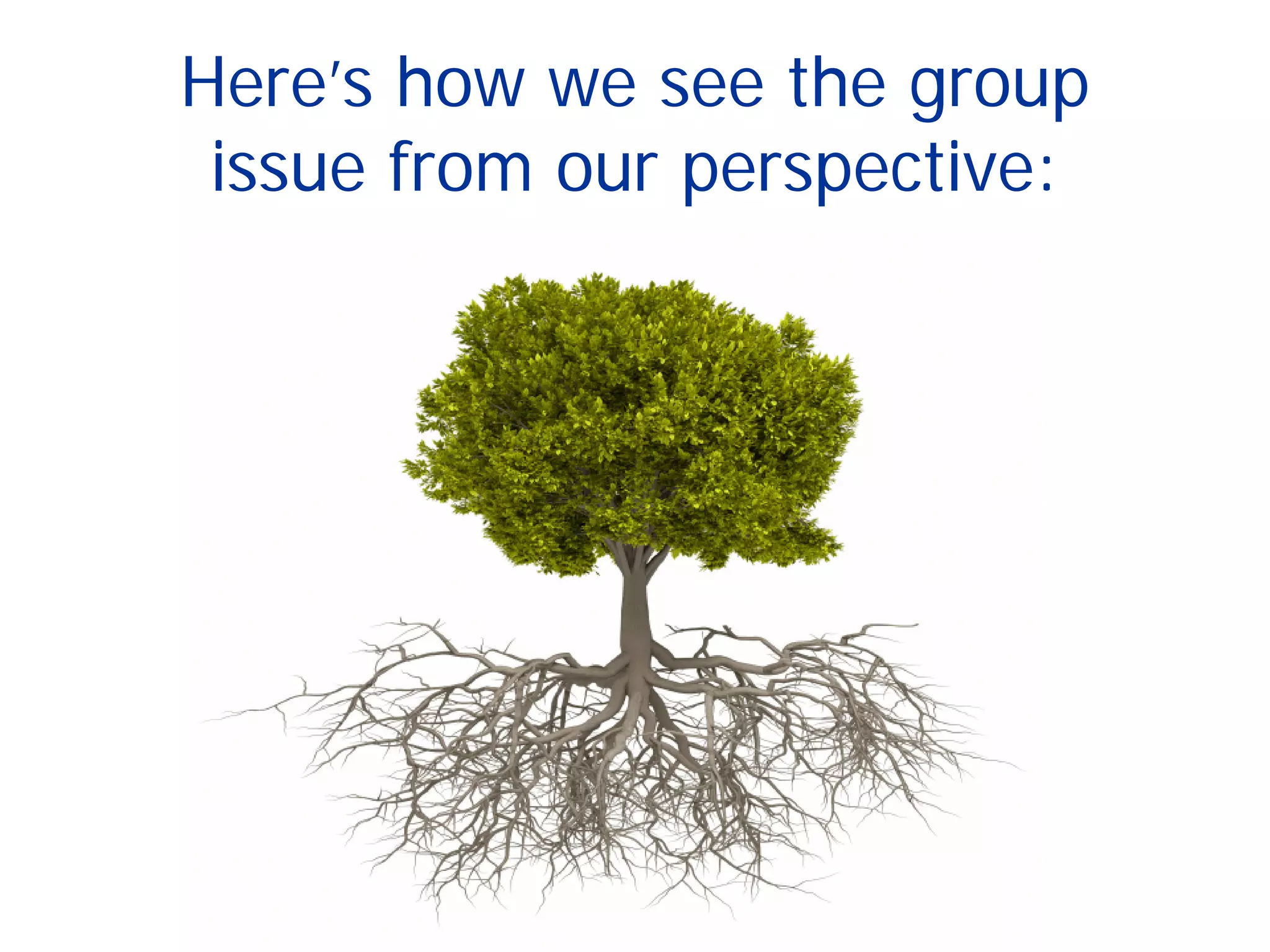
Here’s how we see the group
issue from our perspective:
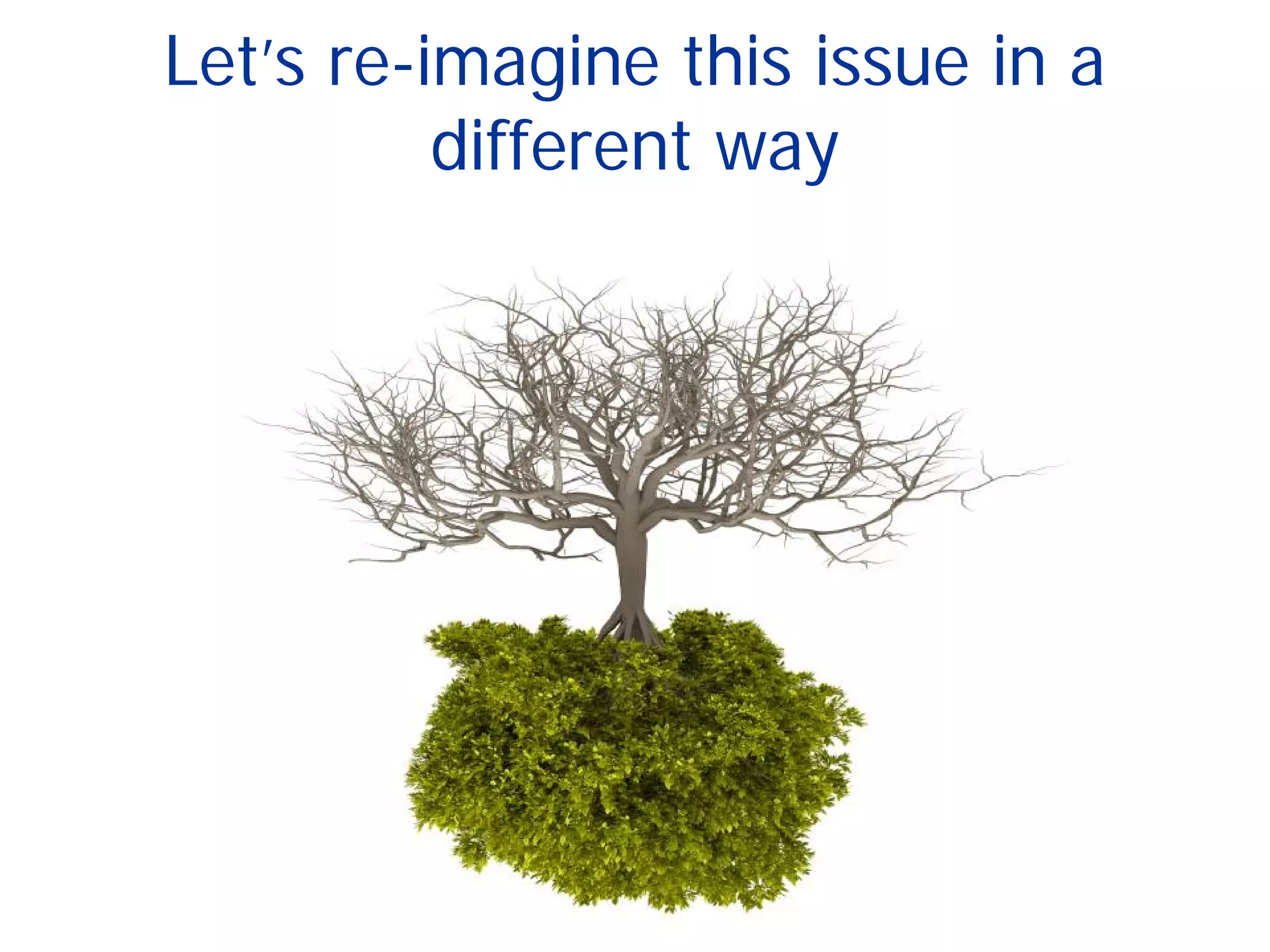
Let’s re-imagine this issue in a
different way
The goal is to find a way in
What are some compassionate
possibilities in how we respond?
What strategy could you use?
• Open question
• Affirmation
• Reflection
Individual content reflection
Individual process reflection
Group content reflection
Group process reflection
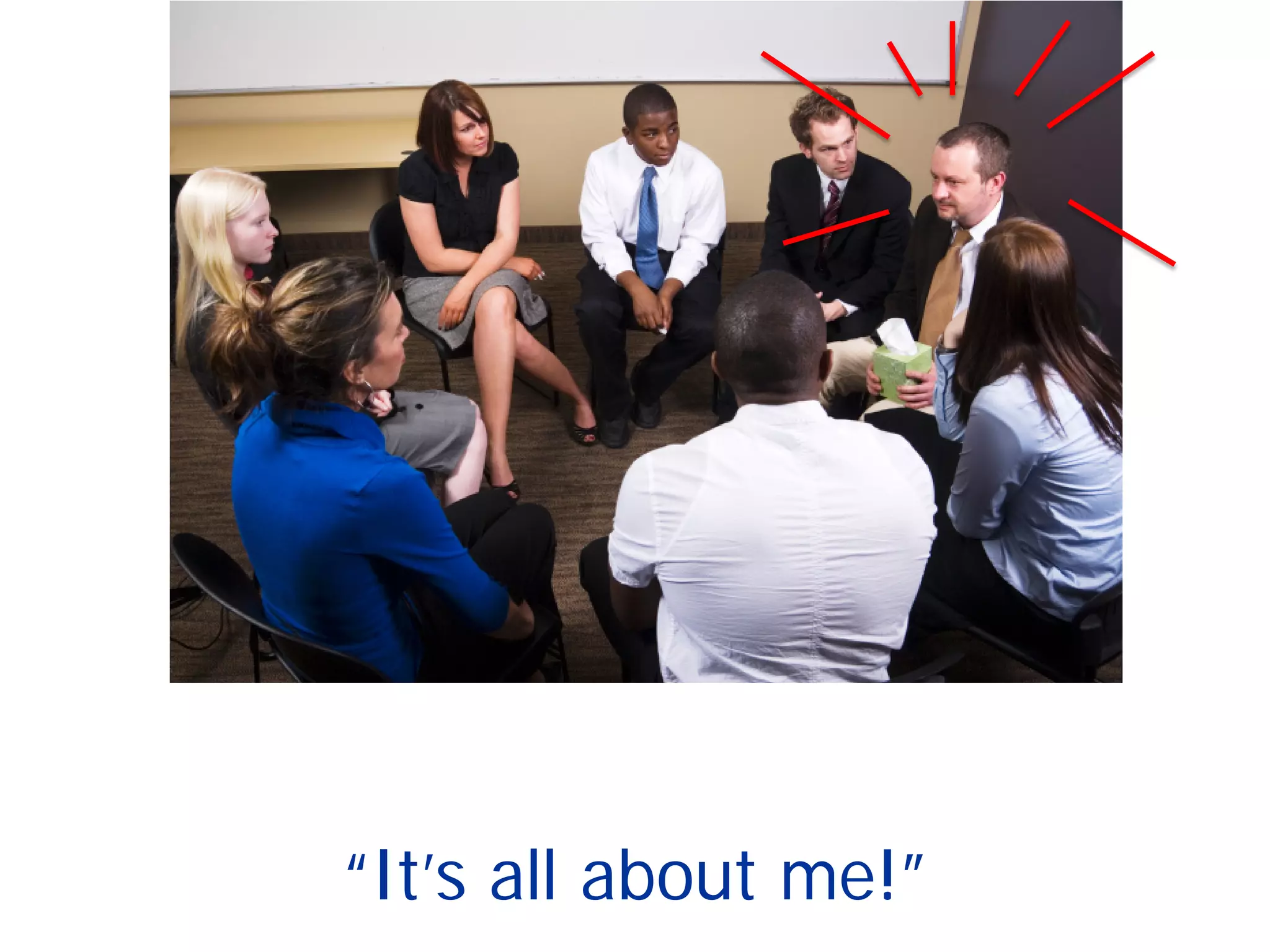
“It’s all about me!”
What strategy could you use?
• Open question
• Affirmation
• Reflection
Individual content reflection
Individual process reflection
Group content reflection
Group process reflection
“Us versus Them”
What strategy could you use?
• Open question
• Affirmation
• Reflection
Individual content reflection
Individual process reflection
Group content reflection
Group process reflection
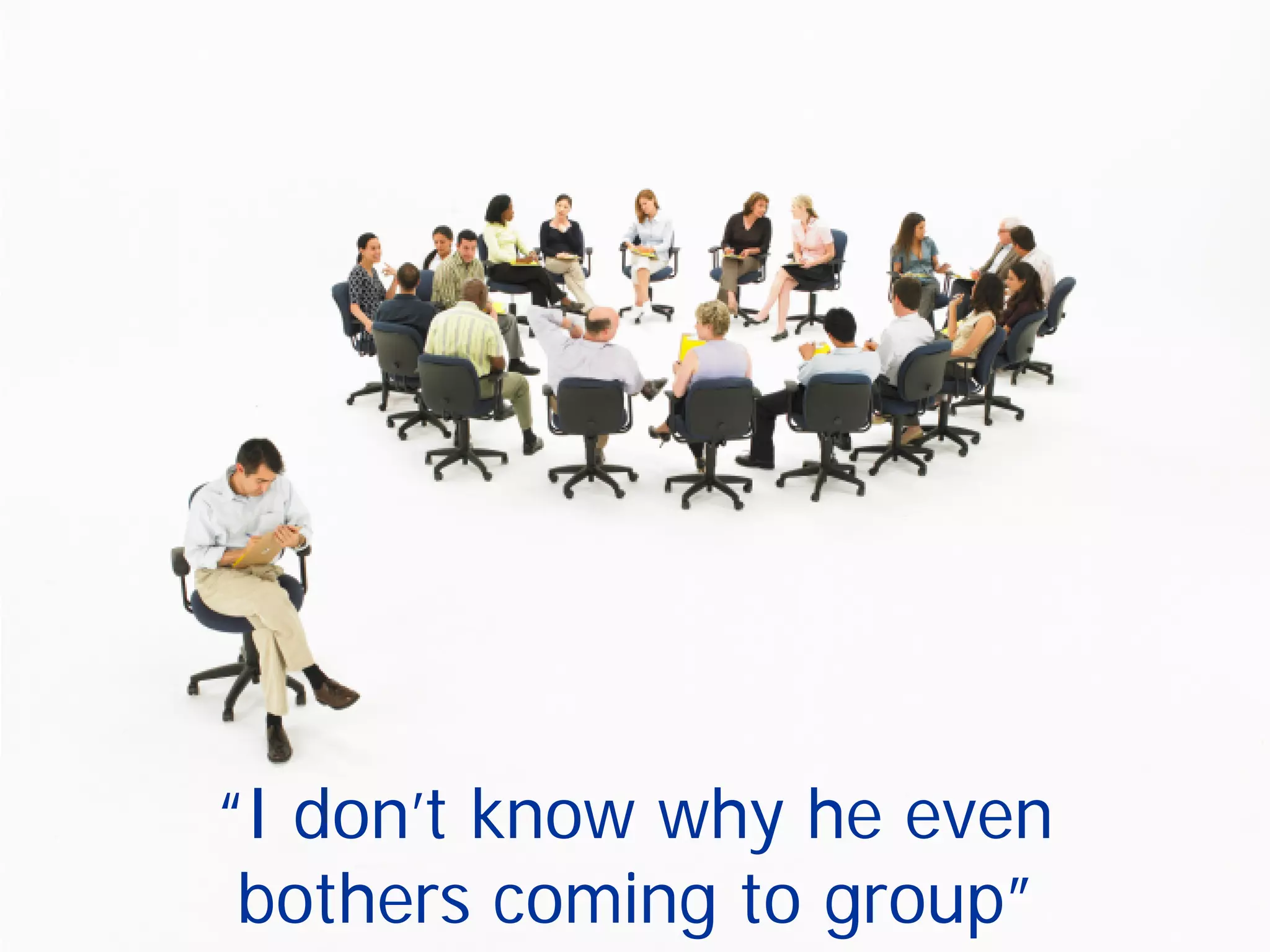
“I don’t know why he even
bothers coming to group”
What strategy could you use?
• Open question
• Affirmation
• Reflection
Individual content reflection
Individual process reflection
Group content reflection
Group process reflection
“This is a really good class”
What strategy could you use?
• Open question
• Affirmation
• Reflection
Individual content reflection
Individual process reflection
Group content reflection
Group process reflection
Basic MI Conversational
Shaping Strategies
• Establishing, developing, holding focus
• Changing focus
• Accelerating and Decelerating
• Broadening and Narrowing
• Deepening and Lightening
When you are not sure where to
go next…
“Tell me more…Tell me more…”
Confidence Ruler
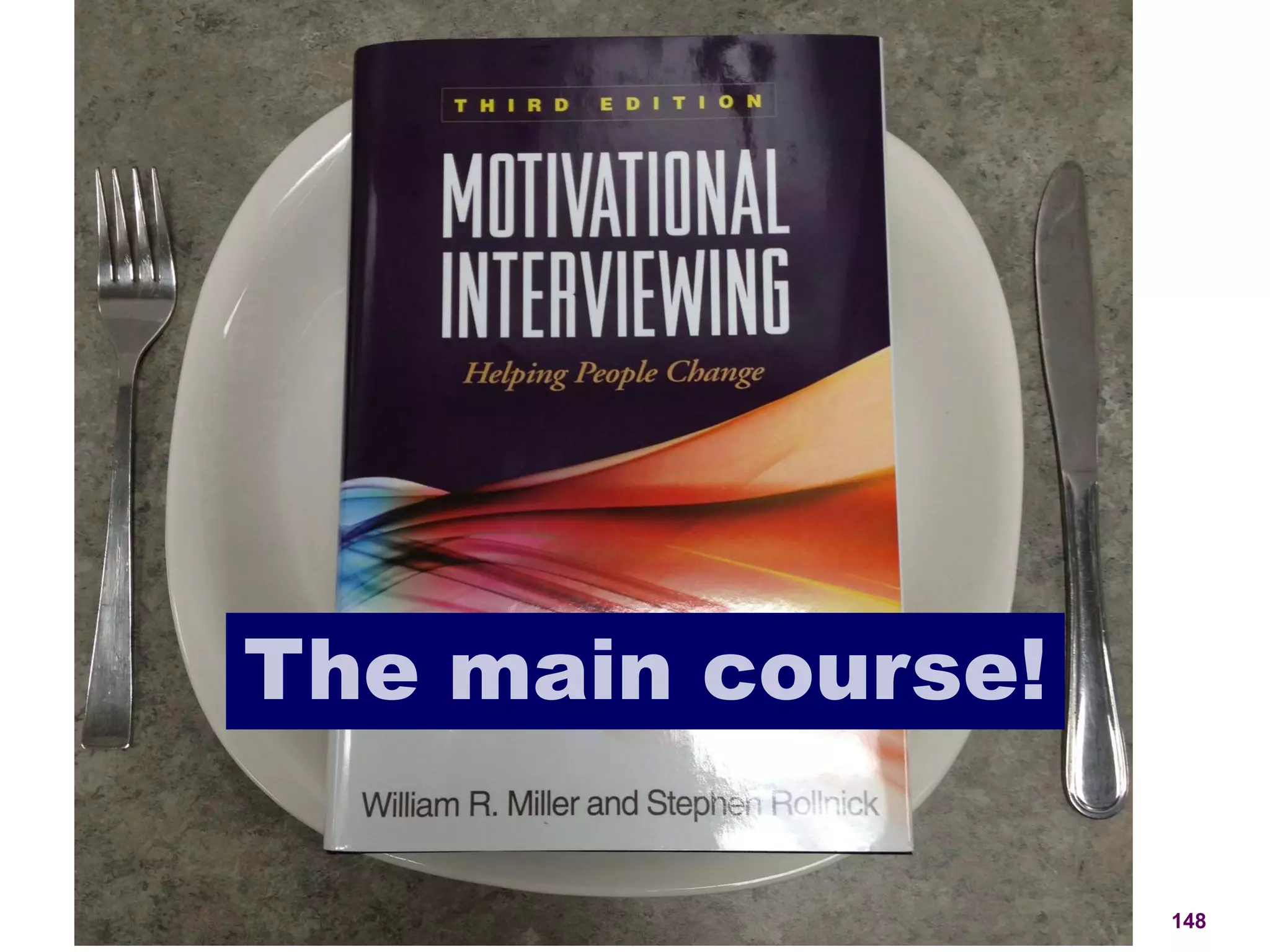
The main course!
148
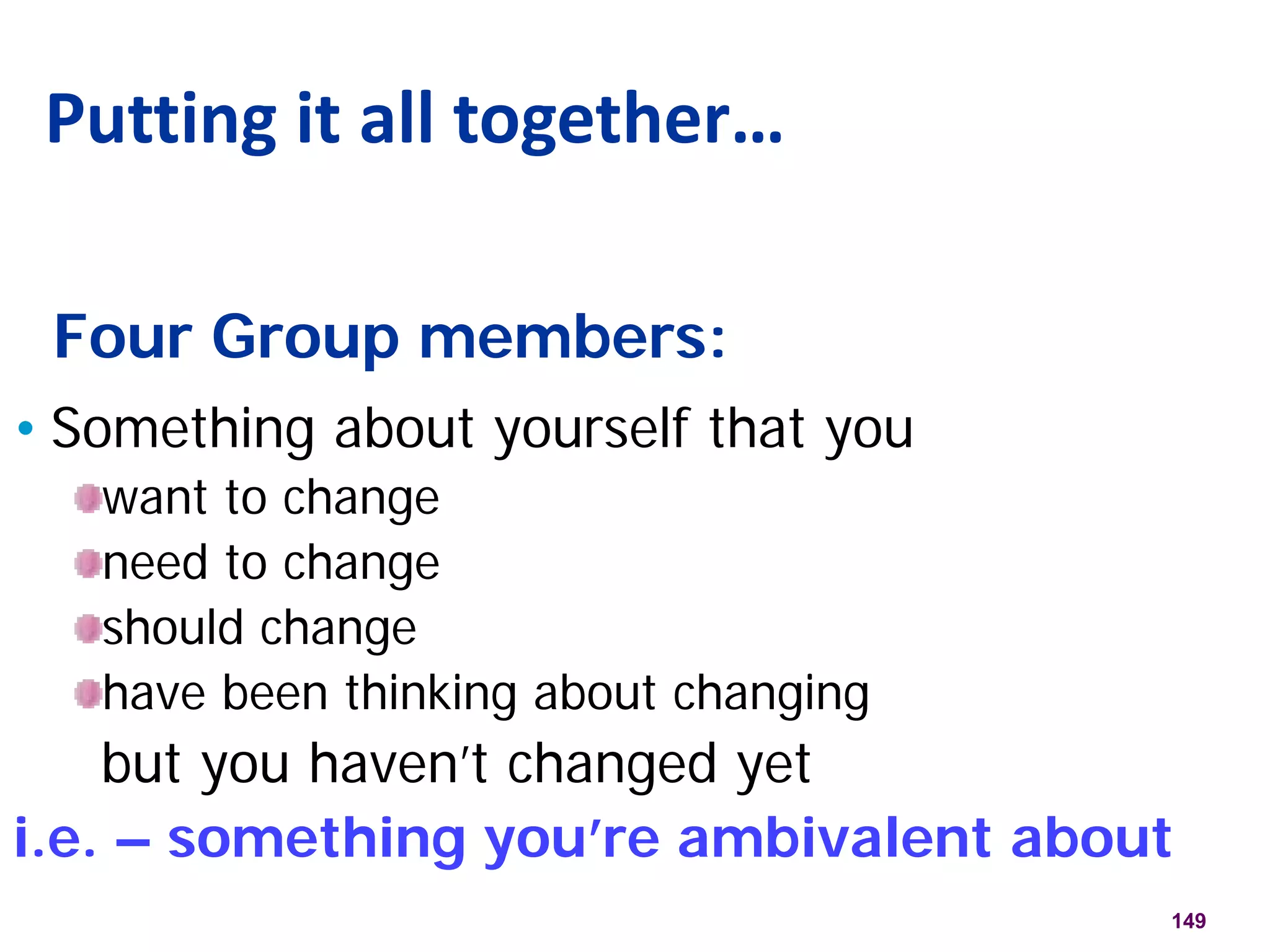
Four Group members:
• Something about yourself that you
want to change
need to change
should change
have been thinking about changing
but you haven’t changed yet
i.e. – something you’re ambivalent about
Putting it all together…
149
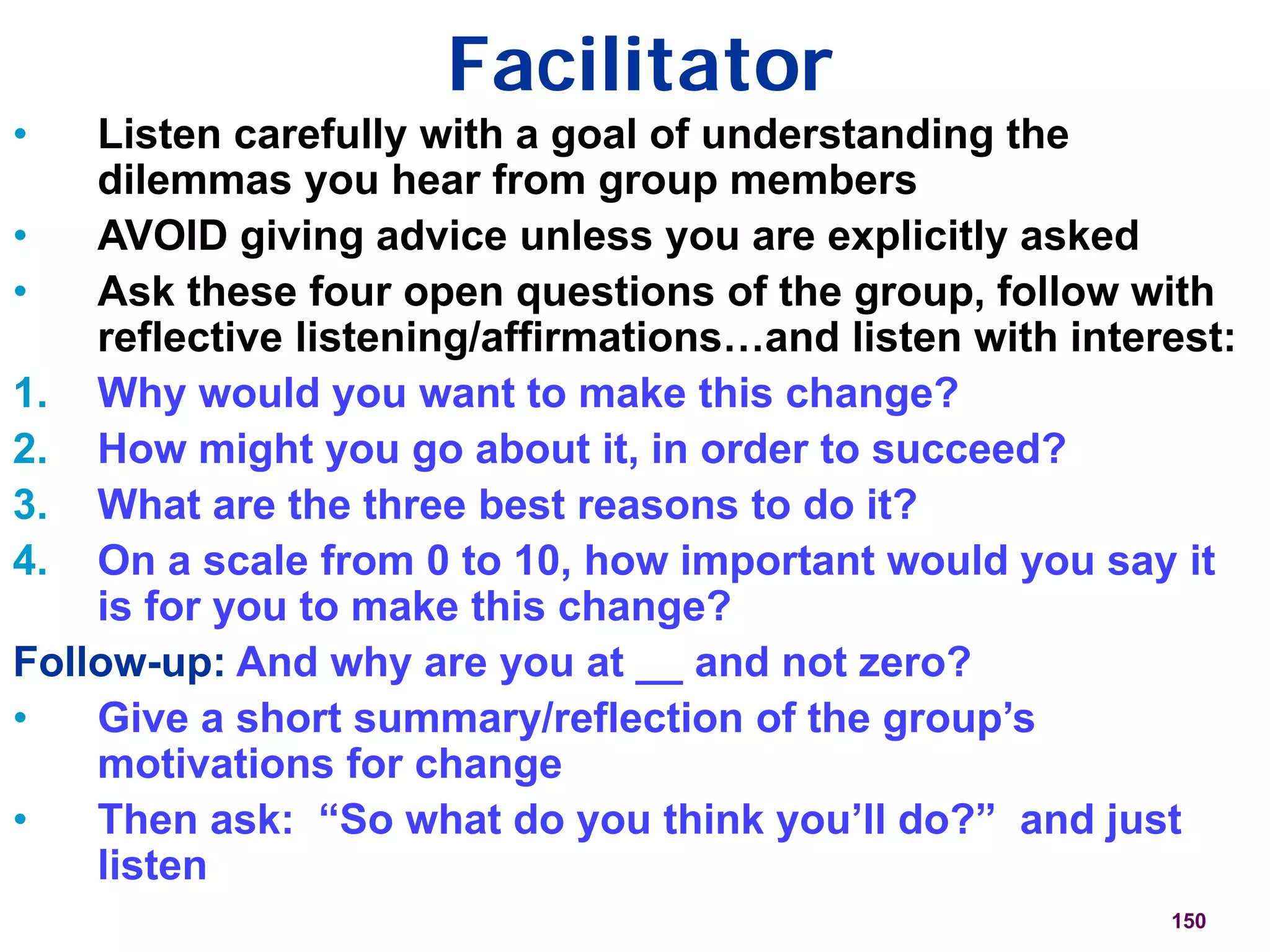
Facilitator
150
• Listen carefully with a goal of understanding the
dilemmas you hear from group members
• AVOID giving advice unless you are explicitly asked
• Ask these four open questions of the group, follow with
reflective listening/affirmations…and listen with interest:
1. Why would you want to make this change?
2. How might you go about it, in order to succeed?
3. What are the three best reasons to do it?
4. On a scale from 0 to 10, how important would you say it
is for you to make this change?
Follow-up: And why are you at __ and not zero?
• Give a short summary/reflection of the group’s
motivations for change
• Then ask: “So what do you think you’ll do?” and just
listen
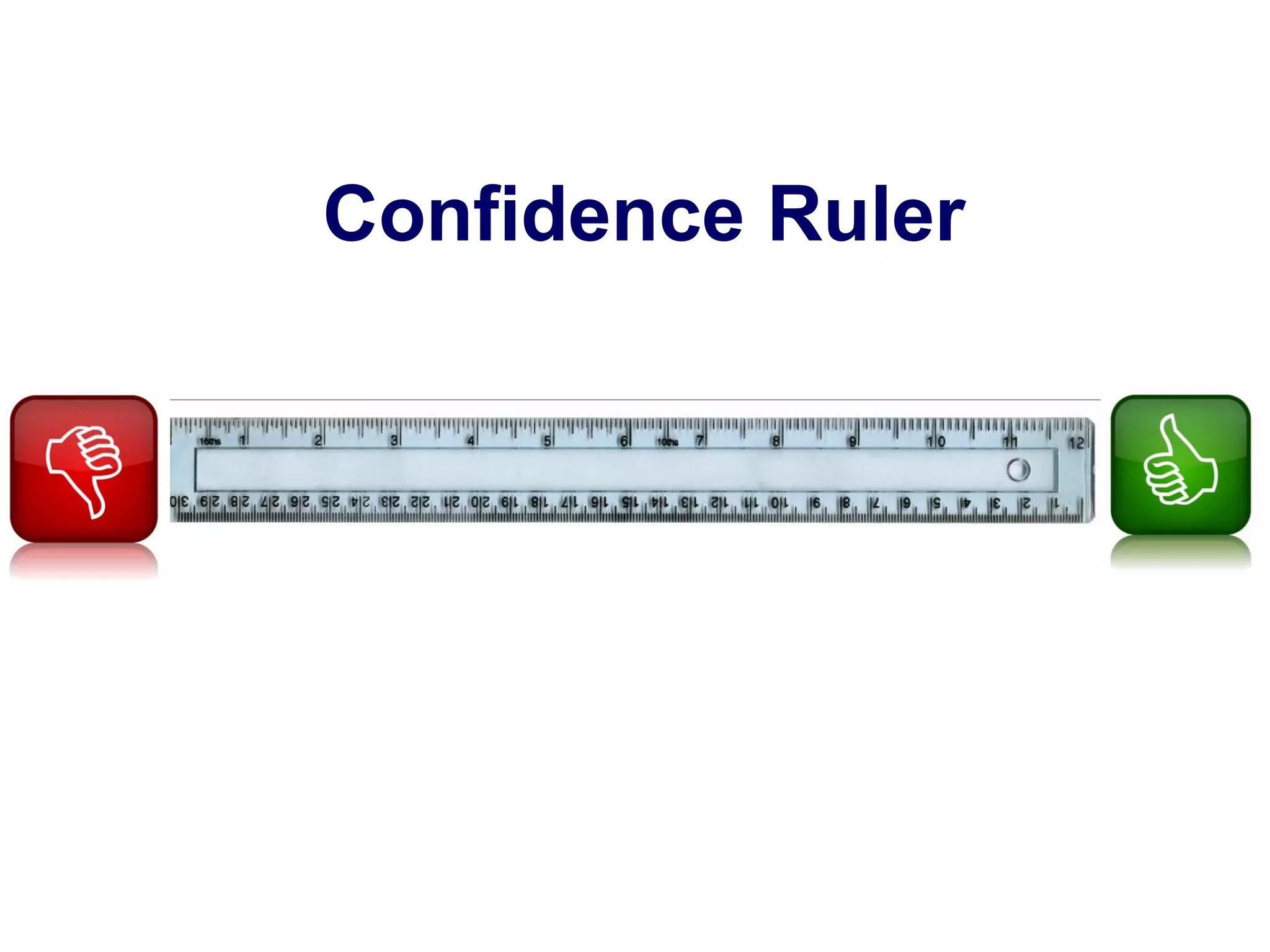
Confidence Ruler
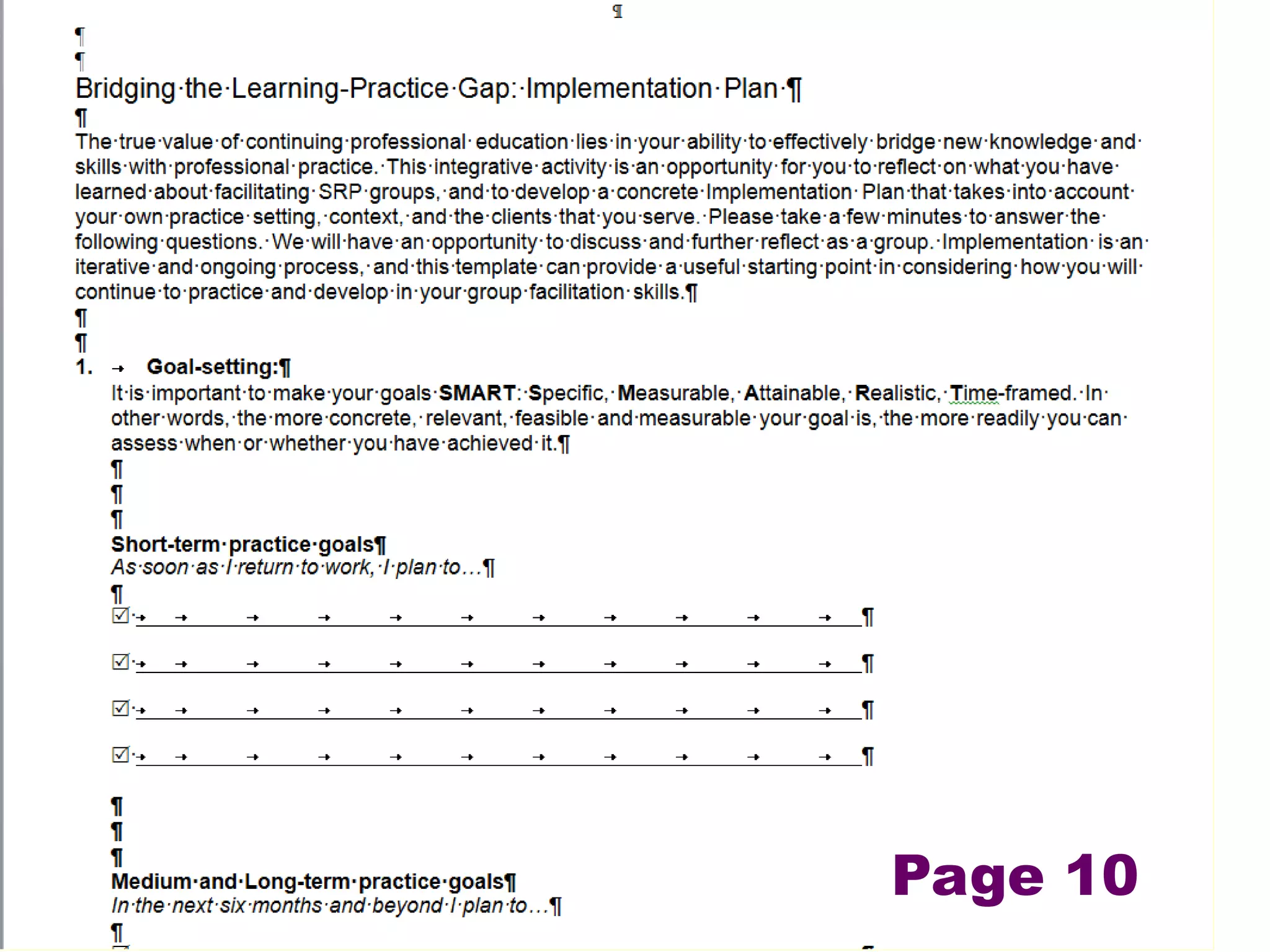
Page 10
Barriers and Enablers to Practice Change
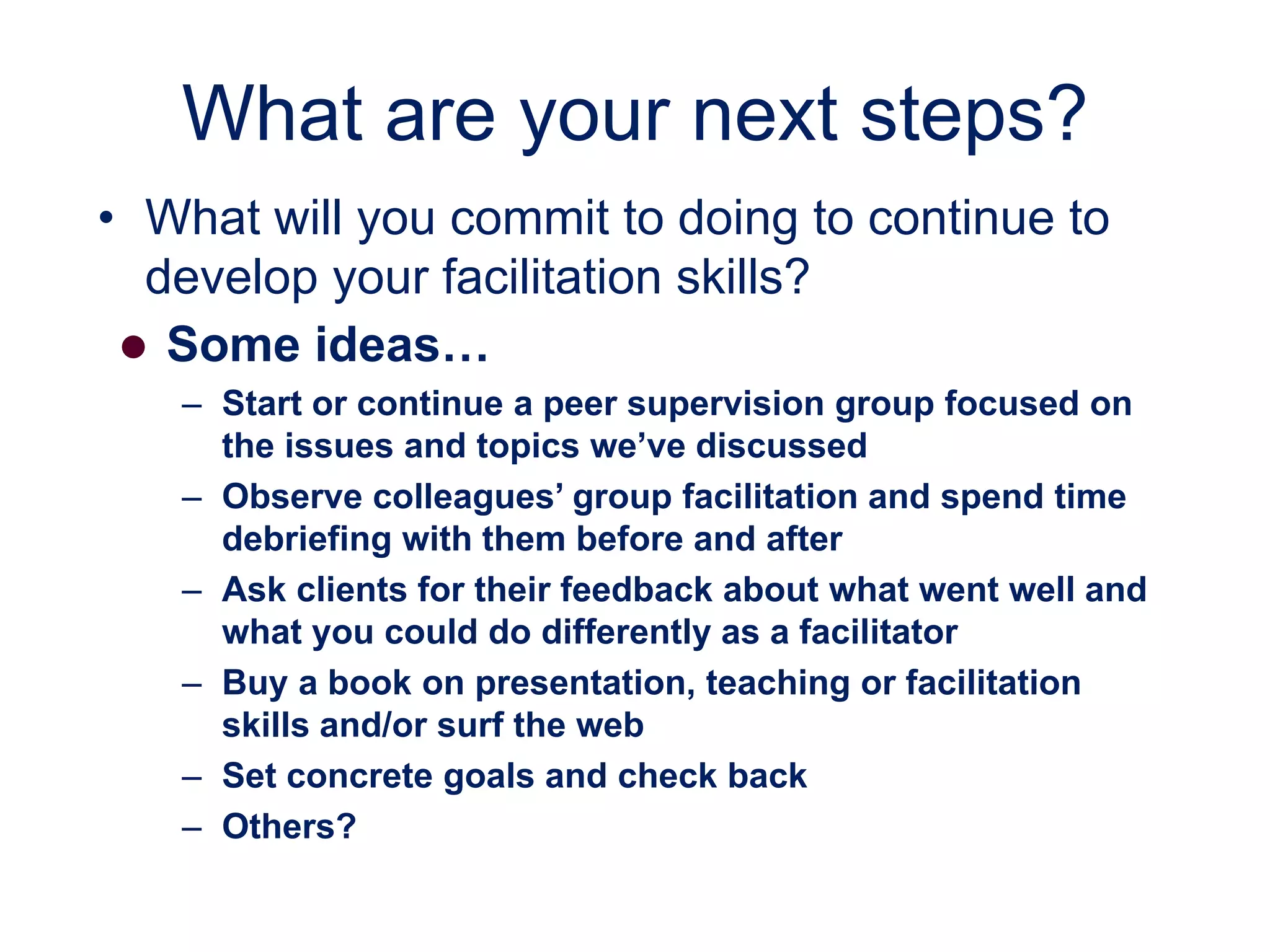
What are your next steps?
• What will you commit to doing to continue to
develop your facilitation skills?
 Some ideas…
– Start or continue a peer supervision group focused on
the issues and topics we’ve discussed
– Observe colleagues’ group facilitation and spend time
debriefing with them before and after
– Ask clients for their feedback about what went well and
what you could do differently as a facilitator
– Buy a book on presentation, teaching or facilitation
skills and/or surf the web
– Set concrete goals and check back
– Others?
Confidence Ruler
Wrapping Up
Summary
Quick review of group dynamics and
practice implications
Overview and practice: Resist the Righting
Reflex and evidence base for MI
Integrating MI best practice skills (MI Spirit,
Four Processes & OARS skills)
Agenda Mapping and providing information
Critical issues in group
What is your style: Guide, Follow or Direct?
Implementation planning & next steps
Recommended Resources
Martino, S., Ball, S.A., Gallon, S.L., Hall, D., Garcia, M., Ceperich, S., Farentinos, C., Hamilton,
J., and Hausotter, W. (2006). Motivational Interviewing Assessment: Supervisory Tools for
Enhancing Proficiency (MIA STEP). Salem, OR: Northwest Frontier Addiction Technology
Transfer Center, Oregon Health and Science University.
http://www.motivationalinterview.org/Documents//MIA-STEP.pdf
Miller, W.R. & Rollnick, S. (2013). Motivational Interviewing: Helping People Change (Third
Edition). New York: Guilford.
Miller, W.R. & Rollnick, S. (2009). Ten things that Motivational Interviewing is not. Behavioural
and Cognitive Psychotherapy, 37, 129-140.
http://journals.cambridge.org/action/displayAbstract?fromPage=online&aid=5318416
Rollnick, S., Miller, W.R., & Butler, C.C. (2008). Motivational Interviewing in Health Care: Helping
Patients Change Behavior. New York: The Guildford Press.
First chapter and table of contents available at www.motivationalinterview.org
Rosengren, D.B. (2009). Building Motivational Interviewing Skills: A Practitioner Workbook. New
York: Guilford.
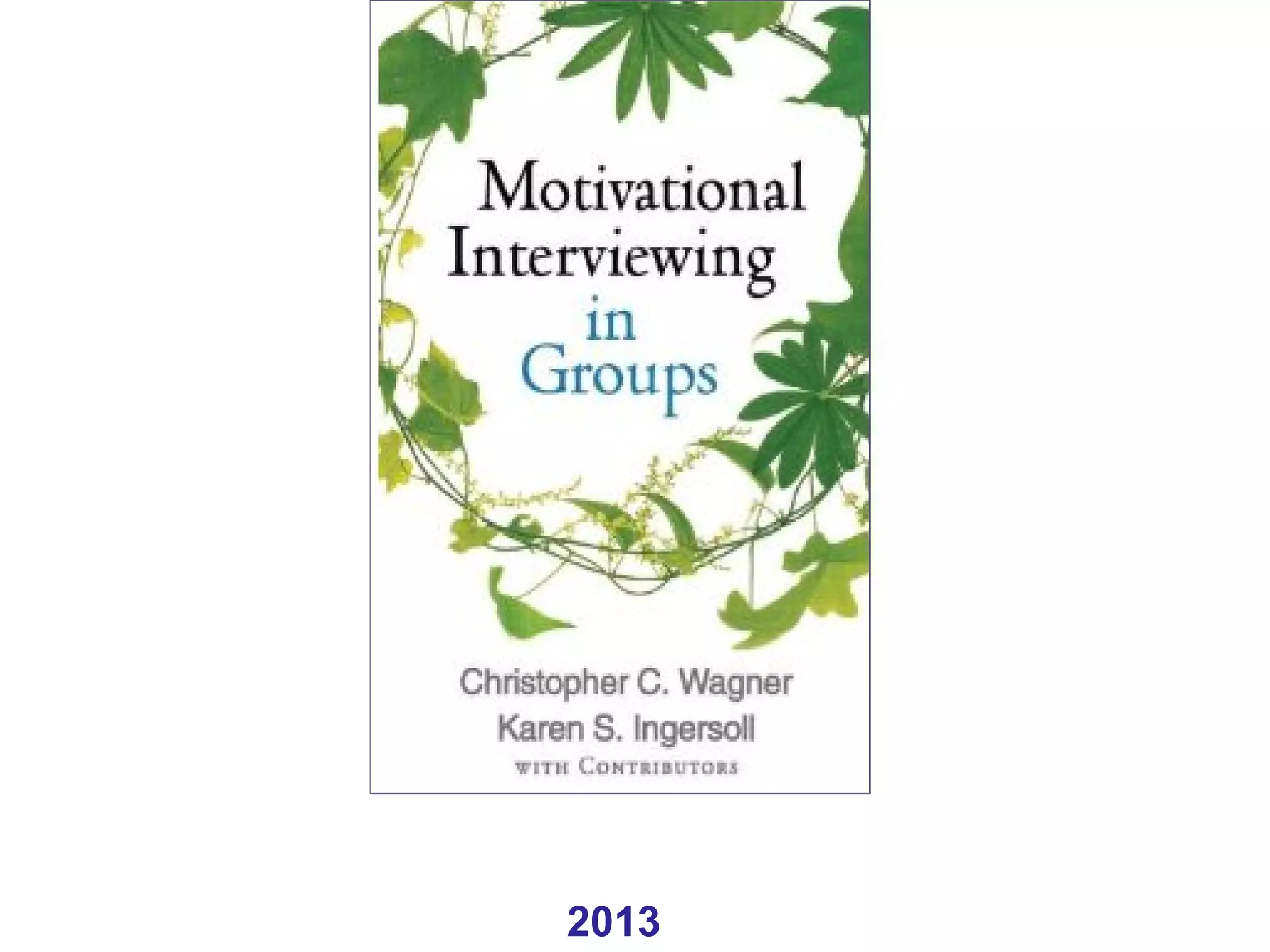
Wagner, C.C. & Ingersoll, K.S. (2013). Motivational Interviewing in Groups. New York: Guilford
Useful Websites
Motivational Interviewing Website
http://www.motivationalinterview.net/
Motivational Interviewing Network of Trainers (MINT) Website
www.motivationalinterviewing.org
Examples of Motivational Interviewing Videos on YouTube
http://www.youtube.com/user/teachproject#p/u
Engaging
Focusing
Evoking
Planning
Motivational Interviewing: Practice Tips
MI Spirit: The Essential Foundation
Partnership: You and the client are equal
experts
Acceptance: Absolute worth, accurate empathy,
autonomy support, affirmation
Compassion: Beneficence, caring, focus on the
other
Evocation: The client’s wisdom is most
important
OARS: Key Skills
Open Questions: What are your reasons for
change? How might you go about it in order to
succeed?
Affirmation: You have worked hard to make this
happen. I can see that you’ve given this a lot of
thought.
Reflections: You wish that… You would like to…
Summary Statements: Let me make sure I
understand how this all fits together…
Diagnosis
Treatment
Plan
Symptoms
Benefits
Finances
Stress
Relationship
Agenda-Mapping
Can we take a few minutes to talk about the different issues or
concerns that you or others have? Just to get a “big picture” view of
what you are coping with right now…
Given all of these possible areas for change, what are your priorities?
Where would be the most helpful place for us to start?
0 1 2 3 4 5 6 7 8 9 10
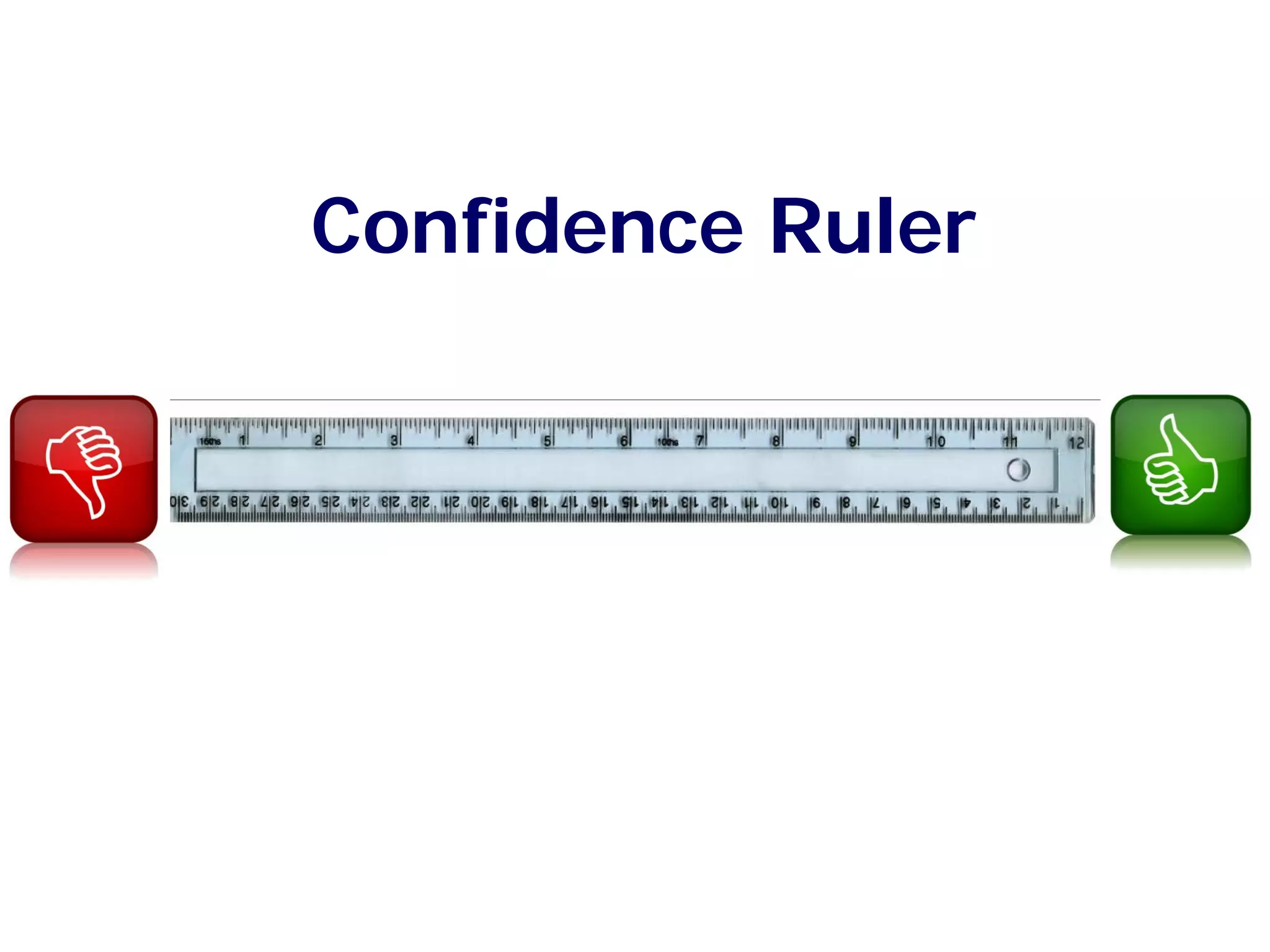
People usually have multiple or competing priorities. On a
scale of zero-to-ten, how important is it to change…? How
confident are you that you could make this change?
Readiness Ruler
Why did you say [lower number] and not [higher number]?
What would it take to go from [lower number] to [higher number]?
Elicit: What do you already know about…?
Provide information: Be brief!
Elicit: How does that fit for you? What do
you make of that?
Listen for Change Talk: DARN CAT
Desire, Ability, Reasons, Need
Commitment, Activation, Taking Steps
Reference: Miller, W. & Rollnick, S. (2013). Motivational Interviewing: Helping People Change (3rd Edition). New York: Guilford.
2013 Marilyn Herie, PhD RSW marilyn.herie@utoronto.ca
Four MI Processes
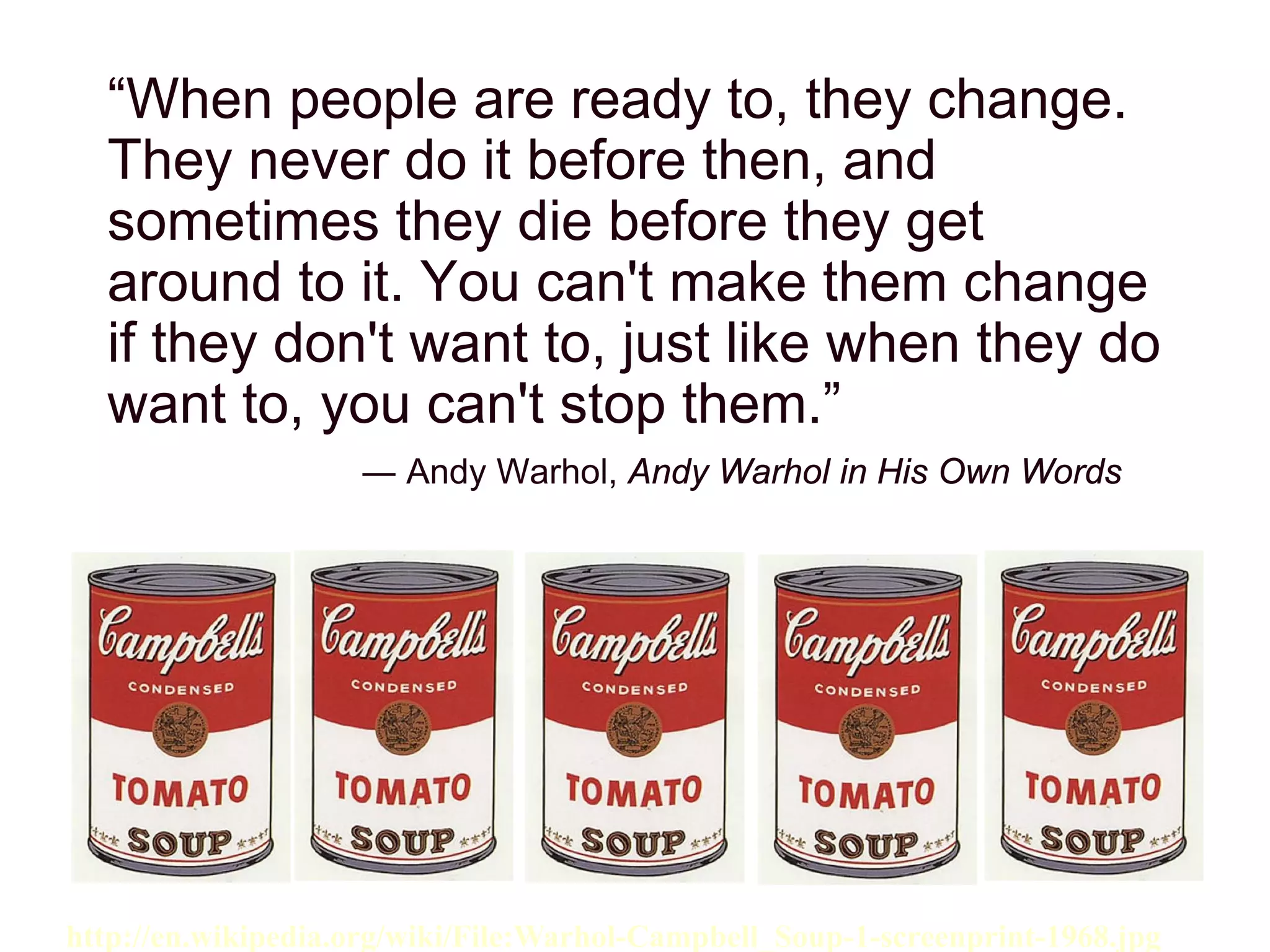
“When people are ready to, they change.
They never do it before then, and
sometimes they die before they get
around to it. You can't make them change
if they don't want to, just like when they do
want to, you can't stop them.”
― Andy Warhol, Andy Warhol in His Own Words
http://en.wikipedia.org/wiki/File:Warhol-Campbell_Soup-1-screenprint-1968.jpg
Remember to complete the
Workshop Evaluation
Thank
you
marilyn.herie@utoronto.ca
www.educateria.com
@MarilynHerie
If you have built castles in the air, your
work need not be lost. That is where
they should be. Now put the
foundation under them.
Henry David Thoreau
Castles in the air?

Herie advanced groups 2013 final pub

  • 1.
    Advanced Practice inGroup Facilitation Integrating Motivational Skills and Strategies Dr. Marilyn Herie PhD, RSW Brain Tumour Support Group Facilitator and Convenor Workshop April 13, 2013 Brain Tumour Foundation of Canada
  • 4.
  • 5.
    What do youmost want to take away from today? • Turn to the person next to you and share your responses • One or more key things you would like to take away from this workshop? • We will check in as a large group in 5 minutes
  • 7.
    Learning Objectives At theend of this session, you will be able to… 1. Resist the “righting reflex” in favour of “PACE” (Partnership, Acceptance, Compassion, Evocation) 2. Practice the foundation skills of Motivational Interviewing (Open questions, Affirmations, Reflections, Summaries, Information) 3. Apply the foundation skills in shaping group conversation and engaging with challenging group members 4. Adapt motivational group activities for your own groups 5. Identify your preferred facilitation style, and increase flexibility in incorporating other styles.
  • 9.
  • 10.
    What is thevalue of groups? 1. To communicate key information 2. To effect behaviour change 3. Mutual support and empowerment
  • 11.
  • 12.
    Content versus Process A personwill not always remember what you said or did, but they will always remember how you made them feel.
  • 13.
    Some challenging issues… •A member monopolizes the conversation • A member discloses she is having small seizures but has not told her doctor because she wants to retain her driver’s license • A member starts to disclose childhood abuse or trauma • A member repeatedly talks about how much he loved injecting opioids and this is upsetting to other group members
  • 14.
    Examples of GroupNorms • Making sure that everyone has a voice (“Is it OK if I sometimes interrupt or redirect the group to keep us on track?”) • Mutual respect • Being on time • Missing a session • What this group can and cannot do • “Taboo subjects” • How we support ourselves and each other when difficult feelings come up
  • 15.
    Some challenging issues (revisited) •A member monopolizes the conversation… Making sure we all have a voice in this group/ Mutual respect and inclusion • A member discloses she is having small seizures but has not told her doctor because she wants to retain her driver’s license… Confidentiality & Duty to Report • A member starts to disclose childhood abuse or trauma… What this group can and cannot do • A member repeatedly talks about how much he loved injecting opioids and this is upsetting to other group members… Taboo subjects and how we talk about/handle them
  • 16.
    Stages and Tasks 1.Orientation stage 2. Dissatisfaction stage 3. Resolution stage 4. Production stage 5. Termination stage Belonging Fight-flight Trust Consolidation, ending Interdependence
  • 17.
    The Art ofCounselling • Attending to process and content • Adapting materials to the needs of the client and group • Eliciting and integrating client feedback • An ongoing development process…
  • 19.
    Easier More Difficult FormatSupport Psychoeducational Psychotherapeutic Structure Structured Semistructured Unstructured Composition Homogenous Heterogeneous Size 5 15 Session Length 60 minutes 120 minutes Admission Staggered Closed Open Wagner & Ingersoll (2013) p.103
  • 20.
  • 22.
    Best Practices inGroup Facilitation
  • 24.
  • 25.
    What is MI? Motivationalinterviewing is a collaborative conversation to strengthen a person’s own motivation for and commitment to change. Miller & Rollnick, 2013
  • 26.
    Follow (Listen) Direct(Inform) Guide (Ask)
  • 29.
    Research publications evaluatingMI effectiveness have been doubling every three years. www.motivationalinterview.org
  • 30.
    MI Outcome Studiesby Era 0 20 40 60 80 100 1988-94 1995-99 2000-02 2003-06 Alcohol Drugs Dual Dx Gambling Offenders Eating Dis Adh/Retention Smoking HIV Risk Cardiac Diabetes Psychiatric Health Prom Family Violence Asthma Dental 31Slide from Bill Miller, 2010
  • 31.
    MI Applications • Publichealth & workplace • Sexual health • Dietary change • Weight management • Voice therapy • Gambling • Physical activity • Stroke rehab • Chronic pain • Medication adherence • Diabetes • Mental health • Addictions • Fibromyalgia • Chronic leg ulceration • Self-care • Criminal justice • Vascular risk • Domestic violence Anstiss, 2009
  • 32.
  • 33.
  • 35.
    The “Spirit” ofMotivational Interviewing • Partnership • Acceptance • Compassion • Evocation • Absolute worth • Accurate empathy • Autonomy support • Affirmation 36
  • 36.
    Partnership “You are thebest judge of what is going to work for you.”
  • 37.
    Acceptance “I am hereto help whatever you decide to do.”
  • 38.
    “People are mostable to change when they feel free not to.” - Carl Rogers
  • 39.
    Compassion Guide me tobe a patient companion, to listen with a heart as open as the sky. Grant me vision to see through his eyes, and eager ears to hear his story…Let me honour and respect his choosing of his own path. Adapted from Miller, 2013, “A Meditative Preparation” (p.24)
  • 40.
    Evocation “What were youhoping for by coming here today?”
  • 41.
    “A Psychological Law” Ilearn what I believe as I hear myself speak. Bill Miller (Based on D. Bem, 1967, “Self-Perception: An alternative interpretation of cognitive dissonance phenomena”)
  • 42.
    Engaging Focusing Evoking Planning Four Processes inMI Adapted from Miller and Rollnick, 2013, p. 26
  • 43.
    Four Processes inMI 1. Engaging: The relational foundation 2. Focusing: Clarify directions: What is the horizon? 3. Evoking: The person’s own arguments for change 4. Planning: Developing commitment to change + formulating a plan of action Miller and Rollnick, 2013
  • 44.
    Engaging • Opening check-in •Attention to content (e.g. what people say) and process (e.g. how they say it & others’ responses) • Openness and flexibility – what does the group want or need?
  • 45.
    Focusing • What arewe covering in this session? • Therapist session checklist and group input
  • 46.
  • 47.
    So many choices,so little time…
  • 48.
  • 49.
    Agenda-Mapping Worksheet Priorities Strengths & Successes RelationshipsGrief & Loss Loneliness/ Isolation $$ Issues Symptoms and Coping ??? ??? ???
  • 50.
    “Given these possibleareas of focus, what would should we talk about in our time here today?”
  • 51.
    Evoking • “I learnwhat I believe as I hear myself speak”
  • 55.
    Planning What is onthe horizon? What is the person working towards changing?
  • 56.
    Engaging Focusing Evoking Planning Four Processes inMI Adapted from Miller and Rollnick, 2013, p. 26
  • 57.
  • 59.
  • 60.
    FOUR KEY STRATEGIES– OARS OPEN questions (to elicit client change talk) AFFIRM the client appropriately (support, emphasize personal control) REFLECT (try for complex reflections) SUMMARIZE ambivalence, offer double-sided reflection
  • 61.
    Open Questions always thebeautiful answer who asks a more beautiful question - e.e. cummings
  • 62.
    Open versus ClosedQuestions • CLOSED questions invite a “yes/no”, one- word or very limited answer • OPEN questions encourage elaboration – they evoke the group’s ideas, opinions, hopes, concerns, etc.
  • 63.
    Open versus Closed Questions Readthe following sample questions, and “vote” for whether each one is OPEN or CLOSED
  • 64.
    a. Open question b.Closed question “Would you say you are looking forward to these group sessions?”
  • 65.
    a. Open question b.Closed question “Would you say you are looking forward to these group sessions?”
  • 66.
    a. Open question b.Closed question “Tell me some of your thoughts about coming to these group sessions?”
  • 67.
    a. Open question b.Closed question “Tell me some of your thoughts about coming to these group sessions?”
  • 68.
    “What made youdecide to sign up for this group?” a. Open question b. Closed question
  • 69.
    a. Open question b.Closed question “What made you decide to sign up for this group?”
  • 70.
    How severe wouldyou rate your symptoms right now? a. Open question b. Closed question
  • 71.
    a. Open question b.Closed question How severe would you rate your symptoms right now?
  • 72.
    Can you describesome of the adjustments you’ve had to make? a. Open question b. Closed question
  • 73.
    a. Open question b.Closed question Can you describe some of the adjustments you’ve had to make?
  • 74.
    If you wereme… 1. Formulate two open questions to a participant: One focused on content One focused on process 2. Formulate two open questions to the group: One focused on content One focused on process
  • 75.
    When you arenot sure where to go next…
  • 76.
  • 77.
  • 78.
    Allusions = Towhat has been said… • That sounds like a good idea... • I think that could work... • I think you’re right about that... • It’s important to you to be a good parent… • I can see how that would concern you… Andréasson, Farbring, Miller & Resnicow (2002) http://www.motivationalinterviewing.org/sites/default/files/MINT9_2.pdf
  • 79.
    Attributions = Tomake someone feel noticed and “seen” as a person… • You are a bit of a philosopher really. You are reflecting on some really deep issues here… • You are the kind of person who cares a lot for other people… • You are a very creative person. It reflects a lot in your personality… • You have what it takes to be a leader. Other people listen to you… • You are the kind of person who does not like to talk behind the backs of other people. You have a lot of integrity… Andréasson, Farbring, Miller & Resnicow (2002) http://www.motivationalinterviewing.org/sites/default/files/MINT9_2.pdf
  • 80.
    Example of Praising: Look howfar you’ve come! I know you can do this.
  • 81.
    I sure hopeso... Praising can lead to… But I am actually not so sure
  • 82.
    Example of Affirming Youhave hung in there even though things have been very stressful.
  • 83.
    Affirming can leadto… Yes – I can’t believe how far I’ve come Maybe I can really do this!
  • 84.
    Example of Praising: You aresuch a wonderful group - I have really enjoyed our session.
  • 85.
    Example of Affirming Thegroup has worked hard today in exploring some tough issues, and we have come closer as a result of that.
  • 86.
    Choose one ofyour most challenging groups – and come up with an affirmation that you could offer
  • 87.
  • 88.
  • 89.
  • 90.
    Simple Reflection Complex Reflection Theyare really on your case about coming to this group. It wasn’t your idea to come to group, and you’re not sure this is going to be at all helpful to you. “I’m only coming to group today because my doctor and my wife are both pressuring me.”
  • 91.
    Practicing Reflective Listening Individually, takea moment to write down an example of a simple and a complex reflection for the following statement (coming up – next slide). Then compare what you wrote with others at your table. As a group, choose the best examples to share with the larger group.
  • 92.
    Practicing Reflective Listening(1) Individual Simple & Complex “I’ve been told I can’t return to my job, and now they are taking away my driver’s license!”
  • 93.
    Individual Simple Reflection: ___________________________________ ___________________________________ IndividualComplex Reflection: ___________________________________ ___________________________________ “I’ve been told I can’t return to my job, and now they are taking away my driver’s license!”
  • 94.
    Individual Simple Reflection: Firstone thing, and then another! Individual Complex Reflection: You’re feeling like pieces of your life are being taken away, one by one. “I’ve been told I can’t return to my job, and now they are taking away my driver’s license!”
  • 95.
  • 96.
    Individual Reflection Group Reflection “I’monly coming to group today because my doctor and my wife are both pressuring me.” Some people are here because they chose to come, while others have been “mandated” to attend. It wasn’t your idea to come to group, and you’re not sure this is going to be at all helpful to you.
  • 97.
    Practicing Reflective Listening(2) Individual & Group Reflections “I’ve been told I can’t return to my job, and now they are taking away my driver’s license!”
  • 98.
  • 99.
    Individual Reflection: You’re feelinglike pieces of your life are being taken away, one by one. Group Reflection: These are major losses, and it’s hard to imagine how to cope with all of the changes that people are experiencing. “I’ve been told I can’t return to my job, and now they are taking away my driver’s license!”
  • 100.
    Group Simple Reflection: ___________________________________ ___________________________________ GroupComplex Reflection: ___________________________________ ___________________________________ “I’ve been told I can’t return to my job, and now they are taking away my driver’s license!”
  • 101.
    Group Simple Reflection: Everyoneis experiencing major losses and change. Group Complex Reflection: These are major losses, and it’s hard to imagine how to cope with all of the changes that people are experiencing. “I’ve been told I can’t return to my job, and now they are taking away my driver’s license!”
  • 102.
  • 103.
    Content Reflection Process Reflection Whateveryour reason for coming to group, ultimately everyone would like to get something of value for the time spent here. Some people are here because they chose to come, while others have been “mandated” to attend. “I’m only coming to group today because my doctor and my wife are both pressuring me.”
  • 104.
    Practicing Reflective Listening(3) Group Content & Group Process “I’ve been told I can’t return to my job, and now they are taking away my driver’s license!”
  • 105.
  • 106.
    Content Reflection: These aremajor losses, and it’s hard to imagine how to cope with all of the changes that people are experiencing. Process Reflection: We’ve heard about a lot of loss in the group today, and it’s not always easy to hear that or talk about it and still feel hopeful. “I’ve been told I can’t return to my job, and now they are taking away my driver’s license!”
  • 107.
  • 108.
  • 109.
    2. Four volunteers:Clients Something that irritates you
  • 110.
    3. One volunteer:Coach A sounding board for the group
  • 111.
  • 112.
    Reflecting Panel Instructions 1.Group: Each share one thing that you find irritating or annoying 2. Panel: Take turns offering a single reflection 3. Group: After ALL Panel members are done, talk to your coach about which reflection resonates most for you and why 4. Group: Offer this feedback to the panel, and continue the paragraph
  • 113.
    Individual Reflection: Simple orcomplex Group Reflection: Simple or complex Group Content or Group Process Reflection
  • 115.
  • 116.
  • 119.
    …and the daycame when the risk it took to remain tightly closed in a bud was more painful than the risk it took to bloom. (Anais Nin)
  • 120.
    The 5th FoundationSkill: Providing Information in a Motivational Way
  • 121.
    “Unsolicited advice isthe junk mail of life.” (Bern Williams)
  • 122.
    The 5th FoundationSkill: Providing Information in a Motivational Way Elicit Provide Elicit
  • 123.
    Elicit/Provide/Elicit • Elicit: Whatideas do you (group) have about coping with…? • Provide: Can I offer some other suggestions? You might consider… • Elicit: How does this fit for you (group)?
  • 124.
    Mark Twain Habit ishabit, and not to be flung out of the window by any [one], but coaxed down the stairs a step at a time.
  • 126.
    Critical Issues inGroup Facilitation
  • 127.
    A Strategy for“Taming” Skeptical/Hostile Participants: • Thank the person asking • Acknowledge their experience/ commitment/willingness to take a risk • Mirror the question or comment back • Extrapolate to a broader context or principle • Respond to the question or comment • See what others think and check back TAMERS
  • 128.
    “I don’t reallyneed to be here”
  • 129.
    Here’s how wesee the group issue from our perspective:
  • 130.
    Let’s re-imagine thisissue in a different way
  • 131.
    The goal isto find a way in
  • 132.
    What are somecompassionate possibilities in how we respond?
  • 133.
    What strategy couldyou use? • Open question • Affirmation • Reflection Individual content reflection Individual process reflection Group content reflection Group process reflection
  • 134.
  • 135.
    What strategy couldyou use? • Open question • Affirmation • Reflection Individual content reflection Individual process reflection Group content reflection Group process reflection
  • 136.
  • 137.
    What strategy couldyou use? • Open question • Affirmation • Reflection Individual content reflection Individual process reflection Group content reflection Group process reflection
  • 138.
    “I don’t knowwhy he even bothers coming to group”
  • 139.
    What strategy couldyou use? • Open question • Affirmation • Reflection Individual content reflection Individual process reflection Group content reflection Group process reflection
  • 140.
    “This is areally good class”
  • 141.
    What strategy couldyou use? • Open question • Affirmation • Reflection Individual content reflection Individual process reflection Group content reflection Group process reflection
  • 142.
    Basic MI Conversational ShapingStrategies • Establishing, developing, holding focus • Changing focus • Accelerating and Decelerating • Broadening and Narrowing • Deepening and Lightening
  • 143.
    When you arenot sure where to go next…
  • 144.
  • 146.
  • 147.
  • 148.
    Four Group members: •Something about yourself that you want to change need to change should change have been thinking about changing but you haven’t changed yet i.e. – something you’re ambivalent about Putting it all together… 149
  • 149.
    Facilitator 150 • Listen carefullywith a goal of understanding the dilemmas you hear from group members • AVOID giving advice unless you are explicitly asked • Ask these four open questions of the group, follow with reflective listening/affirmations…and listen with interest: 1. Why would you want to make this change? 2. How might you go about it, in order to succeed? 3. What are the three best reasons to do it? 4. On a scale from 0 to 10, how important would you say it is for you to make this change? Follow-up: And why are you at __ and not zero? • Give a short summary/reflection of the group’s motivations for change • Then ask: “So what do you think you’ll do?” and just listen
  • 151.
  • 152.
  • 153.
    Barriers and Enablersto Practice Change
  • 154.
    What are yournext steps? • What will you commit to doing to continue to develop your facilitation skills?  Some ideas… – Start or continue a peer supervision group focused on the issues and topics we’ve discussed – Observe colleagues’ group facilitation and spend time debriefing with them before and after – Ask clients for their feedback about what went well and what you could do differently as a facilitator – Buy a book on presentation, teaching or facilitation skills and/or surf the web – Set concrete goals and check back – Others?
  • 155.
  • 157.
  • 158.
    Summary Quick review ofgroup dynamics and practice implications Overview and practice: Resist the Righting Reflex and evidence base for MI Integrating MI best practice skills (MI Spirit, Four Processes & OARS skills) Agenda Mapping and providing information Critical issues in group What is your style: Guide, Follow or Direct? Implementation planning & next steps
  • 159.
    Recommended Resources Martino, S.,Ball, S.A., Gallon, S.L., Hall, D., Garcia, M., Ceperich, S., Farentinos, C., Hamilton, J., and Hausotter, W. (2006). Motivational Interviewing Assessment: Supervisory Tools for Enhancing Proficiency (MIA STEP). Salem, OR: Northwest Frontier Addiction Technology Transfer Center, Oregon Health and Science University. http://www.motivationalinterview.org/Documents//MIA-STEP.pdf Miller, W.R. & Rollnick, S. (2013). Motivational Interviewing: Helping People Change (Third Edition). New York: Guilford. Miller, W.R. & Rollnick, S. (2009). Ten things that Motivational Interviewing is not. Behavioural and Cognitive Psychotherapy, 37, 129-140. http://journals.cambridge.org/action/displayAbstract?fromPage=online&aid=5318416 Rollnick, S., Miller, W.R., & Butler, C.C. (2008). Motivational Interviewing in Health Care: Helping Patients Change Behavior. New York: The Guildford Press. First chapter and table of contents available at www.motivationalinterview.org Rosengren, D.B. (2009). Building Motivational Interviewing Skills: A Practitioner Workbook. New York: Guilford. Wagner, C.C. & Ingersoll, K.S. (2013). Motivational Interviewing in Groups. New York: Guilford Useful Websites Motivational Interviewing Website http://www.motivationalinterview.net/ Motivational Interviewing Network of Trainers (MINT) Website www.motivationalinterviewing.org Examples of Motivational Interviewing Videos on YouTube http://www.youtube.com/user/teachproject#p/u
  • 160.
    Engaging Focusing Evoking Planning Motivational Interviewing: PracticeTips MI Spirit: The Essential Foundation Partnership: You and the client are equal experts Acceptance: Absolute worth, accurate empathy, autonomy support, affirmation Compassion: Beneficence, caring, focus on the other Evocation: The client’s wisdom is most important OARS: Key Skills Open Questions: What are your reasons for change? How might you go about it in order to succeed? Affirmation: You have worked hard to make this happen. I can see that you’ve given this a lot of thought. Reflections: You wish that… You would like to… Summary Statements: Let me make sure I understand how this all fits together… Diagnosis Treatment Plan Symptoms Benefits Finances Stress Relationship Agenda-Mapping Can we take a few minutes to talk about the different issues or concerns that you or others have? Just to get a “big picture” view of what you are coping with right now… Given all of these possible areas for change, what are your priorities? Where would be the most helpful place for us to start? 0 1 2 3 4 5 6 7 8 9 10 People usually have multiple or competing priorities. On a scale of zero-to-ten, how important is it to change…? How confident are you that you could make this change? Readiness Ruler Why did you say [lower number] and not [higher number]? What would it take to go from [lower number] to [higher number]? Elicit: What do you already know about…? Provide information: Be brief! Elicit: How does that fit for you? What do you make of that? Listen for Change Talk: DARN CAT Desire, Ability, Reasons, Need Commitment, Activation, Taking Steps Reference: Miller, W. & Rollnick, S. (2013). Motivational Interviewing: Helping People Change (3rd Edition). New York: Guilford. 2013 Marilyn Herie, PhD RSW marilyn.herie@utoronto.ca Four MI Processes
  • 161.
    “When people areready to, they change. They never do it before then, and sometimes they die before they get around to it. You can't make them change if they don't want to, just like when they do want to, you can't stop them.” ― Andy Warhol, Andy Warhol in His Own Words http://en.wikipedia.org/wiki/File:Warhol-Campbell_Soup-1-screenprint-1968.jpg
  • 163.
    Remember to completethe Workshop Evaluation
  • 164.
  • 165.
    If you havebuilt castles in the air, your work need not be lost. That is where they should be. Now put the foundation under them. Henry David Thoreau Castles in the air?