Motivation
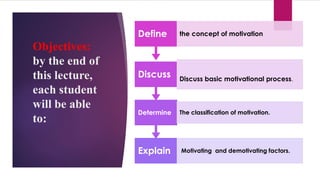
Objectives:
by the end of
this lecture,
each student
will be able
to:
Explain Motivating and demotivating factors.
Determine The classification of motivation.
Discuss Discuss basic motivational process.
Define the concept of motivation
Introduction
When we ask: “what motivates a person to risk his life saving
another? Or working long hours to achieve a particular goal
We usually means, why does he behave as he does?
The term “motivation” refers to the cause or why of
behavior.
Psychologists, then usually narrow the concept of
motivation to those factors that energizes behavior and
give it direction.
Concept of Motivation:
 Motivation is something that encourages action
or feeling. To motivate means to encourage and
inspire. Motivation can also mean to turn on or
ignite the feeling or action.
Basic
motivational
process
Needs and Drives:
 *A drive: “is an aroused state resulting from
some of bodily tissue needs, this aroused
condition motivates the person to initiate
behavior or action”.
 *A need: represents physiological state of tissue
as food, water, oxygen or avoidance of pain.
Primitive motivators:
❑ Hunger
❑ Thirst
❑ Sex
❑ Avoidance of pain
Maslow’s hierarchy of human needs
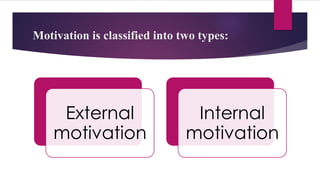
Motivation is classified into two types:
External
motivation
Internal
motivation
MOTIVATING
FACTORS:
What we really want to accomplish is self-
motivation, when people do things for their
own reasons and not yours. That is lasting
motivation.
Remember, the greatest motivator is belief.
We must inculcate in ourselves the belief
that we are responsible for our actions and
behavior. When people accept
responsibility, everything improves quality,
productivity, relationships and teamwork.
A few steps to motivate others:
Give recognition Give respect Make work interesting
Be a good listener
Help but don't do for
others what they
should do for
themselves
DEMOTIVATING
FACTORS:
Unfair criticism
Negative criticism
Rewarding the non-performer which can be demotivating
for the performer
Failure or fear of failure
Success which leads to complacence
Lack of direction
Low self-esteem
Thank
you

motivation pdf.pdf

  • 1.
  • 2.
    Objectives: by the endof this lecture, each student will be able to: Explain Motivating and demotivating factors. Determine The classification of motivation. Discuss Discuss basic motivational process. Define the concept of motivation
  • 3.
    Introduction When we ask:“what motivates a person to risk his life saving another? Or working long hours to achieve a particular goal We usually means, why does he behave as he does? The term “motivation” refers to the cause or why of behavior. Psychologists, then usually narrow the concept of motivation to those factors that energizes behavior and give it direction.
  • 4.
    Concept of Motivation: Motivation is something that encourages action or feeling. To motivate means to encourage and inspire. Motivation can also mean to turn on or ignite the feeling or action.
  • 5.
    Basic motivational process Needs and Drives: *A drive: “is an aroused state resulting from some of bodily tissue needs, this aroused condition motivates the person to initiate behavior or action”.  *A need: represents physiological state of tissue as food, water, oxygen or avoidance of pain.
  • 6.
    Primitive motivators: ❑ Hunger ❑Thirst ❑ Sex ❑ Avoidance of pain
  • 7.
  • 8.
    Motivation is classifiedinto two types: External motivation Internal motivation
  • 9.
    MOTIVATING FACTORS: What we reallywant to accomplish is self- motivation, when people do things for their own reasons and not yours. That is lasting motivation. Remember, the greatest motivator is belief. We must inculcate in ourselves the belief that we are responsible for our actions and behavior. When people accept responsibility, everything improves quality, productivity, relationships and teamwork.
  • 10.
    A few stepsto motivate others: Give recognition Give respect Make work interesting Be a good listener Help but don't do for others what they should do for themselves
  • 11.
    DEMOTIVATING FACTORS: Unfair criticism Negative criticism Rewardingthe non-performer which can be demotivating for the performer Failure or fear of failure Success which leads to complacence Lack of direction Low self-esteem
  • 12.