MOTIVATION CLINIC
“The secret of getting ahead
is getting started.” – Mark
Twain
We all get stuck and overwhelmed from time to time
which can reduce motivation.
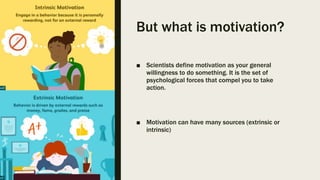
But what is motivation?
■ Scientists define motivation as your general
willingness to do something. It is the set of
psychological forces that compel you to take
action.
■ Motivation can have many sources (extrinsic or
intrinsic)
Common
Misconceptions
About Motivation
One of the most surprising things
about motivation is that it often
comes after starting a new
behavior, not before.
We have this common
misconception that motivation
arrives as a result of passively
consuming a motivational video
or reading an inspirational book.
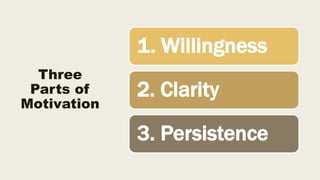
Three
Parts of
Motivation
1. Willingness
2. Clarity
3. Persistence
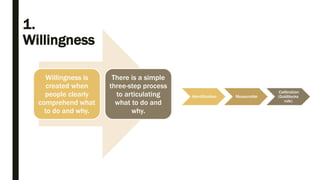
1.
Willingness
Willingness is
created when
people clearly
comprehend what
to do and why.
There is a simple
three-step process
to articulating
what to do and
why.
Identification Measurable
Calibration
(Goldilocks
rule)
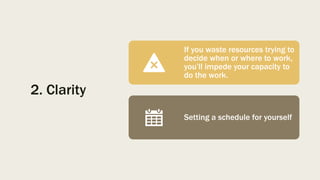
2. Clarity
If you waste resources trying to
decide when or where to work,
you’ll impede your capacity to
do the work.
Setting a schedule for yourself
3.
Persistence
How to
Make
Motivation a
Habit?
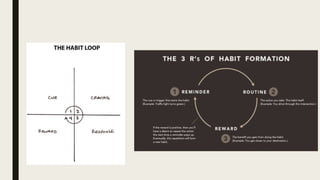
1. Good pre-game routines
For example, my writing routine
starts by getting a glass of water. My
weightlifting routine starts by putting
on my lifting gloves. These tasks are
so easy, I can’t say no to them.
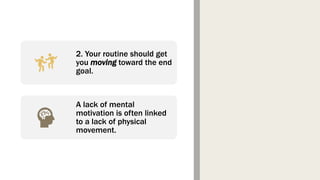
2. Your routine should get
you moving toward the end
goal.
A lack of mental
motivation is often linked
to a lack of physical
movement.
3. You need to follow the
same pattern every single
time.
The primary purpose of your
pre–game routine is to tells
your mind, “This is what
happens before I do ___.”
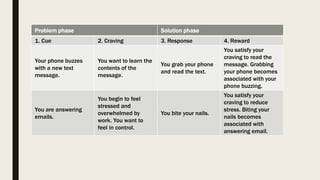
Problem phase Solution phase
1. Cue 2. Craving 3. Response 4. Reward
Your phone buzzes
with a new text
message.
You want to learn the
contents of the
message.
You grab your phone
and read the text.
You satisfy your
craving to read the
message. Grabbing
your phone becomes
associated with your
phone buzzing.
You are answering
emails.
You begin to feel
stressed and
overwhelmed by
work. You want to
feel in control.
You bite your nails.
You satisfy your
craving to reduce
stress. Biting your
nails becomes
associated with
answering email.
How to Stay
Motivated by
Using the
Goldilocks
Rule
(calibration)
■ Imagine you are playing tennis. If you try to play a
serious match against a four-year-old, you will
quickly become bored. The match is too easy.
■ On the opposite end of the spectrum, if you try to
play a serious match against a professional tennis
player like Serena Williams, you will find yourself
demotivated for a different reason. The match is
too difficult.
Imagine yourself playing
tennis against someone
who is your equal.
As the game progresses,
you win a few points and
you lose a few points.
You have a chance of
winning the match, but only
if you really try.
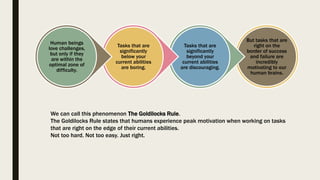
But tasks that are
right on the
border of success
and failure are
incredibly
motivating to our
human brains.
Tasks that are
significantly
beyond your
current abilities
are discouraging.
Tasks that are
significantly
below your
current abilities
are boring.
Human beings
love challenges,
but only if they
are within the
optimal zone of
difficulty.
We can call this phenomenon The Goldilocks Rule.
The Goldilocks Rule states that humans experience peak motivation when working on tasks
that are right on the edge of their current abilities.
Not too hard. Not too easy. Just right.
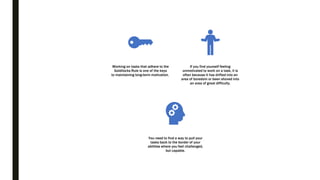
Working on tasks that adhere to the
Goldilocks Rule is one of the keys
to maintaining long-term motivation.
If you find yourself feeling
unmotivated to work on a task, it is
often because it has drifted into an
area of boredom or been shoved into
an area of great difficulty.
You need to find a way to pull your
tasks back to the border of your
abilities where you feel challenged,
but capable.
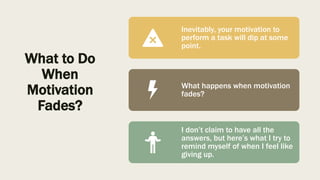
What to Do
When
Motivation
Fades?
Inevitably, your motivation to
perform a task will dip at some
point.
What happens when motivation
fades?
I don’t claim to have all the
answers, but here’s what I try to
remind myself of when I feel like
giving up.
1. Discomfort is temporary- Maintain perspective. Your life is good and your
discomfort is temporary. Step into this moment
of discomfort and let it strengthen you.
■ 2. You Will Never Regret Good Work Once It is Done
■ We want our stomachs to be flat and our arms to be strong, but we do not want to
grind through another workout.
■ We want the final result, but not the failed attempts that precede it. We want the
gold, but not the grind.
3. This is life
•What is life, if not the sum of a
hundred thousand daily battles and
tiny decisions to either gut it out or
give it up?
HOW TO GET PAST
THE "BLAH DAYS"
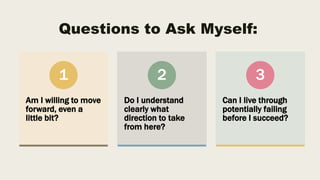
Questions to Ask Myself:
Am I willing to move
forward, even a
little bit?
1
Do I understand
clearly what
direction to take
from here?
2
Can I live through
potentially failing
before I succeed?
3
UPCOMING
EVENTS
■ Add related workshops, etc.
that students attending this
session may also be
interested in
Our Services
Study Help
• Drop-In Study Help for all courses
• Study Groups
• On-Track Appointments
• Question Drop-Off
Tech Help
• Drop-In Student Tech Help
• Ask-a-Lab Associate Question Drop-off
• Get Tech Ready and Appy Hour Workshops
Learning Help
• Check out our collection of self-service resources that supplement classroom materials
Get In Touch!
www.wccnet.edu/LC (live chat assistance offered during regular hours)
(734) 973-3420
Lab Email: LCLab@wccnet.edu
Tutoring Email: TutorWCC@wccnet.edu

Motivation clinic

  • 1.
    MOTIVATION CLINIC “The secretof getting ahead is getting started.” – Mark Twain
  • 3.
    We all getstuck and overwhelmed from time to time which can reduce motivation.
  • 4.
    But what ismotivation? ■ Scientists define motivation as your general willingness to do something. It is the set of psychological forces that compel you to take action. ■ Motivation can have many sources (extrinsic or intrinsic)
  • 5.
    Common Misconceptions About Motivation One ofthe most surprising things about motivation is that it often comes after starting a new behavior, not before. We have this common misconception that motivation arrives as a result of passively consuming a motivational video or reading an inspirational book.
  • 6.
  • 7.
    1. Willingness Willingness is created when peopleclearly comprehend what to do and why. There is a simple three-step process to articulating what to do and why. Identification Measurable Calibration (Goldilocks rule)
  • 8.
    2. Clarity If youwaste resources trying to decide when or where to work, you’ll impede your capacity to do the work. Setting a schedule for yourself
  • 9.
    3. Persistence How to Make Motivation a Habit? 1.Good pre-game routines For example, my writing routine starts by getting a glass of water. My weightlifting routine starts by putting on my lifting gloves. These tasks are so easy, I can’t say no to them.
  • 10.
    2. Your routineshould get you moving toward the end goal. A lack of mental motivation is often linked to a lack of physical movement.
  • 11.
    3. You needto follow the same pattern every single time. The primary purpose of your pre–game routine is to tells your mind, “This is what happens before I do ___.”
  • 13.
    Problem phase Solutionphase 1. Cue 2. Craving 3. Response 4. Reward Your phone buzzes with a new text message. You want to learn the contents of the message. You grab your phone and read the text. You satisfy your craving to read the message. Grabbing your phone becomes associated with your phone buzzing. You are answering emails. You begin to feel stressed and overwhelmed by work. You want to feel in control. You bite your nails. You satisfy your craving to reduce stress. Biting your nails becomes associated with answering email.
  • 14.
    How to Stay Motivatedby Using the Goldilocks Rule (calibration) ■ Imagine you are playing tennis. If you try to play a serious match against a four-year-old, you will quickly become bored. The match is too easy. ■ On the opposite end of the spectrum, if you try to play a serious match against a professional tennis player like Serena Williams, you will find yourself demotivated for a different reason. The match is too difficult.
  • 15.
    Imagine yourself playing tennisagainst someone who is your equal. As the game progresses, you win a few points and you lose a few points. You have a chance of winning the match, but only if you really try.
  • 16.
    But tasks thatare right on the border of success and failure are incredibly motivating to our human brains. Tasks that are significantly beyond your current abilities are discouraging. Tasks that are significantly below your current abilities are boring. Human beings love challenges, but only if they are within the optimal zone of difficulty. We can call this phenomenon The Goldilocks Rule. The Goldilocks Rule states that humans experience peak motivation when working on tasks that are right on the edge of their current abilities. Not too hard. Not too easy. Just right.
  • 17.
    Working on tasksthat adhere to the Goldilocks Rule is one of the keys to maintaining long-term motivation. If you find yourself feeling unmotivated to work on a task, it is often because it has drifted into an area of boredom or been shoved into an area of great difficulty. You need to find a way to pull your tasks back to the border of your abilities where you feel challenged, but capable.
  • 18.
    What to Do When Motivation Fades? Inevitably,your motivation to perform a task will dip at some point. What happens when motivation fades? I don’t claim to have all the answers, but here’s what I try to remind myself of when I feel like giving up.
  • 19.
    1. Discomfort istemporary- Maintain perspective. Your life is good and your discomfort is temporary. Step into this moment of discomfort and let it strengthen you.
  • 20.
    ■ 2. YouWill Never Regret Good Work Once It is Done ■ We want our stomachs to be flat and our arms to be strong, but we do not want to grind through another workout. ■ We want the final result, but not the failed attempts that precede it. We want the gold, but not the grind.
  • 21.
    3. This islife •What is life, if not the sum of a hundred thousand daily battles and tiny decisions to either gut it out or give it up?
  • 22.
    HOW TO GETPAST THE "BLAH DAYS"
  • 24.
    Questions to AskMyself: Am I willing to move forward, even a little bit? 1 Do I understand clearly what direction to take from here? 2 Can I live through potentially failing before I succeed? 3
  • 26.
    UPCOMING EVENTS ■ Add relatedworkshops, etc. that students attending this session may also be interested in
  • 27.
    Our Services Study Help •Drop-In Study Help for all courses • Study Groups • On-Track Appointments • Question Drop-Off Tech Help • Drop-In Student Tech Help • Ask-a-Lab Associate Question Drop-off • Get Tech Ready and Appy Hour Workshops Learning Help • Check out our collection of self-service resources that supplement classroom materials Get In Touch! www.wccnet.edu/LC (live chat assistance offered during regular hours) (734) 973-3420 Lab Email: LCLab@wccnet.edu Tutoring Email: TutorWCC@wccnet.edu