GOVERNMENT OF PAKISTAN
NATIONAL HIGHWAY AUTHORITY
GENERAL SPECIFICATIONS
(DECEMBER – 1998)
Prepared & Presented By:
Sampak International (Pvt) Ltd.
Management Consultants
G-568, Johar Town,
Lahore, Pakistan.
FOREWORD
Review and updating of General Specifications of National Highway Authority (1991)
became essential in light of new responsibilities entrusted by the Honorable Prime
Minister of Pakistan on this Agency to Construct Motorways and other important
highways on international standards.
In order to assess the new requirements of General Specifications we arranged series of
meetings with other consultants of the Authority, besides getting the opinions of major
contractors in Highway Industry. We also consulted different Directorates of the Authority
to know the problems felt by them during execution of highway projects. A seminar was
also arranged to discuss various maters, which attracted representatives of various
clients, consultants and contractors of highway industry in Pakistan.
We have carried out amendments in the current General Specifications looking to the
causes of disputes and reasons of failure of certain roads constructed in various parts of
the country. Addition of new items has also been made in the existing specifications to
cater for future needs of National Highway Authority.
Our sincere thanks are due to several agencies, which contributed in compilation of this
important document, however special attention of Contracts and Specifications Section of
National Highway Authority under the guidance of Chairman NHA, helped us to complete
the assignment successfully. We hope that this document will contribute effectively in
improving the workmanship and quality of highway construction in Pakistan.
For SAMPAK International (Pvt) Ltd.,
(S.M.A. Shirazi)
NATIONAL HIGHWAY AUTHORITY
GENERAL SPECIFICATIONS
Table of Contents
Item No. Description Page
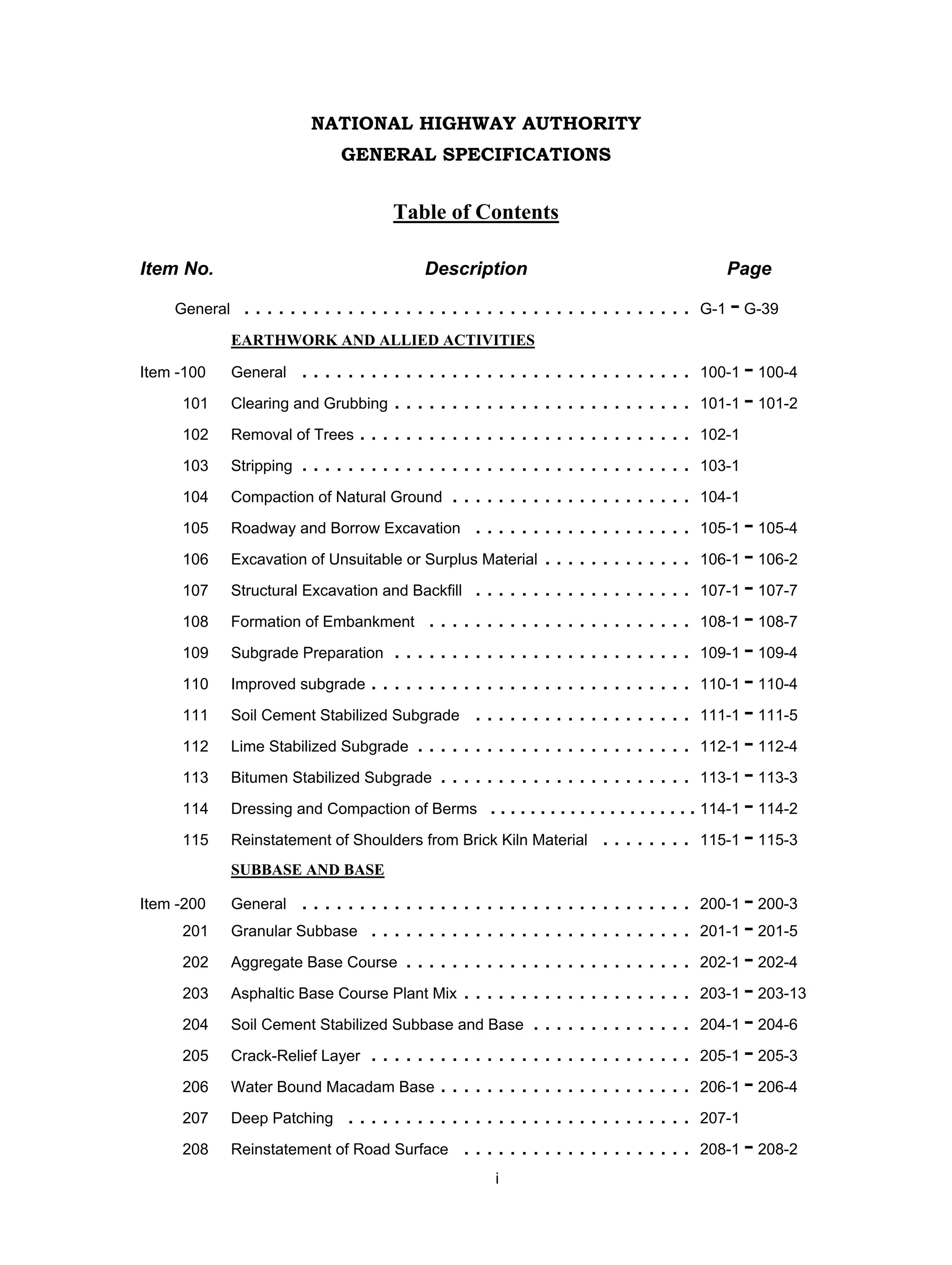
General . . . . . . . . . . . . . . . . . . . . . . . . . . . . . . . . . . . . . . . G-1 - G-39
EARTHWORK AND ALLIED ACTIVITIES
Item -100 General . . . . . . . . . . . . . . . . . . . . . . . . . . . . . . . . . . 100-1 - 100-4
101 Clearing and Grubbing . . . . . . . . . . . . . . . . . . . . . . . . . . 101-1 - 101-2
102 Removal of Trees . . . . . . . . . . . . . . . . . . . . . . . . . . . . . 102-1
103 Stripping . . . . . . . . . . . . . . . . . . . . . . . . . . . . . . . . . . 103-1
104 Compaction of Natural Ground . . . . . . . . . . . . . . . . . . . . . 104-1
105 Roadway and Borrow Excavation . . . . . . . . . . . . . . . . . . . 105-1 - 105-4
106 Excavation of Unsuitable or Surplus Material . . . . . . . . . . . . . 106-1 - 106-2
107 Structural Excavation and Backfill . . . . . . . . . . . . . . . . . . . 107-1 - 107-7
108 Formation of Embankment . . . . . . . . . . . . . . . . . . . . . . . 108-1 - 108-7
109 Subgrade Preparation . . . . . . . . . . . . . . . . . . . . . . . . . . 109-1 - 109-4
110 Improved subgrade . . . . . . . . . . . . . . . . . . . . . . . . . . . . 110-1 - 110-4
111 Soil Cement Stabilized Subgrade . . . . . . . . . . . . . . . . . . . 111-1 - 111-5
112 Lime Stabilized Subgrade . . . . . . . . . . . . . . . . . . . . . . . . 112-1 - 112-4
113 Bitumen Stabilized Subgrade . . . . . . . . . . . . . . . . . . . . . . 113-1 - 113-3
114 Dressing and Compaction of Berms ..................... 114-1 - 114-2
115 Reinstatement of Shoulders from Brick Kiln Material . . . . . . . . 115-1 - 115-3
SUBBASE AND BASE
Item -200 General . . . . . . . . . . . . . . . . . . . . . . . . . . . . . . . . . . 200-1 - 200-3
201 Granular Subbase . . . . . . . . . . . . . . . . . . . . . . . . . . . . 201-1 - 201-5
202 Aggregate Base Course . . . . . . . . . . . . . . . . . . . . . . . . . 202-1 - 202-4
203 Asphaltic Base Course Plant Mix . . . . . . . . . . . . . . . . . . . . 203-1 - 203-13
204 Soil Cement Stabilized Subbase and Base . . . . . . . . . . . . . . 204-1 - 204-6
205 Crack-Relief Layer . . . . . . . . . . . . . . . . . . . . . . . . . . . . 205-1 - 205-3
206 Water Bound Macadam Base . . . . . . . . . . . . . . . . . . . . . . 206-1 - 206-4
207 Deep Patching . . . . . . . . . . . . . . . . . . . . . . . . . . . . . . 207-1
208 Reinstatement of Road Surface . . . . . . . . . . . . . . . . . . . . 208-1 - 208-2
i
Item No. Description Page
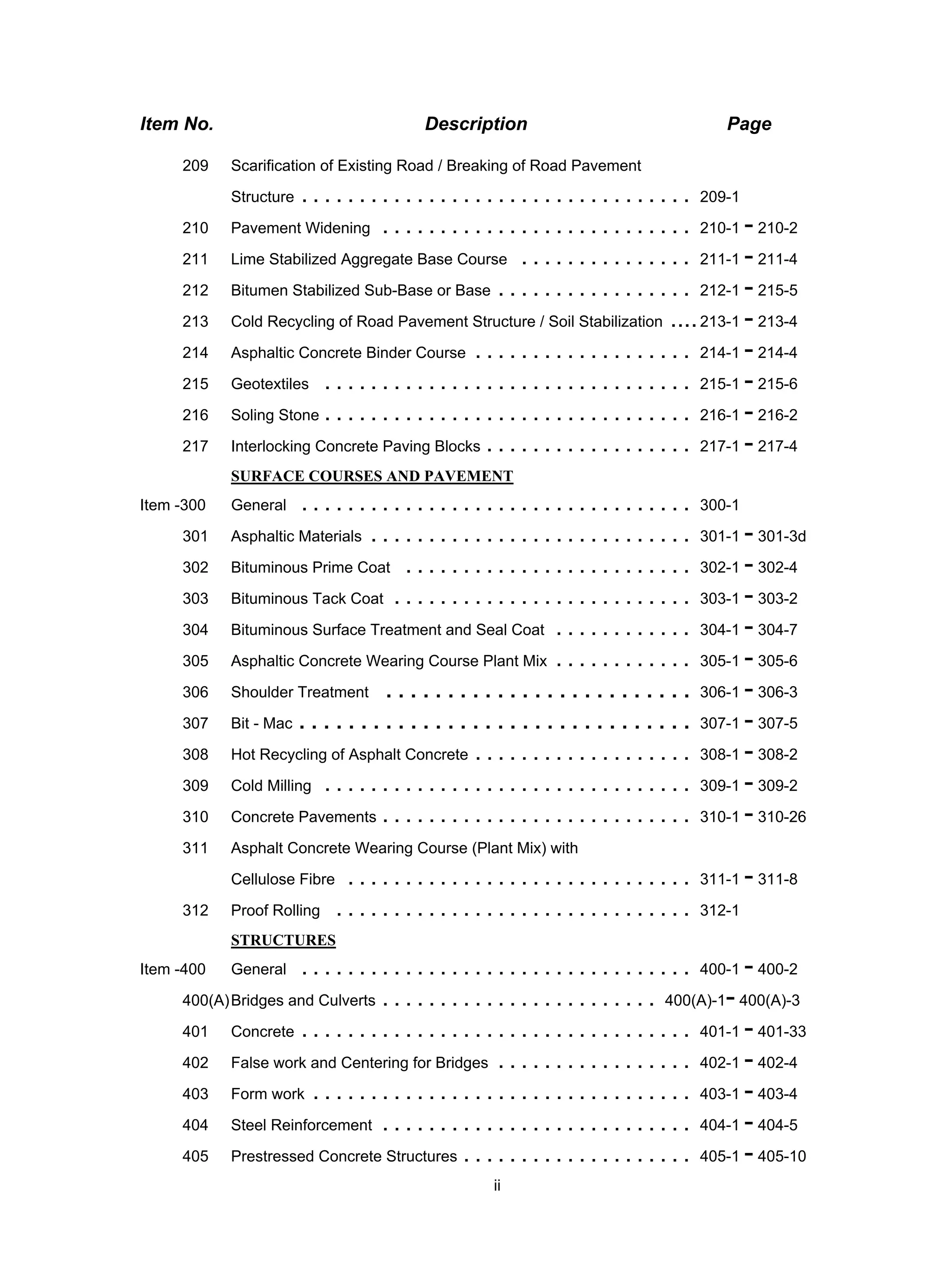
209 Scarification of Existing Road / Breaking of Road Pavement
Structure . . . . . . . . . . . . . . . . . . . . . . . . . . . . . . . . . . 209-1
210 Pavement Widening . . . . . . . . . . . . . . . . . . . . . . . . . . . 210-1 - 210-2
211 Lime Stabilized Aggregate Base Course . . . . . . . . . . . . . . . 211-1 - 211-4
212 Bitumen Stabilized Sub-Base or Base . . . . . . . . . . . . . . . . . 212-1 - 215-5
213 Cold Recycling of Road Pavement Structure / Soil Stabilization ....213-1 - 213-4
214 Asphaltic Concrete Binder Course . . . . . . . . . . . . . . . . . . . 214-1 - 214-4
215 Geotextiles . . . . . . . . . . . . . . . . . . . . . . . . . . . . . . . . 215-1 - 215-6
216 Soling Stone . . . . . . . . . . . . . . . . . . . . . . . . . . . . . . . . 216-1 - 216-2
217 Interlocking Concrete Paving Blocks . . . . . . . . . . . . . . . . . . 217-1 - 217-4
SURFACE COURSES AND PAVEMENT
Item -300 General . . . . . . . . . . . . . . . . . . . . . . . . . . . . . . . . . . 300-1
301 Asphaltic Materials . . . . . . . . . . . . . . . . . . . . . . . . . . . . 301-1 - 301-3d
302 Bituminous Prime Coat . . . . . . . . . . . . . . . . . . . . . . . . . 302-1 - 302-4
303 Bituminous Tack Coat . . . . . . . . . . . . . . . . . . . . . . . . . . 303-1 - 303-2
304 Bituminous Surface Treatment and Seal Coat . . . . . . . . . . . . 304-1 - 304-7
305 Asphaltic Concrete Wearing Course Plant Mix . . . . . . . . . . . . 305-1 - 305-6
306 Shoulder Treatment . . . . . . . . . . . . . . . . . . . . . . . . . 306-1 - 306-3
307 Bit - Mac . . . . . . . . . . . . . . . . . . . . . . . . . . . . . . . . 307-1 - 307-5
308 Hot Recycling of Asphalt Concrete . . . . . . . . . . . . . . . . . . . 308-1 - 308-2
309 Cold Milling . . . . . . . . . . . . . . . . . . . . . . . . . . . . . . . . 309-1 - 309-2
310 Concrete Pavements . . . . . . . . . . . . . . . . . . . . . . . . . . . 310-1 - 310-26
311 Asphalt Concrete Wearing Course (Plant Mix) with
Cellulose Fibre . . . . . . . . . . . . . . . . . . . . . . . . . . . . . . 311-1 - 311-8
312 Proof Rolling . . . . . . . . . . . . . . . . . . . . . . . . . . . . . . . 312-1
STRUCTURES
Item -400 General . . . . . . . . . . . . . . . . . . . . . . . . . . . . . . . . . . 400-1 - 400-2
400(A)Bridges and Culverts . . . . . . . . . . . . . . . . . . . . . . . . 400(A)-1- 400(A)-3
401 Concrete . . . . . . . . . . . . . . . . . . . . . . . . . . . . . . . . . . 401-1 - 401-33
402 False work and Centering for Bridges . . . . . . . . . . . . . . . . . 402-1 - 402-4
403 Form work . . . . . . . . . . . . . . . . . . . . . . . . . . . . . . . . . 403-1 - 403-4
404 Steel Reinforcement . . . . . . . . . . . . . . . . . . . . . . . . . . . 404-1 - 404-5
405 Prestressed Concrete Structures . . . . . . . . . . . . . . . . . . . . 405-1 - 405-10
ii
Item No. Description Page
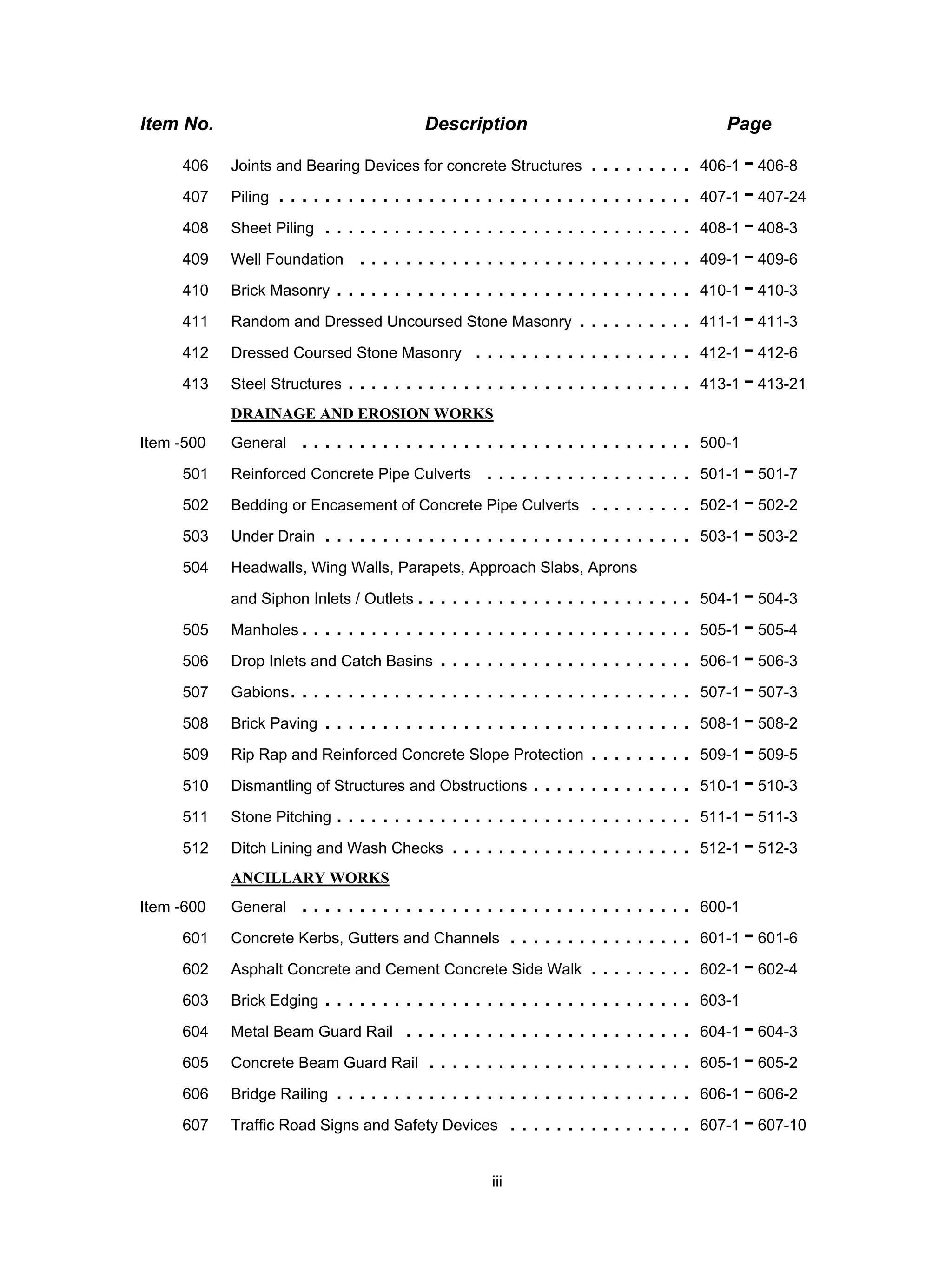
406 Joints and Bearing Devices for concrete Structures . . . . . . . . . 406-1 - 406-8
407 Piling . . . . . . . . . . . . . . . . . . . . . . . . . . . . . . . . . . . . 407-1 - 407-24
408 Sheet Piling . . . . . . . . . . . . . . . . . . . . . . . . . . . . . . . . 408-1 - 408-3
409 Well Foundation . . . . . . . . . . . . . . . . . . . . . . . . . . . . . 409-1 - 409-6
410 Brick Masonry . . . . . . . . . . . . . . . . . . . . . . . . . . . . . . . 410-1 - 410-3
411 Random and Dressed Uncoursed Stone Masonry . . . . . . . . . . 411-1 - 411-3
412 Dressed Coursed Stone Masonry . . . . . . . . . . . . . . . . . . . 412-1 - 412-6
413 Steel Structures . . . . . . . . . . . . . . . . . . . . . . . . . . . . . . 413-1 - 413-21
DRAINAGE AND EROSION WORKS
Item -500 General . . . . . . . . . . . . . . . . . . . . . . . . . . . . . . . . . . 500-1
501 Reinforced Concrete Pipe Culverts . . . . . . . . . . . . . . . . . . 501-1 - 501-7
502 Bedding or Encasement of Concrete Pipe Culverts . . . . . . . . . 502-1 - 502-2
503 Under Drain . . . . . . . . . . . . . . . . . . . . . . . . . . . . . . . . 503-1 - 503-2
504 Headwalls, Wing Walls, Parapets, Approach Slabs, Aprons
and Siphon Inlets / Outlets . . . . . . . . . . . . . . . . . . . . . . . . 504-1 - 504-3
505 Manholes. . . . . . . . . . . . . . . . . . . . . . . . . . . . . . . . . . 505-1 - 505-4
506 Drop Inlets and Catch Basins . . . . . . . . . . . . . . . . . . . . . . 506-1 - 506-3
507 Gabions. . . . . . . . . . . . . . . . . . . . . . . . . . . . . . . . . . . 507-1 - 507-3
508 Brick Paving . . . . . . . . . . . . . . . . . . . . . . . . . . . . . . . . 508-1 - 508-2
509 Rip Rap and Reinforced Concrete Slope Protection . . . . . . . . . 509-1 - 509-5
510 Dismantling of Structures and Obstructions . . . . . . . . . . . . . . 510-1 - 510-3
511 Stone Pitching . . . . . . . . . . . . . . . . . . . . . . . . . . . . . . . 511-1 - 511-3
512 Ditch Lining and Wash Checks . . . . . . . . . . . . . . . . . . . . . 512-1 - 512-3
ANCILLARY WORKS
Item -600 General . . . . . . . . . . . . . . . . . . . . . . . . . . . . . . . . . . 600-1
601 Concrete Kerbs, Gutters and Channels . . . . . . . . . . . . . . . . 601-1 - 601-6
602 Asphalt Concrete and Cement Concrete Side Walk . . . . . . . . . 602-1 - 602-4
603 Brick Edging . . . . . . . . . . . . . . . . . . . . . . . . . . . . . . . . 603-1
604 Metal Beam Guard Rail . . . . . . . . . . . . . . . . . . . . . . . . . 604-1 - 604-3
605 Concrete Beam Guard Rail . . . . . . . . . . . . . . . . . . . . . . . 605-1 - 605-2
606 Bridge Railing . . . . . . . . . . . . . . . . . . . . . . . . . . . . . . . 606-1 - 606-2
607 Traffic Road Signs and Safety Devices . . . . . . . . . . . . . . . . 607-1 - 607-10
iii
Item No. Description Page
608 Pavement Marking . . . . . . . . . . . . . . . . . . . . . . . . . . . . 608-1 - 608-13
609 Reflectorized Pavement Studs . . . . . . . . . . . . . . . . . . . . . 609-1 - 609-4
610 Precast Concrete Posts and Markers . . . . . . . . . . . . . . . . . 610-1 - 610-2
611 Fencing . . . . . . . . . . . . . . . . . . . . . . . . . . . . . . . . . . 611-1 - 611-2
612 Furnishing and Planting Trees, Shrubs and Ground Cover . . . . . 612-1 - 612-9
613 Sprigging and Sodding . . . . . . . . . . . . . . . . . . . . . . . . . . 613-1 - 613-4
MISCELLANEOUS
Item -701 Provision of Survey Teams and Instruments . . . . . . . . . . . . . 701-1
702 Provide, Equip and Maintain Office Facility and Residence
for the Engineer (Base Camp Facility) . . . . . . . . . . . . . . . . . 702-1 - 702-2
703 Provide, Equip and Maintain Laboratory for the Project . . . . . . . 703-1 - 703-2
704 Maintenance of Works for one year after Completion
(Period of Maintenance) . . . . . . . . . . . . . . . . . . . . . . . . . 704-1
705 Temporary Road Works . . . . . . . . . . . . . . . . . . . . . . . . . 705-1 - 705-2
706 Control and Protection of Traffic. . . . . . . . . . . . . . . . . . . . . 706-1 - 706-2
707 Removal / Relocation of Utilities. . . . . . . . . . . . . . . . . . . . . 707-1
Recommended Major Construction Equipments . . . . . . . . . . . M-1 - M-4
iv
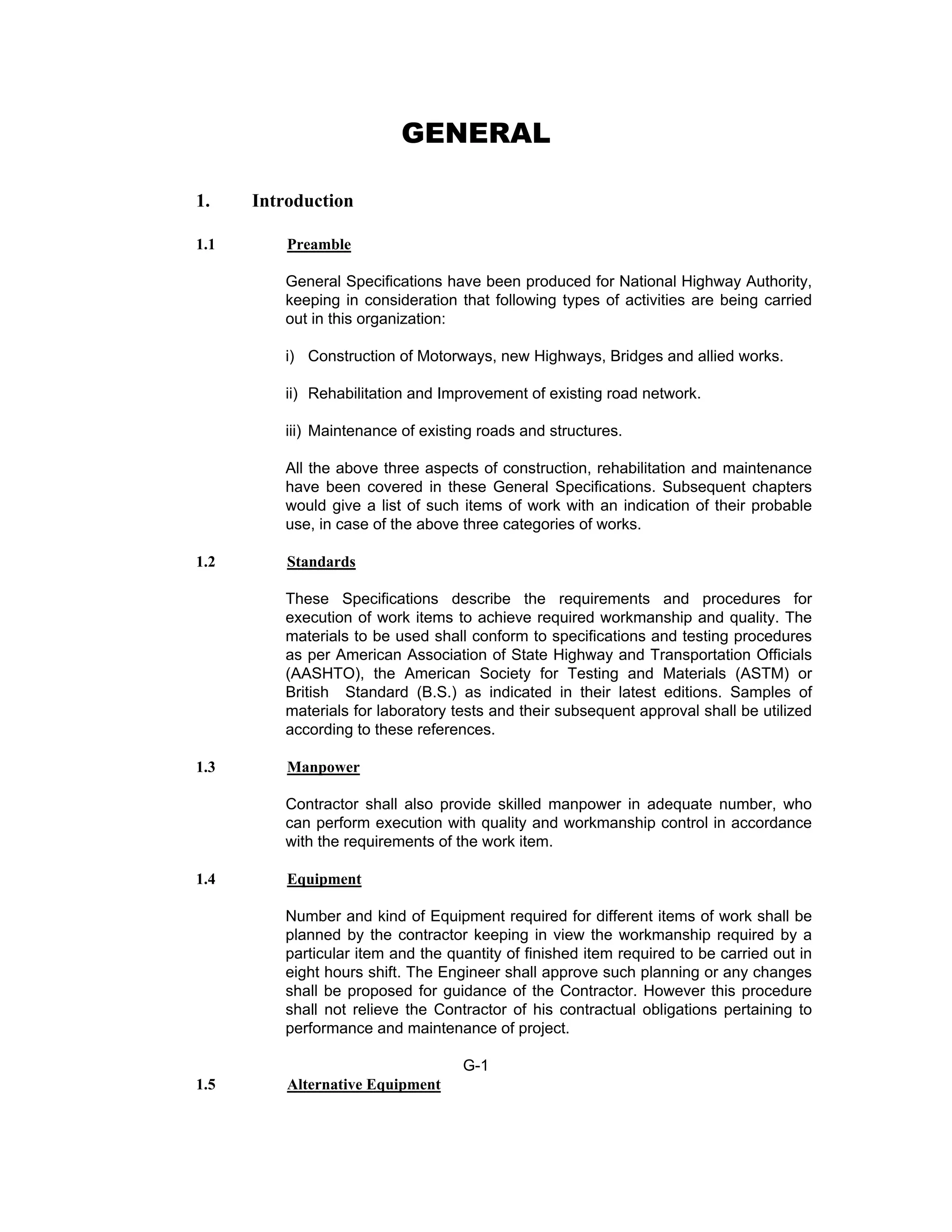
GENERAL
1. Introduction
1.1 Preamble
General Specifications have been produced for National Highway Authority,
keeping in consideration that following types of activities are being carried
out in this organization:
i) Construction of Motorways, new Highways, Bridges and allied works.
ii) Rehabilitation and Improvement of existing road network.
iii) Maintenance of existing roads and structures.
All the above three aspects of construction, rehabilitation and maintenance
have been covered in these General Specifications. Subsequent chapters
would give a list of such items of work with an indication of their probable
use, in case of the above three categories of works.
1.2 Standards
These Specifications describe the requirements and procedures for
execution of work items to achieve required workmanship and quality. The
materials to be used shall conform to specifications and testing procedures
as per American Association of State Highway and Transportation Officials
(AASHTO), the American Society for Testing and Materials (ASTM) or
British Standard (B.S.) as indicated in their latest editions. Samples of
materials for laboratory tests and their subsequent approval shall be utilized
according to these references.
1.3 Manpower
Contractor shall also provide skilled manpower in adequate number, who
can perform execution with quality and workmanship control in accordance
with the requirements of the work item.
1.4 Equipment
Number and kind of Equipment required for different items of work shall be
planned by the contractor keeping in view the workmanship required by a
particular item and the quantity of finished item required to be carried out in
eight hours shift. The Engineer shall approve such planning or any changes
shall be proposed for guidance of the Contractor. However this procedure
shall not relieve the Contractor of his contractual obligations pertaining to
performance and maintenance of project.
G-1
1.5 Alternative Equipment
While few of these specifications may provide that equipment of a particular
size and type is to be used to perform portions of the work, it is to be
understood that the deployment and use of new or improved equipment is to
be encouraged.
The Contractor may request, in writing, permission from the Engineer to use
equipment of a different size or type in place of the equipment specified or
recommended in these chapters.
The Engineer, before considering or granting such request, may require the
Contractor to furnish, at his expense, evidence to satisfy the Engineer that
the equipment proposed for use by the Contractor is capable of producing
work equal to or better in quality than, that which can be produced by the
equipment specified.
If such permission is granted by the Engineer, it shall be understood that
such permission is granted for the purpose of testing the quality of work
actually produced by such equipment and is subject to continuous
attainment of results which, in the opinion of the Engineer, are equal to, or
better than, that which can be obtained with the equipment specified. The
Engineer shall have the right to withdraw such permission at any time when
he determines that the alternative equipment is not producing work of equal
quality in all respects, to that which can be produced by the equipment
specified. Upon withdrawal of such permission by the Engineer, the
Contractor will be required to use the equipment originally specified and
shall, in accordance with the directions of the Engineer, remove and dispose
off or otherwise remedy, at his expense, any defective or unsatisfactory
work produced with the alternative equipment.
Neither the Employer nor the Contractor shall have any claim against the
other for either the withholding or the granting of permission to use
alternative equipment, or for the withdrawal of such permission.
Nothing in this clause shall relieve the Contractor of his responsibility for
furnishing materials or producing finished work of the quality specified in
these specifications.
1.6 Storage of Materials
Articles or materials to be incorporated in the work shall be stored in such a
manner as to ensure the preservation of their quality and fitness for the
work, and to facilitate inspection.
1.7 Defective Materials
All materials which the Engineer has determined as not conforming to the
requirements of the drawings and specifications will be rejected whether in
place or not. They shall be removed immediately from the site of the work,
unless otherwise permitted by the Engineer. No rejected material, the
defects of which have been subsequently corrected, shall be used in the
G-2
work, unless approval in writing has been given by the Engineer. Upon
failure of the Contractor to comply promptly with any order of the Engineer
made under the provisions in this clause, the Engineer shall have authority
to cause the removal of rejected material and to deduct the cost thereof
from any payments due or to become due to the Contractor.
1.8 Quarry Materials
Quarry material is rock, sand, gravel, earth, or other mineral material, other
than local borrow or selected material, obtained on the project. Quarry
material does not include materials such as cement, lime, marble powder
etc. obtained from established commercial sources.
Quarry Materials shall be furnished by the Contractor from any source he
may select, except that when mandatory local sources of certain materials
are designated in the Special Provisions, the Contractor shall furnish
material from such designated mandatory sources.
The furnishing of quarry materials from any source is subject to the
provisions of "Examination of drawings, Specifications, and item of Work".
Unless approved in writing by the Engineer, material sources shall not be
excavated at locations where the resulting scars will present an unsightly
appearance from any highway. No payment will be made for material
obtained in violation of this provision.
The Contractor shall, at his expense, make any arrangements necessary for
hauling over local public and private roads from any source.
Full compensation for furnishing all labour, materials, tools, equipment, and
incidentals, and for doing all the work involved in conforming to the
provisions in this clause, for furnishing and producing materials from any
source shall be considered as included in the price paid for the contract item
of work involving such material and no additional compensation will be
allowed therefor.
1.9 Trade Names and Alternatives
For convenience in designation on the plans or in the specifications, certain
articles or materials to be incorporated in the work may be designated under
a trade name or the name of a manufacturer and the catalogue information.
The use of an alternative article or material that is of equal quality and of the
required characteristics for the purpose intended will be permitted, subject
to the following requirements:
The responsibility of proof as to quality and suitability of alternatives shall be
upon the Contractor and he shall furnish all information necessary as
required by the Engineer. The Engineer shall be the sole judge as to the
quality and suitability of alternative articles or materials and his decision
shall be final.
G-3
Whenever the specifications permit the substitution of a similar or equivalent
material or article, no tests or action relating to the approval of such
substitute material will be made until the request for the substitution is made
in writing by the Contractor accompanied by complete data as to the
equality of the material or article proposed. Such request shall be made
well in time to permit approval without delaying the work.
1.10 Frequency of Tests & Test Designation
Frequency of tests for the items of construction has been given in
subsequent chapters. Test designation and procedure will be used as given
in the latest version of relative publication.
1.11 Testing
Unless otherwise specified, all tests shall be performed in accordance with
the methods used by AASHTO/ASTM and shall be made by the contractor
under the supervision of the Engineer or his designated representative.
Whenever the specifications provide an option between two or more tests,
the Engineer will determine the test to be used.
Whenever a reference is made in the specifications to a specification
manual, or a test designation either of the American Society For Testing and
Materials, the American Association of State Highway and Transportation
Officials, Federal Highway Specification, or any other recognized national
organization, and the number or other identification representing the year of
adoption or latest revision is omitted, it shall mean the specification, manual
or test designation in effect on the day 30 days prior to the date for
submission of bids. Whenever said specification manual or test designation
provides for test reports (such as certified mill test reports) from the
manufacturer, copies of such reports, identified as to the lot of material,
shall be furnished to the Engineer. When material that cannot be identified
with specific test reports is proposed for use, the Engineer may, at his
discretion, select random samples from the lot for testing. Test specimens
from the random samples, including those required for retest, shall be
prepared in accordance with the referenced specification and furnished by
the Contractor at his expense. The number of such samples and test
specimens shall be entirely at the discretion of the Engineer. Unidentified
metal products such as sheet plate, hardware, etc. shall be subject to the
test requirements prescribed by the Engineer.
When desired by the Engineer, the Contractor shall furnish, without charge,
samples of all materials entering into the work and no material shall be used
prior to approval by the Engineer. Samples of material from local sources
shall be taken by or in the presence of the Engineer, otherwise the samples
will not be considered for testing.
1.12 Construction Stakes, Lines and Grades
The Engineer will furnish design survey data and jointly locate with
contractor, all points of intersection and of tangents and basic benchmarks.
The plans indicate the properties of horizontal and vertical curves, together
with rates of superelevation where required. The contractor shall set
G-4
construction stakes establishing lines, slopes, and continuous profile-grade
in road work, and center line and bench marks for bridge work, culvert work,
protective and accessory structures and appurtenances and will furnish the
Engineer with the original copy of the field notes together with all necessary
information relating to lines, slopes and grades. These stakes and marks
shall constitute the field control by and in accordance with which the
contractor shall establish other necessary controls and perform the work.
If, in the opinion of the Engineer, modification of the line or grade is
advisable, before or after stakeout, the Engineer will issue detailed
instructions to the Contractor for such modification and the Contractor will
revise the stakeout for further approval. No change in bid unit price will be
made for such modifications.
The profiles and cross sections on the plans indicate the elevation of the top
of road surface or as otherwise noted on the plans. The contractor shall be
responsible for the preservation of all stakes and marks, and if any of the
construction stakes or marks has been destroyed or disturbed, the
Contractor will replace them at his own expense.
The Contractor shall be responsible for the accuracy of all lines, slopes,
grades, and other survey work.
1.13 As-Built Drawings/Shop Drawings
During construction, the Contractor shall keep an accurate record of all
deviations of work as actually installed from that shown or indicated on the
Contract Drawings or revised during construction. Upon completion of the
Works, the Contractor shall deliver all “As Built” drawings to the Engineer.
All shop drawings/fabrication drawings shall be prepared by the Contractor
and submitted to the Engineer before the start of the work. The Engineer
shall check and approve or return the same to the Contractor for
correction/modification. All works are to be executed in accordance with
shop drawings, approved before the commencement of the works. Shop
drawings should truly reflect the provisions of typical drawings. Any
deviation from the provision of contract drawings, shall not be allowed
unless written approval is issued by the Engineer.
1.14 Utility Lines
The Contractor shall conduct his operations, make necessary
arrangements, take suitable precautions and perform all required works
incidental to the protection of and avoidance of interference with power
transmission, telegraph, telephone and natural gas lines, oil lines water and
sewerage mains and other utilities within the areas of his operations in
connection with his contract and the Contractor shall save harmless and
indemnify the Employer in respect of all claims, demands, proceedings,
costs, charges and expenses whatsoever arising out of or in relation to any
such interference.
G-5
1.15 Safety Precautions.
The Contractor shall adequately provide for the safety, health and welfare of
persons and for the prevention of damage to works, materials and
equipment for the purpose of or in connection with the Contract.
1.16 Inspection
The Engineer shall, at all times, have safe access to the work during its
construction, and shall be furnished with every reasonable facility for
ascertaining that the materials and the workmanship are in accordance with
the requirements and intentions of these Specifications, the Special
Provisions, and the plans/drawings. All works done and all materials
furnished shall be subject to inspection by Engineer.
The inspection of the work or materials shall not relieve the Contractor of
any of his obligations to fulfill his contract as prescribed. Work and
materials not meeting such requirements shall be made good and
unsuitable work or materials may be rejected, not withstanding that such
work or materials have been previously inspected by the Engineer or that
payment therefor has been included in a progress estimate.
1.17 Removal of Rejected and Unauthorized Work
All works, which have been rejected, shall be remedied, or removed and
replaced by the Contractor in an acceptable manner and no compensation
will be allowed to him for such removal, replacement, or remedial work.
Any work done beyond the lines and grades shown on the plans or
established by the Engineer, or any extra work done without written
authority will be considered as unauthorized work and will not be paid for.
Upon order of the Engineer, unauthorized work shall be remedied, removed,
or replaced at the Contractor's expenses.
Upon failure of the Contractor to comply promptly with any order of the
Engineer made under this Item, the Employer may cause rejected or
unauthorized work to be remedied, removed, or replaced and to deduct the
costs from any payment due or to become due to the Contractor.
1.18 Alternative Methods of Construction
Whenever the plans or specifications provide that more than one specified
methods of construction or more than one specified type of construction
equipment may be used to perform portions of the work and leave the
selection of the method of construction or the type of equipment to be used
up to the Contractor, it is understood that the Employer does not guarantee
that every such method of construction or type of equipment can be used
successfully throughout all or any part of any project. It shall be the
Contractor's responsibility to select and use the alternative or alternatives,
which will satisfactorily perform the work under the conditions encountered.
G-6
In the event some of the alternatives are not feasible or it is necessary to
use more than one of the alternatives on any project, full compensation for
any additional cost involved shall be considered as included in the contract
price paid for the item of work involved and no additional compensation will
be allowed thereof.
1.19 Conformity with Contract Documents and Allowable Deviations.
Work and materials shall conform to the lines, grades, cross sections,
dimensions and material requirements, including tolerances, shown on the
plans or indicated in the specifications. Although measurement, sampling
and testing may be considered evidence as to such conformity, the
Engineer shall be the sole judge as to whether the work or materials deviate
from the plans and specifications, and his decision relating to any allowable
deviations therefrom shall be final.
1.20 Trial Section
Contractor shall submit complete methodology of trial section for approval of
the Engineer. Trial sections shall be prepared for each type of road
pavement layer. Inspite of the approval of Engineer for trial section,
contractor shall be responsible for the quality of work. Contractor will
provide minimum of following informations in the methodology.
i) Equipment to be used.
ii) Layer thickness adopted
iii) Per day production.
iv) Results of tests.
2. Scope
The Standard Specifications is a part of contract documents which shall be
read in conjunction with the following contract documents which are
mutually explanatory to one another and mentioned hereunder, with the
order of precedence as given in the Condition of Contract.
(i) Contract Agreement.
(ii) Instruction to bidders.
(iii) Addenda.
(iv) Letter of acceptance.
(v) Supplementary conditions.
(vi) Special Provisions.
(vii) Conditions of Contract Part - II.
(viii) Conditions of Contract Part - I.
(ix) Drawings.
(x) General Specifications.
(xi) The bid and Appendices "A to L".
3. Abbreviations and Definitions
Wherever in these specifications or in other contract documents the
following abbreviations and terms or pronouns in place of them are used,
the intent and meaning shall be interpreted as follows:
G-7
3.1 Abbreviations
AASHTO - American Association of State Highway and
Transportation Officials.
ASTM - American Society for Testing and Material
AWG - American Wire Gauge
AWPA - American Wood Preservers Association
BS - British Standard Code of Practice
ACI - American Concrete Institute
FHWA - U.S. Federal Highway Administration
PCA - Portland Cement Association
Wt. - Weight
Lb. - Pound
AWS - American Welding Society
Gallon - U.S. Gallon
In. - Inch
Ft. - Foot
Yd. - Yard
Ltr. - Litre
mm - Millimeter
cm. - Centimeter
M - Meter
Km - Kilometer
SM - Square Meter
o - degree
Sq. cm. - Square Centimeter
CM - Cubic Meter
ha - Hectare
Kg - Kilogram
Ton - Metric Ton (1000 Kg)
oC - Degree Centigrade
oF - Degree Fahrenheit
G-8
3.2 Definitions
Wherever in these specifications or in other contract document the following
terms or pronouns in place of them are used, the intent and meaning shall
be interpreted as follows:
Accepted
– Completion of the work item to the Engineer's satisfaction
Addendum
–- A written amendment or revision to the Contract documents or plans
issued to bidders prior to the final date and time for submission of
Tenders in the "Instruction to Tenderer."
Aggregates
– Crushed stone or processed gravel (shingle)
Amenities
– Recreational facilities and similar items provided to improve living
conditions at site - characteristics conducive to pleasantness.
Apron
– A concrete, rock or masonry slab forming a part, or for the protection of a
structure.
Asphalt Base Course
– The lowermost layer of specified thickness of an asphalt concrete
pavement which may include an asphalt leveling course.
Asphalt Concrete
– High quality, thoroughly controlled hot mixture of asphalt cement and
well-graded, high quality aggregate, thoroughly compacted into a
uniform, dense mass.
Asphalt Concrete Pavement
– All courses of asphalt-aggregate mixtures placed above the layer of base
course, subbase or improved subgrade. When placed directly on the
subgrade, it is called full-depth asphalt pavement.
Auxiliary Lane
– That portion of the roadway adjoining the traveled way for speed change
or other purposes supplementary to through traffic movements.
G-9
Barrage
– A low dam or weir across a river equipped with a series of gates to
regulate the water surface level above the weir.
Base Course
– The layer of specified material and thickness placed immediately below
the surfacing.
Batten
– Beam, structural member.
Beldar
– Unskilled labour employed on maintenance gangs for canals or roads.
Bid/Tender Price
– The sum of the products of the quantities of work with the quoted prices
in the Tender by the Contractor.
Bill of Quantities and list of Prices
– A list showing work quantities and specifying unit price and/or lump sum
for specific items of work.
Blinding Layer
– A layer of concrete or other material (Generally thin) covering the surface
of excavated ground or fill, forming a stable surface on which further
work may be constructed.
Boulder
– A rock fragment, usually rounded by weathering or abrasion, with an
average dimension of 10 centimeters or more.
Boundary
– Limit of right-of-way or other zones.
Bridge
– Any structure other than a culvert, which carries a utility, facility, or
railroad highway, pedestrian, or other traffic over a water course,
over, under or around any obstruction and with a clear span of more
than 6.50 M.
G-10
Bund
– A continuous embankment, dike or levee (generally associated with
training or containing the flow of rivers).
Catchment
– The watershed or area which contributes runoff to a drain or other
channel.
Contractor
– The individual firm or corporation contracting with the Employer/Client for
performance of the prescribed work.
Contract Price
– The sum of the products of the quantities with the agreed prices
appearing in the agreement between the Contractor and the
Engineer/Employer.
Construction Limit
– Construction limit of a project is area between left & right side of catch
points of road under construction, where as in case of structures this limit
will extend to area which is required for execution of permanent structure
Cubic Meter
– A volume equivalent to 1.0 M x 1.0 M x 1.0 M.
Cuboid
– Crushed stone particles with each face fractured and in roughly cuboid
shape.
Culvert
– Any structure, other than a bridge which provides an opening under a
roadway for drainage or irrigation purpose and with a clear span of 6.5 M
or less.
Cum
– With or associated with - for example, 'Railroad-cum-road' bridge.
Cusec
– A rate of flow of one cubic foot per second.
G-11
Daywork
– Work to be paid for on the basis of actual labour, material, and plant
used - Force account.
Detour (Diversion)
– A temporary roadway, which leaves the main, route and rejoin it later, for
the uninterrupted flow of traffic.
Drawings
– The approved plans(drawings), profiles, typical cross-sections, revised
drawings and supplemental drawings, or exact reproduction thereof,
which show the location, character, dimensions and details of the work.
Earth
– Sediments or other unconsolidated accumulations of solid particles,
produced by the physical and chemical disintegration of rock, and which
may or may not contain organic matter.
Engineer
– The duly authorized representative of the Client/Employer for controlling
the project site, acting directly or through his duly authorized
representatives, who is responsible for engineering supervision of the
work.
Equipment
– All machinery and equipment, together with the necessary supplies for
up keep and maintenance and also tools and apparatus necessary for
the proper construction and acceptable completion of the work.
Fix
– Any item of construction which requires special placement in the works.
Flexible Pavement Structure
– Any combination of improved subgrade, subbase, base and asphalt
surfacing placed on the subgrade to support the traffic load and reduce
its intensity at the subgrade surface.
Forms or Formwork
– Shuttering including supports and falsework.
G-12
Frustration of a Contract
– Rendered impossible of performance by external cause beyond the
contemplation of the parties.
Gang Header
– Experienced workman or labour incharge of small groups of workmen or
labour.
Gasoline
– Motor spirit, petrol.
Godown
– Warehouse, store room or storage shed.
Grade
– The trace of a vertical plane intersecting the top surface of the proposed
wearing surface, usually along the longitudinal center-line of the
roadbed. Profile grade means either elevation or gradient of such trace
according to the context.
Gravel
– Small sized stone, shingle or rock fragments usually rounded in shape
formed from rocks or boulders by glacial or weathering action..
Guide Bank (for Bund)
– A protective and training embankment or levee for directing river flow.
Highway
– A general term denoting public way for purposes of vehicular travel,
including the entire area within the right-of-way. (Recommended Usage:
in urban areas-highway or street; in rural areas-highway or road).
Install
– To place in special position any hardware, equipment or fixture for
completing a job.
Kilometer
– A distance equal to 1000 meters.
G-13
Laboratory
– A testing laboratory approved by NHA or any testing laboratory, which
may be designated by the Engineer.
Leveling Course
– The layer of specified material of variable thickness placed generally on
an existing road surface to compensate for depressions and undulations
in order to correct grades and cross falls according to design.
Materials
– Any substance specified for use in the construction of the project and its
appurtenances.
Metalled (roadway)
– Surfaced, paved (roadway).
Mile
– Distance of 5,280 feet. (1,610 M)
Monsoon
– Prevailing winds in the Indian Ocean.
– The rainy season associated with the south-west monsoon.
Motor Spirit
– Petrol, gasoline.
Octroi
– A municipal fee for municipal services.
Period of Maintenance
– Period of maintenance shall mean the period of contractor's
maintenance named in the contract, calculated from the date of
completion of the work as certified by the Hand-over committee.
Pitching or Rip-Rap
– Broken stone, brickwork or other materials placed usually on side slopes
of Embankments for protection of the earth surface, dry or in cement
mortar as specified.
G-14
Prime Cost
– A net sum entered in the Bill of Quantities by the employer as the sum
provided to cover the cost of or to be paid by the Contractor to
merchants or others for specific articles or materials to be supplied after
deducting all trade discounts and any discount for cash.
Provide
– To make available an item for a certain period/time or indefinite time as
the case may be.
Provisional Sum
– Any sum of money fixed by the Employer and included in the Bill of
Quantities to provide for work not otherwise included therein. A
provisional sum is only to be expended, either wholly or in part under the
Employer's Representatives or the Engineer's direction in accordance
with Contract. This sum may or may not be utilised in full or partially
through the contractor.
Regulator
– A canal structure, usually equipped with gates, for control, or checking,
of flow in the canal or an off taking channel.
Return
– Report
Revetment (Material)
– Rock.
Right-of-way (ROW)
– A general term denoting land, property, or interest therein, usually in a
strip, acquired for or devoted to transportation purposes.
Roadside
– A general term denoting the area adjoining the outer edge of the
roadway. Extensive areas between the roadways of a divided highway
may also be considered roadside.
Roadway
– The portion of a highway within limits of construction.
G-15
Scaffolding
– Arrangement of struts/columns/pipes to support shuttering or other
platforms.
Setting out
– Laying out or staking out-establishing on the site the lines, levels and
grades to which the construction works are to be carried out.
Shingle
– See Aggregates.
Shoulders
– The portion of the roadway contiguous with the traveled way for
accommodation of stopped vehicles, for emergency use, and for lateral
support of base and surface courses.
Sidewalk
– That portion of the roadway primarily constructed for the use of
pedestrians.
Sleepers
– Cross ties, railroad ties.
Soil Binder
– Portion of Soil passing 0.425 mm (# 40) sieve.
Special Provisions
– Additions and revisions to the Standard Specifications and General
Conditions of Contract, covering conditions particular to an individual
contract.
Spoil Bank
– Disposal area for excess excavation, spoil tip or waste dump.
Structures
– Bridges, culverts, catch basins, drop inlets retaining walls, manholes,
headwalls, service pipes causeways Irish bridges and other features
which may be encountered in the work and not otherwise classed herein.
Subbase
– The layer of specified material and thickness placed between the base
course and subgrade.
G-16
Subgrade
– The top surface of a roadbed upon which the pavement structures and
shoulders including curbs are constructed.
Subgrade level
– That level of the roadbed (or, embankment) on which other road material
has to be placed.
Subgrade treatment
– Modification of roadbed material by stabilization.
Substructure
– All of that part of a structure below the bearings of simple and continuous
spans, or rigid frames, including back walls, wing walls.
Super-tax
– A Pakistani tax on income or profit above a certain level of income or
profit.
Surface Course
– The uppermost layer of specified thickness of an asphalt concrete
pavement; also called "Wearing Course".
Surfacing
– The uppermost layer of specified material placed on the traveled way or
shoulder. Types of surfacing may consist of surface treatment (hot
surface dressing) of asphalt concrete surface course, or concrete
pavement.
Supply
– Primarily meaning to deliver any item on permanent basis.
Tender
– Bid proposal.
Tenderer
– A firm or individual submitting a Tender.
Traffic Lanes
– That portion of a traveled way allowing the movement of a single line of
vehicles.
G-17
Unmetalled (Roadway)
– Unsurfaced, unpaved (roadway)/dirt road.
Variation Order
– A document compiled to include changes, substitutions and additional
work items not covered in the B.O.Q, for the sanction of the competent
Authority and shall include increase or decrease in quantities or rates
also.
Work
– The work shall mean the furnishing of all labour, materials, equipment
and other incidentals necessary or convenient to the successful
completion of the project and carrying out of all the duties and
obligations imposed by the contract.
Wagon (railway)
– A railroad freight car.
Wayleave
– Permission to cross land, right of entry as defined in the land acquisition
act of the Government of Pakistan.
Well
– A concrete or masonry caisson incorporated in foundations.
Working Drawings
– Stress sheets, shop drawings, erection plans, falsework plans, form work
plans, cofferdam plans, bending diagrams for reinforcing steel, or any
other supplementary plans or similar data which the contractor is
required to submit to the Engineer for approval.
Written Undertaking
– A written promise.
G-18
EARTH WORK
AND
ALLIED ACTIVITIES
EARTHWORK
ITEM 100 G E N E R A L
100.1 DESCRIPTION
Earthwork will consist of all necessary work for the excavation and placing in
embankment or backfill or disposal by dumping of earth, rock or other
material from or to the roadway or adjacent thereto or from borrow areas,
including the excavation of side and interception ditches, the removal of
unsuitable subgrade material, the formation of laybyes, the widening of cuts
and the flattening of cut slopes whether to obtain material for embankments
or backfill, or to increase the stability of the slopes, clearing and grubbing,
the selective removal of trees, stripping and the removal of existing
obstructions within the approved cross section for excavation, in accordance
with these specifications and in conformity with the lines, grades, sections,
and dimensions shown on the drawings or as directed by the Engineer.
100.2 SOIL INFORMATION
Any information concerning the properties of the soil or sub soil and other
geotechnical information shown on the drawing or other documents forming
part of the contract is for information only. The contractor is obliged to make
his own assessment of site conditions prevailing. No claim for extra cost or
time extension will be entertained based on the information provided.
The Contractor shall be deemed to have visited the site prior to making his
bid and shall ascertain the nature of the earth and rock, its quantity,
locations and suitability to meet the specified requirements, and he shall
base his bid estimates solely on his own soil investigation. After the award
of the contract no claim for a revision of bid prices depending on the sources
of soil information will be entertained.
100.3 EXPLOSIVES
Where explosives are used the Contractor shall provide suitable buildings or
warehouses in approved positions for the storage of explosives, which shall
be stored in the manner and quantity approved by the Engineer or as per
relative laws of government. Such storage places shall be accessible only to
authorized personnel. They shall be properly marked, all doors or accesses
thereto shall be constructed of materials as directed by the Engineer and
provided with secure locks and all necessary means for preventing access
by unauthorized persons. The Contractor shall be responsible for the
prevention of any unauthorized issue or improper use of any explosives.
The handling of explosives shall be entrusted only to experienced and
responsible men, to the satisfaction of the Engineer, and in conformity with
the statutory regulations.
100-1
All drilling and blasting shall be done in such a manner as to bring the
excavation as close as possible to the required cross sections, and to
disturb as little as possible the material to be left in place. Blasting by
means of drill holes, tunnels, or any other method shall be performed at the
entire risk and responsibility of the Contractor who shall have no claim to
payment for extra work occasioned by breakage outside the approved
cross-sections or dimensions.
The greatest care shall be taken by the Contractor during all blasting
operations to ensure that no injury be done to persons or damage to
property or to the finished work. Shots shall be properly loaded and capped,
and only a moderate charge shall be used in each hole. A record of all
explosives used, showing locations and amounts, shall be kept by the
Contractor for checking by the Engineer.
Where directed by the Engineer, the Contractor shall provide heavy mesh
blasting mat for protection of persons, property and the work. If necessary,
blasting shall be restricted to time prescribed by the Engineer.
The Engineer may prohibit blasting and order the rock to be excavated by
other means, if, in his opinion, it would be dangerous to persons or adjacent
structures, or is being carried out in a reckless manner. If traffic on the road
has to be interrupted, the Contractor shall obtain approval of his schedule
for such interruption from the proper authorities and shall satisfy the
Engineer that he has obtained it. No extra payment shall be admissible for
such arrangements as described here above.
100.4 REMOVAL OF EXISTING OBSTRUCTIONS
The pay items under Items 101, 103, 105, 106, 107 and 108 shall include
the cost of removal of all material regardless of its nature, encountered
within the limits of the approved cross-section, including the removal and
disposal, as required by the Engineer, of existing brick, stone, concrete or
masonry, rock boulders or fragments, old pavements, culverts, bridges or
parts thereof, retaining walls or any other material encountered during the
excavation, unless a separate item exists for such features.
100.5 REMOVAL OR DIVERSION OF WATER
Except where provided for, no separate payment will be made for control of
or removal of water during or after earthwork operations. The cost of
sheeting, shoring, cofferdams, pumping and draining shall be included in the
bid prices for earthwork. The Contractor shall provide necessary facilities
for dewatering and for draining or diverting watercourses when necessary
for the protection of the contract work or where required by the Engineer.
The Contractor shall provide such drainage outlet ditches or canals as may
be necessary to effect proper drainage before rain is expected. Such
drainage ditches or canals for protection of work during construction and
their maintenance and clearing to make them continuously effective during
the work shall not be paid separately, but shall be deemed to be included in
other items of work.
100-2
The Contractor shall also provide, fix, maintain and operate such engines,
pumps, hoses, chutes and other appliances as are necessary to keep the
accumulated water at a level required for the safety of the structures as
directed by the Engineer.
100.6 DITCHES
The Contractor shall construct side ditches, interception ditches, and inlet
and outlet ditches as shown on the Drawings or where ordered by the
Engineer, whether for temporary or permanent drainage. In order to keep
water away from the embankment, subgrade, and/or pavement during
construction, the Contractor shall at all times ensure adequate drainage by
scheduling ditch and outlet so that the drainage is operative before work is
started on the embankment, subgrade or pavement. He shall clean and trim
all such drainage ditches from time to time, so that there may be a free flow
of water throughout the whole period of the Contract. Ditches shall first be
trimmed according to approved cross-sections, and final trimming, including
the repair of any damage that may have been done during the construction
work, shall be carried out after the completion of the other construction work
and shall be a condition for final approval and acceptance.
Unless otherwise specified no separate payment will be made for the
excavation of side ditches, interception ditches, inlet and outlet ditches but
such payment will be made under item 105 or 106 whichever applicable.
Where indicated on the drawings or when required by the Engineer, the
Contractor shall take cross-sections of existing stream channels, and in
collaboration with the Engineer, mark them with details of the excavation
required for the relocation of the stream channel. Work shall not proceed
without written approval of the marked cross-sections by the Engineer.
100.7 EXCAVATION FOR CULVERTS
Except where otherwise specified excavation and backfill for culvert and
drainage pipes, except granular backfill to under drains, will not be paid for
separately, but shall be considered as a subsidiary obligation of the
Contractor covered under the contract price for the various classes of pipe
culvert as provided in Item 501.
100.8 LANDSLIDES, BENCHES, FLATTENING OF SLOPES
The Engineer may order the removal of material resulting from landslides,
the construction of benches in or above the cut slope or in the embankment
slope or where in his opinion the slope shows signs of instability, the
flattening of the slope. Payment of all such work shall be at contract prices
in Item 106 or 108 as the case may be.
100.9 SURVEY AND LEVELING PRIOR TO
COMMENCEMENT OF EARTHWORK
The Contractor shall be responsible for the setting out of the work in
accordance with Clause 17 of the General Conditions of Contract.
Notwithstanding that project drawings have been issued to the Contractor,
100-3
the Contractor shall also be responsible for taking joint cross-sections on the
proposed alignment of the road, submitting three copies of the plotted cross-
sections and longitudinal profile to the Engineer and obtaining the approval
of the Engineer to such cross-section and longitudinal profile before any
work in connection with Earthwork is commenced. These cross-sections
and longitudinal profile shall be in the form and manner as instructed in
writing by the Engineer.
100.10 MEASUREMENT AND PAYMENT
The quantities of the various classes of excavation or embankment to be
measured for payment under the contract shall be limited to the lines and
level as taken under clause 100.9 above. However if the levels so taken
differ appreciably from design levels the mater shall be referred to the client.
Excavation and filling beyond the lines and level shown on the drawings,
approved profiles and cross-sections will not be paid for. The Engineer will
decide the angle of the slope of cuts and fills as the work proceeds on the
basis of evaluation of the soil characteristics. The actual lines of the cuts
and fills as made will be duly measured and recorded by the Contractor.
The Engineer will check these records and will approve the measurements,
if correct, as a basis of payment. Excess of excavation shall be backfilled,
as directed by the Engineer, with subbase materials without extra payment
to the Contractor; excess of fill may be either left in place or removed as
required by the Engineer. The quantities of excavation, backfill and
earthwork to be paid for in Items 103, 106, 107 and 108 respectively shall
be the number of cubic meters of material measured by the average end-
area method, except where the error may exceed plus or minus five percent
as compared with the prismoidal formula in which case the Engineer will
authorize the use of the more accurate method. However, the Contractor
shall request such authority before he submits his quantities for approval.
Quantities measured on the average end-area basis, once they have been
submitted and approved, shall not be subject to review for the purpose of
applying a more accurate method.
100-4
ITEM 101 CLEARING AND GRUBBING
101.1 DESCRIPTION
This work shall consist of removal to the specified depth, grubbing and
disposal of all surface objects, as and where directed in writing by the
Engineer, stumps, roots, bushes and trees with less than 150 mm girth,
vegetation, logs, rubbish and other objectionable material except such
objects as are designated to remain or are to be removed in accordance
with other section of specification.
101.2 CONSTRUCTION REQUIREMENTS
101.2.1 Clearing/Grubbing
In roadway cut areas, all surface objects or any object to the depth of 30 Cm
below subgrade level such as stumps, roots, vegetation, bushes, logs,
rubbish shall be cleared and/or grubbed as directed by the Engineer. In
roadway fill areas where clearing and grubbing is required, same shall be
carried out to the depth of 30 Cm below natural surface level as described
above.
Operation of clearing and grubbing shall in no way be deemed to effect any
level or volume change of the area.
After clearing and grubbing, the compaction of the area will be restored to its
original value without any extra payment. However Engineer may direct in
writing to the Contractor for stripping (if so required) under item 103 or for
compaction under item 104, Compaction of Natural Ground, if the original
compaction is less than the required for respective zone. Payment of these
items will be made separately under the relative items used for such
purpose.
Before bottom layer of embankment is placed, contractor will grub up and
remove without extra payment, any vegetation that may, in the meantime
have grown on surface previously cleared and grubbed.
All trees having girth less than 150 mm measured at (600) mm above
ground and falling within the construction limits shall be felled & removed by
the contractor. The excavation and removal of trees, roots and stumps
including backfilling and compacting of holes and restoring the natural
ground to the original condition shall be responsibility of the contractor for
which no extra payment shall be made to him. The trees, stumps & roots
remains the property of the Employer, which shall be delivered at
designated place as directed by the Engineer.
101.2.2 Protection and Restoration
The Contractor shall prevent damage to all pipes, conduits, wires, cables or
structure above or below ground. No land monuments, property markers, or
official datum points shall be damaged or removed until the
Employer/Engineer has witnessed or otherwise referenced their locations
101-1
and approved their removal. The Contractor shall so control his operations
as to prevent damage to shrubs, which are to be preserved. Protection may
include fences and boards latched to shrubs, to prevent damage from
machine operations. Any damage as a result of contractor’s operation shall
immediately be rectified by him at his own expense.
101.3 MEASUREMENT AND PAYMENT
101.3.1 Measurement
Clearing and grubbing will be measured for payment only on areas so
designated in writing by the Engineer or shown on the drawings. The
quantity to be paid for shall be the number of square meters satisfactorily
cleared and grubbed. Any tree having girth of less than 150 mm (measured
600 mm above ground level) shall be measured to be under this item.
Engineer shall ensure that a minimum of 500 SM area is designated for
clearing and grubbing in any stretch of roadway for the sake of ease to
construction activities.
Clearing and grubbing carried out by the Contractor in roadway cut areas
and borrow pits shall not be measured for payment.
101.3.2 Payment
The quantities determined as provided above will be paid for at the contract
unit price for the pay item mentioned below and shown in the Bill of
Quantities, which price and payment shall be full compensation for clearing
and grubbing and restoration of area, to its original condition.
Pay Item Description Unit of
No. Measurement
------------------------------------------------------------------------
101 Clearing and Grubbing. SM
101-2
ITEM 102 REMOVAL OF TREES
102.1 DESCRIPTION
This work shall consist of the removal of trees and stumps alongwith their
roots to a depth, to ensure complete removal of roots and stumps and their
disposal as provided in Special Provision or as directed in writing by the
Engineer.
102.2 CONSTRUCTION REQUIREMENTS
Such individual trees as the Engineer may designate and mark in white
paint shall be left standing uninjured. All other trees to be removed shall be
counted and an inventory prepared showing girth of the tree stem.
When necessary to prevent injury to other trees or structures or to minimise
danger to traffic, trees shall be cut in sections from top downwards.
Hole or loose earth resulting from the removal of trees shall be filled and
recompacted to a degree of compaction of adjoining area. Any extra
material required for such purpose shall not be measured for payment.
102.3 GENERAL REQUIREMENTS
Contractor shall prevent damage to all under-ground utilities, such as pipes
cables or conduits etc. For this purpose if so required, removal of trees shall
be carried out manually. Any under-ground or over-ground property
damaged by the contractor shall be immediately repaired by the contractor
at his own expense.
102.4 MEASUREMENT AND PAYMENT
102.4.1 Measurement
Engineer and Contractor shall jointly measure the girth and number of trees
to be removed under this item. Any tree having a girth of less than 150 mm
measured six hundred (600) mm above ground level shall not be measured
under this item, as the same shall be removed under item "Clearing and
Grubbing".
102.4.2 Payment
The quantities determined as provided above shall be paid for at the
contract unit price for the pay item mentioned below and shown in the Bill of
Quantities which price shall be deemed to include all cost of labour
equipment and incidental related to the item.
Pay Item Description Unit of
No. Measurement
102 a Removal of trees, 150-300 mm girth Each
102 b Removal of trees, 301-600 mm girth Each
102 c Removal of trees, 601 mm or over girth Each
102-1
ITEM 103 STRIPPING
103.1 DESCRIPTION
This work shall consist of removing unsuitable topsoil, transporting and
depositing in stockpiles or spreading where indicated on the Drawings or as
directed by the Engineer. Engineer shall give instruction in writing, stating
area and depth to be stripped.
103.2 CONSTRUCTION REQUIREMENTS
The areas from which stripping of topsoil is required shall be as indicated on
the Drawings or as directed by the Engineer. The Contractor shall remove
topsoil from these areas to depth as directed by Engineer. Stripping of
topsoil in any case shall be not less than 10 cm. in depth. The removed
topsoil shall be transported, deposited in stock piles at locations designated
by the Engineer and/or spread where indicated on the drawings or as
directed by the Engineer. Engineer shall, however identify the soil as
unsuitable through laboratory tests
The top soil shall be placed separately from other excavated materials and
be completely removed to the required depth from the area prior to the
beginning of regular excavation or embankment work in that area. No
payment will be made for topsoil removed from places other than that
directed by the Engineer. Engineer shall, however identify the soil as
unsuitable through laboratory tests, before such a decision.
103.3 MEASUREMENT AND PAYMENT
103.3.1 Measurement
Measurement shall be made by multiplying the length, breadth and depth of
layer approved by the Engineer in cubic meter of material removed and
disposed as directed by the Engineer. However space thus created shall be
filled by the material as directed by the Engineer and paid separately under
relative item.
103.3.2 Payment
The payment under this item shall be made for at the contract unit price per
cubic meter of stripping measured as above, for removal of material to a
depth approved by the Engineer including its disposal at designated place
and in the manner as directed by the Engineer.
Pay Item Description Unit of
No. Measurement
103 Stripping. CM
103-1
ITEM 104 COMPACTION OF NATURAL GROUND.
104.1 DESCRIPTION.
The natural ground or surface ready for construction purposes after clearing
and grubbing or stripping, (if required) will be considered as (natural)
Ground for the purpose of this item. The compaction of natural ground shall
be carried out through a written order by the Engineer.
104.2 CONSTRUCTION REQUIREMENTS.
Up to a depth of twenty (20) cm below the natural ground, all sods and
vegetable matters shall be removed and clear surface shall be broken up by
ploughing and scarifying to compact to the degree as defined below:-
For height of Embankment Percent of Maximum Dry Density
below sub grade level. as determined by AASHTO T-180.*
0 to 30 cm 95
30 to 75 cm 93
Over 75 cm 90
Below the foundation of structures 95
104.2.1 Compaction of original ground surface in areas of high water levels and
salinity.
Compaction of the natural ground surface in such areas will be difficult if not
impossible. See Items 108, etc. under Formation of Embankment for
construction requirements under these conditions, where compaction of
Natural Ground shall not be carried out.
104.3 MEASUREMENT AND PAYMENT.
104.3.1 Measurement.
The measurement shall be made by multiplying the length and breadth of
the area approved in writing by the Engineer to be paid under this item. The
measurement of the item shall be in Square meter.
Any subsidence of levels of Natural Ground due to compaction under this
item shall not be measured for payment, the contractor is expected to take
care of such factors while bidding.
104.3.2 Payment.
The payment under this item shall be made for at the contract unit price for
Square meter of compaction of (natural) ground measured as above and
shall be deemed to include cost of scarification, watering, mixing, leveling,
rolling, labour, equipment, tools, and incidentals necessary to complete this
item.
Pay Item Description Unit of
No. Measurement
104 Compaction of Natural SM
Ground
104-1
ITEM 105 ROADWAY AND BORROW EXCAVATION FOR
EMBANKMENT
105.1 DESCRIPTION
The work shall consist of excavating the roadway and borrowpits, removal
and satisfactory disposal of all materials taken from within the limits of the
work, also such excavation as is necessary for inlet and outlet ditches of
structures and shall include all excavation, shaping and sloping for the
construction, preparation of all embankment, subgrade, shoulders,
intersections and approaches as directed and in conformity to the alignment,
grade, level and cross-sections shown on the plans or established by the
Engineer.
105.2 CLASSIFICATION OF EXCAVATION
105.2.1 Road Way Excavation
Roadway Excavation shall comprise all excavation that is not classified as
structural excavation carried out within the limits of roadway including
permanent drainage ditches and side slopes in cut.
Roadway Excavation shall further, be classified as "Common Excavation",
or "Rock Excavation", (common excavation shall include all the materials of
whatever nature encountered but not including rock excavation).
a) Common Excavation
Common excavation shall consist of the removal and satisfactory disposal of
all eolian, alluvial and residual materials, inplace unaltered and unweathered
strata, which are not firm or rigid enough to possess all the characteristics of
"Rock Excavation". Boulders of less than one quarter (1/4) cubic meter
volume shall also be classified as "Common Excavation". Eolian and
alluvial materials consist of gravel, shale, volcanic ash, loess, dunes and,
loams, sands and clays or any combination of these materials, and termed
as Common Excavation.
b) Rock Excavation
This includes firm and rigid igneous, metamorphic and sedimentary rocks.
Boulders larger than quarter (1/4) cubic meter in volume will also be
considered as "Rock Excavation", provided these are firm and stable lying in
continuous bed and constitute more than 50% by volume as compared to
other type of materials in the total mass.
The classification of Hard, Medium or Soft Rock shall be same as described
under item 106.2 of General Specifications.
105-1
105.2.2 Borrow Excavation
Borrow Excavation shall comprise all excavation taken from borrow pits.
Material from borrow pits shall normally be used for the construction of
embankment or for the backfill when there is no material available from
roadway excavation or structural excavation. Permission to use material
from borrowpit shall first be obtained in writing from the Engineer.
Nevertheless the total quantity of material from roadway excavation and
structural excavation after deduction of the material declared unsuitable by
the Engineer, shall be considered available for use in the work and any
material used from borrow pits for formation of embankment shall not be
measured for payment.
In making his bid, the Contractor shall inspect the site and prepare his
estimate of the haulage cost on the basis of his own survey of the possible
nature and locations of the borrow pits. Their distance from the work sites
shall not be grounds for extra payment or revision of the contract price.
The consent of the landowner or tenant for excavating the borrow material
and hauling along private access roads shall be secured by the Contractor
who shall, if required, pay for such concession. Borrow pits shall be left in a
condition acceptable to the landowner and/or tenant and the Engineer.
105.2.3 Structural Excavation
The description method of measurement and payment of this section shall
conform to as specified in item 107.
105.3 CONSTRUCTION REQUIREMENTS
All material removed from excavation shall be used in the formation of
embankment, subgrade, shoulders, and at such other places as directed,
unless it is declared unsuitable and ordered to waste by the Engineer. No
excavated material shall be wasted without written permission from the
Engineer, and when such material is to be wasted, it shall be so placed that
it will present a neat appearance and not offer any danger to abutting
property.
The material shall be declared unsuitable if the soaked CBR (96 hours) is
less than five (5) percent or if falls under A-6 or A-7 of AASHTO soil
classification.
During construction of the roadway, the road bed shall be maintained in
such a condition that it will be well drained at all times.
All slopes, except in solid rock or other material shall be trimmed precisely
as per cross-sections, and care must be exercised that no material shall be
loosened beyond the required slopes. In blasting rock slopes, a reasonably
uniform face shall be left, regardless of whether or not the excavation is
carried beyond the specified side slope. All breakage and slides shall be
removed by the contractor and disposed of as directed by the Engineer.
105-2
Rock, shale and other unsuitable road bed material encountered in cuts
shall be excavated to required width and depth indicated on the plans or as
otherwise directed. Any overbreakage below the depth shown on the plans
will not be paid for. Backfill of the overcut shall be of approved earth
material and shall have the same density requirements as specified on the
plans and shall be at the expense of contractor.
Borrowpits shall be located so that the nearest edge of the pit is at least
thirty (30) meters from the roadway toe of slope unless otherwise directed
by the Engineer.
Permission to use any borrow material, including its suitability, shall be
obtained in writing from the Engineer before execution of work. It is
responsibility of the contractor to submit a request for test at least
fifteen (15) working days prior to the day the contractor intends to begin
taking material from the borrow area.
In no case shall borrow material be obtained from downstream of any
hydraulic structure. However the borrowpit may be established at five
hundred (500) meters upstream of the hydraulic structure. The side slopes
of the pits or channels shall be constructed as shown on the plans or as
directed by the Engineer. In no case the side slopes of borrow pit be steeper
than a slope; 1:5 (V:H).
Upon abandonment of borrow pit or quarry area, the contractor shall, at his
own expense, clean and trim the borrow pit or quarry area, the right of way,
and adjoining properties which were occupied during execution of work, all
to the satisfaction of the Engineer.
All drilling and blasting shall be done in such a manner as will most nearly
complete the excavation to the required grade line, and produce the least
disturbance of the material to be left in place. Blasting by means of drill
holes or any other methods shall be performed at the entire risk and
responsibility of the contractor. Care shall be taken to ensure that no injury
be done to persons or properties or to the finished work. Blasting shall be
restricted to the hours prescribed by the local authorities or the Engineer.
Where between two successive cross-sections of the road, the properties of
rock boulders, in sizes larger than a one quarter (1/4) of a cubic meter and
its ratio to earth is more than 50%, the excavation will be considered wholly
as rock.
Rock material above ground level such as stones, boulders, piles of stone,
and dry stones walling whose individual sizes are greater than one quarter
of a cubic meter shall be removed and disposed of if directed in writing by
the Engineer and shall be paid under relevant item of work in the Bill of
Quantities.
105.4 MEASUREMENT AND PAYMENT
105.4.1 Measurement
When the Bill of Quantities specifies for "Common Excavation", "Rock
Excavation" and "Borrow Excavation" the quantities of the different classes
of excavation shall be computed as follows:
105-3
a) Common Excavation
The unit of measurement for common excavation shall be in cubic meter
and be computed by average end area method based on cross-sections
duly approved by the Engineer prior to commencement and completion of
required excavation.
The excavated material approved for fill under any item of the Bill of
Quantities shall be used in the manner as described under the relevant item
of work, irrespective of haulage distance.
b) Rock Excavation
Authorized "Rock Excavation" to be measured in cubic meters shall consist
of area that is necessary to provide the design section and grade or as
directed by the Engineer. Any over breakage beyond the lines shown on
the plans and outside of the tolerances set for subgrade in cuts shall not be
paid for. The Engineer shall define the beginning and ending points of
areas classified as "Rock Excavation". Any area over excavated in the
subgrade shall be reinstated at the cost of contractor as directed by the
Engineer.
The pay quantity for "Rock Excavation" shall be computed by means of
average end area method from approved cross-sections based on original
ground elevations after the authorized removal of unsuitable or overburden
materials, if required.
For disposal of excavated rock material, same procedure shall be followed
as described above for the "Common Excavation" specified in sub item
No.105.4.1 (a).
c) Borrow Excavation
No measurement shall be made for any Borrow Excavation, however this
material if used in any of the Bill items, shall be measured and paid as
provided under the relative items of work.
105.4.2 Payment
No payment for Roadway or Borrow Excavation shall be made under this
item as the same is deemed to be included under relative item of Formation
of Embankment.
105-4
ITEM 106 EXCAVATION OF UNSUITABLE OR SURPLUS
MATERIAL
106.1 DESCRIPTION
The work shall consist of excavation and disposal of unsuitable or surplus
material arising from roadway excavation, which is declared in writing by the
Engineer to be unsuitable for use or surplus to the requirements of the
project. When excavation of unsuitable material requires special attention
for a known condition on a specific project then construction requirements
and payment shall be covered under relevant Provisions.
106.2 CONSTRUCTION REQUIREMENTS
All suitable material excavated within the limits and scope of the project
shall be used in the most effective manner for the formation of the
embankment, for widening of roadway, for backfill, or for other work included
in the contract.
Any material surplus to these requirement or any material declared in writing
by the Engineer to be unsuitable shall be disposed of and leveled in thin
layers by the Contractor outside the right of way within 7 Km of excavation.
The Engineer shall decide regarding the unsuitability of the material by
conducting appropriate laboratory tests.
When unsuitable materials are ordered to be removed and replaced, the soil
left in place shall be compacted to a depth of twenty (20) cm to the density
prescribed under Item 108.3.1. Payment for such compaction shall be
included in the contract prices for the excavation materials.
If the unsuitable material, which is to be removed, is below standing water
level and the replacement material is gravel or a similar self-draining
material of at least thirty (30) cm in depth, the compaction may be
dispensed with if approved by the Engineer.
Rock excavation shall be classified as under:
a) Hard Rock
Any rock which can not be removed with Ripper of a 200 H.P. Bulldozer and
constitutes a firm and continuous bed of rock only.
b) Medium Rock
Any rock which can not be removed with the blade of 200 H.P. Buldozer but
can be removed by the ripper, will be termed as Medium Rock, irrespective
of the fact that it is removed by blasting.
c) Soft Rock
Any rock which can be removed with the blade of a 200 H.P. Bulldozer. This
item will be termed as Soft Rock, irrespective of the fact that it is removed
by blasting.
106-1
106.3 MEASUREMENT AND PAYMENT
106.3.1 Measurement
When the contractor is directed to excavate unsuitable material below the
surface of original ground in fill areas, the depth to which these unsuitable
materials are to be removed will be determined by the Engineer. The
contractor shall schedule his work in such a way that authorized cross
sections can be taken before and after the material has been removed. Only
material which is surplus to the requirements of the project or is declared in
writing by the Engineer to be unsuitable will qualify for payments under pay
Item No. 106 a, 106 b, 106 c, and 106 d as the case may be.
The cost of excavation of material which is used anywhere in the project
shall be deemed to be included in the pay Item relating to the part of the
work where the material is used.
The under mentioned Pay Item Nos. 106 a, 106 b, 106 c, and 106 d shall
include the cost of obtaining the consent of the owner or tenant of the land
where the disposal of surplus or unsuitable material is made.
Unsuitable or surplus material shall be measured in its original position and
its volume shall be calculated in cubic meters using end area method.
106.3.2 Payment
The quantities determined as provided above shall be paid for at the
contract unit price respectively for each of the particular pay Items listed
below and shown in the Bill of Quantities which prices and payment shall
constitute full compensation for all costs involved in the proper completion of
the work prescribed in this item.
Pay Item Description Unit of
No. Measurement
------------------------------------------------------------------------
106a Excavate Unsuitable Common CM
Material
106b Excavate Unsuitable Rock
Material.
i. Hard Rock CM
ii. Medium Rock CM
iii. Soft Rock CM
106c Excavate Surplus Common
Material CM
106d Excavate Surplus Rock Material
i. Hard Rock CM
ii. Medium Rock CM
iii. Soft Rock CM
106-2
ITEM 107 STRUCTURAL EXCAVATION AND BACKFILL
107.1 DESCRIPTION
Structural excavation shall include the removal of all material of whatever
nature, necessary for the construction of foundations of bridges, culverts,
retaining walls, headwalls, wing walls, catch basins, manholes, inlets and
other structures not otherwise provided for in these specifications and in
accordance with the plans or as directed by the Engineer. It shall include
the furnishing of all necessary equipment and construction of all cribs,
cofferdams, caissons, dewatering, sheeting, shoring etc., which may be
necessary for the execution of the work. It shall also include the subsequent
removal of cofferdams and cribs and the placement of all necessary backfill
as hereinafter specified. It shall also include the disposing of excavated
material, which is not required for backfill, in a manner and in locations so as
not to affect the carrying capacity of any channel and not to be unsightly.
107.2 MATERIAL REQUIREMENT FOR BACKFILL
107.2.1 Backfill around structure
Backfill around structure shall be made with the following material.
a. Granular backfill of selected material as specified here under.
b. Common backfill shall be carried out from excavated material or any
other borrow material approved by the Engineer.
107.2.2 Granular backfill
Granular backfill material shall meet the following requirements.
a) Grading Requirement
Sieve Designation Percent Passing
mm Inch. A B
--------------------- ------- --------
25 1" 100 100
19 3/4" 60-100 75-100
4.75 No. 4 50-85 55-100
2.0 No. 10 40-70 40-100
0.425 NO. 40 25-45 20-50
0.075 No. 200 0-15 5-15
b) Material satisfying the requirements of coarse sand falling under soil
classification A-3 (AASHTO). In case, coarse sand is utilised for granular
fill it shall be ensured that the same is confined properly with approved
material.
c) The material shall have a Plasticity Index of not more than size (6) as
determined by AASHTO T-89 and T-90.
107-1
107.2.3 Common backfill
Use of excavated material as backfill may be allowed under this item. Use of
borrow material for common backfill shall be allowed subject to approval of
borrow material by the Engineer.
107.2.4 Rock backfill
Rock material of small size shall be permitted in the backfilling of structures
or walls subject to the approval of methodology by the Engineer.
107.3 CONSTRUCTION REQUIREMENTS
107.3.1 Structural excavation
a) General
All substructures, where practicable, shall be constructed in open
excavation and, where necessary, the excavation shall be shored, braced,
or protected by cofferdams in accordance with approved methods. When
footings can be placed in the dry without the use of cribs or cofferdams,
backforms may be omitted with the approval of the Engineer, and the entire
excavation filled with lean concrete to the required elevation of the top of the
footing. The additional concrete shall be at the expense of the Contractor.
In case the contractor has excavated additional volumes than specified
thereunder, the contractor shall at his own expense backfill the volume with
approved material as directed by Engineer.
The classification of Hard, Medium or Soft Rock shall be same as described
under item 106.2 of General Specifications.
b) Preservation of channel
Unless otherwise specified, no excavation shall be made outside of
caissons, cribs, cofferdams, piling, or sheeting, and the natural stream bed
adjacent to the structure shall not be disturbed without permission from the
Engineer. If any excavation or dredging is made at the site of the structure
before caissons, cribs or cofferdams are in place, the Contractor shall,
without extra charge, after the foundation base is in place, backfill all such
excavation to the original ground surface or river bed with material approved
by the Engineer. Material deposited within the stream area from foundation
or other excavation or from filling of cofferdams shall be removed and the
stream bed freed from obstruction thereby.
c) Depth of Footings
The elevation of the bottoms of footings, as shown on the drawings, shall be
considered as approximate only and the Engineer may order, in writing,
such changes in dimensions or elevation of footings as may be necessary to
secure a satisfactory foundation.
107-2
d) Preparation of Foundations of Footings
i) All rock or other hard foundation material shall be freed from all loose
material, cleaned and cut to a firm surface, either leveled, stepped, or
roughened, as may be directed by the Engineer.
ii) When masonry is to rest on an excavated surface other than rock
special, care shall be taken not to disturb the bottom of the excavation,
and the final leveling of the grade shall not be made until just before the
masonry is to be placed.
e) Cofferdams and Cribs
i) For substructure work, the contractor shall submit, upon request,
drawings showing his proposed method of cofferdams construction and
other details left open to his choice or not fully shown on the Engineer's
drawings. The Contractor shall not start work until the Engineer has
approved such drawings.
ii) Cofferdams and cribs for foundation construction shall be carried to
adequate depths and heights, be safely designed and constructed, and
be made as water tight as is necessary for the proper performance of the
work which must be done inside them. In general, the interior dimensions
of cofferdams and cribs shall be such as to give sufficient clearance for
the construction of forms and the inspection of their exteriors, and to
permit pumping outside the forms. Cofferdams or cribs, which are tilted
or moved laterally during the process of sinking, shall be righted, reset,
or enlarged so as to provide the necessary clearance and this shall be
solely at the expense of the Contractor.
iii) When conditions are encountered which, in the opinion of the Engineer,
render it impracticable to dewater the foundation before placing masonry,
he may require the construction of a concrete foundation seal of such
dimensions as may be necessary. The foundation water shall then be
pumped out and the balance of the masonry placed in the dry. When
weighted cribs are employed and the weight is utilized to partially
overcome the hydrostatic pressure acting against the bottom of the
foundation seal, special anchorage such as dowels or keys shall be
provided to transfer the entire weight of the crib into the foundation seal.
During the placing of a foundation seal, the elevation of the water inside
the cofferdam shall be controlled to prevent any flow through the seal,
and if the cofferdam is to remain in place, it shall be vented or ported at
low water level.
iv) Cofferdams or cribs shall be constructed so as to protect green concrete
against damage from a sudden rising of the stream or river and to
prevent damage to the foundation by erosion. No timber or bracing shall
be left in cofferdams or cribs in such a way as to extend into the
substructure masonry without written permission from the Engineer.
v) Unless otherwise provided, cofferdams of cribs with all sheeting and
bracing shall be removed after the completion of the substructure, care
being taken not to disturb or otherwise injure the finished masonry.
107-3
f) Pumping
i) Pumping from the interior of any foundation enclosure shall be done in
such a manner as to preclude the possibility of the movement of water
through any fresh concrete. No pumping of water will be permitted
during the placing of concrete or for a period of at least twenty four (24)
hours thereafter, unless it is done from a suitable sump pit separated
from the concrete work by a watertight wall or other effective means.
ii) Pumping to unwater a sealed cofferdam shall not commence until the
seal has set sufficiently to with stand the hydrostatic pressure.
g) Inspection
After each excavation is completed the Contractor shall notify the Engineer,
and no concrete or masonry shall be placed until the Engineer has approved
the depth of the excavation and the character of the foundation material.
In case if an existing structure is to be replaced with a new structure the
quantities for dismantling the structure shall be paid under item 510
(Dismantling of structures) and additional excavation required shall be
carried out under this item.
h) Classification of Excavation
Classification of excavation shall be made as described under items 106.2
of this Specification.
107.3.2 Excavation in Embankments
Unless otherwise specified, the Contractor may choose with the approval of
the Engineer to excavate for structures, culverts, and pipe culverts after the
embankment has been placed. Any space remaining after the placing of
such structures or culverts shall be filled with material approved by the
Engineer and compacted as follows :
Layers of not more than 20 cm in loose thickness shall be placed and
compacted in succession, with mechanical tampers, plate compactors or
hand guided rollers operated transversely to the roadway, to the densities
specified in the item 108.3.1. Moisture content shall be adjusted as directed
by the Engineer. Proper benching shall be made to ensure bonding of
existing and new material without any extra payment.
The excavation in embankment and the placing of backfill for the purposes
described above shall not constitute any claim for payment. also if sand or
granular backfill is used by the contractor for his convenience, no extra
payment will be made.
107-4
107.3.3 Backfill
a) Granular backfill where-ever directed shall be placed in the position and
to the required depth, shown on the drawings or where and as required
in writing by the Engineer and it shall be well compacted in layers not
exceeding twenty (20) cm in thickness to 100 percent of Max. dry density
as per AASHTO T-180 (D). In case of water logged areas the thickness
of the layer shall not exceed fifty (50) centimeters or as directed by the
Engineer. Volume of granular fill around structures shall be calculated
within the vertical limits of approved excavation for such a structure,
where as the horizontal limits shall be those as specified on drawings.
b) Common backfill shall consist of earth free from large lumps, wood and
other organic materials and of a quality acceptable to the Engineer. It
shall be placed in the position and to the required depths shown on the
Drawings and/or as required in writing by the Engineer and it shall be
well compacted in layers not to exceed twenty (20) cms in depth to the
density, 95 percent of maximum dry density, as per AASHTO T-180 (D).
c) The rock backfill material whose individual sizes are not more than 30 cm
shall be placed in the position to the required depth as specified and the
voids shall be filled in layer of fine material approved by the Engineer.
The compacting efforts shall be made so as to achieve the desired
compaction approved visually by the Engineer. The depth of the layer in
any case shall not exceed sixty (60) centimeters. However in water
logged areas, the thickness may be increased as directed by the
Engineer. Rock backfill will not be placed within two meters from
concrete face of any structure.
d) All spaces excavated and not occupied by abutments, piers or other
permanent work shall be refilled with earth or granular fill as approved by
the Engineer up to the surface of the surrounding ground, with a
sufficient allowance for settlement. All such backfill shall be thoroughly
compacted and, in general, its top surface shall be neatly graded.
e) The fill behind abutments and wing walls of all bridge structures shall be
deposited in well-compacted, horizontal layers not to exceed twenty (20)
cm. in thickness. The common backfill in front of such units shall be
placed first to prevent the possibility of forward movement.
Special precautions shall be taken to prevent any wedging action against
the masonry, and the slope bounding the excavation for abutments and
wingwalls shall be destroyed by stepping or roughening to prevent
wedge action. Jetting of the fill behind abutments and wingwalls will not
be permitted.
107-5
f) Fill placed around culverts and piers shall be deposited on both sides to
approximately the same elevation at the same time. Where the
Contractor does not have proper equipments to ensure compaction in
restricted areas, Engineer may allow backfill with sand saturation
method, at no extra cost to the Client.
g) Adequate provision shall be made for the through drainage of all backfill.
French drains shall be placed as weep holes.
h) No backfill shall be placed against concrete or masonry structure before
fourteen (14) days of placement and backfilling shall be carried out on
both sides of the structure simultaneously.
107.4 MEASUREMENT AND PAYMENT
107.4.1 Measurement
a) Structural Excavation
The quantities of structural excavation to be paid for shall be the number of
cubic meters of material measured in its original position computed by the
average end-area method, and excavated to the satisfaction of the
Engineer.
Structural Excavation will be classified for measurement and payment as
"Structural Excavation in Common Material", "Structural Excavation in Common
Material Below Water Level", "Structural Excavation in Rock Material" and
according to whether the excavation is in earth or rock and according to whether
the excavation is above or below the water level which is the constant level to
which the water naturally rises in a foundation pit.
The volume of earth or rock to be measured for structural excavation shall
consist of a prismoid bounded by the following planes:-
1) The vertical limits for computing pay quantities will be vertical
planes 50 centimeters outside of the neat lines of footings or
foundations as shown on the Drawings or as directed by the
Engineer.
2) The upper limit for payment of structural excavation shall be the
ground surface as it existed prior to the start of construction
operations, except where structural excavation is performed
within roadway excavation or ditch excavation areas, the upper
limit shall be the planes of the bottom and side slopes of said
excavated areas.
3) The lower limits for computing pay quantities of structural
excavation or structure backfill shall be a plane at the bottom of
the completed footings, foundations, structures or lean concrete.
107-6
Measurement for structural excavation shall not include material removed
below the footing grade and beyond specific limits to compensate for
anticipated swell or as a result of effective swell during pile driving, or
additional material resulting from slides, slips, cave-ins, silting or fillings,
whether due to the action of the elements or to carelessness of the
Contractor. The depths of the footings shown on the drawings are
approximate only and any variation found to be necessary during
construction shall be paid for at the contract unit price.
b) Granular Backfill
The quantities of Granular Backfill to be paid for shall be the number of
cubic meters of material laid and compacted in place within the line of
structure and limits defined in Item 107.4.1 (a) above, computed and
accepted by the Engineer.
c) Common Backfill
The quantities of Common Backfill to be paid for shall be the number of
cubic meters of material laid and compacted, placed within the lines of
structure and limits defined in Item 107.4.1(a) above and accepted by the
Engineer.
107.4.2 Payment
The quantities determined as provided above shall be paid for at the
contract unit price respectively for each of the particular pay item listed
below that is shown in the Bill of Quantities, which price and payment shall
be full compensation for all the costs involved in the proper completion of
the work prescribed in this item.
Pay Item Description Unit of
No. Measurement
------------------------------------------------------------------------
107a Structural Excavation in
Common Material CM
107b Structural Excavation in
Common Material Below
Water Level CM
107c Structural Excavation in
Rock Material
i. Hard Rock CM
ii. Medium Rock CM
iii. Soft Rock CM
107d Granular Backfill type-- CM
107e Common Backfill CM
107-7
ITEM 108 FORMATION OF EMBANKMENT
108.1 DESCRIPTION
This work shall consist of formation of embankment, including preparation of
area for placing and compaction of embankment material in layers and in
holes, pits and other depressions within the roadway area in accordance
with the specifications and in conformity with the lines, grades, thickness
and typical cross-section shown on the plans or established by the
Engineer.
108.2 MATERIAL REQUIREMENTS
Material for embankment shall consist of suitable material excavated from
borrow, roadway excavation or structural excavation and shall include all
lead and lift. Borrow material will be used only when material obtained from
roadway or structural excavation is not suitable or is deficient for
embankment formation and shall include all lead and lift.
The material under this item shall conform to the following specification.
a) Contractor shall use AASHTO Class A-1, A-2, A-3, A-4 or A-5
soil as specified in AASHTO M-145 or other material approved
by the Engineer.
b) CBR of the material shall not be less than five (5) percent,
determined in accordance with AASHTO T-193. CBR value shall
be obtained at a density corresponding to the degree of
compaction required for the corresponding layer.
c) Swell value of the material for embankment formation shall not
exceed five tenth (0.5) percent. However, while establishing the
swell value, surcharge weights representing the overburden will
be used. In case sandy material is used for embankment
formation, it shall be properly confined at no extra payment with
a material and to the extent as approved by the Engineer and
sandy material shall not be used on slopes of embankment.
d) In areas subject to flood and prolonged inundation of the
embankment, such as at bridge sites, the material used in
embankment, unless rock, shall be AASHTO Class A1 (a), A1
(b) and A-2-4, soils. Other soils may be used only with the
written consent of Engineer.
108.3 CONSTRUCTION REQUIREMENTS
108.3.1 Formation of Embankment with Borrow Common Material
Material for embankment, obtained and approved as provided above, shall
be placed in horizontal layers of uniform thickness and in conformity with
108-1
the lines, grades, sections and dimensions shown on the Drawings or as
required by the Engineer. The layers of loose material other than rock shall
be not more than 20 cm. thick, unless otherwise allowed by the Engineer
after a trial section is prepared and approved.
The material placed in layers and that scarified to the designated depth for
formation of embankment shall be compacted to the density specified
below:
Depth in centimeters Percent of Maximum Dry Density.
below subgrade Level as determined by AASHTO T-180. *
0 to 30 95
30 to 75 93
Over 75 90
* Method 'B' or 'D' whichever is applicable, or corresponding
Relative Density in case of sand fill.
In-place density determinations of the compacted layers shall be made in
accordance with AASHTO T-191 or other approved methods. For all soils,
with the exception of rock fill materials, containing more than 10% oversize
particles (retained on 3/4 inch/ 19 mm sieve), the in-place density thus
obtained shall be adjusted to account for such oversize particles or as
directed by the Engineer. Subsequent layers shall not be placed and
compacted unless the previous layer has been properly compacted and
accepted by the Engineer.
Material for embankment at locations inaccessible to normal compacting
equipment shall be placed in horizontal layers of loose material not more
than 15 centimeters thick and compacted to the densities specified above by
the use of mechanical tempers, or other appropriate equipment.
The compaction of the embankment shall be carried out at the designated
moisture content consistent with the available compacting equipment.
Embankment material that does not contain sufficient moisture to obtain the
required compaction shall be given additional moisture by means of
approved sprinklers and mixing. Material containing more than the optimum
moisture may not, without written approval of the Engineer, be incorporated
in the embankment until it has been sufficiently dried out. The drying of wet
material may be expedited by scarification, disking or other approved
methods.
When materials of widely divergent characteristics, such as clay and chalk
or sand, drawn from different sources, are to be used in the embankment
they shall be deposited in alternate layers of the same material over the full
width of the embankment to depths approved by the Engineer. Rock, clay or
other material shall be broken up, and no accumulation of lumps or boulders
in the embankment will be permitted. No surplus material shall be permitted
to be left at the toe of embankment or at the top of cut sections.
108-2
Side slopes shall be neatly trimmed to the lines and slopes shown on the
drawings or as directed by the Engineer, and the finished work shall be left
in a neat and acceptable condition.
108.3.2 Formation of Embankment With Rock Material
Embankment formed of material consisting predominantly of rock fragment
of such size that the material cannot be placed in layers of the thickness
prescribed without crushing, pulverizing or further breaking down the pieces,
such material may be placed in layers not exceeding in thickness than the
approximate average size of the rocks except that no layer shall exceed
eighty (80) centimeters of loose measurement and compacted by a vibratory
roller with the minimum mass as shown in the following table.
Mass per metre width of
vibrating roll (Kg/M)
Depth of fill layer
(mm)
Number of passes of
the roller on each layer
2300 – 2900 400 5
2900 – 3600 500 5
2600 – 4300 600 5
4300 – 500 700 5
>5000 800 5
The material shall be carefully placed in layers, so that all larger stones will
be well distributed and voids completely filled with smaller stones, clean
small spells, shale, earth, sand, gravel, to form a solid mass. After placing
rock material, surface shall be covered with a layer of fine material having
thickness less than twenty (20) centimeters. Such fine material shall be
reserved from roadway excavation by the Contractor. Should such material
be available but not reserved, Contractor will supply and place borrow
material for forming smooth grade without extra payment.
Each layer shall be bladed or leveled with motor grader, bulldozer or similar
equipment capable of shifting and forming the layer into a neat and orderly
condition. No rock larger than eight (8) centimeters in any dimension shall
be placed in the top fifteen (15) centimeters of embankment unless
otherwise allowed by the Engineer.
Material for each layer should be consolidated with heavy weight vibratory
roller until settlement as checked between two consecutive passes of roller
is less that one (1) percent of the layer thickness. In evaluation of
settlement, survey points should be established and rolling continued until
difference of levels as checked after two consecutive passes is less than
one (1) percent of the total layer thickness. More over initial rolling of
overlaid fine material shall be done without watering to ensure their intrusion
in voids of rock layer beneath. Watering shall be done when voids are
properly filled.
Embankments, which are formed of material that contain rock but also
contain sufficient compactable material other than rock or other hard
material to make rolling feasible, shall be placed and compacted in the
manner prescribed above and to the point when settlement is within above
mentioned requirement. Compaction test will be made whenever the
Engineer determines they are feasible and necessary. Each layer must be
approved by the Engineer before the next layer is placed.
108-3
When rock to be incorporated in fill is composed largely of weak or friable
material, the rock shall be reduced to a maximum size not exceeding fifty
(50) percent of the thickness of the layer being placed.
108.3.3 Formation of Embankment on Steep Slopes
Where embankments are to be constructed on steep slope, hill sides or
where new fill is to be placed and compacted against existing pavement or
where embankment is to be built along one half the width at a time, the
original slope of the hill side, of existing pavement or adjacent to half width
of embankment shall be cut in steps of twenty (20) centimeters depth.
Benching shall be of sufficient width to permit operation of equipment
possible during placing and compaction of material.
Cut material shall be incorporated with the new embankment material and
compacted in horizontal layers. No extra payment will be allowed for such
an operation.
108.3.4 Formation of Embankment on Existing Roads
Before fill is placed and compacted on an existing roadway, the existing
embankment and/or pavement may be leveled by cutting, rooting or
scarifying by approved mechanical means to a level to be determined by the
Engineer. The earth, old asphalt or other material arising as a result of this
operation will be declared either suitable or unsuitable, for use in the
embankment or other items, by the Engineer. If the material is declared
suitable it will be measured under relative item and if it is declared
unsuitable, it will be measured under item 106a.
108.3.5 Formation of Embankment in Water Logged Areas
Where embankments are to be placed in water logged areas and which are
inaccessible to heavy construction equipment, a special working platform
shall be first established, consisting of a blanket of fill material placed on top
of the soft layer. The material of the working table shall consist of normal or
processed granular fill, obtained from borrow excavation. This material shall
conform to the following specifications:
Percentage of Weight Passing
Sieve Description Mesh Sieve, AASHTO T-27
3 inch (75 mm) 100
The remaining grading shall be such as to avoid intrusion into the working
platform material of subgrade or natural ground surface material. For this
condition to be met it will be required that the ratio.
D15(Working Platform Material)
------------------------------------------- is less than 5.
D85 (Natural Ground Material)
D85 and D15 mean the particle diameters corresponding to 85% and 15%,
respectively, passing (by weight) in a grain size analysis.
Construction of this working table shall proceed from one edge of the soft
area by using the fill as a ramp for further material transport.
108-4
The thickness of the working table as prescribed above shall be
approximately 0.5 meter unless directed otherwise by the Engineer, and the
width shall be that of the embankment. The placement and compaction of
the working table shall be carried out by use of light equipment, as directed
by the Engineer.
No density requirements are specified for the working platform, however,
subsequent layers above it shall be compacted to the densities specified in
Item 108.3.1.
108.3.6 General Requirements
To avoid interference with the construction of bridge abutments and wing
walls, the Contractor shall at points determined by the Engineer, suspend
work on embankments and/or in cuts forming the approaches to any such
structure until such time as the construction of the later is sufficiently
advanced to permit the completion of the approaches without the risk of
interference or damage to the bridge works. The cost of such suspension of
work shall be included in the contract unit prices for embankment. In
carrying embankments up to or over bridges, culverts or pipe drainage, care
shall be taken by the Contractor to have the embankments brought to
equally on both sides and over the top of any such structure. Contractor
shall make special arrangements to ensure proper compaction in restricted
spaces and around structures. No compensation shall be made to the
Contractor for working in narrow or otherwise restricted areas.
When as a result of settlement, an embankment requires the addition of
material up to 30 cm in thickness to bring it up to the required grade level,
the top of the embankment shall be thoroughly scarified before the
additional material is being placed, without extra payment to Contractor for
the scarification.
The Contractor shall be responsible for the stability of all embankments and
shall replace any portions that in the opinion of the Engineer have been
damaged or displaced due to carelessness or neglect on the part of the
Contractor. Embankment material which may be lost or displaced as a result
of natural causes such as storms, cloud-burst or as a result of unavoidable
movement or settlement of the ground or foundation upon which the
embankment is constructed shall be replaced by the Contractor with
acceptable material from excavation or borrow. No additional compensation
will be allowed for the replacement.
During construction, the roadway shall be kept in shape and drained out at
all times. When unsuitable material has been placed in the embankment by
the Contractor, he shall remove it without extra payment.
108.4 MEASUREMENT AND PAYMENT
108.4.1 Measurement
The quantities to be paid for shall be the number of cubic meters calculated
on theoretical designed lines and grades and the ground levels as
established under clause 100.9, compacted in place, accepted by the
Engineer formed with material resulting from:
108-5
i) Formation of Embankment from Borrow Excavation
Measurement shall be made as under:-
Formation from Borrow = Total Embankment Quantity (minus)
Roadway excavation Quantity (minus)
structural excavation Quantity.
ii) Formation from structural Excavation
This quantity shall be the same as calculated for structural excavation
irrespective of its haulage distance except that declared unsuitable by
the Engineer.
iii) Formation from Roadway Excavation.
This quantity shall be the same as calculated for Roadway Excavation.
The contractor will be supposed to use material from Roadway
Excavation irrespective of haulage distance. However if contractor, for
his own convenience, uses the material from borrow, the payment will
still be made under this item 108 (a) & 108 (b).
In the measurement of "Formation of Embankment on steep slopes" no
allowance will be made for the benching or volume of material cut out
from the hill side or from the first half width fill to accommodate the
compacting equipment but will be calculated only on the net volume of fill
placed against the original hill sides, the old embankment or the first half
width fill.
108.4.2 Payment.
a) Formation from Borrow Excavation .
The quantity to be paid for shall be the number of cubic meters placed in
embankment, measured as provided above for material from borrow
excavation and such a payment will be deemed to include cost of
excavation, payment of royalty, levies and taxes of Local, Provincial and
Federal Government, cost of hauling including all lead and lift, spreading,
watering, rolling, labour, equipment, tools and incidental necessary to
complete this item.
b) Formation from Structural Excavation.
The quantity to be paid for shall be the number of cubic meters placed in
embankment and measured as provided above for material from structural
excavation and such payment will be deemed to include cost of hauling,
dumping, spreading, watering, rolling, labour, equipment, tools and
incidental necessary to complete this item.
108-6
c) Formation from Roadway Excavation
The quantity to be paid for shall be the number of cubic meters placed in
embankment and measured as provided above for material from roadway
excavation and such payment will be deemed to include cost of excavation,
hauling, dumping, spreading, watering, rolling, labour, equipment, tools and
incidental necessary to complete this item.
Pay Item Description Unit of
No. Measurement
------------------------------------------------------------------------
108a Formation of Embankment
form Roadway Excavation
in Common Material CM
108b Formation of Embankment
from Roadway Excavation
in Rock Material.
i. Hard Rock CM
ii. Medium Rock CM
iii. Soft Rock CM
108c Formation of Embankment
from Borrow Excavation
in Common Material. CM
108d Formation of Embankment
from Structural Excavation
in Common Material. CM
108e Formation of Embankment
from Structural Excavation
in Rock Material
i. Hard Rock CM
ii. Medium Rock CM
iii. Soft Rock CM
108-7
ITEM 109 SUBGRADE PREPARATION
109.1 DESCRIPTION
The subgrade preparation shall be that part of the work on which, the
subbase is placed or, in the absence of subbase, act as the base of the
pavement structure. It shall extend to the full width of the road bed including
the shoulders and laybyes as indicated on the Drawings or as specified
herein.
109.2 CONSTRUCTION REQUIREMENT
109.2.1 Prior Work
Before commencing the work all culverts, drains, ditches including fully
compacted backfill over them outlets for drainage, head walls/wing walls of
culverts and any other minor structure below thirty (30) centimeters of
existing subgrade level or all structures which will be below thirty (30)
centimeters of newly placed subgrade level, shall be in such operative
conditions as to ensure prompt and effective drainage and to avoid damage
to subgrade by surface water. No work of subgrade preparation will be
started before the prior work herein described have been approved by the
Engineer.
109.2.2 Compaction Requirement
All materials down to a depth of 30 cm below the subgrade level in earth cut
or embankment shall be compacted to at least 95 percent of the maximum
dry density as determined according to AASHTO T-180 Method 'B' or 'D'
whichever is applicable, or corresponding Relative Density as per D-
4254-83 (ASTM).
109.2.3 Subgrade Preparation in Earth Cut
In case bottom of subgrade level is within thirty (30) cm of the natural
ground, the surface shall be scarified, broken up, adjusted to moisture
content and compacted to minimum density of ninety five (95) percent of the
maximum dry density as determined by AASHTO T-180 Method D.
Subsequent layer of approved material shall be incorporated to ensure that
the depth of subgrade layer is thirty (30) cm.
In case, the bottom of subgrade is below the natural ground by more than
Thirty (30) cm, the material above the top of subgrade shall be removed and
subsequent layer of thirty (30) cm shall be scarified, broken up, adjusted to
moisture content and compacted to the same degree of compaction as
described above.
109-1
In case, unsuitable material is encountered at the sub grade level within a
depth of thirty (30) cm, the same shall be removed in total and replaced by
the approved material. The contractor shall be paid for removal of
unsuitable material as per pay Item 106a and for replacement of approved
material, the payment will be made under pay Item 108c.
109.2.4 Subgrade Preparation in Rock Cut
Excavation in rock shall extend to the subgrade level as shown on drawings.
Rock shall be undercut nearly to required elevation and sections shown on
the plans or as directed by the Engineer. Transverse and longitudinal
profiles checked by template shall be accurate to the requirement. Cuts
below subgrade level shall be backfilled with selected subbase material and
compacted to minimum ninety eight (98) percent of the maximum dry
density as determined by AASHTO T-180, method 'D'. No compensation
shall be made to the Contractor for over-cut or remedial measures as
described above.
No rock shall be higher than two (2) centimeters above the under cut section
elevation. The under cut material shall be placed in embankment or
disposed of at the direction of Engineer.
109.2.5 Subgrade in Embankment
When the subgrade is formed in embankment, its width shall be the full
width of top of embankment and material placed in the upper part of
embankment down to a depth of thirty (30) centimeters below subgrade
level shall meet compaction requirement of 109.2.2. Soils having a minimum
value of C.B.R of seven (7) percent and swell value of not more than 0.3
percent shall be used. C.B.R less than seven (7)% may be used in case, the
design allows for it. Unsuitable material if encountered within the existing
formation layer as per laboratory specified test, shall be removed, disposed
of and replaced by suitable one as per direction of the Engineer of which the
payment will be made under relevant items of work.
Rollers and other equipments of approved size and type, accepted by the
Engineer, shall be used for compaction. Water shall be added to obtain
optimum moisture content ; if necessary. Contractor shall ensure proper
compaction in restricted areas by use of special equipments and rollers. No
compensation shall be made for extra work due to restricted space.
Performance of this item of work shall not be paid for under this section but
shall be deemed to be covered by the contract price for pay item 108a,
through 108e, Formation of Embankment.
109.2.6 Subgrade Level in Existing Road
Where indicated on the Drawings or directed by the Engineer that the
existing road surface is to be used as the subgrade, the correct elevation on
which the base or subbase is to be laid shall be obtained, where necessary,
either by means of leveling course or by excavation. The leveling course
shall be constructed to the requirements of the Engineer and paid for under
109-2
the appropriate Pay Item involved. Excavation shall include disposal of any
surplus material in the adjacent embankment or elsewhere as directed by
the Engineer.
In case, the design level of subgrade is within 30 cm of the existing
ground/road then the item shall be measured and paid accordingly.
109.2.7 Subgrade reinforcement
When the width of the existing pavement, either to be scarified or not, is
insufficient to contain the subbase or base to be placed upon it, the
Engineer may order to strengthen and support the subbase or base on one
or both sides of the existing pavement. This work shall consist of the
removal and disposal of any unsuitable material and its replacements with
suitable material to such width and depth as required by the Engineer.
The excavated material shall, if declared suitable for use elsewhere in the
embankment by the Engineer be so used, and payment for its removal shall
be covered under the contract price of Pay Item No. 108a; if declared
unsuitable it shall be disposed of and paid as provided in Item 106a. The
finished compacted surface of the subgrade shall be as specified in Item
109.2.3.
109.2.8 Protection of Completed Work
Any part of the subgrade that has been completed shall be protected and
kept well drained. Any damage resulting from carelessness of the
Contractor shall be repaired as directed by the Engineer without additional
payment.
The Contractor shall be responsible for all the consequences of traffic being
admitted to the subgrade. He shall repair any ruts or ridges occasioned by
his own traffic or that of others by reshaping and compacting with rollers of
the size and type necessary for such repair. He shall limit the area of
subgrade preparation to an area easily maintained with the equipment
available. Subgrade preparation and subbase or base placing shall be
arranged to follow each other closely. The subgrade, when prepared too
soon in relation to the placing of the subbase, is liable to deteriorate, and in
such case the Contractor shall, without additional payment, repair, reroll, or
recompact the subgrade as may be necessary to restore it to the state
specified herein.
109.2.9 Templates and Straightedges
The Contractor shall provide for the use of the Engineer, satisfactory
templates and straightedges in sufficient numbers to check the accuracy of
the work, as provided in these specifications and no subsequent work shall
be permitted until the subgrade levels have been checked and approved by
the Engineer. For tolerances, referred to the, "Table for Allowable
Tolerances" in these specifications.
109-3
109.3 MEASUREMENT AND PAYMENT
109.3.1 Measurement
The quantity to be paid for shall be the number of square meters of
subgrade prepared as herein before prescribed and accepted. Subgrade in
rock cuts and on embankment not consisting of the existing road surface in
fill area shall not be measured for direct payment.
Subgrade preparation on "Existing Surface" shall only be measured for
payment when ordered by the Engineer.
109.3.2 Payment
The quantities, determined as provided above, shall be paid for at the
contract unit price respectively, for each of the particular pay items listed
below that is shown in the Bill of Quantities which prices and payment shall
be full compensation for furnishing of material, water, equipment, tools,
labour, and all other items necessary for completion of work.
Pay Item Description Unit of
No. Measurement
------------------------------------------------------------------------
109a Subgrade preparation in
Earth Cut SM
109b Subgrade preparation in
Existing Road
i, Without any fill SM
ii. With fill less than 30 cms SM
109-4
ITEM 110 IMPROVED SUBGRADE
110.1 DESCRIPTION
This work shall consist of the formation of the roadbed, under subbase or
base course as the case may be, with an approved blend of materials,
uniformly mixed, compacted, shaped and finished to the lines, grades and
typical cross-sections shown on the Drawings, or in thickness as directed by
the Engineer.
Improved subgrade as herein referred to may be defined as material
suitable for embankment to which better quality of material is blended in
proper proportion to improve its strength properties or performance.
110.2 MATERIAL REQUIREMENTS
The major component of improved subgrade shall consist of material
conforming to Item 108.2 - "Material requirements for embankment."
The blending material shall be any soil that classifies as A-1(a), A-1(b), A-
2-4 or A-3 according to AASHTO M-145 with PI of not more than 6.
The blended mixture when compacted to ninety five (95) percent of the
maximum dry density determined by AASHTO T 180-D Method, shall exhibit
a laboratory soaked CBR (96 hours) of not less than 20, or as specified in
the drawings.
110.3 CONSTRUCTION REQUIREMENTS
110.3.1 Preparation
The surface of the roadbed on which the improved subgrade is to be
constructed shall be compacted to the density specified under Item 108.3.1.
110.3.2 Proportioning of Materials
Prior to start of construction, the proportion of each material to be
incorporated for improved subgrade shall be established as approved by the
Engineer. The Engineer shall specify a single percentage of each material to
be blended and shall establish the gradation of the resulting mixtures
alongwith the ranges of permissible gradation tolerances to obtain the
required CBR for the improved subgrade.
The blend proportions thus established shall apply only when each material
to be used is obtained from same source. Should a change in source of
material be made, a new proportion shall be established. When
unsatisfactory results or other conditions make it necessary, the Engineer
may require additional laboratory tests.
110-1
110.3.3 Mixing and Spreading
Improved subgrade may be constructed with any combination of machines
or equipment that will yield results meeting these specifications.
a) Stationary Plant Method
The soil ingredients and water shall be mixed in an approved mixing plant
(Pug Mill). The plant shall be equipped with feeding and metering devices
that will add the materials to be blended in the specified quantities. Water
shall be added during the mixing operation in the quantity required for
proper compaction, which is approximately optimum moisture content plus
or minus two (2) percent. The mixing time shall be that which is required to
secure a uniform mixture. After mixing, the blended material shall be
transported to the job site while it contains the sufficient moisture and shall
be placed on the roadbed by means of an approved mechanical spreader.
The mixture shall be spread at rate that will produce a uniform compacted
thickness conforming to the required grade and cross-section. Compaction
shall start as soon as possible after spreading and shall continue until the
specified relative compaction is achieved.
b) Traveling Plant Method
The traveling plant shall be either a flat transverse shaft type or a windrow
type pugmill. After the materials have been placed by a mechanical
spreader or windrow sizing device the materials shall be uniformly mixed by
the traveling mixing plant. During the mixing operation, water shall be added
as necessary to bring the moisture content of the mixture to the percentage
suitable for proper compaction.
c) Road Mix Method
The materials shall be transported to the site and spread in layers on the
roadbed in the quantities required to produce the specified blend. After the
materials for each lift have been spread, the materials shall be mixed by
motor graders and other approved equipment until the mixture is uniform
throughout.
During mixing operation, water shall be added as necessary to bring the
moisture content to the proper percentage.
110.3.4 Compaction
Unless otherwise permitted by the Engineer based on the performance of
the compacting equipment used as determined from the trial section, each
layer of improved subgrade shall be placed in horizontal layers of uniform
loose thickness not exceeding twenty (20) centimeters. Each layer shall be
compacted to the density conforming to the requirements specified in Item
108.3.1.
In-place density determinations of the compacted layers shall be made in
accordance with AASHTO T-191, T-238 or other approved methods.
110-2
110.3.5 Trial Sections
Prior to the formation of the improved subgrade, the Contractor shall
construct three trial sections of 200 meter length one (1) for each blend of
improved material proposed to be incorporated for improved subgrade, or as
directed by the Engineer. The compacting equipment to be used in the trial
sections shall be the same equipment that the Contractor intends to use for
main work, accepted by the Engineer.
The object of these trials is to determine the proper moisture content, the
relationship between the number of passes of compacting equipment,
density obtained for the blended material, and to establish the optimum lift
thickness that can be effectively compacted with the equipment used. No
separate payment will be made for this work, which will be regarded as a
subsidiary obligation of the Contractor under pay Item No. 110.
110.3.6 Protection of Completed Work
Any part of the completed improved subgrade shall be protected and well
drained and any damage shall be repaired as directed by the Engineer
without additional payment.
The Contractor shall be responsible for all the consequences of traffic being
admitted to the improved subgrade. He shall repair any ruts or ridges
occasioned by his own traffic or that of others by reshaping and compacting
with rollers of the size and type necessary for such repair. He shall limit the
improved subgrade preparation to an area easily maintained with the
equipment available. Subgrade preparation and placement of succeeding
layer to follow each other closely. The improved subgrade, when prepared
too soon in relation to the placing of the layer above it, is liable to
deteriorate, and in such case the Contractor shall, without additional
payment, repair, reroll, or recompact the improved subgrade as may be
necessary to restore it to the state specified herein.
110.3.7 Templates and Straightedges
The Contractor shall provide for the use of the Engineer, satisfactory
templates and straightedges in sufficient numbers to check the accuracy of
the work, as provided in these specifications and no subsequent work shall
be permitted until the improved subgrade level have been checked and
approved by the Engineer.
110.3.8 Tolerance
The allowable tolerances for the finished improved subgrade surface prior to
placing the overlying subbase, base or asphaltic concrete course are given
in the relevant, "Table for Allowable Tolerances" in these specifications.
110-3
110.4 MEASUREMENT AND PAYMENT
110.4.1 Measurement
The quantity of improved subgrade to be paid for shall be measured in cubic
meter by the theoretical area covered in place as shown on the Drawings,
completed and accepted improved subgrade in a thickness of 30 cms.
110.4.2 Payment
The accepted quantities measured as provided above shall be paid for at
the contract unit price per cubic meter of improved subgrade for the pay
item listed below and shown in the Bill of Quantities, which price and
payment shall constitute full compensation for furnishing all materials,
hauling, mixing, placing in layers, watering and compacting, labour,
equipment, tools and incidentals necessary to complete the item.
Pay Item Description Unit of
No. Measurement
------------------------------------------------------------------------
110 Improved Subgrade CM
110-4
ITEM 111 SOIL CEMENT STABILIZED SUBGRADE
111.1 DESCRIPTION
The work shall consist of performing all operations in connection with the
formation of soil cement stabilized subgrade and all incidentals in
accordance with the specifications and in conformity with the lines and level,
grade and typical cross-sections shown on the plans or directed by the
Engineer.
111.2 MATERIAL REQUIREMENTS
111.2.1 General
The mix in place method of construction shall only be applied to sites with
naturally occurring sand, gravel or sand and gravel mixture. For the
stationary plant method of construction the materials shall comply with the
specifications or materials from any other source selected by the Contractor
shall be subject to the Engineer's approval.
111.2.2 Soil
Soil used for cement stabilization shall be either "Silty or Clayey Soils" or
sandy and gravely soils with the following characteristics
a) Silty and Clayey Soils
When this type of soil is used for cement stabilization it shall fulfill the
following requirements.
i) Liquid Limit (Max). 45%
ii) Plastic Limit (Max). 20%
iii) P.H. Value Not less than 12
iv) Soluble Sulphate Content max: 4%
v) Soluble Chloride Content max: 8%
If the soil at site does not have P.H. value specified above, it shall be
improved by adding calcium chloride upto two (2) percent by weight of
the dry soil.
Soils, which don't meet above requirement, shall be subject to the
approval of Engineer.
b) Sandy and gravely soils
Sandy and gravely soils used for cement stabilization shall fulfill the
following requirements:
111-1
i) Passing maximum size fifty (50) mm sieve 100%
ii) Passing five (5) mm (No. 4) sieve above 50%
iii) Passing 0.4 mm (No. 36) sieve. above 15%
iv) Passing 0.075 mm (No. 200) sieve below 5%
v) Finer than 0.002 mm (Clay) below 3%
Soil which do not meet above requirements shall be subject to the approval
of Engineer after reviewing the laboratory testing results.
111.2.3 Cement
The Cement to be used for stabilization shall be Portland cement or
sulphate resistant cement as directed by the Engineer according to the
results of laboratory tests. Portland Cement shall conform to requirement of
AASHTO M-85 while sulphate resistant cement shall conform to
requirement of AASHTO M-74.
Immediately upon arrival to site, the Cement bags shall be stored in weather
proof building to protect from dampness on raised platform. At the time of
use, all cement shall be free flowing and free of lumps. Under normal
circumstances cement shall not be stored for a period longer than four
months. Any cement that has remained in store for a period in excess of
four months, or of which there is any doubt as to its quality, shall be retested
for specification requirements. No such cement shall be used in the works
without the approval of Engineer.
111.2.4 Water
Water to be used shall be free from injurious quantities of oil, alkali,
vegetable matter and salts. It shall not contain more than 1000 parts per
millions of sulphates. In no case, water shall contain impurities to the extent
that will cause change in setting time of cement by more than twenty five
percent nor reduction in compressive strength of mortar after fourteen (14)
days by more than five (5) percent when compared to results obtained with
distilled water.
111.2.5 Mix Design Requirement in Laboratory
Before starting the work of stabilization, the proposed mix design showing
exact percentage of cement and water to be used so as to obtain a mixture,
shall be submitted by the contractor for the approval of Engineer. The mix
proportions shall be such so as to satisfy the following requirements.
i) Mixture sample, stored in box, with maximum humidity of ninety
five (95) % for twenty four (24) hours and submerged in water for
two hours before crushing, shall have a minimum compressive
strength of 17 kilogram per square centimeter.
ii) The maximum permissive swelling of volume shall be two (2) %
and maximum loss in weight eight (8) % when tested in
accordance with AASHTO T-135.
111-2
iii) Maximum permissible tolerance of cement and water content
during construction shall be as under:-
Cement Content: Tolerance of + 1.0 percent of that given in the mix
design.
Water Content: 0 to (+)2% of that given in the mix design.
111.2.6 Composition of Mixture at Site
Soil shall be mixed with sufficient cement to obtain required crushing
strength. The cement content shall be determined at the laboratory so that
minimum compressive strength of mixture is thirty (30) Kg/square centimeter
at seven (7) days. The moisture content of the mix cement stabilized
material shall not be less than the optimum as determined by AASHTO T-
134 Method and not more than two (2) percent above the optimum as
determined by this test or such higher value as may be agreed by the
Engineer on basis of preliminary trial.
111.3 CONSTRUCTION REQUIREMENTS
111.3.1 Mix in Place Method
The field equipments used for pulverizing and mixing the stabilized material
shall be approved by the engineer on the basis of preliminary trials to
ensure that the plant is capable of producing the required degree of mixing
and uniformity of stabilized material to the full thickness of layer being
processed. The mixers shall be equipped with a device for controlling the
depth of processing and the mixing blades shall be maintained so that
correct depth of mixing is obtained at all times. The cement shall be spread
ahead of mixer by means of a cement spreader, fitted with a device to
ensure a uniform and controllable rate of spread of cement both
transversely and longitudinally.
Water shall be added to adjust moisture content of material to optimum for
compaction using water sprayer in uniform and controllable manner both
transversely and longitudinally.
The mixing machine shall be set so that, it slightly cuts edge of adjoining
lane processed previously to ensure proper processing of all material
throughout the depth of layer. The output of the mixing plant shall not be
less than twenty five linear meters per hour measured longitudinally of
completed stabilized layer in order to achieve satisfactory compaction.
111.3.2 Stationary Plant Method
The stationary plant shall be of the power driven paddle or pan type and
may be of the batch or continuous type. In case the batch mixes are used,
the appropriate measured quantity of material and cement shall first be
placed in the mixer and then water be added as necessary to bring the
moisture content of the resulting mixture with in the range specified above.
111-3
Care shall be taken with batch type paddle mixers to ensure that the cement
is spread uniformly in the loading skip so that it is fed evenly along the
mixing trough and that with both paddle and pan mixers, the cement is
proportioned accurately by a separate weighing or proportioning device from
that used for the material being stabilized. Mixing shall be continued until
the mixture has the uniformity and mixing time will not be less than one (1)
minute.
111.3.3 Compaction
Any modification to meet the specification shall be completed together with
compaction, within one and a half (1 1
/2) hours after mixing, or making good
to deficient areas at contractor's expense. Thickness shall be as shown on
the drawings or as directed by the Engineer and shall comply the following
requirements.
Immediately after spreading and shaping operation, the mixture shall be
thoroughly and uniformly compacted with approved rollers. Rolling shall
continue until entire depth and width of subgrade is uniformly compacted to
maximum density of Ninety five (95) % as tested in accordance with
modified AASHTO T-134. Compaction shall be completed as soon as
possible after mixing, normally within three hours, depending mainly on
setting time of cement and weather conditions.
Compaction shall not be carried out after cement hydration and any soils
material, which has been mixed or deposited after cement hydration, shall
be removed and replaced with fresh mixed material.
After compaction, stabilized subgrade shall be protected against drying out
by keeping it continuously damp or wet for a period of at least three (3) days
or by coating with approved curing material. Surface shall be maintain in an
acceptable condition at all times prior to the construction of sub-base.
No vehicular traffic shall run on the stabilized subgrade within a minimum
curing period of seven days.
111.3.4 Tolerance
Tolerance in the thickness of compacted layers shall conform to as specified
in the relevant, "Table for Allowable Tolerances" in these specifications.
111.4 MEASUREMENT AND PAYMENT
111.4.1 Measurement
The unit of measurement for payment shall be cubic meter of completed and
accepted subgrade as measured in place. Measurement shall not include
any areas in excess of that shown on the drawings, except the areas
authorized by the Engineer in writing. Measurement of cement content used
shall be the number of metric Ton used to stabilize subgrade. This quantity
of Cement consumed shall not exceed the theoretical percentage
established in the laboratory.
111-4
111.4.2 Payment
The measured quantity of stabilized subgrade determined as above shall be
paid for at the contract unit price per cubic meter for a particular item listed
below and shown on the bill of quantities, which payment shall be full
compensation for furnishing all labour, material, tool, plant, equipment,
handling, mixing manipulating, placing, shaping, compacting, including
necessary water for compaction, rolling, finishing; correcting unsatisfactory
areas and unsatisfactory material; maintenance including protection of
stabilized layers; and incidentals necessary for completion of work except
cement consumed which shall be paid separately as measured above.
Pay Item Description Unit of
No. Measurement
------------------------------------------------------------------------
111a Soil Cement stabilized CM
Sub-grade
111b Cement content type…… Ton
111-5
ITEM 112 LIME STABILIZED SUBGRADE
112.1 DESCRIPTION
The work shall consist of performing all operations in connection with
construction of lime stabilized subgrade and all incidentals in accordance
with these specifications and in conformity with lines and level, grade and
typical cross-sections shown on the plans or as directed by the Engineer.
112.2 MATERIAL REQUIREMENTS
112.2.1 Soil
Naturally occurring heavy clay soils, clayey gravels or soils containing a
sufficient proportion of clay or silty clay to enable satisfactory stabilization
with lime shall be required for the Mix in Place method of construction and
shall conform to properties as specified in Item 111.2, "Material
Requirements" under soils cement stabilized sub grade. Materials from any
other sources selected by the Contractor shall comply with the specification
all as approved by the Engineer in case of stationary plant construction
method.
Lime stabilization has been used successfully in clayey soils having
plasticity index more than ten (10). This type of stabilization is applicable to
that soil which contain a high percentage of clay or silty clay.
112.2.2 Lime
Lime to be used for stabilization shall be calcium hydroxide (slaked or
hydrated lime) or Calcium oxide (quick lime) to the requirements for building
lime as in table given below or lower quality lime produced from temporary
burning pits or Kilns when approved by the Engineer.
Table 112/2
SPECIFICATION REQUIREMENT FOR LIME
Property LIME
Quick Lime
(Ca O)
Hydrated Lime
Ca (OH)2
Calcium or Magnesium Oxides Not less than 92% Not less than 95%
Carbon Dioxide-at Kiln Not more than 3% Not more than 5%
Carbon Dioxide-elsewhere Not more than 3% Not more than 7%
112-1
112.2.3 Water
Water used for lime stabilization shall be clean and free from injurious
substances. Potable water is preferred and organic water is not permitted.
It shall neither contain more than 1,000 parts per million of chlorides nor
more than 1,300 parts per million of sulphates (SO4). Water from doubtful
sources shall not be used until tested as specified in AASHTO- T-26 and
approved by the Engineer.
112.2.4 Mix Design in Laboratory
The mix design shall be worked out in the laboratory and it shall state the
following field requirements:
(i) The percentage of lime and water (optimum content and
tolerances)
(ii) The field density of lime stabilized mixture to minimum ninety five
(95) percent of laboratory density established with modified
AASHTO T-134 test.
(iii) The required results of the compressive strength in laboratory at
7 days shall not be less than ten (10) Kg/sq. cm.
112.2.5 Composition of Mixture at Site
Soil containing clay shall be mixed with sufficient lime, normally three (3)
percent to eight (8) percent lime content, so that minimum compressive
strength is seven (7) Kilogram force per square centimeters at seven (7)
days. Moisture content of the lime stabilized material shall be not less than
the optimum nor more than two (2) percent above the optimum as
determined by Vibrating Hammer method test of BS 1924 (1975).
As a guide trials, lime content should be established starting with 1% of lime
by weight of dry soil for each ten (10) percent of clay in soil.
112.3 CONSTRUCTION REQUIREMENTS
112.3.1 Stationary Plant Method
The construction requirements of this clause shall conform to as specified in
sub item 111.3.2.
112.3.2 Mix in Place Method
The requirements of construction under this clause shall be in accordance
with sub item 111.3.1.
112-2
112.3.3 Precautionary Measures
Keeping in view the caustic nature of calcium oxide (quick lime), special
measures shall be taken in handling, since it will attack equipment
corrosively and precautions shall also be taken against the risk of severe
skin burns to personnel. Suitable handling methods shall be used such as
fully mechanised or bottom dump handling equipment, and protective
clothing worn by the operators. Working operations should take into
account the wind direction to minimise the dust problem and consequent
eye or skin irritation to any personnel involved in the vicinity. Even when
calcium hydroxide (slaked or hydrated lime) is used, care must be taken
against the effects of prolonged exposure to skin.
112.3.4 Compaction Requirement
Immediately upon completion of spreading and shaping operation, the
mixture shall be thoroughly compacted with approved roller. Compaction
shall be continued until the entire depth of subgrade is uniformly compacted
to the maximum density of 95% as determined by modified AASHTO T-
134.
If quick lime is used, it shall not be permitted to compact the layers
immediately after spreading the lime, because the hydration of the lime will
cause damage to the compacted layers. The time within which compaction
shall be completed will be estimated in the laboratory. Dry density of
compacted layers shall not be less than Ninety five (95) % of the maximum
dry density determined in laboratory.
Compaction shall not take place after hydration of lime and any lime
stabilized material that has been mixed and deposited after hydration of
lime, shall be removed and replaced with fresh material, mixed and treated
in accordance with the requirements of this clause.
Surface of subgrade shall be acceptable in all respects to specification,
together with compaction with One and half (1.1
/2) hours after mixing.
Contractor will be responsible for any removal of or making good to deficient
area without any extra payment. No vehicle or equipment shall be allowed to
move over stabilised subgrade before initial setting of 7 days.
112.3.5 Tolerance
Tolerance for lime stabilized subgrade shall be as specified in the relevant,
"Table for Allowable Tolerances" in these specifications.
112.3.6 Weather Limitation
The laying of lime courses shall be avoided as far as practicable during cold
and wet weather and shall be suspended when free standing water is
present on the surface. The stabilized material shall not be laid on any
surface, which is frozen or covered with ice or snow, and laying shall cease
when the atmospheric temperature reaches five (5) degree C. on a falling
thermometer or as directed by the Engineer. If wet weather threatens to be
prolonged, the manufacture and laying of stabilized mix shall be suspended.
112-3
112.4 MEASUREMENT AND PAYMENT
112.4.1 Measurement
The unit of measurement for payment shall be the cubic meter of the
compacted and accepted subgrade as measured in place. Measurement
shall not include any area in excess of that shown on the drawings, except
the areas authorized by the Engineer in writing. Measurement of lime
consumed shall be the number of metric Ton used to stabilize subgrade.
This quantity of lime consumed shall not exceed the theoretical percentage
established in the laboratory.
112.4.2 Payment
The measured quantity of stabilized subgrade determined as above shall be
paid for at the contract unit price per cubic meter for a particular item listed
below and shown on the bill of quantities, which payment shall be full
compensation for furnishing all labour, material, tool, plant, equipment;
handling, mixing, manipulating, placing, shaping, compacting including
necessary water for compaction, rolling, finishing; correcting unsatisfactory
areas and unsatisfactory mixtures; maintenance including protection of
stabilized layers; and incidentals necessary for completion of work except
lime consumed which shall be paid separately as measured above.
Pay Item Description Unit of
No. Measurement
------------------------------------------------------------------------
112a Lime Stabilized Subgrade CM
112b Lime Ton
112-4
ITEM 113 BITUMEN STABILIZED SUBGRADE
113.1 DESCRIPTION
The work shall consist of performing all operations in connection with
construction of bitumen stabilized subgrade and all incidentals in
accordance with the specifications in conformity with the lines, grade,
thickness and typical cross-sections shown on the plans or as directed by
the Engineer.
113.2 MATERIAL REQUIREMENTS
113.2.1 Soil
This method will only apply to sites with naturally occurring non plastic
material such as sand. If the material is brought at site, it shall be non-
plastic having uniform gradation.
113.2.2 Bitumen
Bituminous material used for subgrade stabilization shall comply with the
requirement as per relevant tables specified in item 301, "Asphaltic
Materials" for hot mix asphaltic concrete or can be viscous cut back that
requires heating in areas where moisture content of sand is high,
necessitating heating and drying of sand.
In dry areas, where natural moisture content of sand is low, the bituminous
binder shall be fluid cut back conforming the requirements as given in tables
301-3 and 301-4 respectively of item 301 "Asphaltic Materials".
Bitumen emulsion or foamed penetration grade bitumen can also be used
subject to the approval of Engineer after trial test.
Bitumen-sand mixture for the grade of bitumen selected shall be ascertained
by trial mixes using Marshall Test to determine the quantity of bitumen
required using either heated or unheated sand. The quantity of bitumen
required will generally lie between three (3) to six (6) percent by weight of
dry sand, the higher proportions being required with fine-grained materials.
113.3 CONSTRUCTION REQUIREMENTS
Equipment, tools, and machines used for bitumen stabilized subgrade shall
be subject to the approval of Engineer and shall be maintained in
satisfactory working conditions all the times.
Mix in place method of bitumen stabilization will be subject to the approval
of Engineer to ensure full control of bitumen content, uniform and thorough
mixing and satisfactory processing of the material to the full depth of the
layer. For scarification of in situ material and spreading of Bituminous
material, grader with blade and bitumen distributor shall be used
113-1
The stabilized soil shall be left uncompacted after pulverization and mixing
to allow for evaporation of volatile materials thus increasing stability and
decreasing water absorption particularly in fine grained sand when
temperature is low.
113.3.1 Compaction
Immediately after completion of spreading, aeration and shaping operation,
the mixture shall be thoroughly compacted with rubber or pneumatic tyred
rollers. Compaction shall continue until entire width and depth of subgrade
is uniformly compacted to give soaked (96 hours) unconfined compressive
strength according to design requirement to meet traffic loading. Steel
wheeled tandem roller shall be used to carry out final rolling of compacted
surface to eliminate the tyre marks.
To determine the efficiency of mixing, spreading, degree of compaction of
equipment and suitability of construction method, trial sections as directed
by the Engineer, shall be prepared by the contractor before main work of
stabilization is started.
If thickness of compacted layer is less than 20 centimeters, it shall be laid as
single operation where as if thickness of compacted stabilized layer is more
than twenty centimeter, material shall be placed in two or more layers, each
within the range of eight (8) to twenty (20) centimeters in compacted
thickness.
The results of CBR test for measuring the strength of bitumen stabilized
materials or cone stability test for designing bitumen-sand mixture shall not
supersede those of Marshall Test unless agreed by the Engineer. In-situ
density of compacted layer shall be determined using method as described
by AASHTO - T-191, AASHTO - T-205 or AASHTO - T-238 and shall be
minimum ninety five (95) % modified AASHTO according to the above
mentioned methods.
Frequency of testing in field and in laboratory will be according to relevant
schedule for sampling and testing of these specifications.
113.3.2 Tolerance
Compacted layer shall comply with the tolerance requirements as specified
in relevant, "Table for Allowable Tolerances" in these specification.
113.3.3 Weather Limitation
The laying of bituminous courses shall be avoided as for as practicable
during wet weather and shall be suspended when free standing water is
present on the surface. The stabilized material shall not be laid on any
surface, which is frozen or covered with ice or snow and laying shall cease
when the air temperature reaches five (5) degree C on a falling
thermometer. Laying shall not commence until the air temperature is at least
five (5) degree C on a rising thermometer unless otherwise directed by the
Engineer and also if wet weather threatens to be prolonged the manufacture
and laying of stabilized mix shall be suspended.
113-2
113.4 MEASUREMENT AND PAYMENT
113.4.1 Measurement
The unit of measurement for payment shall be cubic meters of a given
thickness of compacted and accepted subgrade as measured in place.
Measurement shall not include any areas in excess of that shown on the
drawings, except the areas authorized by the Engineer in writing.
Measurement of bitumen binder used shall be the number of metric Ton
used to stabilize subgrade. This quantity of bitumen consumed shall not
exceed the theoretical percentage established in the laboratory.
113.4.2 Payment
Measured quantity of stabilized subgrade determined as above shall be paid
for at the contract unit price per cubic meter for a particular item listed below
and shown on the bill of quantities, which payment shall be full
compensation for furnishing all labour, material, tool, plant, equipment;
handling, mixing, manipulating, placing, shaping, compacting including
necessary water for compaction, rolling, finishing; correcting unsuitable
areas and unsatisfactory material; maintenance including protection of
stabilized subgrade layer and incidentals necessary for completion of work
except bitumen consumed which shall be paid separately as measured
above.
Pay Item Description Unit of
No. Measurement
------------------------------------------------------------------------
113a Bitumen Stabilized Subgrade. CM
113b Bitumen Binder, type -- Ton
113-3
ITEM 114 DRESSING AND COMPACTION OF BERMS
114.1 DESCRIPTION
This work shall consist of scarification of berms, which are undulated, or out
of level. The existing material shall be scarified, watered, mixed and
properly leveled and compacted according to specification described here
under or as directed by the Engineer.
114.2 MATERIAL REQUIREMENTS
In this item no fresh material is required, however, if fresh material is
used it shall be measured and paid under other relative items of
works.
114.3 CONSTRUCTION REQUIREMENTS
114.3.1 Dressing of berm without the use of extra material
In case the berms show undulation of more than 5 cms in level from the
reconstructed pavement structure, the berms shall be scarified to a depth of
15 cm and material will be watered, mixed and compact with appropriate
equipment approved by the Engineer.
114.3.2 Dressing of berm with the use of extra material
In case the difference of elevation of existing berm with respect to
reconstructed road structure is less then 15 cm then additional material (to
be measured under other items of work) shall be added to bring the level of
berms in conformity with the lines and grades of the existing road. Existing
and fresh material shall be properly mixed, watered and compacted as
directed by the Engineer.
114.3.3 Compaction requirement
Compaction requirement of the fresh and existing material shall be in
accordance with the type of material used in berms, as under:-
Compaction requirement as
Depth in cm per AASHTO T-180 (D).
0 - 15 (Top layer) 95% for common earth
material
0 - 15 (Top layer) 100% for subbase material
114-1
114.3.4 Compaction of slopes
While reinstating/dressing of berms, it shall be ensured that compaction
requirements are observed on slopes of the berms. The degree of
compaction shall be as per direction of the Engineer.
114.4 MEASUREMENT AND PAYMENT
114.4.1 Measurement
Measurement under this item shall be made in square meter of berms
dressed or compacted in accordance with theoretical lines, or sections
shown on the drawings, or as per existing edge of road.
In case partial fresh material is used to compensate for shortage of material
in the top layer the quantity of such material shall be measured by survey
levels of existing ground and designed lines, grades or sections shown on
the drawing.
The quantity of material thus measured shall be paid under other items of
works of formation of embankment / subbase.
114.4.2 Payment
The payment of this item shall be made for at the contract unit price per
square meter of dressed and compacted berm measured as above, for
scarification watering, mixing, rolling, labour, equipment, tools and
incidentals necessary to complete this item.
Pay Item Description Unit of
No. Measurement
------------------------------------------------------------------------
114a Dressing of berm without SM
extra material.
114b Dressing of berm with SM
extra material.
114-2
ITEM 115 REINSTATEMENT OF SHOULDERS FROM BRICK KILN
MATERIAL
115.1 DESCRIPTION
This work shall consist of furnishing and placing in single layer of Brick Kiln
material on shoulders and to mechanically interlock by watering and rolling,
in conformity with lines, grades and cross-sections shown on drawing.
115.2 MATERIAL REQUIREMENTS
The material shall conform to the following requirements.
115.2.1 Texture
The Kiln material shall be fully burnt having reddish brown/black colour. No
unburnt or semi burnt material shall be allowed. The material shall behave
like improved sub grade with following properties.
115.2.2 Gradation
The grading shall conform to the following limits.
Sieve Designation Mass Percent Passing.
1" (25 mm) 100
3/8" (9.5 mm) 80-100
No. 10 50-85
No. 200 15-35
Note:- Coarser than 1" (25 mm) size material may be allowed upto five
(5) percent by the Engineer.
115.2.3 Physical Requirements
The additional physical requirements of the kiln material will satisfy the
following limits:-
1. P.I. value. 6.0% max.
2. Swelling Value. 0.20% max.
3. Soaked C.B.R. (96 hours) 20% min.
115-1
115.3 CONSTRUCTION REQUIREMENTS
115.3.1 General
Material for shoulders, obtained and approved as provided above shall be
placed and thoroughly mixed with water in horizontal layer of uniform
thickness and in conformity with the lines, grades, sections and dimensions
shown on the Drawings. The layer of loose material shall not be more than
twenty (20) centimeters in thickness unless otherwise approved by the
Engineer.
The compaction of the shoulders shall be carried out at the designated
moisture content, consistent with the approved compacting equipment.
Shoulder material that does not contain sufficient moisture to obtain the
required compaction shall be given additional moisture by means of
approved sprinklers and mixing operation. Material containing moisture
more than necessary to obtain the required compaction may not, without
written approval of the Engineer be incorporated in the shoulders until it has
been sufficiently dried out. The drying of wet material may be expedited by
discing or other approved methods.
Side slopes shall be neatly trimmed to the lines and slopes shown on the
drawings or as directed by the Engineer, and the finished work shall be kept
in a neat and acceptable condition.
115.3.2 Compaction
All material shall be compacted to a minimum ninety five (95) percent of the
maximum dry density as determined according to AASHTO T-180 method
'B' or 'D' whichever is applicable. In place density determination of the
compacted layer shall be made in accordance with AASHTO T-191 or other
approved method.
115.4 MEASUREMENT AND PAYMENT
115.4.1 Measurement
The quantities to be paid for shall be the number in cubic meter by the
theoretical volume of shoulders constructed according to designed lines and
grades compacted in place and complete in all respect.
115-2
115.4.2 Payment
The accepted quantities measured as provided above shall be paid for at
the contract unit price per cubic meter of Brick Kiln shoulder material for the
pay item listed below and shown in the Bill of Quantities, which price and
payment shall constitute full compensation for furnishing all materials,
hauling, mixing, placing, watering and compacting, labour, equipment, tools
and incidentals necessary to complete the item.
Pay Item Description Unit of
No. Measurement
------------------------------------------------------------------------
115 Reinstatement of Shoulders CM
from Brick Kiln Material.
115-3
AND
SUBBASE
BASE
SUBBASE AND BASE
ITEM 200 G E N E R A L
200.1 DESCRIPTION
The work shall consist of furnishing, spreading, and compacting graded
subbase, base, asphaltic base course, crushed limestone base course,
cement stabilized subbase and base course, lime stabilized subbase and
bitumen stabilized subbase and base, crack relief layers, constructed on a
prepared bed and all incidentals in accordance with these specification in
conformity with the lines, grade thickness and typical cross-section shown
on the drawing and/or as directed by the Engineer.
200.2 MATERIAL
The material shall consist of sand, gravel or a sand gravel mixture obtained
from the source approved by the Engineer. Material requirements for this
work are specified under various items of the section.
200.2.1 Sampling and Testing
Adequate representative samples shall be submitted to Engineer for testing
and preliminary approval not less than twenty days, before the intended
material is to be used in the work. The material, when deemed necessary by
the Engineer, shall be sampled and tested in his presence by the contractor
for particular subbase, base course as called for in the specification of
particular application and /or the bill of quantities, and/or as shown on the
drawing, to assure conformance with the requirements of specification. Any
material found not to conform with the requirements will be subject to
rejection. All rejected material shall be removed and replaced with the
material meeting the requirement, at no additional cost to the Client.
Preliminary approval of source shall not mean that all the material in the
source is approved.
Sampling and testing, unless otherwise stated, shall be according to the
standard methods prescribed in the latest edition of the American
Association of State Highway and Transportation Officials (AASHTO) or
standard specification and methods of sampling and testing, provided in
latest version of American Society of Testing and Materials (ASTM). Any
deviation from the methods and procedure prescribed therein may be made
only as directed in writing by the Engineer as per relevant "Table for
Sampling and Testing Frequency".
200-1
200.2.2 Selection of Place for Sampling
The selection of representative samples for testing shall be by "Random
Sampling Method" by which every part of a lot or stockpile has equal chance
to be selected. When it is necessary to sample stockpiles, every effort
should be made to enlist the service of power equipment that is capable of
exposing the material at various levels and locations. In sampling sand from
stockpiles, the outer layer which may have become dry, causing
segregation shall be removed and representative samples of the damp sand
selected.
200.2.3 Number and Size of Samples
The number and size of sample required depends on the intended use of
the material, the quantity of material involved and the variation both in
quality and size of aggregate. A sufficient number of samples shall be
obtained to cover all variations in the material. The quantities must be
sufficient to provide for proper execution of the required tests.
200.2.4 Schedule for Sampling and Testing
The sampling frequency, acceptance limits, and other information for proper
control of each work shall be as given in "Tables for Sampling and Testing
Frequency" which will provide the minimum testing frequency under normal
conditions. Where sampling frequencies are not given in the table they shall
be as directed by the Engineer. Where frequencies are given as per layer or
per strip this will mean the width of strip or layer being laid at any one item.
If the materials or operations are variable and good control is difficult to
maintain, greater sampling frequency may be taken as directed by the
Engineer.
200.2.5 Tolerances
The allowable tolerances for the subgrade prior to placing the overlying
courses, together with the allowable tolerances for the subbase and base
are as specified in "Table for Allowable Tolerances", in these specifications.
200.3 PLANT & EQUIPMENT
All equipment, tools and machines used in the performance of work shall be
maintained in satisfactory conditions at all times and be subject to the
approval of the Engineer. List of recommended type of equipment is only for
guidance of contractor. However contractor will be responsible to give
required quality and workmanship through any type of equipment
irrespective of any approval given by the Engineer.
200-2
200.4 TRIAL STRIPS
Contractor shall prepare trial strip for any item as appearing in this chapter,
to establish the following.
a) Maximum thickness of loose layer, which can be laid.
b) Type of equipment to be used.
c) Watering and mixing procedures.
d) Number of passes required to satisfactorily compact the layer to required
level.
e) Any other requirement ordered by the Engineer.
Engineer shall then inspect and test the Trial Strip and approve the
procedure in writing, to carry out the work. However this approval shall not
relieve the contractor from his contractual obligation.
200-3
ITEM 201 GRANULAR SUBBASE
201.1 DESCRIPTION
This item shall consist of furnishing, spreading in one or more layers and
compacting granular subbase according to the specifications and drawings
and/or as directed by the Engineer.
201.2 MATERIAL REQUIREMENTS
Granular subbase material shall consist of natural or processed aggregates
such as gravel, sand or stone fragment and shall be clean and free from
dirt, organic matter and other deleterious substances, and shall be of such
nature that it can be compacted readily under watering and rolling to form a
firm, stable subbase.
The material shall comply to the following grading and quality requirements:
a) The subbase material shall have a gradation curve within the
limits for grading A, B, and C given below. However grading A
may be allowed by the Engineer in special circumstances.
Grading Requirements for Subbase Material
Sieve Designation
Mass Percent Passing
Grading
mm Inch A B
60.0 (2.1/2) 100 --
50.0 (2) 90-100 100
25.0 (1) 50-80 55-85
9.5 (3/8) -- 40-70
4.75 No. 4 35-70 30-60
2.0 No. 10 -- 20-50
0.425 No. 40 -- 10-30
0.075 No. 200 2-8 5-15
The Coefficient of Uniformity D60/D10 shall be not less than 3, where
D60 and D10 are the particle diameters corresponding to 60% and 10%,
respectively, passing (by weight) in a grain size analysis, curve.
201-1
b) The Material shall have a CBR value of at least 50%, determined
according to AASHTO T-193. The CBR value shall be obtained
at a density corresponding to Ninety eight (98) percent of the
maximum dry density determined according to AASHTO T-180
Method-D.
c) The coarse aggregate material retained on sieve No. 4 shall
have a percentage of wear by the Los Angeles Abrasion
(AASHTO T-96) of not more than fifty (50) percent.
d) In order to avoid intrusion of silty and clayey material from the
subgrade in the subbase, the ratio D15 (Subbase)/D85
(Subgrade) should be less than 5.
Where D85 and D15 are the particle diameters corresponding to
eighty five (85) % and fifteen (15) %, respectively, passing (by
weight) in a grain size analysis, curve.
e) The fraction passing the 0.075 mm (No. 200) sieve shall not be
greater than two third of the fraction passing the 0.425 mm (No.
40) sieve. The fraction passing the 0.425 mm sieve shall have a
liquid limit of not greater than 25 and a plasticity index of 6 or
less.
f) If over-size is encountered, screening of material at source, shall
invariably be done, no hand picking shall be allowed, however
hand picking may be allowed by the Engineer, if over-size
quantity is less than 5% of the total mass.
g) Sand equivalent for all classes shall be 25 min.
201.3 CONSTRUCTION REQUIREMENTS
201.3.1 Spreading
Granular subbase shall be spread on approved subgrade layer as a uniform
mixture. Segregation shall be avoided during spreading and the final
compacted layer shall be free from concentration of coarse or fine materials.
Granular subbase shall be deposited on the roadbed or shoulders in a
quantity which will provide the required compacted thickness without
resorting to spotting, picking up or otherwise shifting the subbase material.
In case any material is to be added to compensate for levels, the same shall
be done after scarifying the existing material, to ensure proper bonding of
additional material.
201-2
When the required thickness is fifteen (15) cm or less, the aggregates may
be spread and compacted as one layer, but in no case shall a layer be less
than seven and one half (7.5) centimeters thick. Where the required
thickness is more than 15 cm, the aggregates shall be spread and
compacted in 2 or more layers of approximately equal thickness, but in any
case the maximum compacted thickness of one layer shall not exceed
15 cm. All subsequent layers shall be spread and compacted in a similar
manner.
Granular subbase shall be spread with equipment that will provide a uniform
layer conforming to the specified item both transversely and longitudinally
within the tolerances as specified in "Table for Allowable Tolerances" in
these specifications. No hauling or placement of material will be permitted
when, in the judgment of the Engineer, the weather or road conditions are
such that the hauling operation will cause cutting or rutting of subgrade or
contamination of sub base material.
201.3.2 Compaction Trials
Prior to commencement of granular subbase operation, contractor shall
construct a trial length, not to exceed, five hundred (500) meters and not
less than two hundred (200) meters with the approved subbase material as
will be used during construction to determine the adequacy of the
contractor's equipment, loose depth measurement necessary to result in the
specified compacted layer depths, the field moisture content, and the
relationship between the number of compaction passes and the resulting
density of the material. For details, refer to clause 1.20 (General) of these
specifications.
201.3.3 Compaction
The moisture content of subbase material shall be adjusted prior to
compaction, by watering with approved sprinklers mounted on trucks or by
drying out, as required, in order to obtain the specified compaction.
The subbase material shall be compacted by means of approved vibrating
rollers or steel wheel rollers (rubber tyred rollers may be used as a
supplement), progressing gradually from the outside towards the centre,
except on superelevated curves, where the rolling shall begin at the low side
and progress to the high side. Each succeeding pass shall overlap the
previous pass by at least one third of the roller width. While the rolling
progresses, the entire surface of each layer shall be properly shaped and
dressed with a motor grader, to attain a smooth surface free from ruts or
ridges and having proper section and crown. Rolling shall continue until
entire thickness of each layer is thoroughly and uniformly compacted to the
specified density.
Any area inaccessible to rolling equipment shall be compacted by means of
hand guided rollers, plate compactors or mechanical tampers, where the
thickness in loose layer shall not be more than 10 cm.
201-3
If the layer of subbase material, or part thereof does not conform to the
required finish, the Contractor shall, at his own expense, rework, water, and
recompact the material before succeeding layer of the pavement structure is
constructed.
Immediately prior to the placing of first layer of base course the subbase
layer (both under the traveled way and the shoulders) shall conform to the
required level and shape. Prior to placing the succeeding layers of
the material, the top surface of each layer shall be made sufficiently moist to
ensure bond between the layers. The edges or edge slopes shall be bladed
or otherwise dressed to conform to the lines and dimensions shown on the
plans.
No material for construction of the base shall be placed until the subbase
has been approved by the Engineer.
201.3.4 Compaction requirements
The relative compaction of each layer of the compacted subbase shall not
be less than Ninety eight (98) percent of the maximum dry density
determined according to AASHTO T-180 Method-D. The field density shall
be determined according to AASHTO T-191 or other approved method. For
all materials, the field density thus obtained shall be adjusted to account for
oversize particles (retained on 19 mm sieve) as directed by the Engineer.
Also for adjustment of any material retained on 4.75 mm sieve, AASHTO
Method T-224 shall be used
201.3.5 Moisture Content Determination
As it is customary in the project laboratories that small samples of materials
are placed in ovens for moisture determination for proctor, following
precautions are necessary to ensure proper compaction results.
a) Same size of sample is placed in oven for moisture determination in
case of laboratory density (Proctor) and field density.
b) Moisture content for calculation of field density and proctor shall be
observed on material passing 4.75 mm sieve.
201.3.6 Tolerance
The subbase shall be compacted to the desired level and cross slopes as
shown on the drawings. The allowable tolerance shall be according to the
"Table for Allowable Tolerances" in these specifications.
201.4 MEASUREMENT AND PAYMENT
201.4.1 Measurement
The quantity of subbase to be paid for shall be measured in cubic meters by
the theoretical volume in place as shown on the drawings or as directed and
approved for construction by the Engineer, placed and accepted in the
completed granular subbase course. No allowance will be given for
materials placed outside the theoretical limits as shown on the cross-
sections.
201-4
201.4.2 Payment
The accepted quantities measured as provided above shall be paid for at
the contract unit price per cubic meter of granular subbase, for the Pay Item
listed below and shown in the Bill of Quantities, which price and payment
shall constitute full compensation for furnishing all materials, hauling,
placing, watering, rolling, labour, equipment, tools and incidentals necessary
to complete the item.
Pay Item Description Unit of
No. Measurement
------------------------------------------------------------------------
201 Granular Subbase CM
201-5
ITEM 202 AGGREGATE BASE COURSE
202.1 DESCRIPTION
This item shall consist of furnishing, spreading and compacting one (1) or
more layers of aggregate base on a prepared subgrade, subbase, or
existing road surface, in accordance with the specifications and the
drawings and/or as directed by the Engineer.
202.2 MATERIAL REQUIREMENTS
Material for aggregate base course shall consist of crushed hard durable
gravel, rock or stone fragments. It shall be clean and free from organic
matters, lumps of clay and other deleterious substances. The material shall
be of such a nature that it can be compacted readily under watering and
rolling to form a firm, stable base for both flexible and rigid pavements.
The aggregate base shall comply to the following grading and quality
requirements.
a) The gradation curve of the material shall be smooth and within the
envelope limits for Grading A or B given below.
Grading Requirements for Aggregate Base Material
Sieve Designation
Mass Percent Passing
Grading
mm Inch A B
50.0 2 100 100
25.0 1 70-95 75-95
9.5 3/8 30-65 40-75
4.75 No. 4 25-55 30-60
2.00 No. 10 15-40 20-50
0.425 No. 40 8-20 12-25
0.075 No. 200 2-8 5-10
The material shall be well graded such that the coefficient of Uniformity
D60/D10 shall be greater than four (4).
b) Crushed Aggregate (material retained on sieve NO. 4) shall consist
of material of which at least ninety (90) percent by weight shall be
crushed particles, having a minimum of two (2) fractured faces.
202-1
c) The Coarse aggregate shall have a percentage of wear by the Loss
Angeles Abrasion test (AASHTO T-96) of not more than forty (40).
d) The material shall have a loss of less than twelve (12) percent when
subjected to five cycles of the Sodium Sulphate Soundness test
according to AASHTO T-104.
e) The sand equivalent determined according to AASHTO T-176 shall
not be less than 45 and the material shall have a Liquid limit of not
more than twenty five (25) and a plasticity Index of not more than 6
as determined by AASHTO T-89 and T-90.
f) The material passing the 19 mm sieve shall have a CBR value
of minimum eighty (80) percent, tested according to the AASHTO T
193. The CBR value shall be obtained at the maximum dry density
determined according to AASHTO T 180, Method D.
g) Laminated material shall not exceed 15% of total volume of
Aggregate Base Course.
202.2.1 Filler for Blending
If filler, in addition to that naturally present in the aggregate base material is
necessary for meeting the grading requirement or for satisfactory bonding of
the material, it shall be uniformly blended with the base course material at
the crushing plant or in a pugmill unless otherwise approved. The material
for such purpose shall be obtained from sources approved by the Engineer.
The material shall be free from organic matter, dirt, shale, clay and clay
lump or other deleterious matter and shall conform to following requirement.
AASHTO Sieve Percent Passing
3/8 Inch 100
4 85-100
100 10-30
Plasticity Index (AASHTO T-90) 6 maximum
Sand Equivalent (AASHTO T-176) 30 minimum
However the combined aggregates prepared by mixing the coarse material
and filler shall satisfy the requirements as mentioned in clause 202.2 above.
202.3 CONSTRUCTION REQUIREMENTS
202.3.1 Preparation of surface for Aggregate base course
In case crushed aggregate base is to be laid over prepared sub base
course, the subbase course shall not have loose material or moisture in
excess to optimum moisture content.
202-2
Spreading shall conform in all respects to the requirements specified under
this heading in Item 201 - Subbase (201.3.1).
202.3.2 Compaction
Compaction process shall conform in all respect to the requirements
specified under this heading in Item 201 (201.3.3).
202.3.3 Compaction Requirement
The relative compaction of each layer of the compacted base shall not be
less than 100 percent to the maximum dry density determined according to
AASHTO T-180, Method D (Modified). The field density shall be determined
according to AASHTO T-191 or other approved method. For all materials,
the field density thus obtained shall be adjusted to account for oversize
particles (retained on 19 mm sieve) as directed by the Engineer. Also for
adjustment of any material retained on 4.75 mm sieve, AASHTO Method T-
224 shall be used
Completed base course shall be maintained in an acceptable condition at all
times until prime coat is applied. When base course is to carry traffic for an
indefinite length of time before receiving surfacing, the contractor shall
maintain the surface until final acceptance and shall prevent reveling by
wetting, blading, rolling and addition of fines as may be required to keep the
base tightly bound and leave a slight excess of material over the entire
surface which must be removed and the surface finish restored before
application of prime coat.
202.3.4 Moisture Content Determination
Moisture content determination shall conform in all respects to the
requirements specified under clause 201.3.5 for subbase.
202.3.5 Trial Sections
Prior to commencement of aggregate base course operations, a trial section
of two hundred (200) meters minimum, but not to exceed five hundred (500)
meters shall be prepared by the contractor using same material and
equipment as will be used at site to determine the adequacy of equipment,
loose depth measurement necessary to result in the specified compacted
layer depths, field moisture content, and relationship between the number of
compaction passes and the resulting density of material. For details refer to
clause 1.20 (General) of these specifications.
202.3.6 Tolerance
The completed base course shall be tested for required thickness and
smoothness before acceptance. Any area having waves, irregularities in
excess of one (1) cm in three (3) M or two (2) cm in fifteen (15) M shall be
corrected by scarifying the surface, adding approved material, reshaping,
re-compacting and finishing as specified. Skin patching of an area without
scarifying the surface to permit proper bonding of added material shall not
be permitted. The allowable tolerances shall be according to the "Table for
Allowable Tolerances" in these specifications.
202-3
202.3.7 Acceptance, Sampling and Testing
Acceptance of sampling and testing with respect to materials and
construction requirements shall be governed by the relevant, "Table for
Sampling and Testing Frequency" or as approved by the Engineer.
202.4 MEASUREMENT AND PAYMENT
202.4.1 Measurement
The quantity of aggregate base to be paid for, shall be measured by the
theoretical volume in place as shown on the drawings or as directed and
approved for construction by the Engineer, placed and accepted in the
completed crushed aggregate base course. No allowance will be given for
materials placed outside the theoretical limits as shown on the cross
sections.
202.4.2 Payment
The accepted quantities measured as above shall be paid for at the contract
unit price per cubic meter of aggregate base, for the item listed below and
shown in the Bill of Quantities, which price and payment shall constitute full
compensation for furnishing all materials, hauling, placing, watering, rolling,
labour, equipment, tools and incidentals necessary to complete this item.
Pay Item Description Unit of
No. Measurement
------------------------------------------------------------------------
202 Aggregate Base. CM
202-4
ITEM 203 ASPHALTIC BASE COURSE PLANT MIX
203.1 DESCRIPTION
This work shall consist of furnishing of plant, labour, equipment and material
and performing all operations in connection with the construction of an
asphaltic plant-mix base course on a previously constructed and accepted
subgrade, subbase or base course, subject to terms and conditions of the
Contract, and in strict accordance with this Section of the Specification, the
Drawings and the directions of the Engineer.
203.2 MATERIAL REQUIREMENTS
203.2.1 Mineral Aggregate
Mineral aggregate for bituminous base course shall consist of coarse
aggregate, fine aggregate and filler material, if required, all conforming with
the following requirements:
Coarse aggregate which is the material retained on AASHTO No. 4 sieve
shall consist of crushed rock, crushed gravel or crushed boulder. It shall be
clean, hard, tough, sound, durable, free from decomposed stones, organic
matter, shale, clay lump or other deleterious substances. Rock or boulders
from which coarse aggregate is obtained, shall be of uniform quality
throughout the quarry.
The crushing shall be so regulated that at least ninety five (95) percent by
weight of material retained on AASHTO No. 4 sieve shall consist of pieces
with at least two (2) mechanically fractured faces, and when tested for
stability of bituminous mix shall show satisfactory stability.
Fine aggregate which is material passing No. 4 sieve, shall consist of 100%
crushed material from rock or boulder. No natural sand will be allowed in
the mix.
When the combined grading of the coarse and fine aggregates is deficient in
material passing No. 200 sieve, additional filler material shall be added. The
filler material shall consist of finely divided rock dust, hydrated lime,
hydraulic cement or other suitable mineral matter. However, in case the
coarse aggregates are of quartizitic nature, then hydrated lime or a better
material shall be allowed. At the time of use, it shall be sufficiently dry to
flow freely. Filler material shall conform to following gradation:
US Standard Sieve Percent Passing
by Weight
No. 30 100
No. 50 95-100
No. 200 70-100
203-1
The coarse and fine aggregates shall meet the following applicable
requirements:
a) The percentage of wear by the Los Angeles Abrasion test
(AASHTO T 96) shall not be more than forty (40).
b) The loss when subject to five cycles of the Sodium Sulphate
Soundness test (AASHTO T 104) shall be less than twelve (12)
percent.
c) The Sand Equivalent (AASHTO T 176) determined after all
processing except for addition of asphalt cement shall not be
less than forty five (45).
d) Fine aggregates shall have a liquid limit not more than twenty
five (25) and a Plasticity Index of not more than six (6) as
determined by AASHTO T 89 and T-90.
e) The portion of aggregate retained on the 9.5 mm (3/8 inch)
sieve shall not contain more than 15 percent by weight of flat
and/or elongated particles (ratio of maximum to minimum
dimensions = 2.5:1).
f) Stripping test shall be performed on coarse aggregates as
described under AASHTO T-182 and only that material shall be
allowed which qualifies the test.
g) The coarse aggregates shall be checked if desired by the
Engineer for cationic and anionic behaviour so that their affinity
with the bitumen to be used is verified.
h) Petrographic examination of the coarse aggregate shall be
conducted if so directed by the Engineer.
203.2.2 Asphaltic Material
Asphalt binder to be mixed with the aggregate to produce asphaltic base
shall be asphalt cement having penetration grade 40-50, 60-70 or 80-100 as
specified by the Engineer. Generally it will meet the requirements of
AASHTO M - 20.
203.2.3 Asphalt Concrete Base Course Mixture
The composition of the asphaltic concrete paving mixtures for base course
shall conform to Class A and/or Class B shown in the following table:
203-2
TABLE 203-1
Combined Aggregate Grading Requirements
__________________________________________________________
Mix Designation Class A Class B
__________________________________________________________
Use Leveling/Base Leveling/Base
__________________________________________________________
Compacted Thickness 70 - 90 mm 50 - 80 mm
__________________________________________________________
U.S. Standard Sieve Size Percent passing by weight
__________________________________________________________
2" (50 mm) 100 –
__________________________________________________________
1.1/2" (38 mm) 90 - 100 100
__________________________________________________________
1" (25 mm) – 75 - 90
__________________________________________________________
3/4" (19 mm) 56 - 75 65-80
__________________________________________________________
1/2" (12.5 mm) – 55 - 70
__________________________________________________________
3/8" (9.5 mm) – 45 - 60
__________________________________________________________
No. 4 (4.75 mm) 23 - 40 30 - 45
__________________________________________________________
No. 8 (2.38 mm) 15 - 30 15 - 35
__________________________________________________________
No. 50 (0.300 mm) 4 - 10 5 - 15
__________________________________________________________
No. 200 (0.075 mm) 3 - 6 2 - 7
__________________________________________________________
Asphalt Content weight 3 3
percent of total mix (Minimum) (minimum)
__________________________________________________________
203-3
The asphalt concrete leveling / base course mixture shall meet the
following Marshall Test Criteria.
Compaction, number of blows each end
of specimen ......................................... 75
Stability ................................................ 1000 Kg (Min.)
Flow, 0.25 mm (0.01 in.)...................... 8-14
Percent air voids in mix ....................... 4-8
Percent voids in mineral
aggregates........................................... According to Table 5.3 MS-2 ,
Asphalt institute, sixth edition
1993.
Loss in Stability.................................... 25 percent (Max.)
Mixes composed of larger size aggregates with maximum size upto 38 mm
(1.5 inches) will be prepared according to modified Marshall method as per
MS-2 Asphalt institute, sixth edition, 1993 or the latest edition. The
procedure is basically the same as the original method except for following
differences that are due to the larger specimen size that is used:
a) The hammer weighs 10.2 kg (22.5 Ib.) and has a 149.4 mm (5.88
inches) flat tamping face. Only mechanically-operated device is used for
the same 457 mm (18 inches) drop height.
b) The specimen has a 152.4 mm (6 inches) diameter by 95.2 mm (3.75
inches) height.
c) The batch weights are typically of 4 Kg.
d) The equipment for compacting and testing (molds and breaking heads)
are proportionately larger to accommodate the larger specimens.
e) The mix is placed in the mold in two approximately equal increments,
with spading performed after each increment to avoid honey-combing.
f) The number of blows needed for the larger specimen is 1.5 times (75 or
112 blows) of that required for the smaller specimen (50 or 75 blows) to
obtain equivalent compaction.
g) The design criteria shall be modified as well, the minimum stability shall
be 2.25 times and the range of flow values shall be 1.5 times normal-
sized specimens.
h) Similar to the normal procedure, following values shall be used to
convert the measured stability values to an equivalent value for a
specimen with a 95.2 mm (3.75 inches) thickness, if the actual thickness
varies:
203-4
Approximate
Height
Specimen Volume Correlation
mm (inches) (Cubic cm) Ratio
88.9 (3 1
/2) 1608 to 1626 1.12
90.5 (3 9
/16) 1637 to 1665 1.09
92.1 (3 5
/8) 1666 to 1694 1.06
93.7 (3 11
/16) 1695 to 1723 1.03
95.2 (3 3
/4) 1724 to 1752 1.00
96.8 (3 13
/16) 1753 to 1781 0.97
98.4 (3 7
/8) 1782 to 1810 0.95
100.0 (3 15
/16) 1811 to 1839 0.92
101.6 (4) 1840 to 1968 0.90
203.2.4 Job-Mix Formula
At least one (1) week prior to production, a Job-Mix Formula (JMF) for the
asphaltic base course to be used for the project, shall be established jointly
by the Engineer and the Contractor in the project laboratory. Job mix
formula shall combine the mineral aggregates and asphalts in such
proportion conforming to specification requirements.
The JMF shall be established by MARSHALL Method of Mix Design
according to the procedure prescribed in the Asphalt Institute Manual Series
No. 2 (MS-2), sixth edition 1993, or the latest Edition.
The JMF, with the allowable tolerances shall be within the range specified in
Item 203.2.3. Each JMF shall indicate a single percentage of aggregate
passing each required sieve size and a single percentage of bitumen to be
added to the aggregate.
The ratio of wt. of filler (passing sieve No. 200) to that of asphalt shall range
between 1–1.5 for hot climate areas with temperature more than 40o
C.
After the JMF is established, all mixtures furnished for the project
represented by samples taken from the asphalt plant during operation, shall
conform thereto Moreover upon receiving the job-mix, approved by the
Engineer, the Contractor shall adjust his plant to proportion the individual
aggregates, mineral filler and asphalt to produce a final mix that, when
compared to job mix formula shall be within the following limits.
203-5
Maximum Variation of Percentage of Materials
Retained No. 4 and larger + 7.0%
Passing No. 4 to No. 100 sieve + 4.0%
Passing No. 200 + 1.0%
Asphalt Content
Weight percent of total mix + 0.3%
In addition to meeting the requirements specified in the proceeding items,
the mixture as established by the JMF shall also satisfy the following
physical property
Loss of Marshall stability by immersion of specimen in water at sixty (60)
degree centigrade for 24 hours as compared with stability measured after
immersion in water at 60 degrees centigrade for 20 minutes shall not
exceeds twenty five (25) percent. If the mixture fails to meet this criterion,
JMF shall be modified or an antistripping agent shall be used.
Should a change of sources of materials be made, a new Job Mix Formula
shall be established before the new material is used. When unsatisfactory
results or other conditions make it necessary, a new Job Mix Formula will be
required.
203.3 CONSTRUCTION REQUIREMENTS
203.3.1 Bituminous Mixing Plant
Plants used for the preparation of bituminous mixtures shall be "Batching
Plants" conforming to AASHTO M 156, and of adequate capacity,
coordinated and operated to produce a mixture within the limits of these
specifications. Plant shall have minimum three cold bins and at least 3.5
decks of hot sieves.
203.3.2 Preparation of Aggregates
Before being fed to the dryer, aggregates for the asphaltic base courses
shall be separated into three or more sizes and stored separately in cold
bins. One bin shall contain aggregate of such size that eighty (80) percent
will pass sieve No. 4, and the other two bins shall contain aggregate of such
sizes that eighty (80) percent will be retained on sieve No. 4. Should fine
material, be incorporated in the mix, separate bin shall be provided in
addition to the three bins mentioned above. If filler is used as a separate
component it will also be stored and measured separately and accurately
before being fed into the mixer through filler screw mechanism.
Asphalt cement shall be heated within a temperature range of hundred and
thirty five to hundred and sixty three (135-163) degrees centigrade at the
time of mixing. Asphalt cement heated above maximum shown shall be
considered overheated and shall be rejected and removed from job site.
203-6
Dried aggregate weighed and drawn to pugmill shall be combined with
proportionate quantity of asphalt cement according to the job mix formula.
Temperature of asphalt, except for temporary fluctuations, shall not be lower
than fifteen (15) degrees centigrade below the temperature of the
aggregate, at the time, the two materials enter into the pugmill.
For placing the materials in bins or in moving them from bins to the dryer,
any method which causes segregation or uncontrolled combination of
materials of different grading, shall be discontinued and the segregated or
degraded materials shall be prescreened for reuse.
Each aggregate ingredient shall be heated and dried at temperature not to
exceed hundred and sixty three (163) degrees centigrade. If aggregate
contain sufficient moisture to cause foaming in the mixture or their
temperature is in excess of hundred and sixty three (163) degrees
centigrade, they shall be removed from the bins and returned to their
respective stock piles. In no case, shall the temperature of asphaltic mix
exceed 163 degree centigrade when discharged from the pugmill.
Immediately after heating, the aggregates shall be screened to required
sizes and stored in separate hot bins for batching and mixing with
bituminous material.
Asphalt plant shall have minimum three and half (3
1
/2) sieve decks to
effectively control the gradation of hot bins.
203.3.3 Hauling Equipment
Dump truck used for hauling bituminous mixtures shall have tight, clean,
smooth metal beds which have been thinly coated with an approved
material to prevent adhering of material to the beds. Each truck shall have
a cover of canvas or of other suitable material of sufficient size as to protect
the mixture from the weather. The mixture will be delivered on the road at a
temperature not less than hundred and thirty (130) degree C. Drivers of
dump trucks will ensure that while reversing the vehicles, paver is not
pushed back producing a hump.
203.3.4 Bituminous Pavers
Bituminous pavers shall be self-contained, power-propelled units, provided
with an automatically controlled activated screed or strike-off assembly,
heated if necessary, capable of spreading and finishing courses of
bituminous plant mix material in lane widths applicable to the specified
typical section and thickness shown on the plans. Pavers used for
shoulders and similar construction shall be capable of spreading and
finishing course of bituminous plant mix material in widths shown on the
plans.
The paver shall be equipped with a receiving hopper having sufficient
capacity for a uniform spreading operation. The paver shall be equipped
with automatic feed controls, properly adjusted to maintain a uniform depth
of material ahead of the screed.
203-7
The screed or strike-off assembly shall be capable of producing a finished
surface of the required evenness and texture without tearing, shoving or
gouging the mixture.
When laying the mixtures, the paver shall be capable of being operated at
forward speeds consistent with satisfactory laying of the mixture. The paver
shall be operated at speeds which will give the best result for the type of
power being used.
The mixed material shall be delivered to paver in time to permit completion
of spreading, finishing and compaction of mixture during day light hours.
The paver shall be equipped with automatic screed controls with sensors for
either or both sides of the paver, capable of sensing grade from an outside
reference line, sensing the transverse slope of the screed and providing the
automatic signals which operates the screed to maintain the desired grade
and transverse slope. The sensor shall be so constructed that it will operate
from a reference line or a ski-like arrangement.
The transverse slope controller shall be capable of maintaining the screed
at the desired slope within plus or minus 0.1 percent variation.
Manual operation will only be permitted in the construction of irregularly
shaped and minor areas.
Whenever a breakdown or malfunction of the automatic controls occurs, the
equipment may be operated manually or by other methods in order to allow
the contractor to use the asphalt already produced at the plant or in transit,
provided this method of operation will produce results otherwise meeting the
specifications.
Reference lines will be required for both outer edges of the traveled way for
each main line roadway for vertical control. Horizontal control utilizing the
reference line will be permitted. The grade and slope for intermediate lanes
shall be controlled automatically from reference lines or by means of a ski
and a slope control device or a dual ski arrangement. When the finish of the
grade prepared for paving is superior to the established tolerance and,
when in the opinion of the Engineer, further improvement to the line, grade,
cross sections and smoothness can best be achieved without the use of the
reference line, a ski-like arrangement may be substituted subject to the
approval of the Engineer. The use of the reference lines shall be reinstated
immediately whenever the Contractor fails to maintain a superior pavement.
The Contractor shall furnish and install all pins, brackets, tensioning
devices, wire and accessories necessary for satisfactory operation of the
automatic control equipment.
203.3.5 Rollers
Rollers shall be steel wheel, pneumatic tyre and vibratory, or a combination
thereof. The roller(s) shall be in good condition, capable of reversing without
backlash, and shall be operated at speeds slow enough to avoid
displacement of the bituminous mixture. The number and weight of rollers
shall be sufficient to compact the mixture to the required density while it is
still in a workable condition. Vibratory rollers shall be acceptable for
bituminous mixture compaction. The use of equipment, which results in
excessive crushing of the aggregate will not be permitted.
203-8
203.3.6 Preparation of Base or Existing Pavement Surface
Before spreading materials, the surface of base or existing pavement on
which the mix is to be placed shall be conditioned by application of a prime
or tack coat as specified.
After a prime coat is applied, it shall be left undisturbed not less than twenty
four (24) hours. The Contractor shall maintain the primed surface until the
mix material has been placed. This maintenance shall include the
spreading of sand or other approved material, if necessary to prevent
adherence of the prime coat to the tyres of vehicles using the primed
surface, and patching any breaks in the primed surface with additional
bituminous material. Any area of primed surface that has become damaged
shall be repaired before the mix is placed, to the satisfaction of Engineer. It
shall be ensured that primed surface is not in tacky condition, when premix
is laid.
After a tack coat is applied, it shall be allowed to dry until it is in the proper
condition of tackiness to receive the mix. The tack coat shall be applied
only as far in advance of the placing of mix, as is necessary to obtain the
proper condition of tackiness. Any breaks in the tack coat shall be repaired.
When the surface of the existing pavement or old base is irregular, it shall
be brought to uniform grade and cross-section by leveling course as
directed. The leveling course mixture shall conform to the requirements of
Item 203.2.
A thin coating of bituminous material shall be sprayed on contact surface of
curbing, gutters, manholes, and other structures, prior to the bituminous
mixture being placed against them.
203.3.7 Spreading and Finishing
The mixture shall be laid upon an approved surface, spread and struck off to
the section and elevation established. Bituminous pavers shall be used to
distribute the mixture either over the entire width or over such partial width
as may be practicable.
The longitudinal joint in one layer shall offset to that in the layer immediately
below, by approximately 15.0 cm; however, the joint in the top layer shall be
at the centerline of the pavement if the roadway comprises two lanes of
width, or at lane lines if the roadway is more than 2 lanes in width.
On areas where irregularities or unavoidable obstacles make the use of
mechanical spreading and finishing equipment impracticable, the mixture
shall be spread, raked and luted by hand tools. For such areas the mixture
shall be dumped, spread and screeded to give the required compacted
thickness, ensuring even distribution of coarse and fine material.
When production of the mixture can be maintained and wherever practical,
pavers shall be used in echelon to place the wearing course in adjacent
lanes and compacted to form a surface without lateral joint.
203-9
All mixtures shall be spread at a temperature of not less than hundred and
thirty (130) degree C and all initial rolling or tamping shall be performed
when the temperature of the mixture is such that the sum of the air
temperature plus the temperature of the mixture is between 165 degree C
and 190 degree C. The mixture shall not be placed on any wet surface or
when weather conditions will otherwise prevent its proper handling or
finishing.
203.3.8 Compaction
After spreading and strike off and as soon as the mix condition permits the
rolling to be performed without excessive shoving or tearing, the mixture
shall be thoroughly and uniformly compacted. Rolling shall not be
prolonged when cracks appear on the surface.
Initial or breakdown rolling shall be done by means of either a tandem steel
roller or three wheeled steel roller. Rolling shall begin as soon as the
mixture will bear the roller without undue displacement.
The number and weight of rollers shall be sufficient to obtain the required
compaction while the mixture is still in workable condition. The sequence of
rolling and the selection of roller types shall provide the specified pavement
density. Initial rolling with a tandem steel roller or a three-wheeled steel
roller shall follow the paver as closely as possible.
Unless otherwise directed, rolling shall begin at the lower side and proceed
longitudinally, parallel to the road centerline, each trip overlapping one-half
of the roller width, gradually progressing to the crown of the road. When
paving in echelon or abutting a previously placed lane, the longitudinal joint
should be rolled first followed by the regular rolling procedure. On super
elevated curves the rolling shall begin at the low side and progress to the
high side by overlapping of longitudinal trips parallel to the centerline.
Intermediate rolling with a pneumatic tyred roller shall be done behind the
initial rolling. Final rolling shall eliminate marks from previous rolling. In no
case shall the temperature be less than hundred and twenty (120) degree
C. for initial break down rolling while all other compaction operations shall
be completed before the temperature drops down to hundred and ten (110)
degree C.
Rollers shall move at a slow but uniform speed with the drive roll or wheels
nearest the paver. Rolling shall be continued until all roller marks are
eliminated and a minimum density of Ninety seven (97) percent of a
laboratory compacted specimen made from asphaltic material obtained for
daily Marshall density is achieved.
Any displacement resulting while reversing the direction of a roller, or from
other causes, shall be corrected at once by the use of rakes and addition of
fresh mixture when required. Care shall be exercised in rolling not to
displace the line and grade of the edges of the bituminous mixture.
To prevent adhesion of the mixture to the rollers, wheels of rollers shall be
kept properly moistened with water or water mixed with very small quantities
of detergent or other approved material. Excess liquid will not be permitted.
203-10
Along forms, curbs, headers, walls and other places not accessible to the
roller, the mixture shall be thoroughly compacted with hot hand tampers,
smoothing irons or with mechanical tampers. On depressed areas, tempers
be used or cleated compression strips may be used under the roller to
transmit compression to the depressed area.
Any mixture that becomes loose and broken, mixed with dirt, or is in any
way defective in finish or density shall be removed and replaced with fresh
hot mixture, which shall be compacted to conform with the surrounding
area. Any area showing an excess or deficiency of bituminous material shall
be removed and replaced.
Sequence of laying and compaction of premix shall be so managed, that a
long time does not elapse between successive dump trucks, which may cool
down the uncompacted premix, between paver and compacted asphalt
below 120
o
C
203.3.9 Frequency of Testing for Cores
One core shall be taken for each 100 linear meter of each lane of Asphaltic
Base, or fraction thereof, in special cases. If the core so taken is failed
against the specified 97% density, then two (2) additional cores shall be
taken in the longitudinal alignment of the road at an interval of three (3)
meters on either side with respect to the failing core and shall be tested
against field density. If all the three cores give an average of 97%
compaction, and the individual compaction of the core is not less than ninety
five (95) percent, then the compaction is acceptable. If average of the cores
further fails against compaction, then retake the cores at a distance of
fifteen (15) meters on either side and compaction shall be checked for all
the five cores in the same fashion. If average of five cores is 97%, the area
will be accepted. In case average is ninety six 96% or more, then Engineer
may withhold the payment in full or partly and observe behaviour during
maintenance period, for the release of payment or otherwise. In case of
failure of the average of these five cores giving average compaction of less
then 96%, the failed area shall be removed and subsequently be replaced
by specified mix in an approved manner at the expense of contractor.
203.3.10 Surface Tolerances
After completion of final rolling, the finished surface shall be tested for
smoothness with three (3) meters straightedge by Engineer at selected
locations. The variation of surface from testing edge of straight edge
between any two (2) contacts with the surface shall at no point exceed six
(6) millimeters when placed either parallel or perpendicular to centreline of
roadway.
Any irregularities that exceed the specified tolerances or that retain water on
the surface shall be corrected by removing the defective area and replacing
with new asphaltic base course without additional cost to the Employer.
203-11
203.3.11 Base Thickness Tolerances
For determination of thickness, one (1) core for each hundred (100) linear
meter of each lane shall be taken. Unless otherwise permitted, cores
extracted for thickness measurement shall not be used for density
determination and density cores shall not be used for thickness
measurements.
When layer thickness of asphaltic base course is deficient by more than
five (5) mm from that specified in the Drawings, the deficiency shall be
removed with satisfactory base course material and/or made up by
additional asphalt concrete wearing course thickness without extra cost to
the Employer. If such remedial action is authorised, revised thickness
determinations shall be made by measurements of new cores taken after
placing of "Asphaltic Wearing Course" material or as directed by the
Engineer. If base course deficiencies are corrected in this manner, full
payment for the "Asphaltic Base Course" will be made to the Contractor, but
no additional payment will be made for the increase in thickness of the
"Asphaltic Wearing Course".
203.3.12 Acceptance Sampling and Testing
Acceptance of samples and testing of materials and construction
requirements, shall be governed by the relevant, "Table for Sampling and
Testing Frequency" or as approved by the Engineer.
203.3.13 Weather Limitations
Hot asphaltic mixtures shall be placed only when the air temperature is four
(4) degrees centigrade or above and no asphalt shall be laid under foggy or
rainy weather or over moist surface.
203.3.14 Trial Section
Contractor shall prepare a trial section before the start of work in light of
procedure given in clause 1.20 (General).
203.4 MEASUREMENT AND PAYMENT
203.4.1 Measurement
The quantities for asphaltic leveling / base course will be measured by
volume in cubic meters compacted in place. Measurement shall be based
on the dimension as shown on plan or as otherwise directed or authorized
by the Engineer. No measurement shall be made for unauthorized areas or
for extra thickness.
The quantity of asphaltic material used is included in the asphalt concrete
mixture and will not be measured separately.
Quantities of liquid asphalt, wasted or remaining on hand after completion of
the work, shall not be measured or paid for.
203-12
203.4.2 Payment
The quantities determined as provided above shall be paid for at the
contract unit price respectively for each of the particular pay items listed
below and shown in the Bill of Quantities, which prices and payment shall
constitute full compensation for all the costs necessary for the proper
completion of the work prescribed in this item. Asphalt additive or
antistripping agent, if allowed and used to meet with JMF requirement shall
not be paid directly, payment shall be deemed to be included in the
respective pay items of Asphaltic Base Course.
Pay Item Description Unit of
No. Measurement
------------------------------------------------------------------------
203a Asphaltic Base Course-
Plant Mix (Class A) CM
203b Asphaltic Base Course-
Plant Mix (Class B) CM
203c Asphaltic Leveling Course-
Plant Mix (Class A) CM
203d Asphaltic Leveling Course-
Plant Mix (Class B) CM
203-13
ITEM 204 SOIL CEMENT STABILIZED SUBBASE AND BASE
204.1 DESCRIPTION
The work shall consist of performing all operations in connection with the
construction of cement stabilized subbase or base and all incidentals in
accordance with the specifications in conformity with the lines, grade,
thickness and typical cross-sections shown on the plans or as directed by
the Engineer.
204.2 MATERIAL REQUIREMENTS
204.2.1 Mineral Aggregate
Aggregate shall be clean, tough, hard durable particles free of decomposed
stone, organic matter and other deleterious substances and shall consist of
material of which at least 50% by weight of the total aggregates shall have
at least two (2) mechanically fractured faces for cement stabilized subbase
whereas for cement stabilized base course, material shall have at least
Ninety (90) percent by weight of total aggregate having two (2) mechanically
fractured faces.
Coarse aggregate retained on sieve No. 4 shall have a percentage of wear
by Los Angeles Abrasion as determined by AASHTO T 96 not more than
forty five (45) for base course and fifty (50) for subbase material.
Fraction Passing 0.075 mm (No. 200) shall not be greater than two-third of
the fraction passing the 0.425 mm (No. 40) sieve. The fraction passing
0.425 mm (No. 40) sieve shall have a liquid limit not greater than 25% and
plasticity index not greater than 6.
Sandy and gravely soils used for cement stabilization shall fulfill the
following grading requirements.
Passing maximum size 50 mm sieve 100%
Passing AASHTO No. 4 sieve above 50%
Passing AASHTO No. 40 sieve above 15%
Passing AASHTO No. 200 sieve below 5%
Clay fraction, finer than 0.002 mm below 3%
204.2.2 Cement
Cement shall conform in all respect to requirement specified under sub-item
111.2.2 and item 401 "Concrete".
204.2.3 Water
Water used for cement stabilized base course or subbase shall conform in
all respect to requirements specified under sub-item 112.2.3.
204-1
204.2.4 Mix Design Requirements in Laboratory
Prior to commencement the work of stabilization, proposed mix design
indicating the exact percentage of cement and water to be used so as to
obtain a uniform mixture, shall be submitted by the Contractor for Engineer's
approval, and shall fulfill the following requirements:
i) The mixture sample submerged in water for two hours before
crushing, after storage in a box having minimum humidity of
ninety five (95) percent for Twenty four (24) hours shall have a
minimum compressive strength of twenty three (23) kg/sq.cm for
sub base and thirty (30) kg/sq. cm for base respectively.
ii) The maximum permissive swelling of volume shall be two (2)
percent and maximum loss in weight eight (8) percent when
tested in accordance with AASHTO T-135.
iii) Maximum variation during constructions shall be as given
below:-
a. Cement Content: -1 to +1% of that given
in the mix design.
b. Water contents: 0 to +2% of that given in
the mix design.
iv) Bituminous material for curing seal shall be any one of the
following :
Type Applicable Specifications
RC-250 AASHTO M-81
MC-250 AASHTO M-82
SS-1 AASHTO M-140
RT-5 AASHTO M-52
Optimum moisture content shall be determined in accordance with
AASHTO T-134 by placing moist sample under shade for seven days and
crushing after two hours of immersion in water.
204.2.5 Composition of Mixture at Site
The granular material shall thoroughly be mixed at site with sufficient
cement to obtain required crushing strength. The cement content shall be
determined at the laboratory so that minimum compressive strength of
mixture is fifty (50) kg/sq. cm for sub base and eighty (80) kg/sq. cm for
base respectively at seven (7) days. The moisture content of the mix
cement stabilized material shall not be less than the optimum as determined
by AASHTO T-134 Method and nor more than two (2) percent above the
optimum as determined by this test or such higher value as may be agreed
by the Engineer on basis of preliminary trial.
204-2
204.3 CONSTRUCTION REQUIREMENTS
204.3.1 Stationary Plant Method
Equipment, tools, machines used in the performance of cement stabilized
subbase, base shall be subject to the approval of Engineer and shall be
maintained in satisfactory working condition at all times.
If stationary plant is used, it shall be of the power driven paddle or pan type
and may be of batch or continuous type.
If batch mixer is used, measured amount of material and cement shall first
be placed in mixer, water being added to bring moisture content of mixture
within the optimum range. Mixing shall be continued until mixture is
uniformly mixed but in no case less than one minute mixing time.
The mixing plant shall be of approved type, coordinated and operated as to
produce mixture within mix design requirements and shall be of sufficient
capacity.
The aggregate, cement and water shall be mixed at an approved central
mixing plant by either continuous-flow or batch type mixer revolving blades
or rotary drum mixer.
The plant shall be equipped with feeding and metering devices that add the
materials; cement and water into the mixer in specified quantities; mixed
thoroughly and sufficiently to obtain intimate and uniform mixture with out
cement lumps.
The mixture shall be transported to paving area in trucks or other approved
equipments having clean bed within a maximum hauling time of forty five
(45) minutes.
The mixture shall be placed on moist subgrade/or subbase without
segregation at a rate that will produce a uniformly compacted layer
conforming to the required grade and cross-section. The mixture shall be
spread by spreader within thirty minutes after placement of mixture.
Compaction shall start as soon as possible after spreading and elapsed
time between the addition of water to mixture and start of compaction shall
not exceed ninety (90) minutes.
204.3.2 Mix in Place Method
Cement stabilized subbase/base course can also be constructed by MIX-IN-
PLACE method. The plant used for pulverising and mixing the stabilized
material shall be approved by the Engineer on the basis of trial conducted to
establish that the plant is capable of producing the degree of mixing and
uniformity of material according to specification requirement. The material
shall be processed throughout the depth of layer with blades of approved
mixing equipment. The cement shall be spread ahead of mixer by means of
cement spreader, fitted with a device to ensure uniform and required rate of
spread of cement both transversely and longitudinally.
204-3
Moisture content of the material shall be adjusted to optimum using water
sprayer of such design that water is discharged in uniform and controllable
manner both transversely and longitudinally.
204.3.3 Construction Joints
In the end of each day construction, a straight transverse construction joint
shall be formed by cutting into completed work to form a true vertical face.
For large area, a series of parallel lanes of convenient length and width
meeting approval of Engineer shall be built with true vertical face free of
loose or shattered material.
Guide stakes shall be set for cement spreading and mixing.
Grade and alignment stakes shall be furnished, set and maintained by
contractor, in order that the work shall conform to the lines, grade and
cross-sections shown on the drawing.
All material shall be placed and spread evenly by mechanical spreader
capable of leveling off the material to an even depth. The mixture shall be
mixed uniformly with proper moisture content. Areas of segregated material
shall be corrected by removing and replacing with satisfactory material or by
re-mixing. When necessary to meet the requirements, additional approved
material shall be spread in such amounts as are found to be necessary and
the added material shall be uniformly mixed into previously placed material,
adding water as required to obtain the specified density.
204.3.4 Compaction
The thickness of layer shall be as shown on the Drawings but in no case
shall be less than eight (8) centimeters. If thickness of each layer does not
exceed twenty centimeters, it shall be constructed as one layer. If thickness
of layer exceeds twenty (20) centimeters, it shall be constructed in two or
more layers each within the range of eight (8) to twenty (20) centimeters in
compacted thickness.
The mixture shall be spread and finished true to crown and grade by
machine or hand method where machine methods are impracticable as
determined by the Engineer and shall be thoroughly compacted with
approved rollers until entire depth and width of subbase/base is uniformly
compacted to maximum density of 95% as tested according to procedure
outlined in AASHTO T-134.
The compaction shall be complete as soon as possible after mixing,
normally within three (3) hours after adding water depending on setting time
of cement and the weather conditions.
Compaction shall not take place after cement hydration and any material
that has been mixed or deposited after cement has hydrated shall be
removed and replaced with fresh mix material.
204-4
204.3.5 Preliminary Trial
At least one (1) week before main work of stabilization is started contractor
shall construct a trial section of two hundred (200) meters in length at
location approved by the Engineer with same material, equipment, mix
proportion and construction procedure that he proposes to use for the main
work.
Purpose of this trial section is to determine efficiency of mixing, spreading,
compaction, suitability of construction procedures, depth of layer being
compacted with available compactive effort.
In place density determination will be made using AASHTO T-191 or
AASHTO T-205 & T-238 Method.
204.3.6 Curing/Maintenance
After compaction the stabilized subbase/base layer shall be protected
against drying out by keeping it continuously damp for a period of at least
three (3) days or by coating with approved curing material at the rate
approved by the Engineer.
The completed cement stabilized subbase/base shall be maintained in an
acceptable condition at all the times, prior to construction of subsequent
asphaltic layer.
No vehicular traffic shall be allowed to pass on the compacted layer until
curing period has elapsed with a minimum no-traffic period of seven (7)
days.
Cement stabilized subbase/base shall be constructed only when the
atmospheric temperature is above 4 degrees centigrade and when the
weather is not rainy.
204.3.7 Tolerance
The surface of each subbase/base course shall be properly shaped to a
smooth uniform surface parallel to the finished surface of the carriageway
and shall not vary more than the limits as specified in the relevant, "Table
for Allowable Tolerances" in these specifications.
The completed Subbase/Base course shall be tested for required thickness
and surface before acceptance. Any area having compacted thickness less
than the thickness shown in the bill of quantities and/or on the drawings
shall be rectified by scarifying the top seventy five (75) mm, reshaping with
added material and recompacting all to specification. Skin patching of an
area without scarifying the surface to permit proper bonding of added
material will not be permitted.
204-5
204.4 MEASUREMENT AND PAYMENT
204.4.1 Measurement
The unit of measurement for payment shall be cubic meter of the
compacted and accepted subbase/base material as measured in place.
Measurement shall not include any areas in excess of that shown on the
drawings except the areas authorized, in writing, by the Engineer.
Measurement of cement content used shall be the number of metric Ton
consumed to stabilize subbase/base. This quantity of cement used shall not
exceed the theoretical percentage established in the laboratory.
Bituminous curing material shall be measured by the metric Ton. The
contractor shall furnish in duplicate certified weight tickets from the batch
scales of commercial plants.
204.4.2 Payment
Measured quantity of stabilized subbase/base determined as provided
above shall be paid for at the contract unit price per cubic meter for a
particular item listed below and shown on the Bill of Quantities, which
payment shall be full compensation for furnishing all labour, material, tool,
plant, equipment, handling, mixing, manipulating, placing, shaping,
compacting including necessary water for compaction, rolling, finishing;
correcting unsuitable area and unsatisfactory material; maintenance
including protection of stabilized subbase/base layer and incidentals
necessary for completion of work except cement consumed which shall be
paid separately as measured above. Payment for bituminous curing material
shall include all labour, material, heating (if required) equipment, spreading
and protection from traffic as directed by the Engineer.
Pay Item Description Unit of
No. Measurement
------------------------------------------------------------------------
204a Cement Stabilized Subbase CM
204b Cement Stabilized Base CM
204c Cement content Ton
204d Liquid Asphalt for
curing seal, type ___ Ton
204e Emulsified Asphalt for
curing seal, type ___ Ton
204-6
ITEM 205 CRACK - RELIEF LAYER
205.1 DESCRIPTION
The work shall consist of constructing a layer of graded crushed aggregate
or asphaltic open-graded plant mix on a prepared soil-cement base course
in accordance with these specifications and in conformity with the lines,
grades, thicknesses and typical cross sections shown on the Drawings.
205.2 MATERIAL REQUIREMENTS
205.2.1 Aggregates
Material for graded crushed aggregates shall in all respects conform with
the requirements specified under Item 202, with the following exceptions
and supplementary requirements:
a) The portion of the aggregate retained on the 9.5 mm. (3/8 inch)
sieve shall not contain more than 10 percent by weight of flat
and/or elongated particles (ratio of maximum to minimum
dimension = 2.5:1).
b) Crushed aggregates shall consist of particles with not less than
Ninety (90) percent of the portion retained on the 4.75 mm. (No.
4) sieve having at least two fractured faces.
Aggregates for the asphaltic open-graded plant mix shall conform to the
requirements of Item 203.2.1 with the following exceptions:
a) Fine aggregates and mineral filler will be required.
b) Sand equivalent and plasticity requirements are not applicable.
205.2.2 Asphaltic Material
Asphaltic binder shall be asphalt cement, 60-70 penetration grade, meeting
the requirements of AASHTO M-20.
205.2.3 Asphaltic Open-Graded Mixture
The composition of the asphaltic open-graded crack-relief layer shall meet
the following criteria:
205-1
Aggregate Grading Requirements
Sieve Designation
mm Inch
Percent Passing by weight
50 2 100
37.5 1.1/2 75-90
19 3/4 50-70
4.75 No. 4 8-20
0.15 No. 100 0-5
Asphalt Cement Content of total Mix 2-3% by weight
Mixing Time 30 seconds (Maximum)
Mix Design Within Master Range Gradation
The exact percentage of asphalt cement content shall be such that at least
Ninety five (95) percent coating of aggregates will be achieved when tested
in accordance with AASHTO T-195.
205.3 CONSTRUCTION REQUIREMENTS
Prior to construction of the crack-relief layer (CRL) the completed soil-
cement base course shall be duly accepted by the Engineer.
205.3.1 Graded Crushed Aggregate
Construction of this layer shall conform in all respects to the requirements
specified under Item 202.3.
205.3.2 Asphaltic Open-Graded CRL
Construction of this layer shall conform in all respects to the requirements
specified under Item 203.3, except as provided below:-
a) Compaction shall be accomplished by ten (10) Ton steel
Wheeled tandem rollers. A maximum of three complete
coverages, or as otherwise directed by the Engineer, shall be
sufficient. No density test will be required, however the
compaction shall be achieved in the same manner as displayed
in the total test and to satisfaction of the Engineer.
b) The consistency and temperature of the mix shall be so
controlled that it does not squeeze out or move under the
pressure of compacting roller. For this purpose, trial reaches
shall be prepared by the contractor to fix the above parameters.
205-2
In order to ensure the stability of CRL before the placement of
any subsequent layer or opening of a layer to traffic, a priming
time of 4 days in hot weather will be allowed. This time may be
reduced to two days where the lower temperature allows.
c) All traffic shall be kept off this layer until a subsequent layer has
been placed on it. Any damage caused by traffic moving directly
on the crack-relief layer shall be the responsibility of the
Contractor and all necessary repair work thereto shall be at the
Contractor's expense.
205.4 MEASUREMENT AND PAYMENT
205.4.1 Measurement
The quantity of graded crushed aggregate crack-relief asphaltic open
graded layer to be paid for shall be measured by the theoretical volume in
place as shown on the drawings or as directed and approved for
construction by the Engineer, placed and accepted in the completed graded
crushed aggregate crack-relief layer.
The quantity of asphaltic open graded crack relief layer shall be measured
in cubic meters by taking out cores as detailed for Base Course Asphalt
under item 203.4.1
The quantity of Asphaltic material is included in the mixture and will not be
measured separately.
205.4.2 Payment
The quantities determined as provided above shall be paid for at the
contract unit price respectively for each of the particular pay items listed
below and shown in the Bill of Quantities, which prices and payment shall
constitute full compensation for all costs necessary for the proper
completion of the work prescribed in this item:
Pay Item Description Unit of
No. Measurement
------------------------------------------------------------------------
205a Graded Crushed Aggregate
Crack-Relief Layer CM
205b Asphaltic Open-Graded
Plant Mix Crack Relief
Layer CM
205-3
ITEM 206 WATER BOUND MACADAM BASE
206.1 DESCRIPTION
This work shall consist of furnishing and placing one or more courses of
clean crushed stone base mechanically interlocked by rolling, and voids
thereof filled with screening and binding material with the assistance of
water, laid on a prepared subgrade, sub base, or existing pavement in
conformity with the lines, grades and cross-sections shown on the drawings.
Unless otherwise directed by the Engineer this item of work may be applied
to road structure or shoulders.
206.2 MATERIAL REQUIREMENTS
Coarse aggregates either crushed or broken stone shall conform to the
quality requirements as specified hereunder, except that no CBR testing will
be required. The gradation curve of the coarse aggregate shall be within the
envelop limits given below:-
Percent Passing by weight
Sieve Designation
mm Inch Class A Class B Class C
102 (4”) 100
89 (3.1/2:) 90 - 100
76 (3”) – 100
63.5 (2.1/2”) 25 - 60 90 - 100 100
50 (2”) – 25 - 75 90 - 100
37.5 (1.1/2”) 0 - 15 0 - 15 35 - 70
25 (1”) – – 0 - 15
19 (3/4”) 0 - 5 0 - 5 0 - 5
12.5 (1/2”) – – –
Fine aggregate (filler material or screenings) shall consist of crushed stone
screenings or any other fine material approved by the Engineer. It shall be
free from clay lumps, dirt and other objectionable material. The fine
aggregate shall be of the following gradation.
Sieve Designation
mm Inch Percent Passing by weight
9.5 3/8 100
4.75 No. 4 85-100
0.15 No. 100 10-30
The material passing No. 40 sieve shall have a liquid Limit of not more than
twenty five (25) percent and a Plasticity Index of not more than six (6).
206-1
206.2.1 Physical Requirements
The additional physical requirements of coarse aggregates for water bound
macadam will satisfy the following limits:-
a. Loss Angeles Abrasion Value Max 45%
b. Flakiness Index Max 15%
c. The loss when subject to five cycles of the Sodium Sulphate
Soundness test (AASHTO T-104) shall be less than twelve (12).
206.2.2 Binding Material
Binding material to prevent raveling of water bound macadam shall consist
of a fine grained material passing 100 percent through 425 micron sieve and
possessing P.I value of four to nine (4-9) when the Water Bound Macadam
(WBM) is to be used as a surfacing course, and upto 6 when WBM is being
adopted as sub-base/base course with bituminous surfacing. If lime stone
formations are available nearby, lime stones dust or as directed by the
Engineer, may be used fully employed for this purpose.
206.3 CONSTRUCTION REQUIREMENTS
206.3.1 Equipment
Any combination of machines or equipment that will produce the results
meeting these specifications may be used with the approval of the Engineer.
These include mechanical spreaders, water sprinklers and
rollers/compactors.
206.3.2 Structure Preparation
Preparation of surface for water bound macadam, shall be carried out in the
same manner as for aggregate base course item 202.3.1.
Where the existing road surface is black topped, 50 mm x 50 mm furrows
shall be cut in the existing surface at one (1) meter intervals at forty five (45)
degree to the centre line of the carriage-way before proceeding with the
laying of coarse aggregates.
Before starting with WBM Construction, necessary arrangements shall be
made for the lateral confinement of aggregates. One method is to construct
side shoulders in advance to a thickness corresponding to the compacted
layer of the WBM course. After shoulders are ready, there inside edges
may be trimmed vertical and the included area cleaned of all spilled material
thereby setting the stage for spread of coarse aggregates. The practice of
constructing WBM in a trench section excavated in the finished formation
must be avoided.
206-2
206.3.3 Spreading and Compaction
Crushed stone shall be deposited and spread on the prepared surface to
the proper depth so that the compacted layer will not exceed two and a half
(2.1/2) times the thickness of maximum aggregate size. Each layer shall be
inspected thoroughly before rolling to detect high or low spots. Crushed
stones shall be added or shifted to provide a true surface. The course
aggregate layer, after being laid to proper thickness, shall be lightly rolled
sufficient only to establish the required grade and level of the stones.
Spreading of the coarse aggregates shall be followed by rolling with a
smooth wheel roller weighing at least 10 tons. Rolling shall begin at the
lower edge of the shoulders to lock the stones firmly at the edge, then
progress gradually towards the centre line. Rolling shall continue until the
aggregate is well keyed and does not creep ahead of the roller.
In no case, shall coarse aggregates be stored in heaps directly on the area
where these are to be laid nor shall their hauling over a partly completed
base be permitted, however dumpers shall be allowed at the construction
area where the material will be spreaded quickly after dumping.
Following the initial rolling, dry screenings shall be applied uniformly over
the surface. Dry rolling shall be continued while screenings are being
applied. The surface shall be swept with mechanical or hand brooms to aid
spreading of the screenings.
When the interstices in the coarse aggregate are filled with screenings, the
surface shall be sprinkled with water until it is saturated. The rolling,
sprinkling and application of additional screenings shall continue until a
grout is formed that fills all the voids and forms a wave of grout in front of
the roller.
When more than one layer is required to complete the Macadam base
course to the thickness shown on the drawings, each layer shall be
constructed as before prescribed.
206.3.4 Construction Control Testing
Tests for compliance with the requirements of Item 206.2 will be made as
often as deemed necessary and to the satisfaction of the Engineer.
206.3.5 Maintenance
The completed base course shall be maintained in an acceptable condition
until the necessary subsequent treatment is applied.
206-3
206.4 MEASUREMENT AND PAYMENT
206.4.1 Measurement
The quantity of Water Bound Macadam Base to be paid for shall be
measured by the theoretical volume in place in cubic meters, as shown on
the Drawings or as directed and approved for construction by the Engineer,
placed and accepted in the completed Waterbound Macadam Base Course.
No allowance will be given for materials placed outside the theoretical limits
shown on the cross-sections.
206.4.2 Payment
The accepted quantities measured as provided above shall be paid for at
the contract unit price per cubic meter of Water Bound Macadam Base, for
the pay items listed below and shown in the Bill of Quantities, which price
and payment shall constitute full compensation for furnishing all materials,
hauling, placing, watering, rolling, labour, equipment, tools and incidentals
necessary to complete this item.
Pay Item Description Unit of
No. Measurement
------------------------------------------------------------------------
206a Water Bound Macadam Base
with Coarse Agg: Class A CM
206b Water Bound Macadam Base
with Coarse Agg: Class B CM
206c Water Bound Macadam Base
with Coarse Agg: Class C CM
206-4
ITEM 207 DEEP PATCHING
207.1 DESCRIPTION
This work shall be carried out in patches of roads where the existing road
base material has moved and is lying in loose condition. Requirement under
this item is to remove the existing road base and to strengthen it to take new
layer of aggregate or water bound macadam base.
207.2 MATERIAL REQUIREMENTS
Fresh aggregate base or water bound macadam base may be required to
be added to existing road base. Specification for such material shall
conform to material requirements of item 202.2 or 206.2.
207.3 CONSTRUCTION REQUIREMENTS
Patches of roads in which surface courses have broken and road base has
moved, the material which has lost its compaction shall be removed. Next
layer shall be watered and compacted, thereby the removed material shall
be placed back duly screened to remove plastic contamination, by hand
picking and passing though sieve No. 4. after properly watering and mixing.
Material will be recompacted in layers not exceeding fifteen (15) cms thick
with approved equipments. Additional material will be added, if needed
particularly non-plastic fines passing sieve No. 4.
207.4 MEASUREMENT AND PAYMENT
207.4.1 Measurement
The quantity of deep patching to be paid for shall be measured in square
meter of the area demarcated or approved by the Engineer. The minimum
area will be taken as 0.5 square meters irrespective of the size of the pot
hole.
207.4.2 Payment
The accepted quantities measured as provided above shall be paid for at
the contract unit price per square meter of deep patching, which price
payment shall constitute full compensation for furnishing all materials,
hauling, placing, watering, rolling, labour, equipment, tools and incidentals
necessary to complete the item:
Pay Item Description Unit of
No. Measurement
------------------------------------------------------------------------
207a Deep Patching SM
(0-15 cm)
207b Deep Patching SM
(15-30 cm)
207-1
ITEM 208 REINSTATEMENT OF ROAD SURFACE
208.1 DESCRIPTION
This work shall consist of reinstatement of worn out road surface with a
material approved by the Engineer. Pot holes, ditches and depressions
shall be filled with the approved materials in layers in conformity with lines,
grades, sections and dimensions, as directed by the Engineer.
208.2 MATERIAL REQUIREMENTS
The material used under this item shall conform to the material requirement
of different B.O.Q. items selected for use by the Engineer.
208.3 CONSTRUCTION REQUIREMENTS
The contractor shall remove loose material from the pot holes or from road
depressions and shall also reshape the holes and depression by removing
firm material as directed by the Engineer and dispose all material according
to the instruction of the Engineer. The surface thus exposed shall be
compacted in accordance with applicable requirement, for reinstatement of
surface the Engineer shall select item of work as mentioned here under:
1) Granular subbase.
2) Aggregate base course.
3) Water bound macadam.
4) Asphalt base course.
5) Surface treatment.
The Engineer may select one, or more than one of the items mentioned
above to reinstate the pot hole or depressions in the road surface according
to size and depth of the hole or depression.
208.4 MEASUREMENT AND PAYMENT
208.4.1 Measurement
The quantities to be paid for shall be the number of square meter of pot
holes or road depressions, reinstated in accordance with the requirement of
this item.
The material used for reinstatement of the pot hole or road depression shall
be measured in cubic meter or tones as applicable under the item used.
208-1
208.4.2 Payment
The accepted quantities measured, as provided above shall be paid for at
the contract unit price per square meter of reinstated surface, as for the pay
item listed below and as shown on the bill of quantities which price shall
constitute full compensation for excavation and disposal of material,
watering, rolling, labour, equipment, tools, and incidental necessary to
complete this item.
However the material used such as subbase, aggregate base course, water
bound Macadam or asphaltic base course shall be paid at the rates
applicable to the item.
Pay Item Description Unit of
No. Measurement
---------------------------------------------------------------------------
208 Reinstatement of Road Surface SM
208-2
ITEM 209 SCARIFICATION OF EXISTING ROAD/BREAKING OF ROAD
PAVEMENT STRUCTURE
209.1 DESCRIPTION
This item shall consist of scarification of existing road surface or breaking of
existing road pavement structure to ensure bondage of new layer with the
existing road pavement and to ensure drainage of water below the surface
of freshly laid aggregate base. The surface on which the base material is to
be constructed shall be approved and accepted by the Engineer prior to
placing the crushed stone base aggregate.
209.2 CONSTRUCTION REQUIREMENTS
The method of scarification of road surface or breaking of pavement
structure shall be proposed by the contractor and approved by the Engineer,
in accordance with the requirements under site conditions.
After the existing pavement structure has been broken off, the material shall
be removed and disposed off outside the right of way, according to the
satisfaction of the Engineer. The surface obtained after scarification or
breaking the existing pavement shall be compacted to the density
prescribed under item 108.3.1. Payment of such compaction shall be
included in the contract price for item 209.
209.3 MEASUREMENT AND PAYMENT
209.3.1 Measurement
The quantity for road pavement structure broken and removed, to be paid
for shall be measurement in Cu. meter to a depth as shown in the
drawings/cross sections or as specified by the Engineer and in the area
earmarked by the Engineer for such purpose.
The quantity for road pavement structure scarified, to be paid for shall be
measured in Sq. meter as shown in the drawings/cross sections or as
specified by the Engineer and in the area earmarked by the Engineer for
such purpose.
209.3.2 Payment
The quantities as measured above shall be paid for at the contract unit price
per Cu. meter of breaking of road pavement structure and per Sq. meter of
scarification of existing road pavement structure, for carrying out the works
mentioned above including cost of labour, equipment, tools and incidental
necessary to complete these items.
Pay Item Description Unit of
No. Measurement
----------------------------------------------------------------------------------
209a Breaking of Existing Road Pavement
Structure . CM
209b Scarification of Existing
Road Pavement . SM
209-1
ITEM 210 PAVEMENT WIDENING
210.1 DESCRIPTION
This work shall consist of the widening of the existing pavement and
finishing of the completed work in accordance with the specifications and in
conformity with the lines, grades, thickness of each pavement component
and typical cross-sections shown on the plans or as directed by the
Engineer.
210.2 MATERIALS
Materials for the construction of "Pavement Widening" shall conform to the
requirements specified in relevant items of Subbase and Base course in
these specifications.
210.3 TRENCHING
The contractor shall excavate along the edge of the existing pavement for
the full depth and width as indicated on the Drawings or as directed by the
Engineer. The bottom of the trench shall be compacted with rollers and/or
tampers approved by the Engineer to minimum ninety five (95) % of the
maximum dry density as per AASHTO T-191 method. If the plans do not
call for a specific type of compaction, the subgrade, subbase or base shall
be compacted by rolling with an approved type trench roller until the entire
surface is smooth, firm and at the designated elevation. Adequate
provisions shall be made for drainage of the trench to prevent damage to
the subgrade. Prior to placing any widening material, the trench shall be
cleaned of all loose material. The edge of the existing pavement shall be
thoroughly cleaned. The trench must be approved by the Engineer, before
placing any widening material. All subsequent layers shall be compacted to
the degree as shown under relevant item of these specifications.
210.4 SPECIAL PROVISIONS FOR HANDLING TRAFFIC
Widening operations shall be permitted on only one (1) side of the
pavement at a time and excavation of trenches shall be permitted only
sufficiently in advance of other operations to ensure a continuity of the
operations of excavating, placing widening material, and rolling.
Reflectorized barricades shall be placed along open trenches day and night.
Lighting shall be placed at each barricade at night. Barricades and lights
shall be approved by the Engineer. The barricades shall be placed at
intervals not to exceed one hundred (100) meters or as directed by the
Engineer.
The Contractor shall make adequate provision to enable traffic to cross
open trenches at intersecting roads, streets and private entrances.
210-1
Partial shouldering shall be performed immediately after completion of
widening of portions of the Work in order to eliminate the hazard.
No separate payment will be made for handling traffic which will be
considered subsidiary to the item of "Pavement Widening."
210.5 MEASUREMENT AND PAYMENT
210.5.1 Measurement
"Pavement Widening" shall be measured by the unit of cubic meter and
shall include all excavation, trimming, disposal and compaction of subgrade
and subsequent layers of subbase and base course.
The removal of edge kerb if exists, will not be paid for separately but will be
considered subsidiary to the item of "Pavement Widening".
Water, ordered by the Engineer or added with the consent of the Engineer,
which is necessary to obtain satisfactory compaction of the foundation
treatment will not be paid for separately, but will be considered subsidiary to
the item of "Pavement Widening". No measurement will be made of
unauthorized areas or for extra width or thickness.
210.5.2 Payment
The amount of completed and accepted Work, measured as provided
above, will be paid for at the unit price bid in the Bill of Quantities for
"Pavement Widening," which price shall be full compensation for furnishing
materials, such as subbase, base course and water etc., for all labour,
equipment, tools, supplies, and all other items necessary for the proper
completion of the Work.
Pay Item Description Unit of
No. Measurement
------------------------------------------------------------------------
210 Pavement Widening CM
210-2
ITEM 211 LIME STABILIZED AGGREGATE BASE COURSE
211.1 DESCRIPTION
This work shall consist of performing all operations in connection with
construction of "Lime Stabilized Aggregate Base Course" on the prepared
Subbase or Subgrade surface and all incidentals in accordance with the
specifications in conformity with the lines and level grade, and typical cross-
sections shown on the plans.
211.2 MATERIAL REQUIREMENTS
211.2.1 Coarse Aggregate
Coarse Aggregates for crushed Lime stabilized Base Course shall be
composed of hard, tough, sound durable crushed limestone, particles free
from thin and elongated, soft and disintegrated material or other
objectionable matters, complying with the following requirements.
Table 211/2
CRUSHED STONE GRADING
Sieve Designation
mm Inch Percent Passing by Weight
37.5 1.1/2 100
25.0 1 80-100
12.5 1/2 50-80
4.75 No. 4 30-60
0.425 No. 40 10-30
0.075 No. 200 5-15
The fraction of material passing 0.075 mm (No. 200 Sieve) shall not be
more than 60% the fraction passing 0.425 mm (No. 40 Sieve).
Crushing of boulder or rock shall be regulated in such a way that fraction of
aggregates retained on No. 40 (0.425 mm) sieve shall contain at least
Ninety (90) percent by weight of crushed particles having more than one
mechanical fractured faces.
The Abrasion loss of Crushed Lime Stone as determined by
AASHTO T96-74 shall not exceed forty five (45) percent.
211.2.2 Fine Aggregate
The fraction of crushed aggregates passing No. 4 sieve shall consist of
stone screenings free of loam, organic or other matter.
211-1
The material passing 0.425 mm (No. 40) sieve when prepared in
accordance with AASHTO T 146-49 and tested by appropriate methods
shall conform with the following requirement.
Liquid Limit 25% Maximum.
Plasticity Index 6 Maximum.
The calcium sulphate content of the fraction retained on sieve No. 4 shall
not exceed ten (10) percent by weight.
211.3 CONSTRUCTION REQUIREMENTS
211.3.1 Equipment
All equipment, tools and machines used in the performance of the work
shall be in good working condition and maintained all the times.
Blade graders, if used for spreading, the material shall have adjustable
blades for slopes.
All sprinkling equipment shall be suitable for applying water uniformly and at
controlled quantities to variable width of surface.
Transport vehicles carrying plant mix material shall have a capacity suited to
the output of mixing plant and the site condition.
Mixing plant shall be of approved type, coordinated and operated so as to
produce a mixture within required specification limit and shall have sufficient
capacity.
211.3.2 Construction
Grade and alignment control stakes shall be furnished, set and maintained
by the contractor in order that work shall conform to the lines, grade and
cross-section shown on the drawings.
Material shall be placed and spread evenly using mechanical spreader. The
spreader shall be adjustable so that width and thickness of the spreader can
be set to any dimension required by the drawings and for uniform and
complete coverage.
Aggregate shall be spread to loose thickness necessary to obtain the
required compacted thickness of the layer.
Immediately after spreading and shaping operation, the mixture shall be
thoroughly compacted with approved rollers. Water shall be applied to the
materials during the rolling operation in such amount as may be required to
obtain the specified density. In all the places not accessible to the rolling
equipment, the material shall be compacted thoroughly with approved
mechanical or hand tampers to density comparable to that obtained by
211-2
rolling. The surface of the final layer shall be finished by blading and the
addition of water, until the surface is smooth and free from waves and
irregularities and is true to grade and cross-section. Where the thickness
exceeds twelve and half (12.5) centimeters, it shall be compacted in two
layers of equal thickness except that if vibratory roller is used for
compaction, the layer thickness may be increased to maximum of twenty
five (25) centimeters provided that satisfactory compaction is achieved.
Each layer shall be compacted until the entire depth of course is at least
95% of density at optimum moisture content as determined by AASHTO
T 180-74. Compaction shall be completed as soon as possible after the
material has been spread.
211.3.3 Thickness and Finish
Completed base course shall be tested for the required thickness and
smoothness before acceptance. Any areas of the completed base course
having compacted thickness less than the thickness shown on the drawing,
or waves and irregularities as specified in the relevant, "Table for Allowable
Tolerances", in these specifications shall be corrected by scarifying the
surface, adding approved material, reshaping, recompacting and finishing
as specified and as approved by the Engineer. Skin patching of an area
without scarifying the surface to permit proper bonding of added material will
not be permitted.
211.3.4 Maintenance
The completed base course shall be maintained in an acceptable condition
at all times until prime coat is applied. When the base course is to carry
traffic for an indefinite length of time before receiving the surfacing or
pavement, the contractor shall maintain the surface until final acceptance
and shall prevent raveling by wetting, blading, rolling and the addition of
fines as may be required to keep the base tightly bound and leave a slight
excess of material over the entire surface, which must be removed and the
finish restored before the application of prime coat.
211.4 MEASUREMENT AND PAYMENT
211.4.1 Measurement
The unit of measurement for payment shall be in cubic meter of the
completed and accepted crushed lime stone base course as measured in
place. Measurement shall not include any area in excess of that shown on
the drawings except the area authorized in writing by the Engineer.
Measurement of lime used shall be the number of metric Ton consumed to
stabilize base course. This quantity of lime used shall not exceed the
theoretical percentage established in the laboratory.
211-3
211.4.2 Payment
Measured quantities of crushed limestone base course determined as
above shall be paid for at the contract unit price per cubic meter for
particular item listed below and shown on the bill of quantities, which
payment shall be full compensation for furnishing all labour, material, tool,
plant, equipment; handling, mixing, manipulating, placing, shaping,
compacting including necessary water for compaction, rolling, finishing;
correcting unsuitable areas and unsatisfactory material; maintenance
including protection of prepared base course and all incidentals necessary
for completion of work except lime used which shall be paid separately as
measured above.
Pay Item Description Unit of
No. Measurement
------------------------------------------------------------------------
211a Lime Stabilized Aggregate
Base Course CM.
211b Lime Ton.
211-4
ITEM 212 BITUMEN STABILIZED SUB-BASE OR BASE
212.1 DESCRIPTION
This work shall consist of performing all operation in connection with
construction of bitumen stabilized subbase or base and all incidentals in
conformity with the lines and level, grade, thickness and typical cross-
section shown on the drawings or as directed by the Engineer.
212.2 MATERIAL REQUIREMENTS
If stationary plant is used for blending, all ingredients shall comply with any
of the grading curve given in Table 1 whereas for mix in place method, in
situ sand and gravel shall meet the gradation requirement as per Table 2 for
bitumen stabilized Subbase or Base Course.
Coarse aggregate retained on 4.75 mm (No. 4) sieve shall consist of tough,
hard and durable particles free from decomposed stone, organic matter and
other deleterious substances.
Crushing of material shall be regulated such that material retained on
4.75mm (NO. 4) sieve shall have 50% by weight of total aggregates with at
least two (2) mechanically fractured faces in case of bitumen stabilized
subbase where as for bitumen stabilized base, material retained on No. 4
sieve shall have at least Ninety (90) percent by weight of total aggregate
with two (2) mechanically fractured faces.
Aggregate retained on sieve No. 4 shall have a percentage of wear by Los
Angles Abrasion Test as determined by AASHTO T-96 not more than forty
five (45) percent in case of base course material and fifty (50) percent in
case of sub-base material.
Fraction passing 0.075mm (No. 200) sieve shall not be greater than 2/3 rd
of the fraction passing the 0.425mm (No. 40) sieve. The fraction passing
0.425 mm (No. 40) shall have a liquid limit not greater than 25% and
plasticity Index not greater that 6.
If mineral aggregates contain moisture thus necessitating drying, bitumen
material shall be of such nature that it will not foam when heated to hundred
and eighty (180) degree centigrade and shall conform with requirements as
shown in Table 301.2.
In dry areas, where natural moisture content of mineral aggregate is low
bitumen binder shall be cut back conforming with the following
requirements. Cut back shall meet the requirement of AASHTO M 81-70
and M 82-73 for rapid and medium curing type respectively . It shall comply
with the requirements of AASHTO T 49-74, T 50-69, T 78-74 for the
selected grade to suit the cutback as approved by the Engineer.
Alternatively the bituminous binder shall be asphaltic cement of 80/100
penetration in summer and 120/150 in winter; bitumen emulsion of 80/100
penetration in summer and 150/180 penetration in winter. The bituminous
emulsion shall comply with the requirements of AASHTO M 100-70 and be
tested in accordance with AASHTO T 59-74.
212-1
Bitumen-Aggregate mixture for the grade of bitumen selected shall be
ascertained by trial mixes using Marshal Method to determine the amount
by weight of dry material, and using either heated or unheated aggregates
as appropriate.
TENTATIVE CRITERIA FOR BITUMEN-AGGREGATE SUBBASE / BASE
MATERIAL
Characteristic Subbase Base
Marshal Stability
(Min)
250 Kg 400 Kg
Flow (Min) 2 mm 2 mm
TABLE - 1
SELECTED GRANULAR SUBBASE /BASE MATERIAL-GRADING.
Sieve Designation Percent Passing by weight
mm Inch Type-A Type-B Type-C
75 3 inch. 100 --- ---
50 2 inch. 90 -100 100 ---
25 1 inch. 55 - 90 70-100 100
9.5 1/8 inch. 35 - 65 50-80 65-95
4.75 No. 4 25 - 55 40-65 50-80
2.0 No. 10 20 - 40 30-50 40-65
0.425 No. 40 10 - 25 15-25 20-35
0.075 No. 200 3 - 10 3-10 3-10
Table - 2
SAND - GRAVEL SUB BASE MATERIAL - GRADING
Sieve Designation
mm Inch Percent Passing by Weight
37.5 1.1/2 Inch. 100
25.0 1 Inch. 80-100
12.5 1/2 Inch. 50-80
4.75 No. 4 30-60
0.425 No. 40 10-30
0.075 No. 200 5-15
Fine aggregate passing 4.75 mm (No. 4 Sieve) shall consist of sharp natural
sand, free from organic or other objectionable substances.
212-2
212.3 CONSTRUCTION REQUIREMENTS
All equipment, tools, machines used in the performance of work shall be in
good working condition and be subject to the approval of the Engineer, and
shall be maintained in satisfactory working condition at all times.
Blade grader if used shall have an adjustable blade for slopes and shall be
self propelled.
212.3.1 Mix in Place Method of Construction
Mix in place method of construction may be adopted where the use of low
viscosity binder i.e. Cutback or Bitumen emulsion are found suitable.
Grade and alignment control stakes shall be furnished, set and maintained
by the contractor in order that work shall conform to the line, grade and
cross-section shown on the drawings. The stakes shall be set in rows on
and parallel to the center line of pavement and spaced so that string line
may be stretched between them.
All material shall be placed evenly using mechanical spreader or spreader
box operated with a mechanism which levels off the surface to an even
depth.
Mixing shall be accomplished on one or more passes of the mixer through
the material and shall be continued until the resulting mixture is entirely
uniform and of proper moisture content. Moisture content, if less than
required, shall be adjusted by sprinkling equipment, which shall be suitable
for applying water uniformly and at controlled amount to variable depth of
layer.
Areas of segregated material shall be corrected by removing and replacing
with satisfactory material or by re-mixing. When necessary to meet the
requirement of specified, additional approved material shall be spread in
such amounts as are found to be necessary and the added material shall be
uniformly spread adding water if required to obtain the specified density.
212.3.2 Stationary Mixing Plant Method
Stationary plant method of construction will be used where stabilization with
asphalt cement binder of penetration grade 80/100 is necessary.
The mixing plant shall be designed, coordinated and operated so as to
produce mixture within required Job-Mix-Formula and shall have sufficient
capacity. The plant shall be weigh batch type.
Transport vehicles carrying plant mix material shall have a capacity suited to
the output of mixing plant and the site condition and be capable of
discharging cleanly. Segregation of material shall be avoided.
212-3
212.3.3 Compaction
Immediately after spreading, shaping to required level, crown and grade, the
mixture shall be thoroughly compacted with rubber or pneumatic tyred
rollers. Compaction shall continue until the entire depth and width of
Subbase/Base is uniformly compacted. Rolling shall begin at the low side
and progress towards the higher side overlapping each preceding trip until
entire surface has been rolled. Alternate trip of roller shall be of slightly
different length. Roller shall be in good working condition, capable of
reversing without back lash and shall be operated by skilled operator.
Compaction shall be checked on stabilized layer in accordance with
ASTM-D 915-61 (1973). The bulk density of the mixture shall not be less
than ninety eight (98) % of the laboratory bulk density. Deficient pavement
shall be removed and replaced with satisfactory material.
212.3.4 Tolerance
Tolerance in the compacted layer shall be as specified in the relevant,
"Table for Allowable Tolerances" in these specifications.
212.3.5 Curing and Maintenance
After compaction, the stabilized Subbase/Base shall be protected against
damage and maintained in an acceptable condition at all times prior to the
construction of subsequent courses.
No vehicular traffic shall be allowed to pass on the stabilized surface for a
minimum period of two (2) days.
212.3.6 Weather Limitations
Laying of bitumen stabilized base/subbase shall be avoided when air temp
is four degrees centigrade or below or when weather is rainy or foggy.
Placing of mixture shall also be avoided when surface is wet or on any
surface which is frozen or covered with ice or snow.
212.4 MEASUREMENT OF PAYMENT
212.4.1 Measurement
The unit of measurement for payment shall be cubic meter for the
compacted and accepted bitumen stabilized subbase/base course as
measured in place. Measurement shall not include any area except the area
authorized in writing by the Engineer. Measurement of bitumen binder used
shall be the number of metric Ton used to stabilize sub base or base
course. The quantity of bitumen used shall not exceed the theoretical
percentage established in the laboratory.
212-4
212.4.2 Payment
Measured quantity of stabilized Subbase/Base determined as above shall
be paid for at the contract unit price per cubic meter for particular items
listed below and shown on the bill of quantities, which payment shall be full
compensation for furnishing of labour, material, tool, plant, equipment,
handling, mixing, manipulating, placing, shaping, compacting, rolling,
finishing, correcting unsuitable areas and unsatisfactory material,
maintenance including protection of stabilized Subbase/Base and all
incidentals necessary for the completion of work except bitumen consumed
which shall be paid separately as measured above.
Pay Item Description Unit of
No. Measurement
------------------------------------------------------------------------
212a Bitumen Stabilized
Subbase. CM
212b Bitumen Stabilized
Base Course. CM
212c Bitumen Binder. Ton
212-5
ITEM 213 COLD RECYCLING OF ROAD PAVEMENT
STRUCTURE/SOIL STABILIZATION.
213.1 DESCRIPTION
This item shall consist of breaking, removal, mixing, relaying and
compaction of layers of surface, base and subbase course in a single
operation. In this operation, addition of water or binder will also be required
to add strength to the mix.
213.2 MATERIAL REQUIREMENTS
No fresh material is to be used as far as quarry materials are concerned.
However in order to achieve proper strength of the relayed material; water,
cement or bitumen binder may be required to be added. Specification
requirements of these ingredients shall be same as described under relative
items of work. Cement and bitumen binder of following nomenclature shall
be used.
i) Ordinary Portland cement (Type-I)
ii) Emulsified asphalt (RS-1, RS-2, SS-1, SS-1h)
213.3 CONSTRUCTION REQUIREMENTS
213.3.1 Equipment
Equipment utilized for this item of work shall ensure following activities in a
single operation:
i) Breaking of layers in full depth in single operation.
ii) Pulverizing and mixing of different types of materials to give
homogeneous mix.
iii) Mixing of water or bitumen binder in the total mass.
iv) Laying of treated material in smooth layer, keeping the grade
and line as per design.
213.3.2 Cold Recycling of Asphalt
a. Milling Process
This work shall be carried out by specialized equipment designed to break
and pulverize the asphaltic layer in a manner that maximum size of broken
material reduces to basic size of aggregates. Asphaltic material lumps shall
be reduced to a maximum size of fifteen (15) mm.
213-1
b. Additives
Bitumen binder (Emulsified Asphalt) shall be added to the mix through a
computerised, electronically controlled unit for selecting and measuring the
required amount. Bitumen binder and additives shall be added with pump
and spray/injection system. Quantity of bitumen binder shall be controlled
by programmable micro processors with respect to forward speed, milling
depth, milling width and density of material.
c. Mixing and Laying
Milled materials and additives shall be mixed in a forced mixer to make the
mass completely homogeneous. Material thus prepared shall be relayed
through paving block having tamping and vibrating paving screeds. Paving
screeds should be designed to provide initial compaction and shaping the
surface to give the required grade and profile.
d. Compaction
Initial compaction shall be provided with paving screeds, however final
compaction shall be carried out with conventional rolling equipment
approved by the Engineer considering the type of material and thickness of
recycled layer. However final compaction shall be checked after completion
of rolling as determined by AASHTO T-230 method and shall not be less
than ninety seven (97) percent of the Marshall density.
e. General
Total width of road asphalt shall be recycled in a number of strips,
depending on width of recycling equipment and width of road. However all
longitudinal and lateral joints shall be properly worked up to ensure smooth
riding quality.
213.4 SOIL STABILIZATION
a. Milling Process
This work shall be carried out by specialized equipment designed to break
and pulverize asphaltic layers and base and subbase courses to a depth of
maximum three hundred (300) mm in a single operation. Breaking and
pulverizing shall ensure reduction of binding material to reduce to a size of
50 mm (maximum) or to a smaller size depending on the thickness of
relayed layer.
In case cement is to be used for improving the strength of relayed mix, the
same shall be calculated and spread over the pavement structure before
milling starts.
213-2
b. Additives
Water shall be added to the mix through a computerized, electronically
controlled unit for selecting and measuring the required amount, water shall
be added with pump and spray/injection system. Quantity of water shall be
controlled by programmable micro processor with respect to forward speed,
milling depth, milling width and density of materials.
c. Mixing and Laying
Milled materials and additives shall be mixed in a forced mixer to make the
mass completely homogeneous. Material thus prepared shall be relayed
through paving block having tamping and vibrating paving screed. Paving
screeds should be designed to provide initial compaction and shaping the
surface to give the required grade and profile.
d. Compaction
Initial compaction shall be provided with paving screeds, however final
compaction shall be carried out with conventional rolling equipment
approved by the Engineer considering the type of material and thickness of
recycled layer. However final compaction shall be checked after completion
of rolling as determined by AASHTO T-230 method and shall not be less
than Ninety Five (95) percent of the modified proctor density.
e. General
Total width of road asphalt shall be recycled in a number of strips,
depending on width of recycling equipment and width of road. However all
longitudinal and lateral joints shall be properly worked up to ensure smooth
riding quality.
213.5 MEASUREMENT AND PAYMENT
213.5.1 Measurement
The quantity of cold recycling or soil stabilization to be paid for shall be
measured by the theoretical volume in cubic meter recycled as shown on
the drawings or as directed by the Engineer, completed in place as per
procedure detailed above. No allowance shall be given to material laid
outside approved theoretical limits.
Measurement for bitumen binder shall be made in tons delivered to the
equipment for work minus the balance left in the equipment.
Measurement for cement shall be made equal to the number of tons of
cement delivered and laid over the pavement in manner described above.
213-3
213.5.2 Payment
The accepted quantities measured as provided above, shall be paid for at
the contract unit price for each of the particular pay item listed below, which
price and payment shall constitute full compensation for furnishing all
materials, labour, equipments, tools and incidentals to complete the item.
Pay Item Description Unit of
No. Measurement
------------------------------------------------------------------------
213a Cold recycling of Asphaltic
layer CM
213b Soil Stabilization CM
213c Bitumen Binder (Asphaltic
Emulsion) Ton
213d Cement Binder (O.P.C - Type-I) Ton
213-4
ITEM 214 ASPHALTIC CONCRETE BINDER COURSE
214.1 DESCRIPTION
This work shall consist of furnishing and mixing aggregates and asphalt
binder at a central mixing plant, transporting, spreading and compacting the
mixture on a prepared base in accordance with these specifications and to
the lines, grades and typical pavement sections shown on the Drawings or
as directed by the Engineer.
214.2 MATERIAL REQUIREMENTS.
214.2.1 Aggregates.
Coarse and fine aggregates shall be clean, hard, tough, sound particles free
from decomposed material, vegetable matter and other deleterious
substances, and be of uniform quality, geology and petrology. Water borne
material such as river bed gravel, if used, shall also conform to the above
criteria.
Coarse aggregate, which is material retained on the No. 4 sieve, shall
consist of crushed rock, crushed gravel or a mixture of natural and crushed
gravel. The aggregate shall contain not more than 8% by weight of flats/or
elongated particles (ratio maximum to minimum 5:1) and shall contain 100%
angular material, such that all faces of each piece are fractured faces in
cuboid shape.
Fine aggregate, which is material passing the No. 4 sieve shall consist of
100% crushed material from rock or boulder. No natural sand will be
allowed in the mix.
When the combined grading of the coarse and fine aggregates is deficient in
material passing the No. 200 sieve, additional filler material shall be added.
The filler material shall consist of finely divided rock crust, hydrated lime,
hydraulic cement or other suitable mineral matter and shall conform to the
following gradation:
US Standard Percent Passing by
Sieve Weight
No. 30 100
No. 50 95-100
No. 200 70-100
The Coarse and fine aggregates shall meet the following requirements:
a) The percentage of wear by the Los Angles Abrasion test (AASHTO T
96) shall not be more than 40%.
b) The loss when subject to five cycles of the Sodium Sulphate Soundness
test (AASHTO T 140) shall be less than 12%.
214-1
c) The Sand Equivalent (AASHTO T-176) determined after all processing
except for addition of asphalt cement should not be less than 45.
d) All aggregates shall have a liquid limit of not more than 25% and a
Plasticity Index of not more than 4 as determined by AASHTO T-89 and
T-90.
e) The portion of aggregate retained on the 9.5 mm (3/8 inch) sieve shall
not contain more than 15 percent by weight of flat and/or elongated
particles (ratio of maximum to minimum dimensions = 2.5:1).
214.2.2 Asphaltic Material
Asphaltic binder to be mixed with the aggregate to produce asphaltic base
shall be as asphalt cement penetration grade 40-50, or 60-70 or 80-100, as
specified by the Engineer. Generally it will meet the requirement of AASHTO
M-20.
214.2.3 Asphalt Concrete Binder Course Mixture.
The composition of the asphaltic concrete paving mixture for binder course
shall conform to class shown in the following table:
Table No. 1
Combined Aggregate Grading Requirements
Sieve Designation Percent Passing by
mm Inch Weight
25 1 100
19 3/4 90-100
9.5 3/8 56-80
4.75 No. 4 35-65
2.38 No. 8 23-49
0.30 No. 50 5-19
0.075 No. 200 2-8
Asphalt Content Weight
Percent of total mix.
3.5 (minimum)
The asphalt concrete binder course mixture shall meet the following
Marshal Test Criteria:
Compaction, number of blows each end
of Specimen 75
Stability (Minimum) 1000 Kg.
Flow, 0.25 mm (0.01”) 8-14
Percent air voids in mix. 4-8
Percent voids in mineral aggregate according to article
5.3, MS-2, (Asphalt
Institute USA) edition
1993
Loss of stability 25% (Max.)
Filler/Bitumen ratio 1-1.5 (applicable to
hot climate (> 40 o
C.)
214-2
214.2.4 Combined Aggregates Gradation.
Retained on No. 4 + 7.0%
Passing No. 4 to No. 100 sieves + 4.0%
Passing No. 200 + 1.0%
Asphalt Content.
Weight percent of total mix.+ 0.3%
Should a change of sources of materials be made a new Job Mix Formula
shall be established before the new material is used. When unsatisfactory
results or other conditions made it necessary, a new Job Mix Formula will
be required.
214.2.5 Job-Mix Formula.
At least one week prior to production, a Job-Mix Formula (JMF) for the
asphaltic concrete course mixture or mixtures to be used for the project,
shall be established jointly by the Engineer and the Contractor.
The JMF shall be established by Marshal Method of Mix Design according
to the procedure prescribed in the Asphalt Institute Manual Series No. 2
(MS-2), May 1992 Edition.
The JMF, with the allowable tolerances, shall be within the master range
specified in Table No. 1. Each JMF shall indicate a single percentage of
aggregate passing each required sieve size and a single percentage of
bitumen to be added to the aggregates.
After the JMF is established, all mixtures furnished for the project
represented by samples taken from the asphalt plant during operation, shall
conform thereto with the tolerances as per clause 214.2.4 of these
specifications.
214.3 CONSTRUCTION REQUIREMENTS.
Construction requirements for this item shall conform with the same
construction requirements specified for Asphaltic Concrete Base Course
Plant Mix under Item 203.3, except as modified in the following sub-items.
214.3.1 Preparation of Base Course Surface.
Before spreading materials the surface of the previously constructed and
accepted base course on which the mix is to be placed shall be conditioned
by application of a tack/or prime coat, as directed by the Engineer.
214.3.2 Pavement Thickness and Tolerances.
The asphalt concrete binder course shall be compacted to the desired level
and cross slope as shown on the drawings or as directed by the Engineer.
214-3
The tolerances in compacted thickness of the binder course shall be + 10
percent from the desired thickness shown on the drawings. For
determination of the thickness, one (1) core per hundred meters of each
lane will be taken. If the thickness so determined is deficient by more than +
10 percent, the Engineer shall decide whether to accept the deficit thickness
or to direct reconstruction.
The surface of the binder course shall be tested by the Engineer using at
3-meter straight edge at selected locations. The variation of the surface
from the testing edge of the straightedge between any two contacts,
longitudinal or transverse with the surface shall at no point + 5.0 millimeters.
The cross fall (camber) shall be within + 0.2 percent of that specified, and
the level at any point shall be within drawings. All humps or depressions
exceeding the specified tolerance shall be corrected by removing the
defective works and replacing it with new material, by overlaying, or by other
means satisfactory to the Engineer.
214.4 MEASUREMENT AND PAYMENT.
214.4.1 Measurement
The quantities of asphaltic binder course shall be measured on per cubic
meter basis.
The quantity of asphaltic material used is included in the asphalt concrete
mixture and will not be measured separately.
Quantities of liquid asphalt, wasted or remaining on hand after completion of
the work, shall not be measured or paid for.
214.4.2 Payment
The quantities determined, as provided above, shall be paid for at the
contract unit price respectively for each of the particular pay item listed
below and shown in the Bill of Quantities, which prices and payment shall
constitute full compensation for all the costs necessary for the proper
completion of the work prescribed in this item:
Pay Item Description Unit of
No. Measurement
------------------------------------------------------------------------
214 Asphaltic Concrete CM.
Binder Course.
214-4
ITEM 215 GEOTEXTILES
215.1 DESCRIPTION
The work covered by this section shall consist in furnishing all material,
labour, equipment and placing of Geotextiles on prepared surfaces
complete in accordance with the specifications for the work items involved,
in thicknesses and to the dimensions shown on the typical cross-sections of
applicable drawings or as directed by the Engineer.
215.2 GEOTEXTILE FUNCTIONS
Where indicated on the drawings or directed by the Engineer, Geotextile will
be placed to perform one or more of the following functions.
• One road foundation for the purpose of separation between road fill
material and soft underlying soils in order to eliminate the need for
removal of poor subsoil material and quick and effective drainage of
soil-fill interface.
• For subgrade stabilization and increasing soil shear strength by
providing bonding mechanism of the Geotextile - soil system.
• As a filter for all drainage systems where a danger of clogging by fine
particles of adjacent soil is possible. The geotextile will retain the
particles from passing whilst allowing the seepage water to pass
through.
• As a filter element for all bodies of water where the soil can be eroded
by current, wave action or changing water levels.
• For permanent protection of synthetic sealing systems
(Geomembranes) against mechanical damage during installation and
after completion of construction.
215.3 MATERIAL REQUIREMENTS
215.3.1 Composition and Environmental Behaviour
The raw material of geotextile shall be Ultra Violet stabilized polypropylene.
The fibers shall consist of continuous filaments of approximately 40 micron
diameter and mechanically bonded by needling. The geotextile material
shall be resistant to acid and alkaline media in the pH range 2 to 13,
resistant to lime, cement and concrete, resistant to all naturally occurring
bacteria and fungi. A prolonged out side exposure of several months shall
have no effect on the properties of Geotextile.
215-1
215.3.2 Mechanical and Hydraulic Properties
• To ensure free drainage, the geotextile shall have high water
permeability.
• Geotextile shall offer high retention capability for almost all types of
soils.
• The geotextile shall have optimum stress-strain behaviour even with low
unit weight for high resistance against installation damage.
215.4 CONSTRUCTION REQUIREMENTS
215.4.1 Preparation
The surface shall be fairly leveled before placement of Geotextile. It is to be
ensured that there are no protruding stones which may damage the
geotextile fabric.
215.4.2 Geotextile Placement
The Geotextile shall be rolled out directly on top of the prepared surface in a
manner as recommended by the manufacturer. It shall be over lapped at the
edges as shown on the drawings or as recommended by the manufacturer.
215.4.3 Placement of fill
The first layer of fill material shall be applied by overhead placement. Traffic
on the geotextile itself shall be avoided. Necessary precautions shall be
observed to ensure that geotextile shall not be damaged during placement.
215.4.4 Spreading
Spreading of fill material shall be done with suitable equipment and
procedure ensuring that geotextile must not be damaged by high axle load
stresses of spreading equipment traveling on sharp fill over the geotextile.
215.4.5 Compaction
The compacting method (Static/Dynamic) shall be suited to subgrade/fill
material.
215.4.6 Jointing of Geotextile Panels
A tension joint shall be achieved by overlapping, welding or sewing as
shown on drawings or approved by the Engineer.
i) Overlapping
Overlapping width shall not be less 30 cm on even surface and 50 cm on
uneven surface. In order to avoid displacing the geotextile during backfill
over end panel joints, the connecting panel must be placed underneath the
end of the previously rolled out geotextile.
215-2
ii) Welding
Welding width shall not be less than 10 cm. A wide pattern gas torch shall
be used at a low temperature and about 20 cm from the geotextile. The
welded geotextile section shall be continuously pressed down by walking on
it during placement.
iii) Sewing
The stitching method shall be single thread, double thread or butterfly type
suitable to geotextile thread type and strength. The thread shall be
sufficiently tightened and stitch density shall be three to six stitches per inch.
215.5 GEOTEXTILE FUNCTION FOR REPAVING
This section deals with geotextiles placed between old pavement and new
asphalt overlay, alongwith suitable tack coat of bitumen. Where indicated on
drawings or directed by the Engineer, geotextile will be placed to perform
one or more of the following functions.
• To ensure proper adhesion between old pavement and new asphalt
overlay & thus reducing the over all flexural tensile stresses and
increasing life of road surface.
• As a cut off layer for the prevention of propagation of cracks in the
pavement.
• As water barrier, even under high pressure to stop reflective cracking in
the pavements.
215.5.1 Construction Requirements
• Removal of dirt, dust and vegetation from wearing surface and cracks.
• Filling potholes and larger cracks (>5mm) with hot mix or an adequate
filler.
• Removal of sharp or craggy edges on surface.
• On badly damaged roads, a level course of approx. 1,5 cm shall be laid
to avoid the labour intensive and time consuming operation of crack
filling.
215.5.2 Applying the tack coat
Depending on the condition of the old surface, a calculated amount of tack
coat (Qef) of approx. 1.1 kg/m2
active binder is to be sprayed evenly on the
prepared surface before laying geotextile, making sure that:-
• The bitumen is applied beyond the width of the geotextile by about 5 cm
on either side.
• The spraying temperature for pure bitumen is kept between 150 o
C and
170o
C to achieve a coating as even as possible.
215-3
• When using bitumen emulsion, the coating amount is adjusted to contain
the required average amount of bitumen.
• The coating is only applied to areas where the paving felt is to be laid.
• No additional pre-spray agent is applied on top of the paving felt.
• Where only sections for the road are covered with the paving felts, their
surfaces must be gritted.
215.5.3 Laying Geotextile
Geotextile shall be laid by hand or machine taking into account that;
• When using pure bitumen as tack coat, Geotextile may be laid
immediately after coating.
• When using bitumen emulsions, Geotextile shall not be laid until the
emulsion has cured.
• Wrinkles shall be avoided.
• Edges lengthways and across overlap by 5-10 cm, an additional pure
bitumen binder of 0.9 kg/m2
shall be applied on the overlapping seams.
• Transverse overlapping is to be carried out with reference to the
direction in which the asphalt finisher will proceed i.e. under the previous
one so that the felt does not shift out of place when the asphalt concrete
is applied.
• When one half of the road is made (leaving the other open to traffic), at
least 25cm of the lengthways felt edge shall remain uncovered to allow
overlapping when laying the other half of the road.
• During short time stoppages of construction work, the road under
construction shall be opened only to slow traffic without detriment to
Geotextile.
• Rain water on the Geotextile surface shall be allowed to evaporate
before applying a top layer.
215.5.4 Applying the asphalt concrete surface
The asphalt concrete surfacing shall be applied immediately after laying
Geotextile preferably by crawler type finisher, taking the following points into
consideration.
• The material mix shall have a temperature between 145 o
C and 165o
C
• To avoid types of the finisher or truck sticking to the felt (which can
happen in hot climates or where too much tack coat has been applied),
some of the mix can be spread manually in the pathway of the vehicles.
215-4
215.6 GEOTEXTILE TESTING
Geotextiles testing shall be in accordance with following standard test
methods.
• Weight ASTM D-3776
• Thickness ISO 9863
• CBR Puncture Resistance Test BS 6906/4
• Strip Tensile Test ASTM D-4595
• Grab Tensile Test ASTM D-1682
• Tear Strength Test ASTM D-1117
• Penetration Resistance Test (Drop Test) NT Build 243
• Vertical Permeability BS 6906/3
• Pore Size E DIN 60500/6
Based on the required functions and the type of stresses, the contractor
shall propose the type of Geotextile. The contractor shall furnish technical
literature and Manufacturer’s Certificate of Guarantee for the type of
geotextile material for approval of Engineer prior to delivering the material to
the site. The certificate shall note compliance to the specifications and shall
state the results of the tests performed on the material, as required by the
specifications. The Contractor shall, when directed by the Engineer, have
the Geotextile material tested for conformance to the applicable
specifications at an approved testing laboratory. All costs connected with
certificate of Guarantee and any subsequent quality testing shall be at the
contractor’s expense.
215.7 MEASUREMENT AND PAYMENT
215.7.1 Measurement
The quantity of Geotextile measured to be paid shall be the number of
square meters of work completed in accordance with requirement of this
item and the limiting dimensions shall not exceed than those shown on the
drawings or fixed by the Engineer. Measurement shall only be made of area
covered without considering any overlap.
215-5
215.7.2 Payment
The accepted quantity measured as provided above shall be paid at the
contract unit price per square meter of Geotextile laid for the pay item as
listed below in the BOQ which price and payment shall constitute full
compensation for furnishing all materials, labour, equipment and placing of
geotextile.
Pay Item Description Unit of
No. Measurement
------------------------------------------------------------------------
215 Providing and Placing S.M.
of Geotextile, type------.
215-6
ITEM 216 SOLING STONE
216.1 DESCRIPTION
This item shall consist of laying of soling stone, handpacked on a surface
(subgrade) prepared earlier and all interstices filled with sand or similar
approved materials to provide proper bonding of all the stones with each
other.
216.2 MATERIAL REQUIREMENTS
The material for soling shall be round and durable rock, properly shaped or
boulders of maximum size 15-20 cm. The filler material to fill the interstices
shall be coarse sand or rock dust or any other material approved by the
Engineer. Material shall be cohesionless and clean to allow its free flow
down to the bottom of soling area.
216.3 CONSTRUCTION REQUIREMENT
216.3.1 The subgrade to receive the soiling stone shall be prepared under relative
item of the work.
216.3.2 Placing of Soling Stone
The soling stone shall be placed from outer edges of the road and finishing
at the crown of the road in such a way that all stones are properly
handpacked and keyed with the surrounding stones. It shall be ensured that
the maximum dimension is kept in vertical position ensuring the variation of
the size of the stone does not exceed + 1" of specified thickness of soling
stone:
The filler material shall be dry and in free flow condition when placed over
the soling stone. The filler material shall be kept adding while the soling
stones are rolled under a 6 tons roller. The addition of filler material shall
continue till the area does not absorb more material and it is ensured that all
interstices are fully filled. The area will than be watered and kept under
rolling to achieve a smooth surface.
216.3 MEASUREMENT AND PAYMENT
216.3.1 Measurement
The area to be measured shall be bound by the lines shown on the
drawings whereas the normal thickness shall be that which is described in
BOQ. The measurement shall be made in CM.
216-1
216.3.2 Payment
The quantities determined as provided above shall be paid for at the
contract unit price for cubic meter which price and payment shall be full
compensation for all cost of materials, manpower and equipments involved
in the proper completion of work.
Pay Item Description Unit of
No. Measurement
------------------------------------------------------------------------
216 Laying of Soling Stone CM
216-2
ITEM 217 INTERLOCKING CONCRETE PAVING BLOCKS
217.1 DESCRIPTION
The work shall consist of precast concrete paving blocks intended for the
construction of low speed roads, parking areas, lay byes, industrial and
other paved surfaces subjected to all categories of static and vehicular
loading and pedestrian traffic. Paving blocks covered by these
Specifications are designed to form a structural element and the surfacing
of pavements, having the block to block joints filled, so as to develop
frictional interlock and placed in conformity with the lines, grades,
thicknesses and typical cross-section shown on the drawings or as directed
by the Engineer.
217.2 MATERIAL REQUIREMENTS
For execution of this item provisions made in BS 6717 shall be applicable.
Detailed requirement of materials and construction shall be as under:
217.2.1 Binders and Binder Constituents
Paving blocks shall be made using one or more of the following binders or
binder constituents complying with the requirements of the relevant
standards:
Ordinary Portland Cement BS 12
Portland Blastfurnace Cement BS 146 : Part 2
Portland Pulverized Fuel ash Cement BS 6588
Pulverized fuel ash BS 3892 : Part 1
Ground granulated Blast furnace slag BS 6699
Where pulverized fuel ash is used, the proportions and properties of the
combination with Portland Cement shall comply with BS 6588.
Where ground granulated blastfurnace slag is used, the proportions and
properties of the combination with Portland Cement shall comply with BS
146 : Part 2.
217.2.2 Aggregates
Paving blocks shall be made using one or more of the following aggregates
complying with the relevant standards:
Natural Aggregates (Crushed or
Uncrushed)
BS 882 : 1983 (except grading
requirements in clause 5)
Air Cooled blastfurnace slag BS 1047 : 1083 (except
grading requirements in 4.8)
Pulverized fuel ash BS 3892 : Part-1 or Part-2
Ground granulated blastfurnace slag BS 6699
217-1
217.2.2.1 Acid Soluble Material (Fine Aggregate)
When tested as described in BS 812 : Part 119, the fine aggregate (material
passing a 5 mm sieve complying with BS 410) shall contain not more than
25% by mass of acid soluble material either in the fraction retained on, or in
the fraction passing, a 600 μ m sieve.
217.2.3 Water
The water shall be of drinking quality or in accordance with the
recommendations of appendix A of BS 3148 : 1980.
217.2.4 ADMIXTURES AND PIGMENTS
Proprietary accelerating, retarding and water reducing agents shall comply
with BS 5075 : Part 1.
Pigments shall comply with BS 1014.
Calcium chloride shall comply with BS 3587
217.2.5 FINISHES
The finish should be agreed between the manufacturer and the Engineer.
Concrete described as “natural colour” shall contain no pigment.
In composite paving blocks the surface layer shall be formed as an integral
part of the block and shall be not less than 5 mm thick.
217.2.6 BINDER CONTENT
The cement content of the compacted concrete shall be not less than 380
kg/m3
. For equivalent durability, paving blocks made with binder
constituents other than ordinary Portland cement shall have a higher binder
content than paving blocks made in a similar way using only Portland
Cement. The Engineer will decide the additional binder content. The
compressive strength test will be the only guide to the amount of additional
binder needed.
217.2.7 SIZES AND TOLERANCES
217.2.7.1 Sizes
Paving blocks shall have a work size thickness of not less than 60 mm.
Type-R blocks shall be rectangular with a work size length of 200 mm and a
work size width of 100 mm. Type-S blocks shall be of any shape fitting
within a 295 mm square coordinating space and shall have a work size
width not less than 80 mm.
The preferred work size thicknesses are 60 mm, 65 mm, 80 mm & 100 mm.
A chamfer around the wearing surface with a work size not exceeding 7 mm
in width or depth shall be permitted.
All arrisses shall be of uniform shape.
217-2
217.2.7.2 Tolerances
The maximum dimensional deviations from the stated work sizes for paving
blocks shall be as follows:
length + 2 mm
width + 2 mm
thickness + 3 mm
Where a paving block includes profiled sides, the profile shall not deviate
from the manufacturer’s specification by more than 2 mm.
217.2.8 COMPRESSIVE STRENGTH
The compressive strength of paving blocks shall be not less than 49 N/mm2
and the crushing strength of any individual block shall be not less than 40
N/mm2
.
217.2.9 SAMPLING
The following sampling procedure shall be used for the compressive
strength test.
a) Before laying paving blocks, divide each designated section, comprising
not more than 5000 blocks, in a consignment into eight approximately
equal groups, Clearly mark all samples at the time of sampling in such a
way that the designated section or part thereof and the consignment
represented by the sample are clearly defined. Take two (2) blocks from
each group.
b) Dispatch the sample to the test laboratory, taking precautions to avoid
damage to the paving blocks in transit. Each sample shall be
accompanied by a certificate from the person responsible for taking the
sample, stating that sampling was carried out in accordance with this
Part of BS 6717.
c) Protect the paving blocks from damage and contamination until they
have been tested. Carry out any tests as soon as possible after the
sample has been taken.
217.2.10 MARKING
The following particulars relating to paving blocks made in accordance with
this standard shall be indicated clearly on the delivery note invoice,
manufacturer’s or supplier’s certificate or brochure supplied with the
consignment of blocks:
a) The name, trade mark or other means of identification of the
manufacturer.
b) The number and date of this British Standard, i.e. BS 6717 : Part 1 :
1986*; or latest revision.
217-3
217.3 CONSTRUCTION REQUIREMENTS
217.3.1 Laying the Concrete Blocks
The total area to be covered with paving block shall be prepared by:
a) Compaction of subgrade
b) Laying of subbase in a thickness specified
c) Laying of crushed aggregate base or lean concrete in thickness as per
typical section
217.3.2 Tolerance
Tolerance of these layers shall be as per applicable requirement of each
item of this specifications.
Payment for each of the above item shall be made under the relative item of
work.
The total area will thereby be divide with nylon strings into sectors of not
more than 1.5 square meters. This shall be done to control the alignment of
paving blocks and to avoid multiplication of deviation in sizes of paving
blocks.
217.4 MEASUREMENT AND PAYMENT
217.4.1 Measurement
The area to be measured shall be bound by lines shown on the drawings or
as directed by the Engineer. Unit of measurement shall be square meter
measured in horizontal plane.
217.4.2 Payment
The quality determined as provided above shall be paid for the unit price of
contract for each square meter of paving block installed including sand
cushion and sand filling in joints and all other work related for installing
paving blocks. Cost shall include all labour, materials and equipment for
proper completion of work.
Pay Item Description Unit of
No. Measurement
------------------------------------------------------------------------
217a Installation of paving blocks SM
60 mm thick
217b Installation of paving blocks SM
80 mm thick
217c Installation of paving blocks SM
100 mm thick
217-4
SURFACE COURSES
AND
PAVEMENT
SURFACE COURSES AND PAVEMENT
ITEM 300 G E N E R A L
This section describes the requirements and procedures for execution of
surface courses and pavements. The materials to be used shall conform to
specifications and testing procedures as per American Association of State
Highway and Transportation Official (AASHTO) or the American Society for
Testing and Material (ASTM) as indicated in their latest editions. Samples
of materials for laboratory tests and their subsequent approvals shall be
utilized according to these references unless otherwise directed by the
Engineer.
Materials which do not conform to the requirements of these specifications
will be rejected whether in place or not. They shall be removed immediately
from the site of the work at the expense of contractor. While
subgrade/subbase and paving operations are in progress, a detour shall be
provided for vehicular flow in order to avoid any public inconvenience and
thoroughly be maintained till completion of that particular section of the
project or as a whole. In order to expedite the passage of public traffic
through or around the work, the contractor shall install road signs, warning
lights, flares, barricades and other facilities for the safety, convenience and
direction of public traffic. Also where directed by the Engineer, the
contractor shall furnish competent flagmen whose sole duties shall consist
of directing the movement of public traffic through or around the work. The
cost of furnishing and installation of such road-signs, lights, flares
barricades and other facilities, shall be included in the respective work item.
Should the Engineer point out the inadequacy of warning and protective
measures, and require additional measures, such action on the part of the
Engineer shall not relieve the contractor from responsibility for public safety
or abrogate his obligation to furnish and pay for these services.
300-1
ITEM 301 ASPHALTIC MATERIALS
301.1 ASPHALT CEMENT
Asphalt Cement shall be an oil asphalt, or a mixture of refined liquid asphalt
and refined solid asphalt, prepared from crude asphaltic petroleum. It shall
be free from admixture with any residues obtained by the artificial distillation
of coal, coal tar, or paraffin and shall be homogeneous and free from water.
No emulsification shall occur when a thirty (30) gram sample is boiled for
two (2) hours with two hundred and fifty (250) cubic centimeters of distilled
water in a five hundred (500) cubic centimeters Erlenmeyer flask equipped
with a reflux condenser.
Asphalt Cement shall be classified by penetration and when tested in
accordance with the standard methods of tests of the AASHTO, the grades
of asphalts shall conform to the requirements set forth in Table 301-2. The
grade of asphalt to be used shall be in accordance with these specifications
or the Special Provisions or as directed by the Engineer.
301.2 ENVIRONMENTAL FACTORS
In areas where highly frost susceptible soils and severe low temperature
conditions are encountered, it may be necessary to remove and replace
soils susceptible to frost heave or take other precautions prior to pavement
construction. In extremely hot climates, asphalt mixes should be designed to
resist rutting and maintain stiffness at high temperatures.
Because asphalt mixtures are influenced by temperature, it is recommended
that different asphalt grades be used where different temperature conditions
prevail. Table below gives recommended asphalt grades for various
temperature conditions.
SELECTING ASPHALT GRADE
Temperature Condition Asphalt Grade +
Cold, mean annual air temperature AC-10
< 7 o
C (45 o
F) AR-4000
80 / 100 pen
Warm, mean annual air temperature AC-20
between 7 o
C (45 o
F) AR-8000
and 24 o
C (75 o
F) 60 / 70 pen.
Hot, mean annual air temperature AC-40
> 24 o
C (75 o
F) AR-16000
40 / 50 pen.
* Both medium setting (MS) and slow setting (SS) emulsified asphalts are
used in emulsified asphalt base mixes. They can be either of two types:
cationic (ASTM D 2397 or AASHTO M 208) or anionic (ASTM D977 or
AASHTO M 140). Selecting one of the two shall depends on the type of
aggregate used for better affinity.
301-1
The grade of emulsified asphalt is selected primarily on the basis of its
ability to satisfactorily coat the aggregate. This is determined by coating and
stability test (ASTM D 244, AASHTO T 59). Other factors important in the
selection are the water availability at the job site, anticipated weather at the
time of construction, the mixing process to be used, and the curing rate.
301.3 CUT-BACK ASPHALT
Liquid asphalts (cut back) shall consist of materials conforming to the
following classifications. When tested in accordance with the standard
methods of tests of the AASHTO, the grades of liquid asphalt shall conform
to the requirements specified in the Table 301-3 and 301-4.
Medium curing products designated by letters MC, shall consist of asphalt
cement fluxed or blended with a kerosene solvent.
Rapid curing products designated by the letters RC, shall consist of asphalt
cement with a penetration of grade 80-100, fluxed or blended with a
naphtha solvent.
301.4 EMULSIFIED ASPHALT
Asphaltic emulsions shall be composed of a bituminous base uniformly
emulsified with water and an emulsifying or stabilizing agent. They shall be
classified according to use as Rapid Setting or Slow Setting, and shall
conform to the requirements specified in Table 301-5.
The bituminous base used in manufacturing RS-1 type emulsion shall be
asphalt cement, Grade 120-150 or Grade 200-300, as designated by the
Engineer.
The bituminous base used in manufacturing SS1 type emulsion shall be
paving asphalt, Grade 60-70 or Grade 120-150, as designated by the
Engineer.
301-2
APPLICATION TEMPERATURES
TABLE 301-1
Application Temperature Range, oC
Spraying
Temperature
Asphalt Type /
Grade
Mixing Temp
Road Mixes
a. Asphalt Cement
(All grades)
As required to achieve
viscosity of 75-150 secs.
Saybolt-Furol or as required
to achieve a Kinematic
Viscosity of 150-300
centistokes.
160 (Max)
b. Emulsified Asphalts
RS-1 – –
RS-2 – –
MS-1 10-70 20-70
MS-2 10-70 20-70
MS-2h 10-70 20-70
HFMS-1 10-70 20-70
HFMS-2 10-70 20-70
HFMS-24 10-70 20-70
SS-1 10-70 20-70
SS-1h 10-70 20-70
CRS-1 10-70 20-70
CRS-2 – –
CMS-2 – –
CMS-2h 10-70 10-70
CSS-1 10-70 10-70
CSS-1h 10-70 10-70
c. Cutback Asphalts (RC, MC, SC)
30 (MC only) – –
70 – 20 min.
250 55-80 40 min.
800 75-100 55 min.
3000 80-115 –
301-3
TABLE 301-2
REQUIREMENTS FOR ASPHALT CEMENT (AASHTO M-20)
Penetration Grade
40 - 50 60 - 70 80 - 100 120 - 150
Min. Max. Min. Max. Min. Max. Min Max
Penetration at 77o
F (25 o
C) 100g
5 sec.
40 50 60 70 80 100 120 150
Flash point, Cleveland Open
Cup, o
F(o
C)
450
(232)
-
-
450
(232)
-
-
450
(232
)
-
-
425
(218)
-
-
Ductility at 77 o
F (25 o
C) 5cm
per min, cm.
100 - 100 - 100 - 100 -
Solubility in trichloroethylene
percent.
99 - 99 - 99 - 99 -
Thin-film oven test, 1/8 in.
(3.2mm), 325 o
F (163 o
C) 5 hr
Loss on heating, percent.
- 0.80 - 0.80 - 1.0 - 1.3
Penetration, of residue,
percent of original.
58 - 54 - 50 - 46 -
Ductility of residue at 77 o
F
(25o
C) 5 cm. per min., cm.
- - 50 - 75 - 100 -
301-a
TABLE 301-3
REQUIREMENTS FOR MEDIUM-CURING TYPE ASPHALTS (AASHTO M-82)
MC - 70 MC - 250 MC - 800
Min. Max
.
Min. Max
.
Min. Max
.
Water, percent ................................................... - 0.2 - 0.2 - 0.2
Flash point (tag. open cup), Degree C .............. 38 - 66 - 66 -
Kinematic Viscosity at 60o
C (140o
F) (See
Note 1) Centistokes ........................................... 70 140 250 500 800 1600
Distillation test:
Distillate, percentage by volume of total distillate
at 360o
C (680o
F)
at 225o
C (437o
F) ................................................
at 260o
C (500 o
F) ...............................................
at 315 o
C (600 o
F)...............................................
0
20
65
20
60
90
0
15
60
10
55
87
-
0
45
-
35
80
Residue from distillation at 360 o
C (680 o
F)
Volume percentage of sample by difference ..... 55 - 67 - 75 -
Tests on residue from distillation:
penetration, 100g., 5 sec., at 25 o
C (77 o
F)........ 120 250 120 250 120 250
Ductility, 5 cm/min, cm (see note 2)................... 100 - 100 - 100 -
Solubility in Trichloroethylene, percent.............. 99.0 - 99.0 - 99.0 -
Note: 1. As an alternate, Saybolt Furol vicosities may be specified as following:
Grade MC-70 Furol Viscosity at 50o
C (122o
F) - 60 to 120 Sec.
Grade MC-250 Furol Viscosity at 60o
C (140o
F) - 125 to 250 Sec.
Grade MC-800 Furol Viscosity at 82.2o
C (180o
F) - 100 to 200 Sec.
2. If penetration of residue is more than 200 and its ductility at 25o
C (77 o
F)
is less than 100 cm., the material will be acceptable if its ductility at 15.5
o
C (60 o
F) is more than 100 cm.
301-b
TABLE 301-4
REQUIREMENTS FOR RAPID-CURING TYPE ASPHALTS (AASHTO M-81)
RC - 70 RC - 250 RC - 800
Min. Max
.
Min. Max
.
Min. Max
.
Water, percent.................................................... - 0.2 - 0.2 - 0.2
Flash point (tag. open cup), Degree C............... - - 27 - 27 -
Kinematic Viscosity at 60o
C (140o
F) (See
Note 1) Centistokes............................................ 70 140 250 500 800 1600
Distillation test:
Distillate, percentage by volume of total distillate
at 360o
C (680o
F)
at 190o
C (374o
F) ................................................
at 225o
C (437o
F) ................................................
at 260o
C (500 o
F)................................................
at 315 o
C (600 o
F) ...............................................
10
50
70
85
-
-
-
-
-
35
60
80
-
-
-
-
-
15
45
75
-
-
-
-
Residue from distillation at 360 o
C (680 o
F)
Volume percentage of sample by difference ..... 55 - 65 - 75 -
Tests on residue from distillation:
penetration, 100g: 5 Sec., at 25 o
C (77 o
F)........ 80 120 80 120 80 120
Ductility, 5 cm/min, of 25 o
C (77 o
F) cm ............ 100 - 100 - 100 -
Solubility in Trichloroethylene, percent .............. 99.0 - 99.0 - 99.0 -
Note: As an alternate, Saybolt Furol vicosities may be specified as following:
Grade RC-70 Furol Viscosity at 50o
C (122o
F) - 60 to 120 Sec.
Grade RC-250 Furol Viscosity at 60o
C (140o
F) - 125 to 250 Sec.
Grade RC-800 Furol Viscosity at 82.2o
C (180o
F) - 100 to 200 Sec.
301-c
TABLE 301-5
REQUIREMENTS FOR EMULSIFIED ASPHALTS (AASHTO M-140)
Type ..................................................................................... Rapid-Setting Slow-Setting
RS - 1 RS - 2 SS - 1 SS - 1h
Grade................................................................................... Min. Max. Min. Max. Min. Max. Min. Max.
Test on Emulsions:
Viscosity, Saybolt Furol at 77o
F (25o
F). Sec................ 20 100 - - 20 100 20 100
Viscosity, Saybolt Furol at 122 o
F (50 o
C) Sec. ............ - - 75 400 - - - -
Settlement 5 days, percent (a)..................................... - 5 - 5 - 5 - 5
Storage stability test 1 day (b) ..................................... - 1 - 1 - 1 - 1
Demulsibility, 35 m1. 0.02 NCaCl2 percent ................. 60 - 60 - - - - -
Cement mixing test, percent ....................................... - - - - - 2.0 - 2.0
Sieve test, percent ....................................................... - 0.10 - 0.10 - 0.10 - 0.10
Residue by distillation, percent .................................... 55 - 63 - 57 - 57 -
Test on Residue from Distillation Test Penetration, 77
o
F (25 o
C) 100g. 5 Sec. ................................................
100 200 100 200 100 200 40 90
Ductility, 77 o
F (25 o
C), 5 cm/min. cm........................... 40 - 40 - 40 - 40 -
Solubility in trichloroethylene, percent ......................... 97.5 - 97.5 - 97.5 - 97.5 -
Suggested uses
Surface treatment,
penetration
macadam and tack
coat
Surface treatment &
penetration
macadam
Plant or road mixture with graded and fine
aggregates, a substantial quantity of which
passes a No. 8 (2.3mm) sieve and a
portion of which may pass a No. 200
(0.075 mm) sieve; slurry seal treatments.
a) The test requirement for settlement may be waived when the emulsified asphalt is used in less than 5 days time; or the Engineer may
require that the settlement test be run from the time the sample is received until it is used, if the elapsed time is less than 5 days.
b) The 24-hr. (1 day) storage stability test may be used instead of the 5 days settlement test.
c) The demulsibility test shall be made within 30 days from date of shipment.
301-d
ITEM 302 BITUMINOUS PRIME COAT
302.1 DESCRIPTION
This work shall consist of furnishing all plant, labour, equipment, material
and performing all operations in applying a liquid asphalt prime coat on a
previously prepared and untreated; earth sub grade, waterbound base
course, crushed aggregate base course, tops of roadway shoulders, and as
otherwise shown on the plans in strict accordance with the specification and
in conformity with the lines shown on the drawings.
302.2 MATERIAL REQUIREMENTS
Asphaltic material shall conform to the requirements of the item 301 -
"Asphaltic Materials", either cutback or Emulsified Asphalt, which ever is
specified in the Bill of Quantities.
302.3 CONSTRUCTION REQUIREMENTS
Prime coat shall be applied when the surface to be treated is dry; except
that when emulsified asphalt is used, the surface may be reasonably moist.
The application is prohibited when the weather is foggy or rainy, or when the
atmospheric temperature is below fifteen (15) degree C unless otherwise
directed by the Engineer. Prior to the application of the prime coat, all loose
materials shall be removed from the surface and the same shall be cleaned
by means of approved mechanical sweepers or blowers and/or hand
brooms, until it is as free from dust as is deemed practicable. No traffic
shall be permitted on the surface after it has been prepared to receive the
bituminous material. Prior to the application of prime coat on bridge decks
and concrete pavements, the surfaces shall be cleaned of all loose material
as described in Section 302.3. All expansion joints shall be cleaned and
filled with bituminous material as directed by the Engineer. Areas to be
primed will be classified as under:
(i) The top of earth surface or water bound base courses from a
point twenty (20) centimeters outside the edge of the pavement
line to 20 cms outside the line on the opposite side of the
roadway.
(ii) The top of the shoulders from the inter-section of embankment
slope and top of subgrade to the edge of the pavement line.
(iii) The bridge wearing surface from curb to curb and end to end of
bridge wearing surface.
(iv) Other surfaces as shown on the plans or ordered by the
Engineer.
Primed surface shall be kept undisturbed for at least 24 hours, so that
the bituminous material travels beneath and leaves the top surface in
non-tacky condition. No asphaltic operations shall start on a tacky
condition.
302-1
302.3.1 Equipment
The liquid asphaltic material shall be sprayed by means of a pressure
distributor of not less than 1000 litre capacity, mounted on pneumatic tyres
of such width and number that the load produced on the road surface will
not exceed hundred (100) Kg per cm width of tyre. It shall be of recognized
manufacturer.
The tank shall have a heating device able to heat a complete charge of
asphaltic liquid up to one hundred eighty (180) degree C. The heating
device shall be so that overheating will not occur. Consequently, the flames
must not touch directly on the casting of the tank containing the asphaltic
liquid or gases therefrom. The Contractor will be responsible for any fire or
accident resulting from heating of bituminous materials. The liquid shall be
circulated or stirred during the heating. The tank shall be insulated in such
a way that the drop in temperature when the tank is filled and not heated,
will be less than two (2) degree C per hour. A thermometer shall be fixed to
the tank in order to be able to control continuously the temperature of the
liquid. The thermometer shall be placed in such a way that the highest
temperature in the tank is measured. The tank shall be furnished with a
device that indicates the contents. The pipes for filling the tank shall be
furnished with an easily interchangeable filter.
The distributor shall be able to vary the spray width of the asphaltic liquid in
steps of maximum 10 cm, to a total width of four (4) M. The spraying bar
shall have nozzles from which the liquid is sprayed fan-shaped on the road
surface equally distributed over the total spraying width.
The distributor shall have a pump for spraying the liquid driven by a
separate motor, or the speed of the pump shall be synchronized with the
speed of the distributor. The pump shall be furnished with an indicator
showing the performance in litres per minute. At the suction side the pump
shall have a filter easily exchangeable. A thermometer shall be fixed, which
indicates the temperature of the liquid immediately before it leaves the
spraying bar.
The distributor shall be furnished with a tachometer indicating the speed in
meter per minute. The tachometer shall be visible from the driver's seat.
The function of the distributor shall be so exact that the deviation from the
prescribed quantity to be spread on any square meter does not exceed
10% . The distributor shall be equipped with a device for hand spraying of
the bituminous liquid, to cover any irregular area or covering the area
improperly sprayed.
302.3.2 Application of Asphaltic Material
Immediately before applying prime coat, the full area of surface to be treated
shall be swept with a power broom to remove all dirt and other objectionable
material. If required by the Engineer, the surface shall be made moist but
not saturated. Asphaltic Materials shall be applied at
302-2
temperature stated in Item 301 by approved pressure distributors operated
by skilled workmen. The spray nozzles and spray bars shall be adjusted and
frequently checked so as to ensure uniform distribution. Spraying shall be
ceased immediately upon any clogging or interference of any nozzle and
remedial measures be taken before spraying is resumed.
The rate for application of asphaltic material (cut back/emulsified) shall be
as under:-
TYPE OF SURFACE LITRES PER SQUARE METER
Minimum Maximum
1. Subgrade, Subbase,
Water bound base courses, 0.65 1.75
and Crushed stone base course.
2. Bridge, Wearing Surfaces,
Concrete Pavement 0.15 0.4
However, the exact rate shall be specified by the Engineer determined from
field trials.
The test methods shall be determined by the Engineer and performed by
the Contractor in the presence of Engineer.
The prime coat shall be left undisturbed for a period of at least 24 hours,
and shall not be opened to traffic until it has penetrated and cured
sufficiently so that it will not be picked up by the wheels of passing vehicles.
The Contractor shall maintain the prime coat until the next course is applied.
Care shall be taken that the application of bituminous material is not in
excess of the specified amounts; any excess shall be blotted with sand or
similar treatment. All areas inaccessible to the distributor shall be sprayed
manually using the device for hand spraying from the distributor.
The surface of structures and trees adjacent to the area being treated shall
be protected in such manner so as to prevent them being spattered or
marred.
Where no convenient detour is available for traffic, operations shall be
confined to one-half the roadway width at a time. The Contractor shall
provide proper traffic control so that vehicles may proceed without damage
to the primed area. Work shall not be started on the portion of the road not
covered by previous application until the surface previously covered has
dried and is ready for traffic.
302.4 MEASUREMENT AND PAYMENT
302.4.1 Measurement
The unit of measurement shall be square meter as actually covered by
prime coat in accordance with these specifications. No measurement or
payment will be made for the areas primed outside the limits, specified
herein, shown on the plans or designated by the Engineer.
302-3
Blotting material will not be measured for payment and shall be considered
subsidiary to the prime coat..
302.4.2 Payment
The payment for area primed measured as stated above, shall be made for
the contract unit price per SM, which payment shall be full compensation for
furnishing all labour, material, tools, equipment and incidentals and for
performing all the work involved in applying prime coat, complete in place in
accordance with these specifications:
Pay Item Description Unit of
No. Measurement
------------------------------------------------------------------------
302 Bituminous Prime Coat. SM
302-4
ITEM 303 BITUMINOUS TACK COAT
303.1 DESCRIPTION
The work covered by this section shall consist in furnishing all plant, labour,
equipment and applying asphaltic material on a previously prepared
asphaltic layer, in addition to performing all operations in connection with
the application of a Bituminous tack coat, complete in accordance with
these specifications and to the width shown on the typical cross- sections of
applicable drawings.
303.2 MATERIAL REQUIREMENTS
Asphaltic material shall conform to the requirements of item 301, "Asphaltic
Materials" for emulsified asphalt, or cut back asphalt as called for in the Bill
of Quantities.
303.3 CONSTRUCTION REQUIREMENTS
Immediately before applying the tack coat, all loose material, dirt or other
objectionable material, shall be removed from the surface to be treated by
power brooms and/or blowers, supplemented with hand brooms, as directed
by the Engineer. The tack coat shall be applied only when the surface is
dry, however for emulsified asphalt, application may be made on a
reasonable moist surface. Application of tack coat shall be avoided in case
of foggy or rainy weather. Prior to the application, an inspection of the
prepared surface will be made by the Engineer to determine its fitness to
receive the Bituminous binder and no tack coat will be applied until the
surface has been approved.
303.3.1 Equipment
Equipment shall conform in all respect to the provision under Item 302.3.1
and shall be subject to the approval of the Engineer in addition to the
maintenance of the same in a satisfactory working condition at all times. A
hand power spray attachment to a bitumen pressure distributor or other
container having an independently operated bitumen pump, pressure
gauge, thermometer for determining the temperature of the asphalt tank
contents and a hose connected to a hand power spray suitable for applying
the Bituminous tack coat in the amounts specified - all to be such as to meet
the approval of the Engineer, shall be furnished .
303.3.2 Application of Asphaltic Material:
Asphaltic material shall be applied by means of a pressure distributor, at the
temperature stated in Item 301 for the particular material being used. Rates
of application of cut back shall be within the range of 0.2-0.4 litres per
square meter and for emulsified asphalt the rate shall be within the range of
0.3 – 0.6 litre per square meter; the exact rate shall be specified by the
Engineer.
303-1
Care shall be taken that the application of asphaltic material is not in excess
of the specified quantity; any excess asphalt shall be blotted by sand or
similar treatment. All areas inaccessible to the distributor shall be treated
manually using the device for hand spraying from the distributor. The
surfaces of structures and trees adjacent to the areas being treated shall be
protected in such a manner as to prevent them being spattered or marred.
Where no convenient detour is available for traffic, operations shall be
confined to one-half the roadway width at a time. The Contractor shall
provide proper traffic control so that vehicles may proceed without damage
to the treated area. Work shall not be started on the portion of the road not
covered by previous application until the surface previously covered has
dried and is ready for paving.
Traffic shall be kept off the tack coat at all times. The tack coat shall be
sprayed only so far in advance of the surface course as will permit it to dry
to a "tacky" condition. The Contractor shall maintain the tack coat until the
next course has been placed. Any area that has become fouled, by traffic
or otherwise, shall be cleaned by Contractor at his own cost before the next
course is applied.
303.4 MEASUREMENT AND PAYMENT
303.4.1 Measurement
The quantities of Bituminous Tack Coat shall be measured in square meter
for the actual area Tacked with asphaltic material on the prepared surface in
accordance with this specification.
303.4.2 Payment
The payment of bituminous Tack coat, measured as stated above shall be
paid for at the Contract unit price per square meter, which payment shall be
full compensation for furnishing all labour, materials, tools, equipment and
incidentals and for performing all the work involved in applying Tack Coat
complete in place, as shown on the Drawings and in accordance with these
specification.
Pay Item Description Unit of
No. Measurement
------------------------------------------------------------------------
303 Bituminous Tack Coat. SM
303-2
ITEM 304 BITUMINOUS SURFACE TREATMENT AND SEAL COAT./
PAD COAT
304.1 DESCRIPTION
This work shall consist of one or more applications of asphaltic material and
one or more covers of aggregates or an application of asphaltic material
without aggregates applied in accordance with these specifications and in
conformity with the lines and width shown on the typical cross-sections or as
established by the Engineer.
304.2 MATERIAL REQUIREMENTS
304.2.1 Aggregate
Aggregate shall consist of clean, dry, hard, durable, tough, angular, sound
crushed stone or crushed gravel of uniform quality, and free from dirt, clay
and other objectionable matter. Aggregates from the sources of established
adhesion properties would be used. The percentage of wear by the Los
Angeles Abrasion test (AASHTO T-96) shall not be more than forty (40).
Aggregate crushing value (ACV) when tested as per BS-812 (1990) shall
not exceed 25%. When subjected to five (5) cycles of sodium-sulfate
soundness testing as determined by AASHTO T-104, it shall have a weight
loss of not greater than ten (10) percent. The moisture content in the
aggregate applied directly to the surface of the bituminous material shall not
exceed three (3) percent by weight plus one-half (1/2) the water absorption
of the aggregate at the time of delivery to the Project. In no case shall free
moisture be drawing from the truck bed.
The portion of aggregate retained on the 9.5 mm (3/8 inch) sieve shall not
contain more than fifteen (15) percent of particles by weight of flat or
elongated, or both, that the ratio between the maximum and the minimum
dimensions exceeds 2.5:1. Flakiness Index, tested under BS-812 (1990)
part 105, shall be 25 (max) for nominal size 18 mm and 12 mm and 30
(max) for nominal size 9mm.
The nominal sizes of aggregates used for surface treatment; shown against
table 304-1 shall be as under:
Size No. 1 – Nominal size 18 mm
Size No. 2 – Nominal size 12 mm
Size No .3 – Nominal size 9 mm
Size No. 4 – Nominal size 6 mm
The nominal size are defined in the table below:
Specified Size *
Nominal Size Passing Retained
(mm) Sieve (mm) %age Sieve (mm) %age
18 19 100 12.5 85
12 12.5 100 9.5 85
9 9.5 100 6.3 85
6 6.3 100 4.75 85
* By convention, this item defines a fraction of material within the respective
sieves.
304-1
For Material passing 3/8" Sieve, following Table shall be used:
Sieve Designation Percent Passing by Weight
mm Inch Size No. 1 Size No. 2 Size No. 3 Size No. 4
9.5 3/8 0–15 0-10 – –
4.75 No. 4 0–5 0–5 0–10 –
2.38 No. 8 – – 0–5 0–5
1.18 No. 16 – – – 0–3
0.075 No. 200 0–2 0–2 0–1 0–1
304.2.2 Asphaltic Material
The asphaltic material shall conform to the requirements of Item 301
'Asphaltic Materials'. The type shall be one of the following, as shown in the
Bill of Quantities or ordered by the Engineer. Spraying temperature shall be
as shown against each type.
Table: Spraying Temperatures (o
C) for Surface Treatments
Spraying Temperature
Asphalt Type / Grade
Surface Treatments
a. Asphalt Cements
AC-2.5 130 min.
AC-5 140 mn.
AC-10 140 mn.
AC-20 145 min.
AC-40 150 min.
AR-1000 155 min.
AR-2000 140 min.
AR-4000 145 min.
AR-8000 145 min.
AR-16000 –
200-300 pen. 130 min.
120-150 pen. 130 min.
85-100 pen. 140 min.
60-70 pen. 145 min.
40-50 pen. 150 min.
b. Emulsified Asphalts
RS-1 20-60
RS-2 50-85
MS-1 20-70
MS-2 –
MS-2h –
HFMS-1 20-70
HFMS-2 –
HFMS-2h –
HFMS-2s –
SS-1 –
SS-1h –
CRS-1 50-85
CRS-2 50-85
CMS-2 –
CMS-2h –
CSS-1 –
CSS-1h –
304-2
Spraying Temperature
Asphalt Type / Grade
Surface Treatments
c. Cutback Asphalts (RC, MC, SC)
30 (MC only) 30 min.
70 50 min.
250 75 min.
800 95 min.
3000 110 min.
304.3 CONSTRUCTION REQUIREMENTS
At the time of the application, the weather shall be warm and dry, and the
road surface shall be clean and dry. Spraying shall not be done unless the
road temperature is above twenty (20) degree C for at least one hour prior
to the commencement of spraying operations, and the temperature shall not
be less than twenty (20) degree C during the spraying. Prior to applying the
asphaltic material, dirt and other objectionable materials shall be removed
from the surface and surface shall be primed as per item 302. If so directed
by the Engineer, the surface shall be cleaned by power brooming or wire
brush until all loose and foreign materials are removed.
304.3.1 Equipment
Equipment shall conform in all respects to the provisions under Item
302.3.1. The equipment shall be operated by the manpower specially
trained for this work. Necessary safety arrangement for the workers,
equipment and traffic shall be ensured during the operations.
304.3.2 Preparation of Surface
Irregularities and surface damage e.g. pot-holes, depressions, raveling,
shall be corrected prior to surface dressing. The Engineer shall also satisfy
himself that fundamental pavement defects e.g. base failure, drainage
problems etc. have been remedied before surface dressing is attempted.
Areas, which are excessively rich in bitumen e.g. 'bleeding', shall be cut out
and patched. All patches, however, occasioned shall be thoroughly
compacted, sealed and blinded with crusher dust before opening to traffic
for several days before surface dressing commences.
Immediately prior to the application of binder, all dirt, dust or foreign material
shall be removed by thorough brooming and / or the use of compressed air.
Adhering mud or other soiling may be removed using water and brushes,
the general use of water to wash the road shall not be permitted.
304.3.3 Application of Asphaltic Materials
Asphalt cement, liquid asphalt and emulsified asphalt shall be applied by
means of pressure distributor manual or automatic at the temperature
specified for the type and grade of asphalt being used. The rates of
application shall be within the ranges given in Table 304-1.
304-3
The spread of bituminous materials shall be at least ten (10) cm more than
the width to be covered by the aggregate from the spreading device. The
distributor shall be moving forward at proper application speed at the time
the spray bar is opened. Any skipped areas or deficiencies shall be
corrected in an approved manner. Junctions of spreads shall be carefully
made to assure a smooth riding surface. The length of spread of bituminous
material shall not exceed than that which trucks loaded with cover coat
material can immediately cover. Under no circumstances shall operations
proceed in such manner that bituminous material will be allowed to chill, set
up, dry, or otherwise impair retention of the cover coat.
The distributor when not spreading shall be so designed that the spray bar
or mechanism will not drip bituminous material on the surface of the traveled
way. Distribution of the bituminous material shall be so regulated and
sufficient bituminous material left in the distributor at the end of each
application, so that there will be a uniform distribution of bituminous
material. In no case shall the distributor be allowed to expel air with the
bituminous material thereby causing uneven coverage. The angle of the
spray nozzles and the height of the spray bar shall be so adjusted and
frequently checked that uniform distribution is ensured. The distribution
shall cease immediately upon any clogging or interference of any nozzle
and corrective measures shall be taken before distribution is resumed.
304.3.4 Spreading of Aggregate
Immediately after applying the asphaltic material, dry aggregate shall be
uniformly and evenly distributed over the treated surface from an approved
mechanical aggregate spreader or any other means approved by the
Engineer. The truck carrying the aggregate shall move backward as it
spreads same, so as to prevent the tyres of the truck and the mechanical
aggregate spreader from driving directly on the newly sprayed asphalt. No
portion of the binder shall remain uncovered for a period in excess of twenty
(20) minutes after spraying.
Immediately after spreading of the aggregate, the treated surface shall be
rolled with a self-propelled pneumatic-tyre roller having a minimum contact
pressure of 2.8 Kg/square centimeter. A steel-wheeled roller weighing
between six (6) to eight (8) tons may be used as a second roller. Rolling
shall continue only until a smooth, thoroughly compacted surface is
obtained. Procedures of starting, stopping, or turning of any piece of
equipment which results in displacement of the cover material or damage to
the seal courses be prohibited.
Any place where binder shows undulations on the surface shall be covered
with additional aggregate and further rolled and broomdragged until an even
surface results, and does not adhere to wheels of vehicles. Overlapping the
applications of cover material shall be avoided and all spillage shall be
removed from the surface.
The quantity of aggregates to be applied shall be within the ranges specified
in Table 304.1.
304-4
304.3.5 Maintenance of Traffic
Detouring of highway traffic for this work on running road will not be
provided for or permitted, except when authorized by the Engineer. All
construction operations shall be coordinated to result in the least practicable
delay of traffic. One way traffic shall be maintained and traffic speeds
restricted to fifteen (15) Km per hour. The contractor shall provide flagmen,
warning signs, barricades, and a sufficient number of pilot cars to control
traffic through the bituminous sealing operations when so directed by the
Engineer. Pilot cars shall be used to lead the traffic through the areas of all
distribution and sealing operations. Pilot cars shall be light "Pick up" trucks
or other approved vehicles and shall be equipped with signs reading "PILOT
CAR - DO NOT PASS" in both English and Urdu languages. Two (2) signs
shall be mounted on the vehicles so as to be clearly visible from both
directions. One (1) flagman shall be stationed immediately ahead of the
application of the bituminous material and one (1) flagman immediately
behind the section being rolled. Suitable speed limit signs shall be
displayed, and the signs shall move forward with the flagman as the work
progresses.
No separate payment shall be made for conformance to this paragraph. All
these items being considered subsidiary to the item (s) given in the Bill of
Quantities.
304.3.6 Working Period
All work shall be so conducted that the work of applying asphalt and
aggregate and of all rolling shall be completed during the time from sunrise
to sunset and under favorable weather conditions as determined by the
Engineer.
304.3.7 Maintenance of completed work
When directed by the Engineer, the Contractor will be required to add
bituminous material or aggregate or both to the portion of road identified for
such purpose on the project. Furnishing additional bituminous material and
furnishing, spreading, dragging and rolling of additional aggregate will not
be paid for separately but will be considered as subsidiary work pertaining
to the relevant item of "Bituminous Surface Treatment".
304.3.8 Opening to Traffic and after-care
There shall be no delay in opening a completed surface dressing to traffic at
a controlled speed. Prior to opening to traffic any spillage of aggregates
shall be removed and any binder drips or wind blown contamination shall be
dusted with crusher waste. After 2-3 days under traffic, excess stone will be
removed by brushing.
304.3.9 Pad Coat
To ensure chipping retention when surface dressing on a very hard surface,
a pad coat consisting of application of an initial binder spray followed by 6
mm. chipping will be applied. After stabilizing of pad coat under traffic, the
appropriate surface dressing will be applied.
304-5
304.4 MEASUREMENT AND PAYMENT
304.4.1 Measurement
The quantity of surface treatment to be paid for shall be measured in square
meter within the theoretical line in place as shown on drawing. No
allowance will be given for material placed outside the theoretical limits of
finished surfacing whether placed for, due to requirement of contractor’s
operations or placed out side the limits due to inadequate control.
304.4.2 Payment
The aggregate and asphaltic material measured as stated above shall be
paid for at the contract unit price per square meter for a particular item listed
below and shown on the bill of quantities, which payment shall be full
compensation for furnishing all labour, materials, tools equipment and
incidental for performing all the work in the construction of bituminous
surface treatment or seal coat complete in place and according to
specification, including priming of surface.
Pay Item Description Unit of
No. Measurement
------------------------------------------------------------------------
304 a Single Surface Treatment SM
304 b Double surface Treatment SM
304 c Triple Surface Treatment SM
304 d Seal Coat / Pad Coat SM
304-6
TABLE 304-1
Quantities of Materials for Bituminous Surface Treatments
Surface Treatment Aggregate Bituminous Material
Type Application Size No. Quantity Kg.
/Sq.M
Quantity Litres
/ Sq.M
Type
Single Single 2 12.5
1.19 (a)
1.63 (b)
First 1 24.0
1.90 (a)
Double 2.14 (b)
Second 3 12.5
1.19 (a)
1.63 (b)
First 1 24.0
1.90 (a)
2.14 (b)
Tripple
Second 2 12.5
1.19 (a)
1.63 (b)
Third 3 6.5 0.68 (c)
Seal Coat / Pad Coat with
Aggregate
4 4 0.5 (c)
Notes:-
i) Bituminous material types are (a) asphalt cement, (b) cut-back or emulsified
and (c) asphalt cement, cut-back and emulsified.
ii) Quantities of bituminous material may be varied by the Engineer by + 15%
depending on site conditions.
iii) Prime coat shall be applied prior to the surface treatment for the newly
constructed pavement at the rate as specified in the item 302.3.2.
304-7
ITEM 305 ASPHALT CONCRETE WEARING COURSE - PLANT MIX
305.1 DESCRIPTION
This work shall consist of furnishing aggregates and asphalt binder at a
central mixing plant, to a specified mixing temperature, transporting,
spreading and compacting the mixture in an approved manner on primed or
tacked base, subbase, subgrade, bridge deck or concrete pavement in
accordance with these specifications and in conformity with the lines,
grades and typical cross-sections shown in the drawings or as directed by
the Engineer.
305.2 MATERIAL REQUIREMENTS
305.2.1 Mineral Aggregates
The Aggregates shall consist of coarse aggregates, fine aggregates and
filler material, if required and shall be clean, hard, tough, durable and sound
particles of uniform quality, geology, petrology and free from decomposed
material, vegetable matter, soil, clay, lumps and other deleterious
substances.
Coarse aggregate which is the material retained on an AASHTO No. 4
Sieve, shall consist of one hundred (100) % crushed rock or crushed gravel
having two (2) faces mechanically crushed. The type of source shall be
uniform throughout the quarry location from where such a material is
obtained. The coarse aggregates shall be free from an excess of flat or/and
elongated particles.
Fine aggregate which is the material passing from AASHTO No. 4 sieve,
shall consist of 100% crushed material from rock or boulder. Fine
aggregate shall be stored separately, and no natural sand will be allowed in
the mix.
When the combined grading of the coarse and fine aggregates is deficient in
material passing the AASHTO No. 200 sieve, mineral filler material shall be
added as approved by the Engineer. The filler shall consist of finely divided
mineral matter such as rock dust, hydrated lime, hydraulic, calcined dust
cement or other suitable mineral matter free from lumps, balls or other
deleterious material and shall conform to the following gradation:
Sieve Designation
mm Inch Percent Passing by Weight
0.600 No. 30 100
0.300 No. 50 95-100
0.075 No. 200 70-100
305-1
The coarse and fine aggregates shall meet the following requirements:
a) The percent of wear by the Los Angeles Abrasion test (AASHTO
T 96) shall not be more than thirty (30).
b) The loss when subjected to five cycles of the Sodium Sulphate
Soundness test (AASHTO T 104) shall be less than twelve (12)
percent.
c) The Sand Equivalent (AASHTO T 176) determined after all
processing except for addition of asphalt cement shall not be
less than 45.
d) All aggregates shall have a liquid limit of not more than twenty
five (25) percent and a Plasticity Index of not more than four (4)
as determined by AASHTO T-89 and T-90.
e) The portion of aggregates retained on the 9.5 mm (3/8 inch)
sieve shall not contain more than 10 percent by weight of flat
and/or elongated particles (ratio of maximum to minimum
dimension = 2.5:1).
f) Stripping test shall be performed on crush aggregates as
described under AASHTO-182 and only that material shall be
allowed which qualifies the test.
g) The coarse aggregates shall be checked if desired by the
Engineer for cationic and anionic behaviour so that their affinity
with the bitumen to be used is verified.
h) Petrographic examination of the coarse aggregate shall be
conducted if so directed by the Engineer.
The percentage of particles having certain proportions between their largest
and smallest dimensions (i.e. between the largest distance the particles can
fill out between two parallel planes that will permit the particle to pass), shall
be determined in the following way:
i. Form a sample of coarse aggregates, all particles passing No. 4
sieve are eliminated. The sample shall be of sufficient quantity
so that at least 100 particles remain.
ii. By means of a sliding caliper, the largest and smallest
dimensions, as defined above, are determined for each particle
and its proportion calculated (with one decimal).
iii. The total weights of particles having the proportions two and a
half (2.5) or less and three (3) or less, are determined and their
percentage in relation to the total sample are calculated.
305.2.2 Asphaltic Material
Asphaltic binder to be mixed with the aggregate to produce asphaltic base
shall be asphalt cement penetration grade 40-50, 60-70 or 80-100 as
specified by the Engineer. Generally it will meet the requirement of AASHTO
M-20.
305-2
305.2.3 Asphalt Concrete Wearing Course Mixture
The composition of the asphaltic concrete paving mixture for wearing course
shall conform to Class A and/or Class B shown in the following table:
Table 305-1
Asphalt Concrete Wearing Course Requirements
Mix Designation Class A Class B
Compacted Thickness 50-80 mm 35-60 mm
Combined Aggregate Grading Requirements
Sieve Designation Percent Passing by Weight
Mm Inch
25 1 100 –
19 3/4 90-100 100
12.5 1/2 - 75-90
9.5 3/8 56-70 60-80
4.75 No. 4 35-50 40-60
2.38 No. 8 23-35 20-40
1.18 No. 16 5-12 5-15
0.075 No. 200 2-8 3-8
Asphalt Content by weight
percent of total mix 3.5 (Min.) 3.5 (Min.)
The asphalt concrete wearing course mixture shall meet the following
Marshal Test Criteria:
Compaction, number of blows 75
each end of specimen
Stability 1000 Kg (Min)
Flow, 0.25 mm (0.01 inch) 8-14
Percent air voids in mix 4-7
Percent voids in mineral aggregates according to table 5.3 MS-2
(Asphalt Institute - USA ), sixth
addition, 1993.
Loss of Stability 20% (Max.)
305-3
305.2.4 Job-Mix Formula
At least one week prior to production, a Job-Mix Formula (JMF) for the
asphaltic wearing course mixture or mixtures to be used for the project, shall
be established jointly by the Engineer and the Contractor.
The JMF shall be established by Marshall Method of Mix Design according
to the procedure prescribed in the Asphalt Institute Manual Series No. 2
(MS-2), sixth edition 1993 or the latest Edition.
The JMF, with the allowable tolerances, shall be within the master range
specified in Table 305-1. Each JMF shall indicate a single percentage of
aggregate passing each required sieve and a single percentage of bitumen
to be added to the aggregates.
The ratio of weight of filler (Passing No. 200) to that of asphalt shall range
between 1 – 1.5 for hot climate areas with temperature more than 40
o
C.
After the JMF is established, all mixtures furnished for the project
represented by samples taken from the asphalt plant during operation, shall
conform thereto with the following ranges of tolerances:
Combined aggregates gradation
Retained No. 4 and larger + 7.0%
Passing No. 4 to No. 100 sieves + 4.0%
Passing No. 200 + 1.0%
Asphalt Content.
Weight percent of total mix + 0.3%
In addition to meeting the requirements specified in the preceding items, the
mixture as established by the JMF shall also satisfy the following physical
property:
Loss of Marshall Stability by immersion of specimen in water at sixty (60)
degree C. for twenty four (24) hours as compared with the stability
measured after immersion in water at sixty (60) degree C. for twenty (20)
minutes shall not exceed twenty (20) percent. If the mixture fails to meet
this criterion, the JMF shall be modified or an anti-stripping agent shall be
used.
Should a change of sources of materials be made a new Job Mix Formula
shall be established before the new material is used. When unsatisfactory
results or other conditions make it necessary, a new Job Mix Formula will be
required.
305.3 CONSTRUCTION REQUIREMENTS
Construction requirements for this Item shall conform with the same as
specified for Asphaltic Concrete Base Course Plant Mix under Item 203.3,
except as modified in the following sub-items.
305-4
305.3.1 Preparation of Base Course Surface
Before spreading materials, the surface of the previously constructed and
accepted base course on which the mix is to be placed shall be conditioned
by application of a tack coat, if directed by the Engineer.
305.3.2 Pavement Thickness and Tolerances
The asphalt concrete wearing course shall be compacted to the desired
level and cross slope as shown on the drawing or as directed by the
Engineer.
The tolerances in compacted thickness of the wearing course shall be
+3mm from the desired thickness shown on the drawings. For determination
of thickness one (1) core per hundred meters of each lane will be taken. If
the thickness so determined is deficient by more than three (3) mm, but not
more than ten (10) mm, payment will be made at an adjusted price as
specified in table-1, clause 305.4.2.(2) of this specification.
The surface of the wearing course shall be tested by the Engineer using a
5 meters straightedge at selected locations. The variation of the surface
from the testing edge of the straightedge between any two contacts,
longitudinal or transverse with the surface shall at no point exceed five (5)
millimeters. The cross fall (camber) shall be with + 0.2 percent of that
specified, and the level at any point shall be within + three (3) mm of the
level shown on the Drawings. All humps or depressions exceeding the
specified tolerance shall be corrected by removing the defective work and
replacing it with new material, by overlaying, or by other means satisfactory
to the Engineer.
305.3.3 Acceptance Sampling and Testing
Acceptance of sampling and testing for this Item with respect to materials
and construction requirements, not specified herein, shall be in accordance
with the relevant, "Tables for Sampling and Testing Frequency" in these
specifications.
305.4 MEASUREMENT AND PAYMENT
305.4.1 Measurement
The quantities of Asphaltic wearing course shall be measured by volume in
CM. laid and compacted in place. Measurements shall be based on the
dimension as shown on plans or as otherwise directed or authorized by the
Engineer. A tolerance of + three (3) mm shall be allowed in compacted
thickness of wearing course. However, any asphalt in excess of 3 mm shall
not be paid and any layer deficient by more than 3 mm but not exceeding 10
mm shall be paid as per clause 305.4.2 (2) of this specification.
The quantity of bitumen material used is included in the asphalt concrete
mixture and will not be measured separately.
305-5
Quantities of Bitumen or asphaltic concrete wasted or remaining on hand
after completion of the work shall not be measured or paid for.
305.4.2 Payment
1) The quantity determined as provided above shall be paid for at the
contract unit price respectively for each of the particular pay items listed
below and shown in the Bill of Quantities , which prices and payment
shall constitute full compensation for all the costs necessary for the
proper completion of the work prescribed in this item. Asphalt additive or
antistripping agent, if allowed and used to meet with JMF requirement
shall not be paid directly, payment shall be deemed to be included in the
respective pay items of Asphaltic wearing course.
2) Price adjustment. If the thickness determined as per clause 305.3.2 of
this specification is deficient by more than three (3) mm, but not more
than ten (10) mm, payment will be made at an adjusted price as
specified in table-1 below:-
Table - 1
Deficiency in thickness as
determined by cores
Proportional Rate of contract
Price allowed.
0.0 mm to 3.0 mm 100%
3.1 mm to 5.0 mm 90%
5.1 mm to 10.0 mm 80%
When wearing course is more than ten (10) mm deficient in thickness,
the contractor shall remove such deficient areas and replace them with
wearing course of an approved quality and thickness or the contractor
may opt to place an additional layer of wearing course asphalt, grading
with a minimum thickness of 35 mm. The contractor will receive no
compensation for the above additional work.
Alternately, the Contractor may choose to overlay the area in a thickness
of 30 mm (min.) with smooth transition as approved by the Engineer on
either side with no extra compensation.
Pay Item Description Unit of
No. Measurement
------------------------------------------------------------------------
305a Asphaltic Concrete for
Wearing Course (Class A) CM
305 b Asphaltic Concrete for
Wearing Course (Class B) CM
305-6
ITEM 306 SHOULDER TREATMENT
306.1 DESCRIPTION
This work shall consist of constructing shoulders of the types specified
hereinafter in accordance with the specifications and in conformity to the
lines, grades thickness and typical cross-sections shown on the plans or
established by the Engineer.
306.1.1 Definition of Shoulders
That portion of the completed road construction which lies above the
elevation of the subgrade or sub-base and which extends from the edge of
the wearing course to the point of inter-section with the embankment slopes
on either side of the road centerline.
306.2 MATERIAL REQUIREMENTS
306.2.1 Earth Shoulders
The material used for "Earth Shoulders" shall consist of suitable materials
from roadway or structural excavation supplemented by additional suitable
material from borrow excavation or as designated on the plans and shall be
obtained from sources approved by the Engineer.
306.2.2 Aggregate Shoulders
Material used for "Aggregate Shoulders" shall be of class designated on the
plans and shall conform to all the requirements of item 201, "Granular
Subbase", item 202, "Aggregate Base Course" or item 206, "Water Bound
Macadam Base".
306.2.3 Soil Cement Stabilized Shoulders
Material for soil cement shoulders shall conform to all the requirements of
item 204, "Soil Cement Stabilized Subbase or Base".
306.2.4 Asphaltic Materials
Materials for surface treatment of shoulders shall be liquid asphalts,
emulsified asphalts or asphalt cement as specified or shown on the
drawings and in the Bill of Quantities. Asphaltic materials shall conform to
all the requirements of item 301 for the type specified.
306-1
306.3 CONSTRUCTION REQUIREMENTS
306.3.1 General
All shoulders shall be formed and compacted as soon as practicable after
the asphalt paving on the traffic lanes is completed, however in the case of
cement concrete surfacing, shouldering operation shall not be initiated prior
to Engineer's approval.
306.3.2 Shouldering and delineation
On projects that carry traffic through construction, the contractor shall begin
shouldering on the second day of the laying of the final roadway surfacing
layer, unless weather conditions prevent this operation, in which case the
shouldering shall begin as soon as the weather does permit. If the
contractor fails to begin the shouldering within a reasonable time after the
last layer has been laid, whether the project has a flow of traffic through
construction or not, the Engineer may order the contractor to cease paving
until the shoulder work has begun. The shouldering shall be a continuous
operation from that time until completion, with the weather being the only
delaying factor. The Contractor shall, on roads under traffic or as directed by
the Engineer, delineate the edge of pavement as soon as the surfacing is
begun and maintain the delineation until the shoulders are completed. The
delineators shall be approved prior to use and shall be placed at the edge of
the surfacing at approximately one hundred (100) meter intervals. The cost
of this delineation will be considered subsidiary to other items in the Bill of
Quantities and will not be paid for directly.
306.3.3 Earth Shoulders
Earth shoulders shall be constructed in accordance with the applicable
paragraphs under Item 108.
306.3.4 Aggregate Shoulders
Aggregate shoulders shall be constructed in accordance with the
requirements of Item 201, 202 or 206 whichever is shown on the drawings.
306.3.5 Soil Cement Stabilized Shoulders
Soil cement stabilized shoulders shall be constructed in accordance with the
requirements of item 204.
306.3.6 Asphaltic Treatment of Shoulders
The asphaltic treatment of the prepared shoulders shall be either a
bituminous surface treatment or seal coat or a layer of asphaltic concrete as
shown on the plans or in the Bill of Quantities. Detailed construction
procedures for the particular treatment specified are outlined under item
203, 304, or 305.
306-2
306.4 MEASUREMENT AND PAYMENT
The quantities for shoulder materials and treatment shall be measured and
paid for as specified under the particular pay items in the work listed below.
The quantities of different items of work as mentioned below shall be added
to relative items of the bill of quantities.
Pay Item Description Unit of
No. Measurement
------------------------------------------------------------------------
108 a Formation of Embankment from
Roadway Excavation in
Common Material CM
108 c Formation of Embankment
from Borrow Excavation in
Common Material CM
108 d Formation of Embankment from
structural Excavation in
Common Material. CM
201 Granular Sub Base. CM
202 Aggregate Base. CM
203 Asphaltic Base - Plant Mix.
Class...... CM
204a Cement Stabilized Subbase CM
204b Cement Stabilized Base CM
204c Cement content Ton
204d Liquid Asphalt for
curing seal, type ___ Ton
204e Emulsified Asphalt for
curing seal, type ___ Ton
206 Waterbound Macadam Base. CM
304 Bituminous Surface Treatment
and Seal Coat. SM
305 Asphalt Concrete Wearing
Course Plant Mix. Class...... CM
306-3
ITEM 307 B I T - M A C
307.1 DESCRIPTION
This item shall consist of furnishing and mixing aggregates with asphalt
binder at site in mobile mixing plant, spreading, compacting on an approved
primed subgrade, subbase or base course, for potholes repair, leveling
course and wearing course in accordance with the specification and in
conformity with the lines, grade, thickness and typical cross-section shown
on the Drawings or as directed by the Engineer including sealing of cold
bituminous surface cracks with sand-bitumen slurry.
307.2 MATERIAL REQUIREMENTS
307.2.1 Mineral Aggregate
Mineral aggregates for BIT-MAC Construction shall consist of coarse
aggregates, fine aggregate and filler material, all conforming to the following
specification requirements:-
a. Coarse aggregate which is the material retained on No. 4 Sieve
and Passing 25.4 mm sieve, shall consist of crushed rock
crushed boulder, or crushed gravel. It shall be clean, hard,
tough, sound, durable, free from decomposed stones, organic
matter, shales, clay lumps or other deleterious substances.
Rock or boulders from which coarse aggregates shall be
obtained, must be of uniform quality throughout the quarry
location.
b. Fine aggregates which is the material passing No. 4 sieve shall
consist of crushed sand.
c. When combined gradation of coarse and fine aggregates is
deficient in material passing No. 200 sieve, mineral filler shall be
added. The filler material shall consist of finely divided rock dust
from sound rock, hydrated lime or hydraulic cement. At the time
of use it shall be sufficiently dry to flow freely, free from lumps.
Aggregate should be stored on hard clean surface so as to facilitate prompt
inspection and control. Private property shall not be used for storage
purposes without written consent of the owner or lessee and payment to him
by contractor, if necessary. Material shall be stored in such a way as to
prevent segregation and coning to ensure proper control of gradation. The
equipment and methods used for stockpiling and removing aggregates shall
be such that no degradation of aggregate will result and no appreciable
amount of foreign material will be incorporated into the aggregate. When
aggregates containing a wide range of sizes are to be incorporated, they
must be stockpiled separately to prevent intermingling. Mineral Filler must
be protected from moisture to eliminate caking and hardening.
307-1
307.2.2 Bituminous Binder
Asphaltic binder used shall conform to standard specification of petroleum
asphalt having grades 60-70 or 80-100 penetration. Generally it will meet
the requirement of AASHTO M-20, Table 301-2.
307.2.3 DESIGN CHARACTERISTICS
Optimum Grading Curves for different types of hot mix asphaltic design
related to quantum of repair work and maximum size of aggregates, given in
Table 307.2-A, must be carefully selected considering average thickness of
patches.
Design sheet under table No. 307.2.A showing Dense Graded Mix used for
leveling courses and potholes should use little asphalt content of such
quantity to prevent bleeding through subsequent wearing course or surface
treatment. Design sheet under table No. 307.2.B. is suitable for open
graded wearing course having rough surface texture with good skid
resistance thus having minimum bleeding tendency.
307.3 CONSTRUCTION REQUIREMENTS
307.3.1 Mixing Requirement
Asphalt cement shall be heated to a max. temperature of 163 degrees
centigrade at the time of mixing. Asphalt cement heated above 163
degrees centigrade shall be rejected. Temperature of asphalt shall be
checked frequently. Each aggregate ingredient shall be heated to
temperature 150-160 degrees centigrade for at least six (6) minutes before
mixing of asphalt cement to ensure complete drying of aggregates. The
range of heating of aggregates shall be strictly followed, to ensure proper
coating of aggregates. Fine aggregates shall be introduced into the dryer
(mixer) first followed by the coarse aggregates to assure proper mixing.
Quantity of aggregates fed to dryer (mixer) must be accurately controlled by
suitable measuring device (Iron box) having predetermined volume of one
(1) cubic foot or as instructed by Engineer.
Both bitumen and aggregates must be heated before they are combined in
the mixer drum. Mixing temperature should be kept within the range of
140-170 degrees centigrade.
To achieve uniform mixing and proper coating, aggregates and asphalt
cement must be thoroughly mixed for a minimum duration of ninety (90)
seconds. Mixing time shall be prolonged to hundred (100) seconds if
coating of aggregates is not proper. After one hundred and twenty (120)
seconds if it is still not possible to get good coating, the aggregate drying
time must be increased.
307-2
TABLE 307.2-A
DESIGN SHEETS FOR DENSE GRADED HOT MIX. FOR LEVELING AND POTHOLES, RELATED TO THICKNESS WITH
ASPHALT BINDER 60-70 OR 80-100 PENETRATION GRADE.
AGGREGATE IN
MIX
FILLER FINE
AGG.
COARSE AGGREGATES BITUMEN
USED.
REMARKS
Sieve Size Inch
(mm)
200
(0.075)
No. 8
(2.36)
No. 4
(4.75)
3/8”
(9.5)
1/2”
(12.5)
3/4”
(19)
1”
(25)
4% by Wt.
of Mix.
Minimum Layer
Thickness:-20 mm
Aggr. max size : 9 mm
Specification Range 4-12 43-56 55-75 90-100 Rate of Aggr.
Allowed % Passing 9 48 65 100 Appl. :-50 Kg/SM
% by Weight 57% 43%
Qty. by Proportion. 4 3
Specification Range 3-11 30-45 46-60 72-87 87-100 4% by Wt Minimum Layer
Allowed % Passing 8 36 54 80 100 of Mix. Thickness: 30mm
% by Weight 46% 54% Aggregate Size:- 12mm
Qty. by Proportion. 3 4 Rate of Aggr.
Appl.:- 70Kg/SM.
Specification Range 4-11 32-46 46-60 65-80 75-88 90-100 3.5% by Minimum Layer
Allowed % Passing 8 38 53 73 82 100 Wt. of Thickness:- 50mm
% by Weight 46% 54% Mix. Aggr.size:- 20mm Down
Qty. by Proportion. 3 4 Rate of Aggr.
Appl.: 115 Kg/SM.
Specification Range 4-12 24-37 34-47 49-61 57-70 70-87 88-100 3.5% by Minimum Layer
Allowed % Passing 8 30 40 54 62 76 100 Wt. of Thickness:-50mm
% by Weight 46% 54% Mix. Aggr. size:- 20mm Down
Qty. by Proportion. 3 4 Rate of Aggr.
Appl.: 150 Kg/SM.
307-2 (A)
TABLE 307.2-B
DESIGN SHEETS FOR OPEN GRADED HOT MIX. FOR WEARING COURSE AND RELATED TO THICKNESS WITH
ASPHALT BINDER 60-70 OR 80-100 PENETRATION GRADE.
AGGREGATE IN
MIX
FILLER FINE
AGG.
COARSE AGGREGATES BITUMEN
USED.
REMARKS
Sieve Size Inch
(mm)
200
(0.075)
No. 8
(2.36)
No. 4
(4.75)
3/8”
(9.5)
1/2”
(12.5)
3/4”
(19)
1”
(25)
4% by Wt.
of Mix.
Minimum Layer
Thickness: 20mm
Aggregate Max.
Specification Range 2-10 24-37 40-50 88-100 Size-9 mm
Allowed % Passing 6 30 43 100 Rate of Aggr.
% by Weight 36% 64% Appl.: 50 Kg/SM.
Qty. by Proportion. 1 2
Specification Range 1-9 14-28 32-45 57-70 75-100 3.5% by Minimum Layer
Allowed % Passing 6 25 37 63 100 Wt. of Thickness:- 30mm
% by Weight 31% 69% Mix. Aggregate Size:-12mm
Qty. by Proportion. 1 2 Rate of Aggr.
Appl.: 70Kg/SM.
Specification Range 1-10 14-28 25-40 45-57 58-70 87-100 3.5% by Minimum Layer
Allowed % Passing 6 20 32 50 65 100 Wt. of Thickness:- 50mm
% by Weight 26% 74% Mix. Aggr. size 20mm Down
Qty. by Proportion. 1 3 Rate of Aggr.
Appl.: 110 Kg/SM.
Specification Range 2-10 12-25 20-35 36-51 45-60 65-81 82-100 3.5% by Minimum Layer
Allowed % Passing 6 17 26 41 52 72 100 Wt. of Thickness:- 60mm
% by Weight 23% 77% Mix. Aggr. size - 25mm Down
Qty. by Proportion. 1 3 Rate of Aggr.
Appl.:-135 Kg/SM.
307-2 (B)
307.3.2 Deep Patches/Pot holes
The surfaces of base course thus prepared as mentioned under Item 207,
shall be primed to receive Bit Mac in a thickness as per drawings or as
directed by the Engineer, Bit Mac shall be spread carefully to avoid
segregation. Compaction shall be done with equipment suited to the size of
job. A vibratory plate compactor is recommended for small patches.
Whereas roller may be more practical for larger areas. Straight edge or
stringline shall be used to check riding quality and the alignment of the
patch.
307.3.3 Leveling Course
All local depressions corrugated surface, ripples across the pavement
should be rectified before leveling course is placed. Clean the area free of
dust or other loose material with mechanical broom or compressed air.
Apply light tack coat, 0.2 to 0.7 litres per square meter of A.C 80/100
penetration grade. After drying dense graded hot Bit-Mac shall be spread in
layer not more than seven (7) centimeters in thickness. Spread shall be
done carefully to prevent segregation and compact with steel wheeled and
pneumatic tyred roller. For small pot holes hand tempers shall be allowed.
Use stringline to check the riding quality of the leveling course.
307.3.4 Wearing Surface
307.3.4.1 Mini Mixing Plant
Local made bitumen aggregate mixer equipment used for preparation of Bit-
Mac shall be in good working condition, of sufficient capacity, capable of
being operated to produce a uniform blend with the given ingredients.
307.3.4.2 Preparation of aggregates
Aggregates shall be stored and handled as discussed under item 307.2,
Material Requirement.
307.3.4.3 Hauling Equipment
Bit-Mac mixed material shall be delivered in tight, clean and smooth metal
bed hand trolleys, or any method as convenient to the Contractor and
approved by the Engineer.
307.3.4.4 Preparation of Base or Existing Pavement Surface
Surface of base or existing pavement upon which Bit-Mac mix is to be
placed shall be cleaned by means of compressed air to remove dust or as
approved by the Engineer.
307-3
Priming shall be done in a manner as described in item 302. The rate of
application of prime coat shall be 0.8-1.5 litres per square meter. Tack coat
shall be done in a manner as described in item 303. The rate of application
of tack coat shall be 0.2-0.4 litres per square meter. When surface of
existing pavement or old base is irregular, it shall be brought to uniform
grade and cross-section by leveling course as described above.
Sand bitumen slurry to seal the cracks in clod bituminous surface shall be
injected by pressure pumps with nozzles filled at the end instead of spray
pipe in conventional harris trolley.
307.3.4.5 Spreading and Finishing
Bit-Mac mixture shall be placed on approved surface, struck off to required
section manually with rakes or hand tools by experienced foreman,
distributed over the entire width or partial width as required. All mixtures
shall be spread at temperatures not less than one hundred and forty (140)
degrees centigrade. Mixture shall not be placed on any wet surface or
when the atmospheric temperature is below five (5) degree centigrade or
when the weather is foggy or rainy.
307.3.4.6 Compaction
Roller shall be steel wheel or pneumatic tyred. The roller (s) shall be in
good working condition, capable of reversing without backlash, capable to
be operated at speeds slow enough to avoid displacement of Bit-Mac. The
number and weight of rollers shall be sufficient to compact the mixture while
it is still in workable condition to obtain compaction to Engineer's
satisfaction. The use of equipment which results in excessive crushing of
aggregates shall not be permitted.
After spreading and strike off as soon as the mix condition permit the rolling
to be performed without excessive shoving or tearing, the Bit-Mac mixture
shall be thoroughly and uniformly compacted. Rolling will not be prolonged
to avoid appearance of cracks. Rolling will be done longitudinally, beginning
at the lower side of the spread and proceeding towards the higher side,
overlapping successive trips by at least one half (1/2) the width of rear
wheels of roller.
Roller shall be operated at speed slow enough to avoid displacement of
mixture. To prevent adhesion of mixture to rollers, the wheels of rollers
shall be kept properly moist with water, but avoiding excess water. Rolling
shall be continued until all roller marks have been eliminated.
Along forms, curbs, headers, walls and other places not accessible to the
roller, the mixture shall be thoroughly compacted with hot hand tampers or
mechanical tampers.
Any mixture that has become cold enough, mixed with dirt or is defective in
any way shall be replaced with fresh hot mixture and compacted to conform
the requirement.
307-4
307.4 MEASUREMENT AND PAYMENT
307.4.1 Measurement
Unless otherwise shown on the plans or as directed by the Engineer,
quantity of BIT-MAC shall be measured by theoretical volume of compacted
mix, in place, in cubic meters. Measurement will be based on the
dimensions as shown on plans or as directed by the Engineer. No
measurement will be made for unauthorized areas or for extra thickness
than specified. Minimum quantity for pot hole shall be 0.05 cubic meters.
307.4.2 Payment
The accepted quantities measured above shall be paid for at the contract
unit price per cubic meters of BIT-MAC for the Pay Item listed below and
shown in the Bill of Quantities, which price and payment shall constitute full
compensation for slurry seal, priming and tack coat, furnishing all materials,
hauling, placing, rolling, labour, equipment, tools and incidentals necessary
to complete the item.
Pay Item Description Unit of
No. Measurement
------------------------------------------------------------------------
307 a Dense Graded Hot
BIT-MAC. CM
307 b Open Graded Hot
BIT-MAC. CM
307-5
ITEM 308 HOT RECYCLING OF ASPHALT CONCRETE
308.1 DESCRIPTION
This item shall consist of heating and removal of the existing asphalt
concrete layer to a designated depth, adding a calculated quantity of asphalt
binder, adding of freshly prepared asphalt concrete of specified quality,
mixing, laying and compaction of properly mixed asphalt concrete in
thickness and width as per drawings or as directed by the Engineer.
308.2 MATERIAL REQUIREMENTS
Material specifications for coarse and fine aggregates and asphalt binder
shall correspond to the specification requirements elaborated under items
203, 300 and 305 respectively.
308.3 CONSTRUCTION REQUIREMENTS
308.3.1 Heating the Existing Pavement
Asphalt pavement shall be heated and softened by preheaters or in built
infrared gas fired heaters, to temperatures between 140-170 degrees C.
308.3.2 Scarifying Asphalt Course
Rotating shaft scarifiers fitted with carbide bits shall remove asphaltic
course to a depth as specified in drawings or as directed by the Engineer.
Scarifiers shall be controlled by electronic devices to ensure removal of
materials to a specified depth and grade.
308.3.3 Mixing of Reclaimed Material
Formula for the admixture will be based on material analysis of existing
pavement by bitumen extraction and sieve analysis. Material to be added
may be asphalt binder or aggregate, which will be calculated to ensure
preparation of proper final mix.
308.3.4 Addition of Fresh Asphalt Concrete
Fresh asphalt concrete of specified design prepared as per Item 203 or 305
shall be added in proportion to be established as per requirement of line and
grades or as directed by the Engineer. This shall be done in conventional
way through dumper-hopper arrangement. Fresh material shall be carried
by drag-slat conveyor into a second mixer. Exact mixing ratio will be
achieved by calibrating the speed of the electronically adjustable drag-slat
conveyor to the forward advance speed of the remixer. A second mixer
shall ensure homogeneity of reclaimed and fresh asphalt. Engineer shall
establish the ratio of fresh and existing asphalt premix to be relayed, before
starting this operation. This ratio shall depend upon the quality of existing
asphaltic concrete.
308-1
308.3.5 Laying and Compaction
Laying and preliminary compaction of mixed asphalt shall be effected by
tamping and vibrating screeds of the recycling equipment. Screeds shall be
able to lay the mix true to the levels and grades required by the drawings or
as directed by the Engineer. Compaction shall be carried out by
conventional equipment to achieve ninety seven (97) percent compaction
with respect to the laboratory compaction achieved by the mixed asphalt as
per Marshall method.
308.4 GENERAL REQUIREMENTS
Any other physical property essential for workmanship or quality control
shall be fixed by the Engineer and contractor jointly. Physical properties of
the fresh material shall correspond to the applicable requirements of such
ingredients in this specifications.
308.5 MEASUREMENT AND PAYMENT
308.5.1 Measurement
The quantity of recycled asphalt shall be measured in cubic meters of
asphalt concrete removed and relayed after mixing of other ingredients such
as asphaltic binder or fresh wearing course asphalt .
Measurement and payment of fresh wearing course asphalt or asphaltic
binder shall be made in tons and paid under applicable item of work
separately.
308.5.2 Payment
The quantity measured as provided above shall be paid at the contract unit
price per cubic meter as shown in B.O.Q., acceptably laid and compacted in
place, which payment shall be deemed to include full compensation for
furnishing all materials, Labour, equipments, tools and incidentals
necessary to complete the item.
Payment for asphaltic binder or fresh asphalt wearing course shall be made
separately under relative item of work as given below:
Pay Item Description Unit of
No. Measurement
------------------------------------------------------------------------
308 a Recycling of Asphalt Concrete
(0-60 mm Thick) CM
308 b Bitumen Binder Grade
(40-50, 60-70, 80-100) Ton
308 c Wearing Course Asphalt Ton
308-2
ITEM 309 COLD MILLING
309.1 DESCRIPTION
This work shall consist of milling (cutting) of concrete or asphaltic layer to a
designated level and width by means of Specialized Equipment, removal of
cut material and disposal as per Special Provision or as directed by the
Engineer.
309.2 CONSTRUCTION REQUIREMENTS
Specialized equipment to be used for this item of work shall be capable of
following operations:
i) Milling drum shall be capable of level and grade adjustments and
it shall have variable speed provision to ensure production of
smooth or rough milled surface.
ii) Level and grade control shall be ensured through electronic
sensors, capable of giving an accuracy of + two (2) mm.
iii) Scraper bars and belt conveyor system shall ensure picking and
loading of milled material in a truck.
309.2.1 Construction Procedure
Area shall be earmarked with respect to depth of milling, which shall be split
in strips looking to the width of milling drum and width of area to be milled.
Milling machine shall be adjusted to cut to required depth. Milling drum
shall be correlated to sky or stringline arrangement to ensure milling
according to required grade and profile.
Milling shall proceed from one edge of the road, strip by strip in a manner
that may ensure resulting surface even and level.
Milled material shall be removed and disposed as per Special Provision or
as directed by the Engineer.
Milled surface shall be cleaned by wire brushes or compressed air for
subsequent operation.
309-1
309.3 MEASUREMENT AND PAYMENT
309.3.1 Measurement
The quantity of cold milling to be paid shall be measured by the number of
square meters of area milled and cleaned as described above, as per
drawings or as directed by the Engineer. No allowance will be given for
milling out side the approved limit. Any such area milled beyond approved
limits, shall be reinstated by the Contractor at his own expense.
309.3.2 Payment
The accepted quantity measured as provided above shall be paid at the
contract unit price per square meter of cold milling for the pay items as listed
below and in the B.O.Q., which price and payment shall constitute full
compensation for labour, equipment and incidentals necessary to complete
the item.
Pay Item Description Unit of
No. Measurement
------------------------------------------------------------------------
309 a Cold Milling, 0 - 30 mm SM
309 b Cold Milling, 0 - 50 mm SM
309 c Cold Milling, 0 - 70 mm SM
309-2
ITEM 310 CONCRETE PAVEMENTS
310.1 DESCRIPTION
This work shall consist of a pavement composed of Portland cement
concrete with or without reinforcement as specified constructed on a
prepared subgrade or base course in accordance with these specifications
and in conformity with the lines, grades, thickness and typical cross-sections
shown on the plans. Both plain and reinforced concrete shall include
deformed bars for contraction joints and dowel bars for expansion joints or
as shown on the Drawings.
310.2 MATERIAL REQUIREMENTS
310.2.1 Concrete
Concrete materials shall conform to the requirements indicated in item 401
and as specified hereinafter. In addition to it the contractor shall advise the
Engineer immediately after the award of the contract of the source of all
materials to be used in proportioning concrete for the work. If the contractor
later proposes to obtain materials from a different source, he shall notify the
Engineer at least thirty (30) days before such materials are to be used.
310.2.2 Reinforcing Steel
Concrete reinforcement shall conform to item 404 or as indicated on the
Drawings. If required, steel fabric for reinforcement of concrete shall
conform to AASHTO M 55-73. It must be supplied in sheets.
310.2.3 Polythene Sheeting
Polythene sheeting for placing immediately below concrete slabs shall be
0.065mm thick or having a minimum weight of fifty (50) grams per square
meter (whichever is greater) made from polythene or other approved
hydrocarbon thermoplastic resin (produced by the polymerization of
ethylene under high pressure and density) and given an anti-static treatment
to reduce dust attraction and reduce friction. The sheeting shall have the
minimum mechanical properties shown in table as under:
PROPERTIES OF POLYTHENE SHEETING
Machine Transverse
Properties Direction Direction.
Tensile Strength Method ASTM
D882-73 Kgf/SM 140 105
Elongation at Break %
Tear Strength Elmendorf Method
ASTM D689-62 (1974)-Kg/cm2
150
390
500
310
310-1
310.2.4 Joint Filler
Joint filler shall consist of cane or other suitable long fibres of a cellular
nature uniformly impregnated with asphalt. The asphalt content of the joint
material shall be between thirty and fifty per cent. The joint material will not
deteriorate under any weather conditions and is to be of such a character as
not to be permanently deformed or broken by moderate twisting, bending or
other ordinary handling. Strips of the joint filler which do not conform to the
specified dimensions within the tolerance + two (2) mm for thickness and +
twelve (12) mm for depth are to be rejected. All damaged strips are to be
rejected too.
310.2.5 Joint Sealing Compound
Joint sealing compound is to be as BS 2499(1973) type A1 or A2, or as
approved by the Engineer.
The compound is to be impermeable, is to withstand all weather conditions
and is to be capable of adhering to the concrete without cracking, spalling or
disintegrating and will not require an impracticable condition of dryness or
cleanliness of the concrete slabs.
Where recommended by the manufacturer of the sealing compound, a
primer supplied by him is to be used to improve adhesion.
310.2.6 Dowel Bars
Dowel bars shall be cut from mild steel bars and will be approved by the
Engineer. The Contractor's attention is directed to the requirement that one
end of each dowel bar in all joints, except bonded construction joints, shall
be sawn and not sheared so that no irregularities likely to interfere with its
sliding action in the concrete shall occur. The minimum length of the dowel
bars spaced at one meter centre to centre or as shown on the drawings,
shall be thirty five (35) times the diameter of the bar used unless otherwise
specified or as directed by the Engineer.
310.2.7 Expansion Caps
Expansion caps for dowel bars in expansion joints shall consist of pressed
metal sleeves plugged at one end by punching the specified joint filler board
of a wad of cotton waste of similar compressibility and sealed at the end
against entry of mortar. The tube shall have an internal diameter permitting
sliding on the dowel bar but close enough to prevent entry of mortar.
310-2
310.2.8 Darkening Agent
Darkening agent for the top course of concrete pavements if ordered and
specified shall be a carbon black; either as an aqueous dispersion
containing at least 25% of solids, to be added to the mixing water, or as a
self-dispersing powder to be added to aggregate and cement. It shall be
approved by the Engineer as non-deleterious and as giving a grey colour
and shall be added at the rate of 0.1% by weight of the mixed concrete if it is
aqueous dispersion. The minimum quantity of self-dispersing powder shall
be 0.025% by weight of the concrete aggregate.
The darkening agent shall be free from sulphur trioxide and from any other
matter deleterious to concrete.
310.2.9 Crack Inducing Battens
Crack inducing battens shall be of wood or of any other suitable material
proposed by the Contractor at the time of tendering and approved of at the
award of the Contract or approved by the Engineer at his discretion after the
award of the Contract. Battens of highly absorbent wood or other material
shall be of cross-sectional dimensions shown on the Drawings, and treated
to prevent adhesion between them and the concrete.
310.2.10 Sampling and Testing
All materials shall be approved by the Engineer prior to use in the work.
Additional samples will be taken and tested by the Employer during the
progress of the work to check on the quality of the materials being supplied
and/or placed by the Contractor. The results of these tests will be available
for the Contractor's use, however they are not intended for construction
control purpose. The contractor should set up his own test facilities or
arrange the same from a private laboratory, to assure that his materials and
workmanship comply with the specification.
310.3 CONSTRUCTION REQUIREMENTS
310.3.1 Pavement Base
The base upon which the concrete pavement is laid shall be leveled
compacted and true to the grades and cross-sections shown on the plans
and shall be so maintained, as provided under such other items throughout
the period of placing concrete pavement.
To ensure the proper depth and section, a scratch template true to depth
and section and resting on accurately set side forms shall be moved over
the surface immediately before placing concrete, and any irregularities shall
be immediately corrected. High spots shall be planed down and the
Contractor shall have the option of either filling low spots to the proper
elevation with approved material, which shall be watered compacted and
struck off to the required grade or of placing additional concrete. No
measurement or payment will be made for such additional concrete.
310-3
Until the subgrade has been checked and approved, no material shall be
deposited thereon . Storing or stock piling of materials on the subgrade and
placing of surfacing material or laying of pavement on muddy or frozen
subgrade will not be permitted.
310.3.2 Forms
Side forms shall be made of metal of an approved section and construction
provided with adequate devices for secure setting so that when in place,
they shall withstand the impact and vibration of the compacting and finishing
equipment with settlement not exceeding 1.5 mm in three (3) meters form a
true plane surface on the top of the form and inside face shall not vary more
than six(6) millimeters from a plane surface. The width of the bases of steel
forms shall be not less than their height except that the forms having a base
not less that two-third(2/3) of their height and meeting all other requirements
herein may be used for manual laying of non rectangular bays.
The depth shall be equal to the thickness of the pavement at the edge or as
shown on the plans. The forms sections shall be tightly joined by each joint
free from play in any direction. These forms shall be stacked with steel
stakes and shall be of a length approved by the Engineer. Each section of
forms shall have stake pocket at each end and at intervals of not more than
one and one-half (1:5) meters between ends.
Each section of forms shall be straight and free form bends and warps at all
times.
Side forms for machine placing shall have rolled section steel rails which
shall be of adequate stiffness to carry the laying, compaction and finishing
machines.
These machines shall not run on folded sheet metal form tops. The top
faces of the forms are to be carefully cleaned and maintained. The forms
shall be without horizontal joints and with flange braces extending outward
on the base not less than two-thirds the height of the forms. Each stack
pocket shall be equipped with a positive non-detachable wedge. These
forms shall be placed by using at least three steel pins of the size and
length approved by the Engineer or as shown on the plans. They shall be
equipped with positive locking devices which will permit neat tight joints and
do not deform under impact vibration by thrust. Pins for stacking forms in
place shall be made of steel at least two(2) centimeters in diameter as
directed by the Engineer in case of impractical use.
Wooden forms may be used for curves having a radius of less than fifty (50)
meters. They shall be made of two and half (2.5) centimeters well seasoned
surfaced planks fastened together and shall be attached securely to a
wooden base in width. All wooden forms shall be braced at least every
sixty(60) centimeters with steel pins of the size and length here in specified.
Straight forms shall be set out as chords to convex edges and as tangents
to concave edges, but payment will not be made for concrete outside the
curved edges shown on the Drawings.
310-4
Before placing forms the underlying material shall be excavated to the
required grade, and shall be firm and compact. The forms shall have full
bearings upon the foundation throughout their length and shall be placed
with exactness to the required grade and alignment of the edge of the
finished pavement.
Forms shall be set to the required lines and grades well in advance of
placing concrete, preferably not less than two hundred (200) meters. Forms
shall not be removed for at least twelve (12) hours after the concrete has
been placed. Forms shall be carefully removed in a manner to avoid
damage to the pavement. Under no circumstances will the use of pry bars
between the forms and the pavement be permitted. Pavement which in the
opinion of the Engineer is damaged due to the careless removal of forms
shall be repaved by the Contractor as directed by the Engineer at the
Contractor's own expense.
Forms shall be thoroughly cleaned and oiled each time they are used.
Special forms or other supporting devices meeting the approval of the
Engineer shall be used to support the joint filler at transverse control joints
when concrete is to be placed on only one side of the filler. When pavement
is placed adjoining existing concrete pavement upon which the finishing
machine will travel, any irregularities in the old pavement shall be ground
down to a true uniform surface of sufficient width to accommodate the
wheels of the finishing equipment if necessary to obtain proper smoothness
of the pavement.
310.3.3 Composition and Compressive Strength of Concrete
1. Composition
(a) All concrete shall be proportioned by weighing and shall conform to the
following strength and mix requirements
i) Compressive Strength, 28 days minimum 250 kg/sq. cm.
ii) Cement content, sacks (50 Kg) 7.5 (min.)
iii) Water cement ratio, maximum 0.45
iv) Slump 25-75 mm
v) Entrained air, percent 3+0.6
vi) Nominal size of aggregate 1 1
/2” Max.
(b) At least 35 days prior to the start of paving operations and after approval
of all materials to be used in the concrete, the contractor shall submit for
approval, the mix design he intends to use based on proportioned
weights of cement, air entrainment agent, saturated surface dry
aggregates and water. This mix design will be tested by the Engineer
and approval will not be granted unless the average twenty eight (28)
days compressive strength exceeds the minimum strength requirement
by at least 15 percent. However the Engineer may allow paving
operation on the basis of seven (7) days strength if he is satisfied with
the results of seven (7) days strength.
310-5
c) The cement content given in the foregoing table is minimum. If it is not
sufficient to produce concrete of the compressive strength specified it
shall be increased as necessary with out additional compensation under
the contract.
d) The compressive strength of the concrete will be determined by testing
standard cylinders made from concrete taken from the mixer. The
making, curing and testing of the specimens will be in accordance with
AASHTO T23-73.
e) During the course of construction, when the source of any material for
the concrete is to be changed, or if there is any variation in the quality of
the materials furnished, additional tests and necessary adjustments in
the mix shall be made as required to obtain the specified strengths.
2. Consistency
The required consistency of the concrete mixture shall be such that the
mixture will be cohesive, uniform and plastic, permitting proper handling and
finish. When deposited it shall not flow, but shall remain in a conical pile.
There shall be minimum of segregation and surplus water during the
process of handling and finishing. The slump shall be determined by
AASHTO T119-74 except that during the course of construction control of
concrete may be accomplished by the ball penetration as outlined in
AASHTO T183-72. Two and a half (2.5) centimeter ball penetration is
considered equivalent to a slump of five (5) centimeters.
The cement content shall be determined by means of a yield test in
accordance with AASHTO T121-74.
310.3.4 Batching and Mixing
Concrete shall either be batched and mixed at a central batching and mixing
plant or batched at a central batching plant for either mixing in field mixers
adjacent to the forms for slabs, or mixed in a truck mixer. When cement is
supplied in bags, each batch of concrete shall contain a whole number of
bags of cement.
i) Batching Equipment
All aggregates and bulk cement for use in pavement shall be batched by
weight by means of automatic devices of approved type conforming to the
requirements specified below:-
The batching shall consist of dividing the aggregates into three sizes, each
stored in a separate bin, of placing the cement in another bin, and of
recombining these ingredients as herein provided.
310-6
Material discharged from the several bins shall be controlled by gates or by
mechanical conveyors. The means of withdrawal from the several bins and
of discharge from the weigh box shall be so interlocked that not more than
one bin can discharge at a time; that the order of discharge can be changed
as desired by the Engineer.; and that the weigh box cannot be tripped until
the required quantity from each of the several bins has been deposited
therein. Should a separate weigh box be used for each size of aggregate, all
bins may be operated and discharged simultaneously. The discharge shall
be so regulated that the amount of material discharged into the weigh
hopper from any bin, with weighing devices at rest, will be within two (2) kg
of the weight called for by the scale setting for the bin.
When the discharge from the several bins is controlled by gates, each gate
shall automatically lock in an open or partially open position until the
required weight is discharged into the weigh box, after which the gate shall
automatically close and lock.
Scales utilised in the batching device may be of the springless dial type or of
the multiple beam type.
If they are the dial type, the dial shall be of such size and so arranged that it
may be easily read from the ground. The automatic weighing device of the
dial scale shall be so marked that the number of proportions required may
be set on the dial at the same time and that proportions may be changed
without delay.
If they are the multiple beam type, the separate beams shall be
automatically connected to the hopper or weigh box in sequence. Multiple
beam scales shall be provided with an indicator operated by the main beam
which will give positive visible evidence of over or under weight. The
indicator shall be so designed that it will be operated during the addition of
the last seventy kilograms of any weighing. The overtravel of the indicator
hand shall be at least one-third of the loading travel. Indicators shall be
enclosed against moisture and dust.
The beams or dial of automatic scales shall be so arranged that the
weighing units will be in a compartment that may be locked at the
requirement of the Engineer.
It is the intention of this Specification that the device shall be automatic to
the extent that the only manual operation required for combining the
ingredients for one batch shall be a single operation of a switch or a starter.
All receptacles used for weighing materials, together with the scales of any
kind used in batching materials, shall be so insulated against the vibration or
movement of the rest of the plant due to any operating equipment, that the
error in weighing with the entire plant running will not exceed two per cent of
any setting nor exceed one and a half per cent of any batch.
310-7
Should separate supplies of aggregate materials of the same size group,
but of different moisture content, be available at the batching plant,
withdrawals shall be made from one supply exclusively and the material
therein completely exhausted before starting on another.
The moisture content of the aggregate shall be such that no visible
separation of moisture and aggregate will take place during transportation
from the batching plant to the point of mixing. Aggregates containing excess
moisture shall be stockpiled prior to use until sufficiently dry to meet the
above requirement.
Except where small quantities of concrete only are to be used, when the
Engineer may permit otherwise, the equipment for batching of concrete
materials shall conform to the following requirements:-
The batching equipment shall be substantially constructed on a firm
foundation, high enough above trucks being loaded to function properly.
It shall have three (3) bins and a weighing hopper . The bins shall have a
total capacity of not less than 100 tons, and the partitions between them
shall extend not less than one(1) meter above the bins. The bins shall be
equipped with baffle boards so as to assist drainage of the aggregates
and prevent the drained out water from passing through the outlet gate.
Al platform shall extend around the weighing hopper for easy means of
inspection, adjustment and weighing.
The weighing hopper shall have a single compartment with
arrangements for ready removal of excess material, and with a discharge
gate opening parallel to the portion of receiving trucks. The amount of
opening of the discharge gate shall be readily controlled. There shall be
sufficient clearance at all points for the weighing hopper to function
properly. The weighing scale shall be of the beam or springless dial type
of standard design and make, and shall be able to record the true weight
within two (2) kg at maximum load. The beam type shall have separate
beams for each size of aggregate, and each beam shall have an easily
operated locking device. A dial which will show the weight when the load
is within forty five (45) kg of that required and an approved signal device
shall be provided.
The weighing scales shall be arranged for ready standardization, and
with each scale shall be furnished a set of standard weights including
seven 25 kg, two 10 kg, two 5kg and two (2) kg weights. For batchers of
capacity of half (1/2) cubic meter or less, the standard weight to be
furnished shall be as approved by the Engineer. The tolerance to these
scales shall be within those listed in table 3 of the US national bureau of
standard NBS handbook 44. The standard weights shall be protected
against the defacement and injury, and shall be easily to handle and
attached. All parts of the weighing devices and appurtenance of the
batching equipment shall be substantially made and shall be maintained
in proper operating condition. If in the opinion of the Engineer, any part
or all of the weighing devices or other appurtenances are not
satisfactory, they shall be replaced in satisfactory at the Contractor's
expense.
310-8
In lieu of the automatic devices for controlling the weighing of the
aggregates and bulk cement as described in the forgoing specification
for batching equipment, the Contractor may be permitted to substitute
manually controlled devices, provided approval for such devices is
granted by the Engineer.
ii) Unloading and Hauling Equipment
Aggregate shall be transported from the batching plant to field paver mixers
in batch boxes, vehicle bodies or other containers of adequate capacity and
construction to carry the volume required, properly.
Partitions separating batches shall be adequate and effected to prevent
spilling from one compartment to another while transit or being dumped.
Where cement is stored in bulk, the contractor shall use a suitable method
of handling the cement from weighing hopper to transporting container or
into the batch itself for transportation to mixer, with chute, boot or other
approved device, to prevent loss of cement and arranged to provide positive
assurance of the actual presence in each batch of the entire cement
specified.
Loose cement shall be transported to the mixer in waterproof compartments
carrying the full amount of the cement required for the batch or it may be
carried in compartments covered by the aggregate. Batches where cement
is placed in contact with the aggregates may be rejected unless mixed
within one and a half hours of such contact. Cement in originally shipping
packages may be transported on top of the aggregates, each containing the
number of bags required by the job mix.
Batches shall be delivered to mixer separate and intact. Each batch shall be
dumped cleanly into the mixer without loss of cement, and when more than
one batch is carried on the truck without spilling of material from one batch
compartment into another.
iii) Batching to Central Mixing Plant
At a central mixing plant, batches shall be discharged from the weighing,
hopper into the mixer either directly by gravity or by elevating container,
large enough to contain the batch. The plant shall be arranged to ensure
that there is no loss of cement during transfer from the weighing hopper to
mixer drum.
iv) Field Mixing Equipment
The concrete mixer shall be a batch mixer so designed as to ensure
positive, uniform distribution of materials throughout the mass. The size
and type of mixer used on various classes of work shall be as specified
below and shall be approved by the Engineer. For all work, where the
volume of concrete to be placed justifies it, the mixer shall have a capacity
of not less than one cubic meter, shall be of approved make and acceptable
to the Engineer, and shall comply with the following requirements:-
310-9
Mixers shall have a locking device preventing the mixture from being
discharged before the expiration of the specified mixing time; an automatic
locking device preventing materials being placed in the mixer before
discharge gate is closed; a regulator that will maintain the rate of speed for
which the mixer has been designed; a signal device that will function when
water is added; a vertical water tank with an automatic device that will
measure and discharge the required volume of water; valves to prevent
overflow into the mixing chamber or on to the ground when the discharge
valve is closed and into the tank when open; and valves and piping in
proper order to prevent any leakage. The automatic device for measuring
and discharging the required volume of water shall be arranged to discharge
a predetermined volume, to be easily adjusted to discharge a larger or
smaller volume, and to register the volume discharged accurately on a
gauge or dial which shall be calibrated before the mixer is used and shall be
kept properly calibrated. A by-pass valve shall permit the discharge of all the
water into a measuring cane for the purpose of calibration. The measuring
of the volume of water required shall be done by means of adjustable
discharge device only.
The loading skip of the mixer shall be substantially made and shaped so
that wet sand and other materials will not remain in it when it is being
discharged. The mixer shall not be used when any of the devices above
stated are not functioning properly, or when the blades of the mixer have
worn down to ninety (90) per cent of their original width. The Contractor
shall furnish a certified statement from the manufacturer as to their original
width. The mixer shall be kept clean and free from hardened mortar.
v) Truck Mixers
Truck mixers shall be used only when permitted by the Engineer in writing.
Each transit mixer shall have a watertight drum, suitable mounted and fitted
with adequate blades capable of properly combing the mixture. A batch
meter and locking device to prevent discharge prior to completion of mixing
shall be provided on each unit. Measuring tanks, equipped with outside taps
and valves to facilitate checking their calibration, shall be provided for the
mixing water. All water added to the mixer shall be passed through an
approved water meter, located between the water tank and mixer drum,
equipped with indicating dials and totaliser, and capable of measuring and
discharging a specified amount of water within an accuracy of one per cent.
The device shall provide means of readily verifying the amount of water
added to mixing shall be provided on each mixer. An inspection opening
shall be provided on each mixer, to permit ready determination of the
consistency of the concrete being placed in the forms. When pick-up and
throw over blades are worn down two (2) centimeter or more in depth, they
shall be replaced with new blades. The Contractor shall furnish a certified
statement from the manufacturer as to the original depth of the blades.
310.3.5 Placing Concrete
a) General
The mixer shall be operated outside of the forms at all times except at
locations where the Engineer deems it not feasible to do so.
310-10
When ordered by the Engineer, the subgrade shall be moistened as
directed, prior to the placement of the subgrade paper such as polythene
sheeting.
Concrete mixed in central plant shall be transported without delay from the
mixing plant to the position for laying and any concrete which in the opinion
of Engineer has been mixed too long before reaching, the work will be
rejected and shall be removed from the site. The concrete shall be
deposited on the subgrade in successive batches for the full width between
forms and in a manner which will require as little rehandling as possible.
Spreading shall be done by an approved mechanical spreader in a manner
that will prevent segregation and separation of the materials. Necessary
hand spreading shall be done with shovels, not rakes. Workmen shall not be
allowed to walk in the freshly mixed concrete with boots or shoes coated
with earth or foreign substances. the amount of material deposited shall be
sufficiently in excess of that required to form the pavement to the required
cross-section after consolidation in order to provide a roll of concrete ahead
of the front screed of the finishing machine for the full length of the screed.
Concrete shall be thoroughly consolidated against and along the faces of all
forms and along the full length and on both sides of all expansion joint
assemblies by means of vibrators inserted in the concrete. Vibrators shall
not be permitted to come in contact with a joint assembly, the grade or a
side form. In no case shall the vibrator be operated longer than fifteen (15)
seconds. Concrete shall be deposited as near to expansion and contraction
joints as possible without disturbing them but shall not be dumped from the
discharge bucket or hopper on to a joint assembly. The hopper is well
centered on the joint assembly. Damage to joint assemblies caused by
dumped concrete shall be repaired immediately as directed by the Engineer
at Contractor's expense. Trucks delivering concrete shall not run on
polythene sheeting nor shall they run on completed slabs until at least
fourteen (14) days after placing the concrete.
Should any concrete materials fall on or be worked into the surface of
completed slab, they shall be removed immediately by methods approved
by the Engineer.
Placement of concrete ahead of the initial spreader strike off shall not be
more than fifteen(15) minutes ahead of final spreader strike-off. If concrete
is placed in one(1) layer only, the placement of concrete shall not be more
than twenty(20) minutes ahead of the spreader strike off.
In order to secure adequate compaction, the concrete is to be spread with a
surcharge above the finished level of the layer. Spreading, compacting and
finishing operations are to be completed without delay.
The total time taken from the addition of the water to the mix until the
completion of the surface finishing operations shall not exceed thirty (30)
minutes when the shade or mix temperature exceeds twenty seven (27)
degree C or forty (40) minutes when less than twenty seven (27) degree C.
The mixing and placing of the concrete shall progress only at such a rate
as to permit proper finishing, protecting and curing of the pavement.
310-11
The additives shall be added to the concrete mix so as to ensure more
setting time. The top of the forms shall be kept free from accumulation of
concrete or foreign material. The Contractor shall not permit the
accumulation of laitance along the edge of a slab poured adjacent to one
previously placed. Any accumulation of laitance shall be removed and
replaced with fresh concrete. As soon as the side forms are removed, the
edges of the slab shall first be inspected by the Engineer and any minor
honey combed areas shall then be filled in with mortar composed of one
part of cement to two parts of fine aggregate under the supervision of the
Engineer.
b) Weather Conditions
For concreting during hot/cold weather, requirements 401.3.6 (I) of these
specifications will be followed.
310.3.6 Placing Reinforcement
All pavement reinforcement shall be placed as shown on the plans. All
marginal bars, dowel bars, and tie bars required by the plans shall be held
in proper position by sufficient number of metal bar supports or pins as
approved by the Engineer. If the center joint is to be sawed in lieu of placing
the metal center strip, the tie bars may be installed mechanically by means
of equipment and methods approved by the Engineer. The satisfactory
placement of the tie bars shall depend upon the ability of the mechanical
device to place the tie bars in their true position. The Engineer may require,
when satisfactory placement is not obtained by mechanical means, that the
tie bars be installed ahead of placing the concrete and that they be securely
staked and tied if necessary to hold them in their exact position. The use of
removable devices, supporting the bars from the forms, will not be
permitted.
Following the placing of the concrete, it shall be struck off to conform to the
cross section shown on the plans and to an elevation such that when the
concrete is properly consolidated and finished, the surface of the pavement
will be at the elevation shown on the plans. When reinforced concrete
pavement is placed in two (2) layers, the entire width of the bottom layer
shall be struck-off to such length and depth that the sheet of fabric or bar
mat may be laid full length on the concrete in its final position without further
manipulation. The reinforcement shall then be placed directly upon the
concrete after which the top layer of the concrete shall be placed, struck off
and screeded. Any position of the bottom layer of the concrete which has
been placed more than thirty (30) minutes with out being covered with the
top layer shall be removed and replaced with freshly mixed concrete at the
contractor’s expense. Plain concrete and bar reinforced bridge approach
pavement may be placed in one (1) layer.
Where two (2) layers of wire mesh reinforcement are required, as at bridge
approaches, the bottom layer shall be supported in the required position
with bar chairs. Separators shall be used for the top layer if the strike off
cannot be properly used for the operation. Laps in adjustment sheets or
mats of reinforcement shall be as shown on the plans. Laps parallel to the
310-12
centerline of the pavement will not be permitted except for unusual widths of
pavement lanes or for irregular areas. If the plans do not show dimensions
for laps, the minimum lap either perpendicular or parallel of the centerline of
the pavement shall be fifteen (15) centimeters. The adjacent sheets shall be
fastened or tied together to hold all parts of the sheets in the same plane.
Reinforcing steel shall be free from detrimental amounts of dirt, oil, paint,
grease, loose mill scale, and loose or thick rust which could impair bond of
the steel with the concrete.
310.3.7 Joints
Joints shall be constructed exactly in accordance with the details shown on
the plans and specifications and with the best of workmanship. Failure to
construct the joints as called for and in the best possible manner, as
determined by the Engineer, will be cause for suspension of work until the
cause of the defective work is remedied.
If removal of existing pavement of any type is required to connect with the
new pavement, and the termination of the removal is not at an existing joint,
the new joint shall be made by sawing the existing pavement not less than
five (5) centimeters deep before removal.
a) Expansion joints
The subgrade at Expansion joints shall be accurately trimmed to the
required cross section and to the proper depth of the pavement.
A string line shall be stretched between the pavement forms along the
centerline of the joint. One half of the length of each dowel bar shall be
painted in accordance with the directions shown on the plans and then
thoroughly coated with hard grease, or lubricant as approved by the
Engineer, to prevent the concrete from bonding to that portion of the
dowel.
The entire joint assembly shall be of a type designated on the plans and
shall be installed in such a position that the centerline of the joint
assembly is perpendicular to the centerline of the pavement slab and the
dowels lie parallel to the centerline of the slab. Finished joints shall not
deviate more than six (6) millimeters in the horizontal alignment from a
straight line. No plugs of concrete shall be permitted any where within
the expansion space.
A slip sleeve of the dimensions shown on the plans shall be placed on
the greased end of each dowel. The greased ends shall be free to slide
in the dowel holder and shall extend in the direction as indicated on the
plans. Any excess grease on the dowel holder shall be removed.
The joint shall be securely staked or fastened in place prior to placing the
concrete and in a manner to ensure the joint and the dowel bars will
remain in their proper position after the concreting and finishing
operations are completed.
310-13
Joints for pavement designed for two (2) or less lanes of traffic shall be
assembled and installed in one (1) continuous piece or the connections
between sections shall be made rigid and tight to prevent offsets in
sections of the joints. The length of individual pieces of the expansion
joint filler shall be not less than the width of one (1) traffic lane of the
pavement.
The finishing machine shall be operated in a manner that will prevent
displacement of the joint. If for any reason it is necessary to straighten a
joint, any depression caused by this operation shall immediately be filled
with fresh concrete, respaded and brought to the original crown in
advance of the longitudinal finishers. Any fluid laitance or mortar caused
by this operation shall be removed and replaced with fresh concrete.
As the finishing machine approaches the joint on the first trip, the excess
concrete shall be shoveled ahead and the tamper and each screed, in
turn, shall be lifted over the joint. On the second trip of the finishing
machine, the screed may be operated over the joint.
b) Contraction Joints
Contraction joints shall be of the type and dimensions and at the spacing
shown on the plans. Sawed contraction joints shall be cut by means of
an approved concrete saw. The joints shall not be sawed until the
concrete has hardened to the extent that tearing and reveling is
precluded. All joints shall be sawed during the initial curing period and
the sawing shall begin before the pavement starts shrinking and before
uncontrolled cracking takes place. Any procedure which results in
premature and uncontrolled cracking shall be revised immediately by
adjusting the sequence of cutting the joints or the time interval involved
between the placing of the concrete or the removal of the curing media
and the cutting of the joints. In no case shall the pavement be left
overnight without having the joints sawed. The joints shall be sawed at
the depth, spacing , and lines shown on the plans. Guidelines or devices
approved by the Engineer shall be provided to ensure cutting the joint in
a straight line and perpendicular to the centerline of the pavement. The
dust resulting from sawing shall be completely removed from the joint
and adjacent areas by means of an air jet or a combination of air and
water applied under pressure immediately after the joint has been cut,
and before filling with joint compound. When the plans specify that
dowels be installed through contraction joints, the subgrade at the
contraction joints shall be accurately trimmed to the required cross
section and to the proper depth of the pavement. A string line shall be
stretched between the pavement forms along the center line of the joint.
Each dowel shall be painted and thoroughly coated with hard grease or
lubricant, in accordance with the direction shown on the plans or as
approved by the Engineer, to prevent the concrete from bonding to that
portion of the dowel. The entire joint assembly shall be of the type
designated on the plans and shall be installed in such a position that the
centerline of the joint assembly is perpendicular to the center line of the
slab and the dowels lie parallel to the slab surface and parallel to the
centerline of the slab. The greased ends of the dowels shall be placed
310-14
in the direction as indicated on the plans and shall be free to slide in the
dowel holder. Any excess hard grease on the dowel holder shall be
removed.
c) Longitudinal Joints
Longitudinal joints shall be constructed in conformance with the details
shown on the plans. When the fabricated steel strip is specified, it shall
be held rigidly in place with an adequate number of pins driven into the
subgrade to ensure that it will remain true to line and grade during
concreting and finishing operations. On multiple lane pavement where
longitudinal joints are constructed at the form line, an approved recessed
form and tie bars will be required. The full depth fabricated steel strip
designated for other longitudinal joints will not be permitted. When
sawed joints are specified or used, suitable guidelines or devices shall
be furnished to ensure cutting the longitudinal joint on the true lines as
shown on the plans. The sawing of longitudinal joints shall be performed
at a time that will preclude erratic or uncontrolled cracking. Sawed joints
shall be filled with the type of joint compound indicated on the plans. The
dust resulting from sawing shall be completely removed from the joint
and adjacent areas by means of air jet or a combination of air and water
applied under pressure immediately after the joint has been cut and
before filling with joint compound.
d) Construction Joints
A butt construction joint shall be made perpendicular to the centerline of
the pavement at the close of each days work and also when the process
of depositing concrete is stopped for a length of time such that, in the
opinion of the Engineer, the concrete will have taken its initial set. This
joint shall be formed by using a clean plank header having a nominal
thickness of five (5) centimeters, a width of not less than the thickness of
the pavement and a length of not less than the width of the pavement.
The header shall be cut true to the crown of the finished pavement and
shall be accurately set and held in place in a plane at right angles to
centerline and perpendicular to the surface of the pavement.
The top surface of the header shall be protected with steel as approved
by the Engineer. On the face along with the center of the header there
shall be fastened a trapezoidal piece of metal or wood the full length of
the header, five (5) centimeters wide and at least twenty five (25)
millimeters in depth to form a grooved joint. The header shall have drilled
holes to accommodate the dowel or tie bars hereinafter specified. Upon
resumption of Work any surplus concrete remaining upon the subgrade
shall be removed. The header shall then be carefully removed and fresh
concrete deposited against the old in such a manner as to avoid injury to
the edge of the old concrete. The fresh concrete shall be vibrated into
the groove in a manner to ensure an interlocking joint.
310-15
Dowel bars or load transfer devices shall be used in all construction
joints in accordance with the details shown on the plans. If no such
details are shown on the plans, tie bars as provided for the longitudinal
joint, and spaced at forty-five (45) centimeter centers, shall be placed
across the joint in a plane parallel to the surface of the pavement
approximately midway between the top and bottom surfaces of the
pavement. The edges of the joint shall be grooved, edged, and sealed
with the material used for sealing expansion and contraction joints.
No construction joint shall be placed within three (3) meters of an
expansion, contraction, or other construction joint.
e) Sealing Joints
i. Materials: Joints shall be sealed with material of the type
designated on the plans.
ii. Hot Poured Joints: The joints shall be sawed as provided in
sub item 310.3.7(b) and covered as provided in sub item
310.3.7(c). After the fourteen (14) or seventeen (17) day curing
period for the pavement has elapsed, the jute or other protective
covering shall be removed from the joint and the joint thoroughly
cleaned of all loose scale, saw dust, dirt, laitance or other matter.
Cleaning may be accomplished with a compressed air jet, air
and water under pressure, wire brushes or in extreme cases the
joint shall, when directed by the Engineer, be resawed to ensure
a completely clean joint. The joint surfaces and adjacent areas of
the slab shall be thoroughly clean.
The hot poured joint material shall be heated in a heating unit
approved by the Engineer to the temperature within the range
required as shown by tests. The joint shall be filled from the
bottom of the saw cut to the surface of the pavement. Any joint
with a depth greater than twenty five (25) millimeters shall be
filled with a minimum of two (2) layers, each layer being
approximately equal in depth.
iii. Cold Poured Joints: The joints shall be sawed as provided in
sub-item 310.3.7(b) & 310.3.7(c) and cleaned of all loose saw
dust, laitance, dirt, other foreign matter and free water.
The joints shall be filled immediately after cleaning. The nozzle
used must be so designed that the joint is filled completely from
bottom to top. The joint shall be filled so it is rounded on top
about six (6) millimeters above the pavement surface.
Immediately after the joints have been filled, they shall be
covered with strip of non-absorptive paper at least four (4)
centimeters wide. Eleven (11) kilogram glassline or heavy craft is
suitable. The paper shall remain on the joint until it weathers or
wears off.
310-16
f) Permanent Header Board
Immediately after the forms are removed from the ends of concrete
pavement that will be exposed to other than permanent type surfacing
and temporary and permanent traffic, a header board having dimensions
of not less than eight (8) centimeters (nominal) by twenty (20)
centimeters shall be bolted securely to the end of the pavement in a
manner to protect the edge of the pavement from damage. The header
board shall extend the full roadway width, but may be in two (2) sections.
At the time of placing the concrete , six (6) (three for each lane), thirteen
(13) millimeters by twenty (20) centimeters bolts shall be embedded in
the end of the pavement in a manner that will hold the header board
securely. The header board shall be shaped to conform to the crown of
the pavement and shall be installed flush with the concrete pavement
surface. The finishing and installing of the header board shall be
considered subsidiary Work pertaining to the other items in the Bill of
Quantities and will not be paid for directly.
The header will not be required on concrete base course Work.
310.3.8 Consolidating and Finishing
After being spread and struck-off as provided in sub-item 310.3.5 "Placing
Concrete," the concrete shall be further struck-off and consolidated with an
approved finishing machine to such an elevation that when finishing
operations are completed, the surface will conform to the required grade
and crown. The finishing machine shall operate over the entire surface at
least twice, the first time with the finishing machine tamper and both screeds
in operation. A uniform roll of concrete approximately fifteen (15)
centimeters above the pavement grade shall be maintained ahead of the
front screed for its entire length during the first trip over with the finishing
machine. Excessive tamping or finishing resulting in bringing an excess of
mortar to the surface will not be permitted.
After the last pass of the finishing machine, a mechanical longitudinal
finisher shall be operated over the concrete surface. The forward motion of
the longitudinal finisher shall be so adjusted that the screed will pass over
each portion of the surface at least twice. The longitudinal finisher shall be
operated in a manner that will prevent excessive slumping of the concrete at
the form lines or the metal center strip or the loss of the crown of the
pavement. If necessary or when ordered by the Engineer, the finisher shall
be operated in one direction only or shall be operated from only the form to
the centerline in order to ensure that the proper cross section of the
pavement is obtained. The leading edge of the screed shall clear the forms
upon completion of each transverse pass in order to clear the pavement
surface of any laitance or thin mortar.
In general, the addition of superficial water to the surface of the concrete to
assist in finishing operations will not be permitted. If the application of water
to the surface is permitted by the Engineer, it shall be applied as a fog spray
by means of approved spray equipment.
310-17
As an alternative to the longitudinal finisher, the contractor may use a
machine composed of a cutting and smoothing float, or floats, suspended
from and guided by a rigid frame. The frame shall be carried by four (4) or
more visible wheels riding on, and constantly in contact with, the side forms.
When directed by the Engineer, following one of the preceding methods of
longitudinal finishing, long-handled floats having blades not less than one
and one half (1.5) meters in length and fifteen (15) centimeters in width shall
be used to smooth and fill in open-textured areas in the pavement, Long-
handled floats shall not be used to float the entire surface of the pavement
in lieu of, or supplementing, one of the preceding methods of longitudinal
finishing.
When the longitudinal finishing has been completed, the entire surface shall
be tested with straightedges not less than three (3) meters in length. The
straightedges shall be operated parallel to the pavement centerline starting
at the center and progressing toward the forms. Advance along the
pavement shall be in successive stages of not more than one half (1/2) the
length of the straightedges. All laitance, surplus water, and inert material
shall be removed from the surface. All high places shall be worked down
and all low places filled by combined operations of floats and straight edges
until no irregularities exist. The proper crown of the pavement shall be
maintained throughout the operations.
After floating and straightening has been completed, the concrete shall be
finished by using a belt made of canvas, rubber, or other approved belting
not less than fifteen (15) centimeters in width, nor less than sixty (60)
centimeters longer than the width of the pavement. This belt shall be worked
with a longitudinal and crosswise motion. Care shall be exercised in the use
of the belt to ensure that the edges of the belt do not dig into the surface of
the concrete or work the crown out of the pavement. Either machine belting
or hand belting will be permitted.
As soon as all excess moisture has disappeared, and while the concrete is
still plastic enough to make a granular surface possible, a drag shall be
used which shall consist of a seamless strip of damp burlap or cotton fabric,
which shall produce a uniform surface of gritty texture after dragging it
longitudinally along the full width of pavement. For pavement (5) meters or
more in width, the drag shall be such that a strip or burlap or fabric at least
one and one half (1.5) meters wide is in contact with the full width of
pavement surface while the drag is used. The drag shall be maintained in
such condition that the resulting surface is of uniform appearance and
reasonably free from grooves over two (2) millimeters in depth, as
determined by the Engineer. Drags shall be maintained clean and free from
encrusted mortar. Drags that cannot be cleaned shall be discarded and new
drags substituted.
After dragging the surface with burlap, the concrete over the expansion joint
filler shall be completely removed and the joint finished. The edges of
the concrete at expansion joints shall be finished with an edger to the
310-18
radius shown on the plans. The exposed edge of the pavement shall be
finished with an edger to a radius of six (6) millimeters. Any tool marks
appearing on the slab adjacent to the joints or edge of slab shall be
eliminated by dragging the surface. In doing this, the rounding of the corner
of the slab shall not be disturbed.
310.3.8.1 Hand Finishing
Unless otherwise specified, hand finishing methods will not be permitted
except under the following conditions:
i) In the event of breakdown of the mechanical equipment, hand
methods may be used to finish the concrete already deposited
on the grade when the breakdown occurs, and no additional
concrete shall be placed until such equipment is repaired to the
satisfaction of the Engineer.
ii) Narrow widths or areas of irregular dimensions where operation
of mechanical equipment is impractical as determined by the
Engineer, may be finished by approved hand methods.
iii) Short lengths of pavement, such as bridge approach pavement,
where the operation of mechanical equipment is impractical may
be finished by approved hand methods.
Concrete, as soon as placed, shall be struck-off and screeded. An
approved portable screed shall be used. A second screed shall be
provided for striking off the bottom layer of concrete if reinforcement is
used.
The screed for the surface shall be at least one (1) meter longer than the
maximum width of the slab to be struck-off. It shall be of approved
design, sufficiently rigid to retain its shape, and be constructed either of
metal or other suitable material shod with metal.
Consolidation shall be attained by the use of a suitable vibrator or other
approved equipment.
In operation the screed shall be moved forward on the forms with a
combined longitudinal and transverse shearing motion, moving always in
the direction in which the work is progressing and so manipulated that
neither end is raised from the side forms during the striking off process. If
necessary, this shall be repeated until the surface is of uniform texture,
true to grade and cross section, and free from porous areas.
After the concrete has been struck-off, it shall be further smoothed,
trued, and consolidated by means of a longitudinal float. The hand
operated longitudinal float shall be not less than three and one-half (3.5)
meters in length and fifteen (15) centimeters in width, properly stiffened
to prevent flexing and warping. The longitudinal float, operated from foot
bridges resting on the side forms and spanning but not touching the
310-19
concrete, shall be worked with a sawing motion, while held in a floating
position parallel to the road centerline, and passing gradually from one
side of the pavement to the other, Movement ahead along the centerline
of the pavement shall be in successive advances of not more than one
half (1/2) the length of the float. Any excess water or soupy material shall
be wasted over the side forms on each pass.
At the option of the Engineer, the long-handled floats having blades not
less than one and one half (1.5) meters in length and fifteen (15)
centimeters in width may be substituted for the hand operated
longitudinal float.
All other operations after this substitution for the mechanical equipment
shall be performed in the manner previously described.
Concreting operation shall be performed only in daylight, Under no
circumstances shall concrete pavement placed or finished at night.
310.3.9 Removing Forms
Unless otherwise provided, forms shall not be removed from freshly placed
concrete until it has set for at least twelve (12) hours, except auxiliary forms
used temporarily in widened areas. Forms shall be removed carefully so as
to avoid damage to the pavement. After the forms have been removed, the
sides of the slab shall be cured as specified for the surface. Major
honeycombed areas will be considered as defective work and shall be
removed and replaced at the Contractor's expense, as directed by the
Engineer. Any area or section so removed shall not be less than three (3)
meters in length nor less than the full width of the lane involved. When it is
necessary to remove and replace a section of pavement, any remaining
portion of the slab adjacent to the joints that is less than three (3) meters in
length, shall also be removed and replaced.
310.3.10 Protecting and Curing of Concrete Pavement
a) Initial Curing
As the surface of the newly-laid pavement is progressively finished, the
initial curing and protection operations shall be started.
Upon completion the finishing operation and while the surface of concrete is
still moist, but no free water remains, a liquid curing membrane approved by
the Engineer shall be applied to the exposed surface of the pavement at the
rate not less than one (1) litre per three and two-thirds (3-2/3) square meters
of surface area when mechanical pressure distributors are used. The curing
membrane, except on irregular areas, shall be applied by means of
approved self-propelled mechanical pressure distributors or approved hand
sprays. Satisfactory means shall be provided for thoroughly mixing the
310-20
curing membrane compound before and during its use. The mechanical
spraying equipment may be either a full width spray bar equipped with
multiple nozzles or a traversing spray which travels from one edge of the
pavement to the other. In either case the path of adjacent nozzles or passes
of the traversing spray shall overlap a minimum of one-half (1/2) the width of
the spray pattern so that all portions of the surface shall receive double
applications from adjacent nozzles or passes. The pumping, pressure and
distribution arrangement shall be correlated with the forward speed to
provide adequate and uniform coverage of the pavement at not less than
the minimum rate required. Irregular areas to which the mechanical
distributor cannot be adapted may be covered with hand sprays.
When hand sprays are used, the curing membrane shall be applied in two
(2) applications, each at a rate of not less than one (1) litre per five (5)
square meters of surface area so as to provide a total rate of application of
one (1) litre per two and one half (2-1/2) square meters of surface area. The
path of the spray on the second application shall be at right angles to the
path of the spray on the first application. When hand operated sprays are
permitted, the equipment supplying the pressure to the spray nozzle shall
be capable of supplying a constant and uniform pressure to provide uniform
and adequate distribution of the curing membrane compound at the rate
required. If from any cause, such as rain-fall soon after its application, the
curing membrane is damaged, the Contractor shall immediately apply
another application of curing membrane to the surface of the pavement. The
rate of application for the replacement membrane shall be the same as for
the original membrane.
Unless otherwise directed by the Engineer, immediately following the
application of the curing membrane, an approved shade-canvas shall be
placed approximately thirty (30) centimeters above the pavement surface.
The shade-canvas shall be constructed of materials and in a manner
approved by the Engineer. In no case shall any portion of the shade-canvas
come in contact with the pavement. The initial curing shall be continued for
a period of twenty four (24) hours from the time the curing membrane is
applied.
When forms are removed, whether during the initial or the final curing
period, the edges of the pavement shall receive curing membrane at the
rate of coverage specified for the pavement surface.
The curing membrane may be applied to the vertical edges of the pavement
by means of hand sprays or by nozzles attached to the mechanical
distributor, but the edges of the pavement shall be covered with curing
membrane at the rate specified within thirty (30) minutes after removal of the
forms.
When cold-poured joint compound is used, all joints shall be sawed during
the initial curing period. The shade-canvas may be moved at joint locations
for short periods of time to permit the sawing. Before being sealed, the joints
shall be thoroughly cleaned of all loose saw dust, laitance, dirt, other foreign
matter, and free of water. As the method of final curing is different
310-21
from that of the initial curing, the cleaning and sealing of joints shall be
performed immediately following the removal of the shade-canvas at the
end of the initial curing period and prior to the application of the
polyethylene sheeting.
When hot poured joint compound is used, the joints shall be sawed,
cleaned, and filled with jute or other acceptable protective material in the
same time sequence as for cold-poured joints.
In no case shall any portion of the concrete pavement be exposed to the
direct rays of the sun for more than one (1) hour.
Following jointing operations, curing membrane shall be applied to the joint
area at the rate specified for the pavement surface.
b) Final Curing
Upon completion of the initial curing period and after the shade-canvas has
been removed and jointing operation has been completed, the pavement
shall be completely covered with White Opaque Polyethylene Film as
specified in AASHTO M 171. Adjoining sheets shall be lapped a minimum of
forty five (45) centimeters. The sheeting shall be held in place in a manner
approved by the Engineer.
Final curing shall be continued until the concrete reaches an age of fourteen
(14) days. During this period, the curing membrane and polyethylene film
shall be protected from damage from any cause. Any damage from one
cause shall be immediately repaired by the Contractor at his expense. No
traffic, including workmen and pedestrians, shall be allowed on the surface
of the pavement until the expiration of the fourteen (14) day curing period.
When concrete is being placed during the time that the air temperature may
be expected to drop below fifteen (15) degrees C, a sufficient supply of
burlap, straw, hay, or other suitable blanketing material shall be provided
along the work to protect the concrete and maintain a minimum temperature
of fifteen (15) degrees C in the concrete as measured on the surface of the
pavement. An approved moisture barrier such as wet burlap or plastic
sheeting shall be placed on the concrete prior to placing the blanketing
material. This type of cure shall be maintained for a period of seventy two
(72) hours as the initial cure. After the initial cure as specified above, a final
cure as specified above may be used. The final cure shall be maintained for
a period of fourteen (14) days, thus making a seventeen (17) day curing
period for cold weather concreting.
310.3.11 Surface Tolerance
As soon as the concrete has hardened sufficiently, the pavement surface
shall be tested with a three (3) meter straightedge or other specified
devices. Areas showing high spots of more than three (3) millimeters,
but not exceeding twelve (12) millimeters in three (3) meters between
310-22
any two contact points, shall be marked and immediately ground down with
an approved grinding tool to a tolerance of less than three (3) mm as
described above. Where the departure from correct cross section exceeds
twelve (12) millimeters, the pavement shall be removed and replaced by
and at the expense of the Contractor.
Any area or section so removed shall be not less than three (3) meters in
length nor less than the full width of the lane involved. When it is necessary
to remove and replace a section of pavement, any remaining portion of the
slab adjacent to the joints that is less than three (3) meters in length, shall
also be removed and replaced at the Contractor's expense.
310.3.12 Tests for Thickness of Pavement and Degree of Compaction
i) Thickness of Pavement
The Employer will not be liable for payment of any excess in thickness of
depth of pavement. During the progress of the work, the thickness or depth
of pavement will be determined by the Engineer from cores cut from the
concrete pavement by the Contractor. The cost of cutting and recovering all
the cores described in this clause and the following paragraph shall be
deemed to be included in the rates and prices for Portland Cement
Concrete Pavement entered by the Contractor in the Bill of Quantities.
Unsatisfactory work shall be repaired, replaced, or will be paid for at an
adjusted price, as follows:
a) One 15cm diameter core will be removed by the Contractor from
each lane, at such locations as the Engineer may direct, and
shall represent not more than 1000 SM of pavement area. A lane
shall be considered the pavement surface between longitudinal
joints, or a longitudinal joint and pavement edge.
b) If any core measurement is deficient more than 6.5 mm from the
required thickness a core measurement shall be taken at each
30m interval in both directions longitudinal from the first deficient
core in the same lane, as defined herein, until the thickness of
the pavement is found to be not more than 6.5 mm deficient from
the required thickness. Each deficient core shall be considered
as representing the condition in the same lane or longitudinal
section, as above defined, for a distance of 15m, in each
direction longitudinally from the core.
c) Sections of pavement which are deficient in thickness,
as determined by cores, by an amount more than 1.3 cm shall
be removed and replaced with pavement of the specified
thickness at the expense of the Contractor. The removal and
replacement shall start at the determined point of deficiency
and proceed longitudinally as hereinafter specified, until the
pavement is to be not more than 6.5 mm deficient from the
required thickness. The old reinforcing steel shall be left
extended a sufficient distance so as to allow the new
reinforcement steel to be lapped with the old, the required
distance to be welded to the satisfaction of the Engineer.
310-23
d) The removal and replacements of pavements shall extend
transversely the full width each lane in which such deficiency is
found.
e) All pavements within two (2) meters of the deficiency spot shall
be removed, except that when any joint is more than two (2)
meters, all pavements shall then be removed to the next joint.
f) Sections of pavement which are deficient in thickness, as
determined by measurement of cores in accordance with
AASHTO T148-49, by an amount more than 6.5 mm, but not
more than 1.3 cm, will be paid for at an adjusted price as
specified in Table Below:
DEFICIENCY IN THICKNESS AS DETERMINED
FROM CORES
Thickness
Proportional Part of Contract of
Contract Price to be allowed.
3.00 mm to 6.5 mm 95 %
6.5 mm to 13 mm 75 %
ii) Degree of Compaction
The cores that have been cut from the concrete pavement according to the
requirements of (i) above shall be examined by the Engineer's
Representative to check the degree of compaction achieved through the
slab and to check the effectiveness of the bond between the top and bottom
course concrete.
Should any core reveal that any part of the slab has not been adequately
compacted by revealing honeycombed or segregated concrete and should
the bond between the top and bottom layers of concrete be such that a
plane of weakness is present, then additional cores shall be taken to check
the areas of defective concrete pavement according to the procedure laid
down in (i) above for determining the areas of concrete pavement deficient
in compaction.
Any areas of defective pavement concrete so found shall be replaced with
new concrete in accordance with this section at contractor's own expense.
The Engineer reserves the right to carry out crushing tests on any or all of
the concrete cores taken in accordance with this clause, and should these
tests show that any area of pavement concrete has failed to meet the
strength requirements of the specification, then such areas of concrete shall
be removed and replaced with new concrete, mixed, laid, compacted and
finished to the requirements of this section at contractor's own expense.
310-24
iii) Refilling of Holes
Holes in the pavement created by the cutting of cores shall be thoroughly
coated on the inside with a neat cement grout and shall then be filled with
concrete of the same mix as shown in the pavement. The filling shall be in
two equal layers and each shall be rodded 25 times to its full depth. The
surface shall be finished flush and broomed. The surface shall be kept
thoroughly wet for 72 hours thereafter.
310.3.13 Replacement of Defective Concrete
Any concrete not complying with the specification shall be cut out and
replaced in accordance with the specification over the full width of the slab
between longitudinal construction joints and over a length extending
between two transverse joints each of a type other than a warping joint.
310.3.14 Concrete Lug Anchors
"Concrete Lug Anchors" shall be constructed in accordance with the
dimensions and notes and at the locations shown on the plans. Unless
otherwise indicated on the plans, the class, composition, consistency,
proportioning, batching, mixing and curing of the concrete used in concrete
lug anchors shall conform to the same requirements as the concrete
pavement. Reinforcing steel, concrete and excavation for lug anchors shall
be subsidiary to the Bill of Quantities item "Concrete Lug Anchors."
310.4 MEASUREMENT AND PAYMENT
310.4.1 Measurement
The unit of measurement for payment shall be the cubic meters of the
completed and accepted Portland Cement Concrete Pavement, as
measured in place. The number of cubic meters of the completed Portland
Cement Concrete Pavement shall be determined by the length measured
along the centre line and upon the surface of the road, times the width as
shown on the Drawings plus the areas of any widening on curves, turnouts
and intersection, authorized and measured separately. Measurement of
pavement thickness will be ensured by erecting shutters for screeding
concrete at required level.
The unit of measurement for bridge Approach Slabs shall be the cubic
meters of the area actually constructed in accordance with the Drawings or
as directed in writing by the Engineer.
Concrete Lug Anchors shall be measured by the linear meters in place, the
measuring being made along the centerline of the concrete lug anchor
transverse to the pavement centerline. No measurement will be made of
unauthorized areas or for extra thickness.
310-25
310.4.2 Payment
The number of cubic meters of Portland Cement Concrete Pavement,
measured as specified in sub-item 310.4.1 above , will be paid for , at the
price tendered per cubic meter in the Bill of Quantities, adjusted as specified
for deficiency in thickness, which price shall include the cost of constructing,
finishing, curing, protecting and cleaning the pavement as above described;
the preparation of subgrade to receive the pavement; the construction of all
joints of whatever type; cutting of cores and filling of holes, all materials,
including joint filler and other material, equipment, labour and all else
necessary therefor, and all other work in connection therewith and incidental
there to in accordance with the specification and Drawings. Reinforcing
steel shall be measured separately under relative items of work.
The number of cubic meters of Bridge Approach Slabs, will be paid for at
the price tendered per cubic meter in the Bill of Quantities, which price shall
include the cost of constructing, finishing, curing, protecting and cleaning
the slab as above described; the surface preparation of the sub-base to
receive the slab; the construction of all joints of whatever type; all materials,
including joint filler and other joint material, equipment, labour and all else
necessary therefor, and all other work in connection therewith and incidental
thereto in accordance with the Specification and Drawings.
Pay Item Description Unit of
No. Measurement
------------------------------------------------------------------------
310 a Plain Concrete Pavement CM
310 b Reinforced Concrete Pavement CM
310 c Concrete Lug Anchors M
310-26
ITEM 311 ASPHALT CONCRETE WEARING COURSE (PLANT MIX)
WITH CELLULOSE FIBRE.
311.1 DESCRIPTION
The work shall consist of furnishing aggregates, asphalt binder and
cellulose fibre at a control asphalt batching plant, mixed at a specified
temperature, spreading and compacting the mixture in an approved manner
on primed or tacked surface of base, subbase, bridge deck or concrete
pavement, in accordance with these specifications and in conformity with
lines, grades, typical cross-sections, shown on the drawings or as directed
by the Engineer.
311.2 MATERIALS REQUIREMENTS
311.2.1 Mineral Aggregates
a) Coarse Aggregates
Coarse Aggregates shall be crushed, non-absorptive stones and unless
otherwise stipulated, shall conform to the following quality requirements of
AASHTO M 283 for class A aggregates:
1. Los Angeles abrasion, AASHTO T 96 30% max.
2. Flat and Elongated Particles,
ASTM D 4791, Comparing length to
thickness (measured on material
retained above the No. 4 sieve)
2.5 : 1 15 % max.
3. Sodium sulfate soundness loss
(5 cycles), AASHTO T 104 15 % max.
4. Particles retained on the No. 4 sieve
shall have at least
one fractured face, 100 % min.
two fractured faces 75 % min.
5. Absorption, AASHTO T 85 2 % max.
6. Coarse and fine durability index, 40 % mix.
AASHTO T 210
Mixes with relatively pure carbonate aggregates or any aggregates known
to polish shall not be used.
b) Fine Aggregates
Fine aggregate shall consist of a blend of 100 % crushed, manufactured sand.
It shall conform to the quality requirements of AASHTO M 20. The sodium
sulfate soundness loss in 5 cycles shall not exceed 15 percent. In addition, the
liquid limit shall not exceed 25 as determined by AASHTO T 89.
311-1
c) Combined Aggregates
The several aggregate fractions of course and fine for the mixture shall be
sized, graded, and combined in such proportions that the resulting
composite blend conforms to Table-A below.
Table A
(Percentage by Weight Passing Sieves, AASHTO T 27 & T 11)
Sieve Designation Percentage Passing
3/4 in. 100 %
1/2 in. 85-95
3/8 in. 60-75
No. 4 20-23
No. 8 16-24
No. 30 12-16
No. 50 12-15
No. 200 8-10
0.020 mm less than 3*
* To be controlled from a combination of aggregate and mineral filler taken
from representative stockpile samples.
311.2.2 Asphalt Cement
a) Asphalt Cement shall be AC-20 or similar grade and conform to
AASHTO M 226.
b) Asphalt Cement shall be mixed at a temperature as required to achieve
a kinematic viscosity of 150 to 300 centistokes. Typical plant mixing
temperature is 310o
- 325 o
F and at no time shall the mixing temperature
exceed 325 o
F.
311.2.3 Mineral Filler
a. Mineral filler should consist of finely divided mineral mater such as rock
or limestone dust or other suitable material. At the time of use it should
be sufficiently dry to flow freely and essentially free from agglomerations.
Filler should be free from organic impurities and have a plasticity index
not greater than 4. Filler material for the mix shall meet the requirements
of AASHTO M 17.
b. Commercial mineral filler added to the mixture, shall be limited to less
than 20% of its weight smaller in size than 0.02 mm.
311.2.4 Cellulose Fibre
Fibre stabilizer, cellulose fibre is to be utilized. Dosage rates for cellulose is
0.3 % by weight of the total mix. Allowable tolerances of fibre dosage shall
be +/- 10 % of the required fibre weight. The selected fibre shall meet the
properties described in Table-B utilizing the listed test procedures.
311-2
Table B
CELLULOSE FIBRE PROPERTIES
1) Sieve Analysis
a. Method A - Alpine Sieve Analysis:
Fibre Length: 0.25” (maximum)
Passing No. 100 sieve 70 % (+/- 10 %)
b. Method B - Mesh Screen Analysis:
Fibre Length: 0.25” (Maximum)
Passing No. 20 sieve 85 % (+/- 10%)
No. 40 sieve 65 % (+/- 10%)
No.140 sieve 30 % (+/- 10%)
2) Ash-Content: 18 % (+/- non-volatiles)
3) pH: 7.5 (+/- -.0)
4) Oil Absorption: 5.0 (+/- 1.0)
(times fibre weight)
5) Moisture Content: < 5 %
1. a) Method A - Alpine Sieve Analysis
This test shall be performed using as Alpine Air Jet Sieve (Type 200 LS). A
representative five gram sample of fibre shall be sieved for 14 minutes at a
controlled vacuum of 22 inches (+/- 3) of water. The portion remaining of the
screen shall be weighted.
b) Method B - Mesh Screen Analysis
This test shall be performed using standard No. 20, 40, 60, 80, 100 and 140
sieves, nylon brushes and a shaker. A representative 10 gram sample of
fibre shall be sieved, using a shaker and two nylon brushes on each screen.
The amount retained on each sieve shall be weighed and the percentage
passing calculated. Repeatability of this method is suspect and needs to be
verified.
2) Ash Content
A representative 2-3 gram sample of fibre shall be placed in a tarred
crucible and heated between 1100o
F for not less than two hours. The
crucible and ash shall be cooled in a desiccator and reweighed.
3) pH Test
Five grams of fibre shall be added to 100 ml of distilled water, stirred and let
set for 30 minutes. The pH shall be determined with a probe calibrated with
pH 7.0 buffer.
311-3
4) Oil Absorption Test
Five grams of fibre shall be accurately weighed and suspended in an
excess of mineral spirits for not less than five minutes to ensure total
saturation. It will then be placed in a screen mesh strainer (approximately
0.5 square millimeter hole size) and shaken on a wrist action shaker for ten
minutes (approximately 1 - 1/4 inch motion at 240 shakes/minute). The
shaken mass shall be then transferred without touching, to a tarred
container and weighed. Results shall be reported as the amount (number of
times its own weight) the fibres are able to absorb.
5) Moisture Content
Ten grams of fibre shall be weighed and placed in a 250o
forced air oven for
two hours. The sample will then be reweighed immediately upon removal
from the oven.
311.2.5 Design Mix Requirements
Design parameter shall be in accordance with Hot Mix Asphalt Design by
Marshal Method utilising AASHTO T - 245.
Sr. No. Test Parameter Designation
i. VTM percent. 3-4 T-166, T-209, T-269
ii. Asphalt Content % 6.0 min. of total mix.
iii. Stability (Kg). 1000 min. Marshall Method
iv. VMA percent. 17 min. MS-2
v. Flow 0.01 inch. 8-14 Marshall Method.
vi. Compaction No. of
blows on each side of
specimen. 50 Marshal Method.
vii. Drain Down Test,
percent.
0.3 max.
The mix design test property values and cores used to develop the job mix
in accordance with the Asphalt Institutes Manual Series No. 2 (MS-2).
Acceptable deviations from various values of JMF shall be as under:
a. Aggregates
Passing No. 4 and larger sieves + 5 %
Passing No. 8 to No. 100 sieves + 3 %
Passing No. 200 sieve + 1 %
b. Asphalt Cement
Percent by wt. in total mix + 0.3 %
c. Cellulose Fibre
Percent by wt. in total mix. + 0.03 %
311-4
311.3 CONSTRUCTION REQUIREMENTS
311.3.1 Mixing Plant
Plants used for the preparation of the mixture shall conform to AASHTO M
156 and the following.
a. Handling Filler
Adequate dry storage shall be provided for the mineral filler, and provisions
shall be made for proportioning the filler into the mixture uniformly and in the
desired quantities. Mineral filler in a batch plant will be added directly into
the weigh hopper. In a drum plant mineral filler will be added directly into the
drum mixer. Special attention is directed to providing appropriate equipment
for accurately proportioning the relative large amounts of mineral filler
required for mixture.
b. Fibre Addition
Adequate dry storage shall be provided for the fibre additive, and provisions
shall be made for proportioning fibre into the mixture uniformly and in the
desired quantities.
c. Batch Plant
Loose fibre or palletized fibre shall be added through a separate inlet
directly into the pugmill before adding bitumen in the mix. The addition of
fibre should be timed to occur during the hot aggregate charging. Adequate
dry mixing time is required to ensure proper blending of the aggregate and
fibre stabilizer. Dry mixing time shall be increased 5 to 15 seconds. Wet
mixing time shall be increased at least 5 seconds for cellulose fibres to
ensure blending with the asphalt cement.
d. Hot - Mixture Storage
When the hot mixture is not to be hauled immediately to the project and
placed, suitable bins shall be provided. Such bins shall be either surge bins
to balance production capacity with hauling and placing capacity or storage
bins which are heated and insulated and which have a controlled
atmosphere around the mixture. The holding time shall be within limitations
imposed by the Engineer, based on laboratory tests of the stored mixture. In
no case will mixture be kept in storage overnight.
311.3.2 Hauling Equipment
Hauling equipment and paver shall be of a type normally used for the
transport and placement of dense grade asphalt hot mix. Truck beds shall
be covered and insulated if necessary, so that he mixture may be delivered
on the road at a temperature of not less than 130 o
C.
311-5
311.3.3 Pavers
Pavers shall be a type normally used for the placement of dense graded
asphalt hot mix. They shall be self-contained, power-propelled units
provided with an adjustable activated screed, heated and capable of
spreading and finishing coursed of asphalt plant mix material in lane widths
applicable to the specified typical section and thickness shown on the
plants.
The paver shall be capable of being operated at forward speeds consistent
with satisfactory placement and compaction of the mixture. The paver shall
be capable of striking a smooth finish of uniform texture.
311.3.4 Conditioning of Existing Surface
a. Immediately before placing the mixture, the existing surface shall be
cleaned of loose or deleterious material by brooming or other approved
means.
b. A thin tack coat of asphalt emulsion (SS-1, SS-1 h, CSS-1, CSS-1 h or
similar material) conforming to AASHTO M 140 or M 208 shall be applied
to ensure uniform and complete adherence of the overlay. The asphalt
emulsion used for this purpose will be diluted with an equal part of water
and be applied at the rate of approximately. 1 gal/square yard.
c. Where the existing surface is distorted, a leveling course of hot asphalt
mix shall be required to restore proper cross-section prior to construction
of the overlay.
311.3.5 Facing And Finishing
The mixture shall be placed at a temperature not less than 290 o
F. The
mixture temperature shall be measured in the truck just prior to dumping
into the spreader.
The mixture shall be spread and struck off to the established grade and
elevation with asphalt pavers.
Facing speed will be adjusted so that sufficient time is allowed for
compaction operations and to provide continuity.
311.3.6 Compaction
Immediately after the mixture has been spread and struck off, it shall be
thoroughly and uniformly compacted by rolling.
a. Due to the nature of mixture, the surface shall be rolled immediately.
Rolling shall be accomplished with steel wheel rollers of a minimum
weight of 10 tons. Rolling procedures shall be adjusted to provide the
specified pavement density. Rollers shall move at a uniform speed not to
exceed 3 mph with the drive roll nearest the paver. Rolling shall be
continued until and roller marks are eliminated and the minimum density
has been obtained. The Contractor shall monitor density during the
compaction process by use of nuclear density gauges to assure that the
minimum required compaction is being obtained.
311-6
b. To prevent adhesion of the mixture to the rollers, it shall be necessary to
keep the wheels properly moistured with water mixed with very small
quantities of detergent or other approved material.
c. The pavement shall be compacted to at least 94% of maximum
theoretical density and at no more than 6% air voids.
d. Once sufficient in-place density has been achieved, rolling operating
should cease, as over-rolling may cause migration of asphalt cement
and filler to the compacted pavement surface.
311.4 CONTROL OF ASPHALT MIXTURE
The mixture furnished by the Contractor shall conform to the job-mix
formula, within the allowable deviations from the target values. The
allowable deviations from the target values for the JMF of the aggregate
shall be +/- 4% for the 3/4”, 1/2” and 3/8” sieve, +/- 3% for the No. 4, No. 8,
No. 30 and No. 50 sieve, and +/- 2% for the No. 200 sieve. The allowable
deviation from the target value for the asphalt content shall be +/- 0.3
percent.
311.5 TRIAL / EXPERIMENTAL SECTIONS
Test section (s), a minimum of 200 meter each, shall be constructed to
examine the mixing plant process control, placement procedures, mix
surface appearance, compaction patterns and to calibrate the nuclear
density device.
311.6 Weather Limitations
The mixture shall be placed only when the air temperature is four (4)
degrees centigrade or above and no asphalt shall be laid under foggy or
rainy weather or over moist surface.
311.7 MEASUREMENT AND PAYMENT
311.7.1 Measurement
The quantities of Asphaltic wearing course shall be measured by volume in
CM. laid and compacted in place. Measurements shall be based on the
dimension as shown on plans or as otherwise directed or authorized by the
Engineer. A tolerance of + three (3) mm shall be allowed in compacted
thickness of wearing course. However, any asphalt in excess of 3 mm shall
not be paid and any layer deficient by more than 3 mm may be rejected
unless rectified by overlaying additional layer at no extra cost, approved by
the Engineer.
The quantity of asphaltic material used is included in the asphalt concrete
mixture and will not be measured separately.
Quantities of Bitumen, wasted or remaining on hand after completion of the
work, shall not be measured or paid for.
311-7
The quantity of cellulose fibre shall be measured in Kg. and paid separately.
311.7.2 Payment
The quantity determined as provided above shall be paid for at the contract
unit price respectively for each of the particular pay items listed below and
shown in the Bill of Quantities, which prices and payment shall constitute full
compensation for all the costs necessary for the proper completion of the
work prescribed in this item.
Pay Item Description Unit of
No. Measurement
------------------------------------------------------------------------
311 a Asphaltic Concrete for CM
Wearing Course (Class A)
311 b Cellulose fibre Kg
311-8
ITEM 312 PROOF ROLLING
312.1 DESCRIPTION
The work shall consist of conducting proof rolling by a specified type of
roller to confirm the adequacy of compaction for the underlying layers of an
existing road or natural surface. The proof rolling shall be carried out in
accordance with these Specifications and in conformation with the lines
shown on the drawings or as directed by the Engineer.
312.2 CONSTRUCTION REQUIREMENTS
1. The proof rolling is to be carried out on any type of granular material,
subgrade material or asphaltic layers as the case may be. However, in
case, the proof rolling is to be carried out on granular material /
subgrade, all the undulations shall be removed by the contractor as a
pre-requisite of this item for which payment shall be deemed to be
included within this item.
2. The equipment required for compaction may be any of the following or
combination there of:
a. Combination vibratory roller – min. 10 tons capacity.
b. Pad foot vibratory roller – min. 10 tons capacity.
c. Pneumatic type roller, 9 wheeler – 21 tons capacity.
312.3 MEASUREMENT AND PAYMENT
312.3.1 Measurement
Proof rolling shall be measured by the unit of square meter in the areas as
designated on the drawings or directed by the Engineer.
312.3.2 Payment
The quantity of completed and accepted work, measured as provided above
will be paid at the unit price quoted by the contractor for furnishing all
equipments,. Labour, and other items necessary for the completion of the
work.
Pay Item Description Unit of
No. Measurement
------------------------------------------------------------------------
312 Proof Rolling SM
312-1
STRUCTURES
STRUCTURES
ITEM 400 G E N E R A L
400.1 DESCRIPTION
This item contains a general description of the specific items of work, the
materials, construction requirements, and methods of measurement and
payment for all concrete structures including bridges, culverts, piles,
composite structures of concrete such as barriers and steel, prestressed
and post tensioned girder and all brick and stone masonry structures built as
indicated on the drawings and in conformity with the lines, grade, dimension
in conjunction with any instructions issued by the Engineer. Materials,
equipment, workmanship and construction methods applied in the work shall
conform to the requirements laid down herein and shall also follow the best
modern construction practices with the approval of Engineer. This item shall
also include construction of certain structural features and incidental items
which are either common to all types of structures or which may apply to
any of them.
400.2 CLEARING OF SITE
The contractor shall clear the sites for proposed structures of trees, bushes,
stumps and debris, in the manner outlined in section 101 "Clearing and
Grubbing" cost of which shall be deemed to be included in the price bid for
the various items. Special clearing of site such as removal of existing
bridges, buildings, concrete pavement etc., will be paid for at the prices
tendered for these items, but where no such prices are provided for, all
costs in connection with the special clearing shall be deemed to be included
in the price tendered for various items of the structures in the Bill of
Quantities.
Removal or relocation of public or private utilities such as telephone,
telegraph lines, power lines, sewer and water pipe lines, railway tracks and
their appurtenances etc., shall be arranged by the Employer's
Representative with the concerned Government Agency/Agencies,
Autonomous Bodies, Utility companies involved. The Employer shall bear
the costs of relocating such utilities.
400.3 ALIGNMENT AND GRADE
The structures on vertical curves or the structures which have superelevated
roadways because of horizontal curves and those spans on which definite
finished camber is necessary in order to form a uniform grade line, all
require special care and attention regarding to the elevation and alignment
of their railing and kerbs.
400-1
400.4 FOUNDATION DATA
Refer to clause 400(A).3 (b)
400.5 FINAL CLEARING
Upon completion of structure, the contractor shall clean up the site, remove
all temporary buildings, false work, lumber, equipment and all other debris.
The contractor shall level off all excavated material not used for back fill
around piers, bents, abutment, culvert, headwalls and on embankment
slopes. Bridge decks and side walks shall be left in clean and workman like
condition. No specific payment for clearing up shall be made but the cost
shall be included in other items shown on the bill of quantities.
400.6 OPENING TO TRAFFIC
Bridges or slab or box culverts having decks constructed with Portland
Cement concrete shall remain closed to all traffic and Contractor's
equipment subject to the results of tests made of the concrete but not less
than twenty eight (28) days after the placing of concrete.
The above time of opening to traffic is applicable when temperatures are
above ten (10) degree C. When temperatures are below ten (10) degree C,
the time of opening to traffic shall be increased at the discretion of the
Engineer. In any event bridges or culverts with concrete decks shall not be
opened to traffic without the approval of the Engineer.
400.7 MEASUREMENT AND PAYMENT
400.7.1 Measurement
The quantities of various pay items which constitute the completed and
accepted structures shall be measured for payment according to the plans
and specification for the several pay items appearing in the Bill of Quantities
and in term of the prescribed units provided for the several pay items. Only
accepted work shall be included for payment and the measured quantity
shall be based on the dimension of component as shown on the plans or as
directed in writing by the Engineer.
400.7.2 Payment
The quantities measured as provided above shall be paid for at the unit
prices bid for the several pay items appearing in the Bill of Quantities which
payment and prices shall be full compensation for furnishing, preparing,
fabricating, transporting, placing and erecting all material for the complete
structure; for all labour, equipment , tool and all other items necessary for
the completion of work. Such payment shall constitute full payment for
completed structure and no allowance will be made for cofferdam
construction, form lumber, false work and other incidental expenses.
400-2
ITEM 400 (A) BRIDGES AND CULVERTS
400.A.1 DESCRIPTION
All steel and concrete bridges and concrete culverts shall be constructed as
indicated on the plans, in conformity with the lines, grades, dimensions and
design shown on the plans and in accordance with the provision of item 107
"Structural Excavation and Backfill", item 401 "Concrete", item 402 "False
Work and Centering for Bridges", item 403 "Form Work", item 404 "Steel
Reinforcement", and item 405 "Pre Cast Concrete Structures", and all other
pay items which are to constitute the complete construction of the structure,
as directed by the Engineer.
400.A.2 MATERIALS
The materials used shall be those prescribed for several contract items
which are to constitute the complete structure.
400.A.3 CONSTRUCTION REQUIREMENTS
a. Clearing the Site
The contractor shall clear the site of the proposed structure of trees, bushes,
stumps, and debris in accordance with section 101 "Clearing and Grubbing".
Special clearing of site such as removal of existing buildings, concrete
pavement shall be paid for at the prices tendered for these items, but where
no such prices are provided for, all costs in connection with this special
clearing shall be deemed to be included in the price tendered for the various
items of structures in the tendered Bill of Quantities.
Removal or relocation of public or private utilities such as telephone or
telegraphs lines, power lines, underground cable lines, sewer and water
supply lines, railway tracks and their appurtenances etc. shall be arranged
by the employer representative with the specific government agency, utility
companies and person involved. The Employer shall bear the cost of
relocating such utilities.
b. Foundation Data
Foundation data including the location of all boreholes together with the
records of ground conditions encountered have been obtained from soil
investigation by test boring, test pits or other sources. It is the Engineer's
responsibility to ensure by additional investigations through the contractor at
the very beginning of construction work that the foundation levels given in
the Drawings coincide with the local requirements.
400(A)-1
c. Alignment and Grades
All structural members such as prefabricated girders, cast in situ deck slab,
cast in situ superstructures, bridge rails including kerbs, wheel guards,
safety fencing shall be so constructed and placed that finished vertical
alignment and grade shall be as shown on the Drawings.
Rails, Sidewalks and Kerbs on the curved portion of structure shall be
constructed, as far as possible after the completion of the entire
superstructure slab. In such cases, the height of rail, sidewalk and/or kerb
may vary with respect to the grade line of the slab in order to produce the
desired appearance.
d. Erection Method
Before moving any construction equipment to the site, the contractor shall
submit for approval an outline of the method he proposes to follow in the
erection of structure.
e. Navigable Streams
The channel of navigable streams shall be kept clear for safe passage of
water. The contractor shall provide and maintain all necessary light and
signals in accordance with the navigation authority's requirements. The
contractor shall pay due regard to the hazard of the river flow during period
of intense rainfall. All material deposited in the channel shall be removed to
the required depth and clearance lines at the contractor's expense.
f. Concreting
The concrete of Bridges or culverts shall be poured and surface finished and
cured as per requirements conforming to item 401.3
g. Final Clearing
Upon completion of structures, the contractor shall clean up the site
conforming to requirements in item 400.5
h. Public Bodies/Service Authorities
The Contractor's methodology shall meet all statutory requirements of the
railway, irrigation or Service Authorities and his rates shall include for all
costs of meeting these requirements.
400(A)-2
400.A.4 MEASUREMENT AND PAYMENT
400.A.4.1 Measurement
The quantities of various pay items of Bridges and culverts which constitute
the completed and accepted structures shall be measured for payment
according to the plans and specification for the several pay items appearing
in the Bill of Quantities and in term of the prescribed units provided for the
several pay items. Only accepted work shall be included for payment and
the measured quantity shall be based on the dimension of component as
shown on the plans or as directed in writing by the Engineer.
400.A.4.2 Payment
The quantities measured as provided above shall be paid for at the unit
prices bid for the several pay items appearing in the Bill of Quantities which
payment and prices shall be full compensation for furnishing, preparing,
fabricating, transporting, placing and erecting all material for the complete
structure; for all labour, equipment , tool and all other items necessary for
the completion of work. Such payment shall constitute full payment for
completed structure and no allowance will be made for cofferdam
construction, form lumber, false work and other incidental expenses.
400(A)-3
ITEM 401 C O N C R E T E
401.1 DESCRIPTION
This work consists of furnishing placing, curing, finishing including transport
of cement concrete made from approved type of Cement, water, fine and
coarse aggregates all in accordance with the requirements in these
specifications and conforming to the lines, grades, and typical sections
shown on the Drawings or called for in the special Provisions and to the
approval of the Engineer.
401.1.1 CLASSES OF CONCRETE
The classes of concrete recognized in these specifications shall be
designated: A,B,C,D1,D2,D3,Y and Lean Concrete. The Class of concrete
to be used shall be as called for on the Drawings or as directed by the
Engineer or specified in the Special Provisions. The following requirements
shall govern unless otherwise shown on the Drawings.
Class A1 Concrete shall be used everywhere, for non-reinforced and
reinforced concrete structures, except as noted below or directed by the
Engineer. Concrete placed under water shall be Class A2 with a minimum
cement content of three hundred fifty (350) kg per cubic meter of concrete
with a slump between ten (10) and fifteen (15) cm. Concrete placed for piles
shall be class A3 with a minimum cement content of four hundred (400) Kg
per cubic meter.
Class B Concrete shall be used only where specified.
Class C Concrete shall be used for cribbing, or as otherwise directed by the
Engineer or specified in the Special Provisions or on the Drawings.
Class D1,D2 or D3, concrete shall be used for pre-stressed and post-
tensioned elements, as indicated on drawings.
Class Y concrete shall be used as a filler in steel grid bridge floors, in thin
reinforced sections, or as otherwise specified in the Special Provisions.
Lean Concrete shall be used in thin layers underneath footings and when
called for on the Drawings or directed by the Engineer.
The concrete of the various classes shall satisfy the requirements shown in
Table 401-1
TABLE 401-1
Portland Cement Concrete Requirements
Min. Cement Max. Size 28 days Consistency Maximum
Class of Kg/Cubic of Coarse Compressive Permissible
Concrete Meter Aggregate Strength (Min) (Range in Slump) Water - Cement
(Cylinder) Vibrated Ratio
(mm) (Kg/Sq. cm.) (mm)
A1 300 20 210 25-75 0.58
A2 350 25 245 100-150 0.58
A3 400 38 280 100-150 0.58
B 250 51 170 25-75 0.65
C 275 38 210 25-75 0.58
D1 450 25 350 50-100 0.40
D2 500 25 425 50-100 0.40
D3 550 25 500 50-100 0.40
Y 400 13 210 25-75 0.58
Lean Concrete 175 51 100 – –
401-1
401.1.2 TYPES OF CONCRETE WORKS
Under Ground Concrete
Concrete poured below Natural Surface Level with or without shuttering and
shoring.
On Ground Concrete
Concrete poured by erecting formwork with necessary bracings on ground.
Elevated Concrete
Concrete poured by erecting props, bracing and towers to support the
formwork at higher levels.
401.2 MATERIAL REQUIREMENTS
401.2.1 Portland Cement
Cement remaining in bulk storage at the mill, prior to shipment, for more
than six (6) months or cement stored in local storage by contractor for more
than three (3) months after shipment from the factory may be retested
before use and shall be rejected if it fails to meet any of the specification
requirements.
Portland cement shall conform to the requirements of the Standard
Specifications for Portland cement, AASHTO Designation M85 (ASTM
Designation C150). The type of the cement to be used, unless otherwise
shown on the Drawings, shall be type I.
Sampling of cement shall be in accordance with AASHTO Designation
T-127.
Mill certificates shall accompany delivery of the material to the work.
Cement shall be delivered in sufficient quantities to ensure that there is no
suspension of the work of concreting at any time. Different brand or
different types of cement from the same mill, or the same brand or type from
different mills shall not be mixed or used alternately in the same item of
construction unless authorized by the Engineer, after preparing new mix
design.
401.2.2 Fine Aggregate
The fine aggregate shall consist of sand, stone screenings or other
approved inert materials with similar characteristics, or a combination
thereof, having clean, hard, strong, sound, durable, uncoated grains
free from injurious amount of dust, lumps, soft or flaky particles, shale
alkali, organic matter, material reactive with alkalis in the cement loam or
other deleterious substances, and shall not contain more than three (3)
percent of material passing the No.200 sieve by washing nor more than one
percent of clay lumps or one (1) percent of shale. The use of beach sand is
prohibited without the written consent of the Engineer.
401-2
For exposed work, the fine aggregate shall be free from any substance that
will discolour the concrete surface.
The fine aggregate shall be uniformly graded and when tested in
accordance with AASHTO Designation T-11 and T-27 shall meet the
following grading requirements:
GRADING OF FINE AGGREGATES
Sieve Designation Percentage Passing by Weight.
3/8 inch 100
No. 4 95-100
No. 16 45-85
No. 50 10-30
No. 100 2-10
No. 200 0-3
In case if fine aggregates fail under Fineness Modulus or Gradation
however material passing No. 4 in combined aggregate, qualifies for these
requirements, then the material can be accepted.
Fine aggregates shall be of such quality that mortar specimens, prepared
with standard Portland cement and tested in accordance with AASHTO
Designation T-71, shall develop a compressive strength at 7 days of not less
than 90 percent of the strength developed by a mortar prepared in the same
manner with the same cement and graded sand having a fineness modulus
of 2.3 to 3.1. Natural aggregates if required shall be thoroughly and
uniformly washed before use. Sand equivalent (T-176) shall be 75 min.
For the purpose of determining the degree of uniformity, a fineness modulus
determination shall be made upon representative samples submitted by the
Contractor from such sources as he proposes to use. Fine aggregate from
any one source having a variation in fineness modulus of greater than 0.20
either way from the fineness modulus of mix design samples submitted by
the Contractor may be rejected till new trial mixes are prepared and tested
by the contractor.
Testing of the aggregate is specified under Item 401.3.9 of these
specifications.
401.2.3 Coarse Aggregate
The coarse aggregate shall consist of crushed or broken stone, gravel or
other approved inert materials with similar characteristics, or a combination
thereof, having clean, hard, strong, sound, durable uncoated particles, free
from injurious amount of soft, friable, thin elongated, or laminated pieces,
alkali, organic or other deleterious matter and conforming to the
requirements of these Specifications.
401-3
The coarse aggregate shall be of uniform grading with maximum sizes as
required for the various classes of concrete as shown in Table 401-2 and
when tested in accordance with AASHTO Designation T-11 & T-27 shall
meet the following grading requirements.
TABLE 401.2
GRADING OF COARSE AGGREGATES
Percentage by Weight Passing Laboratory Sieves
Designated Having Square Openings, in Inches
Sizes 2
1
/2 2 1
1
/2 1
3
/4
1
/2
3
/8 No. 4
1
/2-in. to No. 4 – – – – 100 90-100 40-70 0-15*
3
/4-in. to No. 4 – – – 100 90-100 – 20-55 0-10*
1 -in. to No. 4 – – 100 95-100 – 25-60 -- 0-10*
1
1
/2 -in. to No. 4 – 100 95-100 – 35-70 – 10-30 0-5
2 -in. to No. 4 100 95-100 – 35-70 – 10-30 – 0-5
1
1
/2-in.
3
/4 -in. – 100 90-100 20-55 0-15 – 0-5 –
2 -in. to 1-in. 100 90-100 35-70 0-15 – 0-5 – –
* Not more than five 5 percent shall pass No.8 sieve.
Coarse aggregate shall contain not more than one (1) percent by weight of
material passing the No.200 sieve by washing and not more than five (5)
percent of soft fragments.
It shall have an abrasion loss of not more than forty (40) percent at five
hundred (500) revolutions, when tested in accordance with AASHTO T-96.
When tested in accordance with AASHTO T-104, for five cycle, the loss with
the sodium sulphate soundness test shall be not more than 12 percent.
Natural aggregates shall be thoroughly washed before use. Testing of
coarse aggregate is specified under Item 401.3.9 of these Specifications.
The aggregate shall be non-alkali/silica reactive where the concrete is to be
poured under water or exposed to humid conditions. In case the Contractor
proposes to use the aggregate having the alkaline/siliceous characteristics
with the intention to use it with Blast Furnace Slag Cement, he will under
take to carry out the job with out any extra cost and shall arrange to conduct
the necessary tests as directed by the Engineer.
401.2.4 Combined Aggregate
The coarse and fine aggregate shall be combined in the proportions
according to the approved trial mixes for each class of concrete.
401-4
401.2.5 Rubble or Cyclopean Concrete
Rubble or cyclopean concrete shall consist of tough, sound, and durable
rock. The stone shall be free from coatings, seams, or flaws of any
character. In general, the percentage of wear shall not exceed fifty (50)
when tested in accordance with the Standard Method of Testing for
Abrasion of Coarse Aggregate by the use of the "Los Angeles Machine",
ASTM C535.
401.2.6 Storage of Cement and Aggregates
a) All cement shall be stored, immediately upon arrival on the site of the
work, in weather-proof building, which will protect the cement from
dampness. The floor shall be raised from the ground. The buildings shall
be placed in locations approved by the Engineer. Provisions for storage
shall be ample, and the shipments of cement as received shall be
separately stored in such a manner as to provide easy access for
identification and inspection of each shipment. Storage buildings shall have
capacity of a sufficient quantity of cement for at least thirty (30) days use.
Bulk cement, if used, shall be transferred to elevated air tight and weather-
proof bins. However, if approved, sacked cement on small jobs may be
stored in the open, upon a raised platform provided that ample waterproof
covering is ensured. Stored cement shall meet the test requirements at any
time after storage when retest is ordered by the Engineer. At the time of use
all cement shall be free flowing and free of lumps. Cement bags shall be
weighed at random to check for variation.
Copies of cement records shall be furnished to the Engineer showing such
detail as, the quantity used during the day run or at each part of the work.
Cement held in storage for a period of over sixty (60) days, or cement
which, for any reason the Engineer may suspect of being damaged, shall be
subject to a retest before being used in the work.
b) The handling and storing of concrete aggregates shall be such as to
prevent segregation or the inclusion of foreign materials. The Engineer may
require that aggregates be stored on separate platforms at satisfactory
locations.
In order to secure greater uniformity of the concrete mix, the Engineer may
require that the coarse aggregate be separated into two or more sizes.
Different sizes of aggregate shall be stored in separate bins or in separate
stock piles to prevent the material at the edges of the piles from becoming
intermixed.
If aggregates are stored on the ground the bottom layer of aggregate shall
not be disturbed or used without recleaning and as approved by the
Engineer.
401-5
401.2.7 Water
The water for curing, for washing aggregates and for mixing shall be subject
to the approval of the Engineer. It shall be free from oil and shall contain not
more than one thousand (1,000) parts per million of chlorides nor more than
one thousand three hundreds (1,300) parts per million of sulfates (SO4). In
no case shall the water contain an amount of impurities that will cause a
change in the setting time of Portland cement of more than twenty five (25)
percent nor a reduction in the compressive strength of mortar at fourteen
(14) days of more than five (5) percent when compared to the result
obtained with distilled water.
In non-reinforced concrete work, the water for curing, for washing
aggregates, and for mixing shall be free from oil and shall not contain more
than two thousands (2,000) parts per million of chlorides nor more than one
thousand five hundreds (1,500) parts per million of sulfates as SO4.
In addition to the above requirements, water for curing concrete shall not
contain any impurities in a sufficient amount to cause discolouration of the
concrete or produce etching of the surface.
When required by the Engineer, the quality of the mixing water shall be
determined by the Standard Method of Test for Quality of Water to be used
in concrete, AASHTO Methods of Sampling and Testing, Designation: T 26.
401.2.8 Admixtures
Admixtures shall only be allowed to be used with written permission from the
Engineer. If air-entraining agents, water reducing agents, set retarders or
strength accelerators are permitted to be used, they shall not be used in
greater dosages than those recommended by the manufacturer, or
permitted by the Engineer, and shall conform to the requirements for each
of the agents specified by the manufacturer.
401.3 CONSTRUCTION REQUIREMENTS
The manufacturing, transport, handling and placing of concrete shall
conform with the requirements given hereinafter.
Unless otherwise specified, ordinary Portland cement shall be used for all
types of concrete. When sulphate resisting cement or other type of cement
is required, it will be specified on the Drawings/or in BOQ or ordered by the
Engineer.
401.3.1 Proportioning of Concrete
All concrete shall be proportioned by weighing, except as specified herein.
The proportions by weight of cement, fine aggregates, coarse aggregates
and water necessary to produce concrete of the required strength and
consistency shall be approved by the Engineer. Such approval may be
withdrawn at any time, and changes in the proportions may be required for
the purpose of required workability, density, impermeability, durability and
strength.
401-6
Based on the approved mix proportions, the Contractor shall prepare lists
showing the number of kilograms of the various material to be used in the
batch size adopted. The required consistency shall also be shown. Such
lists are subject to approval by the Engineer, and shall be posted at the
mixer. The amount of water in the mix is the total amount of free water,
including the free water held by the aggregates.
No concrete shall be placed in the works until the results of the twenty eight
(28) days test indicate that the design proportions are satisfactory as per
requirements under Item 401.3.10 "Testing of Compressive Strength".
Adjustment of the proportions shall be subject to the following provisions:
a) Adjustment for variation in workability - If it is found impossible to obtain
concrete of the desired workability with the proportions originally
approved, the Engineer shall make such changes as are necessary.
b) Adjustment for new materials - No change in the source or character of
the material shall be made without due notice to the Engineer and no
new materials shall be used until the Engineer has accepted such
materials and has approved new proportions based on trial mixes.
The Contractor's attention is drawn to the time required to prepare and test
trial batches and the Contractor shall be responsible for production of trial
batches at a sufficiently early date so that the progress of the work is not
delayed.
401.3.2 Consistency
Concrete shall have a consistency such that it will be workable in the
required position. It shall be of such a consistency that it will flow around
reinforcement steel but individual particles of the coarse aggregate when
isolated shall show a coating of mortar containing its proportionate amount
of sand. The consistency of concrete shall be determined to be as dry as it
is practicable to satisfy the requirements for transportation and placing of
the concrete as described hereinafter.
Consistency of concrete shall be determined as specified in AASHTO
T-119. The Consistency of concrete at the time of delivery shall be as
shown in Table 401.1 or as designated by the Engineer.
401.3.3 Mixing Concrete
a) Mixing General
The concrete shall be mixed only in the quantity required for immediate use.
Concrete that has developed an initial set shall be rejected.
Concrete shall be thoroughly mixed in a mixer of an approved size and type
that will ensure a uniform distribution of the materials throughout the mass.
401-7
All concrete shall be mixed in mechanically operated mixers. Mixing plant
and equipment for transporting and placing concrete should be arranged
with an ample auxiliary installation to provide a minimum supply of concrete
in case of breakdown of machinery or in case the normal supply of concrete
should be disrupted. The auxiliary supply of concrete shall be sufficient to
complete the casting of a section up to a construction joint .
Equipment having components made of aluminum or magnesium alloys,
which would have contacted with plastic concrete during mixing,
transporting or pumping of Portland cement concrete, shall not be used.
Concrete mixers shall be equipped with adequate water storage and a
device for accurately measuring and automatically controlling the quantity of
water used.
Materials shall be measured by weighing, except as otherwise specified or
where other methods are specifically authorized by the Engineer. The
apparatus provided for weighing the aggregates and cement shall ensure
accurate measurement of each ingredient.
The accuracy of all weighing devices except that for water shall be such that
successive quantities can be measured to within one (1) percent of the
desired value. Cement in standard packages (bags) approved by the
Engineer need not be weighed. The water measuring device shall be
accurate to plus or minus half percent + 0.50%. All measuring devices shall
be subject to the approval of the Engineer. Scales and measuring devices
shall be tested at the expense of the Contractor as frequently as the
Engineer may deem necessary to ensure their accuracy.
Weighing equipment shall be isolated so that vibration or movement of other
operating equipment do not effect the accuracy of reading. When the entire
plant is running, the scale reading at cut-off shall not vary from the weight
designated by the Engineer more than one (1) percent for cement, one and
half (1.1/2) percent for any size of aggregate, or one (1) percent for the total
aggregates in any batch.
Where volumetric measurements are authorized by the Engineer, the weight
proportions shall be converted to equivalent volumetric proportions. In such
cases, suitable allowances shall be made for variations in the moisture
condition of the aggregates, including the bulking effect in the fine
aggregates. Boxes or similar containers of the exact volume required shall
be filled and struck off. Measurement by wheel barrow volumes will not be
permitted.
b) Mixing at Site
Concrete mixers may be of the revolving drum or the revolving blade type
and the mixing drum or blades shall be operated uniformly at the mixing
speed recommended by the manufacturer. The pick-up and throw-over
blades of mixer shall be restored or replaced when any part or sections is
worn two and half (2.5) cms. or below than the original height of the
manufacturer's design. Mixers and agitators, which have an accumulation
of hard concrete or mortar, shall not be used.
401-8
When bulk cement is used and volume of the batch is one cubic meter or
more, the scale and weigh hopper for Portland cement shall be separate
and distinct from the aggregate hopper or hoppers. The discharge
mechanism of bulk cement weigh hopper shall be interlocked against
opening before the full amount of cement is in the hopper. The discharging
mechanism shall also be interlocked against opening when the amount of
cement in the hopper is underweight by more than one percent or
overweight by more than three (3) percent of the amount specified.
When the aggregates contain more water than the quantity necessary to
produce a saturated surface-dry condition, representative samples shall be
taken and the moisture content determined for each kind of aggregate.
The temperature of mixed concrete, immediately before placing, shall be not
more than thirty two (32) degree C. Aggregates and water shall be cooled
as necessary to produce concrete within this temperatures limit. If ice is
used to cool the concrete, discharge of the mixer will not be permitted until
all ice is melted.
The batch shall be so charged into the mixer that some water will enter in
advance of cement and aggregates. All water shall be in the drum by the
end of the first quarter of the specified mixing time.
Cement shall be batched and charged into the mixer by means that will not
result in loss due to the effect of wind, or in accumulation of cement on
surfaces of conveyors or hoppers, or in other conditions which reduce or
vary the required quantity of cement in the concrete mixture.
The entire contents of a batch mixer shall be removed from the drum before
materials for a succeeding batch are placed therein. The materials
composing a batch except water shall be deposited simultaneously into the
mixer.
All concrete shall be mixed for a period of not less than one and half (1.1/2)
minutes after all materials, including water, are in the mixer. During the
period of mixing, the mixer shall operate at the speed for which it has been
designed.
Mixers shall be operated with an automatic timing device that can be locked
by the Engineer. The time device and discharge mechanism shall be so
interlocked that during normal operation no part of the batch will be
discharged until the specified mixing time has elapsed. In case of failure of
the timing device, the Contractor will be permitted to operate while it is being
repaired, provided he furnishes an approved timepiece equipped with
minute and second hands. If the timing device is not repaired within twenty
four (24) hours, further use of the mixer will be prohibited until repairs are
made.
The first batch of concrete material placed in the mixer shall contain
cement, sand, and water in excess to the requirement of mix, to ensure that
the drum does not extract mortar from the mix changing its design
characteristics. When mixing is to stop for a period of one hour or more, the
mixer shall be thoroughly cleaned.
401-9
c) Plant Mixing
At central mixing plant, batches shall be discharged from the weighing
hopper into the mixer either directly by gravity or by an elevating container
large enough to contain the batch. The plant shall be arranged to ensure
that there is no loss of cement during transfer from weighing hopper to the
mixer drum. The mixing time shall neither be less than fifty (50) second, nor
more than ninety (90) seconds.
The plastisizer, accelerator or retarder or water reducing admixture, if
required, shall be fed separately at the rate recommended by the
manufacture, or as established by laboratory trials.
d) Transit Mixing
Truck mixers, unless otherwise authorized by the Engineer, shall be of the
revolving drum type, watertight, and so constructed that the concrete can be
mixed to ensure a uniform distribution of materials throughout the mass. All
solid materials for the concrete shall be accurately measured and charged
into the drum at the proportioning plant. The truck mixer shall be equipped
with a device by which the quantity of water added can be readily verified.
The mixing water may be added directly to the batch, in case the concrete
batch is poured within twenty five (25) minutes of adding water.
The maximum size of batch in truck mixers shall not exceed the maximum
rated capacity of the mixer as stated by the manufacturer, and stamped in
metal on the mixer. Truck mixing shall be continued for not less than fifty
(50) revolutions after all ingredients, including water, are in the drum. The
mixing speed shall not be less than six (6) rpm, nor more than ten (10) rpm.
Mixing shall begin within thirty (30) minutes after the cement has been
added either to the water or aggregate, but when cement is charged into a
mixer drum containing water or surface-wet aggregate and when the
temperature is above thirty two (32) degree C, this limit shall be reduced to
fifteen (15) minutes. The limitation in time between the introduction of the
cement to the aggregate and the beginning of the mixing may be waived
when, in the judgment of the Engineer, the aggregate is sufficiently free
from moisture, so that there will be no harmful effects on the cement.
e) Partial Mixing at the Central Plant
When a truck mixer, or an agitator provided with adequate mixing blades, is
used for transportation, the mixing time at the stationary plant mixer may be
reduced to thirty (30) seconds and the mixing completed in a truck
mixer/agitator. The mixing time in the truck mixer or agitator equipped with
adequate mixing blades shall be as specified for truck mixing.
f) Stiff Concrete Mix
For mixing concrete of zero slump to be laid by pavers, gravity mixer shall
not be used. Only force mixer of moving blades shall be allowed to ensure
homogenous mix.
401-10
g) Hand Mixing
Hand mixing of materials shall not be allowed in any case.
401.3.4 Hauling and Delivery of Mixed Concrete
a) Hauling
Mixed concrete may be transported to the delivery point in truck agitators or
truck mixers operating at the speed designated by the manufacturer,
provided the consistency and workability of the mixed concrete upon
discharge at the delivery point is suitable for adequate placement and
consolidation in place.
Truck agitators shall be loaded not to exceed the manufacturer's rated
capacity. They shall maintain the mixed concrete in a thoroughly mixed and
uniform mass during hauling.
Bodies of non-agitating hauling equipment shall be so constructed that
leakage of the concrete mix, or any part thereof, will not occur at any time,
and they shall be self-cleaning during discharge.
For zero slump concrete to be laid be paver, concrete will be allowed to be
hauled in open trucks. However concrete hauled in open-top vehicles shall
be protected during hauling against rain, or exposure to the sun for more
than twenty (20) minutes when the ambient temperature exceeds twenty
five (25)degree C.
No additional water shall be incorporated into the concrete during hauling or
after arrival at the delivery point.
The rate of discharge of mixed concrete from truck mixer agitators shall be
controlled by the speed of rotation of the drum in the discharge direction
with the discharge gate fully open.
When a truck mixer or agitator is used for transporting concrete to the
delivery point, discharge shall be completed within one hour, or before two
hundred fifty (250) revolutions of the drum or blades, whichever comes first,
after the introduction of cement to the aggregates. Under conditions
contributing to quick stiffening of the concrete, or when the temperature of
the concrete is thirty (30) degree C or above, a time less than one hour will
be required except when retarder is used in which case it shall be one (1)
hour.
When non-agitating hauling equipment is used for transporting concrete to
the delivery point, discharge shall be completed within one hour after the
addition of the cement to the aggregates. Under conditions contributing to
quick stiffening of the concrete, or when the temperature of the concrete is
thirty (30) degree C or above, the time between the introduction of cement
to the aggregates and discharge shall not exceed forty five (45) minutes.
401-11
b) Delivery
The organization supplying concrete shall have sufficient plant capacity and
transportation vehicles to ensure continuous delivery at the rate required.
The rate of the delivery of concrete during concreting operations shall be
such as to provide for the proper handling, placing, and finishing of the
concrete. The rate shall be such that the interval between batches shall not
exceed twenty (20) minutes. The methods of delivering and handling the
concrete shall be such as will facilitate placing with the minimum rehandling
and without damage to the structure of the concrete.
c) Retempering
The concrete shall be mixed only in such quantities as are required for
immediate use and any concrete that has developed initial set shall not be
used. Concrete that has partially hardened shall not be retempered or
remixed.
401.3.5 Handling and Placing Concrete
a) General
In preparation for the placing of concrete all sawdust, chips and other
construction debris and extraneous matter shall be removed from inside the
formwork, and struts, stays and braces serving temporarily to hold the forms
in correct shape and alignment, pending the placing of concrete at their
locations, shall be removed when the concrete placing has reached an
elevation rendering their services unnecessary. These temporary members
shall be entirely removed from the forms and not buried in the concrete.
No concrete shall be used that does not reach its final position in the forms
within the time stipulated above under Item 401.3.4 "Hauling and Delivery of
Mixed Concrete".
Concrete shall be placed so as to avoid segregation of the materials and the
displacement of the reinforcement. The use of long troughs, chutes, and
pipes for conveying concrete to the forms shall be permitted only on written
authorization of the Engineer. In any case the Engineer will reject the use of
equipment for concrete transportation that will allow segregation, loss of
fines, or in any other way will have a deteriorating effect on the concrete
quality.
Open troughs and chutes shall be of metal or metal lined; where steep
slopes are required, the chutes shall be equipped with baffles or be in short
lengths that reverse the direction of movement.
All chutes, troughs and pipes shall be kept clean and free from coatings of
hardened concrete by thoroughly flushing with water after each run; water
used for flushing shall be discharged clear off the structure.
401-12
When placing operations would involve dropping the concrete more than
one and half (1.1/2) meters, it shall be conveyed through sheet metal or
other approved pipes. As far as practicable, the pipe shall be kept buried in
the newly placed concrete. After initial set of the concrete the forms shall
not be jarred and no loading of any kind shall be placed on the ends of
projecting reinforcement bars.
The concrete shall be placed as nearly as possible to its final position and
the use of vibrators for extensive shifting of the mass of fresh concrete will
not be permitted.
b) Pneumatic Placing
Pneumatic placing of concrete will be permitted only if authorized by the
Engineer. The equipment shall be so arranged that no vibration will occur
that might damage freshly placed concrete.
Where concrete is conveyed and placed by pneumatic means, the
equipment shall be suitable in kind and adequate in capacity for the work.
The machine shall be located as close as practicable to the work. The
discharge lines shall be horizontal or inclined upwards from the machine.
At the conclusion of placing the concrete, the entire equipment shall be
thoroughly cleaned.
c) Pumping
The placing of concrete by pumping will be permitted only if specified in the
Special Provisions or if authorized by the Engineer. The equipment shall be
so arranged that no vibration will occur that might damage freshly placed
concrete.
Where concrete is conveyed and placed by mechanically applied pressure
the equipment shall be suitable in kind and adequate in capacity for the
work. The operation of the pump shall be such that a continuous stream of
concrete without air pockets is obtained. When pumping is completed, the
concrete remaining in the pipeline, if it is to be used, shall be ejected in such
a manner that there will be no contamination of the concrete or separation
of the ingredients. After this operation, the entire equipment shall be
thoroughly cleaned.
d) Placing Concrete Under Water
Concrete shall not be placed under water except where inevitable in which
case approval must be sought from the Engineer and the work carried out
under his immediate supervision. In this case the method of placing shall
be as hereinafter specified.
Concrete deposited under water shall be class A concrete with a minimum
cement content of three hundred fifty (350) Kg per cubic meter of concrete.
401-13
The slump of concrete shall be maintained between ten (10) and fifteen (15)
cm. To prevent segregation, it shall be carefully placed in a compact mass,
in its final position, by means of a tremie, a bottom-dump bucket, or other
approved means, and it shall not be disturbed after being placed. Water
must not be allowed to flow past the fresh concrete surface.
A tremie shall consist of a tube having a diameter of not less than 25 cm
constructed in sections having flanged couplings fitted with gaskets with a
hopper at the top. The tremie shall be supported so as to permit free
movement of the discharge end over the entire top surface of the work and
so as to permit rapid lowering when necessary to retard or stop the flow of
concrete. The discharge end shall be closed at the start of work so as to
prevent water entering the tube and shall be completely submerged in
concrete at all times; the tremie tube shall be kept full to the bottom of the
hopper. When a batch is dumped into the hopper, the flow of concrete shall
be induced by slightly raising the discharge end, but always keeping it in the
placed concrete. The flow shall be continuous until the work is completed.
When the concrete is placed with a bottom-dump bucket, the top of the
bucket shall be open. The bottom doors shall open freely downward and
outward when tripped. The bucket shall be completely filled and slowly
lowered to avoid backwash. It shall not be dumped until it rests on the
surface upon which the concrete is to be deposited and when discharged
shall be withdrawn slowly until well above the concrete.
Dewatering may proceed when the concrete seal is sufficiently hard and
strong. All laitance or other unsatisfactory material shall be removed from
the exposed surface by scraping, chipping or other means, which will not
injure the surface of the concrete.
e) Compaction
Concrete, during and immediately after placing shall be thoroughly
compacted, except lean concrete under footings and concrete deposited
under water. Concrete in walls, beams, columns, etc. shall be placed in
horizontal layers not more than thirty (30) centimeters thick except as
hereinafter provided. When less than a complete layer is placed in one
operation, it shall be terminated in a vertical bulkhead. Each layer shall be
placed and compacted before the preceding layer has taken initial set to
prevent injury to the green concrete and avoid surfaces of separation
between the layers. Each layer shall be compacted so as to avoid the
formation of a construction joint with a preceding layer, which has not taken
an initial set.
The compaction shall be done by mechanical vibration. The concrete shall
be vibrated internally unless special authorization of other methods is given
by the Engineer or is provided herein. Vibrators shall be of a type, design,
and frequency approved by the Engineer. The intensity of vibration shall be
such as visibly to affect a mass of concrete with a 3 cm slump over a radius
of at least half a meter. The Contractor shall provide a sufficient number of
vibrators to properly compact each batch immediately after it is placed in the
forms. Vibrators shall be manipulated so as to thoroughly
401-14
work the concrete around the reinforcement and embedded fixtures and into
the corners and angles of the forms and shall be applied at the point of
placing and in the area of freshly placed concrete. The vibrators shall be
inserted into and withdrawn from the concrete slowly. The vibration shall be
of sufficient duration and intensity to compact the concrete thoroughly but
shall not be continued at any one point to the extent that localized areas of
grout are formed. Application of vibrators shall be at points uniformly
spaced and not farther apart than twice the radius over which the vibration
is visibly effective. Vibration shall not be applied directly to the
reinforcement or to sections or layers of concrete that have hardened to the
degree that the concrete ceases to be plastic under vibration. It shall not be
used to make concrete flow in the forms over distances so great as to cause
segregation and vibrators shall not be used to transport concrete neither in
the forms nor in troughs or chutes.
Vibration shall be supplemented by such external vibrator as is necessary to
ensure smooth surfaces and dense concrete along form surfaces and in
corners and locations impossible to reach with the normal vibrators.
401.3.6 Casting Sections and Construction Joints
a) General
The concrete in each integral part of a structure shall be placed
continuously, and the Contractor will not be allowed to commence work on
any such part unless sufficiently inspected and approved material for the
concrete is at hand, and manpower and equipment are sufficient to
complete the part without interruption in the placing of the concrete.
Construction joints shall be allowed only where specified on the plans or
otherwise approved. If not detailed on the plans, or in the case of
emergency, construction joints shall be placed as directed. Shear keys or
inclined reinforcement shall be used where necessary to transmit shear or
bond the two sections together. When shear keys or inclined reinforcement
are not provided, the concrete shall be roughened as directed. Joints in the
concrete due to discontinuity of work shall be avoided as far as possible.
Such joints, when necessary, shall be constructed to meet the approval of
the Engineer.
When the placing of concrete is temporarily discontinued, the concrete after
becoming firm enough to retain its shape, shall be cleaned of laitance and
other objectionable material to a sufficient depth to expose sound concrete.
Where a "feathered edge" might be produced at a construction joint, as in
the sloped top surface of a wing wall, an inset formwork shall be used to
produce an edge thickness of not less than 15 centimeters in the
succeeding layer. Work shall not be discontinued within fifty (50)
centimeters of the top of any face, unless provision has been made for a
coping less than 50 centimeters thick, in which case, if permitted by the
Engineer, the construction joint may be made at the underside of coping.
401-15
Immediately following the discontinuance of placing concrete all
accumulations of mortar splashed upon the reinforcing steel and the
surfaces of forms shall be removed. Dried mortar chips and dust shall not
be puddled into the unset concrete. Care shall be exercised, during the
cleaning of the reinforcing steel, not to injure or break the concrete steel
bond near the surface of the concrete.
b) Slab Culverts
In general, the lean concrete below the foundation shall be placed and
allowed to set before the reinforced concrete is started.
After the construction of masonry abutment walls, as specified in Special
Provisions, the concrete bed plate and curtain walls shall be constructed
monolithically. Construction joints in wing walls where unavoidable shall be
horizontal and so located that no joint will be visible in the exposed face of
the wing wall above the ground line.
c) Box Culverts
Vertical construction joints shall be at right angles to the axis of the culvert.
In general, the base slab or footings of box culverts shall be placed and
allowed to set before the remainder of the culvert is constructed. In this
case, suitable provision shall be made for bonding the sidewalls to the
culvert base, preferably by means of raised longitudinal keys so constructed
as to prevent, as far as possible, the percolation of water through the
construction joint.
In the construction of box culverts one and quarter (1.1/4) meters or less in
height, the sidewalls and top slab may be constructed as a monolithic unit.
When this method of construction is used, necessary construction joints
shall be vertical and at right angles to the axis of the culvert.
In the construction of box culverts more than one and quarter (1.1/4) meters
in height the concrete in the walls shall be placed and allowed to set before
the top slab is placed. In this case, appropriate keys shall be left in the
sidewalls for anchoring the cover slab.
If possible, each wingwall shall be constructed as a monolithic unit.
Construction joints, where unavoidable, shall be horizontal and so located
that no joint will be visible in the exposed face of the wingwall above the
ground line.
d) Girders, Slabs, and Columns
For simple spans, concrete shall preferably be deposited by beginning at
the center of the span and working from the center toward the ends.
Concrete in girders shall be deposited uniformly for the full length of the
girder and brought up evenly in horizontal layers. For continuous spans,
where required by design considerations, the concrete placing sequence
shall be shown on the plans or in the Special Provisions.
401-16
Concrete in girder haunches less than one (1) meter in height shall be
placed at the same time as that in the girder stem, and the column or
abutment tops shall be cut back to form seats for the haunches. Whenever
any haunch or fillet has a vertical height of one (1) meter or more, the
abutment or columns, the haunch, and the girder shall be placed in three
successive stages; first, to lower side of haunch; second, to the lower side
of the girder; and third to completion.
For haunched continuous girders, the girder stem (including haunch) shall
be placed to the top of stem. Where the size of the pour is such that it
cannot be made in one continuous operation, vertical construction joints
shall preferably be located within the area of contraflexure.
Concrete in slab spans shall be placed in one continuous operation for each
span unless otherwise provided. The floors and girders of through girder
superstructures shall be placed in one continuous operation unless
otherwise specified, in which case a special shear anchorage shall be
provided to ensure monolithic action between girder and floor.
Concrete in T-beam or deck girder spans may be placed on one continuous
operation or may be placed in two separate operations; each of which shall
be continuous; first, to the top of the girder stems and second, to
completion. In the latter case, the bond between stem and slab shall be
provided by suitable shear keys or by artificially roughening the surface of
the top of the girder stem. In general, suitable keys may be formed by the
use of timber blocks approximately five (5) by ten (10) cm in cross-section
and having a length of ten (10) cms less than the width of the girder stem.
These key blocks shall be spaced along the girder stems as required, but
the spacing shall be not greater than thirty (30) cms center to center. The
blocks shall be removed as soon as the concrete has set sufficient to retain
its shape.
Concrete in box girders may be placed in two or three separate operations.
In either case the bottom slab shall be placed first. Bond between the
bottom slab and stem shall be positive and mechanical. If the webs are
placed separately from the top slab, bond between the top slab and webs
shall be secured in the same manner as for T-beams. Requirements for
shear keys for T-beams shall also apply to box girders, except that keys
need not be deeper than the depth to the top of bottom slab reinforcement.
Concrete in columns shall be placed in one continuous operation, unless
otherwise directed. The concrete shall be allowed to set at least 24 hours
before the caps are placed.
When friction collars are used to support cap forms, the concrete of columns
shall have been poured at least seven (7) days earlier.
Unless otherwise permitted, no concrete shall be placed in the
superstructure until the column forms have been stripped sufficiently to
determine the character of the concrete in the columns. The load of the
superstructure shall not be allowed to come upon the bents until the test
cylinders representing the bents have obtained the minimum compressive
strength but in no case in less than seven (7) days.
401-17
e) Construction Joints
Construction joints shall be made only where shown on the Drawings or
called for in the pouring schedule, unless otherwise approved by the
Engineer. If not detailed on the Drawings, construction joints, also in cases
of emergency shall be placed to meet the approval of the Engineer. Shear
keys or reinforcement shall be used, unless otherwise specified, to transmit
shear or to bond the two sections together.
Before depositing new concrete on or against concrete, which has
hardened, the forms shall be re-tightened. The surface of the hardened
concrete shall be roughened as required by the Engineer, in a manner that
will not leave loose particles of aggregate or damage concrete at the
surface. It shall be thoroughly cleaned of foreign matter and laitance.
When directed by the Engineer, the surface of the hardened concrete which
will be in contact with new concrete shall be washed with water to ensure
an excess of mortar at the juncture of the hardened and the newly deposited
concrete, the cleaned and watered surfaces, including vertical and inclined
surface, shall first be thoroughly covered with a coating of mortar of the
same proportion of sand and cement as the class of concrete used against
which the new concrete shall be placed before the grout or mortar has
attained its final set.
The placing of concrete shall be carried out continuously from joint to joint.
The face edges of all joints, which are exposed, to view shall be carefully
finished true to line and elevation.
f) Rubble or Cyclopean Concrete
Rubble or cyclopean concrete shall consist of Class B concrete containing
large embedded stones. The stone for this class of work shall be placed
carefully so as to avoid damage to the forms or to the partially set adjacent
concrete. Stratified stone shall be placed upon its natural bed. Stone shall
be washed and saturated with water before placing.
The total volume of the stone shall not be greater than one third of the total
volume of the portion of the work in which it is placed. For walls of piers
greater than sixty (60) cms in thickness, stone of such size that one man
can handle it, shall be used. Each stone shall be surrounded by at least
fifteen (15) cms of concrete and no stone shall be closer than thirty (30) cms
to any top surface nor any closer than fifteen (15) cms to any coping. For
walls or piers greater than one (1) meter in thickness, larger stone (50 Kg or
more) may be used. Each stone shall be surrounded by at least thirty (30)
cms of concrete, and no stone shall be closer than sixty (60) cms to any top
surface nor closer than twenty (20) cms to any coping.
g) Concrete Exposed to Sea Water
Unless otherwise specifically provided, concrete for structures exposed to
sea water shall be Class A. The clear distance from the face of the
concrete to the nearest face of reinforcement steel shall be not less than 10
cms. The concrete shall be mixed for a period of not less than 2 minutes
and the water content of the mixture shall be carefully controlled and
401-18
regulated so as to produce concrete of maximum impermeability. The
concrete shall be thoroughly compacted and air pockets shall be avoided.
No construction joints shall be formed between levels of extreme low water
and extreme high water as determined by the Engineer. Between these
levels sea water shall not come in contact with the concrete for a period of
not less than thirty (30) days. The original surface, as the concrete comes
from the forms, shall be left undisturbed.
h) Concrete Exposed to Alkali Soils or Alkali Water
Where Concrete may be exposed to the action of alkaline water or soils,
special care shall be taken to place it in accordance with specifications
herein. Wherever possible, placing shall be continuous until completion of
the section or until the concrete is at least fifty (50) cms, above ground or
water level. Alkaline water or soils shall not be in contact with the concrete
during placement and for a period of at least seventy two (72) hours
thereafter.
i) Protection of Concrete from Environmental Conditions
1. General
Precautions shall be taken as needed to protect concrete from damage
due to weather or other environmental conditions during placing and
curing operations.
Any concrete placed during hot weather or during cold weather shall be
at the Contractor’s risk and any damaged concrete shall be removed and
replaced at the Contractor’s expense.
ii) Rain Protection
Under conditions of rain, the placing of concrete shall not commerce or shall
be stopped unless adequate protection is provided to prevent damage to the
surface mortar or damaging flow or wash of the concrete surface.
iii) Work in Hot Weather
The temperature of concrete shall not exceed thirty two (32) degree C at the
time of laying, unless the Contractor incorporates in the mix a plasticiser, of
a make and in proportion which he has shown by laboratory tests and full
scale trial to be satisfactory, to eliminate detrimental effects of high
temperature without introducing any other detrimental effect on quality.
The following may be used to keep the temperature of concrete below the
above limitations:
i) Chilling of concrete water by heat exchange coils or by addition of
broken ice, provided that the water shall be free from ice at the time of
entry into the mixer.
ii) Cooling of coarse aggregate by watering, provided that the water content
of the aggregate so cooled shall be uniform.
401-19
iii) Reclaiming of aggregate from stock piles by the tunnel method to avoid
using the surface layer of the stockpile with shade and wind protection of
conveyor elevating to batching plant.
iv) Night work provided that (i), (ii) and (iii) are proved inadequate or
unsatisfactory in their results and providing also that the Engineer has no
other reason for refusing permission for night work.
The Engineer shall have power to order the suspension of concrete
production in case of not taking precautionary measures by the Contractor
as mentioned above. Under no circumstances will the Contractor be entitled
to receive any additional payment for complying with the requirements of
this clause.
iv. Work in Cold Weather
Except by written approval of the Engineer, concreting operations shall not
be continued when a descending air temperature in the shade and away
from artificial heat falls below five (5) degree C, nor resumed until an
ascending air temperature in the shade and away from artificial heat
reaches two (2) degree C. In such cases, the mixing water and/or
aggregates shall be heated to not less than twenty one (21) degree C nor
more than sixty six (66) degree C, prior to being placed in the mixer by an
approved type of heating device so that the temperature of the concrete
shall not be less than ten (10) degree C, nor more than twenty seven (27)
degree C, at the time of placing. No materials containing frost shall be used.
Cement or fine aggregates containing lumps or crusts of hardened materials
shall not be used.
401.3.7 Concrete Surface Finishing/Rendering
a) General
Concrete surface finishes shall be classified as follows:
Bridge Deck Surface Finish
Sidewalk Surface Finish
Ordinary Surface Form Finish
Class 1 Surface Form Finish
The bridge deck surface finish shall be given to the surface of the bottom
slabs of all box type underpass structures.
The requirements for sidewalk surface finish apply to the surface of the
bottom slabs in box culverts, except that the acceptable variation from a
three-meter straightedge shall be 10 mm, and brooming shall be omitted.
The ordinary surface form finish shall be the final finish applied to all
surfaces after removal of forms, unless otherwise specified or called for on
the drawings.
The Class 1 surface form finish shall be applied only where specified, or as
required by the Engineer when the ordinary surface finish did not produce
the required smooth, even surface of uniform texture and appearances.
401-20
b) Bridge Deck Surface Finish
A smooth riding surface of uniform texture, true to the required grade and
cross-section, shall be obtained on all bridge roadway decks. The
Contractor may use hand tools, or finishing machines or a combination of
both, conforming to the requirements specified herein for finishing bridge
roadway deck concrete.
Finishing of concrete placed in bridge decks shall consist essentially of
compacting and striking off the surface of the concrete as placed and
floating with longitudinal floats the surface so struck off.
The placing of concrete in bridge roadway decks will not be permitted until
the Engineer is satisfied that the rate of producing concrete will be sufficient
to complete the proposed placing and finishing operations within the
schedule time, that experienced finishing machine operators and concrete
finishers are employed to finish the deck, that fogging equipment and all
necessary finishing tools and equipment are on hand at the site of the work
and in satisfactory condition for use. Finishing machines shall be set up
sufficiently in advance of use to permit inspection by the Engineer during the
daylight hours before each pour.
The adjustment and operation of deck finishing machines shall be verified
by moving the machine over the full length of the deck section to be placed
and traversing the float completely across all end bulkheads before
placement of concrete is begun.
Unless adequate lighting facilities are provided by the Contractor, the
placing of concrete in bridge decks shall cease at such time that finishing
operations can be completed during daylight hours.
Rails for the support and operation of finishing machines and headers for
hand-operated strick-off devices shall be completely in place and firmly
secured for the scheduled length for concrete placement before placing of
concrete. Rails for finishing machines shall extend beyond both ends of the
scheduled length for concrete placement to a sufficient distance that will
permit the float of the finishing machine to fully clear the concrete to be
placed. Rails or headers shall be adjustable for elevation and shall be set to
elevations, with allowance for anticipated settlement, camber, and deflection
of false work, as required to obtain a bridge roadway deck true to the
required grade and cross-section. Rails or headers shall be of a type and
shall be so installed that no springing or deflection will occur under the
weight of the finishing equipment and shall be so located that finishing
equipment may operate without interruption over the entire bridge roadway
deck to be finished.
Rails or headers shall be adjusted as necessary to correct for unanticipated
settlement or deflection, which may occur during finishing operations.
401-21
Should settlement or other unanticipated events occur, which in the opinion
of the Engineer would prevent pouring of bridge deck conforming to the
requirements of these specifications, placing of deck concrete shall be
discontinued until corrective measures satisfactory to the Engineer are
provided. In the event satisfactory measures are not provided prior to initial
set of the concrete in the effected area, the placing of concrete shall be
discontinued and a bulkhead installed at a location determined by the
Engineer. All concrete in place beyond the bulkhead shall be removed.
Unless otherwise permitted by the Engineer, bridge deck concrete shall be
placed in a uniform heading approximately parallel to the bridge pier or bent
caps. The rate of placing concrete shall be limited to that which can be
finished before the beginning of initial set except that concrete for the deck
surface shall not be placed more than three (3) meters ahead of strick off.
After the concrete has been placed, compacted, and consolidated, the
surface of the concrete shall be carefully struck off by means of a hand-
operated strick board operating on headers, or by a finishing machine
operating on rails. A uniform deck surface true to the required grade and
cross-section shall be obtained.
Following strike off, the surface of the concrete shall be floated
longitudinally. In the event strike-off is performed by means of a hand-
operated strike board, two (2) separate hand-operated float boards for
longitudinal floating shall be provided. The first float shall be placed in
operation as soon as the condition of the concrete will permit and the
second float shall be operated as far back of the first float as the workability
of the concrete will permit.
In the event the strike off is performed with a finishing machine, longitudinal
floating of the concrete shall be performed by means of a hand-operated
float board or a finishing machine equipped with a longitudinal wooden float.
The longitudinal wooden float on the finishing machine shall have a length
of not less than two and half (2.5) meters nor more than three and half (3.5)
meters. When both strike off and longitudinal floating are to be performed
by finishing machines, one machine, with operator, shall be used for strike
off and a second machine, with a second operator, shall be used for
longitudinal floating. Longitudinal floating may be performed with the same
finishing machine that is used for strike off provided that the length of deck
unit being placed is not more than 10 meters and the strike off operation is
completed for said deck unit before the condition of the concrete requires
that longitudinal floating be started.
Finishing machines used for strike off having a wheel base 1.8 meters or
less shall be followed by 2 separate hand-operated float boards for
longitudinal floating. All the provisions in this Item pertaining to hand-
operated float boards shall apply to the 2 separate float boards for
longitudinal floating.
401-22
Longitudinal floats, either hand-operated or machine-operated, shall be
used with the long axis of the float parallel to the center line of the bridge
roadway. The float shall be operated with a combined longitudinal and
transverse motion planing off the high areas and floating the material
removed into the low areas. Each pass of the float shall lap the previous
pass by one-half the length of the float. Floating shall be continued until a
smooth riding surface is obtained.
In advance of curing operations, the surface of the concrete shall be
textured by brooming with a stiff bristled broom or by other suitable devices,
which will result in uniform scouring. The operation shall be performed at a
time and in a manner to produce a hardened surface having a uniform
texture.
Hand-operated float boards shall be from three and half (3.5) to five (5)
meters long, ribbed and trussed as necessary to provide a rigid float and
shall be equipped with an adjustable handle at each end. The float shall be
wood, not less than two and half (2.5) cms thick and from ten (10) cm to
twenty (20) cm wide. Adjusting screws spaced as not to exceed 60 cms on
centers shall be provided between the float and the rib. The float board
shall be maintained free of twist and true at all times.
Hand-operated float boards shall be operated from transverse finishing
bridges. The finishing bridges shall span completely the roadway area
being floated & a sufficient number of finishing bridges shall be provided to
permit operation of the floats without undue delay. Not less than two (2)
transverse finishing bridges shall be provided when hand-operated float
boards are used. When a finishing machine is used for longitudinal floating,
one finishing bridge equivalent to the transverse finishing bridge specified
herein shall be furnished for use by the Engineer.
All finishing bridges shall be of rigid construction and shall be free of
excessive wobble and springing when used by the operators of longitudinal
floats and shall be easily moved.
Immediate following completion of the deck finishing operations, the
concrete in the deck shall be cured as specified in Item 401.3.8 "Curing
Concrete" hereinafter.
The finished surface of the concrete shall be tested by means of a
straightedge three (3.0) meters long. The surface shall not vary more than
three (3) mm from the lower edge of the straightedge. All high areas in the
hardened surface in excess of three (3) mm as indicated by testing shall be
removed by abrasive means. After grinding by abrasive mean has been
performed, the surface of the concrete shall not be smooth or polished.
Ground areas shall not be of uniform texture and shall present neat and
approximately rectangular patterns.
Where the concrete of the bridge deck is to be covered by bituminous
surfacing, earth, or other cover, two and half 2.5 cms or more in thickness,
the surface of the concrete shall not vary more than nine (9) mm from the
lower edge of the three (3) meter straightedge.
401-23
Bridge deck surfaces under the curbs, railings and sidewalk shall be struck
off to the same plane as the roadway and left undisturbed when future
widening is shown on the plans.
c) Sidewalk Surface Finish
After the concrete has been placed it shall be compacted and the concrete
shall be struck off by means of a strike board, floated with a wooden or cork
floating and finished with a broom. An approved edging tool shall be used
on all edges and at all expansion joints. Brooming shall be transverse to the
line of traffic and if water is necessary, it shall be applied to the surface
immediately in advance of brooming. The surface shall not vary more than
six (6) mm under a three-meter straightedge, and the finished surface shall
be free of blemishes.
d) Ordinary Surface Form Finish
Ordinary surface finish shall consist of filling holes or depressions in the
surface of the concrete, repairing all rock pockets, removing stains and
discolouration visible from traveled ways. Ordinary surface finish shall be
applied to all concrete surfaces either as a final finish or preparatory to the
Class 1 finish. On surfaces, which are to be buried underground or surface,
which are enclosed, such as the cells of box girders; the removal of fins will
not be required.
Except as provided herein, all form bolts and any metal placed for the
convenience of the Contractor shall be removed to a depth of at least two
and half (2.5) cms below the surface of the concrete. All rock pockets and
other unsound concrete shall be removed. The resulting holes or
depression shall be cleaned and filled with mortar. Form bolts projecting
into the cells of box girders need not be removed unless permanent access
is provided into the cells, in which case such bolts shall be removed flush
with the surface of the concrete. Mortar used to fill bolt holes shall consist
of one part cement and two parts sand. Other depressions and pockets
shall be filled with either packed mortar or air blown mortar as directed by
the Engineer. Mortar shall be cured in conformance with the requirements
in Item 401.3.8 (c) "Curing Structures".
If rock pockets or holes in the opinion of the Engineer, are of such an extent
or character as to affect the strength of the structure materially or to
endanger the life of the steel reinforcement, he may declare the concrete
defective and require the removal and replacement of the portions of the
structure affected.
e) Class 1 Surface Form Finish
Class 1 surface finish shall consist of finishing the surfaces of the structure
as necessary to produce even surfaces of uniform texture and appearance,
free of unsightly bulges, depressions and other imperfections. The degree
of care in building forms and character of materials used in form work will be
a contributing factor in the amount of additional finishing required to produce
even surfaces of uniform texture and appearance, free of unsightly bulges,
depressions and other imperfections, and the Engineer shall be the sole
judge in this respect.
401-24
After completion of the ordinary surface finish, areas which do not exhibit
the required smooth, even surface of uniform texture and appearance shall
be sanded with power sanders or other approved abrasive means until
smooth, even surfaces of uniform texture and appearance are obtained. The
use of power carborundum stones or disks will be required to remove
bulges and other imperfections.
Class 1 surface finish shall not be applied until a uniform appearance can
be obtained.
Class 1 surface finish may be required to be applied as the final finish for
the following surfaces, unless otherwise directed by the Engineer:
i) All form finish surfaces of bridge super-structures, except the under
surfaces between girders and the inside vertical surfaces of T girders.
ii) All surfaces of bridge piers, columns and abutments, and retaining walls
above finished ground and to at least three tenth (0.3) meter below
finished ground.
iii) All surfaces of open spandrel arch rings, spandrel columns and abutment
walls.
iv) All surfaces of pedestrian undercrossings, except floors and surfaces to
be covered with earth.
v) Surface above finished ground of culvert headwalls, endwalls and
retaining walls.
vi) Surface inside of culvert barrels having a height of one and half (1.5)
meters or more for a distance inside the barrel at least equal to the
height of the culvert.
vii)All surfaces of railings.
f) Surface Rendering
All faces of concrete which are to come in contact with back fill or pavement
materials, shall be applied two coats of hot bitumen of approved quality,
before placing any material around concrete.
401.3.8 Curing Concrete
a) General
All newly placed concrete shall be cured in accordance with these
specifications, unless otherwise directed by the Engineer.
b) Method of Curing
The curing method shall be one or more of the following as described
hereinafter.
401-25
Water Method
Curing compound Method
Reinforced Waterproof Paper Method if required by
the Engineer.
Forms-in-Place Method
Steam Method
Polyethylene Sheeting Method
Water Method
The concrete shall be kept continuously wet by the application of water for a
minimum period of seven (7) days after the concrete has been placed.
Cotton mats, burlaps, rugs, carpets, or earth or sand blankets, may be used
as a curing medium to retain the moisture, the entire surface of the concrete
shall be kept damp by applying water with a nozzle that so atomizes the
flow that a mist and not a spray is formed, until the surface of the concrete is
covered with the curing medium. The moisture from the nozzle shall not be
applied under pressure directly upon the concrete in a quantity sufficient to
cause a flow or wash the surface. At the expiration of the curing period the
concrete surface shall be cleared of all curing mediums.
When concrete bridge decks and flat slabs are to be cured without the use
of a moisture retaining medium, the entire surface of the bridge deck or slab
shall be kept damp by the application of water with an atomizing nozzle as
specified in the preceding paragraph until the concrete has set, after which
the entire surface of the concrete shall be sprinkled continuously with water
for a period of not less than seven (7) days.
Curing Compound Method
Surfaces exposed to the air may be cured by the application of an
impervious membrane if approved by the Engineer.
The membrane-forming compound used shall consist of a practically
colourless liquid. The use of any membrane forming compound that will alter
the natural colour of the concrete or impart a slippery surface to any wearing
surface shall be prohibited. The compound shall be applied with a pressure
spray in such a manner as to cover the entire concrete surface with a
uniform film, and shall be of such character that it will harden within 30
minutes after application. The amount of compound applied shall be ample
to seal the surface of the concrete thoroughly. Power operated spraying
equipment shall be equipped with an operational pressure gauge and
means of controlling the pressure.
The curing compound shall be applied to the concrete following the surface
finishing operation immediately after the moisture sheen begins to
disappear from the surface, but before any drying shrinkage or craze cracks
begin to appear. In the event of any delay in the application of curing
401-26
compound, which results in any drying or cracking of the surface,
application of water with an atomizing nozzle as specified under "Water
Method", shall be started immediately and shall be continued until
application of the compound which shall not be applied over any free
standing water surface. Should the film of compound be damaged from any
cause before the expiration of seven (7) days after the concrete is placed in
the case of structures, the damaged portion shall be repaired immediately
with additional compound.
Curing compounds shall not hard settle in storage. They shall not be diluted
or altered in any manner after manufacture. At the time of use, the
compound shall be in a thoroughly mixed condition. If the compound has not
been used within one hundred twenty (120) days after the date of
manufacture, the Engineer may require additional testing before use to
determine compliance to requirements.
An anti-settling agent or combination of anti-settling agents shall be
incorporated in the curing compound to prevent caking.
The curing compound shall be packaged in clean barrels or steel containers
or shall be supplied from a suitable storage tank located at the job-site. On-
site storage tanks shall have a permanent system designed to completely
re-disperse any settled material without introducing air or any other foreign
substance. Containers shall be well sealed with ring seals and lug type
crimp lids. The linings of the containers shall be of a character that will resist
the solvent of the curing compound. Each container shall be labeled with the
manufacturer's name, specification number, batch number, number of
gallons, and date of manufacture, and shall have a label warning concerning
flammability. The label shall also warn that the curing compound shall be
well stirred before use. When the curing compound is shipped in tanks or
tank trucks, a shipping invoice shall accompany each load. The invoice shall
contain the same information as that required herein for container labels.
Curing compound may be sampled by the Engineer at the source of supply
and at the job-site.
Reinforced Waterproof Paper Method
The exposed finished surfaces of concrete shall be sprayed with water,
using a nozzle that so atomizes the flow that a mist and not a spray is
formed, until the concrete has set, after which the waterproof paper shall be
placed. The paper shall remain in place for a period of not less than 72
hours.
Reinforced waterproof paper shall comply with ASTM C 171 specifications.
It shall be composed of two sheets of Kraft paper cemented together with a
bituminous adhesive and reinforced with fibre. The waterproof paper shall
be formed into sheets of such width as to provide a complete cover of entire
concrete surface.
401-27
All joints in the sheets shall be securely cemented together in such a
manner as to provide a waterproof joint. The joint seams shall have
minimum lap of ten (10) cm.
The sheets shall be securely weighted down by placing a bank of earth on
the edges of the sheets or by other means satisfactory to the Engineer.
Should any portion of the sheets be broken or damaged within seventy two
(72) hours after being placed, the broken or damaged portions shall be
immediately repaired with new sheets properly cemented into place.
Sections of sheets, which have lost their waterproof qualities or have been
damaged to such an extent as to render them unfit for curing the concrete
shall not be used.
Forms-in-Place Method
Formed surfaces of concrete may be cured by retaining the forms-in-place.
The forms shall remain in place for a minimum period of seven (7) days
after the concrete has been placed, except that for members over five (5)
cms in least dimension, the forms shall be in place for a minimum period of
five (5) days. Wooden forms shall be kept wet by watering during the curing
period.
Steam Method
After placing and vibrating, the concrete shall be allowed to attain its initial
set before steam is applied. During the placing of concrete and application
of steam, provision shall be made to prevent surface drying by means of a
coating of approved material. The optimum curing temperature shall not
exceed sixty five (65) degree C.
Polyethylene Sheeting Method
The wet surface of fresh concrete shall be covered with white polyethylene
sheeting as soon as possible without marring the surface and should cover
all exposed surfaces of the concrete. The edges of the sheeting shall be
weighted securely with a continuous windrow of earth or any other means
satisfactory to the Engineer to provide an air-tight cover. Adjoining sheets
shall overlap not less than thirty (30) cms. and the laps shall be securely
weighted with earth, or any other means satisfactory to the Engineer to
provide an air-tight cover.
c) Curing Structures
All newly placed concrete for cast-in-place structures, other than highway
bridge decks, shall be cured by the water method, the forms-in-place
method, or, as permitted herein, by the curing compound method, all in
accordance with the requirements in Item 401.3.8 (b), "Methods of Curing".
401-28
The curing compound method may be used on concrete surfaces which are
to be buried underground, and surfaces where only Ordinary Surface Finish
is to be applied and on which a uniform colour is not required and which will
not be visible from any public traveled way.
The top surface of highway bridge decks shall be cured by both the curing
compound method, and by the water method. The curing compound shall
be applied progressively during the deck finishing operation immediately
after finishing operations are completed on each individual portion of the
deck. The water cure shall be applied not later than four (4) hours after
completion of the deck finishing or, for portions of the decks on which
finishing is completed after normal working hours, the water cure be applied
not later than 8.00 a.m. the following morning.
When deemed necessary by the Engineer during periods of hot weather,
water shall be applied to concrete surfaces being cured by the curing
compound method or by the forms-in-place method, until the Engineer
determines that a cooling effect is no longer required.
d) Curing Precast Concrete Members
Precast concrete members shall be cured for not less than seven (7) days
by the water method or by steam curing for a period in which 80% of
strength achieved, at the option of the Contractor. Steam curing for precast
members shall conform to the following provisions:
After placement of the concrete, members shall be held for a minimum four
(4) hours precasting period.
To prevent moisture loss on exposed surfaces during the presteaming
period, members shall be covered immediately after casting or the exposed
surfaces shall be kept wet by fog spray or wet blankets.
Enclosures for steam curing shall allow free circulation of steam about the
member and shall be constructed to contain the live steam with a minimum
moisture loss. The use of the tarpaulins or similar flexible covers will be
permitted, provided they are kept in good repair and secured in such a
manner to prevent the loss of steam and moisture.
Steam at jets shall be low pressure and in a saturated condition. Steam at
jets shall not impinge directly on the concrete, test cylinders, or forms.
During application of the steam, the temperature rise within the enclosure
shall not exceed twenty (20) degree C per hour. The curing temperature
throughout the enclosure shall not exceed sixty five (65) degree C and shall
be maintained at a constant level for a sufficient time necessary to develop
the required compressive strength. Control cylinders shall be covered to
prevent moisture loss and shall be placed in a location where temperature is
representative of the average temperature of the enclosure.
401-29
Temperature recording devices that will provide an accurate continuous
permanent record of the curing temperature shall be provided. A minimum
of one temperature recording device per sixty (60) meters of continuous bed
length will be required for checking temperature.
Curing of precast concrete will be considered completed after a termination
of the steam curing cycle.
e) Curing Precast Concrete Piles
All newly placed concrete precast piles, both conventionally reinforced and
prestressed shall be cured by the "Water Method" as described in Item
401.3.8(b) except that the concrete shall be kept under moisture for at least
fourteen (14) days. At the option of the Contractor steam curing may be
used in which case the steam curing provisions in Item 401.3.8(b) "Curing
Precast Concrete Members" shall apply except that the concrete shall be
kept wet for at least seven (7) days including the holding and steaming
period.
401.3.9 Testing of Aggregates
Samples of fine and coarse aggregate to be used shall be selected by the
Engineer. It shall be the responsibility of the Contractor to designate the
source or sources of aggregate and to obtain the necessary samples and
submit them for testing at least thirty (30) days before actual concreting
operations are to begin.
Samples of aggregates shall be obtained and tested in accordance with the
following standard AASHTO methods:-
i) Sampling aggregates T-2
ii) Sieve analysis T-27
iii) Amount of material passing
the No.200 sieve. T-11
iv) Organic impurities T-21
v) Mortar Strength T-71
vi) Sodium sulphate soundness T-104
vii) Friable particles T-112
viii) Abrasion loss T-96
ix) Specific Gravity T-84
x) Absorption. T-85
xi) Production of Plastic Fines. T-210
xii) Fineness Modulus T-27
xiii) Sand Equivalent T-17
xiv) Potential Reactivity of Carbonate
Rocks for Concrete Aggregate
(Rock Cylinder Method). ASTM C 586
xv) Potential Alkali Reactivity of Cement
-Aggregate Combinations
(Morta-Bar Method). ASTM C 227
xvi) Potential Reactivity of Aggregates
(Chemical Methods) ASTM C 289
401-30
No aggregate for testing during the production of concrete shall be sampled
at the discharge gates of the bins feeding the weight hopper. The
Contractor, at his expense, shall provide safe and suitable facilities for
obtaining the samples. No concreting work on the project will be permitted
until the Engineer signifies in writing his approval, following the performance
of the necessary tests, on all the materials involved in making concrete.
401.3.10 Testing of Compressive Strength
Concrete compressive strength requirements consist of a minimum strength
at the age of twenty eight (28) days and the minimum strength which must
be attained before various loads or stresses are applied to the concrete.
The various strengths required are specified in Table 401-1.
The compressive strength of concrete will be determined from test cylinders,
which have been fabricated from concrete sampled and tested in
accordance with AASHTO T 23 and AASHTO T 22.
A set of six (6) cylinders shall be taken from each fifty (50) cubic meters of
each class of concrete or fraction thereof placed each day, three (3) of the
six (6) cylinders to be tested after seven (7) days and three (3) after twenty
eight (28) days.
a) The minimum average 28 days test result of all samples tested at any
time shall be the specified twenty eight (28) days strength.
b) No individual samples tested after 28 days shall show a test result lower
than eighty five (85) percent of the required twenty eight (28) days.
Concrete represented by any single test cylinders that fails to comply with
the requirement under (b) above will be rejected unless the Contractor at his
expense, provides evidence that the strength and quality of the concrete
placed in the work are acceptable. If such evidence consists of tests made
on cores taken from the work, the cores shall be obtained and tested in
accordance with the specifications of AASHTO T-24.
Test results of the cores shall meet the following requirements:-
a) Average test result of the cores shall be less than the minimum required
twenty eight (28) days strength.
b) No individual core shall show a strength less than Ninety five (95)
percent of the required twenty eight (28) days strength.
Should the above test results fail to comply with the requirements, concrete
of that particular pour shall be rejected and removed as directed by the
Engineer. Further more contractor shall redesign the concrete mix for
approval of the Engineer.
In case, seven (7) days strength shows less than seventy (70) percent of
the twenty eight (28) days strength (in case of type-I cement), Engineer may
stop further work on that particular portion of concrete, unless twenty eight
(28) days strength gives satisfactory results.
401-31
Trial Batches for Mix Productions
The placing of concrete shall not begin until trial batches of the mix design
to be used have been produced by the Contractor and tested and approved
by the Engineer. The trial mix proportions shall be such that the average
strength of five (5) consecutive test cylinders shall be 20% higher than the
specified twenty eight (28) days strength and no individual test cylinder shall
be below the specified strength.
When concrete compressive strength is specified as a prerequisite to
applying loads or stresses to a concrete structure or member, test cylinders
will be cured under conditions similar to those at the casting site. The
compressive strength of concrete determined for such purposes will be
evaluated on the basis of individual tests.
401.4 MEASUREMENT AND PAYMENT
401.4.1 Measurement
The quantity of concrete to be paid for shall be the number of cubic meters
of concrete of the various classes complete in place and accepted.
In measuring the volume of concrete to be paid for, the dimension to be
applied shall be those shown on the Drawings except where others ordered
by the Engineer in writing.
Deductions from the theoretical volume of concrete shall be made for the
volumes of draining holes, weep holes, pipes and conduits, etc., in case
where their cross-sectional areas exceed 500 square centimeters.
The measurement shall not include any concrete used in the construction of
cofferdams or falsework.
The volume involved in fillets, scorings, or chamfers ten square centimeters
in cross-sectional area or less shall be disregarded when measuring the
quantity of concrete to be paid for.
Concrete for railings, pipe culverts, etc., is not to be measured under this
item, but under separate items.
401.4.2 Payment
The accepted quantity measured as provided above shall be paid for at the
contract unit price respectively for the pay items listed below that as per
shown in the Bill of Quantities which prices and payment shall be full
compensation also for such works as curing, surface finishing and/or
rendering as required, formation of construction joints and any such work
and incidentals necessary to complete the item except works that are paid
for under other pay items.
401-32
For all concrete structures or portions, thereof, no separate measurement or
payment shall be made for false work, centering, formwork or any other
temporary work to complete the concrete structure or portion thereof,
payment for all such temporary works shall be deemed to be included in the
contract price paid under various items of concrete work.
Pay Item Description. Unit of
No. Measurement
---------------------------------------------------------------------------------------
401a Concrete Class .......
(i) Under Ground CM
(ii) On Ground CM
(iii) Elevated CM
401b Concrete Class B CM
401c Concrete Class C
(i) Under ground CM
(ii) On Ground CM
(iii) Elevated CM
401d (i) Concrete Class D1 CM
(ii) Concrete Class D2 CM
(iii) Concrete Class D3 CM
401e Concrete Class Y CM
401f Lean Concrete CM
401g Precast Concrete, Class ...... CM
401-33
ITEM 402 FALSEWORK AND CENTERING FOR BRIDGES.
402.1 DESCRIPTION
This work shall consist of the design, supply and construction of falsework
which will provide the necessary rigidity to support the loads imposed, and
produce a structure, finished to the lines and grades indicated on the plans
or as required by the Engineer.
402.2 MATERIAL REQUIREMENTS
Timber and lumber to be used for falsework shall be of sound lumber and
comply with the requirement in AASHTO M 168.
Structural steel to be used for falsework shall comply with the requirements
of Standard Specifications for Structural Steel AASHTO M 183. Reinforcing
steel if it is to be used for falsework shall comply with the requirements of
AASHTO M 31 - 82. Concrete when used shall conform to Item 401 of these
specifications.
402.3 CONSTRUCTION REQUIREMENTS
402.3.1 False work Design and Drawings
Detailed working drawings and backup calculations of the falsework shall be
furnished by the Contractor to the Engineer. No falsework construction shall
start until the Engineer has reviewed and approved the drawings. The
Contractor shall provide sufficient time for the Engineer to complete this
review. Such time shall be proportionate to the complexity of the falsework
design and in no case shall be less than one (1) week.
The Contractor may revise the falsework drawings at any time provided
sufficient time is allowed for the Engineer's review before construction is
started on the revised portions.
Assumptions used in design of the falsework shall include but not be limited
to the following:-
i) For designing falsework and centering, a weight of 2,400 kg. per cubic
meter shall be assumed for green concrete. All falsework shall be
designed and constructed to provide the necessary rigidity and to
support the loads without appreciable settlement or deformation. The
Engineer may require the Contractor to employ screw jacks or approved
wedges to take up any settlement in the formwork either before or during
the placing of concrete.
ii) The entire superstructure cross-section, except railing, shall be
considered to be placed at one time, except when in the opinion of the
Engineer, a portion of the load is carried by girders previously cast and
having attained a certain strength.
402-1
iii) Falsework, which cannot be founded on a satisfactory footing, shall be
supported on piling, which shall be spaced, driven, and removed in an
approved manner. The loading used on timber piles shall not exceed the
bearing value for the piles and in no case exceed ten (10) tons per pile.
iv) Soil bearing values and soil conditions (wet and dry) shall be designated
by the Contractor on the falsework drawings. Falsework footings shall be
designed to carry the loads imposed upon them without exceeding
estimated soil bearing values or allowable settlements.
v) Falsework shall be set to give the finished structure, the camber
specified or indicated on the Drawings.
vi) Arch centering shall be constructed according to the approved centering
plans. Provisions shall be made by means of suitable wedges, sand
boxes, or other devices for the gradual lowering of centers to render the
arch self-supporting. When directed, centering shall be placed on
approved jacks in order to take up and correct any slight settlement,
which may occur after the placing has begun.
vii)The maximum loading and deflections used on jacks, brackets, columns,
and other manufactured devices shall not exceed the manufacturer's
recommendations. If requested by the Engineer, the Contractor shall
furnish catalogues or other data verifying these recommendations.
viii)If the concrete is to be prestressed, the falsework shall be designed to
support any increased or readjusted loads caused by the prestressing
forces.
ix) Joints supporting slabs and overhangs shall be considered as falsework
and designed as such.
For the construction of falsework over and adjacent to road ways where
falsework openings are required for maintaining traffic, the Contractor shall
provide any additional features for the work needed to ensure that the
falsework will be stable if subjected to impact by vehicles.
The falsework design at the locations where said openings are required
shall include but not be limited to the following minimum provisions:
i) Each exterior stringer in a span shall be securely anchored to the
falsework cap or framing.
ii) Adequate bracing shall be used during all stages of falsework
construction and removal over or adjacent to public traffic.
iii) Falsework members shall be at least thirty (30) cms clear of temporary
protective railing members.
The falsework drawings shall include a superstructure placing diagram
showing proposed concrete placing sequence and construction joint
location, except that where a schedule for placing concrete is shown on the
contract plans, no deviation will be permitted therefrom unless approved in
writing by the Engineer.
402-2
The falsework drawings shall show any pedestrian openings, which are
required through the falsework.
Anticipated total settlements of falsework and forms shall be indicated by
the Contractor on the falsework drawings. These should include falsework
footing settlement and joint take-up. Anticipated settlements over two (2)
cms will not be allowed unless otherwise permitted by the Engineer. Deck
slab forms between girders shall be constructed with no allowance for
settlement relative to the girders.
Detailed calculations by the Contractor showing the stresses, deflections,
and camber necessary to compensate for said deflections in all load
supporting members shall be included in the working drawings.
After approving the Contractor's falsework deflection camber, the Engineer
will furnish to the Contractor the amounts of camber necessary to
compensate for vertical alignment or anticipated structure deflection, if this
is not shown on the drawings. The total camber used in constructing
falsework shall be the sum of the afore mentioned cambers.
402.3.2 False work Construction and Drawings
The falsework shall be constructed to conform to the falsework drawings.
The materials used in the falsework construction shall be of the quantity and
quality necessary to withstand the stresses imposed. The workmanship
used in falsework construction shall be of such quality that the falsework will
support the loads imposed on it without excessive settlement or take-up
beyond that shown on the falsework drawings.
Falsework shall be founded on footings, capable of supporting the loads
imposed on it.
When falsework is supported on piles, the piles shall be driven to a bearing
value, equal to the calculated pile loading as shown on the falsework
drawings.
Suitable jacks or wedges shall be used in connection with falsework to set
the forms to their required grade and to take up any excessive settlement in
the falsework either before or during the placing of concrete.
The Contractor shall provide tell-tales attached to the soffit forms easily
readable and in enough systematically-placed location to determine the total
settlement of the entire portion of the structure where concrete is being
placed.
Should events occur, including settlements that deviate more than + 2 cms
from those indicated on the falsework drawings, which in the opinion of the
Engineer would prevent obtaining a structure conforming to the
requirements of these specifications, the placing of concrete shall be
discontinued until corrective measures are provided to entire satisfaction of
the Engineer. In the event, satisfactory measures are not taken to
correctness of excessive settlements, the Contractor shall not be relieved of
responsibility for conforming to the requirements of these specifications.
402-3
402.3.3 Removing Falsework
Unless otherwise shown on the drawings, or permitted by the Engineer,
falsework supporting any span of a simple span bridges shall not be
released before 14 days after the last concrete, excluding concrete above
the bridge deck, has been placed. Falsework supporting any span of a
continuous or rigid frame bridge shall not be released before 14 days after
the last concrete, excluding concrete above the bridge deck, has been
placed in that span and in the adjacent portions of each adjoining span
where falsework is to be released.
Falsework supporting deck overhangs and deck slab between girders shall
not be released until seven (7) days after the deck concrete has been
placed.
In addition to the above requirement, no falsework for bridges shall be
released until the supported concrete has attained a compressive strength
of atleast eighty (80) percent of the required twenty eight (28) days strength.
Falsework for cast-in-place prestressed portions of structures shall not be
released until after the prestressing steel has been tensioned.
All falsework materials shall be completely removed. Falsework piling shall
be removed atleast sixty (60) cms below the surface of the original ground
or stream bed. When falsework piling is driven within the limits of ditch or
channel excavation areas, the falsework piling within such areas shall be
removed to atleast sixty (60) cms, below the bottom and side slopes of said
excavated areas.
All debris and refuse resulting from work shall be removed and the premises
left in a neat and presentable condition.
402.4 MEASUREMENT AND PAYMENT
For all concrete structures, prestressed concrete structures or portions
thereof, no separate measurement or payment shall be made for falsework
supporting such structures. All falsework costs shall be considered as
included in the contract prices paid (cost/CM or LM of structural members or
lump-sum) for the various items of concrete work and no additional
compensation will be allowed thereof.
402-4
ITEM 403 FORMWORK
403.1 DESCRIPTION
The work shall consist of providing, erecting and removing concrete forms of
sufficient strength with all necessary bracings, fasteners, etc. and in
conformity with the requirements hereinafter specified.
403.2 MATERIAL REQUIREMENTS
Forms shall be of wood, metal or other approved materials and shall be built
mortar tight and of sufficient rigidity to prevent distortion due to the pressure
of the concrete and other loads incident to the construction operations.
403.3 CONSTRUCTION REQUIREMENTS
403.3.1 Formwork Design and Drawings
The Contractor shall prepare working drawings, backup calculations and
material data for the form work and shutters to be submitted to the Engineer
for approval unless otherwise directed.
The requirements for design of formwork are the same as described under
Item 402.3.1 - Falsework Design and Drawings.
403.3.2 Formwork Construction
Concrete forms shall be constructed and maintained so as to prevent
warping and the opening of joints due to the shrinkage of the lumber and
shall be true to the dimensions, lines and grades of the structure and with
the sufficient strength, rigidity, shape and surface smoothness as to leave
the finished works true to the dimensions shown on drawings or required by
the Engineer and with the surface finish as specified.
Forms for exposed surfaces shall preferably be lined with metal, plywood, or
other approved material, or may with the Engineer's permission, be made of
dressed lumber of uniform thickness. Forms shall be filled at all sharp
corners(Minimum two (2) cms triangular fillets) and shall be given a level or
draft in the case of all projections, such as girders and copings, to ensure
easy removal.
Form fasteners consisting of form bolts, clamps or other devices shall be
used as necessary to prevent spreading of the forms during concrete
placement. The use of ties consisting of twisted wire loops to hold forms in
position will not be permitted. Metal ties or anchorage within the forms shall
be so constructed as to permit their removal to a depth of at least five(5)
cms from the face without injury to the concrete.
403-1
Fitting for metal ties shall be of such design that, upon their removal, the
cavities that are left will be of the smallest possible size. The cavities shall
be filled with cement mortar and the surface left sound, smooth, even, and
uniform in colour. Anchor devices may be cast into the concrete for later use
in supporting forms or for lifting precast members. The use of driven types of
anchorages for fastening forms or form supports to concrete will not be
permitted.
The inside surfaces of forms shall be cleaned of all dirt, mortar and foreign
material. Forms, which will later be removed, shall be thoroughly coated with
form oil prior to use. The form oil shall be a commercial quality form oil or
other approved coating which will permit the ready release of the forms and
will not discolour the concrete. All exposed surfaces of similar portions of a
concrete structure shall be formed with the same forming material or with
materials which produce similar concrete surface textures, colour and
appearance.
Concrete shall not be deposited in the forms until all work in connection with
constructing the forms has been completed, all materials required to be
embedded in the concrete have been placed for the unit to be poured, and
the Engineer has inspected and approved said forms and materials.
The rate of depositing concrete in forms shall be such as to prevent
deflections of the forms or form panels in excess of the deflections permitted
by these specifications. Maximum deflection allowed due to prop settlement
is 5 mm and due to bending of shutters is 3 mm, when measured with 3
meter straight edge.
Forms for all concrete surfaces, which will not be completely enclosed or
hidden below the permanent ground surface, shall conform to the
requirements herein for forms for exposed surfaces. Interior surfaces of
underground drainage structures shall be considered to be completely
enclosed surfaces.
Formwork for concrete placed under water shall be watertight. When lumber
is used, this shall be planed and tongued and grooved.
Forms for exposed concrete surfaces shall be designed and constructed so
that the formed surface of the concrete does not undulate excessively in any
direction between studs, joists, form stiffeners, form fasteners, or wales.
Undulations exceeding either two (2) mm or 1/270 of the center to center
distance between studs, joists, form stiffeners, form fasteners, or wales will
be considered to be excessive. Should any form or forming system, even
though previously approved for use, produce a concrete surface with
excessive undulations, its use shall be discontinued until modifications,
satisfactory to the Engineer have been made. Portions of concrete
structures with surface undulations in excess of the limits herein may be
rejected by the Engineer.
403-2
Forms shall be set and maintained true to the line designated until the
concrete is sufficiently hardened. Forms shall remain in place for periods,
which shall be determined, as herein specified. When forms appear to be
unsatisfactory in any way, either before or during the placing of concrete,
the Engineer will order the work stopped until the defects have been
corrected.
The shape, strength, rigidity, water-tightness, and surface smoothness of
reused forms shall be maintained at all times. Any warped or bulged lumber
must be resized before being reused. Forms that are unsatisfactory in any
respect shall not be reused.
For narrow walls and columns, where the bottom of the form is inaccessible,
the lower form boards shall be adjustable so that they may be removed for
cleaning out extraneous material immediately before placing the concrete.
403.3.3 Removal of Formwork
In the determination of the time for the removal of falsework and forms,
consideration shall be given to the location and character of the structure,
the weather, and other conditions influencing the setting of the concrete,
and the materials used in the mix.
If field operations are not controlled by beam or cylinder tests, the following
periods, exclusive of days when the temperature is below five (5) degree C,
for removal of forms and supports shall be used as a minimum subject to
the approval of the Engineer and to the requirements of Item 402.3.3.
Removing Falsework.
Arch Center 14 Days
Centering Under Beams 14 Days
Supports under Flat Slabs 14 Days
Floor Slabs 14 Days
Vertical Wall Surfaces 24 Hours
Columns 24 Hours
Side of Beams 12 Hours
Top Slabs R.C. Box Culverts 14 Days
Side forms for cast-in-place beams, girders, columns, or other members
where the forms do not resist dead load, bending shall remain in place for at
least forty (40) hours after placing concrete for the members. Side forms for
precast members may be removed the next day after placing concrete
therein.
If high early strength cement is used or by the use of additional cement,
these periods may be reduced as directed.
When field operations are controlled by cylinder tests, the removal of forms,
supports and housing, and the discontinuance of heating and curing (where
applicable) may begin when the concrete is found to have the required
compressive strength, provided in no case shall supports be removed in
less than seven (7) days after placing the concrete.
403-3
All forms shall be removed, except when no permanent access is available
to the cells, the forms supporting the deck of box girders and the forms in
hollow abutments or piers may remain in place. Prior to completion of
forming for the deck forms, the inside of box girders shall be cleared of all
loose material and swept clean.
Methods of form removal likely to cause overstressing of the concrete shall
not be used. In general, the forms shall be removed from the bottom
upwards. Forms and their supports shall not be removed without approval.
Supports shall be removed in such a manner as to permit the concrete to
uniformly and gradually take the stresses due to its own weight.
In general, arch centering or falsework shall be struck and the arch made
self-supporting before the railing or coping is placed. This precaution is
essential in order to avoid jamming of the expansion joints and variations in
alignment. For filled spandrel arches, such portions of the spandrel walls
shall be left for construction subsequent to the striking of centers, as may be
necessary to avoid jamming of the expansion joints.
Centers shall be gradually and uniformly lowered in such a manner as to
avoid injurious stresses in any part of the structure. In arch structures of two
or more spans, the sequence of striking centers shall be approved by the
Engineer.
403.4 MEASUREMENT AND PAYMENT
For all concrete structures, prestressed concrete structures, precast
concrete elements or portions thereof, no separate measurement or
payment shall be made for formwork supporting such structures. All
formwork costs shall be considered as included in the contract prices paid
(cost/CM or LM of structural members or lump-sum) for the various items of
concrete work and no additional compensation will be allowed thereof.
403-4
ITEM 404 STEEL REINFORCEMENT
404.1 DESCRIPTION
This work shall consist of furnishing, fabricating and placing of steel
reinforcement of the type, size, shape and grade required in accordance
with these specifications, and in conformity with the requirements shown on
the Drawings and Special Provisions or as directed by the Engineer.
404.2 MATERIAL REQUIREMENTS
All materials shall conform to the requirements hereinafter given. Test
reports from approved sources shall be submitted to the Engineer for all
steel reinforcement used. These reports shall show the results of chemical
and physical tests made
I) Deformed Billet-Steel Bars (Grades 40 and 60) for Concrete
Reinforcement-AASHTO M-31 (ASTM A-615)
ii) Deformed Steel Wire for Concrete Reinforcement-AASHTO
M-225 (ASTM A-496)
iii) Welded Steel Wire Fabric for Concrete Reinforcement-AASHTO
M-55 (ASTM A-185)
iv) Steel Bar Mats for Concrete Reinforcement-AASHTO M-54
(ASTM A-184)
V) Cold-Drawn Steel Wire for Concrete Reinforcement-AASHTO
M-32 (ASTM A-82)
vi) Welded Deformed Steel Wire Fabric for Concrete
Reinforcement-AASHTO M-221 (ASTM A-497)
vii) Structural Shapes for Concrete Reinforcement ASTM A-36
404.3 CONSTRUCTION REQUIREMENTS
404.3.1 Fabrication of Bent Bars
a) Order Lists
Before materials are ordered all order lists and bending diagrams shall be
furnished by the Contractor, for the approval of the Engineer. The approval
of order lists and bending diagrams by the Engineer shall in no way relieve
the Contractor of responsibility for the correctness of such lists and
diagrams. Any expenses incident to the revisions of material furnished in
accordance with such lists and diagrams to make it comply with the
drawings shall be borne by the Contractor.
404-1
b) Storing and Surface Condition of Reinforcement
Steel reinforcement shall be stored above the surface of the ground on
platforms, skids, or other supports and shall be protected as far as
practicable from mechanical injury and surface deterioration caused by
exposure to conditions producing rust. When placed in the work,
reinforcement shall be free from dirt, detrimental rust, loose seals, paint,
grease, oil, or other foreign materials. Reinforcement shall be free from
injurious defects such as cracks and laminations. Surface seams, surface
irregularities, or mill scale will not be cause for rejection, provided the
minimum dimensions, cross-section area, and tensile properties of a hand-
wire brushed specimen meets the physical requirements for the size and
grade of steel specified.
c) Fabrication
Bent bar reinforcement shall be cold bent to the shapes shown on the
drawings or required by the Engineer. Bars shall be bent around a pin
having the following diameters(D) in relation to the diameter of the bar (d):
Stirrups & column tie bars D = 4xd
Other bars having
d<3.5 cm(1-3/8")(No.11 bar) D = 5xd
d>3.5 cm(1-3/8") D = 10xd
404.3.2 Placing and Fastening
a) Protection of Material
Steel reinforcement shall be protected at all times from injury. When steel,
placed in position as shown on the Drawings, has easily removable and
detrimental rust, loose scale, or dust, it shall be cleaned by a satisfactory
method, approved by the Engineer.
b) Placing and Fastening
Reinforcing steel shall be accurately placed in the position shown on the
Drawings and firmly held during the depositing and finishing of the concrete.
Cover, the distance between the external face of the bar and the face of the
finished concrete, shall be as indicated on the Drawings. Reinforcing steel
bars embedded in concrete shall not be bent after they are in place. Bars
shall be tied at all intersections with 16 gauge black annealed wire except
that where spacing is less than 1 ft (0.3m) in each direction, alternate
intersections need to be tied. All intersections shall be tied in the top mat of
reinforcement placed on bridge decks and the top slabs of box culverts.
Abrupt bends shall be avoided except where one steel bar is bent
around the other.
404-2
Stirrups and ties shall always pass around the outside of main bars and be
securely attached thereto. All reinforcing steel shall be securely held at the
proper distance from steel forms, which remain in place by means of
galvanized steel bars or chairs placed on the forms. All reinforcing steel,
except as mentioned above, shall be securely held at the proper distance
from the forms by means of templates, concrete blocks or galvanized steel
chairs. Metal chairs shall not be used against formed surfaces, which will be
exposed in the finished structure after the forms are stripped. Blocks for
holding reinforcement away from contact with the forms shall be precast
concrete blocks of approved shape, and dimensions and shall have 16-
gauge black annealed tie wires embedded in them. The precast concrete
block shall have a compressive strength equal to that specified for the class
of concrete to be placed in the work. Layers of bars shall be separated by
approved metal chairs or bolsters.
Any broken or damaged concrete spacer blocks shall be removed before
concrete is placed. The use of pebbles, pieces of broken stone or brick,
metal pipe or wooden blocks as spacers will not be permitted. Reinforcing
steel when placed in the work shall be free from flake rust, dirt and foreign
material and before any concrete is placed, any mortar which may be
adhering to the reinforcing steel shall be removed. No concrete shall be
deposited until the Engineer has inspected the placing of the reinforcing
steel and given permission to place the concrete. The Contractor shall allow
the Engineer four hours time after the reinforcement and forms are in place
to conduct the inspection. Any bar of incorrect size, length or shape shall be
removed and replaced with correct bars. Any bar located or spaced
incorrectly shall be relocated or spaced correctly before permission is given
to place concrete and such replacements and corrections shall be at the
Contractor's expense. All concrete placed in violation of these provisions
shall be rejected and removed.
c) Splicing
All reinforcement shall be furnished in the full lengths indicated on the
Drawings unless otherwise permitted. Splicing of bars, except where shown
on the drawings, will not be permitted without the written approval of the
Engineer. Splices shall be staggered as far as possible and with a minimum
separation of not less than forty (40) times bar diameters. Not more than
one third (1/3)of the bars may be spliced in the same cross-section, except
where shown on the drawings.
Unless otherwise shown on the Drawings, bars shall be lapped with a
minimum overlap of forty (40) times the bar diameter. In lapped splices, the
bars shall be placed in contact and wired together. Lapped splices will not
be permitted at locations where the concrete section is insufficient to
provide a minimum clear distance of one bar diameter or one and one third
(1-1/3) the maximum size of coarse aggregate between the splice and the
nearest adjacent bar. Welding of reinforcing steel shall be done only if
detailed on the Drawings or if authorized by the Engineer in writing. Spiral
reinforcement shall be spliced by lapping at least one and one half (1-1/2)
turns or by butt welding unless otherwise shown on the Drawings.
404-3
d) Lapping of Bar Mat
Sheet of mesh or bar-mat reinforcement shall overlap each other sufficiently
to maintain a uniform strength and shall be securely fastened at the ends
and edges. The overlap shall not be less than one mesh in width.
e) Covering
The minimum covering, measured from the surface of the concrete to the
face of any reinforcement bar shall, unless otherwise shown on the
Drawings or directed by the Engineer, be not less than 5 cms except as
follows:
Top of slab 4.0 cm
Bottom of Slab 3.0 cm
Stirrups and ties in T-beams 3.5 cm
In the footings of abutments and retaining walls the minimum covering shall
be 7.5 cm. In work exposed to the action of sea water the minimum covering
shall be 10 cm.
404.4 MEASUREMENT AND PAYMENT
404.4.1 Measurement
The quantity to be paid for shall be the calculated theoretical number of
metric tons of reinforcement steel bars, mesh or mats as determined from
the approved bar bending diagrams and incorporated in the concrete and
accepted, except when reinforcement is paid for under other pay items.
The weight of plain or deformed bars or bar mat will be computed from the
theoretical weight of plain round bars of the same nominal size as shown in
the following tabulation:
Size Weight in Size Weight in
mm Kilograms mm. Kilograms
per Meter per Meter
6 0.222 20 2.466
8 0.395 22 2.984
10 0.616 25 3.853
12 0.888 32 6.313
13 1.042 35 7.553
16 1.578 40 9.865
Clips, ties separators, and other material used for positioning and fastening
the reinforcement in place and structural steel shall not be included in the
weight calculated for payment under this item. If bars are substituted upon
the Contractor's request and as a result more steel is used than specified,
only the amount specified shall be measured for payment.
404-4
When laps are made for splices, other than those shown on the Drawings or
required by the Engineer and for convenience of the Contractor, the extra
steel shall not be measured nor paid for.
When continuous bars are shown on the Drawings, without the splices being
shown the necessary steel in the splices will be paid for on the basis of the
individual bars not being shorter than twelve(12)meters.
For bent bars, the length along centre-line of bar will be paid.
404.4.2 Payment
The accepted quantity measured as provided above shall be paid for at the
contract unit prices respectively for the pay items listed below and shown in
the Bill of Quantities which price and payment shall be full compensation for
furnishing materials, labour, equipment and incidentals necessary to
complete the item.
Pay Item Description. Unit of
No. Measurement
---------------------------------------------------------------------------------------
404a Reinforcement as per AASHTO M 31
Grade 40 Ton
404b Reinforcement as per AASHTO M 31
Grade 60 Ton
404c Reinforcement as per AASHTO M-225 Ton
404d Reinforcement as per AASHTO M-55 Ton
404e Reinforcement as per AASHTO M-54 Ton
404f Reinforcement as per AASHTO M-32 Ton
404g Reinforcement as per AASHTO M-221 Ton
404h Reinforcement (Structural Shapes)
as per ASTM A-36. Ton
404-5
ITEM 405 PRESTRESSED CONCRETE STRUCTURES
405.1 DESCRIPTION
This work shall consist of prestressing precast or cast-in-place concrete by
furnishing, placing and tensioning of prestressing steel in accordance with
details shown on the plans, and as specified in these specifications or as
directed by the Engineer.
This work shall also include the furnishing and installation of any
appurtenant item necessary for the particular prestressing system to be
used, including but not limited to ducts, anchorage assemblies and grout
used for pressure grouting ducts.
405.2 MATERIAL REQUIREMENTS
405.2.1 Prestressing Reinforcement Steel
Prestressing steel shall be high-tensile wire conforming to ASTM
Specification A-421 or AASHTO Designation M-204; strand or rope
conforming to ASTM Specification A-416 or AASHTO Designation M-203 or
high tensile alloy bars as follows:
High-tensile-strength alloy bars shall be stress relieved and cold stretched to
a minimum of 9,100 Kg/sq.cm. After cold stretching the physical properties
shall, be as follows:
I) Minimum Ultimate tensile strength 16,570 Kg/sq.cm
ii) Minimum yield strength, measured
by the 0.7 percent extension under
load method shall be not less than 9,100 Kg/sq.cm
iii) Minimum modulus of elasticity 1.75 x 10 Kg/sq.cm
iv) Minimum elongation in 20 bar dia meter 4 percent
v) Diameters after rupture - 0.75 mm
vi) Diameters tolerance - 0.25 mm
The steel shall be free from injurious defects and shall have a smooth
surface. Material, which shows injuries defects during or prior to its
installation in the work, shall be rejected.
Wire and strand shall be supplied in coils of sufficient diameter to ensure
that they lie out straight.
The Engineer may call for a relaxation test on prestressing steel in case, he
is not satisfied with the source of manufacture. Relaxation for prestressing
steel shall be measured over a period of thousand (1000) hours stressed at
seventy (70) percent of its ultimate tensile strength giving less than six (6)
percent elongation.
a) Testing
All wires, strands, or bars to be shipped to the site shall be assigned a lot
number and tagged for identification purposes. Anchorage assemblies to be
shipped shall be likewise identified.
405-1
All samples submitted shall be representative of the lot to be furnished.
All of the materials specified for testing shall be furnished free of cost and
shall be delivered in time for tests to be made well in advance of anticipated
time of use.
The contractor shall furnish for testing the following samples selected from
each lot as ordered by the Engineer. The selection of samples shall be
made at the manufacturer's plant by the Engineer or his representative.
Pretensioning Method Samples at least 2.10 M long shall be furnished of
each wire, or strand size. A sample shall be taken from each and every coil.
Post-Tensioning Method Samples of the following lengths shall be
furnished:
For wires, sufficient length to make up one parallel-lay cable one and half
(1.5) M long consisting of the same number of wires as the cable to be
furnished. For strands, one and half (1.5) M length shall be furnished.
For bars to be furnished with threaded ends and nuts, one and half (1.5) M
between threads at ends.
Anchorage Assemblies Two anchorage assemblies of each size of
anchorage to be used shall be furnished, complete with distribution plates.
405.2.2 Concrete
The materials for concrete shall conform to the requirements of item 401.
The concrete shall be Class D as shown in table 401-1 unless otherwise
shown on the plans.
405.2.3 Reinforcement Steel
Reinforcement steel shall conform to the requirements of item 404.
405.3 CONSTRUCTION REQUIREMENTS
General
Unless otherwise ordered by the Engineer, the Contractor shall certify for
the Engineer's approval that a technician skilled in the approved
prestressing method will be available to the Contractor to give aid and
instruction in the use of the prestressing equipment to obtain the required
results.
The tensioning process shall be conducted so that the tension being
supplied and the elongation may be measured at all times.
During the prestressing operations, standing behind or under jack will not be
allowed in order to ensure that no one is injured by the flying spindle, tendon
or the jack in the event of a break occurring.
405-2
405.3.1 Prestressing Method
The method of prestressing to be used shall be optional with the Contractor,
provided he introduces no change in the position of centroid of the total
prestressing force over the length of the member and in the magnitude of
the final effective prestressing force as prescribed in the Drawings. The
prestressing system chosen by the Contractor shall have been indicated in
the tender. This option shall be subject to all requirements hereinafter
specified.
Independently from the prestressing system to be applied, the following
points have to be ensured.
(i) The safety of the anchorage of the prestressing tendons and
their suitability for the transmission of forces to the concrete
under all loads whatsoever.
(ii) That the actual losses due to friction coincide with the calculated
ones for the prestressing.
(iii) The suitability of the proposed steel for the chosen prestressing
system.
(iv) The length of transmission of the force to the concrete and the
minimum strength of the latter necessary for prestressing in
systems, where the prestressing elements are fully or partially
anchored to the concrete through bond and friction.
(v) The suitability of measures taken to protect prestressing tendons
from corrosion until the final tensioning is carried out.
The Contractor shall submit well in advance to the Engineer for approval
complete details of the methods, materials, and equipment he proposes to
use in the prestressing operations. Such detail shall outline the method and
sequence of stressing, complete specifications and details of the
prestressing steel and anchoring devices proposed for use, anchoring
stresses, type of enclosures, and all other data pertaining to the
prestressing operation, including the proposed arrangement of the
prestressing units in the members.
An agreement certificate for the prestressing system shall be submitted and
approved by the Engineer before any structural member to be prestressed
may be tensioned; this agreement certificate must be issued by an
authorised testing laboratory otherwise the Engineer may order such an
agreement certificate from a laboratory of his choice at the cost of the
Contractor. All rules referring to this agreement certificate here in after are
subject to the approval of the Engineer.
405.3.2 Prestressing Equipment
Hydraulic jacks shall be equipped with accurate pressure gauges. The
contractor may elect to substitute screw jacks or other types for hydraulic
jacks. In that case, proving rings or other approved devices shall be used in
405-3
connection with the jacks. All devices, whether hydraulic jack gauges or
other wise, shall be calibrated so as to permit the stress in the prestressing
steel to be computed at all times. A certified calibration curve shall
accompany each device. Safety measures shall be taken by the contractor
to prevent accidents due to possible breaking of the prestressing steel or the
slipping of the grips during the prestressing process. All equipments shall be
thoroughly washed with clean water at least once every three (3) hours
during the grouting operations and at the end of use for each day.
405.3.3 Enclosures
Enclosures for prestressing steel shall be accurately placed at locations
shown on the plans or approved by the Engineer.
All enclosures shall be of ferrous metallic material and shall be completely
mortar-tight with the exception that the contractor, at his option, with the
approval of the Engineer, may form the enclosures by means of cores or
ducts composed of rubber or other suitable material which can be removed
prior to installing the prestressing reinforcement. Enclosures shall be strong
enough to maintain their shape under such forces as will be imposed upon
them. They shall be six (6) mm. larger in internal diameter than the bar,
cable, strand or group of wires, which they enclose. Where pressure
grouting in specified, cores or ducts shall be provided with the pipes or other
suitable connection for the injection of grout after the prestressing
operations have been completed.
405.3.4 Placing Steel
All steel units shall be accurately placed in the position shown on the
Drawings or required by the Engineer and firmly held during the placing and
setting of the concrete.
Distance from the forms shall be maintained by stays, blocks, ties, or
hangers approved by the Engineer. Blocks for holding units from contact
with the forms shall be precast mortar blocks of approved shape and
dimensions. Layers of units shall be separated by mortar blocks or other
equally suitable devices. Wooden blocks shall not be left in the concrete.
Suitable horizontal and vertical spacers shall be provided, if required, to hold
the wires in place in true position in the enclosure.
405.3.5 Placing Concrete
Concrete shall be controlled, mixed, and handled as specified in other
articles of this section unless otherwise specified herein.
Concrete shall not be poured in the forms until the Engineer has inspected
the placing of the reinforcement, conduits, anchorages, and prestressing
steel and has given his approval thereof.
The concrete shall be vibrated internally or externally, or both, as ordered by
the Engineer. The vibrating shall be done with care in such a manner as to
avoid displacement of reinforcement, conduits, or wires.
405-4
405.3.6 Pretensioning
The pretensioning elements shall be accurately held in position and
stressed by jacks. A record shall be kept of the jacking force and the
elongation produced thereby. Several units may be cast in one continuous
line and stressed at one time. Sufficient space shall be left between ends of
units, if necessary, to permit access for cutting after the concrete has
attained the required strength. No bond stress shall be transferred to the
concrete, nor end anchorages released, until the concrete has attained a
compressive strength, as shown by cylinder tests, of at least two hundreds
and eighty (280) kg/sq.cm and as approved by the Engineer. The elements
shall be cut or released in such an order that lateral eccentricity of prestress
will be minimum.
405.3.7 Post-Tensioning
Tensioning shall be carried out only in the presence of the Engineer or his
representative unless permission has been obtained to contrary.
Immediately before tensioning, the contractor shall prove that all tendons
are free to move between jacking points and that members are free to
accommodate the horizontal and vertical movements due to the applications
of prestress.
Tensioning of prestressing reinforcement shall not be commenced until tests
on concrete cylinders, manufactured of the same concrete and cured under
the same conditions, indicate that the concrete of the particular member to
be prestressed has attained a compressive strength of at least 280
Kg/sq.cm.
After the concrete has attained the required strength, the prestressing
reinforcement shall be stressed by means of jacks to the required tension
and stress transferred to the end anchorage(s). Stressing shall be from both
ends unless otherwise required in the Contract or agreed by the Engineer.
The tensioning process shall be so conducted that the tension being applied
and the elongation of the prestressing elements may be measured at all
times. The friction loss in the elements, i.e., the difference between the
tension at the jack and the minimum tension in the prestressing steel shall
be determined by the formula:
Ft = 2(F1 - a c E)
d
Where
Ft = total friction loss
F1 = Observed tension at the jack
a = cross-sectional area of the prestressing element.
c = observed elongation of the element when the force
at the jack is F1.
405-5
E = secant modules of elasticity of the element for the
stress F1 as determined from the stress-strain
diagram of the element.
d = distance from the jack to the point of lowest tension
in the element. Where jacking is done from both ends
of the members, the point of minimum tension is the
center of the member. Where jacking is done from one
end only, d is the distance to the other end of the
member.
Any surplus length of tendon shall be cut off by an approved method which
will not affect the strength of the stressed tendon, with particular care if the
use of spark erosion or oxyacetylene burning methods of cutting are
approved by the Engineer.
A record shall be kept of gauge pressures and elongation at all times and
submitted to the Engineer for his approval with in twenty four (24) hours of
each tensioning operation. The tendons shall be maintained in such a
condition that they can be re-stressed until the Engineer has given final
approval after inspecting the tensioning log.
405.3.8 Grouting of Bonded Steel
Post-tensioned prestressed bridge members preferably shall be of the
bonded type in which the tensioned steel is installed in holes or flexible
metal ducts cast in the concrete and bonded to the surrounding concrete by
filling the tubes or ducts with grout. The grout shall be a mixture of cement
and fine sand (passing a No.30 sieve) in the approximate proportion of one
part cement to 0.75 part sand, the exact proportions to be adjusted to form a
grout having the proper consistency and under no circumstances, shall the
water cement ratio exceed 0.45. The compressive strength of the hardened
grout shall not be less than one hundred and seventy (170) Kg/sq.cm after
seven (7) days at a temperature of eighteen (18) degree C, when making
preliminary trials for quality. The grout shall be mixed for a minimum of two
(2) minutes and until a uniform consistency is obtained.
All prestressing reinforcement to be bonded shall be free of dirt, loose rust,
grease, or other deleterious substances. Before grouting, the ducts shall be
free of water, dirt or any other foreign substance. The ducts shall be blown
out with compressed air until no water comes through the duct. For long
members with draped strands an open tap at the low point of the duct may
be necessary.
The grout shall be fluid (consistency of thick paint) but proportioned so that
free water will not separate out of the mix. Unpolished aluminum powder
may be added in an amount per sack of cement as approved by the
Engineer. Commercial plasticisers used in accordance with the
manufacturer's recommendation may be used provided they contain no
ingredients that are corrosive to steel. Sufficient pressure shall be used in
grouting to force the grout completely through the duct, care being taken
that rupturing of the ducts does not occur.
405-6
405.3.9 Handling
Precast prestressed concrete members shall be transported in an upright
position and the points of support with respect to the member shall be
approximately the same during transportation and storage as when the
member is in its final position. In the event that the Contractor deems it
expedient to transport or store precast girders in other than this position it
should be done at his own risk.
Care shall be taken during storage, hoisting, and handling of the precasting
units to prevent cracking or damage. Units damaged by improper storing or
handling shall be replaced by the Contractor at his expense.
Prestressed structural members shall be constructed in conformity with the
drawings governing the particular type of structure to be built or as required
by the Engineer.
405.3.10 Manufacture of Prestressed Members off the Site
i) The details of the method of manufacture shall be approved by the
Engineer before work is started. When the method has been approved,
no changes shall be made without the consent of the Engineer.
ii) The Contractor shall inform the Engineer in advance of the date of
commencement of manufacture and the dates when tensioning of
tendons, casting of members and transfer of stress will be undertaken for
the first time for each type of beam.
iii) The Contractor shall send to the Engineer not more than seven (7) days
after the transfer of stress, a certificate showing the force and strain in
the tendons immediately after they were anchored, the strength and age
of the test cubes cast in accordance with specified procedure and the
minimum age in hours of the concrete at the time the stress was applied
to the member. A copy of all twenty eight (28) days cube test results
relating to the work shall be sent to the Engineer as these become
available. Records shall be kept so that the identity of those who stress
the tendons, cast the concrete and transfer the stress on any member or
line of members can be traced.
iv) Where the Engineer's Representative requires tests to be carried out, no
beams to which the test relate shall be dispatched to the site until the
tests have been satisfactorily completed.
405.3.11 Composite Slab Bridges
a) The manufacturing tolerances for the precast members shall no-where
exceed those given for the length, cross-section and straightness in BS
Code of Practice CP116(1969). The structural use of precast concrete. In
addition, where beams are laid side by side in a deck:
(i) The difference in soffit level between adjacent units before the in
situ concrete is placed shall no-where exceed five (5) mm for
units up to five (5) meters nor ten (10) mm for longer units.
405-7
(ii) The width of the deck soffit shall be within plus twenty five (+25)
mm of that described in the Contract.
(iii) In adjacent spans, the continuity of line of the outside beams
shall be maintained.
(iv) The width of the gap between individual beams shall not exceed
twice the nominal gap described in the contract.
(v) The alignment of transverse holes shall permit the reinforcement
or prestressing tendons to be placed without distortion.
b) The in-situ concrete shall be placed in such a sequence that the
advancing edge of the freshly deposited concrete over the full width of
deck or between longitudinal construction joints is approximately parallel
to the deck supports.
c) Beams shall be prevented from moving laterally during the placing of the
in-situ concrete.
405.3.12 Sampling and Testing
a) Testing of Pretensioned Beams
(i) Any beam required by the Engineer to be subjected to a load test
will be selected after transfer and wherever possible before the
beam has been removed from the casting yard to the storage
area. The Contractor shall not proceed with a load test until he
has obtained the approval of the Engineer to the detailed
arrangements. Except where otherwise agreed by the Engineer,
the load test shall be carried out not less than twenty eight (28)
days after casting. The cost of the load test shall be born by the
Contractor.
(ii) The beam shall be supported at its design points of bearing. The
specified test loads shall be applied equally at the third points of
the span in not less than ten (10) approximately equal stages.
The maximum load shall be sustained for five (5) minutes and
then removed in not less than five (5) approximately equal
stages. The mid-span deflection relative to a straight reference
line joining the points of support shall be measured for each
value of the load and five (5) minutes after removal of the load.
(iii) Loads shall be measured with an accuracy of + two (2) per cent
or 50kg and deflections with an accuracy of + decimal five (0.5)
millimeter.
(iv) The load-deflection graph shall be plotted from these values and
shall show no appreciable variation from a straight line. If after
five (5) minutes of removal of the load the beam does not show a
recovery of at least ninety (90) per cent of the maximum
deflection recorded during the test, the test loading shall be
repeated. The beam shall be considered to have failed the test if
the recovery five (5) minutes after removal of the test load for the
second time is not at least ninety (90) per cent of the maximum
deflection recorded during the second test.
405-8
(v) The result of the test shall be deemed to apply to the other
beams cast in the same production line but in the event of failure
any additional beam may be separately tested at the contractor's
option.
(vi) The contractor shall supply to the Engineer record sheets of the
test showing the age of the beam at the time of the test, loads,
deflections, load-deflection curves and calculated value of
Young's Modules of Elasticity (E).
(vii) In addition, the record sheets supplied by the contractor to the
Engineer shall show the temperatures of the top and bottom
surfaces of the beam measured at the time of the test.
b) Testing of Prestressing Anchorages
Anchorages for post-tensioning shall be tested in accordance with the
procedure described in BS4447 or as approved by the Engineer. For each
anchorage system used in the Works, the characteristic value for anchorage
efficiency shall be not less than ninety (90) percent.
405.3.13 Curing Concrete
a) General
For all prestressed concrete operations the curing procedures shall be well
established and properly controlled. Curing shall be commenced
immediately following initial set or completion of surface finishing. Members
shall be kept wet during the entire period of curing.
b) Method of Curing
The curing methods shall conform to those detailed under item 401.3.8.
405.4 MEASUREMENT AND PAYMENT
405.4.1 Measurement
Measurement and payments for the various items in prestress concrete
work shall be made in accordance with appropriate items of relevant
sections, as depicted in the drawings.
405.4.2 Payment
405.4.2.1 Precast Prestressed Concrete Member
The quantity to be paid for shall be the number of prestressed concrete
structural members of the several types and sizes, constructed and installed
in place, as per drawings completed and accepted. Each member shall
include the concrete, reinforcement and prestressing steel, enclosures for
prestressing steel, anchorage, plates, nuts, formwork, shuttering and
centering if required, and other such material contained within or attached to
the unit.
405-9
405.4.2.2 Cast-in-Place Prestressed Concrete
The work to be paid for under this item will be only the prestressing work as
specified here and shown on the Drawings or required by the Engineer and
shall include supply and installation of prestressing steel, spacers,
enclosures, anchorages plates, nuts and other such material deemed
necessary to complete the work. Steel reinforcement, concrete, falsework,
and formwork will, unless otherwise prescribed, be measured and paid for
according to item No. 401and 404 respectively.
Pay item No. Description and Unit of Measurement for Precast Prestressed
Concrete Members and Cast-in-Place Prestressed Concrete will be
covered, under specified BOQ item number provided in special provisions,
as per drawings and other related documents for following item separately.
(a) Concrete Member (including grouting) CM.
(b) Prestressed ropes/strands, Size ..... Ton.
(c) Prestressed Wire Size ..... Ton.
(d) Prestressed Hardware, including Sheets,
Male/Female Cone and Anchors etc. Ton.
405-10
ITEM 406 JOINTS AND BEARING DEVICES FOR CONCRETE
STRUCTURES
406.1 DESCRIPTION
The work covered in this item shall consist of furnishing all plant, equipment,
materials and labour in performing all operations in connection with
furnishing and placing (in concrete structures) all deck expansion joints and
seals, metal bearing pads and elastomeric bearing pads complete and in
accordance with the specifications, the Drawings, and or as required by the
Engineer.
406.2 MATERIAL REQUIREMENTS
406.2.1 Concrete Joint Filler
a. Preformed Expansion Joint Filler
Unless otherwise directed by the Engineer preformed joints filler shall
conform to the requirements of AASHTO M-213.
b. Neoprene Rubber Sheet with Bitumastic Seal
Unless otherwise directed by the Engineer, neoprene rubber sheets six
(6)mm in thickness, meeting the requirements of Item 406.2.3, shall be used
as a joint filler covered with a bitumastic seal as shown in the Drawings.
406.2.2 Steel for Deck Expansion Joint Seals
Plates, angles or other structural shapes including anchor bolts required for
the expansion joint seals shall conform, unless otherwise directed by the
Engineer, to the requirements of AASHTO M-160 and shall be hot zinc
sprayed (galvanized) with the exception of the nuts and washers which shall
be in stainless steel.
406.2.3 Elastomer for Deck Expansion Joint Seals
Elastomer shall be of the component as neoprene or of polyvinyl chloride
(PVC), at the option of the Contractor. Neoprene shall be manufactured
from a vulcanized elastomeric compound containing neoprene as the sole
elastomer and shall have the following physical characteristics in
accordance with ASTM Method D15, Part B.
406-1
Hardness, Durometer A, 45 + 5 points
ASTM D 2240.
Tensile Strength,
ASTM D 412 127 Kgs/square centimeter
min.
Elongation at Break 400 percent min.
Compression Set, 22 Hours at
70 degree C. ASTM D 395, Method B. 20 percent max.
Low Temperature, ASTM D 746 Not brittle at 40 degree C.
Ozone Resistance, Exposure to
100 PPHM Ozone for 70 hours at
38 degree C. Sample under
20 percent. ASTM D 1149. No cracks
Oil Deterioration - Volume increase
after soaking in ASTM oil No. 3 for
70 hours at 100 degree C. ASTM D 470 120 percent max.
406.2.4 Metal Bearing Devices
Unless otherwise directed by the Engineer or provided in the Special
Provisions, the requirements for metal bearings shall conform to the
following:
a) AASHTO M 107 for bronze bearing.
b) AASHTO M 108 for rolled copper alloy bearings.
c) ASTM B 438 for sintered metal powder bearings.
d) AASHTO M 160 for galvanized steel bearings.
406.2.5 Elastomeric Bearing Pads
General
Elastomeric bearings as herein specified shall include plain bearings
(consisting of elastomer only) and laminated bearings (consisting of layers
of elastomer restrained at their interfaces by bonded laminates.
The reinforcing steel plates laminations for bearing pads shall conform to
the requirements of AASHTO M 183.
Elastomeric bearing pads shall conform to the requirements in these
specifications and the Special Provisions.
406-2
Pads twelve (12) mm and less in thickness may be either laminated or all
elastomer.
Pads over twelve (12) mm in thickness shall be laminated.
Laminated pads shall consist of alternate laminations of elastomer and
metal or elastomer and fabric bonded together.
The thickness called for an elastomeric bearing pad is deemed to be the
total effective thickness of the elastomeric laminations.
The outside laminations shall be metal or fabric. The outside edges of metal
laminations shall be coated over with elastomer not more than three (3) mm
in thickness.
The edges of the steel reinforcing plates of the bearing pads shall be
carefully treated to prevent notch effects.
Steel plates shall be fully enclosed in elastomer so that there is no danger of
corrosion.
Laminations of elastomer shall be 12 mm + 3 mm thickness. Variation in
thickness of an individual elastomer lamination shall not exceed three (3)
mm within the width or length of a pad and the variation in thickness of all
elastomer laminations within a pad shall be such that each metal or fabric
lamination will not vary by more than three (3) mm from a plane parallel to
the top or bottom surface of the pad.
The total overall thickness of a pad shall not be less than the thickness
shown on the plan nor more than six (6) mm greater than that thickness.
Variation of total thickness within an individual pad shall not exceed three
(3) mm.
The length and width of a pad shall not vary more than three (3) mm from
the dimensions shown on the Drawings.
Where elastomeric bearing pads over twelve (12) mm, in thickness are
shown on the Drawings or required by the Engineers, such pads may be
manufactured as a molded laminated pad, or at the option of the Contractor,
may be made up by stacking individual laminated pads.
When laminated pads are stacked, their contact surfaces shall be cleaned
prior to stacking and an approved method shall be used to hold the
individual pads in the stack in proper alignment. Pads of all elastomer or
with fabric laminations may be cut from large sheets. Cutting shall be
performed in such a manner as to avoid heating of the material and to
produce a smooth edge with no tears or other jagged areas and to cause as
little damage to the material as possible.
Corners and edges of molded pads may be rounded at the option of the
Contractor. Radius at corners shall not exceed ten (10) mm and radius of
edges shall not exceed three (3) mm.
406-3
The bond between elastomer and metal or fabric shall be such that, when a
sample is tested for separation, failure shall occur within the elastomer and
not between the elastomer and metal or fabric.
Metal laminations shall be rolled mild steel sheets not less than twenty (20)
gauge in thickness.
Fabric laminations shall be either, (1) a long chain synthetic polymer
containing at least eighty five (85) percent of polyester from ethylene glycol
and teraphthalic acid or (2) a long chain synthetic polymeric amid from
hexamethylene diamine and adipic acid. Each ply of fabric shall have a
breaking strength of not less than 125 Kg. per cm. of width in both
directions. Fabric laminations shall be single ply at top and bottom surfaces
of the pad and either double ply or double strength within the pad.
The sole polymer in the elastomeric compound shall be neoprene and shall
be not less than sixty (60) percent by volume of the total compound.
The elastomer, as determined from test specimens, shall conform to the
following:
Test ASTM
Designation
Requirements
Tensile strength, Kgs per cm2
D 412 160 Min.
Elongation at break, percent D 412 350 Min.
Compression set, 22 hrs. at 67o
C,
percent
D 395
(Method B) 25 Max.
Tear Strength, Kgs per cm2
D 624 (Die C) 13 Min.
Hardness (Shore A) D 2240 60 + 5
Ozone resistance 20% strain, 100
hrs. at 38o
C + 1 o
C
D 1149 (except 100
+20 parts per
No Cracks
100,000,000)
Low temperature stiffness, Young's
Modulus at 35o
C, kgs per cm2
D 797 350 Max.
Low temperature brittleness, 5
hours at –40o
C
D 736 Passed
406-4
After accelerated aging in accordance with ASTM Designation D 573 for 70
hours at 100 degree C, the elastomer shall not show deterioration changes
in excess of the following:
Tensile strength, percent + 15
Elongation at Break, percent - 50 (but not less than 300% total
elongation of the material)
Hardness, points + 10
Shear Test (without vertical load) 7 Kg/sq.cm (Min)
Sampling shall be performed in accordance with AASHTO M251-74 as
appropriate for the tests required during or immediately after manufacture.
The Contractor shall furnish to the Engineer a certification by the
manufacturer that the elastomer, and fabric (if used), in the elastomeric
bearing pads to be furnished conforms to all of the above requirements. The
certification shall be supported by a certified copy of the results of tests
performed by the manufacturer upon samples of the elastomer and fabric to
be used in the pads.
The Engineer will take a sample of not less than 15 x 30 cm in size for
testing from each lot of pads or batch of elastomer to be furnished,
whichever results in the greater number of samples. The samples will be
selected at random at the point of manufacture or, at the option of the
Contractor at the job site. Samples taken at the job site shall consist of
complete pads as detailed on the plans, and the Contractor shall furnish
additional complete pads to replace those taken for testing. Pads shall be
available for sampling three (3) weeks in advance of intended use. All
sample pads for testing shall be furnished by the Contractor at his expense.
406.3 CONSTRUCTION REQUIREMENTS
406.3.1 Open Joints
Open joints shall be constructed at the locations shown on the Drawings or
required by the Engineer using a suitable material, which is subsequently
removed. When removing the material, care shall be exercised to avoid
chipping or breaking of concrete. Reinforcement shall not extend across an
open joint, unless shown on the Drawings.
406.3.2 Filled Joints
When joints of preformed type are required on the Drawings or by the
Engineer, the filler shall be placed in correct position before concrete is
being placed against the filler. Preformed Filler with holes and cracks shall
not be permitted and shall be rejected.
406-5
406.3.3 Steel Joints
Plates, angles or other structural shapes shall be accurately shaped at the
shop, to conform to the section of the concrete floor as per drawings. The
fabrication shall conform to the requirements in Special Provisions. Care
shall be taken to ensure that the surface in the finished plane is true and
free of warping. Methods approved by the Engineer shall be employed in
placing the joints to keep them in correct position during the placing of the
concrete. The opening at expansion joints shall be that to avoid impairment
of the clearance in any manner.
406.3.4 Water Stops (Joint Seals)
Water-stops shall be furnished and installed in accordance with the details
shown on the Drawings or where required by the Engineer and in
accordance with the provisions in these specifications.
Water-stops shall be furnished in full length for each straight portion of the
joint, without field splices. Manufacturer's shop splices shall be fully
vulcanized.
Reinforcing bars provided to support the water-stops shown on the
Drawings or as required by the Engineer shall be securely held in position
by the use of spacers, supporting wires, or other approved devices. Such
reinforcing bars shall be considered, for payment purposes, as a part of the
water-stop. If, after placing concrete, water-stops are materially out of
position or shape, the surrounding concrete shall be removed, the water-
stop reset, and the concrete replaced, all at the Contractor's expense.
Field splices for neoprene water-stops shall be either vulcanized, or
mechanical, using stainless steel parts, or made with a splicing union of the
same stock as the water-stop, at the option of the Contractor. All finished
splices shall have a full size tensile strength of eighteen (18) kg per cm of
width.
Field splices for polyvinyl chloride water-stops shall be performed by heat
sealing the adjacent surfaces in accordance with the manufacturer's
recommendations. A thermostatically controlled electric source of heat shall
be used to make all splices. The heat shall be sufficient to melt but not char
the plastic.
Water-stops when being installed shall be cut and spliced at changes in
direction as may be necessary to avoid buckling or distortion of the web or
flange.
406.3.5 Metal Bearing Devices
Steel bearing plates, bars, rockers, assemblies, and other expansion or
fixed devices shall be constructed in accordance with the details shown on
the plans and shall be hot-dip galvanized after fabrication.
406-6
Bronze or copper alloy plates, if specified, shall conform to the requirements
of the Special Provisions.
The bearing plates shall be set level and the rockers or other expansion
devices shall be set to conform to the temperature at the time of erection or
to the setting specified.
When bearing assemblies or masonry plates are shown on the Drawings to
be placed (not embedded) directly on concrete, the concrete bearing area
shall be constructed slightly above grade and shall be finished by grinding
or other approved means to a true level plane which shall not vary
perceptibly from a straight edge placed in any direction across the area. The
finished plane shall not vary more than three (3) mm from the elevation
shown on the Drawings or that required by the Engineer.
406.3.6 Elastomeric Bearing Pads
When elastomeric bearing pads are shown on the Drawings, the concrete
surfaces on which pads or packing are to be placed shall be wood float
finished to a level plane which shall not vary more than one and a half (1.5)
mm from a straightedge placed in any direction across the area. The
finished plane shall not vary more than three (3) mm from the elevation
shown on the Drawings or that required by the Engineer.
406.4 MEASUREMENT AND PAYMENT
406.4.1 Measurement
a) Filled Concrete Joints
The quantity to be paid for shall be in square meters of either expansion
joint with preformed joint filler or expansion joint with neoprene rubber sheet
six (6) mm thick and covered with bitumastic seal, completed and accepted
in work.
b) Steel Joints
The quantity to be paid for shall be the number of kilograms of steel for steel
joints fabricated, galvanized and placed in the work completed and
accepted.
c) Water Stops
The quantity to be paid for shall be the number of linear meters of water-
stop placed in the work, completed and accepted.
d) Bearing Devices
The quantity to be paid for shall be the number or bearing devices either
steel bearing or elastomeric bearing pads installed in the work completed
and accepted.
406-7
e) Asphaltic Felt
The quantity to be paid shall be in square meter of 3 ply rating Fibre/Fabric
based asphaltic felt weighing forty one 41 kg to forty five (45) kg per 20
square meter including striking coat/paint coat and flood coat of special
industrial bitumen and sand blinding as approved by the Engineer, laid in
place as directed by the Engineer.
406.4.2 Payment
The accepted quantity measured as provided above shall be paid for at the
contract unit price respectively for the pay items listed below and shown in
the Bill of Quantities which price and payment shall be full compensation for
furnishing all materials, labour, equipment, tools and incidentals and any
work pertaining to joints and bearings and which is not paid for separately,
necessary to complete the item.
Pay Item Description. Unit of
No. Measurement
---------------------------------------------------------------------------------------
406a Premoulded Joint filler
12 mm thick with Bitumastic
Joint Seal. SM
406b Neoprene Rubber Joint Filler
12 mm thick with Bitumastic
Joint Seal. SM
406c Steel Expansion Joints. Kg
406d Water Stops 6" Size M
406e Elastomeric Bearing Pads (Accor-
ding to size and thickness) Cubic cm.
406f Asphalt Felt (3 Ply) SM
406g Steel or metal Bearing Devices Each
406-8
ITEM 407 P I L I N G
407.1 DESCRIPTION
This work shall consist of performing all operations in connection with
furnishing, driving, cutting off and load testing of piles to obtain the specified
bearing value complete in place and strictly in accordance with these
Specifications and as shown on the Drawings.
The Contractor shall furnish the precast piles in accordance with an itemized
list, which will be provided by the Engineer, showing the number and lengths
of all piles. When cast-in-place concrete piles are specified on the Drawings,
the Engineer will not furnish the Contractor, an itemized list showing the
number and length of piles. When test piles and load tests are required in
conformance with sub-items 407.3.8 and 407.3.9 respectively, the data
obtained from such test loads will be used in conjunction with other available
subsoil information to determine the number and lengths of piles to be
furnished. The Engineer will not prepare the itemized list of piles for any
portion of the foundation area until all loading tests representative of that
portion have been completed.
The contractor shall provide an outline of his proposed method for
constructing large diameter pile when submitting his tender; the proposed
method of boring being stated.
Not less than two weeks before the contractor proposes to commence
piling, detailed proposal for the piling shall be delivered to the Engineer.
These proposals shall include full details of materials, equipment and
method to be used in the construction of piles.
If it is proposed to use bentonite slurry, this shall also be described.
Work on piling shall not commence until the contractor’s proposals have
been approved by the Engineer and communicated to the contractor.
The requirements herein are minimum. Strict compliance with these
requirements will not relieve the Contractor of the responsibility for adopting
whatever additional provisions may be necessary to ensure the successful
completion of the work.
The kind and type of piles shall be as shown on the Drawings and/or as
specified. No alternate types or kinds of piling shall be used, except with the
written approval of the Engineer each time.
407-1
407.2 MATERIAL REQUIREMENTS
407.2.1 Types of Piles
a. Untreated Timber Piles
Untreated timber piles shall conform to the requirements of AASHTO M
168.
b. Treated Timber Piles
Treated timber piles shall conform to the requirements of AASHTO M 133
and M 168. Unless otherwise called for on the drawings, the timber piles
shall be treated with creosote according to the Standard AWPA PI of the
American Wood-Preservers Association.
c. Reinforced Concrete Cylindrical Piles
Diameter of reinforced concrete piles shall be as shown on the Drawings
and may or may not have permanent lining, as shown on the drawing.
Reinforcing Steel shall conform to the requirements under Item 404 - Steel
Reinforcement.
Concrete shall meet all the requirements for specified Class as provided
under Item 401 and shall be of Class-D unless otherwise specified.
d. Structural Steel Piles
Structural steel piles shall be rolled steel sections of the type, weight and
shape called for on the Drawings. The piles shall be structural steel
conforming to the requirements of ASTM A 7 and ASTM A 36, except that
steel produced by the Acid-Bessemer process shall not be used.
The steel piles shall be coated with red lead paint conforming to AASHTO
M 72 as instructed by the Engineer, unless otherwise specified.
e. Precast Concrete Piles
Concrete for piles shall meet all the requirements for the specified class as
provided under Item 401 - Concrete. The concrete shall be of Class-D1
unless otherwise specified.
Reinforcing Steel shall conform to the requirements under Item 404 - Steel
Reinforcement.
Prestressed concrete piles shall conform to Item 405 - Prestressed
Concrete Structures.
407-2
Precast piles shall be made in accordance with the Drawings, and
reinforcement shall be placed accurately and secured rigidly in such manner
as to ensure its proper location in the completed pile. The concrete cover as
measured to the outside face of ties or spirals shall not be less than five (5)
cm.
The piles shall be cast separately or, if alternate piles are cast in a tier, the
intermediate piles shall not be cast until four (4) days after the adjacent piles
have been poured. Piles cast in tiers shall be separated by tar paper or
other suitable separating materials. The concrete in each pile shall be
placed continuously. The completed piles shall be free from stone pockets,
porous spots, or other defects, and shall be straight and true to the form
specified. The forms shall be true to line and built of metal, plywood, or
dressed lumber. A two and half (2.5) cm chamfer strip shall be formed on all
edges. Forms shall be watertight and shall not be removed within twenty
four (24) hours after the concrete is placed. Piles shall be given a surface
finish according to Item 401.3.7 - Concrete Surface Finishing.
Piles shall be cured in accordance with the requirements of Item 401.3.8 (e)
- Curing Precast Concrete Piles.
Piles shall not be moved until the tests indicate a compressive strength of
eighty (80) percent of the design twenty eight (28) days compressive
strength and they shall not be transported or driven until the tests indicate a
compressive strength equal to the design twenty eight (28) days
compressive strength.
When concrete piles are lifted or moved, they shall be supported at the
points shown on the Drawings or, if not so shown, as instructed by the
Engineer.
407.2.2 Pile Shoes
Pile shoes when required shall be of the design as called for on the
Drawings or by the Engineer.
407.2.3 Pile Splices
Materials for pile splices, when splicing is allowed, shall be of the same
quality and characteristics as the materials used for the pile itself and shall
follow the requirements given on the Drawings unless otherwise directed by
the Engineer.
407.3 CONSTRUCTION REQUIREMENTS
407.3.1 Driven Piles
a. Location and Site Preparation
Piles shall be used where indicated on the Drawings or as directed by the
Engineer.
407-3
All excavations for the foundation in which the piles are to be driven shall be
completed before the driving is begun, unless otherwise specified or
approved by the Engineer. After driving is completed, all loose and
displaced materials shall be removed from around the piles by hand
excavation, leaving clean solid surfaces to receive the concrete for
foundations.
b. Determination of Pile Length
The criteria for pile length and bearing capacity will be determined by the
Engineer according to the results from test piles and load tests. The piles
shall be driven to such depths, that the bearing loads indicated on the
Drawings are obtained.
The criterion for pile length may be one of the following:
1) Piles in sand and gravel shall be driven to a bearing value
determined by use for the pile driving formula or as decided by
the Engineer.
2) Piles in clay shall be driven to the depth ordered by the
Engineer. However, the bearing value shall be controlled by the
appropriate pile driving formula if called for by the Engineer.
3) Piles shall be driven to refusal on rock or hard layer when so
ordered by the Engineer.
The contractor shall be responsible for correct pile lengths and bearing
capacities according to the criteria given by the Engineer.
c. Pile Driving
All piles shall be driven accurately to the vertical or the batter as shown on
the drawings. Each pile shall, after driving, be within fifteen (15) cm from the
theoretical location underneath the pile cap or underneath the
superstructure in the case of pile bents. All piles pushed up by the driving of
adjacent piles or by any other cause shall be driven down again.
Piles shall be used only in places where a minimum penetration of three (3)
meters in firm materials, or five (5) meters in soft materials, can be obtained.
Where a soft stratum overlies a hard stratum, the piles shall penetrate to
hard material upto a sufficient distance to fix the ends rigidly.
All pile driving equipment is subject to the Engineer's approval. The
Contractor is responsible for sufficient weight and efficiency of the hammers
to drive the piles down to the required depth and bearing capacity.
Hammers shall be gravity hammers, single acting steam or pneumatic
hammers or diesel hammers. Gravity hammers shall not weigh less than
sixty (60) percent of the combined weight of the pile and driving head and
not less than 2,000 Kg. The fall shall be adjusted so as to avoid injury to the
pile and shall in no case exceed one (1) m for timber and steel piles and one
half (0.5) M for concrete piles unless otherwise specified or approved by
the Engineer. The plant and equipment furnished for steam
407-4
hammers shall have sufficient capacity to maintain, under working
conditions, the pressure at the hammer specified by the manufacturer. The
boiler or pressure tank shall be equipped with an accurate pressure gauge
and another gauge shall be supplied at the hammer intake to determine the
drop in pressure between the gauge and the hammer. When diesel
hammers are used, they shall be calibrated with test piling and/or test loads
in accordance with Item 407.3.9.
Water jets shall be used only when permitted in writing by the Engineer.
When water jets are used, the number of jets and the nozzle volume and
pressure shall be sufficient to erode the material adjacent to the pile freely.
The jets shall be shut off at a depth not less than three (3) M before final tip
elevation is reached, and the piles driven solely by hammer to final
penetration as required by the Engineer.
Piles shall be supported in line and position with leads while being driven.
Pile driving leads shall be constructed in such a manner as to afford
freedom of movement of the hammer, and shall be held in position by guys
or steel braces to ensure rigid lateral support to the pile during driving. The
leads shall be of sufficient length to make the use of a follower unnecessary,
and shall be so designed as to permit proper placing of batter piles. The
driving of piles with followers shall be avoided if practicable and shall be
done only under written permission from the Engineer.
The method used in driving piles shall not subject them to excessive and
undue abuse producing crushing and spalling of the concrete, injurious
splitting and brooming of the wood, or deformation of the steel. Manipulation
of piles to force them into proper position, if considered by the Engineer to
be excessive, will not be permitted.
The pile tops shall be protected by driving heads, caps or cushions in
accordance with the recommendations from the manufacturer of the pile
hammer and to the satisfaction of the Engineer. The driving head shall be
provided to maintain the axis of the pile in line with the axis of the hammer
and provide a driving surface normal to the pile.
Full-length piles shall be used where practicable. Splicing of piles when
permitted shall be in accordance with the provisions of Item 407.3.5. All
piles shall be continuously driven unless otherwise allowed by the Engineer.
d. Pile Driving Formulae
Pile driving formulas may be used to determine the number of blows of
hammer per unit of pile penetration needed to obtain the specified bearing
capacity for piles driven in the sub-soils at the site. Piles shall be driven to a
final resistance as indicated on the plans determined by the following
formula:
407-5
For drop hammer
Qall = WH/[6(S+2.5)]
For single-acting steam or air hammers and for diesel
Hammers having unrestricted rebound of rams.
Qall = WH/[6(S+0.25)] (Use when driven
weights are smaller
than striking weights)
Qall = WH/[6{S+0.25(WD/WS)}] (Use when driven
weights are larger than
striking weights)
For double-acting steam or air hammers
and diesel hammers having enclosed rams
Qall = E/[6(S+0.25)] (Use when driven
weights are smaller
than striking weights).
Qall = E/[6{S+0.25(WD/WS)}] (Use when driven
weights are larger than
striking weights)
In the above formulas:
Qall = Allowable pile load in Kilograms.
W = Weight of striking parts of hammer in Kilograms.
H = The height of fall in centimeters for steam, and air
hammers, and the observed average height of fall in
centimeters, of blows used to determine penetration for
diesel hammers with unrestricted rebound of hammer.
S = Average net penetration per blow in centimeters for the
last 10 to 20 blows of steam, air, or diesel hammer; or
for the last 15 centimeters of driving for a drop hammer.
E = The actual energy delivered by hammer per blow in
Kilogram - centimeter.
WD = Driven weights in Kilograms
Note: Ratio of driven weights to striking weights should not exceed
three.
WS = Weight of striking parts in Kilograms.
Modifications of basic pile driving formula:
407-6
a) For piles driven to and seated in rock as high capacity end-
bearing piles: Drive to refusal (approximately four (4) to five (5)
blows for the last 0.625 centimeters of driving). Re-drive open
end pipe piles repeatedly until resistance for refusal is reached
within two and half (2.5) centimeters of additional penetration.
b) For piles driven through stiff compressible materials unsuitable
for pile bearing to an underlying bearing stratum:
Add blows attained before reaching bearing stratum to required
blows attained in bearing stratum.
c) For piles into limited thin bearing stratum:
Drive to predetermined tip elevation, and determine allowable load by
load test.
The bearing power as determined by the appropriate formula in the
foregoing list will be considered effective only when it is less than the
crushing strength of the pile. Other recognized formula for determining pile
bearing power may be used when given in special specification. However, it
shall be understood that the relative merits and reliability of any of the pile
formula can be judged only on the basis of comparisons with the results of
load tests.
407.3.2 Cast-in-Place Piles
Piles, cast-in-place, shall consist of one of the types either shown on the
drawing and/or as specified. The term shaft wherever used in this section,
shall mean either piles or shafts.
a. Working Drawings
At least 4 weeks before work on shafts is to begin, the Contractor shall
submit to the Engineer for review and approval, an installation plan for the
construction of drilled shafts. The submittal shall include the following:
i. List of proposed equipment to be used including cranes, drills,
augers, bailing buckets, final cleaning equipment, desanding
equipment, slurry pumps, sampling equipment, tremies or concrete
pumps, casing etc.
ii. Details of overall construction operation sequence and the sequence
of shaft construction in bents or groups.
iii. Details of shaft excavation methods.
iv. When slurry is required, details of the method proposed to mix,
circulate and desand slurry.
v. Details of methods to clean the shaft excavation.
vi. Details of reinforcement placement including support and
centralization methods.
vii. Details of concrete placement, curing and protection.
viii. Details of any required load tests.
ix. Other information shown on the plans or requested by the Engineer.
407-7
The Contractor shall not start the construction of drilled shafts for which
working drawings are required until such drawings have been approved by
the Engineer. Such approval will not relieve the Contractor of responsibility
for results obtained by use of these drawings or any of his other
responsibilities under the contract.
b. Fabrication of Permanent Lining
If shown on the drawings, the contractor shall provide a permanent lining
suitably formed of ten (10) mm minimum thickness mild steel plate
complying with B.S. 4360. The plates shall be cut and rolled to the inner
diameter not less than the nominal diameter of the pile or such larger
diameter as to allow the requisite pile diameter hole in the unlined length of
pile. The rolled plates shall be connected by full penetration butt welds
generally complying with B.S. 5133. No more than three (3) longitudinal
seam welds shall be employed in any one cross-section and such welds
shall be staggered in position in the cross-section between one length and
the next. The dimensional accuracy of the lining shall be as stated on the
drawings.
In the case of steel shells or pipes, after being driven and prior to placing
reinforcing steel and concrete therein, the steel shells or pipes shall be
examined for collapse or reduced diameter at any point. Any shell or pipe,
which is improperly driven or broken or shows partial collapse to such an
extent as to materially decrease its bearing value will be rejected. Rejected
shells or pipes shall be removed and replaced, or a new shell or pipe shall
be driven adjacent to the rejected one. Rejected shells or pipes, which can
not be removed, shall be filled with lean concrete by the Contractor at his
expense.
c. Piles Cast in Drill-Borehole
i) Boring Procedure
The method and equipment of boring generally either the dry method,
wet method, temporary casing method or permanent casing method shall
be one which maintains stability, verticality or batter (as shown on the
Drawing) of the wall and base of borehole by the use of temporary
casing and/or bentonite slurry.
All holes shall be drilled to the tip elevation shown on the Drawings,
unless otherwise specified or approved by the Engineer. Rejected
boreholes shall be filled with lean concrete by contractor at his expense.
The method shall be such that allows soil samples to be taken
and in site soil test, (if required) to be carried out during or ahead of
boring operations. The method/procedure used in execution of borehole
and other operations shall not be such as to cause vibrations resulting in
damage to completed or partially completed piles or to adjacent
structures, services or other property. The procedure shall not be such
as to cause harmful loosening or softening of soil outside the pile that
407-8
has to be filled with concrete. The equipment used for execution of
borehole shall be adequate to ensure that each pile penetrates to the
required founding level.
• Use of Casing
Suitable casings shall be furnished and placed when required to
prevent caving of the hole before concrete is poured. Casing, if used
in drilling operations shall be removed from the hole as concrete is
poured unless otherwise specified. The bottom of the casing shall be
maintained not less than fifty (50) cm below the top of the concrete
during withdrawal and pouring operations unless otherwise permitted
by the Engineer. Separation of the concrete during withdrawal
operations shall be avoided.
• Reinforcement
Reinforcement if called for shall conform to the requirements under
item 404. The steel shells/pipes shall be of sufficient strength and
rigidity to permit driving to the required bearing value or depth
without injury. The steel may be either cylindrical or tapered, step
tapered or a combination, plain, circular or fluted. All types shall
conform to the corresponding ASTM standards. The minimum
average tensile strength of steel shall be 3500 Kg/sq.cm (50,000
psi).
When called for on the Drawings or by the Engineer, the steel
shells/pipes shall be factory coated on both interior or exterior surfaces
by red lead paint conforming to AASHTO M-72 or as stated in the special
specifications. The coating shall not cause any hindrance while
assembling the pile section during welding operations.
ii) Temporary Casing Method
The temporary casing of appropriate diameter for locating the pile and
piloting the borehole shall be pitched at the exact locations as given on
the drawings to ensure that the casing when sunk is within the specified
tolerances. The casing shall be sunk to sufficient depth by approved
methods. The depth shall be at least sufficient to prevent the ingress of
alluvium or other loose materials into the bore when executed below the
bottom level of the casing. In addition, the depth shall be such as the
contractor considers necessary for the stability of the casing and/or
temporary works system during construction in general and for the
following conditions and operations in particular during all conditions of
river current which may occur during the period of works:
a: Open temporary casing to ensure against blow-in of soil.
b: Concreting of the pile, until temporary casing is extracted.
407-9
• Safety of Casing
The contractor shall take all such measures and provide such
strengthening and bracing as is necessary and to the approval of the
engineer to ensure that the temporary casing is not disturbed,
overturned, over-stressed or under-eroded in any condition of
temporary casing shall be such that it will not disturb the freshly cast
concrete and/or permanent lining and/or reinforcement.
Where the use of temporary casing is approved for the purpose of
maintaining the stability and over-rapid withdrawal of the boring tools
which could lead to excessive removal of soil and water and
disturbance of the surrounding ground and when boring through any
permeable stratum (including silt), the water level in the boring shall
be maintained between one (1) meter and two (2) meters above the
external water level, unless the engineer directs otherwise.
The temporary casings shall be free from significant distortion and of
uniform cross sections throughout each continuous length. During
concreting they shall be free from encrusted concrete or any internal
projections which might prevent the proper formation of the piles.
Permanent Casing Method
The permanent casing construction method shall be used when required
by the plans. This method consists of driving or drilling a casing to a
prescribed depth before excavation begins. If full penetration cannot be
attained, the Engineer may require either excavation of material within
the embedded portion of the casing or excavation of a pilot hole ahead of
the casing until the casing reaches the desired penetration. In some
cases, over-reaming to the outside diameter of the casing may be
required in order to advance the casing.
The casing shall be continuous between the elevations shown on the
plans. Unless shown on the plans, the use of temporary casing in lieu of
or in addition to the permanent casing shall not be used except when
authorized by the Engineer in writing.
After the installation of the casing and the excavation of the shaft is
complete, the casing shall be cutoff at the prescribed elevation and the
reinforcing steel and shaft concrete placed within the portion of the
casing left in place.
iii) Bentonite Slurry
Where the use of bentonite slurry is approved for the purpose of
maintaining the stability of the walls and base of bore, the contractor's
proposals in accordance with (sub clause vi) hereof shall include details
of the slurry. These shall include inter-alia:
a. The source of the bentonite
b. The constitution of the slurry.
c. Specific gravity, viscosity, sheer strength and PH value of slurry.
407-10
d. The methods of mixing, storing, placing, removal and
recirculating the slurry, and
e. The provision of stand-by equipment.
Tests shall be carried out to ensure that the proposed constitution of the
slurry is compatible with the ground water. Proposals for the constitution
and physical properties of the slurry shall include average, minimum and
maximum values. The specific gravity of the slurry shall not be less than
one and three hundredth (1.03) in any case at any time. The contractor
shall use additives where necessary to ensure the satisfactory
functioning of the slurry.
Manufacturers Certificate
A manufacturer's certificate showing the properties of the bentonite
powder shall be delivered to the Engineer for each consignment
delivered to site. Independent tests shall be carried out at laboratory
approved by the Engineer on samples of bentonite frequently.
Tests on Bentonite Slurry
The Contractor shall carry out tests during the course of the piling to
check the physical properties of the bentonite slurry in the works. These
tests shall include, inter-alia, density, viscosity, shear strength and PH
tests. The test apparatus and test methods shall be those given in
"Recommended Practice" Standard by American Petroleum Institute,
New York City, 1957, reference API RP29, Section- I, II and VI.
The frequency of tests shall be that which the Contractor considers
necessary to ensure that the bentonite slurry is in accordance with his
proposals and as such other times as the Engineer may direct.
Should the physical properties of any bentonite slurry deviate outside the
agreed limits, such slurry shall be replaced, irrespective of the number of
time it has been used by new bentonite slurry of correct physical
properties.
Adequate time shall be allowed for proper hydration to take place,
consistent with the method of mixing, before using slurry in the works.
Precautions
The Contractor shall control the bentonite slurry so that it does not cause
a nuisance either on the site or adjacent waterways or other areas. After
use it shall be disposed in a manner to the approval of the Engineer.
The level of the slurry in the bentonite shall be maintained so that the
internal fluid pressure always exceeds the external water pressure.
If chiseling is used when boring through hard strata or to overcome
obstructions, the stability of the excavation shall be maintained by
methods acceptable to the Engineer.
iv) Excavation From Boreholes
The soil and debris from inside the pile boreholes shall be removed by
bucket, augur or circulating bentonite slurry provided that no jetting at the
407-11
foot of the borehole shall be permitted. Methods of excavation, which in
the opinion of the Engineer may damage the permanent lining of the pile,
shall not be employed.
Should the excavation reveal any soil stratum below the bottom of a pile
which is, in the opinion of the Engineer, unsuitable for supporting the
loads that will be imposed on it, the Contractor shall remove all such sub
soil stratum to the satisfaction of the Engineer and shall lengthen the pile
if necessary and cost of any such lengthening shall be paid as per this
contract.
Excavation shall be carried out as rapidly as possible in order to reduce
to a minimum the time in which any strata are exposed to the
atmosphere, bentonite slurry or water. In any case, a pile shall not
remain unfilled with concrete for period exceeding eighteen (18) hours
after completion of borehole.
The materials from pile excavation shall be disposed so that the same
does not interfere with any part of the permanent works of this project, in
neat and workmanlike manner.
v) Samples and Tests
The Contractor shall take soil samples as given below or as directed by
the Engineer to the designed tip elevation of the pile and shall carry out
insitu Standard Penetration tests within, and ahead of borehole on the
line of vertical axis of the pile at these locations after one and half (1.5)
meter interval. The costs of tests and collection of samples shall be
deemed to be included in the unit rates quoted by the Contractor. Each
disturbed sample shall, as far as possible, be truly representative of the
grading of insitu soil at the point from which it is taken, without
contamination by other material. It shall be approximately five (5) Kg in
weight and shall be placed in a strong air tight container immediately
after its removal from the sampler. The container shall be sealed as soon
as the sample has been placed in and shall be taken to the site
laboratory for grading, moisture content and Atterberg Limits tests.
The apparatus and procedure for the Standard Penetration Test shall be
in accordance with the provisions of ASTM D 1586 Penetration Test and
split-barrel sampling of soils and/or ASTM D 1587 thin-walled sampling
of soils, (except insofar as any such provisions may conflict with other
requirements of the contract).
vi) Limitations of Boring Sequence
Piles shall be constructed in such a manner and sequence as to ensure
that no damage is sustained by piles already constructed in adjacent
positions. The Contractor shall submit to the Engineer for his approval a
programme showing sequence of construction of various piles.
407-12
vii) Tolerances
Following construction tolerances shall maintained
a. The drilled shaft shall be within 3 inches of the plan position in
the horizontal plane at the plan elevation for the top of the shaft.
b. The vertical alignment of the shaft excavation shall not very from
the plan alignment by more than 1/4 inch per foot of depth.
c. After all the shaft concrete is placed, the top of the reinforcing
steel cage shall be no more than 6 inches above and no more
than 3 inches below plan position.
d. When casing is used, its outside diameter shall not be less than
the shaft diameter shown on the plans. When casing is not used,
the minimum diameter of the drilled shaft shall be the diameter
shown on the plans for diameters 24 inches or less, and not
more than 1 inch less than the diameter shown on the plants for
diameters greater than 24 inches.
e. The bearing area of bells shall be excavated to the plan bearing
area as a minimum. All other plan dimensions shown for the
bells may be varied, when approved, to accommodate the
equipment used.
f. The top elevation of the shaft shall be within 1 inch of the plan
top of shaft elevation.
g. The bottom of the shaft excavation shall be normal to the axis of
the shaft within 3/4 inch per foot of shaft diameter.
viii) Inspection
After the borehole has reached its final stipulated positions, after the
samples have been taken out, as required by the Engineer, and the
borehole has been completely cleaned of all loose matter and otherwise
made ready to receive the reinforcement and thereafter the concrete, the
contractor shall so inform the Engineer.
The Engineer shall inspect the soil samples and test results thereon,
check the elevation of the bottom of the borehole and the amount and
direction, if any, by which the top of the casing is out of position, or out-
of-plumb having satisfied himself on these and on any other points which
he may consider relevant shall sign permission authorizing the
Contractor to proceed with the placing of the reinforcement. The
Contractor shall under no circumstances proceed with the placing of
reinforcement or with the subsequent concreting without having first
obtained the authority signed separately for each and every borehole by
the Engineer.
ix) Pile Reinforcement
The reinforcement for each pile shall be assembled and securely tied by
means of binding wire and by welded reinforcement rings of twenty five
(25) mm diameter bar as shown on the drawings, in such a manner as to
form a rigid cage.
407-13
The required concrete cover to the reinforcement shall be maintained by
suitable spacers securely attached to the reinforcement and of sufficient
strength to resist damage during handling of the reinforcement cage into
the pile. The distance between the spacers shall be such that the
required cover is maintained throughout and that there is no
displacement of the reinforcement cage in the course of the concreting
operation.
Should the Contractor prefer to lower the reinforcement cage assembly
into the borehole in sections, he may do so provided the same lapping
requirements as for assembly on the ground are followed, namely, the
longitudinal reinforcement shall be lapped as shown on the drawings and
the spiral reinforcement shall be doubled over the lap zones. Spacers
maintaining concrete cover shall be located immediately below and
above the laps at 4 points spaced around the cage.
407.3.3 Concreting of Piles
In general, item 401 of the General Specifications shall be followed,
however, the following particular requirements shall be observed.
i) Materials
Compressive strength of concrete in piles shall be of class A3 as
prescribed in Item 401, except if otherwise indicated.
Suitable retarder, plasticiser may be added as approved by the Engineer.
The Contractor shall submit the detailed proposed additive for approval,
which shall be approved after laboratory trial mix results. The dosing of
retarders shall ensure initial setting time of not less than five (5) hours
corresponding to the ambient temperature at which the concreting is
proposed to be carried out.
ii) Commencement of Concreting
Prior to placing any concrete
a. Any heavy contaminated bentonite slurry, which could impair the
free flow of concrete from the tremie pipe, shall be removed.
b. Any loose or soft material/water soil shall be removed from the
bottom of the bore by methods acceptable to the Engineer.
The Contractor shall not proceed with the concreting of the pile until the
Engineer gives specific permit to do so after satisfying himself of the:
¿ Adequacy of the Contractors equipment and arrangement.
¿ Proficiency of his personnel.
¿ Cleanliness of the borehole.
407-14
Contractor shall have a suitable lighting arrangements at all times for
inspecting the entire length of the shells, pipe or hole before placing the
reinforcing steel or concrete.
Prior to the concreting a pile, sample of slurry shall be taken from the
base of the borehole using an approved sampling device and its specific
gravity shall be determined.
iii) Placing of Concrete
The tremie shall be of not less than two hundred and fifty (250) mm
diameter made of water-tight construction. The means of supporting the
tremie shall be such as to permit the free movement of the discharge end
in the concrete in the pile. The tremie pipe shall be fitted with travelling
plug, which shall be placed at the top of the pipe before charging the
tremie pipe with concrete as barrier between the concrete and water or
bentonite slurry, so as to prevent water or bentonite slurry entering the
tube and mixing with the concrete. The tremie shall be carefully lowered
into the borehole so that the end of the tube shall rest at about one
hundred and fifty (150) mm above the bottom of the borehole, with
reinforcement in the borehole, and the hopper end of the tremie tube
shall be filled with concrete as aforesaid. It shall be slightly raised so that
when the concrete reaches the bottom it flows out of the lower end of the
tube, and fills the bottom of the borehole. Thereafter, the rate of
withdrawal of the tremie shall be gradual so as to ensure the end of the
tremie pipe is always one and half (1.5) meters below the top of the
concrete in the borehole. An allowance shall be made for the top five
hundred (500) mm of concrete in borehole during concreting being
unsatisfactory. When the next batch is placed in the hopper the tremie
shall be slightly raised but not out of the concrete at the bottom, until the
batch discharges to the bottom of the upper. This operation shall be
controlled by calculating the volume of concrete required to fill one linear
meter of pile and then by measuring the rate of withdrawal of the tube
corresponding to the volume of the batch in the hopper. The flow shall
then the retarded by lowering the tube. The depth of the concrete in
borehole shall be measured at intervals to keep a constant check that
the tremie pipe bottom is immersed in concrete.
Concreting in each pile shall be carried out in a continuous operation without
stoppages until the pile has been completed.
If the bottom of the tremie pipe ceases to be immersed in the body of the
concrete in the pile and the seal is broken, concreting shall cease
immediately and such remedial measures as the Engineer may accept or
direct shall be carried out. The Contractor shall take precautions to ensure
that the concrete is free of voids and shall prevent the entry of water and/or
collapse of soil into concrete. If any soil or other deleterious or extraneous
materials fall into any pile excavation prior to or during concreting, it shall be
removed immediately.
Concreting shall continue until the concrete has reached an elevation
five hundred (500) mm higher than the designated pile cut off level
shown on the drawings, or as otherwise directed by the Engineer.
407-15
The concrete shall be placed in one continuous operation from tip of cut-off
elevation and shall be carried out in such a manner as to avoid segregation.
The method of placing the concrete and the consistency (slump) shall
conform to the requirements of Item 401 or to the satisfaction of the
Engineer.
No shell or pipe shall be filled with concrete until all adjacent shells, pipes or
piles within a radius of three (3) M or five (5) times the pile diameter,
whichever is greater, have been driven to the required resistance.
After a shell or pipe has been filled with concrete, no pile shall be driven
within seven (7) meters thereof until at least seven (7) days have elapsed.
407.3.4 Withdrawal of Temporary Casing
If the method of construction involves partial withdrawal of temporary casing
as concreting proceeds, a sufficient head of concrete shall be maintained
above the bottom of the temporary casing to ensure that no voids are
formed within the pile and to prevent the entry of ground water and to
prevent the collapse of soil into the concrete.
If such entry or collapse should occur, the temporary casing shall be re-
driven before the concrete has set and all defective concrete shall be
removed or the construction of the pile shall be abandoned, in which case
the provision of the clause herein which refers to "Defective Piles" shall
apply.
The withdrawal of the temporary casing shall be carried out before the
adjacent concrete has taken its initial set.
The method and timing of withdrawal must be such as to ensure that the
space between the pile and the surrounding ground shall be filled with
concrete.
407.3.5 Splicing of Piles
Splicing of piles, when permitted by the Engineer, shall be made as shown
on the Drawings or as specified with materials having same quality and
characteristic as for materials used for the pile itself.
i) Precast Concrete Piles
For precast concrete piles, the splicing shall be done according to one of the
following methods unless otherwise specified.
1) Using prefabricated joints mounted in the forms and cast
together with the pile sections and joined together as specified
by the manufacturer and approved by the Engineer. The joints
shall be of the design and type as shown on the Drawings.
2) By cutting away the concrete at the end of the pile, leaving the
reinforcement steel exposed for a length of forty (40) times steel
bar diameters. The final cut of the concrete shall be
perpendicular to the axis of the pile. Reinforcement of the same
407-16
size as that used in the pile shall be welded to the projecting
steel and the necessary formwork shall be placed, care being
taken to prevent leakage along the pile. The concrete shall be of
the same quality as that used in the pile. Just prior to placing
concrete, the top of the pile shall be wetted thoroughly and
covered with a thin coating of neat cement, or other suitable
bonding material to the satisfaction of the Engineer. The forms
shall remain in place not less than seven (7) days. The pile shall
not be driven until the 28-days design strength is reached.
3) Any other method shown on the Drawings or approved by the
Engineer.
ii) Steel Piles, Shells or pipes
For steel piles shells and pipe, the splicing shall be as under:
If the ordered length of the steel pile, pipe, or shell is insufficient to obtain
the specified bearing value, an extension of same cross-section shall be
spliced to it. Unless otherwise shown on the Drawings, splices shall be
made by butt-welding the entire cross-section to form an integral pile using
the electric arc method. The sections connected shall be properly aligned so
that the axis of the pile will be straight. Piles bent or otherwise injured shall
be rejected.
407.3.6 Cutting of Piles
Tops of piles shall be embedded in the concrete footing as shown on the
drawings.
Concrete piles shall, when approved by the Engineer, be cut off at such a
level that at least five (5) cm of undamaged pile can be embedded in the
structure above. If a pile is damaged below this level, the Contractor shall
repair the pile to the satisfaction of the Engineer. The longitudinal
reinforcement of the piles shall be embedded in the structure above to a
length equal to at least (40) times the diameter of the main reinforcing bars.
The distance from the side of any pile to the nearest edge of the footing
shall not be less than twenty (20) cm.
When the cut-off elevation for a precast concrete pile, steel shell, pipe or for
a cast-in-place concrete pile is below the elevation of the bottom of the pile
cap, the pile may be built up from the butt of the pile to the elevation of the
bottom of the cap by means of a reinforced concrete construction according
to Item 401, if approved by the Engineer.
Cut-offs of structural steel piles shall be made at right angles to the axis of
the pile. The cuts shall be made in clean, straight lines and any irregularity
due to cutting or burning shall be leveled off with deposits of weld metal
prior to placing bearing caps.
407-17
407.3.7 Defective Piles
Any pile delivered with defects such as damaged during driving or cast
insitu, placed out of its proper location, incapable or partially capable of
permanently carrying the load which it is intended to carry, driven below the
elevation fixed by the Drawing or by the Engineer, due to the immature
setting of the concrete in the pile or due to caving/collapse of the borehole
fully or partially, or due to any cause of which Engineer shall be sole judge
to determine shall be corrected at the contractor's expense by one of the
following methods approved by the Engineer:-
a) The pile shall be withdrawn and replaced by a new and when
necessary, by longer pile.
b) A second pile shall be driven or cast adjacent to the defective pile.
c) The pile shall be spliced or built up as otherwise provided herein or the
underside of the footing lowered to properly imbed the pile.
The contractor shall undertake such additional tests/works as the Engineer
may specify to provide additional foundations to supplement the defective
piles and so modify the structure to be supported as to ensure that load will
be transferred safely to the additional foundations of existing pile. The
contractor shall be responsible for the cost of such additional functions and
tests and/or of the extra work carried out in such modification to the
structure.
A concrete pile shall be considered defective if it has a visible crack or
cracks, extending around the four sides of the pile, or any defect, which, in
the opinion of the Engineer affects the strength, or life of the pile.
When a new pile is driven or cast to replace a rejected one, the Contractor,
at his expense, shall enlarge the footing as deemed necessary by the
Engineer.
407.3.8 Test Piles
Test piles which are shown on the Drawings or ordered by the Engineer
shall conform to the requirements for piling as specified and shall be so
located that they may be cut-off and become a part of the completed
structure.
Test piles to be load tested in accordance with Item 407.3.9 shall be driven
in locations determined by the Engineer. These piles shall not be utilized in
the structure unless otherwise directed.
Test piles driven by the Contractor for his own use in determining the
lengths of piles to be furnished may be so located and they may be cut-off
and become a part of the completed structure provided that such test piles
conform to the requirement for piling in these specifications.
407-18
Any pile, which after serving its purpose as a test pile is found unsatisfactory
for utilization in the structure, shall be removed if so ordered by the
Engineer, or if approved by the Engineer it shall be cut-off below the ground
line and footings, but such approval does not in any way relieve the
Contractor of his responsibilities.
Test piles shall generally be driven with the same equipment that is to be
used for driving foundation piles. When required, the ground shall be
excavated to the elevation of the bottom of the footing before the test pile is
driven.
When diesel hammers are to be used for driving end bearing piles, or
friction piles where the bearing capacity shall be checked by pile driving
formulas, the Contractor shall in advance carry out test piling or load tests to
determine the energy developed by the hammer. The Contractor may elect
one of the following methods for the calibration:
a) By test driving the same type of piles successively with diesel
hammer and gravity or single acting hammer, or by driving two
different piles with diesel hammer and gravity or single acting
hammer respectively.
b) By driving test piles to a depth determined by the Engineer and
load testing the same piles in accordance with Item 407.3.9.
c) Calibration tests shall be made at least at two different sites until
the results are satisfactory to the Engineer.
Calibration of diesel hammers may not be required if the hammer has been
previously calibrated under soil conditions and for the same size and type of
pile, provided that the calibration data is accepted by the Engineer.
407.3.9 Load Tests
A load test shall consist of the application of a load equal to a minimum of 2
times the specified bearing capacity or as otherwise provided for herein or as
directed by the Engineer. Load tests shall be made where specified and/or where
called for by the Engineer. Unless otherwise permitted by the Engineer, the load
tests shall be completed before the remaining piles in the same structure are
driven or cast.
Load tests shall be made by methods approved by the Engineer. The Contractor
shall submit to the Engineer detailed plans of the loading system and apparatus
he intends to use at least three (3) weeks in advance. The apparatus shall be so
constructed as to allow the various increments of the load to be placed gradually
without causing vibration to the test piles. Tension anchor piles if used, shall be
of a design and driven to a depth satisfactory to the Engineer. Steel shells or
piles whose walls are not of adequate strength to withstand the test loading when
empty, shall have the required reinforcement and concrete placed before loading.
The load test shall not be started until the concrete has attained a minimum
compressive strength of ninety five (95) percent of the design twenty eight (28)
days compressive strength. If he so elects, the Contractor may use high early
strength cement in the concrete of the load test pile and the tension piles.
407-19
Suitable approved apparatus for determining accurately the load on the pile
and the settlement of the pile under each increment of load shall be supplied
by the Contractor. The apparatus shall have a working capacity of three
times the design load for the pile being tested. Reference points for
measurement of pile settlement shall be sufficiently away from the test pile
to preclude all possibility of disturbance.
All pile load settlements shall be measured by adequate devices, such as
gauges, and shall be checked by means of an Engineer's level. Increment of
deflection shall be read just after each load increment is applied and at 15-
minute intervals thereafter. The safe allowable load shall be considered as
50 percent of the load which, after 48 hours of continuous application, has
caused not more than 6 mm of permanent settlement, measured at the top
of the pile.
The first load to be applied to the test pile shall be 50%, of the pile design
load and the first increment shall be up to the pile design load by applying
additional loads in three equal increments. A minimum period of 2 hours
shall intervene between the application of each increment, except that no
increment shall be added until a settlement of less than one tenth (0.1) mm
is observed for a 15-minute interval under the previously applied increment.
If there is a question as to whether the test pile will support the test load, the
load increments shall be reduced by fifty (50) percent, at the direction of the
Engineer, in order that a more closely controlled failure curve may be
plotted. The full test load shall remain on the test pile not less than forty
eight (48) hours. The full test load shall then be removed and the permanent
settlement read.
When directed by the Engineer load tests shall then be continued beyond
the double design load in 10-ton increments to failure or a maximum of three
(3) times the design load.
The pile may be considered to have failed when the total permanent
settlement exceeds (6) mm.
407.3.10 Backfilling Empty Boring
When each pile has been cast, the empty bores remaining shall not be
back-filled unless required by the construction procedures and activities
following the completion of piling work.
407.3.11 Pile Records
The Contractor shall keep records of the piles driven or installed. A copy of
the record shall be given to the Engineer within two (2) days after each pile
is driven. The record form to be used shall be approved by the Engineer.
The pile records shall give full information on the following:
407-20
Driven Piles Cast-in-Place Piles
Pile type and dimension. Pile type and nominal dimensions.
Driving equipment, type, weight, Date of boring commenced, level
reach-and efficiency of hammer etc. reached each day and date of
casting.
Date of casting (for concrete Soil samples taken from pile boring
piles) and driving. operation and soil test results.
Details of Reinforcement. Strata and ground water
encountered with levels, description
shall be in accordance with
B.S.C.P. 2001.
Test results on concrete Length of finished pile and tip
elevation
Depth driven & tip elevation. Dia of borehole.
For gravity and single-acting Elevation of the bottom of borehole.
hammers: the height of drop.
For double acting hammers: the Date of placing concrete;
frequency of blows. theoretical and actual quantities of
concrete used in pile.
Final set for last 20 blows for every Lengths and diameter of temporary
10 piles and when the Engineer so casing and permanent lining and
requires the penetration along the the elevation of the tip of temporary
whole driven depth shall be casing and of permanent lining.
recorded.
Details of any interruption in Details of Reinforcement.
driving.
Level of pile top immediately after Details of penetration during boring
driving, and the level when all operation or driving of steel shell
piles in the group are driven. (driving records as for driven piles).
Details of re-driving. Quality, consistency and other test
results on concrete.
Any other relevant information. Time interval between boring or
driving and concreting.
Any other relevant information.
407-21
On completion of the piling for each structure, the Contractor shall deliver to
the Engineer a drawing recording the exact location and the final depth (tip
elevation) of all piles.
407.3.12 Confirmatory Boring
The contractor shall carry out confirmatory boring at bridge site at locations
indicated by the Engineer.
Boring shall be carried out with ASTM D 1586 Penetration Test and Split
barrel sampling of soil. Additionally, when undisturbed sampling is required,
the procedure shall conform to ASTM D 1587, Thin Walled sampling of soil.
Diameter of boreholes shall be twenty (20) centimeters cased through out its
length and shall be down to the designated elevation. In-situ standard
penetration test shall be carried out at one and half (1.5) meters interval
from designated top elevation to the bottom of the hole. Undisturbed
samples shall be taken from substratum. If clay is encountered, undisturbed
samples will be taken at interval of three (3) meters.
At least two borings are required at each bridge site. The boring shall extend
to a depth of at least three (3) meters below the pile tip elevation as
indicated in the drawings.
407.4 MEASUREMENT AND PAYMENT
407.4.1 Measurement
The quantities to be paid for shall be the number of linear meters of piles,
completed and accepted, measured from the pile tip elevation to the bottom
of pile caps, footings or bottom of concrete superstructure in the case of
pile bents. In case the bottom of pile caps or footing or bottom of pile bent is
above N.S.L and method of fabrication is such that the work above N.S.L is
done as that of column, the same shall be measured as concrete and steel
for column. No allowance shall be made for cut-offs or the required length of
concrete or reinforcement steel placed into the concrete structure as called
for on the drawings. Any additional pile lengths that may be necessary to
suit the Contractor's method of operation or for any other reason shall not be
included in the measurements.
• For cast-in-situ piles, helical and vertical steel will be measured in Tons.
Pile casing where ever provided will be measured in linear meters.
Measurement shall be made for permanently placed pile casing as
shown on drawings. If the Contractor likes to use temporary casing for
the convenience of preparing of boreholes, the same shall not be
measured whether left at site or withdrawn after completing the
boreholes.
• Test piles when ordered by the Engineer, whether or not utilized as
service piles in the structure shall not be included in the above
measurements. Accepted test piles will be measured separately as the
number of linear meters.
407-22
• Pile shoes when called for on the Drawings or by the Engineer shall be
measured by the number accepted in place.
• Splicing of piles if not shown on the drawings will not be allowed except
that the length of reinforcement is to exceed 12 meter in which case the
splicing will not be measured or paid directly but the cost thereof shall
be considered as included in the unit price for piling.
• Load tests shall be counted as the number of complete and accepted
load tests as described in Item 407.3.9.
• Concrete footings or pile caps shall be measured and paid for as
provided under Item 400 "Structures". Additional quantities of concrete,
reinforcement and formwork caused by incorrect location of piles or
additional piles necessary to replace defective piles shall be to the
Contractor's expense.
407.4.2 Payment
• The quantities of piling left in place in the accepted structure measured
as provided above shall be paid for at the contract unit price per linear
meter of piles of the different types listed below and shown in the Bill of
Quantities.
• For cost-in-situ piles, rate per linear meter will include all items except
for helical and vertical reinforcement, which will be paid as per steel
reinforcement item 404.
• For pre cast piles, the cast of steel shall be included in the rate per
linear mater.
Pile casing will be paid at the contract unit price per linear meter for pile
casing.
Test piles whether or not used in the completed structure or constructed
adjacent to structure as per requirements of the contract document shall be
paid for at the contract unit price for pile installation.
Load tests shall be paid for at the contract unit price for pile load Tests,
either one and half (1.5) times or two (2) times the design load. The unit
price for test loading to three (3) times the design load shall include the total
load test with all load increments as described in Item 407.3.9.
Payment for tubular steel piles left in place shall include the cost of the
concrete core of the specified class of concrete and the steel reinforcement
of the said concrete core.
The quantity to be paid for confirmatory boring shall be the number of linear
meters of the boring completed and accepted.
407-23
Such prices and payment shall be considered full compensation for
furnishing all materials, performing standard penetration and all other
relevant laboratory tests, labour, equipment, tools, fuel, welding, if needed
and other incidental expenses including splicing, caging providing covers
etc. necessary to complete the item as directed by the Engineer.
Pay Item Description. Unit of
No. Measurement
---------------------------------------------------------------------------------------
407a Untreated Timber Piles M
407b Treated Timber Piles M
407c Precast Concrete Piles type _____ M
407d Cast-in-place Concrete Piles, type _____ M
407e Structural Steel Piles, type _____ M
407f Pile Shoes, type _____ Each
407g Test Piles, type _____ M
407h Pile Load Tests to 1.5 times the
design load Each
407i Pile Load Tests to 2 times
the design load. Each
407j Pile Load Tests to 3 times the
design load. Each
407k Confirmatory Boring M
407l Permanent Pile Casing, type ____ M
407m Temporary Pile Casing type ____ M
407-24
ITEM 408 SHEET PILING
408.1 DESCRIPTION
This item shall consist of furnishing, driving, cutting off and removal, if
required, of sheet piles in accordance with the Drawings, or as designated
by the Engineer. Sheet piles for cofferdams in connection with foundations
for structures shall be included in the unit price for Item 107-Structural
Excavation. Sheet piling shall be a separate pay item only when stated in
the Bill of Quantities.
408.2 MATERIAL REQUIREMENTS
408.2.1 Timber Sheet Piles
The timber, unless otherwise definitely noted on the Drawings or in the
Special Provisions, may consist of any species, which will satisfactorily
stand driving. It shall be sawn or hewn with square corners or with tongue-
and-groove joint as directed by the Engineer and shall be free from holes,
loose knots, wing shakes, decay or unsound portions, or other defects
which might impair its strength or tightness.
408.2.2 Concrete Sheet Piles
Concrete, reinforcement, and manufacture of Concrete Sheet Piles shall
conform to the Specifications governing Precast Concrete Piles under Item
407 - Piling. Joint details shall be as indicated on the Drawings.
408.2.3 Steel Sheet Piles
Steel Sheet piles shall be of the type and weight indicated on the Drawings.
The steel shall conform to AASHTO M 223 or ASTM A 572. Permanent
steel sheet piles shall be coated with red lead paint conforming to AASHTO
M 72 as instructed by the Engineer.
408.2.4 Bracing
Bracings or anchors for sheet piles shall be made of wood or steel
according to the Drawings or as designated by the Engineer.
For temporary sheet piling like cofferdams for excavations, the Contractor
shall be solely responsible for the design and construction of the bracing.
The Drawings shall have the approval of the Engineer, but such approval
does not in any way relieve the Contractor of his responsibility.
408-1
408.3 CONSTRUCTION REQUIREMENTS
408.3.1 Installation
Timber and concrete sheet piles shall be sharpened at their lowest ends.
All sheet piles shall be driven to the elevation shown on the Drawings or as
directed by the Engineer. Where it is impossible to drive to the elevation
shown on the Drawings due to sub-surface conditions, the piles may be
stopped at a higher elevation with the written permission of the Engineer.
However, before granting such permission the Engineer shall investigate to
ascertain that the Contractor has adequate equipment for the required
driving and that the piles can not be driven to the elevation shown with the
proper use of this equipment.
The tops of a permanent sheet piling shall be driven or cut-off to a straight
line at the elevation indicated on the Drawings.
The requirements governing the installation of sheet piling shall conform to
those governing piles as set forth under Item 407.3.3 and 407.3.11.
408.3.2 Removal
Temporary sheet piling shall be removed or cut off at the stream bed or the
original ground when directed by the Engineer.
In case when the Engineer orders sheet piling to be left in place for erosion
protection, the Contractor and the Engineer shall agree on an equitable
price.
408.4 MEASUREMENT AND PAYMENT
408.4.1 Measurement
When stated as a separate pay item in the Bill of Quantities, sheet piling will
be measured by the square meters of sheet piling or as a Lump Sum as
shown on the Drawings or directed in writing by the Engineer, complete in
place and accepted. Measurement of piling, which has been delivered
according to Drawings and cannot be driven to the directed elevation
because of subsurface conditions shall be measured to the driven elevation.
408.4.2 Payment
Payment of Timber Sheet Piles, Concrete Sheet Piles and Steel Sheet Piles
as determined under measurement shall be made at the contract unit price
per square meter or as a Lump Sum for the pay items listed below and
shown in the Bill of Quantities. Such prices and payment shall be
considered full compensation for all materials, labour, equipment, tools
paint, bolts, Wales and incidentals necessary to complete the item. All
necessary bracings, whether shown on the drawings or not, shall be
included in the contract price.
408-2
The under mentioned pay items and prices shall not apply to the equitable
rate for sheet piling left in place for erosion protection according to Item
408.3.2.
Pay Item Description. Unit of
No. Measurement
---------------------------------------------------------------------------------------
408a Timber Sheet Piles SM
408b Concrete Sheet Piles SM
408c Steel Sheet Piles SM
408-3
ITEM 409 WELL FOUNDATION
409.1 DESCRIPTION
This item shall consist of performing all operations in connection with the
construction of a well to be used as a foundation for a pier or abutment. The
work shall be comprised of five separate main operations: 1) the casting of
well kerb in proper position. 2) the erection of well steening by stages 3) the
sinking of the erected kerb and well steening to the required elevation. 4)
the proper plugging of the well, and 5) the construction of the transom slab
all in accordance with specifications, and the Drawings or as directed by the
Engineer.
409.2 MATERIAL REQUIREMENTS
409.2.1 Structural Steel
Structural steel shall conform to the requirements of AASHTO M 183 (ASTM
DESIGNATION: A 36 unless otherwise specified).
409.2.2 Reinforcing Steel
Reinforcing steel shall conform to the requirements under item 404 Steel
Reinforcement.
409.2.3 Structural Concrete
Structural concrete shall conform to Class A concrete requirements as
specified under Item 401-Concrete.
409.2.4 Brickwork
Brick work shall conform to the requirements as specified under Item 410-
Brick Masonry of these specifications.
409.2.5 Fill Sand
Fill sand shall consist of natural sand free from deleterious materials subject
to the approval of the Engineer and as specified and shown on the
Drawings.
409.3 CONSTRUCTION REQUIREMENTS
409.3.1 Construction Equipment
All equipment to be used in construction shall be on the Site in first class
working condition and shall have been approved by the Engineer before
construction is started.
The number of units, the sizes, etc., of all equipment shall be adequate to
ensure completion of the work within the time specified in the Contract.
409-1
No equipment shall be removed from the Site without the written approval of
the Engineer.
All equipment, tools and machinery used shall be maintained in a
satisfactory working condition throughout the required period of their use.
409.3.2 Structural Steel Work
(a) Notice of Rolling and Fabrication The contractor shall give ample
advance notice to the Engineer of the beginning of the work at the mill and
shop, so that inspection may be provided. No material shall be rolled or
fabricated before the Engineer has been notified where the orders have
been placed.
(b) Facilities for Inspection The Contractor shall furnish all facilities for the
Inspection of materials and workmanship in the mill and shop, and inspector
shall be allowed free access to the necessary parts of the premises.
(c) Inspection of Fabricated Work at Site The Engineer may waive shop
inspection and make complete inspection of all fabricated work upon its
delivery at the Site of structure. All structural steel works shall conform to
the applicable ASTM requirements as shown under item 413. In case these
requirements are not met, the material thus fabricated shall be rejected.
(d) Handling Members The field assembling of the component parts of the
structure shall be done by the use of twisting, bending or otherwise
deforming the metal. No members slightly bent or twisted shall be put in
place until their defects are corrected and any members seriously damaged
in handling will be rejected.
(e) Finish of Structural Steel Work The workmanship and finish shall be first
class and equal to the best practice in modern bridge shops. Shearing and
clipping shall be done neatly and accurately and all portion of the work
exposed to view shall be neatly finished.
409.3.3 Special Construction Operations
(a) Casting Well Kerbs The cutting edge of the well kerb will be structural
steel pre-fabricated and supplied in segments convenient for Site assembly
by bolting together as per lines and dimensions shown on the Drawings.
The segments of the cutting edge shall be interchangeable. The fitting
together shall be checked at the site of fabrication work by the assembly of
at least two complete cutting edges, formed of segments chosen at random
before these are accepted for dispatch to the site of work. None of the steel
work is to be painted and no surface preparation is called for other than the
removal of the rust and loose adhering mill scale.
Reinforcing steel work in the cutting edge will be properly bolted to the steel
work and placed and assembled as shown on the Drawings.
409-2
Structural concrete for the cutting edge will be of the required strength and
shall be finished to the form and dimensions shown on the Drawings.
(b) Well Steening Well steening shall be made either of brick work in (1:3)
cement mortar or Portland cement concrete of the required strength and of
the form and dimensions as shown on the Drawings.
Reinforcing steel work will continue from the cutting edge into the well
steening with spacers made of structural steel work consisting of mild steel
plates of the size and dimension as shown on the Drawings.
(c) Well Sinking: Well sinking includes all operations required to sink the
well in position and to the required elevation.
(1) Positioning: Each well kerb shall be correctly positioned in place and
approved by the Engineer before commencement of further work.
(2) Support: Well kerb shall be adequately supported to prevent shift or tilt
during the initial operation and on excavation and sinking whether the well
has been started on made up ground or in water in excavation.
(3) Excavation of Sinking: The soil from inside the well shall be removed by
mechanical grabbing or by other devices as approved by the Engineer. The
accuracy of the sinking will be the responsibility of the Contractor.
(4) Dewatering: The Contractor will be required to pump out the water from
inside the wells in such a way as shall be approved by the Engineer; but
notwithstanding any dewatering aid that the Contractor may use to assist in
the operation of sinking the wells, the safety of plant and labour will remain
the responsibility of the Contractor.
(5) Limits of Tilt and Shift: The limit of departure from true vertical position
of any well shall not exceed one unit measured horizontally in a vertical
distance of sixty units.
The maximum horizontal displacement of any well away from its correct
position shall not exceed twenty (20) cm.
(6) Correcting Tilt etc: It will be entirely the responsibility of the Contractor to
keep the tilt and shift within the specified tolerances. If the above limits are
exceeded, the Contractor will be required to adopt measures to overcome
the adverse affects of such shifts and tilts. In any case maximum pressure
at the base of foundations after accounting for all shifts and tilts shall remain
within the specified limits. The measures taken shall be allowed only after its
approval has been received from the Engineer.
(7) Kentledge: The use of rails and other heavy weights is permissible in well
sinking and in correcting error of tilt and horizontal displacement. But the
Contractor must take care not to damage the well in the process; and in any
case he must obtain the approval of the Engineer for his proposed method.
409-3
(8) Limits of Well Sinking: Each and every well shall be sunk to the level
indicated on the Drawings. But in no case shall the Contractor stop well
sinking unless he has first obtained the approval of the Engineer.
(d) Plugging of Well: When the well has reached the final elevation to which
it is to sink and has been approved by the Engineer, the bottom of the well
will be plugged by the depositing concrete of the required strength.
(1)Concrete Under Water: The concrete deposited under water shall have
ten (10) percent excess cement. To prevent segregation it shall be
carefully placed in the final position by means of a dump bucket or other
approved method and shall not be disturbed after being deposited. The
concrete shall be placed under the supervision of the Engineer.
(2)Continuous Placing: The concrete shall be placed in one continuous
operation.
(e) Sand Filling: When the well bottom has been plugged, the well hole will
be filled with sand as specified and shown on Drawings. The sand shall be
free from deleterious materials.
(f) Transom Slab: When the well bottom has been plugged, the well top will
be provided with a transom slab made of structural concrete of required
strength, and reinforcing steel work, all according to the lines, dimensions
and form shown on the Drawings.
409.4 SAMPLING AND TESTING
The Contractor will have adequate arrangements to the satisfaction of the
Engineer to collect disturbed samples of soil at every one and half (1.5)
meter elevation and at every change of soil strata and to deliver it in proper
bags to the representative of the Engineer.
The Contractor will also be required to obtain three samples of the natural
soil at the elevation at which the well kerb has been stopped and another
sample three(3) meters below that elevation before he is allowed to plug the
well.
409.5 MEASUREMENT AND PAYMENT
409.5.1 Measurement
a) General
For the various items of work constructed under this Item, measurement
shall be made as narrated under the respective items. The quantity to be
paid for shall be the original plan quantity measured as provided for
respective items, except where changes have been made by the Engineer
and order has been given in writing.
No measurements for or other allowances will be made for work or materials
for forms, false works, supports, bracings, kentledge or pumping.
409-4
b) Structural Steel
The quantity of structural steel entering into and becoming a part of the
completed structure, and accepted by the Engineer shall be the computed
weight in metric tons of this material entering into the completed structure of
item of work.
The unit of measurement of structural steel work shall be metric tons.
The weights of the rolled shapes, bars, plates and pipe railing shall be
computed on the basis of nominal weight as given in the manufacturer's
hand books, using the dimensions shown on the drawings. The weight shall
be computed on the basis of dimensions and ordered overall lengths for all
structural shapes. No deductions from the computed weight of rolled steel
shall be made for caps, clips, sheared edges, punching borings, drillings,
milling or planing and no allowance shall be made for the weight of weld
metal or for overrun in weight.
c) Reinforcing Steel
For well kerb, steening and transom slab reinforcing steel shall be
measured and paid for according to the requirements of Item 404.
d) Structural Concrete
For well kerb, steening, plugging of well and transom slab construction,
concrete shall be measured and paid for according to the requirements
under Item 401. The unit rate includes the cost of ten (10) percent extra
cement to be used where required.
e) Brick Work
In (1:3) cement mortar for steening shall be measured and paid for
according to the requirements of Item 410.
f) Well Sinking
For any item of work carried out under this head, measurement shall be
made per linear meter of twin or single well of specified external diameter,
sunk below the bed level shown on the Drawings. The unit of measurement
shall be one linear meter. The unit rate for sinking twin or single well shall
include excavation, pumping, supports, bracings, kentledge, tilt correction
soil samples, all according to the requirements given in Item 409.3.3 and
409.4.
g) Fill Sand
The well hole shall be measured as the volume of well hole required to be
filled. The unit of measurement shall be in cubic meters.
409-5
409.5.2 Payment
Payment will be made in accordance with the unit price in the Bill of
Quantities for the various items in accordance with the specifications and
shall constitute full compensation for furnishing all material, equipment, and
labour and for performing all operations necessary to complete the work.
Provision delivery of materials to Site, handling and storage and all
incidentals shall be included in unit prices for various items.
Pay Item Description. Unit of
No. Measurement
---------------------------------------------------------------------------------------
409 a Structural Steel Ton
409 b Reinforcing Steel Ton
409 c Structural Concrete CM
409 d Brickwork CM
409 e Well Sinking LM
409 f Fill Sand CM
409-6
ITEM 410 BRICK MASONRY
410.1 DESCRIPTION
This work shall consist of furnishing all materials, equipment and labour
required for constructing brickwork as shown on the drawings and in
accordance with these specifications.
410.2 MATERIAL REQUIREMENTS
410.2.1 Portland Cement
Portland cement shall conform to the requirements set forth under item
401.2.1.
410.2.2 Sand
Sand for mortar used in brickwork shall conform to the requirement for the
fine aggregate specified in item 401.2.2 except that the grading shall be
according to AASHTO M 45.
410.2.3 Water
The water used in the preparation of mortar shall be free from objectionable
quantities of silt, organic matter, salts or other impurities. No water shall be
used without the approval in writing of the Engineer.
410.2.4 Mortar
The mortar for all brickwork shall consist of one (1) part of Portland cement
to three (3) parts of sand by volume and of sufficient water to produce the
proper consistency for the intended use.
410.2.5 Bricks
The size of the bricks shall be standard size (9"x4 1/2"x3")22.86 cm x 11.43
cm x 7.62 cm. They shall be well-burnt without being vitrified. They shall be
of uniform colour, regular in shape and size with sharp and square corners
and parallel faces. They must be homogeneous in texture and emit a clear
ringing sound when struck. They shall be free from flaws and cracks. They
shall not absorb more than 1/6th of their weight of water after being soaked
for one hour, and shall show no signs of efflorescence on drying.
Compressive strength shall not be less than 140.62 kg/sq.cm (2000 psi).
410-1
410.3 CONSTRUCTION REQUIREMENTS
410.3.1 Mixing of Mortar
Methods and equipment used for mixing mortar shall be such that each
ingredient entering into the mortar shall be subject to the approval of the
Engineer. If a mixer is used, it shall be of approved design and the mixing
time after all the ingredients are in the mixer, except the full amount of
water, shall be not less than two minutes.
Mortar shall be mixed only in sufficient quantities for immediate use. All
mortar not used within thirty(30) minutes after addition of the water to the
mix shall be wasted. Retempering of mortar will not be allowed. Mixing
troughs and pans shall be thoroughly cleaned and washed at the end of
each day's work.
410.3.2 Brick Laying
Brick work shall not be placed during heavy or prolonged rain to wash the
mortar from the bricks. Mortar already spread, diluted by rain shall be
removed and replaced before restoring the work.
All bricks to be used in brickwork with mortar joints shall be immersed in
water from three (3) to four (4) hours before use.
All bricks shall be skillfully laid with level courses, uniform joints, square
corners, plumb verticals and true surface, except where otherwise shown on
the Drawings.
All walls and abutments shall be provided with weep holes. Unless
otherwise shown on the Drawings or directed by the Engineer, the weep
holes shall be placed at the lowest points where free outlets can be
obtained and shall be spaced not more than two (2) meters center to center.
All surfaces exposed to weather, shall be struck pointed to give a good
workmanlike appearance and to seal the cavities in mortar joints.
410.3.3 Curing
All brickwork shall be cured for at least seven (7) days after laying. The
curing method shall be to the satisfaction of the Engineer.
410-2
410.4 MEASUREMENT AND PAYMENT
410.4.1 Measurement
Measurement of brickwork shall be made to the lines of the structures as
shown on the Drawings or as modified by the Engineer for the appropriate
items in which such brickwork is incorporated.
The quantities to be measured shall be the number of cubic meters of
brickwork laid and accepted.
410.4.2 Payment
The quantities measured as provided above shall be paid for at the contract
unit price listed below and shown in the Bill of Quantities, which prices and
payment shall be full compensation for furnishing all materials, labour,
equipment and incidentals for performing all the work involved under this
item:
Pay Item Description. Unit of
No. Measurement
---------------------------------------------------------------------------------------
410 Brickwork CM
410-3
ITEM 411 RANDUM AND DRESSED UNCOURSED STONE MASONRY
411.1 DESCRIPTION
The item shall consist of Random and Dressed uncoursed Stone Masonry
with or without mortar. Dimensions of such masonry may vary as per
drawings or as directed by the Engineer.
411.2 MATERIAL REQUIREMENTS
411.2.1 Stone
Random or dressed stone shall be of approved quality, sound and durable,
free from segregation's, seams, cracks and other structural defects or
imperfection tending to reduce its resistance to weather. It shall be free from
rounded or weathered surfaces.
411.2.2 Mortar
Mortar for laying stone and pointing shall be composed of one part of
Portland cement and four parts of sand unless otherwise shown on the
drawings. Portland cement shall meet the requirements of AASHTO M-85
and sand shall meet the requirements of AASHTO M-45. Water used in
preparation of mortar shall conform to the requirement set forth under item
401.2.7.
411.3 CONSTRUCTION REQUIREMENTS
411.3.1 Stone Size and Shape
Individual stones shall have a thickness of not less than twenty (20) cms
and a width of at least one and a half (1.1/2) times the thickness and length
of atleast one and a half (1.1/2) times their width.
Shape of stones may be irregular in random masonry, however for dressed
uncoursed masonry, stones shall be cut in such a way that a well locked
masonry can be laid. The size and shape of ring stones for arches shall be
as shown on the drawings.
411.3.2 Dressing of Stones
For "A-Class" Masonry, Stones shall be dressed to exact sizes and shapes
and cut to lay on beds with top and bottom truly parallel. Hallow beds shall
not be permitted. Beds of face stone shall be fine finished for a depth of not
less than thirty (30) centimeters. Vertical joints of face stone shall be fine
finished and full to the square for a depth of not less than twenty five (25)
centimeters.
Exposed surfaces of face stone shall be according to the plans, with edges
pitched to true lines and exact batter, chisel drafts four (4) centimeters wide
shall be cut at all exterior corners.
411-1
Stones for B-Class Stone Masonry shall be roughly squared on joints, beds
and faces. Selected stones, roughly squared pitch to line shall be used at all
angles and ends of wall.
411.3.3 Stretchers
Stretcher shall have a width of bed not less than one and a half (1.1/2) times
their thickness, and length of bed not less than twice nor more than three
and half (3.1/2) times their thickness but in no case less than ninety
centimeters. Stone masonry in cement mortar shall be cured for at least
seven (7) days.
411.3.4 Headers
Header, placed in each course, shall have width not less than one and a
half (1.1/2) times their thickness. In walls having thickness of 1.2 meters or
less, the headers shall extend entirely through the wall. In walls of greater
thickness, the length of headers shall be not less than two and a half (2.1/2)
times their thickness when the course is forty five (45) centimeters or less in
height, and not less than 1.2 meters in courses of greater height. Header
shall bond with the core or backing not less than thirty (30) centimeters.
Header shall hold in the heart of the wall spaced not further a part than 2.5
meters center to center. There shall be atleast one header to every two
stretchers.
411.3.5 Cores and Backing
Core and backing shall consist either of roughly bedded and jointed headers
and stretchers, as specified above or concrete as may be specified. When
stone is used for cores of backing, at least one-half (1.1/2) of the stone shall
be of the same size and character as the face stone and with parallel ends.
No course shall be less than twenty (20) centimeters thick. Concrete used
for cores and backing shall conform to the requirements specified in
Item 401. The headers and stretchers in walls, having a thickness of one
meter or less shall have a width or length equal to the full thickness of the
wall. No backing will be allowed.
411.3.6 Laying Stone
It shall conform to the requirement as specified in Item 412.2.9.
411.3.7 Arches
Refer to Item No.412.2.14.
411.4 MEASUREMENT AND PAYMENT
411.4.1 Measurement
The quantity of stone masonry to be paid for shall be the number of cubic
meters measured in the completed work and the limiting dimensions shall
not exceed than those shown on the drawings or fixed in writing by the
Engineer.
411-2
Class C or lean concrete shall be measured separately as per dimensions
shown on the drawings or as directed by the Engineer. No separate
measurement shall be made for stuck pointing which is deemed to be
included in stone masonry with mortar, however roll pointing shall be
measured separately in square meter.
411.4.2 Payment
The quantities determined as provided above shall be paid for at the
contract unit price respectively for each of the particular pay items listed
below and shown in the B.O.Q., which price and payment shall be full
compensation for labour, materials, equipment and incidentals to complete
the item as described above
Pay Item Description. Unit of
No. Measurement
---------------------------------------------------------------------------------------
411 a Stone Masonry Random Dry CM
411 b Stone Masonry Random with mortar. CM
411 c Stone Masonry Dressed Uncoursed Dry CM
411 d Stone Masonry Dressed Uncoursed
with mortar. CM
411 e Concrete Class-C. CM
411 f Lean concrete CM
411 g Roll Pointing SM
411-3
ITEM 412 DRESSED COURSED STONE MASONRY
412.1 DESCRIPTION
This item shall consist of Dressed coursed stone masonry with mortar.
Dimensions of such masonry may vary as per drawings or as directed by
the Engineer.
412.2 MATERIAL REQUIREMENTS
412.2.1 Stone Size
The individual stones shall be large and well proportioned. They shall not be
less than twenty (20) nor more than fifty (50) cms in thickness. The
thickness of courses, if varied, shall diminish regularly from bottom to top of
wall. The size of ring stones in arches shall be as shown on the plans.
412.2.2 Mortar
Mortar shall conform to the requirement set forth under Item 411.2.2.
412.3 CONSTRUCTION REQUIREMENT
412.3.1 Surface Finishes of Stone
For the purpose of this specification the surface finishes of stone are
defined as follows:-
Smooth-finished: Having a surface in which the variations from the pitch line
do not exceed 0.15 cm.
Rough-finished: Having a surface in which the variations from the pitch line
do not exceed 1.25 cm.
Scrabbled: Having a surface in which the variations from the pitch line do
not exceed two (2) cm.
Rock-faced: Having an irregular projecting face without indication of tool
marks. The projections beyond the pitch line shall not exceed seven and
half (7.5) cm and no part of the face shall recede back of the pitch line.
412.3.2 Dressing Stone
Stones shall be dressed to exact sizes and shapes before being laid and
shall be cut to lie on their natural beds with top and bottom truly parallel.
Hollow beds will not be permitted. The bottom bed shall be the full size of
the stone and no stone shall have an overhanging top. In rock-face
construction the face side of any stone shall not present an undercut
contour adjacent to its bottom axis giving a top-heavy, unstable appearance
when laid.
412-1
Beds of face stone shall be fine-finished for a depth of not less than thirty
(30) cm.
Vertical joints of face stone shall be fine-finished and full to the square for a
depth of not less than fifteen (15) cm.
Exposed surfaces of the face stone shall be given the surface finish
indicated on the plans, with edges pitched to true lines and exact batter,
Chisel drafts four (4) cm wide shall be cut at all exterior corners. Face stone
forming the starling or nosing of piers shall be rough-finished unless
otherwise specified.
Holes for stone hooks shall not be permitted to show in exposed surfaces.
412.3.3 Stretchers
Stretchers shall have a width of bed of not less than one and half (1.1/2)
times their thickness. They shall have a length of bed not less than twice nor
more than three and half (3.1/2) times their thickness, and not less than
ninety (90) cm.
412.3.4 Headers
Headers shall be placed in each course and shall have a width of not less
than one and half (1.1/2) times their thickness. In walls having a thickness of
1.2 meters or less, the headers shall extend entirely through the wall. In
walls of greater thickness, the length of headers shall be not less than two
and half (2.1/2) times their thickness when the course is forty five (45) cm.
or less in height, and not less than 1.2 meters in courses of greater height.
Headers shall bond with the core or backing not less than thirty (30) cm.
Headers shall hold in the heart of the wall the same size shown in the face
and shall be spaced not further apart than 2.5 meters center to center.
There shall be at least one header to every two stretchers.
412.3.5 Cores and Backing
Cores and backing shall consist either of roughly bedded and jointed
headers and stretchers, as specified above, or concrete, as may be
specified.
When stone is used for cores of backing, at least one-half of the stone shall
be of the same size and character as the face stone, and with parallel ends.
No course shall be less than twenty (20) cm. thick.
Concrete used for cores and backing shall conform to the requirements
specified in Item 401.
The headers and stretchers in walls having a thickness of one meter or less
shall have a width or length equal to the full thickness of the wall. No
backing will be allowed.
412-2
412.3.6 Mixing Mortar
The mortar shall be hand or machine mixed, as may be required by the
Engineer. In the preparation of hand-mixed mortar, the sand and cement
shall be thoroughly mixed together in a clean, tight mortar box until the
mixture is of uniform colour, after which clean water shall be added in such
quantity as to form a stiff plastic mass. Machine-mixed mortar shall be
prepared in an approved mixer and shall be mixed not less than one and
half (1.1/2) minutes. Mortar shall be used within forty five (45) minutes after
mixing. Retempering of mortar will not be permitted.
412.3.7 Laying Stone
(a) General
Stone masonry shall not be constructed in freezing weather or when the
stone contains frost, except by written permission of the Engineer and
subject to such conditions as he may require. Stone Masonry in Cement
mortar shall be cured for a minimum period of seven (7) days.
(b) Face Stone
Stone shall not be dropped upon, or slid over the wall, nor will hammering,
rolling, or turning of stones on the wall be allowed. They shall be carefully
set without jarring the stone already laid and they shall be handled with a
Lewis or other appliance that will not cause disfigurement.
Each stone shall be cleaned and thoroughly saturated with water before
being set and the bed, which is to receive it, shall be cleaned and well
moistened. All stones shall be well bedded in freshly made mortar and
settled in place with a suitable wooden maul before the setting of the mortar.
Whenever possible, the face joints which can not be so pointed shall be
prepared for pointing by raking them out to a depth of five (5) cm. before the
mortar has set. The face surfaces of stones shall not be smeared with the
mortar forced out of the joints or that used in pointing. No pinning up of
stones with spawls will be permitted in beds.
Joints and beds shall be not less than one (1) cm. nor more than one and
quarter (1.1/4) cm. in thickness and the thickness of the joint or bed shall be
uniform throughout.
The stone in any one course shall be placed so as to form bonds of not less
than thirty (30) cm. with the stones of adjoining courses. Headers shall be
placed over stretchers and, in general, the headers of each course shall
equally divide the spaces between the headers of adjoining courses, but no
headers shall be placed over a joint and no joint shall be made over a
header.
412-3
(c) Stone Backing and Cores
Stone backing shall be laid in the same manner as specified above for face
stone, with headers interlocking with face headers when the thickness of the
wall will permit. Backing shall be laid to break joints with the face stone.
Stone cores shall be laid in full mortar beds so as to bond not less than
thirty (30) cm. with face and backing stone and with each other. Bed joints in
cores and backing shall not exceed 4.5 cm. and vertical joints shall not
exceed ten (10) cm. in thickness.
(d) Concrete Cores and Backing
The operations involved in the handling and placing of concrete used in
cores and backing shall conform to the requirements specified in Item 401.
However, the puddling and compacting of concrete adjacent to the ashlar
masonry facing shall be done in a manner that will ensure the filling of all
spaces around the stones and secure full contact and efficient bond with all
stone surfaces.
412.3.8 Leveling Courses
Stone cores and backing shall be carried up to the approximate level of the
face course before the succeeding course is started.
The construction joints produced in concrete cores or backing by the
intermittent placing of concrete shall be located, in general, not less than
fifteen (15) centimeters below the top bed of any course of masonry.
412.3.9 Resetting
In case any stone is moved or the joint broken, the stone shall be taken up,
the mortar thoroughly cleaned from bed and joints, and the stone reset in
fresh mortar.
412.3.10 Dowels and Cramps
Where required, coping stone, stone in the wings of abutments, and stone in
piers shall be secured with wrought-iron cramps or dowels as indicated on
the plans.
Dowel holes shall be drilled through each stone before the stone is placed
and, after it is in place, such dowel holes shall be extended by drilling into
the underlying course not less than fifteen (15) cm.
Cramps shall be of the shapes and dimensions shown on the plans or
approved by the Engineer. They shall be inset in the stone so as to be flush
with the surfaces.
Cramps and dowels shall be set in lead, care being taken to completely fill
the surrounding spaces with the molten metal.
412-4
412.3.11 Copings
Stones for copings of wall, pier, and abutment bridge seats shall be carefully
selected and fully dimensioned stones. On piers, not more than two stones
shall be used to make up the entire width of coping. The copings of
abutment bridge seats shall be of sufficient width to extend at least ten (10)
cm. under the back-wall. Each step forming the coping of wingwall shall be
formed by a single stone, which shall overlap the stone forming the step
immediately below it at least thirty (30) cm.
Tops of copings shall be given a bevel cut at least five (5) cm. wide, and
beds, bevel cuts, and tops shall be fine-finished. The vertical joints shall be
smooth-finished and the coping shall be laid with joints not more than
0.6 cm in thickness. The undersides of projecting copings, preferably, shall
have a drip bead.
Joints in copings shall be located so as to provide not less than a thirty
(30) cm. bond with the stones of the under course and so that no joint will
come directly under the superstructure masonry plates.
412.3.12 Arches
The number of courses and the depth of voussoirs shall be as shown on the
plans. Voussoirs shall be placed in the order indicated, shall be full size
throughout, dressed true to template, and shall have bond not less than the
thickness of the stone. Beds and joints shall be fine-finished and mortar
joints shall not exceed two (2) cm. in thickness. Exposed surfaces of the
intrados and arch ring shall be given the surface finish indicated on the
plans.
Backing may consist of concrete as specified or of large stones shaped to fit
the arch, bonded to the spandrels, and laid in full beds of mortar. The
extrados and interior faces of the spandrel walls shall be given a finishing
coat of one ratio three (1:3) cement sand mortar which shall be trawled
smooth to receive the waterproofing.
Arch centering, waterproofing, drainage, and filling shall be as specified for
concrete arches.
412.3.13 Pointing
Pointing shall not be done in freezing weather nor when the stone contains
frost.
Joints not pointed at the time the stone is laid shall be thoroughly wet with
clean water and filled with mortar after proper raking. The mortar shall be
well driven into the joints and finished with an approved pointing tool. The
wall shall be kept wet while pointing is being done and in hot or dry weather
the pointed masonry shall be protected from the sun and kept wet for a
period of at least 3 days after completion.
After the pointing is completed and the mortar set, the wall shall be
thoroughly cleaned and left in a neat and workmanlike condition.
412-5
412.4 MEASUREMENT AND PAYMENT
412.4.1 Measurement
The quantity of stone masonry to be paid shall be the number of cubic
meters measured in the completed work and the limiting dimensions shall
not exceed than those shown on the drawings or fixed by the Engineer.
Concrete Class-C or lean shall be measured separately as per dimensions
shown on the drawings or as directed by the Engineer. No separate
measurement shall be made for stuck pointing, which is deemed to be
included in stone masonry with mortar, however roll pointing shall be
measured separately in square meters. No separate measurement will be
made for dowels and cramps.
412.4.2 Payment
The quantities determined as provided above shall be paid for at the
contract unit price respectively for each of the particular pay items listed
below and shown in the B.O.Q., which price and payment shall be full
compensation for labour, materials, tools, equipment and incidentals to
complete the item as described above. Dowels and cramps shall be
considered as subsidiary item.
Pay Item Description. Unit of
No. Measurement
---------------------------------------------------------------------------------------
412 a Stone Masonry Dressed Coursed
with mortar. CM
412 b Concrete Class-C. CM
412 c Lean Concrete CM
412 d Roll Pointing. SM
412-6
ITEM 413 STEEL STRUCTURES
413.1 DESCRIPTION
413.1.1 General
This work shall consist of steel structures and the steel structure portions of
composite structures, constructed in conformity with the lines, grades and
dimensions shown on the drawings or as established by the Engineer.
The work will include all labour, materials and equipment required to furnish,
fabricate, erect and paint structural metals called for in these Specifications
or as shown on the plans. Structural metals will include rivet, welding,
special and alloy steels, metallic electrodes, steel forging, and castings, and
iron castings. This work will also include any incidental metal construction
not otherwise provided for, all in accordance with these specifications,
Drawings or as directed by the Engineer.
413.1.2 Drawings
The Contractor shall submit to the Engineer working Drawings for steel
structures for approval prior to use in construction. Such working Drawings
shall be submitted sufficiently in advance of the start of the related work to
allow time for review by the Engineer and correction by the Contractor of the
Drawings without delaying the work. Such time shall be proportional to the
complexity of the work, but in no case shall such time be less than six (6)
weeks.
The working Drawings shall show details of any permitted options proposed
in the work, details for connections not dimensioned on the plans, the
direction of rolling the plates where specific orientation is required, the
sequence of shop and field assembly and erection, welding sequences and
procedures, the location of all butt welded splices on a layout Drawing of the
entire structure, the location of any temporary supports that are to be used
and the vertical alignment of the girder at each stage of the erection.
Substantiating camber calculations shall be submitted with the working
Drawings.
413.1.3 Inspection
Structural steel will be inspected at the fabrication site. The Contractor shall
notify the Engineer when materials have been delivered to the fabrication
site and shall give the Engineer at least ten (10) days notice before
commencing the fabrication of any structural steel.
413-1
The Contractor shall furnish to the Engineer a copy of all mill orders,
certified mill test reports and a Certificate of Compliance for all structural
steel to be used in the work other than steel which is to be used under the
provisions in Item 413.2.6, "Unidentified Stock Material". Certified mill test
reports for steels with specific impact values shall include, in addition to
other test results, the results of Charpy V-notch impact tests. When fine
grain steel is specified, the test report shall include the grain size. Copies of
mill orders shall be furnished at the time, orders are placed with the
manufacturer. Certified mill test reports and Certificates of Compliance shall
be furnished prior to start of fabrication of material covered by these reports.
The Certificates of Compliance shall be signed by the manufacturer and
shall certify to the Engineer the specifications to which the material has
been manufactured and tested, and that the material is in conformance with
said specifications and test requirements.
Material to be used shall be made available to the Engineer so that the each
piece can be examined. The Engineer shall have free access at all times to
any portion of the fabrication site where said material is stored or where
work on said material is being performed.
413.1.4 Shipping, Handling and Storing Materials
Members weighing more than two and one half (2.5) metric tons shall have
the weight marked thereon.
In handling and shipping of the steel work, every care shall be taken to
avoid bending, scraping, or overstressing the pieces. All pieces bent or
otherwise injured will be rejected.
The loading, transporting, and unloading of structural material shall be so
conducted that the metal will be kept clean. Material to be stored shall be
placed above the ground upon platforms, skids, or other supports, and shall
be kept free from dirt, grease, and other foreign material and properly
drained and protected from corrosion. Girders and beams shall be placed
upright and shored. Long members, such as columns and chords, shall be
supported on skids placed near enough together to prevent damage from
deflection.
413.1.5 Falsework
Falsework used for the erection of structural steel shall conform to the
provisions in Item 402, "Falsework and Centering for Bridges", except that
dead loads shall consist of the weight of the structural steel and any other
portions of the structures which are supported by the falsework.
413-2
Falsework and forms supporting the concrete work on steel structures shall
be constructed so that any loads applied to girder webs shall be applied
within fifteen (15) cms. of a flange or stiffener and shall be distributed in a
manner that will not produce local distortion of the web. Temporary struts
and ties shall be provided as necessary to resist lateral loads applied to the
girder flanges and to prevent appreciable relative vertical movement
between the edge of deck form and the adjacent steel girders.
Loads imposed on existing, new or partially completed structures by the
Contractor's construction methods and equipment shall not exceed the load
carrying capacity of the structure, or portions thereof, as determined by the
Pakistan Code of Practice for Highway Bridges, 1967 or as specified by the
Engineer.
413.1.6 Continuous Members
Unless otherwise noted on the plans, structural steel girders have been
designed for continuity in supporting girder dead load. The Contractor may
at his option erect the girders in such a manner that the girder continuity for
dead load is or is not as assumed in design. Furnishing and erecting the
girders shall be subject to the requirements in this Item.
If erection procedures are to be used which will provide the designed girder
continuity for dead load, members with field joints shall be pre-assembled in
a no-load condition in a horizontal or an upright positions.
If erection procedures are to be used which will result in steel girders not
attaining the continuity for dead load assumed in design, the Contractor
shall furnish to the Engineer for review a statement of steel erection
procedures with calculations, in sufficient detail to substantiate that girder
capacity and geometry will be correct.
If erection procedures are to be used which will result in steel girders not
attaining the continuity for dead load assumed in design, the structure shall,
after erection, have a load carrying capacity at least equal to the designed
structure shown on the plans. The Contractor may increase the cross-
sectional area or change the steel grades to provide the specified load
carrying capacity subject to approval by the Engineer. Any additional steel
or higher strength steels required to accommodate the method of erection
selected shall be considered to be made for the convenience of the
Contractor and no additional payment will be made therefor.
413.2 MATERIAL REQUIREMENTS
413.2.1 Description
The various materials shall conform to the specifications of ASTM as listed
in the following tabulation with certain modifications and additions as
specified.
413-3
Material ASTM Designation
Structural Steel................................................... A 36
High strength low alloy structural manganese
vanadium steel ................................................... A 441
High strength low alloy columbium vanadium
steel.................................................................... A 572, Grade 50
High-yield strength, quenched and tempered
alloy steel plate suitable for welding................... A 514
High strength steel bolts, studs, and threaded
rods for general applications .............................. A 449
High strength structural steel bolts, nuts and
washers .............................................................. A 325
High strength low alloy structural steel............... A 588
Bolts and nuts..................................................... A 307
Carbon steel for forging, pins and rollers ........... A 668, Class G
Alloy steel for forging.......................................... A 668, Class G
Pin nuts............................................................... A 36
Carbon-steel castings......................................... A 27, Grade 65-35
Gray iron castings............................................... A 48, Class 30B
Malleable iron castings....................................... A 47, Grade 32510
Carbon steel structural tubing ............................ A 500, Grade B or A
501
Steel pile (Hydrostatic testing will not apply)...... A 53, Type E or S,
Grade B; A 106,
Grade B; or A 139,
Grade B
Stud Connectors................................................. A 108, grades 1010
through 1020 either
semi- or fully
skilled.
Structural steel designed on the plans as high strength low alloy structural
steel shall conform to the following:-
Thickness Materials-ASTM Designation
0 to 2 cms .......... A 441; A 572, Grade 50; A 588
2 to 5 cms .......... A 572, Grade 50; A 588
5 to 10 cms .......... A 588
All structural steel conforming to ASTM Designations: A 36, A 441 and A
572 shall be other than rimmed or capped steel.
Coiled steel plate shall not be used for the fabrication of flanges, eyebars
and hanger plates nor for flanges and eyebars.
All structural steel precut prior to arrival at the fabrication site shall be cut so
that the plate orientation complies with the requirements of Item 413.3.3,
"Orientation of Plates".
413-4
All structural steel plate used for the fabrication of tension flanges, eyebars
and hanger plates and for splice plates of tension flanges and eyebars shall
meet the longitudinal Charpy V-notch impact value requirements specified
herein. Sampling procedures shall conform to the provisions in ASTM
Designation; A 673. The H (Heat) frequency of testing shall be used for
structural steels conforming to ASTM Designations: A 36, A 441, A 572 and
A 588. The P (Piece) frequency of testing shall be used for structural steel
conforming to ASTM Designation: A 514. Charpy V-notch impact values
shall be determined in accordance with ASTM Designation: E 23.
Charpy V-notch (CVN) impact values shall conform to the following
minimum values: (Note: all metric values in this test are rounded to closest
decimal).
Material Impact Value
Ft. Lbs. at Temp.
(Kg-m at Temp.)
A 36 .................................................... 15 at 40 deg. F.
(2.07 at 4.45 deg. C)
A 441 .................................................... 15 at 40 deg. F.
(2.07 at 4.45 deg. C)
A 572* .................................................... 15 at 40 deg. F.
(2.07 at 4.45 deg. C)
A 588*
2" and under in thickness ........................
(50.8mm & under in thickness)................
15 at 40 deg. F.
(2.07 at 4.45 deg. C)
A 588*
Over 2" to 4" in thickness ........................
(Over 50.8mm to 101.6mm in thickness) .....
20 at 40 deg. F.
(2.77 at 4.45 deg. C)
A 514
2.1/2 & under in thickness.......................
(63.5mm & under in thickness)................
25 at 0 deg. F.
(3.46 at-17.8 deg. C)
A 514
Over 2.1/2" to 4" in thickness ..................
(Over 63.5mm to 101.6mm in thickness) ....
35 at 0 deg. F.
(4.84 at-17.8 deg.C)
*If the yield point of the material exceeds 65,000 psi (4569.5 Kg/Sq.cm), the
temperature for the CVN impact value for acceptability shall be reduced to
15 deg. F. (-9.45 deg. C) for each increment of 10,000 psi (703 Kg/Sq.cm)
above 65,000 psi (4569.5 Kg/Sq.cm).
Stud connectors shall be produced by cold heading, cold rolling or cold
machining. Finished stud connectors shall be of uniform quality and free of
injurious laps, fins, seams, cracks, twists, bends or other defects. Studs
shall not have cracks or bursts deeper than one half (1/2) the thickness from
the periphery of the head to the shaft. Tensile strength of stud connectors
shall be determined by test of bar stock after drawing or of full diameter
finished studs at the option of the Contractor. Strength requirements shall
conform to the following:
413-5
Tensile Strength Elongation Reduction of Area
(Min.)
(Min.) 60,000 psi (Min.) 20% 50%
(4218 Kg/Sq.cm) in 2 inches (50.8 mm)
Stud connectors shall be furnished with arc shields (ferrules) of heat-
resistant ceramic or other suitable material for welding.
413.2.2 Structural Steel
Unless otherwise specified or shown on the plans, all structural steel plates,
shapes and bars shall conform to ASTM Designation: A 36.
At the option of the Contractor, girder flange plates shown on the plans may
be increased in thickness, and may be increased in length provided that the
change does not involve a decrease in detailed thickness of any portion of
said plates. For continuous girders, increases in length of girder flange
plates, which involve changes in locations of butt welds between different
thickness of flange plates, shall be approved in writing by the Engineer prior
to fabrication.
When stud type shear connectors longer than twenty (20) cms. are to be
used, they may consist of two (2) or more shorter studs of the type shown
on the plans connected together with full penetration welds.
Rolled shapes may be substituted for the welded sections, and welded
sections may be substituted for the rolled shapes shown on the plans,
provided that the shapes and sections to be substituted comply with the
following provisions:
a) The depth, width and average thickness shall be at least equal to those
for the shape or section shown on the plans.
b) For welded sections, the flanges shall be welded to the web with
continuous fillet welds on each side of the web. All welding shall conform
to the provisions in Item 413.2.7, "Welding".
c) The strength classification of the material shall not be reduced.
413.2.3 Castings
Steel, gray iron, and malleable iron castings shall be provided with adequate
continuous fillets cast in place in all re-entrant angles. The radius of
curvature of the exposed surface of a fillet shall define the size of the fillet.
The size of fillets shall not be less than one-half (1/2) of the thickness of the
thinnest adjoined member nor less than one and one quarter (1.25) cms.
The dimensions of the finished casting shall not be less than the specified.
Castings shall not be more than seven and half (7.5) percent overweight.
Large castings shall be suspended and hammered over their entire area. No
cracks, flaws or other defects shall appear after such hammering.
413-6
413.2.4 Bearing Pads
a. Metal Bearing Devices
Unless otherwise directed by the Engineer, the materials for metal bearing
shall conform to the following requirements:
AASHTO M 107 for bronze bearings.
AASHTO M 108 for rolled copper alloy bearings.
ASTM B 438 for sintered metal power bearings.
AASHTO M 160 for galvanized steel bearings.
b. Preformed Fabric Pads
The preformed fabric pads shall be composed of multiple layers of two
hundred and seventy (270) gms/SM (8-ounce) cotton duck impregnated and
bound with high-quality natural rubber, or of equivalent suitable materials
compressed into resilient pads of uniform thickness. The number of ply shall
be such as to produce the specified thickness, after compression and
vulcanizing. The finished pads shall with-stand compression loads
perpendicular to the plane of the laminations of not less than seven hundred
(700) Kg/sq.cm without detrimental reduction in thickness or extrusion.
c. Elastomeric Bearing Pads
Elastomeric bearing pads shall conform to the requirements in Item 406.2.5,
"Elastomeric Bearing Pads".
413.2.5 Asbestos Sheet Packing (Concrete Joints)
Asbestos sheet packing shall be approximately fifteen (15) mm thick unless
otherwise shown on the plans, and shall be composed essentially of
compressed white chrysotile asbestos fibres bound together with a synthetic
rubber binder and fillers.
The deformation of the sheet packing under a load of three hundred and fifty
(350) Kg/sq.cm shall be not more than fifteen (15) percent. When tested
between planed steel plates under a load of fifty five (55) Kg/sq.cm, the
sheet packing shall show a static coefficient of friction less than 0.4 after
1.00-1.25 cm. movements.
Where asbestos sheet packing is shown on the plans to be placed in joints
in the concrete, the bottom layer of the packing shall be firmly attached to
the concrete using water-proof cement.
413.2.6 Unidentified Stock Material
Unidentified stock material, consisting of material which cannot be identified
with certified mill test reports, may be used subject to the requirements in
this item.
413-7
When unidentified stock material is proposed for use the Engineer may, at
his discretion, select random test specimens from each piece. The number
of such test specimens shall be entirely at the discretion of the Engineer.
Test specimens shall be cut and machined in accordance with ASTM
requirements. Test specimens from unidentified stock material, including
those required for retest, shall be furnished, machined and got tested by the
Contractor from approved laboratory at his expense.
Fabrication shall not be commenced until the materials involved have been
approved by the Engineer.
Not more than fourteen (14) metric tons of unidentified stock material may
be used on one contract.
Unidentified stock material shall be segregated from all other materials to be
used in the work.
413.2.7 Welding
Welding materials, welding, welder qualification, and inspection of welding
shall conform to the requirements of the American Welding Society
Structural Welding Code or other accepted codes as shown on the plans or
as approved by the Engineer. Correction of weld faults shall be carried out
in the presence of the Engineer.
413.2.8 Galvanizing
When galvanizing is shown on the Drawings, such galvanizing of products
fabricated from rolled, pressed and forged steel shapes, plates, bars and
strips three (3) mm thick or thicker, shall conform to the specifications of
AASHTO M 111 (ASTM A 123), except that complete seal welding of tightly
contacting surfaces of such products prior to galvanizing is required only
where seal welding is shown on the plans. Except for pre-galvanized
standard pipe, galvanizing of material three (3) mm thick or thicker shall be
performed after fabrication into the largest practical sections.
Galvanizing will not be required for stainless steel, mono metal and similar
corrosion resistant parts.
All welded areas shall be thoroughly cleaned prior to galvanizing to remove
all slag and other material that would interfere with the adherence of the
zinc. When it is necessary to straighten any sections after galvanizing, such
work shall be performed without damage to the zinc coating.
Components of bolted assemblies shall be galvanized separately before
assembly. Galvanizing of tapped holes will not be required. Galvanized
surfaces, which are specified to be painted, shall not be chemically treated
after galvanizing and prior to cleaning and painting.
413-8
413.2.9 Cleaning
All steel works shall be blast cleaned after fabrication in accordance with the
Drawings and to the satisfaction of the Engineer. Steel work which is to be
in contact with concrete shall be, after fabrication, wire brushed and cleaned
to remove all loose rust, dirt and grease.
413.2.10 Painting
a) Shop Coat (Prime Coat)
The shop or prime paint coat for metal structures including edges, nuts,
bolts, etc. shall be a factory mixed red lead Ready-Mixed Paint, AASHTO
M-72.
Red lead pigment in the dry form or as a paste in oil shall conform to ASTM
D 83. The ninety seven (97) % grade shall be specified for dry pigment.
b) First Field Coat (2nd prime Coat)
The first field coat shall be a red lead paint as specified for the shop coat,
tinted light brown as required with lamp black in an amount not to exceed 30
gms. per litre of linseed oil.
c) Second Field Coat (Finish Coat)
The paint to be used for the second field coat shall be field mixed and
conform, unless specified otherwise on the Drawings, to one of the following
AASHTO Specifications:
Foliage Green Bridges Paint, M 67
Black Bridge Paint, M 68
Aluminum Paint (Paste-Mixing Vehicle) M 69
White and Tinted Ready-Mixed Paint (Lead
and Zinc Base), M 70
Red Lead (Dry and Paste-in Oil), M 71
Red Lead Ready-mixed Paint (Tinted with
Lamp black as directed by the Engineer), M 72
d) Number of Coats and Colour
Steel shall be painted with one shop or prime coat and with not less than
two field coats. The colour shall be as specified or determined by the
Engineer. Coats shall be different in colour to permit detection of incomplete
application.
e) Weather Conditions
Paint shall not be applied when the steel is damp, the air is misty, or when
in the opinion of the Engineer, conditions are otherwise unsatisfactory for
the work.
413-9
f) Application
Painting shall be done in a neat manner and may be applied with hand
brushes or by spraying (without the addition of a thinner). Aluminum paint
shall preferably be applied by spraying. By either method the coating
applied shall be smoothly and uniformly spread so that no excess paint will
collect at any point.
g) Inaccessible Surfaces
All surfaces which will be inaccessible after fabrication or erection, with the
exception of contact surfaces shall prior to assembly receive the full
protective treatment specified for the component of the structure including
any additional priming coat and finishing coats, which for accessible
surfaces would be applied subsequent to erection.
h) Inspection of Cleaning and Painting
The cleaning and painting of all structural steel parts shall be subject to
detailed inspection and approval of the Engineer. Contractor shall be
responsible for all defects or faults and the correction thereof at his own
expense during fabrication, erection or subsequently discovered before or
during the Period of Maintenance.
413.3 CONSTRUCTION AND FABRICATION REQUIREMENTS
413.3.1 General
The Contractor shall submit as soon as possible to the Engineer for his prior
approval, full details of their proposed fabrication and erection procedures
together with details and calculations of any temporary works which the
Contractor proposes to install for the purposes of erection of the structural
steel work. Workmanship and finish shall be equal to the best general
practice in modern bridge shops.
413.3.2 Straightening Material
Rolled material before being laid out or worked shall be straight.
Subassemblies and completed members shall be straight before being
incorporated into the work. If straightening is necessary, it shall be done by
methods acceptable to the Engineer. Details for methods proposed for
straightening shall be submitted in writing to the Engineer prior to their use.
After straightening, evidence of fracture or other damage will be cause for
rejection of the material.
413.3.3 Orientation of Plates
Steel plates for flanges, eyebars, hangar plates, and splice plates for
flanges and eyebars shall be cut and fabricated so that the primary direction
of rolling is parallel to the direction of the main tensile or compressive stress
in the member.
413-10
413.3.4 Cutting with Torch
Torch cutting shall conform to the requirements for preparation of material to
the American Welding Society's Structural Welding Code or equivalent.
413.3.5 Facing and Bearing Surfaces
Surface of bearing and base plates and other metal bearing surfaces that
are to come into contact with each other or with ground concrete surfaces or
with asbestos sheet packing shall be flat to within three tenths (0.3) cm. and
to within one and six tenths (1.6) mm tolerance overall. Surface of bearing
and base plates and other metal bearing surfaces that are to come in
contact with preformed fabric pads, elastomeric bearing pads or Portland
cement mortar shall be flat to within three (3) mm tolerance in thirty (30) cm
and to within five (5) mm tolerance overall.
Steel slabs where not in contact with other metal bearing surfaces may be
hot-straightened in lieu of machining at the option of the Contractor,
provided the above tolerances are met.
413.3.6 Fitting of Stiffeners
Girder stiffeners designated on the Drawings as bearing stiffeners shall be
welded in accordance with details shown on the Drawings. Where the end
of a stiffener is shown as "Tight-fit" on the plans, the end of the plate shall
be so fitted that it bears on the girder flange with at least point bearing.
Local clearances between the end of the stiffener and the girder flange shall
not exceed one and six tenths (1.6) mm. Except where stiffeners are cut
back, local clearances between the end of the stiffener and the girder flange
which are too great to be sealed by the paint film shall be caulked prior to
painting.
413.3.7 Bent Plates
Cold-bent load-carrying rolled steel plates shall conform to the following:
a) They shall be so taken from the stock plates that the direction of bending
will be at right angles to the direction of rolling.
b) The radius of bend, measured from the concave face of the metal shall
be as specified in the Manual of Steel Construction published by the
AISC or equivalent.
c) Before bending, the corners of the plate shall be rounded to a radius one
and five tenths (1.5) mm throughout that portion of the plate at which the
bending is to occur. If a shorter radius is essential, the plates shall be
bent hot.
413.3.8 End Connection Angles
Floor beams, stringers and girders having end connection angles shall be
built to exact length back to back of connection angles. If end connections
are faced, the finished thickness of the angle shall not be less than that
shown on the detailed Drawings.
413-11
413.3.9 Finished Members
Finished members shall be true to line and free from twists, bends and open
joints.
413.3.10 Screw Threads
Screw threads shall make close fits in the nuts and shall be American
Standard Form, except that for pin ends of diameters greater than 3.81 cm
(1.1/2 inches) they shall be made with six (6) threads to 2.54 cms (1 inch).
413.3.11 Match - Marking
Connecting parts pre-assembled for the purpose of setting up for welding or
for drilling or reaming holes for field connections shall be match-marked,
and a diagram showing such marks shall be furnished to the Engineer.
413.3.12 Finish
Portions of the work exposed to view shall be finished neatly. Shearing,
flame cutting, and chipping shall be done carefully and accurately. All sharp
corners and edges, and edges that are marred, cut or roughened in
handling or erection shall be slightly rounded by grinding or other suitable
means.
413.3.13 Bolted Connections
Bolted connections unless otherwise shown on the Drawings shall be made
with high-strength steel bolts conforming to ASTM Designation A 325. All
bolts shall be installed with a hardened washer under the nut or bolt head,
whichever is the element turned in tightening.
Bolts may be tightened to the required tension by use of a calibrated manual
torque wrench, the turn-of-nut method, or by tightening and using direct
tension indicators. The torque value or the direct tension indicator gap
needed to develop the bolt tension will be determined by the Engineer.
Checking of bolt tension shall be done by the Contractor in the presence of
the Engineer and in such a manner that the Engineer can read the torque
wrench gauge or direct tension indicator during checking.
Nuts shall be located, wherever practicable, on the side of the member,
which will not be visible from the traveled way. Nuts or bolts that will be
partially embedded in concrete shall be located on the side of the member
that will be encased in concrete.
413.3.14 Bolt Holes
Bolt holes shall be either punched full size, drilled full size, sub-punched and
reamed, or sub-drilled and reamed.
Attention is diverted to the provisions in Item 413.3.17, "Assembly", and
details shown on the Drawings for connections where drilling or reaming is
required after the joint is assembled.
413-12
The finished holes shall be cylindrical, perpendicular to the plane of the
connection and shall not be more than one and half (1.5) mm larger than the
nominal diameter of the bolt. Holes shall be clean cut, without torn or ragged
edges. All burns, fins, sharp edges and hole irregularities which would
prevent solid seating of the parts shall be removed.
All holes punched full size, sub-punched, or sub-drilled shall be located with
sufficient accuracy so that after assembling (before any reaming is done) a
cylindrical pin three (3.0) mm smaller in diameter than the nominal size of
the punched, sub-punched, or sub-drilled hole may be passed through the
hole without drifting in at least seventy five (75) percent of the holes for each
connection. All holes shall pass a pin four and a half (4.5) mm smaller in
diameter than the nominal size of the hole.
Mis-punched or mis-drilled holes shall not be corrected by welding unless
approved by the Engineer.
Punching, drilling and reaming shall conform to the following:
a) Punching
Punching or sub-punching of structural steel conforming to ASTM
Designation A 26 where the material is thicker than two and a quarter (2.25)
cm. will not be permitted. Punching or sub punching of high-strength
structural steel where the material is thicker than two (2.0) cm. will not be
permitted.
Holes sub-punched for reaming shall be sub-punched decimal six five (0.65)
cm less in diameter than that of the finished hole.
b) Drilling
Drilling full size shall be done with the parts assembled on to a steel
template with hardened bushings or may be performed with gang drill
equipment if approved by the Engineer. The Engineer may require a proof
assembly to check the fit of major field connections.
Where bolt holes are sub-drilled for reaming, they shall be sub-drilled
decimal six five (0.65) cm less in diameter than that of the finished hole.
Drilling through templates shall be performed only after the templates have
been accurately placed and firmly clamped or bolted.
If members are drilled while assembled, the parts shall be held securely
together while drilling is being done.
Stock drilling of plate parts with precision gang drills will be permitted if all
parts are firmly clamed during drilling and if the drill bits remain
perpendicular to the work during drilling operations.
413-13
c) Reaming
Reaming shall be done after the pieces forming a built-up member are
assembled and are firmly bolted together so that the surfaces are in close
contact or after templates are securely located over the member. The pieces
shall be taken apart before bolting, if necessary, and shavings removed. If it
is necessary to take the members apart for shipping or handling, the pieces
reamed together shall be so marked in order that they may be reassembled
in the same position. Reamed parts shall not be interchanged.
Reaming templates shall have hardened steel bushings and holes
accurately dimensioned. Templates shall have reference lines, which will
permit accurate location of the template on the member or members to be
reamed. Templates used for reaming shall be properly located on the
material and shall be firmly clamped or bolted in position. Templates used
for the reaming of matching members, or the opposite faces of one member,
shall be exact duplicates.
Holes through assembled material that are to be reamed shall not consist of
both sub-punched or sub-drilled holes and holes punched or drilled full size.
413.3.15 Pin Connections
Pins shall be accurately turned to the dimensions shown on the plans and
shall be straight, smooth, and free from flaws. The final surface shall be
produced by a finished cut.
Pins and rollers shall be forged and heat-treated in accordance with the
designation shown on the plans.
If pins are larger than twenty three (23) cms. in diameter, a hole not less
than four decimal seven five (4.75) cms. in diameter shall be bored full
length along the axis after the forging has been allowed to cool to a
temperature below the critical range under suitable conditions to prevent
injury by too rapid cooling, and before being annealed.
Holes for pins shall be bored true to the specified diameter, smooth and
straight, at right angels to the axis of the member and parallel with each
other unless otherwise required. The final surface shall be produced by a
finishing cut.
Machined surfaces for pins and holes shall be coated with a rust inhibitor
that can be easily removed.
The distance outside-to-outside of holes in tension members and inside-to-
inside of holes in compression members shall not vary from that shown on
the plans by more than decimal eight (0.8) mm.
The diameter of the holes for pins shall not exceed that of the pins by more
than half (0.5) mm for pins thirteen (13) cm. or less in diameter, or decimal
eight (0.8) mm. for larger pins.
413-14
Holes for pins in built-up members shall be bored after assembly of the
member, or may be bored prior to assembly, provided procedures approved
in advance by the Engineer are followed which result in such holes being
positioned to the same degree of accuracy as would be obtained if the holes
were bored after assembly.
Pin-connected hangar plates shall be bored in pairs or in stacks firmly bolted
or clamped together so that each pair of hangar plates is matched. Pilot and
driving nuts shall be used in driving pins. Pins shall be so driven that the
members will take full bearing on them. In field assembling, the pin nuts on
pin connections shall be tightened and the threads burred at the face of the
nuts with a pointed tool.
413.3.16 Anchor Bolts
No anchor bolts shall be cast in the concrete.
Anchor bolts shall be set in round holes drilled or cast in the masonry. The
size and length of bolts shall be as indicated on the Plans.
Bolts shall be accurately positioned by means of templates set to correct
location and alignment so as to ensure proper span lengths, and tops of
bolts shall be carefully set to proper elevation. Unless otherwise noted, bolts
shall be installed plumb or normal to the finished bearing surface of the
masonry.
When anchor bolt holes are drilled, a template shall be used to locate the
bolts accurately and permit reinforcing steel bars to be shifted clear of holes
before pouring concrete to prevent cutting these bars during drilling. The
drilling shall be done prior to the erection of structural steel.
Bolts set in holes drilled or cast in the masonry shall have the portion below
the bridge seat swedged, and the drilled or cast holes shall have a diameter
at least one 1 inch (25 mm) in excess of the diameter of the bolt.
Anchor bolts for steel stringers for all bridges (weathering steel and/or
painted steel) shall be A-36 galvanized steel and shall not be painted. The
nuts and washers used on anchor bolts shall also be galvanized and shall
not be painted.
Holes cast in the masonry for swedged bolts shall be formed with removable
round sleeves sealed at their lower ends, and they shall be completely
removed after the hole is cast. During cold weather, effective methods shall
be used to prevent the freezing of water in anchor bolt holes.
After anchor bolts are finally and correctly positioned, the holes around them
shall be completely filled. No grouting of anchor bolts will be permitted until
all structural steel is set in its final position. After the masonry plates or
shoes are set, the space between the bolts and the round holes through
fixed plates or shoes shall also be filled with the same material. Slotted
holes in expansion devices shall remain unfilled to allow free movement.
Mortar used for grouting anchor bolts shall be composed in accordance with
one of the following:
413-15
a) One part Portland Cement and one part mortar sand by dry loose
volume.
b) Non-shrink grout shall be used when specified. The grout shall have a
minimum compressive strength of 350 Kg/Sq.cm (5000 psi) in seven
days when tested in accordance with AASHTO T 106 except that the
cube moulds shall remain intact with a top firmly attached throughout the
curing period. The non-shrink grout shall have a minimum expansion of
0.0 percent after seven days when tested in accordance with AASHTO
T 160.
When air temperature is below four (4) degree C, the Contractor shall
provide adequate cold weather protection to maintain a minimum air
temperature of four (4) degree C around surface of mortar for a period of
three days.
If anchor bolts are mortared in place during cold weather, the bolts and
surrounding masonry shall be kept at a minimum temperature of four (4)
degree C for a period of three days.
When mortar filling is used for bolts inserted in holes drilled or cast in the
masonry, the holes shall first be checked for depth by inserting and
withdrawing the bolts. They shall then be partially filled with mortar into
which the bolts shall be forced by uniform pressure or light blows from a
hammer (flogging and running will not be permitted) so that excess mortar is
pushed out at the top of the hole. The excess mortar shall be removed and
finished off flush with the top surfaces of the masonry, masonry plate or
shoe as the case may be.
Bolts shall be set to project approximately half (0.5) inch (13 mm) above the
nut and shall be threaded to approximately half (0.5) inch (13 mm) below the
nut in its final position.
Nuts shall be drawn up tight except over the slotted holes of expansion
devices in which case they shall be positioned half (0.5) inch (13 mm) clear
of the moveable parts. All anchor bolt threads shall be burred with a sharp
pointed tool at the top of the nut. When nuts are set half (0.5) inch (13 mm)
clear of moveable parts, the bolt thread shall also be burred immediately
under the nut to prevent it becoming tight against the moveable parts.
Rockers or expansion plates with slotted holes shall be set with the proper
tilt or offset as determined by the temperature prevailing at the time and so
that they will be in their midway position at twenty (20) degree C or as
indicated on the Drawings.
413.3.17 Assembly and Erection Procedures
a) General
The Contractor shall submit as soon as possible to the Engineer for his prior
approval full details of their proposed erection procedure together with
details and calculations of any temporary works which the Contractor
proposes to install for the purposes of the erection of the structural steel
work.
413-16
b) Storage at Site and Handling
The structural steelwork after arrival on Site shall be laid out in the area
allocated by the Contractor. It shall be unloaded by crane, or other
appliance, and carefully stacked on timbers and subsequently handled for
erection in such a manner that no distortion or damage is done to the
various members. No steelwork shall be stored directly on the ground.
c) Erection Generally
The works on site shall comply with the requirements stated in these
specifications and the Contractor shall be responsible for providing all
materials, skilled and unskilled labour, plant, equipment, supervision and all
other things necessary for the erection of the steelwork on the Site as
specified in the Contract Documents and shown on the Drawings.
The Contractor shall ensure that suitable plant and equipment of adequate
capacity is used on the Site.
d) Supervision
The erection of the steelwork shall be under the direct charge of a
competent Supervisor who has had sound experience in the erection of
structural steelwork and who shall work full time on the Site from start to
completion of the work.
e) Security During Erection
During erection the work shall be securely bolted or otherwise fastened and
where necessary temporarily braced, so as to make adequate provision for
all erection stresses and conditions, including those due to the erection
equipment and its operation.
Each part of the structure shall be aligned as soon as possible after it is
erected. Members shall not be permanently connected until the structure
has been sufficiently aligned, leveled, plumbed and temporarily connected
to ensure that they will not be displaced during the erection or alignment of
the remainder of the structure. All temporary bracing shall be left in position
until such time as erection is sufficiently far advanced for it to be no longer
required.
f) Temporary Connections
Connections for temporary bracing and additional holes, members or cleats
used to facilitate handling or erection shall be provided in a manner, which
does not weaken the permanent structure or impair its serviceability.
g) Erection Packs, Etc
The Contractor shall provide and shall be deemed to have included in his
rates and prices for providing a suitable range of steel erection packs, shims
and wedges to be used as necessary to ensure the accurate adjustment of
line and level of the steelwork erected on Site and for the temporary works
referred to in the previous sub-item.
413-17
h) Setting Out
The Contractor shall be responsible for the final positioning, leveling,
plumbing and alignment of all steelwork and the accurate placing of every
part of the steelwork in accordance with the Drawings and his own
fabrication drawings.
No steelwork shall be finally concreted until the positioning, levels, plumbing
and alignment of the steelwork (or part of the steelwork if agreed by the
Engineer) has been finally checked by the Contractor.
i) Work on Site
All work on Site shall comply with the following:
1) The steelwork after erection and fixing complete shall comply with the
following maximum permissible dimensional tolerances:
i) Departure from overall plan dimensions at any level ....ten (10)
mm.
ii) Departure from theoretical centres of adjacent beams or girders in
any floor or roof .... five (5) mm.
iii) Departure from the true alignment of any plate girder relative to the
associated setting out geometry shown on the Drawing ... five (5)
mm.
iv) Departure from the true vertical centre line or any girder
throughout its length of height .... five (5) mm.
v) Departure from the specified level of the top of any beam .... five
(5) mm.
j) Site Connections
The Contractor shall make all site connections in accordance with the
details shown on the Contractor's detailed fabrication drawings, which shall
comply with the requirements of these Specifications.
Drifting shall not be used to correct a bad alignment.
Any additional holes required in the steelwork (which must first be approved
by the Engineer) shall be drilled on the Site. Burning holes in the steelwork
will not be permitted.
k) Contact Surfaces
All steel to steel contact surfaces shall be thoroughly cleaned and painted
with two coats of primer as described in clause No 413.2.10 in this
Specification. The surfaces shall be brought together while the second
coating is still tacky.
413-18
l) Site Welding
Site welding will only be permitted where shown on the Drawings and with
prior consent of the Engineer.
m) Inspection of Site Works
All parts of the steel-work will be subject to inspection by the Engineer. The
Contractor shall afford all facilities and assistance for inspection during the
progress of the works.
The Contractor shall whenever possible, give the Engineer at least twenty
four hours notice of when materials or parts of the steelwork will be ready for
inspection.
Materials or workmanship or parts rejected shall be remedied or replaced by
the Contractor without extra charge and without affecting the time for
completion of the contract.
Inspection as aforesaid by the Engineer shall not absolve the Contractor
from being responsible for any error or fault that may be discovered
subsequently and for the final accuracy of the Works.
n) Painting after Erection
1) All paints shall be applied in accordance with the manufacturer's
instructions and as specified under clause 413.2.10.
2) Damaged areas of paint-work shall be thoroughly scraped, wire-brushed
and cleaned to remove all rust, dirt, grease and loose primer, back to
sound paint.
All surfaces shall be thoroughly cleaned prior to further painting.
Damaged areas shall then be treated as described in the cleaning and
painting section.
The second priming coat shall be allowed to dry for at least twenty-four
hours before application of the finishing coat.
o) Inspection
1) The structural steelwork shall be subject to inspection by the Engineer.
That inspection will as far as possible be carried out at the Contractor's
workshops, but the Engineer may at his discretion defer inspection of
any parts of the structural steelwork until after those parts have been
delivered to the Site. The Contractor and his suppliers shall afford the
requisite facilities at all reasonable times and at all places for inspection
and testing to be carried out by the Engineer.
2) All parts of the Works done on the Site will be subject to inspection by
the Engineer. The Contractor shall afford all facilities and assistance for
inspection as aforesaid during the progress of the Site Works and until
the completion of the contract.
413-19
3) Materials or workmanship or parts rejected on inspection as aforesaid
shall be remedied or replaced by the Contractor without extra charge and
without affecting the time for completion of the whole or any part of the
Works.
413.4 MEASUREMENT AND PAYMENT
413.4.1 Measurement
The quantity to be paid for shall be the calculated theoretical number of
kilograms of different shapes of members.
413.4.2 Payment
The pay item shall include fabrication, erection and protective coating
(painting). The measurement shall be the total weight of the finished
member comprising plates, rolled sections, shear connectors, stiffeners,
cleats, packs, splice plates and all incidentals, necessary to complete the
item, without allowance for tolerance for rolling margin and other permissible
deviations from standard weights, and excluding the weights of welds, fillets,
bolts, nuts, washers and protective coatings. No deductions shall be made
for notches, holes and the like each less than 0.01 square meter measured
in area.
Fabrication shall include:
a) Preparation and supply of shop drawings.
b) Examining and checking steel plates for segregation,
laminations, cracks and surface flaws and carrying out any
remedial measures required by the Engineer in respect of such
defects.
c) Cutting, marking off, drilling, notching, machining, form fitting,
edge preparation and cambering.
d) Welding, riveting, bolting as the case may be, assembling and
pre-heating.
e) Bolts, nuts and washers required to fabricate the steelwork and
to complete the erection and installation of steelwork on Site,
together with spares and service bolts, drifts, draw-up cleats and
the like.
f) Welding shear connectors to steel members either at the place
of fabrication or on Site and preheating.
g) Approval testing of welders.
h) Production tests of welding during fabrication including non
destructive testing.
I) Marking members for identification and delivery in matching
sequence.
413-20
Permanent erection shall include:
a) Temporary bracing or stays to prevent displacement including
the provision and removal of temporary attachments.
b) Approval testing of welders.
c) Permanent bolted and welded connections required on Site
including the provision of preheat and shelters for welding.
d) Production tests of Site welding including non-destructive testing.
Protective coating shall include:
a) Specimen panels of blast cleaning.
b) Paint samples and dispatching to testing authority.
c) Paint application procedure trials.
d) Testing.
e) Masking and other measures to protect adjacent untreated
steelwork.
f) Joint fillers and sealing of bolted joints.
g) Preparing materials for application.
h) Preparation of surfaces and painting of steelwork at the place of
fabrication and on Site.
I) Complying with any special requirements in respect of ambient
conditions for the application of protective treatment and for
intervals between successive operations and applications.
j) Strip coats.
Pay Item Description. Unit of
No. Measurement
---------------------------------------------------------------------------------------
413 Structural Steelwork. Kg.
413-21
DRAINAGE
AND
EROSION WORKS
DRAINAGE AND EROSION WORKS
ITEM 500 GENERAL
The Contractor shall so schedule the construction of drainage works that the
discharge of runoff from rain or other sources, both during and after construction,
is properly provided for.
To avoid damage to works in course of construction, the Contractor shall provide
adequate means of protection, including all necessary temporary outlet ditches,
dams or diversion channels, culverts, ditches or other drainage works for the
discharge of runoff water during construction and which shall be kept clear of all
obstructions that might impede the flow of water.
These requirements shall be met without additional payment and all costs thereof
shall be included in the bid prices for any items under the contract.
Drainage structures shown on the Drawings and their estimated total quantities
are not to be taken as final. The Engineer, who will inform the Contractor of them
in writing, will decide the final quantities.
500-1
ITEM 501 REINFORCED CONCRETE PIPE CULVERTS
501 DESCRIPTION
This work shall consist of the construction, reconstruction or repair of
culverts and water drainage structures in accordance with these
specifications, and in conformity with the lines, grades and dimensions
shown on the Drawings or ordered by the Engineer.
The work shall include the furnishing and laying of the pipe, and the
construction of such joints and connection to other pipes, catch basins, or
other structures as may be required to complete the work as shown on the
Drawings or as required by the Engineer.
The work shall also include the removal and disposal of existing culverts
and structures except such portions as may be required or permitted by the
Engineer to be left in place.
The Engineer reserves the right to inspect and test the pipe after its delivery
to the work. Injurious defects revealed subsequent to acceptance of pipe
and prior to its installation in the work shall be cause for rejection.
The Contractor shall not order and deliver the pipes for any work until the
Engineer has approved a list of sizes and lengths.
501.2 MATERIAL REQUIREMENTS
The pipes shall meet the requirements of the AASHTO M-170, class II and
IV as called for in the Bill of Quantities.
Cement, sand and water shall conform to the requirements specified in item
401-Concrete, except that the grading of sand shall meet the requirements
of AASHTO M-45.
Steel reinforcement shall conform to the requirements specified in Item 404
of these specifications.
Rubber ring gaskets for rigid pipe, if required, shall conform to the
requirements of AASHTO M-198.
501.3 MANUFACTURING REQUIREMENTS
Reinforced concrete pipe culverts shall conform to the requirements of
AASHTO M-170.
501-1
501.3.1 Dimensions and Strength Test Requirements
Shell thickness, the quantity of circular reinforcement and the strength per
linear meter for the various sizes of pipe shall conform to the minimum
requirements listed in related Table as per AASHTO M-170 latest addition.
501.3.2 Reinforcement
Each line of reinforcement shall be assembled into a cage, which shall
contain sufficient longitudinal bars or members extending through the barrel
of the pipe to maintain the reinforcement rigidly in exact shape and correct
position within the form. If the splices are not welded, the reinforcement
shall be lapped not less than 30 diameters for bars and 40 diameters for
cold-drawn wire. If welded, the member at either a welded splice or
intersection shall develop a tensile strength of not less than three thousand
seven hundred (3,700) Kgf / Sq. cm. The spacing centres of adjacent rings
of the circumferential reinforcement (pitch) shall not exceed 10 cm. The
circumferential reinforcement shall be located midway between the inner
and outer surfaces of the pipe within a tolerance of + six (6) mm.
501.3.3 Joints
The ends of reinforced concrete culvert pipes shall be the ogee or spigot
and socket types and of such design that when laid the joints shall form a
continuous conduit with a smooth and uniform interior surface.
501.3.4 Tolerances
Variations in internal diameter and wall thickness shall not exceed the limit
specified in relevant “Table for Allowable Tolerances” for reinforced
concrete pipes in these Specifications.
501.3.5 Absorption
The water absorption of the concrete pipe shall not exceed eight (8) per
cent of the dry weight as determined in AASHTO designation T-33.
501.3.6 Curing
Pipes shall be subjected to any one of the methods of curing described in
the following paragraphs or to any other method or combination of methods,
approved by the Engineer's Representative, that will give satisfactory
results, provided that no pipe shall be used within a period of fourteen (14)
days after curing. All pipes shall be marked with the date of casting.
501-2
i) Steam Curing
Pipes shall be placed in a curing chamber, free from outside draughts, and
cured in a moist atmosphere, maintained at a temperature between thirty
eight (38) and fifty four (54) degree C by the injection of steam for a period
of not less than twenty four (24) hours or, when necessary, for such
additional time as may be needed to enable the pipe to meet the strength
requirements. When a curing chamber is not available, pipes may be
placed in an enclosure of canvas or other closely woven material and
subjected to saturated steam at the temperature and for the time specified
above. The enclosure shall be so erected as to allow full circulation of
steam around the entire pipe. The interior surfaces of the curing room or
canvas jackets and the surfaces of the pipes shall be entirely moist at all
times.
ii) Water Spray Curing
Under the conditions of enclosure prescribed in (i) above, pipes may be
cured by subjecting them to a continuous or frequently applied fine spray of
water in an enclosure maintained at a temperature of not less that twenty
one (21) degree C for a period of not less than seventy two (72) hours, or
such additional time as may be necessary to meet the strength
requirements.
iii) Saturated Cover Curing
The sides and top of each pipe may be covered with heavy Hessian or other
suitable material, saturated with water before applying and kept saturated
with water at a temperature of not less than twenty one (21) degree C for
seventy two (72) hours, or such additional time as may be necessary to
meet the strength requirements. The ends of the pipes shall be so
enclosed as to prevent the free circulation of air through or around the pipe.
If the temperature of the water is less than twenty one (21) degree C, the
curing period shall be increased as may be necessary to meet the strength
requirements. The ends of the pipes shall be so enclosed as to prevent the
free circulation of air through or around the pipe.
501.3.7 Workmanship and Finish
All pipes shall be substantially free from fractures, large or deep cracks,
honeycombing, open texture, spells and surface roughness. The planes of
the ends of the pipe shall be perpendicular to the longitudinal axis.
501.3.8 Inspection
The quality of all materials, the process of manufacture and the finished
pipes shall be subject to inspection, test and approval at the place of
manufacture. The Contractor shall make the necessary arrangements with
the manufacturer to set aside in a separate area all pipes for which he
desires approval.
501-3
i) Test Specimens
Pipes for the purpose of tests shall be furnished free of cost by the
Contractor and will be selected at random by the Engineer. The number of
sections required for test will not be more than two (2) percent except that at
least one of every size will be selected. Pipes for tests shall conform to
these specifications.
ii) Test Equipment
If the manufacturer has equipment for conducting the crushing strength test,
the Contractor shall make the necessary arrangements to have the required
tests conducted in the presence of the Inspector designated by the
Engineer. If the testing facilities are not available at the point of
manufacture, the Contractor shall make the necessary arrangements for
furnishing & testing, at no cost to the Employer, the pipe sections selected
by the Inspector to a laboratory approved by the Engineer.
iii) Re-test
Should any of the test specimens provided in accordance with the
requirements listed in paragraph (1) above fail to meet the test
requirements, the Contractor will be allowed a re-test on two additional
specimens for each specimen that failed, and the pipe will be acceptable
only when all the these retested specimens meet the strength requirements.
501.3.9 Rejection
Pipes shall be subject to rejection on account of failure to conform to any of
the above specification requirements or on account of any of the following:-
I) Fractures or cracks passing through the shell, except that a
single end crack that does not exceed the depth of the joint shall
not be cause for rejection. If a single end crack that does not
exceed the depth of the joints exist in more than ten (10) per
cent of the pipes inspected, however, the defective pipes shall
be rejected.
ii) Defects that indicate imperfect mixing and moulding.
iii) Surface defects indicating honeycombing or open texture and
exposure of reinforcement including rust marks caused by
inadequate concrete cover.
iv) Spalls deeper than one half the depth of the joint or extending
more than ten (10) cm around the circumference. If spalls not
deeper than one half of the joint or extending not more than ten
(10) cm around the circumference exist in more than ten (10) per
cent of the pipes, however, the defective pipes shall be rejected.
501-4
v) Misplaced reinforcement already exposed or verified by
checking with an approved concrete reinforcement cover meter.
501.4 CONSTRUCTION REQUIREMENTS
501.4.1 Excavation
A trench shall be excavated to the depth and grade established by the
Drawings. The bottom of the trench shall be shaped to conform to the shape
of the pipe for at least twenty(20) percent of its outside diameter. The width
of the trench shall not be greater than two(2) times the pipe diameter, to
permit satisfactory jointing and thorough tamping of the bedding material
specified in item 502 under and around the pipe. Recesses shall be
excavated for any bells involved. Where rock or hardpan is encountered,
the trench shall be excavated to a depth at least (30) centimeters below the
grade established for the bottom of the pipe. This excess depth shall be
refilled with approved material and thoroughly compacted.
Where in the opinion of the Engineer, the natural foundation soil is such as
to require stabilization, such material shall be replaced by a layer of suitable
material. Where an unsuitable material (peat, mulch, etc.) is encountered at
or below invert elevation during excavation, the necessary subsurface
exploration and analysis shall be made and corrective treatment shall be as
directed by the Engineer.
501.4.2 Placing Pipe
The pipe shall be laid carefully, bell up-grade, ends fully and closely jointed,
and true to the elevations and grades given. Proper facilities shall be
provided for lowering the sections when they are to be placed in a trench.
Each section shall be securely attached to the adjoining sections by the
method specified for the type of joint used. All joints, unless otherwise
specified, shall be filled with stiff mortar composed of one part Portland
cement and two parts sand. The mortar shall be placed so as to form a
durable, watertight joint around the whole circumference of the pipe. After
each section of pipe is laid and before the succeeding section is laid the
lower portion of the bell shall be plastered thoroughly on the inside with
mortar to such depth as to bring the inner surface of the abutting pipe flush
and even. After the section is laid, the remainder of the joint shall be filled
with mortar and sufficient additional mortar shall be used to form a bead
around the outside of the joint. The inside of the joint shall then be wiped
and finished smooth. After the initial set, the mortar on the outside shall be
protected from the air and sun with a cover of thoroughly wetted earth or
burlap. Any pipe, which is not true in alignment or which shows any undue
settlement after being laid, or is damaged, shall be taken up and relaid or
replaced without extra payment. All joints, including any connections, shall
be capable of transferring the required shear across the point.
501-5
501.4.3 Backfilling
After the pipe has been installed and the mortar joints sufficiently set,
granular material (sand) and / or selected material from roadway excavation
or borrow shall be placed alongside the pipes in layers not exceeding twenty
(20) cms in depth and compacted to minimum ninety (90) percent of the
maximum dry density determined as per AASHTO T-191 Method, so that on
each side of the pipe there shall be thoroughly compacted material at least
as wide as the external diameter of the pipe except insofar as undisturbed
material obtrudes upon this width. Each layer shall be moistened, if dry, and
then compacted by tamping with mechanical hammers or by hand tamping
with heavy iron tampers to the densities as specified under item 108.3.1 -
Formation of Embankment with Common Material. This method of filling and
compacting shall be continued until the embankment has reached an
elevation of twenty (20) cms above the top of the pipe. When construction
calls for placing a high embankment over the pipes, special instructions
regarding the method of back filling shall be given by the Engineer.
501.4.4 Construction Plant
Movement of Construction equipment, over a culvert shall be at the
contractor's risk. Any pipe injured thereby shall be repaired or placed at the
contractor's cost.
501.5 Headwalls
Where indicated on the Drawings, the ends of the pipe culverts shall be
protected by concrete or masonry headwalls constructed as shown on the
Drawings. When headwalls are constructed, the ends of the pipe shall be
neatly cutoff flush with the outside face of the headwalls.
501.6 MEASUREMENT AND PAYMENT
501.6.1 Measurement
The quantities to be paid for shall be the number of linear meters of pipe
placed, completed and accepted.
Payment shall be made separately under Item 502 for furnishing and
installing granular material or concrete in the bed of the culvert as shown on
the Drawings.
501.6.2 Payment
The quantities, as measured above, shall be paid for at the contract unit
price respectively, for each of the particular pay items listed below in the
BOQ. Payment shall be full compensation for furnishing and placing all
materials including mortar for joints, for excavating trenches and backfilling,
and for all other costs necessary or usual to the proper completion of the
work prescribed in this item. Headwalls, wing-walls and aprons together with
the bedding for the concrete pipe culvert, will be measured and paid for
separately.
501-6
Pay Item Description Unit of
No. Measurement
---------------------------------------------------------------------------------
AASHTO M 170, Class II Reinforced
Concrete pipe.
501 a Diameter 310 mm M
501 b Diameter 380 mm M
501 c Diameter 460 mm M
501 d Diameter 610 mm M
501 e Diameter 760 mm M
501 f Diameter 910 mm M
501 g Diameter 1070 mm M
501 h Diameter 1220 mm M
501 i Diameter 1520 mm M
AASHTO M 170, Class IV Reinforced
Concrete pipe.
501 j Diameter 310 mm M
501 k Diameter 380 mm M
501 l Diameter 460 mm M
501 m Diameter 610 mm M
501 n Diameter 760 mm M
501 o Diameter 910 mm M
501 p Diameter 1070 mm M
501 q Diameter 1220 mm M
501 r Diameter 1520 mm M
501-7
ITEM 502 BEDDING OR ENCASEMENT OF CONCRETE PIPE
CULVERTS
502.1 DESCRIPTION
This work shall consist of furnishing and placing granular material or
concrete as specified in bedding and around concrete pipe culverts.
502.2 MATERIAL REQUIREMENTS
502.2.1 Granular Material
Granular material shall be sand or selected sandy soil all of which passes a
3/8 inch (9.5 mm) sieve and not more than fifteen (15) percent passes No.
200 sieve.
502.2.2 Concrete
Concrete Class B shall be as specified in Item 401.
502.3 CONSTRUCTION REQUIREMENTS
The bedding material as specified in Items 502.2.1 and 502.2.2 shall be laid
to the dimensions shown on the drawings for the types specified or directed
by the Engineer; the top surface of which shall be accurately shaped by
template to fit the surface of the concrete pipe culvert for at least twenty (20)
percent of its outside diameter.
Granular material shall be deposited in layers not exceeding twenty (20)
cms and shall be compacted to at least Ninety-five (95) percent of maximum
dry density in accordance with AASHTO T-180, Method D. However in
case of sand, sand saturation method for compaction will be allowed, and
density shall be approved by Relative Density Test Method vide ASTM-D
2049.
Concrete Class B shall be mixed, placed, finished and cured all in
accordance with Item 401.
502.4 MEASUREMENT AND PAYMENT
502.4.1 Measurement
The quantities to be paid for shall be the number of cubic meters of granular
material, or concrete Class B, placed and accepted.
502-1
502.4.2 Payment
Quantities measured as provided above shall be paid for at the contract unit
price, for each of the particular pay items listed below, which prices and
payment shall be full compensation for furnishing and placing all materials,
labour, equipment, tools and incidental required for completion of the work
prescribed in this item.
Pay Item Description Unit of
No. Measurement
---------------------------------------------------------------------------------
502 a Granular Material in Bed CM
to Concrete Pipe Culvert
502 b Concrete Class B in Bedding CM
and Encasement of
Concrete Pipe Culvert.
502-2
ITEM 503 U N D E R D R A I N
503.1 DESCRIPTION
The work shall consist of furnishing and installing underdrains complete in
accordance with these specifications and to the width shown on the typical
cross-sections or drawings.
503.2 MATERIAL REQUIREMENTS
503.2.1 Perforated Concrete Pipe
This pipe shall conform to the requirements of AASHTO M 175 or to ASTM
C 444 for the specified diameters and strength classes.
503.2.2 Porous Concrete Pipe
This pipe shall conform to the requirements of AASHTO M 176 for the
specified diameters.
503.2.3 Granular Backfill
Granular backfill for bedding and surrounding underdrains shall be
aggregate conforming to the requirements of Item 201.2 - Granular Sub-
base, Grading C.
In order to avoid intrusion into the sub-base of the in place surrounding
earth material, it shall be required that the ratio:
D15 (Sub-base)
------------------------------------- shall be less than 5
D85 (Surrounding Earth)
503.3 CONSTRUCTION REQUIREMENTS
503.3.1 Trench and Bedding
Trenches shall be excavated to the width, line and grade as shown in the
Drawings; Unless shown otherwise on the Drawings, the depth shall vary
from 0.7 to 1.4 meters below the bottom of a gutter or ditch when underdrain
is situated under a gutter or ditch, and to depths required for proper
drainage, as determined by the Engineer. A bed of granular backfill, ten
(10) cm thick, shall be spread, and compacted in the bottom of the trench
throughout its entire length.
503.3.2 Placing Pipe and Backfilling
The pipe shall be embedded firmly in the bedding material, bells upgrade,
ends fully entered in the adjacent bells and spot mortared to provide for
centering of the pipe, but the joint shall not be closed to allow infiltration of
water.
503-1
Perforated pipe shall be laid with the perforated length of the pipe on its
underside.
After the pipe has been placed and approved by the Engineer, granular
backfill as specified in Item 503.2.3 shall be placed around the drain for a
thickness of at least thirty (30) cm and care shall be taken that no pipe is
displaced. The upper portion of the trench shall then be filled with approved
fine soil selected from structural, common or borrow excavation. All filling
material shall be thoroughly compacted, to the satisfaction of the Engineer.
503.4 MEASUREMENT AND PAYMENT
503.4.1 Measurement
The quantities to be paid for shall be:
(1) The number of meters of underdrain, of the kind mentioned
below, in place and accepted.
(2) The number of cubic meters of granular backfill, in place, and
accepted.
503.4.2 Payment
The quantities, determined as provided above, shall be paid for at the
contract unit price for the pay items listed below. These prices and payment
shall be full compensation for furnishing and placing the underdrain, for
excavating the trench in which the underdrain is laid, for granular backfill
used, for the backfill and all other costs related to the work prescribed in this
item.
Pay Item Description Unit of
No. Measurement
---------------------------------------------------------------------------------
503 a Perforated Concrete Pipe for
Underdrain, Diameter 150 mm M
503 b Perforated Concrete Pipe for
Underdrain, Diameter 200 mm M
503 c Perforated Concrete Pipe for
Underdrain, Diameter 380 mm M
503 d Porous Concrete Pipe for
Underdrain, Diameter 150 mm M
503 e Porous Concrete Pipe for
Underdrain, Diameter 200 mm M
503 f Granular Backfill to Concrete
Pipe Underdrain. CM
503-2
ITEM 504 HEADWALLS, WING-WALLS, PARAPETS, APPROACH
SLABS, APRONS AND SIPHON INLETS/OUTLETS
504.1 DESCRIPTION
This work shall consist of construction of sections as mentioned in the Items
above in concrete, brickwork or stone work for concrete pipe and other
culverts and bridges shown on the Drawings.
504.2 MATERIAL REQUIREMENTS
504.2.1 Formwork
Formwork shall be in accordance with the requirements of design or as
directed by the Engineer.
504.2.2 Steel Reinforcement
Quality of Steel reinforcement shall be in accordance with the material
requirements of Item 404.
504.2.3 Concrete
Quality requirements of all materials for Concrete of Class A, Class B, Class
C, Class Y or lean concrete as specified on the Drawings and shall be in
accordance with the material requirements of Item 401.
504.2.4 Brickwork
Quality of brick and other materials shall be in accordance with the
requirements of Item 410.
504.2.5 Stone Work
Stone work shall be in conformity with item No. 412.
504.3 CONSTRUCTION REQUIREMENTS
504.3.1 Excavation
Excavation shall be in accordance with Item 107.3.1 and in conformity with
the Drawings.
504-1
504.3.2 Granular Backfill
Granular backfill, if ordered in writing by the Engineer, shall be furnished,
placed and compacted in accordance with Item 107.3.3.
504.3.3 Formwork
Formwork shall be supplied and fixed in the positions required for the
concrete to be cast as shown on the Drawings and shall be erected and
removed as directed by the Engineer.
504.3.4 Steel Reinforcement
Steel reinforcement shall be furnished, bent and fixed where shown on the
Drawings. Furnishing, bending and fixing shall be in accordance with Item
404.
504.3.5 Concrete
Concrete Class A, B, C or Y shown on the Drawings shall be supplied,
placed, finished and cured, as specified in Item 401.
504.3.6 Brickwork
Brickwork as shown on the drawings shall be supplied, placed and finished
as specified in Item 410.
504.3.7 Stone Work
Stone work shall be constructed in conformity with item No. 412.
504.4 MEASUREMENT AND PAYMENT
504.4.1 Measurement
Excavation and Backfill shall be measured as specified in Item 107.
The formwork in place and accepted shall not be measured for payment and
shall be deemed to have been paid under other items.
Steel reinforcement in place and accepted shall be measured as specified in
Item 404.
Concrete in place and accepted shall be measured as specified in Item 401,
as per concrete class specified.
Granular backfill in place and accepted shall be measured as specified in
Item 107.
504-2
Brickwork in place and accepted shall be measured as specified in
Item 410.
Stone work in place and accepted shall be measured as specified in item
412.
504.4.2 Payment
Excavation and Backfill shall be paid for under different Item of 107 as the
case may be.
The formwork in place and accepted shall not be paid and shall be deemed
to have been paid under other items.
Steel reinforcement in place and accepted shall be paid for as specified in
Item 404.
Concrete in place and accepted shall be paid for as specified in Item 401,
as per concrete class specified.
Granular backfill in place and accepted shall be paid for as specified in Item
107.
Brickwork in place and accepted shall be paid as specified in Item 410.
Stone work in place and accepted shall be paid as specified in item 412.
504-3
ITEM 505 M A N H O L E S
505.1 DESCRIPTION
The work shall consist of the furnishing and erecting pre-cast or cast in situ
concrete manholes of sizes shown in drawings with the necessary frames
and covers constructed in accordance with these specifications and the
specifications for the other work items involved and in conformity with the
dimensions, lines, elevations and design shown in the Drawings.
505.2 MATERIAL REQUIREMENTS
505.2.1 Precast Concrete Units.
These units shall be cast to the dimensions shown on the drawings.
Structural concrete shall be Class-A in accordance with Item 401.
Reinforcement shall be used as per design drawings. The precast units
shall be cured in accordance with AASHTO M 170. Water absorption of
individual cores taken from such units shall not exceed seven (7) percent.
A sufficient number of cylinders shall be cast to permit compression tests at
seven (7) and twenty-eight (28) days, and to allow for at least two cylinders
for each test. If the strength requirement is met at seven (7) days, the units
will be certified for use fourteen (14) days from date to casting. If the
strength requirements are not met at 28 days, all units made from that batch
will be rejected.
Cracks in units, honeycombed or patched areas in excess of two hundred
(200) square centimeter, excessive water absorption, and failure to meet
strength requirements will be cause for rejection.
505.2.2 Steel Reinforcement
Steel reinforcement shall be in accordance with the requirements of Item
404.
505.2.3 Frames, Grates and Covers, and Ladder Rungs
Metal units shall conform to the dimensions shown on the Drawings and to
the following requirements for the designated materials.
Gray iron castings shall conform to the requirements of AASHTO M 105.
Strength class shall be optional unless otherwise specified.
Carbon steel casting shall conform to the requirements of AASHTO M 103.
Grade shall be optional unless otherwise specified.
Structural steel shall conform to the requirements of AASHTO M 193 or
ASTM A 283, Grade B or better.
Grey iron items shall conform to AASHTO M 105.
505-1
Galvanizing, where specified for these units, shall conform to the
requirements of AASHTO M 111.
Malleable iron castings shall conform to the requirements of AASHTO M
106. Grade shall be optional unless otherwise specified.
505.2.4 Mortar
Mortar shall be composed of one part Portland cement and two parts of fine
aggregate, by volume unless otherwise specified and sufficient water to
make the mortar of such consistency that it can be handled easily and
spread with a trowel. Aggregate for mortar shall conform to Item 401.2.2.
505.2.5 Concrete
In case of cast in situ concrete manholes, concrete shall be of Class A
unless otherwise shown on the Drawings or as directed by the Engineer,
and shall conform to the requirements prescribed for that particular class of
concrete in Item 401. Forms of approved quality shall be used to give
reasonable fair finish from inside, while rough form work may be allowed for
outside finish. All other specifications shall be followed as per item 401.
505.3 CONSTRUCTION REQUIREMENTS
505.3.1 Excavation
Excavation shall conform to the requirements of Item 107.
505.3.2 Backfill
Backfill shall conform to the requirements of Item 108, unless where
granular backfill as specified in Item 107 is required by the Drawings, or is
specified in writing by the Engineer.
505.3.3 Concrete
Concrete construction shall conform to the requirements of Item 401.
505.3.4 Steel Reinforcement
Bending and fixing of steel shall conform to the requirements of Item 404.
505.3.5 Pre-cast Concrete Units
Pre-cast concrete units shall be erected in the positions shown on the
Drawings, or as required by the Engineer.
During erection of the units outside of the manhole shall be finished smooth
and the joints flushed full with mortar.
505-2
505.3.6 Connections
Sections of connection pipe shall be incorporated into the construction and
placed at the elevation, direction and grade required. The inner ends of the
pipe shall be flush with the inner faces of the walls.
505.3.7 Metal Frames
Metal frames shall be set on full mortar beds or otherwise secured as shown
on the Drawings and the frames, covers, and gratings shall be accurately
set true to the line and elevation required to fit the adjoining surface as
approved by the Engineer.
505.3.8 Cleaning
Upon completion each manhole shall be thoroughly cleaned of any
accumulation of silt, debris, or foreign matter of any kind and shall be kept
clear of such accumulations until final acceptance of the work.
505.4 MEASUREMENT AND PAYMENT
505.4.1 Measurement
The quantities to be paid for shall be:
(1) The number of concrete manholes, complete with frames and
covers and all other relevant components, in position and
accepted, from one (1) meter to two (2) meters deep;
(2) The number of concrete manholes, complete with frames and
covers and all other relevant components, in position and
accepted, more than two (2) meters and up to three (3) meters
deep;
(3) The number of concrete manholes, complete with frames and
covers and all other relevant components, in position and
accepted, greater than 3 meter in depth.
In the determination of the depth of a manhole the distance shall be
measured from the top surface of the manhole cover to the under surface of
the foundation of the manhole.
505-3
505.4.2 Payment
The quantities measured as provided above shall be paid for at the contract
unit price respectively, for each of the pay items listed below that is shown
in the Bill of Quantities, which prices and payment shall be full
compensation for furnishing and placing all materials, and for all other costs
necessary or usual to the proper completion of the work prescribed in this
item.
Excavation and backfill shall be measured and paid for as specified under
Item 107 or 108, as the case may be.
Granular backfill, which is in place and accepted shall be measured and
paid for as specified in Item 107.
Pay Item Description Unit of
No. Measurement
---------------------------------------------------------------------------------
505 a Concrete Manhole 1 M to 2 M
deep Each
505 b Concrete Manhole more than 2 M
to 3 M deep. Each
505 c Concrete Manhole greater than
3 M deep. Each
505-4
ITEM 506 DROP INLETS AND CATCH BASINS
506.1 DESCRIPTION
This work shall consist of constructing concrete catch basins, and drop
inlets including the furnishing of metal frames, grates and lids, and the
necessary excavation and backfill in accordance with these specifications
and the specifications for other work items involved and in conformity with
the dimensions, elevations and design shown on the Drawings.
506.2 MATERIAL REQUIREMENTS
506.2.1 Steel Frames, Grates and Lids
Steel frames, grates and lids shall conform to the requirements of AASHTO
M-105.
506.2.2 Concrete
Concrete shall be as specified in Item 401, of the class indicated on the
Drawings.
506.2.3 Masonry
When so indicated on the plans or approved by the Engineer, brick or
concrete block masonry may be used in lieu of concrete for the walls of
catch basins or drop inlets as specified in item 410, "Brick Masonry".
506.2.4 Steel Reinforcement
Quality of reinforcing steel if used in construction of catch basins shall be in
accordance with the material requirements of item 404.
506.3 CONSTRUCTION REQUIREMENTS
506.3.1 Excavation and Backfill
Excavation and backfill shall conform to the requirements of Item 107 or 108
as the case may be.
506.3.2 Concrete Construction
Concrete of the specified class shall be supplied, placed finished and cured
as specified in Item 401.
506-1
506.3.3 Connections
Inlet and outlet tile, sewer pipe and conduit for connections with such
structures shall be of the same size, type and class as the tile, sewer pipe,
and conduit with which connections are made and shall conform to the
pertinent requirements therefor.
Pipe placed in concrete for inlet or outlet connections shall extend from the
inside surface of the walls and beyond the outside surface of the walls a
minimum distance of forty five (45) centimeters distance to allow for
connections with conduits or sewers, and the concrete shall be carefully
constructed around them so as to prevent leakage around their outer
surface.
506.3.4 Frames, Grates and Lids
All frames shall be set on full mortar beds or otherwise secured as shown
on the Drawings. Grates and lids shall be fitted or secured to the frames so
that rocking or chattering will be eliminated.
The frames, grates and lids shall be accurately set so that the complete
installation will be at the correct elevation required to fit the adjoining
surface, the grates and lids shall not be in place while the adjoining concrete
is struck-off and finished.
506.3.5 Cleaning
All catch basins and drop inlets shall be thoroughly cleaned of any
accumulations of silt, debris, or foreign matter of any kind, and shall be kept
clear of such accumulations until the final acceptance of the work.
506.4 MEASUREMENT AND PAYMENT
506.4.1 Measurement
The quantities to be measured shall be:
1) The number of drop inlets of the type specified in the
construction of Drop inlets, complete in place and accepted.
2) The number of catch basins of the type specified, complete in
place, and accepted.
506-2
506.4.2 Payment
The quantities measured as provided above shall be paid at the contract
unit price for each of the pay items listed below. Such prices and payment
shall be full compensation for furnishing and placing all materials, and for all
other costs relative to the proper completion of the work prescribed.
Granular backfill in place and accepted shall be measured and paid for as
specified in Item 107.
Pay Item Description Unit of
No. Measurement
---------------------------------------------------------------------------------
506 a Drop Inlets, Type _____ Each
506 b Catch Basins, Type _____ Each
506-3
ITEM 507 G A B I O N S
507.1 DESCRIPTION
This work shall consist of wire-mesh gabions, furnished and placed in
accordance with these specifications, and the specifications for the other
work items involved, and at the locations and in conformity with the lines
and grades shown on the Drawings. The work in general, covers gabions
used for river and stream stabilization work, such as bank revetments,
jetties, groins deflectors, scour protection and retaining structures.
507.2 MATERIAL REQUIREMENTS
507.2.1 General
Gabions shall be enclosed by galvanized steel wire mesh, which shall be
supplied folded flat to facilitate transport and handling.
Gabions shall be furnished in accordance with the various lengths, widths
and heights required by the Drawings, or as directed by the Engineer. If not
otherwise required, all gabions shall be one meter in width. The lengths
shall be multiples of 2, 3 or 4 times the width of the gabion and heights shall
be three tenth (0.3), one half (0.5) or one (1) meter.
507.2.2 Wire
All wire shall be a good commercial quality of steel and size as per
Drawings coated with a prime western speller or equal (AASHTO M 120)
applied at a rate of not less than 0.8 ounces per square foot (0.25 Kg/Sq. M)
of uncoated wire.
Uniformity of coating shall withstand ten (10) one-minute dips by the Preece
Test in accordance with AASHTO T-66. “Uniformity of Coating by the
Preece Test (Copper Sulphate Dip) on Zinc Coated (Galvanized) Iron or
Steel Articles”. Wire mesh shall withstand 220 hours of exposure before
failure by rusting of any part when subjected to a salt spray test in
accordance with ASTM B 117.
The tensile strength of the wire shall be in the range of four thousand
(4,000) to six thousand (6000) kg. / sq. cm. and shall have an elasticity to
permit elongation of the mesh equivalent to a minimum of ten (10) % without
reducing the gauge or tensile strength of the wire.
507-1
The minimum size of the wire used in fabrication of the gabion baskets shall
be as follows:-
Diameter US Steel
mm Wire Gauge
Body Wire (2.3) 11
Selvedge or Perimeter Wire (2.8) 9
Tying and Connecting Wire (1.95) 13
507.2.3 Fabrication
Gabions shall be in the form of rectangular baskets of the required
dimensions and shall be manufactured from wire as specified above.
Gabions shall be made of steel wire triple twisted forming a uniform
hexagonal mesh pattern with openings eight (8) cm by ten (10) cm or by
twelve (12) cm. The edges shall be formed into securely connected
selvedges adequate to prevent raveling. Individual basket ties and
connections shall be made by using a quantity of wire not less than 8
percent of the weight of each basket.
When the gabion length exceeds its width, it shall have securely tied
diaphragms connected at all edges to form individual cells of equal length
and width. Diaphragms shall be of the same material and manufacture as
specified above for the gabions.
Four cross-connecting wires shall be provided in each cell having a height
of one half the width or less, and eight (8) cross-connecting wires shall be
provided in each cell having a height greater than one half the width.
All the characteristics, values and figures given in the above specifications
are subject to the tolerance of plus or minus five (5) percent.
507.2.4 Rock Fill
Fill for gabions shall consist of hard, durable rock pieces that will not
deteriorate when submerged in water or exposed to severe weather
conditions. Rock pieces shall be generally uniformly graded in sizes
ranging from ten (10) cm to twenty (20) cm. Filled gabions shall have a
minimum density of one thousand three hundred sixty (1,360) kg per cubic
meter. Void spaces shall be evenly distributed and shall not exceed a
maximum of thirty (30) percent.
The rock shall meet the requirements of AASHTO M 63 except that the
Sodium Sulphate Soundness Loss shall not exceed nine (9) % after five (5)
cycles.
507-2
507.3 CONSTRUCTION REQUIREMENTS
Installation shall be performed in a workmanlike manner as approved by the
Engineer. Beds for gabions shall be suitably level. Gabions forming
elements of structures shall be securely connected along the complete
length of top contact edges by means of the above specified tying and
connecting wire.
Before the rock fill is placed the gabions shall be stretched in such manner
as will permit proper shape, alignment and compaction of fill.
Rock fill for exposed faces of gabions walls shall be carefully selected for
uniformity or size, and the pieces shall be hand placed to provide a neat
appearance as approved by the Engineer.
The vertical joints of gabion baskets shall be staggered as in running bond
brickwork.
507.4 MEASUREMENT AND PAYMENT
507.4.1 Measurement
The quantities shall be measured for payment as below:
i) Wire Mesh
The galvanized steel wire mesh furnished placed and accepted shall be the
theoretical number of kilograms calculated from the weight per square meter
of mesh certified by the manufacturer and approved by the Engineer. The
area of mesh to be measured shall be the net area of the Gabion in position.
ii) Rock Fill
The rock fill shall be the number of loose cubic meters of rock placed in the
gabion with an allowance of maximum thirty (30) % voids and accepted and
measured by the width, breadth and length of the gabion constructed.
507.4.2 Payment
The quantities determined as provided above shall be paid for at the
contract unit price, which shall be full compensation for all necessary
excavation, furnishing and placing of materials and all other costs related to
completion of the work.
Pay Item Description Unit of
No. Measurement
---------------------------------------------------------------------------------
507 a Steel Wire Mesh for Gabions Kg
507 b Rock Fill in Gabions CM
507-3
ITEM 508 BRICK PAVING
508.1 DESCRIPTION
This item shall consist of one or more layers of bricks laid over thin layer of
spread sand and the joints filled with sand with suitable bonding, over
prepared shoulder or embankment slopes.
508.2 MATERIAL REQUIREMENTS
508.2.1 Bricks
Quality of bricks shall meet the Material Requirements as specified in Item
410 or as approved by the Engineer.
508.2.2 Sand
Sand used in this work for bed or joints shall be medium to fine sand.
508.3 CONSTRUCTION REQUIREMENTS
508.3.1 Shoulder
The shoulders shall be properly leveled as directed by the Engineer before
commencement of work on this item.
508.3.2 Embankment Slopes
These shall be cut and dressed to dense slopes according to specified line
and grade as per Item 108, or as directed by the Engineer before
commencement of this item.
508.3.3 Stacking of Bricks
The bricks shall be delivered at site in stacks of ten courses high and two
bricks thick for the convenience of proper inspection.
508.3.4 Placing of Bricks
A thin layer of sand, at least 1” (25 mm) in thickness, shall be spread over
dressed shoulder or slope to facilitate neat dressing of bricks. The bricks
shall be laid closely packed in parallel rows transverse to the center line
and/or as directed by the Engineer at site. The bricks shall be laid on edge,
in one (1) or two (2) courses as called for in the plans. If more than one (1)
course is to be laid the joints in the successive courses will be staggered.
Each course shall be properly rolled and joints filled with sand or approved
local soil before laying the next course.
508-1
508.4 MEASUREMENT AND PAYMENT
508.4.1 Measurement
Brick paving when laid and finished to the required thickness and grade line
shall be measured by in superficial area. The unit of measurement will be
square meter.
508.4.2 Payment
Payment shall be made as measured above and shall be full compensation
for preparing and shaping the shoulders and embankment slopes,
replacement of unstable material, provision and laying of the sand bed and
bricks, filling the voids with sand or approved local soil, watering and rolling
the whole width for proper compaction, also including material, labour,
equipment, tools, and incidentals necessary to complete the work
prescribed in this Item.
Pay Item Description Unit of
No. Measurement
---------------------------------------------------------------------------------
508 a Brick Paving (Single Course) SM
508 b Brick Paving (Double Course) SM
508-2
ITEM 509 RIPRAP AND REINFORCED CONCRETE SLOPE
PROTECTION
509.1 DESCRIPTION
This work consists of furnishing and placing a protective covering of erosion
resistant material as riprap or reinforced concrete slope protection on the
locations shown on the plans for slopes or pier foundation protection. The
work shall be done in accordance with the specifications and conformity with
the lines, grades, thickness and typical cross-sections shown on the plans.
The areas to receive riprap or slope protection of any kind shall be dressed
smooth to the slopes or shapes called for on the plans and shall be free
from stumps, organic matter, or waste material. A filter blanket should be
provided where it is anticipated that there may be migration of fines through
the riprap. Toe trench and/or filter blanket is to be constructed, as directed
by the Engineer.
All materials, regardless of type or kind, shall be placed as per lines and
levels called for on the Drawings.
509.2 MATERIAL REQUIREMENTS
509.2.1 Stones
Stone for riprap shall consist of field stone or rough unhewn quarry stone as
nearly rectangular in section as is practical, except that riprap of Class A
shall consist of round natural stones. The stones shall be sound, tough,
durable, dense, resistant to the action of air and water, and suitable in all
respects for the purpose intended. Samples of the stone to be used shall
be submitted to and approved by the Engineer before any stone is placed.
The minimum apparent specific gravity shall be two and half (2.5) and water
absorption shall not exceed six (6) percent for stones to be used in riprap.
The stone shall not have an abrasion loss greater than forty five (45)
percent when subjected to five hundred (500) revolutions in a Loss Angeles
Abrasion test.
Stones for riprap shall be one of the following classes as shown on the
Drawings or determined by the Engineer:
Class A: Stones ranging in weight from a minimum of fifteen (15) Kg to a
maximum of twenty five (25) Kg, with at least 50 percent by weight of the
stones weighing more than twenty (20) kg.
Class B: Stones ranging in weight from a minimum of thirty (30) kg to a
maximum of seventy (70) kg, with at least fifty (50) percent by weight of the
stones weighing more than fifty (50) kg.
Class C: Stones ranging in weight from a minimum sixty (60) kg to a
maximum of one hundred (100) kg, with at least 50 percent by weight of the
stones weighing more than eighty (80) kg.
509-1
Sound pieces of broken concrete obtained from the removal of bridges
culverts, and other structures may be substituted for stone upon approval by
the Engineer.
509.2.2 Filter Material
The grading of the filter material shall be as specified on the drawings or in
the Special Provisions. If not otherwise specified, it will be required that
D15 of the filter is at least 4 times as large as D15 for the underlying
embankment materials, and not more than 4 times the D85 for the
embankment material.
Where: D15 and D85 are the particle diameters corresponding to fifteen
(15) percent and eighty five (85) percent respectively, passing (by weight) in
a grain size analysis.
509.2.3 Portland Cement
Portland cement shall conform to the requirements of AASHTO M 85.
509.2.4 Fine Aggregates
Fine aggregates for mortar shall conform to the requirements of AASHTO M
45.
509.2.5 Steel Reinforcement
Steel reinforcement shall be furnished, bent and fixed where shown on the
drawings. Furnishing, bending and fixing shall be in accordance with
Item 404.
509.2.6 Concrete
Concrete of specified Class shown on the Drawings shall be supplied,
placed, finished and used as indicated in item 401.
509.2.7 Water
Water for concrete and mortar of ratio 1:3 shall conform to Item 401.2.7.
509.3 CONSTRUCTION REQUIREMENTS
509.3.1 Excavation
The bed for the riprap shall be excavated to the required depths and
compacted, trimmed and shaped to the entire satisfaction of the Engineer or
as shown on the plans.
509-2
The riprap shall be set in a toe trench as shown on the Drawings. The toe
trench shall be filled with stone of the same class as the one specified for
the riprap, unless otherwise specified. All toe trenches and excavations shall
be approved by the Engineer with firm sub-grade or base prior to placement
of stones. Stones shall be placed so as to provide minimum of voids.
Larger stones shall be placed in the toe trench and on the outside surface of
the slope.
509.3.2 Placing
Stones placed below water line shall be distributed so that the minimum
thickness of the riprap is not less than that specified.
Stones above the water line shall be placed by hand. They shall be laid
with close, broken joints and shall be firmly bedded into the slope and
against the adjoining stones. The stones shall be laid perpendicular to the
slope with ends in contact. The riprap shall be thoroughly compacted as
construction progresses and the finished surface shall present an even, tight
surface. Interstices between stones shall be chinked with spalls firmly
rammed into place.
Unless otherwise provided, riprap shall have the following minimum
thickness, measured perpendicular to the slope:
Class A: 20 cm
Class B: 45 cm
Class C: 60 cm
The surface of riprap placed above the water line shall not vary from the
theoretical surface by more than 8 cm at any point.
509.3.3 Loose Riprap
The loose riprap shall be placed in layers manually or other methods
approved by the Engineer, all to secure a stable mass. Surface
irregularities of the slope shall not vary more than eight (8) centimeters
along the intended slope. After the completion and approval of the riprap
placement, the surface voids of the riprap in the footing trench and on the
lower portions of the slope shall be filled with excavated material and
dressed to the satisfaction of the Engineer.
509.3.4 Grouted Riprap
Stone for this purpose shall, as for as practicable, be selected of the size
and shape so as to secure fairly large, flat-surfaced stone which will lay up
with a true and even surface and a minimum of voids. The stones shall be
placed first and roughly arranged in close contact, the larger stones being
509-3
placed near the base of the slope. The spaces between the larger stones
shall be filled with stones of suitable size, leaving the surface smooth,
reasonably tight, and conforming to the contour required. In general, the
stone shall be laid with a degree of care that will ensure for plane surfaces a
maximum variation from a true plane of not more than three (3) percent.
Warped and curved surfaces shall have the same general degree of
accuracy as specified above for plane surface.
As each of the larger stones is placed, it shall be surrounded by fresh
mortar and adjacent stones shall be shoved into contact. After the larger
stones are in place, all of the spaces or openings between them shall be
filled with grout consisting of one (1) part of Portland Cement and three (3)
parts of fine aggregates, and one-fifth (1/5) part of hydrated lime with
sufficient water to produce a plastic mix and the smaller stones then placed
by shoving them into position, forcing excess mortar to the surface, and
ensuring that each stone is carefully and firmly bedded laterally. Mortar
shall not be placed in temperature lower than five (5) degree C. During hot,
dry weather the work shall be protected from the sun and kept moist for a
minimum of 3 days after placement. Stones shall be kept wet during placing
of the mortar.
After the work has been completed as above described, all excess mortar
forced up shall be spread uniformly to completely fill all surface voids. All
surface joints shall then be roughly pointed up either with flush joints or with
shallow, smooth raked joints.
Weep holes shall be provided through the riprap cover as shown on the
plans or as directed by the Engineer.
509.3.5 Reinforced concrete slope protection
The slopes with suitable material shall be prepared with appropriate
compaction to form a sub-grade approved by the Engineer and formwork
shall be completed accordingly.
After furnishing and fixing the steel reinforcement, reinforced concrete slope
protection shall be constructed after light spray of water at the locations
shown on the plans or where directed by the Engineer. Placing and
finishing of concrete shall conform to the requirements specified in Item 401.
509.4 MEASUREMENT AND PAYMENT
509.4.1 Measurement
The quantities to be measured for payment shall be the number of cubic
meters of completed and accepted work placed to the designated thickness
on slopes including the toe-wall as shown on Drawings.
A filter layer of granular material, when required, shall be measured
separately by the cubic-meters, in place and accepted.
509-4
The computation of the quantities will be based on the volume within the
theoretical limiting dimensions designated on the Drawings.
These items shall include the furnishing of all material, placing and grouting
stone riprap, mixing and placing concrete including reinforcement.
Excavation, backfilling and slope preparation shall not be measured for
payment but will be considered subsidiary to the items of "Riprap" or "Slope
Protection".
509.4.2 Payment
The quantities, measured as provided above shall be paid for at the contract
unit price, for each of the pay items listed below and shown in the Bill of
Quantities. Payment shall be full compensation for furnishing all materials,
labour, equipment, tools supplies and all other costs related to completion of
the work.
Pay Item Description Unit of
No. Measurement
---------------------------------------------------------------------------------
509 a Riprap, Class A CM
509 b Riprap, Class B CM
509 c Riprap, Class C CM
509 d Grouted Riprap, Class A CM
509 e Grouted Riprap, Class B CM
509 f Grouted Riprap, Class C CM
509 g Reinforced Concrete Slope
Protection CM
509 h Filter Layer of granular
Material CM
509-5
ITEM 510 DISMANTLING OF STRUCTURES AND OBSTRUCTIONS
510.1 DESCRIPTION
This work shall consist of dismantling, removal, wholly or in part and
satisfactory disposal of broken material from buildings, fences, bridges,
culverts, drainage facilities at different locations and any other obstructions
which are not designated or permitted to remain on those sections of
existing highways except for the obstructions to be removed and disposed
of under other items in the contract. It shall also include the salvaging of
designated materials and backfilling the resulting trenches, holes, pits and
ditches.
510.2 CONSTRUCTION REQUIREMENTS
General
Engineer shall specify the extent of dismantling for each structure and the
contractor shall raze, remove and dispose of all remains of all those
dismantled structures and other obstructions any portion of which are on the
right of way, except utilities and those for which other provisions have been
made for removal. All designated useable material shall be removed,
without unnecessary damage, in sections or pieces, which may be readily
transported, and shall be stored by the contractor at specified places with in
the project limits. Unusable perishable material shall be destroyed. Non-
perishable material may be disposed of outside the limits of view from the
project with written permissions of the property owner on whose property
the material is placed. Copies of all agreements with property owners are to
be furnished to the Engineer. Basements or cavities left by structural
removal shall be filled to the level of the surrounding ground and, if within
the prism of construction shall be compacted to the required degree of
compaction designated on the plans for roadway embankment and as
specified in Item 108.3.1.
Salvaged pipe culverts or other structures shall be stored at designated and
accessible points on the project as approved by the Engineer and shall be
the property of the client. Dismantling shall be carried out either manually or
with approved equipments. Structures to be dismantled may include plain
or reinforced concrete, brick, stone masonry or any other such construction
item.
510-1
510.2.1 Removal of Bridges, Culverts and other Drainage Structures
Concrete Bridges, culverts and other drainage structures in use by traffic
shall not be removed until satisfactory arrangements have been made to
accommodate traffic. Unless otherwise directed, the sub-structures of
existing structures shall be removed down to the natural stream bottom and
those parts outside of the stream shall be removed thirty (30) centimeters
below ground surface. Where such portions of existing structures are
wholly or in part within the limits for a new structure, they shall be removed
as necessary to accommodate the construction of the proposed structure.
Steel bridges and wood bridges as designated on the plans, shall be
carefully dismantled without unnecessary damage. Steel members shall be
match marked, unless such match marking is waived by the Engineer. All
salvaged material shall be stored as previously specified.
Blasting or other operations necessary for the removal or dismantling of an
existing structure or obstruction, which may damage new construction, shall
be completed prior to placing the new work.
510.2.2 Removal of Pipes
Unless otherwise directed all pipes shall be carefully removed and every
precaution taken to avoid breaking or damaging the pipe. The contractor
shall be held responsible for the satisfactory removal of such structures in a
usable condition. In case these provisions are violated, due to the
Contractor's negligence, all material to be salvaged which is damaged in
dismantling / removal to impair its future use will be charged to the
contractor at sixty (60) percent of the current quoted price, delivered to the
project, of an equal amount of new material. This amount of money shall be
deducted from any money due or to become due to contractor.
510.2.3 Fences, Boulders, Stone Piles
Stones, fences, piles of stones or boulders of size greater than one-quarter
(1/4) cubic meter in volume which lie within the limits of the work as shown
on the plans, or which fall within the approved cross sections shall be
removed and disposed of as directed.
When fences enclosing pasture land or farm land are to be removed, the
Contractor shall notify the property owner sufficiently in advance to permit
the owner reasonable time to construct supplemental fences or make other
arrangements.
510-2
510.2.4 Wells
Existing wells, abandoned or active, which lie within the limits of the Work
as shown on the plans, or which fall within the approved cross sections or
as directed by the Engineer shall be dismantled, backfilled and compacted.
The Contractor shall carefully remove all salvageable material and store it at
a location on site designated by the Engineer. Unless otherwise noted or
directed, all salvageable material shall become the property of the Client.
Wells shall be filled to the level of the surrounding ground and, if within the
prism of construction, shall be compacted to the type of compaction within
the moisture range designated on the plans for roadway embankment and
as specified in Item 107. No dismantling or backfilling of a well shall be done
by the Contractor without the prior approval of the Engineer.
No separate payment for dismantling or backfilling wells shall be made, the
costs being considered subsidiary to other items listed in the Bill of
Quantities, except that the compacted backfill required for wells will be paid
for as per applicable item of backfill material.
510.3 MEASUREMENT AND PAYMENT
510.3.1 Measurement
The quantity of dismantling the structure to be paid for shall be measured in
cubic meter or kilogram of structure dismantled. All such measurements
shall be agreed by the Engineer and the Contractor before the dismantling
work starts. Necessary shop drawings will be prepared by the contractor for
such purpose.
510.3.2 Payment
The quantity as measured above shall be paid for at the Contract price per
cubic meter or kilogram. The payment shall constitute full compensation for
dismantling, removal and disposal of material as directed by the Engineer
and for all labour, equipments, tools and incidentals necessary to complete
the work.
Pay Item Description Unit of
No. Measurement
---------------------------------------------------------------------------------
510 Dismantling of Structures CM / Kg
and Obstructions.
510-3
ITEM 511 STONE PITCHING
511.1 DESCRIPTION
Where shown on the Drawings, this work shall consist of furnishing hand-set
pitching laid dry or grouted to stabilize slopes or as a protection against
water or other erosion to form a flat or cured surface as directed by the
Engineer. All materials regardless of type or kind shall be placed as per the
lines and levels called for on the plans.
511.2 MATERIAL REQUIREMENTS
511.2.1 Stones
The stones shall comprise good, hard and durable broken boulders or
pieces of rock. These shall be sound, dense, resistant to the action of air
and water and suitable in all respects for the purpose intended. Stones of
class I or II shall be used in pitching, shall conform to the following
specifications. The depth of the stones and their weight shall be as under:-
Class I
Stones ranging in weight from a minimum of fifteen (15) Kg to a maximum
of twenty five (25) Kg with at least fifty (50) percent by weight of the stones
weighing more than twenty (20) Kg. The depth of the stones shall generally
be from twenty (20) cm to twenty five (25) cm and shall be used for heavy
pitching to culvert or bridge ends and approaches, Wadi diversions,
protection for structures, revetment to slopes and where directed.
Class II
Stones ranging in weight from a minimum of ten (10) Kg to a maximum of
fifteen (15) Kg with at least fifty (50) percent by weight of the stones
weighing more than twelve (12) Kg. The depth of the stones shall vary from
fifteen (15) cm to twenty (20) cm and shall be used for lighter pitching where
directed to ditches, beams, dykes etc.
511.2.2 Portland Cement
Portland cement shall conform to the requirements of AASHTO M 85.
511.2.3 Fine Aggregates
Fine aggregates for mortar shall conform to the requirements of AASHTO
M-45.
511.2.4 Water
Water for cement sand mortar shall be as specified in Item 401.
511-1
511.3 CONSTRUCTION REQUIREMENTS
511.3.1 Dry Pitching
The bed upon which pitching shall be laid, shall be firm or compacted of
approved granular material of specified thickness and to the required grades
and lines as shown on the plans or as directed and approved by the
Engineer. The stones shall comprise roughly dressed and shaped, set on
their edges with their longest dimension at right angles to the flow of water.
These shall be securely bedded, breaking bond closely packed with any
interstices locked and filled by selected stone spalls hammered in. The
loose pitching specified in plans shall be placed by dumping and spreading
in layers by hand or other methods approved by the Engineer all to secure a
stable mass. The ends of pitched areas shall be protected from
undermining by the use of edge stones at least twice the general size and
weight set on end. In large or slope areas of pitching, key stones shall be
provided at the rate of one per square meter, at least one and a half times
the general size and weight, set on end.
The pitching to the batters of the earth works and diversions of waterways
shall be carried down in trench to such a depth as will ensure a sound
footing for the lowest course. Subsequent to pitching the trench shall be
backfilled to normal ground level with approved, well compacted suitable
material.
511.3.2 Grouted Pitching
Specified stones shall be arranged in such a way that the largest stones are
at the base of the slope. The surfaces of the rock shall be cleaned of
adhering dirt and clay and shall be moistened. Stone in the bottom courses
and to a vertical height and thickness as per plans shall be carefully
arranged by hand to inter lock and so as to yield true and even surface with
minimum voids and conforming to the contour required. Pitching laid in
cement mortars of 1:3 shall be furnished in panels with weep holes, the
joints between panels being approximately two (2) cm in thickness and
extending the full depth of the pitching, the joints shall be filled with sand
bitumen mixture consisting of approximately one part by weight of bitumen
heated as necessary to two parts by weight of a clean sharp sand. The
dimensions of the panels shall be approximately two meters square but the
precise dimensions in any instance and the spacing of the weep holes shall
be as required by the Engineer. In laying the pitching the lines of the panel
joints shall be picked out with a straight fillet laid on the face of the earth
works and the stones set up carefully to the edge of the fillet. Subsequent
to laying the pitching the fillet shall be removed and the joint caulked with
the sand bitumen mixture as above. The exposed surface of the stones
shall project not less than four (4) centimeters and not more than eight (8)
centimeters of the grout surface. The grouted stone pitching shall be cured
by an approved method for a minimum period of four (4) days and after
expiration of the curing period, the exposed surfaces shall be cleared of all
curing mediums.
511-2
511.4 MEASUREMENT AND PAYMENT
511.4.1 Measurement
The quantities shall be measured by the square meter of completed and
accepted work placed to the designated thickness of slopes including the
toe walls as shown on Drawing. Toe walls shall be measured by the height
times the length, and no additional payment will be made for the additional
thickness of the toe walls when compared to the slope thickness.
Measurement shall be based on the dimensions shown on the plans or as
otherwise authorised by the Engineer. These items shall include the
furnishing of all material, placing and grouting stone pitching. Excavation,
backfilling and slope preparation shall not be measured for payment, but will
be considered subsidiary to the item of "Stone Pitching".
511.4.2 Payment
The amount of completed and accepted work as measured above shall be
paid for at the contract unit price for each of the pay items listed below and
specified in the Bill of Quantities, which price shall be full compensation for
furnishing all materials, for all labour, equipment, tools, supplies, and all
other item necessary for the completion of the work.
Pay Item Description Unit of
No. Measurement
---------------------------------------------------------------------------------
511 a Dry Stone Pitching SM
511 b Grouted Stone Pitching. SM
511-3
ITEM 512 DITCH LINING AND WASH CHECKS
512.1 DESCRIPTION
This work shall consist of the construction of stone or concrete ditch and/or
wash checks, in accordance with the specifications and in conformity with
the lines, grades and cross-sections shown on the drawings or as directed
by the Engineer.
512.2 MATERIAL REQUIREMENTS
Material shall conform to the requirements specified in the following items.
512.2.1 Concrete
Concrete for ditch lining and wash checks shall be as specified in item 401.
512.2.2 Reinforcing Steel
Reinforcing steel shall be as specified in Item 404.
512.2.3 Stone and Mortar
Stone and mortar for grouted stone ditch lining or grouted stone wash
checks, shall be as specified in Item 509 for Riprap and reinforced concrete
slope protection.
512.3 CONSTRUCTION REQUIREMENTS
512.3.1 Excavation
The sub-grade for the ditch lining or wash checks shall be excavated to a
smooth surface parallel to the proposed finished surface and to a depth
sufficient for the full thickness of the lining or wash checks as shown on the
drawings. Unstable sub-grade material shall be removed and replaced with
suitable materials as approved by the Engineer.
512.3.2 Concrete Ditch Lining and Wash checks
Concrete ditch lining and wash checks shall be constructed of Class A
concrete. The composition, consistency, proportioning, mixing, and
protection of the concrete shall conform to the requirements of item 401.
Placement of concrete for ditch lining shall begin at the lower end of the
portion of the ditch to be lined and progress toward the upper end.
512-1
If shown on the plans, the concrete shall be reinforced with the type of
reinforcement and in the manner indicated. Contraction or construction
joints shall be spaced and formed as indicated in the plans.
The surface shall be finished with a wooden float. Bridges for Workmen
shall be used to avoid walking in the freshly laid concrete.
Immediately after the finishing operations are completed, the concrete shall
be protected and cured in a manner as approved by the Engineer.
512.3.3 Stone Ditch Lining and Stone Wash Checks
a. Stone Ditch Lining
The stones shall be placed in rows transversely to the centerline of the ditch
in the manner indicated on the plans. The stones shall be placed with ends
and sides abutting and the joints between stones in each row breaking with
the joints in the preceding row. The larger spaces between stones shall be
filled with spalls. The stones shall be rammed or compacted to give them
firm bearing and stability.
b. Stone Wash Checks
The stones for wash checks shall be laid to form a structure of the
dimensions shown on the plans. The sides and ends of the stones shall be
in contacts much as the sizes and shapes of the stones will permit. Spalls
shall be rammed into the larger spaces between stones to form a solid wall.
Joints between stones in one row shall break with joints between stones in
the adjacent rows.
Stone wash checks may be substituted with concrete wash checks,
constructed by class A concrete, if approved by the Engineer at no extra
cost to the contractor or client.
c. Grout
After the surface has been inspected and approved, the spaces between
stones shall be completely filled with a grout composed of one (1) part of
Portland Cement and three (3) parts of fine aggregate mixed with sufficient
water to produce a plastic mortar. The grout shall be brushed or broomed
into the spaces to ensure proper filling.
The grout shall be cured in the manner as provided for "Grouted Riprap" in
Item 509, "Riprap and Reinforced Concrete Slope Protection."
512-2
512.4 MEASUREMENT AND PAYMENT
512.4.1 Measurement
a. Ditch Lining
Ditch lining shall be measured in square meter by multiplying the exposed
face width to the length of ditch and accepted in place as measured along
the finished surface as shown in the plans or authorized by the Engineer.
b. Wash Checks
Wash checks shall be measured according to the linear meter of wash
checks complete and accepted in place. Measurement shall be made
perpendicular to the ditch centerline along the top surface and at the
upstream edge of each wash check.
512.4.2 Payment
a. Ditch Lining
The amount of completed and accepted Work as measured, will be paid for
at the unit price(s) bid per square meter as specified in the Bill of Quantities
for "Concrete Ditch Lining" or "Grouted Stone Ditch Lining" which price(s)
shall be full compensation for furnishing, transporting, and placing all
materials, including reinforcement, if required, for all excavation, backfilling
and for all labor, tools, and all other items necessary for the proper
completion of the Work.
b. Wash Checks
The amount of completed and accepted Work as measured will be paid for
at the unit price(s) bid per linear meter as specified in the Bill of Quantities
for "Concrete Wash Checks" and "Grouted Stone Wash Checks," which
price(s) shall be full compensation for all excavation, backfilling, for all
materials, for all labor, equipment, tools and all other items necessary for
the proper completion of the Work.
Pay Item Description Unit of
No. Measurement
---------------------------------------------------------------------------------
512 a Concrete Ditch Lining type-- SM
512 b Grouted Stone Ditch Lining type-- SM
512 c Concrete Wash Checks type -- M
512 d Grouted Stone Wash Checks type -- M
512-3
ANCILLARY
WORKS
ANCILLARY WORKS
ITEM 600 G E N E R A L
This section shall consist of items of work which are ancillary or incidental to
the other parts of the General Specifications. Such works shall include
general items, precast concrete posts and markers, traffic control devices,
side walks, guard rails, detours, traffic signs, pavement marking, reflectors,
fencing and brick edging etc., in accordance with these specifications and in
conformity with the lines, grades sections dimensions and locations in the
plans or as required by the Engineer.
This section deals with those items of work in which small elements of
construction employ construction items such as concrete, brick work, stone
masonry, steel reinforcement or structural steel. These items of work have
been separately quantified so that contractor can price them by assessing
size of each element and extra effort which is essential in addition to the
specification requirement of the parent item.
Metal guard-rails, traffic road signs and safety devices, pavement markings,
reflectorised pavement studs, and other such fixtures shall meet the
requirements of ISO - 9,000 for which certificates of manufacturers and
supplies shall be produced.
600-1
ITEM 601 CONCRETE KERBS, GUTTERS AND CHANNELS
601.1 DESCRIPTION
This work shall consist of kerb, gutter, channel, or combination of kerb and
gutter or channel; constructed of the following materials and in accordance
with the specifications at the location and of the form, dimensions and
designs shown on the Drawings or as directed by the Engineer. The kerb,
gutter, channel or in combination may be constructed by one of the following
methods.
i) Cast in place concrete kerbing.
ii) Precast concrete kerbing.
iii) Extruded concrete kerbing.
601.2 MATERIAL REQUIREMENTS
The concrete for cast in place concrete kerbs, gutters and channels shall be
either Class 'A' or class 'C' or as indicated on the Drawings and shall
conform to the requirements of that particular class prescribed under item
401.1.1. “Classes of concrete”. An air entraining agent, if required, shall be
added during mixing an amount to produce five (5) to eight (8) percent air by
volume in the mixed concrete.
Precast concrete kerbing units shall consist of class 'C' concrete conforming
to the requirement of item 401 and to lengths, shape and other details
shown on the Drawings. Kerbing which shows surface irregularities of more
than five (5) mm when checked with three meter straight edge or surface
pits more than fifteen (15) mm in diameter will be rejected.
Forms to hold the concrete shall be built and set in place as described
under item 403-Formwork.
Forms for at least sixty meters of kerb or combination of kerb and gutter or
channels shall be in place and checked for alignment and grade before
concrete is placed. Curved sections shall have forms of either wood or
metal and shall be accurately shaped to radius of curvature shown on the
Drawings. Steel Reinforcement if required shall conform to item 404 "Steel
Reinforcement".
Expansion joint filler shall be either the performed type conforming to
requirement of AASHTO-M 153 or shall be precast fiber board packing.
Joint filler shall consist of one part cement and two parts of approved sand
with sufficient quantity of water necessary to obtain the required
consistency. The mortar shall be used within thirty (30) minutes after
preparation.
The Bonding compound when used shall conform to AASHTO M-200.
601-1
601.3 CONSTRUCTION REQUIREMENTS
601.3.1 Cast-in-Place
a) Excavation and Bedding
Excavation shall be made to the required depth and the base upon which
the kerb or combination of kerb and gutter is to be set shall be compacted to
a minimum density of ninety (90) percent of the maximum dry density as
determined by AASHTO T-191 Method. All soft and unsuitable material shall
be removed and replaced with suitable material acceptable to the Engineer.
Where directed by the Engineer, a layer of cinders or clean sand and gravel,
or other approved porous material having a minimum compacted thickness,
of fifteen (15) cm shall be placed to form a bed for the kerb or combination
of kerb and gutter.
b) Placing Concrete
Concrete may be placed in the gutter to the full depth required. The top of
the kerb or combination of kerb and gutter shall be floated smooth and the
edges rounded to the radii shown on the Drawings. Before finishing, the
surface of the gutter shall be tested with a three (3) meter straight-edge and
any irregularities of more than five (5) mm in three (3) meters shall be
eliminated. In finishing concrete only mortar normally present in the
concrete shall be permitted for finishing. The use of a separate mortar
finishing coat or the practice of working dry cement into the surface of the
concrete will not be permitted.
c) Joints
The kerb and gutter shall be constructed in uniform sections of not more
than twenty five (25) meters in length except where shorter sections are
required to coincide with the location of weakened planes or contraction
joints of the concrete pavement or for closures but no section shall be less
than two (2) meters long. The sections shall be separated by sheet
templates set perpendicular to the face and top of the kerb and gutter. The
templates shall be approximately five (5) mm in thickness, of the same width
as that of the kerb or kerb and gutter and not less than five (5) cm greater
than the depth of the kerb or kerb and gutter. Templates shall be set
carefully and held firmly during the placing of the concrete and shall be
allowed to remain in place until the concrete has set sufficiently to hold its
shape, but shall be removed while the forms are still in place. When pre-cut
fiber-board packing is used in the expansion joints it may be used in place
of the sheet template referred to above, on the approval of the Engineer. In
this event the fiber board shall be pre-cut to the shape of the kerb so that its
outer edge will be flush with the abutting kerb.
Expansion joints shall be formed in the kerb and gutter at intervals of six (6)
to ten (10) meters in order to coincide with the expansion joints of cement
concrete pavement or as shown on the Drawing.
601-2
d) Dowels at Expansion Joints in Channels
At expansion joints in channels and in the channel portion of kerbs and
channel built monolithically, painted dowel bars with slip sleeve shall be
provided as a load transfer medium at locations shown on the Drawings.
The size and spacing of the dowel bars shall be as indicated on the
Drawings. Each dowel shall be set accurately parallel to the top surface of
the gutter and accurately at right angles to the expansion joint.
e) Contraction Joints
Transverse contraction joints shall be provided opposite to all contraction
joints in abutting concrete pavement and other locations shown on the
Drawing spaced to a maximum of four (4) meters.
The contraction joints shall be provided by forming grooves in the face and
surface of structure at right angle to the kerb alignment and kerb surface.
The grooves shall be rectangular in cross-section, five (5) cm deep by
five (5) cm wide. The grooves shall be formed in the top of all kerbs and in
the exposed roadway face of kerb and in the channel surface of monolithic
type kerb and channels and in the surface of channels. The edges of the
joints shall be tooled and the joints shall be left clean, neat and of specified
width and depth.
f) Removal of Forms and Finishing
The forms shall be removed within twenty four (24) hours after concrete has
placed except that the form used against the face of the kerb in a
combination of kerb and gutter shall be removed as soon as the concrete
has set sufficiently to hold its shape. Minor defects shall be repaired with
mortar containing one part of portland cement and two parts of the fine
aggregate. Plastering shall not be permitted on the face of a kerb or kerb
and gutter and all rejected kerb or gutter shall be removed and replaced
without additional compensation. All surfaces which will be exposed in the
finished construction of the kerb and gutter shall be finished, while the
concrete is still "green" by wetting a wood block of float and rubbing the
surface until they are smooth.
g) Curing
During seventy two (72) hours following placing of concrete, the kerbs,
channels and gutters shall be protected against premature drying by
covering with suitable cotton or Hessian mats and by frequent sprinkling
with water, with liquid forming compounds or with waterproof paper or by
any other method as mentioned in section 401.3.8-Curing Concrete and
approved by the Engineer.
h) Backfilling
After forms has been removed and concrete has been cured as
specified, the excavation of kerbs, gutters or channels shall be backfilled
601-3
with suitable earth or granular material tamped into place in layers of not
more than fifteen (15) cms each until firm and solid.
601.3.2 Pre-Cast
a) Excavation and Bedding
Excavation shall be made to the required depth as shown on the Drawings.
All soft and unsuitable material shall be removed and replaced with a
suitable material acceptable to the Engineer.
Bedding shall consist of Class B Concrete conforming to the requirements
of Item 401 and shall be to the section and dimension shown on the
Drawings.
b) Placing
The precast concrete kerbs shall be set in 1:3 of cement sand mortar to the
line, level and grade as shown on the Drawings or as directed by the
Engineer.
c) Joints
Joints between consecutive kerbs shall be three (3) to five (5) mm wide and
filled with cement mortar to the full section of the kerb.
d) Backfilling
Backfilling shall meet the requirements of Item 601.3.1(h).
601.3.3 Extruded Concrete Kerbing and Channels
a) Excavation and Bedding
Excavation and bedding shall conform to the requirements as described
under item 601.3.1(a).
b) Placing
Concrete shall be fed to the machine at a uniform rate. The concrete shall
be of such consistency that after extrusion it will maintain the shape of the
kerb section without support and shall contain the maximum amount of
water that will permit this result. The machine shall be operated under
sufficient uniform restraint to forward motion to produce a well compacted
mass of concrete which requires no further finishing other than light
brushing with a brush filled with water only.
The forming tube portion of the extrusion machine shall be readily
adjustable vertically during the forward motion of the machine. A grade line
gauge or pointer shall be attached to the machine so that a continual
comparison can be made between the kerb being placed and the
established kerb grade as indicated by an offset guide line.
601-4
The top end face of the finished kerb shall be true and straight and the top
surface of the kerb shall be of uniform width, free from bumps or surface pits
larger than fifteen (15) mm in diameter. When a straight-edge three (3)
meters long is laid on the top or face of the kerb, or surface of the gutter, the
surface shall not be more than five (5) mm from the edge of the straight-
edge except at grade changes or curves.
Where adhesive is used to bond the kerb to an existing pavement, the
surface shall be first thoroughly cleaned of all dust, loose material and oil,
the cost of which shall be included in other items of work.
c) Joints
Expansion joints shall be constructed by sawing through the kerb section to
its full depth. The width of the cut shall be such as to admit the joint filler
with a tight fit. Preformed joint filler shall conform to the provisions of Item
601.2 and shall be inserted and mortared in place.
If sawing is performed before the concrete has hardened, the adjacent
portion of the kerb shall be supported firmly with close fitting shields and the
operations of sawing and inserting the joint filler shall be completed before
curing the concrete.
Alternatively pre-cut joint fillers shall be permitted to be placed at the
location of the expansion joints prior to the placing of the extruded kerb with
the approval of the Engineer. The joint fillers shall be set firmly in place in a
vertical position to the line and grade of the kerb profile.
d) Curing and Backfilling
Curing and backfilling shall be as described in item 601.3.1(g) and Item
601.3.1 (h).
601.4 MEASUREMENT AND PAYMENT
601.4.1 Measurement
The unit of measurement for concrete kerb, gutter, or combination of kerb
and gutter, channel, or extruded kerbs and channels shall be measured by
the linear meter along the front face of the section at the finished grade
elevation. Deduction in length will be made for drainage structure installed in
the kerbings such as catch basins and drop inlets etc. Measurement will not
include any area in excess of those shown on the Drawings except for any
area authorised by the Engineer in writing.
601-5
601.4.2 Payment
Measured and accepted quantities shall be paid for at the contract unit price
per linear meter for each of the particular pay item listed below and shown
in the Bill of Quantities which prices and payment shall constitute full
compensation for furnishing and placing all materials for concrete, for
reinforcing steel if required on the Drawings for expansion Joints, material,
form for drainage opening, excavation, backfilling and dumping and disposal
of surplus material and for all labour, equipment, tool and incidentals
necessary to complete the item.
Payment for expansion joint filler material used in transverse expansion and
contraction joints in kerbs and channel shall be understood to be included in
the price tendered per linear meter for the kerbs and channels and shall not
be paid for separately.
Concrete and mortar required for bedding of precast concrete kerbs as
shown on the Drawings shall not be paid for as separated item, but the cost
shall be included in the contract unit price for precast concrete kerb.
Pay Item Description Unit of
No. Measurement
------------------------------------------------------------------------
601a Concrete Kerb, in place, type-- M
601b Combination of Kerb and
Gutter in place, type-- M
601c Combination of kerb and
Channel in place, type-- M
601d Pre-Cast kerb in place, type-- M
601e Concrete Channel, type-- M
601f Extruded Kerb and Channel,
type-- M
601-6
ITEM 602 ASPHALT CONCRETE AND CEMENT CONCRETE
SIDEWALK
602.1 DESCRIPTION
This work shall consist of the construction of sidewalks which can be
asphalt concrete, plain portland cement concrete, or precast Portland
cement concrete slabs (450x450) mm or smaller or interlocking concrete
blocks all in accordance with these specifications and to the line, grade,
levels and dimensions shown on the Drawings or as required by the
Engineer.
602.2 MATERIAL REQUIREMENTS
602.2.1 Cement Concrete
The Concrete shall be either Class A or Class C as indicated on the
drawings and in accordance with Item 401.1.1.
602.2.2 Asphalt Concrete
Asphaltic concrete shall conform to the requirements of Item 305 - Asphalt
Concrete Pavement - for Class B mixture.
602.2.3 Expansion Joint Filler
Unless otherwise directed the joint filler shall have a thickness of five (5)
mm and conform to the requirements of Item 601.2.
602.2.4 Forms
Forms shall be of wood or metal as approved by the Engineer and shall
extend to the full depth of the concrete. All forms shall be straight, free from
warp and of adequate strength to resist bending.
602.2.5 Bed Course Material
Bed course material shall consist of cinders, sand, slag, gravel, crushed
stone or other approved materials of such gradation that all particles will
pass through a 1/2" (12.5 m) sieve.
602.2.6 Asphaltic Prime Coat
Asphaltic prime coat material shall conform to the requirements of Item 301
for Cut-back Asphalt.
602-1
602.3 CONSTRUCTION REQUIREMENTS
602.3.1 Asphalt Concrete Sidewalk
(a) Excavation
Excavation shall be made to the required depth and to a width that will
permit the installation and bracing of the forms. The foundation shall be
shaped and compacted to minimum ninety (90) percent of the maximum dry
density as determined by AASHTO T-191 Method. The surface shall be
even conforming to the section shown on the drawings. All soft material
shall be removed and replaced with acceptable material.
(b) Placing of Bed Course Material
The bed course material shall be compacted in layers not exceeding ten
(10) cm, to the depth shown on the drawings and to the line and grade of
the finished sidewalk surface.
(c) Priming the Bed Course Material
The prepared bed course material shall receive an application of prime coat
in accordance with the requirements of Item 302 and approved by the
Engineer.
(d) Placing the Asphalt Concrete
The asphalt concrete shall be placed on the previously primed prepared bed
only when, in the opinion of the Engineer the bed is sufficiently dry and
weather conditions are suitable. The mixture shall be placed on one or more
courses of uniform thickness as shown on the Drawings. Each course shall
be smoothed by raking or screeding and shall be thoroughly compacted by
rolling with a hand operated roller or a type satisfactory to the Engineer.
After compaction, the surfacing shall be of the thickness and section shown
on the Drawings, shall be smooth, even and of a dense and uniform texture.
Forms, if used, shall be removed and the shoulders shaped and compacted
to the required section.
602.3.2 Cement Concrete Sidewalk
(a) Excavation
Excavation shall meet the requirements of Item 602.3.1 (a).
(b) Placing of Bed Course Material
Where indicated on the drawings the bed course material shall be placed in
accordance with Item 602.3.1 (b).
602-2
(c) Forms and Expansion Joints
All forms shall be staked securely in position at the correct line and
elevation.
Expansion joint filler shall be set in the position shown on the Drawings
before the placing of the concrete is started. The joint filler shall be placed 5
mm below the top surface of the finished sidewalk.
(d) Placing the Cement Concrete Material
The mixing, placing, finishing, and curing of concrete shall be as provided
under Item 401-Concrete.
Before the concrete has set, the surface of the concrete shall be trawled
until it is of uniform smoothness and is true to the lines, elevations, and
surface required.
The surface shall be cut through to a depth of one (1) cm with a trowel at
intervals of one (1) meter or where required, in straight lines perpendicular
to the edge of the sidewalk. The surface shall then be brushed. The edges
of the sidewalk and the transverse cuts shall be shaped with a suitable tool
so formed as to round the edges to a one and half (1.5) centimeters radius.
(e) Precast Elements
Precast concrete slabs or interlocking concrete blocks shall be set on the
bed course material where indicated on the drawings or as directed by the
engineer to provide a smooth top surface without ridges or lumps at joints.
Precast concrete units shall be fair faced cast to the sizes and dimensions
as indicated on the drawings.
The concrete used for pre-cast unit shall conform to the specifications laid
down in item 401-Concrete. The Contractor shall be required to submit a
sample of pre-cast unit for the approval of the Engineer. All pre-cast units
shall strictly conform to the approved sample.
A pre-cast unit cracked or damaged before, during or after erection shall be
removed from the works and replaced by the Contractor at his own
expense. All pre-cast units shall be smoothly finished to the required lines,
grades angles etc. Holes, grooves, pockets, hooks shall be provided as
shown or as directed by the Engineer.
The units shall be properly stacked on a platform without causing any
cracks or damage. Curing of all the pre-cast units shall be done in
accordance with item 401.
602-3
602.4 MEASUREMENT AND PAYMENT
602.4.1 Measurement
The quantity to be paid for shall be the number of square meters of asphalt
concrete or cement concrete sidewalk complete in place and accepted,
measured in the place of the sidewalk surface.
602.4.2 Payment
The quantity as determined above, shall be paid for at the contract unit price
per square meter for the pay items listed below and shown in the Bill of
Quantities, which price and payment shall constitute full compensation for
furnishing and placing all materials, for asphaltic concrete, Portland cement
concrete, expansion joint material, for excavating and compacting the
foundation bed, for furnishing and placing for forms, and for all labour,
equipment, tools and incidentals necessary to complete the item.
Pay Item Description Unit of
No. Measurement
------------------------------------------------------------------------
602 a Asphalt Concrete Sidewalk SM
602 b Cement Concrete Sidewalk SM
602 c Precast Concrete Slab
Sidewalk SM
602 d Precast Concrete Interlocking
Block Sidewalks SM
602-4
ITEM 603 BRICK EDGING
603.1 DESCRIPTION
This item shall consist of brick installed on vertical edge between the
pavement structure and shoulders in such a manner that the brick is laid on
compacted shoulders and top of brick is flushed with the slope of road
pavement.
603.2 MATERIAL REQUIREMENTS
603.2.1 Bricks
Quality of Bricks shall meet the material requirement as specified under
item 410.
603.3 CONSTRUCTION REQUIREMENTS
A trench of appropriate dimensions shall be excavated to accommodate
brick on vertical edge, so that top of the brick becomes flushed with the top
of road pavement and to ensure that one face of the brick remains in
contact with the pavement structure. The cavities on the other face of the
brick shall be refilled with the excavated shoulder material and properly
compacted. The brick shall be laid in accordance with the line and grade of
the road pavement. It shall be ensured that bricks are installed in vertical
positions.
603.4 MEASUREMENT AND PAYMENT
603.4.1 Measurement
Brick edging when laid and finished to the required grade and line shall be
measured per linear meter installed and approved by the Engineer.
603.4.2 Payment
The quantity as measured above shall be paid per linear meter for
excavation of trench, installation of bricks, compacted backfill of cavities and
dressing of berms including material, watering, tamping, labour, equipment,
tools and incidentals necessary to complete the item.
Pay Item Description Unit of
No. Measurement
------------------------------------------------------------------------
603 Brick Edging M
603-1
ITEM 604 METAL BEAM GUARD-RAIL
604.1 DESCRIPTION
This item shall consist of metal beam Guard rail constructed in accordance
with these specifications at the locations and in conformity with the
dimensions, and design shown on the Drawings or as ordered by the
Engineer.
604.2 MATERIAL REQUIREMENTS
604.2.1 Metal Beam Guard Rail
The rail elements shall be galvanized corrugated steel beam conforming to
the requirements of AASHTO M 180 of the designated type and class.
The mechanical properties of the base metals for beams shall conform to
the following requirements:
Yield Point - 3500 kg / sq. cm. (Minimum)
Tensile Strength - 4900 kg / sq. cm. (Minimum)
Elongation - not less than 12 percent in a 2 inch (5.08 cm)
gauge length when tested in accordance with
ASTM E 8.
In addition to the above, the rail shall withstand a cold bend without cracking
of one hundred eighty (180) degree around a mandrel of a diameter equal to
two and half (2.1/2) times the thickness of the plate.
604.2.2 End or Buffer Sections
The end or buffer sections shall be formed from open hearth, electric
furnace or basic oxygen steel. The section shall be of the same or superior
class and type used for the beam to which it is attached.
604.2.3 Connections and Splices
All connections or splices shall be formed with oval shoulder button -
headed bolts to minimize projections on the side of the guard. All bolts and
nuts for beams shall conform to or exceed the requirements of ASTM A 307
and shall be galvanized as specified in ASTM A 153. The bolted connection
of the rail element to the post shall withstand a two thousand two hundred
seventy (2270) kg pull at right angles to the line of the railing.
604-1
604.2.4 Guard Rail Posts
Posts shall be of either steel or concrete as specified. Only one type of post
shall be used for any one continuous Guard rail, except at junctions
between bridges and approach embankments.
a) Steel posts shall be galvanized and of the section and length specified or
as shown on the Drawings. They shall conform to the requirements of
AASHTO M 183 for the grade specified.
b) Precast reinforced concrete posts shall be of a section and length as
specified or as shown on the Drawings. The concrete shall be class C as
specified in Item 401.1.1. Reinforcement shall conform to the
requirements of AASHTO M 31 or M 53. All bars shall be of the
deformed type, conforming to AASHTO M 31 or M 42.
604.2.5 Wooden Spacer Blocks
Wooden spacer blocks between the Guard rail and the posts shall conform
to AASHTO M-133 and M-168 and be constructed to the section and length
specified or as shown on the Drawings.
604.2.6 Post Foundation Blocks
Where required or as ordered by the Engineer, post foundation blocks shall
be constructed in Class A concrete as specified in Item 401.1.1, to the
section and length specified or as shown on the Drawings.
In order to facilitate the removal of posts damaged by vehicle impact, posts
shall be set in galvanized tubular steel sockets cast into foundation blocks.
The sockets shall be of internal dimension (s) after galvanizing such that
there is a clearance of 3 to 5 mm between the socket and the guard rail
post. Following erection of guardrails, the space between posts and sockets
shall be filled with epoxy mortar.
604.3 CONSTRUCTION REQUIREMENTS
All posts shall be set vertically in the position shown on the Drawings and
where embedded in a concrete foundation block shall remain undisturbed
for a minimum of forty eight (48) hours. The space around the post or post
foundation blocks shall be backfilled to the ground line, with selected earth
containing no rocks, in layers of not exceeding ten (10) cm and each layer
shall be moistened and thoroughly compacted. Where steel posts are driven
into the ground no buckled post or deformed head shall be accepted.
604.3.1 Erection of Rail
All metal work shall be fabricated in the shop and no cutting or welding shall
be done in the field unless otherwise ordered by the Engineer. Rail
elements shall be lapped so that the exposed ends will not face
approaching traffic. Terminal sections shall be installed in accordance with
the manufacturer's recommendation.
604-2
604.4 MEASUREMENT AND PAYMENT
604.4.1 Measurement
The Guard rail shall be measured by the linear meter from center to center
of end posts for each completed section fastened in place and accepted.
Guard rail end pieces shall be measured by the number completed in place
and accepted.
Post for Guard rail shall be measured by the number erected in place and
accepted.
604.4.2 Payment
The quantities determined as prescribed above shall be paid for at the
contract price per unit of measurement for the pay item listed below and
shown in the Bill of Quantities which price shall be full compensation for
furnishing placing all materials, for foundations, for provision and erection of
posts for excavation and backfill, for installation and fastening, and for all
costs including labour, tools and incidentals necessary to complete the work
prescribed in this item.
Pay Item Description Unit of
No. Measurement
------------------------------------------------------------------------
604 a Metal Guard Rail M
604 b Guard Rail End Pieces Each
604 c Concrete Post for Guard Rail Each
604 d Steel Post for Guard Rail Each
604-3
ITEM 605 CONCRETE BEAM GUARD RAIL
605.1 DESCRIPTION
This item shall consist of concrete beam Guard rail constructed in
accordance with these specifications at the locations and in conformity with
the dimensions, and design shown on the Drawings.
605.2 MATERIAL REQUIREMENTS
605.2.1 Concrete Beam Guard Rail
The rail shall be of concrete Class A as specified in item 401.1.1
"Structures". Reinforcing steel shall conform to requirement as specified in
item 404. Concrete beam Guard rail shall be of size 125 mm x 300 mm,
where as reinforcing steel shall be provided at the rate of one hundred
twenty (120) Kg. per cubic meter.
605.2.2 Connections and Splices
Bolts, nuts, washers, sleeves and other fittings shall conform to ASTM
Designation A 325 (AASHTO M 614) and shall be zinc coated in
accordance with the requirement of ASTM Designation A 153 (AASHTO
M 232).
605.2.3 Guard Rail Posts
Post shall be of concrete Class A as specified in item 401.1.1 of these
Specifications.
Precast reinforced concrete posts shall be of a section 250 mm x 250 mm.
The concrete shall be Class A as specified in Item 401.1.1. Reinforcement
shall conform to the requirements of AASHTO M 31 or M 53. All bars shall
be of the deformed type, conforming to AASHTO M 137. Reinforcing Steel
shall be provided at the rate of one hundred twenty (120) kg per cubic
meter.
605.2.4 Post Foundation Blocks
Where required or as ordered by the Engineer, post foundation blocks, shall
be constructed in concrete Class C as specified in Item 401.1.1 to the
section and length specified or as directed by the Engineer.
605.3 CONSTRUCTION REQUIREMENTS
605.3.1 Formwork
Formwork shall be supplied and fixed in the position required for the
concrete to be cast as shown on the Drawings, or as required by
the Engineer, and shall be supplied, erected and removed as specified
in Item 403.
605-1
605.3.2 Steel Reinforcement
Steel reinforcement shall be furnished, bent and fixed where shown on the
Drawings, or where required by the Engineer, and its furnishing, bending
and fixing shall be in accordance with Item 404.
605.3.3 Concrete
Concrete Class D1 as shown on the Drawings or as required by the
Engineer shall be supplied, placed, finished and cured as specified in Item
401.
605.4 MEASUREMENT AND PAYMENT
605.4.1 Measurement
The Guard rail shall be measured by the length in meter of completed
section fastened in place and accepted.
Guard rail end pieces shall be measured by the length in meter completed
in place and accepted.
Posts for guard rail and guard rail end pieces shall be measured by the
number erected in place and accepted.
605.4.2 Payment
The quantities, determined as prescribed above shall be paid for at the
contract price per unit for measurement for the pay item listed below and
shown in the Bill of Quantities which price shall be full compensation for
fabrication of items in length as directed, including concrete, steel,
formwork, transportation, erection and fastening of posts and Guard rail,
making and filling of holes, and for all costs including labour, tools and
incidentals necessary to complete the work prescribed in this item.
Pay Item Description Unit of
No. Measurement
-----------------------------------------------------------------------------------
605 a Concrete Beam Guard Rail, type-- M
605 b Guard Rail End Pieces, type-- M
605 c Concrete Post for Guard Rail
and Guard Rail End Pieces, type-- Each
605-2
ITEM 606 BRIDGE RAILING
606.1 DESCRIPTION
This work, consists of the supply and erection of concrete railing for bridges
and other structures in accordance with these specifications and to the
details shown on the Drawings.
Where metal beam Guard rails form part of the Bridge Railing, the Guard
rail beam and connections shall conform to the requirements of item 604
and shall be paid for under that item.
606.2 MATERIAL REQUIREMENTS
606.2.1 Formwork
Formwork where necessary, shall conform to Item 403.
606.2.2 Steel Reinforcement
Steel reinforcement shall be as specified in Item 404.
606.2.3 Concrete
Concrete shall be class D1 as specified in item 401.1.1 or as shown on the
Drawings.
606.3 CONSTRUCTION REQUIREMENTS
606.3.1 Formwork
Formwork shall be supplied and fixed in the position required for the
concrete to be cast as shown on the Drawings, or as directed by the
Engineer, and shall be supplied, erected and removed as specified in
Item 403.
606.3.2 Steel Reinforcement
Steel reinforcement shall be furnished, bent and fixed where shown on the
drawings or where directed by the Engineer and its furnishing, bending, and
fixing shall be in accordance with the Item 404.
606-1
606.3.3 Concrete
Concrete class D1 as shown on the drawings or as directed by the Engineer
shall be supplied, placed, finished and cured, as specified in Item 401.
606.4 MEASUREMENT AND PAYMENT
606.4.1 Measurement
Concrete in place and accepted shall be measured as specified in Item 401.
The formwork in place and accepted shall not be measured separately as
specified in Item 403.
Steel reinforcement in place and accepted shall be measured for as
specified in Item 404.
606.4.2 Payment
Payment shall be made for the materials utilized, or the rates quoted by
contractor and measured as provided above, for following items.
Pay Item Description Unit of
No. Measurement
-----------------------------------------------------------------------------------
606 a Structural Concrete CM
606 b Reinforcing steel Grade 60,
deformed Ton
606-2
ITEM 607 TRAFFIC ROAD SIGNS AND SAFETY DEVICES
607.1 DESCRIPTION
This work shall comprise furnishing and installing traffic signs, permanent
safety devices and post assemblies in accordance with these specifications
and to the details shown on the Drawings. All sign faces and lettering shall
be in accordance with NHA/NTRC sign standards or as shown on plans.
Prior to manufacture and fabrication of the signs the contractor shall submit
to the Engineer for approval detailed drawings showing letter sizes, traffic
symbols and sign layout. The permanent safety devices shall consist of road
posts and hazard markers and will be provided as per specifications,
drawings or as directed by the Engineer.
607.2 MATERIAL REQUIREMENTS
607.2.1 Sign Panels
Sign panels for regulator, warning and informatory signs shall be
manufactured from aluminium alloy conforming to ASTM B 209, alloy
6061-T6 or 5052 - H38 plates of three (3) mm thickness as shown on the
drawings.
The blanks shall be free from laminations, blisters, open seams, pits, holes,
or other defects that may affect their appearance or use. The thickness shall
be uniform and the blank commercially flat. Perform shearing, cutting and
punching before preparing the blanks for application of reflective material.
The blanks shall be cleaned, degreased, and chromate or otherwise
properly prepared according to methods recommended by the sheeting
manufacturer.
607.2.2 Reflective Sheeting
Reflective sheeting used on road sign made of flexible white or colored,
wide angle retroreflective sheeting (herein after called sheeting), and related
processing materials designed to enhance nighttime visibility. The sheeting
shall consist of optical elements adhered to a synthetic resin and
encapsulated by a flexible transparent plastic that has a smooth outer
surface.
The sheeting shall have either a precoated pressure sensitive adhesive or a
tack-free adhesive activated by heat applied in a heat vacuum applicator in
a manner recommended by the sheeting manufacturer. Both adhesive
classes shall be protected by an easily removable liner.
607-1
The manufacturer of the sheeting being offered shall furnish the process
inks, clears and thinners produced by the sheeting manufacturer
recommended for and compatible with the sheeting to meet the
performance requirements of this specification and shall further be
responsible for technical assistance in the use of these inks or alternatively
sheeting can be used on sheeting.
The sheeting manufacturer must provide documented evidence to the
satisfaction of the Engineer that representative production materials of the
type to be supplied has been used successfully in a substantial traffic
signing program in similar climatic conditions for at least three years.
a) Color Requirements. Color shall be specified and conform to the
requirements of Table 1.
Table I
COLOR SPECIFICATION LIMITS* AND REFERENCE STANDARDS
Reflectance
Limit (Y) Munsell
**
Color X Y X Y X Y X Y Min. Max. Paper
White .303 .287 .368 .353 .340 .380 .274 .316 27.0 5PB 7/1
Yellow .498 .412 .557 .442 .479 .520 .438 .472 15.0 40.0 1.25Y 6/12
Red .613 .297 .708 .292 .636 .364 .558 .352 2.5 11.0 7.5R 3/12
Blue .144 .030 .244 .202 .190 .247 .066 .208 1.0 10.0 5.8PB 1.32/6.8
Orange .550 .360 .630 .370 .581 .418 .516 .394 14.0 30.0 2.5YR 5.5/14
Brown .430 .340 .430 .390 .550 .450 .610 .390 3.0 9.0 5YR 3/6
Green .030 .380 .166 .346 .286 .4288 .201 .776 3.0 8.0 10G 3/8
* The four pairs of chromaticity coordinates determine the acceptable color
in terms of the CIE 1931 standard colormeteric system measured with
standard illumination Source C
** Available from Munsell Color Company, 2441 Calvert Street, Baltimore,
Maryland 21218. Catalog No. MCP-90040.
607-2
b) Coefficient of Retroreflection. The coefficients of retroreflection shall
conform to the minimum requirements of Table II.
Table II
MINIMUM COEFFICIENT OF RETROREFLECTION
(CANDELAS PER FOOTCANDLE PER SQUARE FOOT)
Observation Entrance
Angle (o
) Angle (o
) White Red Yellow Green Blue Brown Orange
0.2 -4 250 45 170 45 20.0 12.0 100.0
0.2 +30 150 25 100 25 11.0 8.5 60.0
0.5 -4 95 15 62 15 7.5 5.0 30.0
0.5 +30 65 10 45 10 5.0 3.5 25.0
For screen printed transparent colored areas on white sheeting, the
coefficients of retroreflection shall not be less than 70% of the values for
corresponding color in the above table.
The sheeting manufacturer shall provide a test report from British Standards
Institution (BSI) or any internationally recognised laboratory stating that the
sheeting meets the requirements according to BSI 873 Part 6. or FP 92 of
FHWA.
The brightness of the reflective sheeting totally wet by rain, shall be at least
ninety (90) % of the above values.
The reflective sheeting shall be sufficiently flexible as to permit application
over and adhesion to a moderately embossed surface. It shall not show
damage when bent ninety (90) degree over a fifty (50) mm diameter
mandrill.
The sheeting shall show no cracking or reduction in reflection after being
subjected to the dropping of a twenty five (25) mm diameter steel ball from a
height of two (2) meters onto its surface.
For heat activated material the adhesive shall permit the reflective sheeting
to adhere securely forty eight (48) hours after application, at temperatures of
up to ninety (90) degree Centigrade.
The reflective material shall be weather-resistant and following cleaning,
shall show no definite fading, darkening, cracking, blistering or peeling and
not less than seventy five (75) % of the specified wet or dry minimum
brightness values when exposed to weathering for five (5) years.
607-3
c) Performance Requirements And Obligation. The sign manufacturer
shall submit a certificate from the sheeting manufacturer stating that the
sheeting used for finished retroreflective signs meets all requirements
listed herein.
Sheetings processed and applied to sign blank materials in accordance with
sheeting manufacturer's recommendation, shall perform effectively for the
number of years stated in Table III of this specification. The retroreflective
sheeting will be considered unsatisfactory if it has deteriorated due to
natural causes to the extent that: (1) the sign is ineffective for its intended
purpose when viewed from a moving vehicle under normal day and night
driving conditions; or (2) the coefficient of retroreflection is less than the
minimum specified for that sheeting during that period listed in Table III.
Table III
MINIMUM COEFFICIENT OF RETROREFLECTION CANDELAS PER FOOT
CANDLE PER SQUARE FOOT (.2o
OBS, AND -4o
ENTRANCE)*
Minimum Minimum
Coefficient Coefficient
Sheeting of Retroreflection of Retroreflection
Color (7 Years) (10 Years)
White 212 200
Yellow 144 136
Green 38 36
Red 38 36
Blue 17 16
Brown 10 9
For screen printed transparent colored areas on white sheeting, the
coefficients of retroreflection shall not be less than 50% of the values for the
corresponding color in the above table.
All measurements shall be made after sign cleaning according to sheeting
manufacturer's recommendations.
Where it can be shown that retroreflective traffic signs supplied and used
according to the sheeting manufacturer's recommendations have not met
the above performance requirements, the sheeting manufacturer shall cover
restoration costs as follows for sheetings shown to be unsatisfactory during.
a) The entire seven years the sign manufacturer and sheeting manufacturer
will replace the sheeting required to restore the sign surface to its
original effectiveness.
607-4
b) In addition, during the first five years sign manufacturer and sheeting
manufacturer will cover the cost of restoring the sign surface to its
original effectiveness at no cost to the NHA for materials and labor.
Samples of the reflective sheeting shall be approved by the Engineer prior
to the Contractor placing his order.
607.2.3 Metal Posts
Wide flange of 10 x 10 centimeters metal posts shall be fabricated from
structural steel conforming to the Specifications of ASTM A 283 Grade D.
In lieu of wide flange steel posts the Contractor may use tubular steel posts
of minimum internal and external diameters of sixty three (63) mm and
seventy five (75) mm respectively conforming to the specifications of
ASTM A 501.
All posts shall be thoroughly cleaned, free from grease, scale and rust, and
shall be given one coat of rust inhibitive priming paint and two coats of grey
paint. Length of the posts shall be such that their top flushes with the top of
the sign penal, where as bottom of sign panel is at least hundred and eighty
(180) centimeters above shoulder level.
607.2.4 Plates
a) Plates shall be non-porous, smooth, flat, rigid, weather proof and shall
not rust or deteriorate otherwise.
It shall be so cut that there are no sharp edges and that the corners are
rounded off to a radius of thirty seven and half (37.5) mm. Any trade mark or
other printing shall be carefully removed with liquid thinner.
b) The High Intensity Grade sheeting for the background should cover the
whole area of the sign plate.
c) Prior to application of the High Intensity Grade reflective sheeting, the
sign plate shall be cleaned and shall be wax-free. They shall be
degreased by vapour or by alkaline immersion and etched by scrubbing
with abrasive cleaner. The plate shall be rinsed thoroughly and dried with
hot air before applying the sheets.
d) The sheeting after application to the sign base shall not come off the
edges, which shall be sealed, nor shall it peel off nor warp. The surface
shall be smooth and free from any bubbles, pimples, edge chipping or
edge shattering. It shall be washable and weather-proof.
607-5
607.2.5 Nuts and Bolts
All Nuts and bolts and metal washers shall be of heavily galvanized quality
ten (10) mm dia (G.I.) or aluminium alloy. The bolt heads to be such that
they do not protrude out too much nor show very much on the front face of
the plate. The heads should be flush with the plate face and covered with
sheeting galvanised according to ASTM A 153.
607.2.6 Rubber Washer
All rubber washers shall have thick walls and shall not get dry and brittle
when exposed to weather at the site after they are in position during the life
of the sign.
607.2.7 Caps over the pipes
These can be of heavy plastic or of aluminium well fitted so that they cannot
be removed; any good adhesive can be used.
607.2.8 General
a) Very large signs need not be made of one piece; in that case extended
Aluminium panels shall be used or the various pieces of sheet shall be
joined by angle-irons in anticorodal materials, and, if necessary, with
connecting cross pieces in order to ensure the solidity of the joint and
with slanting struts embedded in the concrete as directed by the
Engineer.
b) All the nuts and bolts and metal washers must be heavily galvanized, or
may be of stainless steel of high quality.
c) Relevant holes to receive ten (10) mm bolts shall be drilled into the pipes
and the plates and not punched. These to be drilled through the plates
before the application of scotchlite.
d) After the plates are fixed with nuts and bolts, the nuts shall be TACK
WELDED to the bolts against pilferage.
607.2.9 Concrete Foundation Blocks
The concrete for the foundation blocks shall be in situ Class A in
accordance with Item 401.1.1 and shall of the size 450 x 450 x 650 mm for
category 1 & 2 and 600 x 600 x 750 mm for category 3.
607.2.10 Road Posts and Hazard Markers
The road posts and hazard markers used as permanent safety devices shall
conform fully with the requirements of the statutory instruments, current
British standards and chapter four (4) of the Traffic signs manual. The safety
devices shall consist of delineators and detours of verge master, flex
607-6
master, edge master, passing place post, and chevroflex etc. and will be
manufactured from highly durable tough plastic material with standing
vehicular impact. These shall be of High Intensity Grade reflective sheeting
for maximum visibility by both day and night and consequently be resistant
to impact, damage and vandalism.
607.3 CONSTRUCTION REQUIREMENTS
607.3.1 Excavation and Backfilling
Holes shall be excavated to the required depth of the bottom of the concrete
foundation as shown on the Drawing.
Backfilling shall be carried out by using the surplus excavated material if
approved by the Engineer and shall be compacted in layers not exceeding
fifteen (15) cm in depth.
Surplus excavated material shall be disposed of by the Contractor as
directed by the Engineer.
607.3.2 Erection of Posts
The posts shall be erected vertically in position inside the formwork of the
foundation block prior to the placing of the concrete and shall be adequately
supported by bracing to prevent movement of the post during the setting
process of the concrete. The posts shall be located at the positions shown
on the Drawings.
607.3.3 Sign Panel Installation
Sign panels shall be installed by the Contractor in accordance with the
details shown on the Drawings. Any chipping or bending of the sign panels
shall be considered as sufficient cause to require replacement of the panels
at the Contractor's expense.
The exposed portion of the fastening hardware on the face of the sign shall
be painted with enamels matching the background colour.
All newly erected traffic road signs shall be covered with burlap or other
material until their uncovering is ordered by the Engineer.
607.3.4 Categories of Signs
Traffic road signs shall be of three categories according to type of
construction
a) Warning Signs
Constructed with single post and sign of equilateral triangle shape, as
shown in drawings, category 1.
607-7
b) Regulatory Signs
Constructed with single post and sign of circular shape, as shown in the
drawings, category 2.
c) Informatory Signs
These signs shall be rectangular in shape and constructed with one, two or
three numbers of posts or as shown on the drawings. Dimensions may vary
according to the requirements, however total area of sign shall be as under:-
Category 3 a = One Sq. meter
Category 3 b = Two Sq. meter
Category 3 c = As shown on drawings
d) Additional panel
If any panel is required to be installed, it shall be of the sizes 60x30 cm or
90x30 cm.
607.3.5 Installation of Safety Devices
Safety devices comprising of road posts, delineators of various types, fixed /
portable safety barriers and hazard markers e.g. verge-master, flex-master
chevroflex, bigmax, edgemaster and passing place post and other etc., shall
be installed in accordance with the techniques and methods laid down in the
manufacturer's manual or guide and in conformity to the line and level and
locations shown on the drawings or as directed by the Engineer to ensure
maximum visibility and safety, even in adverse weather conditions. These
shall be constructed strictly with the specifications and full assistance by the
manufacturer for installation with precision. These safety devices shall be
used as delineators at sharp curves of highways verges, high
embankments, culverts, bridges, as a visual and physical deterrent for a
prohibiting car parking on grass verges and protecting kerb-side areas on
public and private roads.
607.3.6 Sign faces
a) Design
All sign faces shall be of the type, colour, design and size as shown in the
plans. Size and spacing of letters shall be as under:-
607-8
1. The Urdu writing shall be in "Persian" character.
2. The Urdu and English writing shall be about the same in length,
width and spacing.
3. English letters are to be in italics except the first letter of the
word, which is to be in capital.
4. Height of Capital letters 21 cm
5. Height of italics letters 17 cm
6. Stroke Width and Width of border 3.5 cm
7. Space between words and border (at least) 5 cm
8. Space between Words 5 cm
9. Space one line will occupy 4 cm
10. Space between digits of numerals 4 cm
11. Height of numerals same as capital letters 23 cm
12. Space between lines (at least) 5 cm
13. Size of letter for km. Height K-23 cm
m-8 cm
14. Width of letters for km including spacing K-8 cm
m-9.6 cm
15. Width of dividing line 2.0 cm
16. The size and spacing for Urdu letter and
Words will generally conform to the dimensions
shown above for English letters.
17. The spelling of place names in Urdu and in
English shall be as written in the Survey of Pakistan,
maps.
b) Shop Drawings
The contractor shall submit to the Engineer for approval, three (3) copies of
drawings for all special sign faces and all sign faces bearing messages,
showing the design and/or arrangement and spacing of both the Urdu and
English sign messages. Official town names and their spelling shall be as
provided by the Engineer. Size and style of lettering shall be as shown on
the plans or as otherwise approved by the Engineer.
607-9
607.3.7 Storage of Signs
Signs delivered for use on a project shall be stored off ground and under
cover in a manner approved by the Engineer. Any signs damaged,
discolored or defaced during transportation, storage or erection shall be
rejected .
607.4 MEASUREMENT AND PAYMENT
607.4.1 Measurement
The quantities of traffic road signs and safety devices to be paid for shall be
measured in number of each category of sign supplied and installed at site
as directed by the Engineer.
607.4.2 Payment
The quantities measured as determined above shall be paid for at the
contract unit price for the pay items listed below, and as shown in the Bill of
Quantities which price and payment shall be full compensation for furnishing
all labour, materials, tools, equipment, and for excavation, concreting,
backfilling and erection of posts, installation of sign panels and all incidental
costs including sheeting/painting necessary to complete the work as
prescribed in this item.
Pay Item Description Unit of
No. Measurement
-------------------------------------------------------------------------------------
607a Traffic Road Signs Category 1, size-- Each
607b Traffic Road Signs Category 2, size-- Each
607c Traffic Road Signs Category 3 (a) Each
607d Traffic Road Signs Category 3 (b) Each
607e Traffic Road Signs Category 3 (c) SM
607f Additional panel size 60 x 30 cms Each
607g Additional panel size 90 x 30 cms Each
607h Road Posts and Hazard Markers Each
607-10
ITEM 608 PAVEMENT MARKING
608.1 DESCRIPTION
This work shall consist of furnishing non reflective or reflective chlorinated
rubber based or thermoplastic paint material or retroreflective preformed
pavement marking (tape) whichever is called for in the Special Provisions
and shown in the Bill of Quantities, for sampling and packing, for the
preparation of the surface and for the application of the paint to the
pavement surface all in accordance with these Specifications.
The paint shall be applied in conformance to the size, shape and location of
the markings as shown in the Drawings.
608.2 CHLORINATED RUBBER PAINT
608.2.1 Material Requirements
A standard and acceptable quality of Chlorinated Rubber based paint shall
be used. The paint shall be ready for application and shall be of a smooth
quality. The paint shall be homogeneous, well dispersed to a smooth
consistency and shall not cake, liver, thicken, curdle, gel, settle badly or
show any objectionable properties after period of storage not to exceed six
(6) months.
Composition
a) White Traffic Paint
i) Pigment : Titanium Dioxide Rutile and extenders 100%
ii) Vehicle : Modified Chlorinated Rubber
Plasticized and Resin Blend 52+4%
Solvents 45+4%
Additives i.e. Flow leveling, adhesion
improving agents, anti-oxidants,
siccatives etc. 1- 3%
iii) Paint Composition: Pigments 55+4% by Weight
Vehicle, Solvent and
Additives 45+5% by Weight
608-1
b) Yellow Traffic Paint
i) Pigment : Chrome Yellow and
Extenders 100% by Weight
ii) Vehicle : Same as for white traffic paint
iii) Paint Composition: Pigments 55+4% by Weight
Vehicle, Solvent and Additives 45+5% by Weight
c) Black Traffic Paint
i) Pigment : Chrome Black and
Extenders 100% by Weight
ii) Vehicle : Same as for white traffic paint
iii) Paint Composition: Pigments 55+4% by Weight
Vehicle 45+5% by Weight
The volatile material shall be of such character that has a minimum solvent
action of asphalt, and such that the resins and non-volatile components will
be entirely dissolved in the volatile material, and will not precipitate from the
solution on standing. The non-volatile material shall be of such quality that it
will not darken or become yellow when a thin section is exposed to the
sunlight.
Other pavement marking paint may be submitted by the Contractor as an
alternative to the above, for the approval of the Engineer.
608.2.1.1 Ballotini for Reflective Road Paint
The grading of ballotini dispersed in the paint shall be as follows:
Sieve Sizes Percentage Retained
No. 12 0
No. 20 30
No. 30 50
No. 50 80
No. 80 100
Glass beads shall conform with AASHTO Designation M-247. At least ninety
(90) percent glass beads shall be transparent, reasonable spherical and
free from flaws.
The proportion of ballotini to paint shall be not less than five hundred (500)
grams per litre of paint.
608-2
608.2.2 Photometric Requirements for Reflective Road Paint
Other reflective road paints may be considered for use by the Engineer
provided they have minimum brightness values at two tenth (0.2) degree
and half (0.5) degree divergence expressed as candle power per meter per
square meter of surface coating, as follows:
C o l o u r .
White Yellow
Divergence Angle (Degree) 0.2 0.5 0.2 0.5
Incidence Angles 4(Degree) 237 118 129 75
Incidence Angles 40(Degree) 75 43 43 32
608.2.3 CONSTRUCTION REQUIREMENTS
Traffic markings shall be applied with approved equipment capable of
applying the paint at the specified width and at the specified rate of
application. In no case shall the contractor proceed with the work until the
equipment, method of application and rate of application as established by a
test section have been approved by the Engineer
The painting of lane markers and traffic strips shall include the cleaning of
the pavement surfaces, the application, protection and drying of the paint
coatings, the protection of pedestrians, vehicular or other traffic on the
pavements, the protection of all parts of the road, structures or
appurtenances against disfigurement by spatters, splashes or smirches of
paint or of paint materials, and the supplying of all tools, labour and traffic
paint necessary for the entire work.
The paint shall not be applied during rain, wet weather, when the air is
misty, or when, in the opinion of the Engineer, conditions are otherwise
unfavourable for the work. Paint shall not be applied upon damp pavement
surfaces, or upon pavements which have absorbed heat sufficient to cause
the paint to blister and produce a porous paint film.
The application of paint shall preferably be carried out by a purpose-made
machine but where brushes are used only round or oval brushes not
exceeding 10 cm. in width will be permitted. The paint, when applied, shall
be so applied as to produce a uniform, even coating in close contact with
the surface being painted.
Traffic paint shall be applied to the pavement at a rate of one (1) litre to two
and half (2.5) square meters or less. Contractor shall provide adequate
arrangements that applied paint is not disfigured by moving traffic, till its
complete drying and sticking to road surface.
608-3
608.3 HOT-APPLIED THERMOPLASTIC ROAD PAINTS
608.3.1 Material Requirements
608.3.1.1 Aggregate
The aggregate shall consist of light coloured silica sand, calcite, quartz,
calcined flint, or other material approved by the Engineer.
608.3.1.2 Pigment and extender
a) White material.
The pigment shall be titanium dioxide complying with the requirements of
Type A (anatase) or Type R (rutile) of BS 1851.
b) Yellow materials.
Sufficient suitable yellow pigment shall be substituted for all or part of the
titanium dioxide to comply with the other requirements of this specification.
c) All materials.
The extender shall normally be whiting (i.e. calcium carbonate prepared
from natural chalk) complying with the requirements of BS 1795. The
manufacturer may substitute lithopone complying with the requirement of
BS 296 for any or all of the whiting.
d) Binder.
The binder shall consist of synthetic hydrocarbon resin, or, with the approval
of the Engineer, gun or wood resin, plasticized with mineral oil.
e) Composition of mixture.
The proportions of the constituents of the mixed material as found on
analysis shall comply with the requirements of table 1.
608-4
TABLE 1, PROPORTIONS OF CONSTITUENTS OF MIXTURE
Constituent
Percentage by mass of total mixture
Minimum Maximum
Binder (resin and oil) 18 22
Pigment 6* -
Pigment and extender 18 22
Ballotini 20+ -
Aggregate
Pigment 78 82
Extender and ballotini
(* For Titanium Di-oxide only, no minimum is specified for yellow material.
+ Glass Bead 10% Pre-mixed and 10% to be applied on the surface as
Drop-on)
Where specified, 10% in the case of material to which surface ballotini is to
be applied by pressure application.
The grading of the combined aggregate, pigment, extender and ballotini
(where specified) as found on analysis shall comply with the requirements
of table 2.
TABLE 2, GRADING OF COMBINED AGGREGATE, PIGMENT,
EXTENDER AND BALLOTINI
Sieve Percentage by mass passing
Screeded Sprayed
2.80 mm 100 100
1.18 mm 75-95 –
600 μ m (microm) – 75-95
608.3.2 Sampling and Testing
608.3.2.1 Sampling
For the purpose of carrying out the testing, it is essential that adequate and
representative samples be taken in the manner prescribed in specification
BS 3262 at following stages.
a) At the manufacturer’s plant.
b) After it has been re-melted by the road application contractor.
608-5
608.3.3.2 Testing
The samples shall be prepared and tested in accordance with B.S.
Specification 3262 (1976) appendix A to H. The test results shall conform
the following properties.
• Softening point.
The softening point measured in accordance with appendix C shall be not
less than 65o
C.
• Colour and luminance
a) White material.
The luminance factor of white material as delivered by the manufacturer
shall be measured in accordance with appendix D and shall not be less
than 70 whereas the luminance factor of material obtained from an
applicator or melter on site after re-melting measured in accordance with
appendix D shall not be less than 65.
b) Yellow material.
The Colour of yellow material shall be approximately BS 381C Colour
No. 355, Lemon. The luminance factor of yellow material as delivered by the
manufacturer shall be not less than 60 whereas the luminance factor of
material obtained from an applicator or melter on site after re-melting
measured in accordance with appendix D shall not be less than 55.
• Heat Stability
a) White Material.
When tested in accordance with appendix E, the luminance factor of white
material as measured in accordance with appendix D shall be not less than
65.
b) Yellow material.
When tested in accordance with appendix E, the luminance factor of yellow
material as measured in accordance with appendix D shall be not less that
55.
• Flow resistance.
In testing the flow resistance, a cone made and tested in accordance with
appendix F, shall not slump by more than 25%.
608-6
• Skid resistance.
When tested in accordance with appendix G, the skid resistance of a newly
laid marking prepared under the stated conditions shall be not less than 45.
608.3.3 Manufacturing, Packing and Storing of Paint
608.3.3.1 Manufacturing
The paint shall be produced in a plant owned and operated by the
manufacturer following a process which has been used by the manufacturer
for at least five (5) years to produce paint. The equipment for mixing and
grinding shall be clean, modern, and in good condition.
608.3.3.2 Packing
• The material shall be supplied in sealed containers which do not
contaminate the contents and which protect them from contamination.
• Each container shall be clearly and indelibly marked with the
manufacturer’s name, Batch number, date of manufacture,
reflectorisation (if applicable), colour, chemical type of binder and
maximum safe heating temperature.
608.3.3.3 Storing
The material shall be stored in accordance with the manufacturer’s
instructions and any material that is in damaged containers of which the
seal has been broken, shall not be used.
608.3.4 Certification
The Contractor shall furnish a certificate from manufacturer that the material
he proposes to use has the required properties, stating the maximum and
minimum proportions and grading of the constituents, the acid value of the
binder, the setting time, the maximum safe heating temperature, the
temperature range of the apparatus and the proposed method of laying.
608.3.5 Application of Material to the Road.
a) Preparation of site.
The thermoplastic paint shall only be applied to surfaces, which are clean
and dry. Immediately before the application of paint, the surface shall be
cleaned with mechanical broom, compressed air or other approved means
to remove surplus asphalt, oils, mud, dust and other loose or adhered
material. The material shall not be applied if the road surface is at a
temperature of less than 5o
C.
608-7
b) Preparation of material on site.
The material shall be melted in accordance with the manufacturer’s
instructions in a heather fitted with a mechanical stirrer to give a smooth
consistency to the thermoplastic material and such that local
overheating will be avoided. The temperature of the mass shall be
within the range specified by the manufacturer, and shall on no account
be allowed to exceed the maximum temperature stated by the
manufacturer. The molten material shall be used as expeditiously as
possible, and for thermoplastic material, which has natural resin binders
or is otherwise sensitive to prolonged heating, the material shall not be
maintained in a molten condition for more than 4 hours.
• After transfer to the laying apparatus, the material shall be maintained
within the temperature range specified by the manufacturer and stirred
to maintain the right consistency for laying.
• On concrete carriageway, a tack coat compatible with the marking
material shall be applied in accordance with the manufacturer’s
instructions prior to the application of thermoplastic material.
c) Laying.
Carriageway centre lines, lane lines and edge lines shall be laid to a regular
alignment by self propelled machine. Other markings may be laid by hand,
hand propelled machine or self propelled machine as approved by the
Engineer. The surface produced shall be uniform in texture and thickness
and appreciably free from blisters and streaks.
d) Reflectorization by surface application.
When surface application of ballotini is required, additional ballotini (400
g/m2
to 500 g/m2
from the machine) shall be applied by pressure
concurrently with the laying of the line with sufficient velocity to ensure
retention in the surface of the line. The ballotini so sprayed shall give
uniform cover and immediate reflectivity over the whole surface of the
marking.
Ballotini dispensed on the surface of the markings shall conform to the
following grading.
Sieve Percentage by mass passing
1.7 mm 100
600 µ 80 - 100
425 µ 45 - 100
300 µ 10 - 45
212 µ 0 - 25
75 µ 0 - 5
608-8
Not less than 90%, by mass of the ballotini, shall be of transparent glass,
spherical in shape and not more then ten (10) percent shall be ovate in
shape or have other flaws. The ballotini shall be made of soda glass.
e) Thickness
Unless otherwise approved by the Engineer, the material shall be laid to the
following thicknesses.
a) Sprayed lines other than yellow. Not less than 1.5 mm.
b) Sprayed yellow edge lines not less than 0.8 mm.
The minimum thicknesses specified are exclusive of surface applied
ballotini. The method of thickness measurement shall be in accordance with
appendix H of BS 3262 (1976).
608.3.6 Trial Section
In no case shall the contractor proceed with the work until the equipment,
method of application and rate of application conforming the required
thickness (as established by a test section) have been approved by the
Engineer.
608.4 RETRO REFLECTIVE PREFORMED PAVEMENT MARKINGS
608.4.1 Materials - Requirements
The preformed markings shall consist of white or yellow films with pigments
selected to conform to standard highway colours. Ceramic and glass beads
shall be incorporated to provide immediate and continuing retroreflection.
Ceramic skid particles shall be bonded to a top urethane layer to provide a
skid resistant surface.
The preformed markings shall be capable of being adhered to asphalt
cement concrete (ACC) or Portland Cement Concrete (PCC) by a precoated
pressure sensitive adhesive. A primer may be used to precondition the
pavement surface. The preformed marking film shall mold itself to pavement
contours by the action of traffic. The pavement marking film wearing
courses during the paving operation in accordance with the manufacturer’s
instructions, approved by the Engineer. Following proper application and
tamping, the markings shall be immediately ready for traffic. The bidder,
when bidding, shall identify proper solvents and/or primers (where
necessary) for proper application, and recommendation for application that
will assure effective product performance. The preformed markings shall be
suitable for use for one year after the date of receipt when stored in
accordance with the manufacturer’s recommendations.
The marking film shall be durable retroreflective plisot polymer pavement
marking film for performed longitudinal markings subject to low to medium
traffic volumes and moderate wear conditions such as repeated shear
action from crossover or encroachment on channelization lines.
608-9
The retroreflective pavement marking film shall consist of mixture of high-
quality pigmented polymeric materials, with a reflective layer of ceramic and
glass beads, and a layer of skid resistant ceramic particles bonded to the
top urethane wear surface. The film shall have a pre-coated pressure
sensitive adhesive. The edges of the preformed tape shall be clear cut and
true.
608.4.2 Colour:
The daytime colour of the white film shall provide a minimum initial
Luminance factor, Y, of 80, and shall conform to the following chromaticity
requirements: X = 0.290, Y = 0.315; X = 0.491, Y = 0.435; X = 0.512, Y =
0.486; X = 0536, Y = 0.463.
Measurements shall be made in accordance with ASTM E 1349, using
illuminent “C” and 0/45 (45/0) geometry. Calculations shall be in accordance
with ASTM E 308 for the 2
o
standard observer.
608.4.3 Reflectance.
The white and yellow films shall have the following initial minimum
reflectance values as measured in accordance with the testing procedures
of ASTM D 4061. The photometric quantity to be measured shall be specific
luminance (SL), and shall be expressed as millicandals per square foot per
foot-candle (mcd. ft-2
). fc -1
). The metric equivalent shall be expressed as
millicandals per square meter per lux (mcd. m -2
). lx-1
)
White Yellow
Entrance Angle 86.5o
86.5o
Observation Angle 1.0o
1.0o
Specific Luminance 300 175
SL [(mcd. ft-2
). Fc-1
]
608.4.4 Skid Resistance
The surface of the retroreflective films shall provide an initial minimum skid
resistance values of 55 BPN as measured by the British Portable Skid
Tester in accordance with ASTM E 303.
608.4.5 Patchability
The pavement marking film shall be capable of use for patching worn areas
of the same type of film in accordance with the manufacturer’s instructions.
608.4.6 Reflectance Retention.
To have a good, effective performance life, the ceramic and glass beads
must be strongly bonded and not be easily removed by traffic wear. The
following test shall be employed to measure reflectivity retention.
608-10
608.4.6.1 Taber Abraser Simulation Test
Using a Taber Abraser with an H-18 wheel and a 125 gram load, the
sample shall be inspected at 200 cycles, under a microscope, to observed
the extent and type of bead failure. No more than 15% of the beads shall be
lost due to popout and the predominant mode of failure shall be “wear
down” on the beads.
608.4.7 Beads
The size, quality and refractive index of the ceramic and glass beads shall
be such that the performance requirements for the marking shall be met.
The bead adhesion shall be such that beads are not easily removed when
the material surface is scratched.
608.4.8 Bead Retention
The film shall be ceramic and glass bead retention qualities such that when
a 2 in x 6 in. (5.08 cm x 15.24 cm) sample is bent over a 1/2 in. (1.27 cm)
diameter-mandrel, with the 2 in. dimension perpendicular to the mandrel
axis, microscopic examination of the area on the mandrel shall show no
more than 10% of the beads with entrapment by the binder of less than
40%.
608.4.9 Thickness
The film without adhesive, shall have a minimum thickness of 0.030 in
(0.76mm).
608.4.10 Effective Performance Life.
The film, when applied according to the recommendations of the
manufacturer, shall provide neat, durable marking that will not flow or distort
due to temperature if the pavement surface remains stable. The film shall
be weather resistant and through normal traffic wear shall show no fading,
lifting or shrinkage which will significantly impair the intended usage of the
marking throughout its useful life and shall show no significant tearing, roll
back or other signs of poor adhesion.
608.4.11 Installation
The markings shall be applied in accordance with the manufacturer’s
instructions.
608.5 CEMENTITIOUS MARKING COMPOUND
Cementitious marking compound shall be used for Concrete, Surface
Dressing and Bitumen to provide enhanced night and wet, weather visibility.
This compound will be applied at following locations:
• Kerbs - Pavements and car park areas.
• Roundabout - vertical and sloping faces.
608-11
• Traffic Islands - vertical edges and bull noses, etc.
• Traffic Dividers - black and white chevrons.
• Concrete wall and faces - on high speed intersections and traffic
merging.
608.5 MEASUREMENT AND PAYMENT
608.5.1 Measurement
The quantity of non-reflective or reflective chlorinated rubber based or
thermoplastic pavement marking paint, shall be the no. of linear meters of
painted traffic line for the specified width as indicated in BOQ. The
retroreflective preformed pavement markings (tape) shall be measured in
square meters. The arrows shall be measured in number.
The measurement shall be made of painted areas, completed and
accepted. No measurement shall be made of unauthorized areas. Paint that
is applied in un-authorized areas shall be completely removed from the
surface of the road to the satisfaction of the Engineer and at Contractor’s
expense.
608.5.2 Payment
The quantities measured as determined above shall be paid for at the
Contract unit price respectively for the pay items listed below, which price
and payment shall constitute full compensation for furnishing and placing all
materials including sampling, packing and testing at approved laboratory.
The cost shall also include the preparation of the surface, and for all other
costs necessary to complete the work as prescribed in this item.
Pay Item Description Unit of
No. Measurement
----------------------------------------------------------------------------------
608 a Pavement Marking in non-reflective
CR/TP Paint for Lines of 12 cm width. M
608 b Pavement Marking in non-reflective
CR/TP Paint for Lines of 15 cm width. M
608 c Pavement Marking in non-reflective
CR/TP Paint for Lines of 20 cm width. M
608 d Pavement Marking in non-reflective
CR/TP Paint for 4.0 M arrows. Each
608 e Pavement Marking in non-reflective
CR/TP Paint upto 6.0 M arrows. Each
608 f Pavement Marking in non-reflective
CR/TP Paint for various signs. SM
608 g Pavement Marking in reflective
CR/TP Paint for Line of 12 cm width. M
608 h Pavement Marking in reflective
CR/TP Paint for Line of 15 cm width. M
608-12
608 i Pavement Marking in reflective
CR/TP Paint of 20 cm width. M
608 j Pavement Marking in reflective
CR/TP Paint for 4 M arrows. Each
608 k Pavement Marking in reflective
CR/TP Paint for various signs. Each
608 l Pavement Marking in reflective
CR/TP Paint for various signs. SM
608 m Pavement Marking by retro reflective
preformed pavement markings (Tape). SM
608-13
ITEM 609 REFLECTORIZED PAVEMENT STUDS
609.1 DESCRIPTION
This item shall consist of furnishing and installing reflectorized pavement
studs set into the traveled way of the type in accordance with the
specifications and at the locations shown on the Drawings or as directed by
the Engineer.
609.2 MATERIAL REQUIREMENTS
609.2.1 Reflectorized Studs
Reflectorized Studs shall be "cat-eyes" either the 'Flush Surface' type or
`Raised Profile' type having the following characteristics.
(a) `Flush Surface' Type
The `Flush Surface' reflector shall be the short base type having a
maximum base area of 18 cm x 14 cm or as shown on the Drawings.
The base shall be formed in cast-iron with adequate webbing to ensure a
firm key to the road when installed.
The pad shall be highly resilient and durable rubber reinforced with canvas
and shall have an anticipated life of at least five (5) years. The pad shall be
so designed as to produce a self whipping action of the reflector when
depressed.
The reflectors shall be made of impact and abrasion resisting glass and
shall be hermetically sealed into a copper socket.
(b) `Raised Profile' Type
The `Raised Profile' reflectors shall consist of an acrylic plastic shell filled
with an adherent epoxy compound molded from methyl methacylate into the
shape of a shallow frustum of a pyramid having base dimension of
approximately 10 cm x 10 cm and thickness not more than two (2) cm or as
shown on the drawings.
The shell shall contain one or two prismatic reflector each inclined at an
angle of thirty (30) degree to the horizontal and having an area not less than
twenty (20) square cm or as indicated on the plans.
The reflectors shall attain the following standards for their photometric and
physical qualities:
609-1
i) Photometric Requirements
The reflectors shall have the following minimum Specific Intensity values
(S.I) expressed as candle power per foot candle of illumination at the
reflector on a plane perpendicular to the incident light.
COLOUR
Crystal Yellow Red
Divergence Angle 0.20 0.20 0.20
(in Degree) S.I. S.I. S.I.
Incidence Angle
0 3.00 1.80 0.75
20 1.20 0.72 0.30
The reflector for testing shall be located with the center of the reflecting face
at a distance of one and half (1.5) m from a uniformly bright light source
having an effective diameter of half (0.5) centimeter.
The width of the photocell shall be 1.27 cms and shall be shielded from
stray light. The distance from the centers of the light source and photocell
shall be 0.53 cms.
Failure of more than four (4) % of the reflecting faces shall be cause for
rejection of the lot.
ii) Strength Requirement
The reflectors shall support a vertical load of 1000 kg when tested in the
following manner.
A reflector shall be centered horizontally over the open end of a vertically
positioned hollow metal cylinder seventy five (75) mm internal diameter,
twenty five (25) mm high and wall thickness of six (6) mm. The load shall be
applied to the top of the reflector through a six (6) mm diameter by six (6)
mm high metal plug centered on top of the reflector.
Failure shall constitute either breakage or significant deformation of the
marker at any load less than one thousand (1000) kg.
609-2
609.2.2 Adhesive
When 'Raised Profile' type of reflectors are used, a two-part adhesive
having the following ingredients shall be applied to the stud for bonding to
the pavement surface.
Package A Kg/Litre
Epoxy Resin 0.94
Titanium Dioxide 0.07
Colloidal Silica 0.05
Talc 0.345
Package B Kg/Litre
Modified Asphaltic Amine
Hardener (Reinchold 2611) 0.24
Modified Asphaltic Amine
Hardener (Reinchold 2613) 0.472
Carbon Black 0.0022
Colloidal Silica 0.04
Talc 0.650
Equal volumes of Package A & B should be mixed together until a uniform
colour is obtained. No more than one quart of adhesive shall be prepared at
one time.
609.2.3 Cement Mortar
Cement mortar shall consist of one (1) part Portland cement to three (3)
parts of fine aggregates.
609.3 CONSTRUCTION REQUIREMENTS
603.3.1 Flush Surface Type
The stud shall be installed into the pavement in accordance with the
manufacturer's instructions but shall also comply with the following
requirements:
Cavities in the pavement shall be clearly cut to the dimension of the
pavement stud and shall allow a clearance of one (1) cm around the stud
base. The longitudinal center line axis of the cavity shall be the same as
that required for the pavement stud when laid to correct line and direction.
The walls of the cavity shall be splayed back at an angle of approximately
thirty (30) degree to the vertical to facilitate a "dove-tail" joint after the
mortar has set.
609-3
The bottom of the cavity shall be leveled with asphalt concrete prior to
placing the stud base, which shall be pounded into position with Pounder
Foot attached to a pneumatic drill.
The depth of the cavity shall be such that when the stud base and reflectors
have been installed the elevation of the floor of the lens socket shall not be
greater than two (2) mm or less than one (1) mm above the pavement
surface.
The stud shall be grouted into position with asphalt concrete containing fine
aggregate only or with a cement mortar as described in Item 609.2.3 above
when the studs are installed into a cement concrete pavement.
609.3.2 Raised Profile Type
The pavement studs shall be installed in accordance with the
manufacturer's instructions or to the requirements of the Engineer.
609.4 MEASUREMENT AND PAYMENT
609.4.1 Measurement
The quantity of reflectorized pavement studs to be paid for shall be the
number of `Flushed Surface' or `Raised Profile' type provided and installed
as mentioned above.
609.4.2 Payment
The quantities measured as described above shall be paid for at the
contract unit price respectively for the pay items listed below and shown in
the Bill of Quantities, which payment shall constitute full compensation for
furnishing and placing all materials, excavating cavities, preparation of
surfaces, applying adhesive and mortar, for all labour, equipment, tools and
incidentals necessary to complete the item.
Pay Item Description Unit of
No. Measurement
------------------------------------------------------------------------
609a Reflectorised Pavement Stud
(Flush Surface Type - Single) Each
609b Reflectorised Pavement Stud
(Flush Surface Type - Double) Each
609c Reflectorised Pavement Stud
(Raised Profile Type - Single) Each
609d Reflectorised Pavement Stud
(Raised Profile Type - Double) Each
609-4
ITEM 610 PRECAST CONCRETE POSTS AND MARKERS
610.1 DESCRIPTION
The work shall consist of furnishing and placing precast concrete Kilometer,
Ten Kilometer, Guide Posts and Right of Way Markers, complete including
painting and lettering in accordance with the Drawings and specifications or
as directed by the Engineer.
610.2 MATERIAL REQUIREMENT
610.2.1 Concrete
Precast concrete post and markers shall consist of Class A Concrete
conforming to the requirements of Item 401 and to the lengths, shapes and
other details shown on the Drawings.
610.2.2 Reinforcing Steel
Reinforcing steel shall conform to Item 404.
610.3 CONSTRUCTION REQUIREMENTS
(a) Excavation and Bedding
Excavation shall be made to the required depth as shown on the Drawings.
All soft and unsuitable material shall be removed and replaced with suitable
material acceptable to the Engineer.
Bedding shall be to section and dimension shown on the Drawings or as
directed by the Engineer.
(b) Placing
The precast concrete posts and markers shall be set in two (2) cm of
cement mortar to the level and grade as shown on the Drawings or as
directed by the Engineer.
(c) Back-filling
After the placing of precast concrete posts and markers in the excavated
areas and subsequent setting in with cement mortar, the same will be
refilled to the required elevation with suitable earth or granular material,
which shall be tamped in layers of not more than fifteen (15) centimeters
each until firm and solid.
610-1
610.4 MEASUREMENT AND PAYMENT
610.4.1 Measurement
The quantity of each element to be paid for shall be the number of post and
marker furnished and installed in place as per drawing or as directed by the
Engineer.
610.4.2 Payment
The accepted quantities of posts and markers shall be paid for at the
contract unit price per unit of measurement for the pay items listed below
and shown in Bill of Quantities which price shall be compensation for
furnishing, excavation, placing, erection, painting, lettering and for all costs
including labour, tools, and incidentals necessary to complete the work
prescribed in these items:
Pay Item Description Unit of
No. Measurement
------------------------------------------------------------------------
610a Guide Post. Each
610b Right of Way Marker. Each
610c Kilometer Post. Each
610d Ten Kilometer Post. Each
610-2
ITEM 611 F E N C I N G
611.1 DESCRIPTION
This work shall consist of constructing post and barbed wire fence or chain
link fence in accordance with the details and at the locations shown on the
Drawings or as directed by the Engineer.
611.2 MATERIAL REQUIREMENTS
611.2.1 Barbed Wire
Barbed wire shall conform to the requirements of ASTM A 121, Class I. The
barbed wire shall consist of two (2) strands of twelve and half (12.5) gauge
wire, twisted with two (2) points, fourteen (14) gauge barbs spaced 10 cm
apart.
611.2.2 Chain Link Fabric
Chain link fabric shall be fabricated from ten (10) gauge galvanized wire
conforming to AASHTO M 181 and shall be of the type shown in the
Drawings. Before ordering the chain link fabric the Contractor shall submit a
sample of the material to the Engineer for his approval.
611.2.3 Concrete Posts
Concrete posts shall be made from Class D1 concrete in accordance with
Item 401.1.1. The posts shall be cast to the length shown on the detailed
drawings and shall have a smooth surface finish.
611.2.4 Steel Posts
Steel posts shall be of the section as specified or as shown on the
Drawings. The posts shall be of copper bearing steel and shall conform to
the requirements of AASHTO M 183 for the grade specified.
611.2.5 Steel Reinforcement
Steel reinforcement for the concrete posts shall be deformed steel bars
conforming to the provisions of Item 404.
611-1
611.2.6 Hardware
Nuts, bolts, washers and other associated hardware shall be galvanized
after fabrication as specified in ASTM 153.
611.3 CONSTRUCTION REQUIREMENTS
611.3.1 Erection of Posts
The posts shall be erected vertically in position, inside the formwork of the
foundation block prior to the placing of the concrete and shall be adequately
supported by bracing to prevent movement of the post during the setting
process of the concrete. The posts shall be erected to the height and
location shown on the Drawings or as directed by the Engineer.
611.3.2 Installation of Chain Link Fabric
The chain link fabric shall be set to line and elevation and pulled tight
between each post before spot welding or other method of fixing is carried
out.
Where splicing of the fabric is necessary or at joints the lapping of the chain
link fabric shall be a minimum of ten (10) cm and shall occur only at the
concrete post. No horizontal splicing will be permitted.
The fabric shall be fixed to the concrete post as shown on the Drawings.
611.4 MEASUREMENT AND PAYMENT
611.4.1 Measurement
The quantity to be paid for shall be the number of linear meters of fencing
erected in place and accepted, measured between the centres of the end
posts.
611.4.2 Payment
The quantities measured as determined above shall be paid for at the
contract unit price for the pay items listed below and shown in the Bill of
Quantities which price and payment shall be full compensation for
furnishing, placing, excavating, backfilling and erecting all posts for the
installation, fixing and welding of the fabric and wire, and for all materials,
labour, equipment, tools and incidentals necessary to complete the item.
Pay Item Description Unit of
No. Measurement
------------------------------------------------------------------------
611a Chain Link Fabric Fencing M
611b Barbed Wire Fencing. M
611-2
ITEM 612 FURNISHING AND PLANTING TREES, SHRUBS AND
GROUND COVER
612.1 DESCRIPTION
Under this work, the contractor shall furnish and plant trees, shrubs, vines,
ground covers and other plants in addition to preparing and finishing
planting beds and shall perform maintenance and planting operations in a
workmanlike manner according to the provisions of these specifications and
to accepted horticultural practice.
Trees, Shrubs, Vines, ground covers and other plants will herein be referred
to collectively as "Plants" or "Plant Material".
The kinds, sizes and quantities of plants to be furnished and planted and the
locations at which they are to be planted shall be as called for on the
Drawings or as designated by the Engineer.
612.2 MATERIAL REQUIREMENTS
612.2.1 General
All plant material shall comply with the local laws with respect to inspection
for plant diseases and infestation, and such inspection certificates as are
required by law shall be filed with the Engineer's representative. All plants
shall be first-class representative of their normal species or varieties and
shall have average or normal well-developed branch or cane systems
together with vigorous root systems. Plant cut back from larger sizes to
meet specified sizes will not be acceptable. Plants shall be free from
disfiguring knots, sun sealed, abrasions of bark, wind or freezing injury or
other disfigurements. Plants shall show the appearance of normal health
and vigour and shall bear evidence of proper top and root pruning. Unless
otherwise indicated on the Drawings all plants shall be nursery grown.
612.2.2 Trees
Trees shall have straight trunks, well-branched with symmetrical top and
intact leader. They shall have no cuts of limbs over two (2) centimeter in
diameter which have not completely healed over. Each tree shall possess
the characteristics for its variety and growth typical of such trees in the
region.
612.2.3 Shrubs
Each shrub shall possess the characteristics of the variety and growth
typical of such shrubs in the region.
612-1
612.2.4 Vines, Ground Cover and Other Plants
Vines, ground cover and other plants, such as perennials, which are
furnished in pots or other containers and which have been acclimatised to
outside conditions will be provided they are equal to field grown stock.
612.2.5 Collected Plants
Collected wood grown or natural seeding plants if permitted for use by
indication on the Drawings, shall conform in quality, size and grade with the
respective requirements herein given for nursery grown stock. In all cases
such collected wood grown or natural seeding plants shall be of recognised
first quality, clean sound stock free from decayed or decaying stumps and
free from fire injury.
612.3 Handling & Transporting
All plants shall be dug, handled, prepared and packed for transportation to
site with care and skill in accordance with recognized standard practice for
the kind of plant concerned and in compliance with the following provisions
from 612.3.1 to 612.3.4.
612.3.1 General
The root systems of all plants shall not be permitted to dry out any time and
they shall not be exposed to artificial heat or to freezing temperatures.
During transportation, all plants shall be packed adequately to insure
protection from the sun, wind and climatic or seasonal injuries. Tarpaulins
or other covers shall be placed over plants when they are transported by
trucks or in open freight cars for considerable distances. All bare-root plants
shall have their root systems protected by wet shingle, tow, moss or other
suitable material. All earthballs shall be firm and intact and none shall be
"made" balls. All balled and hessian covered plants shall at all times be
handled by the ball, and not by the plant.
612.3.2 Trees
All evergreen trees shall be balled and hessian covered, except that small
trees will be acceptable in suitable containers. The ball shall be firm and the
hessian shall be sound at the time of delivering and placing the tree on the
project.
Deciduous trees supplied in bare-root condition, shall have had their root
systems puddled in a clay solution of sufficient density as to adhere to all
parts of the root system. Deciduous trees may be supplied earth placed and
hessian covered or in containers if the contractor so desires.
The head of each tree shall be carefully tied to prevent fracture of branches.
612-2
612.3.3 Shrubs
All evergreen shrubs shall be earth balled and hessian covered or in
suitable containers as above provided for evergreen trees. Deciduous
shrubs may be supplied bare root, earth balled and hessian covered or in
suitable containers as provided above for deciduous trees.
When collected wood grown natural seeding stock or other non-nursery
grown shrubs are permitted or called for on the Drawing or as directed by
the Engineer, they will be specified as "Clumps" of various classifications.
Collected plants shall be taken from soil, which has produced a fibrous root
system typical of the nature of the plant. The clumps shall be dug with earth
and incidental vegetation adhering to the roots of the soil or habit of the root
growth in such that the roots are not adequately protected, the root system
shall be unwrapped in hessian or other suitable material.
612.3.4 Vines, Ground Covers, Perennials Etc.
Vines, ground covers perennials and other similar plant material supplied in
pots, tins and other suitable containers will be referred to collectively as pot
grown plants. The root systems must be well protected and the plant
supplied in accordance with the specification of quality and protection set
forth above. Pot grown plants shall be well developed and sufficient roots to
hold the earth together intact after removal from the containers and at the
same time not be root bound.
612.4 LABELLING OF PLANT MATERIAL
Legible labels shall be attached to each plant, which is delivered to the site
as a separate unit, and to each box, bundle, bale or container containing
one or more plants. The labels shall give the approved horticultural name,
size, age or other detailed data required to identify the plant as conforming
to specification and, when not attached to separate plants, the label shall
show the quantities of each specified plant contained in the box, bundle,
bale or container.
612.5 INSPECTION AND REJECTION
All plants intended for use on the project shall be subject to inspection by
the Engineer's Representative at any place and at any time. The Contractor
shall inform the Engineer at the earliest practicable date as to the sources of
plant materials to be furnished on the project, and shall give the Engineer at
least 48 hours notice prior to delivery of plant material at the site of the
planting operation.
After arrival at the site of the work and prior to the time of planting, each
plant will be inspected by the Engineer’s Representative for conformance to
the Specification and Drawings, and such plants as do not conform thereto
will be marked or otherwise identified as "rejected". All rejected plant
material shall be removed from the project and shall be replaced by the
Contractor with plant material conforming to all specified requirements, all at
the Contractor's expense.
612-3
612.6 SUBSTITUTION OF PLANTS
No substitutions of plants material will be permitted unless it is proved to the
satisfaction of the Engineer that specified plants are not available during the
normal planting season occurring within the Contract period. If substitution
of plant materials is thus permitted, it shall be made only with prior approval
of the Engineer and shall be subject to adjustment, either for or against the
Contractor, in such amount as the Engineer may consider to be fair and
equitable.
612.7 TEMPORARY STORAGE
After being dug and prior to planting on the project, all plant material shall
be properly protected against injury at all times. Plants which are not
planted or which are not to be planted within one day after arrival on the
project shall be given special protection as follows:
Bare-root plants shall be "heeled-in" in trenches with the bundles opened,
the plants spaced separately, and all root covered and kept moist.
Earth-balled and hessian-covered plants shall have their balls protected by
earth, straw or either suitable material which shall be kept damp or wet to
prevent drying out of root systems.
All plants shall be protected from excessive heat or cold and shall be stored
in a well ventilated and shaded place, protected from wind and sun.
612.8 CONSTRUCTION REQUIREMENTS
612.8.1 Layout of Planting Areas
Plant locations and outlines of planting areas shall be marked out and
staked by the Contractor. The planting layouts will be subject to the
approval of the Engineer prior to commencement of the planting operations.
612.8.2 Preparation of Areas for Planting
Areas on which planting is to be done shall be brought to pleasing contour
and to the lines and grades directed by the Engineer, after which they shall
be cultivated to a depth of fifteen (15) cm. All weeds and other vegetation
growth, large clods, rocks and other debris encountered in the cultivating
work, and any excess shall be removed and disposed of in a manner
approved by the Engineer.
Excavation or pits for individual plants shall be made in accordance with
provision (i) to (iv) as follow:
612-4
i) General
Topsoil shall be kept separate from subsoil and shall be rendered loose and
friable. Alkaline soil, gravel, stones or other materials or matter encountered
in the excavations and which are detrimental to plant growth shall be
separated from the soil and disposed of at locations approved by the
Engineer.
ii) Trees
Pits for trees shall be at least forty five (45) cm greater in dimension than
the diameter of earth ball, or the spread root system of bare-root trees.
Depths of pits for trees shall be not less than eighty (80) cm deep and as
much deeper as may be necessary to provide a depth of at least twenty
(20) cm below the bottom of earth ball or root system of the tree when
placed at the proper level.
iii) Shrubs
Pits for shrubs shall be at least thirty (30) cm greater in dimension than the
diameter of earth ball or the spread root system of bare-root shrubs. Depths
of pits for shrubs shall be not less than thirty (30) cm and as much deeper
as may be necessary to provide a depth of at least fifteen (15) cm below the
bottom of the earth ball or root system of the shrub when placed at the
proper level.
iv) Vines, Ground Covers and Other Plants
Pits, pockets or trenches for vines, ground covers and similar types of plant
materials shall be of such dimensions as will provide space for the spread
root systems of the plants. In general, the pits, pockets or trenches shall be
wider and deeper than the actual space required, as above provided, by
such amount as the Engineer may determine as being necessary to provide
a space of not less than fifteen (15) cm around and beneath the root
systems, in which space good quality topsoil and plant nutrient shall be in
place at the time of planting.
612.8.3 Planting
All planting work, including backfilling, shall be performed by experienced
workmen and in accordance with the recognised best horticultural practice.
Plants shall be set plumb and at such a level of elevation that after
settlement they will bear the same relation to the level of the surrounding
ground as they bore to the ground from which they were dug. All plants shall
be planted on and in good quality topsoil to which fertilizers and soil
conditioners shall be added and uniformly mixed. The prepared topsoil used
in filling under and around the plant and in backfilling the planting holes, pits
or trenches shall be thoroughly and properly conditioned and settled by
careful tamping and watering. For spring planting, a shallow saucer capable
of holding water shall be formed about each plant on the surface of the
completed backfill.
612-5
Earth-balled and hessian-covered plants shall have all cloth, ropes, etc.
removed from the top of the earth balls, but no cloth shall be pulled out form
under the balls. Prepared topsoil shall be carefully tamped around and
under the base of each ball to fill all voids.
Bare-root plants shall have their roots spread out in a natural position and
the prepared top soil shall be carefully placed under and among them to fill
all voids. Any roots, which are broken or frayed shall be cleanly cut off from
the plant.
In removing plants from containers, especially those of metal, care shall be
taken to prevent disturbance of the root systems or ball of earth therein.
If topsoil of suitable quality is not obtainable for planting area preparation in
sufficient quantity for the planting work, the Contractor shall make up any
deficiency. Insofar as such is available and can be taken without detriment
to the highway development, the Contractor will be permitted to obtain
suitable topsoil from areas within the jurisdiction of the Employer, subject to
the directions of the Engineer as to the location, depth, line and grade to
which excavation thereof shall be made. The right to take materials from
sources not under the jurisdiction of the Employer shall be acquired by the
Contractor at his own expense.
Subsoil, and topsoil in excess of the amounts required for filling and
backfilling work on the planting areas shall be disposed of by the contractor
in a manner satisfactory to the Engineer.
612.8.4 Pruning, Guying and Staking
After being planted, all plant materials shall be pruned in conformance to
the best horticultural practice appropriate to the type of plant. Pruning shall
be such as will remove injured twigs and branches and as will compensate
for loss of roots during planting operations. Pruning shall produce clean cuts
without bruising or tearing the bark, shall be in living wood and where the
wound can heal over properly. Cuts over 2 cm in diameter shall be painted
with an approved tree-wound paint.
All deciduous trees over two (2) meter in height shall be staked or guyed at
time of planting. The stake shall be placed in the plant excavation and
driven securely into the ground prior to planting operations. The tree shall
be placed not to exceed ten (10) cm from the stake and fastened tightly to
the stake at a point approximately two thirds the height of the tree by means
of two and half (2.5) mm wire. At the point of contact with the tree, the wire
shall be covered with a length of rubber hose adequate to protect the bark
from chafing and injury. The tie wire shall cross between the tree and stake
and be securely fixed at the specified height.
Deciduous trees over two and half (2.1/2) M high, but less than 4 M high,
shall be staked in a similar manner. In all cases, the stakes shall be cut off
to present a uniformly pleasing appearance as directed by the Engineer.
612-6
Trees of four (4) M or greater height shall be guyed with guy cables, each
consisting of two (2) strands of two and half (2.5) mm or heavier wire
extending from approximately two thirds the height of the tree to a stake or
deadman anchored securely in the ground at a distance from the trunk of
about three-quarters the height of fastening. The tree shall be protected by
rubber hose or similar means. Evergreen trees or other hessian covered
shrubs over half (1/2) M in height shall also be guyed with three (3) cables
in a similar manner.
612.8.5 Cultivation of Planting Areas
An area having a diameter of not less than Ninety(90)cm and lying around
each planted tree and shrub and an area having a diameter of not less than
30 cm and lying around each planted vine or ground cover shall be
loosened and brought to friable condition for a depth of not less than 8 cm.
Where plant materials are planted in groups in which the plants are so
closely spaced as to justify treatment of the area as a unit, the entire area
so occupied and extending 60 cm beyond the outer ends of the branches or
canes shall be cultivated as above provided.
Prior to any planting operations, the planting areas shall be brought to the
lines, grades and cross-sections indicated on the Drawings or as directed
by the Engineer. If the areas are to have mulching material placed thereon,
as indicated on the Drawings, grades shall be adjusted and established to
provide space for the mulch. At the edges of walks, pavements and
driveways the finished surface shall be approximately three (3) cm below
the surfaces thereof. At edges of lawn areas, the finished surface shall be
approximately five (5) cm above the normal height of grass. The edges of
adjoining lawn shall be neatly trimmed with a sharp edging tool.
The cultivating work shall include the removal of weeds, the breaking up or
removing of clods, the removal of objectionable stones, litter and debris, as
well as the removal and disposal of excess soil. Disposal of these materials
shall be in a manner satisfactory to the Engineer.
If mulching is required, as indicated on the Drawings the planting areas may
be left in a reasonably smooth condition and with irregularities in surface
grade and cross-section not exceeding three (3) cm.
612.8.6 Mulching
Planting areas shall be mulched after cultivation with materials of the
approved quality and placed to the depths indicated on the Drawings. Mulch
materials shall be spread uniformly over the areas to be mulched and shall
be finished to a smooth and uniform surface.
612-7
612.8.7 Fertilizers and Soil Conditioners
Fertilizers and soil conditioners shall be mixed with topsoil used in the
planting operations and used elsewhere as directed by the Engineer. Mixing
of these materials with soil, mulch and other materials shall be thorough and
complete. They shall be incorporated in the work as directed by the
Engineer.
Fertilizer shall consist of an approved compound containing not less then:
10 percent Nitrogen
15 percent Phosphoric Acid
10 percent Potash
or similar approved composition
The Contractor may add with the approval of the Engineer any additional
plant nutrients, which he considers the constitution of the soil to warrant.
612.8.8 Maintenance and Protection
Until such time as all work to be done in the Contract is completed by the
Contractor and has been finally accepted by the Engineer, the Contractor
shall maintain all plant materials and all planting areas efficiently.
Maintenance shall consist of keeping plants in a healthy, growing condition
by watering, pruning, spraying and other necessary operations.
Maintenance shall also include the keeping of planting areas free from
weeds, grass, litter and debris, as well as keeping the area smooth, neat
and attractive.
In the event of an infestation from insects or disease, the plants shall be
treated by preventive or remedial measures approved for good horticultural
practice.
If "heeled-in" plant materials have to be held over until a later planting
season, such plant materials shall be lifted and replanted in nursery rows.
Such emergency storage and maintenance of held-over stock shall be at
the sole risk and expense of the Contractor.
All plant and material shall be protected from stray animals or theft or
damage by any element during the specified period of maintenance at the
expense of the contractor.
612.8.9 Guarantee and Replacement
Until such time as all work to be done under the Contract is completed by
the Contractor and during a specified maintenance period after acceptance
of the planting, the life and satisfactory condition of all plants furnished by
the Contractor shall be guaranteed by the Contractor.
During this period, all plants, which, in the opinion of the Engineer are in an
unhealthy or badly impaired condition, shall be replaced with satisfactory
material. After the conclusion of the planting operation and prior to the
612-8
completion of all normal work to determine the condition of the plantings,
all plants then not in a healthy growing condition will be noted for
replacement and shall be promptly removed by the Contractor. As soon as
seasonal conditions permit, all plants to be replaced shall be replaced by
the Contractor with the same kinds and sizes and in the same manner as
originally specified and at no extra cost to the Employer.
612.9 MEASUREMENT AND PAYMENT
612.9.1 Measurement
The quantity to be paid for at the applicable price tendered for a given type
of plant material shall be the number of plants of that type furnished in place
as specified and finally accepted by the Engineer.
No separate payment will be made for the furnishing of fertilizers, mulching
materials and soil conditioners.
612.9.2 Payment
Payment for the furnishing and planting of trees, shrubs, vines, ground
cover and other plant materials will be made at the price tendered for each
for "furnishing and planting" the various types of plants, as set forth in this
specification and on the Drawings.
The price tendered for each for the specified and listed pay items tendered
shall be understood to cover and include payment for all labour, materials,
planting, maintenance, replacement work, transportation and placing of
fertilizers, mulching materials and soil conditioners, and the performance of
all other items of work necessary to complete the work in accordance with
the specification, and for which separate payment is not specifically
provided.
Pay Item Description Unit of
No. Measurement
----------------------------------------------------------------------------------
612 a Furnishing and Planting
of trees including maintenance
period of ........ years. Each
612 b Furnishing and Planting
Shrubs including maintenance
period of ........ years.. Each
612 c Furnishing and Planting
Vines, ground cover and
other Plants including maintenance
period of ........ years. Each
612 d Furnishing and Planting
collected Plants including maintenance
period of ........ years.. Each
612-9
ITEM 613 SPRIGGING AND SODDING
613.1 DESCRIPTION
These works shall consist of furnishing top soil and planting sprigs or laying
grass sods in accordance with the specifications, at the location shown on
the drawings, or as required by the Engineer.
613.2 MATERIAL REQUIREMENTS
613.2.1 Top Soil
Top soil furnished by the Contractor shall consist of a natural friable surface
soil without admixture of undesirable subsoil, refuse, or foreign materials. It
shall be reasonably free from roots, hard clay, coarse gravel, stones larger
than 5 cm in diameter, noxious woods, tall grass, bush sticks, stubble, or
other litter, and shall have been cultivated from a healthy growth of crops,
grasses, trees or other vegetation that is free draining and non-toxic.
613.2.2 Sprigs
Sprigs shall be healthy living stems (stolons or rhizomes) with attached
roots of perennial turf-forming grasses harvested with adhering soil, and
obtained from approved sources in the locality of the work where the sod is
dense and well rooted. The presence of detrimental materials will be cause
for rejection.
613.2.3 Grass Sod
The sod shall consist of a healthy, dense and well rooted growth of living
grass.
The grass sod shall be cut into uniform squares approximately 30 cm by 30
cm or in rolls of uniform width of approximately 39 cm and shall have a
minimum thickness of 5 cm (excluding grass blades).
613.3 CONSTRUCTION REQUIREMENTS
613.3.1 Top Soil
a) Source of Material
The Contractor shall notify the Engineer at least 5 days before he intends to
start top soil stripping operations. After inspection and approval by the
Engineer and prior to stripping any top soil, the Contractor shall remove
noxious weeds and tall grass, bush roots and stones larger than 5 cm in
diameter.
613-1
b) Placing Top Soil
The top soil shall be evenly spread on the designated areas to the line and
slope if shown on the drawings and compacted to a depth of not less than
10 cm. Spreading shall not be done when the ground topsoil is excessively
wet, or otherwise in a condition detrimental to the work. The roadway
surfaces shall be kept clean during hauling and spreading operations.
After spreading has been completed, large clods, stones, roots, stumps and
other loose lying material shall be raked up and removed. Any erosion,
irregularities of grade or other incidental damage to the surface of top soil
prior to the planting of springs or laying of grass sods shall be required to
the Engineer’s satisfaction.
613.3.2 Sprigging
a) Harvesting Sprigs
The Contractor shall obtain the Engineer’s approval of his source of springs
and shall notify the Engineer at least 5 days before the sprigs are to be
harvested.
Sprigs that have dried out or are otherwise damaged during harvesting or
delivery shall be rejected.
b) Planting Sprigs
Spriggings shall not be done during windy weather, or when the ground is
dry, excessively wet, or otherwise un-tillable. If the soil is not moist when the
sprigs are being set, water shall be applied until the soil is moist and in a
workable condition. One or more of the following methods shall be used,
whichever is shown on the drawings:
i) Row sprigging Furrows shall be opened along the approximate contour
of slopes at the spacing and depth indicated on the drawings. Sprigs
shall be placed at intervals not exceeding 15 cm in a continuous row in
the open furrow, & shall be covered immediately.
ii) Spot sprigging spot sprigging shall be performed as specified under
row sprigging except that, instead of planting in continuous rows,
groups of four sprigs or more shall be spaced 50 cm apart in the rows.
c) Maintenance of Sprigged Areas
The Contractor shall regularly water and maintain sprigged areas in a
satisfactory condition for the duration of the contract and until final
acceptance of the work by the Engineer.
613.3.3 Sodding
a) Preparation of the Earth Bed
The Surface of the top soil on the area to be sodded shall be loosened and
brought to a reasonably fine texture to a depth of approximately 2.5 cm.
613-2
b) Placing the Sod
The earth bed upon which the sod is to be placed shall be moistened to the
loosened depth, if not naturally sufficiently moist, and the sod shall be
placed thereon within 24 hours after having been cut.
Unless otherwise required, the sod on slopes shall be laid horizontally,
beginning at the bottom of the slopes and working upwards. When placing
sod scour checks or similar construction, the length of the strips shall be
laid at right angles to the direction of flow of the water.
As the sod is being laid, it shall be lightly tamped with suitable wooden
tampers, sufficiently to set or press the sod into the underlying soil.
At points where it is anticipated that water may flow over a sodded area, the
upper edges of the sod strips (e.g., top of embankment) shall be turned into
the soil to be below the adjacent area, and a layer of earth shall be placed
over this juncture, and thoroughly compacted.
At the limits of sods areas, the end strips shall be turned in and treated as
described above.
c) Staking the Sod
On all slopes steeper than one meter vertical to four meters horizontal the
sod shall be pegged with stakes, 20-30 cm in length, spaced as needed by
the nature of the soil and steepness of slope. Stakes shall be driven into the
sod at right angles to the slope until flush with bottom of the grass blades.
d) Top Dressing
After the staking has been completed, the surface shall be cleared of loose
sod, excess soil, or other foreign material, whereupon a thin layer of top soil
shall be scattered over the sod as a top dressing and the areas shall then
be thoroughly moistened by sprinkling with water.
e) Maintenance of Sodded Areas
The Contractor shall regularly water and maintain sodded areas in a
satisfactory condition for the duration of the Contract and until final
acceptance of the work by the Engineer.
613.4 MEASUREMENT AND PAYMENT
613.4.1 Measurement
The work of sprigging, sodding and top soiling shall each be measured by
the square meter, which has been planted or placed in accordance with
these specifications and accepted.
The top soil to be measured for payment shall be that quantity which
exceeds the amount in Item 103 for “Stripping”.
613-3
613.4.2 Payment
The quantity measured as prescribed above shall be paid for at the contract
unit price for the pay items, Listed below and shown in the Bill of Quantities,
which payment shall be full compensation for furnishing all materials, water,
labor, equipment, tools, transport and all costs necessary to complete the
work as prescribed in the above items.
Pay Item Description Unit of
No. Measurement
----------------------------------------------------------------------------------
613 a Sprigging Sq. m.
613 b Sodding Sq. m.
613 c Top Soil Sq. m.
613-4
MISCELLANEOUS
ITEM 701 PROVISION OF SURVEY TEAMS AND INSTRUMENTS
701.1 DESCRIPTION
The contractor shall provide necessary surveying staff and surveying
701.2 EXTENT OF PROVISION AND GENERAL REQUIREMENT
equipment to the Engineer for conducting necessary survey work in
connection with checking or establishing line, level, control and
quantification of different items of work.
701.3 MEASUREMENT AND PAYMENT
Engineer shall specify the quality, type and number of survey equipment, in
Special Provision. Engineer shall also specify the number and designation
of survey staff to be provided under this item.
701.3.1 Measurement
he quantities
T to be paid for under this item of work shall be at the contract
701.3.2 ayment
unit price.
P
Payment shall constitute full compensation for all costs of furnishing survey
Pay Item Description Unit of
Measurement
L.S.
Month
701-1
ITEM 702 PROVIDE, EQUIP AND MAINTAIN OFFICE FACILITY
AND RESIDENCE FOR THE ENGINEER (BASE CAMP
FACILITY) AND CLIENTS REPRESENTATIVE.
teams and necessary labour, materials, equipment and its maintenance and
incidentals, for the proper completion of the work as directed by the
Engineer in the Special Provision. If the survey instruments are provided
against a normal B.O.Q. item then these will remain the property of
contractor at the end of the project. however if survey instruments are
supplied against Provisional Sum item, then these will become client’s
property at the end of the projects.
No.
--------------------------------------------------------------------------------
01a Provide survey and allied
7
instruments.
01b Maintain Survey Instruments
7
& provide teams for Survey
702.1 DESCRIPTION
The contractor shall provide and properly maintain, for the duration of the
residential facilities for the Engineer, his staff and Client's
representative. The site shall be located as shown on the plans or as
702.2
work, office and
directed by the Engineer. Preferably, location of this office facility shall be at
a central location of the project site near to contractor's office and laboratory
and shall remain at the exclusive use of Engineer and his staff and Clients
representative. The office facility shall be constructed, equipped and
furnished as shown in the Special Provision and drawings.
MAINTENANCE REQUIREMENTS
The Contractor shall provide necessary Janitorial Services and supply for
ch as cleaning, window washing etc.
Air-conditioning, heating and ventilation shall also be provided as per
r.
de additional facilities and
quipment as directed by the Engineer. The cost of the same shall be the
702.3
the above official accommodation su
special provisions. Contractor shall provide security services for base camp
round the clock to the satisfaction of the Engineer. Maintenance or
replacements of worn out or broken equipment or furniture shall be done by
the contractor against item of maintenance.
All charges for installation and maintenance of utilities such as water, gas
and electricity shall be borne by the contracto
If the operations of the Contractor are such that additions to the Engineer's
staff are required, the contractor shall provi
e
responsibility of the Contractor and shall be considered subsidiary to all
other pay items listed in the Bill of Quantities, and paid on proportional
basis.
BUILDING SITE ACQUISITION AND OWNER-SHIP
The Client will secure and obtain the land required for the Engineer's office
le to the Contractor
for construction purposes after signing of the contract.
Provisions.
702.4
and his representative and will make said land availab
The above described accommodation shall be constructed within three
months after the availability of land, however temporary office
ccommodation of equal area shall be provided by the contractor
a
elsewhere, during the construction of Engineer's offices and residences
without any extra charge, however maintenance of such temporary
accommodation shall be paid at the quoted rate.
After completion of the contract, buildings, fixtures and furniture shall be the
property of the Employer.
In order to cater for the offices and residential accommodations, for project
of small duration, contractor shall provide temporary office accommodation
s provided in the Special
a
702-1
MEASUREMENT AND PAYMENT
702.4.1 Measurement
Work under this item shall be measured in two portions:
i) Provide and equip Engineer's and clients office and Residence
um soon after its
completion.
ii)
i) Maintain Engineer's office and Residence to be measured for the
702.4.2 Payment
to be measured for payment as Lump s
Furnish Engineer’s & Clients office & residence.
ii
duration of the contract.
The quantity to be paid for under this item of work shall be at the contract
ted in the Bill of Quantities which price and payment shall
constitute full compensation for all costs of furnishing labour, materials,
Description Unit of
No. Measurement
--------------------------------------------------------------------------------
ence
Month
702-2
EM 703 PROVIDE, EQUIP AND MAINTAIN LABORATORY FOR
THE PROJECT
price quo
equipment and incidentals for the proper completion of the work prescribed
in the specifications, drawings and Special Provisions. In case if furnishing
are provided against a normal B.O.Q. item then it will become the property
of contractor at the end of the project. However if furnishings are supplied
against a Provisional Sum item, then these will become the property of the
Client.
Pay item
702a Provide Engineer's & Client’s
Office & Residence Lump-sum
702b Furnish & Equip Engineer’s &
Clients office & Resid Lump-sum
702c Maintain Engineer's Office
& Residence
IT
703.1 DESCRIPTION
This work shall include the construction of Laboratory complete and ready
necessary furnishing of equipments, utilities, installations
tisfaction of the Engineer as shown
703.2
for use, with all
and access/service roads, all to the sa
on the drawings and Special Provision.
GENERAL REQUIREMENTS
The furnishing of equipment shall ensure conduction of all tests related to
der relative material requirement clause. In
of material can not be performed in the
ted in the special
nstructed on the land made
703.3
construction items described un
case if any test required for testing
project laboratory, the Engineer may authorize such a test to be carried out
at the cost of contractor, at any other laboratory. The Contractor shall
provide at no cost to the Engineer, technicians and helpers in the number
deemed necessary by the Engineer, to assist in the operation of the
laboratories as required by the Contractor's proposed programme of work.
Technicians and helpers once assigned to the laboratories may be removed
by the Contractor only with the approval of the Engineer.
The Contractor shall maintain the laboratory equipment, apparatus and
supplies necessary to permit execution of all standard tests required by the
pecifications. Lists of specific laboratory equipment no
s
provisions are intended as an aid to the contractor and should not be
construed as a binding list nor as a recommendation to purchase from a
specific manufacturer. The Contractor shall submit to the Engineer for his
approval at his earliest, a complete listing of the equipment, apparatus and
supplies he proposes to furnish for the laboratory. The list shall include the
manufacturer's name and descriptive literature.
Lab. Equipment, fixtures & furniture shall remain the property of the
contractor after completion of the project, however laboratory building, shall
e handed over to the client which shall be co
b
available by the client as per item 702.3.
FACILITY OF THE MATERIAL TESTING
Material testing facilities (Laboratory) as described above shall be
ase of delay in providing such
ary facilities of testing material
703-1
703.4 WEATHER RECORDING EQUIPMENT
completed within the mobilization period. In c
a facility, as an interim arrangement, tempor
shall be provided as agreed by the Engineer. Contractor may be paid for
maintenance of temporary laboratory, provided such facilities are
acceptable to the Engineer. Contractor shall also be responsible for extra
expenses of the Engineer for conduction of test in temporary arrangement.
The contractor shall furnish and maintain in good working order for the
duration of the contract, instruments and their necessary appurtenances to
ii) One (1) thermometer
rometer.
nimum thermometer
703.4 ME URE
be used by the Engineer in recording weather data. These instruments
shall be installed at a place as directed by the Engineer. The instruments
will be of the latest model subject to approval of the Engineer including:
i) One (1) rain gauge
iii) One (1) recording ba
iv) One (1) maximum - mi
AS MENT AND PAYMENT
703.4.1 Measurement
Work under this item shall be measured in three (3) portions:
r payment as
Lump-sum soon after its completion.
ii) be measured as Lump-sum item.
703.4.2
i) Provide Material Testing Laboratory, to be measured fo
Equip & Furnish Project Laboratory to
iii) Maintain Laboratory, to be measured for the duration of the contract.
Payment
The quantities under this item of work shall be paid at the contract price
indicated in the Bill of Quantities which price and payment shall constitute
Pay item Description Unit of
No. Measurement
----------- --------------- ----------
laboratory. Lump-sum
ject
Laboratory. Lump-sum
703-2
EM 704 MAINTENANCE OF WORKS FOR ONE YEAR AFTER
COMPLETION, DEFECT LIABILITY PERIOD (PERIOD OF
MAINTENANCE)
full compensation for all costs of furnishing labour, materials, equipment and
incidentals for the proper completion of the work indicated in these
specifications and specified on the drawings and Special Provision.
-------------- ------------------- -----------
703a Provide materials testing
703b Equip and Furnish Pro
703c Maintain Laboratory. Month
IT
704.1 DESCRIPTION
This work shall consist of execution of all such work of repair, amendment,
ectification and making good defects, imperfections,
r faults as may be required of the Contractor in writing by
704.2
reconstruction, r
shrinkage or othe
the Engineer during the Period of Maintenance, or within fourteen(14)days
after its expiration, as a result of an inspection made by or on behalf of the
Employer. Period of Maintenance as defined herein is one year beginning
the day following the receipt by the Contractor of the Certificate of
Completion issued by the Employer.
MATERIALS
All materials to be used for maintenance of works shall conform to the
f applicable sections of this specification in the particular item
.
704.3
requirements o
of work involved
CONSTRUCTION REQUIREMENTS
All repair/remedial work shall be carried out by the Contractor at his own
n the opinion of the Engineer, be due
not in accordance with the Contract,
704.4
expense if the necessity thereof shall, i
to the use of materials or workmanship
or the neglect or failure on the part of the Contractor to comply with any
obligation, expressed or implied, on the Contractor's part under the contract.
MEASUREMENT AND PAYMENT
704.4.1 Measurement
Any maintenance work which become necessary due to use of bad quality
workmanship or which is required to repair normal wear and
e measured for payment.
.
704.4.2
material or bad
tear shall not b
However any special work during maintenance period if carried out at the
written instruction of the Engineer the same shall be measured and paid
under applicable item of work of the BOQ
Payment
The payment for this item for the first year shall be deemed to have been
different items of work and no payment on account of
ce shall be made under this item.
EM 705 FOR TRAFFIC DIVERSION
included in rates for
maintenan
However, in case the Employer requires the maintenance of project for
more than one year, B.O.Q. shall show a separate item 704, and contractor
shall quote the rate for such provision.
704-1
TEMPORARY ROAD WORKS
IT
705.1 DESCRIPTION
The Contractor is allowed to carry out rehabilitation work on half carriage
way and direct the traffic on the other half. However if he opts to divert the
ry road for ease in construction, he shall provide, maintain
required, all
705.2
traffic on tempora
and remove on completion of the works for which they are
Temporary Road Works such as, detours, sleeper tracks over unstable
ground and bridges over streams and shall make them safe and suitable in
every respect for maintaining two way diverted traffic. Such temporary
diversion structures shall be constructed to the satisfaction of the Engineer.
MATERIALS
Materials used in the construction of Temporary Road Works shall provide
reasonably smooth and strong surface to carry the traffic, as approved by
705.3
the Engineer.
CONSTRUCTION AND MAINTENANCE REQUIREMENTS
Before constructing Temporary Road works, the Contractor shall make all
necessary arrangements, including payment if required, with the public
and he shall
705.3.1
authorities or land owners concerned, for the use of the land
also obtain the approval of the Engineer. Such approval will not, however,
relieve the Contractor of his contractual obligations. Upon completion of the
Works, the Contractor shall clean up and restore the land to the satisfaction
of the Engineer or the landowner concerned, which shall be very near to
original condition, unless otherwise allowed in writing.
Construction requirements for Temporary Road
Works shall be carried out by the contractor as per requirement of items
used in construction or as directed by the Engineer. Length of diversion
ct length unless otherwise
705.3.2
shall not exceed more than 20 percent of proje
authorised by Engineer.
Maintenance of Temporary Road
orks shall be performed periodically and to such an extent as to cause no
elays or interruption to the normal flow of traffic.
limited to, immediate repair of potholes,
ss of the road surface, cleaning of
705-1
705.4 MEASUREMENT AND PAYMENT
W
d
Such work shall include, but not
regular grading to maintain smoothne
culverts to ensure proper drainage, repair of damaged portions which may
affect traffic flow.
705.4.1 Measurement
r providing, maintaining, removal and
disposal of temporary road for diversion of traffic in case, if it is required, to
No measurement shall be made fo
divert the traffic for ease in road or culvert construction , as half lane road
f temporary road shall not be measured for payment.
construction is allowed on the project.
However in case of bridge construction, the provision and maintenance of
temporary road shall be measured as under, where as removal and disposal
o
a) Construction of temporary road
Contractor shall submit the proposal of construction to the Engineer.
he proposal of the contractor, which will
n be authorised for construction on rate already quoted by the contractor
Engineer may amend or approve t
the
b) Maintenance of temporary road
Contractor shall maintain the temporary road as directed by the Engineer,
rtionate to the road completed & opened
traffic, approved for maintenance period.
705.4.2
measurement shall be made propo
for
Payment
Payment for provision of temporary road diversion for bridges shall be made
licable items of works of the B.O.Q., whereas payment for
maintenance of temporary road diversion for bridges shall be made under
Unit of
No. Measurement
--------------------------------------------------------------------------------
Construction of
temporary road. Lump-sum
705-2
EM 706 CONTROL AND PROTECTION OF TRAFFIC
under app
this item as measured under item 705.4.1(b).
Pay item Description
705a
Diversion road Lump-sum
705b Maintenance of
IT
706.1 DESCRIPTION
706.1.1 General
The Contractor shall keep open to traffic half a portion of any existing road
performance of the rehabilitation work on the other half provided
during the
that when such a maintenance of traffic is not possible for any reason the
.
to
harge the Contractor with the full cost thereof, which sum will be deducted
706.1.2
contractor will construct a temporary road as provided under item 705.
The Contractor shall take necessary care at all times to ensure the
convenience and safety of residents along and adjacent to the Highway
Any failure of the Contractor in the performance of these works will entitle
the Engineer to carry out such work as he deems to be necessary and
c
from any money due or which may become due to the Contractor under the
Contract.
Temporary Traffic Control
In order to facilitate traffic movement through or around the works, or
gineer, the Contractor shall erect and maintain
at prescribed points on the works and at the approaches to the work, traffic
duty shall consist of
irecting the movement of traffic through or around the work.
706.1.3
wherever ordered by the En
signs, signals, illumination, flares, barricades and other facilities as required
by the Engineer for the direction and control of traffic.
Where required, or where directed by the Engineer, the Contractor shall
furnish and station competent flagmen, whose sole
d
Single-Lane Traffic Control
In all cases where single-lane traffic becomes necessary over a particular
r the approaches thereto, the Contractor, in
maintaining through traffic, shall provide a single lane at least three and a
tion, in-convenience and delay to traffic and shall be responsible for
e adequate control of the traffic using the width, of single lane above
gineer, the movement of the Contractor's equipment from one
ortion of the work to another shall be subject to such single-lane traffic
706-1
706.1.4 Project Information Signs
length of the works or ove
half(3.5) meters wide on the roadway or embankment to be kept open to
traffic.
The Contractor shall so conduct his operations as to offer the least possible
obstruc
th
specified.
At places where such single-lane traffic is in operation, and when ordered
by the En
p
control. Spillage resulting from haulage operations along or across the
roadway shall be removed immediately at the Contractor's expense.
The contractor shall within the mobilization period, erect project information
ssing the project area and at the beginning and
end of the contract. The size of the project information signs and the
706.2
signs at all main roads cro
message thereon shall be determined by the Engineer.
MATERIALS
Materials of road posts, hazard markers, warning tapes, traffic signs,
lights, signals, barricades, diversion cones, big cones,
bollards, detours (Chevron) etc; shall conform to current BS or ASTM
706.3
flashing amber
standards or as approved by the Engineer.
CONSTRUCTION REQUIREMENTS
Traffic signs, signals, barricades, warning tapes road posts and hazard
e so placed as to be easily and
opportunely visible to oncoming traffic to ensure drivers will know
706.4
markers, cones, bollards etc. shall b
immediately what instructions they are to follow.
MEASUREMENT AND PAYMENT
706.4.1 Measurement
This item shall be measured in number of months during which the traffic is
tained by the contractor by providing all signs, signals,
illumination, barricades etc. round the clock and necessary manpower /
706.4.2
properly main
flagmen as per requirement of the Engineer.
Payment
Payment for the maintenance of Traffic as measured above shall be made
applicable item of the work of BOQ for the number of months
during which satisfactory performance is verified by the Engineer.
--------------------------------------------------------------------------------
Control and protection
706-2
EM 707 REMOVAL / RELOCATION OF UTILITIES
under the
Pay item Description Unit of
No. Measurement
706
of Traffic Months
IT
707.1 DESCRIPTION
This work shall consist of carrying out relocation of various types of services
ight of Way. The quantum of work shall be established by
the design consultant and elaborated in the Special Provisions or as
707.2
falling within the R
directed by the Engineer.
MATERIAL REQUIREMENTS
All materials, if required for the relocation of services shall conform to the
Specifications of the relative department whose utilities are being shifted.
NTS
707.3 CONSTRUCTION REQUIREME
ve
707.4
The construction requirement such as alignment, level and general
orkmanship shall conform to the applicable requirements of relati
w
departments.
MEASUREMENT AND PAYMENT
707.4.1 Measurement
he quantity of each item for which utilities have been relocated shall be
the Engineer or as designated in the
ons.
707.4.2
T
measured in the unit as approved by
Special Provisi
Payment
The accepted quantity measured as applicable to each item shall be paid on
he unit rate as quoted / agreed with the contractor for each item.
ent shall constitute full compensation for any design work,
plete the
a Relocation of Electric
pply / L.M.
No.
as lines
L.M.
t
This paym
coordination with relative department, furnishing of materials and installing
or relocation as per requirement of the relative department, which shall also
clude all labour, equipment, tool and incidental necessary to com
in
item
Pay item Description Unit of
No. Measurement
--------------------------------------------------------------------------------
707
lines L.M.
707b Relocation of Telephone
lines L.M.
707c Relocation of Water Su
Sewerage lines
707d Raising of Manholes
707e Relocation of Suig L.M.
707f Relocation of Water
Courses
707-1
RECOMMENDED
MAJOR
CONSTRUCTION
EQUIPMENT
RECOMMENDED MAJOR CONSTRUCTION EQUIPMENT
CONSTRUCTION MACHINERY FOR
ITEM
NO.
DESCRIPTION MAJOR PROJECTS REHABILITATIO
N/MEDIUM SIZE
PROJECTS.
MAINTENANCE
PROJECTS.
101 Clearing and
Grubbing.
1 Bulldozer (160 H. P)
or
Grader (140 H. P)
-- --
2 Dumper (10 T)
102 Removal of Trees 1 Excavator (0.3 CM) -- --
103 Stripping. 1 Grader (140 H. P.) -- --
104 Compaction of Natural
Ground.
1 Static Tandem Roller
(8-12 T) -- --
2 Water Tanker (Tow
Type) -- --
105 Roadway Excavation. 1 Bull Dozer
(160-200 H.P.)
1 Bull Dozer
(160 H.P.)
2 Front End Loader
(2-3 CM)
2 Tractor/Trolley
(50 H.P.)
3 Dump Truck
(10-18T)
107 Structural Excavation
and Backfill
1
2
Excavator (0.3 CM)
Plate Compactor
Plate Compactor Plate Compactor.
108 Formation of
Embankment.
1
2
3
Grader (140-165 HP)
Combination / sheep-
foot or pneumatic
Roller (8-12T)
Water Tanker
(Bowser Type)
Grader (140 HP)
Combination /
sheepfoot or
pneumatic Roller
(8-12T)
Water Tanker
(Bowser Type)
1
2
3
Heavy Duty
Tractor with Blade
(80 H.P.)
Static Roller
(8-12T)
Water Tanker
(Tow-Type).
109,
110,
111 &
112
Sub-grade
Preparation.
1
2
3
Grader (140-165 HP)
with scarifier.
Water Tanker
(Tow-Type)
Combination Roller
(10-12T)
-- --
113 Bitumen Stabilized
Sub-grade.
1
2
3
Grader (140-165 HP)
with scarifier.
Asphalt Distributor.
Tandem Roller
(10-12T)
-- --
M-1
RECOMMENDED MAJOR CONSTRUCTION EQUIPMENT
CONSTRUCTION MACHINERY FOR
ITEM
NO.
DESCRIPTION MAJOR PROJECTS REHABILITATIO
N/MEDIUM SIZE
PROJECTS.
MAINTENANCE
PROJECTS.
114 Dressing and
Compaction of Berms. --
1
2
3
Tractor with
Blade
(50-80 HP)
Water Tanker
(Tow Type)
Static Roller
(10-12T)
1
2
3
Tractor with
Blade (50 H.P.)
Water Tanker
(Tow Type)
Static Roller
(10-12T)
201 Granular Sub-Base. 1
2
3
4
Power Broom /Air
Compressor
Grader With Scarifier
(140 H.P.)
Water Bowser.
Combination Roller
(10-12T)
1
2
3
Heavy Duty
Tractor with
Blade.
Water Tanker
(Tow type)
Static Roller
(10-12T)
1
2
3
Tractor / Trolley
with Blade (50
H.P.)
Water tanker
(Tow Type)
Static Roller
(10-12T)
202 &
211
Base Course 1
2
3
4
5
6
Power Broom / Air
compressor.
Front End Loader
(2-3 CM)
Pugmill (50-100T/
Hour)
Dumper (10-15T)
Base Paver (4M wide)
Combination roller
(10-12T)
1
2
3
Grader
(140 H.P.) with
Articulated
Blade.
Water Tanker
(Tow type)
Combination
Roller
(10-12T)
1
2
3
Heavy Duty
Tractor / Trolley
with Blade
(80 H.P.)
Water Tanker
(Tow Type)
Static Roller
(10-12T)
204 Soil Cement Stabilized
Sub-base / base.
1
2
3
4
Concrete Batching
and forced mixing
plant (30 CM/Hour).
Dumper (10-15T)
Base Paver
(4M wide)
Tandem Roller
(10-12T)
Same Equipment
as for major
project.
--
212 Bitumen Stabilized
i) Sub-base.
Bitumen Stabilized
ii) Base.
1
2
3
Grader with scarifier
(140 H.P.)
Asphalt Distributor
Combination roller
(10-12T)
1
2
Heavy Duty
Tractor with
Blade.
Combination
Roller (10-12T)
--
(a) Cold Mix
(b) Hot Mix
1
2
3
Grader with Scarifier
(140-165 H.P.)
Bitumen Distributor
(Auto/Tow Type)
Tandem Static Roller
(10-12T)
Equipment
mentioned as per
Item 203.
Same Equip-
ment as for
major projects.
Equipment
mentioned as
per Item 203.
M-2
RECOMMENDED MAJOR CONSTRUCTION EQUIPMENT
CONSTRUCTION MACHINERY FOR
ITEM
NO.
DESCRIPTION MAJOR PROJECTS REHABILITATION/
MEDIUM SIZE
PROJECTS.
MAINTENANCE
PROJECTS.
213 Recycling of Road
Pavement Structure /
Soil Stabilization.
--
1
2
3
4
Cold Mix
Recycler.
Grader (140 HP)
Water Tanker
(Tow Type)
Vib. Combination
Roller
(10-12T)
--
203 &
305
Asphaltic Base Course
/ Wearing Course
Plant Mix.
1
2
3
4
5
6
7
Power Broom / Air-
Compressor.
Front End Loader
(2-3 CM)
Asphalt Plant
(80-120T)
Paver (4 M wide)
Dumper (10-18T)
P.T.R (9 Wheeler
21 T)
Tandem Vibratory
Roller (10-12T)
1
2
3
4
5
6
Front End loader
(1.50-2.50 CM)
Asphalt Plant
(20-40T)
Dumper (10T)
Paver
(4M wide)
P.T.R.
(9 Wheeled)18-T.
Tandem
Vibratory Roller.
(8-10T)
1
2
3
4
Bitumen
Aggregate
Mixer (1 CM)
Wheel Barrow
(0.5 CM)
Tandem
Vibratory
Roller (8-10T)
Tractor /
Trolley
(50 H.P.)
308 Re-cycling of Asphalt
Concrete
-- 1
2
Recycling
Machine.
Bitumen Bowser
plus all
equipment for
Asphaltic
Concrete under
Item 305
--
115 &
306
Shoulder Treatment. 1
2
3
4
Grader (140 H.P.)
Dumpers (10T)
Water Tanker
(Tow type)
Combination Roller
(10-12T)
1
2
3
Heavy Duty
Tractor / Trolley
with Blade.
Water Tanker
(Two type)
Static Roller
(10-12T)
1
2
3
Tractor /
Trolley with
Blade
(50 H.P.)
Water Tanker
(Tow type)
Static Roller
(8-10T)
309 Cold Milling -- 1
2
3
Cold Milling
Machine
(1 M wide)
Dumpers (10T)
Water Tanker
(Tow type)
1
2
3
Cold Milling
Machine (1 M
wide)
Dumpers
(10T)
Water Tanker
(Tow type)
302 &
303
Bituminous Prime
Coat / Tack Coat.
1
2
Power Broom / Air-
Compressor.
Engine Operated
Bitumen pressure
distributor (Auto-Type)
1 Manual Operated
Bitumen pressure
distributor
(Tow Type)
Manually
Operated
Bitumen
pressure
distributor
(Tow Type)
M-3
RECOMMENDED MAJOR CONSTRUCTION EQUIPMENT
CONSTRUCTION MACHINERY FOR
ITEM
NO.
DESCRIPTION MAJOR PROJECTS REHABILITATIO
N/MEDIUM SIZE
PROJECTS.
MAINTENANCE
PROJECTS.
304 Bituminous Surface
Treatment.
1
2
3
4
5
Power Broom/Air-
Compressor.
Aggregate Spreader.
Engine Operated
Bitumen pressure
distributor (Auto-
Type)
Dump Truck (10T)
Rubber Mounted
Tandem Roller or
P.T.R (9 Wheeled-
18T)
1
2
3
4
Aggregate
Spreader
(3-4 M wide)
Bitumen
Distributor
Auto or Tow-
Type.
Dump Truck
(10T).
Static Tandem
Roller (8-10T)
1
2
Tractor/Trolley
(50 H.P.)
Bitumen Sprayer
(manual) static
Tandem Roller
(18T)
310 Concrete Pavements. Concrete Batching
Plant (30 CM/H).
Concrete Paving
Machine (4 M wide)
Front End Loader
(2-3 CM)
Concrete Transit
mixer (6 CM)
-- --
401 Concrete 1
2
3
4
5
6
Concrete Batching
Plant (30 CM/H)
Front End Loader
(2-3 CM)
Concrete Transit
Mixer (6 CM)
Crane (20-45T).
Vibrator (40mm-
50mm)
Concrete Finisher.
1
2
3
4
5
Concrete
Static Mixer (1
CM)
Tractor Trolley
(50 H.P.)
Crane (20T)
Water Tanker
(Tow Type)
Vibrator
(40mm-50mm)
1
2
3
4
Concrete Static
Mixer (1/2-1 CM)
Tractor/Trolley
(50 H.P.)
Vibrator.
Wheel Borrows.
405 Prestressed Concrete
Structures
1
2
Prestressing
Equipment plus all
equipment contained
in Item No. 401.
Heavy Duty Crane or
Beam launching
Truss.
-- --
407 Piling. Piling Equipment plus
all those equipment
mentioned in Item
401, for major
projects.
-- --
608 Pavement Marking Road Marking
Machine
Manual Manual
M-4
REFERENCES
The following references were taken into account for the compilation of General
Specifications for National Highways Authority, Ministry of Communication, Government
of Pakistan.
1. General Specifications for Road and Bridge Construction “Kingdom of
Saudi Arabia”.
2. Standard Specifications for Roads and Bridges “Republic of Iraq”.
3. Standard Specifications National Highway Authority, Government of
Pakistan.
4. Standard Specifications, for Maintenance Backlog Reduction
Programme (Maintenance Directorate) National Highway Authority,
published by Sampak International (Pvt) Ltd.
5. AASHTO / ASTM Specifications (U.S.A.).
6. British Standard Specifications (B.S).
7. The Asphalt Institute Manual Series.
8. Equipment Catalogues of different manufacturers.
PATRONAGE (Client)
Client’s Senior Executives, Whose patronage contributed towards successful
accomplishment of the assignment.
National Highway Authority
Mr. Javed Khizar Hyatt
Member Planning
Mr. Ahsan Rashid
Director (C&S)
Mr. Mushtaq Mahmood
Project Director (LBP)
Mr. Haider Raza
Dy. Director (C&S)
Assistance From Outside Agencies
M/S 3 M Pakistan (Pvt) Ltd.
M/S Buxly Paints Limited
M/S National Engineers
SERVICES (Senior Executives)
Sampak Senior Executives, Whose dedicated services contributed towards successful
accomplishment of the assignment.
Engr. Shafiq Ahmed
Principal Engineer
Engr. Abdul Aziz Mughal
Senior Highway Engineer
Mr. Syed Nuzhat Hussain Zaidi
Senior Materials Engineer
Mr. Mir Ashraf Khan
Asstt. Computer Programmer
Annex – A
Test ASTM
Designation
Requirements
Tensile strength, kgs per cm2
D 412 160 Min.
Elongation at break, percent D 412 350 Min.
Compression set, 22 hrs. at
67o
C percent
D 395
(Method B) 25 Max.
Tear Strength, Kgs per cm2
D 624 (Die C) 13 Min.
Hardness (Shore A) D 2240 60 + 5
Ozone resistance 20% strain,
100 hrs. at 38o
C + 1 o
C
D 1149 (except
100 +20 parts per
100,000,000)
No Cracks
Low temperature stiffness,
Young's Modulus at 35o
C, kgs
per cm2 D 797 350 Max.
Low temperature brittleness,
5 hours at –40o
C D 736 Passed
Annex – B
TABLE 1, PROPORTIONS OF CONSTITUENTS OF MIXTURE
Constituent Percentage by mass of total
mixture
Minimum Maximum
Binder (resin and oil) 18 22
Pigment 6* -
Pigment and extender 18 22
Ballotini 20+ -
Aggregate
Pigment 78 82
Extender and ballotini
(* For Titanium Di-oxide only, no minimum is specified for yellow
material.
+ Glass Bead 10% Pre-mixed and 10% to be applied on the surface as Drop-on)
Where specified, 10% in the case of material to which surface ballotini
is to be applied by pressure application.
The grading of the combined aggregate, pigment, extender and ballotini
(where specified) as found on analysis shall comply with the
requirements of table 2.
TABLE 2, GRADING OF COMBINED AGGREGATE, PIGMENT,
EXTENDER AND BALLOTINI
Sieve Percentage by mass passing
Screeded Sprayed
2.80 mm 100 100
1.18 mm 75-95 –
600 μ m (micron) – 75-95
TABLE FOR SAMPLING
AND
TESTING FREQUENCY
SCHEDULE FOR SAMPLING AND TESTING OF EMBANKMENT AND SUBGRADE
(ITEM NO. 108 TO 113)
Material Test Designation Sampling and Testing
Frequency
Reference
Soil Classification. AASHTO M-145 1/2,000 CM. As per Item
108.2,
109.2.5,
110.2 etc.
CBR AASHTO T-193 1/2,000 M. As per Item
108.2 and
110.2 etc.
Swelling AASHTO T-193 1/2,000 CM. As per Item
108.2 (c)
Moisture Density
(Lab) or
AASHTO T-180 1/2,000 M. As per Item
108.3,
Relative Density. ASTM D-4254-83 1/1,000 M. 109.2.2 etc
ref. Density
Field Density. AASHTO T-191 1/200 M. As per Item
108.3,
109.2.2 etc.
G-19
SCHEDULE FOR SAMPLING AND TESTING OF GRANULAR SUBBASE
(ITEM NO. 201)
Material Test Designation Sampling and Testing
Frequency
Reference
Aggregate Gradation AASHTO T-27 3/Source plus 1/1000 CM As per Item
No. 201.2
Plasticity Index. AASHTO T-89
and T-90
3/Source plus as required
based on visual observation. - do -
CBR AASHTO T-193 3/Source plus as required
based on variation in
gradation or 1/1000 CM
- do -
Abrasion AASHTO T-96 3/Source plus 1/500 CM - do -
Moisture Density. AASHTO T-180 1/1000 CM - do -
Field Density AASHTO T-191,
T-238 and T-239
4/layer/400 M laid 3
Minimum/layer if less than
400 M laid.
As per Item
No. 201.3.4.
Sand Equivalent AASHTO T-176 3/source plus as required
based on visual observation.
As per Item
No. 201.2
G-20
SCHEDULE FOR SAMPLING AND TESTING OF AGGREGATE BASE COURSE
(ITEM NO. 202)
Material Test Designation Sampling and Testing
Frequency
Reference
Aggregate Gradation AASHTO T-27 3/Source plus 1/1000 M As per Item
202.2 (a)
Plasticity Index. AASHTO T-89
and T-90
3/Source plus as required
based on visual observation.
As per Item
202.2 (e)
CBR AASHTO T-193 3/Source/stock pile plus as
required based on variation
in gradation.
As per Item
202.2 (f)
Abrasion AASHTO T-96 3/Source plus 1/5,000 CM As per Item
202.2 (c)
Sodium
Sulphate
Soundness
AASHTO T-104 3/Source plus 1/5,000 CM As per Item
202.2 (d)
Fractured faces. Visual 3/Source plus as required
based on visual observation.
As per Item
202.2 (b)
Moisture Density. AASHTO T-180 1/1000 CM As per Item
203.3.3.
Field Density. AASHTO T-191 or
T-238 and T-239.
4/layer/400 M laid 3
minimum/layer if less than
400 M laid.
As per item
202.3.3.
Sand Equivalent AASHTO T-176 3/source plus as required
based on visual observation.
As per Item
202.2(e)
G-21
SCHEDULE FOR SAMPLING AND TESTING OF ASPHALTIC BASE COURSE
PLANT MIX (ITEM NO. 203)
Material Test Designation Sampling and Testing
Frequency.
Reference
Coarse
Aggregate
Gradation AASHTO T-27 1/1000 CM
Abrasion AASHTO T-96 3/Source/stock pile plus
1/5000 CM
As per Item
203.2.1 (a)
Sodium Sulphate
Soundness
AASHTO T-104 3/Source plus 1/5000 CM As per Item
203.2.1 (b)
Stripping AASHTO T-182 3/Source plus 2/5000 CM --
Fractured faces Visual 3/Source plus as required
based on visual observation.
As per Item
203.2.1
Flat and Elongated
Particle.
Visual “ “ “ As per Item
203.2.1 (e)
Specific Gravity.
and Absorption
AASHTO T-85 4/Source for each size in Hot
bins of Asphalt Plant
For use in
preparation
of JMF.
Fine
Aggregate
Sand Equivalent
or
Plasticity Index.
AASHTO T-176
AASHTO T-89
and T-90.
3/Source plus as required
based on visual observation.
2/1000 CM
As per Item
203.2.1 (c)
As per Item
203.2.1 (d)
Specific Gravity. AASHTO T-84 4/Source. For use in
preparation
of JMF.
Friable Particles AASHTO T-112 2/5000 CM --
Asphalt
Cement.
Specific Gravity. AASHTO T-228 2/Shipment. For use in
preparation
of JMF.
Penetration. AASHTO T-49 3/Week of plant operation
Samples taken from heating
tank at staggered intervals.
As per Item
203.2.2.
Mixture Extraction AASHTO T-164
Gradation T-30
Bulk Sp. Gr. AASHTO T-166
Method B
Maximum Sp. Gr. AASHTO T-209 2/day’s production. As per Item
203.2.3.
Air Voids AASHTO T-269
G-22
SCHEDULE FOR SAMPLING AND TESTING OF ASPHALTIC BASE COURSE
PLANT MIX (ITEM NO. 203)
Material Test Designation Sampling and Testing
Frequency.
Reference
Mixture
Compacted
in place.
Thickness AASHTO T-230 1/layer @ 100 M interval
per lane.
As per item
203.3.11.
Compaction AASHTO T-230
ASTM D2950
1/layer @ 100 M interval
per lane.
As per item
203.3.9
Notes:
Test locations will be selected at random.
G-23
SCHEDULE FOR SAMPLING AND TESTING OF SOIL-CEMENT BASE COURSE
(ITEM NO. 204)
Material Test Designation Sampling and Testing
Frequency.
Reference
Soil Classification. AASHTO T-27 and
T-89.
3/Borrow Source plus
1/1000 CM
Soil Class
must be A-3
or A-4.
Mixture Moisture- Density. AASHTO T-134 1/Soil Class. As per Item
204.3.4 for
ref. Density
Pulverization. Note (a) 1/300 m strip –
Field Density. AASHTO T-191 or
T-238 & T-205.
1/300 m strip
1/300 m strip
As per Item
204.3.5.
Compressive
Strength
ASTM D-1633 1/Soil Class As per Item
204.2.4
Wetting & Drying AASHTO T-135 1/Soil Class For mix
design.
Note:
a) Screening of Soil through one inch and No. 4.
sieves prior to mixing with cement.
G-24
SCHEDULE FOR SAMPLING AND TESTING OF CRACK-RELIEF LAYER
(ITEM NO. 205)
Material Test Designation Sampling and Testing
Frequency
Reference
Aggregate
(Crushed)
Gradation AASHTO T-27 Same as for item 202. As per Item
205.2.1.
Aggregate
(Asphaltic
open-graded
plant mix)
Gradation AASHTO T-27 Same as for coarse
aggregate under item 203.
As per item
205.2.1.
Asphalt
Cement
– – Same as for Item 203. As per Item
203.2.2.
Mixture Asphalt Coating. AASHTO T-195 1/day’s production or as
required based on visual
observation.
–
G-25
SCHEDULE FOR SAMPLING AND TESTING OF WEARING COURSE
PLANT MIX (ITEM NO. 305)
Material Test Designation Sampling and Testing
Frequency
Reference
Coarse
Aggregate
Gradation AASHTO T-27 1/1000 CM
Abrasion. AASHTO T-96 3/Source plus 1/5000 CM As per Item
305.2.1 (a)
Sodium Sulphate
Soundness
AASHTO T-104 3/Source plus 1/5000 CM As per Item
305.2.1 (b)
Stripping AASHTO T-182 3/Source plus 1/5000 CM
Fractured faces Visual 3/Source plus as required
base on visual observation.
As per Item
305.2.1
Flat and Elongated
Particle. Visual - do -
As per Item
305.2.1 (e)
Specific Gravity
and Absorption.
AASHTO T-85 4/Source for each size in Hot
bins of Asphalt Plant.
For use in
preparation
of JMF.
Fine
Aggregate
Sand Equivalent
or
Plasticity Index.
AASHTO T-176
AASHTO T-89 &
T-90.
3/Source plus as required
base on visual observation.
1/1000 CM
As per Item
305.2.1 (c)
As per Item
305.2.1 (d)
Specific Gravity. AASHTO T-84 2/Source For use in
preparation
of JMF.
Friable Particles AASHTO T-112 1/5000 CM –
Asphalt
Cement.
Specific Gravity. AASHTO T-228 2/shipment. For use in
preparation
of JMF.
Penetration. AASHTO T-49 3/week of plant operation.
Samples taken from heating
tank at staggered intervals.
As per
clause
305.2.2
Premix Extraction AASHTO T-164
Asphalt Gradation AASHTO T-30
Flow AASHTO T-245
Stability
Bulk Sp. Gravity
AASHTO T-245
AASHTO T-166
2/day’s production.
As per
Clause
305.2.3.
Loss Stability AASHTO T-245
G-26
SCHEDULE FOR SAMPLING AND TESTING OF WEARING COURSE
PLANT MIX (ITEM NO. 305)
Material Test Designation Sampling and Testing
Frequency
Reference
Mixture
compacted in
place.
Thickness AASHTO T-230 1/layer @ 100 M interval per
lane.
As per item
305.3.2.
Compaction AASHTO T-230
ASTM D2950
1/layer @ 100 M interval per
lane.
As per Item
305.3.2.
Notes:
Test locations will be selected at random.
G-27
SCHEDULE FOR SAMPLING AND TESTING OF CONCRETE
(ITEM NO. 401)
Material Test Designation Sampling and Testing
Frequency
Acceptance
Limit.
Coarse
Aggregate
Gradation AASHTO T-27 2/Stockpile plus 1/1000 CM As per Item
401.2.3
Unit Wt. AASHTO T-19 1/Source plus 1/1000 CM For use in
preparation of
mix design.
Sp. Gravity AASHTO T-85 2/Source plus 1/1000 CM - do -
Absorption AASHTO T-85 1/Source plus 1/500 CM - do -
Abrasion AASHTO T-96 1/Source plus 1/5000 CM As per Item
401.2.3
Soundness AASHTO T-104 1/Source plus 1/5000 CM As per Item
401.2.3
Deleterious
Substance
AASHTO M-80 1/Source plus 1/5000 CM As per Item
401.2.3
Fine
Aggregate
Gradation AASHTO M-6 2/Source plus 1/1000 CM As per Item
401.2.2
Unit Wt. AASHTO T-19 4/Source plus 1/800 CM For use in
preparation of
mix design.
Specific
Gravity AASHTO T-84 4/Source plus 1/1000 CM - do -
Absorption AASHTO T-84 1/Source plus 1/1000 CM - do -
Organic
Impurities AASHTO T-21 1/Source plus 1/1000 CM As per Item
401.3.9 and
401.2.2
Soundness AASHTO T-104 1/Source plus 1/5000 CM –
Fineness AASHTO M-6 1/Source plus 1/1000 CM As per Item
401.2.2
Deleterious
Substance
AASHTO M-6 1/Source plus 1/5000 CM As per Item
401.2.2
Petrographic – 1/Source plus 1/5000 CM –
G-28
SCHEDULE FOR SAMPLING AND TESTING OF CONCRETE
(ITEM NO. 401)
Material Test Designation Sampling and Testing
Frequency.
Acceptance
Limit.
Yield Test for
Cement Content
AASHTO T-121 1/Lot or 1000 Bags As per Item
310.3.3
Cement Setting Time AASHTO T-131 1/Lot or 1000 Bags As per Item
401.2.1
Mortar Strength AASHTO T-132 1/Lot or 1000 Bags As per Item
401.2.1
Water Chemical Tests AASHTO T-26 1/Source As per Item
401.2.7
Concrete
mix
Compression
(Cube or
Cylinder)
AASHTO T-22 6/Shift or 50 CM (2 sets of 3
each)
As per Item
401.1.1 table
401-1
Slump AASHTO T-119 2/shift or 50 CM - do -
G-29
TABLE FOR ALLOWABLE TOLERANCES
(EARTHWORKS, PAVEMENT COURSES AND CONCRETE)
Description
Thickness
(mm)
Level
(mm)
5M Straight-
edge
(mm)
Cross-fall
(%)
Longitudinal Grade
in 30 M
(%)
Sub-grade + 20 + 0
- 40
30 + 0.5 + 0.1
Subbase (Granular or
Stabilized)
+ 10
- 20
+ 0
- 25
20 + 0.3 + 0.1
Base Course (Granular
or Stabilized)
+ 5
- 10
+ 5
- 10
6 + 0.2 + 0.1
Asphaltic Base Course. + 3
- 10
+ 3
- 10
6 + 0.2 + 0.1
Asphaltic Wearing
Course.
+ 3 + 3 5 + 0.2 + 0.1
Concrete for
Pavements.
+ 10
- 5
+ 10
- 5
5 + 0.2 + 0.1
Concrete for structures + 5 + 10 5 - - - -
Note: 1. Material for stabilization of soil may be cement, lime or bitumen.
2. Accumulative tolerance shall not be more than that as specified against
the final layer.
G-30
ALLOWABLE TOLERANCE FROM THEORETICAL WEIGHTS
(REINFORCEMENT)
AS PER AASHTO M-31
*
Diameter of Bars Lot under Individual Bar under
All ..................................... 3.5 % 6%
* The term “Lot” means all bars of the same nominal weight per linear meter contained in an
individual shipping release or shipping order.
Note: Reinforcing bars are evaluated on the basis of nominal weights. In no case shall the
overweight of any bar or lot of bars be cause of rejection.
G-31
TABLE FOR ALLOWABLE TOLERANCE
(REINFORCED CONCRETE PIPES OF CLASS - II AND IV)
AS PER AASHTO M-170
Description
Internal diameter
variation
(%)
Wall Thickness
Permissible Variation in the
Position of Reinforcement
Pipes of internal
diameter of 300 mm to
610 mm
+ 1.5 - 5 mm or
- 5 percent
Whichever is less
+ 10 percent of wall thickness
or ± 12 mm. whichever is less
Pipes of internal
diameter of 690 mm to
2750 mm
± 1.0 - 5 mm or
- 5 percent
Whichever is less
+ 10 percent of wall thickness
or ± 12 mm. whichever is less
Notes: 1. Pipe having localized variations in wall thickness exceeding those
specified above shall be accepted, if the three-edge bearing strength and
minimum steel cover requirements are met.
2. Pipes having variations in the position of the reinforcement exceeding
those specified above shall be accepted if the three-edge bearing strength
requirements on a representative sample are met.
G-32
SECTION-I
EARTH WORK AND ALLIED ACTIVITIES
Item No Description New Construction Rehabilitation Maintenance
100 - General, Earth Work. o o o
101 - Clearing and Grubbing. o
102 - Removal of Trees. o
103 - Stripping. o
104 - Compaction of Natural Ground. o
105 - Roadway and Borrow Excavation. o
106 - Excavation of Unsuitable surplus
material.
o
107 - Structural Excavation and Backfill. o o
108 - Formation of Embankment. o o o
109 - Subgrade Preparation. o o
110 - Improved Subgrade. o
111 - Soil Cement Stabilized Subgrade. o
112 - Lime Stabilized Subgrade. o
113 - Bitumen Stabilized Subgrade. o
114 - Dressing and Compaction of
Berms.
o o
115 - Reinstatement of shoulders from
Brick Kiln material.
o o
G-33
SECTION-II
SUBBASE AND BASE.
Item No Description New Construction Rehabilitation Maintenance
200 - General. o o o
201 - Granular Subbase. o o o
202 - Aggregate Base Course. o o o
203 Asphaltic Base Course Plant Mix. o o
204 - Soil Cement Stabilized Subbase
and Base.
o o
205 - Crack Relief layer. o o
206 - Water Bound Macadam Base. o o o
207 - Deep Patching. o o
208 - Reinstatement of Road Surface. o o
209 - Scarification of Existing Road/
Breaking of Road Pavement
Structure.
o o
210 - Pavement Widening and Grooving
of existing surface.
o o
211 - Lime Stabilized Aggregate Base
Course.
o
212 Bitumen Stabilized Subbase or
Base.
o o
213 - Cold Recycling of Road Pavement
Structure/Soil Stabilisation.
o
214 - Asphaltic Base / Binder Course o
215 - Geotextiles o
G-34
SECTION-III
SURFACE COURSES AND PAVEMENT.
Item No Description New Construction Rehabilitatio
n
Maintenance
300 - General. o o o
301 - Asphaltic Materials. o o o
302 - Bituminous Prime Coat. o o o
303 Bituminous Tack Coat. o o o
304 - Bituminous Surface Treatment and
Seal Coat.
o o o
305 - Asphaltic Concrete Wearing Course,
Plant Mix.
o o
306 - Shoulder Treatment. o o o
307 - Bit-Mac. o o
308 - Hot Recycling of Asphalt Concrete o
309 - Cold Milling o o
310 - Concrete Pavements. o o o
G-35
SECTION-IV
STRUCTURES
Item No Description New Construction Rehabilitatio
n
Maintenance
400 - General - Structures. O o o
400A - Bridges and Culverts. O o
401 - Concrete. O o o
402 - Falsework & Centring for Bridges o o o
403 - Formwork. o o o
404 Steel Reinforcement. o o o
405 - Prestressed Concrete Structures. o
406 - Joints & Bearing Devices for
Concrete
o o
407 - Piling. o
408 - Sheet Piling. o
409 - Well Foundation o
410 Brick Masonry o o o
411 - Random and. Dressed Uncoursed
Stone Masonry. o o o
412 - Dressed Coursed Stone Masonry. o o
413 - Steel Structures. o o
G-36
SECTION-V
DRAINAGE AND EROSION WORKS.
ITEM NO DESCRIPTION New Construction Rehabilitatio
n
Maintenance
500 - General - Drainage & Erosion Works. o o o
501 - Reinforced Concrete Pipe Culverts o o o
502 - Bed to Concrete Pipe Culverts. o o o
503 - Underdrain. o o
504 - Headwalls, Wingwalls, Parapets,
Approach Slabs, Aprons and siphon
inlets / outlets.
o o o
505 - Manholes. o o o
506 - Drop Inlets and Catch Basins. o o o
507 - Gabions o o o
508 Brick Paving. o o o
509 - Riprap and Reinforced Concrete
Slope Protection.
o o o
510 - Dismantling of Structures and
Obstructions.
o o o
511 - Stone Pitching. o o o
512 - Ditch Lining and Wash Checks. o o o
G-37
SECTION-VI
ANCILLARY WORKS.
Item No Description New Construction Rehabilitatio
n
Maintenance
600 - General - Ancillary Works. o o o
601 - Concrete Kerbs, Gutters and
Channels.
o o o
602 - Asphalt Concrete and Cement
Concrete Side Walk.
o o o
603 - Brick Edging. o o o
604 - Metal Beam Guard-rail. o o o
605 - Concrete Beam Guard-rail. o o o
606 - Bridge Railing. o o o
607 - Traffic Signs and Safety Devices. o o o
608 - Pavement Marking. o o o
609 - Reflectorized Pavement Studs. o o o
610 - Precast Concrete Posts & Markers. o o o
611 - Fencing. o
612 - Furnishing and Planting Trees,
Shrubs and Ground cover. o o o
613 - Sprigging and Sodding. o o o
G-38
SECTION-VII
MISCELLANEOUS
Item No Description New Construction
Rehabilitatio
n
Maintenance
701 - Provision of Survey Teams and
Instruments.
o o
702 - Provide, Equip and Maintain Office
Facility to the Engineer.
(Base Camp Facility)
o o
703 - Provide, Equip and Maintain
Laboratory for the Project.
o o o
704 - Maintenance of Works for One Year
after completion (Period of
Maintenance.)
o o
705 - Temporary Road Works for Traffic
Diversion.
o o
706 - Control and Protection of Traffic. o o
G-39
ERRORS IN GENERAL SPECIFICATIONS – NHA 1998
Due to printing errors in NHA Specifications – 1998, the following page Nos. of “Butter
Papers” are to be replaced before printing of Next Edition as the same have been
incorporated in the “Master Copy” which is retained in the computer. However
corrigendum to General Specifications NHA – 1998 has already been issued to NHA vide
our letter No. III-45-HW/7476 dated 09.02.2000.
Description of Item Page # Description of Item Page #
Table of Contents (ii) & (iii) Shoulder Treatment 306 – 2
General G – 6 Concrete Pavements 310 – 10
General G – 11 – Ditto – 310 – 16
General G – 20 – Ditto – 310 – 25
General G – 21 – Ditto – with Cellulose Fibre 311 – 2
Earthwork 100 – 3 – Ditto – 311 – 4
Roadway and Borrow
Excavation for Embankments
105 – 3 – Ditto – 311 – 8
Excavation of Unsuitable
Material
106 – 1 Concrete 401 – 1
– Ditto – 106 – 2 Joints and Bearing Devices 406 – 4
Structural Excavation and
Backfill
107 – 1 – Ditto – 406 – 7
Formation of Embankment 108 – 6 Piling 407 – 12
– Ditto – 108 – 7 – Ditto – 407 – 22
Improved Sub-grade 110 – 4 Well Foundation 409 – 6
Dressing and Compaction of
Berms
114 – 1 Steel Structure 413 – 11
Granular Sub-base 201 – 4 Dismantling of Structures 510 – 3
Asphaltic Base Course Plant
Mix
203 – 3 Traffic Road Signs 607 – 4
Water Bound Macadam Base 206 – 1 – Ditto – 607 – 7
– Ditto – 206 – 4 Pavement Marking 608 – 2
Prepared by: Mr. Abdul Aziz Mughal Page 1 / 2
Principal Engineer (Technical)
Description of Item Page # Description of Item Page #
Cold Recycling of Road
Pavement Structure
213 – 3 – Ditto – 608 – 5
Asphalt Concrete Binder
Course
214 – 3 – Ditto – 608 – 9
– Ditto – 214 – 4 – Ditto – 608 – 10
Geotextiles 215 – 3 Reflectorized Pavement Studs 609 – 1
Asphaltic Materials 301 – 1 – Ditto – 609 – 2
– Ditto – 301 – 3 Fencing 611 – 1
– Ditto – (Table 301-2) 301 – a Furnishing and Planting Trees 612 – 4
Bituminous Prime Coat 302 – 3 – Ditto – 612 – 7
Bituminous Tack Coat 303 – 1 Sprigging and Sodding 613 – 3
Bituminous Surface Treatment 304 – 1 Provide, Equip and Maintain
Laboratory for the project
703 – 1
– Ditto – 304 – 3 Temporary Road Works for
Traffic Diversion
705 – 1
– Ditto – 304 – 4 – Ditto – 705 – 2
– Ditto – 304 – 5 Control and Protection of Traffic 706 – 1
Asphalt Concrete Wearing
Course Plant Mix
305 – 2 – Ditto – 706 – 2
– Ditto – 305 – 3 Removal / Relocation of Utilities 707 – 1
– Ditto – (Table 1) 305 – 6 Recommended Major
Construction Equipment
M-3 & M-
4
Prepared by: Mr. Abdul Aziz Mughal Page 2 / 2
Principal Engineer (Technical)

most important General Specifications NHA.pdf

  • 1.
    GOVERNMENT OF PAKISTAN NATIONALHIGHWAY AUTHORITY GENERAL SPECIFICATIONS (DECEMBER – 1998) Prepared & Presented By: Sampak International (Pvt) Ltd. Management Consultants G-568, Johar Town, Lahore, Pakistan.
  • 2.
    FOREWORD Review and updatingof General Specifications of National Highway Authority (1991) became essential in light of new responsibilities entrusted by the Honorable Prime Minister of Pakistan on this Agency to Construct Motorways and other important highways on international standards. In order to assess the new requirements of General Specifications we arranged series of meetings with other consultants of the Authority, besides getting the opinions of major contractors in Highway Industry. We also consulted different Directorates of the Authority to know the problems felt by them during execution of highway projects. A seminar was also arranged to discuss various maters, which attracted representatives of various clients, consultants and contractors of highway industry in Pakistan. We have carried out amendments in the current General Specifications looking to the causes of disputes and reasons of failure of certain roads constructed in various parts of the country. Addition of new items has also been made in the existing specifications to cater for future needs of National Highway Authority. Our sincere thanks are due to several agencies, which contributed in compilation of this important document, however special attention of Contracts and Specifications Section of National Highway Authority under the guidance of Chairman NHA, helped us to complete the assignment successfully. We hope that this document will contribute effectively in improving the workmanship and quality of highway construction in Pakistan. For SAMPAK International (Pvt) Ltd., (S.M.A. Shirazi)
  • 3.
    NATIONAL HIGHWAY AUTHORITY GENERALSPECIFICATIONS Table of Contents Item No. Description Page General . . . . . . . . . . . . . . . . . . . . . . . . . . . . . . . . . . . . . . . G-1 - G-39 EARTHWORK AND ALLIED ACTIVITIES Item -100 General . . . . . . . . . . . . . . . . . . . . . . . . . . . . . . . . . . 100-1 - 100-4 101 Clearing and Grubbing . . . . . . . . . . . . . . . . . . . . . . . . . . 101-1 - 101-2 102 Removal of Trees . . . . . . . . . . . . . . . . . . . . . . . . . . . . . 102-1 103 Stripping . . . . . . . . . . . . . . . . . . . . . . . . . . . . . . . . . . 103-1 104 Compaction of Natural Ground . . . . . . . . . . . . . . . . . . . . . 104-1 105 Roadway and Borrow Excavation . . . . . . . . . . . . . . . . . . . 105-1 - 105-4 106 Excavation of Unsuitable or Surplus Material . . . . . . . . . . . . . 106-1 - 106-2 107 Structural Excavation and Backfill . . . . . . . . . . . . . . . . . . . 107-1 - 107-7 108 Formation of Embankment . . . . . . . . . . . . . . . . . . . . . . . 108-1 - 108-7 109 Subgrade Preparation . . . . . . . . . . . . . . . . . . . . . . . . . . 109-1 - 109-4 110 Improved subgrade . . . . . . . . . . . . . . . . . . . . . . . . . . . . 110-1 - 110-4 111 Soil Cement Stabilized Subgrade . . . . . . . . . . . . . . . . . . . 111-1 - 111-5 112 Lime Stabilized Subgrade . . . . . . . . . . . . . . . . . . . . . . . . 112-1 - 112-4 113 Bitumen Stabilized Subgrade . . . . . . . . . . . . . . . . . . . . . . 113-1 - 113-3 114 Dressing and Compaction of Berms ..................... 114-1 - 114-2 115 Reinstatement of Shoulders from Brick Kiln Material . . . . . . . . 115-1 - 115-3 SUBBASE AND BASE Item -200 General . . . . . . . . . . . . . . . . . . . . . . . . . . . . . . . . . . 200-1 - 200-3 201 Granular Subbase . . . . . . . . . . . . . . . . . . . . . . . . . . . . 201-1 - 201-5 202 Aggregate Base Course . . . . . . . . . . . . . . . . . . . . . . . . . 202-1 - 202-4 203 Asphaltic Base Course Plant Mix . . . . . . . . . . . . . . . . . . . . 203-1 - 203-13 204 Soil Cement Stabilized Subbase and Base . . . . . . . . . . . . . . 204-1 - 204-6 205 Crack-Relief Layer . . . . . . . . . . . . . . . . . . . . . . . . . . . . 205-1 - 205-3 206 Water Bound Macadam Base . . . . . . . . . . . . . . . . . . . . . . 206-1 - 206-4 207 Deep Patching . . . . . . . . . . . . . . . . . . . . . . . . . . . . . . 207-1 208 Reinstatement of Road Surface . . . . . . . . . . . . . . . . . . . . 208-1 - 208-2 i
  • 4.
    Item No. DescriptionPage 209 Scarification of Existing Road / Breaking of Road Pavement Structure . . . . . . . . . . . . . . . . . . . . . . . . . . . . . . . . . . 209-1 210 Pavement Widening . . . . . . . . . . . . . . . . . . . . . . . . . . . 210-1 - 210-2 211 Lime Stabilized Aggregate Base Course . . . . . . . . . . . . . . . 211-1 - 211-4 212 Bitumen Stabilized Sub-Base or Base . . . . . . . . . . . . . . . . . 212-1 - 215-5 213 Cold Recycling of Road Pavement Structure / Soil Stabilization ....213-1 - 213-4 214 Asphaltic Concrete Binder Course . . . . . . . . . . . . . . . . . . . 214-1 - 214-4 215 Geotextiles . . . . . . . . . . . . . . . . . . . . . . . . . . . . . . . . 215-1 - 215-6 216 Soling Stone . . . . . . . . . . . . . . . . . . . . . . . . . . . . . . . . 216-1 - 216-2 217 Interlocking Concrete Paving Blocks . . . . . . . . . . . . . . . . . . 217-1 - 217-4 SURFACE COURSES AND PAVEMENT Item -300 General . . . . . . . . . . . . . . . . . . . . . . . . . . . . . . . . . . 300-1 301 Asphaltic Materials . . . . . . . . . . . . . . . . . . . . . . . . . . . . 301-1 - 301-3d 302 Bituminous Prime Coat . . . . . . . . . . . . . . . . . . . . . . . . . 302-1 - 302-4 303 Bituminous Tack Coat . . . . . . . . . . . . . . . . . . . . . . . . . . 303-1 - 303-2 304 Bituminous Surface Treatment and Seal Coat . . . . . . . . . . . . 304-1 - 304-7 305 Asphaltic Concrete Wearing Course Plant Mix . . . . . . . . . . . . 305-1 - 305-6 306 Shoulder Treatment . . . . . . . . . . . . . . . . . . . . . . . . . 306-1 - 306-3 307 Bit - Mac . . . . . . . . . . . . . . . . . . . . . . . . . . . . . . . . 307-1 - 307-5 308 Hot Recycling of Asphalt Concrete . . . . . . . . . . . . . . . . . . . 308-1 - 308-2 309 Cold Milling . . . . . . . . . . . . . . . . . . . . . . . . . . . . . . . . 309-1 - 309-2 310 Concrete Pavements . . . . . . . . . . . . . . . . . . . . . . . . . . . 310-1 - 310-26 311 Asphalt Concrete Wearing Course (Plant Mix) with Cellulose Fibre . . . . . . . . . . . . . . . . . . . . . . . . . . . . . . 311-1 - 311-8 312 Proof Rolling . . . . . . . . . . . . . . . . . . . . . . . . . . . . . . . 312-1 STRUCTURES Item -400 General . . . . . . . . . . . . . . . . . . . . . . . . . . . . . . . . . . 400-1 - 400-2 400(A)Bridges and Culverts . . . . . . . . . . . . . . . . . . . . . . . . 400(A)-1- 400(A)-3 401 Concrete . . . . . . . . . . . . . . . . . . . . . . . . . . . . . . . . . . 401-1 - 401-33 402 False work and Centering for Bridges . . . . . . . . . . . . . . . . . 402-1 - 402-4 403 Form work . . . . . . . . . . . . . . . . . . . . . . . . . . . . . . . . . 403-1 - 403-4 404 Steel Reinforcement . . . . . . . . . . . . . . . . . . . . . . . . . . . 404-1 - 404-5 405 Prestressed Concrete Structures . . . . . . . . . . . . . . . . . . . . 405-1 - 405-10 ii
  • 5.
    Item No. DescriptionPage 406 Joints and Bearing Devices for concrete Structures . . . . . . . . . 406-1 - 406-8 407 Piling . . . . . . . . . . . . . . . . . . . . . . . . . . . . . . . . . . . . 407-1 - 407-24 408 Sheet Piling . . . . . . . . . . . . . . . . . . . . . . . . . . . . . . . . 408-1 - 408-3 409 Well Foundation . . . . . . . . . . . . . . . . . . . . . . . . . . . . . 409-1 - 409-6 410 Brick Masonry . . . . . . . . . . . . . . . . . . . . . . . . . . . . . . . 410-1 - 410-3 411 Random and Dressed Uncoursed Stone Masonry . . . . . . . . . . 411-1 - 411-3 412 Dressed Coursed Stone Masonry . . . . . . . . . . . . . . . . . . . 412-1 - 412-6 413 Steel Structures . . . . . . . . . . . . . . . . . . . . . . . . . . . . . . 413-1 - 413-21 DRAINAGE AND EROSION WORKS Item -500 General . . . . . . . . . . . . . . . . . . . . . . . . . . . . . . . . . . 500-1 501 Reinforced Concrete Pipe Culverts . . . . . . . . . . . . . . . . . . 501-1 - 501-7 502 Bedding or Encasement of Concrete Pipe Culverts . . . . . . . . . 502-1 - 502-2 503 Under Drain . . . . . . . . . . . . . . . . . . . . . . . . . . . . . . . . 503-1 - 503-2 504 Headwalls, Wing Walls, Parapets, Approach Slabs, Aprons and Siphon Inlets / Outlets . . . . . . . . . . . . . . . . . . . . . . . . 504-1 - 504-3 505 Manholes. . . . . . . . . . . . . . . . . . . . . . . . . . . . . . . . . . 505-1 - 505-4 506 Drop Inlets and Catch Basins . . . . . . . . . . . . . . . . . . . . . . 506-1 - 506-3 507 Gabions. . . . . . . . . . . . . . . . . . . . . . . . . . . . . . . . . . . 507-1 - 507-3 508 Brick Paving . . . . . . . . . . . . . . . . . . . . . . . . . . . . . . . . 508-1 - 508-2 509 Rip Rap and Reinforced Concrete Slope Protection . . . . . . . . . 509-1 - 509-5 510 Dismantling of Structures and Obstructions . . . . . . . . . . . . . . 510-1 - 510-3 511 Stone Pitching . . . . . . . . . . . . . . . . . . . . . . . . . . . . . . . 511-1 - 511-3 512 Ditch Lining and Wash Checks . . . . . . . . . . . . . . . . . . . . . 512-1 - 512-3 ANCILLARY WORKS Item -600 General . . . . . . . . . . . . . . . . . . . . . . . . . . . . . . . . . . 600-1 601 Concrete Kerbs, Gutters and Channels . . . . . . . . . . . . . . . . 601-1 - 601-6 602 Asphalt Concrete and Cement Concrete Side Walk . . . . . . . . . 602-1 - 602-4 603 Brick Edging . . . . . . . . . . . . . . . . . . . . . . . . . . . . . . . . 603-1 604 Metal Beam Guard Rail . . . . . . . . . . . . . . . . . . . . . . . . . 604-1 - 604-3 605 Concrete Beam Guard Rail . . . . . . . . . . . . . . . . . . . . . . . 605-1 - 605-2 606 Bridge Railing . . . . . . . . . . . . . . . . . . . . . . . . . . . . . . . 606-1 - 606-2 607 Traffic Road Signs and Safety Devices . . . . . . . . . . . . . . . . 607-1 - 607-10 iii
  • 6.
    Item No. DescriptionPage 608 Pavement Marking . . . . . . . . . . . . . . . . . . . . . . . . . . . . 608-1 - 608-13 609 Reflectorized Pavement Studs . . . . . . . . . . . . . . . . . . . . . 609-1 - 609-4 610 Precast Concrete Posts and Markers . . . . . . . . . . . . . . . . . 610-1 - 610-2 611 Fencing . . . . . . . . . . . . . . . . . . . . . . . . . . . . . . . . . . 611-1 - 611-2 612 Furnishing and Planting Trees, Shrubs and Ground Cover . . . . . 612-1 - 612-9 613 Sprigging and Sodding . . . . . . . . . . . . . . . . . . . . . . . . . . 613-1 - 613-4 MISCELLANEOUS Item -701 Provision of Survey Teams and Instruments . . . . . . . . . . . . . 701-1 702 Provide, Equip and Maintain Office Facility and Residence for the Engineer (Base Camp Facility) . . . . . . . . . . . . . . . . . 702-1 - 702-2 703 Provide, Equip and Maintain Laboratory for the Project . . . . . . . 703-1 - 703-2 704 Maintenance of Works for one year after Completion (Period of Maintenance) . . . . . . . . . . . . . . . . . . . . . . . . . 704-1 705 Temporary Road Works . . . . . . . . . . . . . . . . . . . . . . . . . 705-1 - 705-2 706 Control and Protection of Traffic. . . . . . . . . . . . . . . . . . . . . 706-1 - 706-2 707 Removal / Relocation of Utilities. . . . . . . . . . . . . . . . . . . . . 707-1 Recommended Major Construction Equipments . . . . . . . . . . . M-1 - M-4 iv
  • 7.
    GENERAL 1. Introduction 1.1 Preamble GeneralSpecifications have been produced for National Highway Authority, keeping in consideration that following types of activities are being carried out in this organization: i) Construction of Motorways, new Highways, Bridges and allied works. ii) Rehabilitation and Improvement of existing road network. iii) Maintenance of existing roads and structures. All the above three aspects of construction, rehabilitation and maintenance have been covered in these General Specifications. Subsequent chapters would give a list of such items of work with an indication of their probable use, in case of the above three categories of works. 1.2 Standards These Specifications describe the requirements and procedures for execution of work items to achieve required workmanship and quality. The materials to be used shall conform to specifications and testing procedures as per American Association of State Highway and Transportation Officials (AASHTO), the American Society for Testing and Materials (ASTM) or British Standard (B.S.) as indicated in their latest editions. Samples of materials for laboratory tests and their subsequent approval shall be utilized according to these references. 1.3 Manpower Contractor shall also provide skilled manpower in adequate number, who can perform execution with quality and workmanship control in accordance with the requirements of the work item. 1.4 Equipment Number and kind of Equipment required for different items of work shall be planned by the contractor keeping in view the workmanship required by a particular item and the quantity of finished item required to be carried out in eight hours shift. The Engineer shall approve such planning or any changes shall be proposed for guidance of the Contractor. However this procedure shall not relieve the Contractor of his contractual obligations pertaining to performance and maintenance of project. G-1 1.5 Alternative Equipment
  • 8.
    While few ofthese specifications may provide that equipment of a particular size and type is to be used to perform portions of the work, it is to be understood that the deployment and use of new or improved equipment is to be encouraged. The Contractor may request, in writing, permission from the Engineer to use equipment of a different size or type in place of the equipment specified or recommended in these chapters. The Engineer, before considering or granting such request, may require the Contractor to furnish, at his expense, evidence to satisfy the Engineer that the equipment proposed for use by the Contractor is capable of producing work equal to or better in quality than, that which can be produced by the equipment specified. If such permission is granted by the Engineer, it shall be understood that such permission is granted for the purpose of testing the quality of work actually produced by such equipment and is subject to continuous attainment of results which, in the opinion of the Engineer, are equal to, or better than, that which can be obtained with the equipment specified. The Engineer shall have the right to withdraw such permission at any time when he determines that the alternative equipment is not producing work of equal quality in all respects, to that which can be produced by the equipment specified. Upon withdrawal of such permission by the Engineer, the Contractor will be required to use the equipment originally specified and shall, in accordance with the directions of the Engineer, remove and dispose off or otherwise remedy, at his expense, any defective or unsatisfactory work produced with the alternative equipment. Neither the Employer nor the Contractor shall have any claim against the other for either the withholding or the granting of permission to use alternative equipment, or for the withdrawal of such permission. Nothing in this clause shall relieve the Contractor of his responsibility for furnishing materials or producing finished work of the quality specified in these specifications. 1.6 Storage of Materials Articles or materials to be incorporated in the work shall be stored in such a manner as to ensure the preservation of their quality and fitness for the work, and to facilitate inspection. 1.7 Defective Materials All materials which the Engineer has determined as not conforming to the requirements of the drawings and specifications will be rejected whether in place or not. They shall be removed immediately from the site of the work, unless otherwise permitted by the Engineer. No rejected material, the defects of which have been subsequently corrected, shall be used in the G-2 work, unless approval in writing has been given by the Engineer. Upon failure of the Contractor to comply promptly with any order of the Engineer
  • 9.
    made under theprovisions in this clause, the Engineer shall have authority to cause the removal of rejected material and to deduct the cost thereof from any payments due or to become due to the Contractor. 1.8 Quarry Materials Quarry material is rock, sand, gravel, earth, or other mineral material, other than local borrow or selected material, obtained on the project. Quarry material does not include materials such as cement, lime, marble powder etc. obtained from established commercial sources. Quarry Materials shall be furnished by the Contractor from any source he may select, except that when mandatory local sources of certain materials are designated in the Special Provisions, the Contractor shall furnish material from such designated mandatory sources. The furnishing of quarry materials from any source is subject to the provisions of "Examination of drawings, Specifications, and item of Work". Unless approved in writing by the Engineer, material sources shall not be excavated at locations where the resulting scars will present an unsightly appearance from any highway. No payment will be made for material obtained in violation of this provision. The Contractor shall, at his expense, make any arrangements necessary for hauling over local public and private roads from any source. Full compensation for furnishing all labour, materials, tools, equipment, and incidentals, and for doing all the work involved in conforming to the provisions in this clause, for furnishing and producing materials from any source shall be considered as included in the price paid for the contract item of work involving such material and no additional compensation will be allowed therefor. 1.9 Trade Names and Alternatives For convenience in designation on the plans or in the specifications, certain articles or materials to be incorporated in the work may be designated under a trade name or the name of a manufacturer and the catalogue information. The use of an alternative article or material that is of equal quality and of the required characteristics for the purpose intended will be permitted, subject to the following requirements: The responsibility of proof as to quality and suitability of alternatives shall be upon the Contractor and he shall furnish all information necessary as required by the Engineer. The Engineer shall be the sole judge as to the quality and suitability of alternative articles or materials and his decision shall be final. G-3 Whenever the specifications permit the substitution of a similar or equivalent material or article, no tests or action relating to the approval of such substitute material will be made until the request for the substitution is made
  • 10.
    in writing bythe Contractor accompanied by complete data as to the equality of the material or article proposed. Such request shall be made well in time to permit approval without delaying the work. 1.10 Frequency of Tests & Test Designation Frequency of tests for the items of construction has been given in subsequent chapters. Test designation and procedure will be used as given in the latest version of relative publication. 1.11 Testing Unless otherwise specified, all tests shall be performed in accordance with the methods used by AASHTO/ASTM and shall be made by the contractor under the supervision of the Engineer or his designated representative. Whenever the specifications provide an option between two or more tests, the Engineer will determine the test to be used. Whenever a reference is made in the specifications to a specification manual, or a test designation either of the American Society For Testing and Materials, the American Association of State Highway and Transportation Officials, Federal Highway Specification, or any other recognized national organization, and the number or other identification representing the year of adoption or latest revision is omitted, it shall mean the specification, manual or test designation in effect on the day 30 days prior to the date for submission of bids. Whenever said specification manual or test designation provides for test reports (such as certified mill test reports) from the manufacturer, copies of such reports, identified as to the lot of material, shall be furnished to the Engineer. When material that cannot be identified with specific test reports is proposed for use, the Engineer may, at his discretion, select random samples from the lot for testing. Test specimens from the random samples, including those required for retest, shall be prepared in accordance with the referenced specification and furnished by the Contractor at his expense. The number of such samples and test specimens shall be entirely at the discretion of the Engineer. Unidentified metal products such as sheet plate, hardware, etc. shall be subject to the test requirements prescribed by the Engineer. When desired by the Engineer, the Contractor shall furnish, without charge, samples of all materials entering into the work and no material shall be used prior to approval by the Engineer. Samples of material from local sources shall be taken by or in the presence of the Engineer, otherwise the samples will not be considered for testing. 1.12 Construction Stakes, Lines and Grades The Engineer will furnish design survey data and jointly locate with contractor, all points of intersection and of tangents and basic benchmarks. The plans indicate the properties of horizontal and vertical curves, together with rates of superelevation where required. The contractor shall set G-4 construction stakes establishing lines, slopes, and continuous profile-grade in road work, and center line and bench marks for bridge work, culvert work, protective and accessory structures and appurtenances and will furnish the
  • 11.
    Engineer with theoriginal copy of the field notes together with all necessary information relating to lines, slopes and grades. These stakes and marks shall constitute the field control by and in accordance with which the contractor shall establish other necessary controls and perform the work. If, in the opinion of the Engineer, modification of the line or grade is advisable, before or after stakeout, the Engineer will issue detailed instructions to the Contractor for such modification and the Contractor will revise the stakeout for further approval. No change in bid unit price will be made for such modifications. The profiles and cross sections on the plans indicate the elevation of the top of road surface or as otherwise noted on the plans. The contractor shall be responsible for the preservation of all stakes and marks, and if any of the construction stakes or marks has been destroyed or disturbed, the Contractor will replace them at his own expense. The Contractor shall be responsible for the accuracy of all lines, slopes, grades, and other survey work. 1.13 As-Built Drawings/Shop Drawings During construction, the Contractor shall keep an accurate record of all deviations of work as actually installed from that shown or indicated on the Contract Drawings or revised during construction. Upon completion of the Works, the Contractor shall deliver all “As Built” drawings to the Engineer. All shop drawings/fabrication drawings shall be prepared by the Contractor and submitted to the Engineer before the start of the work. The Engineer shall check and approve or return the same to the Contractor for correction/modification. All works are to be executed in accordance with shop drawings, approved before the commencement of the works. Shop drawings should truly reflect the provisions of typical drawings. Any deviation from the provision of contract drawings, shall not be allowed unless written approval is issued by the Engineer. 1.14 Utility Lines The Contractor shall conduct his operations, make necessary arrangements, take suitable precautions and perform all required works incidental to the protection of and avoidance of interference with power transmission, telegraph, telephone and natural gas lines, oil lines water and sewerage mains and other utilities within the areas of his operations in connection with his contract and the Contractor shall save harmless and indemnify the Employer in respect of all claims, demands, proceedings, costs, charges and expenses whatsoever arising out of or in relation to any such interference. G-5 1.15 Safety Precautions.
  • 12.
    The Contractor shalladequately provide for the safety, health and welfare of persons and for the prevention of damage to works, materials and equipment for the purpose of or in connection with the Contract. 1.16 Inspection The Engineer shall, at all times, have safe access to the work during its construction, and shall be furnished with every reasonable facility for ascertaining that the materials and the workmanship are in accordance with the requirements and intentions of these Specifications, the Special Provisions, and the plans/drawings. All works done and all materials furnished shall be subject to inspection by Engineer. The inspection of the work or materials shall not relieve the Contractor of any of his obligations to fulfill his contract as prescribed. Work and materials not meeting such requirements shall be made good and unsuitable work or materials may be rejected, not withstanding that such work or materials have been previously inspected by the Engineer or that payment therefor has been included in a progress estimate. 1.17 Removal of Rejected and Unauthorized Work All works, which have been rejected, shall be remedied, or removed and replaced by the Contractor in an acceptable manner and no compensation will be allowed to him for such removal, replacement, or remedial work. Any work done beyond the lines and grades shown on the plans or established by the Engineer, or any extra work done without written authority will be considered as unauthorized work and will not be paid for. Upon order of the Engineer, unauthorized work shall be remedied, removed, or replaced at the Contractor's expenses. Upon failure of the Contractor to comply promptly with any order of the Engineer made under this Item, the Employer may cause rejected or unauthorized work to be remedied, removed, or replaced and to deduct the costs from any payment due or to become due to the Contractor. 1.18 Alternative Methods of Construction Whenever the plans or specifications provide that more than one specified methods of construction or more than one specified type of construction equipment may be used to perform portions of the work and leave the selection of the method of construction or the type of equipment to be used up to the Contractor, it is understood that the Employer does not guarantee that every such method of construction or type of equipment can be used successfully throughout all or any part of any project. It shall be the Contractor's responsibility to select and use the alternative or alternatives, which will satisfactorily perform the work under the conditions encountered. G-6 In the event some of the alternatives are not feasible or it is necessary to use more than one of the alternatives on any project, full compensation for
  • 13.
    any additional costinvolved shall be considered as included in the contract price paid for the item of work involved and no additional compensation will be allowed thereof. 1.19 Conformity with Contract Documents and Allowable Deviations. Work and materials shall conform to the lines, grades, cross sections, dimensions and material requirements, including tolerances, shown on the plans or indicated in the specifications. Although measurement, sampling and testing may be considered evidence as to such conformity, the Engineer shall be the sole judge as to whether the work or materials deviate from the plans and specifications, and his decision relating to any allowable deviations therefrom shall be final. 1.20 Trial Section Contractor shall submit complete methodology of trial section for approval of the Engineer. Trial sections shall be prepared for each type of road pavement layer. Inspite of the approval of Engineer for trial section, contractor shall be responsible for the quality of work. Contractor will provide minimum of following informations in the methodology. i) Equipment to be used. ii) Layer thickness adopted iii) Per day production. iv) Results of tests. 2. Scope The Standard Specifications is a part of contract documents which shall be read in conjunction with the following contract documents which are mutually explanatory to one another and mentioned hereunder, with the order of precedence as given in the Condition of Contract. (i) Contract Agreement. (ii) Instruction to bidders. (iii) Addenda. (iv) Letter of acceptance. (v) Supplementary conditions. (vi) Special Provisions. (vii) Conditions of Contract Part - II. (viii) Conditions of Contract Part - I. (ix) Drawings. (x) General Specifications. (xi) The bid and Appendices "A to L". 3. Abbreviations and Definitions Wherever in these specifications or in other contract documents the following abbreviations and terms or pronouns in place of them are used, the intent and meaning shall be interpreted as follows: G-7 3.1 Abbreviations
  • 14.
    AASHTO - AmericanAssociation of State Highway and Transportation Officials. ASTM - American Society for Testing and Material AWG - American Wire Gauge AWPA - American Wood Preservers Association BS - British Standard Code of Practice ACI - American Concrete Institute FHWA - U.S. Federal Highway Administration PCA - Portland Cement Association Wt. - Weight Lb. - Pound AWS - American Welding Society Gallon - U.S. Gallon In. - Inch Ft. - Foot Yd. - Yard Ltr. - Litre mm - Millimeter cm. - Centimeter M - Meter Km - Kilometer SM - Square Meter o - degree Sq. cm. - Square Centimeter CM - Cubic Meter ha - Hectare Kg - Kilogram Ton - Metric Ton (1000 Kg) oC - Degree Centigrade oF - Degree Fahrenheit G-8 3.2 Definitions
  • 15.
    Wherever in thesespecifications or in other contract document the following terms or pronouns in place of them are used, the intent and meaning shall be interpreted as follows: Accepted – Completion of the work item to the Engineer's satisfaction Addendum –- A written amendment or revision to the Contract documents or plans issued to bidders prior to the final date and time for submission of Tenders in the "Instruction to Tenderer." Aggregates – Crushed stone or processed gravel (shingle) Amenities – Recreational facilities and similar items provided to improve living conditions at site - characteristics conducive to pleasantness. Apron – A concrete, rock or masonry slab forming a part, or for the protection of a structure. Asphalt Base Course – The lowermost layer of specified thickness of an asphalt concrete pavement which may include an asphalt leveling course. Asphalt Concrete – High quality, thoroughly controlled hot mixture of asphalt cement and well-graded, high quality aggregate, thoroughly compacted into a uniform, dense mass. Asphalt Concrete Pavement – All courses of asphalt-aggregate mixtures placed above the layer of base course, subbase or improved subgrade. When placed directly on the subgrade, it is called full-depth asphalt pavement. Auxiliary Lane – That portion of the roadway adjoining the traveled way for speed change or other purposes supplementary to through traffic movements. G-9 Barrage
  • 16.
    – A lowdam or weir across a river equipped with a series of gates to regulate the water surface level above the weir. Base Course – The layer of specified material and thickness placed immediately below the surfacing. Batten – Beam, structural member. Beldar – Unskilled labour employed on maintenance gangs for canals or roads. Bid/Tender Price – The sum of the products of the quantities of work with the quoted prices in the Tender by the Contractor. Bill of Quantities and list of Prices – A list showing work quantities and specifying unit price and/or lump sum for specific items of work. Blinding Layer – A layer of concrete or other material (Generally thin) covering the surface of excavated ground or fill, forming a stable surface on which further work may be constructed. Boulder – A rock fragment, usually rounded by weathering or abrasion, with an average dimension of 10 centimeters or more. Boundary – Limit of right-of-way or other zones. Bridge – Any structure other than a culvert, which carries a utility, facility, or railroad highway, pedestrian, or other traffic over a water course, over, under or around any obstruction and with a clear span of more than 6.50 M. G-10 Bund
  • 17.
    – A continuousembankment, dike or levee (generally associated with training or containing the flow of rivers). Catchment – The watershed or area which contributes runoff to a drain or other channel. Contractor – The individual firm or corporation contracting with the Employer/Client for performance of the prescribed work. Contract Price – The sum of the products of the quantities with the agreed prices appearing in the agreement between the Contractor and the Engineer/Employer. Construction Limit – Construction limit of a project is area between left & right side of catch points of road under construction, where as in case of structures this limit will extend to area which is required for execution of permanent structure Cubic Meter – A volume equivalent to 1.0 M x 1.0 M x 1.0 M. Cuboid – Crushed stone particles with each face fractured and in roughly cuboid shape. Culvert – Any structure, other than a bridge which provides an opening under a roadway for drainage or irrigation purpose and with a clear span of 6.5 M or less. Cum – With or associated with - for example, 'Railroad-cum-road' bridge. Cusec – A rate of flow of one cubic foot per second. G-11 Daywork
  • 18.
    – Work tobe paid for on the basis of actual labour, material, and plant used - Force account. Detour (Diversion) – A temporary roadway, which leaves the main, route and rejoin it later, for the uninterrupted flow of traffic. Drawings – The approved plans(drawings), profiles, typical cross-sections, revised drawings and supplemental drawings, or exact reproduction thereof, which show the location, character, dimensions and details of the work. Earth – Sediments or other unconsolidated accumulations of solid particles, produced by the physical and chemical disintegration of rock, and which may or may not contain organic matter. Engineer – The duly authorized representative of the Client/Employer for controlling the project site, acting directly or through his duly authorized representatives, who is responsible for engineering supervision of the work. Equipment – All machinery and equipment, together with the necessary supplies for up keep and maintenance and also tools and apparatus necessary for the proper construction and acceptable completion of the work. Fix – Any item of construction which requires special placement in the works. Flexible Pavement Structure – Any combination of improved subgrade, subbase, base and asphalt surfacing placed on the subgrade to support the traffic load and reduce its intensity at the subgrade surface. Forms or Formwork – Shuttering including supports and falsework. G-12 Frustration of a Contract
  • 19.
    – Rendered impossibleof performance by external cause beyond the contemplation of the parties. Gang Header – Experienced workman or labour incharge of small groups of workmen or labour. Gasoline – Motor spirit, petrol. Godown – Warehouse, store room or storage shed. Grade – The trace of a vertical plane intersecting the top surface of the proposed wearing surface, usually along the longitudinal center-line of the roadbed. Profile grade means either elevation or gradient of such trace according to the context. Gravel – Small sized stone, shingle or rock fragments usually rounded in shape formed from rocks or boulders by glacial or weathering action.. Guide Bank (for Bund) – A protective and training embankment or levee for directing river flow. Highway – A general term denoting public way for purposes of vehicular travel, including the entire area within the right-of-way. (Recommended Usage: in urban areas-highway or street; in rural areas-highway or road). Install – To place in special position any hardware, equipment or fixture for completing a job. Kilometer – A distance equal to 1000 meters. G-13 Laboratory – A testing laboratory approved by NHA or any testing laboratory, which may be designated by the Engineer.
  • 20.
    Leveling Course – Thelayer of specified material of variable thickness placed generally on an existing road surface to compensate for depressions and undulations in order to correct grades and cross falls according to design. Materials – Any substance specified for use in the construction of the project and its appurtenances. Metalled (roadway) – Surfaced, paved (roadway). Mile – Distance of 5,280 feet. (1,610 M) Monsoon – Prevailing winds in the Indian Ocean. – The rainy season associated with the south-west monsoon. Motor Spirit – Petrol, gasoline. Octroi – A municipal fee for municipal services. Period of Maintenance – Period of maintenance shall mean the period of contractor's maintenance named in the contract, calculated from the date of completion of the work as certified by the Hand-over committee. Pitching or Rip-Rap – Broken stone, brickwork or other materials placed usually on side slopes of Embankments for protection of the earth surface, dry or in cement mortar as specified. G-14 Prime Cost – A net sum entered in the Bill of Quantities by the employer as the sum provided to cover the cost of or to be paid by the Contractor to merchants or others for specific articles or materials to be supplied after deducting all trade discounts and any discount for cash.
  • 21.
    Provide – To makeavailable an item for a certain period/time or indefinite time as the case may be. Provisional Sum – Any sum of money fixed by the Employer and included in the Bill of Quantities to provide for work not otherwise included therein. A provisional sum is only to be expended, either wholly or in part under the Employer's Representatives or the Engineer's direction in accordance with Contract. This sum may or may not be utilised in full or partially through the contractor. Regulator – A canal structure, usually equipped with gates, for control, or checking, of flow in the canal or an off taking channel. Return – Report Revetment (Material) – Rock. Right-of-way (ROW) – A general term denoting land, property, or interest therein, usually in a strip, acquired for or devoted to transportation purposes. Roadside – A general term denoting the area adjoining the outer edge of the roadway. Extensive areas between the roadways of a divided highway may also be considered roadside. Roadway – The portion of a highway within limits of construction. G-15 Scaffolding – Arrangement of struts/columns/pipes to support shuttering or other platforms. Setting out – Laying out or staking out-establishing on the site the lines, levels and grades to which the construction works are to be carried out.
  • 22.
    Shingle – See Aggregates. Shoulders –The portion of the roadway contiguous with the traveled way for accommodation of stopped vehicles, for emergency use, and for lateral support of base and surface courses. Sidewalk – That portion of the roadway primarily constructed for the use of pedestrians. Sleepers – Cross ties, railroad ties. Soil Binder – Portion of Soil passing 0.425 mm (# 40) sieve. Special Provisions – Additions and revisions to the Standard Specifications and General Conditions of Contract, covering conditions particular to an individual contract. Spoil Bank – Disposal area for excess excavation, spoil tip or waste dump. Structures – Bridges, culverts, catch basins, drop inlets retaining walls, manholes, headwalls, service pipes causeways Irish bridges and other features which may be encountered in the work and not otherwise classed herein. Subbase – The layer of specified material and thickness placed between the base course and subgrade. G-16 Subgrade – The top surface of a roadbed upon which the pavement structures and shoulders including curbs are constructed. Subgrade level – That level of the roadbed (or, embankment) on which other road material has to be placed.
  • 23.
    Subgrade treatment – Modificationof roadbed material by stabilization. Substructure – All of that part of a structure below the bearings of simple and continuous spans, or rigid frames, including back walls, wing walls. Super-tax – A Pakistani tax on income or profit above a certain level of income or profit. Surface Course – The uppermost layer of specified thickness of an asphalt concrete pavement; also called "Wearing Course". Surfacing – The uppermost layer of specified material placed on the traveled way or shoulder. Types of surfacing may consist of surface treatment (hot surface dressing) of asphalt concrete surface course, or concrete pavement. Supply – Primarily meaning to deliver any item on permanent basis. Tender – Bid proposal. Tenderer – A firm or individual submitting a Tender. Traffic Lanes – That portion of a traveled way allowing the movement of a single line of vehicles. G-17 Unmetalled (Roadway) – Unsurfaced, unpaved (roadway)/dirt road. Variation Order – A document compiled to include changes, substitutions and additional work items not covered in the B.O.Q, for the sanction of the competent Authority and shall include increase or decrease in quantities or rates also.
  • 24.
    Work – The workshall mean the furnishing of all labour, materials, equipment and other incidentals necessary or convenient to the successful completion of the project and carrying out of all the duties and obligations imposed by the contract. Wagon (railway) – A railroad freight car. Wayleave – Permission to cross land, right of entry as defined in the land acquisition act of the Government of Pakistan. Well – A concrete or masonry caisson incorporated in foundations. Working Drawings – Stress sheets, shop drawings, erection plans, falsework plans, form work plans, cofferdam plans, bending diagrams for reinforcing steel, or any other supplementary plans or similar data which the contractor is required to submit to the Engineer for approval. Written Undertaking – A written promise. G-18
  • 25.
  • 26.
    EARTHWORK ITEM 100 GE N E R A L 100.1 DESCRIPTION Earthwork will consist of all necessary work for the excavation and placing in embankment or backfill or disposal by dumping of earth, rock or other material from or to the roadway or adjacent thereto or from borrow areas, including the excavation of side and interception ditches, the removal of unsuitable subgrade material, the formation of laybyes, the widening of cuts and the flattening of cut slopes whether to obtain material for embankments or backfill, or to increase the stability of the slopes, clearing and grubbing, the selective removal of trees, stripping and the removal of existing obstructions within the approved cross section for excavation, in accordance with these specifications and in conformity with the lines, grades, sections, and dimensions shown on the drawings or as directed by the Engineer. 100.2 SOIL INFORMATION Any information concerning the properties of the soil or sub soil and other geotechnical information shown on the drawing or other documents forming part of the contract is for information only. The contractor is obliged to make his own assessment of site conditions prevailing. No claim for extra cost or time extension will be entertained based on the information provided. The Contractor shall be deemed to have visited the site prior to making his bid and shall ascertain the nature of the earth and rock, its quantity, locations and suitability to meet the specified requirements, and he shall base his bid estimates solely on his own soil investigation. After the award of the contract no claim for a revision of bid prices depending on the sources of soil information will be entertained. 100.3 EXPLOSIVES Where explosives are used the Contractor shall provide suitable buildings or warehouses in approved positions for the storage of explosives, which shall be stored in the manner and quantity approved by the Engineer or as per relative laws of government. Such storage places shall be accessible only to authorized personnel. They shall be properly marked, all doors or accesses thereto shall be constructed of materials as directed by the Engineer and provided with secure locks and all necessary means for preventing access by unauthorized persons. The Contractor shall be responsible for the prevention of any unauthorized issue or improper use of any explosives. The handling of explosives shall be entrusted only to experienced and responsible men, to the satisfaction of the Engineer, and in conformity with the statutory regulations. 100-1
  • 27.
    All drilling andblasting shall be done in such a manner as to bring the excavation as close as possible to the required cross sections, and to disturb as little as possible the material to be left in place. Blasting by means of drill holes, tunnels, or any other method shall be performed at the entire risk and responsibility of the Contractor who shall have no claim to payment for extra work occasioned by breakage outside the approved cross-sections or dimensions. The greatest care shall be taken by the Contractor during all blasting operations to ensure that no injury be done to persons or damage to property or to the finished work. Shots shall be properly loaded and capped, and only a moderate charge shall be used in each hole. A record of all explosives used, showing locations and amounts, shall be kept by the Contractor for checking by the Engineer. Where directed by the Engineer, the Contractor shall provide heavy mesh blasting mat for protection of persons, property and the work. If necessary, blasting shall be restricted to time prescribed by the Engineer. The Engineer may prohibit blasting and order the rock to be excavated by other means, if, in his opinion, it would be dangerous to persons or adjacent structures, or is being carried out in a reckless manner. If traffic on the road has to be interrupted, the Contractor shall obtain approval of his schedule for such interruption from the proper authorities and shall satisfy the Engineer that he has obtained it. No extra payment shall be admissible for such arrangements as described here above. 100.4 REMOVAL OF EXISTING OBSTRUCTIONS The pay items under Items 101, 103, 105, 106, 107 and 108 shall include the cost of removal of all material regardless of its nature, encountered within the limits of the approved cross-section, including the removal and disposal, as required by the Engineer, of existing brick, stone, concrete or masonry, rock boulders or fragments, old pavements, culverts, bridges or parts thereof, retaining walls or any other material encountered during the excavation, unless a separate item exists for such features. 100.5 REMOVAL OR DIVERSION OF WATER Except where provided for, no separate payment will be made for control of or removal of water during or after earthwork operations. The cost of sheeting, shoring, cofferdams, pumping and draining shall be included in the bid prices for earthwork. The Contractor shall provide necessary facilities for dewatering and for draining or diverting watercourses when necessary for the protection of the contract work or where required by the Engineer. The Contractor shall provide such drainage outlet ditches or canals as may be necessary to effect proper drainage before rain is expected. Such drainage ditches or canals for protection of work during construction and their maintenance and clearing to make them continuously effective during the work shall not be paid separately, but shall be deemed to be included in other items of work. 100-2
  • 28.
    The Contractor shallalso provide, fix, maintain and operate such engines, pumps, hoses, chutes and other appliances as are necessary to keep the accumulated water at a level required for the safety of the structures as directed by the Engineer. 100.6 DITCHES The Contractor shall construct side ditches, interception ditches, and inlet and outlet ditches as shown on the Drawings or where ordered by the Engineer, whether for temporary or permanent drainage. In order to keep water away from the embankment, subgrade, and/or pavement during construction, the Contractor shall at all times ensure adequate drainage by scheduling ditch and outlet so that the drainage is operative before work is started on the embankment, subgrade or pavement. He shall clean and trim all such drainage ditches from time to time, so that there may be a free flow of water throughout the whole period of the Contract. Ditches shall first be trimmed according to approved cross-sections, and final trimming, including the repair of any damage that may have been done during the construction work, shall be carried out after the completion of the other construction work and shall be a condition for final approval and acceptance. Unless otherwise specified no separate payment will be made for the excavation of side ditches, interception ditches, inlet and outlet ditches but such payment will be made under item 105 or 106 whichever applicable. Where indicated on the drawings or when required by the Engineer, the Contractor shall take cross-sections of existing stream channels, and in collaboration with the Engineer, mark them with details of the excavation required for the relocation of the stream channel. Work shall not proceed without written approval of the marked cross-sections by the Engineer. 100.7 EXCAVATION FOR CULVERTS Except where otherwise specified excavation and backfill for culvert and drainage pipes, except granular backfill to under drains, will not be paid for separately, but shall be considered as a subsidiary obligation of the Contractor covered under the contract price for the various classes of pipe culvert as provided in Item 501. 100.8 LANDSLIDES, BENCHES, FLATTENING OF SLOPES The Engineer may order the removal of material resulting from landslides, the construction of benches in or above the cut slope or in the embankment slope or where in his opinion the slope shows signs of instability, the flattening of the slope. Payment of all such work shall be at contract prices in Item 106 or 108 as the case may be. 100.9 SURVEY AND LEVELING PRIOR TO COMMENCEMENT OF EARTHWORK The Contractor shall be responsible for the setting out of the work in accordance with Clause 17 of the General Conditions of Contract. Notwithstanding that project drawings have been issued to the Contractor, 100-3
  • 29.
    the Contractor shallalso be responsible for taking joint cross-sections on the proposed alignment of the road, submitting three copies of the plotted cross- sections and longitudinal profile to the Engineer and obtaining the approval of the Engineer to such cross-section and longitudinal profile before any work in connection with Earthwork is commenced. These cross-sections and longitudinal profile shall be in the form and manner as instructed in writing by the Engineer. 100.10 MEASUREMENT AND PAYMENT The quantities of the various classes of excavation or embankment to be measured for payment under the contract shall be limited to the lines and level as taken under clause 100.9 above. However if the levels so taken differ appreciably from design levels the mater shall be referred to the client. Excavation and filling beyond the lines and level shown on the drawings, approved profiles and cross-sections will not be paid for. The Engineer will decide the angle of the slope of cuts and fills as the work proceeds on the basis of evaluation of the soil characteristics. The actual lines of the cuts and fills as made will be duly measured and recorded by the Contractor. The Engineer will check these records and will approve the measurements, if correct, as a basis of payment. Excess of excavation shall be backfilled, as directed by the Engineer, with subbase materials without extra payment to the Contractor; excess of fill may be either left in place or removed as required by the Engineer. The quantities of excavation, backfill and earthwork to be paid for in Items 103, 106, 107 and 108 respectively shall be the number of cubic meters of material measured by the average end- area method, except where the error may exceed plus or minus five percent as compared with the prismoidal formula in which case the Engineer will authorize the use of the more accurate method. However, the Contractor shall request such authority before he submits his quantities for approval. Quantities measured on the average end-area basis, once they have been submitted and approved, shall not be subject to review for the purpose of applying a more accurate method. 100-4
  • 30.
    ITEM 101 CLEARINGAND GRUBBING 101.1 DESCRIPTION This work shall consist of removal to the specified depth, grubbing and disposal of all surface objects, as and where directed in writing by the Engineer, stumps, roots, bushes and trees with less than 150 mm girth, vegetation, logs, rubbish and other objectionable material except such objects as are designated to remain or are to be removed in accordance with other section of specification. 101.2 CONSTRUCTION REQUIREMENTS 101.2.1 Clearing/Grubbing In roadway cut areas, all surface objects or any object to the depth of 30 Cm below subgrade level such as stumps, roots, vegetation, bushes, logs, rubbish shall be cleared and/or grubbed as directed by the Engineer. In roadway fill areas where clearing and grubbing is required, same shall be carried out to the depth of 30 Cm below natural surface level as described above. Operation of clearing and grubbing shall in no way be deemed to effect any level or volume change of the area. After clearing and grubbing, the compaction of the area will be restored to its original value without any extra payment. However Engineer may direct in writing to the Contractor for stripping (if so required) under item 103 or for compaction under item 104, Compaction of Natural Ground, if the original compaction is less than the required for respective zone. Payment of these items will be made separately under the relative items used for such purpose. Before bottom layer of embankment is placed, contractor will grub up and remove without extra payment, any vegetation that may, in the meantime have grown on surface previously cleared and grubbed. All trees having girth less than 150 mm measured at (600) mm above ground and falling within the construction limits shall be felled & removed by the contractor. The excavation and removal of trees, roots and stumps including backfilling and compacting of holes and restoring the natural ground to the original condition shall be responsibility of the contractor for which no extra payment shall be made to him. The trees, stumps & roots remains the property of the Employer, which shall be delivered at designated place as directed by the Engineer. 101.2.2 Protection and Restoration The Contractor shall prevent damage to all pipes, conduits, wires, cables or structure above or below ground. No land monuments, property markers, or official datum points shall be damaged or removed until the Employer/Engineer has witnessed or otherwise referenced their locations 101-1
  • 31.
    and approved theirremoval. The Contractor shall so control his operations as to prevent damage to shrubs, which are to be preserved. Protection may include fences and boards latched to shrubs, to prevent damage from machine operations. Any damage as a result of contractor’s operation shall immediately be rectified by him at his own expense. 101.3 MEASUREMENT AND PAYMENT 101.3.1 Measurement Clearing and grubbing will be measured for payment only on areas so designated in writing by the Engineer or shown on the drawings. The quantity to be paid for shall be the number of square meters satisfactorily cleared and grubbed. Any tree having girth of less than 150 mm (measured 600 mm above ground level) shall be measured to be under this item. Engineer shall ensure that a minimum of 500 SM area is designated for clearing and grubbing in any stretch of roadway for the sake of ease to construction activities. Clearing and grubbing carried out by the Contractor in roadway cut areas and borrow pits shall not be measured for payment. 101.3.2 Payment The quantities determined as provided above will be paid for at the contract unit price for the pay item mentioned below and shown in the Bill of Quantities, which price and payment shall be full compensation for clearing and grubbing and restoration of area, to its original condition. Pay Item Description Unit of No. Measurement ------------------------------------------------------------------------ 101 Clearing and Grubbing. SM 101-2
  • 32.
    ITEM 102 REMOVALOF TREES 102.1 DESCRIPTION This work shall consist of the removal of trees and stumps alongwith their roots to a depth, to ensure complete removal of roots and stumps and their disposal as provided in Special Provision or as directed in writing by the Engineer. 102.2 CONSTRUCTION REQUIREMENTS Such individual trees as the Engineer may designate and mark in white paint shall be left standing uninjured. All other trees to be removed shall be counted and an inventory prepared showing girth of the tree stem. When necessary to prevent injury to other trees or structures or to minimise danger to traffic, trees shall be cut in sections from top downwards. Hole or loose earth resulting from the removal of trees shall be filled and recompacted to a degree of compaction of adjoining area. Any extra material required for such purpose shall not be measured for payment. 102.3 GENERAL REQUIREMENTS Contractor shall prevent damage to all under-ground utilities, such as pipes cables or conduits etc. For this purpose if so required, removal of trees shall be carried out manually. Any under-ground or over-ground property damaged by the contractor shall be immediately repaired by the contractor at his own expense. 102.4 MEASUREMENT AND PAYMENT 102.4.1 Measurement Engineer and Contractor shall jointly measure the girth and number of trees to be removed under this item. Any tree having a girth of less than 150 mm measured six hundred (600) mm above ground level shall not be measured under this item, as the same shall be removed under item "Clearing and Grubbing". 102.4.2 Payment The quantities determined as provided above shall be paid for at the contract unit price for the pay item mentioned below and shown in the Bill of Quantities which price shall be deemed to include all cost of labour equipment and incidental related to the item. Pay Item Description Unit of No. Measurement 102 a Removal of trees, 150-300 mm girth Each 102 b Removal of trees, 301-600 mm girth Each 102 c Removal of trees, 601 mm or over girth Each 102-1
  • 33.
    ITEM 103 STRIPPING 103.1DESCRIPTION This work shall consist of removing unsuitable topsoil, transporting and depositing in stockpiles or spreading where indicated on the Drawings or as directed by the Engineer. Engineer shall give instruction in writing, stating area and depth to be stripped. 103.2 CONSTRUCTION REQUIREMENTS The areas from which stripping of topsoil is required shall be as indicated on the Drawings or as directed by the Engineer. The Contractor shall remove topsoil from these areas to depth as directed by Engineer. Stripping of topsoil in any case shall be not less than 10 cm. in depth. The removed topsoil shall be transported, deposited in stock piles at locations designated by the Engineer and/or spread where indicated on the drawings or as directed by the Engineer. Engineer shall, however identify the soil as unsuitable through laboratory tests The top soil shall be placed separately from other excavated materials and be completely removed to the required depth from the area prior to the beginning of regular excavation or embankment work in that area. No payment will be made for topsoil removed from places other than that directed by the Engineer. Engineer shall, however identify the soil as unsuitable through laboratory tests, before such a decision. 103.3 MEASUREMENT AND PAYMENT 103.3.1 Measurement Measurement shall be made by multiplying the length, breadth and depth of layer approved by the Engineer in cubic meter of material removed and disposed as directed by the Engineer. However space thus created shall be filled by the material as directed by the Engineer and paid separately under relative item. 103.3.2 Payment The payment under this item shall be made for at the contract unit price per cubic meter of stripping measured as above, for removal of material to a depth approved by the Engineer including its disposal at designated place and in the manner as directed by the Engineer. Pay Item Description Unit of No. Measurement 103 Stripping. CM 103-1
  • 34.
    ITEM 104 COMPACTIONOF NATURAL GROUND. 104.1 DESCRIPTION. The natural ground or surface ready for construction purposes after clearing and grubbing or stripping, (if required) will be considered as (natural) Ground for the purpose of this item. The compaction of natural ground shall be carried out through a written order by the Engineer. 104.2 CONSTRUCTION REQUIREMENTS. Up to a depth of twenty (20) cm below the natural ground, all sods and vegetable matters shall be removed and clear surface shall be broken up by ploughing and scarifying to compact to the degree as defined below:- For height of Embankment Percent of Maximum Dry Density below sub grade level. as determined by AASHTO T-180.* 0 to 30 cm 95 30 to 75 cm 93 Over 75 cm 90 Below the foundation of structures 95 104.2.1 Compaction of original ground surface in areas of high water levels and salinity. Compaction of the natural ground surface in such areas will be difficult if not impossible. See Items 108, etc. under Formation of Embankment for construction requirements under these conditions, where compaction of Natural Ground shall not be carried out. 104.3 MEASUREMENT AND PAYMENT. 104.3.1 Measurement. The measurement shall be made by multiplying the length and breadth of the area approved in writing by the Engineer to be paid under this item. The measurement of the item shall be in Square meter. Any subsidence of levels of Natural Ground due to compaction under this item shall not be measured for payment, the contractor is expected to take care of such factors while bidding. 104.3.2 Payment. The payment under this item shall be made for at the contract unit price for Square meter of compaction of (natural) ground measured as above and shall be deemed to include cost of scarification, watering, mixing, leveling, rolling, labour, equipment, tools, and incidentals necessary to complete this item. Pay Item Description Unit of No. Measurement 104 Compaction of Natural SM Ground 104-1
  • 35.
    ITEM 105 ROADWAYAND BORROW EXCAVATION FOR EMBANKMENT 105.1 DESCRIPTION The work shall consist of excavating the roadway and borrowpits, removal and satisfactory disposal of all materials taken from within the limits of the work, also such excavation as is necessary for inlet and outlet ditches of structures and shall include all excavation, shaping and sloping for the construction, preparation of all embankment, subgrade, shoulders, intersections and approaches as directed and in conformity to the alignment, grade, level and cross-sections shown on the plans or established by the Engineer. 105.2 CLASSIFICATION OF EXCAVATION 105.2.1 Road Way Excavation Roadway Excavation shall comprise all excavation that is not classified as structural excavation carried out within the limits of roadway including permanent drainage ditches and side slopes in cut. Roadway Excavation shall further, be classified as "Common Excavation", or "Rock Excavation", (common excavation shall include all the materials of whatever nature encountered but not including rock excavation). a) Common Excavation Common excavation shall consist of the removal and satisfactory disposal of all eolian, alluvial and residual materials, inplace unaltered and unweathered strata, which are not firm or rigid enough to possess all the characteristics of "Rock Excavation". Boulders of less than one quarter (1/4) cubic meter volume shall also be classified as "Common Excavation". Eolian and alluvial materials consist of gravel, shale, volcanic ash, loess, dunes and, loams, sands and clays or any combination of these materials, and termed as Common Excavation. b) Rock Excavation This includes firm and rigid igneous, metamorphic and sedimentary rocks. Boulders larger than quarter (1/4) cubic meter in volume will also be considered as "Rock Excavation", provided these are firm and stable lying in continuous bed and constitute more than 50% by volume as compared to other type of materials in the total mass. The classification of Hard, Medium or Soft Rock shall be same as described under item 106.2 of General Specifications. 105-1
  • 36.
    105.2.2 Borrow Excavation BorrowExcavation shall comprise all excavation taken from borrow pits. Material from borrow pits shall normally be used for the construction of embankment or for the backfill when there is no material available from roadway excavation or structural excavation. Permission to use material from borrowpit shall first be obtained in writing from the Engineer. Nevertheless the total quantity of material from roadway excavation and structural excavation after deduction of the material declared unsuitable by the Engineer, shall be considered available for use in the work and any material used from borrow pits for formation of embankment shall not be measured for payment. In making his bid, the Contractor shall inspect the site and prepare his estimate of the haulage cost on the basis of his own survey of the possible nature and locations of the borrow pits. Their distance from the work sites shall not be grounds for extra payment or revision of the contract price. The consent of the landowner or tenant for excavating the borrow material and hauling along private access roads shall be secured by the Contractor who shall, if required, pay for such concession. Borrow pits shall be left in a condition acceptable to the landowner and/or tenant and the Engineer. 105.2.3 Structural Excavation The description method of measurement and payment of this section shall conform to as specified in item 107. 105.3 CONSTRUCTION REQUIREMENTS All material removed from excavation shall be used in the formation of embankment, subgrade, shoulders, and at such other places as directed, unless it is declared unsuitable and ordered to waste by the Engineer. No excavated material shall be wasted without written permission from the Engineer, and when such material is to be wasted, it shall be so placed that it will present a neat appearance and not offer any danger to abutting property. The material shall be declared unsuitable if the soaked CBR (96 hours) is less than five (5) percent or if falls under A-6 or A-7 of AASHTO soil classification. During construction of the roadway, the road bed shall be maintained in such a condition that it will be well drained at all times. All slopes, except in solid rock or other material shall be trimmed precisely as per cross-sections, and care must be exercised that no material shall be loosened beyond the required slopes. In blasting rock slopes, a reasonably uniform face shall be left, regardless of whether or not the excavation is carried beyond the specified side slope. All breakage and slides shall be removed by the contractor and disposed of as directed by the Engineer. 105-2
  • 37.
    Rock, shale andother unsuitable road bed material encountered in cuts shall be excavated to required width and depth indicated on the plans or as otherwise directed. Any overbreakage below the depth shown on the plans will not be paid for. Backfill of the overcut shall be of approved earth material and shall have the same density requirements as specified on the plans and shall be at the expense of contractor. Borrowpits shall be located so that the nearest edge of the pit is at least thirty (30) meters from the roadway toe of slope unless otherwise directed by the Engineer. Permission to use any borrow material, including its suitability, shall be obtained in writing from the Engineer before execution of work. It is responsibility of the contractor to submit a request for test at least fifteen (15) working days prior to the day the contractor intends to begin taking material from the borrow area. In no case shall borrow material be obtained from downstream of any hydraulic structure. However the borrowpit may be established at five hundred (500) meters upstream of the hydraulic structure. The side slopes of the pits or channels shall be constructed as shown on the plans or as directed by the Engineer. In no case the side slopes of borrow pit be steeper than a slope; 1:5 (V:H). Upon abandonment of borrow pit or quarry area, the contractor shall, at his own expense, clean and trim the borrow pit or quarry area, the right of way, and adjoining properties which were occupied during execution of work, all to the satisfaction of the Engineer. All drilling and blasting shall be done in such a manner as will most nearly complete the excavation to the required grade line, and produce the least disturbance of the material to be left in place. Blasting by means of drill holes or any other methods shall be performed at the entire risk and responsibility of the contractor. Care shall be taken to ensure that no injury be done to persons or properties or to the finished work. Blasting shall be restricted to the hours prescribed by the local authorities or the Engineer. Where between two successive cross-sections of the road, the properties of rock boulders, in sizes larger than a one quarter (1/4) of a cubic meter and its ratio to earth is more than 50%, the excavation will be considered wholly as rock. Rock material above ground level such as stones, boulders, piles of stone, and dry stones walling whose individual sizes are greater than one quarter of a cubic meter shall be removed and disposed of if directed in writing by the Engineer and shall be paid under relevant item of work in the Bill of Quantities. 105.4 MEASUREMENT AND PAYMENT 105.4.1 Measurement When the Bill of Quantities specifies for "Common Excavation", "Rock Excavation" and "Borrow Excavation" the quantities of the different classes of excavation shall be computed as follows: 105-3
  • 38.
    a) Common Excavation Theunit of measurement for common excavation shall be in cubic meter and be computed by average end area method based on cross-sections duly approved by the Engineer prior to commencement and completion of required excavation. The excavated material approved for fill under any item of the Bill of Quantities shall be used in the manner as described under the relevant item of work, irrespective of haulage distance. b) Rock Excavation Authorized "Rock Excavation" to be measured in cubic meters shall consist of area that is necessary to provide the design section and grade or as directed by the Engineer. Any over breakage beyond the lines shown on the plans and outside of the tolerances set for subgrade in cuts shall not be paid for. The Engineer shall define the beginning and ending points of areas classified as "Rock Excavation". Any area over excavated in the subgrade shall be reinstated at the cost of contractor as directed by the Engineer. The pay quantity for "Rock Excavation" shall be computed by means of average end area method from approved cross-sections based on original ground elevations after the authorized removal of unsuitable or overburden materials, if required. For disposal of excavated rock material, same procedure shall be followed as described above for the "Common Excavation" specified in sub item No.105.4.1 (a). c) Borrow Excavation No measurement shall be made for any Borrow Excavation, however this material if used in any of the Bill items, shall be measured and paid as provided under the relative items of work. 105.4.2 Payment No payment for Roadway or Borrow Excavation shall be made under this item as the same is deemed to be included under relative item of Formation of Embankment. 105-4
  • 39.
    ITEM 106 EXCAVATIONOF UNSUITABLE OR SURPLUS MATERIAL 106.1 DESCRIPTION The work shall consist of excavation and disposal of unsuitable or surplus material arising from roadway excavation, which is declared in writing by the Engineer to be unsuitable for use or surplus to the requirements of the project. When excavation of unsuitable material requires special attention for a known condition on a specific project then construction requirements and payment shall be covered under relevant Provisions. 106.2 CONSTRUCTION REQUIREMENTS All suitable material excavated within the limits and scope of the project shall be used in the most effective manner for the formation of the embankment, for widening of roadway, for backfill, or for other work included in the contract. Any material surplus to these requirement or any material declared in writing by the Engineer to be unsuitable shall be disposed of and leveled in thin layers by the Contractor outside the right of way within 7 Km of excavation. The Engineer shall decide regarding the unsuitability of the material by conducting appropriate laboratory tests. When unsuitable materials are ordered to be removed and replaced, the soil left in place shall be compacted to a depth of twenty (20) cm to the density prescribed under Item 108.3.1. Payment for such compaction shall be included in the contract prices for the excavation materials. If the unsuitable material, which is to be removed, is below standing water level and the replacement material is gravel or a similar self-draining material of at least thirty (30) cm in depth, the compaction may be dispensed with if approved by the Engineer. Rock excavation shall be classified as under: a) Hard Rock Any rock which can not be removed with Ripper of a 200 H.P. Bulldozer and constitutes a firm and continuous bed of rock only. b) Medium Rock Any rock which can not be removed with the blade of 200 H.P. Buldozer but can be removed by the ripper, will be termed as Medium Rock, irrespective of the fact that it is removed by blasting. c) Soft Rock Any rock which can be removed with the blade of a 200 H.P. Bulldozer. This item will be termed as Soft Rock, irrespective of the fact that it is removed by blasting. 106-1
  • 40.
    106.3 MEASUREMENT ANDPAYMENT 106.3.1 Measurement When the contractor is directed to excavate unsuitable material below the surface of original ground in fill areas, the depth to which these unsuitable materials are to be removed will be determined by the Engineer. The contractor shall schedule his work in such a way that authorized cross sections can be taken before and after the material has been removed. Only material which is surplus to the requirements of the project or is declared in writing by the Engineer to be unsuitable will qualify for payments under pay Item No. 106 a, 106 b, 106 c, and 106 d as the case may be. The cost of excavation of material which is used anywhere in the project shall be deemed to be included in the pay Item relating to the part of the work where the material is used. The under mentioned Pay Item Nos. 106 a, 106 b, 106 c, and 106 d shall include the cost of obtaining the consent of the owner or tenant of the land where the disposal of surplus or unsuitable material is made. Unsuitable or surplus material shall be measured in its original position and its volume shall be calculated in cubic meters using end area method. 106.3.2 Payment The quantities determined as provided above shall be paid for at the contract unit price respectively for each of the particular pay Items listed below and shown in the Bill of Quantities which prices and payment shall constitute full compensation for all costs involved in the proper completion of the work prescribed in this item. Pay Item Description Unit of No. Measurement ------------------------------------------------------------------------ 106a Excavate Unsuitable Common CM Material 106b Excavate Unsuitable Rock Material. i. Hard Rock CM ii. Medium Rock CM iii. Soft Rock CM 106c Excavate Surplus Common Material CM 106d Excavate Surplus Rock Material i. Hard Rock CM ii. Medium Rock CM iii. Soft Rock CM 106-2
  • 41.
    ITEM 107 STRUCTURALEXCAVATION AND BACKFILL 107.1 DESCRIPTION Structural excavation shall include the removal of all material of whatever nature, necessary for the construction of foundations of bridges, culverts, retaining walls, headwalls, wing walls, catch basins, manholes, inlets and other structures not otherwise provided for in these specifications and in accordance with the plans or as directed by the Engineer. It shall include the furnishing of all necessary equipment and construction of all cribs, cofferdams, caissons, dewatering, sheeting, shoring etc., which may be necessary for the execution of the work. It shall also include the subsequent removal of cofferdams and cribs and the placement of all necessary backfill as hereinafter specified. It shall also include the disposing of excavated material, which is not required for backfill, in a manner and in locations so as not to affect the carrying capacity of any channel and not to be unsightly. 107.2 MATERIAL REQUIREMENT FOR BACKFILL 107.2.1 Backfill around structure Backfill around structure shall be made with the following material. a. Granular backfill of selected material as specified here under. b. Common backfill shall be carried out from excavated material or any other borrow material approved by the Engineer. 107.2.2 Granular backfill Granular backfill material shall meet the following requirements. a) Grading Requirement Sieve Designation Percent Passing mm Inch. A B --------------------- ------- -------- 25 1" 100 100 19 3/4" 60-100 75-100 4.75 No. 4 50-85 55-100 2.0 No. 10 40-70 40-100 0.425 NO. 40 25-45 20-50 0.075 No. 200 0-15 5-15 b) Material satisfying the requirements of coarse sand falling under soil classification A-3 (AASHTO). In case, coarse sand is utilised for granular fill it shall be ensured that the same is confined properly with approved material. c) The material shall have a Plasticity Index of not more than size (6) as determined by AASHTO T-89 and T-90. 107-1 107.2.3 Common backfill
  • 42.
    Use of excavatedmaterial as backfill may be allowed under this item. Use of borrow material for common backfill shall be allowed subject to approval of borrow material by the Engineer. 107.2.4 Rock backfill Rock material of small size shall be permitted in the backfilling of structures or walls subject to the approval of methodology by the Engineer. 107.3 CONSTRUCTION REQUIREMENTS 107.3.1 Structural excavation a) General All substructures, where practicable, shall be constructed in open excavation and, where necessary, the excavation shall be shored, braced, or protected by cofferdams in accordance with approved methods. When footings can be placed in the dry without the use of cribs or cofferdams, backforms may be omitted with the approval of the Engineer, and the entire excavation filled with lean concrete to the required elevation of the top of the footing. The additional concrete shall be at the expense of the Contractor. In case the contractor has excavated additional volumes than specified thereunder, the contractor shall at his own expense backfill the volume with approved material as directed by Engineer. The classification of Hard, Medium or Soft Rock shall be same as described under item 106.2 of General Specifications. b) Preservation of channel Unless otherwise specified, no excavation shall be made outside of caissons, cribs, cofferdams, piling, or sheeting, and the natural stream bed adjacent to the structure shall not be disturbed without permission from the Engineer. If any excavation or dredging is made at the site of the structure before caissons, cribs or cofferdams are in place, the Contractor shall, without extra charge, after the foundation base is in place, backfill all such excavation to the original ground surface or river bed with material approved by the Engineer. Material deposited within the stream area from foundation or other excavation or from filling of cofferdams shall be removed and the stream bed freed from obstruction thereby. c) Depth of Footings The elevation of the bottoms of footings, as shown on the drawings, shall be considered as approximate only and the Engineer may order, in writing, such changes in dimensions or elevation of footings as may be necessary to secure a satisfactory foundation. 107-2 d) Preparation of Foundations of Footings
  • 43.
    i) All rockor other hard foundation material shall be freed from all loose material, cleaned and cut to a firm surface, either leveled, stepped, or roughened, as may be directed by the Engineer. ii) When masonry is to rest on an excavated surface other than rock special, care shall be taken not to disturb the bottom of the excavation, and the final leveling of the grade shall not be made until just before the masonry is to be placed. e) Cofferdams and Cribs i) For substructure work, the contractor shall submit, upon request, drawings showing his proposed method of cofferdams construction and other details left open to his choice or not fully shown on the Engineer's drawings. The Contractor shall not start work until the Engineer has approved such drawings. ii) Cofferdams and cribs for foundation construction shall be carried to adequate depths and heights, be safely designed and constructed, and be made as water tight as is necessary for the proper performance of the work which must be done inside them. In general, the interior dimensions of cofferdams and cribs shall be such as to give sufficient clearance for the construction of forms and the inspection of their exteriors, and to permit pumping outside the forms. Cofferdams or cribs, which are tilted or moved laterally during the process of sinking, shall be righted, reset, or enlarged so as to provide the necessary clearance and this shall be solely at the expense of the Contractor. iii) When conditions are encountered which, in the opinion of the Engineer, render it impracticable to dewater the foundation before placing masonry, he may require the construction of a concrete foundation seal of such dimensions as may be necessary. The foundation water shall then be pumped out and the balance of the masonry placed in the dry. When weighted cribs are employed and the weight is utilized to partially overcome the hydrostatic pressure acting against the bottom of the foundation seal, special anchorage such as dowels or keys shall be provided to transfer the entire weight of the crib into the foundation seal. During the placing of a foundation seal, the elevation of the water inside the cofferdam shall be controlled to prevent any flow through the seal, and if the cofferdam is to remain in place, it shall be vented or ported at low water level. iv) Cofferdams or cribs shall be constructed so as to protect green concrete against damage from a sudden rising of the stream or river and to prevent damage to the foundation by erosion. No timber or bracing shall be left in cofferdams or cribs in such a way as to extend into the substructure masonry without written permission from the Engineer. v) Unless otherwise provided, cofferdams of cribs with all sheeting and bracing shall be removed after the completion of the substructure, care being taken not to disturb or otherwise injure the finished masonry. 107-3 f) Pumping
  • 44.
    i) Pumping fromthe interior of any foundation enclosure shall be done in such a manner as to preclude the possibility of the movement of water through any fresh concrete. No pumping of water will be permitted during the placing of concrete or for a period of at least twenty four (24) hours thereafter, unless it is done from a suitable sump pit separated from the concrete work by a watertight wall or other effective means. ii) Pumping to unwater a sealed cofferdam shall not commence until the seal has set sufficiently to with stand the hydrostatic pressure. g) Inspection After each excavation is completed the Contractor shall notify the Engineer, and no concrete or masonry shall be placed until the Engineer has approved the depth of the excavation and the character of the foundation material. In case if an existing structure is to be replaced with a new structure the quantities for dismantling the structure shall be paid under item 510 (Dismantling of structures) and additional excavation required shall be carried out under this item. h) Classification of Excavation Classification of excavation shall be made as described under items 106.2 of this Specification. 107.3.2 Excavation in Embankments Unless otherwise specified, the Contractor may choose with the approval of the Engineer to excavate for structures, culverts, and pipe culverts after the embankment has been placed. Any space remaining after the placing of such structures or culverts shall be filled with material approved by the Engineer and compacted as follows : Layers of not more than 20 cm in loose thickness shall be placed and compacted in succession, with mechanical tampers, plate compactors or hand guided rollers operated transversely to the roadway, to the densities specified in the item 108.3.1. Moisture content shall be adjusted as directed by the Engineer. Proper benching shall be made to ensure bonding of existing and new material without any extra payment. The excavation in embankment and the placing of backfill for the purposes described above shall not constitute any claim for payment. also if sand or granular backfill is used by the contractor for his convenience, no extra payment will be made. 107-4 107.3.3 Backfill
  • 45.
    a) Granular backfillwhere-ever directed shall be placed in the position and to the required depth, shown on the drawings or where and as required in writing by the Engineer and it shall be well compacted in layers not exceeding twenty (20) cm in thickness to 100 percent of Max. dry density as per AASHTO T-180 (D). In case of water logged areas the thickness of the layer shall not exceed fifty (50) centimeters or as directed by the Engineer. Volume of granular fill around structures shall be calculated within the vertical limits of approved excavation for such a structure, where as the horizontal limits shall be those as specified on drawings. b) Common backfill shall consist of earth free from large lumps, wood and other organic materials and of a quality acceptable to the Engineer. It shall be placed in the position and to the required depths shown on the Drawings and/or as required in writing by the Engineer and it shall be well compacted in layers not to exceed twenty (20) cms in depth to the density, 95 percent of maximum dry density, as per AASHTO T-180 (D). c) The rock backfill material whose individual sizes are not more than 30 cm shall be placed in the position to the required depth as specified and the voids shall be filled in layer of fine material approved by the Engineer. The compacting efforts shall be made so as to achieve the desired compaction approved visually by the Engineer. The depth of the layer in any case shall not exceed sixty (60) centimeters. However in water logged areas, the thickness may be increased as directed by the Engineer. Rock backfill will not be placed within two meters from concrete face of any structure. d) All spaces excavated and not occupied by abutments, piers or other permanent work shall be refilled with earth or granular fill as approved by the Engineer up to the surface of the surrounding ground, with a sufficient allowance for settlement. All such backfill shall be thoroughly compacted and, in general, its top surface shall be neatly graded. e) The fill behind abutments and wing walls of all bridge structures shall be deposited in well-compacted, horizontal layers not to exceed twenty (20) cm. in thickness. The common backfill in front of such units shall be placed first to prevent the possibility of forward movement. Special precautions shall be taken to prevent any wedging action against the masonry, and the slope bounding the excavation for abutments and wingwalls shall be destroyed by stepping or roughening to prevent wedge action. Jetting of the fill behind abutments and wingwalls will not be permitted. 107-5 f) Fill placed around culverts and piers shall be deposited on both sides to approximately the same elevation at the same time. Where the
  • 46.
    Contractor does nothave proper equipments to ensure compaction in restricted areas, Engineer may allow backfill with sand saturation method, at no extra cost to the Client. g) Adequate provision shall be made for the through drainage of all backfill. French drains shall be placed as weep holes. h) No backfill shall be placed against concrete or masonry structure before fourteen (14) days of placement and backfilling shall be carried out on both sides of the structure simultaneously. 107.4 MEASUREMENT AND PAYMENT 107.4.1 Measurement a) Structural Excavation The quantities of structural excavation to be paid for shall be the number of cubic meters of material measured in its original position computed by the average end-area method, and excavated to the satisfaction of the Engineer. Structural Excavation will be classified for measurement and payment as "Structural Excavation in Common Material", "Structural Excavation in Common Material Below Water Level", "Structural Excavation in Rock Material" and according to whether the excavation is in earth or rock and according to whether the excavation is above or below the water level which is the constant level to which the water naturally rises in a foundation pit. The volume of earth or rock to be measured for structural excavation shall consist of a prismoid bounded by the following planes:- 1) The vertical limits for computing pay quantities will be vertical planes 50 centimeters outside of the neat lines of footings or foundations as shown on the Drawings or as directed by the Engineer. 2) The upper limit for payment of structural excavation shall be the ground surface as it existed prior to the start of construction operations, except where structural excavation is performed within roadway excavation or ditch excavation areas, the upper limit shall be the planes of the bottom and side slopes of said excavated areas. 3) The lower limits for computing pay quantities of structural excavation or structure backfill shall be a plane at the bottom of the completed footings, foundations, structures or lean concrete. 107-6 Measurement for structural excavation shall not include material removed below the footing grade and beyond specific limits to compensate for anticipated swell or as a result of effective swell during pile driving, or additional material resulting from slides, slips, cave-ins, silting or fillings,
  • 47.
    whether due tothe action of the elements or to carelessness of the Contractor. The depths of the footings shown on the drawings are approximate only and any variation found to be necessary during construction shall be paid for at the contract unit price. b) Granular Backfill The quantities of Granular Backfill to be paid for shall be the number of cubic meters of material laid and compacted in place within the line of structure and limits defined in Item 107.4.1 (a) above, computed and accepted by the Engineer. c) Common Backfill The quantities of Common Backfill to be paid for shall be the number of cubic meters of material laid and compacted, placed within the lines of structure and limits defined in Item 107.4.1(a) above and accepted by the Engineer. 107.4.2 Payment The quantities determined as provided above shall be paid for at the contract unit price respectively for each of the particular pay item listed below that is shown in the Bill of Quantities, which price and payment shall be full compensation for all the costs involved in the proper completion of the work prescribed in this item. Pay Item Description Unit of No. Measurement ------------------------------------------------------------------------ 107a Structural Excavation in Common Material CM 107b Structural Excavation in Common Material Below Water Level CM 107c Structural Excavation in Rock Material i. Hard Rock CM ii. Medium Rock CM iii. Soft Rock CM 107d Granular Backfill type-- CM 107e Common Backfill CM 107-7 ITEM 108 FORMATION OF EMBANKMENT 108.1 DESCRIPTION
  • 48.
    This work shallconsist of formation of embankment, including preparation of area for placing and compaction of embankment material in layers and in holes, pits and other depressions within the roadway area in accordance with the specifications and in conformity with the lines, grades, thickness and typical cross-section shown on the plans or established by the Engineer. 108.2 MATERIAL REQUIREMENTS Material for embankment shall consist of suitable material excavated from borrow, roadway excavation or structural excavation and shall include all lead and lift. Borrow material will be used only when material obtained from roadway or structural excavation is not suitable or is deficient for embankment formation and shall include all lead and lift. The material under this item shall conform to the following specification. a) Contractor shall use AASHTO Class A-1, A-2, A-3, A-4 or A-5 soil as specified in AASHTO M-145 or other material approved by the Engineer. b) CBR of the material shall not be less than five (5) percent, determined in accordance with AASHTO T-193. CBR value shall be obtained at a density corresponding to the degree of compaction required for the corresponding layer. c) Swell value of the material for embankment formation shall not exceed five tenth (0.5) percent. However, while establishing the swell value, surcharge weights representing the overburden will be used. In case sandy material is used for embankment formation, it shall be properly confined at no extra payment with a material and to the extent as approved by the Engineer and sandy material shall not be used on slopes of embankment. d) In areas subject to flood and prolonged inundation of the embankment, such as at bridge sites, the material used in embankment, unless rock, shall be AASHTO Class A1 (a), A1 (b) and A-2-4, soils. Other soils may be used only with the written consent of Engineer. 108.3 CONSTRUCTION REQUIREMENTS 108.3.1 Formation of Embankment with Borrow Common Material Material for embankment, obtained and approved as provided above, shall be placed in horizontal layers of uniform thickness and in conformity with 108-1 the lines, grades, sections and dimensions shown on the Drawings or as required by the Engineer. The layers of loose material other than rock shall be not more than 20 cm. thick, unless otherwise allowed by the Engineer after a trial section is prepared and approved.
  • 49.
    The material placedin layers and that scarified to the designated depth for formation of embankment shall be compacted to the density specified below: Depth in centimeters Percent of Maximum Dry Density. below subgrade Level as determined by AASHTO T-180. * 0 to 30 95 30 to 75 93 Over 75 90 * Method 'B' or 'D' whichever is applicable, or corresponding Relative Density in case of sand fill. In-place density determinations of the compacted layers shall be made in accordance with AASHTO T-191 or other approved methods. For all soils, with the exception of rock fill materials, containing more than 10% oversize particles (retained on 3/4 inch/ 19 mm sieve), the in-place density thus obtained shall be adjusted to account for such oversize particles or as directed by the Engineer. Subsequent layers shall not be placed and compacted unless the previous layer has been properly compacted and accepted by the Engineer. Material for embankment at locations inaccessible to normal compacting equipment shall be placed in horizontal layers of loose material not more than 15 centimeters thick and compacted to the densities specified above by the use of mechanical tempers, or other appropriate equipment. The compaction of the embankment shall be carried out at the designated moisture content consistent with the available compacting equipment. Embankment material that does not contain sufficient moisture to obtain the required compaction shall be given additional moisture by means of approved sprinklers and mixing. Material containing more than the optimum moisture may not, without written approval of the Engineer, be incorporated in the embankment until it has been sufficiently dried out. The drying of wet material may be expedited by scarification, disking or other approved methods. When materials of widely divergent characteristics, such as clay and chalk or sand, drawn from different sources, are to be used in the embankment they shall be deposited in alternate layers of the same material over the full width of the embankment to depths approved by the Engineer. Rock, clay or other material shall be broken up, and no accumulation of lumps or boulders in the embankment will be permitted. No surplus material shall be permitted to be left at the toe of embankment or at the top of cut sections. 108-2 Side slopes shall be neatly trimmed to the lines and slopes shown on the drawings or as directed by the Engineer, and the finished work shall be left in a neat and acceptable condition. 108.3.2 Formation of Embankment With Rock Material
  • 50.
    Embankment formed ofmaterial consisting predominantly of rock fragment of such size that the material cannot be placed in layers of the thickness prescribed without crushing, pulverizing or further breaking down the pieces, such material may be placed in layers not exceeding in thickness than the approximate average size of the rocks except that no layer shall exceed eighty (80) centimeters of loose measurement and compacted by a vibratory roller with the minimum mass as shown in the following table. Mass per metre width of vibrating roll (Kg/M) Depth of fill layer (mm) Number of passes of the roller on each layer 2300 – 2900 400 5 2900 – 3600 500 5 2600 – 4300 600 5 4300 – 500 700 5 >5000 800 5 The material shall be carefully placed in layers, so that all larger stones will be well distributed and voids completely filled with smaller stones, clean small spells, shale, earth, sand, gravel, to form a solid mass. After placing rock material, surface shall be covered with a layer of fine material having thickness less than twenty (20) centimeters. Such fine material shall be reserved from roadway excavation by the Contractor. Should such material be available but not reserved, Contractor will supply and place borrow material for forming smooth grade without extra payment. Each layer shall be bladed or leveled with motor grader, bulldozer or similar equipment capable of shifting and forming the layer into a neat and orderly condition. No rock larger than eight (8) centimeters in any dimension shall be placed in the top fifteen (15) centimeters of embankment unless otherwise allowed by the Engineer. Material for each layer should be consolidated with heavy weight vibratory roller until settlement as checked between two consecutive passes of roller is less that one (1) percent of the layer thickness. In evaluation of settlement, survey points should be established and rolling continued until difference of levels as checked after two consecutive passes is less than one (1) percent of the total layer thickness. More over initial rolling of overlaid fine material shall be done without watering to ensure their intrusion in voids of rock layer beneath. Watering shall be done when voids are properly filled. Embankments, which are formed of material that contain rock but also contain sufficient compactable material other than rock or other hard material to make rolling feasible, shall be placed and compacted in the manner prescribed above and to the point when settlement is within above mentioned requirement. Compaction test will be made whenever the Engineer determines they are feasible and necessary. Each layer must be approved by the Engineer before the next layer is placed. 108-3 When rock to be incorporated in fill is composed largely of weak or friable material, the rock shall be reduced to a maximum size not exceeding fifty (50) percent of the thickness of the layer being placed. 108.3.3 Formation of Embankment on Steep Slopes
  • 51.
    Where embankments areto be constructed on steep slope, hill sides or where new fill is to be placed and compacted against existing pavement or where embankment is to be built along one half the width at a time, the original slope of the hill side, of existing pavement or adjacent to half width of embankment shall be cut in steps of twenty (20) centimeters depth. Benching shall be of sufficient width to permit operation of equipment possible during placing and compaction of material. Cut material shall be incorporated with the new embankment material and compacted in horizontal layers. No extra payment will be allowed for such an operation. 108.3.4 Formation of Embankment on Existing Roads Before fill is placed and compacted on an existing roadway, the existing embankment and/or pavement may be leveled by cutting, rooting or scarifying by approved mechanical means to a level to be determined by the Engineer. The earth, old asphalt or other material arising as a result of this operation will be declared either suitable or unsuitable, for use in the embankment or other items, by the Engineer. If the material is declared suitable it will be measured under relative item and if it is declared unsuitable, it will be measured under item 106a. 108.3.5 Formation of Embankment in Water Logged Areas Where embankments are to be placed in water logged areas and which are inaccessible to heavy construction equipment, a special working platform shall be first established, consisting of a blanket of fill material placed on top of the soft layer. The material of the working table shall consist of normal or processed granular fill, obtained from borrow excavation. This material shall conform to the following specifications: Percentage of Weight Passing Sieve Description Mesh Sieve, AASHTO T-27 3 inch (75 mm) 100 The remaining grading shall be such as to avoid intrusion into the working platform material of subgrade or natural ground surface material. For this condition to be met it will be required that the ratio. D15(Working Platform Material) ------------------------------------------- is less than 5. D85 (Natural Ground Material) D85 and D15 mean the particle diameters corresponding to 85% and 15%, respectively, passing (by weight) in a grain size analysis. Construction of this working table shall proceed from one edge of the soft area by using the fill as a ramp for further material transport. 108-4 The thickness of the working table as prescribed above shall be approximately 0.5 meter unless directed otherwise by the Engineer, and the width shall be that of the embankment. The placement and compaction of the working table shall be carried out by use of light equipment, as directed by the Engineer.
  • 52.
    No density requirementsare specified for the working platform, however, subsequent layers above it shall be compacted to the densities specified in Item 108.3.1. 108.3.6 General Requirements To avoid interference with the construction of bridge abutments and wing walls, the Contractor shall at points determined by the Engineer, suspend work on embankments and/or in cuts forming the approaches to any such structure until such time as the construction of the later is sufficiently advanced to permit the completion of the approaches without the risk of interference or damage to the bridge works. The cost of such suspension of work shall be included in the contract unit prices for embankment. In carrying embankments up to or over bridges, culverts or pipe drainage, care shall be taken by the Contractor to have the embankments brought to equally on both sides and over the top of any such structure. Contractor shall make special arrangements to ensure proper compaction in restricted spaces and around structures. No compensation shall be made to the Contractor for working in narrow or otherwise restricted areas. When as a result of settlement, an embankment requires the addition of material up to 30 cm in thickness to bring it up to the required grade level, the top of the embankment shall be thoroughly scarified before the additional material is being placed, without extra payment to Contractor for the scarification. The Contractor shall be responsible for the stability of all embankments and shall replace any portions that in the opinion of the Engineer have been damaged or displaced due to carelessness or neglect on the part of the Contractor. Embankment material which may be lost or displaced as a result of natural causes such as storms, cloud-burst or as a result of unavoidable movement or settlement of the ground or foundation upon which the embankment is constructed shall be replaced by the Contractor with acceptable material from excavation or borrow. No additional compensation will be allowed for the replacement. During construction, the roadway shall be kept in shape and drained out at all times. When unsuitable material has been placed in the embankment by the Contractor, he shall remove it without extra payment. 108.4 MEASUREMENT AND PAYMENT 108.4.1 Measurement The quantities to be paid for shall be the number of cubic meters calculated on theoretical designed lines and grades and the ground levels as established under clause 100.9, compacted in place, accepted by the Engineer formed with material resulting from: 108-5 i) Formation of Embankment from Borrow Excavation Measurement shall be made as under:-
  • 53.
    Formation from Borrow= Total Embankment Quantity (minus) Roadway excavation Quantity (minus) structural excavation Quantity. ii) Formation from structural Excavation This quantity shall be the same as calculated for structural excavation irrespective of its haulage distance except that declared unsuitable by the Engineer. iii) Formation from Roadway Excavation. This quantity shall be the same as calculated for Roadway Excavation. The contractor will be supposed to use material from Roadway Excavation irrespective of haulage distance. However if contractor, for his own convenience, uses the material from borrow, the payment will still be made under this item 108 (a) & 108 (b). In the measurement of "Formation of Embankment on steep slopes" no allowance will be made for the benching or volume of material cut out from the hill side or from the first half width fill to accommodate the compacting equipment but will be calculated only on the net volume of fill placed against the original hill sides, the old embankment or the first half width fill. 108.4.2 Payment. a) Formation from Borrow Excavation . The quantity to be paid for shall be the number of cubic meters placed in embankment, measured as provided above for material from borrow excavation and such a payment will be deemed to include cost of excavation, payment of royalty, levies and taxes of Local, Provincial and Federal Government, cost of hauling including all lead and lift, spreading, watering, rolling, labour, equipment, tools and incidental necessary to complete this item. b) Formation from Structural Excavation. The quantity to be paid for shall be the number of cubic meters placed in embankment and measured as provided above for material from structural excavation and such payment will be deemed to include cost of hauling, dumping, spreading, watering, rolling, labour, equipment, tools and incidental necessary to complete this item. 108-6 c) Formation from Roadway Excavation The quantity to be paid for shall be the number of cubic meters placed in embankment and measured as provided above for material from roadway
  • 54.
    excavation and suchpayment will be deemed to include cost of excavation, hauling, dumping, spreading, watering, rolling, labour, equipment, tools and incidental necessary to complete this item. Pay Item Description Unit of No. Measurement ------------------------------------------------------------------------ 108a Formation of Embankment form Roadway Excavation in Common Material CM 108b Formation of Embankment from Roadway Excavation in Rock Material. i. Hard Rock CM ii. Medium Rock CM iii. Soft Rock CM 108c Formation of Embankment from Borrow Excavation in Common Material. CM 108d Formation of Embankment from Structural Excavation in Common Material. CM 108e Formation of Embankment from Structural Excavation in Rock Material i. Hard Rock CM ii. Medium Rock CM iii. Soft Rock CM 108-7 ITEM 109 SUBGRADE PREPARATION 109.1 DESCRIPTION
  • 55.
    The subgrade preparationshall be that part of the work on which, the subbase is placed or, in the absence of subbase, act as the base of the pavement structure. It shall extend to the full width of the road bed including the shoulders and laybyes as indicated on the Drawings or as specified herein. 109.2 CONSTRUCTION REQUIREMENT 109.2.1 Prior Work Before commencing the work all culverts, drains, ditches including fully compacted backfill over them outlets for drainage, head walls/wing walls of culverts and any other minor structure below thirty (30) centimeters of existing subgrade level or all structures which will be below thirty (30) centimeters of newly placed subgrade level, shall be in such operative conditions as to ensure prompt and effective drainage and to avoid damage to subgrade by surface water. No work of subgrade preparation will be started before the prior work herein described have been approved by the Engineer. 109.2.2 Compaction Requirement All materials down to a depth of 30 cm below the subgrade level in earth cut or embankment shall be compacted to at least 95 percent of the maximum dry density as determined according to AASHTO T-180 Method 'B' or 'D' whichever is applicable, or corresponding Relative Density as per D- 4254-83 (ASTM). 109.2.3 Subgrade Preparation in Earth Cut In case bottom of subgrade level is within thirty (30) cm of the natural ground, the surface shall be scarified, broken up, adjusted to moisture content and compacted to minimum density of ninety five (95) percent of the maximum dry density as determined by AASHTO T-180 Method D. Subsequent layer of approved material shall be incorporated to ensure that the depth of subgrade layer is thirty (30) cm. In case, the bottom of subgrade is below the natural ground by more than Thirty (30) cm, the material above the top of subgrade shall be removed and subsequent layer of thirty (30) cm shall be scarified, broken up, adjusted to moisture content and compacted to the same degree of compaction as described above. 109-1 In case, unsuitable material is encountered at the sub grade level within a depth of thirty (30) cm, the same shall be removed in total and replaced by the approved material. The contractor shall be paid for removal of unsuitable material as per pay Item 106a and for replacement of approved material, the payment will be made under pay Item 108c. 109.2.4 Subgrade Preparation in Rock Cut
  • 56.
    Excavation in rockshall extend to the subgrade level as shown on drawings. Rock shall be undercut nearly to required elevation and sections shown on the plans or as directed by the Engineer. Transverse and longitudinal profiles checked by template shall be accurate to the requirement. Cuts below subgrade level shall be backfilled with selected subbase material and compacted to minimum ninety eight (98) percent of the maximum dry density as determined by AASHTO T-180, method 'D'. No compensation shall be made to the Contractor for over-cut or remedial measures as described above. No rock shall be higher than two (2) centimeters above the under cut section elevation. The under cut material shall be placed in embankment or disposed of at the direction of Engineer. 109.2.5 Subgrade in Embankment When the subgrade is formed in embankment, its width shall be the full width of top of embankment and material placed in the upper part of embankment down to a depth of thirty (30) centimeters below subgrade level shall meet compaction requirement of 109.2.2. Soils having a minimum value of C.B.R of seven (7) percent and swell value of not more than 0.3 percent shall be used. C.B.R less than seven (7)% may be used in case, the design allows for it. Unsuitable material if encountered within the existing formation layer as per laboratory specified test, shall be removed, disposed of and replaced by suitable one as per direction of the Engineer of which the payment will be made under relevant items of work. Rollers and other equipments of approved size and type, accepted by the Engineer, shall be used for compaction. Water shall be added to obtain optimum moisture content ; if necessary. Contractor shall ensure proper compaction in restricted areas by use of special equipments and rollers. No compensation shall be made for extra work due to restricted space. Performance of this item of work shall not be paid for under this section but shall be deemed to be covered by the contract price for pay item 108a, through 108e, Formation of Embankment. 109.2.6 Subgrade Level in Existing Road Where indicated on the Drawings or directed by the Engineer that the existing road surface is to be used as the subgrade, the correct elevation on which the base or subbase is to be laid shall be obtained, where necessary, either by means of leveling course or by excavation. The leveling course shall be constructed to the requirements of the Engineer and paid for under 109-2 the appropriate Pay Item involved. Excavation shall include disposal of any surplus material in the adjacent embankment or elsewhere as directed by the Engineer. In case, the design level of subgrade is within 30 cm of the existing ground/road then the item shall be measured and paid accordingly. 109.2.7 Subgrade reinforcement
  • 57.
    When the widthof the existing pavement, either to be scarified or not, is insufficient to contain the subbase or base to be placed upon it, the Engineer may order to strengthen and support the subbase or base on one or both sides of the existing pavement. This work shall consist of the removal and disposal of any unsuitable material and its replacements with suitable material to such width and depth as required by the Engineer. The excavated material shall, if declared suitable for use elsewhere in the embankment by the Engineer be so used, and payment for its removal shall be covered under the contract price of Pay Item No. 108a; if declared unsuitable it shall be disposed of and paid as provided in Item 106a. The finished compacted surface of the subgrade shall be as specified in Item 109.2.3. 109.2.8 Protection of Completed Work Any part of the subgrade that has been completed shall be protected and kept well drained. Any damage resulting from carelessness of the Contractor shall be repaired as directed by the Engineer without additional payment. The Contractor shall be responsible for all the consequences of traffic being admitted to the subgrade. He shall repair any ruts or ridges occasioned by his own traffic or that of others by reshaping and compacting with rollers of the size and type necessary for such repair. He shall limit the area of subgrade preparation to an area easily maintained with the equipment available. Subgrade preparation and subbase or base placing shall be arranged to follow each other closely. The subgrade, when prepared too soon in relation to the placing of the subbase, is liable to deteriorate, and in such case the Contractor shall, without additional payment, repair, reroll, or recompact the subgrade as may be necessary to restore it to the state specified herein. 109.2.9 Templates and Straightedges The Contractor shall provide for the use of the Engineer, satisfactory templates and straightedges in sufficient numbers to check the accuracy of the work, as provided in these specifications and no subsequent work shall be permitted until the subgrade levels have been checked and approved by the Engineer. For tolerances, referred to the, "Table for Allowable Tolerances" in these specifications. 109-3 109.3 MEASUREMENT AND PAYMENT 109.3.1 Measurement The quantity to be paid for shall be the number of square meters of subgrade prepared as herein before prescribed and accepted. Subgrade in rock cuts and on embankment not consisting of the existing road surface in fill area shall not be measured for direct payment.
  • 58.
    Subgrade preparation on"Existing Surface" shall only be measured for payment when ordered by the Engineer. 109.3.2 Payment The quantities, determined as provided above, shall be paid for at the contract unit price respectively, for each of the particular pay items listed below that is shown in the Bill of Quantities which prices and payment shall be full compensation for furnishing of material, water, equipment, tools, labour, and all other items necessary for completion of work. Pay Item Description Unit of No. Measurement ------------------------------------------------------------------------ 109a Subgrade preparation in Earth Cut SM 109b Subgrade preparation in Existing Road i, Without any fill SM ii. With fill less than 30 cms SM 109-4 ITEM 110 IMPROVED SUBGRADE 110.1 DESCRIPTION This work shall consist of the formation of the roadbed, under subbase or base course as the case may be, with an approved blend of materials, uniformly mixed, compacted, shaped and finished to the lines, grades and typical cross-sections shown on the Drawings, or in thickness as directed by the Engineer.
  • 59.
    Improved subgrade asherein referred to may be defined as material suitable for embankment to which better quality of material is blended in proper proportion to improve its strength properties or performance. 110.2 MATERIAL REQUIREMENTS The major component of improved subgrade shall consist of material conforming to Item 108.2 - "Material requirements for embankment." The blending material shall be any soil that classifies as A-1(a), A-1(b), A- 2-4 or A-3 according to AASHTO M-145 with PI of not more than 6. The blended mixture when compacted to ninety five (95) percent of the maximum dry density determined by AASHTO T 180-D Method, shall exhibit a laboratory soaked CBR (96 hours) of not less than 20, or as specified in the drawings. 110.3 CONSTRUCTION REQUIREMENTS 110.3.1 Preparation The surface of the roadbed on which the improved subgrade is to be constructed shall be compacted to the density specified under Item 108.3.1. 110.3.2 Proportioning of Materials Prior to start of construction, the proportion of each material to be incorporated for improved subgrade shall be established as approved by the Engineer. The Engineer shall specify a single percentage of each material to be blended and shall establish the gradation of the resulting mixtures alongwith the ranges of permissible gradation tolerances to obtain the required CBR for the improved subgrade. The blend proportions thus established shall apply only when each material to be used is obtained from same source. Should a change in source of material be made, a new proportion shall be established. When unsatisfactory results or other conditions make it necessary, the Engineer may require additional laboratory tests. 110-1 110.3.3 Mixing and Spreading Improved subgrade may be constructed with any combination of machines or equipment that will yield results meeting these specifications. a) Stationary Plant Method The soil ingredients and water shall be mixed in an approved mixing plant (Pug Mill). The plant shall be equipped with feeding and metering devices that will add the materials to be blended in the specified quantities. Water shall be added during the mixing operation in the quantity required for proper compaction, which is approximately optimum moisture content plus
  • 60.
    or minus two(2) percent. The mixing time shall be that which is required to secure a uniform mixture. After mixing, the blended material shall be transported to the job site while it contains the sufficient moisture and shall be placed on the roadbed by means of an approved mechanical spreader. The mixture shall be spread at rate that will produce a uniform compacted thickness conforming to the required grade and cross-section. Compaction shall start as soon as possible after spreading and shall continue until the specified relative compaction is achieved. b) Traveling Plant Method The traveling plant shall be either a flat transverse shaft type or a windrow type pugmill. After the materials have been placed by a mechanical spreader or windrow sizing device the materials shall be uniformly mixed by the traveling mixing plant. During the mixing operation, water shall be added as necessary to bring the moisture content of the mixture to the percentage suitable for proper compaction. c) Road Mix Method The materials shall be transported to the site and spread in layers on the roadbed in the quantities required to produce the specified blend. After the materials for each lift have been spread, the materials shall be mixed by motor graders and other approved equipment until the mixture is uniform throughout. During mixing operation, water shall be added as necessary to bring the moisture content to the proper percentage. 110.3.4 Compaction Unless otherwise permitted by the Engineer based on the performance of the compacting equipment used as determined from the trial section, each layer of improved subgrade shall be placed in horizontal layers of uniform loose thickness not exceeding twenty (20) centimeters. Each layer shall be compacted to the density conforming to the requirements specified in Item 108.3.1. In-place density determinations of the compacted layers shall be made in accordance with AASHTO T-191, T-238 or other approved methods. 110-2 110.3.5 Trial Sections Prior to the formation of the improved subgrade, the Contractor shall construct three trial sections of 200 meter length one (1) for each blend of improved material proposed to be incorporated for improved subgrade, or as directed by the Engineer. The compacting equipment to be used in the trial sections shall be the same equipment that the Contractor intends to use for main work, accepted by the Engineer. The object of these trials is to determine the proper moisture content, the relationship between the number of passes of compacting equipment, density obtained for the blended material, and to establish the optimum lift
  • 61.
    thickness that canbe effectively compacted with the equipment used. No separate payment will be made for this work, which will be regarded as a subsidiary obligation of the Contractor under pay Item No. 110. 110.3.6 Protection of Completed Work Any part of the completed improved subgrade shall be protected and well drained and any damage shall be repaired as directed by the Engineer without additional payment. The Contractor shall be responsible for all the consequences of traffic being admitted to the improved subgrade. He shall repair any ruts or ridges occasioned by his own traffic or that of others by reshaping and compacting with rollers of the size and type necessary for such repair. He shall limit the improved subgrade preparation to an area easily maintained with the equipment available. Subgrade preparation and placement of succeeding layer to follow each other closely. The improved subgrade, when prepared too soon in relation to the placing of the layer above it, is liable to deteriorate, and in such case the Contractor shall, without additional payment, repair, reroll, or recompact the improved subgrade as may be necessary to restore it to the state specified herein. 110.3.7 Templates and Straightedges The Contractor shall provide for the use of the Engineer, satisfactory templates and straightedges in sufficient numbers to check the accuracy of the work, as provided in these specifications and no subsequent work shall be permitted until the improved subgrade level have been checked and approved by the Engineer. 110.3.8 Tolerance The allowable tolerances for the finished improved subgrade surface prior to placing the overlying subbase, base or asphaltic concrete course are given in the relevant, "Table for Allowable Tolerances" in these specifications. 110-3 110.4 MEASUREMENT AND PAYMENT 110.4.1 Measurement The quantity of improved subgrade to be paid for shall be measured in cubic meter by the theoretical area covered in place as shown on the Drawings, completed and accepted improved subgrade in a thickness of 30 cms. 110.4.2 Payment
  • 62.
    The accepted quantitiesmeasured as provided above shall be paid for at the contract unit price per cubic meter of improved subgrade for the pay item listed below and shown in the Bill of Quantities, which price and payment shall constitute full compensation for furnishing all materials, hauling, mixing, placing in layers, watering and compacting, labour, equipment, tools and incidentals necessary to complete the item. Pay Item Description Unit of No. Measurement ------------------------------------------------------------------------ 110 Improved Subgrade CM 110-4 ITEM 111 SOIL CEMENT STABILIZED SUBGRADE 111.1 DESCRIPTION The work shall consist of performing all operations in connection with the formation of soil cement stabilized subgrade and all incidentals in accordance with the specifications and in conformity with the lines and level, grade and typical cross-sections shown on the plans or directed by the Engineer. 111.2 MATERIAL REQUIREMENTS 111.2.1 General The mix in place method of construction shall only be applied to sites with naturally occurring sand, gravel or sand and gravel mixture. For the
  • 63.
    stationary plant methodof construction the materials shall comply with the specifications or materials from any other source selected by the Contractor shall be subject to the Engineer's approval. 111.2.2 Soil Soil used for cement stabilization shall be either "Silty or Clayey Soils" or sandy and gravely soils with the following characteristics a) Silty and Clayey Soils When this type of soil is used for cement stabilization it shall fulfill the following requirements. i) Liquid Limit (Max). 45% ii) Plastic Limit (Max). 20% iii) P.H. Value Not less than 12 iv) Soluble Sulphate Content max: 4% v) Soluble Chloride Content max: 8% If the soil at site does not have P.H. value specified above, it shall be improved by adding calcium chloride upto two (2) percent by weight of the dry soil. Soils, which don't meet above requirement, shall be subject to the approval of Engineer. b) Sandy and gravely soils Sandy and gravely soils used for cement stabilization shall fulfill the following requirements: 111-1 i) Passing maximum size fifty (50) mm sieve 100% ii) Passing five (5) mm (No. 4) sieve above 50% iii) Passing 0.4 mm (No. 36) sieve. above 15% iv) Passing 0.075 mm (No. 200) sieve below 5% v) Finer than 0.002 mm (Clay) below 3% Soil which do not meet above requirements shall be subject to the approval of Engineer after reviewing the laboratory testing results. 111.2.3 Cement The Cement to be used for stabilization shall be Portland cement or sulphate resistant cement as directed by the Engineer according to the results of laboratory tests. Portland Cement shall conform to requirement of AASHTO M-85 while sulphate resistant cement shall conform to requirement of AASHTO M-74.
  • 64.
    Immediately upon arrivalto site, the Cement bags shall be stored in weather proof building to protect from dampness on raised platform. At the time of use, all cement shall be free flowing and free of lumps. Under normal circumstances cement shall not be stored for a period longer than four months. Any cement that has remained in store for a period in excess of four months, or of which there is any doubt as to its quality, shall be retested for specification requirements. No such cement shall be used in the works without the approval of Engineer. 111.2.4 Water Water to be used shall be free from injurious quantities of oil, alkali, vegetable matter and salts. It shall not contain more than 1000 parts per millions of sulphates. In no case, water shall contain impurities to the extent that will cause change in setting time of cement by more than twenty five percent nor reduction in compressive strength of mortar after fourteen (14) days by more than five (5) percent when compared to results obtained with distilled water. 111.2.5 Mix Design Requirement in Laboratory Before starting the work of stabilization, the proposed mix design showing exact percentage of cement and water to be used so as to obtain a mixture, shall be submitted by the contractor for the approval of Engineer. The mix proportions shall be such so as to satisfy the following requirements. i) Mixture sample, stored in box, with maximum humidity of ninety five (95) % for twenty four (24) hours and submerged in water for two hours before crushing, shall have a minimum compressive strength of 17 kilogram per square centimeter. ii) The maximum permissive swelling of volume shall be two (2) % and maximum loss in weight eight (8) % when tested in accordance with AASHTO T-135. 111-2 iii) Maximum permissible tolerance of cement and water content during construction shall be as under:- Cement Content: Tolerance of + 1.0 percent of that given in the mix design. Water Content: 0 to (+)2% of that given in the mix design. 111.2.6 Composition of Mixture at Site Soil shall be mixed with sufficient cement to obtain required crushing strength. The cement content shall be determined at the laboratory so that minimum compressive strength of mixture is thirty (30) Kg/square centimeter at seven (7) days. The moisture content of the mix cement stabilized material shall not be less than the optimum as determined by AASHTO T- 134 Method and not more than two (2) percent above the optimum as determined by this test or such higher value as may be agreed by the Engineer on basis of preliminary trial. 111.3 CONSTRUCTION REQUIREMENTS
  • 65.
    111.3.1 Mix inPlace Method The field equipments used for pulverizing and mixing the stabilized material shall be approved by the engineer on the basis of preliminary trials to ensure that the plant is capable of producing the required degree of mixing and uniformity of stabilized material to the full thickness of layer being processed. The mixers shall be equipped with a device for controlling the depth of processing and the mixing blades shall be maintained so that correct depth of mixing is obtained at all times. The cement shall be spread ahead of mixer by means of a cement spreader, fitted with a device to ensure a uniform and controllable rate of spread of cement both transversely and longitudinally. Water shall be added to adjust moisture content of material to optimum for compaction using water sprayer in uniform and controllable manner both transversely and longitudinally. The mixing machine shall be set so that, it slightly cuts edge of adjoining lane processed previously to ensure proper processing of all material throughout the depth of layer. The output of the mixing plant shall not be less than twenty five linear meters per hour measured longitudinally of completed stabilized layer in order to achieve satisfactory compaction. 111.3.2 Stationary Plant Method The stationary plant shall be of the power driven paddle or pan type and may be of the batch or continuous type. In case the batch mixes are used, the appropriate measured quantity of material and cement shall first be placed in the mixer and then water be added as necessary to bring the moisture content of the resulting mixture with in the range specified above. 111-3 Care shall be taken with batch type paddle mixers to ensure that the cement is spread uniformly in the loading skip so that it is fed evenly along the mixing trough and that with both paddle and pan mixers, the cement is proportioned accurately by a separate weighing or proportioning device from that used for the material being stabilized. Mixing shall be continued until the mixture has the uniformity and mixing time will not be less than one (1) minute. 111.3.3 Compaction Any modification to meet the specification shall be completed together with compaction, within one and a half (1 1 /2) hours after mixing, or making good to deficient areas at contractor's expense. Thickness shall be as shown on the drawings or as directed by the Engineer and shall comply the following requirements. Immediately after spreading and shaping operation, the mixture shall be thoroughly and uniformly compacted with approved rollers. Rolling shall continue until entire depth and width of subgrade is uniformly compacted to maximum density of Ninety five (95) % as tested in accordance with
  • 66.
    modified AASHTO T-134.Compaction shall be completed as soon as possible after mixing, normally within three hours, depending mainly on setting time of cement and weather conditions. Compaction shall not be carried out after cement hydration and any soils material, which has been mixed or deposited after cement hydration, shall be removed and replaced with fresh mixed material. After compaction, stabilized subgrade shall be protected against drying out by keeping it continuously damp or wet for a period of at least three (3) days or by coating with approved curing material. Surface shall be maintain in an acceptable condition at all times prior to the construction of sub-base. No vehicular traffic shall run on the stabilized subgrade within a minimum curing period of seven days. 111.3.4 Tolerance Tolerance in the thickness of compacted layers shall conform to as specified in the relevant, "Table for Allowable Tolerances" in these specifications. 111.4 MEASUREMENT AND PAYMENT 111.4.1 Measurement The unit of measurement for payment shall be cubic meter of completed and accepted subgrade as measured in place. Measurement shall not include any areas in excess of that shown on the drawings, except the areas authorized by the Engineer in writing. Measurement of cement content used shall be the number of metric Ton used to stabilize subgrade. This quantity of Cement consumed shall not exceed the theoretical percentage established in the laboratory. 111-4 111.4.2 Payment The measured quantity of stabilized subgrade determined as above shall be paid for at the contract unit price per cubic meter for a particular item listed below and shown on the bill of quantities, which payment shall be full compensation for furnishing all labour, material, tool, plant, equipment, handling, mixing manipulating, placing, shaping, compacting, including necessary water for compaction, rolling, finishing; correcting unsatisfactory areas and unsatisfactory material; maintenance including protection of stabilized layers; and incidentals necessary for completion of work except cement consumed which shall be paid separately as measured above. Pay Item Description Unit of No. Measurement ------------------------------------------------------------------------ 111a Soil Cement stabilized CM Sub-grade 111b Cement content type…… Ton
  • 67.
    111-5 ITEM 112 LIMESTABILIZED SUBGRADE 112.1 DESCRIPTION The work shall consist of performing all operations in connection with construction of lime stabilized subgrade and all incidentals in accordance with these specifications and in conformity with lines and level, grade and typical cross-sections shown on the plans or as directed by the Engineer. 112.2 MATERIAL REQUIREMENTS 112.2.1 Soil Naturally occurring heavy clay soils, clayey gravels or soils containing a sufficient proportion of clay or silty clay to enable satisfactory stabilization with lime shall be required for the Mix in Place method of construction and shall conform to properties as specified in Item 111.2, "Material Requirements" under soils cement stabilized sub grade. Materials from any other sources selected by the Contractor shall comply with the specification all as approved by the Engineer in case of stationary plant construction method.
  • 68.
    Lime stabilization hasbeen used successfully in clayey soils having plasticity index more than ten (10). This type of stabilization is applicable to that soil which contain a high percentage of clay or silty clay. 112.2.2 Lime Lime to be used for stabilization shall be calcium hydroxide (slaked or hydrated lime) or Calcium oxide (quick lime) to the requirements for building lime as in table given below or lower quality lime produced from temporary burning pits or Kilns when approved by the Engineer. Table 112/2 SPECIFICATION REQUIREMENT FOR LIME Property LIME Quick Lime (Ca O) Hydrated Lime Ca (OH)2 Calcium or Magnesium Oxides Not less than 92% Not less than 95% Carbon Dioxide-at Kiln Not more than 3% Not more than 5% Carbon Dioxide-elsewhere Not more than 3% Not more than 7% 112-1 112.2.3 Water Water used for lime stabilization shall be clean and free from injurious substances. Potable water is preferred and organic water is not permitted. It shall neither contain more than 1,000 parts per million of chlorides nor more than 1,300 parts per million of sulphates (SO4). Water from doubtful sources shall not be used until tested as specified in AASHTO- T-26 and approved by the Engineer. 112.2.4 Mix Design in Laboratory The mix design shall be worked out in the laboratory and it shall state the following field requirements: (i) The percentage of lime and water (optimum content and tolerances) (ii) The field density of lime stabilized mixture to minimum ninety five (95) percent of laboratory density established with modified AASHTO T-134 test. (iii) The required results of the compressive strength in laboratory at 7 days shall not be less than ten (10) Kg/sq. cm. 112.2.5 Composition of Mixture at Site
  • 69.
    Soil containing clayshall be mixed with sufficient lime, normally three (3) percent to eight (8) percent lime content, so that minimum compressive strength is seven (7) Kilogram force per square centimeters at seven (7) days. Moisture content of the lime stabilized material shall be not less than the optimum nor more than two (2) percent above the optimum as determined by Vibrating Hammer method test of BS 1924 (1975). As a guide trials, lime content should be established starting with 1% of lime by weight of dry soil for each ten (10) percent of clay in soil. 112.3 CONSTRUCTION REQUIREMENTS 112.3.1 Stationary Plant Method The construction requirements of this clause shall conform to as specified in sub item 111.3.2. 112.3.2 Mix in Place Method The requirements of construction under this clause shall be in accordance with sub item 111.3.1. 112-2 112.3.3 Precautionary Measures Keeping in view the caustic nature of calcium oxide (quick lime), special measures shall be taken in handling, since it will attack equipment corrosively and precautions shall also be taken against the risk of severe skin burns to personnel. Suitable handling methods shall be used such as fully mechanised or bottom dump handling equipment, and protective clothing worn by the operators. Working operations should take into account the wind direction to minimise the dust problem and consequent eye or skin irritation to any personnel involved in the vicinity. Even when calcium hydroxide (slaked or hydrated lime) is used, care must be taken against the effects of prolonged exposure to skin. 112.3.4 Compaction Requirement Immediately upon completion of spreading and shaping operation, the mixture shall be thoroughly compacted with approved roller. Compaction shall be continued until the entire depth of subgrade is uniformly compacted to the maximum density of 95% as determined by modified AASHTO T- 134. If quick lime is used, it shall not be permitted to compact the layers immediately after spreading the lime, because the hydration of the lime will cause damage to the compacted layers. The time within which compaction shall be completed will be estimated in the laboratory. Dry density of compacted layers shall not be less than Ninety five (95) % of the maximum dry density determined in laboratory.
  • 70.
    Compaction shall nottake place after hydration of lime and any lime stabilized material that has been mixed and deposited after hydration of lime, shall be removed and replaced with fresh material, mixed and treated in accordance with the requirements of this clause. Surface of subgrade shall be acceptable in all respects to specification, together with compaction with One and half (1.1 /2) hours after mixing. Contractor will be responsible for any removal of or making good to deficient area without any extra payment. No vehicle or equipment shall be allowed to move over stabilised subgrade before initial setting of 7 days. 112.3.5 Tolerance Tolerance for lime stabilized subgrade shall be as specified in the relevant, "Table for Allowable Tolerances" in these specifications. 112.3.6 Weather Limitation The laying of lime courses shall be avoided as far as practicable during cold and wet weather and shall be suspended when free standing water is present on the surface. The stabilized material shall not be laid on any surface, which is frozen or covered with ice or snow, and laying shall cease when the atmospheric temperature reaches five (5) degree C. on a falling thermometer or as directed by the Engineer. If wet weather threatens to be prolonged, the manufacture and laying of stabilized mix shall be suspended. 112-3 112.4 MEASUREMENT AND PAYMENT 112.4.1 Measurement The unit of measurement for payment shall be the cubic meter of the compacted and accepted subgrade as measured in place. Measurement shall not include any area in excess of that shown on the drawings, except the areas authorized by the Engineer in writing. Measurement of lime consumed shall be the number of metric Ton used to stabilize subgrade. This quantity of lime consumed shall not exceed the theoretical percentage established in the laboratory. 112.4.2 Payment The measured quantity of stabilized subgrade determined as above shall be paid for at the contract unit price per cubic meter for a particular item listed below and shown on the bill of quantities, which payment shall be full compensation for furnishing all labour, material, tool, plant, equipment; handling, mixing, manipulating, placing, shaping, compacting including necessary water for compaction, rolling, finishing; correcting unsatisfactory areas and unsatisfactory mixtures; maintenance including protection of stabilized layers; and incidentals necessary for completion of work except lime consumed which shall be paid separately as measured above. Pay Item Description Unit of No. Measurement
  • 71.
    ------------------------------------------------------------------------ 112a Lime StabilizedSubgrade CM 112b Lime Ton 112-4 ITEM 113 BITUMEN STABILIZED SUBGRADE 113.1 DESCRIPTION The work shall consist of performing all operations in connection with construction of bitumen stabilized subgrade and all incidentals in accordance with the specifications in conformity with the lines, grade, thickness and typical cross-sections shown on the plans or as directed by the Engineer. 113.2 MATERIAL REQUIREMENTS 113.2.1 Soil This method will only apply to sites with naturally occurring non plastic material such as sand. If the material is brought at site, it shall be non- plastic having uniform gradation. 113.2.2 Bitumen Bituminous material used for subgrade stabilization shall comply with the requirement as per relevant tables specified in item 301, "Asphaltic Materials" for hot mix asphaltic concrete or can be viscous cut back that requires heating in areas where moisture content of sand is high, necessitating heating and drying of sand. In dry areas, where natural moisture content of sand is low, the bituminous binder shall be fluid cut back conforming the requirements as given in tables 301-3 and 301-4 respectively of item 301 "Asphaltic Materials".
  • 72.
    Bitumen emulsion orfoamed penetration grade bitumen can also be used subject to the approval of Engineer after trial test. Bitumen-sand mixture for the grade of bitumen selected shall be ascertained by trial mixes using Marshall Test to determine the quantity of bitumen required using either heated or unheated sand. The quantity of bitumen required will generally lie between three (3) to six (6) percent by weight of dry sand, the higher proportions being required with fine-grained materials. 113.3 CONSTRUCTION REQUIREMENTS Equipment, tools, and machines used for bitumen stabilized subgrade shall be subject to the approval of Engineer and shall be maintained in satisfactory working conditions all the times. Mix in place method of bitumen stabilization will be subject to the approval of Engineer to ensure full control of bitumen content, uniform and thorough mixing and satisfactory processing of the material to the full depth of the layer. For scarification of in situ material and spreading of Bituminous material, grader with blade and bitumen distributor shall be used 113-1 The stabilized soil shall be left uncompacted after pulverization and mixing to allow for evaporation of volatile materials thus increasing stability and decreasing water absorption particularly in fine grained sand when temperature is low. 113.3.1 Compaction Immediately after completion of spreading, aeration and shaping operation, the mixture shall be thoroughly compacted with rubber or pneumatic tyred rollers. Compaction shall continue until entire width and depth of subgrade is uniformly compacted to give soaked (96 hours) unconfined compressive strength according to design requirement to meet traffic loading. Steel wheeled tandem roller shall be used to carry out final rolling of compacted surface to eliminate the tyre marks. To determine the efficiency of mixing, spreading, degree of compaction of equipment and suitability of construction method, trial sections as directed by the Engineer, shall be prepared by the contractor before main work of stabilization is started. If thickness of compacted layer is less than 20 centimeters, it shall be laid as single operation where as if thickness of compacted stabilized layer is more than twenty centimeter, material shall be placed in two or more layers, each within the range of eight (8) to twenty (20) centimeters in compacted thickness. The results of CBR test for measuring the strength of bitumen stabilized materials or cone stability test for designing bitumen-sand mixture shall not supersede those of Marshall Test unless agreed by the Engineer. In-situ density of compacted layer shall be determined using method as described by AASHTO - T-191, AASHTO - T-205 or AASHTO - T-238 and shall be
  • 73.
    minimum ninety five(95) % modified AASHTO according to the above mentioned methods. Frequency of testing in field and in laboratory will be according to relevant schedule for sampling and testing of these specifications. 113.3.2 Tolerance Compacted layer shall comply with the tolerance requirements as specified in relevant, "Table for Allowable Tolerances" in these specification. 113.3.3 Weather Limitation The laying of bituminous courses shall be avoided as for as practicable during wet weather and shall be suspended when free standing water is present on the surface. The stabilized material shall not be laid on any surface, which is frozen or covered with ice or snow and laying shall cease when the air temperature reaches five (5) degree C on a falling thermometer. Laying shall not commence until the air temperature is at least five (5) degree C on a rising thermometer unless otherwise directed by the Engineer and also if wet weather threatens to be prolonged the manufacture and laying of stabilized mix shall be suspended. 113-2 113.4 MEASUREMENT AND PAYMENT 113.4.1 Measurement The unit of measurement for payment shall be cubic meters of a given thickness of compacted and accepted subgrade as measured in place. Measurement shall not include any areas in excess of that shown on the drawings, except the areas authorized by the Engineer in writing. Measurement of bitumen binder used shall be the number of metric Ton used to stabilize subgrade. This quantity of bitumen consumed shall not exceed the theoretical percentage established in the laboratory. 113.4.2 Payment Measured quantity of stabilized subgrade determined as above shall be paid for at the contract unit price per cubic meter for a particular item listed below and shown on the bill of quantities, which payment shall be full compensation for furnishing all labour, material, tool, plant, equipment; handling, mixing, manipulating, placing, shaping, compacting including necessary water for compaction, rolling, finishing; correcting unsuitable areas and unsatisfactory material; maintenance including protection of stabilized subgrade layer and incidentals necessary for completion of work except bitumen consumed which shall be paid separately as measured above. Pay Item Description Unit of No. Measurement ------------------------------------------------------------------------
  • 74.
    113a Bitumen StabilizedSubgrade. CM 113b Bitumen Binder, type -- Ton 113-3 ITEM 114 DRESSING AND COMPACTION OF BERMS 114.1 DESCRIPTION This work shall consist of scarification of berms, which are undulated, or out of level. The existing material shall be scarified, watered, mixed and properly leveled and compacted according to specification described here under or as directed by the Engineer. 114.2 MATERIAL REQUIREMENTS In this item no fresh material is required, however, if fresh material is used it shall be measured and paid under other relative items of works. 114.3 CONSTRUCTION REQUIREMENTS 114.3.1 Dressing of berm without the use of extra material In case the berms show undulation of more than 5 cms in level from the reconstructed pavement structure, the berms shall be scarified to a depth of 15 cm and material will be watered, mixed and compact with appropriate equipment approved by the Engineer. 114.3.2 Dressing of berm with the use of extra material In case the difference of elevation of existing berm with respect to reconstructed road structure is less then 15 cm then additional material (to be measured under other items of work) shall be added to bring the level of berms in conformity with the lines and grades of the existing road. Existing
  • 75.
    and fresh materialshall be properly mixed, watered and compacted as directed by the Engineer. 114.3.3 Compaction requirement Compaction requirement of the fresh and existing material shall be in accordance with the type of material used in berms, as under:- Compaction requirement as Depth in cm per AASHTO T-180 (D). 0 - 15 (Top layer) 95% for common earth material 0 - 15 (Top layer) 100% for subbase material 114-1 114.3.4 Compaction of slopes While reinstating/dressing of berms, it shall be ensured that compaction requirements are observed on slopes of the berms. The degree of compaction shall be as per direction of the Engineer. 114.4 MEASUREMENT AND PAYMENT 114.4.1 Measurement Measurement under this item shall be made in square meter of berms dressed or compacted in accordance with theoretical lines, or sections shown on the drawings, or as per existing edge of road. In case partial fresh material is used to compensate for shortage of material in the top layer the quantity of such material shall be measured by survey levels of existing ground and designed lines, grades or sections shown on the drawing. The quantity of material thus measured shall be paid under other items of works of formation of embankment / subbase. 114.4.2 Payment The payment of this item shall be made for at the contract unit price per square meter of dressed and compacted berm measured as above, for scarification watering, mixing, rolling, labour, equipment, tools and incidentals necessary to complete this item. Pay Item Description Unit of No. Measurement
  • 76.
    ------------------------------------------------------------------------ 114a Dressing ofberm without SM extra material. 114b Dressing of berm with SM extra material. 114-2 ITEM 115 REINSTATEMENT OF SHOULDERS FROM BRICK KILN MATERIAL 115.1 DESCRIPTION This work shall consist of furnishing and placing in single layer of Brick Kiln material on shoulders and to mechanically interlock by watering and rolling, in conformity with lines, grades and cross-sections shown on drawing. 115.2 MATERIAL REQUIREMENTS The material shall conform to the following requirements. 115.2.1 Texture The Kiln material shall be fully burnt having reddish brown/black colour. No unburnt or semi burnt material shall be allowed. The material shall behave like improved sub grade with following properties. 115.2.2 Gradation The grading shall conform to the following limits. Sieve Designation Mass Percent Passing. 1" (25 mm) 100 3/8" (9.5 mm) 80-100 No. 10 50-85 No. 200 15-35 Note:- Coarser than 1" (25 mm) size material may be allowed upto five (5) percent by the Engineer. 115.2.3 Physical Requirements
  • 77.
    The additional physicalrequirements of the kiln material will satisfy the following limits:- 1. P.I. value. 6.0% max. 2. Swelling Value. 0.20% max. 3. Soaked C.B.R. (96 hours) 20% min. 115-1 115.3 CONSTRUCTION REQUIREMENTS 115.3.1 General Material for shoulders, obtained and approved as provided above shall be placed and thoroughly mixed with water in horizontal layer of uniform thickness and in conformity with the lines, grades, sections and dimensions shown on the Drawings. The layer of loose material shall not be more than twenty (20) centimeters in thickness unless otherwise approved by the Engineer. The compaction of the shoulders shall be carried out at the designated moisture content, consistent with the approved compacting equipment. Shoulder material that does not contain sufficient moisture to obtain the required compaction shall be given additional moisture by means of approved sprinklers and mixing operation. Material containing moisture more than necessary to obtain the required compaction may not, without written approval of the Engineer be incorporated in the shoulders until it has been sufficiently dried out. The drying of wet material may be expedited by discing or other approved methods. Side slopes shall be neatly trimmed to the lines and slopes shown on the drawings or as directed by the Engineer, and the finished work shall be kept in a neat and acceptable condition. 115.3.2 Compaction All material shall be compacted to a minimum ninety five (95) percent of the maximum dry density as determined according to AASHTO T-180 method 'B' or 'D' whichever is applicable. In place density determination of the compacted layer shall be made in accordance with AASHTO T-191 or other approved method.
  • 78.
    115.4 MEASUREMENT ANDPAYMENT 115.4.1 Measurement The quantities to be paid for shall be the number in cubic meter by the theoretical volume of shoulders constructed according to designed lines and grades compacted in place and complete in all respect. 115-2 115.4.2 Payment The accepted quantities measured as provided above shall be paid for at the contract unit price per cubic meter of Brick Kiln shoulder material for the pay item listed below and shown in the Bill of Quantities, which price and payment shall constitute full compensation for furnishing all materials, hauling, mixing, placing, watering and compacting, labour, equipment, tools and incidentals necessary to complete the item. Pay Item Description Unit of No. Measurement ------------------------------------------------------------------------ 115 Reinstatement of Shoulders CM from Brick Kiln Material.
  • 79.
  • 80.
    AND SUBBASE BASE SUBBASE AND BASE ITEM200 G E N E R A L 200.1 DESCRIPTION The work shall consist of furnishing, spreading, and compacting graded subbase, base, asphaltic base course, crushed limestone base course, cement stabilized subbase and base course, lime stabilized subbase and bitumen stabilized subbase and base, crack relief layers, constructed on a prepared bed and all incidentals in accordance with these specification in conformity with the lines, grade thickness and typical cross-section shown on the drawing and/or as directed by the Engineer.
  • 81.
    200.2 MATERIAL The materialshall consist of sand, gravel or a sand gravel mixture obtained from the source approved by the Engineer. Material requirements for this work are specified under various items of the section. 200.2.1 Sampling and Testing Adequate representative samples shall be submitted to Engineer for testing and preliminary approval not less than twenty days, before the intended material is to be used in the work. The material, when deemed necessary by the Engineer, shall be sampled and tested in his presence by the contractor for particular subbase, base course as called for in the specification of particular application and /or the bill of quantities, and/or as shown on the drawing, to assure conformance with the requirements of specification. Any material found not to conform with the requirements will be subject to rejection. All rejected material shall be removed and replaced with the material meeting the requirement, at no additional cost to the Client. Preliminary approval of source shall not mean that all the material in the source is approved. Sampling and testing, unless otherwise stated, shall be according to the standard methods prescribed in the latest edition of the American Association of State Highway and Transportation Officials (AASHTO) or standard specification and methods of sampling and testing, provided in latest version of American Society of Testing and Materials (ASTM). Any deviation from the methods and procedure prescribed therein may be made only as directed in writing by the Engineer as per relevant "Table for Sampling and Testing Frequency". 200-1 200.2.2 Selection of Place for Sampling The selection of representative samples for testing shall be by "Random Sampling Method" by which every part of a lot or stockpile has equal chance to be selected. When it is necessary to sample stockpiles, every effort should be made to enlist the service of power equipment that is capable of exposing the material at various levels and locations. In sampling sand from stockpiles, the outer layer which may have become dry, causing segregation shall be removed and representative samples of the damp sand selected. 200.2.3 Number and Size of Samples The number and size of sample required depends on the intended use of the material, the quantity of material involved and the variation both in quality and size of aggregate. A sufficient number of samples shall be obtained to cover all variations in the material. The quantities must be sufficient to provide for proper execution of the required tests.
  • 82.
    200.2.4 Schedule forSampling and Testing The sampling frequency, acceptance limits, and other information for proper control of each work shall be as given in "Tables for Sampling and Testing Frequency" which will provide the minimum testing frequency under normal conditions. Where sampling frequencies are not given in the table they shall be as directed by the Engineer. Where frequencies are given as per layer or per strip this will mean the width of strip or layer being laid at any one item. If the materials or operations are variable and good control is difficult to maintain, greater sampling frequency may be taken as directed by the Engineer. 200.2.5 Tolerances The allowable tolerances for the subgrade prior to placing the overlying courses, together with the allowable tolerances for the subbase and base are as specified in "Table for Allowable Tolerances", in these specifications. 200.3 PLANT & EQUIPMENT All equipment, tools and machines used in the performance of work shall be maintained in satisfactory conditions at all times and be subject to the approval of the Engineer. List of recommended type of equipment is only for guidance of contractor. However contractor will be responsible to give required quality and workmanship through any type of equipment irrespective of any approval given by the Engineer. 200-2 200.4 TRIAL STRIPS Contractor shall prepare trial strip for any item as appearing in this chapter, to establish the following. a) Maximum thickness of loose layer, which can be laid. b) Type of equipment to be used. c) Watering and mixing procedures. d) Number of passes required to satisfactorily compact the layer to required level. e) Any other requirement ordered by the Engineer. Engineer shall then inspect and test the Trial Strip and approve the procedure in writing, to carry out the work. However this approval shall not relieve the contractor from his contractual obligation.
  • 83.
    200-3 ITEM 201 GRANULARSUBBASE 201.1 DESCRIPTION This item shall consist of furnishing, spreading in one or more layers and compacting granular subbase according to the specifications and drawings and/or as directed by the Engineer. 201.2 MATERIAL REQUIREMENTS Granular subbase material shall consist of natural or processed aggregates such as gravel, sand or stone fragment and shall be clean and free from dirt, organic matter and other deleterious substances, and shall be of such nature that it can be compacted readily under watering and rolling to form a firm, stable subbase. The material shall comply to the following grading and quality requirements: a) The subbase material shall have a gradation curve within the limits for grading A, B, and C given below. However grading A may be allowed by the Engineer in special circumstances. Grading Requirements for Subbase Material
  • 84.
    Sieve Designation Mass PercentPassing Grading mm Inch A B 60.0 (2.1/2) 100 -- 50.0 (2) 90-100 100 25.0 (1) 50-80 55-85 9.5 (3/8) -- 40-70 4.75 No. 4 35-70 30-60 2.0 No. 10 -- 20-50 0.425 No. 40 -- 10-30 0.075 No. 200 2-8 5-15 The Coefficient of Uniformity D60/D10 shall be not less than 3, where D60 and D10 are the particle diameters corresponding to 60% and 10%, respectively, passing (by weight) in a grain size analysis, curve. 201-1 b) The Material shall have a CBR value of at least 50%, determined according to AASHTO T-193. The CBR value shall be obtained at a density corresponding to Ninety eight (98) percent of the maximum dry density determined according to AASHTO T-180 Method-D. c) The coarse aggregate material retained on sieve No. 4 shall have a percentage of wear by the Los Angeles Abrasion (AASHTO T-96) of not more than fifty (50) percent. d) In order to avoid intrusion of silty and clayey material from the subgrade in the subbase, the ratio D15 (Subbase)/D85 (Subgrade) should be less than 5. Where D85 and D15 are the particle diameters corresponding to eighty five (85) % and fifteen (15) %, respectively, passing (by weight) in a grain size analysis, curve. e) The fraction passing the 0.075 mm (No. 200) sieve shall not be greater than two third of the fraction passing the 0.425 mm (No. 40) sieve. The fraction passing the 0.425 mm sieve shall have a liquid limit of not greater than 25 and a plasticity index of 6 or less.
  • 85.
    f) If over-sizeis encountered, screening of material at source, shall invariably be done, no hand picking shall be allowed, however hand picking may be allowed by the Engineer, if over-size quantity is less than 5% of the total mass. g) Sand equivalent for all classes shall be 25 min. 201.3 CONSTRUCTION REQUIREMENTS 201.3.1 Spreading Granular subbase shall be spread on approved subgrade layer as a uniform mixture. Segregation shall be avoided during spreading and the final compacted layer shall be free from concentration of coarse or fine materials. Granular subbase shall be deposited on the roadbed or shoulders in a quantity which will provide the required compacted thickness without resorting to spotting, picking up or otherwise shifting the subbase material. In case any material is to be added to compensate for levels, the same shall be done after scarifying the existing material, to ensure proper bonding of additional material. 201-2 When the required thickness is fifteen (15) cm or less, the aggregates may be spread and compacted as one layer, but in no case shall a layer be less than seven and one half (7.5) centimeters thick. Where the required thickness is more than 15 cm, the aggregates shall be spread and compacted in 2 or more layers of approximately equal thickness, but in any case the maximum compacted thickness of one layer shall not exceed 15 cm. All subsequent layers shall be spread and compacted in a similar manner. Granular subbase shall be spread with equipment that will provide a uniform layer conforming to the specified item both transversely and longitudinally within the tolerances as specified in "Table for Allowable Tolerances" in these specifications. No hauling or placement of material will be permitted when, in the judgment of the Engineer, the weather or road conditions are such that the hauling operation will cause cutting or rutting of subgrade or contamination of sub base material. 201.3.2 Compaction Trials Prior to commencement of granular subbase operation, contractor shall construct a trial length, not to exceed, five hundred (500) meters and not less than two hundred (200) meters with the approved subbase material as will be used during construction to determine the adequacy of the contractor's equipment, loose depth measurement necessary to result in the specified compacted layer depths, the field moisture content, and the
  • 86.
    relationship between thenumber of compaction passes and the resulting density of the material. For details, refer to clause 1.20 (General) of these specifications. 201.3.3 Compaction The moisture content of subbase material shall be adjusted prior to compaction, by watering with approved sprinklers mounted on trucks or by drying out, as required, in order to obtain the specified compaction. The subbase material shall be compacted by means of approved vibrating rollers or steel wheel rollers (rubber tyred rollers may be used as a supplement), progressing gradually from the outside towards the centre, except on superelevated curves, where the rolling shall begin at the low side and progress to the high side. Each succeeding pass shall overlap the previous pass by at least one third of the roller width. While the rolling progresses, the entire surface of each layer shall be properly shaped and dressed with a motor grader, to attain a smooth surface free from ruts or ridges and having proper section and crown. Rolling shall continue until entire thickness of each layer is thoroughly and uniformly compacted to the specified density. Any area inaccessible to rolling equipment shall be compacted by means of hand guided rollers, plate compactors or mechanical tampers, where the thickness in loose layer shall not be more than 10 cm. 201-3 If the layer of subbase material, or part thereof does not conform to the required finish, the Contractor shall, at his own expense, rework, water, and recompact the material before succeeding layer of the pavement structure is constructed. Immediately prior to the placing of first layer of base course the subbase layer (both under the traveled way and the shoulders) shall conform to the required level and shape. Prior to placing the succeeding layers of the material, the top surface of each layer shall be made sufficiently moist to ensure bond between the layers. The edges or edge slopes shall be bladed or otherwise dressed to conform to the lines and dimensions shown on the plans. No material for construction of the base shall be placed until the subbase has been approved by the Engineer. 201.3.4 Compaction requirements The relative compaction of each layer of the compacted subbase shall not be less than Ninety eight (98) percent of the maximum dry density determined according to AASHTO T-180 Method-D. The field density shall be determined according to AASHTO T-191 or other approved method. For all materials, the field density thus obtained shall be adjusted to account for oversize particles (retained on 19 mm sieve) as directed by the Engineer. Also for adjustment of any material retained on 4.75 mm sieve, AASHTO Method T-224 shall be used
  • 87.
    201.3.5 Moisture ContentDetermination As it is customary in the project laboratories that small samples of materials are placed in ovens for moisture determination for proctor, following precautions are necessary to ensure proper compaction results. a) Same size of sample is placed in oven for moisture determination in case of laboratory density (Proctor) and field density. b) Moisture content for calculation of field density and proctor shall be observed on material passing 4.75 mm sieve. 201.3.6 Tolerance The subbase shall be compacted to the desired level and cross slopes as shown on the drawings. The allowable tolerance shall be according to the "Table for Allowable Tolerances" in these specifications. 201.4 MEASUREMENT AND PAYMENT 201.4.1 Measurement The quantity of subbase to be paid for shall be measured in cubic meters by the theoretical volume in place as shown on the drawings or as directed and approved for construction by the Engineer, placed and accepted in the completed granular subbase course. No allowance will be given for materials placed outside the theoretical limits as shown on the cross- sections. 201-4 201.4.2 Payment The accepted quantities measured as provided above shall be paid for at the contract unit price per cubic meter of granular subbase, for the Pay Item listed below and shown in the Bill of Quantities, which price and payment shall constitute full compensation for furnishing all materials, hauling, placing, watering, rolling, labour, equipment, tools and incidentals necessary to complete the item. Pay Item Description Unit of No. Measurement ------------------------------------------------------------------------ 201 Granular Subbase CM
  • 88.
    201-5 ITEM 202 AGGREGATEBASE COURSE 202.1 DESCRIPTION This item shall consist of furnishing, spreading and compacting one (1) or more layers of aggregate base on a prepared subgrade, subbase, or existing road surface, in accordance with the specifications and the drawings and/or as directed by the Engineer. 202.2 MATERIAL REQUIREMENTS Material for aggregate base course shall consist of crushed hard durable gravel, rock or stone fragments. It shall be clean and free from organic matters, lumps of clay and other deleterious substances. The material shall be of such a nature that it can be compacted readily under watering and rolling to form a firm, stable base for both flexible and rigid pavements. The aggregate base shall comply to the following grading and quality requirements. a) The gradation curve of the material shall be smooth and within the envelope limits for Grading A or B given below. Grading Requirements for Aggregate Base Material
  • 89.
    Sieve Designation Mass PercentPassing Grading mm Inch A B 50.0 2 100 100 25.0 1 70-95 75-95 9.5 3/8 30-65 40-75 4.75 No. 4 25-55 30-60 2.00 No. 10 15-40 20-50 0.425 No. 40 8-20 12-25 0.075 No. 200 2-8 5-10 The material shall be well graded such that the coefficient of Uniformity D60/D10 shall be greater than four (4). b) Crushed Aggregate (material retained on sieve NO. 4) shall consist of material of which at least ninety (90) percent by weight shall be crushed particles, having a minimum of two (2) fractured faces. 202-1 c) The Coarse aggregate shall have a percentage of wear by the Loss Angeles Abrasion test (AASHTO T-96) of not more than forty (40). d) The material shall have a loss of less than twelve (12) percent when subjected to five cycles of the Sodium Sulphate Soundness test according to AASHTO T-104. e) The sand equivalent determined according to AASHTO T-176 shall not be less than 45 and the material shall have a Liquid limit of not more than twenty five (25) and a plasticity Index of not more than 6 as determined by AASHTO T-89 and T-90. f) The material passing the 19 mm sieve shall have a CBR value of minimum eighty (80) percent, tested according to the AASHTO T 193. The CBR value shall be obtained at the maximum dry density determined according to AASHTO T 180, Method D. g) Laminated material shall not exceed 15% of total volume of Aggregate Base Course. 202.2.1 Filler for Blending If filler, in addition to that naturally present in the aggregate base material is necessary for meeting the grading requirement or for satisfactory bonding of the material, it shall be uniformly blended with the base course material at the crushing plant or in a pugmill unless otherwise approved. The material for such purpose shall be obtained from sources approved by the Engineer.
  • 90.
    The material shallbe free from organic matter, dirt, shale, clay and clay lump or other deleterious matter and shall conform to following requirement. AASHTO Sieve Percent Passing 3/8 Inch 100 4 85-100 100 10-30 Plasticity Index (AASHTO T-90) 6 maximum Sand Equivalent (AASHTO T-176) 30 minimum However the combined aggregates prepared by mixing the coarse material and filler shall satisfy the requirements as mentioned in clause 202.2 above. 202.3 CONSTRUCTION REQUIREMENTS 202.3.1 Preparation of surface for Aggregate base course In case crushed aggregate base is to be laid over prepared sub base course, the subbase course shall not have loose material or moisture in excess to optimum moisture content. 202-2 Spreading shall conform in all respects to the requirements specified under this heading in Item 201 - Subbase (201.3.1). 202.3.2 Compaction Compaction process shall conform in all respect to the requirements specified under this heading in Item 201 (201.3.3). 202.3.3 Compaction Requirement The relative compaction of each layer of the compacted base shall not be less than 100 percent to the maximum dry density determined according to AASHTO T-180, Method D (Modified). The field density shall be determined according to AASHTO T-191 or other approved method. For all materials, the field density thus obtained shall be adjusted to account for oversize particles (retained on 19 mm sieve) as directed by the Engineer. Also for adjustment of any material retained on 4.75 mm sieve, AASHTO Method T- 224 shall be used Completed base course shall be maintained in an acceptable condition at all times until prime coat is applied. When base course is to carry traffic for an indefinite length of time before receiving surfacing, the contractor shall maintain the surface until final acceptance and shall prevent reveling by wetting, blading, rolling and addition of fines as may be required to keep the base tightly bound and leave a slight excess of material over the entire surface which must be removed and the surface finish restored before application of prime coat.
  • 91.
    202.3.4 Moisture ContentDetermination Moisture content determination shall conform in all respects to the requirements specified under clause 201.3.5 for subbase. 202.3.5 Trial Sections Prior to commencement of aggregate base course operations, a trial section of two hundred (200) meters minimum, but not to exceed five hundred (500) meters shall be prepared by the contractor using same material and equipment as will be used at site to determine the adequacy of equipment, loose depth measurement necessary to result in the specified compacted layer depths, field moisture content, and relationship between the number of compaction passes and the resulting density of material. For details refer to clause 1.20 (General) of these specifications. 202.3.6 Tolerance The completed base course shall be tested for required thickness and smoothness before acceptance. Any area having waves, irregularities in excess of one (1) cm in three (3) M or two (2) cm in fifteen (15) M shall be corrected by scarifying the surface, adding approved material, reshaping, re-compacting and finishing as specified. Skin patching of an area without scarifying the surface to permit proper bonding of added material shall not be permitted. The allowable tolerances shall be according to the "Table for Allowable Tolerances" in these specifications. 202-3 202.3.7 Acceptance, Sampling and Testing Acceptance of sampling and testing with respect to materials and construction requirements shall be governed by the relevant, "Table for Sampling and Testing Frequency" or as approved by the Engineer. 202.4 MEASUREMENT AND PAYMENT 202.4.1 Measurement The quantity of aggregate base to be paid for, shall be measured by the theoretical volume in place as shown on the drawings or as directed and approved for construction by the Engineer, placed and accepted in the completed crushed aggregate base course. No allowance will be given for materials placed outside the theoretical limits as shown on the cross sections. 202.4.2 Payment The accepted quantities measured as above shall be paid for at the contract unit price per cubic meter of aggregate base, for the item listed below and shown in the Bill of Quantities, which price and payment shall constitute full compensation for furnishing all materials, hauling, placing, watering, rolling, labour, equipment, tools and incidentals necessary to complete this item.
  • 92.
    Pay Item DescriptionUnit of No. Measurement ------------------------------------------------------------------------ 202 Aggregate Base. CM 202-4 ITEM 203 ASPHALTIC BASE COURSE PLANT MIX 203.1 DESCRIPTION This work shall consist of furnishing of plant, labour, equipment and material and performing all operations in connection with the construction of an asphaltic plant-mix base course on a previously constructed and accepted subgrade, subbase or base course, subject to terms and conditions of the Contract, and in strict accordance with this Section of the Specification, the Drawings and the directions of the Engineer. 203.2 MATERIAL REQUIREMENTS 203.2.1 Mineral Aggregate Mineral aggregate for bituminous base course shall consist of coarse aggregate, fine aggregate and filler material, if required, all conforming with the following requirements: Coarse aggregate which is the material retained on AASHTO No. 4 sieve shall consist of crushed rock, crushed gravel or crushed boulder. It shall be clean, hard, tough, sound, durable, free from decomposed stones, organic matter, shale, clay lump or other deleterious substances. Rock or boulders from which coarse aggregate is obtained, shall be of uniform quality throughout the quarry. The crushing shall be so regulated that at least ninety five (95) percent by weight of material retained on AASHTO No. 4 sieve shall consist of pieces with at least two (2) mechanically fractured faces, and when tested for stability of bituminous mix shall show satisfactory stability.
  • 93.
    Fine aggregate whichis material passing No. 4 sieve, shall consist of 100% crushed material from rock or boulder. No natural sand will be allowed in the mix. When the combined grading of the coarse and fine aggregates is deficient in material passing No. 200 sieve, additional filler material shall be added. The filler material shall consist of finely divided rock dust, hydrated lime, hydraulic cement or other suitable mineral matter. However, in case the coarse aggregates are of quartizitic nature, then hydrated lime or a better material shall be allowed. At the time of use, it shall be sufficiently dry to flow freely. Filler material shall conform to following gradation: US Standard Sieve Percent Passing by Weight No. 30 100 No. 50 95-100 No. 200 70-100 203-1 The coarse and fine aggregates shall meet the following applicable requirements: a) The percentage of wear by the Los Angeles Abrasion test (AASHTO T 96) shall not be more than forty (40). b) The loss when subject to five cycles of the Sodium Sulphate Soundness test (AASHTO T 104) shall be less than twelve (12) percent. c) The Sand Equivalent (AASHTO T 176) determined after all processing except for addition of asphalt cement shall not be less than forty five (45). d) Fine aggregates shall have a liquid limit not more than twenty five (25) and a Plasticity Index of not more than six (6) as determined by AASHTO T 89 and T-90. e) The portion of aggregate retained on the 9.5 mm (3/8 inch) sieve shall not contain more than 15 percent by weight of flat and/or elongated particles (ratio of maximum to minimum dimensions = 2.5:1). f) Stripping test shall be performed on coarse aggregates as described under AASHTO T-182 and only that material shall be allowed which qualifies the test. g) The coarse aggregates shall be checked if desired by the Engineer for cationic and anionic behaviour so that their affinity with the bitumen to be used is verified. h) Petrographic examination of the coarse aggregate shall be conducted if so directed by the Engineer.
  • 94.
    203.2.2 Asphaltic Material Asphaltbinder to be mixed with the aggregate to produce asphaltic base shall be asphalt cement having penetration grade 40-50, 60-70 or 80-100 as specified by the Engineer. Generally it will meet the requirements of AASHTO M - 20. 203.2.3 Asphalt Concrete Base Course Mixture The composition of the asphaltic concrete paving mixtures for base course shall conform to Class A and/or Class B shown in the following table: 203-2 TABLE 203-1 Combined Aggregate Grading Requirements __________________________________________________________ Mix Designation Class A Class B __________________________________________________________ Use Leveling/Base Leveling/Base __________________________________________________________ Compacted Thickness 70 - 90 mm 50 - 80 mm __________________________________________________________ U.S. Standard Sieve Size Percent passing by weight __________________________________________________________ 2" (50 mm) 100 – __________________________________________________________ 1.1/2" (38 mm) 90 - 100 100 __________________________________________________________ 1" (25 mm) – 75 - 90 __________________________________________________________ 3/4" (19 mm) 56 - 75 65-80 __________________________________________________________ 1/2" (12.5 mm) – 55 - 70 __________________________________________________________
  • 95.
    3/8" (9.5 mm)– 45 - 60 __________________________________________________________ No. 4 (4.75 mm) 23 - 40 30 - 45 __________________________________________________________ No. 8 (2.38 mm) 15 - 30 15 - 35 __________________________________________________________ No. 50 (0.300 mm) 4 - 10 5 - 15 __________________________________________________________ No. 200 (0.075 mm) 3 - 6 2 - 7 __________________________________________________________ Asphalt Content weight 3 3 percent of total mix (Minimum) (minimum) __________________________________________________________ 203-3 The asphalt concrete leveling / base course mixture shall meet the following Marshall Test Criteria. Compaction, number of blows each end of specimen ......................................... 75 Stability ................................................ 1000 Kg (Min.) Flow, 0.25 mm (0.01 in.)...................... 8-14 Percent air voids in mix ....................... 4-8 Percent voids in mineral aggregates........................................... According to Table 5.3 MS-2 , Asphalt institute, sixth edition 1993. Loss in Stability.................................... 25 percent (Max.) Mixes composed of larger size aggregates with maximum size upto 38 mm (1.5 inches) will be prepared according to modified Marshall method as per MS-2 Asphalt institute, sixth edition, 1993 or the latest edition. The procedure is basically the same as the original method except for following differences that are due to the larger specimen size that is used: a) The hammer weighs 10.2 kg (22.5 Ib.) and has a 149.4 mm (5.88 inches) flat tamping face. Only mechanically-operated device is used for the same 457 mm (18 inches) drop height. b) The specimen has a 152.4 mm (6 inches) diameter by 95.2 mm (3.75 inches) height. c) The batch weights are typically of 4 Kg.
  • 96.
    d) The equipmentfor compacting and testing (molds and breaking heads) are proportionately larger to accommodate the larger specimens. e) The mix is placed in the mold in two approximately equal increments, with spading performed after each increment to avoid honey-combing. f) The number of blows needed for the larger specimen is 1.5 times (75 or 112 blows) of that required for the smaller specimen (50 or 75 blows) to obtain equivalent compaction. g) The design criteria shall be modified as well, the minimum stability shall be 2.25 times and the range of flow values shall be 1.5 times normal- sized specimens. h) Similar to the normal procedure, following values shall be used to convert the measured stability values to an equivalent value for a specimen with a 95.2 mm (3.75 inches) thickness, if the actual thickness varies: 203-4 Approximate Height Specimen Volume Correlation mm (inches) (Cubic cm) Ratio 88.9 (3 1 /2) 1608 to 1626 1.12 90.5 (3 9 /16) 1637 to 1665 1.09 92.1 (3 5 /8) 1666 to 1694 1.06 93.7 (3 11 /16) 1695 to 1723 1.03 95.2 (3 3 /4) 1724 to 1752 1.00 96.8 (3 13 /16) 1753 to 1781 0.97 98.4 (3 7 /8) 1782 to 1810 0.95 100.0 (3 15 /16) 1811 to 1839 0.92 101.6 (4) 1840 to 1968 0.90 203.2.4 Job-Mix Formula At least one (1) week prior to production, a Job-Mix Formula (JMF) for the asphaltic base course to be used for the project, shall be established jointly by the Engineer and the Contractor in the project laboratory. Job mix formula shall combine the mineral aggregates and asphalts in such proportion conforming to specification requirements. The JMF shall be established by MARSHALL Method of Mix Design according to the procedure prescribed in the Asphalt Institute Manual Series No. 2 (MS-2), sixth edition 1993, or the latest Edition. The JMF, with the allowable tolerances shall be within the range specified in Item 203.2.3. Each JMF shall indicate a single percentage of aggregate
  • 97.
    passing each requiredsieve size and a single percentage of bitumen to be added to the aggregate. The ratio of wt. of filler (passing sieve No. 200) to that of asphalt shall range between 1–1.5 for hot climate areas with temperature more than 40o C. After the JMF is established, all mixtures furnished for the project represented by samples taken from the asphalt plant during operation, shall conform thereto Moreover upon receiving the job-mix, approved by the Engineer, the Contractor shall adjust his plant to proportion the individual aggregates, mineral filler and asphalt to produce a final mix that, when compared to job mix formula shall be within the following limits. 203-5 Maximum Variation of Percentage of Materials Retained No. 4 and larger + 7.0% Passing No. 4 to No. 100 sieve + 4.0% Passing No. 200 + 1.0% Asphalt Content Weight percent of total mix + 0.3% In addition to meeting the requirements specified in the proceeding items, the mixture as established by the JMF shall also satisfy the following physical property Loss of Marshall stability by immersion of specimen in water at sixty (60) degree centigrade for 24 hours as compared with stability measured after immersion in water at 60 degrees centigrade for 20 minutes shall not exceeds twenty five (25) percent. If the mixture fails to meet this criterion, JMF shall be modified or an antistripping agent shall be used. Should a change of sources of materials be made, a new Job Mix Formula shall be established before the new material is used. When unsatisfactory results or other conditions make it necessary, a new Job Mix Formula will be required. 203.3 CONSTRUCTION REQUIREMENTS 203.3.1 Bituminous Mixing Plant Plants used for the preparation of bituminous mixtures shall be "Batching Plants" conforming to AASHTO M 156, and of adequate capacity,
  • 98.
    coordinated and operatedto produce a mixture within the limits of these specifications. Plant shall have minimum three cold bins and at least 3.5 decks of hot sieves. 203.3.2 Preparation of Aggregates Before being fed to the dryer, aggregates for the asphaltic base courses shall be separated into three or more sizes and stored separately in cold bins. One bin shall contain aggregate of such size that eighty (80) percent will pass sieve No. 4, and the other two bins shall contain aggregate of such sizes that eighty (80) percent will be retained on sieve No. 4. Should fine material, be incorporated in the mix, separate bin shall be provided in addition to the three bins mentioned above. If filler is used as a separate component it will also be stored and measured separately and accurately before being fed into the mixer through filler screw mechanism. Asphalt cement shall be heated within a temperature range of hundred and thirty five to hundred and sixty three (135-163) degrees centigrade at the time of mixing. Asphalt cement heated above maximum shown shall be considered overheated and shall be rejected and removed from job site. 203-6 Dried aggregate weighed and drawn to pugmill shall be combined with proportionate quantity of asphalt cement according to the job mix formula. Temperature of asphalt, except for temporary fluctuations, shall not be lower than fifteen (15) degrees centigrade below the temperature of the aggregate, at the time, the two materials enter into the pugmill. For placing the materials in bins or in moving them from bins to the dryer, any method which causes segregation or uncontrolled combination of materials of different grading, shall be discontinued and the segregated or degraded materials shall be prescreened for reuse. Each aggregate ingredient shall be heated and dried at temperature not to exceed hundred and sixty three (163) degrees centigrade. If aggregate contain sufficient moisture to cause foaming in the mixture or their temperature is in excess of hundred and sixty three (163) degrees centigrade, they shall be removed from the bins and returned to their respective stock piles. In no case, shall the temperature of asphaltic mix exceed 163 degree centigrade when discharged from the pugmill. Immediately after heating, the aggregates shall be screened to required sizes and stored in separate hot bins for batching and mixing with bituminous material. Asphalt plant shall have minimum three and half (3 1 /2) sieve decks to effectively control the gradation of hot bins. 203.3.3 Hauling Equipment Dump truck used for hauling bituminous mixtures shall have tight, clean, smooth metal beds which have been thinly coated with an approved material to prevent adhering of material to the beds. Each truck shall have a cover of canvas or of other suitable material of sufficient size as to protect the mixture from the weather. The mixture will be delivered on the road at a
  • 99.
    temperature not lessthan hundred and thirty (130) degree C. Drivers of dump trucks will ensure that while reversing the vehicles, paver is not pushed back producing a hump. 203.3.4 Bituminous Pavers Bituminous pavers shall be self-contained, power-propelled units, provided with an automatically controlled activated screed or strike-off assembly, heated if necessary, capable of spreading and finishing courses of bituminous plant mix material in lane widths applicable to the specified typical section and thickness shown on the plans. Pavers used for shoulders and similar construction shall be capable of spreading and finishing course of bituminous plant mix material in widths shown on the plans. The paver shall be equipped with a receiving hopper having sufficient capacity for a uniform spreading operation. The paver shall be equipped with automatic feed controls, properly adjusted to maintain a uniform depth of material ahead of the screed. 203-7 The screed or strike-off assembly shall be capable of producing a finished surface of the required evenness and texture without tearing, shoving or gouging the mixture. When laying the mixtures, the paver shall be capable of being operated at forward speeds consistent with satisfactory laying of the mixture. The paver shall be operated at speeds which will give the best result for the type of power being used. The mixed material shall be delivered to paver in time to permit completion of spreading, finishing and compaction of mixture during day light hours. The paver shall be equipped with automatic screed controls with sensors for either or both sides of the paver, capable of sensing grade from an outside reference line, sensing the transverse slope of the screed and providing the automatic signals which operates the screed to maintain the desired grade and transverse slope. The sensor shall be so constructed that it will operate from a reference line or a ski-like arrangement. The transverse slope controller shall be capable of maintaining the screed at the desired slope within plus or minus 0.1 percent variation. Manual operation will only be permitted in the construction of irregularly shaped and minor areas. Whenever a breakdown or malfunction of the automatic controls occurs, the equipment may be operated manually or by other methods in order to allow the contractor to use the asphalt already produced at the plant or in transit, provided this method of operation will produce results otherwise meeting the specifications. Reference lines will be required for both outer edges of the traveled way for each main line roadway for vertical control. Horizontal control utilizing the reference line will be permitted. The grade and slope for intermediate lanes shall be controlled automatically from reference lines or by means of a ski
  • 100.
    and a slopecontrol device or a dual ski arrangement. When the finish of the grade prepared for paving is superior to the established tolerance and, when in the opinion of the Engineer, further improvement to the line, grade, cross sections and smoothness can best be achieved without the use of the reference line, a ski-like arrangement may be substituted subject to the approval of the Engineer. The use of the reference lines shall be reinstated immediately whenever the Contractor fails to maintain a superior pavement. The Contractor shall furnish and install all pins, brackets, tensioning devices, wire and accessories necessary for satisfactory operation of the automatic control equipment. 203.3.5 Rollers Rollers shall be steel wheel, pneumatic tyre and vibratory, or a combination thereof. The roller(s) shall be in good condition, capable of reversing without backlash, and shall be operated at speeds slow enough to avoid displacement of the bituminous mixture. The number and weight of rollers shall be sufficient to compact the mixture to the required density while it is still in a workable condition. Vibratory rollers shall be acceptable for bituminous mixture compaction. The use of equipment, which results in excessive crushing of the aggregate will not be permitted. 203-8 203.3.6 Preparation of Base or Existing Pavement Surface Before spreading materials, the surface of base or existing pavement on which the mix is to be placed shall be conditioned by application of a prime or tack coat as specified. After a prime coat is applied, it shall be left undisturbed not less than twenty four (24) hours. The Contractor shall maintain the primed surface until the mix material has been placed. This maintenance shall include the spreading of sand or other approved material, if necessary to prevent adherence of the prime coat to the tyres of vehicles using the primed surface, and patching any breaks in the primed surface with additional bituminous material. Any area of primed surface that has become damaged shall be repaired before the mix is placed, to the satisfaction of Engineer. It shall be ensured that primed surface is not in tacky condition, when premix is laid. After a tack coat is applied, it shall be allowed to dry until it is in the proper condition of tackiness to receive the mix. The tack coat shall be applied only as far in advance of the placing of mix, as is necessary to obtain the proper condition of tackiness. Any breaks in the tack coat shall be repaired. When the surface of the existing pavement or old base is irregular, it shall be brought to uniform grade and cross-section by leveling course as directed. The leveling course mixture shall conform to the requirements of Item 203.2. A thin coating of bituminous material shall be sprayed on contact surface of curbing, gutters, manholes, and other structures, prior to the bituminous mixture being placed against them. 203.3.7 Spreading and Finishing
  • 101.
    The mixture shallbe laid upon an approved surface, spread and struck off to the section and elevation established. Bituminous pavers shall be used to distribute the mixture either over the entire width or over such partial width as may be practicable. The longitudinal joint in one layer shall offset to that in the layer immediately below, by approximately 15.0 cm; however, the joint in the top layer shall be at the centerline of the pavement if the roadway comprises two lanes of width, or at lane lines if the roadway is more than 2 lanes in width. On areas where irregularities or unavoidable obstacles make the use of mechanical spreading and finishing equipment impracticable, the mixture shall be spread, raked and luted by hand tools. For such areas the mixture shall be dumped, spread and screeded to give the required compacted thickness, ensuring even distribution of coarse and fine material. When production of the mixture can be maintained and wherever practical, pavers shall be used in echelon to place the wearing course in adjacent lanes and compacted to form a surface without lateral joint. 203-9 All mixtures shall be spread at a temperature of not less than hundred and thirty (130) degree C and all initial rolling or tamping shall be performed when the temperature of the mixture is such that the sum of the air temperature plus the temperature of the mixture is between 165 degree C and 190 degree C. The mixture shall not be placed on any wet surface or when weather conditions will otherwise prevent its proper handling or finishing. 203.3.8 Compaction After spreading and strike off and as soon as the mix condition permits the rolling to be performed without excessive shoving or tearing, the mixture shall be thoroughly and uniformly compacted. Rolling shall not be prolonged when cracks appear on the surface. Initial or breakdown rolling shall be done by means of either a tandem steel roller or three wheeled steel roller. Rolling shall begin as soon as the mixture will bear the roller without undue displacement. The number and weight of rollers shall be sufficient to obtain the required compaction while the mixture is still in workable condition. The sequence of rolling and the selection of roller types shall provide the specified pavement density. Initial rolling with a tandem steel roller or a three-wheeled steel roller shall follow the paver as closely as possible. Unless otherwise directed, rolling shall begin at the lower side and proceed longitudinally, parallel to the road centerline, each trip overlapping one-half of the roller width, gradually progressing to the crown of the road. When paving in echelon or abutting a previously placed lane, the longitudinal joint should be rolled first followed by the regular rolling procedure. On super
  • 102.
    elevated curves therolling shall begin at the low side and progress to the high side by overlapping of longitudinal trips parallel to the centerline. Intermediate rolling with a pneumatic tyred roller shall be done behind the initial rolling. Final rolling shall eliminate marks from previous rolling. In no case shall the temperature be less than hundred and twenty (120) degree C. for initial break down rolling while all other compaction operations shall be completed before the temperature drops down to hundred and ten (110) degree C. Rollers shall move at a slow but uniform speed with the drive roll or wheels nearest the paver. Rolling shall be continued until all roller marks are eliminated and a minimum density of Ninety seven (97) percent of a laboratory compacted specimen made from asphaltic material obtained for daily Marshall density is achieved. Any displacement resulting while reversing the direction of a roller, or from other causes, shall be corrected at once by the use of rakes and addition of fresh mixture when required. Care shall be exercised in rolling not to displace the line and grade of the edges of the bituminous mixture. To prevent adhesion of the mixture to the rollers, wheels of rollers shall be kept properly moistened with water or water mixed with very small quantities of detergent or other approved material. Excess liquid will not be permitted. 203-10 Along forms, curbs, headers, walls and other places not accessible to the roller, the mixture shall be thoroughly compacted with hot hand tampers, smoothing irons or with mechanical tampers. On depressed areas, tempers be used or cleated compression strips may be used under the roller to transmit compression to the depressed area. Any mixture that becomes loose and broken, mixed with dirt, or is in any way defective in finish or density shall be removed and replaced with fresh hot mixture, which shall be compacted to conform with the surrounding area. Any area showing an excess or deficiency of bituminous material shall be removed and replaced. Sequence of laying and compaction of premix shall be so managed, that a long time does not elapse between successive dump trucks, which may cool down the uncompacted premix, between paver and compacted asphalt below 120 o C 203.3.9 Frequency of Testing for Cores One core shall be taken for each 100 linear meter of each lane of Asphaltic Base, or fraction thereof, in special cases. If the core so taken is failed against the specified 97% density, then two (2) additional cores shall be taken in the longitudinal alignment of the road at an interval of three (3) meters on either side with respect to the failing core and shall be tested against field density. If all the three cores give an average of 97% compaction, and the individual compaction of the core is not less than ninety five (95) percent, then the compaction is acceptable. If average of the cores further fails against compaction, then retake the cores at a distance of fifteen (15) meters on either side and compaction shall be checked for all the five cores in the same fashion. If average of five cores is 97%, the area
  • 103.
    will be accepted.In case average is ninety six 96% or more, then Engineer may withhold the payment in full or partly and observe behaviour during maintenance period, for the release of payment or otherwise. In case of failure of the average of these five cores giving average compaction of less then 96%, the failed area shall be removed and subsequently be replaced by specified mix in an approved manner at the expense of contractor. 203.3.10 Surface Tolerances After completion of final rolling, the finished surface shall be tested for smoothness with three (3) meters straightedge by Engineer at selected locations. The variation of surface from testing edge of straight edge between any two (2) contacts with the surface shall at no point exceed six (6) millimeters when placed either parallel or perpendicular to centreline of roadway. Any irregularities that exceed the specified tolerances or that retain water on the surface shall be corrected by removing the defective area and replacing with new asphaltic base course without additional cost to the Employer. 203-11 203.3.11 Base Thickness Tolerances For determination of thickness, one (1) core for each hundred (100) linear meter of each lane shall be taken. Unless otherwise permitted, cores extracted for thickness measurement shall not be used for density determination and density cores shall not be used for thickness measurements. When layer thickness of asphaltic base course is deficient by more than five (5) mm from that specified in the Drawings, the deficiency shall be removed with satisfactory base course material and/or made up by additional asphalt concrete wearing course thickness without extra cost to the Employer. If such remedial action is authorised, revised thickness determinations shall be made by measurements of new cores taken after placing of "Asphaltic Wearing Course" material or as directed by the Engineer. If base course deficiencies are corrected in this manner, full payment for the "Asphaltic Base Course" will be made to the Contractor, but no additional payment will be made for the increase in thickness of the "Asphaltic Wearing Course". 203.3.12 Acceptance Sampling and Testing Acceptance of samples and testing of materials and construction requirements, shall be governed by the relevant, "Table for Sampling and Testing Frequency" or as approved by the Engineer. 203.3.13 Weather Limitations
  • 104.
    Hot asphaltic mixturesshall be placed only when the air temperature is four (4) degrees centigrade or above and no asphalt shall be laid under foggy or rainy weather or over moist surface. 203.3.14 Trial Section Contractor shall prepare a trial section before the start of work in light of procedure given in clause 1.20 (General). 203.4 MEASUREMENT AND PAYMENT 203.4.1 Measurement The quantities for asphaltic leveling / base course will be measured by volume in cubic meters compacted in place. Measurement shall be based on the dimension as shown on plan or as otherwise directed or authorized by the Engineer. No measurement shall be made for unauthorized areas or for extra thickness. The quantity of asphaltic material used is included in the asphalt concrete mixture and will not be measured separately. Quantities of liquid asphalt, wasted or remaining on hand after completion of the work, shall not be measured or paid for. 203-12 203.4.2 Payment The quantities determined as provided above shall be paid for at the contract unit price respectively for each of the particular pay items listed below and shown in the Bill of Quantities, which prices and payment shall constitute full compensation for all the costs necessary for the proper completion of the work prescribed in this item. Asphalt additive or antistripping agent, if allowed and used to meet with JMF requirement shall not be paid directly, payment shall be deemed to be included in the respective pay items of Asphaltic Base Course. Pay Item Description Unit of No. Measurement ------------------------------------------------------------------------ 203a Asphaltic Base Course- Plant Mix (Class A) CM 203b Asphaltic Base Course- Plant Mix (Class B) CM 203c Asphaltic Leveling Course- Plant Mix (Class A) CM 203d Asphaltic Leveling Course- Plant Mix (Class B) CM
  • 105.
    203-13 ITEM 204 SOILCEMENT STABILIZED SUBBASE AND BASE 204.1 DESCRIPTION The work shall consist of performing all operations in connection with the construction of cement stabilized subbase or base and all incidentals in accordance with the specifications in conformity with the lines, grade, thickness and typical cross-sections shown on the plans or as directed by the Engineer. 204.2 MATERIAL REQUIREMENTS 204.2.1 Mineral Aggregate Aggregate shall be clean, tough, hard durable particles free of decomposed stone, organic matter and other deleterious substances and shall consist of material of which at least 50% by weight of the total aggregates shall have at least two (2) mechanically fractured faces for cement stabilized subbase whereas for cement stabilized base course, material shall have at least Ninety (90) percent by weight of total aggregate having two (2) mechanically fractured faces. Coarse aggregate retained on sieve No. 4 shall have a percentage of wear by Los Angeles Abrasion as determined by AASHTO T 96 not more than forty five (45) for base course and fifty (50) for subbase material. Fraction Passing 0.075 mm (No. 200) shall not be greater than two-third of the fraction passing the 0.425 mm (No. 40) sieve. The fraction passing
  • 106.
    0.425 mm (No.40) sieve shall have a liquid limit not greater than 25% and plasticity index not greater than 6. Sandy and gravely soils used for cement stabilization shall fulfill the following grading requirements. Passing maximum size 50 mm sieve 100% Passing AASHTO No. 4 sieve above 50% Passing AASHTO No. 40 sieve above 15% Passing AASHTO No. 200 sieve below 5% Clay fraction, finer than 0.002 mm below 3% 204.2.2 Cement Cement shall conform in all respect to requirement specified under sub-item 111.2.2 and item 401 "Concrete". 204.2.3 Water Water used for cement stabilized base course or subbase shall conform in all respect to requirements specified under sub-item 112.2.3. 204-1 204.2.4 Mix Design Requirements in Laboratory Prior to commencement the work of stabilization, proposed mix design indicating the exact percentage of cement and water to be used so as to obtain a uniform mixture, shall be submitted by the Contractor for Engineer's approval, and shall fulfill the following requirements: i) The mixture sample submerged in water for two hours before crushing, after storage in a box having minimum humidity of ninety five (95) percent for Twenty four (24) hours shall have a minimum compressive strength of twenty three (23) kg/sq.cm for sub base and thirty (30) kg/sq. cm for base respectively. ii) The maximum permissive swelling of volume shall be two (2) percent and maximum loss in weight eight (8) percent when tested in accordance with AASHTO T-135. iii) Maximum variation during constructions shall be as given below:- a. Cement Content: -1 to +1% of that given in the mix design. b. Water contents: 0 to +2% of that given in the mix design. iv) Bituminous material for curing seal shall be any one of the following : Type Applicable Specifications
  • 107.
    RC-250 AASHTO M-81 MC-250AASHTO M-82 SS-1 AASHTO M-140 RT-5 AASHTO M-52 Optimum moisture content shall be determined in accordance with AASHTO T-134 by placing moist sample under shade for seven days and crushing after two hours of immersion in water. 204.2.5 Composition of Mixture at Site The granular material shall thoroughly be mixed at site with sufficient cement to obtain required crushing strength. The cement content shall be determined at the laboratory so that minimum compressive strength of mixture is fifty (50) kg/sq. cm for sub base and eighty (80) kg/sq. cm for base respectively at seven (7) days. The moisture content of the mix cement stabilized material shall not be less than the optimum as determined by AASHTO T-134 Method and nor more than two (2) percent above the optimum as determined by this test or such higher value as may be agreed by the Engineer on basis of preliminary trial. 204-2 204.3 CONSTRUCTION REQUIREMENTS 204.3.1 Stationary Plant Method Equipment, tools, machines used in the performance of cement stabilized subbase, base shall be subject to the approval of Engineer and shall be maintained in satisfactory working condition at all times. If stationary plant is used, it shall be of the power driven paddle or pan type and may be of batch or continuous type. If batch mixer is used, measured amount of material and cement shall first be placed in mixer, water being added to bring moisture content of mixture within the optimum range. Mixing shall be continued until mixture is uniformly mixed but in no case less than one minute mixing time. The mixing plant shall be of approved type, coordinated and operated as to produce mixture within mix design requirements and shall be of sufficient capacity. The aggregate, cement and water shall be mixed at an approved central mixing plant by either continuous-flow or batch type mixer revolving blades or rotary drum mixer. The plant shall be equipped with feeding and metering devices that add the materials; cement and water into the mixer in specified quantities; mixed thoroughly and sufficiently to obtain intimate and uniform mixture with out cement lumps.
  • 108.
    The mixture shallbe transported to paving area in trucks or other approved equipments having clean bed within a maximum hauling time of forty five (45) minutes. The mixture shall be placed on moist subgrade/or subbase without segregation at a rate that will produce a uniformly compacted layer conforming to the required grade and cross-section. The mixture shall be spread by spreader within thirty minutes after placement of mixture. Compaction shall start as soon as possible after spreading and elapsed time between the addition of water to mixture and start of compaction shall not exceed ninety (90) minutes. 204.3.2 Mix in Place Method Cement stabilized subbase/base course can also be constructed by MIX-IN- PLACE method. The plant used for pulverising and mixing the stabilized material shall be approved by the Engineer on the basis of trial conducted to establish that the plant is capable of producing the degree of mixing and uniformity of material according to specification requirement. The material shall be processed throughout the depth of layer with blades of approved mixing equipment. The cement shall be spread ahead of mixer by means of cement spreader, fitted with a device to ensure uniform and required rate of spread of cement both transversely and longitudinally. 204-3 Moisture content of the material shall be adjusted to optimum using water sprayer of such design that water is discharged in uniform and controllable manner both transversely and longitudinally. 204.3.3 Construction Joints In the end of each day construction, a straight transverse construction joint shall be formed by cutting into completed work to form a true vertical face. For large area, a series of parallel lanes of convenient length and width meeting approval of Engineer shall be built with true vertical face free of loose or shattered material. Guide stakes shall be set for cement spreading and mixing. Grade and alignment stakes shall be furnished, set and maintained by contractor, in order that the work shall conform to the lines, grade and cross-sections shown on the drawing. All material shall be placed and spread evenly by mechanical spreader capable of leveling off the material to an even depth. The mixture shall be mixed uniformly with proper moisture content. Areas of segregated material shall be corrected by removing and replacing with satisfactory material or by re-mixing. When necessary to meet the requirements, additional approved material shall be spread in such amounts as are found to be necessary and the added material shall be uniformly mixed into previously placed material, adding water as required to obtain the specified density. 204.3.4 Compaction
  • 109.
    The thickness oflayer shall be as shown on the Drawings but in no case shall be less than eight (8) centimeters. If thickness of each layer does not exceed twenty centimeters, it shall be constructed as one layer. If thickness of layer exceeds twenty (20) centimeters, it shall be constructed in two or more layers each within the range of eight (8) to twenty (20) centimeters in compacted thickness. The mixture shall be spread and finished true to crown and grade by machine or hand method where machine methods are impracticable as determined by the Engineer and shall be thoroughly compacted with approved rollers until entire depth and width of subbase/base is uniformly compacted to maximum density of 95% as tested according to procedure outlined in AASHTO T-134. The compaction shall be complete as soon as possible after mixing, normally within three (3) hours after adding water depending on setting time of cement and the weather conditions. Compaction shall not take place after cement hydration and any material that has been mixed or deposited after cement has hydrated shall be removed and replaced with fresh mix material. 204-4 204.3.5 Preliminary Trial At least one (1) week before main work of stabilization is started contractor shall construct a trial section of two hundred (200) meters in length at location approved by the Engineer with same material, equipment, mix proportion and construction procedure that he proposes to use for the main work. Purpose of this trial section is to determine efficiency of mixing, spreading, compaction, suitability of construction procedures, depth of layer being compacted with available compactive effort. In place density determination will be made using AASHTO T-191 or AASHTO T-205 & T-238 Method. 204.3.6 Curing/Maintenance After compaction the stabilized subbase/base layer shall be protected against drying out by keeping it continuously damp for a period of at least three (3) days or by coating with approved curing material at the rate approved by the Engineer. The completed cement stabilized subbase/base shall be maintained in an acceptable condition at all the times, prior to construction of subsequent asphaltic layer.
  • 110.
    No vehicular trafficshall be allowed to pass on the compacted layer until curing period has elapsed with a minimum no-traffic period of seven (7) days. Cement stabilized subbase/base shall be constructed only when the atmospheric temperature is above 4 degrees centigrade and when the weather is not rainy. 204.3.7 Tolerance The surface of each subbase/base course shall be properly shaped to a smooth uniform surface parallel to the finished surface of the carriageway and shall not vary more than the limits as specified in the relevant, "Table for Allowable Tolerances" in these specifications. The completed Subbase/Base course shall be tested for required thickness and surface before acceptance. Any area having compacted thickness less than the thickness shown in the bill of quantities and/or on the drawings shall be rectified by scarifying the top seventy five (75) mm, reshaping with added material and recompacting all to specification. Skin patching of an area without scarifying the surface to permit proper bonding of added material will not be permitted. 204-5 204.4 MEASUREMENT AND PAYMENT 204.4.1 Measurement The unit of measurement for payment shall be cubic meter of the compacted and accepted subbase/base material as measured in place. Measurement shall not include any areas in excess of that shown on the drawings except the areas authorized, in writing, by the Engineer. Measurement of cement content used shall be the number of metric Ton consumed to stabilize subbase/base. This quantity of cement used shall not exceed the theoretical percentage established in the laboratory. Bituminous curing material shall be measured by the metric Ton. The contractor shall furnish in duplicate certified weight tickets from the batch scales of commercial plants. 204.4.2 Payment Measured quantity of stabilized subbase/base determined as provided above shall be paid for at the contract unit price per cubic meter for a particular item listed below and shown on the Bill of Quantities, which payment shall be full compensation for furnishing all labour, material, tool, plant, equipment, handling, mixing, manipulating, placing, shaping, compacting including necessary water for compaction, rolling, finishing; correcting unsuitable area and unsatisfactory material; maintenance
  • 111.
    including protection ofstabilized subbase/base layer and incidentals necessary for completion of work except cement consumed which shall be paid separately as measured above. Payment for bituminous curing material shall include all labour, material, heating (if required) equipment, spreading and protection from traffic as directed by the Engineer. Pay Item Description Unit of No. Measurement ------------------------------------------------------------------------ 204a Cement Stabilized Subbase CM 204b Cement Stabilized Base CM 204c Cement content Ton 204d Liquid Asphalt for curing seal, type ___ Ton 204e Emulsified Asphalt for curing seal, type ___ Ton 204-6 ITEM 205 CRACK - RELIEF LAYER 205.1 DESCRIPTION The work shall consist of constructing a layer of graded crushed aggregate or asphaltic open-graded plant mix on a prepared soil-cement base course in accordance with these specifications and in conformity with the lines, grades, thicknesses and typical cross sections shown on the Drawings. 205.2 MATERIAL REQUIREMENTS 205.2.1 Aggregates Material for graded crushed aggregates shall in all respects conform with the requirements specified under Item 202, with the following exceptions and supplementary requirements: a) The portion of the aggregate retained on the 9.5 mm. (3/8 inch) sieve shall not contain more than 10 percent by weight of flat and/or elongated particles (ratio of maximum to minimum dimension = 2.5:1). b) Crushed aggregates shall consist of particles with not less than Ninety (90) percent of the portion retained on the 4.75 mm. (No. 4) sieve having at least two fractured faces.
  • 112.
    Aggregates for theasphaltic open-graded plant mix shall conform to the requirements of Item 203.2.1 with the following exceptions: a) Fine aggregates and mineral filler will be required. b) Sand equivalent and plasticity requirements are not applicable. 205.2.2 Asphaltic Material Asphaltic binder shall be asphalt cement, 60-70 penetration grade, meeting the requirements of AASHTO M-20. 205.2.3 Asphaltic Open-Graded Mixture The composition of the asphaltic open-graded crack-relief layer shall meet the following criteria: 205-1 Aggregate Grading Requirements Sieve Designation mm Inch Percent Passing by weight 50 2 100 37.5 1.1/2 75-90 19 3/4 50-70 4.75 No. 4 8-20 0.15 No. 100 0-5 Asphalt Cement Content of total Mix 2-3% by weight Mixing Time 30 seconds (Maximum) Mix Design Within Master Range Gradation The exact percentage of asphalt cement content shall be such that at least Ninety five (95) percent coating of aggregates will be achieved when tested in accordance with AASHTO T-195. 205.3 CONSTRUCTION REQUIREMENTS Prior to construction of the crack-relief layer (CRL) the completed soil- cement base course shall be duly accepted by the Engineer. 205.3.1 Graded Crushed Aggregate Construction of this layer shall conform in all respects to the requirements specified under Item 202.3. 205.3.2 Asphaltic Open-Graded CRL
  • 113.
    Construction of thislayer shall conform in all respects to the requirements specified under Item 203.3, except as provided below:- a) Compaction shall be accomplished by ten (10) Ton steel Wheeled tandem rollers. A maximum of three complete coverages, or as otherwise directed by the Engineer, shall be sufficient. No density test will be required, however the compaction shall be achieved in the same manner as displayed in the total test and to satisfaction of the Engineer. b) The consistency and temperature of the mix shall be so controlled that it does not squeeze out or move under the pressure of compacting roller. For this purpose, trial reaches shall be prepared by the contractor to fix the above parameters. 205-2 In order to ensure the stability of CRL before the placement of any subsequent layer or opening of a layer to traffic, a priming time of 4 days in hot weather will be allowed. This time may be reduced to two days where the lower temperature allows. c) All traffic shall be kept off this layer until a subsequent layer has been placed on it. Any damage caused by traffic moving directly on the crack-relief layer shall be the responsibility of the Contractor and all necessary repair work thereto shall be at the Contractor's expense. 205.4 MEASUREMENT AND PAYMENT 205.4.1 Measurement The quantity of graded crushed aggregate crack-relief asphaltic open graded layer to be paid for shall be measured by the theoretical volume in place as shown on the drawings or as directed and approved for construction by the Engineer, placed and accepted in the completed graded crushed aggregate crack-relief layer. The quantity of asphaltic open graded crack relief layer shall be measured in cubic meters by taking out cores as detailed for Base Course Asphalt under item 203.4.1 The quantity of Asphaltic material is included in the mixture and will not be measured separately. 205.4.2 Payment The quantities determined as provided above shall be paid for at the contract unit price respectively for each of the particular pay items listed below and shown in the Bill of Quantities, which prices and payment shall
  • 114.
    constitute full compensationfor all costs necessary for the proper completion of the work prescribed in this item: Pay Item Description Unit of No. Measurement ------------------------------------------------------------------------ 205a Graded Crushed Aggregate Crack-Relief Layer CM 205b Asphaltic Open-Graded Plant Mix Crack Relief Layer CM 205-3 ITEM 206 WATER BOUND MACADAM BASE 206.1 DESCRIPTION This work shall consist of furnishing and placing one or more courses of clean crushed stone base mechanically interlocked by rolling, and voids thereof filled with screening and binding material with the assistance of water, laid on a prepared subgrade, sub base, or existing pavement in conformity with the lines, grades and cross-sections shown on the drawings. Unless otherwise directed by the Engineer this item of work may be applied to road structure or shoulders. 206.2 MATERIAL REQUIREMENTS Coarse aggregates either crushed or broken stone shall conform to the quality requirements as specified hereunder, except that no CBR testing will be required. The gradation curve of the coarse aggregate shall be within the envelop limits given below:- Percent Passing by weight Sieve Designation mm Inch Class A Class B Class C 102 (4”) 100 89 (3.1/2:) 90 - 100 76 (3”) – 100 63.5 (2.1/2”) 25 - 60 90 - 100 100 50 (2”) – 25 - 75 90 - 100 37.5 (1.1/2”) 0 - 15 0 - 15 35 - 70 25 (1”) – – 0 - 15 19 (3/4”) 0 - 5 0 - 5 0 - 5 12.5 (1/2”) – – –
  • 115.
    Fine aggregate (fillermaterial or screenings) shall consist of crushed stone screenings or any other fine material approved by the Engineer. It shall be free from clay lumps, dirt and other objectionable material. The fine aggregate shall be of the following gradation. Sieve Designation mm Inch Percent Passing by weight 9.5 3/8 100 4.75 No. 4 85-100 0.15 No. 100 10-30 The material passing No. 40 sieve shall have a liquid Limit of not more than twenty five (25) percent and a Plasticity Index of not more than six (6). 206-1 206.2.1 Physical Requirements The additional physical requirements of coarse aggregates for water bound macadam will satisfy the following limits:- a. Loss Angeles Abrasion Value Max 45% b. Flakiness Index Max 15% c. The loss when subject to five cycles of the Sodium Sulphate Soundness test (AASHTO T-104) shall be less than twelve (12). 206.2.2 Binding Material Binding material to prevent raveling of water bound macadam shall consist of a fine grained material passing 100 percent through 425 micron sieve and possessing P.I value of four to nine (4-9) when the Water Bound Macadam (WBM) is to be used as a surfacing course, and upto 6 when WBM is being adopted as sub-base/base course with bituminous surfacing. If lime stone formations are available nearby, lime stones dust or as directed by the Engineer, may be used fully employed for this purpose. 206.3 CONSTRUCTION REQUIREMENTS 206.3.1 Equipment Any combination of machines or equipment that will produce the results meeting these specifications may be used with the approval of the Engineer. These include mechanical spreaders, water sprinklers and rollers/compactors. 206.3.2 Structure Preparation Preparation of surface for water bound macadam, shall be carried out in the same manner as for aggregate base course item 202.3.1.
  • 116.
    Where the existingroad surface is black topped, 50 mm x 50 mm furrows shall be cut in the existing surface at one (1) meter intervals at forty five (45) degree to the centre line of the carriage-way before proceeding with the laying of coarse aggregates. Before starting with WBM Construction, necessary arrangements shall be made for the lateral confinement of aggregates. One method is to construct side shoulders in advance to a thickness corresponding to the compacted layer of the WBM course. After shoulders are ready, there inside edges may be trimmed vertical and the included area cleaned of all spilled material thereby setting the stage for spread of coarse aggregates. The practice of constructing WBM in a trench section excavated in the finished formation must be avoided. 206-2 206.3.3 Spreading and Compaction Crushed stone shall be deposited and spread on the prepared surface to the proper depth so that the compacted layer will not exceed two and a half (2.1/2) times the thickness of maximum aggregate size. Each layer shall be inspected thoroughly before rolling to detect high or low spots. Crushed stones shall be added or shifted to provide a true surface. The course aggregate layer, after being laid to proper thickness, shall be lightly rolled sufficient only to establish the required grade and level of the stones. Spreading of the coarse aggregates shall be followed by rolling with a smooth wheel roller weighing at least 10 tons. Rolling shall begin at the lower edge of the shoulders to lock the stones firmly at the edge, then progress gradually towards the centre line. Rolling shall continue until the aggregate is well keyed and does not creep ahead of the roller. In no case, shall coarse aggregates be stored in heaps directly on the area where these are to be laid nor shall their hauling over a partly completed base be permitted, however dumpers shall be allowed at the construction area where the material will be spreaded quickly after dumping. Following the initial rolling, dry screenings shall be applied uniformly over the surface. Dry rolling shall be continued while screenings are being applied. The surface shall be swept with mechanical or hand brooms to aid spreading of the screenings. When the interstices in the coarse aggregate are filled with screenings, the surface shall be sprinkled with water until it is saturated. The rolling, sprinkling and application of additional screenings shall continue until a grout is formed that fills all the voids and forms a wave of grout in front of the roller. When more than one layer is required to complete the Macadam base course to the thickness shown on the drawings, each layer shall be constructed as before prescribed. 206.3.4 Construction Control Testing
  • 117.
    Tests for compliancewith the requirements of Item 206.2 will be made as often as deemed necessary and to the satisfaction of the Engineer. 206.3.5 Maintenance The completed base course shall be maintained in an acceptable condition until the necessary subsequent treatment is applied. 206-3 206.4 MEASUREMENT AND PAYMENT 206.4.1 Measurement The quantity of Water Bound Macadam Base to be paid for shall be measured by the theoretical volume in place in cubic meters, as shown on the Drawings or as directed and approved for construction by the Engineer, placed and accepted in the completed Waterbound Macadam Base Course. No allowance will be given for materials placed outside the theoretical limits shown on the cross-sections. 206.4.2 Payment The accepted quantities measured as provided above shall be paid for at the contract unit price per cubic meter of Water Bound Macadam Base, for the pay items listed below and shown in the Bill of Quantities, which price and payment shall constitute full compensation for furnishing all materials, hauling, placing, watering, rolling, labour, equipment, tools and incidentals necessary to complete this item. Pay Item Description Unit of No. Measurement ------------------------------------------------------------------------ 206a Water Bound Macadam Base with Coarse Agg: Class A CM 206b Water Bound Macadam Base with Coarse Agg: Class B CM 206c Water Bound Macadam Base with Coarse Agg: Class C CM
  • 118.
    206-4 ITEM 207 DEEPPATCHING 207.1 DESCRIPTION This work shall be carried out in patches of roads where the existing road base material has moved and is lying in loose condition. Requirement under this item is to remove the existing road base and to strengthen it to take new layer of aggregate or water bound macadam base. 207.2 MATERIAL REQUIREMENTS Fresh aggregate base or water bound macadam base may be required to be added to existing road base. Specification for such material shall conform to material requirements of item 202.2 or 206.2. 207.3 CONSTRUCTION REQUIREMENTS Patches of roads in which surface courses have broken and road base has moved, the material which has lost its compaction shall be removed. Next layer shall be watered and compacted, thereby the removed material shall be placed back duly screened to remove plastic contamination, by hand picking and passing though sieve No. 4. after properly watering and mixing. Material will be recompacted in layers not exceeding fifteen (15) cms thick with approved equipments. Additional material will be added, if needed particularly non-plastic fines passing sieve No. 4. 207.4 MEASUREMENT AND PAYMENT 207.4.1 Measurement The quantity of deep patching to be paid for shall be measured in square meter of the area demarcated or approved by the Engineer. The minimum area will be taken as 0.5 square meters irrespective of the size of the pot hole. 207.4.2 Payment The accepted quantities measured as provided above shall be paid for at the contract unit price per square meter of deep patching, which price payment shall constitute full compensation for furnishing all materials, hauling, placing, watering, rolling, labour, equipment, tools and incidentals necessary to complete the item:
  • 119.
    Pay Item DescriptionUnit of No. Measurement ------------------------------------------------------------------------ 207a Deep Patching SM (0-15 cm) 207b Deep Patching SM (15-30 cm) 207-1 ITEM 208 REINSTATEMENT OF ROAD SURFACE 208.1 DESCRIPTION This work shall consist of reinstatement of worn out road surface with a material approved by the Engineer. Pot holes, ditches and depressions shall be filled with the approved materials in layers in conformity with lines, grades, sections and dimensions, as directed by the Engineer. 208.2 MATERIAL REQUIREMENTS The material used under this item shall conform to the material requirement of different B.O.Q. items selected for use by the Engineer. 208.3 CONSTRUCTION REQUIREMENTS The contractor shall remove loose material from the pot holes or from road depressions and shall also reshape the holes and depression by removing firm material as directed by the Engineer and dispose all material according to the instruction of the Engineer. The surface thus exposed shall be compacted in accordance with applicable requirement, for reinstatement of surface the Engineer shall select item of work as mentioned here under: 1) Granular subbase. 2) Aggregate base course. 3) Water bound macadam. 4) Asphalt base course. 5) Surface treatment. The Engineer may select one, or more than one of the items mentioned above to reinstate the pot hole or depressions in the road surface according to size and depth of the hole or depression. 208.4 MEASUREMENT AND PAYMENT 208.4.1 Measurement The quantities to be paid for shall be the number of square meter of pot holes or road depressions, reinstated in accordance with the requirement of this item.
  • 120.
    The material usedfor reinstatement of the pot hole or road depression shall be measured in cubic meter or tones as applicable under the item used. 208-1 208.4.2 Payment The accepted quantities measured, as provided above shall be paid for at the contract unit price per square meter of reinstated surface, as for the pay item listed below and as shown on the bill of quantities which price shall constitute full compensation for excavation and disposal of material, watering, rolling, labour, equipment, tools, and incidental necessary to complete this item. However the material used such as subbase, aggregate base course, water bound Macadam or asphaltic base course shall be paid at the rates applicable to the item. Pay Item Description Unit of No. Measurement --------------------------------------------------------------------------- 208 Reinstatement of Road Surface SM
  • 121.
    208-2 ITEM 209 SCARIFICATIONOF EXISTING ROAD/BREAKING OF ROAD PAVEMENT STRUCTURE 209.1 DESCRIPTION This item shall consist of scarification of existing road surface or breaking of existing road pavement structure to ensure bondage of new layer with the existing road pavement and to ensure drainage of water below the surface of freshly laid aggregate base. The surface on which the base material is to be constructed shall be approved and accepted by the Engineer prior to placing the crushed stone base aggregate. 209.2 CONSTRUCTION REQUIREMENTS The method of scarification of road surface or breaking of pavement structure shall be proposed by the contractor and approved by the Engineer, in accordance with the requirements under site conditions. After the existing pavement structure has been broken off, the material shall be removed and disposed off outside the right of way, according to the satisfaction of the Engineer. The surface obtained after scarification or breaking the existing pavement shall be compacted to the density prescribed under item 108.3.1. Payment of such compaction shall be included in the contract price for item 209. 209.3 MEASUREMENT AND PAYMENT 209.3.1 Measurement The quantity for road pavement structure broken and removed, to be paid for shall be measurement in Cu. meter to a depth as shown in the drawings/cross sections or as specified by the Engineer and in the area earmarked by the Engineer for such purpose. The quantity for road pavement structure scarified, to be paid for shall be measured in Sq. meter as shown in the drawings/cross sections or as specified by the Engineer and in the area earmarked by the Engineer for such purpose. 209.3.2 Payment The quantities as measured above shall be paid for at the contract unit price per Cu. meter of breaking of road pavement structure and per Sq. meter of scarification of existing road pavement structure, for carrying out the works mentioned above including cost of labour, equipment, tools and incidental necessary to complete these items. Pay Item Description Unit of No. Measurement ---------------------------------------------------------------------------------- 209a Breaking of Existing Road Pavement Structure . CM 209b Scarification of Existing Road Pavement . SM
  • 122.
    209-1 ITEM 210 PAVEMENTWIDENING 210.1 DESCRIPTION This work shall consist of the widening of the existing pavement and finishing of the completed work in accordance with the specifications and in conformity with the lines, grades, thickness of each pavement component and typical cross-sections shown on the plans or as directed by the Engineer. 210.2 MATERIALS Materials for the construction of "Pavement Widening" shall conform to the requirements specified in relevant items of Subbase and Base course in these specifications. 210.3 TRENCHING The contractor shall excavate along the edge of the existing pavement for the full depth and width as indicated on the Drawings or as directed by the Engineer. The bottom of the trench shall be compacted with rollers and/or tampers approved by the Engineer to minimum ninety five (95) % of the maximum dry density as per AASHTO T-191 method. If the plans do not call for a specific type of compaction, the subgrade, subbase or base shall be compacted by rolling with an approved type trench roller until the entire surface is smooth, firm and at the designated elevation. Adequate provisions shall be made for drainage of the trench to prevent damage to the subgrade. Prior to placing any widening material, the trench shall be cleaned of all loose material. The edge of the existing pavement shall be thoroughly cleaned. The trench must be approved by the Engineer, before placing any widening material. All subsequent layers shall be compacted to the degree as shown under relevant item of these specifications. 210.4 SPECIAL PROVISIONS FOR HANDLING TRAFFIC Widening operations shall be permitted on only one (1) side of the pavement at a time and excavation of trenches shall be permitted only sufficiently in advance of other operations to ensure a continuity of the operations of excavating, placing widening material, and rolling. Reflectorized barricades shall be placed along open trenches day and night. Lighting shall be placed at each barricade at night. Barricades and lights shall be approved by the Engineer. The barricades shall be placed at intervals not to exceed one hundred (100) meters or as directed by the Engineer. The Contractor shall make adequate provision to enable traffic to cross open trenches at intersecting roads, streets and private entrances.
  • 123.
    210-1 Partial shouldering shallbe performed immediately after completion of widening of portions of the Work in order to eliminate the hazard. No separate payment will be made for handling traffic which will be considered subsidiary to the item of "Pavement Widening." 210.5 MEASUREMENT AND PAYMENT 210.5.1 Measurement "Pavement Widening" shall be measured by the unit of cubic meter and shall include all excavation, trimming, disposal and compaction of subgrade and subsequent layers of subbase and base course. The removal of edge kerb if exists, will not be paid for separately but will be considered subsidiary to the item of "Pavement Widening". Water, ordered by the Engineer or added with the consent of the Engineer, which is necessary to obtain satisfactory compaction of the foundation treatment will not be paid for separately, but will be considered subsidiary to the item of "Pavement Widening". No measurement will be made of unauthorized areas or for extra width or thickness. 210.5.2 Payment The amount of completed and accepted Work, measured as provided above, will be paid for at the unit price bid in the Bill of Quantities for "Pavement Widening," which price shall be full compensation for furnishing materials, such as subbase, base course and water etc., for all labour, equipment, tools, supplies, and all other items necessary for the proper completion of the Work. Pay Item Description Unit of No. Measurement ------------------------------------------------------------------------ 210 Pavement Widening CM
  • 124.
    210-2 ITEM 211 LIMESTABILIZED AGGREGATE BASE COURSE 211.1 DESCRIPTION This work shall consist of performing all operations in connection with construction of "Lime Stabilized Aggregate Base Course" on the prepared Subbase or Subgrade surface and all incidentals in accordance with the specifications in conformity with the lines and level grade, and typical cross- sections shown on the plans. 211.2 MATERIAL REQUIREMENTS 211.2.1 Coarse Aggregate Coarse Aggregates for crushed Lime stabilized Base Course shall be composed of hard, tough, sound durable crushed limestone, particles free from thin and elongated, soft and disintegrated material or other objectionable matters, complying with the following requirements. Table 211/2 CRUSHED STONE GRADING Sieve Designation mm Inch Percent Passing by Weight 37.5 1.1/2 100 25.0 1 80-100 12.5 1/2 50-80 4.75 No. 4 30-60 0.425 No. 40 10-30 0.075 No. 200 5-15 The fraction of material passing 0.075 mm (No. 200 Sieve) shall not be more than 60% the fraction passing 0.425 mm (No. 40 Sieve). Crushing of boulder or rock shall be regulated in such a way that fraction of aggregates retained on No. 40 (0.425 mm) sieve shall contain at least Ninety (90) percent by weight of crushed particles having more than one mechanical fractured faces. The Abrasion loss of Crushed Lime Stone as determined by AASHTO T96-74 shall not exceed forty five (45) percent. 211.2.2 Fine Aggregate The fraction of crushed aggregates passing No. 4 sieve shall consist of stone screenings free of loam, organic or other matter. 211-1
  • 125.
    The material passing0.425 mm (No. 40) sieve when prepared in accordance with AASHTO T 146-49 and tested by appropriate methods shall conform with the following requirement. Liquid Limit 25% Maximum. Plasticity Index 6 Maximum. The calcium sulphate content of the fraction retained on sieve No. 4 shall not exceed ten (10) percent by weight. 211.3 CONSTRUCTION REQUIREMENTS 211.3.1 Equipment All equipment, tools and machines used in the performance of the work shall be in good working condition and maintained all the times. Blade graders, if used for spreading, the material shall have adjustable blades for slopes. All sprinkling equipment shall be suitable for applying water uniformly and at controlled quantities to variable width of surface. Transport vehicles carrying plant mix material shall have a capacity suited to the output of mixing plant and the site condition. Mixing plant shall be of approved type, coordinated and operated so as to produce a mixture within required specification limit and shall have sufficient capacity. 211.3.2 Construction Grade and alignment control stakes shall be furnished, set and maintained by the contractor in order that work shall conform to the lines, grade and cross-section shown on the drawings. Material shall be placed and spread evenly using mechanical spreader. The spreader shall be adjustable so that width and thickness of the spreader can be set to any dimension required by the drawings and for uniform and complete coverage. Aggregate shall be spread to loose thickness necessary to obtain the required compacted thickness of the layer. Immediately after spreading and shaping operation, the mixture shall be thoroughly compacted with approved rollers. Water shall be applied to the materials during the rolling operation in such amount as may be required to obtain the specified density. In all the places not accessible to the rolling equipment, the material shall be compacted thoroughly with approved mechanical or hand tampers to density comparable to that obtained by 211-2
  • 126.
    rolling. The surfaceof the final layer shall be finished by blading and the addition of water, until the surface is smooth and free from waves and irregularities and is true to grade and cross-section. Where the thickness exceeds twelve and half (12.5) centimeters, it shall be compacted in two layers of equal thickness except that if vibratory roller is used for compaction, the layer thickness may be increased to maximum of twenty five (25) centimeters provided that satisfactory compaction is achieved. Each layer shall be compacted until the entire depth of course is at least 95% of density at optimum moisture content as determined by AASHTO T 180-74. Compaction shall be completed as soon as possible after the material has been spread. 211.3.3 Thickness and Finish Completed base course shall be tested for the required thickness and smoothness before acceptance. Any areas of the completed base course having compacted thickness less than the thickness shown on the drawing, or waves and irregularities as specified in the relevant, "Table for Allowable Tolerances", in these specifications shall be corrected by scarifying the surface, adding approved material, reshaping, recompacting and finishing as specified and as approved by the Engineer. Skin patching of an area without scarifying the surface to permit proper bonding of added material will not be permitted. 211.3.4 Maintenance The completed base course shall be maintained in an acceptable condition at all times until prime coat is applied. When the base course is to carry traffic for an indefinite length of time before receiving the surfacing or pavement, the contractor shall maintain the surface until final acceptance and shall prevent raveling by wetting, blading, rolling and the addition of fines as may be required to keep the base tightly bound and leave a slight excess of material over the entire surface, which must be removed and the finish restored before the application of prime coat. 211.4 MEASUREMENT AND PAYMENT 211.4.1 Measurement The unit of measurement for payment shall be in cubic meter of the completed and accepted crushed lime stone base course as measured in place. Measurement shall not include any area in excess of that shown on the drawings except the area authorized in writing by the Engineer. Measurement of lime used shall be the number of metric Ton consumed to stabilize base course. This quantity of lime used shall not exceed the theoretical percentage established in the laboratory. 211-3 211.4.2 Payment
  • 127.
    Measured quantities ofcrushed limestone base course determined as above shall be paid for at the contract unit price per cubic meter for particular item listed below and shown on the bill of quantities, which payment shall be full compensation for furnishing all labour, material, tool, plant, equipment; handling, mixing, manipulating, placing, shaping, compacting including necessary water for compaction, rolling, finishing; correcting unsuitable areas and unsatisfactory material; maintenance including protection of prepared base course and all incidentals necessary for completion of work except lime used which shall be paid separately as measured above. Pay Item Description Unit of No. Measurement ------------------------------------------------------------------------ 211a Lime Stabilized Aggregate Base Course CM. 211b Lime Ton. 211-4
  • 128.
    ITEM 212 BITUMENSTABILIZED SUB-BASE OR BASE 212.1 DESCRIPTION This work shall consist of performing all operation in connection with construction of bitumen stabilized subbase or base and all incidentals in conformity with the lines and level, grade, thickness and typical cross- section shown on the drawings or as directed by the Engineer. 212.2 MATERIAL REQUIREMENTS If stationary plant is used for blending, all ingredients shall comply with any of the grading curve given in Table 1 whereas for mix in place method, in situ sand and gravel shall meet the gradation requirement as per Table 2 for bitumen stabilized Subbase or Base Course. Coarse aggregate retained on 4.75 mm (No. 4) sieve shall consist of tough, hard and durable particles free from decomposed stone, organic matter and other deleterious substances. Crushing of material shall be regulated such that material retained on 4.75mm (NO. 4) sieve shall have 50% by weight of total aggregates with at least two (2) mechanically fractured faces in case of bitumen stabilized subbase where as for bitumen stabilized base, material retained on No. 4 sieve shall have at least Ninety (90) percent by weight of total aggregate with two (2) mechanically fractured faces. Aggregate retained on sieve No. 4 shall have a percentage of wear by Los Angles Abrasion Test as determined by AASHTO T-96 not more than forty five (45) percent in case of base course material and fifty (50) percent in case of sub-base material. Fraction passing 0.075mm (No. 200) sieve shall not be greater than 2/3 rd of the fraction passing the 0.425mm (No. 40) sieve. The fraction passing 0.425 mm (No. 40) shall have a liquid limit not greater than 25% and plasticity Index not greater that 6. If mineral aggregates contain moisture thus necessitating drying, bitumen material shall be of such nature that it will not foam when heated to hundred and eighty (180) degree centigrade and shall conform with requirements as shown in Table 301.2. In dry areas, where natural moisture content of mineral aggregate is low bitumen binder shall be cut back conforming with the following requirements. Cut back shall meet the requirement of AASHTO M 81-70 and M 82-73 for rapid and medium curing type respectively . It shall comply with the requirements of AASHTO T 49-74, T 50-69, T 78-74 for the selected grade to suit the cutback as approved by the Engineer. Alternatively the bituminous binder shall be asphaltic cement of 80/100 penetration in summer and 120/150 in winter; bitumen emulsion of 80/100 penetration in summer and 150/180 penetration in winter. The bituminous emulsion shall comply with the requirements of AASHTO M 100-70 and be tested in accordance with AASHTO T 59-74. 212-1
  • 129.
    Bitumen-Aggregate mixture forthe grade of bitumen selected shall be ascertained by trial mixes using Marshal Method to determine the amount by weight of dry material, and using either heated or unheated aggregates as appropriate. TENTATIVE CRITERIA FOR BITUMEN-AGGREGATE SUBBASE / BASE MATERIAL Characteristic Subbase Base Marshal Stability (Min) 250 Kg 400 Kg Flow (Min) 2 mm 2 mm TABLE - 1 SELECTED GRANULAR SUBBASE /BASE MATERIAL-GRADING. Sieve Designation Percent Passing by weight mm Inch Type-A Type-B Type-C 75 3 inch. 100 --- --- 50 2 inch. 90 -100 100 --- 25 1 inch. 55 - 90 70-100 100 9.5 1/8 inch. 35 - 65 50-80 65-95 4.75 No. 4 25 - 55 40-65 50-80 2.0 No. 10 20 - 40 30-50 40-65 0.425 No. 40 10 - 25 15-25 20-35 0.075 No. 200 3 - 10 3-10 3-10 Table - 2 SAND - GRAVEL SUB BASE MATERIAL - GRADING Sieve Designation mm Inch Percent Passing by Weight 37.5 1.1/2 Inch. 100 25.0 1 Inch. 80-100 12.5 1/2 Inch. 50-80 4.75 No. 4 30-60 0.425 No. 40 10-30 0.075 No. 200 5-15 Fine aggregate passing 4.75 mm (No. 4 Sieve) shall consist of sharp natural sand, free from organic or other objectionable substances. 212-2 212.3 CONSTRUCTION REQUIREMENTS
  • 130.
    All equipment, tools,machines used in the performance of work shall be in good working condition and be subject to the approval of the Engineer, and shall be maintained in satisfactory working condition at all times. Blade grader if used shall have an adjustable blade for slopes and shall be self propelled. 212.3.1 Mix in Place Method of Construction Mix in place method of construction may be adopted where the use of low viscosity binder i.e. Cutback or Bitumen emulsion are found suitable. Grade and alignment control stakes shall be furnished, set and maintained by the contractor in order that work shall conform to the line, grade and cross-section shown on the drawings. The stakes shall be set in rows on and parallel to the center line of pavement and spaced so that string line may be stretched between them. All material shall be placed evenly using mechanical spreader or spreader box operated with a mechanism which levels off the surface to an even depth. Mixing shall be accomplished on one or more passes of the mixer through the material and shall be continued until the resulting mixture is entirely uniform and of proper moisture content. Moisture content, if less than required, shall be adjusted by sprinkling equipment, which shall be suitable for applying water uniformly and at controlled amount to variable depth of layer. Areas of segregated material shall be corrected by removing and replacing with satisfactory material or by re-mixing. When necessary to meet the requirement of specified, additional approved material shall be spread in such amounts as are found to be necessary and the added material shall be uniformly spread adding water if required to obtain the specified density. 212.3.2 Stationary Mixing Plant Method Stationary plant method of construction will be used where stabilization with asphalt cement binder of penetration grade 80/100 is necessary. The mixing plant shall be designed, coordinated and operated so as to produce mixture within required Job-Mix-Formula and shall have sufficient capacity. The plant shall be weigh batch type. Transport vehicles carrying plant mix material shall have a capacity suited to the output of mixing plant and the site condition and be capable of discharging cleanly. Segregation of material shall be avoided. 212-3 212.3.3 Compaction
  • 131.
    Immediately after spreading,shaping to required level, crown and grade, the mixture shall be thoroughly compacted with rubber or pneumatic tyred rollers. Compaction shall continue until the entire depth and width of Subbase/Base is uniformly compacted. Rolling shall begin at the low side and progress towards the higher side overlapping each preceding trip until entire surface has been rolled. Alternate trip of roller shall be of slightly different length. Roller shall be in good working condition, capable of reversing without back lash and shall be operated by skilled operator. Compaction shall be checked on stabilized layer in accordance with ASTM-D 915-61 (1973). The bulk density of the mixture shall not be less than ninety eight (98) % of the laboratory bulk density. Deficient pavement shall be removed and replaced with satisfactory material. 212.3.4 Tolerance Tolerance in the compacted layer shall be as specified in the relevant, "Table for Allowable Tolerances" in these specifications. 212.3.5 Curing and Maintenance After compaction, the stabilized Subbase/Base shall be protected against damage and maintained in an acceptable condition at all times prior to the construction of subsequent courses. No vehicular traffic shall be allowed to pass on the stabilized surface for a minimum period of two (2) days. 212.3.6 Weather Limitations Laying of bitumen stabilized base/subbase shall be avoided when air temp is four degrees centigrade or below or when weather is rainy or foggy. Placing of mixture shall also be avoided when surface is wet or on any surface which is frozen or covered with ice or snow. 212.4 MEASUREMENT OF PAYMENT 212.4.1 Measurement The unit of measurement for payment shall be cubic meter for the compacted and accepted bitumen stabilized subbase/base course as measured in place. Measurement shall not include any area except the area authorized in writing by the Engineer. Measurement of bitumen binder used shall be the number of metric Ton used to stabilize sub base or base course. The quantity of bitumen used shall not exceed the theoretical percentage established in the laboratory. 212-4 212.4.2 Payment
  • 132.
    Measured quantity ofstabilized Subbase/Base determined as above shall be paid for at the contract unit price per cubic meter for particular items listed below and shown on the bill of quantities, which payment shall be full compensation for furnishing of labour, material, tool, plant, equipment, handling, mixing, manipulating, placing, shaping, compacting, rolling, finishing, correcting unsuitable areas and unsatisfactory material, maintenance including protection of stabilized Subbase/Base and all incidentals necessary for the completion of work except bitumen consumed which shall be paid separately as measured above. Pay Item Description Unit of No. Measurement ------------------------------------------------------------------------ 212a Bitumen Stabilized Subbase. CM 212b Bitumen Stabilized Base Course. CM 212c Bitumen Binder. Ton 212-5 ITEM 213 COLD RECYCLING OF ROAD PAVEMENT STRUCTURE/SOIL STABILIZATION. 213.1 DESCRIPTION
  • 133.
    This item shallconsist of breaking, removal, mixing, relaying and compaction of layers of surface, base and subbase course in a single operation. In this operation, addition of water or binder will also be required to add strength to the mix. 213.2 MATERIAL REQUIREMENTS No fresh material is to be used as far as quarry materials are concerned. However in order to achieve proper strength of the relayed material; water, cement or bitumen binder may be required to be added. Specification requirements of these ingredients shall be same as described under relative items of work. Cement and bitumen binder of following nomenclature shall be used. i) Ordinary Portland cement (Type-I) ii) Emulsified asphalt (RS-1, RS-2, SS-1, SS-1h) 213.3 CONSTRUCTION REQUIREMENTS 213.3.1 Equipment Equipment utilized for this item of work shall ensure following activities in a single operation: i) Breaking of layers in full depth in single operation. ii) Pulverizing and mixing of different types of materials to give homogeneous mix. iii) Mixing of water or bitumen binder in the total mass. iv) Laying of treated material in smooth layer, keeping the grade and line as per design. 213.3.2 Cold Recycling of Asphalt a. Milling Process This work shall be carried out by specialized equipment designed to break and pulverize the asphaltic layer in a manner that maximum size of broken material reduces to basic size of aggregates. Asphaltic material lumps shall be reduced to a maximum size of fifteen (15) mm. 213-1 b. Additives Bitumen binder (Emulsified Asphalt) shall be added to the mix through a computerised, electronically controlled unit for selecting and measuring the required amount. Bitumen binder and additives shall be added with pump and spray/injection system. Quantity of bitumen binder shall be controlled by programmable micro processors with respect to forward speed, milling depth, milling width and density of material.
  • 134.
    c. Mixing andLaying Milled materials and additives shall be mixed in a forced mixer to make the mass completely homogeneous. Material thus prepared shall be relayed through paving block having tamping and vibrating paving screeds. Paving screeds should be designed to provide initial compaction and shaping the surface to give the required grade and profile. d. Compaction Initial compaction shall be provided with paving screeds, however final compaction shall be carried out with conventional rolling equipment approved by the Engineer considering the type of material and thickness of recycled layer. However final compaction shall be checked after completion of rolling as determined by AASHTO T-230 method and shall not be less than ninety seven (97) percent of the Marshall density. e. General Total width of road asphalt shall be recycled in a number of strips, depending on width of recycling equipment and width of road. However all longitudinal and lateral joints shall be properly worked up to ensure smooth riding quality. 213.4 SOIL STABILIZATION a. Milling Process This work shall be carried out by specialized equipment designed to break and pulverize asphaltic layers and base and subbase courses to a depth of maximum three hundred (300) mm in a single operation. Breaking and pulverizing shall ensure reduction of binding material to reduce to a size of 50 mm (maximum) or to a smaller size depending on the thickness of relayed layer. In case cement is to be used for improving the strength of relayed mix, the same shall be calculated and spread over the pavement structure before milling starts. 213-2 b. Additives Water shall be added to the mix through a computerized, electronically controlled unit for selecting and measuring the required amount, water shall be added with pump and spray/injection system. Quantity of water shall be controlled by programmable micro processor with respect to forward speed, milling depth, milling width and density of materials. c. Mixing and Laying
  • 135.
    Milled materials andadditives shall be mixed in a forced mixer to make the mass completely homogeneous. Material thus prepared shall be relayed through paving block having tamping and vibrating paving screed. Paving screeds should be designed to provide initial compaction and shaping the surface to give the required grade and profile. d. Compaction Initial compaction shall be provided with paving screeds, however final compaction shall be carried out with conventional rolling equipment approved by the Engineer considering the type of material and thickness of recycled layer. However final compaction shall be checked after completion of rolling as determined by AASHTO T-230 method and shall not be less than Ninety Five (95) percent of the modified proctor density. e. General Total width of road asphalt shall be recycled in a number of strips, depending on width of recycling equipment and width of road. However all longitudinal and lateral joints shall be properly worked up to ensure smooth riding quality. 213.5 MEASUREMENT AND PAYMENT 213.5.1 Measurement The quantity of cold recycling or soil stabilization to be paid for shall be measured by the theoretical volume in cubic meter recycled as shown on the drawings or as directed by the Engineer, completed in place as per procedure detailed above. No allowance shall be given to material laid outside approved theoretical limits. Measurement for bitumen binder shall be made in tons delivered to the equipment for work minus the balance left in the equipment. Measurement for cement shall be made equal to the number of tons of cement delivered and laid over the pavement in manner described above. 213-3 213.5.2 Payment The accepted quantities measured as provided above, shall be paid for at the contract unit price for each of the particular pay item listed below, which price and payment shall constitute full compensation for furnishing all materials, labour, equipments, tools and incidentals to complete the item. Pay Item Description Unit of
  • 136.
    No. Measurement ------------------------------------------------------------------------ 213a Coldrecycling of Asphaltic layer CM 213b Soil Stabilization CM 213c Bitumen Binder (Asphaltic Emulsion) Ton 213d Cement Binder (O.P.C - Type-I) Ton 213-4 ITEM 214 ASPHALTIC CONCRETE BINDER COURSE 214.1 DESCRIPTION This work shall consist of furnishing and mixing aggregates and asphalt binder at a central mixing plant, transporting, spreading and compacting the mixture on a prepared base in accordance with these specifications and to the lines, grades and typical pavement sections shown on the Drawings or as directed by the Engineer. 214.2 MATERIAL REQUIREMENTS. 214.2.1 Aggregates.
  • 137.
    Coarse and fineaggregates shall be clean, hard, tough, sound particles free from decomposed material, vegetable matter and other deleterious substances, and be of uniform quality, geology and petrology. Water borne material such as river bed gravel, if used, shall also conform to the above criteria. Coarse aggregate, which is material retained on the No. 4 sieve, shall consist of crushed rock, crushed gravel or a mixture of natural and crushed gravel. The aggregate shall contain not more than 8% by weight of flats/or elongated particles (ratio maximum to minimum 5:1) and shall contain 100% angular material, such that all faces of each piece are fractured faces in cuboid shape. Fine aggregate, which is material passing the No. 4 sieve shall consist of 100% crushed material from rock or boulder. No natural sand will be allowed in the mix. When the combined grading of the coarse and fine aggregates is deficient in material passing the No. 200 sieve, additional filler material shall be added. The filler material shall consist of finely divided rock crust, hydrated lime, hydraulic cement or other suitable mineral matter and shall conform to the following gradation: US Standard Percent Passing by Sieve Weight No. 30 100 No. 50 95-100 No. 200 70-100 The Coarse and fine aggregates shall meet the following requirements: a) The percentage of wear by the Los Angles Abrasion test (AASHTO T 96) shall not be more than 40%. b) The loss when subject to five cycles of the Sodium Sulphate Soundness test (AASHTO T 140) shall be less than 12%. 214-1 c) The Sand Equivalent (AASHTO T-176) determined after all processing except for addition of asphalt cement should not be less than 45. d) All aggregates shall have a liquid limit of not more than 25% and a Plasticity Index of not more than 4 as determined by AASHTO T-89 and T-90. e) The portion of aggregate retained on the 9.5 mm (3/8 inch) sieve shall not contain more than 15 percent by weight of flat and/or elongated particles (ratio of maximum to minimum dimensions = 2.5:1). 214.2.2 Asphaltic Material Asphaltic binder to be mixed with the aggregate to produce asphaltic base shall be as asphalt cement penetration grade 40-50, or 60-70 or 80-100, as
  • 138.
    specified by theEngineer. Generally it will meet the requirement of AASHTO M-20. 214.2.3 Asphalt Concrete Binder Course Mixture. The composition of the asphaltic concrete paving mixture for binder course shall conform to class shown in the following table: Table No. 1 Combined Aggregate Grading Requirements Sieve Designation Percent Passing by mm Inch Weight 25 1 100 19 3/4 90-100 9.5 3/8 56-80 4.75 No. 4 35-65 2.38 No. 8 23-49 0.30 No. 50 5-19 0.075 No. 200 2-8 Asphalt Content Weight Percent of total mix. 3.5 (minimum) The asphalt concrete binder course mixture shall meet the following Marshal Test Criteria: Compaction, number of blows each end of Specimen 75 Stability (Minimum) 1000 Kg. Flow, 0.25 mm (0.01”) 8-14 Percent air voids in mix. 4-8 Percent voids in mineral aggregate according to article 5.3, MS-2, (Asphalt Institute USA) edition 1993 Loss of stability 25% (Max.) Filler/Bitumen ratio 1-1.5 (applicable to hot climate (> 40 o C.) 214-2 214.2.4 Combined Aggregates Gradation. Retained on No. 4 + 7.0% Passing No. 4 to No. 100 sieves + 4.0% Passing No. 200 + 1.0% Asphalt Content. Weight percent of total mix.+ 0.3% Should a change of sources of materials be made a new Job Mix Formula shall be established before the new material is used. When unsatisfactory
  • 139.
    results or otherconditions made it necessary, a new Job Mix Formula will be required. 214.2.5 Job-Mix Formula. At least one week prior to production, a Job-Mix Formula (JMF) for the asphaltic concrete course mixture or mixtures to be used for the project, shall be established jointly by the Engineer and the Contractor. The JMF shall be established by Marshal Method of Mix Design according to the procedure prescribed in the Asphalt Institute Manual Series No. 2 (MS-2), May 1992 Edition. The JMF, with the allowable tolerances, shall be within the master range specified in Table No. 1. Each JMF shall indicate a single percentage of aggregate passing each required sieve size and a single percentage of bitumen to be added to the aggregates. After the JMF is established, all mixtures furnished for the project represented by samples taken from the asphalt plant during operation, shall conform thereto with the tolerances as per clause 214.2.4 of these specifications. 214.3 CONSTRUCTION REQUIREMENTS. Construction requirements for this item shall conform with the same construction requirements specified for Asphaltic Concrete Base Course Plant Mix under Item 203.3, except as modified in the following sub-items. 214.3.1 Preparation of Base Course Surface. Before spreading materials the surface of the previously constructed and accepted base course on which the mix is to be placed shall be conditioned by application of a tack/or prime coat, as directed by the Engineer. 214.3.2 Pavement Thickness and Tolerances. The asphalt concrete binder course shall be compacted to the desired level and cross slope as shown on the drawings or as directed by the Engineer. 214-3 The tolerances in compacted thickness of the binder course shall be + 10 percent from the desired thickness shown on the drawings. For determination of the thickness, one (1) core per hundred meters of each lane will be taken. If the thickness so determined is deficient by more than + 10 percent, the Engineer shall decide whether to accept the deficit thickness or to direct reconstruction. The surface of the binder course shall be tested by the Engineer using at 3-meter straight edge at selected locations. The variation of the surface from the testing edge of the straightedge between any two contacts, longitudinal or transverse with the surface shall at no point + 5.0 millimeters. The cross fall (camber) shall be within + 0.2 percent of that specified, and
  • 140.
    the level atany point shall be within drawings. All humps or depressions exceeding the specified tolerance shall be corrected by removing the defective works and replacing it with new material, by overlaying, or by other means satisfactory to the Engineer. 214.4 MEASUREMENT AND PAYMENT. 214.4.1 Measurement The quantities of asphaltic binder course shall be measured on per cubic meter basis. The quantity of asphaltic material used is included in the asphalt concrete mixture and will not be measured separately. Quantities of liquid asphalt, wasted or remaining on hand after completion of the work, shall not be measured or paid for. 214.4.2 Payment The quantities determined, as provided above, shall be paid for at the contract unit price respectively for each of the particular pay item listed below and shown in the Bill of Quantities, which prices and payment shall constitute full compensation for all the costs necessary for the proper completion of the work prescribed in this item: Pay Item Description Unit of No. Measurement ------------------------------------------------------------------------ 214 Asphaltic Concrete CM. Binder Course. 214-4 ITEM 215 GEOTEXTILES 215.1 DESCRIPTION The work covered by this section shall consist in furnishing all material, labour, equipment and placing of Geotextiles on prepared surfaces complete in accordance with the specifications for the work items involved, in thicknesses and to the dimensions shown on the typical cross-sections of applicable drawings or as directed by the Engineer. 215.2 GEOTEXTILE FUNCTIONS
  • 141.
    Where indicated onthe drawings or directed by the Engineer, Geotextile will be placed to perform one or more of the following functions. • One road foundation for the purpose of separation between road fill material and soft underlying soils in order to eliminate the need for removal of poor subsoil material and quick and effective drainage of soil-fill interface. • For subgrade stabilization and increasing soil shear strength by providing bonding mechanism of the Geotextile - soil system. • As a filter for all drainage systems where a danger of clogging by fine particles of adjacent soil is possible. The geotextile will retain the particles from passing whilst allowing the seepage water to pass through. • As a filter element for all bodies of water where the soil can be eroded by current, wave action or changing water levels. • For permanent protection of synthetic sealing systems (Geomembranes) against mechanical damage during installation and after completion of construction. 215.3 MATERIAL REQUIREMENTS 215.3.1 Composition and Environmental Behaviour The raw material of geotextile shall be Ultra Violet stabilized polypropylene. The fibers shall consist of continuous filaments of approximately 40 micron diameter and mechanically bonded by needling. The geotextile material shall be resistant to acid and alkaline media in the pH range 2 to 13, resistant to lime, cement and concrete, resistant to all naturally occurring bacteria and fungi. A prolonged out side exposure of several months shall have no effect on the properties of Geotextile. 215-1 215.3.2 Mechanical and Hydraulic Properties • To ensure free drainage, the geotextile shall have high water permeability. • Geotextile shall offer high retention capability for almost all types of soils. • The geotextile shall have optimum stress-strain behaviour even with low unit weight for high resistance against installation damage. 215.4 CONSTRUCTION REQUIREMENTS
  • 142.
    215.4.1 Preparation The surfaceshall be fairly leveled before placement of Geotextile. It is to be ensured that there are no protruding stones which may damage the geotextile fabric. 215.4.2 Geotextile Placement The Geotextile shall be rolled out directly on top of the prepared surface in a manner as recommended by the manufacturer. It shall be over lapped at the edges as shown on the drawings or as recommended by the manufacturer. 215.4.3 Placement of fill The first layer of fill material shall be applied by overhead placement. Traffic on the geotextile itself shall be avoided. Necessary precautions shall be observed to ensure that geotextile shall not be damaged during placement. 215.4.4 Spreading Spreading of fill material shall be done with suitable equipment and procedure ensuring that geotextile must not be damaged by high axle load stresses of spreading equipment traveling on sharp fill over the geotextile. 215.4.5 Compaction The compacting method (Static/Dynamic) shall be suited to subgrade/fill material. 215.4.6 Jointing of Geotextile Panels A tension joint shall be achieved by overlapping, welding or sewing as shown on drawings or approved by the Engineer. i) Overlapping Overlapping width shall not be less 30 cm on even surface and 50 cm on uneven surface. In order to avoid displacing the geotextile during backfill over end panel joints, the connecting panel must be placed underneath the end of the previously rolled out geotextile. 215-2 ii) Welding Welding width shall not be less than 10 cm. A wide pattern gas torch shall be used at a low temperature and about 20 cm from the geotextile. The welded geotextile section shall be continuously pressed down by walking on it during placement. iii) Sewing
  • 143.
    The stitching methodshall be single thread, double thread or butterfly type suitable to geotextile thread type and strength. The thread shall be sufficiently tightened and stitch density shall be three to six stitches per inch. 215.5 GEOTEXTILE FUNCTION FOR REPAVING This section deals with geotextiles placed between old pavement and new asphalt overlay, alongwith suitable tack coat of bitumen. Where indicated on drawings or directed by the Engineer, geotextile will be placed to perform one or more of the following functions. • To ensure proper adhesion between old pavement and new asphalt overlay & thus reducing the over all flexural tensile stresses and increasing life of road surface. • As a cut off layer for the prevention of propagation of cracks in the pavement. • As water barrier, even under high pressure to stop reflective cracking in the pavements. 215.5.1 Construction Requirements • Removal of dirt, dust and vegetation from wearing surface and cracks. • Filling potholes and larger cracks (>5mm) with hot mix or an adequate filler. • Removal of sharp or craggy edges on surface. • On badly damaged roads, a level course of approx. 1,5 cm shall be laid to avoid the labour intensive and time consuming operation of crack filling. 215.5.2 Applying the tack coat Depending on the condition of the old surface, a calculated amount of tack coat (Qef) of approx. 1.1 kg/m2 active binder is to be sprayed evenly on the prepared surface before laying geotextile, making sure that:- • The bitumen is applied beyond the width of the geotextile by about 5 cm on either side. • The spraying temperature for pure bitumen is kept between 150 o C and 170o C to achieve a coating as even as possible. 215-3 • When using bitumen emulsion, the coating amount is adjusted to contain the required average amount of bitumen. • The coating is only applied to areas where the paving felt is to be laid. • No additional pre-spray agent is applied on top of the paving felt. • Where only sections for the road are covered with the paving felts, their surfaces must be gritted.
  • 144.
    215.5.3 Laying Geotextile Geotextileshall be laid by hand or machine taking into account that; • When using pure bitumen as tack coat, Geotextile may be laid immediately after coating. • When using bitumen emulsions, Geotextile shall not be laid until the emulsion has cured. • Wrinkles shall be avoided. • Edges lengthways and across overlap by 5-10 cm, an additional pure bitumen binder of 0.9 kg/m2 shall be applied on the overlapping seams. • Transverse overlapping is to be carried out with reference to the direction in which the asphalt finisher will proceed i.e. under the previous one so that the felt does not shift out of place when the asphalt concrete is applied. • When one half of the road is made (leaving the other open to traffic), at least 25cm of the lengthways felt edge shall remain uncovered to allow overlapping when laying the other half of the road. • During short time stoppages of construction work, the road under construction shall be opened only to slow traffic without detriment to Geotextile. • Rain water on the Geotextile surface shall be allowed to evaporate before applying a top layer. 215.5.4 Applying the asphalt concrete surface The asphalt concrete surfacing shall be applied immediately after laying Geotextile preferably by crawler type finisher, taking the following points into consideration. • The material mix shall have a temperature between 145 o C and 165o C • To avoid types of the finisher or truck sticking to the felt (which can happen in hot climates or where too much tack coat has been applied), some of the mix can be spread manually in the pathway of the vehicles. 215-4 215.6 GEOTEXTILE TESTING Geotextiles testing shall be in accordance with following standard test methods. • Weight ASTM D-3776 • Thickness ISO 9863
  • 145.
    • CBR PunctureResistance Test BS 6906/4 • Strip Tensile Test ASTM D-4595 • Grab Tensile Test ASTM D-1682 • Tear Strength Test ASTM D-1117 • Penetration Resistance Test (Drop Test) NT Build 243 • Vertical Permeability BS 6906/3 • Pore Size E DIN 60500/6 Based on the required functions and the type of stresses, the contractor shall propose the type of Geotextile. The contractor shall furnish technical literature and Manufacturer’s Certificate of Guarantee for the type of geotextile material for approval of Engineer prior to delivering the material to the site. The certificate shall note compliance to the specifications and shall state the results of the tests performed on the material, as required by the specifications. The Contractor shall, when directed by the Engineer, have the Geotextile material tested for conformance to the applicable specifications at an approved testing laboratory. All costs connected with certificate of Guarantee and any subsequent quality testing shall be at the contractor’s expense. 215.7 MEASUREMENT AND PAYMENT 215.7.1 Measurement The quantity of Geotextile measured to be paid shall be the number of square meters of work completed in accordance with requirement of this item and the limiting dimensions shall not exceed than those shown on the drawings or fixed by the Engineer. Measurement shall only be made of area covered without considering any overlap. 215-5 215.7.2 Payment The accepted quantity measured as provided above shall be paid at the contract unit price per square meter of Geotextile laid for the pay item as listed below in the BOQ which price and payment shall constitute full
  • 146.
    compensation for furnishingall materials, labour, equipment and placing of geotextile. Pay Item Description Unit of No. Measurement ------------------------------------------------------------------------ 215 Providing and Placing S.M. of Geotextile, type------. 215-6 ITEM 216 SOLING STONE 216.1 DESCRIPTION
  • 147.
    This item shallconsist of laying of soling stone, handpacked on a surface (subgrade) prepared earlier and all interstices filled with sand or similar approved materials to provide proper bonding of all the stones with each other. 216.2 MATERIAL REQUIREMENTS The material for soling shall be round and durable rock, properly shaped or boulders of maximum size 15-20 cm. The filler material to fill the interstices shall be coarse sand or rock dust or any other material approved by the Engineer. Material shall be cohesionless and clean to allow its free flow down to the bottom of soling area. 216.3 CONSTRUCTION REQUIREMENT 216.3.1 The subgrade to receive the soiling stone shall be prepared under relative item of the work. 216.3.2 Placing of Soling Stone The soling stone shall be placed from outer edges of the road and finishing at the crown of the road in such a way that all stones are properly handpacked and keyed with the surrounding stones. It shall be ensured that the maximum dimension is kept in vertical position ensuring the variation of the size of the stone does not exceed + 1" of specified thickness of soling stone: The filler material shall be dry and in free flow condition when placed over the soling stone. The filler material shall be kept adding while the soling stones are rolled under a 6 tons roller. The addition of filler material shall continue till the area does not absorb more material and it is ensured that all interstices are fully filled. The area will than be watered and kept under rolling to achieve a smooth surface. 216.3 MEASUREMENT AND PAYMENT 216.3.1 Measurement The area to be measured shall be bound by the lines shown on the drawings whereas the normal thickness shall be that which is described in BOQ. The measurement shall be made in CM. 216-1 216.3.2 Payment The quantities determined as provided above shall be paid for at the contract unit price for cubic meter which price and payment shall be full
  • 148.
    compensation for allcost of materials, manpower and equipments involved in the proper completion of work. Pay Item Description Unit of No. Measurement ------------------------------------------------------------------------ 216 Laying of Soling Stone CM 216-2 ITEM 217 INTERLOCKING CONCRETE PAVING BLOCKS 217.1 DESCRIPTION
  • 149.
    The work shallconsist of precast concrete paving blocks intended for the construction of low speed roads, parking areas, lay byes, industrial and other paved surfaces subjected to all categories of static and vehicular loading and pedestrian traffic. Paving blocks covered by these Specifications are designed to form a structural element and the surfacing of pavements, having the block to block joints filled, so as to develop frictional interlock and placed in conformity with the lines, grades, thicknesses and typical cross-section shown on the drawings or as directed by the Engineer. 217.2 MATERIAL REQUIREMENTS For execution of this item provisions made in BS 6717 shall be applicable. Detailed requirement of materials and construction shall be as under: 217.2.1 Binders and Binder Constituents Paving blocks shall be made using one or more of the following binders or binder constituents complying with the requirements of the relevant standards: Ordinary Portland Cement BS 12 Portland Blastfurnace Cement BS 146 : Part 2 Portland Pulverized Fuel ash Cement BS 6588 Pulverized fuel ash BS 3892 : Part 1 Ground granulated Blast furnace slag BS 6699 Where pulverized fuel ash is used, the proportions and properties of the combination with Portland Cement shall comply with BS 6588. Where ground granulated blastfurnace slag is used, the proportions and properties of the combination with Portland Cement shall comply with BS 146 : Part 2. 217.2.2 Aggregates Paving blocks shall be made using one or more of the following aggregates complying with the relevant standards: Natural Aggregates (Crushed or Uncrushed) BS 882 : 1983 (except grading requirements in clause 5) Air Cooled blastfurnace slag BS 1047 : 1083 (except grading requirements in 4.8) Pulverized fuel ash BS 3892 : Part-1 or Part-2 Ground granulated blastfurnace slag BS 6699 217-1 217.2.2.1 Acid Soluble Material (Fine Aggregate)
  • 150.
    When tested asdescribed in BS 812 : Part 119, the fine aggregate (material passing a 5 mm sieve complying with BS 410) shall contain not more than 25% by mass of acid soluble material either in the fraction retained on, or in the fraction passing, a 600 μ m sieve. 217.2.3 Water The water shall be of drinking quality or in accordance with the recommendations of appendix A of BS 3148 : 1980. 217.2.4 ADMIXTURES AND PIGMENTS Proprietary accelerating, retarding and water reducing agents shall comply with BS 5075 : Part 1. Pigments shall comply with BS 1014. Calcium chloride shall comply with BS 3587 217.2.5 FINISHES The finish should be agreed between the manufacturer and the Engineer. Concrete described as “natural colour” shall contain no pigment. In composite paving blocks the surface layer shall be formed as an integral part of the block and shall be not less than 5 mm thick. 217.2.6 BINDER CONTENT The cement content of the compacted concrete shall be not less than 380 kg/m3 . For equivalent durability, paving blocks made with binder constituents other than ordinary Portland cement shall have a higher binder content than paving blocks made in a similar way using only Portland Cement. The Engineer will decide the additional binder content. The compressive strength test will be the only guide to the amount of additional binder needed. 217.2.7 SIZES AND TOLERANCES 217.2.7.1 Sizes Paving blocks shall have a work size thickness of not less than 60 mm. Type-R blocks shall be rectangular with a work size length of 200 mm and a work size width of 100 mm. Type-S blocks shall be of any shape fitting within a 295 mm square coordinating space and shall have a work size width not less than 80 mm. The preferred work size thicknesses are 60 mm, 65 mm, 80 mm & 100 mm. A chamfer around the wearing surface with a work size not exceeding 7 mm in width or depth shall be permitted. All arrisses shall be of uniform shape. 217-2 217.2.7.2 Tolerances
  • 151.
    The maximum dimensionaldeviations from the stated work sizes for paving blocks shall be as follows: length + 2 mm width + 2 mm thickness + 3 mm Where a paving block includes profiled sides, the profile shall not deviate from the manufacturer’s specification by more than 2 mm. 217.2.8 COMPRESSIVE STRENGTH The compressive strength of paving blocks shall be not less than 49 N/mm2 and the crushing strength of any individual block shall be not less than 40 N/mm2 . 217.2.9 SAMPLING The following sampling procedure shall be used for the compressive strength test. a) Before laying paving blocks, divide each designated section, comprising not more than 5000 blocks, in a consignment into eight approximately equal groups, Clearly mark all samples at the time of sampling in such a way that the designated section or part thereof and the consignment represented by the sample are clearly defined. Take two (2) blocks from each group. b) Dispatch the sample to the test laboratory, taking precautions to avoid damage to the paving blocks in transit. Each sample shall be accompanied by a certificate from the person responsible for taking the sample, stating that sampling was carried out in accordance with this Part of BS 6717. c) Protect the paving blocks from damage and contamination until they have been tested. Carry out any tests as soon as possible after the sample has been taken. 217.2.10 MARKING The following particulars relating to paving blocks made in accordance with this standard shall be indicated clearly on the delivery note invoice, manufacturer’s or supplier’s certificate or brochure supplied with the consignment of blocks: a) The name, trade mark or other means of identification of the manufacturer. b) The number and date of this British Standard, i.e. BS 6717 : Part 1 : 1986*; or latest revision. 217-3 217.3 CONSTRUCTION REQUIREMENTS
  • 152.
    217.3.1 Laying theConcrete Blocks The total area to be covered with paving block shall be prepared by: a) Compaction of subgrade b) Laying of subbase in a thickness specified c) Laying of crushed aggregate base or lean concrete in thickness as per typical section 217.3.2 Tolerance Tolerance of these layers shall be as per applicable requirement of each item of this specifications. Payment for each of the above item shall be made under the relative item of work. The total area will thereby be divide with nylon strings into sectors of not more than 1.5 square meters. This shall be done to control the alignment of paving blocks and to avoid multiplication of deviation in sizes of paving blocks. 217.4 MEASUREMENT AND PAYMENT 217.4.1 Measurement The area to be measured shall be bound by lines shown on the drawings or as directed by the Engineer. Unit of measurement shall be square meter measured in horizontal plane. 217.4.2 Payment The quality determined as provided above shall be paid for the unit price of contract for each square meter of paving block installed including sand cushion and sand filling in joints and all other work related for installing paving blocks. Cost shall include all labour, materials and equipment for proper completion of work. Pay Item Description Unit of No. Measurement ------------------------------------------------------------------------ 217a Installation of paving blocks SM 60 mm thick 217b Installation of paving blocks SM 80 mm thick 217c Installation of paving blocks SM 100 mm thick 217-4
  • 153.
  • 154.
    SURFACE COURSES ANDPAVEMENT ITEM 300 G E N E R A L This section describes the requirements and procedures for execution of surface courses and pavements. The materials to be used shall conform to specifications and testing procedures as per American Association of State Highway and Transportation Official (AASHTO) or the American Society for Testing and Material (ASTM) as indicated in their latest editions. Samples of materials for laboratory tests and their subsequent approvals shall be utilized according to these references unless otherwise directed by the Engineer. Materials which do not conform to the requirements of these specifications will be rejected whether in place or not. They shall be removed immediately from the site of the work at the expense of contractor. While subgrade/subbase and paving operations are in progress, a detour shall be provided for vehicular flow in order to avoid any public inconvenience and thoroughly be maintained till completion of that particular section of the project or as a whole. In order to expedite the passage of public traffic through or around the work, the contractor shall install road signs, warning lights, flares, barricades and other facilities for the safety, convenience and direction of public traffic. Also where directed by the Engineer, the contractor shall furnish competent flagmen whose sole duties shall consist of directing the movement of public traffic through or around the work. The cost of furnishing and installation of such road-signs, lights, flares barricades and other facilities, shall be included in the respective work item. Should the Engineer point out the inadequacy of warning and protective measures, and require additional measures, such action on the part of the Engineer shall not relieve the contractor from responsibility for public safety or abrogate his obligation to furnish and pay for these services. 300-1 ITEM 301 ASPHALTIC MATERIALS
  • 155.
    301.1 ASPHALT CEMENT AsphaltCement shall be an oil asphalt, or a mixture of refined liquid asphalt and refined solid asphalt, prepared from crude asphaltic petroleum. It shall be free from admixture with any residues obtained by the artificial distillation of coal, coal tar, or paraffin and shall be homogeneous and free from water. No emulsification shall occur when a thirty (30) gram sample is boiled for two (2) hours with two hundred and fifty (250) cubic centimeters of distilled water in a five hundred (500) cubic centimeters Erlenmeyer flask equipped with a reflux condenser. Asphalt Cement shall be classified by penetration and when tested in accordance with the standard methods of tests of the AASHTO, the grades of asphalts shall conform to the requirements set forth in Table 301-2. The grade of asphalt to be used shall be in accordance with these specifications or the Special Provisions or as directed by the Engineer. 301.2 ENVIRONMENTAL FACTORS In areas where highly frost susceptible soils and severe low temperature conditions are encountered, it may be necessary to remove and replace soils susceptible to frost heave or take other precautions prior to pavement construction. In extremely hot climates, asphalt mixes should be designed to resist rutting and maintain stiffness at high temperatures. Because asphalt mixtures are influenced by temperature, it is recommended that different asphalt grades be used where different temperature conditions prevail. Table below gives recommended asphalt grades for various temperature conditions. SELECTING ASPHALT GRADE Temperature Condition Asphalt Grade + Cold, mean annual air temperature AC-10 < 7 o C (45 o F) AR-4000 80 / 100 pen Warm, mean annual air temperature AC-20 between 7 o C (45 o F) AR-8000 and 24 o C (75 o F) 60 / 70 pen. Hot, mean annual air temperature AC-40 > 24 o C (75 o F) AR-16000 40 / 50 pen. * Both medium setting (MS) and slow setting (SS) emulsified asphalts are used in emulsified asphalt base mixes. They can be either of two types: cationic (ASTM D 2397 or AASHTO M 208) or anionic (ASTM D977 or AASHTO M 140). Selecting one of the two shall depends on the type of aggregate used for better affinity. 301-1 The grade of emulsified asphalt is selected primarily on the basis of its ability to satisfactorily coat the aggregate. This is determined by coating and stability test (ASTM D 244, AASHTO T 59). Other factors important in the
  • 156.
    selection are thewater availability at the job site, anticipated weather at the time of construction, the mixing process to be used, and the curing rate. 301.3 CUT-BACK ASPHALT Liquid asphalts (cut back) shall consist of materials conforming to the following classifications. When tested in accordance with the standard methods of tests of the AASHTO, the grades of liquid asphalt shall conform to the requirements specified in the Table 301-3 and 301-4. Medium curing products designated by letters MC, shall consist of asphalt cement fluxed or blended with a kerosene solvent. Rapid curing products designated by the letters RC, shall consist of asphalt cement with a penetration of grade 80-100, fluxed or blended with a naphtha solvent. 301.4 EMULSIFIED ASPHALT Asphaltic emulsions shall be composed of a bituminous base uniformly emulsified with water and an emulsifying or stabilizing agent. They shall be classified according to use as Rapid Setting or Slow Setting, and shall conform to the requirements specified in Table 301-5. The bituminous base used in manufacturing RS-1 type emulsion shall be asphalt cement, Grade 120-150 or Grade 200-300, as designated by the Engineer. The bituminous base used in manufacturing SS1 type emulsion shall be paving asphalt, Grade 60-70 or Grade 120-150, as designated by the Engineer. 301-2 APPLICATION TEMPERATURES TABLE 301-1
  • 157.
    Application Temperature Range,oC Spraying Temperature Asphalt Type / Grade Mixing Temp Road Mixes a. Asphalt Cement (All grades) As required to achieve viscosity of 75-150 secs. Saybolt-Furol or as required to achieve a Kinematic Viscosity of 150-300 centistokes. 160 (Max) b. Emulsified Asphalts RS-1 – – RS-2 – – MS-1 10-70 20-70 MS-2 10-70 20-70 MS-2h 10-70 20-70 HFMS-1 10-70 20-70 HFMS-2 10-70 20-70 HFMS-24 10-70 20-70 SS-1 10-70 20-70 SS-1h 10-70 20-70 CRS-1 10-70 20-70 CRS-2 – – CMS-2 – – CMS-2h 10-70 10-70 CSS-1 10-70 10-70 CSS-1h 10-70 10-70 c. Cutback Asphalts (RC, MC, SC) 30 (MC only) – – 70 – 20 min. 250 55-80 40 min. 800 75-100 55 min. 3000 80-115 – 301-3 TABLE 301-2 REQUIREMENTS FOR ASPHALT CEMENT (AASHTO M-20)
  • 158.
    Penetration Grade 40 -50 60 - 70 80 - 100 120 - 150 Min. Max. Min. Max. Min. Max. Min Max Penetration at 77o F (25 o C) 100g 5 sec. 40 50 60 70 80 100 120 150 Flash point, Cleveland Open Cup, o F(o C) 450 (232) - - 450 (232) - - 450 (232 ) - - 425 (218) - - Ductility at 77 o F (25 o C) 5cm per min, cm. 100 - 100 - 100 - 100 - Solubility in trichloroethylene percent. 99 - 99 - 99 - 99 - Thin-film oven test, 1/8 in. (3.2mm), 325 o F (163 o C) 5 hr Loss on heating, percent. - 0.80 - 0.80 - 1.0 - 1.3 Penetration, of residue, percent of original. 58 - 54 - 50 - 46 - Ductility of residue at 77 o F (25o C) 5 cm. per min., cm. - - 50 - 75 - 100 - 301-a TABLE 301-3 REQUIREMENTS FOR MEDIUM-CURING TYPE ASPHALTS (AASHTO M-82)
  • 159.
    MC - 70MC - 250 MC - 800 Min. Max . Min. Max . Min. Max . Water, percent ................................................... - 0.2 - 0.2 - 0.2 Flash point (tag. open cup), Degree C .............. 38 - 66 - 66 - Kinematic Viscosity at 60o C (140o F) (See Note 1) Centistokes ........................................... 70 140 250 500 800 1600 Distillation test: Distillate, percentage by volume of total distillate at 360o C (680o F) at 225o C (437o F) ................................................ at 260o C (500 o F) ............................................... at 315 o C (600 o F)............................................... 0 20 65 20 60 90 0 15 60 10 55 87 - 0 45 - 35 80 Residue from distillation at 360 o C (680 o F) Volume percentage of sample by difference ..... 55 - 67 - 75 - Tests on residue from distillation: penetration, 100g., 5 sec., at 25 o C (77 o F)........ 120 250 120 250 120 250 Ductility, 5 cm/min, cm (see note 2)................... 100 - 100 - 100 - Solubility in Trichloroethylene, percent.............. 99.0 - 99.0 - 99.0 - Note: 1. As an alternate, Saybolt Furol vicosities may be specified as following: Grade MC-70 Furol Viscosity at 50o C (122o F) - 60 to 120 Sec. Grade MC-250 Furol Viscosity at 60o C (140o F) - 125 to 250 Sec. Grade MC-800 Furol Viscosity at 82.2o C (180o F) - 100 to 200 Sec. 2. If penetration of residue is more than 200 and its ductility at 25o C (77 o F) is less than 100 cm., the material will be acceptable if its ductility at 15.5 o C (60 o F) is more than 100 cm. 301-b TABLE 301-4 REQUIREMENTS FOR RAPID-CURING TYPE ASPHALTS (AASHTO M-81)
  • 160.
    RC - 70RC - 250 RC - 800 Min. Max . Min. Max . Min. Max . Water, percent.................................................... - 0.2 - 0.2 - 0.2 Flash point (tag. open cup), Degree C............... - - 27 - 27 - Kinematic Viscosity at 60o C (140o F) (See Note 1) Centistokes............................................ 70 140 250 500 800 1600 Distillation test: Distillate, percentage by volume of total distillate at 360o C (680o F) at 190o C (374o F) ................................................ at 225o C (437o F) ................................................ at 260o C (500 o F)................................................ at 315 o C (600 o F) ............................................... 10 50 70 85 - - - - - 35 60 80 - - - - - 15 45 75 - - - - Residue from distillation at 360 o C (680 o F) Volume percentage of sample by difference ..... 55 - 65 - 75 - Tests on residue from distillation: penetration, 100g: 5 Sec., at 25 o C (77 o F)........ 80 120 80 120 80 120 Ductility, 5 cm/min, of 25 o C (77 o F) cm ............ 100 - 100 - 100 - Solubility in Trichloroethylene, percent .............. 99.0 - 99.0 - 99.0 - Note: As an alternate, Saybolt Furol vicosities may be specified as following: Grade RC-70 Furol Viscosity at 50o C (122o F) - 60 to 120 Sec. Grade RC-250 Furol Viscosity at 60o C (140o F) - 125 to 250 Sec. Grade RC-800 Furol Viscosity at 82.2o C (180o F) - 100 to 200 Sec. 301-c
  • 161.
    TABLE 301-5 REQUIREMENTS FOREMULSIFIED ASPHALTS (AASHTO M-140) Type ..................................................................................... Rapid-Setting Slow-Setting RS - 1 RS - 2 SS - 1 SS - 1h Grade................................................................................... Min. Max. Min. Max. Min. Max. Min. Max. Test on Emulsions: Viscosity, Saybolt Furol at 77o F (25o F). Sec................ 20 100 - - 20 100 20 100 Viscosity, Saybolt Furol at 122 o F (50 o C) Sec. ............ - - 75 400 - - - - Settlement 5 days, percent (a)..................................... - 5 - 5 - 5 - 5 Storage stability test 1 day (b) ..................................... - 1 - 1 - 1 - 1 Demulsibility, 35 m1. 0.02 NCaCl2 percent ................. 60 - 60 - - - - - Cement mixing test, percent ....................................... - - - - - 2.0 - 2.0 Sieve test, percent ....................................................... - 0.10 - 0.10 - 0.10 - 0.10 Residue by distillation, percent .................................... 55 - 63 - 57 - 57 - Test on Residue from Distillation Test Penetration, 77 o F (25 o C) 100g. 5 Sec. ................................................ 100 200 100 200 100 200 40 90 Ductility, 77 o F (25 o C), 5 cm/min. cm........................... 40 - 40 - 40 - 40 - Solubility in trichloroethylene, percent ......................... 97.5 - 97.5 - 97.5 - 97.5 - Suggested uses Surface treatment, penetration macadam and tack coat Surface treatment & penetration macadam Plant or road mixture with graded and fine aggregates, a substantial quantity of which passes a No. 8 (2.3mm) sieve and a portion of which may pass a No. 200 (0.075 mm) sieve; slurry seal treatments. a) The test requirement for settlement may be waived when the emulsified asphalt is used in less than 5 days time; or the Engineer may require that the settlement test be run from the time the sample is received until it is used, if the elapsed time is less than 5 days. b) The 24-hr. (1 day) storage stability test may be used instead of the 5 days settlement test. c) The demulsibility test shall be made within 30 days from date of shipment. 301-d
  • 162.
    ITEM 302 BITUMINOUSPRIME COAT 302.1 DESCRIPTION This work shall consist of furnishing all plant, labour, equipment, material and performing all operations in applying a liquid asphalt prime coat on a previously prepared and untreated; earth sub grade, waterbound base course, crushed aggregate base course, tops of roadway shoulders, and as otherwise shown on the plans in strict accordance with the specification and in conformity with the lines shown on the drawings. 302.2 MATERIAL REQUIREMENTS Asphaltic material shall conform to the requirements of the item 301 - "Asphaltic Materials", either cutback or Emulsified Asphalt, which ever is specified in the Bill of Quantities. 302.3 CONSTRUCTION REQUIREMENTS Prime coat shall be applied when the surface to be treated is dry; except that when emulsified asphalt is used, the surface may be reasonably moist. The application is prohibited when the weather is foggy or rainy, or when the atmospheric temperature is below fifteen (15) degree C unless otherwise directed by the Engineer. Prior to the application of the prime coat, all loose materials shall be removed from the surface and the same shall be cleaned by means of approved mechanical sweepers or blowers and/or hand brooms, until it is as free from dust as is deemed practicable. No traffic shall be permitted on the surface after it has been prepared to receive the bituminous material. Prior to the application of prime coat on bridge decks and concrete pavements, the surfaces shall be cleaned of all loose material as described in Section 302.3. All expansion joints shall be cleaned and filled with bituminous material as directed by the Engineer. Areas to be primed will be classified as under: (i) The top of earth surface or water bound base courses from a point twenty (20) centimeters outside the edge of the pavement line to 20 cms outside the line on the opposite side of the roadway. (ii) The top of the shoulders from the inter-section of embankment slope and top of subgrade to the edge of the pavement line. (iii) The bridge wearing surface from curb to curb and end to end of bridge wearing surface. (iv) Other surfaces as shown on the plans or ordered by the Engineer. Primed surface shall be kept undisturbed for at least 24 hours, so that the bituminous material travels beneath and leaves the top surface in non-tacky condition. No asphaltic operations shall start on a tacky condition. 302-1
  • 163.
    302.3.1 Equipment The liquidasphaltic material shall be sprayed by means of a pressure distributor of not less than 1000 litre capacity, mounted on pneumatic tyres of such width and number that the load produced on the road surface will not exceed hundred (100) Kg per cm width of tyre. It shall be of recognized manufacturer. The tank shall have a heating device able to heat a complete charge of asphaltic liquid up to one hundred eighty (180) degree C. The heating device shall be so that overheating will not occur. Consequently, the flames must not touch directly on the casting of the tank containing the asphaltic liquid or gases therefrom. The Contractor will be responsible for any fire or accident resulting from heating of bituminous materials. The liquid shall be circulated or stirred during the heating. The tank shall be insulated in such a way that the drop in temperature when the tank is filled and not heated, will be less than two (2) degree C per hour. A thermometer shall be fixed to the tank in order to be able to control continuously the temperature of the liquid. The thermometer shall be placed in such a way that the highest temperature in the tank is measured. The tank shall be furnished with a device that indicates the contents. The pipes for filling the tank shall be furnished with an easily interchangeable filter. The distributor shall be able to vary the spray width of the asphaltic liquid in steps of maximum 10 cm, to a total width of four (4) M. The spraying bar shall have nozzles from which the liquid is sprayed fan-shaped on the road surface equally distributed over the total spraying width. The distributor shall have a pump for spraying the liquid driven by a separate motor, or the speed of the pump shall be synchronized with the speed of the distributor. The pump shall be furnished with an indicator showing the performance in litres per minute. At the suction side the pump shall have a filter easily exchangeable. A thermometer shall be fixed, which indicates the temperature of the liquid immediately before it leaves the spraying bar. The distributor shall be furnished with a tachometer indicating the speed in meter per minute. The tachometer shall be visible from the driver's seat. The function of the distributor shall be so exact that the deviation from the prescribed quantity to be spread on any square meter does not exceed 10% . The distributor shall be equipped with a device for hand spraying of the bituminous liquid, to cover any irregular area or covering the area improperly sprayed. 302.3.2 Application of Asphaltic Material Immediately before applying prime coat, the full area of surface to be treated shall be swept with a power broom to remove all dirt and other objectionable material. If required by the Engineer, the surface shall be made moist but not saturated. Asphaltic Materials shall be applied at
  • 164.
    302-2 temperature stated inItem 301 by approved pressure distributors operated by skilled workmen. The spray nozzles and spray bars shall be adjusted and frequently checked so as to ensure uniform distribution. Spraying shall be ceased immediately upon any clogging or interference of any nozzle and remedial measures be taken before spraying is resumed. The rate for application of asphaltic material (cut back/emulsified) shall be as under:- TYPE OF SURFACE LITRES PER SQUARE METER Minimum Maximum 1. Subgrade, Subbase, Water bound base courses, 0.65 1.75 and Crushed stone base course. 2. Bridge, Wearing Surfaces, Concrete Pavement 0.15 0.4 However, the exact rate shall be specified by the Engineer determined from field trials. The test methods shall be determined by the Engineer and performed by the Contractor in the presence of Engineer. The prime coat shall be left undisturbed for a period of at least 24 hours, and shall not be opened to traffic until it has penetrated and cured sufficiently so that it will not be picked up by the wheels of passing vehicles. The Contractor shall maintain the prime coat until the next course is applied. Care shall be taken that the application of bituminous material is not in excess of the specified amounts; any excess shall be blotted with sand or similar treatment. All areas inaccessible to the distributor shall be sprayed manually using the device for hand spraying from the distributor. The surface of structures and trees adjacent to the area being treated shall be protected in such manner so as to prevent them being spattered or marred. Where no convenient detour is available for traffic, operations shall be confined to one-half the roadway width at a time. The Contractor shall provide proper traffic control so that vehicles may proceed without damage to the primed area. Work shall not be started on the portion of the road not covered by previous application until the surface previously covered has dried and is ready for traffic. 302.4 MEASUREMENT AND PAYMENT 302.4.1 Measurement The unit of measurement shall be square meter as actually covered by prime coat in accordance with these specifications. No measurement or payment will be made for the areas primed outside the limits, specified herein, shown on the plans or designated by the Engineer.
  • 165.
    302-3 Blotting material willnot be measured for payment and shall be considered subsidiary to the prime coat.. 302.4.2 Payment The payment for area primed measured as stated above, shall be made for the contract unit price per SM, which payment shall be full compensation for furnishing all labour, material, tools, equipment and incidentals and for performing all the work involved in applying prime coat, complete in place in accordance with these specifications: Pay Item Description Unit of No. Measurement ------------------------------------------------------------------------ 302 Bituminous Prime Coat. SM 302-4 ITEM 303 BITUMINOUS TACK COAT 303.1 DESCRIPTION
  • 166.
    The work coveredby this section shall consist in furnishing all plant, labour, equipment and applying asphaltic material on a previously prepared asphaltic layer, in addition to performing all operations in connection with the application of a Bituminous tack coat, complete in accordance with these specifications and to the width shown on the typical cross- sections of applicable drawings. 303.2 MATERIAL REQUIREMENTS Asphaltic material shall conform to the requirements of item 301, "Asphaltic Materials" for emulsified asphalt, or cut back asphalt as called for in the Bill of Quantities. 303.3 CONSTRUCTION REQUIREMENTS Immediately before applying the tack coat, all loose material, dirt or other objectionable material, shall be removed from the surface to be treated by power brooms and/or blowers, supplemented with hand brooms, as directed by the Engineer. The tack coat shall be applied only when the surface is dry, however for emulsified asphalt, application may be made on a reasonable moist surface. Application of tack coat shall be avoided in case of foggy or rainy weather. Prior to the application, an inspection of the prepared surface will be made by the Engineer to determine its fitness to receive the Bituminous binder and no tack coat will be applied until the surface has been approved. 303.3.1 Equipment Equipment shall conform in all respect to the provision under Item 302.3.1 and shall be subject to the approval of the Engineer in addition to the maintenance of the same in a satisfactory working condition at all times. A hand power spray attachment to a bitumen pressure distributor or other container having an independently operated bitumen pump, pressure gauge, thermometer for determining the temperature of the asphalt tank contents and a hose connected to a hand power spray suitable for applying the Bituminous tack coat in the amounts specified - all to be such as to meet the approval of the Engineer, shall be furnished . 303.3.2 Application of Asphaltic Material: Asphaltic material shall be applied by means of a pressure distributor, at the temperature stated in Item 301 for the particular material being used. Rates of application of cut back shall be within the range of 0.2-0.4 litres per square meter and for emulsified asphalt the rate shall be within the range of 0.3 – 0.6 litre per square meter; the exact rate shall be specified by the Engineer. 303-1 Care shall be taken that the application of asphaltic material is not in excess of the specified quantity; any excess asphalt shall be blotted by sand or similar treatment. All areas inaccessible to the distributor shall be treated manually using the device for hand spraying from the distributor. The surfaces of structures and trees adjacent to the areas being treated shall be protected in such a manner as to prevent them being spattered or marred.
  • 167.
    Where no convenientdetour is available for traffic, operations shall be confined to one-half the roadway width at a time. The Contractor shall provide proper traffic control so that vehicles may proceed without damage to the treated area. Work shall not be started on the portion of the road not covered by previous application until the surface previously covered has dried and is ready for paving. Traffic shall be kept off the tack coat at all times. The tack coat shall be sprayed only so far in advance of the surface course as will permit it to dry to a "tacky" condition. The Contractor shall maintain the tack coat until the next course has been placed. Any area that has become fouled, by traffic or otherwise, shall be cleaned by Contractor at his own cost before the next course is applied. 303.4 MEASUREMENT AND PAYMENT 303.4.1 Measurement The quantities of Bituminous Tack Coat shall be measured in square meter for the actual area Tacked with asphaltic material on the prepared surface in accordance with this specification. 303.4.2 Payment The payment of bituminous Tack coat, measured as stated above shall be paid for at the Contract unit price per square meter, which payment shall be full compensation for furnishing all labour, materials, tools, equipment and incidentals and for performing all the work involved in applying Tack Coat complete in place, as shown on the Drawings and in accordance with these specification. Pay Item Description Unit of No. Measurement ------------------------------------------------------------------------ 303 Bituminous Tack Coat. SM 303-2 ITEM 304 BITUMINOUS SURFACE TREATMENT AND SEAL COAT./ PAD COAT 304.1 DESCRIPTION
  • 168.
    This work shallconsist of one or more applications of asphaltic material and one or more covers of aggregates or an application of asphaltic material without aggregates applied in accordance with these specifications and in conformity with the lines and width shown on the typical cross-sections or as established by the Engineer. 304.2 MATERIAL REQUIREMENTS 304.2.1 Aggregate Aggregate shall consist of clean, dry, hard, durable, tough, angular, sound crushed stone or crushed gravel of uniform quality, and free from dirt, clay and other objectionable matter. Aggregates from the sources of established adhesion properties would be used. The percentage of wear by the Los Angeles Abrasion test (AASHTO T-96) shall not be more than forty (40). Aggregate crushing value (ACV) when tested as per BS-812 (1990) shall not exceed 25%. When subjected to five (5) cycles of sodium-sulfate soundness testing as determined by AASHTO T-104, it shall have a weight loss of not greater than ten (10) percent. The moisture content in the aggregate applied directly to the surface of the bituminous material shall not exceed three (3) percent by weight plus one-half (1/2) the water absorption of the aggregate at the time of delivery to the Project. In no case shall free moisture be drawing from the truck bed. The portion of aggregate retained on the 9.5 mm (3/8 inch) sieve shall not contain more than fifteen (15) percent of particles by weight of flat or elongated, or both, that the ratio between the maximum and the minimum dimensions exceeds 2.5:1. Flakiness Index, tested under BS-812 (1990) part 105, shall be 25 (max) for nominal size 18 mm and 12 mm and 30 (max) for nominal size 9mm. The nominal sizes of aggregates used for surface treatment; shown against table 304-1 shall be as under: Size No. 1 – Nominal size 18 mm Size No. 2 – Nominal size 12 mm Size No .3 – Nominal size 9 mm Size No. 4 – Nominal size 6 mm The nominal size are defined in the table below: Specified Size * Nominal Size Passing Retained (mm) Sieve (mm) %age Sieve (mm) %age 18 19 100 12.5 85 12 12.5 100 9.5 85 9 9.5 100 6.3 85 6 6.3 100 4.75 85 * By convention, this item defines a fraction of material within the respective sieves. 304-1 For Material passing 3/8" Sieve, following Table shall be used: Sieve Designation Percent Passing by Weight mm Inch Size No. 1 Size No. 2 Size No. 3 Size No. 4 9.5 3/8 0–15 0-10 – –
  • 169.
    4.75 No. 40–5 0–5 0–10 – 2.38 No. 8 – – 0–5 0–5 1.18 No. 16 – – – 0–3 0.075 No. 200 0–2 0–2 0–1 0–1 304.2.2 Asphaltic Material The asphaltic material shall conform to the requirements of Item 301 'Asphaltic Materials'. The type shall be one of the following, as shown in the Bill of Quantities or ordered by the Engineer. Spraying temperature shall be as shown against each type. Table: Spraying Temperatures (o C) for Surface Treatments Spraying Temperature Asphalt Type / Grade Surface Treatments a. Asphalt Cements AC-2.5 130 min. AC-5 140 mn. AC-10 140 mn. AC-20 145 min. AC-40 150 min. AR-1000 155 min. AR-2000 140 min. AR-4000 145 min. AR-8000 145 min. AR-16000 – 200-300 pen. 130 min. 120-150 pen. 130 min. 85-100 pen. 140 min. 60-70 pen. 145 min. 40-50 pen. 150 min. b. Emulsified Asphalts RS-1 20-60 RS-2 50-85 MS-1 20-70 MS-2 – MS-2h – HFMS-1 20-70 HFMS-2 – HFMS-2h – HFMS-2s – SS-1 – SS-1h – CRS-1 50-85 CRS-2 50-85 CMS-2 – CMS-2h – CSS-1 – CSS-1h – 304-2 Spraying Temperature Asphalt Type / Grade Surface Treatments
  • 170.
    c. Cutback Asphalts(RC, MC, SC) 30 (MC only) 30 min. 70 50 min. 250 75 min. 800 95 min. 3000 110 min. 304.3 CONSTRUCTION REQUIREMENTS At the time of the application, the weather shall be warm and dry, and the road surface shall be clean and dry. Spraying shall not be done unless the road temperature is above twenty (20) degree C for at least one hour prior to the commencement of spraying operations, and the temperature shall not be less than twenty (20) degree C during the spraying. Prior to applying the asphaltic material, dirt and other objectionable materials shall be removed from the surface and surface shall be primed as per item 302. If so directed by the Engineer, the surface shall be cleaned by power brooming or wire brush until all loose and foreign materials are removed. 304.3.1 Equipment Equipment shall conform in all respects to the provisions under Item 302.3.1. The equipment shall be operated by the manpower specially trained for this work. Necessary safety arrangement for the workers, equipment and traffic shall be ensured during the operations. 304.3.2 Preparation of Surface Irregularities and surface damage e.g. pot-holes, depressions, raveling, shall be corrected prior to surface dressing. The Engineer shall also satisfy himself that fundamental pavement defects e.g. base failure, drainage problems etc. have been remedied before surface dressing is attempted. Areas, which are excessively rich in bitumen e.g. 'bleeding', shall be cut out and patched. All patches, however, occasioned shall be thoroughly compacted, sealed and blinded with crusher dust before opening to traffic for several days before surface dressing commences. Immediately prior to the application of binder, all dirt, dust or foreign material shall be removed by thorough brooming and / or the use of compressed air. Adhering mud or other soiling may be removed using water and brushes, the general use of water to wash the road shall not be permitted. 304.3.3 Application of Asphaltic Materials Asphalt cement, liquid asphalt and emulsified asphalt shall be applied by means of pressure distributor manual or automatic at the temperature specified for the type and grade of asphalt being used. The rates of application shall be within the ranges given in Table 304-1. 304-3 The spread of bituminous materials shall be at least ten (10) cm more than the width to be covered by the aggregate from the spreading device. The distributor shall be moving forward at proper application speed at the time
  • 171.
    the spray baris opened. Any skipped areas or deficiencies shall be corrected in an approved manner. Junctions of spreads shall be carefully made to assure a smooth riding surface. The length of spread of bituminous material shall not exceed than that which trucks loaded with cover coat material can immediately cover. Under no circumstances shall operations proceed in such manner that bituminous material will be allowed to chill, set up, dry, or otherwise impair retention of the cover coat. The distributor when not spreading shall be so designed that the spray bar or mechanism will not drip bituminous material on the surface of the traveled way. Distribution of the bituminous material shall be so regulated and sufficient bituminous material left in the distributor at the end of each application, so that there will be a uniform distribution of bituminous material. In no case shall the distributor be allowed to expel air with the bituminous material thereby causing uneven coverage. The angle of the spray nozzles and the height of the spray bar shall be so adjusted and frequently checked that uniform distribution is ensured. The distribution shall cease immediately upon any clogging or interference of any nozzle and corrective measures shall be taken before distribution is resumed. 304.3.4 Spreading of Aggregate Immediately after applying the asphaltic material, dry aggregate shall be uniformly and evenly distributed over the treated surface from an approved mechanical aggregate spreader or any other means approved by the Engineer. The truck carrying the aggregate shall move backward as it spreads same, so as to prevent the tyres of the truck and the mechanical aggregate spreader from driving directly on the newly sprayed asphalt. No portion of the binder shall remain uncovered for a period in excess of twenty (20) minutes after spraying. Immediately after spreading of the aggregate, the treated surface shall be rolled with a self-propelled pneumatic-tyre roller having a minimum contact pressure of 2.8 Kg/square centimeter. A steel-wheeled roller weighing between six (6) to eight (8) tons may be used as a second roller. Rolling shall continue only until a smooth, thoroughly compacted surface is obtained. Procedures of starting, stopping, or turning of any piece of equipment which results in displacement of the cover material or damage to the seal courses be prohibited. Any place where binder shows undulations on the surface shall be covered with additional aggregate and further rolled and broomdragged until an even surface results, and does not adhere to wheels of vehicles. Overlapping the applications of cover material shall be avoided and all spillage shall be removed from the surface. The quantity of aggregates to be applied shall be within the ranges specified in Table 304.1. 304-4 304.3.5 Maintenance of Traffic
  • 172.
    Detouring of highwaytraffic for this work on running road will not be provided for or permitted, except when authorized by the Engineer. All construction operations shall be coordinated to result in the least practicable delay of traffic. One way traffic shall be maintained and traffic speeds restricted to fifteen (15) Km per hour. The contractor shall provide flagmen, warning signs, barricades, and a sufficient number of pilot cars to control traffic through the bituminous sealing operations when so directed by the Engineer. Pilot cars shall be used to lead the traffic through the areas of all distribution and sealing operations. Pilot cars shall be light "Pick up" trucks or other approved vehicles and shall be equipped with signs reading "PILOT CAR - DO NOT PASS" in both English and Urdu languages. Two (2) signs shall be mounted on the vehicles so as to be clearly visible from both directions. One (1) flagman shall be stationed immediately ahead of the application of the bituminous material and one (1) flagman immediately behind the section being rolled. Suitable speed limit signs shall be displayed, and the signs shall move forward with the flagman as the work progresses. No separate payment shall be made for conformance to this paragraph. All these items being considered subsidiary to the item (s) given in the Bill of Quantities. 304.3.6 Working Period All work shall be so conducted that the work of applying asphalt and aggregate and of all rolling shall be completed during the time from sunrise to sunset and under favorable weather conditions as determined by the Engineer. 304.3.7 Maintenance of completed work When directed by the Engineer, the Contractor will be required to add bituminous material or aggregate or both to the portion of road identified for such purpose on the project. Furnishing additional bituminous material and furnishing, spreading, dragging and rolling of additional aggregate will not be paid for separately but will be considered as subsidiary work pertaining to the relevant item of "Bituminous Surface Treatment". 304.3.8 Opening to Traffic and after-care There shall be no delay in opening a completed surface dressing to traffic at a controlled speed. Prior to opening to traffic any spillage of aggregates shall be removed and any binder drips or wind blown contamination shall be dusted with crusher waste. After 2-3 days under traffic, excess stone will be removed by brushing. 304.3.9 Pad Coat To ensure chipping retention when surface dressing on a very hard surface, a pad coat consisting of application of an initial binder spray followed by 6 mm. chipping will be applied. After stabilizing of pad coat under traffic, the appropriate surface dressing will be applied. 304-5
  • 173.
    304.4 MEASUREMENT ANDPAYMENT 304.4.1 Measurement The quantity of surface treatment to be paid for shall be measured in square meter within the theoretical line in place as shown on drawing. No allowance will be given for material placed outside the theoretical limits of finished surfacing whether placed for, due to requirement of contractor’s operations or placed out side the limits due to inadequate control. 304.4.2 Payment The aggregate and asphaltic material measured as stated above shall be paid for at the contract unit price per square meter for a particular item listed below and shown on the bill of quantities, which payment shall be full compensation for furnishing all labour, materials, tools equipment and incidental for performing all the work in the construction of bituminous surface treatment or seal coat complete in place and according to specification, including priming of surface. Pay Item Description Unit of No. Measurement ------------------------------------------------------------------------ 304 a Single Surface Treatment SM 304 b Double surface Treatment SM 304 c Triple Surface Treatment SM 304 d Seal Coat / Pad Coat SM 304-6
  • 174.
    TABLE 304-1 Quantities ofMaterials for Bituminous Surface Treatments Surface Treatment Aggregate Bituminous Material Type Application Size No. Quantity Kg. /Sq.M Quantity Litres / Sq.M Type Single Single 2 12.5 1.19 (a) 1.63 (b) First 1 24.0 1.90 (a) Double 2.14 (b) Second 3 12.5 1.19 (a) 1.63 (b) First 1 24.0 1.90 (a) 2.14 (b) Tripple Second 2 12.5 1.19 (a) 1.63 (b) Third 3 6.5 0.68 (c) Seal Coat / Pad Coat with Aggregate 4 4 0.5 (c) Notes:- i) Bituminous material types are (a) asphalt cement, (b) cut-back or emulsified and (c) asphalt cement, cut-back and emulsified. ii) Quantities of bituminous material may be varied by the Engineer by + 15% depending on site conditions. iii) Prime coat shall be applied prior to the surface treatment for the newly constructed pavement at the rate as specified in the item 302.3.2. 304-7 ITEM 305 ASPHALT CONCRETE WEARING COURSE - PLANT MIX
  • 175.
    305.1 DESCRIPTION This workshall consist of furnishing aggregates and asphalt binder at a central mixing plant, to a specified mixing temperature, transporting, spreading and compacting the mixture in an approved manner on primed or tacked base, subbase, subgrade, bridge deck or concrete pavement in accordance with these specifications and in conformity with the lines, grades and typical cross-sections shown in the drawings or as directed by the Engineer. 305.2 MATERIAL REQUIREMENTS 305.2.1 Mineral Aggregates The Aggregates shall consist of coarse aggregates, fine aggregates and filler material, if required and shall be clean, hard, tough, durable and sound particles of uniform quality, geology, petrology and free from decomposed material, vegetable matter, soil, clay, lumps and other deleterious substances. Coarse aggregate which is the material retained on an AASHTO No. 4 Sieve, shall consist of one hundred (100) % crushed rock or crushed gravel having two (2) faces mechanically crushed. The type of source shall be uniform throughout the quarry location from where such a material is obtained. The coarse aggregates shall be free from an excess of flat or/and elongated particles. Fine aggregate which is the material passing from AASHTO No. 4 sieve, shall consist of 100% crushed material from rock or boulder. Fine aggregate shall be stored separately, and no natural sand will be allowed in the mix. When the combined grading of the coarse and fine aggregates is deficient in material passing the AASHTO No. 200 sieve, mineral filler material shall be added as approved by the Engineer. The filler shall consist of finely divided mineral matter such as rock dust, hydrated lime, hydraulic, calcined dust cement or other suitable mineral matter free from lumps, balls or other deleterious material and shall conform to the following gradation: Sieve Designation mm Inch Percent Passing by Weight 0.600 No. 30 100 0.300 No. 50 95-100 0.075 No. 200 70-100 305-1 The coarse and fine aggregates shall meet the following requirements:
  • 176.
    a) The percentof wear by the Los Angeles Abrasion test (AASHTO T 96) shall not be more than thirty (30). b) The loss when subjected to five cycles of the Sodium Sulphate Soundness test (AASHTO T 104) shall be less than twelve (12) percent. c) The Sand Equivalent (AASHTO T 176) determined after all processing except for addition of asphalt cement shall not be less than 45. d) All aggregates shall have a liquid limit of not more than twenty five (25) percent and a Plasticity Index of not more than four (4) as determined by AASHTO T-89 and T-90. e) The portion of aggregates retained on the 9.5 mm (3/8 inch) sieve shall not contain more than 10 percent by weight of flat and/or elongated particles (ratio of maximum to minimum dimension = 2.5:1). f) Stripping test shall be performed on crush aggregates as described under AASHTO-182 and only that material shall be allowed which qualifies the test. g) The coarse aggregates shall be checked if desired by the Engineer for cationic and anionic behaviour so that their affinity with the bitumen to be used is verified. h) Petrographic examination of the coarse aggregate shall be conducted if so directed by the Engineer. The percentage of particles having certain proportions between their largest and smallest dimensions (i.e. between the largest distance the particles can fill out between two parallel planes that will permit the particle to pass), shall be determined in the following way: i. Form a sample of coarse aggregates, all particles passing No. 4 sieve are eliminated. The sample shall be of sufficient quantity so that at least 100 particles remain. ii. By means of a sliding caliper, the largest and smallest dimensions, as defined above, are determined for each particle and its proportion calculated (with one decimal). iii. The total weights of particles having the proportions two and a half (2.5) or less and three (3) or less, are determined and their percentage in relation to the total sample are calculated. 305.2.2 Asphaltic Material Asphaltic binder to be mixed with the aggregate to produce asphaltic base shall be asphalt cement penetration grade 40-50, 60-70 or 80-100 as specified by the Engineer. Generally it will meet the requirement of AASHTO M-20. 305-2
  • 177.
    305.2.3 Asphalt ConcreteWearing Course Mixture The composition of the asphaltic concrete paving mixture for wearing course shall conform to Class A and/or Class B shown in the following table: Table 305-1 Asphalt Concrete Wearing Course Requirements Mix Designation Class A Class B Compacted Thickness 50-80 mm 35-60 mm Combined Aggregate Grading Requirements Sieve Designation Percent Passing by Weight Mm Inch 25 1 100 – 19 3/4 90-100 100 12.5 1/2 - 75-90 9.5 3/8 56-70 60-80 4.75 No. 4 35-50 40-60 2.38 No. 8 23-35 20-40 1.18 No. 16 5-12 5-15 0.075 No. 200 2-8 3-8 Asphalt Content by weight percent of total mix 3.5 (Min.) 3.5 (Min.) The asphalt concrete wearing course mixture shall meet the following Marshal Test Criteria: Compaction, number of blows 75 each end of specimen Stability 1000 Kg (Min) Flow, 0.25 mm (0.01 inch) 8-14 Percent air voids in mix 4-7 Percent voids in mineral aggregates according to table 5.3 MS-2 (Asphalt Institute - USA ), sixth addition, 1993. Loss of Stability 20% (Max.) 305-3 305.2.4 Job-Mix Formula
  • 178.
    At least oneweek prior to production, a Job-Mix Formula (JMF) for the asphaltic wearing course mixture or mixtures to be used for the project, shall be established jointly by the Engineer and the Contractor. The JMF shall be established by Marshall Method of Mix Design according to the procedure prescribed in the Asphalt Institute Manual Series No. 2 (MS-2), sixth edition 1993 or the latest Edition. The JMF, with the allowable tolerances, shall be within the master range specified in Table 305-1. Each JMF shall indicate a single percentage of aggregate passing each required sieve and a single percentage of bitumen to be added to the aggregates. The ratio of weight of filler (Passing No. 200) to that of asphalt shall range between 1 – 1.5 for hot climate areas with temperature more than 40 o C. After the JMF is established, all mixtures furnished for the project represented by samples taken from the asphalt plant during operation, shall conform thereto with the following ranges of tolerances: Combined aggregates gradation Retained No. 4 and larger + 7.0% Passing No. 4 to No. 100 sieves + 4.0% Passing No. 200 + 1.0% Asphalt Content. Weight percent of total mix + 0.3% In addition to meeting the requirements specified in the preceding items, the mixture as established by the JMF shall also satisfy the following physical property: Loss of Marshall Stability by immersion of specimen in water at sixty (60) degree C. for twenty four (24) hours as compared with the stability measured after immersion in water at sixty (60) degree C. for twenty (20) minutes shall not exceed twenty (20) percent. If the mixture fails to meet this criterion, the JMF shall be modified or an anti-stripping agent shall be used. Should a change of sources of materials be made a new Job Mix Formula shall be established before the new material is used. When unsatisfactory results or other conditions make it necessary, a new Job Mix Formula will be required. 305.3 CONSTRUCTION REQUIREMENTS Construction requirements for this Item shall conform with the same as specified for Asphaltic Concrete Base Course Plant Mix under Item 203.3, except as modified in the following sub-items. 305-4
  • 179.
    305.3.1 Preparation ofBase Course Surface Before spreading materials, the surface of the previously constructed and accepted base course on which the mix is to be placed shall be conditioned by application of a tack coat, if directed by the Engineer. 305.3.2 Pavement Thickness and Tolerances The asphalt concrete wearing course shall be compacted to the desired level and cross slope as shown on the drawing or as directed by the Engineer. The tolerances in compacted thickness of the wearing course shall be +3mm from the desired thickness shown on the drawings. For determination of thickness one (1) core per hundred meters of each lane will be taken. If the thickness so determined is deficient by more than three (3) mm, but not more than ten (10) mm, payment will be made at an adjusted price as specified in table-1, clause 305.4.2.(2) of this specification. The surface of the wearing course shall be tested by the Engineer using a 5 meters straightedge at selected locations. The variation of the surface from the testing edge of the straightedge between any two contacts, longitudinal or transverse with the surface shall at no point exceed five (5) millimeters. The cross fall (camber) shall be with + 0.2 percent of that specified, and the level at any point shall be within + three (3) mm of the level shown on the Drawings. All humps or depressions exceeding the specified tolerance shall be corrected by removing the defective work and replacing it with new material, by overlaying, or by other means satisfactory to the Engineer. 305.3.3 Acceptance Sampling and Testing Acceptance of sampling and testing for this Item with respect to materials and construction requirements, not specified herein, shall be in accordance with the relevant, "Tables for Sampling and Testing Frequency" in these specifications. 305.4 MEASUREMENT AND PAYMENT 305.4.1 Measurement The quantities of Asphaltic wearing course shall be measured by volume in CM. laid and compacted in place. Measurements shall be based on the dimension as shown on plans or as otherwise directed or authorized by the Engineer. A tolerance of + three (3) mm shall be allowed in compacted thickness of wearing course. However, any asphalt in excess of 3 mm shall not be paid and any layer deficient by more than 3 mm but not exceeding 10 mm shall be paid as per clause 305.4.2 (2) of this specification. The quantity of bitumen material used is included in the asphalt concrete mixture and will not be measured separately. 305-5
  • 180.
    Quantities of Bitumenor asphaltic concrete wasted or remaining on hand after completion of the work shall not be measured or paid for. 305.4.2 Payment 1) The quantity determined as provided above shall be paid for at the contract unit price respectively for each of the particular pay items listed below and shown in the Bill of Quantities , which prices and payment shall constitute full compensation for all the costs necessary for the proper completion of the work prescribed in this item. Asphalt additive or antistripping agent, if allowed and used to meet with JMF requirement shall not be paid directly, payment shall be deemed to be included in the respective pay items of Asphaltic wearing course. 2) Price adjustment. If the thickness determined as per clause 305.3.2 of this specification is deficient by more than three (3) mm, but not more than ten (10) mm, payment will be made at an adjusted price as specified in table-1 below:- Table - 1 Deficiency in thickness as determined by cores Proportional Rate of contract Price allowed. 0.0 mm to 3.0 mm 100% 3.1 mm to 5.0 mm 90% 5.1 mm to 10.0 mm 80% When wearing course is more than ten (10) mm deficient in thickness, the contractor shall remove such deficient areas and replace them with wearing course of an approved quality and thickness or the contractor may opt to place an additional layer of wearing course asphalt, grading with a minimum thickness of 35 mm. The contractor will receive no compensation for the above additional work. Alternately, the Contractor may choose to overlay the area in a thickness of 30 mm (min.) with smooth transition as approved by the Engineer on either side with no extra compensation. Pay Item Description Unit of No. Measurement ------------------------------------------------------------------------ 305a Asphaltic Concrete for Wearing Course (Class A) CM 305 b Asphaltic Concrete for Wearing Course (Class B) CM 305-6 ITEM 306 SHOULDER TREATMENT
  • 181.
    306.1 DESCRIPTION This workshall consist of constructing shoulders of the types specified hereinafter in accordance with the specifications and in conformity to the lines, grades thickness and typical cross-sections shown on the plans or established by the Engineer. 306.1.1 Definition of Shoulders That portion of the completed road construction which lies above the elevation of the subgrade or sub-base and which extends from the edge of the wearing course to the point of inter-section with the embankment slopes on either side of the road centerline. 306.2 MATERIAL REQUIREMENTS 306.2.1 Earth Shoulders The material used for "Earth Shoulders" shall consist of suitable materials from roadway or structural excavation supplemented by additional suitable material from borrow excavation or as designated on the plans and shall be obtained from sources approved by the Engineer. 306.2.2 Aggregate Shoulders Material used for "Aggregate Shoulders" shall be of class designated on the plans and shall conform to all the requirements of item 201, "Granular Subbase", item 202, "Aggregate Base Course" or item 206, "Water Bound Macadam Base". 306.2.3 Soil Cement Stabilized Shoulders Material for soil cement shoulders shall conform to all the requirements of item 204, "Soil Cement Stabilized Subbase or Base". 306.2.4 Asphaltic Materials Materials for surface treatment of shoulders shall be liquid asphalts, emulsified asphalts or asphalt cement as specified or shown on the drawings and in the Bill of Quantities. Asphaltic materials shall conform to all the requirements of item 301 for the type specified. 306-1 306.3 CONSTRUCTION REQUIREMENTS 306.3.1 General
  • 182.
    All shoulders shallbe formed and compacted as soon as practicable after the asphalt paving on the traffic lanes is completed, however in the case of cement concrete surfacing, shouldering operation shall not be initiated prior to Engineer's approval. 306.3.2 Shouldering and delineation On projects that carry traffic through construction, the contractor shall begin shouldering on the second day of the laying of the final roadway surfacing layer, unless weather conditions prevent this operation, in which case the shouldering shall begin as soon as the weather does permit. If the contractor fails to begin the shouldering within a reasonable time after the last layer has been laid, whether the project has a flow of traffic through construction or not, the Engineer may order the contractor to cease paving until the shoulder work has begun. The shouldering shall be a continuous operation from that time until completion, with the weather being the only delaying factor. The Contractor shall, on roads under traffic or as directed by the Engineer, delineate the edge of pavement as soon as the surfacing is begun and maintain the delineation until the shoulders are completed. The delineators shall be approved prior to use and shall be placed at the edge of the surfacing at approximately one hundred (100) meter intervals. The cost of this delineation will be considered subsidiary to other items in the Bill of Quantities and will not be paid for directly. 306.3.3 Earth Shoulders Earth shoulders shall be constructed in accordance with the applicable paragraphs under Item 108. 306.3.4 Aggregate Shoulders Aggregate shoulders shall be constructed in accordance with the requirements of Item 201, 202 or 206 whichever is shown on the drawings. 306.3.5 Soil Cement Stabilized Shoulders Soil cement stabilized shoulders shall be constructed in accordance with the requirements of item 204. 306.3.6 Asphaltic Treatment of Shoulders The asphaltic treatment of the prepared shoulders shall be either a bituminous surface treatment or seal coat or a layer of asphaltic concrete as shown on the plans or in the Bill of Quantities. Detailed construction procedures for the particular treatment specified are outlined under item 203, 304, or 305. 306-2 306.4 MEASUREMENT AND PAYMENT The quantities for shoulder materials and treatment shall be measured and paid for as specified under the particular pay items in the work listed below.
  • 183.
    The quantities ofdifferent items of work as mentioned below shall be added to relative items of the bill of quantities. Pay Item Description Unit of No. Measurement ------------------------------------------------------------------------ 108 a Formation of Embankment from Roadway Excavation in Common Material CM 108 c Formation of Embankment from Borrow Excavation in Common Material CM 108 d Formation of Embankment from structural Excavation in Common Material. CM 201 Granular Sub Base. CM 202 Aggregate Base. CM 203 Asphaltic Base - Plant Mix. Class...... CM 204a Cement Stabilized Subbase CM 204b Cement Stabilized Base CM 204c Cement content Ton 204d Liquid Asphalt for curing seal, type ___ Ton 204e Emulsified Asphalt for curing seal, type ___ Ton 206 Waterbound Macadam Base. CM 304 Bituminous Surface Treatment and Seal Coat. SM 305 Asphalt Concrete Wearing Course Plant Mix. Class...... CM 306-3 ITEM 307 B I T - M A C 307.1 DESCRIPTION
  • 184.
    This item shallconsist of furnishing and mixing aggregates with asphalt binder at site in mobile mixing plant, spreading, compacting on an approved primed subgrade, subbase or base course, for potholes repair, leveling course and wearing course in accordance with the specification and in conformity with the lines, grade, thickness and typical cross-section shown on the Drawings or as directed by the Engineer including sealing of cold bituminous surface cracks with sand-bitumen slurry. 307.2 MATERIAL REQUIREMENTS 307.2.1 Mineral Aggregate Mineral aggregates for BIT-MAC Construction shall consist of coarse aggregates, fine aggregate and filler material, all conforming to the following specification requirements:- a. Coarse aggregate which is the material retained on No. 4 Sieve and Passing 25.4 mm sieve, shall consist of crushed rock crushed boulder, or crushed gravel. It shall be clean, hard, tough, sound, durable, free from decomposed stones, organic matter, shales, clay lumps or other deleterious substances. Rock or boulders from which coarse aggregates shall be obtained, must be of uniform quality throughout the quarry location. b. Fine aggregates which is the material passing No. 4 sieve shall consist of crushed sand. c. When combined gradation of coarse and fine aggregates is deficient in material passing No. 200 sieve, mineral filler shall be added. The filler material shall consist of finely divided rock dust from sound rock, hydrated lime or hydraulic cement. At the time of use it shall be sufficiently dry to flow freely, free from lumps. Aggregate should be stored on hard clean surface so as to facilitate prompt inspection and control. Private property shall not be used for storage purposes without written consent of the owner or lessee and payment to him by contractor, if necessary. Material shall be stored in such a way as to prevent segregation and coning to ensure proper control of gradation. The equipment and methods used for stockpiling and removing aggregates shall be such that no degradation of aggregate will result and no appreciable amount of foreign material will be incorporated into the aggregate. When aggregates containing a wide range of sizes are to be incorporated, they must be stockpiled separately to prevent intermingling. Mineral Filler must be protected from moisture to eliminate caking and hardening. 307-1 307.2.2 Bituminous Binder Asphaltic binder used shall conform to standard specification of petroleum asphalt having grades 60-70 or 80-100 penetration. Generally it will meet the requirement of AASHTO M-20, Table 301-2.
  • 185.
    307.2.3 DESIGN CHARACTERISTICS OptimumGrading Curves for different types of hot mix asphaltic design related to quantum of repair work and maximum size of aggregates, given in Table 307.2-A, must be carefully selected considering average thickness of patches. Design sheet under table No. 307.2.A showing Dense Graded Mix used for leveling courses and potholes should use little asphalt content of such quantity to prevent bleeding through subsequent wearing course or surface treatment. Design sheet under table No. 307.2.B. is suitable for open graded wearing course having rough surface texture with good skid resistance thus having minimum bleeding tendency. 307.3 CONSTRUCTION REQUIREMENTS 307.3.1 Mixing Requirement Asphalt cement shall be heated to a max. temperature of 163 degrees centigrade at the time of mixing. Asphalt cement heated above 163 degrees centigrade shall be rejected. Temperature of asphalt shall be checked frequently. Each aggregate ingredient shall be heated to temperature 150-160 degrees centigrade for at least six (6) minutes before mixing of asphalt cement to ensure complete drying of aggregates. The range of heating of aggregates shall be strictly followed, to ensure proper coating of aggregates. Fine aggregates shall be introduced into the dryer (mixer) first followed by the coarse aggregates to assure proper mixing. Quantity of aggregates fed to dryer (mixer) must be accurately controlled by suitable measuring device (Iron box) having predetermined volume of one (1) cubic foot or as instructed by Engineer. Both bitumen and aggregates must be heated before they are combined in the mixer drum. Mixing temperature should be kept within the range of 140-170 degrees centigrade. To achieve uniform mixing and proper coating, aggregates and asphalt cement must be thoroughly mixed for a minimum duration of ninety (90) seconds. Mixing time shall be prolonged to hundred (100) seconds if coating of aggregates is not proper. After one hundred and twenty (120) seconds if it is still not possible to get good coating, the aggregate drying time must be increased. 307-2
  • 186.
    TABLE 307.2-A DESIGN SHEETSFOR DENSE GRADED HOT MIX. FOR LEVELING AND POTHOLES, RELATED TO THICKNESS WITH ASPHALT BINDER 60-70 OR 80-100 PENETRATION GRADE. AGGREGATE IN MIX FILLER FINE AGG. COARSE AGGREGATES BITUMEN USED. REMARKS Sieve Size Inch (mm) 200 (0.075) No. 8 (2.36) No. 4 (4.75) 3/8” (9.5) 1/2” (12.5) 3/4” (19) 1” (25) 4% by Wt. of Mix. Minimum Layer Thickness:-20 mm Aggr. max size : 9 mm Specification Range 4-12 43-56 55-75 90-100 Rate of Aggr. Allowed % Passing 9 48 65 100 Appl. :-50 Kg/SM % by Weight 57% 43% Qty. by Proportion. 4 3 Specification Range 3-11 30-45 46-60 72-87 87-100 4% by Wt Minimum Layer Allowed % Passing 8 36 54 80 100 of Mix. Thickness: 30mm % by Weight 46% 54% Aggregate Size:- 12mm Qty. by Proportion. 3 4 Rate of Aggr. Appl.:- 70Kg/SM. Specification Range 4-11 32-46 46-60 65-80 75-88 90-100 3.5% by Minimum Layer Allowed % Passing 8 38 53 73 82 100 Wt. of Thickness:- 50mm % by Weight 46% 54% Mix. Aggr.size:- 20mm Down Qty. by Proportion. 3 4 Rate of Aggr. Appl.: 115 Kg/SM. Specification Range 4-12 24-37 34-47 49-61 57-70 70-87 88-100 3.5% by Minimum Layer Allowed % Passing 8 30 40 54 62 76 100 Wt. of Thickness:-50mm % by Weight 46% 54% Mix. Aggr. size:- 20mm Down Qty. by Proportion. 3 4 Rate of Aggr. Appl.: 150 Kg/SM. 307-2 (A)
  • 187.
    TABLE 307.2-B DESIGN SHEETSFOR OPEN GRADED HOT MIX. FOR WEARING COURSE AND RELATED TO THICKNESS WITH ASPHALT BINDER 60-70 OR 80-100 PENETRATION GRADE. AGGREGATE IN MIX FILLER FINE AGG. COARSE AGGREGATES BITUMEN USED. REMARKS Sieve Size Inch (mm) 200 (0.075) No. 8 (2.36) No. 4 (4.75) 3/8” (9.5) 1/2” (12.5) 3/4” (19) 1” (25) 4% by Wt. of Mix. Minimum Layer Thickness: 20mm Aggregate Max. Specification Range 2-10 24-37 40-50 88-100 Size-9 mm Allowed % Passing 6 30 43 100 Rate of Aggr. % by Weight 36% 64% Appl.: 50 Kg/SM. Qty. by Proportion. 1 2 Specification Range 1-9 14-28 32-45 57-70 75-100 3.5% by Minimum Layer Allowed % Passing 6 25 37 63 100 Wt. of Thickness:- 30mm % by Weight 31% 69% Mix. Aggregate Size:-12mm Qty. by Proportion. 1 2 Rate of Aggr. Appl.: 70Kg/SM. Specification Range 1-10 14-28 25-40 45-57 58-70 87-100 3.5% by Minimum Layer Allowed % Passing 6 20 32 50 65 100 Wt. of Thickness:- 50mm % by Weight 26% 74% Mix. Aggr. size 20mm Down Qty. by Proportion. 1 3 Rate of Aggr. Appl.: 110 Kg/SM. Specification Range 2-10 12-25 20-35 36-51 45-60 65-81 82-100 3.5% by Minimum Layer Allowed % Passing 6 17 26 41 52 72 100 Wt. of Thickness:- 60mm % by Weight 23% 77% Mix. Aggr. size - 25mm Down Qty. by Proportion. 1 3 Rate of Aggr. Appl.:-135 Kg/SM. 307-2 (B)
  • 188.
    307.3.2 Deep Patches/Potholes The surfaces of base course thus prepared as mentioned under Item 207, shall be primed to receive Bit Mac in a thickness as per drawings or as directed by the Engineer, Bit Mac shall be spread carefully to avoid segregation. Compaction shall be done with equipment suited to the size of job. A vibratory plate compactor is recommended for small patches. Whereas roller may be more practical for larger areas. Straight edge or stringline shall be used to check riding quality and the alignment of the patch. 307.3.3 Leveling Course All local depressions corrugated surface, ripples across the pavement should be rectified before leveling course is placed. Clean the area free of dust or other loose material with mechanical broom or compressed air. Apply light tack coat, 0.2 to 0.7 litres per square meter of A.C 80/100 penetration grade. After drying dense graded hot Bit-Mac shall be spread in layer not more than seven (7) centimeters in thickness. Spread shall be done carefully to prevent segregation and compact with steel wheeled and pneumatic tyred roller. For small pot holes hand tempers shall be allowed. Use stringline to check the riding quality of the leveling course. 307.3.4 Wearing Surface 307.3.4.1 Mini Mixing Plant Local made bitumen aggregate mixer equipment used for preparation of Bit- Mac shall be in good working condition, of sufficient capacity, capable of being operated to produce a uniform blend with the given ingredients. 307.3.4.2 Preparation of aggregates Aggregates shall be stored and handled as discussed under item 307.2, Material Requirement. 307.3.4.3 Hauling Equipment Bit-Mac mixed material shall be delivered in tight, clean and smooth metal bed hand trolleys, or any method as convenient to the Contractor and approved by the Engineer. 307.3.4.4 Preparation of Base or Existing Pavement Surface Surface of base or existing pavement upon which Bit-Mac mix is to be placed shall be cleaned by means of compressed air to remove dust or as approved by the Engineer. 307-3 Priming shall be done in a manner as described in item 302. The rate of application of prime coat shall be 0.8-1.5 litres per square meter. Tack coat
  • 189.
    shall be donein a manner as described in item 303. The rate of application of tack coat shall be 0.2-0.4 litres per square meter. When surface of existing pavement or old base is irregular, it shall be brought to uniform grade and cross-section by leveling course as described above. Sand bitumen slurry to seal the cracks in clod bituminous surface shall be injected by pressure pumps with nozzles filled at the end instead of spray pipe in conventional harris trolley. 307.3.4.5 Spreading and Finishing Bit-Mac mixture shall be placed on approved surface, struck off to required section manually with rakes or hand tools by experienced foreman, distributed over the entire width or partial width as required. All mixtures shall be spread at temperatures not less than one hundred and forty (140) degrees centigrade. Mixture shall not be placed on any wet surface or when the atmospheric temperature is below five (5) degree centigrade or when the weather is foggy or rainy. 307.3.4.6 Compaction Roller shall be steel wheel or pneumatic tyred. The roller (s) shall be in good working condition, capable of reversing without backlash, capable to be operated at speeds slow enough to avoid displacement of Bit-Mac. The number and weight of rollers shall be sufficient to compact the mixture while it is still in workable condition to obtain compaction to Engineer's satisfaction. The use of equipment which results in excessive crushing of aggregates shall not be permitted. After spreading and strike off as soon as the mix condition permit the rolling to be performed without excessive shoving or tearing, the Bit-Mac mixture shall be thoroughly and uniformly compacted. Rolling will not be prolonged to avoid appearance of cracks. Rolling will be done longitudinally, beginning at the lower side of the spread and proceeding towards the higher side, overlapping successive trips by at least one half (1/2) the width of rear wheels of roller. Roller shall be operated at speed slow enough to avoid displacement of mixture. To prevent adhesion of mixture to rollers, the wheels of rollers shall be kept properly moist with water, but avoiding excess water. Rolling shall be continued until all roller marks have been eliminated. Along forms, curbs, headers, walls and other places not accessible to the roller, the mixture shall be thoroughly compacted with hot hand tampers or mechanical tampers. Any mixture that has become cold enough, mixed with dirt or is defective in any way shall be replaced with fresh hot mixture and compacted to conform the requirement. 307-4 307.4 MEASUREMENT AND PAYMENT 307.4.1 Measurement
  • 190.
    Unless otherwise shownon the plans or as directed by the Engineer, quantity of BIT-MAC shall be measured by theoretical volume of compacted mix, in place, in cubic meters. Measurement will be based on the dimensions as shown on plans or as directed by the Engineer. No measurement will be made for unauthorized areas or for extra thickness than specified. Minimum quantity for pot hole shall be 0.05 cubic meters. 307.4.2 Payment The accepted quantities measured above shall be paid for at the contract unit price per cubic meters of BIT-MAC for the Pay Item listed below and shown in the Bill of Quantities, which price and payment shall constitute full compensation for slurry seal, priming and tack coat, furnishing all materials, hauling, placing, rolling, labour, equipment, tools and incidentals necessary to complete the item. Pay Item Description Unit of No. Measurement ------------------------------------------------------------------------ 307 a Dense Graded Hot BIT-MAC. CM 307 b Open Graded Hot BIT-MAC. CM 307-5 ITEM 308 HOT RECYCLING OF ASPHALT CONCRETE 308.1 DESCRIPTION
  • 191.
    This item shallconsist of heating and removal of the existing asphalt concrete layer to a designated depth, adding a calculated quantity of asphalt binder, adding of freshly prepared asphalt concrete of specified quality, mixing, laying and compaction of properly mixed asphalt concrete in thickness and width as per drawings or as directed by the Engineer. 308.2 MATERIAL REQUIREMENTS Material specifications for coarse and fine aggregates and asphalt binder shall correspond to the specification requirements elaborated under items 203, 300 and 305 respectively. 308.3 CONSTRUCTION REQUIREMENTS 308.3.1 Heating the Existing Pavement Asphalt pavement shall be heated and softened by preheaters or in built infrared gas fired heaters, to temperatures between 140-170 degrees C. 308.3.2 Scarifying Asphalt Course Rotating shaft scarifiers fitted with carbide bits shall remove asphaltic course to a depth as specified in drawings or as directed by the Engineer. Scarifiers shall be controlled by electronic devices to ensure removal of materials to a specified depth and grade. 308.3.3 Mixing of Reclaimed Material Formula for the admixture will be based on material analysis of existing pavement by bitumen extraction and sieve analysis. Material to be added may be asphalt binder or aggregate, which will be calculated to ensure preparation of proper final mix. 308.3.4 Addition of Fresh Asphalt Concrete Fresh asphalt concrete of specified design prepared as per Item 203 or 305 shall be added in proportion to be established as per requirement of line and grades or as directed by the Engineer. This shall be done in conventional way through dumper-hopper arrangement. Fresh material shall be carried by drag-slat conveyor into a second mixer. Exact mixing ratio will be achieved by calibrating the speed of the electronically adjustable drag-slat conveyor to the forward advance speed of the remixer. A second mixer shall ensure homogeneity of reclaimed and fresh asphalt. Engineer shall establish the ratio of fresh and existing asphalt premix to be relayed, before starting this operation. This ratio shall depend upon the quality of existing asphaltic concrete. 308-1 308.3.5 Laying and Compaction Laying and preliminary compaction of mixed asphalt shall be effected by tamping and vibrating screeds of the recycling equipment. Screeds shall be able to lay the mix true to the levels and grades required by the drawings or as directed by the Engineer. Compaction shall be carried out by conventional equipment to achieve ninety seven (97) percent compaction
  • 192.
    with respect tothe laboratory compaction achieved by the mixed asphalt as per Marshall method. 308.4 GENERAL REQUIREMENTS Any other physical property essential for workmanship or quality control shall be fixed by the Engineer and contractor jointly. Physical properties of the fresh material shall correspond to the applicable requirements of such ingredients in this specifications. 308.5 MEASUREMENT AND PAYMENT 308.5.1 Measurement The quantity of recycled asphalt shall be measured in cubic meters of asphalt concrete removed and relayed after mixing of other ingredients such as asphaltic binder or fresh wearing course asphalt . Measurement and payment of fresh wearing course asphalt or asphaltic binder shall be made in tons and paid under applicable item of work separately. 308.5.2 Payment The quantity measured as provided above shall be paid at the contract unit price per cubic meter as shown in B.O.Q., acceptably laid and compacted in place, which payment shall be deemed to include full compensation for furnishing all materials, Labour, equipments, tools and incidentals necessary to complete the item. Payment for asphaltic binder or fresh asphalt wearing course shall be made separately under relative item of work as given below: Pay Item Description Unit of No. Measurement ------------------------------------------------------------------------ 308 a Recycling of Asphalt Concrete (0-60 mm Thick) CM 308 b Bitumen Binder Grade (40-50, 60-70, 80-100) Ton 308 c Wearing Course Asphalt Ton 308-2 ITEM 309 COLD MILLING 309.1 DESCRIPTION This work shall consist of milling (cutting) of concrete or asphaltic layer to a designated level and width by means of Specialized Equipment, removal of
  • 193.
    cut material anddisposal as per Special Provision or as directed by the Engineer. 309.2 CONSTRUCTION REQUIREMENTS Specialized equipment to be used for this item of work shall be capable of following operations: i) Milling drum shall be capable of level and grade adjustments and it shall have variable speed provision to ensure production of smooth or rough milled surface. ii) Level and grade control shall be ensured through electronic sensors, capable of giving an accuracy of + two (2) mm. iii) Scraper bars and belt conveyor system shall ensure picking and loading of milled material in a truck. 309.2.1 Construction Procedure Area shall be earmarked with respect to depth of milling, which shall be split in strips looking to the width of milling drum and width of area to be milled. Milling machine shall be adjusted to cut to required depth. Milling drum shall be correlated to sky or stringline arrangement to ensure milling according to required grade and profile. Milling shall proceed from one edge of the road, strip by strip in a manner that may ensure resulting surface even and level. Milled material shall be removed and disposed as per Special Provision or as directed by the Engineer. Milled surface shall be cleaned by wire brushes or compressed air for subsequent operation. 309-1 309.3 MEASUREMENT AND PAYMENT 309.3.1 Measurement The quantity of cold milling to be paid shall be measured by the number of square meters of area milled and cleaned as described above, as per drawings or as directed by the Engineer. No allowance will be given for milling out side the approved limit. Any such area milled beyond approved limits, shall be reinstated by the Contractor at his own expense.
  • 194.
    309.3.2 Payment The acceptedquantity measured as provided above shall be paid at the contract unit price per square meter of cold milling for the pay items as listed below and in the B.O.Q., which price and payment shall constitute full compensation for labour, equipment and incidentals necessary to complete the item. Pay Item Description Unit of No. Measurement ------------------------------------------------------------------------ 309 a Cold Milling, 0 - 30 mm SM 309 b Cold Milling, 0 - 50 mm SM 309 c Cold Milling, 0 - 70 mm SM 309-2 ITEM 310 CONCRETE PAVEMENTS 310.1 DESCRIPTION This work shall consist of a pavement composed of Portland cement concrete with or without reinforcement as specified constructed on a prepared subgrade or base course in accordance with these specifications and in conformity with the lines, grades, thickness and typical cross-sections shown on the plans. Both plain and reinforced concrete shall include deformed bars for contraction joints and dowel bars for expansion joints or as shown on the Drawings. 310.2 MATERIAL REQUIREMENTS
  • 195.
    310.2.1 Concrete Concrete materialsshall conform to the requirements indicated in item 401 and as specified hereinafter. In addition to it the contractor shall advise the Engineer immediately after the award of the contract of the source of all materials to be used in proportioning concrete for the work. If the contractor later proposes to obtain materials from a different source, he shall notify the Engineer at least thirty (30) days before such materials are to be used. 310.2.2 Reinforcing Steel Concrete reinforcement shall conform to item 404 or as indicated on the Drawings. If required, steel fabric for reinforcement of concrete shall conform to AASHTO M 55-73. It must be supplied in sheets. 310.2.3 Polythene Sheeting Polythene sheeting for placing immediately below concrete slabs shall be 0.065mm thick or having a minimum weight of fifty (50) grams per square meter (whichever is greater) made from polythene or other approved hydrocarbon thermoplastic resin (produced by the polymerization of ethylene under high pressure and density) and given an anti-static treatment to reduce dust attraction and reduce friction. The sheeting shall have the minimum mechanical properties shown in table as under: PROPERTIES OF POLYTHENE SHEETING Machine Transverse Properties Direction Direction. Tensile Strength Method ASTM D882-73 Kgf/SM 140 105 Elongation at Break % Tear Strength Elmendorf Method ASTM D689-62 (1974)-Kg/cm2 150 390 500 310 310-1 310.2.4 Joint Filler Joint filler shall consist of cane or other suitable long fibres of a cellular nature uniformly impregnated with asphalt. The asphalt content of the joint material shall be between thirty and fifty per cent. The joint material will not deteriorate under any weather conditions and is to be of such a character as not to be permanently deformed or broken by moderate twisting, bending or other ordinary handling. Strips of the joint filler which do not conform to the specified dimensions within the tolerance + two (2) mm for thickness and + twelve (12) mm for depth are to be rejected. All damaged strips are to be rejected too. 310.2.5 Joint Sealing Compound
  • 196.
    Joint sealing compoundis to be as BS 2499(1973) type A1 or A2, or as approved by the Engineer. The compound is to be impermeable, is to withstand all weather conditions and is to be capable of adhering to the concrete without cracking, spalling or disintegrating and will not require an impracticable condition of dryness or cleanliness of the concrete slabs. Where recommended by the manufacturer of the sealing compound, a primer supplied by him is to be used to improve adhesion. 310.2.6 Dowel Bars Dowel bars shall be cut from mild steel bars and will be approved by the Engineer. The Contractor's attention is directed to the requirement that one end of each dowel bar in all joints, except bonded construction joints, shall be sawn and not sheared so that no irregularities likely to interfere with its sliding action in the concrete shall occur. The minimum length of the dowel bars spaced at one meter centre to centre or as shown on the drawings, shall be thirty five (35) times the diameter of the bar used unless otherwise specified or as directed by the Engineer. 310.2.7 Expansion Caps Expansion caps for dowel bars in expansion joints shall consist of pressed metal sleeves plugged at one end by punching the specified joint filler board of a wad of cotton waste of similar compressibility and sealed at the end against entry of mortar. The tube shall have an internal diameter permitting sliding on the dowel bar but close enough to prevent entry of mortar. 310-2 310.2.8 Darkening Agent Darkening agent for the top course of concrete pavements if ordered and specified shall be a carbon black; either as an aqueous dispersion containing at least 25% of solids, to be added to the mixing water, or as a self-dispersing powder to be added to aggregate and cement. It shall be approved by the Engineer as non-deleterious and as giving a grey colour and shall be added at the rate of 0.1% by weight of the mixed concrete if it is aqueous dispersion. The minimum quantity of self-dispersing powder shall be 0.025% by weight of the concrete aggregate. The darkening agent shall be free from sulphur trioxide and from any other matter deleterious to concrete. 310.2.9 Crack Inducing Battens
  • 197.
    Crack inducing battensshall be of wood or of any other suitable material proposed by the Contractor at the time of tendering and approved of at the award of the Contract or approved by the Engineer at his discretion after the award of the Contract. Battens of highly absorbent wood or other material shall be of cross-sectional dimensions shown on the Drawings, and treated to prevent adhesion between them and the concrete. 310.2.10 Sampling and Testing All materials shall be approved by the Engineer prior to use in the work. Additional samples will be taken and tested by the Employer during the progress of the work to check on the quality of the materials being supplied and/or placed by the Contractor. The results of these tests will be available for the Contractor's use, however they are not intended for construction control purpose. The contractor should set up his own test facilities or arrange the same from a private laboratory, to assure that his materials and workmanship comply with the specification. 310.3 CONSTRUCTION REQUIREMENTS 310.3.1 Pavement Base The base upon which the concrete pavement is laid shall be leveled compacted and true to the grades and cross-sections shown on the plans and shall be so maintained, as provided under such other items throughout the period of placing concrete pavement. To ensure the proper depth and section, a scratch template true to depth and section and resting on accurately set side forms shall be moved over the surface immediately before placing concrete, and any irregularities shall be immediately corrected. High spots shall be planed down and the Contractor shall have the option of either filling low spots to the proper elevation with approved material, which shall be watered compacted and struck off to the required grade or of placing additional concrete. No measurement or payment will be made for such additional concrete. 310-3 Until the subgrade has been checked and approved, no material shall be deposited thereon . Storing or stock piling of materials on the subgrade and placing of surfacing material or laying of pavement on muddy or frozen subgrade will not be permitted. 310.3.2 Forms Side forms shall be made of metal of an approved section and construction provided with adequate devices for secure setting so that when in place, they shall withstand the impact and vibration of the compacting and finishing equipment with settlement not exceeding 1.5 mm in three (3) meters form a true plane surface on the top of the form and inside face shall not vary more than six(6) millimeters from a plane surface. The width of the bases of steel forms shall be not less than their height except that the forms having a base not less that two-third(2/3) of their height and meeting all other requirements herein may be used for manual laying of non rectangular bays.
  • 198.
    The depth shallbe equal to the thickness of the pavement at the edge or as shown on the plans. The forms sections shall be tightly joined by each joint free from play in any direction. These forms shall be stacked with steel stakes and shall be of a length approved by the Engineer. Each section of forms shall have stake pocket at each end and at intervals of not more than one and one-half (1:5) meters between ends. Each section of forms shall be straight and free form bends and warps at all times. Side forms for machine placing shall have rolled section steel rails which shall be of adequate stiffness to carry the laying, compaction and finishing machines. These machines shall not run on folded sheet metal form tops. The top faces of the forms are to be carefully cleaned and maintained. The forms shall be without horizontal joints and with flange braces extending outward on the base not less than two-thirds the height of the forms. Each stack pocket shall be equipped with a positive non-detachable wedge. These forms shall be placed by using at least three steel pins of the size and length approved by the Engineer or as shown on the plans. They shall be equipped with positive locking devices which will permit neat tight joints and do not deform under impact vibration by thrust. Pins for stacking forms in place shall be made of steel at least two(2) centimeters in diameter as directed by the Engineer in case of impractical use. Wooden forms may be used for curves having a radius of less than fifty (50) meters. They shall be made of two and half (2.5) centimeters well seasoned surfaced planks fastened together and shall be attached securely to a wooden base in width. All wooden forms shall be braced at least every sixty(60) centimeters with steel pins of the size and length here in specified. Straight forms shall be set out as chords to convex edges and as tangents to concave edges, but payment will not be made for concrete outside the curved edges shown on the Drawings. 310-4 Before placing forms the underlying material shall be excavated to the required grade, and shall be firm and compact. The forms shall have full bearings upon the foundation throughout their length and shall be placed with exactness to the required grade and alignment of the edge of the finished pavement. Forms shall be set to the required lines and grades well in advance of placing concrete, preferably not less than two hundred (200) meters. Forms shall not be removed for at least twelve (12) hours after the concrete has been placed. Forms shall be carefully removed in a manner to avoid damage to the pavement. Under no circumstances will the use of pry bars between the forms and the pavement be permitted. Pavement which in the opinion of the Engineer is damaged due to the careless removal of forms shall be repaved by the Contractor as directed by the Engineer at the Contractor's own expense. Forms shall be thoroughly cleaned and oiled each time they are used.
  • 199.
    Special forms orother supporting devices meeting the approval of the Engineer shall be used to support the joint filler at transverse control joints when concrete is to be placed on only one side of the filler. When pavement is placed adjoining existing concrete pavement upon which the finishing machine will travel, any irregularities in the old pavement shall be ground down to a true uniform surface of sufficient width to accommodate the wheels of the finishing equipment if necessary to obtain proper smoothness of the pavement. 310.3.3 Composition and Compressive Strength of Concrete 1. Composition (a) All concrete shall be proportioned by weighing and shall conform to the following strength and mix requirements i) Compressive Strength, 28 days minimum 250 kg/sq. cm. ii) Cement content, sacks (50 Kg) 7.5 (min.) iii) Water cement ratio, maximum 0.45 iv) Slump 25-75 mm v) Entrained air, percent 3+0.6 vi) Nominal size of aggregate 1 1 /2” Max. (b) At least 35 days prior to the start of paving operations and after approval of all materials to be used in the concrete, the contractor shall submit for approval, the mix design he intends to use based on proportioned weights of cement, air entrainment agent, saturated surface dry aggregates and water. This mix design will be tested by the Engineer and approval will not be granted unless the average twenty eight (28) days compressive strength exceeds the minimum strength requirement by at least 15 percent. However the Engineer may allow paving operation on the basis of seven (7) days strength if he is satisfied with the results of seven (7) days strength. 310-5 c) The cement content given in the foregoing table is minimum. If it is not sufficient to produce concrete of the compressive strength specified it shall be increased as necessary with out additional compensation under the contract. d) The compressive strength of the concrete will be determined by testing standard cylinders made from concrete taken from the mixer. The making, curing and testing of the specimens will be in accordance with AASHTO T23-73. e) During the course of construction, when the source of any material for the concrete is to be changed, or if there is any variation in the quality of the materials furnished, additional tests and necessary adjustments in the mix shall be made as required to obtain the specified strengths. 2. Consistency
  • 200.
    The required consistencyof the concrete mixture shall be such that the mixture will be cohesive, uniform and plastic, permitting proper handling and finish. When deposited it shall not flow, but shall remain in a conical pile. There shall be minimum of segregation and surplus water during the process of handling and finishing. The slump shall be determined by AASHTO T119-74 except that during the course of construction control of concrete may be accomplished by the ball penetration as outlined in AASHTO T183-72. Two and a half (2.5) centimeter ball penetration is considered equivalent to a slump of five (5) centimeters. The cement content shall be determined by means of a yield test in accordance with AASHTO T121-74. 310.3.4 Batching and Mixing Concrete shall either be batched and mixed at a central batching and mixing plant or batched at a central batching plant for either mixing in field mixers adjacent to the forms for slabs, or mixed in a truck mixer. When cement is supplied in bags, each batch of concrete shall contain a whole number of bags of cement. i) Batching Equipment All aggregates and bulk cement for use in pavement shall be batched by weight by means of automatic devices of approved type conforming to the requirements specified below:- The batching shall consist of dividing the aggregates into three sizes, each stored in a separate bin, of placing the cement in another bin, and of recombining these ingredients as herein provided. 310-6 Material discharged from the several bins shall be controlled by gates or by mechanical conveyors. The means of withdrawal from the several bins and of discharge from the weigh box shall be so interlocked that not more than one bin can discharge at a time; that the order of discharge can be changed as desired by the Engineer.; and that the weigh box cannot be tripped until the required quantity from each of the several bins has been deposited therein. Should a separate weigh box be used for each size of aggregate, all bins may be operated and discharged simultaneously. The discharge shall be so regulated that the amount of material discharged into the weigh hopper from any bin, with weighing devices at rest, will be within two (2) kg of the weight called for by the scale setting for the bin. When the discharge from the several bins is controlled by gates, each gate shall automatically lock in an open or partially open position until the required weight is discharged into the weigh box, after which the gate shall automatically close and lock.
  • 201.
    Scales utilised inthe batching device may be of the springless dial type or of the multiple beam type. If they are the dial type, the dial shall be of such size and so arranged that it may be easily read from the ground. The automatic weighing device of the dial scale shall be so marked that the number of proportions required may be set on the dial at the same time and that proportions may be changed without delay. If they are the multiple beam type, the separate beams shall be automatically connected to the hopper or weigh box in sequence. Multiple beam scales shall be provided with an indicator operated by the main beam which will give positive visible evidence of over or under weight. The indicator shall be so designed that it will be operated during the addition of the last seventy kilograms of any weighing. The overtravel of the indicator hand shall be at least one-third of the loading travel. Indicators shall be enclosed against moisture and dust. The beams or dial of automatic scales shall be so arranged that the weighing units will be in a compartment that may be locked at the requirement of the Engineer. It is the intention of this Specification that the device shall be automatic to the extent that the only manual operation required for combining the ingredients for one batch shall be a single operation of a switch or a starter. All receptacles used for weighing materials, together with the scales of any kind used in batching materials, shall be so insulated against the vibration or movement of the rest of the plant due to any operating equipment, that the error in weighing with the entire plant running will not exceed two per cent of any setting nor exceed one and a half per cent of any batch. 310-7 Should separate supplies of aggregate materials of the same size group, but of different moisture content, be available at the batching plant, withdrawals shall be made from one supply exclusively and the material therein completely exhausted before starting on another. The moisture content of the aggregate shall be such that no visible separation of moisture and aggregate will take place during transportation from the batching plant to the point of mixing. Aggregates containing excess moisture shall be stockpiled prior to use until sufficiently dry to meet the above requirement. Except where small quantities of concrete only are to be used, when the Engineer may permit otherwise, the equipment for batching of concrete materials shall conform to the following requirements:- The batching equipment shall be substantially constructed on a firm foundation, high enough above trucks being loaded to function properly.
  • 202.
    It shall havethree (3) bins and a weighing hopper . The bins shall have a total capacity of not less than 100 tons, and the partitions between them shall extend not less than one(1) meter above the bins. The bins shall be equipped with baffle boards so as to assist drainage of the aggregates and prevent the drained out water from passing through the outlet gate. Al platform shall extend around the weighing hopper for easy means of inspection, adjustment and weighing. The weighing hopper shall have a single compartment with arrangements for ready removal of excess material, and with a discharge gate opening parallel to the portion of receiving trucks. The amount of opening of the discharge gate shall be readily controlled. There shall be sufficient clearance at all points for the weighing hopper to function properly. The weighing scale shall be of the beam or springless dial type of standard design and make, and shall be able to record the true weight within two (2) kg at maximum load. The beam type shall have separate beams for each size of aggregate, and each beam shall have an easily operated locking device. A dial which will show the weight when the load is within forty five (45) kg of that required and an approved signal device shall be provided. The weighing scales shall be arranged for ready standardization, and with each scale shall be furnished a set of standard weights including seven 25 kg, two 10 kg, two 5kg and two (2) kg weights. For batchers of capacity of half (1/2) cubic meter or less, the standard weight to be furnished shall be as approved by the Engineer. The tolerance to these scales shall be within those listed in table 3 of the US national bureau of standard NBS handbook 44. The standard weights shall be protected against the defacement and injury, and shall be easily to handle and attached. All parts of the weighing devices and appurtenance of the batching equipment shall be substantially made and shall be maintained in proper operating condition. If in the opinion of the Engineer, any part or all of the weighing devices or other appurtenances are not satisfactory, they shall be replaced in satisfactory at the Contractor's expense. 310-8 In lieu of the automatic devices for controlling the weighing of the aggregates and bulk cement as described in the forgoing specification for batching equipment, the Contractor may be permitted to substitute manually controlled devices, provided approval for such devices is granted by the Engineer. ii) Unloading and Hauling Equipment Aggregate shall be transported from the batching plant to field paver mixers in batch boxes, vehicle bodies or other containers of adequate capacity and construction to carry the volume required, properly. Partitions separating batches shall be adequate and effected to prevent spilling from one compartment to another while transit or being dumped. Where cement is stored in bulk, the contractor shall use a suitable method of handling the cement from weighing hopper to transporting container or
  • 203.
    into the batchitself for transportation to mixer, with chute, boot or other approved device, to prevent loss of cement and arranged to provide positive assurance of the actual presence in each batch of the entire cement specified. Loose cement shall be transported to the mixer in waterproof compartments carrying the full amount of the cement required for the batch or it may be carried in compartments covered by the aggregate. Batches where cement is placed in contact with the aggregates may be rejected unless mixed within one and a half hours of such contact. Cement in originally shipping packages may be transported on top of the aggregates, each containing the number of bags required by the job mix. Batches shall be delivered to mixer separate and intact. Each batch shall be dumped cleanly into the mixer without loss of cement, and when more than one batch is carried on the truck without spilling of material from one batch compartment into another. iii) Batching to Central Mixing Plant At a central mixing plant, batches shall be discharged from the weighing, hopper into the mixer either directly by gravity or by elevating container, large enough to contain the batch. The plant shall be arranged to ensure that there is no loss of cement during transfer from the weighing hopper to mixer drum. iv) Field Mixing Equipment The concrete mixer shall be a batch mixer so designed as to ensure positive, uniform distribution of materials throughout the mass. The size and type of mixer used on various classes of work shall be as specified below and shall be approved by the Engineer. For all work, where the volume of concrete to be placed justifies it, the mixer shall have a capacity of not less than one cubic meter, shall be of approved make and acceptable to the Engineer, and shall comply with the following requirements:- 310-9 Mixers shall have a locking device preventing the mixture from being discharged before the expiration of the specified mixing time; an automatic locking device preventing materials being placed in the mixer before discharge gate is closed; a regulator that will maintain the rate of speed for which the mixer has been designed; a signal device that will function when water is added; a vertical water tank with an automatic device that will measure and discharge the required volume of water; valves to prevent overflow into the mixing chamber or on to the ground when the discharge valve is closed and into the tank when open; and valves and piping in proper order to prevent any leakage. The automatic device for measuring and discharging the required volume of water shall be arranged to discharge a predetermined volume, to be easily adjusted to discharge a larger or smaller volume, and to register the volume discharged accurately on a gauge or dial which shall be calibrated before the mixer is used and shall be kept properly calibrated. A by-pass valve shall permit the discharge of all the water into a measuring cane for the purpose of calibration. The measuring
  • 204.
    of the volumeof water required shall be done by means of adjustable discharge device only. The loading skip of the mixer shall be substantially made and shaped so that wet sand and other materials will not remain in it when it is being discharged. The mixer shall not be used when any of the devices above stated are not functioning properly, or when the blades of the mixer have worn down to ninety (90) per cent of their original width. The Contractor shall furnish a certified statement from the manufacturer as to their original width. The mixer shall be kept clean and free from hardened mortar. v) Truck Mixers Truck mixers shall be used only when permitted by the Engineer in writing. Each transit mixer shall have a watertight drum, suitable mounted and fitted with adequate blades capable of properly combing the mixture. A batch meter and locking device to prevent discharge prior to completion of mixing shall be provided on each unit. Measuring tanks, equipped with outside taps and valves to facilitate checking their calibration, shall be provided for the mixing water. All water added to the mixer shall be passed through an approved water meter, located between the water tank and mixer drum, equipped with indicating dials and totaliser, and capable of measuring and discharging a specified amount of water within an accuracy of one per cent. The device shall provide means of readily verifying the amount of water added to mixing shall be provided on each mixer. An inspection opening shall be provided on each mixer, to permit ready determination of the consistency of the concrete being placed in the forms. When pick-up and throw over blades are worn down two (2) centimeter or more in depth, they shall be replaced with new blades. The Contractor shall furnish a certified statement from the manufacturer as to the original depth of the blades. 310.3.5 Placing Concrete a) General The mixer shall be operated outside of the forms at all times except at locations where the Engineer deems it not feasible to do so. 310-10 When ordered by the Engineer, the subgrade shall be moistened as directed, prior to the placement of the subgrade paper such as polythene sheeting. Concrete mixed in central plant shall be transported without delay from the mixing plant to the position for laying and any concrete which in the opinion of Engineer has been mixed too long before reaching, the work will be rejected and shall be removed from the site. The concrete shall be deposited on the subgrade in successive batches for the full width between forms and in a manner which will require as little rehandling as possible. Spreading shall be done by an approved mechanical spreader in a manner that will prevent segregation and separation of the materials. Necessary hand spreading shall be done with shovels, not rakes. Workmen shall not be allowed to walk in the freshly mixed concrete with boots or shoes coated with earth or foreign substances. the amount of material deposited shall be
  • 205.
    sufficiently in excessof that required to form the pavement to the required cross-section after consolidation in order to provide a roll of concrete ahead of the front screed of the finishing machine for the full length of the screed. Concrete shall be thoroughly consolidated against and along the faces of all forms and along the full length and on both sides of all expansion joint assemblies by means of vibrators inserted in the concrete. Vibrators shall not be permitted to come in contact with a joint assembly, the grade or a side form. In no case shall the vibrator be operated longer than fifteen (15) seconds. Concrete shall be deposited as near to expansion and contraction joints as possible without disturbing them but shall not be dumped from the discharge bucket or hopper on to a joint assembly. The hopper is well centered on the joint assembly. Damage to joint assemblies caused by dumped concrete shall be repaired immediately as directed by the Engineer at Contractor's expense. Trucks delivering concrete shall not run on polythene sheeting nor shall they run on completed slabs until at least fourteen (14) days after placing the concrete. Should any concrete materials fall on or be worked into the surface of completed slab, they shall be removed immediately by methods approved by the Engineer. Placement of concrete ahead of the initial spreader strike off shall not be more than fifteen(15) minutes ahead of final spreader strike-off. If concrete is placed in one(1) layer only, the placement of concrete shall not be more than twenty(20) minutes ahead of the spreader strike off. In order to secure adequate compaction, the concrete is to be spread with a surcharge above the finished level of the layer. Spreading, compacting and finishing operations are to be completed without delay. The total time taken from the addition of the water to the mix until the completion of the surface finishing operations shall not exceed thirty (30) minutes when the shade or mix temperature exceeds twenty seven (27) degree C or forty (40) minutes when less than twenty seven (27) degree C. The mixing and placing of the concrete shall progress only at such a rate as to permit proper finishing, protecting and curing of the pavement. 310-11 The additives shall be added to the concrete mix so as to ensure more setting time. The top of the forms shall be kept free from accumulation of concrete or foreign material. The Contractor shall not permit the accumulation of laitance along the edge of a slab poured adjacent to one previously placed. Any accumulation of laitance shall be removed and replaced with fresh concrete. As soon as the side forms are removed, the edges of the slab shall first be inspected by the Engineer and any minor honey combed areas shall then be filled in with mortar composed of one part of cement to two parts of fine aggregate under the supervision of the Engineer. b) Weather Conditions For concreting during hot/cold weather, requirements 401.3.6 (I) of these specifications will be followed.
  • 206.
    310.3.6 Placing Reinforcement Allpavement reinforcement shall be placed as shown on the plans. All marginal bars, dowel bars, and tie bars required by the plans shall be held in proper position by sufficient number of metal bar supports or pins as approved by the Engineer. If the center joint is to be sawed in lieu of placing the metal center strip, the tie bars may be installed mechanically by means of equipment and methods approved by the Engineer. The satisfactory placement of the tie bars shall depend upon the ability of the mechanical device to place the tie bars in their true position. The Engineer may require, when satisfactory placement is not obtained by mechanical means, that the tie bars be installed ahead of placing the concrete and that they be securely staked and tied if necessary to hold them in their exact position. The use of removable devices, supporting the bars from the forms, will not be permitted. Following the placing of the concrete, it shall be struck off to conform to the cross section shown on the plans and to an elevation such that when the concrete is properly consolidated and finished, the surface of the pavement will be at the elevation shown on the plans. When reinforced concrete pavement is placed in two (2) layers, the entire width of the bottom layer shall be struck-off to such length and depth that the sheet of fabric or bar mat may be laid full length on the concrete in its final position without further manipulation. The reinforcement shall then be placed directly upon the concrete after which the top layer of the concrete shall be placed, struck off and screeded. Any position of the bottom layer of the concrete which has been placed more than thirty (30) minutes with out being covered with the top layer shall be removed and replaced with freshly mixed concrete at the contractor’s expense. Plain concrete and bar reinforced bridge approach pavement may be placed in one (1) layer. Where two (2) layers of wire mesh reinforcement are required, as at bridge approaches, the bottom layer shall be supported in the required position with bar chairs. Separators shall be used for the top layer if the strike off cannot be properly used for the operation. Laps in adjustment sheets or mats of reinforcement shall be as shown on the plans. Laps parallel to the 310-12 centerline of the pavement will not be permitted except for unusual widths of pavement lanes or for irregular areas. If the plans do not show dimensions for laps, the minimum lap either perpendicular or parallel of the centerline of the pavement shall be fifteen (15) centimeters. The adjacent sheets shall be fastened or tied together to hold all parts of the sheets in the same plane. Reinforcing steel shall be free from detrimental amounts of dirt, oil, paint, grease, loose mill scale, and loose or thick rust which could impair bond of the steel with the concrete. 310.3.7 Joints Joints shall be constructed exactly in accordance with the details shown on the plans and specifications and with the best of workmanship. Failure to construct the joints as called for and in the best possible manner, as
  • 207.
    determined by theEngineer, will be cause for suspension of work until the cause of the defective work is remedied. If removal of existing pavement of any type is required to connect with the new pavement, and the termination of the removal is not at an existing joint, the new joint shall be made by sawing the existing pavement not less than five (5) centimeters deep before removal. a) Expansion joints The subgrade at Expansion joints shall be accurately trimmed to the required cross section and to the proper depth of the pavement. A string line shall be stretched between the pavement forms along the centerline of the joint. One half of the length of each dowel bar shall be painted in accordance with the directions shown on the plans and then thoroughly coated with hard grease, or lubricant as approved by the Engineer, to prevent the concrete from bonding to that portion of the dowel. The entire joint assembly shall be of a type designated on the plans and shall be installed in such a position that the centerline of the joint assembly is perpendicular to the centerline of the pavement slab and the dowels lie parallel to the centerline of the slab. Finished joints shall not deviate more than six (6) millimeters in the horizontal alignment from a straight line. No plugs of concrete shall be permitted any where within the expansion space. A slip sleeve of the dimensions shown on the plans shall be placed on the greased end of each dowel. The greased ends shall be free to slide in the dowel holder and shall extend in the direction as indicated on the plans. Any excess grease on the dowel holder shall be removed. The joint shall be securely staked or fastened in place prior to placing the concrete and in a manner to ensure the joint and the dowel bars will remain in their proper position after the concreting and finishing operations are completed. 310-13 Joints for pavement designed for two (2) or less lanes of traffic shall be assembled and installed in one (1) continuous piece or the connections between sections shall be made rigid and tight to prevent offsets in sections of the joints. The length of individual pieces of the expansion joint filler shall be not less than the width of one (1) traffic lane of the pavement. The finishing machine shall be operated in a manner that will prevent displacement of the joint. If for any reason it is necessary to straighten a joint, any depression caused by this operation shall immediately be filled with fresh concrete, respaded and brought to the original crown in advance of the longitudinal finishers. Any fluid laitance or mortar caused by this operation shall be removed and replaced with fresh concrete. As the finishing machine approaches the joint on the first trip, the excess concrete shall be shoveled ahead and the tamper and each screed, in
  • 208.
    turn, shall belifted over the joint. On the second trip of the finishing machine, the screed may be operated over the joint. b) Contraction Joints Contraction joints shall be of the type and dimensions and at the spacing shown on the plans. Sawed contraction joints shall be cut by means of an approved concrete saw. The joints shall not be sawed until the concrete has hardened to the extent that tearing and reveling is precluded. All joints shall be sawed during the initial curing period and the sawing shall begin before the pavement starts shrinking and before uncontrolled cracking takes place. Any procedure which results in premature and uncontrolled cracking shall be revised immediately by adjusting the sequence of cutting the joints or the time interval involved between the placing of the concrete or the removal of the curing media and the cutting of the joints. In no case shall the pavement be left overnight without having the joints sawed. The joints shall be sawed at the depth, spacing , and lines shown on the plans. Guidelines or devices approved by the Engineer shall be provided to ensure cutting the joint in a straight line and perpendicular to the centerline of the pavement. The dust resulting from sawing shall be completely removed from the joint and adjacent areas by means of an air jet or a combination of air and water applied under pressure immediately after the joint has been cut, and before filling with joint compound. When the plans specify that dowels be installed through contraction joints, the subgrade at the contraction joints shall be accurately trimmed to the required cross section and to the proper depth of the pavement. A string line shall be stretched between the pavement forms along the center line of the joint. Each dowel shall be painted and thoroughly coated with hard grease or lubricant, in accordance with the direction shown on the plans or as approved by the Engineer, to prevent the concrete from bonding to that portion of the dowel. The entire joint assembly shall be of the type designated on the plans and shall be installed in such a position that the centerline of the joint assembly is perpendicular to the center line of the slab and the dowels lie parallel to the slab surface and parallel to the centerline of the slab. The greased ends of the dowels shall be placed 310-14 in the direction as indicated on the plans and shall be free to slide in the dowel holder. Any excess hard grease on the dowel holder shall be removed. c) Longitudinal Joints Longitudinal joints shall be constructed in conformance with the details shown on the plans. When the fabricated steel strip is specified, it shall be held rigidly in place with an adequate number of pins driven into the subgrade to ensure that it will remain true to line and grade during concreting and finishing operations. On multiple lane pavement where longitudinal joints are constructed at the form line, an approved recessed form and tie bars will be required. The full depth fabricated steel strip designated for other longitudinal joints will not be permitted. When sawed joints are specified or used, suitable guidelines or devices shall be furnished to ensure cutting the longitudinal joint on the true lines as shown on the plans. The sawing of longitudinal joints shall be performed
  • 209.
    at a timethat will preclude erratic or uncontrolled cracking. Sawed joints shall be filled with the type of joint compound indicated on the plans. The dust resulting from sawing shall be completely removed from the joint and adjacent areas by means of air jet or a combination of air and water applied under pressure immediately after the joint has been cut and before filling with joint compound. d) Construction Joints A butt construction joint shall be made perpendicular to the centerline of the pavement at the close of each days work and also when the process of depositing concrete is stopped for a length of time such that, in the opinion of the Engineer, the concrete will have taken its initial set. This joint shall be formed by using a clean plank header having a nominal thickness of five (5) centimeters, a width of not less than the thickness of the pavement and a length of not less than the width of the pavement. The header shall be cut true to the crown of the finished pavement and shall be accurately set and held in place in a plane at right angles to centerline and perpendicular to the surface of the pavement. The top surface of the header shall be protected with steel as approved by the Engineer. On the face along with the center of the header there shall be fastened a trapezoidal piece of metal or wood the full length of the header, five (5) centimeters wide and at least twenty five (25) millimeters in depth to form a grooved joint. The header shall have drilled holes to accommodate the dowel or tie bars hereinafter specified. Upon resumption of Work any surplus concrete remaining upon the subgrade shall be removed. The header shall then be carefully removed and fresh concrete deposited against the old in such a manner as to avoid injury to the edge of the old concrete. The fresh concrete shall be vibrated into the groove in a manner to ensure an interlocking joint. 310-15 Dowel bars or load transfer devices shall be used in all construction joints in accordance with the details shown on the plans. If no such details are shown on the plans, tie bars as provided for the longitudinal joint, and spaced at forty-five (45) centimeter centers, shall be placed across the joint in a plane parallel to the surface of the pavement approximately midway between the top and bottom surfaces of the pavement. The edges of the joint shall be grooved, edged, and sealed with the material used for sealing expansion and contraction joints. No construction joint shall be placed within three (3) meters of an expansion, contraction, or other construction joint. e) Sealing Joints i. Materials: Joints shall be sealed with material of the type designated on the plans.
  • 210.
    ii. Hot PouredJoints: The joints shall be sawed as provided in sub item 310.3.7(b) and covered as provided in sub item 310.3.7(c). After the fourteen (14) or seventeen (17) day curing period for the pavement has elapsed, the jute or other protective covering shall be removed from the joint and the joint thoroughly cleaned of all loose scale, saw dust, dirt, laitance or other matter. Cleaning may be accomplished with a compressed air jet, air and water under pressure, wire brushes or in extreme cases the joint shall, when directed by the Engineer, be resawed to ensure a completely clean joint. The joint surfaces and adjacent areas of the slab shall be thoroughly clean. The hot poured joint material shall be heated in a heating unit approved by the Engineer to the temperature within the range required as shown by tests. The joint shall be filled from the bottom of the saw cut to the surface of the pavement. Any joint with a depth greater than twenty five (25) millimeters shall be filled with a minimum of two (2) layers, each layer being approximately equal in depth. iii. Cold Poured Joints: The joints shall be sawed as provided in sub-item 310.3.7(b) & 310.3.7(c) and cleaned of all loose saw dust, laitance, dirt, other foreign matter and free water. The joints shall be filled immediately after cleaning. The nozzle used must be so designed that the joint is filled completely from bottom to top. The joint shall be filled so it is rounded on top about six (6) millimeters above the pavement surface. Immediately after the joints have been filled, they shall be covered with strip of non-absorptive paper at least four (4) centimeters wide. Eleven (11) kilogram glassline or heavy craft is suitable. The paper shall remain on the joint until it weathers or wears off. 310-16 f) Permanent Header Board Immediately after the forms are removed from the ends of concrete pavement that will be exposed to other than permanent type surfacing and temporary and permanent traffic, a header board having dimensions of not less than eight (8) centimeters (nominal) by twenty (20) centimeters shall be bolted securely to the end of the pavement in a manner to protect the edge of the pavement from damage. The header board shall extend the full roadway width, but may be in two (2) sections. At the time of placing the concrete , six (6) (three for each lane), thirteen (13) millimeters by twenty (20) centimeters bolts shall be embedded in the end of the pavement in a manner that will hold the header board securely. The header board shall be shaped to conform to the crown of the pavement and shall be installed flush with the concrete pavement surface. The finishing and installing of the header board shall be considered subsidiary Work pertaining to the other items in the Bill of Quantities and will not be paid for directly.
  • 211.
    The header willnot be required on concrete base course Work. 310.3.8 Consolidating and Finishing After being spread and struck-off as provided in sub-item 310.3.5 "Placing Concrete," the concrete shall be further struck-off and consolidated with an approved finishing machine to such an elevation that when finishing operations are completed, the surface will conform to the required grade and crown. The finishing machine shall operate over the entire surface at least twice, the first time with the finishing machine tamper and both screeds in operation. A uniform roll of concrete approximately fifteen (15) centimeters above the pavement grade shall be maintained ahead of the front screed for its entire length during the first trip over with the finishing machine. Excessive tamping or finishing resulting in bringing an excess of mortar to the surface will not be permitted. After the last pass of the finishing machine, a mechanical longitudinal finisher shall be operated over the concrete surface. The forward motion of the longitudinal finisher shall be so adjusted that the screed will pass over each portion of the surface at least twice. The longitudinal finisher shall be operated in a manner that will prevent excessive slumping of the concrete at the form lines or the metal center strip or the loss of the crown of the pavement. If necessary or when ordered by the Engineer, the finisher shall be operated in one direction only or shall be operated from only the form to the centerline in order to ensure that the proper cross section of the pavement is obtained. The leading edge of the screed shall clear the forms upon completion of each transverse pass in order to clear the pavement surface of any laitance or thin mortar. In general, the addition of superficial water to the surface of the concrete to assist in finishing operations will not be permitted. If the application of water to the surface is permitted by the Engineer, it shall be applied as a fog spray by means of approved spray equipment. 310-17 As an alternative to the longitudinal finisher, the contractor may use a machine composed of a cutting and smoothing float, or floats, suspended from and guided by a rigid frame. The frame shall be carried by four (4) or more visible wheels riding on, and constantly in contact with, the side forms. When directed by the Engineer, following one of the preceding methods of longitudinal finishing, long-handled floats having blades not less than one and one half (1.5) meters in length and fifteen (15) centimeters in width shall be used to smooth and fill in open-textured areas in the pavement, Long- handled floats shall not be used to float the entire surface of the pavement in lieu of, or supplementing, one of the preceding methods of longitudinal finishing. When the longitudinal finishing has been completed, the entire surface shall be tested with straightedges not less than three (3) meters in length. The straightedges shall be operated parallel to the pavement centerline starting at the center and progressing toward the forms. Advance along the pavement shall be in successive stages of not more than one half (1/2) the
  • 212.
    length of thestraightedges. All laitance, surplus water, and inert material shall be removed from the surface. All high places shall be worked down and all low places filled by combined operations of floats and straight edges until no irregularities exist. The proper crown of the pavement shall be maintained throughout the operations. After floating and straightening has been completed, the concrete shall be finished by using a belt made of canvas, rubber, or other approved belting not less than fifteen (15) centimeters in width, nor less than sixty (60) centimeters longer than the width of the pavement. This belt shall be worked with a longitudinal and crosswise motion. Care shall be exercised in the use of the belt to ensure that the edges of the belt do not dig into the surface of the concrete or work the crown out of the pavement. Either machine belting or hand belting will be permitted. As soon as all excess moisture has disappeared, and while the concrete is still plastic enough to make a granular surface possible, a drag shall be used which shall consist of a seamless strip of damp burlap or cotton fabric, which shall produce a uniform surface of gritty texture after dragging it longitudinally along the full width of pavement. For pavement (5) meters or more in width, the drag shall be such that a strip or burlap or fabric at least one and one half (1.5) meters wide is in contact with the full width of pavement surface while the drag is used. The drag shall be maintained in such condition that the resulting surface is of uniform appearance and reasonably free from grooves over two (2) millimeters in depth, as determined by the Engineer. Drags shall be maintained clean and free from encrusted mortar. Drags that cannot be cleaned shall be discarded and new drags substituted. After dragging the surface with burlap, the concrete over the expansion joint filler shall be completely removed and the joint finished. The edges of the concrete at expansion joints shall be finished with an edger to the 310-18 radius shown on the plans. The exposed edge of the pavement shall be finished with an edger to a radius of six (6) millimeters. Any tool marks appearing on the slab adjacent to the joints or edge of slab shall be eliminated by dragging the surface. In doing this, the rounding of the corner of the slab shall not be disturbed. 310.3.8.1 Hand Finishing Unless otherwise specified, hand finishing methods will not be permitted except under the following conditions: i) In the event of breakdown of the mechanical equipment, hand methods may be used to finish the concrete already deposited on the grade when the breakdown occurs, and no additional concrete shall be placed until such equipment is repaired to the satisfaction of the Engineer.
  • 213.
    ii) Narrow widthsor areas of irregular dimensions where operation of mechanical equipment is impractical as determined by the Engineer, may be finished by approved hand methods. iii) Short lengths of pavement, such as bridge approach pavement, where the operation of mechanical equipment is impractical may be finished by approved hand methods. Concrete, as soon as placed, shall be struck-off and screeded. An approved portable screed shall be used. A second screed shall be provided for striking off the bottom layer of concrete if reinforcement is used. The screed for the surface shall be at least one (1) meter longer than the maximum width of the slab to be struck-off. It shall be of approved design, sufficiently rigid to retain its shape, and be constructed either of metal or other suitable material shod with metal. Consolidation shall be attained by the use of a suitable vibrator or other approved equipment. In operation the screed shall be moved forward on the forms with a combined longitudinal and transverse shearing motion, moving always in the direction in which the work is progressing and so manipulated that neither end is raised from the side forms during the striking off process. If necessary, this shall be repeated until the surface is of uniform texture, true to grade and cross section, and free from porous areas. After the concrete has been struck-off, it shall be further smoothed, trued, and consolidated by means of a longitudinal float. The hand operated longitudinal float shall be not less than three and one-half (3.5) meters in length and fifteen (15) centimeters in width, properly stiffened to prevent flexing and warping. The longitudinal float, operated from foot bridges resting on the side forms and spanning but not touching the 310-19 concrete, shall be worked with a sawing motion, while held in a floating position parallel to the road centerline, and passing gradually from one side of the pavement to the other, Movement ahead along the centerline of the pavement shall be in successive advances of not more than one half (1/2) the length of the float. Any excess water or soupy material shall be wasted over the side forms on each pass. At the option of the Engineer, the long-handled floats having blades not less than one and one half (1.5) meters in length and fifteen (15) centimeters in width may be substituted for the hand operated longitudinal float. All other operations after this substitution for the mechanical equipment shall be performed in the manner previously described. Concreting operation shall be performed only in daylight, Under no circumstances shall concrete pavement placed or finished at night.
  • 214.
    310.3.9 Removing Forms Unlessotherwise provided, forms shall not be removed from freshly placed concrete until it has set for at least twelve (12) hours, except auxiliary forms used temporarily in widened areas. Forms shall be removed carefully so as to avoid damage to the pavement. After the forms have been removed, the sides of the slab shall be cured as specified for the surface. Major honeycombed areas will be considered as defective work and shall be removed and replaced at the Contractor's expense, as directed by the Engineer. Any area or section so removed shall not be less than three (3) meters in length nor less than the full width of the lane involved. When it is necessary to remove and replace a section of pavement, any remaining portion of the slab adjacent to the joints that is less than three (3) meters in length, shall also be removed and replaced. 310.3.10 Protecting and Curing of Concrete Pavement a) Initial Curing As the surface of the newly-laid pavement is progressively finished, the initial curing and protection operations shall be started. Upon completion the finishing operation and while the surface of concrete is still moist, but no free water remains, a liquid curing membrane approved by the Engineer shall be applied to the exposed surface of the pavement at the rate not less than one (1) litre per three and two-thirds (3-2/3) square meters of surface area when mechanical pressure distributors are used. The curing membrane, except on irregular areas, shall be applied by means of approved self-propelled mechanical pressure distributors or approved hand sprays. Satisfactory means shall be provided for thoroughly mixing the 310-20 curing membrane compound before and during its use. The mechanical spraying equipment may be either a full width spray bar equipped with multiple nozzles or a traversing spray which travels from one edge of the pavement to the other. In either case the path of adjacent nozzles or passes of the traversing spray shall overlap a minimum of one-half (1/2) the width of the spray pattern so that all portions of the surface shall receive double applications from adjacent nozzles or passes. The pumping, pressure and distribution arrangement shall be correlated with the forward speed to provide adequate and uniform coverage of the pavement at not less than the minimum rate required. Irregular areas to which the mechanical distributor cannot be adapted may be covered with hand sprays. When hand sprays are used, the curing membrane shall be applied in two (2) applications, each at a rate of not less than one (1) litre per five (5) square meters of surface area so as to provide a total rate of application of one (1) litre per two and one half (2-1/2) square meters of surface area. The path of the spray on the second application shall be at right angles to the path of the spray on the first application. When hand operated sprays are
  • 215.
    permitted, the equipmentsupplying the pressure to the spray nozzle shall be capable of supplying a constant and uniform pressure to provide uniform and adequate distribution of the curing membrane compound at the rate required. If from any cause, such as rain-fall soon after its application, the curing membrane is damaged, the Contractor shall immediately apply another application of curing membrane to the surface of the pavement. The rate of application for the replacement membrane shall be the same as for the original membrane. Unless otherwise directed by the Engineer, immediately following the application of the curing membrane, an approved shade-canvas shall be placed approximately thirty (30) centimeters above the pavement surface. The shade-canvas shall be constructed of materials and in a manner approved by the Engineer. In no case shall any portion of the shade-canvas come in contact with the pavement. The initial curing shall be continued for a period of twenty four (24) hours from the time the curing membrane is applied. When forms are removed, whether during the initial or the final curing period, the edges of the pavement shall receive curing membrane at the rate of coverage specified for the pavement surface. The curing membrane may be applied to the vertical edges of the pavement by means of hand sprays or by nozzles attached to the mechanical distributor, but the edges of the pavement shall be covered with curing membrane at the rate specified within thirty (30) minutes after removal of the forms. When cold-poured joint compound is used, all joints shall be sawed during the initial curing period. The shade-canvas may be moved at joint locations for short periods of time to permit the sawing. Before being sealed, the joints shall be thoroughly cleaned of all loose saw dust, laitance, dirt, other foreign matter, and free of water. As the method of final curing is different 310-21 from that of the initial curing, the cleaning and sealing of joints shall be performed immediately following the removal of the shade-canvas at the end of the initial curing period and prior to the application of the polyethylene sheeting. When hot poured joint compound is used, the joints shall be sawed, cleaned, and filled with jute or other acceptable protective material in the same time sequence as for cold-poured joints. In no case shall any portion of the concrete pavement be exposed to the direct rays of the sun for more than one (1) hour. Following jointing operations, curing membrane shall be applied to the joint area at the rate specified for the pavement surface. b) Final Curing
  • 216.
    Upon completion ofthe initial curing period and after the shade-canvas has been removed and jointing operation has been completed, the pavement shall be completely covered with White Opaque Polyethylene Film as specified in AASHTO M 171. Adjoining sheets shall be lapped a minimum of forty five (45) centimeters. The sheeting shall be held in place in a manner approved by the Engineer. Final curing shall be continued until the concrete reaches an age of fourteen (14) days. During this period, the curing membrane and polyethylene film shall be protected from damage from any cause. Any damage from one cause shall be immediately repaired by the Contractor at his expense. No traffic, including workmen and pedestrians, shall be allowed on the surface of the pavement until the expiration of the fourteen (14) day curing period. When concrete is being placed during the time that the air temperature may be expected to drop below fifteen (15) degrees C, a sufficient supply of burlap, straw, hay, or other suitable blanketing material shall be provided along the work to protect the concrete and maintain a minimum temperature of fifteen (15) degrees C in the concrete as measured on the surface of the pavement. An approved moisture barrier such as wet burlap or plastic sheeting shall be placed on the concrete prior to placing the blanketing material. This type of cure shall be maintained for a period of seventy two (72) hours as the initial cure. After the initial cure as specified above, a final cure as specified above may be used. The final cure shall be maintained for a period of fourteen (14) days, thus making a seventeen (17) day curing period for cold weather concreting. 310.3.11 Surface Tolerance As soon as the concrete has hardened sufficiently, the pavement surface shall be tested with a three (3) meter straightedge or other specified devices. Areas showing high spots of more than three (3) millimeters, but not exceeding twelve (12) millimeters in three (3) meters between 310-22 any two contact points, shall be marked and immediately ground down with an approved grinding tool to a tolerance of less than three (3) mm as described above. Where the departure from correct cross section exceeds twelve (12) millimeters, the pavement shall be removed and replaced by and at the expense of the Contractor. Any area or section so removed shall be not less than three (3) meters in length nor less than the full width of the lane involved. When it is necessary to remove and replace a section of pavement, any remaining portion of the slab adjacent to the joints that is less than three (3) meters in length, shall also be removed and replaced at the Contractor's expense. 310.3.12 Tests for Thickness of Pavement and Degree of Compaction i) Thickness of Pavement
  • 217.
    The Employer willnot be liable for payment of any excess in thickness of depth of pavement. During the progress of the work, the thickness or depth of pavement will be determined by the Engineer from cores cut from the concrete pavement by the Contractor. The cost of cutting and recovering all the cores described in this clause and the following paragraph shall be deemed to be included in the rates and prices for Portland Cement Concrete Pavement entered by the Contractor in the Bill of Quantities. Unsatisfactory work shall be repaired, replaced, or will be paid for at an adjusted price, as follows: a) One 15cm diameter core will be removed by the Contractor from each lane, at such locations as the Engineer may direct, and shall represent not more than 1000 SM of pavement area. A lane shall be considered the pavement surface between longitudinal joints, or a longitudinal joint and pavement edge. b) If any core measurement is deficient more than 6.5 mm from the required thickness a core measurement shall be taken at each 30m interval in both directions longitudinal from the first deficient core in the same lane, as defined herein, until the thickness of the pavement is found to be not more than 6.5 mm deficient from the required thickness. Each deficient core shall be considered as representing the condition in the same lane or longitudinal section, as above defined, for a distance of 15m, in each direction longitudinally from the core. c) Sections of pavement which are deficient in thickness, as determined by cores, by an amount more than 1.3 cm shall be removed and replaced with pavement of the specified thickness at the expense of the Contractor. The removal and replacement shall start at the determined point of deficiency and proceed longitudinally as hereinafter specified, until the pavement is to be not more than 6.5 mm deficient from the required thickness. The old reinforcing steel shall be left extended a sufficient distance so as to allow the new reinforcement steel to be lapped with the old, the required distance to be welded to the satisfaction of the Engineer. 310-23 d) The removal and replacements of pavements shall extend transversely the full width each lane in which such deficiency is found. e) All pavements within two (2) meters of the deficiency spot shall be removed, except that when any joint is more than two (2) meters, all pavements shall then be removed to the next joint. f) Sections of pavement which are deficient in thickness, as determined by measurement of cores in accordance with AASHTO T148-49, by an amount more than 6.5 mm, but not more than 1.3 cm, will be paid for at an adjusted price as specified in Table Below: DEFICIENCY IN THICKNESS AS DETERMINED FROM CORES
  • 218.
    Thickness Proportional Part ofContract of Contract Price to be allowed. 3.00 mm to 6.5 mm 95 % 6.5 mm to 13 mm 75 % ii) Degree of Compaction The cores that have been cut from the concrete pavement according to the requirements of (i) above shall be examined by the Engineer's Representative to check the degree of compaction achieved through the slab and to check the effectiveness of the bond between the top and bottom course concrete. Should any core reveal that any part of the slab has not been adequately compacted by revealing honeycombed or segregated concrete and should the bond between the top and bottom layers of concrete be such that a plane of weakness is present, then additional cores shall be taken to check the areas of defective concrete pavement according to the procedure laid down in (i) above for determining the areas of concrete pavement deficient in compaction. Any areas of defective pavement concrete so found shall be replaced with new concrete in accordance with this section at contractor's own expense. The Engineer reserves the right to carry out crushing tests on any or all of the concrete cores taken in accordance with this clause, and should these tests show that any area of pavement concrete has failed to meet the strength requirements of the specification, then such areas of concrete shall be removed and replaced with new concrete, mixed, laid, compacted and finished to the requirements of this section at contractor's own expense. 310-24 iii) Refilling of Holes Holes in the pavement created by the cutting of cores shall be thoroughly coated on the inside with a neat cement grout and shall then be filled with concrete of the same mix as shown in the pavement. The filling shall be in two equal layers and each shall be rodded 25 times to its full depth. The surface shall be finished flush and broomed. The surface shall be kept thoroughly wet for 72 hours thereafter. 310.3.13 Replacement of Defective Concrete Any concrete not complying with the specification shall be cut out and replaced in accordance with the specification over the full width of the slab between longitudinal construction joints and over a length extending between two transverse joints each of a type other than a warping joint. 310.3.14 Concrete Lug Anchors
  • 219.
    "Concrete Lug Anchors"shall be constructed in accordance with the dimensions and notes and at the locations shown on the plans. Unless otherwise indicated on the plans, the class, composition, consistency, proportioning, batching, mixing and curing of the concrete used in concrete lug anchors shall conform to the same requirements as the concrete pavement. Reinforcing steel, concrete and excavation for lug anchors shall be subsidiary to the Bill of Quantities item "Concrete Lug Anchors." 310.4 MEASUREMENT AND PAYMENT 310.4.1 Measurement The unit of measurement for payment shall be the cubic meters of the completed and accepted Portland Cement Concrete Pavement, as measured in place. The number of cubic meters of the completed Portland Cement Concrete Pavement shall be determined by the length measured along the centre line and upon the surface of the road, times the width as shown on the Drawings plus the areas of any widening on curves, turnouts and intersection, authorized and measured separately. Measurement of pavement thickness will be ensured by erecting shutters for screeding concrete at required level. The unit of measurement for bridge Approach Slabs shall be the cubic meters of the area actually constructed in accordance with the Drawings or as directed in writing by the Engineer. Concrete Lug Anchors shall be measured by the linear meters in place, the measuring being made along the centerline of the concrete lug anchor transverse to the pavement centerline. No measurement will be made of unauthorized areas or for extra thickness. 310-25 310.4.2 Payment The number of cubic meters of Portland Cement Concrete Pavement, measured as specified in sub-item 310.4.1 above , will be paid for , at the price tendered per cubic meter in the Bill of Quantities, adjusted as specified for deficiency in thickness, which price shall include the cost of constructing, finishing, curing, protecting and cleaning the pavement as above described; the preparation of subgrade to receive the pavement; the construction of all joints of whatever type; cutting of cores and filling of holes, all materials, including joint filler and other material, equipment, labour and all else necessary therefor, and all other work in connection therewith and incidental there to in accordance with the specification and Drawings. Reinforcing steel shall be measured separately under relative items of work. The number of cubic meters of Bridge Approach Slabs, will be paid for at the price tendered per cubic meter in the Bill of Quantities, which price shall include the cost of constructing, finishing, curing, protecting and cleaning the slab as above described; the surface preparation of the sub-base to
  • 220.
    receive the slab;the construction of all joints of whatever type; all materials, including joint filler and other joint material, equipment, labour and all else necessary therefor, and all other work in connection therewith and incidental thereto in accordance with the Specification and Drawings. Pay Item Description Unit of No. Measurement ------------------------------------------------------------------------ 310 a Plain Concrete Pavement CM 310 b Reinforced Concrete Pavement CM 310 c Concrete Lug Anchors M 310-26 ITEM 311 ASPHALT CONCRETE WEARING COURSE (PLANT MIX) WITH CELLULOSE FIBRE. 311.1 DESCRIPTION The work shall consist of furnishing aggregates, asphalt binder and cellulose fibre at a control asphalt batching plant, mixed at a specified temperature, spreading and compacting the mixture in an approved manner on primed or tacked surface of base, subbase, bridge deck or concrete pavement, in accordance with these specifications and in conformity with lines, grades, typical cross-sections, shown on the drawings or as directed by the Engineer. 311.2 MATERIALS REQUIREMENTS 311.2.1 Mineral Aggregates a) Coarse Aggregates
  • 221.
    Coarse Aggregates shallbe crushed, non-absorptive stones and unless otherwise stipulated, shall conform to the following quality requirements of AASHTO M 283 for class A aggregates: 1. Los Angeles abrasion, AASHTO T 96 30% max. 2. Flat and Elongated Particles, ASTM D 4791, Comparing length to thickness (measured on material retained above the No. 4 sieve) 2.5 : 1 15 % max. 3. Sodium sulfate soundness loss (5 cycles), AASHTO T 104 15 % max. 4. Particles retained on the No. 4 sieve shall have at least one fractured face, 100 % min. two fractured faces 75 % min. 5. Absorption, AASHTO T 85 2 % max. 6. Coarse and fine durability index, 40 % mix. AASHTO T 210 Mixes with relatively pure carbonate aggregates or any aggregates known to polish shall not be used. b) Fine Aggregates Fine aggregate shall consist of a blend of 100 % crushed, manufactured sand. It shall conform to the quality requirements of AASHTO M 20. The sodium sulfate soundness loss in 5 cycles shall not exceed 15 percent. In addition, the liquid limit shall not exceed 25 as determined by AASHTO T 89. 311-1 c) Combined Aggregates The several aggregate fractions of course and fine for the mixture shall be sized, graded, and combined in such proportions that the resulting composite blend conforms to Table-A below. Table A (Percentage by Weight Passing Sieves, AASHTO T 27 & T 11) Sieve Designation Percentage Passing 3/4 in. 100 % 1/2 in. 85-95 3/8 in. 60-75 No. 4 20-23 No. 8 16-24 No. 30 12-16 No. 50 12-15 No. 200 8-10
  • 222.
    0.020 mm lessthan 3* * To be controlled from a combination of aggregate and mineral filler taken from representative stockpile samples. 311.2.2 Asphalt Cement a) Asphalt Cement shall be AC-20 or similar grade and conform to AASHTO M 226. b) Asphalt Cement shall be mixed at a temperature as required to achieve a kinematic viscosity of 150 to 300 centistokes. Typical plant mixing temperature is 310o - 325 o F and at no time shall the mixing temperature exceed 325 o F. 311.2.3 Mineral Filler a. Mineral filler should consist of finely divided mineral mater such as rock or limestone dust or other suitable material. At the time of use it should be sufficiently dry to flow freely and essentially free from agglomerations. Filler should be free from organic impurities and have a plasticity index not greater than 4. Filler material for the mix shall meet the requirements of AASHTO M 17. b. Commercial mineral filler added to the mixture, shall be limited to less than 20% of its weight smaller in size than 0.02 mm. 311.2.4 Cellulose Fibre Fibre stabilizer, cellulose fibre is to be utilized. Dosage rates for cellulose is 0.3 % by weight of the total mix. Allowable tolerances of fibre dosage shall be +/- 10 % of the required fibre weight. The selected fibre shall meet the properties described in Table-B utilizing the listed test procedures. 311-2 Table B CELLULOSE FIBRE PROPERTIES 1) Sieve Analysis a. Method A - Alpine Sieve Analysis: Fibre Length: 0.25” (maximum) Passing No. 100 sieve 70 % (+/- 10 %) b. Method B - Mesh Screen Analysis: Fibre Length: 0.25” (Maximum) Passing No. 20 sieve 85 % (+/- 10%) No. 40 sieve 65 % (+/- 10%) No.140 sieve 30 % (+/- 10%) 2) Ash-Content: 18 % (+/- non-volatiles) 3) pH: 7.5 (+/- -.0)
  • 223.
    4) Oil Absorption:5.0 (+/- 1.0) (times fibre weight) 5) Moisture Content: < 5 % 1. a) Method A - Alpine Sieve Analysis This test shall be performed using as Alpine Air Jet Sieve (Type 200 LS). A representative five gram sample of fibre shall be sieved for 14 minutes at a controlled vacuum of 22 inches (+/- 3) of water. The portion remaining of the screen shall be weighted. b) Method B - Mesh Screen Analysis This test shall be performed using standard No. 20, 40, 60, 80, 100 and 140 sieves, nylon brushes and a shaker. A representative 10 gram sample of fibre shall be sieved, using a shaker and two nylon brushes on each screen. The amount retained on each sieve shall be weighed and the percentage passing calculated. Repeatability of this method is suspect and needs to be verified. 2) Ash Content A representative 2-3 gram sample of fibre shall be placed in a tarred crucible and heated between 1100o F for not less than two hours. The crucible and ash shall be cooled in a desiccator and reweighed. 3) pH Test Five grams of fibre shall be added to 100 ml of distilled water, stirred and let set for 30 minutes. The pH shall be determined with a probe calibrated with pH 7.0 buffer. 311-3 4) Oil Absorption Test Five grams of fibre shall be accurately weighed and suspended in an excess of mineral spirits for not less than five minutes to ensure total saturation. It will then be placed in a screen mesh strainer (approximately 0.5 square millimeter hole size) and shaken on a wrist action shaker for ten minutes (approximately 1 - 1/4 inch motion at 240 shakes/minute). The shaken mass shall be then transferred without touching, to a tarred container and weighed. Results shall be reported as the amount (number of times its own weight) the fibres are able to absorb. 5) Moisture Content Ten grams of fibre shall be weighed and placed in a 250o forced air oven for two hours. The sample will then be reweighed immediately upon removal from the oven. 311.2.5 Design Mix Requirements
  • 224.
    Design parameter shallbe in accordance with Hot Mix Asphalt Design by Marshal Method utilising AASHTO T - 245. Sr. No. Test Parameter Designation i. VTM percent. 3-4 T-166, T-209, T-269 ii. Asphalt Content % 6.0 min. of total mix. iii. Stability (Kg). 1000 min. Marshall Method iv. VMA percent. 17 min. MS-2 v. Flow 0.01 inch. 8-14 Marshall Method. vi. Compaction No. of blows on each side of specimen. 50 Marshal Method. vii. Drain Down Test, percent. 0.3 max. The mix design test property values and cores used to develop the job mix in accordance with the Asphalt Institutes Manual Series No. 2 (MS-2). Acceptable deviations from various values of JMF shall be as under: a. Aggregates Passing No. 4 and larger sieves + 5 % Passing No. 8 to No. 100 sieves + 3 % Passing No. 200 sieve + 1 % b. Asphalt Cement Percent by wt. in total mix + 0.3 % c. Cellulose Fibre Percent by wt. in total mix. + 0.03 % 311-4 311.3 CONSTRUCTION REQUIREMENTS 311.3.1 Mixing Plant Plants used for the preparation of the mixture shall conform to AASHTO M 156 and the following. a. Handling Filler Adequate dry storage shall be provided for the mineral filler, and provisions shall be made for proportioning the filler into the mixture uniformly and in the desired quantities. Mineral filler in a batch plant will be added directly into the weigh hopper. In a drum plant mineral filler will be added directly into the drum mixer. Special attention is directed to providing appropriate equipment for accurately proportioning the relative large amounts of mineral filler required for mixture. b. Fibre Addition
  • 225.
    Adequate dry storageshall be provided for the fibre additive, and provisions shall be made for proportioning fibre into the mixture uniformly and in the desired quantities. c. Batch Plant Loose fibre or palletized fibre shall be added through a separate inlet directly into the pugmill before adding bitumen in the mix. The addition of fibre should be timed to occur during the hot aggregate charging. Adequate dry mixing time is required to ensure proper blending of the aggregate and fibre stabilizer. Dry mixing time shall be increased 5 to 15 seconds. Wet mixing time shall be increased at least 5 seconds for cellulose fibres to ensure blending with the asphalt cement. d. Hot - Mixture Storage When the hot mixture is not to be hauled immediately to the project and placed, suitable bins shall be provided. Such bins shall be either surge bins to balance production capacity with hauling and placing capacity or storage bins which are heated and insulated and which have a controlled atmosphere around the mixture. The holding time shall be within limitations imposed by the Engineer, based on laboratory tests of the stored mixture. In no case will mixture be kept in storage overnight. 311.3.2 Hauling Equipment Hauling equipment and paver shall be of a type normally used for the transport and placement of dense grade asphalt hot mix. Truck beds shall be covered and insulated if necessary, so that he mixture may be delivered on the road at a temperature of not less than 130 o C. 311-5 311.3.3 Pavers Pavers shall be a type normally used for the placement of dense graded asphalt hot mix. They shall be self-contained, power-propelled units provided with an adjustable activated screed, heated and capable of spreading and finishing coursed of asphalt plant mix material in lane widths applicable to the specified typical section and thickness shown on the plants. The paver shall be capable of being operated at forward speeds consistent with satisfactory placement and compaction of the mixture. The paver shall be capable of striking a smooth finish of uniform texture. 311.3.4 Conditioning of Existing Surface a. Immediately before placing the mixture, the existing surface shall be cleaned of loose or deleterious material by brooming or other approved means.
  • 226.
    b. A thintack coat of asphalt emulsion (SS-1, SS-1 h, CSS-1, CSS-1 h or similar material) conforming to AASHTO M 140 or M 208 shall be applied to ensure uniform and complete adherence of the overlay. The asphalt emulsion used for this purpose will be diluted with an equal part of water and be applied at the rate of approximately. 1 gal/square yard. c. Where the existing surface is distorted, a leveling course of hot asphalt mix shall be required to restore proper cross-section prior to construction of the overlay. 311.3.5 Facing And Finishing The mixture shall be placed at a temperature not less than 290 o F. The mixture temperature shall be measured in the truck just prior to dumping into the spreader. The mixture shall be spread and struck off to the established grade and elevation with asphalt pavers. Facing speed will be adjusted so that sufficient time is allowed for compaction operations and to provide continuity. 311.3.6 Compaction Immediately after the mixture has been spread and struck off, it shall be thoroughly and uniformly compacted by rolling. a. Due to the nature of mixture, the surface shall be rolled immediately. Rolling shall be accomplished with steel wheel rollers of a minimum weight of 10 tons. Rolling procedures shall be adjusted to provide the specified pavement density. Rollers shall move at a uniform speed not to exceed 3 mph with the drive roll nearest the paver. Rolling shall be continued until and roller marks are eliminated and the minimum density has been obtained. The Contractor shall monitor density during the compaction process by use of nuclear density gauges to assure that the minimum required compaction is being obtained. 311-6 b. To prevent adhesion of the mixture to the rollers, it shall be necessary to keep the wheels properly moistured with water mixed with very small quantities of detergent or other approved material. c. The pavement shall be compacted to at least 94% of maximum theoretical density and at no more than 6% air voids. d. Once sufficient in-place density has been achieved, rolling operating should cease, as over-rolling may cause migration of asphalt cement and filler to the compacted pavement surface. 311.4 CONTROL OF ASPHALT MIXTURE The mixture furnished by the Contractor shall conform to the job-mix formula, within the allowable deviations from the target values. The allowable deviations from the target values for the JMF of the aggregate shall be +/- 4% for the 3/4”, 1/2” and 3/8” sieve, +/- 3% for the No. 4, No. 8,
  • 227.
    No. 30 andNo. 50 sieve, and +/- 2% for the No. 200 sieve. The allowable deviation from the target value for the asphalt content shall be +/- 0.3 percent. 311.5 TRIAL / EXPERIMENTAL SECTIONS Test section (s), a minimum of 200 meter each, shall be constructed to examine the mixing plant process control, placement procedures, mix surface appearance, compaction patterns and to calibrate the nuclear density device. 311.6 Weather Limitations The mixture shall be placed only when the air temperature is four (4) degrees centigrade or above and no asphalt shall be laid under foggy or rainy weather or over moist surface. 311.7 MEASUREMENT AND PAYMENT 311.7.1 Measurement The quantities of Asphaltic wearing course shall be measured by volume in CM. laid and compacted in place. Measurements shall be based on the dimension as shown on plans or as otherwise directed or authorized by the Engineer. A tolerance of + three (3) mm shall be allowed in compacted thickness of wearing course. However, any asphalt in excess of 3 mm shall not be paid and any layer deficient by more than 3 mm may be rejected unless rectified by overlaying additional layer at no extra cost, approved by the Engineer. The quantity of asphaltic material used is included in the asphalt concrete mixture and will not be measured separately. Quantities of Bitumen, wasted or remaining on hand after completion of the work, shall not be measured or paid for. 311-7 The quantity of cellulose fibre shall be measured in Kg. and paid separately. 311.7.2 Payment The quantity determined as provided above shall be paid for at the contract unit price respectively for each of the particular pay items listed below and shown in the Bill of Quantities, which prices and payment shall constitute full compensation for all the costs necessary for the proper completion of the work prescribed in this item. Pay Item Description Unit of No. Measurement ------------------------------------------------------------------------ 311 a Asphaltic Concrete for CM Wearing Course (Class A)
  • 228.
    311 b Cellulosefibre Kg 311-8 ITEM 312 PROOF ROLLING 312.1 DESCRIPTION The work shall consist of conducting proof rolling by a specified type of roller to confirm the adequacy of compaction for the underlying layers of an existing road or natural surface. The proof rolling shall be carried out in accordance with these Specifications and in conformation with the lines shown on the drawings or as directed by the Engineer. 312.2 CONSTRUCTION REQUIREMENTS 1. The proof rolling is to be carried out on any type of granular material, subgrade material or asphaltic layers as the case may be. However, in case, the proof rolling is to be carried out on granular material /
  • 229.
    subgrade, all theundulations shall be removed by the contractor as a pre-requisite of this item for which payment shall be deemed to be included within this item. 2. The equipment required for compaction may be any of the following or combination there of: a. Combination vibratory roller – min. 10 tons capacity. b. Pad foot vibratory roller – min. 10 tons capacity. c. Pneumatic type roller, 9 wheeler – 21 tons capacity. 312.3 MEASUREMENT AND PAYMENT 312.3.1 Measurement Proof rolling shall be measured by the unit of square meter in the areas as designated on the drawings or directed by the Engineer. 312.3.2 Payment The quantity of completed and accepted work, measured as provided above will be paid at the unit price quoted by the contractor for furnishing all equipments,. Labour, and other items necessary for the completion of the work. Pay Item Description Unit of No. Measurement ------------------------------------------------------------------------ 312 Proof Rolling SM 312-1
  • 230.
  • 231.
    STRUCTURES ITEM 400 GE N E R A L 400.1 DESCRIPTION This item contains a general description of the specific items of work, the materials, construction requirements, and methods of measurement and payment for all concrete structures including bridges, culverts, piles, composite structures of concrete such as barriers and steel, prestressed and post tensioned girder and all brick and stone masonry structures built as indicated on the drawings and in conformity with the lines, grade, dimension in conjunction with any instructions issued by the Engineer. Materials, equipment, workmanship and construction methods applied in the work shall conform to the requirements laid down herein and shall also follow the best modern construction practices with the approval of Engineer. This item shall also include construction of certain structural features and incidental items which are either common to all types of structures or which may apply to any of them. 400.2 CLEARING OF SITE The contractor shall clear the sites for proposed structures of trees, bushes, stumps and debris, in the manner outlined in section 101 "Clearing and Grubbing" cost of which shall be deemed to be included in the price bid for the various items. Special clearing of site such as removal of existing bridges, buildings, concrete pavement etc., will be paid for at the prices tendered for these items, but where no such prices are provided for, all costs in connection with the special clearing shall be deemed to be included in the price tendered for various items of the structures in the Bill of Quantities. Removal or relocation of public or private utilities such as telephone, telegraph lines, power lines, sewer and water pipe lines, railway tracks and their appurtenances etc., shall be arranged by the Employer's Representative with the concerned Government Agency/Agencies, Autonomous Bodies, Utility companies involved. The Employer shall bear the costs of relocating such utilities. 400.3 ALIGNMENT AND GRADE The structures on vertical curves or the structures which have superelevated roadways because of horizontal curves and those spans on which definite finished camber is necessary in order to form a uniform grade line, all require special care and attention regarding to the elevation and alignment of their railing and kerbs. 400-1 400.4 FOUNDATION DATA
  • 232.
    Refer to clause400(A).3 (b) 400.5 FINAL CLEARING Upon completion of structure, the contractor shall clean up the site, remove all temporary buildings, false work, lumber, equipment and all other debris. The contractor shall level off all excavated material not used for back fill around piers, bents, abutment, culvert, headwalls and on embankment slopes. Bridge decks and side walks shall be left in clean and workman like condition. No specific payment for clearing up shall be made but the cost shall be included in other items shown on the bill of quantities. 400.6 OPENING TO TRAFFIC Bridges or slab or box culverts having decks constructed with Portland Cement concrete shall remain closed to all traffic and Contractor's equipment subject to the results of tests made of the concrete but not less than twenty eight (28) days after the placing of concrete. The above time of opening to traffic is applicable when temperatures are above ten (10) degree C. When temperatures are below ten (10) degree C, the time of opening to traffic shall be increased at the discretion of the Engineer. In any event bridges or culverts with concrete decks shall not be opened to traffic without the approval of the Engineer. 400.7 MEASUREMENT AND PAYMENT 400.7.1 Measurement The quantities of various pay items which constitute the completed and accepted structures shall be measured for payment according to the plans and specification for the several pay items appearing in the Bill of Quantities and in term of the prescribed units provided for the several pay items. Only accepted work shall be included for payment and the measured quantity shall be based on the dimension of component as shown on the plans or as directed in writing by the Engineer. 400.7.2 Payment The quantities measured as provided above shall be paid for at the unit prices bid for the several pay items appearing in the Bill of Quantities which payment and prices shall be full compensation for furnishing, preparing, fabricating, transporting, placing and erecting all material for the complete structure; for all labour, equipment , tool and all other items necessary for the completion of work. Such payment shall constitute full payment for completed structure and no allowance will be made for cofferdam construction, form lumber, false work and other incidental expenses. 400-2 ITEM 400 (A) BRIDGES AND CULVERTS
  • 233.
    400.A.1 DESCRIPTION All steeland concrete bridges and concrete culverts shall be constructed as indicated on the plans, in conformity with the lines, grades, dimensions and design shown on the plans and in accordance with the provision of item 107 "Structural Excavation and Backfill", item 401 "Concrete", item 402 "False Work and Centering for Bridges", item 403 "Form Work", item 404 "Steel Reinforcement", and item 405 "Pre Cast Concrete Structures", and all other pay items which are to constitute the complete construction of the structure, as directed by the Engineer. 400.A.2 MATERIALS The materials used shall be those prescribed for several contract items which are to constitute the complete structure. 400.A.3 CONSTRUCTION REQUIREMENTS a. Clearing the Site The contractor shall clear the site of the proposed structure of trees, bushes, stumps, and debris in accordance with section 101 "Clearing and Grubbing". Special clearing of site such as removal of existing buildings, concrete pavement shall be paid for at the prices tendered for these items, but where no such prices are provided for, all costs in connection with this special clearing shall be deemed to be included in the price tendered for the various items of structures in the tendered Bill of Quantities. Removal or relocation of public or private utilities such as telephone or telegraphs lines, power lines, underground cable lines, sewer and water supply lines, railway tracks and their appurtenances etc. shall be arranged by the employer representative with the specific government agency, utility companies and person involved. The Employer shall bear the cost of relocating such utilities. b. Foundation Data Foundation data including the location of all boreholes together with the records of ground conditions encountered have been obtained from soil investigation by test boring, test pits or other sources. It is the Engineer's responsibility to ensure by additional investigations through the contractor at the very beginning of construction work that the foundation levels given in the Drawings coincide with the local requirements. 400(A)-1 c. Alignment and Grades All structural members such as prefabricated girders, cast in situ deck slab, cast in situ superstructures, bridge rails including kerbs, wheel guards,
  • 234.
    safety fencing shallbe so constructed and placed that finished vertical alignment and grade shall be as shown on the Drawings. Rails, Sidewalks and Kerbs on the curved portion of structure shall be constructed, as far as possible after the completion of the entire superstructure slab. In such cases, the height of rail, sidewalk and/or kerb may vary with respect to the grade line of the slab in order to produce the desired appearance. d. Erection Method Before moving any construction equipment to the site, the contractor shall submit for approval an outline of the method he proposes to follow in the erection of structure. e. Navigable Streams The channel of navigable streams shall be kept clear for safe passage of water. The contractor shall provide and maintain all necessary light and signals in accordance with the navigation authority's requirements. The contractor shall pay due regard to the hazard of the river flow during period of intense rainfall. All material deposited in the channel shall be removed to the required depth and clearance lines at the contractor's expense. f. Concreting The concrete of Bridges or culverts shall be poured and surface finished and cured as per requirements conforming to item 401.3 g. Final Clearing Upon completion of structures, the contractor shall clean up the site conforming to requirements in item 400.5 h. Public Bodies/Service Authorities The Contractor's methodology shall meet all statutory requirements of the railway, irrigation or Service Authorities and his rates shall include for all costs of meeting these requirements. 400(A)-2 400.A.4 MEASUREMENT AND PAYMENT 400.A.4.1 Measurement The quantities of various pay items of Bridges and culverts which constitute the completed and accepted structures shall be measured for payment
  • 235.
    according to theplans and specification for the several pay items appearing in the Bill of Quantities and in term of the prescribed units provided for the several pay items. Only accepted work shall be included for payment and the measured quantity shall be based on the dimension of component as shown on the plans or as directed in writing by the Engineer. 400.A.4.2 Payment The quantities measured as provided above shall be paid for at the unit prices bid for the several pay items appearing in the Bill of Quantities which payment and prices shall be full compensation for furnishing, preparing, fabricating, transporting, placing and erecting all material for the complete structure; for all labour, equipment , tool and all other items necessary for the completion of work. Such payment shall constitute full payment for completed structure and no allowance will be made for cofferdam construction, form lumber, false work and other incidental expenses. 400(A)-3 ITEM 401 C O N C R E T E 401.1 DESCRIPTION This work consists of furnishing placing, curing, finishing including transport of cement concrete made from approved type of Cement, water, fine and coarse aggregates all in accordance with the requirements in these specifications and conforming to the lines, grades, and typical sections
  • 236.
    shown on theDrawings or called for in the special Provisions and to the approval of the Engineer. 401.1.1 CLASSES OF CONCRETE The classes of concrete recognized in these specifications shall be designated: A,B,C,D1,D2,D3,Y and Lean Concrete. The Class of concrete to be used shall be as called for on the Drawings or as directed by the Engineer or specified in the Special Provisions. The following requirements shall govern unless otherwise shown on the Drawings. Class A1 Concrete shall be used everywhere, for non-reinforced and reinforced concrete structures, except as noted below or directed by the Engineer. Concrete placed under water shall be Class A2 with a minimum cement content of three hundred fifty (350) kg per cubic meter of concrete with a slump between ten (10) and fifteen (15) cm. Concrete placed for piles shall be class A3 with a minimum cement content of four hundred (400) Kg per cubic meter. Class B Concrete shall be used only where specified. Class C Concrete shall be used for cribbing, or as otherwise directed by the Engineer or specified in the Special Provisions or on the Drawings. Class D1,D2 or D3, concrete shall be used for pre-stressed and post- tensioned elements, as indicated on drawings. Class Y concrete shall be used as a filler in steel grid bridge floors, in thin reinforced sections, or as otherwise specified in the Special Provisions. Lean Concrete shall be used in thin layers underneath footings and when called for on the Drawings or directed by the Engineer. The concrete of the various classes shall satisfy the requirements shown in Table 401-1 TABLE 401-1 Portland Cement Concrete Requirements Min. Cement Max. Size 28 days Consistency Maximum Class of Kg/Cubic of Coarse Compressive Permissible Concrete Meter Aggregate Strength (Min) (Range in Slump) Water - Cement (Cylinder) Vibrated Ratio (mm) (Kg/Sq. cm.) (mm) A1 300 20 210 25-75 0.58 A2 350 25 245 100-150 0.58 A3 400 38 280 100-150 0.58 B 250 51 170 25-75 0.65 C 275 38 210 25-75 0.58 D1 450 25 350 50-100 0.40 D2 500 25 425 50-100 0.40 D3 550 25 500 50-100 0.40 Y 400 13 210 25-75 0.58 Lean Concrete 175 51 100 – – 401-1 401.1.2 TYPES OF CONCRETE WORKS Under Ground Concrete Concrete poured below Natural Surface Level with or without shuttering and shoring. On Ground Concrete
  • 237.
    Concrete poured byerecting formwork with necessary bracings on ground. Elevated Concrete Concrete poured by erecting props, bracing and towers to support the formwork at higher levels. 401.2 MATERIAL REQUIREMENTS 401.2.1 Portland Cement Cement remaining in bulk storage at the mill, prior to shipment, for more than six (6) months or cement stored in local storage by contractor for more than three (3) months after shipment from the factory may be retested before use and shall be rejected if it fails to meet any of the specification requirements. Portland cement shall conform to the requirements of the Standard Specifications for Portland cement, AASHTO Designation M85 (ASTM Designation C150). The type of the cement to be used, unless otherwise shown on the Drawings, shall be type I. Sampling of cement shall be in accordance with AASHTO Designation T-127. Mill certificates shall accompany delivery of the material to the work. Cement shall be delivered in sufficient quantities to ensure that there is no suspension of the work of concreting at any time. Different brand or different types of cement from the same mill, or the same brand or type from different mills shall not be mixed or used alternately in the same item of construction unless authorized by the Engineer, after preparing new mix design. 401.2.2 Fine Aggregate The fine aggregate shall consist of sand, stone screenings or other approved inert materials with similar characteristics, or a combination thereof, having clean, hard, strong, sound, durable, uncoated grains free from injurious amount of dust, lumps, soft or flaky particles, shale alkali, organic matter, material reactive with alkalis in the cement loam or other deleterious substances, and shall not contain more than three (3) percent of material passing the No.200 sieve by washing nor more than one percent of clay lumps or one (1) percent of shale. The use of beach sand is prohibited without the written consent of the Engineer. 401-2 For exposed work, the fine aggregate shall be free from any substance that will discolour the concrete surface. The fine aggregate shall be uniformly graded and when tested in accordance with AASHTO Designation T-11 and T-27 shall meet the following grading requirements: GRADING OF FINE AGGREGATES
  • 238.
    Sieve Designation PercentagePassing by Weight. 3/8 inch 100 No. 4 95-100 No. 16 45-85 No. 50 10-30 No. 100 2-10 No. 200 0-3 In case if fine aggregates fail under Fineness Modulus or Gradation however material passing No. 4 in combined aggregate, qualifies for these requirements, then the material can be accepted. Fine aggregates shall be of such quality that mortar specimens, prepared with standard Portland cement and tested in accordance with AASHTO Designation T-71, shall develop a compressive strength at 7 days of not less than 90 percent of the strength developed by a mortar prepared in the same manner with the same cement and graded sand having a fineness modulus of 2.3 to 3.1. Natural aggregates if required shall be thoroughly and uniformly washed before use. Sand equivalent (T-176) shall be 75 min. For the purpose of determining the degree of uniformity, a fineness modulus determination shall be made upon representative samples submitted by the Contractor from such sources as he proposes to use. Fine aggregate from any one source having a variation in fineness modulus of greater than 0.20 either way from the fineness modulus of mix design samples submitted by the Contractor may be rejected till new trial mixes are prepared and tested by the contractor. Testing of the aggregate is specified under Item 401.3.9 of these specifications. 401.2.3 Coarse Aggregate The coarse aggregate shall consist of crushed or broken stone, gravel or other approved inert materials with similar characteristics, or a combination thereof, having clean, hard, strong, sound, durable uncoated particles, free from injurious amount of soft, friable, thin elongated, or laminated pieces, alkali, organic or other deleterious matter and conforming to the requirements of these Specifications. 401-3 The coarse aggregate shall be of uniform grading with maximum sizes as required for the various classes of concrete as shown in Table 401-2 and when tested in accordance with AASHTO Designation T-11 & T-27 shall meet the following grading requirements. TABLE 401.2 GRADING OF COARSE AGGREGATES
  • 239.
    Percentage by WeightPassing Laboratory Sieves Designated Having Square Openings, in Inches Sizes 2 1 /2 2 1 1 /2 1 3 /4 1 /2 3 /8 No. 4 1 /2-in. to No. 4 – – – – 100 90-100 40-70 0-15* 3 /4-in. to No. 4 – – – 100 90-100 – 20-55 0-10* 1 -in. to No. 4 – – 100 95-100 – 25-60 -- 0-10* 1 1 /2 -in. to No. 4 – 100 95-100 – 35-70 – 10-30 0-5 2 -in. to No. 4 100 95-100 – 35-70 – 10-30 – 0-5 1 1 /2-in. 3 /4 -in. – 100 90-100 20-55 0-15 – 0-5 – 2 -in. to 1-in. 100 90-100 35-70 0-15 – 0-5 – – * Not more than five 5 percent shall pass No.8 sieve. Coarse aggregate shall contain not more than one (1) percent by weight of material passing the No.200 sieve by washing and not more than five (5) percent of soft fragments. It shall have an abrasion loss of not more than forty (40) percent at five hundred (500) revolutions, when tested in accordance with AASHTO T-96. When tested in accordance with AASHTO T-104, for five cycle, the loss with the sodium sulphate soundness test shall be not more than 12 percent. Natural aggregates shall be thoroughly washed before use. Testing of coarse aggregate is specified under Item 401.3.9 of these Specifications. The aggregate shall be non-alkali/silica reactive where the concrete is to be poured under water or exposed to humid conditions. In case the Contractor proposes to use the aggregate having the alkaline/siliceous characteristics with the intention to use it with Blast Furnace Slag Cement, he will under take to carry out the job with out any extra cost and shall arrange to conduct the necessary tests as directed by the Engineer. 401.2.4 Combined Aggregate The coarse and fine aggregate shall be combined in the proportions according to the approved trial mixes for each class of concrete. 401-4 401.2.5 Rubble or Cyclopean Concrete Rubble or cyclopean concrete shall consist of tough, sound, and durable rock. The stone shall be free from coatings, seams, or flaws of any character. In general, the percentage of wear shall not exceed fifty (50) when tested in accordance with the Standard Method of Testing for Abrasion of Coarse Aggregate by the use of the "Los Angeles Machine", ASTM C535.
  • 240.
    401.2.6 Storage ofCement and Aggregates a) All cement shall be stored, immediately upon arrival on the site of the work, in weather-proof building, which will protect the cement from dampness. The floor shall be raised from the ground. The buildings shall be placed in locations approved by the Engineer. Provisions for storage shall be ample, and the shipments of cement as received shall be separately stored in such a manner as to provide easy access for identification and inspection of each shipment. Storage buildings shall have capacity of a sufficient quantity of cement for at least thirty (30) days use. Bulk cement, if used, shall be transferred to elevated air tight and weather- proof bins. However, if approved, sacked cement on small jobs may be stored in the open, upon a raised platform provided that ample waterproof covering is ensured. Stored cement shall meet the test requirements at any time after storage when retest is ordered by the Engineer. At the time of use all cement shall be free flowing and free of lumps. Cement bags shall be weighed at random to check for variation. Copies of cement records shall be furnished to the Engineer showing such detail as, the quantity used during the day run or at each part of the work. Cement held in storage for a period of over sixty (60) days, or cement which, for any reason the Engineer may suspect of being damaged, shall be subject to a retest before being used in the work. b) The handling and storing of concrete aggregates shall be such as to prevent segregation or the inclusion of foreign materials. The Engineer may require that aggregates be stored on separate platforms at satisfactory locations. In order to secure greater uniformity of the concrete mix, the Engineer may require that the coarse aggregate be separated into two or more sizes. Different sizes of aggregate shall be stored in separate bins or in separate stock piles to prevent the material at the edges of the piles from becoming intermixed. If aggregates are stored on the ground the bottom layer of aggregate shall not be disturbed or used without recleaning and as approved by the Engineer. 401-5 401.2.7 Water The water for curing, for washing aggregates and for mixing shall be subject to the approval of the Engineer. It shall be free from oil and shall contain not more than one thousand (1,000) parts per million of chlorides nor more than one thousand three hundreds (1,300) parts per million of sulfates (SO4). In no case shall the water contain an amount of impurities that will cause a change in the setting time of Portland cement of more than twenty five (25) percent nor a reduction in the compressive strength of mortar at fourteen (14) days of more than five (5) percent when compared to the result obtained with distilled water.
  • 241.
    In non-reinforced concretework, the water for curing, for washing aggregates, and for mixing shall be free from oil and shall not contain more than two thousands (2,000) parts per million of chlorides nor more than one thousand five hundreds (1,500) parts per million of sulfates as SO4. In addition to the above requirements, water for curing concrete shall not contain any impurities in a sufficient amount to cause discolouration of the concrete or produce etching of the surface. When required by the Engineer, the quality of the mixing water shall be determined by the Standard Method of Test for Quality of Water to be used in concrete, AASHTO Methods of Sampling and Testing, Designation: T 26. 401.2.8 Admixtures Admixtures shall only be allowed to be used with written permission from the Engineer. If air-entraining agents, water reducing agents, set retarders or strength accelerators are permitted to be used, they shall not be used in greater dosages than those recommended by the manufacturer, or permitted by the Engineer, and shall conform to the requirements for each of the agents specified by the manufacturer. 401.3 CONSTRUCTION REQUIREMENTS The manufacturing, transport, handling and placing of concrete shall conform with the requirements given hereinafter. Unless otherwise specified, ordinary Portland cement shall be used for all types of concrete. When sulphate resisting cement or other type of cement is required, it will be specified on the Drawings/or in BOQ or ordered by the Engineer. 401.3.1 Proportioning of Concrete All concrete shall be proportioned by weighing, except as specified herein. The proportions by weight of cement, fine aggregates, coarse aggregates and water necessary to produce concrete of the required strength and consistency shall be approved by the Engineer. Such approval may be withdrawn at any time, and changes in the proportions may be required for the purpose of required workability, density, impermeability, durability and strength. 401-6 Based on the approved mix proportions, the Contractor shall prepare lists showing the number of kilograms of the various material to be used in the batch size adopted. The required consistency shall also be shown. Such lists are subject to approval by the Engineer, and shall be posted at the mixer. The amount of water in the mix is the total amount of free water, including the free water held by the aggregates. No concrete shall be placed in the works until the results of the twenty eight (28) days test indicate that the design proportions are satisfactory as per requirements under Item 401.3.10 "Testing of Compressive Strength". Adjustment of the proportions shall be subject to the following provisions:
  • 242.
    a) Adjustment forvariation in workability - If it is found impossible to obtain concrete of the desired workability with the proportions originally approved, the Engineer shall make such changes as are necessary. b) Adjustment for new materials - No change in the source or character of the material shall be made without due notice to the Engineer and no new materials shall be used until the Engineer has accepted such materials and has approved new proportions based on trial mixes. The Contractor's attention is drawn to the time required to prepare and test trial batches and the Contractor shall be responsible for production of trial batches at a sufficiently early date so that the progress of the work is not delayed. 401.3.2 Consistency Concrete shall have a consistency such that it will be workable in the required position. It shall be of such a consistency that it will flow around reinforcement steel but individual particles of the coarse aggregate when isolated shall show a coating of mortar containing its proportionate amount of sand. The consistency of concrete shall be determined to be as dry as it is practicable to satisfy the requirements for transportation and placing of the concrete as described hereinafter. Consistency of concrete shall be determined as specified in AASHTO T-119. The Consistency of concrete at the time of delivery shall be as shown in Table 401.1 or as designated by the Engineer. 401.3.3 Mixing Concrete a) Mixing General The concrete shall be mixed only in the quantity required for immediate use. Concrete that has developed an initial set shall be rejected. Concrete shall be thoroughly mixed in a mixer of an approved size and type that will ensure a uniform distribution of the materials throughout the mass. 401-7 All concrete shall be mixed in mechanically operated mixers. Mixing plant and equipment for transporting and placing concrete should be arranged with an ample auxiliary installation to provide a minimum supply of concrete in case of breakdown of machinery or in case the normal supply of concrete should be disrupted. The auxiliary supply of concrete shall be sufficient to complete the casting of a section up to a construction joint . Equipment having components made of aluminum or magnesium alloys, which would have contacted with plastic concrete during mixing, transporting or pumping of Portland cement concrete, shall not be used.
  • 243.
    Concrete mixers shallbe equipped with adequate water storage and a device for accurately measuring and automatically controlling the quantity of water used. Materials shall be measured by weighing, except as otherwise specified or where other methods are specifically authorized by the Engineer. The apparatus provided for weighing the aggregates and cement shall ensure accurate measurement of each ingredient. The accuracy of all weighing devices except that for water shall be such that successive quantities can be measured to within one (1) percent of the desired value. Cement in standard packages (bags) approved by the Engineer need not be weighed. The water measuring device shall be accurate to plus or minus half percent + 0.50%. All measuring devices shall be subject to the approval of the Engineer. Scales and measuring devices shall be tested at the expense of the Contractor as frequently as the Engineer may deem necessary to ensure their accuracy. Weighing equipment shall be isolated so that vibration or movement of other operating equipment do not effect the accuracy of reading. When the entire plant is running, the scale reading at cut-off shall not vary from the weight designated by the Engineer more than one (1) percent for cement, one and half (1.1/2) percent for any size of aggregate, or one (1) percent for the total aggregates in any batch. Where volumetric measurements are authorized by the Engineer, the weight proportions shall be converted to equivalent volumetric proportions. In such cases, suitable allowances shall be made for variations in the moisture condition of the aggregates, including the bulking effect in the fine aggregates. Boxes or similar containers of the exact volume required shall be filled and struck off. Measurement by wheel barrow volumes will not be permitted. b) Mixing at Site Concrete mixers may be of the revolving drum or the revolving blade type and the mixing drum or blades shall be operated uniformly at the mixing speed recommended by the manufacturer. The pick-up and throw-over blades of mixer shall be restored or replaced when any part or sections is worn two and half (2.5) cms. or below than the original height of the manufacturer's design. Mixers and agitators, which have an accumulation of hard concrete or mortar, shall not be used. 401-8 When bulk cement is used and volume of the batch is one cubic meter or more, the scale and weigh hopper for Portland cement shall be separate and distinct from the aggregate hopper or hoppers. The discharge mechanism of bulk cement weigh hopper shall be interlocked against opening before the full amount of cement is in the hopper. The discharging mechanism shall also be interlocked against opening when the amount of cement in the hopper is underweight by more than one percent or overweight by more than three (3) percent of the amount specified.
  • 244.
    When the aggregatescontain more water than the quantity necessary to produce a saturated surface-dry condition, representative samples shall be taken and the moisture content determined for each kind of aggregate. The temperature of mixed concrete, immediately before placing, shall be not more than thirty two (32) degree C. Aggregates and water shall be cooled as necessary to produce concrete within this temperatures limit. If ice is used to cool the concrete, discharge of the mixer will not be permitted until all ice is melted. The batch shall be so charged into the mixer that some water will enter in advance of cement and aggregates. All water shall be in the drum by the end of the first quarter of the specified mixing time. Cement shall be batched and charged into the mixer by means that will not result in loss due to the effect of wind, or in accumulation of cement on surfaces of conveyors or hoppers, or in other conditions which reduce or vary the required quantity of cement in the concrete mixture. The entire contents of a batch mixer shall be removed from the drum before materials for a succeeding batch are placed therein. The materials composing a batch except water shall be deposited simultaneously into the mixer. All concrete shall be mixed for a period of not less than one and half (1.1/2) minutes after all materials, including water, are in the mixer. During the period of mixing, the mixer shall operate at the speed for which it has been designed. Mixers shall be operated with an automatic timing device that can be locked by the Engineer. The time device and discharge mechanism shall be so interlocked that during normal operation no part of the batch will be discharged until the specified mixing time has elapsed. In case of failure of the timing device, the Contractor will be permitted to operate while it is being repaired, provided he furnishes an approved timepiece equipped with minute and second hands. If the timing device is not repaired within twenty four (24) hours, further use of the mixer will be prohibited until repairs are made. The first batch of concrete material placed in the mixer shall contain cement, sand, and water in excess to the requirement of mix, to ensure that the drum does not extract mortar from the mix changing its design characteristics. When mixing is to stop for a period of one hour or more, the mixer shall be thoroughly cleaned. 401-9 c) Plant Mixing At central mixing plant, batches shall be discharged from the weighing hopper into the mixer either directly by gravity or by an elevating container large enough to contain the batch. The plant shall be arranged to ensure that there is no loss of cement during transfer from weighing hopper to the mixer drum. The mixing time shall neither be less than fifty (50) second, nor more than ninety (90) seconds.
  • 245.
    The plastisizer, acceleratoror retarder or water reducing admixture, if required, shall be fed separately at the rate recommended by the manufacture, or as established by laboratory trials. d) Transit Mixing Truck mixers, unless otherwise authorized by the Engineer, shall be of the revolving drum type, watertight, and so constructed that the concrete can be mixed to ensure a uniform distribution of materials throughout the mass. All solid materials for the concrete shall be accurately measured and charged into the drum at the proportioning plant. The truck mixer shall be equipped with a device by which the quantity of water added can be readily verified. The mixing water may be added directly to the batch, in case the concrete batch is poured within twenty five (25) minutes of adding water. The maximum size of batch in truck mixers shall not exceed the maximum rated capacity of the mixer as stated by the manufacturer, and stamped in metal on the mixer. Truck mixing shall be continued for not less than fifty (50) revolutions after all ingredients, including water, are in the drum. The mixing speed shall not be less than six (6) rpm, nor more than ten (10) rpm. Mixing shall begin within thirty (30) minutes after the cement has been added either to the water or aggregate, but when cement is charged into a mixer drum containing water or surface-wet aggregate and when the temperature is above thirty two (32) degree C, this limit shall be reduced to fifteen (15) minutes. The limitation in time between the introduction of the cement to the aggregate and the beginning of the mixing may be waived when, in the judgment of the Engineer, the aggregate is sufficiently free from moisture, so that there will be no harmful effects on the cement. e) Partial Mixing at the Central Plant When a truck mixer, or an agitator provided with adequate mixing blades, is used for transportation, the mixing time at the stationary plant mixer may be reduced to thirty (30) seconds and the mixing completed in a truck mixer/agitator. The mixing time in the truck mixer or agitator equipped with adequate mixing blades shall be as specified for truck mixing. f) Stiff Concrete Mix For mixing concrete of zero slump to be laid by pavers, gravity mixer shall not be used. Only force mixer of moving blades shall be allowed to ensure homogenous mix. 401-10 g) Hand Mixing Hand mixing of materials shall not be allowed in any case. 401.3.4 Hauling and Delivery of Mixed Concrete a) Hauling Mixed concrete may be transported to the delivery point in truck agitators or truck mixers operating at the speed designated by the manufacturer,
  • 246.
    provided the consistencyand workability of the mixed concrete upon discharge at the delivery point is suitable for adequate placement and consolidation in place. Truck agitators shall be loaded not to exceed the manufacturer's rated capacity. They shall maintain the mixed concrete in a thoroughly mixed and uniform mass during hauling. Bodies of non-agitating hauling equipment shall be so constructed that leakage of the concrete mix, or any part thereof, will not occur at any time, and they shall be self-cleaning during discharge. For zero slump concrete to be laid be paver, concrete will be allowed to be hauled in open trucks. However concrete hauled in open-top vehicles shall be protected during hauling against rain, or exposure to the sun for more than twenty (20) minutes when the ambient temperature exceeds twenty five (25)degree C. No additional water shall be incorporated into the concrete during hauling or after arrival at the delivery point. The rate of discharge of mixed concrete from truck mixer agitators shall be controlled by the speed of rotation of the drum in the discharge direction with the discharge gate fully open. When a truck mixer or agitator is used for transporting concrete to the delivery point, discharge shall be completed within one hour, or before two hundred fifty (250) revolutions of the drum or blades, whichever comes first, after the introduction of cement to the aggregates. Under conditions contributing to quick stiffening of the concrete, or when the temperature of the concrete is thirty (30) degree C or above, a time less than one hour will be required except when retarder is used in which case it shall be one (1) hour. When non-agitating hauling equipment is used for transporting concrete to the delivery point, discharge shall be completed within one hour after the addition of the cement to the aggregates. Under conditions contributing to quick stiffening of the concrete, or when the temperature of the concrete is thirty (30) degree C or above, the time between the introduction of cement to the aggregates and discharge shall not exceed forty five (45) minutes. 401-11 b) Delivery The organization supplying concrete shall have sufficient plant capacity and transportation vehicles to ensure continuous delivery at the rate required. The rate of the delivery of concrete during concreting operations shall be such as to provide for the proper handling, placing, and finishing of the concrete. The rate shall be such that the interval between batches shall not exceed twenty (20) minutes. The methods of delivering and handling the concrete shall be such as will facilitate placing with the minimum rehandling and without damage to the structure of the concrete.
  • 247.
    c) Retempering The concreteshall be mixed only in such quantities as are required for immediate use and any concrete that has developed initial set shall not be used. Concrete that has partially hardened shall not be retempered or remixed. 401.3.5 Handling and Placing Concrete a) General In preparation for the placing of concrete all sawdust, chips and other construction debris and extraneous matter shall be removed from inside the formwork, and struts, stays and braces serving temporarily to hold the forms in correct shape and alignment, pending the placing of concrete at their locations, shall be removed when the concrete placing has reached an elevation rendering their services unnecessary. These temporary members shall be entirely removed from the forms and not buried in the concrete. No concrete shall be used that does not reach its final position in the forms within the time stipulated above under Item 401.3.4 "Hauling and Delivery of Mixed Concrete". Concrete shall be placed so as to avoid segregation of the materials and the displacement of the reinforcement. The use of long troughs, chutes, and pipes for conveying concrete to the forms shall be permitted only on written authorization of the Engineer. In any case the Engineer will reject the use of equipment for concrete transportation that will allow segregation, loss of fines, or in any other way will have a deteriorating effect on the concrete quality. Open troughs and chutes shall be of metal or metal lined; where steep slopes are required, the chutes shall be equipped with baffles or be in short lengths that reverse the direction of movement. All chutes, troughs and pipes shall be kept clean and free from coatings of hardened concrete by thoroughly flushing with water after each run; water used for flushing shall be discharged clear off the structure. 401-12 When placing operations would involve dropping the concrete more than one and half (1.1/2) meters, it shall be conveyed through sheet metal or other approved pipes. As far as practicable, the pipe shall be kept buried in the newly placed concrete. After initial set of the concrete the forms shall not be jarred and no loading of any kind shall be placed on the ends of projecting reinforcement bars. The concrete shall be placed as nearly as possible to its final position and the use of vibrators for extensive shifting of the mass of fresh concrete will not be permitted. b) Pneumatic Placing
  • 248.
    Pneumatic placing ofconcrete will be permitted only if authorized by the Engineer. The equipment shall be so arranged that no vibration will occur that might damage freshly placed concrete. Where concrete is conveyed and placed by pneumatic means, the equipment shall be suitable in kind and adequate in capacity for the work. The machine shall be located as close as practicable to the work. The discharge lines shall be horizontal or inclined upwards from the machine. At the conclusion of placing the concrete, the entire equipment shall be thoroughly cleaned. c) Pumping The placing of concrete by pumping will be permitted only if specified in the Special Provisions or if authorized by the Engineer. The equipment shall be so arranged that no vibration will occur that might damage freshly placed concrete. Where concrete is conveyed and placed by mechanically applied pressure the equipment shall be suitable in kind and adequate in capacity for the work. The operation of the pump shall be such that a continuous stream of concrete without air pockets is obtained. When pumping is completed, the concrete remaining in the pipeline, if it is to be used, shall be ejected in such a manner that there will be no contamination of the concrete or separation of the ingredients. After this operation, the entire equipment shall be thoroughly cleaned. d) Placing Concrete Under Water Concrete shall not be placed under water except where inevitable in which case approval must be sought from the Engineer and the work carried out under his immediate supervision. In this case the method of placing shall be as hereinafter specified. Concrete deposited under water shall be class A concrete with a minimum cement content of three hundred fifty (350) Kg per cubic meter of concrete. 401-13 The slump of concrete shall be maintained between ten (10) and fifteen (15) cm. To prevent segregation, it shall be carefully placed in a compact mass, in its final position, by means of a tremie, a bottom-dump bucket, or other approved means, and it shall not be disturbed after being placed. Water must not be allowed to flow past the fresh concrete surface. A tremie shall consist of a tube having a diameter of not less than 25 cm constructed in sections having flanged couplings fitted with gaskets with a hopper at the top. The tremie shall be supported so as to permit free movement of the discharge end over the entire top surface of the work and so as to permit rapid lowering when necessary to retard or stop the flow of concrete. The discharge end shall be closed at the start of work so as to prevent water entering the tube and shall be completely submerged in
  • 249.
    concrete at alltimes; the tremie tube shall be kept full to the bottom of the hopper. When a batch is dumped into the hopper, the flow of concrete shall be induced by slightly raising the discharge end, but always keeping it in the placed concrete. The flow shall be continuous until the work is completed. When the concrete is placed with a bottom-dump bucket, the top of the bucket shall be open. The bottom doors shall open freely downward and outward when tripped. The bucket shall be completely filled and slowly lowered to avoid backwash. It shall not be dumped until it rests on the surface upon which the concrete is to be deposited and when discharged shall be withdrawn slowly until well above the concrete. Dewatering may proceed when the concrete seal is sufficiently hard and strong. All laitance or other unsatisfactory material shall be removed from the exposed surface by scraping, chipping or other means, which will not injure the surface of the concrete. e) Compaction Concrete, during and immediately after placing shall be thoroughly compacted, except lean concrete under footings and concrete deposited under water. Concrete in walls, beams, columns, etc. shall be placed in horizontal layers not more than thirty (30) centimeters thick except as hereinafter provided. When less than a complete layer is placed in one operation, it shall be terminated in a vertical bulkhead. Each layer shall be placed and compacted before the preceding layer has taken initial set to prevent injury to the green concrete and avoid surfaces of separation between the layers. Each layer shall be compacted so as to avoid the formation of a construction joint with a preceding layer, which has not taken an initial set. The compaction shall be done by mechanical vibration. The concrete shall be vibrated internally unless special authorization of other methods is given by the Engineer or is provided herein. Vibrators shall be of a type, design, and frequency approved by the Engineer. The intensity of vibration shall be such as visibly to affect a mass of concrete with a 3 cm slump over a radius of at least half a meter. The Contractor shall provide a sufficient number of vibrators to properly compact each batch immediately after it is placed in the forms. Vibrators shall be manipulated so as to thoroughly 401-14 work the concrete around the reinforcement and embedded fixtures and into the corners and angles of the forms and shall be applied at the point of placing and in the area of freshly placed concrete. The vibrators shall be inserted into and withdrawn from the concrete slowly. The vibration shall be of sufficient duration and intensity to compact the concrete thoroughly but shall not be continued at any one point to the extent that localized areas of grout are formed. Application of vibrators shall be at points uniformly spaced and not farther apart than twice the radius over which the vibration is visibly effective. Vibration shall not be applied directly to the reinforcement or to sections or layers of concrete that have hardened to the degree that the concrete ceases to be plastic under vibration. It shall not be used to make concrete flow in the forms over distances so great as to cause segregation and vibrators shall not be used to transport concrete neither in the forms nor in troughs or chutes.
  • 250.
    Vibration shall besupplemented by such external vibrator as is necessary to ensure smooth surfaces and dense concrete along form surfaces and in corners and locations impossible to reach with the normal vibrators. 401.3.6 Casting Sections and Construction Joints a) General The concrete in each integral part of a structure shall be placed continuously, and the Contractor will not be allowed to commence work on any such part unless sufficiently inspected and approved material for the concrete is at hand, and manpower and equipment are sufficient to complete the part without interruption in the placing of the concrete. Construction joints shall be allowed only where specified on the plans or otherwise approved. If not detailed on the plans, or in the case of emergency, construction joints shall be placed as directed. Shear keys or inclined reinforcement shall be used where necessary to transmit shear or bond the two sections together. When shear keys or inclined reinforcement are not provided, the concrete shall be roughened as directed. Joints in the concrete due to discontinuity of work shall be avoided as far as possible. Such joints, when necessary, shall be constructed to meet the approval of the Engineer. When the placing of concrete is temporarily discontinued, the concrete after becoming firm enough to retain its shape, shall be cleaned of laitance and other objectionable material to a sufficient depth to expose sound concrete. Where a "feathered edge" might be produced at a construction joint, as in the sloped top surface of a wing wall, an inset formwork shall be used to produce an edge thickness of not less than 15 centimeters in the succeeding layer. Work shall not be discontinued within fifty (50) centimeters of the top of any face, unless provision has been made for a coping less than 50 centimeters thick, in which case, if permitted by the Engineer, the construction joint may be made at the underside of coping. 401-15 Immediately following the discontinuance of placing concrete all accumulations of mortar splashed upon the reinforcing steel and the surfaces of forms shall be removed. Dried mortar chips and dust shall not be puddled into the unset concrete. Care shall be exercised, during the cleaning of the reinforcing steel, not to injure or break the concrete steel bond near the surface of the concrete. b) Slab Culverts In general, the lean concrete below the foundation shall be placed and allowed to set before the reinforced concrete is started. After the construction of masonry abutment walls, as specified in Special Provisions, the concrete bed plate and curtain walls shall be constructed monolithically. Construction joints in wing walls where unavoidable shall be
  • 251.
    horizontal and solocated that no joint will be visible in the exposed face of the wing wall above the ground line. c) Box Culverts Vertical construction joints shall be at right angles to the axis of the culvert. In general, the base slab or footings of box culverts shall be placed and allowed to set before the remainder of the culvert is constructed. In this case, suitable provision shall be made for bonding the sidewalls to the culvert base, preferably by means of raised longitudinal keys so constructed as to prevent, as far as possible, the percolation of water through the construction joint. In the construction of box culverts one and quarter (1.1/4) meters or less in height, the sidewalls and top slab may be constructed as a monolithic unit. When this method of construction is used, necessary construction joints shall be vertical and at right angles to the axis of the culvert. In the construction of box culverts more than one and quarter (1.1/4) meters in height the concrete in the walls shall be placed and allowed to set before the top slab is placed. In this case, appropriate keys shall be left in the sidewalls for anchoring the cover slab. If possible, each wingwall shall be constructed as a monolithic unit. Construction joints, where unavoidable, shall be horizontal and so located that no joint will be visible in the exposed face of the wingwall above the ground line. d) Girders, Slabs, and Columns For simple spans, concrete shall preferably be deposited by beginning at the center of the span and working from the center toward the ends. Concrete in girders shall be deposited uniformly for the full length of the girder and brought up evenly in horizontal layers. For continuous spans, where required by design considerations, the concrete placing sequence shall be shown on the plans or in the Special Provisions. 401-16 Concrete in girder haunches less than one (1) meter in height shall be placed at the same time as that in the girder stem, and the column or abutment tops shall be cut back to form seats for the haunches. Whenever any haunch or fillet has a vertical height of one (1) meter or more, the abutment or columns, the haunch, and the girder shall be placed in three successive stages; first, to lower side of haunch; second, to the lower side of the girder; and third to completion. For haunched continuous girders, the girder stem (including haunch) shall be placed to the top of stem. Where the size of the pour is such that it cannot be made in one continuous operation, vertical construction joints shall preferably be located within the area of contraflexure. Concrete in slab spans shall be placed in one continuous operation for each span unless otherwise provided. The floors and girders of through girder superstructures shall be placed in one continuous operation unless
  • 252.
    otherwise specified, inwhich case a special shear anchorage shall be provided to ensure monolithic action between girder and floor. Concrete in T-beam or deck girder spans may be placed on one continuous operation or may be placed in two separate operations; each of which shall be continuous; first, to the top of the girder stems and second, to completion. In the latter case, the bond between stem and slab shall be provided by suitable shear keys or by artificially roughening the surface of the top of the girder stem. In general, suitable keys may be formed by the use of timber blocks approximately five (5) by ten (10) cm in cross-section and having a length of ten (10) cms less than the width of the girder stem. These key blocks shall be spaced along the girder stems as required, but the spacing shall be not greater than thirty (30) cms center to center. The blocks shall be removed as soon as the concrete has set sufficient to retain its shape. Concrete in box girders may be placed in two or three separate operations. In either case the bottom slab shall be placed first. Bond between the bottom slab and stem shall be positive and mechanical. If the webs are placed separately from the top slab, bond between the top slab and webs shall be secured in the same manner as for T-beams. Requirements for shear keys for T-beams shall also apply to box girders, except that keys need not be deeper than the depth to the top of bottom slab reinforcement. Concrete in columns shall be placed in one continuous operation, unless otherwise directed. The concrete shall be allowed to set at least 24 hours before the caps are placed. When friction collars are used to support cap forms, the concrete of columns shall have been poured at least seven (7) days earlier. Unless otherwise permitted, no concrete shall be placed in the superstructure until the column forms have been stripped sufficiently to determine the character of the concrete in the columns. The load of the superstructure shall not be allowed to come upon the bents until the test cylinders representing the bents have obtained the minimum compressive strength but in no case in less than seven (7) days. 401-17 e) Construction Joints Construction joints shall be made only where shown on the Drawings or called for in the pouring schedule, unless otherwise approved by the Engineer. If not detailed on the Drawings, construction joints, also in cases of emergency shall be placed to meet the approval of the Engineer. Shear keys or reinforcement shall be used, unless otherwise specified, to transmit shear or to bond the two sections together. Before depositing new concrete on or against concrete, which has hardened, the forms shall be re-tightened. The surface of the hardened concrete shall be roughened as required by the Engineer, in a manner that will not leave loose particles of aggregate or damage concrete at the surface. It shall be thoroughly cleaned of foreign matter and laitance. When directed by the Engineer, the surface of the hardened concrete which will be in contact with new concrete shall be washed with water to ensure
  • 253.
    an excess ofmortar at the juncture of the hardened and the newly deposited concrete, the cleaned and watered surfaces, including vertical and inclined surface, shall first be thoroughly covered with a coating of mortar of the same proportion of sand and cement as the class of concrete used against which the new concrete shall be placed before the grout or mortar has attained its final set. The placing of concrete shall be carried out continuously from joint to joint. The face edges of all joints, which are exposed, to view shall be carefully finished true to line and elevation. f) Rubble or Cyclopean Concrete Rubble or cyclopean concrete shall consist of Class B concrete containing large embedded stones. The stone for this class of work shall be placed carefully so as to avoid damage to the forms or to the partially set adjacent concrete. Stratified stone shall be placed upon its natural bed. Stone shall be washed and saturated with water before placing. The total volume of the stone shall not be greater than one third of the total volume of the portion of the work in which it is placed. For walls of piers greater than sixty (60) cms in thickness, stone of such size that one man can handle it, shall be used. Each stone shall be surrounded by at least fifteen (15) cms of concrete and no stone shall be closer than thirty (30) cms to any top surface nor any closer than fifteen (15) cms to any coping. For walls or piers greater than one (1) meter in thickness, larger stone (50 Kg or more) may be used. Each stone shall be surrounded by at least thirty (30) cms of concrete, and no stone shall be closer than sixty (60) cms to any top surface nor closer than twenty (20) cms to any coping. g) Concrete Exposed to Sea Water Unless otherwise specifically provided, concrete for structures exposed to sea water shall be Class A. The clear distance from the face of the concrete to the nearest face of reinforcement steel shall be not less than 10 cms. The concrete shall be mixed for a period of not less than 2 minutes and the water content of the mixture shall be carefully controlled and 401-18 regulated so as to produce concrete of maximum impermeability. The concrete shall be thoroughly compacted and air pockets shall be avoided. No construction joints shall be formed between levels of extreme low water and extreme high water as determined by the Engineer. Between these levels sea water shall not come in contact with the concrete for a period of not less than thirty (30) days. The original surface, as the concrete comes from the forms, shall be left undisturbed. h) Concrete Exposed to Alkali Soils or Alkali Water Where Concrete may be exposed to the action of alkaline water or soils, special care shall be taken to place it in accordance with specifications herein. Wherever possible, placing shall be continuous until completion of the section or until the concrete is at least fifty (50) cms, above ground or water level. Alkaline water or soils shall not be in contact with the concrete during placement and for a period of at least seventy two (72) hours thereafter.
  • 254.
    i) Protection ofConcrete from Environmental Conditions 1. General Precautions shall be taken as needed to protect concrete from damage due to weather or other environmental conditions during placing and curing operations. Any concrete placed during hot weather or during cold weather shall be at the Contractor’s risk and any damaged concrete shall be removed and replaced at the Contractor’s expense. ii) Rain Protection Under conditions of rain, the placing of concrete shall not commerce or shall be stopped unless adequate protection is provided to prevent damage to the surface mortar or damaging flow or wash of the concrete surface. iii) Work in Hot Weather The temperature of concrete shall not exceed thirty two (32) degree C at the time of laying, unless the Contractor incorporates in the mix a plasticiser, of a make and in proportion which he has shown by laboratory tests and full scale trial to be satisfactory, to eliminate detrimental effects of high temperature without introducing any other detrimental effect on quality. The following may be used to keep the temperature of concrete below the above limitations: i) Chilling of concrete water by heat exchange coils or by addition of broken ice, provided that the water shall be free from ice at the time of entry into the mixer. ii) Cooling of coarse aggregate by watering, provided that the water content of the aggregate so cooled shall be uniform. 401-19 iii) Reclaiming of aggregate from stock piles by the tunnel method to avoid using the surface layer of the stockpile with shade and wind protection of conveyor elevating to batching plant. iv) Night work provided that (i), (ii) and (iii) are proved inadequate or unsatisfactory in their results and providing also that the Engineer has no other reason for refusing permission for night work. The Engineer shall have power to order the suspension of concrete production in case of not taking precautionary measures by the Contractor as mentioned above. Under no circumstances will the Contractor be entitled to receive any additional payment for complying with the requirements of this clause. iv. Work in Cold Weather Except by written approval of the Engineer, concreting operations shall not be continued when a descending air temperature in the shade and away
  • 255.
    from artificial heatfalls below five (5) degree C, nor resumed until an ascending air temperature in the shade and away from artificial heat reaches two (2) degree C. In such cases, the mixing water and/or aggregates shall be heated to not less than twenty one (21) degree C nor more than sixty six (66) degree C, prior to being placed in the mixer by an approved type of heating device so that the temperature of the concrete shall not be less than ten (10) degree C, nor more than twenty seven (27) degree C, at the time of placing. No materials containing frost shall be used. Cement or fine aggregates containing lumps or crusts of hardened materials shall not be used. 401.3.7 Concrete Surface Finishing/Rendering a) General Concrete surface finishes shall be classified as follows: Bridge Deck Surface Finish Sidewalk Surface Finish Ordinary Surface Form Finish Class 1 Surface Form Finish The bridge deck surface finish shall be given to the surface of the bottom slabs of all box type underpass structures. The requirements for sidewalk surface finish apply to the surface of the bottom slabs in box culverts, except that the acceptable variation from a three-meter straightedge shall be 10 mm, and brooming shall be omitted. The ordinary surface form finish shall be the final finish applied to all surfaces after removal of forms, unless otherwise specified or called for on the drawings. The Class 1 surface form finish shall be applied only where specified, or as required by the Engineer when the ordinary surface finish did not produce the required smooth, even surface of uniform texture and appearances. 401-20 b) Bridge Deck Surface Finish A smooth riding surface of uniform texture, true to the required grade and cross-section, shall be obtained on all bridge roadway decks. The Contractor may use hand tools, or finishing machines or a combination of both, conforming to the requirements specified herein for finishing bridge roadway deck concrete. Finishing of concrete placed in bridge decks shall consist essentially of compacting and striking off the surface of the concrete as placed and floating with longitudinal floats the surface so struck off. The placing of concrete in bridge roadway decks will not be permitted until the Engineer is satisfied that the rate of producing concrete will be sufficient to complete the proposed placing and finishing operations within the schedule time, that experienced finishing machine operators and concrete finishers are employed to finish the deck, that fogging equipment and all
  • 256.
    necessary finishing toolsand equipment are on hand at the site of the work and in satisfactory condition for use. Finishing machines shall be set up sufficiently in advance of use to permit inspection by the Engineer during the daylight hours before each pour. The adjustment and operation of deck finishing machines shall be verified by moving the machine over the full length of the deck section to be placed and traversing the float completely across all end bulkheads before placement of concrete is begun. Unless adequate lighting facilities are provided by the Contractor, the placing of concrete in bridge decks shall cease at such time that finishing operations can be completed during daylight hours. Rails for the support and operation of finishing machines and headers for hand-operated strick-off devices shall be completely in place and firmly secured for the scheduled length for concrete placement before placing of concrete. Rails for finishing machines shall extend beyond both ends of the scheduled length for concrete placement to a sufficient distance that will permit the float of the finishing machine to fully clear the concrete to be placed. Rails or headers shall be adjustable for elevation and shall be set to elevations, with allowance for anticipated settlement, camber, and deflection of false work, as required to obtain a bridge roadway deck true to the required grade and cross-section. Rails or headers shall be of a type and shall be so installed that no springing or deflection will occur under the weight of the finishing equipment and shall be so located that finishing equipment may operate without interruption over the entire bridge roadway deck to be finished. Rails or headers shall be adjusted as necessary to correct for unanticipated settlement or deflection, which may occur during finishing operations. 401-21 Should settlement or other unanticipated events occur, which in the opinion of the Engineer would prevent pouring of bridge deck conforming to the requirements of these specifications, placing of deck concrete shall be discontinued until corrective measures satisfactory to the Engineer are provided. In the event satisfactory measures are not provided prior to initial set of the concrete in the effected area, the placing of concrete shall be discontinued and a bulkhead installed at a location determined by the Engineer. All concrete in place beyond the bulkhead shall be removed. Unless otherwise permitted by the Engineer, bridge deck concrete shall be placed in a uniform heading approximately parallel to the bridge pier or bent caps. The rate of placing concrete shall be limited to that which can be finished before the beginning of initial set except that concrete for the deck surface shall not be placed more than three (3) meters ahead of strick off. After the concrete has been placed, compacted, and consolidated, the surface of the concrete shall be carefully struck off by means of a hand- operated strick board operating on headers, or by a finishing machine
  • 257.
    operating on rails.A uniform deck surface true to the required grade and cross-section shall be obtained. Following strike off, the surface of the concrete shall be floated longitudinally. In the event strike-off is performed by means of a hand- operated strike board, two (2) separate hand-operated float boards for longitudinal floating shall be provided. The first float shall be placed in operation as soon as the condition of the concrete will permit and the second float shall be operated as far back of the first float as the workability of the concrete will permit. In the event the strike off is performed with a finishing machine, longitudinal floating of the concrete shall be performed by means of a hand-operated float board or a finishing machine equipped with a longitudinal wooden float. The longitudinal wooden float on the finishing machine shall have a length of not less than two and half (2.5) meters nor more than three and half (3.5) meters. When both strike off and longitudinal floating are to be performed by finishing machines, one machine, with operator, shall be used for strike off and a second machine, with a second operator, shall be used for longitudinal floating. Longitudinal floating may be performed with the same finishing machine that is used for strike off provided that the length of deck unit being placed is not more than 10 meters and the strike off operation is completed for said deck unit before the condition of the concrete requires that longitudinal floating be started. Finishing machines used for strike off having a wheel base 1.8 meters or less shall be followed by 2 separate hand-operated float boards for longitudinal floating. All the provisions in this Item pertaining to hand- operated float boards shall apply to the 2 separate float boards for longitudinal floating. 401-22 Longitudinal floats, either hand-operated or machine-operated, shall be used with the long axis of the float parallel to the center line of the bridge roadway. The float shall be operated with a combined longitudinal and transverse motion planing off the high areas and floating the material removed into the low areas. Each pass of the float shall lap the previous pass by one-half the length of the float. Floating shall be continued until a smooth riding surface is obtained. In advance of curing operations, the surface of the concrete shall be textured by brooming with a stiff bristled broom or by other suitable devices, which will result in uniform scouring. The operation shall be performed at a time and in a manner to produce a hardened surface having a uniform texture. Hand-operated float boards shall be from three and half (3.5) to five (5) meters long, ribbed and trussed as necessary to provide a rigid float and shall be equipped with an adjustable handle at each end. The float shall be wood, not less than two and half (2.5) cms thick and from ten (10) cm to
  • 258.
    twenty (20) cmwide. Adjusting screws spaced as not to exceed 60 cms on centers shall be provided between the float and the rib. The float board shall be maintained free of twist and true at all times. Hand-operated float boards shall be operated from transverse finishing bridges. The finishing bridges shall span completely the roadway area being floated & a sufficient number of finishing bridges shall be provided to permit operation of the floats without undue delay. Not less than two (2) transverse finishing bridges shall be provided when hand-operated float boards are used. When a finishing machine is used for longitudinal floating, one finishing bridge equivalent to the transverse finishing bridge specified herein shall be furnished for use by the Engineer. All finishing bridges shall be of rigid construction and shall be free of excessive wobble and springing when used by the operators of longitudinal floats and shall be easily moved. Immediate following completion of the deck finishing operations, the concrete in the deck shall be cured as specified in Item 401.3.8 "Curing Concrete" hereinafter. The finished surface of the concrete shall be tested by means of a straightedge three (3.0) meters long. The surface shall not vary more than three (3) mm from the lower edge of the straightedge. All high areas in the hardened surface in excess of three (3) mm as indicated by testing shall be removed by abrasive means. After grinding by abrasive mean has been performed, the surface of the concrete shall not be smooth or polished. Ground areas shall not be of uniform texture and shall present neat and approximately rectangular patterns. Where the concrete of the bridge deck is to be covered by bituminous surfacing, earth, or other cover, two and half 2.5 cms or more in thickness, the surface of the concrete shall not vary more than nine (9) mm from the lower edge of the three (3) meter straightedge. 401-23 Bridge deck surfaces under the curbs, railings and sidewalk shall be struck off to the same plane as the roadway and left undisturbed when future widening is shown on the plans. c) Sidewalk Surface Finish After the concrete has been placed it shall be compacted and the concrete shall be struck off by means of a strike board, floated with a wooden or cork floating and finished with a broom. An approved edging tool shall be used on all edges and at all expansion joints. Brooming shall be transverse to the line of traffic and if water is necessary, it shall be applied to the surface immediately in advance of brooming. The surface shall not vary more than six (6) mm under a three-meter straightedge, and the finished surface shall be free of blemishes. d) Ordinary Surface Form Finish
  • 259.
    Ordinary surface finishshall consist of filling holes or depressions in the surface of the concrete, repairing all rock pockets, removing stains and discolouration visible from traveled ways. Ordinary surface finish shall be applied to all concrete surfaces either as a final finish or preparatory to the Class 1 finish. On surfaces, which are to be buried underground or surface, which are enclosed, such as the cells of box girders; the removal of fins will not be required. Except as provided herein, all form bolts and any metal placed for the convenience of the Contractor shall be removed to a depth of at least two and half (2.5) cms below the surface of the concrete. All rock pockets and other unsound concrete shall be removed. The resulting holes or depression shall be cleaned and filled with mortar. Form bolts projecting into the cells of box girders need not be removed unless permanent access is provided into the cells, in which case such bolts shall be removed flush with the surface of the concrete. Mortar used to fill bolt holes shall consist of one part cement and two parts sand. Other depressions and pockets shall be filled with either packed mortar or air blown mortar as directed by the Engineer. Mortar shall be cured in conformance with the requirements in Item 401.3.8 (c) "Curing Structures". If rock pockets or holes in the opinion of the Engineer, are of such an extent or character as to affect the strength of the structure materially or to endanger the life of the steel reinforcement, he may declare the concrete defective and require the removal and replacement of the portions of the structure affected. e) Class 1 Surface Form Finish Class 1 surface finish shall consist of finishing the surfaces of the structure as necessary to produce even surfaces of uniform texture and appearance, free of unsightly bulges, depressions and other imperfections. The degree of care in building forms and character of materials used in form work will be a contributing factor in the amount of additional finishing required to produce even surfaces of uniform texture and appearance, free of unsightly bulges, depressions and other imperfections, and the Engineer shall be the sole judge in this respect. 401-24 After completion of the ordinary surface finish, areas which do not exhibit the required smooth, even surface of uniform texture and appearance shall be sanded with power sanders or other approved abrasive means until smooth, even surfaces of uniform texture and appearance are obtained. The use of power carborundum stones or disks will be required to remove bulges and other imperfections. Class 1 surface finish shall not be applied until a uniform appearance can be obtained. Class 1 surface finish may be required to be applied as the final finish for the following surfaces, unless otherwise directed by the Engineer: i) All form finish surfaces of bridge super-structures, except the under surfaces between girders and the inside vertical surfaces of T girders.
  • 260.
    ii) All surfacesof bridge piers, columns and abutments, and retaining walls above finished ground and to at least three tenth (0.3) meter below finished ground. iii) All surfaces of open spandrel arch rings, spandrel columns and abutment walls. iv) All surfaces of pedestrian undercrossings, except floors and surfaces to be covered with earth. v) Surface above finished ground of culvert headwalls, endwalls and retaining walls. vi) Surface inside of culvert barrels having a height of one and half (1.5) meters or more for a distance inside the barrel at least equal to the height of the culvert. vii)All surfaces of railings. f) Surface Rendering All faces of concrete which are to come in contact with back fill or pavement materials, shall be applied two coats of hot bitumen of approved quality, before placing any material around concrete. 401.3.8 Curing Concrete a) General All newly placed concrete shall be cured in accordance with these specifications, unless otherwise directed by the Engineer. b) Method of Curing The curing method shall be one or more of the following as described hereinafter. 401-25 Water Method Curing compound Method Reinforced Waterproof Paper Method if required by the Engineer. Forms-in-Place Method Steam Method Polyethylene Sheeting Method Water Method The concrete shall be kept continuously wet by the application of water for a minimum period of seven (7) days after the concrete has been placed. Cotton mats, burlaps, rugs, carpets, or earth or sand blankets, may be used as a curing medium to retain the moisture, the entire surface of the concrete shall be kept damp by applying water with a nozzle that so atomizes the flow that a mist and not a spray is formed, until the surface of the concrete is
  • 261.
    covered with thecuring medium. The moisture from the nozzle shall not be applied under pressure directly upon the concrete in a quantity sufficient to cause a flow or wash the surface. At the expiration of the curing period the concrete surface shall be cleared of all curing mediums. When concrete bridge decks and flat slabs are to be cured without the use of a moisture retaining medium, the entire surface of the bridge deck or slab shall be kept damp by the application of water with an atomizing nozzle as specified in the preceding paragraph until the concrete has set, after which the entire surface of the concrete shall be sprinkled continuously with water for a period of not less than seven (7) days. Curing Compound Method Surfaces exposed to the air may be cured by the application of an impervious membrane if approved by the Engineer. The membrane-forming compound used shall consist of a practically colourless liquid. The use of any membrane forming compound that will alter the natural colour of the concrete or impart a slippery surface to any wearing surface shall be prohibited. The compound shall be applied with a pressure spray in such a manner as to cover the entire concrete surface with a uniform film, and shall be of such character that it will harden within 30 minutes after application. The amount of compound applied shall be ample to seal the surface of the concrete thoroughly. Power operated spraying equipment shall be equipped with an operational pressure gauge and means of controlling the pressure. The curing compound shall be applied to the concrete following the surface finishing operation immediately after the moisture sheen begins to disappear from the surface, but before any drying shrinkage or craze cracks begin to appear. In the event of any delay in the application of curing 401-26 compound, which results in any drying or cracking of the surface, application of water with an atomizing nozzle as specified under "Water Method", shall be started immediately and shall be continued until application of the compound which shall not be applied over any free standing water surface. Should the film of compound be damaged from any cause before the expiration of seven (7) days after the concrete is placed in the case of structures, the damaged portion shall be repaired immediately with additional compound. Curing compounds shall not hard settle in storage. They shall not be diluted or altered in any manner after manufacture. At the time of use, the compound shall be in a thoroughly mixed condition. If the compound has not been used within one hundred twenty (120) days after the date of manufacture, the Engineer may require additional testing before use to determine compliance to requirements. An anti-settling agent or combination of anti-settling agents shall be incorporated in the curing compound to prevent caking.
  • 262.
    The curing compoundshall be packaged in clean barrels or steel containers or shall be supplied from a suitable storage tank located at the job-site. On- site storage tanks shall have a permanent system designed to completely re-disperse any settled material without introducing air or any other foreign substance. Containers shall be well sealed with ring seals and lug type crimp lids. The linings of the containers shall be of a character that will resist the solvent of the curing compound. Each container shall be labeled with the manufacturer's name, specification number, batch number, number of gallons, and date of manufacture, and shall have a label warning concerning flammability. The label shall also warn that the curing compound shall be well stirred before use. When the curing compound is shipped in tanks or tank trucks, a shipping invoice shall accompany each load. The invoice shall contain the same information as that required herein for container labels. Curing compound may be sampled by the Engineer at the source of supply and at the job-site. Reinforced Waterproof Paper Method The exposed finished surfaces of concrete shall be sprayed with water, using a nozzle that so atomizes the flow that a mist and not a spray is formed, until the concrete has set, after which the waterproof paper shall be placed. The paper shall remain in place for a period of not less than 72 hours. Reinforced waterproof paper shall comply with ASTM C 171 specifications. It shall be composed of two sheets of Kraft paper cemented together with a bituminous adhesive and reinforced with fibre. The waterproof paper shall be formed into sheets of such width as to provide a complete cover of entire concrete surface. 401-27 All joints in the sheets shall be securely cemented together in such a manner as to provide a waterproof joint. The joint seams shall have minimum lap of ten (10) cm. The sheets shall be securely weighted down by placing a bank of earth on the edges of the sheets or by other means satisfactory to the Engineer. Should any portion of the sheets be broken or damaged within seventy two (72) hours after being placed, the broken or damaged portions shall be immediately repaired with new sheets properly cemented into place. Sections of sheets, which have lost their waterproof qualities or have been damaged to such an extent as to render them unfit for curing the concrete shall not be used. Forms-in-Place Method Formed surfaces of concrete may be cured by retaining the forms-in-place. The forms shall remain in place for a minimum period of seven (7) days
  • 263.
    after the concretehas been placed, except that for members over five (5) cms in least dimension, the forms shall be in place for a minimum period of five (5) days. Wooden forms shall be kept wet by watering during the curing period. Steam Method After placing and vibrating, the concrete shall be allowed to attain its initial set before steam is applied. During the placing of concrete and application of steam, provision shall be made to prevent surface drying by means of a coating of approved material. The optimum curing temperature shall not exceed sixty five (65) degree C. Polyethylene Sheeting Method The wet surface of fresh concrete shall be covered with white polyethylene sheeting as soon as possible without marring the surface and should cover all exposed surfaces of the concrete. The edges of the sheeting shall be weighted securely with a continuous windrow of earth or any other means satisfactory to the Engineer to provide an air-tight cover. Adjoining sheets shall overlap not less than thirty (30) cms. and the laps shall be securely weighted with earth, or any other means satisfactory to the Engineer to provide an air-tight cover. c) Curing Structures All newly placed concrete for cast-in-place structures, other than highway bridge decks, shall be cured by the water method, the forms-in-place method, or, as permitted herein, by the curing compound method, all in accordance with the requirements in Item 401.3.8 (b), "Methods of Curing". 401-28 The curing compound method may be used on concrete surfaces which are to be buried underground, and surfaces where only Ordinary Surface Finish is to be applied and on which a uniform colour is not required and which will not be visible from any public traveled way. The top surface of highway bridge decks shall be cured by both the curing compound method, and by the water method. The curing compound shall be applied progressively during the deck finishing operation immediately after finishing operations are completed on each individual portion of the deck. The water cure shall be applied not later than four (4) hours after completion of the deck finishing or, for portions of the decks on which finishing is completed after normal working hours, the water cure be applied not later than 8.00 a.m. the following morning. When deemed necessary by the Engineer during periods of hot weather, water shall be applied to concrete surfaces being cured by the curing compound method or by the forms-in-place method, until the Engineer determines that a cooling effect is no longer required. d) Curing Precast Concrete Members
  • 264.
    Precast concrete membersshall be cured for not less than seven (7) days by the water method or by steam curing for a period in which 80% of strength achieved, at the option of the Contractor. Steam curing for precast members shall conform to the following provisions: After placement of the concrete, members shall be held for a minimum four (4) hours precasting period. To prevent moisture loss on exposed surfaces during the presteaming period, members shall be covered immediately after casting or the exposed surfaces shall be kept wet by fog spray or wet blankets. Enclosures for steam curing shall allow free circulation of steam about the member and shall be constructed to contain the live steam with a minimum moisture loss. The use of the tarpaulins or similar flexible covers will be permitted, provided they are kept in good repair and secured in such a manner to prevent the loss of steam and moisture. Steam at jets shall be low pressure and in a saturated condition. Steam at jets shall not impinge directly on the concrete, test cylinders, or forms. During application of the steam, the temperature rise within the enclosure shall not exceed twenty (20) degree C per hour. The curing temperature throughout the enclosure shall not exceed sixty five (65) degree C and shall be maintained at a constant level for a sufficient time necessary to develop the required compressive strength. Control cylinders shall be covered to prevent moisture loss and shall be placed in a location where temperature is representative of the average temperature of the enclosure. 401-29 Temperature recording devices that will provide an accurate continuous permanent record of the curing temperature shall be provided. A minimum of one temperature recording device per sixty (60) meters of continuous bed length will be required for checking temperature. Curing of precast concrete will be considered completed after a termination of the steam curing cycle. e) Curing Precast Concrete Piles All newly placed concrete precast piles, both conventionally reinforced and prestressed shall be cured by the "Water Method" as described in Item 401.3.8(b) except that the concrete shall be kept under moisture for at least fourteen (14) days. At the option of the Contractor steam curing may be used in which case the steam curing provisions in Item 401.3.8(b) "Curing Precast Concrete Members" shall apply except that the concrete shall be kept wet for at least seven (7) days including the holding and steaming period. 401.3.9 Testing of Aggregates
  • 265.
    Samples of fineand coarse aggregate to be used shall be selected by the Engineer. It shall be the responsibility of the Contractor to designate the source or sources of aggregate and to obtain the necessary samples and submit them for testing at least thirty (30) days before actual concreting operations are to begin. Samples of aggregates shall be obtained and tested in accordance with the following standard AASHTO methods:- i) Sampling aggregates T-2 ii) Sieve analysis T-27 iii) Amount of material passing the No.200 sieve. T-11 iv) Organic impurities T-21 v) Mortar Strength T-71 vi) Sodium sulphate soundness T-104 vii) Friable particles T-112 viii) Abrasion loss T-96 ix) Specific Gravity T-84 x) Absorption. T-85 xi) Production of Plastic Fines. T-210 xii) Fineness Modulus T-27 xiii) Sand Equivalent T-17 xiv) Potential Reactivity of Carbonate Rocks for Concrete Aggregate (Rock Cylinder Method). ASTM C 586 xv) Potential Alkali Reactivity of Cement -Aggregate Combinations (Morta-Bar Method). ASTM C 227 xvi) Potential Reactivity of Aggregates (Chemical Methods) ASTM C 289 401-30 No aggregate for testing during the production of concrete shall be sampled at the discharge gates of the bins feeding the weight hopper. The Contractor, at his expense, shall provide safe and suitable facilities for obtaining the samples. No concreting work on the project will be permitted until the Engineer signifies in writing his approval, following the performance of the necessary tests, on all the materials involved in making concrete. 401.3.10 Testing of Compressive Strength Concrete compressive strength requirements consist of a minimum strength at the age of twenty eight (28) days and the minimum strength which must be attained before various loads or stresses are applied to the concrete. The various strengths required are specified in Table 401-1. The compressive strength of concrete will be determined from test cylinders, which have been fabricated from concrete sampled and tested in accordance with AASHTO T 23 and AASHTO T 22. A set of six (6) cylinders shall be taken from each fifty (50) cubic meters of each class of concrete or fraction thereof placed each day, three (3) of the six (6) cylinders to be tested after seven (7) days and three (3) after twenty eight (28) days.
  • 266.
    a) The minimumaverage 28 days test result of all samples tested at any time shall be the specified twenty eight (28) days strength. b) No individual samples tested after 28 days shall show a test result lower than eighty five (85) percent of the required twenty eight (28) days. Concrete represented by any single test cylinders that fails to comply with the requirement under (b) above will be rejected unless the Contractor at his expense, provides evidence that the strength and quality of the concrete placed in the work are acceptable. If such evidence consists of tests made on cores taken from the work, the cores shall be obtained and tested in accordance with the specifications of AASHTO T-24. Test results of the cores shall meet the following requirements:- a) Average test result of the cores shall be less than the minimum required twenty eight (28) days strength. b) No individual core shall show a strength less than Ninety five (95) percent of the required twenty eight (28) days strength. Should the above test results fail to comply with the requirements, concrete of that particular pour shall be rejected and removed as directed by the Engineer. Further more contractor shall redesign the concrete mix for approval of the Engineer. In case, seven (7) days strength shows less than seventy (70) percent of the twenty eight (28) days strength (in case of type-I cement), Engineer may stop further work on that particular portion of concrete, unless twenty eight (28) days strength gives satisfactory results. 401-31 Trial Batches for Mix Productions The placing of concrete shall not begin until trial batches of the mix design to be used have been produced by the Contractor and tested and approved by the Engineer. The trial mix proportions shall be such that the average strength of five (5) consecutive test cylinders shall be 20% higher than the specified twenty eight (28) days strength and no individual test cylinder shall be below the specified strength. When concrete compressive strength is specified as a prerequisite to applying loads or stresses to a concrete structure or member, test cylinders will be cured under conditions similar to those at the casting site. The compressive strength of concrete determined for such purposes will be evaluated on the basis of individual tests. 401.4 MEASUREMENT AND PAYMENT 401.4.1 Measurement The quantity of concrete to be paid for shall be the number of cubic meters of concrete of the various classes complete in place and accepted.
  • 267.
    In measuring thevolume of concrete to be paid for, the dimension to be applied shall be those shown on the Drawings except where others ordered by the Engineer in writing. Deductions from the theoretical volume of concrete shall be made for the volumes of draining holes, weep holes, pipes and conduits, etc., in case where their cross-sectional areas exceed 500 square centimeters. The measurement shall not include any concrete used in the construction of cofferdams or falsework. The volume involved in fillets, scorings, or chamfers ten square centimeters in cross-sectional area or less shall be disregarded when measuring the quantity of concrete to be paid for. Concrete for railings, pipe culverts, etc., is not to be measured under this item, but under separate items. 401.4.2 Payment The accepted quantity measured as provided above shall be paid for at the contract unit price respectively for the pay items listed below that as per shown in the Bill of Quantities which prices and payment shall be full compensation also for such works as curing, surface finishing and/or rendering as required, formation of construction joints and any such work and incidentals necessary to complete the item except works that are paid for under other pay items. 401-32 For all concrete structures or portions, thereof, no separate measurement or payment shall be made for false work, centering, formwork or any other temporary work to complete the concrete structure or portion thereof, payment for all such temporary works shall be deemed to be included in the contract price paid under various items of concrete work. Pay Item Description. Unit of No. Measurement --------------------------------------------------------------------------------------- 401a Concrete Class ....... (i) Under Ground CM (ii) On Ground CM (iii) Elevated CM 401b Concrete Class B CM 401c Concrete Class C (i) Under ground CM (ii) On Ground CM (iii) Elevated CM 401d (i) Concrete Class D1 CM (ii) Concrete Class D2 CM
  • 268.
    (iii) Concrete ClassD3 CM 401e Concrete Class Y CM 401f Lean Concrete CM 401g Precast Concrete, Class ...... CM 401-33 ITEM 402 FALSEWORK AND CENTERING FOR BRIDGES. 402.1 DESCRIPTION This work shall consist of the design, supply and construction of falsework which will provide the necessary rigidity to support the loads imposed, and produce a structure, finished to the lines and grades indicated on the plans or as required by the Engineer. 402.2 MATERIAL REQUIREMENTS Timber and lumber to be used for falsework shall be of sound lumber and comply with the requirement in AASHTO M 168. Structural steel to be used for falsework shall comply with the requirements of Standard Specifications for Structural Steel AASHTO M 183. Reinforcing steel if it is to be used for falsework shall comply with the requirements of AASHTO M 31 - 82. Concrete when used shall conform to Item 401 of these specifications. 402.3 CONSTRUCTION REQUIREMENTS
  • 269.
    402.3.1 False workDesign and Drawings Detailed working drawings and backup calculations of the falsework shall be furnished by the Contractor to the Engineer. No falsework construction shall start until the Engineer has reviewed and approved the drawings. The Contractor shall provide sufficient time for the Engineer to complete this review. Such time shall be proportionate to the complexity of the falsework design and in no case shall be less than one (1) week. The Contractor may revise the falsework drawings at any time provided sufficient time is allowed for the Engineer's review before construction is started on the revised portions. Assumptions used in design of the falsework shall include but not be limited to the following:- i) For designing falsework and centering, a weight of 2,400 kg. per cubic meter shall be assumed for green concrete. All falsework shall be designed and constructed to provide the necessary rigidity and to support the loads without appreciable settlement or deformation. The Engineer may require the Contractor to employ screw jacks or approved wedges to take up any settlement in the formwork either before or during the placing of concrete. ii) The entire superstructure cross-section, except railing, shall be considered to be placed at one time, except when in the opinion of the Engineer, a portion of the load is carried by girders previously cast and having attained a certain strength. 402-1 iii) Falsework, which cannot be founded on a satisfactory footing, shall be supported on piling, which shall be spaced, driven, and removed in an approved manner. The loading used on timber piles shall not exceed the bearing value for the piles and in no case exceed ten (10) tons per pile. iv) Soil bearing values and soil conditions (wet and dry) shall be designated by the Contractor on the falsework drawings. Falsework footings shall be designed to carry the loads imposed upon them without exceeding estimated soil bearing values or allowable settlements. v) Falsework shall be set to give the finished structure, the camber specified or indicated on the Drawings. vi) Arch centering shall be constructed according to the approved centering plans. Provisions shall be made by means of suitable wedges, sand boxes, or other devices for the gradual lowering of centers to render the arch self-supporting. When directed, centering shall be placed on approved jacks in order to take up and correct any slight settlement, which may occur after the placing has begun. vii)The maximum loading and deflections used on jacks, brackets, columns, and other manufactured devices shall not exceed the manufacturer's recommendations. If requested by the Engineer, the Contractor shall furnish catalogues or other data verifying these recommendations.
  • 270.
    viii)If the concreteis to be prestressed, the falsework shall be designed to support any increased or readjusted loads caused by the prestressing forces. ix) Joints supporting slabs and overhangs shall be considered as falsework and designed as such. For the construction of falsework over and adjacent to road ways where falsework openings are required for maintaining traffic, the Contractor shall provide any additional features for the work needed to ensure that the falsework will be stable if subjected to impact by vehicles. The falsework design at the locations where said openings are required shall include but not be limited to the following minimum provisions: i) Each exterior stringer in a span shall be securely anchored to the falsework cap or framing. ii) Adequate bracing shall be used during all stages of falsework construction and removal over or adjacent to public traffic. iii) Falsework members shall be at least thirty (30) cms clear of temporary protective railing members. The falsework drawings shall include a superstructure placing diagram showing proposed concrete placing sequence and construction joint location, except that where a schedule for placing concrete is shown on the contract plans, no deviation will be permitted therefrom unless approved in writing by the Engineer. 402-2 The falsework drawings shall show any pedestrian openings, which are required through the falsework. Anticipated total settlements of falsework and forms shall be indicated by the Contractor on the falsework drawings. These should include falsework footing settlement and joint take-up. Anticipated settlements over two (2) cms will not be allowed unless otherwise permitted by the Engineer. Deck slab forms between girders shall be constructed with no allowance for settlement relative to the girders. Detailed calculations by the Contractor showing the stresses, deflections, and camber necessary to compensate for said deflections in all load supporting members shall be included in the working drawings. After approving the Contractor's falsework deflection camber, the Engineer will furnish to the Contractor the amounts of camber necessary to compensate for vertical alignment or anticipated structure deflection, if this is not shown on the drawings. The total camber used in constructing falsework shall be the sum of the afore mentioned cambers. 402.3.2 False work Construction and Drawings The falsework shall be constructed to conform to the falsework drawings. The materials used in the falsework construction shall be of the quantity and
  • 271.
    quality necessary towithstand the stresses imposed. The workmanship used in falsework construction shall be of such quality that the falsework will support the loads imposed on it without excessive settlement or take-up beyond that shown on the falsework drawings. Falsework shall be founded on footings, capable of supporting the loads imposed on it. When falsework is supported on piles, the piles shall be driven to a bearing value, equal to the calculated pile loading as shown on the falsework drawings. Suitable jacks or wedges shall be used in connection with falsework to set the forms to their required grade and to take up any excessive settlement in the falsework either before or during the placing of concrete. The Contractor shall provide tell-tales attached to the soffit forms easily readable and in enough systematically-placed location to determine the total settlement of the entire portion of the structure where concrete is being placed. Should events occur, including settlements that deviate more than + 2 cms from those indicated on the falsework drawings, which in the opinion of the Engineer would prevent obtaining a structure conforming to the requirements of these specifications, the placing of concrete shall be discontinued until corrective measures are provided to entire satisfaction of the Engineer. In the event, satisfactory measures are not taken to correctness of excessive settlements, the Contractor shall not be relieved of responsibility for conforming to the requirements of these specifications. 402-3 402.3.3 Removing Falsework Unless otherwise shown on the drawings, or permitted by the Engineer, falsework supporting any span of a simple span bridges shall not be released before 14 days after the last concrete, excluding concrete above the bridge deck, has been placed. Falsework supporting any span of a continuous or rigid frame bridge shall not be released before 14 days after the last concrete, excluding concrete above the bridge deck, has been placed in that span and in the adjacent portions of each adjoining span where falsework is to be released. Falsework supporting deck overhangs and deck slab between girders shall not be released until seven (7) days after the deck concrete has been placed. In addition to the above requirement, no falsework for bridges shall be released until the supported concrete has attained a compressive strength of atleast eighty (80) percent of the required twenty eight (28) days strength. Falsework for cast-in-place prestressed portions of structures shall not be released until after the prestressing steel has been tensioned.
  • 272.
    All falsework materialsshall be completely removed. Falsework piling shall be removed atleast sixty (60) cms below the surface of the original ground or stream bed. When falsework piling is driven within the limits of ditch or channel excavation areas, the falsework piling within such areas shall be removed to atleast sixty (60) cms, below the bottom and side slopes of said excavated areas. All debris and refuse resulting from work shall be removed and the premises left in a neat and presentable condition. 402.4 MEASUREMENT AND PAYMENT For all concrete structures, prestressed concrete structures or portions thereof, no separate measurement or payment shall be made for falsework supporting such structures. All falsework costs shall be considered as included in the contract prices paid (cost/CM or LM of structural members or lump-sum) for the various items of concrete work and no additional compensation will be allowed thereof. 402-4 ITEM 403 FORMWORK 403.1 DESCRIPTION The work shall consist of providing, erecting and removing concrete forms of sufficient strength with all necessary bracings, fasteners, etc. and in conformity with the requirements hereinafter specified. 403.2 MATERIAL REQUIREMENTS Forms shall be of wood, metal or other approved materials and shall be built mortar tight and of sufficient rigidity to prevent distortion due to the pressure of the concrete and other loads incident to the construction operations. 403.3 CONSTRUCTION REQUIREMENTS 403.3.1 Formwork Design and Drawings
  • 273.
    The Contractor shallprepare working drawings, backup calculations and material data for the form work and shutters to be submitted to the Engineer for approval unless otherwise directed. The requirements for design of formwork are the same as described under Item 402.3.1 - Falsework Design and Drawings. 403.3.2 Formwork Construction Concrete forms shall be constructed and maintained so as to prevent warping and the opening of joints due to the shrinkage of the lumber and shall be true to the dimensions, lines and grades of the structure and with the sufficient strength, rigidity, shape and surface smoothness as to leave the finished works true to the dimensions shown on drawings or required by the Engineer and with the surface finish as specified. Forms for exposed surfaces shall preferably be lined with metal, plywood, or other approved material, or may with the Engineer's permission, be made of dressed lumber of uniform thickness. Forms shall be filled at all sharp corners(Minimum two (2) cms triangular fillets) and shall be given a level or draft in the case of all projections, such as girders and copings, to ensure easy removal. Form fasteners consisting of form bolts, clamps or other devices shall be used as necessary to prevent spreading of the forms during concrete placement. The use of ties consisting of twisted wire loops to hold forms in position will not be permitted. Metal ties or anchorage within the forms shall be so constructed as to permit their removal to a depth of at least five(5) cms from the face without injury to the concrete. 403-1 Fitting for metal ties shall be of such design that, upon their removal, the cavities that are left will be of the smallest possible size. The cavities shall be filled with cement mortar and the surface left sound, smooth, even, and uniform in colour. Anchor devices may be cast into the concrete for later use in supporting forms or for lifting precast members. The use of driven types of anchorages for fastening forms or form supports to concrete will not be permitted. The inside surfaces of forms shall be cleaned of all dirt, mortar and foreign material. Forms, which will later be removed, shall be thoroughly coated with form oil prior to use. The form oil shall be a commercial quality form oil or other approved coating which will permit the ready release of the forms and will not discolour the concrete. All exposed surfaces of similar portions of a concrete structure shall be formed with the same forming material or with materials which produce similar concrete surface textures, colour and appearance. Concrete shall not be deposited in the forms until all work in connection with constructing the forms has been completed, all materials required to be embedded in the concrete have been placed for the unit to be poured, and the Engineer has inspected and approved said forms and materials.
  • 274.
    The rate ofdepositing concrete in forms shall be such as to prevent deflections of the forms or form panels in excess of the deflections permitted by these specifications. Maximum deflection allowed due to prop settlement is 5 mm and due to bending of shutters is 3 mm, when measured with 3 meter straight edge. Forms for all concrete surfaces, which will not be completely enclosed or hidden below the permanent ground surface, shall conform to the requirements herein for forms for exposed surfaces. Interior surfaces of underground drainage structures shall be considered to be completely enclosed surfaces. Formwork for concrete placed under water shall be watertight. When lumber is used, this shall be planed and tongued and grooved. Forms for exposed concrete surfaces shall be designed and constructed so that the formed surface of the concrete does not undulate excessively in any direction between studs, joists, form stiffeners, form fasteners, or wales. Undulations exceeding either two (2) mm or 1/270 of the center to center distance between studs, joists, form stiffeners, form fasteners, or wales will be considered to be excessive. Should any form or forming system, even though previously approved for use, produce a concrete surface with excessive undulations, its use shall be discontinued until modifications, satisfactory to the Engineer have been made. Portions of concrete structures with surface undulations in excess of the limits herein may be rejected by the Engineer. 403-2 Forms shall be set and maintained true to the line designated until the concrete is sufficiently hardened. Forms shall remain in place for periods, which shall be determined, as herein specified. When forms appear to be unsatisfactory in any way, either before or during the placing of concrete, the Engineer will order the work stopped until the defects have been corrected. The shape, strength, rigidity, water-tightness, and surface smoothness of reused forms shall be maintained at all times. Any warped or bulged lumber must be resized before being reused. Forms that are unsatisfactory in any respect shall not be reused. For narrow walls and columns, where the bottom of the form is inaccessible, the lower form boards shall be adjustable so that they may be removed for cleaning out extraneous material immediately before placing the concrete. 403.3.3 Removal of Formwork In the determination of the time for the removal of falsework and forms, consideration shall be given to the location and character of the structure, the weather, and other conditions influencing the setting of the concrete, and the materials used in the mix.
  • 275.
    If field operationsare not controlled by beam or cylinder tests, the following periods, exclusive of days when the temperature is below five (5) degree C, for removal of forms and supports shall be used as a minimum subject to the approval of the Engineer and to the requirements of Item 402.3.3. Removing Falsework. Arch Center 14 Days Centering Under Beams 14 Days Supports under Flat Slabs 14 Days Floor Slabs 14 Days Vertical Wall Surfaces 24 Hours Columns 24 Hours Side of Beams 12 Hours Top Slabs R.C. Box Culverts 14 Days Side forms for cast-in-place beams, girders, columns, or other members where the forms do not resist dead load, bending shall remain in place for at least forty (40) hours after placing concrete for the members. Side forms for precast members may be removed the next day after placing concrete therein. If high early strength cement is used or by the use of additional cement, these periods may be reduced as directed. When field operations are controlled by cylinder tests, the removal of forms, supports and housing, and the discontinuance of heating and curing (where applicable) may begin when the concrete is found to have the required compressive strength, provided in no case shall supports be removed in less than seven (7) days after placing the concrete. 403-3 All forms shall be removed, except when no permanent access is available to the cells, the forms supporting the deck of box girders and the forms in hollow abutments or piers may remain in place. Prior to completion of forming for the deck forms, the inside of box girders shall be cleared of all loose material and swept clean. Methods of form removal likely to cause overstressing of the concrete shall not be used. In general, the forms shall be removed from the bottom upwards. Forms and their supports shall not be removed without approval. Supports shall be removed in such a manner as to permit the concrete to uniformly and gradually take the stresses due to its own weight. In general, arch centering or falsework shall be struck and the arch made self-supporting before the railing or coping is placed. This precaution is essential in order to avoid jamming of the expansion joints and variations in alignment. For filled spandrel arches, such portions of the spandrel walls shall be left for construction subsequent to the striking of centers, as may be necessary to avoid jamming of the expansion joints. Centers shall be gradually and uniformly lowered in such a manner as to avoid injurious stresses in any part of the structure. In arch structures of two or more spans, the sequence of striking centers shall be approved by the Engineer.
  • 276.
    403.4 MEASUREMENT ANDPAYMENT For all concrete structures, prestressed concrete structures, precast concrete elements or portions thereof, no separate measurement or payment shall be made for formwork supporting such structures. All formwork costs shall be considered as included in the contract prices paid (cost/CM or LM of structural members or lump-sum) for the various items of concrete work and no additional compensation will be allowed thereof. 403-4 ITEM 404 STEEL REINFORCEMENT 404.1 DESCRIPTION This work shall consist of furnishing, fabricating and placing of steel reinforcement of the type, size, shape and grade required in accordance with these specifications, and in conformity with the requirements shown on the Drawings and Special Provisions or as directed by the Engineer. 404.2 MATERIAL REQUIREMENTS All materials shall conform to the requirements hereinafter given. Test reports from approved sources shall be submitted to the Engineer for all steel reinforcement used. These reports shall show the results of chemical and physical tests made I) Deformed Billet-Steel Bars (Grades 40 and 60) for Concrete Reinforcement-AASHTO M-31 (ASTM A-615) ii) Deformed Steel Wire for Concrete Reinforcement-AASHTO M-225 (ASTM A-496) iii) Welded Steel Wire Fabric for Concrete Reinforcement-AASHTO M-55 (ASTM A-185)
  • 277.
    iv) Steel BarMats for Concrete Reinforcement-AASHTO M-54 (ASTM A-184) V) Cold-Drawn Steel Wire for Concrete Reinforcement-AASHTO M-32 (ASTM A-82) vi) Welded Deformed Steel Wire Fabric for Concrete Reinforcement-AASHTO M-221 (ASTM A-497) vii) Structural Shapes for Concrete Reinforcement ASTM A-36 404.3 CONSTRUCTION REQUIREMENTS 404.3.1 Fabrication of Bent Bars a) Order Lists Before materials are ordered all order lists and bending diagrams shall be furnished by the Contractor, for the approval of the Engineer. The approval of order lists and bending diagrams by the Engineer shall in no way relieve the Contractor of responsibility for the correctness of such lists and diagrams. Any expenses incident to the revisions of material furnished in accordance with such lists and diagrams to make it comply with the drawings shall be borne by the Contractor. 404-1 b) Storing and Surface Condition of Reinforcement Steel reinforcement shall be stored above the surface of the ground on platforms, skids, or other supports and shall be protected as far as practicable from mechanical injury and surface deterioration caused by exposure to conditions producing rust. When placed in the work, reinforcement shall be free from dirt, detrimental rust, loose seals, paint, grease, oil, or other foreign materials. Reinforcement shall be free from injurious defects such as cracks and laminations. Surface seams, surface irregularities, or mill scale will not be cause for rejection, provided the minimum dimensions, cross-section area, and tensile properties of a hand- wire brushed specimen meets the physical requirements for the size and grade of steel specified. c) Fabrication Bent bar reinforcement shall be cold bent to the shapes shown on the drawings or required by the Engineer. Bars shall be bent around a pin having the following diameters(D) in relation to the diameter of the bar (d): Stirrups & column tie bars D = 4xd Other bars having d<3.5 cm(1-3/8")(No.11 bar) D = 5xd d>3.5 cm(1-3/8") D = 10xd
  • 278.
    404.3.2 Placing andFastening a) Protection of Material Steel reinforcement shall be protected at all times from injury. When steel, placed in position as shown on the Drawings, has easily removable and detrimental rust, loose scale, or dust, it shall be cleaned by a satisfactory method, approved by the Engineer. b) Placing and Fastening Reinforcing steel shall be accurately placed in the position shown on the Drawings and firmly held during the depositing and finishing of the concrete. Cover, the distance between the external face of the bar and the face of the finished concrete, shall be as indicated on the Drawings. Reinforcing steel bars embedded in concrete shall not be bent after they are in place. Bars shall be tied at all intersections with 16 gauge black annealed wire except that where spacing is less than 1 ft (0.3m) in each direction, alternate intersections need to be tied. All intersections shall be tied in the top mat of reinforcement placed on bridge decks and the top slabs of box culverts. Abrupt bends shall be avoided except where one steel bar is bent around the other. 404-2 Stirrups and ties shall always pass around the outside of main bars and be securely attached thereto. All reinforcing steel shall be securely held at the proper distance from steel forms, which remain in place by means of galvanized steel bars or chairs placed on the forms. All reinforcing steel, except as mentioned above, shall be securely held at the proper distance from the forms by means of templates, concrete blocks or galvanized steel chairs. Metal chairs shall not be used against formed surfaces, which will be exposed in the finished structure after the forms are stripped. Blocks for holding reinforcement away from contact with the forms shall be precast concrete blocks of approved shape, and dimensions and shall have 16- gauge black annealed tie wires embedded in them. The precast concrete block shall have a compressive strength equal to that specified for the class of concrete to be placed in the work. Layers of bars shall be separated by approved metal chairs or bolsters. Any broken or damaged concrete spacer blocks shall be removed before concrete is placed. The use of pebbles, pieces of broken stone or brick, metal pipe or wooden blocks as spacers will not be permitted. Reinforcing steel when placed in the work shall be free from flake rust, dirt and foreign material and before any concrete is placed, any mortar which may be adhering to the reinforcing steel shall be removed. No concrete shall be deposited until the Engineer has inspected the placing of the reinforcing steel and given permission to place the concrete. The Contractor shall allow the Engineer four hours time after the reinforcement and forms are in place to conduct the inspection. Any bar of incorrect size, length or shape shall be removed and replaced with correct bars. Any bar located or spaced incorrectly shall be relocated or spaced correctly before permission is given to place concrete and such replacements and corrections shall be at the
  • 279.
    Contractor's expense. Allconcrete placed in violation of these provisions shall be rejected and removed. c) Splicing All reinforcement shall be furnished in the full lengths indicated on the Drawings unless otherwise permitted. Splicing of bars, except where shown on the drawings, will not be permitted without the written approval of the Engineer. Splices shall be staggered as far as possible and with a minimum separation of not less than forty (40) times bar diameters. Not more than one third (1/3)of the bars may be spliced in the same cross-section, except where shown on the drawings. Unless otherwise shown on the Drawings, bars shall be lapped with a minimum overlap of forty (40) times the bar diameter. In lapped splices, the bars shall be placed in contact and wired together. Lapped splices will not be permitted at locations where the concrete section is insufficient to provide a minimum clear distance of one bar diameter or one and one third (1-1/3) the maximum size of coarse aggregate between the splice and the nearest adjacent bar. Welding of reinforcing steel shall be done only if detailed on the Drawings or if authorized by the Engineer in writing. Spiral reinforcement shall be spliced by lapping at least one and one half (1-1/2) turns or by butt welding unless otherwise shown on the Drawings. 404-3 d) Lapping of Bar Mat Sheet of mesh or bar-mat reinforcement shall overlap each other sufficiently to maintain a uniform strength and shall be securely fastened at the ends and edges. The overlap shall not be less than one mesh in width. e) Covering The minimum covering, measured from the surface of the concrete to the face of any reinforcement bar shall, unless otherwise shown on the Drawings or directed by the Engineer, be not less than 5 cms except as follows: Top of slab 4.0 cm Bottom of Slab 3.0 cm Stirrups and ties in T-beams 3.5 cm In the footings of abutments and retaining walls the minimum covering shall be 7.5 cm. In work exposed to the action of sea water the minimum covering shall be 10 cm. 404.4 MEASUREMENT AND PAYMENT 404.4.1 Measurement The quantity to be paid for shall be the calculated theoretical number of metric tons of reinforcement steel bars, mesh or mats as determined from
  • 280.
    the approved barbending diagrams and incorporated in the concrete and accepted, except when reinforcement is paid for under other pay items. The weight of plain or deformed bars or bar mat will be computed from the theoretical weight of plain round bars of the same nominal size as shown in the following tabulation: Size Weight in Size Weight in mm Kilograms mm. Kilograms per Meter per Meter 6 0.222 20 2.466 8 0.395 22 2.984 10 0.616 25 3.853 12 0.888 32 6.313 13 1.042 35 7.553 16 1.578 40 9.865 Clips, ties separators, and other material used for positioning and fastening the reinforcement in place and structural steel shall not be included in the weight calculated for payment under this item. If bars are substituted upon the Contractor's request and as a result more steel is used than specified, only the amount specified shall be measured for payment. 404-4 When laps are made for splices, other than those shown on the Drawings or required by the Engineer and for convenience of the Contractor, the extra steel shall not be measured nor paid for. When continuous bars are shown on the Drawings, without the splices being shown the necessary steel in the splices will be paid for on the basis of the individual bars not being shorter than twelve(12)meters. For bent bars, the length along centre-line of bar will be paid. 404.4.2 Payment The accepted quantity measured as provided above shall be paid for at the contract unit prices respectively for the pay items listed below and shown in the Bill of Quantities which price and payment shall be full compensation for furnishing materials, labour, equipment and incidentals necessary to complete the item. Pay Item Description. Unit of No. Measurement --------------------------------------------------------------------------------------- 404a Reinforcement as per AASHTO M 31 Grade 40 Ton 404b Reinforcement as per AASHTO M 31 Grade 60 Ton 404c Reinforcement as per AASHTO M-225 Ton
  • 281.
    404d Reinforcement asper AASHTO M-55 Ton 404e Reinforcement as per AASHTO M-54 Ton 404f Reinforcement as per AASHTO M-32 Ton 404g Reinforcement as per AASHTO M-221 Ton 404h Reinforcement (Structural Shapes) as per ASTM A-36. Ton 404-5 ITEM 405 PRESTRESSED CONCRETE STRUCTURES 405.1 DESCRIPTION This work shall consist of prestressing precast or cast-in-place concrete by furnishing, placing and tensioning of prestressing steel in accordance with details shown on the plans, and as specified in these specifications or as directed by the Engineer. This work shall also include the furnishing and installation of any appurtenant item necessary for the particular prestressing system to be used, including but not limited to ducts, anchorage assemblies and grout used for pressure grouting ducts. 405.2 MATERIAL REQUIREMENTS 405.2.1 Prestressing Reinforcement Steel Prestressing steel shall be high-tensile wire conforming to ASTM Specification A-421 or AASHTO Designation M-204; strand or rope conforming to ASTM Specification A-416 or AASHTO Designation M-203 or high tensile alloy bars as follows: High-tensile-strength alloy bars shall be stress relieved and cold stretched to a minimum of 9,100 Kg/sq.cm. After cold stretching the physical properties shall, be as follows: I) Minimum Ultimate tensile strength 16,570 Kg/sq.cm ii) Minimum yield strength, measured by the 0.7 percent extension under load method shall be not less than 9,100 Kg/sq.cm iii) Minimum modulus of elasticity 1.75 x 10 Kg/sq.cm
  • 282.
    iv) Minimum elongationin 20 bar dia meter 4 percent v) Diameters after rupture - 0.75 mm vi) Diameters tolerance - 0.25 mm The steel shall be free from injurious defects and shall have a smooth surface. Material, which shows injuries defects during or prior to its installation in the work, shall be rejected. Wire and strand shall be supplied in coils of sufficient diameter to ensure that they lie out straight. The Engineer may call for a relaxation test on prestressing steel in case, he is not satisfied with the source of manufacture. Relaxation for prestressing steel shall be measured over a period of thousand (1000) hours stressed at seventy (70) percent of its ultimate tensile strength giving less than six (6) percent elongation. a) Testing All wires, strands, or bars to be shipped to the site shall be assigned a lot number and tagged for identification purposes. Anchorage assemblies to be shipped shall be likewise identified. 405-1 All samples submitted shall be representative of the lot to be furnished. All of the materials specified for testing shall be furnished free of cost and shall be delivered in time for tests to be made well in advance of anticipated time of use. The contractor shall furnish for testing the following samples selected from each lot as ordered by the Engineer. The selection of samples shall be made at the manufacturer's plant by the Engineer or his representative. Pretensioning Method Samples at least 2.10 M long shall be furnished of each wire, or strand size. A sample shall be taken from each and every coil. Post-Tensioning Method Samples of the following lengths shall be furnished: For wires, sufficient length to make up one parallel-lay cable one and half (1.5) M long consisting of the same number of wires as the cable to be furnished. For strands, one and half (1.5) M length shall be furnished. For bars to be furnished with threaded ends and nuts, one and half (1.5) M between threads at ends. Anchorage Assemblies Two anchorage assemblies of each size of anchorage to be used shall be furnished, complete with distribution plates. 405.2.2 Concrete The materials for concrete shall conform to the requirements of item 401. The concrete shall be Class D as shown in table 401-1 unless otherwise shown on the plans.
  • 283.
    405.2.3 Reinforcement Steel Reinforcementsteel shall conform to the requirements of item 404. 405.3 CONSTRUCTION REQUIREMENTS General Unless otherwise ordered by the Engineer, the Contractor shall certify for the Engineer's approval that a technician skilled in the approved prestressing method will be available to the Contractor to give aid and instruction in the use of the prestressing equipment to obtain the required results. The tensioning process shall be conducted so that the tension being supplied and the elongation may be measured at all times. During the prestressing operations, standing behind or under jack will not be allowed in order to ensure that no one is injured by the flying spindle, tendon or the jack in the event of a break occurring. 405-2 405.3.1 Prestressing Method The method of prestressing to be used shall be optional with the Contractor, provided he introduces no change in the position of centroid of the total prestressing force over the length of the member and in the magnitude of the final effective prestressing force as prescribed in the Drawings. The prestressing system chosen by the Contractor shall have been indicated in the tender. This option shall be subject to all requirements hereinafter specified. Independently from the prestressing system to be applied, the following points have to be ensured. (i) The safety of the anchorage of the prestressing tendons and their suitability for the transmission of forces to the concrete under all loads whatsoever. (ii) That the actual losses due to friction coincide with the calculated ones for the prestressing. (iii) The suitability of the proposed steel for the chosen prestressing system. (iv) The length of transmission of the force to the concrete and the minimum strength of the latter necessary for prestressing in systems, where the prestressing elements are fully or partially anchored to the concrete through bond and friction. (v) The suitability of measures taken to protect prestressing tendons from corrosion until the final tensioning is carried out. The Contractor shall submit well in advance to the Engineer for approval complete details of the methods, materials, and equipment he proposes to
  • 284.
    use in theprestressing operations. Such detail shall outline the method and sequence of stressing, complete specifications and details of the prestressing steel and anchoring devices proposed for use, anchoring stresses, type of enclosures, and all other data pertaining to the prestressing operation, including the proposed arrangement of the prestressing units in the members. An agreement certificate for the prestressing system shall be submitted and approved by the Engineer before any structural member to be prestressed may be tensioned; this agreement certificate must be issued by an authorised testing laboratory otherwise the Engineer may order such an agreement certificate from a laboratory of his choice at the cost of the Contractor. All rules referring to this agreement certificate here in after are subject to the approval of the Engineer. 405.3.2 Prestressing Equipment Hydraulic jacks shall be equipped with accurate pressure gauges. The contractor may elect to substitute screw jacks or other types for hydraulic jacks. In that case, proving rings or other approved devices shall be used in 405-3 connection with the jacks. All devices, whether hydraulic jack gauges or other wise, shall be calibrated so as to permit the stress in the prestressing steel to be computed at all times. A certified calibration curve shall accompany each device. Safety measures shall be taken by the contractor to prevent accidents due to possible breaking of the prestressing steel or the slipping of the grips during the prestressing process. All equipments shall be thoroughly washed with clean water at least once every three (3) hours during the grouting operations and at the end of use for each day. 405.3.3 Enclosures Enclosures for prestressing steel shall be accurately placed at locations shown on the plans or approved by the Engineer. All enclosures shall be of ferrous metallic material and shall be completely mortar-tight with the exception that the contractor, at his option, with the approval of the Engineer, may form the enclosures by means of cores or ducts composed of rubber or other suitable material which can be removed prior to installing the prestressing reinforcement. Enclosures shall be strong enough to maintain their shape under such forces as will be imposed upon them. They shall be six (6) mm. larger in internal diameter than the bar, cable, strand or group of wires, which they enclose. Where pressure grouting in specified, cores or ducts shall be provided with the pipes or other suitable connection for the injection of grout after the prestressing operations have been completed. 405.3.4 Placing Steel All steel units shall be accurately placed in the position shown on the Drawings or required by the Engineer and firmly held during the placing and setting of the concrete. Distance from the forms shall be maintained by stays, blocks, ties, or hangers approved by the Engineer. Blocks for holding units from contact
  • 285.
    with the formsshall be precast mortar blocks of approved shape and dimensions. Layers of units shall be separated by mortar blocks or other equally suitable devices. Wooden blocks shall not be left in the concrete. Suitable horizontal and vertical spacers shall be provided, if required, to hold the wires in place in true position in the enclosure. 405.3.5 Placing Concrete Concrete shall be controlled, mixed, and handled as specified in other articles of this section unless otherwise specified herein. Concrete shall not be poured in the forms until the Engineer has inspected the placing of the reinforcement, conduits, anchorages, and prestressing steel and has given his approval thereof. The concrete shall be vibrated internally or externally, or both, as ordered by the Engineer. The vibrating shall be done with care in such a manner as to avoid displacement of reinforcement, conduits, or wires. 405-4 405.3.6 Pretensioning The pretensioning elements shall be accurately held in position and stressed by jacks. A record shall be kept of the jacking force and the elongation produced thereby. Several units may be cast in one continuous line and stressed at one time. Sufficient space shall be left between ends of units, if necessary, to permit access for cutting after the concrete has attained the required strength. No bond stress shall be transferred to the concrete, nor end anchorages released, until the concrete has attained a compressive strength, as shown by cylinder tests, of at least two hundreds and eighty (280) kg/sq.cm and as approved by the Engineer. The elements shall be cut or released in such an order that lateral eccentricity of prestress will be minimum. 405.3.7 Post-Tensioning Tensioning shall be carried out only in the presence of the Engineer or his representative unless permission has been obtained to contrary. Immediately before tensioning, the contractor shall prove that all tendons are free to move between jacking points and that members are free to accommodate the horizontal and vertical movements due to the applications of prestress. Tensioning of prestressing reinforcement shall not be commenced until tests on concrete cylinders, manufactured of the same concrete and cured under the same conditions, indicate that the concrete of the particular member to be prestressed has attained a compressive strength of at least 280 Kg/sq.cm. After the concrete has attained the required strength, the prestressing reinforcement shall be stressed by means of jacks to the required tension and stress transferred to the end anchorage(s). Stressing shall be from both ends unless otherwise required in the Contract or agreed by the Engineer. The tensioning process shall be so conducted that the tension being applied
  • 286.
    and the elongationof the prestressing elements may be measured at all times. The friction loss in the elements, i.e., the difference between the tension at the jack and the minimum tension in the prestressing steel shall be determined by the formula: Ft = 2(F1 - a c E) d Where Ft = total friction loss F1 = Observed tension at the jack a = cross-sectional area of the prestressing element. c = observed elongation of the element when the force at the jack is F1. 405-5 E = secant modules of elasticity of the element for the stress F1 as determined from the stress-strain diagram of the element. d = distance from the jack to the point of lowest tension in the element. Where jacking is done from both ends of the members, the point of minimum tension is the center of the member. Where jacking is done from one end only, d is the distance to the other end of the member. Any surplus length of tendon shall be cut off by an approved method which will not affect the strength of the stressed tendon, with particular care if the use of spark erosion or oxyacetylene burning methods of cutting are approved by the Engineer. A record shall be kept of gauge pressures and elongation at all times and submitted to the Engineer for his approval with in twenty four (24) hours of each tensioning operation. The tendons shall be maintained in such a condition that they can be re-stressed until the Engineer has given final approval after inspecting the tensioning log. 405.3.8 Grouting of Bonded Steel Post-tensioned prestressed bridge members preferably shall be of the bonded type in which the tensioned steel is installed in holes or flexible metal ducts cast in the concrete and bonded to the surrounding concrete by filling the tubes or ducts with grout. The grout shall be a mixture of cement and fine sand (passing a No.30 sieve) in the approximate proportion of one part cement to 0.75 part sand, the exact proportions to be adjusted to form a grout having the proper consistency and under no circumstances, shall the water cement ratio exceed 0.45. The compressive strength of the hardened grout shall not be less than one hundred and seventy (170) Kg/sq.cm after seven (7) days at a temperature of eighteen (18) degree C, when making
  • 287.
    preliminary trials forquality. The grout shall be mixed for a minimum of two (2) minutes and until a uniform consistency is obtained. All prestressing reinforcement to be bonded shall be free of dirt, loose rust, grease, or other deleterious substances. Before grouting, the ducts shall be free of water, dirt or any other foreign substance. The ducts shall be blown out with compressed air until no water comes through the duct. For long members with draped strands an open tap at the low point of the duct may be necessary. The grout shall be fluid (consistency of thick paint) but proportioned so that free water will not separate out of the mix. Unpolished aluminum powder may be added in an amount per sack of cement as approved by the Engineer. Commercial plasticisers used in accordance with the manufacturer's recommendation may be used provided they contain no ingredients that are corrosive to steel. Sufficient pressure shall be used in grouting to force the grout completely through the duct, care being taken that rupturing of the ducts does not occur. 405-6 405.3.9 Handling Precast prestressed concrete members shall be transported in an upright position and the points of support with respect to the member shall be approximately the same during transportation and storage as when the member is in its final position. In the event that the Contractor deems it expedient to transport or store precast girders in other than this position it should be done at his own risk. Care shall be taken during storage, hoisting, and handling of the precasting units to prevent cracking or damage. Units damaged by improper storing or handling shall be replaced by the Contractor at his expense. Prestressed structural members shall be constructed in conformity with the drawings governing the particular type of structure to be built or as required by the Engineer. 405.3.10 Manufacture of Prestressed Members off the Site i) The details of the method of manufacture shall be approved by the Engineer before work is started. When the method has been approved, no changes shall be made without the consent of the Engineer. ii) The Contractor shall inform the Engineer in advance of the date of commencement of manufacture and the dates when tensioning of tendons, casting of members and transfer of stress will be undertaken for the first time for each type of beam. iii) The Contractor shall send to the Engineer not more than seven (7) days after the transfer of stress, a certificate showing the force and strain in the tendons immediately after they were anchored, the strength and age of the test cubes cast in accordance with specified procedure and the minimum age in hours of the concrete at the time the stress was applied to the member. A copy of all twenty eight (28) days cube test results relating to the work shall be sent to the Engineer as these become
  • 288.
    available. Records shallbe kept so that the identity of those who stress the tendons, cast the concrete and transfer the stress on any member or line of members can be traced. iv) Where the Engineer's Representative requires tests to be carried out, no beams to which the test relate shall be dispatched to the site until the tests have been satisfactorily completed. 405.3.11 Composite Slab Bridges a) The manufacturing tolerances for the precast members shall no-where exceed those given for the length, cross-section and straightness in BS Code of Practice CP116(1969). The structural use of precast concrete. In addition, where beams are laid side by side in a deck: (i) The difference in soffit level between adjacent units before the in situ concrete is placed shall no-where exceed five (5) mm for units up to five (5) meters nor ten (10) mm for longer units. 405-7 (ii) The width of the deck soffit shall be within plus twenty five (+25) mm of that described in the Contract. (iii) In adjacent spans, the continuity of line of the outside beams shall be maintained. (iv) The width of the gap between individual beams shall not exceed twice the nominal gap described in the contract. (v) The alignment of transverse holes shall permit the reinforcement or prestressing tendons to be placed without distortion. b) The in-situ concrete shall be placed in such a sequence that the advancing edge of the freshly deposited concrete over the full width of deck or between longitudinal construction joints is approximately parallel to the deck supports. c) Beams shall be prevented from moving laterally during the placing of the in-situ concrete. 405.3.12 Sampling and Testing a) Testing of Pretensioned Beams (i) Any beam required by the Engineer to be subjected to a load test will be selected after transfer and wherever possible before the beam has been removed from the casting yard to the storage area. The Contractor shall not proceed with a load test until he has obtained the approval of the Engineer to the detailed arrangements. Except where otherwise agreed by the Engineer, the load test shall be carried out not less than twenty eight (28) days after casting. The cost of the load test shall be born by the Contractor. (ii) The beam shall be supported at its design points of bearing. The specified test loads shall be applied equally at the third points of the span in not less than ten (10) approximately equal stages. The maximum load shall be sustained for five (5) minutes and then removed in not less than five (5) approximately equal
  • 289.
    stages. The mid-spandeflection relative to a straight reference line joining the points of support shall be measured for each value of the load and five (5) minutes after removal of the load. (iii) Loads shall be measured with an accuracy of + two (2) per cent or 50kg and deflections with an accuracy of + decimal five (0.5) millimeter. (iv) The load-deflection graph shall be plotted from these values and shall show no appreciable variation from a straight line. If after five (5) minutes of removal of the load the beam does not show a recovery of at least ninety (90) per cent of the maximum deflection recorded during the test, the test loading shall be repeated. The beam shall be considered to have failed the test if the recovery five (5) minutes after removal of the test load for the second time is not at least ninety (90) per cent of the maximum deflection recorded during the second test. 405-8 (v) The result of the test shall be deemed to apply to the other beams cast in the same production line but in the event of failure any additional beam may be separately tested at the contractor's option. (vi) The contractor shall supply to the Engineer record sheets of the test showing the age of the beam at the time of the test, loads, deflections, load-deflection curves and calculated value of Young's Modules of Elasticity (E). (vii) In addition, the record sheets supplied by the contractor to the Engineer shall show the temperatures of the top and bottom surfaces of the beam measured at the time of the test. b) Testing of Prestressing Anchorages Anchorages for post-tensioning shall be tested in accordance with the procedure described in BS4447 or as approved by the Engineer. For each anchorage system used in the Works, the characteristic value for anchorage efficiency shall be not less than ninety (90) percent. 405.3.13 Curing Concrete a) General For all prestressed concrete operations the curing procedures shall be well established and properly controlled. Curing shall be commenced immediately following initial set or completion of surface finishing. Members shall be kept wet during the entire period of curing. b) Method of Curing The curing methods shall conform to those detailed under item 401.3.8. 405.4 MEASUREMENT AND PAYMENT 405.4.1 Measurement
  • 290.
    Measurement and paymentsfor the various items in prestress concrete work shall be made in accordance with appropriate items of relevant sections, as depicted in the drawings. 405.4.2 Payment 405.4.2.1 Precast Prestressed Concrete Member The quantity to be paid for shall be the number of prestressed concrete structural members of the several types and sizes, constructed and installed in place, as per drawings completed and accepted. Each member shall include the concrete, reinforcement and prestressing steel, enclosures for prestressing steel, anchorage, plates, nuts, formwork, shuttering and centering if required, and other such material contained within or attached to the unit. 405-9 405.4.2.2 Cast-in-Place Prestressed Concrete The work to be paid for under this item will be only the prestressing work as specified here and shown on the Drawings or required by the Engineer and shall include supply and installation of prestressing steel, spacers, enclosures, anchorages plates, nuts and other such material deemed necessary to complete the work. Steel reinforcement, concrete, falsework, and formwork will, unless otherwise prescribed, be measured and paid for according to item No. 401and 404 respectively. Pay item No. Description and Unit of Measurement for Precast Prestressed Concrete Members and Cast-in-Place Prestressed Concrete will be covered, under specified BOQ item number provided in special provisions, as per drawings and other related documents for following item separately. (a) Concrete Member (including grouting) CM. (b) Prestressed ropes/strands, Size ..... Ton. (c) Prestressed Wire Size ..... Ton. (d) Prestressed Hardware, including Sheets, Male/Female Cone and Anchors etc. Ton.
  • 291.
    405-10 ITEM 406 JOINTSAND BEARING DEVICES FOR CONCRETE STRUCTURES 406.1 DESCRIPTION The work covered in this item shall consist of furnishing all plant, equipment, materials and labour in performing all operations in connection with furnishing and placing (in concrete structures) all deck expansion joints and seals, metal bearing pads and elastomeric bearing pads complete and in accordance with the specifications, the Drawings, and or as required by the Engineer. 406.2 MATERIAL REQUIREMENTS 406.2.1 Concrete Joint Filler a. Preformed Expansion Joint Filler Unless otherwise directed by the Engineer preformed joints filler shall conform to the requirements of AASHTO M-213. b. Neoprene Rubber Sheet with Bitumastic Seal Unless otherwise directed by the Engineer, neoprene rubber sheets six (6)mm in thickness, meeting the requirements of Item 406.2.3, shall be used as a joint filler covered with a bitumastic seal as shown in the Drawings. 406.2.2 Steel for Deck Expansion Joint Seals Plates, angles or other structural shapes including anchor bolts required for the expansion joint seals shall conform, unless otherwise directed by the Engineer, to the requirements of AASHTO M-160 and shall be hot zinc
  • 292.
    sprayed (galvanized) withthe exception of the nuts and washers which shall be in stainless steel. 406.2.3 Elastomer for Deck Expansion Joint Seals Elastomer shall be of the component as neoprene or of polyvinyl chloride (PVC), at the option of the Contractor. Neoprene shall be manufactured from a vulcanized elastomeric compound containing neoprene as the sole elastomer and shall have the following physical characteristics in accordance with ASTM Method D15, Part B. 406-1 Hardness, Durometer A, 45 + 5 points ASTM D 2240. Tensile Strength, ASTM D 412 127 Kgs/square centimeter min. Elongation at Break 400 percent min. Compression Set, 22 Hours at 70 degree C. ASTM D 395, Method B. 20 percent max. Low Temperature, ASTM D 746 Not brittle at 40 degree C. Ozone Resistance, Exposure to 100 PPHM Ozone for 70 hours at 38 degree C. Sample under 20 percent. ASTM D 1149. No cracks Oil Deterioration - Volume increase after soaking in ASTM oil No. 3 for 70 hours at 100 degree C. ASTM D 470 120 percent max. 406.2.4 Metal Bearing Devices Unless otherwise directed by the Engineer or provided in the Special Provisions, the requirements for metal bearings shall conform to the following: a) AASHTO M 107 for bronze bearing. b) AASHTO M 108 for rolled copper alloy bearings. c) ASTM B 438 for sintered metal powder bearings. d) AASHTO M 160 for galvanized steel bearings. 406.2.5 Elastomeric Bearing Pads
  • 293.
    General Elastomeric bearings asherein specified shall include plain bearings (consisting of elastomer only) and laminated bearings (consisting of layers of elastomer restrained at their interfaces by bonded laminates. The reinforcing steel plates laminations for bearing pads shall conform to the requirements of AASHTO M 183. Elastomeric bearing pads shall conform to the requirements in these specifications and the Special Provisions. 406-2 Pads twelve (12) mm and less in thickness may be either laminated or all elastomer. Pads over twelve (12) mm in thickness shall be laminated. Laminated pads shall consist of alternate laminations of elastomer and metal or elastomer and fabric bonded together. The thickness called for an elastomeric bearing pad is deemed to be the total effective thickness of the elastomeric laminations. The outside laminations shall be metal or fabric. The outside edges of metal laminations shall be coated over with elastomer not more than three (3) mm in thickness. The edges of the steel reinforcing plates of the bearing pads shall be carefully treated to prevent notch effects. Steel plates shall be fully enclosed in elastomer so that there is no danger of corrosion. Laminations of elastomer shall be 12 mm + 3 mm thickness. Variation in thickness of an individual elastomer lamination shall not exceed three (3) mm within the width or length of a pad and the variation in thickness of all elastomer laminations within a pad shall be such that each metal or fabric lamination will not vary by more than three (3) mm from a plane parallel to the top or bottom surface of the pad. The total overall thickness of a pad shall not be less than the thickness shown on the plan nor more than six (6) mm greater than that thickness. Variation of total thickness within an individual pad shall not exceed three (3) mm. The length and width of a pad shall not vary more than three (3) mm from the dimensions shown on the Drawings. Where elastomeric bearing pads over twelve (12) mm, in thickness are shown on the Drawings or required by the Engineers, such pads may be manufactured as a molded laminated pad, or at the option of the Contractor, may be made up by stacking individual laminated pads.
  • 294.
    When laminated padsare stacked, their contact surfaces shall be cleaned prior to stacking and an approved method shall be used to hold the individual pads in the stack in proper alignment. Pads of all elastomer or with fabric laminations may be cut from large sheets. Cutting shall be performed in such a manner as to avoid heating of the material and to produce a smooth edge with no tears or other jagged areas and to cause as little damage to the material as possible. Corners and edges of molded pads may be rounded at the option of the Contractor. Radius at corners shall not exceed ten (10) mm and radius of edges shall not exceed three (3) mm. 406-3 The bond between elastomer and metal or fabric shall be such that, when a sample is tested for separation, failure shall occur within the elastomer and not between the elastomer and metal or fabric. Metal laminations shall be rolled mild steel sheets not less than twenty (20) gauge in thickness. Fabric laminations shall be either, (1) a long chain synthetic polymer containing at least eighty five (85) percent of polyester from ethylene glycol and teraphthalic acid or (2) a long chain synthetic polymeric amid from hexamethylene diamine and adipic acid. Each ply of fabric shall have a breaking strength of not less than 125 Kg. per cm. of width in both directions. Fabric laminations shall be single ply at top and bottom surfaces of the pad and either double ply or double strength within the pad. The sole polymer in the elastomeric compound shall be neoprene and shall be not less than sixty (60) percent by volume of the total compound. The elastomer, as determined from test specimens, shall conform to the following: Test ASTM Designation Requirements Tensile strength, Kgs per cm2 D 412 160 Min. Elongation at break, percent D 412 350 Min. Compression set, 22 hrs. at 67o C, percent D 395 (Method B) 25 Max. Tear Strength, Kgs per cm2 D 624 (Die C) 13 Min. Hardness (Shore A) D 2240 60 + 5 Ozone resistance 20% strain, 100 hrs. at 38o C + 1 o C D 1149 (except 100 +20 parts per No Cracks
  • 295.
    100,000,000) Low temperature stiffness,Young's Modulus at 35o C, kgs per cm2 D 797 350 Max. Low temperature brittleness, 5 hours at –40o C D 736 Passed 406-4 After accelerated aging in accordance with ASTM Designation D 573 for 70 hours at 100 degree C, the elastomer shall not show deterioration changes in excess of the following: Tensile strength, percent + 15 Elongation at Break, percent - 50 (but not less than 300% total elongation of the material) Hardness, points + 10 Shear Test (without vertical load) 7 Kg/sq.cm (Min) Sampling shall be performed in accordance with AASHTO M251-74 as appropriate for the tests required during or immediately after manufacture. The Contractor shall furnish to the Engineer a certification by the manufacturer that the elastomer, and fabric (if used), in the elastomeric bearing pads to be furnished conforms to all of the above requirements. The certification shall be supported by a certified copy of the results of tests performed by the manufacturer upon samples of the elastomer and fabric to be used in the pads. The Engineer will take a sample of not less than 15 x 30 cm in size for testing from each lot of pads or batch of elastomer to be furnished, whichever results in the greater number of samples. The samples will be selected at random at the point of manufacture or, at the option of the Contractor at the job site. Samples taken at the job site shall consist of complete pads as detailed on the plans, and the Contractor shall furnish additional complete pads to replace those taken for testing. Pads shall be available for sampling three (3) weeks in advance of intended use. All sample pads for testing shall be furnished by the Contractor at his expense. 406.3 CONSTRUCTION REQUIREMENTS 406.3.1 Open Joints Open joints shall be constructed at the locations shown on the Drawings or required by the Engineer using a suitable material, which is subsequently removed. When removing the material, care shall be exercised to avoid
  • 296.
    chipping or breakingof concrete. Reinforcement shall not extend across an open joint, unless shown on the Drawings. 406.3.2 Filled Joints When joints of preformed type are required on the Drawings or by the Engineer, the filler shall be placed in correct position before concrete is being placed against the filler. Preformed Filler with holes and cracks shall not be permitted and shall be rejected. 406-5 406.3.3 Steel Joints Plates, angles or other structural shapes shall be accurately shaped at the shop, to conform to the section of the concrete floor as per drawings. The fabrication shall conform to the requirements in Special Provisions. Care shall be taken to ensure that the surface in the finished plane is true and free of warping. Methods approved by the Engineer shall be employed in placing the joints to keep them in correct position during the placing of the concrete. The opening at expansion joints shall be that to avoid impairment of the clearance in any manner. 406.3.4 Water Stops (Joint Seals) Water-stops shall be furnished and installed in accordance with the details shown on the Drawings or where required by the Engineer and in accordance with the provisions in these specifications. Water-stops shall be furnished in full length for each straight portion of the joint, without field splices. Manufacturer's shop splices shall be fully vulcanized. Reinforcing bars provided to support the water-stops shown on the Drawings or as required by the Engineer shall be securely held in position by the use of spacers, supporting wires, or other approved devices. Such reinforcing bars shall be considered, for payment purposes, as a part of the water-stop. If, after placing concrete, water-stops are materially out of position or shape, the surrounding concrete shall be removed, the water- stop reset, and the concrete replaced, all at the Contractor's expense. Field splices for neoprene water-stops shall be either vulcanized, or mechanical, using stainless steel parts, or made with a splicing union of the same stock as the water-stop, at the option of the Contractor. All finished splices shall have a full size tensile strength of eighteen (18) kg per cm of width. Field splices for polyvinyl chloride water-stops shall be performed by heat sealing the adjacent surfaces in accordance with the manufacturer's recommendations. A thermostatically controlled electric source of heat shall be used to make all splices. The heat shall be sufficient to melt but not char the plastic.
  • 297.
    Water-stops when beinginstalled shall be cut and spliced at changes in direction as may be necessary to avoid buckling or distortion of the web or flange. 406.3.5 Metal Bearing Devices Steel bearing plates, bars, rockers, assemblies, and other expansion or fixed devices shall be constructed in accordance with the details shown on the plans and shall be hot-dip galvanized after fabrication. 406-6 Bronze or copper alloy plates, if specified, shall conform to the requirements of the Special Provisions. The bearing plates shall be set level and the rockers or other expansion devices shall be set to conform to the temperature at the time of erection or to the setting specified. When bearing assemblies or masonry plates are shown on the Drawings to be placed (not embedded) directly on concrete, the concrete bearing area shall be constructed slightly above grade and shall be finished by grinding or other approved means to a true level plane which shall not vary perceptibly from a straight edge placed in any direction across the area. The finished plane shall not vary more than three (3) mm from the elevation shown on the Drawings or that required by the Engineer. 406.3.6 Elastomeric Bearing Pads When elastomeric bearing pads are shown on the Drawings, the concrete surfaces on which pads or packing are to be placed shall be wood float finished to a level plane which shall not vary more than one and a half (1.5) mm from a straightedge placed in any direction across the area. The finished plane shall not vary more than three (3) mm from the elevation shown on the Drawings or that required by the Engineer. 406.4 MEASUREMENT AND PAYMENT 406.4.1 Measurement a) Filled Concrete Joints The quantity to be paid for shall be in square meters of either expansion joint with preformed joint filler or expansion joint with neoprene rubber sheet six (6) mm thick and covered with bitumastic seal, completed and accepted in work. b) Steel Joints The quantity to be paid for shall be the number of kilograms of steel for steel joints fabricated, galvanized and placed in the work completed and accepted.
  • 298.
    c) Water Stops Thequantity to be paid for shall be the number of linear meters of water- stop placed in the work, completed and accepted. d) Bearing Devices The quantity to be paid for shall be the number or bearing devices either steel bearing or elastomeric bearing pads installed in the work completed and accepted. 406-7 e) Asphaltic Felt The quantity to be paid shall be in square meter of 3 ply rating Fibre/Fabric based asphaltic felt weighing forty one 41 kg to forty five (45) kg per 20 square meter including striking coat/paint coat and flood coat of special industrial bitumen and sand blinding as approved by the Engineer, laid in place as directed by the Engineer. 406.4.2 Payment The accepted quantity measured as provided above shall be paid for at the contract unit price respectively for the pay items listed below and shown in the Bill of Quantities which price and payment shall be full compensation for furnishing all materials, labour, equipment, tools and incidentals and any work pertaining to joints and bearings and which is not paid for separately, necessary to complete the item. Pay Item Description. Unit of No. Measurement --------------------------------------------------------------------------------------- 406a Premoulded Joint filler 12 mm thick with Bitumastic Joint Seal. SM 406b Neoprene Rubber Joint Filler 12 mm thick with Bitumastic Joint Seal. SM 406c Steel Expansion Joints. Kg 406d Water Stops 6" Size M 406e Elastomeric Bearing Pads (Accor- ding to size and thickness) Cubic cm. 406f Asphalt Felt (3 Ply) SM 406g Steel or metal Bearing Devices Each
  • 299.
    406-8 ITEM 407 PI L I N G 407.1 DESCRIPTION This work shall consist of performing all operations in connection with furnishing, driving, cutting off and load testing of piles to obtain the specified bearing value complete in place and strictly in accordance with these Specifications and as shown on the Drawings. The Contractor shall furnish the precast piles in accordance with an itemized list, which will be provided by the Engineer, showing the number and lengths of all piles. When cast-in-place concrete piles are specified on the Drawings, the Engineer will not furnish the Contractor, an itemized list showing the number and length of piles. When test piles and load tests are required in conformance with sub-items 407.3.8 and 407.3.9 respectively, the data obtained from such test loads will be used in conjunction with other available subsoil information to determine the number and lengths of piles to be furnished. The Engineer will not prepare the itemized list of piles for any portion of the foundation area until all loading tests representative of that portion have been completed. The contractor shall provide an outline of his proposed method for constructing large diameter pile when submitting his tender; the proposed method of boring being stated. Not less than two weeks before the contractor proposes to commence piling, detailed proposal for the piling shall be delivered to the Engineer. These proposals shall include full details of materials, equipment and method to be used in the construction of piles. If it is proposed to use bentonite slurry, this shall also be described. Work on piling shall not commence until the contractor’s proposals have been approved by the Engineer and communicated to the contractor. The requirements herein are minimum. Strict compliance with these requirements will not relieve the Contractor of the responsibility for adopting
  • 300.
    whatever additional provisionsmay be necessary to ensure the successful completion of the work. The kind and type of piles shall be as shown on the Drawings and/or as specified. No alternate types or kinds of piling shall be used, except with the written approval of the Engineer each time. 407-1 407.2 MATERIAL REQUIREMENTS 407.2.1 Types of Piles a. Untreated Timber Piles Untreated timber piles shall conform to the requirements of AASHTO M 168. b. Treated Timber Piles Treated timber piles shall conform to the requirements of AASHTO M 133 and M 168. Unless otherwise called for on the drawings, the timber piles shall be treated with creosote according to the Standard AWPA PI of the American Wood-Preservers Association. c. Reinforced Concrete Cylindrical Piles Diameter of reinforced concrete piles shall be as shown on the Drawings and may or may not have permanent lining, as shown on the drawing. Reinforcing Steel shall conform to the requirements under Item 404 - Steel Reinforcement. Concrete shall meet all the requirements for specified Class as provided under Item 401 and shall be of Class-D unless otherwise specified. d. Structural Steel Piles Structural steel piles shall be rolled steel sections of the type, weight and shape called for on the Drawings. The piles shall be structural steel conforming to the requirements of ASTM A 7 and ASTM A 36, except that steel produced by the Acid-Bessemer process shall not be used. The steel piles shall be coated with red lead paint conforming to AASHTO M 72 as instructed by the Engineer, unless otherwise specified. e. Precast Concrete Piles Concrete for piles shall meet all the requirements for the specified class as provided under Item 401 - Concrete. The concrete shall be of Class-D1 unless otherwise specified.
  • 301.
    Reinforcing Steel shallconform to the requirements under Item 404 - Steel Reinforcement. Prestressed concrete piles shall conform to Item 405 - Prestressed Concrete Structures. 407-2 Precast piles shall be made in accordance with the Drawings, and reinforcement shall be placed accurately and secured rigidly in such manner as to ensure its proper location in the completed pile. The concrete cover as measured to the outside face of ties or spirals shall not be less than five (5) cm. The piles shall be cast separately or, if alternate piles are cast in a tier, the intermediate piles shall not be cast until four (4) days after the adjacent piles have been poured. Piles cast in tiers shall be separated by tar paper or other suitable separating materials. The concrete in each pile shall be placed continuously. The completed piles shall be free from stone pockets, porous spots, or other defects, and shall be straight and true to the form specified. The forms shall be true to line and built of metal, plywood, or dressed lumber. A two and half (2.5) cm chamfer strip shall be formed on all edges. Forms shall be watertight and shall not be removed within twenty four (24) hours after the concrete is placed. Piles shall be given a surface finish according to Item 401.3.7 - Concrete Surface Finishing. Piles shall be cured in accordance with the requirements of Item 401.3.8 (e) - Curing Precast Concrete Piles. Piles shall not be moved until the tests indicate a compressive strength of eighty (80) percent of the design twenty eight (28) days compressive strength and they shall not be transported or driven until the tests indicate a compressive strength equal to the design twenty eight (28) days compressive strength. When concrete piles are lifted or moved, they shall be supported at the points shown on the Drawings or, if not so shown, as instructed by the Engineer. 407.2.2 Pile Shoes Pile shoes when required shall be of the design as called for on the Drawings or by the Engineer. 407.2.3 Pile Splices Materials for pile splices, when splicing is allowed, shall be of the same quality and characteristics as the materials used for the pile itself and shall follow the requirements given on the Drawings unless otherwise directed by the Engineer. 407.3 CONSTRUCTION REQUIREMENTS
  • 302.
    407.3.1 Driven Piles a.Location and Site Preparation Piles shall be used where indicated on the Drawings or as directed by the Engineer. 407-3 All excavations for the foundation in which the piles are to be driven shall be completed before the driving is begun, unless otherwise specified or approved by the Engineer. After driving is completed, all loose and displaced materials shall be removed from around the piles by hand excavation, leaving clean solid surfaces to receive the concrete for foundations. b. Determination of Pile Length The criteria for pile length and bearing capacity will be determined by the Engineer according to the results from test piles and load tests. The piles shall be driven to such depths, that the bearing loads indicated on the Drawings are obtained. The criterion for pile length may be one of the following: 1) Piles in sand and gravel shall be driven to a bearing value determined by use for the pile driving formula or as decided by the Engineer. 2) Piles in clay shall be driven to the depth ordered by the Engineer. However, the bearing value shall be controlled by the appropriate pile driving formula if called for by the Engineer. 3) Piles shall be driven to refusal on rock or hard layer when so ordered by the Engineer. The contractor shall be responsible for correct pile lengths and bearing capacities according to the criteria given by the Engineer. c. Pile Driving All piles shall be driven accurately to the vertical or the batter as shown on the drawings. Each pile shall, after driving, be within fifteen (15) cm from the theoretical location underneath the pile cap or underneath the superstructure in the case of pile bents. All piles pushed up by the driving of adjacent piles or by any other cause shall be driven down again. Piles shall be used only in places where a minimum penetration of three (3) meters in firm materials, or five (5) meters in soft materials, can be obtained. Where a soft stratum overlies a hard stratum, the piles shall penetrate to hard material upto a sufficient distance to fix the ends rigidly. All pile driving equipment is subject to the Engineer's approval. The Contractor is responsible for sufficient weight and efficiency of the hammers to drive the piles down to the required depth and bearing capacity. Hammers shall be gravity hammers, single acting steam or pneumatic
  • 303.
    hammers or dieselhammers. Gravity hammers shall not weigh less than sixty (60) percent of the combined weight of the pile and driving head and not less than 2,000 Kg. The fall shall be adjusted so as to avoid injury to the pile and shall in no case exceed one (1) m for timber and steel piles and one half (0.5) M for concrete piles unless otherwise specified or approved by the Engineer. The plant and equipment furnished for steam 407-4 hammers shall have sufficient capacity to maintain, under working conditions, the pressure at the hammer specified by the manufacturer. The boiler or pressure tank shall be equipped with an accurate pressure gauge and another gauge shall be supplied at the hammer intake to determine the drop in pressure between the gauge and the hammer. When diesel hammers are used, they shall be calibrated with test piling and/or test loads in accordance with Item 407.3.9. Water jets shall be used only when permitted in writing by the Engineer. When water jets are used, the number of jets and the nozzle volume and pressure shall be sufficient to erode the material adjacent to the pile freely. The jets shall be shut off at a depth not less than three (3) M before final tip elevation is reached, and the piles driven solely by hammer to final penetration as required by the Engineer. Piles shall be supported in line and position with leads while being driven. Pile driving leads shall be constructed in such a manner as to afford freedom of movement of the hammer, and shall be held in position by guys or steel braces to ensure rigid lateral support to the pile during driving. The leads shall be of sufficient length to make the use of a follower unnecessary, and shall be so designed as to permit proper placing of batter piles. The driving of piles with followers shall be avoided if practicable and shall be done only under written permission from the Engineer. The method used in driving piles shall not subject them to excessive and undue abuse producing crushing and spalling of the concrete, injurious splitting and brooming of the wood, or deformation of the steel. Manipulation of piles to force them into proper position, if considered by the Engineer to be excessive, will not be permitted. The pile tops shall be protected by driving heads, caps or cushions in accordance with the recommendations from the manufacturer of the pile hammer and to the satisfaction of the Engineer. The driving head shall be provided to maintain the axis of the pile in line with the axis of the hammer and provide a driving surface normal to the pile. Full-length piles shall be used where practicable. Splicing of piles when permitted shall be in accordance with the provisions of Item 407.3.5. All piles shall be continuously driven unless otherwise allowed by the Engineer. d. Pile Driving Formulae Pile driving formulas may be used to determine the number of blows of hammer per unit of pile penetration needed to obtain the specified bearing
  • 304.
    capacity for pilesdriven in the sub-soils at the site. Piles shall be driven to a final resistance as indicated on the plans determined by the following formula: 407-5 For drop hammer Qall = WH/[6(S+2.5)] For single-acting steam or air hammers and for diesel Hammers having unrestricted rebound of rams. Qall = WH/[6(S+0.25)] (Use when driven weights are smaller than striking weights) Qall = WH/[6{S+0.25(WD/WS)}] (Use when driven weights are larger than striking weights) For double-acting steam or air hammers and diesel hammers having enclosed rams Qall = E/[6(S+0.25)] (Use when driven weights are smaller than striking weights). Qall = E/[6{S+0.25(WD/WS)}] (Use when driven weights are larger than striking weights) In the above formulas: Qall = Allowable pile load in Kilograms. W = Weight of striking parts of hammer in Kilograms. H = The height of fall in centimeters for steam, and air hammers, and the observed average height of fall in centimeters, of blows used to determine penetration for diesel hammers with unrestricted rebound of hammer. S = Average net penetration per blow in centimeters for the last 10 to 20 blows of steam, air, or diesel hammer; or for the last 15 centimeters of driving for a drop hammer. E = The actual energy delivered by hammer per blow in Kilogram - centimeter. WD = Driven weights in Kilograms Note: Ratio of driven weights to striking weights should not exceed three. WS = Weight of striking parts in Kilograms.
  • 305.
    Modifications of basicpile driving formula: 407-6 a) For piles driven to and seated in rock as high capacity end- bearing piles: Drive to refusal (approximately four (4) to five (5) blows for the last 0.625 centimeters of driving). Re-drive open end pipe piles repeatedly until resistance for refusal is reached within two and half (2.5) centimeters of additional penetration. b) For piles driven through stiff compressible materials unsuitable for pile bearing to an underlying bearing stratum: Add blows attained before reaching bearing stratum to required blows attained in bearing stratum. c) For piles into limited thin bearing stratum: Drive to predetermined tip elevation, and determine allowable load by load test. The bearing power as determined by the appropriate formula in the foregoing list will be considered effective only when it is less than the crushing strength of the pile. Other recognized formula for determining pile bearing power may be used when given in special specification. However, it shall be understood that the relative merits and reliability of any of the pile formula can be judged only on the basis of comparisons with the results of load tests. 407.3.2 Cast-in-Place Piles Piles, cast-in-place, shall consist of one of the types either shown on the drawing and/or as specified. The term shaft wherever used in this section, shall mean either piles or shafts. a. Working Drawings At least 4 weeks before work on shafts is to begin, the Contractor shall submit to the Engineer for review and approval, an installation plan for the construction of drilled shafts. The submittal shall include the following: i. List of proposed equipment to be used including cranes, drills, augers, bailing buckets, final cleaning equipment, desanding equipment, slurry pumps, sampling equipment, tremies or concrete pumps, casing etc. ii. Details of overall construction operation sequence and the sequence of shaft construction in bents or groups. iii. Details of shaft excavation methods. iv. When slurry is required, details of the method proposed to mix, circulate and desand slurry. v. Details of methods to clean the shaft excavation. vi. Details of reinforcement placement including support and centralization methods.
  • 306.
    vii. Details ofconcrete placement, curing and protection. viii. Details of any required load tests. ix. Other information shown on the plans or requested by the Engineer. 407-7 The Contractor shall not start the construction of drilled shafts for which working drawings are required until such drawings have been approved by the Engineer. Such approval will not relieve the Contractor of responsibility for results obtained by use of these drawings or any of his other responsibilities under the contract. b. Fabrication of Permanent Lining If shown on the drawings, the contractor shall provide a permanent lining suitably formed of ten (10) mm minimum thickness mild steel plate complying with B.S. 4360. The plates shall be cut and rolled to the inner diameter not less than the nominal diameter of the pile or such larger diameter as to allow the requisite pile diameter hole in the unlined length of pile. The rolled plates shall be connected by full penetration butt welds generally complying with B.S. 5133. No more than three (3) longitudinal seam welds shall be employed in any one cross-section and such welds shall be staggered in position in the cross-section between one length and the next. The dimensional accuracy of the lining shall be as stated on the drawings. In the case of steel shells or pipes, after being driven and prior to placing reinforcing steel and concrete therein, the steel shells or pipes shall be examined for collapse or reduced diameter at any point. Any shell or pipe, which is improperly driven or broken or shows partial collapse to such an extent as to materially decrease its bearing value will be rejected. Rejected shells or pipes shall be removed and replaced, or a new shell or pipe shall be driven adjacent to the rejected one. Rejected shells or pipes, which can not be removed, shall be filled with lean concrete by the Contractor at his expense. c. Piles Cast in Drill-Borehole i) Boring Procedure The method and equipment of boring generally either the dry method, wet method, temporary casing method or permanent casing method shall be one which maintains stability, verticality or batter (as shown on the Drawing) of the wall and base of borehole by the use of temporary casing and/or bentonite slurry. All holes shall be drilled to the tip elevation shown on the Drawings, unless otherwise specified or approved by the Engineer. Rejected boreholes shall be filled with lean concrete by contractor at his expense. The method shall be such that allows soil samples to be taken and in site soil test, (if required) to be carried out during or ahead of boring operations. The method/procedure used in execution of borehole and other operations shall not be such as to cause vibrations resulting in damage to completed or partially completed piles or to adjacent
  • 307.
    structures, services orother property. The procedure shall not be such as to cause harmful loosening or softening of soil outside the pile that 407-8 has to be filled with concrete. The equipment used for execution of borehole shall be adequate to ensure that each pile penetrates to the required founding level. • Use of Casing Suitable casings shall be furnished and placed when required to prevent caving of the hole before concrete is poured. Casing, if used in drilling operations shall be removed from the hole as concrete is poured unless otherwise specified. The bottom of the casing shall be maintained not less than fifty (50) cm below the top of the concrete during withdrawal and pouring operations unless otherwise permitted by the Engineer. Separation of the concrete during withdrawal operations shall be avoided. • Reinforcement Reinforcement if called for shall conform to the requirements under item 404. The steel shells/pipes shall be of sufficient strength and rigidity to permit driving to the required bearing value or depth without injury. The steel may be either cylindrical or tapered, step tapered or a combination, plain, circular or fluted. All types shall conform to the corresponding ASTM standards. The minimum average tensile strength of steel shall be 3500 Kg/sq.cm (50,000 psi). When called for on the Drawings or by the Engineer, the steel shells/pipes shall be factory coated on both interior or exterior surfaces by red lead paint conforming to AASHTO M-72 or as stated in the special specifications. The coating shall not cause any hindrance while assembling the pile section during welding operations. ii) Temporary Casing Method The temporary casing of appropriate diameter for locating the pile and piloting the borehole shall be pitched at the exact locations as given on the drawings to ensure that the casing when sunk is within the specified tolerances. The casing shall be sunk to sufficient depth by approved methods. The depth shall be at least sufficient to prevent the ingress of alluvium or other loose materials into the bore when executed below the bottom level of the casing. In addition, the depth shall be such as the contractor considers necessary for the stability of the casing and/or temporary works system during construction in general and for the following conditions and operations in particular during all conditions of river current which may occur during the period of works: a: Open temporary casing to ensure against blow-in of soil. b: Concreting of the pile, until temporary casing is extracted.
  • 308.
    407-9 • Safety ofCasing The contractor shall take all such measures and provide such strengthening and bracing as is necessary and to the approval of the engineer to ensure that the temporary casing is not disturbed, overturned, over-stressed or under-eroded in any condition of temporary casing shall be such that it will not disturb the freshly cast concrete and/or permanent lining and/or reinforcement. Where the use of temporary casing is approved for the purpose of maintaining the stability and over-rapid withdrawal of the boring tools which could lead to excessive removal of soil and water and disturbance of the surrounding ground and when boring through any permeable stratum (including silt), the water level in the boring shall be maintained between one (1) meter and two (2) meters above the external water level, unless the engineer directs otherwise. The temporary casings shall be free from significant distortion and of uniform cross sections throughout each continuous length. During concreting they shall be free from encrusted concrete or any internal projections which might prevent the proper formation of the piles. Permanent Casing Method The permanent casing construction method shall be used when required by the plans. This method consists of driving or drilling a casing to a prescribed depth before excavation begins. If full penetration cannot be attained, the Engineer may require either excavation of material within the embedded portion of the casing or excavation of a pilot hole ahead of the casing until the casing reaches the desired penetration. In some cases, over-reaming to the outside diameter of the casing may be required in order to advance the casing. The casing shall be continuous between the elevations shown on the plans. Unless shown on the plans, the use of temporary casing in lieu of or in addition to the permanent casing shall not be used except when authorized by the Engineer in writing. After the installation of the casing and the excavation of the shaft is complete, the casing shall be cutoff at the prescribed elevation and the reinforcing steel and shaft concrete placed within the portion of the casing left in place. iii) Bentonite Slurry Where the use of bentonite slurry is approved for the purpose of maintaining the stability of the walls and base of bore, the contractor's proposals in accordance with (sub clause vi) hereof shall include details of the slurry. These shall include inter-alia: a. The source of the bentonite
  • 309.
    b. The constitutionof the slurry. c. Specific gravity, viscosity, sheer strength and PH value of slurry. 407-10 d. The methods of mixing, storing, placing, removal and recirculating the slurry, and e. The provision of stand-by equipment. Tests shall be carried out to ensure that the proposed constitution of the slurry is compatible with the ground water. Proposals for the constitution and physical properties of the slurry shall include average, minimum and maximum values. The specific gravity of the slurry shall not be less than one and three hundredth (1.03) in any case at any time. The contractor shall use additives where necessary to ensure the satisfactory functioning of the slurry. Manufacturers Certificate A manufacturer's certificate showing the properties of the bentonite powder shall be delivered to the Engineer for each consignment delivered to site. Independent tests shall be carried out at laboratory approved by the Engineer on samples of bentonite frequently. Tests on Bentonite Slurry The Contractor shall carry out tests during the course of the piling to check the physical properties of the bentonite slurry in the works. These tests shall include, inter-alia, density, viscosity, shear strength and PH tests. The test apparatus and test methods shall be those given in "Recommended Practice" Standard by American Petroleum Institute, New York City, 1957, reference API RP29, Section- I, II and VI. The frequency of tests shall be that which the Contractor considers necessary to ensure that the bentonite slurry is in accordance with his proposals and as such other times as the Engineer may direct. Should the physical properties of any bentonite slurry deviate outside the agreed limits, such slurry shall be replaced, irrespective of the number of time it has been used by new bentonite slurry of correct physical properties. Adequate time shall be allowed for proper hydration to take place, consistent with the method of mixing, before using slurry in the works. Precautions The Contractor shall control the bentonite slurry so that it does not cause a nuisance either on the site or adjacent waterways or other areas. After use it shall be disposed in a manner to the approval of the Engineer. The level of the slurry in the bentonite shall be maintained so that the internal fluid pressure always exceeds the external water pressure. If chiseling is used when boring through hard strata or to overcome obstructions, the stability of the excavation shall be maintained by methods acceptable to the Engineer. iv) Excavation From Boreholes
  • 310.
    The soil anddebris from inside the pile boreholes shall be removed by bucket, augur or circulating bentonite slurry provided that no jetting at the 407-11 foot of the borehole shall be permitted. Methods of excavation, which in the opinion of the Engineer may damage the permanent lining of the pile, shall not be employed. Should the excavation reveal any soil stratum below the bottom of a pile which is, in the opinion of the Engineer, unsuitable for supporting the loads that will be imposed on it, the Contractor shall remove all such sub soil stratum to the satisfaction of the Engineer and shall lengthen the pile if necessary and cost of any such lengthening shall be paid as per this contract. Excavation shall be carried out as rapidly as possible in order to reduce to a minimum the time in which any strata are exposed to the atmosphere, bentonite slurry or water. In any case, a pile shall not remain unfilled with concrete for period exceeding eighteen (18) hours after completion of borehole. The materials from pile excavation shall be disposed so that the same does not interfere with any part of the permanent works of this project, in neat and workmanlike manner. v) Samples and Tests The Contractor shall take soil samples as given below or as directed by the Engineer to the designed tip elevation of the pile and shall carry out insitu Standard Penetration tests within, and ahead of borehole on the line of vertical axis of the pile at these locations after one and half (1.5) meter interval. The costs of tests and collection of samples shall be deemed to be included in the unit rates quoted by the Contractor. Each disturbed sample shall, as far as possible, be truly representative of the grading of insitu soil at the point from which it is taken, without contamination by other material. It shall be approximately five (5) Kg in weight and shall be placed in a strong air tight container immediately after its removal from the sampler. The container shall be sealed as soon as the sample has been placed in and shall be taken to the site laboratory for grading, moisture content and Atterberg Limits tests. The apparatus and procedure for the Standard Penetration Test shall be in accordance with the provisions of ASTM D 1586 Penetration Test and split-barrel sampling of soils and/or ASTM D 1587 thin-walled sampling of soils, (except insofar as any such provisions may conflict with other requirements of the contract). vi) Limitations of Boring Sequence Piles shall be constructed in such a manner and sequence as to ensure that no damage is sustained by piles already constructed in adjacent positions. The Contractor shall submit to the Engineer for his approval a programme showing sequence of construction of various piles.
  • 311.
    407-12 vii) Tolerances Following constructiontolerances shall maintained a. The drilled shaft shall be within 3 inches of the plan position in the horizontal plane at the plan elevation for the top of the shaft. b. The vertical alignment of the shaft excavation shall not very from the plan alignment by more than 1/4 inch per foot of depth. c. After all the shaft concrete is placed, the top of the reinforcing steel cage shall be no more than 6 inches above and no more than 3 inches below plan position. d. When casing is used, its outside diameter shall not be less than the shaft diameter shown on the plans. When casing is not used, the minimum diameter of the drilled shaft shall be the diameter shown on the plans for diameters 24 inches or less, and not more than 1 inch less than the diameter shown on the plants for diameters greater than 24 inches. e. The bearing area of bells shall be excavated to the plan bearing area as a minimum. All other plan dimensions shown for the bells may be varied, when approved, to accommodate the equipment used. f. The top elevation of the shaft shall be within 1 inch of the plan top of shaft elevation. g. The bottom of the shaft excavation shall be normal to the axis of the shaft within 3/4 inch per foot of shaft diameter. viii) Inspection After the borehole has reached its final stipulated positions, after the samples have been taken out, as required by the Engineer, and the borehole has been completely cleaned of all loose matter and otherwise made ready to receive the reinforcement and thereafter the concrete, the contractor shall so inform the Engineer. The Engineer shall inspect the soil samples and test results thereon, check the elevation of the bottom of the borehole and the amount and direction, if any, by which the top of the casing is out of position, or out- of-plumb having satisfied himself on these and on any other points which he may consider relevant shall sign permission authorizing the Contractor to proceed with the placing of the reinforcement. The Contractor shall under no circumstances proceed with the placing of reinforcement or with the subsequent concreting without having first obtained the authority signed separately for each and every borehole by the Engineer. ix) Pile Reinforcement The reinforcement for each pile shall be assembled and securely tied by means of binding wire and by welded reinforcement rings of twenty five
  • 312.
    (25) mm diameterbar as shown on the drawings, in such a manner as to form a rigid cage. 407-13 The required concrete cover to the reinforcement shall be maintained by suitable spacers securely attached to the reinforcement and of sufficient strength to resist damage during handling of the reinforcement cage into the pile. The distance between the spacers shall be such that the required cover is maintained throughout and that there is no displacement of the reinforcement cage in the course of the concreting operation. Should the Contractor prefer to lower the reinforcement cage assembly into the borehole in sections, he may do so provided the same lapping requirements as for assembly on the ground are followed, namely, the longitudinal reinforcement shall be lapped as shown on the drawings and the spiral reinforcement shall be doubled over the lap zones. Spacers maintaining concrete cover shall be located immediately below and above the laps at 4 points spaced around the cage. 407.3.3 Concreting of Piles In general, item 401 of the General Specifications shall be followed, however, the following particular requirements shall be observed. i) Materials Compressive strength of concrete in piles shall be of class A3 as prescribed in Item 401, except if otherwise indicated. Suitable retarder, plasticiser may be added as approved by the Engineer. The Contractor shall submit the detailed proposed additive for approval, which shall be approved after laboratory trial mix results. The dosing of retarders shall ensure initial setting time of not less than five (5) hours corresponding to the ambient temperature at which the concreting is proposed to be carried out. ii) Commencement of Concreting Prior to placing any concrete a. Any heavy contaminated bentonite slurry, which could impair the free flow of concrete from the tremie pipe, shall be removed. b. Any loose or soft material/water soil shall be removed from the bottom of the bore by methods acceptable to the Engineer. The Contractor shall not proceed with the concreting of the pile until the Engineer gives specific permit to do so after satisfying himself of the: ¿ Adequacy of the Contractors equipment and arrangement. ¿ Proficiency of his personnel. ¿ Cleanliness of the borehole.
  • 313.
    407-14 Contractor shall havea suitable lighting arrangements at all times for inspecting the entire length of the shells, pipe or hole before placing the reinforcing steel or concrete. Prior to the concreting a pile, sample of slurry shall be taken from the base of the borehole using an approved sampling device and its specific gravity shall be determined. iii) Placing of Concrete The tremie shall be of not less than two hundred and fifty (250) mm diameter made of water-tight construction. The means of supporting the tremie shall be such as to permit the free movement of the discharge end in the concrete in the pile. The tremie pipe shall be fitted with travelling plug, which shall be placed at the top of the pipe before charging the tremie pipe with concrete as barrier between the concrete and water or bentonite slurry, so as to prevent water or bentonite slurry entering the tube and mixing with the concrete. The tremie shall be carefully lowered into the borehole so that the end of the tube shall rest at about one hundred and fifty (150) mm above the bottom of the borehole, with reinforcement in the borehole, and the hopper end of the tremie tube shall be filled with concrete as aforesaid. It shall be slightly raised so that when the concrete reaches the bottom it flows out of the lower end of the tube, and fills the bottom of the borehole. Thereafter, the rate of withdrawal of the tremie shall be gradual so as to ensure the end of the tremie pipe is always one and half (1.5) meters below the top of the concrete in the borehole. An allowance shall be made for the top five hundred (500) mm of concrete in borehole during concreting being unsatisfactory. When the next batch is placed in the hopper the tremie shall be slightly raised but not out of the concrete at the bottom, until the batch discharges to the bottom of the upper. This operation shall be controlled by calculating the volume of concrete required to fill one linear meter of pile and then by measuring the rate of withdrawal of the tube corresponding to the volume of the batch in the hopper. The flow shall then the retarded by lowering the tube. The depth of the concrete in borehole shall be measured at intervals to keep a constant check that the tremie pipe bottom is immersed in concrete. Concreting in each pile shall be carried out in a continuous operation without stoppages until the pile has been completed. If the bottom of the tremie pipe ceases to be immersed in the body of the concrete in the pile and the seal is broken, concreting shall cease immediately and such remedial measures as the Engineer may accept or direct shall be carried out. The Contractor shall take precautions to ensure that the concrete is free of voids and shall prevent the entry of water and/or collapse of soil into concrete. If any soil or other deleterious or extraneous materials fall into any pile excavation prior to or during concreting, it shall be removed immediately.
  • 314.
    Concreting shall continueuntil the concrete has reached an elevation five hundred (500) mm higher than the designated pile cut off level shown on the drawings, or as otherwise directed by the Engineer. 407-15 The concrete shall be placed in one continuous operation from tip of cut-off elevation and shall be carried out in such a manner as to avoid segregation. The method of placing the concrete and the consistency (slump) shall conform to the requirements of Item 401 or to the satisfaction of the Engineer. No shell or pipe shall be filled with concrete until all adjacent shells, pipes or piles within a radius of three (3) M or five (5) times the pile diameter, whichever is greater, have been driven to the required resistance. After a shell or pipe has been filled with concrete, no pile shall be driven within seven (7) meters thereof until at least seven (7) days have elapsed. 407.3.4 Withdrawal of Temporary Casing If the method of construction involves partial withdrawal of temporary casing as concreting proceeds, a sufficient head of concrete shall be maintained above the bottom of the temporary casing to ensure that no voids are formed within the pile and to prevent the entry of ground water and to prevent the collapse of soil into the concrete. If such entry or collapse should occur, the temporary casing shall be re- driven before the concrete has set and all defective concrete shall be removed or the construction of the pile shall be abandoned, in which case the provision of the clause herein which refers to "Defective Piles" shall apply. The withdrawal of the temporary casing shall be carried out before the adjacent concrete has taken its initial set. The method and timing of withdrawal must be such as to ensure that the space between the pile and the surrounding ground shall be filled with concrete. 407.3.5 Splicing of Piles Splicing of piles, when permitted by the Engineer, shall be made as shown on the Drawings or as specified with materials having same quality and characteristic as for materials used for the pile itself. i) Precast Concrete Piles For precast concrete piles, the splicing shall be done according to one of the following methods unless otherwise specified. 1) Using prefabricated joints mounted in the forms and cast together with the pile sections and joined together as specified by the manufacturer and approved by the Engineer. The joints shall be of the design and type as shown on the Drawings.
  • 315.
    2) By cuttingaway the concrete at the end of the pile, leaving the reinforcement steel exposed for a length of forty (40) times steel bar diameters. The final cut of the concrete shall be perpendicular to the axis of the pile. Reinforcement of the same 407-16 size as that used in the pile shall be welded to the projecting steel and the necessary formwork shall be placed, care being taken to prevent leakage along the pile. The concrete shall be of the same quality as that used in the pile. Just prior to placing concrete, the top of the pile shall be wetted thoroughly and covered with a thin coating of neat cement, or other suitable bonding material to the satisfaction of the Engineer. The forms shall remain in place not less than seven (7) days. The pile shall not be driven until the 28-days design strength is reached. 3) Any other method shown on the Drawings or approved by the Engineer. ii) Steel Piles, Shells or pipes For steel piles shells and pipe, the splicing shall be as under: If the ordered length of the steel pile, pipe, or shell is insufficient to obtain the specified bearing value, an extension of same cross-section shall be spliced to it. Unless otherwise shown on the Drawings, splices shall be made by butt-welding the entire cross-section to form an integral pile using the electric arc method. The sections connected shall be properly aligned so that the axis of the pile will be straight. Piles bent or otherwise injured shall be rejected. 407.3.6 Cutting of Piles Tops of piles shall be embedded in the concrete footing as shown on the drawings. Concrete piles shall, when approved by the Engineer, be cut off at such a level that at least five (5) cm of undamaged pile can be embedded in the structure above. If a pile is damaged below this level, the Contractor shall repair the pile to the satisfaction of the Engineer. The longitudinal reinforcement of the piles shall be embedded in the structure above to a length equal to at least (40) times the diameter of the main reinforcing bars. The distance from the side of any pile to the nearest edge of the footing shall not be less than twenty (20) cm. When the cut-off elevation for a precast concrete pile, steel shell, pipe or for a cast-in-place concrete pile is below the elevation of the bottom of the pile cap, the pile may be built up from the butt of the pile to the elevation of the bottom of the cap by means of a reinforced concrete construction according to Item 401, if approved by the Engineer. Cut-offs of structural steel piles shall be made at right angles to the axis of the pile. The cuts shall be made in clean, straight lines and any irregularity due to cutting or burning shall be leveled off with deposits of weld metal prior to placing bearing caps.
  • 316.
    407-17 407.3.7 Defective Piles Anypile delivered with defects such as damaged during driving or cast insitu, placed out of its proper location, incapable or partially capable of permanently carrying the load which it is intended to carry, driven below the elevation fixed by the Drawing or by the Engineer, due to the immature setting of the concrete in the pile or due to caving/collapse of the borehole fully or partially, or due to any cause of which Engineer shall be sole judge to determine shall be corrected at the contractor's expense by one of the following methods approved by the Engineer:- a) The pile shall be withdrawn and replaced by a new and when necessary, by longer pile. b) A second pile shall be driven or cast adjacent to the defective pile. c) The pile shall be spliced or built up as otherwise provided herein or the underside of the footing lowered to properly imbed the pile. The contractor shall undertake such additional tests/works as the Engineer may specify to provide additional foundations to supplement the defective piles and so modify the structure to be supported as to ensure that load will be transferred safely to the additional foundations of existing pile. The contractor shall be responsible for the cost of such additional functions and tests and/or of the extra work carried out in such modification to the structure. A concrete pile shall be considered defective if it has a visible crack or cracks, extending around the four sides of the pile, or any defect, which, in the opinion of the Engineer affects the strength, or life of the pile. When a new pile is driven or cast to replace a rejected one, the Contractor, at his expense, shall enlarge the footing as deemed necessary by the Engineer. 407.3.8 Test Piles Test piles which are shown on the Drawings or ordered by the Engineer shall conform to the requirements for piling as specified and shall be so located that they may be cut-off and become a part of the completed structure. Test piles to be load tested in accordance with Item 407.3.9 shall be driven in locations determined by the Engineer. These piles shall not be utilized in the structure unless otherwise directed. Test piles driven by the Contractor for his own use in determining the lengths of piles to be furnished may be so located and they may be cut-off and become a part of the completed structure provided that such test piles conform to the requirement for piling in these specifications.
  • 317.
    407-18 Any pile, whichafter serving its purpose as a test pile is found unsatisfactory for utilization in the structure, shall be removed if so ordered by the Engineer, or if approved by the Engineer it shall be cut-off below the ground line and footings, but such approval does not in any way relieve the Contractor of his responsibilities. Test piles shall generally be driven with the same equipment that is to be used for driving foundation piles. When required, the ground shall be excavated to the elevation of the bottom of the footing before the test pile is driven. When diesel hammers are to be used for driving end bearing piles, or friction piles where the bearing capacity shall be checked by pile driving formulas, the Contractor shall in advance carry out test piling or load tests to determine the energy developed by the hammer. The Contractor may elect one of the following methods for the calibration: a) By test driving the same type of piles successively with diesel hammer and gravity or single acting hammer, or by driving two different piles with diesel hammer and gravity or single acting hammer respectively. b) By driving test piles to a depth determined by the Engineer and load testing the same piles in accordance with Item 407.3.9. c) Calibration tests shall be made at least at two different sites until the results are satisfactory to the Engineer. Calibration of diesel hammers may not be required if the hammer has been previously calibrated under soil conditions and for the same size and type of pile, provided that the calibration data is accepted by the Engineer. 407.3.9 Load Tests A load test shall consist of the application of a load equal to a minimum of 2 times the specified bearing capacity or as otherwise provided for herein or as directed by the Engineer. Load tests shall be made where specified and/or where called for by the Engineer. Unless otherwise permitted by the Engineer, the load tests shall be completed before the remaining piles in the same structure are driven or cast. Load tests shall be made by methods approved by the Engineer. The Contractor shall submit to the Engineer detailed plans of the loading system and apparatus he intends to use at least three (3) weeks in advance. The apparatus shall be so constructed as to allow the various increments of the load to be placed gradually without causing vibration to the test piles. Tension anchor piles if used, shall be of a design and driven to a depth satisfactory to the Engineer. Steel shells or piles whose walls are not of adequate strength to withstand the test loading when empty, shall have the required reinforcement and concrete placed before loading. The load test shall not be started until the concrete has attained a minimum compressive strength of ninety five (95) percent of the design twenty eight (28)
  • 318.
    days compressive strength.If he so elects, the Contractor may use high early strength cement in the concrete of the load test pile and the tension piles. 407-19 Suitable approved apparatus for determining accurately the load on the pile and the settlement of the pile under each increment of load shall be supplied by the Contractor. The apparatus shall have a working capacity of three times the design load for the pile being tested. Reference points for measurement of pile settlement shall be sufficiently away from the test pile to preclude all possibility of disturbance. All pile load settlements shall be measured by adequate devices, such as gauges, and shall be checked by means of an Engineer's level. Increment of deflection shall be read just after each load increment is applied and at 15- minute intervals thereafter. The safe allowable load shall be considered as 50 percent of the load which, after 48 hours of continuous application, has caused not more than 6 mm of permanent settlement, measured at the top of the pile. The first load to be applied to the test pile shall be 50%, of the pile design load and the first increment shall be up to the pile design load by applying additional loads in three equal increments. A minimum period of 2 hours shall intervene between the application of each increment, except that no increment shall be added until a settlement of less than one tenth (0.1) mm is observed for a 15-minute interval under the previously applied increment. If there is a question as to whether the test pile will support the test load, the load increments shall be reduced by fifty (50) percent, at the direction of the Engineer, in order that a more closely controlled failure curve may be plotted. The full test load shall remain on the test pile not less than forty eight (48) hours. The full test load shall then be removed and the permanent settlement read. When directed by the Engineer load tests shall then be continued beyond the double design load in 10-ton increments to failure or a maximum of three (3) times the design load. The pile may be considered to have failed when the total permanent settlement exceeds (6) mm. 407.3.10 Backfilling Empty Boring When each pile has been cast, the empty bores remaining shall not be back-filled unless required by the construction procedures and activities following the completion of piling work. 407.3.11 Pile Records The Contractor shall keep records of the piles driven or installed. A copy of the record shall be given to the Engineer within two (2) days after each pile is driven. The record form to be used shall be approved by the Engineer. The pile records shall give full information on the following:
  • 319.
    407-20 Driven Piles Cast-in-PlacePiles Pile type and dimension. Pile type and nominal dimensions. Driving equipment, type, weight, Date of boring commenced, level reach-and efficiency of hammer etc. reached each day and date of casting. Date of casting (for concrete Soil samples taken from pile boring piles) and driving. operation and soil test results. Details of Reinforcement. Strata and ground water encountered with levels, description shall be in accordance with B.S.C.P. 2001. Test results on concrete Length of finished pile and tip elevation Depth driven & tip elevation. Dia of borehole. For gravity and single-acting Elevation of the bottom of borehole. hammers: the height of drop. For double acting hammers: the Date of placing concrete; frequency of blows. theoretical and actual quantities of concrete used in pile. Final set for last 20 blows for every Lengths and diameter of temporary 10 piles and when the Engineer so casing and permanent lining and requires the penetration along the the elevation of the tip of temporary whole driven depth shall be casing and of permanent lining. recorded. Details of any interruption in Details of Reinforcement. driving. Level of pile top immediately after Details of penetration during boring driving, and the level when all operation or driving of steel shell piles in the group are driven. (driving records as for driven piles). Details of re-driving. Quality, consistency and other test results on concrete. Any other relevant information. Time interval between boring or driving and concreting.
  • 320.
    Any other relevantinformation. 407-21 On completion of the piling for each structure, the Contractor shall deliver to the Engineer a drawing recording the exact location and the final depth (tip elevation) of all piles. 407.3.12 Confirmatory Boring The contractor shall carry out confirmatory boring at bridge site at locations indicated by the Engineer. Boring shall be carried out with ASTM D 1586 Penetration Test and Split barrel sampling of soil. Additionally, when undisturbed sampling is required, the procedure shall conform to ASTM D 1587, Thin Walled sampling of soil. Diameter of boreholes shall be twenty (20) centimeters cased through out its length and shall be down to the designated elevation. In-situ standard penetration test shall be carried out at one and half (1.5) meters interval from designated top elevation to the bottom of the hole. Undisturbed samples shall be taken from substratum. If clay is encountered, undisturbed samples will be taken at interval of three (3) meters. At least two borings are required at each bridge site. The boring shall extend to a depth of at least three (3) meters below the pile tip elevation as indicated in the drawings. 407.4 MEASUREMENT AND PAYMENT 407.4.1 Measurement The quantities to be paid for shall be the number of linear meters of piles, completed and accepted, measured from the pile tip elevation to the bottom of pile caps, footings or bottom of concrete superstructure in the case of pile bents. In case the bottom of pile caps or footing or bottom of pile bent is above N.S.L and method of fabrication is such that the work above N.S.L is done as that of column, the same shall be measured as concrete and steel for column. No allowance shall be made for cut-offs or the required length of concrete or reinforcement steel placed into the concrete structure as called for on the drawings. Any additional pile lengths that may be necessary to suit the Contractor's method of operation or for any other reason shall not be included in the measurements. • For cast-in-situ piles, helical and vertical steel will be measured in Tons. Pile casing where ever provided will be measured in linear meters. Measurement shall be made for permanently placed pile casing as shown on drawings. If the Contractor likes to use temporary casing for the convenience of preparing of boreholes, the same shall not be measured whether left at site or withdrawn after completing the boreholes.
  • 321.
    • Test pileswhen ordered by the Engineer, whether or not utilized as service piles in the structure shall not be included in the above measurements. Accepted test piles will be measured separately as the number of linear meters. 407-22 • Pile shoes when called for on the Drawings or by the Engineer shall be measured by the number accepted in place. • Splicing of piles if not shown on the drawings will not be allowed except that the length of reinforcement is to exceed 12 meter in which case the splicing will not be measured or paid directly but the cost thereof shall be considered as included in the unit price for piling. • Load tests shall be counted as the number of complete and accepted load tests as described in Item 407.3.9. • Concrete footings or pile caps shall be measured and paid for as provided under Item 400 "Structures". Additional quantities of concrete, reinforcement and formwork caused by incorrect location of piles or additional piles necessary to replace defective piles shall be to the Contractor's expense. 407.4.2 Payment • The quantities of piling left in place in the accepted structure measured as provided above shall be paid for at the contract unit price per linear meter of piles of the different types listed below and shown in the Bill of Quantities. • For cost-in-situ piles, rate per linear meter will include all items except for helical and vertical reinforcement, which will be paid as per steel reinforcement item 404. • For pre cast piles, the cast of steel shall be included in the rate per linear mater. Pile casing will be paid at the contract unit price per linear meter for pile casing. Test piles whether or not used in the completed structure or constructed adjacent to structure as per requirements of the contract document shall be paid for at the contract unit price for pile installation. Load tests shall be paid for at the contract unit price for pile load Tests, either one and half (1.5) times or two (2) times the design load. The unit price for test loading to three (3) times the design load shall include the total load test with all load increments as described in Item 407.3.9. Payment for tubular steel piles left in place shall include the cost of the concrete core of the specified class of concrete and the steel reinforcement of the said concrete core.
  • 322.
    The quantity tobe paid for confirmatory boring shall be the number of linear meters of the boring completed and accepted. 407-23 Such prices and payment shall be considered full compensation for furnishing all materials, performing standard penetration and all other relevant laboratory tests, labour, equipment, tools, fuel, welding, if needed and other incidental expenses including splicing, caging providing covers etc. necessary to complete the item as directed by the Engineer. Pay Item Description. Unit of No. Measurement --------------------------------------------------------------------------------------- 407a Untreated Timber Piles M 407b Treated Timber Piles M 407c Precast Concrete Piles type _____ M 407d Cast-in-place Concrete Piles, type _____ M 407e Structural Steel Piles, type _____ M 407f Pile Shoes, type _____ Each 407g Test Piles, type _____ M 407h Pile Load Tests to 1.5 times the design load Each 407i Pile Load Tests to 2 times the design load. Each 407j Pile Load Tests to 3 times the design load. Each 407k Confirmatory Boring M 407l Permanent Pile Casing, type ____ M 407m Temporary Pile Casing type ____ M
  • 323.
    407-24 ITEM 408 SHEETPILING 408.1 DESCRIPTION This item shall consist of furnishing, driving, cutting off and removal, if required, of sheet piles in accordance with the Drawings, or as designated by the Engineer. Sheet piles for cofferdams in connection with foundations for structures shall be included in the unit price for Item 107-Structural Excavation. Sheet piling shall be a separate pay item only when stated in the Bill of Quantities. 408.2 MATERIAL REQUIREMENTS 408.2.1 Timber Sheet Piles The timber, unless otherwise definitely noted on the Drawings or in the Special Provisions, may consist of any species, which will satisfactorily stand driving. It shall be sawn or hewn with square corners or with tongue- and-groove joint as directed by the Engineer and shall be free from holes, loose knots, wing shakes, decay or unsound portions, or other defects which might impair its strength or tightness. 408.2.2 Concrete Sheet Piles Concrete, reinforcement, and manufacture of Concrete Sheet Piles shall conform to the Specifications governing Precast Concrete Piles under Item 407 - Piling. Joint details shall be as indicated on the Drawings. 408.2.3 Steel Sheet Piles Steel Sheet piles shall be of the type and weight indicated on the Drawings. The steel shall conform to AASHTO M 223 or ASTM A 572. Permanent steel sheet piles shall be coated with red lead paint conforming to AASHTO M 72 as instructed by the Engineer. 408.2.4 Bracing Bracings or anchors for sheet piles shall be made of wood or steel according to the Drawings or as designated by the Engineer. For temporary sheet piling like cofferdams for excavations, the Contractor shall be solely responsible for the design and construction of the bracing. The Drawings shall have the approval of the Engineer, but such approval does not in any way relieve the Contractor of his responsibility.
  • 324.
    408-1 408.3 CONSTRUCTION REQUIREMENTS 408.3.1Installation Timber and concrete sheet piles shall be sharpened at their lowest ends. All sheet piles shall be driven to the elevation shown on the Drawings or as directed by the Engineer. Where it is impossible to drive to the elevation shown on the Drawings due to sub-surface conditions, the piles may be stopped at a higher elevation with the written permission of the Engineer. However, before granting such permission the Engineer shall investigate to ascertain that the Contractor has adequate equipment for the required driving and that the piles can not be driven to the elevation shown with the proper use of this equipment. The tops of a permanent sheet piling shall be driven or cut-off to a straight line at the elevation indicated on the Drawings. The requirements governing the installation of sheet piling shall conform to those governing piles as set forth under Item 407.3.3 and 407.3.11. 408.3.2 Removal Temporary sheet piling shall be removed or cut off at the stream bed or the original ground when directed by the Engineer. In case when the Engineer orders sheet piling to be left in place for erosion protection, the Contractor and the Engineer shall agree on an equitable price. 408.4 MEASUREMENT AND PAYMENT 408.4.1 Measurement When stated as a separate pay item in the Bill of Quantities, sheet piling will be measured by the square meters of sheet piling or as a Lump Sum as shown on the Drawings or directed in writing by the Engineer, complete in place and accepted. Measurement of piling, which has been delivered according to Drawings and cannot be driven to the directed elevation because of subsurface conditions shall be measured to the driven elevation. 408.4.2 Payment Payment of Timber Sheet Piles, Concrete Sheet Piles and Steel Sheet Piles as determined under measurement shall be made at the contract unit price per square meter or as a Lump Sum for the pay items listed below and shown in the Bill of Quantities. Such prices and payment shall be considered full compensation for all materials, labour, equipment, tools paint, bolts, Wales and incidentals necessary to complete the item. All
  • 325.
    necessary bracings, whethershown on the drawings or not, shall be included in the contract price. 408-2 The under mentioned pay items and prices shall not apply to the equitable rate for sheet piling left in place for erosion protection according to Item 408.3.2. Pay Item Description. Unit of No. Measurement --------------------------------------------------------------------------------------- 408a Timber Sheet Piles SM 408b Concrete Sheet Piles SM 408c Steel Sheet Piles SM
  • 326.
    408-3 ITEM 409 WELLFOUNDATION 409.1 DESCRIPTION This item shall consist of performing all operations in connection with the construction of a well to be used as a foundation for a pier or abutment. The work shall be comprised of five separate main operations: 1) the casting of well kerb in proper position. 2) the erection of well steening by stages 3) the sinking of the erected kerb and well steening to the required elevation. 4) the proper plugging of the well, and 5) the construction of the transom slab all in accordance with specifications, and the Drawings or as directed by the Engineer. 409.2 MATERIAL REQUIREMENTS 409.2.1 Structural Steel Structural steel shall conform to the requirements of AASHTO M 183 (ASTM DESIGNATION: A 36 unless otherwise specified). 409.2.2 Reinforcing Steel Reinforcing steel shall conform to the requirements under item 404 Steel Reinforcement. 409.2.3 Structural Concrete Structural concrete shall conform to Class A concrete requirements as specified under Item 401-Concrete. 409.2.4 Brickwork Brick work shall conform to the requirements as specified under Item 410- Brick Masonry of these specifications. 409.2.5 Fill Sand Fill sand shall consist of natural sand free from deleterious materials subject to the approval of the Engineer and as specified and shown on the Drawings. 409.3 CONSTRUCTION REQUIREMENTS 409.3.1 Construction Equipment All equipment to be used in construction shall be on the Site in first class working condition and shall have been approved by the Engineer before construction is started. The number of units, the sizes, etc., of all equipment shall be adequate to ensure completion of the work within the time specified in the Contract.
  • 327.
    409-1 No equipment shallbe removed from the Site without the written approval of the Engineer. All equipment, tools and machinery used shall be maintained in a satisfactory working condition throughout the required period of their use. 409.3.2 Structural Steel Work (a) Notice of Rolling and Fabrication The contractor shall give ample advance notice to the Engineer of the beginning of the work at the mill and shop, so that inspection may be provided. No material shall be rolled or fabricated before the Engineer has been notified where the orders have been placed. (b) Facilities for Inspection The Contractor shall furnish all facilities for the Inspection of materials and workmanship in the mill and shop, and inspector shall be allowed free access to the necessary parts of the premises. (c) Inspection of Fabricated Work at Site The Engineer may waive shop inspection and make complete inspection of all fabricated work upon its delivery at the Site of structure. All structural steel works shall conform to the applicable ASTM requirements as shown under item 413. In case these requirements are not met, the material thus fabricated shall be rejected. (d) Handling Members The field assembling of the component parts of the structure shall be done by the use of twisting, bending or otherwise deforming the metal. No members slightly bent or twisted shall be put in place until their defects are corrected and any members seriously damaged in handling will be rejected. (e) Finish of Structural Steel Work The workmanship and finish shall be first class and equal to the best practice in modern bridge shops. Shearing and clipping shall be done neatly and accurately and all portion of the work exposed to view shall be neatly finished. 409.3.3 Special Construction Operations (a) Casting Well Kerbs The cutting edge of the well kerb will be structural steel pre-fabricated and supplied in segments convenient for Site assembly by bolting together as per lines and dimensions shown on the Drawings. The segments of the cutting edge shall be interchangeable. The fitting together shall be checked at the site of fabrication work by the assembly of at least two complete cutting edges, formed of segments chosen at random before these are accepted for dispatch to the site of work. None of the steel work is to be painted and no surface preparation is called for other than the removal of the rust and loose adhering mill scale. Reinforcing steel work in the cutting edge will be properly bolted to the steel work and placed and assembled as shown on the Drawings.
  • 328.
    409-2 Structural concrete forthe cutting edge will be of the required strength and shall be finished to the form and dimensions shown on the Drawings. (b) Well Steening Well steening shall be made either of brick work in (1:3) cement mortar or Portland cement concrete of the required strength and of the form and dimensions as shown on the Drawings. Reinforcing steel work will continue from the cutting edge into the well steening with spacers made of structural steel work consisting of mild steel plates of the size and dimension as shown on the Drawings. (c) Well Sinking: Well sinking includes all operations required to sink the well in position and to the required elevation. (1) Positioning: Each well kerb shall be correctly positioned in place and approved by the Engineer before commencement of further work. (2) Support: Well kerb shall be adequately supported to prevent shift or tilt during the initial operation and on excavation and sinking whether the well has been started on made up ground or in water in excavation. (3) Excavation of Sinking: The soil from inside the well shall be removed by mechanical grabbing or by other devices as approved by the Engineer. The accuracy of the sinking will be the responsibility of the Contractor. (4) Dewatering: The Contractor will be required to pump out the water from inside the wells in such a way as shall be approved by the Engineer; but notwithstanding any dewatering aid that the Contractor may use to assist in the operation of sinking the wells, the safety of plant and labour will remain the responsibility of the Contractor. (5) Limits of Tilt and Shift: The limit of departure from true vertical position of any well shall not exceed one unit measured horizontally in a vertical distance of sixty units. The maximum horizontal displacement of any well away from its correct position shall not exceed twenty (20) cm. (6) Correcting Tilt etc: It will be entirely the responsibility of the Contractor to keep the tilt and shift within the specified tolerances. If the above limits are exceeded, the Contractor will be required to adopt measures to overcome the adverse affects of such shifts and tilts. In any case maximum pressure at the base of foundations after accounting for all shifts and tilts shall remain within the specified limits. The measures taken shall be allowed only after its approval has been received from the Engineer. (7) Kentledge: The use of rails and other heavy weights is permissible in well sinking and in correcting error of tilt and horizontal displacement. But the Contractor must take care not to damage the well in the process; and in any case he must obtain the approval of the Engineer for his proposed method.
  • 329.
    409-3 (8) Limits ofWell Sinking: Each and every well shall be sunk to the level indicated on the Drawings. But in no case shall the Contractor stop well sinking unless he has first obtained the approval of the Engineer. (d) Plugging of Well: When the well has reached the final elevation to which it is to sink and has been approved by the Engineer, the bottom of the well will be plugged by the depositing concrete of the required strength. (1)Concrete Under Water: The concrete deposited under water shall have ten (10) percent excess cement. To prevent segregation it shall be carefully placed in the final position by means of a dump bucket or other approved method and shall not be disturbed after being deposited. The concrete shall be placed under the supervision of the Engineer. (2)Continuous Placing: The concrete shall be placed in one continuous operation. (e) Sand Filling: When the well bottom has been plugged, the well hole will be filled with sand as specified and shown on Drawings. The sand shall be free from deleterious materials. (f) Transom Slab: When the well bottom has been plugged, the well top will be provided with a transom slab made of structural concrete of required strength, and reinforcing steel work, all according to the lines, dimensions and form shown on the Drawings. 409.4 SAMPLING AND TESTING The Contractor will have adequate arrangements to the satisfaction of the Engineer to collect disturbed samples of soil at every one and half (1.5) meter elevation and at every change of soil strata and to deliver it in proper bags to the representative of the Engineer. The Contractor will also be required to obtain three samples of the natural soil at the elevation at which the well kerb has been stopped and another sample three(3) meters below that elevation before he is allowed to plug the well. 409.5 MEASUREMENT AND PAYMENT 409.5.1 Measurement a) General For the various items of work constructed under this Item, measurement shall be made as narrated under the respective items. The quantity to be paid for shall be the original plan quantity measured as provided for respective items, except where changes have been made by the Engineer and order has been given in writing. No measurements for or other allowances will be made for work or materials for forms, false works, supports, bracings, kentledge or pumping. 409-4
  • 330.
    b) Structural Steel Thequantity of structural steel entering into and becoming a part of the completed structure, and accepted by the Engineer shall be the computed weight in metric tons of this material entering into the completed structure of item of work. The unit of measurement of structural steel work shall be metric tons. The weights of the rolled shapes, bars, plates and pipe railing shall be computed on the basis of nominal weight as given in the manufacturer's hand books, using the dimensions shown on the drawings. The weight shall be computed on the basis of dimensions and ordered overall lengths for all structural shapes. No deductions from the computed weight of rolled steel shall be made for caps, clips, sheared edges, punching borings, drillings, milling or planing and no allowance shall be made for the weight of weld metal or for overrun in weight. c) Reinforcing Steel For well kerb, steening and transom slab reinforcing steel shall be measured and paid for according to the requirements of Item 404. d) Structural Concrete For well kerb, steening, plugging of well and transom slab construction, concrete shall be measured and paid for according to the requirements under Item 401. The unit rate includes the cost of ten (10) percent extra cement to be used where required. e) Brick Work In (1:3) cement mortar for steening shall be measured and paid for according to the requirements of Item 410. f) Well Sinking For any item of work carried out under this head, measurement shall be made per linear meter of twin or single well of specified external diameter, sunk below the bed level shown on the Drawings. The unit of measurement shall be one linear meter. The unit rate for sinking twin or single well shall include excavation, pumping, supports, bracings, kentledge, tilt correction soil samples, all according to the requirements given in Item 409.3.3 and 409.4. g) Fill Sand The well hole shall be measured as the volume of well hole required to be filled. The unit of measurement shall be in cubic meters. 409-5 409.5.2 Payment
  • 331.
    Payment will bemade in accordance with the unit price in the Bill of Quantities for the various items in accordance with the specifications and shall constitute full compensation for furnishing all material, equipment, and labour and for performing all operations necessary to complete the work. Provision delivery of materials to Site, handling and storage and all incidentals shall be included in unit prices for various items. Pay Item Description. Unit of No. Measurement --------------------------------------------------------------------------------------- 409 a Structural Steel Ton 409 b Reinforcing Steel Ton 409 c Structural Concrete CM 409 d Brickwork CM 409 e Well Sinking LM 409 f Fill Sand CM 409-6 ITEM 410 BRICK MASONRY 410.1 DESCRIPTION
  • 332.
    This work shallconsist of furnishing all materials, equipment and labour required for constructing brickwork as shown on the drawings and in accordance with these specifications. 410.2 MATERIAL REQUIREMENTS 410.2.1 Portland Cement Portland cement shall conform to the requirements set forth under item 401.2.1. 410.2.2 Sand Sand for mortar used in brickwork shall conform to the requirement for the fine aggregate specified in item 401.2.2 except that the grading shall be according to AASHTO M 45. 410.2.3 Water The water used in the preparation of mortar shall be free from objectionable quantities of silt, organic matter, salts or other impurities. No water shall be used without the approval in writing of the Engineer. 410.2.4 Mortar The mortar for all brickwork shall consist of one (1) part of Portland cement to three (3) parts of sand by volume and of sufficient water to produce the proper consistency for the intended use. 410.2.5 Bricks The size of the bricks shall be standard size (9"x4 1/2"x3")22.86 cm x 11.43 cm x 7.62 cm. They shall be well-burnt without being vitrified. They shall be of uniform colour, regular in shape and size with sharp and square corners and parallel faces. They must be homogeneous in texture and emit a clear ringing sound when struck. They shall be free from flaws and cracks. They shall not absorb more than 1/6th of their weight of water after being soaked for one hour, and shall show no signs of efflorescence on drying. Compressive strength shall not be less than 140.62 kg/sq.cm (2000 psi). 410-1 410.3 CONSTRUCTION REQUIREMENTS 410.3.1 Mixing of Mortar Methods and equipment used for mixing mortar shall be such that each ingredient entering into the mortar shall be subject to the approval of the Engineer. If a mixer is used, it shall be of approved design and the mixing
  • 333.
    time after allthe ingredients are in the mixer, except the full amount of water, shall be not less than two minutes. Mortar shall be mixed only in sufficient quantities for immediate use. All mortar not used within thirty(30) minutes after addition of the water to the mix shall be wasted. Retempering of mortar will not be allowed. Mixing troughs and pans shall be thoroughly cleaned and washed at the end of each day's work. 410.3.2 Brick Laying Brick work shall not be placed during heavy or prolonged rain to wash the mortar from the bricks. Mortar already spread, diluted by rain shall be removed and replaced before restoring the work. All bricks to be used in brickwork with mortar joints shall be immersed in water from three (3) to four (4) hours before use. All bricks shall be skillfully laid with level courses, uniform joints, square corners, plumb verticals and true surface, except where otherwise shown on the Drawings. All walls and abutments shall be provided with weep holes. Unless otherwise shown on the Drawings or directed by the Engineer, the weep holes shall be placed at the lowest points where free outlets can be obtained and shall be spaced not more than two (2) meters center to center. All surfaces exposed to weather, shall be struck pointed to give a good workmanlike appearance and to seal the cavities in mortar joints. 410.3.3 Curing All brickwork shall be cured for at least seven (7) days after laying. The curing method shall be to the satisfaction of the Engineer. 410-2 410.4 MEASUREMENT AND PAYMENT 410.4.1 Measurement Measurement of brickwork shall be made to the lines of the structures as shown on the Drawings or as modified by the Engineer for the appropriate items in which such brickwork is incorporated.
  • 334.
    The quantities tobe measured shall be the number of cubic meters of brickwork laid and accepted. 410.4.2 Payment The quantities measured as provided above shall be paid for at the contract unit price listed below and shown in the Bill of Quantities, which prices and payment shall be full compensation for furnishing all materials, labour, equipment and incidentals for performing all the work involved under this item: Pay Item Description. Unit of No. Measurement --------------------------------------------------------------------------------------- 410 Brickwork CM 410-3 ITEM 411 RANDUM AND DRESSED UNCOURSED STONE MASONRY 411.1 DESCRIPTION The item shall consist of Random and Dressed uncoursed Stone Masonry with or without mortar. Dimensions of such masonry may vary as per drawings or as directed by the Engineer. 411.2 MATERIAL REQUIREMENTS 411.2.1 Stone
  • 335.
    Random or dressedstone shall be of approved quality, sound and durable, free from segregation's, seams, cracks and other structural defects or imperfection tending to reduce its resistance to weather. It shall be free from rounded or weathered surfaces. 411.2.2 Mortar Mortar for laying stone and pointing shall be composed of one part of Portland cement and four parts of sand unless otherwise shown on the drawings. Portland cement shall meet the requirements of AASHTO M-85 and sand shall meet the requirements of AASHTO M-45. Water used in preparation of mortar shall conform to the requirement set forth under item 401.2.7. 411.3 CONSTRUCTION REQUIREMENTS 411.3.1 Stone Size and Shape Individual stones shall have a thickness of not less than twenty (20) cms and a width of at least one and a half (1.1/2) times the thickness and length of atleast one and a half (1.1/2) times their width. Shape of stones may be irregular in random masonry, however for dressed uncoursed masonry, stones shall be cut in such a way that a well locked masonry can be laid. The size and shape of ring stones for arches shall be as shown on the drawings. 411.3.2 Dressing of Stones For "A-Class" Masonry, Stones shall be dressed to exact sizes and shapes and cut to lay on beds with top and bottom truly parallel. Hallow beds shall not be permitted. Beds of face stone shall be fine finished for a depth of not less than thirty (30) centimeters. Vertical joints of face stone shall be fine finished and full to the square for a depth of not less than twenty five (25) centimeters. Exposed surfaces of face stone shall be according to the plans, with edges pitched to true lines and exact batter, chisel drafts four (4) centimeters wide shall be cut at all exterior corners. 411-1 Stones for B-Class Stone Masonry shall be roughly squared on joints, beds and faces. Selected stones, roughly squared pitch to line shall be used at all angles and ends of wall. 411.3.3 Stretchers Stretcher shall have a width of bed not less than one and a half (1.1/2) times their thickness, and length of bed not less than twice nor more than three and half (3.1/2) times their thickness but in no case less than ninety centimeters. Stone masonry in cement mortar shall be cured for at least seven (7) days. 411.3.4 Headers
  • 336.
    Header, placed ineach course, shall have width not less than one and a half (1.1/2) times their thickness. In walls having thickness of 1.2 meters or less, the headers shall extend entirely through the wall. In walls of greater thickness, the length of headers shall be not less than two and a half (2.1/2) times their thickness when the course is forty five (45) centimeters or less in height, and not less than 1.2 meters in courses of greater height. Header shall bond with the core or backing not less than thirty (30) centimeters. Header shall hold in the heart of the wall spaced not further a part than 2.5 meters center to center. There shall be atleast one header to every two stretchers. 411.3.5 Cores and Backing Core and backing shall consist either of roughly bedded and jointed headers and stretchers, as specified above or concrete as may be specified. When stone is used for cores of backing, at least one-half (1.1/2) of the stone shall be of the same size and character as the face stone and with parallel ends. No course shall be less than twenty (20) centimeters thick. Concrete used for cores and backing shall conform to the requirements specified in Item 401. The headers and stretchers in walls, having a thickness of one meter or less shall have a width or length equal to the full thickness of the wall. No backing will be allowed. 411.3.6 Laying Stone It shall conform to the requirement as specified in Item 412.2.9. 411.3.7 Arches Refer to Item No.412.2.14. 411.4 MEASUREMENT AND PAYMENT 411.4.1 Measurement The quantity of stone masonry to be paid for shall be the number of cubic meters measured in the completed work and the limiting dimensions shall not exceed than those shown on the drawings or fixed in writing by the Engineer. 411-2 Class C or lean concrete shall be measured separately as per dimensions shown on the drawings or as directed by the Engineer. No separate measurement shall be made for stuck pointing which is deemed to be included in stone masonry with mortar, however roll pointing shall be measured separately in square meter. 411.4.2 Payment The quantities determined as provided above shall be paid for at the contract unit price respectively for each of the particular pay items listed below and shown in the B.O.Q., which price and payment shall be full compensation for labour, materials, equipment and incidentals to complete the item as described above
  • 337.
    Pay Item Description.Unit of No. Measurement --------------------------------------------------------------------------------------- 411 a Stone Masonry Random Dry CM 411 b Stone Masonry Random with mortar. CM 411 c Stone Masonry Dressed Uncoursed Dry CM 411 d Stone Masonry Dressed Uncoursed with mortar. CM 411 e Concrete Class-C. CM 411 f Lean concrete CM 411 g Roll Pointing SM 411-3 ITEM 412 DRESSED COURSED STONE MASONRY 412.1 DESCRIPTION This item shall consist of Dressed coursed stone masonry with mortar. Dimensions of such masonry may vary as per drawings or as directed by the Engineer. 412.2 MATERIAL REQUIREMENTS 412.2.1 Stone Size The individual stones shall be large and well proportioned. They shall not be less than twenty (20) nor more than fifty (50) cms in thickness. The
  • 338.
    thickness of courses,if varied, shall diminish regularly from bottom to top of wall. The size of ring stones in arches shall be as shown on the plans. 412.2.2 Mortar Mortar shall conform to the requirement set forth under Item 411.2.2. 412.3 CONSTRUCTION REQUIREMENT 412.3.1 Surface Finishes of Stone For the purpose of this specification the surface finishes of stone are defined as follows:- Smooth-finished: Having a surface in which the variations from the pitch line do not exceed 0.15 cm. Rough-finished: Having a surface in which the variations from the pitch line do not exceed 1.25 cm. Scrabbled: Having a surface in which the variations from the pitch line do not exceed two (2) cm. Rock-faced: Having an irregular projecting face without indication of tool marks. The projections beyond the pitch line shall not exceed seven and half (7.5) cm and no part of the face shall recede back of the pitch line. 412.3.2 Dressing Stone Stones shall be dressed to exact sizes and shapes before being laid and shall be cut to lie on their natural beds with top and bottom truly parallel. Hollow beds will not be permitted. The bottom bed shall be the full size of the stone and no stone shall have an overhanging top. In rock-face construction the face side of any stone shall not present an undercut contour adjacent to its bottom axis giving a top-heavy, unstable appearance when laid. 412-1 Beds of face stone shall be fine-finished for a depth of not less than thirty (30) cm. Vertical joints of face stone shall be fine-finished and full to the square for a depth of not less than fifteen (15) cm. Exposed surfaces of the face stone shall be given the surface finish indicated on the plans, with edges pitched to true lines and exact batter, Chisel drafts four (4) cm wide shall be cut at all exterior corners. Face stone forming the starling or nosing of piers shall be rough-finished unless otherwise specified. Holes for stone hooks shall not be permitted to show in exposed surfaces. 412.3.3 Stretchers
  • 339.
    Stretchers shall havea width of bed of not less than one and half (1.1/2) times their thickness. They shall have a length of bed not less than twice nor more than three and half (3.1/2) times their thickness, and not less than ninety (90) cm. 412.3.4 Headers Headers shall be placed in each course and shall have a width of not less than one and half (1.1/2) times their thickness. In walls having a thickness of 1.2 meters or less, the headers shall extend entirely through the wall. In walls of greater thickness, the length of headers shall be not less than two and half (2.1/2) times their thickness when the course is forty five (45) cm. or less in height, and not less than 1.2 meters in courses of greater height. Headers shall bond with the core or backing not less than thirty (30) cm. Headers shall hold in the heart of the wall the same size shown in the face and shall be spaced not further apart than 2.5 meters center to center. There shall be at least one header to every two stretchers. 412.3.5 Cores and Backing Cores and backing shall consist either of roughly bedded and jointed headers and stretchers, as specified above, or concrete, as may be specified. When stone is used for cores of backing, at least one-half of the stone shall be of the same size and character as the face stone, and with parallel ends. No course shall be less than twenty (20) cm. thick. Concrete used for cores and backing shall conform to the requirements specified in Item 401. The headers and stretchers in walls having a thickness of one meter or less shall have a width or length equal to the full thickness of the wall. No backing will be allowed. 412-2 412.3.6 Mixing Mortar The mortar shall be hand or machine mixed, as may be required by the Engineer. In the preparation of hand-mixed mortar, the sand and cement shall be thoroughly mixed together in a clean, tight mortar box until the mixture is of uniform colour, after which clean water shall be added in such quantity as to form a stiff plastic mass. Machine-mixed mortar shall be prepared in an approved mixer and shall be mixed not less than one and half (1.1/2) minutes. Mortar shall be used within forty five (45) minutes after mixing. Retempering of mortar will not be permitted. 412.3.7 Laying Stone (a) General Stone masonry shall not be constructed in freezing weather or when the stone contains frost, except by written permission of the Engineer and
  • 340.
    subject to suchconditions as he may require. Stone Masonry in Cement mortar shall be cured for a minimum period of seven (7) days. (b) Face Stone Stone shall not be dropped upon, or slid over the wall, nor will hammering, rolling, or turning of stones on the wall be allowed. They shall be carefully set without jarring the stone already laid and they shall be handled with a Lewis or other appliance that will not cause disfigurement. Each stone shall be cleaned and thoroughly saturated with water before being set and the bed, which is to receive it, shall be cleaned and well moistened. All stones shall be well bedded in freshly made mortar and settled in place with a suitable wooden maul before the setting of the mortar. Whenever possible, the face joints which can not be so pointed shall be prepared for pointing by raking them out to a depth of five (5) cm. before the mortar has set. The face surfaces of stones shall not be smeared with the mortar forced out of the joints or that used in pointing. No pinning up of stones with spawls will be permitted in beds. Joints and beds shall be not less than one (1) cm. nor more than one and quarter (1.1/4) cm. in thickness and the thickness of the joint or bed shall be uniform throughout. The stone in any one course shall be placed so as to form bonds of not less than thirty (30) cm. with the stones of adjoining courses. Headers shall be placed over stretchers and, in general, the headers of each course shall equally divide the spaces between the headers of adjoining courses, but no headers shall be placed over a joint and no joint shall be made over a header. 412-3 (c) Stone Backing and Cores Stone backing shall be laid in the same manner as specified above for face stone, with headers interlocking with face headers when the thickness of the wall will permit. Backing shall be laid to break joints with the face stone. Stone cores shall be laid in full mortar beds so as to bond not less than thirty (30) cm. with face and backing stone and with each other. Bed joints in cores and backing shall not exceed 4.5 cm. and vertical joints shall not exceed ten (10) cm. in thickness. (d) Concrete Cores and Backing The operations involved in the handling and placing of concrete used in cores and backing shall conform to the requirements specified in Item 401. However, the puddling and compacting of concrete adjacent to the ashlar masonry facing shall be done in a manner that will ensure the filling of all spaces around the stones and secure full contact and efficient bond with all stone surfaces.
  • 341.
    412.3.8 Leveling Courses Stonecores and backing shall be carried up to the approximate level of the face course before the succeeding course is started. The construction joints produced in concrete cores or backing by the intermittent placing of concrete shall be located, in general, not less than fifteen (15) centimeters below the top bed of any course of masonry. 412.3.9 Resetting In case any stone is moved or the joint broken, the stone shall be taken up, the mortar thoroughly cleaned from bed and joints, and the stone reset in fresh mortar. 412.3.10 Dowels and Cramps Where required, coping stone, stone in the wings of abutments, and stone in piers shall be secured with wrought-iron cramps or dowels as indicated on the plans. Dowel holes shall be drilled through each stone before the stone is placed and, after it is in place, such dowel holes shall be extended by drilling into the underlying course not less than fifteen (15) cm. Cramps shall be of the shapes and dimensions shown on the plans or approved by the Engineer. They shall be inset in the stone so as to be flush with the surfaces. Cramps and dowels shall be set in lead, care being taken to completely fill the surrounding spaces with the molten metal. 412-4 412.3.11 Copings Stones for copings of wall, pier, and abutment bridge seats shall be carefully selected and fully dimensioned stones. On piers, not more than two stones shall be used to make up the entire width of coping. The copings of abutment bridge seats shall be of sufficient width to extend at least ten (10) cm. under the back-wall. Each step forming the coping of wingwall shall be formed by a single stone, which shall overlap the stone forming the step immediately below it at least thirty (30) cm. Tops of copings shall be given a bevel cut at least five (5) cm. wide, and beds, bevel cuts, and tops shall be fine-finished. The vertical joints shall be smooth-finished and the coping shall be laid with joints not more than 0.6 cm in thickness. The undersides of projecting copings, preferably, shall have a drip bead. Joints in copings shall be located so as to provide not less than a thirty (30) cm. bond with the stones of the under course and so that no joint will come directly under the superstructure masonry plates.
  • 342.
    412.3.12 Arches The numberof courses and the depth of voussoirs shall be as shown on the plans. Voussoirs shall be placed in the order indicated, shall be full size throughout, dressed true to template, and shall have bond not less than the thickness of the stone. Beds and joints shall be fine-finished and mortar joints shall not exceed two (2) cm. in thickness. Exposed surfaces of the intrados and arch ring shall be given the surface finish indicated on the plans. Backing may consist of concrete as specified or of large stones shaped to fit the arch, bonded to the spandrels, and laid in full beds of mortar. The extrados and interior faces of the spandrel walls shall be given a finishing coat of one ratio three (1:3) cement sand mortar which shall be trawled smooth to receive the waterproofing. Arch centering, waterproofing, drainage, and filling shall be as specified for concrete arches. 412.3.13 Pointing Pointing shall not be done in freezing weather nor when the stone contains frost. Joints not pointed at the time the stone is laid shall be thoroughly wet with clean water and filled with mortar after proper raking. The mortar shall be well driven into the joints and finished with an approved pointing tool. The wall shall be kept wet while pointing is being done and in hot or dry weather the pointed masonry shall be protected from the sun and kept wet for a period of at least 3 days after completion. After the pointing is completed and the mortar set, the wall shall be thoroughly cleaned and left in a neat and workmanlike condition. 412-5 412.4 MEASUREMENT AND PAYMENT 412.4.1 Measurement The quantity of stone masonry to be paid shall be the number of cubic meters measured in the completed work and the limiting dimensions shall not exceed than those shown on the drawings or fixed by the Engineer. Concrete Class-C or lean shall be measured separately as per dimensions shown on the drawings or as directed by the Engineer. No separate measurement shall be made for stuck pointing, which is deemed to be included in stone masonry with mortar, however roll pointing shall be measured separately in square meters. No separate measurement will be made for dowels and cramps. 412.4.2 Payment
  • 343.
    The quantities determinedas provided above shall be paid for at the contract unit price respectively for each of the particular pay items listed below and shown in the B.O.Q., which price and payment shall be full compensation for labour, materials, tools, equipment and incidentals to complete the item as described above. Dowels and cramps shall be considered as subsidiary item. Pay Item Description. Unit of No. Measurement --------------------------------------------------------------------------------------- 412 a Stone Masonry Dressed Coursed with mortar. CM 412 b Concrete Class-C. CM 412 c Lean Concrete CM 412 d Roll Pointing. SM 412-6 ITEM 413 STEEL STRUCTURES 413.1 DESCRIPTION 413.1.1 General This work shall consist of steel structures and the steel structure portions of composite structures, constructed in conformity with the lines, grades and dimensions shown on the drawings or as established by the Engineer. The work will include all labour, materials and equipment required to furnish, fabricate, erect and paint structural metals called for in these Specifications or as shown on the plans. Structural metals will include rivet, welding, special and alloy steels, metallic electrodes, steel forging, and castings, and iron castings. This work will also include any incidental metal construction not otherwise provided for, all in accordance with these specifications, Drawings or as directed by the Engineer.
  • 344.
    413.1.2 Drawings The Contractorshall submit to the Engineer working Drawings for steel structures for approval prior to use in construction. Such working Drawings shall be submitted sufficiently in advance of the start of the related work to allow time for review by the Engineer and correction by the Contractor of the Drawings without delaying the work. Such time shall be proportional to the complexity of the work, but in no case shall such time be less than six (6) weeks. The working Drawings shall show details of any permitted options proposed in the work, details for connections not dimensioned on the plans, the direction of rolling the plates where specific orientation is required, the sequence of shop and field assembly and erection, welding sequences and procedures, the location of all butt welded splices on a layout Drawing of the entire structure, the location of any temporary supports that are to be used and the vertical alignment of the girder at each stage of the erection. Substantiating camber calculations shall be submitted with the working Drawings. 413.1.3 Inspection Structural steel will be inspected at the fabrication site. The Contractor shall notify the Engineer when materials have been delivered to the fabrication site and shall give the Engineer at least ten (10) days notice before commencing the fabrication of any structural steel. 413-1 The Contractor shall furnish to the Engineer a copy of all mill orders, certified mill test reports and a Certificate of Compliance for all structural steel to be used in the work other than steel which is to be used under the provisions in Item 413.2.6, "Unidentified Stock Material". Certified mill test reports for steels with specific impact values shall include, in addition to other test results, the results of Charpy V-notch impact tests. When fine grain steel is specified, the test report shall include the grain size. Copies of mill orders shall be furnished at the time, orders are placed with the manufacturer. Certified mill test reports and Certificates of Compliance shall be furnished prior to start of fabrication of material covered by these reports. The Certificates of Compliance shall be signed by the manufacturer and shall certify to the Engineer the specifications to which the material has been manufactured and tested, and that the material is in conformance with said specifications and test requirements. Material to be used shall be made available to the Engineer so that the each piece can be examined. The Engineer shall have free access at all times to any portion of the fabrication site where said material is stored or where work on said material is being performed.
  • 345.
    413.1.4 Shipping, Handlingand Storing Materials Members weighing more than two and one half (2.5) metric tons shall have the weight marked thereon. In handling and shipping of the steel work, every care shall be taken to avoid bending, scraping, or overstressing the pieces. All pieces bent or otherwise injured will be rejected. The loading, transporting, and unloading of structural material shall be so conducted that the metal will be kept clean. Material to be stored shall be placed above the ground upon platforms, skids, or other supports, and shall be kept free from dirt, grease, and other foreign material and properly drained and protected from corrosion. Girders and beams shall be placed upright and shored. Long members, such as columns and chords, shall be supported on skids placed near enough together to prevent damage from deflection. 413.1.5 Falsework Falsework used for the erection of structural steel shall conform to the provisions in Item 402, "Falsework and Centering for Bridges", except that dead loads shall consist of the weight of the structural steel and any other portions of the structures which are supported by the falsework. 413-2 Falsework and forms supporting the concrete work on steel structures shall be constructed so that any loads applied to girder webs shall be applied within fifteen (15) cms. of a flange or stiffener and shall be distributed in a manner that will not produce local distortion of the web. Temporary struts and ties shall be provided as necessary to resist lateral loads applied to the girder flanges and to prevent appreciable relative vertical movement between the edge of deck form and the adjacent steel girders. Loads imposed on existing, new or partially completed structures by the Contractor's construction methods and equipment shall not exceed the load carrying capacity of the structure, or portions thereof, as determined by the Pakistan Code of Practice for Highway Bridges, 1967 or as specified by the Engineer. 413.1.6 Continuous Members Unless otherwise noted on the plans, structural steel girders have been designed for continuity in supporting girder dead load. The Contractor may at his option erect the girders in such a manner that the girder continuity for dead load is or is not as assumed in design. Furnishing and erecting the girders shall be subject to the requirements in this Item.
  • 346.
    If erection proceduresare to be used which will provide the designed girder continuity for dead load, members with field joints shall be pre-assembled in a no-load condition in a horizontal or an upright positions. If erection procedures are to be used which will result in steel girders not attaining the continuity for dead load assumed in design, the Contractor shall furnish to the Engineer for review a statement of steel erection procedures with calculations, in sufficient detail to substantiate that girder capacity and geometry will be correct. If erection procedures are to be used which will result in steel girders not attaining the continuity for dead load assumed in design, the structure shall, after erection, have a load carrying capacity at least equal to the designed structure shown on the plans. The Contractor may increase the cross- sectional area or change the steel grades to provide the specified load carrying capacity subject to approval by the Engineer. Any additional steel or higher strength steels required to accommodate the method of erection selected shall be considered to be made for the convenience of the Contractor and no additional payment will be made therefor. 413.2 MATERIAL REQUIREMENTS 413.2.1 Description The various materials shall conform to the specifications of ASTM as listed in the following tabulation with certain modifications and additions as specified. 413-3 Material ASTM Designation Structural Steel................................................... A 36 High strength low alloy structural manganese vanadium steel ................................................... A 441 High strength low alloy columbium vanadium steel.................................................................... A 572, Grade 50 High-yield strength, quenched and tempered alloy steel plate suitable for welding................... A 514 High strength steel bolts, studs, and threaded rods for general applications .............................. A 449 High strength structural steel bolts, nuts and washers .............................................................. A 325 High strength low alloy structural steel............... A 588 Bolts and nuts..................................................... A 307 Carbon steel for forging, pins and rollers ........... A 668, Class G Alloy steel for forging.......................................... A 668, Class G Pin nuts............................................................... A 36 Carbon-steel castings......................................... A 27, Grade 65-35 Gray iron castings............................................... A 48, Class 30B Malleable iron castings....................................... A 47, Grade 32510
  • 347.
    Carbon steel structuraltubing ............................ A 500, Grade B or A 501 Steel pile (Hydrostatic testing will not apply)...... A 53, Type E or S, Grade B; A 106, Grade B; or A 139, Grade B Stud Connectors................................................. A 108, grades 1010 through 1020 either semi- or fully skilled. Structural steel designed on the plans as high strength low alloy structural steel shall conform to the following:- Thickness Materials-ASTM Designation 0 to 2 cms .......... A 441; A 572, Grade 50; A 588 2 to 5 cms .......... A 572, Grade 50; A 588 5 to 10 cms .......... A 588 All structural steel conforming to ASTM Designations: A 36, A 441 and A 572 shall be other than rimmed or capped steel. Coiled steel plate shall not be used for the fabrication of flanges, eyebars and hanger plates nor for flanges and eyebars. All structural steel precut prior to arrival at the fabrication site shall be cut so that the plate orientation complies with the requirements of Item 413.3.3, "Orientation of Plates". 413-4 All structural steel plate used for the fabrication of tension flanges, eyebars and hanger plates and for splice plates of tension flanges and eyebars shall meet the longitudinal Charpy V-notch impact value requirements specified herein. Sampling procedures shall conform to the provisions in ASTM Designation; A 673. The H (Heat) frequency of testing shall be used for structural steels conforming to ASTM Designations: A 36, A 441, A 572 and A 588. The P (Piece) frequency of testing shall be used for structural steel conforming to ASTM Designation: A 514. Charpy V-notch impact values shall be determined in accordance with ASTM Designation: E 23. Charpy V-notch (CVN) impact values shall conform to the following minimum values: (Note: all metric values in this test are rounded to closest decimal). Material Impact Value Ft. Lbs. at Temp. (Kg-m at Temp.) A 36 .................................................... 15 at 40 deg. F. (2.07 at 4.45 deg. C) A 441 .................................................... 15 at 40 deg. F. (2.07 at 4.45 deg. C)
  • 348.
    A 572* ....................................................15 at 40 deg. F. (2.07 at 4.45 deg. C) A 588* 2" and under in thickness ........................ (50.8mm & under in thickness)................ 15 at 40 deg. F. (2.07 at 4.45 deg. C) A 588* Over 2" to 4" in thickness ........................ (Over 50.8mm to 101.6mm in thickness) ..... 20 at 40 deg. F. (2.77 at 4.45 deg. C) A 514 2.1/2 & under in thickness....................... (63.5mm & under in thickness)................ 25 at 0 deg. F. (3.46 at-17.8 deg. C) A 514 Over 2.1/2" to 4" in thickness .................. (Over 63.5mm to 101.6mm in thickness) .... 35 at 0 deg. F. (4.84 at-17.8 deg.C) *If the yield point of the material exceeds 65,000 psi (4569.5 Kg/Sq.cm), the temperature for the CVN impact value for acceptability shall be reduced to 15 deg. F. (-9.45 deg. C) for each increment of 10,000 psi (703 Kg/Sq.cm) above 65,000 psi (4569.5 Kg/Sq.cm). Stud connectors shall be produced by cold heading, cold rolling or cold machining. Finished stud connectors shall be of uniform quality and free of injurious laps, fins, seams, cracks, twists, bends or other defects. Studs shall not have cracks or bursts deeper than one half (1/2) the thickness from the periphery of the head to the shaft. Tensile strength of stud connectors shall be determined by test of bar stock after drawing or of full diameter finished studs at the option of the Contractor. Strength requirements shall conform to the following: 413-5 Tensile Strength Elongation Reduction of Area (Min.) (Min.) 60,000 psi (Min.) 20% 50% (4218 Kg/Sq.cm) in 2 inches (50.8 mm) Stud connectors shall be furnished with arc shields (ferrules) of heat- resistant ceramic or other suitable material for welding. 413.2.2 Structural Steel Unless otherwise specified or shown on the plans, all structural steel plates, shapes and bars shall conform to ASTM Designation: A 36. At the option of the Contractor, girder flange plates shown on the plans may be increased in thickness, and may be increased in length provided that the change does not involve a decrease in detailed thickness of any portion of said plates. For continuous girders, increases in length of girder flange plates, which involve changes in locations of butt welds between different thickness of flange plates, shall be approved in writing by the Engineer prior to fabrication.
  • 349.
    When stud typeshear connectors longer than twenty (20) cms. are to be used, they may consist of two (2) or more shorter studs of the type shown on the plans connected together with full penetration welds. Rolled shapes may be substituted for the welded sections, and welded sections may be substituted for the rolled shapes shown on the plans, provided that the shapes and sections to be substituted comply with the following provisions: a) The depth, width and average thickness shall be at least equal to those for the shape or section shown on the plans. b) For welded sections, the flanges shall be welded to the web with continuous fillet welds on each side of the web. All welding shall conform to the provisions in Item 413.2.7, "Welding". c) The strength classification of the material shall not be reduced. 413.2.3 Castings Steel, gray iron, and malleable iron castings shall be provided with adequate continuous fillets cast in place in all re-entrant angles. The radius of curvature of the exposed surface of a fillet shall define the size of the fillet. The size of fillets shall not be less than one-half (1/2) of the thickness of the thinnest adjoined member nor less than one and one quarter (1.25) cms. The dimensions of the finished casting shall not be less than the specified. Castings shall not be more than seven and half (7.5) percent overweight. Large castings shall be suspended and hammered over their entire area. No cracks, flaws or other defects shall appear after such hammering. 413-6 413.2.4 Bearing Pads a. Metal Bearing Devices Unless otherwise directed by the Engineer, the materials for metal bearing shall conform to the following requirements: AASHTO M 107 for bronze bearings. AASHTO M 108 for rolled copper alloy bearings. ASTM B 438 for sintered metal power bearings. AASHTO M 160 for galvanized steel bearings. b. Preformed Fabric Pads The preformed fabric pads shall be composed of multiple layers of two hundred and seventy (270) gms/SM (8-ounce) cotton duck impregnated and bound with high-quality natural rubber, or of equivalent suitable materials compressed into resilient pads of uniform thickness. The number of ply shall be such as to produce the specified thickness, after compression and vulcanizing. The finished pads shall with-stand compression loads perpendicular to the plane of the laminations of not less than seven hundred (700) Kg/sq.cm without detrimental reduction in thickness or extrusion.
  • 350.
    c. Elastomeric BearingPads Elastomeric bearing pads shall conform to the requirements in Item 406.2.5, "Elastomeric Bearing Pads". 413.2.5 Asbestos Sheet Packing (Concrete Joints) Asbestos sheet packing shall be approximately fifteen (15) mm thick unless otherwise shown on the plans, and shall be composed essentially of compressed white chrysotile asbestos fibres bound together with a synthetic rubber binder and fillers. The deformation of the sheet packing under a load of three hundred and fifty (350) Kg/sq.cm shall be not more than fifteen (15) percent. When tested between planed steel plates under a load of fifty five (55) Kg/sq.cm, the sheet packing shall show a static coefficient of friction less than 0.4 after 1.00-1.25 cm. movements. Where asbestos sheet packing is shown on the plans to be placed in joints in the concrete, the bottom layer of the packing shall be firmly attached to the concrete using water-proof cement. 413.2.6 Unidentified Stock Material Unidentified stock material, consisting of material which cannot be identified with certified mill test reports, may be used subject to the requirements in this item. 413-7 When unidentified stock material is proposed for use the Engineer may, at his discretion, select random test specimens from each piece. The number of such test specimens shall be entirely at the discretion of the Engineer. Test specimens shall be cut and machined in accordance with ASTM requirements. Test specimens from unidentified stock material, including those required for retest, shall be furnished, machined and got tested by the Contractor from approved laboratory at his expense. Fabrication shall not be commenced until the materials involved have been approved by the Engineer. Not more than fourteen (14) metric tons of unidentified stock material may be used on one contract. Unidentified stock material shall be segregated from all other materials to be used in the work. 413.2.7 Welding Welding materials, welding, welder qualification, and inspection of welding shall conform to the requirements of the American Welding Society Structural Welding Code or other accepted codes as shown on the plans or as approved by the Engineer. Correction of weld faults shall be carried out in the presence of the Engineer.
  • 351.
    413.2.8 Galvanizing When galvanizingis shown on the Drawings, such galvanizing of products fabricated from rolled, pressed and forged steel shapes, plates, bars and strips three (3) mm thick or thicker, shall conform to the specifications of AASHTO M 111 (ASTM A 123), except that complete seal welding of tightly contacting surfaces of such products prior to galvanizing is required only where seal welding is shown on the plans. Except for pre-galvanized standard pipe, galvanizing of material three (3) mm thick or thicker shall be performed after fabrication into the largest practical sections. Galvanizing will not be required for stainless steel, mono metal and similar corrosion resistant parts. All welded areas shall be thoroughly cleaned prior to galvanizing to remove all slag and other material that would interfere with the adherence of the zinc. When it is necessary to straighten any sections after galvanizing, such work shall be performed without damage to the zinc coating. Components of bolted assemblies shall be galvanized separately before assembly. Galvanizing of tapped holes will not be required. Galvanized surfaces, which are specified to be painted, shall not be chemically treated after galvanizing and prior to cleaning and painting. 413-8 413.2.9 Cleaning All steel works shall be blast cleaned after fabrication in accordance with the Drawings and to the satisfaction of the Engineer. Steel work which is to be in contact with concrete shall be, after fabrication, wire brushed and cleaned to remove all loose rust, dirt and grease. 413.2.10 Painting a) Shop Coat (Prime Coat) The shop or prime paint coat for metal structures including edges, nuts, bolts, etc. shall be a factory mixed red lead Ready-Mixed Paint, AASHTO M-72. Red lead pigment in the dry form or as a paste in oil shall conform to ASTM D 83. The ninety seven (97) % grade shall be specified for dry pigment. b) First Field Coat (2nd prime Coat) The first field coat shall be a red lead paint as specified for the shop coat, tinted light brown as required with lamp black in an amount not to exceed 30 gms. per litre of linseed oil. c) Second Field Coat (Finish Coat)
  • 352.
    The paint tobe used for the second field coat shall be field mixed and conform, unless specified otherwise on the Drawings, to one of the following AASHTO Specifications: Foliage Green Bridges Paint, M 67 Black Bridge Paint, M 68 Aluminum Paint (Paste-Mixing Vehicle) M 69 White and Tinted Ready-Mixed Paint (Lead and Zinc Base), M 70 Red Lead (Dry and Paste-in Oil), M 71 Red Lead Ready-mixed Paint (Tinted with Lamp black as directed by the Engineer), M 72 d) Number of Coats and Colour Steel shall be painted with one shop or prime coat and with not less than two field coats. The colour shall be as specified or determined by the Engineer. Coats shall be different in colour to permit detection of incomplete application. e) Weather Conditions Paint shall not be applied when the steel is damp, the air is misty, or when in the opinion of the Engineer, conditions are otherwise unsatisfactory for the work. 413-9 f) Application Painting shall be done in a neat manner and may be applied with hand brushes or by spraying (without the addition of a thinner). Aluminum paint shall preferably be applied by spraying. By either method the coating applied shall be smoothly and uniformly spread so that no excess paint will collect at any point. g) Inaccessible Surfaces All surfaces which will be inaccessible after fabrication or erection, with the exception of contact surfaces shall prior to assembly receive the full protective treatment specified for the component of the structure including any additional priming coat and finishing coats, which for accessible surfaces would be applied subsequent to erection. h) Inspection of Cleaning and Painting The cleaning and painting of all structural steel parts shall be subject to detailed inspection and approval of the Engineer. Contractor shall be responsible for all defects or faults and the correction thereof at his own expense during fabrication, erection or subsequently discovered before or during the Period of Maintenance. 413.3 CONSTRUCTION AND FABRICATION REQUIREMENTS 413.3.1 General
  • 353.
    The Contractor shallsubmit as soon as possible to the Engineer for his prior approval, full details of their proposed fabrication and erection procedures together with details and calculations of any temporary works which the Contractor proposes to install for the purposes of erection of the structural steel work. Workmanship and finish shall be equal to the best general practice in modern bridge shops. 413.3.2 Straightening Material Rolled material before being laid out or worked shall be straight. Subassemblies and completed members shall be straight before being incorporated into the work. If straightening is necessary, it shall be done by methods acceptable to the Engineer. Details for methods proposed for straightening shall be submitted in writing to the Engineer prior to their use. After straightening, evidence of fracture or other damage will be cause for rejection of the material. 413.3.3 Orientation of Plates Steel plates for flanges, eyebars, hangar plates, and splice plates for flanges and eyebars shall be cut and fabricated so that the primary direction of rolling is parallel to the direction of the main tensile or compressive stress in the member. 413-10 413.3.4 Cutting with Torch Torch cutting shall conform to the requirements for preparation of material to the American Welding Society's Structural Welding Code or equivalent. 413.3.5 Facing and Bearing Surfaces Surface of bearing and base plates and other metal bearing surfaces that are to come into contact with each other or with ground concrete surfaces or with asbestos sheet packing shall be flat to within three tenths (0.3) cm. and to within one and six tenths (1.6) mm tolerance overall. Surface of bearing and base plates and other metal bearing surfaces that are to come in contact with preformed fabric pads, elastomeric bearing pads or Portland cement mortar shall be flat to within three (3) mm tolerance in thirty (30) cm and to within five (5) mm tolerance overall. Steel slabs where not in contact with other metal bearing surfaces may be hot-straightened in lieu of machining at the option of the Contractor, provided the above tolerances are met. 413.3.6 Fitting of Stiffeners Girder stiffeners designated on the Drawings as bearing stiffeners shall be welded in accordance with details shown on the Drawings. Where the end of a stiffener is shown as "Tight-fit" on the plans, the end of the plate shall be so fitted that it bears on the girder flange with at least point bearing. Local clearances between the end of the stiffener and the girder flange shall not exceed one and six tenths (1.6) mm. Except where stiffeners are cut back, local clearances between the end of the stiffener and the girder flange
  • 354.
    which are toogreat to be sealed by the paint film shall be caulked prior to painting. 413.3.7 Bent Plates Cold-bent load-carrying rolled steel plates shall conform to the following: a) They shall be so taken from the stock plates that the direction of bending will be at right angles to the direction of rolling. b) The radius of bend, measured from the concave face of the metal shall be as specified in the Manual of Steel Construction published by the AISC or equivalent. c) Before bending, the corners of the plate shall be rounded to a radius one and five tenths (1.5) mm throughout that portion of the plate at which the bending is to occur. If a shorter radius is essential, the plates shall be bent hot. 413.3.8 End Connection Angles Floor beams, stringers and girders having end connection angles shall be built to exact length back to back of connection angles. If end connections are faced, the finished thickness of the angle shall not be less than that shown on the detailed Drawings. 413-11 413.3.9 Finished Members Finished members shall be true to line and free from twists, bends and open joints. 413.3.10 Screw Threads Screw threads shall make close fits in the nuts and shall be American Standard Form, except that for pin ends of diameters greater than 3.81 cm (1.1/2 inches) they shall be made with six (6) threads to 2.54 cms (1 inch). 413.3.11 Match - Marking Connecting parts pre-assembled for the purpose of setting up for welding or for drilling or reaming holes for field connections shall be match-marked, and a diagram showing such marks shall be furnished to the Engineer. 413.3.12 Finish Portions of the work exposed to view shall be finished neatly. Shearing, flame cutting, and chipping shall be done carefully and accurately. All sharp corners and edges, and edges that are marred, cut or roughened in handling or erection shall be slightly rounded by grinding or other suitable means. 413.3.13 Bolted Connections Bolted connections unless otherwise shown on the Drawings shall be made with high-strength steel bolts conforming to ASTM Designation A 325. All bolts shall be installed with a hardened washer under the nut or bolt head, whichever is the element turned in tightening.
  • 355.
    Bolts may betightened to the required tension by use of a calibrated manual torque wrench, the turn-of-nut method, or by tightening and using direct tension indicators. The torque value or the direct tension indicator gap needed to develop the bolt tension will be determined by the Engineer. Checking of bolt tension shall be done by the Contractor in the presence of the Engineer and in such a manner that the Engineer can read the torque wrench gauge or direct tension indicator during checking. Nuts shall be located, wherever practicable, on the side of the member, which will not be visible from the traveled way. Nuts or bolts that will be partially embedded in concrete shall be located on the side of the member that will be encased in concrete. 413.3.14 Bolt Holes Bolt holes shall be either punched full size, drilled full size, sub-punched and reamed, or sub-drilled and reamed. Attention is diverted to the provisions in Item 413.3.17, "Assembly", and details shown on the Drawings for connections where drilling or reaming is required after the joint is assembled. 413-12 The finished holes shall be cylindrical, perpendicular to the plane of the connection and shall not be more than one and half (1.5) mm larger than the nominal diameter of the bolt. Holes shall be clean cut, without torn or ragged edges. All burns, fins, sharp edges and hole irregularities which would prevent solid seating of the parts shall be removed. All holes punched full size, sub-punched, or sub-drilled shall be located with sufficient accuracy so that after assembling (before any reaming is done) a cylindrical pin three (3.0) mm smaller in diameter than the nominal size of the punched, sub-punched, or sub-drilled hole may be passed through the hole without drifting in at least seventy five (75) percent of the holes for each connection. All holes shall pass a pin four and a half (4.5) mm smaller in diameter than the nominal size of the hole. Mis-punched or mis-drilled holes shall not be corrected by welding unless approved by the Engineer. Punching, drilling and reaming shall conform to the following: a) Punching Punching or sub-punching of structural steel conforming to ASTM Designation A 26 where the material is thicker than two and a quarter (2.25) cm. will not be permitted. Punching or sub punching of high-strength structural steel where the material is thicker than two (2.0) cm. will not be permitted. Holes sub-punched for reaming shall be sub-punched decimal six five (0.65) cm less in diameter than that of the finished hole. b) Drilling
  • 356.
    Drilling full sizeshall be done with the parts assembled on to a steel template with hardened bushings or may be performed with gang drill equipment if approved by the Engineer. The Engineer may require a proof assembly to check the fit of major field connections. Where bolt holes are sub-drilled for reaming, they shall be sub-drilled decimal six five (0.65) cm less in diameter than that of the finished hole. Drilling through templates shall be performed only after the templates have been accurately placed and firmly clamped or bolted. If members are drilled while assembled, the parts shall be held securely together while drilling is being done. Stock drilling of plate parts with precision gang drills will be permitted if all parts are firmly clamed during drilling and if the drill bits remain perpendicular to the work during drilling operations. 413-13 c) Reaming Reaming shall be done after the pieces forming a built-up member are assembled and are firmly bolted together so that the surfaces are in close contact or after templates are securely located over the member. The pieces shall be taken apart before bolting, if necessary, and shavings removed. If it is necessary to take the members apart for shipping or handling, the pieces reamed together shall be so marked in order that they may be reassembled in the same position. Reamed parts shall not be interchanged. Reaming templates shall have hardened steel bushings and holes accurately dimensioned. Templates shall have reference lines, which will permit accurate location of the template on the member or members to be reamed. Templates used for reaming shall be properly located on the material and shall be firmly clamped or bolted in position. Templates used for the reaming of matching members, or the opposite faces of one member, shall be exact duplicates. Holes through assembled material that are to be reamed shall not consist of both sub-punched or sub-drilled holes and holes punched or drilled full size. 413.3.15 Pin Connections Pins shall be accurately turned to the dimensions shown on the plans and shall be straight, smooth, and free from flaws. The final surface shall be produced by a finished cut. Pins and rollers shall be forged and heat-treated in accordance with the designation shown on the plans. If pins are larger than twenty three (23) cms. in diameter, a hole not less than four decimal seven five (4.75) cms. in diameter shall be bored full length along the axis after the forging has been allowed to cool to a
  • 357.
    temperature below thecritical range under suitable conditions to prevent injury by too rapid cooling, and before being annealed. Holes for pins shall be bored true to the specified diameter, smooth and straight, at right angels to the axis of the member and parallel with each other unless otherwise required. The final surface shall be produced by a finishing cut. Machined surfaces for pins and holes shall be coated with a rust inhibitor that can be easily removed. The distance outside-to-outside of holes in tension members and inside-to- inside of holes in compression members shall not vary from that shown on the plans by more than decimal eight (0.8) mm. The diameter of the holes for pins shall not exceed that of the pins by more than half (0.5) mm for pins thirteen (13) cm. or less in diameter, or decimal eight (0.8) mm. for larger pins. 413-14 Holes for pins in built-up members shall be bored after assembly of the member, or may be bored prior to assembly, provided procedures approved in advance by the Engineer are followed which result in such holes being positioned to the same degree of accuracy as would be obtained if the holes were bored after assembly. Pin-connected hangar plates shall be bored in pairs or in stacks firmly bolted or clamped together so that each pair of hangar plates is matched. Pilot and driving nuts shall be used in driving pins. Pins shall be so driven that the members will take full bearing on them. In field assembling, the pin nuts on pin connections shall be tightened and the threads burred at the face of the nuts with a pointed tool. 413.3.16 Anchor Bolts No anchor bolts shall be cast in the concrete. Anchor bolts shall be set in round holes drilled or cast in the masonry. The size and length of bolts shall be as indicated on the Plans. Bolts shall be accurately positioned by means of templates set to correct location and alignment so as to ensure proper span lengths, and tops of bolts shall be carefully set to proper elevation. Unless otherwise noted, bolts shall be installed plumb or normal to the finished bearing surface of the masonry. When anchor bolt holes are drilled, a template shall be used to locate the bolts accurately and permit reinforcing steel bars to be shifted clear of holes before pouring concrete to prevent cutting these bars during drilling. The drilling shall be done prior to the erection of structural steel. Bolts set in holes drilled or cast in the masonry shall have the portion below the bridge seat swedged, and the drilled or cast holes shall have a diameter at least one 1 inch (25 mm) in excess of the diameter of the bolt.
  • 358.
    Anchor bolts forsteel stringers for all bridges (weathering steel and/or painted steel) shall be A-36 galvanized steel and shall not be painted. The nuts and washers used on anchor bolts shall also be galvanized and shall not be painted. Holes cast in the masonry for swedged bolts shall be formed with removable round sleeves sealed at their lower ends, and they shall be completely removed after the hole is cast. During cold weather, effective methods shall be used to prevent the freezing of water in anchor bolt holes. After anchor bolts are finally and correctly positioned, the holes around them shall be completely filled. No grouting of anchor bolts will be permitted until all structural steel is set in its final position. After the masonry plates or shoes are set, the space between the bolts and the round holes through fixed plates or shoes shall also be filled with the same material. Slotted holes in expansion devices shall remain unfilled to allow free movement. Mortar used for grouting anchor bolts shall be composed in accordance with one of the following: 413-15 a) One part Portland Cement and one part mortar sand by dry loose volume. b) Non-shrink grout shall be used when specified. The grout shall have a minimum compressive strength of 350 Kg/Sq.cm (5000 psi) in seven days when tested in accordance with AASHTO T 106 except that the cube moulds shall remain intact with a top firmly attached throughout the curing period. The non-shrink grout shall have a minimum expansion of 0.0 percent after seven days when tested in accordance with AASHTO T 160. When air temperature is below four (4) degree C, the Contractor shall provide adequate cold weather protection to maintain a minimum air temperature of four (4) degree C around surface of mortar for a period of three days. If anchor bolts are mortared in place during cold weather, the bolts and surrounding masonry shall be kept at a minimum temperature of four (4) degree C for a period of three days. When mortar filling is used for bolts inserted in holes drilled or cast in the masonry, the holes shall first be checked for depth by inserting and withdrawing the bolts. They shall then be partially filled with mortar into which the bolts shall be forced by uniform pressure or light blows from a hammer (flogging and running will not be permitted) so that excess mortar is pushed out at the top of the hole. The excess mortar shall be removed and finished off flush with the top surfaces of the masonry, masonry plate or shoe as the case may be. Bolts shall be set to project approximately half (0.5) inch (13 mm) above the nut and shall be threaded to approximately half (0.5) inch (13 mm) below the nut in its final position.
  • 359.
    Nuts shall bedrawn up tight except over the slotted holes of expansion devices in which case they shall be positioned half (0.5) inch (13 mm) clear of the moveable parts. All anchor bolt threads shall be burred with a sharp pointed tool at the top of the nut. When nuts are set half (0.5) inch (13 mm) clear of moveable parts, the bolt thread shall also be burred immediately under the nut to prevent it becoming tight against the moveable parts. Rockers or expansion plates with slotted holes shall be set with the proper tilt or offset as determined by the temperature prevailing at the time and so that they will be in their midway position at twenty (20) degree C or as indicated on the Drawings. 413.3.17 Assembly and Erection Procedures a) General The Contractor shall submit as soon as possible to the Engineer for his prior approval full details of their proposed erection procedure together with details and calculations of any temporary works which the Contractor proposes to install for the purposes of the erection of the structural steel work. 413-16 b) Storage at Site and Handling The structural steelwork after arrival on Site shall be laid out in the area allocated by the Contractor. It shall be unloaded by crane, or other appliance, and carefully stacked on timbers and subsequently handled for erection in such a manner that no distortion or damage is done to the various members. No steelwork shall be stored directly on the ground. c) Erection Generally The works on site shall comply with the requirements stated in these specifications and the Contractor shall be responsible for providing all materials, skilled and unskilled labour, plant, equipment, supervision and all other things necessary for the erection of the steelwork on the Site as specified in the Contract Documents and shown on the Drawings. The Contractor shall ensure that suitable plant and equipment of adequate capacity is used on the Site. d) Supervision The erection of the steelwork shall be under the direct charge of a competent Supervisor who has had sound experience in the erection of structural steelwork and who shall work full time on the Site from start to completion of the work. e) Security During Erection During erection the work shall be securely bolted or otherwise fastened and where necessary temporarily braced, so as to make adequate provision for all erection stresses and conditions, including those due to the erection equipment and its operation. Each part of the structure shall be aligned as soon as possible after it is erected. Members shall not be permanently connected until the structure
  • 360.
    has been sufficientlyaligned, leveled, plumbed and temporarily connected to ensure that they will not be displaced during the erection or alignment of the remainder of the structure. All temporary bracing shall be left in position until such time as erection is sufficiently far advanced for it to be no longer required. f) Temporary Connections Connections for temporary bracing and additional holes, members or cleats used to facilitate handling or erection shall be provided in a manner, which does not weaken the permanent structure or impair its serviceability. g) Erection Packs, Etc The Contractor shall provide and shall be deemed to have included in his rates and prices for providing a suitable range of steel erection packs, shims and wedges to be used as necessary to ensure the accurate adjustment of line and level of the steelwork erected on Site and for the temporary works referred to in the previous sub-item. 413-17 h) Setting Out The Contractor shall be responsible for the final positioning, leveling, plumbing and alignment of all steelwork and the accurate placing of every part of the steelwork in accordance with the Drawings and his own fabrication drawings. No steelwork shall be finally concreted until the positioning, levels, plumbing and alignment of the steelwork (or part of the steelwork if agreed by the Engineer) has been finally checked by the Contractor. i) Work on Site All work on Site shall comply with the following: 1) The steelwork after erection and fixing complete shall comply with the following maximum permissible dimensional tolerances: i) Departure from overall plan dimensions at any level ....ten (10) mm. ii) Departure from theoretical centres of adjacent beams or girders in any floor or roof .... five (5) mm. iii) Departure from the true alignment of any plate girder relative to the associated setting out geometry shown on the Drawing ... five (5) mm. iv) Departure from the true vertical centre line or any girder throughout its length of height .... five (5) mm. v) Departure from the specified level of the top of any beam .... five (5) mm. j) Site Connections
  • 361.
    The Contractor shallmake all site connections in accordance with the details shown on the Contractor's detailed fabrication drawings, which shall comply with the requirements of these Specifications. Drifting shall not be used to correct a bad alignment. Any additional holes required in the steelwork (which must first be approved by the Engineer) shall be drilled on the Site. Burning holes in the steelwork will not be permitted. k) Contact Surfaces All steel to steel contact surfaces shall be thoroughly cleaned and painted with two coats of primer as described in clause No 413.2.10 in this Specification. The surfaces shall be brought together while the second coating is still tacky. 413-18 l) Site Welding Site welding will only be permitted where shown on the Drawings and with prior consent of the Engineer. m) Inspection of Site Works All parts of the steel-work will be subject to inspection by the Engineer. The Contractor shall afford all facilities and assistance for inspection during the progress of the works. The Contractor shall whenever possible, give the Engineer at least twenty four hours notice of when materials or parts of the steelwork will be ready for inspection. Materials or workmanship or parts rejected shall be remedied or replaced by the Contractor without extra charge and without affecting the time for completion of the contract. Inspection as aforesaid by the Engineer shall not absolve the Contractor from being responsible for any error or fault that may be discovered subsequently and for the final accuracy of the Works. n) Painting after Erection 1) All paints shall be applied in accordance with the manufacturer's instructions and as specified under clause 413.2.10. 2) Damaged areas of paint-work shall be thoroughly scraped, wire-brushed and cleaned to remove all rust, dirt, grease and loose primer, back to sound paint. All surfaces shall be thoroughly cleaned prior to further painting. Damaged areas shall then be treated as described in the cleaning and painting section.
  • 362.
    The second primingcoat shall be allowed to dry for at least twenty-four hours before application of the finishing coat. o) Inspection 1) The structural steelwork shall be subject to inspection by the Engineer. That inspection will as far as possible be carried out at the Contractor's workshops, but the Engineer may at his discretion defer inspection of any parts of the structural steelwork until after those parts have been delivered to the Site. The Contractor and his suppliers shall afford the requisite facilities at all reasonable times and at all places for inspection and testing to be carried out by the Engineer. 2) All parts of the Works done on the Site will be subject to inspection by the Engineer. The Contractor shall afford all facilities and assistance for inspection as aforesaid during the progress of the Site Works and until the completion of the contract. 413-19 3) Materials or workmanship or parts rejected on inspection as aforesaid shall be remedied or replaced by the Contractor without extra charge and without affecting the time for completion of the whole or any part of the Works. 413.4 MEASUREMENT AND PAYMENT 413.4.1 Measurement The quantity to be paid for shall be the calculated theoretical number of kilograms of different shapes of members. 413.4.2 Payment The pay item shall include fabrication, erection and protective coating (painting). The measurement shall be the total weight of the finished member comprising plates, rolled sections, shear connectors, stiffeners, cleats, packs, splice plates and all incidentals, necessary to complete the item, without allowance for tolerance for rolling margin and other permissible deviations from standard weights, and excluding the weights of welds, fillets, bolts, nuts, washers and protective coatings. No deductions shall be made for notches, holes and the like each less than 0.01 square meter measured in area. Fabrication shall include: a) Preparation and supply of shop drawings. b) Examining and checking steel plates for segregation, laminations, cracks and surface flaws and carrying out any remedial measures required by the Engineer in respect of such defects. c) Cutting, marking off, drilling, notching, machining, form fitting, edge preparation and cambering.
  • 363.
    d) Welding, riveting,bolting as the case may be, assembling and pre-heating. e) Bolts, nuts and washers required to fabricate the steelwork and to complete the erection and installation of steelwork on Site, together with spares and service bolts, drifts, draw-up cleats and the like. f) Welding shear connectors to steel members either at the place of fabrication or on Site and preheating. g) Approval testing of welders. h) Production tests of welding during fabrication including non destructive testing. I) Marking members for identification and delivery in matching sequence. 413-20 Permanent erection shall include: a) Temporary bracing or stays to prevent displacement including the provision and removal of temporary attachments. b) Approval testing of welders. c) Permanent bolted and welded connections required on Site including the provision of preheat and shelters for welding. d) Production tests of Site welding including non-destructive testing. Protective coating shall include: a) Specimen panels of blast cleaning. b) Paint samples and dispatching to testing authority. c) Paint application procedure trials. d) Testing. e) Masking and other measures to protect adjacent untreated steelwork. f) Joint fillers and sealing of bolted joints. g) Preparing materials for application. h) Preparation of surfaces and painting of steelwork at the place of fabrication and on Site. I) Complying with any special requirements in respect of ambient conditions for the application of protective treatment and for intervals between successive operations and applications.
  • 364.
    j) Strip coats. PayItem Description. Unit of No. Measurement --------------------------------------------------------------------------------------- 413 Structural Steelwork. Kg. 413-21
  • 365.
  • 366.
    DRAINAGE AND EROSIONWORKS ITEM 500 GENERAL The Contractor shall so schedule the construction of drainage works that the discharge of runoff from rain or other sources, both during and after construction, is properly provided for. To avoid damage to works in course of construction, the Contractor shall provide adequate means of protection, including all necessary temporary outlet ditches, dams or diversion channels, culverts, ditches or other drainage works for the discharge of runoff water during construction and which shall be kept clear of all obstructions that might impede the flow of water. These requirements shall be met without additional payment and all costs thereof shall be included in the bid prices for any items under the contract. Drainage structures shown on the Drawings and their estimated total quantities are not to be taken as final. The Engineer, who will inform the Contractor of them in writing, will decide the final quantities. 500-1 ITEM 501 REINFORCED CONCRETE PIPE CULVERTS 501 DESCRIPTION This work shall consist of the construction, reconstruction or repair of culverts and water drainage structures in accordance with these specifications, and in conformity with the lines, grades and dimensions shown on the Drawings or ordered by the Engineer. The work shall include the furnishing and laying of the pipe, and the construction of such joints and connection to other pipes, catch basins, or other structures as may be required to complete the work as shown on the Drawings or as required by the Engineer. The work shall also include the removal and disposal of existing culverts and structures except such portions as may be required or permitted by the Engineer to be left in place. The Engineer reserves the right to inspect and test the pipe after its delivery to the work. Injurious defects revealed subsequent to acceptance of pipe and prior to its installation in the work shall be cause for rejection. The Contractor shall not order and deliver the pipes for any work until the Engineer has approved a list of sizes and lengths.
  • 367.
    501.2 MATERIAL REQUIREMENTS Thepipes shall meet the requirements of the AASHTO M-170, class II and IV as called for in the Bill of Quantities. Cement, sand and water shall conform to the requirements specified in item 401-Concrete, except that the grading of sand shall meet the requirements of AASHTO M-45. Steel reinforcement shall conform to the requirements specified in Item 404 of these specifications. Rubber ring gaskets for rigid pipe, if required, shall conform to the requirements of AASHTO M-198. 501.3 MANUFACTURING REQUIREMENTS Reinforced concrete pipe culverts shall conform to the requirements of AASHTO M-170. 501-1 501.3.1 Dimensions and Strength Test Requirements Shell thickness, the quantity of circular reinforcement and the strength per linear meter for the various sizes of pipe shall conform to the minimum requirements listed in related Table as per AASHTO M-170 latest addition. 501.3.2 Reinforcement Each line of reinforcement shall be assembled into a cage, which shall contain sufficient longitudinal bars or members extending through the barrel of the pipe to maintain the reinforcement rigidly in exact shape and correct position within the form. If the splices are not welded, the reinforcement shall be lapped not less than 30 diameters for bars and 40 diameters for cold-drawn wire. If welded, the member at either a welded splice or intersection shall develop a tensile strength of not less than three thousand seven hundred (3,700) Kgf / Sq. cm. The spacing centres of adjacent rings of the circumferential reinforcement (pitch) shall not exceed 10 cm. The circumferential reinforcement shall be located midway between the inner and outer surfaces of the pipe within a tolerance of + six (6) mm. 501.3.3 Joints The ends of reinforced concrete culvert pipes shall be the ogee or spigot and socket types and of such design that when laid the joints shall form a continuous conduit with a smooth and uniform interior surface. 501.3.4 Tolerances Variations in internal diameter and wall thickness shall not exceed the limit specified in relevant “Table for Allowable Tolerances” for reinforced concrete pipes in these Specifications.
  • 368.
    501.3.5 Absorption The waterabsorption of the concrete pipe shall not exceed eight (8) per cent of the dry weight as determined in AASHTO designation T-33. 501.3.6 Curing Pipes shall be subjected to any one of the methods of curing described in the following paragraphs or to any other method or combination of methods, approved by the Engineer's Representative, that will give satisfactory results, provided that no pipe shall be used within a period of fourteen (14) days after curing. All pipes shall be marked with the date of casting. 501-2 i) Steam Curing Pipes shall be placed in a curing chamber, free from outside draughts, and cured in a moist atmosphere, maintained at a temperature between thirty eight (38) and fifty four (54) degree C by the injection of steam for a period of not less than twenty four (24) hours or, when necessary, for such additional time as may be needed to enable the pipe to meet the strength requirements. When a curing chamber is not available, pipes may be placed in an enclosure of canvas or other closely woven material and subjected to saturated steam at the temperature and for the time specified above. The enclosure shall be so erected as to allow full circulation of steam around the entire pipe. The interior surfaces of the curing room or canvas jackets and the surfaces of the pipes shall be entirely moist at all times. ii) Water Spray Curing Under the conditions of enclosure prescribed in (i) above, pipes may be cured by subjecting them to a continuous or frequently applied fine spray of water in an enclosure maintained at a temperature of not less that twenty one (21) degree C for a period of not less than seventy two (72) hours, or such additional time as may be necessary to meet the strength requirements. iii) Saturated Cover Curing The sides and top of each pipe may be covered with heavy Hessian or other suitable material, saturated with water before applying and kept saturated with water at a temperature of not less than twenty one (21) degree C for seventy two (72) hours, or such additional time as may be necessary to meet the strength requirements. The ends of the pipes shall be so enclosed as to prevent the free circulation of air through or around the pipe. If the temperature of the water is less than twenty one (21) degree C, the curing period shall be increased as may be necessary to meet the strength
  • 369.
    requirements. The endsof the pipes shall be so enclosed as to prevent the free circulation of air through or around the pipe. 501.3.7 Workmanship and Finish All pipes shall be substantially free from fractures, large or deep cracks, honeycombing, open texture, spells and surface roughness. The planes of the ends of the pipe shall be perpendicular to the longitudinal axis. 501.3.8 Inspection The quality of all materials, the process of manufacture and the finished pipes shall be subject to inspection, test and approval at the place of manufacture. The Contractor shall make the necessary arrangements with the manufacturer to set aside in a separate area all pipes for which he desires approval. 501-3 i) Test Specimens Pipes for the purpose of tests shall be furnished free of cost by the Contractor and will be selected at random by the Engineer. The number of sections required for test will not be more than two (2) percent except that at least one of every size will be selected. Pipes for tests shall conform to these specifications. ii) Test Equipment If the manufacturer has equipment for conducting the crushing strength test, the Contractor shall make the necessary arrangements to have the required tests conducted in the presence of the Inspector designated by the Engineer. If the testing facilities are not available at the point of manufacture, the Contractor shall make the necessary arrangements for furnishing & testing, at no cost to the Employer, the pipe sections selected by the Inspector to a laboratory approved by the Engineer. iii) Re-test Should any of the test specimens provided in accordance with the requirements listed in paragraph (1) above fail to meet the test requirements, the Contractor will be allowed a re-test on two additional specimens for each specimen that failed, and the pipe will be acceptable only when all the these retested specimens meet the strength requirements. 501.3.9 Rejection Pipes shall be subject to rejection on account of failure to conform to any of the above specification requirements or on account of any of the following:- I) Fractures or cracks passing through the shell, except that a single end crack that does not exceed the depth of the joint shall not be cause for rejection. If a single end crack that does not exceed the depth of the joints exist in more than ten (10) per
  • 370.
    cent of thepipes inspected, however, the defective pipes shall be rejected. ii) Defects that indicate imperfect mixing and moulding. iii) Surface defects indicating honeycombing or open texture and exposure of reinforcement including rust marks caused by inadequate concrete cover. iv) Spalls deeper than one half the depth of the joint or extending more than ten (10) cm around the circumference. If spalls not deeper than one half of the joint or extending not more than ten (10) cm around the circumference exist in more than ten (10) per cent of the pipes, however, the defective pipes shall be rejected. 501-4 v) Misplaced reinforcement already exposed or verified by checking with an approved concrete reinforcement cover meter. 501.4 CONSTRUCTION REQUIREMENTS 501.4.1 Excavation A trench shall be excavated to the depth and grade established by the Drawings. The bottom of the trench shall be shaped to conform to the shape of the pipe for at least twenty(20) percent of its outside diameter. The width of the trench shall not be greater than two(2) times the pipe diameter, to permit satisfactory jointing and thorough tamping of the bedding material specified in item 502 under and around the pipe. Recesses shall be excavated for any bells involved. Where rock or hardpan is encountered, the trench shall be excavated to a depth at least (30) centimeters below the grade established for the bottom of the pipe. This excess depth shall be refilled with approved material and thoroughly compacted. Where in the opinion of the Engineer, the natural foundation soil is such as to require stabilization, such material shall be replaced by a layer of suitable material. Where an unsuitable material (peat, mulch, etc.) is encountered at or below invert elevation during excavation, the necessary subsurface exploration and analysis shall be made and corrective treatment shall be as directed by the Engineer. 501.4.2 Placing Pipe The pipe shall be laid carefully, bell up-grade, ends fully and closely jointed, and true to the elevations and grades given. Proper facilities shall be provided for lowering the sections when they are to be placed in a trench. Each section shall be securely attached to the adjoining sections by the method specified for the type of joint used. All joints, unless otherwise specified, shall be filled with stiff mortar composed of one part Portland cement and two parts sand. The mortar shall be placed so as to form a durable, watertight joint around the whole circumference of the pipe. After each section of pipe is laid and before the succeeding section is laid the lower portion of the bell shall be plastered thoroughly on the inside with
  • 371.
    mortar to suchdepth as to bring the inner surface of the abutting pipe flush and even. After the section is laid, the remainder of the joint shall be filled with mortar and sufficient additional mortar shall be used to form a bead around the outside of the joint. The inside of the joint shall then be wiped and finished smooth. After the initial set, the mortar on the outside shall be protected from the air and sun with a cover of thoroughly wetted earth or burlap. Any pipe, which is not true in alignment or which shows any undue settlement after being laid, or is damaged, shall be taken up and relaid or replaced without extra payment. All joints, including any connections, shall be capable of transferring the required shear across the point. 501-5 501.4.3 Backfilling After the pipe has been installed and the mortar joints sufficiently set, granular material (sand) and / or selected material from roadway excavation or borrow shall be placed alongside the pipes in layers not exceeding twenty (20) cms in depth and compacted to minimum ninety (90) percent of the maximum dry density determined as per AASHTO T-191 Method, so that on each side of the pipe there shall be thoroughly compacted material at least as wide as the external diameter of the pipe except insofar as undisturbed material obtrudes upon this width. Each layer shall be moistened, if dry, and then compacted by tamping with mechanical hammers or by hand tamping with heavy iron tampers to the densities as specified under item 108.3.1 - Formation of Embankment with Common Material. This method of filling and compacting shall be continued until the embankment has reached an elevation of twenty (20) cms above the top of the pipe. When construction calls for placing a high embankment over the pipes, special instructions regarding the method of back filling shall be given by the Engineer. 501.4.4 Construction Plant Movement of Construction equipment, over a culvert shall be at the contractor's risk. Any pipe injured thereby shall be repaired or placed at the contractor's cost. 501.5 Headwalls Where indicated on the Drawings, the ends of the pipe culverts shall be protected by concrete or masonry headwalls constructed as shown on the Drawings. When headwalls are constructed, the ends of the pipe shall be neatly cutoff flush with the outside face of the headwalls. 501.6 MEASUREMENT AND PAYMENT 501.6.1 Measurement The quantities to be paid for shall be the number of linear meters of pipe placed, completed and accepted.
  • 372.
    Payment shall bemade separately under Item 502 for furnishing and installing granular material or concrete in the bed of the culvert as shown on the Drawings. 501.6.2 Payment The quantities, as measured above, shall be paid for at the contract unit price respectively, for each of the particular pay items listed below in the BOQ. Payment shall be full compensation for furnishing and placing all materials including mortar for joints, for excavating trenches and backfilling, and for all other costs necessary or usual to the proper completion of the work prescribed in this item. Headwalls, wing-walls and aprons together with the bedding for the concrete pipe culvert, will be measured and paid for separately. 501-6 Pay Item Description Unit of No. Measurement --------------------------------------------------------------------------------- AASHTO M 170, Class II Reinforced Concrete pipe. 501 a Diameter 310 mm M 501 b Diameter 380 mm M 501 c Diameter 460 mm M 501 d Diameter 610 mm M 501 e Diameter 760 mm M 501 f Diameter 910 mm M 501 g Diameter 1070 mm M 501 h Diameter 1220 mm M 501 i Diameter 1520 mm M AASHTO M 170, Class IV Reinforced Concrete pipe. 501 j Diameter 310 mm M 501 k Diameter 380 mm M 501 l Diameter 460 mm M 501 m Diameter 610 mm M 501 n Diameter 760 mm M 501 o Diameter 910 mm M 501 p Diameter 1070 mm M 501 q Diameter 1220 mm M 501 r Diameter 1520 mm M 501-7 ITEM 502 BEDDING OR ENCASEMENT OF CONCRETE PIPE CULVERTS
  • 373.
    502.1 DESCRIPTION This workshall consist of furnishing and placing granular material or concrete as specified in bedding and around concrete pipe culverts. 502.2 MATERIAL REQUIREMENTS 502.2.1 Granular Material Granular material shall be sand or selected sandy soil all of which passes a 3/8 inch (9.5 mm) sieve and not more than fifteen (15) percent passes No. 200 sieve. 502.2.2 Concrete Concrete Class B shall be as specified in Item 401. 502.3 CONSTRUCTION REQUIREMENTS The bedding material as specified in Items 502.2.1 and 502.2.2 shall be laid to the dimensions shown on the drawings for the types specified or directed by the Engineer; the top surface of which shall be accurately shaped by template to fit the surface of the concrete pipe culvert for at least twenty (20) percent of its outside diameter. Granular material shall be deposited in layers not exceeding twenty (20) cms and shall be compacted to at least Ninety-five (95) percent of maximum dry density in accordance with AASHTO T-180, Method D. However in case of sand, sand saturation method for compaction will be allowed, and density shall be approved by Relative Density Test Method vide ASTM-D 2049. Concrete Class B shall be mixed, placed, finished and cured all in accordance with Item 401. 502.4 MEASUREMENT AND PAYMENT 502.4.1 Measurement The quantities to be paid for shall be the number of cubic meters of granular material, or concrete Class B, placed and accepted. 502-1 502.4.2 Payment
  • 374.
    Quantities measured asprovided above shall be paid for at the contract unit price, for each of the particular pay items listed below, which prices and payment shall be full compensation for furnishing and placing all materials, labour, equipment, tools and incidental required for completion of the work prescribed in this item. Pay Item Description Unit of No. Measurement --------------------------------------------------------------------------------- 502 a Granular Material in Bed CM to Concrete Pipe Culvert 502 b Concrete Class B in Bedding CM and Encasement of Concrete Pipe Culvert. 502-2 ITEM 503 U N D E R D R A I N 503.1 DESCRIPTION The work shall consist of furnishing and installing underdrains complete in accordance with these specifications and to the width shown on the typical cross-sections or drawings. 503.2 MATERIAL REQUIREMENTS 503.2.1 Perforated Concrete Pipe This pipe shall conform to the requirements of AASHTO M 175 or to ASTM C 444 for the specified diameters and strength classes. 503.2.2 Porous Concrete Pipe This pipe shall conform to the requirements of AASHTO M 176 for the specified diameters. 503.2.3 Granular Backfill Granular backfill for bedding and surrounding underdrains shall be aggregate conforming to the requirements of Item 201.2 - Granular Sub- base, Grading C. In order to avoid intrusion into the sub-base of the in place surrounding earth material, it shall be required that the ratio: D15 (Sub-base) ------------------------------------- shall be less than 5 D85 (Surrounding Earth) 503.3 CONSTRUCTION REQUIREMENTS
  • 375.
    503.3.1 Trench andBedding Trenches shall be excavated to the width, line and grade as shown in the Drawings; Unless shown otherwise on the Drawings, the depth shall vary from 0.7 to 1.4 meters below the bottom of a gutter or ditch when underdrain is situated under a gutter or ditch, and to depths required for proper drainage, as determined by the Engineer. A bed of granular backfill, ten (10) cm thick, shall be spread, and compacted in the bottom of the trench throughout its entire length. 503.3.2 Placing Pipe and Backfilling The pipe shall be embedded firmly in the bedding material, bells upgrade, ends fully entered in the adjacent bells and spot mortared to provide for centering of the pipe, but the joint shall not be closed to allow infiltration of water. 503-1 Perforated pipe shall be laid with the perforated length of the pipe on its underside. After the pipe has been placed and approved by the Engineer, granular backfill as specified in Item 503.2.3 shall be placed around the drain for a thickness of at least thirty (30) cm and care shall be taken that no pipe is displaced. The upper portion of the trench shall then be filled with approved fine soil selected from structural, common or borrow excavation. All filling material shall be thoroughly compacted, to the satisfaction of the Engineer. 503.4 MEASUREMENT AND PAYMENT 503.4.1 Measurement The quantities to be paid for shall be: (1) The number of meters of underdrain, of the kind mentioned below, in place and accepted. (2) The number of cubic meters of granular backfill, in place, and accepted. 503.4.2 Payment The quantities, determined as provided above, shall be paid for at the contract unit price for the pay items listed below. These prices and payment shall be full compensation for furnishing and placing the underdrain, for excavating the trench in which the underdrain is laid, for granular backfill used, for the backfill and all other costs related to the work prescribed in this item. Pay Item Description Unit of No. Measurement ---------------------------------------------------------------------------------
  • 376.
    503 a PerforatedConcrete Pipe for Underdrain, Diameter 150 mm M 503 b Perforated Concrete Pipe for Underdrain, Diameter 200 mm M 503 c Perforated Concrete Pipe for Underdrain, Diameter 380 mm M 503 d Porous Concrete Pipe for Underdrain, Diameter 150 mm M 503 e Porous Concrete Pipe for Underdrain, Diameter 200 mm M 503 f Granular Backfill to Concrete Pipe Underdrain. CM 503-2 ITEM 504 HEADWALLS, WING-WALLS, PARAPETS, APPROACH SLABS, APRONS AND SIPHON INLETS/OUTLETS 504.1 DESCRIPTION This work shall consist of construction of sections as mentioned in the Items above in concrete, brickwork or stone work for concrete pipe and other culverts and bridges shown on the Drawings. 504.2 MATERIAL REQUIREMENTS 504.2.1 Formwork Formwork shall be in accordance with the requirements of design or as directed by the Engineer. 504.2.2 Steel Reinforcement Quality of Steel reinforcement shall be in accordance with the material requirements of Item 404. 504.2.3 Concrete Quality requirements of all materials for Concrete of Class A, Class B, Class C, Class Y or lean concrete as specified on the Drawings and shall be in accordance with the material requirements of Item 401. 504.2.4 Brickwork Quality of brick and other materials shall be in accordance with the requirements of Item 410. 504.2.5 Stone Work
  • 377.
    Stone work shallbe in conformity with item No. 412. 504.3 CONSTRUCTION REQUIREMENTS 504.3.1 Excavation Excavation shall be in accordance with Item 107.3.1 and in conformity with the Drawings. 504-1 504.3.2 Granular Backfill Granular backfill, if ordered in writing by the Engineer, shall be furnished, placed and compacted in accordance with Item 107.3.3. 504.3.3 Formwork Formwork shall be supplied and fixed in the positions required for the concrete to be cast as shown on the Drawings and shall be erected and removed as directed by the Engineer. 504.3.4 Steel Reinforcement Steel reinforcement shall be furnished, bent and fixed where shown on the Drawings. Furnishing, bending and fixing shall be in accordance with Item 404. 504.3.5 Concrete Concrete Class A, B, C or Y shown on the Drawings shall be supplied, placed, finished and cured, as specified in Item 401. 504.3.6 Brickwork Brickwork as shown on the drawings shall be supplied, placed and finished as specified in Item 410. 504.3.7 Stone Work Stone work shall be constructed in conformity with item No. 412. 504.4 MEASUREMENT AND PAYMENT 504.4.1 Measurement Excavation and Backfill shall be measured as specified in Item 107. The formwork in place and accepted shall not be measured for payment and shall be deemed to have been paid under other items.
  • 378.
    Steel reinforcement inplace and accepted shall be measured as specified in Item 404. Concrete in place and accepted shall be measured as specified in Item 401, as per concrete class specified. Granular backfill in place and accepted shall be measured as specified in Item 107. 504-2 Brickwork in place and accepted shall be measured as specified in Item 410. Stone work in place and accepted shall be measured as specified in item 412. 504.4.2 Payment Excavation and Backfill shall be paid for under different Item of 107 as the case may be. The formwork in place and accepted shall not be paid and shall be deemed to have been paid under other items. Steel reinforcement in place and accepted shall be paid for as specified in Item 404. Concrete in place and accepted shall be paid for as specified in Item 401, as per concrete class specified. Granular backfill in place and accepted shall be paid for as specified in Item 107. Brickwork in place and accepted shall be paid as specified in Item 410. Stone work in place and accepted shall be paid as specified in item 412. 504-3 ITEM 505 M A N H O L E S 505.1 DESCRIPTION The work shall consist of the furnishing and erecting pre-cast or cast in situ concrete manholes of sizes shown in drawings with the necessary frames and covers constructed in accordance with these specifications and the specifications for the other work items involved and in conformity with the dimensions, lines, elevations and design shown in the Drawings. 505.2 MATERIAL REQUIREMENTS 505.2.1 Precast Concrete Units.
  • 379.
    These units shallbe cast to the dimensions shown on the drawings. Structural concrete shall be Class-A in accordance with Item 401. Reinforcement shall be used as per design drawings. The precast units shall be cured in accordance with AASHTO M 170. Water absorption of individual cores taken from such units shall not exceed seven (7) percent. A sufficient number of cylinders shall be cast to permit compression tests at seven (7) and twenty-eight (28) days, and to allow for at least two cylinders for each test. If the strength requirement is met at seven (7) days, the units will be certified for use fourteen (14) days from date to casting. If the strength requirements are not met at 28 days, all units made from that batch will be rejected. Cracks in units, honeycombed or patched areas in excess of two hundred (200) square centimeter, excessive water absorption, and failure to meet strength requirements will be cause for rejection. 505.2.2 Steel Reinforcement Steel reinforcement shall be in accordance with the requirements of Item 404. 505.2.3 Frames, Grates and Covers, and Ladder Rungs Metal units shall conform to the dimensions shown on the Drawings and to the following requirements for the designated materials. Gray iron castings shall conform to the requirements of AASHTO M 105. Strength class shall be optional unless otherwise specified. Carbon steel casting shall conform to the requirements of AASHTO M 103. Grade shall be optional unless otherwise specified. Structural steel shall conform to the requirements of AASHTO M 193 or ASTM A 283, Grade B or better. Grey iron items shall conform to AASHTO M 105. 505-1 Galvanizing, where specified for these units, shall conform to the requirements of AASHTO M 111. Malleable iron castings shall conform to the requirements of AASHTO M 106. Grade shall be optional unless otherwise specified. 505.2.4 Mortar Mortar shall be composed of one part Portland cement and two parts of fine aggregate, by volume unless otherwise specified and sufficient water to make the mortar of such consistency that it can be handled easily and spread with a trowel. Aggregate for mortar shall conform to Item 401.2.2. 505.2.5 Concrete
  • 380.
    In case ofcast in situ concrete manholes, concrete shall be of Class A unless otherwise shown on the Drawings or as directed by the Engineer, and shall conform to the requirements prescribed for that particular class of concrete in Item 401. Forms of approved quality shall be used to give reasonable fair finish from inside, while rough form work may be allowed for outside finish. All other specifications shall be followed as per item 401. 505.3 CONSTRUCTION REQUIREMENTS 505.3.1 Excavation Excavation shall conform to the requirements of Item 107. 505.3.2 Backfill Backfill shall conform to the requirements of Item 108, unless where granular backfill as specified in Item 107 is required by the Drawings, or is specified in writing by the Engineer. 505.3.3 Concrete Concrete construction shall conform to the requirements of Item 401. 505.3.4 Steel Reinforcement Bending and fixing of steel shall conform to the requirements of Item 404. 505.3.5 Pre-cast Concrete Units Pre-cast concrete units shall be erected in the positions shown on the Drawings, or as required by the Engineer. During erection of the units outside of the manhole shall be finished smooth and the joints flushed full with mortar. 505-2 505.3.6 Connections Sections of connection pipe shall be incorporated into the construction and placed at the elevation, direction and grade required. The inner ends of the pipe shall be flush with the inner faces of the walls. 505.3.7 Metal Frames Metal frames shall be set on full mortar beds or otherwise secured as shown on the Drawings and the frames, covers, and gratings shall be accurately set true to the line and elevation required to fit the adjoining surface as approved by the Engineer. 505.3.8 Cleaning Upon completion each manhole shall be thoroughly cleaned of any accumulation of silt, debris, or foreign matter of any kind and shall be kept clear of such accumulations until final acceptance of the work.
  • 381.
    505.4 MEASUREMENT ANDPAYMENT 505.4.1 Measurement The quantities to be paid for shall be: (1) The number of concrete manholes, complete with frames and covers and all other relevant components, in position and accepted, from one (1) meter to two (2) meters deep; (2) The number of concrete manholes, complete with frames and covers and all other relevant components, in position and accepted, more than two (2) meters and up to three (3) meters deep; (3) The number of concrete manholes, complete with frames and covers and all other relevant components, in position and accepted, greater than 3 meter in depth. In the determination of the depth of a manhole the distance shall be measured from the top surface of the manhole cover to the under surface of the foundation of the manhole. 505-3 505.4.2 Payment The quantities measured as provided above shall be paid for at the contract unit price respectively, for each of the pay items listed below that is shown in the Bill of Quantities, which prices and payment shall be full compensation for furnishing and placing all materials, and for all other costs necessary or usual to the proper completion of the work prescribed in this item. Excavation and backfill shall be measured and paid for as specified under Item 107 or 108, as the case may be. Granular backfill, which is in place and accepted shall be measured and paid for as specified in Item 107. Pay Item Description Unit of No. Measurement --------------------------------------------------------------------------------- 505 a Concrete Manhole 1 M to 2 M
  • 382.
    deep Each 505 bConcrete Manhole more than 2 M to 3 M deep. Each 505 c Concrete Manhole greater than 3 M deep. Each 505-4 ITEM 506 DROP INLETS AND CATCH BASINS 506.1 DESCRIPTION This work shall consist of constructing concrete catch basins, and drop inlets including the furnishing of metal frames, grates and lids, and the necessary excavation and backfill in accordance with these specifications and the specifications for other work items involved and in conformity with the dimensions, elevations and design shown on the Drawings. 506.2 MATERIAL REQUIREMENTS 506.2.1 Steel Frames, Grates and Lids Steel frames, grates and lids shall conform to the requirements of AASHTO M-105. 506.2.2 Concrete Concrete shall be as specified in Item 401, of the class indicated on the Drawings. 506.2.3 Masonry When so indicated on the plans or approved by the Engineer, brick or concrete block masonry may be used in lieu of concrete for the walls of catch basins or drop inlets as specified in item 410, "Brick Masonry". 506.2.4 Steel Reinforcement Quality of reinforcing steel if used in construction of catch basins shall be in accordance with the material requirements of item 404. 506.3 CONSTRUCTION REQUIREMENTS 506.3.1 Excavation and Backfill Excavation and backfill shall conform to the requirements of Item 107 or 108 as the case may be. 506.3.2 Concrete Construction
  • 383.
    Concrete of thespecified class shall be supplied, placed finished and cured as specified in Item 401. 506-1 506.3.3 Connections Inlet and outlet tile, sewer pipe and conduit for connections with such structures shall be of the same size, type and class as the tile, sewer pipe, and conduit with which connections are made and shall conform to the pertinent requirements therefor. Pipe placed in concrete for inlet or outlet connections shall extend from the inside surface of the walls and beyond the outside surface of the walls a minimum distance of forty five (45) centimeters distance to allow for connections with conduits or sewers, and the concrete shall be carefully constructed around them so as to prevent leakage around their outer surface. 506.3.4 Frames, Grates and Lids All frames shall be set on full mortar beds or otherwise secured as shown on the Drawings. Grates and lids shall be fitted or secured to the frames so that rocking or chattering will be eliminated. The frames, grates and lids shall be accurately set so that the complete installation will be at the correct elevation required to fit the adjoining surface, the grates and lids shall not be in place while the adjoining concrete is struck-off and finished. 506.3.5 Cleaning All catch basins and drop inlets shall be thoroughly cleaned of any accumulations of silt, debris, or foreign matter of any kind, and shall be kept clear of such accumulations until the final acceptance of the work. 506.4 MEASUREMENT AND PAYMENT 506.4.1 Measurement The quantities to be measured shall be: 1) The number of drop inlets of the type specified in the construction of Drop inlets, complete in place and accepted. 2) The number of catch basins of the type specified, complete in place, and accepted.
  • 384.
    506-2 506.4.2 Payment The quantitiesmeasured as provided above shall be paid at the contract unit price for each of the pay items listed below. Such prices and payment shall be full compensation for furnishing and placing all materials, and for all other costs relative to the proper completion of the work prescribed. Granular backfill in place and accepted shall be measured and paid for as specified in Item 107. Pay Item Description Unit of No. Measurement --------------------------------------------------------------------------------- 506 a Drop Inlets, Type _____ Each 506 b Catch Basins, Type _____ Each 506-3 ITEM 507 G A B I O N S 507.1 DESCRIPTION This work shall consist of wire-mesh gabions, furnished and placed in accordance with these specifications, and the specifications for the other work items involved, and at the locations and in conformity with the lines and grades shown on the Drawings. The work in general, covers gabions used for river and stream stabilization work, such as bank revetments, jetties, groins deflectors, scour protection and retaining structures. 507.2 MATERIAL REQUIREMENTS 507.2.1 General Gabions shall be enclosed by galvanized steel wire mesh, which shall be supplied folded flat to facilitate transport and handling. Gabions shall be furnished in accordance with the various lengths, widths and heights required by the Drawings, or as directed by the Engineer. If not otherwise required, all gabions shall be one meter in width. The lengths shall be multiples of 2, 3 or 4 times the width of the gabion and heights shall be three tenth (0.3), one half (0.5) or one (1) meter. 507.2.2 Wire All wire shall be a good commercial quality of steel and size as per Drawings coated with a prime western speller or equal (AASHTO M 120)
  • 385.
    applied at arate of not less than 0.8 ounces per square foot (0.25 Kg/Sq. M) of uncoated wire. Uniformity of coating shall withstand ten (10) one-minute dips by the Preece Test in accordance with AASHTO T-66. “Uniformity of Coating by the Preece Test (Copper Sulphate Dip) on Zinc Coated (Galvanized) Iron or Steel Articles”. Wire mesh shall withstand 220 hours of exposure before failure by rusting of any part when subjected to a salt spray test in accordance with ASTM B 117. The tensile strength of the wire shall be in the range of four thousand (4,000) to six thousand (6000) kg. / sq. cm. and shall have an elasticity to permit elongation of the mesh equivalent to a minimum of ten (10) % without reducing the gauge or tensile strength of the wire. 507-1 The minimum size of the wire used in fabrication of the gabion baskets shall be as follows:- Diameter US Steel mm Wire Gauge Body Wire (2.3) 11 Selvedge or Perimeter Wire (2.8) 9 Tying and Connecting Wire (1.95) 13 507.2.3 Fabrication Gabions shall be in the form of rectangular baskets of the required dimensions and shall be manufactured from wire as specified above. Gabions shall be made of steel wire triple twisted forming a uniform hexagonal mesh pattern with openings eight (8) cm by ten (10) cm or by twelve (12) cm. The edges shall be formed into securely connected selvedges adequate to prevent raveling. Individual basket ties and connections shall be made by using a quantity of wire not less than 8 percent of the weight of each basket. When the gabion length exceeds its width, it shall have securely tied diaphragms connected at all edges to form individual cells of equal length and width. Diaphragms shall be of the same material and manufacture as specified above for the gabions. Four cross-connecting wires shall be provided in each cell having a height of one half the width or less, and eight (8) cross-connecting wires shall be provided in each cell having a height greater than one half the width. All the characteristics, values and figures given in the above specifications are subject to the tolerance of plus or minus five (5) percent.
  • 386.
    507.2.4 Rock Fill Fillfor gabions shall consist of hard, durable rock pieces that will not deteriorate when submerged in water or exposed to severe weather conditions. Rock pieces shall be generally uniformly graded in sizes ranging from ten (10) cm to twenty (20) cm. Filled gabions shall have a minimum density of one thousand three hundred sixty (1,360) kg per cubic meter. Void spaces shall be evenly distributed and shall not exceed a maximum of thirty (30) percent. The rock shall meet the requirements of AASHTO M 63 except that the Sodium Sulphate Soundness Loss shall not exceed nine (9) % after five (5) cycles. 507-2 507.3 CONSTRUCTION REQUIREMENTS Installation shall be performed in a workmanlike manner as approved by the Engineer. Beds for gabions shall be suitably level. Gabions forming elements of structures shall be securely connected along the complete length of top contact edges by means of the above specified tying and connecting wire. Before the rock fill is placed the gabions shall be stretched in such manner as will permit proper shape, alignment and compaction of fill. Rock fill for exposed faces of gabions walls shall be carefully selected for uniformity or size, and the pieces shall be hand placed to provide a neat appearance as approved by the Engineer. The vertical joints of gabion baskets shall be staggered as in running bond brickwork. 507.4 MEASUREMENT AND PAYMENT 507.4.1 Measurement The quantities shall be measured for payment as below: i) Wire Mesh The galvanized steel wire mesh furnished placed and accepted shall be the theoretical number of kilograms calculated from the weight per square meter of mesh certified by the manufacturer and approved by the Engineer. The area of mesh to be measured shall be the net area of the Gabion in position. ii) Rock Fill
  • 387.
    The rock fillshall be the number of loose cubic meters of rock placed in the gabion with an allowance of maximum thirty (30) % voids and accepted and measured by the width, breadth and length of the gabion constructed. 507.4.2 Payment The quantities determined as provided above shall be paid for at the contract unit price, which shall be full compensation for all necessary excavation, furnishing and placing of materials and all other costs related to completion of the work. Pay Item Description Unit of No. Measurement --------------------------------------------------------------------------------- 507 a Steel Wire Mesh for Gabions Kg 507 b Rock Fill in Gabions CM 507-3 ITEM 508 BRICK PAVING 508.1 DESCRIPTION This item shall consist of one or more layers of bricks laid over thin layer of spread sand and the joints filled with sand with suitable bonding, over prepared shoulder or embankment slopes. 508.2 MATERIAL REQUIREMENTS 508.2.1 Bricks Quality of bricks shall meet the Material Requirements as specified in Item 410 or as approved by the Engineer. 508.2.2 Sand Sand used in this work for bed or joints shall be medium to fine sand. 508.3 CONSTRUCTION REQUIREMENTS 508.3.1 Shoulder The shoulders shall be properly leveled as directed by the Engineer before commencement of work on this item. 508.3.2 Embankment Slopes These shall be cut and dressed to dense slopes according to specified line and grade as per Item 108, or as directed by the Engineer before commencement of this item.
  • 388.
    508.3.3 Stacking ofBricks The bricks shall be delivered at site in stacks of ten courses high and two bricks thick for the convenience of proper inspection. 508.3.4 Placing of Bricks A thin layer of sand, at least 1” (25 mm) in thickness, shall be spread over dressed shoulder or slope to facilitate neat dressing of bricks. The bricks shall be laid closely packed in parallel rows transverse to the center line and/or as directed by the Engineer at site. The bricks shall be laid on edge, in one (1) or two (2) courses as called for in the plans. If more than one (1) course is to be laid the joints in the successive courses will be staggered. Each course shall be properly rolled and joints filled with sand or approved local soil before laying the next course. 508-1 508.4 MEASUREMENT AND PAYMENT 508.4.1 Measurement Brick paving when laid and finished to the required thickness and grade line shall be measured by in superficial area. The unit of measurement will be square meter. 508.4.2 Payment Payment shall be made as measured above and shall be full compensation for preparing and shaping the shoulders and embankment slopes, replacement of unstable material, provision and laying of the sand bed and bricks, filling the voids with sand or approved local soil, watering and rolling the whole width for proper compaction, also including material, labour, equipment, tools, and incidentals necessary to complete the work prescribed in this Item. Pay Item Description Unit of No. Measurement --------------------------------------------------------------------------------- 508 a Brick Paving (Single Course) SM 508 b Brick Paving (Double Course) SM 508-2 ITEM 509 RIPRAP AND REINFORCED CONCRETE SLOPE PROTECTION 509.1 DESCRIPTION
  • 389.
    This work consistsof furnishing and placing a protective covering of erosion resistant material as riprap or reinforced concrete slope protection on the locations shown on the plans for slopes or pier foundation protection. The work shall be done in accordance with the specifications and conformity with the lines, grades, thickness and typical cross-sections shown on the plans. The areas to receive riprap or slope protection of any kind shall be dressed smooth to the slopes or shapes called for on the plans and shall be free from stumps, organic matter, or waste material. A filter blanket should be provided where it is anticipated that there may be migration of fines through the riprap. Toe trench and/or filter blanket is to be constructed, as directed by the Engineer. All materials, regardless of type or kind, shall be placed as per lines and levels called for on the Drawings. 509.2 MATERIAL REQUIREMENTS 509.2.1 Stones Stone for riprap shall consist of field stone or rough unhewn quarry stone as nearly rectangular in section as is practical, except that riprap of Class A shall consist of round natural stones. The stones shall be sound, tough, durable, dense, resistant to the action of air and water, and suitable in all respects for the purpose intended. Samples of the stone to be used shall be submitted to and approved by the Engineer before any stone is placed. The minimum apparent specific gravity shall be two and half (2.5) and water absorption shall not exceed six (6) percent for stones to be used in riprap. The stone shall not have an abrasion loss greater than forty five (45) percent when subjected to five hundred (500) revolutions in a Loss Angeles Abrasion test. Stones for riprap shall be one of the following classes as shown on the Drawings or determined by the Engineer: Class A: Stones ranging in weight from a minimum of fifteen (15) Kg to a maximum of twenty five (25) Kg, with at least 50 percent by weight of the stones weighing more than twenty (20) kg. Class B: Stones ranging in weight from a minimum of thirty (30) kg to a maximum of seventy (70) kg, with at least fifty (50) percent by weight of the stones weighing more than fifty (50) kg. Class C: Stones ranging in weight from a minimum sixty (60) kg to a maximum of one hundred (100) kg, with at least 50 percent by weight of the stones weighing more than eighty (80) kg. 509-1 Sound pieces of broken concrete obtained from the removal of bridges culverts, and other structures may be substituted for stone upon approval by the Engineer. 509.2.2 Filter Material
  • 390.
    The grading ofthe filter material shall be as specified on the drawings or in the Special Provisions. If not otherwise specified, it will be required that D15 of the filter is at least 4 times as large as D15 for the underlying embankment materials, and not more than 4 times the D85 for the embankment material. Where: D15 and D85 are the particle diameters corresponding to fifteen (15) percent and eighty five (85) percent respectively, passing (by weight) in a grain size analysis. 509.2.3 Portland Cement Portland cement shall conform to the requirements of AASHTO M 85. 509.2.4 Fine Aggregates Fine aggregates for mortar shall conform to the requirements of AASHTO M 45. 509.2.5 Steel Reinforcement Steel reinforcement shall be furnished, bent and fixed where shown on the drawings. Furnishing, bending and fixing shall be in accordance with Item 404. 509.2.6 Concrete Concrete of specified Class shown on the Drawings shall be supplied, placed, finished and used as indicated in item 401. 509.2.7 Water Water for concrete and mortar of ratio 1:3 shall conform to Item 401.2.7. 509.3 CONSTRUCTION REQUIREMENTS 509.3.1 Excavation The bed for the riprap shall be excavated to the required depths and compacted, trimmed and shaped to the entire satisfaction of the Engineer or as shown on the plans. 509-2 The riprap shall be set in a toe trench as shown on the Drawings. The toe trench shall be filled with stone of the same class as the one specified for the riprap, unless otherwise specified. All toe trenches and excavations shall be approved by the Engineer with firm sub-grade or base prior to placement of stones. Stones shall be placed so as to provide minimum of voids. Larger stones shall be placed in the toe trench and on the outside surface of the slope. 509.3.2 Placing
  • 391.
    Stones placed belowwater line shall be distributed so that the minimum thickness of the riprap is not less than that specified. Stones above the water line shall be placed by hand. They shall be laid with close, broken joints and shall be firmly bedded into the slope and against the adjoining stones. The stones shall be laid perpendicular to the slope with ends in contact. The riprap shall be thoroughly compacted as construction progresses and the finished surface shall present an even, tight surface. Interstices between stones shall be chinked with spalls firmly rammed into place. Unless otherwise provided, riprap shall have the following minimum thickness, measured perpendicular to the slope: Class A: 20 cm Class B: 45 cm Class C: 60 cm The surface of riprap placed above the water line shall not vary from the theoretical surface by more than 8 cm at any point. 509.3.3 Loose Riprap The loose riprap shall be placed in layers manually or other methods approved by the Engineer, all to secure a stable mass. Surface irregularities of the slope shall not vary more than eight (8) centimeters along the intended slope. After the completion and approval of the riprap placement, the surface voids of the riprap in the footing trench and on the lower portions of the slope shall be filled with excavated material and dressed to the satisfaction of the Engineer. 509.3.4 Grouted Riprap Stone for this purpose shall, as for as practicable, be selected of the size and shape so as to secure fairly large, flat-surfaced stone which will lay up with a true and even surface and a minimum of voids. The stones shall be placed first and roughly arranged in close contact, the larger stones being 509-3 placed near the base of the slope. The spaces between the larger stones shall be filled with stones of suitable size, leaving the surface smooth, reasonably tight, and conforming to the contour required. In general, the stone shall be laid with a degree of care that will ensure for plane surfaces a maximum variation from a true plane of not more than three (3) percent. Warped and curved surfaces shall have the same general degree of accuracy as specified above for plane surface. As each of the larger stones is placed, it shall be surrounded by fresh mortar and adjacent stones shall be shoved into contact. After the larger stones are in place, all of the spaces or openings between them shall be
  • 392.
    filled with groutconsisting of one (1) part of Portland Cement and three (3) parts of fine aggregates, and one-fifth (1/5) part of hydrated lime with sufficient water to produce a plastic mix and the smaller stones then placed by shoving them into position, forcing excess mortar to the surface, and ensuring that each stone is carefully and firmly bedded laterally. Mortar shall not be placed in temperature lower than five (5) degree C. During hot, dry weather the work shall be protected from the sun and kept moist for a minimum of 3 days after placement. Stones shall be kept wet during placing of the mortar. After the work has been completed as above described, all excess mortar forced up shall be spread uniformly to completely fill all surface voids. All surface joints shall then be roughly pointed up either with flush joints or with shallow, smooth raked joints. Weep holes shall be provided through the riprap cover as shown on the plans or as directed by the Engineer. 509.3.5 Reinforced concrete slope protection The slopes with suitable material shall be prepared with appropriate compaction to form a sub-grade approved by the Engineer and formwork shall be completed accordingly. After furnishing and fixing the steel reinforcement, reinforced concrete slope protection shall be constructed after light spray of water at the locations shown on the plans or where directed by the Engineer. Placing and finishing of concrete shall conform to the requirements specified in Item 401. 509.4 MEASUREMENT AND PAYMENT 509.4.1 Measurement The quantities to be measured for payment shall be the number of cubic meters of completed and accepted work placed to the designated thickness on slopes including the toe-wall as shown on Drawings. A filter layer of granular material, when required, shall be measured separately by the cubic-meters, in place and accepted. 509-4 The computation of the quantities will be based on the volume within the theoretical limiting dimensions designated on the Drawings. These items shall include the furnishing of all material, placing and grouting stone riprap, mixing and placing concrete including reinforcement. Excavation, backfilling and slope preparation shall not be measured for payment but will be considered subsidiary to the items of "Riprap" or "Slope Protection". 509.4.2 Payment
  • 393.
    The quantities, measuredas provided above shall be paid for at the contract unit price, for each of the pay items listed below and shown in the Bill of Quantities. Payment shall be full compensation for furnishing all materials, labour, equipment, tools supplies and all other costs related to completion of the work. Pay Item Description Unit of No. Measurement --------------------------------------------------------------------------------- 509 a Riprap, Class A CM 509 b Riprap, Class B CM 509 c Riprap, Class C CM 509 d Grouted Riprap, Class A CM 509 e Grouted Riprap, Class B CM 509 f Grouted Riprap, Class C CM 509 g Reinforced Concrete Slope Protection CM 509 h Filter Layer of granular Material CM 509-5 ITEM 510 DISMANTLING OF STRUCTURES AND OBSTRUCTIONS 510.1 DESCRIPTION This work shall consist of dismantling, removal, wholly or in part and satisfactory disposal of broken material from buildings, fences, bridges, culverts, drainage facilities at different locations and any other obstructions which are not designated or permitted to remain on those sections of existing highways except for the obstructions to be removed and disposed of under other items in the contract. It shall also include the salvaging of designated materials and backfilling the resulting trenches, holes, pits and ditches. 510.2 CONSTRUCTION REQUIREMENTS General Engineer shall specify the extent of dismantling for each structure and the contractor shall raze, remove and dispose of all remains of all those dismantled structures and other obstructions any portion of which are on the right of way, except utilities and those for which other provisions have been made for removal. All designated useable material shall be removed, without unnecessary damage, in sections or pieces, which may be readily transported, and shall be stored by the contractor at specified places with in the project limits. Unusable perishable material shall be destroyed. Non- perishable material may be disposed of outside the limits of view from the project with written permissions of the property owner on whose property the material is placed. Copies of all agreements with property owners are to be furnished to the Engineer. Basements or cavities left by structural
  • 394.
    removal shall befilled to the level of the surrounding ground and, if within the prism of construction shall be compacted to the required degree of compaction designated on the plans for roadway embankment and as specified in Item 108.3.1. Salvaged pipe culverts or other structures shall be stored at designated and accessible points on the project as approved by the Engineer and shall be the property of the client. Dismantling shall be carried out either manually or with approved equipments. Structures to be dismantled may include plain or reinforced concrete, brick, stone masonry or any other such construction item. 510-1 510.2.1 Removal of Bridges, Culverts and other Drainage Structures Concrete Bridges, culverts and other drainage structures in use by traffic shall not be removed until satisfactory arrangements have been made to accommodate traffic. Unless otherwise directed, the sub-structures of existing structures shall be removed down to the natural stream bottom and those parts outside of the stream shall be removed thirty (30) centimeters below ground surface. Where such portions of existing structures are wholly or in part within the limits for a new structure, they shall be removed as necessary to accommodate the construction of the proposed structure. Steel bridges and wood bridges as designated on the plans, shall be carefully dismantled without unnecessary damage. Steel members shall be match marked, unless such match marking is waived by the Engineer. All salvaged material shall be stored as previously specified. Blasting or other operations necessary for the removal or dismantling of an existing structure or obstruction, which may damage new construction, shall be completed prior to placing the new work. 510.2.2 Removal of Pipes Unless otherwise directed all pipes shall be carefully removed and every precaution taken to avoid breaking or damaging the pipe. The contractor shall be held responsible for the satisfactory removal of such structures in a usable condition. In case these provisions are violated, due to the Contractor's negligence, all material to be salvaged which is damaged in dismantling / removal to impair its future use will be charged to the contractor at sixty (60) percent of the current quoted price, delivered to the project, of an equal amount of new material. This amount of money shall be deducted from any money due or to become due to contractor. 510.2.3 Fences, Boulders, Stone Piles Stones, fences, piles of stones or boulders of size greater than one-quarter (1/4) cubic meter in volume which lie within the limits of the work as shown on the plans, or which fall within the approved cross sections shall be removed and disposed of as directed. When fences enclosing pasture land or farm land are to be removed, the Contractor shall notify the property owner sufficiently in advance to permit
  • 395.
    the owner reasonabletime to construct supplemental fences or make other arrangements. 510-2 510.2.4 Wells Existing wells, abandoned or active, which lie within the limits of the Work as shown on the plans, or which fall within the approved cross sections or as directed by the Engineer shall be dismantled, backfilled and compacted. The Contractor shall carefully remove all salvageable material and store it at a location on site designated by the Engineer. Unless otherwise noted or directed, all salvageable material shall become the property of the Client. Wells shall be filled to the level of the surrounding ground and, if within the prism of construction, shall be compacted to the type of compaction within the moisture range designated on the plans for roadway embankment and as specified in Item 107. No dismantling or backfilling of a well shall be done by the Contractor without the prior approval of the Engineer. No separate payment for dismantling or backfilling wells shall be made, the costs being considered subsidiary to other items listed in the Bill of Quantities, except that the compacted backfill required for wells will be paid for as per applicable item of backfill material. 510.3 MEASUREMENT AND PAYMENT 510.3.1 Measurement The quantity of dismantling the structure to be paid for shall be measured in cubic meter or kilogram of structure dismantled. All such measurements shall be agreed by the Engineer and the Contractor before the dismantling work starts. Necessary shop drawings will be prepared by the contractor for such purpose. 510.3.2 Payment The quantity as measured above shall be paid for at the Contract price per cubic meter or kilogram. The payment shall constitute full compensation for dismantling, removal and disposal of material as directed by the Engineer and for all labour, equipments, tools and incidentals necessary to complete the work. Pay Item Description Unit of No. Measurement --------------------------------------------------------------------------------- 510 Dismantling of Structures CM / Kg and Obstructions.
  • 396.
    510-3 ITEM 511 STONEPITCHING 511.1 DESCRIPTION Where shown on the Drawings, this work shall consist of furnishing hand-set pitching laid dry or grouted to stabilize slopes or as a protection against water or other erosion to form a flat or cured surface as directed by the Engineer. All materials regardless of type or kind shall be placed as per the lines and levels called for on the plans. 511.2 MATERIAL REQUIREMENTS 511.2.1 Stones The stones shall comprise good, hard and durable broken boulders or pieces of rock. These shall be sound, dense, resistant to the action of air and water and suitable in all respects for the purpose intended. Stones of class I or II shall be used in pitching, shall conform to the following specifications. The depth of the stones and their weight shall be as under:- Class I Stones ranging in weight from a minimum of fifteen (15) Kg to a maximum of twenty five (25) Kg with at least fifty (50) percent by weight of the stones weighing more than twenty (20) Kg. The depth of the stones shall generally be from twenty (20) cm to twenty five (25) cm and shall be used for heavy pitching to culvert or bridge ends and approaches, Wadi diversions, protection for structures, revetment to slopes and where directed. Class II Stones ranging in weight from a minimum of ten (10) Kg to a maximum of fifteen (15) Kg with at least fifty (50) percent by weight of the stones weighing more than twelve (12) Kg. The depth of the stones shall vary from fifteen (15) cm to twenty (20) cm and shall be used for lighter pitching where directed to ditches, beams, dykes etc. 511.2.2 Portland Cement Portland cement shall conform to the requirements of AASHTO M 85. 511.2.3 Fine Aggregates Fine aggregates for mortar shall conform to the requirements of AASHTO M-45. 511.2.4 Water Water for cement sand mortar shall be as specified in Item 401. 511-1 511.3 CONSTRUCTION REQUIREMENTS
  • 397.
    511.3.1 Dry Pitching Thebed upon which pitching shall be laid, shall be firm or compacted of approved granular material of specified thickness and to the required grades and lines as shown on the plans or as directed and approved by the Engineer. The stones shall comprise roughly dressed and shaped, set on their edges with their longest dimension at right angles to the flow of water. These shall be securely bedded, breaking bond closely packed with any interstices locked and filled by selected stone spalls hammered in. The loose pitching specified in plans shall be placed by dumping and spreading in layers by hand or other methods approved by the Engineer all to secure a stable mass. The ends of pitched areas shall be protected from undermining by the use of edge stones at least twice the general size and weight set on end. In large or slope areas of pitching, key stones shall be provided at the rate of one per square meter, at least one and a half times the general size and weight, set on end. The pitching to the batters of the earth works and diversions of waterways shall be carried down in trench to such a depth as will ensure a sound footing for the lowest course. Subsequent to pitching the trench shall be backfilled to normal ground level with approved, well compacted suitable material. 511.3.2 Grouted Pitching Specified stones shall be arranged in such a way that the largest stones are at the base of the slope. The surfaces of the rock shall be cleaned of adhering dirt and clay and shall be moistened. Stone in the bottom courses and to a vertical height and thickness as per plans shall be carefully arranged by hand to inter lock and so as to yield true and even surface with minimum voids and conforming to the contour required. Pitching laid in cement mortars of 1:3 shall be furnished in panels with weep holes, the joints between panels being approximately two (2) cm in thickness and extending the full depth of the pitching, the joints shall be filled with sand bitumen mixture consisting of approximately one part by weight of bitumen heated as necessary to two parts by weight of a clean sharp sand. The dimensions of the panels shall be approximately two meters square but the precise dimensions in any instance and the spacing of the weep holes shall be as required by the Engineer. In laying the pitching the lines of the panel joints shall be picked out with a straight fillet laid on the face of the earth works and the stones set up carefully to the edge of the fillet. Subsequent to laying the pitching the fillet shall be removed and the joint caulked with the sand bitumen mixture as above. The exposed surface of the stones shall project not less than four (4) centimeters and not more than eight (8) centimeters of the grout surface. The grouted stone pitching shall be cured by an approved method for a minimum period of four (4) days and after expiration of the curing period, the exposed surfaces shall be cleared of all curing mediums. 511-2 511.4 MEASUREMENT AND PAYMENT
  • 398.
    511.4.1 Measurement The quantitiesshall be measured by the square meter of completed and accepted work placed to the designated thickness of slopes including the toe walls as shown on Drawing. Toe walls shall be measured by the height times the length, and no additional payment will be made for the additional thickness of the toe walls when compared to the slope thickness. Measurement shall be based on the dimensions shown on the plans or as otherwise authorised by the Engineer. These items shall include the furnishing of all material, placing and grouting stone pitching. Excavation, backfilling and slope preparation shall not be measured for payment, but will be considered subsidiary to the item of "Stone Pitching". 511.4.2 Payment The amount of completed and accepted work as measured above shall be paid for at the contract unit price for each of the pay items listed below and specified in the Bill of Quantities, which price shall be full compensation for furnishing all materials, for all labour, equipment, tools, supplies, and all other item necessary for the completion of the work. Pay Item Description Unit of No. Measurement --------------------------------------------------------------------------------- 511 a Dry Stone Pitching SM 511 b Grouted Stone Pitching. SM 511-3 ITEM 512 DITCH LINING AND WASH CHECKS 512.1 DESCRIPTION This work shall consist of the construction of stone or concrete ditch and/or wash checks, in accordance with the specifications and in conformity with the lines, grades and cross-sections shown on the drawings or as directed by the Engineer. 512.2 MATERIAL REQUIREMENTS Material shall conform to the requirements specified in the following items. 512.2.1 Concrete Concrete for ditch lining and wash checks shall be as specified in item 401. 512.2.2 Reinforcing Steel Reinforcing steel shall be as specified in Item 404.
  • 399.
    512.2.3 Stone andMortar Stone and mortar for grouted stone ditch lining or grouted stone wash checks, shall be as specified in Item 509 for Riprap and reinforced concrete slope protection. 512.3 CONSTRUCTION REQUIREMENTS 512.3.1 Excavation The sub-grade for the ditch lining or wash checks shall be excavated to a smooth surface parallel to the proposed finished surface and to a depth sufficient for the full thickness of the lining or wash checks as shown on the drawings. Unstable sub-grade material shall be removed and replaced with suitable materials as approved by the Engineer. 512.3.2 Concrete Ditch Lining and Wash checks Concrete ditch lining and wash checks shall be constructed of Class A concrete. The composition, consistency, proportioning, mixing, and protection of the concrete shall conform to the requirements of item 401. Placement of concrete for ditch lining shall begin at the lower end of the portion of the ditch to be lined and progress toward the upper end. 512-1 If shown on the plans, the concrete shall be reinforced with the type of reinforcement and in the manner indicated. Contraction or construction joints shall be spaced and formed as indicated in the plans. The surface shall be finished with a wooden float. Bridges for Workmen shall be used to avoid walking in the freshly laid concrete. Immediately after the finishing operations are completed, the concrete shall be protected and cured in a manner as approved by the Engineer. 512.3.3 Stone Ditch Lining and Stone Wash Checks a. Stone Ditch Lining The stones shall be placed in rows transversely to the centerline of the ditch in the manner indicated on the plans. The stones shall be placed with ends and sides abutting and the joints between stones in each row breaking with the joints in the preceding row. The larger spaces between stones shall be filled with spalls. The stones shall be rammed or compacted to give them firm bearing and stability. b. Stone Wash Checks The stones for wash checks shall be laid to form a structure of the dimensions shown on the plans. The sides and ends of the stones shall be in contacts much as the sizes and shapes of the stones will permit. Spalls
  • 400.
    shall be rammedinto the larger spaces between stones to form a solid wall. Joints between stones in one row shall break with joints between stones in the adjacent rows. Stone wash checks may be substituted with concrete wash checks, constructed by class A concrete, if approved by the Engineer at no extra cost to the contractor or client. c. Grout After the surface has been inspected and approved, the spaces between stones shall be completely filled with a grout composed of one (1) part of Portland Cement and three (3) parts of fine aggregate mixed with sufficient water to produce a plastic mortar. The grout shall be brushed or broomed into the spaces to ensure proper filling. The grout shall be cured in the manner as provided for "Grouted Riprap" in Item 509, "Riprap and Reinforced Concrete Slope Protection." 512-2 512.4 MEASUREMENT AND PAYMENT 512.4.1 Measurement a. Ditch Lining Ditch lining shall be measured in square meter by multiplying the exposed face width to the length of ditch and accepted in place as measured along the finished surface as shown in the plans or authorized by the Engineer. b. Wash Checks Wash checks shall be measured according to the linear meter of wash checks complete and accepted in place. Measurement shall be made perpendicular to the ditch centerline along the top surface and at the upstream edge of each wash check. 512.4.2 Payment a. Ditch Lining The amount of completed and accepted Work as measured, will be paid for at the unit price(s) bid per square meter as specified in the Bill of Quantities for "Concrete Ditch Lining" or "Grouted Stone Ditch Lining" which price(s) shall be full compensation for furnishing, transporting, and placing all materials, including reinforcement, if required, for all excavation, backfilling and for all labor, tools, and all other items necessary for the proper completion of the Work.
  • 401.
    b. Wash Checks Theamount of completed and accepted Work as measured will be paid for at the unit price(s) bid per linear meter as specified in the Bill of Quantities for "Concrete Wash Checks" and "Grouted Stone Wash Checks," which price(s) shall be full compensation for all excavation, backfilling, for all materials, for all labor, equipment, tools and all other items necessary for the proper completion of the Work. Pay Item Description Unit of No. Measurement --------------------------------------------------------------------------------- 512 a Concrete Ditch Lining type-- SM 512 b Grouted Stone Ditch Lining type-- SM 512 c Concrete Wash Checks type -- M 512 d Grouted Stone Wash Checks type -- M 512-3
  • 402.
    ANCILLARY WORKS ANCILLARY WORKS ITEM 600G E N E R A L This section shall consist of items of work which are ancillary or incidental to the other parts of the General Specifications. Such works shall include general items, precast concrete posts and markers, traffic control devices, side walks, guard rails, detours, traffic signs, pavement marking, reflectors, fencing and brick edging etc., in accordance with these specifications and in
  • 403.
    conformity with thelines, grades sections dimensions and locations in the plans or as required by the Engineer. This section deals with those items of work in which small elements of construction employ construction items such as concrete, brick work, stone masonry, steel reinforcement or structural steel. These items of work have been separately quantified so that contractor can price them by assessing size of each element and extra effort which is essential in addition to the specification requirement of the parent item. Metal guard-rails, traffic road signs and safety devices, pavement markings, reflectorised pavement studs, and other such fixtures shall meet the requirements of ISO - 9,000 for which certificates of manufacturers and supplies shall be produced. 600-1 ITEM 601 CONCRETE KERBS, GUTTERS AND CHANNELS 601.1 DESCRIPTION This work shall consist of kerb, gutter, channel, or combination of kerb and gutter or channel; constructed of the following materials and in accordance with the specifications at the location and of the form, dimensions and designs shown on the Drawings or as directed by the Engineer. The kerb, gutter, channel or in combination may be constructed by one of the following methods. i) Cast in place concrete kerbing.
  • 404.
    ii) Precast concretekerbing. iii) Extruded concrete kerbing. 601.2 MATERIAL REQUIREMENTS The concrete for cast in place concrete kerbs, gutters and channels shall be either Class 'A' or class 'C' or as indicated on the Drawings and shall conform to the requirements of that particular class prescribed under item 401.1.1. “Classes of concrete”. An air entraining agent, if required, shall be added during mixing an amount to produce five (5) to eight (8) percent air by volume in the mixed concrete. Precast concrete kerbing units shall consist of class 'C' concrete conforming to the requirement of item 401 and to lengths, shape and other details shown on the Drawings. Kerbing which shows surface irregularities of more than five (5) mm when checked with three meter straight edge or surface pits more than fifteen (15) mm in diameter will be rejected. Forms to hold the concrete shall be built and set in place as described under item 403-Formwork. Forms for at least sixty meters of kerb or combination of kerb and gutter or channels shall be in place and checked for alignment and grade before concrete is placed. Curved sections shall have forms of either wood or metal and shall be accurately shaped to radius of curvature shown on the Drawings. Steel Reinforcement if required shall conform to item 404 "Steel Reinforcement". Expansion joint filler shall be either the performed type conforming to requirement of AASHTO-M 153 or shall be precast fiber board packing. Joint filler shall consist of one part cement and two parts of approved sand with sufficient quantity of water necessary to obtain the required consistency. The mortar shall be used within thirty (30) minutes after preparation. The Bonding compound when used shall conform to AASHTO M-200. 601-1 601.3 CONSTRUCTION REQUIREMENTS 601.3.1 Cast-in-Place a) Excavation and Bedding Excavation shall be made to the required depth and the base upon which the kerb or combination of kerb and gutter is to be set shall be compacted to a minimum density of ninety (90) percent of the maximum dry density as determined by AASHTO T-191 Method. All soft and unsuitable material shall be removed and replaced with suitable material acceptable to the Engineer. Where directed by the Engineer, a layer of cinders or clean sand and gravel, or other approved porous material having a minimum compacted thickness,
  • 405.
    of fifteen (15)cm shall be placed to form a bed for the kerb or combination of kerb and gutter. b) Placing Concrete Concrete may be placed in the gutter to the full depth required. The top of the kerb or combination of kerb and gutter shall be floated smooth and the edges rounded to the radii shown on the Drawings. Before finishing, the surface of the gutter shall be tested with a three (3) meter straight-edge and any irregularities of more than five (5) mm in three (3) meters shall be eliminated. In finishing concrete only mortar normally present in the concrete shall be permitted for finishing. The use of a separate mortar finishing coat or the practice of working dry cement into the surface of the concrete will not be permitted. c) Joints The kerb and gutter shall be constructed in uniform sections of not more than twenty five (25) meters in length except where shorter sections are required to coincide with the location of weakened planes or contraction joints of the concrete pavement or for closures but no section shall be less than two (2) meters long. The sections shall be separated by sheet templates set perpendicular to the face and top of the kerb and gutter. The templates shall be approximately five (5) mm in thickness, of the same width as that of the kerb or kerb and gutter and not less than five (5) cm greater than the depth of the kerb or kerb and gutter. Templates shall be set carefully and held firmly during the placing of the concrete and shall be allowed to remain in place until the concrete has set sufficiently to hold its shape, but shall be removed while the forms are still in place. When pre-cut fiber-board packing is used in the expansion joints it may be used in place of the sheet template referred to above, on the approval of the Engineer. In this event the fiber board shall be pre-cut to the shape of the kerb so that its outer edge will be flush with the abutting kerb. Expansion joints shall be formed in the kerb and gutter at intervals of six (6) to ten (10) meters in order to coincide with the expansion joints of cement concrete pavement or as shown on the Drawing. 601-2 d) Dowels at Expansion Joints in Channels At expansion joints in channels and in the channel portion of kerbs and channel built monolithically, painted dowel bars with slip sleeve shall be provided as a load transfer medium at locations shown on the Drawings. The size and spacing of the dowel bars shall be as indicated on the Drawings. Each dowel shall be set accurately parallel to the top surface of the gutter and accurately at right angles to the expansion joint. e) Contraction Joints Transverse contraction joints shall be provided opposite to all contraction joints in abutting concrete pavement and other locations shown on the Drawing spaced to a maximum of four (4) meters.
  • 406.
    The contraction jointsshall be provided by forming grooves in the face and surface of structure at right angle to the kerb alignment and kerb surface. The grooves shall be rectangular in cross-section, five (5) cm deep by five (5) cm wide. The grooves shall be formed in the top of all kerbs and in the exposed roadway face of kerb and in the channel surface of monolithic type kerb and channels and in the surface of channels. The edges of the joints shall be tooled and the joints shall be left clean, neat and of specified width and depth. f) Removal of Forms and Finishing The forms shall be removed within twenty four (24) hours after concrete has placed except that the form used against the face of the kerb in a combination of kerb and gutter shall be removed as soon as the concrete has set sufficiently to hold its shape. Minor defects shall be repaired with mortar containing one part of portland cement and two parts of the fine aggregate. Plastering shall not be permitted on the face of a kerb or kerb and gutter and all rejected kerb or gutter shall be removed and replaced without additional compensation. All surfaces which will be exposed in the finished construction of the kerb and gutter shall be finished, while the concrete is still "green" by wetting a wood block of float and rubbing the surface until they are smooth. g) Curing During seventy two (72) hours following placing of concrete, the kerbs, channels and gutters shall be protected against premature drying by covering with suitable cotton or Hessian mats and by frequent sprinkling with water, with liquid forming compounds or with waterproof paper or by any other method as mentioned in section 401.3.8-Curing Concrete and approved by the Engineer. h) Backfilling After forms has been removed and concrete has been cured as specified, the excavation of kerbs, gutters or channels shall be backfilled 601-3 with suitable earth or granular material tamped into place in layers of not more than fifteen (15) cms each until firm and solid. 601.3.2 Pre-Cast a) Excavation and Bedding Excavation shall be made to the required depth as shown on the Drawings. All soft and unsuitable material shall be removed and replaced with a suitable material acceptable to the Engineer. Bedding shall consist of Class B Concrete conforming to the requirements of Item 401 and shall be to the section and dimension shown on the Drawings.
  • 407.
    b) Placing The precastconcrete kerbs shall be set in 1:3 of cement sand mortar to the line, level and grade as shown on the Drawings or as directed by the Engineer. c) Joints Joints between consecutive kerbs shall be three (3) to five (5) mm wide and filled with cement mortar to the full section of the kerb. d) Backfilling Backfilling shall meet the requirements of Item 601.3.1(h). 601.3.3 Extruded Concrete Kerbing and Channels a) Excavation and Bedding Excavation and bedding shall conform to the requirements as described under item 601.3.1(a). b) Placing Concrete shall be fed to the machine at a uniform rate. The concrete shall be of such consistency that after extrusion it will maintain the shape of the kerb section without support and shall contain the maximum amount of water that will permit this result. The machine shall be operated under sufficient uniform restraint to forward motion to produce a well compacted mass of concrete which requires no further finishing other than light brushing with a brush filled with water only. The forming tube portion of the extrusion machine shall be readily adjustable vertically during the forward motion of the machine. A grade line gauge or pointer shall be attached to the machine so that a continual comparison can be made between the kerb being placed and the established kerb grade as indicated by an offset guide line. 601-4 The top end face of the finished kerb shall be true and straight and the top surface of the kerb shall be of uniform width, free from bumps or surface pits larger than fifteen (15) mm in diameter. When a straight-edge three (3) meters long is laid on the top or face of the kerb, or surface of the gutter, the surface shall not be more than five (5) mm from the edge of the straight- edge except at grade changes or curves. Where adhesive is used to bond the kerb to an existing pavement, the surface shall be first thoroughly cleaned of all dust, loose material and oil, the cost of which shall be included in other items of work. c) Joints
  • 408.
    Expansion joints shallbe constructed by sawing through the kerb section to its full depth. The width of the cut shall be such as to admit the joint filler with a tight fit. Preformed joint filler shall conform to the provisions of Item 601.2 and shall be inserted and mortared in place. If sawing is performed before the concrete has hardened, the adjacent portion of the kerb shall be supported firmly with close fitting shields and the operations of sawing and inserting the joint filler shall be completed before curing the concrete. Alternatively pre-cut joint fillers shall be permitted to be placed at the location of the expansion joints prior to the placing of the extruded kerb with the approval of the Engineer. The joint fillers shall be set firmly in place in a vertical position to the line and grade of the kerb profile. d) Curing and Backfilling Curing and backfilling shall be as described in item 601.3.1(g) and Item 601.3.1 (h). 601.4 MEASUREMENT AND PAYMENT 601.4.1 Measurement The unit of measurement for concrete kerb, gutter, or combination of kerb and gutter, channel, or extruded kerbs and channels shall be measured by the linear meter along the front face of the section at the finished grade elevation. Deduction in length will be made for drainage structure installed in the kerbings such as catch basins and drop inlets etc. Measurement will not include any area in excess of those shown on the Drawings except for any area authorised by the Engineer in writing. 601-5 601.4.2 Payment Measured and accepted quantities shall be paid for at the contract unit price per linear meter for each of the particular pay item listed below and shown in the Bill of Quantities which prices and payment shall constitute full compensation for furnishing and placing all materials for concrete, for reinforcing steel if required on the Drawings for expansion Joints, material, form for drainage opening, excavation, backfilling and dumping and disposal of surplus material and for all labour, equipment, tool and incidentals necessary to complete the item. Payment for expansion joint filler material used in transverse expansion and contraction joints in kerbs and channel shall be understood to be included in the price tendered per linear meter for the kerbs and channels and shall not be paid for separately.
  • 409.
    Concrete and mortarrequired for bedding of precast concrete kerbs as shown on the Drawings shall not be paid for as separated item, but the cost shall be included in the contract unit price for precast concrete kerb. Pay Item Description Unit of No. Measurement ------------------------------------------------------------------------ 601a Concrete Kerb, in place, type-- M 601b Combination of Kerb and Gutter in place, type-- M 601c Combination of kerb and Channel in place, type-- M 601d Pre-Cast kerb in place, type-- M 601e Concrete Channel, type-- M 601f Extruded Kerb and Channel, type-- M 601-6 ITEM 602 ASPHALT CONCRETE AND CEMENT CONCRETE SIDEWALK 602.1 DESCRIPTION This work shall consist of the construction of sidewalks which can be asphalt concrete, plain portland cement concrete, or precast Portland cement concrete slabs (450x450) mm or smaller or interlocking concrete blocks all in accordance with these specifications and to the line, grade, levels and dimensions shown on the Drawings or as required by the Engineer. 602.2 MATERIAL REQUIREMENTS 602.2.1 Cement Concrete
  • 410.
    The Concrete shallbe either Class A or Class C as indicated on the drawings and in accordance with Item 401.1.1. 602.2.2 Asphalt Concrete Asphaltic concrete shall conform to the requirements of Item 305 - Asphalt Concrete Pavement - for Class B mixture. 602.2.3 Expansion Joint Filler Unless otherwise directed the joint filler shall have a thickness of five (5) mm and conform to the requirements of Item 601.2. 602.2.4 Forms Forms shall be of wood or metal as approved by the Engineer and shall extend to the full depth of the concrete. All forms shall be straight, free from warp and of adequate strength to resist bending. 602.2.5 Bed Course Material Bed course material shall consist of cinders, sand, slag, gravel, crushed stone or other approved materials of such gradation that all particles will pass through a 1/2" (12.5 m) sieve. 602.2.6 Asphaltic Prime Coat Asphaltic prime coat material shall conform to the requirements of Item 301 for Cut-back Asphalt. 602-1 602.3 CONSTRUCTION REQUIREMENTS 602.3.1 Asphalt Concrete Sidewalk (a) Excavation Excavation shall be made to the required depth and to a width that will permit the installation and bracing of the forms. The foundation shall be shaped and compacted to minimum ninety (90) percent of the maximum dry density as determined by AASHTO T-191 Method. The surface shall be even conforming to the section shown on the drawings. All soft material shall be removed and replaced with acceptable material. (b) Placing of Bed Course Material The bed course material shall be compacted in layers not exceeding ten (10) cm, to the depth shown on the drawings and to the line and grade of the finished sidewalk surface.
  • 411.
    (c) Priming theBed Course Material The prepared bed course material shall receive an application of prime coat in accordance with the requirements of Item 302 and approved by the Engineer. (d) Placing the Asphalt Concrete The asphalt concrete shall be placed on the previously primed prepared bed only when, in the opinion of the Engineer the bed is sufficiently dry and weather conditions are suitable. The mixture shall be placed on one or more courses of uniform thickness as shown on the Drawings. Each course shall be smoothed by raking or screeding and shall be thoroughly compacted by rolling with a hand operated roller or a type satisfactory to the Engineer. After compaction, the surfacing shall be of the thickness and section shown on the Drawings, shall be smooth, even and of a dense and uniform texture. Forms, if used, shall be removed and the shoulders shaped and compacted to the required section. 602.3.2 Cement Concrete Sidewalk (a) Excavation Excavation shall meet the requirements of Item 602.3.1 (a). (b) Placing of Bed Course Material Where indicated on the drawings the bed course material shall be placed in accordance with Item 602.3.1 (b). 602-2 (c) Forms and Expansion Joints All forms shall be staked securely in position at the correct line and elevation. Expansion joint filler shall be set in the position shown on the Drawings before the placing of the concrete is started. The joint filler shall be placed 5 mm below the top surface of the finished sidewalk. (d) Placing the Cement Concrete Material The mixing, placing, finishing, and curing of concrete shall be as provided under Item 401-Concrete. Before the concrete has set, the surface of the concrete shall be trawled until it is of uniform smoothness and is true to the lines, elevations, and surface required. The surface shall be cut through to a depth of one (1) cm with a trowel at intervals of one (1) meter or where required, in straight lines perpendicular to the edge of the sidewalk. The surface shall then be brushed. The edges
  • 412.
    of the sidewalkand the transverse cuts shall be shaped with a suitable tool so formed as to round the edges to a one and half (1.5) centimeters radius. (e) Precast Elements Precast concrete slabs or interlocking concrete blocks shall be set on the bed course material where indicated on the drawings or as directed by the engineer to provide a smooth top surface without ridges or lumps at joints. Precast concrete units shall be fair faced cast to the sizes and dimensions as indicated on the drawings. The concrete used for pre-cast unit shall conform to the specifications laid down in item 401-Concrete. The Contractor shall be required to submit a sample of pre-cast unit for the approval of the Engineer. All pre-cast units shall strictly conform to the approved sample. A pre-cast unit cracked or damaged before, during or after erection shall be removed from the works and replaced by the Contractor at his own expense. All pre-cast units shall be smoothly finished to the required lines, grades angles etc. Holes, grooves, pockets, hooks shall be provided as shown or as directed by the Engineer. The units shall be properly stacked on a platform without causing any cracks or damage. Curing of all the pre-cast units shall be done in accordance with item 401. 602-3 602.4 MEASUREMENT AND PAYMENT 602.4.1 Measurement The quantity to be paid for shall be the number of square meters of asphalt concrete or cement concrete sidewalk complete in place and accepted, measured in the place of the sidewalk surface. 602.4.2 Payment The quantity as determined above, shall be paid for at the contract unit price per square meter for the pay items listed below and shown in the Bill of Quantities, which price and payment shall constitute full compensation for furnishing and placing all materials, for asphaltic concrete, Portland cement concrete, expansion joint material, for excavating and compacting the foundation bed, for furnishing and placing for forms, and for all labour, equipment, tools and incidentals necessary to complete the item. Pay Item Description Unit of No. Measurement ------------------------------------------------------------------------
  • 413.
    602 a AsphaltConcrete Sidewalk SM 602 b Cement Concrete Sidewalk SM 602 c Precast Concrete Slab Sidewalk SM 602 d Precast Concrete Interlocking Block Sidewalks SM 602-4 ITEM 603 BRICK EDGING 603.1 DESCRIPTION This item shall consist of brick installed on vertical edge between the pavement structure and shoulders in such a manner that the brick is laid on compacted shoulders and top of brick is flushed with the slope of road pavement. 603.2 MATERIAL REQUIREMENTS 603.2.1 Bricks Quality of Bricks shall meet the material requirement as specified under item 410. 603.3 CONSTRUCTION REQUIREMENTS A trench of appropriate dimensions shall be excavated to accommodate brick on vertical edge, so that top of the brick becomes flushed with the top of road pavement and to ensure that one face of the brick remains in contact with the pavement structure. The cavities on the other face of the brick shall be refilled with the excavated shoulder material and properly compacted. The brick shall be laid in accordance with the line and grade of
  • 414.
    the road pavement.It shall be ensured that bricks are installed in vertical positions. 603.4 MEASUREMENT AND PAYMENT 603.4.1 Measurement Brick edging when laid and finished to the required grade and line shall be measured per linear meter installed and approved by the Engineer. 603.4.2 Payment The quantity as measured above shall be paid per linear meter for excavation of trench, installation of bricks, compacted backfill of cavities and dressing of berms including material, watering, tamping, labour, equipment, tools and incidentals necessary to complete the item. Pay Item Description Unit of No. Measurement ------------------------------------------------------------------------ 603 Brick Edging M 603-1 ITEM 604 METAL BEAM GUARD-RAIL 604.1 DESCRIPTION This item shall consist of metal beam Guard rail constructed in accordance with these specifications at the locations and in conformity with the dimensions, and design shown on the Drawings or as ordered by the Engineer. 604.2 MATERIAL REQUIREMENTS 604.2.1 Metal Beam Guard Rail The rail elements shall be galvanized corrugated steel beam conforming to the requirements of AASHTO M 180 of the designated type and class. The mechanical properties of the base metals for beams shall conform to the following requirements: Yield Point - 3500 kg / sq. cm. (Minimum) Tensile Strength - 4900 kg / sq. cm. (Minimum) Elongation - not less than 12 percent in a 2 inch (5.08 cm) gauge length when tested in accordance with ASTM E 8.
  • 415.
    In addition tothe above, the rail shall withstand a cold bend without cracking of one hundred eighty (180) degree around a mandrel of a diameter equal to two and half (2.1/2) times the thickness of the plate. 604.2.2 End or Buffer Sections The end or buffer sections shall be formed from open hearth, electric furnace or basic oxygen steel. The section shall be of the same or superior class and type used for the beam to which it is attached. 604.2.3 Connections and Splices All connections or splices shall be formed with oval shoulder button - headed bolts to minimize projections on the side of the guard. All bolts and nuts for beams shall conform to or exceed the requirements of ASTM A 307 and shall be galvanized as specified in ASTM A 153. The bolted connection of the rail element to the post shall withstand a two thousand two hundred seventy (2270) kg pull at right angles to the line of the railing. 604-1 604.2.4 Guard Rail Posts Posts shall be of either steel or concrete as specified. Only one type of post shall be used for any one continuous Guard rail, except at junctions between bridges and approach embankments. a) Steel posts shall be galvanized and of the section and length specified or as shown on the Drawings. They shall conform to the requirements of AASHTO M 183 for the grade specified. b) Precast reinforced concrete posts shall be of a section and length as specified or as shown on the Drawings. The concrete shall be class C as specified in Item 401.1.1. Reinforcement shall conform to the requirements of AASHTO M 31 or M 53. All bars shall be of the deformed type, conforming to AASHTO M 31 or M 42. 604.2.5 Wooden Spacer Blocks Wooden spacer blocks between the Guard rail and the posts shall conform to AASHTO M-133 and M-168 and be constructed to the section and length specified or as shown on the Drawings. 604.2.6 Post Foundation Blocks Where required or as ordered by the Engineer, post foundation blocks shall be constructed in Class A concrete as specified in Item 401.1.1, to the section and length specified or as shown on the Drawings. In order to facilitate the removal of posts damaged by vehicle impact, posts shall be set in galvanized tubular steel sockets cast into foundation blocks.
  • 416.
    The sockets shallbe of internal dimension (s) after galvanizing such that there is a clearance of 3 to 5 mm between the socket and the guard rail post. Following erection of guardrails, the space between posts and sockets shall be filled with epoxy mortar. 604.3 CONSTRUCTION REQUIREMENTS All posts shall be set vertically in the position shown on the Drawings and where embedded in a concrete foundation block shall remain undisturbed for a minimum of forty eight (48) hours. The space around the post or post foundation blocks shall be backfilled to the ground line, with selected earth containing no rocks, in layers of not exceeding ten (10) cm and each layer shall be moistened and thoroughly compacted. Where steel posts are driven into the ground no buckled post or deformed head shall be accepted. 604.3.1 Erection of Rail All metal work shall be fabricated in the shop and no cutting or welding shall be done in the field unless otherwise ordered by the Engineer. Rail elements shall be lapped so that the exposed ends will not face approaching traffic. Terminal sections shall be installed in accordance with the manufacturer's recommendation. 604-2 604.4 MEASUREMENT AND PAYMENT 604.4.1 Measurement The Guard rail shall be measured by the linear meter from center to center of end posts for each completed section fastened in place and accepted. Guard rail end pieces shall be measured by the number completed in place and accepted. Post for Guard rail shall be measured by the number erected in place and accepted. 604.4.2 Payment The quantities determined as prescribed above shall be paid for at the contract price per unit of measurement for the pay item listed below and shown in the Bill of Quantities which price shall be full compensation for furnishing placing all materials, for foundations, for provision and erection of posts for excavation and backfill, for installation and fastening, and for all costs including labour, tools and incidentals necessary to complete the work prescribed in this item. Pay Item Description Unit of No. Measurement ------------------------------------------------------------------------ 604 a Metal Guard Rail M
  • 417.
    604 b GuardRail End Pieces Each 604 c Concrete Post for Guard Rail Each 604 d Steel Post for Guard Rail Each 604-3 ITEM 605 CONCRETE BEAM GUARD RAIL 605.1 DESCRIPTION This item shall consist of concrete beam Guard rail constructed in accordance with these specifications at the locations and in conformity with the dimensions, and design shown on the Drawings. 605.2 MATERIAL REQUIREMENTS 605.2.1 Concrete Beam Guard Rail The rail shall be of concrete Class A as specified in item 401.1.1 "Structures". Reinforcing steel shall conform to requirement as specified in item 404. Concrete beam Guard rail shall be of size 125 mm x 300 mm, where as reinforcing steel shall be provided at the rate of one hundred twenty (120) Kg. per cubic meter. 605.2.2 Connections and Splices Bolts, nuts, washers, sleeves and other fittings shall conform to ASTM Designation A 325 (AASHTO M 614) and shall be zinc coated in accordance with the requirement of ASTM Designation A 153 (AASHTO M 232). 605.2.3 Guard Rail Posts Post shall be of concrete Class A as specified in item 401.1.1 of these Specifications. Precast reinforced concrete posts shall be of a section 250 mm x 250 mm. The concrete shall be Class A as specified in Item 401.1.1. Reinforcement
  • 418.
    shall conform tothe requirements of AASHTO M 31 or M 53. All bars shall be of the deformed type, conforming to AASHTO M 137. Reinforcing Steel shall be provided at the rate of one hundred twenty (120) kg per cubic meter. 605.2.4 Post Foundation Blocks Where required or as ordered by the Engineer, post foundation blocks, shall be constructed in concrete Class C as specified in Item 401.1.1 to the section and length specified or as directed by the Engineer. 605.3 CONSTRUCTION REQUIREMENTS 605.3.1 Formwork Formwork shall be supplied and fixed in the position required for the concrete to be cast as shown on the Drawings, or as required by the Engineer, and shall be supplied, erected and removed as specified in Item 403. 605-1 605.3.2 Steel Reinforcement Steel reinforcement shall be furnished, bent and fixed where shown on the Drawings, or where required by the Engineer, and its furnishing, bending and fixing shall be in accordance with Item 404. 605.3.3 Concrete Concrete Class D1 as shown on the Drawings or as required by the Engineer shall be supplied, placed, finished and cured as specified in Item 401. 605.4 MEASUREMENT AND PAYMENT 605.4.1 Measurement The Guard rail shall be measured by the length in meter of completed section fastened in place and accepted. Guard rail end pieces shall be measured by the length in meter completed in place and accepted. Posts for guard rail and guard rail end pieces shall be measured by the number erected in place and accepted. 605.4.2 Payment The quantities, determined as prescribed above shall be paid for at the contract price per unit for measurement for the pay item listed below and shown in the Bill of Quantities which price shall be full compensation for fabrication of items in length as directed, including concrete, steel, formwork, transportation, erection and fastening of posts and Guard rail,
  • 419.
    making and fillingof holes, and for all costs including labour, tools and incidentals necessary to complete the work prescribed in this item. Pay Item Description Unit of No. Measurement ----------------------------------------------------------------------------------- 605 a Concrete Beam Guard Rail, type-- M 605 b Guard Rail End Pieces, type-- M 605 c Concrete Post for Guard Rail and Guard Rail End Pieces, type-- Each 605-2 ITEM 606 BRIDGE RAILING 606.1 DESCRIPTION This work, consists of the supply and erection of concrete railing for bridges and other structures in accordance with these specifications and to the details shown on the Drawings. Where metal beam Guard rails form part of the Bridge Railing, the Guard rail beam and connections shall conform to the requirements of item 604 and shall be paid for under that item. 606.2 MATERIAL REQUIREMENTS 606.2.1 Formwork Formwork where necessary, shall conform to Item 403. 606.2.2 Steel Reinforcement Steel reinforcement shall be as specified in Item 404. 606.2.3 Concrete Concrete shall be class D1 as specified in item 401.1.1 or as shown on the Drawings. 606.3 CONSTRUCTION REQUIREMENTS 606.3.1 Formwork
  • 420.
    Formwork shall besupplied and fixed in the position required for the concrete to be cast as shown on the Drawings, or as directed by the Engineer, and shall be supplied, erected and removed as specified in Item 403. 606.3.2 Steel Reinforcement Steel reinforcement shall be furnished, bent and fixed where shown on the drawings or where directed by the Engineer and its furnishing, bending, and fixing shall be in accordance with the Item 404. 606-1 606.3.3 Concrete Concrete class D1 as shown on the drawings or as directed by the Engineer shall be supplied, placed, finished and cured, as specified in Item 401. 606.4 MEASUREMENT AND PAYMENT 606.4.1 Measurement Concrete in place and accepted shall be measured as specified in Item 401. The formwork in place and accepted shall not be measured separately as specified in Item 403. Steel reinforcement in place and accepted shall be measured for as specified in Item 404. 606.4.2 Payment Payment shall be made for the materials utilized, or the rates quoted by contractor and measured as provided above, for following items. Pay Item Description Unit of No. Measurement ----------------------------------------------------------------------------------- 606 a Structural Concrete CM 606 b Reinforcing steel Grade 60, deformed Ton
  • 421.
    606-2 ITEM 607 TRAFFICROAD SIGNS AND SAFETY DEVICES 607.1 DESCRIPTION This work shall comprise furnishing and installing traffic signs, permanent safety devices and post assemblies in accordance with these specifications and to the details shown on the Drawings. All sign faces and lettering shall be in accordance with NHA/NTRC sign standards or as shown on plans. Prior to manufacture and fabrication of the signs the contractor shall submit to the Engineer for approval detailed drawings showing letter sizes, traffic symbols and sign layout. The permanent safety devices shall consist of road posts and hazard markers and will be provided as per specifications, drawings or as directed by the Engineer. 607.2 MATERIAL REQUIREMENTS 607.2.1 Sign Panels Sign panels for regulator, warning and informatory signs shall be manufactured from aluminium alloy conforming to ASTM B 209, alloy 6061-T6 or 5052 - H38 plates of three (3) mm thickness as shown on the drawings. The blanks shall be free from laminations, blisters, open seams, pits, holes, or other defects that may affect their appearance or use. The thickness shall be uniform and the blank commercially flat. Perform shearing, cutting and punching before preparing the blanks for application of reflective material. The blanks shall be cleaned, degreased, and chromate or otherwise properly prepared according to methods recommended by the sheeting manufacturer. 607.2.2 Reflective Sheeting Reflective sheeting used on road sign made of flexible white or colored, wide angle retroreflective sheeting (herein after called sheeting), and related processing materials designed to enhance nighttime visibility. The sheeting shall consist of optical elements adhered to a synthetic resin and
  • 422.
    encapsulated by aflexible transparent plastic that has a smooth outer surface. The sheeting shall have either a precoated pressure sensitive adhesive or a tack-free adhesive activated by heat applied in a heat vacuum applicator in a manner recommended by the sheeting manufacturer. Both adhesive classes shall be protected by an easily removable liner. 607-1 The manufacturer of the sheeting being offered shall furnish the process inks, clears and thinners produced by the sheeting manufacturer recommended for and compatible with the sheeting to meet the performance requirements of this specification and shall further be responsible for technical assistance in the use of these inks or alternatively sheeting can be used on sheeting. The sheeting manufacturer must provide documented evidence to the satisfaction of the Engineer that representative production materials of the type to be supplied has been used successfully in a substantial traffic signing program in similar climatic conditions for at least three years. a) Color Requirements. Color shall be specified and conform to the requirements of Table 1. Table I COLOR SPECIFICATION LIMITS* AND REFERENCE STANDARDS Reflectance Limit (Y) Munsell ** Color X Y X Y X Y X Y Min. Max. Paper White .303 .287 .368 .353 .340 .380 .274 .316 27.0 5PB 7/1 Yellow .498 .412 .557 .442 .479 .520 .438 .472 15.0 40.0 1.25Y 6/12 Red .613 .297 .708 .292 .636 .364 .558 .352 2.5 11.0 7.5R 3/12 Blue .144 .030 .244 .202 .190 .247 .066 .208 1.0 10.0 5.8PB 1.32/6.8 Orange .550 .360 .630 .370 .581 .418 .516 .394 14.0 30.0 2.5YR 5.5/14 Brown .430 .340 .430 .390 .550 .450 .610 .390 3.0 9.0 5YR 3/6 Green .030 .380 .166 .346 .286 .4288 .201 .776 3.0 8.0 10G 3/8
  • 423.
    * The fourpairs of chromaticity coordinates determine the acceptable color in terms of the CIE 1931 standard colormeteric system measured with standard illumination Source C ** Available from Munsell Color Company, 2441 Calvert Street, Baltimore, Maryland 21218. Catalog No. MCP-90040. 607-2 b) Coefficient of Retroreflection. The coefficients of retroreflection shall conform to the minimum requirements of Table II. Table II MINIMUM COEFFICIENT OF RETROREFLECTION (CANDELAS PER FOOTCANDLE PER SQUARE FOOT) Observation Entrance Angle (o ) Angle (o ) White Red Yellow Green Blue Brown Orange 0.2 -4 250 45 170 45 20.0 12.0 100.0 0.2 +30 150 25 100 25 11.0 8.5 60.0 0.5 -4 95 15 62 15 7.5 5.0 30.0 0.5 +30 65 10 45 10 5.0 3.5 25.0 For screen printed transparent colored areas on white sheeting, the coefficients of retroreflection shall not be less than 70% of the values for corresponding color in the above table. The sheeting manufacturer shall provide a test report from British Standards Institution (BSI) or any internationally recognised laboratory stating that the sheeting meets the requirements according to BSI 873 Part 6. or FP 92 of FHWA. The brightness of the reflective sheeting totally wet by rain, shall be at least ninety (90) % of the above values. The reflective sheeting shall be sufficiently flexible as to permit application over and adhesion to a moderately embossed surface. It shall not show damage when bent ninety (90) degree over a fifty (50) mm diameter mandrill. The sheeting shall show no cracking or reduction in reflection after being subjected to the dropping of a twenty five (25) mm diameter steel ball from a height of two (2) meters onto its surface.
  • 424.
    For heat activatedmaterial the adhesive shall permit the reflective sheeting to adhere securely forty eight (48) hours after application, at temperatures of up to ninety (90) degree Centigrade. The reflective material shall be weather-resistant and following cleaning, shall show no definite fading, darkening, cracking, blistering or peeling and not less than seventy five (75) % of the specified wet or dry minimum brightness values when exposed to weathering for five (5) years. 607-3 c) Performance Requirements And Obligation. The sign manufacturer shall submit a certificate from the sheeting manufacturer stating that the sheeting used for finished retroreflective signs meets all requirements listed herein. Sheetings processed and applied to sign blank materials in accordance with sheeting manufacturer's recommendation, shall perform effectively for the number of years stated in Table III of this specification. The retroreflective sheeting will be considered unsatisfactory if it has deteriorated due to natural causes to the extent that: (1) the sign is ineffective for its intended purpose when viewed from a moving vehicle under normal day and night driving conditions; or (2) the coefficient of retroreflection is less than the minimum specified for that sheeting during that period listed in Table III. Table III MINIMUM COEFFICIENT OF RETROREFLECTION CANDELAS PER FOOT CANDLE PER SQUARE FOOT (.2o OBS, AND -4o ENTRANCE)* Minimum Minimum Coefficient Coefficient Sheeting of Retroreflection of Retroreflection Color (7 Years) (10 Years) White 212 200 Yellow 144 136 Green 38 36 Red 38 36 Blue 17 16 Brown 10 9 For screen printed transparent colored areas on white sheeting, the coefficients of retroreflection shall not be less than 50% of the values for the corresponding color in the above table. All measurements shall be made after sign cleaning according to sheeting manufacturer's recommendations.
  • 425.
    Where it canbe shown that retroreflective traffic signs supplied and used according to the sheeting manufacturer's recommendations have not met the above performance requirements, the sheeting manufacturer shall cover restoration costs as follows for sheetings shown to be unsatisfactory during. a) The entire seven years the sign manufacturer and sheeting manufacturer will replace the sheeting required to restore the sign surface to its original effectiveness. 607-4 b) In addition, during the first five years sign manufacturer and sheeting manufacturer will cover the cost of restoring the sign surface to its original effectiveness at no cost to the NHA for materials and labor. Samples of the reflective sheeting shall be approved by the Engineer prior to the Contractor placing his order. 607.2.3 Metal Posts Wide flange of 10 x 10 centimeters metal posts shall be fabricated from structural steel conforming to the Specifications of ASTM A 283 Grade D. In lieu of wide flange steel posts the Contractor may use tubular steel posts of minimum internal and external diameters of sixty three (63) mm and seventy five (75) mm respectively conforming to the specifications of ASTM A 501. All posts shall be thoroughly cleaned, free from grease, scale and rust, and shall be given one coat of rust inhibitive priming paint and two coats of grey paint. Length of the posts shall be such that their top flushes with the top of the sign penal, where as bottom of sign panel is at least hundred and eighty (180) centimeters above shoulder level. 607.2.4 Plates a) Plates shall be non-porous, smooth, flat, rigid, weather proof and shall not rust or deteriorate otherwise. It shall be so cut that there are no sharp edges and that the corners are rounded off to a radius of thirty seven and half (37.5) mm. Any trade mark or other printing shall be carefully removed with liquid thinner. b) The High Intensity Grade sheeting for the background should cover the whole area of the sign plate. c) Prior to application of the High Intensity Grade reflective sheeting, the sign plate shall be cleaned and shall be wax-free. They shall be degreased by vapour or by alkaline immersion and etched by scrubbing with abrasive cleaner. The plate shall be rinsed thoroughly and dried with hot air before applying the sheets.
  • 426.
    d) The sheetingafter application to the sign base shall not come off the edges, which shall be sealed, nor shall it peel off nor warp. The surface shall be smooth and free from any bubbles, pimples, edge chipping or edge shattering. It shall be washable and weather-proof. 607-5 607.2.5 Nuts and Bolts All Nuts and bolts and metal washers shall be of heavily galvanized quality ten (10) mm dia (G.I.) or aluminium alloy. The bolt heads to be such that they do not protrude out too much nor show very much on the front face of the plate. The heads should be flush with the plate face and covered with sheeting galvanised according to ASTM A 153. 607.2.6 Rubber Washer All rubber washers shall have thick walls and shall not get dry and brittle when exposed to weather at the site after they are in position during the life of the sign. 607.2.7 Caps over the pipes These can be of heavy plastic or of aluminium well fitted so that they cannot be removed; any good adhesive can be used. 607.2.8 General a) Very large signs need not be made of one piece; in that case extended Aluminium panels shall be used or the various pieces of sheet shall be joined by angle-irons in anticorodal materials, and, if necessary, with connecting cross pieces in order to ensure the solidity of the joint and with slanting struts embedded in the concrete as directed by the Engineer. b) All the nuts and bolts and metal washers must be heavily galvanized, or may be of stainless steel of high quality. c) Relevant holes to receive ten (10) mm bolts shall be drilled into the pipes and the plates and not punched. These to be drilled through the plates before the application of scotchlite. d) After the plates are fixed with nuts and bolts, the nuts shall be TACK WELDED to the bolts against pilferage. 607.2.9 Concrete Foundation Blocks
  • 427.
    The concrete forthe foundation blocks shall be in situ Class A in accordance with Item 401.1.1 and shall of the size 450 x 450 x 650 mm for category 1 & 2 and 600 x 600 x 750 mm for category 3. 607.2.10 Road Posts and Hazard Markers The road posts and hazard markers used as permanent safety devices shall conform fully with the requirements of the statutory instruments, current British standards and chapter four (4) of the Traffic signs manual. The safety devices shall consist of delineators and detours of verge master, flex 607-6 master, edge master, passing place post, and chevroflex etc. and will be manufactured from highly durable tough plastic material with standing vehicular impact. These shall be of High Intensity Grade reflective sheeting for maximum visibility by both day and night and consequently be resistant to impact, damage and vandalism. 607.3 CONSTRUCTION REQUIREMENTS 607.3.1 Excavation and Backfilling Holes shall be excavated to the required depth of the bottom of the concrete foundation as shown on the Drawing. Backfilling shall be carried out by using the surplus excavated material if approved by the Engineer and shall be compacted in layers not exceeding fifteen (15) cm in depth. Surplus excavated material shall be disposed of by the Contractor as directed by the Engineer. 607.3.2 Erection of Posts The posts shall be erected vertically in position inside the formwork of the foundation block prior to the placing of the concrete and shall be adequately supported by bracing to prevent movement of the post during the setting process of the concrete. The posts shall be located at the positions shown on the Drawings. 607.3.3 Sign Panel Installation Sign panels shall be installed by the Contractor in accordance with the details shown on the Drawings. Any chipping or bending of the sign panels shall be considered as sufficient cause to require replacement of the panels at the Contractor's expense. The exposed portion of the fastening hardware on the face of the sign shall be painted with enamels matching the background colour. All newly erected traffic road signs shall be covered with burlap or other material until their uncovering is ordered by the Engineer.
  • 428.
    607.3.4 Categories ofSigns Traffic road signs shall be of three categories according to type of construction a) Warning Signs Constructed with single post and sign of equilateral triangle shape, as shown in drawings, category 1. 607-7 b) Regulatory Signs Constructed with single post and sign of circular shape, as shown in the drawings, category 2. c) Informatory Signs These signs shall be rectangular in shape and constructed with one, two or three numbers of posts or as shown on the drawings. Dimensions may vary according to the requirements, however total area of sign shall be as under:- Category 3 a = One Sq. meter Category 3 b = Two Sq. meter Category 3 c = As shown on drawings d) Additional panel If any panel is required to be installed, it shall be of the sizes 60x30 cm or 90x30 cm. 607.3.5 Installation of Safety Devices Safety devices comprising of road posts, delineators of various types, fixed / portable safety barriers and hazard markers e.g. verge-master, flex-master chevroflex, bigmax, edgemaster and passing place post and other etc., shall be installed in accordance with the techniques and methods laid down in the manufacturer's manual or guide and in conformity to the line and level and locations shown on the drawings or as directed by the Engineer to ensure maximum visibility and safety, even in adverse weather conditions. These shall be constructed strictly with the specifications and full assistance by the manufacturer for installation with precision. These safety devices shall be used as delineators at sharp curves of highways verges, high embankments, culverts, bridges, as a visual and physical deterrent for a prohibiting car parking on grass verges and protecting kerb-side areas on public and private roads.
  • 429.
    607.3.6 Sign faces a)Design All sign faces shall be of the type, colour, design and size as shown in the plans. Size and spacing of letters shall be as under:- 607-8 1. The Urdu writing shall be in "Persian" character. 2. The Urdu and English writing shall be about the same in length, width and spacing. 3. English letters are to be in italics except the first letter of the word, which is to be in capital. 4. Height of Capital letters 21 cm 5. Height of italics letters 17 cm 6. Stroke Width and Width of border 3.5 cm 7. Space between words and border (at least) 5 cm 8. Space between Words 5 cm 9. Space one line will occupy 4 cm 10. Space between digits of numerals 4 cm 11. Height of numerals same as capital letters 23 cm 12. Space between lines (at least) 5 cm 13. Size of letter for km. Height K-23 cm m-8 cm 14. Width of letters for km including spacing K-8 cm m-9.6 cm 15. Width of dividing line 2.0 cm 16. The size and spacing for Urdu letter and Words will generally conform to the dimensions shown above for English letters. 17. The spelling of place names in Urdu and in English shall be as written in the Survey of Pakistan, maps. b) Shop Drawings
  • 430.
    The contractor shallsubmit to the Engineer for approval, three (3) copies of drawings for all special sign faces and all sign faces bearing messages, showing the design and/or arrangement and spacing of both the Urdu and English sign messages. Official town names and their spelling shall be as provided by the Engineer. Size and style of lettering shall be as shown on the plans or as otherwise approved by the Engineer. 607-9 607.3.7 Storage of Signs Signs delivered for use on a project shall be stored off ground and under cover in a manner approved by the Engineer. Any signs damaged, discolored or defaced during transportation, storage or erection shall be rejected . 607.4 MEASUREMENT AND PAYMENT 607.4.1 Measurement The quantities of traffic road signs and safety devices to be paid for shall be measured in number of each category of sign supplied and installed at site as directed by the Engineer. 607.4.2 Payment The quantities measured as determined above shall be paid for at the contract unit price for the pay items listed below, and as shown in the Bill of Quantities which price and payment shall be full compensation for furnishing all labour, materials, tools, equipment, and for excavation, concreting, backfilling and erection of posts, installation of sign panels and all incidental costs including sheeting/painting necessary to complete the work as prescribed in this item. Pay Item Description Unit of No. Measurement ------------------------------------------------------------------------------------- 607a Traffic Road Signs Category 1, size-- Each 607b Traffic Road Signs Category 2, size-- Each 607c Traffic Road Signs Category 3 (a) Each 607d Traffic Road Signs Category 3 (b) Each 607e Traffic Road Signs Category 3 (c) SM 607f Additional panel size 60 x 30 cms Each 607g Additional panel size 90 x 30 cms Each
  • 431.
    607h Road Postsand Hazard Markers Each 607-10 ITEM 608 PAVEMENT MARKING 608.1 DESCRIPTION This work shall consist of furnishing non reflective or reflective chlorinated rubber based or thermoplastic paint material or retroreflective preformed pavement marking (tape) whichever is called for in the Special Provisions and shown in the Bill of Quantities, for sampling and packing, for the preparation of the surface and for the application of the paint to the pavement surface all in accordance with these Specifications. The paint shall be applied in conformance to the size, shape and location of the markings as shown in the Drawings. 608.2 CHLORINATED RUBBER PAINT 608.2.1 Material Requirements A standard and acceptable quality of Chlorinated Rubber based paint shall be used. The paint shall be ready for application and shall be of a smooth quality. The paint shall be homogeneous, well dispersed to a smooth consistency and shall not cake, liver, thicken, curdle, gel, settle badly or show any objectionable properties after period of storage not to exceed six (6) months. Composition a) White Traffic Paint i) Pigment : Titanium Dioxide Rutile and extenders 100% ii) Vehicle : Modified Chlorinated Rubber Plasticized and Resin Blend 52+4% Solvents 45+4% Additives i.e. Flow leveling, adhesion improving agents, anti-oxidants, siccatives etc. 1- 3% iii) Paint Composition: Pigments 55+4% by Weight Vehicle, Solvent and Additives 45+5% by Weight
  • 432.
    608-1 b) Yellow TrafficPaint i) Pigment : Chrome Yellow and Extenders 100% by Weight ii) Vehicle : Same as for white traffic paint iii) Paint Composition: Pigments 55+4% by Weight Vehicle, Solvent and Additives 45+5% by Weight c) Black Traffic Paint i) Pigment : Chrome Black and Extenders 100% by Weight ii) Vehicle : Same as for white traffic paint iii) Paint Composition: Pigments 55+4% by Weight Vehicle 45+5% by Weight The volatile material shall be of such character that has a minimum solvent action of asphalt, and such that the resins and non-volatile components will be entirely dissolved in the volatile material, and will not precipitate from the solution on standing. The non-volatile material shall be of such quality that it will not darken or become yellow when a thin section is exposed to the sunlight. Other pavement marking paint may be submitted by the Contractor as an alternative to the above, for the approval of the Engineer. 608.2.1.1 Ballotini for Reflective Road Paint The grading of ballotini dispersed in the paint shall be as follows: Sieve Sizes Percentage Retained No. 12 0 No. 20 30 No. 30 50 No. 50 80 No. 80 100 Glass beads shall conform with AASHTO Designation M-247. At least ninety (90) percent glass beads shall be transparent, reasonable spherical and free from flaws.
  • 433.
    The proportion ofballotini to paint shall be not less than five hundred (500) grams per litre of paint. 608-2 608.2.2 Photometric Requirements for Reflective Road Paint Other reflective road paints may be considered for use by the Engineer provided they have minimum brightness values at two tenth (0.2) degree and half (0.5) degree divergence expressed as candle power per meter per square meter of surface coating, as follows: C o l o u r . White Yellow Divergence Angle (Degree) 0.2 0.5 0.2 0.5 Incidence Angles 4(Degree) 237 118 129 75 Incidence Angles 40(Degree) 75 43 43 32 608.2.3 CONSTRUCTION REQUIREMENTS Traffic markings shall be applied with approved equipment capable of applying the paint at the specified width and at the specified rate of application. In no case shall the contractor proceed with the work until the equipment, method of application and rate of application as established by a test section have been approved by the Engineer The painting of lane markers and traffic strips shall include the cleaning of the pavement surfaces, the application, protection and drying of the paint coatings, the protection of pedestrians, vehicular or other traffic on the pavements, the protection of all parts of the road, structures or appurtenances against disfigurement by spatters, splashes or smirches of paint or of paint materials, and the supplying of all tools, labour and traffic paint necessary for the entire work. The paint shall not be applied during rain, wet weather, when the air is misty, or when, in the opinion of the Engineer, conditions are otherwise unfavourable for the work. Paint shall not be applied upon damp pavement surfaces, or upon pavements which have absorbed heat sufficient to cause the paint to blister and produce a porous paint film. The application of paint shall preferably be carried out by a purpose-made machine but where brushes are used only round or oval brushes not exceeding 10 cm. in width will be permitted. The paint, when applied, shall be so applied as to produce a uniform, even coating in close contact with the surface being painted. Traffic paint shall be applied to the pavement at a rate of one (1) litre to two and half (2.5) square meters or less. Contractor shall provide adequate arrangements that applied paint is not disfigured by moving traffic, till its complete drying and sticking to road surface.
  • 434.
    608-3 608.3 HOT-APPLIED THERMOPLASTICROAD PAINTS 608.3.1 Material Requirements 608.3.1.1 Aggregate The aggregate shall consist of light coloured silica sand, calcite, quartz, calcined flint, or other material approved by the Engineer. 608.3.1.2 Pigment and extender a) White material. The pigment shall be titanium dioxide complying with the requirements of Type A (anatase) or Type R (rutile) of BS 1851. b) Yellow materials. Sufficient suitable yellow pigment shall be substituted for all or part of the titanium dioxide to comply with the other requirements of this specification. c) All materials. The extender shall normally be whiting (i.e. calcium carbonate prepared from natural chalk) complying with the requirements of BS 1795. The manufacturer may substitute lithopone complying with the requirement of BS 296 for any or all of the whiting. d) Binder. The binder shall consist of synthetic hydrocarbon resin, or, with the approval of the Engineer, gun or wood resin, plasticized with mineral oil. e) Composition of mixture.
  • 435.
    The proportions ofthe constituents of the mixed material as found on analysis shall comply with the requirements of table 1. 608-4 TABLE 1, PROPORTIONS OF CONSTITUENTS OF MIXTURE Constituent Percentage by mass of total mixture Minimum Maximum Binder (resin and oil) 18 22 Pigment 6* - Pigment and extender 18 22 Ballotini 20+ - Aggregate Pigment 78 82 Extender and ballotini (* For Titanium Di-oxide only, no minimum is specified for yellow material. + Glass Bead 10% Pre-mixed and 10% to be applied on the surface as Drop-on) Where specified, 10% in the case of material to which surface ballotini is to be applied by pressure application. The grading of the combined aggregate, pigment, extender and ballotini (where specified) as found on analysis shall comply with the requirements of table 2. TABLE 2, GRADING OF COMBINED AGGREGATE, PIGMENT, EXTENDER AND BALLOTINI Sieve Percentage by mass passing Screeded Sprayed 2.80 mm 100 100 1.18 mm 75-95 – 600 μ m (microm) – 75-95 608.3.2 Sampling and Testing 608.3.2.1 Sampling For the purpose of carrying out the testing, it is essential that adequate and representative samples be taken in the manner prescribed in specification BS 3262 at following stages.
  • 436.
    a) At themanufacturer’s plant. b) After it has been re-melted by the road application contractor. 608-5 608.3.3.2 Testing The samples shall be prepared and tested in accordance with B.S. Specification 3262 (1976) appendix A to H. The test results shall conform the following properties. • Softening point. The softening point measured in accordance with appendix C shall be not less than 65o C. • Colour and luminance a) White material. The luminance factor of white material as delivered by the manufacturer shall be measured in accordance with appendix D and shall not be less than 70 whereas the luminance factor of material obtained from an applicator or melter on site after re-melting measured in accordance with appendix D shall not be less than 65. b) Yellow material. The Colour of yellow material shall be approximately BS 381C Colour No. 355, Lemon. The luminance factor of yellow material as delivered by the manufacturer shall be not less than 60 whereas the luminance factor of material obtained from an applicator or melter on site after re-melting measured in accordance with appendix D shall not be less than 55. • Heat Stability a) White Material. When tested in accordance with appendix E, the luminance factor of white material as measured in accordance with appendix D shall be not less than 65. b) Yellow material. When tested in accordance with appendix E, the luminance factor of yellow material as measured in accordance with appendix D shall be not less that 55. • Flow resistance.
  • 437.
    In testing theflow resistance, a cone made and tested in accordance with appendix F, shall not slump by more than 25%. 608-6 • Skid resistance. When tested in accordance with appendix G, the skid resistance of a newly laid marking prepared under the stated conditions shall be not less than 45. 608.3.3 Manufacturing, Packing and Storing of Paint 608.3.3.1 Manufacturing The paint shall be produced in a plant owned and operated by the manufacturer following a process which has been used by the manufacturer for at least five (5) years to produce paint. The equipment for mixing and grinding shall be clean, modern, and in good condition. 608.3.3.2 Packing • The material shall be supplied in sealed containers which do not contaminate the contents and which protect them from contamination. • Each container shall be clearly and indelibly marked with the manufacturer’s name, Batch number, date of manufacture, reflectorisation (if applicable), colour, chemical type of binder and maximum safe heating temperature. 608.3.3.3 Storing The material shall be stored in accordance with the manufacturer’s instructions and any material that is in damaged containers of which the seal has been broken, shall not be used. 608.3.4 Certification The Contractor shall furnish a certificate from manufacturer that the material he proposes to use has the required properties, stating the maximum and minimum proportions and grading of the constituents, the acid value of the binder, the setting time, the maximum safe heating temperature, the temperature range of the apparatus and the proposed method of laying. 608.3.5 Application of Material to the Road. a) Preparation of site. The thermoplastic paint shall only be applied to surfaces, which are clean and dry. Immediately before the application of paint, the surface shall be cleaned with mechanical broom, compressed air or other approved means to remove surplus asphalt, oils, mud, dust and other loose or adhered material. The material shall not be applied if the road surface is at a temperature of less than 5o C.
  • 438.
    608-7 b) Preparation ofmaterial on site. The material shall be melted in accordance with the manufacturer’s instructions in a heather fitted with a mechanical stirrer to give a smooth consistency to the thermoplastic material and such that local overheating will be avoided. The temperature of the mass shall be within the range specified by the manufacturer, and shall on no account be allowed to exceed the maximum temperature stated by the manufacturer. The molten material shall be used as expeditiously as possible, and for thermoplastic material, which has natural resin binders or is otherwise sensitive to prolonged heating, the material shall not be maintained in a molten condition for more than 4 hours. • After transfer to the laying apparatus, the material shall be maintained within the temperature range specified by the manufacturer and stirred to maintain the right consistency for laying. • On concrete carriageway, a tack coat compatible with the marking material shall be applied in accordance with the manufacturer’s instructions prior to the application of thermoplastic material. c) Laying. Carriageway centre lines, lane lines and edge lines shall be laid to a regular alignment by self propelled machine. Other markings may be laid by hand, hand propelled machine or self propelled machine as approved by the Engineer. The surface produced shall be uniform in texture and thickness and appreciably free from blisters and streaks. d) Reflectorization by surface application. When surface application of ballotini is required, additional ballotini (400 g/m2 to 500 g/m2 from the machine) shall be applied by pressure concurrently with the laying of the line with sufficient velocity to ensure retention in the surface of the line. The ballotini so sprayed shall give uniform cover and immediate reflectivity over the whole surface of the marking. Ballotini dispensed on the surface of the markings shall conform to the following grading. Sieve Percentage by mass passing 1.7 mm 100 600 µ 80 - 100 425 µ 45 - 100
  • 439.
    300 µ 10- 45 212 µ 0 - 25 75 µ 0 - 5 608-8 Not less than 90%, by mass of the ballotini, shall be of transparent glass, spherical in shape and not more then ten (10) percent shall be ovate in shape or have other flaws. The ballotini shall be made of soda glass. e) Thickness Unless otherwise approved by the Engineer, the material shall be laid to the following thicknesses. a) Sprayed lines other than yellow. Not less than 1.5 mm. b) Sprayed yellow edge lines not less than 0.8 mm. The minimum thicknesses specified are exclusive of surface applied ballotini. The method of thickness measurement shall be in accordance with appendix H of BS 3262 (1976). 608.3.6 Trial Section In no case shall the contractor proceed with the work until the equipment, method of application and rate of application conforming the required thickness (as established by a test section) have been approved by the Engineer. 608.4 RETRO REFLECTIVE PREFORMED PAVEMENT MARKINGS 608.4.1 Materials - Requirements The preformed markings shall consist of white or yellow films with pigments selected to conform to standard highway colours. Ceramic and glass beads shall be incorporated to provide immediate and continuing retroreflection. Ceramic skid particles shall be bonded to a top urethane layer to provide a skid resistant surface. The preformed markings shall be capable of being adhered to asphalt cement concrete (ACC) or Portland Cement Concrete (PCC) by a precoated pressure sensitive adhesive. A primer may be used to precondition the pavement surface. The preformed marking film shall mold itself to pavement contours by the action of traffic. The pavement marking film wearing courses during the paving operation in accordance with the manufacturer’s instructions, approved by the Engineer. Following proper application and tamping, the markings shall be immediately ready for traffic. The bidder, when bidding, shall identify proper solvents and/or primers (where necessary) for proper application, and recommendation for application that will assure effective product performance. The preformed markings shall be suitable for use for one year after the date of receipt when stored in accordance with the manufacturer’s recommendations.
  • 440.
    The marking filmshall be durable retroreflective plisot polymer pavement marking film for performed longitudinal markings subject to low to medium traffic volumes and moderate wear conditions such as repeated shear action from crossover or encroachment on channelization lines. 608-9 The retroreflective pavement marking film shall consist of mixture of high- quality pigmented polymeric materials, with a reflective layer of ceramic and glass beads, and a layer of skid resistant ceramic particles bonded to the top urethane wear surface. The film shall have a pre-coated pressure sensitive adhesive. The edges of the preformed tape shall be clear cut and true. 608.4.2 Colour: The daytime colour of the white film shall provide a minimum initial Luminance factor, Y, of 80, and shall conform to the following chromaticity requirements: X = 0.290, Y = 0.315; X = 0.491, Y = 0.435; X = 0.512, Y = 0.486; X = 0536, Y = 0.463. Measurements shall be made in accordance with ASTM E 1349, using illuminent “C” and 0/45 (45/0) geometry. Calculations shall be in accordance with ASTM E 308 for the 2 o standard observer. 608.4.3 Reflectance. The white and yellow films shall have the following initial minimum reflectance values as measured in accordance with the testing procedures of ASTM D 4061. The photometric quantity to be measured shall be specific luminance (SL), and shall be expressed as millicandals per square foot per foot-candle (mcd. ft-2 ). fc -1 ). The metric equivalent shall be expressed as millicandals per square meter per lux (mcd. m -2 ). lx-1 ) White Yellow Entrance Angle 86.5o 86.5o Observation Angle 1.0o 1.0o Specific Luminance 300 175 SL [(mcd. ft-2 ). Fc-1 ] 608.4.4 Skid Resistance The surface of the retroreflective films shall provide an initial minimum skid resistance values of 55 BPN as measured by the British Portable Skid Tester in accordance with ASTM E 303. 608.4.5 Patchability The pavement marking film shall be capable of use for patching worn areas of the same type of film in accordance with the manufacturer’s instructions. 608.4.6 Reflectance Retention.
  • 441.
    To have agood, effective performance life, the ceramic and glass beads must be strongly bonded and not be easily removed by traffic wear. The following test shall be employed to measure reflectivity retention. 608-10 608.4.6.1 Taber Abraser Simulation Test Using a Taber Abraser with an H-18 wheel and a 125 gram load, the sample shall be inspected at 200 cycles, under a microscope, to observed the extent and type of bead failure. No more than 15% of the beads shall be lost due to popout and the predominant mode of failure shall be “wear down” on the beads. 608.4.7 Beads The size, quality and refractive index of the ceramic and glass beads shall be such that the performance requirements for the marking shall be met. The bead adhesion shall be such that beads are not easily removed when the material surface is scratched. 608.4.8 Bead Retention The film shall be ceramic and glass bead retention qualities such that when a 2 in x 6 in. (5.08 cm x 15.24 cm) sample is bent over a 1/2 in. (1.27 cm) diameter-mandrel, with the 2 in. dimension perpendicular to the mandrel axis, microscopic examination of the area on the mandrel shall show no more than 10% of the beads with entrapment by the binder of less than 40%. 608.4.9 Thickness The film without adhesive, shall have a minimum thickness of 0.030 in (0.76mm). 608.4.10 Effective Performance Life. The film, when applied according to the recommendations of the manufacturer, shall provide neat, durable marking that will not flow or distort due to temperature if the pavement surface remains stable. The film shall be weather resistant and through normal traffic wear shall show no fading, lifting or shrinkage which will significantly impair the intended usage of the marking throughout its useful life and shall show no significant tearing, roll back or other signs of poor adhesion. 608.4.11 Installation The markings shall be applied in accordance with the manufacturer’s instructions. 608.5 CEMENTITIOUS MARKING COMPOUND
  • 442.
    Cementitious marking compoundshall be used for Concrete, Surface Dressing and Bitumen to provide enhanced night and wet, weather visibility. This compound will be applied at following locations: • Kerbs - Pavements and car park areas. • Roundabout - vertical and sloping faces. 608-11 • Traffic Islands - vertical edges and bull noses, etc. • Traffic Dividers - black and white chevrons. • Concrete wall and faces - on high speed intersections and traffic merging. 608.5 MEASUREMENT AND PAYMENT 608.5.1 Measurement The quantity of non-reflective or reflective chlorinated rubber based or thermoplastic pavement marking paint, shall be the no. of linear meters of painted traffic line for the specified width as indicated in BOQ. The retroreflective preformed pavement markings (tape) shall be measured in square meters. The arrows shall be measured in number. The measurement shall be made of painted areas, completed and accepted. No measurement shall be made of unauthorized areas. Paint that is applied in un-authorized areas shall be completely removed from the surface of the road to the satisfaction of the Engineer and at Contractor’s expense. 608.5.2 Payment The quantities measured as determined above shall be paid for at the Contract unit price respectively for the pay items listed below, which price and payment shall constitute full compensation for furnishing and placing all materials including sampling, packing and testing at approved laboratory. The cost shall also include the preparation of the surface, and for all other costs necessary to complete the work as prescribed in this item. Pay Item Description Unit of No. Measurement ---------------------------------------------------------------------------------- 608 a Pavement Marking in non-reflective CR/TP Paint for Lines of 12 cm width. M 608 b Pavement Marking in non-reflective CR/TP Paint for Lines of 15 cm width. M 608 c Pavement Marking in non-reflective CR/TP Paint for Lines of 20 cm width. M 608 d Pavement Marking in non-reflective CR/TP Paint for 4.0 M arrows. Each 608 e Pavement Marking in non-reflective
  • 443.
    CR/TP Paint upto6.0 M arrows. Each 608 f Pavement Marking in non-reflective CR/TP Paint for various signs. SM 608 g Pavement Marking in reflective CR/TP Paint for Line of 12 cm width. M 608 h Pavement Marking in reflective CR/TP Paint for Line of 15 cm width. M 608-12 608 i Pavement Marking in reflective CR/TP Paint of 20 cm width. M 608 j Pavement Marking in reflective CR/TP Paint for 4 M arrows. Each 608 k Pavement Marking in reflective CR/TP Paint for various signs. Each 608 l Pavement Marking in reflective CR/TP Paint for various signs. SM 608 m Pavement Marking by retro reflective preformed pavement markings (Tape). SM
  • 444.
    608-13 ITEM 609 REFLECTORIZEDPAVEMENT STUDS 609.1 DESCRIPTION This item shall consist of furnishing and installing reflectorized pavement studs set into the traveled way of the type in accordance with the specifications and at the locations shown on the Drawings or as directed by the Engineer. 609.2 MATERIAL REQUIREMENTS 609.2.1 Reflectorized Studs Reflectorized Studs shall be "cat-eyes" either the 'Flush Surface' type or `Raised Profile' type having the following characteristics. (a) `Flush Surface' Type The `Flush Surface' reflector shall be the short base type having a maximum base area of 18 cm x 14 cm or as shown on the Drawings. The base shall be formed in cast-iron with adequate webbing to ensure a firm key to the road when installed. The pad shall be highly resilient and durable rubber reinforced with canvas and shall have an anticipated life of at least five (5) years. The pad shall be so designed as to produce a self whipping action of the reflector when depressed. The reflectors shall be made of impact and abrasion resisting glass and shall be hermetically sealed into a copper socket. (b) `Raised Profile' Type The `Raised Profile' reflectors shall consist of an acrylic plastic shell filled with an adherent epoxy compound molded from methyl methacylate into the shape of a shallow frustum of a pyramid having base dimension of approximately 10 cm x 10 cm and thickness not more than two (2) cm or as shown on the drawings.
  • 445.
    The shell shallcontain one or two prismatic reflector each inclined at an angle of thirty (30) degree to the horizontal and having an area not less than twenty (20) square cm or as indicated on the plans. The reflectors shall attain the following standards for their photometric and physical qualities: 609-1 i) Photometric Requirements The reflectors shall have the following minimum Specific Intensity values (S.I) expressed as candle power per foot candle of illumination at the reflector on a plane perpendicular to the incident light. COLOUR Crystal Yellow Red Divergence Angle 0.20 0.20 0.20 (in Degree) S.I. S.I. S.I. Incidence Angle 0 3.00 1.80 0.75 20 1.20 0.72 0.30 The reflector for testing shall be located with the center of the reflecting face at a distance of one and half (1.5) m from a uniformly bright light source having an effective diameter of half (0.5) centimeter. The width of the photocell shall be 1.27 cms and shall be shielded from stray light. The distance from the centers of the light source and photocell shall be 0.53 cms. Failure of more than four (4) % of the reflecting faces shall be cause for rejection of the lot. ii) Strength Requirement The reflectors shall support a vertical load of 1000 kg when tested in the following manner. A reflector shall be centered horizontally over the open end of a vertically positioned hollow metal cylinder seventy five (75) mm internal diameter, twenty five (25) mm high and wall thickness of six (6) mm. The load shall be applied to the top of the reflector through a six (6) mm diameter by six (6) mm high metal plug centered on top of the reflector.
  • 446.
    Failure shall constituteeither breakage or significant deformation of the marker at any load less than one thousand (1000) kg. 609-2 609.2.2 Adhesive When 'Raised Profile' type of reflectors are used, a two-part adhesive having the following ingredients shall be applied to the stud for bonding to the pavement surface. Package A Kg/Litre Epoxy Resin 0.94 Titanium Dioxide 0.07 Colloidal Silica 0.05 Talc 0.345 Package B Kg/Litre Modified Asphaltic Amine Hardener (Reinchold 2611) 0.24 Modified Asphaltic Amine Hardener (Reinchold 2613) 0.472 Carbon Black 0.0022 Colloidal Silica 0.04 Talc 0.650 Equal volumes of Package A & B should be mixed together until a uniform colour is obtained. No more than one quart of adhesive shall be prepared at one time. 609.2.3 Cement Mortar Cement mortar shall consist of one (1) part Portland cement to three (3) parts of fine aggregates. 609.3 CONSTRUCTION REQUIREMENTS 603.3.1 Flush Surface Type The stud shall be installed into the pavement in accordance with the manufacturer's instructions but shall also comply with the following requirements: Cavities in the pavement shall be clearly cut to the dimension of the pavement stud and shall allow a clearance of one (1) cm around the stud base. The longitudinal center line axis of the cavity shall be the same as that required for the pavement stud when laid to correct line and direction.
  • 447.
    The walls ofthe cavity shall be splayed back at an angle of approximately thirty (30) degree to the vertical to facilitate a "dove-tail" joint after the mortar has set. 609-3 The bottom of the cavity shall be leveled with asphalt concrete prior to placing the stud base, which shall be pounded into position with Pounder Foot attached to a pneumatic drill. The depth of the cavity shall be such that when the stud base and reflectors have been installed the elevation of the floor of the lens socket shall not be greater than two (2) mm or less than one (1) mm above the pavement surface. The stud shall be grouted into position with asphalt concrete containing fine aggregate only or with a cement mortar as described in Item 609.2.3 above when the studs are installed into a cement concrete pavement. 609.3.2 Raised Profile Type The pavement studs shall be installed in accordance with the manufacturer's instructions or to the requirements of the Engineer. 609.4 MEASUREMENT AND PAYMENT 609.4.1 Measurement The quantity of reflectorized pavement studs to be paid for shall be the number of `Flushed Surface' or `Raised Profile' type provided and installed as mentioned above. 609.4.2 Payment The quantities measured as described above shall be paid for at the contract unit price respectively for the pay items listed below and shown in the Bill of Quantities, which payment shall constitute full compensation for furnishing and placing all materials, excavating cavities, preparation of surfaces, applying adhesive and mortar, for all labour, equipment, tools and incidentals necessary to complete the item. Pay Item Description Unit of No. Measurement ------------------------------------------------------------------------ 609a Reflectorised Pavement Stud (Flush Surface Type - Single) Each 609b Reflectorised Pavement Stud (Flush Surface Type - Double) Each 609c Reflectorised Pavement Stud (Raised Profile Type - Single) Each
  • 448.
    609d Reflectorised PavementStud (Raised Profile Type - Double) Each 609-4 ITEM 610 PRECAST CONCRETE POSTS AND MARKERS 610.1 DESCRIPTION The work shall consist of furnishing and placing precast concrete Kilometer, Ten Kilometer, Guide Posts and Right of Way Markers, complete including painting and lettering in accordance with the Drawings and specifications or as directed by the Engineer. 610.2 MATERIAL REQUIREMENT 610.2.1 Concrete Precast concrete post and markers shall consist of Class A Concrete conforming to the requirements of Item 401 and to the lengths, shapes and other details shown on the Drawings. 610.2.2 Reinforcing Steel Reinforcing steel shall conform to Item 404. 610.3 CONSTRUCTION REQUIREMENTS (a) Excavation and Bedding Excavation shall be made to the required depth as shown on the Drawings. All soft and unsuitable material shall be removed and replaced with suitable material acceptable to the Engineer. Bedding shall be to section and dimension shown on the Drawings or as directed by the Engineer. (b) Placing The precast concrete posts and markers shall be set in two (2) cm of cement mortar to the level and grade as shown on the Drawings or as directed by the Engineer. (c) Back-filling After the placing of precast concrete posts and markers in the excavated areas and subsequent setting in with cement mortar, the same will be refilled to the required elevation with suitable earth or granular material, which shall be tamped in layers of not more than fifteen (15) centimeters each until firm and solid.
  • 449.
    610-1 610.4 MEASUREMENT ANDPAYMENT 610.4.1 Measurement The quantity of each element to be paid for shall be the number of post and marker furnished and installed in place as per drawing or as directed by the Engineer. 610.4.2 Payment The accepted quantities of posts and markers shall be paid for at the contract unit price per unit of measurement for the pay items listed below and shown in Bill of Quantities which price shall be compensation for furnishing, excavation, placing, erection, painting, lettering and for all costs including labour, tools, and incidentals necessary to complete the work prescribed in these items: Pay Item Description Unit of No. Measurement ------------------------------------------------------------------------ 610a Guide Post. Each 610b Right of Way Marker. Each 610c Kilometer Post. Each 610d Ten Kilometer Post. Each 610-2 ITEM 611 F E N C I N G
  • 450.
    611.1 DESCRIPTION This workshall consist of constructing post and barbed wire fence or chain link fence in accordance with the details and at the locations shown on the Drawings or as directed by the Engineer. 611.2 MATERIAL REQUIREMENTS 611.2.1 Barbed Wire Barbed wire shall conform to the requirements of ASTM A 121, Class I. The barbed wire shall consist of two (2) strands of twelve and half (12.5) gauge wire, twisted with two (2) points, fourteen (14) gauge barbs spaced 10 cm apart. 611.2.2 Chain Link Fabric Chain link fabric shall be fabricated from ten (10) gauge galvanized wire conforming to AASHTO M 181 and shall be of the type shown in the Drawings. Before ordering the chain link fabric the Contractor shall submit a sample of the material to the Engineer for his approval. 611.2.3 Concrete Posts Concrete posts shall be made from Class D1 concrete in accordance with Item 401.1.1. The posts shall be cast to the length shown on the detailed drawings and shall have a smooth surface finish. 611.2.4 Steel Posts Steel posts shall be of the section as specified or as shown on the Drawings. The posts shall be of copper bearing steel and shall conform to the requirements of AASHTO M 183 for the grade specified. 611.2.5 Steel Reinforcement Steel reinforcement for the concrete posts shall be deformed steel bars conforming to the provisions of Item 404. 611-1 611.2.6 Hardware Nuts, bolts, washers and other associated hardware shall be galvanized after fabrication as specified in ASTM 153. 611.3 CONSTRUCTION REQUIREMENTS
  • 451.
    611.3.1 Erection ofPosts The posts shall be erected vertically in position, inside the formwork of the foundation block prior to the placing of the concrete and shall be adequately supported by bracing to prevent movement of the post during the setting process of the concrete. The posts shall be erected to the height and location shown on the Drawings or as directed by the Engineer. 611.3.2 Installation of Chain Link Fabric The chain link fabric shall be set to line and elevation and pulled tight between each post before spot welding or other method of fixing is carried out. Where splicing of the fabric is necessary or at joints the lapping of the chain link fabric shall be a minimum of ten (10) cm and shall occur only at the concrete post. No horizontal splicing will be permitted. The fabric shall be fixed to the concrete post as shown on the Drawings. 611.4 MEASUREMENT AND PAYMENT 611.4.1 Measurement The quantity to be paid for shall be the number of linear meters of fencing erected in place and accepted, measured between the centres of the end posts. 611.4.2 Payment The quantities measured as determined above shall be paid for at the contract unit price for the pay items listed below and shown in the Bill of Quantities which price and payment shall be full compensation for furnishing, placing, excavating, backfilling and erecting all posts for the installation, fixing and welding of the fabric and wire, and for all materials, labour, equipment, tools and incidentals necessary to complete the item. Pay Item Description Unit of No. Measurement ------------------------------------------------------------------------ 611a Chain Link Fabric Fencing M 611b Barbed Wire Fencing. M 611-2 ITEM 612 FURNISHING AND PLANTING TREES, SHRUBS AND GROUND COVER 612.1 DESCRIPTION
  • 452.
    Under this work,the contractor shall furnish and plant trees, shrubs, vines, ground covers and other plants in addition to preparing and finishing planting beds and shall perform maintenance and planting operations in a workmanlike manner according to the provisions of these specifications and to accepted horticultural practice. Trees, Shrubs, Vines, ground covers and other plants will herein be referred to collectively as "Plants" or "Plant Material". The kinds, sizes and quantities of plants to be furnished and planted and the locations at which they are to be planted shall be as called for on the Drawings or as designated by the Engineer. 612.2 MATERIAL REQUIREMENTS 612.2.1 General All plant material shall comply with the local laws with respect to inspection for plant diseases and infestation, and such inspection certificates as are required by law shall be filed with the Engineer's representative. All plants shall be first-class representative of their normal species or varieties and shall have average or normal well-developed branch or cane systems together with vigorous root systems. Plant cut back from larger sizes to meet specified sizes will not be acceptable. Plants shall be free from disfiguring knots, sun sealed, abrasions of bark, wind or freezing injury or other disfigurements. Plants shall show the appearance of normal health and vigour and shall bear evidence of proper top and root pruning. Unless otherwise indicated on the Drawings all plants shall be nursery grown. 612.2.2 Trees Trees shall have straight trunks, well-branched with symmetrical top and intact leader. They shall have no cuts of limbs over two (2) centimeter in diameter which have not completely healed over. Each tree shall possess the characteristics for its variety and growth typical of such trees in the region. 612.2.3 Shrubs Each shrub shall possess the characteristics of the variety and growth typical of such shrubs in the region. 612-1 612.2.4 Vines, Ground Cover and Other Plants Vines, ground cover and other plants, such as perennials, which are furnished in pots or other containers and which have been acclimatised to outside conditions will be provided they are equal to field grown stock. 612.2.5 Collected Plants
  • 453.
    Collected wood grownor natural seeding plants if permitted for use by indication on the Drawings, shall conform in quality, size and grade with the respective requirements herein given for nursery grown stock. In all cases such collected wood grown or natural seeding plants shall be of recognised first quality, clean sound stock free from decayed or decaying stumps and free from fire injury. 612.3 Handling & Transporting All plants shall be dug, handled, prepared and packed for transportation to site with care and skill in accordance with recognized standard practice for the kind of plant concerned and in compliance with the following provisions from 612.3.1 to 612.3.4. 612.3.1 General The root systems of all plants shall not be permitted to dry out any time and they shall not be exposed to artificial heat or to freezing temperatures. During transportation, all plants shall be packed adequately to insure protection from the sun, wind and climatic or seasonal injuries. Tarpaulins or other covers shall be placed over plants when they are transported by trucks or in open freight cars for considerable distances. All bare-root plants shall have their root systems protected by wet shingle, tow, moss or other suitable material. All earthballs shall be firm and intact and none shall be "made" balls. All balled and hessian covered plants shall at all times be handled by the ball, and not by the plant. 612.3.2 Trees All evergreen trees shall be balled and hessian covered, except that small trees will be acceptable in suitable containers. The ball shall be firm and the hessian shall be sound at the time of delivering and placing the tree on the project. Deciduous trees supplied in bare-root condition, shall have had their root systems puddled in a clay solution of sufficient density as to adhere to all parts of the root system. Deciduous trees may be supplied earth placed and hessian covered or in containers if the contractor so desires. The head of each tree shall be carefully tied to prevent fracture of branches. 612-2 612.3.3 Shrubs All evergreen shrubs shall be earth balled and hessian covered or in suitable containers as above provided for evergreen trees. Deciduous shrubs may be supplied bare root, earth balled and hessian covered or in suitable containers as provided above for deciduous trees. When collected wood grown natural seeding stock or other non-nursery grown shrubs are permitted or called for on the Drawing or as directed by the Engineer, they will be specified as "Clumps" of various classifications.
  • 454.
    Collected plants shallbe taken from soil, which has produced a fibrous root system typical of the nature of the plant. The clumps shall be dug with earth and incidental vegetation adhering to the roots of the soil or habit of the root growth in such that the roots are not adequately protected, the root system shall be unwrapped in hessian or other suitable material. 612.3.4 Vines, Ground Covers, Perennials Etc. Vines, ground covers perennials and other similar plant material supplied in pots, tins and other suitable containers will be referred to collectively as pot grown plants. The root systems must be well protected and the plant supplied in accordance with the specification of quality and protection set forth above. Pot grown plants shall be well developed and sufficient roots to hold the earth together intact after removal from the containers and at the same time not be root bound. 612.4 LABELLING OF PLANT MATERIAL Legible labels shall be attached to each plant, which is delivered to the site as a separate unit, and to each box, bundle, bale or container containing one or more plants. The labels shall give the approved horticultural name, size, age or other detailed data required to identify the plant as conforming to specification and, when not attached to separate plants, the label shall show the quantities of each specified plant contained in the box, bundle, bale or container. 612.5 INSPECTION AND REJECTION All plants intended for use on the project shall be subject to inspection by the Engineer's Representative at any place and at any time. The Contractor shall inform the Engineer at the earliest practicable date as to the sources of plant materials to be furnished on the project, and shall give the Engineer at least 48 hours notice prior to delivery of plant material at the site of the planting operation. After arrival at the site of the work and prior to the time of planting, each plant will be inspected by the Engineer’s Representative for conformance to the Specification and Drawings, and such plants as do not conform thereto will be marked or otherwise identified as "rejected". All rejected plant material shall be removed from the project and shall be replaced by the Contractor with plant material conforming to all specified requirements, all at the Contractor's expense. 612-3 612.6 SUBSTITUTION OF PLANTS No substitutions of plants material will be permitted unless it is proved to the satisfaction of the Engineer that specified plants are not available during the normal planting season occurring within the Contract period. If substitution of plant materials is thus permitted, it shall be made only with prior approval of the Engineer and shall be subject to adjustment, either for or against the Contractor, in such amount as the Engineer may consider to be fair and equitable.
  • 455.
    612.7 TEMPORARY STORAGE Afterbeing dug and prior to planting on the project, all plant material shall be properly protected against injury at all times. Plants which are not planted or which are not to be planted within one day after arrival on the project shall be given special protection as follows: Bare-root plants shall be "heeled-in" in trenches with the bundles opened, the plants spaced separately, and all root covered and kept moist. Earth-balled and hessian-covered plants shall have their balls protected by earth, straw or either suitable material which shall be kept damp or wet to prevent drying out of root systems. All plants shall be protected from excessive heat or cold and shall be stored in a well ventilated and shaded place, protected from wind and sun. 612.8 CONSTRUCTION REQUIREMENTS 612.8.1 Layout of Planting Areas Plant locations and outlines of planting areas shall be marked out and staked by the Contractor. The planting layouts will be subject to the approval of the Engineer prior to commencement of the planting operations. 612.8.2 Preparation of Areas for Planting Areas on which planting is to be done shall be brought to pleasing contour and to the lines and grades directed by the Engineer, after which they shall be cultivated to a depth of fifteen (15) cm. All weeds and other vegetation growth, large clods, rocks and other debris encountered in the cultivating work, and any excess shall be removed and disposed of in a manner approved by the Engineer. Excavation or pits for individual plants shall be made in accordance with provision (i) to (iv) as follow: 612-4 i) General Topsoil shall be kept separate from subsoil and shall be rendered loose and friable. Alkaline soil, gravel, stones or other materials or matter encountered in the excavations and which are detrimental to plant growth shall be separated from the soil and disposed of at locations approved by the Engineer. ii) Trees Pits for trees shall be at least forty five (45) cm greater in dimension than the diameter of earth ball, or the spread root system of bare-root trees.
  • 456.
    Depths of pitsfor trees shall be not less than eighty (80) cm deep and as much deeper as may be necessary to provide a depth of at least twenty (20) cm below the bottom of earth ball or root system of the tree when placed at the proper level. iii) Shrubs Pits for shrubs shall be at least thirty (30) cm greater in dimension than the diameter of earth ball or the spread root system of bare-root shrubs. Depths of pits for shrubs shall be not less than thirty (30) cm and as much deeper as may be necessary to provide a depth of at least fifteen (15) cm below the bottom of the earth ball or root system of the shrub when placed at the proper level. iv) Vines, Ground Covers and Other Plants Pits, pockets or trenches for vines, ground covers and similar types of plant materials shall be of such dimensions as will provide space for the spread root systems of the plants. In general, the pits, pockets or trenches shall be wider and deeper than the actual space required, as above provided, by such amount as the Engineer may determine as being necessary to provide a space of not less than fifteen (15) cm around and beneath the root systems, in which space good quality topsoil and plant nutrient shall be in place at the time of planting. 612.8.3 Planting All planting work, including backfilling, shall be performed by experienced workmen and in accordance with the recognised best horticultural practice. Plants shall be set plumb and at such a level of elevation that after settlement they will bear the same relation to the level of the surrounding ground as they bore to the ground from which they were dug. All plants shall be planted on and in good quality topsoil to which fertilizers and soil conditioners shall be added and uniformly mixed. The prepared topsoil used in filling under and around the plant and in backfilling the planting holes, pits or trenches shall be thoroughly and properly conditioned and settled by careful tamping and watering. For spring planting, a shallow saucer capable of holding water shall be formed about each plant on the surface of the completed backfill. 612-5 Earth-balled and hessian-covered plants shall have all cloth, ropes, etc. removed from the top of the earth balls, but no cloth shall be pulled out form under the balls. Prepared topsoil shall be carefully tamped around and under the base of each ball to fill all voids. Bare-root plants shall have their roots spread out in a natural position and the prepared top soil shall be carefully placed under and among them to fill all voids. Any roots, which are broken or frayed shall be cleanly cut off from the plant. In removing plants from containers, especially those of metal, care shall be taken to prevent disturbance of the root systems or ball of earth therein.
  • 457.
    If topsoil ofsuitable quality is not obtainable for planting area preparation in sufficient quantity for the planting work, the Contractor shall make up any deficiency. Insofar as such is available and can be taken without detriment to the highway development, the Contractor will be permitted to obtain suitable topsoil from areas within the jurisdiction of the Employer, subject to the directions of the Engineer as to the location, depth, line and grade to which excavation thereof shall be made. The right to take materials from sources not under the jurisdiction of the Employer shall be acquired by the Contractor at his own expense. Subsoil, and topsoil in excess of the amounts required for filling and backfilling work on the planting areas shall be disposed of by the contractor in a manner satisfactory to the Engineer. 612.8.4 Pruning, Guying and Staking After being planted, all plant materials shall be pruned in conformance to the best horticultural practice appropriate to the type of plant. Pruning shall be such as will remove injured twigs and branches and as will compensate for loss of roots during planting operations. Pruning shall produce clean cuts without bruising or tearing the bark, shall be in living wood and where the wound can heal over properly. Cuts over 2 cm in diameter shall be painted with an approved tree-wound paint. All deciduous trees over two (2) meter in height shall be staked or guyed at time of planting. The stake shall be placed in the plant excavation and driven securely into the ground prior to planting operations. The tree shall be placed not to exceed ten (10) cm from the stake and fastened tightly to the stake at a point approximately two thirds the height of the tree by means of two and half (2.5) mm wire. At the point of contact with the tree, the wire shall be covered with a length of rubber hose adequate to protect the bark from chafing and injury. The tie wire shall cross between the tree and stake and be securely fixed at the specified height. Deciduous trees over two and half (2.1/2) M high, but less than 4 M high, shall be staked in a similar manner. In all cases, the stakes shall be cut off to present a uniformly pleasing appearance as directed by the Engineer. 612-6 Trees of four (4) M or greater height shall be guyed with guy cables, each consisting of two (2) strands of two and half (2.5) mm or heavier wire extending from approximately two thirds the height of the tree to a stake or deadman anchored securely in the ground at a distance from the trunk of about three-quarters the height of fastening. The tree shall be protected by rubber hose or similar means. Evergreen trees or other hessian covered shrubs over half (1/2) M in height shall also be guyed with three (3) cables in a similar manner. 612.8.5 Cultivation of Planting Areas An area having a diameter of not less than Ninety(90)cm and lying around each planted tree and shrub and an area having a diameter of not less than
  • 458.
    30 cm andlying around each planted vine or ground cover shall be loosened and brought to friable condition for a depth of not less than 8 cm. Where plant materials are planted in groups in which the plants are so closely spaced as to justify treatment of the area as a unit, the entire area so occupied and extending 60 cm beyond the outer ends of the branches or canes shall be cultivated as above provided. Prior to any planting operations, the planting areas shall be brought to the lines, grades and cross-sections indicated on the Drawings or as directed by the Engineer. If the areas are to have mulching material placed thereon, as indicated on the Drawings, grades shall be adjusted and established to provide space for the mulch. At the edges of walks, pavements and driveways the finished surface shall be approximately three (3) cm below the surfaces thereof. At edges of lawn areas, the finished surface shall be approximately five (5) cm above the normal height of grass. The edges of adjoining lawn shall be neatly trimmed with a sharp edging tool. The cultivating work shall include the removal of weeds, the breaking up or removing of clods, the removal of objectionable stones, litter and debris, as well as the removal and disposal of excess soil. Disposal of these materials shall be in a manner satisfactory to the Engineer. If mulching is required, as indicated on the Drawings the planting areas may be left in a reasonably smooth condition and with irregularities in surface grade and cross-section not exceeding three (3) cm. 612.8.6 Mulching Planting areas shall be mulched after cultivation with materials of the approved quality and placed to the depths indicated on the Drawings. Mulch materials shall be spread uniformly over the areas to be mulched and shall be finished to a smooth and uniform surface. 612-7 612.8.7 Fertilizers and Soil Conditioners Fertilizers and soil conditioners shall be mixed with topsoil used in the planting operations and used elsewhere as directed by the Engineer. Mixing of these materials with soil, mulch and other materials shall be thorough and complete. They shall be incorporated in the work as directed by the Engineer. Fertilizer shall consist of an approved compound containing not less then: 10 percent Nitrogen 15 percent Phosphoric Acid 10 percent Potash or similar approved composition
  • 459.
    The Contractor mayadd with the approval of the Engineer any additional plant nutrients, which he considers the constitution of the soil to warrant. 612.8.8 Maintenance and Protection Until such time as all work to be done in the Contract is completed by the Contractor and has been finally accepted by the Engineer, the Contractor shall maintain all plant materials and all planting areas efficiently. Maintenance shall consist of keeping plants in a healthy, growing condition by watering, pruning, spraying and other necessary operations. Maintenance shall also include the keeping of planting areas free from weeds, grass, litter and debris, as well as keeping the area smooth, neat and attractive. In the event of an infestation from insects or disease, the plants shall be treated by preventive or remedial measures approved for good horticultural practice. If "heeled-in" plant materials have to be held over until a later planting season, such plant materials shall be lifted and replanted in nursery rows. Such emergency storage and maintenance of held-over stock shall be at the sole risk and expense of the Contractor. All plant and material shall be protected from stray animals or theft or damage by any element during the specified period of maintenance at the expense of the contractor. 612.8.9 Guarantee and Replacement Until such time as all work to be done under the Contract is completed by the Contractor and during a specified maintenance period after acceptance of the planting, the life and satisfactory condition of all plants furnished by the Contractor shall be guaranteed by the Contractor. During this period, all plants, which, in the opinion of the Engineer are in an unhealthy or badly impaired condition, shall be replaced with satisfactory material. After the conclusion of the planting operation and prior to the 612-8 completion of all normal work to determine the condition of the plantings, all plants then not in a healthy growing condition will be noted for replacement and shall be promptly removed by the Contractor. As soon as seasonal conditions permit, all plants to be replaced shall be replaced by the Contractor with the same kinds and sizes and in the same manner as originally specified and at no extra cost to the Employer. 612.9 MEASUREMENT AND PAYMENT 612.9.1 Measurement The quantity to be paid for at the applicable price tendered for a given type of plant material shall be the number of plants of that type furnished in place as specified and finally accepted by the Engineer.
  • 460.
    No separate paymentwill be made for the furnishing of fertilizers, mulching materials and soil conditioners. 612.9.2 Payment Payment for the furnishing and planting of trees, shrubs, vines, ground cover and other plant materials will be made at the price tendered for each for "furnishing and planting" the various types of plants, as set forth in this specification and on the Drawings. The price tendered for each for the specified and listed pay items tendered shall be understood to cover and include payment for all labour, materials, planting, maintenance, replacement work, transportation and placing of fertilizers, mulching materials and soil conditioners, and the performance of all other items of work necessary to complete the work in accordance with the specification, and for which separate payment is not specifically provided. Pay Item Description Unit of No. Measurement ---------------------------------------------------------------------------------- 612 a Furnishing and Planting of trees including maintenance period of ........ years. Each 612 b Furnishing and Planting Shrubs including maintenance period of ........ years.. Each 612 c Furnishing and Planting Vines, ground cover and other Plants including maintenance period of ........ years. Each 612 d Furnishing and Planting collected Plants including maintenance period of ........ years.. Each 612-9 ITEM 613 SPRIGGING AND SODDING 613.1 DESCRIPTION These works shall consist of furnishing top soil and planting sprigs or laying grass sods in accordance with the specifications, at the location shown on the drawings, or as required by the Engineer. 613.2 MATERIAL REQUIREMENTS 613.2.1 Top Soil Top soil furnished by the Contractor shall consist of a natural friable surface soil without admixture of undesirable subsoil, refuse, or foreign materials. It
  • 461.
    shall be reasonablyfree from roots, hard clay, coarse gravel, stones larger than 5 cm in diameter, noxious woods, tall grass, bush sticks, stubble, or other litter, and shall have been cultivated from a healthy growth of crops, grasses, trees or other vegetation that is free draining and non-toxic. 613.2.2 Sprigs Sprigs shall be healthy living stems (stolons or rhizomes) with attached roots of perennial turf-forming grasses harvested with adhering soil, and obtained from approved sources in the locality of the work where the sod is dense and well rooted. The presence of detrimental materials will be cause for rejection. 613.2.3 Grass Sod The sod shall consist of a healthy, dense and well rooted growth of living grass. The grass sod shall be cut into uniform squares approximately 30 cm by 30 cm or in rolls of uniform width of approximately 39 cm and shall have a minimum thickness of 5 cm (excluding grass blades). 613.3 CONSTRUCTION REQUIREMENTS 613.3.1 Top Soil a) Source of Material The Contractor shall notify the Engineer at least 5 days before he intends to start top soil stripping operations. After inspection and approval by the Engineer and prior to stripping any top soil, the Contractor shall remove noxious weeds and tall grass, bush roots and stones larger than 5 cm in diameter. 613-1 b) Placing Top Soil The top soil shall be evenly spread on the designated areas to the line and slope if shown on the drawings and compacted to a depth of not less than 10 cm. Spreading shall not be done when the ground topsoil is excessively wet, or otherwise in a condition detrimental to the work. The roadway surfaces shall be kept clean during hauling and spreading operations. After spreading has been completed, large clods, stones, roots, stumps and other loose lying material shall be raked up and removed. Any erosion, irregularities of grade or other incidental damage to the surface of top soil prior to the planting of springs or laying of grass sods shall be required to the Engineer’s satisfaction. 613.3.2 Sprigging a) Harvesting Sprigs
  • 462.
    The Contractor shallobtain the Engineer’s approval of his source of springs and shall notify the Engineer at least 5 days before the sprigs are to be harvested. Sprigs that have dried out or are otherwise damaged during harvesting or delivery shall be rejected. b) Planting Sprigs Spriggings shall not be done during windy weather, or when the ground is dry, excessively wet, or otherwise un-tillable. If the soil is not moist when the sprigs are being set, water shall be applied until the soil is moist and in a workable condition. One or more of the following methods shall be used, whichever is shown on the drawings: i) Row sprigging Furrows shall be opened along the approximate contour of slopes at the spacing and depth indicated on the drawings. Sprigs shall be placed at intervals not exceeding 15 cm in a continuous row in the open furrow, & shall be covered immediately. ii) Spot sprigging spot sprigging shall be performed as specified under row sprigging except that, instead of planting in continuous rows, groups of four sprigs or more shall be spaced 50 cm apart in the rows. c) Maintenance of Sprigged Areas The Contractor shall regularly water and maintain sprigged areas in a satisfactory condition for the duration of the contract and until final acceptance of the work by the Engineer. 613.3.3 Sodding a) Preparation of the Earth Bed The Surface of the top soil on the area to be sodded shall be loosened and brought to a reasonably fine texture to a depth of approximately 2.5 cm. 613-2 b) Placing the Sod The earth bed upon which the sod is to be placed shall be moistened to the loosened depth, if not naturally sufficiently moist, and the sod shall be placed thereon within 24 hours after having been cut. Unless otherwise required, the sod on slopes shall be laid horizontally, beginning at the bottom of the slopes and working upwards. When placing sod scour checks or similar construction, the length of the strips shall be laid at right angles to the direction of flow of the water. As the sod is being laid, it shall be lightly tamped with suitable wooden tampers, sufficiently to set or press the sod into the underlying soil.
  • 463.
    At points whereit is anticipated that water may flow over a sodded area, the upper edges of the sod strips (e.g., top of embankment) shall be turned into the soil to be below the adjacent area, and a layer of earth shall be placed over this juncture, and thoroughly compacted. At the limits of sods areas, the end strips shall be turned in and treated as described above. c) Staking the Sod On all slopes steeper than one meter vertical to four meters horizontal the sod shall be pegged with stakes, 20-30 cm in length, spaced as needed by the nature of the soil and steepness of slope. Stakes shall be driven into the sod at right angles to the slope until flush with bottom of the grass blades. d) Top Dressing After the staking has been completed, the surface shall be cleared of loose sod, excess soil, or other foreign material, whereupon a thin layer of top soil shall be scattered over the sod as a top dressing and the areas shall then be thoroughly moistened by sprinkling with water. e) Maintenance of Sodded Areas The Contractor shall regularly water and maintain sodded areas in a satisfactory condition for the duration of the Contract and until final acceptance of the work by the Engineer. 613.4 MEASUREMENT AND PAYMENT 613.4.1 Measurement The work of sprigging, sodding and top soiling shall each be measured by the square meter, which has been planted or placed in accordance with these specifications and accepted. The top soil to be measured for payment shall be that quantity which exceeds the amount in Item 103 for “Stripping”. 613-3 613.4.2 Payment The quantity measured as prescribed above shall be paid for at the contract unit price for the pay items, Listed below and shown in the Bill of Quantities, which payment shall be full compensation for furnishing all materials, water, labor, equipment, tools, transport and all costs necessary to complete the work as prescribed in the above items. Pay Item Description Unit of No. Measurement ---------------------------------------------------------------------------------- 613 a Sprigging Sq. m.
  • 464.
    613 b SoddingSq. m. 613 c Top Soil Sq. m. 613-4
  • 465.
    MISCELLANEOUS ITEM 701 PROVISIONOF SURVEY TEAMS AND INSTRUMENTS
  • 466.
    701.1 DESCRIPTION The contractorshall provide necessary surveying staff and surveying 701.2 EXTENT OF PROVISION AND GENERAL REQUIREMENT equipment to the Engineer for conducting necessary survey work in connection with checking or establishing line, level, control and quantification of different items of work. 701.3 MEASUREMENT AND PAYMENT Engineer shall specify the quality, type and number of survey equipment, in Special Provision. Engineer shall also specify the number and designation of survey staff to be provided under this item. 701.3.1 Measurement he quantities T to be paid for under this item of work shall be at the contract 701.3.2 ayment unit price. P Payment shall constitute full compensation for all costs of furnishing survey Pay Item Description Unit of Measurement L.S. Month 701-1 ITEM 702 PROVIDE, EQUIP AND MAINTAIN OFFICE FACILITY AND RESIDENCE FOR THE ENGINEER (BASE CAMP FACILITY) AND CLIENTS REPRESENTATIVE. teams and necessary labour, materials, equipment and its maintenance and incidentals, for the proper completion of the work as directed by the Engineer in the Special Provision. If the survey instruments are provided against a normal B.O.Q. item then these will remain the property of contractor at the end of the project. however if survey instruments are supplied against Provisional Sum item, then these will become client’s property at the end of the projects. No. -------------------------------------------------------------------------------- 01a Provide survey and allied 7 instruments. 01b Maintain Survey Instruments 7 & provide teams for Survey
  • 467.
    702.1 DESCRIPTION The contractorshall provide and properly maintain, for the duration of the residential facilities for the Engineer, his staff and Client's representative. The site shall be located as shown on the plans or as 702.2 work, office and directed by the Engineer. Preferably, location of this office facility shall be at a central location of the project site near to contractor's office and laboratory and shall remain at the exclusive use of Engineer and his staff and Clients representative. The office facility shall be constructed, equipped and furnished as shown in the Special Provision and drawings. MAINTENANCE REQUIREMENTS The Contractor shall provide necessary Janitorial Services and supply for ch as cleaning, window washing etc. Air-conditioning, heating and ventilation shall also be provided as per r. de additional facilities and quipment as directed by the Engineer. The cost of the same shall be the 702.3 the above official accommodation su special provisions. Contractor shall provide security services for base camp round the clock to the satisfaction of the Engineer. Maintenance or replacements of worn out or broken equipment or furniture shall be done by the contractor against item of maintenance. All charges for installation and maintenance of utilities such as water, gas and electricity shall be borne by the contracto If the operations of the Contractor are such that additions to the Engineer's staff are required, the contractor shall provi e responsibility of the Contractor and shall be considered subsidiary to all other pay items listed in the Bill of Quantities, and paid on proportional basis. BUILDING SITE ACQUISITION AND OWNER-SHIP The Client will secure and obtain the land required for the Engineer's office le to the Contractor for construction purposes after signing of the contract. Provisions. 702.4 and his representative and will make said land availab The above described accommodation shall be constructed within three months after the availability of land, however temporary office ccommodation of equal area shall be provided by the contractor a elsewhere, during the construction of Engineer's offices and residences without any extra charge, however maintenance of such temporary accommodation shall be paid at the quoted rate. After completion of the contract, buildings, fixtures and furniture shall be the property of the Employer. In order to cater for the offices and residential accommodations, for project of small duration, contractor shall provide temporary office accommodation s provided in the Special a 702-1 MEASUREMENT AND PAYMENT
  • 468.
    702.4.1 Measurement Work underthis item shall be measured in two portions: i) Provide and equip Engineer's and clients office and Residence um soon after its completion. ii) i) Maintain Engineer's office and Residence to be measured for the 702.4.2 Payment to be measured for payment as Lump s Furnish Engineer’s & Clients office & residence. ii duration of the contract. The quantity to be paid for under this item of work shall be at the contract ted in the Bill of Quantities which price and payment shall constitute full compensation for all costs of furnishing labour, materials, Description Unit of No. Measurement -------------------------------------------------------------------------------- ence Month 702-2 EM 703 PROVIDE, EQUIP AND MAINTAIN LABORATORY FOR THE PROJECT price quo equipment and incidentals for the proper completion of the work prescribed in the specifications, drawings and Special Provisions. In case if furnishing are provided against a normal B.O.Q. item then it will become the property of contractor at the end of the project. However if furnishings are supplied against a Provisional Sum item, then these will become the property of the Client. Pay item 702a Provide Engineer's & Client’s Office & Residence Lump-sum 702b Furnish & Equip Engineer’s & Clients office & Resid Lump-sum 702c Maintain Engineer's Office & Residence IT
  • 469.
    703.1 DESCRIPTION This workshall include the construction of Laboratory complete and ready necessary furnishing of equipments, utilities, installations tisfaction of the Engineer as shown 703.2 for use, with all and access/service roads, all to the sa on the drawings and Special Provision. GENERAL REQUIREMENTS The furnishing of equipment shall ensure conduction of all tests related to der relative material requirement clause. In of material can not be performed in the ted in the special nstructed on the land made 703.3 construction items described un case if any test required for testing project laboratory, the Engineer may authorize such a test to be carried out at the cost of contractor, at any other laboratory. The Contractor shall provide at no cost to the Engineer, technicians and helpers in the number deemed necessary by the Engineer, to assist in the operation of the laboratories as required by the Contractor's proposed programme of work. Technicians and helpers once assigned to the laboratories may be removed by the Contractor only with the approval of the Engineer. The Contractor shall maintain the laboratory equipment, apparatus and supplies necessary to permit execution of all standard tests required by the pecifications. Lists of specific laboratory equipment no s provisions are intended as an aid to the contractor and should not be construed as a binding list nor as a recommendation to purchase from a specific manufacturer. The Contractor shall submit to the Engineer for his approval at his earliest, a complete listing of the equipment, apparatus and supplies he proposes to furnish for the laboratory. The list shall include the manufacturer's name and descriptive literature. Lab. Equipment, fixtures & furniture shall remain the property of the contractor after completion of the project, however laboratory building, shall e handed over to the client which shall be co b available by the client as per item 702.3. FACILITY OF THE MATERIAL TESTING Material testing facilities (Laboratory) as described above shall be ase of delay in providing such ary facilities of testing material 703-1 703.4 WEATHER RECORDING EQUIPMENT completed within the mobilization period. In c a facility, as an interim arrangement, tempor shall be provided as agreed by the Engineer. Contractor may be paid for maintenance of temporary laboratory, provided such facilities are acceptable to the Engineer. Contractor shall also be responsible for extra expenses of the Engineer for conduction of test in temporary arrangement.
  • 470.
    The contractor shallfurnish and maintain in good working order for the duration of the contract, instruments and their necessary appurtenances to ii) One (1) thermometer rometer. nimum thermometer 703.4 ME URE be used by the Engineer in recording weather data. These instruments shall be installed at a place as directed by the Engineer. The instruments will be of the latest model subject to approval of the Engineer including: i) One (1) rain gauge iii) One (1) recording ba iv) One (1) maximum - mi AS MENT AND PAYMENT 703.4.1 Measurement Work under this item shall be measured in three (3) portions: r payment as Lump-sum soon after its completion. ii) be measured as Lump-sum item. 703.4.2 i) Provide Material Testing Laboratory, to be measured fo Equip & Furnish Project Laboratory to iii) Maintain Laboratory, to be measured for the duration of the contract. Payment The quantities under this item of work shall be paid at the contract price indicated in the Bill of Quantities which price and payment shall constitute Pay item Description Unit of No. Measurement ----------- --------------- ---------- laboratory. Lump-sum ject Laboratory. Lump-sum 703-2 EM 704 MAINTENANCE OF WORKS FOR ONE YEAR AFTER COMPLETION, DEFECT LIABILITY PERIOD (PERIOD OF MAINTENANCE) full compensation for all costs of furnishing labour, materials, equipment and incidentals for the proper completion of the work indicated in these specifications and specified on the drawings and Special Provision. -------------- ------------------- ----------- 703a Provide materials testing 703b Equip and Furnish Pro 703c Maintain Laboratory. Month IT
  • 471.
    704.1 DESCRIPTION This workshall consist of execution of all such work of repair, amendment, ectification and making good defects, imperfections, r faults as may be required of the Contractor in writing by 704.2 reconstruction, r shrinkage or othe the Engineer during the Period of Maintenance, or within fourteen(14)days after its expiration, as a result of an inspection made by or on behalf of the Employer. Period of Maintenance as defined herein is one year beginning the day following the receipt by the Contractor of the Certificate of Completion issued by the Employer. MATERIALS All materials to be used for maintenance of works shall conform to the f applicable sections of this specification in the particular item . 704.3 requirements o of work involved CONSTRUCTION REQUIREMENTS All repair/remedial work shall be carried out by the Contractor at his own n the opinion of the Engineer, be due not in accordance with the Contract, 704.4 expense if the necessity thereof shall, i to the use of materials or workmanship or the neglect or failure on the part of the Contractor to comply with any obligation, expressed or implied, on the Contractor's part under the contract. MEASUREMENT AND PAYMENT 704.4.1 Measurement Any maintenance work which become necessary due to use of bad quality workmanship or which is required to repair normal wear and e measured for payment. . 704.4.2 material or bad tear shall not b However any special work during maintenance period if carried out at the written instruction of the Engineer the same shall be measured and paid under applicable item of work of the BOQ Payment The payment for this item for the first year shall be deemed to have been different items of work and no payment on account of ce shall be made under this item. EM 705 FOR TRAFFIC DIVERSION included in rates for maintenan However, in case the Employer requires the maintenance of project for more than one year, B.O.Q. shall show a separate item 704, and contractor shall quote the rate for such provision. 704-1 TEMPORARY ROAD WORKS IT 705.1 DESCRIPTION
  • 472.
    The Contractor isallowed to carry out rehabilitation work on half carriage way and direct the traffic on the other half. However if he opts to divert the ry road for ease in construction, he shall provide, maintain required, all 705.2 traffic on tempora and remove on completion of the works for which they are Temporary Road Works such as, detours, sleeper tracks over unstable ground and bridges over streams and shall make them safe and suitable in every respect for maintaining two way diverted traffic. Such temporary diversion structures shall be constructed to the satisfaction of the Engineer. MATERIALS Materials used in the construction of Temporary Road Works shall provide reasonably smooth and strong surface to carry the traffic, as approved by 705.3 the Engineer. CONSTRUCTION AND MAINTENANCE REQUIREMENTS Before constructing Temporary Road works, the Contractor shall make all necessary arrangements, including payment if required, with the public and he shall 705.3.1 authorities or land owners concerned, for the use of the land also obtain the approval of the Engineer. Such approval will not, however, relieve the Contractor of his contractual obligations. Upon completion of the Works, the Contractor shall clean up and restore the land to the satisfaction of the Engineer or the landowner concerned, which shall be very near to original condition, unless otherwise allowed in writing. Construction requirements for Temporary Road Works shall be carried out by the contractor as per requirement of items used in construction or as directed by the Engineer. Length of diversion ct length unless otherwise 705.3.2 shall not exceed more than 20 percent of proje authorised by Engineer. Maintenance of Temporary Road orks shall be performed periodically and to such an extent as to cause no elays or interruption to the normal flow of traffic. limited to, immediate repair of potholes, ss of the road surface, cleaning of 705-1 705.4 MEASUREMENT AND PAYMENT W d Such work shall include, but not regular grading to maintain smoothne culverts to ensure proper drainage, repair of damaged portions which may affect traffic flow. 705.4.1 Measurement r providing, maintaining, removal and disposal of temporary road for diversion of traffic in case, if it is required, to No measurement shall be made fo
  • 473.
    divert the trafficfor ease in road or culvert construction , as half lane road f temporary road shall not be measured for payment. construction is allowed on the project. However in case of bridge construction, the provision and maintenance of temporary road shall be measured as under, where as removal and disposal o a) Construction of temporary road Contractor shall submit the proposal of construction to the Engineer. he proposal of the contractor, which will n be authorised for construction on rate already quoted by the contractor Engineer may amend or approve t the b) Maintenance of temporary road Contractor shall maintain the temporary road as directed by the Engineer, rtionate to the road completed & opened traffic, approved for maintenance period. 705.4.2 measurement shall be made propo for Payment Payment for provision of temporary road diversion for bridges shall be made licable items of works of the B.O.Q., whereas payment for maintenance of temporary road diversion for bridges shall be made under Unit of No. Measurement -------------------------------------------------------------------------------- Construction of temporary road. Lump-sum 705-2 EM 706 CONTROL AND PROTECTION OF TRAFFIC under app this item as measured under item 705.4.1(b). Pay item Description 705a Diversion road Lump-sum 705b Maintenance of IT 706.1 DESCRIPTION 706.1.1 General The Contractor shall keep open to traffic half a portion of any existing road performance of the rehabilitation work on the other half provided during the
  • 474.
    that when sucha maintenance of traffic is not possible for any reason the . to harge the Contractor with the full cost thereof, which sum will be deducted 706.1.2 contractor will construct a temporary road as provided under item 705. The Contractor shall take necessary care at all times to ensure the convenience and safety of residents along and adjacent to the Highway Any failure of the Contractor in the performance of these works will entitle the Engineer to carry out such work as he deems to be necessary and c from any money due or which may become due to the Contractor under the Contract. Temporary Traffic Control In order to facilitate traffic movement through or around the works, or gineer, the Contractor shall erect and maintain at prescribed points on the works and at the approaches to the work, traffic duty shall consist of irecting the movement of traffic through or around the work. 706.1.3 wherever ordered by the En signs, signals, illumination, flares, barricades and other facilities as required by the Engineer for the direction and control of traffic. Where required, or where directed by the Engineer, the Contractor shall furnish and station competent flagmen, whose sole d Single-Lane Traffic Control In all cases where single-lane traffic becomes necessary over a particular r the approaches thereto, the Contractor, in maintaining through traffic, shall provide a single lane at least three and a tion, in-convenience and delay to traffic and shall be responsible for e adequate control of the traffic using the width, of single lane above gineer, the movement of the Contractor's equipment from one ortion of the work to another shall be subject to such single-lane traffic 706-1 706.1.4 Project Information Signs length of the works or ove half(3.5) meters wide on the roadway or embankment to be kept open to traffic. The Contractor shall so conduct his operations as to offer the least possible obstruc th specified. At places where such single-lane traffic is in operation, and when ordered by the En p control. Spillage resulting from haulage operations along or across the roadway shall be removed immediately at the Contractor's expense. The contractor shall within the mobilization period, erect project information ssing the project area and at the beginning and end of the contract. The size of the project information signs and the 706.2 signs at all main roads cro message thereon shall be determined by the Engineer. MATERIALS
  • 475.
    Materials of roadposts, hazard markers, warning tapes, traffic signs, lights, signals, barricades, diversion cones, big cones, bollards, detours (Chevron) etc; shall conform to current BS or ASTM 706.3 flashing amber standards or as approved by the Engineer. CONSTRUCTION REQUIREMENTS Traffic signs, signals, barricades, warning tapes road posts and hazard e so placed as to be easily and opportunely visible to oncoming traffic to ensure drivers will know 706.4 markers, cones, bollards etc. shall b immediately what instructions they are to follow. MEASUREMENT AND PAYMENT 706.4.1 Measurement This item shall be measured in number of months during which the traffic is tained by the contractor by providing all signs, signals, illumination, barricades etc. round the clock and necessary manpower / 706.4.2 properly main flagmen as per requirement of the Engineer. Payment Payment for the maintenance of Traffic as measured above shall be made applicable item of the work of BOQ for the number of months during which satisfactory performance is verified by the Engineer. -------------------------------------------------------------------------------- Control and protection 706-2 EM 707 REMOVAL / RELOCATION OF UTILITIES under the Pay item Description Unit of No. Measurement 706 of Traffic Months IT 707.1 DESCRIPTION This work shall consist of carrying out relocation of various types of services ight of Way. The quantum of work shall be established by the design consultant and elaborated in the Special Provisions or as 707.2 falling within the R directed by the Engineer. MATERIAL REQUIREMENTS
  • 476.
    All materials, ifrequired for the relocation of services shall conform to the Specifications of the relative department whose utilities are being shifted. NTS 707.3 CONSTRUCTION REQUIREME ve 707.4 The construction requirement such as alignment, level and general orkmanship shall conform to the applicable requirements of relati w departments. MEASUREMENT AND PAYMENT 707.4.1 Measurement he quantity of each item for which utilities have been relocated shall be the Engineer or as designated in the ons. 707.4.2 T measured in the unit as approved by Special Provisi Payment The accepted quantity measured as applicable to each item shall be paid on he unit rate as quoted / agreed with the contractor for each item. ent shall constitute full compensation for any design work, plete the a Relocation of Electric pply / L.M. No. as lines L.M. t This paym coordination with relative department, furnishing of materials and installing or relocation as per requirement of the relative department, which shall also clude all labour, equipment, tool and incidental necessary to com in item Pay item Description Unit of No. Measurement -------------------------------------------------------------------------------- 707 lines L.M. 707b Relocation of Telephone lines L.M. 707c Relocation of Water Su Sewerage lines 707d Raising of Manholes 707e Relocation of Suig L.M. 707f Relocation of Water Courses 707-1
  • 477.
  • 478.
    RECOMMENDED MAJOR CONSTRUCTIONEQUIPMENT CONSTRUCTION MACHINERY FOR ITEM NO. DESCRIPTION MAJOR PROJECTS REHABILITATIO N/MEDIUM SIZE PROJECTS. MAINTENANCE PROJECTS. 101 Clearing and Grubbing. 1 Bulldozer (160 H. P) or Grader (140 H. P) -- -- 2 Dumper (10 T) 102 Removal of Trees 1 Excavator (0.3 CM) -- -- 103 Stripping. 1 Grader (140 H. P.) -- -- 104 Compaction of Natural Ground. 1 Static Tandem Roller (8-12 T) -- -- 2 Water Tanker (Tow Type) -- -- 105 Roadway Excavation. 1 Bull Dozer (160-200 H.P.) 1 Bull Dozer (160 H.P.) 2 Front End Loader (2-3 CM) 2 Tractor/Trolley (50 H.P.) 3 Dump Truck (10-18T) 107 Structural Excavation and Backfill 1 2 Excavator (0.3 CM) Plate Compactor Plate Compactor Plate Compactor. 108 Formation of Embankment. 1 2 3 Grader (140-165 HP) Combination / sheep- foot or pneumatic Roller (8-12T) Water Tanker (Bowser Type) Grader (140 HP) Combination / sheepfoot or pneumatic Roller (8-12T) Water Tanker (Bowser Type) 1 2 3 Heavy Duty Tractor with Blade (80 H.P.) Static Roller (8-12T) Water Tanker (Tow-Type). 109, 110, 111 & 112 Sub-grade Preparation. 1 2 3 Grader (140-165 HP) with scarifier. Water Tanker (Tow-Type) Combination Roller (10-12T) -- -- 113 Bitumen Stabilized Sub-grade. 1 2 3 Grader (140-165 HP) with scarifier. Asphalt Distributor. Tandem Roller (10-12T) -- -- M-1
  • 479.
    RECOMMENDED MAJOR CONSTRUCTIONEQUIPMENT CONSTRUCTION MACHINERY FOR ITEM NO. DESCRIPTION MAJOR PROJECTS REHABILITATIO N/MEDIUM SIZE PROJECTS. MAINTENANCE PROJECTS. 114 Dressing and Compaction of Berms. -- 1 2 3 Tractor with Blade (50-80 HP) Water Tanker (Tow Type) Static Roller (10-12T) 1 2 3 Tractor with Blade (50 H.P.) Water Tanker (Tow Type) Static Roller (10-12T) 201 Granular Sub-Base. 1 2 3 4 Power Broom /Air Compressor Grader With Scarifier (140 H.P.) Water Bowser. Combination Roller (10-12T) 1 2 3 Heavy Duty Tractor with Blade. Water Tanker (Tow type) Static Roller (10-12T) 1 2 3 Tractor / Trolley with Blade (50 H.P.) Water tanker (Tow Type) Static Roller (10-12T) 202 & 211 Base Course 1 2 3 4 5 6 Power Broom / Air compressor. Front End Loader (2-3 CM) Pugmill (50-100T/ Hour) Dumper (10-15T) Base Paver (4M wide) Combination roller (10-12T) 1 2 3 Grader (140 H.P.) with Articulated Blade. Water Tanker (Tow type) Combination Roller (10-12T) 1 2 3 Heavy Duty Tractor / Trolley with Blade (80 H.P.) Water Tanker (Tow Type) Static Roller (10-12T) 204 Soil Cement Stabilized Sub-base / base. 1 2 3 4 Concrete Batching and forced mixing plant (30 CM/Hour). Dumper (10-15T) Base Paver (4M wide) Tandem Roller (10-12T) Same Equipment as for major project. -- 212 Bitumen Stabilized i) Sub-base. Bitumen Stabilized ii) Base. 1 2 3 Grader with scarifier (140 H.P.) Asphalt Distributor Combination roller (10-12T) 1 2 Heavy Duty Tractor with Blade. Combination Roller (10-12T) -- (a) Cold Mix (b) Hot Mix 1 2 3 Grader with Scarifier (140-165 H.P.) Bitumen Distributor (Auto/Tow Type) Tandem Static Roller (10-12T) Equipment mentioned as per Item 203. Same Equip- ment as for major projects. Equipment mentioned as per Item 203. M-2
  • 480.
    RECOMMENDED MAJOR CONSTRUCTIONEQUIPMENT CONSTRUCTION MACHINERY FOR ITEM NO. DESCRIPTION MAJOR PROJECTS REHABILITATION/ MEDIUM SIZE PROJECTS. MAINTENANCE PROJECTS. 213 Recycling of Road Pavement Structure / Soil Stabilization. -- 1 2 3 4 Cold Mix Recycler. Grader (140 HP) Water Tanker (Tow Type) Vib. Combination Roller (10-12T) -- 203 & 305 Asphaltic Base Course / Wearing Course Plant Mix. 1 2 3 4 5 6 7 Power Broom / Air- Compressor. Front End Loader (2-3 CM) Asphalt Plant (80-120T) Paver (4 M wide) Dumper (10-18T) P.T.R (9 Wheeler 21 T) Tandem Vibratory Roller (10-12T) 1 2 3 4 5 6 Front End loader (1.50-2.50 CM) Asphalt Plant (20-40T) Dumper (10T) Paver (4M wide) P.T.R. (9 Wheeled)18-T. Tandem Vibratory Roller. (8-10T) 1 2 3 4 Bitumen Aggregate Mixer (1 CM) Wheel Barrow (0.5 CM) Tandem Vibratory Roller (8-10T) Tractor / Trolley (50 H.P.) 308 Re-cycling of Asphalt Concrete -- 1 2 Recycling Machine. Bitumen Bowser plus all equipment for Asphaltic Concrete under Item 305 -- 115 & 306 Shoulder Treatment. 1 2 3 4 Grader (140 H.P.) Dumpers (10T) Water Tanker (Tow type) Combination Roller (10-12T) 1 2 3 Heavy Duty Tractor / Trolley with Blade. Water Tanker (Two type) Static Roller (10-12T) 1 2 3 Tractor / Trolley with Blade (50 H.P.) Water Tanker (Tow type) Static Roller (8-10T) 309 Cold Milling -- 1 2 3 Cold Milling Machine (1 M wide) Dumpers (10T) Water Tanker (Tow type) 1 2 3 Cold Milling Machine (1 M wide) Dumpers (10T) Water Tanker (Tow type) 302 & 303 Bituminous Prime Coat / Tack Coat. 1 2 Power Broom / Air- Compressor. Engine Operated Bitumen pressure distributor (Auto-Type) 1 Manual Operated Bitumen pressure distributor (Tow Type) Manually Operated Bitumen pressure distributor (Tow Type) M-3
  • 481.
    RECOMMENDED MAJOR CONSTRUCTIONEQUIPMENT CONSTRUCTION MACHINERY FOR ITEM NO. DESCRIPTION MAJOR PROJECTS REHABILITATIO N/MEDIUM SIZE PROJECTS. MAINTENANCE PROJECTS. 304 Bituminous Surface Treatment. 1 2 3 4 5 Power Broom/Air- Compressor. Aggregate Spreader. Engine Operated Bitumen pressure distributor (Auto- Type) Dump Truck (10T) Rubber Mounted Tandem Roller or P.T.R (9 Wheeled- 18T) 1 2 3 4 Aggregate Spreader (3-4 M wide) Bitumen Distributor Auto or Tow- Type. Dump Truck (10T). Static Tandem Roller (8-10T) 1 2 Tractor/Trolley (50 H.P.) Bitumen Sprayer (manual) static Tandem Roller (18T) 310 Concrete Pavements. Concrete Batching Plant (30 CM/H). Concrete Paving Machine (4 M wide) Front End Loader (2-3 CM) Concrete Transit mixer (6 CM) -- -- 401 Concrete 1 2 3 4 5 6 Concrete Batching Plant (30 CM/H) Front End Loader (2-3 CM) Concrete Transit Mixer (6 CM) Crane (20-45T). Vibrator (40mm- 50mm) Concrete Finisher. 1 2 3 4 5 Concrete Static Mixer (1 CM) Tractor Trolley (50 H.P.) Crane (20T) Water Tanker (Tow Type) Vibrator (40mm-50mm) 1 2 3 4 Concrete Static Mixer (1/2-1 CM) Tractor/Trolley (50 H.P.) Vibrator. Wheel Borrows. 405 Prestressed Concrete Structures 1 2 Prestressing Equipment plus all equipment contained in Item No. 401. Heavy Duty Crane or Beam launching Truss. -- -- 407 Piling. Piling Equipment plus all those equipment mentioned in Item 401, for major projects. -- -- 608 Pavement Marking Road Marking Machine Manual Manual M-4
  • 482.
    REFERENCES The following referenceswere taken into account for the compilation of General Specifications for National Highways Authority, Ministry of Communication, Government of Pakistan. 1. General Specifications for Road and Bridge Construction “Kingdom of Saudi Arabia”. 2. Standard Specifications for Roads and Bridges “Republic of Iraq”. 3. Standard Specifications National Highway Authority, Government of Pakistan. 4. Standard Specifications, for Maintenance Backlog Reduction Programme (Maintenance Directorate) National Highway Authority, published by Sampak International (Pvt) Ltd. 5. AASHTO / ASTM Specifications (U.S.A.). 6. British Standard Specifications (B.S). 7. The Asphalt Institute Manual Series. 8. Equipment Catalogues of different manufacturers.

  • 483.
    PATRONAGE (Client) Client’s SeniorExecutives, Whose patronage contributed towards successful accomplishment of the assignment. National Highway Authority Mr. Javed Khizar Hyatt Member Planning Mr. Ahsan Rashid Director (C&S) Mr. Mushtaq Mahmood Project Director (LBP) Mr. Haider Raza Dy. Director (C&S) Assistance From Outside Agencies M/S 3 M Pakistan (Pvt) Ltd. M/S Buxly Paints Limited M/S National Engineers
  • 484.
    SERVICES (Senior Executives) SampakSenior Executives, Whose dedicated services contributed towards successful accomplishment of the assignment. Engr. Shafiq Ahmed Principal Engineer Engr. Abdul Aziz Mughal Senior Highway Engineer Mr. Syed Nuzhat Hussain Zaidi Senior Materials Engineer Mr. Mir Ashraf Khan Asstt. Computer Programmer
  • 485.
    Annex – A TestASTM Designation Requirements Tensile strength, kgs per cm2 D 412 160 Min. Elongation at break, percent D 412 350 Min. Compression set, 22 hrs. at 67o C percent D 395 (Method B) 25 Max. Tear Strength, Kgs per cm2 D 624 (Die C) 13 Min. Hardness (Shore A) D 2240 60 + 5 Ozone resistance 20% strain, 100 hrs. at 38o C + 1 o C D 1149 (except 100 +20 parts per 100,000,000) No Cracks Low temperature stiffness, Young's Modulus at 35o C, kgs per cm2 D 797 350 Max. Low temperature brittleness, 5 hours at –40o C D 736 Passed Annex – B TABLE 1, PROPORTIONS OF CONSTITUENTS OF MIXTURE Constituent Percentage by mass of total mixture Minimum Maximum Binder (resin and oil) 18 22 Pigment 6* - Pigment and extender 18 22 Ballotini 20+ - Aggregate Pigment 78 82 Extender and ballotini (* For Titanium Di-oxide only, no minimum is specified for yellow material. + Glass Bead 10% Pre-mixed and 10% to be applied on the surface as Drop-on)
  • 486.
    Where specified, 10%in the case of material to which surface ballotini is to be applied by pressure application. The grading of the combined aggregate, pigment, extender and ballotini (where specified) as found on analysis shall comply with the requirements of table 2. TABLE 2, GRADING OF COMBINED AGGREGATE, PIGMENT, EXTENDER AND BALLOTINI Sieve Percentage by mass passing Screeded Sprayed 2.80 mm 100 100 1.18 mm 75-95 – 600 μ m (micron) – 75-95
  • 487.
  • 488.
    SCHEDULE FOR SAMPLINGAND TESTING OF EMBANKMENT AND SUBGRADE (ITEM NO. 108 TO 113) Material Test Designation Sampling and Testing Frequency Reference Soil Classification. AASHTO M-145 1/2,000 CM. As per Item 108.2, 109.2.5, 110.2 etc. CBR AASHTO T-193 1/2,000 M. As per Item 108.2 and 110.2 etc. Swelling AASHTO T-193 1/2,000 CM. As per Item 108.2 (c) Moisture Density (Lab) or AASHTO T-180 1/2,000 M. As per Item 108.3, Relative Density. ASTM D-4254-83 1/1,000 M. 109.2.2 etc ref. Density Field Density. AASHTO T-191 1/200 M. As per Item 108.3, 109.2.2 etc. G-19
  • 489.
    SCHEDULE FOR SAMPLINGAND TESTING OF GRANULAR SUBBASE (ITEM NO. 201) Material Test Designation Sampling and Testing Frequency Reference Aggregate Gradation AASHTO T-27 3/Source plus 1/1000 CM As per Item No. 201.2 Plasticity Index. AASHTO T-89 and T-90 3/Source plus as required based on visual observation. - do - CBR AASHTO T-193 3/Source plus as required based on variation in gradation or 1/1000 CM - do - Abrasion AASHTO T-96 3/Source plus 1/500 CM - do - Moisture Density. AASHTO T-180 1/1000 CM - do - Field Density AASHTO T-191, T-238 and T-239 4/layer/400 M laid 3 Minimum/layer if less than 400 M laid. As per Item No. 201.3.4. Sand Equivalent AASHTO T-176 3/source plus as required based on visual observation. As per Item No. 201.2 G-20
  • 490.
    SCHEDULE FOR SAMPLINGAND TESTING OF AGGREGATE BASE COURSE (ITEM NO. 202) Material Test Designation Sampling and Testing Frequency Reference Aggregate Gradation AASHTO T-27 3/Source plus 1/1000 M As per Item 202.2 (a) Plasticity Index. AASHTO T-89 and T-90 3/Source plus as required based on visual observation. As per Item 202.2 (e) CBR AASHTO T-193 3/Source/stock pile plus as required based on variation in gradation. As per Item 202.2 (f) Abrasion AASHTO T-96 3/Source plus 1/5,000 CM As per Item 202.2 (c) Sodium Sulphate Soundness AASHTO T-104 3/Source plus 1/5,000 CM As per Item 202.2 (d) Fractured faces. Visual 3/Source plus as required based on visual observation. As per Item 202.2 (b) Moisture Density. AASHTO T-180 1/1000 CM As per Item 203.3.3. Field Density. AASHTO T-191 or T-238 and T-239. 4/layer/400 M laid 3 minimum/layer if less than 400 M laid. As per item 202.3.3. Sand Equivalent AASHTO T-176 3/source plus as required based on visual observation. As per Item 202.2(e) G-21
  • 491.
    SCHEDULE FOR SAMPLINGAND TESTING OF ASPHALTIC BASE COURSE PLANT MIX (ITEM NO. 203) Material Test Designation Sampling and Testing Frequency. Reference Coarse Aggregate Gradation AASHTO T-27 1/1000 CM Abrasion AASHTO T-96 3/Source/stock pile plus 1/5000 CM As per Item 203.2.1 (a) Sodium Sulphate Soundness AASHTO T-104 3/Source plus 1/5000 CM As per Item 203.2.1 (b) Stripping AASHTO T-182 3/Source plus 2/5000 CM -- Fractured faces Visual 3/Source plus as required based on visual observation. As per Item 203.2.1 Flat and Elongated Particle. Visual “ “ “ As per Item 203.2.1 (e) Specific Gravity. and Absorption AASHTO T-85 4/Source for each size in Hot bins of Asphalt Plant For use in preparation of JMF. Fine Aggregate Sand Equivalent or Plasticity Index. AASHTO T-176 AASHTO T-89 and T-90. 3/Source plus as required based on visual observation. 2/1000 CM As per Item 203.2.1 (c) As per Item 203.2.1 (d) Specific Gravity. AASHTO T-84 4/Source. For use in preparation of JMF. Friable Particles AASHTO T-112 2/5000 CM -- Asphalt Cement. Specific Gravity. AASHTO T-228 2/Shipment. For use in preparation of JMF. Penetration. AASHTO T-49 3/Week of plant operation Samples taken from heating tank at staggered intervals. As per Item 203.2.2. Mixture Extraction AASHTO T-164 Gradation T-30 Bulk Sp. Gr. AASHTO T-166 Method B Maximum Sp. Gr. AASHTO T-209 2/day’s production. As per Item 203.2.3. Air Voids AASHTO T-269 G-22
  • 492.
    SCHEDULE FOR SAMPLINGAND TESTING OF ASPHALTIC BASE COURSE PLANT MIX (ITEM NO. 203) Material Test Designation Sampling and Testing Frequency. Reference Mixture Compacted in place. Thickness AASHTO T-230 1/layer @ 100 M interval per lane. As per item 203.3.11. Compaction AASHTO T-230 ASTM D2950 1/layer @ 100 M interval per lane. As per item 203.3.9 Notes: Test locations will be selected at random. G-23
  • 493.
    SCHEDULE FOR SAMPLINGAND TESTING OF SOIL-CEMENT BASE COURSE (ITEM NO. 204) Material Test Designation Sampling and Testing Frequency. Reference Soil Classification. AASHTO T-27 and T-89. 3/Borrow Source plus 1/1000 CM Soil Class must be A-3 or A-4. Mixture Moisture- Density. AASHTO T-134 1/Soil Class. As per Item 204.3.4 for ref. Density Pulverization. Note (a) 1/300 m strip – Field Density. AASHTO T-191 or T-238 & T-205. 1/300 m strip 1/300 m strip As per Item 204.3.5. Compressive Strength ASTM D-1633 1/Soil Class As per Item 204.2.4 Wetting & Drying AASHTO T-135 1/Soil Class For mix design. Note: a) Screening of Soil through one inch and No. 4. sieves prior to mixing with cement. G-24
  • 494.
    SCHEDULE FOR SAMPLINGAND TESTING OF CRACK-RELIEF LAYER (ITEM NO. 205) Material Test Designation Sampling and Testing Frequency Reference Aggregate (Crushed) Gradation AASHTO T-27 Same as for item 202. As per Item 205.2.1. Aggregate (Asphaltic open-graded plant mix) Gradation AASHTO T-27 Same as for coarse aggregate under item 203. As per item 205.2.1. Asphalt Cement – – Same as for Item 203. As per Item 203.2.2. Mixture Asphalt Coating. AASHTO T-195 1/day’s production or as required based on visual observation. – G-25
  • 495.
    SCHEDULE FOR SAMPLINGAND TESTING OF WEARING COURSE PLANT MIX (ITEM NO. 305) Material Test Designation Sampling and Testing Frequency Reference Coarse Aggregate Gradation AASHTO T-27 1/1000 CM Abrasion. AASHTO T-96 3/Source plus 1/5000 CM As per Item 305.2.1 (a) Sodium Sulphate Soundness AASHTO T-104 3/Source plus 1/5000 CM As per Item 305.2.1 (b) Stripping AASHTO T-182 3/Source plus 1/5000 CM Fractured faces Visual 3/Source plus as required base on visual observation. As per Item 305.2.1 Flat and Elongated Particle. Visual - do - As per Item 305.2.1 (e) Specific Gravity and Absorption. AASHTO T-85 4/Source for each size in Hot bins of Asphalt Plant. For use in preparation of JMF. Fine Aggregate Sand Equivalent or Plasticity Index. AASHTO T-176 AASHTO T-89 & T-90. 3/Source plus as required base on visual observation. 1/1000 CM As per Item 305.2.1 (c) As per Item 305.2.1 (d) Specific Gravity. AASHTO T-84 2/Source For use in preparation of JMF. Friable Particles AASHTO T-112 1/5000 CM – Asphalt Cement. Specific Gravity. AASHTO T-228 2/shipment. For use in preparation of JMF. Penetration. AASHTO T-49 3/week of plant operation. Samples taken from heating tank at staggered intervals. As per clause 305.2.2 Premix Extraction AASHTO T-164 Asphalt Gradation AASHTO T-30 Flow AASHTO T-245 Stability Bulk Sp. Gravity AASHTO T-245 AASHTO T-166 2/day’s production. As per Clause 305.2.3. Loss Stability AASHTO T-245 G-26
  • 496.
    SCHEDULE FOR SAMPLINGAND TESTING OF WEARING COURSE PLANT MIX (ITEM NO. 305) Material Test Designation Sampling and Testing Frequency Reference Mixture compacted in place. Thickness AASHTO T-230 1/layer @ 100 M interval per lane. As per item 305.3.2. Compaction AASHTO T-230 ASTM D2950 1/layer @ 100 M interval per lane. As per Item 305.3.2. Notes: Test locations will be selected at random. G-27
  • 497.
    SCHEDULE FOR SAMPLINGAND TESTING OF CONCRETE (ITEM NO. 401) Material Test Designation Sampling and Testing Frequency Acceptance Limit. Coarse Aggregate Gradation AASHTO T-27 2/Stockpile plus 1/1000 CM As per Item 401.2.3 Unit Wt. AASHTO T-19 1/Source plus 1/1000 CM For use in preparation of mix design. Sp. Gravity AASHTO T-85 2/Source plus 1/1000 CM - do - Absorption AASHTO T-85 1/Source plus 1/500 CM - do - Abrasion AASHTO T-96 1/Source plus 1/5000 CM As per Item 401.2.3 Soundness AASHTO T-104 1/Source plus 1/5000 CM As per Item 401.2.3 Deleterious Substance AASHTO M-80 1/Source plus 1/5000 CM As per Item 401.2.3 Fine Aggregate Gradation AASHTO M-6 2/Source plus 1/1000 CM As per Item 401.2.2 Unit Wt. AASHTO T-19 4/Source plus 1/800 CM For use in preparation of mix design. Specific Gravity AASHTO T-84 4/Source plus 1/1000 CM - do - Absorption AASHTO T-84 1/Source plus 1/1000 CM - do - Organic Impurities AASHTO T-21 1/Source plus 1/1000 CM As per Item 401.3.9 and 401.2.2 Soundness AASHTO T-104 1/Source plus 1/5000 CM – Fineness AASHTO M-6 1/Source plus 1/1000 CM As per Item 401.2.2 Deleterious Substance AASHTO M-6 1/Source plus 1/5000 CM As per Item 401.2.2 Petrographic – 1/Source plus 1/5000 CM – G-28
  • 498.
    SCHEDULE FOR SAMPLINGAND TESTING OF CONCRETE (ITEM NO. 401) Material Test Designation Sampling and Testing Frequency. Acceptance Limit. Yield Test for Cement Content AASHTO T-121 1/Lot or 1000 Bags As per Item 310.3.3 Cement Setting Time AASHTO T-131 1/Lot or 1000 Bags As per Item 401.2.1 Mortar Strength AASHTO T-132 1/Lot or 1000 Bags As per Item 401.2.1 Water Chemical Tests AASHTO T-26 1/Source As per Item 401.2.7 Concrete mix Compression (Cube or Cylinder) AASHTO T-22 6/Shift or 50 CM (2 sets of 3 each) As per Item 401.1.1 table 401-1 Slump AASHTO T-119 2/shift or 50 CM - do - G-29
  • 499.
    TABLE FOR ALLOWABLETOLERANCES (EARTHWORKS, PAVEMENT COURSES AND CONCRETE) Description Thickness (mm) Level (mm) 5M Straight- edge (mm) Cross-fall (%) Longitudinal Grade in 30 M (%) Sub-grade + 20 + 0 - 40 30 + 0.5 + 0.1 Subbase (Granular or Stabilized) + 10 - 20 + 0 - 25 20 + 0.3 + 0.1 Base Course (Granular or Stabilized) + 5 - 10 + 5 - 10 6 + 0.2 + 0.1 Asphaltic Base Course. + 3 - 10 + 3 - 10 6 + 0.2 + 0.1 Asphaltic Wearing Course. + 3 + 3 5 + 0.2 + 0.1 Concrete for Pavements. + 10 - 5 + 10 - 5 5 + 0.2 + 0.1 Concrete for structures + 5 + 10 5 - - - - Note: 1. Material for stabilization of soil may be cement, lime or bitumen. 2. Accumulative tolerance shall not be more than that as specified against the final layer. G-30
  • 500.
    ALLOWABLE TOLERANCE FROMTHEORETICAL WEIGHTS (REINFORCEMENT) AS PER AASHTO M-31 * Diameter of Bars Lot under Individual Bar under All ..................................... 3.5 % 6% * The term “Lot” means all bars of the same nominal weight per linear meter contained in an individual shipping release or shipping order. Note: Reinforcing bars are evaluated on the basis of nominal weights. In no case shall the overweight of any bar or lot of bars be cause of rejection. G-31
  • 501.
    TABLE FOR ALLOWABLETOLERANCE (REINFORCED CONCRETE PIPES OF CLASS - II AND IV) AS PER AASHTO M-170 Description Internal diameter variation (%) Wall Thickness Permissible Variation in the Position of Reinforcement Pipes of internal diameter of 300 mm to 610 mm + 1.5 - 5 mm or - 5 percent Whichever is less + 10 percent of wall thickness or ± 12 mm. whichever is less Pipes of internal diameter of 690 mm to 2750 mm ± 1.0 - 5 mm or - 5 percent Whichever is less + 10 percent of wall thickness or ± 12 mm. whichever is less Notes: 1. Pipe having localized variations in wall thickness exceeding those specified above shall be accepted, if the three-edge bearing strength and minimum steel cover requirements are met. 2. Pipes having variations in the position of the reinforcement exceeding those specified above shall be accepted if the three-edge bearing strength requirements on a representative sample are met. G-32
  • 502.
    SECTION-I EARTH WORK ANDALLIED ACTIVITIES Item No Description New Construction Rehabilitation Maintenance 100 - General, Earth Work. o o o 101 - Clearing and Grubbing. o 102 - Removal of Trees. o 103 - Stripping. o 104 - Compaction of Natural Ground. o 105 - Roadway and Borrow Excavation. o 106 - Excavation of Unsuitable surplus material. o 107 - Structural Excavation and Backfill. o o 108 - Formation of Embankment. o o o 109 - Subgrade Preparation. o o 110 - Improved Subgrade. o 111 - Soil Cement Stabilized Subgrade. o 112 - Lime Stabilized Subgrade. o 113 - Bitumen Stabilized Subgrade. o 114 - Dressing and Compaction of Berms. o o 115 - Reinstatement of shoulders from Brick Kiln material. o o G-33
  • 503.
    SECTION-II SUBBASE AND BASE. ItemNo Description New Construction Rehabilitation Maintenance 200 - General. o o o 201 - Granular Subbase. o o o 202 - Aggregate Base Course. o o o 203 Asphaltic Base Course Plant Mix. o o 204 - Soil Cement Stabilized Subbase and Base. o o 205 - Crack Relief layer. o o 206 - Water Bound Macadam Base. o o o 207 - Deep Patching. o o 208 - Reinstatement of Road Surface. o o 209 - Scarification of Existing Road/ Breaking of Road Pavement Structure. o o 210 - Pavement Widening and Grooving of existing surface. o o 211 - Lime Stabilized Aggregate Base Course. o 212 Bitumen Stabilized Subbase or Base. o o 213 - Cold Recycling of Road Pavement Structure/Soil Stabilisation. o 214 - Asphaltic Base / Binder Course o 215 - Geotextiles o G-34
  • 504.
    SECTION-III SURFACE COURSES ANDPAVEMENT. Item No Description New Construction Rehabilitatio n Maintenance 300 - General. o o o 301 - Asphaltic Materials. o o o 302 - Bituminous Prime Coat. o o o 303 Bituminous Tack Coat. o o o 304 - Bituminous Surface Treatment and Seal Coat. o o o 305 - Asphaltic Concrete Wearing Course, Plant Mix. o o 306 - Shoulder Treatment. o o o 307 - Bit-Mac. o o 308 - Hot Recycling of Asphalt Concrete o 309 - Cold Milling o o 310 - Concrete Pavements. o o o G-35
  • 505.
    SECTION-IV STRUCTURES Item No DescriptionNew Construction Rehabilitatio n Maintenance 400 - General - Structures. O o o 400A - Bridges and Culverts. O o 401 - Concrete. O o o 402 - Falsework & Centring for Bridges o o o 403 - Formwork. o o o 404 Steel Reinforcement. o o o 405 - Prestressed Concrete Structures. o 406 - Joints & Bearing Devices for Concrete o o 407 - Piling. o 408 - Sheet Piling. o 409 - Well Foundation o 410 Brick Masonry o o o 411 - Random and. Dressed Uncoursed Stone Masonry. o o o 412 - Dressed Coursed Stone Masonry. o o 413 - Steel Structures. o o
  • 506.
    G-36 SECTION-V DRAINAGE AND EROSIONWORKS. ITEM NO DESCRIPTION New Construction Rehabilitatio n Maintenance 500 - General - Drainage & Erosion Works. o o o 501 - Reinforced Concrete Pipe Culverts o o o 502 - Bed to Concrete Pipe Culverts. o o o 503 - Underdrain. o o 504 - Headwalls, Wingwalls, Parapets, Approach Slabs, Aprons and siphon inlets / outlets. o o o 505 - Manholes. o o o 506 - Drop Inlets and Catch Basins. o o o 507 - Gabions o o o 508 Brick Paving. o o o 509 - Riprap and Reinforced Concrete Slope Protection. o o o 510 - Dismantling of Structures and Obstructions. o o o 511 - Stone Pitching. o o o 512 - Ditch Lining and Wash Checks. o o o
  • 507.
    G-37 SECTION-VI ANCILLARY WORKS. Item NoDescription New Construction Rehabilitatio n Maintenance 600 - General - Ancillary Works. o o o 601 - Concrete Kerbs, Gutters and Channels. o o o 602 - Asphalt Concrete and Cement Concrete Side Walk. o o o 603 - Brick Edging. o o o 604 - Metal Beam Guard-rail. o o o 605 - Concrete Beam Guard-rail. o o o 606 - Bridge Railing. o o o 607 - Traffic Signs and Safety Devices. o o o 608 - Pavement Marking. o o o 609 - Reflectorized Pavement Studs. o o o 610 - Precast Concrete Posts & Markers. o o o 611 - Fencing. o 612 - Furnishing and Planting Trees, Shrubs and Ground cover. o o o 613 - Sprigging and Sodding. o o o
  • 508.
    G-38 SECTION-VII MISCELLANEOUS Item No DescriptionNew Construction Rehabilitatio n Maintenance 701 - Provision of Survey Teams and Instruments. o o 702 - Provide, Equip and Maintain Office Facility to the Engineer. (Base Camp Facility) o o 703 - Provide, Equip and Maintain Laboratory for the Project. o o o 704 - Maintenance of Works for One Year after completion (Period of Maintenance.) o o 705 - Temporary Road Works for Traffic Diversion. o o 706 - Control and Protection of Traffic. o o
  • 509.
  • 510.
    ERRORS IN GENERALSPECIFICATIONS – NHA 1998 Due to printing errors in NHA Specifications – 1998, the following page Nos. of “Butter Papers” are to be replaced before printing of Next Edition as the same have been incorporated in the “Master Copy” which is retained in the computer. However corrigendum to General Specifications NHA – 1998 has already been issued to NHA vide our letter No. III-45-HW/7476 dated 09.02.2000. Description of Item Page # Description of Item Page # Table of Contents (ii) & (iii) Shoulder Treatment 306 – 2 General G – 6 Concrete Pavements 310 – 10 General G – 11 – Ditto – 310 – 16 General G – 20 – Ditto – 310 – 25 General G – 21 – Ditto – with Cellulose Fibre 311 – 2 Earthwork 100 – 3 – Ditto – 311 – 4 Roadway and Borrow Excavation for Embankments 105 – 3 – Ditto – 311 – 8 Excavation of Unsuitable Material 106 – 1 Concrete 401 – 1 – Ditto – 106 – 2 Joints and Bearing Devices 406 – 4 Structural Excavation and Backfill 107 – 1 – Ditto – 406 – 7 Formation of Embankment 108 – 6 Piling 407 – 12 – Ditto – 108 – 7 – Ditto – 407 – 22 Improved Sub-grade 110 – 4 Well Foundation 409 – 6 Dressing and Compaction of Berms 114 – 1 Steel Structure 413 – 11 Granular Sub-base 201 – 4 Dismantling of Structures 510 – 3 Asphaltic Base Course Plant Mix 203 – 3 Traffic Road Signs 607 – 4 Water Bound Macadam Base 206 – 1 – Ditto – 607 – 7 – Ditto – 206 – 4 Pavement Marking 608 – 2 Prepared by: Mr. Abdul Aziz Mughal Page 1 / 2 Principal Engineer (Technical)
  • 511.
    Description of ItemPage # Description of Item Page # Cold Recycling of Road Pavement Structure 213 – 3 – Ditto – 608 – 5 Asphalt Concrete Binder Course 214 – 3 – Ditto – 608 – 9 – Ditto – 214 – 4 – Ditto – 608 – 10 Geotextiles 215 – 3 Reflectorized Pavement Studs 609 – 1 Asphaltic Materials 301 – 1 – Ditto – 609 – 2 – Ditto – 301 – 3 Fencing 611 – 1 – Ditto – (Table 301-2) 301 – a Furnishing and Planting Trees 612 – 4 Bituminous Prime Coat 302 – 3 – Ditto – 612 – 7 Bituminous Tack Coat 303 – 1 Sprigging and Sodding 613 – 3 Bituminous Surface Treatment 304 – 1 Provide, Equip and Maintain Laboratory for the project 703 – 1 – Ditto – 304 – 3 Temporary Road Works for Traffic Diversion 705 – 1 – Ditto – 304 – 4 – Ditto – 705 – 2 – Ditto – 304 – 5 Control and Protection of Traffic 706 – 1 Asphalt Concrete Wearing Course Plant Mix 305 – 2 – Ditto – 706 – 2 – Ditto – 305 – 3 Removal / Relocation of Utilities 707 – 1 – Ditto – (Table 1) 305 – 6 Recommended Major Construction Equipment M-3 & M- 4 Prepared by: Mr. Abdul Aziz Mughal Page 2 / 2 Principal Engineer (Technical)