Dr. Khakare Vikas 1
E-LEARNING MODULES
TOPIC : CODE OF CIVIL PROCEDURE
CLASS: LLB third year and BALLB fifth year
MODULE 7 Appeal
Submitted by:
Dr. Khakare Vikas
Asso. Prof.
Narayanrao Chavan Law College, Nanded
SRTMUN College code127
CONTENTS NOTES
1 APPEAL
Where a person is aggrieved by decision or judgment of a Court,
he can prefer appeal to appellate Court challenging the decision
or judgment of lower trial Court. Appeal is a statutory right
available to aggrieved person. Provision for appeal is mentioned
under section 96 to111; Order XLI.
1.1 Right to appeal
Save where otherwise expressly provided in the body of
this Code or by any other law for the time being in force, an
appeal shall lie from every decree passed by any Court exercising
original jurisdiction the Court authorized to hear appeals from the
decisions of such Court.1
A right to appeal is not natural right like right to sue
1.2 Who can prefer appeal
1.Any party to suit adversely affected by the decree,
2.In case of death of party, his legal representative,
3.Guardian of a minor party,
4.Any transferee of interest of party, who is bound by decree
of the Court,
5.A person who is not party to suit but who is aggrieved by
decree or who is prejudicely affected by decree. But such
person must receive leave of appellate Court to file appeal.
1.3 KINDS OF APPEAL
1. Appeal from original decree, (sec. 96)
2. Appeal from order (sec. 104),
3. Appeal from appellate decree/Second appeal/Appeal to High
Court (sec. 100), and
4. Appeal to the Supreme Court (sec.109).
2 Appeal from original decree [sec. 96]:
Generally from every original decree passed by any Court
first appeal lies. From an ex-parte decree appeal may lie but
1
Section 96
Dr. Khakare Vikas 2
appeal shall not lie from a decree passed with consent of parties.2
No appeal lies from a decree in any suit cognizable by a
Small Cause Court except on question of law, and the value of
the subject matter does not exceed Rs. 10,000/-.
3 Appeal from orders [sec. 104, Order XLIII]:
An appeal does not lie from every order. Appeal shall lie
from the orders which are appealable. Such orders are:3
ff. An order under section 35A, [i.e. compensatory cost
for false or vexatious claims or defences]
ffa. An order under section 91 or section 92 refusing
leave to institute a suit of the nature referred to in section
91 or section 92, as the case may be,
g. An order under section 95; [i.e. compensation for
obtaining arrest, attachment or injunction on insufficient
grounds]
h. An order under any of the provisions of this Code
imposing a fine or directing the arrest or detention in the
civil prison of an person except where such arrest or
detention is in execution of a decree;
i. Any order made under rules from which an appeal is
expressly allowed by rules.
No appeal shall lie from any order passed in appeal under this
section. This means, there is no second appeal from orders.
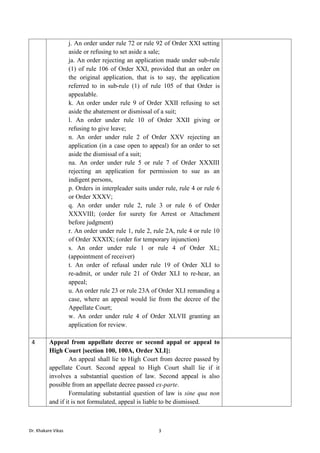
Order XLIII states that appeal under section 104 may lie from the
following orders:
a. An order under rule 10 of Order VII returning a plaint
to be presented to the proper Court except where the
procedure specified in rule 10A of Order VII has been
followed,
c. An order under rule 9 of Order IX rejecting an
application (in a case open to appeal) for an order to set
aside the dismissal of a suit;
d. An order under rule 13 of Order IX rejecting an
application (in a case open to appeal) for an order to set
aside a decree passed ex parte
f. An order under rule 21 of Order XI; (non compliance of
order of discovery)
i. An order under rule 34 of Order XXI on an objection to
the draft of a document or of an endorsement;
2
Section 96
3
Section 104
Dr. Khakare Vikas 3
j. An order under rule 72 or rule 92 of Order XXI setting
aside or refusing to set aside a sale;
ja. An order rejecting an application made under sub-rule
(1) of rule 106 of Order XXI, provided that an order on
the original application, that is to say, the application
referred to in sub-rule (1) of rule 105 of that Order is
appealable.
k. An order under rule 9 of Order XXII refusing to set
aside the abatement or dismissal of a suit;
l. An order under rule 10 of Order XXII giving or
refusing to give leave;
n. An order under rule 2 of Order XXV rejecting an
application (in a case open to appeal) for an order to set
aside the dismissal of a suit;
na. An order under rule 5 or rule 7 of Order XXXIII
rejecting an application for permission to sue as an
indigent persons,
p. Orders in interpleader suits under rule, rule 4 or rule 6
or Order XXXV;
q. An order under rule 2, rule 3 or rule 6 of Order
XXXVIII; (order for surety for Arrest or Attachment
before judgment)
r. An order under rule 1, rule 2, rule 2A, rule 4 or rule 10
of Order XXXIX; (order for temporary injunction)
s. An order under rule 1 or rule 4 of Order XL;
(appointment of receiver)
t. An order of refusal under rule 19 of Order XLI to
re-admit, or under rule 21 of Order XLI to re-hear, an
appeal;
u. An order rule 23 or rule 23A of Order XLI remanding a
case, where an appeal would lie from the decree of the
Appellate Court;
w. An order under rule 4 of Order XLVII granting an
application for review.
4 Appeal from appellate decree or second appal or appeal to
High Court [section 100, 100A, Order XLI]:
An appeal shall lie to High Court from decree passed by
appellate Court. Second appeal to High Court shall lie if it
involves a substantial question of law. Second appeal is also
possible from an appellate decree passed ex-parte.
Formulating substantial question of law is sine qua non
and if it is not formulated, appeal is liable to be dismissed.
Dr. Khakare Vikas 4
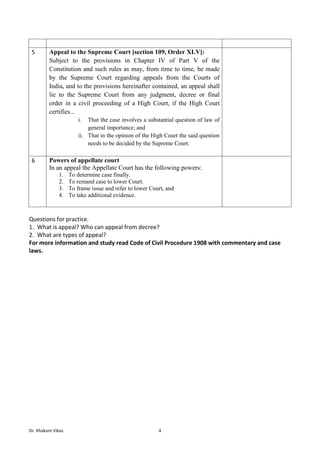
5 Appeal to the Supreme Court [section 109, Order XLV]:
Subject to the provisions in Chapter IV of Part V of the
Constitution and such rules as may, from time to time, be made
by the Supreme Court regarding appeals from the Courts of
India, and to the provisions hereinafter contained, an appeal shall
lie to the Supreme Court from any judgment, decree or final
order in a civil proceeding of a High Court, if the High Court
certifies...
i. That the case involves a substantial question of law of
general importance; and
ii. That in the opinion of the High Court the said question
needs to be decided by the Supreme Court.
6 Powers of appellate court
In an appeal the Appellate Court has the following powers:
1. To determine case finally.
2. To remand case to lower Court.
3. To frame issue and refer to lower Court, and
4. To take additional evidence.
Questions for practice.
1. What is appeal? Who can appeal from decree?
2. What are types of appeal?
For more information and study read Code of Civil Procedure 1908 with commentary and case
laws.