Monhegan:
A Prescription for Resilience
Kenneth Paul Keil Groß
A Capstone Submitted
in Partial Fulfillment of the Requirements for the Degree of
Master of Community Planning and Development
Edmund S. Muskie School of Public Service
University of Southern Maine
Capstone Advisor: Professor Yuseung Kim
May 2016
Table of Contents
Acknowledgements	iii
Preface	v
Map of Monhegan	 1
Monhegan	2
The People	 3
Statement of Research Question	 4
Delimiters	5
Definitions 	 5
From Away	 5
Gentrification.	5
Plantation	6
Resilience versus Sustainability	 6
Year-Round Resident	 6
Importance	7
Literature Review	 7
The G-Word: Gentrification	 7
The Expense of Islandness	 12
Research Methodology	 15
Qualitative Research	 15
Technical Details	 17
Adjunct Surveys	 17
Enumeration Survey	 17
Market Basket Survey	 18
A Note on Privacy	 20
Research	22
“This is kind of an outpost”	 22
The Setting	 23
The People	 25
How many people live on Monhe-
gan?	26
Git’r Done	 27
Shortage of Labor	 29
The Housing Situation	 30
Seasonal moving	 33
MISCA	35
Shortcomings	37
L. Brackett & Son	 38
Extending the Market Basket 	 39
Island Farms	 41
Case Examples: Great Cranberry and
North Haven	 45
Cranberry Isles Realty Trust	 46
Vision and Action	 47
Program	48
CIRT: Intangibles	 48
CIRT: Concluding Thoughts	 50
North Haven Sustainable Housing	51
Frenchboro	53
A Good Fit	 55
Monhegan: A Prescription for Resiliance	 59
What can MISCA do?	 60
Needs Assessment	 61
Goals and Actions	 62
Long Term Plan	 63
Fundraising	65
What the plantation can do	 66
Advertising Makes it Happen	 67
Transparency	68
Hire a General Manager	 69
Food Sovereignty	 70
Conclusion	74
Limits of research?	 75
Closing Remarks	 76
References	78
Appendix A: Enumeration Survey	 84
Appendix B: General Consent for Interviews	
87
Appendix C: Enumeration Consent	 91
Appendix D: 2010 Census	 95
2016 Enumeration Survey	 100
Appendix E: Recent Homes for Sale	 101
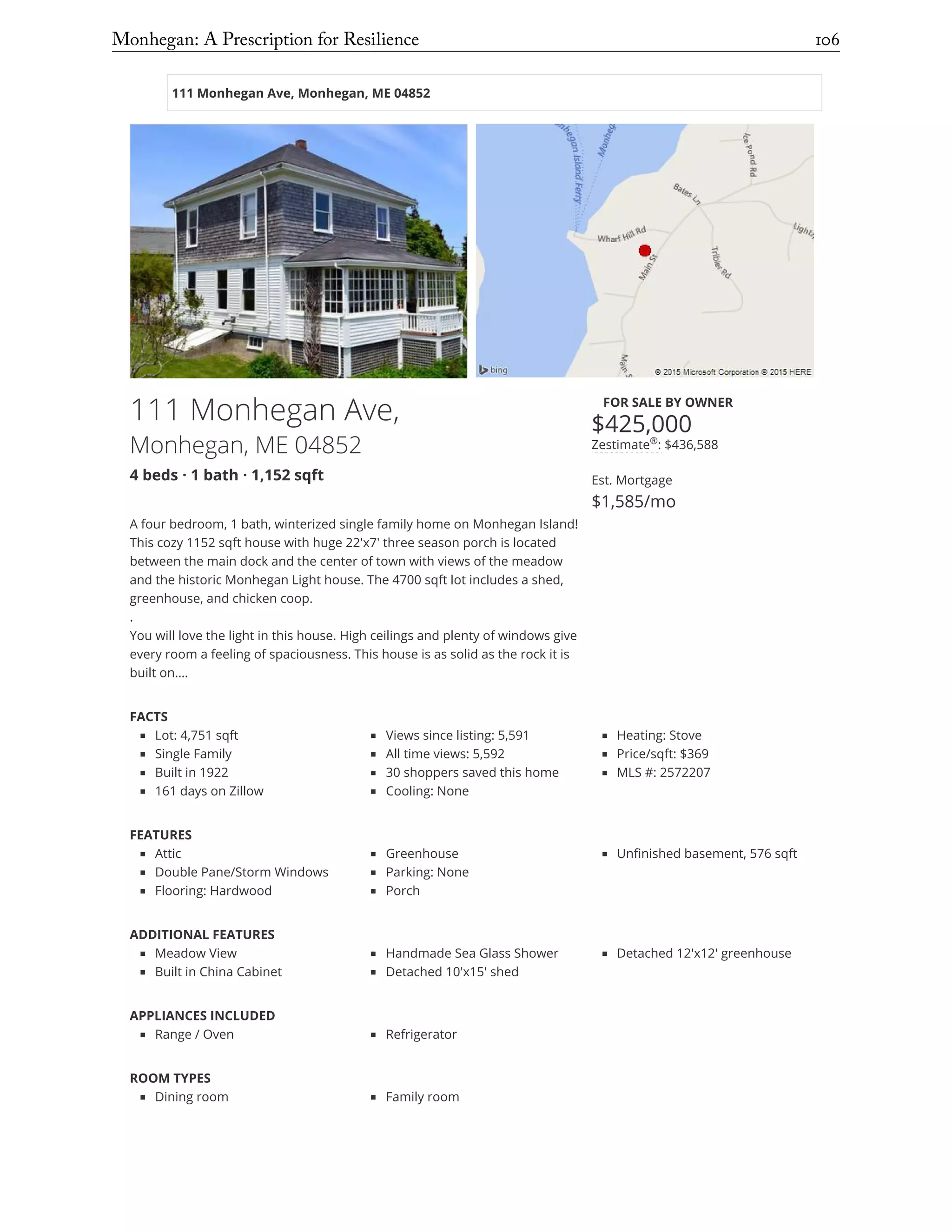
Apendix F: Modular Home Builders	 107
Monhegan: A Prescription for Resilience	 iii
Acknowledgements
A serious research project, I have come to realize cannot be accomplished without the
assistance of many other people. These are a few of those who have helped me complete this on
one way or another, and to them and the many others I have missed, thank you.
My advisor, Dr. Yuseung Kim, was instrumental in guiding my work; he understood
my point of view and provided numerous suggestions that have helped me write the paper that
I wanted to write as opposed to the paper that I had to write. The “400 block of MacDonough
Street between Patchen and Malcolm X” (Smith, n.d.) was always in the back of my mind.
Dr. Richard Barringer, Emeritus, provided me with the painful criticism that I desper-
ately needed early in this process. He made me think long and hard about what I intended to
research, why, and how. Given that he had no obligation to assist me, I greatly appreciate his
offer to read my drafts. Its clear from his comments that the initial drafts were quite painful
to endure, and his input has (hopefully) made this a better examination of Monhegan than my
initial proposal.
Thank you to my wife, Susan Mathias—you’ve been superlatively patient. Peggy Cope
Mascher, you set it all up initially and got the ball rolling. And thank you to the Island Institute
for being so cooperative and helpful in guiding me to some of the people I needed to speak to
about the other islands along Maine’s coast.
A special thanks goes to the Cranberry Isles Realty Trust which not only agreed to speak
with me, but also suggested that I meet its clients and arranged for me to spend the night in a
CIRT property for a night. Very special thanks to Rosalie Kell for providing me with a place to
sleep, Ingrid Gaither for her views and warm hospitality, and especially to Phil Whitney who
invited me to visit and who made all the necessary arrangements.
Monhegan: A Prescription for Resilience	 iv
And Monhegan. Perhaps I should enumerate the contributions of each individual, but
there are far too many people to list individually. After World War II, the island of Malta was
collectively awarded the George Cross for conspicuous service in the face of adversity; it is the
second highest order after the Victoria Cross. If I were sovereign, I would, without hesitation,
present the community of Monhegan a similar award for their willingness to speak with me and
to share with me many intimate details regarding island life there. This goes far beyond formal
interviews; nearly everyone I spoke to was open, honest, and genuinely helpful in the pursuit
of this research. This includes the many unsung heroes whom I pestered repeatedly, even after
formal interviews, who were forthright and open in their responses. This project could not be
completed without the kind help and support of the entire Monhegan community, to whom I
owe a great debt of gratitude. I sincerely hope that you feel that I “get it.”
Thank you to all of you.
Monhegan: A Prescription for Resilience	 v
Preface
While conducting research, many of the people that I met asked if they could read the
results of my work. First and foremost, this is an academic paper, a professional treatise regarding
the population issues confronting Monhegan Island. Generally speaking, academic writing is dry
and in some instances dull. Although this work partially fulfills the requirements for the degree
of Master of Community Planning and Development, I felt that it should also be useful to the
people of Monhegan as well as any other community that seeks information regarding similar
problems that they, too, face.
With this broader audience in mind, I have attempted make the writing fluid and conver-
sational. There are times when I have explained things that an academic or a professional in this
field may already understand; I ask for patience regarding while reading and to please keep this
broader audience in mind. Therefore, extra detail has been added to the introductory material to
help a broader audience understand what was done and why it was done that way.
For the broader audience, please remember that this is an academic paper. Because of
that, I needed to follow certain conventions in the writing. You may be tempted to say, “Well,
yeah. I know that already!” but remember that not everyone reading this work is familiar with
your community nor the issues that you currently confront. In theory, another researcher in the
future could pick this work up and use examples from this body of research and apply it to other
situations.
Lastly, I sincerely hope that this work will not collect digital dust in an archive some-
where on the internet. I hope that this proves useful to the people of Monhegan and to other
island communities.
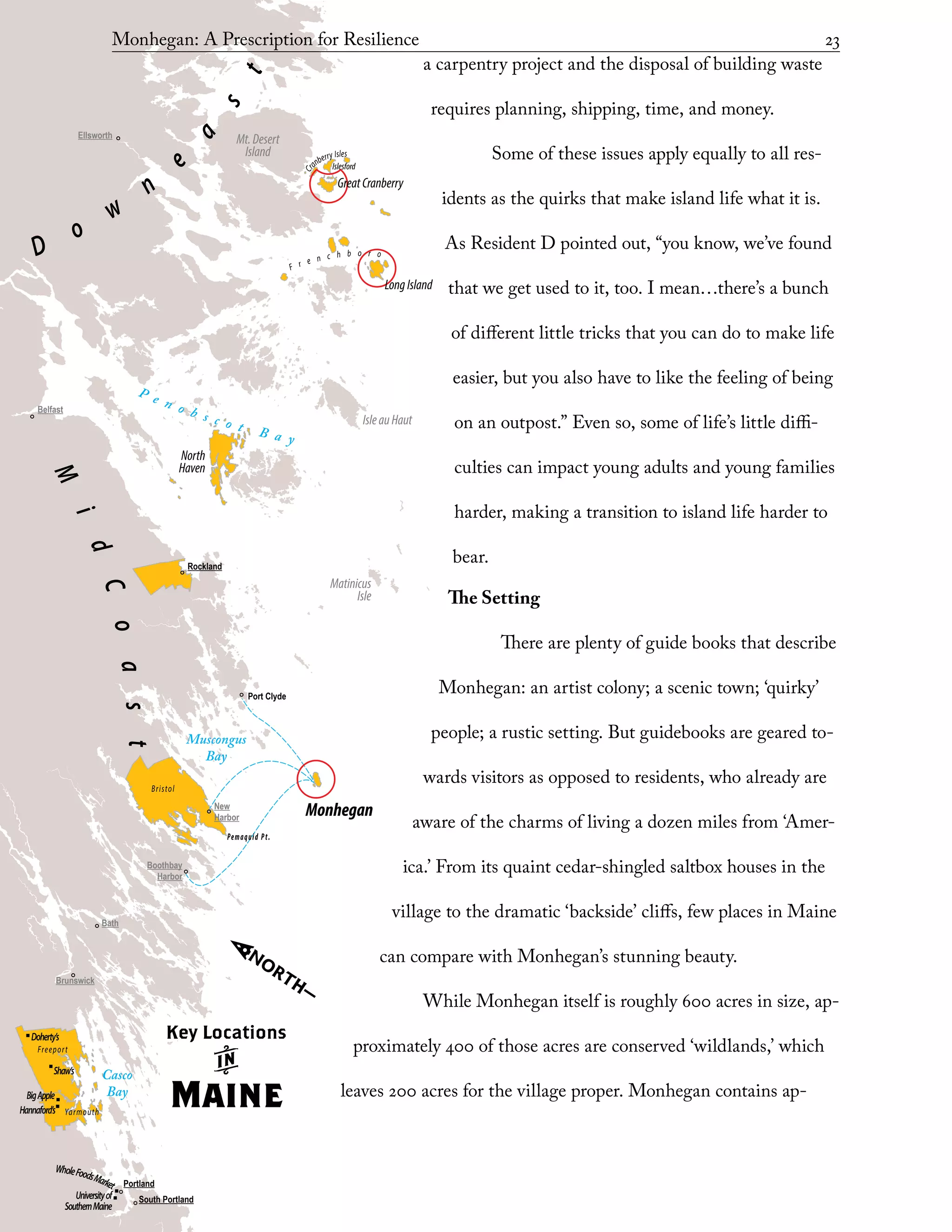
j
Station
Hill
Pulpit
Rock
Black
Head
Little White
Head
White
Head
Burnt
Head
Boar’s Head
Gull Rock
Lobster Point
Crow’s
Nest
Horn’s
Hill
Lighthouse
Hill
Wharf
Hill
Green Point
Christmas C
ove
Lobster Cove
Monhegan
Harbor
DrunkenGut
Calves Cove
Deadmans Cove
Squeaker Cove
Gull Cove
The
Meadow
Ice Pond
L o
n
g
S
w
a
m
p
Gulf of
Maine
P e b b l e
B e a c h
Arnie’s Beach
Swim
Beach
Fish
Beach
M
a n
ana
Smutty Nose
Nigh
Duck
Washerwoman
Nelson’s Ledge
Eastern
Duck Rock
Duck Rocks
Seal Ledges
B
a
c
k
s
i
d
e
The
V
i
l
l
a
g
e C a t h
e
d
r
a
l
W o
o
d
s
W
i
l
d
l a n d s
L.Bracket&Son
IslandInn MonheganLight
BurtonCottage
TheBallfield
MISCA
Lots
Cemetery
Monhegan
Mus.
DolanCottage
B.S.Cottage
Monhegan
Library
MISCABuilding
Fish
&Main
TheRed
House
Carina
Wharf
Elva’sOld
PostOffice
MonheganChurch
Monhegan
House
TrailingYew
Kendall
Apts.
WeberHome
AlisonHillStudio
GoldsmithHouse
Richardson
Cottage
Monhegan
Brewery
SchoolTeacher’sHouse
MartinHouse
T
heNovelty
BogdanoveCottage
MonheganSchool
N
Backside
Village
HarborHarbor
Manana
I
nshore
Pebble Beach
Lobster Cove
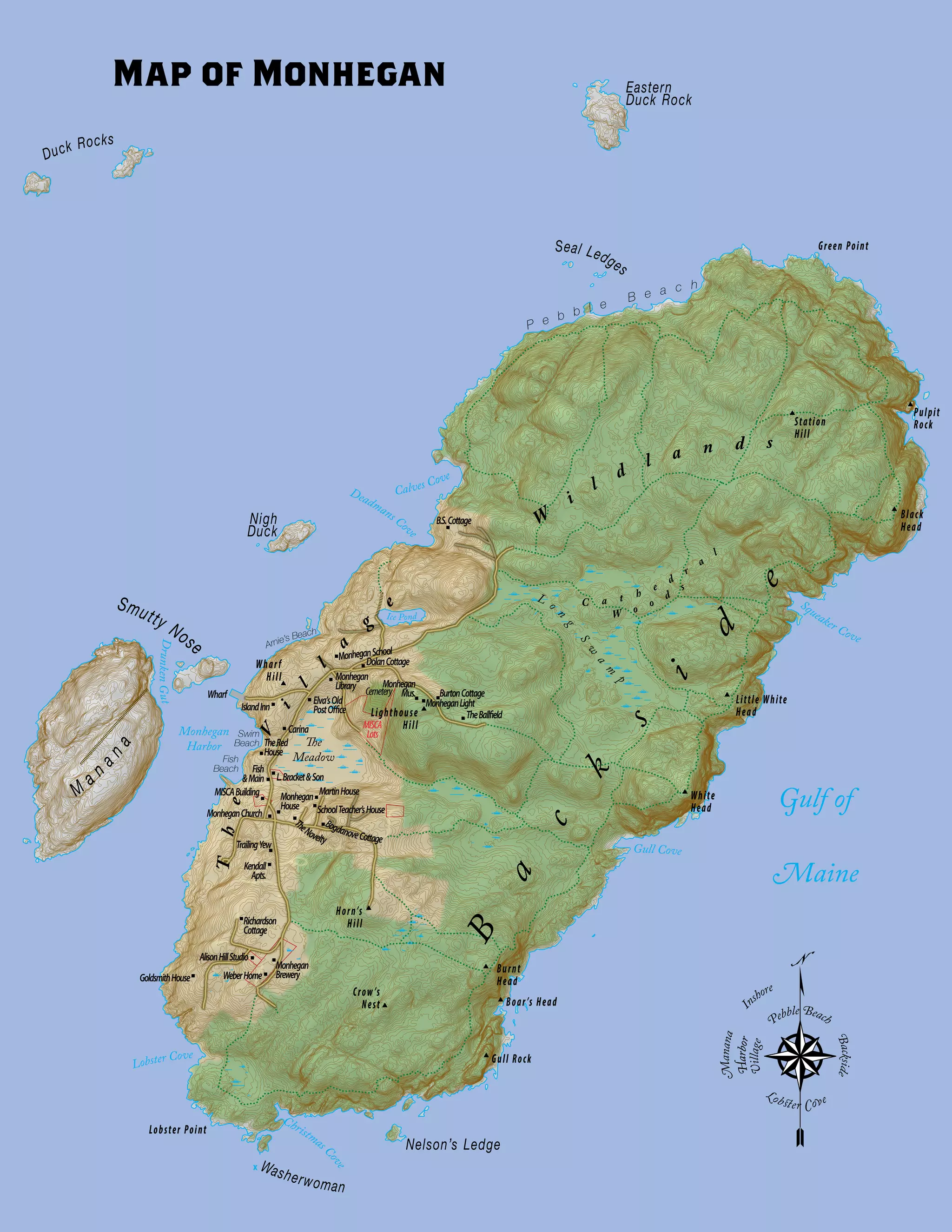
Map of Monhegan
Monhegan: A Prescription for Resilience	 2
Monhegan
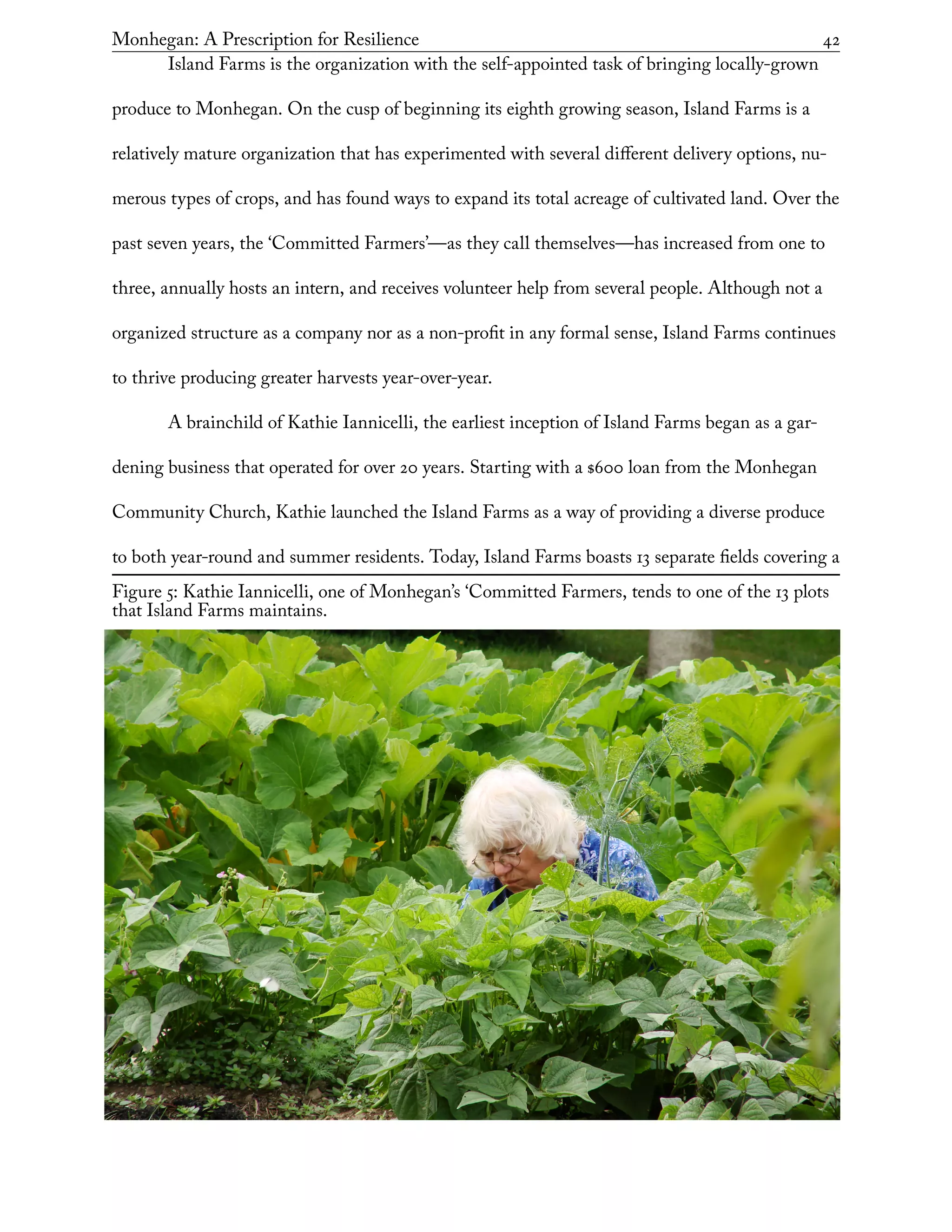
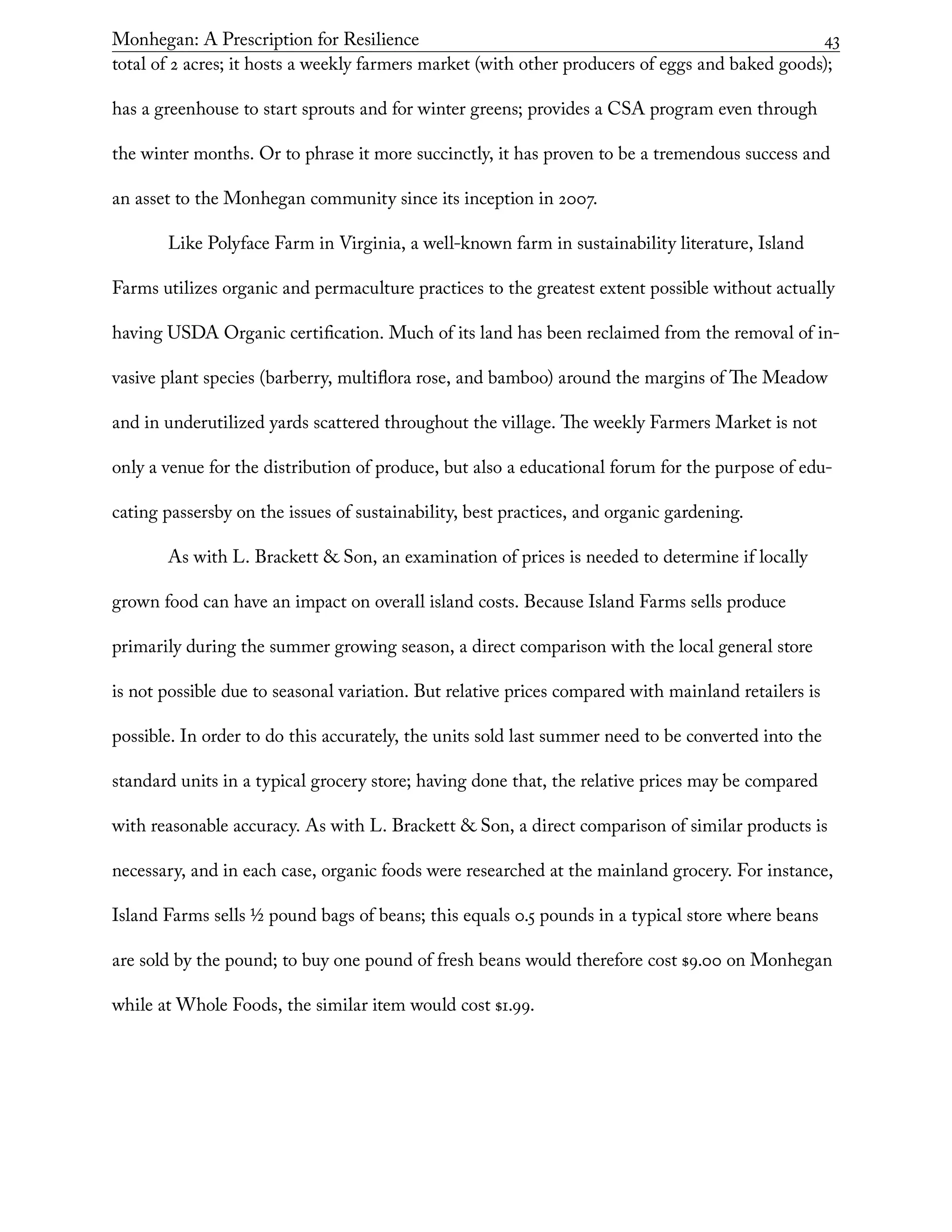
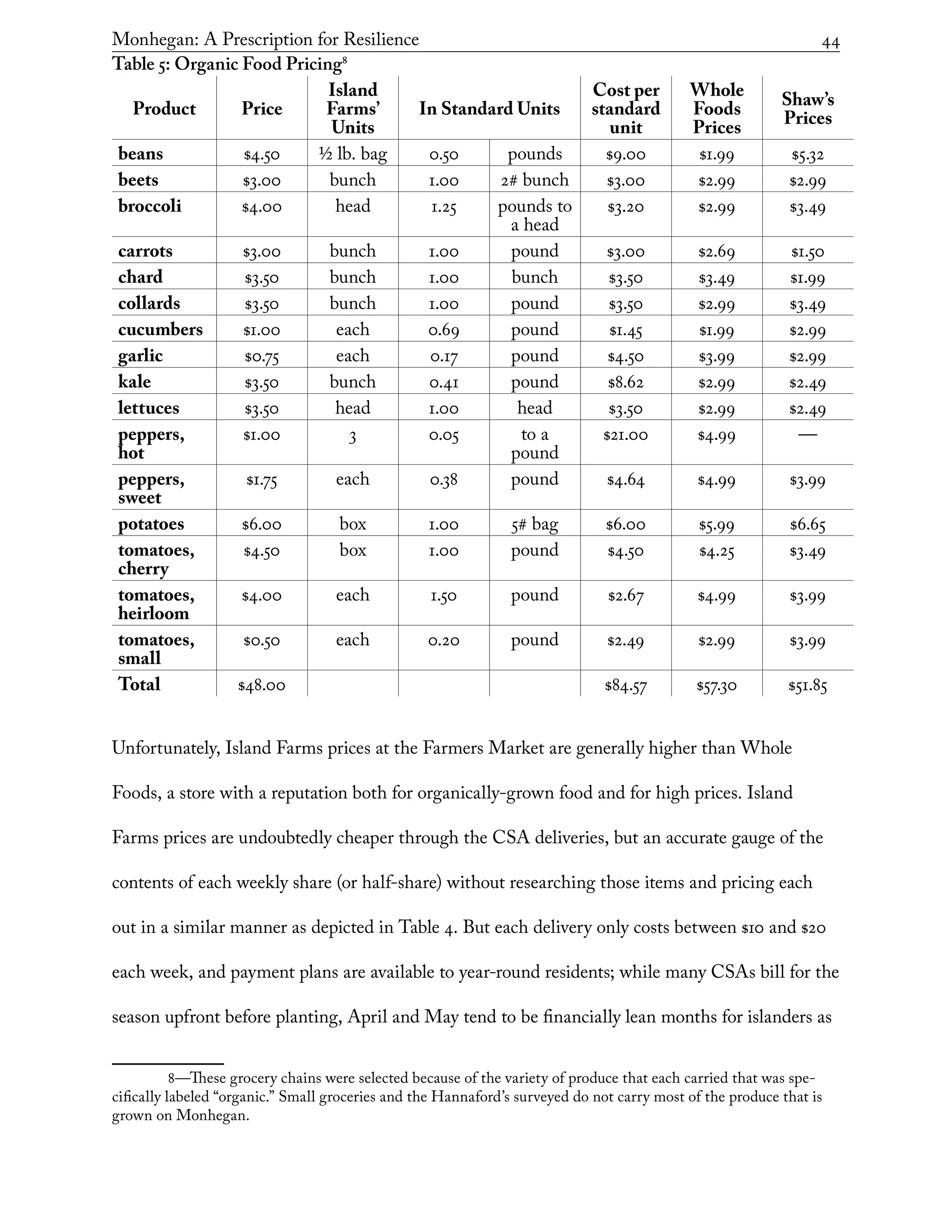
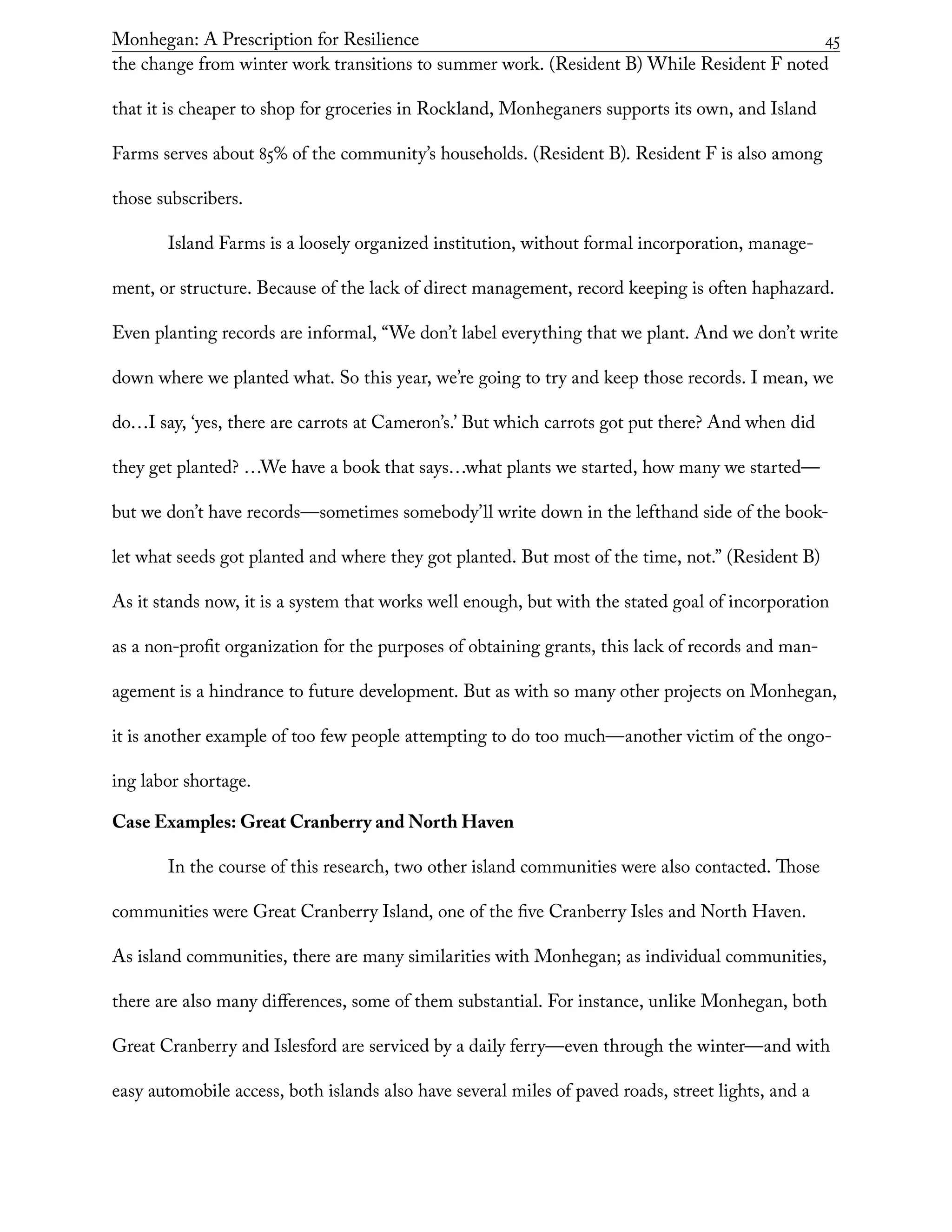
Stand on the shore at Pemaquid Point and look out to the open sea, and you’ll see that
Monhegan is both “the ocean island” and “THE island,” as in the only island you notice…
	 —from Notes on a Lost Flute: A Field Guide to the Wabanaki, Kerry Hardy
Few places in Maine hold as much lore as that associated with Monhegan. First visited in
1605 by Captain George Waymouth (May) and then by Samuel de Champlain (July), and later by
Jamestown’s Captain John Smith (1614), the community is noted for saving the lives of the starv-
ing Pilgrims in Plymouth by supplying cod (1622), for sheltering perhaps 300 mainland refugees
of King Phillip’s War (1675), and for serving as a base for the pirate Black Sam Bellamy (1717).
Monhegan’s martial history ended with the 1813 battle between the HMS Boxer and the
USS Enterprise. The battle, located between Monhegan and Pemaquid, ended with the Boxer’s
destruction and the death of both commanders; they are buried side by side in Portland’s Eastern
Cemetery. The American victory was immortalized in Longfellow’s poem, “My Lost Youth:”
Iremember the sea-fight far away,
How it thundered o’er the tide!
And the dead captains, as they lay
In their graves, o’erlooking the tranquil bay,
	 Where they in battle died.
And the sound of that mournful song
Goes through me with a thrill:
“A boy’s will is the wind’s will,
And the thoughts of youth are long, long thoughts.”
While many communities would long for a history like this, Monhegan’s rich history
continued to accumulate unabated. Accepting its first artists in 1878, Monhegan has hosted more
than its share of painters including Rockwell Kent—well known in his time as both a painter
and as an author—Edward Hopper, three generations of the Wyeth family, along with scores of
unknown and lesser-known artists attracted by Monhegan’s dramatic cliffs and landscapes. This
annual pilgrimage of oil painters and watercolorists continues to this day.
Monhegan: A Prescription for Resilience	 3
Today, Monhegan is a thriving tourist destination, hosting hundreds of visitors each day
during the summer months. Five separate ferry boats from three different ports travel to and
from the island bringing people to see the quaint fishing village set amongst 400 acres of ‘wild
lands.’ Those aware of Monhegan’s heritage are also drawn to the working studios of about 20
different artists who ply their craft in an idyllic setting.
The People
The Island Institute publishes Island Indicators on a periodic basis which also includes
population estimates. Their estimate for 2011, one year after the decennial census suggested that
60 people lived on Monhegan, and by 2015, that number had dropped to 50. (Island Indicators,
2012 and 2015) While these numbers may be more accurate than that of the American Community
Survey’s estimate, the surveys were not scientific and were based on inshore interviews with key
island personnel; given the labor-intensive nature of a full enumeration, the quantity of islands
that the Island Institute serves (15), and their need for only very rough estimates to conduct their
work, the Institute may be forgiven for not conducting an intensive survey.
Monhegan’s recent history demonstrates the volatility of its population: possessing 65
people in 1960, its population fell to just 24 during the 1960s due to a calamitous fire (McLane,
1992); it recovered slightly to 44 residents in 1970 and soared to 109 in 1980, with a steady decline
since that time. (Curtis, n.d.) Nevertheless, population figures form the core of a viable town
plan. (Daniels, et al, 2007) These figures form a baseline from which future planning may be
built upon, determining both housing and job needs. The People
The Island Institute publishes Island Indicators on a periodic basis which also includes
population estimates. Their estimate for 2011, one year after the decennial census suggested that
60 people lived on Monhegan, and by 2015, that number had dropped to 50. (Island Indicators,
2012 and 2015) While these numbers may be more accurate than that of the American Community
Monhegan: A Prescription for Resilience	 4
Survey’s estimate, the surveys were not scientific and were based on inshore interviews with key
island personnel; given the labor-intensive nature of a full enumeration, the quantity of islands
that the Island Institute serves (15), and their need for only very rough estimates to conduct their
work, the Institute may be forgiven for not conducting an intensive survey.
Monhegan’s recent history demonstrates the volatility of its population: possessing 65
people in 1960, its population fell to just 24 during the 1960s due to a calamitous fire (McLane,
1992); it recovered slightly to 44 residents in 1970 and soared to 109 in 1980, with a steady decline
since that time. (Curtis, n.d.) Nevertheless, population figures form the core of a viable town
plan. (Daniels, et al, 2007) These figures form a baseline from which future planning may be
built upon, determining both housing and job needs.
Statement of Research Question
Monhegan, like many island communities, is threatened by the loss of population as its
young adults migrate to the mainland. The purpose of this study is to develop a resilient popula-
tion on Monhegan Island.
Knowing the problem is easy, as is asking the obvious question, “How do we get people
to move to this area?” This is a problem that confronts not only Monhegan, but also other Maine
islands and even Maine itself.
Several factors make Monhegan’s future uncertain. The first is the gradual shift from
commercial fishing, the mainstay of its economy, as it becomes more reliant on tourism services.
In addition, seasonal vacation homes inflate the cost of housing on the island. The island—in
conjunction with partners such as the Island Institute—is currently exploring options to lower
the costs of housing and energy, but island living is expensive.
Therefore, to increase Monhegan’s attractiveness as a place to live—not just to visit—the
community needs to ask itself, How does Monhegan create and environment that attracts new
Monhegan: A Prescription for Resilience	 5
residents? What can be done to arrest the problem of affordable housing? Can local agriculture
be used to mitigate the expense of islandness? Within the scope of this study, the last question is
limited to impact of local agriculture on food prices and whether that will assist in the attraction
of new residents.
Delimiters
This study is confined to the Plantation of Monhegan. Other Maine islands and main-
land areas will be examined only for those case examples that can be applied directly to Monhe-
gan’s present conditions.
Definitions
From Away
A general Mainer term for someone born and raised outside of Maine. In some circles,
one cannot be a “true Mainer” unless that person is third generation Mainer; this strong sense of
identity can also apply to ideas and concepts “from away,” suggesting skepticism about its efficacy
in a local context.
Gentrification.
Few words in planning engender more controversy than the “G-Word.” For purposes of
this investigation, the Centers for Disease Control has a clear and succinct definition:
Gentrification is often defined as the transformation of neighborhoods from low value
to high value. This change has the potential to cause displacement of long-time residents
and businesses. Displacement happens when long-time or original neighborhood resi-
dents move from a gentrified area because of higher rents, mortgages, and property taxes.
(CDC)
This definition is used because it lacks bias. As the literature will reveal, gentrification can
affect any social or economic class, and this definition also lacks a qualitative description of the
area being gentrified (such as run-down or slum).
Monhegan: A Prescription for Resilience	 6
Plantation
A plantation is the weakest form of local self-government within Maine, and should not
be confused with large agricultural estates. Maine’s towns and cities both have more comprehen-
sive forms of government including an executive branch, which plantations lack. An assessor is
a member of a three-person board that serves as a plantation’s government. Because plantations
lack an executive branch, the assessor charged with executing the decisions made by the board is
called the first assessor.
Resilience versus Sustainability
Resilience and sustainability are often used interchangeably in popular culture. Resil-
ience in this study refers to the ability to withstand stress and hardship, and more specifically in
this study, the ability to withstand the pressures of gentrification. Sustainability is the ability to
self-perpetuate a condition assuming that outside stress and hardship do not befall a particular
community. Thus, resilience, as suggested here, is a stronger form of sustainability.
Year-Round Resident
According to the Island Institute, this surprisingly requires explanation because:
“…the definition of the year-round population differs from one island to another and
island communities differ in how they define a “year-round” resident…The U.S. Census
counts the number of people residing in each household or location as of April 1 of the
Census collection year. One of the limitations of this process is that people self-report
their place of residence and the process may not include people who are off-island (such as
students, vacationers, or people who winter off-island).” (Island Indicators, 2015)
For purposes of establishing a sustainable community and of the scope of this research,
the definition of “year-round resident” will consist of Monheganers who live on the island for 12
months of each year (allowing for short trips inshore for shopping, visiting relatives, and va-
cations). Monheganers who do not spend the winter (“people who winter ashore”) will not be
counted as “year-round residents,” but minors attending high school and college students who
Monhegan: A Prescription for Resilience	 7
grew up on Monhegan will be considered “year-round residents” in the spirit of a Rumspringa
hope that they will return permanently.
This is not to say that a part-year resident—or seasonal resident—is not an important
member of the community. Many part-year residents have important and positive roles on Mon-
hegan; such people simply do not live there year-round.
Importance
Very little is written about the demographic plight that confronts each of Maine’s island
communities. Maine’s mainland communities are well documented, but further study of the
offshore island communities is needed to properly address the needs of these communities. In
addition, Monhegan needs to adapt new solutions that do not rely as heavily on fishing as the
mainstay of its economy, and it must adapt to the pressures that seasonal tourism places on the
local economy. (McReynolds, p. 95, 2014)
Hopefully this study will find ways for the Monhegan Island community to remain a vi-
able and resilient society throughout the 21st Century. The methods of research and prescription
can hopefully be used for other island communities in Maine as well.
j
Monhegan: A Prescription for Resilience	 8
Monhegan: A Prescription for Resilience	 7
Literature Review
Literature, n. The collective body of the writings of all mankind, excepting Hubert Howe
Bancroft and Adair Welcker. Theirs are Illiterature.
	 —Ambrose Bierce, The Devil’s Dictionary
The most common theme that runs through the literature regarding Monhegan spe-
cifically, island affordability, and island population is that not much has been written on these
topics. Fortunately, enough has been written about islands specifically and rural life generally to
draw analogs to the questions posed in this body of research, either through analogs of their own
or through direct research. Monhegan specifically, is fertile ground for research, and since each
island in the world poses a unique case, much can be learned here.
The G-Word: Gentrification
When beginning exploration of the issues confronting Monhegan, one correspondent
suggested,
“I would be careful to distinguish between “gentrification” and high real estate prices on
islands. The seasonal nature of much of Maine’s coast isn’t anything new – and the word
gentrification would imply that, somehow, the summer housing is being redesigned and
redefining the aesthetics of the islands. Although that is true in some cases, it isn’t always.
It might be more accurate to say that the desirability of island life has, over time, increas-
ingly inspired the movement of seasonal residents to islands. That has, in turn, driven up
the real estate prices.” (Correspondent 1)
Is housing affordability caused by gentrification, or is it caused by another, yet unnamed,
factor? The literature suggests Correspondent 1 is in error—the reason for which will be explored
shortly—and that the changes transpiring on Monhegan are caused by gentrification. The prob-
lem of gentrification is fairly common in island communities, even those that are not “lower
class” nor “run-down” as the classic definition might suggest.
Monhegan: A Prescription for Resilience	 8
Ruth Glass coined the term ‘gentrification’ in 1964, and in the fifty years since its intro-
duction, its definition has remained consistent. Ruth Glass, a Marxist-inspired sociologist in
London was among the first researchers to examine this issue and to define its consequences.
Clark, et al, interpreting Glass’s definition, describes gentrification as, “an area [that] is
characterized by two outstanding features: a marked shift in occupancy upward in terms of class/
socioeconomic position, and, reinvestment in the built environment.” (Clark, et al, 2007; Atkin-
son, 2003) When compared with the definition used by the CDC (q.v. Definitions), there is little
functional difference in the definitions that these authors describe.
There are other methods to determine whether gentrification is transpiring, but these
methods are lacking in different ways. For instance, the Philadelphia Federal Reserve Bank’s
study used the change in consumer credit scores to determine gentrification (Ding, et al, 2015),
but this type of data would not be appropriate in which gentrification is a result of seasonal hous-
ing. Another method tracks changes in educational attainment along with family income, house
ownership, changes in poverty and race (Barton, 2016); this method would have little value in an
island community where 77.5% of the community already owns their home, and racial diversity
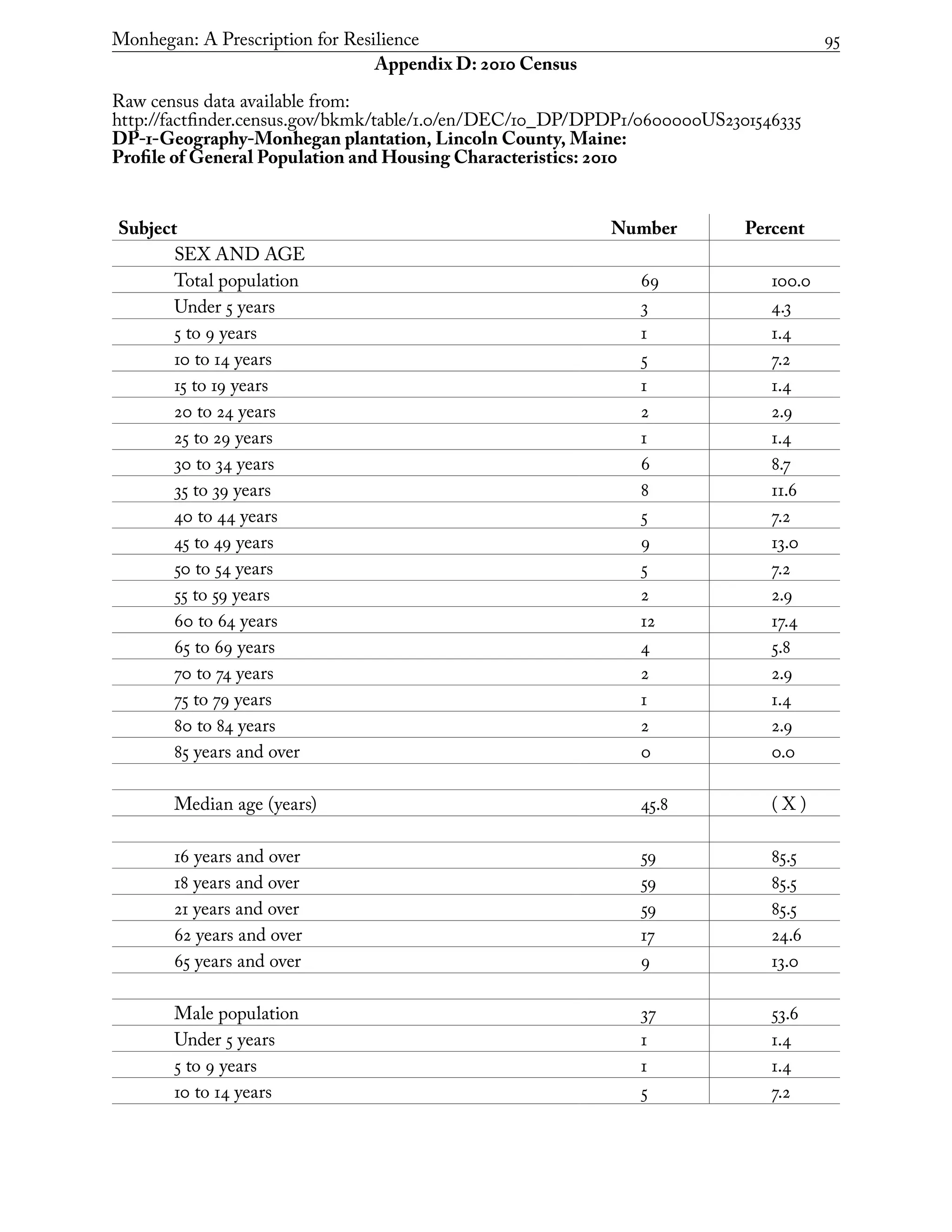
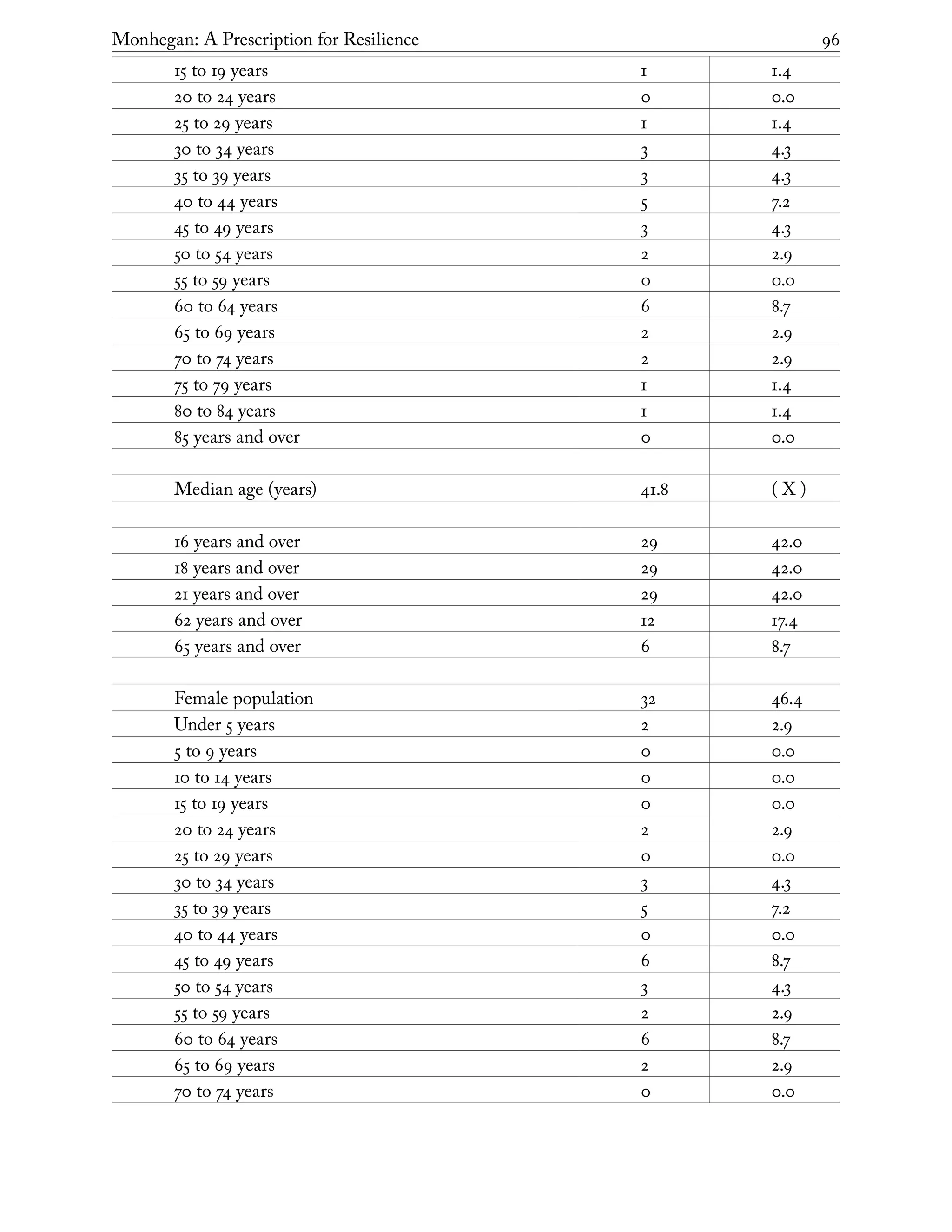
is already minimal, with 67 of 69 residents identifying themselves as White in the 2010 census.
While educational attainment can be one measure of gentrification, its value is of limited use
without other statistics to support its use.
Because these types of quantitative methods cannot be applied to an island community
such as Monhegan, this raises the question as to whether or not the factor causing the lack of
affordable housing is gentrification. In the case of Monhegan, that pressure comes in the form
of second—or summer—homes. Because of the aesthetic and scenic value of a coastal place such
as Monhegan, along with structural changes in the rural character in coastal Maine, “outsiders”
seek picturesque residences which inevitably increases housing costs to a point that many locals
Monhegan: A Prescription for Resilience	 9
can no longer afford to live in those same places. (Paris, 2009) More specifically, he states, “there
is a clear causal relationship between the growth of second home ownership and problems of
affordability for lower-income households and first time [home] buyers.” In this case, “lower-in-
come” does not refer to the poor, but rather the relationship between those able to afford the cost
of a second home on the coast versus the indigenous population.
Two case studies—one examining Bruny Island, near Hobart, Tasmania (Jackson, 2006),
and the other regarding Södra Skärgården, an archipelago near Göteborg, Sweden (Clark, et al,
2007)—frame the current discussion regarding island gentrification. Characterized by heated
land prices, second homes, and tourism, these case studies represent close analogs to Monhe-
gan. Like Monhegan, most of Bruny’s homes are owned by summer residents and tourism in the
mainstay of the local economy. ‘“Land prices are just crazy,”’ stated one interviewee on Bruny
(Jackson, 2006), and the same could be said of Monhegan as well.
The case study of Södra Skärgården, an archipelago 3.6 km off of the coast of Göte-
borg, Sweden, reveals a history very similar to that of Monhegan’s: settled in antiquity, Södra
Skärgården was a fishing and agricultural community until a spa hotel was built there in the
1850s. Gradually at first, the island culture changed throughout the twentieth century from an
self-sufficient community to one focused on seasonal and holiday tourism. Clustering along the
desireable shorelines, the increase in seasonal housing and residents create a burden on local ser-
vices and inflate the cost of housing.
Monhegan’s history closely parallels that of Södra Skärgården: Monhegan’s agricultural
base declined significantly between 1842 and 1900; both artists—often a harbinger of gentrifica-
tion—and the first hotel arrived in 1878; in the twentieth century, successive subdivisions drove
the number of houses up from 34 in 1910 to 174 in 2010 as the population of the island dwindled.
(Jenney, 1923; McLane, 1992; ACS)
Monhegan: A Prescription for Resilience	 10
In their conclusion, Clark, et al, draws attention to other island communities world-
wide that are also affected by gentrification including Peaks Island and the Maine coast without
further elaboration. But their cursory observations regarding coastal Maine’s gentrification is
strongly supported by another study.
Using rent-gap analysis1
—another means of measuring gentrification—Thompson (2012)
identifies several communities on Maine’s coast affected by gentrification pressures. In his anal-
ysis, Thompson examined four communities (Eastport, Lubec, Rockland, and Port Clyde) for
signs of, aspects of, and effects of gentrification. Of these communities, Port Clyde is of par-
ticular interest because it is the primary entrepôt for Monhegan. Like Monhegan, land values
were never undervalued in Port Clyde,2
often a precursor for urban gentrification, but the succes-
sion of ‘rusticators,’ artists, and so-called ‘amenity migrants’ have driven up housing prices over
time. This pressure has resulted in the relocation of many fishermen outside of the village and
competition for water access with the ‘amenity migrants’ who convert the docks to private uses.
Thompson attributes this development pressure on Port Clyde’s role as the main ferry port for
Monhegan, with many of the local businesses catering to the tourism traffic that the ferry gener-
ates. Because of the close symbiotic relationship between Port Clyde and Monhegan, it is hard to
imaging the pressures of gentrification affecting one end of the ferry line, but not the other.
Whether the various methods of measuring gentrification can be utilized in such a small
community as Monhegan is debatable. As noted, some demographic measures cannot be applied,
and land records are difficult to acquire. But there is ample circumstantial and anecdotal evidence
to support the claim that Monhegan is in the process of gentrification.
1—Rent-gap is the measure between the current value and its potential value. The term was coined by
Scottish/American geographer Neil Smith in 1979. He proposed that uneven spatial development was the result of
capital markets rather than social preference.
2—in essence, Thompson concedes that rent-gap analysis is a less-than-ideal means of measurement of
gentrification within Port Clyde because “there was never a decrease in capitalized ground rent.” Rent-gap analysis
is difficult to undertake due to the amount of analysis of land records needed to perform this type of study. Because
Monhegan’s property records are not readily accessible, this method is not practical in this particular case.
Monhegan: A Prescription for Resilience	 11
How could Correspondent 1, a respected professional, make such a mistaken misdiag-
nosis? The correspondent is not mistaken; the answer to this question is that the G-Word has
become a divisive and controversial term that potentially could alienate some of the people who
are in a position to help alleviate the situation:
It is also important to remember that summer residents can have a meaningful, positive,
and important impact on island life. On many islands, families have been visiting in the
summer for generations and they take great pride in being a key part of the community in
which they live seasonally. (Correspondent 1)
In the public mind, the G-Word is “an ugly word, a term of outrage.” (Davidson, 2014)
Reactions to gentrification in New York City are strong, indicating the conflict between devel-
opers and ‘hipsters’ on one side and existing residents on the other. Spike Lee, a Brooklyn native,
encapsulated local sentiment when he stated, “You can’t just come in when people have a culture
that’s been laid down for generations and you come in and now shit gotta change because you’re
here?” (Coscarelli, 2014) Long time residents have a sense of “ownership” (Tomlinson, 2016) and
pride that a long-time association with a place engenders.
That conflict exists on Monhegan as well, but is not nearly as obvious as in Bushwick or
in The Bronx. National Geographic Magazine notes that conflict in the title of its report on Mon-
hegan, “Welcome to Monhegan Island, Maine. Now please GO AWAY.” (Newman, 2001b). In a
supplement, the author explained the social hierarchy:
“In the unofficial hierarchy of Monhegan, day-trippers3
are the bottom dwellers; short-
term renters rank a few notches up, superseded by the stable population of summer residents; and
finally are the year-round locals, fewer than half of whom fish for lobster in winter.” (Newman,
2001a)
3— Local term referring to the hundreds of people who descend upon Monhegan on the morning ferry
and leave before 6:00pm when most shops close for the evening.
Monhegan: A Prescription for Resilience	 12
People who have visited Monhegan have also commented on the ‘quirkiness’ of the year-
round residents, without realizing the possible reasons why. “In hindsight, I think the unfriend-
liness is a something of a gimmick. Kind of like Ed Debevic’s4
in Chicago, scaled up to an entire
island. People come there expecting to be treated rudely.” (Correspondent 2) Perhaps he should
have stayed longer than a day? Given that Monhegan’s 50 men, women and children are overrun
by upwards of 600 daily visitors (Report…, 2005), a phenomenon that causes the island to attain
urban-level population densities, that ‘rudeness’ is understandable.
The use of the G-word is a minefield that requires delicate handling. A certain amount
of diplomacy and relationship building will, in the end, be the key to finding a solution to the
housing problem on Monhegan.
The Expense of Islandness5
“’Everything costs twice as much as it does on the mainland,’ one local told me after we
arrived. That turned out to be an understatement. I dropped $40 on a lunch that should have cost
less than $20.” (Elliot, 2012) While this travel writer acknowledges the cost of goods on an island
is inflated due to the cost of shipping everything—rolls for sandwiches, condiments, napkins and
plates—to Monhegan, he clearly did not grasp in its entirety how expensive island life can be.
McReynolds (2014) encapsulated the issue of the cost of living on all of Maine’s island
communities within one study. As he pointed out, not only do most household items need to
be imported to resource-poor communities, but also that island prices are heavily dependent on
the costs of transportation. Suggesting that measures of the cost of living on island communi-
ties should reflect a combination of food and housing costs, McReynolds also noted that other
4—Ed Debevic’s was a restaurant in the River North section of Chicago, noted for its rude wait staff.
Ironically, the restaurant closed in October, 2015 to make way for a 22-story residential high-rise; River North has
gentrified to a great extent since the restaurant opened at that location in 1984. (http://goo.gl/kOiSaz)
5— Throughout the literature reviewed for this study, Islandness is a commonly used term (Baldaccino,
2004; Conkling, 2007; Jackson, 2006) that refers to the unique social structure that occurs on islands. This struc-
ture can manifest itself as fierce independence from outside interference, yet instills a strong sense of cooperation
and interconnectedness among the community’s residences.
Monhegan: A Prescription for Resilience	 13
measures such as energy and its dependent variables of utility, heating oil, and transportation
costs also be included in such a standardized measure. In particular, he noted that creating food
independence through local agricultural efforts could also alleviate some of the stresses related to
island living.
McReynolds indicated that his article was a preliminary study that required further in-
vestigation; some of that investigation has already been reviewed in other literature. For instance,
McReynolds neglected to mention the importance of broadband internet service; while all island
communities in Maine have some form of broadband service, its upgrade would have profound
and positive impacts, not only as a service for tourist, but also to facilitate mundane data ex-
changes such as credit card purchases (Tilson, 2015). In addition, offshore businesses that rely on
the internet could also be facilitated with higher-speed connections.
Regarding the other main issue that McReynolds described, sustainable food sources,
very little has been written about this area of study. The Island Institute conducted a “market
basket survey” in 2010 and in 2015 to gauge the cost to islanders and found that an archetypal
shopping trip would cost 33% more in island communities than in adjacent inshore6
communi-
ties. (Island Indicators, 2012; McReynolds, 2014). Monhegan was not part of the “market basket
survey,” so its exact deviation from inshore prices (Port Clyde is its corresponding port) is not
known. In addition, the difference between island prices and the mainstream prices that urban
centers is not known; most people in Maine live in urban centers, which may enjoy significantly
lower food costs—or not, as the case may be—than both rural and island communities.
The other food option that islanders may elect is to harvest their own food. McReynolds
himself posed the question, “what can islanders do to generate their own food supply through
6— Monheganers’ term for the mainland. Like many local toponyms in Maine, the origin is derived from
Monhegan’s nautical heritage. Other similar names, such as Foreside and Backside, echo this origin throughout
the coastal regions of the state. Depending on the context, inshore can also be called “America,” heightening the
sense of isolation, separateness, and independence. “America” is also used colloquially on other islands as well.
Monhegan: A Prescription for Resilience	 14
community gardens and other local sources?” (McReynolds, 2014) Monheganers do produce at
least some of their own food, however, and they operate their own Community Supported Agri-
culture (CSA) which provides a wide range of crops for local consumption. At its peak, the CSA
“delivered as many as 25 bags of produce weekly to working winter residents, to those who lend
their land to the farm, and to some elderly summer residents.” (Iannicelli, 2015)
j
Monhegan: A Prescription for Resilience	 15
Research Methodology
There are known knowns. There things we know we know. But we also know that there are
known unknowns. That is to say we know that there are some things we do not know. But
there are also unknown unknowns. The ones we don’t know we don’t know.
	 —Donald Rumsfeld, Secretary of Defense, 2002
Qualitative Research
How does one investigate issues and problems within a small community? Statistical
methods such as census data are unreliable due to the small size of the population. In addition,
many of the finer details that illustrate issues and problems become lost or are simply not col-
lected through a larger survey. The most logical course of action was to conduct a qualitative
study utilizing interviews to illustrate issues and to shed light on problems. One quality that
quantitative methods are very poor at measuring are the nuanced social aspects of those issues
and problems, but qualitative methods excel at this particular aspect of research.
A colleague and respected researcher asked, “Why interview residents? They’re all going
to tell you the same thing?” True, but that’s the point. A single observation (or interview) could
be an outlier or simply a rumor. But multiple observations from different perspectives validate the
issue being studied and helps to ensure the validity of each of those independent observations.
For example, the colleague’s point of view may be valid, or it could be an isolated opinion without
the support of other observations from other colleagues. In truth, he may have been offering a
Socratic line of questioning in order to bolster this study, but there is no supporting data to prove
this opinion. In addition, those who disagree with prevailing attitudes illustrate other aspects of
island life: societal fractures as well as flaws in the systems or programs within a community.
Conducting a series of interviews needs to follow a format in order to maintain a level
of scientific consistency. While each interview may contain a certain amount of fluff that is not
relevant to the systematic study of specific issues or problems, every interview asked specific ques-
Monhegan: A Prescription for Resilience	 16
tions related to the issues of attracting young people to Monhegan and assessing the problems
that may repel such people:
❧❧ What do you like about living on Monhegan?
❧❧ What do you miss from living inshore? (Nearly everyone lives on the main-
land at some point, even if that period of time is only during high school)
❧❧ What makes living on Monhegan difficult?
❧❧ If a given person was ‘from away,’ what brought that person to Monhegan initially?
In addition to these specific questions, each interview followed either an unstructured or
semistructured form based on the responses from each participant. Allowing the participants to
partially direct the discussions revealed several points that might otherwise have been missed;
one issue that had not been considered before conducting these surveys was that of what makes
‘a good fit’ in an island community. This particular issue had not been discussed in the literature
reviewed for this project.
Community leaders also answered questions regarding their specific programs as related
to this study. The programs specifically targeted were the Monhegan Island Sustainable Commu-
nity Association (MISCA) and the Island Farms. The questions related to current plans, fund-
raising, current size of effort, problems with the administration of each program, and program
successes.
Because the interviews were semi-structured, other details also surfaced during these
discussion. There were, of course, many details and anecdotes about island life. But more im-
portantly, other issues were also revealed as well. Perhaps the most important issue that was not
revealed in the literature is that of seasonal moving, a condition caused by the lack of permanent
winter housing which forces nearly a quarter of Monhegan’s population to move twice each year.
More details on this condition will follow in the research section.
Monhegan: A Prescription for Resilience	 17
Technical Details
All told, this study utilized just under 7 hours of interviews, nearly five hours of which
transpired on the island of Monhegan.4
Six people on Monhegan participated directly in these
recorded interviews, four of whom were community leaders. All interviews took place in the
participants’ homes except for one, which took place at the School Teacher’s House where this re-
searcher was house sitting during the week of February 13, 2016.5
Four additional interviews took
place on Great Cranberry Island during a visit there on March 17, 2016 and with North Haven
Island (via phone).
Adjunct Surveys
The bulk of this body of research revolves around the gleaned from the interview process,
but to supplement the analysis and discussion of that data, this research incorporates two addi-
tional surveys. These two surveys serve primarily one purpose: satisfying the researcher’s curiosity
and do not represent critical data to the body of this research. But they do inform the broader
conversation of maintaining a sustainable population on Monhegan and are thus included here.
Enumeration Survey
Population figures for Monhegan depict a steady decline over the past three decades after
a modern peak of 109 people in 1980; 88 people in 1990 (-19.3%); 75 in 2000 (-14.8%); 69 in 2010
(-8.0%). But the 2015 Island Indicators noted that Monhegan’s population had fallen to just 49
(-29%)! Curiosity stepped in: how could that be correct? How many people really live on Monhe-
gan year-round?
The initial survey was paper-based and collected directly from the participants. The
survey itself consisted of seven questions (see Appendix A) that inquired about each household.
4—Should the exact amount of interview time interest the reader, the grand total amounted to 6:56:53 of
which 4:47:04 was recorded on Monhegan.
5—This study also makes use of the informal input from at least 15 additional individuals on Monhegan,
plus photographs, collected ephemera, and direct observations of island life on Monhegan with this intent of expe-
riencing and understanding as many details of island life as possible.
Monhegan: A Prescription for Resilience	 18
In a perfect world, this would have been the only method necessary; the week during which the
survey was conducted (February 12–22), however, was winter break for most of Maine’s schools.
Many people were inshore during that week and an exact count was impossible, and only 12
responses were collected during that time. In order to collect better results, an online instrument
was created and distributed through a private online group on Facebook popular with Monhegan
residents. The online version contained two additional questions for control purposes: “Name?”
and “Are you a year-round resident?”—Both fields were required to be filled in before submis-
sion, and were used to explicitly grant consent, to prevent the duplication of entries (for instance,
by different members of the same household), and to weed out summer residents excited at the
prospect of filling out a survey about Monhegan. The consent field was particularly important
because consent on the paper survey was collected on a separate sheet of paper and not associated
with a specific survey. The online survey collected an additional five households (as well as sev-
eral summer residents, as expected). Knowing that several people had not answered either sur-
vey, the results were corroborated with Resident X, a long time resident who regularly conducts
head-counts on the island. This last method (contacting locals) is the method used by the Island
Institute for their Island Indicators (2012, 2015), and proved to be the most reliable of the three
methods.
Market Basket Survey
The Market Basket Survey is an extension of previous such surveys performed by the Is-
land Institute and published in their Island Indicators (2012 and 2015). The purpose of the original
survey was to compare food prices on the islands with those in immediately adjacent ports to
roughly determine how much transportation costs add to the price of food in those island com-
munities. The Island Institute surveyed several islands where they had available staff, but Monhe-
gan was not included as a part of the original surveys. Furthermore, McReynolds (2014), utilizing
Monhegan: A Prescription for Resilience	 19
the 2012 Island Indicators, hypothesized that growing food locally to the islands could represent
a cost savings to residents and enable them to use their savings for other needs such as housing.
Thus the inclusion of a new Market Basket Survey for Monhegan represents both an extension of
existing data and an opportunity to test McReynolds’s hypothesis.
To examine this hypothesis, the same Market Basket Survey items were used to establish
the prices on Monhegan. Because some of the items on the Island Institute’s list were not avail-
able on Monhegan (canned corn, rice), several other items were added to round out the list (ce-
real, premium cigarettes, ramen noodles). Organic beef and cage-free eggs were also substituted
in the survey to match the stock carried by L. Brackett & Son, Monhegan’s only grocery store.
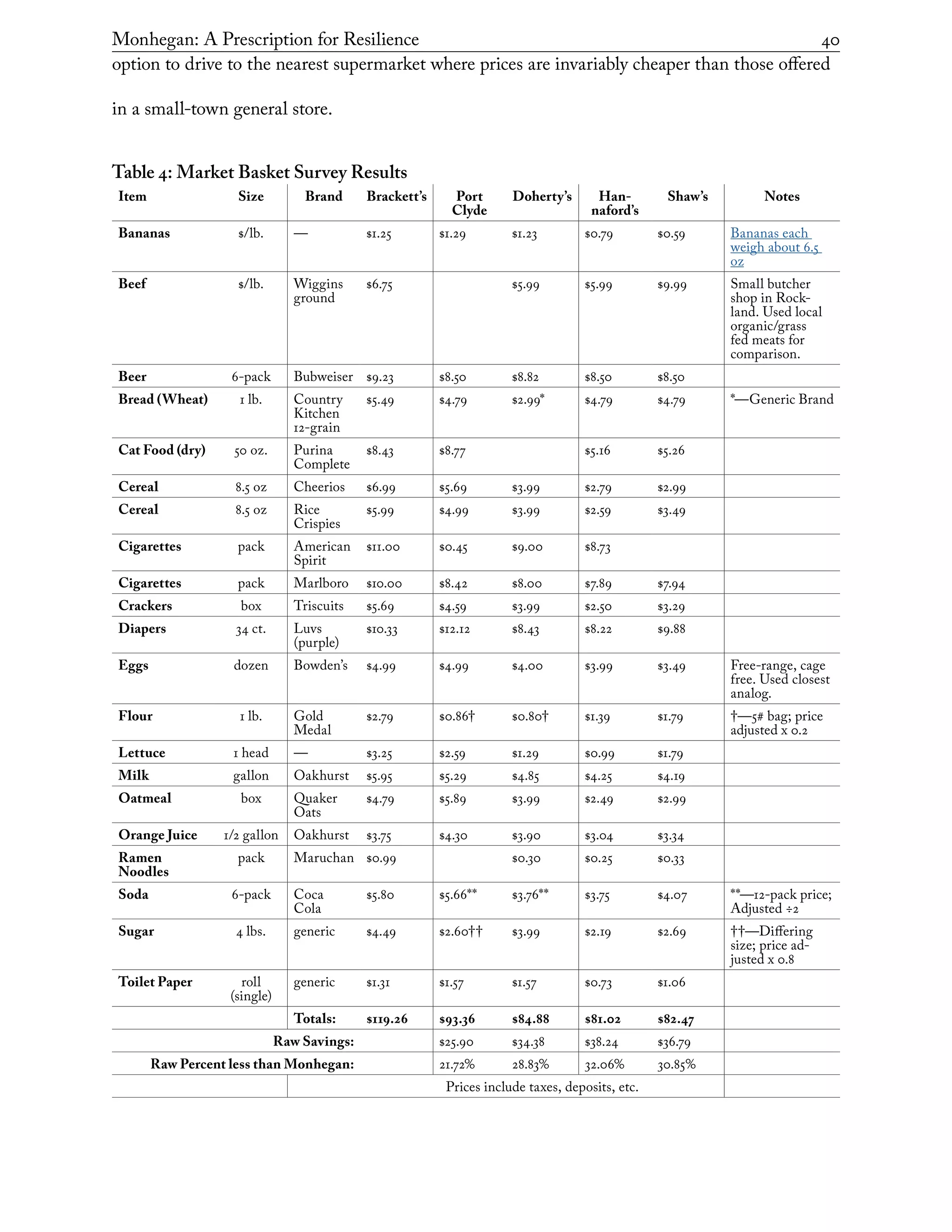
Several stores were then selected as comparisons for prices: the Port Clyde General Store is lo-
cated in Port Clyde, Monhegan’s ferry terminal; Doherty’s North Freeport Store is another gen-
eral store, but located far from tourism traffic; Hannaford’s (Yarmouth) and Shaw’s (Freeport) are
the two major supermarket chains in the state of Maine. Two other sites were also surveyed, but
their selection of groceries proved insufficient to provide a reasonable comparison to Monhegan:
Big Apple in Yarmouth has a wide selection of beer, wine, and automobile supplies; The North
Pownal General Store in Durham only carried about two-thirds of the goods in the survey, with
many of those being less than equivalent in size, brand, or reasonable equivalent.
j
Monhegan: A Prescription for Resilience	 20
A Note on Privacy
Island life and privacy are often mutually exclusive. During one of my interviews on
Great Cranberry Island, one of the residents there described an encounter with a Monhegan
resident by prefacing her remarks, “I won’t name any names…and if I gave any more detail, it
would totally identify them.” Unfortunately, despite the shortest of descriptions that this resident
gave and the brief anecdote used to illustrate a general point about island life, the two subordi-
nate clauses that this resident of Great Cranberry used were still enough to identify the specific
Monheganer in question.
To the best of my ability, I have attempted to rigorously protect the identity of those with
whom I interviewed. Each speaker has been given a plain pseudonym (Resident A, Resident B,
etc.) and are assigned in the order of transcription, not by the order of recording. I have done my
utmost to remove even references to gender, age, and other traces of identity. There were times
that a person may have voiced a personal opinion or experience and then spoken as a leader of a
particular organization; in such cases, those individuals have been assigned multiple pseudonyms
so that their organizations are not associated with personal viewpoints and to provide an addi-
tional layer of privacy. In some instances where general descriptions of island life overlap, I have
also included remarks from people on other islands where their stories corroborate those experi-
ences taken from Monhegan.
Even so, there is a risk that an individual might be identified. I noticed this risk while
transcribing the recording of one person because I had a much easier time understanding the nu-
ances of speech; this person grew up in a similar area of the United States as myself and I found
the “accent” much easier to understand; not just the way specific letters are pronounced, but also
the cadence and even certain phrases were more familiar to me. Midwesterners, such as myself,
do not say, “Yep, yep,” for instance, but is often a phrase of agreement in New England.
Monhegan: A Prescription for Resilience	 21
If I have accidentally revealed you through these descriptions, please forgive my inad-
vertent breach of confidentiality. Your words have been used to illustrate points rather than to
embarrass you. If this is the case, I humbly apologize.
j
Figure 5. Sketch of cliffs at Burnt Head
Monhegan: A Prescription for Resilience	 22
Research
In the moneth of Aprill, 1614. with two Ships from London, of a few Marchants, I chanced
to arriue in New-England, a parte of Ameryca, at the Ile of Monahiggan, in 43 1/2 of
Northerly latitude…
	 —from A Description of New England (1616), Captaine John Smith
“This is kind of an outpost”
During the summer, Monhegan and many of the other island communities are idyllic
places. Monhegan’s five daily ferries transport visitors to two coffee houses, restaurants, an art
supply store, a brewery, ATMs, clear nights, and warm—but not hot—days. Although small, the
island hosts some of the finest and most scenic hiking in Maine and there are plenty of opportu-
nities to socialize, snap pictures of the numerous gardens, and to simply relax.
But the realities of living on a small island differ drastically from that idyllic setting for
nine months each year. For much of the year, only two businesses remain open through the win-
ter: the post office and L. Brackett & Son, Monhegan’s lone grocery store. If the
grocery lacks certain provisions, the winter ferry
schedule drops to three weekly trips, that neces-
sitates either a taxi ride or a car ride to Rock-
land—an 18-mile drive—and at least two nights
inshore. All other services—from ATMs to the
Monhegan Brewery—close before the first snow
begins to fly. While the summertime connections and
services can make an island seem close to ‘America,’
the change in seasons restores the insularity of island
life; even the small tasks of buying lumber for
Portland
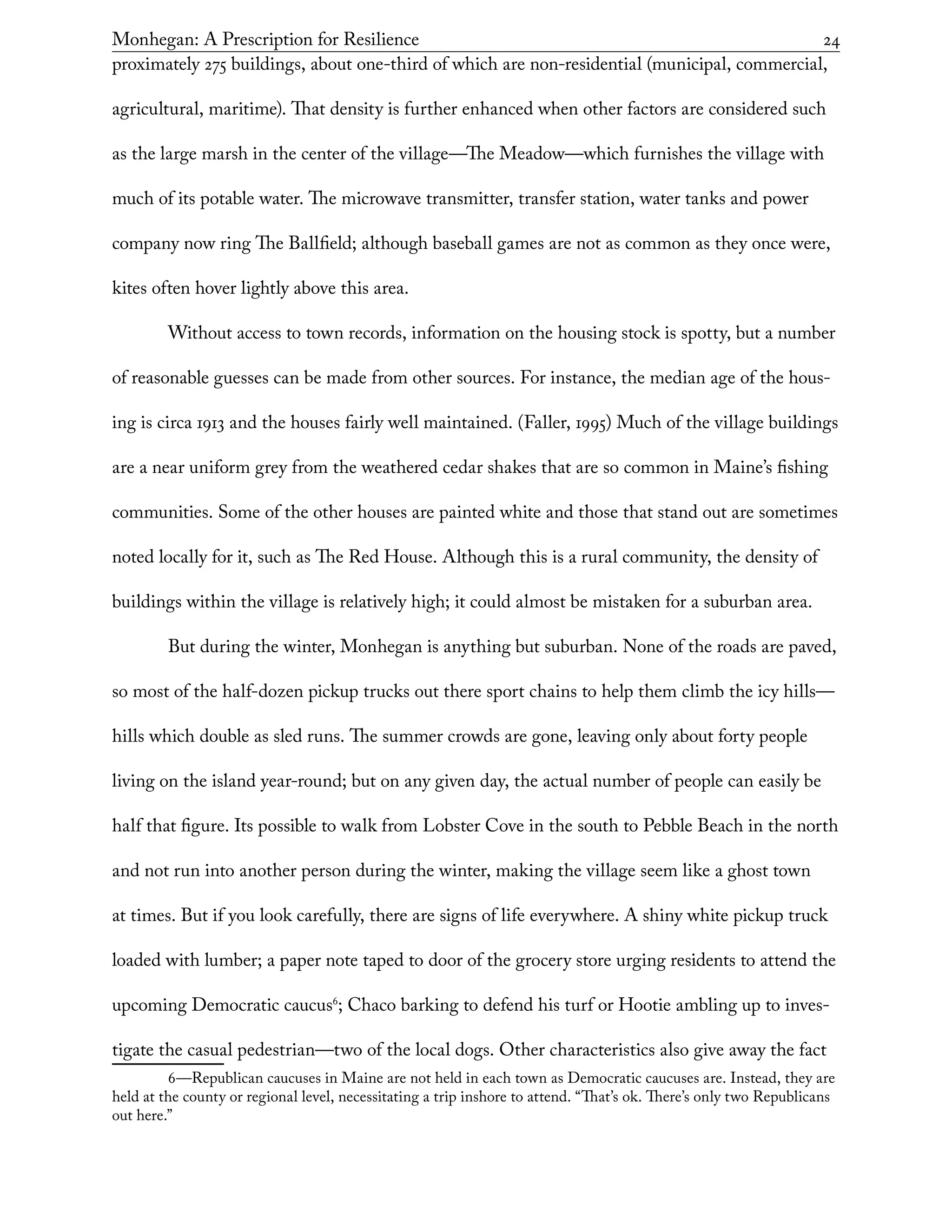
South Portland
Ellsworth
Belfast
Bath
Boothbay
Harbor
New
Harbor
Brunswick
Rockland
Port Clyde
Bristol
Freeport
Yarmouth
Shaw’s
Doherty’s
Hannaford’s
BigApple
Universityof
SouthernMaine
WholeFoodsMarket
Monhegan
LongIsland
GreatCranberry
Islesford
IsleauHaut
Matinicus
Isle
Mt.Desert
Island
North
Haven
F r e n c h b o r o
Cr
anberry Isles
P e n o b s c o t B a y
Casco
Bay
Muscongus
Bay
Pemaquid Pt.
M
i
dCoast
D
o
w
n
e
a
s
t
Key Locations
k
Maine
Monhegan: A Prescription for Resilience	 23
a carpentry project and the disposal of building waste
requires planning, shipping, time, and money.
Some of these issues apply equally to all res-
idents as the quirks that make island life what it is.
As Resident D pointed out, “you know, we’ve found
that we get used to it, too. I mean…there’s a bunch
of different little tricks that you can do to make life
easier, but you also have to like the feeling of being
on an outpost.” Even so, some of life’s little diffi-
culties can impact young adults and young families
harder, making a transition to island life harder to
bear.
The Setting
There are plenty of guide books that describe
Monhegan: an artist colony; a scenic town; ‘quirky’
people; a rustic setting. But guidebooks are geared to-
wards visitors as opposed to residents, who already are
aware of the charms of living a dozen miles from ‘Amer-
ica.’ From its quaint cedar-shingled saltbox houses in the
village to the dramatic ‘backside’ cliffs, few places in Maine
can compare with Monhegan’s stunning beauty.
While Monhegan itself is roughly 600 acres in size, ap-
proximately 400 of those acres are conserved ‘wildlands,’ which
leaves 200 acres for the village proper. Monhegan contains ap-
Monhegan: A Prescription for Resilience	 24
proximately 275 buildings, about one-third of which are non-residential (municipal, commercial,
agricultural, maritime). That density is further enhanced when other factors are considered such
as the large marsh in the center of the village—The Meadow—which furnishes the village with
much of its potable water. The microwave transmitter, transfer station, water tanks and power
company now ring The Ballfield; although baseball games are not as common as they once were,
kites often hover lightly above this area.
Without access to town records, information on the housing stock is spotty, but a number
of reasonable guesses can be made from other sources. For instance, the median age of the hous-
ing is circa 1913 and the houses fairly well maintained. (Faller, 1995) Much of the village buildings
are a near uniform grey from the weathered cedar shakes that are so common in Maine’s fishing
communities. Some of the other houses are painted white and those that stand out are sometimes
noted locally for it, such as The Red House. Although this is a rural community, the density of
buildings within the village is relatively high; it could almost be mistaken for a suburban area.
But during the winter, Monhegan is anything but suburban. None of the roads are paved,
so most of the half-dozen pickup trucks out there sport chains to help them climb the icy hills—
hills which double as sled runs. The summer crowds are gone, leaving only about forty people
living on the island year-round; but on any given day, the actual number of people can easily be
half that figure. Its possible to walk from Lobster Cove in the south to Pebble Beach in the north
and not run into another person during the winter, making the village seem like a ghost town
at times. But if you look carefully, there are signs of life everywhere. A shiny white pickup truck
loaded with lumber; a paper note taped to door of the grocery store urging residents to attend the
upcoming Democratic caucus6
; Chaco barking to defend his turf or Hootie ambling up to inves-
tigate the casual pedestrian—two of the local dogs. Other characteristics also give away the fact
6—Republican caucuses in Maine are not held in each town as Democratic caucuses are. Instead, they are
held at the county or regional level, necessitating a trip inshore to attend. “That’s ok. There’s only two Republicans
out here.”
Monhegan: A Prescription for Resilience	 25
that this is not a mere suburban subdivision: the numbers on houses—1784 or 1824, for example—
refer to the year of construction rather than the actual address; most houses, in fact, lack numbers
and if they are identified at all, it is with a name: Gull Shores; Little Frost; Lower Lights; Uncle
Henry’s. Even streets lack signs to direct visitors, although these names sometimes vary between
year-round residents and summer residents: Main Street or Monhegan Avenue? Ice Pond Road or
Mucky Lane? Alfred’s Way or Stanley Lane? Only a day-tripper would think that a sign indicat-
ing the directions of the “B.S. Cottage” meant anything but Boynton-Specterman. Therein lies
the real charm of Monhegan. Its organic lack of standardization, idiosyncratic ways make this a
real village in an old-world sense, rather than a planned suburban community.
The People
If a place makes a person, who are the people of Monhegan? The modern progenitor of
Monhegan was Henry Trefethren, who purchased the island for £300 in 1777; the earliest part
of Monhegan’s history becomes a little bit murky, but three of his children settled on the island
around 1781, forming the first generation of Monheganers: Henry, Jr.; Mary, who married Josiah
Starling; Sarah, who married Thomas Horn. While the Trefethren name disappeared after a cou-
ple of generations, the Starlings (later Sterlings) and the Horns (also changing to Orne) stayed on
for a few generations longer and lent their names to some of the features on the landscape: Horn’s
Hill, where the Horn farm was located, as well as Sterling Cove—locally called Arnie’s Beach.
These three families represent a sort of nobility in Monhegan society; the ability to state, “I’m an
eighth- or ninth-generation Monheganer descended from the…” Starling, Horn, or Trefethren
families is a source of pride. If one cannot be a true Mainer without living here for three genera-
tions, being a true Monheganer requires a bit more commitment.
Even so, many people are accepted into the Monhegan community without such deep
roots. That acceptance is predicated on hard work and commitment to the community itself.
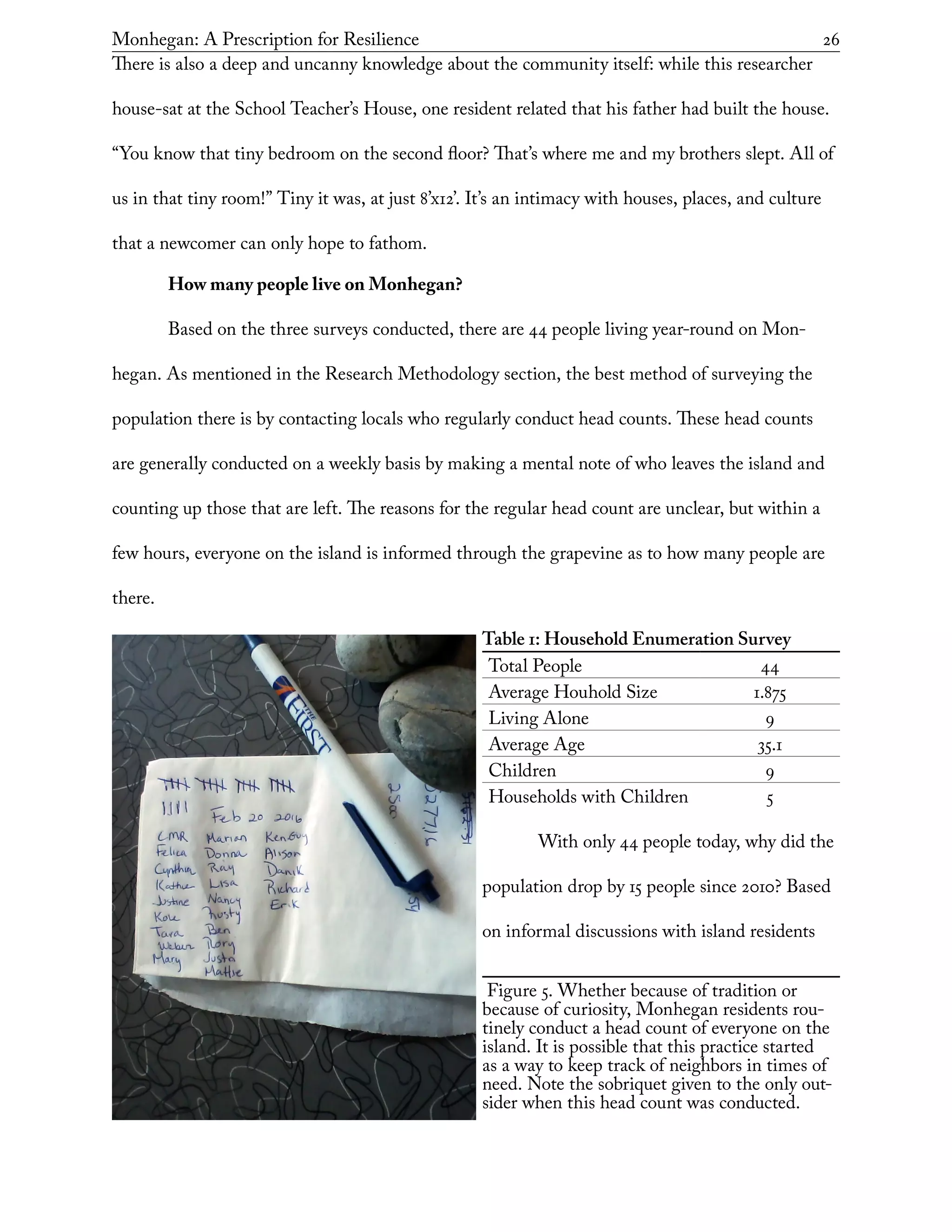
Figure 5. Whether because of tradition or
because of curiosity, Monhegan residents rou-
tinely conduct a head count of everyone on the
island. It is possible that this practice started
as a way to keep track of neighbors in times of
need. Note the sobriquet given to the only out-
sider when this head count was conducted.
Monhegan: A Prescription for Resilience	 26
There is also a deep and uncanny knowledge about the community itself: while this researcher
house-sat at the School Teacher’s House, one resident related that his father had built the house.
“You know that tiny bedroom on the second floor? That’s where me and my brothers slept. All of
us in that tiny room!” Tiny it was, at just 8’x12’. It’s an intimacy with houses, places, and culture
that a newcomer can only hope to fathom.
How many people live on Monhegan?
Based on the three surveys conducted, there are 44 people living year-round on Mon-
hegan. As mentioned in the Research Methodology section, the best method of surveying the
population there is by contacting locals who regularly conduct head counts. These head counts
are generally conducted on a weekly basis by making a mental note of who leaves the island and
counting up those that are left. The reasons for the regular head count are unclear, but within a
few hours, everyone on the island is informed through the grapevine as to how many people are
there.
Table 1: Household Enumeration Survey
Total People 44
Average Houhold Size 1.875
Living Alone 9
Average Age 35.1
Children 9
Households with Children 5
With only 44 people today, why did the
population drop by 15 people since 2010? Based
on informal discussions with island residents
Monhegan: A Prescription for Resilience	 27
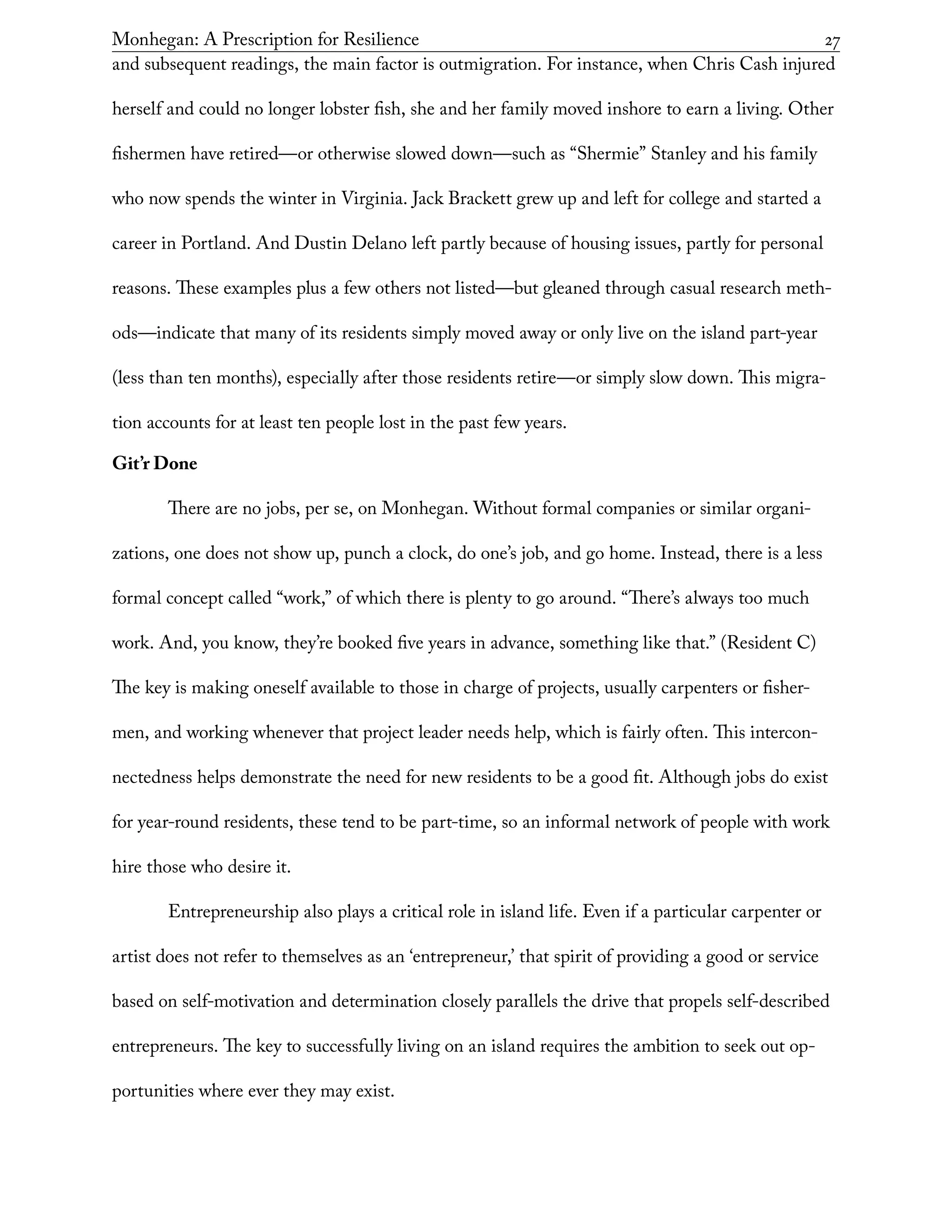
and subsequent readings, the main factor is outmigration. For instance, when Chris Cash injured
herself and could no longer lobster fish, she and her family moved inshore to earn a living. Other
fishermen have retired—or otherwise slowed down—such as “Shermie” Stanley and his family
who now spends the winter in Virginia. Jack Brackett grew up and left for college and started a
career in Portland. And Dustin Delano left partly because of housing issues, partly for personal
reasons. These examples plus a few others not listed—but gleaned through casual research meth-
ods—indicate that many of its residents simply moved away or only live on the island part-year
(less than ten months), especially after those residents retire—or simply slow down. This migra-
tion accounts for at least ten people lost in the past few years.
Git’r Done
There are no jobs, per se, on Monhegan. Without formal companies or similar organi-
zations, one does not show up, punch a clock, do one’s job, and go home. Instead, there is a less
formal concept called “work,” of which there is plenty to go around. “There’s always too much
work. And, you know, they’re booked five years in advance, something like that.” (Resident C)
The key is making oneself available to those in charge of projects, usually carpenters or fisher-
men, and working whenever that project leader needs help, which is fairly often. This intercon-
nectedness helps demonstrate the need for new residents to be a good fit. Although jobs do exist
for year-round residents, these tend to be part-time, so an informal network of people with work
hire those who desire it.
Entrepreneurship also plays a critical role in island life. Even if a particular carpenter or
artist does not refer to themselves as an ‘entrepreneur,’ that spirit of providing a good or service
based on self-motivation and determination closely parallels the drive that propels self-described
entrepreneurs. The key to successfully living on an island requires the ambition to seek out op-
portunities where ever they may exist.
Monhegan: A Prescription for Resilience	 28
Another aspect of island life is the unwritten requirement to work several jobs. Although
the expense of living on Monhegan could, in theory, be a factor in this need, in reality, much of
the work on Monhegan is seasonal. “The fishermen, they’re really busy in the fall and then the
wintertime they’re not busy. And then summertime comes around, some of them do carpentry
work and that’s busy again and then…so its this constant cycle. Its like, what to do in the mid-
dle of winter out here. Cause things kind of have a standstill and that would be great for young
people who are artists and people that want to fish or are artists and will fish.” (Resident C) Not
everyone works as a carpenter or as a fisherman, however. Many people also work in support of
the tourism sector, whether as bakers or as hospitality staff. There are, of course, several artists as
well who live on Monhegan full time.
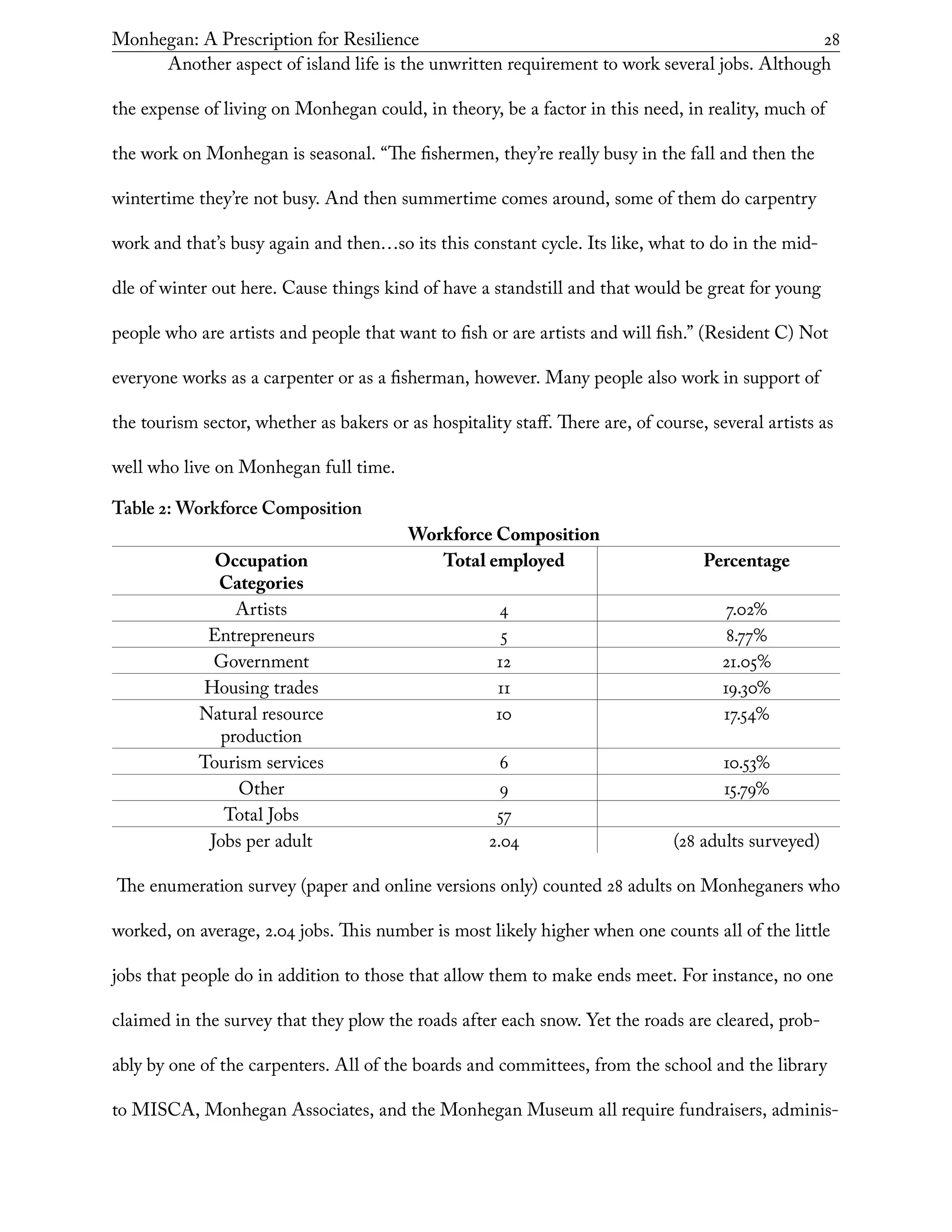
Table 2: Workforce Composition
Workforce Composition
Occupation
Categories
Total employed Percentage
Artists 4 7.02%
Entrepreneurs 5 8.77%
Government 12 21.05%
Housing trades 11 19.30%
Natural resource
production
10 17.54%
Tourism services 6 10.53%
Other 9 15.79%
Total Jobs 57
Jobs per adult 2.04 (28 adults surveyed)
The enumeration survey (paper and online versions only) counted 28 adults on Monheganers who
worked, on average, 2.04 jobs. This number is most likely higher when one counts all of the little
jobs that people do in addition to those that allow them to make ends meet. For instance, no one
claimed in the survey that they plow the roads after each snow. Yet the roads are cleared, prob-
ably by one of the carpenters. All of the boards and committees, from the school and the library
to MISCA, Monhegan Associates, and the Monhegan Museum all require fundraisers, adminis-
Monhegan: A Prescription for Resilience	 29
tration, and programs, but often pay little or nothing at all. Even so, these are jobs that islanders
work out of necessity and in reality, there is a shortage of labor on Monhegan.
For such a small workforce, Monhegan has a surprisingly diverse labor market; bear in
mind that specific jobs—a total of 41 different positions—were combined into broad categories
for the sake of privacy. Some of these categories should be self-explanatory (artists) while others
require explanation (natural resource production): ‘Government’ workers are those who are paid
through tax revenues and may be local, state or federal workers; ‘Housing trades’ include carpen-
ters and caretakers; ‘Natural resource production’ includes farmers, fishermen, and other trades
that utilize the soil or the sea for a livelihood; ’Tourism services’ include hotel workers, cooks,
and other related professions that directly assist tourists, although some of these people may have
also been categorized as ‘Entrepreneurs’ as seemed appropriate. Another point to remember is
that this survey is based on the self-identification of most of the adults on Monhegan, therefore
the percentages are only approximate. Even so, the island has a dynamic economy that suggests
that any new residents that the island attracts would have an easier time making a living than if
the economy relied on a smaller number of professions.
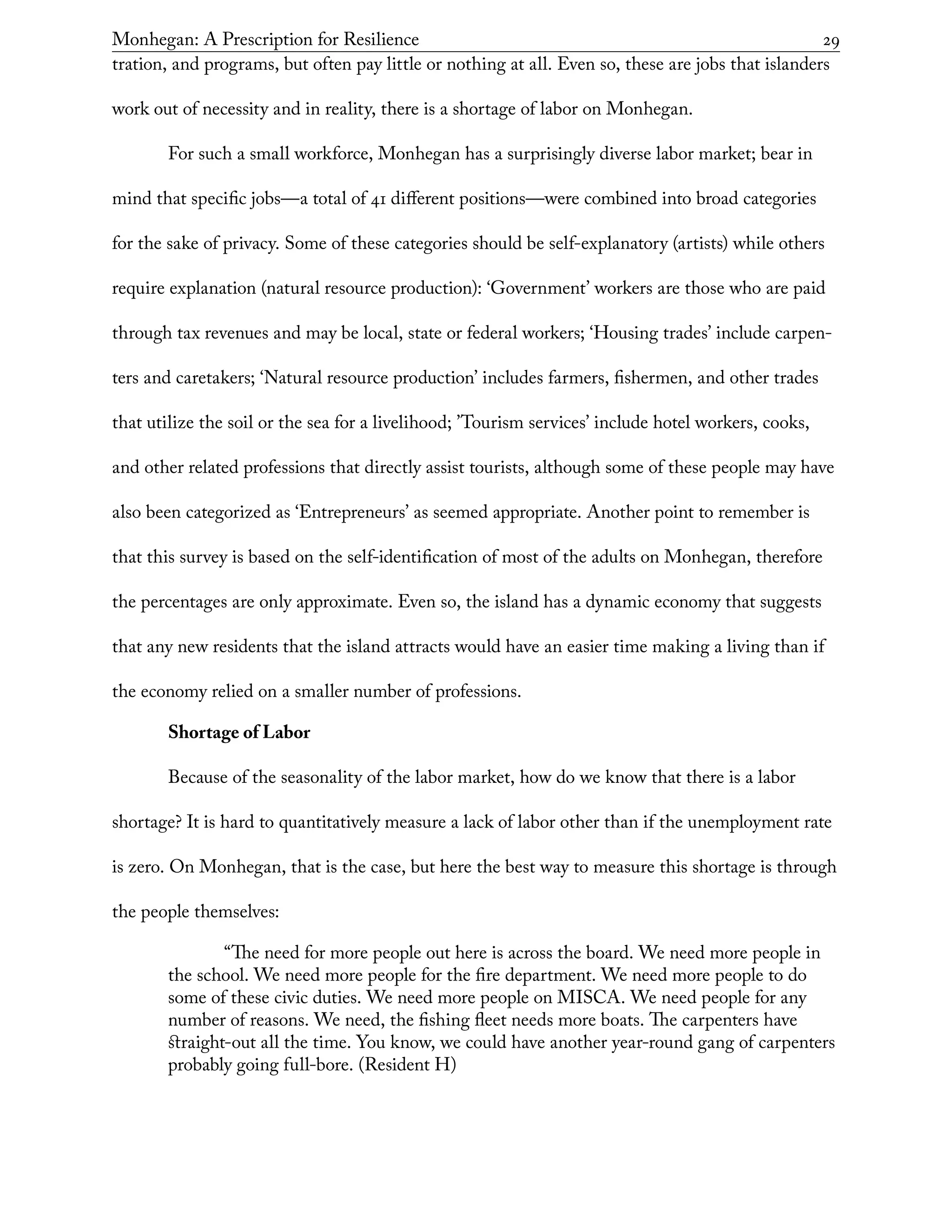
Shortage of Labor
Because of the seasonality of the labor market, how do we know that there is a labor
shortage? It is hard to quantitatively measure a lack of labor other than if the unemployment rate
is zero. On Monhegan, that is the case, but here the best way to measure this shortage is through
the people themselves:
	 “The need for more people out here is across the board. We need more people in
the school. We need more people for the fire department. We need more people to do
some of these civic duties. We need more people on MISCA. We need people for any
number of reasons. We need, the fishing fleet needs more boats. The carpenters have
straight-out all the time. You know, we could have another year-round gang of carpenters
probably going full-bore. (Resident H)
Monhegan: A Prescription for Resilience	 30
	 “You end up feeling like you’re not doing anything well. And it is…[the] whole
community, the health and well-being, mentally and the growth of it is a whole commu-
nity endeavor or problem, not just to fall on the shoulders of a few.” (Resident E)
	 “There’s always too much work. And, you know, they’re booked five years in ad-
vance, something like that. So…you know, and I’m already looking at the next two years
to have, pretty much, you know, work the whole entire time depending on how fast I go.”
(Resident C)
	 “You got a couple of guys fishing and…no, there’s just not enough people.” (Resi-
dent F)
When four of the six people interviewed for a project related to housing and expenses
bring up the issue of labor shortages without prompting, it is an issue of significance. The issue,
of course, is not the shortage of labor, for that is merely a symptom of the larger problem. It’s
not a problem of attracting new residents; as the summer season demonstrates, plenty of workers
come to work in the hotels and stores. The problem is that once summer has ended, there is no
wintertime housing for those workers who wish to stay longer.
The tight labor market has serious repercussions in many aspects of community life.
Several residents noted that they did not feel that they did an adequate job in some of the services
that they provide to the island because they have each taken on too many responsibilities. These
residents, in taking on numerous responsibilities, are beginning to burn out from overwork. In
other instances, “people…take on jobs that [they] are totally unqualified [to do] and I would just
say don’t have any motivation to do the job properly. And if they’re willing to do it and no one
else is, you take what you get. So, sometimes things suffer because of that.” (Resident D)
The Housing Situation
Before examining the details of the affordable housing issues and problems on Monhe-
gan, a quick review of the 2010 Census should quickly illustrate the overall situation:
Monhegan: A Prescription for Resilience	 31
Table 3: Housing Characteristics
Housing Occupancy No.
2010
%
2010
No.
2000
%
2000
Total housing units 164 100.0% 177 100.0%
Occupied housing
units
40 24.4% 46 26.0%
Vacant housing units 124 75.6% 131 74.0%
For rent 18 11.0%
Rented, not occupied 0 0.0%
For sale only 1 0.6%
Sold, not occupied 0 0.0%
For seasonal,
recreational, or
occasional use
105 64.0% 121 68.4%
All other vacants 0 0.0%
Homeowner vacancy
rate (percent) [8]
3.1% 3.1%
Rental vacancy rate
(percent) [9]
66.7% 31.8%
Housing Tenure
Occupied housing
units
40 100.0% 46 100.0%
Owner-occupied
housing units
31 77.5% 31 67.4%
Population in owner
occupied housing units
56
Average household
size of owner occupied
units
1.81 1.87
Renter occupied
housing units
9 22.5% 15 32.6%
Population in renter
occupied housing units
13
Average household
size of renter-occupied
units
1.44 1.13
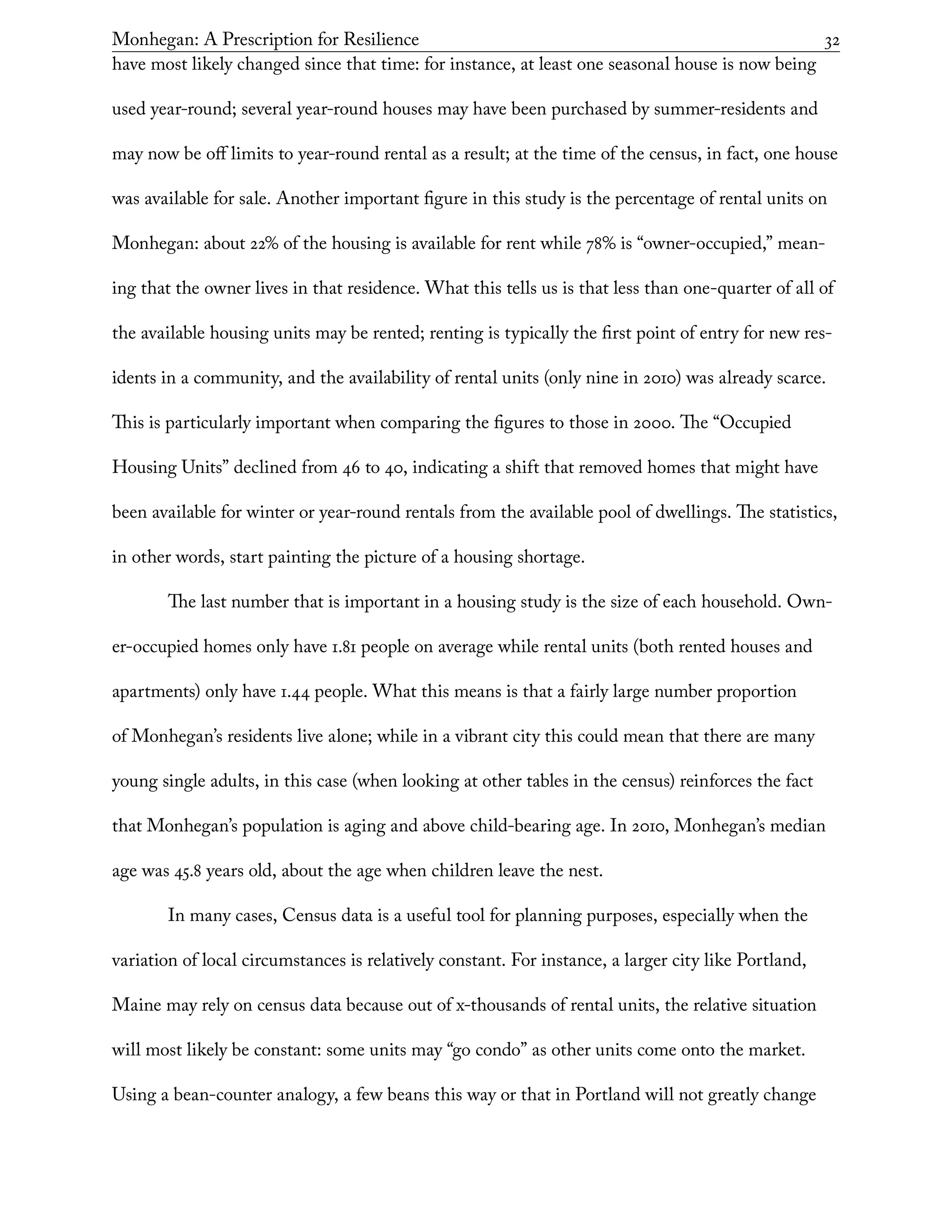
What do these numbers tell us? First of all, there are 164 dwelling units—including
apartments—on Monhegan. 105 of these units are only used during the summer, and 40 are
year-round residences. Please bear in mind that these figures are already six years old and they
Monhegan: A Prescription for Resilience	 32
have most likely changed since that time: for instance, at least one seasonal house is now being
used year-round; several year-round houses may have been purchased by summer-residents and
may now be off limits to year-round rental as a result; at the time of the census, in fact, one house
was available for sale. Another important figure in this study is the percentage of rental units on
Monhegan: about 22% of the housing is available for rent while 78% is “owner-occupied,” mean-
ing that the owner lives in that residence. What this tells us is that less than one-quarter of all of
the available housing units may be rented; renting is typically the first point of entry for new res-
idents in a community, and the availability of rental units (only nine in 2010) was already scarce.
This is particularly important when comparing the figures to those in 2000. The “Occupied
Housing Units” declined from 46 to 40, indicating a shift that removed homes that might have
been available for winter or year-round rentals from the available pool of dwellings. The statistics,
in other words, start painting the picture of a housing shortage.
The last number that is important in a housing study is the size of each household. Own-
er-occupied homes only have 1.81 people on average while rental units (both rented houses and
apartments) only have 1.44 people. What this means is that a fairly large number proportion
of Monhegan’s residents live alone; while in a vibrant city this could mean that there are many
young single adults, in this case (when looking at other tables in the census) reinforces the fact
that Monhegan’s population is aging and above child-bearing age. In 2010, Monhegan’s median
age was 45.8 years old, about the age when children leave the nest.
In many cases, Census data is a useful tool for planning purposes, especially when the
variation of local circumstances is relatively constant. For instance, a larger city like Portland,
Maine may rely on census data because out of x-thousands of rental units, the relative situation
will most likely be constant: some units may “go condo” as other units come onto the market.
Using a bean-counter analogy, a few beans this way or that in Portland will not greatly change
Monhegan: A Prescription for Resilience	 33
the overall picture. But on Monhegan, there are only 164 total beans; each bean counted in one
pile or another represents a significant shift in available housing because the total pot is so much
smaller.
Seasonal moving
An important aspect of island living regarding housing is seasonal moving. Alien to most
communities, seasonal moving is a condition where people must move semiannually because
the rents changed for a season—usually summer in seaside communities—is greatly inflated
from what the market would bear during normal (or winter) conditions. Seasonal moving is not
unique to island communities; Old Orchard Beach follows similar market approaches to housing,
whereby seasonal residents (fall, winter, and spring) will live in a home while during the summer
that home is often rented on a weekly basis or will serve as a summer residence by the owner.
Inshore, college students often make up the seasonal residency, while people from away
will occupy each unit during the summer. From personal experience in Old Orchard Beach, my
$800 monthly rent during the winter easily became $1200 per week during the summer. While
this pattern works well for a community such as Old Orchard Beach, for an island community
such as Monhegan, the consequences are detrimental. Why?
“I would guess that between 8 to 12 people are displaced seasonally on Monhegan. Some
are lucky to find a place and some are sadly displaced right off the island. This, of course, varies
year to year.” (Resident D) Assuming the 2010 population recorded by the census, that represents
almost 15% of the year-round population; however, the head-count that I conducted indicates that
there are only 44 year-round residents on Monhegan, the true percentage is nearly 23% of year-
round residents, or between one-fifth and one-quarter of all of Monhegan’s residents must seek
shelter on a semi-annual basis. If one is, say 20 years old, that might be a fun prospect. But for a
young couple ready to start a family, “they’re probably sick of moving. And out here, it seems like
Monhegan: A Prescription for Resilience	 34
the first few years, you have to move. In the spring, you have to move out of your winter house
and in the fall, you have to move out of your summer dorm room…that gets old too. We’ve all
done it, but…everyone that lives here has done that for some amount of time.” (Resident D) An-
other person commented, “Every fall, we got to call, make phone calls to find a house. Then we
got to argue with people…’Oh, well, we had that house last year. We were supposed to get it this
year.’” (Resident G) This represents a serious impediment to settling on the island permanently.
“Just the fact that there’s not a lot of winter housing. Or if you do have winter housing, you have
to move in six months. It’s not like you can just have a place and live there year round. You can’t
rent a place year round, necessarily. Or there’s very few places where you can because people can
make a killing in the summertime out here renting out their cottages.” (Resident C)
Therein lies the problem that needs to be addressed: there are plenty of houses to live in if
‘people’ were willing to let them out year-round. “Unfortunately there’s some sacrifices involved
with that for people that have houses that rent them out in the summer. And…they’d rather
be greedy than to see the island succeed and continue on.” (Resident C) Perhaps ‘greedy’ is too
strong an adjective, something this resident quickly corrected, but “there’s just no year-round
rentals, its hard enough to find a winter rental. And there are a bunch of people that own, I’m
not going to get bitter, but the fact is there are a bunch of people that own houses out here that
only come in the summer. And these houses are winterized and have been lived in recently in
the winters. And they love Monhegan more than you could ever imagine loving something, but
when it comes time to help out in some way, like, say, renting your house out in the winter, they
couldn’t possibly do that.” (Resident D) Perhaps there are more diplomatic ways to describe the
problem, but clearly greater cooperation between the owners—whether summer residents or even
year-round residents with multiple properties—is needed to ensure that there are people there in
the community to ensure that Monhegan remains a viable tourist draw. Greedy—followed by “I
Monhegan: A Prescription for Resilience	 35
didn’t mean that.” Not bitter? These are the words of frustration, frustration at the consequences
of gentrification.
Time to cue evil villain music? Not quite. Summer residents in particular are not only
aware of this issue, but also have a hand in helping the situation, often because of the multigen-
erational association with Monhegan. This became evident during a dinner conversation at the
Trailing Yew; the topic of this research was initially uncomfortable for some at the dinner table,
but at least one of the summer residents expressed a clear understanding of the growing imbal-
ance of the housing situation. This viewpoint differs from that of so-called short-term residents
(those that stay a week or so); the conversation at the next table revolved around the fantastic real
estate deals to be found in Portland and South Portland, two other communities dealing with
their own affordable housing issues. In contrast, many of the summer residents “have money and
have a love for Monhegan…we’ve had a lot of individual donors that have been extremely gener-
ous” in their support of MISCA. (Resident H)
MISCA
The Monhegan Island Sustainable Community Association, or MISCA is the primary
means for the community to address the issue of affordable housing. Using the community land
trust model, MISCA purchases residential properties and then sells or rents the building and its
rights to residents while keeping the land—the more expensive asset in a situation such as Mon-
hegan’s. This model has been successfully used throughout the United States and Canada since
the late 1960s.
At the present time, MISCA owns seven parcels on which there are four houses and
the MISCA Building. Two of the parcels are vacant lots and on two of the built lots there are
also two stand-alone businesses: L. Brackett & Son, the local general store and the Monhegan
Brewery, built by Matt and Mary Weber behind their home. Between the MISCA Building and
Monhegan: A Prescription for Resilience	 36
L. Brackett & Son, the commercial heart of Monhegan is entirely on MISCA properties. The
MISCA Building has a particularly interesting history. Originally built in 1916 as the Monhegan
Store, it—along with six other buildings—burned down in November 1963 after a blaze started
in the basement of the store. Rebuilt in 1964, today it houses a café and gift shop, the Plantation
Office, the Post Office, a laundromat, and two apartments. The other commercial pilar of Mon-
hegan is its general store. When Monhegan’s Carina general store closed in 2013 after losing its
lease, MISCA stepped in to facilitate the purchase of the current store in a partnership with res-
ident Lisa Brackett and several fundraisers. But the heroic effort was not without a price: because
of the disruption that the closure potentially posed, MISCA missed out on an opportunity to
apply for a state grant for two new houses because of the lack of staff resources.
Even so, MISCA continues to actively seek opportunities to stabilize the housing situ-
ation on Monhegan. The organization is currently negotiating the transfer of two more houses
into its portfolio7
,
“but its not a gain of winter rentals or year-round houses, its just making sure that the
people that were in them, now they own them. Which is great, but its not a gain. And…
every time I think we can raise money and build one of these [new] houses over there
and rent it out year-round, you know, for someone to try it out for a year or two. Another
year-round rental, the owner decides its time for me to sell this.…it’d be crazy for us not
to buy it.” (Resident H)
But as the speaker noted, because these two houses are already being rented during the
winter, thus MISCA is still unable to get ahead of the curve despite its best efforts to do so.
“We’re so busy trying to get people that have been here for years and been renting for years—
years! I mean ten years or longer—we’re so busy trying to get them into their own places that we
haven’t been able to do anything new.” (Resident H)
7—Once the summer of 2016 is over, MISCA will have seven houses, two apartments, and two buildable
lots. In addition, another house is currently (May, 2016) under construction as a so-called ‘assessory dwelling.’
Under the rules of the state Land Use Planning Commission, this house is technically an addition to an existing
house, but functions as a separate home. This additional house is being built by the current residents themselves
and is not a MISCA project.
Monhegan: A Prescription for Resilience	 37
Shortcomings
While MISCA has had many great successes since its inception in 2002, it has also had a
few setbacks. The most crucial problem—as with other programs in the community—is the lack
of staffing. Managing a nonprofit organization, on top of the jobs that each resident performs
plus any other responsibilities, is a burden, and MISCA is not an exception. “I don’t feel like I
have the time to adequately do my job on MISCA. And what’s more is that I’ve been involved,
deeply involved, long enough that I’m about worn out with it.” (Resident H) Until more people
move to Monhegan, burn out and fatigue will be a common problem in many island organi-
zations. A personnel shortage means that when multiple situations arise (as with the closing of
Carina general store at the same time as a unique grant opportunity), only one can currently be
addressed. It also means that future plans, goals, and strategies cannot be adequately developed
when other priorities demand attention. “We don’t have a long-term plan written out. Maybe we
should, but we don’t.” (Resident H) The labor shortage also means that developing new solutions
such as alternative funding mechanisms or carrying out plans to build on the two available lots is
a lot more difficult to achieve.
Of potential concern is MISCA’s reputation for acquiring good homes. “A lot of people
have complained that MISCA bought Allison that house and then reduced the price to sell it
to her without fixing up any of the things that have gone wrong with it. It needs a new septic
system, it needs insulation, a new water system, new kitchen, a new roof, blah blah blah. And…
MISCA didn’t fix any of that before they sold it to her. They just reduced the price by half, basi-
cally. And…some people that’s good enough for and some people think that’s not good enough…
Who’s to say who’s right?” (Resident H) This concern could just be an outlier—MISCA has
purchased several homes seemingly without issue. Although this may be sexist to state, some-
times people feel protective of single women such as Alison, and some people may feel that she
Monhegan: A Prescription for Resilience	 38
has been taken advantage of in this case. In its present state, MISCA is more of a reactive rather
that proactive organization. “The way it really works is that when a property, when an existing
house comes up for sale, it there’s a likely candidate on island—someone who would qualify for
the program and expresses interest in that property—then MISCA does everything possible to
buy that property at whatever its listed at. And then, in turn, we turn around and sell that at an
affordable price to someone that’s in the program. So generally…MISCA buys a $600,000 house,
then they would turn around and sell it for $150,000 or $200,000 or whatever the person could af-
ford.” (Resident H) This suggests that caveat emptor strongly applies to the candidate, but with-
out further information or the input from Alison Hill—her cistern was empty in February and
was relying on water from her neighbors, the Webers—strong conclusions regarding the manner
in which this particular transaction cannot be made. But the reactive quality of MISCA suggests
that the organization acted in good faith and that the house was simply a lemon; this particular
transaction had a few mistakes.
L. Brackett & Son
To offset the high costs of shipping food to the islands, McReynolds conjectured that
locally grown food and CSAs (Community Supported Agriculture) could reduce those costs.
(McReynolds, 2014) In order to test this hypothesis, an examination of both the local general
store and the local agricultural program are required.
L. Brackett & Son is a small general store on Main Street, freshly reshingled, serving as
a meeting place for village residents: not only people grab coffee and food there, but the Demo-
cratic presidential caucus was also held within the store. If the reader has never visited a general
store in Maine, imagine standing in front of the double doors that are plastered with various
announcements. When entering, a cooler on the right contains vegetables, pop, and beer; on the
left is the cash register and sales counter. If the store is empty, residents are expected to sign a
Monhegan: A Prescription for Resilience	 39
notebook detailing their purchases to be settled later; short-term residents leave a note and cash.
Between the cooler and counter is a stand containing fresh fruits and vegetables. The back half
of the store is similarly arranged in three rows—from left to right are two rows of shelves with
everything a resident might need in a pinch and on the right is the food and coffee counter—
complete with stools and coffee mugs. The cookies are simply delicious. Along the back wall is a
selection of fine wines. Beyond this area is a small kitchen and a restroom. The entire enterprise
occupies perhaps a thousand square feet in total, if that. Along with the post office, this is the
place were all of the action and conversation takes place in town.
Lisa Bracket, the store’s proprietor, is a wealth of knowledge about the happenings in
town. She is a quintessential Monheganer—eighth generation—her son is a cook at a respected
Portland restaurant. Perhaps the store’s name suggests a hopeful optimism once he matures. If
he returns. Like many Monheganers, not only does she operate the store, but she also works in
a half-dozen different positions within town government and is a lobster boat sternman, now
retired. In her words, the store is operated as a service; prices are kept as low as possible so that
residents are able to have access to goods ranging from batteries—Monhegan lacks streetlights so
flashlights are a necessity—to candy bars. Most towns in Maine have a general store and Monhe-
gan is no exception.
Extending the Market Basket
Each of the Island Institute’s Island Indicators contains a comparison of grocery prices
between a particular island and its adjacent ferry port. In each of the Market Basket surveys, as
they are called, Monhegan is not included, and the while the comparison of prices provides a
good approximation of shipping costs added onto islanders’ food bills, the survey does not ac-
curately portray even what a mainlander might pay for groceries. Mainlanders always have the
Monhegan: A Prescription for Resilience	 40
option to drive to the nearest supermarket where prices are invariably cheaper than those offered
in a small-town general store.
Table 4: Market Basket Survey Results
Item Size Brand Brackett’s Port
Clyde
Doherty’s Han-
naford’s
Shaw’s Notes
Bananas $/lb. — $1.25 $1.29 $1.23 $0.79 $0.59 Bananas each
weigh about 6.5
oz
Beef $/lb. Wiggins
ground
$6.75 $5.99 $5.99 $9.99 Small butcher
shop in Rock-
land. Used local
organic/grass
fed meats for
comparison.
Beer 6-pack Bubweiser $9.23 $8.50 $8.82 $8.50 $8.50
Bread (Wheat) 1 lb. Country
Kitchen
12-grain
$5.49 $4.79 $2.99* $4.79 $4.79 *—Generic Brand
Cat Food (dry) 50 oz. Purina
Complete
$8.43 $8.77 $5.16 $5.26
Cereal 8.5 oz Cheerios $6.99 $5.69 $3.99 $2.79 $2.99
Cereal 8.5 oz Rice
Crispies
$5.99 $4.99 $3.99 $2.59 $3.49
Cigarettes pack American
Spirit
$11.00 $0.45 $9.00 $8.73
Cigarettes pack Marlboro $10.00 $8.42 $8.00 $7.89 $7.94
Crackers box Triscuits $5.69 $4.59 $3.99 $2.50 $3.29
Diapers 34 ct. Luvs
(purple)
$10.33 $12.12 $8.43 $8.22 $9.88
Eggs dozen Bowden’s $4.99 $4.99 $4.00 $3.99 $3.49 Free-range, cage
free. Used closest
analog.
Flour 1 lb. Gold
Medal
$2.79 $0.86† $0.80† $1.39 $1.79 †—5# bag; price
adjusted x 0.2
Lettuce 1 head — $3.25 $2.59 $1.29 $0.99 $1.79
Milk gallon Oakhurst $5.95 $5.29 $4.85 $4.25 $4.19
Oatmeal box Quaker
Oats
$4.79 $5.89 $3.99 $2.49 $2.99
Orange Juice 1/2 gallon Oakhurst $3.75 $4.30 $3.90 $3.04 $3.34
Ramen
Noodles
pack Maruchan $0.99 $0.30 $0.25 $0.33
Soda 6-pack Coca
Cola
$5.80 $5.66** $3.76** $3.75 $4.07 **—12-pack price;
Adjusted ÷2
Sugar 4 lbs. generic $4.49 $2.60†† $3.99 $2.19 $2.69 ††—Differing
size; price ad-
justed x 0.8
Toilet Paper roll
(single)
generic $1.31 $1.57 $1.57 $0.73 $1.06
Totals: $119.26 $93.36 $84.88 $81.02 $82.47
Raw Savings: $25.90 $34.38 $38.24 $36.79
Raw Percent less than Monhegan: 21.72% 28.83% 32.06% 30.85%
Prices include taxes, deposits, etc.
Monhegan: A Prescription for Resilience	 41
Differences should
reflect transportation
costs. BUT if that
were the case, then
Port Clyde should be
similar to Doherty’s
Standard
general
store
prices.
Assumption: Values
are fairly consistent be-
tween different stores
within each chain.
Mean price: $5.68 $4.91 $4.24 $3.86 $4.12
Percent less than Monhegan: 13.5% 25.3% 32.1% 27.4%
Price data on Monhegan collected week of February 14, 2016; all others collected week of February 21, 2016.
All things being equal, the prices charged at Port Clyde should be approximately equal to
those at Doherty’s. But they are not. Why? This is pure conjecture, but the Port Clyde General
Store is owned by Linda Bean’s Perfect Maine. Linda Bean’s is not intentionally overcharging
the locals, however. In addition to the General Store, the same building also houses Linda Bean’s
Wyeth Art Gallery, and within Port Clyde, Linda Bean’s also owns three restaurants, 13 inns,
cottages and beds and breakfast, a lobster pound, and guided offshore cruises. What this means
is that Port Clyde is a tourist destination, and the prices there reflect the cost of convenience
offered to visitors from away. As already noted by Thompson (2012), Port Clyde has already un-
dergone the process of gentrification, a fact further demonstrated by the lack of packaged ramen
noodles.
With this in mind, the cost of transporting food to Monhegan is probably about 25% the
total cost charged on the island. Brackett’s claims to make a minimal profit on its sales, a refrain
also heard at the Cranberry General Store on Great Cranberry Island as well as in the Island
Indicators report; assuming this to be true, that would suggest that the cost of shipping to Mon-
hegan could be higher than the 25% of the total prices charged.
Island Farms
In the second part of examining McReynolds’ hypothesis that locally grown food and
CSAs (Community Supported Agriculture) could reduce food costs, (McReynolds, 2014) a brief
overview of the existing agriculture program on Monhegan is needed to complete the research
necessary to test his hypothesis.
Figure 5: Kathie Iannicelli, one of Monhegan’s ‘Committed Farmers, tends to one of the 13 plots
that Island Farms maintains.
Monhegan: A Prescription for Resilience	 42
Island Farms is the organization with the self-appointed task of bringing locally-grown
produce to Monhegan. On the cusp of beginning its eighth growing season, Island Farms is a
relatively mature organization that has experimented with several different delivery options, nu-
merous types of crops, and has found ways to expand its total acreage of cultivated land. Over the
past seven years, the ‘Committed Farmers’—as they call themselves—has increased from one to
three, annually hosts an intern, and receives volunteer help from several people. Although not a
organized structure as a company nor as a non-profit in any formal sense, Island Farms continues
to thrive producing greater harvests year-over-year.
A brainchild of Kathie Iannicelli, the earliest inception of Island Farms began as a gar-
dening business that operated for over 20 years. Starting with a $600 loan from the Monhegan
Community Church, Kathie launched the Island Farms as a way of providing a diverse produce
to both year-round and summer residents. Today, Island Farms boasts 13 separate fields covering a
Monhegan: A Prescription for Resilience	 43
total of 2 acres; it hosts a weekly farmers market (with other producers of eggs and baked goods);
has a greenhouse to start sprouts and for winter greens; provides a CSA program even through
the winter months. Or to phrase it more succinctly, it has proven to be a tremendous success and
an asset to the Monhegan community since its inception in 2007.
Like Polyface Farm in Virginia, a well-known farm in sustainability literature, Island
Farms utilizes organic and permaculture practices to the greatest extent possible without actually
having USDA Organic certification. Much of its land has been reclaimed from the removal of in-
vasive plant species (barberry, multiflora rose, and bamboo) around the margins of The Meadow
and in underutilized yards scattered throughout the village. The weekly Farmers Market is not
only a venue for the distribution of produce, but also a educational forum for the purpose of edu-
cating passersby on the issues of sustainability, best practices, and organic gardening.
As with L. Brackett & Son, an examination of prices is needed to determine if locally
grown food can have an impact on overall island costs. Because Island Farms sells produce
primarily during the summer growing season, a direct comparison with the local general store
is not possible due to seasonal variation. But relative prices compared with mainland retailers is
possible. In order to do this accurately, the units sold last summer need to be converted into the
standard units in a typical grocery store; having done that, the relative prices may be compared
with reasonable accuracy. As with L. Brackett & Son, a direct comparison of similar products is
necessary, and in each case, organic foods were researched at the mainland grocery. For instance,
Island Farms sells 1/2 pound bags of beans; this equals 0.5 pounds in a typical store where beans
are sold by the pound; to buy one pound of fresh beans would therefore cost $9.00 on Monhegan
while at Whole Foods, the similar item would cost $1.99.
Monhegan: A Prescription for Resilience	 44
Table 5: Organic Food Pricing8
Product Price
Island
Farms’
Units
In Standard Units
Cost per
standard
unit
Whole
Foods
Prices
Shaw’s
Prices
beans $4.50 ½ lb. bag 0.50 pounds $9.00 $1.99 $5.32
beets $3.00 bunch 1.00 2# bunch $3.00 $2.99 $2.99
broccoli $4.00 head 1.25 pounds to
a head
$3.20 $2.99 $3.49
carrots $3.00 bunch 1.00 pound $3.00 $2.69 $1.50
chard $3.50 bunch 1.00 bunch $3.50 $3.49 $1.99
collards $3.50 bunch 1.00 pound $3.50 $2.99 $3.49
cucumbers $1.00 each 0.69 pound $1.45 $1.99 $2.99
garlic $0.75 each 0.17 pound $4.50 $3.99 $2.99
kale $3.50 bunch 0.41 pound $8.62 $2.99 $2.49
lettuces $3.50 head 1.00 head $3.50 $2.99 $2.49
peppers,
hot
$1.00 3 0.05 to a
pound
$21.00 $4.99 —
peppers,
sweet
$1.75 each 0.38 pound $4.64 $4.99 $3.99
potatoes $6.00 box 1.00 5# bag $6.00 $5.99 $6.65
tomatoes,
cherry
$4.50 box 1.00 pound $4.50 $4.25 $3.49
tomatoes,
heirloom
$4.00 each 1.50 pound $2.67 $4.99 $3.99
tomatoes,
small
$0.50 each 0.20 pound $2.49 $2.99 $3.99
Total $48.00 $84.57 $57.30 $51.85
Unfortunately, Island Farms prices at the Farmers Market are generally higher than Whole
Foods, a store with a reputation both for organically-grown food and for high prices. Island
Farms prices are undoubtedly cheaper through the CSA deliveries, but an accurate gauge of the
contents of each weekly share (or half-share) without researching those items and pricing each
out in a similar manner as depicted in Table 4. But each delivery only costs between $10 and $20
each week, and payment plans are available to year-round residents; while many CSAs bill for the
season upfront before planting, April and May tend to be financially lean months for islanders as
8—These grocery chains were selected because of the variety of produce that each carried that was spe-
cifically labeled “organic.” Small groceries and the Hannaford’s surveyed do not carry most of the produce that is
grown on Monhegan.
Monhegan: A Prescription for Resilience	 45
the change from winter work transitions to summer work. (Resident B) While Resident F noted
that it is cheaper to shop for groceries in Rockland, Monheganers supports its own, and Island
Farms serves about 85% of the community’s households. (Resident B). Resident F is also among
those subscribers.
Island Farms is a loosely organized institution, without formal incorporation, manage-
ment, or structure. Because of the lack of direct management, record keeping is often haphazard.
Even planting records are informal, “We don’t label everything that we plant. And we don’t write
down where we planted what. So this year, we’re going to try and keep those records. I mean, we
do…I say, ‘yes, there are carrots at Cameron’s.’ But which carrots got put there? And when did
they get planted? …We have a book that says…what plants we started, how many we started—
but we don’t have records—sometimes somebody’ll write down in the lefthand side of the book-
let what seeds got planted and where they got planted. But most of the time, not.” (Resident B)
As it stands now, it is a system that works well enough, but with the stated goal of incorporation
as a non-profit organization for the purposes of obtaining grants, this lack of records and man-
agement is a hindrance to future development. But as with so many other projects on Monhegan,
it is another example of too few people attempting to do too much—another victim of the ongo-
ing labor shortage.
Case Examples: Great Cranberry and North Haven
In the course of this research, two other island communities were also contacted. Those
communities were Great Cranberry Island, one of the five Cranberry Isles and North Haven.
As island communities, there are many similarities with Monhegan; as individual communities,
there are also many differences, some of them substantial. For instance, unlike Monhegan, both
Great Cranberry and Islesford are serviced by a daily ferry—even through the winter—and with
easy automobile access, both islands also have several miles of paved roads, street lights, and a
Monhegan: A Prescription for Resilience	 46
stronger connection with the mainland. Another feature that distinguishes Monhegan from
these two islands is that most of the land on Mohegan is held in conservation trust, a condition
that enhances both the quality of life, but also diminishes the available land for development.
In this regard, Monhegan is more like Frenchboro and Isle au Haut. But Great Cranberry and
North Haven are also as different from each other as they are from Monhegan.
A recommendation from the Island Institute led specifically to these two communities.
According to the institute, both had had recent successes addressing the problems of affordable
housing, that lessons could be learned from each of these two examples. Both communities also
had a web presence—a web site, Facebook page, news articles—that trumpeted their successes
and offered a means of communicating with the respective community land trusts; other islands
in the vicinity of Monhegan do not have as strong of a presence, making measures of success dif-
ficult to determine and making initial contact difficult to discern.
Cranberry Isles Realty Trust
At roughly 1050 acres and Great Cranberry Isle approaches twice the size of Monhegan;
at its closest point, it is a scant 3/4 of a mile from Mount Desert Island—home of Acadia National
Park and bridged to the mainland—and a short 2 1/2 mile ferry ride to port. In stark contrast to
Monhegan’s gabbroic hills and cliffs, Great Cranberry’s gentle, level terrain would make it a per-
fect landscape for agriculture; in fact, for much of its history, it was an agricultural outpost, and
its agricultural history is currently being documented by Jessi Duma, an Island Institute Fellow.
Shaped roughly like a crescent moon, its two-mile paved road runs meridionally along the length
of the island. Now boasting 67 people, it had but 37 as recently as 2001, (CIRT) which illustrates
the primary factor that makes this community a compelling case example.
The Cranberry Isles Realty Trust (CIRT) began around 1996 as a means of retaining year-
round residents in the archipelago. Through its first 14 years, CIRT had a few notable successes—
Monhegan: A Prescription for Resilience	 47
the acquisition of three houses (one on Islesford9
) and the assistance to a couple on Islesford to
purchase a fourth, non-CIRT, house—as well as a number of mistakes due to inexperience and
experimentation. The three houses that CIRT owned were—and still are—operated as rental
properties. During this period, the condition of the houses declined and the quality of the ten-
ants were sometimes less than perfect; CIRT was sometimes unable to collect rents and was
unable to adequately manage its properties. As a result, the organization began to lose money.
Vision and Action
This period ended around 2011 when two new members were appointed to the board of
directors: Bruce Komuson and Phil Whitney. Both were then active in another project together
called the Cranberry House, which will be discussed shortly. But is important in this specific
context is that these two individuals brought with them two critical qualities: vision and action.
“We learned that the state had a bonding package that had been passed by the voters that
the money was specifically designated for islands who wanted to build affordable housing. And
the requirement was that you’d have to build two houses and the money that was designated for
that would be about $355,000. So we approached the CIRT board at that time—neither of us
were members of CIRT—and they jumped on it, very eagerly. And we wound up both becoming
members of CIRT.” (CIRT)
Ideas without action lead to naught; Bruce donated land to build the houses and both
Bruce and Phil dedicated “thousands of hours…on this. It took us about three years to go from
the initial contacts with the state to actually begin construction,” largely due to state require-
ments, reporting and meetings as well as site planning, project management, and additional
fundraising. (CIRT) Both houses were completed in 2014 and have been occupied by long-term
tenants ever since.
9— Islesford is the local name for one of the two primary islands. Some sources also call it Little Cran-
berry Island.
Monhegan: A Prescription for Resilience	 48
Board composition is important to this story. Each board member has skills that are
applicable to the organization as a whole, skills such as writing, management, construction,
fundraising, and so on. Some of the tenants also serve on the board, providing input from the
client perspective as well. The composition also reflects year-round residents, summer residents,
and even a few mainland members with an interest in the eventual fate of the Cranberry Isles.
This diversity, the individual members dedication to purpose, and a willingness to cooperate are
reflected in CIRT’s current success story.
Program
In its entirety, CIRT owns five houses, four of which are on Great Cranberry Island. If
the efforts to recruit a new minister to the church are included, Phil10
and CIRT have enticed five
families that include 10 adults and 11 children to live on Great Cranberry. Each of the houses that
CIRT maintains is a rental property with the intent of a try-before-you-buy scenario: “The idea
being that they wouldn’t make it a permanent rental situation, that they would after a few years
hopefully be able to survive economically and be able to perhaps go out, buy a piece of land, build
their own house.” (CIRT)
CIRT: Intangibles
The Cranberry House is the engine that set many things in motion on Great Cranberry,
and was the project that initially engaged both Bruce and Phil prior to their involvement with
CIRT. As a historic structure, it serves as the local historical society and archives, but its size
lends itself to many other important uses. The first floor also houses Hitty’s Café—named for a
doll who was the primary character in the children’s book, Hitty, Her First Hundred Years, that
won the Newberry Award in 1930. Complete with an outdoor deck, it serves as a meeting place
that serves typical fare for the Maine coast, including lobster rolls. More importantly is the sec-
10— Phil will tell you that that this is incorrect; everyone was recruited through the efforts of various
boards. It just happens to be the case that Phil serves on each of those boards and is often the executive in charge.
Monhegan: A Prescription for Resilience	 49
ond floor that serves as a community space. As a single large room, the second floor is the loca-
tion for classes, activities, and even movies. The classes include guitar lessons for children while
the activities frequently include exercise programs such as yoga and zumba; all of these programs
are specifically geared towards year-round residents, creating a social and recreational space for
them in both summer and winter. (CIRT)
Agriculture on Great Cranberry is in the early stages of development after a long hia-
tus. Currently, there are three independent efforts at development: the Sumner family, summer
resident Janice Murch, and the Island Ecology Project. The Island Ecology Project most closely
resembles Monhegan’s own efforts in that it currently consists of three widely scattered raised
beds (a fourth is planned for 2016) and it operates strictly on a CSA model with half of the pro-
duce going to the individual landowners. The project also maintains a sophisticated compost and
mulching operation at a fifth location. (Duma) Janice Murch’s project is much larger, consisting
of several acres of cleared woodland now dedicated to cider apple orchards and sheep grazing.
Murch’s goals are unclear, but through the agricultural project, she has provided a significant
benefit to the community by bringing in a steady stream of young employees—one of whom is
Jessi Duma. These employees, through the type of work that they are engaged in, are strongly
vested in the project’s success and many not only return each season, but also remain year-round.
(Duma)
The Sumner family farm may be the most ambitious of the efforts, and equally important,
it is an effort by of one of CIRT’s tenants. Prior to their move to Great Cranberry in 2015, they
had operated a farm in Southwestern Virginia. They currently raise goats and vegetables, and
plan to cultivate additional land owned by the Whitney Family Trust with the addition of draft
horses and possibly cows. The Sumners bring to Great Cranberry a level of professional skills
that potentially could add more jobs and new sources of income for the community. They are the
Monhegan: A Prescription for Resilience	 50
type of people that Great Cranberry is actively seeking to populate its affordable housing units.
(CIRT)
CIRT: Concluding Thoughts
Because of Great Cranberry’s relatively diverse economy—tourism, carpentry, care taking,
boat building, and most recently formal agriculture—and because of its locational advantages
that permit commuting, Great Cranberry is in a strong position to maintain its community over,
say, the next twenty years. Because conservation lands occupy less space on the island, there is
a great deal of property that could be developed in the future for additional affordable housing
units. When Phil Whitney retired to Great Cranberry, there were no school-aged children on
that island. The school was closed and each new family had to send their children to Islesford for
school—especially after 2014 when the new houses were completed. Paradoxically, the school on
Great Cranberry today is undergoing renovations in preparation for reopening in the Fall, 2016;
at the same time, Islesford’s population has dropped from over 60 to around 40 and is now facing
many of the same challenges its sister island faced a decade ago. Moving forward, CIRT expects
to place an emphasis on Islesford, assuming the level of cooperation is as significant as it has been
on Great Cranberry.
There are several issues, however, that have not been addressed. One factor observed there
during the very brief research visit is the risk of to dividing the community between newcomers
and long-term residents. Cliques are nothing new in island society, nor is the fear of newcomers
in general: “you don’t want to have people moving to an island and taking away jobs from those
who are already here because it’s a very thin economy as it is. Especially in the winter months.”
(CIRT) CIRT attempts to address the issue of “taking away jobs” through its screening process,
but divisions may still erupt. Many of the newcomers are active in the events held at the Cran-
berry House; Great Cranberry, however, has long had another social organization called the
Monhegan: A Prescription for Resilience	 51
Ladies’ Aide Society that could be displaced by the Cranberry House. This division runs more or
less between long-time resident and new arrivals. Is this a real problem? Only time, observation,
and further research will be able to make that determination.
The other concern involves the stated goal of short-term rental solutions. What happens
in five or ten years if the same people are still renting CIRT homes? If the objective is to encour-
age those families to purchase their own homes eventually, will CIRT act as a traditional com-
munity land trust and assist with those purchases of homes and property that will assuredly still
be beyond the reach of most working-class people? This is an issue that CIRT should ask itself
over the coming years.
North Haven Sustainable Housing
In contrast with its smaller siblings discussed in this research, North Haven in larger
in every conceivable way. Approximately 12 square miles—more than twelve times larger than
Monhegan—and a year-round population of 355 (2010), North Haven is fortunate to have both
three daily ferries and twice-daily air service via Penobscot Island Air. North Haven could easily
be considered a town that happens to be on an island. Like Great Cranberry, it is much more
level than Monhegan and it also has a much more diverse economy that also includes boat yards
as well. Its gentle terrain makes it an ideal location for farms, at least three of which graze live-
stock of various types. There is even enough open land to grow grains in addition to the standard
vegetable gardens typically found on the islands. These agricultural efforts are large enough to
not only offer Farmers Markets and CSAs, but also sell their produce in local stores, and the
Turner Farm sells 1/3 of their produce to the Nebo Lodge restaurant, both of which are owned
and managed by the Pingree family.
But North Haven’s size has not insulated it from the same insular problems of housing
shortages and seasonal moving. “We have teachers who are moving from a winter rental into
Monhegan: A Prescription for Resilience	 52
a yurt11
for the summer. They literally just found the yurt on eBay and found some woods they
could put it in where the landowner is okay with it.” (NHSH) As a result, North Haven Sus-
tainable Housing is primarily focused on providing housing to end the cycles of seasonal moving
rather than expressly attempting to attract new residents.
Fueled by a recent ten-acre donation, NHSH has a plan to build five houses within 5–7
years. The plan is bolstered in part by a needs assessment conducted in the Fall, 2015, and both
documents are useful for securing grants and donations. Among the partners that NHSH has
worked with are the Jane’s Trust, a grant-making institution in Boston that regularly funds proj-
ects in Maine, and the Genesis Fund, an affordable housing lender and consultancy that focuses
on housing affordability issues from their offices in Brunswick, Maine. (NHSH) North Haven
also benefited from the same Maine Housing Grant that enabled Great Cranberry to build their
two most recent houses, which has brought the total number of houses under NHSH’s man-
agement to four, a significant accomplishment in only 11 years. Through another land donation,
NHSH has partnered with another non-profit to develop an elder-care facility on North Ha-
ven, as well. In all cases, fundraising is suplemented by intense volunteer contributions primar-
ily through free labor. This has greatly assisted each effort to build and renovate buildings and
houses throughout the island.
Among the assets that NHSH lists as critical to their successes are the local school and
the town’s community center. Both institutions help create a sense of permanency and place for
the community. As with most island communities, North Haven is particularly protective of its
school, and NHSH “just scrambled and bought a house that happened to come up on the market
because this huge family doesn’t have a place to live and the school really didn’t want to lose the
kids in school.” (NHSH) That transaction is expected to be completed early this summer—bring-
11— A yurt (or ger) is a semipermanent traditional Mongolian tent that can be quickly torn down, moved,
and rebuilt in a matter of hours.
Monhegan: A Prescription for Resilience	 53
ing the total number of rental houses to five—but in general NHSH prefers “a more big-picture
look and do a more aggressive project and we hope to develop four to five houses for sale or rent
that would be new construction,” and eshewing a more piecemeal or a case-by-case approach.
(NHSH) Until the shorter term goal of addressing seasonal moving is resolved, attracting new
residents will be left for the next generation of housing advocates.
Frenchboro
Late in the research phase, the NHSH representative offhandedly remarked, “French-
boro…really developed housing and then advertised in the world saying, ‘Hey! Move to our
island!’ to try to attract more young families.” (NHSH) Attempts to reach people on Frenchboro,
however, were not acknowledged. But the phrase “advertising in the world” was intriguing and
warranted a bit more research, especially since Frenchboro had not been mentioned in any of the
literature up to this point.
The quest to attract young families to the islands is hardly a new problem. Monhegan it-
self struggled with the issue in the 1970s when it experimented with low-interest loans to enable
families to purchase homes.12
(Bernard, 2010) In the late 1980s, Frenchboro tried a novel solution
to attract new residents to Long Island13
: applicants were required to write an essay detailing why
they wanted to live there and how they each planned on earning a living. The winners received a
house lot as well as assistance to build a new home. (Higgins, 1988)
As a publicity stunt, the program was a tremendous success. Newspapers as distant as
the Los Angeles Times picked up the story, and over 300 applicants vied for 10 housing slots.
Frenchboro’s population had dropped from 97 people in 1950 to only 43 in 1980, the census im-
12— As a reminder, mortgage interest rates skyrocketed to unprecedented levels in the 1970s and 1980s.
Interest rates rose from about 7.5% in February, 1973 to an all-time high of 18.45% for a 30-year mortgage in Octo-
ber, 1981. Those rates did not drop below 10% again until 1990.
13— Not to be confused with Long Island town in Casco Bay, formerly a part of Portland. The island in
Frenchboro has also been called Outer Long Island.
Monhegan: A Prescription for Resilience	 54
mediately prior to this contest. With such strong national interest in Frenchboro’s fate, the 2000
census, a dozen years after the contest, revealed a population of 38.
What happened? Frenchboro serves as a cautionary tale; an oft-heard phrase “a good
fit” was repeated by several people on different islands, and it appears that Frenchboro did not
adequately screen its applicants prior to settlement. Walter Pietrowski, a welder from Norwich,
CT serves as an adequate poster child for what went wrong in Frenchboro. After purchasing a
lobster boat and trying his hand full time at lobstering (NY Times, 1988), scallop fishing, and
odd jobs, he and his family ended up moving back to Connecticut after a couple of years. The
attempt at island life had left his family $15,000 in debt and consisted of a life of just scraping by.
(Matza,1994). Many of the people brought in were simply ill-prepared for island life, or as nu-
merous islanders have called it, these people were not “a good fit.” Even though this particular
experiment was a flop, something took root that warrants further investigation: in 2010, French-
boro’s population had spiked to 61 people.
That Frenchboro was unable to return calls is hardly surprising. On April 1, Frenchboro
has lost its mail service due to a dispute between a private carrier and the postal service. Since
that time, residents have had their mail service dropped from six days each week to just two, and
the town has been doggedly been attempting to rectify the situation. Nor is Frenchboro the only
island community facing uncertainties; Cranberry Isles, which includes Great Cranberry Island,
is having its own issues with its winter ferry service. Beal & Bunker’s owner has announced his
retirement; service was to end November 1, 2015, but has since been extended to at least October
10, 2016. “the islands are very fragile economically and politically and socially and things can
happen rapidly that can make everything go downhill.” (CIRT)
Monhegan: A Prescription for Resilience	 55
A Good Fit
“Whether or not they’re year-round rentals or someone buys the land and builds their
own house, in my opinion, doesn’t matter as long as the people are a good fit for the island.
Which is tricky. Who is to say if you’re a good fit or not? You know? Pretty subjective.” (Resi-
dent D) ‘A good fit’ is a phrase not only heard on Monhegan, but in other island communities
as well. It can be an elusive term unless one asks enough questions as to what it means to them.
Curiously, the need to ‘fit in’ to an island community is not well documented in the literature.
Marshall (1999) described some of the problems of social adjustment to island life in the context
of mainland wives who married island men on Grand Manan, New Brunswick. She expanded on
the issues of ‘insiders,’ ‘outsiders,’ ‘belonging,’ ‘unbelonging,’ and exclusion in her later work, Tides
of Change (2009), but like so many island communities, the dynamics on Grand Manan are very
different from those on Monhegan. While cliques exist on Maine’s island communities, the rigid
social structures that Marshall described do not, possibly due to the much smaller populations
on Maine’s islands. Smaller communities rely heavily on cooperation and interconnectedness,
regardless of which clique a person may belong.14
The most obvious trait any new resident must have is the ability to adapt to an island en-
vironment. A trip to the grocery store during the winter really is a ’trip’ that requires at least two
nights inshore. Many of the services and activities that one becomes accustomed to inshore rarely
happen in an island setting, if ever. This aspect is hardly unique to Monhegan; Great Cranberry
Island can seem equally far under the right circumstances:
“Some people can’t handle the isolation once they get here. That body of water that’s only
three miles wide is a huge psychological factor to a lot of people. And in the summer,
when its dead calm and you’re, you know, blue sky and the birds are flying around and
you’re having a good time, you don’t think much about it. But on a January night, when
you might have a medical problem, and it’s a gale wind out there and you’re not going to
14—Incidentally, Marshall noted that the rigidity of Grand Manan’s social structure was beginning to
relax around 2006. Unfortunately, she passed away in 2013, thus a follow-up examination of this phen0menon may
not be forthcoming for a while.
Figure 6: Monhegan during the mid-morning is a quiet place. In the background, inshore is ten
miles distant across Muscongus Bay. In the foreground, the Red House and the Rope Shed have
both been recently reshingled, indicating the quiet signs of life during the winter.
Monhegan: A Prescription for Resilience	 56
get off the island to the hospital. People don’t think about that until sometimes its, you
know, too late! And it’s a big change from summer to winter. Its more like living on the
frontier out here. Some people get a little offended when I say that, but its true! You’re on
the edge of the world out here. There’s nothing between you and the northwest coast of
Africa. And even though you’re only three miles from the mainland, from the National
Park and from the towns, in the wintertime, it can be a big three miles when its gale
winds and a blizzard.” (CIRT)
This isolation can be particularly hard on younger residents living on the island for the
first time. “Initially, I really missed going to the movies and…the nightlife. …Going out to a
club or a bar or just being in a room where I didn’t know everybody. And just being kind of
anonymous in that way.” (Resident E) Movies, music, and social gathering spots are an important
part of life for people under 30 years old. “Its all about the environment and, like, having a beer
on tap.” (Resident C) The summertime is full of activities—lectures, kite flying, music, the Mon-
hegan Brewing Company—but another resident noted that its hard to give up movies, barbecues,
Trader Joe’s, “and their, you know, beer-on-tap…during the winter.” (Resident A)
New residents often detect ennui from the year-round community. Its hard to be accepted
into Monhegan society in part because many people do have a hard time fitting in and year-
round island residents are protective of the special status accorded to such residency. For instance,
one first-time winter-resident was discouraged from filling out the enumeration survey conducted
Monhegan: A Prescription for Resilience	 57
as a part of this research by an established year-round resident because of the lack of tenured
residency. “Some of those reasons are just that some people who have come here it hasn’t worked
out very well. So…its almost like the community is waiting, there’s like a waiting period and,
like. seeing what’s going to happen and getting an idea of who you are as a person and how you’re
going to integrate into the community. Where you’re going to fall in…I think in general, accep-
tance into the community, that was within…a year of living here.” (Resident E) In other words,
new residents need to prove themselves not only that they can be productive members of the
community, but also that they’ll stick it out no matter what adversities may crop up. Commit-
ment is a two-way street, so to speak. That ‘fitting in’ includes one’s industriousness; one summer
intern “just not as willing a worker and also an odd fit for the island. For some reason, you know,
some people fit right in, some can’t find an in.” (Resident B)
The most important aspect to “a good fit” is common decency. The Monhegan commu-
nity needs mature, responsible people who have their act together. Monhegan does not have a
police force and therefore is ill-equipped to intervene in cases of disorderly conduct, domestic
disputes, and drunken rowdiness. In a community where labor resources are scarce, residents are
expected to behave with common sense and self-restraint. Regardless of how one behaves, “some-
times drama crops up around you and you’re kind of like, ‘What the hell?’ …the rumor mill is
very, you know, its usually on high, especially around March…But…if you take that all with
a grain of salt, it doesn’t matter.” (Resident C) Like any small rural community, everyone will
quickly know everything about a new resident, both good and bad. “You’re in a fishbowl. And
everybody is looking at you and wanting to know about you and knowing about you or thinking
they do. Rumors are everywhere and some people can’t handle that kind of closeness. Likewise,
you know about everybody else’s business. You may not want to, you know, so it’s a two-way
Monhegan: A Prescription for Resilience	 58
street.” (CIRT) While this level of scrutiny can be difficult for any newcomer, it can become
unbearable for anyone who does not conform to the community norm.
“So, we talk with a lot of people and I think we’ve learned over the years how to identify
people who might be good candidates. You never know until they arrive and they’re set-
tled in. But you’re looking for certain qualities and a big part of it, as I said, is the ability
to make a living without taking a living from somebody else and being rather self-suf-
ficient. You don’t want somebody coming out here who, you know, a light bulb goes out
and they’re calling up needing assistance to fix it. You see what I mean? And some people
can be that way.” (CIRT)
j
Monhegan: A Prescription for Resilience	 59
Monhegan: A Prescription for Resiliance
Resilience is all about being able to overcome the unexpected. Sustainability is about sur-
vival. The goal of resilience is to thrive.
	 —Jamais Cascio
Monhegan—like many places in the United States—is in danger of being loved to death.
Any prescription, like those at Yosemite National Park15
that limit the number of cars and tourists
for the sake of preserving the beloved landscape, is often difficult to comprehend or endure unless
the problems associated with those prescriptions are clearly understood. While many people love
Monhegan, the excessive expression of that love is in danger of capsizing this boat. Because of
the sheer number of summer residences, a viable year-round population is crucial to the summer
residents; without them, those summer residences will succumb to the harsh elements of winter
and the dangers of fire, leakage, and freezing without the caretakers living in situ.
Of the three questions posed in this research, one hardly needs an in-depth explana-
tion: How does Monhegan attract young people to live there? Monhegan already attracts young
people every year through its summer season; this winter, three people spent their first winter
on Monhegan and two of them will most likely be back for a second winter. All three of these
people are under 30 years old, the key demographic that the community seeks. Monhegan cur-
rently has work—carpentry and care taking—and the community has potential opportunities
in the form of unused lobster fishing licenses. It is also an environment where the right type of
entrepreneur can also thrive, one who finds a niche providing a good or service to the summer
residents and visitors.
15—Yosemite, Arches, Canyonlands, Rocky Mountain, and Zion National Parks have either implemented
or are in the process of implementing Traffic Congestion Management Plans due in part to the destruction that
automobiles cause to the scenic beauty and environmental integrity of those areas. In addition to the impact that
such traffic has on the natural setting of these parks, the infrastructure in these remote areas was never designed
to handle the millions of annual visitors. Islands are similarly crushed by visitors who do not pay for the water they
use, the litter they produce, and the general level of services that they expect.
Monhegan: A Prescription for Resilience	 60
In addition, Monhegan’s quality of life is very high. Throughout the research process,
people consistently described the community as beautiful, no crime, a good school, a close com-
munity, and good hiking. Although Monheganers already know these qualities as truths, these
are also keywords that can be used to attract additional residents in the future. Even during the
wintertime, Monhegan sells itself as a great place to live.
The real problem, therefore, is where does Monhegan house people who want to live
there? Unfortunately, this not only applies to new residents, but to nearly one quarter of the com-
munity’s permanent population. As revealed in the research, 8–12 people are forced to move every
few months due to the phenomenon called seasonal moving. On average, this represents 22.7% of
the community’s population. There is simply not enough housing to address this village’s current
needs.
What can MISCA do?
As previously discussed, the Monhegan Island Sustainable Community Association is
the primary vehicle for turning around the housing problems within the community. In order to
fulfill that role, MISCA needs to better enunciate its vision, goals and plans to achieve its vision
and goals. What follows is a plan; whether this is the plan that MISCA’s board and co-presidents
adopt or if modifications are necessary is up to them, but hopefully this will serve as a starting
point for future discussions and future successes.
MISCA’s mission is “to sustain the year-round community. So that’s the number one
goal, and of course we do it with houses.” (Resident H) This is the guiding principle that moti-
vates MISCA, and the eventual goal of the organization. Every plan needs a mission statement
to remind everyone who reads the plan what the organization is all about; those readers could be
board members, donors, or grant-making foundations.
Monhegan: A Prescription for Resilience	 61
What does MISCA hope to achieve? What is its vision for the future and what does that
look like? A vision statement expresses more immediate goals for an organization or for a specific
program. An appropriate vision in this case is, ’To provide enough housing within five years to
end the problem of seasonal moving by purchasing existing structures suitable for this endeavor
or to build homes as necessary to accomplish this goal.’ The vision statement is a more refined
and specific iteration of the mission statement.
Needs Assessment
A plan requires specific goals that serve as benchmarks through the process of achiev-
ing both the vision and the mission of MISCA. In order to permanently house as many people
as possible, the research indicates that MISCA needs to acquire approximately ten additional
housing units as soon as possible. This goal is based on the fact that eight to twelve people are
displaced each fall and spring due to the seasonal cycles inherent in the current housing environ-
ment, representing approximately 22% of the total year-round population of Monhegan. In order
to provide such housing, MISCA needs to alter its previous strategy of exclusively purchasing ex-
isting homes for candidates on its waiting list to a more proactive approach by purchasing rental
properties. Over the long term, this is a temporary measure simply to help stabilize the current
population and to prevent any further loss of population when residents are forced ‘inshore’ to
find seasonal housing.
A formal needs assessment, a fairly easy survey to conduct, is recommended to determine
the exact number of dwelling units needed before committing to any purchase. The Vermont
Housing Finance Agency has an easy step-by-step guide available online (http://www.housing-
data.org/download/assessment_guide.pdf). In addition, a very simply survey form may be down-
loaded from http://www.housingpolicy.org/assets/MA/Rental_Need_Template.pdf. Although
this survey may seem daunting at first—it is 17 pages long—it can easily be filled out in an after-
Monhegan: A Prescription for Resilience	 62
noon while sipping a few Deadman’s Cove Black IPAs at Monhegan Brewing: the demographic
data needed to fill in this survey is already contained within this report (see Appendix D); a copy
of Ruth Grant Faller’s Monhegan: Her Houses and Her People—available in the Monhegan
Library—lists nearly every house in the community along with their ages; the caretakers and
carpenters should have a good idea of the conditions of each house.
Goals and Actions
With the objective of maximizing housing units in the shortest amount of time, this
researcher proposes that MISCA purchase the Inn at Fish and Maine building at a fair market
price from the Murdock family with the intent of winterizing this building and then leasing the
space out to residents in need of permanent housing. Why this building? There are few ‘apart-
ment buildings’ on Monhegan and all of them one serious defect: none of them are winterized.
While there are several other such buildings that qualify as apartment buildings, some—such
as the Novelty—were designed as dormitories for hotel employees and utilize communal toilet
facilities; others, such as Kendall Apartments are simply too small—Kendall has two units. The
Fish and Maine building has four units, each with a private kitchen and bath, making them hab-
itable except for the issue of winterization. In addition, the ground floor space could be used as a
community center (movies, small concerts, socials), rented out to a business for additional income
for MISCA, or simply be converted into additional rental units. If this building proves unfeasible
or if a transaction cannot be agreed upon, adjust the priority of the next several steps; building
an apartment building from scratch is a very expensive undertaking, therefore exploring existing
options is highly desirable.
The next goal is to develop the two existing properties that MISCA currently owns. Each
property will contain a single-family dwelling of approximately 1500 square feet. These homes
should be constructed from an appropriate modular plan (see Appendix F) for the best price that
Monhegan: A Prescription for Resilience	 63
MISCA is able to negotiate. Once built, these two new homes must be offered either as rental
units or for purchase under the classic community land trust model that retains the land owner-
ship to MISCA, but reserving building rights to the homeowner. To avoid any stigma that might
be associated with an “affordable home,” an effort will be made to make sure that each house is
attractive and that it complements existing homes within its location and within the community.
By adopting a two-prong strategy, these homes will be occupied even if the tenant is not yet will-
ing or able to make a full commitment to purchasing a home at that time. In addition, by acquir-
ing an apartment building near the center of the village, it can be more closely observed to ensure
that tenants behave appropriately within community standards.
These two efforts would bring the total housing units to six—or more if the first floor of
the Inn at Fish and Maine was to be repurposed as additional apartments. The needs assessment
will determine if this is adequate for the current needs or not.
Long Term Plan
Once the current housing situation is stabilized or the short term plan above is completed,
MISCA needs to consider what options are available to expand its efforts. What the board needs
to decide, with community input, is how many new people it would like to attract to live on
Monhegan. An emphasis should be placed on attracting young families and couples—between 25
and 35 years of age—to help sustain the school and with the hope that natural increase will help
grow the population of the community.
Where will these new residents live? There are two options: purchasing homes on the
open market and building new homes on donated (preferred) or purchased land. MISCA cur-
rently purchases homes that are already on the market; it needs to do so preemptively, before a
resident requests a specific home. For instance, the Miller House (see Appendix E) is on the mar-
ket for $500,000, and its MLS description indicates that it is winterized already—although the
Monhegan: A Prescription for Resilience	 64
quality of that process may be questionable. Purchase the house; if a resident cannot be found to
buy it from MISCA, that house can still be leased to help alleviate the overall housing shortage,
and if a buyer seeks it later, determine the best way to handle that sale at that time in the future.
The other option is to obtain vacant lands suitable for building. Many of the summer
residences have, by Monhegan standards, huge lots. If the current landowner can be persuaded to
part with a buildable portion of their lots, more houses could be built by MISCA (see Appendix
F for builders) for current or future needs. Although further study to determine which lots are
buildable is needed, a cursory examination using GIS to compare parcel bounds with 2’ contours
reveals at least nine potentially buildable areas:
❧❧ On Ocean Avenue north of Goldsmith House.
❧❧ On Ocean Avenue east of Goldsmith House. (At the bend in the road.)
❧❧ East end of large lot north of Richardson Cottage.
❧❧ North side of Horns Hill Road between Hilltop Lane and the Bogdanove House.
❧❧ South side of Horns Hill Road across street from Bogdanove House.
❧❧ Lots between MISCA Building and Inn at Fish and Maine
❧❧ Lot between Wharf Hill Road and Main Street, across from Elva’s.
❧❧ Lighthouse Hill Road between cemetery and Dolan Cottage.
❧❧ Lighthouse Hill Road west of Burton Cottage.
Local knowledge always trumps map analysis, and ground-truthing—the process of
verifying that which is on the map matches the realities in the field—is a mandatory step: a site
could be steeper than anticipated or a site could be an unbuildable wetland, for instance. Other
potentially buildable lots probably exist, and need to be scouted out and visually surveyed16
during
the off-season.
16—As opposed to a formal survey utilizing professional equipment.
Monhegan: A Prescription for Resilience	 65
A sincere effort needs to be made to purchase every available home that is on the open
market, whether or not an approved applicant is willing to purchase that house. Not every at-
tempt will be successful, but doing so has several benefits. It will make current owners more
aware of the seriousness of MISCA and its mission. If a suitable buyer cannot be found, then
such houses can always be used for rentals, thus fulfilling the vision of providing a permanent
roof over everyone’s head. In a worst-case scenario—no one locally wishes to live in a particular
house—that house could always be let out for summer rentals, thereby increasing MISCA’s reve-
nue streams.
Fundraising
When compared with the other islands surveyed in this study, MISCA is a powerhouse
fundraiser in a league of its own. North Haven, a much larger island community, has raised
$250-$300,000 over the course of the past eleven years. Monhegan’s annual fundraising of ap-
proximately $100,000 dwarfs all other efforts, and is testament to the affection that Monhegan’s
summer residents have towards the community.
Even so, there are ways to increase funding and to make MISCA’s current funds stretch
further. For example, the Aimone family of artists plan to hold a fundraising event on Monhegan
on May 28, 2016 at Carina. A continuation of this even will take place in Rockland from June
30th to July 10th. Called the 2016 Monhegan Island Photo Festival, 25% of gross receipts will be
donated to MISCA17
. In the future, what possibilities exist for hosting a benefit of this nature in
a location such as New York City or in Boston, places where potential donors routinely attend art
exhibits?
MISCA could also establish partnerships with organizations that routinely make do-
nations through purchases. Amazon’s Smile program donates 0.5% of eligible purchases to
17— For more information, see https://www.indiegogo.com/projects/monhegan-island-photo-festival-in-
augural#/ and http://thecarinahouse.visura.co/monhegan-events-may-2016.
Monhegan: A Prescription for Resilience	 66
non-profits of the customer’s choice. If MISCA has not yet investigated this route, it will find at
least a couple of dollars in its account. (See https://org.amazon.com/) Some credit card companies
offer similar programs and partnerships with inshore art galleries and businesses can also yield
results.
Another way to engage donors is through “sustaining contributions.” Most listeners of the
Maine Public Broadcasting Network (MPBN) have heard of the term ‘evergreen friends,’ donors
who sign up for automatic credit card payments each month in the amount of their choosing; the
minimum amount needs to be at least $5 each month per credit card rules, but there is no upper
limit on the amount. Other creative forms of fundraising are listed on the MPBN website (http://
news.mpbn.net/topic/ways-support#stream/0).
What the plantation can do
Although a plantation form of government is very weak—it cannot enact laws and ordi-
nances, for instance—it still has powers related to acquiring money. The most obvious example
is through the local property tax. A one-mill levy, for instance, would raise the property tax on a
$100,000 home—typical for MISCA—by $100 per year. Citizens are understandably reluctant to
pay higher taxes, but consider a few points:
❧❧ Monhegan has the fourth-lowest property tax rate in Maine.
❧❧ For 2016, the state’s homestead exemption increased from $10,000
to $15,000, effectively lowering property taxes for homeowners; that ex-
emption will increase to $20,000 in the 2017 tax year.
Thus, although the rate would increase percentage-wise, the effective tax rate would actu-
ally decrease for ‘permanent residents’ of Monhegan. If a direct subsidy to MISCA is not accept-
able to the citizens of Monhegan, then perhaps a “sustainability fund” could be implemented by
the plantation for use in all manner of projects related to sustainability and resilience, including
Monhegan: A Prescription for Resilience	 67
MISCA. Other projects could include invasive species removal, solar power for homes, or other
projects related to sustainability in addition to providing funds for MISCA.
Should a property tax prove unpalatable, other forms of generating revenue may also exist.
For instance, perhaps it is within the power of the Harbor Master to impose a $5 per passenger
landing fee, to be collected by the ferry service. Such a fee could be earmarked not only for the
types of projects already listed as part of the proposed sustainability fund, but also for providing
free public toilets, a source of irritation among some visitors to Monhegan.
But taxation is not the only form of money that local governments may raise. Grants are
an important part of funding specific projects, and while state moneys have dried up under the
current administration, many opportunities still exist at the federal level. Community Block
Development Grants may, for instance, be used to acquire affordable housing, and other grant
opportunities exist at grants.gov.
Advertising Makes it Happen
A few months ago, MISCA solicited email addresses through their Facebook page osten-
sibly for a regular email newsletter. A great plan that needs to be acted upon, even if the newslet-
ter is but a paragraph long. Advertising in all of its various forms presents the issues of affordable
housing in sharp focus to those who care about it most. It is a constant reminder that the problem
has not been fixed yet, but it can also serve to demonstrate progress towards the goals that the
donors are supporting. But it is also worth mentioning that MISCA maintains an active and
effective campaign via Facebook. Updates are usually made at least weekly, if not more often and
those posts describe specific building and fundraising efforts.
Set up donation jars in every business establishment on the island. Each jar will raise
awareness among casual day-trippers, and even if the total donations only average $10 each day,
Monhegan: A Prescription for Resilience	 68
over the course of a season, at least $1000 could easily be raised. Including a brochure may help
remind such casual visitors of the need once they get home.
Monhegan is not alone regarding housing affordability nor seasonal moving. Issue press
releases and communication with outside news agencies such as MPBN, the Portland Press-Her-
ald, and with agencies in Boston and New York. Repeated efforts at communication may eventu-
ally prompt a reporter to ask questions and, in essence, advertise MISCA accomplishments and,
equally important, hurdles.
The last point regarding fundraising is to always remember that MISCA is a non-profit
organization. Always find out if a discount for materials is available. Ask if home purchases may
be made at a discount from the fair market price—it could result in a substantial tax benefit for
the seller. No individual is begging for handouts in this case; MISCA is promoting a community
benefit that helps ensure that future generations of year-round and summer residents can con-
tinue to fully enjoy this island.
Transparency
Is transparency an issue for MISCA? Whether it is an issue or not, MISCA needs to be
a pillar of integrity within the community, but two minor incidents demonstrate that MISCA
always needs to work to uphold its image. A good way to avoid the perception of selling ‘lemons,’
could offer as a service to inspect each home prior to purchase and to present a report following
the inspection.
The process of becoming a housing inspector is not difficult. If MISCA believes that this
is a worthwhile investment, it should send a non-carpenter—to avoid any the appearance of a
conflict of interest—to the National Association of Home Inspectors Training Institute. (http://
www.nahi.org/training-institute/) The cost is reasonable ($2500 for an 80-hour course) and could
be useful for a retired or semi-retired year-round resident. The person that attends the institute
Monhegan: A Prescription for Resilience	 69
will gain a valuable skill and certification. That skill can be used as a value-added service for all
homes sold on Monhegan —and elsewhere if the inspector is willing to travel—including sum-
mer residents and could potentially alert homeowners to unseen but needed repairs, increasing
the demand for more carpentry work. Inspectors can expect to earn between $500 and $1000 for
each inspection (https://www.angieslist.com/articles/how-much-does-home-inspection-cost.
htm), but if MISCA is willing to pay for the training, perhaps an arrangement could be made for
a discount on MISCA homes.
Another area of concern is the level of transparency regarding the conditions and order
of the candidate wait list for housing. During the course of research, one complaint was raised
about the fairness of the process. Because it is only one complaint, it could be an outlier—perhaps
sour grapes over a transaction that fell through or simply confusion regarding the way the pro-
cess works. Nevertheless, the process needs to be carefully explained to each candidate, and that
explanation needs to be repeated from time to time. A possible solution would be to have each
candidate sign a disclosure statement that outlines the process.
Hire a General Manager
This segment of the prescription has largely been a long to-do list. Given the current
labor shortage on Monhegan, additional duties and responsibilities are probably the last thing
that a board member of MISCA wants to take on for themselves. Even so, one of the most
difficult decisions that anyone in business can make is the decision that they can’t do everything
themselves. MISCA needs to hire a general manger who will report to both the board and to
the co-presidents. A manager is an executive, one who executes the decisions made by the board,
finding the most reasonable ways to accomplish goals, and to carry out full-time tasks for a board
that should only be composed of part-time members.
Monhegan: A Prescription for Resilience	 70
A general manager is responsible for the day-to-day operations of the organization.
Among the duties expected of such a manager include: property management; grant writing;
project management (for new construction or renovations); fundraising and development; com-
munications and marketing; networking with other island organizations; networking with other
agencies such as the Genesis Fund—for technical assistance; any daily administrative work and
record keeping.
This position should be a new hire from inshore and one that is a paid position. There
simply are not enough people on Monhegan to ensure that this is properly attended to in an effi-
cient manner. The person hired needs to be fully cognizant of what island life entails—especially
in the winter—and needs to listen to the community and an to keep open mind with the com-
munity at large. With the community’s survival at stake, a half-baked solution or an unqualified
person is simply not adequate.
Hiring a person to manage should not be considered unusual or a luxury. Cranberry Isles
Realty Trust plans on hiring Jessi Duma after her term as an Island Fellow expires in September.
Hannah Pingree shifted from the board of North Haven Sustainable Housing to serve as Capital
Campaign Director following the acquisition of the eldercare property donation. Having a person
responsible for the day-to-day management of the organization is a good way to ensure that its
needs and those of the community are met.
Food Sovereignty
With the best of intentions, this research hoped to prove McReynolds correct: that local
agriculture would be a means of reducing food costs so that the savings could be applied in other
areas such as housing. Unfortunately, that is not the case. Small-scale farms inherently have
higher costs per unit than large-scale farms, and the overall cost of producing food locally on
an island is roughly the same as that of importing it. While some food prices could be possibly
Monhegan: A Prescription for Resilience	 71
reduced by Island Farms, the resultant savings to consumers would be minimal and would not
pose a significant impact on the overall expense of island life. “The people that are out here aren’t
starving. They’re not worrying about, ‘Oh, my god! Where am I going to get my next meal?’”
(Resident F) True food sovereignty—genuine food self-sufficiency—is a worthy, but elusive goal.
At the moment, two acres are currently planted with crops and a greenhouse does provide
greens throughout the winter, but in order for Monhegan to produce enough vegetables alone
would probably require the tearing down of some of its houses in order to create larger agricul-
tural fields. In addition, there is not enough land to grow grains or to raise livestock—except in
small numbers for perhaps artisanal milk products.
As a corollary to this line of research, Monhegan does not have the resources to ade-
quately build their own community supported fishery; local waters have already been overfished
with many species almost non-existent today. Sea urchins are one example species that was once
plentiful in Monhegan Harbor, but are rarely seen today.
“There was a craze around here for sea urchins. The Japanese wanted the sea urchins roe.
So you would look out into the harbor…and there would be boats gathering sea urchins and
there was a place over by Manana—between Smuttynose and Manana. If you were in a skiff,
you could look down. It was solid sea urchins. People, the fishermen brought up lobster traps and
they would be full of sea urchins.” (Resident B)
Today, only one fisherman on Monhegan has the capacity to do the type of deep sea
fishing required for ground and other similar fish. Lobster is still a viable fishery, but profits are
greater when those catches are sold inshore. Monhegan simply does not have enough fishermen
to create a reliable fishery for local consumption. “We’re losing them like flies. I mean, the fleets
cut in half since I’ve been here. [2012]” (Resident F) At the same time, this presents an oppor-
tunity to entice new residents who wish to fish Monhegan’s exclusive waters. “We have so many
Monhegan: A Prescription for Resilience	 72
licenses associated with Monhegan. I think its 20? 18 or 20. And I think there’s only nine fisher-
men right now. So we have all of these available fishing licenses. So that’s…that would be great
if, some more people were coming out here to fish.” (Resident E)
This is not to say that these are foolish pursuits; Island Farms has a good business model,
it plans realistic expansion in the future, and it is able to successfully supply some of the food
needed on the island. Some fish are landed (including lobster) and consumed locally as well. But
these efforts will not fully replace foodstuffs imported from ‘America.’ But the effort is at least
sufficient to reduce total dependence on inshore sources. And while Monhegan’s size precludes it
from entirely breaking free from inshore grocery stores, other larger islands may be able to make
a sizable dent in the level of their imports.
Nevertheless, local production of food does provide several benefits beyond pure eco-
nomics. Sure, buying locally does provide a benefit economically by keeping dollars within the
community. But the variety of produce that Island Farms provides is also of critical importance
as well. While a small grocer might provide the basics—lettuce, tomatoes, potatoes, and mush-
rooms—locally produced agriculture also provides beets, beans, and broccoli. This local variety
should not be undervalued.
As far as comparisons go, Monhegan would find itself somewhere in the middle. Agricul-
tural efforts are only just beginning on Great Cranberry while on North Haven, those enterprises
are quite mature and robust. For Island Farms to develop a stronger model, it needs better man-
agement of its records and a clear path forward. Will it be a fantastic money-making operation?
Probably not. But as a non-profit service to the community, better management could make it
more responsive to local needs and desires. For instance, squash turned out to be a poor invest-
ment because local residents did not buy squash. What carrots do best in a given soil? Better
record-keeping would help their efforts. Given the scale of the farming operation, an intern—one
Monhegan: A Prescription for Resilience	 73
versed in business or non-profit management—would be the best manager of such an operation.
Setting up a valid process of maintaining records, management, and eventual incorporation could
easily be done by a college student looking for that type of experience.
j
Monhegan: A Prescription for Resilience	 74
Conclusion
Consistent with the Island Institute’s findings, the population of Monhegan has contin-
ued to drop. As the population drops, there are fewer people to take on the same number of jobs
and the same amount of work that keeps a community functioning.
Monhegan’s housing woes are a form of gentrification. This is demonstrated by the clos-
ing of Carina—the island’s grocery store in 2013—as well as by the number of winterized homes
that are taken out of the pool of available homes for year-round residents. Along with the crush
of annual tourists, this has left many Monheganers feeling overworked and frustrated with the
lack of easy solutions.
McReynold’s hypothesis that local agriculture could serve as a means of offsetting is-
land expenses proved incorrect. This is a big disappointment, and asks the question, ‘what other
assumptions that researchers put forth are invalid?’ Or perhaps the question is more accurate to
posit, ‘Do all of Maine’s islands share Monhegan’s shortcomings regarding local agriculture?’
In 1900, there were about 300 unbridged island communities in Maine. Today, there are
but 15, and their future is uncertain. Whether it is how to preserve these communities, or what
makes each one unique from each other—and different from the mainland—island research
is critically important. The big lesson to be learned from this research is just how fragile these
communities are under the pressure of gentrification and the lure of a better life within the mass
of American society twelve miles inshore. While each island ultimately does not represent a mi-
crocosm of mainland society, many lessons regarding social hierarchy and democratic process are
more prevalent in an isolated community such as Monhegan that bears additional study.
Hopefully, this research has opened a window on these and other processes. Islands
present a means of examining how people get along with each other and how collective decisions
are made. As an example, Monhegan is currently confronted with a difficult situation regarding
Monhegan: A Prescription for Resilience	 75
energy independence: new wind turbines could end an era in which Monhegan has some of the
highest electricity prices in the US, but the introduction of wind turbines will despoil some of
its pristine viewsheds. How it confronts this issue along with others could prove pivotal in how
other isolated and island communities reconcile modern convenience with traditional values. Nei-
ther side is absolutely correct in their opinions, and how a small community reaches consensus
could hold valuable lessons for other communities, island or mainland.
Limits of research?
The enumeration survey, while able to capture the number of year-round residents, was
weakened by its design and by its focus on households, rather than on individuals.
The interviews were limited to just a few winter residents. The input of summer residents
may have proven useful; how aware are they of the housing crises? How many are oblivious or
simply insouciant about it? These attitudes are important; the summer residents are the main
source of fundraising for all of the organizations on the island, from MISCA and Island Farms—
both discussed in this research—to the library, museum, and as the backbone of its economy
through carpentry and care taking.
In addition to the lack of input from summer residents, absentee landowners where not
contacted, nor were their holdings researched in the Plantation land records. Most of the sum-
mer residents most likely live along the eastern seaboard—also not researched—but the level of
engagement of Californian landowners—if any—have also not been taken into account. Ab-
sentee landowners do have a role to play, for they hold some of the houses that could be used to
shelter year-round residents, but are only rented out during the summer for sources of income and
investment.
The market basket survey did not take into account the prices at Walmart, which is where
many Monheganers shop for groceries due to its relatively convenient location on US Route
Monhegan: A Prescription for Resilience	 76
1 near the northern terminus of Route 131 in Thomaston. While it is doubtful that Walmart’s
inclusion would significantly alter the results of the price comparisons, it would represent the best
comparable example in those price differences.
There are probably more gaps in the academic record regarding Maine’s island commu-
nities that this research barely scratched or even considered. Only further research can hope to
uncover such gems.
As revealed by the literature review, Maine’s islands, academically speaking, are a mys-
tery. Using just Monhegan as an example, the lack of study is, frankly, appalling. Since 1923, a
comprehensive narrative history of Monhegan nor the other island communities has been at-
tempted. McLean has probably produced the most complete version of island histories, but many
gaps remain.
Little, if any research has been conducted regarding the social organization of each island
community in Maine. Based on this research, each island possesses its own ‘personality,’ outlooks
and perceptions different from the other island communities. How are cliques formed? What
constitutes island ‘elders?’ How is consensus arrived? How are priorities decided? Given that
no literature even described what ‘a good fit’ might mean suggests that these communities are
understudied as a whole. The study of Maine’s year-round islands are a fertile ground for further
research, no matter the area of expertise.
Closing Remarks
Monhegan finds itself in a difficult position as it faces an uncertain future. But Mon-
hegan has at its disposal numerous tools and a conscientious and engaged citizenry, qualities
that can ensure the community’s survival in the long run. As this research should demonstrate,
the key, above all else, is to ask questions, to uncover nuggets of truth. Statistical inquiry, for
instance, would not have revealed the concept of ‘a good fit,’ a quality that all islanders need to
Monhegan: A Prescription for Resilience	 77
consider as they attempt to attract new people. Nor will the answers be found elsewhere, for
well-meaning academics and professionals who are unwilling or unable to study communities up
close and in the field will invariably become mislead by logical, but inappropriate conclusions.
Early in the process of research, concepts such as ‘nissology,’ ‘islandness,’ and ‘studying
islands on their own terms’ were abstract terms that held little meaning without field work. Each
island represents not a microcosm, but individual and unique places that share common qualities,
but express those qualities in different ways. Like Darwin’s finches in the Galapagos Islands,
each island community needs to be studied and understood for its own particular qualities before
drawing conclusions.
j
Monhegan: A Prescription for Resilience	 78
References
Interviews
Correspondent 1. (October 14, 2015). Email correspondence.
Correspondent 2. (October 21–22, 2015). Email correspondence.
Duma, J. (March 18, 2016). Personal interview and tour.
Pingree, H. NHSH. (April 15, 2016). Phone interview. Inline citation is (NHSH).
Resident A. (Week of February 14, 2016). Personal interview.
Resident B. (Week of February 14, 2016). Personal interview.
Resident C. (Week of February 14, 2016). Personal interview.
Resident D. (Week of February 14, 2016). Personal interview.
Resident E. (Week of February 14, 2016). Personal interview.
Resident F. (Week of February 14, 2016). Personal interview.
Resident G. (Week of February 14, 2016). Personal interview.
Resident H. (Week of February 14, 2016). Personal interview.
Whitney, P. President of CIRT. (March 17, 2016). Personal interview and tour. Inline citation is
(CIRT).
Resident X. (March 10, 2016). Email correspondence.
Books, journals, and reference materials
American FactFinder - American Community Survey (2014, 5-year Estimates). (2014). Retrieved
January 13, 2016, from http://factfinder.census.gov/bkmk/cf/1.0/en/place/Monhegan plan-
tation, Lincoln County, Maine/POPULATION/ACS_EST
American FactFinder - Results. (2000). [Government]. Retrieved January 13, 2016, from http://
factfinder.census.gov/bkmk/table/1.0/en/DEC/00_SF1/DP1/0600000US2301546335
American FactFinder - Results. (2010). [Government]. Retrieved January 13, 2016, from http://
factfinder.census.gov/bkmk/cf/1.0/en/place/Monhegan plantation, Lincoln County,
Maine/POPULATION/ACS_EST
CDC - Healthy Places - Health Effects of Gentrification. (2013, August 21). [Government].
Retrieved January 12, 2016, from http://www.cdc.gov/healthyplaces/healthtopics/gentrifi-
cation.htm
Monhegan: A Prescription for Resilience	 79
Current Electric Rates: Maine Office of the Public Advocate. (March, 2015). Retrieved February
14, 2016, from http://www.state.me.us/meopa/utilities/electric/current_rates.html
Fading Maine Town Finds a Future. (1987, September 20). The New York Times. New York, NY.
Retrieved from http://www.nytimes.com/1987/09/20/us/fading-maine-town-finds-a-fu-
ture.html
Island Indicators 2006. (2007). Retrieved December 24, 2015, from http://www.islandinstitute.
org/resource/island-indicators-2015
Island Indicators 2012. (2012). Retrieved December 24, 2015, from http://www.islandinstitute.org/
resource/island-indicators-2015
Island Indicators 2015. (2015). Retrieved December 24, 2015, from http://www.islandinstitute.org/
resource/island-indicators-2015
Island Institute. (2015). Monhegan. On Island Institute website. Retrieved May 29, 2015, from
http://www.islandinstitute.org/places/monhegan
Port Clyde Fresh Catch. (n.d.). Retrieved from http://www.portclydefreshcatch.com/
Report on the Characteristics and Habits of Visitors to Monhegan Island: A Simulation Fore-
cast of Visitor Behavior and Island Revenues With Data from Summer 2003 and 2004:
A review of why people come, what they do, how much they spend and A Discussion of
Maintaining the Island’s Heritage Value. Initial survey data gathered in July, 2003. New
Survey data gathered in August 2004. (2005). Retrieved from Monhegan Associates.
http://monheganassociates.org/wp-content/uploads/2011/10/Monhegan-Study-2005.pdf
Atkinson, R. (2003). Introduction: misunderstood saviour or vengeful wrecker? the many mean-
ings and problems of gentrification. Urban Studies (Routledge), 40(12), 2343–2350. Re-
trieved from http://www.library.umaine.edu/auth/EZProxy/test/authej.asp?url=http://
search.ebscohost.com/login.aspx?direct=true&db=bth&AN=11426214&site=ehost-live
Badger, E. (2014, December 17). It’s time to give up the most loaded, least un-
derstood word in urban policy: gentrification. The Washington Post. Re-
trieved from https://www.washingtonpost.com/news/wonk/wp/2014/12/17/
its-time-to-give-up-the-emptiest-word-in-urban-policy-gentrification/
Baldacchino, G. (2007). Islands as Novelty Sites. Geographical Review, 97(2), 165–174. Retrieved
from http://www.library.umaine.edu/auth/EZProxy/test/authej.asp?url=http://search.
ebscohost.com/login.aspx?direct=true&db=a9h&AN=27179288&site=ehost-live
Baldacchino, G. (2008). Studying Islands: On Whose Terms? Some Epistemological and Meth-
odological Challenges to the Pursuit of Island Studies. Island Studies Journal, 3(1), 37–56.
Retrieved from http://www.islandstudies.ca/sites/islandstudies.ca/files/ISJ-3-1-2008-Bal-
dacchino-FINAL.pdf
Barton, M. (2016). An exploration of the importance of the strategy used to identify gentrifica-
tion. Urban Studies, 53(1), 92–111. http://doi.org/10.1177/0042098014561723
Monhegan: A Prescription for Resilience	 80
Bernard, T. (2010). Hope and Hard Times: Communities, Collaboration and Sustainability. Ga-
briola Island, British Columbia: New Society Publishers.
Bleakley, W. (2014, May 22). The Last of the Monhegans. Retrieved May 5, 2016, from http://
downeast.com/last-monhegans/
Brown, P. L. (2012, October 1). A Growing Movement for Community-Supported Fisheries. The
New York Times. Retrieved from http://www.nytimes.com/2012/10/03/dining/a-grow-
ing-movement-for-community-supported-fisheries.html
Campbell, D. (2008). Charting a new course: community-supported fishery project may
help Maine fishing co-op stay afloat. Rural Cooperatives, 75(5), 4+. Retrieved
from http://bi.galegroup.com.ursus-proxy-1.ursus.maine.edu/essentials/article/
GALE%7CA192259477?u=maine_usm&sid=summon&userGroup=maine_usm
Casey, T. (2015, November 18). I’m Not Dead Yet! Massive Maine Offshore Wind Energy Project
Clings To Life. Retrieved November 20, 2015, from http://cleantechnica.com/2015/11/18/
im-not-dead-yet-massive-maine-offshore-wind-energy-project-clings-life/
Clark, E., Karen Johnson, Anna Lundholm, & Gunnar Malmberg. (2007). Gentrification and
Space Wars. Godfrey Baldacchino (Ed.), A World of Islands: An Island Studies Reader
| Island Studies. Charlottetown, Prince Edward Island: Island Studies Press. Retrieved
from http://www.islandstudies.ca/worldofislands.html
Colburn, L. L., & Jepson, M. (2012). Social Indicators of Gentrification Pressure in Fishing
Communities: A Context for Social Impact Assessment. Coastal Management, 40(3),
289–300. http://doi.org/10.1080/08920753.2012.677635
Conkling, P. (2007). On Islanders and Islandness. Geographical Review, 97(2), 191–201. Retrieved
from http://www.jstor.org.ursus-proxy-1.ursus.maine.edu/stable/30034161
Conkling, P. (2009, September). Trap Day on Monhegan. Retrieved August 28, 2015, from http://
www.yankeemagazine.com/article/travel/down-east-stories/lobstering-monhegan
Coscarelli, J. (2014, February 26). Spike Lee’s Amazing Rant Against Gentrification: “We Been
Here!” Daily Intelligencer. Retrieved from http://nymag.com/daily/intelligencer/2014/02/
spike-lee-amazing-rant-against-gentrification.html
Curtis, G. (n.d.). Subject Guides: Government Documents: Maine Census. Retrieved July 25,
2015, from http://libguides.library.umaine.edu/c.php?g=149681&p=1043072
Daniels, T. L., Keller, J. W., Lapping, M. B., Daniels, K., & Segedy, J. (2007). The Small Town
Planning Handbook (Third). Chicago, IL: Planners Press.
Davidson, J. (2014, February 24). Is Gentrification All Bad? New York Magazine. Retrieved from
http://nymag.com/news/features/gentrification-2014-2/
Ding, L., Hwang, J., & Divringi, E. E. (2015). Gentrification and Residential Mobility in Phila-
delphia (SSRN Scholarly Paper No. ID 2675379). Rochester, NY: Social Science Research
Network. Retrieved from http://papers.ssrn.com/abstract=2675379
Monhegan: A Prescription for Resilience	 81
Elliott, C. (2012, June 25). Maine’s Most Memorable Tourist Trap? HuffPost Travel [News]. Re-
trieved October 21, 2015, from http://www.huffingtonpost.com/christopher-elliott/monhe-
gan-island-tourist-trap_b_1622886.html
Faller, R. G. (1995). Monhegan: Her Houses and Her People (1780-1970) (Second). Melrose, MA:
Mainstay Publications.
First, D. (2009, March 18). Economy of scales: Community-supported fisheries deliver the fresh-
est catch to consumers. They could also be a boon for a troubled industry. Boston.com.
Boston, Mass. Retrieved from http://www.boston.com/lifestyle/food/articles/2009/03/18/
economy_of_scales/
Fishbein, R. (n.d.). Bushwick Woman Fights Gentrification With Christmas Lights: “Your
Luxury Is Our Displacement.” Retrieved from http://gothamist.com/2015/12/29/bush-
wick_gentrification_lights.php
Freeman, C., & Cheyne, C. (2008). Coasts for Sale: Gentrification in New Zealand. Planning
Theory & Practice, 9(1), 33–56. http://doi.org/10.1080/14649350701843846
Gmelch, G., & Richling, B. (1988). “We”re Better Off Here’: Return Migration to Newfound-
land Outports. Anthropology Today, 4(4), 12–14. http://doi.org/10.2307/3032990
Hardy, K. (2009). Notes on a Lost Flute: A Field Guide to the Wabanaki (1st ed.). Camden,
Maine: Downeast.
Higgins, A. J. (1988, February 25). Frenchboro housing project attracts financing from state. The
Bangor Daily News, p. 9. Bangor, Maine. Retrieved from https://news.google.com/news-
papers?nid=2457&dat=19880225&id=GaxJAAAAIBAJ&sjid=gg4NAAAAIBAJ&pg=693
4,1647403&hl=en
Higgins, A. J. (2015, November 16). UMaine-Led Offshore Wind Project Gets $3.7 Mil-
lion Boost. Retrieved November 20, 2015, from http://news.mpbn.net/post/
umaine-led-offshore-wind-project-gets-37-million-boost
Iannicelli, K. (2015, Fall). Island Farm Update. Monhegan Associates, Inc.; An Island Land
Trust: Outreach Memo, pp. 13–14. Monhegan. Retrieved from http://monheganassoci-
ates.org/wp-content/uploads/2015/11/MAI-OutreachMemoFALL2015.pdf
Jackson, R. (2006). Bruny on the Brink: Governance, Gentrification and Tourism on an Aus-
tralian Island. Island Studies Journal, 1(2), 201–222. Retrieved from http://www.library.
umaine.edu/auth/EZProxy/test/authej.asp?url=http://search.ebscohost.com/login.
aspx?direct=true&db=a9h&AN=95770992&site=ehost-live
Jenney, C. F. (1923). The Fortunate Island of Monhegan: A Historical Monograph. Worcester,
Mass.: The Davis Press. Retrieved from https://themonheganlibrary.files.wordpress.
com/2012/06/fortunate-island-jenny.pdf
Johnson, T. R., Henry, A. M., & Thompson, C. (2014). Qualitative Indicators of Social Resil-
ience in Small-Scale Fishing Communities: An Emphasis on Perceptions and Practice.
Monhegan: A Prescription for Resilience	 82
Human Ecology Review, 20(2), 97–115. Retrieved from http://search.proquest.com.ur-
sus-proxy-1.ursus.maine.edu/docview/1648036980?pq-origsite=summon
Lewyn, M. (2015, December 1). Definitions (of Gentrification) Matter. Planetizen. Retrieved
from http://www.planetizen.com/node/82429/definitions-gentrification-matter
Marshall, J. (1999). Insiders and Outsiders: The Role of Insularity, Migration and Modernity on
Grand Manan, New Brunswick. In R. King & J. Connell (Eds.), Small Worlds, Global
Lives: Islands and Migration (first, Vols. 1–5). London and New York: Bloomsbury
Academic.
Marshall, J. (2009). Tides of change on Grand Manan Island: culture and belonging in a fishing com-
munity. Montréal: McGill-Queen’s University Press.
Matza, M., & Writer, I. S. (1994, May 23). Luster Fades From Life On The Islands Off
Maine. Philadelphia Inquirer. Philadelphia, PA. Retrieved from http://articles.philly.
com/1994-05-23/news/25828942_1_frenchboro-long-island-firehouse
McCarthy, J. (2014, October 20). On the Edge: Monhegan Island’s Year-Round Res-
idents Take Charge of Their Future. Retrieved May 25, 2015, from http://
www.mainebiz.biz/article/20141020/CURRENTEDITION/310169993/
on-the-edge:-monhegan-island’s-year-round-residents-take-charge-of-their-future
McLane, C. B. (1992). Islands of the Mid-Maine Coast: Muscongus Bay and Monhegan Island
(1st ed., Vol. III). Rockland, ME: Island Institute.
McMullen, M. (2015, November 16). Maine offshore wind project still faces money hurdles,
despite federal grant. Retrieved November 20, 2015, from https://bakken.com/news/
id/248156/maine-offshore-wind-project-still-faces-money-hurdles-despite-federal-grant/
McReynolds, S. A. (2014). Community Sustainability in the Year-Round Islands of
Maine. Island Studies Journal, 9(1), 79–102. Retrieved from http://www.library.
umaine.edu/auth/EZProxy/test/authej.asp?url=http://search.ebscohost.com/login.
aspx?direct=true&db=a9h&AN=95770992&site=ehost-live
Murphy, A. (n.d.). Counting Empty Houses Come Winter. Island Journal. Retrieved from
http://www.islandjournal.com/article/counting-empty-houses-come-winter/
Newman, C. (2001a, July). Monhegan Island (Online Extra). Retrieved from http://ngm.nation-
algeographic.com/ngm/data/2001/07/01/html/fulltext5.html
Newman, C. (2001b, July). Welcome to Monhegan Island, Maine. Now Please, Go Away. Re-
trieved July 24, 2015, from http://ngm.nationalgeographic.com/ngm/data/2001/07/01/
html/fulltext5.html
Paris, C. (2009). Re-Positioning Second Homes Within Housing Studies: Household Invest-
ment, Gentrification, Multiple Residence, Mobility and Hyper-Consumption. Housing,
Theory & Society, 26(4), 292–310. http://doi.org/10.1080/14036090802300392
Monhegan: A Prescription for Resilience	 83
Pude, S. (2009). Overcoming Funding Obstacles to Island Wind Power Projects in New En-
gland: The Case of Monhegan, Maine (Masters Thesis). Tufts University, Somerville,
MA. Retrieved from http://sites.tufts.edu/MaryDavis/files/2012/09/Masters_Thesis_-_
Suzanne_Pude.pdf
Schively, C. (2007). Sustainable Development as a Policy Guide: An Application to Affordable
Housing in Island Communities. Environment, Development and Sustainability, 10(6),
769–786. http://doi.org/10.1007/s10668-007-9084-5
Seeley, R. H., & Schlesinger, W. H. (2012). Sustainable seaweed cutting? The rockweed ( Asco-
phyllum nodosum) industry of Maine and the Maritime Provinces. Annals of the New
York Academy of Sciences, 1249(1), 84–103. http://doi.org/10.1111/j.1749-6632.2012.06443.x
Smith, G., editor (n.d.). One Block -- New York Magazine [Magazine]. Retrieved November 21,
2015, from http://nymag.com/oneblock/
Thompson, C. (2012, December 1). Gentrification and Vulnerability of Maine Fishing Communi-
ties. Retrieved from http://digitalcommons.library.umaine.edu/etd/1860
Tomlinson, C. (2016, January 15). Why I Hate Gentrification - But Only in London. Huffington
Post UK. Retrieved from http://www.huffingtonpost.co.uk/chloe-tomlinson/london-gen-
trification_b_8979614.html
Turkel, T. (2015, November 16). Maine pilot project receives $3.7 million award, reviving
vision for offshore wind farm. The Portland Press Herald / Maine Sunday Tele-
gram. Portland, Maine. Retrieved from http://www.pressherald.com/2015/11/16/
maine-pilot-project-receives-3-7-million-award-reviving-vision-for-offshore-wind-farm/
Woodard, C. (2004). The Lobster Coast: Rebels, Rusticators, and the Struggle for a Forgotton
Frontier. New York, NY: Penguin Group [Viking imprint].
j
Monhegan: A Prescription for Resilience	 84
Appendix A: Enumeration Survey
Enumeration Survey Questions
At each home, ask the following of any one adult present:
1. How many people live in this household?
2. What are their ages?
3. What are their genders?
4. What are their primary occupations?
5. What other ways do you make ends meet (including subsistence living)?
6. Where is each person from originally?
a. If from Monhegan, how many generations?
b. If from elsewhere, reason for relocating to Monhegan?
7. How many people do you think live on Monhegan year-round?
4/28/2016 Enumeration Survey
https://docs.google.com/forms/d/1X_CykUdw8Pb1a5glCkfJuVuySp0qFeTLwCYvZTobYD4/edit?usp=drive_web 1/2
Enumeration Survey
What you need to know, the short version: 
1. This is a voluntary survey. You do not need to answer any of these questions. 
2. I am administering this survey to gain knowledge about the community of Monhegan as a 
whole.  
3. I hope that every YEAR­ROUND household on Monhegan will participate. 
4. There are no risks or benefits to you if you take this survey. 
5. There is no cost of any sort to you except your time. 
6. This survey is designed to be anonymous. All reasonable attempts will be made to keep your 
responses secret, but if you're the only lion tamer on Monhegan, there's a chance that someone 
might be able to pick your information out. 
7. You may skip or refuse any question (except the first granting consent) for any reason. You are 
not even required to participate at all. All I can do is ask nicely and say, "Please." 
8. Questions? Please contact me (Ken Gross, 207.320.5318 or Kenneth.k.gross [at] maine.edu) 
or my academic advisor (Yuseung Kim, 207.228.8152 or Yuseung.Kim [at] maine.edu). 
9. If you have any questions or concerns about your rights as a research subject, please call the 
USM Human Protections Administrator (207.228.8434) or email usmirb [at] maine.edu. 
* Required
1. Typed consent (your name just for consent
purposes) *
2. Do you live on Monhegan Year­Round?
Mark only one oval.
 Yes
 No
3. How many people live in your household?
4. What are their ages? (separate each with a
comma, please)
5. What are their genders? (separate each
with a comma, please)
6. What are their primary occupations?
(separate each with a comma, please)
Monhegan: A Prescription for Resilience	 85
4/28/2016 Enumeration Survey
https://docs.google.com/forms/d/1X_CykUdw8Pb1a5glCkfJuVuySp0qFeTLwCYvZTobYD4/edit?usp=drive_web 2/2
Powered by
7. What other ways do each of you make ends
meet (including subsisence living)?
(separate each with a comma, please)
8. Where is each person from originally?
(separate each with a comma, please)
9. IF from Monhegan, how many generations?
10. IF from elsewhere, reason for relocating to
Monhegan?
11. How many people do you think live on
Monhegan?
Monhegan: A Prescription for Resilience	 86
Monhegan: A Prescription for Resilience	 87
Appendix B: General Consent for Interviews
Consent for Participation in Research
Project Title: Working Title: Monhegan, Towards a Resilient Population
Principal Investigator(s):
Ken Gross, student
Muskie School of Public Service
University of Southern Maine
207/320-5318 or Kenneth.k.gross@maine.edu
Advisor:
Dr. Yuseung Kim
Muskie School of Public Service
University of Southern Maine
207/228-8152 or ykim@usm.maine.edu
Introduction:
General requirement language:
Please read this form, you may also request that the form is read to you. The purpose of this
form is to provide you with information about this research study, and if you choose to partici-
pate, document your decision.
You are encouraged to ask any questions that you may have about this study, now, during or after
the project is complete. You can take as much time as you need to decide whether or not you
want to participate. Your participation is voluntary.
Why is this study being done?
The purpose of this study is to help island communities like Monhegan find ways to attract year-
round residents and to find ways of making it cheaper for all year-residents to live on the islands.
Monhegan: A Prescription for Resilience	 88
I will not profit from this research financially or in any other material way, although I hope that
what you share with me will help your community and other island communities remain viable
over the next several decades. You will, however, be helping me with my educational experience.
Who will be in this study?
My goal is to speak with as many people who live on Monhegan as is possible. It is because you
are a year-round resident that I am seeking your opinions.
What will I be asked to do?
I would like to have a conversation with you regarding your observations and your opinions on
island life.
What are the possible risks of taking part in this study?
There are no foreseeable risks associated with participation in this study.
What are the possible benefits of taking part in this study?
I am required to tell you that there are no personal benefits to taking this survey. I hope to
help the Monhegan community, but you won’t become rich or famous by helping me with this
research.
What will it cost me?
Nothing except for a few minutes of your time.
How will my privacy be protected?
Because my research is part of my capstone project, a requirement for graduation from USM’s
Muskie School for Public Service, you must assume that my final report will be published in
some form or another. At the very least, this project will enter the University’s “Digital Com-
mons,” a kind of online library. It is also possible that this material could be published in a pro-
fessional or an academic journal.
Monhegan: A Prescription for Resilience	 89
How will my data be kept confidential?
These recordings will be stored on my computer, which is password protected, until this project is
completed. These recordings will not identify you specifically because I need your open an hon-
est opinions and observations. I will be the only person listening to these recordings, and I will
adhere to what is called Business Sensitive Data standards. I will be the only person who will be
able to connect your words with you.
Please note that the Institutional Review Board may review the research records. This is for your
protection: the IRB ensures that I am adhering to high standards of conduct.
A copy of your signed consent form will be maintained by the principal investigator for at least 3
years after the project is complete before it is destroyed. The consent forms will be stored in a se-
cure location that only members of the research team will have access to and will not be affiliated
with any data obtained during the project.
If, at any time, you would like a copy of the original recordings or of the transcript from those
recordings, I can make those available to you. Beyond yourself, these materials will not be made
available to anyone else except as quotes attributed to a pseudonym (an alias or a fake name).
What are my rights as a research participant?
Your participation is voluntary. You may even tell me to go away and ask that I not bother you,
although I hope you will not say this.
You may skip or refuse to answer any question for any reason.
If you choose not to participate there is no penalty to you and you will not lose any benefits that
you are otherwise entitled to receive. You are free to withdraw from this research study at any
time, for any reason. If you choose to withdraw from the research there will be no penalty to you
and you will not lose any benefits that you are otherwise entitled to receive.
Monhegan: A Prescription for Resilience	 90
What other options do I have?
You may choose not to participate.
Whom may I contact with questions?
The researcher conducting this study is Ken Gross. For questions or more information concerning
this research you may contact me (Ken Gross) at 207/320-5318 or Kenneth.k.gross@maine.edu.
You may also contact my advisor, Yuseung Kim, at 207/228-8152 or ykim@usm.maine.edu.
If you have any questions or concerns about your rights as a research subject, you may call the
USM Human Protections Administrator at (207) 228-8434 and/or email usmirb@usm.maine.edu.
Will I receive a copy of this consent form?
Yes, you may keep a copy of this consent form if you would like one.
Participant’s Statement
I understand the above description of this research and the risks and benefits associated with my
participation as a research subject. I agree to take part in the research and do so voluntarily.
Participant’s signature		 Date
Printed name
Researcher’s Statement
The participant named above had sufficient time to consider the information, had an opportunity
to ask questions, and voluntarily agreed to be in this study.
Researcher’s signature		 Date
Printed name
Monhegan: A Prescription for Resilience	 91
Appendix C: Enumeration Consent
Consent for Participation in Research
Project Title: Working Title: Monhegan, Towards a Resilient Population
Principal Investigator(s):
Ken Gross, student
Muskie School of Public Service
University of Southern Maine
207/320-5318 or Kenneth.k.gross@maine.edu
Advisor:
Dr. Yuseung Kim
Muskie School of Public Service
University of Southern Maine
207/228-8152 or ykim@usm.maine.edu
Introduction:
I am sorry to intrude upon your time and to insinuate myself into your household. I am a student
conducting research, and in the long run I hope to help the Monhegan community.
Please read this form. Your participation is voluntary.
Why is this study being done?
The purpose of this study is to help island communities like Monhegan find ways to attract year-
round residents and to find ways of making it cheaper for all year-residents to live on the islands.
I will not profit from this research financially or in any other material way, although I hope that
what you share with me will help your community and other island communities remain viable
over the next several decades. You will, however, be helping me with my educational experience.
Monhegan: A Prescription for Resilience	 92
Who will be in this study?
This interview today is part of a complete survey of Monhegan. Much like the US Census con-
ducted every ten years, it is my hope to speak with every household to find out how many people
live on Monhegan all year.
What will I be asked to do?
I would like to ask you a total of eight questions. These questions will ask how old you are, how
many people live with you, their ages and genders, and their occupations. Two questions are more
for fun than for serious scientific research. This should only take about five or ten minutes. Tops!
What are the possible risks of taking part in this study?
There are no risks with taking this survey.
What are the possible benefits of taking part in this study?
I am required to tell you that there are no personal benefits to taking this survey. I hope
to help the Monhegan community, but you won’t become rich or famous by helping me with this
research.
What will it cost me?
Nothing except for a few minutes of your time. You might spend more time reading this consent
form than filling out the actual survey!
How will my privacy be protected?
This survey is designed to be anonymous, please do not include any information anywhere on the
survey that may individually identify you or anyone else. Neither your name nor your address will
be collected as part of this survey.
Although all reasonable attempts are being made to keep your identity secret, if there is some-
thing unique about your basic demographic information (for instance, if you are the only lion
tamer on Monhegan), disclosure to me may reveal who you are in the final study. Please consider
this before signing this consent form and before answering the survey questions.
Monhegan: A Prescription for Resilience	 93
What are my rights as a research participant?
You may skip or refuse to answer any question for any reason.
What other options do I have?
If you wish, you may choose not to participate. Because this research seeks to determine how
many people live on Monhegan, I (Ken Gross, principal researcher) may opt to ask other people
in the community general facts about your household.
Whom may I contact with questions?
The researcher conducting this study is Ken Gross. For questions or more information concerning
this research you may contact me (Ken Gross) at 207/320-5318 or Kenneth.k.gross@maine.edu.
You may also contact my advisor, Yuseung Kim, at 207/228-8152 or ykim@usm.maine.edu.
If you have any questions or concerns about your rights as a research subject, you may call the
USM Human Protections Administrator at (207) 228-8434 and/or email usmirb@usm.maine.edu.
Will I receive a copy of this consent form?
Yes, you may keep a copy of this consent form if you would like one.
Participant’s Statement
I understand the above description of this research and the risks and benefits associated with my
participation as a research subject. I agree to take part in the research and do so voluntarily.
Participant’s signature		 Date
Printed name
Researcher’s Statement
The participant named above had sufficient time to consider the information, had an opportunity
to ask questions, and voluntarily agreed to be in this study.
Researcher’s signature		 Date	 Printed name
Monhegan: A Prescription for Resilience	 94
Monhegan: A Prescription for Resilience	 95
Appendix D: 2010 Census
Raw census data available from:
http://factfinder.census.gov/bkmk/table/1.0/en/DEC/10_DP/DPDP1/0600000US2301546335
DP-1-Geography-Monhegan plantation, Lincoln County, Maine:
Profile of General Population and Housing Characteristics: 2010
Subject Number Percent
SEX AND AGE
Total population 69 100.0
Under 5 years 3 4.3
5 to 9 years 1 1.4
10 to 14 years 5 7.2
15 to 19 years 1 1.4
20 to 24 years 2 2.9
25 to 29 years 1 1.4
30 to 34 years 6 8.7
35 to 39 years 8 11.6
40 to 44 years 5 7.2
45 to 49 years 9 13.0
50 to 54 years 5 7.2
55 to 59 years 2 2.9
60 to 64 years 12 17.4
65 to 69 years 4 5.8
70 to 74 years 2 2.9
75 to 79 years 1 1.4
80 to 84 years 2 2.9
85 years and over 0 0.0
Median age (years) 45.8 ( X )
16 years and over 59 85.5
18 years and over 59 85.5
21 years and over 59 85.5
62 years and over 17 24.6
65 years and over 9 13.0
Male population 37 53.6
Under 5 years 1 1.4
5 to 9 years 1 1.4
10 to 14 years 5 7.2
Monhegan: A Prescription for Resilience	 96
15 to 19 years 1 1.4
20 to 24 years 0 0.0
25 to 29 years 1 1.4
30 to 34 years 3 4.3
35 to 39 years 3 4.3
40 to 44 years 5 7.2
45 to 49 years 3 4.3
50 to 54 years 2 2.9
55 to 59 years 0 0.0
60 to 64 years 6 8.7
65 to 69 years 2 2.9
70 to 74 years 2 2.9
75 to 79 years 1 1.4
80 to 84 years 1 1.4
85 years and over 0 0.0
Median age (years) 41.8 ( X )
16 years and over 29 42.0
18 years and over 29 42.0
21 years and over 29 42.0
62 years and over 12 17.4
65 years and over 6 8.7
Female population 32 46.4
Under 5 years 2 2.9
5 to 9 years 0 0.0
10 to 14 years 0 0.0
15 to 19 years 0 0.0
20 to 24 years 2 2.9
25 to 29 years 0 0.0
30 to 34 years 3 4.3
35 to 39 years 5 7.2
40 to 44 years 0 0.0
45 to 49 years 6 8.7
50 to 54 years 3 4.3
55 to 59 years 2 2.9
60 to 64 years 6 8.7
65 to 69 years 2 2.9
70 to 74 years 0 0.0
Monhegan: A Prescription for Resilience	 97
75 to 79 years 0 0.0
80 to 84 years 1 1.4
85 years and over 0 0.0
Median age (years) 48.0 ( X )
16 years and over 30 43.5
18 years and over 30 43.5
21 years and over 30 43.5
62 years and over 5 7.2
65 years and over 3 4.3
RACE
Total population 69 100.0
One Race 67 97.1
White 67 97.1
Black or African American 0 0.0
Two or More Races 2 2.9
White; American Indian and Alaska Native [3] 1 1.4
White; Asian [3] 0 0.0
White; Black or African American [3] 1 1.4
White; Some Other Race [3] 0 0.0
Race alone or in combination with one or more other
races: [4]
White 69 100.0
Black or African American 1 1.4
American Indian and Alaska Native 1 1.4
RELATIONSHIP
Total population 69 100.0
In households 69 100.0
Householder 40 58.0
Spouse [6] 14 20.3
Child 9 13.0
Own child under 18 years 8 11.6
Other relatives 2 2.9
Under 18 years 1 1.4
65 years and over 0 0.0
Monhegan: A Prescription for Resilience	 98
Nonrelatives 4 5.8
Under 18 years 1 1.4
65 years and over 0 0.0
Unmarried partner 3 4.3
In group quarters 0 0.0
Institutionalized population 0 0.0
Male 0 0.0
Female 0 0.0
Noninstitutionalized population 0 0.0
Male 0 0.0
Female 0 0.0
HOUSEHOLDS BY TYPE
Total households 40 100.0
Family households (families) [7] 15 37.5
With own children under 18 years 6 15.0
Husband-wife family 14 35.0
With own children under 18 years 5 12.5
Male householder, no wife present 0 0.0
With own children under 18 years 0 0.0
Female householder, no husband present 1 2.5
With own children under 18 years 1 2.5
Nonfamily households [7] 25 62.5
Householder living alone 23 57.5
Male 11 27.5
65 years and over 4 10.0
Female 12 30.0
65 years and over 1 2.5
Households with individuals under 18 years 7 17.5
Households with individuals 65 years and over 8 20.0
Average household size 1.73 ( X )
Average family size [7] 2.67 ( X )
HOUSING OCCUPANCY
Total housing units 164 100.0
Occupied housing units 40 24.4
Monhegan: A Prescription for Resilience	 99
Vacant housing units 124 75.6
For rent 18 11.0
Rented, not occupied 0 0.0
For sale only 1 0.6
Sold, not occupied 0 0.0
For seasonal, recreational, or occasional use 105 64.0
All other vacants 0 0.0
Homeowner vacancy rate (percent) [8] 3.1 ( X )
Rental vacancy rate (percent) [9] 66.7 ( X )
HOUSING TENURE
Occupied housing units 40 100.0
Owner-occupied housing units 31 77.5
Population in owner-occupied housing units 56 ( X )
Average household size of owner-occupied units 1.81 ( X )
Renter-occupied housing units 9 22.5
Population in renter-occupied housing units 13 ( X )
Average household size of renter-occupied units 1.44 ( X )
	KEY
X Not applicable.
[1] Other Asian alone, or two or more Asian categories.
[2] Other Pacific Islander alone, or two or more Native Hawaiian and Other Pacific Islander
categories.
[3] One of the four most commonly reported multiple-race combinations nationwide in Census
2000.
[4] In combination with one or more of the other races listed. The six numbers may add to more
than the total population, and the six percentages may add to more than 100 percent because
individuals may report more than one race.
[5] This category is composed of people whose origins are from the Dominican Republic, Spain,
and Spanish-speaking Central or South American countries. It also includes general origin re-
sponses such as “Latino” or “Hispanic.”
[6] “Spouse” represents spouse of the householder. It does not reflect all spouses in a household.
Responses of “same-sex spouse” were edited during processing to “unmarried partner.”
[7] “Family households” consist of a householder and one or more other people related to the
householder by birth, marriage, or adoption. They do not include same-sex married couples
even if the marriage was performed in a state issuing marriage certificates for same-sex couples.
Same-sex couple households are included in the family households category if there is at least one
additional person related to the householder by birth or adoption. Same-sex couple households
with no relatives of the householder present are tabulated in nonfamily households. “Nonfam-
ily households” consist of people living alone and households which do not have any members
related to the householder.
[8] The homeowner vacancy rate is the proportion of the homeowner inventory that is vacant “for
sale.” It is computed by dividing the total number of vacant units “for sale only” by the sum of
owner-occupied units, vacant units that are “for sale only,” and vacant units that have been sold
but not yet occupied; and then multiplying by 100.
Monhegan: A Prescription for Resilience	 100
[9] The rental vacancy rate is the proportion of the rental inventory that is vacant “for rent.” It is
computed by dividing the total number of vacant units “for rent” by the sum of the renter-oc-
cupied units, vacant units that are “for rent,” and vacant units that have been rented but not yet
occupied; and then multiplying by 100.
Source: U.S. Census Bureau, 2010 Census.
2016 Enumeration Survey
During the week of February 14th and in consultation Resident X on March 10h, 2016, the
population of Monhegan was found to contain 44 people in total. Of these, 35 were adults, 9 were
children.
H-91 Hill Rd OFC HORN, Monhegan Island Plt, ME 04852
H-91 Hill Rd OFC HORN,
Monhegan Island Plt, ME 04852
3 beds · 2 baths · 1,260 sqft
FOR SALE
$550,000
Est. Mortgage
$2,051/mo
Listed by:
Live the dream! This is the island home of renowned New Yorker cover artist
Charles Martin, and the subject of a Jamie Wyeth painting. A very well
maintained three bedroom, one-and-a-half bath home, it is tucked behind
the Monhegan House with views across the Meadow to the island's Dock. A
rare opportunity!
FACTS
Baths: 1 full, 1 half
Lot: 0.63 acres
Single Family
Built in 1918
83 days on Zillow
Views since listing: 883
All time views: 2,014
4 shoppers saved this home
Cooling: None
Price/sqft: $437
MLS #: 1226693
FEATURES
Flooring: Hardwood Porch
ADDITIONAL FEATURES
Views: Scenic
Area Amenities: Outdoor
Activities
Area Amenities: Aquatic Activities
Age: Over 50 Years Old
Area Amenities: Boating
Area Amenities: Area Fishing
Bath Tub and Shower
Exterior: Storage Shed
Area Amenities: Area Boat Ramp
Cooling: C
Special Market: Second Home
Location: Island
Area Description: Rock Beach
Area Description: Sand Beach
Area Description: Other Beach
Location: Off Water
Area Amenities: Area Boat Dock
Exterior: Out Building
Monhegan: A Prescription for Resilience	 101
Appendix E: Recent Homes for Sale
APPLIANCES INCLUDED
Range / Oven Refrigerator Washer
CONSTRUCTION
Roof type: Asphalt Stories: 0 Structure type: Other
OTHER
Floor size: 1,260 sqft
Heating: Gas
Laundry: In Unit
Zillow Home ID: 2106477943
Zestimate Details
Zestimate
$489,320
-$1,116 Last 30 days
Zestimate range
$391K $548K Rent Zestimate
$1,800/mo
+$185 Last 30 days
Zestimate range
$1.1K $3.4K
Price History
DATE EVENT PRICE $/SQFT SOURCE
08/24/15 Listed for sale $550,000 -7.6% $436 Legacy Propert...
05/06/15 Listing removed $595,000 $472 The Swan Agenc...
04/29/15 Listed for sale $595,000 $472 The Swan Agenc...
This home --
Monhegan: A Prescription for Resilience	 102
1 Lighthouse Rd, Monhegan Island Plt, ME 04852
1 Lighthouse Rd,
Monhegan Island Plt, ME 04852
4 beds · 3 baths · 1,490 sqft
FOR SALE
$500,000
Est. Mortgage
$1,865/mo
Listed by:
Historic home of Dr. Alta Ashley and guest house in one property with 6
bedrooms and a sleeping loft and scenic views over the village to the water.
Multiple decks create secluded outdoor spaces with beautiful views. Great
opportunity for summer or year-round living, quiet location at the edge of
the village. Lots of options - enjoy island living, use as rental property, or a
combination.
FACTS
Baths: 2 full, 1 half
Lot: 0.25 acres
Single Family
Built in 1926
83 days on Zillow
Views since listing: 643
All time views: 978
3 shoppers saved this home
Price/sqft: $336
MLS #: 1233286
ADDITIONAL FEATURES
Age: Over 50 Years Old
CONSTRUCTION
Roof type: Other Stories: 0 Structure type: Other
OTHER
Floor size: 1,490 sqft Last remodel year: 1926 Zillow Home ID: 2103208615
Zestimate Details
City, State, or Zip
Monhegan: A Prescription for Resilience	 103
Popularity on Zillow
643 views since listing
978 all-time ()
3 shoppers saved
this home to their list of favorites
Zestimate
$482,137
+$0 Last 30 days
Zestimate range
$381K $564K Rent Zestimate
$2,950/mo
+$0 Last 30 days
Zestimate range
$1.6K $5.2K
Price History
DATE EVENT PRICE $/SQFT SOURCE
08/24/15 Listed for sale $500,000 -39.4% $335 Better Homes &...
05/06/15 Listing removed $825,000 $553 Legacy Propert...
Mortgages
$500,000
HOME PRICE
$100,000 20%
DOWN PAYMENT
720-739
CREDIT SCORE
4.6/5
1,710 Reviews
NMLS #66247
30 year fixed
3.875% APR
3.875% Rate · $1,881/mo · $1 in fees
Lowest APR & Fees (30yr)
View details
4.53/5
1,743 Reviews
NMLS #1071
30 year fixed
3.875% APR
3.875% Rate · $1,881/mo · $1 in fees
View details
4.87/5 30 year fixed
This home --
Monhegan: A Prescription for Resilience	 104
Neighborhood: 04852
NEARBY Walk Score ® 6 (Car-Dependent)
Nearby Schools in Monhegan
SCHOOL RATING  GRADES DISTANCE
NR Monhegan Island School (assigned) K, 6, 8 0.6 mi
6
out of 10
Friendship Village School K-6 13.7 mi
8
out of 10
Boothbay Region High 9-12 20.9 mi
Data by GreatSchools.org
Listing Provided by
Penney Read, Better Homes and Gardens Real Estate The Masi, (207) 236-4777, Source: Better Homes
and Gardens Real Estate
See all of your results
3,536 Reviews
NMLS #409631
4.000% APR
4.000% Rate · $1,910/mo · $1 in fees
View details
Homes Map
OFF MARKET
$745,608 4 bds · 2.5 b…
0 day on Zillow • 5 Ice Pond Ln, Wisc…
FOR SALE BY OWNER
4 bds · 1 ba · 1.2k sqft
0 day on Zillow • 111 Monhegan Ave…
35 photos
See more nearby homes
Monhegan: A Prescription for Resilience	 105
111 Monhegan Ave, Monhegan, ME 04852
111 Monhegan Ave,
Monhegan, ME 04852
4 beds · 1 bath · 1,152 sqft
FOR SALE BY OWNER
$425,000
Zestimate : $436,588
Est. Mortgage
$1,585/mo
A four bedroom, 1 bath, winterized single family home on Monhegan Island!
This cozy 1152 sqft house with huge 22'x7' three season porch is located
between the main dock and the center of town with views of the meadow
and the historic Monhegan Light house. The 4700 sqft lot includes a shed,
greenhouse, and chicken coop.
.
You will love the light in this house. High ceilings and plenty of windows give
every room a feeling of spaciousness. This house is as solid as the rock it is
built on.… 
FACTS
Lot: 4,751 sqft
Single Family
Built in 1922
161 days on Zillow
Views since listing: 5,591
All time views: 5,592
30 shoppers saved this home
Cooling: None
Heating: Stove
Price/sqft: $369
MLS #: 2572207
FEATURES
Attic
Double Pane/Storm Windows
Flooring: Hardwood
Greenhouse
Parking: None
Porch
Unfinished basement, 576 sqft
ADDITIONAL FEATURES
Meadow View
Built in China Cabinet
Handmade Sea Glass Shower
Detached 10'x15' shed
Detached 12'x12' greenhouse
APPLIANCES INCLUDED
Range / Oven Refrigerator
ROOM TYPES
Dining room Family room
CONSTRUCTION
®
City, State, or ZipMonhegan: A Prescription for Resilience	 106
Monhegan: A Prescription for Resilience	 107
Apendix F: Modular Home Builders
I have compiled a short list of modular or prefab housing builders. Each of these builders
was selected because they offered attractive ‘green’ houses, a trait desired by MISCA. This list is
not comprehensive nor does a builder’s inclusion on this list constitute an endorsement; this list is
merely intended as a starting point for research and planning purposes.
Kezar Homes are ecofriendly and utilize passive solar for heating. Although small, the
modular design permits later expansion. A reasonably-sized starter home can easily be built for
less than $100,000. Although based in Pennsylvania, the company states that manufacturing is
subcontracted to a manufacturer closer to the build site. http://www.kezarhomes.com/
Deltec Homes designs some interesting looking houses, many of which are octagonal.
http://www.deltechomes.com/tiny-homes-diy/augusta/
Shelter-Kit makes conventional houses in nearby New Hampshire. A 1500-square foot
house would cost approximately $57,000. http://www.shelter-kit.com/
GO Logic, based in Belfast, offers prefab green homes. Their prices are more expensive
than most, but further investigation is probably worthwhile given their proximity. http://www.
gologic.us/
BrightBuilt is based in Portland, and specializes in designing and building net-zero
homes. The styles depicted tend to more conventional designs that are typically found in subur-
ban areas. http://brightbuilthome.com/
Shelter + 7, inc., based in West Gardiner, was recently written up in the Kennebec Journal
(http://www.centralmaine.com/2016/04/15/inventor-launches-building-prototype-in-west-gar-
diner/). Given the isolated locations of MISCA’s two lots, a pair of quonset huts could be a viable
option. http://www.archtypestructures.com/

Monhegan Capstone v5.2

  • 1.
    Monhegan: A Prescription forResilience Kenneth Paul Keil Groß A Capstone Submitted in Partial Fulfillment of the Requirements for the Degree of Master of Community Planning and Development Edmund S. Muskie School of Public Service University of Southern Maine Capstone Advisor: Professor Yuseung Kim May 2016
  • 2.
    Table of Contents Acknowledgements iii Preface v Mapof Monhegan 1 Monhegan 2 The People 3 Statement of Research Question 4 Delimiters 5 Definitions 5 From Away 5 Gentrification. 5 Plantation 6 Resilience versus Sustainability 6 Year-Round Resident 6 Importance 7 Literature Review 7 The G-Word: Gentrification 7 The Expense of Islandness 12 Research Methodology 15 Qualitative Research 15 Technical Details 17 Adjunct Surveys 17 Enumeration Survey 17 Market Basket Survey 18 A Note on Privacy 20 Research 22 “This is kind of an outpost” 22 The Setting 23 The People 25 How many people live on Monhe- gan? 26 Git’r Done 27 Shortage of Labor 29 The Housing Situation 30 Seasonal moving 33 MISCA 35 Shortcomings 37 L. Brackett & Son 38 Extending the Market Basket 39 Island Farms 41 Case Examples: Great Cranberry and North Haven 45 Cranberry Isles Realty Trust 46 Vision and Action 47 Program 48 CIRT: Intangibles 48 CIRT: Concluding Thoughts 50 North Haven Sustainable Housing 51 Frenchboro 53 A Good Fit 55 Monhegan: A Prescription for Resiliance 59 What can MISCA do? 60 Needs Assessment 61 Goals and Actions 62 Long Term Plan 63 Fundraising 65 What the plantation can do 66 Advertising Makes it Happen 67 Transparency 68 Hire a General Manager 69 Food Sovereignty 70 Conclusion 74 Limits of research? 75 Closing Remarks 76 References 78 Appendix A: Enumeration Survey 84 Appendix B: General Consent for Interviews 87 Appendix C: Enumeration Consent 91 Appendix D: 2010 Census 95 2016 Enumeration Survey 100 Appendix E: Recent Homes for Sale 101 Apendix F: Modular Home Builders 107
  • 3.
    Monhegan: A Prescriptionfor Resilience iii Acknowledgements A serious research project, I have come to realize cannot be accomplished without the assistance of many other people. These are a few of those who have helped me complete this on one way or another, and to them and the many others I have missed, thank you. My advisor, Dr. Yuseung Kim, was instrumental in guiding my work; he understood my point of view and provided numerous suggestions that have helped me write the paper that I wanted to write as opposed to the paper that I had to write. The “400 block of MacDonough Street between Patchen and Malcolm X” (Smith, n.d.) was always in the back of my mind. Dr. Richard Barringer, Emeritus, provided me with the painful criticism that I desper- ately needed early in this process. He made me think long and hard about what I intended to research, why, and how. Given that he had no obligation to assist me, I greatly appreciate his offer to read my drafts. Its clear from his comments that the initial drafts were quite painful to endure, and his input has (hopefully) made this a better examination of Monhegan than my initial proposal. Thank you to my wife, Susan Mathias—you’ve been superlatively patient. Peggy Cope Mascher, you set it all up initially and got the ball rolling. And thank you to the Island Institute for being so cooperative and helpful in guiding me to some of the people I needed to speak to about the other islands along Maine’s coast. A special thanks goes to the Cranberry Isles Realty Trust which not only agreed to speak with me, but also suggested that I meet its clients and arranged for me to spend the night in a CIRT property for a night. Very special thanks to Rosalie Kell for providing me with a place to sleep, Ingrid Gaither for her views and warm hospitality, and especially to Phil Whitney who invited me to visit and who made all the necessary arrangements.
  • 4.
    Monhegan: A Prescriptionfor Resilience iv And Monhegan. Perhaps I should enumerate the contributions of each individual, but there are far too many people to list individually. After World War II, the island of Malta was collectively awarded the George Cross for conspicuous service in the face of adversity; it is the second highest order after the Victoria Cross. If I were sovereign, I would, without hesitation, present the community of Monhegan a similar award for their willingness to speak with me and to share with me many intimate details regarding island life there. This goes far beyond formal interviews; nearly everyone I spoke to was open, honest, and genuinely helpful in the pursuit of this research. This includes the many unsung heroes whom I pestered repeatedly, even after formal interviews, who were forthright and open in their responses. This project could not be completed without the kind help and support of the entire Monhegan community, to whom I owe a great debt of gratitude. I sincerely hope that you feel that I “get it.” Thank you to all of you.
  • 5.
    Monhegan: A Prescriptionfor Resilience v Preface While conducting research, many of the people that I met asked if they could read the results of my work. First and foremost, this is an academic paper, a professional treatise regarding the population issues confronting Monhegan Island. Generally speaking, academic writing is dry and in some instances dull. Although this work partially fulfills the requirements for the degree of Master of Community Planning and Development, I felt that it should also be useful to the people of Monhegan as well as any other community that seeks information regarding similar problems that they, too, face. With this broader audience in mind, I have attempted make the writing fluid and conver- sational. There are times when I have explained things that an academic or a professional in this field may already understand; I ask for patience regarding while reading and to please keep this broader audience in mind. Therefore, extra detail has been added to the introductory material to help a broader audience understand what was done and why it was done that way. For the broader audience, please remember that this is an academic paper. Because of that, I needed to follow certain conventions in the writing. You may be tempted to say, “Well, yeah. I know that already!” but remember that not everyone reading this work is familiar with your community nor the issues that you currently confront. In theory, another researcher in the future could pick this work up and use examples from this body of research and apply it to other situations. Lastly, I sincerely hope that this work will not collect digital dust in an archive some- where on the internet. I hope that this proves useful to the people of Monhegan and to other island communities. j
  • 6.
    Station Hill Pulpit Rock Black Head Little White Head White Head Burnt Head Boar’s Head GullRock Lobster Point Crow’s Nest Horn’s Hill Lighthouse Hill Wharf Hill Green Point Christmas C ove Lobster Cove Monhegan Harbor DrunkenGut Calves Cove Deadmans Cove Squeaker Cove Gull Cove The Meadow Ice Pond L o n g S w a m p Gulf of Maine P e b b l e B e a c h Arnie’s Beach Swim Beach Fish Beach M a n ana Smutty Nose Nigh Duck Washerwoman Nelson’s Ledge Eastern Duck Rock Duck Rocks Seal Ledges B a c k s i d e The V i l l a g e C a t h e d r a l W o o d s W i l d l a n d s L.Bracket&Son IslandInn MonheganLight BurtonCottage TheBallfield MISCA Lots Cemetery Monhegan Mus. DolanCottage B.S.Cottage Monhegan Library MISCABuilding Fish &Main TheRed House Carina Wharf Elva’sOld PostOffice MonheganChurch Monhegan House TrailingYew Kendall Apts. WeberHome AlisonHillStudio GoldsmithHouse Richardson Cottage Monhegan Brewery SchoolTeacher’sHouse MartinHouse T heNovelty BogdanoveCottage MonheganSchool N Backside Village HarborHarbor Manana I nshore Pebble Beach Lobster Cove Map of Monhegan
  • 7.
    Monhegan: A Prescriptionfor Resilience 2 Monhegan Stand on the shore at Pemaquid Point and look out to the open sea, and you’ll see that Monhegan is both “the ocean island” and “THE island,” as in the only island you notice… —from Notes on a Lost Flute: A Field Guide to the Wabanaki, Kerry Hardy Few places in Maine hold as much lore as that associated with Monhegan. First visited in 1605 by Captain George Waymouth (May) and then by Samuel de Champlain (July), and later by Jamestown’s Captain John Smith (1614), the community is noted for saving the lives of the starv- ing Pilgrims in Plymouth by supplying cod (1622), for sheltering perhaps 300 mainland refugees of King Phillip’s War (1675), and for serving as a base for the pirate Black Sam Bellamy (1717). Monhegan’s martial history ended with the 1813 battle between the HMS Boxer and the USS Enterprise. The battle, located between Monhegan and Pemaquid, ended with the Boxer’s destruction and the death of both commanders; they are buried side by side in Portland’s Eastern Cemetery. The American victory was immortalized in Longfellow’s poem, “My Lost Youth:” Iremember the sea-fight far away, How it thundered o’er the tide! And the dead captains, as they lay In their graves, o’erlooking the tranquil bay, Where they in battle died. And the sound of that mournful song Goes through me with a thrill: “A boy’s will is the wind’s will, And the thoughts of youth are long, long thoughts.” While many communities would long for a history like this, Monhegan’s rich history continued to accumulate unabated. Accepting its first artists in 1878, Monhegan has hosted more than its share of painters including Rockwell Kent—well known in his time as both a painter and as an author—Edward Hopper, three generations of the Wyeth family, along with scores of unknown and lesser-known artists attracted by Monhegan’s dramatic cliffs and landscapes. This annual pilgrimage of oil painters and watercolorists continues to this day.
  • 8.
    Monhegan: A Prescriptionfor Resilience 3 Today, Monhegan is a thriving tourist destination, hosting hundreds of visitors each day during the summer months. Five separate ferry boats from three different ports travel to and from the island bringing people to see the quaint fishing village set amongst 400 acres of ‘wild lands.’ Those aware of Monhegan’s heritage are also drawn to the working studios of about 20 different artists who ply their craft in an idyllic setting. The People The Island Institute publishes Island Indicators on a periodic basis which also includes population estimates. Their estimate for 2011, one year after the decennial census suggested that 60 people lived on Monhegan, and by 2015, that number had dropped to 50. (Island Indicators, 2012 and 2015) While these numbers may be more accurate than that of the American Community Survey’s estimate, the surveys were not scientific and were based on inshore interviews with key island personnel; given the labor-intensive nature of a full enumeration, the quantity of islands that the Island Institute serves (15), and their need for only very rough estimates to conduct their work, the Institute may be forgiven for not conducting an intensive survey. Monhegan’s recent history demonstrates the volatility of its population: possessing 65 people in 1960, its population fell to just 24 during the 1960s due to a calamitous fire (McLane, 1992); it recovered slightly to 44 residents in 1970 and soared to 109 in 1980, with a steady decline since that time. (Curtis, n.d.) Nevertheless, population figures form the core of a viable town plan. (Daniels, et al, 2007) These figures form a baseline from which future planning may be built upon, determining both housing and job needs. The People The Island Institute publishes Island Indicators on a periodic basis which also includes population estimates. Their estimate for 2011, one year after the decennial census suggested that 60 people lived on Monhegan, and by 2015, that number had dropped to 50. (Island Indicators, 2012 and 2015) While these numbers may be more accurate than that of the American Community
  • 9.
    Monhegan: A Prescriptionfor Resilience 4 Survey’s estimate, the surveys were not scientific and were based on inshore interviews with key island personnel; given the labor-intensive nature of a full enumeration, the quantity of islands that the Island Institute serves (15), and their need for only very rough estimates to conduct their work, the Institute may be forgiven for not conducting an intensive survey. Monhegan’s recent history demonstrates the volatility of its population: possessing 65 people in 1960, its population fell to just 24 during the 1960s due to a calamitous fire (McLane, 1992); it recovered slightly to 44 residents in 1970 and soared to 109 in 1980, with a steady decline since that time. (Curtis, n.d.) Nevertheless, population figures form the core of a viable town plan. (Daniels, et al, 2007) These figures form a baseline from which future planning may be built upon, determining both housing and job needs. Statement of Research Question Monhegan, like many island communities, is threatened by the loss of population as its young adults migrate to the mainland. The purpose of this study is to develop a resilient popula- tion on Monhegan Island. Knowing the problem is easy, as is asking the obvious question, “How do we get people to move to this area?” This is a problem that confronts not only Monhegan, but also other Maine islands and even Maine itself. Several factors make Monhegan’s future uncertain. The first is the gradual shift from commercial fishing, the mainstay of its economy, as it becomes more reliant on tourism services. In addition, seasonal vacation homes inflate the cost of housing on the island. The island—in conjunction with partners such as the Island Institute—is currently exploring options to lower the costs of housing and energy, but island living is expensive. Therefore, to increase Monhegan’s attractiveness as a place to live—not just to visit—the community needs to ask itself, How does Monhegan create and environment that attracts new
  • 10.
    Monhegan: A Prescriptionfor Resilience 5 residents? What can be done to arrest the problem of affordable housing? Can local agriculture be used to mitigate the expense of islandness? Within the scope of this study, the last question is limited to impact of local agriculture on food prices and whether that will assist in the attraction of new residents. Delimiters This study is confined to the Plantation of Monhegan. Other Maine islands and main- land areas will be examined only for those case examples that can be applied directly to Monhe- gan’s present conditions. Definitions From Away A general Mainer term for someone born and raised outside of Maine. In some circles, one cannot be a “true Mainer” unless that person is third generation Mainer; this strong sense of identity can also apply to ideas and concepts “from away,” suggesting skepticism about its efficacy in a local context. Gentrification. Few words in planning engender more controversy than the “G-Word.” For purposes of this investigation, the Centers for Disease Control has a clear and succinct definition: Gentrification is often defined as the transformation of neighborhoods from low value to high value. This change has the potential to cause displacement of long-time residents and businesses. Displacement happens when long-time or original neighborhood resi- dents move from a gentrified area because of higher rents, mortgages, and property taxes. (CDC) This definition is used because it lacks bias. As the literature will reveal, gentrification can affect any social or economic class, and this definition also lacks a qualitative description of the area being gentrified (such as run-down or slum).
  • 11.
    Monhegan: A Prescriptionfor Resilience 6 Plantation A plantation is the weakest form of local self-government within Maine, and should not be confused with large agricultural estates. Maine’s towns and cities both have more comprehen- sive forms of government including an executive branch, which plantations lack. An assessor is a member of a three-person board that serves as a plantation’s government. Because plantations lack an executive branch, the assessor charged with executing the decisions made by the board is called the first assessor. Resilience versus Sustainability Resilience and sustainability are often used interchangeably in popular culture. Resil- ience in this study refers to the ability to withstand stress and hardship, and more specifically in this study, the ability to withstand the pressures of gentrification. Sustainability is the ability to self-perpetuate a condition assuming that outside stress and hardship do not befall a particular community. Thus, resilience, as suggested here, is a stronger form of sustainability. Year-Round Resident According to the Island Institute, this surprisingly requires explanation because: “…the definition of the year-round population differs from one island to another and island communities differ in how they define a “year-round” resident…The U.S. Census counts the number of people residing in each household or location as of April 1 of the Census collection year. One of the limitations of this process is that people self-report their place of residence and the process may not include people who are off-island (such as students, vacationers, or people who winter off-island).” (Island Indicators, 2015) For purposes of establishing a sustainable community and of the scope of this research, the definition of “year-round resident” will consist of Monheganers who live on the island for 12 months of each year (allowing for short trips inshore for shopping, visiting relatives, and va- cations). Monheganers who do not spend the winter (“people who winter ashore”) will not be counted as “year-round residents,” but minors attending high school and college students who
  • 12.
    Monhegan: A Prescriptionfor Resilience 7 grew up on Monhegan will be considered “year-round residents” in the spirit of a Rumspringa hope that they will return permanently. This is not to say that a part-year resident—or seasonal resident—is not an important member of the community. Many part-year residents have important and positive roles on Mon- hegan; such people simply do not live there year-round. Importance Very little is written about the demographic plight that confronts each of Maine’s island communities. Maine’s mainland communities are well documented, but further study of the offshore island communities is needed to properly address the needs of these communities. In addition, Monhegan needs to adapt new solutions that do not rely as heavily on fishing as the mainstay of its economy, and it must adapt to the pressures that seasonal tourism places on the local economy. (McReynolds, p. 95, 2014) Hopefully this study will find ways for the Monhegan Island community to remain a vi- able and resilient society throughout the 21st Century. The methods of research and prescription can hopefully be used for other island communities in Maine as well. j
  • 13.
    Monhegan: A Prescriptionfor Resilience 8
  • 14.
    Monhegan: A Prescriptionfor Resilience 7 Literature Review Literature, n. The collective body of the writings of all mankind, excepting Hubert Howe Bancroft and Adair Welcker. Theirs are Illiterature. —Ambrose Bierce, The Devil’s Dictionary The most common theme that runs through the literature regarding Monhegan spe- cifically, island affordability, and island population is that not much has been written on these topics. Fortunately, enough has been written about islands specifically and rural life generally to draw analogs to the questions posed in this body of research, either through analogs of their own or through direct research. Monhegan specifically, is fertile ground for research, and since each island in the world poses a unique case, much can be learned here. The G-Word: Gentrification When beginning exploration of the issues confronting Monhegan, one correspondent suggested, “I would be careful to distinguish between “gentrification” and high real estate prices on islands. The seasonal nature of much of Maine’s coast isn’t anything new – and the word gentrification would imply that, somehow, the summer housing is being redesigned and redefining the aesthetics of the islands. Although that is true in some cases, it isn’t always. It might be more accurate to say that the desirability of island life has, over time, increas- ingly inspired the movement of seasonal residents to islands. That has, in turn, driven up the real estate prices.” (Correspondent 1) Is housing affordability caused by gentrification, or is it caused by another, yet unnamed, factor? The literature suggests Correspondent 1 is in error—the reason for which will be explored shortly—and that the changes transpiring on Monhegan are caused by gentrification. The prob- lem of gentrification is fairly common in island communities, even those that are not “lower class” nor “run-down” as the classic definition might suggest.
  • 15.
    Monhegan: A Prescriptionfor Resilience 8 Ruth Glass coined the term ‘gentrification’ in 1964, and in the fifty years since its intro- duction, its definition has remained consistent. Ruth Glass, a Marxist-inspired sociologist in London was among the first researchers to examine this issue and to define its consequences. Clark, et al, interpreting Glass’s definition, describes gentrification as, “an area [that] is characterized by two outstanding features: a marked shift in occupancy upward in terms of class/ socioeconomic position, and, reinvestment in the built environment.” (Clark, et al, 2007; Atkin- son, 2003) When compared with the definition used by the CDC (q.v. Definitions), there is little functional difference in the definitions that these authors describe. There are other methods to determine whether gentrification is transpiring, but these methods are lacking in different ways. For instance, the Philadelphia Federal Reserve Bank’s study used the change in consumer credit scores to determine gentrification (Ding, et al, 2015), but this type of data would not be appropriate in which gentrification is a result of seasonal hous- ing. Another method tracks changes in educational attainment along with family income, house ownership, changes in poverty and race (Barton, 2016); this method would have little value in an island community where 77.5% of the community already owns their home, and racial diversity is already minimal, with 67 of 69 residents identifying themselves as White in the 2010 census. While educational attainment can be one measure of gentrification, its value is of limited use without other statistics to support its use. Because these types of quantitative methods cannot be applied to an island community such as Monhegan, this raises the question as to whether or not the factor causing the lack of affordable housing is gentrification. In the case of Monhegan, that pressure comes in the form of second—or summer—homes. Because of the aesthetic and scenic value of a coastal place such as Monhegan, along with structural changes in the rural character in coastal Maine, “outsiders” seek picturesque residences which inevitably increases housing costs to a point that many locals
  • 16.
    Monhegan: A Prescriptionfor Resilience 9 can no longer afford to live in those same places. (Paris, 2009) More specifically, he states, “there is a clear causal relationship between the growth of second home ownership and problems of affordability for lower-income households and first time [home] buyers.” In this case, “lower-in- come” does not refer to the poor, but rather the relationship between those able to afford the cost of a second home on the coast versus the indigenous population. Two case studies—one examining Bruny Island, near Hobart, Tasmania (Jackson, 2006), and the other regarding Södra Skärgården, an archipelago near Göteborg, Sweden (Clark, et al, 2007)—frame the current discussion regarding island gentrification. Characterized by heated land prices, second homes, and tourism, these case studies represent close analogs to Monhe- gan. Like Monhegan, most of Bruny’s homes are owned by summer residents and tourism in the mainstay of the local economy. ‘“Land prices are just crazy,”’ stated one interviewee on Bruny (Jackson, 2006), and the same could be said of Monhegan as well. The case study of Södra Skärgården, an archipelago 3.6 km off of the coast of Göte- borg, Sweden, reveals a history very similar to that of Monhegan’s: settled in antiquity, Södra Skärgården was a fishing and agricultural community until a spa hotel was built there in the 1850s. Gradually at first, the island culture changed throughout the twentieth century from an self-sufficient community to one focused on seasonal and holiday tourism. Clustering along the desireable shorelines, the increase in seasonal housing and residents create a burden on local ser- vices and inflate the cost of housing. Monhegan’s history closely parallels that of Södra Skärgården: Monhegan’s agricultural base declined significantly between 1842 and 1900; both artists—often a harbinger of gentrifica- tion—and the first hotel arrived in 1878; in the twentieth century, successive subdivisions drove the number of houses up from 34 in 1910 to 174 in 2010 as the population of the island dwindled. (Jenney, 1923; McLane, 1992; ACS)
  • 17.
    Monhegan: A Prescriptionfor Resilience 10 In their conclusion, Clark, et al, draws attention to other island communities world- wide that are also affected by gentrification including Peaks Island and the Maine coast without further elaboration. But their cursory observations regarding coastal Maine’s gentrification is strongly supported by another study. Using rent-gap analysis1 —another means of measuring gentrification—Thompson (2012) identifies several communities on Maine’s coast affected by gentrification pressures. In his anal- ysis, Thompson examined four communities (Eastport, Lubec, Rockland, and Port Clyde) for signs of, aspects of, and effects of gentrification. Of these communities, Port Clyde is of par- ticular interest because it is the primary entrepôt for Monhegan. Like Monhegan, land values were never undervalued in Port Clyde,2 often a precursor for urban gentrification, but the succes- sion of ‘rusticators,’ artists, and so-called ‘amenity migrants’ have driven up housing prices over time. This pressure has resulted in the relocation of many fishermen outside of the village and competition for water access with the ‘amenity migrants’ who convert the docks to private uses. Thompson attributes this development pressure on Port Clyde’s role as the main ferry port for Monhegan, with many of the local businesses catering to the tourism traffic that the ferry gener- ates. Because of the close symbiotic relationship between Port Clyde and Monhegan, it is hard to imaging the pressures of gentrification affecting one end of the ferry line, but not the other. Whether the various methods of measuring gentrification can be utilized in such a small community as Monhegan is debatable. As noted, some demographic measures cannot be applied, and land records are difficult to acquire. But there is ample circumstantial and anecdotal evidence to support the claim that Monhegan is in the process of gentrification. 1—Rent-gap is the measure between the current value and its potential value. The term was coined by Scottish/American geographer Neil Smith in 1979. He proposed that uneven spatial development was the result of capital markets rather than social preference. 2—in essence, Thompson concedes that rent-gap analysis is a less-than-ideal means of measurement of gentrification within Port Clyde because “there was never a decrease in capitalized ground rent.” Rent-gap analysis is difficult to undertake due to the amount of analysis of land records needed to perform this type of study. Because Monhegan’s property records are not readily accessible, this method is not practical in this particular case.
  • 18.
    Monhegan: A Prescriptionfor Resilience 11 How could Correspondent 1, a respected professional, make such a mistaken misdiag- nosis? The correspondent is not mistaken; the answer to this question is that the G-Word has become a divisive and controversial term that potentially could alienate some of the people who are in a position to help alleviate the situation: It is also important to remember that summer residents can have a meaningful, positive, and important impact on island life. On many islands, families have been visiting in the summer for generations and they take great pride in being a key part of the community in which they live seasonally. (Correspondent 1) In the public mind, the G-Word is “an ugly word, a term of outrage.” (Davidson, 2014) Reactions to gentrification in New York City are strong, indicating the conflict between devel- opers and ‘hipsters’ on one side and existing residents on the other. Spike Lee, a Brooklyn native, encapsulated local sentiment when he stated, “You can’t just come in when people have a culture that’s been laid down for generations and you come in and now shit gotta change because you’re here?” (Coscarelli, 2014) Long time residents have a sense of “ownership” (Tomlinson, 2016) and pride that a long-time association with a place engenders. That conflict exists on Monhegan as well, but is not nearly as obvious as in Bushwick or in The Bronx. National Geographic Magazine notes that conflict in the title of its report on Mon- hegan, “Welcome to Monhegan Island, Maine. Now please GO AWAY.” (Newman, 2001b). In a supplement, the author explained the social hierarchy: “In the unofficial hierarchy of Monhegan, day-trippers3 are the bottom dwellers; short- term renters rank a few notches up, superseded by the stable population of summer residents; and finally are the year-round locals, fewer than half of whom fish for lobster in winter.” (Newman, 2001a) 3— Local term referring to the hundreds of people who descend upon Monhegan on the morning ferry and leave before 6:00pm when most shops close for the evening.
  • 19.
    Monhegan: A Prescriptionfor Resilience 12 People who have visited Monhegan have also commented on the ‘quirkiness’ of the year- round residents, without realizing the possible reasons why. “In hindsight, I think the unfriend- liness is a something of a gimmick. Kind of like Ed Debevic’s4 in Chicago, scaled up to an entire island. People come there expecting to be treated rudely.” (Correspondent 2) Perhaps he should have stayed longer than a day? Given that Monhegan’s 50 men, women and children are overrun by upwards of 600 daily visitors (Report…, 2005), a phenomenon that causes the island to attain urban-level population densities, that ‘rudeness’ is understandable. The use of the G-word is a minefield that requires delicate handling. A certain amount of diplomacy and relationship building will, in the end, be the key to finding a solution to the housing problem on Monhegan. The Expense of Islandness5 “’Everything costs twice as much as it does on the mainland,’ one local told me after we arrived. That turned out to be an understatement. I dropped $40 on a lunch that should have cost less than $20.” (Elliot, 2012) While this travel writer acknowledges the cost of goods on an island is inflated due to the cost of shipping everything—rolls for sandwiches, condiments, napkins and plates—to Monhegan, he clearly did not grasp in its entirety how expensive island life can be. McReynolds (2014) encapsulated the issue of the cost of living on all of Maine’s island communities within one study. As he pointed out, not only do most household items need to be imported to resource-poor communities, but also that island prices are heavily dependent on the costs of transportation. Suggesting that measures of the cost of living on island communi- ties should reflect a combination of food and housing costs, McReynolds also noted that other 4—Ed Debevic’s was a restaurant in the River North section of Chicago, noted for its rude wait staff. Ironically, the restaurant closed in October, 2015 to make way for a 22-story residential high-rise; River North has gentrified to a great extent since the restaurant opened at that location in 1984. (http://goo.gl/kOiSaz) 5— Throughout the literature reviewed for this study, Islandness is a commonly used term (Baldaccino, 2004; Conkling, 2007; Jackson, 2006) that refers to the unique social structure that occurs on islands. This struc- ture can manifest itself as fierce independence from outside interference, yet instills a strong sense of cooperation and interconnectedness among the community’s residences.
  • 20.
    Monhegan: A Prescriptionfor Resilience 13 measures such as energy and its dependent variables of utility, heating oil, and transportation costs also be included in such a standardized measure. In particular, he noted that creating food independence through local agricultural efforts could also alleviate some of the stresses related to island living. McReynolds indicated that his article was a preliminary study that required further in- vestigation; some of that investigation has already been reviewed in other literature. For instance, McReynolds neglected to mention the importance of broadband internet service; while all island communities in Maine have some form of broadband service, its upgrade would have profound and positive impacts, not only as a service for tourist, but also to facilitate mundane data ex- changes such as credit card purchases (Tilson, 2015). In addition, offshore businesses that rely on the internet could also be facilitated with higher-speed connections. Regarding the other main issue that McReynolds described, sustainable food sources, very little has been written about this area of study. The Island Institute conducted a “market basket survey” in 2010 and in 2015 to gauge the cost to islanders and found that an archetypal shopping trip would cost 33% more in island communities than in adjacent inshore6 communi- ties. (Island Indicators, 2012; McReynolds, 2014). Monhegan was not part of the “market basket survey,” so its exact deviation from inshore prices (Port Clyde is its corresponding port) is not known. In addition, the difference between island prices and the mainstream prices that urban centers is not known; most people in Maine live in urban centers, which may enjoy significantly lower food costs—or not, as the case may be—than both rural and island communities. The other food option that islanders may elect is to harvest their own food. McReynolds himself posed the question, “what can islanders do to generate their own food supply through 6— Monheganers’ term for the mainland. Like many local toponyms in Maine, the origin is derived from Monhegan’s nautical heritage. Other similar names, such as Foreside and Backside, echo this origin throughout the coastal regions of the state. Depending on the context, inshore can also be called “America,” heightening the sense of isolation, separateness, and independence. “America” is also used colloquially on other islands as well.
  • 21.
    Monhegan: A Prescriptionfor Resilience 14 community gardens and other local sources?” (McReynolds, 2014) Monheganers do produce at least some of their own food, however, and they operate their own Community Supported Agri- culture (CSA) which provides a wide range of crops for local consumption. At its peak, the CSA “delivered as many as 25 bags of produce weekly to working winter residents, to those who lend their land to the farm, and to some elderly summer residents.” (Iannicelli, 2015) j
  • 22.
    Monhegan: A Prescriptionfor Resilience 15 Research Methodology There are known knowns. There things we know we know. But we also know that there are known unknowns. That is to say we know that there are some things we do not know. But there are also unknown unknowns. The ones we don’t know we don’t know. —Donald Rumsfeld, Secretary of Defense, 2002 Qualitative Research How does one investigate issues and problems within a small community? Statistical methods such as census data are unreliable due to the small size of the population. In addition, many of the finer details that illustrate issues and problems become lost or are simply not col- lected through a larger survey. The most logical course of action was to conduct a qualitative study utilizing interviews to illustrate issues and to shed light on problems. One quality that quantitative methods are very poor at measuring are the nuanced social aspects of those issues and problems, but qualitative methods excel at this particular aspect of research. A colleague and respected researcher asked, “Why interview residents? They’re all going to tell you the same thing?” True, but that’s the point. A single observation (or interview) could be an outlier or simply a rumor. But multiple observations from different perspectives validate the issue being studied and helps to ensure the validity of each of those independent observations. For example, the colleague’s point of view may be valid, or it could be an isolated opinion without the support of other observations from other colleagues. In truth, he may have been offering a Socratic line of questioning in order to bolster this study, but there is no supporting data to prove this opinion. In addition, those who disagree with prevailing attitudes illustrate other aspects of island life: societal fractures as well as flaws in the systems or programs within a community. Conducting a series of interviews needs to follow a format in order to maintain a level of scientific consistency. While each interview may contain a certain amount of fluff that is not relevant to the systematic study of specific issues or problems, every interview asked specific ques-
  • 23.
    Monhegan: A Prescriptionfor Resilience 16 tions related to the issues of attracting young people to Monhegan and assessing the problems that may repel such people: ❧❧ What do you like about living on Monhegan? ❧❧ What do you miss from living inshore? (Nearly everyone lives on the main- land at some point, even if that period of time is only during high school) ❧❧ What makes living on Monhegan difficult? ❧❧ If a given person was ‘from away,’ what brought that person to Monhegan initially? In addition to these specific questions, each interview followed either an unstructured or semistructured form based on the responses from each participant. Allowing the participants to partially direct the discussions revealed several points that might otherwise have been missed; one issue that had not been considered before conducting these surveys was that of what makes ‘a good fit’ in an island community. This particular issue had not been discussed in the literature reviewed for this project. Community leaders also answered questions regarding their specific programs as related to this study. The programs specifically targeted were the Monhegan Island Sustainable Commu- nity Association (MISCA) and the Island Farms. The questions related to current plans, fund- raising, current size of effort, problems with the administration of each program, and program successes. Because the interviews were semi-structured, other details also surfaced during these discussion. There were, of course, many details and anecdotes about island life. But more im- portantly, other issues were also revealed as well. Perhaps the most important issue that was not revealed in the literature is that of seasonal moving, a condition caused by the lack of permanent winter housing which forces nearly a quarter of Monhegan’s population to move twice each year. More details on this condition will follow in the research section.
  • 24.
    Monhegan: A Prescriptionfor Resilience 17 Technical Details All told, this study utilized just under 7 hours of interviews, nearly five hours of which transpired on the island of Monhegan.4 Six people on Monhegan participated directly in these recorded interviews, four of whom were community leaders. All interviews took place in the participants’ homes except for one, which took place at the School Teacher’s House where this re- searcher was house sitting during the week of February 13, 2016.5 Four additional interviews took place on Great Cranberry Island during a visit there on March 17, 2016 and with North Haven Island (via phone). Adjunct Surveys The bulk of this body of research revolves around the gleaned from the interview process, but to supplement the analysis and discussion of that data, this research incorporates two addi- tional surveys. These two surveys serve primarily one purpose: satisfying the researcher’s curiosity and do not represent critical data to the body of this research. But they do inform the broader conversation of maintaining a sustainable population on Monhegan and are thus included here. Enumeration Survey Population figures for Monhegan depict a steady decline over the past three decades after a modern peak of 109 people in 1980; 88 people in 1990 (-19.3%); 75 in 2000 (-14.8%); 69 in 2010 (-8.0%). But the 2015 Island Indicators noted that Monhegan’s population had fallen to just 49 (-29%)! Curiosity stepped in: how could that be correct? How many people really live on Monhe- gan year-round? The initial survey was paper-based and collected directly from the participants. The survey itself consisted of seven questions (see Appendix A) that inquired about each household. 4—Should the exact amount of interview time interest the reader, the grand total amounted to 6:56:53 of which 4:47:04 was recorded on Monhegan. 5—This study also makes use of the informal input from at least 15 additional individuals on Monhegan, plus photographs, collected ephemera, and direct observations of island life on Monhegan with this intent of expe- riencing and understanding as many details of island life as possible.
  • 25.
    Monhegan: A Prescriptionfor Resilience 18 In a perfect world, this would have been the only method necessary; the week during which the survey was conducted (February 12–22), however, was winter break for most of Maine’s schools. Many people were inshore during that week and an exact count was impossible, and only 12 responses were collected during that time. In order to collect better results, an online instrument was created and distributed through a private online group on Facebook popular with Monhegan residents. The online version contained two additional questions for control purposes: “Name?” and “Are you a year-round resident?”—Both fields were required to be filled in before submis- sion, and were used to explicitly grant consent, to prevent the duplication of entries (for instance, by different members of the same household), and to weed out summer residents excited at the prospect of filling out a survey about Monhegan. The consent field was particularly important because consent on the paper survey was collected on a separate sheet of paper and not associated with a specific survey. The online survey collected an additional five households (as well as sev- eral summer residents, as expected). Knowing that several people had not answered either sur- vey, the results were corroborated with Resident X, a long time resident who regularly conducts head-counts on the island. This last method (contacting locals) is the method used by the Island Institute for their Island Indicators (2012, 2015), and proved to be the most reliable of the three methods. Market Basket Survey The Market Basket Survey is an extension of previous such surveys performed by the Is- land Institute and published in their Island Indicators (2012 and 2015). The purpose of the original survey was to compare food prices on the islands with those in immediately adjacent ports to roughly determine how much transportation costs add to the price of food in those island com- munities. The Island Institute surveyed several islands where they had available staff, but Monhe- gan was not included as a part of the original surveys. Furthermore, McReynolds (2014), utilizing
  • 26.
    Monhegan: A Prescriptionfor Resilience 19 the 2012 Island Indicators, hypothesized that growing food locally to the islands could represent a cost savings to residents and enable them to use their savings for other needs such as housing. Thus the inclusion of a new Market Basket Survey for Monhegan represents both an extension of existing data and an opportunity to test McReynolds’s hypothesis. To examine this hypothesis, the same Market Basket Survey items were used to establish the prices on Monhegan. Because some of the items on the Island Institute’s list were not avail- able on Monhegan (canned corn, rice), several other items were added to round out the list (ce- real, premium cigarettes, ramen noodles). Organic beef and cage-free eggs were also substituted in the survey to match the stock carried by L. Brackett & Son, Monhegan’s only grocery store. Several stores were then selected as comparisons for prices: the Port Clyde General Store is lo- cated in Port Clyde, Monhegan’s ferry terminal; Doherty’s North Freeport Store is another gen- eral store, but located far from tourism traffic; Hannaford’s (Yarmouth) and Shaw’s (Freeport) are the two major supermarket chains in the state of Maine. Two other sites were also surveyed, but their selection of groceries proved insufficient to provide a reasonable comparison to Monhegan: Big Apple in Yarmouth has a wide selection of beer, wine, and automobile supplies; The North Pownal General Store in Durham only carried about two-thirds of the goods in the survey, with many of those being less than equivalent in size, brand, or reasonable equivalent. j
  • 27.
    Monhegan: A Prescriptionfor Resilience 20 A Note on Privacy Island life and privacy are often mutually exclusive. During one of my interviews on Great Cranberry Island, one of the residents there described an encounter with a Monhegan resident by prefacing her remarks, “I won’t name any names…and if I gave any more detail, it would totally identify them.” Unfortunately, despite the shortest of descriptions that this resident gave and the brief anecdote used to illustrate a general point about island life, the two subordi- nate clauses that this resident of Great Cranberry used were still enough to identify the specific Monheganer in question. To the best of my ability, I have attempted to rigorously protect the identity of those with whom I interviewed. Each speaker has been given a plain pseudonym (Resident A, Resident B, etc.) and are assigned in the order of transcription, not by the order of recording. I have done my utmost to remove even references to gender, age, and other traces of identity. There were times that a person may have voiced a personal opinion or experience and then spoken as a leader of a particular organization; in such cases, those individuals have been assigned multiple pseudonyms so that their organizations are not associated with personal viewpoints and to provide an addi- tional layer of privacy. In some instances where general descriptions of island life overlap, I have also included remarks from people on other islands where their stories corroborate those experi- ences taken from Monhegan. Even so, there is a risk that an individual might be identified. I noticed this risk while transcribing the recording of one person because I had a much easier time understanding the nu- ances of speech; this person grew up in a similar area of the United States as myself and I found the “accent” much easier to understand; not just the way specific letters are pronounced, but also the cadence and even certain phrases were more familiar to me. Midwesterners, such as myself, do not say, “Yep, yep,” for instance, but is often a phrase of agreement in New England.
  • 28.
    Monhegan: A Prescriptionfor Resilience 21 If I have accidentally revealed you through these descriptions, please forgive my inad- vertent breach of confidentiality. Your words have been used to illustrate points rather than to embarrass you. If this is the case, I humbly apologize. j
  • 29.
    Figure 5. Sketchof cliffs at Burnt Head Monhegan: A Prescription for Resilience 22 Research In the moneth of Aprill, 1614. with two Ships from London, of a few Marchants, I chanced to arriue in New-England, a parte of Ameryca, at the Ile of Monahiggan, in 43 1/2 of Northerly latitude… —from A Description of New England (1616), Captaine John Smith “This is kind of an outpost” During the summer, Monhegan and many of the other island communities are idyllic places. Monhegan’s five daily ferries transport visitors to two coffee houses, restaurants, an art supply store, a brewery, ATMs, clear nights, and warm—but not hot—days. Although small, the island hosts some of the finest and most scenic hiking in Maine and there are plenty of opportu- nities to socialize, snap pictures of the numerous gardens, and to simply relax. But the realities of living on a small island differ drastically from that idyllic setting for nine months each year. For much of the year, only two businesses remain open through the win- ter: the post office and L. Brackett & Son, Monhegan’s lone grocery store. If the grocery lacks certain provisions, the winter ferry schedule drops to three weekly trips, that neces- sitates either a taxi ride or a car ride to Rock- land—an 18-mile drive—and at least two nights inshore. All other services—from ATMs to the Monhegan Brewery—close before the first snow begins to fly. While the summertime connections and services can make an island seem close to ‘America,’ the change in seasons restores the insularity of island life; even the small tasks of buying lumber for
  • 30.
    Portland South Portland Ellsworth Belfast Bath Boothbay Harbor New Harbor Brunswick Rockland Port Clyde Bristol Freeport Yarmouth Shaw’s Doherty’s Hannaford’s BigApple Universityof SouthernMaine WholeFoodsMarket Monhegan LongIsland GreatCranberry Islesford IsleauHaut Matinicus Isle Mt.Desert Island North Haven Fr e n c h b o r o Cr anberry Isles P e n o b s c o t B a y Casco Bay Muscongus Bay Pemaquid Pt. M i dCoast D o w n e a s t Key Locations k Maine Monhegan: A Prescription for Resilience 23 a carpentry project and the disposal of building waste requires planning, shipping, time, and money. Some of these issues apply equally to all res- idents as the quirks that make island life what it is. As Resident D pointed out, “you know, we’ve found that we get used to it, too. I mean…there’s a bunch of different little tricks that you can do to make life easier, but you also have to like the feeling of being on an outpost.” Even so, some of life’s little diffi- culties can impact young adults and young families harder, making a transition to island life harder to bear. The Setting There are plenty of guide books that describe Monhegan: an artist colony; a scenic town; ‘quirky’ people; a rustic setting. But guidebooks are geared to- wards visitors as opposed to residents, who already are aware of the charms of living a dozen miles from ‘Amer- ica.’ From its quaint cedar-shingled saltbox houses in the village to the dramatic ‘backside’ cliffs, few places in Maine can compare with Monhegan’s stunning beauty. While Monhegan itself is roughly 600 acres in size, ap- proximately 400 of those acres are conserved ‘wildlands,’ which leaves 200 acres for the village proper. Monhegan contains ap-
  • 31.
    Monhegan: A Prescriptionfor Resilience 24 proximately 275 buildings, about one-third of which are non-residential (municipal, commercial, agricultural, maritime). That density is further enhanced when other factors are considered such as the large marsh in the center of the village—The Meadow—which furnishes the village with much of its potable water. The microwave transmitter, transfer station, water tanks and power company now ring The Ballfield; although baseball games are not as common as they once were, kites often hover lightly above this area. Without access to town records, information on the housing stock is spotty, but a number of reasonable guesses can be made from other sources. For instance, the median age of the hous- ing is circa 1913 and the houses fairly well maintained. (Faller, 1995) Much of the village buildings are a near uniform grey from the weathered cedar shakes that are so common in Maine’s fishing communities. Some of the other houses are painted white and those that stand out are sometimes noted locally for it, such as The Red House. Although this is a rural community, the density of buildings within the village is relatively high; it could almost be mistaken for a suburban area. But during the winter, Monhegan is anything but suburban. None of the roads are paved, so most of the half-dozen pickup trucks out there sport chains to help them climb the icy hills— hills which double as sled runs. The summer crowds are gone, leaving only about forty people living on the island year-round; but on any given day, the actual number of people can easily be half that figure. Its possible to walk from Lobster Cove in the south to Pebble Beach in the north and not run into another person during the winter, making the village seem like a ghost town at times. But if you look carefully, there are signs of life everywhere. A shiny white pickup truck loaded with lumber; a paper note taped to door of the grocery store urging residents to attend the upcoming Democratic caucus6 ; Chaco barking to defend his turf or Hootie ambling up to inves- tigate the casual pedestrian—two of the local dogs. Other characteristics also give away the fact 6—Republican caucuses in Maine are not held in each town as Democratic caucuses are. Instead, they are held at the county or regional level, necessitating a trip inshore to attend. “That’s ok. There’s only two Republicans out here.”
  • 32.
    Monhegan: A Prescriptionfor Resilience 25 that this is not a mere suburban subdivision: the numbers on houses—1784 or 1824, for example— refer to the year of construction rather than the actual address; most houses, in fact, lack numbers and if they are identified at all, it is with a name: Gull Shores; Little Frost; Lower Lights; Uncle Henry’s. Even streets lack signs to direct visitors, although these names sometimes vary between year-round residents and summer residents: Main Street or Monhegan Avenue? Ice Pond Road or Mucky Lane? Alfred’s Way or Stanley Lane? Only a day-tripper would think that a sign indicat- ing the directions of the “B.S. Cottage” meant anything but Boynton-Specterman. Therein lies the real charm of Monhegan. Its organic lack of standardization, idiosyncratic ways make this a real village in an old-world sense, rather than a planned suburban community. The People If a place makes a person, who are the people of Monhegan? The modern progenitor of Monhegan was Henry Trefethren, who purchased the island for £300 in 1777; the earliest part of Monhegan’s history becomes a little bit murky, but three of his children settled on the island around 1781, forming the first generation of Monheganers: Henry, Jr.; Mary, who married Josiah Starling; Sarah, who married Thomas Horn. While the Trefethren name disappeared after a cou- ple of generations, the Starlings (later Sterlings) and the Horns (also changing to Orne) stayed on for a few generations longer and lent their names to some of the features on the landscape: Horn’s Hill, where the Horn farm was located, as well as Sterling Cove—locally called Arnie’s Beach. These three families represent a sort of nobility in Monhegan society; the ability to state, “I’m an eighth- or ninth-generation Monheganer descended from the…” Starling, Horn, or Trefethren families is a source of pride. If one cannot be a true Mainer without living here for three genera- tions, being a true Monheganer requires a bit more commitment. Even so, many people are accepted into the Monhegan community without such deep roots. That acceptance is predicated on hard work and commitment to the community itself.
  • 33.
    Figure 5. Whetherbecause of tradition or because of curiosity, Monhegan residents rou- tinely conduct a head count of everyone on the island. It is possible that this practice started as a way to keep track of neighbors in times of need. Note the sobriquet given to the only out- sider when this head count was conducted. Monhegan: A Prescription for Resilience 26 There is also a deep and uncanny knowledge about the community itself: while this researcher house-sat at the School Teacher’s House, one resident related that his father had built the house. “You know that tiny bedroom on the second floor? That’s where me and my brothers slept. All of us in that tiny room!” Tiny it was, at just 8’x12’. It’s an intimacy with houses, places, and culture that a newcomer can only hope to fathom. How many people live on Monhegan? Based on the three surveys conducted, there are 44 people living year-round on Mon- hegan. As mentioned in the Research Methodology section, the best method of surveying the population there is by contacting locals who regularly conduct head counts. These head counts are generally conducted on a weekly basis by making a mental note of who leaves the island and counting up those that are left. The reasons for the regular head count are unclear, but within a few hours, everyone on the island is informed through the grapevine as to how many people are there. Table 1: Household Enumeration Survey Total People 44 Average Houhold Size 1.875 Living Alone 9 Average Age 35.1 Children 9 Households with Children 5 With only 44 people today, why did the population drop by 15 people since 2010? Based on informal discussions with island residents
  • 34.
    Monhegan: A Prescriptionfor Resilience 27 and subsequent readings, the main factor is outmigration. For instance, when Chris Cash injured herself and could no longer lobster fish, she and her family moved inshore to earn a living. Other fishermen have retired—or otherwise slowed down—such as “Shermie” Stanley and his family who now spends the winter in Virginia. Jack Brackett grew up and left for college and started a career in Portland. And Dustin Delano left partly because of housing issues, partly for personal reasons. These examples plus a few others not listed—but gleaned through casual research meth- ods—indicate that many of its residents simply moved away or only live on the island part-year (less than ten months), especially after those residents retire—or simply slow down. This migra- tion accounts for at least ten people lost in the past few years. Git’r Done There are no jobs, per se, on Monhegan. Without formal companies or similar organi- zations, one does not show up, punch a clock, do one’s job, and go home. Instead, there is a less formal concept called “work,” of which there is plenty to go around. “There’s always too much work. And, you know, they’re booked five years in advance, something like that.” (Resident C) The key is making oneself available to those in charge of projects, usually carpenters or fisher- men, and working whenever that project leader needs help, which is fairly often. This intercon- nectedness helps demonstrate the need for new residents to be a good fit. Although jobs do exist for year-round residents, these tend to be part-time, so an informal network of people with work hire those who desire it. Entrepreneurship also plays a critical role in island life. Even if a particular carpenter or artist does not refer to themselves as an ‘entrepreneur,’ that spirit of providing a good or service based on self-motivation and determination closely parallels the drive that propels self-described entrepreneurs. The key to successfully living on an island requires the ambition to seek out op- portunities where ever they may exist.
  • 35.
    Monhegan: A Prescriptionfor Resilience 28 Another aspect of island life is the unwritten requirement to work several jobs. Although the expense of living on Monhegan could, in theory, be a factor in this need, in reality, much of the work on Monhegan is seasonal. “The fishermen, they’re really busy in the fall and then the wintertime they’re not busy. And then summertime comes around, some of them do carpentry work and that’s busy again and then…so its this constant cycle. Its like, what to do in the mid- dle of winter out here. Cause things kind of have a standstill and that would be great for young people who are artists and people that want to fish or are artists and will fish.” (Resident C) Not everyone works as a carpenter or as a fisherman, however. Many people also work in support of the tourism sector, whether as bakers or as hospitality staff. There are, of course, several artists as well who live on Monhegan full time. Table 2: Workforce Composition Workforce Composition Occupation Categories Total employed Percentage Artists 4 7.02% Entrepreneurs 5 8.77% Government 12 21.05% Housing trades 11 19.30% Natural resource production 10 17.54% Tourism services 6 10.53% Other 9 15.79% Total Jobs 57 Jobs per adult 2.04 (28 adults surveyed) The enumeration survey (paper and online versions only) counted 28 adults on Monheganers who worked, on average, 2.04 jobs. This number is most likely higher when one counts all of the little jobs that people do in addition to those that allow them to make ends meet. For instance, no one claimed in the survey that they plow the roads after each snow. Yet the roads are cleared, prob- ably by one of the carpenters. All of the boards and committees, from the school and the library to MISCA, Monhegan Associates, and the Monhegan Museum all require fundraisers, adminis-
  • 36.
    Monhegan: A Prescriptionfor Resilience 29 tration, and programs, but often pay little or nothing at all. Even so, these are jobs that islanders work out of necessity and in reality, there is a shortage of labor on Monhegan. For such a small workforce, Monhegan has a surprisingly diverse labor market; bear in mind that specific jobs—a total of 41 different positions—were combined into broad categories for the sake of privacy. Some of these categories should be self-explanatory (artists) while others require explanation (natural resource production): ‘Government’ workers are those who are paid through tax revenues and may be local, state or federal workers; ‘Housing trades’ include carpen- ters and caretakers; ‘Natural resource production’ includes farmers, fishermen, and other trades that utilize the soil or the sea for a livelihood; ’Tourism services’ include hotel workers, cooks, and other related professions that directly assist tourists, although some of these people may have also been categorized as ‘Entrepreneurs’ as seemed appropriate. Another point to remember is that this survey is based on the self-identification of most of the adults on Monhegan, therefore the percentages are only approximate. Even so, the island has a dynamic economy that suggests that any new residents that the island attracts would have an easier time making a living than if the economy relied on a smaller number of professions. Shortage of Labor Because of the seasonality of the labor market, how do we know that there is a labor shortage? It is hard to quantitatively measure a lack of labor other than if the unemployment rate is zero. On Monhegan, that is the case, but here the best way to measure this shortage is through the people themselves: “The need for more people out here is across the board. We need more people in the school. We need more people for the fire department. We need more people to do some of these civic duties. We need more people on MISCA. We need people for any number of reasons. We need, the fishing fleet needs more boats. The carpenters have straight-out all the time. You know, we could have another year-round gang of carpenters probably going full-bore. (Resident H)
  • 37.
    Monhegan: A Prescriptionfor Resilience 30 “You end up feeling like you’re not doing anything well. And it is…[the] whole community, the health and well-being, mentally and the growth of it is a whole commu- nity endeavor or problem, not just to fall on the shoulders of a few.” (Resident E) “There’s always too much work. And, you know, they’re booked five years in ad- vance, something like that. So…you know, and I’m already looking at the next two years to have, pretty much, you know, work the whole entire time depending on how fast I go.” (Resident C) “You got a couple of guys fishing and…no, there’s just not enough people.” (Resi- dent F) When four of the six people interviewed for a project related to housing and expenses bring up the issue of labor shortages without prompting, it is an issue of significance. The issue, of course, is not the shortage of labor, for that is merely a symptom of the larger problem. It’s not a problem of attracting new residents; as the summer season demonstrates, plenty of workers come to work in the hotels and stores. The problem is that once summer has ended, there is no wintertime housing for those workers who wish to stay longer. The tight labor market has serious repercussions in many aspects of community life. Several residents noted that they did not feel that they did an adequate job in some of the services that they provide to the island because they have each taken on too many responsibilities. These residents, in taking on numerous responsibilities, are beginning to burn out from overwork. In other instances, “people…take on jobs that [they] are totally unqualified [to do] and I would just say don’t have any motivation to do the job properly. And if they’re willing to do it and no one else is, you take what you get. So, sometimes things suffer because of that.” (Resident D) The Housing Situation Before examining the details of the affordable housing issues and problems on Monhe- gan, a quick review of the 2010 Census should quickly illustrate the overall situation:
  • 38.
    Monhegan: A Prescriptionfor Resilience 31 Table 3: Housing Characteristics Housing Occupancy No. 2010 % 2010 No. 2000 % 2000 Total housing units 164 100.0% 177 100.0% Occupied housing units 40 24.4% 46 26.0% Vacant housing units 124 75.6% 131 74.0% For rent 18 11.0% Rented, not occupied 0 0.0% For sale only 1 0.6% Sold, not occupied 0 0.0% For seasonal, recreational, or occasional use 105 64.0% 121 68.4% All other vacants 0 0.0% Homeowner vacancy rate (percent) [8] 3.1% 3.1% Rental vacancy rate (percent) [9] 66.7% 31.8% Housing Tenure Occupied housing units 40 100.0% 46 100.0% Owner-occupied housing units 31 77.5% 31 67.4% Population in owner occupied housing units 56 Average household size of owner occupied units 1.81 1.87 Renter occupied housing units 9 22.5% 15 32.6% Population in renter occupied housing units 13 Average household size of renter-occupied units 1.44 1.13 What do these numbers tell us? First of all, there are 164 dwelling units—including apartments—on Monhegan. 105 of these units are only used during the summer, and 40 are year-round residences. Please bear in mind that these figures are already six years old and they
  • 39.
    Monhegan: A Prescriptionfor Resilience 32 have most likely changed since that time: for instance, at least one seasonal house is now being used year-round; several year-round houses may have been purchased by summer-residents and may now be off limits to year-round rental as a result; at the time of the census, in fact, one house was available for sale. Another important figure in this study is the percentage of rental units on Monhegan: about 22% of the housing is available for rent while 78% is “owner-occupied,” mean- ing that the owner lives in that residence. What this tells us is that less than one-quarter of all of the available housing units may be rented; renting is typically the first point of entry for new res- idents in a community, and the availability of rental units (only nine in 2010) was already scarce. This is particularly important when comparing the figures to those in 2000. The “Occupied Housing Units” declined from 46 to 40, indicating a shift that removed homes that might have been available for winter or year-round rentals from the available pool of dwellings. The statistics, in other words, start painting the picture of a housing shortage. The last number that is important in a housing study is the size of each household. Own- er-occupied homes only have 1.81 people on average while rental units (both rented houses and apartments) only have 1.44 people. What this means is that a fairly large number proportion of Monhegan’s residents live alone; while in a vibrant city this could mean that there are many young single adults, in this case (when looking at other tables in the census) reinforces the fact that Monhegan’s population is aging and above child-bearing age. In 2010, Monhegan’s median age was 45.8 years old, about the age when children leave the nest. In many cases, Census data is a useful tool for planning purposes, especially when the variation of local circumstances is relatively constant. For instance, a larger city like Portland, Maine may rely on census data because out of x-thousands of rental units, the relative situation will most likely be constant: some units may “go condo” as other units come onto the market. Using a bean-counter analogy, a few beans this way or that in Portland will not greatly change
  • 40.
    Monhegan: A Prescriptionfor Resilience 33 the overall picture. But on Monhegan, there are only 164 total beans; each bean counted in one pile or another represents a significant shift in available housing because the total pot is so much smaller. Seasonal moving An important aspect of island living regarding housing is seasonal moving. Alien to most communities, seasonal moving is a condition where people must move semiannually because the rents changed for a season—usually summer in seaside communities—is greatly inflated from what the market would bear during normal (or winter) conditions. Seasonal moving is not unique to island communities; Old Orchard Beach follows similar market approaches to housing, whereby seasonal residents (fall, winter, and spring) will live in a home while during the summer that home is often rented on a weekly basis or will serve as a summer residence by the owner. Inshore, college students often make up the seasonal residency, while people from away will occupy each unit during the summer. From personal experience in Old Orchard Beach, my $800 monthly rent during the winter easily became $1200 per week during the summer. While this pattern works well for a community such as Old Orchard Beach, for an island community such as Monhegan, the consequences are detrimental. Why? “I would guess that between 8 to 12 people are displaced seasonally on Monhegan. Some are lucky to find a place and some are sadly displaced right off the island. This, of course, varies year to year.” (Resident D) Assuming the 2010 population recorded by the census, that represents almost 15% of the year-round population; however, the head-count that I conducted indicates that there are only 44 year-round residents on Monhegan, the true percentage is nearly 23% of year- round residents, or between one-fifth and one-quarter of all of Monhegan’s residents must seek shelter on a semi-annual basis. If one is, say 20 years old, that might be a fun prospect. But for a young couple ready to start a family, “they’re probably sick of moving. And out here, it seems like
  • 41.
    Monhegan: A Prescriptionfor Resilience 34 the first few years, you have to move. In the spring, you have to move out of your winter house and in the fall, you have to move out of your summer dorm room…that gets old too. We’ve all done it, but…everyone that lives here has done that for some amount of time.” (Resident D) An- other person commented, “Every fall, we got to call, make phone calls to find a house. Then we got to argue with people…’Oh, well, we had that house last year. We were supposed to get it this year.’” (Resident G) This represents a serious impediment to settling on the island permanently. “Just the fact that there’s not a lot of winter housing. Or if you do have winter housing, you have to move in six months. It’s not like you can just have a place and live there year round. You can’t rent a place year round, necessarily. Or there’s very few places where you can because people can make a killing in the summertime out here renting out their cottages.” (Resident C) Therein lies the problem that needs to be addressed: there are plenty of houses to live in if ‘people’ were willing to let them out year-round. “Unfortunately there’s some sacrifices involved with that for people that have houses that rent them out in the summer. And…they’d rather be greedy than to see the island succeed and continue on.” (Resident C) Perhaps ‘greedy’ is too strong an adjective, something this resident quickly corrected, but “there’s just no year-round rentals, its hard enough to find a winter rental. And there are a bunch of people that own, I’m not going to get bitter, but the fact is there are a bunch of people that own houses out here that only come in the summer. And these houses are winterized and have been lived in recently in the winters. And they love Monhegan more than you could ever imagine loving something, but when it comes time to help out in some way, like, say, renting your house out in the winter, they couldn’t possibly do that.” (Resident D) Perhaps there are more diplomatic ways to describe the problem, but clearly greater cooperation between the owners—whether summer residents or even year-round residents with multiple properties—is needed to ensure that there are people there in the community to ensure that Monhegan remains a viable tourist draw. Greedy—followed by “I
  • 42.
    Monhegan: A Prescriptionfor Resilience 35 didn’t mean that.” Not bitter? These are the words of frustration, frustration at the consequences of gentrification. Time to cue evil villain music? Not quite. Summer residents in particular are not only aware of this issue, but also have a hand in helping the situation, often because of the multigen- erational association with Monhegan. This became evident during a dinner conversation at the Trailing Yew; the topic of this research was initially uncomfortable for some at the dinner table, but at least one of the summer residents expressed a clear understanding of the growing imbal- ance of the housing situation. This viewpoint differs from that of so-called short-term residents (those that stay a week or so); the conversation at the next table revolved around the fantastic real estate deals to be found in Portland and South Portland, two other communities dealing with their own affordable housing issues. In contrast, many of the summer residents “have money and have a love for Monhegan…we’ve had a lot of individual donors that have been extremely gener- ous” in their support of MISCA. (Resident H) MISCA The Monhegan Island Sustainable Community Association, or MISCA is the primary means for the community to address the issue of affordable housing. Using the community land trust model, MISCA purchases residential properties and then sells or rents the building and its rights to residents while keeping the land—the more expensive asset in a situation such as Mon- hegan’s. This model has been successfully used throughout the United States and Canada since the late 1960s. At the present time, MISCA owns seven parcels on which there are four houses and the MISCA Building. Two of the parcels are vacant lots and on two of the built lots there are also two stand-alone businesses: L. Brackett & Son, the local general store and the Monhegan Brewery, built by Matt and Mary Weber behind their home. Between the MISCA Building and
  • 43.
    Monhegan: A Prescriptionfor Resilience 36 L. Brackett & Son, the commercial heart of Monhegan is entirely on MISCA properties. The MISCA Building has a particularly interesting history. Originally built in 1916 as the Monhegan Store, it—along with six other buildings—burned down in November 1963 after a blaze started in the basement of the store. Rebuilt in 1964, today it houses a café and gift shop, the Plantation Office, the Post Office, a laundromat, and two apartments. The other commercial pilar of Mon- hegan is its general store. When Monhegan’s Carina general store closed in 2013 after losing its lease, MISCA stepped in to facilitate the purchase of the current store in a partnership with res- ident Lisa Brackett and several fundraisers. But the heroic effort was not without a price: because of the disruption that the closure potentially posed, MISCA missed out on an opportunity to apply for a state grant for two new houses because of the lack of staff resources. Even so, MISCA continues to actively seek opportunities to stabilize the housing situ- ation on Monhegan. The organization is currently negotiating the transfer of two more houses into its portfolio7 , “but its not a gain of winter rentals or year-round houses, its just making sure that the people that were in them, now they own them. Which is great, but its not a gain. And… every time I think we can raise money and build one of these [new] houses over there and rent it out year-round, you know, for someone to try it out for a year or two. Another year-round rental, the owner decides its time for me to sell this.…it’d be crazy for us not to buy it.” (Resident H) But as the speaker noted, because these two houses are already being rented during the winter, thus MISCA is still unable to get ahead of the curve despite its best efforts to do so. “We’re so busy trying to get people that have been here for years and been renting for years— years! I mean ten years or longer—we’re so busy trying to get them into their own places that we haven’t been able to do anything new.” (Resident H) 7—Once the summer of 2016 is over, MISCA will have seven houses, two apartments, and two buildable lots. In addition, another house is currently (May, 2016) under construction as a so-called ‘assessory dwelling.’ Under the rules of the state Land Use Planning Commission, this house is technically an addition to an existing house, but functions as a separate home. This additional house is being built by the current residents themselves and is not a MISCA project.
  • 44.
    Monhegan: A Prescriptionfor Resilience 37 Shortcomings While MISCA has had many great successes since its inception in 2002, it has also had a few setbacks. The most crucial problem—as with other programs in the community—is the lack of staffing. Managing a nonprofit organization, on top of the jobs that each resident performs plus any other responsibilities, is a burden, and MISCA is not an exception. “I don’t feel like I have the time to adequately do my job on MISCA. And what’s more is that I’ve been involved, deeply involved, long enough that I’m about worn out with it.” (Resident H) Until more people move to Monhegan, burn out and fatigue will be a common problem in many island organi- zations. A personnel shortage means that when multiple situations arise (as with the closing of Carina general store at the same time as a unique grant opportunity), only one can currently be addressed. It also means that future plans, goals, and strategies cannot be adequately developed when other priorities demand attention. “We don’t have a long-term plan written out. Maybe we should, but we don’t.” (Resident H) The labor shortage also means that developing new solutions such as alternative funding mechanisms or carrying out plans to build on the two available lots is a lot more difficult to achieve. Of potential concern is MISCA’s reputation for acquiring good homes. “A lot of people have complained that MISCA bought Allison that house and then reduced the price to sell it to her without fixing up any of the things that have gone wrong with it. It needs a new septic system, it needs insulation, a new water system, new kitchen, a new roof, blah blah blah. And… MISCA didn’t fix any of that before they sold it to her. They just reduced the price by half, basi- cally. And…some people that’s good enough for and some people think that’s not good enough… Who’s to say who’s right?” (Resident H) This concern could just be an outlier—MISCA has purchased several homes seemingly without issue. Although this may be sexist to state, some- times people feel protective of single women such as Alison, and some people may feel that she
  • 45.
    Monhegan: A Prescriptionfor Resilience 38 has been taken advantage of in this case. In its present state, MISCA is more of a reactive rather that proactive organization. “The way it really works is that when a property, when an existing house comes up for sale, it there’s a likely candidate on island—someone who would qualify for the program and expresses interest in that property—then MISCA does everything possible to buy that property at whatever its listed at. And then, in turn, we turn around and sell that at an affordable price to someone that’s in the program. So generally…MISCA buys a $600,000 house, then they would turn around and sell it for $150,000 or $200,000 or whatever the person could af- ford.” (Resident H) This suggests that caveat emptor strongly applies to the candidate, but with- out further information or the input from Alison Hill—her cistern was empty in February and was relying on water from her neighbors, the Webers—strong conclusions regarding the manner in which this particular transaction cannot be made. But the reactive quality of MISCA suggests that the organization acted in good faith and that the house was simply a lemon; this particular transaction had a few mistakes. L. Brackett & Son To offset the high costs of shipping food to the islands, McReynolds conjectured that locally grown food and CSAs (Community Supported Agriculture) could reduce those costs. (McReynolds, 2014) In order to test this hypothesis, an examination of both the local general store and the local agricultural program are required. L. Brackett & Son is a small general store on Main Street, freshly reshingled, serving as a meeting place for village residents: not only people grab coffee and food there, but the Demo- cratic presidential caucus was also held within the store. If the reader has never visited a general store in Maine, imagine standing in front of the double doors that are plastered with various announcements. When entering, a cooler on the right contains vegetables, pop, and beer; on the left is the cash register and sales counter. If the store is empty, residents are expected to sign a
  • 46.
    Monhegan: A Prescriptionfor Resilience 39 notebook detailing their purchases to be settled later; short-term residents leave a note and cash. Between the cooler and counter is a stand containing fresh fruits and vegetables. The back half of the store is similarly arranged in three rows—from left to right are two rows of shelves with everything a resident might need in a pinch and on the right is the food and coffee counter— complete with stools and coffee mugs. The cookies are simply delicious. Along the back wall is a selection of fine wines. Beyond this area is a small kitchen and a restroom. The entire enterprise occupies perhaps a thousand square feet in total, if that. Along with the post office, this is the place were all of the action and conversation takes place in town. Lisa Bracket, the store’s proprietor, is a wealth of knowledge about the happenings in town. She is a quintessential Monheganer—eighth generation—her son is a cook at a respected Portland restaurant. Perhaps the store’s name suggests a hopeful optimism once he matures. If he returns. Like many Monheganers, not only does she operate the store, but she also works in a half-dozen different positions within town government and is a lobster boat sternman, now retired. In her words, the store is operated as a service; prices are kept as low as possible so that residents are able to have access to goods ranging from batteries—Monhegan lacks streetlights so flashlights are a necessity—to candy bars. Most towns in Maine have a general store and Monhe- gan is no exception. Extending the Market Basket Each of the Island Institute’s Island Indicators contains a comparison of grocery prices between a particular island and its adjacent ferry port. In each of the Market Basket surveys, as they are called, Monhegan is not included, and the while the comparison of prices provides a good approximation of shipping costs added onto islanders’ food bills, the survey does not ac- curately portray even what a mainlander might pay for groceries. Mainlanders always have the
  • 47.
    Monhegan: A Prescriptionfor Resilience 40 option to drive to the nearest supermarket where prices are invariably cheaper than those offered in a small-town general store. Table 4: Market Basket Survey Results Item Size Brand Brackett’s Port Clyde Doherty’s Han- naford’s Shaw’s Notes Bananas $/lb. — $1.25 $1.29 $1.23 $0.79 $0.59 Bananas each weigh about 6.5 oz Beef $/lb. Wiggins ground $6.75 $5.99 $5.99 $9.99 Small butcher shop in Rock- land. Used local organic/grass fed meats for comparison. Beer 6-pack Bubweiser $9.23 $8.50 $8.82 $8.50 $8.50 Bread (Wheat) 1 lb. Country Kitchen 12-grain $5.49 $4.79 $2.99* $4.79 $4.79 *—Generic Brand Cat Food (dry) 50 oz. Purina Complete $8.43 $8.77 $5.16 $5.26 Cereal 8.5 oz Cheerios $6.99 $5.69 $3.99 $2.79 $2.99 Cereal 8.5 oz Rice Crispies $5.99 $4.99 $3.99 $2.59 $3.49 Cigarettes pack American Spirit $11.00 $0.45 $9.00 $8.73 Cigarettes pack Marlboro $10.00 $8.42 $8.00 $7.89 $7.94 Crackers box Triscuits $5.69 $4.59 $3.99 $2.50 $3.29 Diapers 34 ct. Luvs (purple) $10.33 $12.12 $8.43 $8.22 $9.88 Eggs dozen Bowden’s $4.99 $4.99 $4.00 $3.99 $3.49 Free-range, cage free. Used closest analog. Flour 1 lb. Gold Medal $2.79 $0.86† $0.80† $1.39 $1.79 †—5# bag; price adjusted x 0.2 Lettuce 1 head — $3.25 $2.59 $1.29 $0.99 $1.79 Milk gallon Oakhurst $5.95 $5.29 $4.85 $4.25 $4.19 Oatmeal box Quaker Oats $4.79 $5.89 $3.99 $2.49 $2.99 Orange Juice 1/2 gallon Oakhurst $3.75 $4.30 $3.90 $3.04 $3.34 Ramen Noodles pack Maruchan $0.99 $0.30 $0.25 $0.33 Soda 6-pack Coca Cola $5.80 $5.66** $3.76** $3.75 $4.07 **—12-pack price; Adjusted ÷2 Sugar 4 lbs. generic $4.49 $2.60†† $3.99 $2.19 $2.69 ††—Differing size; price ad- justed x 0.8 Toilet Paper roll (single) generic $1.31 $1.57 $1.57 $0.73 $1.06 Totals: $119.26 $93.36 $84.88 $81.02 $82.47 Raw Savings: $25.90 $34.38 $38.24 $36.79 Raw Percent less than Monhegan: 21.72% 28.83% 32.06% 30.85% Prices include taxes, deposits, etc.
  • 48.
    Monhegan: A Prescriptionfor Resilience 41 Differences should reflect transportation costs. BUT if that were the case, then Port Clyde should be similar to Doherty’s Standard general store prices. Assumption: Values are fairly consistent be- tween different stores within each chain. Mean price: $5.68 $4.91 $4.24 $3.86 $4.12 Percent less than Monhegan: 13.5% 25.3% 32.1% 27.4% Price data on Monhegan collected week of February 14, 2016; all others collected week of February 21, 2016. All things being equal, the prices charged at Port Clyde should be approximately equal to those at Doherty’s. But they are not. Why? This is pure conjecture, but the Port Clyde General Store is owned by Linda Bean’s Perfect Maine. Linda Bean’s is not intentionally overcharging the locals, however. In addition to the General Store, the same building also houses Linda Bean’s Wyeth Art Gallery, and within Port Clyde, Linda Bean’s also owns three restaurants, 13 inns, cottages and beds and breakfast, a lobster pound, and guided offshore cruises. What this means is that Port Clyde is a tourist destination, and the prices there reflect the cost of convenience offered to visitors from away. As already noted by Thompson (2012), Port Clyde has already un- dergone the process of gentrification, a fact further demonstrated by the lack of packaged ramen noodles. With this in mind, the cost of transporting food to Monhegan is probably about 25% the total cost charged on the island. Brackett’s claims to make a minimal profit on its sales, a refrain also heard at the Cranberry General Store on Great Cranberry Island as well as in the Island Indicators report; assuming this to be true, that would suggest that the cost of shipping to Mon- hegan could be higher than the 25% of the total prices charged. Island Farms In the second part of examining McReynolds’ hypothesis that locally grown food and CSAs (Community Supported Agriculture) could reduce food costs, (McReynolds, 2014) a brief overview of the existing agriculture program on Monhegan is needed to complete the research necessary to test his hypothesis.
  • 49.
    Figure 5: KathieIannicelli, one of Monhegan’s ‘Committed Farmers, tends to one of the 13 plots that Island Farms maintains. Monhegan: A Prescription for Resilience 42 Island Farms is the organization with the self-appointed task of bringing locally-grown produce to Monhegan. On the cusp of beginning its eighth growing season, Island Farms is a relatively mature organization that has experimented with several different delivery options, nu- merous types of crops, and has found ways to expand its total acreage of cultivated land. Over the past seven years, the ‘Committed Farmers’—as they call themselves—has increased from one to three, annually hosts an intern, and receives volunteer help from several people. Although not a organized structure as a company nor as a non-profit in any formal sense, Island Farms continues to thrive producing greater harvests year-over-year. A brainchild of Kathie Iannicelli, the earliest inception of Island Farms began as a gar- dening business that operated for over 20 years. Starting with a $600 loan from the Monhegan Community Church, Kathie launched the Island Farms as a way of providing a diverse produce to both year-round and summer residents. Today, Island Farms boasts 13 separate fields covering a
  • 50.
    Monhegan: A Prescriptionfor Resilience 43 total of 2 acres; it hosts a weekly farmers market (with other producers of eggs and baked goods); has a greenhouse to start sprouts and for winter greens; provides a CSA program even through the winter months. Or to phrase it more succinctly, it has proven to be a tremendous success and an asset to the Monhegan community since its inception in 2007. Like Polyface Farm in Virginia, a well-known farm in sustainability literature, Island Farms utilizes organic and permaculture practices to the greatest extent possible without actually having USDA Organic certification. Much of its land has been reclaimed from the removal of in- vasive plant species (barberry, multiflora rose, and bamboo) around the margins of The Meadow and in underutilized yards scattered throughout the village. The weekly Farmers Market is not only a venue for the distribution of produce, but also a educational forum for the purpose of edu- cating passersby on the issues of sustainability, best practices, and organic gardening. As with L. Brackett & Son, an examination of prices is needed to determine if locally grown food can have an impact on overall island costs. Because Island Farms sells produce primarily during the summer growing season, a direct comparison with the local general store is not possible due to seasonal variation. But relative prices compared with mainland retailers is possible. In order to do this accurately, the units sold last summer need to be converted into the standard units in a typical grocery store; having done that, the relative prices may be compared with reasonable accuracy. As with L. Brackett & Son, a direct comparison of similar products is necessary, and in each case, organic foods were researched at the mainland grocery. For instance, Island Farms sells 1/2 pound bags of beans; this equals 0.5 pounds in a typical store where beans are sold by the pound; to buy one pound of fresh beans would therefore cost $9.00 on Monhegan while at Whole Foods, the similar item would cost $1.99.
  • 51.
    Monhegan: A Prescriptionfor Resilience 44 Table 5: Organic Food Pricing8 Product Price Island Farms’ Units In Standard Units Cost per standard unit Whole Foods Prices Shaw’s Prices beans $4.50 ½ lb. bag 0.50 pounds $9.00 $1.99 $5.32 beets $3.00 bunch 1.00 2# bunch $3.00 $2.99 $2.99 broccoli $4.00 head 1.25 pounds to a head $3.20 $2.99 $3.49 carrots $3.00 bunch 1.00 pound $3.00 $2.69 $1.50 chard $3.50 bunch 1.00 bunch $3.50 $3.49 $1.99 collards $3.50 bunch 1.00 pound $3.50 $2.99 $3.49 cucumbers $1.00 each 0.69 pound $1.45 $1.99 $2.99 garlic $0.75 each 0.17 pound $4.50 $3.99 $2.99 kale $3.50 bunch 0.41 pound $8.62 $2.99 $2.49 lettuces $3.50 head 1.00 head $3.50 $2.99 $2.49 peppers, hot $1.00 3 0.05 to a pound $21.00 $4.99 — peppers, sweet $1.75 each 0.38 pound $4.64 $4.99 $3.99 potatoes $6.00 box 1.00 5# bag $6.00 $5.99 $6.65 tomatoes, cherry $4.50 box 1.00 pound $4.50 $4.25 $3.49 tomatoes, heirloom $4.00 each 1.50 pound $2.67 $4.99 $3.99 tomatoes, small $0.50 each 0.20 pound $2.49 $2.99 $3.99 Total $48.00 $84.57 $57.30 $51.85 Unfortunately, Island Farms prices at the Farmers Market are generally higher than Whole Foods, a store with a reputation both for organically-grown food and for high prices. Island Farms prices are undoubtedly cheaper through the CSA deliveries, but an accurate gauge of the contents of each weekly share (or half-share) without researching those items and pricing each out in a similar manner as depicted in Table 4. But each delivery only costs between $10 and $20 each week, and payment plans are available to year-round residents; while many CSAs bill for the season upfront before planting, April and May tend to be financially lean months for islanders as 8—These grocery chains were selected because of the variety of produce that each carried that was spe- cifically labeled “organic.” Small groceries and the Hannaford’s surveyed do not carry most of the produce that is grown on Monhegan.
  • 52.
    Monhegan: A Prescriptionfor Resilience 45 the change from winter work transitions to summer work. (Resident B) While Resident F noted that it is cheaper to shop for groceries in Rockland, Monheganers supports its own, and Island Farms serves about 85% of the community’s households. (Resident B). Resident F is also among those subscribers. Island Farms is a loosely organized institution, without formal incorporation, manage- ment, or structure. Because of the lack of direct management, record keeping is often haphazard. Even planting records are informal, “We don’t label everything that we plant. And we don’t write down where we planted what. So this year, we’re going to try and keep those records. I mean, we do…I say, ‘yes, there are carrots at Cameron’s.’ But which carrots got put there? And when did they get planted? …We have a book that says…what plants we started, how many we started— but we don’t have records—sometimes somebody’ll write down in the lefthand side of the book- let what seeds got planted and where they got planted. But most of the time, not.” (Resident B) As it stands now, it is a system that works well enough, but with the stated goal of incorporation as a non-profit organization for the purposes of obtaining grants, this lack of records and man- agement is a hindrance to future development. But as with so many other projects on Monhegan, it is another example of too few people attempting to do too much—another victim of the ongo- ing labor shortage. Case Examples: Great Cranberry and North Haven In the course of this research, two other island communities were also contacted. Those communities were Great Cranberry Island, one of the five Cranberry Isles and North Haven. As island communities, there are many similarities with Monhegan; as individual communities, there are also many differences, some of them substantial. For instance, unlike Monhegan, both Great Cranberry and Islesford are serviced by a daily ferry—even through the winter—and with easy automobile access, both islands also have several miles of paved roads, street lights, and a
  • 53.
    Monhegan: A Prescriptionfor Resilience 46 stronger connection with the mainland. Another feature that distinguishes Monhegan from these two islands is that most of the land on Mohegan is held in conservation trust, a condition that enhances both the quality of life, but also diminishes the available land for development. In this regard, Monhegan is more like Frenchboro and Isle au Haut. But Great Cranberry and North Haven are also as different from each other as they are from Monhegan. A recommendation from the Island Institute led specifically to these two communities. According to the institute, both had had recent successes addressing the problems of affordable housing, that lessons could be learned from each of these two examples. Both communities also had a web presence—a web site, Facebook page, news articles—that trumpeted their successes and offered a means of communicating with the respective community land trusts; other islands in the vicinity of Monhegan do not have as strong of a presence, making measures of success dif- ficult to determine and making initial contact difficult to discern. Cranberry Isles Realty Trust At roughly 1050 acres and Great Cranberry Isle approaches twice the size of Monhegan; at its closest point, it is a scant 3/4 of a mile from Mount Desert Island—home of Acadia National Park and bridged to the mainland—and a short 2 1/2 mile ferry ride to port. In stark contrast to Monhegan’s gabbroic hills and cliffs, Great Cranberry’s gentle, level terrain would make it a per- fect landscape for agriculture; in fact, for much of its history, it was an agricultural outpost, and its agricultural history is currently being documented by Jessi Duma, an Island Institute Fellow. Shaped roughly like a crescent moon, its two-mile paved road runs meridionally along the length of the island. Now boasting 67 people, it had but 37 as recently as 2001, (CIRT) which illustrates the primary factor that makes this community a compelling case example. The Cranberry Isles Realty Trust (CIRT) began around 1996 as a means of retaining year- round residents in the archipelago. Through its first 14 years, CIRT had a few notable successes—
  • 54.
    Monhegan: A Prescriptionfor Resilience 47 the acquisition of three houses (one on Islesford9 ) and the assistance to a couple on Islesford to purchase a fourth, non-CIRT, house—as well as a number of mistakes due to inexperience and experimentation. The three houses that CIRT owned were—and still are—operated as rental properties. During this period, the condition of the houses declined and the quality of the ten- ants were sometimes less than perfect; CIRT was sometimes unable to collect rents and was unable to adequately manage its properties. As a result, the organization began to lose money. Vision and Action This period ended around 2011 when two new members were appointed to the board of directors: Bruce Komuson and Phil Whitney. Both were then active in another project together called the Cranberry House, which will be discussed shortly. But is important in this specific context is that these two individuals brought with them two critical qualities: vision and action. “We learned that the state had a bonding package that had been passed by the voters that the money was specifically designated for islands who wanted to build affordable housing. And the requirement was that you’d have to build two houses and the money that was designated for that would be about $355,000. So we approached the CIRT board at that time—neither of us were members of CIRT—and they jumped on it, very eagerly. And we wound up both becoming members of CIRT.” (CIRT) Ideas without action lead to naught; Bruce donated land to build the houses and both Bruce and Phil dedicated “thousands of hours…on this. It took us about three years to go from the initial contacts with the state to actually begin construction,” largely due to state require- ments, reporting and meetings as well as site planning, project management, and additional fundraising. (CIRT) Both houses were completed in 2014 and have been occupied by long-term tenants ever since. 9— Islesford is the local name for one of the two primary islands. Some sources also call it Little Cran- berry Island.
  • 55.
    Monhegan: A Prescriptionfor Resilience 48 Board composition is important to this story. Each board member has skills that are applicable to the organization as a whole, skills such as writing, management, construction, fundraising, and so on. Some of the tenants also serve on the board, providing input from the client perspective as well. The composition also reflects year-round residents, summer residents, and even a few mainland members with an interest in the eventual fate of the Cranberry Isles. This diversity, the individual members dedication to purpose, and a willingness to cooperate are reflected in CIRT’s current success story. Program In its entirety, CIRT owns five houses, four of which are on Great Cranberry Island. If the efforts to recruit a new minister to the church are included, Phil10 and CIRT have enticed five families that include 10 adults and 11 children to live on Great Cranberry. Each of the houses that CIRT maintains is a rental property with the intent of a try-before-you-buy scenario: “The idea being that they wouldn’t make it a permanent rental situation, that they would after a few years hopefully be able to survive economically and be able to perhaps go out, buy a piece of land, build their own house.” (CIRT) CIRT: Intangibles The Cranberry House is the engine that set many things in motion on Great Cranberry, and was the project that initially engaged both Bruce and Phil prior to their involvement with CIRT. As a historic structure, it serves as the local historical society and archives, but its size lends itself to many other important uses. The first floor also houses Hitty’s Café—named for a doll who was the primary character in the children’s book, Hitty, Her First Hundred Years, that won the Newberry Award in 1930. Complete with an outdoor deck, it serves as a meeting place that serves typical fare for the Maine coast, including lobster rolls. More importantly is the sec- 10— Phil will tell you that that this is incorrect; everyone was recruited through the efforts of various boards. It just happens to be the case that Phil serves on each of those boards and is often the executive in charge.
  • 56.
    Monhegan: A Prescriptionfor Resilience 49 ond floor that serves as a community space. As a single large room, the second floor is the loca- tion for classes, activities, and even movies. The classes include guitar lessons for children while the activities frequently include exercise programs such as yoga and zumba; all of these programs are specifically geared towards year-round residents, creating a social and recreational space for them in both summer and winter. (CIRT) Agriculture on Great Cranberry is in the early stages of development after a long hia- tus. Currently, there are three independent efforts at development: the Sumner family, summer resident Janice Murch, and the Island Ecology Project. The Island Ecology Project most closely resembles Monhegan’s own efforts in that it currently consists of three widely scattered raised beds (a fourth is planned for 2016) and it operates strictly on a CSA model with half of the pro- duce going to the individual landowners. The project also maintains a sophisticated compost and mulching operation at a fifth location. (Duma) Janice Murch’s project is much larger, consisting of several acres of cleared woodland now dedicated to cider apple orchards and sheep grazing. Murch’s goals are unclear, but through the agricultural project, she has provided a significant benefit to the community by bringing in a steady stream of young employees—one of whom is Jessi Duma. These employees, through the type of work that they are engaged in, are strongly vested in the project’s success and many not only return each season, but also remain year-round. (Duma) The Sumner family farm may be the most ambitious of the efforts, and equally important, it is an effort by of one of CIRT’s tenants. Prior to their move to Great Cranberry in 2015, they had operated a farm in Southwestern Virginia. They currently raise goats and vegetables, and plan to cultivate additional land owned by the Whitney Family Trust with the addition of draft horses and possibly cows. The Sumners bring to Great Cranberry a level of professional skills that potentially could add more jobs and new sources of income for the community. They are the
  • 57.
    Monhegan: A Prescriptionfor Resilience 50 type of people that Great Cranberry is actively seeking to populate its affordable housing units. (CIRT) CIRT: Concluding Thoughts Because of Great Cranberry’s relatively diverse economy—tourism, carpentry, care taking, boat building, and most recently formal agriculture—and because of its locational advantages that permit commuting, Great Cranberry is in a strong position to maintain its community over, say, the next twenty years. Because conservation lands occupy less space on the island, there is a great deal of property that could be developed in the future for additional affordable housing units. When Phil Whitney retired to Great Cranberry, there were no school-aged children on that island. The school was closed and each new family had to send their children to Islesford for school—especially after 2014 when the new houses were completed. Paradoxically, the school on Great Cranberry today is undergoing renovations in preparation for reopening in the Fall, 2016; at the same time, Islesford’s population has dropped from over 60 to around 40 and is now facing many of the same challenges its sister island faced a decade ago. Moving forward, CIRT expects to place an emphasis on Islesford, assuming the level of cooperation is as significant as it has been on Great Cranberry. There are several issues, however, that have not been addressed. One factor observed there during the very brief research visit is the risk of to dividing the community between newcomers and long-term residents. Cliques are nothing new in island society, nor is the fear of newcomers in general: “you don’t want to have people moving to an island and taking away jobs from those who are already here because it’s a very thin economy as it is. Especially in the winter months.” (CIRT) CIRT attempts to address the issue of “taking away jobs” through its screening process, but divisions may still erupt. Many of the newcomers are active in the events held at the Cran- berry House; Great Cranberry, however, has long had another social organization called the
  • 58.
    Monhegan: A Prescriptionfor Resilience 51 Ladies’ Aide Society that could be displaced by the Cranberry House. This division runs more or less between long-time resident and new arrivals. Is this a real problem? Only time, observation, and further research will be able to make that determination. The other concern involves the stated goal of short-term rental solutions. What happens in five or ten years if the same people are still renting CIRT homes? If the objective is to encour- age those families to purchase their own homes eventually, will CIRT act as a traditional com- munity land trust and assist with those purchases of homes and property that will assuredly still be beyond the reach of most working-class people? This is an issue that CIRT should ask itself over the coming years. North Haven Sustainable Housing In contrast with its smaller siblings discussed in this research, North Haven in larger in every conceivable way. Approximately 12 square miles—more than twelve times larger than Monhegan—and a year-round population of 355 (2010), North Haven is fortunate to have both three daily ferries and twice-daily air service via Penobscot Island Air. North Haven could easily be considered a town that happens to be on an island. Like Great Cranberry, it is much more level than Monhegan and it also has a much more diverse economy that also includes boat yards as well. Its gentle terrain makes it an ideal location for farms, at least three of which graze live- stock of various types. There is even enough open land to grow grains in addition to the standard vegetable gardens typically found on the islands. These agricultural efforts are large enough to not only offer Farmers Markets and CSAs, but also sell their produce in local stores, and the Turner Farm sells 1/3 of their produce to the Nebo Lodge restaurant, both of which are owned and managed by the Pingree family. But North Haven’s size has not insulated it from the same insular problems of housing shortages and seasonal moving. “We have teachers who are moving from a winter rental into
  • 59.
    Monhegan: A Prescriptionfor Resilience 52 a yurt11 for the summer. They literally just found the yurt on eBay and found some woods they could put it in where the landowner is okay with it.” (NHSH) As a result, North Haven Sus- tainable Housing is primarily focused on providing housing to end the cycles of seasonal moving rather than expressly attempting to attract new residents. Fueled by a recent ten-acre donation, NHSH has a plan to build five houses within 5–7 years. The plan is bolstered in part by a needs assessment conducted in the Fall, 2015, and both documents are useful for securing grants and donations. Among the partners that NHSH has worked with are the Jane’s Trust, a grant-making institution in Boston that regularly funds proj- ects in Maine, and the Genesis Fund, an affordable housing lender and consultancy that focuses on housing affordability issues from their offices in Brunswick, Maine. (NHSH) North Haven also benefited from the same Maine Housing Grant that enabled Great Cranberry to build their two most recent houses, which has brought the total number of houses under NHSH’s man- agement to four, a significant accomplishment in only 11 years. Through another land donation, NHSH has partnered with another non-profit to develop an elder-care facility on North Ha- ven, as well. In all cases, fundraising is suplemented by intense volunteer contributions primar- ily through free labor. This has greatly assisted each effort to build and renovate buildings and houses throughout the island. Among the assets that NHSH lists as critical to their successes are the local school and the town’s community center. Both institutions help create a sense of permanency and place for the community. As with most island communities, North Haven is particularly protective of its school, and NHSH “just scrambled and bought a house that happened to come up on the market because this huge family doesn’t have a place to live and the school really didn’t want to lose the kids in school.” (NHSH) That transaction is expected to be completed early this summer—bring- 11— A yurt (or ger) is a semipermanent traditional Mongolian tent that can be quickly torn down, moved, and rebuilt in a matter of hours.
  • 60.
    Monhegan: A Prescriptionfor Resilience 53 ing the total number of rental houses to five—but in general NHSH prefers “a more big-picture look and do a more aggressive project and we hope to develop four to five houses for sale or rent that would be new construction,” and eshewing a more piecemeal or a case-by-case approach. (NHSH) Until the shorter term goal of addressing seasonal moving is resolved, attracting new residents will be left for the next generation of housing advocates. Frenchboro Late in the research phase, the NHSH representative offhandedly remarked, “French- boro…really developed housing and then advertised in the world saying, ‘Hey! Move to our island!’ to try to attract more young families.” (NHSH) Attempts to reach people on Frenchboro, however, were not acknowledged. But the phrase “advertising in the world” was intriguing and warranted a bit more research, especially since Frenchboro had not been mentioned in any of the literature up to this point. The quest to attract young families to the islands is hardly a new problem. Monhegan it- self struggled with the issue in the 1970s when it experimented with low-interest loans to enable families to purchase homes.12 (Bernard, 2010) In the late 1980s, Frenchboro tried a novel solution to attract new residents to Long Island13 : applicants were required to write an essay detailing why they wanted to live there and how they each planned on earning a living. The winners received a house lot as well as assistance to build a new home. (Higgins, 1988) As a publicity stunt, the program was a tremendous success. Newspapers as distant as the Los Angeles Times picked up the story, and over 300 applicants vied for 10 housing slots. Frenchboro’s population had dropped from 97 people in 1950 to only 43 in 1980, the census im- 12— As a reminder, mortgage interest rates skyrocketed to unprecedented levels in the 1970s and 1980s. Interest rates rose from about 7.5% in February, 1973 to an all-time high of 18.45% for a 30-year mortgage in Octo- ber, 1981. Those rates did not drop below 10% again until 1990. 13— Not to be confused with Long Island town in Casco Bay, formerly a part of Portland. The island in Frenchboro has also been called Outer Long Island.
  • 61.
    Monhegan: A Prescriptionfor Resilience 54 mediately prior to this contest. With such strong national interest in Frenchboro’s fate, the 2000 census, a dozen years after the contest, revealed a population of 38. What happened? Frenchboro serves as a cautionary tale; an oft-heard phrase “a good fit” was repeated by several people on different islands, and it appears that Frenchboro did not adequately screen its applicants prior to settlement. Walter Pietrowski, a welder from Norwich, CT serves as an adequate poster child for what went wrong in Frenchboro. After purchasing a lobster boat and trying his hand full time at lobstering (NY Times, 1988), scallop fishing, and odd jobs, he and his family ended up moving back to Connecticut after a couple of years. The attempt at island life had left his family $15,000 in debt and consisted of a life of just scraping by. (Matza,1994). Many of the people brought in were simply ill-prepared for island life, or as nu- merous islanders have called it, these people were not “a good fit.” Even though this particular experiment was a flop, something took root that warrants further investigation: in 2010, French- boro’s population had spiked to 61 people. That Frenchboro was unable to return calls is hardly surprising. On April 1, Frenchboro has lost its mail service due to a dispute between a private carrier and the postal service. Since that time, residents have had their mail service dropped from six days each week to just two, and the town has been doggedly been attempting to rectify the situation. Nor is Frenchboro the only island community facing uncertainties; Cranberry Isles, which includes Great Cranberry Island, is having its own issues with its winter ferry service. Beal & Bunker’s owner has announced his retirement; service was to end November 1, 2015, but has since been extended to at least October 10, 2016. “the islands are very fragile economically and politically and socially and things can happen rapidly that can make everything go downhill.” (CIRT)
  • 62.
    Monhegan: A Prescriptionfor Resilience 55 A Good Fit “Whether or not they’re year-round rentals or someone buys the land and builds their own house, in my opinion, doesn’t matter as long as the people are a good fit for the island. Which is tricky. Who is to say if you’re a good fit or not? You know? Pretty subjective.” (Resi- dent D) ‘A good fit’ is a phrase not only heard on Monhegan, but in other island communities as well. It can be an elusive term unless one asks enough questions as to what it means to them. Curiously, the need to ‘fit in’ to an island community is not well documented in the literature. Marshall (1999) described some of the problems of social adjustment to island life in the context of mainland wives who married island men on Grand Manan, New Brunswick. She expanded on the issues of ‘insiders,’ ‘outsiders,’ ‘belonging,’ ‘unbelonging,’ and exclusion in her later work, Tides of Change (2009), but like so many island communities, the dynamics on Grand Manan are very different from those on Monhegan. While cliques exist on Maine’s island communities, the rigid social structures that Marshall described do not, possibly due to the much smaller populations on Maine’s islands. Smaller communities rely heavily on cooperation and interconnectedness, regardless of which clique a person may belong.14 The most obvious trait any new resident must have is the ability to adapt to an island en- vironment. A trip to the grocery store during the winter really is a ’trip’ that requires at least two nights inshore. Many of the services and activities that one becomes accustomed to inshore rarely happen in an island setting, if ever. This aspect is hardly unique to Monhegan; Great Cranberry Island can seem equally far under the right circumstances: “Some people can’t handle the isolation once they get here. That body of water that’s only three miles wide is a huge psychological factor to a lot of people. And in the summer, when its dead calm and you’re, you know, blue sky and the birds are flying around and you’re having a good time, you don’t think much about it. But on a January night, when you might have a medical problem, and it’s a gale wind out there and you’re not going to 14—Incidentally, Marshall noted that the rigidity of Grand Manan’s social structure was beginning to relax around 2006. Unfortunately, she passed away in 2013, thus a follow-up examination of this phen0menon may not be forthcoming for a while.
  • 63.
    Figure 6: Monheganduring the mid-morning is a quiet place. In the background, inshore is ten miles distant across Muscongus Bay. In the foreground, the Red House and the Rope Shed have both been recently reshingled, indicating the quiet signs of life during the winter. Monhegan: A Prescription for Resilience 56 get off the island to the hospital. People don’t think about that until sometimes its, you know, too late! And it’s a big change from summer to winter. Its more like living on the frontier out here. Some people get a little offended when I say that, but its true! You’re on the edge of the world out here. There’s nothing between you and the northwest coast of Africa. And even though you’re only three miles from the mainland, from the National Park and from the towns, in the wintertime, it can be a big three miles when its gale winds and a blizzard.” (CIRT) This isolation can be particularly hard on younger residents living on the island for the first time. “Initially, I really missed going to the movies and…the nightlife. …Going out to a club or a bar or just being in a room where I didn’t know everybody. And just being kind of anonymous in that way.” (Resident E) Movies, music, and social gathering spots are an important part of life for people under 30 years old. “Its all about the environment and, like, having a beer on tap.” (Resident C) The summertime is full of activities—lectures, kite flying, music, the Mon- hegan Brewing Company—but another resident noted that its hard to give up movies, barbecues, Trader Joe’s, “and their, you know, beer-on-tap…during the winter.” (Resident A) New residents often detect ennui from the year-round community. Its hard to be accepted into Monhegan society in part because many people do have a hard time fitting in and year- round island residents are protective of the special status accorded to such residency. For instance, one first-time winter-resident was discouraged from filling out the enumeration survey conducted
  • 64.
    Monhegan: A Prescriptionfor Resilience 57 as a part of this research by an established year-round resident because of the lack of tenured residency. “Some of those reasons are just that some people who have come here it hasn’t worked out very well. So…its almost like the community is waiting, there’s like a waiting period and, like. seeing what’s going to happen and getting an idea of who you are as a person and how you’re going to integrate into the community. Where you’re going to fall in…I think in general, accep- tance into the community, that was within…a year of living here.” (Resident E) In other words, new residents need to prove themselves not only that they can be productive members of the community, but also that they’ll stick it out no matter what adversities may crop up. Commit- ment is a two-way street, so to speak. That ‘fitting in’ includes one’s industriousness; one summer intern “just not as willing a worker and also an odd fit for the island. For some reason, you know, some people fit right in, some can’t find an in.” (Resident B) The most important aspect to “a good fit” is common decency. The Monhegan commu- nity needs mature, responsible people who have their act together. Monhegan does not have a police force and therefore is ill-equipped to intervene in cases of disorderly conduct, domestic disputes, and drunken rowdiness. In a community where labor resources are scarce, residents are expected to behave with common sense and self-restraint. Regardless of how one behaves, “some- times drama crops up around you and you’re kind of like, ‘What the hell?’ …the rumor mill is very, you know, its usually on high, especially around March…But…if you take that all with a grain of salt, it doesn’t matter.” (Resident C) Like any small rural community, everyone will quickly know everything about a new resident, both good and bad. “You’re in a fishbowl. And everybody is looking at you and wanting to know about you and knowing about you or thinking they do. Rumors are everywhere and some people can’t handle that kind of closeness. Likewise, you know about everybody else’s business. You may not want to, you know, so it’s a two-way
  • 65.
    Monhegan: A Prescriptionfor Resilience 58 street.” (CIRT) While this level of scrutiny can be difficult for any newcomer, it can become unbearable for anyone who does not conform to the community norm. “So, we talk with a lot of people and I think we’ve learned over the years how to identify people who might be good candidates. You never know until they arrive and they’re set- tled in. But you’re looking for certain qualities and a big part of it, as I said, is the ability to make a living without taking a living from somebody else and being rather self-suf- ficient. You don’t want somebody coming out here who, you know, a light bulb goes out and they’re calling up needing assistance to fix it. You see what I mean? And some people can be that way.” (CIRT) j
  • 66.
    Monhegan: A Prescriptionfor Resilience 59 Monhegan: A Prescription for Resiliance Resilience is all about being able to overcome the unexpected. Sustainability is about sur- vival. The goal of resilience is to thrive. —Jamais Cascio Monhegan—like many places in the United States—is in danger of being loved to death. Any prescription, like those at Yosemite National Park15 that limit the number of cars and tourists for the sake of preserving the beloved landscape, is often difficult to comprehend or endure unless the problems associated with those prescriptions are clearly understood. While many people love Monhegan, the excessive expression of that love is in danger of capsizing this boat. Because of the sheer number of summer residences, a viable year-round population is crucial to the summer residents; without them, those summer residences will succumb to the harsh elements of winter and the dangers of fire, leakage, and freezing without the caretakers living in situ. Of the three questions posed in this research, one hardly needs an in-depth explana- tion: How does Monhegan attract young people to live there? Monhegan already attracts young people every year through its summer season; this winter, three people spent their first winter on Monhegan and two of them will most likely be back for a second winter. All three of these people are under 30 years old, the key demographic that the community seeks. Monhegan cur- rently has work—carpentry and care taking—and the community has potential opportunities in the form of unused lobster fishing licenses. It is also an environment where the right type of entrepreneur can also thrive, one who finds a niche providing a good or service to the summer residents and visitors. 15—Yosemite, Arches, Canyonlands, Rocky Mountain, and Zion National Parks have either implemented or are in the process of implementing Traffic Congestion Management Plans due in part to the destruction that automobiles cause to the scenic beauty and environmental integrity of those areas. In addition to the impact that such traffic has on the natural setting of these parks, the infrastructure in these remote areas was never designed to handle the millions of annual visitors. Islands are similarly crushed by visitors who do not pay for the water they use, the litter they produce, and the general level of services that they expect.
  • 67.
    Monhegan: A Prescriptionfor Resilience 60 In addition, Monhegan’s quality of life is very high. Throughout the research process, people consistently described the community as beautiful, no crime, a good school, a close com- munity, and good hiking. Although Monheganers already know these qualities as truths, these are also keywords that can be used to attract additional residents in the future. Even during the wintertime, Monhegan sells itself as a great place to live. The real problem, therefore, is where does Monhegan house people who want to live there? Unfortunately, this not only applies to new residents, but to nearly one quarter of the com- munity’s permanent population. As revealed in the research, 8–12 people are forced to move every few months due to the phenomenon called seasonal moving. On average, this represents 22.7% of the community’s population. There is simply not enough housing to address this village’s current needs. What can MISCA do? As previously discussed, the Monhegan Island Sustainable Community Association is the primary vehicle for turning around the housing problems within the community. In order to fulfill that role, MISCA needs to better enunciate its vision, goals and plans to achieve its vision and goals. What follows is a plan; whether this is the plan that MISCA’s board and co-presidents adopt or if modifications are necessary is up to them, but hopefully this will serve as a starting point for future discussions and future successes. MISCA’s mission is “to sustain the year-round community. So that’s the number one goal, and of course we do it with houses.” (Resident H) This is the guiding principle that moti- vates MISCA, and the eventual goal of the organization. Every plan needs a mission statement to remind everyone who reads the plan what the organization is all about; those readers could be board members, donors, or grant-making foundations.
  • 68.
    Monhegan: A Prescriptionfor Resilience 61 What does MISCA hope to achieve? What is its vision for the future and what does that look like? A vision statement expresses more immediate goals for an organization or for a specific program. An appropriate vision in this case is, ’To provide enough housing within five years to end the problem of seasonal moving by purchasing existing structures suitable for this endeavor or to build homes as necessary to accomplish this goal.’ The vision statement is a more refined and specific iteration of the mission statement. Needs Assessment A plan requires specific goals that serve as benchmarks through the process of achiev- ing both the vision and the mission of MISCA. In order to permanently house as many people as possible, the research indicates that MISCA needs to acquire approximately ten additional housing units as soon as possible. This goal is based on the fact that eight to twelve people are displaced each fall and spring due to the seasonal cycles inherent in the current housing environ- ment, representing approximately 22% of the total year-round population of Monhegan. In order to provide such housing, MISCA needs to alter its previous strategy of exclusively purchasing ex- isting homes for candidates on its waiting list to a more proactive approach by purchasing rental properties. Over the long term, this is a temporary measure simply to help stabilize the current population and to prevent any further loss of population when residents are forced ‘inshore’ to find seasonal housing. A formal needs assessment, a fairly easy survey to conduct, is recommended to determine the exact number of dwelling units needed before committing to any purchase. The Vermont Housing Finance Agency has an easy step-by-step guide available online (http://www.housing- data.org/download/assessment_guide.pdf). In addition, a very simply survey form may be down- loaded from http://www.housingpolicy.org/assets/MA/Rental_Need_Template.pdf. Although this survey may seem daunting at first—it is 17 pages long—it can easily be filled out in an after-
  • 69.
    Monhegan: A Prescriptionfor Resilience 62 noon while sipping a few Deadman’s Cove Black IPAs at Monhegan Brewing: the demographic data needed to fill in this survey is already contained within this report (see Appendix D); a copy of Ruth Grant Faller’s Monhegan: Her Houses and Her People—available in the Monhegan Library—lists nearly every house in the community along with their ages; the caretakers and carpenters should have a good idea of the conditions of each house. Goals and Actions With the objective of maximizing housing units in the shortest amount of time, this researcher proposes that MISCA purchase the Inn at Fish and Maine building at a fair market price from the Murdock family with the intent of winterizing this building and then leasing the space out to residents in need of permanent housing. Why this building? There are few ‘apart- ment buildings’ on Monhegan and all of them one serious defect: none of them are winterized. While there are several other such buildings that qualify as apartment buildings, some—such as the Novelty—were designed as dormitories for hotel employees and utilize communal toilet facilities; others, such as Kendall Apartments are simply too small—Kendall has two units. The Fish and Maine building has four units, each with a private kitchen and bath, making them hab- itable except for the issue of winterization. In addition, the ground floor space could be used as a community center (movies, small concerts, socials), rented out to a business for additional income for MISCA, or simply be converted into additional rental units. If this building proves unfeasible or if a transaction cannot be agreed upon, adjust the priority of the next several steps; building an apartment building from scratch is a very expensive undertaking, therefore exploring existing options is highly desirable. The next goal is to develop the two existing properties that MISCA currently owns. Each property will contain a single-family dwelling of approximately 1500 square feet. These homes should be constructed from an appropriate modular plan (see Appendix F) for the best price that
  • 70.
    Monhegan: A Prescriptionfor Resilience 63 MISCA is able to negotiate. Once built, these two new homes must be offered either as rental units or for purchase under the classic community land trust model that retains the land owner- ship to MISCA, but reserving building rights to the homeowner. To avoid any stigma that might be associated with an “affordable home,” an effort will be made to make sure that each house is attractive and that it complements existing homes within its location and within the community. By adopting a two-prong strategy, these homes will be occupied even if the tenant is not yet will- ing or able to make a full commitment to purchasing a home at that time. In addition, by acquir- ing an apartment building near the center of the village, it can be more closely observed to ensure that tenants behave appropriately within community standards. These two efforts would bring the total housing units to six—or more if the first floor of the Inn at Fish and Maine was to be repurposed as additional apartments. The needs assessment will determine if this is adequate for the current needs or not. Long Term Plan Once the current housing situation is stabilized or the short term plan above is completed, MISCA needs to consider what options are available to expand its efforts. What the board needs to decide, with community input, is how many new people it would like to attract to live on Monhegan. An emphasis should be placed on attracting young families and couples—between 25 and 35 years of age—to help sustain the school and with the hope that natural increase will help grow the population of the community. Where will these new residents live? There are two options: purchasing homes on the open market and building new homes on donated (preferred) or purchased land. MISCA cur- rently purchases homes that are already on the market; it needs to do so preemptively, before a resident requests a specific home. For instance, the Miller House (see Appendix E) is on the mar- ket for $500,000, and its MLS description indicates that it is winterized already—although the
  • 71.
    Monhegan: A Prescriptionfor Resilience 64 quality of that process may be questionable. Purchase the house; if a resident cannot be found to buy it from MISCA, that house can still be leased to help alleviate the overall housing shortage, and if a buyer seeks it later, determine the best way to handle that sale at that time in the future. The other option is to obtain vacant lands suitable for building. Many of the summer residences have, by Monhegan standards, huge lots. If the current landowner can be persuaded to part with a buildable portion of their lots, more houses could be built by MISCA (see Appendix F for builders) for current or future needs. Although further study to determine which lots are buildable is needed, a cursory examination using GIS to compare parcel bounds with 2’ contours reveals at least nine potentially buildable areas: ❧❧ On Ocean Avenue north of Goldsmith House. ❧❧ On Ocean Avenue east of Goldsmith House. (At the bend in the road.) ❧❧ East end of large lot north of Richardson Cottage. ❧❧ North side of Horns Hill Road between Hilltop Lane and the Bogdanove House. ❧❧ South side of Horns Hill Road across street from Bogdanove House. ❧❧ Lots between MISCA Building and Inn at Fish and Maine ❧❧ Lot between Wharf Hill Road and Main Street, across from Elva’s. ❧❧ Lighthouse Hill Road between cemetery and Dolan Cottage. ❧❧ Lighthouse Hill Road west of Burton Cottage. Local knowledge always trumps map analysis, and ground-truthing—the process of verifying that which is on the map matches the realities in the field—is a mandatory step: a site could be steeper than anticipated or a site could be an unbuildable wetland, for instance. Other potentially buildable lots probably exist, and need to be scouted out and visually surveyed16 during the off-season. 16—As opposed to a formal survey utilizing professional equipment.
  • 72.
    Monhegan: A Prescriptionfor Resilience 65 A sincere effort needs to be made to purchase every available home that is on the open market, whether or not an approved applicant is willing to purchase that house. Not every at- tempt will be successful, but doing so has several benefits. It will make current owners more aware of the seriousness of MISCA and its mission. If a suitable buyer cannot be found, then such houses can always be used for rentals, thus fulfilling the vision of providing a permanent roof over everyone’s head. In a worst-case scenario—no one locally wishes to live in a particular house—that house could always be let out for summer rentals, thereby increasing MISCA’s reve- nue streams. Fundraising When compared with the other islands surveyed in this study, MISCA is a powerhouse fundraiser in a league of its own. North Haven, a much larger island community, has raised $250-$300,000 over the course of the past eleven years. Monhegan’s annual fundraising of ap- proximately $100,000 dwarfs all other efforts, and is testament to the affection that Monhegan’s summer residents have towards the community. Even so, there are ways to increase funding and to make MISCA’s current funds stretch further. For example, the Aimone family of artists plan to hold a fundraising event on Monhegan on May 28, 2016 at Carina. A continuation of this even will take place in Rockland from June 30th to July 10th. Called the 2016 Monhegan Island Photo Festival, 25% of gross receipts will be donated to MISCA17 . In the future, what possibilities exist for hosting a benefit of this nature in a location such as New York City or in Boston, places where potential donors routinely attend art exhibits? MISCA could also establish partnerships with organizations that routinely make do- nations through purchases. Amazon’s Smile program donates 0.5% of eligible purchases to 17— For more information, see https://www.indiegogo.com/projects/monhegan-island-photo-festival-in- augural#/ and http://thecarinahouse.visura.co/monhegan-events-may-2016.
  • 73.
    Monhegan: A Prescriptionfor Resilience 66 non-profits of the customer’s choice. If MISCA has not yet investigated this route, it will find at least a couple of dollars in its account. (See https://org.amazon.com/) Some credit card companies offer similar programs and partnerships with inshore art galleries and businesses can also yield results. Another way to engage donors is through “sustaining contributions.” Most listeners of the Maine Public Broadcasting Network (MPBN) have heard of the term ‘evergreen friends,’ donors who sign up for automatic credit card payments each month in the amount of their choosing; the minimum amount needs to be at least $5 each month per credit card rules, but there is no upper limit on the amount. Other creative forms of fundraising are listed on the MPBN website (http:// news.mpbn.net/topic/ways-support#stream/0). What the plantation can do Although a plantation form of government is very weak—it cannot enact laws and ordi- nances, for instance—it still has powers related to acquiring money. The most obvious example is through the local property tax. A one-mill levy, for instance, would raise the property tax on a $100,000 home—typical for MISCA—by $100 per year. Citizens are understandably reluctant to pay higher taxes, but consider a few points: ❧❧ Monhegan has the fourth-lowest property tax rate in Maine. ❧❧ For 2016, the state’s homestead exemption increased from $10,000 to $15,000, effectively lowering property taxes for homeowners; that ex- emption will increase to $20,000 in the 2017 tax year. Thus, although the rate would increase percentage-wise, the effective tax rate would actu- ally decrease for ‘permanent residents’ of Monhegan. If a direct subsidy to MISCA is not accept- able to the citizens of Monhegan, then perhaps a “sustainability fund” could be implemented by the plantation for use in all manner of projects related to sustainability and resilience, including
  • 74.
    Monhegan: A Prescriptionfor Resilience 67 MISCA. Other projects could include invasive species removal, solar power for homes, or other projects related to sustainability in addition to providing funds for MISCA. Should a property tax prove unpalatable, other forms of generating revenue may also exist. For instance, perhaps it is within the power of the Harbor Master to impose a $5 per passenger landing fee, to be collected by the ferry service. Such a fee could be earmarked not only for the types of projects already listed as part of the proposed sustainability fund, but also for providing free public toilets, a source of irritation among some visitors to Monhegan. But taxation is not the only form of money that local governments may raise. Grants are an important part of funding specific projects, and while state moneys have dried up under the current administration, many opportunities still exist at the federal level. Community Block Development Grants may, for instance, be used to acquire affordable housing, and other grant opportunities exist at grants.gov. Advertising Makes it Happen A few months ago, MISCA solicited email addresses through their Facebook page osten- sibly for a regular email newsletter. A great plan that needs to be acted upon, even if the newslet- ter is but a paragraph long. Advertising in all of its various forms presents the issues of affordable housing in sharp focus to those who care about it most. It is a constant reminder that the problem has not been fixed yet, but it can also serve to demonstrate progress towards the goals that the donors are supporting. But it is also worth mentioning that MISCA maintains an active and effective campaign via Facebook. Updates are usually made at least weekly, if not more often and those posts describe specific building and fundraising efforts. Set up donation jars in every business establishment on the island. Each jar will raise awareness among casual day-trippers, and even if the total donations only average $10 each day,
  • 75.
    Monhegan: A Prescriptionfor Resilience 68 over the course of a season, at least $1000 could easily be raised. Including a brochure may help remind such casual visitors of the need once they get home. Monhegan is not alone regarding housing affordability nor seasonal moving. Issue press releases and communication with outside news agencies such as MPBN, the Portland Press-Her- ald, and with agencies in Boston and New York. Repeated efforts at communication may eventu- ally prompt a reporter to ask questions and, in essence, advertise MISCA accomplishments and, equally important, hurdles. The last point regarding fundraising is to always remember that MISCA is a non-profit organization. Always find out if a discount for materials is available. Ask if home purchases may be made at a discount from the fair market price—it could result in a substantial tax benefit for the seller. No individual is begging for handouts in this case; MISCA is promoting a community benefit that helps ensure that future generations of year-round and summer residents can con- tinue to fully enjoy this island. Transparency Is transparency an issue for MISCA? Whether it is an issue or not, MISCA needs to be a pillar of integrity within the community, but two minor incidents demonstrate that MISCA always needs to work to uphold its image. A good way to avoid the perception of selling ‘lemons,’ could offer as a service to inspect each home prior to purchase and to present a report following the inspection. The process of becoming a housing inspector is not difficult. If MISCA believes that this is a worthwhile investment, it should send a non-carpenter—to avoid any the appearance of a conflict of interest—to the National Association of Home Inspectors Training Institute. (http:// www.nahi.org/training-institute/) The cost is reasonable ($2500 for an 80-hour course) and could be useful for a retired or semi-retired year-round resident. The person that attends the institute
  • 76.
    Monhegan: A Prescriptionfor Resilience 69 will gain a valuable skill and certification. That skill can be used as a value-added service for all homes sold on Monhegan —and elsewhere if the inspector is willing to travel—including sum- mer residents and could potentially alert homeowners to unseen but needed repairs, increasing the demand for more carpentry work. Inspectors can expect to earn between $500 and $1000 for each inspection (https://www.angieslist.com/articles/how-much-does-home-inspection-cost. htm), but if MISCA is willing to pay for the training, perhaps an arrangement could be made for a discount on MISCA homes. Another area of concern is the level of transparency regarding the conditions and order of the candidate wait list for housing. During the course of research, one complaint was raised about the fairness of the process. Because it is only one complaint, it could be an outlier—perhaps sour grapes over a transaction that fell through or simply confusion regarding the way the pro- cess works. Nevertheless, the process needs to be carefully explained to each candidate, and that explanation needs to be repeated from time to time. A possible solution would be to have each candidate sign a disclosure statement that outlines the process. Hire a General Manager This segment of the prescription has largely been a long to-do list. Given the current labor shortage on Monhegan, additional duties and responsibilities are probably the last thing that a board member of MISCA wants to take on for themselves. Even so, one of the most difficult decisions that anyone in business can make is the decision that they can’t do everything themselves. MISCA needs to hire a general manger who will report to both the board and to the co-presidents. A manager is an executive, one who executes the decisions made by the board, finding the most reasonable ways to accomplish goals, and to carry out full-time tasks for a board that should only be composed of part-time members.
  • 77.
    Monhegan: A Prescriptionfor Resilience 70 A general manager is responsible for the day-to-day operations of the organization. Among the duties expected of such a manager include: property management; grant writing; project management (for new construction or renovations); fundraising and development; com- munications and marketing; networking with other island organizations; networking with other agencies such as the Genesis Fund—for technical assistance; any daily administrative work and record keeping. This position should be a new hire from inshore and one that is a paid position. There simply are not enough people on Monhegan to ensure that this is properly attended to in an effi- cient manner. The person hired needs to be fully cognizant of what island life entails—especially in the winter—and needs to listen to the community and an to keep open mind with the com- munity at large. With the community’s survival at stake, a half-baked solution or an unqualified person is simply not adequate. Hiring a person to manage should not be considered unusual or a luxury. Cranberry Isles Realty Trust plans on hiring Jessi Duma after her term as an Island Fellow expires in September. Hannah Pingree shifted from the board of North Haven Sustainable Housing to serve as Capital Campaign Director following the acquisition of the eldercare property donation. Having a person responsible for the day-to-day management of the organization is a good way to ensure that its needs and those of the community are met. Food Sovereignty With the best of intentions, this research hoped to prove McReynolds correct: that local agriculture would be a means of reducing food costs so that the savings could be applied in other areas such as housing. Unfortunately, that is not the case. Small-scale farms inherently have higher costs per unit than large-scale farms, and the overall cost of producing food locally on an island is roughly the same as that of importing it. While some food prices could be possibly
  • 78.
    Monhegan: A Prescriptionfor Resilience 71 reduced by Island Farms, the resultant savings to consumers would be minimal and would not pose a significant impact on the overall expense of island life. “The people that are out here aren’t starving. They’re not worrying about, ‘Oh, my god! Where am I going to get my next meal?’” (Resident F) True food sovereignty—genuine food self-sufficiency—is a worthy, but elusive goal. At the moment, two acres are currently planted with crops and a greenhouse does provide greens throughout the winter, but in order for Monhegan to produce enough vegetables alone would probably require the tearing down of some of its houses in order to create larger agricul- tural fields. In addition, there is not enough land to grow grains or to raise livestock—except in small numbers for perhaps artisanal milk products. As a corollary to this line of research, Monhegan does not have the resources to ade- quately build their own community supported fishery; local waters have already been overfished with many species almost non-existent today. Sea urchins are one example species that was once plentiful in Monhegan Harbor, but are rarely seen today. “There was a craze around here for sea urchins. The Japanese wanted the sea urchins roe. So you would look out into the harbor…and there would be boats gathering sea urchins and there was a place over by Manana—between Smuttynose and Manana. If you were in a skiff, you could look down. It was solid sea urchins. People, the fishermen brought up lobster traps and they would be full of sea urchins.” (Resident B) Today, only one fisherman on Monhegan has the capacity to do the type of deep sea fishing required for ground and other similar fish. Lobster is still a viable fishery, but profits are greater when those catches are sold inshore. Monhegan simply does not have enough fishermen to create a reliable fishery for local consumption. “We’re losing them like flies. I mean, the fleets cut in half since I’ve been here. [2012]” (Resident F) At the same time, this presents an oppor- tunity to entice new residents who wish to fish Monhegan’s exclusive waters. “We have so many
  • 79.
    Monhegan: A Prescriptionfor Resilience 72 licenses associated with Monhegan. I think its 20? 18 or 20. And I think there’s only nine fisher- men right now. So we have all of these available fishing licenses. So that’s…that would be great if, some more people were coming out here to fish.” (Resident E) This is not to say that these are foolish pursuits; Island Farms has a good business model, it plans realistic expansion in the future, and it is able to successfully supply some of the food needed on the island. Some fish are landed (including lobster) and consumed locally as well. But these efforts will not fully replace foodstuffs imported from ‘America.’ But the effort is at least sufficient to reduce total dependence on inshore sources. And while Monhegan’s size precludes it from entirely breaking free from inshore grocery stores, other larger islands may be able to make a sizable dent in the level of their imports. Nevertheless, local production of food does provide several benefits beyond pure eco- nomics. Sure, buying locally does provide a benefit economically by keeping dollars within the community. But the variety of produce that Island Farms provides is also of critical importance as well. While a small grocer might provide the basics—lettuce, tomatoes, potatoes, and mush- rooms—locally produced agriculture also provides beets, beans, and broccoli. This local variety should not be undervalued. As far as comparisons go, Monhegan would find itself somewhere in the middle. Agricul- tural efforts are only just beginning on Great Cranberry while on North Haven, those enterprises are quite mature and robust. For Island Farms to develop a stronger model, it needs better man- agement of its records and a clear path forward. Will it be a fantastic money-making operation? Probably not. But as a non-profit service to the community, better management could make it more responsive to local needs and desires. For instance, squash turned out to be a poor invest- ment because local residents did not buy squash. What carrots do best in a given soil? Better record-keeping would help their efforts. Given the scale of the farming operation, an intern—one
  • 80.
    Monhegan: A Prescriptionfor Resilience 73 versed in business or non-profit management—would be the best manager of such an operation. Setting up a valid process of maintaining records, management, and eventual incorporation could easily be done by a college student looking for that type of experience. j
  • 81.
    Monhegan: A Prescriptionfor Resilience 74 Conclusion Consistent with the Island Institute’s findings, the population of Monhegan has contin- ued to drop. As the population drops, there are fewer people to take on the same number of jobs and the same amount of work that keeps a community functioning. Monhegan’s housing woes are a form of gentrification. This is demonstrated by the clos- ing of Carina—the island’s grocery store in 2013—as well as by the number of winterized homes that are taken out of the pool of available homes for year-round residents. Along with the crush of annual tourists, this has left many Monheganers feeling overworked and frustrated with the lack of easy solutions. McReynold’s hypothesis that local agriculture could serve as a means of offsetting is- land expenses proved incorrect. This is a big disappointment, and asks the question, ‘what other assumptions that researchers put forth are invalid?’ Or perhaps the question is more accurate to posit, ‘Do all of Maine’s islands share Monhegan’s shortcomings regarding local agriculture?’ In 1900, there were about 300 unbridged island communities in Maine. Today, there are but 15, and their future is uncertain. Whether it is how to preserve these communities, or what makes each one unique from each other—and different from the mainland—island research is critically important. The big lesson to be learned from this research is just how fragile these communities are under the pressure of gentrification and the lure of a better life within the mass of American society twelve miles inshore. While each island ultimately does not represent a mi- crocosm of mainland society, many lessons regarding social hierarchy and democratic process are more prevalent in an isolated community such as Monhegan that bears additional study. Hopefully, this research has opened a window on these and other processes. Islands present a means of examining how people get along with each other and how collective decisions are made. As an example, Monhegan is currently confronted with a difficult situation regarding
  • 82.
    Monhegan: A Prescriptionfor Resilience 75 energy independence: new wind turbines could end an era in which Monhegan has some of the highest electricity prices in the US, but the introduction of wind turbines will despoil some of its pristine viewsheds. How it confronts this issue along with others could prove pivotal in how other isolated and island communities reconcile modern convenience with traditional values. Nei- ther side is absolutely correct in their opinions, and how a small community reaches consensus could hold valuable lessons for other communities, island or mainland. Limits of research? The enumeration survey, while able to capture the number of year-round residents, was weakened by its design and by its focus on households, rather than on individuals. The interviews were limited to just a few winter residents. The input of summer residents may have proven useful; how aware are they of the housing crises? How many are oblivious or simply insouciant about it? These attitudes are important; the summer residents are the main source of fundraising for all of the organizations on the island, from MISCA and Island Farms— both discussed in this research—to the library, museum, and as the backbone of its economy through carpentry and care taking. In addition to the lack of input from summer residents, absentee landowners where not contacted, nor were their holdings researched in the Plantation land records. Most of the sum- mer residents most likely live along the eastern seaboard—also not researched—but the level of engagement of Californian landowners—if any—have also not been taken into account. Ab- sentee landowners do have a role to play, for they hold some of the houses that could be used to shelter year-round residents, but are only rented out during the summer for sources of income and investment. The market basket survey did not take into account the prices at Walmart, which is where many Monheganers shop for groceries due to its relatively convenient location on US Route
  • 83.
    Monhegan: A Prescriptionfor Resilience 76 1 near the northern terminus of Route 131 in Thomaston. While it is doubtful that Walmart’s inclusion would significantly alter the results of the price comparisons, it would represent the best comparable example in those price differences. There are probably more gaps in the academic record regarding Maine’s island commu- nities that this research barely scratched or even considered. Only further research can hope to uncover such gems. As revealed by the literature review, Maine’s islands, academically speaking, are a mys- tery. Using just Monhegan as an example, the lack of study is, frankly, appalling. Since 1923, a comprehensive narrative history of Monhegan nor the other island communities has been at- tempted. McLean has probably produced the most complete version of island histories, but many gaps remain. Little, if any research has been conducted regarding the social organization of each island community in Maine. Based on this research, each island possesses its own ‘personality,’ outlooks and perceptions different from the other island communities. How are cliques formed? What constitutes island ‘elders?’ How is consensus arrived? How are priorities decided? Given that no literature even described what ‘a good fit’ might mean suggests that these communities are understudied as a whole. The study of Maine’s year-round islands are a fertile ground for further research, no matter the area of expertise. Closing Remarks Monhegan finds itself in a difficult position as it faces an uncertain future. But Mon- hegan has at its disposal numerous tools and a conscientious and engaged citizenry, qualities that can ensure the community’s survival in the long run. As this research should demonstrate, the key, above all else, is to ask questions, to uncover nuggets of truth. Statistical inquiry, for instance, would not have revealed the concept of ‘a good fit,’ a quality that all islanders need to
  • 84.
    Monhegan: A Prescriptionfor Resilience 77 consider as they attempt to attract new people. Nor will the answers be found elsewhere, for well-meaning academics and professionals who are unwilling or unable to study communities up close and in the field will invariably become mislead by logical, but inappropriate conclusions. Early in the process of research, concepts such as ‘nissology,’ ‘islandness,’ and ‘studying islands on their own terms’ were abstract terms that held little meaning without field work. Each island represents not a microcosm, but individual and unique places that share common qualities, but express those qualities in different ways. Like Darwin’s finches in the Galapagos Islands, each island community needs to be studied and understood for its own particular qualities before drawing conclusions. j
  • 85.
    Monhegan: A Prescriptionfor Resilience 78 References Interviews Correspondent 1. (October 14, 2015). Email correspondence. Correspondent 2. (October 21–22, 2015). Email correspondence. Duma, J. (March 18, 2016). Personal interview and tour. Pingree, H. NHSH. (April 15, 2016). Phone interview. Inline citation is (NHSH). Resident A. (Week of February 14, 2016). Personal interview. Resident B. (Week of February 14, 2016). Personal interview. Resident C. (Week of February 14, 2016). Personal interview. Resident D. (Week of February 14, 2016). Personal interview. Resident E. (Week of February 14, 2016). Personal interview. Resident F. (Week of February 14, 2016). Personal interview. Resident G. (Week of February 14, 2016). Personal interview. Resident H. (Week of February 14, 2016). Personal interview. Whitney, P. President of CIRT. (March 17, 2016). Personal interview and tour. Inline citation is (CIRT). Resident X. (March 10, 2016). Email correspondence. Books, journals, and reference materials American FactFinder - American Community Survey (2014, 5-year Estimates). (2014). Retrieved January 13, 2016, from http://factfinder.census.gov/bkmk/cf/1.0/en/place/Monhegan plan- tation, Lincoln County, Maine/POPULATION/ACS_EST American FactFinder - Results. (2000). [Government]. Retrieved January 13, 2016, from http:// factfinder.census.gov/bkmk/table/1.0/en/DEC/00_SF1/DP1/0600000US2301546335 American FactFinder - Results. (2010). [Government]. Retrieved January 13, 2016, from http:// factfinder.census.gov/bkmk/cf/1.0/en/place/Monhegan plantation, Lincoln County, Maine/POPULATION/ACS_EST CDC - Healthy Places - Health Effects of Gentrification. (2013, August 21). [Government]. Retrieved January 12, 2016, from http://www.cdc.gov/healthyplaces/healthtopics/gentrifi- cation.htm
  • 86.
    Monhegan: A Prescriptionfor Resilience 79 Current Electric Rates: Maine Office of the Public Advocate. (March, 2015). Retrieved February 14, 2016, from http://www.state.me.us/meopa/utilities/electric/current_rates.html Fading Maine Town Finds a Future. (1987, September 20). The New York Times. New York, NY. Retrieved from http://www.nytimes.com/1987/09/20/us/fading-maine-town-finds-a-fu- ture.html Island Indicators 2006. (2007). Retrieved December 24, 2015, from http://www.islandinstitute. org/resource/island-indicators-2015 Island Indicators 2012. (2012). Retrieved December 24, 2015, from http://www.islandinstitute.org/ resource/island-indicators-2015 Island Indicators 2015. (2015). Retrieved December 24, 2015, from http://www.islandinstitute.org/ resource/island-indicators-2015 Island Institute. (2015). Monhegan. On Island Institute website. Retrieved May 29, 2015, from http://www.islandinstitute.org/places/monhegan Port Clyde Fresh Catch. (n.d.). Retrieved from http://www.portclydefreshcatch.com/ Report on the Characteristics and Habits of Visitors to Monhegan Island: A Simulation Fore- cast of Visitor Behavior and Island Revenues With Data from Summer 2003 and 2004: A review of why people come, what they do, how much they spend and A Discussion of Maintaining the Island’s Heritage Value. Initial survey data gathered in July, 2003. New Survey data gathered in August 2004. (2005). Retrieved from Monhegan Associates. http://monheganassociates.org/wp-content/uploads/2011/10/Monhegan-Study-2005.pdf Atkinson, R. (2003). Introduction: misunderstood saviour or vengeful wrecker? the many mean- ings and problems of gentrification. Urban Studies (Routledge), 40(12), 2343–2350. Re- trieved from http://www.library.umaine.edu/auth/EZProxy/test/authej.asp?url=http:// search.ebscohost.com/login.aspx?direct=true&db=bth&AN=11426214&site=ehost-live Badger, E. (2014, December 17). It’s time to give up the most loaded, least un- derstood word in urban policy: gentrification. The Washington Post. Re- trieved from https://www.washingtonpost.com/news/wonk/wp/2014/12/17/ its-time-to-give-up-the-emptiest-word-in-urban-policy-gentrification/ Baldacchino, G. (2007). Islands as Novelty Sites. Geographical Review, 97(2), 165–174. Retrieved from http://www.library.umaine.edu/auth/EZProxy/test/authej.asp?url=http://search. ebscohost.com/login.aspx?direct=true&db=a9h&AN=27179288&site=ehost-live Baldacchino, G. (2008). Studying Islands: On Whose Terms? Some Epistemological and Meth- odological Challenges to the Pursuit of Island Studies. Island Studies Journal, 3(1), 37–56. Retrieved from http://www.islandstudies.ca/sites/islandstudies.ca/files/ISJ-3-1-2008-Bal- dacchino-FINAL.pdf Barton, M. (2016). An exploration of the importance of the strategy used to identify gentrifica- tion. Urban Studies, 53(1), 92–111. http://doi.org/10.1177/0042098014561723
  • 87.
    Monhegan: A Prescriptionfor Resilience 80 Bernard, T. (2010). Hope and Hard Times: Communities, Collaboration and Sustainability. Ga- briola Island, British Columbia: New Society Publishers. Bleakley, W. (2014, May 22). The Last of the Monhegans. Retrieved May 5, 2016, from http:// downeast.com/last-monhegans/ Brown, P. L. (2012, October 1). A Growing Movement for Community-Supported Fisheries. The New York Times. Retrieved from http://www.nytimes.com/2012/10/03/dining/a-grow- ing-movement-for-community-supported-fisheries.html Campbell, D. (2008). Charting a new course: community-supported fishery project may help Maine fishing co-op stay afloat. Rural Cooperatives, 75(5), 4+. Retrieved from http://bi.galegroup.com.ursus-proxy-1.ursus.maine.edu/essentials/article/ GALE%7CA192259477?u=maine_usm&sid=summon&userGroup=maine_usm Casey, T. (2015, November 18). I’m Not Dead Yet! Massive Maine Offshore Wind Energy Project Clings To Life. Retrieved November 20, 2015, from http://cleantechnica.com/2015/11/18/ im-not-dead-yet-massive-maine-offshore-wind-energy-project-clings-life/ Clark, E., Karen Johnson, Anna Lundholm, & Gunnar Malmberg. (2007). Gentrification and Space Wars. Godfrey Baldacchino (Ed.), A World of Islands: An Island Studies Reader | Island Studies. Charlottetown, Prince Edward Island: Island Studies Press. Retrieved from http://www.islandstudies.ca/worldofislands.html Colburn, L. L., & Jepson, M. (2012). Social Indicators of Gentrification Pressure in Fishing Communities: A Context for Social Impact Assessment. Coastal Management, 40(3), 289–300. http://doi.org/10.1080/08920753.2012.677635 Conkling, P. (2007). On Islanders and Islandness. Geographical Review, 97(2), 191–201. Retrieved from http://www.jstor.org.ursus-proxy-1.ursus.maine.edu/stable/30034161 Conkling, P. (2009, September). Trap Day on Monhegan. Retrieved August 28, 2015, from http:// www.yankeemagazine.com/article/travel/down-east-stories/lobstering-monhegan Coscarelli, J. (2014, February 26). Spike Lee’s Amazing Rant Against Gentrification: “We Been Here!” Daily Intelligencer. Retrieved from http://nymag.com/daily/intelligencer/2014/02/ spike-lee-amazing-rant-against-gentrification.html Curtis, G. (n.d.). Subject Guides: Government Documents: Maine Census. Retrieved July 25, 2015, from http://libguides.library.umaine.edu/c.php?g=149681&p=1043072 Daniels, T. L., Keller, J. W., Lapping, M. B., Daniels, K., & Segedy, J. (2007). The Small Town Planning Handbook (Third). Chicago, IL: Planners Press. Davidson, J. (2014, February 24). Is Gentrification All Bad? New York Magazine. Retrieved from http://nymag.com/news/features/gentrification-2014-2/ Ding, L., Hwang, J., & Divringi, E. E. (2015). Gentrification and Residential Mobility in Phila- delphia (SSRN Scholarly Paper No. ID 2675379). Rochester, NY: Social Science Research Network. Retrieved from http://papers.ssrn.com/abstract=2675379
  • 88.
    Monhegan: A Prescriptionfor Resilience 81 Elliott, C. (2012, June 25). Maine’s Most Memorable Tourist Trap? HuffPost Travel [News]. Re- trieved October 21, 2015, from http://www.huffingtonpost.com/christopher-elliott/monhe- gan-island-tourist-trap_b_1622886.html Faller, R. G. (1995). Monhegan: Her Houses and Her People (1780-1970) (Second). Melrose, MA: Mainstay Publications. First, D. (2009, March 18). Economy of scales: Community-supported fisheries deliver the fresh- est catch to consumers. They could also be a boon for a troubled industry. Boston.com. Boston, Mass. Retrieved from http://www.boston.com/lifestyle/food/articles/2009/03/18/ economy_of_scales/ Fishbein, R. (n.d.). Bushwick Woman Fights Gentrification With Christmas Lights: “Your Luxury Is Our Displacement.” Retrieved from http://gothamist.com/2015/12/29/bush- wick_gentrification_lights.php Freeman, C., & Cheyne, C. (2008). Coasts for Sale: Gentrification in New Zealand. Planning Theory & Practice, 9(1), 33–56. http://doi.org/10.1080/14649350701843846 Gmelch, G., & Richling, B. (1988). “We”re Better Off Here’: Return Migration to Newfound- land Outports. Anthropology Today, 4(4), 12–14. http://doi.org/10.2307/3032990 Hardy, K. (2009). Notes on a Lost Flute: A Field Guide to the Wabanaki (1st ed.). Camden, Maine: Downeast. Higgins, A. J. (1988, February 25). Frenchboro housing project attracts financing from state. The Bangor Daily News, p. 9. Bangor, Maine. Retrieved from https://news.google.com/news- papers?nid=2457&dat=19880225&id=GaxJAAAAIBAJ&sjid=gg4NAAAAIBAJ&pg=693 4,1647403&hl=en Higgins, A. J. (2015, November 16). UMaine-Led Offshore Wind Project Gets $3.7 Mil- lion Boost. Retrieved November 20, 2015, from http://news.mpbn.net/post/ umaine-led-offshore-wind-project-gets-37-million-boost Iannicelli, K. (2015, Fall). Island Farm Update. Monhegan Associates, Inc.; An Island Land Trust: Outreach Memo, pp. 13–14. Monhegan. Retrieved from http://monheganassoci- ates.org/wp-content/uploads/2015/11/MAI-OutreachMemoFALL2015.pdf Jackson, R. (2006). Bruny on the Brink: Governance, Gentrification and Tourism on an Aus- tralian Island. Island Studies Journal, 1(2), 201–222. Retrieved from http://www.library. umaine.edu/auth/EZProxy/test/authej.asp?url=http://search.ebscohost.com/login. aspx?direct=true&db=a9h&AN=95770992&site=ehost-live Jenney, C. F. (1923). The Fortunate Island of Monhegan: A Historical Monograph. Worcester, Mass.: The Davis Press. Retrieved from https://themonheganlibrary.files.wordpress. com/2012/06/fortunate-island-jenny.pdf Johnson, T. R., Henry, A. M., & Thompson, C. (2014). Qualitative Indicators of Social Resil- ience in Small-Scale Fishing Communities: An Emphasis on Perceptions and Practice.
  • 89.
    Monhegan: A Prescriptionfor Resilience 82 Human Ecology Review, 20(2), 97–115. Retrieved from http://search.proquest.com.ur- sus-proxy-1.ursus.maine.edu/docview/1648036980?pq-origsite=summon Lewyn, M. (2015, December 1). Definitions (of Gentrification) Matter. Planetizen. Retrieved from http://www.planetizen.com/node/82429/definitions-gentrification-matter Marshall, J. (1999). Insiders and Outsiders: The Role of Insularity, Migration and Modernity on Grand Manan, New Brunswick. In R. King & J. Connell (Eds.), Small Worlds, Global Lives: Islands and Migration (first, Vols. 1–5). London and New York: Bloomsbury Academic. Marshall, J. (2009). Tides of change on Grand Manan Island: culture and belonging in a fishing com- munity. Montréal: McGill-Queen’s University Press. Matza, M., & Writer, I. S. (1994, May 23). Luster Fades From Life On The Islands Off Maine. Philadelphia Inquirer. Philadelphia, PA. Retrieved from http://articles.philly. com/1994-05-23/news/25828942_1_frenchboro-long-island-firehouse McCarthy, J. (2014, October 20). On the Edge: Monhegan Island’s Year-Round Res- idents Take Charge of Their Future. Retrieved May 25, 2015, from http:// www.mainebiz.biz/article/20141020/CURRENTEDITION/310169993/ on-the-edge:-monhegan-island’s-year-round-residents-take-charge-of-their-future McLane, C. B. (1992). Islands of the Mid-Maine Coast: Muscongus Bay and Monhegan Island (1st ed., Vol. III). Rockland, ME: Island Institute. McMullen, M. (2015, November 16). Maine offshore wind project still faces money hurdles, despite federal grant. Retrieved November 20, 2015, from https://bakken.com/news/ id/248156/maine-offshore-wind-project-still-faces-money-hurdles-despite-federal-grant/ McReynolds, S. A. (2014). Community Sustainability in the Year-Round Islands of Maine. Island Studies Journal, 9(1), 79–102. Retrieved from http://www.library. umaine.edu/auth/EZProxy/test/authej.asp?url=http://search.ebscohost.com/login. aspx?direct=true&db=a9h&AN=95770992&site=ehost-live Murphy, A. (n.d.). Counting Empty Houses Come Winter. Island Journal. Retrieved from http://www.islandjournal.com/article/counting-empty-houses-come-winter/ Newman, C. (2001a, July). Monhegan Island (Online Extra). Retrieved from http://ngm.nation- algeographic.com/ngm/data/2001/07/01/html/fulltext5.html Newman, C. (2001b, July). Welcome to Monhegan Island, Maine. Now Please, Go Away. Re- trieved July 24, 2015, from http://ngm.nationalgeographic.com/ngm/data/2001/07/01/ html/fulltext5.html Paris, C. (2009). Re-Positioning Second Homes Within Housing Studies: Household Invest- ment, Gentrification, Multiple Residence, Mobility and Hyper-Consumption. Housing, Theory & Society, 26(4), 292–310. http://doi.org/10.1080/14036090802300392
  • 90.
    Monhegan: A Prescriptionfor Resilience 83 Pude, S. (2009). Overcoming Funding Obstacles to Island Wind Power Projects in New En- gland: The Case of Monhegan, Maine (Masters Thesis). Tufts University, Somerville, MA. Retrieved from http://sites.tufts.edu/MaryDavis/files/2012/09/Masters_Thesis_-_ Suzanne_Pude.pdf Schively, C. (2007). Sustainable Development as a Policy Guide: An Application to Affordable Housing in Island Communities. Environment, Development and Sustainability, 10(6), 769–786. http://doi.org/10.1007/s10668-007-9084-5 Seeley, R. H., & Schlesinger, W. H. (2012). Sustainable seaweed cutting? The rockweed ( Asco- phyllum nodosum) industry of Maine and the Maritime Provinces. Annals of the New York Academy of Sciences, 1249(1), 84–103. http://doi.org/10.1111/j.1749-6632.2012.06443.x Smith, G., editor (n.d.). One Block -- New York Magazine [Magazine]. Retrieved November 21, 2015, from http://nymag.com/oneblock/ Thompson, C. (2012, December 1). Gentrification and Vulnerability of Maine Fishing Communi- ties. Retrieved from http://digitalcommons.library.umaine.edu/etd/1860 Tomlinson, C. (2016, January 15). Why I Hate Gentrification - But Only in London. Huffington Post UK. Retrieved from http://www.huffingtonpost.co.uk/chloe-tomlinson/london-gen- trification_b_8979614.html Turkel, T. (2015, November 16). Maine pilot project receives $3.7 million award, reviving vision for offshore wind farm. The Portland Press Herald / Maine Sunday Tele- gram. Portland, Maine. Retrieved from http://www.pressherald.com/2015/11/16/ maine-pilot-project-receives-3-7-million-award-reviving-vision-for-offshore-wind-farm/ Woodard, C. (2004). The Lobster Coast: Rebels, Rusticators, and the Struggle for a Forgotton Frontier. New York, NY: Penguin Group [Viking imprint]. j
  • 91.
    Monhegan: A Prescriptionfor Resilience 84 Appendix A: Enumeration Survey Enumeration Survey Questions At each home, ask the following of any one adult present: 1. How many people live in this household? 2. What are their ages? 3. What are their genders? 4. What are their primary occupations? 5. What other ways do you make ends meet (including subsistence living)? 6. Where is each person from originally? a. If from Monhegan, how many generations? b. If from elsewhere, reason for relocating to Monhegan? 7. How many people do you think live on Monhegan year-round?
  • 92.
    4/28/2016 Enumeration Survey https://docs.google.com/forms/d/1X_CykUdw8Pb1a5glCkfJuVuySp0qFeTLwCYvZTobYD4/edit?usp=drive_web1/2 Enumeration Survey What you need to know, the short version:  1. This is a voluntary survey. You do not need to answer any of these questions.  2. I am administering this survey to gain knowledge about the community of Monhegan as a  whole.   3. I hope that every YEAR­ROUND household on Monhegan will participate.  4. There are no risks or benefits to you if you take this survey.  5. There is no cost of any sort to you except your time.  6. This survey is designed to be anonymous. All reasonable attempts will be made to keep your  responses secret, but if you're the only lion tamer on Monhegan, there's a chance that someone  might be able to pick your information out.  7. You may skip or refuse any question (except the first granting consent) for any reason. You are  not even required to participate at all. All I can do is ask nicely and say, "Please."  8. Questions? Please contact me (Ken Gross, 207.320.5318 or Kenneth.k.gross [at] maine.edu)  or my academic advisor (Yuseung Kim, 207.228.8152 or Yuseung.Kim [at] maine.edu).  9. If you have any questions or concerns about your rights as a research subject, please call the  USM Human Protections Administrator (207.228.8434) or email usmirb [at] maine.edu.  * Required 1. Typed consent (your name just for consent purposes) * 2. Do you live on Monhegan Year­Round? Mark only one oval.  Yes  No 3. How many people live in your household? 4. What are their ages? (separate each with a comma, please) 5. What are their genders? (separate each with a comma, please) 6. What are their primary occupations? (separate each with a comma, please) Monhegan: A Prescription for Resilience 85
  • 93.
    4/28/2016 Enumeration Survey https://docs.google.com/forms/d/1X_CykUdw8Pb1a5glCkfJuVuySp0qFeTLwCYvZTobYD4/edit?usp=drive_web2/2 Powered by 7. What other ways do each of you make ends meet (including subsisence living)? (separate each with a comma, please) 8. Where is each person from originally? (separate each with a comma, please) 9. IF from Monhegan, how many generations? 10. IF from elsewhere, reason for relocating to Monhegan? 11. How many people do you think live on Monhegan? Monhegan: A Prescription for Resilience 86
  • 94.
    Monhegan: A Prescriptionfor Resilience 87 Appendix B: General Consent for Interviews Consent for Participation in Research Project Title: Working Title: Monhegan, Towards a Resilient Population Principal Investigator(s): Ken Gross, student Muskie School of Public Service University of Southern Maine 207/320-5318 or Kenneth.k.gross@maine.edu Advisor: Dr. Yuseung Kim Muskie School of Public Service University of Southern Maine 207/228-8152 or ykim@usm.maine.edu Introduction: General requirement language: Please read this form, you may also request that the form is read to you. The purpose of this form is to provide you with information about this research study, and if you choose to partici- pate, document your decision. You are encouraged to ask any questions that you may have about this study, now, during or after the project is complete. You can take as much time as you need to decide whether or not you want to participate. Your participation is voluntary. Why is this study being done? The purpose of this study is to help island communities like Monhegan find ways to attract year- round residents and to find ways of making it cheaper for all year-residents to live on the islands.
  • 95.
    Monhegan: A Prescriptionfor Resilience 88 I will not profit from this research financially or in any other material way, although I hope that what you share with me will help your community and other island communities remain viable over the next several decades. You will, however, be helping me with my educational experience. Who will be in this study? My goal is to speak with as many people who live on Monhegan as is possible. It is because you are a year-round resident that I am seeking your opinions. What will I be asked to do? I would like to have a conversation with you regarding your observations and your opinions on island life. What are the possible risks of taking part in this study? There are no foreseeable risks associated with participation in this study. What are the possible benefits of taking part in this study? I am required to tell you that there are no personal benefits to taking this survey. I hope to help the Monhegan community, but you won’t become rich or famous by helping me with this research. What will it cost me? Nothing except for a few minutes of your time. How will my privacy be protected? Because my research is part of my capstone project, a requirement for graduation from USM’s Muskie School for Public Service, you must assume that my final report will be published in some form or another. At the very least, this project will enter the University’s “Digital Com- mons,” a kind of online library. It is also possible that this material could be published in a pro- fessional or an academic journal.
  • 96.
    Monhegan: A Prescriptionfor Resilience 89 How will my data be kept confidential? These recordings will be stored on my computer, which is password protected, until this project is completed. These recordings will not identify you specifically because I need your open an hon- est opinions and observations. I will be the only person listening to these recordings, and I will adhere to what is called Business Sensitive Data standards. I will be the only person who will be able to connect your words with you. Please note that the Institutional Review Board may review the research records. This is for your protection: the IRB ensures that I am adhering to high standards of conduct. A copy of your signed consent form will be maintained by the principal investigator for at least 3 years after the project is complete before it is destroyed. The consent forms will be stored in a se- cure location that only members of the research team will have access to and will not be affiliated with any data obtained during the project. If, at any time, you would like a copy of the original recordings or of the transcript from those recordings, I can make those available to you. Beyond yourself, these materials will not be made available to anyone else except as quotes attributed to a pseudonym (an alias or a fake name). What are my rights as a research participant? Your participation is voluntary. You may even tell me to go away and ask that I not bother you, although I hope you will not say this. You may skip or refuse to answer any question for any reason. If you choose not to participate there is no penalty to you and you will not lose any benefits that you are otherwise entitled to receive. You are free to withdraw from this research study at any time, for any reason. If you choose to withdraw from the research there will be no penalty to you and you will not lose any benefits that you are otherwise entitled to receive.
  • 97.
    Monhegan: A Prescriptionfor Resilience 90 What other options do I have? You may choose not to participate. Whom may I contact with questions? The researcher conducting this study is Ken Gross. For questions or more information concerning this research you may contact me (Ken Gross) at 207/320-5318 or Kenneth.k.gross@maine.edu. You may also contact my advisor, Yuseung Kim, at 207/228-8152 or ykim@usm.maine.edu. If you have any questions or concerns about your rights as a research subject, you may call the USM Human Protections Administrator at (207) 228-8434 and/or email usmirb@usm.maine.edu. Will I receive a copy of this consent form? Yes, you may keep a copy of this consent form if you would like one. Participant’s Statement I understand the above description of this research and the risks and benefits associated with my participation as a research subject. I agree to take part in the research and do so voluntarily. Participant’s signature Date Printed name Researcher’s Statement The participant named above had sufficient time to consider the information, had an opportunity to ask questions, and voluntarily agreed to be in this study. Researcher’s signature Date Printed name
  • 98.
    Monhegan: A Prescriptionfor Resilience 91 Appendix C: Enumeration Consent Consent for Participation in Research Project Title: Working Title: Monhegan, Towards a Resilient Population Principal Investigator(s): Ken Gross, student Muskie School of Public Service University of Southern Maine 207/320-5318 or Kenneth.k.gross@maine.edu Advisor: Dr. Yuseung Kim Muskie School of Public Service University of Southern Maine 207/228-8152 or ykim@usm.maine.edu Introduction: I am sorry to intrude upon your time and to insinuate myself into your household. I am a student conducting research, and in the long run I hope to help the Monhegan community. Please read this form. Your participation is voluntary. Why is this study being done? The purpose of this study is to help island communities like Monhegan find ways to attract year- round residents and to find ways of making it cheaper for all year-residents to live on the islands. I will not profit from this research financially or in any other material way, although I hope that what you share with me will help your community and other island communities remain viable over the next several decades. You will, however, be helping me with my educational experience.
  • 99.
    Monhegan: A Prescriptionfor Resilience 92 Who will be in this study? This interview today is part of a complete survey of Monhegan. Much like the US Census con- ducted every ten years, it is my hope to speak with every household to find out how many people live on Monhegan all year. What will I be asked to do? I would like to ask you a total of eight questions. These questions will ask how old you are, how many people live with you, their ages and genders, and their occupations. Two questions are more for fun than for serious scientific research. This should only take about five or ten minutes. Tops! What are the possible risks of taking part in this study? There are no risks with taking this survey. What are the possible benefits of taking part in this study? I am required to tell you that there are no personal benefits to taking this survey. I hope to help the Monhegan community, but you won’t become rich or famous by helping me with this research. What will it cost me? Nothing except for a few minutes of your time. You might spend more time reading this consent form than filling out the actual survey! How will my privacy be protected? This survey is designed to be anonymous, please do not include any information anywhere on the survey that may individually identify you or anyone else. Neither your name nor your address will be collected as part of this survey. Although all reasonable attempts are being made to keep your identity secret, if there is some- thing unique about your basic demographic information (for instance, if you are the only lion tamer on Monhegan), disclosure to me may reveal who you are in the final study. Please consider this before signing this consent form and before answering the survey questions.
  • 100.
    Monhegan: A Prescriptionfor Resilience 93 What are my rights as a research participant? You may skip or refuse to answer any question for any reason. What other options do I have? If you wish, you may choose not to participate. Because this research seeks to determine how many people live on Monhegan, I (Ken Gross, principal researcher) may opt to ask other people in the community general facts about your household. Whom may I contact with questions? The researcher conducting this study is Ken Gross. For questions or more information concerning this research you may contact me (Ken Gross) at 207/320-5318 or Kenneth.k.gross@maine.edu. You may also contact my advisor, Yuseung Kim, at 207/228-8152 or ykim@usm.maine.edu. If you have any questions or concerns about your rights as a research subject, you may call the USM Human Protections Administrator at (207) 228-8434 and/or email usmirb@usm.maine.edu. Will I receive a copy of this consent form? Yes, you may keep a copy of this consent form if you would like one. Participant’s Statement I understand the above description of this research and the risks and benefits associated with my participation as a research subject. I agree to take part in the research and do so voluntarily. Participant’s signature Date Printed name Researcher’s Statement The participant named above had sufficient time to consider the information, had an opportunity to ask questions, and voluntarily agreed to be in this study. Researcher’s signature Date Printed name
  • 101.
    Monhegan: A Prescriptionfor Resilience 94
  • 102.
    Monhegan: A Prescriptionfor Resilience 95 Appendix D: 2010 Census Raw census data available from: http://factfinder.census.gov/bkmk/table/1.0/en/DEC/10_DP/DPDP1/0600000US2301546335 DP-1-Geography-Monhegan plantation, Lincoln County, Maine: Profile of General Population and Housing Characteristics: 2010 Subject Number Percent SEX AND AGE Total population 69 100.0 Under 5 years 3 4.3 5 to 9 years 1 1.4 10 to 14 years 5 7.2 15 to 19 years 1 1.4 20 to 24 years 2 2.9 25 to 29 years 1 1.4 30 to 34 years 6 8.7 35 to 39 years 8 11.6 40 to 44 years 5 7.2 45 to 49 years 9 13.0 50 to 54 years 5 7.2 55 to 59 years 2 2.9 60 to 64 years 12 17.4 65 to 69 years 4 5.8 70 to 74 years 2 2.9 75 to 79 years 1 1.4 80 to 84 years 2 2.9 85 years and over 0 0.0 Median age (years) 45.8 ( X ) 16 years and over 59 85.5 18 years and over 59 85.5 21 years and over 59 85.5 62 years and over 17 24.6 65 years and over 9 13.0 Male population 37 53.6 Under 5 years 1 1.4 5 to 9 years 1 1.4 10 to 14 years 5 7.2
  • 103.
    Monhegan: A Prescriptionfor Resilience 96 15 to 19 years 1 1.4 20 to 24 years 0 0.0 25 to 29 years 1 1.4 30 to 34 years 3 4.3 35 to 39 years 3 4.3 40 to 44 years 5 7.2 45 to 49 years 3 4.3 50 to 54 years 2 2.9 55 to 59 years 0 0.0 60 to 64 years 6 8.7 65 to 69 years 2 2.9 70 to 74 years 2 2.9 75 to 79 years 1 1.4 80 to 84 years 1 1.4 85 years and over 0 0.0 Median age (years) 41.8 ( X ) 16 years and over 29 42.0 18 years and over 29 42.0 21 years and over 29 42.0 62 years and over 12 17.4 65 years and over 6 8.7 Female population 32 46.4 Under 5 years 2 2.9 5 to 9 years 0 0.0 10 to 14 years 0 0.0 15 to 19 years 0 0.0 20 to 24 years 2 2.9 25 to 29 years 0 0.0 30 to 34 years 3 4.3 35 to 39 years 5 7.2 40 to 44 years 0 0.0 45 to 49 years 6 8.7 50 to 54 years 3 4.3 55 to 59 years 2 2.9 60 to 64 years 6 8.7 65 to 69 years 2 2.9 70 to 74 years 0 0.0
  • 104.
    Monhegan: A Prescriptionfor Resilience 97 75 to 79 years 0 0.0 80 to 84 years 1 1.4 85 years and over 0 0.0 Median age (years) 48.0 ( X ) 16 years and over 30 43.5 18 years and over 30 43.5 21 years and over 30 43.5 62 years and over 5 7.2 65 years and over 3 4.3 RACE Total population 69 100.0 One Race 67 97.1 White 67 97.1 Black or African American 0 0.0 Two or More Races 2 2.9 White; American Indian and Alaska Native [3] 1 1.4 White; Asian [3] 0 0.0 White; Black or African American [3] 1 1.4 White; Some Other Race [3] 0 0.0 Race alone or in combination with one or more other races: [4] White 69 100.0 Black or African American 1 1.4 American Indian and Alaska Native 1 1.4 RELATIONSHIP Total population 69 100.0 In households 69 100.0 Householder 40 58.0 Spouse [6] 14 20.3 Child 9 13.0 Own child under 18 years 8 11.6 Other relatives 2 2.9 Under 18 years 1 1.4 65 years and over 0 0.0
  • 105.
    Monhegan: A Prescriptionfor Resilience 98 Nonrelatives 4 5.8 Under 18 years 1 1.4 65 years and over 0 0.0 Unmarried partner 3 4.3 In group quarters 0 0.0 Institutionalized population 0 0.0 Male 0 0.0 Female 0 0.0 Noninstitutionalized population 0 0.0 Male 0 0.0 Female 0 0.0 HOUSEHOLDS BY TYPE Total households 40 100.0 Family households (families) [7] 15 37.5 With own children under 18 years 6 15.0 Husband-wife family 14 35.0 With own children under 18 years 5 12.5 Male householder, no wife present 0 0.0 With own children under 18 years 0 0.0 Female householder, no husband present 1 2.5 With own children under 18 years 1 2.5 Nonfamily households [7] 25 62.5 Householder living alone 23 57.5 Male 11 27.5 65 years and over 4 10.0 Female 12 30.0 65 years and over 1 2.5 Households with individuals under 18 years 7 17.5 Households with individuals 65 years and over 8 20.0 Average household size 1.73 ( X ) Average family size [7] 2.67 ( X ) HOUSING OCCUPANCY Total housing units 164 100.0 Occupied housing units 40 24.4
  • 106.
    Monhegan: A Prescriptionfor Resilience 99 Vacant housing units 124 75.6 For rent 18 11.0 Rented, not occupied 0 0.0 For sale only 1 0.6 Sold, not occupied 0 0.0 For seasonal, recreational, or occasional use 105 64.0 All other vacants 0 0.0 Homeowner vacancy rate (percent) [8] 3.1 ( X ) Rental vacancy rate (percent) [9] 66.7 ( X ) HOUSING TENURE Occupied housing units 40 100.0 Owner-occupied housing units 31 77.5 Population in owner-occupied housing units 56 ( X ) Average household size of owner-occupied units 1.81 ( X ) Renter-occupied housing units 9 22.5 Population in renter-occupied housing units 13 ( X ) Average household size of renter-occupied units 1.44 ( X ) KEY X Not applicable. [1] Other Asian alone, or two or more Asian categories. [2] Other Pacific Islander alone, or two or more Native Hawaiian and Other Pacific Islander categories. [3] One of the four most commonly reported multiple-race combinations nationwide in Census 2000. [4] In combination with one or more of the other races listed. The six numbers may add to more than the total population, and the six percentages may add to more than 100 percent because individuals may report more than one race. [5] This category is composed of people whose origins are from the Dominican Republic, Spain, and Spanish-speaking Central or South American countries. It also includes general origin re- sponses such as “Latino” or “Hispanic.” [6] “Spouse” represents spouse of the householder. It does not reflect all spouses in a household. Responses of “same-sex spouse” were edited during processing to “unmarried partner.” [7] “Family households” consist of a householder and one or more other people related to the householder by birth, marriage, or adoption. They do not include same-sex married couples even if the marriage was performed in a state issuing marriage certificates for same-sex couples. Same-sex couple households are included in the family households category if there is at least one additional person related to the householder by birth or adoption. Same-sex couple households with no relatives of the householder present are tabulated in nonfamily households. “Nonfam- ily households” consist of people living alone and households which do not have any members related to the householder. [8] The homeowner vacancy rate is the proportion of the homeowner inventory that is vacant “for sale.” It is computed by dividing the total number of vacant units “for sale only” by the sum of owner-occupied units, vacant units that are “for sale only,” and vacant units that have been sold but not yet occupied; and then multiplying by 100.
  • 107.
    Monhegan: A Prescriptionfor Resilience 100 [9] The rental vacancy rate is the proportion of the rental inventory that is vacant “for rent.” It is computed by dividing the total number of vacant units “for rent” by the sum of the renter-oc- cupied units, vacant units that are “for rent,” and vacant units that have been rented but not yet occupied; and then multiplying by 100. Source: U.S. Census Bureau, 2010 Census. 2016 Enumeration Survey During the week of February 14th and in consultation Resident X on March 10h, 2016, the population of Monhegan was found to contain 44 people in total. Of these, 35 were adults, 9 were children.
  • 108.
    H-91 Hill RdOFC HORN, Monhegan Island Plt, ME 04852 H-91 Hill Rd OFC HORN, Monhegan Island Plt, ME 04852 3 beds · 2 baths · 1,260 sqft FOR SALE $550,000 Est. Mortgage $2,051/mo Listed by: Live the dream! This is the island home of renowned New Yorker cover artist Charles Martin, and the subject of a Jamie Wyeth painting. A very well maintained three bedroom, one-and-a-half bath home, it is tucked behind the Monhegan House with views across the Meadow to the island's Dock. A rare opportunity! FACTS Baths: 1 full, 1 half Lot: 0.63 acres Single Family Built in 1918 83 days on Zillow Views since listing: 883 All time views: 2,014 4 shoppers saved this home Cooling: None Price/sqft: $437 MLS #: 1226693 FEATURES Flooring: Hardwood Porch ADDITIONAL FEATURES Views: Scenic Area Amenities: Outdoor Activities Area Amenities: Aquatic Activities Age: Over 50 Years Old Area Amenities: Boating Area Amenities: Area Fishing Bath Tub and Shower Exterior: Storage Shed Area Amenities: Area Boat Ramp Cooling: C Special Market: Second Home Location: Island Area Description: Rock Beach Area Description: Sand Beach Area Description: Other Beach Location: Off Water Area Amenities: Area Boat Dock Exterior: Out Building Monhegan: A Prescription for Resilience 101 Appendix E: Recent Homes for Sale
  • 109.
    APPLIANCES INCLUDED Range /Oven Refrigerator Washer CONSTRUCTION Roof type: Asphalt Stories: 0 Structure type: Other OTHER Floor size: 1,260 sqft Heating: Gas Laundry: In Unit Zillow Home ID: 2106477943 Zestimate Details Zestimate $489,320 -$1,116 Last 30 days Zestimate range $391K $548K Rent Zestimate $1,800/mo +$185 Last 30 days Zestimate range $1.1K $3.4K Price History DATE EVENT PRICE $/SQFT SOURCE 08/24/15 Listed for sale $550,000 -7.6% $436 Legacy Propert... 05/06/15 Listing removed $595,000 $472 The Swan Agenc... 04/29/15 Listed for sale $595,000 $472 The Swan Agenc... This home -- Monhegan: A Prescription for Resilience 102
  • 110.
    1 Lighthouse Rd,Monhegan Island Plt, ME 04852 1 Lighthouse Rd, Monhegan Island Plt, ME 04852 4 beds · 3 baths · 1,490 sqft FOR SALE $500,000 Est. Mortgage $1,865/mo Listed by: Historic home of Dr. Alta Ashley and guest house in one property with 6 bedrooms and a sleeping loft and scenic views over the village to the water. Multiple decks create secluded outdoor spaces with beautiful views. Great opportunity for summer or year-round living, quiet location at the edge of the village. Lots of options - enjoy island living, use as rental property, or a combination. FACTS Baths: 2 full, 1 half Lot: 0.25 acres Single Family Built in 1926 83 days on Zillow Views since listing: 643 All time views: 978 3 shoppers saved this home Price/sqft: $336 MLS #: 1233286 ADDITIONAL FEATURES Age: Over 50 Years Old CONSTRUCTION Roof type: Other Stories: 0 Structure type: Other OTHER Floor size: 1,490 sqft Last remodel year: 1926 Zillow Home ID: 2103208615 Zestimate Details City, State, or Zip Monhegan: A Prescription for Resilience 103
  • 111.
    Popularity on Zillow 643views since listing 978 all-time () 3 shoppers saved this home to their list of favorites Zestimate $482,137 +$0 Last 30 days Zestimate range $381K $564K Rent Zestimate $2,950/mo +$0 Last 30 days Zestimate range $1.6K $5.2K Price History DATE EVENT PRICE $/SQFT SOURCE 08/24/15 Listed for sale $500,000 -39.4% $335 Better Homes &... 05/06/15 Listing removed $825,000 $553 Legacy Propert... Mortgages $500,000 HOME PRICE $100,000 20% DOWN PAYMENT 720-739 CREDIT SCORE 4.6/5 1,710 Reviews NMLS #66247 30 year fixed 3.875% APR 3.875% Rate · $1,881/mo · $1 in fees Lowest APR & Fees (30yr) View details 4.53/5 1,743 Reviews NMLS #1071 30 year fixed 3.875% APR 3.875% Rate · $1,881/mo · $1 in fees View details 4.87/5 30 year fixed This home -- Monhegan: A Prescription for Resilience 104
  • 112.
    Neighborhood: 04852 NEARBY WalkScore ® 6 (Car-Dependent) Nearby Schools in Monhegan SCHOOL RATING  GRADES DISTANCE NR Monhegan Island School (assigned) K, 6, 8 0.6 mi 6 out of 10 Friendship Village School K-6 13.7 mi 8 out of 10 Boothbay Region High 9-12 20.9 mi Data by GreatSchools.org Listing Provided by Penney Read, Better Homes and Gardens Real Estate The Masi, (207) 236-4777, Source: Better Homes and Gardens Real Estate See all of your results 3,536 Reviews NMLS #409631 4.000% APR 4.000% Rate · $1,910/mo · $1 in fees View details Homes Map OFF MARKET $745,608 4 bds · 2.5 b… 0 day on Zillow • 5 Ice Pond Ln, Wisc… FOR SALE BY OWNER 4 bds · 1 ba · 1.2k sqft 0 day on Zillow • 111 Monhegan Ave… 35 photos See more nearby homes Monhegan: A Prescription for Resilience 105
  • 113.
    111 Monhegan Ave,Monhegan, ME 04852 111 Monhegan Ave, Monhegan, ME 04852 4 beds · 1 bath · 1,152 sqft FOR SALE BY OWNER $425,000 Zestimate : $436,588 Est. Mortgage $1,585/mo A four bedroom, 1 bath, winterized single family home on Monhegan Island! This cozy 1152 sqft house with huge 22'x7' three season porch is located between the main dock and the center of town with views of the meadow and the historic Monhegan Light house. The 4700 sqft lot includes a shed, greenhouse, and chicken coop. . You will love the light in this house. High ceilings and plenty of windows give every room a feeling of spaciousness. This house is as solid as the rock it is built on.…  FACTS Lot: 4,751 sqft Single Family Built in 1922 161 days on Zillow Views since listing: 5,591 All time views: 5,592 30 shoppers saved this home Cooling: None Heating: Stove Price/sqft: $369 MLS #: 2572207 FEATURES Attic Double Pane/Storm Windows Flooring: Hardwood Greenhouse Parking: None Porch Unfinished basement, 576 sqft ADDITIONAL FEATURES Meadow View Built in China Cabinet Handmade Sea Glass Shower Detached 10'x15' shed Detached 12'x12' greenhouse APPLIANCES INCLUDED Range / Oven Refrigerator ROOM TYPES Dining room Family room CONSTRUCTION ® City, State, or ZipMonhegan: A Prescription for Resilience 106
  • 114.
    Monhegan: A Prescriptionfor Resilience 107 Apendix F: Modular Home Builders I have compiled a short list of modular or prefab housing builders. Each of these builders was selected because they offered attractive ‘green’ houses, a trait desired by MISCA. This list is not comprehensive nor does a builder’s inclusion on this list constitute an endorsement; this list is merely intended as a starting point for research and planning purposes. Kezar Homes are ecofriendly and utilize passive solar for heating. Although small, the modular design permits later expansion. A reasonably-sized starter home can easily be built for less than $100,000. Although based in Pennsylvania, the company states that manufacturing is subcontracted to a manufacturer closer to the build site. http://www.kezarhomes.com/ Deltec Homes designs some interesting looking houses, many of which are octagonal. http://www.deltechomes.com/tiny-homes-diy/augusta/ Shelter-Kit makes conventional houses in nearby New Hampshire. A 1500-square foot house would cost approximately $57,000. http://www.shelter-kit.com/ GO Logic, based in Belfast, offers prefab green homes. Their prices are more expensive than most, but further investigation is probably worthwhile given their proximity. http://www. gologic.us/ BrightBuilt is based in Portland, and specializes in designing and building net-zero homes. The styles depicted tend to more conventional designs that are typically found in subur- ban areas. http://brightbuilthome.com/ Shelter + 7, inc., based in West Gardiner, was recently written up in the Kennebec Journal (http://www.centralmaine.com/2016/04/15/inventor-launches-building-prototype-in-west-gar- diner/). Given the isolated locations of MISCA’s two lots, a pair of quonset huts could be a viable option. http://www.archtypestructures.com/