PHP & MongoDB
Shaken, not stirred
Spyros Passas / @spassas
Friday, April 12, 13
NoSQL | Everybody is talking about it!
Friday, April 12, 13
NoSQL | What
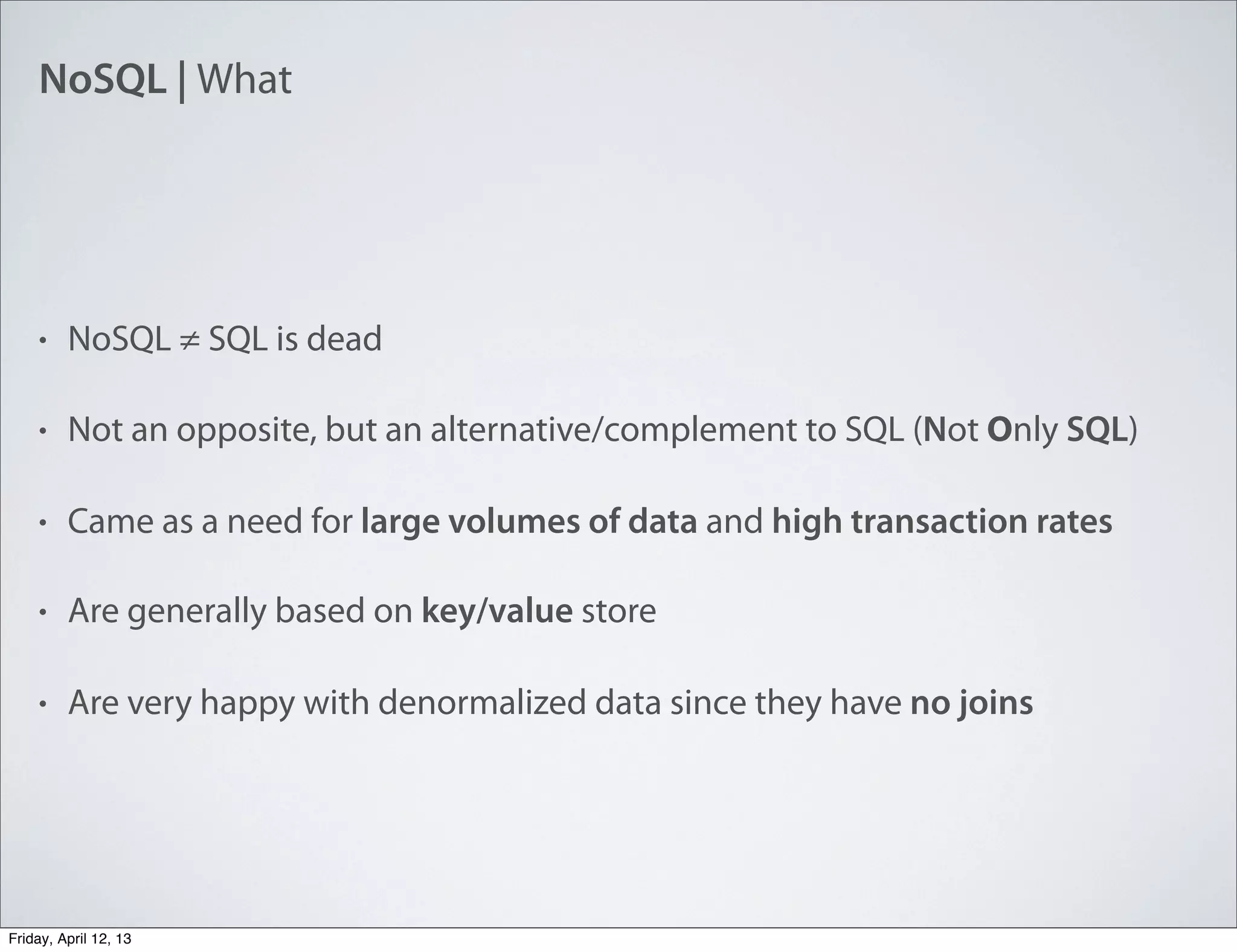
• NoSQL ≠ SQL is dead
• Not an opposite, but an alternative/complement to SQL (Not Only SQL)
• Came as a need for large volumes of data and high transaction rates
• Are generally based on key/value store
• Are very happy with denormalized data since they have no joins
Friday, April 12, 13
NoSQL | Why
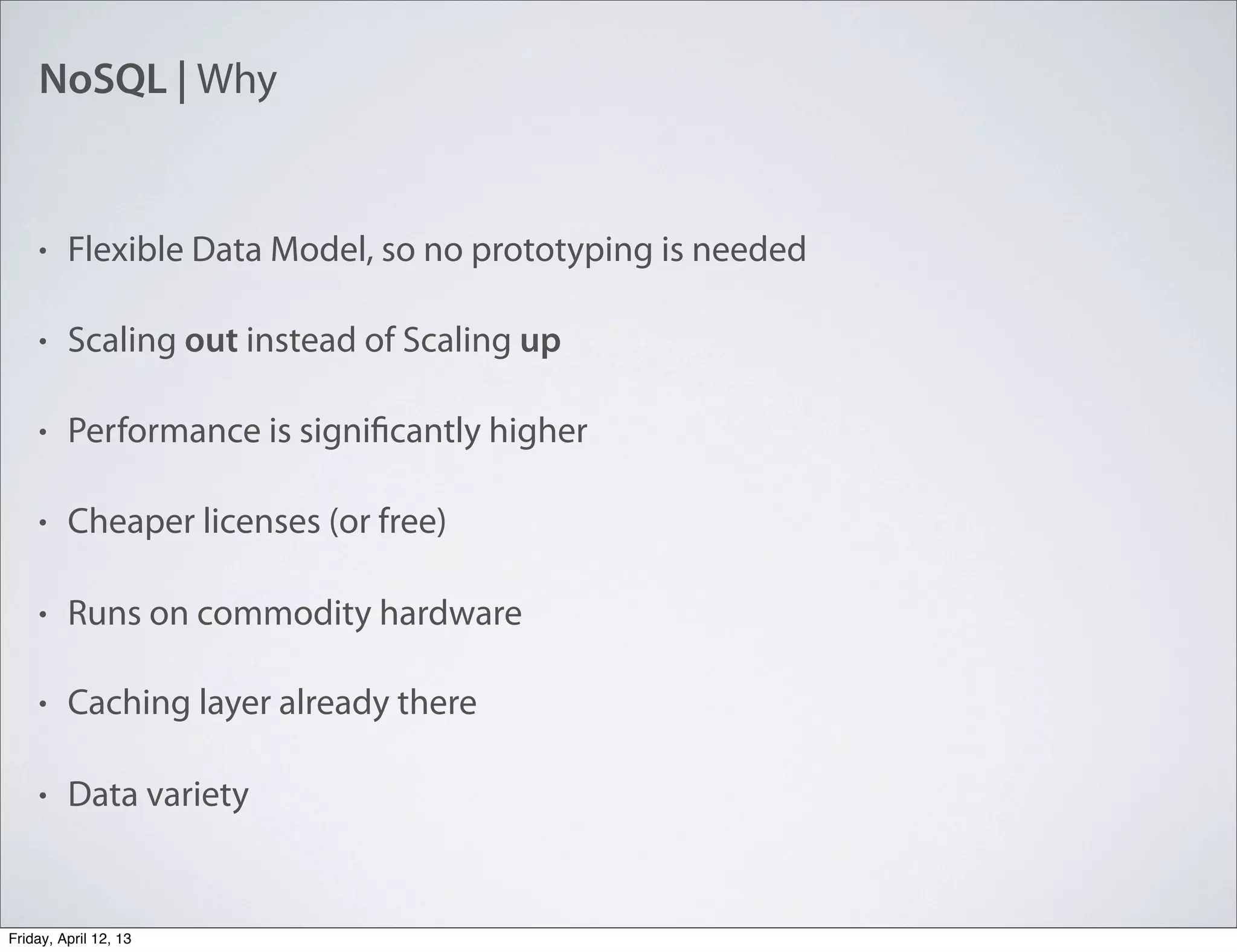
• Flexible Data Model, so no prototyping is needed
• Scaling out instead of Scaling up
• Performance is significantly higher
• Cheaper licenses (or free)
• Runs on commodity hardware
• Caching layer already there
• Data variety
Friday, April 12, 13
NoSQL | Why not
• well, it’s not all ACID...
• Less mature than the relational systems (so the ecosystem of tools/addons
is still small)
• BI & Reporting is limited
• Coarse grained Security settings
Friday, April 12, 13
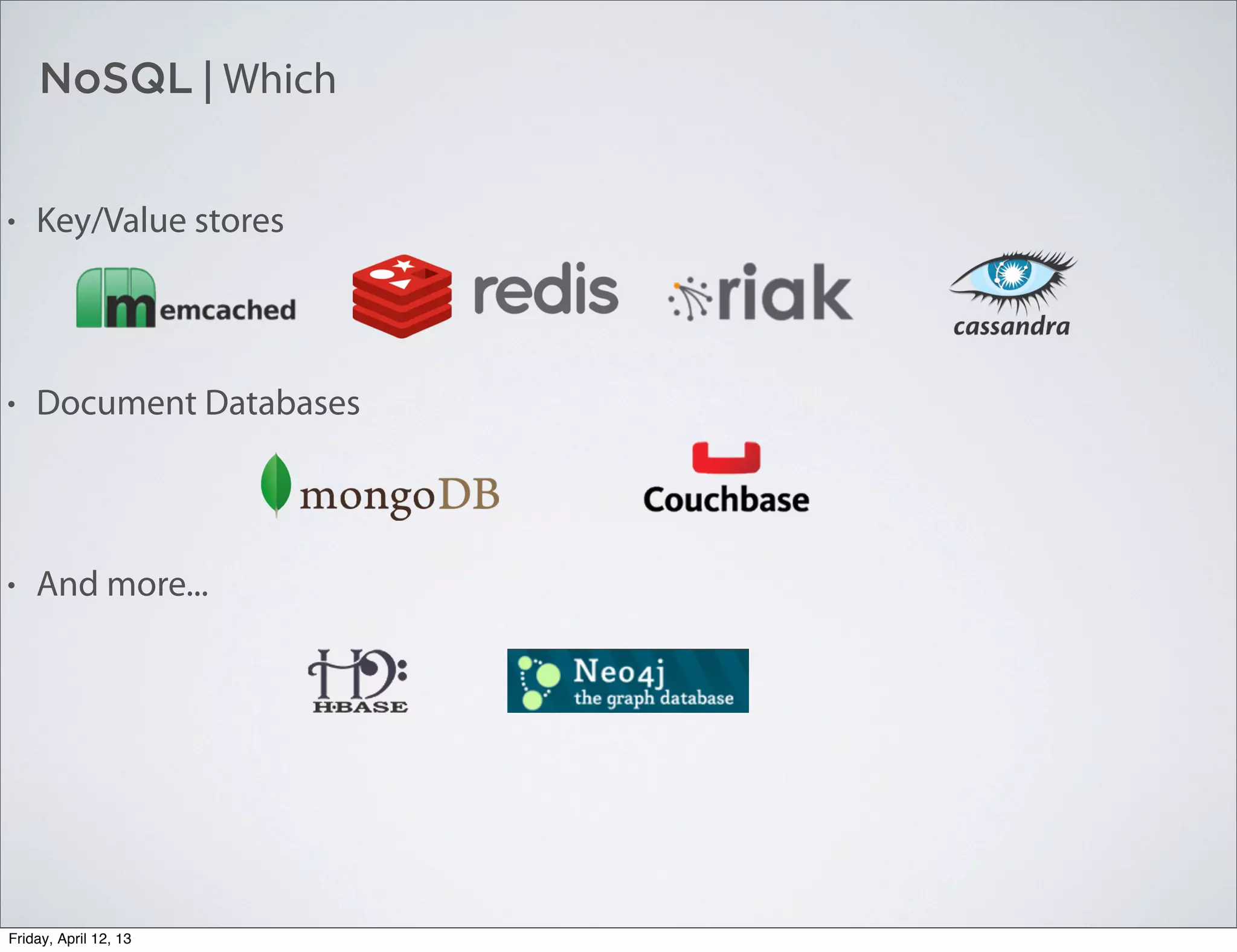
NoSQL | Which
• Key/Value stores
• Document Databases
• And more...
Friday, April 12, 13
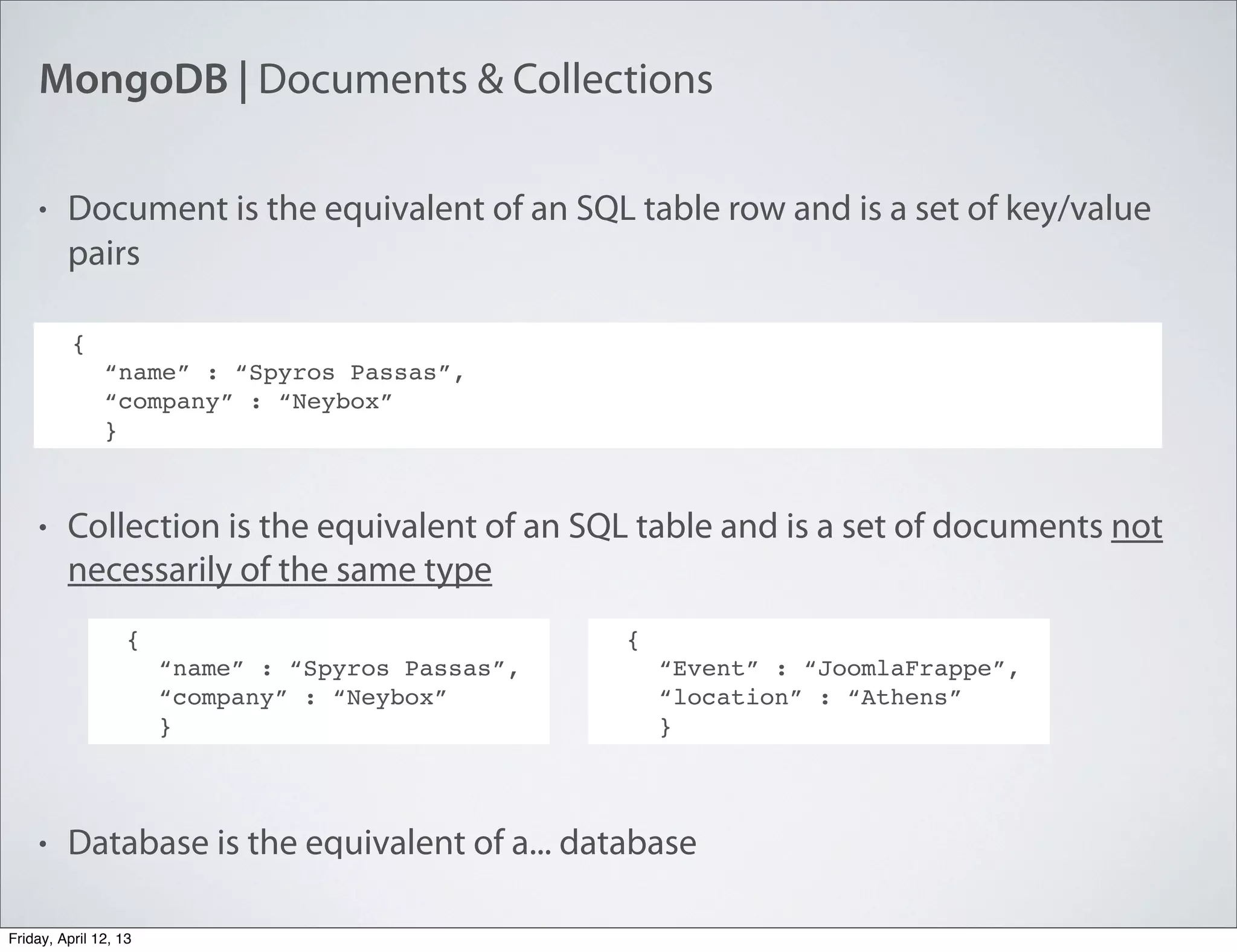
MongoDB | Documents & Collections
• Document is the equivalent of an SQL table row and is a set of key/value
pairs
• Collection is the equivalent of an SQL table and is a set of documents not
necessarily of the same type
• Database is the equivalent of a... database
{
“name” : “Spyros Passas”,
“company” : “Neybox”
}
{
“name” : “Spyros Passas”,
“company” : “Neybox”
}
{
“Event” : “JoomlaFrappe”,
“location” : “Athens”
}
Friday, April 12, 13
MongoDB | What can a value be?
• Keys are always strings (without . and $)
• Value can be
• String
• Number
• Date
• Array
• Document
{“name” : “Spyros Passas”}
{“age” : 30}
{“birthday” : Date(“1982-12-12”}
{“interests” : [“Programming”, “NoSQL”]}
{“address” : {
“street” : “123 Pireus st.”,
“city” : “Athens”,
“zip_code” : 17121
}
}
Friday, April 12, 13
MongoDB | Example of a document
{
“_id” : ObjectId(“47cc67093475061e3d95369d”),
“name” : “Spyros Passas”,
“birthday” : Date(“1982-12-12”),
“age” : 30,
“interests” : [“Programming”, “NoSQL”],
“address” : {
“street” : “123 Pireus st.”,
“city” : “Athens”,
“zip_code” : 17121
}
“_id” : ObjectId(“47cc67093475061e3d95369d”)
ObjectId is a special type
Friday, April 12, 13
MongoDB | Indexes
• Any field can be indexed
• Indexes are ordered
• Indexes can be unique
• Compound indexes are possible (and in fact very useful)
• Can be created or dropped at anytime
• Indexes have a large size and an insertion overhead
Friday, April 12, 13
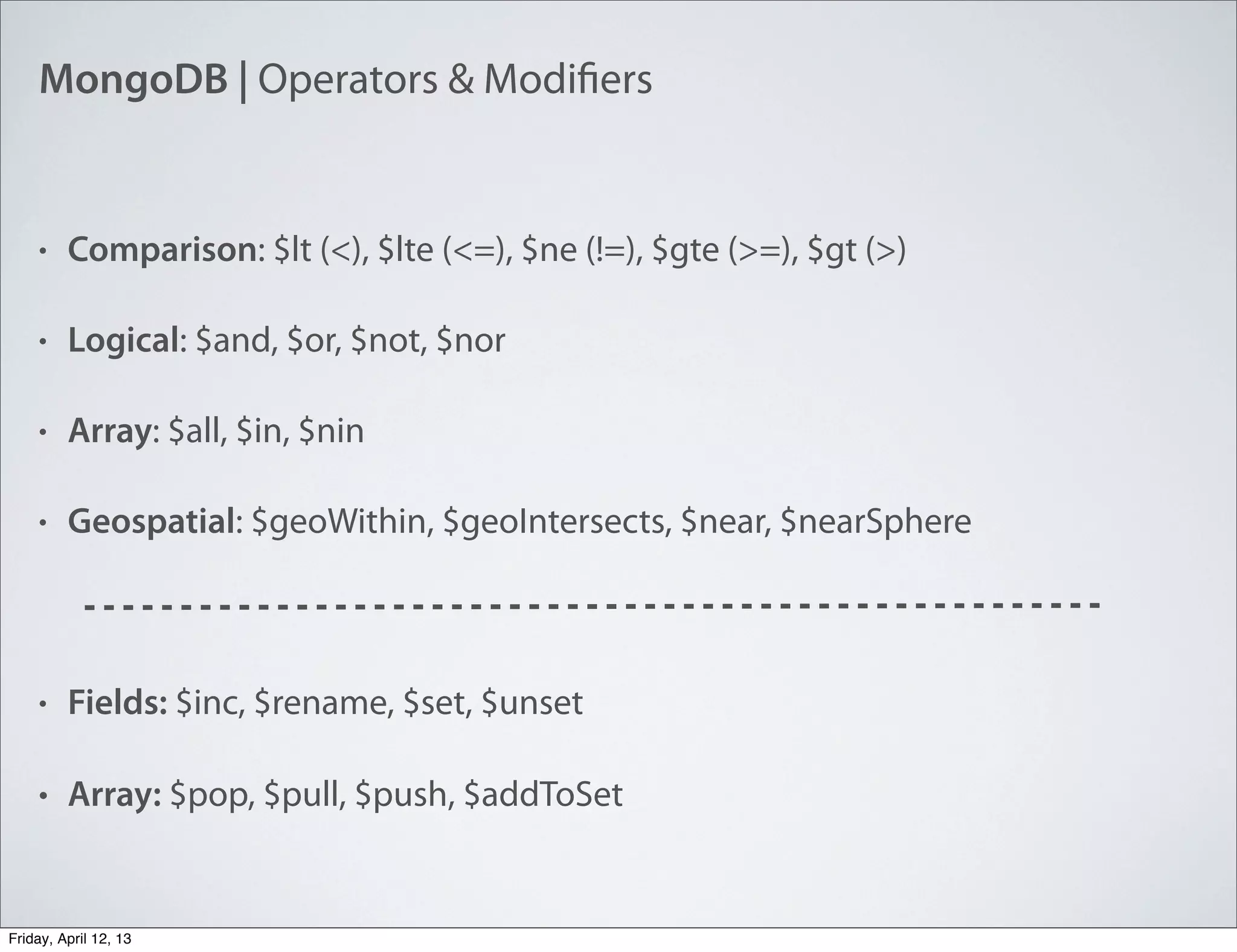
MongoDB | Operators & Modifiers
• Comparison: $lt (<), $lte (<=), $ne (!=), $gte (>=), $gt (>)
• Logical: $and, $or, $not, $nor
• Array: $all, $in, $nin
• Geospatial: $geoWithin, $geoIntersects, $near, $nearSphere
• Fields: $inc, $rename, $set, $unset
• Array: $pop, $pull, $push, $addToSet
Friday, April 12, 13
MongoDB | Data Relations
• MongoDB has no joins (but you can fake them in the application level)
• MongoDB supports nested data (and it’s a pretty good idea actually!)
• Collections are not necessary, but greatly help data organization and
performance
Friday, April 12, 13
MongoDB | Going from relational to NoSQL
• Rethink your data and select a proper database
• Rethink the relationships between your data
• Rethink your query access patterns to create efficient indexes
• Get to know your NoSQL database (and its limitations)
• Move logic from data to application layer (but be careful)
Friday, April 12, 13
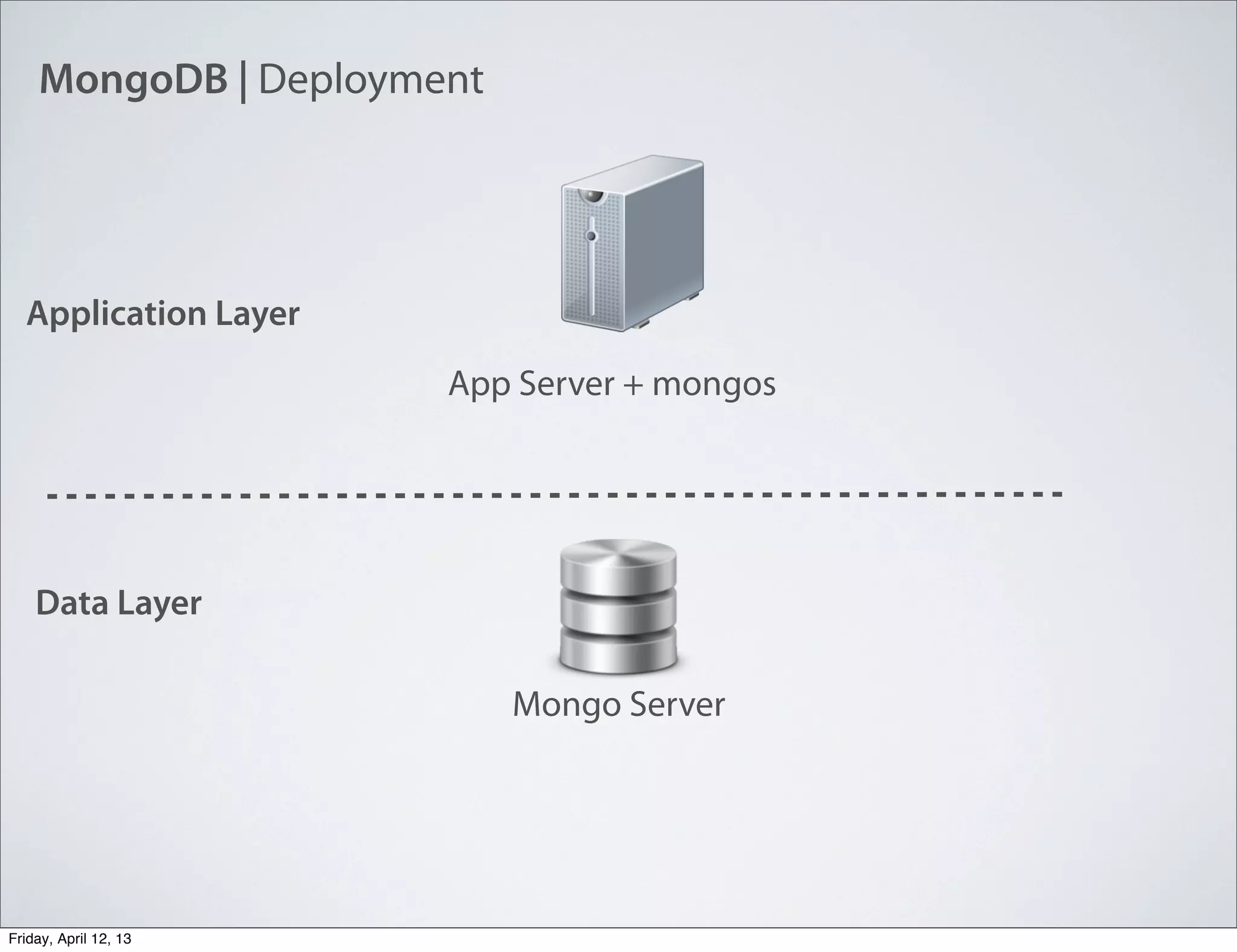
MongoDB | Deployment
Mongo Server
Data Layer
Application Layer
App Server + mongos
Friday, April 12, 13
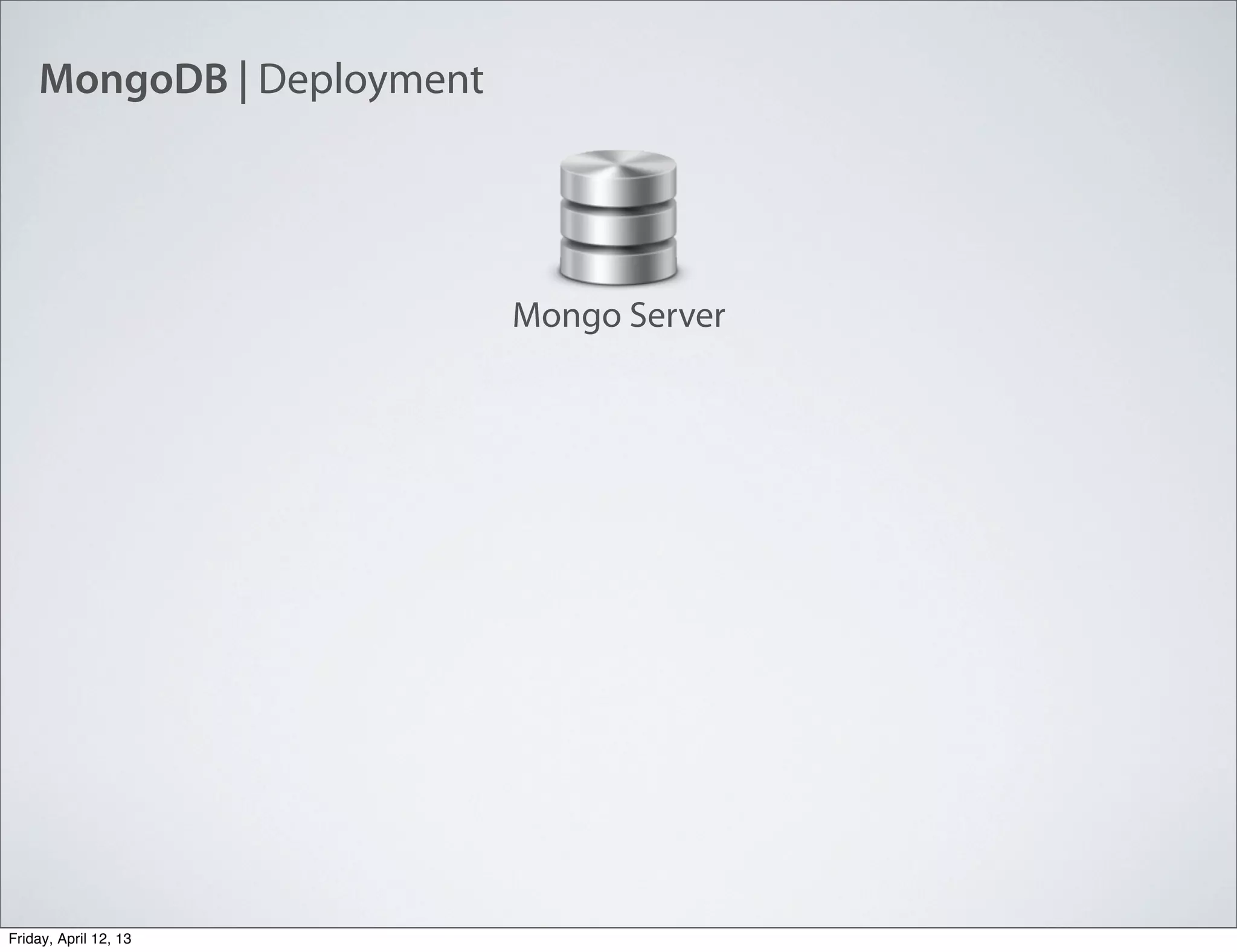
MongoDB | Deployment
Mongo Server
Friday, April 12, 13
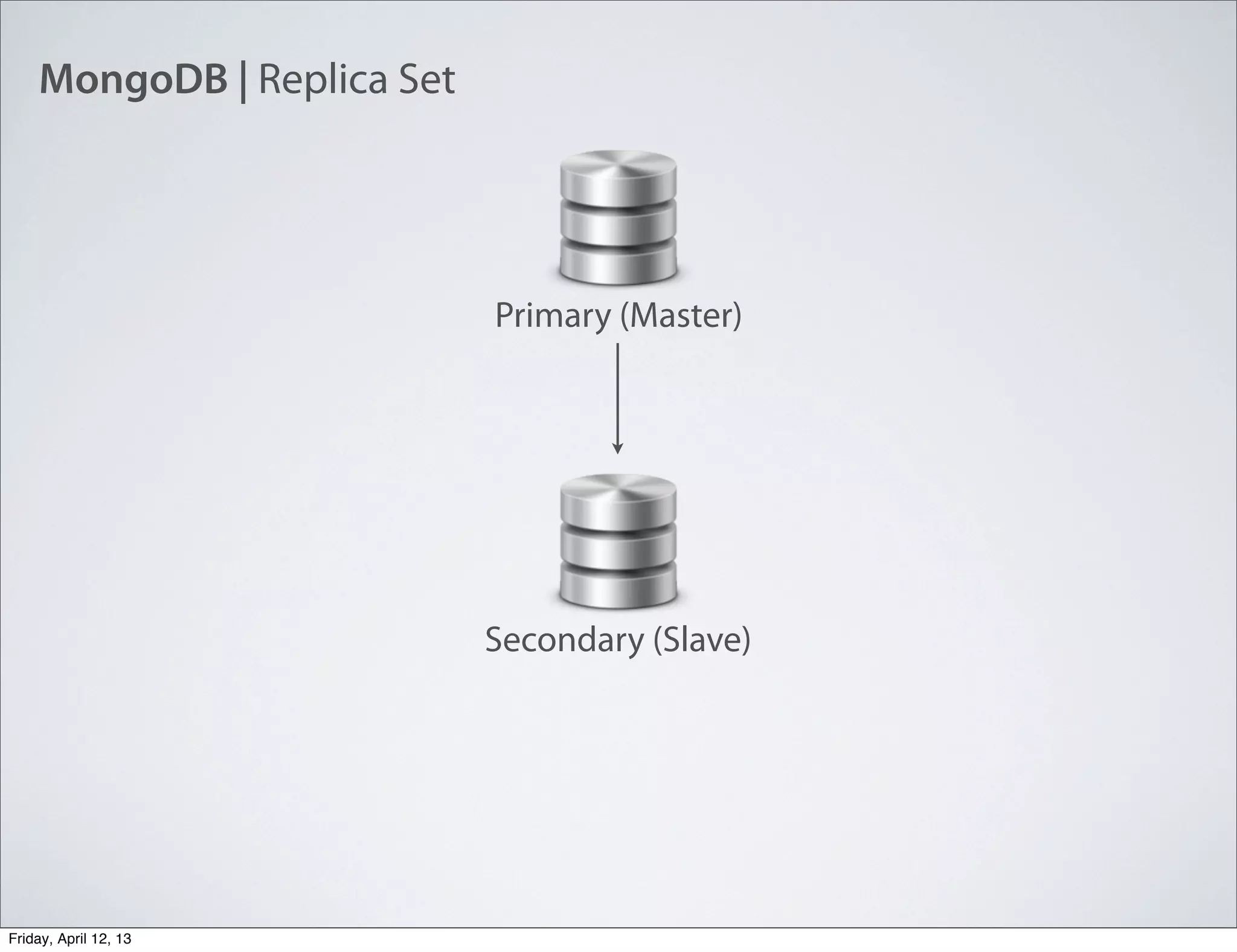
MongoDB | Replica Set
Primary (Master)
Secondary (Slave)
Friday, April 12, 13
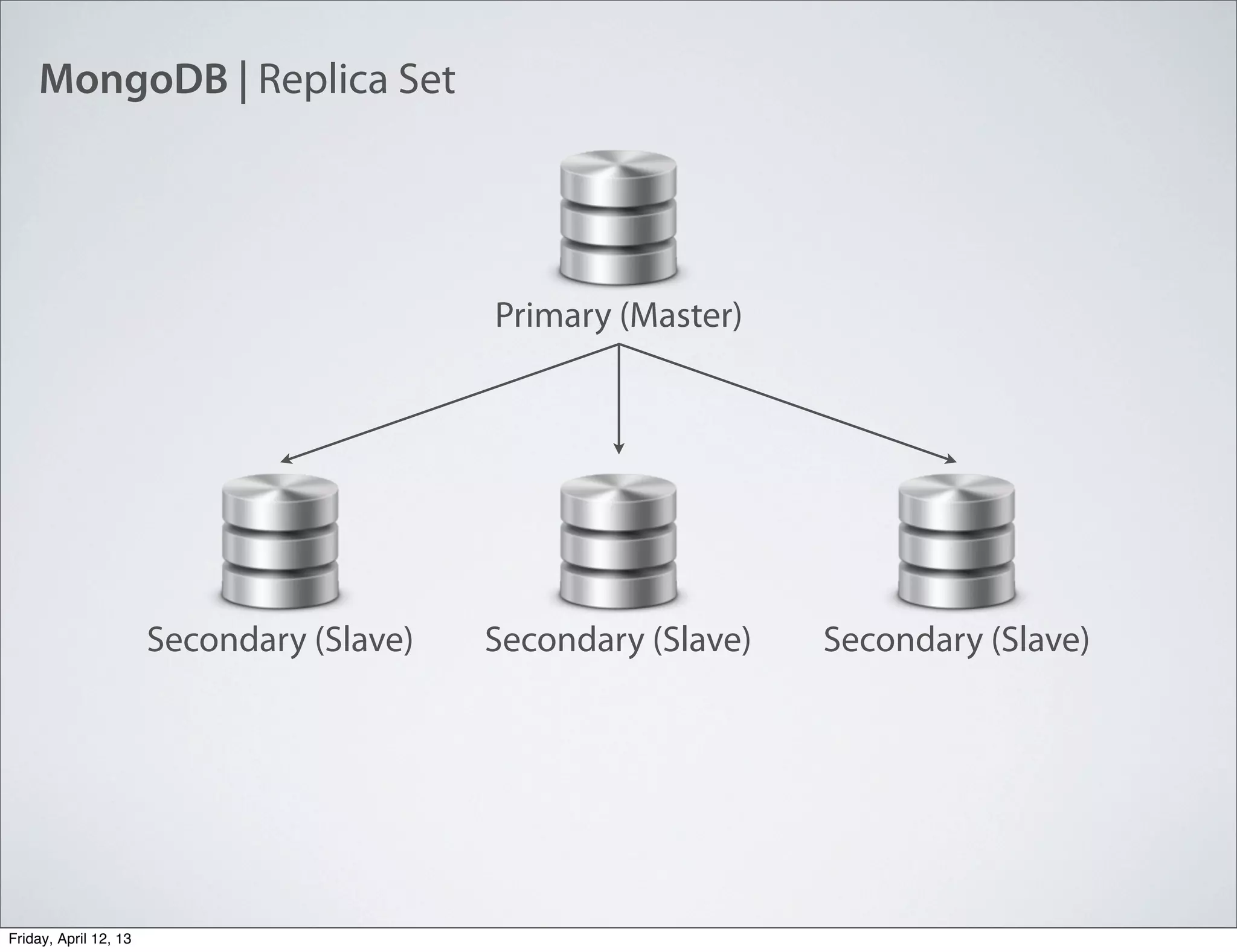
MongoDB | Replica Set
Primary (Master)
Secondary (Slave)Secondary (Slave) Secondary (Slave)
Friday, April 12, 13
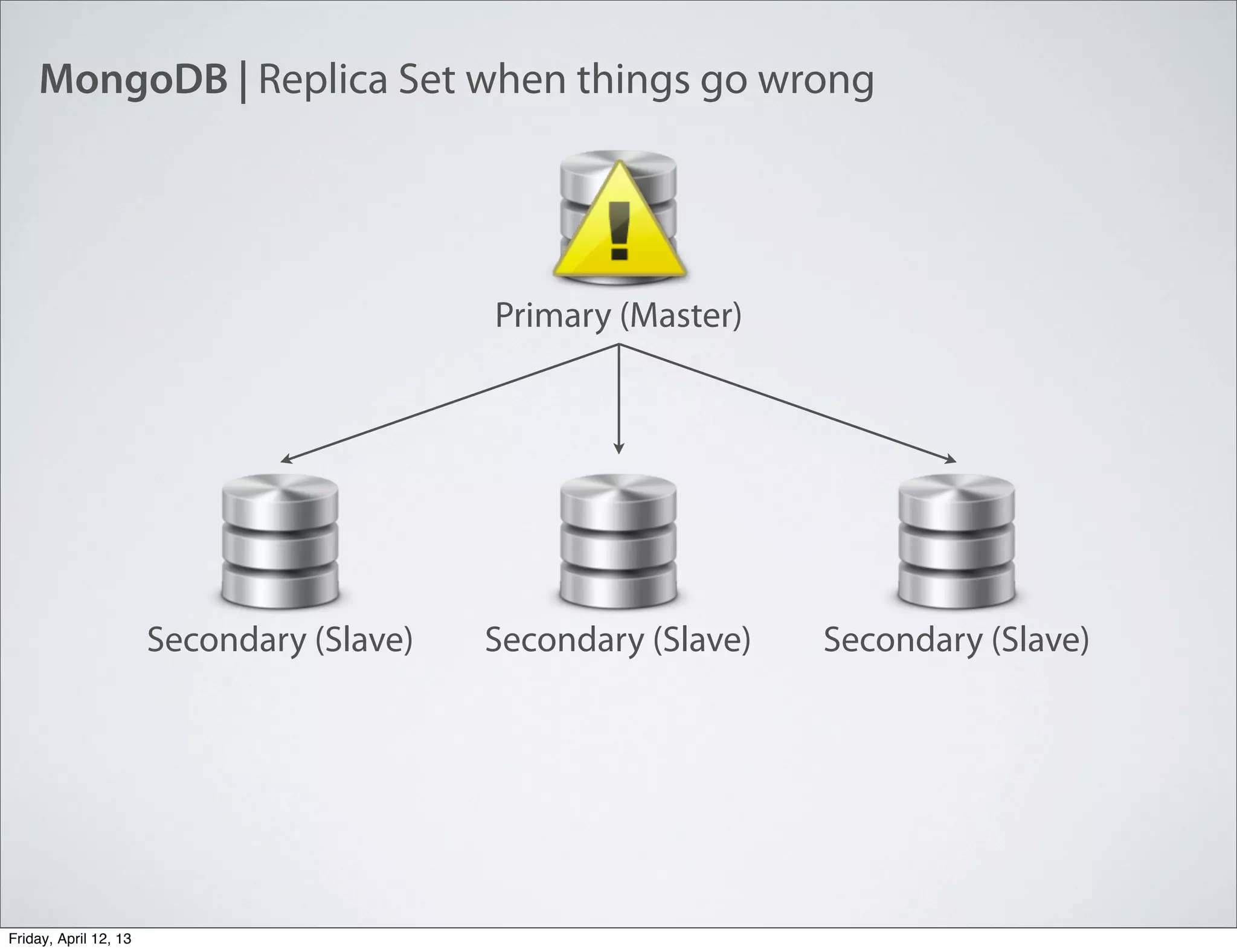
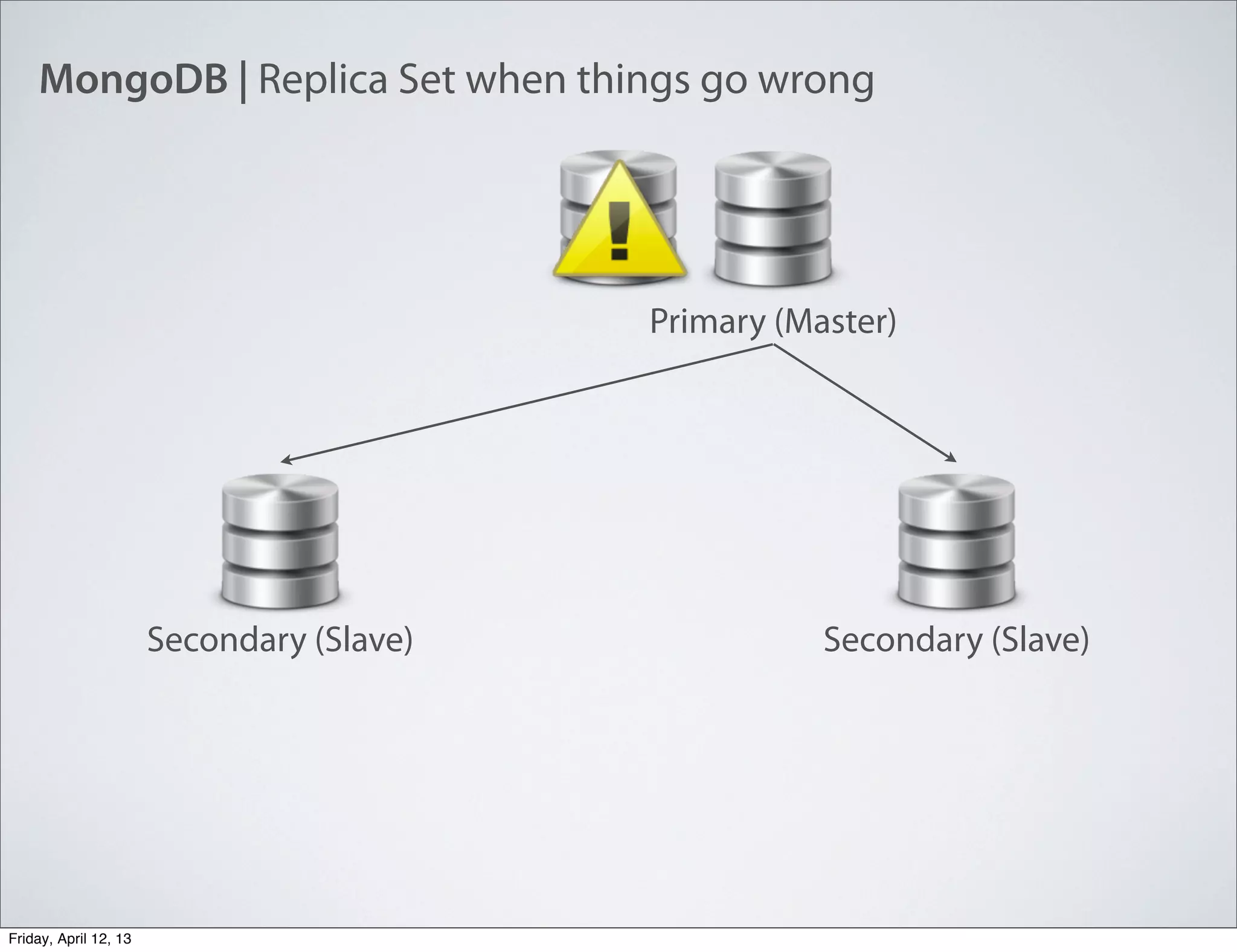
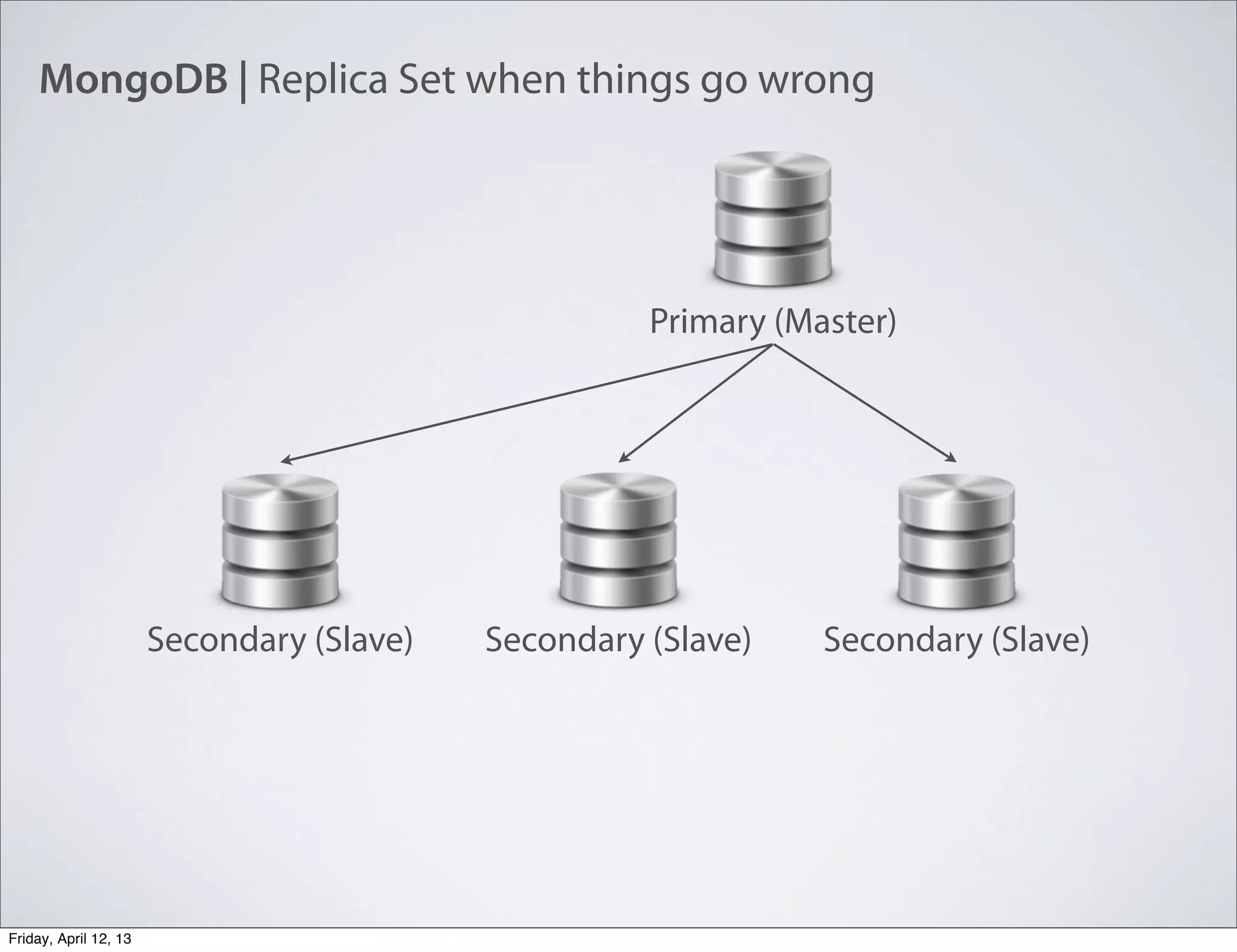
MongoDB | Replica Set when things go wrong
Primary (Master)
Secondary (Slave)Secondary (Slave) Secondary (Slave)
Friday, April 12, 13
MongoDB | Replica Set when things go wrong
Primary (Master)
Secondary (Slave) Secondary (Slave)
Friday, April 12, 13
MongoDB | Replica Set when things go wrong
Primary (Master)
Secondary (Slave) Secondary (Slave)Secondary (Slave)
Friday, April 12, 13
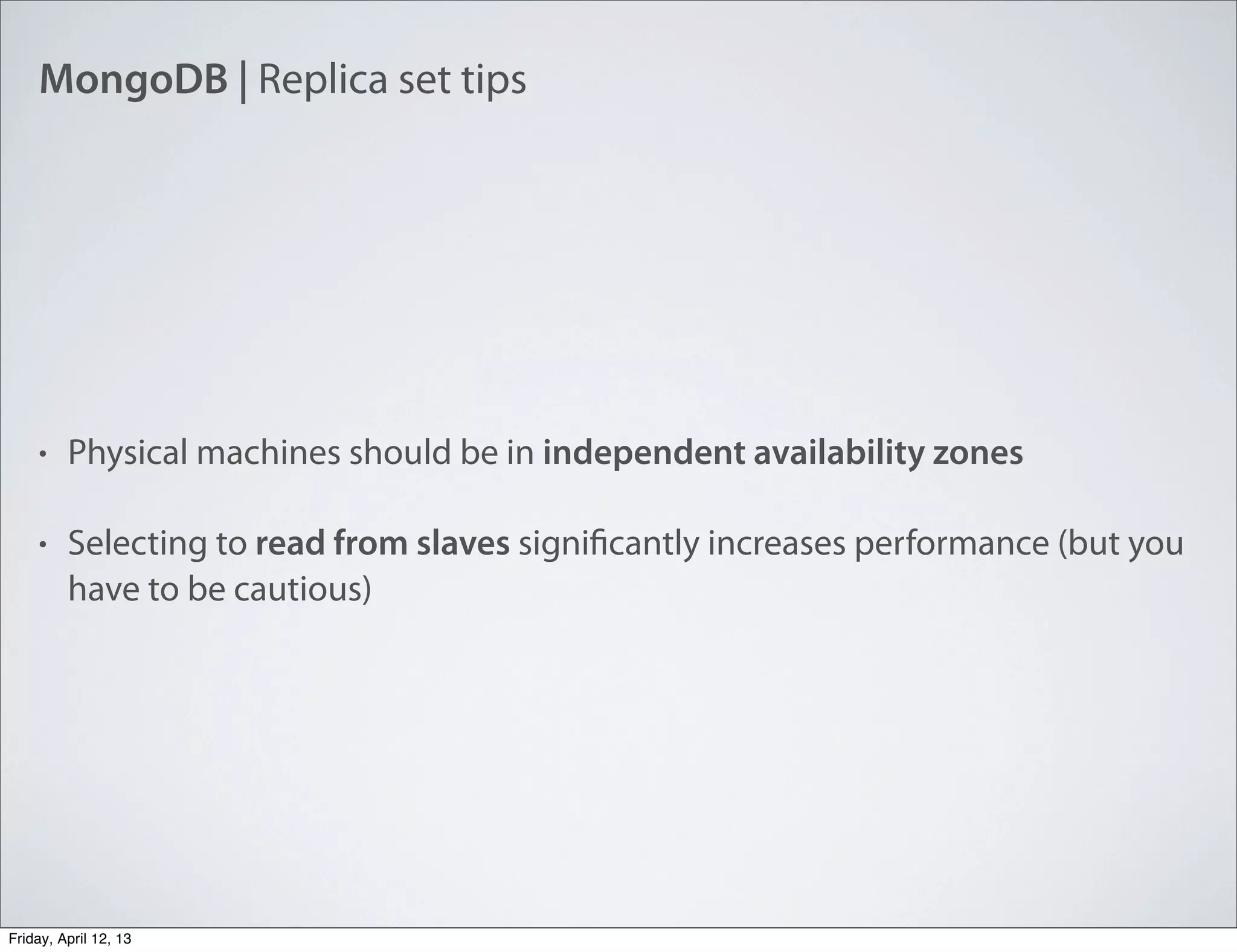
MongoDB | Replica set tips
• Physical machines should be in independent availability zones
• Selecting to read from slaves significantly increases performance (but you
have to be cautious)
Friday, April 12, 13
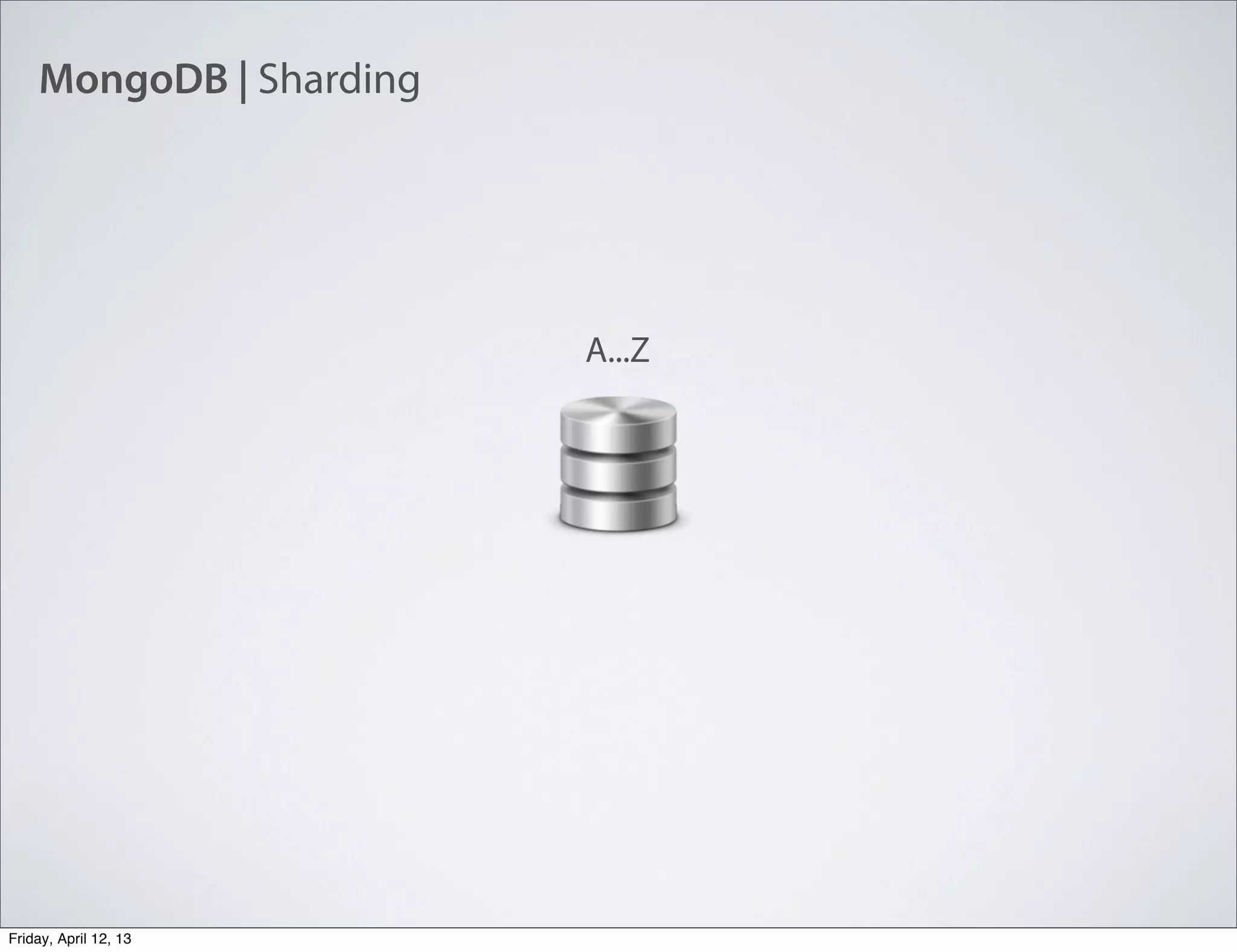
MongoDB | Sharding
A...Z
Friday, April 12, 13
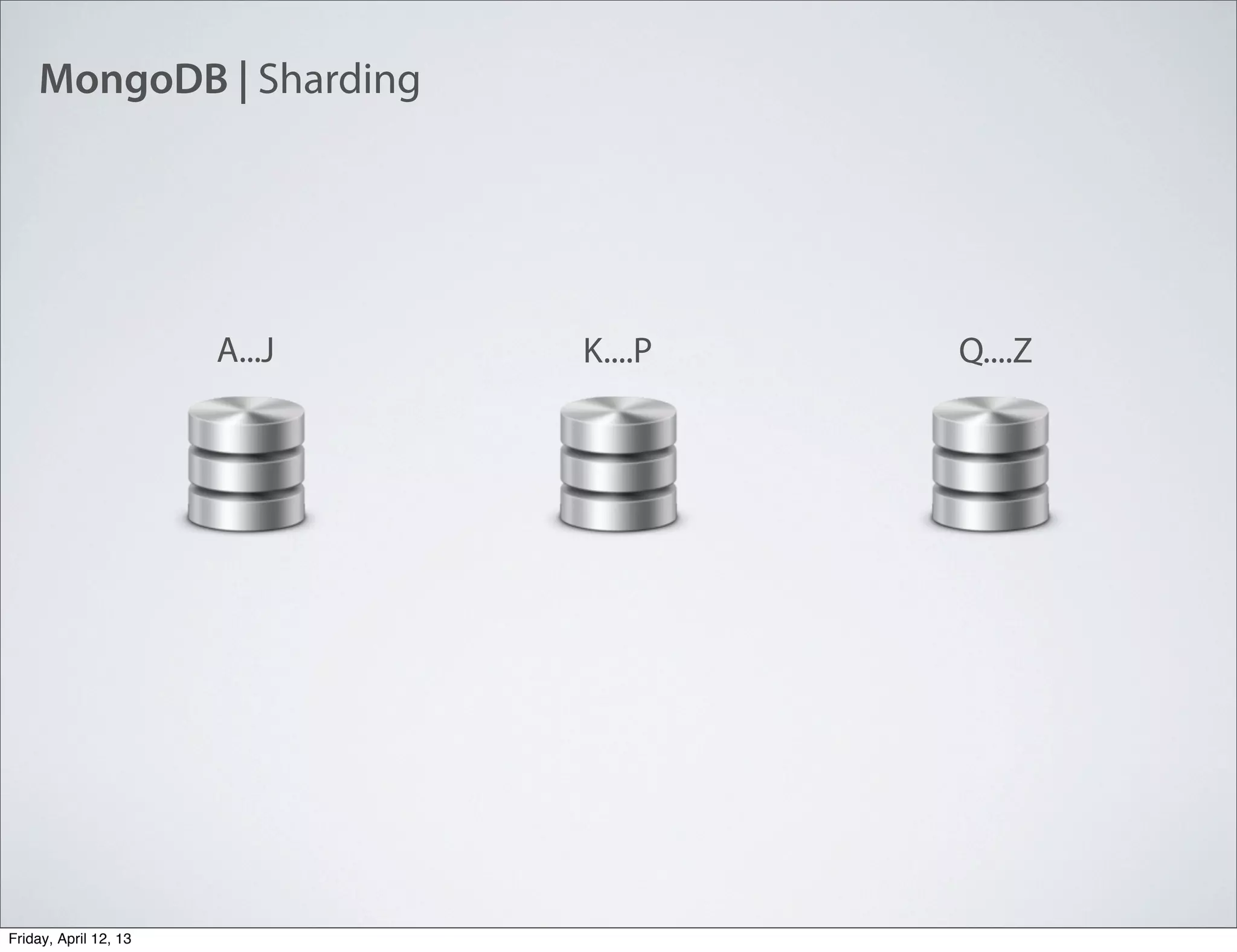
MongoDB | Sharding
A...J K....P Q....Z
Friday, April 12, 13
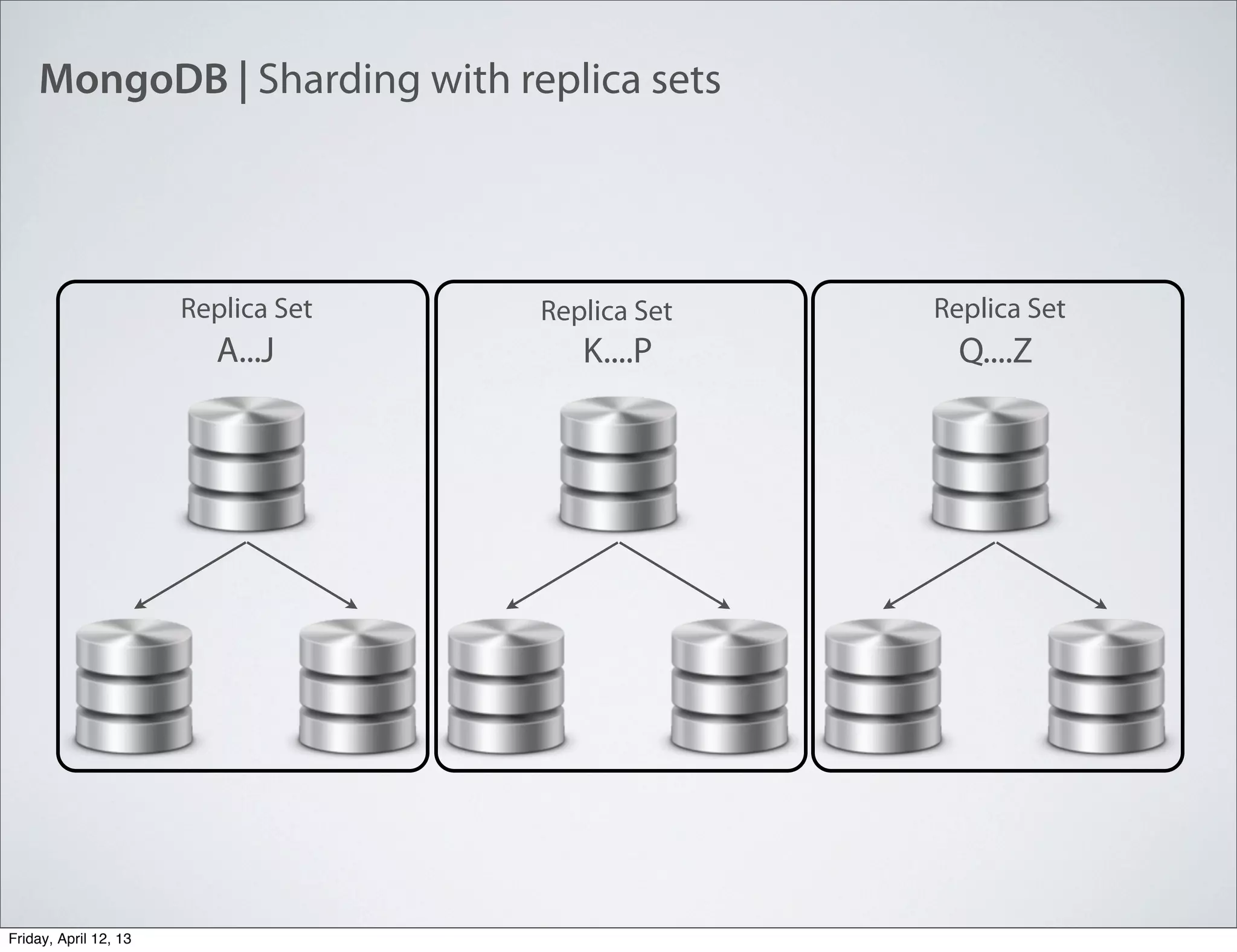
MongoDB | Sharding with replica sets
A...J K....P Q....Z
Replica SetReplica SetReplica Set
Friday, April 12, 13
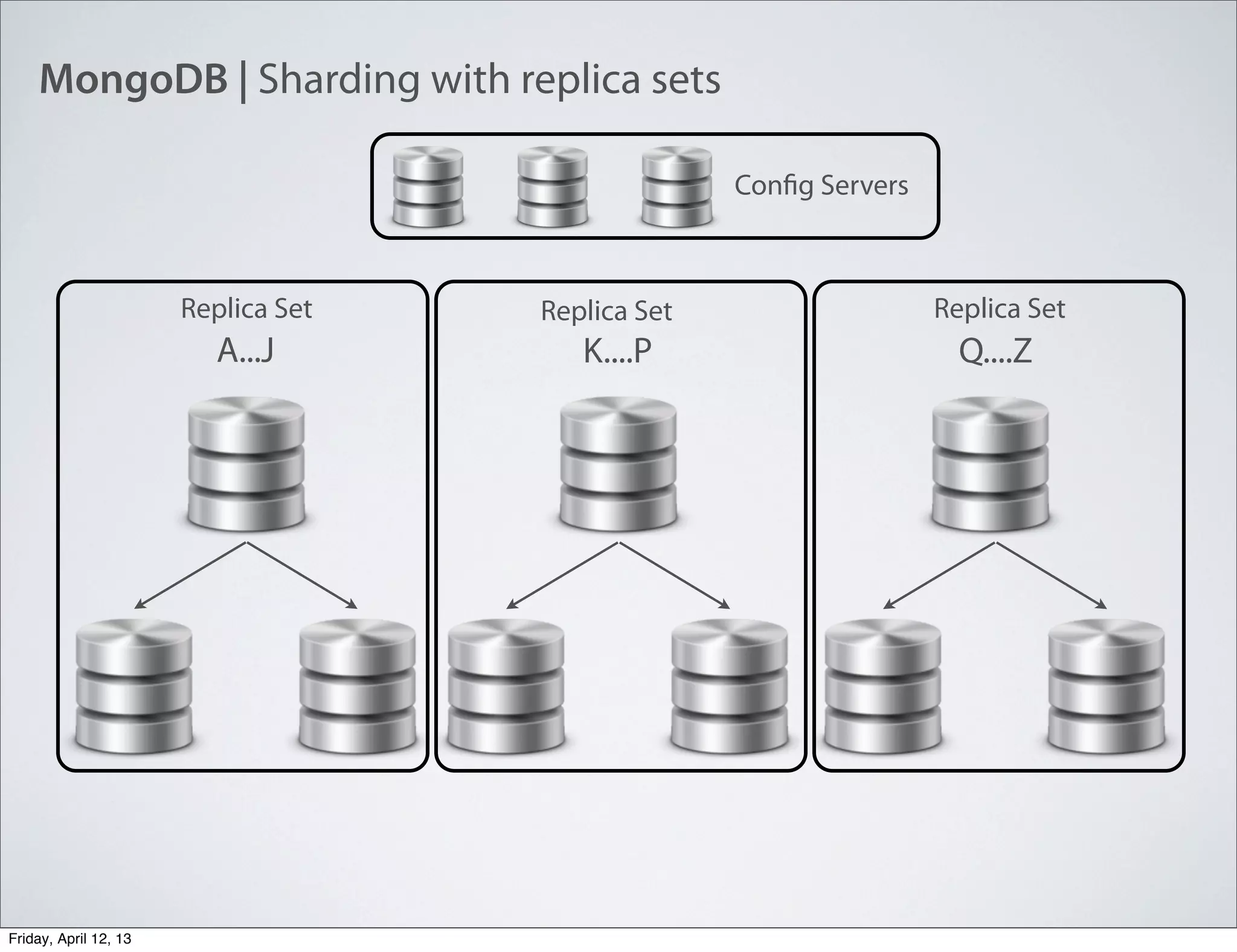
MongoDB | Sharding with replica sets
A...J K....P Q....Z
Config Servers
Replica SetReplica SetReplica Set
Friday, April 12, 13
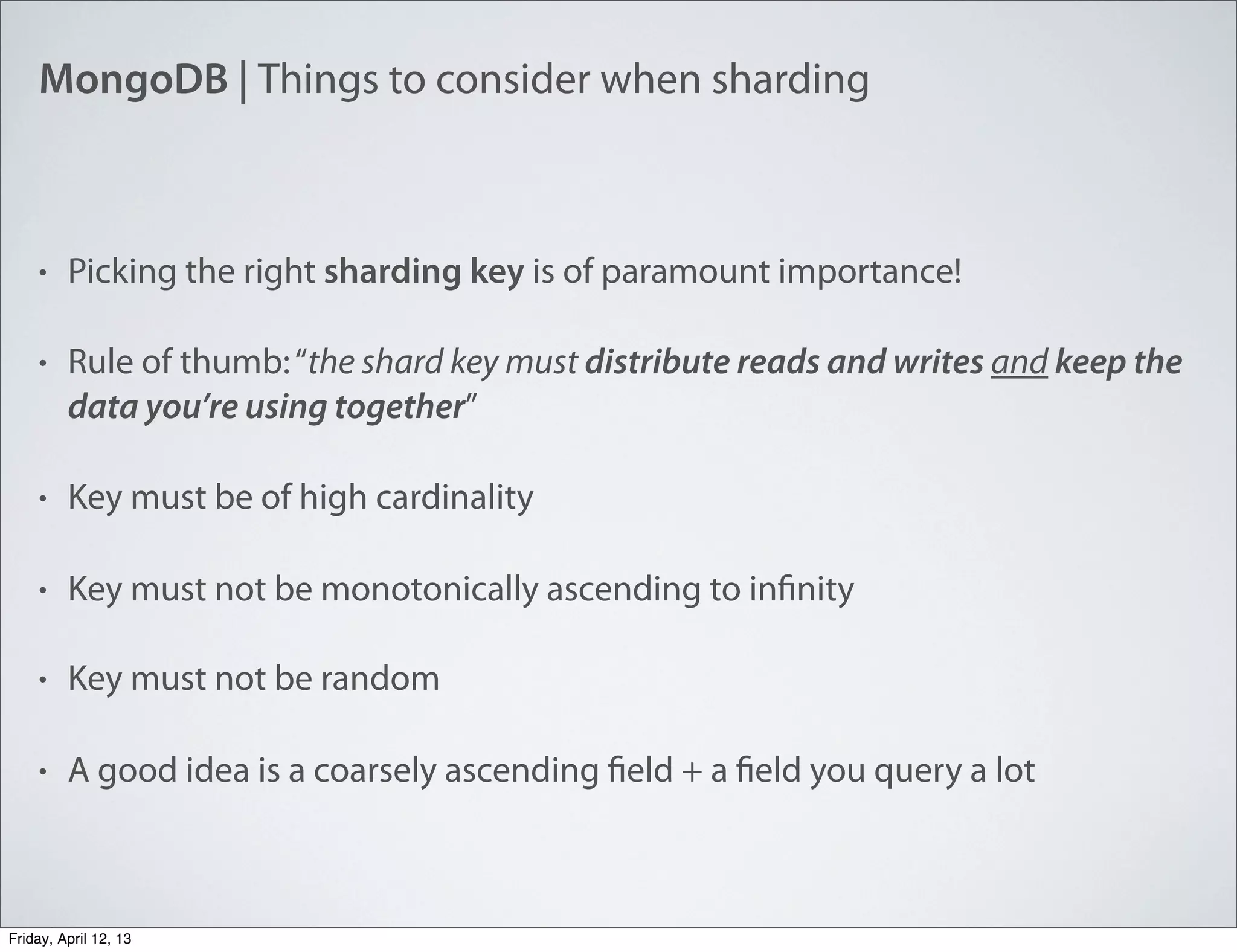
MongoDB | Things to consider when sharding
• Picking the right sharding key is of paramount importance!
• Rule of thumb:“the shard key must distribute reads and writes and keep the
data you’re using together”
• Key must be of high cardinality
• Key must not be monotonically ascending to infinity
• Key must not be random
• A good idea is a coarsely ascending field + a field you query a lot
Friday, April 12, 13
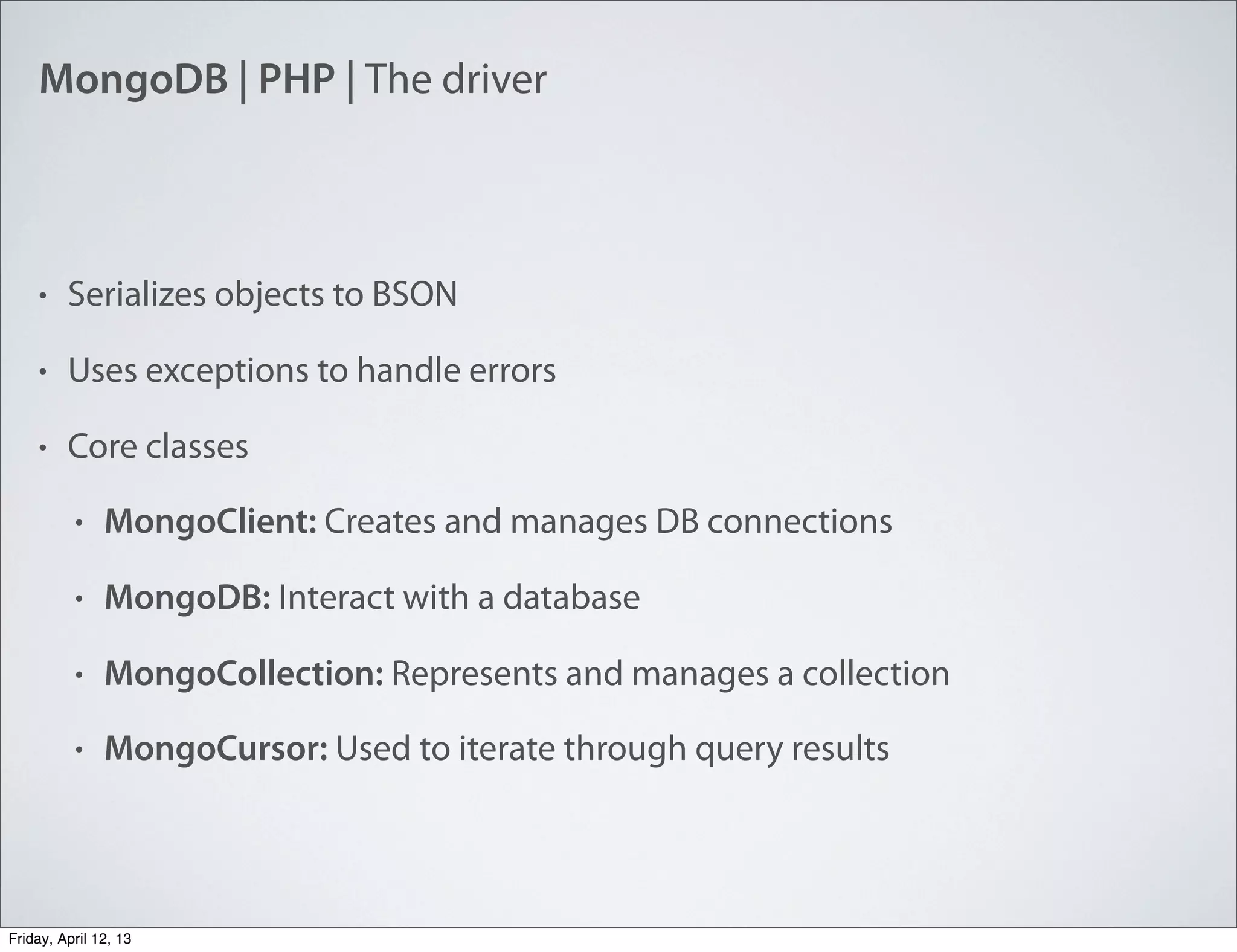
MongoDB | PHP | The driver
• Serializes objects to BSON
• Uses exceptions to handle errors
• Core classes
• MongoClient: Creates and manages DB connections
• MongoDB: Interact with a database
• MongoCollection: Represents and manages a collection
• MongoCursor: Used to iterate through query results
Friday, April 12, 13
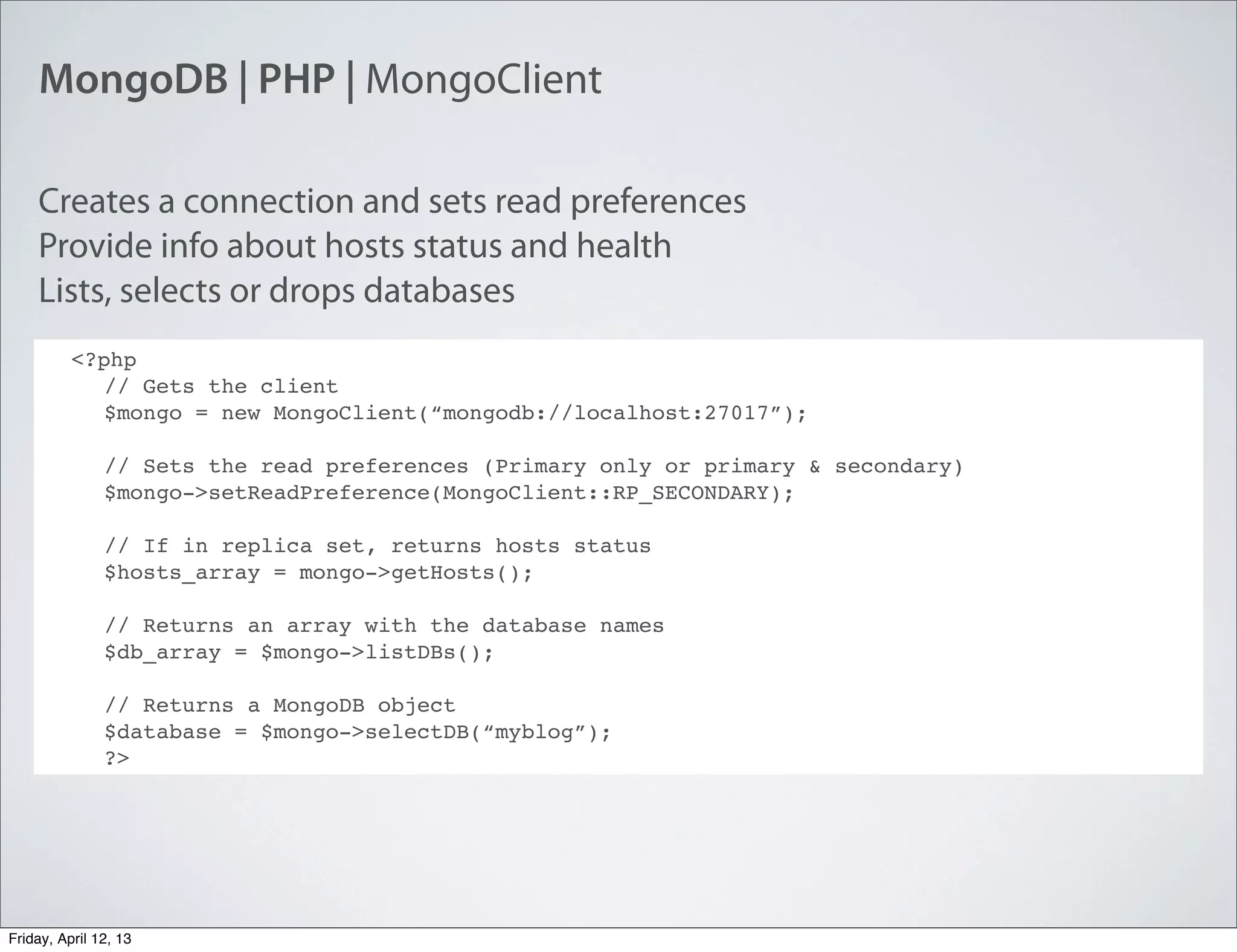
MongoDB | PHP | MongoClient
<?php
// Gets the client
$mongo = new MongoClient(“mongodb://localhost:27017”);
// Sets the read preferences (Primary only or primary & secondary)
$mongo->setReadPreference(MongoClient::RP_SECONDARY);
// If in replica set, returns hosts status
$hosts_array = mongo->getHosts();
// Returns an array with the database names
$db_array = $mongo->listDBs();
// Returns a MongoDB object
$database = $mongo->selectDB(“myblog”);
?>
Creates a connection and sets read preferences
Provide info about hosts status and health
Lists, selects or drops databases
Friday, April 12, 13
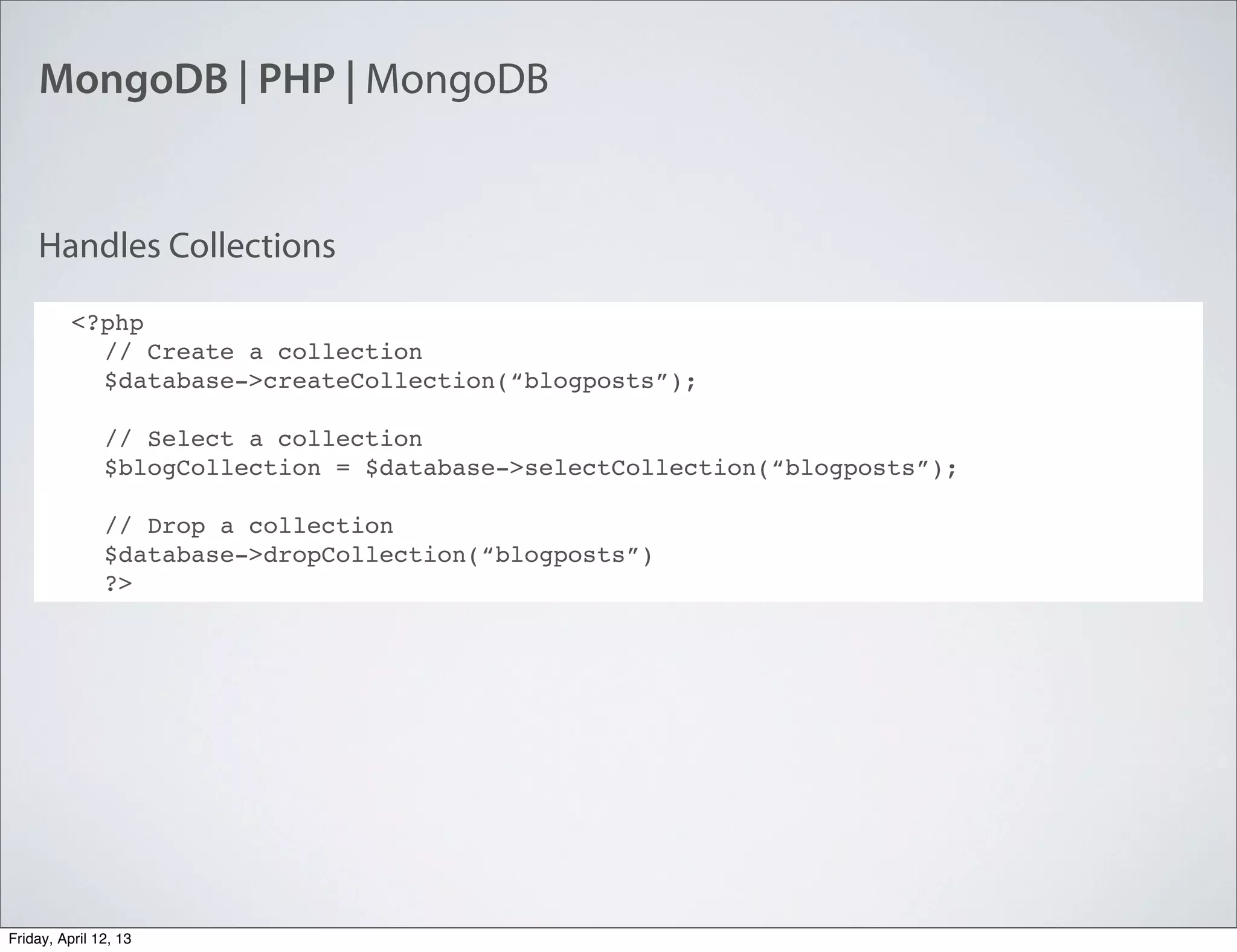
MongoDB | PHP | MongoDB
<?php
// Create a collection
$database->createCollection(“blogposts”);
// Select a collection
$blogCollection = $database->selectCollection(“blogposts”);
// Drop a collection
$database->dropCollection(“blogposts”)
?>
Handles Collections
Friday, April 12, 13
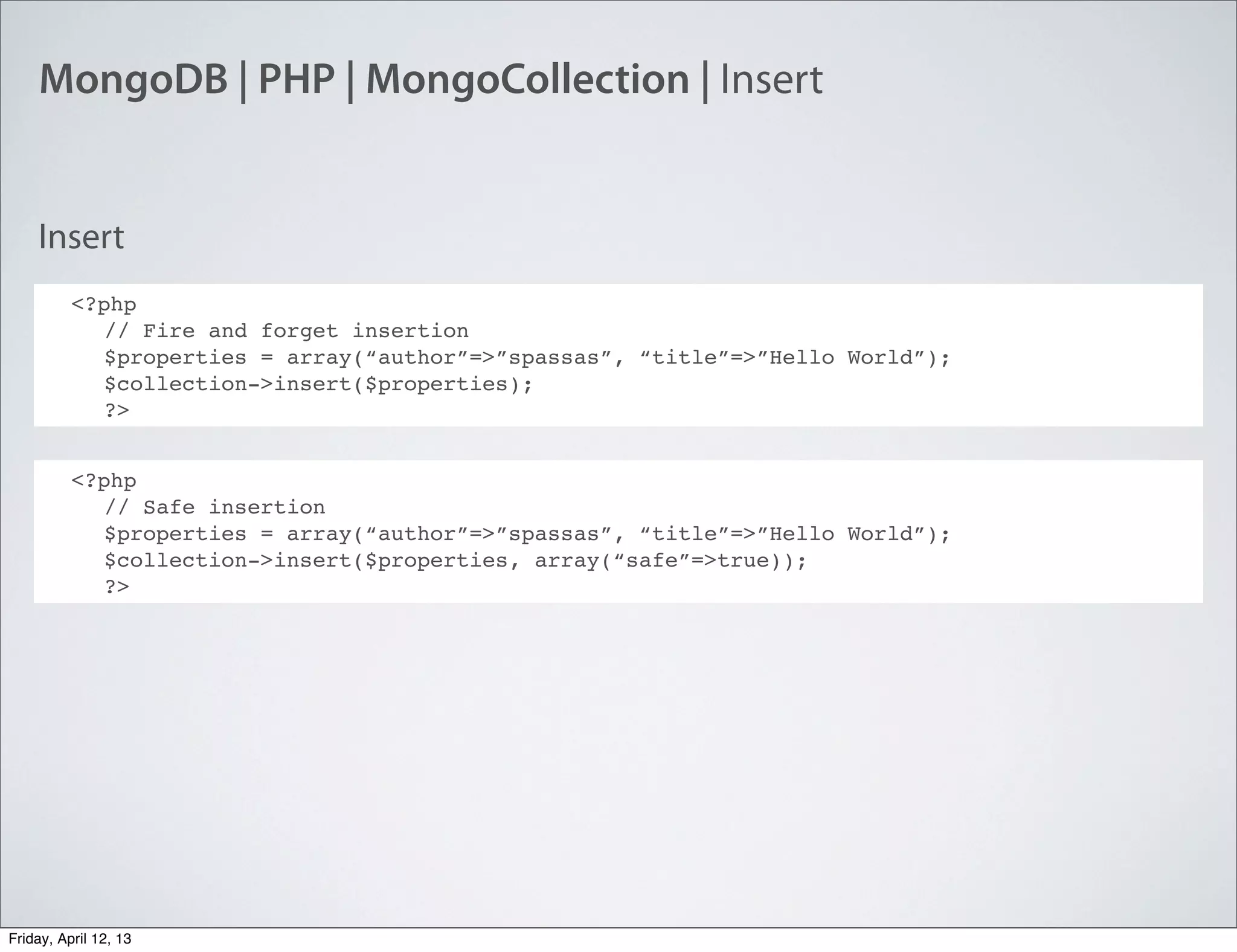
MongoDB | PHP | MongoCollection | Insert
<?php
// Fire and forget insertion
$properties = array(“author”=>”spassas”, “title”=>”Hello World”);
$collection->insert($properties);
?>
Insert
<?php
// Safe insertion
$properties = array(“author”=>”spassas”, “title”=>”Hello World”);
$collection->insert($properties, array(“safe”=>true));
?>
Friday, April 12, 13
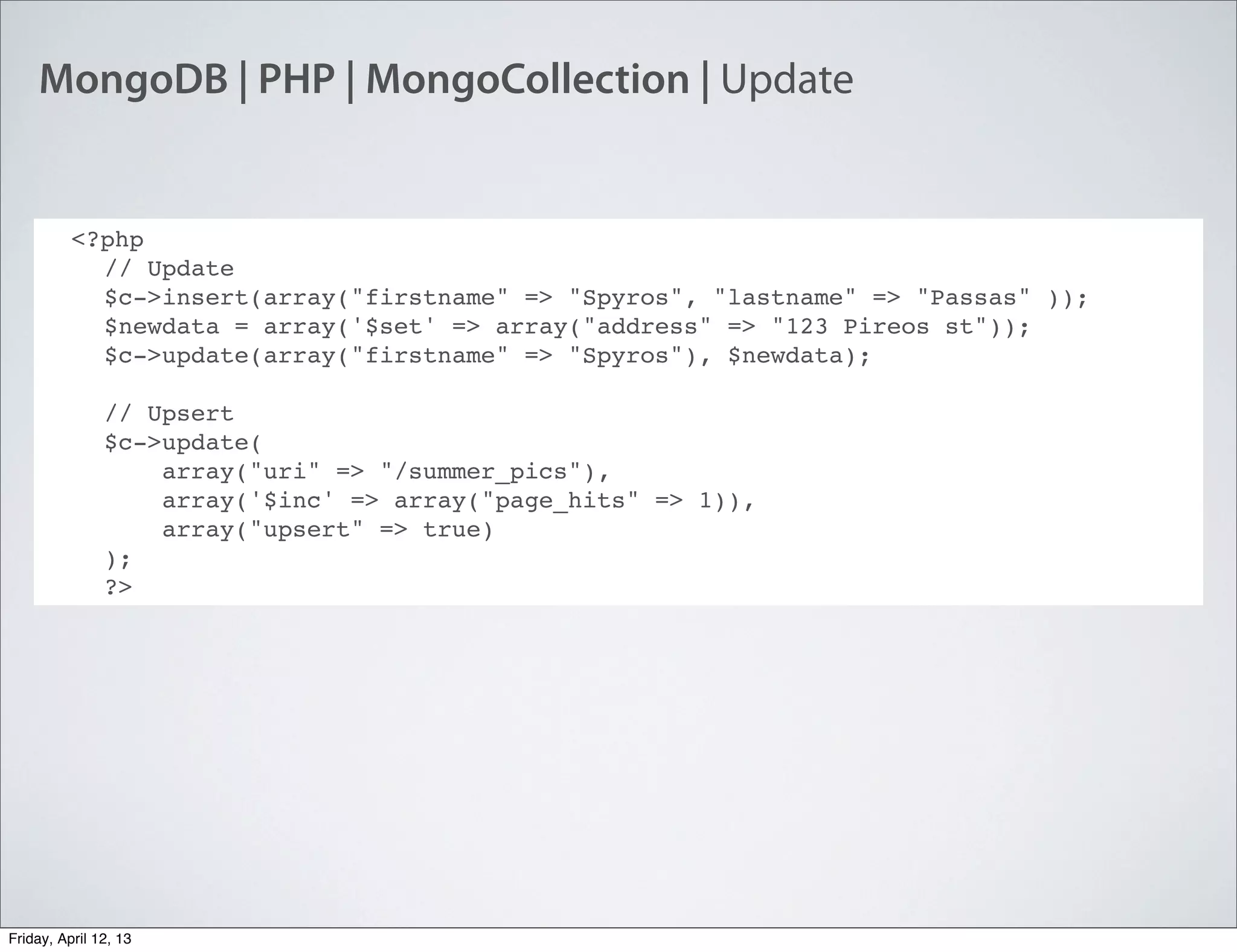
MongoDB | PHP | MongoCollection | Update
<?php
// Update
$c->insert(array("firstname" => "Spyros", "lastname" => "Passas" ));
$newdata = array('$set' => array("address" => "123 Pireos st"));
$c->update(array("firstname" => "Spyros"), $newdata);
// Upsert
$c->update(
    array("uri" => "/summer_pics"),
    array('$inc' => array("page_hits" => 1)),
    array("upsert" => true)
);
?>
Friday, April 12, 13
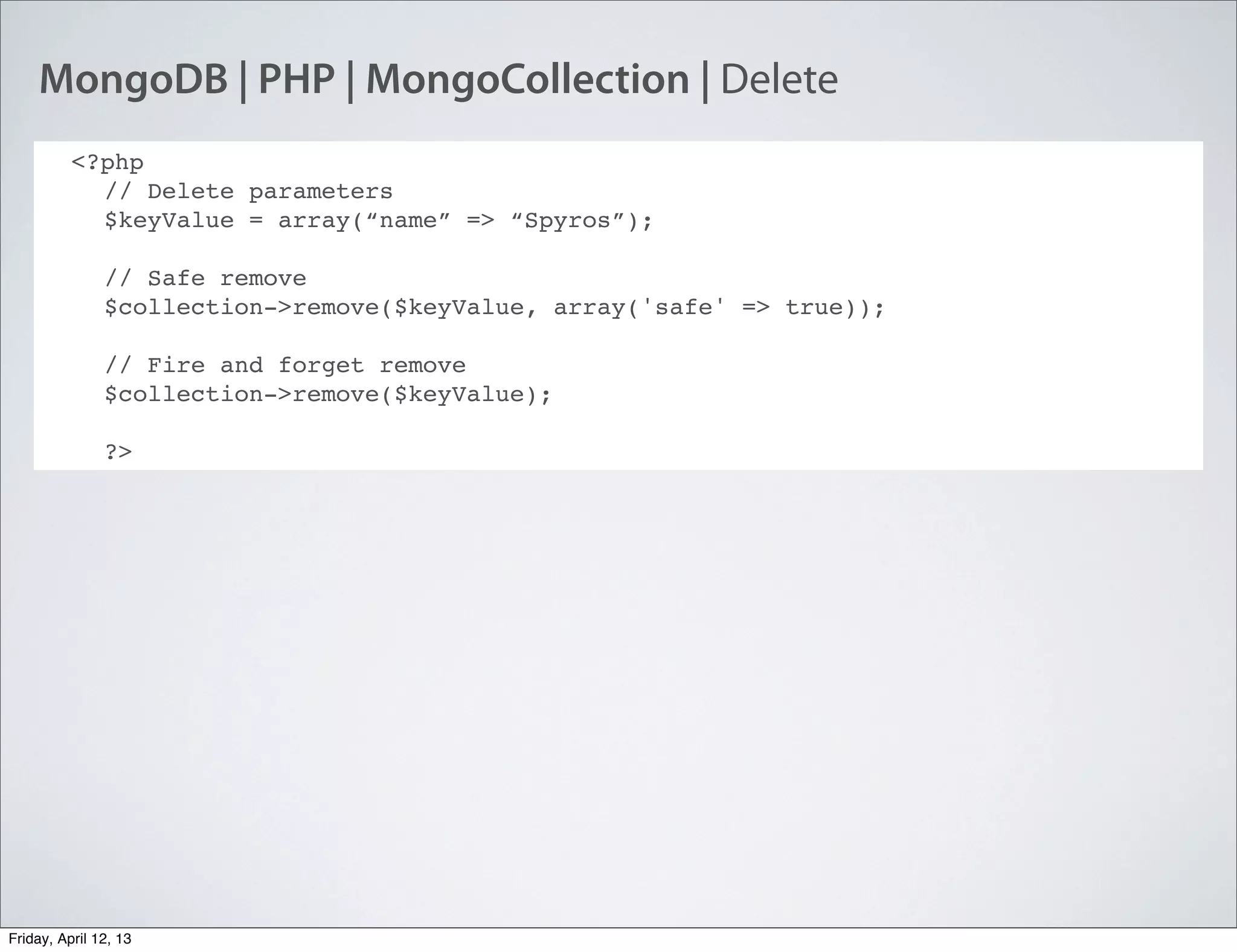
MongoDB | PHP | MongoCollection | Delete
<?php
// Delete parameters
$keyValue = array(“name” => “Spyros”);
// Safe remove
$collection->remove($keyValue, array('safe' => true));
// Fire and forget remove
$collection->remove($keyValue);
?>
Friday, April 12, 13
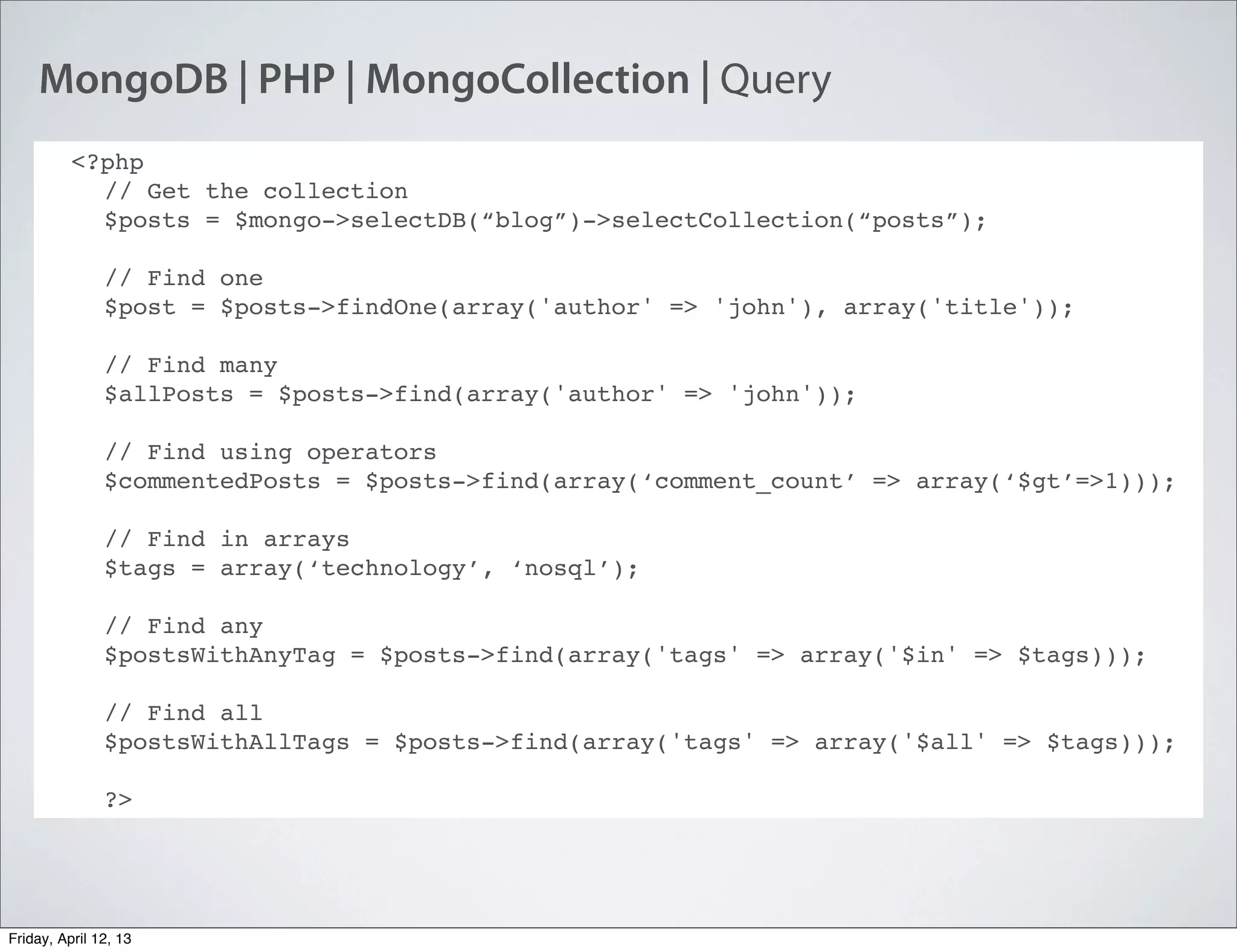
MongoDB | PHP | MongoCollection | Query
<?php
// Get the collection
$posts = $mongo->selectDB(“blog”)->selectCollection(“posts”);
// Find one
$post = $posts->findOne(array('author' => 'john'), array('title'));
// Find many
$allPosts = $posts->find(array('author' => 'john'));
// Find using operators
$commentedPosts = $posts->find(array(‘comment_count’ => array(‘$gt’=>1)));
// Find in arrays
$tags = array(‘technology’, ‘nosql’);
// Find any
$postsWithAnyTag = $posts->find(array('tags' => array('$in' => $tags)));
// Find all
$postsWithAllTags = $posts->find(array('tags' => array('$all' => $tags)));
?>
Friday, April 12, 13
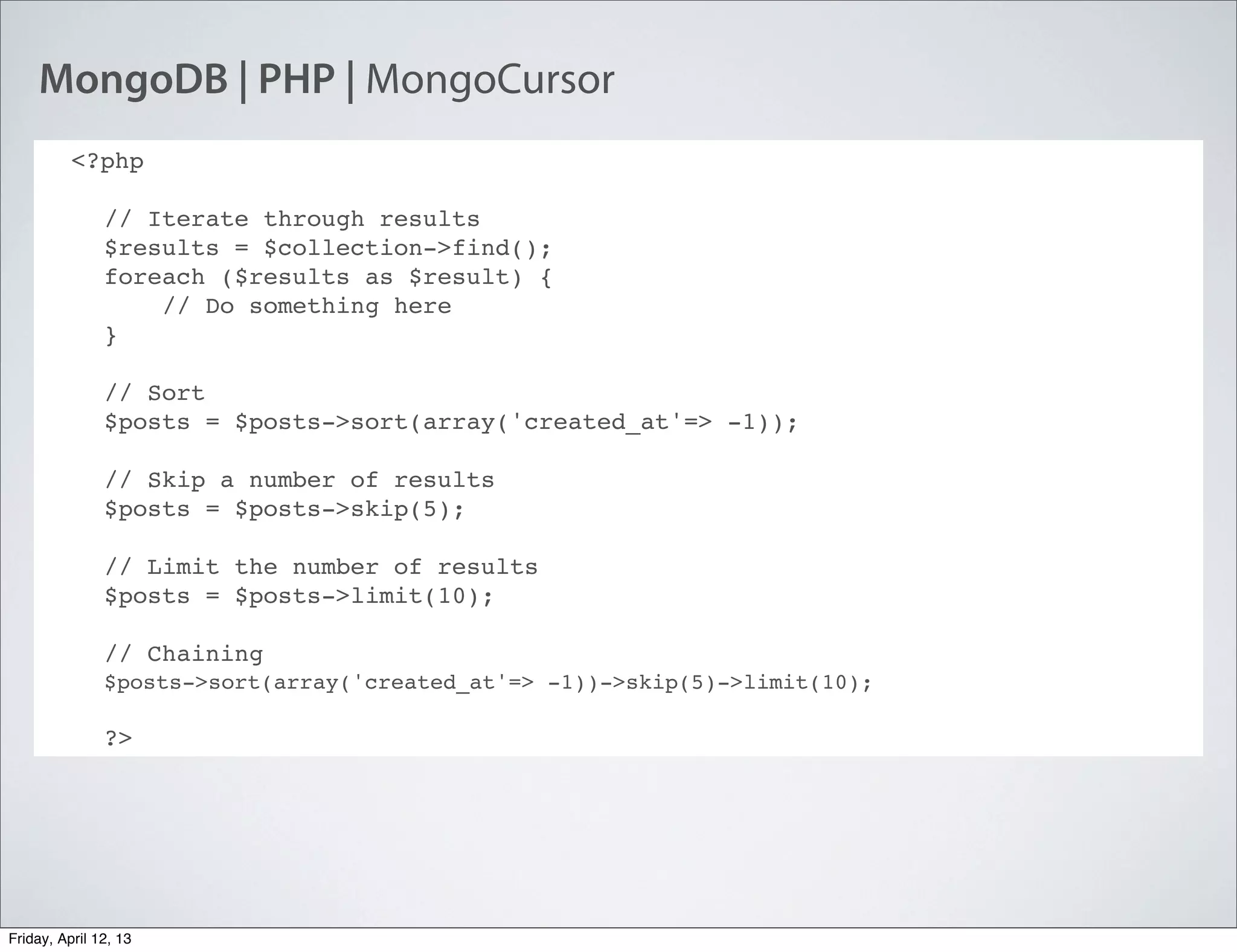
MongoDB | PHP | MongoCursor
<?php
// Iterate through results
$results = $collection->find();
foreach ($results as $result) {
    // Do something here
}
// Sort
$posts = $posts->sort(array('created_at'=> -1));
// Skip a number of results
$posts = $posts->skip(5);
// Limit the number of results
$posts = $posts->limit(10);
// Chaining
$posts->sort(array('created_at'=> -1))->skip(5)->limit(10);
?>
Friday, April 12, 13
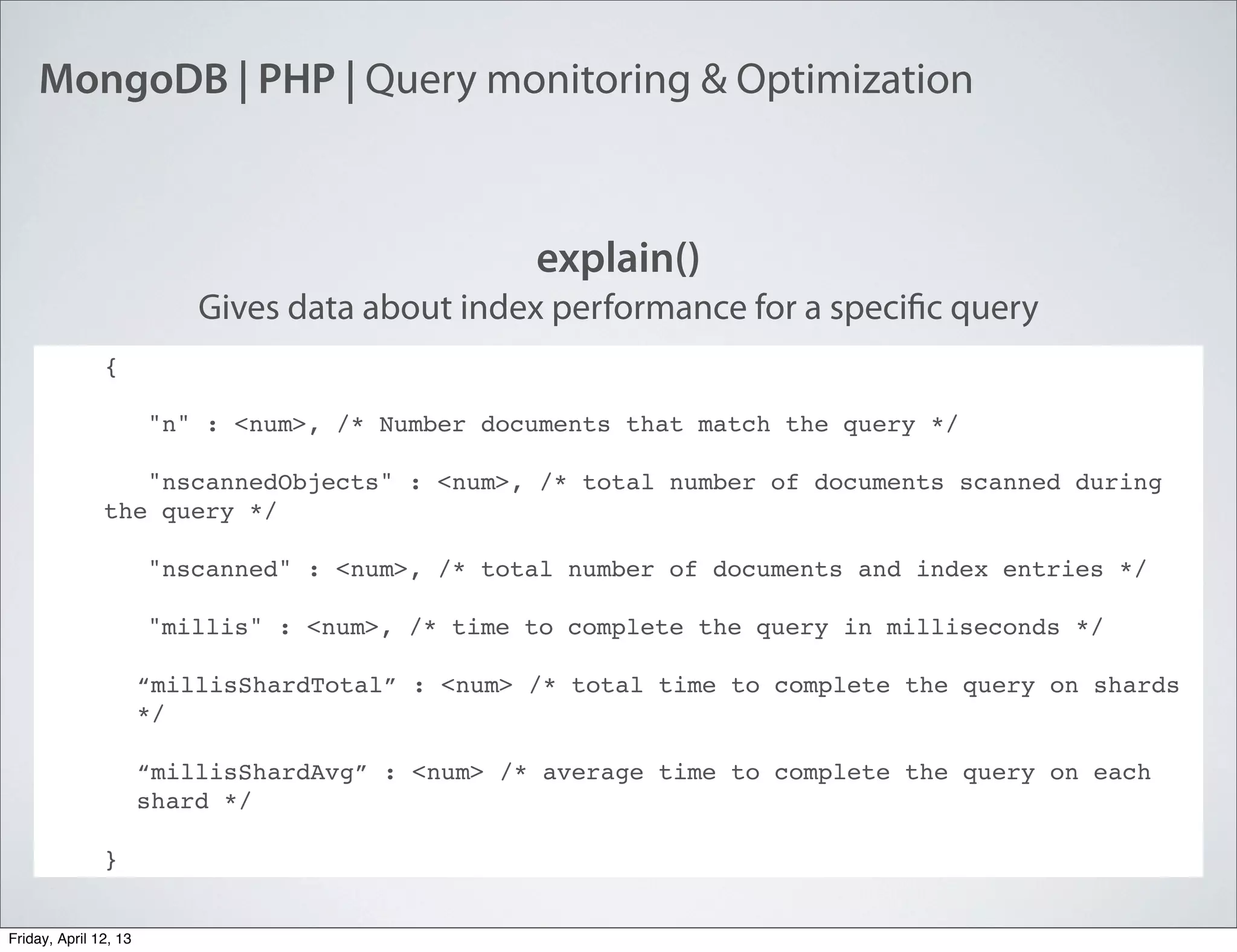
MongoDB | PHP | Query monitoring & Optimization
explain()
Gives data about index performance for a specific query
{
"n" : <num>, /* Number documents that match the query */
"nscannedObjects" : <num>, /* total number of documents scanned during
the query */
"nscanned" : <num>, /* total number of documents and index entries */
"millis" : <num>, /* time to complete the query in milliseconds */
“millisShardTotal” : <num> /* total time to complete the query on shards
*/
“millisShardAvg” : <num> /* average time to complete the query on each
shard */
}
Friday, April 12, 13
Thank you!
{“status” : “over and out”,
“mood” : “:)”,
“coming_up” : “Q & A”
“contact_details”: {
“email”:“sp@neybox.com”,
“twitter”:”@spassas”,
}
}
Friday, April 12, 13

Mongo db php_shaken_not_stirred_joomlafrappe

  • 1.
    PHP & MongoDB Shaken,not stirred Spyros Passas / @spassas Friday, April 12, 13
  • 2.
    NoSQL | Everybodyis talking about it! Friday, April 12, 13
  • 3.
    NoSQL | What •NoSQL ≠ SQL is dead • Not an opposite, but an alternative/complement to SQL (Not Only SQL) • Came as a need for large volumes of data and high transaction rates • Are generally based on key/value store • Are very happy with denormalized data since they have no joins Friday, April 12, 13
  • 4.
    NoSQL | Why •Flexible Data Model, so no prototyping is needed • Scaling out instead of Scaling up • Performance is significantly higher • Cheaper licenses (or free) • Runs on commodity hardware • Caching layer already there • Data variety Friday, April 12, 13
  • 5.
    NoSQL | Whynot • well, it’s not all ACID... • Less mature than the relational systems (so the ecosystem of tools/addons is still small) • BI & Reporting is limited • Coarse grained Security settings Friday, April 12, 13
  • 6.
    NoSQL | Which •Key/Value stores • Document Databases • And more... Friday, April 12, 13
  • 7.
    MongoDB | Documents& Collections • Document is the equivalent of an SQL table row and is a set of key/value pairs • Collection is the equivalent of an SQL table and is a set of documents not necessarily of the same type • Database is the equivalent of a... database { “name” : “Spyros Passas”, “company” : “Neybox” } { “name” : “Spyros Passas”, “company” : “Neybox” } { “Event” : “JoomlaFrappe”, “location” : “Athens” } Friday, April 12, 13
  • 8.
    MongoDB | Whatcan a value be? • Keys are always strings (without . and $) • Value can be • String • Number • Date • Array • Document {“name” : “Spyros Passas”} {“age” : 30} {“birthday” : Date(“1982-12-12”} {“interests” : [“Programming”, “NoSQL”]} {“address” : { “street” : “123 Pireus st.”, “city” : “Athens”, “zip_code” : 17121 } } Friday, April 12, 13
  • 9.
    MongoDB | Exampleof a document { “_id” : ObjectId(“47cc67093475061e3d95369d”), “name” : “Spyros Passas”, “birthday” : Date(“1982-12-12”), “age” : 30, “interests” : [“Programming”, “NoSQL”], “address” : { “street” : “123 Pireus st.”, “city” : “Athens”, “zip_code” : 17121 } “_id” : ObjectId(“47cc67093475061e3d95369d”) ObjectId is a special type Friday, April 12, 13
  • 10.
    MongoDB | Indexes •Any field can be indexed • Indexes are ordered • Indexes can be unique • Compound indexes are possible (and in fact very useful) • Can be created or dropped at anytime • Indexes have a large size and an insertion overhead Friday, April 12, 13
  • 11.
    MongoDB | Operators& Modifiers • Comparison: $lt (<), $lte (<=), $ne (!=), $gte (>=), $gt (>) • Logical: $and, $or, $not, $nor • Array: $all, $in, $nin • Geospatial: $geoWithin, $geoIntersects, $near, $nearSphere • Fields: $inc, $rename, $set, $unset • Array: $pop, $pull, $push, $addToSet Friday, April 12, 13
  • 12.
    MongoDB | DataRelations • MongoDB has no joins (but you can fake them in the application level) • MongoDB supports nested data (and it’s a pretty good idea actually!) • Collections are not necessary, but greatly help data organization and performance Friday, April 12, 13
  • 13.
    MongoDB | Goingfrom relational to NoSQL • Rethink your data and select a proper database • Rethink the relationships between your data • Rethink your query access patterns to create efficient indexes • Get to know your NoSQL database (and its limitations) • Move logic from data to application layer (but be careful) Friday, April 12, 13
  • 14.
    MongoDB | Deployment MongoServer Data Layer Application Layer App Server + mongos Friday, April 12, 13
  • 15.
    MongoDB | Deployment MongoServer Friday, April 12, 13
  • 16.
    MongoDB | ReplicaSet Primary (Master) Secondary (Slave) Friday, April 12, 13
  • 17.
    MongoDB | ReplicaSet Primary (Master) Secondary (Slave)Secondary (Slave) Secondary (Slave) Friday, April 12, 13
  • 18.
    MongoDB | ReplicaSet when things go wrong Primary (Master) Secondary (Slave)Secondary (Slave) Secondary (Slave) Friday, April 12, 13
  • 19.
    MongoDB | ReplicaSet when things go wrong Primary (Master) Secondary (Slave) Secondary (Slave) Friday, April 12, 13
  • 20.
    MongoDB | ReplicaSet when things go wrong Primary (Master) Secondary (Slave) Secondary (Slave)Secondary (Slave) Friday, April 12, 13
  • 21.
    MongoDB | Replicaset tips • Physical machines should be in independent availability zones • Selecting to read from slaves significantly increases performance (but you have to be cautious) Friday, April 12, 13
  • 22.
  • 23.
    MongoDB | Sharding A...JK....P Q....Z Friday, April 12, 13
  • 24.
    MongoDB | Shardingwith replica sets A...J K....P Q....Z Replica SetReplica SetReplica Set Friday, April 12, 13
  • 25.
    MongoDB | Shardingwith replica sets A...J K....P Q....Z Config Servers Replica SetReplica SetReplica Set Friday, April 12, 13
  • 26.
    MongoDB | Thingsto consider when sharding • Picking the right sharding key is of paramount importance! • Rule of thumb:“the shard key must distribute reads and writes and keep the data you’re using together” • Key must be of high cardinality • Key must not be monotonically ascending to infinity • Key must not be random • A good idea is a coarsely ascending field + a field you query a lot Friday, April 12, 13
  • 27.
    MongoDB | PHP| The driver • Serializes objects to BSON • Uses exceptions to handle errors • Core classes • MongoClient: Creates and manages DB connections • MongoDB: Interact with a database • MongoCollection: Represents and manages a collection • MongoCursor: Used to iterate through query results Friday, April 12, 13
  • 28.
    MongoDB | PHP| MongoClient <?php // Gets the client $mongo = new MongoClient(“mongodb://localhost:27017”); // Sets the read preferences (Primary only or primary & secondary) $mongo->setReadPreference(MongoClient::RP_SECONDARY); // If in replica set, returns hosts status $hosts_array = mongo->getHosts(); // Returns an array with the database names $db_array = $mongo->listDBs(); // Returns a MongoDB object $database = $mongo->selectDB(“myblog”); ?> Creates a connection and sets read preferences Provide info about hosts status and health Lists, selects or drops databases Friday, April 12, 13
  • 29.
    MongoDB | PHP| MongoDB <?php // Create a collection $database->createCollection(“blogposts”); // Select a collection $blogCollection = $database->selectCollection(“blogposts”); // Drop a collection $database->dropCollection(“blogposts”) ?> Handles Collections Friday, April 12, 13
  • 30.
    MongoDB | PHP| MongoCollection | Insert <?php // Fire and forget insertion $properties = array(“author”=>”spassas”, “title”=>”Hello World”); $collection->insert($properties); ?> Insert <?php // Safe insertion $properties = array(“author”=>”spassas”, “title”=>”Hello World”); $collection->insert($properties, array(“safe”=>true)); ?> Friday, April 12, 13
  • 31.
    MongoDB | PHP| MongoCollection | Update <?php // Update $c->insert(array("firstname" => "Spyros", "lastname" => "Passas" )); $newdata = array('$set' => array("address" => "123 Pireos st")); $c->update(array("firstname" => "Spyros"), $newdata); // Upsert $c->update(     array("uri" => "/summer_pics"),     array('$inc' => array("page_hits" => 1)),     array("upsert" => true) ); ?> Friday, April 12, 13
  • 32.
    MongoDB | PHP| MongoCollection | Delete <?php // Delete parameters $keyValue = array(“name” => “Spyros”); // Safe remove $collection->remove($keyValue, array('safe' => true)); // Fire and forget remove $collection->remove($keyValue); ?> Friday, April 12, 13
  • 33.
    MongoDB | PHP| MongoCollection | Query <?php // Get the collection $posts = $mongo->selectDB(“blog”)->selectCollection(“posts”); // Find one $post = $posts->findOne(array('author' => 'john'), array('title')); // Find many $allPosts = $posts->find(array('author' => 'john')); // Find using operators $commentedPosts = $posts->find(array(‘comment_count’ => array(‘$gt’=>1))); // Find in arrays $tags = array(‘technology’, ‘nosql’); // Find any $postsWithAnyTag = $posts->find(array('tags' => array('$in' => $tags))); // Find all $postsWithAllTags = $posts->find(array('tags' => array('$all' => $tags))); ?> Friday, April 12, 13
  • 34.
    MongoDB | PHP| MongoCursor <?php // Iterate through results $results = $collection->find(); foreach ($results as $result) {     // Do something here } // Sort $posts = $posts->sort(array('created_at'=> -1)); // Skip a number of results $posts = $posts->skip(5); // Limit the number of results $posts = $posts->limit(10); // Chaining $posts->sort(array('created_at'=> -1))->skip(5)->limit(10); ?> Friday, April 12, 13
  • 35.
    MongoDB | PHP| Query monitoring & Optimization explain() Gives data about index performance for a specific query { "n" : <num>, /* Number documents that match the query */ "nscannedObjects" : <num>, /* total number of documents scanned during the query */ "nscanned" : <num>, /* total number of documents and index entries */ "millis" : <num>, /* time to complete the query in milliseconds */ “millisShardTotal” : <num> /* total time to complete the query on shards */ “millisShardAvg” : <num> /* average time to complete the query on each shard */ } Friday, April 12, 13
  • 36.
    Thank you! {“status” :“over and out”, “mood” : “:)”, “coming_up” : “Q & A” “contact_details”: { “email”:“sp@neybox.com”, “twitter”:”@spassas”, } } Friday, April 12, 13