#2 Use the chapter opener as a warm-up.
Show students the video of coffee grains. Ask students to suggest how we can count the number of coffee grains.
Ask students the given questions.
Guide students if they have difficulties in answering the questions.
#3 Outline the learning aim of the section.
Remind students that they will eventually integrate their learning and form connections between the concepts.
#4 Ask students how the mass of an atom can be measured.
Explain to them what relative atomic mass means.
Have the students compare the masses of some atoms in the figure given.
Highlight to them that the relative atomic masses of elements are given in the Periodic Table.
#5 Ask students what relative molecular mass is.
Explain to them what relative molecular mass means.
Show students how to calculate the relative molecular masses of some molecular substances using the table given.
#6 Ask students what relative formula mass is.
Explain to them what relative formula mass means.
Show students how to calculate the relative formula masses of some ionic compounds using the table given.
#7 Outline the learning aims of the section.
Remind students that they will eventually integrate their learning and form connections between the concepts.
#8 Ask students what the mole is.
Guide and explain to students the calculations involving the mole and the number of particles.
3. Have students answer the question in Quick Check on Student’s Book p. 86.
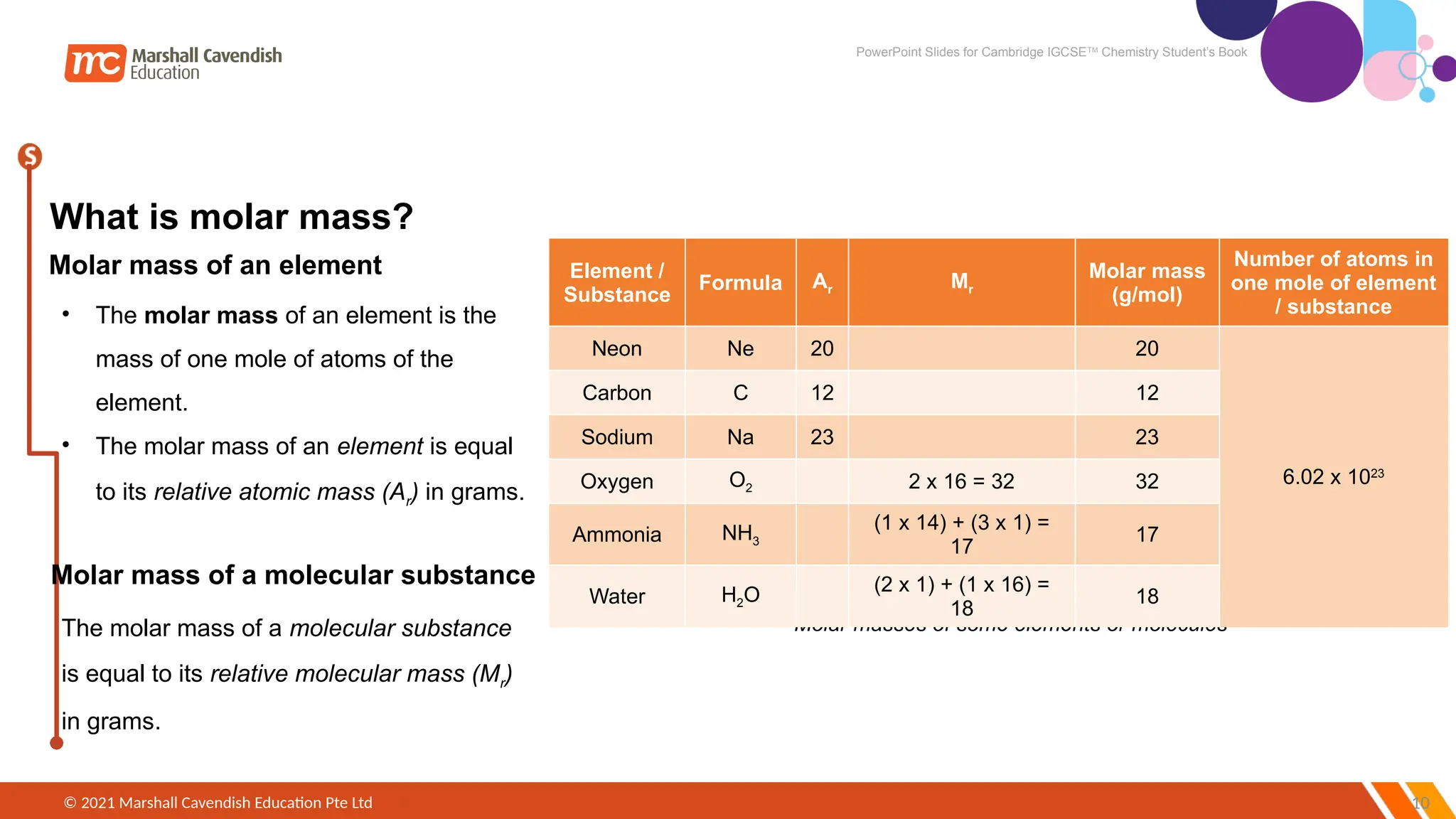
#10 Ask students what molar mass is.
Guide students to recognise the relationship between the relative atomic mass (Ar) and the molar mass of an element.
Explain the relationship using the first table given in the slide.
Explain to students what the molar mass of a molecular substance is using the second table given.
#11 Ask students to explain what the molar mass of ionic compounds is.
Guide students if they have difficulties in answering the question.
#12 Guide students on how to calculate the number of ions in one mole of an ionic compound using the figure given in the slide.
Guide students on how to calculate the number of moles.
#13 Go through Worked Example 6C.
Guide students if they have difficulties in answering the question.
Have students answer the questions in
Quick Check on Student’s Book p. 88.;
Let’s Practise 6.2 on Student’s Book p. 89.
#14 Outline the learning aim of the section.
Remind students that they will eventually integrate their learning and form connections between the concepts.
#15 Ask students what Avogadro’s law is and what it means.
Explain to them the term molar gas volume.
Highlight to students the Helpful Notes in the Student’s Book p. 90.
#16 Guide students on how to calculate the number of moles of a gas.
Have students answer the question in Quick Check on Student’s Book p. 90.
#17 Lead a discussion with the students using the questions in the slide.
Guide students if they have difficulties in answering the questions.
Discuss with students on how to calculate the number of moles of different gases with equal mass.
Explain to students the solutions.
#18 Outline the learning aim of the section.
Remind students that they will eventually integrate their learning and form connections between the concepts.
#19 Ask students what a chemical equation means.
Explain to students how to use stoichiometry in chemical equations.
Highlight to students the Helpful Notes on Student's Book p. 92.
Have students answer the question in Quick Check on Student’s Book p. 92.
#21 Guide the students on how to calculate the volumes of gaseous reactants and products.
Have students answer the question in Quick Check on Student’s Book p. 92.
#23 Ask students what a limiting reactant is.
Lead a discussion with the students to identify what a limiting reactant is, using the figure given in the slide.
Explain to them the meaning a limiting reactant.
#24 Guide the students to understanding the effect of limiting reactants, using the table(s) given in the slide(s).
Ask them to identify the limiting reactant in Experiment A.
#25 Guide the students to understanding the effect of limiting reactants, using the table(s) given in the slide(s).
Ask them to identify the limiting reactant in Experiment B.
#26 Guide the students to understanding the effect of limiting reactants, using the table(s) given in the slide(s).
Ask them to identify the limiting reactant in Experiment B.
#27 Outline the learning aim of the section.
Remind students that they will eventually integrate their learning and form connections between the concepts.
#28 Explain to students what concentration is and how they can be expressed.
#29 Guide students on how to calculate the concentration of a solution in g/dm3.
Go through Worked Example 6P.
Guide students on how to calculate the concentration of a solution in mol/dm3.
Go through Worked Examples 6Q and 6R.
Explain to students the solutions.
#30 Lead a discussion with the students on how the concentration of a solution can be changed.
#31 Ask students what volumetric analysis is.
Explain to them how to conduct volumetric analysis using titration.
Have students answer the question in Quick Check on Student’s Book p. 101.
https://www.dreamstime.com/stock-photo-woman-who%C3%A2%E2%82%AC%E2%84%A2s-scientist-demonstrate-titration-technique-laboratory-image72278035
#32 Have students refer to Let’s Investigate 6A on Student’s Book p. 101.
Explain to students how the experimental set-up can be used to determine the concentration of ammonia in a household ammonia solution.
Go through Worked Example 6T.
#33 Outline the learning aim of the section.
Remind students that they will eventually integrate their learning and form connections between the concepts.
#34 Guide students on how to calculate the empirical formula of a compound.
#35 Have students refer to Let’s Investigate 6B on Student’s Book p. 104.
Explain to students how the experimental set-up can be used to determine the the empirical formula of magnesium oxide.
Discuss with the students how do we calculate the empirical formula of a compound.
#36 Guide the students on how to calculate the molecular formula of a compound.
#38 Outline the learning aim of the section.
Remind students that they will eventually integrate their learning and form connections between the concepts.
#39 Guide the students on how to calculate percentage yield.
Go through Worked Example 6V.
#40 Guide students on how to calculate the percentage composition of a compound
Go through Worked Example 6W.
Guide students on how to calculate the percentage purity of a compound.
Go through Worked Example 6Y.
Ask students to answer the question in Quick Check on Student’s Book p. 108.
#41 Encourage students to complete the mind map to assess their learning journey.
#43 Review the key concepts using the mind map.
Encourage students to draw their own mind maps for the concepts covered in the chapter.




![namma_kalvi_11th_chemistry_unit_1_ppt_em_218218 [Autosaved].pptx](https://cdn.slidesharecdn.com/ss_thumbnails/nammakalvi11thchemistryunit1pptem218218autosaved-250528062629-1e37d33f-thumbnail.jpg?width=640&height=640&fit=bounds)


