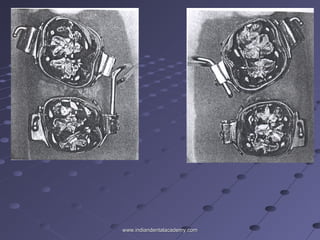
MOLARMOLAR
DISTALISATIONDISTALISATION
www.indiandentalacademy.comwww.indiandentalacademy.com
The appliances used for molar distalizationThe appliances used for molar distalization
can be divided intocan be divided into
Removable appliances andRemovable appliances and
Fixed appliances.Fixed appliances.
Removable appliances are:Removable appliances are:
Extra oral tractionExtra oral traction
Removable appliances with finger springsRemovable appliances with finger springs
Sliding jigs with intermaxillary elastics.Sliding jigs with intermaxillary elastics.
www.indiandentalacademy.comwww.indiandentalacademy.com
The fixed appliances areThe fixed appliances are
A. Intramaxillary applianceA. Intramaxillary appliance
1. Wislons 3D appliance1. Wislons 3D appliance
2. Repelling Magnets2. Repelling Magnets
3.The pendulum appliance3.The pendulum appliance
4. Niti based appliances : archwires – single loop,4. Niti based appliances : archwires – single loop,
double loop; Compressed coil springsdouble loop; Compressed coil springs
5. Jones jig5. Jones jig
6. Distal Jet6. Distal Jet
7. Fixed piston appliances7. Fixed piston appliances
8. IBMD8. IBMD
9. K-loop9. K-loop
10.Franzulum appliance10.Franzulum appliance
11. First class appliance11. First class appliance
www.indiandentalacademy.comwww.indiandentalacademy.com
B.B. Intermaxillary appliance:Intermaxillary appliance:
1. Herbst appliance1. Herbst appliance
2. Jasper Jumper2. Jasper Jumper
3. Eureka Spring3. Eureka Spring
4. Klapper superspring4. Klapper superspring
C. SAS supported distalization:C. SAS supported distalization:
www.indiandentalacademy.comwww.indiandentalacademy.com
INDICATIONS & CONTRAINDICATIONSINDICATIONS & CONTRAINDICATIONS
THE INDICATIONS FOR MOLAR DISTALIZATIONTHE INDICATIONS FOR MOLAR DISTALIZATION
1. In non-extraction treatment of Class II malocclusion1. In non-extraction treatment of Class II malocclusion
cases.cases.
2. In low & average mandibular plane angle cases.2. In low & average mandibular plane angle cases.
3. In class I skeletal pattern cases.3. In class I skeletal pattern cases.
4. In patients with mild arch length discrepancy.4. In patients with mild arch length discrepancy.
5. In cases where the upper permanent molars have5. In cases where the upper permanent molars have
moved mesially due to early loss of deciduous molars.moved mesially due to early loss of deciduous molars.
6. In patients where the second molars extractions are6. In patients where the second molars extractions are
planned or where it has not yet erupted.planned or where it has not yet erupted.
7. In second molar extraction cases where the third7. In second molar extraction cases where the third
molars are well formed and erupting properly.molars are well formed and erupting properly.
www.indiandentalacademy.comwww.indiandentalacademy.com
CONTRAINDICATIONS FOR MOLARCONTRAINDICATIONS FOR MOLAR
DISTALIZATIONDISTALIZATION
In high mandibular plane angle cases.In high mandibular plane angle cases.
Skeletal and Dental open biteSkeletal and Dental open bite
Class II & III skeletal patternClass II & III skeletal pattern
Severe arch length discrepancy patients.Severe arch length discrepancy patients.
www.indiandentalacademy.comwww.indiandentalacademy.com
ptV pterygoid (vertical) a vertical line drawn through distal radiographic
outline of the pterygomaxillary fissure and perpendicular to FH plane
The mean value for 9 year old is age + 3mm add 1 mm per year
www.indiandentalacademy.comwww.indiandentalacademy.com
REMOVABLE APPLIANCES AREREMOVABLE APPLIANCES ARE ::
EXTRA ORAL FORCESEXTRA ORAL FORCES
REMOVABLE APPLIANCESREMOVABLE APPLIANCES
THE CETLIN APPLIANCETHE CETLIN APPLIANCE
EXTRA ORAL FORCESEXTRA ORAL FORCES
One of the earliest methods of molarOne of the earliest methods of molar
distalization introduced and proved to bedistalization introduced and proved to be
effective was by extra oral forces employingeffective was by extra oral forces employing
use of theuse of the head gear.head gear.
Components of Head Gear:Components of Head Gear:
Force delivering Unit:Force delivering Unit:
Force Generating Unit.Force Generating Unit.
The Anchor Unit:The Anchor Unit:
www.indiandentalacademy.comwww.indiandentalacademy.com
SELECTION OF HEADGEAR:SELECTION OF HEADGEAR:
11.. Headgear anchorage locationHeadgear anchorage location:: location of the anchoragelocation of the anchorage
unit determines the type of force that will be applied to the unit.unit determines the type of force that will be applied to the unit.
The relation of the force to the Cres of the unit to which it isThe relation of the force to the Cres of the unit to which it is
applied determines the effects that will be produced by theapplied determines the effects that will be produced by the
orthopedic force.orthopedic force.

High pull headgearHigh pull headgear:: this applies a superior (intrusive) andthis applies a superior (intrusive) and
distal force to the maxilla and the maxillary dentition.distal force to the maxilla and the maxillary dentition.

Cervical pull:Cervical pull: this produces an inferior (extrusive) andthis produces an inferior (extrusive) and
distalising force on the maxilla.distalising force on the maxilla.

Combination headgearCombination headgear:: no moment is produced and ano moment is produced and a
distalising force is applied to the maxilla.distalising force is applied to the maxilla.
Since the Cres of the molar is located in the mid root region,Since the Cres of the molar is located in the mid root region,
force vectors above this point will result in a distal rootforce vectors above this point will result in a distal root
movement. Forces below this point will result in a distal crownmovement. Forces below this point will result in a distal crown
movement. Similar considerations apply to the maxilla.movement. Similar considerations apply to the maxilla.
www.indiandentalacademy.comwww.indiandentalacademy.com
TYPES OF HEADGEARS:TYPES OF HEADGEARS:
CERVICAL HEADGEAR:CERVICAL HEADGEAR:
This was first introduced byThis was first introduced by
SILAS KLOEHNSILAS KLOEHN in 1947. It isin 1947. It is
the most commonly usedthe most commonly used
facebow in clinical practice.facebow in clinical practice.
Typically it is used in growingTypically it is used in growing
patients with decreasedpatients with decreased
vertical dimension. Thevertical dimension. The
purpose of the facebow is topurpose of the facebow is to
restrict the forward growth ofrestrict the forward growth of
the maxilla. The vector ofthe maxilla. The vector of
force is below the occlusalforce is below the occlusal
plane producing bothplane producing both
extrusive and distalisingextrusive and distalising
effects.effects. www.indiandentalacademy.comwww.indiandentalacademy.com
Effects of cervical headgear:Effects of cervical headgear:

to erupt the entire upper jawto erupt the entire upper jaw

tends to move the upper jawtends to move the upper jaw
distallydistally

Steepen the occlusal plane.Steepen the occlusal plane.

Expansion of the upper arch.Expansion of the upper arch.
Effect of different positions of the outer bow:Effect of different positions of the outer bow:
when the outer bow is bent upwardswhen the outer bow is bent upwards::
The forces that are produced areThe forces that are produced are
A distalising force to the upper teeth, which is good for correctionA distalising force to the upper teeth, which is good for correction
of class II relation.of class II relation.
When the outer bow is bent upwards, bringing it down to theWhen the outer bow is bent upwards, bringing it down to the
occlusal plane tends to produce a negative moment that flattens theocclusal plane tends to produce a negative moment that flattens the
occlusal plane. Hence the steepening effect of the cervical headgearocclusal plane. Hence the steepening effect of the cervical headgear
is nullified.is nullified.
Eruption of the entire upper arch tends to increase the mandibularEruption of the entire upper arch tends to increase the mandibular
plane angle and tends to worsen the class II skeletal relationship.plane angle and tends to worsen the class II skeletal relationship.
this type is good for patients with forward growth rotationthis type is good for patients with forward growth rotationwww.indiandentalacademy.comwww.indiandentalacademy.com
when the outer bow is bentwhen the outer bow is bent
downwardsdownwards::
Forces that are produced areForces that are produced are

Positive moment on the occlusalPositive moment on the occlusal
plane is seen that tends to steepenplane is seen that tends to steepen
the occlusal plane since the pull isthe occlusal plane since the pull is
below the Cres.below the Cres.

Extrusive force and a distalisingExtrusive force and a distalising
force.force.
When the outer bow and innerWhen the outer bow and inner
bow are in the same levelbow are in the same level,, nono
moment is produced and theremoment is produced and there
is a net distalising and extrusiveis a net distalising and extrusive
force.force.
When theWhen the outer bow is shorterouter bow is shorter than the inner bow, the headgear strapthan the inner bow, the headgear strap
hook is placed too far anteriorly. This results in a greater tendency tohook is placed too far anteriorly. This results in a greater tendency to
steepen the occlusal plane when the straps are engaged. The pull of thesteepen the occlusal plane when the straps are engaged. The pull of the
bow is further forward from the Cres and this tends to steepen thebow is further forward from the Cres and this tends to steepen the
occlusal plane. When theocclusal plane. When the outer bow is longouter bow is long, there is a tendency to, there is a tendency to
flatten the occlusal plane.flatten the occlusal plane. www.indiandentalacademy.comwww.indiandentalacademy.com
AdvantagesAdvantages
Direction of pull is advantageous in treatment ofDirection of pull is advantageous in treatment of
short face class II maxillary protrusive cases withshort face class II maxillary protrusive cases with
low MPA and deep bites.low MPA and deep bites.
Disadvantages:Disadvantages:
It normally causes extrusion of the upper molars.It normally causes extrusion of the upper molars.
This movement is seldom desirable except inThis movement is seldom desirable except in
patients with reduced lower anterior facial height.patients with reduced lower anterior facial height.
It is contraindicated in patients with steepIt is contraindicated in patients with steep
mandibular planes and in open bite cases.mandibular planes and in open bite cases.
www.indiandentalacademy.comwww.indiandentalacademy.com
Long term study on cervical headgear:Long term study on cervical headgear:
Melsen et al in AJO 2003Melsen et al in AJO 2003 studstudiedied thethe
intramaxillary molarintramaxillary molar displacement 7 years afterdisplacement 7 years after
treatment with Kloehn headgeartreatment with Kloehn headgear and cervicaland cervical
tractiontraction. Two groups of 10 patients were studied.. Two groups of 10 patients were studied.
In one group, the outer bow was tilted upward byIn one group, the outer bow was tilted upward by
202000
and in another group, it was tilted down byand in another group, it was tilted down by
202000
. In the group that had the outer bow tilted. In the group that had the outer bow tilted
downwards, molar correction was faster. In bothdownwards, molar correction was faster. In both
the groups, the maxilla was moved backwardthe groups, the maxilla was moved backward
and downward.and downward. A strongA strong tendency of the molarstendency of the molars
to return to the keyto return to the key ridge wasridge was demonstrated, anddemonstrated, and
therethere waswas no evidence thatno evidence that the Class Ithe Class I
relationship obtained by extraoral tractionrelationship obtained by extraoral traction waswas
moremore stable than that obtained by functional orstable than that obtained by functional or
intramaxillaryintramaxillary appliances.appliances.www.indiandentalacademy.comwww.indiandentalacademy.com
OCCIPITAL HEADGEAR:OCCIPITAL HEADGEAR:
The occipital headgear consists of aThe occipital headgear consists of a
facebow which fits over the occiput offacebow which fits over the occiput of
the head. The force generated by athe head. The force generated by a
high pull (occipital) has both distalisinghigh pull (occipital) has both distalising
and intrusive forces since the force isand intrusive forces since the force is
exerted above the occlusal plane.exerted above the occlusal plane.
Such forces are used in conditionsSuch forces are used in conditions
where vertical control of the molars iswhere vertical control of the molars is
important. As growth guidingimportant. As growth guiding
appliance, a high pull headgear canappliance, a high pull headgear can
decrease the vertical development ofdecrease the vertical development of
the maxilla, thereby allowing forthe maxilla, thereby allowing for
autorotation of the mandible andautorotation of the mandible and
maximizing the horizontal expressionmaximizing the horizontal expression
of mandibular growth.of mandibular growth.
Occipital pull with short outer bow (force anterior to Cres)Occipital pull with short outer bow (force anterior to Cres)
This results in a force system at the unit’s Cres with a moment thatThis results in a force system at the unit’s Cres with a moment that
tends to flatten the occlusal plane and creates distalising and intrusivetends to flatten the occlusal plane and creates distalising and intrusive
components.components. www.indiandentalacademy.comwww.indiandentalacademy.com
b.b. occipital pull with forceoccipital pull with force
passing through Crespassing through Cres
There is no moment that isThere is no moment that is
created and hence there is nocreated and hence there is no
change in the cant of thechange in the cant of the
occlusal plane. Intrusive andocclusal plane. Intrusive and
distal components of forcedistal components of force
are produced.are produced.
c.c. occipital pull with longoccipital pull with long
outer bow( force posteriorouter bow( force posterior
to Cres)to Cres)
The force system at the unit’sThe force system at the unit’s
Cres has a moment thatCres has a moment that
tends to steepen the occlusaltends to steepen the occlusal
plane. Intrusive andplane. Intrusive and
distalising forces aredistalising forces are
produced. This system mightproduced. This system might
be required in class II openbe required in class II open
bite patients.bite patients. www.indiandentalacademy.comwww.indiandentalacademy.com
Advantages:Advantages:
These headgears can be used in patientsThese headgears can be used in patients
with steep mandibular planes and in caseswith steep mandibular planes and in cases
wherein mandibular growth is morewherein mandibular growth is more
vertical than horizontal. They can also bevertical than horizontal. They can also be
used in certain open bite cases causedused in certain open bite cases caused
due to excessive eruption of buccal teeth.due to excessive eruption of buccal teeth.
www.indiandentalacademy.comwww.indiandentalacademy.com
Combination headgears have bothCombination headgears have both
occipital and cervical traction springs.occipital and cervical traction springs.
This is perhaps the most versatile typeThis is perhaps the most versatile type
because the pull can be readilybecause the pull can be readily
controlled by selecting the force level ofcontrolled by selecting the force level of
the springs and by controlling the lengththe springs and by controlling the length
of the outer bow. For distal translationof the outer bow. For distal translation
of the upper posteriors, a distal tractionof the upper posteriors, a distal traction
is needed that passes through the Cres,is needed that passes through the Cres,
neither above nor below. Theneither above nor below. The
combination type headgear will allow acombination type headgear will allow a
distal force straight through Cres bydistal force straight through Cres by
having equal occipital and cervicalhaving equal occipital and cervical
components on the outer bow, which iscomponents on the outer bow, which is
angled upwards to allow the force toangled upwards to allow the force to
pass through the Cres.pass through the Cres.
COMBINATION HEADGEAR.COMBINATION HEADGEAR.
www.indiandentalacademy.comwww.indiandentalacademy.com
Based on occlusal plane requirements:Based on occlusal plane requirements:
Action desiredAction desired Outer bow angulationOuter bow angulation
distal force and flattening - outer bowdistal force and flattening - outer bow
above Cresabove Cres
distal force and steepeningdistal force and steepening- outer bow- outer bow
below Cresbelow Cres
distal force and no moment-- outer bow atdistal force and no moment-- outer bow at
CresCres
www.indiandentalacademy.comwww.indiandentalacademy.com
Alain (JCO 1972)Alain (JCO 1972) explained the use of a removableexplained the use of a removable
appliance for distalizing the molars. The appliance wasappliance for distalizing the molars. The appliance was
originally devised by G.Vienne and later produced byoriginally devised by G.Vienne and later produced by
A.Lorette.A.Lorette.
The appliances were introduced as the appliances withThe appliances were introduced as the appliances with
wires sliding in tubes.wires sliding in tubes.
THE PRINCIPLETHE PRINCIPLE
The appliance consists of a stationary part and a movableThe appliance consists of a stationary part and a movable
part. Both these parts are held together by a long,part. Both these parts are held together by a long,
horseshoe shaped wire which moves the movable part byhorseshoe shaped wire which moves the movable part by
virtue of the elasticity of the wire. Each end of the wire isvirtue of the elasticity of the wire. Each end of the wire is
inserted into a tube, one in the fixed part of the applianceinserted into a tube, one in the fixed part of the appliance
and the other in the removable part.and the other in the removable part.
REMOVABLEREMOVABLE APPLIANCESAPPLIANCES
www.indiandentalacademy.comwww.indiandentalacademy.com
THE APPLIANCETHE APPLIANCE
The movable part has an adams clasp and two parallelThe movable part has an adams clasp and two parallel
tubes embedded for the molars to be moved distally.tubes embedded for the molars to be moved distally.
The stationary part contains the other clasps for theThe stationary part contains the other clasps for the
retention of the plate and one tube which contains theretention of the plate and one tube which contains the
other end of the horse shoe shaped active wire.other end of the horse shoe shaped active wire.
ACTIVATIONACTIVATION
Using the 139 plier, the wire coming out of the tubeUsing the 139 plier, the wire coming out of the tube
embedded in the stationary part is bent, which makes theembedded in the stationary part is bent, which makes the
movable part slide distally.movable part slide distally.
DISADVANTAGEDISADVANTAGE
A delicate appliance, since the two wires holding theA delicate appliance, since the two wires holding the
movable part should do so without binding.movable part should do so without binding.
www.indiandentalacademy.comwww.indiandentalacademy.com
3. THE CETLIN APPLIANCE3. THE CETLIN APPLIANCE
JCO 1983 Cetlin and TenhoeJCO 1983 Cetlin and Tenhoe
The appliance involves a combination of extra oral force in the form ofThe appliance involves a combination of extra oral force in the form of
head gear and an intraoral force in the form of a removable appliance.head gear and an intraoral force in the form of a removable appliance.
The Cetlin appliance utilises a removable appliance intraorally to tip theThe Cetlin appliance utilises a removable appliance intraorally to tip the
crowns distally and then an extraoral force to upright the roots. So thecrowns distally and then an extraoral force to upright the roots. So the
intra oral removable appliance can be called the crown mover while theintra oral removable appliance can be called the crown mover while the
extra oral force, the root mover.extra oral force, the root mover.
ANCHORAGEANCHORAGE
The anchorage for the removable appliance is by proper adaptation to theThe anchorage for the removable appliance is by proper adaptation to the
palate, an acrylic shield around the four maxillary incisors and a modifiedpalate, an acrylic shield around the four maxillary incisors and a modified
adams clasp on the first premolars.adams clasp on the first premolars.
www.indiandentalacademy.comwww.indiandentalacademy.com
THE EXTRA ORAL FORCETHE EXTRA ORAL FORCE
The extra Oral appliance is a headgear which is inserted into molarThe extra Oral appliance is a headgear which is inserted into molar
tube. The headgear used is generally cervical or a high pull,tube. The headgear used is generally cervical or a high pull,
depending on the usual consideration of the skeletal pattern.depending on the usual consideration of the skeletal pattern.
THE APPLIANCETHE APPLIANCE
The removable appliance is worn 24 hours a day. The applianceThe removable appliance is worn 24 hours a day. The appliance
also contains a bite plane to disengage the molars (to aid in rapidalso contains a bite plane to disengage the molars (to aid in rapid
molar movement).molar movement).
THE FORCE APPLIEDTHE FORCE APPLIED
In the removable appliance, the spring is activated only 1 to 1.5 mm,In the removable appliance, the spring is activated only 1 to 1.5 mm,
measured along the occlusal of the molar and it supplies force onmeasured along the occlusal of the molar and it supplies force on
the molars of only 30 gms. The springs are placed as far gingivallythe molars of only 30 gms. The springs are placed as far gingivally
as possible to minimize crown tipping and to cause molar movementas possible to minimize crown tipping and to cause molar movement
without irritation.without irritation.
The extra oral head gear on the other hand exerts a 150 gm forceThe extra oral head gear on the other hand exerts a 150 gm force
per tooth and is used to control root position. The headgear isper tooth and is used to control root position. The headgear is
adviced to be worn for 12-14 hours/day.adviced to be worn for 12-14 hours/day.
www.indiandentalacademy.comwww.indiandentalacademy.com
ACRYLIC CERVICAL OCCIPITAL APPLIANCEACRYLIC CERVICAL OCCIPITAL APPLIANCE
ACCOACCO
Developed by H.margolisDeveloped by H.margolis
IT consists of acrylic palatal palatal section ,modified adams claspIT consists of acrylic palatal palatal section ,modified adams clasp
on the Ist PM ,labial bow across incisors for retention and fingeron the Ist PM ,labial bow across incisors for retention and finger
spring against mesial aspect of first molars .spring against mesial aspect of first molars .
The finger springs are activated approximately one half a cusp widthThe finger springs are activated approximately one half a cusp width
in posterior direction,it can be made of round or rectangular wirein posterior direction,it can be made of round or rectangular wire
,force applied of 100 – 125 gm .1 mm bite plate to disocclude the,force applied of 100 – 125 gm .1 mm bite plate to disocclude the
posteriorsposteriors
24 hour wear24 hour wear
In original design the labial bow was bent to include helices betweenIn original design the labial bow was bent to include helices between
lateral ald central incisors.lateral ald central incisors.
A straight pull headgear or northwest headgear was inserted intoA straight pull headgear or northwest headgear was inserted into
helicesand worn night time ,only one finger spring for one molar andhelicesand worn night time ,only one finger spring for one molar and
for bilateral two appliances were neededfor bilateral two appliances were needed
www.indiandentalacademy.comwww.indiandentalacademy.com
ADVANTAGESADVANTAGES
Constant acting force enhancing rate of molar movementConstant acting force enhancing rate of molar movement
Relative comfort easy to wearRelative comfort easy to wear
Effective for asymmetric distal movementEffective for asymmetric distal movement
DISADVANTAGESDISADVANTAGES
Tips crown distally ( less when close to Cres of molar)Tips crown distally ( less when close to Cres of molar)
High pull headgear in conjunction to ACCOHigh pull headgear in conjunction to ACCO
(Cetlin,Tenhoeve)(Cetlin,Tenhoeve)
Anchorage loss ( overjet measured each visit,ifAnchorage loss ( overjet measured each visit,if
anchorage loss exceeds 2 mm labial bow removed andanchorage loss exceeds 2 mm labial bow removed and
bracket the incisors ,100 gm classII elastics placed withbracket the incisors ,100 gm classII elastics placed with
a sectional archwire.a sectional archwire.
To control elastic reaction force lower arch anchorageTo control elastic reaction force lower arch anchorage
controlled by lip bumpercontrolled by lip bumper
www.indiandentalacademy.comwww.indiandentalacademy.com
INTRAMAXILLRY APPLIANCESINTRAMAXILLRY APPLIANCES
WILSONS' RAPID MOLAR DISTALIZATIONWILSONS' RAPID MOLAR DISTALIZATION
Advocated by William L. Wilson & Robert C.Wilson (1984Advocated by William L. Wilson & Robert C.Wilson (1984
JCO) under modular orthodontics.JCO) under modular orthodontics.
The Wilson treatment achieves molar distalization withoutThe Wilson treatment achieves molar distalization without
extra oral forces.extra oral forces.
THE CONCEPTTHE CONCEPT
Newton’s' 3rd law of motion states that 'for every force,Newton’s' 3rd law of motion states that 'for every force,
there is an equal and opposite force', (i.e.) for everythere is an equal and opposite force', (i.e.) for every
moment, there is a counter moment.moment, there is a counter moment.
Implicit in Newton’s' law is the concept that control ofImplicit in Newton’s' law is the concept that control of
counter moments increases the efficiency of the momentcounter moments increases the efficiency of the moment
of force. Modular orthodontic units have been designed toof force. Modular orthodontic units have been designed to
control countermoments, eliminate 'round trips', andcontrol countermoments, eliminate 'round trips', and
reduce headgear use.reduce headgear use.
www.indiandentalacademy.comwww.indiandentalacademy.com
DESIGN OF APPLIANCEDESIGN OF APPLIANCE
Wilson advocates maxillary bimetric distalizing archesWilson advocates maxillary bimetric distalizing arches
(BDA) and a mandibular three dimensional lingual arch.(BDA) and a mandibular three dimensional lingual arch.
The bimetric arch produces a coil spring action againstThe bimetric arch produces a coil spring action against
the molars and producing an anterior counter momentthe molars and producing an anterior counter moment
against the incisors, which is controlled by the wearingagainst the incisors, which is controlled by the wearing
of class II elastics.of class II elastics.
These, in turn, react with a lower molar mesial forceThese, in turn, react with a lower molar mesial force
vector which is controlled by the 3D lingual arch with avector which is controlled by the 3D lingual arch with a
design for anchorage resistance. This is supplementeddesign for anchorage resistance. This is supplemented
by molar buccal root torque and cortical resistance toby molar buccal root torque and cortical resistance to
satisfy increased anchorage needs.satisfy increased anchorage needs.
www.indiandentalacademy.comwww.indiandentalacademy.com
The vertical component of elastic force is controlled byThe vertical component of elastic force is controlled by
using the elastic load reduction principle, in which theusing the elastic load reduction principle, in which the
elastic force is reduced to physiologically acceptableelastic force is reduced to physiologically acceptable
levels. Mandibular anchorage and elastic load reductionlevels. Mandibular anchorage and elastic load reduction
control the reactive countermoments and produce acontrol the reactive countermoments and produce a
relatively friction free, rapid distalizing of molars; withoutrelatively friction free, rapid distalizing of molars; without
headgear and with preservation of mandibular archheadgear and with preservation of mandibular arch
integrity.integrity.
Wilson's Schedule for Maximum Mandibular AnchorageWilson's Schedule for Maximum Mandibular Anchorage
6 ounce elastics for 5 days.6 ounce elastics for 5 days.
4 ounce elastics for 5 days and4 ounce elastics for 5 days and
2 ounce elastics for 11 days.2 ounce elastics for 11 days.
For minimal mandibular anchorageFor minimal mandibular anchorage::
6 ounce for 10 days6 ounce for 10 days
3 ounce for 11 days.3 ounce for 11 days.
www.indiandentalacademy.comwww.indiandentalacademy.com
Magnets:
Distalization of molars can be achieved by using
repelling rare earth magnets.
Blechman first introduced magnetic force therapy in the
year 1983
The “magnetic molar distalizing system” (MDS)
generated a maximum force of 225 gm resulting in
normal bone architecture, with “no root resorption” and
“no adverse side effects.”
Blechman and Steger note that magnetic forces
generate “rapid tooth movement without increased
mobility or discomfort normally associated with a
conventional force and magnet also markedly
decreased root resorption”.
www.indiandentalacademy.comwww.indiandentalacademy.com
Anthony A. Gianelly (AJO 1989)Anthony A. Gianelly (AJO 1989)
Design:Design:
Nance appliance extends anteriorly to the incisor segment by meansNance appliance extends anteriorly to the incisor segment by means
of an 0.045-inch wire soldered to the lingual aspect of the premolars.of an 0.045-inch wire soldered to the lingual aspect of the premolars.
The acrylic component is placed against both the palatal vault and theThe acrylic component is placed against both the palatal vault and the
incisors.incisors.
Bilateral distal extensions (0.045-inch wire) with loops at the end areBilateral distal extensions (0.045-inch wire) with loops at the end are
soldered to the labial aspect of the premolar bands so that the loopssoldered to the labial aspect of the premolar bands so that the loops
approximate the molar tubes.approximate the molar tubes.
Anchoring the modified Nance appliance to the first premolarAnchoring the modified Nance appliance to the first premolar
encourages the distal drift of the second premolars that normallyencourages the distal drift of the second premolars that normally
occurs as first molars are moved posteriorly.occurs as first molars are moved posteriorly.
REPELLING MAGNETSREPELLING MAGNETS
www.indiandentalacademy.comwww.indiandentalacademy.com
The modified Nance appliance serves two functions:The modified Nance appliance serves two functions:
Activation of the magnetsActivation of the magnets
Contains the reaction force arising from the action of theContains the reaction force arising from the action of the
magnets.magnets.
Molars were moved distally 2.0 mm while the premolarsMolars were moved distally 2.0 mm while the premolars
moved anteriorly 2.1 mm.moved anteriorly 2.1 mm.
When 2When 2ndnd
molars were not present, the fastest molarmolars were not present, the fastest molar
movement was observed and Class I molar relationshipsmovement was observed and Class I molar relationships
were attained within 2 to 5 months.were attained within 2 to 5 months.
Disadvantages :Disadvantages :
Magnets tend to be expensive and bulky.Magnets tend to be expensive and bulky.
Magnetic force dissipates rapidly with increasingMagnetic force dissipates rapidly with increasing
intermagnet distance.intermagnet distance.
Requires frequent recall reactivation appointment.Requires frequent recall reactivation appointment.
Because of these drawbacks, Darendeliler has concludedBecause of these drawbacks, Darendeliler has concluded
that magnetsthat magnets offer no advantage over conventionaloffer no advantage over conventional
systems in molar distalization.systems in molar distalization.
www.indiandentalacademy.comwww.indiandentalacademy.com
PENDULUM APPLIANCEPENDULUM APPLIANCE
JAMES J. HILGERS, JCO 1992JAMES J. HILGERS, JCO 1992
The Pendulum Appliance is aThe Pendulum Appliance is a
hybrid that uses a large Nancehybrid that uses a large Nance
acrylic button in the palate foracrylic button in the palate for
anchorage, along with .032" TMAanchorage, along with .032" TMA
springs that deliver a light,springs that deliver a light,
continuous force to the upper firstcontinuous force to the upper first
molars without affecting the palatalmolars without affecting the palatal
button. Thus, the appliancebutton. Thus, the appliance
produces a broad, swinging arc—produces a broad, swinging arc—
or pendulum— of force from theor pendulum— of force from the
midline of the palate to the uppermidline of the palate to the upper
molars.molars.
www.indiandentalacademy.comwww.indiandentalacademy.com
FabricationFabrication
The right and left PendulumThe right and left Pendulum
springs, formed from .032" TMAsprings, formed from .032" TMA
wire, consist of a recurved molarwire, consist of a recurved molar
insertion wire, a small horizontalinsertion wire, a small horizontal
adjustment loop, a closed helix,adjustment loop, a closed helix,
and a loop for retention in theand a loop for retention in the
acrylic button.acrylic button.
The springs are extended asThe springs are extended as
close to the center of the palatalclose to the center of the palatal
button as possible to maximizebutton as possible to maximize
their range of motion, to allowtheir range of motion, to allow
for easier insertion into thefor easier insertion into the
lingual sheaths, and to reducelingual sheaths, and to reduce
forces to an acceptable range.forces to an acceptable range.
www.indiandentalacademy.comwww.indiandentalacademy.com
The anterior portion of the appliance can be retained inThe anterior portion of the appliance can be retained in
place with occlusally bonded rests or soldered to bandsplace with occlusally bonded rests or soldered to bands
on either the deciduous molars or the first and secondon either the deciduous molars or the first and second
bicuspids.bicuspids.
The Nance button should be made as large as possible toThe Nance button should be made as large as possible to
prevent any tissue impingement. It should extend to aboutprevent any tissue impingement. It should extend to about
5mm from the teeth, to avoid the highly vascular cuff of5mm from the teeth, to avoid the highly vascular cuff of
tissue near the teeth and to allow adequate hygiene.tissue near the teeth and to allow adequate hygiene.
If expansion of the upper arch is needed, a midpalatalIf expansion of the upper arch is needed, a midpalatal
jackscrew can be incorporated into the center of thejackscrew can be incorporated into the center of the
Nance button . The screw is activated one-quarter turnNance button . The screw is activated one-quarter turn
every three days, after a week or so for patientevery three days, after a week or so for patient
adjustment, to produce a slow, stable expansion.adjustment, to produce a slow, stable expansion.
This version of the appliance is called a "This version of the appliance is called a "Pend-X".Pend-X".
www.indiandentalacademy.comwww.indiandentalacademy.com
Preactivation and PlacementPreactivation and Placement
The springs should be bentThe springs should be bent parallelparallel to the midline of theto the midline of the
palate. About one-third of this overactivation is lost inpalate. About one-third of this overactivation is lost in
placement, and the remaining pressure is tolerated easilyplacement, and the remaining pressure is tolerated easily
by the patient.by the patient.
Once the appliance is cemented in place, each PendulumOnce the appliance is cemented in place, each Pendulum
spring is brought forward with finger pressure, the mesialspring is brought forward with finger pressure, the mesial
end of the recurved loop is grasped with a Weingart plierend of the recurved loop is grasped with a Weingart plier
and the spring is seated in the lingual sheath. . Distaland the spring is seated in the lingual sheath. . Distal
pressure holds the spring in the sheath quite effectively,pressure holds the spring in the sheath quite effectively,
but an elastic "O" ring can be used to secure it.but an elastic "O" ring can be used to secure it.www.indiandentalacademy.comwww.indiandentalacademy.com
A. As the molar is driven distally, it moves on an arc towardA. As the molar is driven distally, it moves on an arc toward
the midline of the appliance— in other words, towardthe midline of the appliance— in other words, toward
crossbite.crossbite.
B. This tendency can be counteracted by opening theB. This tendency can be counteracted by opening the
adjustment loop slightly to increase the expansion andadjustment loop slightly to increase the expansion and
molar rotation.molar rotation.
Distal root tip can also be produced by adjusting thisDistal root tip can also be produced by adjusting this
horizontal loop on the Pendulum spring. Tipping back thehorizontal loop on the Pendulum spring. Tipping back the
recurved portion of the spring at the loop causes a morerecurved portion of the spring at the loop causes a more
direct distal movement of the molars.direct distal movement of the molars.www.indiandentalacademy.comwww.indiandentalacademy.com
ReactivationReactivation
The spring is reactivated byThe spring is reactivated by
pushing the centre of helixpushing the centre of helix
distally toward the midlinedistally toward the midline
with a bird beak plier.with a bird beak plier.
StabilizationStabilization
Molars must be stabilized inMolars must be stabilized in
their new distalized positionstheir new distalized positions
or they will rapidly drift backor they will rapidly drift back
mesially. It is also importantmesially. It is also important
to move the buccal segmentsto move the buccal segments
into a Class I relationship tointo a Class I relationship to
harness the full advantagesharness the full advantages
of the appliance.of the appliance.
www.indiandentalacademy.comwww.indiandentalacademy.com
The molars can beThe molars can be stabilizedstabilized in any of four ways:in any of four ways:
The Nance portion is removed and a full upper fixedThe Nance portion is removed and a full upper fixed
appliance is bonded. An upper utility arch holds the molarsappliance is bonded. An upper utility arch holds the molars
back with the incisors as anchorage.back with the incisors as anchorage.
After removal of the Pendulum Appliance, a smaller, easier-After removal of the Pendulum Appliance, a smaller, easier-
to-clean Nance button ("Insta-Nance”) is placed.to-clean Nance button ("Insta-Nance”) is placed.
The entire upper arch is bonded and a continuous archwireThe entire upper arch is bonded and a continuous archwire
with omega loops mesial to the upper first molar tubes iswith omega loops mesial to the upper first molar tubes is
placed.placed.
A headgear is worn.A headgear is worn.
Drawbacks of PADrawbacks of PA
The pendulum appliance not only drives the molars distally,The pendulum appliance not only drives the molars distally,
there is also a slight lingual tipping.there is also a slight lingual tipping.
Causes the anterior bite to openCauses the anterior bite to open
Not very easy to fabricate.Not very easy to fabricate.
www.indiandentalacademy.comwww.indiandentalacademy.com
MODIFICATIONS IN PAMODIFICATIONS IN PA
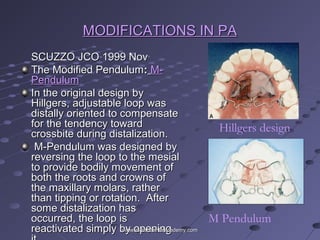
SCUZZO JCO 1999 NovSCUZZO JCO 1999 Nov
The Modified PendulumThe Modified Pendulum:: M-M-
PendulumPendulum
In the original design byIn the original design by
Hillgers, adjustable loop wasHillgers, adjustable loop was
distally oriented to compensatedistally oriented to compensate
for the tendency towardfor the tendency toward
crossbite during distalization.crossbite during distalization.
M-Pendulum was designed byM-Pendulum was designed by
reversing the loop to the mesialreversing the loop to the mesial
to provide bodily movement ofto provide bodily movement of
both the roots and crowns ofboth the roots and crowns of
the maxillary molars, ratherthe maxillary molars, rather
than tipping or rotation. Afterthan tipping or rotation. After
some distalization hassome distalization has
occurred, the loop isoccurred, the loop is
reactivated simply by openingreactivated simply by opening
Hillgers design
M Pendulum
www.indiandentalacademy.comwww.indiandentalacademy.com
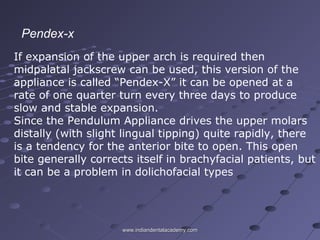
If expansion of the upper arch is required then
midpalatal jackscrew can be used, this version of the
appliance is called “Pendex-X” it can be opened at a
rate of one quarter turn every three days to produce
slow and stable expansion.
Since the Pendulum Appliance drives the upper molars
distally (with slight lingual tipping) quite rapidly, there
is a tendency for the anterior bite to open. This open
bite generally corrects itself in brachyfacial patients, but
it can be a problem in dolichofacial types
Pendex-x
www.indiandentalacademy.comwww.indiandentalacademy.com
Pendex – X
www.indiandentalacademy.comwww.indiandentalacademy.com
A Modified Pendulum Appliance for Anterior
Anchorage Control
PABLO ECHARRI JCO 2003
In cases of extreme Overjet or where
anchorage is critical, such as with reduced
periodontal support, the modified M-Pendulum
was used with four removable arms, for both
the first and second molars. The internal
diameter of the four stainless steel tubes
embedded in the acrylic corresponds to that of
the removable TMA arms.
www.indiandentalacademy.comwww.indiandentalacademy.com
The following case needed distalization only of
the upper right first and second molars. The fixed
left spring was made with stainless steel wire for
anchorage. The two removable right springs were
made with TMA wire
www.indiandentalacademy.comwww.indiandentalacademy.com
SCUZZO JCO 2000SCUZZO JCO 2000
AprilApril
A further modificationA further modification
of the M- Pendulumof the M- Pendulum
appliance was madeappliance was made
by using removableby using removable
TMA arms that can beTMA arms that can be
reactivated outsidereactivated outside
the mouth.the mouth.
www.indiandentalacademy.comwww.indiandentalacademy.com
STUDIES EVALUATING PASTUDIES EVALUATING PA
Ghosh and. Nanda. (AJO 1996)Ghosh and. Nanda. (AJO 1996)
Friedrich K. Byloff (1997 AO) part 1 & PartFriedrich K. Byloff (1997 AO) part 1 & Part
22
Bussick & McNamara, AJO 2000MarchBussick & McNamara, AJO 2000March
www.indiandentalacademy.comwww.indiandentalacademy.com
Ghosh and. NandaGhosh and. Nanda. (AJO 1996) evaluated the effect of. (AJO 1996) evaluated the effect of
Hilgers PA on 41 patients , mean age 12 years and 5Hilgers PA on 41 patients , mean age 12 years and 5
months.months.
After molar distalization was completed and the pendulumAfter molar distalization was completed and the pendulum
appliance removed, a utility arch was placed to preventappliance removed, a utility arch was placed to prevent
relapse.relapse.
DENTAL EFFECTDENTAL EFFECT
Sagittal PlaneSagittal Plane
The correction of the Class II relationship was achieved by aThe correction of the Class II relationship was achieved by a
mean maxillary first molar distalization of 3.37 mm. Averagemean maxillary first molar distalization of 3.37 mm. Average
distal tipping of 8.36°occurred in 1st molar.distal tipping of 8.36°occurred in 1st molar.
The second molar teeth were distalized to a mean of 2.27The second molar teeth were distalized to a mean of 2.27
mm,and tipped distally 11.99°.mm,and tipped distally 11.99°.
There was a statistically significant correlation between theThere was a statistically significant correlation between the
amount of distalization and the amount of first molar tipping.amount of distalization and the amount of first molar tipping.
Vertical planeVertical plane
The vertical change in molar position was insignificant.The vertical change in molar position was insignificant.
There was a mean intrusion of 0.47 mm in second molarThere was a mean intrusion of 0.47 mm in second molarwww.indiandentalacademy.comwww.indiandentalacademy.com
Transverse planeTransverse plane
The transverse width at the maxillary second premolars increased byThe transverse width at the maxillary second premolars increased by
1.95 mm as they drifted distally into a wider part of the arch.1.95 mm as they drifted distally into a wider part of the arch.
The arc described by the spring during its distal movement causes aThe arc described by the spring during its distal movement causes a
mesiobuccal rotation instead of distobuccal rotation. The width betweenmesiobuccal rotation instead of distobuccal rotation. The width between
the mesiobuccal cusps of the right and left first molar teeth increased bythe mesiobuccal cusps of the right and left first molar teeth increased by
1.40 mm, whereas that between the distobuccal cusps showed no1.40 mm, whereas that between the distobuccal cusps showed no
increase. The second molar teeth also showed an expansion of 2.33increase. The second molar teeth also showed an expansion of 2.33
mm between the mesiobuccal cusps.mm between the mesiobuccal cusps.
Distalization of the maxillary first molars with this appliance thereforeDistalization of the maxillary first molars with this appliance therefore
causescauses both distal as well as buccal tippingboth distal as well as buccal tipping of the second molars.of the second molars.
The effect of distalization on the maxillary third molars was extremelyThe effect of distalization on the maxillary third molars was extremely
variable. No patient showed more than half of root formation on the thirdvariable. No patient showed more than half of root formation on the third
molar teeth, and only the crowns were visible in most radiographs. Themolar teeth, and only the crowns were visible in most radiographs. The
third molars showed a net distal tipping of 2.49°, but an insignificantthird molars showed a net distal tipping of 2.49°, but an insignificant
amount of horizontal or vertical change in position 0.19 mm distalizationamount of horizontal or vertical change in position 0.19 mm distalization
and 0.22 mm intrusionand 0.22 mm intrusion
www.indiandentalacademy.comwww.indiandentalacademy.com
Anchorage loss & effect on anterior segmentsAnchorage loss & effect on anterior segments
Loss of anchorage was measured at the first premolarLoss of anchorage was measured at the first premolar
teeth. For every millimeter of distal molar movement, theteeth. For every millimeter of distal molar movement, the
premolar moved mesially 0.75 mm.premolar moved mesially 0.75 mm.
The overjet increased by 1.30 mm and the overbiteThe overjet increased by 1.30 mm and the overbite
decreased by 1.39 mm as a result of treatment. Thedecreased by 1.39 mm as a result of treatment. The
maxillary central incisor was proclined an average ofmaxillary central incisor was proclined an average of
2.40° relative to the SN line.2.40° relative to the SN line.
The upper lip protruded 0.31 mm and the lower lipThe upper lip protruded 0.31 mm and the lower lip
protruded 0.95 mm relative to the E plane.protruded 0.95 mm relative to the E plane.
Effect of eruption of the maxillary second molarEffect of eruption of the maxillary second molar
There were no statistically significant differences inThere were no statistically significant differences in
maxillary first molar movement, as well as anchoragemaxillary first molar movement, as well as anchorage
loss between the group of 18 patients who had eruptedloss between the group of 18 patients who had erupted
maxillary second molars and the 23 who did not,maxillary second molars and the 23 who did not,
indicating that the eruption of maxillary second molarsindicating that the eruption of maxillary second molars
hadhad minimal effectminimal effect on first molar distalization.on first molar distalization.www.indiandentalacademy.comwww.indiandentalacademy.com
Skeletal effects with the pendulum appliance :Skeletal effects with the pendulum appliance :
The pendulum appliance caused insignificant changes inThe pendulum appliance caused insignificant changes in
the cant of the palatal and occlusal planes. Thethe cant of the palatal and occlusal planes. The
mandibular plane, on the other hand, showed a smallmandibular plane, on the other hand, showed a small
backward rotation of 1.09° with treatment, which causedbackward rotation of 1.09° with treatment, which caused
a decrease in the overbite by 1.39 mm.a decrease in the overbite by 1.39 mm.
Because there was no vertical change in the maxillaryBecause there was no vertical change in the maxillary
molar position and only an extrusion of 0.5 mm inmolar position and only an extrusion of 0.5 mm in
mandibular first molar position, most of the backwardmandibular first molar position, most of the backward
mandibular rotation was caused by distalizing themandibular rotation was caused by distalizing the
maxillary molar "into the wedge." The lower anterior facemaxillary molar "into the wedge." The lower anterior face
height, as a result, increased by 2.79 mm.height, as a result, increased by 2.79 mm.
www.indiandentalacademy.comwww.indiandentalacademy.com
Effect based on MPAEffect based on MPA
The patients in the sample were arbitrarily divided into threeThe patients in the sample were arbitrarily divided into three
groups, based on their initial Frankfort horizontal togroups, based on their initial Frankfort horizontal to
mandibular plane angle (FMA) measurements.mandibular plane angle (FMA) measurements.
There was a trend for greater increase in FMA in group withThere was a trend for greater increase in FMA in group with
FMA greater than 25°.FMA greater than 25°.
Patients with high mandibular plane angles showedPatients with high mandibular plane angles showed
posterior mandibular rotation and increase in lower faceposterior mandibular rotation and increase in lower face
height, 4.13 mm as compared to 1.97 mm in average MPAheight, 4.13 mm as compared to 1.97 mm in average MPA
group.group.
The increase in the lower face height as a result of molarThe increase in the lower face height as a result of molar
distalization, was more than double in high angle groupdistalization, was more than double in high angle group
(4.13 mm) than in average group (1.97 mm).(4.13 mm) than in average group (1.97 mm).
www.indiandentalacademy.comwww.indiandentalacademy.com
Friedrich K. Byloff (1997 AO) part 1Friedrich K. Byloff (1997 AO) part 1 studied, the dentalstudied, the dental
and skeletal effects of the pendulum appliance, applyingand skeletal effects of the pendulum appliance, applying
200 to 250 g of force to the molars in 13 patients (age200 to 250 g of force to the molars in 13 patients (age
range 8 years to 13 years 5 months) by means ofrange 8 years to 13 years 5 months) by means of
cephalometric radiographs.cephalometric radiographs.
This study suggest that the pendulum appliance isThis study suggest that the pendulum appliance is
effective in moving the maxillary first molars distally at aeffective in moving the maxillary first molars distally at a
mean monthly rate of 1.02 mm using an initial force ofmean monthly rate of 1.02 mm using an initial force of
200 to 250 g in a mean period of 4 months.200 to 250 g in a mean period of 4 months.
www.indiandentalacademy.comwww.indiandentalacademy.com
Distal molar movement, molar and incisor tipping:Distal molar movement, molar and incisor tipping:
The pendulum appliance produces 3.39 mm ±1.25 mmThe pendulum appliance produces 3.39 mm ±1.25 mm
distal molar movement with a mean bimolar intrusion ofdistal molar movement with a mean bimolar intrusion of
1.17 mm ± 1.29 mm. This positive finding can be related1.17 mm ± 1.29 mm. This positive finding can be related
to prevention of dentoalveolar vertical growth by the rigidto prevention of dentoalveolar vertical growth by the rigid
bonded appliance.bonded appliance.
Molar distal tipping of 14.5° ± 8.33° occurred. TheMolar distal tipping of 14.5° ± 8.33° occurred. The
trajectory of the TMA springs may account for thetrajectory of the TMA springs may account for the
excessive tipping found in this study.excessive tipping found in this study.
Maxillary expansion is possible for transverseMaxillary expansion is possible for transverse
deficiencies in combination with distal molar movement.deficiencies in combination with distal molar movement.
The pendulum appliance does not create dental orThe pendulum appliance does not create dental or
skeletal bite opening.skeletal bite opening.
Anchorage loss:Anchorage loss: Second premolar anchorage loss foundSecond premolar anchorage loss found
in this study was 1.63 mm (±1.37 mm) i.e.in this study was 1.63 mm (±1.37 mm) i.e. 29 %.29 %. DistalDistal
molar movement represented 71% of the space openedmolar movement represented 71% of the space opened
between molars and premolars. Incisor anchorage lossbetween molars and premolars. Incisor anchorage loss
was minimalwas minimal www.indiandentalacademy.comwww.indiandentalacademy.com
Friedrich K. Byloff (1997 AO) part IIFriedrich K. Byloff (1997 AO) part II
In this study, the appliance was modified by incorporatingIn this study, the appliance was modified by incorporating
an uprighting bend into the distalizing spring during thean uprighting bend into the distalizing spring during the
second phase of treatment to avoid excessive distalsecond phase of treatment to avoid excessive distal
tipping of the maxillary molars.tipping of the maxillary molars.
Treatment changes were analyzed and compared withTreatment changes were analyzed and compared with
the previous study.the previous study.
Due to the initial moderate dental transverse deficiency, 8Due to the initial moderate dental transverse deficiency, 8
of the patients required maxillary expansion of 2 to 4 mm.of the patients required maxillary expansion of 2 to 4 mm.
Appliance design and activation:Appliance design and activation:
The major difference was the incorporation of the molarThe major difference was the incorporation of the molar
uprighting bends. An expansion screw was added to theuprighting bends. An expansion screw was added to the
PA in 8 of the subjects who required 2 to 4 mm ofPA in 8 of the subjects who required 2 to 4 mm of
transverse development; the appliance was activatedtransverse development; the appliance was activated
every seventh day to achieve a slow rate of expansion.every seventh day to achieve a slow rate of expansion.
www.indiandentalacademy.comwww.indiandentalacademy.com
Active treatment in this study, contrary to the previous one,Active treatment in this study, contrary to the previous one,
consisted ofconsisted of two phases.two phases.
1. Distal molar1. Distal molar crown movementcrown movement: Molar distalization was: Molar distalization was
done until an overcorrected Class I relationship wasdone until an overcorrected Class I relationship was
obtained.obtained.
2. Molar2. Molar root up rightingroot up righting: The appliance was modified by: The appliance was modified by
adding a bend to the spring design to upright the molars byadding a bend to the spring design to upright the molars by
moving the roots distally.. The moment created was expectedmoving the roots distally.. The moment created was expected
to upright the molars. The springs were left slightly active into upright the molars. The springs were left slightly active in
the sagittal plane to maintain the position of the molarthe sagittal plane to maintain the position of the molar
crowns. The appliance was left in place until the molar crowncrowns. The appliance was left in place until the molar crown
seemed to be sufficiently uprighted.seemed to be sufficiently uprighted.
www.indiandentalacademy.comwww.indiandentalacademy.com
Treatment timeTreatment time
Mean total experimental time using the PA was 27.25 ±Mean total experimental time using the PA was 27.25 ±
7.12 weeks (6 months 3 weeks ± 7 weeks).7.12 weeks (6 months 3 weeks ± 7 weeks).
1st phase of treatment, ( obtaining a super Class I1st phase of treatment, ( obtaining a super Class I
relationship) the distal movement phase, took 16.45 ±relationship) the distal movement phase, took 16.45 ±
6.67 weeks.6.67 weeks.
2nd phase -- to upright the maxillary molars required2nd phase -- to upright the maxillary molars required
another 10.9 weeks.another 10.9 weeks.
Thus the total treatment time was increased by 64.1%.Thus the total treatment time was increased by 64.1%.
Distal molar movement & molar tipping:Distal molar movement & molar tipping:
The percentage of molar movement compared with totalThe percentage of molar movement compared with total
space opening decreased from 70.92 % to 64.16.space opening decreased from 70.92 % to 64.16.
Rate of movement was between 0.69 mm ± 0.29 mm andRate of movement was between 0.69 mm ± 0.29 mm and
1.20 mm ± 0.74 mm per month, depending on the rate of1.20 mm ± 0.74 mm per month, depending on the rate of
uprighting.uprighting.
During the uprighting phase, the average monthly distalDuring the uprighting phase, the average monthly distal
movement of the apex was 1.01 mm ± 0.57 mm.movement of the apex was 1.01 mm ± 0.57 mm.
www.indiandentalacademy.comwww.indiandentalacademy.com
Second molar eruption stagesSecond molar eruption stages
In both study the position of the second molars didn’tIn both study the position of the second molars didn’t
influence the amount of distal molar movement or premolarinfluence the amount of distal molar movement or premolar
or incisor anchorage loss.or incisor anchorage loss.
Intrusion—extrusionIntrusion—extrusion
Increases in the premolar and incisor extrusion andIncreases in the premolar and incisor extrusion and
decrease in molar intrusion when compared with the firstdecrease in molar intrusion when compared with the first
study might be a result of the vertical reactive componentstudy might be a result of the vertical reactive component
of the uprighting bend.of the uprighting bend.
Anchorage lossAnchorage loss
The price for more space opening and distal molar crownThe price for more space opening and distal molar crown
movement, and especially for more root movement andmovement, and especially for more root movement and
reduced final tipping of the molars, was increased totalreduced final tipping of the molars, was increased total
treatment time and 0.61 mm more anchorage loss at thetreatment time and 0.61 mm more anchorage loss at the
premolars and 0.62 mm at the incisor edge level.premolars and 0.62 mm at the incisor edge level.
The effects of the original pendulum appliance wereThe effects of the original pendulum appliance were notnot
significantly changedsignificantly changed by the incorporation of the uprightingby the incorporation of the uprighting
bends, although slightly more anchorage loss was notedbends, although slightly more anchorage loss was noted
on the maxillary incisal edge.on the maxillary incisal edge.
www.indiandentalacademy.comwww.indiandentalacademy.com
Bussick & McNamara, AJO 2000MarchBussick & McNamara, AJO 2000March
Subjects were: Varying facial patterns (high, neutral, andSubjects were: Varying facial patterns (high, neutral, and
low mandibular plane angles).low mandibular plane angles).
Cephalometric radiographs obtained from 13Cephalometric radiographs obtained from 13
practitioners were used to document the treatment ofpractitioners were used to document the treatment of
101 patients (45 boys and 56 girls).101 patients (45 boys and 56 girls).
The relative effect of erupted maxillary second molars onThe relative effect of erupted maxillary second molars on
distalization of the first molar and the effects, if any, ofdistalization of the first molar and the effects, if any, of
permanent versus deciduous dentition based anchoragepermanent versus deciduous dentition based anchorage
on distalization of maxillary molars were also evaluated.on distalization of maxillary molars were also evaluated.
Treatment with a pendulum/pendex appliance, similar toTreatment with a pendulum/pendex appliance, similar to
the type described by Hilgers,was initiated in all patientsthe type described by Hilgers,was initiated in all patients
www.indiandentalacademy.comwww.indiandentalacademy.com
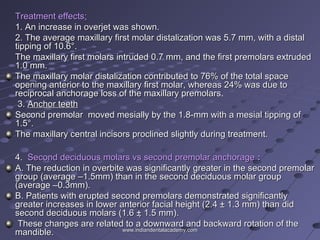
Treatment effectsTreatment effects::
1. An increase in overjet was shown.1. An increase in overjet was shown.
2. The average maxillary first molar distalization was 5.7 mm, with a distal2. The average maxillary first molar distalization was 5.7 mm, with a distal
tipping of 10.6°.tipping of 10.6°.
The maxillary first molars intruded 0.7 mm, and the first premolars extrudedThe maxillary first molars intruded 0.7 mm, and the first premolars extruded
1.0 mm.1.0 mm.
The maxillary molar distalization contributed to 76% of the total spaceThe maxillary molar distalization contributed to 76% of the total space
opening anterior to the maxillary first molar, whereas 24% was due toopening anterior to the maxillary first molar, whereas 24% was due to
reciprocal anchorage loss of the maxillary premolars.reciprocal anchorage loss of the maxillary premolars.
3.3. Anchor teethAnchor teeth
Second premolar moved mesially by the 1.8-mm with a mesial tipping ofSecond premolar moved mesially by the 1.8-mm with a mesial tipping of
1.5°.1.5°.
The maxillary central incisors proclined slightly during treatment.The maxillary central incisors proclined slightly during treatment.
4.4. Second deciduous molars vs second premolar anchorageSecond deciduous molars vs second premolar anchorage ::
A. The reduction in overbite was significantly greater in the second premolarA. The reduction in overbite was significantly greater in the second premolar
group (average –1.5mm) than in the second deciduous molar groupgroup (average –1.5mm) than in the second deciduous molar group
(average –0.3mm).(average –0.3mm).
B. Patients with erupted second premolars demonstrated significantlyB. Patients with erupted second premolars demonstrated significantly
greater increases in lower anterior facial height (2.4 ± 1.3 mm) than didgreater increases in lower anterior facial height (2.4 ± 1.3 mm) than did
second deciduous molars (1.6 ± 1.5 mm).second deciduous molars (1.6 ± 1.5 mm).
These changes are related to a downward and backward rotation of theThese changes are related to a downward and backward rotation of the
mandible.mandible. www.indiandentalacademy.comwww.indiandentalacademy.com
5. Presence or Absence of Erupted Permanent Maxillary5. Presence or Absence of Erupted Permanent Maxillary
Second MolarsSecond Molars
1. No significant differences were noted in the1. No significant differences were noted in the
anteroposterior movement of the maxillary first molar andanteroposterior movement of the maxillary first molar and
sagittal anchorage loss between the 57 patients who hadsagittal anchorage loss between the 57 patients who had
erupted maxillary second molars and the 44 who had not.erupted maxillary second molars and the 44 who had not.
2. In patients with erupted maxillary second molars, there2. In patients with erupted maxillary second molars, there
was a slightly greater increase in lower anterior face heightwas a slightly greater increase in lower anterior face height
and in the mandibular plane angle and a slightly greaterand in the mandibular plane angle and a slightly greater
decrease in overbite in comparison to patients withdecrease in overbite in comparison to patients with
unerupted second molars.unerupted second molars.
www.indiandentalacademy.comwww.indiandentalacademy.com
6. Variation in Facial Patterns6. Variation in Facial Patterns::
Lower anterior facial height increased 2.2 mm; thereLower anterior facial height increased 2.2 mm; there
waswas no significant differenceno significant difference in lower anterior facialin lower anterior facial
height increase between patients of high, neutral, or lowheight increase between patients of high, neutral, or low
mandibular plane angles.mandibular plane angles.
For maximum maxillary first molar distalization withFor maximum maxillary first molar distalization with
minimal increase in lower anterior facial height, thisminimal increase in lower anterior facial height, this
appliance appears to beappliance appears to be best used on patients withbest used on patients with
maxillary second deciduous molars for anchorage andmaxillary second deciduous molars for anchorage and
the absence of erupted permanent maxillary secondthe absence of erupted permanent maxillary second
molarsmolars, although significant bite opening was not of, although significant bite opening was not of
major concern in any patient in the study.major concern in any patient in the study.
www.indiandentalacademy.comwww.indiandentalacademy.com
Distalization appliances based on NiTiDistalization appliances based on NiTi
wires and coilswires and coils
Superelastic coilsSuperelastic coils
Superelastic archwire: single looped,Superelastic archwire: single looped,
double loopeddouble looped
www.indiandentalacademy.comwww.indiandentalacademy.com
1. SUPER ELASTIC NiTi COILS1. SUPER ELASTIC NiTi COILS
Anthony A. Gianelly (AJO 1991) used Japanese NiTiAnthony A. Gianelly (AJO 1991) used Japanese NiTi
super elastic coils, exerting 100 gm of force, compressedsuper elastic coils, exerting 100 gm of force, compressed
against the maxillary first molars and moved the molarsagainst the maxillary first molars and moved the molars
distally 1 to 1.5 mm/month.distally 1 to 1.5 mm/month.
Coils are used in conjunction with a vertically slottedCoils are used in conjunction with a vertically slotted
(0.020-inch) fixed appliance.(0.020-inch) fixed appliance.
A passive 0.016 ´ 0.22-inch wire with stops that abut theA passive 0.016 ´ 0.22-inch wire with stops that abut the
distal wings of the premolar brackets is inserted todistal wings of the premolar brackets is inserted to
ensure that the wire cannot move past the firstensure that the wire cannot move past the first
premolars, thus placing the reaction force on the Nancepremolars, thus placing the reaction force on the Nance
appliance. Coils are placed on the wire between the firstappliance. Coils are placed on the wire between the first
premolars and the molars.premolars and the molars.
The coils are activated 8 to 10 mm by compressing andThe coils are activated 8 to 10 mm by compressing and
maintaining them against the molars by crimpable hooksmaintaining them against the molars by crimpable hooks
or Gurin locks.or Gurin locks.
www.indiandentalacademy.comwww.indiandentalacademy.com
AnchorageAnchorage
A Nance-type appliance was cemented onto the firstA Nance-type appliance was cemented onto the first
premolars. The appliance extends from the incisors to thepremolars. The appliance extends from the incisors to the
molar area and a bite plate is added to the incisal portionmolar area and a bite plate is added to the incisal portion
to disclude the posterior teeth slightlyto disclude the posterior teeth slightly
Anchorage enhancement:Anchorage enhancement:
To enhance anchorage further, a 0.018-inch uprightingTo enhance anchorage further, a 0.018-inch uprighting
spring is placed in the vertical slot of the premolarspring is placed in the vertical slot of the premolar
brackets, directing the crowns distally.brackets, directing the crowns distally.
Class II mechanics are used only when anchorage loss isClass II mechanics are used only when anchorage loss is
at least 1 mm.at least 1 mm.
When Class II elastics are attached, a rectangular wireWhen Class II elastics are attached, a rectangular wire
with 10° of incisor lingual root torque is inserted in thewith 10° of incisor lingual root torque is inserted in the
mandibular arch to maintain lower incisor position.mandibular arch to maintain lower incisor position.
100 gm superelastic coils can be used successfully in100 gm superelastic coils can be used successfully in
patients with Class II malocclusions to move molarspatients with Class II malocclusions to move molars
posteriorly at the rate of 1 to 1.5 mm/month with little or noposteriorly at the rate of 1 to 1.5 mm/month with little or no
cooperation from the patient.cooperation from the patient.www.indiandentalacademy.comwww.indiandentalacademy.com
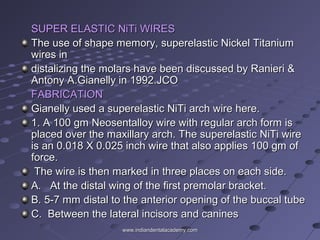
SUPER ELASTIC NiTi WIRESSUPER ELASTIC NiTi WIRES
The use of shape memory, superelastic Nickel TitaniumThe use of shape memory, superelastic Nickel Titanium
wires inwires in
distalizing the molars have been discussed by Ranieri &distalizing the molars have been discussed by Ranieri &
Antony A.Gianelly in 1992.JCOAntony A.Gianelly in 1992.JCO
FABRICATIONFABRICATION
Gianelly used a superelastic NiTi arch wire here.Gianelly used a superelastic NiTi arch wire here.
1. A 100 gm Neosentalloy wire with regular arch form is1. A 100 gm Neosentalloy wire with regular arch form is
placed over the maxillary arch. The superelastic NiTi wireplaced over the maxillary arch. The superelastic NiTi wire
is an 0.018 X 0.025 inch wire that also applies 100 gm ofis an 0.018 X 0.025 inch wire that also applies 100 gm of
force.force.
The wire is then marked in three places on each side.The wire is then marked in three places on each side.
A. At the distal wing of the first premolar bracket.A. At the distal wing of the first premolar bracket.
B. 5-7 mm distal to the anterior opening of the buccal tubeB. 5-7 mm distal to the anterior opening of the buccal tube
C. Between the lateral incisors and caninesC. Between the lateral incisors and canines
www.indiandentalacademy.comwww.indiandentalacademy.com
A stop is then crimped on the arch wire at each of the posterior marksA stop is then crimped on the arch wire at each of the posterior marks
and a hook is then added for inter-maxillary elastics between theand a hook is then added for inter-maxillary elastics between the
lateral incisors and canines.lateral incisors and canines.
3. The wire is then inserted into the molar tube until the posterior stop3. The wire is then inserted into the molar tube until the posterior stop
abuts the tube.abuts the tube.
To place the wire through the first premolar bracket, the anterior stopTo place the wire through the first premolar bracket, the anterior stop
is grasped and the wire gently forced distally so that the stop abuts theis grasped and the wire gently forced distally so that the stop abuts the
distal wing of the first premolar bracket, when ligated.distal wing of the first premolar bracket, when ligated.
Since the wire is 5-7 mm longer than the available space, the excessSince the wire is 5-7 mm longer than the available space, the excess
will be deflected gingivally into the buccal fold.will be deflected gingivally into the buccal fold.
www.indiandentalacademy.comwww.indiandentalacademy.com
ACTION OF THE WIRE/APPLIANCEACTION OF THE WIRE/APPLIANCE
The distalization of the molars occur as the wire returns to its originalThe distalization of the molars occur as the wire returns to its original
shape, exerting a distal force of 100 gms against the molars and ashape, exerting a distal force of 100 gms against the molars and a
reactionary mesial force on the first premolars, canines and incisors.reactionary mesial force on the first premolars, canines and incisors.
There is also a tendency for the premolars to move buccally.There is also a tendency for the premolars to move buccally.
THE ANCHORAGETHE ANCHORAGE
The anchorage can be controlled byThe anchorage can be controlled by
a. Placing a 100-150 gm class II elastics against the first premolars.a. Placing a 100-150 gm class II elastics against the first premolars.
(or)(or)
b. Placement of hooks between the lateral incisors and canines (or)b. Placement of hooks between the lateral incisors and canines (or)
c. A Nance appliance cemented to the first premolars.c. A Nance appliance cemented to the first premolars.
www.indiandentalacademy.comwww.indiandentalacademy.com
THE ADVANTAGE OF THE APPLIANCETHE ADVANTAGE OF THE APPLIANCE
1. The appliance distalizes the molar at1. The appliance distalizes the molar at
the rate of 1-2 mm per month with littlethe rate of 1-2 mm per month with little
loss of anchorage.loss of anchorage.
2. The Neosentalloy wire is easy to insert2. The Neosentalloy wire is easy to insert
even after all teeth have been bracketedeven after all teeth have been bracketed
or banded.or banded.
www.indiandentalacademy.comwww.indiandentalacademy.com
Giancotti, & Cozza (JCO 1998 April) usedGiancotti, & Cozza (JCO 1998 April) used double loopdouble loop forfor
simultaneous distalization of both molarssimultaneous distalization of both molars
Superelastic nickel titanium wires have been found asSuperelastic nickel titanium wires have been found as
effective as other means in producing distal movement ofeffective as other means in producing distal movement of
the maxillary first molars. When the distalization is carriedthe maxillary first molars. When the distalization is carried
out before the second molars have erupted, it can reliablyout before the second molars have erupted, it can reliably
produce 1-2mm of space. Once the second molars haveproduce 1-2mm of space. Once the second molars have
erupted, however, the distal movement can be moreerupted, however, the distal movement can be more
difficult and time-consuming, and loss of anchorage isdifficult and time-consuming, and loss of anchorage is
likely.likely.
Author used Nickel Titanium Double-Loop System forAuthor used Nickel Titanium Double-Loop System for
Simultaneous distalization of First and Second Molars.Simultaneous distalization of First and Second Molars.
Appliance DesignAppliance Design
The mandibular first and second molars and secondThe mandibular first and second molars and second
bicuspids are banded, and the remaining mandibular teethbicuspids are banded, and the remaining mandibular teeth
are bonded. A lip bumper is placed to prevent anyare bonded. A lip bumper is placed to prevent any
extrusion from the use of Class II elastics.extrusion from the use of Class II elastics.
The maxillary molars and bicuspids are banded, and theThe maxillary molars and bicuspids are banded, and the
anterior teeth are bondedanterior teeth are bonded
www.indiandentalacademy.comwww.indiandentalacademy.com
An 80g NeoSentalloy archwireAn 80g NeoSentalloy archwire
(regular mandibular(regular mandibular archform) isarchform) is
placed on the maxillary arch andplaced on the maxillary arch and
marked distal to the first bicuspidmarked distal to the first bicuspid
bracket and about 5mm distal to thebracket and about 5mm distal to the
first molar tube . Stops are thenfirst molar tube . Stops are then
crimped in the archwire at each markcrimped in the archwire at each mark
(distal to 4 and 6)(distal to 4 and 6)
Two sectional nickel titaniumTwo sectional nickel titanium
archwires (one for each side) arearchwires (one for each side) are
prepared by crimping stops distal andprepared by crimping stops distal and
mesial to the second bicuspids andmesial to the second bicuspids and
about 5mm distal to each secondabout 5mm distal to each second
molar tube.molar tube.
Uprighting springs are inserted intoUprighting springs are inserted into
the vertical slots of the first bicuspidthe vertical slots of the first bicuspid
and Class II elastics are placedand Class II elastics are placed
www.indiandentalacademy.comwww.indiandentalacademy.com
The First Class Appliance for Rapid Molar
Distalization by ARTURO FORTINI, JCO 1999
To minimize the anchorage loss, a new type of appliance
for unilateral or bilateral distalization of the maxillary first
molars was developed.
1. Vestibular components. Formative screws are soldered
on the buccal sides of the first molar bands, occlusal to
the .022" × .028" single tubes, so they will not interfere
with subsequent insertion of the archwire.
www.indiandentalacademy.comwww.indiandentalacademy.com
Split rings, welded to the second premolar or second
deciduous molar bands, control the vestibular screws.
2. Palatal components. In the palatal aspect, the
appliance is much like a modified Nance button, but is
wider and has a butterfly shape for added stability and
support during retention The embedded .045" wires
should be in single sections, without welded joints, to
prevent breakage.
Sections of .045" tube are soldered to the palatal sides of
the first molar bands for insertion of the butterfly
component of the appliance.
www.indiandentalacademy.comwww.indiandentalacademy.com
These tubes allow the molars to be distalized without
undesirable tipping. The butterfly section is soldered to
the second bicuspid or deciduous molar bands.
Nickel titanium .010" × .045" coil springs, approximately
10mm each in length, are fully compressed between the
bicuspid solder joints and the tubes on the permanent
molar. The author has treated 62 Class II cases with this
appliance age range from 8.7 years to 14.5 years. The
average time for distalization was 42 days, with a range
from 28 to 95 days.
www.indiandentalacademy.comwww.indiandentalacademy.com
C-Space Regainer for Molar Distalization by
KYU-RHIM CHUNG
YOUNG-GUK PARK, SU-JIN KO JCO 2000
The C-space regainer consists of a labial framework,
formed from .036" stainless steel wire, and an acrylic
splint. A closed helix, as wide in diameter as comfort will
allow, is bent into the framework in each canine region.
The labial framework is extended distally to lie as close to
the buccal molar tubes as possible, allowing easy
insertion into the headgear tubes and improving the
precision of the distal-driving force. The distal ends of the
framework should be polished down for a loose fit in the
molar tubes. A .010" × .040" open-coil spring is soldered
immediately distal to the helix.
www.indiandentalacademy.comwww.indiandentalacademy.com
Appliance Placement
The open-coil spring should be 130% of the
length between the solder point and the mesial
edge of the headgear tube. When compressed, it
will exert 200g of force and move the molars distally
about 1-1.5mm per month. Vertical control is maintained
by adjusting the wire framework occlusally or gingivally
www.indiandentalacademy.comwww.indiandentalacademy.com
The Jones Jig:
Jones Jig consists of a heavy round wire and a light wire
projecting through the molar tubes. Both wires are fixed
to a fixed attachment sheath and hook. An anteriorly
placed sliding sheath when tied back activates the open
coil spring contained between the two sheaths. The
desired result is distalization of the maxillary molar. A
Nance palatal button is attached to the bands, which have
been placed on the second premolars.
The force generated by compression of the open
coil spring is 70 to 75 grams, with this light force several
millimeters of molar distalization can be obtained in 3 to 4
months.
www.indiandentalacademy.comwww.indiandentalacademy.com
The advantages of the Jones Jig are
• light forces
• ease of activation
•it can be used without bonding the anterior
teeth
The disadvantages are
•distal tipping of the molars
•mesial tipping of the premolars
www.indiandentalacademy.comwww.indiandentalacademy.com
DISTAL JETDISTAL JET
Distal jet was designed by AldoDistal jet was designed by Aldo
Carano & Mauro in 1996.Carano & Mauro in 1996.
Appliance DesignAppliance Design
Bilateral tubes of .036" internalBilateral tubes of .036" internal
diameter which is attached to andiameter which is attached to an
acrylic Nance button.acrylic Nance button.
A NiTi coil spring and a screw-A NiTi coil spring and a screw-
clamp are slid over each tube.clamp are slid over each tube.
The wire extending from theThe wire extending from the
acrylic through each tube ends inacrylic through each tube ends in
a bayonet bend that is inserteda bayonet bend that is inserted
into the lingual sheath of the firstinto the lingual sheath of the first
molar band. An anchor wire frommolar band. An anchor wire from
the Nance button is soldered tothe Nance button is soldered to
bands on the second premolarsbands on the second premolars
www.indiandentalacademy.comwww.indiandentalacademy.com
Components:Components:
1. The Transpalatal connector – rigidly immobilizes the premolars and1. The Transpalatal connector – rigidly immobilizes the premolars and
provides a support to the Nance button.provides a support to the Nance button.
2. The bayonet director unit - Lumen of the tube portion supports the2. The bayonet director unit - Lumen of the tube portion supports the
molar bayonet, while its outside diameter supports the spring and themolar bayonet, while its outside diameter supports the spring and the
activation lock.activation lock.
3. The molar bayonet - It is drawn out of the bayonet director unit during3. The molar bayonet - It is drawn out of the bayonet director unit during
distalization and inserts into the lingual sheath.distalization and inserts into the lingual sheath.
4. The Distal stop - Prevents the spring from riding up on the vertical4. The Distal stop - Prevents the spring from riding up on the vertical
arm of the molar bayonet while activation of the appliance.arm of the molar bayonet while activation of the appliance.
5. Nickel titanium springs - Two force ranges - 180 gms and 240 gms.5. Nickel titanium springs - Two force ranges - 180 gms and 240 gms.
6. Activation locks - To compress and activate the springs.6. Activation locks - To compress and activate the springs.
7. Lock wrench - To engage and tighten the screw of the activation lock7. Lock wrench - To engage and tighten the screw of the activation lock
1. TP connector
2. Bayonet director
3. Molar bayonet
6. Activation lock
7. C Res
www.indiandentalacademy.comwww.indiandentalacademy.com
Activation:Activation:
The Distal Jet is reactivatedThe Distal Jet is reactivated
by sliding the clamp closer toby sliding the clamp closer to
the first molar once a month.the first molar once a month.
Once distalization isOnce distalization is
complete, the appliance cancomplete, the appliance can
be converted to a Nancebe converted to a Nance
retainer simply by replacingretainer simply by replacing
the clamp-spring assembliesthe clamp-spring assemblies
with cold-cure acrylic andwith cold-cure acrylic and
cutting off the arms to thecutting off the arms to the
premolarspremolars..
www.indiandentalacademy.comwww.indiandentalacademy.com
Advantage of distal jet :Advantage of distal jet :
The appliance is relatively easy to fabricate, easy toThe appliance is relatively easy to fabricate, easy to
insert, is well tolerated and is esthetic.insert, is well tolerated and is esthetic.
Easy activationEasy activation
Ease of conversion to a Nance holding arch to maintainEase of conversion to a Nance holding arch to maintain
the distalized molar positions.the distalized molar positions.
The Distal Jet also permits the simultaneous use of fullThe Distal Jet also permits the simultaneous use of full
bonded appliances, possibly avoiding the need for twobonded appliances, possibly avoiding the need for two
phases of treatmentphases of treatment
www.indiandentalacademy.comwww.indiandentalacademy.com
Distal jetDistal jet
www.indiandentalacademy.comwww.indiandentalacademy.com
MODIFICATIONS OF DISTAL JETMODIFICATIONS OF DISTAL JET
Bowman (1998 Sept JCO)Bowman (1998 Sept JCO) described severaldescribed several
modifications to the original appliance.modifications to the original appliance.
Conversion to Nance Holding Arch:Conversion to Nance Holding Arch:
Upon completion of molar distalization, the Distal Jet isUpon completion of molar distalization, the Distal Jet is
converted to a Nance holding arch to prevent further distalconverted to a Nance holding arch to prevent further distal
movement and consequent anchorage loss. It can be donemovement and consequent anchorage loss. It can be done
by these two methods:by these two methods:
1. One way to stop movement of the bayonet wire through1. One way to stop movement of the bayonet wire through
the tube is to flow a light-cured acrylic around the coilthe tube is to flow a light-cured acrylic around the coil
spring, over the distal bayonet bend, and over the activationspring, over the distal bayonet bend, and over the activation
collar to produce a solid extension from the molar bands tocollar to produce a solid extension from the molar bands to
the acrylic button.the acrylic button.
www.indiandentalacademy.comwww.indiandentalacademy.com
2. Wrap an .014" stainless steel ligature wire around the2. Wrap an .014" stainless steel ligature wire around the
end of the doubled back wire (extending distally from theend of the doubled back wire (extending distally from the
lingual sheath on the first molar band) and tie it aroundlingual sheath on the first molar band) and tie it around
the tube just mesial to the activation collar. The coilthe tube just mesial to the activation collar. The coil
spring should be compressed completely and the setspring should be compressed completely and the set
screw tightened to prevent mesial movement of thescrew tightened to prevent mesial movement of the
molars.molars.
www.indiandentalacademy.comwww.indiandentalacademy.com
Double -Set -Screw Distal JetDouble -Set -Screw Distal Jet
A modification of the Distal JetA modification of the Distal Jet
incorporating two set screws into theincorporating two set screws into the
activation collar permits an easier,activation collar permits an easier,
cleaner, and more reliablecleaner, and more reliable
conversion to a molar Nanceconversion to a molar Nance
holding arch.holding arch.
The mesial set screw is used duringThe mesial set screw is used during
active distalization .The distal screwactive distalization .The distal screw
is set on the bayonet wire, lockingis set on the bayonet wire, locking
the two pieces together to preventthe two pieces together to prevent
molar movement.molar movement.
The premolar supporting wires areThe premolar supporting wires are
sectioned where they enter thesectioned where they enter the
acrylic button, using a high-speedacrylic button, using a high-speed
handpiece and diamond bur.handpiece and diamond bur.
The bayonet wire or tube can beThe bayonet wire or tube can be
bent with a three-prong plier tobent with a three-prong plier to
adjust the pressure of theacrylicadjust the pressure of theacrylic
button against the palatebutton against the palate
www.indiandentalacademy.comwww.indiandentalacademy.com
Conversion of double-set-screw Distal Jet to Nance holding arch:Conversion of double-set-screw Distal Jet to Nance holding arch:
A. Upon completion ofmolar distalization, double-set-screw activationA. Upon completion ofmolar distalization, double-set-screw activation
collar is slid mesially to gain access to coil spring.collar is slid mesially to gain access to coil spring.
B.Free end of coil spring is grasped with plier. Coil spring is removed byB.Free end of coil spring is grasped with plier. Coil spring is removed by
peeling it away from bayonet wire.peeling it away from bayonet wire.
C. Distal end of tube, where bayonet wire enters, can now be seen.C. Distal end of tube, where bayonet wire enters, can now be seen.
D. Double set-screw collar is slid back to this junction, mesial set screwD. Double set-screw collar is slid back to this junction, mesial set screw
is locked on tube, and distal screw is set on bayonet.is locked on tube, and distal screw is set on bayonet.
www.indiandentalacademy.comwww.indiandentalacademy.com
Quick & Angela Harris (JCO 2000 July)Quick & Angela Harris (JCO 2000 July)
The Distal Jet is a fixed palatal appliance that is mostThe Distal Jet is a fixed palatal appliance that is most
commonly used to distalize the maxillary molars, eithercommonly used to distalize the maxillary molars, either
unilaterally or bilaterally.unilaterally or bilaterally.
DisadvantageDisadvantage of Distal jet: Lies in activationof Distal jet: Lies in activation
The appliance is activated by sliding a collar along theThe appliance is activated by sliding a collar along the
supporting tube to compress a coil spring, then fixing thesupporting tube to compress a coil spring, then fixing the
collar in place by tightening a small set-screw.collar in place by tightening a small set-screw.
This procedure is sometimes difficult because of theThis procedure is sometimes difficult because of the
small size of the screw, the moisture and confined spacesmall size of the screw, the moisture and confined space
of the intraoral environment, and food impaction in theof the intraoral environment, and food impaction in the
screw head.screw head.
In addition, activation requires the use of a smallIn addition, activation requires the use of a small AllenAllen
wrenchwrench, which has the risk of being swallowed or, which has the risk of being swallowed or
aspiratedaspirated..
www.indiandentalacademy.comwww.indiandentalacademy.com
Appliance DesignAppliance Design
The basis of the modification is the rearThe basis of the modification is the rear
entry of the sliding section into theentry of the sliding section into the
lingual molar sheath, so that thelingual molar sheath, so that the
appliance pulls rather than pushes theappliance pulls rather than pushes the
molars distally.molars distally.
The doubled-backwire (or “foot”) isThe doubled-backwire (or “foot”) is
inserted into the lingual sheath from theinserted into the lingual sheath from the
distal. The foot should be a little longerdistal. The foot should be a little longer
than the sheath so it can be tied back tothan the sheath so it can be tied back to
the sliding section with an elastomericthe sliding section with an elastomeric
or metal ligature.or metal ligature.
Either .030" or .032" wire is suitable forEither .030" or .032" wire is suitable for
the sliding sections. Support tubes ofthe sliding sections. Support tubes of
corresponding internal diameter arecorresponding internal diameter are
embedded in the acrylic Nance button.embedded in the acrylic Nance button.
www.indiandentalacademy.comwww.indiandentalacademy.com
The desired amount of activation is achieved byThe desired amount of activation is achieved by
compressing the coil spring between the distal end of thecompressing the coil spring between the distal end of the
support tube and a stop soldered to the sliding wire.support tube and a stop soldered to the sliding wire.
To reactivate the appliance, the safety ligature is cut, theTo reactivate the appliance, the safety ligature is cut, the
sliding wire is pulled out distally, and a new, longersliding wire is pulled out distally, and a new, longer
section of coil is placed over the wire.section of coil is placed over the wire.
In addition, no set-screws or Allen wrenches are used,In addition, no set-screws or Allen wrenches are used,
simplifying the activation procedure.simplifying the activation procedure.
After molar distalization is completed, the molar positionsAfter molar distalization is completed, the molar positions
are held by replacing the open coils with either closedare held by replacing the open coils with either closed
coils or solid tubing to prevent anterior relapse or a newcoils or solid tubing to prevent anterior relapse or a new
Nance button can be made.Nance button can be made.
www.indiandentalacademy.comwww.indiandentalacademy.com
TO BE CONTINUED
www.indiandentalacademy.comwww.indiandentalacademy.com
•The Lokar Molar Distalizing Appliance:
The Lokar appliance inserts into the molar
attachments with an appropriately sized rectangular
wire.
A compression spring is activated by a sliding sleeve
which is tied to the most distal tooth mesial of the first
molar by a ligature wire.
There is flat guiding bar and the round posterior guiding
rod. This guiding rod is soldered to the mesially
positioned sliding sleeve while the flat anterior guiding
bar is soldered to the immovable posterior sleeve.
www.indiandentalacademy.comwww.indiandentalacademy.com
With this arrangement it can be visualized that on activation the
coils spring is compressed by the sliding sleeve and an increase
in the guiding rod occurs
This appliance can be best used with Nance palatal
button. Advantages of this appliance are ease of
insertion, ease of activation minimal breakage.
A: the rectangular wire fits into molar tube; B: open coil;
C: sliding sleeve; D: groove for tying the ligature for
activation; E: flat guiding bar; F: round posterior guiding
rod; G: immovable posterior sleeve
www.indiandentalacademy.comwww.indiandentalacademy.com
The appliance was described byThe appliance was described by
Raphael U.Greenfield in 1997.Raphael U.Greenfield in 1997.
The appliance proposed to achieveThe appliance proposed to achieve
distal bodily movement of the molarsdistal bodily movement of the molars
without tipping the crown with no loss ofwithout tipping the crown with no loss of
posterior anchorage.posterior anchorage.
THE APPLIANCETHE APPLIANCE
The components of the appliance are:The components of the appliance are:
a. Maxillary first molar and first bicuspida. Maxillary first molar and first bicuspid
bands.bands.
b. 0.036" stainless steel tubingb. 0.036" stainless steel tubing
(soldered to the bicuspids).(soldered to the bicuspids).
c.0.030" stainless steel wires (solderedc.0.030" stainless steel wires (soldered
to the first molar).to the first molar).
d. Enlarged Nance button reinforcedd. Enlarged Nance button reinforced
with an 0.040" stainless steel wire forwith an 0.040" stainless steel wire for
control of anterior anchorage.control of anterior anchorage.
e. 0.055" hyperplastic nickel titaniume. 0.055" hyperplastic nickel titanium
open-coil springs - to provide a light butopen-coil springs - to provide a light but
continuous force.continuous force.
THE FIXED PISTON APPLIANCETHE FIXED PISTON APPLIANCE
www.indiandentalacademy.comwww.indiandentalacademy.com
THE ADVANTAGESTHE ADVANTAGES
The fixed piston appliance has been proved to beThe fixed piston appliance has been proved to be
effective in molar distalisation and is said to have theeffective in molar distalisation and is said to have the
following advantages:following advantages:
Bodily movement of maxillary first molars (with no loss ofBodily movement of maxillary first molars (with no loss of
posterior anchorage).posterior anchorage).
Minimum patient compliance.Minimum patient compliance.
Allows the use of head gear if needed.Allows the use of head gear if needed.
In non-extraction cases, it is proved to reduce treatmentIn non-extraction cases, it is proved to reduce treatment
time as it distalizes at the rate of 1mm per month.time as it distalizes at the rate of 1mm per month.
Maintains the arch width after expansion with Haas orMaintains the arch width after expansion with Haas or
Hyrax appliances.Hyrax appliances.
Uses a light, controlled force of only 1-2 ounce per tooth.Uses a light, controlled force of only 1-2 ounce per tooth.
Because of this there is no loss of anterior anchorageBecause of this there is no loss of anterior anchorage
and no inflammation of the palatal mucosa beneath andand no inflammation of the palatal mucosa beneath and
adjacent to the modified Nance button.adjacent to the modified Nance button.
Does not interfere with the occlusal plane, thusDoes not interfere with the occlusal plane, thus
maintaining effective control over the vertical dimensions.maintaining effective control over the vertical dimensions.
www.indiandentalacademy.comwww.indiandentalacademy.com
K-LoopK-Loop
Put forward by Valrun Kalra (JCO 1995)Put forward by Valrun Kalra (JCO 1995)
The K-Loop molar distalizer consists ofThe K-Loop molar distalizer consists of
1. A K-Loop to provide the forces and1. A K-Loop to provide the forces and
moments.moments.
2. A Nance button - to resist anchorage.2. A Nance button - to resist anchorage.
The k-Loop is made of 0.017’ x 0.025' TMAThe k-Loop is made of 0.017’ x 0.025' TMA
wire which can be activated twice as muchwire which can be activated twice as much
as stainless steel, before it undergoesas stainless steel, before it undergoes
permanent plastic deformation.permanent plastic deformation.
www.indiandentalacademy.comwww.indiandentalacademy.com
A.A. The loop of the 'K' should be 8 mm long and 1.5The loop of the 'K' should be 8 mm long and 1.5
mm wide.mm wide.
BB. The legs of the 'K' are to be bent down 20 ° and. The legs of the 'K' are to be bent down 20 ° and
inserted into the molar tube and the premolarinserted into the molar tube and the premolar
bracket.bracket.
CC. The wires are marked at the mesial of the molar. The wires are marked at the mesial of the molar
tube and the distal of the premolar bracket.tube and the distal of the premolar bracket.
A B C
www.indiandentalacademy.comwww.indiandentalacademy.com
DD. Stops are bent into the wire 1 mm distal to the. Stops are bent into the wire 1 mm distal to the
distal mark and 1 mm mesial to the mesial mark.distal mark and 1 mm mesial to the mesial mark.
Each stop are well defined and are about 1.5mmEach stop are well defined and are about 1.5mm
long.long.
EE. These bends help keep the appliances away. These bends help keep the appliances away
from the mucobuccal fold, allowing a 2mmfrom the mucobuccal fold, allowing a 2mm
activation of the loopactivation of the loop
D
E
www.indiandentalacademy.comwww.indiandentalacademy.com
The bends in the appliance legs produceThe bends in the appliance legs produce
moments that counteract the tipping momentsmoments that counteract the tipping moments
created by the force of the appliance, and thesecreated by the force of the appliance, and these
moments are reinforced by the moment ofmoments are reinforced by the moment of
activation as the loop is squeezed into place.activation as the loop is squeezed into place.
Thus, the molar undergoes a translatoryThus, the molar undergoes a translatory
movement instead of tipping. Root movementsmovement instead of tipping. Root movements
are said to continue even after the forcesare said to continue even after the forces
dissipate.dissipate.
www.indiandentalacademy.comwww.indiandentalacademy.com
For additional molar movement, the reactivationFor additional molar movement, the reactivation
is 2mm after 6 to 8 weeks.is 2mm after 6 to 8 weeks.
The premolars move forward by 1 mm during 4The premolars move forward by 1 mm during 4
mm of molar distalization (the anchorage loss).mm of molar distalization (the anchorage loss).
To prevent anchorage loss a head gear (straightTo prevent anchorage loss a head gear (straight
pull or high pull) with forces of 150 g to thepull or high pull) with forces of 150 g to the
premolars can be used.premolars can be used.
AdvantagesAdvantages
Simple & efficientSimple & efficient
Controls moment to force ratio to produce bodilyControls moment to force ratio to produce bodily
movementmovement
Easy fabrication and placementEasy fabrication and placement
Hygienic and comfortable to the patientHygienic and comfortable to the patient
Low cost.Low cost. www.indiandentalacademy.comwww.indiandentalacademy.com
Herbst ApplianceHerbst Appliance
The Herbst appliance is completely tooth-borne and usesThe Herbst appliance is completely tooth-borne and uses
both the maxillary and mandibular dentition to transfer theboth the maxillary and mandibular dentition to transfer the
force exerted from the telescopic arms of the Herbst biteforce exerted from the telescopic arms of the Herbst bite
jumping mech-anism to the bases of the maxilla and thejumping mech-anism to the bases of the maxilla and the
mandible. The telescopic system produces amandible. The telescopic system produces a
posterosuperiorly directed force on the maxil-lary posteriorposterosuperiorly directed force on the maxil-lary posterior
teeth and an anteriorly directed force on the mandibularteeth and an anteriorly directed force on the mandibular
dentition. As a result, Class II molar correction generally isdentition. As a result, Class II molar correction generally is
a combina-tion of skeletal and dentoalveolar changes irre-a combina-tion of skeletal and dentoalveolar changes irre-
spective of facial morphology.spective of facial morphology.
www.indiandentalacademy.comwww.indiandentalacademy.com
HERBST DESIGN
TELESCOPING PARTS OF HERBST APPLIANCE
www.indiandentalacademy.comwww.indiandentalacademy.com
The Herbst telescoping bitejumping mechanism places aThe Herbst telescoping bitejumping mechanism places a
distal and intrusive force on the maxillary molars anddistal and intrusive force on the maxillary molars and
the force vector passes occ1usally to the center ofthe force vector passes occ1usally to the center of
resistance. This force system produces backward andresistance. This force system produces backward and
upward movements of maxillary molars in conjunctionupward movements of maxillary molars in conjunction
with distal crown tip-ping. Because of the intrusivewith distal crown tip-ping. Because of the intrusive
effect, distal movements of maxillary molars do not tendeffect, distal movements of maxillary molars do not tend
to open the mandible. These effects are similar to thoseto open the mandible. These effects are similar to those
produced by high-pull head-gear.produced by high-pull head-gear.
In general, maxillary molar distal-ization has beenIn general, maxillary molar distal-ization has been
shown to comprise approxi-mately 25% to 40% of molarshown to comprise approxi-mately 25% to 40% of molar
correction with the banded Herbst appliance, whereascorrection with the banded Herbst appliance, whereas
in the acrylic design it accounts for 20% to 25% of thein the acrylic design it accounts for 20% to 25% of the
correction.correction.
www.indiandentalacademy.comwww.indiandentalacademy.com
The distalizing effects are reported to range from anThe distalizing effects are reported to range from an
average of 1.8 mm in the study by Franchi et al (AJOaverage of 1.8 mm in the study by Franchi et al (AJO
1999) to 2.8 mm in the study by Pancherez (AJO1999) to 2.8 mm in the study by Pancherez (AJO
1982). The intrusive effects are 1mm approximately.1982). The intrusive effects are 1mm approximately.
The amount of distal and vertical movement ofThe amount of distal and vertical movement of
maxillary molars is found to be independent of themaxillary molars is found to be independent of the
presence of erupted 2presence of erupted 2ndnd
molar.molar.
StabilityStability
In a long-term study on the results of Herbst treatment,In a long-term study on the results of Herbst treatment,
Pancherz (AJO 1991) compared two groups of Herbst-Pancherz (AJO 1991) compared two groups of Herbst-
treated patients with and without relapse in thetreated patients with and without relapse in the
occlusion. Skeletal and dentoalveolar changes in theocclusion. Skeletal and dentoalveolar changes in the
mandibular arch were found to be similar in bothmandibular arch were found to be similar in both
groups 5 years after treatment. The reason for relapsegroups 5 years after treatment. The reason for relapse
was thought to be the anterior movements of maxillarywas thought to be the anterior movements of maxillary
dentition owing to muscular influence from the lips ordentition owing to muscular influence from the lips or
tongue, or to an unstable occlusal condition aftertongue, or to an unstable occlusal condition afterwww.indiandentalacademy.comwww.indiandentalacademy.com
The Klapper Superspring II:The Klapper Superspring II:
In 1997 Lewis Klapper introduced the KlapperIn 1997 Lewis Klapper introduced the Klapper
Superspring for the correction of Class II malocclusions.Superspring for the correction of Class II malocclusions.
It resembles a Jasper Jumper with the substitution of aIt resembles a Jasper Jumper with the substitution of a
cable for the coil spring. In 1998 the cable was wrappedcable for the coil spring. In 1998 the cable was wrapped
with a coil.with a coil.
The Klapper Superspring II inserts from the mesial and isThe Klapper Superspring II inserts from the mesial and is
rigidly secured to the molar by an oval attachment tube.rigidly secured to the molar by an oval attachment tube.
The Klapper Superspring creates a mo-ment on theThe Klapper Superspring creates a mo-ment on the
molar, which is expressed clinically as distal root tip, butmolar, which is expressed clinically as distal root tip, but
extended wear of the appliance results in excessiveextended wear of the appliance results in excessive
distal root tipping.distal root tipping.
www.indiandentalacademy.comwww.indiandentalacademy.com
Because the Klapper Superspring inserts gingivally onBecause the Klapper Superspring inserts gingivally on
the molar and cannot roll to the buccal as readily as athe molar and cannot roll to the buccal as readily as a
Jasper Jumper, there may be a greater verticalJasper Jumper, there may be a greater vertical
component to the force vector. If this were of clinicalcomponent to the force vector. If this were of clinical
significance, a patient with a pro-nounced curve of Speesignificance, a patient with a pro-nounced curve of Spee
would level more quickly with the Klapper Superspring.would level more quickly with the Klapper Superspring.
However, extended wear should pro-duce excessiveHowever, extended wear should pro-duce excessive
intrusions and may require removal before sagittalintrusions and may require removal before sagittal
corrections have been completed.corrections have been completed.
Disadvantages of the Klapper Superspring:Disadvantages of the Klapper Superspring:
1. Requirement of a special molar tube,1. Requirement of a special molar tube,
2. Limitation to maximal opening,2. Limitation to maximal opening,
3. Risk of injury to the patient if breakage oc-curs3. Risk of injury to the patient if breakage oc-curs
4. Extended wear may cause excessive distal root tipping4. Extended wear may cause excessive distal root tipping
to the maxillary molar and more intrusion to the molarsto the maxillary molar and more intrusion to the molars
and incisors than desiredand incisors than desiredwww.indiandentalacademy.comwww.indiandentalacademy.com
The Eureka SpringThe Eureka Spring
The interarch Eureka Spring becameThe interarch Eureka Spring became
available in 1996, has a pureavailable in 1996, has a pure
compression action, and thereforecompression action, and therefore
delivers linear force throughout itsdelivers linear force throughout its
range. It permits unlimited mandibularrange. It permits unlimited mandibular
move-ments and has good patientmove-ments and has good patient
acceptance.acceptance.
It can be used in Class II and Class IIIIt can be used in Class II and Class III
malocclusions, does not require molarmalocclusions, does not require molar
tubes, and can be used in conjunctiontubes, and can be used in conjunction
with extraoral force.with extraoral force.
These springs come in two sizes andThese springs come in two sizes and
are converted at the time of insertionare converted at the time of insertion
into left or right action; thereforeinto left or right action; therefore
inventory is minimal.inventory is minimal.
www.indiandentalacademy.comwww.indiandentalacademy.com
No auxiliary attachments are required. Because it is truly aNo auxiliary attachments are required. Because it is truly a
compression spring, it is less prone to breakage than curvi-compression spring, it is less prone to breakage than curvi-
linear than Jasper Jumper. A constant force of 16 gramslinear than Jasper Jumper. A constant force of 16 grams
per millimeter is generated, which permits the clinician toper millimeter is generated, which permits the clinician to
visually determine the force at any time and adjust the forcevisually determine the force at any time and adjust the force
as neededas needed
A cephalometric evaluation of the first 50 consecutivelyA cephalometric evaluation of the first 50 consecutively
treated bilateral Class II patients indicated the following:treated bilateral Class II patients indicated the following:
Average anteroposterior correction was at the rate ofAverage anteroposterior correction was at the rate of
0.7mm per month.0.7mm per month.
For every 3 mm of anteroposterior correction, the maxil-laryFor every 3 mm of anteroposterior correction, the maxil-lary
molars intruded 1 mm and the mandibular incisors intrudedmolars intruded 1 mm and the mandibular incisors intruded
2 mm.2 mm.
www.indiandentalacademy.comwww.indiandentalacademy.com
The maxillary dentition moved distally 1.5 mm and theThe maxillary dentition moved distally 1.5 mm and the
mandibular dentition moved mesially 1.5 mm.mandibular dentition moved mesially 1.5 mm.
No increase occurred in anterior face height between theNo increase occurred in anterior face height between the
dolichocephalic and brachycephalic subgroups.dolichocephalic and brachycephalic subgroups.
As with the Jasper Jumper, intrusion of teeth occurs dur­As with the Jasper Jumper, intrusion of teeth occurs dur­
ing treatment. However, unlike the Jasper Jumper theing treatment. However, unlike the Jasper Jumper the
amount of intrusive force can be altered by changing theamount of intrusive force can be altered by changing the
force vector and magnitudeforce vector and magnitude
www.indiandentalacademy.comwww.indiandentalacademy.com
TRANSPALATAL ARCH-MOLAR DISTALISATION
AND DEROTATION
A mesiopalatal rotated molar can occupy 3 mm
more space as the distance between the
mesiobuccal cusp and the distopalatal cusp is 13
mm and the mesiodistal width of the molar is 10
mm.
Therefore 3 mm of space can be achieved in each
arch by derotating the first permanent molar.
www.indiandentalacademy.comwww.indiandentalacademy.com
Space gain from correction of mesiolingual
rotation.
www.indiandentalacademy.comwww.indiandentalacademy.com
The simplest method of derotating the molar is
by using a Transpalatal arch
The palatal bar was introduced by Goshgarian as
an anchorage appliance and modified by Cetlin
and Ten Hoeve as a removable tooth moving
appliance. It is made of .036-inch S.S. wire
double backed at the ends so that it can be
inserted into a 0.036 x 0.072 inch horizontal
lingual sheath.
The palatal U shaped coffin loop can be made
distally if an intrusive force is desired posterior to
the Cres of the molar to tip the molar crowns
distally. This effect can be achieved if the palatal
bar is placed low in the oral cavity.
www.indiandentalacademy.comwww.indiandentalacademy.com
TPA can be used for the following purposes
1. Distalization
2. Rotation
3. Expansion
4. Vertical control
5. Torque
6. Anchorage control
Rotation:
To derotate the molars the TPA when inserted
into the lingual sheath on one side the other side
should be so adjusted that the terminal on that
side should lie distal and lateral to its sheath,
To check the same configuration on the other
side the method is repeated by first inserting the
terminal in that lingual sheath.www.indiandentalacademy.comwww.indiandentalacademy.com
www.indiandentalacademy.comwww.indiandentalacademy.com
Distalization:
It can be used in two clinical conditions
1.When in a malocclusion, a class II molar relationship
exists on one side and the other side is normal.
2. When the both upper molars have to be distalized and
the patient does not want to wear headgear
When activated for distalizing the molar the active side
should lie distal and lateral to its lingual sheath as in the
case of rotation control.
www.indiandentalacademy.comwww.indiandentalacademy.com
Mandibular space regaining:
Removable appliance can be used for regaining
space in the lower arch but it is more fragile and
prone to breakage
If there is a unilateral loss of space a removable
lingual arch can be used and activated on one
side by incorporating a loop which can be opened
to provide distal tipping of the molar but a
reaction force is expressed downward on the
cingulum which have the tendency to move the
incisors facially.
www.indiandentalacademy.comwww.indiandentalacademy.com
The lingual arch with adjustment
loops mesial to the permanent molars
in placewww.indiandentalacademy.comwww.indiandentalacademy.com
www.indiandentalacademy.comwww.indiandentalacademy.com
If the space has been lost bilaterally, a
lingual arch can be used but pitting posterior
movement of both the molars against the
anchorage offered by the incisors means
that significant forward displacement of the
incisors can be expected.
www.indiandentalacademy.comwww.indiandentalacademy.com
LIP BUMPER
To overcome this problem lip bumper can be
used which is fitted into the tubes on the
molar teeth, the appliance presses against the
lip and forces the molars to tip distally the
appliance also alters the forces of equilibrium
against the incisors and helps in the forward
movement of these teeth and hence increase
in the arch length.
The lip bumper has a stainless steel wire,
usually 0.045 inch thick that spans the facial
surface of the mandibular arch without
contacting the teeth and is inserted into tubes
attached to the mandibular molars.www.indiandentalacademy.comwww.indiandentalacademy.com
Anteriorly, the wire is sometimes covered by
plastic tubing or a shield made of acrylic or
plastic that holds the lower lip away from the
mandibular incisors. Forces from the mentalis
muscle are translated to the mandibular molars,
enabling them to move to an upright and distal
position. At the same time, the tongue may cause
the mandibular incisors to tilt outward and the
canines and premolars to move buccally.
The advantage of lingual arch over the lip bumper
is that it can be used to maintain the space after
the space has been regained
www.indiandentalacademy.comwww.indiandentalacademy.com
Lip bumper for molar distalization
www.indiandentalacademy.comwww.indiandentalacademy.com
A 6 months study was done by Moshe
Davidovitch published in AJO January 1997.
Thirty-four patients, age averages 7.9 to 13.1
years were taken for the study who had a
crowding ranging from 3-8 mm
Patients were divided into two groups
randomly into control group who did not
receive any treatment and the other was on
lip bumper therapy. Alterations of mandibular
incisor position were measured from lateral
Cephalometric radiographs. Mandibular left
permanent first molar position changes were
determined from both lateral Cephalometric
and tomographic radiographs
www.indiandentalacademy.comwww.indiandentalacademy.com
Occlusal photographs of mandibular arch before
and after lip bumper treatment.
www.indiandentalacademy.comwww.indiandentalacademy.com
Results shows that the forces produced
during speech and swallowing were
significantly more than the forces produced at
rest. This design was given by Hodge in AJO
June 1997 he designed a MFD ( molar force
device ) to measure the forces of lip pressure
on the molar, this device was fixed on the
molar tube into which was seated the lip
bumper. The analog data was converted into
digital data
The study results show that there was
asymmetric distribution of the force from left
to right side and ranged from 1.27 to 2.8
grams
www.indiandentalacademy.comwww.indiandentalacademy.com
Molar force device (MFD) inserted into
buccal tubes of mandibular first molars
www.indiandentalacademy.comwww.indiandentalacademy.com
Mandibular Molar Distalization with the Franzulum
Appliance
By Friedrich, Stoff and Derendililer JCO 2000
Appliance Design
The Franzulum Appliance’s anterior anchorage
unit is an acrylic button, positioned lingually
and inferiorly to the mandibular anterior teeth,
and extending from the mandibular left canine to
the mandibular right canine. The posterior
distalizing unit uses nickel titanium coil springs,
about 18mm in length, which apply an initial
force of 100-120g per side. A J-shaped wire
passing through each coil is inserted into the
corresponding tube of the anchorage unit;
www.indiandentalacademy.comwww.indiandentalacademy.com
the recurved posterior portion of the wire is
engaged in the lingual sheath of the mandibular
first molar band. The anchorage unit is bonded
with composite resin to the canines and first
premolars. The J-shaped distalizing unit is then
ligated to the lingual sheaths of the molar bands,
compressing the coil springs. Thus, the active
part of the appliance runs lingually at a level
close to the center of resistance of the molar, to
produce an almost pure bodily movement. During
the distalization phase, the mandibular molars
moved 4.5-5mm distally while the incisors moved
1mm anteriorly.
www.indiandentalacademy.comwww.indiandentalacademy.com
The mandibular right molar crown tipped 4°
distally, and the mandibular incisor crowns tipped
1° labially. Thus, the movement of the incisor
crown resulted in an anchorage loss of 1mm and
1°.
www.indiandentalacademy.comwww.indiandentalacademy.com
Karaman ­Karaman ­ implant­supported modifiedimplant­supported modified
distal jet appliancedistal jet appliance
Graz implant supported pendulumGraz implant supported pendulum
Sugawara & Umemori SAS supportedSugawara & Umemori SAS supported
mandibular distalizationmandibular distalization
Kyong JCO 2003Kyong JCO 2003
IMPLANT SUPPORTED DISTALIZATIONIMPLANT SUPPORTED DISTALIZATION
www.indiandentalacademy.comwww.indiandentalacademy.com
Karaman (AO 2002 April ) A caseKaraman (AO 2002 April ) A case
reportreport
In this study, author used anIn this study, author used an
implant­supported modified distalimplant­supported modified distal
jet appliance that has thejet appliance that has the
advantages of implants andadvantages of implants and
intraoral distalization appliances,intraoral distalization appliances,
and assessed its effect onand assessed its effect on
dentofacial structures.dentofacial structures.
Molar bands with palatal tubesMolar bands with palatal tubes
were fitted to the upper first molars.were fitted to the upper first molars.
An anchorage screw three mm inAn anchorage screw three mm in
diameter and 14 mm in length wasdiameter and 14 mm in length was
placed at the anterior palatalplaced at the anterior palatal
suture, two–three mm posterior tosuture, two–three mm posterior to
the canalis incissivus under localthe canalis incissivus under local
anesthesia .anesthesia . www.indiandentalacademy.comwww.indiandentalacademy.com
Anchor wires 0.8 mm in diameterAnchor wires 0.8 mm in diameter
were soldered to the tubes forwere soldered to the tubes for
occlusal rests on the firstocclusal rests on the first
premolars. The 0.9­mm wirepremolars. The 0.9­mm wire
extended through each tube,extended through each tube,
ending in a bayonet bend thatending in a bayonet bend that
was inserted into the palatal tubewas inserted into the palatal tube
of the first molar band.of the first molar band.
For force application, Niti open­For force application, Niti open­
coil springs were adjusted.coil springs were adjusted.
The implant­supported modifiedThe implant­supported modified
distal jet appliance was attacheddistal jet appliance was attached
to the anchor premolars andto the anchor premolars and
implant with light­curedimplant with light­cured
composite adhesive.composite adhesive.
www.indiandentalacademy.comwww.indiandentalacademy.com
The screw was removed without anesthesia and with noThe screw was removed without anesthesia and with no
discomfort for the patient during the removal.discomfort for the patient during the removal.
Maxillary molar moved distally 5mm after 4 months ofMaxillary molar moved distally 5mm after 4 months of
treatment and intruded by 2mm without movement oftreatment and intruded by 2mm without movement of
premolars.premolars.
Upper incisor position, MPA, and LAFH remained theUpper incisor position, MPA, and LAFH remained the
same.same.
The main advantages of the appliance are its stabilityThe main advantages of the appliance are its stability
against rotational movements. Adequate distalagainst rotational movements. Adequate distal
movement of the molar tooth was achieved without themovement of the molar tooth was achieved without the
loss of anchorage.loss of anchorage.
Irritation of the palatal mucosa and gingival hyperplasiaIrritation of the palatal mucosa and gingival hyperplasia
didn’t occur because the patient could maintain optimumdidn’t occur because the patient could maintain optimum
oral hygiene.oral hygiene.
www.indiandentalacademy.comwww.indiandentalacademy.com
Distalization of Maxillary Molars with a Midpalatal
Miniscrew by Kyung JCO 2003
a miniscrew is fixed in the midpalatal suture for
distalizing the maxillary molar. Power chain is
attached from the miniscrew to the transpalatal
arch which is soldered to the maxillary molars. In
a 11 year old patient molars distalized by 3.5 mm
from the apices and 5mm from the crown in a 3
months period with a distal force of 400 grams
In another 11 year old female patient same
amount of space was achieved in nine months
period.
www.indiandentalacademy.comwww.indiandentalacademy.com
Sugawara & Umemori, (Ajo 2004JanSugawara & Umemori, (Ajo 2004Jan))
  
The skeletal anchorage system (SAS) consists ofThe skeletal anchorage system (SAS) consists of
titanium anchor plates and monocortical screws that aretitanium anchor plates and monocortical screws that are
temporarily placed in either the maxilla or the mandible,temporarily placed in either the maxilla or the mandible,
or in both, as absolute orthodontic anchorage units,or in both, as absolute orthodontic anchorage units,
Distalization of the molars has been one of the mostDistalization of the molars has been one of the most
difficult biomechanical problems in traditionaldifficult biomechanical problems in traditional
orthodontics, particularly in adults and in the mandible,orthodontics, particularly in adults and in the mandible,
However, it has now become possible to move molar'sHowever, it has now become possible to move molar's
distally with the SAS to correct anterior crossbites,distally with the SAS to correct anterior crossbites,
maxillary dental protrusion, crowding, dentalmaxillary dental protrusion, crowding, dental
asymmetries without having to extract premolars.asymmetries without having to extract premolars.
www.indiandentalacademy.comwww.indiandentalacademy.com
Skeletal anchorage system (SAS) uses pureSkeletal anchorage system (SAS) uses pure
titanium anchor plates and screws as absolutetitanium anchor plates and screws as absolute
orthodontic anchorage units. The anchororthodontic anchorage units. The anchor
plates are monocortically placed at the piriformplates are monocortically placed at the piriform
opening rim, the zygomatic buttresses, andopening rim, the zygomatic buttresses, and
any regions of the mandibular cortical bone,any regions of the mandibular cortical bone,
Because the anchor plates work as theBecause the anchor plates work as the
onplant and the screws function as theonplant and the screws function as the
implant, SAS enables the rigid anchorage thatimplant, SAS enables the rigid anchorage that
results from the osseointegration effects inresults from the osseointegration effects in
both the anchor plates and screws.both the anchor plates and screws.
www.indiandentalacademy.comwww.indiandentalacademy.com
SAS does not interfere with tooth movement.SAS does not interfere with tooth movement.
Therefore, it is possible to distalize theTherefore, it is possible to distalize the
mandibular molars with anchor plates placed atmandibular molars with anchor plates placed at
the anterior border of the mandibular ramus orthe anterior border of the mandibular ramus or
mandibular bodymandibular body
www.indiandentalacademy.comwww.indiandentalacademy.com
The SAS hasThe SAS has outstanding advantagesoutstanding advantages not provided bynot provided by
the other mechanisms for distalizing the mandibularthe other mechanisms for distalizing the mandibular
molars.molars.
1. It is possible to intrude the mandibular molars with1. It is possible to intrude the mandibular molars with
the SAS. Therefore the extrusion of the mandibularthe SAS. Therefore the extrusion of the mandibular
molars after the tipping of the molar distalization canmolars after the tipping of the molar distalization can
be corrected easily.be corrected easily.
2. En masse distalization of the mandibular buccal2. En masse distalization of the mandibular buccal
segments or the entire dentition is also possible if thesegments or the entire dentition is also possible if the
mandibular dentition is aligned.mandibular dentition is aligned.
3. With the SAS, it is not always neccssary to extract3. With the SAS, it is not always neccssary to extract
the mandibular first or second premolars even inthe mandibular first or second premolars even in
patients with moderate to severe crowding.patients with moderate to severe crowding.
4. Molar relationship in patients with symmetric or4. Molar relationship in patients with symmetric or
asymmetric Class III molar relationship can beasymmetric Class III molar relationship can be
corrected without having to extract mandibularcorrected without having to extract mandibular
premolars.premolars. www.indiandentalacademy.comwww.indiandentalacademy.com
ConclusionConclusion
Traditionally, the arch length deficiency has beenTraditionally, the arch length deficiency has been
calculated anterior to the first molars because molarcalculated anterior to the first molars because molar
distalization was assumed to be nearly impossible.distalization was assumed to be nearly impossible.
However by using the space posterior to the secondHowever by using the space posterior to the second
molars. 14 permanent teeth can be well aligned in themolars. 14 permanent teeth can be well aligned in the
alveolar bone.alveolar bone.
““It is that the best balance, the best harmony, the bestIt is that the best balance, the best harmony, the best
proportions of the mouth in its relations to the other featuresproportions of the mouth in its relations to the other features
require that there shall be the full complement of teeth, andrequire that there shall be the full complement of teeth, and
that each tooth shall be made to occupy its normal positionthat each tooth shall be made to occupy its normal position
normal occlusion”.normal occlusion”.
Edward H. Angle,1903Edward H. Angle,1903
www.indiandentalacademy.comwww.indiandentalacademy.com

Molar distalisation

  • 1.
  • 2.
    The appliances usedfor molar distalizationThe appliances used for molar distalization can be divided intocan be divided into Removable appliances andRemovable appliances and Fixed appliances.Fixed appliances. Removable appliances are:Removable appliances are: Extra oral tractionExtra oral traction Removable appliances with finger springsRemovable appliances with finger springs Sliding jigs with intermaxillary elastics.Sliding jigs with intermaxillary elastics. www.indiandentalacademy.comwww.indiandentalacademy.com
  • 3.
    The fixed appliancesareThe fixed appliances are A. Intramaxillary applianceA. Intramaxillary appliance 1. Wislons 3D appliance1. Wislons 3D appliance 2. Repelling Magnets2. Repelling Magnets 3.The pendulum appliance3.The pendulum appliance 4. Niti based appliances : archwires – single loop,4. Niti based appliances : archwires – single loop, double loop; Compressed coil springsdouble loop; Compressed coil springs 5. Jones jig5. Jones jig 6. Distal Jet6. Distal Jet 7. Fixed piston appliances7. Fixed piston appliances 8. IBMD8. IBMD 9. K-loop9. K-loop 10.Franzulum appliance10.Franzulum appliance 11. First class appliance11. First class appliance www.indiandentalacademy.comwww.indiandentalacademy.com
  • 4.
    B.B. Intermaxillary appliance:Intermaxillaryappliance: 1. Herbst appliance1. Herbst appliance 2. Jasper Jumper2. Jasper Jumper 3. Eureka Spring3. Eureka Spring 4. Klapper superspring4. Klapper superspring C. SAS supported distalization:C. SAS supported distalization: www.indiandentalacademy.comwww.indiandentalacademy.com
  • 5.
    INDICATIONS & CONTRAINDICATIONSINDICATIONS& CONTRAINDICATIONS THE INDICATIONS FOR MOLAR DISTALIZATIONTHE INDICATIONS FOR MOLAR DISTALIZATION 1. In non-extraction treatment of Class II malocclusion1. In non-extraction treatment of Class II malocclusion cases.cases. 2. In low & average mandibular plane angle cases.2. In low & average mandibular plane angle cases. 3. In class I skeletal pattern cases.3. In class I skeletal pattern cases. 4. In patients with mild arch length discrepancy.4. In patients with mild arch length discrepancy. 5. In cases where the upper permanent molars have5. In cases where the upper permanent molars have moved mesially due to early loss of deciduous molars.moved mesially due to early loss of deciduous molars. 6. In patients where the second molars extractions are6. In patients where the second molars extractions are planned or where it has not yet erupted.planned or where it has not yet erupted. 7. In second molar extraction cases where the third7. In second molar extraction cases where the third molars are well formed and erupting properly.molars are well formed and erupting properly. www.indiandentalacademy.comwww.indiandentalacademy.com
  • 6.
    CONTRAINDICATIONS FOR MOLARCONTRAINDICATIONSFOR MOLAR DISTALIZATIONDISTALIZATION In high mandibular plane angle cases.In high mandibular plane angle cases. Skeletal and Dental open biteSkeletal and Dental open bite Class II & III skeletal patternClass II & III skeletal pattern Severe arch length discrepancy patients.Severe arch length discrepancy patients. www.indiandentalacademy.comwww.indiandentalacademy.com
  • 7.
    ptV pterygoid (vertical)a vertical line drawn through distal radiographic outline of the pterygomaxillary fissure and perpendicular to FH plane The mean value for 9 year old is age + 3mm add 1 mm per year www.indiandentalacademy.comwww.indiandentalacademy.com
  • 8.
    REMOVABLE APPLIANCES AREREMOVABLEAPPLIANCES ARE :: EXTRA ORAL FORCESEXTRA ORAL FORCES REMOVABLE APPLIANCESREMOVABLE APPLIANCES THE CETLIN APPLIANCETHE CETLIN APPLIANCE EXTRA ORAL FORCESEXTRA ORAL FORCES One of the earliest methods of molarOne of the earliest methods of molar distalization introduced and proved to bedistalization introduced and proved to be effective was by extra oral forces employingeffective was by extra oral forces employing use of theuse of the head gear.head gear. Components of Head Gear:Components of Head Gear: Force delivering Unit:Force delivering Unit: Force Generating Unit.Force Generating Unit. The Anchor Unit:The Anchor Unit: www.indiandentalacademy.comwww.indiandentalacademy.com
  • 9.
    SELECTION OF HEADGEAR:SELECTIONOF HEADGEAR: 11.. Headgear anchorage locationHeadgear anchorage location:: location of the anchoragelocation of the anchorage unit determines the type of force that will be applied to the unit.unit determines the type of force that will be applied to the unit. The relation of the force to the Cres of the unit to which it isThe relation of the force to the Cres of the unit to which it is applied determines the effects that will be produced by theapplied determines the effects that will be produced by the orthopedic force.orthopedic force.  High pull headgearHigh pull headgear:: this applies a superior (intrusive) andthis applies a superior (intrusive) and distal force to the maxilla and the maxillary dentition.distal force to the maxilla and the maxillary dentition.  Cervical pull:Cervical pull: this produces an inferior (extrusive) andthis produces an inferior (extrusive) and distalising force on the maxilla.distalising force on the maxilla.  Combination headgearCombination headgear:: no moment is produced and ano moment is produced and a distalising force is applied to the maxilla.distalising force is applied to the maxilla. Since the Cres of the molar is located in the mid root region,Since the Cres of the molar is located in the mid root region, force vectors above this point will result in a distal rootforce vectors above this point will result in a distal root movement. Forces below this point will result in a distal crownmovement. Forces below this point will result in a distal crown movement. Similar considerations apply to the maxilla.movement. Similar considerations apply to the maxilla. www.indiandentalacademy.comwww.indiandentalacademy.com
  • 10.
    TYPES OF HEADGEARS:TYPESOF HEADGEARS: CERVICAL HEADGEAR:CERVICAL HEADGEAR: This was first introduced byThis was first introduced by SILAS KLOEHNSILAS KLOEHN in 1947. It isin 1947. It is the most commonly usedthe most commonly used facebow in clinical practice.facebow in clinical practice. Typically it is used in growingTypically it is used in growing patients with decreasedpatients with decreased vertical dimension. Thevertical dimension. The purpose of the facebow is topurpose of the facebow is to restrict the forward growth ofrestrict the forward growth of the maxilla. The vector ofthe maxilla. The vector of force is below the occlusalforce is below the occlusal plane producing bothplane producing both extrusive and distalisingextrusive and distalising effects.effects. www.indiandentalacademy.comwww.indiandentalacademy.com
  • 11.
    Effects of cervicalheadgear:Effects of cervical headgear:  to erupt the entire upper jawto erupt the entire upper jaw  tends to move the upper jawtends to move the upper jaw distallydistally  Steepen the occlusal plane.Steepen the occlusal plane.  Expansion of the upper arch.Expansion of the upper arch. Effect of different positions of the outer bow:Effect of different positions of the outer bow: when the outer bow is bent upwardswhen the outer bow is bent upwards:: The forces that are produced areThe forces that are produced are A distalising force to the upper teeth, which is good for correctionA distalising force to the upper teeth, which is good for correction of class II relation.of class II relation. When the outer bow is bent upwards, bringing it down to theWhen the outer bow is bent upwards, bringing it down to the occlusal plane tends to produce a negative moment that flattens theocclusal plane tends to produce a negative moment that flattens the occlusal plane. Hence the steepening effect of the cervical headgearocclusal plane. Hence the steepening effect of the cervical headgear is nullified.is nullified. Eruption of the entire upper arch tends to increase the mandibularEruption of the entire upper arch tends to increase the mandibular plane angle and tends to worsen the class II skeletal relationship.plane angle and tends to worsen the class II skeletal relationship. this type is good for patients with forward growth rotationthis type is good for patients with forward growth rotationwww.indiandentalacademy.comwww.indiandentalacademy.com
  • 12.
    when the outerbow is bentwhen the outer bow is bent downwardsdownwards:: Forces that are produced areForces that are produced are  Positive moment on the occlusalPositive moment on the occlusal plane is seen that tends to steepenplane is seen that tends to steepen the occlusal plane since the pull isthe occlusal plane since the pull is below the Cres.below the Cres.  Extrusive force and a distalisingExtrusive force and a distalising force.force. When the outer bow and innerWhen the outer bow and inner bow are in the same levelbow are in the same level,, nono moment is produced and theremoment is produced and there is a net distalising and extrusiveis a net distalising and extrusive force.force. When theWhen the outer bow is shorterouter bow is shorter than the inner bow, the headgear strapthan the inner bow, the headgear strap hook is placed too far anteriorly. This results in a greater tendency tohook is placed too far anteriorly. This results in a greater tendency to steepen the occlusal plane when the straps are engaged. The pull of thesteepen the occlusal plane when the straps are engaged. The pull of the bow is further forward from the Cres and this tends to steepen thebow is further forward from the Cres and this tends to steepen the occlusal plane. When theocclusal plane. When the outer bow is longouter bow is long, there is a tendency to, there is a tendency to flatten the occlusal plane.flatten the occlusal plane. www.indiandentalacademy.comwww.indiandentalacademy.com
  • 13.
    AdvantagesAdvantages Direction of pullis advantageous in treatment ofDirection of pull is advantageous in treatment of short face class II maxillary protrusive cases withshort face class II maxillary protrusive cases with low MPA and deep bites.low MPA and deep bites. Disadvantages:Disadvantages: It normally causes extrusion of the upper molars.It normally causes extrusion of the upper molars. This movement is seldom desirable except inThis movement is seldom desirable except in patients with reduced lower anterior facial height.patients with reduced lower anterior facial height. It is contraindicated in patients with steepIt is contraindicated in patients with steep mandibular planes and in open bite cases.mandibular planes and in open bite cases. www.indiandentalacademy.comwww.indiandentalacademy.com
  • 14.
    Long term studyon cervical headgear:Long term study on cervical headgear: Melsen et al in AJO 2003Melsen et al in AJO 2003 studstudiedied thethe intramaxillary molarintramaxillary molar displacement 7 years afterdisplacement 7 years after treatment with Kloehn headgeartreatment with Kloehn headgear and cervicaland cervical tractiontraction. Two groups of 10 patients were studied.. Two groups of 10 patients were studied. In one group, the outer bow was tilted upward byIn one group, the outer bow was tilted upward by 202000 and in another group, it was tilted down byand in another group, it was tilted down by 202000 . In the group that had the outer bow tilted. In the group that had the outer bow tilted downwards, molar correction was faster. In bothdownwards, molar correction was faster. In both the groups, the maxilla was moved backwardthe groups, the maxilla was moved backward and downward.and downward. A strongA strong tendency of the molarstendency of the molars to return to the keyto return to the key ridge wasridge was demonstrated, anddemonstrated, and therethere waswas no evidence thatno evidence that the Class Ithe Class I relationship obtained by extraoral tractionrelationship obtained by extraoral traction waswas moremore stable than that obtained by functional orstable than that obtained by functional or intramaxillaryintramaxillary appliances.appliances.www.indiandentalacademy.comwww.indiandentalacademy.com
  • 15.
    OCCIPITAL HEADGEAR:OCCIPITAL HEADGEAR: Theoccipital headgear consists of aThe occipital headgear consists of a facebow which fits over the occiput offacebow which fits over the occiput of the head. The force generated by athe head. The force generated by a high pull (occipital) has both distalisinghigh pull (occipital) has both distalising and intrusive forces since the force isand intrusive forces since the force is exerted above the occlusal plane.exerted above the occlusal plane. Such forces are used in conditionsSuch forces are used in conditions where vertical control of the molars iswhere vertical control of the molars is important. As growth guidingimportant. As growth guiding appliance, a high pull headgear canappliance, a high pull headgear can decrease the vertical development ofdecrease the vertical development of the maxilla, thereby allowing forthe maxilla, thereby allowing for autorotation of the mandible andautorotation of the mandible and maximizing the horizontal expressionmaximizing the horizontal expression of mandibular growth.of mandibular growth. Occipital pull with short outer bow (force anterior to Cres)Occipital pull with short outer bow (force anterior to Cres) This results in a force system at the unit’s Cres with a moment thatThis results in a force system at the unit’s Cres with a moment that tends to flatten the occlusal plane and creates distalising and intrusivetends to flatten the occlusal plane and creates distalising and intrusive components.components. www.indiandentalacademy.comwww.indiandentalacademy.com
  • 16.
    b.b. occipital pullwith forceoccipital pull with force passing through Crespassing through Cres There is no moment that isThere is no moment that is created and hence there is nocreated and hence there is no change in the cant of thechange in the cant of the occlusal plane. Intrusive andocclusal plane. Intrusive and distal components of forcedistal components of force are produced.are produced. c.c. occipital pull with longoccipital pull with long outer bow( force posteriorouter bow( force posterior to Cres)to Cres) The force system at the unit’sThe force system at the unit’s Cres has a moment thatCres has a moment that tends to steepen the occlusaltends to steepen the occlusal plane. Intrusive andplane. Intrusive and distalising forces aredistalising forces are produced. This system mightproduced. This system might be required in class II openbe required in class II open bite patients.bite patients. www.indiandentalacademy.comwww.indiandentalacademy.com
  • 17.
    Advantages:Advantages: These headgears canbe used in patientsThese headgears can be used in patients with steep mandibular planes and in caseswith steep mandibular planes and in cases wherein mandibular growth is morewherein mandibular growth is more vertical than horizontal. They can also bevertical than horizontal. They can also be used in certain open bite cases causedused in certain open bite cases caused due to excessive eruption of buccal teeth.due to excessive eruption of buccal teeth. www.indiandentalacademy.comwww.indiandentalacademy.com
  • 18.
    Combination headgears havebothCombination headgears have both occipital and cervical traction springs.occipital and cervical traction springs. This is perhaps the most versatile typeThis is perhaps the most versatile type because the pull can be readilybecause the pull can be readily controlled by selecting the force level ofcontrolled by selecting the force level of the springs and by controlling the lengththe springs and by controlling the length of the outer bow. For distal translationof the outer bow. For distal translation of the upper posteriors, a distal tractionof the upper posteriors, a distal traction is needed that passes through the Cres,is needed that passes through the Cres, neither above nor below. Theneither above nor below. The combination type headgear will allow acombination type headgear will allow a distal force straight through Cres bydistal force straight through Cres by having equal occipital and cervicalhaving equal occipital and cervical components on the outer bow, which iscomponents on the outer bow, which is angled upwards to allow the force toangled upwards to allow the force to pass through the Cres.pass through the Cres. COMBINATION HEADGEAR.COMBINATION HEADGEAR. www.indiandentalacademy.comwww.indiandentalacademy.com
  • 19.
    Based on occlusalplane requirements:Based on occlusal plane requirements: Action desiredAction desired Outer bow angulationOuter bow angulation distal force and flattening - outer bowdistal force and flattening - outer bow above Cresabove Cres distal force and steepeningdistal force and steepening- outer bow- outer bow below Cresbelow Cres distal force and no moment-- outer bow atdistal force and no moment-- outer bow at CresCres www.indiandentalacademy.comwww.indiandentalacademy.com
  • 20.
    Alain (JCO 1972)Alain(JCO 1972) explained the use of a removableexplained the use of a removable appliance for distalizing the molars. The appliance wasappliance for distalizing the molars. The appliance was originally devised by G.Vienne and later produced byoriginally devised by G.Vienne and later produced by A.Lorette.A.Lorette. The appliances were introduced as the appliances withThe appliances were introduced as the appliances with wires sliding in tubes.wires sliding in tubes. THE PRINCIPLETHE PRINCIPLE The appliance consists of a stationary part and a movableThe appliance consists of a stationary part and a movable part. Both these parts are held together by a long,part. Both these parts are held together by a long, horseshoe shaped wire which moves the movable part byhorseshoe shaped wire which moves the movable part by virtue of the elasticity of the wire. Each end of the wire isvirtue of the elasticity of the wire. Each end of the wire is inserted into a tube, one in the fixed part of the applianceinserted into a tube, one in the fixed part of the appliance and the other in the removable part.and the other in the removable part. REMOVABLEREMOVABLE APPLIANCESAPPLIANCES www.indiandentalacademy.comwww.indiandentalacademy.com
  • 21.
    THE APPLIANCETHE APPLIANCE Themovable part has an adams clasp and two parallelThe movable part has an adams clasp and two parallel tubes embedded for the molars to be moved distally.tubes embedded for the molars to be moved distally. The stationary part contains the other clasps for theThe stationary part contains the other clasps for the retention of the plate and one tube which contains theretention of the plate and one tube which contains the other end of the horse shoe shaped active wire.other end of the horse shoe shaped active wire. ACTIVATIONACTIVATION Using the 139 plier, the wire coming out of the tubeUsing the 139 plier, the wire coming out of the tube embedded in the stationary part is bent, which makes theembedded in the stationary part is bent, which makes the movable part slide distally.movable part slide distally. DISADVANTAGEDISADVANTAGE A delicate appliance, since the two wires holding theA delicate appliance, since the two wires holding the movable part should do so without binding.movable part should do so without binding. www.indiandentalacademy.comwww.indiandentalacademy.com
  • 22.
    3. THE CETLINAPPLIANCE3. THE CETLIN APPLIANCE JCO 1983 Cetlin and TenhoeJCO 1983 Cetlin and Tenhoe The appliance involves a combination of extra oral force in the form ofThe appliance involves a combination of extra oral force in the form of head gear and an intraoral force in the form of a removable appliance.head gear and an intraoral force in the form of a removable appliance. The Cetlin appliance utilises a removable appliance intraorally to tip theThe Cetlin appliance utilises a removable appliance intraorally to tip the crowns distally and then an extraoral force to upright the roots. So thecrowns distally and then an extraoral force to upright the roots. So the intra oral removable appliance can be called the crown mover while theintra oral removable appliance can be called the crown mover while the extra oral force, the root mover.extra oral force, the root mover. ANCHORAGEANCHORAGE The anchorage for the removable appliance is by proper adaptation to theThe anchorage for the removable appliance is by proper adaptation to the palate, an acrylic shield around the four maxillary incisors and a modifiedpalate, an acrylic shield around the four maxillary incisors and a modified adams clasp on the first premolars.adams clasp on the first premolars. www.indiandentalacademy.comwww.indiandentalacademy.com
  • 23.
    THE EXTRA ORALFORCETHE EXTRA ORAL FORCE The extra Oral appliance is a headgear which is inserted into molarThe extra Oral appliance is a headgear which is inserted into molar tube. The headgear used is generally cervical or a high pull,tube. The headgear used is generally cervical or a high pull, depending on the usual consideration of the skeletal pattern.depending on the usual consideration of the skeletal pattern. THE APPLIANCETHE APPLIANCE The removable appliance is worn 24 hours a day. The applianceThe removable appliance is worn 24 hours a day. The appliance also contains a bite plane to disengage the molars (to aid in rapidalso contains a bite plane to disengage the molars (to aid in rapid molar movement).molar movement). THE FORCE APPLIEDTHE FORCE APPLIED In the removable appliance, the spring is activated only 1 to 1.5 mm,In the removable appliance, the spring is activated only 1 to 1.5 mm, measured along the occlusal of the molar and it supplies force onmeasured along the occlusal of the molar and it supplies force on the molars of only 30 gms. The springs are placed as far gingivallythe molars of only 30 gms. The springs are placed as far gingivally as possible to minimize crown tipping and to cause molar movementas possible to minimize crown tipping and to cause molar movement without irritation.without irritation. The extra oral head gear on the other hand exerts a 150 gm forceThe extra oral head gear on the other hand exerts a 150 gm force per tooth and is used to control root position. The headgear isper tooth and is used to control root position. The headgear is adviced to be worn for 12-14 hours/day.adviced to be worn for 12-14 hours/day. www.indiandentalacademy.comwww.indiandentalacademy.com
  • 24.
    ACRYLIC CERVICAL OCCIPITALAPPLIANCEACRYLIC CERVICAL OCCIPITAL APPLIANCE ACCOACCO Developed by H.margolisDeveloped by H.margolis IT consists of acrylic palatal palatal section ,modified adams claspIT consists of acrylic palatal palatal section ,modified adams clasp on the Ist PM ,labial bow across incisors for retention and fingeron the Ist PM ,labial bow across incisors for retention and finger spring against mesial aspect of first molars .spring against mesial aspect of first molars . The finger springs are activated approximately one half a cusp widthThe finger springs are activated approximately one half a cusp width in posterior direction,it can be made of round or rectangular wirein posterior direction,it can be made of round or rectangular wire ,force applied of 100 – 125 gm .1 mm bite plate to disocclude the,force applied of 100 – 125 gm .1 mm bite plate to disocclude the posteriorsposteriors 24 hour wear24 hour wear In original design the labial bow was bent to include helices betweenIn original design the labial bow was bent to include helices between lateral ald central incisors.lateral ald central incisors. A straight pull headgear or northwest headgear was inserted intoA straight pull headgear or northwest headgear was inserted into helicesand worn night time ,only one finger spring for one molar andhelicesand worn night time ,only one finger spring for one molar and for bilateral two appliances were neededfor bilateral two appliances were needed www.indiandentalacademy.comwww.indiandentalacademy.com
  • 25.
  • 26.
    ADVANTAGESADVANTAGES Constant acting forceenhancing rate of molar movementConstant acting force enhancing rate of molar movement Relative comfort easy to wearRelative comfort easy to wear Effective for asymmetric distal movementEffective for asymmetric distal movement DISADVANTAGESDISADVANTAGES Tips crown distally ( less when close to Cres of molar)Tips crown distally ( less when close to Cres of molar) High pull headgear in conjunction to ACCOHigh pull headgear in conjunction to ACCO (Cetlin,Tenhoeve)(Cetlin,Tenhoeve) Anchorage loss ( overjet measured each visit,ifAnchorage loss ( overjet measured each visit,if anchorage loss exceeds 2 mm labial bow removed andanchorage loss exceeds 2 mm labial bow removed and bracket the incisors ,100 gm classII elastics placed withbracket the incisors ,100 gm classII elastics placed with a sectional archwire.a sectional archwire. To control elastic reaction force lower arch anchorageTo control elastic reaction force lower arch anchorage controlled by lip bumpercontrolled by lip bumper www.indiandentalacademy.comwww.indiandentalacademy.com
  • 27.
    INTRAMAXILLRY APPLIANCESINTRAMAXILLRY APPLIANCES WILSONS'RAPID MOLAR DISTALIZATIONWILSONS' RAPID MOLAR DISTALIZATION Advocated by William L. Wilson & Robert C.Wilson (1984Advocated by William L. Wilson & Robert C.Wilson (1984 JCO) under modular orthodontics.JCO) under modular orthodontics. The Wilson treatment achieves molar distalization withoutThe Wilson treatment achieves molar distalization without extra oral forces.extra oral forces. THE CONCEPTTHE CONCEPT Newton’s' 3rd law of motion states that 'for every force,Newton’s' 3rd law of motion states that 'for every force, there is an equal and opposite force', (i.e.) for everythere is an equal and opposite force', (i.e.) for every moment, there is a counter moment.moment, there is a counter moment. Implicit in Newton’s' law is the concept that control ofImplicit in Newton’s' law is the concept that control of counter moments increases the efficiency of the momentcounter moments increases the efficiency of the moment of force. Modular orthodontic units have been designed toof force. Modular orthodontic units have been designed to control countermoments, eliminate 'round trips', andcontrol countermoments, eliminate 'round trips', and reduce headgear use.reduce headgear use. www.indiandentalacademy.comwww.indiandentalacademy.com
  • 28.
    DESIGN OF APPLIANCEDESIGNOF APPLIANCE Wilson advocates maxillary bimetric distalizing archesWilson advocates maxillary bimetric distalizing arches (BDA) and a mandibular three dimensional lingual arch.(BDA) and a mandibular three dimensional lingual arch. The bimetric arch produces a coil spring action againstThe bimetric arch produces a coil spring action against the molars and producing an anterior counter momentthe molars and producing an anterior counter moment against the incisors, which is controlled by the wearingagainst the incisors, which is controlled by the wearing of class II elastics.of class II elastics. These, in turn, react with a lower molar mesial forceThese, in turn, react with a lower molar mesial force vector which is controlled by the 3D lingual arch with avector which is controlled by the 3D lingual arch with a design for anchorage resistance. This is supplementeddesign for anchorage resistance. This is supplemented by molar buccal root torque and cortical resistance toby molar buccal root torque and cortical resistance to satisfy increased anchorage needs.satisfy increased anchorage needs. www.indiandentalacademy.comwww.indiandentalacademy.com
  • 29.
    The vertical componentof elastic force is controlled byThe vertical component of elastic force is controlled by using the elastic load reduction principle, in which theusing the elastic load reduction principle, in which the elastic force is reduced to physiologically acceptableelastic force is reduced to physiologically acceptable levels. Mandibular anchorage and elastic load reductionlevels. Mandibular anchorage and elastic load reduction control the reactive countermoments and produce acontrol the reactive countermoments and produce a relatively friction free, rapid distalizing of molars; withoutrelatively friction free, rapid distalizing of molars; without headgear and with preservation of mandibular archheadgear and with preservation of mandibular arch integrity.integrity. Wilson's Schedule for Maximum Mandibular AnchorageWilson's Schedule for Maximum Mandibular Anchorage 6 ounce elastics for 5 days.6 ounce elastics for 5 days. 4 ounce elastics for 5 days and4 ounce elastics for 5 days and 2 ounce elastics for 11 days.2 ounce elastics for 11 days. For minimal mandibular anchorageFor minimal mandibular anchorage:: 6 ounce for 10 days6 ounce for 10 days 3 ounce for 11 days.3 ounce for 11 days. www.indiandentalacademy.comwww.indiandentalacademy.com
  • 30.
    Magnets: Distalization of molarscan be achieved by using repelling rare earth magnets. Blechman first introduced magnetic force therapy in the year 1983 The “magnetic molar distalizing system” (MDS) generated a maximum force of 225 gm resulting in normal bone architecture, with “no root resorption” and “no adverse side effects.” Blechman and Steger note that magnetic forces generate “rapid tooth movement without increased mobility or discomfort normally associated with a conventional force and magnet also markedly decreased root resorption”. www.indiandentalacademy.comwww.indiandentalacademy.com
  • 31.
    Anthony A. Gianelly(AJO 1989)Anthony A. Gianelly (AJO 1989) Design:Design: Nance appliance extends anteriorly to the incisor segment by meansNance appliance extends anteriorly to the incisor segment by means of an 0.045-inch wire soldered to the lingual aspect of the premolars.of an 0.045-inch wire soldered to the lingual aspect of the premolars. The acrylic component is placed against both the palatal vault and theThe acrylic component is placed against both the palatal vault and the incisors.incisors. Bilateral distal extensions (0.045-inch wire) with loops at the end areBilateral distal extensions (0.045-inch wire) with loops at the end are soldered to the labial aspect of the premolar bands so that the loopssoldered to the labial aspect of the premolar bands so that the loops approximate the molar tubes.approximate the molar tubes. Anchoring the modified Nance appliance to the first premolarAnchoring the modified Nance appliance to the first premolar encourages the distal drift of the second premolars that normallyencourages the distal drift of the second premolars that normally occurs as first molars are moved posteriorly.occurs as first molars are moved posteriorly. REPELLING MAGNETSREPELLING MAGNETS www.indiandentalacademy.comwww.indiandentalacademy.com
  • 32.
    The modified Nanceappliance serves two functions:The modified Nance appliance serves two functions: Activation of the magnetsActivation of the magnets Contains the reaction force arising from the action of theContains the reaction force arising from the action of the magnets.magnets. Molars were moved distally 2.0 mm while the premolarsMolars were moved distally 2.0 mm while the premolars moved anteriorly 2.1 mm.moved anteriorly 2.1 mm. When 2When 2ndnd molars were not present, the fastest molarmolars were not present, the fastest molar movement was observed and Class I molar relationshipsmovement was observed and Class I molar relationships were attained within 2 to 5 months.were attained within 2 to 5 months. Disadvantages :Disadvantages : Magnets tend to be expensive and bulky.Magnets tend to be expensive and bulky. Magnetic force dissipates rapidly with increasingMagnetic force dissipates rapidly with increasing intermagnet distance.intermagnet distance. Requires frequent recall reactivation appointment.Requires frequent recall reactivation appointment. Because of these drawbacks, Darendeliler has concludedBecause of these drawbacks, Darendeliler has concluded that magnetsthat magnets offer no advantage over conventionaloffer no advantage over conventional systems in molar distalization.systems in molar distalization. www.indiandentalacademy.comwww.indiandentalacademy.com
  • 33.
    PENDULUM APPLIANCEPENDULUM APPLIANCE JAMESJ. HILGERS, JCO 1992JAMES J. HILGERS, JCO 1992 The Pendulum Appliance is aThe Pendulum Appliance is a hybrid that uses a large Nancehybrid that uses a large Nance acrylic button in the palate foracrylic button in the palate for anchorage, along with .032" TMAanchorage, along with .032" TMA springs that deliver a light,springs that deliver a light, continuous force to the upper firstcontinuous force to the upper first molars without affecting the palatalmolars without affecting the palatal button. Thus, the appliancebutton. Thus, the appliance produces a broad, swinging arc—produces a broad, swinging arc— or pendulum— of force from theor pendulum— of force from the midline of the palate to the uppermidline of the palate to the upper molars.molars. www.indiandentalacademy.comwww.indiandentalacademy.com
  • 34.
    FabricationFabrication The right andleft PendulumThe right and left Pendulum springs, formed from .032" TMAsprings, formed from .032" TMA wire, consist of a recurved molarwire, consist of a recurved molar insertion wire, a small horizontalinsertion wire, a small horizontal adjustment loop, a closed helix,adjustment loop, a closed helix, and a loop for retention in theand a loop for retention in the acrylic button.acrylic button. The springs are extended asThe springs are extended as close to the center of the palatalclose to the center of the palatal button as possible to maximizebutton as possible to maximize their range of motion, to allowtheir range of motion, to allow for easier insertion into thefor easier insertion into the lingual sheaths, and to reducelingual sheaths, and to reduce forces to an acceptable range.forces to an acceptable range. www.indiandentalacademy.comwww.indiandentalacademy.com
  • 35.
    The anterior portionof the appliance can be retained inThe anterior portion of the appliance can be retained in place with occlusally bonded rests or soldered to bandsplace with occlusally bonded rests or soldered to bands on either the deciduous molars or the first and secondon either the deciduous molars or the first and second bicuspids.bicuspids. The Nance button should be made as large as possible toThe Nance button should be made as large as possible to prevent any tissue impingement. It should extend to aboutprevent any tissue impingement. It should extend to about 5mm from the teeth, to avoid the highly vascular cuff of5mm from the teeth, to avoid the highly vascular cuff of tissue near the teeth and to allow adequate hygiene.tissue near the teeth and to allow adequate hygiene. If expansion of the upper arch is needed, a midpalatalIf expansion of the upper arch is needed, a midpalatal jackscrew can be incorporated into the center of thejackscrew can be incorporated into the center of the Nance button . The screw is activated one-quarter turnNance button . The screw is activated one-quarter turn every three days, after a week or so for patientevery three days, after a week or so for patient adjustment, to produce a slow, stable expansion.adjustment, to produce a slow, stable expansion. This version of the appliance is called a "This version of the appliance is called a "Pend-X".Pend-X". www.indiandentalacademy.comwww.indiandentalacademy.com
  • 36.
    Preactivation and PlacementPreactivationand Placement The springs should be bentThe springs should be bent parallelparallel to the midline of theto the midline of the palate. About one-third of this overactivation is lost inpalate. About one-third of this overactivation is lost in placement, and the remaining pressure is tolerated easilyplacement, and the remaining pressure is tolerated easily by the patient.by the patient. Once the appliance is cemented in place, each PendulumOnce the appliance is cemented in place, each Pendulum spring is brought forward with finger pressure, the mesialspring is brought forward with finger pressure, the mesial end of the recurved loop is grasped with a Weingart plierend of the recurved loop is grasped with a Weingart plier and the spring is seated in the lingual sheath. . Distaland the spring is seated in the lingual sheath. . Distal pressure holds the spring in the sheath quite effectively,pressure holds the spring in the sheath quite effectively, but an elastic "O" ring can be used to secure it.but an elastic "O" ring can be used to secure it.www.indiandentalacademy.comwww.indiandentalacademy.com
  • 37.
    A. As themolar is driven distally, it moves on an arc towardA. As the molar is driven distally, it moves on an arc toward the midline of the appliance— in other words, towardthe midline of the appliance— in other words, toward crossbite.crossbite. B. This tendency can be counteracted by opening theB. This tendency can be counteracted by opening the adjustment loop slightly to increase the expansion andadjustment loop slightly to increase the expansion and molar rotation.molar rotation. Distal root tip can also be produced by adjusting thisDistal root tip can also be produced by adjusting this horizontal loop on the Pendulum spring. Tipping back thehorizontal loop on the Pendulum spring. Tipping back the recurved portion of the spring at the loop causes a morerecurved portion of the spring at the loop causes a more direct distal movement of the molars.direct distal movement of the molars.www.indiandentalacademy.comwww.indiandentalacademy.com
  • 38.
    ReactivationReactivation The spring isreactivated byThe spring is reactivated by pushing the centre of helixpushing the centre of helix distally toward the midlinedistally toward the midline with a bird beak plier.with a bird beak plier. StabilizationStabilization Molars must be stabilized inMolars must be stabilized in their new distalized positionstheir new distalized positions or they will rapidly drift backor they will rapidly drift back mesially. It is also importantmesially. It is also important to move the buccal segmentsto move the buccal segments into a Class I relationship tointo a Class I relationship to harness the full advantagesharness the full advantages of the appliance.of the appliance. www.indiandentalacademy.comwww.indiandentalacademy.com
  • 39.
    The molars canbeThe molars can be stabilizedstabilized in any of four ways:in any of four ways: The Nance portion is removed and a full upper fixedThe Nance portion is removed and a full upper fixed appliance is bonded. An upper utility arch holds the molarsappliance is bonded. An upper utility arch holds the molars back with the incisors as anchorage.back with the incisors as anchorage. After removal of the Pendulum Appliance, a smaller, easier-After removal of the Pendulum Appliance, a smaller, easier- to-clean Nance button ("Insta-Nance”) is placed.to-clean Nance button ("Insta-Nance”) is placed. The entire upper arch is bonded and a continuous archwireThe entire upper arch is bonded and a continuous archwire with omega loops mesial to the upper first molar tubes iswith omega loops mesial to the upper first molar tubes is placed.placed. A headgear is worn.A headgear is worn. Drawbacks of PADrawbacks of PA The pendulum appliance not only drives the molars distally,The pendulum appliance not only drives the molars distally, there is also a slight lingual tipping.there is also a slight lingual tipping. Causes the anterior bite to openCauses the anterior bite to open Not very easy to fabricate.Not very easy to fabricate. www.indiandentalacademy.comwww.indiandentalacademy.com
  • 40.
    MODIFICATIONS IN PAMODIFICATIONSIN PA SCUZZO JCO 1999 NovSCUZZO JCO 1999 Nov The Modified PendulumThe Modified Pendulum:: M-M- PendulumPendulum In the original design byIn the original design by Hillgers, adjustable loop wasHillgers, adjustable loop was distally oriented to compensatedistally oriented to compensate for the tendency towardfor the tendency toward crossbite during distalization.crossbite during distalization. M-Pendulum was designed byM-Pendulum was designed by reversing the loop to the mesialreversing the loop to the mesial to provide bodily movement ofto provide bodily movement of both the roots and crowns ofboth the roots and crowns of the maxillary molars, ratherthe maxillary molars, rather than tipping or rotation. Afterthan tipping or rotation. After some distalization hassome distalization has occurred, the loop isoccurred, the loop is reactivated simply by openingreactivated simply by opening Hillgers design M Pendulum www.indiandentalacademy.comwww.indiandentalacademy.com
  • 41.
    If expansion ofthe upper arch is required then midpalatal jackscrew can be used, this version of the appliance is called “Pendex-X” it can be opened at a rate of one quarter turn every three days to produce slow and stable expansion. Since the Pendulum Appliance drives the upper molars distally (with slight lingual tipping) quite rapidly, there is a tendency for the anterior bite to open. This open bite generally corrects itself in brachyfacial patients, but it can be a problem in dolichofacial types Pendex-x www.indiandentalacademy.comwww.indiandentalacademy.com
  • 42.
  • 43.
    A Modified PendulumAppliance for Anterior Anchorage Control PABLO ECHARRI JCO 2003 In cases of extreme Overjet or where anchorage is critical, such as with reduced periodontal support, the modified M-Pendulum was used with four removable arms, for both the first and second molars. The internal diameter of the four stainless steel tubes embedded in the acrylic corresponds to that of the removable TMA arms. www.indiandentalacademy.comwww.indiandentalacademy.com
  • 44.
    The following caseneeded distalization only of the upper right first and second molars. The fixed left spring was made with stainless steel wire for anchorage. The two removable right springs were made with TMA wire www.indiandentalacademy.comwww.indiandentalacademy.com
  • 45.
    SCUZZO JCO 2000SCUZZOJCO 2000 AprilApril A further modificationA further modification of the M- Pendulumof the M- Pendulum appliance was madeappliance was made by using removableby using removable TMA arms that can beTMA arms that can be reactivated outsidereactivated outside the mouth.the mouth. www.indiandentalacademy.comwww.indiandentalacademy.com
  • 46.
    STUDIES EVALUATING PASTUDIESEVALUATING PA Ghosh and. Nanda. (AJO 1996)Ghosh and. Nanda. (AJO 1996) Friedrich K. Byloff (1997 AO) part 1 & PartFriedrich K. Byloff (1997 AO) part 1 & Part 22 Bussick & McNamara, AJO 2000MarchBussick & McNamara, AJO 2000March www.indiandentalacademy.comwww.indiandentalacademy.com
  • 47.
    Ghosh and. NandaGhoshand. Nanda. (AJO 1996) evaluated the effect of. (AJO 1996) evaluated the effect of Hilgers PA on 41 patients , mean age 12 years and 5Hilgers PA on 41 patients , mean age 12 years and 5 months.months. After molar distalization was completed and the pendulumAfter molar distalization was completed and the pendulum appliance removed, a utility arch was placed to preventappliance removed, a utility arch was placed to prevent relapse.relapse. DENTAL EFFECTDENTAL EFFECT Sagittal PlaneSagittal Plane The correction of the Class II relationship was achieved by aThe correction of the Class II relationship was achieved by a mean maxillary first molar distalization of 3.37 mm. Averagemean maxillary first molar distalization of 3.37 mm. Average distal tipping of 8.36°occurred in 1st molar.distal tipping of 8.36°occurred in 1st molar. The second molar teeth were distalized to a mean of 2.27The second molar teeth were distalized to a mean of 2.27 mm,and tipped distally 11.99°.mm,and tipped distally 11.99°. There was a statistically significant correlation between theThere was a statistically significant correlation between the amount of distalization and the amount of first molar tipping.amount of distalization and the amount of first molar tipping. Vertical planeVertical plane The vertical change in molar position was insignificant.The vertical change in molar position was insignificant. There was a mean intrusion of 0.47 mm in second molarThere was a mean intrusion of 0.47 mm in second molarwww.indiandentalacademy.comwww.indiandentalacademy.com
  • 48.
    Transverse planeTransverse plane Thetransverse width at the maxillary second premolars increased byThe transverse width at the maxillary second premolars increased by 1.95 mm as they drifted distally into a wider part of the arch.1.95 mm as they drifted distally into a wider part of the arch. The arc described by the spring during its distal movement causes aThe arc described by the spring during its distal movement causes a mesiobuccal rotation instead of distobuccal rotation. The width betweenmesiobuccal rotation instead of distobuccal rotation. The width between the mesiobuccal cusps of the right and left first molar teeth increased bythe mesiobuccal cusps of the right and left first molar teeth increased by 1.40 mm, whereas that between the distobuccal cusps showed no1.40 mm, whereas that between the distobuccal cusps showed no increase. The second molar teeth also showed an expansion of 2.33increase. The second molar teeth also showed an expansion of 2.33 mm between the mesiobuccal cusps.mm between the mesiobuccal cusps. Distalization of the maxillary first molars with this appliance thereforeDistalization of the maxillary first molars with this appliance therefore causescauses both distal as well as buccal tippingboth distal as well as buccal tipping of the second molars.of the second molars. The effect of distalization on the maxillary third molars was extremelyThe effect of distalization on the maxillary third molars was extremely variable. No patient showed more than half of root formation on the thirdvariable. No patient showed more than half of root formation on the third molar teeth, and only the crowns were visible in most radiographs. Themolar teeth, and only the crowns were visible in most radiographs. The third molars showed a net distal tipping of 2.49°, but an insignificantthird molars showed a net distal tipping of 2.49°, but an insignificant amount of horizontal or vertical change in position 0.19 mm distalizationamount of horizontal or vertical change in position 0.19 mm distalization and 0.22 mm intrusionand 0.22 mm intrusion www.indiandentalacademy.comwww.indiandentalacademy.com
  • 49.
    Anchorage loss &effect on anterior segmentsAnchorage loss & effect on anterior segments Loss of anchorage was measured at the first premolarLoss of anchorage was measured at the first premolar teeth. For every millimeter of distal molar movement, theteeth. For every millimeter of distal molar movement, the premolar moved mesially 0.75 mm.premolar moved mesially 0.75 mm. The overjet increased by 1.30 mm and the overbiteThe overjet increased by 1.30 mm and the overbite decreased by 1.39 mm as a result of treatment. Thedecreased by 1.39 mm as a result of treatment. The maxillary central incisor was proclined an average ofmaxillary central incisor was proclined an average of 2.40° relative to the SN line.2.40° relative to the SN line. The upper lip protruded 0.31 mm and the lower lipThe upper lip protruded 0.31 mm and the lower lip protruded 0.95 mm relative to the E plane.protruded 0.95 mm relative to the E plane. Effect of eruption of the maxillary second molarEffect of eruption of the maxillary second molar There were no statistically significant differences inThere were no statistically significant differences in maxillary first molar movement, as well as anchoragemaxillary first molar movement, as well as anchorage loss between the group of 18 patients who had eruptedloss between the group of 18 patients who had erupted maxillary second molars and the 23 who did not,maxillary second molars and the 23 who did not, indicating that the eruption of maxillary second molarsindicating that the eruption of maxillary second molars hadhad minimal effectminimal effect on first molar distalization.on first molar distalization.www.indiandentalacademy.comwww.indiandentalacademy.com
  • 50.
    Skeletal effects withthe pendulum appliance :Skeletal effects with the pendulum appliance : The pendulum appliance caused insignificant changes inThe pendulum appliance caused insignificant changes in the cant of the palatal and occlusal planes. Thethe cant of the palatal and occlusal planes. The mandibular plane, on the other hand, showed a smallmandibular plane, on the other hand, showed a small backward rotation of 1.09° with treatment, which causedbackward rotation of 1.09° with treatment, which caused a decrease in the overbite by 1.39 mm.a decrease in the overbite by 1.39 mm. Because there was no vertical change in the maxillaryBecause there was no vertical change in the maxillary molar position and only an extrusion of 0.5 mm inmolar position and only an extrusion of 0.5 mm in mandibular first molar position, most of the backwardmandibular first molar position, most of the backward mandibular rotation was caused by distalizing themandibular rotation was caused by distalizing the maxillary molar "into the wedge." The lower anterior facemaxillary molar "into the wedge." The lower anterior face height, as a result, increased by 2.79 mm.height, as a result, increased by 2.79 mm. www.indiandentalacademy.comwww.indiandentalacademy.com
  • 51.
    Effect based onMPAEffect based on MPA The patients in the sample were arbitrarily divided into threeThe patients in the sample were arbitrarily divided into three groups, based on their initial Frankfort horizontal togroups, based on their initial Frankfort horizontal to mandibular plane angle (FMA) measurements.mandibular plane angle (FMA) measurements. There was a trend for greater increase in FMA in group withThere was a trend for greater increase in FMA in group with FMA greater than 25°.FMA greater than 25°. Patients with high mandibular plane angles showedPatients with high mandibular plane angles showed posterior mandibular rotation and increase in lower faceposterior mandibular rotation and increase in lower face height, 4.13 mm as compared to 1.97 mm in average MPAheight, 4.13 mm as compared to 1.97 mm in average MPA group.group. The increase in the lower face height as a result of molarThe increase in the lower face height as a result of molar distalization, was more than double in high angle groupdistalization, was more than double in high angle group (4.13 mm) than in average group (1.97 mm).(4.13 mm) than in average group (1.97 mm). www.indiandentalacademy.comwww.indiandentalacademy.com
  • 52.
    Friedrich K. Byloff(1997 AO) part 1Friedrich K. Byloff (1997 AO) part 1 studied, the dentalstudied, the dental and skeletal effects of the pendulum appliance, applyingand skeletal effects of the pendulum appliance, applying 200 to 250 g of force to the molars in 13 patients (age200 to 250 g of force to the molars in 13 patients (age range 8 years to 13 years 5 months) by means ofrange 8 years to 13 years 5 months) by means of cephalometric radiographs.cephalometric radiographs. This study suggest that the pendulum appliance isThis study suggest that the pendulum appliance is effective in moving the maxillary first molars distally at aeffective in moving the maxillary first molars distally at a mean monthly rate of 1.02 mm using an initial force ofmean monthly rate of 1.02 mm using an initial force of 200 to 250 g in a mean period of 4 months.200 to 250 g in a mean period of 4 months. www.indiandentalacademy.comwww.indiandentalacademy.com
  • 53.
    Distal molar movement,molar and incisor tipping:Distal molar movement, molar and incisor tipping: The pendulum appliance produces 3.39 mm ±1.25 mmThe pendulum appliance produces 3.39 mm ±1.25 mm distal molar movement with a mean bimolar intrusion ofdistal molar movement with a mean bimolar intrusion of 1.17 mm ± 1.29 mm. This positive finding can be related1.17 mm ± 1.29 mm. This positive finding can be related to prevention of dentoalveolar vertical growth by the rigidto prevention of dentoalveolar vertical growth by the rigid bonded appliance.bonded appliance. Molar distal tipping of 14.5° ± 8.33° occurred. TheMolar distal tipping of 14.5° ± 8.33° occurred. The trajectory of the TMA springs may account for thetrajectory of the TMA springs may account for the excessive tipping found in this study.excessive tipping found in this study. Maxillary expansion is possible for transverseMaxillary expansion is possible for transverse deficiencies in combination with distal molar movement.deficiencies in combination with distal molar movement. The pendulum appliance does not create dental orThe pendulum appliance does not create dental or skeletal bite opening.skeletal bite opening. Anchorage loss:Anchorage loss: Second premolar anchorage loss foundSecond premolar anchorage loss found in this study was 1.63 mm (±1.37 mm) i.e.in this study was 1.63 mm (±1.37 mm) i.e. 29 %.29 %. DistalDistal molar movement represented 71% of the space openedmolar movement represented 71% of the space opened between molars and premolars. Incisor anchorage lossbetween molars and premolars. Incisor anchorage loss was minimalwas minimal www.indiandentalacademy.comwww.indiandentalacademy.com
  • 54.
    Friedrich K. Byloff(1997 AO) part IIFriedrich K. Byloff (1997 AO) part II In this study, the appliance was modified by incorporatingIn this study, the appliance was modified by incorporating an uprighting bend into the distalizing spring during thean uprighting bend into the distalizing spring during the second phase of treatment to avoid excessive distalsecond phase of treatment to avoid excessive distal tipping of the maxillary molars.tipping of the maxillary molars. Treatment changes were analyzed and compared withTreatment changes were analyzed and compared with the previous study.the previous study. Due to the initial moderate dental transverse deficiency, 8Due to the initial moderate dental transverse deficiency, 8 of the patients required maxillary expansion of 2 to 4 mm.of the patients required maxillary expansion of 2 to 4 mm. Appliance design and activation:Appliance design and activation: The major difference was the incorporation of the molarThe major difference was the incorporation of the molar uprighting bends. An expansion screw was added to theuprighting bends. An expansion screw was added to the PA in 8 of the subjects who required 2 to 4 mm ofPA in 8 of the subjects who required 2 to 4 mm of transverse development; the appliance was activatedtransverse development; the appliance was activated every seventh day to achieve a slow rate of expansion.every seventh day to achieve a slow rate of expansion. www.indiandentalacademy.comwww.indiandentalacademy.com
  • 55.
    Active treatment inthis study, contrary to the previous one,Active treatment in this study, contrary to the previous one, consisted ofconsisted of two phases.two phases. 1. Distal molar1. Distal molar crown movementcrown movement: Molar distalization was: Molar distalization was done until an overcorrected Class I relationship wasdone until an overcorrected Class I relationship was obtained.obtained. 2. Molar2. Molar root up rightingroot up righting: The appliance was modified by: The appliance was modified by adding a bend to the spring design to upright the molars byadding a bend to the spring design to upright the molars by moving the roots distally.. The moment created was expectedmoving the roots distally.. The moment created was expected to upright the molars. The springs were left slightly active into upright the molars. The springs were left slightly active in the sagittal plane to maintain the position of the molarthe sagittal plane to maintain the position of the molar crowns. The appliance was left in place until the molar crowncrowns. The appliance was left in place until the molar crown seemed to be sufficiently uprighted.seemed to be sufficiently uprighted. www.indiandentalacademy.comwww.indiandentalacademy.com
  • 56.
    Treatment timeTreatment time Meantotal experimental time using the PA was 27.25 ±Mean total experimental time using the PA was 27.25 ± 7.12 weeks (6 months 3 weeks ± 7 weeks).7.12 weeks (6 months 3 weeks ± 7 weeks). 1st phase of treatment, ( obtaining a super Class I1st phase of treatment, ( obtaining a super Class I relationship) the distal movement phase, took 16.45 ±relationship) the distal movement phase, took 16.45 ± 6.67 weeks.6.67 weeks. 2nd phase -- to upright the maxillary molars required2nd phase -- to upright the maxillary molars required another 10.9 weeks.another 10.9 weeks. Thus the total treatment time was increased by 64.1%.Thus the total treatment time was increased by 64.1%. Distal molar movement & molar tipping:Distal molar movement & molar tipping: The percentage of molar movement compared with totalThe percentage of molar movement compared with total space opening decreased from 70.92 % to 64.16.space opening decreased from 70.92 % to 64.16. Rate of movement was between 0.69 mm ± 0.29 mm andRate of movement was between 0.69 mm ± 0.29 mm and 1.20 mm ± 0.74 mm per month, depending on the rate of1.20 mm ± 0.74 mm per month, depending on the rate of uprighting.uprighting. During the uprighting phase, the average monthly distalDuring the uprighting phase, the average monthly distal movement of the apex was 1.01 mm ± 0.57 mm.movement of the apex was 1.01 mm ± 0.57 mm. www.indiandentalacademy.comwww.indiandentalacademy.com
  • 57.
    Second molar eruptionstagesSecond molar eruption stages In both study the position of the second molars didn’tIn both study the position of the second molars didn’t influence the amount of distal molar movement or premolarinfluence the amount of distal molar movement or premolar or incisor anchorage loss.or incisor anchorage loss. Intrusion—extrusionIntrusion—extrusion Increases in the premolar and incisor extrusion andIncreases in the premolar and incisor extrusion and decrease in molar intrusion when compared with the firstdecrease in molar intrusion when compared with the first study might be a result of the vertical reactive componentstudy might be a result of the vertical reactive component of the uprighting bend.of the uprighting bend. Anchorage lossAnchorage loss The price for more space opening and distal molar crownThe price for more space opening and distal molar crown movement, and especially for more root movement andmovement, and especially for more root movement and reduced final tipping of the molars, was increased totalreduced final tipping of the molars, was increased total treatment time and 0.61 mm more anchorage loss at thetreatment time and 0.61 mm more anchorage loss at the premolars and 0.62 mm at the incisor edge level.premolars and 0.62 mm at the incisor edge level. The effects of the original pendulum appliance wereThe effects of the original pendulum appliance were notnot significantly changedsignificantly changed by the incorporation of the uprightingby the incorporation of the uprighting bends, although slightly more anchorage loss was notedbends, although slightly more anchorage loss was noted on the maxillary incisal edge.on the maxillary incisal edge. www.indiandentalacademy.comwww.indiandentalacademy.com
  • 58.
    Bussick & McNamara,AJO 2000MarchBussick & McNamara, AJO 2000March Subjects were: Varying facial patterns (high, neutral, andSubjects were: Varying facial patterns (high, neutral, and low mandibular plane angles).low mandibular plane angles). Cephalometric radiographs obtained from 13Cephalometric radiographs obtained from 13 practitioners were used to document the treatment ofpractitioners were used to document the treatment of 101 patients (45 boys and 56 girls).101 patients (45 boys and 56 girls). The relative effect of erupted maxillary second molars onThe relative effect of erupted maxillary second molars on distalization of the first molar and the effects, if any, ofdistalization of the first molar and the effects, if any, of permanent versus deciduous dentition based anchoragepermanent versus deciduous dentition based anchorage on distalization of maxillary molars were also evaluated.on distalization of maxillary molars were also evaluated. Treatment with a pendulum/pendex appliance, similar toTreatment with a pendulum/pendex appliance, similar to the type described by Hilgers,was initiated in all patientsthe type described by Hilgers,was initiated in all patients www.indiandentalacademy.comwww.indiandentalacademy.com
  • 59.
    Treatment effectsTreatment effects:: 1.An increase in overjet was shown.1. An increase in overjet was shown. 2. The average maxillary first molar distalization was 5.7 mm, with a distal2. The average maxillary first molar distalization was 5.7 mm, with a distal tipping of 10.6°.tipping of 10.6°. The maxillary first molars intruded 0.7 mm, and the first premolars extrudedThe maxillary first molars intruded 0.7 mm, and the first premolars extruded 1.0 mm.1.0 mm. The maxillary molar distalization contributed to 76% of the total spaceThe maxillary molar distalization contributed to 76% of the total space opening anterior to the maxillary first molar, whereas 24% was due toopening anterior to the maxillary first molar, whereas 24% was due to reciprocal anchorage loss of the maxillary premolars.reciprocal anchorage loss of the maxillary premolars. 3.3. Anchor teethAnchor teeth Second premolar moved mesially by the 1.8-mm with a mesial tipping ofSecond premolar moved mesially by the 1.8-mm with a mesial tipping of 1.5°.1.5°. The maxillary central incisors proclined slightly during treatment.The maxillary central incisors proclined slightly during treatment. 4.4. Second deciduous molars vs second premolar anchorageSecond deciduous molars vs second premolar anchorage :: A. The reduction in overbite was significantly greater in the second premolarA. The reduction in overbite was significantly greater in the second premolar group (average –1.5mm) than in the second deciduous molar groupgroup (average –1.5mm) than in the second deciduous molar group (average –0.3mm).(average –0.3mm). B. Patients with erupted second premolars demonstrated significantlyB. Patients with erupted second premolars demonstrated significantly greater increases in lower anterior facial height (2.4 ± 1.3 mm) than didgreater increases in lower anterior facial height (2.4 ± 1.3 mm) than did second deciduous molars (1.6 ± 1.5 mm).second deciduous molars (1.6 ± 1.5 mm). These changes are related to a downward and backward rotation of theThese changes are related to a downward and backward rotation of the mandible.mandible. www.indiandentalacademy.comwww.indiandentalacademy.com
  • 60.
    5. Presence orAbsence of Erupted Permanent Maxillary5. Presence or Absence of Erupted Permanent Maxillary Second MolarsSecond Molars 1. No significant differences were noted in the1. No significant differences were noted in the anteroposterior movement of the maxillary first molar andanteroposterior movement of the maxillary first molar and sagittal anchorage loss between the 57 patients who hadsagittal anchorage loss between the 57 patients who had erupted maxillary second molars and the 44 who had not.erupted maxillary second molars and the 44 who had not. 2. In patients with erupted maxillary second molars, there2. In patients with erupted maxillary second molars, there was a slightly greater increase in lower anterior face heightwas a slightly greater increase in lower anterior face height and in the mandibular plane angle and a slightly greaterand in the mandibular plane angle and a slightly greater decrease in overbite in comparison to patients withdecrease in overbite in comparison to patients with unerupted second molars.unerupted second molars. www.indiandentalacademy.comwww.indiandentalacademy.com
  • 61.
    6. Variation inFacial Patterns6. Variation in Facial Patterns:: Lower anterior facial height increased 2.2 mm; thereLower anterior facial height increased 2.2 mm; there waswas no significant differenceno significant difference in lower anterior facialin lower anterior facial height increase between patients of high, neutral, or lowheight increase between patients of high, neutral, or low mandibular plane angles.mandibular plane angles. For maximum maxillary first molar distalization withFor maximum maxillary first molar distalization with minimal increase in lower anterior facial height, thisminimal increase in lower anterior facial height, this appliance appears to beappliance appears to be best used on patients withbest used on patients with maxillary second deciduous molars for anchorage andmaxillary second deciduous molars for anchorage and the absence of erupted permanent maxillary secondthe absence of erupted permanent maxillary second molarsmolars, although significant bite opening was not of, although significant bite opening was not of major concern in any patient in the study.major concern in any patient in the study. www.indiandentalacademy.comwww.indiandentalacademy.com
  • 62.
    Distalization appliances basedon NiTiDistalization appliances based on NiTi wires and coilswires and coils Superelastic coilsSuperelastic coils Superelastic archwire: single looped,Superelastic archwire: single looped, double loopeddouble looped www.indiandentalacademy.comwww.indiandentalacademy.com
  • 63.
    1. SUPER ELASTICNiTi COILS1. SUPER ELASTIC NiTi COILS Anthony A. Gianelly (AJO 1991) used Japanese NiTiAnthony A. Gianelly (AJO 1991) used Japanese NiTi super elastic coils, exerting 100 gm of force, compressedsuper elastic coils, exerting 100 gm of force, compressed against the maxillary first molars and moved the molarsagainst the maxillary first molars and moved the molars distally 1 to 1.5 mm/month.distally 1 to 1.5 mm/month. Coils are used in conjunction with a vertically slottedCoils are used in conjunction with a vertically slotted (0.020-inch) fixed appliance.(0.020-inch) fixed appliance. A passive 0.016 ´ 0.22-inch wire with stops that abut theA passive 0.016 ´ 0.22-inch wire with stops that abut the distal wings of the premolar brackets is inserted todistal wings of the premolar brackets is inserted to ensure that the wire cannot move past the firstensure that the wire cannot move past the first premolars, thus placing the reaction force on the Nancepremolars, thus placing the reaction force on the Nance appliance. Coils are placed on the wire between the firstappliance. Coils are placed on the wire between the first premolars and the molars.premolars and the molars. The coils are activated 8 to 10 mm by compressing andThe coils are activated 8 to 10 mm by compressing and maintaining them against the molars by crimpable hooksmaintaining them against the molars by crimpable hooks or Gurin locks.or Gurin locks. www.indiandentalacademy.comwww.indiandentalacademy.com
  • 64.
    AnchorageAnchorage A Nance-type appliancewas cemented onto the firstA Nance-type appliance was cemented onto the first premolars. The appliance extends from the incisors to thepremolars. The appliance extends from the incisors to the molar area and a bite plate is added to the incisal portionmolar area and a bite plate is added to the incisal portion to disclude the posterior teeth slightlyto disclude the posterior teeth slightly Anchorage enhancement:Anchorage enhancement: To enhance anchorage further, a 0.018-inch uprightingTo enhance anchorage further, a 0.018-inch uprighting spring is placed in the vertical slot of the premolarspring is placed in the vertical slot of the premolar brackets, directing the crowns distally.brackets, directing the crowns distally. Class II mechanics are used only when anchorage loss isClass II mechanics are used only when anchorage loss is at least 1 mm.at least 1 mm. When Class II elastics are attached, a rectangular wireWhen Class II elastics are attached, a rectangular wire with 10° of incisor lingual root torque is inserted in thewith 10° of incisor lingual root torque is inserted in the mandibular arch to maintain lower incisor position.mandibular arch to maintain lower incisor position. 100 gm superelastic coils can be used successfully in100 gm superelastic coils can be used successfully in patients with Class II malocclusions to move molarspatients with Class II malocclusions to move molars posteriorly at the rate of 1 to 1.5 mm/month with little or noposteriorly at the rate of 1 to 1.5 mm/month with little or no cooperation from the patient.cooperation from the patient.www.indiandentalacademy.comwww.indiandentalacademy.com
  • 65.
    SUPER ELASTIC NiTiWIRESSUPER ELASTIC NiTi WIRES The use of shape memory, superelastic Nickel TitaniumThe use of shape memory, superelastic Nickel Titanium wires inwires in distalizing the molars have been discussed by Ranieri &distalizing the molars have been discussed by Ranieri & Antony A.Gianelly in 1992.JCOAntony A.Gianelly in 1992.JCO FABRICATIONFABRICATION Gianelly used a superelastic NiTi arch wire here.Gianelly used a superelastic NiTi arch wire here. 1. A 100 gm Neosentalloy wire with regular arch form is1. A 100 gm Neosentalloy wire with regular arch form is placed over the maxillary arch. The superelastic NiTi wireplaced over the maxillary arch. The superelastic NiTi wire is an 0.018 X 0.025 inch wire that also applies 100 gm ofis an 0.018 X 0.025 inch wire that also applies 100 gm of force.force. The wire is then marked in three places on each side.The wire is then marked in three places on each side. A. At the distal wing of the first premolar bracket.A. At the distal wing of the first premolar bracket. B. 5-7 mm distal to the anterior opening of the buccal tubeB. 5-7 mm distal to the anterior opening of the buccal tube C. Between the lateral incisors and caninesC. Between the lateral incisors and canines www.indiandentalacademy.comwww.indiandentalacademy.com
  • 66.
    A stop isthen crimped on the arch wire at each of the posterior marksA stop is then crimped on the arch wire at each of the posterior marks and a hook is then added for inter-maxillary elastics between theand a hook is then added for inter-maxillary elastics between the lateral incisors and canines.lateral incisors and canines. 3. The wire is then inserted into the molar tube until the posterior stop3. The wire is then inserted into the molar tube until the posterior stop abuts the tube.abuts the tube. To place the wire through the first premolar bracket, the anterior stopTo place the wire through the first premolar bracket, the anterior stop is grasped and the wire gently forced distally so that the stop abuts theis grasped and the wire gently forced distally so that the stop abuts the distal wing of the first premolar bracket, when ligated.distal wing of the first premolar bracket, when ligated. Since the wire is 5-7 mm longer than the available space, the excessSince the wire is 5-7 mm longer than the available space, the excess will be deflected gingivally into the buccal fold.will be deflected gingivally into the buccal fold. www.indiandentalacademy.comwww.indiandentalacademy.com
  • 67.
    ACTION OF THEWIRE/APPLIANCEACTION OF THE WIRE/APPLIANCE The distalization of the molars occur as the wire returns to its originalThe distalization of the molars occur as the wire returns to its original shape, exerting a distal force of 100 gms against the molars and ashape, exerting a distal force of 100 gms against the molars and a reactionary mesial force on the first premolars, canines and incisors.reactionary mesial force on the first premolars, canines and incisors. There is also a tendency for the premolars to move buccally.There is also a tendency for the premolars to move buccally. THE ANCHORAGETHE ANCHORAGE The anchorage can be controlled byThe anchorage can be controlled by a. Placing a 100-150 gm class II elastics against the first premolars.a. Placing a 100-150 gm class II elastics against the first premolars. (or)(or) b. Placement of hooks between the lateral incisors and canines (or)b. Placement of hooks between the lateral incisors and canines (or) c. A Nance appliance cemented to the first premolars.c. A Nance appliance cemented to the first premolars. www.indiandentalacademy.comwww.indiandentalacademy.com
  • 68.
    THE ADVANTAGE OFTHE APPLIANCETHE ADVANTAGE OF THE APPLIANCE 1. The appliance distalizes the molar at1. The appliance distalizes the molar at the rate of 1-2 mm per month with littlethe rate of 1-2 mm per month with little loss of anchorage.loss of anchorage. 2. The Neosentalloy wire is easy to insert2. The Neosentalloy wire is easy to insert even after all teeth have been bracketedeven after all teeth have been bracketed or banded.or banded. www.indiandentalacademy.comwww.indiandentalacademy.com
  • 69.
    Giancotti, & Cozza(JCO 1998 April) usedGiancotti, & Cozza (JCO 1998 April) used double loopdouble loop forfor simultaneous distalization of both molarssimultaneous distalization of both molars Superelastic nickel titanium wires have been found asSuperelastic nickel titanium wires have been found as effective as other means in producing distal movement ofeffective as other means in producing distal movement of the maxillary first molars. When the distalization is carriedthe maxillary first molars. When the distalization is carried out before the second molars have erupted, it can reliablyout before the second molars have erupted, it can reliably produce 1-2mm of space. Once the second molars haveproduce 1-2mm of space. Once the second molars have erupted, however, the distal movement can be moreerupted, however, the distal movement can be more difficult and time-consuming, and loss of anchorage isdifficult and time-consuming, and loss of anchorage is likely.likely. Author used Nickel Titanium Double-Loop System forAuthor used Nickel Titanium Double-Loop System for Simultaneous distalization of First and Second Molars.Simultaneous distalization of First and Second Molars. Appliance DesignAppliance Design The mandibular first and second molars and secondThe mandibular first and second molars and second bicuspids are banded, and the remaining mandibular teethbicuspids are banded, and the remaining mandibular teeth are bonded. A lip bumper is placed to prevent anyare bonded. A lip bumper is placed to prevent any extrusion from the use of Class II elastics.extrusion from the use of Class II elastics. The maxillary molars and bicuspids are banded, and theThe maxillary molars and bicuspids are banded, and the anterior teeth are bondedanterior teeth are bonded www.indiandentalacademy.comwww.indiandentalacademy.com
  • 70.
    An 80g NeoSentalloyarchwireAn 80g NeoSentalloy archwire (regular mandibular(regular mandibular archform) isarchform) is placed on the maxillary arch andplaced on the maxillary arch and marked distal to the first bicuspidmarked distal to the first bicuspid bracket and about 5mm distal to thebracket and about 5mm distal to the first molar tube . Stops are thenfirst molar tube . Stops are then crimped in the archwire at each markcrimped in the archwire at each mark (distal to 4 and 6)(distal to 4 and 6) Two sectional nickel titaniumTwo sectional nickel titanium archwires (one for each side) arearchwires (one for each side) are prepared by crimping stops distal andprepared by crimping stops distal and mesial to the second bicuspids andmesial to the second bicuspids and about 5mm distal to each secondabout 5mm distal to each second molar tube.molar tube. Uprighting springs are inserted intoUprighting springs are inserted into the vertical slots of the first bicuspidthe vertical slots of the first bicuspid and Class II elastics are placedand Class II elastics are placed www.indiandentalacademy.comwww.indiandentalacademy.com
  • 71.
    The First ClassAppliance for Rapid Molar Distalization by ARTURO FORTINI, JCO 1999 To minimize the anchorage loss, a new type of appliance for unilateral or bilateral distalization of the maxillary first molars was developed. 1. Vestibular components. Formative screws are soldered on the buccal sides of the first molar bands, occlusal to the .022" × .028" single tubes, so they will not interfere with subsequent insertion of the archwire. www.indiandentalacademy.comwww.indiandentalacademy.com
  • 72.
    Split rings, weldedto the second premolar or second deciduous molar bands, control the vestibular screws. 2. Palatal components. In the palatal aspect, the appliance is much like a modified Nance button, but is wider and has a butterfly shape for added stability and support during retention The embedded .045" wires should be in single sections, without welded joints, to prevent breakage. Sections of .045" tube are soldered to the palatal sides of the first molar bands for insertion of the butterfly component of the appliance. www.indiandentalacademy.comwww.indiandentalacademy.com
  • 73.
    These tubes allowthe molars to be distalized without undesirable tipping. The butterfly section is soldered to the second bicuspid or deciduous molar bands. Nickel titanium .010" × .045" coil springs, approximately 10mm each in length, are fully compressed between the bicuspid solder joints and the tubes on the permanent molar. The author has treated 62 Class II cases with this appliance age range from 8.7 years to 14.5 years. The average time for distalization was 42 days, with a range from 28 to 95 days. www.indiandentalacademy.comwww.indiandentalacademy.com
  • 74.
  • 75.
    C-Space Regainer forMolar Distalization by KYU-RHIM CHUNG YOUNG-GUK PARK, SU-JIN KO JCO 2000 The C-space regainer consists of a labial framework, formed from .036" stainless steel wire, and an acrylic splint. A closed helix, as wide in diameter as comfort will allow, is bent into the framework in each canine region. The labial framework is extended distally to lie as close to the buccal molar tubes as possible, allowing easy insertion into the headgear tubes and improving the precision of the distal-driving force. The distal ends of the framework should be polished down for a loose fit in the molar tubes. A .010" × .040" open-coil spring is soldered immediately distal to the helix. www.indiandentalacademy.comwww.indiandentalacademy.com
  • 76.
    Appliance Placement The open-coilspring should be 130% of the length between the solder point and the mesial edge of the headgear tube. When compressed, it will exert 200g of force and move the molars distally about 1-1.5mm per month. Vertical control is maintained by adjusting the wire framework occlusally or gingivally www.indiandentalacademy.comwww.indiandentalacademy.com
  • 77.
    The Jones Jig: JonesJig consists of a heavy round wire and a light wire projecting through the molar tubes. Both wires are fixed to a fixed attachment sheath and hook. An anteriorly placed sliding sheath when tied back activates the open coil spring contained between the two sheaths. The desired result is distalization of the maxillary molar. A Nance palatal button is attached to the bands, which have been placed on the second premolars. The force generated by compression of the open coil spring is 70 to 75 grams, with this light force several millimeters of molar distalization can be obtained in 3 to 4 months. www.indiandentalacademy.comwww.indiandentalacademy.com
  • 78.
    The advantages ofthe Jones Jig are • light forces • ease of activation •it can be used without bonding the anterior teeth The disadvantages are •distal tipping of the molars •mesial tipping of the premolars www.indiandentalacademy.comwww.indiandentalacademy.com
  • 79.
    DISTAL JETDISTAL JET Distaljet was designed by AldoDistal jet was designed by Aldo Carano & Mauro in 1996.Carano & Mauro in 1996. Appliance DesignAppliance Design Bilateral tubes of .036" internalBilateral tubes of .036" internal diameter which is attached to andiameter which is attached to an acrylic Nance button.acrylic Nance button. A NiTi coil spring and a screw-A NiTi coil spring and a screw- clamp are slid over each tube.clamp are slid over each tube. The wire extending from theThe wire extending from the acrylic through each tube ends inacrylic through each tube ends in a bayonet bend that is inserteda bayonet bend that is inserted into the lingual sheath of the firstinto the lingual sheath of the first molar band. An anchor wire frommolar band. An anchor wire from the Nance button is soldered tothe Nance button is soldered to bands on the second premolarsbands on the second premolars www.indiandentalacademy.comwww.indiandentalacademy.com
  • 80.
    Components:Components: 1. The Transpalatalconnector – rigidly immobilizes the premolars and1. The Transpalatal connector – rigidly immobilizes the premolars and provides a support to the Nance button.provides a support to the Nance button. 2. The bayonet director unit - Lumen of the tube portion supports the2. The bayonet director unit - Lumen of the tube portion supports the molar bayonet, while its outside diameter supports the spring and themolar bayonet, while its outside diameter supports the spring and the activation lock.activation lock. 3. The molar bayonet - It is drawn out of the bayonet director unit during3. The molar bayonet - It is drawn out of the bayonet director unit during distalization and inserts into the lingual sheath.distalization and inserts into the lingual sheath. 4. The Distal stop - Prevents the spring from riding up on the vertical4. The Distal stop - Prevents the spring from riding up on the vertical arm of the molar bayonet while activation of the appliance.arm of the molar bayonet while activation of the appliance. 5. Nickel titanium springs - Two force ranges - 180 gms and 240 gms.5. Nickel titanium springs - Two force ranges - 180 gms and 240 gms. 6. Activation locks - To compress and activate the springs.6. Activation locks - To compress and activate the springs. 7. Lock wrench - To engage and tighten the screw of the activation lock7. Lock wrench - To engage and tighten the screw of the activation lock 1. TP connector 2. Bayonet director 3. Molar bayonet 6. Activation lock 7. C Res www.indiandentalacademy.comwww.indiandentalacademy.com
  • 81.
    Activation:Activation: The Distal Jetis reactivatedThe Distal Jet is reactivated by sliding the clamp closer toby sliding the clamp closer to the first molar once a month.the first molar once a month. Once distalization isOnce distalization is complete, the appliance cancomplete, the appliance can be converted to a Nancebe converted to a Nance retainer simply by replacingretainer simply by replacing the clamp-spring assembliesthe clamp-spring assemblies with cold-cure acrylic andwith cold-cure acrylic and cutting off the arms to thecutting off the arms to the premolarspremolars.. www.indiandentalacademy.comwww.indiandentalacademy.com
  • 82.
    Advantage of distaljet :Advantage of distal jet : The appliance is relatively easy to fabricate, easy toThe appliance is relatively easy to fabricate, easy to insert, is well tolerated and is esthetic.insert, is well tolerated and is esthetic. Easy activationEasy activation Ease of conversion to a Nance holding arch to maintainEase of conversion to a Nance holding arch to maintain the distalized molar positions.the distalized molar positions. The Distal Jet also permits the simultaneous use of fullThe Distal Jet also permits the simultaneous use of full bonded appliances, possibly avoiding the need for twobonded appliances, possibly avoiding the need for two phases of treatmentphases of treatment www.indiandentalacademy.comwww.indiandentalacademy.com
  • 83.
  • 84.
    MODIFICATIONS OF DISTALJETMODIFICATIONS OF DISTAL JET Bowman (1998 Sept JCO)Bowman (1998 Sept JCO) described severaldescribed several modifications to the original appliance.modifications to the original appliance. Conversion to Nance Holding Arch:Conversion to Nance Holding Arch: Upon completion of molar distalization, the Distal Jet isUpon completion of molar distalization, the Distal Jet is converted to a Nance holding arch to prevent further distalconverted to a Nance holding arch to prevent further distal movement and consequent anchorage loss. It can be donemovement and consequent anchorage loss. It can be done by these two methods:by these two methods: 1. One way to stop movement of the bayonet wire through1. One way to stop movement of the bayonet wire through the tube is to flow a light-cured acrylic around the coilthe tube is to flow a light-cured acrylic around the coil spring, over the distal bayonet bend, and over the activationspring, over the distal bayonet bend, and over the activation collar to produce a solid extension from the molar bands tocollar to produce a solid extension from the molar bands to the acrylic button.the acrylic button. www.indiandentalacademy.comwww.indiandentalacademy.com
  • 85.
    2. Wrap an.014" stainless steel ligature wire around the2. Wrap an .014" stainless steel ligature wire around the end of the doubled back wire (extending distally from theend of the doubled back wire (extending distally from the lingual sheath on the first molar band) and tie it aroundlingual sheath on the first molar band) and tie it around the tube just mesial to the activation collar. The coilthe tube just mesial to the activation collar. The coil spring should be compressed completely and the setspring should be compressed completely and the set screw tightened to prevent mesial movement of thescrew tightened to prevent mesial movement of the molars.molars. www.indiandentalacademy.comwww.indiandentalacademy.com
  • 86.
    Double -Set -ScrewDistal JetDouble -Set -Screw Distal Jet A modification of the Distal JetA modification of the Distal Jet incorporating two set screws into theincorporating two set screws into the activation collar permits an easier,activation collar permits an easier, cleaner, and more reliablecleaner, and more reliable conversion to a molar Nanceconversion to a molar Nance holding arch.holding arch. The mesial set screw is used duringThe mesial set screw is used during active distalization .The distal screwactive distalization .The distal screw is set on the bayonet wire, lockingis set on the bayonet wire, locking the two pieces together to preventthe two pieces together to prevent molar movement.molar movement. The premolar supporting wires areThe premolar supporting wires are sectioned where they enter thesectioned where they enter the acrylic button, using a high-speedacrylic button, using a high-speed handpiece and diamond bur.handpiece and diamond bur. The bayonet wire or tube can beThe bayonet wire or tube can be bent with a three-prong plier tobent with a three-prong plier to adjust the pressure of theacrylicadjust the pressure of theacrylic button against the palatebutton against the palate www.indiandentalacademy.comwww.indiandentalacademy.com
  • 87.
    Conversion of double-set-screwDistal Jet to Nance holding arch:Conversion of double-set-screw Distal Jet to Nance holding arch: A. Upon completion ofmolar distalization, double-set-screw activationA. Upon completion ofmolar distalization, double-set-screw activation collar is slid mesially to gain access to coil spring.collar is slid mesially to gain access to coil spring. B.Free end of coil spring is grasped with plier. Coil spring is removed byB.Free end of coil spring is grasped with plier. Coil spring is removed by peeling it away from bayonet wire.peeling it away from bayonet wire. C. Distal end of tube, where bayonet wire enters, can now be seen.C. Distal end of tube, where bayonet wire enters, can now be seen. D. Double set-screw collar is slid back to this junction, mesial set screwD. Double set-screw collar is slid back to this junction, mesial set screw is locked on tube, and distal screw is set on bayonet.is locked on tube, and distal screw is set on bayonet. www.indiandentalacademy.comwww.indiandentalacademy.com
  • 88.
    Quick & AngelaHarris (JCO 2000 July)Quick & Angela Harris (JCO 2000 July) The Distal Jet is a fixed palatal appliance that is mostThe Distal Jet is a fixed palatal appliance that is most commonly used to distalize the maxillary molars, eithercommonly used to distalize the maxillary molars, either unilaterally or bilaterally.unilaterally or bilaterally. DisadvantageDisadvantage of Distal jet: Lies in activationof Distal jet: Lies in activation The appliance is activated by sliding a collar along theThe appliance is activated by sliding a collar along the supporting tube to compress a coil spring, then fixing thesupporting tube to compress a coil spring, then fixing the collar in place by tightening a small set-screw.collar in place by tightening a small set-screw. This procedure is sometimes difficult because of theThis procedure is sometimes difficult because of the small size of the screw, the moisture and confined spacesmall size of the screw, the moisture and confined space of the intraoral environment, and food impaction in theof the intraoral environment, and food impaction in the screw head.screw head. In addition, activation requires the use of a smallIn addition, activation requires the use of a small AllenAllen wrenchwrench, which has the risk of being swallowed or, which has the risk of being swallowed or aspiratedaspirated.. www.indiandentalacademy.comwww.indiandentalacademy.com
  • 89.
    Appliance DesignAppliance Design Thebasis of the modification is the rearThe basis of the modification is the rear entry of the sliding section into theentry of the sliding section into the lingual molar sheath, so that thelingual molar sheath, so that the appliance pulls rather than pushes theappliance pulls rather than pushes the molars distally.molars distally. The doubled-backwire (or “foot”) isThe doubled-backwire (or “foot”) is inserted into the lingual sheath from theinserted into the lingual sheath from the distal. The foot should be a little longerdistal. The foot should be a little longer than the sheath so it can be tied back tothan the sheath so it can be tied back to the sliding section with an elastomericthe sliding section with an elastomeric or metal ligature.or metal ligature. Either .030" or .032" wire is suitable forEither .030" or .032" wire is suitable for the sliding sections. Support tubes ofthe sliding sections. Support tubes of corresponding internal diameter arecorresponding internal diameter are embedded in the acrylic Nance button.embedded in the acrylic Nance button. www.indiandentalacademy.comwww.indiandentalacademy.com
  • 90.
    The desired amountof activation is achieved byThe desired amount of activation is achieved by compressing the coil spring between the distal end of thecompressing the coil spring between the distal end of the support tube and a stop soldered to the sliding wire.support tube and a stop soldered to the sliding wire. To reactivate the appliance, the safety ligature is cut, theTo reactivate the appliance, the safety ligature is cut, the sliding wire is pulled out distally, and a new, longersliding wire is pulled out distally, and a new, longer section of coil is placed over the wire.section of coil is placed over the wire. In addition, no set-screws or Allen wrenches are used,In addition, no set-screws or Allen wrenches are used, simplifying the activation procedure.simplifying the activation procedure. After molar distalization is completed, the molar positionsAfter molar distalization is completed, the molar positions are held by replacing the open coils with either closedare held by replacing the open coils with either closed coils or solid tubing to prevent anterior relapse or a newcoils or solid tubing to prevent anterior relapse or a new Nance button can be made.Nance button can be made. www.indiandentalacademy.comwww.indiandentalacademy.com
  • 91.
  • 92.
    •The Lokar MolarDistalizing Appliance: The Lokar appliance inserts into the molar attachments with an appropriately sized rectangular wire. A compression spring is activated by a sliding sleeve which is tied to the most distal tooth mesial of the first molar by a ligature wire. There is flat guiding bar and the round posterior guiding rod. This guiding rod is soldered to the mesially positioned sliding sleeve while the flat anterior guiding bar is soldered to the immovable posterior sleeve. www.indiandentalacademy.comwww.indiandentalacademy.com
  • 93.
    With this arrangementit can be visualized that on activation the coils spring is compressed by the sliding sleeve and an increase in the guiding rod occurs This appliance can be best used with Nance palatal button. Advantages of this appliance are ease of insertion, ease of activation minimal breakage. A: the rectangular wire fits into molar tube; B: open coil; C: sliding sleeve; D: groove for tying the ligature for activation; E: flat guiding bar; F: round posterior guiding rod; G: immovable posterior sleeve www.indiandentalacademy.comwww.indiandentalacademy.com
  • 94.
    The appliance wasdescribed byThe appliance was described by Raphael U.Greenfield in 1997.Raphael U.Greenfield in 1997. The appliance proposed to achieveThe appliance proposed to achieve distal bodily movement of the molarsdistal bodily movement of the molars without tipping the crown with no loss ofwithout tipping the crown with no loss of posterior anchorage.posterior anchorage. THE APPLIANCETHE APPLIANCE The components of the appliance are:The components of the appliance are: a. Maxillary first molar and first bicuspida. Maxillary first molar and first bicuspid bands.bands. b. 0.036" stainless steel tubingb. 0.036" stainless steel tubing (soldered to the bicuspids).(soldered to the bicuspids). c.0.030" stainless steel wires (solderedc.0.030" stainless steel wires (soldered to the first molar).to the first molar). d. Enlarged Nance button reinforcedd. Enlarged Nance button reinforced with an 0.040" stainless steel wire forwith an 0.040" stainless steel wire for control of anterior anchorage.control of anterior anchorage. e. 0.055" hyperplastic nickel titaniume. 0.055" hyperplastic nickel titanium open-coil springs - to provide a light butopen-coil springs - to provide a light but continuous force.continuous force. THE FIXED PISTON APPLIANCETHE FIXED PISTON APPLIANCE www.indiandentalacademy.comwww.indiandentalacademy.com
  • 95.
    THE ADVANTAGESTHE ADVANTAGES Thefixed piston appliance has been proved to beThe fixed piston appliance has been proved to be effective in molar distalisation and is said to have theeffective in molar distalisation and is said to have the following advantages:following advantages: Bodily movement of maxillary first molars (with no loss ofBodily movement of maxillary first molars (with no loss of posterior anchorage).posterior anchorage). Minimum patient compliance.Minimum patient compliance. Allows the use of head gear if needed.Allows the use of head gear if needed. In non-extraction cases, it is proved to reduce treatmentIn non-extraction cases, it is proved to reduce treatment time as it distalizes at the rate of 1mm per month.time as it distalizes at the rate of 1mm per month. Maintains the arch width after expansion with Haas orMaintains the arch width after expansion with Haas or Hyrax appliances.Hyrax appliances. Uses a light, controlled force of only 1-2 ounce per tooth.Uses a light, controlled force of only 1-2 ounce per tooth. Because of this there is no loss of anterior anchorageBecause of this there is no loss of anterior anchorage and no inflammation of the palatal mucosa beneath andand no inflammation of the palatal mucosa beneath and adjacent to the modified Nance button.adjacent to the modified Nance button. Does not interfere with the occlusal plane, thusDoes not interfere with the occlusal plane, thus maintaining effective control over the vertical dimensions.maintaining effective control over the vertical dimensions. www.indiandentalacademy.comwww.indiandentalacademy.com
  • 96.
    K-LoopK-Loop Put forward byValrun Kalra (JCO 1995)Put forward by Valrun Kalra (JCO 1995) The K-Loop molar distalizer consists ofThe K-Loop molar distalizer consists of 1. A K-Loop to provide the forces and1. A K-Loop to provide the forces and moments.moments. 2. A Nance button - to resist anchorage.2. A Nance button - to resist anchorage. The k-Loop is made of 0.017’ x 0.025' TMAThe k-Loop is made of 0.017’ x 0.025' TMA wire which can be activated twice as muchwire which can be activated twice as much as stainless steel, before it undergoesas stainless steel, before it undergoes permanent plastic deformation.permanent plastic deformation. www.indiandentalacademy.comwww.indiandentalacademy.com
  • 97.
    A.A. The loopof the 'K' should be 8 mm long and 1.5The loop of the 'K' should be 8 mm long and 1.5 mm wide.mm wide. BB. The legs of the 'K' are to be bent down 20 ° and. The legs of the 'K' are to be bent down 20 ° and inserted into the molar tube and the premolarinserted into the molar tube and the premolar bracket.bracket. CC. The wires are marked at the mesial of the molar. The wires are marked at the mesial of the molar tube and the distal of the premolar bracket.tube and the distal of the premolar bracket. A B C www.indiandentalacademy.comwww.indiandentalacademy.com
  • 98.
    DD. Stops arebent into the wire 1 mm distal to the. Stops are bent into the wire 1 mm distal to the distal mark and 1 mm mesial to the mesial mark.distal mark and 1 mm mesial to the mesial mark. Each stop are well defined and are about 1.5mmEach stop are well defined and are about 1.5mm long.long. EE. These bends help keep the appliances away. These bends help keep the appliances away from the mucobuccal fold, allowing a 2mmfrom the mucobuccal fold, allowing a 2mm activation of the loopactivation of the loop D E www.indiandentalacademy.comwww.indiandentalacademy.com
  • 99.
    The bends inthe appliance legs produceThe bends in the appliance legs produce moments that counteract the tipping momentsmoments that counteract the tipping moments created by the force of the appliance, and thesecreated by the force of the appliance, and these moments are reinforced by the moment ofmoments are reinforced by the moment of activation as the loop is squeezed into place.activation as the loop is squeezed into place. Thus, the molar undergoes a translatoryThus, the molar undergoes a translatory movement instead of tipping. Root movementsmovement instead of tipping. Root movements are said to continue even after the forcesare said to continue even after the forces dissipate.dissipate. www.indiandentalacademy.comwww.indiandentalacademy.com
  • 100.
    For additional molarmovement, the reactivationFor additional molar movement, the reactivation is 2mm after 6 to 8 weeks.is 2mm after 6 to 8 weeks. The premolars move forward by 1 mm during 4The premolars move forward by 1 mm during 4 mm of molar distalization (the anchorage loss).mm of molar distalization (the anchorage loss). To prevent anchorage loss a head gear (straightTo prevent anchorage loss a head gear (straight pull or high pull) with forces of 150 g to thepull or high pull) with forces of 150 g to the premolars can be used.premolars can be used. AdvantagesAdvantages Simple & efficientSimple & efficient Controls moment to force ratio to produce bodilyControls moment to force ratio to produce bodily movementmovement Easy fabrication and placementEasy fabrication and placement Hygienic and comfortable to the patientHygienic and comfortable to the patient Low cost.Low cost. www.indiandentalacademy.comwww.indiandentalacademy.com
  • 101.
    Herbst ApplianceHerbst Appliance TheHerbst appliance is completely tooth-borne and usesThe Herbst appliance is completely tooth-borne and uses both the maxillary and mandibular dentition to transfer theboth the maxillary and mandibular dentition to transfer the force exerted from the telescopic arms of the Herbst biteforce exerted from the telescopic arms of the Herbst bite jumping mech-anism to the bases of the maxilla and thejumping mech-anism to the bases of the maxilla and the mandible. The telescopic system produces amandible. The telescopic system produces a posterosuperiorly directed force on the maxil-lary posteriorposterosuperiorly directed force on the maxil-lary posterior teeth and an anteriorly directed force on the mandibularteeth and an anteriorly directed force on the mandibular dentition. As a result, Class II molar correction generally isdentition. As a result, Class II molar correction generally is a combina-tion of skeletal and dentoalveolar changes irre-a combina-tion of skeletal and dentoalveolar changes irre- spective of facial morphology.spective of facial morphology. www.indiandentalacademy.comwww.indiandentalacademy.com
  • 102.
    HERBST DESIGN TELESCOPING PARTSOF HERBST APPLIANCE www.indiandentalacademy.comwww.indiandentalacademy.com
  • 103.
    The Herbst telescopingbitejumping mechanism places aThe Herbst telescoping bitejumping mechanism places a distal and intrusive force on the maxillary molars anddistal and intrusive force on the maxillary molars and the force vector passes occ1usally to the center ofthe force vector passes occ1usally to the center of resistance. This force system produces backward andresistance. This force system produces backward and upward movements of maxillary molars in conjunctionupward movements of maxillary molars in conjunction with distal crown tip-ping. Because of the intrusivewith distal crown tip-ping. Because of the intrusive effect, distal movements of maxillary molars do not tendeffect, distal movements of maxillary molars do not tend to open the mandible. These effects are similar to thoseto open the mandible. These effects are similar to those produced by high-pull head-gear.produced by high-pull head-gear. In general, maxillary molar distal-ization has beenIn general, maxillary molar distal-ization has been shown to comprise approxi-mately 25% to 40% of molarshown to comprise approxi-mately 25% to 40% of molar correction with the banded Herbst appliance, whereascorrection with the banded Herbst appliance, whereas in the acrylic design it accounts for 20% to 25% of thein the acrylic design it accounts for 20% to 25% of the correction.correction. www.indiandentalacademy.comwww.indiandentalacademy.com
  • 104.
    The distalizing effectsare reported to range from anThe distalizing effects are reported to range from an average of 1.8 mm in the study by Franchi et al (AJOaverage of 1.8 mm in the study by Franchi et al (AJO 1999) to 2.8 mm in the study by Pancherez (AJO1999) to 2.8 mm in the study by Pancherez (AJO 1982). The intrusive effects are 1mm approximately.1982). The intrusive effects are 1mm approximately. The amount of distal and vertical movement ofThe amount of distal and vertical movement of maxillary molars is found to be independent of themaxillary molars is found to be independent of the presence of erupted 2presence of erupted 2ndnd molar.molar. StabilityStability In a long-term study on the results of Herbst treatment,In a long-term study on the results of Herbst treatment, Pancherz (AJO 1991) compared two groups of Herbst-Pancherz (AJO 1991) compared two groups of Herbst- treated patients with and without relapse in thetreated patients with and without relapse in the occlusion. Skeletal and dentoalveolar changes in theocclusion. Skeletal and dentoalveolar changes in the mandibular arch were found to be similar in bothmandibular arch were found to be similar in both groups 5 years after treatment. The reason for relapsegroups 5 years after treatment. The reason for relapse was thought to be the anterior movements of maxillarywas thought to be the anterior movements of maxillary dentition owing to muscular influence from the lips ordentition owing to muscular influence from the lips or tongue, or to an unstable occlusal condition aftertongue, or to an unstable occlusal condition afterwww.indiandentalacademy.comwww.indiandentalacademy.com
  • 105.
    The Klapper SuperspringII:The Klapper Superspring II: In 1997 Lewis Klapper introduced the KlapperIn 1997 Lewis Klapper introduced the Klapper Superspring for the correction of Class II malocclusions.Superspring for the correction of Class II malocclusions. It resembles a Jasper Jumper with the substitution of aIt resembles a Jasper Jumper with the substitution of a cable for the coil spring. In 1998 the cable was wrappedcable for the coil spring. In 1998 the cable was wrapped with a coil.with a coil. The Klapper Superspring II inserts from the mesial and isThe Klapper Superspring II inserts from the mesial and is rigidly secured to the molar by an oval attachment tube.rigidly secured to the molar by an oval attachment tube. The Klapper Superspring creates a mo-ment on theThe Klapper Superspring creates a mo-ment on the molar, which is expressed clinically as distal root tip, butmolar, which is expressed clinically as distal root tip, but extended wear of the appliance results in excessiveextended wear of the appliance results in excessive distal root tipping.distal root tipping. www.indiandentalacademy.comwww.indiandentalacademy.com
  • 106.
    Because the KlapperSuperspring inserts gingivally onBecause the Klapper Superspring inserts gingivally on the molar and cannot roll to the buccal as readily as athe molar and cannot roll to the buccal as readily as a Jasper Jumper, there may be a greater verticalJasper Jumper, there may be a greater vertical component to the force vector. If this were of clinicalcomponent to the force vector. If this were of clinical significance, a patient with a pro-nounced curve of Speesignificance, a patient with a pro-nounced curve of Spee would level more quickly with the Klapper Superspring.would level more quickly with the Klapper Superspring. However, extended wear should pro-duce excessiveHowever, extended wear should pro-duce excessive intrusions and may require removal before sagittalintrusions and may require removal before sagittal corrections have been completed.corrections have been completed. Disadvantages of the Klapper Superspring:Disadvantages of the Klapper Superspring: 1. Requirement of a special molar tube,1. Requirement of a special molar tube, 2. Limitation to maximal opening,2. Limitation to maximal opening, 3. Risk of injury to the patient if breakage oc-curs3. Risk of injury to the patient if breakage oc-curs 4. Extended wear may cause excessive distal root tipping4. Extended wear may cause excessive distal root tipping to the maxillary molar and more intrusion to the molarsto the maxillary molar and more intrusion to the molars and incisors than desiredand incisors than desiredwww.indiandentalacademy.comwww.indiandentalacademy.com
  • 107.
    The Eureka SpringTheEureka Spring The interarch Eureka Spring becameThe interarch Eureka Spring became available in 1996, has a pureavailable in 1996, has a pure compression action, and thereforecompression action, and therefore delivers linear force throughout itsdelivers linear force throughout its range. It permits unlimited mandibularrange. It permits unlimited mandibular move-ments and has good patientmove-ments and has good patient acceptance.acceptance. It can be used in Class II and Class IIIIt can be used in Class II and Class III malocclusions, does not require molarmalocclusions, does not require molar tubes, and can be used in conjunctiontubes, and can be used in conjunction with extraoral force.with extraoral force. These springs come in two sizes andThese springs come in two sizes and are converted at the time of insertionare converted at the time of insertion into left or right action; thereforeinto left or right action; therefore inventory is minimal.inventory is minimal. www.indiandentalacademy.comwww.indiandentalacademy.com
  • 108.
    No auxiliary attachmentsare required. Because it is truly aNo auxiliary attachments are required. Because it is truly a compression spring, it is less prone to breakage than curvi-compression spring, it is less prone to breakage than curvi- linear than Jasper Jumper. A constant force of 16 gramslinear than Jasper Jumper. A constant force of 16 grams per millimeter is generated, which permits the clinician toper millimeter is generated, which permits the clinician to visually determine the force at any time and adjust the forcevisually determine the force at any time and adjust the force as neededas needed A cephalometric evaluation of the first 50 consecutivelyA cephalometric evaluation of the first 50 consecutively treated bilateral Class II patients indicated the following:treated bilateral Class II patients indicated the following: Average anteroposterior correction was at the rate ofAverage anteroposterior correction was at the rate of 0.7mm per month.0.7mm per month. For every 3 mm of anteroposterior correction, the maxil-laryFor every 3 mm of anteroposterior correction, the maxil-lary molars intruded 1 mm and the mandibular incisors intrudedmolars intruded 1 mm and the mandibular incisors intruded 2 mm.2 mm. www.indiandentalacademy.comwww.indiandentalacademy.com
  • 109.
    The maxillary dentitionmoved distally 1.5 mm and theThe maxillary dentition moved distally 1.5 mm and the mandibular dentition moved mesially 1.5 mm.mandibular dentition moved mesially 1.5 mm. No increase occurred in anterior face height between theNo increase occurred in anterior face height between the dolichocephalic and brachycephalic subgroups.dolichocephalic and brachycephalic subgroups. As with the Jasper Jumper, intrusion of teeth occurs dur­As with the Jasper Jumper, intrusion of teeth occurs dur­ ing treatment. However, unlike the Jasper Jumper theing treatment. However, unlike the Jasper Jumper the amount of intrusive force can be altered by changing theamount of intrusive force can be altered by changing the force vector and magnitudeforce vector and magnitude www.indiandentalacademy.comwww.indiandentalacademy.com
  • 110.
    TRANSPALATAL ARCH-MOLAR DISTALISATION ANDDEROTATION A mesiopalatal rotated molar can occupy 3 mm more space as the distance between the mesiobuccal cusp and the distopalatal cusp is 13 mm and the mesiodistal width of the molar is 10 mm. Therefore 3 mm of space can be achieved in each arch by derotating the first permanent molar. www.indiandentalacademy.comwww.indiandentalacademy.com
  • 111.
    Space gain fromcorrection of mesiolingual rotation. www.indiandentalacademy.comwww.indiandentalacademy.com
  • 112.
    The simplest methodof derotating the molar is by using a Transpalatal arch The palatal bar was introduced by Goshgarian as an anchorage appliance and modified by Cetlin and Ten Hoeve as a removable tooth moving appliance. It is made of .036-inch S.S. wire double backed at the ends so that it can be inserted into a 0.036 x 0.072 inch horizontal lingual sheath. The palatal U shaped coffin loop can be made distally if an intrusive force is desired posterior to the Cres of the molar to tip the molar crowns distally. This effect can be achieved if the palatal bar is placed low in the oral cavity. www.indiandentalacademy.comwww.indiandentalacademy.com
  • 113.
    TPA can beused for the following purposes 1. Distalization 2. Rotation 3. Expansion 4. Vertical control 5. Torque 6. Anchorage control Rotation: To derotate the molars the TPA when inserted into the lingual sheath on one side the other side should be so adjusted that the terminal on that side should lie distal and lateral to its sheath, To check the same configuration on the other side the method is repeated by first inserting the terminal in that lingual sheath.www.indiandentalacademy.comwww.indiandentalacademy.com
  • 114.
  • 115.
    Distalization: It can beused in two clinical conditions 1.When in a malocclusion, a class II molar relationship exists on one side and the other side is normal. 2. When the both upper molars have to be distalized and the patient does not want to wear headgear When activated for distalizing the molar the active side should lie distal and lateral to its lingual sheath as in the case of rotation control. www.indiandentalacademy.comwww.indiandentalacademy.com
  • 116.
    Mandibular space regaining: Removableappliance can be used for regaining space in the lower arch but it is more fragile and prone to breakage If there is a unilateral loss of space a removable lingual arch can be used and activated on one side by incorporating a loop which can be opened to provide distal tipping of the molar but a reaction force is expressed downward on the cingulum which have the tendency to move the incisors facially. www.indiandentalacademy.comwww.indiandentalacademy.com
  • 117.
    The lingual archwith adjustment loops mesial to the permanent molars in placewww.indiandentalacademy.comwww.indiandentalacademy.com
  • 118.
  • 119.
    If the spacehas been lost bilaterally, a lingual arch can be used but pitting posterior movement of both the molars against the anchorage offered by the incisors means that significant forward displacement of the incisors can be expected. www.indiandentalacademy.comwww.indiandentalacademy.com
  • 120.
    LIP BUMPER To overcomethis problem lip bumper can be used which is fitted into the tubes on the molar teeth, the appliance presses against the lip and forces the molars to tip distally the appliance also alters the forces of equilibrium against the incisors and helps in the forward movement of these teeth and hence increase in the arch length. The lip bumper has a stainless steel wire, usually 0.045 inch thick that spans the facial surface of the mandibular arch without contacting the teeth and is inserted into tubes attached to the mandibular molars.www.indiandentalacademy.comwww.indiandentalacademy.com
  • 121.
    Anteriorly, the wireis sometimes covered by plastic tubing or a shield made of acrylic or plastic that holds the lower lip away from the mandibular incisors. Forces from the mentalis muscle are translated to the mandibular molars, enabling them to move to an upright and distal position. At the same time, the tongue may cause the mandibular incisors to tilt outward and the canines and premolars to move buccally. The advantage of lingual arch over the lip bumper is that it can be used to maintain the space after the space has been regained www.indiandentalacademy.comwww.indiandentalacademy.com
  • 122.
  • 123.
    Lip bumper formolar distalization www.indiandentalacademy.comwww.indiandentalacademy.com
  • 124.
    A 6 monthsstudy was done by Moshe Davidovitch published in AJO January 1997. Thirty-four patients, age averages 7.9 to 13.1 years were taken for the study who had a crowding ranging from 3-8 mm Patients were divided into two groups randomly into control group who did not receive any treatment and the other was on lip bumper therapy. Alterations of mandibular incisor position were measured from lateral Cephalometric radiographs. Mandibular left permanent first molar position changes were determined from both lateral Cephalometric and tomographic radiographs www.indiandentalacademy.comwww.indiandentalacademy.com
  • 125.
    Occlusal photographs ofmandibular arch before and after lip bumper treatment. www.indiandentalacademy.comwww.indiandentalacademy.com
  • 126.
    Results shows thatthe forces produced during speech and swallowing were significantly more than the forces produced at rest. This design was given by Hodge in AJO June 1997 he designed a MFD ( molar force device ) to measure the forces of lip pressure on the molar, this device was fixed on the molar tube into which was seated the lip bumper. The analog data was converted into digital data The study results show that there was asymmetric distribution of the force from left to right side and ranged from 1.27 to 2.8 grams www.indiandentalacademy.comwww.indiandentalacademy.com
  • 127.
    Molar force device(MFD) inserted into buccal tubes of mandibular first molars www.indiandentalacademy.comwww.indiandentalacademy.com
  • 128.
    Mandibular Molar Distalizationwith the Franzulum Appliance By Friedrich, Stoff and Derendililer JCO 2000 Appliance Design The Franzulum Appliance’s anterior anchorage unit is an acrylic button, positioned lingually and inferiorly to the mandibular anterior teeth, and extending from the mandibular left canine to the mandibular right canine. The posterior distalizing unit uses nickel titanium coil springs, about 18mm in length, which apply an initial force of 100-120g per side. A J-shaped wire passing through each coil is inserted into the corresponding tube of the anchorage unit; www.indiandentalacademy.comwww.indiandentalacademy.com
  • 129.
    the recurved posteriorportion of the wire is engaged in the lingual sheath of the mandibular first molar band. The anchorage unit is bonded with composite resin to the canines and first premolars. The J-shaped distalizing unit is then ligated to the lingual sheaths of the molar bands, compressing the coil springs. Thus, the active part of the appliance runs lingually at a level close to the center of resistance of the molar, to produce an almost pure bodily movement. During the distalization phase, the mandibular molars moved 4.5-5mm distally while the incisors moved 1mm anteriorly. www.indiandentalacademy.comwww.indiandentalacademy.com
  • 130.
    The mandibular rightmolar crown tipped 4° distally, and the mandibular incisor crowns tipped 1° labially. Thus, the movement of the incisor crown resulted in an anchorage loss of 1mm and 1°. www.indiandentalacademy.comwww.indiandentalacademy.com
  • 131.
    Karaman ­Karaman ­implant­supported modifiedimplant­supported modified distal jet appliancedistal jet appliance Graz implant supported pendulumGraz implant supported pendulum Sugawara & Umemori SAS supportedSugawara & Umemori SAS supported mandibular distalizationmandibular distalization Kyong JCO 2003Kyong JCO 2003 IMPLANT SUPPORTED DISTALIZATIONIMPLANT SUPPORTED DISTALIZATION www.indiandentalacademy.comwww.indiandentalacademy.com
  • 132.
    Karaman (AO 2002April ) A caseKaraman (AO 2002 April ) A case reportreport In this study, author used anIn this study, author used an implant­supported modified distalimplant­supported modified distal jet appliance that has thejet appliance that has the advantages of implants andadvantages of implants and intraoral distalization appliances,intraoral distalization appliances, and assessed its effect onand assessed its effect on dentofacial structures.dentofacial structures. Molar bands with palatal tubesMolar bands with palatal tubes were fitted to the upper first molars.were fitted to the upper first molars. An anchorage screw three mm inAn anchorage screw three mm in diameter and 14 mm in length wasdiameter and 14 mm in length was placed at the anterior palatalplaced at the anterior palatal suture, two–three mm posterior tosuture, two–three mm posterior to the canalis incissivus under localthe canalis incissivus under local anesthesia .anesthesia . www.indiandentalacademy.comwww.indiandentalacademy.com
  • 133.
    Anchor wires 0.8mm in diameterAnchor wires 0.8 mm in diameter were soldered to the tubes forwere soldered to the tubes for occlusal rests on the firstocclusal rests on the first premolars. The 0.9­mm wirepremolars. The 0.9­mm wire extended through each tube,extended through each tube, ending in a bayonet bend thatending in a bayonet bend that was inserted into the palatal tubewas inserted into the palatal tube of the first molar band.of the first molar band. For force application, Niti open­For force application, Niti open­ coil springs were adjusted.coil springs were adjusted. The implant­supported modifiedThe implant­supported modified distal jet appliance was attacheddistal jet appliance was attached to the anchor premolars andto the anchor premolars and implant with light­curedimplant with light­cured composite adhesive.composite adhesive. www.indiandentalacademy.comwww.indiandentalacademy.com
  • 134.
    The screw wasremoved without anesthesia and with noThe screw was removed without anesthesia and with no discomfort for the patient during the removal.discomfort for the patient during the removal. Maxillary molar moved distally 5mm after 4 months ofMaxillary molar moved distally 5mm after 4 months of treatment and intruded by 2mm without movement oftreatment and intruded by 2mm without movement of premolars.premolars. Upper incisor position, MPA, and LAFH remained theUpper incisor position, MPA, and LAFH remained the same.same. The main advantages of the appliance are its stabilityThe main advantages of the appliance are its stability against rotational movements. Adequate distalagainst rotational movements. Adequate distal movement of the molar tooth was achieved without themovement of the molar tooth was achieved without the loss of anchorage.loss of anchorage. Irritation of the palatal mucosa and gingival hyperplasiaIrritation of the palatal mucosa and gingival hyperplasia didn’t occur because the patient could maintain optimumdidn’t occur because the patient could maintain optimum oral hygiene.oral hygiene. www.indiandentalacademy.comwww.indiandentalacademy.com
  • 135.
    Distalization of MaxillaryMolars with a Midpalatal Miniscrew by Kyung JCO 2003 a miniscrew is fixed in the midpalatal suture for distalizing the maxillary molar. Power chain is attached from the miniscrew to the transpalatal arch which is soldered to the maxillary molars. In a 11 year old patient molars distalized by 3.5 mm from the apices and 5mm from the crown in a 3 months period with a distal force of 400 grams In another 11 year old female patient same amount of space was achieved in nine months period. www.indiandentalacademy.comwww.indiandentalacademy.com
  • 136.
  • 137.
    Sugawara & Umemori,(Ajo 2004JanSugawara & Umemori, (Ajo 2004Jan))    The skeletal anchorage system (SAS) consists ofThe skeletal anchorage system (SAS) consists of titanium anchor plates and monocortical screws that aretitanium anchor plates and monocortical screws that are temporarily placed in either the maxilla or the mandible,temporarily placed in either the maxilla or the mandible, or in both, as absolute orthodontic anchorage units,or in both, as absolute orthodontic anchorage units, Distalization of the molars has been one of the mostDistalization of the molars has been one of the most difficult biomechanical problems in traditionaldifficult biomechanical problems in traditional orthodontics, particularly in adults and in the mandible,orthodontics, particularly in adults and in the mandible, However, it has now become possible to move molar'sHowever, it has now become possible to move molar's distally with the SAS to correct anterior crossbites,distally with the SAS to correct anterior crossbites, maxillary dental protrusion, crowding, dentalmaxillary dental protrusion, crowding, dental asymmetries without having to extract premolars.asymmetries without having to extract premolars. www.indiandentalacademy.comwww.indiandentalacademy.com
  • 138.
    Skeletal anchorage system(SAS) uses pureSkeletal anchorage system (SAS) uses pure titanium anchor plates and screws as absolutetitanium anchor plates and screws as absolute orthodontic anchorage units. The anchororthodontic anchorage units. The anchor plates are monocortically placed at the piriformplates are monocortically placed at the piriform opening rim, the zygomatic buttresses, andopening rim, the zygomatic buttresses, and any regions of the mandibular cortical bone,any regions of the mandibular cortical bone, Because the anchor plates work as theBecause the anchor plates work as the onplant and the screws function as theonplant and the screws function as the implant, SAS enables the rigid anchorage thatimplant, SAS enables the rigid anchorage that results from the osseointegration effects inresults from the osseointegration effects in both the anchor plates and screws.both the anchor plates and screws. www.indiandentalacademy.comwww.indiandentalacademy.com
  • 139.
    SAS does notinterfere with tooth movement.SAS does not interfere with tooth movement. Therefore, it is possible to distalize theTherefore, it is possible to distalize the mandibular molars with anchor plates placed atmandibular molars with anchor plates placed at the anterior border of the mandibular ramus orthe anterior border of the mandibular ramus or mandibular bodymandibular body www.indiandentalacademy.comwww.indiandentalacademy.com
  • 140.
    The SAS hasTheSAS has outstanding advantagesoutstanding advantages not provided bynot provided by the other mechanisms for distalizing the mandibularthe other mechanisms for distalizing the mandibular molars.molars. 1. It is possible to intrude the mandibular molars with1. It is possible to intrude the mandibular molars with the SAS. Therefore the extrusion of the mandibularthe SAS. Therefore the extrusion of the mandibular molars after the tipping of the molar distalization canmolars after the tipping of the molar distalization can be corrected easily.be corrected easily. 2. En masse distalization of the mandibular buccal2. En masse distalization of the mandibular buccal segments or the entire dentition is also possible if thesegments or the entire dentition is also possible if the mandibular dentition is aligned.mandibular dentition is aligned. 3. With the SAS, it is not always neccssary to extract3. With the SAS, it is not always neccssary to extract the mandibular first or second premolars even inthe mandibular first or second premolars even in patients with moderate to severe crowding.patients with moderate to severe crowding. 4. Molar relationship in patients with symmetric or4. Molar relationship in patients with symmetric or asymmetric Class III molar relationship can beasymmetric Class III molar relationship can be corrected without having to extract mandibularcorrected without having to extract mandibular premolars.premolars. www.indiandentalacademy.comwww.indiandentalacademy.com
  • 141.
    ConclusionConclusion Traditionally, the archlength deficiency has beenTraditionally, the arch length deficiency has been calculated anterior to the first molars because molarcalculated anterior to the first molars because molar distalization was assumed to be nearly impossible.distalization was assumed to be nearly impossible. However by using the space posterior to the secondHowever by using the space posterior to the second molars. 14 permanent teeth can be well aligned in themolars. 14 permanent teeth can be well aligned in the alveolar bone.alveolar bone. ““It is that the best balance, the best harmony, the bestIt is that the best balance, the best harmony, the best proportions of the mouth in its relations to the other featuresproportions of the mouth in its relations to the other features require that there shall be the full complement of teeth, andrequire that there shall be the full complement of teeth, and that each tooth shall be made to occupy its normal positionthat each tooth shall be made to occupy its normal position normal occlusion”.normal occlusion”. Edward H. Angle,1903Edward H. Angle,1903 www.indiandentalacademy.comwww.indiandentalacademy.com