AARP Education & Outreach Regional Trainings for State Offices Spring 2010 Chronic & Long Term Care Improvements Under Health Reform AARP Government Relations and Advocacy Health & Long-term Care Teams
Long Term Care (LTC) How the Law Changes LTC:  New Options and Incentives for Medicaid Home and Community Based Services (HCBS) New Protections and Better Information for Consumers  Benefits of the Law: Significant New Medicaid Incentives to Expand Services Helps People Live in the Setting of their Choice Improves Consumer Decision-making and Quality of LTC AARP’s Position Going Forward: New Law Builds on Important Federal and State Programs that AARP has Helped to Develop AARP Made LTC Improvements a Cornerstone of our Support for HCR and is Committed to Implementation & Education of Public AARP
Overview of Improvements  Provisions Affecting Home and Community-Based Services (HCBS)  Community First Choice Option State Balancing Incentives Payments Program HCBS State Plan Option Changes Money Follows the Person Rebalancing Demonstration Spousal Impoverishment for HCBS Aging and Disability Resource Centers Co-Pays For Duals Provisions Affecting Nursing Home Residents and Consumers Information and Disclosure Oversight and Enforcement Provisions to Improve Quality across all Settings Criminal Background Checks Elder Justice  AARP
Medicaid Community First Choice Option New state plan option to provide HCBS attendant services &  supports to individuals needing institutional level of care Offer statewide; no limits on ## of participants; assistance with ADLs, IADLs, health-related tasks, etc. Financial eligibility requirements for participation Incentive:  6% enhanced federal Medicaid matching rate (FMAP) Development and Implementation Council Data collection, quality / evaluation and reports to Congress Begins effective Oct. 1, 2011 AARP
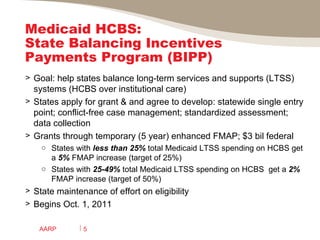
Medicaid HCBS:  State Balancing Incentives Payments Program (BIPP)  Goal: help states balance long-term services and supports (LTSS) systems (HCBS over institutional care) States apply for grant & and agree to develop: statewide single entry point; conflict-free case management; standardized assessment; data collection Grants through temporary (5 year) enhanced FMAP; $3 bil federal States with  less than 25%  total Medicaid LTSS spending on HCBS get a  5%  FMAP increase (target of 25%) States with  25-49%  total Medicaid LTSS spending on HCBS  get a  2%  FMAP increase (target of 50%) State maintenance of effort on eligibility  Begins Oct. 1, 2011 AARP
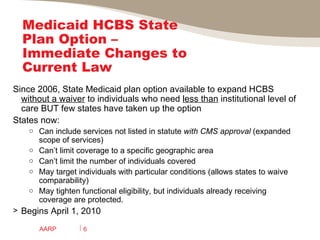
Medicaid HCBS State Plan Option – Immediate Changes to Current Law Since 2006, State Medicaid plan option available to expand HCBS  without a waiver  to individuals who need  less than  institutional level of care BUT few states have taken up the option  States now: Can include services not listed in statute  with CMS approval  (expanded scope of services)  Can’t limit coverage to a specific geographic area  Can’t limit the number of individuals covered May target individuals with particular conditions (allows states to waive comparability) May tighten functional eligibility, but individuals already receiving coverage are protected. Begins April 1, 2010 AARP
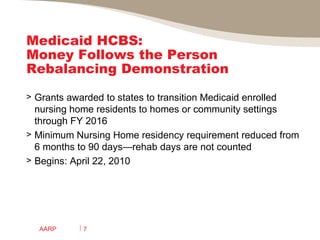
Medicaid HCBS:  Money Follows the Person Rebalancing Demonstration  Grants awarded to states to transition Medicaid enrolled nursing home residents to homes or community settings through FY 2016  Minimum Nursing Home residency requirement reduced from 6 months to 90 days—rehab days are not counted Begins: April 22, 2010 AARP
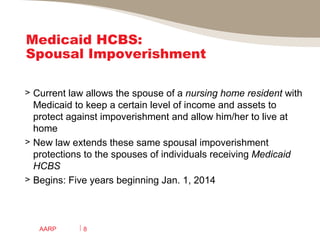
Medicaid HCBS: Spousal Impoverishment Current law allows the spouse of a  nursing home resident  with Medicaid to keep a certain level of income and assets to protect against impoverishment and allow him/her to live at home New law extends these same spousal impoverishment protections to the spouses of individuals receiving  Medicaid HCBS Begins: Five years beginning Jan. 1, 2014 AARP
Other HCBS Related Provisions $10 million per year for five years starting in 2010 for Aging and Disability Resource Centers – “one-stop shops” for information and other assistance regarding long-term services and supports  No Medicare Part D cost sharing for full dual eligibles (persons with Medicare and Medicaid) receiving home and community-based services (HCBS) who would otherwise receive institutional care AARP
Nursing Homes: Information and Disclosure  New law provides better and easier access to information on: Nursing Home Ownership/Organizational Structure Standardized Staffing Data based on Payroll Records Complaints and How to Make Complaints Crimes Expenditures  Survey Reports and Investigations States must have/maintain comprehensive nursing home websites  CMS   Nursing Home Compare  Website will be modified to include: Timely updates of inspection information Links to state government nursing home websites and inspection forms Consumer rights page with state specific information GAO to study Five Star Rating System and report to Congress AARP
Nursing Homes:  Oversight and Enforcement States must establish complaint resolution processes that meet specified criteria Some Medicare and Medicaid fines may be used to benefit residents or support consumer involvement New requirements (& penalties) in the event of facility closure Two new demonstration projects on culture change and information technology authorized AARP
Criminal Background Checks and Elder Justice National program for national and state criminal background checks on certain employees of long-term care providers – both home and community-based and institutional settings  Federal dollars to states to help fund the program Elder Justice – elder abuse prevention, detection,  response, and coordination of efforts Must be funded before programs can start AARP

Hcr e&o ltc training 410

  • 1.
    AARP Education &Outreach Regional Trainings for State Offices Spring 2010 Chronic & Long Term Care Improvements Under Health Reform AARP Government Relations and Advocacy Health & Long-term Care Teams
  • 2.
    Long Term Care(LTC) How the Law Changes LTC: New Options and Incentives for Medicaid Home and Community Based Services (HCBS) New Protections and Better Information for Consumers Benefits of the Law: Significant New Medicaid Incentives to Expand Services Helps People Live in the Setting of their Choice Improves Consumer Decision-making and Quality of LTC AARP’s Position Going Forward: New Law Builds on Important Federal and State Programs that AARP has Helped to Develop AARP Made LTC Improvements a Cornerstone of our Support for HCR and is Committed to Implementation & Education of Public AARP
  • 3.
    Overview of Improvements Provisions Affecting Home and Community-Based Services (HCBS) Community First Choice Option State Balancing Incentives Payments Program HCBS State Plan Option Changes Money Follows the Person Rebalancing Demonstration Spousal Impoverishment for HCBS Aging and Disability Resource Centers Co-Pays For Duals Provisions Affecting Nursing Home Residents and Consumers Information and Disclosure Oversight and Enforcement Provisions to Improve Quality across all Settings Criminal Background Checks Elder Justice AARP
  • 4.
    Medicaid Community FirstChoice Option New state plan option to provide HCBS attendant services & supports to individuals needing institutional level of care Offer statewide; no limits on ## of participants; assistance with ADLs, IADLs, health-related tasks, etc. Financial eligibility requirements for participation Incentive: 6% enhanced federal Medicaid matching rate (FMAP) Development and Implementation Council Data collection, quality / evaluation and reports to Congress Begins effective Oct. 1, 2011 AARP
  • 5.
    Medicaid HCBS: State Balancing Incentives Payments Program (BIPP) Goal: help states balance long-term services and supports (LTSS) systems (HCBS over institutional care) States apply for grant & and agree to develop: statewide single entry point; conflict-free case management; standardized assessment; data collection Grants through temporary (5 year) enhanced FMAP; $3 bil federal States with less than 25% total Medicaid LTSS spending on HCBS get a 5% FMAP increase (target of 25%) States with 25-49% total Medicaid LTSS spending on HCBS get a 2% FMAP increase (target of 50%) State maintenance of effort on eligibility Begins Oct. 1, 2011 AARP
  • 6.
    Medicaid HCBS StatePlan Option – Immediate Changes to Current Law Since 2006, State Medicaid plan option available to expand HCBS without a waiver to individuals who need less than institutional level of care BUT few states have taken up the option States now: Can include services not listed in statute with CMS approval (expanded scope of services) Can’t limit coverage to a specific geographic area Can’t limit the number of individuals covered May target individuals with particular conditions (allows states to waive comparability) May tighten functional eligibility, but individuals already receiving coverage are protected. Begins April 1, 2010 AARP
  • 7.
    Medicaid HCBS: Money Follows the Person Rebalancing Demonstration Grants awarded to states to transition Medicaid enrolled nursing home residents to homes or community settings through FY 2016 Minimum Nursing Home residency requirement reduced from 6 months to 90 days—rehab days are not counted Begins: April 22, 2010 AARP
  • 8.
    Medicaid HCBS: SpousalImpoverishment Current law allows the spouse of a nursing home resident with Medicaid to keep a certain level of income and assets to protect against impoverishment and allow him/her to live at home New law extends these same spousal impoverishment protections to the spouses of individuals receiving Medicaid HCBS Begins: Five years beginning Jan. 1, 2014 AARP
  • 9.
    Other HCBS RelatedProvisions $10 million per year for five years starting in 2010 for Aging and Disability Resource Centers – “one-stop shops” for information and other assistance regarding long-term services and supports No Medicare Part D cost sharing for full dual eligibles (persons with Medicare and Medicaid) receiving home and community-based services (HCBS) who would otherwise receive institutional care AARP
  • 10.
    Nursing Homes: Informationand Disclosure New law provides better and easier access to information on: Nursing Home Ownership/Organizational Structure Standardized Staffing Data based on Payroll Records Complaints and How to Make Complaints Crimes Expenditures Survey Reports and Investigations States must have/maintain comprehensive nursing home websites CMS Nursing Home Compare Website will be modified to include: Timely updates of inspection information Links to state government nursing home websites and inspection forms Consumer rights page with state specific information GAO to study Five Star Rating System and report to Congress AARP
  • 11.
    Nursing Homes: Oversight and Enforcement States must establish complaint resolution processes that meet specified criteria Some Medicare and Medicaid fines may be used to benefit residents or support consumer involvement New requirements (& penalties) in the event of facility closure Two new demonstration projects on culture change and information technology authorized AARP
  • 12.
    Criminal Background Checksand Elder Justice National program for national and state criminal background checks on certain employees of long-term care providers – both home and community-based and institutional settings Federal dollars to states to help fund the program Elder Justice – elder abuse prevention, detection, response, and coordination of efforts Must be funded before programs can start AARP