Memorial Hermann
1115 Waiver - Delivery System Reform Incentive Payment (DSRIP) Program
About the 1115 Waiver
The Medicaid 1115 Waiver is a Federal
Government program for health care facilities and
care providers that run programs supporting CMS’
Triple Aim goal.
In December 2011, the Texas Legislature approved
the Waiver based on a partnership between Texas
HHSC and CMS. Enactment of Section 1115 of the
Social Security Act allows Texas to expand existing
Medicaid managed care programs, reimburse
hospitals for certain uncompensated care, and
provides an avenue to test and receive federal
matching funds for experimental, pilot, or
demonstration projects typically not covered by
Medicaid. The Waiver also redirected the Upper
Payment Limit supplemental payments into the
Waiver’s two subpools– Uncompensated Care and
DSRIP – worth $29B in funding via local and
federal match monies.
The Waiver is a 5-year (demonstration year)
program from October 2011 through September
2016.
About the DSRIP Program
The Waiver divided the state into 20 Regional
Health Partnerships (RHPs) to more effectively and
efficiently deliver care for Medicaid and low
income uninsured Texans through DSRIP projects.
Each RHP was charged with creating a regional
plan identifying partners, community needs, their
proposed projects and funding distribution. The
RHP Anchor acts as a primary point of contact for
Texas HHSC in the region and is responsible for
seeking regional stakeholder engagement and
coordinating development of the regional plan.
Harris Health System serves as the RHP3 Anchor.
The DSRIP Program provides an unprecedented
opportunity to improve patient care for
low‐income populations by incentivizing delivery
system reforms that increase access to health
care, improve the quality of care, and enhance the
health of patients and families they serve.
DSRIP projects receive incentive payments for
meeting annual performance metrics related to
improvement or process milestones and quality-
driven outcome measures. This allows for the
creation of more impactful and transformative
programs that serve and keep our community
healthy.
The DSRIP Program also creates opportunities for
synergistic collaborations between Providers,
public and private agencies, and community
stakeholders.
There are over 1,400 DSRIP projects across Texas
tailored to 20 RHPs that are charged with
transforming the delivery of health care.
Memorial Hermann’s
DSRIP Footprint
Memorial Hermann is the fourth-largest DSRIP
Provider in RHP3 (by total incentive payments)
with nine Category 1-2 transformational DSRIP
projects. These projects are integrated and
aligned within our umbrella organizations.
Community Benefits Corporation
 Health Centers for Schools
 Nurse Triage Line
 ER Navigation/COPE
Behavioral Health Services
 Psych Response Team-Case Management
 Mental Health Crisis Clinics
MHMG
 Convenient Care Centers
 Physician Network Development
MHMD
 Supportive Medicine
Home Care
 Home Care Behavioral Health
DSRIP Project Categories
Cat 1 – Projects focused on infrastructure
developments by investments in technology,
tools, and human resources to strengthen the
ability of providers to serve populations and
continuously improve services (P4P).
Cat 2 – Projects focused on program innovation
and redesign by piloting, testing, and
replicating innovative care models (P4P).
Cat 3 – Outcome measures related to Cat 1 and
2 projects that must demonstrate annual
quality improvements on a population larger
than the Cat 1 and 2 project populations (P4P).
Cat 4 - Reporting focused on population-based
improvements related to potentially
preventable events, patient satisfaction,
medication mngt., and ED throughput (P4R).
P4P: contains pay-for-performance metrics
P4R: contains pay-for-reporting metrics
Looking Forward
The 84th Texas Legislative Session convened on
January 13, 2015, and will assess a potential
Waiver renewal/extension.
Texas HHSC must submit a transition plan to
CMS by March 31, 2015.
Texas HHSC must submit a request to CMS no
later than September 30, 2015, for Waiver
renewal/extension.
CMS to approve or deny Texas HHSC’s Waiver
renewal/extension request by March 30, 2016.
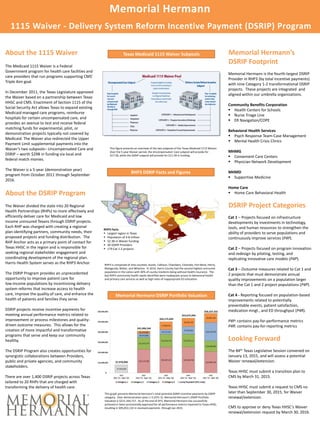
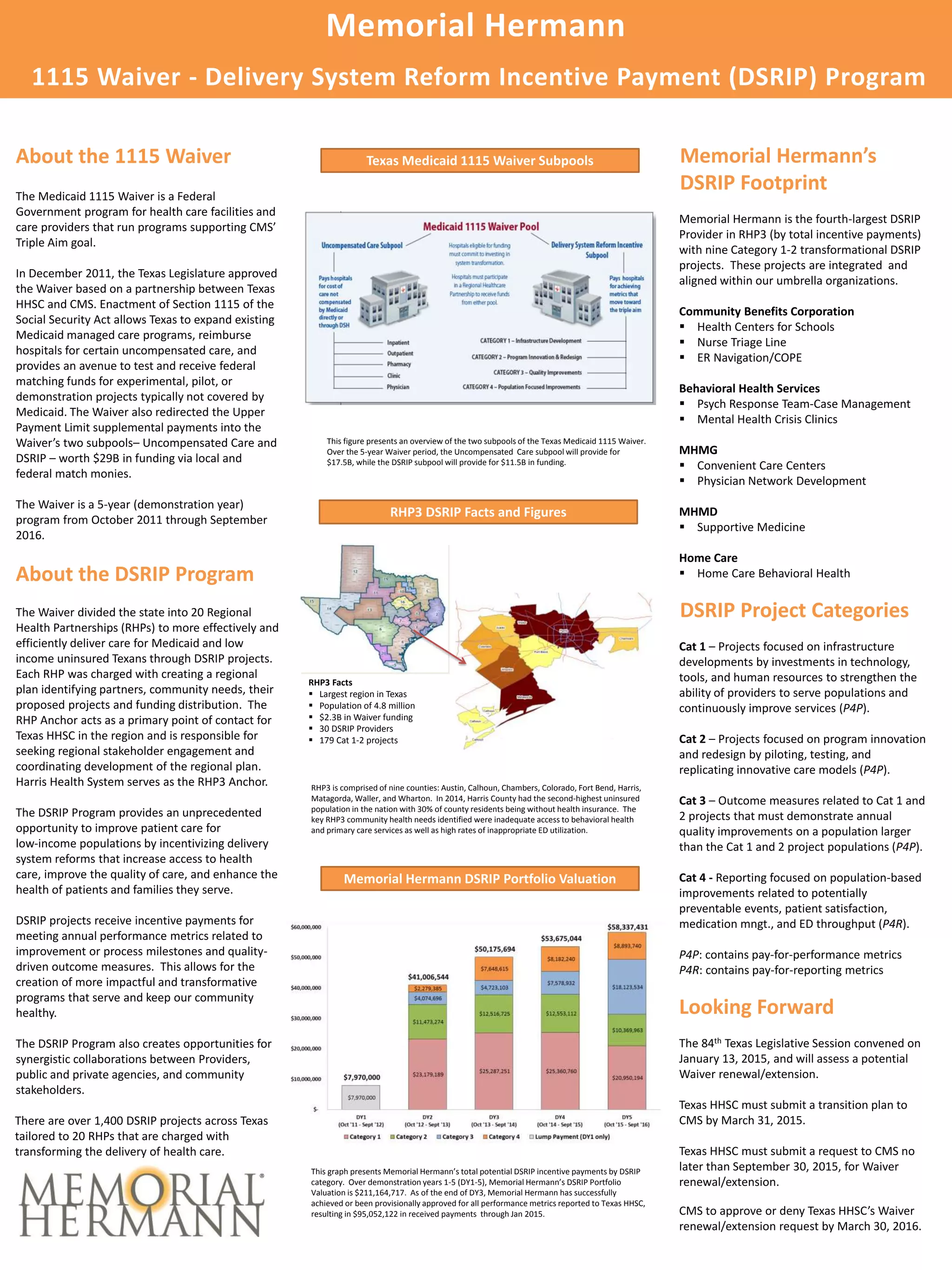
RHP3 is comprised of nine counties: Austin, Calhoun, Chambers, Colorado, Fort Bend, Harris,
Matagorda, Waller, and Wharton. In 2014, Harris County had the second-highest uninsured
population in the nation with 30% of county residents being without health insurance. The
key RHP3 community health needs identified were inadequate access to behavioral health
and primary care services as well as high rates of inappropriate ED utilization.
This graph presents Memorial Hermann’s total potential DSRIP incentive payments by DSRIP
category. Over demonstration years 1-5 (DY1-5), Memorial Hermann’s DSRIP Portfolio
Valuation is $211,164,717. As of the end of DY3, Memorial Hermann has successfully
achieved or been provisionally approved for all performance metrics reported to Texas HHSC,
resulting in $95,052,122 in received payments through Jan 2015.
Texas Medicaid 1115 Waiver Subpools
RHP3 DSRIP Facts and Figures
Memorial Hermann DSRIP Portfolio Valuation
This figure presents an overview of the two subpools of the Texas Medicaid 1115 Waiver.
Over the 5-year Waiver period, the Uncompensated Care subpool will provide for
$17.5B, while the DSRIP subpool will provide for $11.5B in funding.
RHP3 Facts
 Largest region in Texas
 Population of 4.8 million
 $2.3B in Waiver funding
 30 DSRIP Providers
 179 Cat 1-2 projects

DSRIP Program Overview

  • 1.
    Memorial Hermann 1115 Waiver- Delivery System Reform Incentive Payment (DSRIP) Program About the 1115 Waiver The Medicaid 1115 Waiver is a Federal Government program for health care facilities and care providers that run programs supporting CMS’ Triple Aim goal. In December 2011, the Texas Legislature approved the Waiver based on a partnership between Texas HHSC and CMS. Enactment of Section 1115 of the Social Security Act allows Texas to expand existing Medicaid managed care programs, reimburse hospitals for certain uncompensated care, and provides an avenue to test and receive federal matching funds for experimental, pilot, or demonstration projects typically not covered by Medicaid. The Waiver also redirected the Upper Payment Limit supplemental payments into the Waiver’s two subpools– Uncompensated Care and DSRIP – worth $29B in funding via local and federal match monies. The Waiver is a 5-year (demonstration year) program from October 2011 through September 2016. About the DSRIP Program The Waiver divided the state into 20 Regional Health Partnerships (RHPs) to more effectively and efficiently deliver care for Medicaid and low income uninsured Texans through DSRIP projects. Each RHP was charged with creating a regional plan identifying partners, community needs, their proposed projects and funding distribution. The RHP Anchor acts as a primary point of contact for Texas HHSC in the region and is responsible for seeking regional stakeholder engagement and coordinating development of the regional plan. Harris Health System serves as the RHP3 Anchor. The DSRIP Program provides an unprecedented opportunity to improve patient care for low‐income populations by incentivizing delivery system reforms that increase access to health care, improve the quality of care, and enhance the health of patients and families they serve. DSRIP projects receive incentive payments for meeting annual performance metrics related to improvement or process milestones and quality- driven outcome measures. This allows for the creation of more impactful and transformative programs that serve and keep our community healthy. The DSRIP Program also creates opportunities for synergistic collaborations between Providers, public and private agencies, and community stakeholders. There are over 1,400 DSRIP projects across Texas tailored to 20 RHPs that are charged with transforming the delivery of health care. Memorial Hermann’s DSRIP Footprint Memorial Hermann is the fourth-largest DSRIP Provider in RHP3 (by total incentive payments) with nine Category 1-2 transformational DSRIP projects. These projects are integrated and aligned within our umbrella organizations. Community Benefits Corporation  Health Centers for Schools  Nurse Triage Line  ER Navigation/COPE Behavioral Health Services  Psych Response Team-Case Management  Mental Health Crisis Clinics MHMG  Convenient Care Centers  Physician Network Development MHMD  Supportive Medicine Home Care  Home Care Behavioral Health DSRIP Project Categories Cat 1 – Projects focused on infrastructure developments by investments in technology, tools, and human resources to strengthen the ability of providers to serve populations and continuously improve services (P4P). Cat 2 – Projects focused on program innovation and redesign by piloting, testing, and replicating innovative care models (P4P). Cat 3 – Outcome measures related to Cat 1 and 2 projects that must demonstrate annual quality improvements on a population larger than the Cat 1 and 2 project populations (P4P). Cat 4 - Reporting focused on population-based improvements related to potentially preventable events, patient satisfaction, medication mngt., and ED throughput (P4R). P4P: contains pay-for-performance metrics P4R: contains pay-for-reporting metrics Looking Forward The 84th Texas Legislative Session convened on January 13, 2015, and will assess a potential Waiver renewal/extension. Texas HHSC must submit a transition plan to CMS by March 31, 2015. Texas HHSC must submit a request to CMS no later than September 30, 2015, for Waiver renewal/extension. CMS to approve or deny Texas HHSC’s Waiver renewal/extension request by March 30, 2016. RHP3 is comprised of nine counties: Austin, Calhoun, Chambers, Colorado, Fort Bend, Harris, Matagorda, Waller, and Wharton. In 2014, Harris County had the second-highest uninsured population in the nation with 30% of county residents being without health insurance. The key RHP3 community health needs identified were inadequate access to behavioral health and primary care services as well as high rates of inappropriate ED utilization. This graph presents Memorial Hermann’s total potential DSRIP incentive payments by DSRIP category. Over demonstration years 1-5 (DY1-5), Memorial Hermann’s DSRIP Portfolio Valuation is $211,164,717. As of the end of DY3, Memorial Hermann has successfully achieved or been provisionally approved for all performance metrics reported to Texas HHSC, resulting in $95,052,122 in received payments through Jan 2015. Texas Medicaid 1115 Waiver Subpools RHP3 DSRIP Facts and Figures Memorial Hermann DSRIP Portfolio Valuation This figure presents an overview of the two subpools of the Texas Medicaid 1115 Waiver. Over the 5-year Waiver period, the Uncompensated Care subpool will provide for $17.5B, while the DSRIP subpool will provide for $11.5B in funding. RHP3 Facts  Largest region in Texas  Population of 4.8 million  $2.3B in Waiver funding  30 DSRIP Providers  179 Cat 1-2 projects