The European Commission support for the production of this publication does not constitute an endorsement of the contents, which solely reflect the views of the
authors. The Commission cannot be held responsible for any use which may be made of the information contained herein
Module 4. BUILDING NETWORKS
4.1. Usage of Social Networks and Drivers
for Creating Eco-Innovative Networks in
Hospitality Industry
Learning Outcomes
The learner will be able to implement the necessary drives for the
creation of social networks and to use different tools to understand
networks’ effectiveness for eco-innovation in the hospitality industry.
Network Concept
The network is basically established in order to provide benefit for
each member of the network group. Networks are essential drivers to
form a social power on creating a synergy. Also they are beneficial to
encourage people to defend any idea for maximizing the quality of
their lives.
Networks
Networks are sources to gain social capital especially for organizations
as well as individuals. Reaching special business lines to create a win-
win position or persuading someone or some group for the aimed
issue can be actualized easily by networks. In current age, social
networks can be the best example on that; just think on it! Having
some idea, info or vision becomes so fast and easy if you have a
Twitter, Facebook or Instagram account.
The Most Popular Social Networks
• LinkedIn
• Facebook
• Twitter
• Instagram
• Socialcast
• Yammer
Eco-Innovation Drivers for Creating Networks
Eco-innovation is a tool that speed up sustainable development by cutting
down the environmental costs and effects specifically within the hospitality
industry.
Firms’ decision to apply eco-innovation is affected by both internal and
external factors. These are as follows;
•Technology push
•Market and demand pull
•Regulations
•Corporate social responsibility (CSR)
•Firm-specific aspects.
Internal Drivers
Internal features of the firms are significant factors for innovation
(Fagerberg et al., 2005) and lead to their competitive advantage (Bernauer
et al., 2006).
• Technological Capabilities; hugely take parts in achieving innovation
(Baumol, 2002; Pavitt, 1984). These capabilities, including knowledge
capital stock and physical abilities, are important for companies in order
to enhance new processes and products.
• Environmental Management System (EMS) Implementation; support
companies by establishing organizational abilities and implementation
for example recycling, resource reduction, prevention of pollution and
green product design.
• Corporate Social Responsibility; establishes motivation for companies to
execute eco-innovation.
External Drivers
Eco-innovation is also dependent on external drivers including;
• Regulation pressures,
• Green demands of customers,
• Competitiveness.
Usage of Social Network
• Literally, innovation is generated through the interaction of relevant actors and
the existence of the social connections.
• Social networks are necessities to access and use of the local sources, without
them there would be no possibility to act such kind of behavior (Lin, 2006).
• The collaboration with external actors like universities, suppliers, NGO’s and
even competitors are likely to result in overcoming some challenges such as
lack of know-how, technology or resources.
• To collaborate with the convenient innovation networks will assist the
companies in reaching out the technology and the market itself.
Building Eco-Innovation Network
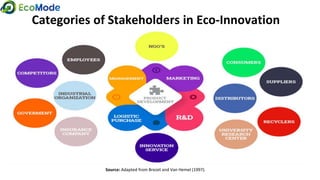
• Application of eco-innovation needs a broad range of social actors,
while coordinating and assembling their expectations (Ceschin,
2013).
• Driving interest in active involvement and empowering all related
stakeholders for a more sustainable society are necessities in
building eco-innovation network. This results in a better eco-
innovation’s alignment with the other actors, stakeholders and
customers’ requirements (Polonsky and Ottman, 1998).
Categories of Stakeholders in Eco-Innovation
Source: Adapted from Brezet and Van Hemel (1997).
Engagement of Stakeholders in Eco-Innovation
Process
• Networks of actors to introduce new ideas consistent with a
common vision should correctly be developed in the beginning
parts of activities of eco-innovation. This is termed the Front End of
Eco-Innovation (FEEI) (Bocken et al., 2014).
• The Front End of Innovation consists of five non-sequential
components:
• Analysis of opportunity,
• Identification of opportunity,
• Generation and selection of idea,
• Development of technology and concept.
How Stakeholders Ought to be Engaged in Eco-
Innovation Practices?
• A direct way of engagement of stakeholders may be imagined in
eco-innovation, with the aid of surveys, interviews, customer
meetings, focus groups, open innovation or co-creation.
• Stakeholders ought to enable some real contribution to the eco-
innovation exercises as they actively participate in all this crucial
stage (Agogué et al., 2017).
References
• Agogué, M., Berthet, E., Fredberg, T., LeMasson, P., Segrestin, B, Stoezel, M., Wiener, M. & Yström, A.
(2017). Explicating the role of innovation intermediaries in the “unknown”: A contingency approach.
Journal of Strategy and Management, 10(1), 19‒ 39.
• Baumol, J.W. (2002). The free-market innovation machine: Analyzing the growth miracle of capitalism.
Princeton University Press, Princeton, New Jersey.
• Bernauer, T., Engels, S., Kammerer, D., & Seijas, J. (2006). Explaining green innovation. Center for
Comparative and International Studies (CIS), ETH Zurich, University of Zurich, Working Paper, (17), 105-19.
• Bocken, N. M. P., Farracho, M., Bosworth, R., & Kemp, R. (2014). The front-end of eco-innovation for eco-
innovative small and medium sized companies. Journal of Engineering and Technology Management, 31,
43-57.
• Brezet, H., Van Hemel, C. (1997). Ecodesign: a promising approach to sustainable production and
consumption. UNEP United Nations Publications, Paris.
• Briggs, R. & Reinig, B. (2007). Bounded ideation theory: a new model of the relationship between idea-
quantity and idea-quality during ideation. In: Proceedings of the 40th Hawaii International Conference on
System Sciences, USA.
• Ceschin, F. (2013). Critical factors for implementing and diffusing sustainable product-Service systems:
insights from innovation studies and companies' experiences. Journal of Cleaner Production, 45, 74-88.
• Fagerberg, J., Mowery, D.C. & Nelson, R.R. (2005). The Oxford Handbook of Innovation. Oxford University
Press, Oxford.
• Jones, E. (2003). Eco-innovation: Tools to Facilitate Early-stage Workshop (PhD thesis). Brunel University,
UK.
References
• Lin, N. (2006). Social Capital, in: J. Beckert & M. Zagiroski (Eds) Encyclopedia of
Economic Sociology. Routledge, New York, NY.
• Maletic, M., Maletic, D., Dahlgaard, J. J., Dahlgaard-Park, S. M., & Gomišček, B. (2014).
Sustainability exploration and sustainability exploitation: From a literature review
towards a conceptual framework. Journal of Cleaner Production, 79, 182-194.
• Mont, O., Neuvonen, A., & Lähteenoja, S. (2014). Sustainable lifestyles 2050:
stakeholder visions, emerging practices and future research. Journal of Cleaner
Production, 63, 24-32.
• Pavitt, K. (1984). Sectoral patterns of technical change: Towards a tax onomy and a
theory. Research Policy, 13(6), 343-373.
• Polonsky, M.J. & Ottman, J. (1998). Stakeholders' contribution to the green new
product development process. Journal of Marketing Management, 14(6), 533-557.
• Thompson, A. W., Hallstedt, S., & Isaksson, O. (2012). Introductory approach for
sustainability integration in conceptual design. In DS 70: Proceedings of DESIGN 2012,
the 12th International Design Conference, Dubrovnik, Croatia.
• Vidal, R. V. V. (2009). Creativity for problem solvers. Ai & Society, 23(3), 409-432.
Project web-page: http://eco-mode-project.eu/
This work is licensed under a

Module4 4.1 presentation_version1

  • 1.
    The European Commissionsupport for the production of this publication does not constitute an endorsement of the contents, which solely reflect the views of the authors. The Commission cannot be held responsible for any use which may be made of the information contained herein Module 4. BUILDING NETWORKS 4.1. Usage of Social Networks and Drivers for Creating Eco-Innovative Networks in Hospitality Industry
  • 2.
    Learning Outcomes The learnerwill be able to implement the necessary drives for the creation of social networks and to use different tools to understand networks’ effectiveness for eco-innovation in the hospitality industry.
  • 3.
    Network Concept The networkis basically established in order to provide benefit for each member of the network group. Networks are essential drivers to form a social power on creating a synergy. Also they are beneficial to encourage people to defend any idea for maximizing the quality of their lives.
  • 4.
    Networks Networks are sourcesto gain social capital especially for organizations as well as individuals. Reaching special business lines to create a win- win position or persuading someone or some group for the aimed issue can be actualized easily by networks. In current age, social networks can be the best example on that; just think on it! Having some idea, info or vision becomes so fast and easy if you have a Twitter, Facebook or Instagram account.
  • 5.
    The Most PopularSocial Networks • LinkedIn • Facebook • Twitter • Instagram • Socialcast • Yammer
  • 6.
    Eco-Innovation Drivers forCreating Networks Eco-innovation is a tool that speed up sustainable development by cutting down the environmental costs and effects specifically within the hospitality industry. Firms’ decision to apply eco-innovation is affected by both internal and external factors. These are as follows; •Technology push •Market and demand pull •Regulations •Corporate social responsibility (CSR) •Firm-specific aspects.
  • 7.
    Internal Drivers Internal featuresof the firms are significant factors for innovation (Fagerberg et al., 2005) and lead to their competitive advantage (Bernauer et al., 2006). • Technological Capabilities; hugely take parts in achieving innovation (Baumol, 2002; Pavitt, 1984). These capabilities, including knowledge capital stock and physical abilities, are important for companies in order to enhance new processes and products. • Environmental Management System (EMS) Implementation; support companies by establishing organizational abilities and implementation for example recycling, resource reduction, prevention of pollution and green product design. • Corporate Social Responsibility; establishes motivation for companies to execute eco-innovation.
  • 8.
    External Drivers Eco-innovation isalso dependent on external drivers including; • Regulation pressures, • Green demands of customers, • Competitiveness.
  • 9.
    Usage of SocialNetwork • Literally, innovation is generated through the interaction of relevant actors and the existence of the social connections. • Social networks are necessities to access and use of the local sources, without them there would be no possibility to act such kind of behavior (Lin, 2006). • The collaboration with external actors like universities, suppliers, NGO’s and even competitors are likely to result in overcoming some challenges such as lack of know-how, technology or resources. • To collaborate with the convenient innovation networks will assist the companies in reaching out the technology and the market itself.
  • 10.
    Building Eco-Innovation Network •Application of eco-innovation needs a broad range of social actors, while coordinating and assembling their expectations (Ceschin, 2013). • Driving interest in active involvement and empowering all related stakeholders for a more sustainable society are necessities in building eco-innovation network. This results in a better eco- innovation’s alignment with the other actors, stakeholders and customers’ requirements (Polonsky and Ottman, 1998).
  • 11.
    Categories of Stakeholdersin Eco-Innovation Source: Adapted from Brezet and Van Hemel (1997).
  • 12.
    Engagement of Stakeholdersin Eco-Innovation Process • Networks of actors to introduce new ideas consistent with a common vision should correctly be developed in the beginning parts of activities of eco-innovation. This is termed the Front End of Eco-Innovation (FEEI) (Bocken et al., 2014). • The Front End of Innovation consists of five non-sequential components: • Analysis of opportunity, • Identification of opportunity, • Generation and selection of idea, • Development of technology and concept.
  • 13.
    How Stakeholders Oughtto be Engaged in Eco- Innovation Practices? • A direct way of engagement of stakeholders may be imagined in eco-innovation, with the aid of surveys, interviews, customer meetings, focus groups, open innovation or co-creation. • Stakeholders ought to enable some real contribution to the eco- innovation exercises as they actively participate in all this crucial stage (Agogué et al., 2017).
  • 14.
    References • Agogué, M.,Berthet, E., Fredberg, T., LeMasson, P., Segrestin, B, Stoezel, M., Wiener, M. & Yström, A. (2017). Explicating the role of innovation intermediaries in the “unknown”: A contingency approach. Journal of Strategy and Management, 10(1), 19‒ 39. • Baumol, J.W. (2002). The free-market innovation machine: Analyzing the growth miracle of capitalism. Princeton University Press, Princeton, New Jersey. • Bernauer, T., Engels, S., Kammerer, D., & Seijas, J. (2006). Explaining green innovation. Center for Comparative and International Studies (CIS), ETH Zurich, University of Zurich, Working Paper, (17), 105-19. • Bocken, N. M. P., Farracho, M., Bosworth, R., & Kemp, R. (2014). The front-end of eco-innovation for eco- innovative small and medium sized companies. Journal of Engineering and Technology Management, 31, 43-57. • Brezet, H., Van Hemel, C. (1997). Ecodesign: a promising approach to sustainable production and consumption. UNEP United Nations Publications, Paris. • Briggs, R. & Reinig, B. (2007). Bounded ideation theory: a new model of the relationship between idea- quantity and idea-quality during ideation. In: Proceedings of the 40th Hawaii International Conference on System Sciences, USA. • Ceschin, F. (2013). Critical factors for implementing and diffusing sustainable product-Service systems: insights from innovation studies and companies' experiences. Journal of Cleaner Production, 45, 74-88. • Fagerberg, J., Mowery, D.C. & Nelson, R.R. (2005). The Oxford Handbook of Innovation. Oxford University Press, Oxford. • Jones, E. (2003). Eco-innovation: Tools to Facilitate Early-stage Workshop (PhD thesis). Brunel University, UK.
  • 15.
    References • Lin, N.(2006). Social Capital, in: J. Beckert & M. Zagiroski (Eds) Encyclopedia of Economic Sociology. Routledge, New York, NY. • Maletic, M., Maletic, D., Dahlgaard, J. J., Dahlgaard-Park, S. M., & Gomišček, B. (2014). Sustainability exploration and sustainability exploitation: From a literature review towards a conceptual framework. Journal of Cleaner Production, 79, 182-194. • Mont, O., Neuvonen, A., & Lähteenoja, S. (2014). Sustainable lifestyles 2050: stakeholder visions, emerging practices and future research. Journal of Cleaner Production, 63, 24-32. • Pavitt, K. (1984). Sectoral patterns of technical change: Towards a tax onomy and a theory. Research Policy, 13(6), 343-373. • Polonsky, M.J. & Ottman, J. (1998). Stakeholders' contribution to the green new product development process. Journal of Marketing Management, 14(6), 533-557. • Thompson, A. W., Hallstedt, S., & Isaksson, O. (2012). Introductory approach for sustainability integration in conceptual design. In DS 70: Proceedings of DESIGN 2012, the 12th International Design Conference, Dubrovnik, Croatia. • Vidal, R. V. V. (2009). Creativity for problem solvers. Ai & Society, 23(3), 409-432.
  • 16.