TCP/IP Protocol Suite 1
Chapter 7
Chapter 7
Upon completion you will be able to:
ARP and RARP
ARP and RARP
• Understand the need for ARP
• Understand the cases in which ARP is used
• Understand the components and interactions in an ARP package
• Understand the need for RARP
Objectives
TCP/IP Protocol Suite 2
ARP and RARP
Hosts and Routers are recognized by Logical Addresses.
Logical addresses are universal.
At physical level hosts and routers recognized by Physical Address.
Physical address are local addresses. Ex. MAC Addresses.
Delivery requires two levels of addressing. Mapping is required.
Static Mapping: Storing mapping information in a table.
Physical addresses may change because of change in NIC card or
mobile host move from one network to another.
Dynamic Mapping: Machine knows one of the two addresses, it can
use protocol to find the other one.
TCP/IP Protocol Suite 3
ARP and RARP
Dynamic Mapping: Machine knows one of the two addresses, it can
use protocol to find the other one.
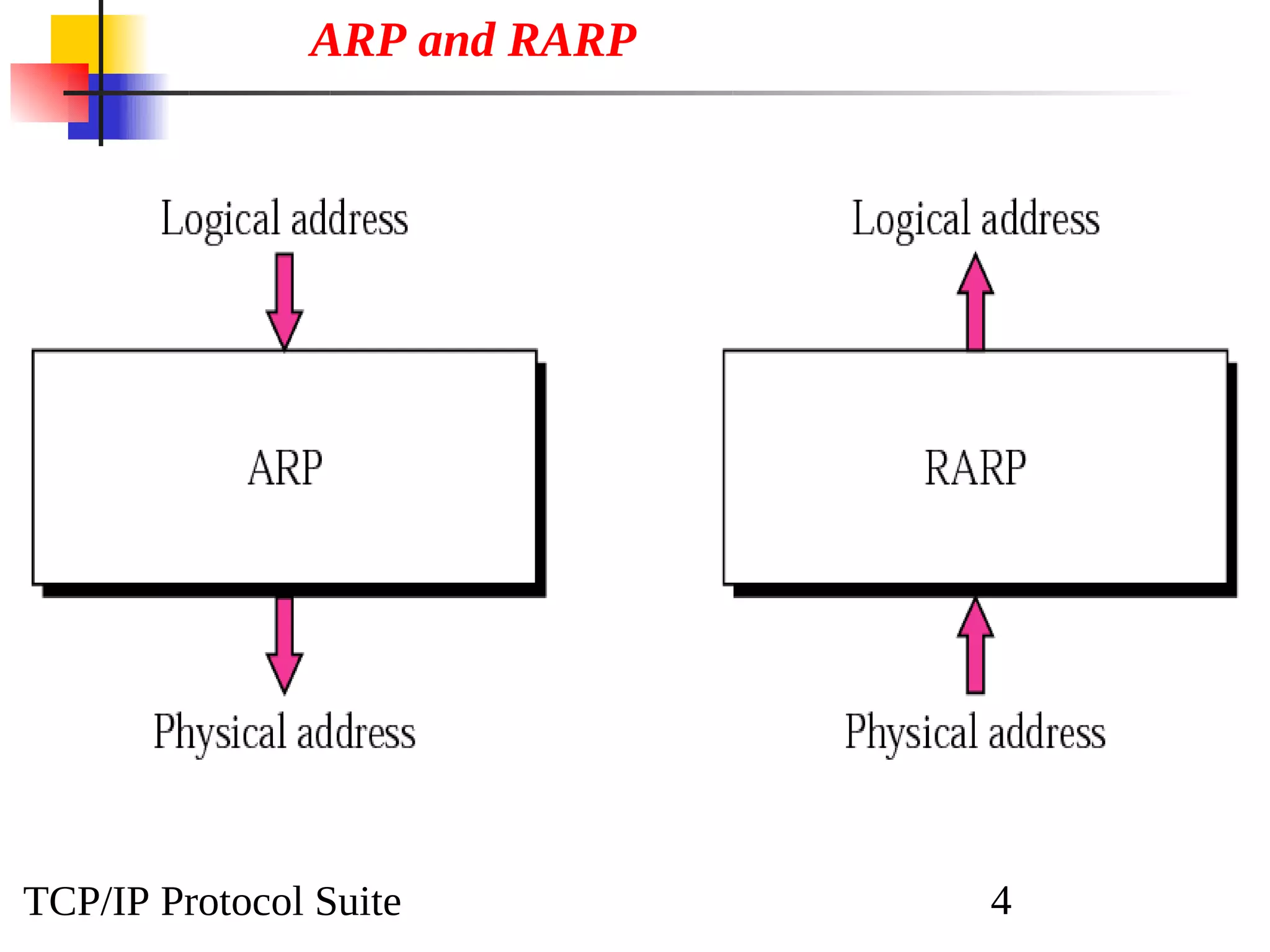
ARP: Maps Logical address to physical address
RARP: Maps Physical address to Logical Address.
TCP/IP Protocol Suite 4
ARP and RARP
TCP/IP Protocol Suite 5
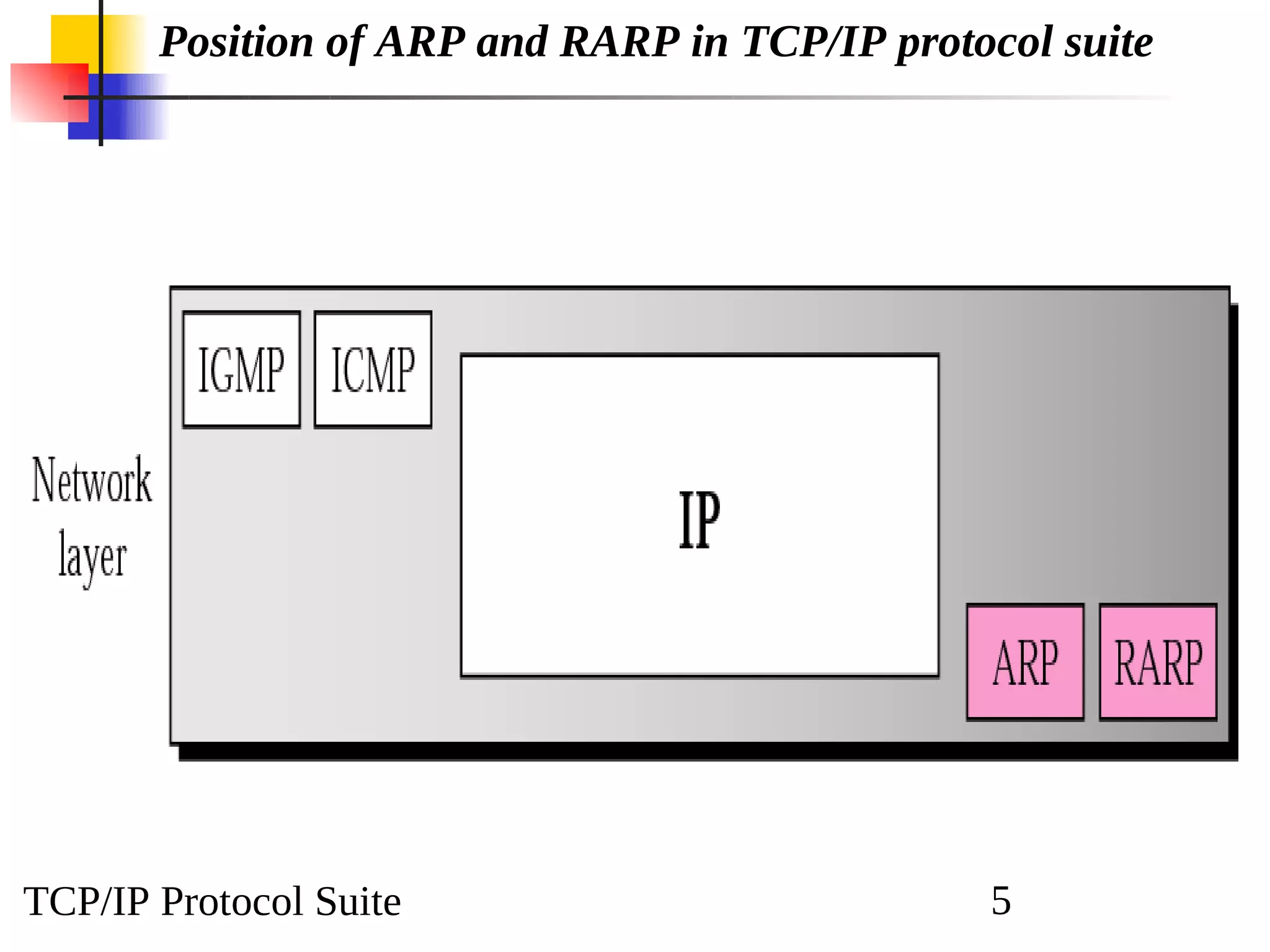
Position of ARP and RARP in TCP/IP protocol suite
TCP/IP Protocol Suite 6
7.1 ARP
ARP associates an IP address with its physical address. On a typical
physical network, such as a LAN, each device on a link is identified by a
physical or station address that is usually imprinted on the NIC.
The topics discussed in this section include:
Packet Format
Packet Format
Encapsulation
Encapsulation
Operation
Operation
ARP over ATM
ARP over ATM
Proxy ARP
Proxy ARP
TCP/IP Protocol Suite 7
ARP
Sender has logical address of receiver.
Sender asks receiver to announce its physical address.
When any host needs to know Physical address of another machine
host it sends a ARP query Packet.
Query includes Sender's physical and IP address and receivers
only IP address.
Query packet is broadcast over the network.
TCP/IP Protocol Suite 8
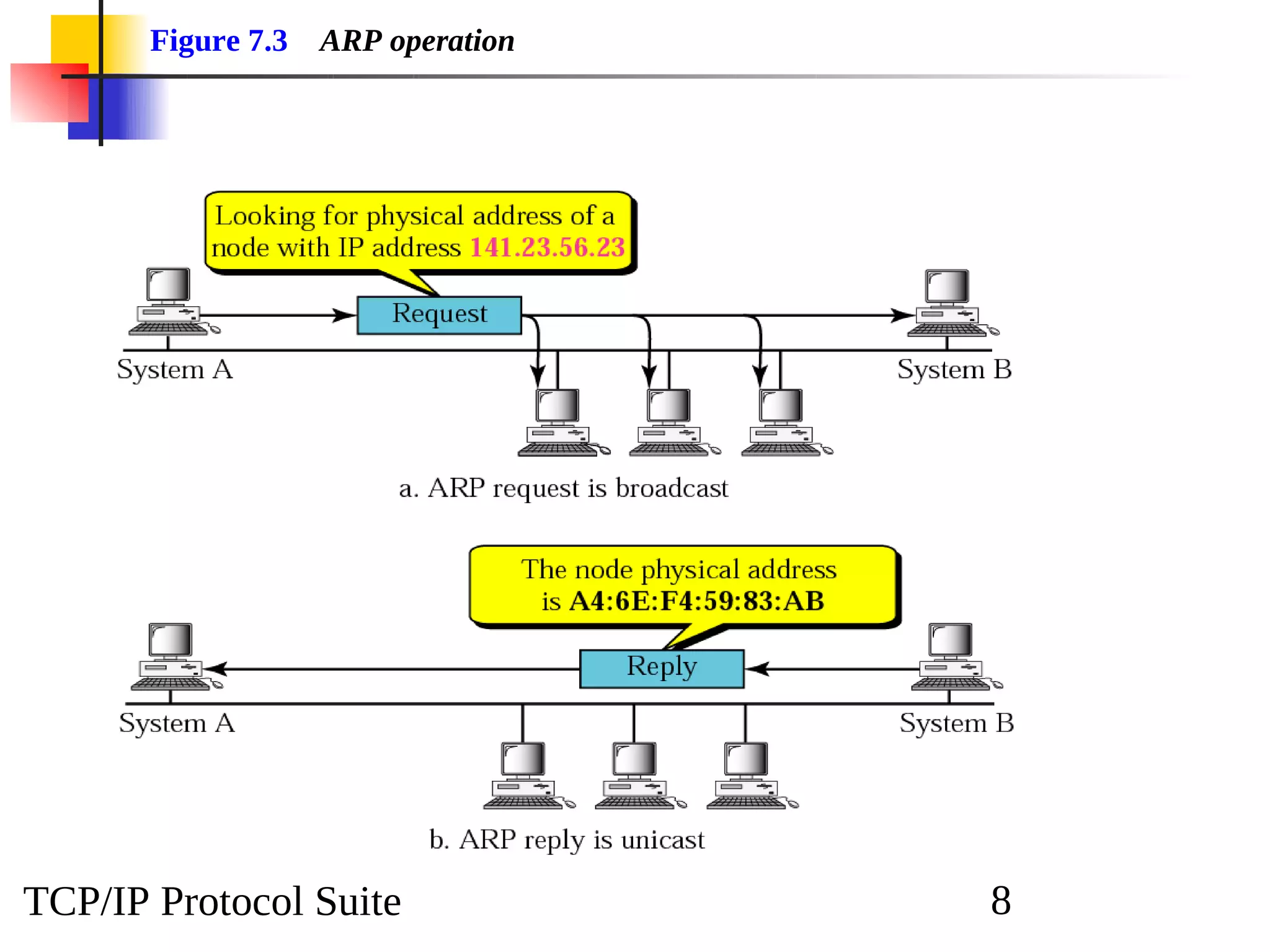
Figure 7.3 ARP operation
TCP/IP Protocol Suite 9
ARP
Every host receives and processes ARP query packet.
Only receiver sends back ARP response packet containing receivers
IP address and Physical address.
Response packet is unicast.
TCP/IP Protocol Suite 10
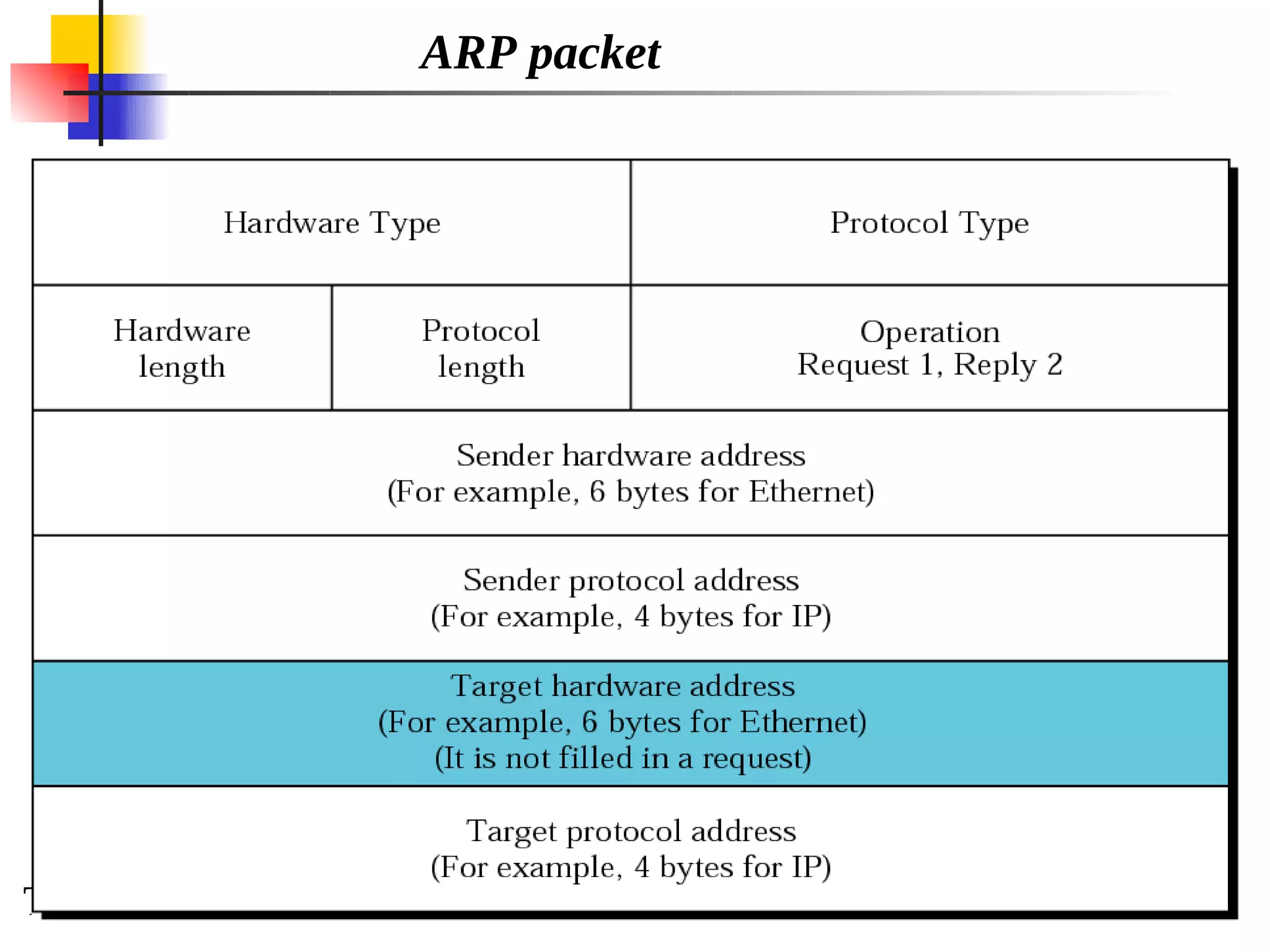
ARP packet
TCP/IP Protocol Suite 11
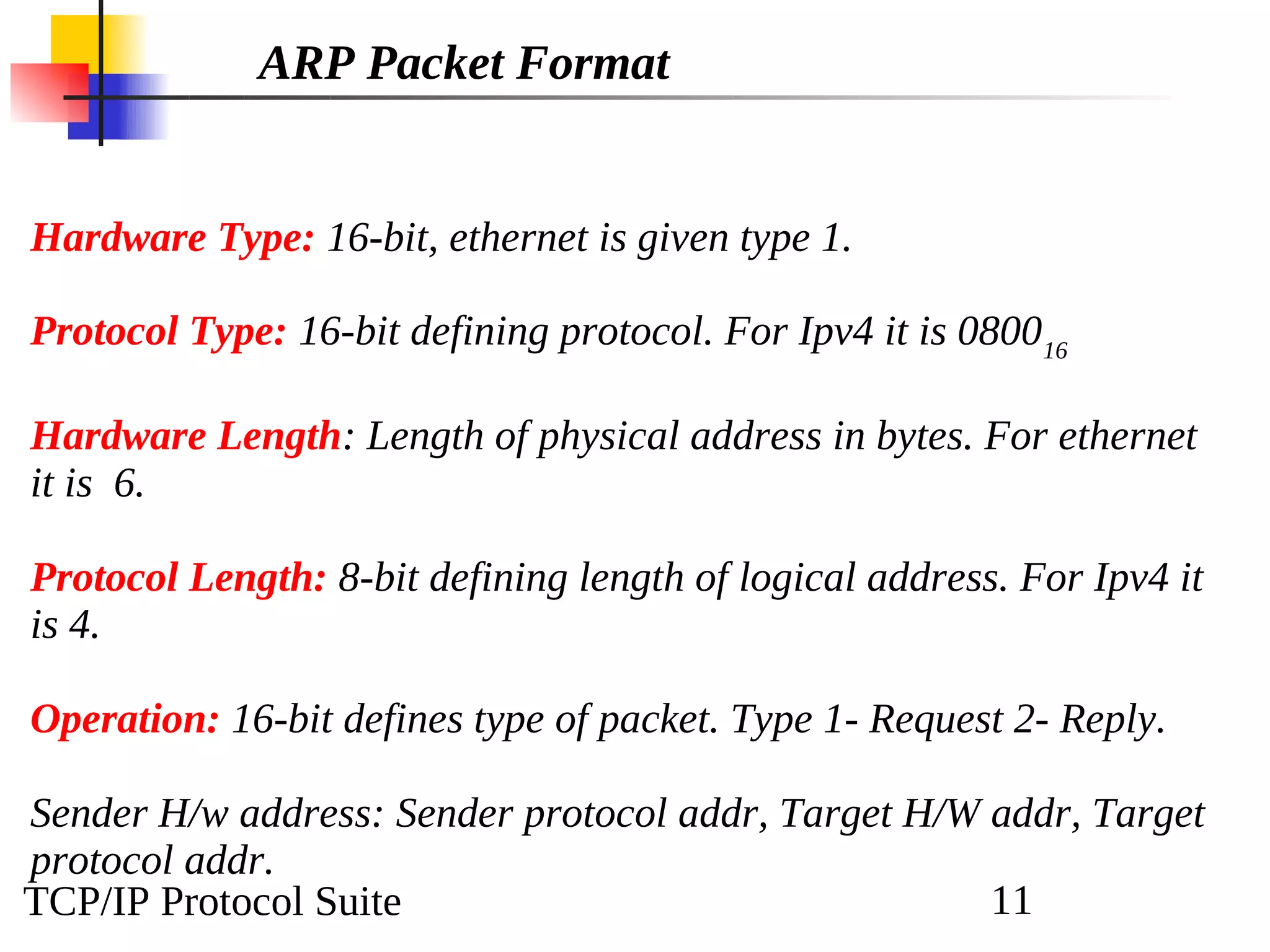
ARP Packet Format
Hardware Type: 16-bit, ethernet is given type 1.
Protocol Type: 16-bit defining protocol. For Ipv4 it is 080016
Hardware Length: Length of physical address in bytes. For ethernet
it is 6.
Protocol Length: 8-bit defining length of logical address. For Ipv4 it
is 4.
Operation: 16-bit defines type of packet. Type 1- Request 2- Reply.
Sender H/w address: Sender protocol addr, Target H/W addr, Target
protocol addr.
TCP/IP Protocol Suite 12
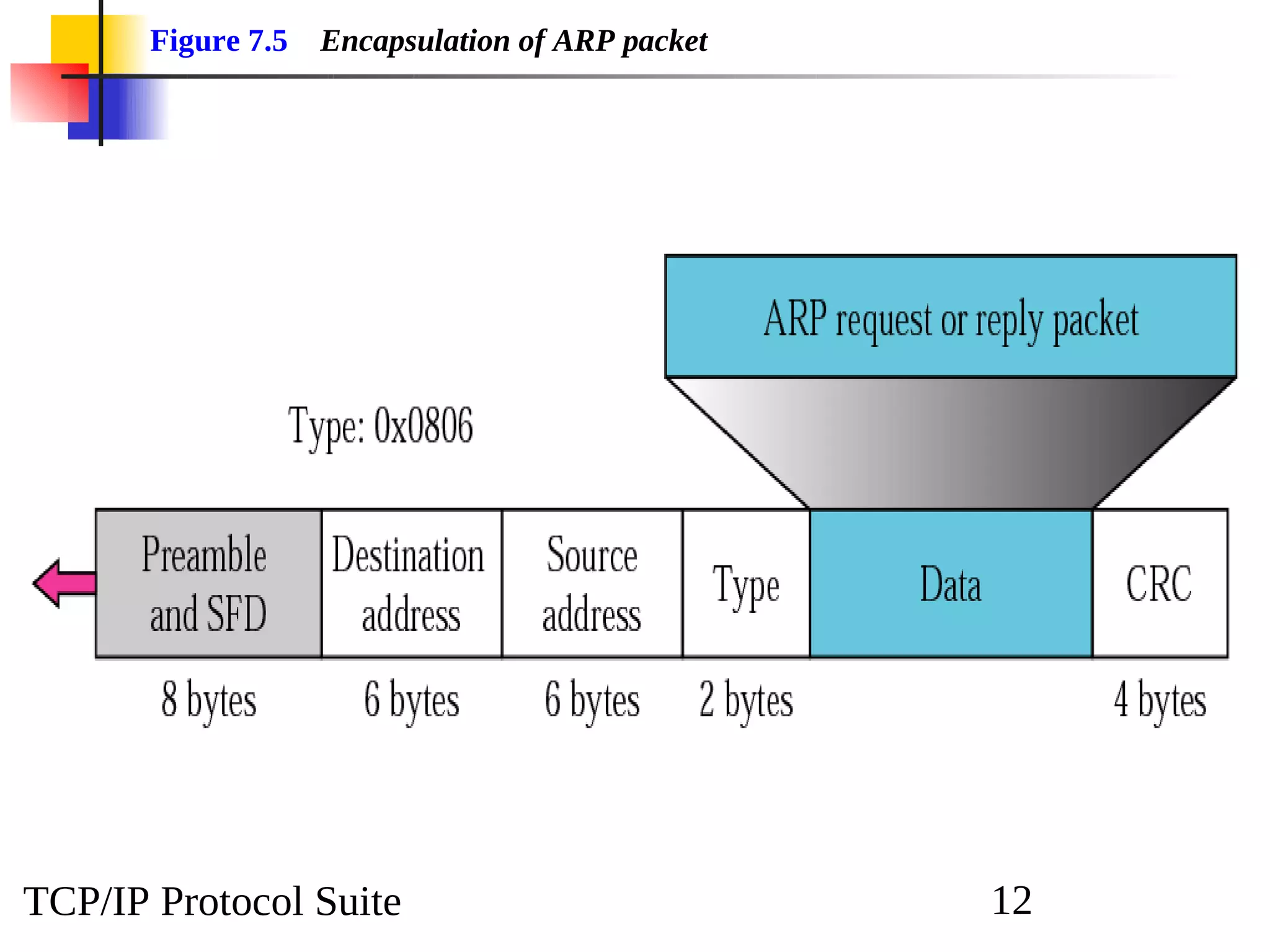
Figure 7.5 Encapsulation of ARP packet
TCP/IP Protocol Suite 13
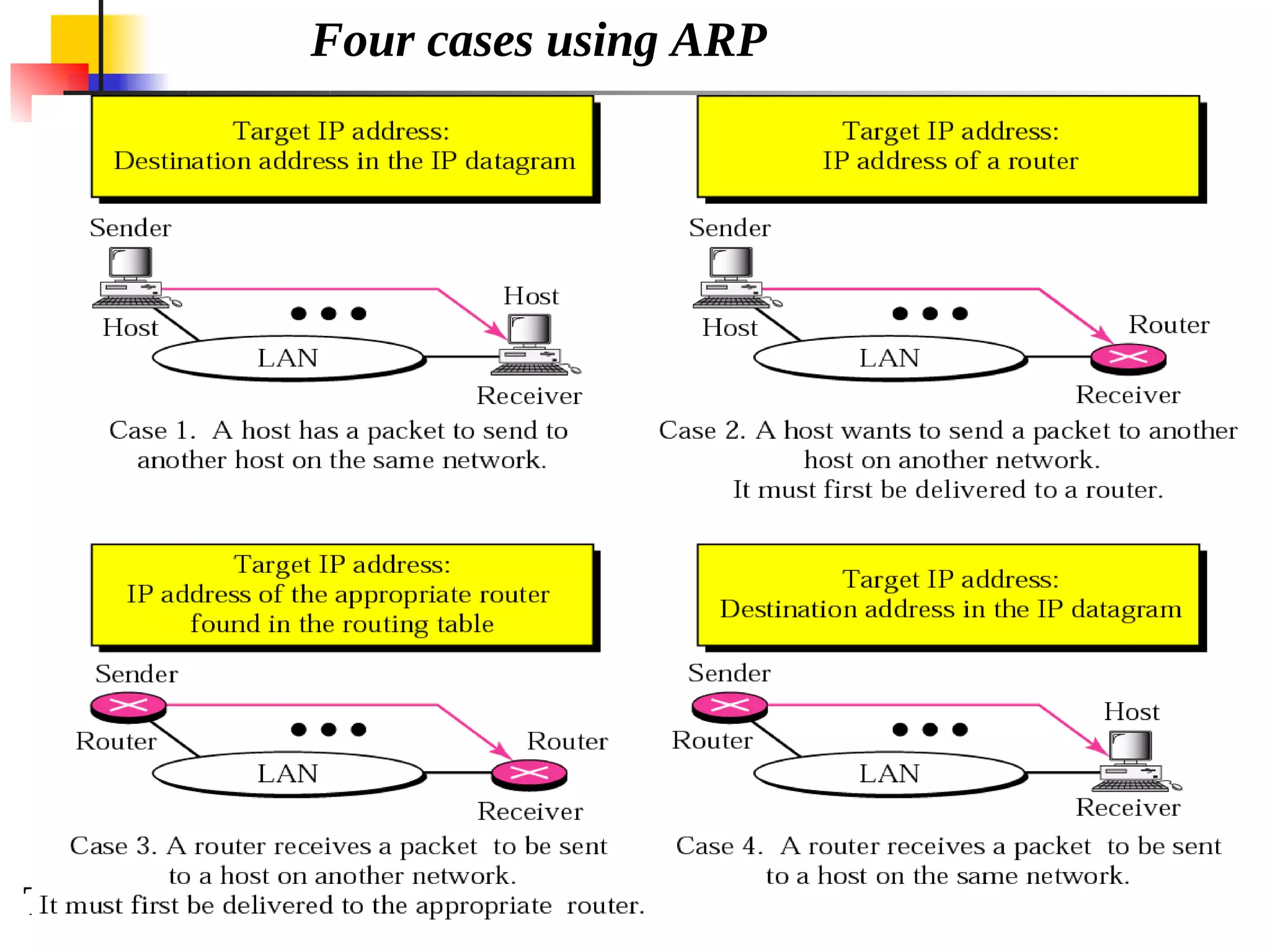
Four cases using ARP
TCP/IP Protocol Suite 14
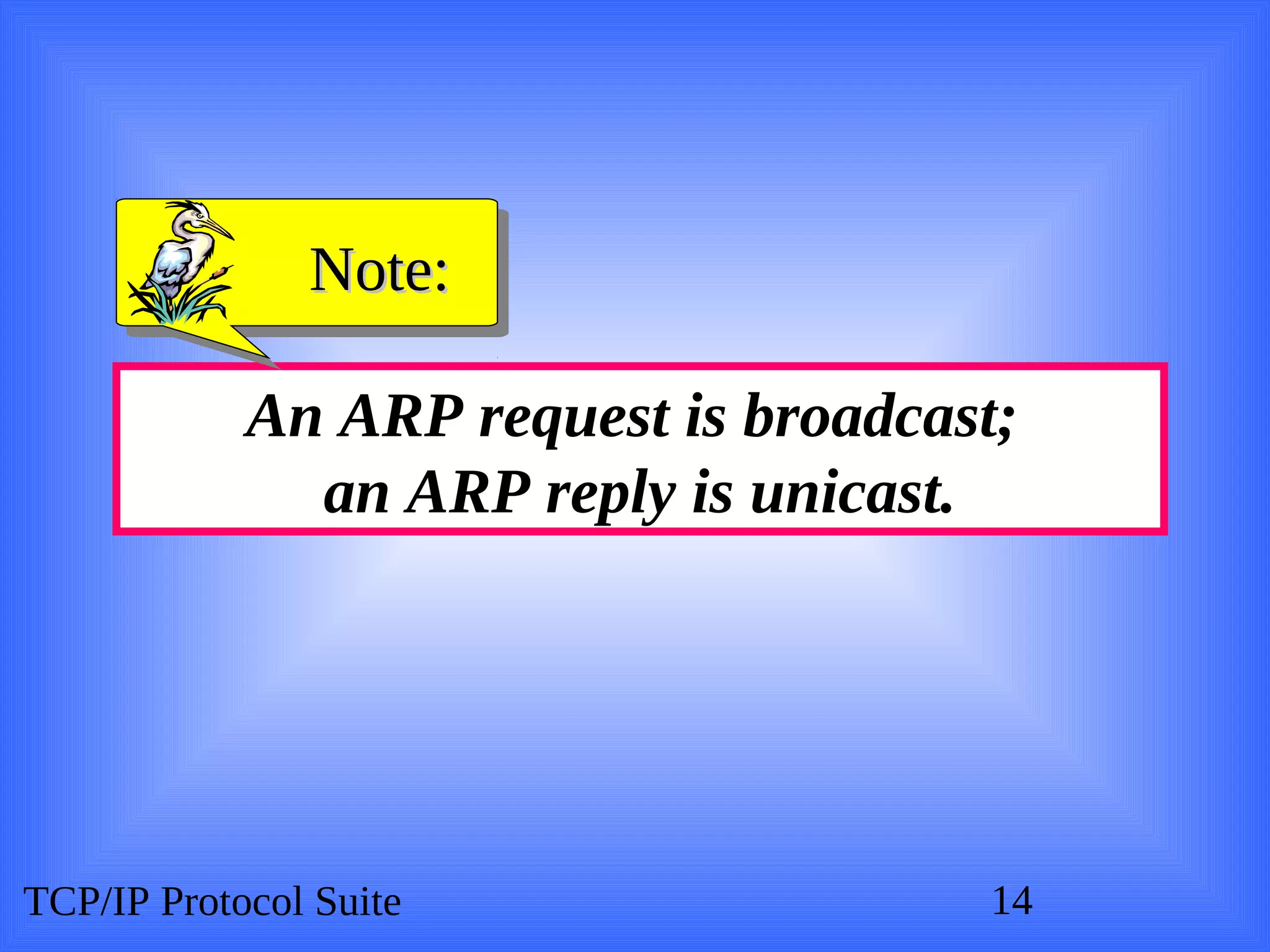
An ARP request is broadcast;
an ARP reply is unicast.
Note:
Note:
TCP/IP Protocol Suite 15
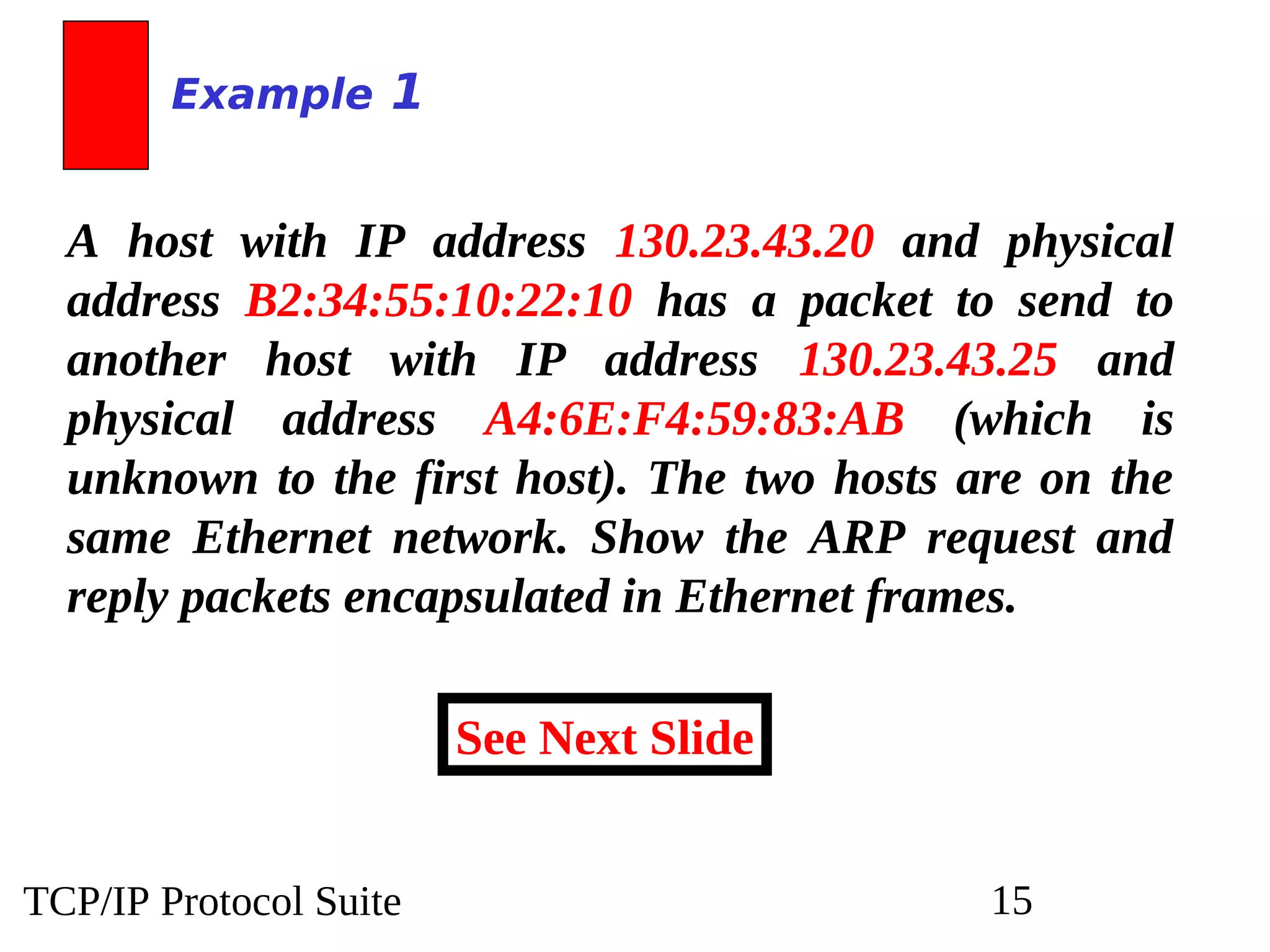
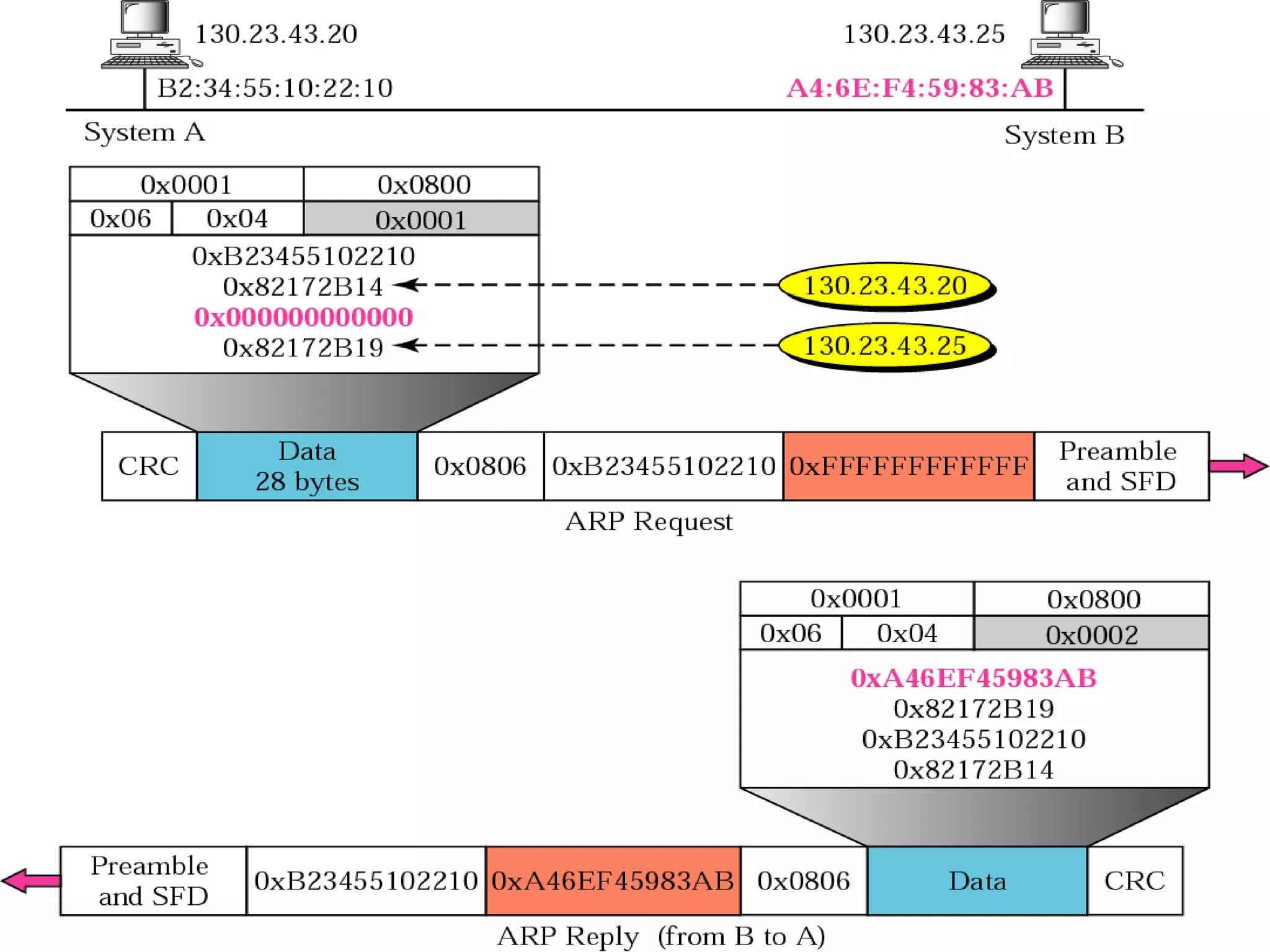
A host with IP address 130.23.43.20 and physical
address B2:34:55:10:22:10 has a packet to send to
another host with IP address 130.23.43.25 and
physical address A4:6E:F4:59:83:AB (which is
unknown to the first host). The two hosts are on the
same Ethernet network. Show the ARP request and
reply packets encapsulated in Ethernet frames.
Example 1
See Next Slide
TCP/IP Protocol Suite 16
Solution
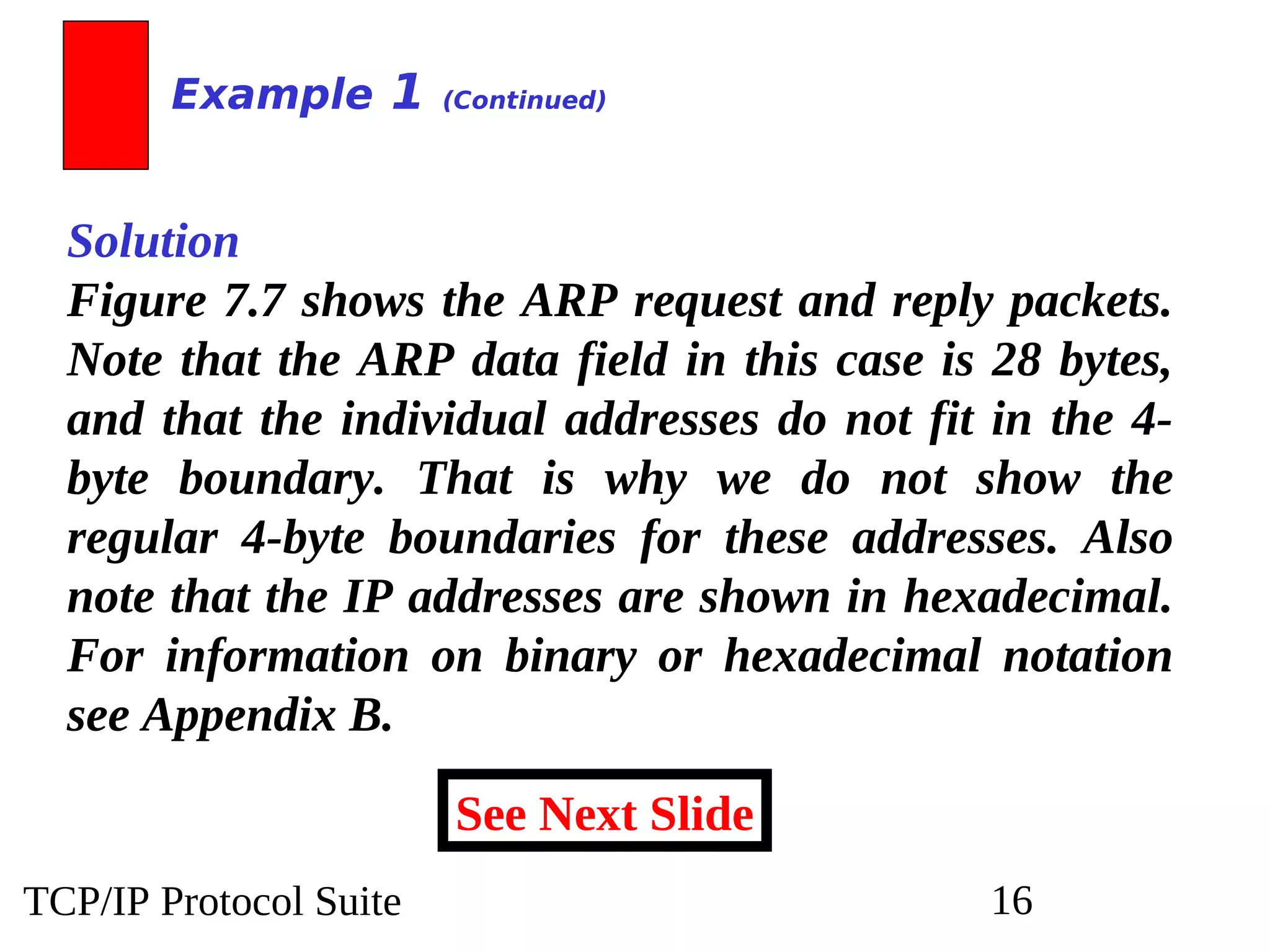
Figure 7.7 shows the ARP request and reply packets.
Note that the ARP data field in this case is 28 bytes,
and that the individual addresses do not fit in the 4-
byte boundary. That is why we do not show the
regular 4-byte boundaries for these addresses. Also
note that the IP addresses are shown in hexadecimal.
For information on binary or hexadecimal notation
see Appendix B.
Example 1 (Continued)
See Next Slide
TCP/IP Protocol Suite 17
TCP/IP Protocol Suite 18
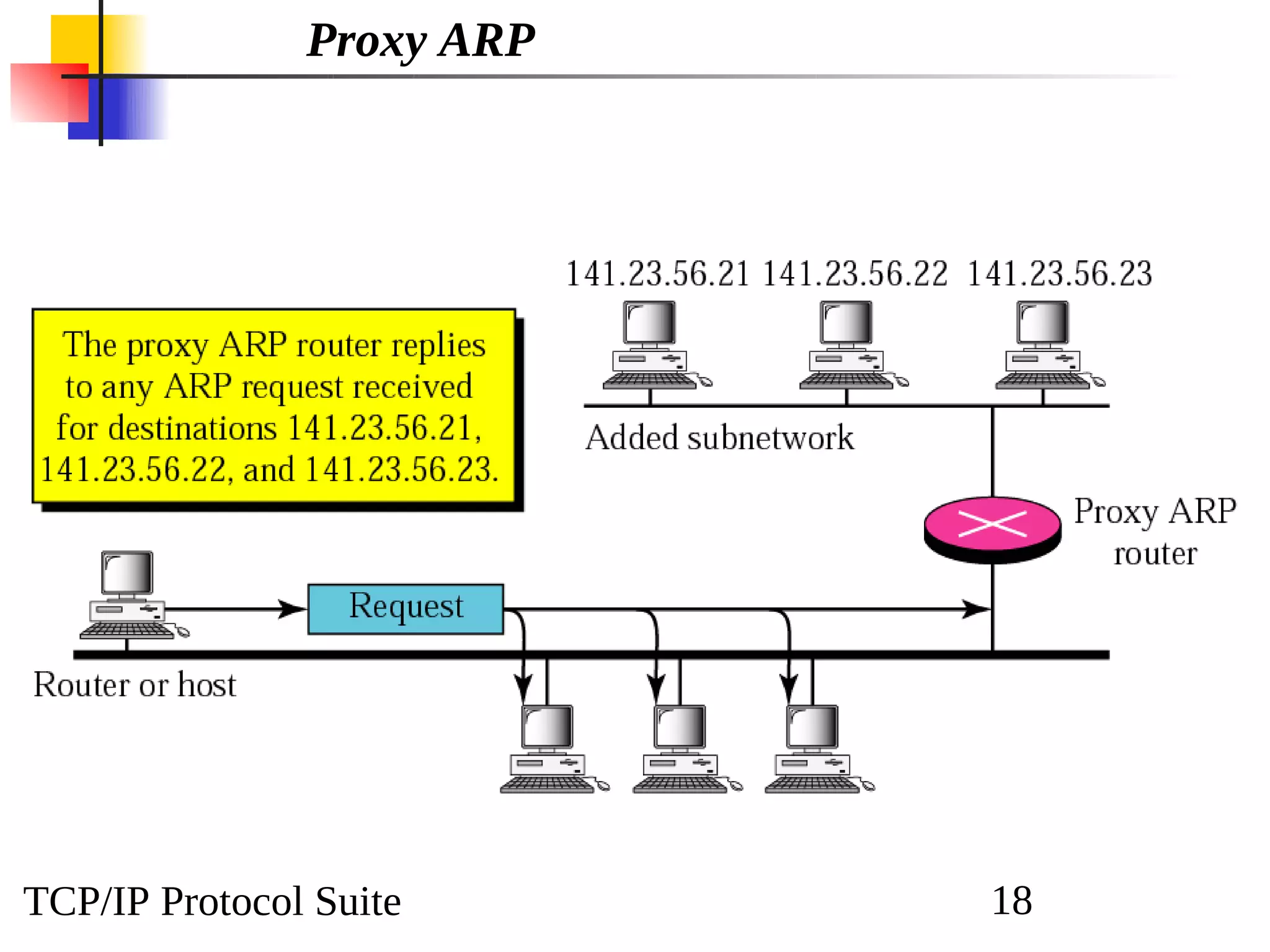
Proxy ARP
TCP/IP Protocol Suite 19
7.2 ARP PACKAGE
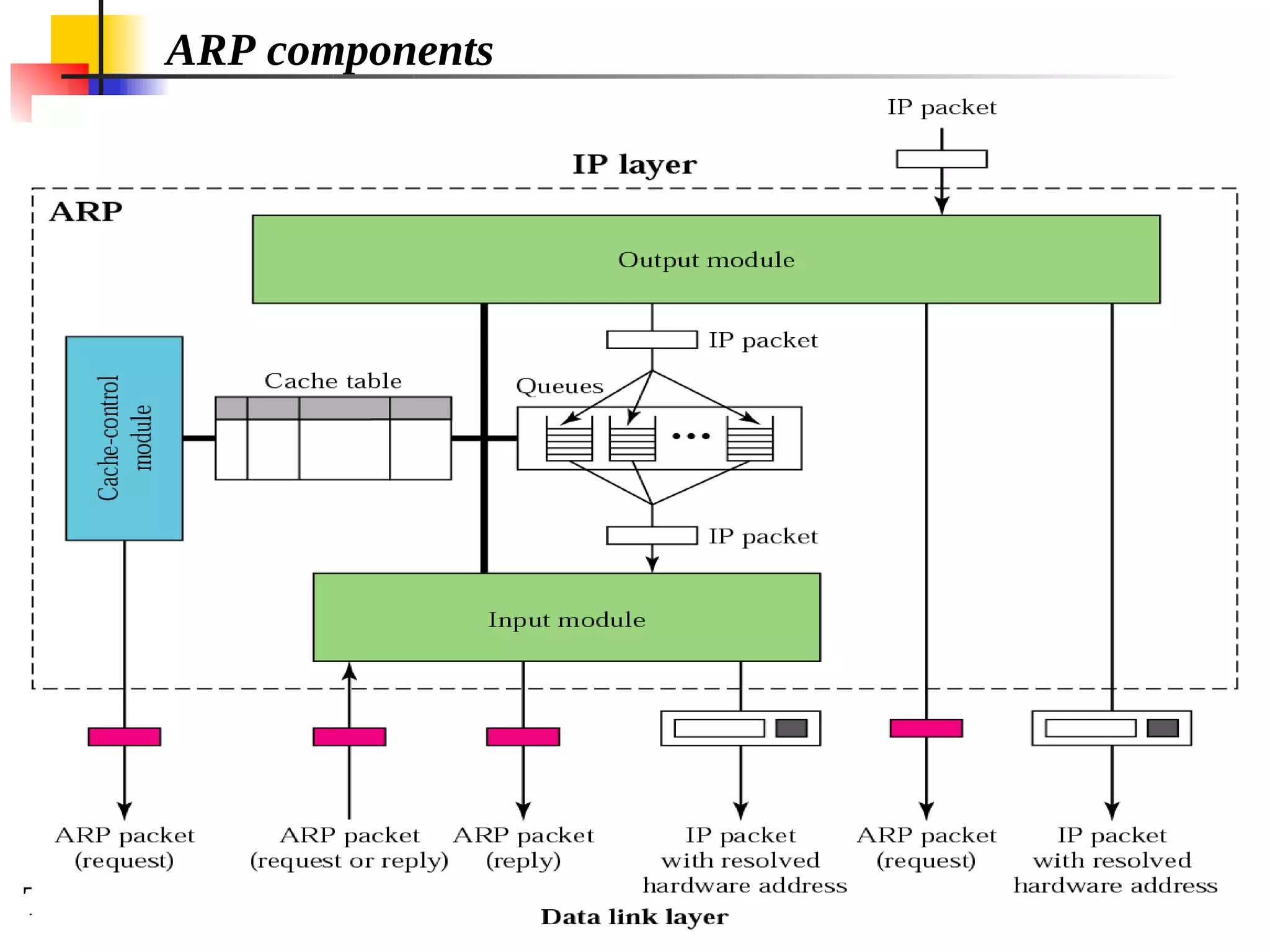
In this section, we give an example of a simplified ARP software package
to show the components and the relationships between the components.
This ARP package involves five modules: a cache table, queues, an
output module, an input module, and a cache-control module.
The topics discussed in this section include:
Cache Table
Cache Table
Queues
Queues
Output Module
Output Module
Input Module
Input Module
Cache-Control Module
TCP/IP Protocol Suite 20
ARP components
TCP/IP Protocol Suite 21
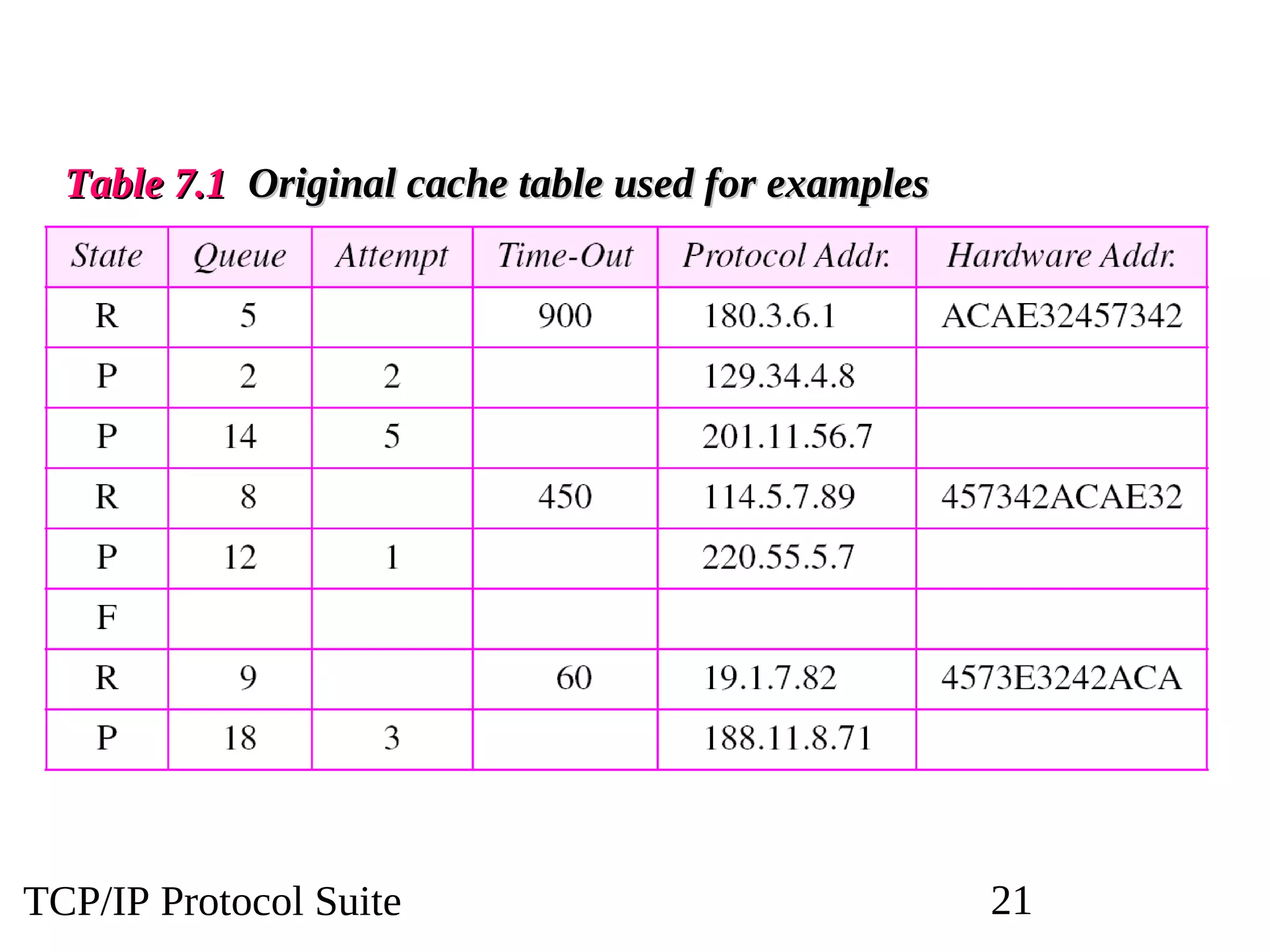
Table 7.1
Table 7.1 Original cache table used for examples
Original cache table used for examples
TCP/IP Protocol Suite 22
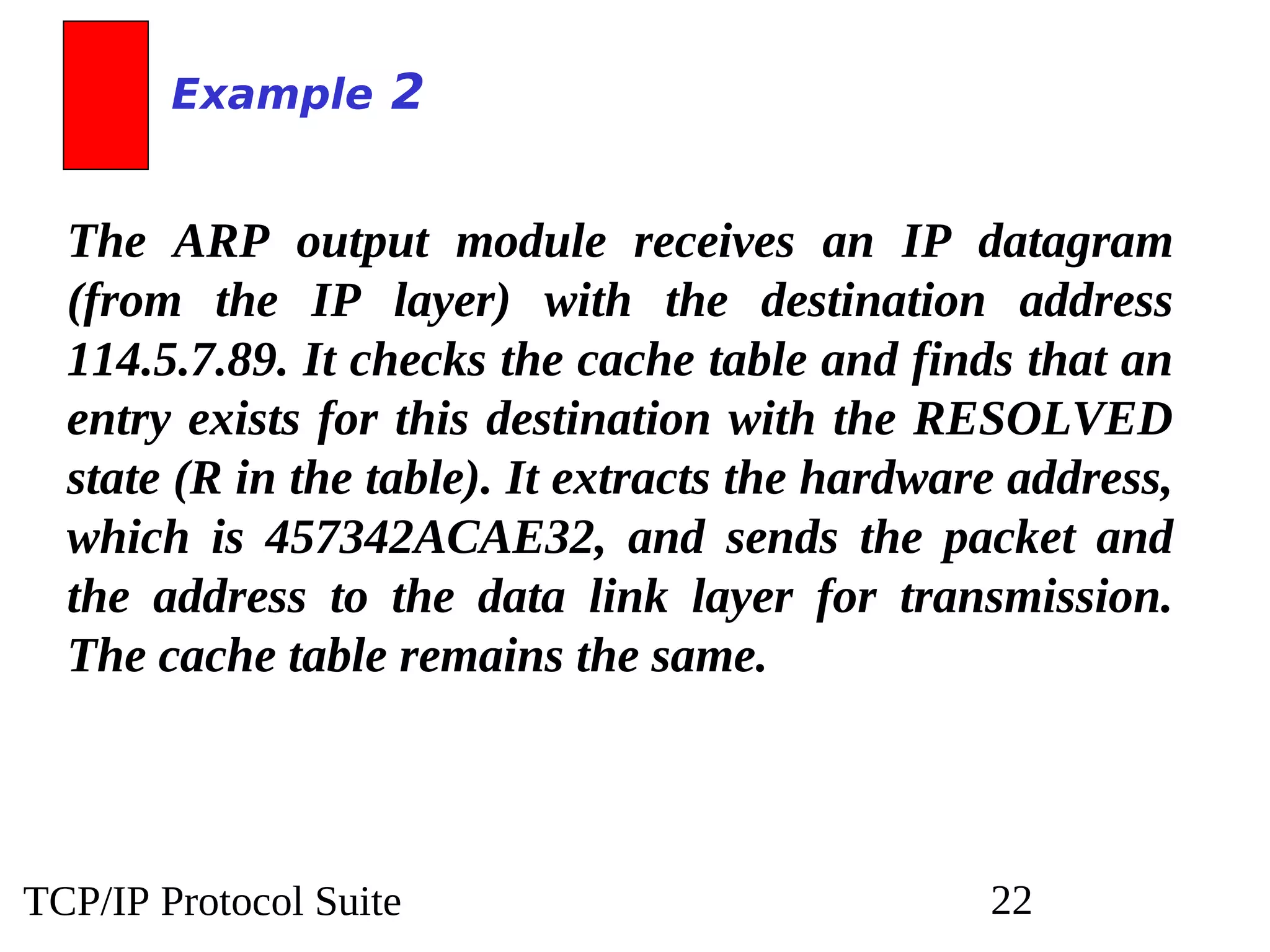
The ARP output module receives an IP datagram
(from the IP layer) with the destination address
114.5.7.89. It checks the cache table and finds that an
entry exists for this destination with the RESOLVED
state (R in the table). It extracts the hardware address,
which is 457342ACAE32, and sends the packet and
the address to the data link layer for transmission.
The cache table remains the same.
Example 2
TCP/IP Protocol Suite 23
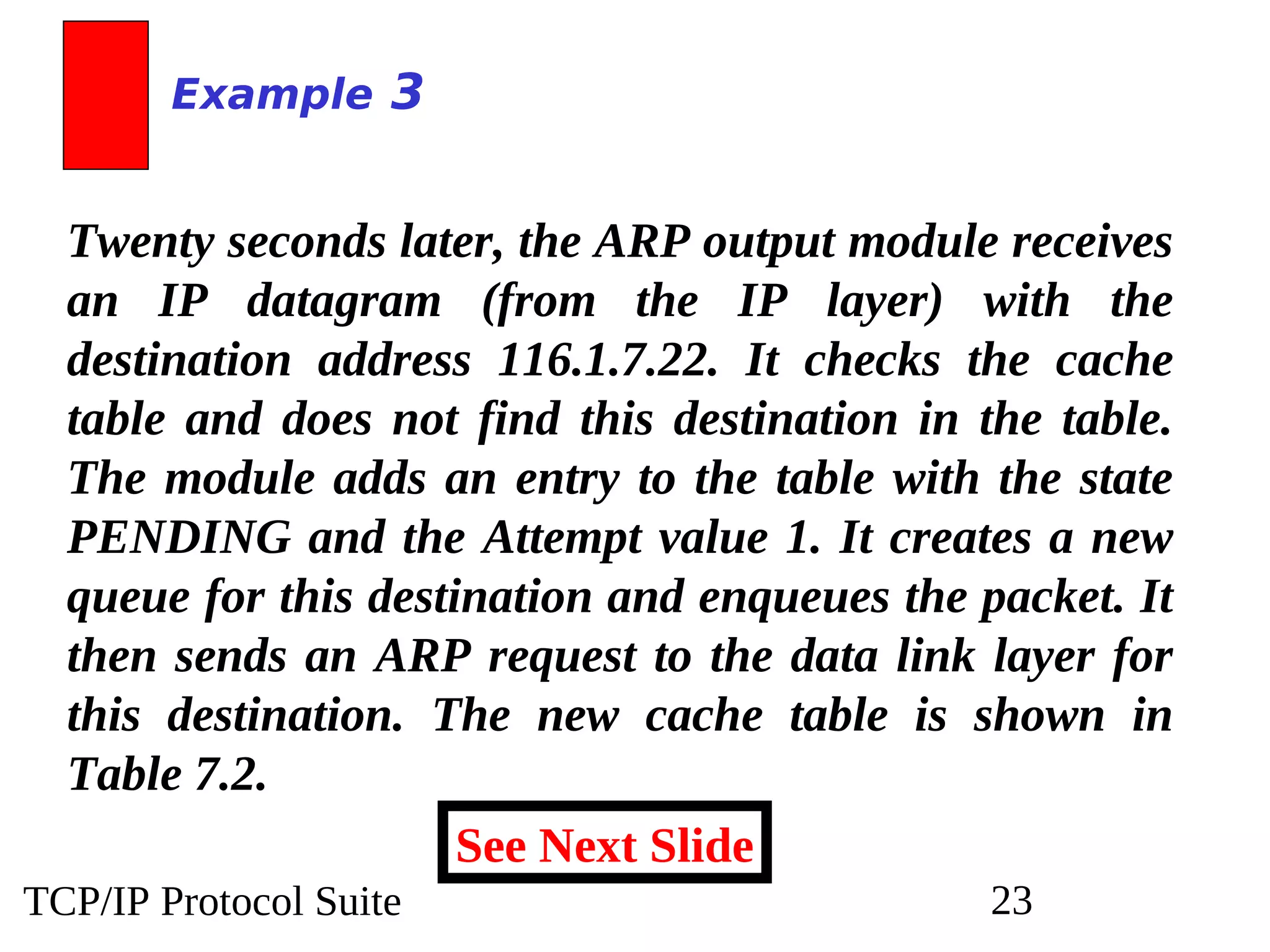
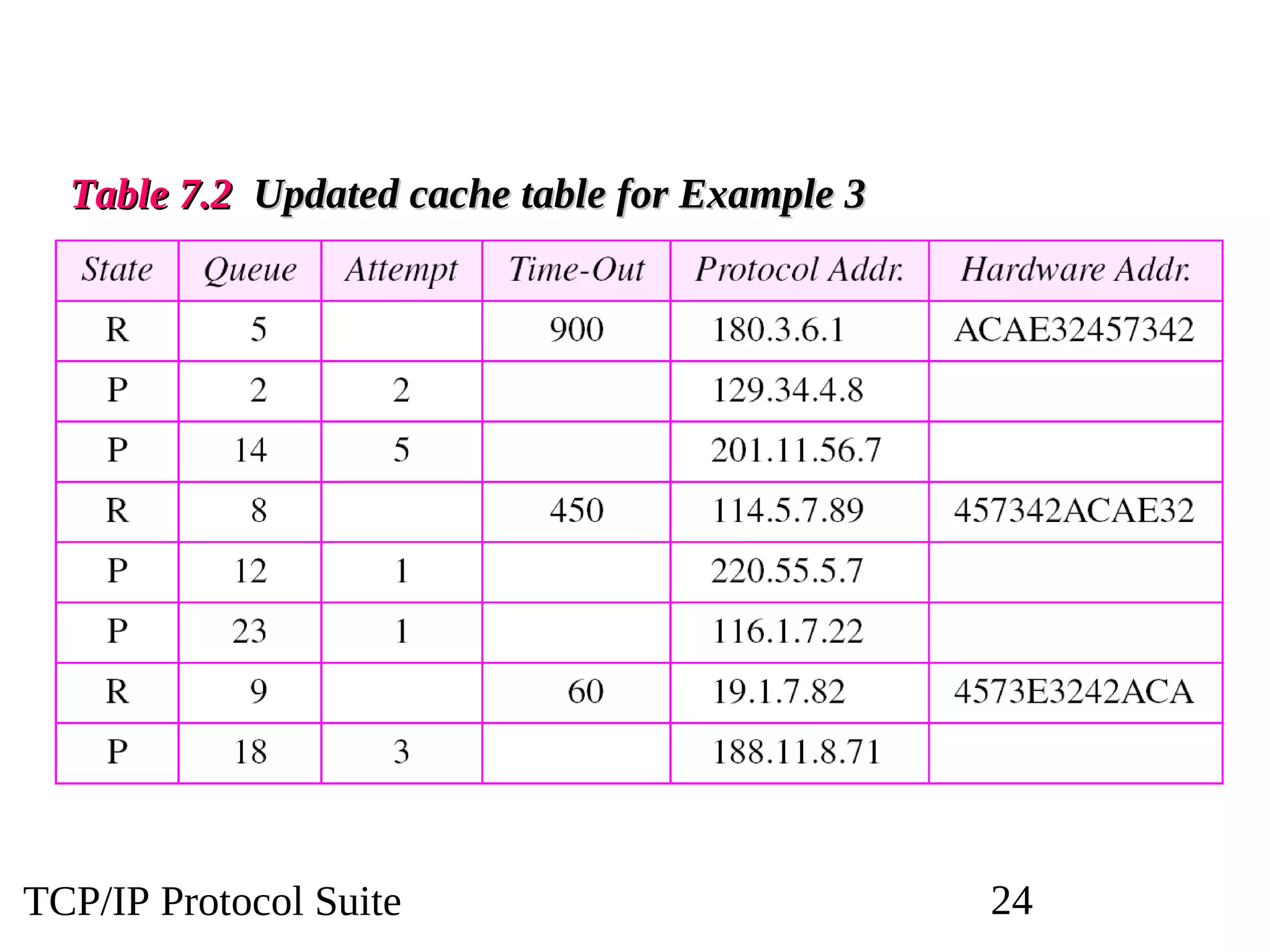
Twenty seconds later, the ARP output module receives
an IP datagram (from the IP layer) with the
destination address 116.1.7.22. It checks the cache
table and does not find this destination in the table.
The module adds an entry to the table with the state
PENDING and the Attempt value 1. It creates a new
queue for this destination and enqueues the packet. It
then sends an ARP request to the data link layer for
this destination. The new cache table is shown in
Table 7.2.
Example 3
See Next Slide
TCP/IP Protocol Suite 24
Table 7.2
Table 7.2 Updated cache table for Example 3
Updated cache table for Example 3
TCP/IP Protocol Suite 25
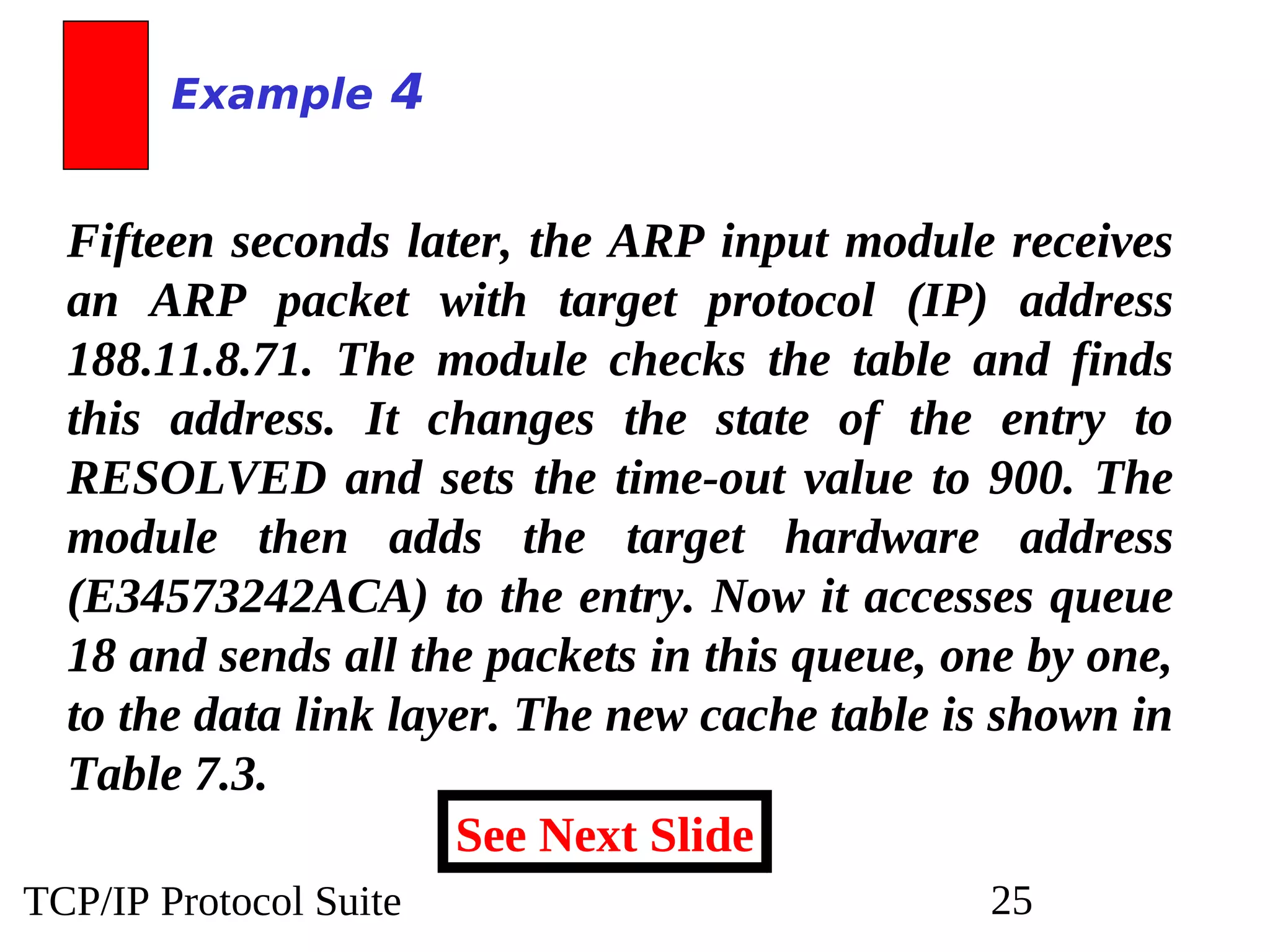
Fifteen seconds later, the ARP input module receives
an ARP packet with target protocol (IP) address
188.11.8.71. The module checks the table and finds
this address. It changes the state of the entry to
RESOLVED and sets the time-out value to 900. The
module then adds the target hardware address
(E34573242ACA) to the entry. Now it accesses queue
18 and sends all the packets in this queue, one by one,
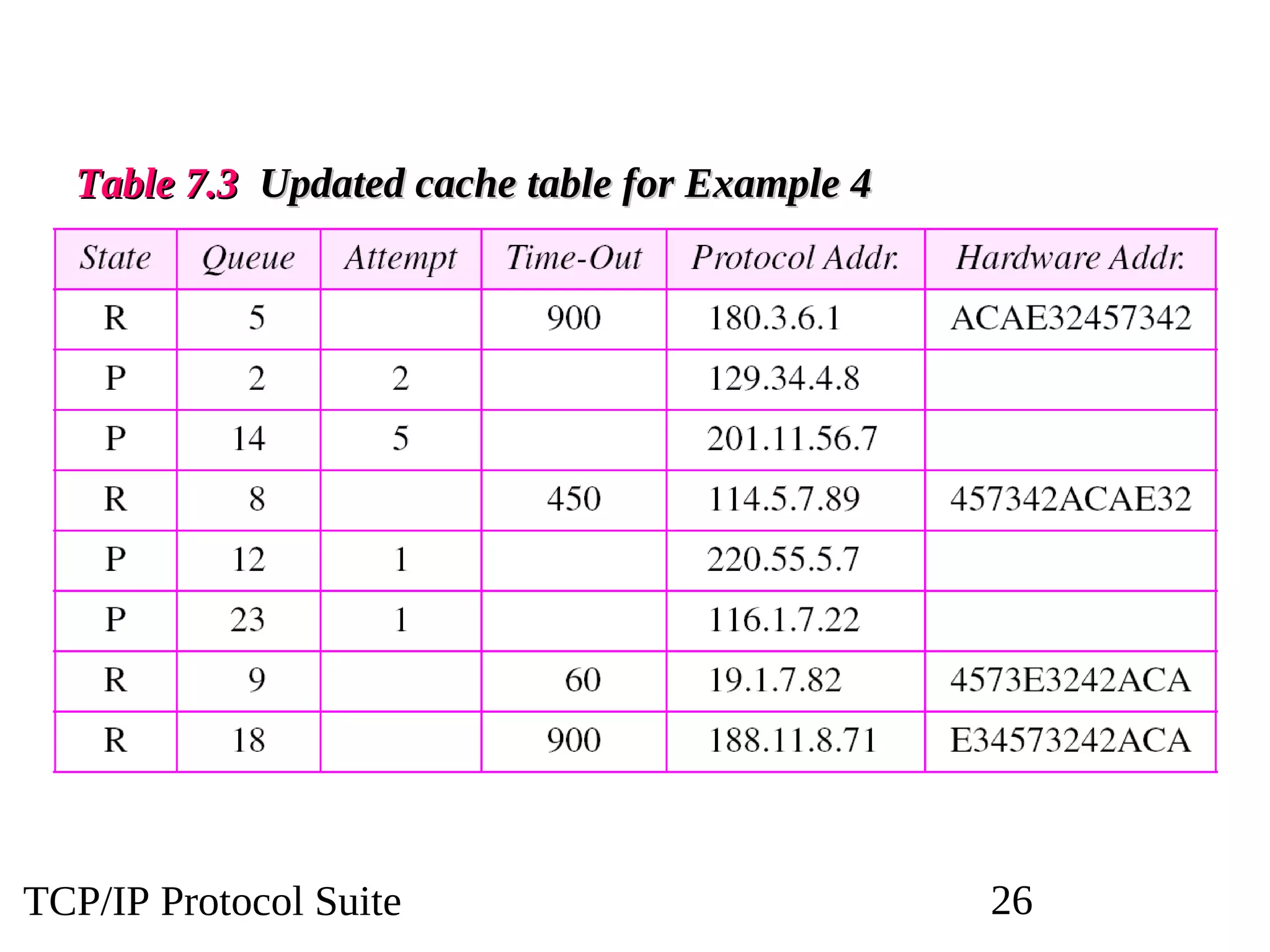
to the data link layer. The new cache table is shown in
Table 7.3.
Example 4
See Next Slide
TCP/IP Protocol Suite 26
Table 7.3
Table 7.3 Updated cache table for Example 4
Updated cache table for Example 4
TCP/IP Protocol Suite 27
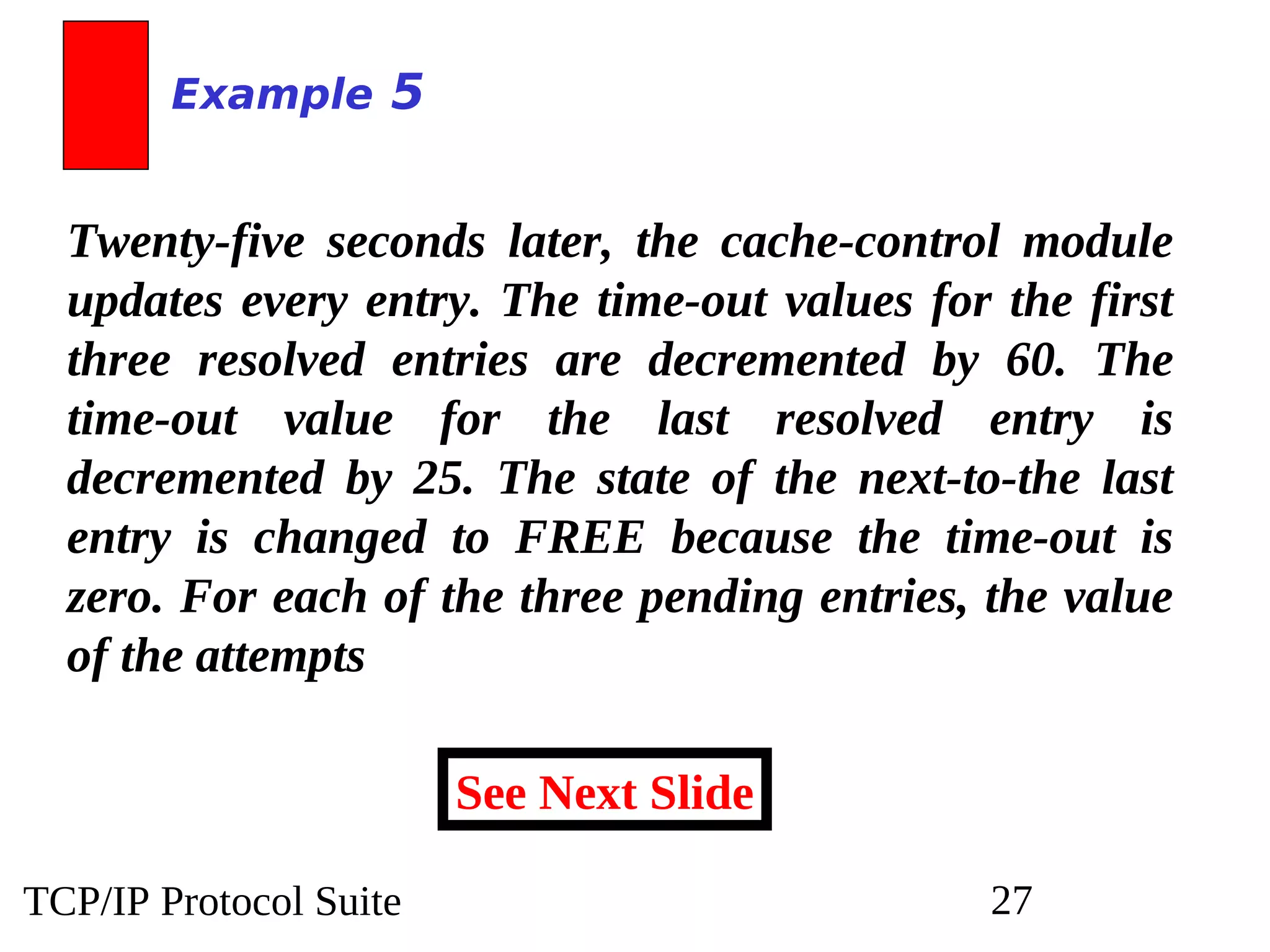
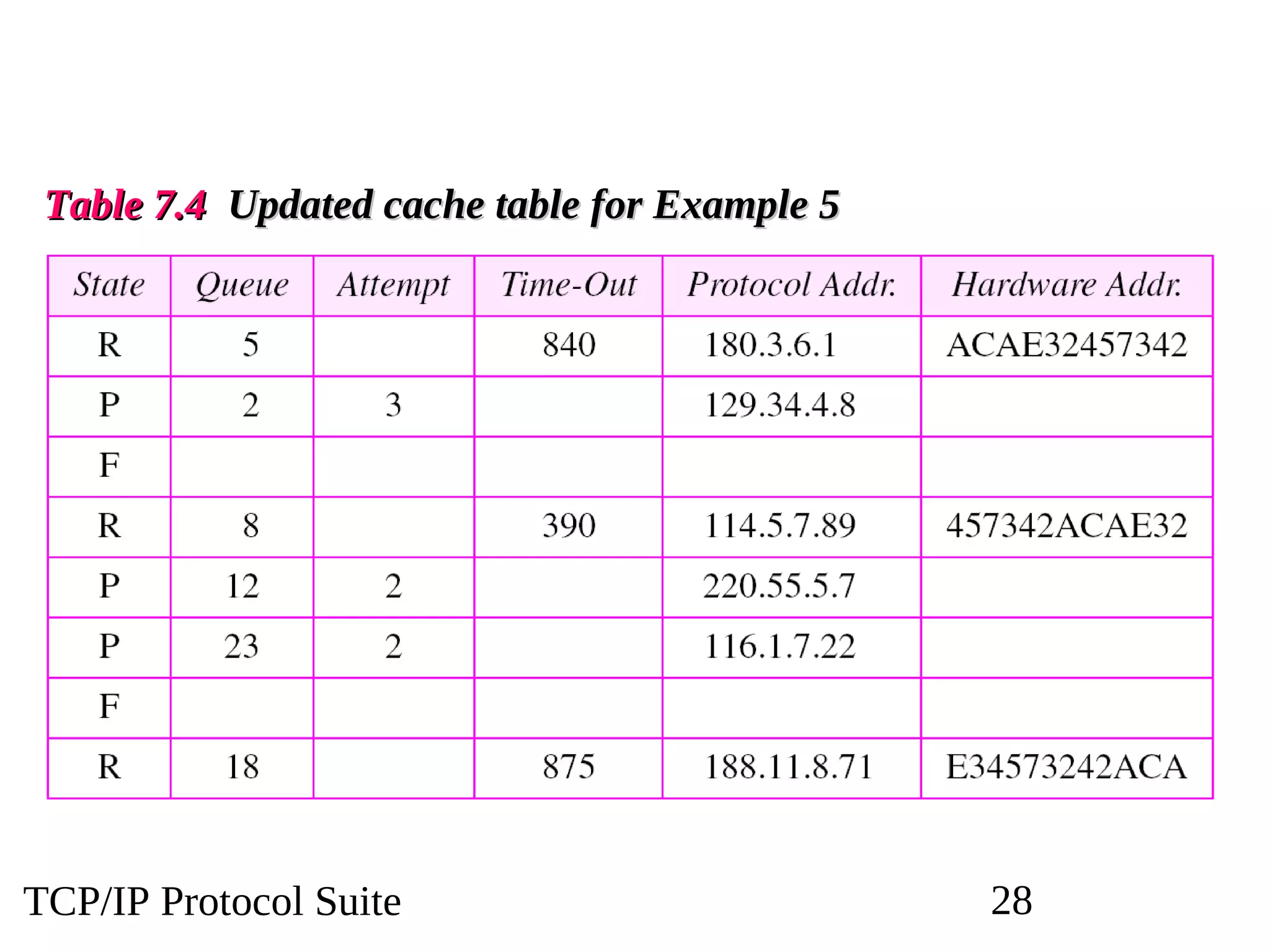
Twenty-five seconds later, the cache-control module
updates every entry. The time-out values for the first
three resolved entries are decremented by 60. The
time-out value for the last resolved entry is
decremented by 25. The state of the next-to-the last
entry is changed to FREE because the time-out is
zero. For each of the three pending entries, the value
of the attempts
Example 5
See Next Slide
TCP/IP Protocol Suite 28
Table 7.4
Table 7.4 Updated cache table for Example 5
Updated cache table for Example 5
TCP/IP Protocol Suite 29
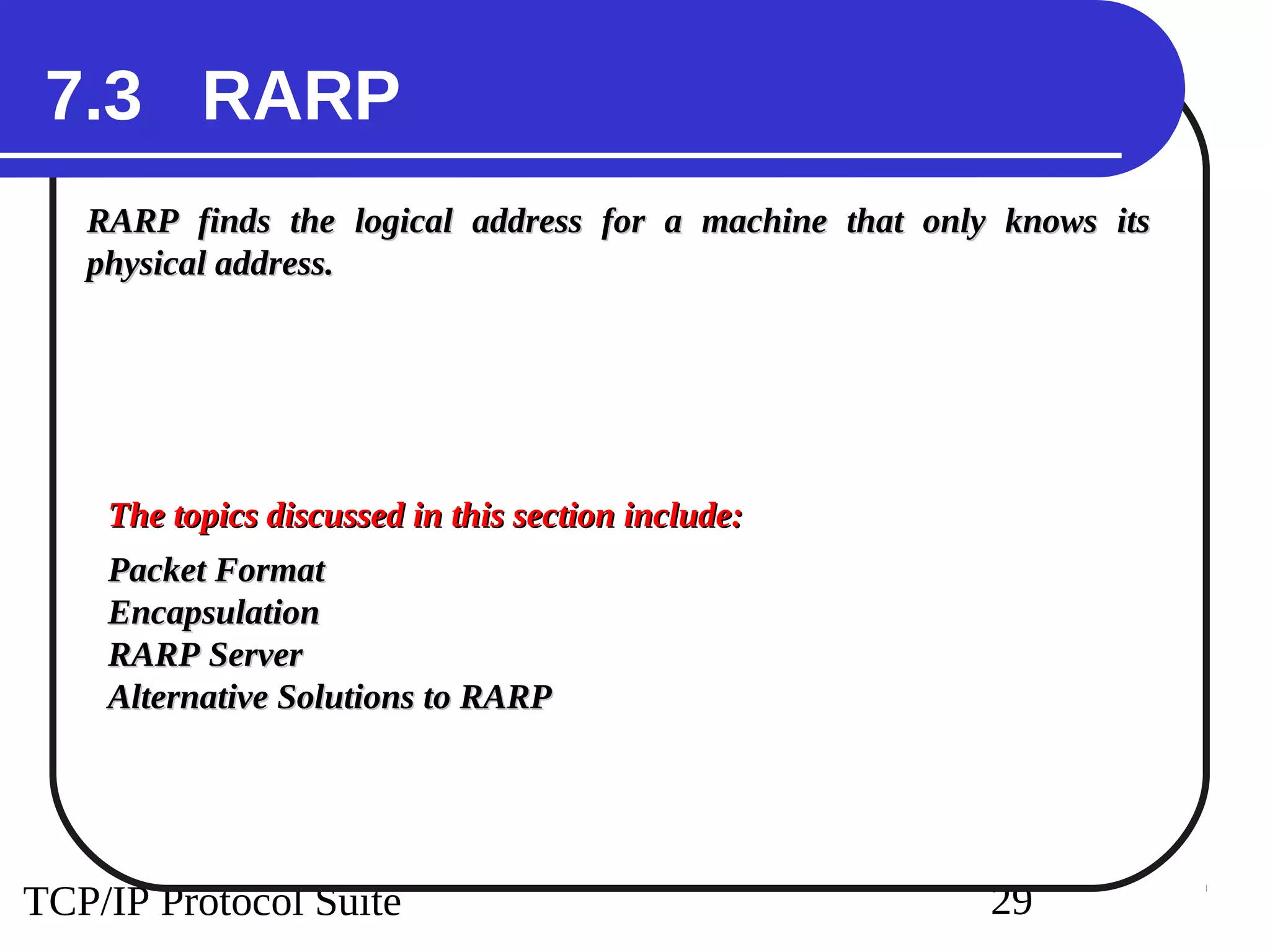
7.3 RARP
RARP finds the logical address for a machine that only knows its
physical address.
physical address.
The topics discussed in this section include:
Packet Format
Packet Format
Encapsulation
Encapsulation
RARP Server
RARP Server
Alternative Solutions to RARP
TCP/IP Protocol Suite 30
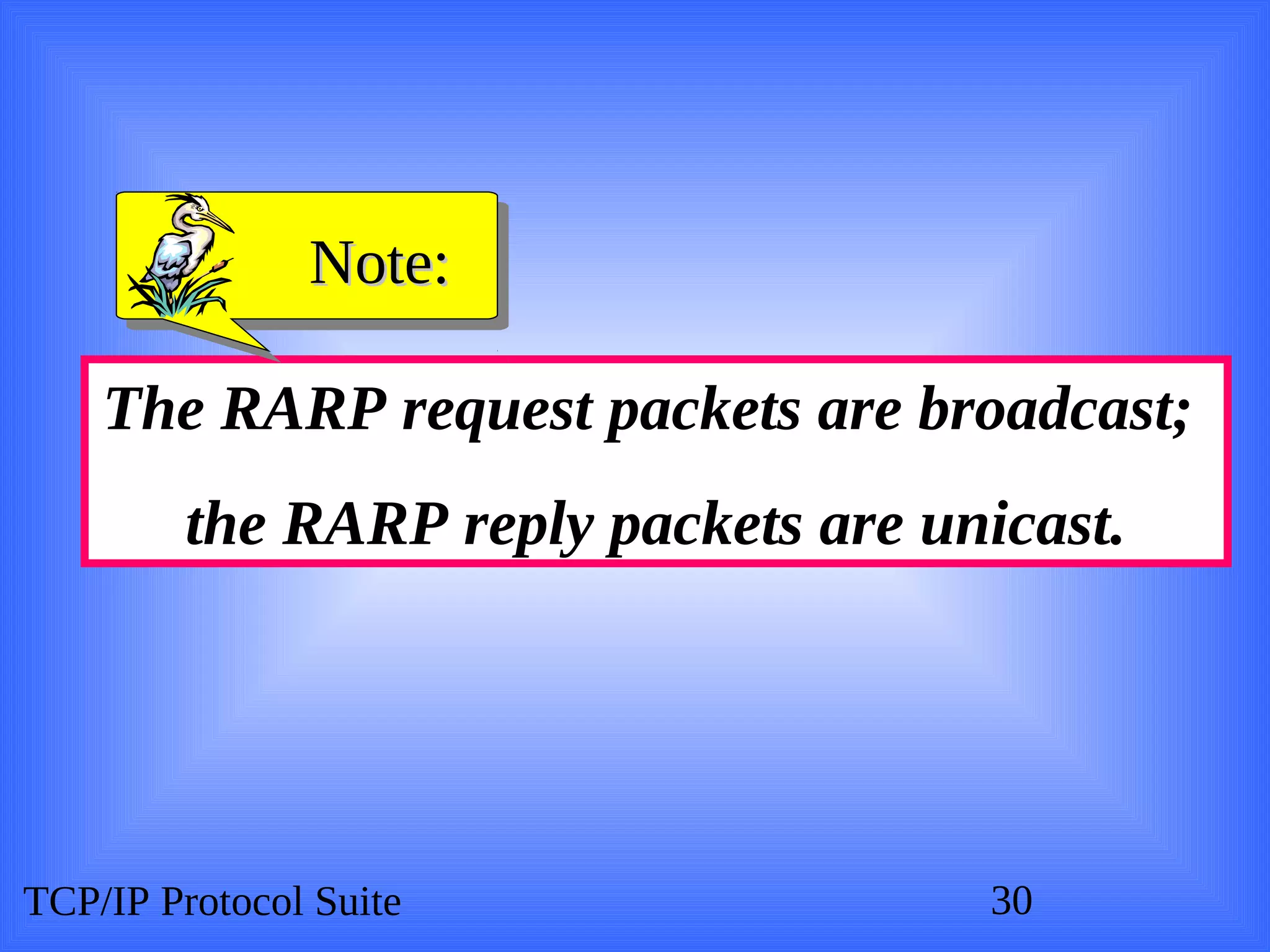
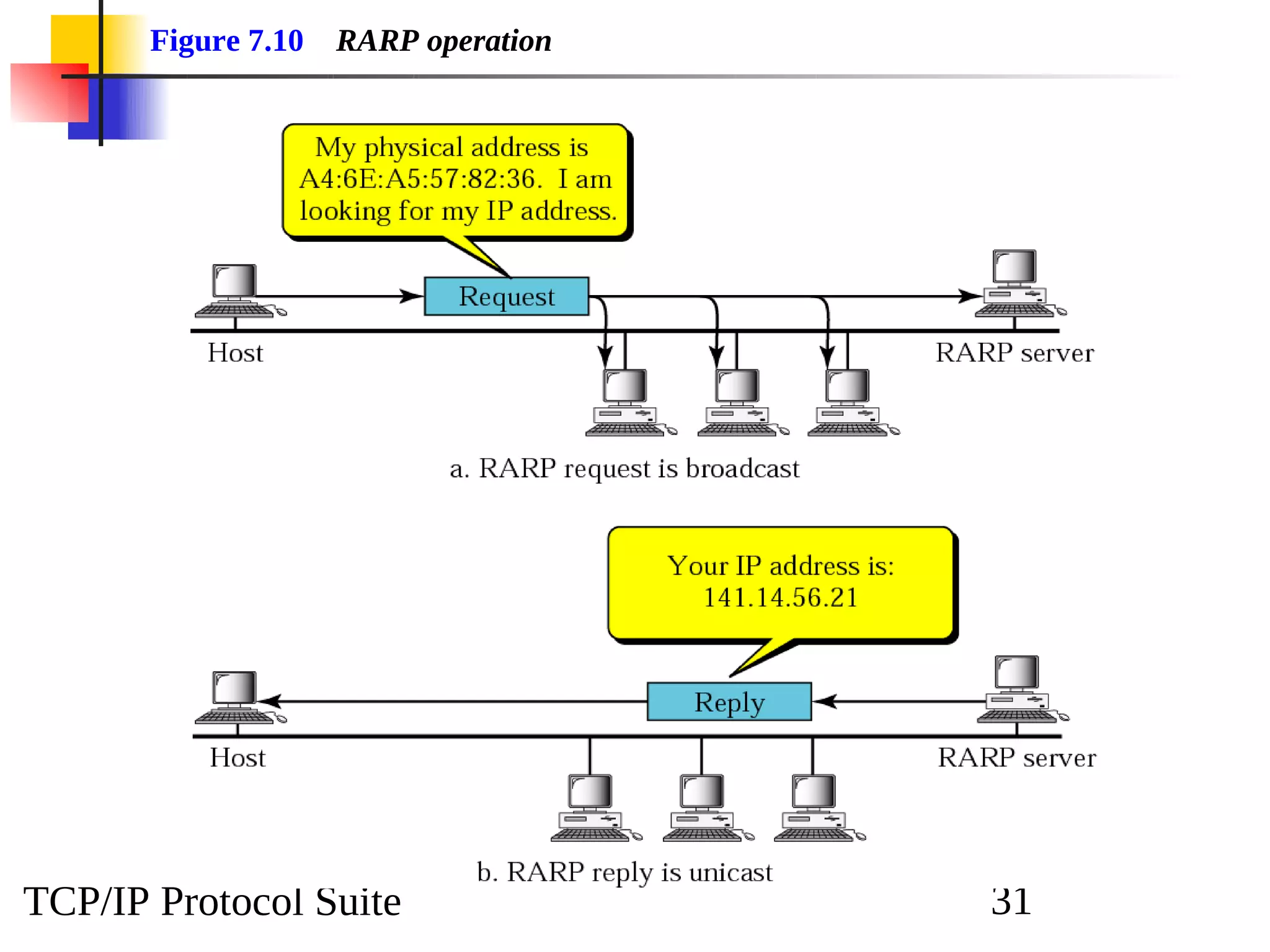
The RARP request packets are broadcast;
the RARP reply packets are unicast.
Note:
Note:
TCP/IP Protocol Suite 31
Figure 7.10 RARP operation
TCP/IP Protocol Suite 32
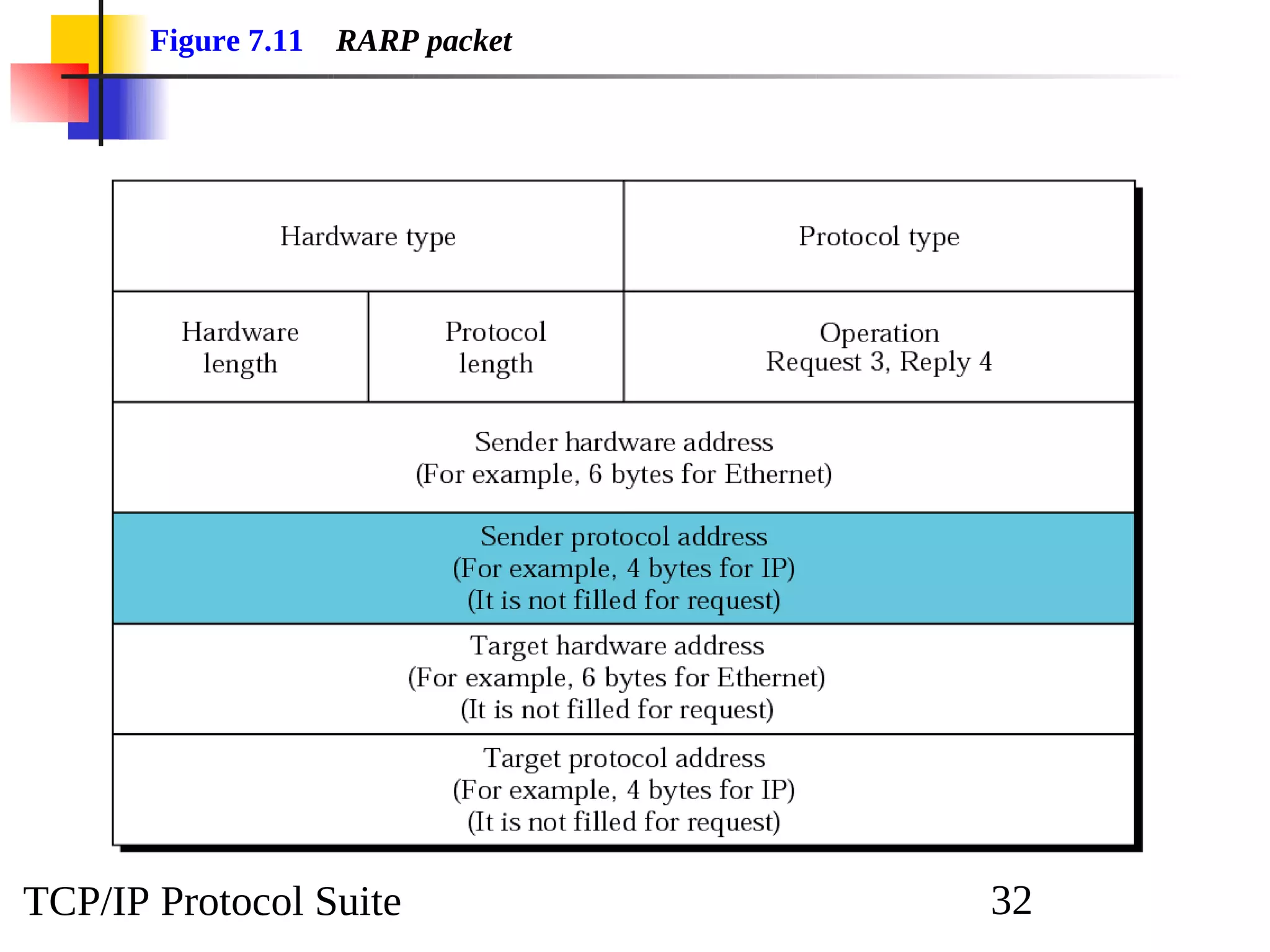
Figure 7.11 RARP packet
TCP/IP Protocol Suite 33
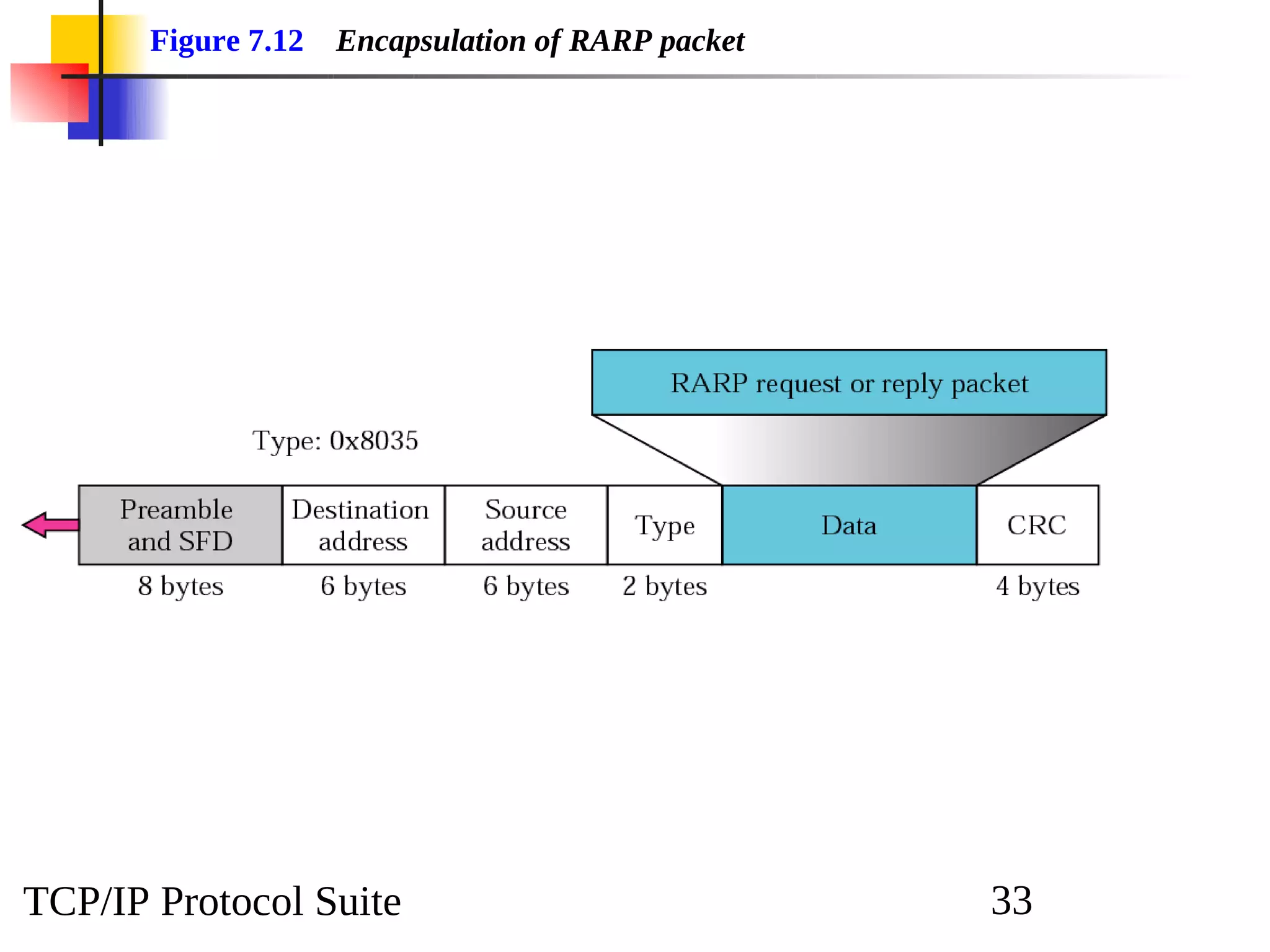
Figure 7.12 Encapsulation of RARP packet
TCP/IP Protocol Suite 34
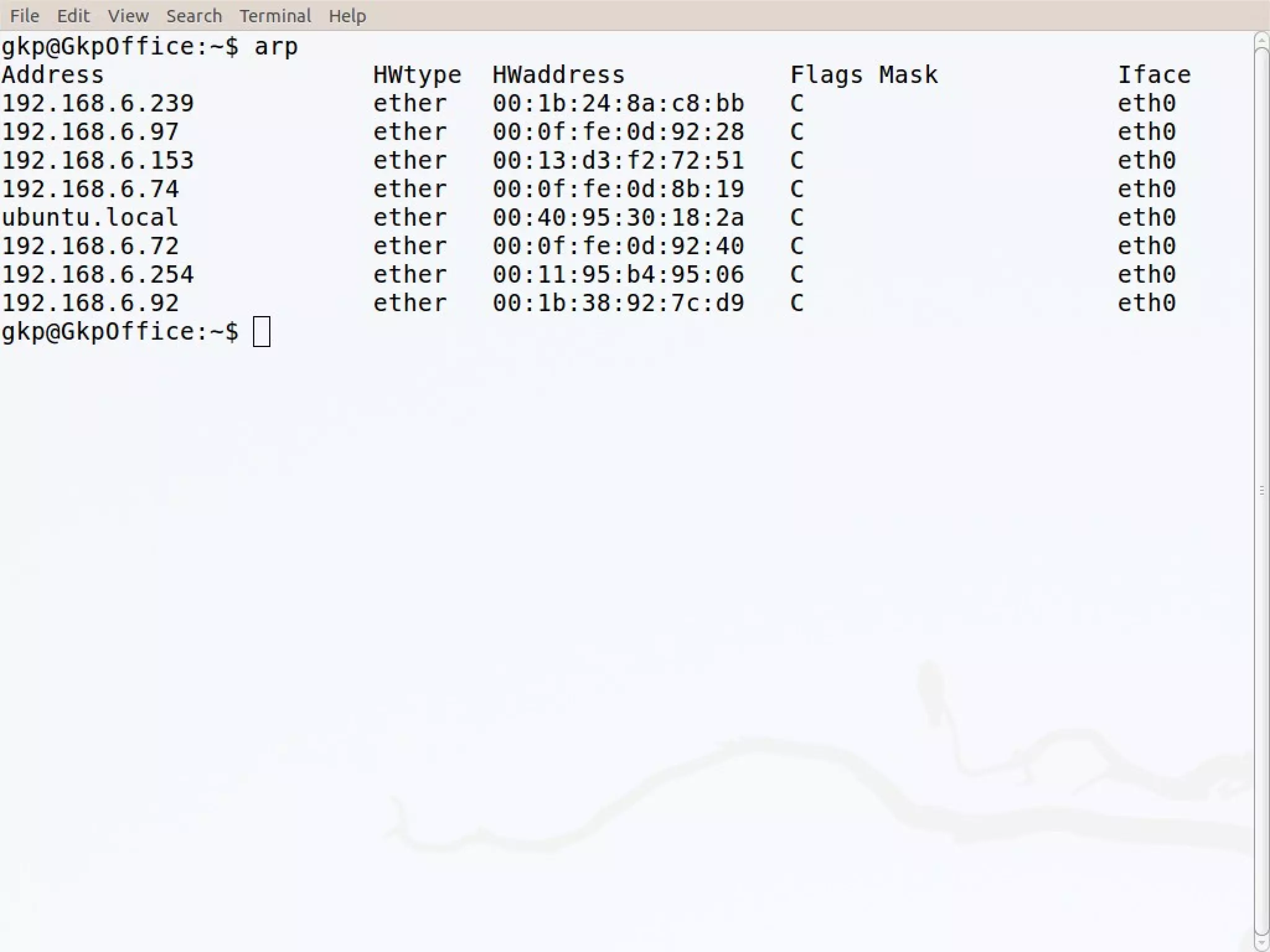
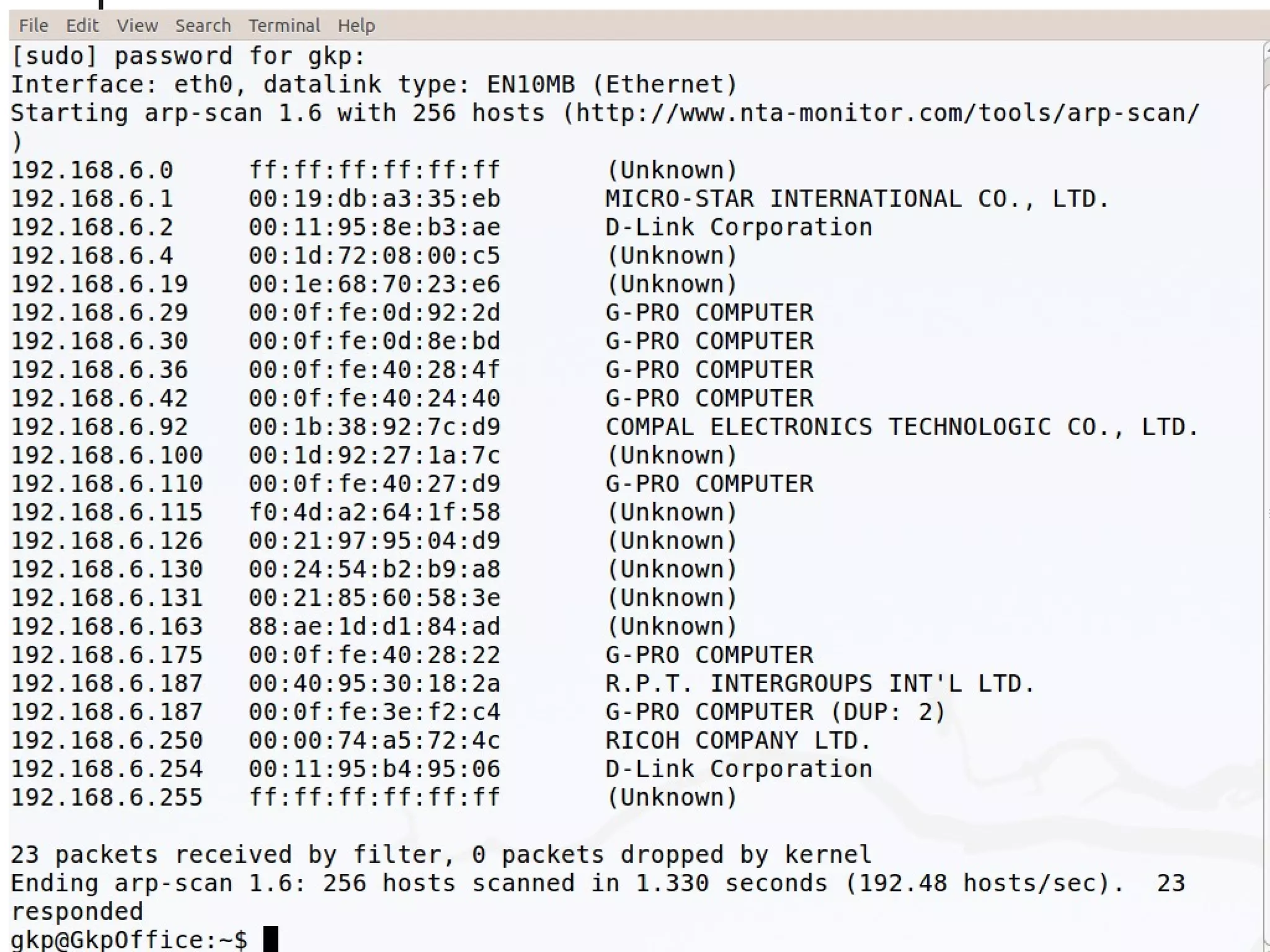
ARP Command
TCP/IP Protocol Suite 35

Chap-07 ARP and RARP.pdf

  • 1.
    TCP/IP Protocol Suite1 Chapter 7 Chapter 7 Upon completion you will be able to: ARP and RARP ARP and RARP • Understand the need for ARP • Understand the cases in which ARP is used • Understand the components and interactions in an ARP package • Understand the need for RARP Objectives
  • 2.
    TCP/IP Protocol Suite2 ARP and RARP Hosts and Routers are recognized by Logical Addresses. Logical addresses are universal. At physical level hosts and routers recognized by Physical Address. Physical address are local addresses. Ex. MAC Addresses. Delivery requires two levels of addressing. Mapping is required. Static Mapping: Storing mapping information in a table. Physical addresses may change because of change in NIC card or mobile host move from one network to another. Dynamic Mapping: Machine knows one of the two addresses, it can use protocol to find the other one.
  • 3.
    TCP/IP Protocol Suite3 ARP and RARP Dynamic Mapping: Machine knows one of the two addresses, it can use protocol to find the other one. ARP: Maps Logical address to physical address RARP: Maps Physical address to Logical Address.
  • 4.
    TCP/IP Protocol Suite4 ARP and RARP
  • 5.
    TCP/IP Protocol Suite5 Position of ARP and RARP in TCP/IP protocol suite
  • 6.
    TCP/IP Protocol Suite6 7.1 ARP ARP associates an IP address with its physical address. On a typical ARP associates an IP address with its physical address. On a typical physical network, such as a LAN, each device on a link is identified by a physical network, such as a LAN, each device on a link is identified by a physical or station address that is usually imprinted on the NIC. physical or station address that is usually imprinted on the NIC. The topics discussed in this section include: The topics discussed in this section include: Packet Format Packet Format Encapsulation Encapsulation Operation Operation ARP over ATM ARP over ATM Proxy ARP Proxy ARP
  • 7.
    TCP/IP Protocol Suite7 ARP Sender has logical address of receiver. Sender asks receiver to announce its physical address. When any host needs to know Physical address of another machine host it sends a ARP query Packet. Query includes Sender's physical and IP address and receivers only IP address. Query packet is broadcast over the network.
  • 8.
    TCP/IP Protocol Suite8 Figure 7.3 ARP operation
  • 9.
    TCP/IP Protocol Suite9 ARP Every host receives and processes ARP query packet. Only receiver sends back ARP response packet containing receivers IP address and Physical address. Response packet is unicast.
  • 10.
    TCP/IP Protocol Suite10 ARP packet
  • 11.
    TCP/IP Protocol Suite11 ARP Packet Format Hardware Type: 16-bit, ethernet is given type 1. Protocol Type: 16-bit defining protocol. For Ipv4 it is 080016 Hardware Length: Length of physical address in bytes. For ethernet it is 6. Protocol Length: 8-bit defining length of logical address. For Ipv4 it is 4. Operation: 16-bit defines type of packet. Type 1- Request 2- Reply. Sender H/w address: Sender protocol addr, Target H/W addr, Target protocol addr.
  • 12.
    TCP/IP Protocol Suite12 Figure 7.5 Encapsulation of ARP packet
  • 13.
    TCP/IP Protocol Suite13 Four cases using ARP
  • 14.
    TCP/IP Protocol Suite14 An ARP request is broadcast; an ARP reply is unicast. Note: Note:
  • 15.
    TCP/IP Protocol Suite15 A host with IP address 130.23.43.20 and physical address B2:34:55:10:22:10 has a packet to send to another host with IP address 130.23.43.25 and physical address A4:6E:F4:59:83:AB (which is unknown to the first host). The two hosts are on the same Ethernet network. Show the ARP request and reply packets encapsulated in Ethernet frames. Example 1 See Next Slide
  • 16.
    TCP/IP Protocol Suite16 Solution Figure 7.7 shows the ARP request and reply packets. Note that the ARP data field in this case is 28 bytes, and that the individual addresses do not fit in the 4- byte boundary. That is why we do not show the regular 4-byte boundaries for these addresses. Also note that the IP addresses are shown in hexadecimal. For information on binary or hexadecimal notation see Appendix B. Example 1 (Continued) See Next Slide
  • 17.
  • 18.
  • 19.
    TCP/IP Protocol Suite19 7.2 ARP PACKAGE In this section, we give an example of a simplified ARP software package In this section, we give an example of a simplified ARP software package to show the components and the relationships between the components. to show the components and the relationships between the components. This ARP package involves five modules: a cache table, queues, an This ARP package involves five modules: a cache table, queues, an output module, an input module, and a cache-control module. output module, an input module, and a cache-control module. The topics discussed in this section include: The topics discussed in this section include: Cache Table Cache Table Queues Queues Output Module Output Module Input Module Input Module Cache-Control Module Cache-Control Module
  • 20.
    TCP/IP Protocol Suite20 ARP components
  • 21.
    TCP/IP Protocol Suite21 Table 7.1 Table 7.1 Original cache table used for examples Original cache table used for examples
  • 22.
    TCP/IP Protocol Suite22 The ARP output module receives an IP datagram (from the IP layer) with the destination address 114.5.7.89. It checks the cache table and finds that an entry exists for this destination with the RESOLVED state (R in the table). It extracts the hardware address, which is 457342ACAE32, and sends the packet and the address to the data link layer for transmission. The cache table remains the same. Example 2
  • 23.
    TCP/IP Protocol Suite23 Twenty seconds later, the ARP output module receives an IP datagram (from the IP layer) with the destination address 116.1.7.22. It checks the cache table and does not find this destination in the table. The module adds an entry to the table with the state PENDING and the Attempt value 1. It creates a new queue for this destination and enqueues the packet. It then sends an ARP request to the data link layer for this destination. The new cache table is shown in Table 7.2. Example 3 See Next Slide
  • 24.
    TCP/IP Protocol Suite24 Table 7.2 Table 7.2 Updated cache table for Example 3 Updated cache table for Example 3
  • 25.
    TCP/IP Protocol Suite25 Fifteen seconds later, the ARP input module receives an ARP packet with target protocol (IP) address 188.11.8.71. The module checks the table and finds this address. It changes the state of the entry to RESOLVED and sets the time-out value to 900. The module then adds the target hardware address (E34573242ACA) to the entry. Now it accesses queue 18 and sends all the packets in this queue, one by one, to the data link layer. The new cache table is shown in Table 7.3. Example 4 See Next Slide
  • 26.
    TCP/IP Protocol Suite26 Table 7.3 Table 7.3 Updated cache table for Example 4 Updated cache table for Example 4
  • 27.
    TCP/IP Protocol Suite27 Twenty-five seconds later, the cache-control module updates every entry. The time-out values for the first three resolved entries are decremented by 60. The time-out value for the last resolved entry is decremented by 25. The state of the next-to-the last entry is changed to FREE because the time-out is zero. For each of the three pending entries, the value of the attempts Example 5 See Next Slide
  • 28.
    TCP/IP Protocol Suite28 Table 7.4 Table 7.4 Updated cache table for Example 5 Updated cache table for Example 5
  • 29.
    TCP/IP Protocol Suite29 7.3 RARP RARP finds the logical address for a machine that only knows its RARP finds the logical address for a machine that only knows its physical address. physical address. The topics discussed in this section include: The topics discussed in this section include: Packet Format Packet Format Encapsulation Encapsulation RARP Server RARP Server Alternative Solutions to RARP Alternative Solutions to RARP
  • 30.
    TCP/IP Protocol Suite30 The RARP request packets are broadcast; the RARP reply packets are unicast. Note: Note:
  • 31.
    TCP/IP Protocol Suite31 Figure 7.10 RARP operation
  • 32.
    TCP/IP Protocol Suite32 Figure 7.11 RARP packet
  • 33.
    TCP/IP Protocol Suite33 Figure 7.12 Encapsulation of RARP packet
  • 34.
    TCP/IP Protocol Suite34 ARP Command
  • 35.