Absolute Value 
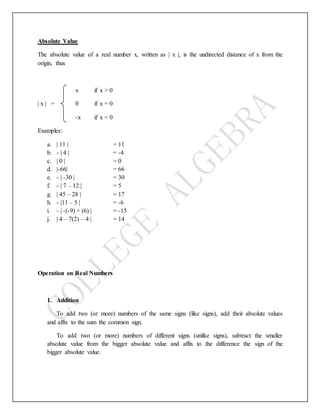
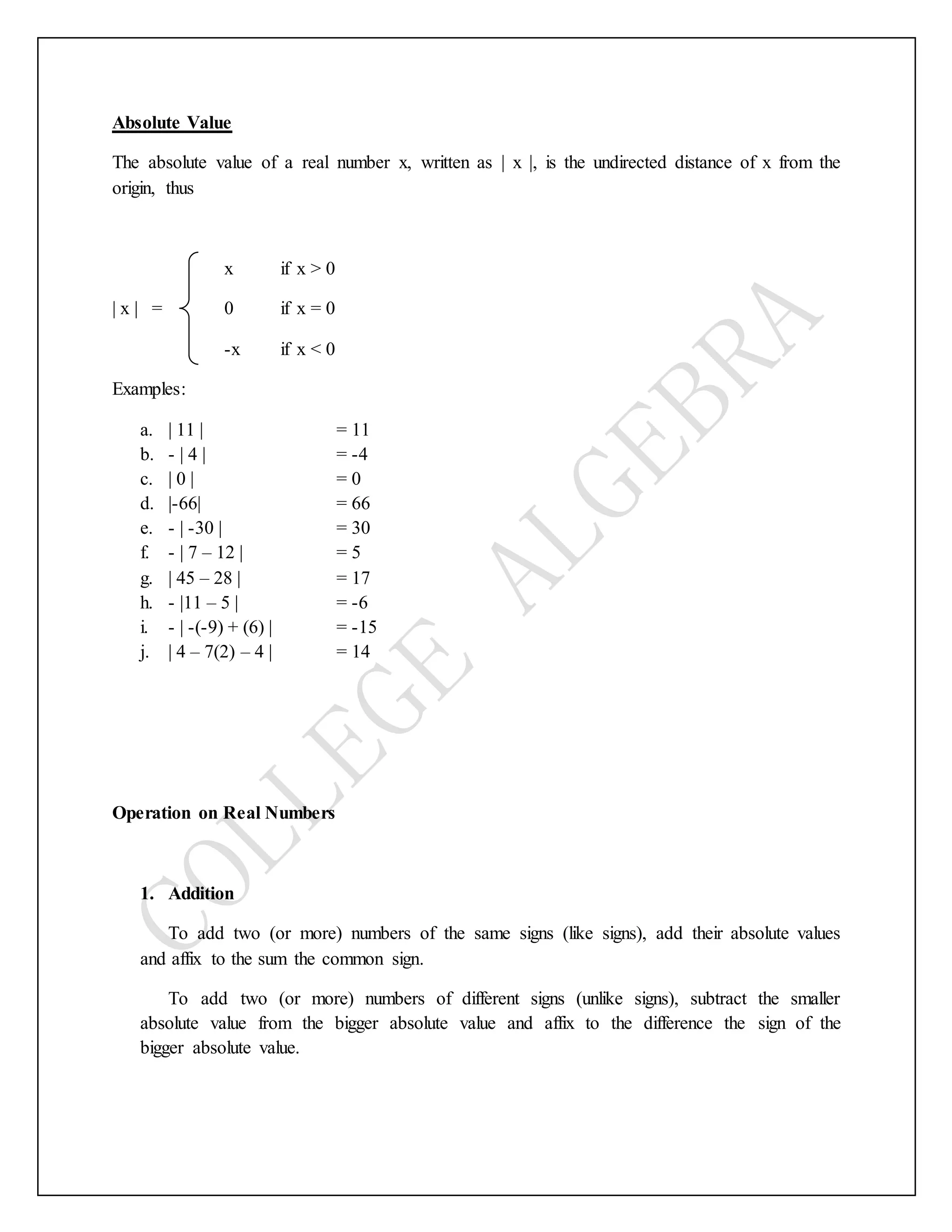
The absolute value of a real number x, written as | x |, is the undirected distance of x from the 
origin, thus 
x if x > 0 
| x | = 0 if x = 0 
-x if x < 0 
Examples: 
a. | 11 | = 11 
b. - | 4 | = -4 
c. | 0 | = 0 
d. |-66| = 66 
e. - | -30 | = 30 
f. - | 7 – 12 | = 5 
g. | 45 – 28 | = 17 
h. - |11 – 5 | = -6 
i. - | -(-9) + (6) | = -15 
j. | 4 – 7(2) – 4 | = 14 
Operation on Real Numbers 
1. Addition 
To add two (or more) numbers of the same signs (like signs), add their absolute values 
and affix to the sum the common sign. 
To add two (or more) numbers of different signs (unlike signs), subtract the smaller 
absolute value from the bigger absolute value and affix to the difference the sign of the 
bigger absolute value.
Examples: 
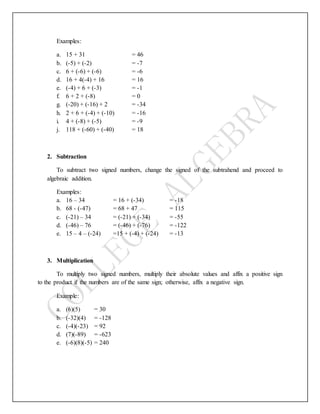
a. 15 + 31 = 46 
b. (-5) + (-2) = -7 
c. 6 + (-6) + (-6) = -6 
d. 16 + 4(-4) + 16 = 16 
e. (-4) + 6 + (-3) = -1 
f. 6 + 2 + (-8) = 0 
g. (-20) + (-16) + 2 = -34 
h. 2 + 6 + (-4) + (-10) = -16 
i. 4 + (-8) + (-5) = -9 
j. 118 + (-60) + (-40) = 18 
2. Subtraction 
To subtract two signed numbers, change the signed of the subtrahend and proceed to 
algebraic addition. 
Examples: 
a. 16 – 34 = 16 + (-34) = -18 
b. 68 - (-47) = 68 + 47 = 115 
c. (-21) – 34 = (-21) + (-34) = -55 
d. (-46) – 76 = (-46) + (-76) = -122 
e. 15 – 4 – (-24) =15 + (-4) + (-24) = -13 
3. Multiplication 
To multiply two signed numbers, multiply their absolute values and affix a positive sign 
to the product if the numbers are of the same sign; otherwise, affix a negative sign. 
Example: 
a. (6)(5) = 30 
b. (-32)(4) = -128 
c. (-4)(-23) = 92 
d. (7)(-89) = -623 
e. (-6)(8)(-5) = 240
4. Division 
To divide two signed numbers, divide their absolute values and affix a positive sign to the 
quotient if the numbers are of the same sign; otherwise, affix a negative sign. 
Examples: 
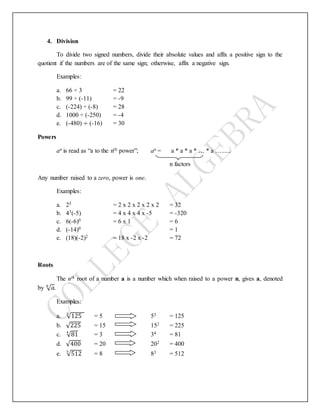
a. 66 ÷ 3 = 22 
b. 99 ÷ (-11) = -9 
c. (-224) ÷ (-8) = 28 
d. 1000 ÷ (-250) = -4 
e. (-480) ÷ (-16) = 30 
Powers 
an is read as “a to the nth power”; an = a * a * a * … * a …...... 
n factors 
Any number raised to a zero, power is one. 
Examples: 
a. 25 = 2 x 2 x 2 x 2 x 2 = 32 
b. 43(-5) = 4 x 4 x 4 x -5 = -320 
c. 6(-6)0 = 6 x 1 = 6 
d. (-14)0 = 1 
e. (18)(-2)2 = 18 x -2 x -2 = 72 
Roots 
The nth root of a number a is a number which when raised to a power n, gives a, denoted 
by √푎 푛 . 
Examples: 
a. √125 3 = 5 53 = 125 
b. √225 = 15 152 = 225 
c. √81 4 = 3 34 = 81 
d. √400 = 20 202 = 400 
e. √512 3 = 8 83 = 512

Module of integer exponents

  • 1.
    Absolute Value Theabsolute value of a real number x, written as | x |, is the undirected distance of x from the origin, thus x if x > 0 | x | = 0 if x = 0 -x if x < 0 Examples: a. | 11 | = 11 b. - | 4 | = -4 c. | 0 | = 0 d. |-66| = 66 e. - | -30 | = 30 f. - | 7 – 12 | = 5 g. | 45 – 28 | = 17 h. - |11 – 5 | = -6 i. - | -(-9) + (6) | = -15 j. | 4 – 7(2) – 4 | = 14 Operation on Real Numbers 1. Addition To add two (or more) numbers of the same signs (like signs), add their absolute values and affix to the sum the common sign. To add two (or more) numbers of different signs (unlike signs), subtract the smaller absolute value from the bigger absolute value and affix to the difference the sign of the bigger absolute value.
  • 2.
    Examples: a. 15+ 31 = 46 b. (-5) + (-2) = -7 c. 6 + (-6) + (-6) = -6 d. 16 + 4(-4) + 16 = 16 e. (-4) + 6 + (-3) = -1 f. 6 + 2 + (-8) = 0 g. (-20) + (-16) + 2 = -34 h. 2 + 6 + (-4) + (-10) = -16 i. 4 + (-8) + (-5) = -9 j. 118 + (-60) + (-40) = 18 2. Subtraction To subtract two signed numbers, change the signed of the subtrahend and proceed to algebraic addition. Examples: a. 16 – 34 = 16 + (-34) = -18 b. 68 - (-47) = 68 + 47 = 115 c. (-21) – 34 = (-21) + (-34) = -55 d. (-46) – 76 = (-46) + (-76) = -122 e. 15 – 4 – (-24) =15 + (-4) + (-24) = -13 3. Multiplication To multiply two signed numbers, multiply their absolute values and affix a positive sign to the product if the numbers are of the same sign; otherwise, affix a negative sign. Example: a. (6)(5) = 30 b. (-32)(4) = -128 c. (-4)(-23) = 92 d. (7)(-89) = -623 e. (-6)(8)(-5) = 240
  • 3.
    4. Division Todivide two signed numbers, divide their absolute values and affix a positive sign to the quotient if the numbers are of the same sign; otherwise, affix a negative sign. Examples: a. 66 ÷ 3 = 22 b. 99 ÷ (-11) = -9 c. (-224) ÷ (-8) = 28 d. 1000 ÷ (-250) = -4 e. (-480) ÷ (-16) = 30 Powers an is read as “a to the nth power”; an = a * a * a * … * a …...... n factors Any number raised to a zero, power is one. Examples: a. 25 = 2 x 2 x 2 x 2 x 2 = 32 b. 43(-5) = 4 x 4 x 4 x -5 = -320 c. 6(-6)0 = 6 x 1 = 6 d. (-14)0 = 1 e. (18)(-2)2 = 18 x -2 x -2 = 72 Roots The nth root of a number a is a number which when raised to a power n, gives a, denoted by √푎 푛 . Examples: a. √125 3 = 5 53 = 125 b. √225 = 15 152 = 225 c. √81 4 = 3 34 = 81 d. √400 = 20 202 = 400 e. √512 3 = 8 83 = 512