M O D U L E I
U N D E R S T A N D I N G
C U S T O M E R S A N D
R E L A T I O N S H I P S
1
PROF.NATARAJ, THIAGARAJAR SCHOOL OF
MANAGEMENT
Understanding Customers
2
PROF.NATARAJ, THIAGARAJAR SCHOOL OF
MANAGEMENT
 Who is your customer?
 What consumers buy?
 Why they buy?
 When they buy?
 Where they buy?
 How often they buy?
 How often they use the product?
 What are the service requirements ?
 How customer interacts with the organization?
 What are the modifications in the product / service
required by the customer?
Knowing Your Customer
3
PROF.NATARAJ, THIAGARAJAR SCHOOL OF
MANAGEMENT
• Survival mantra today is not to concentrate on Return on
Investments (ROI), but on Return on Relationships (ROR).
• The real challenge with the organizations is not only to create
customer satisfaction, but to create high customer value
ROI Vs ROR
4
PROF.NATARAJ, THIAGARAJAR SCHOOL OF
MANAGEMENT
Listening Responding Improving
Customer Care
5
PROF.NATARAJ, THIAGARAJAR SCHOOL OF
MANAGEMENT
 Organizations should have sufficiently equipped channels of
communication to listen to the customers.
 Complaint Handling Mechanism is a passive and reactive
approach.
 This should be converted into a pro-active system, where
organizations can find out innovative ways to get feedback from
the customers and respond on its own.
 The method and procedures of listening to the customer should
be accessible, easy, simple and widely communicated to the
customers.
Listening
6
PROF.NATARAJ, THIAGARAJAR SCHOOL OF
MANAGEMENT
• First of all any call from the customer must be
acknowledged.
• Customer expects a quick and appropriate response to
his call. The complaint or service request should be
handled appropriately.
Responding
7
PROF.NATARAJ, THIAGARAJAR SCHOOL OF
MANAGEMENT
• Organizations need to learn from previous experiences of
complaints and grievances, so that recurrences of problems to
the customers are minimal.
• The customer care mechanism should provide inputs to product
improvement, new product development, improvement in service
delivery system, training of manpower, campaign planning,
brand building exercises etc.
Improving
8
PROF.NATARAJ, THIAGARAJAR SCHOOL OF
MANAGEMENT
Analyze,
Segment,
Engage,
Optimize
Prof.NATARAJ,
THIAGARAJAR
SCHOOL
OF
MANAGEMENT
9
Prof.NATARAJ, THIAGARAJAR SCHOOL OF MANAGEMENT 10
RFM Analysis
11
Prof.NATARAJ, THIAGARAJAR SCHOOL OF MANAGEMENT
Airtel Vs Jio
• https://www.youtube.com/watch?v=XYOZ4RzrHW0&t=745s
Prof.NATARAJ, THIAGARAJAR SCHOOL OF MANAGEMENT 12
Customer
Portfolio
Analysis
TOP TIER, 11% OF
CUSTOMERS
THRESHOLD, NEXT
22%
FENCE SITTERS,
NEXT 39%
VALUE DESTROYERS,
BOTTOM 28%.
13
Prof.NATARAJ, THIAGARAJAR SCHOOL OF MANAGEMENT
Customer Touch Points and Moments of
Truth
 The organization and customer both
have to interact with each other.
 All these interactions represent touch
points.
 This experiences of ‘touching’ the
brand and getting associated with the
organization creates an impact in the
mind of customer. These touch points
generate ‘moments of truth’, wherein
the customer perceives the experience
of interaction with organization either
as good or bad, constructive or
destructive, positive or negative.
14
PROF.NATARAJ, THIAGARAJAR SCHOOL OF
MANAGEMENT
Customer touch
points
• Brick and Mortar
• Channel Partners
• Interaction Centers (Kiosks)
• Employees
• Promotional Campaigns
• Digital
• Web interface
• Mailers
• Mobile Communication
• Publicity- Youtube, Facebook, Instagram, Association,
Newspapers, TV,
• Intangibles
• Brand
15
PROF.NATARAJ, THIAGARAJAR SCHOOL OF
MANAGEMENT
Customer Loyalty and Customer
Advocacy
 The ultimate purpose of any customer care
system is to generate customer satisfaction.
 A satisfied customer spreads the positive word
of mouth and gets emotionally attached to the
product/service/organization.
 Customer advocacy is much more and beyond
customer satisfaction, as in this stage customer
becomes the ambassador of the product /
service, which adds to the credibility and image
of the organization.
 Customer advocacy can be the ideal stage that
the organization can dream to achieve.
16
PROF.NATARAJ, THIAGARAJAR SCHOOL OF
MANAGEMENT
• Seamlessness
• Trustworthiness
• Attentiveness
• Resourcefulness
Value of a Loyal Customer Base
17
PROF.NATARAJ, THIAGARAJAR SCHOOL OF
MANAGEMENT
Value Creation
18
PROF.NATARAJ, THIAGARAJAR SCHOOL OF
MANAGEMENT
Customer Life Cycle (CLC)
19
PROF.NATARAJ, THIAGARAJAR SCHOOL OF
MANAGEMENT
CLC Marketing
20
PROF.NATARAJ, THIAGARAJAR SCHOOL OF
MANAGEMENT
DATA GENERATED PER SECOND
"it’s estimated that 1.7 MB of data will be created every second for every
person on earth."
21
Prof.NATARAJ, THIAGARAJAR SCHOOL OF MANAGEMENT
Decisions to
be Data Driven
• Net Promoter Score (NPS)
• Customer Acquisition Cost (CAC)
• Customer Lifetime Value (CLV)
• CAC-to-CLV
• Customer Satisfaction Score (CSAT)
• Customer Effort Score (CES)
• Customer Retention Rate
• First Contact Resolution
• Average Ticket Time
22
Prof.NATARAJ, THIAGARAJAR SCHOOL OF MANAGEMENT
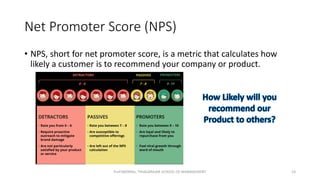
Net Promoter Score (NPS)
• NPS, short for net promoter score, is a metric that calculates how
likely a customer is to recommend your company or product.
How Likely will you
recommend our
Product to others?
23
Prof.NATARAJ, THIAGARAJAR SCHOOL OF MANAGEMENT
Net Promoter Score., Contd.,
• Count the number of
promoters, passives, and
detractors you have, and
enter those numbers
• The percentage of
detractors is subtracted
from the percentage
of promoters to give an
NPS.
• Anything above zero is
good, while anything below
zero suggests you need to
make improvements
24
Prof.NATARAJ, THIAGARAJAR SCHOOL OF MANAGEMENT
How to Get NPS Data
• To get the raw data, send out a survey to existing customers, asking
them to rate how likely they would be to recommend your product or
service to a friend or colleague.
25
Prof.NATARAJ, THIAGARAJAR SCHOOL OF MANAGEMENT
Customer Acquisition
Cost
• Customer acquisition cost, or CAC, is the amount of
money spent on sales and marketing required to
close a deal.
• It is calculated by summing a company's total sales
and marketing spend and dividing it by the number
of new customers.
• Companies can calculate CAC for a given time
period or all time, and is helpful to compare the
effectiveness of different marketing tactics and
strategies.
• A lower CAC is better, as it suggests your marketing
and sales teams are efficient and properly scaled.
26
Prof.NATARAJ, THIAGARAJAR SCHOOL OF MANAGEMENT
Customer Lifetime Value
(CLV)
• Customer lifetime value equates to revenue an
average customer will provide a company
before they discontinue their patronage.
• simple CLV formula
• multiply average annual revenue by the
average lifespan of a customer.
27
Prof.NATARAJ, THIAGARAJAR SCHOOL OF MANAGEMENT
Customer Satisfaction
Score (CSAT)
• Similar to NPS, customer satisfaction score
(CSAT) measures how happy your customers
are.
• Enter how many responses each option
receives, and the CSAT will appear in the
labeled cell.
• If you run a survey from 1-5, 1-7, etc., leave
the cells outside the range of the scale blank
28
Prof.NATARAJ, THIAGARAJAR SCHOOL OF MANAGEMENT
How to get Data
for CSAT?
Run a survey asking customers
how satisfied they are on a sale
from 1 to up to 10.
29
Prof.NATARAJ, THIAGARAJAR SCHOOL OF MANAGEMENT
Customer Effort Score
(CES)
• Customer effort score (CES) is a metric to show
how much effort was required from customers
to solve a problem and/or find information
they're looking for.
• A high CES might suggest customers take a
long time to find the resources they need,
indicating your company may need a
knowledge base for easy problem-solving
documentation to be stored.
30
Prof.NATARAJ, THIAGARAJAR SCHOOL OF MANAGEMENT
How to Get Data?
• You can prompt CES surveys
on customer
training/documentation
pages, after support phone
calls, on chatbots, or in
customer support emails.
31
Prof.NATARAJ, THIAGARAJAR SCHOOL OF MANAGEMENT
CAC-to-CLV
• This metric compares the customer's acquisition
cost to the revenue that customer will provide
over time.
• It helps businesses know if customers churn
before they start contributing profit to the
company.
• Support leaders can use this information to
discover if they need to invest more in customer
support tools if this is the case.
32
Prof.NATARAJ, THIAGARAJAR SCHOOL OF MANAGEMENT
Customer Retention
Rate
• Customer retention rate designates
the percentage of customers the company has
retained over a given time period
• High Retention Rate means you're keeping
most of your clients and customers happy.
• FORMULA
• Customers at the End of the Period- New
Customers Acquired in the Period)/ Customers
at the Start of the Period
33
Prof.NATARAJ, THIAGARAJAR SCHOOL OF MANAGEMENT
How to Get Data?
• Choose a specific period of time – one year, one month, all time, etc.
– and be consistent in entering the metrics from that time for
accuracy.
34
Prof.NATARAJ, THIAGARAJAR SCHOOL OF MANAGEMENT
Why Companies want relationship
with Customers?
35
Prof.NATARAJ, THIAGARAJAR SCHOOL OF MANAGEMENT
Retention Rate and Average Customer tenure
36
Prof.NATARAJ, THIAGARAJAR SCHOOL OF MANAGEMENT
Customer Churn Rate
• Customer Churn Rate is a metric
used to see how many customers
have stopped coming to your
business or have cancelled their
membership, subscription,
or patronage.
37
Prof.NATARAJ, THIAGARAJAR SCHOOL OF MANAGEMENT
B2B Marketing Metrics
Metric Name How to compute What it means if the
number increases
Bench marks
CAC (Customer
Acquisition Cost)
All sales and marketing
costs (advertising, salary,
commission, bonus) in a
period divided by number
of new customers in that
period
You are spending more
for each new customer
and/ or your sales and
marketing might be less
efficient.
Highly dependent on
industry and price point
Marketing % of CAC Take all the marketing
cost and divide by the
total sales and marketing
costs you used to
compute CAC
1. Your sales team
underperformed
2. Your marketing team
overspent
3. Your marketing team
is exaggerates the
forecast and sales
team could not meet
up the expectation
10 – 30% is desirable.
38
Prof.NATARAJ, THIAGARAJAR SCHOOL OF MANAGEMENT
Metric Name How to compute What it means if the
number increases
Bench marks
LTV: CAC LTV/ CAC Higher the better
Higher ratio means
higher ROI on sales and
marketing
3:1 is a good target, for
every 1 rupee you spent
you are getting a life
time value of 3 rupees
4:1 or higher indicates a
better model
Time to payback Take the CAC and divide
by how much your
customers pay you on
average each month.
A higher payback means
it takes longer time to
earn back the CAC.
Under 6 months means
you are underinvesting
in sales and marketing
9-18 months is ideal
More than 18 months is
problematic
39
Prof.NATARAJ, THIAGARAJAR SCHOOL OF MANAGEMENT
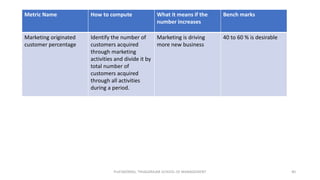
Metric Name How to compute What it means if the
number increases
Bench marks
Marketing originated
customer percentage
Identify the number of
customers acquired
through marketing
activities and divide it by
total number of
customers acquired
through all activities
during a period.
Marketing is driving
more new business
40 to 60 % is desirable
40
Prof.NATARAJ, THIAGARAJAR SCHOOL OF MANAGEMENT
Computing Cohort value
41
Prof.NATARAJ, THIAGARAJAR SCHOOL OF MANAGEMENT
INSIGHTS
FROM
ANALYSIS
In year 1 the company lost 40 per cent of
these new customers,
but the remaining 60 per cent each
generated $50 contribution to profit.
If this is discounted at 15 per cent, in
year 0’s currency each retained
customer’s profit contribution is $43.48.
In year 2, the retention rate rises from 60
to 70 per cent, and each of the remaining
customers contributes $70 ($52.93 at
discounted rate) to profit.
42
Prof.NATARAJ, THIAGARAJAR SCHOOL OF MANAGEMENT
INSIGHTS
FROM
ANALYSIS
You can see from the right
hand column in Figure 2.5 that it takes
nearly five years to recover the
investment of acquiring this cohort.
The data demonstrate two well-
established phenomena. First, profit
per customer rises over time,
Secondly, customer retention rate rises
over time. It is feasible to use data
such as these to manage a business for
improved profitability.
43
Prof.NATARAJ, THIAGARAJAR SCHOOL OF MANAGEMENT
Strategies
1. Improve customer retention rate in
the early years of the relationship.
This will produce a larger number of
customers to generate higher
profits in the later years.
2. Increase the profit earned per
customer by:
reducing cost-to-serve
cross-selling or up-selling additional products
and services.
3. Become better at customer
acquisition by:
using more cost effective recruitment
channels
better qualification of prospects.
44
Prof.NATARAJ, THIAGARAJAR SCHOOL OF MANAGEMENT
BREAK OUT ROOM
• CRM Done Right
45
Prof.NATARAJ, THIAGARAJAR SCHOOL OF MANAGEMENT
Discussion Questions CRM Done Right
• What do you understand from CRM Cycle?
• Do the organization need perfect data for CRM?
• Write short notes on Routine Aches Vs Strategic Pain Points
• How to calculate the Cost of CRM?
• What is the meaning behind business before technology?
• MBA
• https://forms.gle/HTmDZRnuvpKd9cJN9
• PGDM
• https://forms.gle/KMb7gsGK7o2E65aa6
46
Prof.NATARAJ, THIAGARAJAR SCHOOL OF MANAGEMENT
Understanding
Relationships
47
Prof.NATARAJ, THIAGARAJAR SCHOOL OF MANAGEMENT
By the end
You will
understand
how to recognize a relationship
attributes of successful relationships
the importance of trust and commitment within a
relationship
why companies and customers are sometimes
motivated to establish and maintain relationships
with each other, and sometimes not
48
PROF.NATARAJ, THIAGARAJAR SCHOOL OF
MANAGEMENT
Put Relationship Back in to CRM
• Read the Article and submit your responses
• MBA
• https://forms.gle/RpaBp44WCtHMaotY7
• PGDM
• https://forms.gle/wteSrLbRd3V4eJZ77
PROF.NATARAJ, THIAGARAJAR SCHOOL OF
MANAGEMENT
49
MAGGI!!!!!!!
• https://www.youtube.com/watch?v=r5OCFaXqS5I
Prof.NATARAJ, THIAGARAJAR SCHOOL OF MANAGEMENT 50
What is
relationship?
• A relationship is composed of a series of
interactive episodes between dyadic parties over
time.
• Let’s be clear about what is meant by ‘ interactive
episode ’ . Episodes are time bound (they have a
beginning and an end) and are nameable.
• Within a sales representative–customer
relationship it is often possible to identify a few
discrete episodes, such as
• making a purchase,
• Enquiring about a product,
• making a sales call, negotiating terms, dealing
with a complaint,
• resolving dispute
51
PROF.NATARAJ, THIAGARAJAR SCHOOL OF
MANAGEMENT
Dwyer has identified five general phases through
which customer– Firm relationships can evolve
Awareness
01
Exploration
02
Expansion
03
Commitment
04
Dissolution.
05
52
PROF.NATARAJ, THIAGARAJAR SCHOOL OF
MANAGEMENT
Contd.,
• Awareness is when each
party comes to the attention
of the other as a possible
exchange partner.
• Exploration is the period of
investigation and testing
during which the parties
explore each other's- trial
purchases
53
PROF.NATARAJ, THIAGARAJAR SCHOOL OF
MANAGEMENT
The
exploration phase
has five
subprocesses:
Attraction,
Communication
Bargaining,
Development
and exercise of
power,
Development
of norms,
Development of
expectations.
54
PROF.NATARAJ, THIAGARAJAR SCHOOL OF
MANAGEMENT
• Expansion is the phase in which there increasing interdependence.
• More transactions take place and trust begins to develop.
• The commitment phase is characterized by
• increased adaptation and mutually understood roles and goals.
• Purchasing processes that have become automated are a sure sign
of commitment.
• Not all relationships reach the commitment phase.
55
PROF.NATARAJ, THIAGARAJAR SCHOOL OF
MANAGEMENT
• Customers may exit relationships for many reasons, such as
• Repeated service failures or
• changed product requirements.
• Relationship development highlights two attributes of highly
developed relationships:
• Trust and Commitment.
56
PROF.NATARAJ, THIAGARAJAR SCHOOL OF
MANAGEMENT
Trust
• Trust is focused. That is, although there
may be a generalized sense
of confidence and security, these feelings
are directed. One party may trust the
other party’s
• benevolence : a belief that one party
acts in the interests of the other
• honesty : a belief that the other party’s
word is reliable or credible
• competence : a belief that the other
party has the necessary expertise to
perform as required.
57
PROF.NATARAJ, THIAGARAJAR SCHOOL OF
MANAGEMENT
Scam-1992
• https://www.youtube.com/shorts/9WqBm4mo8e4
PROF.NATARAJ, THIAGARAJAR SCHOOL OF
MANAGEMENT
58
Trust
PROF.NATARAJ, THIAGARAJAR SCHOOL OF MANAGEMENT 59
The development of trust is an
investment in relationship building
which has a long-term payoff.
Trust emerges as parties share
experiences, and interpret and assess
each other’s motives.
Trust has been described as the glue
that holds a relationship together
across time and experience
calculus-
based trust :
PROF.NATARAJ, THIAGARAJAR SCHOOL OF MANAGEMENT 60
this is present in the early stages of a
relationship and is quite calculative.
It is as if one party says: ‘ I trust you
because of what I am gaining or
expect to gain from the relationship ’ .
The outcomes of creating and
maintaining the new relationship are
weighed against those of dissolving it.
knowledge-based
trust
• this relies on the individual
parties ’ interactive history
and knowledge of each other,
allowing each to make
accurate predictions about
how the other will act
PROF.NATARAJ, THIAGARAJAR SCHOOL OF MANAGEMENT 61
Identification-
based trust
this happens when mutual
understanding
is so deep that each can act as
substitute for the other in
interpersonal interaction.
This is found in the later stages of
relationship development
62
PROF.NATARAJ, THIAGARAJAR SCHOOL OF
MANAGEMENT
Commitment
Commitment is shown by ‘ an
exchange partner believing that an
ongoing relationship with another is
so important as to warrant maximum
effort to maintain it;
that is, the committed party
believes the relationship is worth
working on to ensure that it
endures indefinitely ’
63
PROF.NATARAJ, THIAGARAJAR SCHOOL OF
MANAGEMENT
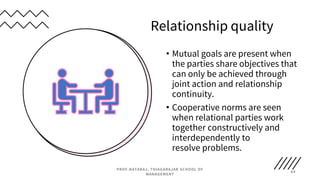
Relationship quality
• Mutual goals are present when
the parties share objectives that
can only be achieved through
joint action and relationship
continuity.
• Cooperative norms are seen
when relational parties work
together constructively and
interdependently to
resolve problems.
64
PROF.NATARAJ, THIAGARAJAR SCHOOL OF
MANAGEMENT
Why Companies want relationship with
Customers?
65
PROF.NATARAJ, THIAGARAJAR SCHOOL OF
MANAGEMENT
CASE: Consequences of customer churn at
Sprint Nextel
• Sprint Nextel, the third largest wireless telecommunications fi rm in the USA, is
downsizing its workforce by 4000 jobs and closing 125 stores in the first half of 2008.
• The moves are part of cost-saving measures prompted by anticipated decreases in the
firm’s subscriber base, revenues and profitability in the fourth quarter of 2007. The firm
expects to save $700 to $800 million annually by cutting the jobs.
• Sprint Nextel lost 190 000 subscribers and 683 000 ‘ post-paid ’ customers during the
fourth quarter of 2007.
• The subscriber losses are being attributed to a slowdown in the growth of wireless
subscriptions in the USA, and continuing customer defection to larger rivals AT &
T Mobile and Verizon Wireless since Sprint bought Nextel Communications for $36
billion in 2005.
• The firm is also struggling with service quality problems. On this news, shares of Sprint
Nextel fell to their lowest price since October 2002.
66
PROF.NATARAJ, THIAGARAJAR SCHOOL OF
MANAGEMENT
C U S T O M E R
I N S I G H T
67
PROF.NATARAJ, THIAGARAJAR SCHOOL OF
MANAGEMENT
Why companies Want relationship with
Customers?
• Reduced Marketing Cost
• Better Customer Insight
• Revenues Grow
• Cost to serve is low
• Referrals are generated
• Higher prices are paid
68
PROF.NATARAJ, THIAGARAJAR SCHOOL OF
MANAGEMENT
Profit Grow Over time
69
PROF.NATARAJ, THIAGARAJAR SCHOOL OF
MANAGEMENT
Why Customers want relationship with
Companies B2C Context
Recognition Personalization Power
Risk Reduction Status Affiliation
70
PROF.NATARAJ, THIAGARAJAR SCHOOL OF
MANAGEMENT
B2B Context.
PRODUCT
COMPLEXITY
PRODUCT STRATEGIC
SIGNIFICANCE
SERVICE
REQUIREMENTS
RECIPROCITY
71
PROF.NATARAJ, THIAGARAJAR SCHOOL OF
MANAGEMENT
CRM RE
• https://makeityours.royalenfield.com/configurator/supernova
• https://forms.gle/oc69qLjMDCXdEBBv7 - PGDM
• https://forms.gle/F2hkz8i5DujuTpdx8- MBA
72
PROF.NATARAJ, THIAGARAJAR SCHOOL OF
MANAGEMENT
Why customers
do not want
relationship with
companies?- B2C
• Ill Treated
• Dishonesty
• Lack of confidence
• Availability of substitutes
• Price
• Quality
• Change
PROF.NATARAJ, THIAGARAJAR SCHOOL OF MANAGEMENT 73
B2B
• Fear of dependency
• Lack of perceived value in
relationship
• Lack of confidence in supplier
• Customer lacks relational
orientation
• Rapid technological changes
74
PROF.NATARAJ, THIAGARAJAR SCHOOL OF
MANAGEMENT
Why companies do not want relationship
with customers?
•B2B Context
• Loss of control
• Cost
• Resource Commitment
• Opportunity cost
75
PROF.NATARAJ, THIAGARAJAR SCHOOL OF
MANAGEMENT
Customer Loyalty
• Behavioral Loyalty
• Attitudinal Loyalty
76
PROF.NATARAJ, THIAGARAJAR SCHOOL OF
MANAGEMENT
Behavioural Loyalty
• Many direct marketing companies use RFM measures of
behavioural loyalty.
• The most loyal are those who have high scores on the
three behavioural variables:
• recency of purchases (R),
• frequency of purchases (F) and
• monetary value of purchases (M).
77
PROF.NATARAJ, THIAGARAJAR SCHOOL OF
MANAGEMENT
The variables are measured as follows:
• R time elapsed since last purchase
• F number of purchases in a given time period
• M monetary value of purchases in a given time period.
78
PROF.NATARAJ, THIAGARAJAR SCHOOL OF
MANAGEMENT
Attitudinal Loyalty
• Attitudinal loyalty is measured
by reference to components of
attitude such as beliefs, feelings
and purchasing intention.
• Those customers who have a
stronger preference for,
involvement in, or commitment
to a supplier are the more loyal
in attitudinal terms.
79
PROF.NATARAJ, THIAGARAJAR SCHOOL OF
MANAGEMENT
Dick Basu's Model
80
PROF.NATARAJ, THIAGARAJAR SCHOOL OF
MANAGEMENT
• The best known is Dick and Basu’s model,
• as shown in four forms of loyalty, according to relative attitudinal
strength and repeat purchase behaviour.
• ‘ Loyals ’
• are those who have high levels of repeat buying and a
strong relative attitude. ‘
• 'Spurious loyals ’
• have high levels of repeat purchase but weak relative attitude. Their
repeat purchasing can be explained by inertia, high switching costs
or indifference.
81
PROF.NATARAJ, THIAGARAJAR SCHOOL OF
MANAGEMENT
Latent loyalty
• Exists when a strong relative
attitude is not accompanied
by repeat buying.
• This might be evidence of
weakness in the
company’s distribution
strategy, the product or service
not being available when and
where customers want.
82
PROF.NATARAJ, THIAGARAJAR SCHOOL OF
MANAGEMENT

Module I_Understanding Customers.pdf

  • 1.
    M O DU L E I U N D E R S T A N D I N G C U S T O M E R S A N D R E L A T I O N S H I P S 1 PROF.NATARAJ, THIAGARAJAR SCHOOL OF MANAGEMENT
  • 2.
  • 3.
     Who isyour customer?  What consumers buy?  Why they buy?  When they buy?  Where they buy?  How often they buy?  How often they use the product?  What are the service requirements ?  How customer interacts with the organization?  What are the modifications in the product / service required by the customer? Knowing Your Customer 3 PROF.NATARAJ, THIAGARAJAR SCHOOL OF MANAGEMENT
  • 4.
    • Survival mantratoday is not to concentrate on Return on Investments (ROI), but on Return on Relationships (ROR). • The real challenge with the organizations is not only to create customer satisfaction, but to create high customer value ROI Vs ROR 4 PROF.NATARAJ, THIAGARAJAR SCHOOL OF MANAGEMENT
  • 5.
    Listening Responding Improving CustomerCare 5 PROF.NATARAJ, THIAGARAJAR SCHOOL OF MANAGEMENT
  • 6.
     Organizations shouldhave sufficiently equipped channels of communication to listen to the customers.  Complaint Handling Mechanism is a passive and reactive approach.  This should be converted into a pro-active system, where organizations can find out innovative ways to get feedback from the customers and respond on its own.  The method and procedures of listening to the customer should be accessible, easy, simple and widely communicated to the customers. Listening 6 PROF.NATARAJ, THIAGARAJAR SCHOOL OF MANAGEMENT
  • 7.
    • First ofall any call from the customer must be acknowledged. • Customer expects a quick and appropriate response to his call. The complaint or service request should be handled appropriately. Responding 7 PROF.NATARAJ, THIAGARAJAR SCHOOL OF MANAGEMENT
  • 8.
    • Organizations needto learn from previous experiences of complaints and grievances, so that recurrences of problems to the customers are minimal. • The customer care mechanism should provide inputs to product improvement, new product development, improvement in service delivery system, training of manpower, campaign planning, brand building exercises etc. Improving 8 PROF.NATARAJ, THIAGARAJAR SCHOOL OF MANAGEMENT
  • 9.
  • 10.
  • 11.
  • 12.
    Airtel Vs Jio •https://www.youtube.com/watch?v=XYOZ4RzrHW0&t=745s Prof.NATARAJ, THIAGARAJAR SCHOOL OF MANAGEMENT 12
  • 13.
    Customer Portfolio Analysis TOP TIER, 11%OF CUSTOMERS THRESHOLD, NEXT 22% FENCE SITTERS, NEXT 39% VALUE DESTROYERS, BOTTOM 28%. 13 Prof.NATARAJ, THIAGARAJAR SCHOOL OF MANAGEMENT
  • 14.
    Customer Touch Pointsand Moments of Truth  The organization and customer both have to interact with each other.  All these interactions represent touch points.  This experiences of ‘touching’ the brand and getting associated with the organization creates an impact in the mind of customer. These touch points generate ‘moments of truth’, wherein the customer perceives the experience of interaction with organization either as good or bad, constructive or destructive, positive or negative. 14 PROF.NATARAJ, THIAGARAJAR SCHOOL OF MANAGEMENT
  • 15.
    Customer touch points • Brickand Mortar • Channel Partners • Interaction Centers (Kiosks) • Employees • Promotional Campaigns • Digital • Web interface • Mailers • Mobile Communication • Publicity- Youtube, Facebook, Instagram, Association, Newspapers, TV, • Intangibles • Brand 15 PROF.NATARAJ, THIAGARAJAR SCHOOL OF MANAGEMENT
  • 16.
    Customer Loyalty andCustomer Advocacy  The ultimate purpose of any customer care system is to generate customer satisfaction.  A satisfied customer spreads the positive word of mouth and gets emotionally attached to the product/service/organization.  Customer advocacy is much more and beyond customer satisfaction, as in this stage customer becomes the ambassador of the product / service, which adds to the credibility and image of the organization.  Customer advocacy can be the ideal stage that the organization can dream to achieve. 16 PROF.NATARAJ, THIAGARAJAR SCHOOL OF MANAGEMENT
  • 17.
    • Seamlessness • Trustworthiness •Attentiveness • Resourcefulness Value of a Loyal Customer Base 17 PROF.NATARAJ, THIAGARAJAR SCHOOL OF MANAGEMENT
  • 18.
  • 19.
    Customer Life Cycle(CLC) 19 PROF.NATARAJ, THIAGARAJAR SCHOOL OF MANAGEMENT
  • 20.
  • 21.
    DATA GENERATED PERSECOND "it’s estimated that 1.7 MB of data will be created every second for every person on earth." 21 Prof.NATARAJ, THIAGARAJAR SCHOOL OF MANAGEMENT
  • 22.
    Decisions to be DataDriven • Net Promoter Score (NPS) • Customer Acquisition Cost (CAC) • Customer Lifetime Value (CLV) • CAC-to-CLV • Customer Satisfaction Score (CSAT) • Customer Effort Score (CES) • Customer Retention Rate • First Contact Resolution • Average Ticket Time 22 Prof.NATARAJ, THIAGARAJAR SCHOOL OF MANAGEMENT
  • 23.
    Net Promoter Score(NPS) • NPS, short for net promoter score, is a metric that calculates how likely a customer is to recommend your company or product. How Likely will you recommend our Product to others? 23 Prof.NATARAJ, THIAGARAJAR SCHOOL OF MANAGEMENT
  • 24.
    Net Promoter Score.,Contd., • Count the number of promoters, passives, and detractors you have, and enter those numbers • The percentage of detractors is subtracted from the percentage of promoters to give an NPS. • Anything above zero is good, while anything below zero suggests you need to make improvements 24 Prof.NATARAJ, THIAGARAJAR SCHOOL OF MANAGEMENT
  • 25.
    How to GetNPS Data • To get the raw data, send out a survey to existing customers, asking them to rate how likely they would be to recommend your product or service to a friend or colleague. 25 Prof.NATARAJ, THIAGARAJAR SCHOOL OF MANAGEMENT
  • 26.
    Customer Acquisition Cost • Customeracquisition cost, or CAC, is the amount of money spent on sales and marketing required to close a deal. • It is calculated by summing a company's total sales and marketing spend and dividing it by the number of new customers. • Companies can calculate CAC for a given time period or all time, and is helpful to compare the effectiveness of different marketing tactics and strategies. • A lower CAC is better, as it suggests your marketing and sales teams are efficient and properly scaled. 26 Prof.NATARAJ, THIAGARAJAR SCHOOL OF MANAGEMENT
  • 27.
    Customer Lifetime Value (CLV) •Customer lifetime value equates to revenue an average customer will provide a company before they discontinue their patronage. • simple CLV formula • multiply average annual revenue by the average lifespan of a customer. 27 Prof.NATARAJ, THIAGARAJAR SCHOOL OF MANAGEMENT
  • 28.
    Customer Satisfaction Score (CSAT) •Similar to NPS, customer satisfaction score (CSAT) measures how happy your customers are. • Enter how many responses each option receives, and the CSAT will appear in the labeled cell. • If you run a survey from 1-5, 1-7, etc., leave the cells outside the range of the scale blank 28 Prof.NATARAJ, THIAGARAJAR SCHOOL OF MANAGEMENT
  • 29.
    How to getData for CSAT? Run a survey asking customers how satisfied they are on a sale from 1 to up to 10. 29 Prof.NATARAJ, THIAGARAJAR SCHOOL OF MANAGEMENT
  • 30.
    Customer Effort Score (CES) •Customer effort score (CES) is a metric to show how much effort was required from customers to solve a problem and/or find information they're looking for. • A high CES might suggest customers take a long time to find the resources they need, indicating your company may need a knowledge base for easy problem-solving documentation to be stored. 30 Prof.NATARAJ, THIAGARAJAR SCHOOL OF MANAGEMENT
  • 31.
    How to GetData? • You can prompt CES surveys on customer training/documentation pages, after support phone calls, on chatbots, or in customer support emails. 31 Prof.NATARAJ, THIAGARAJAR SCHOOL OF MANAGEMENT
  • 32.
    CAC-to-CLV • This metriccompares the customer's acquisition cost to the revenue that customer will provide over time. • It helps businesses know if customers churn before they start contributing profit to the company. • Support leaders can use this information to discover if they need to invest more in customer support tools if this is the case. 32 Prof.NATARAJ, THIAGARAJAR SCHOOL OF MANAGEMENT
  • 33.
    Customer Retention Rate • Customerretention rate designates the percentage of customers the company has retained over a given time period • High Retention Rate means you're keeping most of your clients and customers happy. • FORMULA • Customers at the End of the Period- New Customers Acquired in the Period)/ Customers at the Start of the Period 33 Prof.NATARAJ, THIAGARAJAR SCHOOL OF MANAGEMENT
  • 34.
    How to GetData? • Choose a specific period of time – one year, one month, all time, etc. – and be consistent in entering the metrics from that time for accuracy. 34 Prof.NATARAJ, THIAGARAJAR SCHOOL OF MANAGEMENT
  • 35.
    Why Companies wantrelationship with Customers? 35 Prof.NATARAJ, THIAGARAJAR SCHOOL OF MANAGEMENT
  • 36.
    Retention Rate andAverage Customer tenure 36 Prof.NATARAJ, THIAGARAJAR SCHOOL OF MANAGEMENT
  • 37.
    Customer Churn Rate •Customer Churn Rate is a metric used to see how many customers have stopped coming to your business or have cancelled their membership, subscription, or patronage. 37 Prof.NATARAJ, THIAGARAJAR SCHOOL OF MANAGEMENT
  • 38.
    B2B Marketing Metrics MetricName How to compute What it means if the number increases Bench marks CAC (Customer Acquisition Cost) All sales and marketing costs (advertising, salary, commission, bonus) in a period divided by number of new customers in that period You are spending more for each new customer and/ or your sales and marketing might be less efficient. Highly dependent on industry and price point Marketing % of CAC Take all the marketing cost and divide by the total sales and marketing costs you used to compute CAC 1. Your sales team underperformed 2. Your marketing team overspent 3. Your marketing team is exaggerates the forecast and sales team could not meet up the expectation 10 – 30% is desirable. 38 Prof.NATARAJ, THIAGARAJAR SCHOOL OF MANAGEMENT
  • 39.
    Metric Name Howto compute What it means if the number increases Bench marks LTV: CAC LTV/ CAC Higher the better Higher ratio means higher ROI on sales and marketing 3:1 is a good target, for every 1 rupee you spent you are getting a life time value of 3 rupees 4:1 or higher indicates a better model Time to payback Take the CAC and divide by how much your customers pay you on average each month. A higher payback means it takes longer time to earn back the CAC. Under 6 months means you are underinvesting in sales and marketing 9-18 months is ideal More than 18 months is problematic 39 Prof.NATARAJ, THIAGARAJAR SCHOOL OF MANAGEMENT
  • 40.
    Metric Name Howto compute What it means if the number increases Bench marks Marketing originated customer percentage Identify the number of customers acquired through marketing activities and divide it by total number of customers acquired through all activities during a period. Marketing is driving more new business 40 to 60 % is desirable 40 Prof.NATARAJ, THIAGARAJAR SCHOOL OF MANAGEMENT
  • 41.
    Computing Cohort value 41 Prof.NATARAJ,THIAGARAJAR SCHOOL OF MANAGEMENT
  • 42.
    INSIGHTS FROM ANALYSIS In year 1the company lost 40 per cent of these new customers, but the remaining 60 per cent each generated $50 contribution to profit. If this is discounted at 15 per cent, in year 0’s currency each retained customer’s profit contribution is $43.48. In year 2, the retention rate rises from 60 to 70 per cent, and each of the remaining customers contributes $70 ($52.93 at discounted rate) to profit. 42 Prof.NATARAJ, THIAGARAJAR SCHOOL OF MANAGEMENT
  • 43.
    INSIGHTS FROM ANALYSIS You can seefrom the right hand column in Figure 2.5 that it takes nearly five years to recover the investment of acquiring this cohort. The data demonstrate two well- established phenomena. First, profit per customer rises over time, Secondly, customer retention rate rises over time. It is feasible to use data such as these to manage a business for improved profitability. 43 Prof.NATARAJ, THIAGARAJAR SCHOOL OF MANAGEMENT
  • 44.
    Strategies 1. Improve customerretention rate in the early years of the relationship. This will produce a larger number of customers to generate higher profits in the later years. 2. Increase the profit earned per customer by: reducing cost-to-serve cross-selling or up-selling additional products and services. 3. Become better at customer acquisition by: using more cost effective recruitment channels better qualification of prospects. 44 Prof.NATARAJ, THIAGARAJAR SCHOOL OF MANAGEMENT
  • 45.
    BREAK OUT ROOM •CRM Done Right 45 Prof.NATARAJ, THIAGARAJAR SCHOOL OF MANAGEMENT
  • 46.
    Discussion Questions CRMDone Right • What do you understand from CRM Cycle? • Do the organization need perfect data for CRM? • Write short notes on Routine Aches Vs Strategic Pain Points • How to calculate the Cost of CRM? • What is the meaning behind business before technology? • MBA • https://forms.gle/HTmDZRnuvpKd9cJN9 • PGDM • https://forms.gle/KMb7gsGK7o2E65aa6 46 Prof.NATARAJ, THIAGARAJAR SCHOOL OF MANAGEMENT
  • 47.
  • 48.
    By the end Youwill understand how to recognize a relationship attributes of successful relationships the importance of trust and commitment within a relationship why companies and customers are sometimes motivated to establish and maintain relationships with each other, and sometimes not 48 PROF.NATARAJ, THIAGARAJAR SCHOOL OF MANAGEMENT
  • 49.
    Put Relationship Backin to CRM • Read the Article and submit your responses • MBA • https://forms.gle/RpaBp44WCtHMaotY7 • PGDM • https://forms.gle/wteSrLbRd3V4eJZ77 PROF.NATARAJ, THIAGARAJAR SCHOOL OF MANAGEMENT 49
  • 50.
  • 51.
    What is relationship? • Arelationship is composed of a series of interactive episodes between dyadic parties over time. • Let’s be clear about what is meant by ‘ interactive episode ’ . Episodes are time bound (they have a beginning and an end) and are nameable. • Within a sales representative–customer relationship it is often possible to identify a few discrete episodes, such as • making a purchase, • Enquiring about a product, • making a sales call, negotiating terms, dealing with a complaint, • resolving dispute 51 PROF.NATARAJ, THIAGARAJAR SCHOOL OF MANAGEMENT
  • 52.
    Dwyer has identifiedfive general phases through which customer– Firm relationships can evolve Awareness 01 Exploration 02 Expansion 03 Commitment 04 Dissolution. 05 52 PROF.NATARAJ, THIAGARAJAR SCHOOL OF MANAGEMENT
  • 53.
    Contd., • Awareness iswhen each party comes to the attention of the other as a possible exchange partner. • Exploration is the period of investigation and testing during which the parties explore each other's- trial purchases 53 PROF.NATARAJ, THIAGARAJAR SCHOOL OF MANAGEMENT
  • 54.
    The exploration phase has five subprocesses: Attraction, Communication Bargaining, Development andexercise of power, Development of norms, Development of expectations. 54 PROF.NATARAJ, THIAGARAJAR SCHOOL OF MANAGEMENT
  • 55.
    • Expansion isthe phase in which there increasing interdependence. • More transactions take place and trust begins to develop. • The commitment phase is characterized by • increased adaptation and mutually understood roles and goals. • Purchasing processes that have become automated are a sure sign of commitment. • Not all relationships reach the commitment phase. 55 PROF.NATARAJ, THIAGARAJAR SCHOOL OF MANAGEMENT
  • 56.
    • Customers mayexit relationships for many reasons, such as • Repeated service failures or • changed product requirements. • Relationship development highlights two attributes of highly developed relationships: • Trust and Commitment. 56 PROF.NATARAJ, THIAGARAJAR SCHOOL OF MANAGEMENT
  • 57.
    Trust • Trust isfocused. That is, although there may be a generalized sense of confidence and security, these feelings are directed. One party may trust the other party’s • benevolence : a belief that one party acts in the interests of the other • honesty : a belief that the other party’s word is reliable or credible • competence : a belief that the other party has the necessary expertise to perform as required. 57 PROF.NATARAJ, THIAGARAJAR SCHOOL OF MANAGEMENT
  • 58.
  • 59.
    Trust PROF.NATARAJ, THIAGARAJAR SCHOOLOF MANAGEMENT 59 The development of trust is an investment in relationship building which has a long-term payoff. Trust emerges as parties share experiences, and interpret and assess each other’s motives. Trust has been described as the glue that holds a relationship together across time and experience
  • 60.
    calculus- based trust : PROF.NATARAJ,THIAGARAJAR SCHOOL OF MANAGEMENT 60 this is present in the early stages of a relationship and is quite calculative. It is as if one party says: ‘ I trust you because of what I am gaining or expect to gain from the relationship ’ . The outcomes of creating and maintaining the new relationship are weighed against those of dissolving it.
  • 61.
    knowledge-based trust • this relieson the individual parties ’ interactive history and knowledge of each other, allowing each to make accurate predictions about how the other will act PROF.NATARAJ, THIAGARAJAR SCHOOL OF MANAGEMENT 61
  • 62.
    Identification- based trust this happenswhen mutual understanding is so deep that each can act as substitute for the other in interpersonal interaction. This is found in the later stages of relationship development 62 PROF.NATARAJ, THIAGARAJAR SCHOOL OF MANAGEMENT
  • 63.
    Commitment Commitment is shownby ‘ an exchange partner believing that an ongoing relationship with another is so important as to warrant maximum effort to maintain it; that is, the committed party believes the relationship is worth working on to ensure that it endures indefinitely ’ 63 PROF.NATARAJ, THIAGARAJAR SCHOOL OF MANAGEMENT
  • 64.
    Relationship quality • Mutualgoals are present when the parties share objectives that can only be achieved through joint action and relationship continuity. • Cooperative norms are seen when relational parties work together constructively and interdependently to resolve problems. 64 PROF.NATARAJ, THIAGARAJAR SCHOOL OF MANAGEMENT
  • 65.
    Why Companies wantrelationship with Customers? 65 PROF.NATARAJ, THIAGARAJAR SCHOOL OF MANAGEMENT
  • 66.
    CASE: Consequences ofcustomer churn at Sprint Nextel • Sprint Nextel, the third largest wireless telecommunications fi rm in the USA, is downsizing its workforce by 4000 jobs and closing 125 stores in the first half of 2008. • The moves are part of cost-saving measures prompted by anticipated decreases in the firm’s subscriber base, revenues and profitability in the fourth quarter of 2007. The firm expects to save $700 to $800 million annually by cutting the jobs. • Sprint Nextel lost 190 000 subscribers and 683 000 ‘ post-paid ’ customers during the fourth quarter of 2007. • The subscriber losses are being attributed to a slowdown in the growth of wireless subscriptions in the USA, and continuing customer defection to larger rivals AT & T Mobile and Verizon Wireless since Sprint bought Nextel Communications for $36 billion in 2005. • The firm is also struggling with service quality problems. On this news, shares of Sprint Nextel fell to their lowest price since October 2002. 66 PROF.NATARAJ, THIAGARAJAR SCHOOL OF MANAGEMENT
  • 67.
    C U ST O M E R I N S I G H T 67 PROF.NATARAJ, THIAGARAJAR SCHOOL OF MANAGEMENT
  • 68.
    Why companies Wantrelationship with Customers? • Reduced Marketing Cost • Better Customer Insight • Revenues Grow • Cost to serve is low • Referrals are generated • Higher prices are paid 68 PROF.NATARAJ, THIAGARAJAR SCHOOL OF MANAGEMENT
  • 69.
    Profit Grow Overtime 69 PROF.NATARAJ, THIAGARAJAR SCHOOL OF MANAGEMENT
  • 70.
    Why Customers wantrelationship with Companies B2C Context Recognition Personalization Power Risk Reduction Status Affiliation 70 PROF.NATARAJ, THIAGARAJAR SCHOOL OF MANAGEMENT
  • 71.
  • 72.
    CRM RE • https://makeityours.royalenfield.com/configurator/supernova •https://forms.gle/oc69qLjMDCXdEBBv7 - PGDM • https://forms.gle/F2hkz8i5DujuTpdx8- MBA 72 PROF.NATARAJ, THIAGARAJAR SCHOOL OF MANAGEMENT
  • 73.
    Why customers do notwant relationship with companies?- B2C • Ill Treated • Dishonesty • Lack of confidence • Availability of substitutes • Price • Quality • Change PROF.NATARAJ, THIAGARAJAR SCHOOL OF MANAGEMENT 73
  • 74.
    B2B • Fear ofdependency • Lack of perceived value in relationship • Lack of confidence in supplier • Customer lacks relational orientation • Rapid technological changes 74 PROF.NATARAJ, THIAGARAJAR SCHOOL OF MANAGEMENT
  • 75.
    Why companies donot want relationship with customers? •B2B Context • Loss of control • Cost • Resource Commitment • Opportunity cost 75 PROF.NATARAJ, THIAGARAJAR SCHOOL OF MANAGEMENT
  • 76.
    Customer Loyalty • BehavioralLoyalty • Attitudinal Loyalty 76 PROF.NATARAJ, THIAGARAJAR SCHOOL OF MANAGEMENT
  • 77.
    Behavioural Loyalty • Manydirect marketing companies use RFM measures of behavioural loyalty. • The most loyal are those who have high scores on the three behavioural variables: • recency of purchases (R), • frequency of purchases (F) and • monetary value of purchases (M). 77 PROF.NATARAJ, THIAGARAJAR SCHOOL OF MANAGEMENT
  • 78.
    The variables aremeasured as follows: • R time elapsed since last purchase • F number of purchases in a given time period • M monetary value of purchases in a given time period. 78 PROF.NATARAJ, THIAGARAJAR SCHOOL OF MANAGEMENT
  • 79.
    Attitudinal Loyalty • Attitudinalloyalty is measured by reference to components of attitude such as beliefs, feelings and purchasing intention. • Those customers who have a stronger preference for, involvement in, or commitment to a supplier are the more loyal in attitudinal terms. 79 PROF.NATARAJ, THIAGARAJAR SCHOOL OF MANAGEMENT
  • 80.
    Dick Basu's Model 80 PROF.NATARAJ,THIAGARAJAR SCHOOL OF MANAGEMENT
  • 81.
    • The bestknown is Dick and Basu’s model, • as shown in four forms of loyalty, according to relative attitudinal strength and repeat purchase behaviour. • ‘ Loyals ’ • are those who have high levels of repeat buying and a strong relative attitude. ‘ • 'Spurious loyals ’ • have high levels of repeat purchase but weak relative attitude. Their repeat purchasing can be explained by inertia, high switching costs or indifference. 81 PROF.NATARAJ, THIAGARAJAR SCHOOL OF MANAGEMENT
  • 82.
    Latent loyalty • Existswhen a strong relative attitude is not accompanied by repeat buying. • This might be evidence of weakness in the company’s distribution strategy, the product or service not being available when and where customers want. 82 PROF.NATARAJ, THIAGARAJAR SCHOOL OF MANAGEMENT