Module 6 Assignment
M6: CLC Evaluation of Lesson Plan
MaDora Law Aneshia Peterson
Grand Canyon University: EED 364
08 May 2016
GCU College of Education
LESSON PLAN TEMPLATE
03/2014
Teacher Candidate:
Grade Level:
Date:
Unit/Subject:
Instructional Plan Title
MaDora Law, Aneshia Peterson
6th grade
May 8th, 2016
Ratio and Proportions
Mushy Rice
I. Planning
Lesson summary and focus:
In this lesson, students will create a model to show how two
values compare to each other. Students will compare amounts
and then show how they would scale those comparisons.
Classroom and student factors:
The classroom consists of English Language Learners, below
level skill level students, above skill level students, and
students identified as special education students with learning
and emotional disability.
National / State Learning Standards:
CCSS.MATH.CONTENT.6.RP.A.3
Use ratio and rate reasoning to solve real-world and
mathematical problems, e.g., by reasoning about tables of
equivalent ratios, tape diagrams, double number line diagrams,
or equations.
CCSS.MATH.CONTENT.6.RP.A.3.A
Make tables of equivalent ratios relating quantities with whole-
number measurements, find missing values in the tables, and
plot the pairs of values on the coordinate plane. Use tables to
compare ratios.
Specific learning target(s) / objectives:
Students will be able to create a model to show how two values
compare to one another
Teaching notes:
This lesson falls midyear and is one of the introductory ratio
units.
Agenda:
Opening: Students will be split into groups.
(2)Students will work together and create their models(3)
Closure: Exit Slip
Formative assessment:
The teacher will ask the students at the beginning of the lesson
about what they know about ratios and proportions and do a
small review
The teacher will walk around the classroom and observe the
students while they are working in their groups
Academic Language:
Key vocabulary:
Ratio
Proportion
Models
Function:
Students will demonstrate and understanding of the vocabulary
by providing a valid definition and proper usage.
Form:
Students will ask questions and will work together as a group
to solve the problems
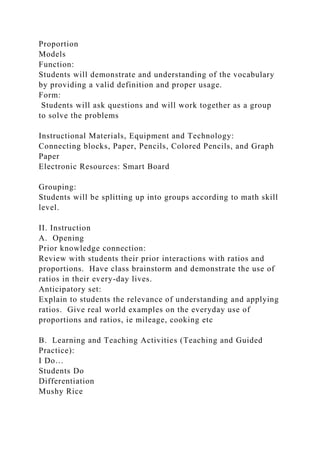
Instructional Materials, Equipment and Technology:
Connecting blocks, Paper, Pencils, Colored Pencils, and Graph
Paper
Electronic Resources: Smart Board
Grouping:
Students will be splitting up into groups according to math skill
level.
II. Instruction
A. Opening
Prior knowledge connection:
Review with students their prior interactions with ratios and
proportions. Have class brainstorm and demonstrate the use of
ratios in their every-day lives.
Anticipatory set:
Explain to students the relevance of understanding and applying
ratios. Give real world examples on the everyday use of
proportions and ratios, ie mileage, cooking etc
B. Learning and Teaching Activities (Teaching and Guided
Practice):
I Do…
Students Do
Differentiation
Mushy Rice
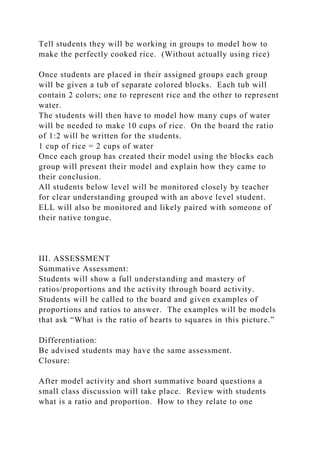
Tell students they will be working in groups to model how to
make the perfectly cooked rice. (Without actually using rice)
Once students are placed in their assigned groups each group
will be given a tub of separate colored blocks. Each tub will
contain 2 colors; one to represent rice and the other to represent
water.
The students will then have to model how many cups of water
will be needed to make 10 cups of rice. On the board the ratio
of 1:2 will be written for the students.
1 cup of rice = 2 cups of water
Once each group has created their model using the blocks each
group will present their model and explain how they came to
their conclusion.
All students below level will be monitored closely by teacher
for clear understanding grouped with an above level student.
ELL will also be monitored and likely paired with someone of
their native tongue.
III. ASSESSMENT
Summative Assessment:
Students will show a full understanding and mastery of
ratios/proportions and the activity through board activity.
Students will be called to the board and given examples of
proportions and ratios to answer. The examples will be models
that ask “What is the ratio of hearts to squares in this picture.”
Differentiation:
Be advised students may have the same assessment.
Closure:
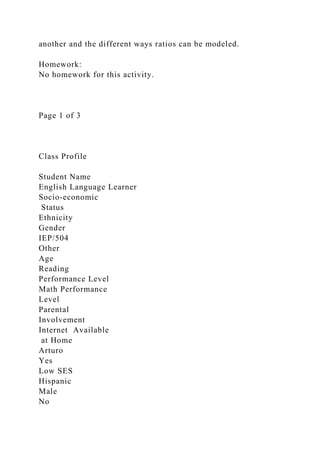
After model activity and short summative board questions a
small class discussion will take place. Review with students
what is a ratio and proportion. How to they relate to one
another and the different ways ratios can be modeled.
Homework:
No homework for this activity.
Rationale/Revisions:
(Response skillfully and convincingly summarizes the group’s
evaluations of the lessons and supports the revisions. Be sure to
include several distinctive supporting details and/or examples.
Explain how you carefully planned, for choices of instructional
materials and strategies in light of learning goals and student
outcomes. Use research to support your instructional strategy
selections.)
.
PLANNING: Instructional Script and Materials
This lesson plan demonstrates well-developed and skillful use
of effective, student-centered verbal, nonverbal and electronic
media communication tools and techniques to create
opportunities for active inquiry, collaboration and supportive
interaction by…
PLANNING: Meeting the Varied Learning Needs of Students
This lesson plan has creative, well-developed differentiated
activities and supports clearly designed to meet the needs of
specific individuals or groups with similar needs. This is
demonstrated by…
PLANNING: Meeting the Language Needs of Students
The lesson plan clearly and comprehensively incorporates
content-based vocabulary, targeted instructional support for the
use of vocabulary, and additional language demands associated
with the language function of the class. This is demonstrated
by…
PLANNING: Assessments to Monitor Student Learning
The lesson plan creatively allows for multiple forms of evidence
in order to monitor students’ understanding and skill
development in the content area throughout and at the end of the
lesson. It is well aligned with the stated learning targets and
standards and include well-crafted modifications for individual
students’ needs. This is demonstrated by…
Reference
GCU College of Education
LESSON PLAN TEMPLATE
03/2014
Teacher Candidate:
Grade Level:
Date:
Unit/Subject:
Instructional Plan Title
MaDora Law, Aneshia Peterson
6th grade
May 8th, 2016
Ratio and Proportions
Mushy Rice
I. Planning
Lesson summary and focus:
In this lesson, students will create a model to show how two
values compare to each other. Students will compare amounts
and then show how they would scale those comparisons.
Classroom and student factors:
The classroom consists of English Language Learners, below
level skill level students, above skill level students, and
students identified as special education students with learning
and emotional disability.
National / State Learning Standards:
CCSS.MATH.CONTENT.6.RP.A.3
Use ratio and rate reasoning to solve real-world and
mathematical problems, e.g., by reasoning about tables of
equivalent ratios, tape diagrams, double number line diagrams,
or equations.
CCSS.MATH.CONTENT.6.RP.A.3.A
Make tables of equivalent ratios relating quantities with whole-
number measurements, find missing values in the tables, and
plot the pairs of values on the coordinate plane. Use tables to
compare ratios.
Specific learning target(s) / objectives:
Students will be able to create a model to show how two values
compare to one another
Teaching notes:
This lesson falls midyear and is one of the introductory ratio
units.
Agenda:
Opening: Students will be split into groups.
(2)Students will work together and create their models(3)
Closure: Exit Slip
Formative assessment:
The teacher will ask the students at the beginning of the lesson
about what they know about ratios and proportions and do a
small review
The teacher will walk around the classroom and observe the
students while they are working in their groups
Academic Language:
Key vocabulary:
Ratio
Proportion
Models
Function:
Students will demonstrate and understanding of the vocabulary
by providing a valid definition and proper usage.
Form:
Students will ask questions and will work together as a group
to solve the problems
Instructional Materials, Equipment and Technology:
Connecting blocks, Paper, Pencils, Colored Pencils, and Graph
Paper
Electronic Resources: Smart Board
Grouping:
Students will be splitting up into groups according to math skill
level.
II. Instruction
A. Opening
Prior knowledge connection:
Review with students their prior interactions with ratios and
proportions. Have class brainstorm and demonstrate the use of
ratios in their every-day lives.
Anticipatory set:
Explain to students the relevance of understanding and applying
ratios. Give real world examples on the everyday use of
proportions and ratios, ie mileage, cooking etc
B. Learning and Teaching Activities (Teaching and Guided
Practice):
I Do…
Students Do
Differentiation
Mushy Rice
Tell students they will be working in groups to model how to
make the perfectly cooked rice. (Without actually using rice)
Once students are placed in their assigned groups each group
will be given a tub of separate colored blocks. Each tub will
contain 2 colors; one to represent rice and the other to represent
water.
The students will then have to model how many cups of water
will be needed to make 10 cups of rice. On the board the ratio
of 1:2 will be written for the students.
1 cup of rice = 2 cups of water
Once each group has created their model using the blocks each
group will present their model and explain how they came to
their conclusion.
All students below level will be monitored closely by teacher
for clear understanding grouped with an above level student.
ELL will also be monitored and likely paired with someone of
their native tongue.
III. ASSESSMENT
Summative Assessment:
Students will show a full understanding and mastery of
ratios/proportions and the activity through board activity.
Students will be called to the board and given examples of
proportions and ratios to answer. The examples will be models
that ask “What is the ratio of hearts to squares in this picture.”
Differentiation:
Be advised students may have the same assessment.
Closure:
After model activity and short summative board questions a
small class discussion will take place. Review with students
what is a ratio and proportion. How to they relate to one
another and the different ways ratios can be modeled.
Homework:
No homework for this activity.
Page 1 of 3
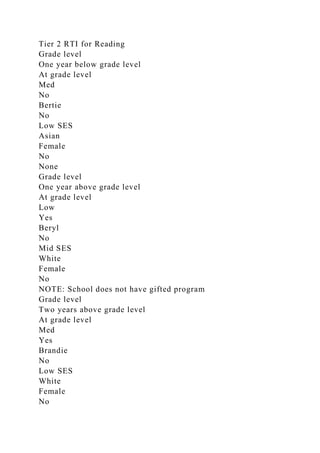
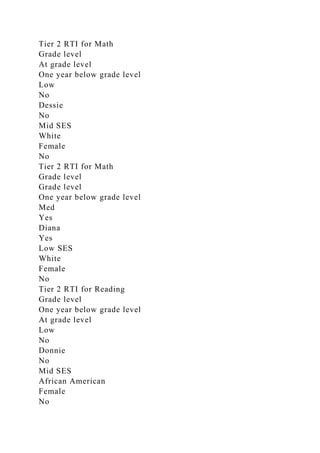
Class Profile
Student Name
English Language Learner
Socio-economic
Status
Ethnicity
Gender
IEP/504
Other
Age
Reading
Performance Level
Math Performance
Level
Parental
Involvement
Internet Available
at Home
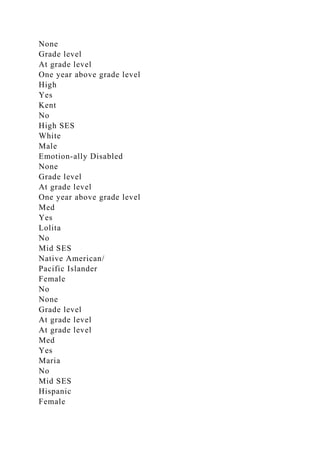
Arturo
Yes
Low SES
Hispanic
Male
No
Tier 2 RTI for Reading
Grade level
One year below grade level
At grade level
Med
No
Bertie
No
Low SES
Asian
Female
No
None
Grade level
One year above grade level
At grade level
Low
Yes
Beryl
No
Mid SES
White
Female
No
NOTE: School does not have gifted program
Grade level
Two years above grade level
At grade level
Med
Yes
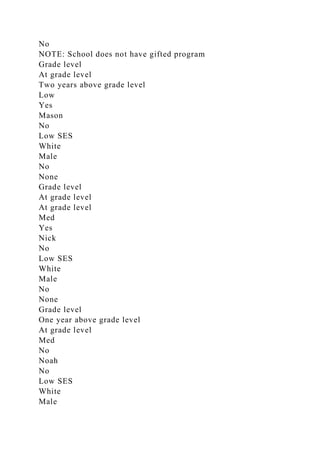
Brandie
No
Low SES
White
Female
No
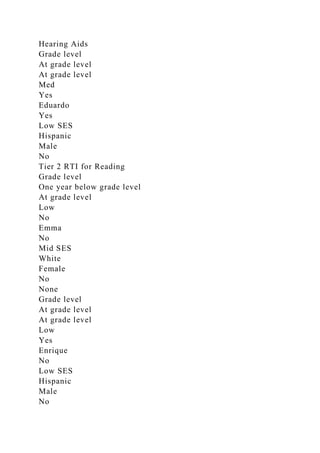
Tier 2 RTI for Math
Grade level
At grade level
One year below grade level
Low
No
Dessie
No
Mid SES
White
Female
No
Tier 2 RTI for Math
Grade level
Grade level
One year below grade level
Med
Yes
Diana
Yes
Low SES
White
Female
No
Tier 2 RTI for Reading
Grade level
One year below grade level
At grade level
Low
No
Donnie
No
Mid SES
African American
Female
No
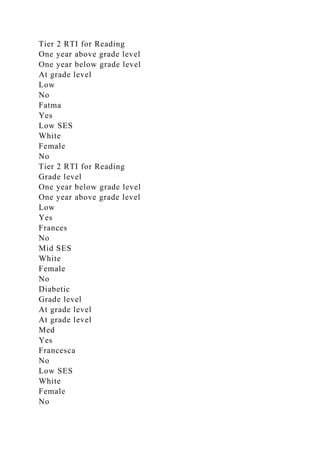
Hearing Aids
Grade level
At grade level
At grade level
Med
Yes
Eduardo
Yes
Low SES
Hispanic
Male
No
Tier 2 RTI for Reading
Grade level
One year below grade level
At grade level
Low
No
Emma
No
Mid SES
White
Female
No
None
Grade level
At grade level
At grade level
Low
Yes
Enrique
No
Low SES
Hispanic
Male
No
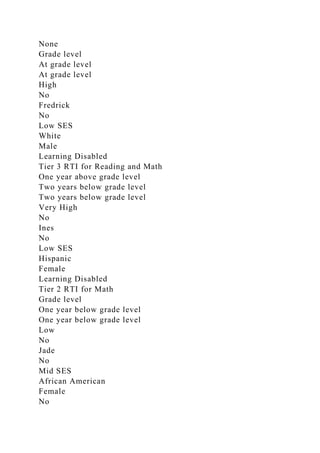
Tier 2 RTI for Reading
One year above grade level
One year below grade level
At grade level
Low
No
Fatma
Yes
Low SES
White
Female
No
Tier 2 RTI for Reading
Grade level
One year below grade level
One year above grade level
Low
Yes
Frances
No
Mid SES
White
Female
No
Diabetic
Grade level
At grade level
At grade level
Med
Yes
Francesca
No
Low SES
White
Female
No
None
Grade level
At grade level
At grade level
High
No
Fredrick
No
Low SES
White
Male
Learning Disabled
Tier 3 RTI for Reading and Math
One year above grade level
Two years below grade level
Very High
No
Ines
No
Low SES
Hispanic
Female
Learning Disabled
Tier 2 RTI for Math
Grade level
One year below grade level
Low
No
Jade
No
Mid SES
African American
Female
No
None
Grade level
At grade level
One year above grade level
High
Yes
Kent
No
High SES
White
Male
Emotion-ally Disabled
None
Grade level
At grade level
One year above grade level
Med
Yes
Lolita
No
Mid SES
Native American/
Pacific Islander
Female
No
None
Grade level
At grade level
At grade level
Med
Yes
Maria
No
Mid SES
Hispanic
Female
No
NOTE: School does not have gifted program
Grade level
At grade level
Two years above grade level
Low
Yes
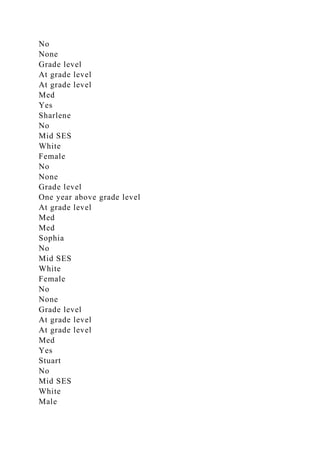
Mason
No
Low SES
White
Male
No
None
Grade level
At grade level
At grade level
Med
Yes
Nick
No
Low SES
White
Male
No
None
Grade level
One year above grade level
At grade level
Med
No
Noah
No
Low SES
White
Male
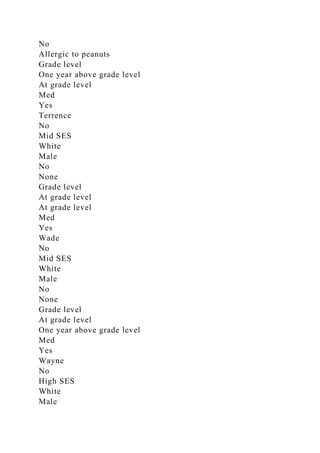
No
None
Grade level
At grade level
At grade level
Med
Yes
Sharlene
No
Mid SES
White
Female
No
None
Grade level
One year above grade level
At grade level
Med
Med
Sophia
No
Mid SES
White
Female
No
None
Grade level
At grade level
At grade level
Med
Yes
Stuart
No
Mid SES
White
Male
No
Allergic to peanuts
Grade level
One year above grade level
At grade level
Med
Yes
Terrence
No
Mid SES
White
Male
No
None
Grade level
At grade level
At grade level
Med
Yes
Wade
No
Mid SES
White
Male
No
None
Grade level
At grade level
One year above grade level
Med
Yes
Wayne
No
High SES
White
Male
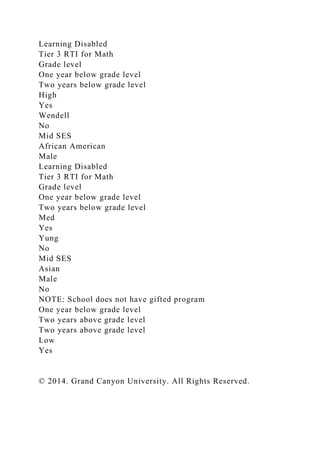
Learning Disabled
Tier 3 RTI for Math
Grade level
One year below grade level
Two years below grade level
High
Yes
Wendell
No
Mid SES
African American
Male
Learning Disabled
Tier 3 RTI for Math
Grade level
One year below grade level
Two years below grade level
Med
Yes
Yung
No
Mid SES
Asian
Male
No
NOTE: School does not have gifted program
One year below grade level
Two years above grade level
Low
Yes
© 2014. Grand Canyon University. All Rights Reserved.
Module 6 AssignmentM6 CLC Evaluation of Lesson Plan M.docx

Module 6 AssignmentM6 CLC Evaluation of Lesson Plan M.docx

  • 1.
    Module 6 Assignment M6:CLC Evaluation of Lesson Plan MaDora Law Aneshia Peterson Grand Canyon University: EED 364 08 May 2016 GCU College of Education LESSON PLAN TEMPLATE 03/2014 Teacher Candidate: Grade Level: Date: Unit/Subject: Instructional Plan Title MaDora Law, Aneshia Peterson 6th grade May 8th, 2016 Ratio and Proportions Mushy Rice I. Planning Lesson summary and focus: In this lesson, students will create a model to show how two values compare to each other. Students will compare amounts and then show how they would scale those comparisons. Classroom and student factors: The classroom consists of English Language Learners, below level skill level students, above skill level students, and students identified as special education students with learning
  • 2.
    and emotional disability. National/ State Learning Standards: CCSS.MATH.CONTENT.6.RP.A.3 Use ratio and rate reasoning to solve real-world and mathematical problems, e.g., by reasoning about tables of equivalent ratios, tape diagrams, double number line diagrams, or equations. CCSS.MATH.CONTENT.6.RP.A.3.A Make tables of equivalent ratios relating quantities with whole- number measurements, find missing values in the tables, and plot the pairs of values on the coordinate plane. Use tables to compare ratios. Specific learning target(s) / objectives: Students will be able to create a model to show how two values compare to one another Teaching notes: This lesson falls midyear and is one of the introductory ratio units. Agenda: Opening: Students will be split into groups. (2)Students will work together and create their models(3) Closure: Exit Slip Formative assessment: The teacher will ask the students at the beginning of the lesson about what they know about ratios and proportions and do a small review The teacher will walk around the classroom and observe the students while they are working in their groups Academic Language: Key vocabulary: Ratio Proportion
  • 3.
    Models Function: Students will demonstrateand understanding of the vocabulary by providing a valid definition and proper usage. Form: Students will ask questions and will work together as a group to solve the problems Instructional Materials, Equipment and Technology: Connecting blocks, Paper, Pencils, Colored Pencils, and Graph Paper Electronic Resources: Smart Board Grouping: Students will be splitting up into groups according to math skill level. II. Instruction A. Opening Prior knowledge connection: Review with students their prior interactions with ratios and proportions. Have class brainstorm and demonstrate the use of ratios in their every-day lives. Anticipatory set: Explain to students the relevance of understanding and applying ratios. Give real world examples on the everyday use of proportions and ratios, ie mileage, cooking etc B. Learning and Teaching Activities (Teaching and Guided Practice): I Do… Students Do Differentiation Mushy Rice Tell students they will be working in groups to model how to
  • 4.
    make the perfectlycooked rice. (Without actually using rice) Once students are placed in their assigned groups each group will be given a tub of separate colored blocks. Each tub will contain 2 colors; one to represent rice and the other to represent water. The students will then have to model how many cups of water will be needed to make 10 cups of rice. On the board the ratio of 1:2 will be written for the students. 1 cup of rice = 2 cups of water Once each group has created their model using the blocks each group will present their model and explain how they came to their conclusion. All students below level will be monitored closely by teacher for clear understanding grouped with an above level student. ELL will also be monitored and likely paired with someone of their native tongue. III. ASSESSMENT Summative Assessment: Students will show a full understanding and mastery of ratios/proportions and the activity through board activity. Students will be called to the board and given examples of proportions and ratios to answer. The examples will be models that ask “What is the ratio of hearts to squares in this picture.” Differentiation: Be advised students may have the same assessment. Closure: After model activity and short summative board questions a small class discussion will take place. Review with students what is a ratio and proportion. How to they relate to one another and the different ways ratios can be modeled.
  • 5.
    Homework: No homework forthis activity. Rationale/Revisions: (Response skillfully and convincingly summarizes the group’s evaluations of the lessons and supports the revisions. Be sure to include several distinctive supporting details and/or examples. Explain how you carefully planned, for choices of instructional materials and strategies in light of learning goals and student outcomes. Use research to support your instructional strategy selections.) . PLANNING: Instructional Script and Materials This lesson plan demonstrates well-developed and skillful use of effective, student-centered verbal, nonverbal and electronic media communication tools and techniques to create opportunities for active inquiry, collaboration and supportive interaction by… PLANNING: Meeting the Varied Learning Needs of Students This lesson plan has creative, well-developed differentiated activities and supports clearly designed to meet the needs of specific individuals or groups with similar needs. This is demonstrated by… PLANNING: Meeting the Language Needs of Students The lesson plan clearly and comprehensively incorporates content-based vocabulary, targeted instructional support for the use of vocabulary, and additional language demands associated
  • 6.
    with the languagefunction of the class. This is demonstrated by… PLANNING: Assessments to Monitor Student Learning The lesson plan creatively allows for multiple forms of evidence in order to monitor students’ understanding and skill development in the content area throughout and at the end of the lesson. It is well aligned with the stated learning targets and standards and include well-crafted modifications for individual students’ needs. This is demonstrated by… Reference GCU College of Education LESSON PLAN TEMPLATE 03/2014 Teacher Candidate: Grade Level: Date: Unit/Subject: Instructional Plan Title MaDora Law, Aneshia Peterson 6th grade May 8th, 2016 Ratio and Proportions Mushy Rice I. Planning Lesson summary and focus: In this lesson, students will create a model to show how two values compare to each other. Students will compare amounts and then show how they would scale those comparisons. Classroom and student factors: The classroom consists of English Language Learners, below level skill level students, above skill level students, and
  • 7.
    students identified asspecial education students with learning and emotional disability. National / State Learning Standards: CCSS.MATH.CONTENT.6.RP.A.3 Use ratio and rate reasoning to solve real-world and mathematical problems, e.g., by reasoning about tables of equivalent ratios, tape diagrams, double number line diagrams, or equations. CCSS.MATH.CONTENT.6.RP.A.3.A Make tables of equivalent ratios relating quantities with whole- number measurements, find missing values in the tables, and plot the pairs of values on the coordinate plane. Use tables to compare ratios. Specific learning target(s) / objectives: Students will be able to create a model to show how two values compare to one another Teaching notes: This lesson falls midyear and is one of the introductory ratio units. Agenda: Opening: Students will be split into groups. (2)Students will work together and create their models(3) Closure: Exit Slip Formative assessment: The teacher will ask the students at the beginning of the lesson about what they know about ratios and proportions and do a small review The teacher will walk around the classroom and observe the students while they are working in their groups Academic Language: Key vocabulary: Ratio
  • 8.
    Proportion Models Function: Students will demonstrateand understanding of the vocabulary by providing a valid definition and proper usage. Form: Students will ask questions and will work together as a group to solve the problems Instructional Materials, Equipment and Technology: Connecting blocks, Paper, Pencils, Colored Pencils, and Graph Paper Electronic Resources: Smart Board Grouping: Students will be splitting up into groups according to math skill level. II. Instruction A. Opening Prior knowledge connection: Review with students their prior interactions with ratios and proportions. Have class brainstorm and demonstrate the use of ratios in their every-day lives. Anticipatory set: Explain to students the relevance of understanding and applying ratios. Give real world examples on the everyday use of proportions and ratios, ie mileage, cooking etc B. Learning and Teaching Activities (Teaching and Guided Practice): I Do… Students Do Differentiation Mushy Rice
  • 9.
    Tell students theywill be working in groups to model how to make the perfectly cooked rice. (Without actually using rice) Once students are placed in their assigned groups each group will be given a tub of separate colored blocks. Each tub will contain 2 colors; one to represent rice and the other to represent water. The students will then have to model how many cups of water will be needed to make 10 cups of rice. On the board the ratio of 1:2 will be written for the students. 1 cup of rice = 2 cups of water Once each group has created their model using the blocks each group will present their model and explain how they came to their conclusion. All students below level will be monitored closely by teacher for clear understanding grouped with an above level student. ELL will also be monitored and likely paired with someone of their native tongue. III. ASSESSMENT Summative Assessment: Students will show a full understanding and mastery of ratios/proportions and the activity through board activity. Students will be called to the board and given examples of proportions and ratios to answer. The examples will be models that ask “What is the ratio of hearts to squares in this picture.” Differentiation: Be advised students may have the same assessment. Closure: After model activity and short summative board questions a small class discussion will take place. Review with students what is a ratio and proportion. How to they relate to one
  • 10.
    another and thedifferent ways ratios can be modeled. Homework: No homework for this activity. Page 1 of 3 Class Profile Student Name English Language Learner Socio-economic Status Ethnicity Gender IEP/504 Other Age Reading Performance Level Math Performance Level Parental Involvement Internet Available at Home Arturo Yes Low SES Hispanic Male No
  • 11.
    Tier 2 RTIfor Reading Grade level One year below grade level At grade level Med No Bertie No Low SES Asian Female No None Grade level One year above grade level At grade level Low Yes Beryl No Mid SES White Female No NOTE: School does not have gifted program Grade level Two years above grade level At grade level Med Yes Brandie No Low SES White Female No
  • 12.
    Tier 2 RTIfor Math Grade level At grade level One year below grade level Low No Dessie No Mid SES White Female No Tier 2 RTI for Math Grade level Grade level One year below grade level Med Yes Diana Yes Low SES White Female No Tier 2 RTI for Reading Grade level One year below grade level At grade level Low No Donnie No Mid SES African American Female No
  • 13.
    Hearing Aids Grade level Atgrade level At grade level Med Yes Eduardo Yes Low SES Hispanic Male No Tier 2 RTI for Reading Grade level One year below grade level At grade level Low No Emma No Mid SES White Female No None Grade level At grade level At grade level Low Yes Enrique No Low SES Hispanic Male No
  • 14.
    Tier 2 RTIfor Reading One year above grade level One year below grade level At grade level Low No Fatma Yes Low SES White Female No Tier 2 RTI for Reading Grade level One year below grade level One year above grade level Low Yes Frances No Mid SES White Female No Diabetic Grade level At grade level At grade level Med Yes Francesca No Low SES White Female No
  • 15.
    None Grade level At gradelevel At grade level High No Fredrick No Low SES White Male Learning Disabled Tier 3 RTI for Reading and Math One year above grade level Two years below grade level Two years below grade level Very High No Ines No Low SES Hispanic Female Learning Disabled Tier 2 RTI for Math Grade level One year below grade level One year below grade level Low No Jade No Mid SES African American Female No
  • 16.
    None Grade level At gradelevel One year above grade level High Yes Kent No High SES White Male Emotion-ally Disabled None Grade level At grade level One year above grade level Med Yes Lolita No Mid SES Native American/ Pacific Islander Female No None Grade level At grade level At grade level Med Yes Maria No Mid SES Hispanic Female
  • 17.
    No NOTE: School doesnot have gifted program Grade level At grade level Two years above grade level Low Yes Mason No Low SES White Male No None Grade level At grade level At grade level Med Yes Nick No Low SES White Male No None Grade level One year above grade level At grade level Med No Noah No Low SES White Male
  • 18.
    No None Grade level At gradelevel At grade level Med Yes Sharlene No Mid SES White Female No None Grade level One year above grade level At grade level Med Med Sophia No Mid SES White Female No None Grade level At grade level At grade level Med Yes Stuart No Mid SES White Male
  • 19.
    No Allergic to peanuts Gradelevel One year above grade level At grade level Med Yes Terrence No Mid SES White Male No None Grade level At grade level At grade level Med Yes Wade No Mid SES White Male No None Grade level At grade level One year above grade level Med Yes Wayne No High SES White Male
  • 20.
    Learning Disabled Tier 3RTI for Math Grade level One year below grade level Two years below grade level High Yes Wendell No Mid SES African American Male Learning Disabled Tier 3 RTI for Math Grade level One year below grade level Two years below grade level Med Yes Yung No Mid SES Asian Male No NOTE: School does not have gifted program One year below grade level Two years above grade level Two years above grade level Low Yes © 2014. Grand Canyon University. All Rights Reserved.