Name: _______________________________ (Ex2 rework)
CHM 3372, Winter 2016
Exam #2 Re-work
Due Wed, 3/2/16
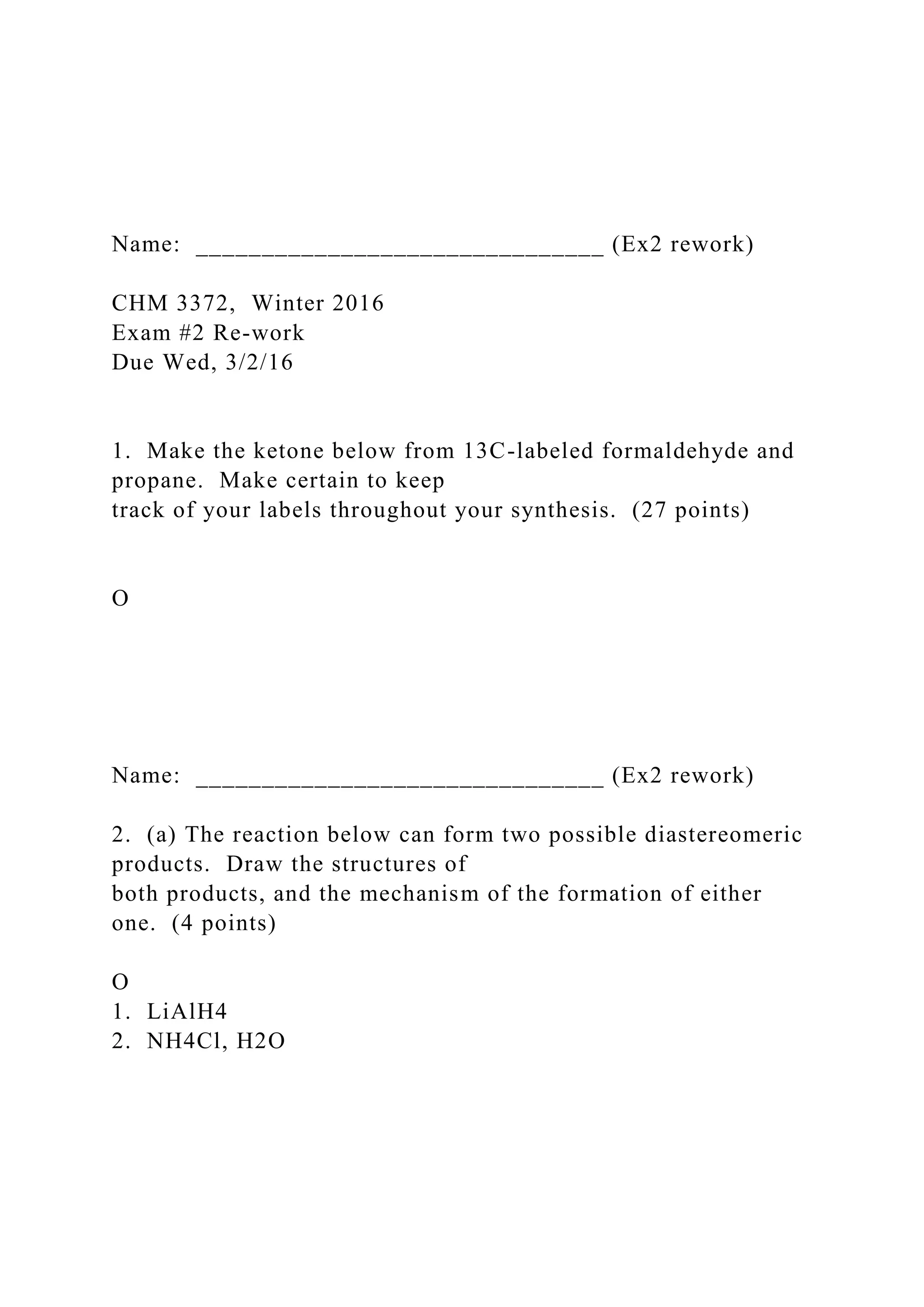
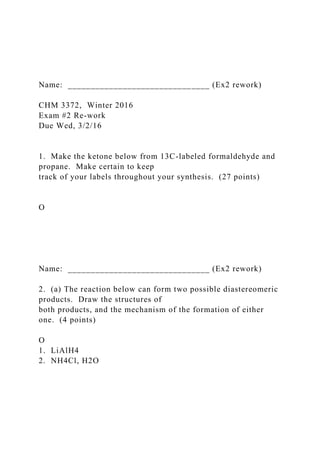
1. Make the ketone below from 13C-labeled formaldehyde and
propane. Make certain to keep
track of your labels throughout your synthesis. (27 points)
O
Name: _______________________________ (Ex2 rework)
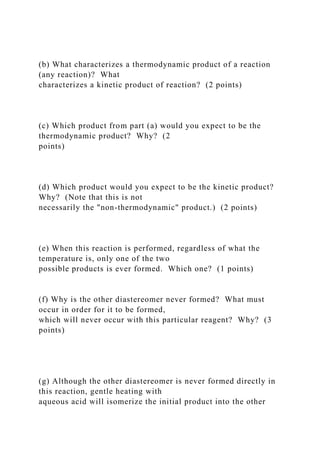
2. (a) The reaction below can form two possible diastereomeric
products. Draw the structures of
both products, and the mechanism of the formation of either
one. (4 points)
O
1. LiAlH4
2. NH4Cl, H2O
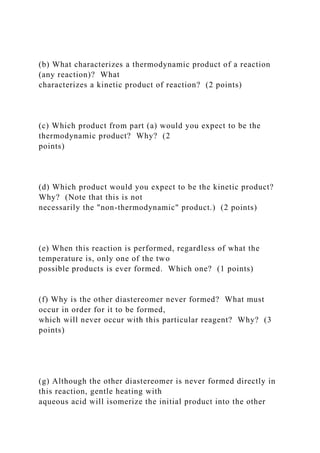
(b) What characterizes a thermodynamic product of a reaction
(any reaction)? What
characterizes a kinetic product of reaction? (2 points)
(c) Which product from part (a) would you expect to be the
thermodynamic product? Why? (2
points)
(d) Which product would you expect to be the kinetic product?
Why? (Note that this is not
necessarily the "non-thermodynamic" product.) (2 points)
(e) When this reaction is performed, regardless of what the
temperature is, only one of the two
possible products is ever formed. Which one? (1 points)
(f) Why is the other diastereomer never formed? What must
occur in order for it to be formed,
which will never occur with this particular reagent? Why? (3
points)
(g) Although the other diastereomer is never formed directly in
this reaction, gentle heating with
aqueous acid will isomerize the initial product into the other
diastereomer. Draw the mechanism
of the isomerization, and comment on why this isomerization
occurs -- why one diastereomer
will react completely to form the other. (5 points)
Name: _______________________________ (Ex2 rework)
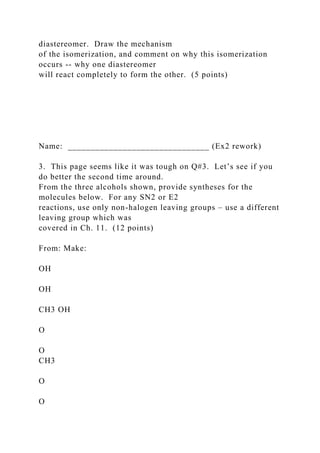
3. This page seems like it was tough on Q#3. Let’s see if you
do better the second time around.
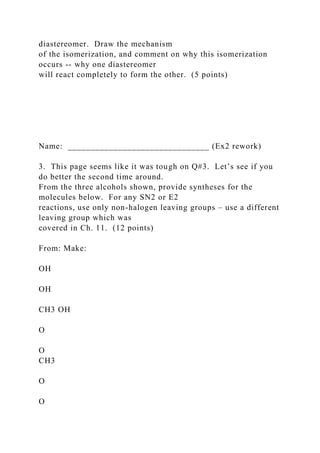
From the three alcohols shown, provide syntheses for the
molecules below. For any SN2 or E2
reactions, use only non-halogen leaving groups – use a different
leaving group which was
covered in Ch. 11. (12 points)
From: Make:
OH
OH
CH3 OH
O
O
CH3
O
O
O
Name: _______________________________ (Ex2 rework)
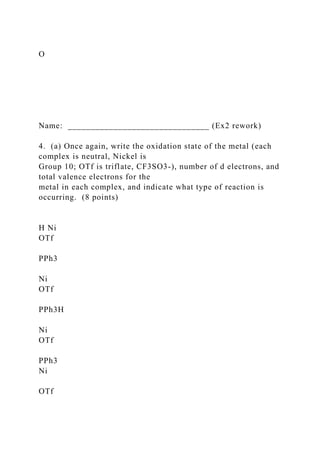
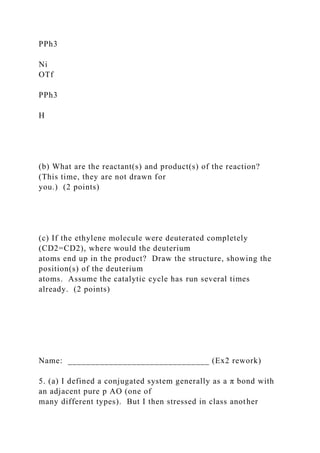
4. (a) Once again, write the oxidation state of the metal (each
complex is neutral, Nickel is
Group 10; OTf is triflate, CF3SO3-), number of d electrons, and
total valence electrons for the
metal in each complex, and indicate what type of reaction is
occurring. (8 points)
H Ni
OTf
PPh3
Ni
OTf
PPh3H
Ni
OTf
PPh3
Ni
OTf
PPh3
Ni
OTf
PPh3
H
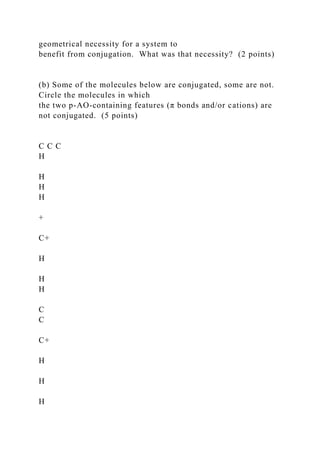
(b) What are the reactant(s) and product(s) of the reaction?
(This time, they are not drawn for
you.) (2 points)
(c) If the ethylene molecule were deuterated completely
(CD2=CD2), where would the deuterium
atoms end up in the product? Draw the structure, showing the
position(s) of the deuterium
atoms. Assume the catalytic cycle has run several times
already. (2 points)
Name: _______________________________ (Ex2 rework)
5. (a) I defined a conjugated system generally as a π bond with
an adjacent pure p AO (one of
many different types). But I then stressed in class another
geometrical necessity for a system to
benefit from conjugation. What was that necessity? (2 points)
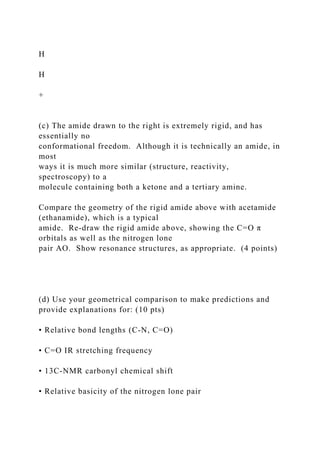
(b) Some of the molecules below are conjugated, some are not.
Circle the molecules in which
the two p-AO-containing features (π bonds and/or cations) are
not conjugated. (5 points)
C C C
H
H
H
H
+
C+
H
H
H
C
C
C+
H
H
H
H
H
+
(c) The amide drawn to the right is extremely rigid, and has
essentially no
conformational freedom. Although it is technically an amide, in
most
ways it is much more similar (structure, reactivity,
spectroscopy) to a
molecule containing both a ketone and a tertiary amine.
Compare the geometry of the rigid amide above with acetamide
(ethanamide), which is a typical
amide. Re-draw the rigid amide above, showing the C=O π
orbitals as well as the nitrogen lone
pair AO. Show resonance structures, as appropriate. (4 points)
(d) Use your geometrical comparison to make predictions and
provide explanations for: (10 pts)
• Relative bond lengths (C-N, C=O)
• C=O IR stretching frequency
• 13C-NMR carbonyl chemical shift
• Relative basicity of the nitrogen lone pair
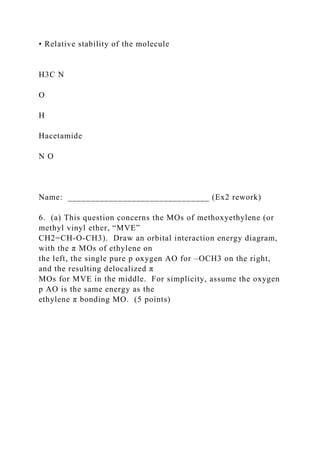
• Relative stability of the molecule
H3C N
O
H
Hacetamide
N O
Name: _______________________________ (Ex2 rework)
6. (a) This question concerns the MOs of methoxyethylene (or
methyl vinyl ether, “MVE”
CH2=CH-O-CH3). Draw an orbital interaction energy diagram,
with the π MOs of ethylene on
the left, the single pure p oxygen AO for –OCH3 on the right,
and the resulting delocalized π
MOs for MVE in the middle. For simplicity, assume the oxygen
p AO is the same energy as the
ethylene π bonding MO. (5 points)
(b) Why is the second lone pair on oxygen left out of this MO
diagram? (2 points)
(c) Which ethylene π MO does the oxygen p AO have a larger
interaction with? Why? Is this
interaction stabilizing or destabilizing? Why? (4 points)
(d) Is the interaction with the other ethylene π MO zero in
magnitude? If so, why? If not, how
does it affect the energies of the delocalized π MOs for MVE?
(2 points)
(e) Are the electrons in the delocalized π MOs for MVE (in the
middle) more stable or less stable
than those in a non-interacting π bond and O lp (on the sides)?
Why? (2 points)
(f) What is your prediction for the λmax of MVE, compared to
ethylene (171 nm)? Why? (2
points)
Name: _______________________________ (Ex2 rework)
CHM 3372, Winter 2016
Exam #2 Re-work
Due Wed, 3/2/16
1. Make the ketone below from 13C-labeled formaldehyde and
propane. Make certain to keep
track of your labels throughout your synthesis. (27 points)
O
Name: _______________________________ (Ex2 rework)
2. (a) The reaction below can form two possible diastereomeric
products. Draw the structures of
both products, and the mechanism of the formation of either
one. (4 points)
O
1. LiAlH4
2. NH4Cl, H2O
(b) What characterizes a thermodynamic product of a reaction
(any reaction)? What
characterizes a kinetic product of reaction? (2 points)
(c) Which product from part (a) would you expect to be the
thermodynamic product? Why? (2
points)
(d) Which product would you expect to be the kinetic product?
Why? (Note that this is not
necessarily the "non-thermodynamic" product.) (2 points)
(e) When this reaction is performed, regardless of what the
temperature is, only one of the two
possible products is ever formed. Which one? (1 points)
(f) Why is the other diastereomer never formed? What must
occur in order for it to be formed,
which will never occur with this particular reagent? Why? (3
points)
(g) Although the other diastereomer is never formed directly in
this reaction, gentle heating with
aqueous acid will isomerize the initial product into the other
diastereomer. Draw the mechanism
of the isomerization, and comment on why this isomerization
occurs -- why one diastereomer
will react completely to form the other. (5 points)
Name: _______________________________ (Ex2 rework)
3. This page seems like it was tough on Q#3. Let’s see if you
do better the second time around.
From the three alcohols shown, provide syntheses for the
molecules below. For any SN2 or E2
reactions, use only non-halogen leaving groups – use a different
leaving group which was
covered in Ch. 11. (12 points)
From: Make:
OH
OH
CH3 OH
O
O
CH3
O
O
O
Name: _______________________________ (Ex2 rework)
4. (a) Once again, write the oxidation state of the metal (each
complex is neutral, Nickel is
Group 10; OTf is triflate, CF3SO3-), number of d electrons, and
total valence electrons for the
metal in each complex, and indicate what type of reaction is
occurring. (8 points)
H Ni
OTf
PPh3
Ni
OTf
PPh3H
Ni
OTf
PPh3
Ni
OTf
PPh3
Ni
OTf
PPh3
H
(b) What are the reactant(s) and product(s) of the reaction?
(This time, they are not drawn for
you.) (2 points)
(c) If the ethylene molecule were deuterated completely
(CD2=CD2), where would the deuterium
atoms end up in the product? Draw the structure, showing the
position(s) of the deuterium
atoms. Assume the catalytic cycle has run several times
already. (2 points)
Name: _______________________________ (Ex2 rework)
5. (a) I defined a conjugated system generally as a π bond with
an adjacent pure p AO (one of
many different types). But I then stressed in class another
geometrical necessity for a system to
benefit from conjugation. What was that necessity? (2 points)
(b) Some of the molecules below are conjugated, some are not.
Circle the molecules in which
the two p-AO-containing features (π bonds and/or cations) are
not conjugated. (5 points)
C C C
H
H
H
H
+
C+
H
H
H
C
C
C+
H
H
H
H
H
+
(c) The amide drawn to the right is extremely rigid, and has
essentially no
conformational freedom. Although it is technically an amide, in
most
ways it is much more similar (structure, reactivity,
spectroscopy) to a
molecule containing both a ketone and a tertiary amine.
Compare the geometry of the rigid amide above with acetamide
(ethanamide), which is a typical
amide. Re-draw the rigid amide above, showing the C=O π
orbitals as well as the nitrogen lone
pair AO. Show resonance structures, as appropriate. (4 points)
(d) Use your geometrical comparison to make predictions and
provide explanations for: (10 pts)
• Relative bond lengths (C-N, C=O)
• C=O IR stretching frequency
• 13C-NMR carbonyl chemical shift
• Relative basicity of the nitrogen lone pair
• Relative stability of the molecule
H3C N
O
H
Hacetamide
N O
Name: _______________________________ (Ex2 rework)
6. (a) This question concerns the MOs of methoxyethylene (or
methyl vinyl ether, “MVE”
CH2=CH-O-CH3). Draw an orbital interaction energy diagram,
with the π MOs of ethylene on
the left, the single pure p oxygen AO for –OCH3 on the right,
and the resulting delocalized π
MOs for MVE in the middle. For simplicity, assume the oxygen
p AO is the same energy as the
ethylene π bonding MO. (5 points)
(b) Why is the second lone pair on oxygen left out of this MO
diagram? (2 points)
(c) Which ethylene π MO does the oxygen p AO have a larger
interaction with? Why? Is this
interaction stabilizing or destabilizing? Why? (4 points)
(d) Is the interaction with the other ethylene π MO zero in
magnitude? If so, why? If not, how
does it affect the energies of the delocalized π MOs for MVE?
(2 points)
(e) Are the electrons in the delocalized π MOs for MVE (in the
middle) more stable or less stable
than those in a non-interacting π bond and O lp (on the sides)?
Why? (2 points)
(f) What is your prediction for the λmax of MVE, compared to
ethylene (171 nm)? Why? (2
points)
Name  _______________________________ (Ex2 rework) CHM 33.docx

Name _______________________________ (Ex2 rework) CHM 33.docx

  • 1.
    Name: _______________________________ (Ex2rework) CHM 3372, Winter 2016 Exam #2 Re-work Due Wed, 3/2/16 1. Make the ketone below from 13C-labeled formaldehyde and propane. Make certain to keep track of your labels throughout your synthesis. (27 points) O Name: _______________________________ (Ex2 rework) 2. (a) The reaction below can form two possible diastereomeric products. Draw the structures of both products, and the mechanism of the formation of either one. (4 points) O 1. LiAlH4 2. NH4Cl, H2O
  • 2.
    (b) What characterizesa thermodynamic product of a reaction (any reaction)? What characterizes a kinetic product of reaction? (2 points) (c) Which product from part (a) would you expect to be the thermodynamic product? Why? (2 points) (d) Which product would you expect to be the kinetic product? Why? (Note that this is not necessarily the "non-thermodynamic" product.) (2 points) (e) When this reaction is performed, regardless of what the temperature is, only one of the two possible products is ever formed. Which one? (1 points) (f) Why is the other diastereomer never formed? What must occur in order for it to be formed, which will never occur with this particular reagent? Why? (3 points) (g) Although the other diastereomer is never formed directly in this reaction, gentle heating with aqueous acid will isomerize the initial product into the other
  • 3.
    diastereomer. Draw themechanism of the isomerization, and comment on why this isomerization occurs -- why one diastereomer will react completely to form the other. (5 points) Name: _______________________________ (Ex2 rework) 3. This page seems like it was tough on Q#3. Let’s see if you do better the second time around. From the three alcohols shown, provide syntheses for the molecules below. For any SN2 or E2 reactions, use only non-halogen leaving groups – use a different leaving group which was covered in Ch. 11. (12 points) From: Make: OH OH CH3 OH O O CH3 O O
  • 4.
    O Name: _______________________________ (Ex2rework) 4. (a) Once again, write the oxidation state of the metal (each complex is neutral, Nickel is Group 10; OTf is triflate, CF3SO3-), number of d electrons, and total valence electrons for the metal in each complex, and indicate what type of reaction is occurring. (8 points) H Ni OTf PPh3 Ni OTf PPh3H Ni OTf PPh3 Ni OTf
  • 5.
    PPh3 Ni OTf PPh3 H (b) What arethe reactant(s) and product(s) of the reaction? (This time, they are not drawn for you.) (2 points) (c) If the ethylene molecule were deuterated completely (CD2=CD2), where would the deuterium atoms end up in the product? Draw the structure, showing the position(s) of the deuterium atoms. Assume the catalytic cycle has run several times already. (2 points) Name: _______________________________ (Ex2 rework) 5. (a) I defined a conjugated system generally as a π bond with an adjacent pure p AO (one of many different types). But I then stressed in class another
  • 6.
    geometrical necessity fora system to benefit from conjugation. What was that necessity? (2 points) (b) Some of the molecules below are conjugated, some are not. Circle the molecules in which the two p-AO-containing features (π bonds and/or cations) are not conjugated. (5 points) C C C H H H H + C+ H H H C C C+ H H H
  • 7.
    H H + (c) The amidedrawn to the right is extremely rigid, and has essentially no conformational freedom. Although it is technically an amide, in most ways it is much more similar (structure, reactivity, spectroscopy) to a molecule containing both a ketone and a tertiary amine. Compare the geometry of the rigid amide above with acetamide (ethanamide), which is a typical amide. Re-draw the rigid amide above, showing the C=O π orbitals as well as the nitrogen lone pair AO. Show resonance structures, as appropriate. (4 points) (d) Use your geometrical comparison to make predictions and provide explanations for: (10 pts) • Relative bond lengths (C-N, C=O) • C=O IR stretching frequency • 13C-NMR carbonyl chemical shift • Relative basicity of the nitrogen lone pair
  • 8.
    • Relative stabilityof the molecule H3C N O H Hacetamide N O Name: _______________________________ (Ex2 rework) 6. (a) This question concerns the MOs of methoxyethylene (or methyl vinyl ether, “MVE” CH2=CH-O-CH3). Draw an orbital interaction energy diagram, with the π MOs of ethylene on the left, the single pure p oxygen AO for –OCH3 on the right, and the resulting delocalized π MOs for MVE in the middle. For simplicity, assume the oxygen p AO is the same energy as the ethylene π bonding MO. (5 points)
  • 9.
    (b) Why isthe second lone pair on oxygen left out of this MO diagram? (2 points) (c) Which ethylene π MO does the oxygen p AO have a larger interaction with? Why? Is this interaction stabilizing or destabilizing? Why? (4 points) (d) Is the interaction with the other ethylene π MO zero in magnitude? If so, why? If not, how does it affect the energies of the delocalized π MOs for MVE? (2 points) (e) Are the electrons in the delocalized π MOs for MVE (in the middle) more stable or less stable than those in a non-interacting π bond and O lp (on the sides)? Why? (2 points) (f) What is your prediction for the λmax of MVE, compared to ethylene (171 nm)? Why? (2 points)
  • 10.
    Name: _______________________________ (Ex2rework) CHM 3372, Winter 2016 Exam #2 Re-work Due Wed, 3/2/16 1. Make the ketone below from 13C-labeled formaldehyde and propane. Make certain to keep track of your labels throughout your synthesis. (27 points) O Name: _______________________________ (Ex2 rework) 2. (a) The reaction below can form two possible diastereomeric products. Draw the structures of both products, and the mechanism of the formation of either one. (4 points) O 1. LiAlH4 2. NH4Cl, H2O
  • 11.
    (b) What characterizesa thermodynamic product of a reaction (any reaction)? What characterizes a kinetic product of reaction? (2 points) (c) Which product from part (a) would you expect to be the thermodynamic product? Why? (2 points) (d) Which product would you expect to be the kinetic product? Why? (Note that this is not necessarily the "non-thermodynamic" product.) (2 points) (e) When this reaction is performed, regardless of what the temperature is, only one of the two possible products is ever formed. Which one? (1 points) (f) Why is the other diastereomer never formed? What must occur in order for it to be formed, which will never occur with this particular reagent? Why? (3 points) (g) Although the other diastereomer is never formed directly in this reaction, gentle heating with aqueous acid will isomerize the initial product into the other
  • 12.
    diastereomer. Draw themechanism of the isomerization, and comment on why this isomerization occurs -- why one diastereomer will react completely to form the other. (5 points) Name: _______________________________ (Ex2 rework) 3. This page seems like it was tough on Q#3. Let’s see if you do better the second time around. From the three alcohols shown, provide syntheses for the molecules below. For any SN2 or E2 reactions, use only non-halogen leaving groups – use a different leaving group which was covered in Ch. 11. (12 points) From: Make: OH OH CH3 OH O O CH3 O O
  • 13.
    O Name: _______________________________ (Ex2rework) 4. (a) Once again, write the oxidation state of the metal (each complex is neutral, Nickel is Group 10; OTf is triflate, CF3SO3-), number of d electrons, and total valence electrons for the metal in each complex, and indicate what type of reaction is occurring. (8 points) H Ni OTf PPh3 Ni OTf PPh3H Ni OTf PPh3 Ni OTf
  • 14.
    PPh3 Ni OTf PPh3 H (b) What arethe reactant(s) and product(s) of the reaction? (This time, they are not drawn for you.) (2 points) (c) If the ethylene molecule were deuterated completely (CD2=CD2), where would the deuterium atoms end up in the product? Draw the structure, showing the position(s) of the deuterium atoms. Assume the catalytic cycle has run several times already. (2 points) Name: _______________________________ (Ex2 rework) 5. (a) I defined a conjugated system generally as a π bond with an adjacent pure p AO (one of many different types). But I then stressed in class another
  • 15.
    geometrical necessity fora system to benefit from conjugation. What was that necessity? (2 points) (b) Some of the molecules below are conjugated, some are not. Circle the molecules in which the two p-AO-containing features (π bonds and/or cations) are not conjugated. (5 points) C C C H H H H + C+ H H H C C C+ H H H
  • 16.
    H H + (c) The amidedrawn to the right is extremely rigid, and has essentially no conformational freedom. Although it is technically an amide, in most ways it is much more similar (structure, reactivity, spectroscopy) to a molecule containing both a ketone and a tertiary amine. Compare the geometry of the rigid amide above with acetamide (ethanamide), which is a typical amide. Re-draw the rigid amide above, showing the C=O π orbitals as well as the nitrogen lone pair AO. Show resonance structures, as appropriate. (4 points) (d) Use your geometrical comparison to make predictions and provide explanations for: (10 pts) • Relative bond lengths (C-N, C=O) • C=O IR stretching frequency • 13C-NMR carbonyl chemical shift • Relative basicity of the nitrogen lone pair
  • 17.
    • Relative stabilityof the molecule H3C N O H Hacetamide N O Name: _______________________________ (Ex2 rework) 6. (a) This question concerns the MOs of methoxyethylene (or methyl vinyl ether, “MVE” CH2=CH-O-CH3). Draw an orbital interaction energy diagram, with the π MOs of ethylene on the left, the single pure p oxygen AO for –OCH3 on the right, and the resulting delocalized π MOs for MVE in the middle. For simplicity, assume the oxygen p AO is the same energy as the ethylene π bonding MO. (5 points)
  • 18.
    (b) Why isthe second lone pair on oxygen left out of this MO diagram? (2 points) (c) Which ethylene π MO does the oxygen p AO have a larger interaction with? Why? Is this interaction stabilizing or destabilizing? Why? (4 points) (d) Is the interaction with the other ethylene π MO zero in magnitude? If so, why? If not, how does it affect the energies of the delocalized π MOs for MVE? (2 points) (e) Are the electrons in the delocalized π MOs for MVE (in the middle) more stable or less stable than those in a non-interacting π bond and O lp (on the sides)? Why? (2 points) (f) What is your prediction for the λmax of MVE, compared to ethylene (171 nm)? Why? (2 points)