Runninghead:WRITINGCLASSROOMASSESSMENT ITEMS
Writing Classroom Assessment Items
Terrance Barriner
American College of Education
WRITING CLASSROOMASSESSMENT ITEMS 2
A common misconception is that assessments are the end of a unit. Assessments
are valuable devices that provide feedback on our instruction and student mastery
(Young & Kim, 2010). Because of the valuable feedback that can be provided, it is
important to ensure that the our assessments are both valid and reliable. This paper
will examine a teacher created summative assessment in part one. Part two will provide
an example of a formative assessment. The final section will examine a performance
task, which is also type of assessment.
Part 1: Summative Multiple Choice Test
1. Which of the following identifies a power given to Congress by the U.S.
Constitution?
a. Pardon criminals c. Appoint Supreme Court Justices
b. Interpreting laws d. Regulating Interstate Commerce *
2. What power does the U.S. Constitution give to the legislative branch?
a. Declaring War* c. Enforcing laws
b. Making treaties d. Interpreting laws
3. Which of the following identifies a power of the Supreme Court?
a. Override veto c. Nominate federal judges
b. Interpret Laws* d. Impeach the executive branch
4. How would you summarize the Founders decision to structure the government
into different branches?
a. To promote efficiency by delegating official responsibilities
b. To promote participation by creating a large bureaucracy
c. To prevent any branch from having too many duties
d. To prevent any branch from becoming too powerful *
5. A bill was signed which provided citizens with the option of choosing their health
care plans. It was vetoed. That veto was then overruled. Four years after, the
law was ruled unconstitutional.
Organize the branches in the order in which they exercised their power?
a. Legislative, Executive, Judicial *
b. Legislative, Judicial, Executive
c. Legislative, Executive, Legislative
d. Executive, Legislative, Judicial
WRITING CLASSROOMASSESSMENT ITEMS 3
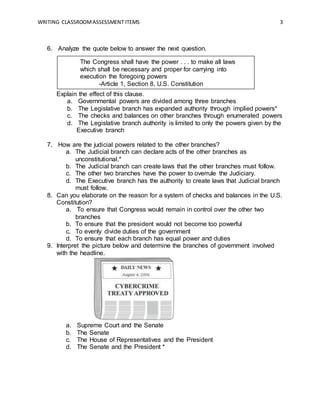
6. Analyze the quote below to answer the next question.
Explain the effect of this clause.
a. Governmental powers are divided among three branches
b. The Legislative branch has expanded authority through implied powers*
c. The checks and balances on other branches through enumerated powers
d. The Legislative branch authority is limited to only the powers given by the
Executive branch
7. How are the judicial powers related to the other branches?
a. The Judicial branch can declare acts of the other branches as
unconstitutional.*
b. The Judicial branch can create laws that the other branches must follow.
c. The other two branches have the power to overrule the Judiciary.
d. The Executive branch has the authority to create laws that Judicial branch
must follow.
8. Can you elaborate on the reason for a system of checks and balances in the U.S.
Constitution?
a. To ensure that Congress would remain in control over the other two
branches
b. To ensure that the president would not become too powerful
c. To evenly divide duties of the government
d. To ensure that each branch has equal power and duties
9. Interpret the picture below and determine the branches of government involved
with the headline.
a. Supreme Court and the Senate
b. The Senate
c. The House of Representatives and the President
d. The Senate and the President *
The Congress shall have the power . . . to make all laws
which shall be necessary and proper for carrying into
execution the foregoing powers
-Article 1, Section 8, U.S. Constitution
WRITING CLASSROOMASSESSMENT ITEMS 4
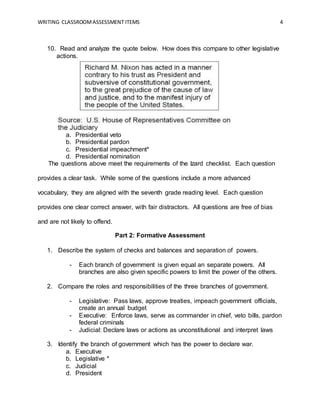
10. Read and analyze the quote below. How does this compare to other legislative
actions.
a. Presidential veto
b. Presidential pardon
c. Presidential impeachment*
d. Presidential nomination
The questions above meet the requirements of the Izard checklist. Each question
provides a clear task. While some of the questions include a more advanced
vocabulary, they are aligned with the seventh grade reading level. Each question
provides one clear correct answer, with fair distractors. All questions are free of bias
and are not likely to offend.
Part 2: Formative Assessment
1. Describe the system of checks and balances and separation of powers.
- Each branch of government is given equal an separate powers. All
branches are also given specific powers to limit the power of the others.
2. Compare the roles and responsibilities of the three branches of government.
- Legislative: Pass laws, approve treaties, impeach government officials,
create an annual budget
- Executive: Enforce laws, serve as commander in chief, veto bills, pardon
federal criminals
- Judicial: Declare laws or actions as unconstitutional and interpret laws
3. Identify the branch of government which has the power to declare war.
a. Executive
b. Legislative *
c. Judicial
d. President
WRITING CLASSROOMASSESSMENT ITEMS 5
4. How is the judicial branch limited by the Constitution?
a. It lacks the authority to hand down punishments
b. It lacks the authority to approve new legislation*
c. It lacks the authority to evaluate the actions of government officials
d. It lacks the authority to make people appear in court without their consent
5. Which power is given to Congress by the U.S. Constitution?
a. Enforcing state laws
b. Building public schools
c. Interpreting federal laws
d. Override presidential veto
Part 3: Performance Task
Performance outcome and descriptors Students will demonstrate their
knowledge of the powers of each branch
of government.
Performance task description Students will create a children’s book in
which they explain the role and powers of
each branch of government. The book
will explain Articles I, II, and III of the
Constitution in student friendly language.
Audience The audience for the task is other
seventh grade students or younger.
Real-world task In addition to explaining the powers and
roles of the branches, students must
provide an example from a current event
of a power of each branch.
Step by step process for completion 1. The teacher will lecture on this unit
to provide students with
information.
2. Students will be required to
research to gather more
information and examples.
3. Students will outline their project
and submit it to the teacher for
approval.
4. Students will complete their project
using the style of book.
Criteria process 1. Individuals will complete the text of
the book including the examples.
2. They will add pictures.
3. Students will add color and
decorations to the book.
WRITING CLASSROOMASSESSMENT ITEMS 6
Final product The end result should be a children’s
book that contains an explanation of the
powers and roles of each branch of
government. It should also provide two
real-world examples. Since this is a
children’s book, illustrations should be
included. The overall project should be
colorful, neat, and aesthetically pleasing.
Category Description of Performance Levels
Excellent Good Okay Needs
Improvement
Explanation of
Roles and
Powers
(8 points)
A detailed
explanation of
the roles and
powers of each
branch are
present and in
“kid friendly”
An explanation
of the rolesand
powersof each
branch exists,
but some details
may have been
leftoutor not
writtenusing
“kidfriendly”
language.
An explanation
of the rolesand
powersof each
branch has been
attempted,
however, some
detailshave
beenleftout.
Little tono “kid
friendly”
language isused.
The powersand
rolesof all three
branchesare not
present.
Real-World
Examples
(8 points)
Two examples
are provided
alongwithan
explanation.
Two examples
are present,but
an explanationis
not provided.
One example is
provided.
No examplesare
provided.
Illustrations
(4 points)
Illustrations are
providedfor
each branch and
example thatare
relevantandkid
friendly.
Illustrationsare
providedfor
each branch and
example butall
may notbe
relevantorkid
friendly.
Illustrationsare
partially
providedand
may notbe
relevantorkid
friendly.
No illustrations
are present.
Aesthetics
(Color/Neatness)
(3 points)
The projectis in
bookform,
colorful,andfree
frombendsor
stains.
The projectis in
bookform and
couldhave more
colorand may
have minimal
bendsor stains.
The projectis in
bookform, but
doesnotcontain
colorand may
have bendsor
stains.
The projectis not
inbook form,
doesnotcontain
color,and may
have bendsor
stains.
WRITING CLASSROOMASSESSMENT ITEMS 7
Conclusion
Writing assessments is a necessary task for all educators. Evaluating these tests for
validity and reliability is even more important of a task, however, many educators never
receive proper training to do so. Districts must empower their teachers and provide
them with the necessary tools to be successful with creating assessments (McCrann,
2018). This assignment has proven to be a valuable experience, which provided
experience in both creating and evaluating various types of assessments.
WRITING CLASSROOMASSESSMENT ITEMS 8
References
McCrann, J. R. T. (2018). Putting assessments back in the hands of teachers:
Teacher-created performance assessments can lead to deeper learning and
powerful changes in instructional climate. Educational Leadership, 75(5), 41–45.
Young, V. M., & Kim, D. H. (2010). Using assessments for instructional improvement: A
literature review. Education Policy Analysis Archives, 18, 19.

Module 3 Writing Classroom Assessment Items

  • 1.
    Runninghead:WRITINGCLASSROOMASSESSMENT ITEMS Writing ClassroomAssessment Items Terrance Barriner American College of Education
  • 2.
    WRITING CLASSROOMASSESSMENT ITEMS2 A common misconception is that assessments are the end of a unit. Assessments are valuable devices that provide feedback on our instruction and student mastery (Young & Kim, 2010). Because of the valuable feedback that can be provided, it is important to ensure that the our assessments are both valid and reliable. This paper will examine a teacher created summative assessment in part one. Part two will provide an example of a formative assessment. The final section will examine a performance task, which is also type of assessment. Part 1: Summative Multiple Choice Test 1. Which of the following identifies a power given to Congress by the U.S. Constitution? a. Pardon criminals c. Appoint Supreme Court Justices b. Interpreting laws d. Regulating Interstate Commerce * 2. What power does the U.S. Constitution give to the legislative branch? a. Declaring War* c. Enforcing laws b. Making treaties d. Interpreting laws 3. Which of the following identifies a power of the Supreme Court? a. Override veto c. Nominate federal judges b. Interpret Laws* d. Impeach the executive branch 4. How would you summarize the Founders decision to structure the government into different branches? a. To promote efficiency by delegating official responsibilities b. To promote participation by creating a large bureaucracy c. To prevent any branch from having too many duties d. To prevent any branch from becoming too powerful * 5. A bill was signed which provided citizens with the option of choosing their health care plans. It was vetoed. That veto was then overruled. Four years after, the law was ruled unconstitutional. Organize the branches in the order in which they exercised their power? a. Legislative, Executive, Judicial * b. Legislative, Judicial, Executive c. Legislative, Executive, Legislative d. Executive, Legislative, Judicial
  • 3.
    WRITING CLASSROOMASSESSMENT ITEMS3 6. Analyze the quote below to answer the next question. Explain the effect of this clause. a. Governmental powers are divided among three branches b. The Legislative branch has expanded authority through implied powers* c. The checks and balances on other branches through enumerated powers d. The Legislative branch authority is limited to only the powers given by the Executive branch 7. How are the judicial powers related to the other branches? a. The Judicial branch can declare acts of the other branches as unconstitutional.* b. The Judicial branch can create laws that the other branches must follow. c. The other two branches have the power to overrule the Judiciary. d. The Executive branch has the authority to create laws that Judicial branch must follow. 8. Can you elaborate on the reason for a system of checks and balances in the U.S. Constitution? a. To ensure that Congress would remain in control over the other two branches b. To ensure that the president would not become too powerful c. To evenly divide duties of the government d. To ensure that each branch has equal power and duties 9. Interpret the picture below and determine the branches of government involved with the headline. a. Supreme Court and the Senate b. The Senate c. The House of Representatives and the President d. The Senate and the President * The Congress shall have the power . . . to make all laws which shall be necessary and proper for carrying into execution the foregoing powers -Article 1, Section 8, U.S. Constitution
  • 4.
    WRITING CLASSROOMASSESSMENT ITEMS4 10. Read and analyze the quote below. How does this compare to other legislative actions. a. Presidential veto b. Presidential pardon c. Presidential impeachment* d. Presidential nomination The questions above meet the requirements of the Izard checklist. Each question provides a clear task. While some of the questions include a more advanced vocabulary, they are aligned with the seventh grade reading level. Each question provides one clear correct answer, with fair distractors. All questions are free of bias and are not likely to offend. Part 2: Formative Assessment 1. Describe the system of checks and balances and separation of powers. - Each branch of government is given equal an separate powers. All branches are also given specific powers to limit the power of the others. 2. Compare the roles and responsibilities of the three branches of government. - Legislative: Pass laws, approve treaties, impeach government officials, create an annual budget - Executive: Enforce laws, serve as commander in chief, veto bills, pardon federal criminals - Judicial: Declare laws or actions as unconstitutional and interpret laws 3. Identify the branch of government which has the power to declare war. a. Executive b. Legislative * c. Judicial d. President
  • 5.
    WRITING CLASSROOMASSESSMENT ITEMS5 4. How is the judicial branch limited by the Constitution? a. It lacks the authority to hand down punishments b. It lacks the authority to approve new legislation* c. It lacks the authority to evaluate the actions of government officials d. It lacks the authority to make people appear in court without their consent 5. Which power is given to Congress by the U.S. Constitution? a. Enforcing state laws b. Building public schools c. Interpreting federal laws d. Override presidential veto Part 3: Performance Task Performance outcome and descriptors Students will demonstrate their knowledge of the powers of each branch of government. Performance task description Students will create a children’s book in which they explain the role and powers of each branch of government. The book will explain Articles I, II, and III of the Constitution in student friendly language. Audience The audience for the task is other seventh grade students or younger. Real-world task In addition to explaining the powers and roles of the branches, students must provide an example from a current event of a power of each branch. Step by step process for completion 1. The teacher will lecture on this unit to provide students with information. 2. Students will be required to research to gather more information and examples. 3. Students will outline their project and submit it to the teacher for approval. 4. Students will complete their project using the style of book. Criteria process 1. Individuals will complete the text of the book including the examples. 2. They will add pictures. 3. Students will add color and decorations to the book.
  • 6.
    WRITING CLASSROOMASSESSMENT ITEMS6 Final product The end result should be a children’s book that contains an explanation of the powers and roles of each branch of government. It should also provide two real-world examples. Since this is a children’s book, illustrations should be included. The overall project should be colorful, neat, and aesthetically pleasing. Category Description of Performance Levels Excellent Good Okay Needs Improvement Explanation of Roles and Powers (8 points) A detailed explanation of the roles and powers of each branch are present and in “kid friendly” An explanation of the rolesand powersof each branch exists, but some details may have been leftoutor not writtenusing “kidfriendly” language. An explanation of the rolesand powersof each branch has been attempted, however, some detailshave beenleftout. Little tono “kid friendly” language isused. The powersand rolesof all three branchesare not present. Real-World Examples (8 points) Two examples are provided alongwithan explanation. Two examples are present,but an explanationis not provided. One example is provided. No examplesare provided. Illustrations (4 points) Illustrations are providedfor each branch and example thatare relevantandkid friendly. Illustrationsare providedfor each branch and example butall may notbe relevantorkid friendly. Illustrationsare partially providedand may notbe relevantorkid friendly. No illustrations are present. Aesthetics (Color/Neatness) (3 points) The projectis in bookform, colorful,andfree frombendsor stains. The projectis in bookform and couldhave more colorand may have minimal bendsor stains. The projectis in bookform, but doesnotcontain colorand may have bendsor stains. The projectis not inbook form, doesnotcontain color,and may have bendsor stains.
  • 7.
    WRITING CLASSROOMASSESSMENT ITEMS7 Conclusion Writing assessments is a necessary task for all educators. Evaluating these tests for validity and reliability is even more important of a task, however, many educators never receive proper training to do so. Districts must empower their teachers and provide them with the necessary tools to be successful with creating assessments (McCrann, 2018). This assignment has proven to be a valuable experience, which provided experience in both creating and evaluating various types of assessments.
  • 8.
    WRITING CLASSROOMASSESSMENT ITEMS8 References McCrann, J. R. T. (2018). Putting assessments back in the hands of teachers: Teacher-created performance assessments can lead to deeper learning and powerful changes in instructional climate. Educational Leadership, 75(5), 41–45. Young, V. M., & Kim, D. H. (2010). Using assessments for instructional improvement: A literature review. Education Policy Analysis Archives, 18, 19.