Running head: RESEARCHING DIVERSITY 1
Researching Diversity
Terrance Barriner
American College of Education
2
RESEARCHINGDIVERSITY
Schools throughout the country have experienced an achievement gap with
minorities, students of poverty, and English language learners. While these gaps exist,
few schools have been successful in developing strategies to close these gaps. This
paper will examine the achievement levels of African American students at Chester A.
Moore Elementary. This data will be reviewed to find trends and issues. It will also
examine the practices chosen to address the achievement gap and the preferred
learning style of African American students.
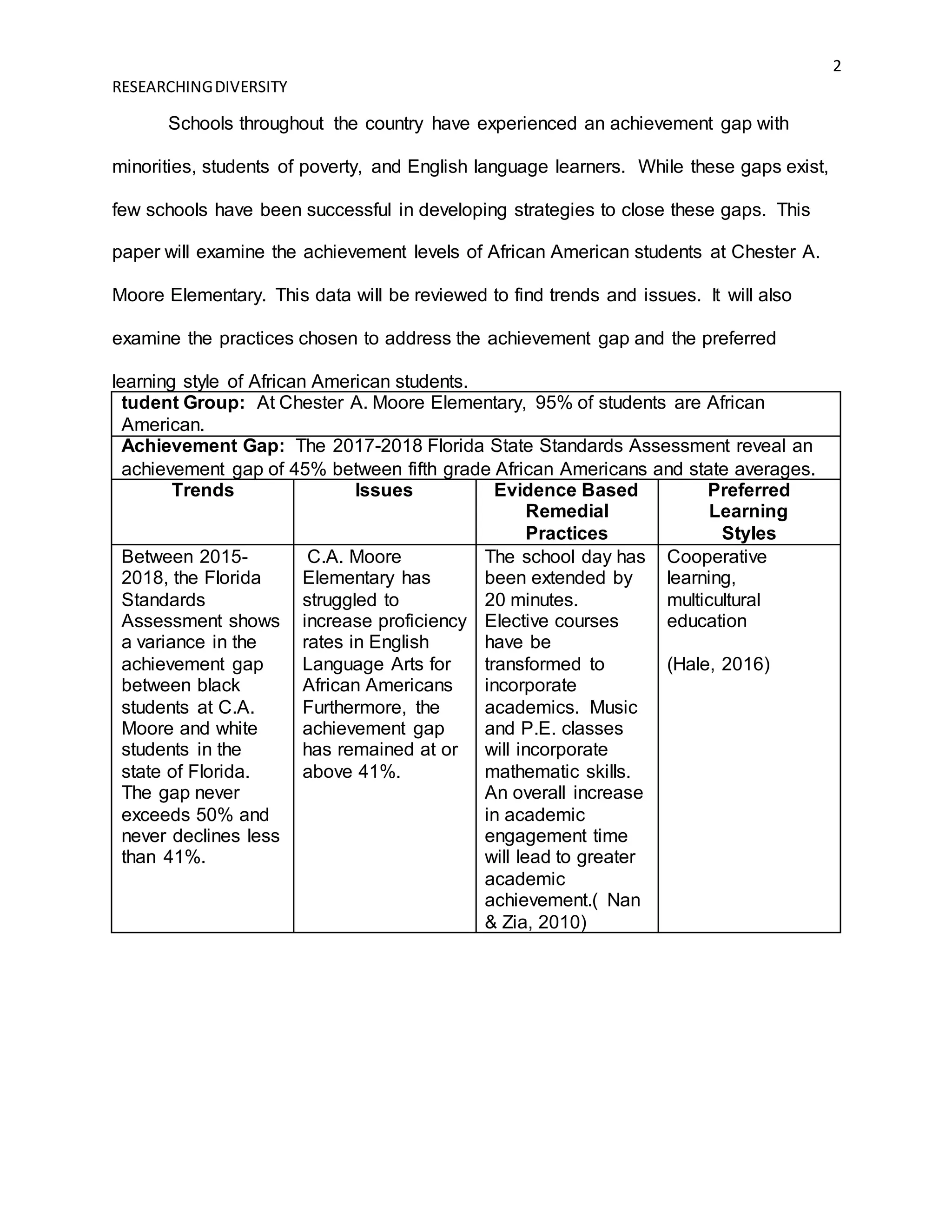
tudent Group: At Chester A. Moore Elementary, 95% of students are African
American.
Achievement Gap: The 2017-2018 Florida State Standards Assessment reveal an
achievement gap of 45% between fifth grade African Americans and state averages.
Trends Issues Evidence Based
Remedial
Practices
Preferred
Learning
Styles
Between 2015-
2018, the Florida
Standards
Assessment shows
a variance in the
achievement gap
between black
students at C.A.
Moore and white
students in the
state of Florida.
The gap never
exceeds 50% and
never declines less
than 41%.
C.A. Moore
Elementary has
struggled to
increase proficiency
rates in English
Language Arts for
African Americans
Furthermore, the
achievement gap
has remained at or
above 41%.
The school day has
been extended by
20 minutes.
Elective courses
have be
transformed to
incorporate
academics. Music
and P.E. classes
will incorporate
mathematic skills.
An overall increase
in academic
engagement time
will lead to greater
academic
achievement.( Nan
& Zia, 2010)
Cooperative
learning,
multicultural
education
(Hale, 2016)
3
RESEARCHINGDIVERSITY
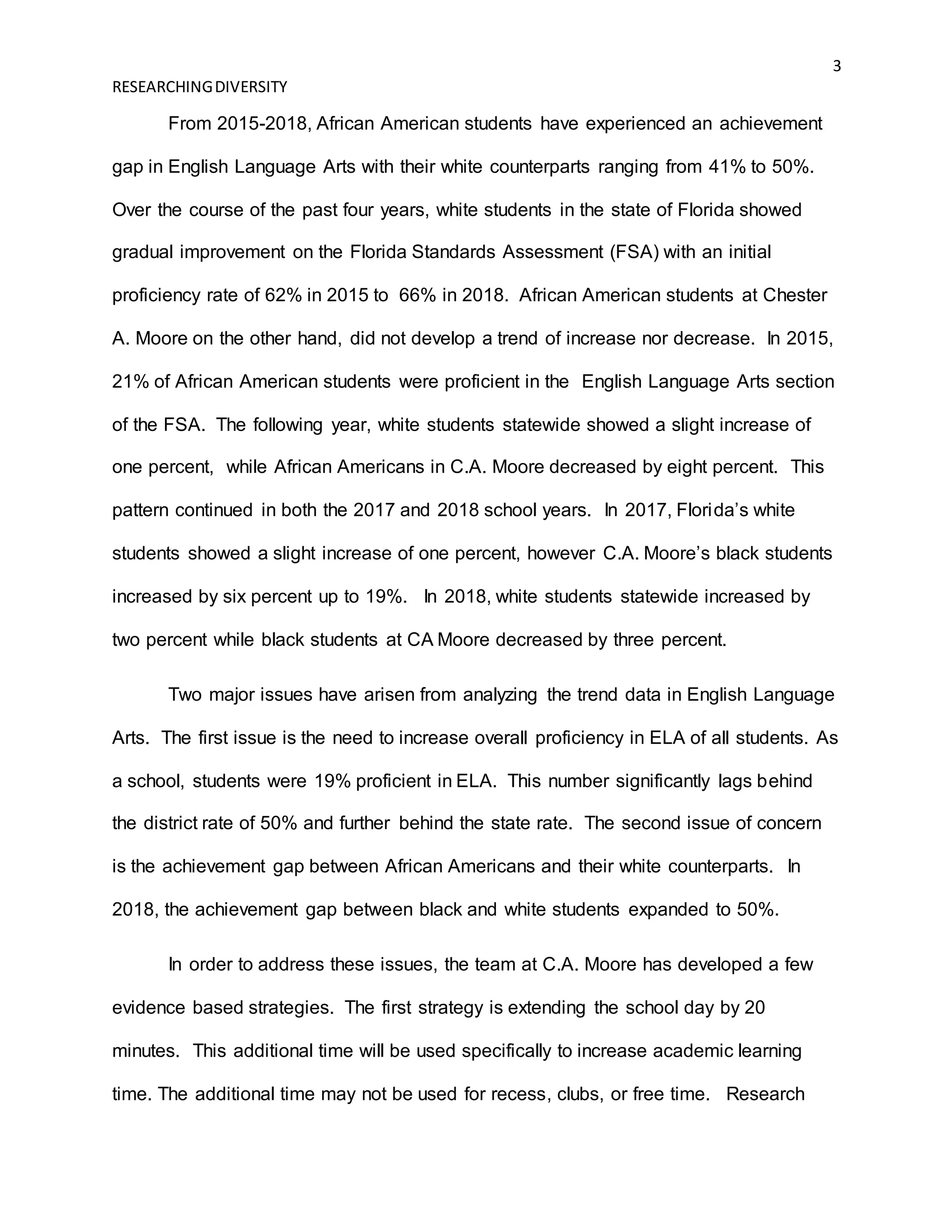
From 2015-2018, African American students have experienced an achievement
gap in English Language Arts with their white counterparts ranging from 41% to 50%.
Over the course of the past four years, white students in the state of Florida showed
gradual improvement on the Florida Standards Assessment (FSA) with an initial
proficiency rate of 62% in 2015 to 66% in 2018. African American students at Chester
A. Moore on the other hand, did not develop a trend of increase nor decrease. In 2015,
21% of African American students were proficient in the English Language Arts section
of the FSA. The following year, white students statewide showed a slight increase of
one percent, while African Americans in C.A. Moore decreased by eight percent. This
pattern continued in both the 2017 and 2018 school years. In 2017, Florida’s white
students showed a slight increase of one percent, however C.A. Moore’s black students
increased by six percent up to 19%. In 2018, white students statewide increased by
two percent while black students at CA Moore decreased by three percent.
Two major issues have arisen from analyzing the trend data in English Language
Arts. The first issue is the need to increase overall proficiency in ELA of all students. As
a school, students were 19% proficient in ELA. This number significantly lags behind
the district rate of 50% and further behind the state rate. The second issue of concern
is the achievement gap between African Americans and their white counterparts. In
2018, the achievement gap between black and white students expanded to 50%.
In order to address these issues, the team at C.A. Moore has developed a few
evidence based strategies. The first strategy is extending the school day by 20
minutes. This additional time will be used specifically to increase academic learning
time. The additional time may not be used for recess, clubs, or free time. Research
4
RESEARCHINGDIVERSITY
suggests that in order to close the achievement gap, academic engagement time must
be increased (Nan & Zia, 2010). The team has also decided to increase the academic
focus during elective courses. In physical education and music, students will read
passages on their favorite athletes and musicians. Ideally, I would like something similar
implemented in all classes. I would like for teachers to include more text or materials
that are culturally relevant. African American students achieve at higher rates when
studying topics that are culturally relevant (Hale, 2016). These changes will incorporate
both student interests, as well as skills necessary to increase proficiency.
Another research based practice that will be utilized is the increased use of
cooperative learning strategies. African American males in particular desire to work in
groups and are more academically responsive to the learning process when cooperative
strategies are used (Wilson-Jones & Caston, 2004). To ensure that teachers are using
more cooperative strategies, several teachers were sent to Kagan Cooperative Learning
training this summer. A minimum of one teacher was chosen in each tested grade
level. In addition, teachers will receive training twice a month during planning to learn
how to incorporate cooperative strategies into their lessons. When students practice
using these strategies in all classes, both engagement and academic achievement will
increase.
Conclusion
The growth of the achievement gap between African Americans and Caucasians
is a major concern for schools. At Chester A. Moore, the gap has fluctuated between
41%-50% from 2015-2018. The school is addressing this issue by incorporating
evidence-based strategies. During the 2019 school year, the school day will be
5
RESEARCHINGDIVERSITY
extended in order to increase academic learning time. Students will also will have
additional academic time during elective classes. These changes are the initial steps
taken in reducing the achievement gap.
6
RESEARCHINGDIVERSITY
References
Hale, J. E. (2016). Learning styles of African American children: instructional
implications. Journal Of Curriculum and Teaching, 5(2), 109-118.
Nan, L., & Zia, H. (2010). Closing the achievement gap: strategies for ensuring the
success of minority students. National Teacher Education Journal, 3(2), 47-59.
Wilson-Jones, L., & Caston, M. C. (2004). Cooperative learning on academic
achievement in elementary African American males. Journal of Instructional
Psychology, (4), 280.

Module 3 Researching Diversity

  • 1.
    Running head: RESEARCHINGDIVERSITY 1 Researching Diversity Terrance Barriner American College of Education
  • 2.
    2 RESEARCHINGDIVERSITY Schools throughout thecountry have experienced an achievement gap with minorities, students of poverty, and English language learners. While these gaps exist, few schools have been successful in developing strategies to close these gaps. This paper will examine the achievement levels of African American students at Chester A. Moore Elementary. This data will be reviewed to find trends and issues. It will also examine the practices chosen to address the achievement gap and the preferred learning style of African American students. tudent Group: At Chester A. Moore Elementary, 95% of students are African American. Achievement Gap: The 2017-2018 Florida State Standards Assessment reveal an achievement gap of 45% between fifth grade African Americans and state averages. Trends Issues Evidence Based Remedial Practices Preferred Learning Styles Between 2015- 2018, the Florida Standards Assessment shows a variance in the achievement gap between black students at C.A. Moore and white students in the state of Florida. The gap never exceeds 50% and never declines less than 41%. C.A. Moore Elementary has struggled to increase proficiency rates in English Language Arts for African Americans Furthermore, the achievement gap has remained at or above 41%. The school day has been extended by 20 minutes. Elective courses have be transformed to incorporate academics. Music and P.E. classes will incorporate mathematic skills. An overall increase in academic engagement time will lead to greater academic achievement.( Nan & Zia, 2010) Cooperative learning, multicultural education (Hale, 2016)
  • 3.
    3 RESEARCHINGDIVERSITY From 2015-2018, AfricanAmerican students have experienced an achievement gap in English Language Arts with their white counterparts ranging from 41% to 50%. Over the course of the past four years, white students in the state of Florida showed gradual improvement on the Florida Standards Assessment (FSA) with an initial proficiency rate of 62% in 2015 to 66% in 2018. African American students at Chester A. Moore on the other hand, did not develop a trend of increase nor decrease. In 2015, 21% of African American students were proficient in the English Language Arts section of the FSA. The following year, white students statewide showed a slight increase of one percent, while African Americans in C.A. Moore decreased by eight percent. This pattern continued in both the 2017 and 2018 school years. In 2017, Florida’s white students showed a slight increase of one percent, however C.A. Moore’s black students increased by six percent up to 19%. In 2018, white students statewide increased by two percent while black students at CA Moore decreased by three percent. Two major issues have arisen from analyzing the trend data in English Language Arts. The first issue is the need to increase overall proficiency in ELA of all students. As a school, students were 19% proficient in ELA. This number significantly lags behind the district rate of 50% and further behind the state rate. The second issue of concern is the achievement gap between African Americans and their white counterparts. In 2018, the achievement gap between black and white students expanded to 50%. In order to address these issues, the team at C.A. Moore has developed a few evidence based strategies. The first strategy is extending the school day by 20 minutes. This additional time will be used specifically to increase academic learning time. The additional time may not be used for recess, clubs, or free time. Research
  • 4.
    4 RESEARCHINGDIVERSITY suggests that inorder to close the achievement gap, academic engagement time must be increased (Nan & Zia, 2010). The team has also decided to increase the academic focus during elective courses. In physical education and music, students will read passages on their favorite athletes and musicians. Ideally, I would like something similar implemented in all classes. I would like for teachers to include more text or materials that are culturally relevant. African American students achieve at higher rates when studying topics that are culturally relevant (Hale, 2016). These changes will incorporate both student interests, as well as skills necessary to increase proficiency. Another research based practice that will be utilized is the increased use of cooperative learning strategies. African American males in particular desire to work in groups and are more academically responsive to the learning process when cooperative strategies are used (Wilson-Jones & Caston, 2004). To ensure that teachers are using more cooperative strategies, several teachers were sent to Kagan Cooperative Learning training this summer. A minimum of one teacher was chosen in each tested grade level. In addition, teachers will receive training twice a month during planning to learn how to incorporate cooperative strategies into their lessons. When students practice using these strategies in all classes, both engagement and academic achievement will increase. Conclusion The growth of the achievement gap between African Americans and Caucasians is a major concern for schools. At Chester A. Moore, the gap has fluctuated between 41%-50% from 2015-2018. The school is addressing this issue by incorporating evidence-based strategies. During the 2019 school year, the school day will be
  • 5.
    5 RESEARCHINGDIVERSITY extended in orderto increase academic learning time. Students will also will have additional academic time during elective classes. These changes are the initial steps taken in reducing the achievement gap.
  • 6.
    6 RESEARCHINGDIVERSITY References Hale, J. E.(2016). Learning styles of African American children: instructional implications. Journal Of Curriculum and Teaching, 5(2), 109-118. Nan, L., & Zia, H. (2010). Closing the achievement gap: strategies for ensuring the success of minority students. National Teacher Education Journal, 3(2), 47-59. Wilson-Jones, L., & Caston, M. C. (2004). Cooperative learning on academic achievement in elementary African American males. Journal of Instructional Psychology, (4), 280.