Chapter Objectives
After completingthis chapter, you will be able to:
Explain remote replication technologies
◦ Synchronous and asynchronous
Discuss host and array based remote replication
◦ Functionality
◦ Differences
◦ Selecting the appropriate technology
Discuss network options for remote replication
3.
What is RemoteReplication?
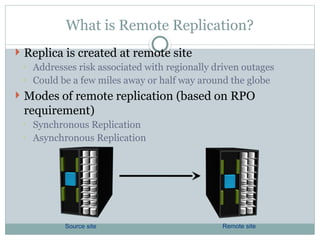
Replica is created at remote site
◦ Addresses risk associated with regionally driven outages
◦ Could be a few miles away or half way around the globe
Modes of remote replication (based on RPO
requirement)
◦ Synchronous Replication
◦ Asynchronous Replication
Source site Remote site
4.
Synchronous Replication
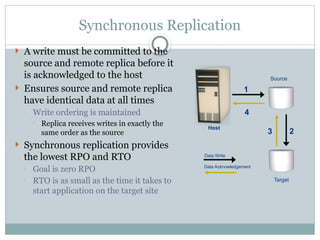
Awrite must be committed to the
source and remote replica before it
is acknowledged to the host
Ensures source and remote replica
have identical data at all times
◦ Write ordering is maintained
Replica receives writes in exactly the
same order as the source
Synchronous replication provides
the lowest RPO and RTO
◦ Goal is zero RPO
◦ RTO is as small as the time it takes to
start application on the target site
1
3
4
2
Data Write
Data Acknowledgement
Host
Target
Source
5.
Synchronous Replication: BandwidthRequirement
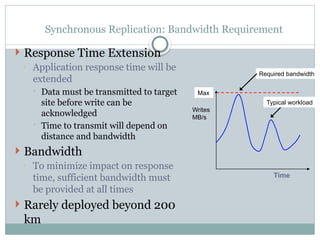
Response Time Extension
◦ Application response time will be
extended
Data must be transmitted to target
site before write can be
acknowledged
Time to transmit will depend on
distance and bandwidth
Bandwidth
◦ To minimize impact on response
time, sufficient bandwidth must
be provided at all times
Rarely deployed beyond 200
km
Time
Writes
MB/s
Required bandwidth
Typical workload
Max
6.
Asynchronous Replication
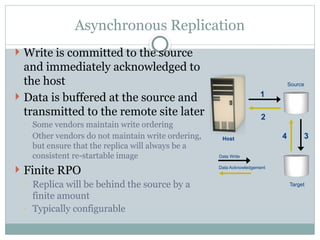
Writeis committed to the source
and immediately acknowledged to
the host
Data is buffered at the source and
transmitted to the remote site later
◦ Some vendors maintain write ordering
◦ Other vendors do not maintain write ordering,
but ensure that the replica will always be a
consistent re-startable image
Finite RPO
◦ Replica will be behind the source by a
finite amount
◦ Typically configurable
1
4
2
3
Data Write
Data Acknowledgement
Host
Target
Source
7.
Asynchronous Replication: BandwidthRequirement
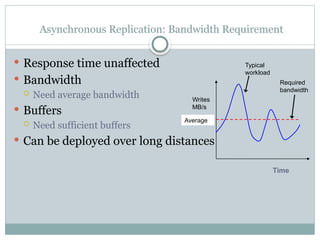
Response time unaffected
Bandwidth
Need average bandwidth
Buffers
Need sufficient buffers
Can be deployed over long distances
Average
Time
Writes
MB/s
Required
bandwidth
Typical
workload
8.
Remote Replication Technologies
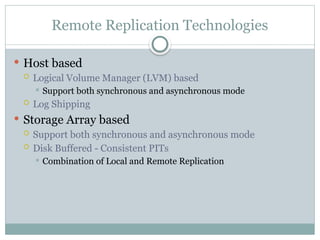
Host based
Logical Volume Manager (LVM) based
Support both synchronous and asynchronous mode
Log Shipping
Storage Array based
Support both synchronous and asynchronous mode
Disk Buffered - Consistent PITs
Combination of Local and Remote Replication
9.
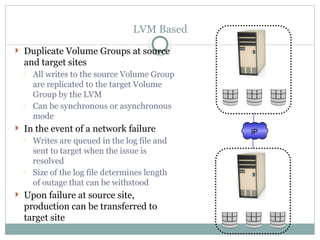
LVM Based
DuplicateVolume Groups at source
and target sites
◦ All writes to the source Volume Group
are replicated to the target Volume
Group by the LVM
◦ Can be synchronous or asynchronous
mode
In the event of a network failure
◦ Writes are queued in the log file and
sent to target when the issue is
resolved
◦ Size of the log file determines length
of outage that can be withstood
Upon failure at source site,
production can be transferred to
target site
IP
10.
LVM Based –Advantages and Limitations
Advantages
Different storage arrays and RAID protection can be used at
the source and target sites
Response time issue can be eliminated with asynchronous
mode, with extended RPO
Limitations
Extended network outages require large log files
CPU overhead on host
11.
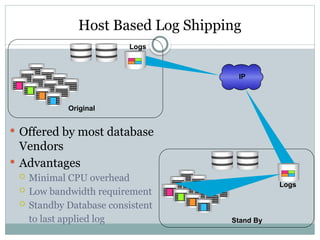
Host Based LogShipping
Offered by most database
Vendors
Advantages
Minimal CPU overhead
Low bandwidth requirement
Standby Database consistent
to last applied log
Original
Logs
Stand By
Logs
IP
12.
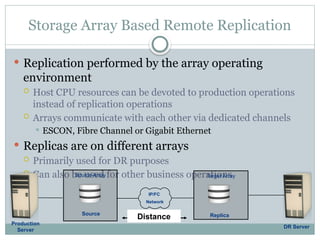
Storage Array BasedRemote Replication
Replication performed by the array operating
environment
Host CPU resources can be devoted to production operations
instead of replication operations
Arrays communicate with each other via dedicated channels
ESCON, Fibre Channel or Gigabit Ethernet
Replicas are on different arrays
Primarily used for DR purposes
Can also be used for other business operations
Source Array Target Array
Distance
Source Replica
DR Server
Production
Server
IP/FC
Network
13.
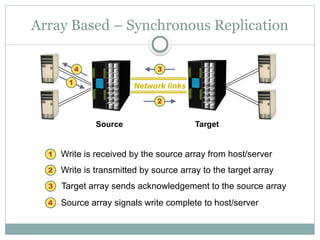
Array Based –Synchronous Replication
Network links
Write is received by the source array from host/server
Write is transmitted by source array to the target array
Target array sends acknowledgement to the source array
Source array signals write complete to host/server
Source Target
14.
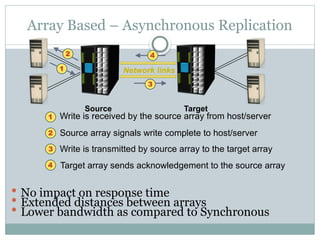
Array Based –Asynchronous Replication
No impact on response time
Extended distances between arrays
Lower bandwidth as compared to Synchronous
Write is received by the source array from host/server
Write is transmitted by source array to the target array
Source array signals write complete to host/server
Target array sends acknowledgement to the source array
Network links
Source Target
15.
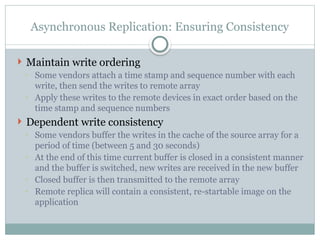
Asynchronous Replication: EnsuringConsistency
Maintain write ordering
◦ Some vendors attach a time stamp and sequence number with each
write, then send the writes to remote array
◦ Apply these writes to the remote devices in exact order based on the
time stamp and sequence numbers
Dependent write consistency
◦ Some vendors buffer the writes in the cache of the source array for a
period of time (between 5 and 30 seconds)
◦ At the end of this time current buffer is closed in a consistent manner
and the buffer is switched, new writes are received in the new buffer
◦ Closed buffer is then transmitted to the remote array
◦ Remote replica will contain a consistent, re-startable image on the
application
16.
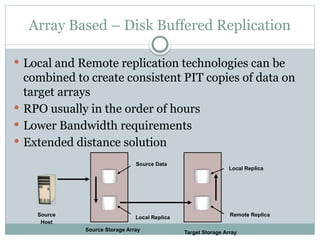
Array Based –Disk Buffered Replication
Local and Remote replication technologies can be
combined to create consistent PIT copies of data on
target arrays
RPO usually in the order of hours
Lower Bandwidth requirements
Extended distance solution
Source Storage Array
Target Storage Array
Local Replica
Remote Replica
Local Replica
Source
Host
Source Data
17.
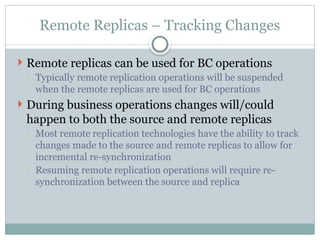
Remote Replicas –Tracking Changes
Remote replicas can be used for BC operations
◦ Typically remote replication operations will be suspended
when the remote replicas are used for BC operations
During business operations changes will/could
happen to both the source and remote replicas
◦ Most remote replication technologies have the ability to track
changes made to the source and remote replicas to allow for
incremental re-synchronization
◦ Resuming remote replication operations will require re-
synchronization between the source and replica
18.
Array Based –Which Technology?
Synchronous
◦ Is a must if zero RPO is required
◦ Need sufficient bandwidth at all times
◦ Rarely above 125 miles
Asynchronous
◦ Extended distance solutions with minimal RPO (order of minutes)
◦ No Response time elongation
◦ Generally requires lower Bandwidth than synchronous
◦ Must design with adequate cache/buffer capacity
Disk buffered
◦ Extended distance solution with RPO in the order of hours
◦ Require lower bandwidth than synchronous or asynchronous
19.
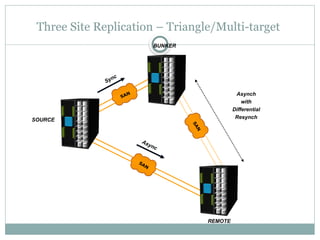
Three Site Replication
Eliminates disadvantages of two site replication
Single site disaster leads to a window when there is no DR
protection
Data replicated to two remote sites
Implemented in two ways
Three Site Cascade/Multi-hop
Three Site Triangle/Multi-target
20.
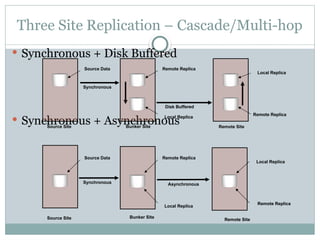
Three Site Replication– Cascade/Multi-hop
Synchronous + Disk Buffered
Synchronous + Asynchronous
Bunker Site Remote Site
Local Replica
Remote Replica
Local Replica
Source Data
Synchronous
Remote Replica
Disk Buffered
Source Site
Bunker Site
Remote Site
Local Replica
Remote Replica
Local Replica
Source Data
Synchronous
Remote Replica
Asynchronous
Source Site
21.
Three Site Replication– Triangle/Multi-target
Asynch
with
Differential
Resynch
SOURCE
REMOTE
BUNKER
Sync
Async
SAN
SAN
S
A
N
22.
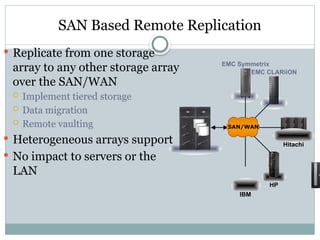
SAN Based RemoteReplication
Replicate from one storage
array to any other storage array
over the SAN/WAN
Implement tiered storage
Data migration
Remote vaulting
Heterogeneous arrays support
No impact to servers or the
LAN
Hitachi
EMC Symmetrix
EMC CLARiiON
HP
IBM
SAN/WAN
23.
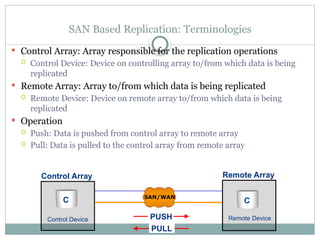
SAN Based Replication:Terminologies
Control Array: Array responsible for the replication operations
Control Device: Device on controlling array to/from which data is being
replicated
Remote Array: Array to/from which data is being replicated
Remote Device: Device on remote array to/from which data is being
replicated
Operation
Push: Data is pushed from control array to remote array
Pull: Data is pulled to the control array from remote array
Control Array Remote Array
PUSH
PULL
Control Device Remote Device
C C
SAN/WAN
24.
Network Options forRemote Replication
A dedicated or a shared network must be in place for
remote replication
Use ESCON or FC for shorter distance
For extended distances, an optical or IP network must be used
Example of optical network: DWDM and SONET
Protocol converters may require to connect ESCON or FC adapters
from the arrays to these networks
Native GigE adapters allows array to be connected directly to
IP Networks
25.
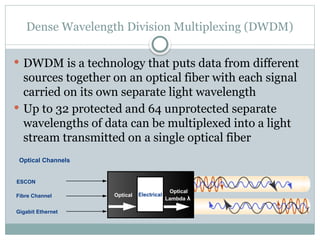
Dense Wavelength DivisionMultiplexing (DWDM)
DWDM is a technology that puts data from different
sources together on an optical fiber with each signal
carried on its own separate light wavelength
Up to 32 protected and 64 unprotected separate
wavelengths of data can be multiplexed into a light
stream transmitted on a single optical fiber
ESCON
Fibre Channel
Gigabit Ethernet
Optical Channels
Optical Electrical
Optical
Lambda λ
26.
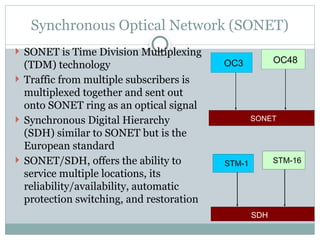
Synchronous Optical Network(SONET)
SONET is Time Division Multiplexing
(TDM) technology
Traffic from multiple subscribers is
multiplexed together and sent out
onto SONET ring as an optical signal
Synchronous Digital Hierarchy
(SDH) similar to SONET but is the
European standard
SONET/SDH, offers the ability to
service multiple locations, its
reliability/availability, automatic
protection switching, and restoration
SDH
STM-1 STM-16
SONET
OC3 OC48
27.
Chapter Summary
Key pointscovered in this chapter:
Modes of remote replication
Synchronous and asynchronous mode
Host based remote replication
LVM based and log shipping
Array based remote replication
Synchronous, asynchronous and disk buffered
Three site replication
SAN based remote replication
Network options for remote replication
28.
Concept in Practice– EMC Remote Replication
EMC Symmetrix Arrays
EMC SRDF/Synchronous
EMC SRDF/Asynchronous
EMC SRDF/Automated Replication
EMC CLARiiON Arrays
EMC MirrorView/Synchronous
EMC MirrorView/Asynchronous
EMC SAN Copy
SAN based remote replication solution for EMC CLARiiON
29.
Check Your Knowledge
What is the difference between Synchronous and
Asynchronous mode?
Discuss one host based remote replication technology?
Discuss one array based remote replication technology?
What are differences in the bandwidth requirements
between the array remote replication technologies
discussed in this chapter?
Discuss the effects of a bunker failure in a three-site
replication for the following implementation:
− Multihop—synchronous + disk buffered
− Multihop—synchronous + asynchronous
− Multitarget