National Institute on Aging 
National Institutes of Health 
ALZHEIMER’S DISEASE 
UnravelingtheMystery
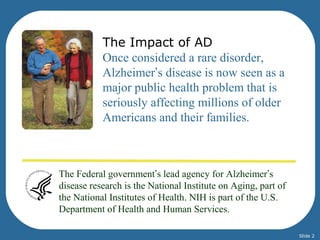
The Impact of AD 
Once considered a rare disorder, 
Alzheimer’s disease is now seen as a 
major public health problem that is 
seriously affecting millions of older 
Americans and their families. 
The Federal government’s lead agency for Alzheimer’s 
disease research is the National Institute on Aging, part of 
the National Institutes of Health. NIH is part of the U.S. 
Department of Health and Human Services. 
Slide 2
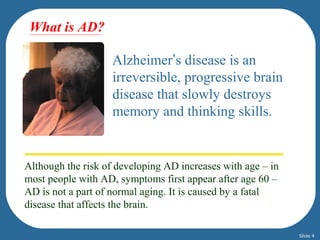
Alzheimer’s disease is an 
irreversible, progressive brain 
disease that slowly destroys 
memory and thinking skills. 
What is AD? 
Although the risk of developing AD increases with age – in 
most people with AD, symptoms first appear after age 60 – 
AD is not a part of normal aging. It is caused by a fatal 
disease that affects the brain. 
Slide 4
What is AD? 
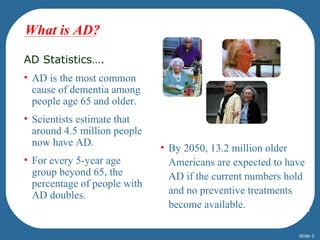
AD Statistics…. 
• AD is the most common 
cause of dementia among 
people age 65 and older. 
• Scientists estimate that 
around 4.5 million people 
now have AD. 
• For every 5-year age 
group beyond 65, the 
percentage of people with 
AD doubles. 
• By 2050, 13.2 million older 
Americans are expected to have 
AD if the current numbers hold 
and no preventive treatments 
become available. 
Slide 5
What is AD? 
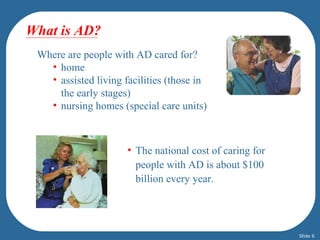
Where are people with AD cared for? 
• home 
• assisted living facilities (those in 
the early stages) 
• nursing homes (special care units) 
• The national cost of caring for 
people with AD is about $100 
billion every year. 
Slide 6
AD and the Brain 
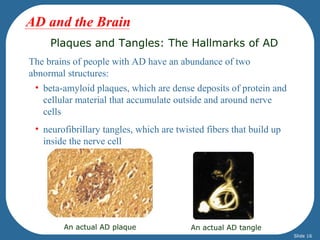
Plaques and Tangles: The Hallmarks of AD 
The brains of people with AD have an abundance of two 
abnormal structures: 
• beta-amyloid plaques, which are dense deposits of protein and 
cellular material that accumulate outside and around nerve 
cells 
• neurofibrillary tangles, which are twisted fibers that build up 
inside the nerve cell 
An actual AD plaque An actual AD tangle 
Slide 16
Beta-amyloid Plaques 
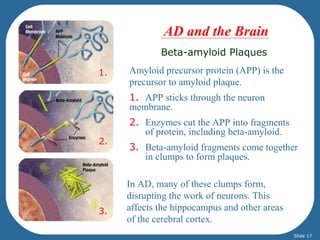
Amyloid precursor protein (APP) is the 
precursor to amyloid plaque. 
1. APP sticks through the neuron 
membrane. 
2. Enzymes cut the APP into fragments 
of protein, including beta-amyloid. 
3. Beta-amyloid fragments come together 
in clumps to form plaques. 
1. 
2. 
3. 
AD and the Brain 
In AD, many of these clumps form, 
disrupting the work of neurons. This 
affects the hippocampus and other areas 
of the cerebral cortex. 
Slide 17
AD and the Brain 
Neurofibrillary 
Tangles 
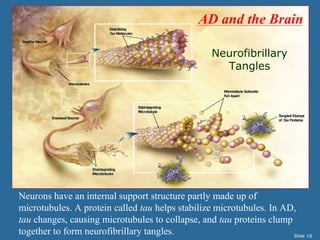
Neurons have an internal support structure partly made up of 
microtubules. A protein called tau helps stabilize microtubules. In AD, 
tau changes, causing microtubules to collapse, and tau proteins clump 
together to form neurofibrillary tangles. 
Slide 18
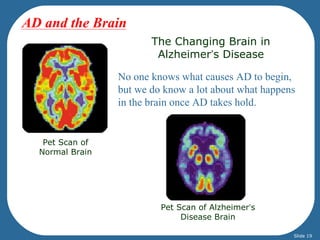
The Changing Brain in 
Alzheimer’s Disease 
No one knows what causes AD to begin, 
but we do know a lot about what happens 
in the brain once AD takes hold. 
Pet Scan of 
Normal Brain 
Pet Scan of Alzheimer’s 
Disease Brain 
AD and the Brain 
Slide 19
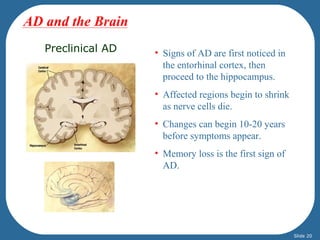
Preclinical AD • Signs of AD are first noticed in 
the entorhinal cortex, then 
proceed to the hippocampus. 
• Affected regions begin to shrink 
as nerve cells die. 
• Changes can begin 10-20 years 
before symptoms appear. 
• Memory loss is the first sign of 
AD. 
AD and the Brain 
Slide 20
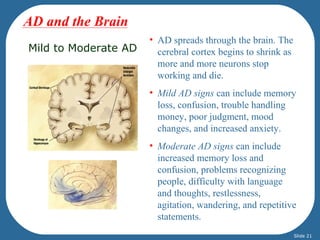
Mild to Moderate AD 
• AD spreads through the brain. The 
cerebral cortex begins to shrink as 
more and more neurons stop 
working and die. 
• Mild AD signs can include memory 
loss, confusion, trouble handling 
money, poor judgment, mood 
changes, and increased anxiety. 
• Moderate AD signs can include 
increased memory loss and 
confusion, problems recognizing 
people, difficulty with language 
and thoughts, restlessness, 
agitation, wandering, and repetitive 
statements. 
AD and the Brain 
Slide 21
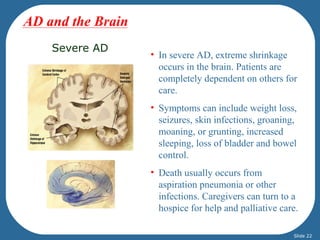
Severe AD 
• In severe AD, extreme shrinkage 
occurs in the brain. Patients are 
completely dependent on others for 
care. 
• Symptoms can include weight loss, 
seizures, skin infections, groaning, 
moaning, or grunting, increased 
sleeping, loss of bladder and bowel 
control. 
• Death usually occurs from 
aspiration pneumonia or other 
infections. Caregivers can turn to a 
hospice for help and palliative care. 
AD and the Brain 
Slide 22
AD Research: Finding New Answers 
and Asking Better Questions 
• The Search for Causes (slides 24 – 28 ) 
• Diagnosing AD (slides 29 – 30) 
• Clinical Trials (slide 31) 
• The Search for Treatments (slides 32-33) 
• New NIA Study (slide 34) 
• Managing the Symptoms of AD (slide 35) 
Slide 23
AD Research: the 
Search for Causes 
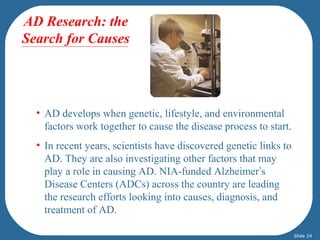
AD develops 
• AD develops when genetic, lifestyle, and environmental 
factors work together to cause the disease process to start. 
• In recent years, scientists have discovered genetic links to 
AD. They are also investigating other factors that may 
play a role in causing AD. NIA-funded Alzheimer’s 
Disease Centers (ADCs) across the country are leading 
the research efforts looking into causes, diagnosis, and 
treatment of AD. 
Slide 24
AD Research: the Search for Causes 
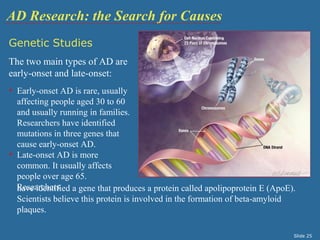
Genetic Studies 
The two main types of AD are 
early-onset and late-onset: 
• Early-onset AD is rare, usually 
affecting people aged 30 to 60 
and usually running in families. 
Researchers have identified 
mutations in three genes that 
cause early-onset AD. 
• Late-onset AD is more 
common. It usually affects 
people over age 65. 
hRaevsee airdcehnetrifsi ed a gene that produces a protein called apolipoprotein E (ApoE). 
Scientists believe this protein is involved in the formation of beta-amyloid 
plaques. 
Slide 25
AD Research: the Search for Causes 
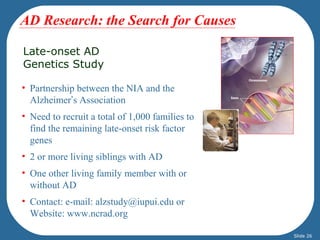
Late-onset AD 
Genetics Study 
• Partnership between the NIA and the 
Alzheimer’s Association 
• Need to recruit a total of 1,000 families to 
find the remaining late-onset risk factor 
genes 
• 2 or more living siblings with AD 
• One other living family member with or 
without AD 
• Contact: e-mail: alzstudy@iupui.edu or 
Website: www.ncrad.org 
Slide 26
AD Research: the Search for Causes 
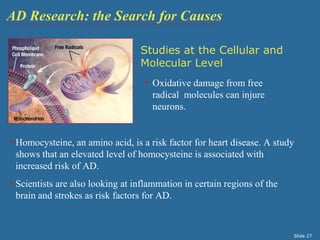
Studies at the Cellular and 
Molecular Level 
• Oxidative damage from free 
radical molecules can injure 
neurons. 
• Homocysteine, an amino acid, is a risk factor for heart disease. A study 
shows that an elevated level of homocysteine is associated with 
increased risk of AD. 
• Scientists are also looking at inflammation in certain regions of the 
brain and strokes as risk factors for AD. 
Slide 27
AD Research: the Search for Causes 
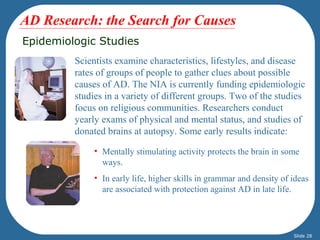
Epidemiologic Studies 
Scientists examine characteristics, lifestyles, and disease 
rates of groups of people to gather clues about possible 
causes of AD. The NIA is currently funding epidemiologic 
studies in a variety of different groups. Two of the studies 
focus on religious communities. Researchers conduct 
yearly exams of physical and mental status, and studies of 
donated brains at autopsy. Some early results indicate: 
• Mentally stimulating activity protects the brain in some 
ways. 
• In early life, higher skills in grammar and density of ideas 
are associated with protection against AD in late life. 
Slide 28
AD Research: Diagnosing AD 
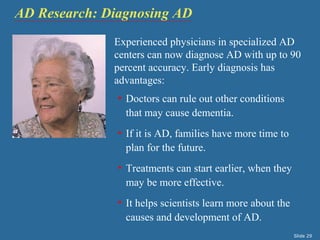
Experienced physicians in specialized AD 
centers can now diagnose AD with up to 90 
percent accuracy. Early diagnosis has 
advantages: 
• Doctors can rule out other conditions 
that may cause dementia. 
• If it is AD, families have more time to 
plan for the future. 
• Treatments can start earlier, when they 
may be more effective. 
• It helps scientists learn more about the 
causes and development of AD. 
Slide 29
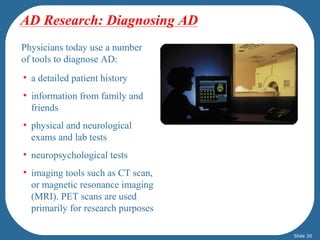
AD Research: Diagnosing AD 
Physicians today use a number 
of tools to diagnose AD: 
• a detailed patient history 
• information from family and 
friends 
• physical and neurological 
exams and lab tests 
• neuropsychological tests 
• imaging tools such as CT scan, 
or magnetic resonance imaging 
(MRI). PET scans are used 
primarily for research purposes 
Slide 30
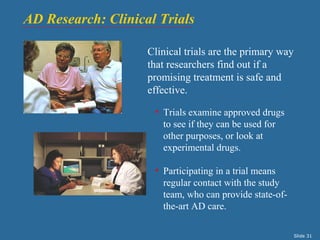
AD Research: Clinical Trials 
Clinical trials are the primary way 
that researchers find out if a 
promising treatment is safe and 
effective. 
• Trials examine approved drugs 
to see if they can be used for 
other purposes, or look at 
experimental drugs. 
• Participating in a trial means 
regular contact with the study 
team, who can provide state-of-the- 
art AD care. 
Slide 31
AD Research: the Search for Treatments 
Drugs used to treat mild to moderate AD symptoms include: 
• Aricept 
• Exelon 
• Reminyl 
An additional drug, Namenda, has been approved to treat symptoms of 
moderate to severe AD. These drugs can help improve some patients’ 
abilities to carry out activities up to a year or so, but they do not stop or 
reverse AD. 
Scientists are also studying agents that someday may be 
useful in preventing AD. For example, they have 
experimented with a vaccine against AD. Although the 
first clinical trial was stopped due to side effects in some 
participants, valuable information was gathered. 
Slide 32
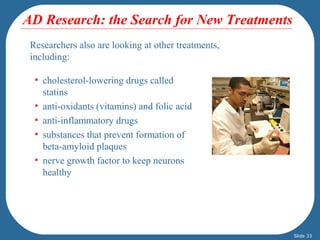
AD Research: the Search for New Treatments 
Researchers also are looking at other treatments, 
including: 
• cholesterol-lowering drugs called 
statins 
• anti-oxidants (vitamins) and folic acid 
• anti-inflammatory drugs 
• substances that prevent formation of 
beta-amyloid plaques 
• nerve growth factor to keep neurons 
healthy 
Slide 33

Excerpt NIA Alzheimer's

  • 1.
    National Institute onAging National Institutes of Health ALZHEIMER’S DISEASE UnravelingtheMystery
  • 2.
    The Impact ofAD Once considered a rare disorder, Alzheimer’s disease is now seen as a major public health problem that is seriously affecting millions of older Americans and their families. The Federal government’s lead agency for Alzheimer’s disease research is the National Institute on Aging, part of the National Institutes of Health. NIH is part of the U.S. Department of Health and Human Services. Slide 2
  • 3.
    Alzheimer’s disease isan irreversible, progressive brain disease that slowly destroys memory and thinking skills. What is AD? Although the risk of developing AD increases with age – in most people with AD, symptoms first appear after age 60 – AD is not a part of normal aging. It is caused by a fatal disease that affects the brain. Slide 4
  • 4.
    What is AD? AD Statistics…. • AD is the most common cause of dementia among people age 65 and older. • Scientists estimate that around 4.5 million people now have AD. • For every 5-year age group beyond 65, the percentage of people with AD doubles. • By 2050, 13.2 million older Americans are expected to have AD if the current numbers hold and no preventive treatments become available. Slide 5
  • 5.
    What is AD? Where are people with AD cared for? • home • assisted living facilities (those in the early stages) • nursing homes (special care units) • The national cost of caring for people with AD is about $100 billion every year. Slide 6
  • 6.
    AD and theBrain Plaques and Tangles: The Hallmarks of AD The brains of people with AD have an abundance of two abnormal structures: • beta-amyloid plaques, which are dense deposits of protein and cellular material that accumulate outside and around nerve cells • neurofibrillary tangles, which are twisted fibers that build up inside the nerve cell An actual AD plaque An actual AD tangle Slide 16
  • 7.
    Beta-amyloid Plaques Amyloidprecursor protein (APP) is the precursor to amyloid plaque. 1. APP sticks through the neuron membrane. 2. Enzymes cut the APP into fragments of protein, including beta-amyloid. 3. Beta-amyloid fragments come together in clumps to form plaques. 1. 2. 3. AD and the Brain In AD, many of these clumps form, disrupting the work of neurons. This affects the hippocampus and other areas of the cerebral cortex. Slide 17
  • 8.
    AD and theBrain Neurofibrillary Tangles Neurons have an internal support structure partly made up of microtubules. A protein called tau helps stabilize microtubules. In AD, tau changes, causing microtubules to collapse, and tau proteins clump together to form neurofibrillary tangles. Slide 18
  • 9.
    The Changing Brainin Alzheimer’s Disease No one knows what causes AD to begin, but we do know a lot about what happens in the brain once AD takes hold. Pet Scan of Normal Brain Pet Scan of Alzheimer’s Disease Brain AD and the Brain Slide 19
  • 10.
    Preclinical AD •Signs of AD are first noticed in the entorhinal cortex, then proceed to the hippocampus. • Affected regions begin to shrink as nerve cells die. • Changes can begin 10-20 years before symptoms appear. • Memory loss is the first sign of AD. AD and the Brain Slide 20
  • 11.
    Mild to ModerateAD • AD spreads through the brain. The cerebral cortex begins to shrink as more and more neurons stop working and die. • Mild AD signs can include memory loss, confusion, trouble handling money, poor judgment, mood changes, and increased anxiety. • Moderate AD signs can include increased memory loss and confusion, problems recognizing people, difficulty with language and thoughts, restlessness, agitation, wandering, and repetitive statements. AD and the Brain Slide 21
  • 12.
    Severe AD •In severe AD, extreme shrinkage occurs in the brain. Patients are completely dependent on others for care. • Symptoms can include weight loss, seizures, skin infections, groaning, moaning, or grunting, increased sleeping, loss of bladder and bowel control. • Death usually occurs from aspiration pneumonia or other infections. Caregivers can turn to a hospice for help and palliative care. AD and the Brain Slide 22
  • 13.
    AD Research: FindingNew Answers and Asking Better Questions • The Search for Causes (slides 24 – 28 ) • Diagnosing AD (slides 29 – 30) • Clinical Trials (slide 31) • The Search for Treatments (slides 32-33) • New NIA Study (slide 34) • Managing the Symptoms of AD (slide 35) Slide 23
  • 14.
    AD Research: the Search for Causes AD develops • AD develops when genetic, lifestyle, and environmental factors work together to cause the disease process to start. • In recent years, scientists have discovered genetic links to AD. They are also investigating other factors that may play a role in causing AD. NIA-funded Alzheimer’s Disease Centers (ADCs) across the country are leading the research efforts looking into causes, diagnosis, and treatment of AD. Slide 24
  • 15.
    AD Research: theSearch for Causes Genetic Studies The two main types of AD are early-onset and late-onset: • Early-onset AD is rare, usually affecting people aged 30 to 60 and usually running in families. Researchers have identified mutations in three genes that cause early-onset AD. • Late-onset AD is more common. It usually affects people over age 65. hRaevsee airdcehnetrifsi ed a gene that produces a protein called apolipoprotein E (ApoE). Scientists believe this protein is involved in the formation of beta-amyloid plaques. Slide 25
  • 16.
    AD Research: theSearch for Causes Late-onset AD Genetics Study • Partnership between the NIA and the Alzheimer’s Association • Need to recruit a total of 1,000 families to find the remaining late-onset risk factor genes • 2 or more living siblings with AD • One other living family member with or without AD • Contact: e-mail: alzstudy@iupui.edu or Website: www.ncrad.org Slide 26
  • 17.
    AD Research: theSearch for Causes Studies at the Cellular and Molecular Level • Oxidative damage from free radical molecules can injure neurons. • Homocysteine, an amino acid, is a risk factor for heart disease. A study shows that an elevated level of homocysteine is associated with increased risk of AD. • Scientists are also looking at inflammation in certain regions of the brain and strokes as risk factors for AD. Slide 27
  • 18.
    AD Research: theSearch for Causes Epidemiologic Studies Scientists examine characteristics, lifestyles, and disease rates of groups of people to gather clues about possible causes of AD. The NIA is currently funding epidemiologic studies in a variety of different groups. Two of the studies focus on religious communities. Researchers conduct yearly exams of physical and mental status, and studies of donated brains at autopsy. Some early results indicate: • Mentally stimulating activity protects the brain in some ways. • In early life, higher skills in grammar and density of ideas are associated with protection against AD in late life. Slide 28
  • 19.
    AD Research: DiagnosingAD Experienced physicians in specialized AD centers can now diagnose AD with up to 90 percent accuracy. Early diagnosis has advantages: • Doctors can rule out other conditions that may cause dementia. • If it is AD, families have more time to plan for the future. • Treatments can start earlier, when they may be more effective. • It helps scientists learn more about the causes and development of AD. Slide 29
  • 20.
    AD Research: DiagnosingAD Physicians today use a number of tools to diagnose AD: • a detailed patient history • information from family and friends • physical and neurological exams and lab tests • neuropsychological tests • imaging tools such as CT scan, or magnetic resonance imaging (MRI). PET scans are used primarily for research purposes Slide 30
  • 21.
    AD Research: ClinicalTrials Clinical trials are the primary way that researchers find out if a promising treatment is safe and effective. • Trials examine approved drugs to see if they can be used for other purposes, or look at experimental drugs. • Participating in a trial means regular contact with the study team, who can provide state-of-the- art AD care. Slide 31
  • 22.
    AD Research: theSearch for Treatments Drugs used to treat mild to moderate AD symptoms include: • Aricept • Exelon • Reminyl An additional drug, Namenda, has been approved to treat symptoms of moderate to severe AD. These drugs can help improve some patients’ abilities to carry out activities up to a year or so, but they do not stop or reverse AD. Scientists are also studying agents that someday may be useful in preventing AD. For example, they have experimented with a vaccine against AD. Although the first clinical trial was stopped due to side effects in some participants, valuable information was gathered. Slide 32
  • 23.
    AD Research: theSearch for New Treatments Researchers also are looking at other treatments, including: • cholesterol-lowering drugs called statins • anti-oxidants (vitamins) and folic acid • anti-inflammatory drugs • substances that prevent formation of beta-amyloid plaques • nerve growth factor to keep neurons healthy Slide 33

Editor's Notes

  • #2 The National Institute on Aging presents: Alzheimer’s Disease, Unraveling the Mystery. The National Institute on Aging is part of the National Institutes of Health U.S. Department of Health and Human Services