DESIGNING
A MODERN CAREER
Ieva Kilgour
2013
About me
• Education in economics, business strategy, and social sciences
• Experience in HR, business development, marketing research,
demand planning and training
• Gave trainings on presentation skills, public speaking
• Coached executives on managing their teams
• Living and working in Belgium since 2008
• Studying towards Personal Performance Coaching certification
• Helping frustrated professionals who are unhappy with their
career and are willing to change but do not know where and
how to start
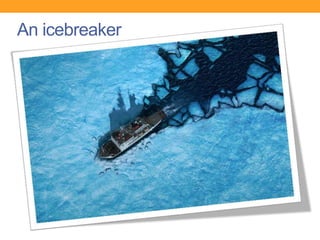
An icebreaker
Most popular jobs
1. Network Systems Analyst
2. Physician's Assistant
3. Physician and Surgeon
4. Software Engineer
5. Fitness Trainer
6. Database Administrator
7. Pharmacist
8. Psychiatrist
9. Veterinary Technician
10. Dental Hygienist
http://www.alec.co.uk/free-career-assessment/top-10-most-popular-careers.htm
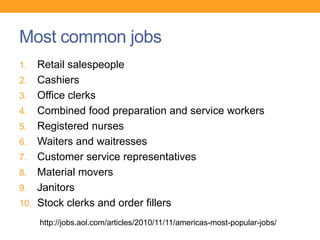
Most common jobs
1. Retail salespeople
2. Cashiers
3. Office clerks
4. Combined food preparation and service workers
5. Registered nurses
6. Waiters and waitresses
7. Customer service representatives
8. Material movers
9. Janitors
10. Stock clerks and order fillers
http://jobs.aol.com/articles/2010/11/11/americas-most-popular-jobs/
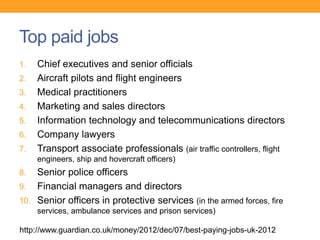
Top paid jobs
1. Chief executives and senior officials
2. Aircraft pilots and flight engineers
3. Medical practitioners
4. Marketing and sales directors
5. Information technology and telecommunications directors
6. Company lawyers
7. Transport associate professionals (air traffic controllers, flight
engineers, ship and hovercraft officers)
8. Senior police officers
9. Financial managers and directors
10. Senior officers in protective services (in the armed forces, fire
services, ambulance services and prison services)
http://www.guardian.co.uk/money/2012/dec/07/best-paying-jobs-uk-2012
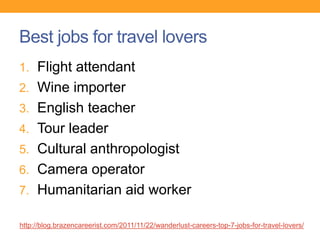
Best jobs for travel lovers
1. Flight attendant
2. Wine importer
3. English teacher
4. Tour leader
5. Cultural anthropologist
6. Camera operator
7. Humanitarian aid worker
http://blog.brazencareerist.com/2011/11/22/wanderlust-careers-top-7-jobs-for-travel-lovers/
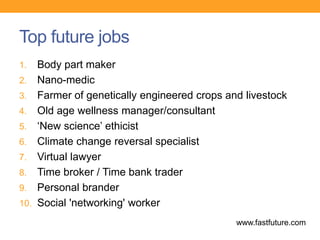
Top future jobs
1. Body part maker
2. Nano-medic
3. Farmer of genetically engineered crops and livestock
4. Old age wellness manager/consultant
5. ‘New science’ ethicist
6. Climate change reversal specialist
7. Virtual lawyer
8. Time broker / Time bank trader
9. Personal brander
10. Social 'networking' worker
www.fastfuture.com
What is ‘a career’?
• Job vs Career
• What is the difference?
• What are the implications of the above?
• “A career is for a life time”
• “You must choose to do one thing as a career”
• “You can’t get paid for doing what you love”
• “I do my job to get paid, then I spend vacations doing what I really
want”
• “I would love to travel the world, but I can do it only after I spend
months in the office”
• “My perfect job is (somewhere) out there, I just
need to find it”
Myths
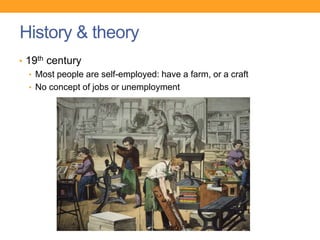
History & theory
• 19th century
• Most people are self-employed: have a farm, or a craft
• No concept of jobs or unemployment
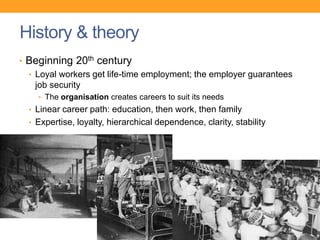
History & theory
• Beginning 20th century
• Loyal workers get life-time employment; the employer guarantees
job security
• The organisation creates careers to suit its needs
• Linear career path: education, then work, then family
• Expertise, loyalty, hierarchical dependence, clarity, stability
History & theory
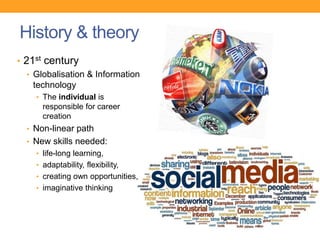
• 21st century
• Globalisation & Information
technology
• The individual is
responsible for career
creation
• Non-linear path
• New skills needed:
• life-long learning,
• adaptability, flexibility,
• creating own opportunities,
• imaginative thinking
Career considerations...
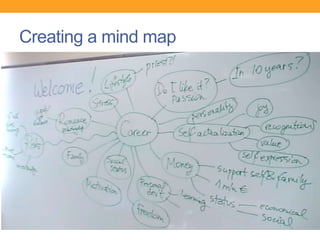
Creating a mind map
• Exercise
Creating a mind map
Finding a career
• Look around at what other people do
• who makes money
• Get advised by parents / friends
• Take college / university degree
• To prepare for a particular career
• (Take a career test)
• Online or at recruitment company
• Identify the most suitable career for you
• Look for jobs on internet / job ads
• Take it or leave it, you have no input to job description
• Choose a career and stick with it
• Career choice you make will have an impact on your next career
moves
The philosophy & process behind…
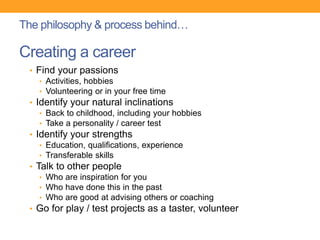
• Find your passions
• Activities, hobbies
• Volunteering or in your free time
• Identify your natural inclinations
• Back to childhood, including your hobbies
• Take a personality / career test
• Identify your strengths
• Education, qualifications, experience
• Transferable skills
• Talk to other people
• Who are inspiration for you
• Who have done this in the past
• Who are good at advising others or coaching
• Go for play / test projects as a taster, volunteer
Creating a career
The philosophy & process behind…
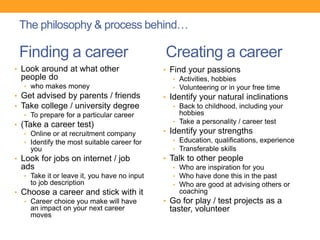
Finding a career
• Find your passions
• Activities, hobbies
• Volunteering or in your free time
• Identify your natural inclinations
• Back to childhood, including your
hobbies
• Take a personality / career test
• Identify your strengths
• Education, qualifications, experience
• Transferable skills
• Talk to other people
• Who are inspiration for you
• Who have done this in the past
• Who are good at advising others or
coaching
• Go for play / test projects as a
taster, volunteer
• Look around at what other
people do
• who makes money
• Get advised by parents / friends
• Take college / university degree
• To prepare for a particular career
• (Take a career test)
• Online or at recruitment company
• Identify the most suitable career for
you
• Look for jobs on internet / job
ads
• Take it or leave it, you have no input
to job description
• Choose a career and stick with it
• Career choice you make will have
an impact on your next career
moves
Creating a career
The philosophy & process behind…
Concluding remarks
• The concept of career has changed dramatically
•  Globalisation and technological innovation
• You are responsible for creating your career and
your life
• Adopt a holistic approach (consider multiple
inputs)
• A pre-set job might not be an answer
• You are much more than a job description
• You have your own definition of what you want to do
• You can change/evolve your career
Inspired by:
• Marianne Cantwell (2013), “Be A Free Range Human”
• Chris Guillebeau, chrisguillebeau.com/
• Dom Jackman & Rob Symington, www.escapethecity.org/
• Pamela Slim, www.escapefromcubiclenation.com/
• Danielle LaPorte, www.daniellelaporte.com/
• Savickas et al. (2009), “Life designing: A paradigm for
career construction in the 21st century”,
xa.yimg.com/kq/groups/70983503/2046355320/name/Life
+designing(ENG).pdf
• Patton, Wendy (2005), “A Postmodern Approach to
Career Education: What Does it Look Like?”
http://eprints.qut.edu.au/3053/01/3053.pdf

Modern_career_seminar_2013

  • 1.
  • 2.
    About me • Educationin economics, business strategy, and social sciences • Experience in HR, business development, marketing research, demand planning and training • Gave trainings on presentation skills, public speaking • Coached executives on managing their teams • Living and working in Belgium since 2008 • Studying towards Personal Performance Coaching certification • Helping frustrated professionals who are unhappy with their career and are willing to change but do not know where and how to start
  • 3.
  • 4.
    Most popular jobs 1.Network Systems Analyst 2. Physician's Assistant 3. Physician and Surgeon 4. Software Engineer 5. Fitness Trainer 6. Database Administrator 7. Pharmacist 8. Psychiatrist 9. Veterinary Technician 10. Dental Hygienist http://www.alec.co.uk/free-career-assessment/top-10-most-popular-careers.htm
  • 5.
    Most common jobs 1.Retail salespeople 2. Cashiers 3. Office clerks 4. Combined food preparation and service workers 5. Registered nurses 6. Waiters and waitresses 7. Customer service representatives 8. Material movers 9. Janitors 10. Stock clerks and order fillers http://jobs.aol.com/articles/2010/11/11/americas-most-popular-jobs/
  • 6.
    Top paid jobs 1.Chief executives and senior officials 2. Aircraft pilots and flight engineers 3. Medical practitioners 4. Marketing and sales directors 5. Information technology and telecommunications directors 6. Company lawyers 7. Transport associate professionals (air traffic controllers, flight engineers, ship and hovercraft officers) 8. Senior police officers 9. Financial managers and directors 10. Senior officers in protective services (in the armed forces, fire services, ambulance services and prison services) http://www.guardian.co.uk/money/2012/dec/07/best-paying-jobs-uk-2012
  • 7.
    Best jobs fortravel lovers 1. Flight attendant 2. Wine importer 3. English teacher 4. Tour leader 5. Cultural anthropologist 6. Camera operator 7. Humanitarian aid worker http://blog.brazencareerist.com/2011/11/22/wanderlust-careers-top-7-jobs-for-travel-lovers/
  • 8.
    Top future jobs 1.Body part maker 2. Nano-medic 3. Farmer of genetically engineered crops and livestock 4. Old age wellness manager/consultant 5. ‘New science’ ethicist 6. Climate change reversal specialist 7. Virtual lawyer 8. Time broker / Time bank trader 9. Personal brander 10. Social 'networking' worker www.fastfuture.com
  • 9.
    What is ‘acareer’? • Job vs Career • What is the difference? • What are the implications of the above?
  • 10.
    • “A careeris for a life time” • “You must choose to do one thing as a career” • “You can’t get paid for doing what you love” • “I do my job to get paid, then I spend vacations doing what I really want” • “I would love to travel the world, but I can do it only after I spend months in the office” • “My perfect job is (somewhere) out there, I just need to find it” Myths
  • 11.
    History & theory •19th century • Most people are self-employed: have a farm, or a craft • No concept of jobs or unemployment
  • 12.
    History & theory •Beginning 20th century • Loyal workers get life-time employment; the employer guarantees job security • The organisation creates careers to suit its needs • Linear career path: education, then work, then family • Expertise, loyalty, hierarchical dependence, clarity, stability
  • 13.
    History & theory •21st century • Globalisation & Information technology • The individual is responsible for career creation • Non-linear path • New skills needed: • life-long learning, • adaptability, flexibility, • creating own opportunities, • imaginative thinking
  • 14.
  • 15.
    Creating a mindmap • Exercise
  • 16.
  • 17.
    Finding a career •Look around at what other people do • who makes money • Get advised by parents / friends • Take college / university degree • To prepare for a particular career • (Take a career test) • Online or at recruitment company • Identify the most suitable career for you • Look for jobs on internet / job ads • Take it or leave it, you have no input to job description • Choose a career and stick with it • Career choice you make will have an impact on your next career moves The philosophy & process behind…
  • 18.
    • Find yourpassions • Activities, hobbies • Volunteering or in your free time • Identify your natural inclinations • Back to childhood, including your hobbies • Take a personality / career test • Identify your strengths • Education, qualifications, experience • Transferable skills • Talk to other people • Who are inspiration for you • Who have done this in the past • Who are good at advising others or coaching • Go for play / test projects as a taster, volunteer Creating a career The philosophy & process behind…
  • 19.
    Finding a career •Find your passions • Activities, hobbies • Volunteering or in your free time • Identify your natural inclinations • Back to childhood, including your hobbies • Take a personality / career test • Identify your strengths • Education, qualifications, experience • Transferable skills • Talk to other people • Who are inspiration for you • Who have done this in the past • Who are good at advising others or coaching • Go for play / test projects as a taster, volunteer • Look around at what other people do • who makes money • Get advised by parents / friends • Take college / university degree • To prepare for a particular career • (Take a career test) • Online or at recruitment company • Identify the most suitable career for you • Look for jobs on internet / job ads • Take it or leave it, you have no input to job description • Choose a career and stick with it • Career choice you make will have an impact on your next career moves Creating a career The philosophy & process behind…
  • 20.
    Concluding remarks • Theconcept of career has changed dramatically •  Globalisation and technological innovation • You are responsible for creating your career and your life • Adopt a holistic approach (consider multiple inputs) • A pre-set job might not be an answer • You are much more than a job description • You have your own definition of what you want to do • You can change/evolve your career
  • 21.
    Inspired by: • MarianneCantwell (2013), “Be A Free Range Human” • Chris Guillebeau, chrisguillebeau.com/ • Dom Jackman & Rob Symington, www.escapethecity.org/ • Pamela Slim, www.escapefromcubiclenation.com/ • Danielle LaPorte, www.daniellelaporte.com/ • Savickas et al. (2009), “Life designing: A paradigm for career construction in the 21st century”, xa.yimg.com/kq/groups/70983503/2046355320/name/Life +designing(ENG).pdf • Patton, Wendy (2005), “A Postmodern Approach to Career Education: What Does it Look Like?” http://eprints.qut.edu.au/3053/01/3053.pdf