What do youmean by Model?
A model is a pattern or figure of
something to be made. Models are everywhere
and we use them in different kinds of things!
Same with COMMUNICATION.
Now, What do you mean by Model of
Communication?
It help us understand better the
process of communication in every different
3.
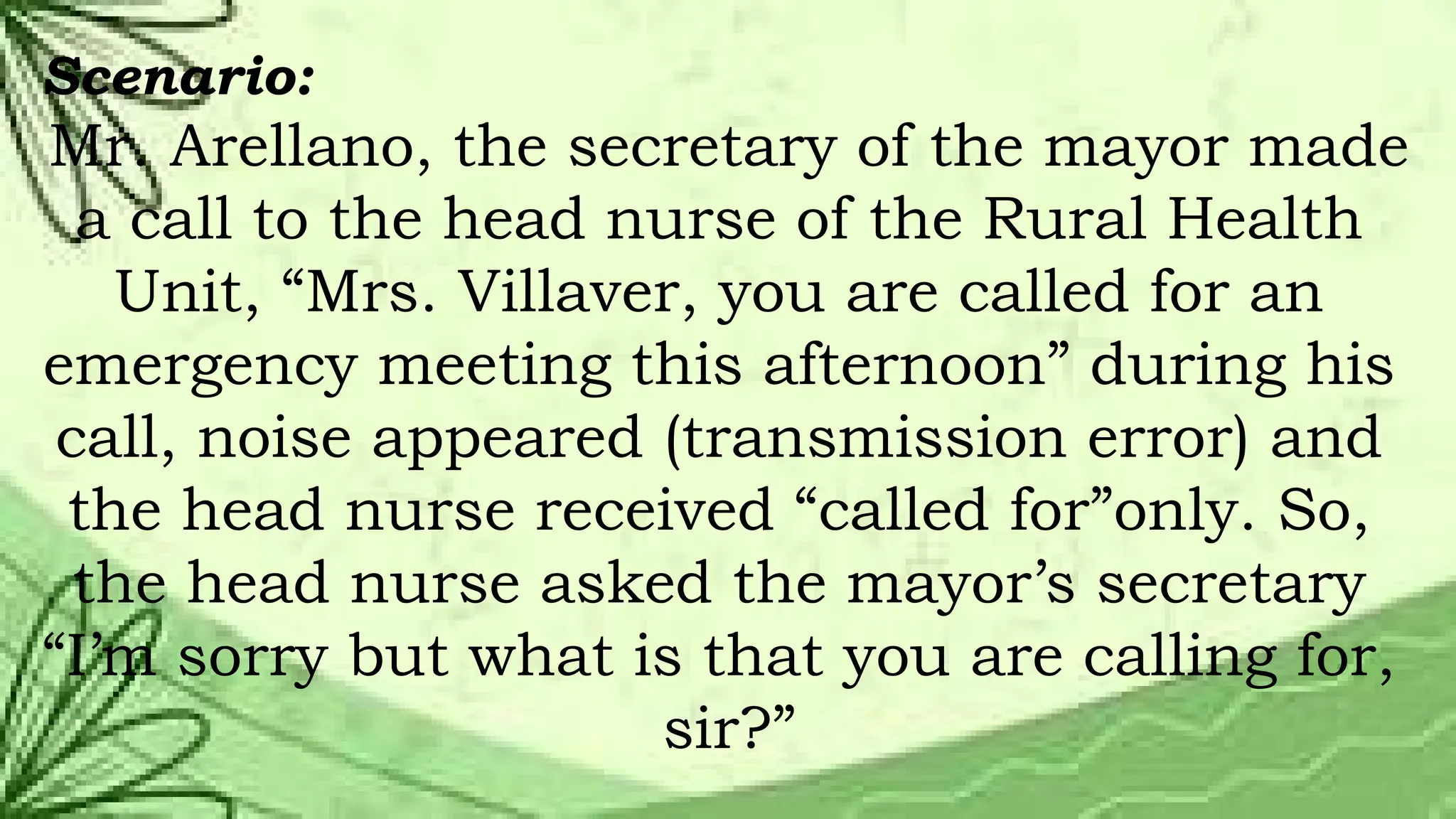
Scenario:
Mr. Arellano, thesecretary of the mayor made
a call to the head nurse of the Rural Health
Unit, “Mrs. Villaver, you are called for an
emergency meeting this afternoon” during his
call, noise appeared (transmission error) and
the head nurse received “called for”only. So,
the head nurse asked the mayor’s secretary
“I’m sorry but what is that you are calling for,
sir?”
4.
Question:
Who is thesender?
What is the message?
What could be the possible noise?
Who is the receiver?
Can you give a short presentation of the
diagram?
How important are models to see the process
of communication?
Here, we havea picture of a person listening
to music. Reading a book. Watching the news
on television. Listening to the sermon of the
priest. What is common in these
communication situations?
7.
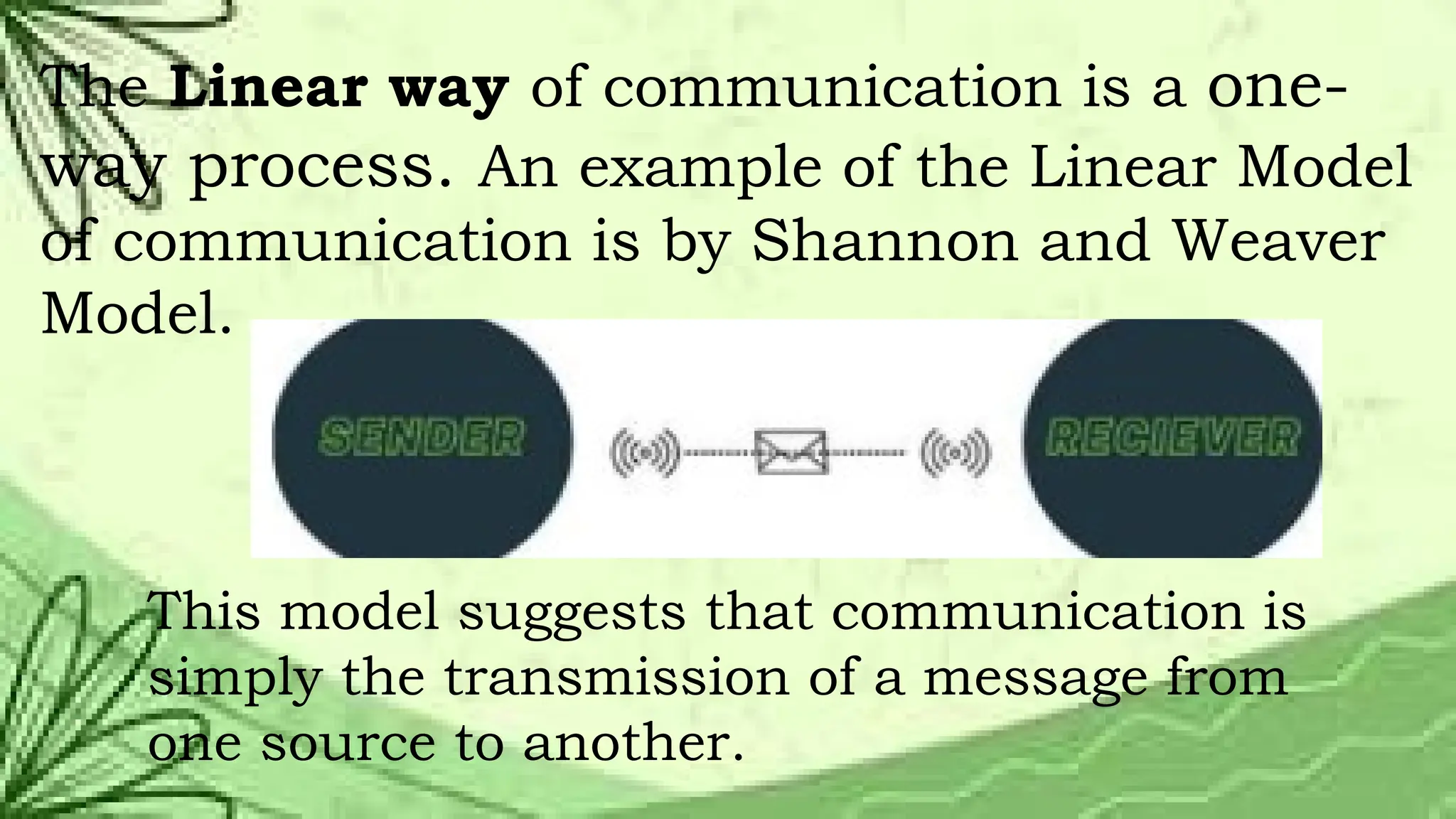
The Linear wayof communication is a one-
way process. An example of the Linear Model
of communication is by Shannon and Weaver
Model.
This model suggests that communication is
simply the transmission of a message from
one source to another.
8.
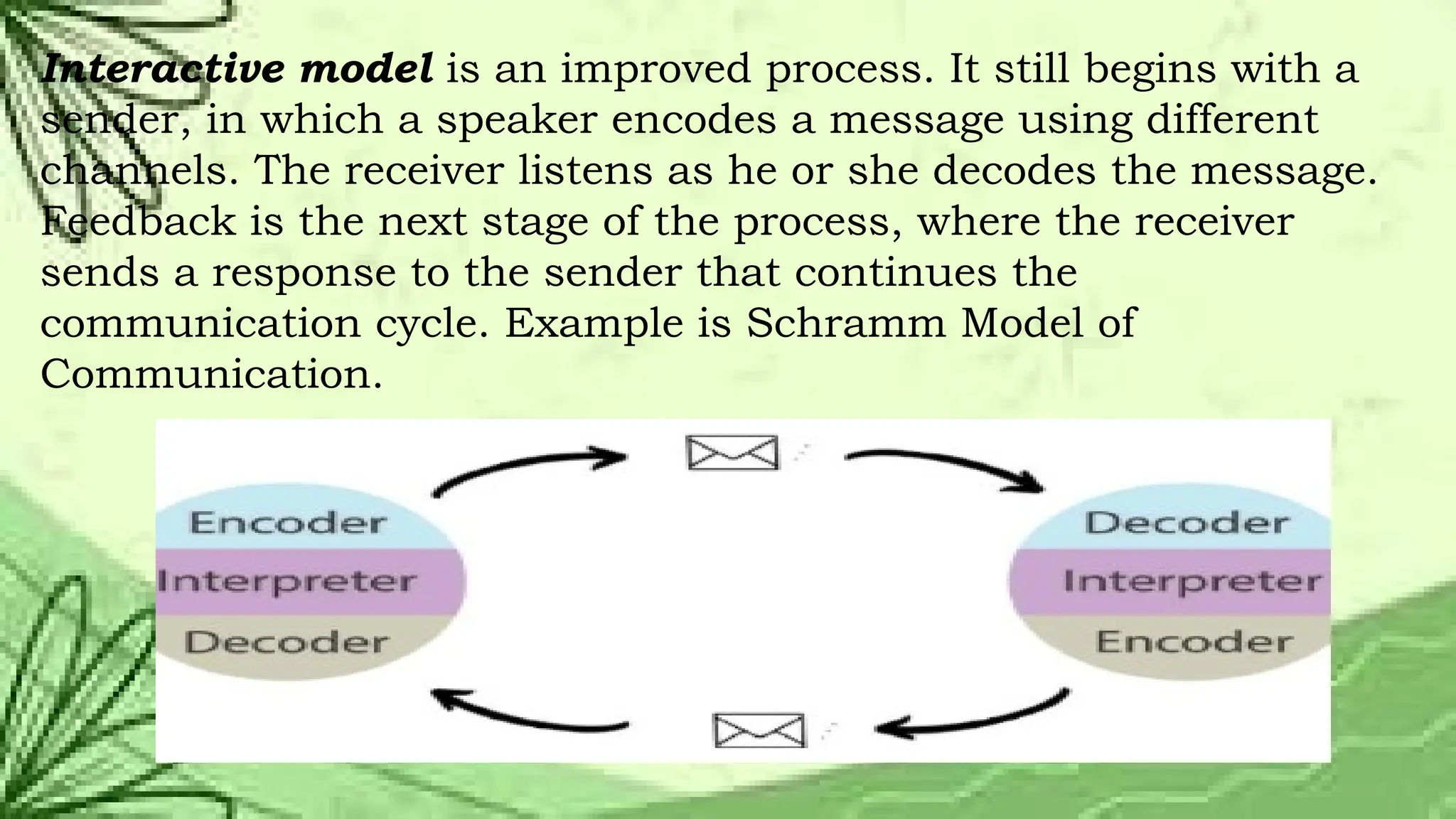
Interactive model isan improved process. It still begins with a
sender, in which a speaker encodes a message using different
channels. The receiver listens as he or she decodes the message.
Feedback is the next stage of the process, where the receiver
sends a response to the sender that continues the
communication cycle. Example is Schramm Model of
Communication.
9.
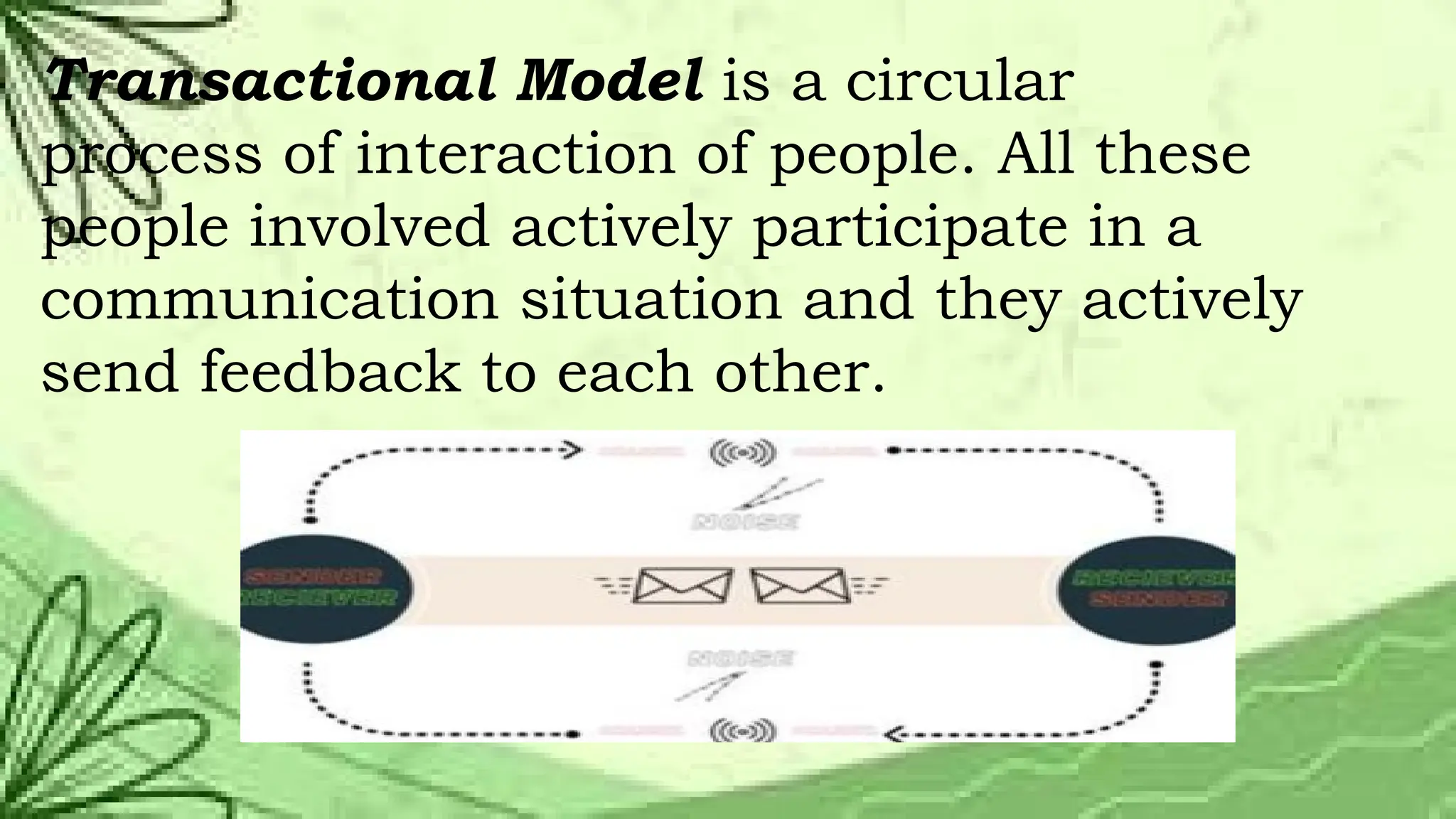
Transactional Model isa circular
process of interaction of people. All these
people involved actively participate in a
communication situation and they actively
send feedback to each other.
10.
LET’S MAKE ASCENE!
Instruction: Your task is to make a scenario based on the
models and present the scenario in the
class. You are scored based on the Rubric:
You are scored based on the Rubric:
Content – 5 pts.
Organization- 5 pts.
Presentation- 5 pts.
Cooperation- 5 pts.
11.
LET’S EVALUATE!
Instruction: Talkabout the similarities
and differences of the three given
models of communication below; the
things they have in common and the
ways in which they differ by
illustrating them through a Venn
diagram.


![OC-PPTM2- COMMUNICATION MODELS [Autosaved].pptx](https://cdn.slidesharecdn.com/ss_thumbnails/oc-pptm2-communicationmodelsautosaved-240901061429-8de2509c-thumbnail.jpg?width=640&height=640&fit=bounds)


