OBJECTIVES
At the end of this lesson, you should be able to:
• Know the communication models;
• understand how each model works and;
• Differentiate the three according to its
context/use.
COMMUNICATION
MODELS
A. Linear Model
The linear communication model presents
communication as a one-way activity in which
information flows from the sender to the receiver.
This process shows only a passive receiver.
Feedback is not a requirement, and the role of the
receiver is only to accept information.
Shannon-Weaver Model
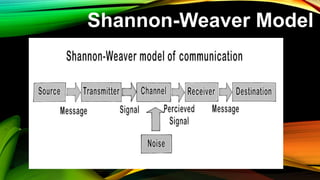
An example of linear type of communication is the
Shannon-Weaver model (1949). It is also
considered as the mother of all communication
models. It has a one-way process starting from a
source (producer of message); passing through a
channel (signals adapted for transmission) which
may at times be interrupted by noise (barrier) to a
receiver (decoder of message from the signal).
The process stops after the message has arrived
at its destination.
1. listening to the radio
2. watching the news on
television
Examples:
B. Interactive Model
The interactive communication model shows a
two-way activity. The sender and the receiver
have the same role in the activity: either one
comes up with an idea, sends a message, and
reacts to a concept. The model involves
feedback, an element missing from the linear
communication model. It may also include noise,
an element that affects the interpretation of the
message.
Schramm Model
Schramm (1954) visualized the process of
communication as an exchange of thoughts and ideas.
Feedback was added to the Shannon-Weaver model.
The recipient of the message decodes it and creates a
feedback based on his understanding of the
information sent and vice versa.
The figure identifies the six elements of communication
which are the sender, the message sent, the receiver
and the feedback provided by the receiver and sent
back as a response to the sender and the processes of
encoding and decoding.
1. Telephone Conversation
2. Interview
3. Casual Conversation
Examples:
C. Transactional Model
The transactional model presents
communication not only as a two-way process but
also a simultaneous activity. Senders and
receivers are called participants since they are
both capable of sending or receiving messages
anytime or at the same time.
The noise and the environment are the other
elements that affect the process. The noise is any
distraction that affects the interpretation of the
message.
In this concept, the noise or barrier to
communication is also taken into
consideration for it may directly or
indirectly affect the smooth flow of
communication. In the event that the
message was not clearly conveyed due to
the barrier, the communication continues
in order to clarify the intended meaning of
the sender.
Helical Model
The helical model has basic elements that are
similar to the other communication models.
However, unlike those models, it promotes an
upward and forward movement. It shows that
knowledge increases as the interaction goes on.
Also, the helical model proposes that
communication starts at birth and evolves as one
grows up, and that one's responses depend on
past experiences. So, there is not only a forward
movement in the process but also some looking
back involved.
1. The learning of a new word
Example:
QUESTIONS???
ELEMENTS OF
COMMUNICATION
The participants are the communicators
who can be both senders and receivers. A
sender transmits the information to the
receiver, and the receiver decodes the
message in order to formulate a response.
Participants
Context refers to the interrelated conditions affecting
the message. These include physical, social,
psychological, and cultural factors.
Physical context refers to the place, time,
environment, and distance between
communicators. Social context refers to the
relationship of the communicators,
whereas psychological context refers to their moods
and feelings. Cultural context includes the beliefs and
norms of the participants.
Context
The main point of having communication is
the message. The message is the idea or
information that the sender would like to
convey to the receiver. It is thus important
that the message is stated clearly and in a
way that is understandable to the receiver.
Message
The channel is the means of delivering
the message. It can be a face-to-face
conversation, a letter, a phone call, an e-
mail, or the social media.
Channel
The feedback is the response of the
receiver. This helps the sender of the
message to determine whether the
message was understood by the receiver. If
the participants of the conversation
continue giving feedback, the flow of
communication continues.
Feedback
QUESTIONS???

Communication Models.pptx

  • 1.
    OBJECTIVES At the endof this lesson, you should be able to: • Know the communication models; • understand how each model works and; • Differentiate the three according to its context/use.
  • 2.
  • 3.
  • 4.
    The linear communicationmodel presents communication as a one-way activity in which information flows from the sender to the receiver. This process shows only a passive receiver. Feedback is not a requirement, and the role of the receiver is only to accept information.
  • 5.
  • 6.
    An example oflinear type of communication is the Shannon-Weaver model (1949). It is also considered as the mother of all communication models. It has a one-way process starting from a source (producer of message); passing through a channel (signals adapted for transmission) which may at times be interrupted by noise (barrier) to a receiver (decoder of message from the signal). The process stops after the message has arrived at its destination.
  • 7.
    1. listening tothe radio 2. watching the news on television Examples:
  • 8.
  • 9.
    The interactive communicationmodel shows a two-way activity. The sender and the receiver have the same role in the activity: either one comes up with an idea, sends a message, and reacts to a concept. The model involves feedback, an element missing from the linear communication model. It may also include noise, an element that affects the interpretation of the message.
  • 10.
  • 11.
    Schramm (1954) visualizedthe process of communication as an exchange of thoughts and ideas. Feedback was added to the Shannon-Weaver model. The recipient of the message decodes it and creates a feedback based on his understanding of the information sent and vice versa. The figure identifies the six elements of communication which are the sender, the message sent, the receiver and the feedback provided by the receiver and sent back as a response to the sender and the processes of encoding and decoding.
  • 12.
    1. Telephone Conversation 2.Interview 3. Casual Conversation Examples:
  • 13.
  • 14.
    The transactional modelpresents communication not only as a two-way process but also a simultaneous activity. Senders and receivers are called participants since they are both capable of sending or receiving messages anytime or at the same time. The noise and the environment are the other elements that affect the process. The noise is any distraction that affects the interpretation of the message.
  • 15.
    In this concept,the noise or barrier to communication is also taken into consideration for it may directly or indirectly affect the smooth flow of communication. In the event that the message was not clearly conveyed due to the barrier, the communication continues in order to clarify the intended meaning of the sender.
  • 16.
  • 17.
    The helical modelhas basic elements that are similar to the other communication models. However, unlike those models, it promotes an upward and forward movement. It shows that knowledge increases as the interaction goes on. Also, the helical model proposes that communication starts at birth and evolves as one grows up, and that one's responses depend on past experiences. So, there is not only a forward movement in the process but also some looking back involved.
  • 18.
    1. The learningof a new word Example:
  • 19.
  • 20.
  • 21.
    The participants arethe communicators who can be both senders and receivers. A sender transmits the information to the receiver, and the receiver decodes the message in order to formulate a response. Participants
  • 22.
    Context refers tothe interrelated conditions affecting the message. These include physical, social, psychological, and cultural factors. Physical context refers to the place, time, environment, and distance between communicators. Social context refers to the relationship of the communicators, whereas psychological context refers to their moods and feelings. Cultural context includes the beliefs and norms of the participants. Context
  • 23.
    The main pointof having communication is the message. The message is the idea or information that the sender would like to convey to the receiver. It is thus important that the message is stated clearly and in a way that is understandable to the receiver. Message
  • 24.
    The channel isthe means of delivering the message. It can be a face-to-face conversation, a letter, a phone call, an e- mail, or the social media. Channel
  • 25.
    The feedback isthe response of the receiver. This helps the sender of the message to determine whether the message was understood by the receiver. If the participants of the conversation continue giving feedback, the flow of communication continues. Feedback
  • 26.