COMMUNICATION
MODELS
Diana B. Broñola
SHS Teacher 3
Models of Communication Process
A. Linear Communication
Linear communication is one-way, focusing on the
transmission of a message to a receiver who never responds
or has no way of responding to the information conveyed.
For instance, a competition organizer is presenting
the contest mechanics. The message is final and cannot be
contended at all. It could be the president giving his State of
the Nation Address on the national television or a student
who reads a poem or tells a story in front of an audience in
a school program.
Models of Communication Process
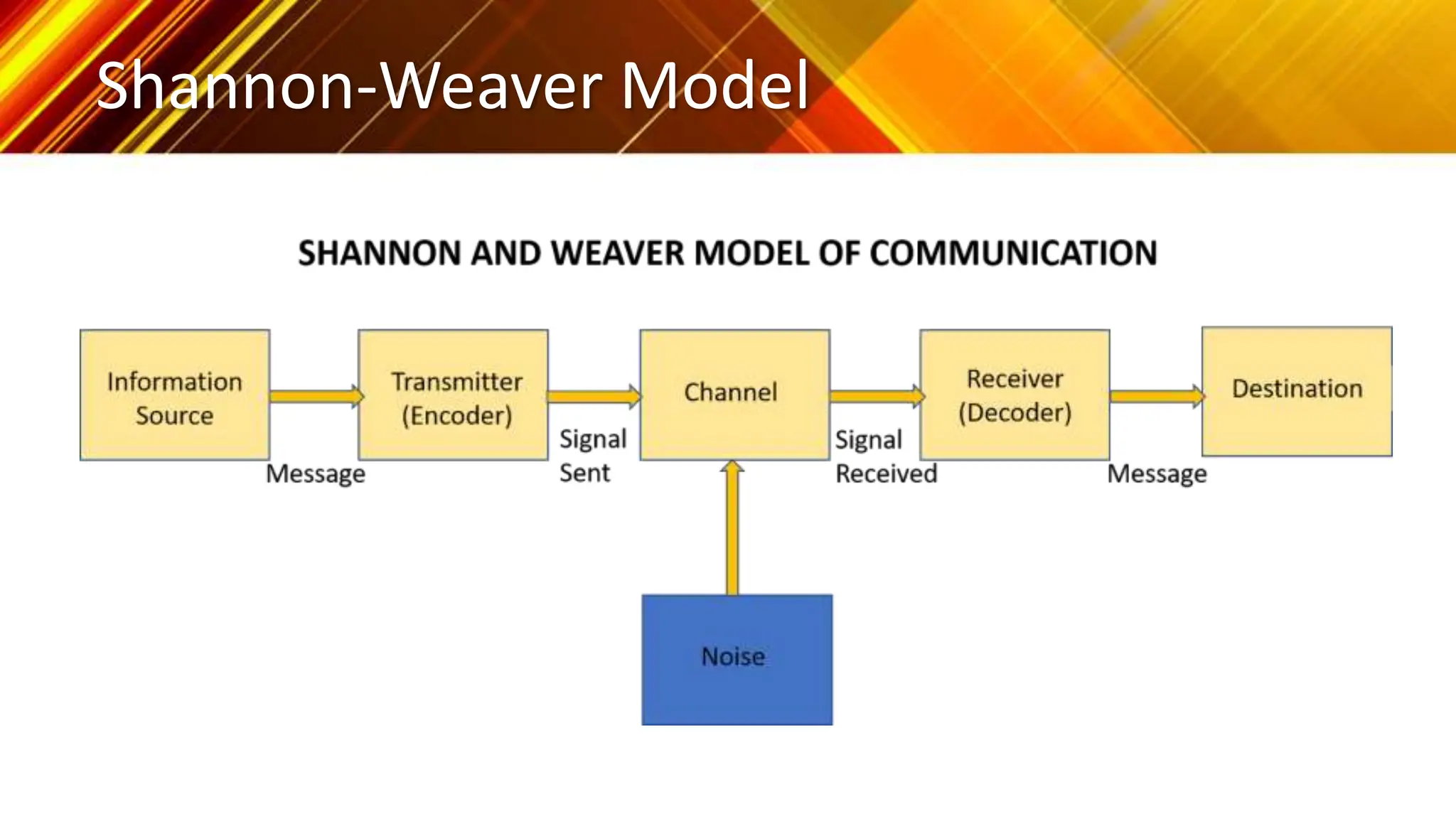
Shannon-Weaver Model
 an example of linear type of model (1949)
 considered as the mother of all communication models
 has a one-way process starting from a source (producer
of message); passing through a channel (signals adapted
for transmission) which may at times be interrupted by
noise (barrier) to a receiver (decoder of message from
the signal). The process stops after the message has
arrived at its destination.
Shannon-Weaver Model
Models of Communication Process
B. Interactive
Interactive approach is a two-way
communication process where a response is given after
a message is sent. The recipient of the action
intentionally or unintentionally gives a feedback
associated with the information received.
Models of Communication Process
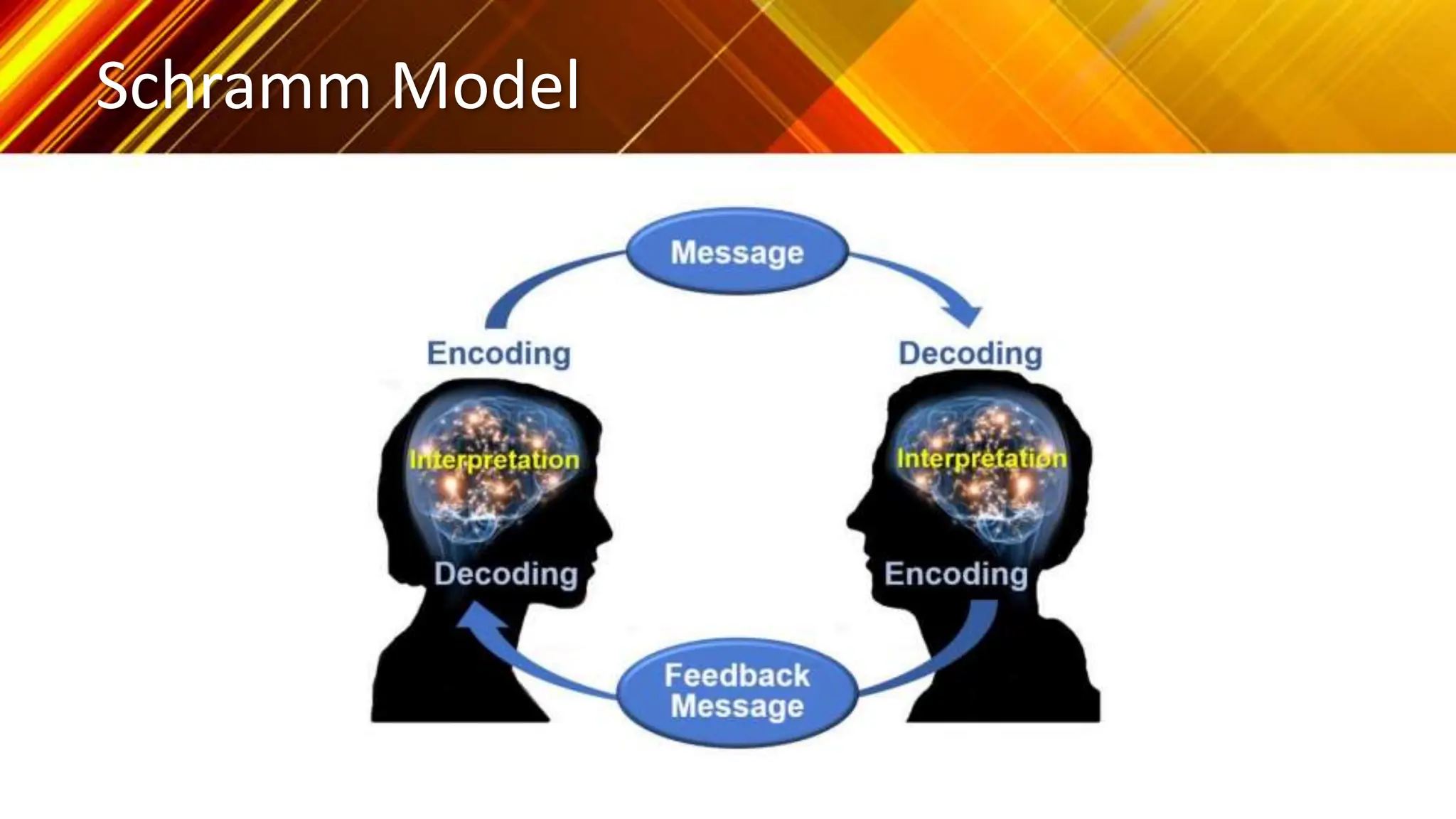
Schramm Model
 visualized the process of communication as an exchange of
thoughts and ideas
 Feedback was added to the Shannon-Weaver Model. The recipient
of the message decodes it and creates a feedback based on his
understanding of the information sent and vice versa
 The figure identifies the six elements of communication which are
the sender, the message sent, the receiver and the feedback
provided by the receiver and sent back as a response to the sender
and the processes of encoding and decoding.
Schramm Model
Models of Communication Process
C. Transactional Model
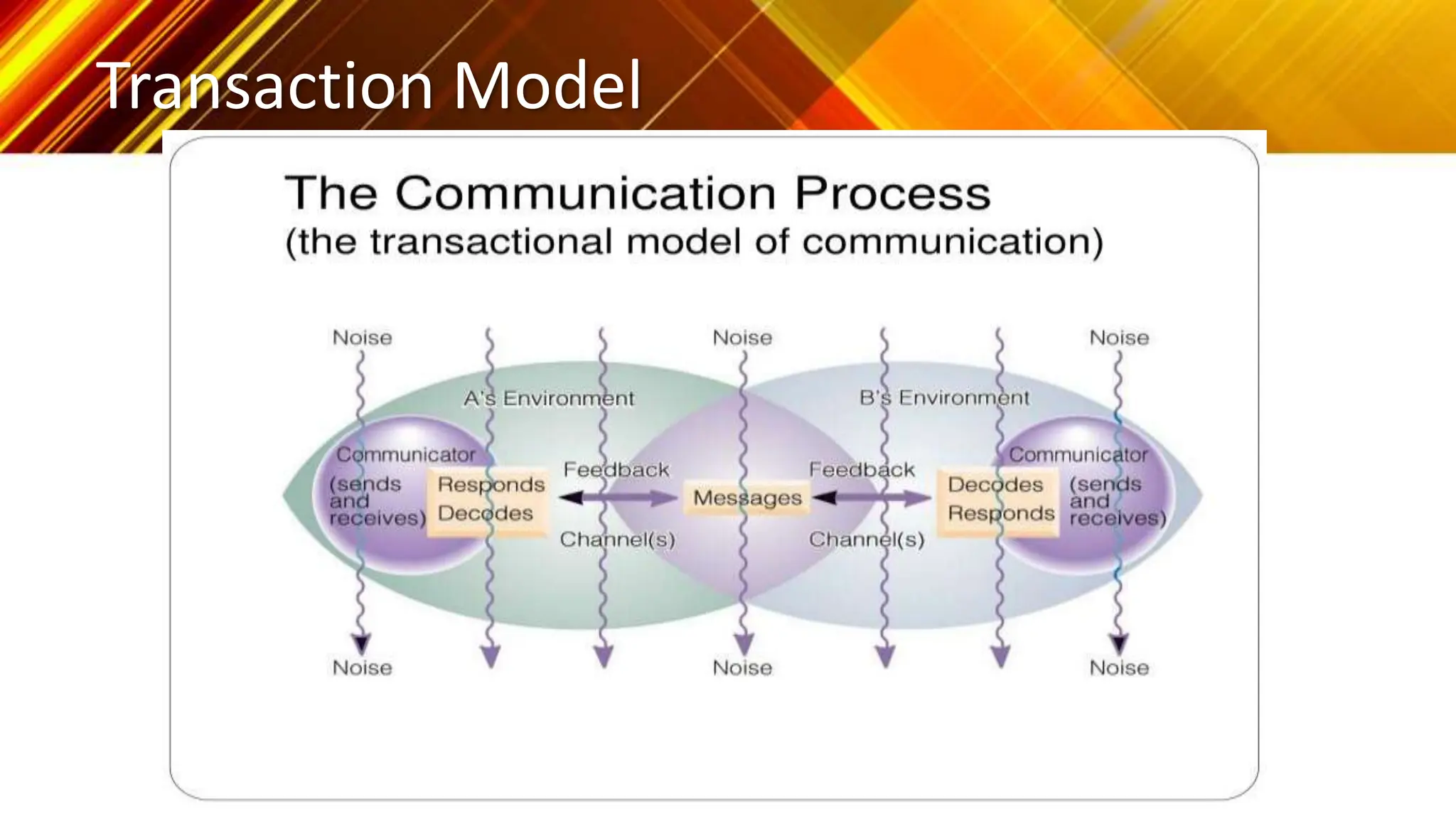
The transactional model shows a circular process of interaction
between the persons involved in the communication, with each one
actively participating and sharing ideas with one another. They are the
communicators actively exchanging information and reaction.
Feedback is given freely and deliberately to one another or to
all members participating in the communication transaction. The
sender and the receiver may simultaneously exchange roles as
communicators. Since communication is deemed dynamic and
progressive, the topic may also change from time to time.
Models of Communication Process
C. Transactional Model
In this concept, the noise or barrier to communication is also taken
into consideration for it may directly or indirectly affect the smooth flow of
communication. In the event that the message was not clearly conveyed due
to the barrier, the communication continues in order to clarify the intended
meaning of the sender. When the transmission is cut along the way due to the
barrier, the communicators work collaboratively to understand each other.
Now, the sender becomes a receiver of feedback (the response from the
receiver) and the receiver also acts as sender providing information in
response to the message conveyed to him. In this way, the communication is
made more effective and complete.
Transaction Model
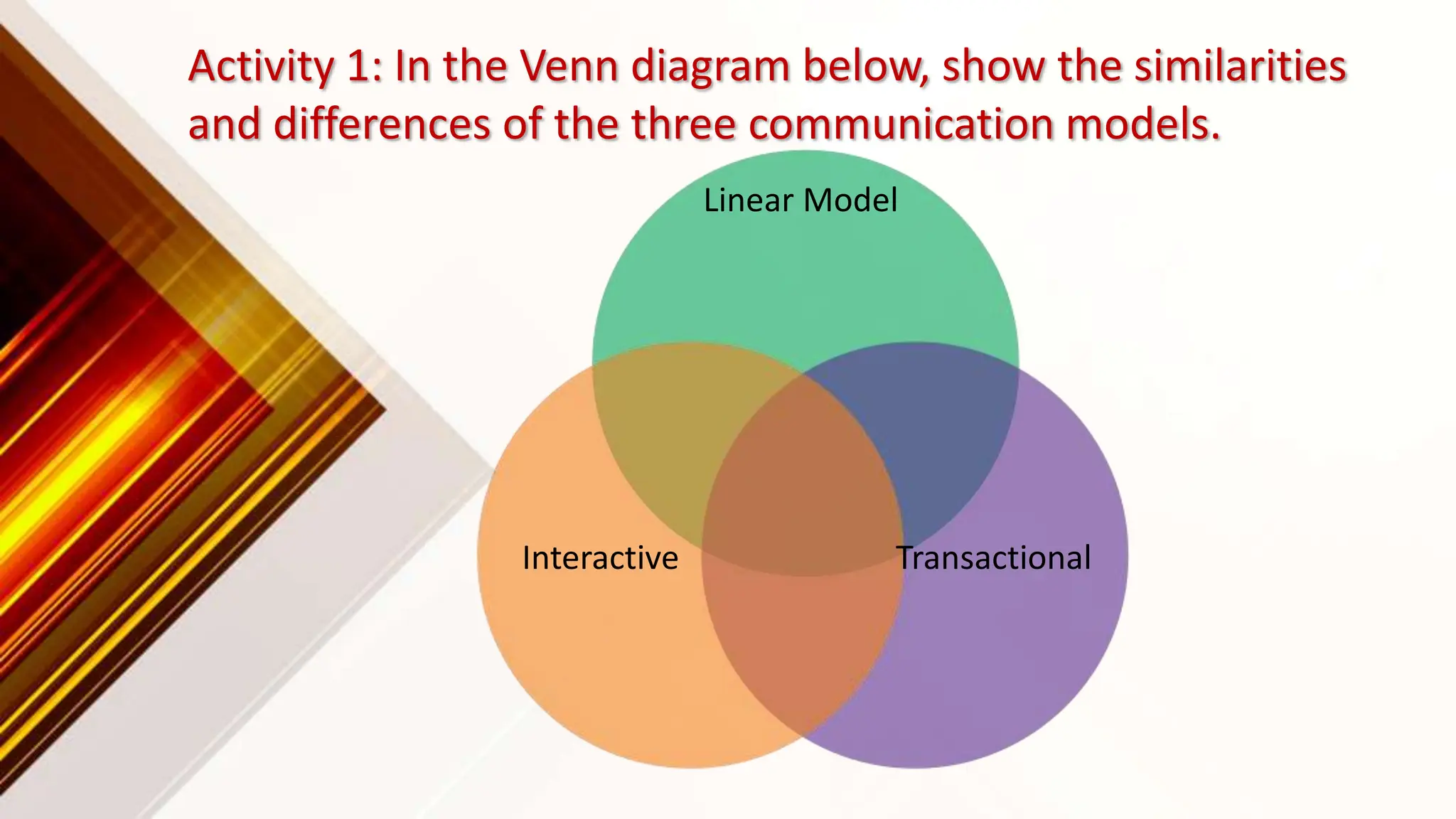
Activity 1: In the Venn diagram below, show the similarities
and differences of the three communication models.
Linear Model
Interactive Transactional
4.-Communication-Models.powwerpoint presentation

4.-Communication-Models.powwerpoint presentation

  • 1.
  • 2.
    Models of CommunicationProcess A. Linear Communication Linear communication is one-way, focusing on the transmission of a message to a receiver who never responds or has no way of responding to the information conveyed. For instance, a competition organizer is presenting the contest mechanics. The message is final and cannot be contended at all. It could be the president giving his State of the Nation Address on the national television or a student who reads a poem or tells a story in front of an audience in a school program.
  • 3.
    Models of CommunicationProcess Shannon-Weaver Model  an example of linear type of model (1949)  considered as the mother of all communication models  has a one-way process starting from a source (producer of message); passing through a channel (signals adapted for transmission) which may at times be interrupted by noise (barrier) to a receiver (decoder of message from the signal). The process stops after the message has arrived at its destination.
  • 4.
  • 5.
    Models of CommunicationProcess B. Interactive Interactive approach is a two-way communication process where a response is given after a message is sent. The recipient of the action intentionally or unintentionally gives a feedback associated with the information received.
  • 6.
    Models of CommunicationProcess Schramm Model  visualized the process of communication as an exchange of thoughts and ideas  Feedback was added to the Shannon-Weaver Model. The recipient of the message decodes it and creates a feedback based on his understanding of the information sent and vice versa  The figure identifies the six elements of communication which are the sender, the message sent, the receiver and the feedback provided by the receiver and sent back as a response to the sender and the processes of encoding and decoding.
  • 7.
  • 8.
    Models of CommunicationProcess C. Transactional Model The transactional model shows a circular process of interaction between the persons involved in the communication, with each one actively participating and sharing ideas with one another. They are the communicators actively exchanging information and reaction. Feedback is given freely and deliberately to one another or to all members participating in the communication transaction. The sender and the receiver may simultaneously exchange roles as communicators. Since communication is deemed dynamic and progressive, the topic may also change from time to time.
  • 9.
    Models of CommunicationProcess C. Transactional Model In this concept, the noise or barrier to communication is also taken into consideration for it may directly or indirectly affect the smooth flow of communication. In the event that the message was not clearly conveyed due to the barrier, the communication continues in order to clarify the intended meaning of the sender. When the transmission is cut along the way due to the barrier, the communicators work collaboratively to understand each other. Now, the sender becomes a receiver of feedback (the response from the receiver) and the receiver also acts as sender providing information in response to the message conveyed to him. In this way, the communication is made more effective and complete.
  • 10.
  • 11.
    Activity 1: Inthe Venn diagram below, show the similarities and differences of the three communication models. Linear Model Interactive Transactional