Modeling, Simulation, and Control of
a Real System
Robert Throne
Electrical and Computer Engineering
Rose-Hulman Institute of Technology
Introduction
• Models of physical systems are widely used
in undergraduate science and engineering
education.
• Students erroneously believe even simple
models are exact.
Introduction
• Obtained ECP Model 210a rectilinear mass,
spring, damper systems for use in both
system dynamics and controls systems labs.
• Models for these systems are easy to
develop and students have seen these types
of models in a variety of courses.
Introduction
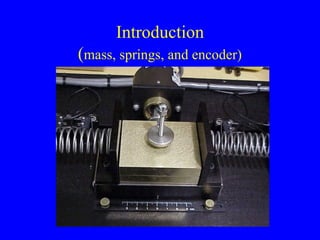
(mass, springs, and encoder)
Introduction
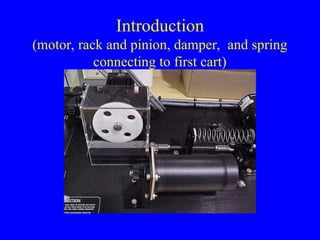
(motor, rack and pinion, damper, and spring
connecting to first cart)
Introduction
We developed four groups of labs for the
ECE introductory controls class for a one
degree of freedom system:
• Time domain system identification.
• Frequency domain system identification.
• Closed loop plant gain estimation.
• Controller design based on the model.
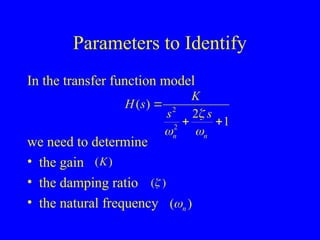
Parameters to Identify
In the transfer function model
we need to determine
• the gain
• the damping ratio
• the natural frequency
( )
K
( )

( )
n

2
2
( )
2
1
n n
K
H s
s s

 

 
Time Domain System Identification
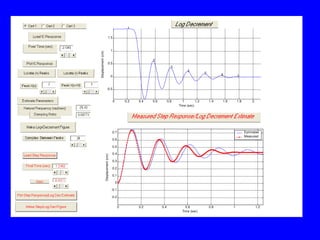
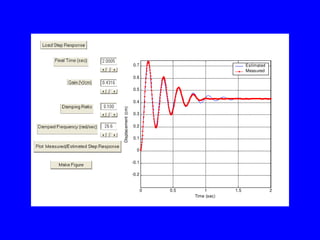
• Log decrement analysis
• Fitting the step response of a second order
system to the measured step response
0 0.2 0.4 0.6 0.8 1 1.2 1.4 1.6 1.8 2
-0.5
0
0.5
1
1.5
Time (sec)
Displacement
(cm)
1
2
3
4
5
6 7
0 0.2 0.4 0.6 0.8 1 1.2
-0.2
-0.1
0
0.1
0.2
0.3
0.4
0.5
0.6
0.7
Time (sec)
Displacement
(cm)
Estimated
Measured
0 0.5 1 1.5 2
-0.2
-0.1
0
0.1
0.2
0.3
0.4
0.5
0.6
0.7
Time (sec)
Displacement
(cm)
Estimated
Measured
Frequency Domain System
Identification
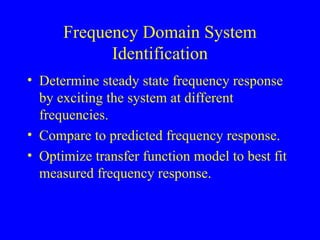
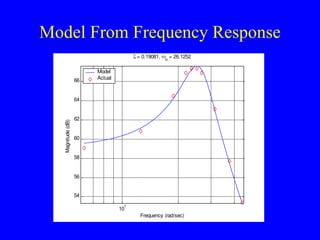
• Determine steady state frequency response
by exciting the system at different
frequencies.
• Compare to predicted frequency response.
• Optimize transfer function model to best fit
measured frequency response.
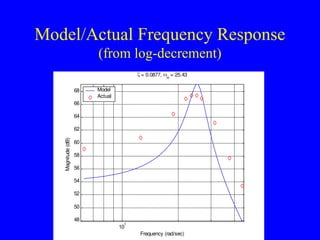
Model/Actual Frequency Response
(from log-decrement)
10
1
48
50
52
54
56
58
60
62
64
66
68
Magnitude
(dB)
Frequency (rad/sec)
 = 0.0877, 
n
= 25.43
Model
Actual
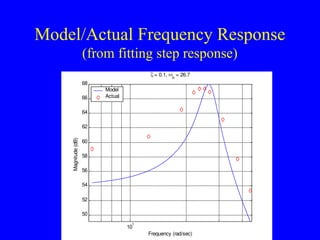
Model/Actual Frequency Response
(from fitting step response)
10
1
50
52
54
56
58
60
62
64
66
68
Magnitude
(dB)
Frequency (rad/sec)
 = 0.1, 
n
= 26.7
Model
Actual
Model From Frequency Response
10
1
54
56
58
60
62
64
66
Magnitude
(dB)
Frequency (rad/sec)
 = 0.19081, 
n
= 26.1252
Model
Actual
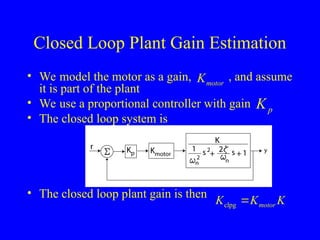
Closed Loop Plant Gain Estimation
• We model the motor as a gain, , and assume
it is part of the plant
• We use a proportional controller with gain
• The closed loop system is
• The closed loop plant gain is then
motor
K
p
K
clpg motor
K K K

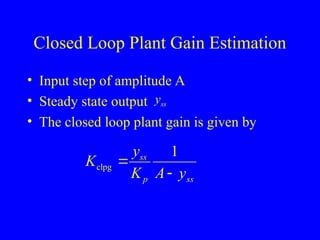
Closed Loop Plant Gain Estimation
• Input step of amplitude A
• Steady state output
• The closed loop plant gain is given by
ss
y
clpg
1
ss
p ss
y
K
K A y


Results with Controllers
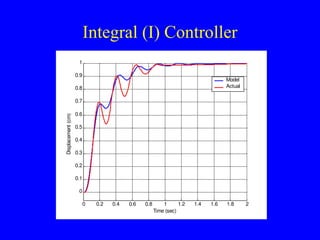
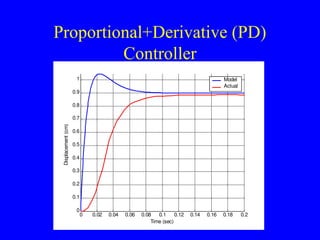
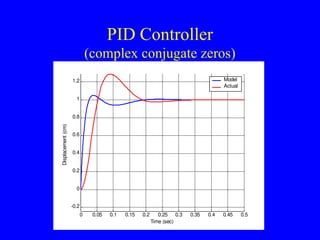
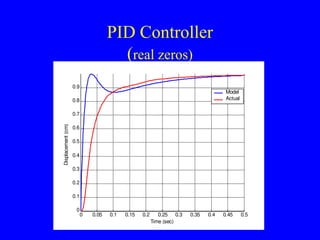
After identifying the system, I, PI, PD, and PID
controllers were designed using Matlab’s sisotool
to control the position of the mass (the first cart).
Both predicted (model based) responses and actual
(real system) responses are plotted on the same
graph.
Integral (I) Controller
0 0.2 0.4 0.6 0.8 1 1.2 1.4 1.6 1.8 2
0
0.1
0.2
0.3
0.4
0.5
0.6
0.7
0.8
0.9
1
Time (sec)
Displacement
(cm)
Model
Actual
``It doesn’t work!’’
Proportional+Derivative (PD)
Controller
0 0.02 0.04 0.06 0.08 0.1 0.12 0.14 0.16 0.18 0.2
0
0.1
0.2
0.3
0.4
0.5
0.6
0.7
0.8
0.9
1
Time (sec)
Displacement
(cm)
Model
Actual
PID Controller
(complex conjugate zeros)
0 0.05 0.1 0.15 0.2 0.25 0.3 0.35 0.4 0.45 0.5
-0.2
0
0.2
0.4
0.6
0.8
1
1.2
Time (sec)
Displacement
(cm)
Model
Actual
PID Controller
(real zeros)
0 0.05 0.1 0.15 0.2 0.25 0.3 0.35 0.4 0.45 0.5
0
0.1
0.2
0.3
0.4
0.5
0.6
0.7
0.8
0.9
Time (sec)
Displacement
(cm)
Model
Actual
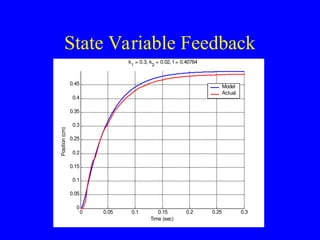
State Variable Feedback
0 0.05 0.1 0.15 0.2 0.25 0.3
0
0.05
0.1
0.15
0.2
0.25
0.3
0.35
0.4
0.45
Time (sec)
Position
(cm) k
1
= 0.3, k
2
= 0.02, f = 0.40764
Model
Actual
Conclusions
Students learn:
• Simple, commonly used models are not
exact, but still very useful.
• Simple models are a reasonable starting
point for design.
• Motors have limitations which must be
incorporated into designs.
Conclusions
We have extended these labs to include
Model matching
• ITAE
• quadratic optimal
• polynomial equation (Diophantine)
2 and 3 DOF state variable models
Acknowledgement
This material is based upon work supported
by the National Science Foundation under
Grant No. 0310445

Modelling Simulation and Control of a Real System

  • 1.
    Modeling, Simulation, andControl of a Real System Robert Throne Electrical and Computer Engineering Rose-Hulman Institute of Technology
  • 2.
    Introduction • Models ofphysical systems are widely used in undergraduate science and engineering education. • Students erroneously believe even simple models are exact.
  • 3.
    Introduction • Obtained ECPModel 210a rectilinear mass, spring, damper systems for use in both system dynamics and controls systems labs. • Models for these systems are easy to develop and students have seen these types of models in a variety of courses.
  • 4.
  • 5.
    Introduction (motor, rack andpinion, damper, and spring connecting to first cart)
  • 6.
    Introduction We developed fourgroups of labs for the ECE introductory controls class for a one degree of freedom system: • Time domain system identification. • Frequency domain system identification. • Closed loop plant gain estimation. • Controller design based on the model.
  • 7.
    Parameters to Identify Inthe transfer function model we need to determine • the gain • the damping ratio • the natural frequency ( ) K ( )  ( ) n  2 2 ( ) 2 1 n n K H s s s      
  • 8.
    Time Domain SystemIdentification • Log decrement analysis • Fitting the step response of a second order system to the measured step response
  • 9.
    0 0.2 0.40.6 0.8 1 1.2 1.4 1.6 1.8 2 -0.5 0 0.5 1 1.5 Time (sec) Displacement (cm) 1 2 3 4 5 6 7 0 0.2 0.4 0.6 0.8 1 1.2 -0.2 -0.1 0 0.1 0.2 0.3 0.4 0.5 0.6 0.7 Time (sec) Displacement (cm) Estimated Measured
  • 10.
    0 0.5 11.5 2 -0.2 -0.1 0 0.1 0.2 0.3 0.4 0.5 0.6 0.7 Time (sec) Displacement (cm) Estimated Measured
  • 11.
    Frequency Domain System Identification •Determine steady state frequency response by exciting the system at different frequencies. • Compare to predicted frequency response. • Optimize transfer function model to best fit measured frequency response.
  • 12.
    Model/Actual Frequency Response (fromlog-decrement) 10 1 48 50 52 54 56 58 60 62 64 66 68 Magnitude (dB) Frequency (rad/sec)  = 0.0877,  n = 25.43 Model Actual
  • 13.
    Model/Actual Frequency Response (fromfitting step response) 10 1 50 52 54 56 58 60 62 64 66 68 Magnitude (dB) Frequency (rad/sec)  = 0.1,  n = 26.7 Model Actual
  • 14.
    Model From FrequencyResponse 10 1 54 56 58 60 62 64 66 Magnitude (dB) Frequency (rad/sec)  = 0.19081,  n = 26.1252 Model Actual
  • 15.
    Closed Loop PlantGain Estimation • We model the motor as a gain, , and assume it is part of the plant • We use a proportional controller with gain • The closed loop system is • The closed loop plant gain is then motor K p K clpg motor K K K 
  • 16.
    Closed Loop PlantGain Estimation • Input step of amplitude A • Steady state output • The closed loop plant gain is given by ss y clpg 1 ss p ss y K K A y  
  • 17.
    Results with Controllers Afteridentifying the system, I, PI, PD, and PID controllers were designed using Matlab’s sisotool to control the position of the mass (the first cart). Both predicted (model based) responses and actual (real system) responses are plotted on the same graph.
  • 18.
    Integral (I) Controller 00.2 0.4 0.6 0.8 1 1.2 1.4 1.6 1.8 2 0 0.1 0.2 0.3 0.4 0.5 0.6 0.7 0.8 0.9 1 Time (sec) Displacement (cm) Model Actual
  • 19.
  • 20.
    Proportional+Derivative (PD) Controller 0 0.020.04 0.06 0.08 0.1 0.12 0.14 0.16 0.18 0.2 0 0.1 0.2 0.3 0.4 0.5 0.6 0.7 0.8 0.9 1 Time (sec) Displacement (cm) Model Actual
  • 21.
    PID Controller (complex conjugatezeros) 0 0.05 0.1 0.15 0.2 0.25 0.3 0.35 0.4 0.45 0.5 -0.2 0 0.2 0.4 0.6 0.8 1 1.2 Time (sec) Displacement (cm) Model Actual
  • 22.
    PID Controller (real zeros) 00.05 0.1 0.15 0.2 0.25 0.3 0.35 0.4 0.45 0.5 0 0.1 0.2 0.3 0.4 0.5 0.6 0.7 0.8 0.9 Time (sec) Displacement (cm) Model Actual
  • 23.
    State Variable Feedback 00.05 0.1 0.15 0.2 0.25 0.3 0 0.05 0.1 0.15 0.2 0.25 0.3 0.35 0.4 0.45 Time (sec) Position (cm) k 1 = 0.3, k 2 = 0.02, f = 0.40764 Model Actual
  • 24.
    Conclusions Students learn: • Simple,commonly used models are not exact, but still very useful. • Simple models are a reasonable starting point for design. • Motors have limitations which must be incorporated into designs.
  • 25.
    Conclusions We have extendedthese labs to include Model matching • ITAE • quadratic optimal • polynomial equation (Diophantine) 2 and 3 DOF state variable models
  • 26.
    Acknowledgement This material isbased upon work supported by the National Science Foundation under Grant No. 0310445