University of Liège – University of Michigan
Model­free Monte Carlo­like Policy Evaluation
Raphaël Fonteneau, Susan Murphy, Louis Wehenkel, Damien Ernst
Journées MAS, Bordeaux, France
(August 31st
 – September 3rd
 2010)
The material of this talk is based on a presentation
given by Raphael Fonteneau at Cap 2010.
Time
Patients
1
n
0 1 T
Evaluation
?
Therapy to evaluate
3
Introduction
● Discrete­time stochastic optimal control problems arise in many 
fields (finance, medecine, engineering,...)
● Many techniques for solving such problems use an oracle that 
evaluates the performance of any given policy in order to 
determine a (near­)optimal control policy
● When the system is accessible to experimentation, such an oracle 
can be based on a Monte Carlo (MC) approach
● In this paper, the only information is contained in a sample of one­
step transitions of the system
● In this context, we propose a Model­Free Monte Carlo (MFMC) 
estimator of the performance of a given policy that mimics in some 
way the Monte Carlo estimator.
4
Problem statement
● We consider a discrete­time system whose dynamics over T stages 
is given by
● All xt  
lie in a normed state space X, all ut
 lie in a normed action 
space U, wt
 are i.i.d. according to a probability distribution pW
(.)
● An instantaneous reward  is associated with the 
action ut  
while being in state xt
 
● A policy h: {0,...,T­1} × X  U is given, and we want to evaluate 
its performance.
Problem statement
● The expected return of the policy h when starting from an initial 
state x0 
is given by
  where
with
x0
xT
w0
w1
wT −2
wT −1
x1
x2 xT−2 xT−1
r0
r1 rT −2
rT −1
6
Problem statement
● Problem: the functions f, ρ and pW
(.) are unknown
● They are replaced by a sample of system transitions
  where the pairs are arbitrary chosen and the pairs  
are determined by   , where wl
 is drawn     
according to pW
(.) 
How to evaluate Jh
(x0
) in this context?
7
The Monte Carlo estimator
● We define the Monte Carlo estimator of the expected return of h 
when starting from the initial state x0
:
  with
8
The Monte Carlo estimator
x1
1
x0
x1
p
xT −1
1
xT
1
xT
p
xT −1
px2
p
xT −2
p
x2
1
xT −2
1
w0
1
w0
p
wT −2
1
wT −1
1
xT
2
         MC Estimator
∑
t=0
T −1
rt
1
∑
t=0
T −1
rt
2
∑
t=0
T −1
rt
p
1
p
∑
i=1
p
∑
t=0
T −1
rt
i
w1
1
w0
2 w1
2
wT −2
2 wT −1
2
wT −2
p
wT −1
p
wt
i
~pW .
w1
p
x1
2 x2
2
xT −2
2
xT −1
2
r0
1
r1
1
rT −2
1
rT −1
1
r0
2
r0
p
r1
2
r1
p
rT −2
2
rT −2
p
rT −1
2
rT −1
p
9
The Monte Carlo estimator
● We assume that the random variable Rh
(x0
) admits a finite 
variance
● The bias and variance of the Monte Carlo estimator are
10
● Here, the MC approach is not feasible, since the system is 
unknown
● We introduce the Model­Free Monte Carlo estimator
● From the sample of transitions, we build p sequences of different 
transitions of length T called ``broken trajectories''
● These broken trajectories are built so as to minimize the 
discrepancy (using a distance metric ∆) with a classical MC 
sample that could be obtained by simulating the system with the 
policy h
● We average the cumulated returns over the p broken trajectories 
to compute an estimate of the expected return of h
● The algorithm has complexity O(npT) .
The Model­free Monte Carlo estimator
11
The Model­free Monte Carlo estimator
12
Example with T=3, p=2, n=8
The Model­free Monte Carlo estimator
13
The Model­free Monte Carlo estimator
14
The Model­free Monte Carlo estimator
15
The Model­free Monte Carlo estimator
17
The Model­free Monte Carlo estimator
18
The Model­free Monte Carlo estimator
20
The Model­free Monte Carlo estimator
21
The Model­free Monte Carlo estimator
23
The Model­free Monte Carlo estimator
24
The Model­free Monte Carlo estimator
26
The Model­free Monte Carlo estimator
27
The Model­free Monte Carlo estimator
29
The Model­free Monte Carlo estimator
30
The Model­free Monte Carlo estimator
32
● Assumption: the functions f, ρ and h are Lipschitz continuous
MFMC estimator: analysis
33
● The only information available on the system is gathered in a 
sample of n one­step transitions
● We define the random variable         as follows:
a
The set of pairs                                           is arbitrary chosen,
a
whereas the pairs   are determined by 
where wl
 is drawn according to pW
(.) 
●          is a realization of the random set         .          
MFMC estimator: analysis
34
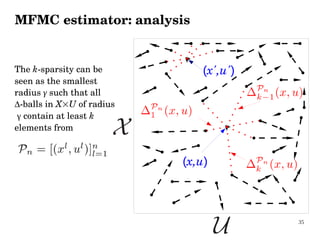
● Distance metric ∆
● k­sparsity
●                       denotes the distance of (x,u) to its k­th nearest 
neighbor (using the distance ∆) in the sample
MFMC estimator: analysis
35
X
U
(x,u)
(x',u')The k­sparsity can be
seen as the smallest 
radius γ such that all
∆­balls in X×U of radius
 γ contain at least k
elements from
MFMC estimator: analysis
36
● Expected value of the MFMC estimator
● Theorem
MFMC estimator: analysis
37
● Variance of the MFMC estimator
● Theorem
MFMC estimator: analysis
38
Illustration
● System
● pW
(.) is uniform over W, T = 15, x0
 = ­0.5  .
39
Illustration
● Simulations for p = 10, n = 100 … 10 000, uniform grid
n
Monte Carlo estimatorModel­free Monte Carlo estimator
40
Illustration
● Simulations for p = 1 … 100, n = 10 000, uniform grid
Monte Carlo estimator
p p
Model­free Monte Carlo estimator
41
Conclusions and Future work
Conclusions
● We have proposed in this paper an estimator of the expected 
return of a policy in a model­free setting, the MFMC estimator
● We have provided bounds on the bias and variance of the MFMC 
estimator
● The bias and variance of the MFMC estimator converge to the bias 
and variance of the MC estimator
Future work
● MFMC estimator in a direct policy search framework
● One  could  extend  this  approach  to  evaluate  return  distributions 
(and not only expected values). This could allow to develop ''safe'' 
policy search techniques based on Value at Risk (VaR) criteria.

Model-­free Monte Carlo-­like Policy Evaluation