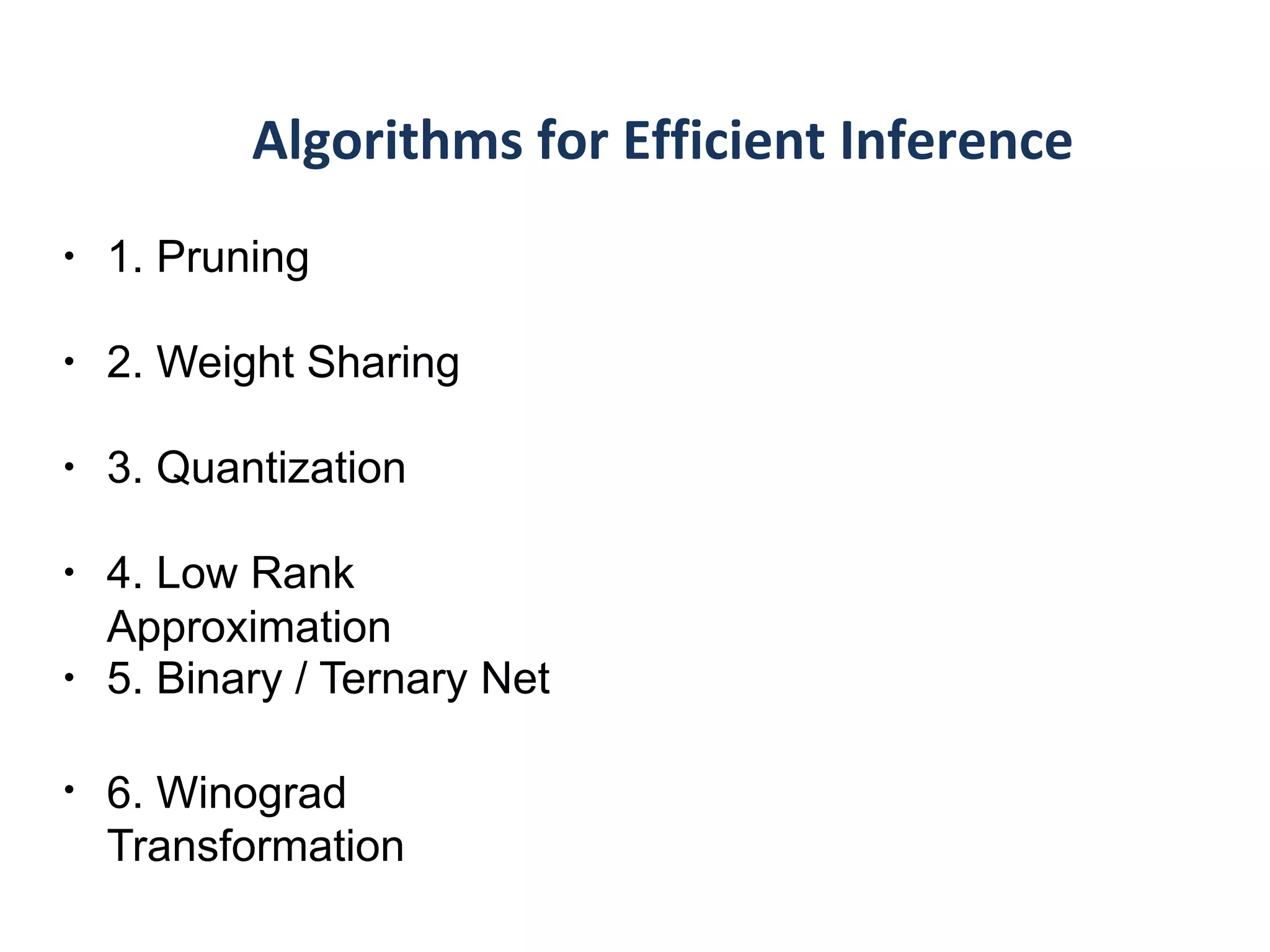
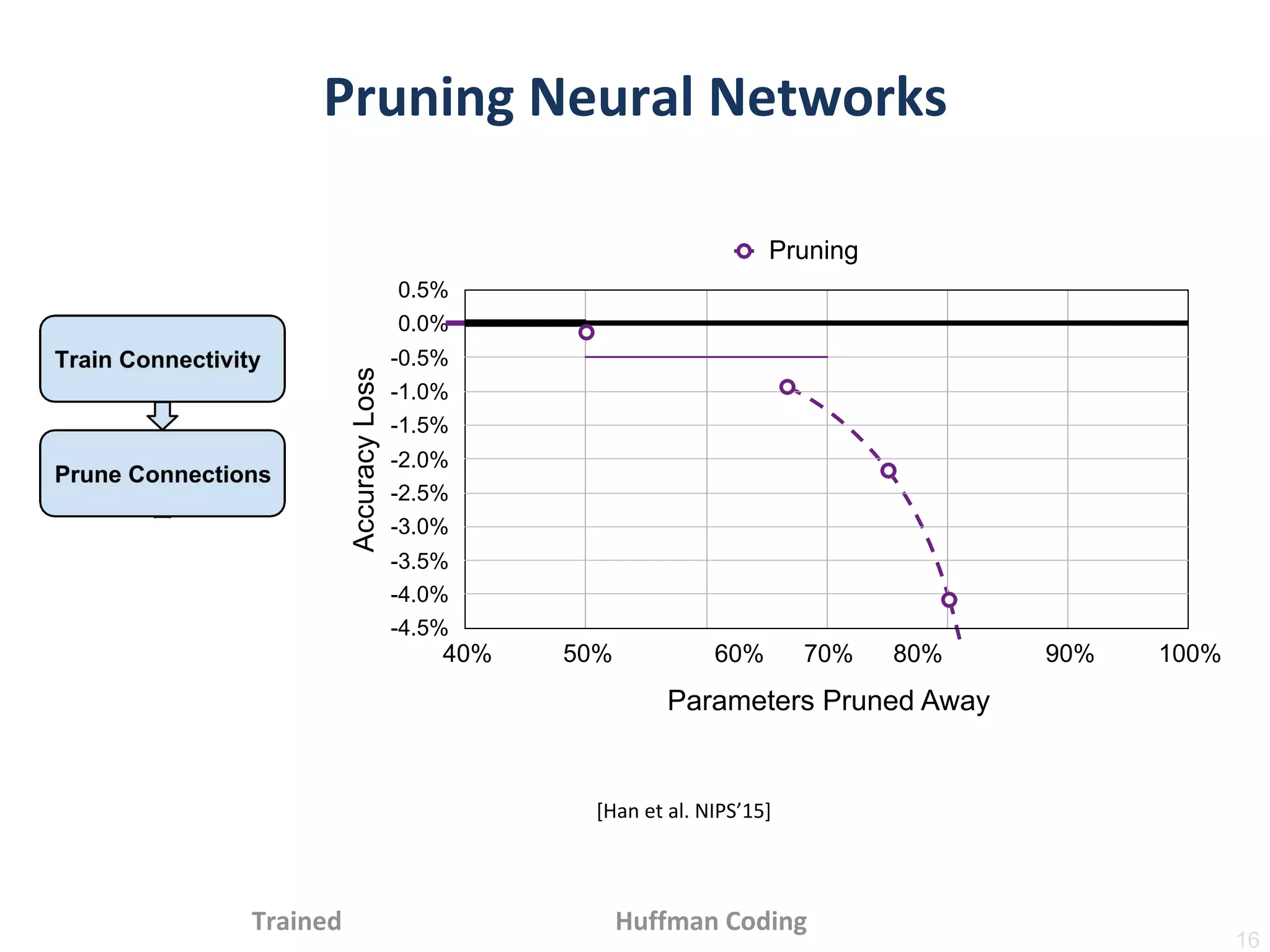
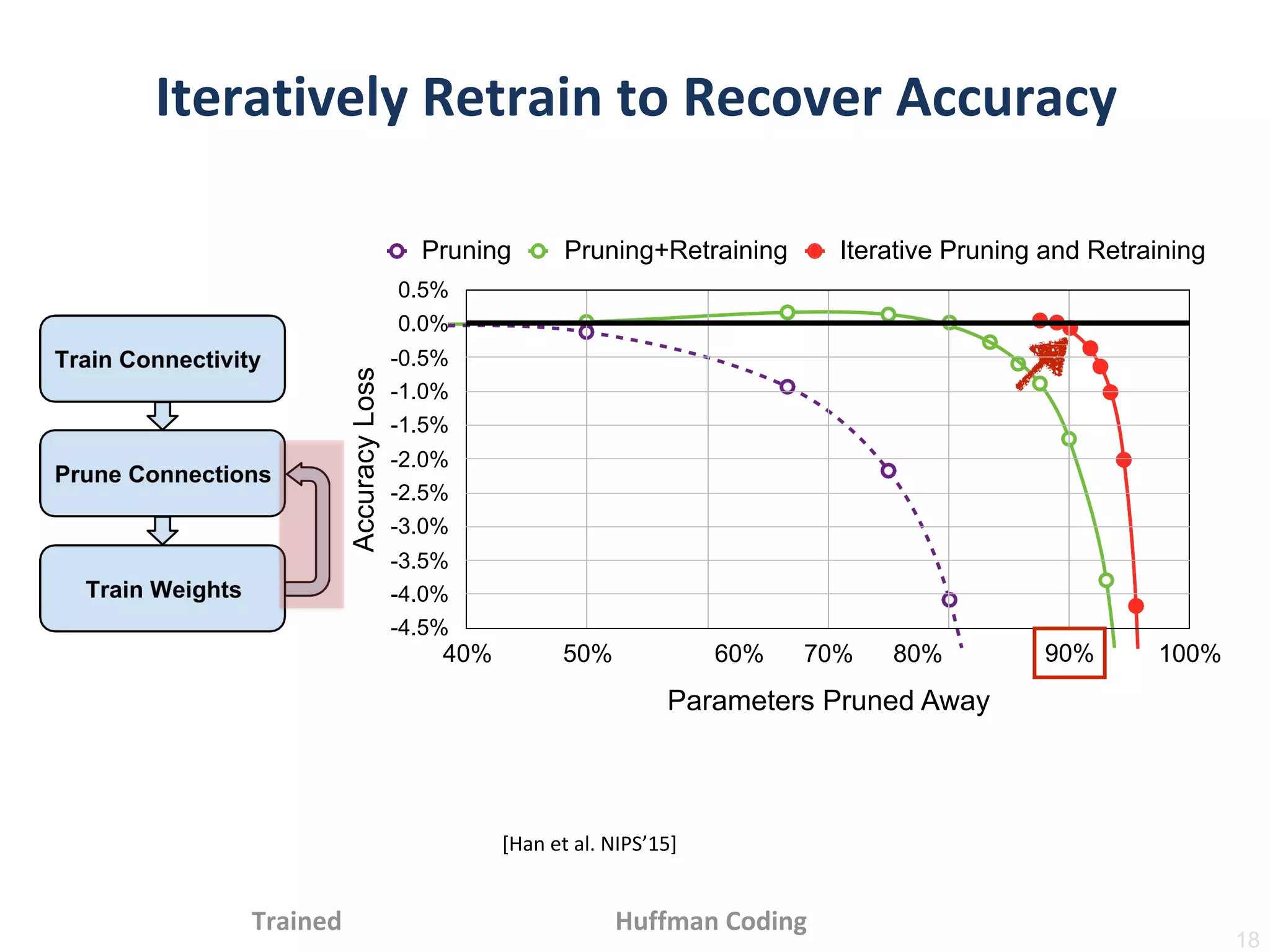
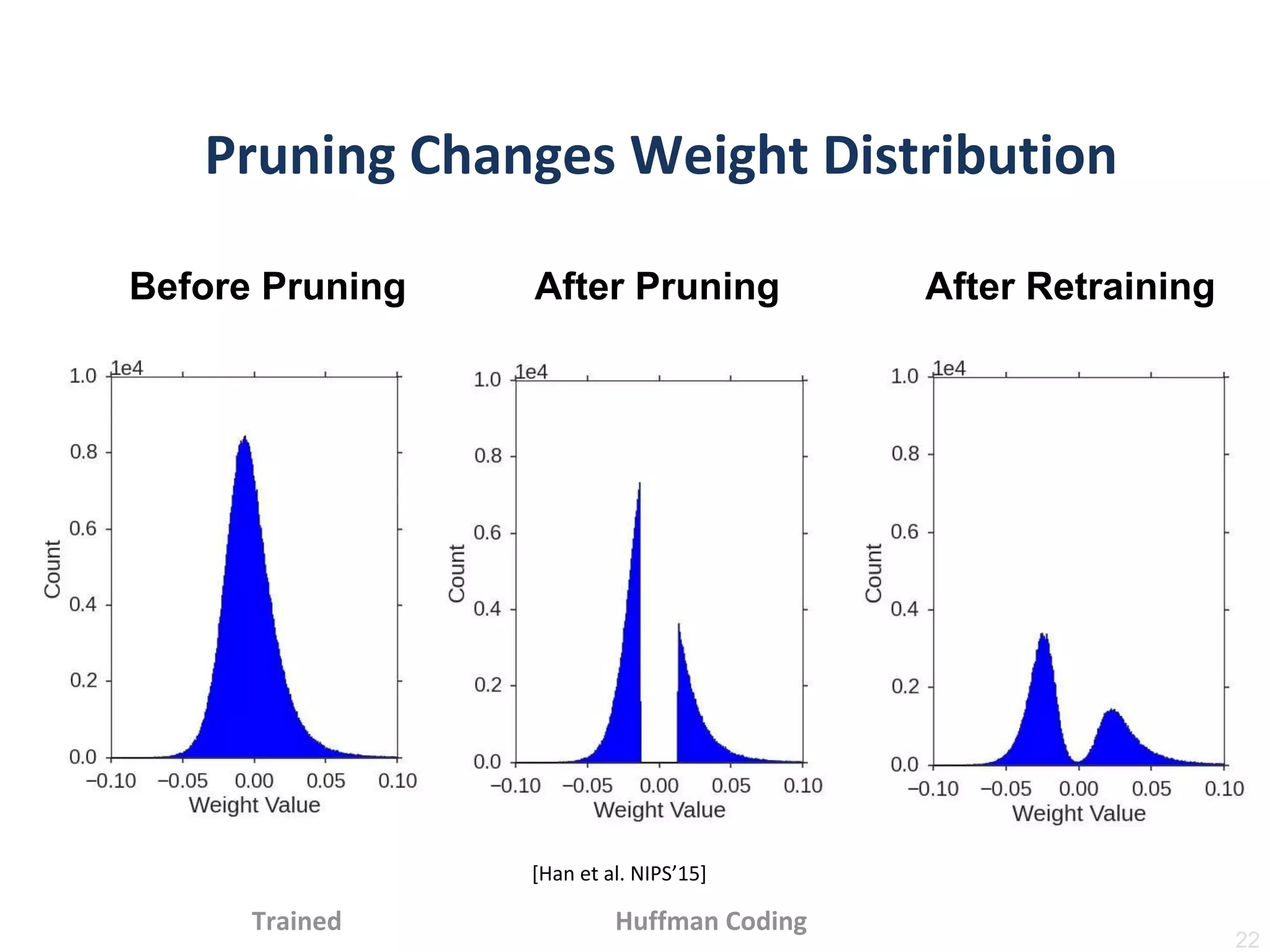
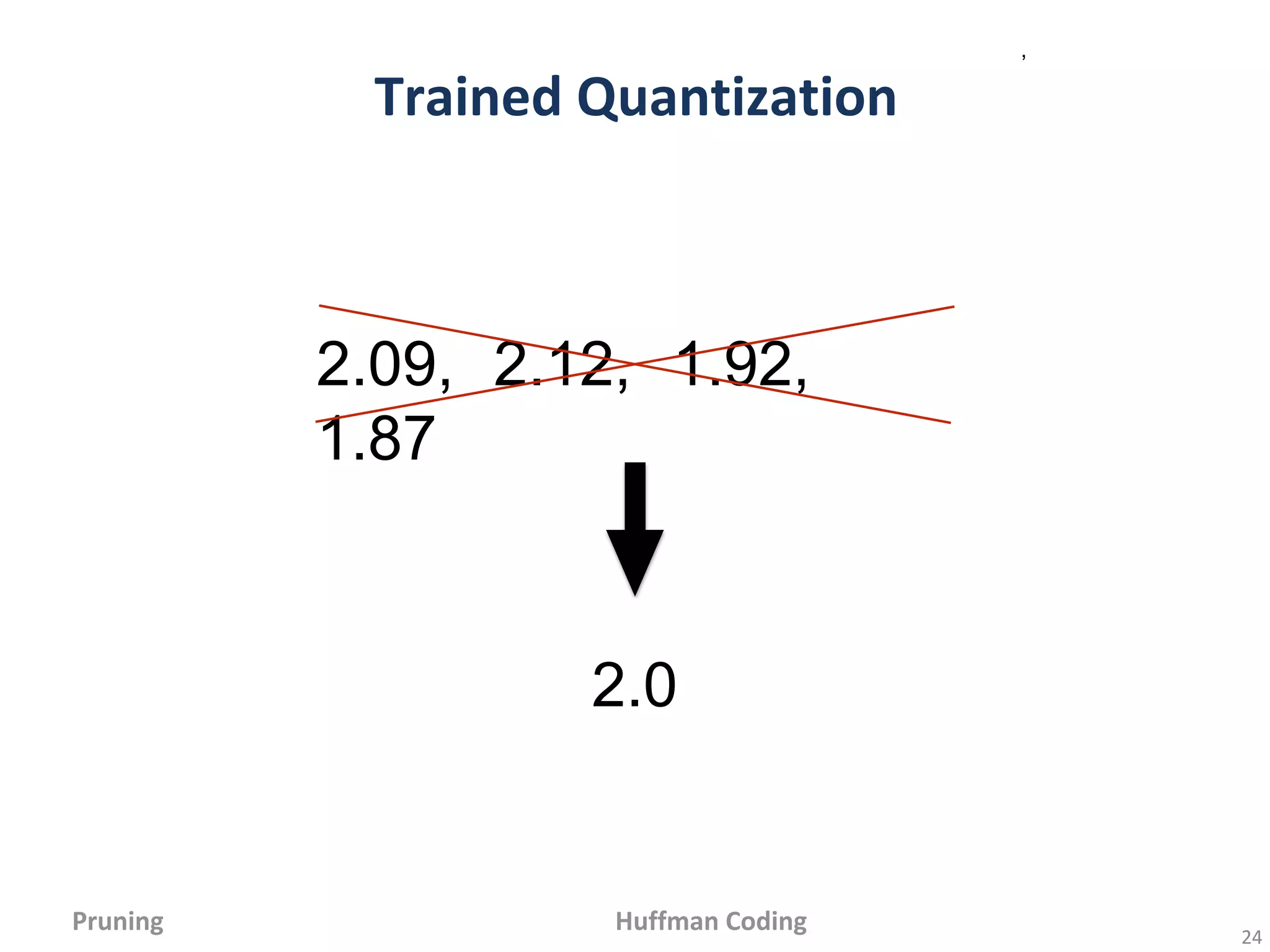
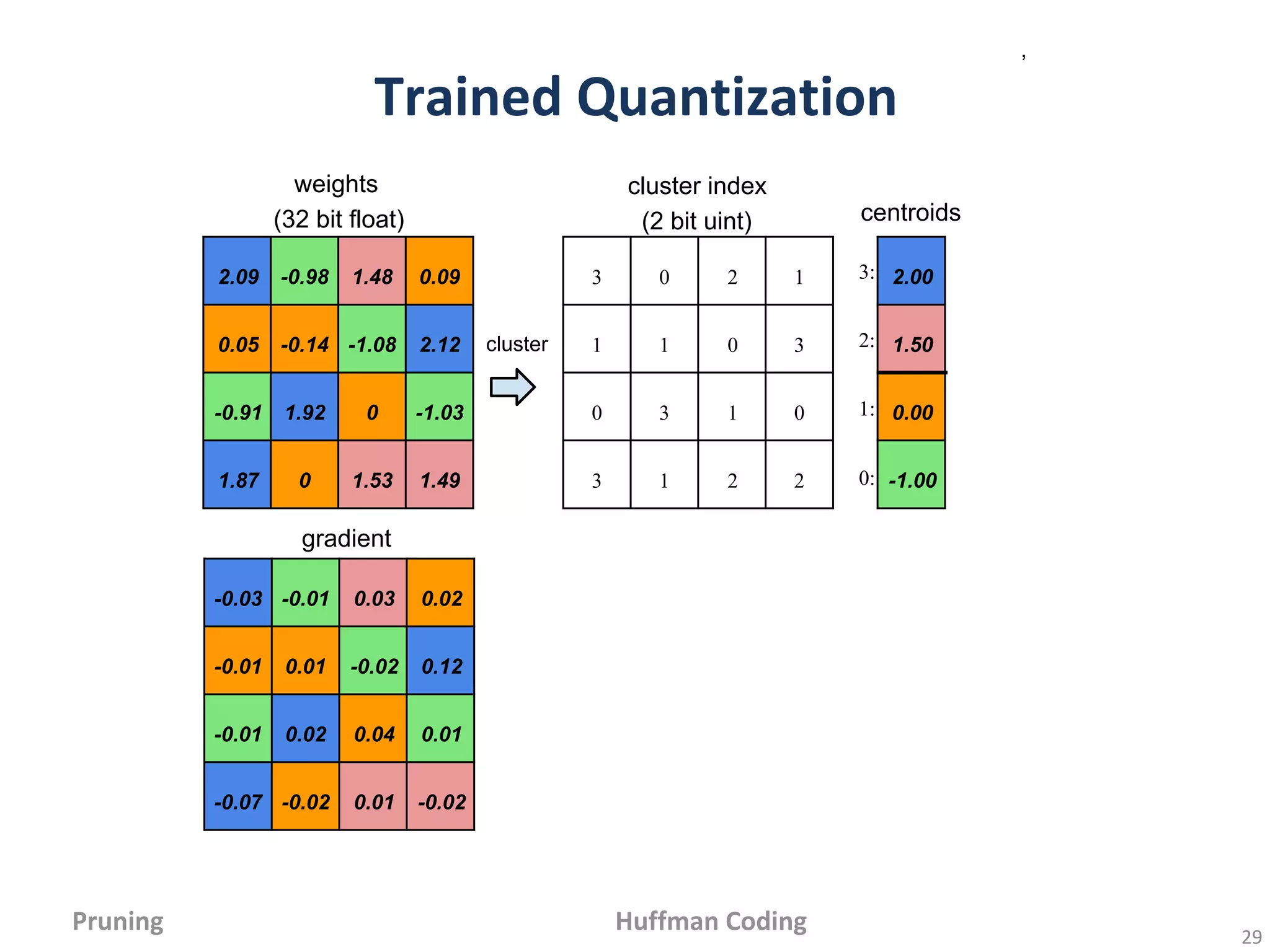
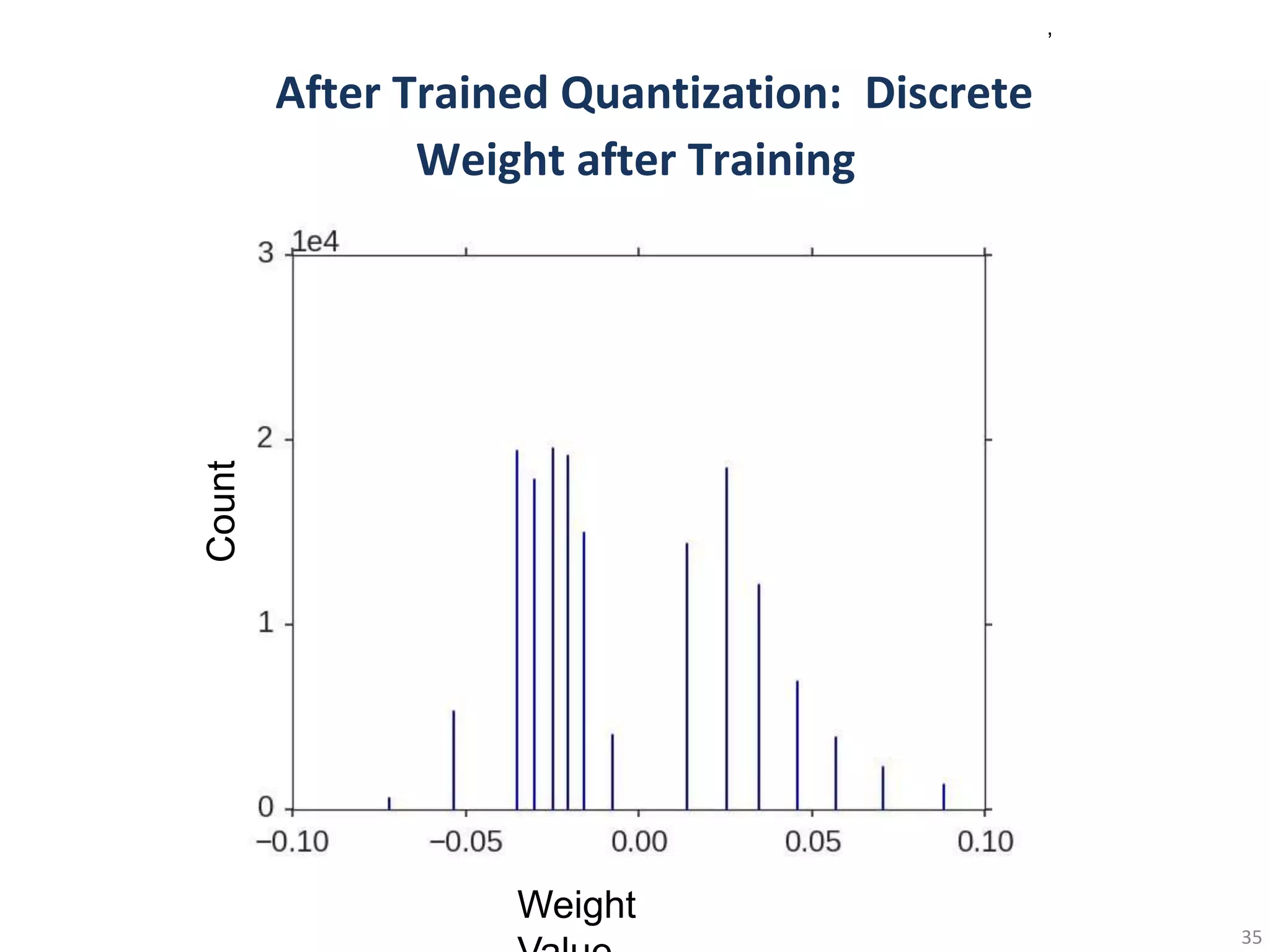
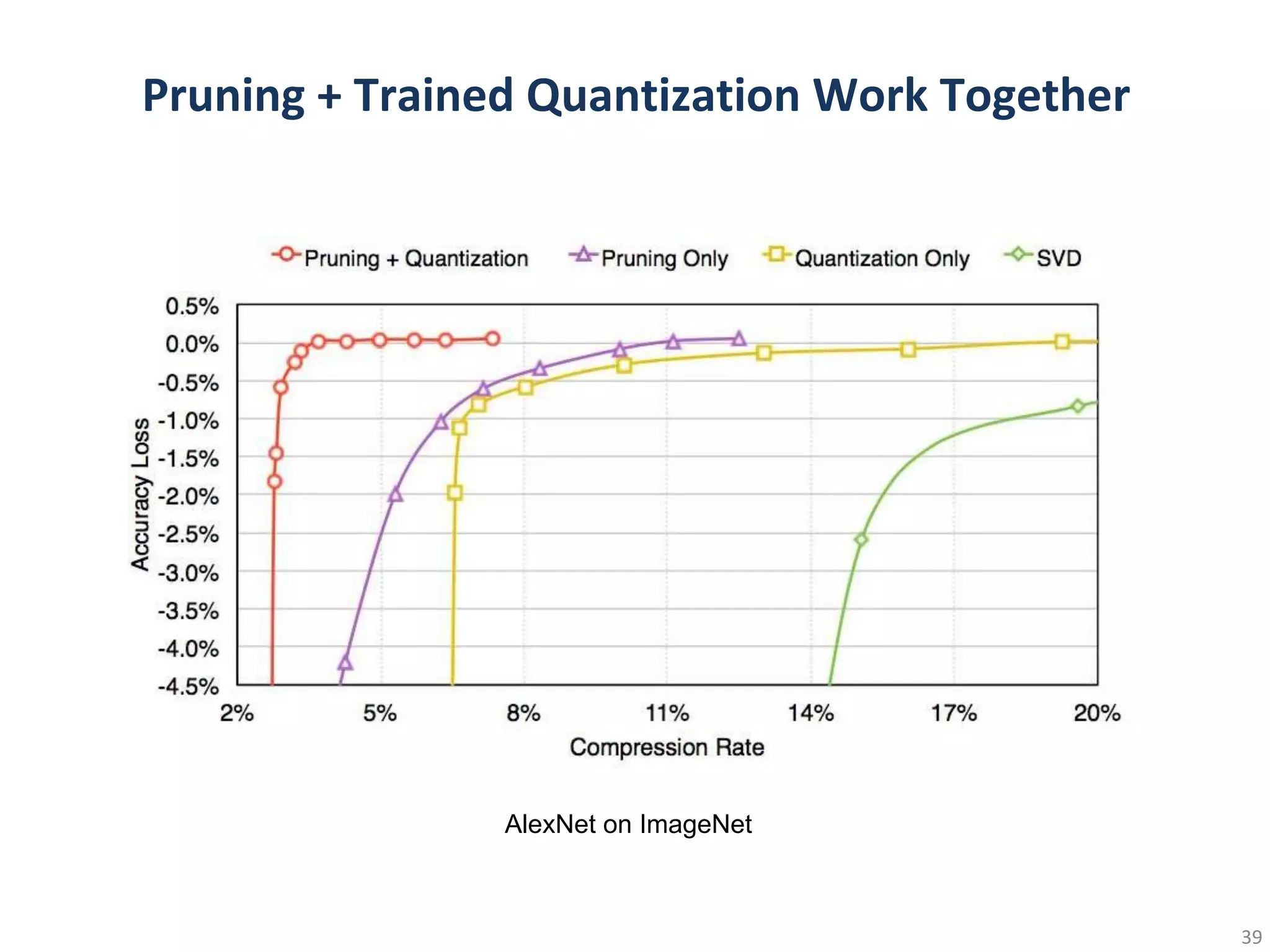
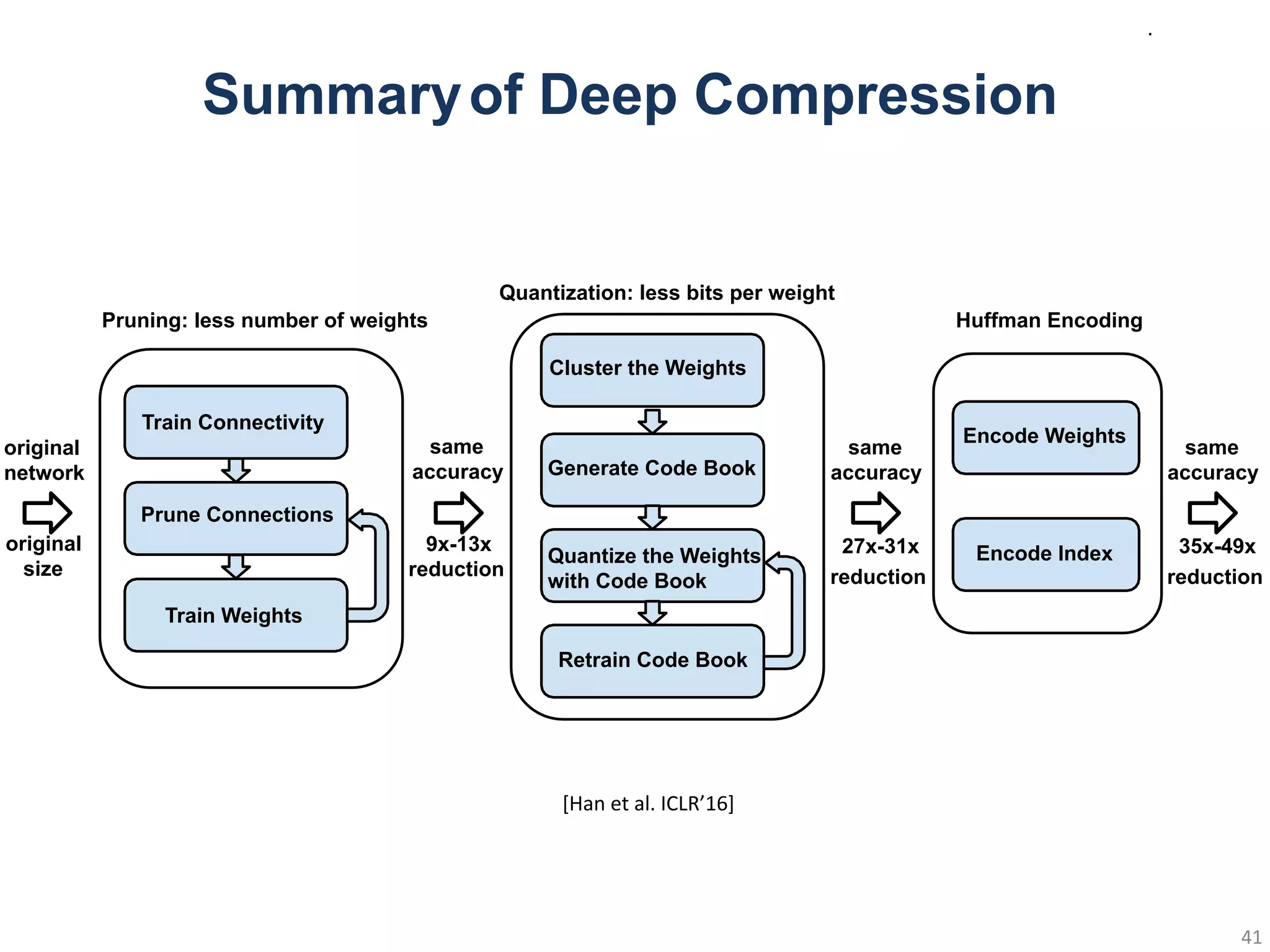
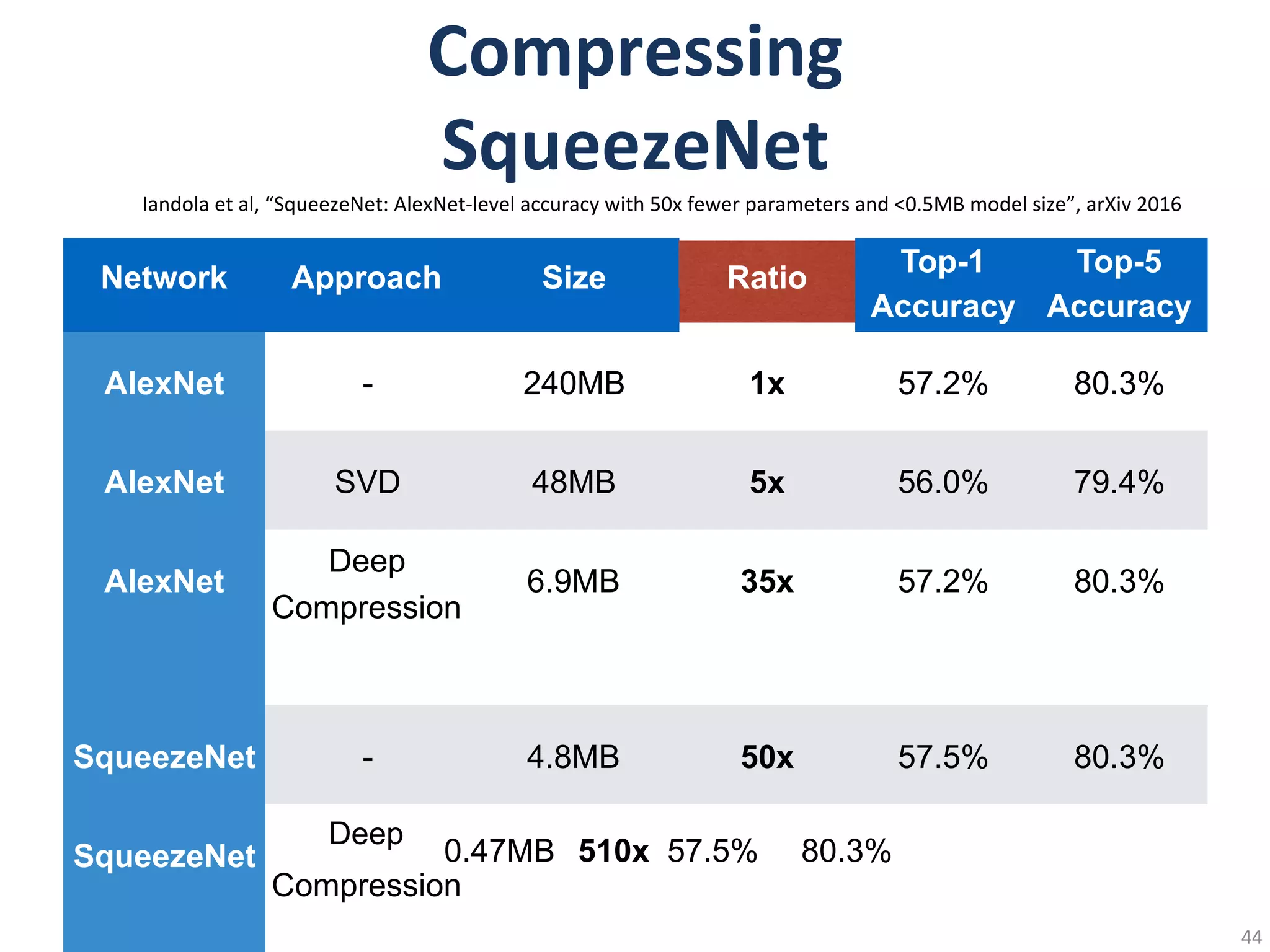
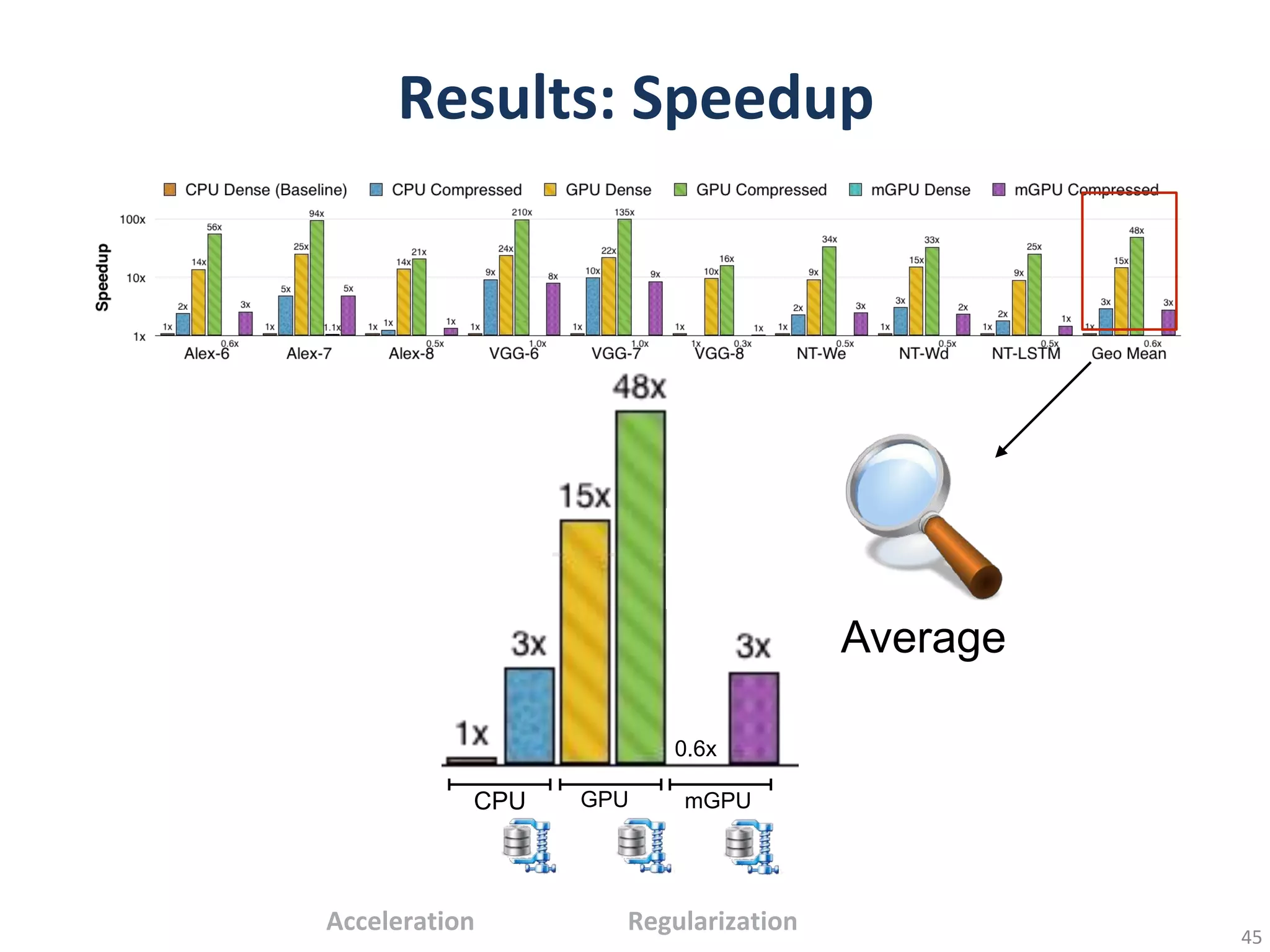
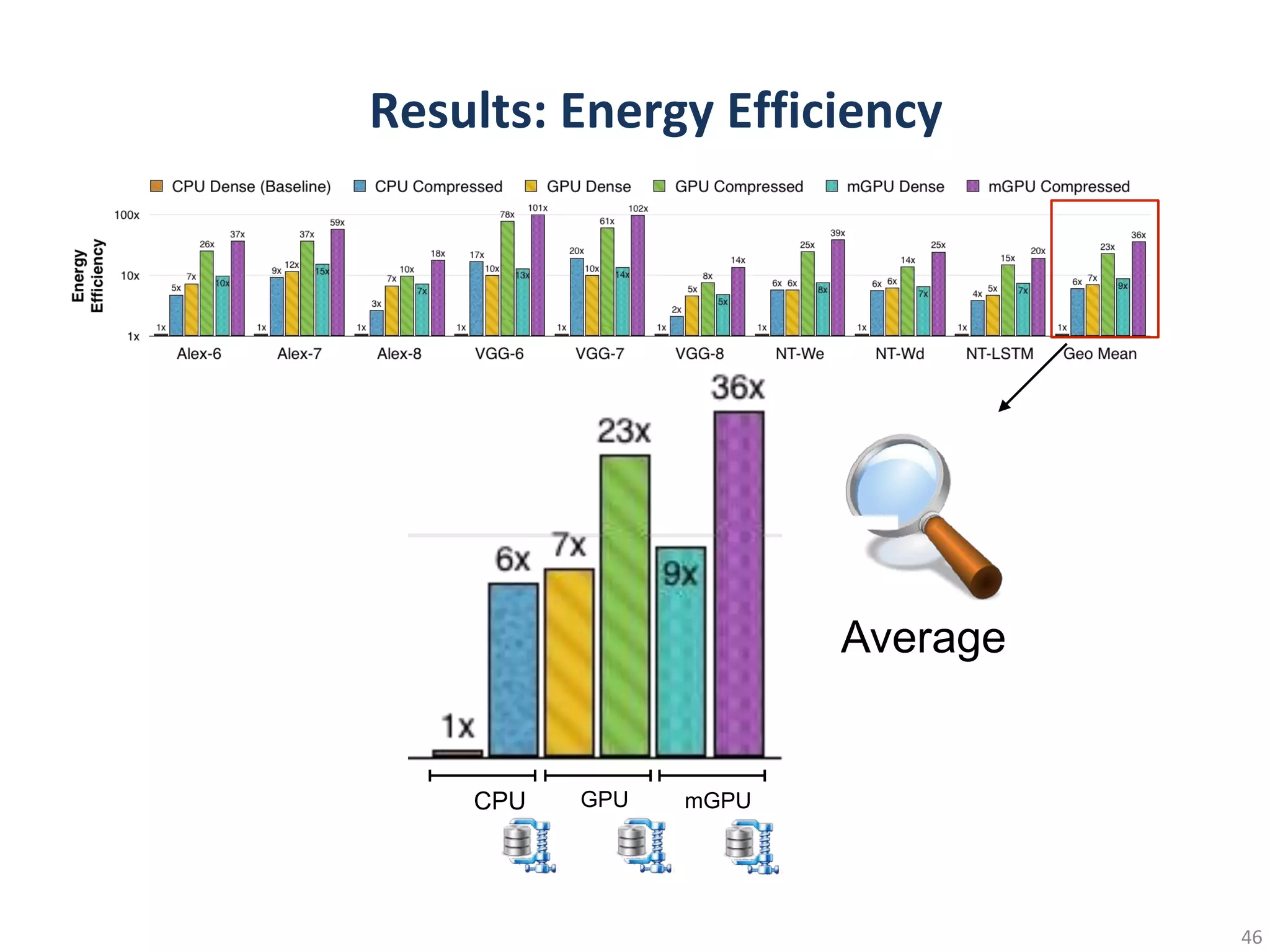
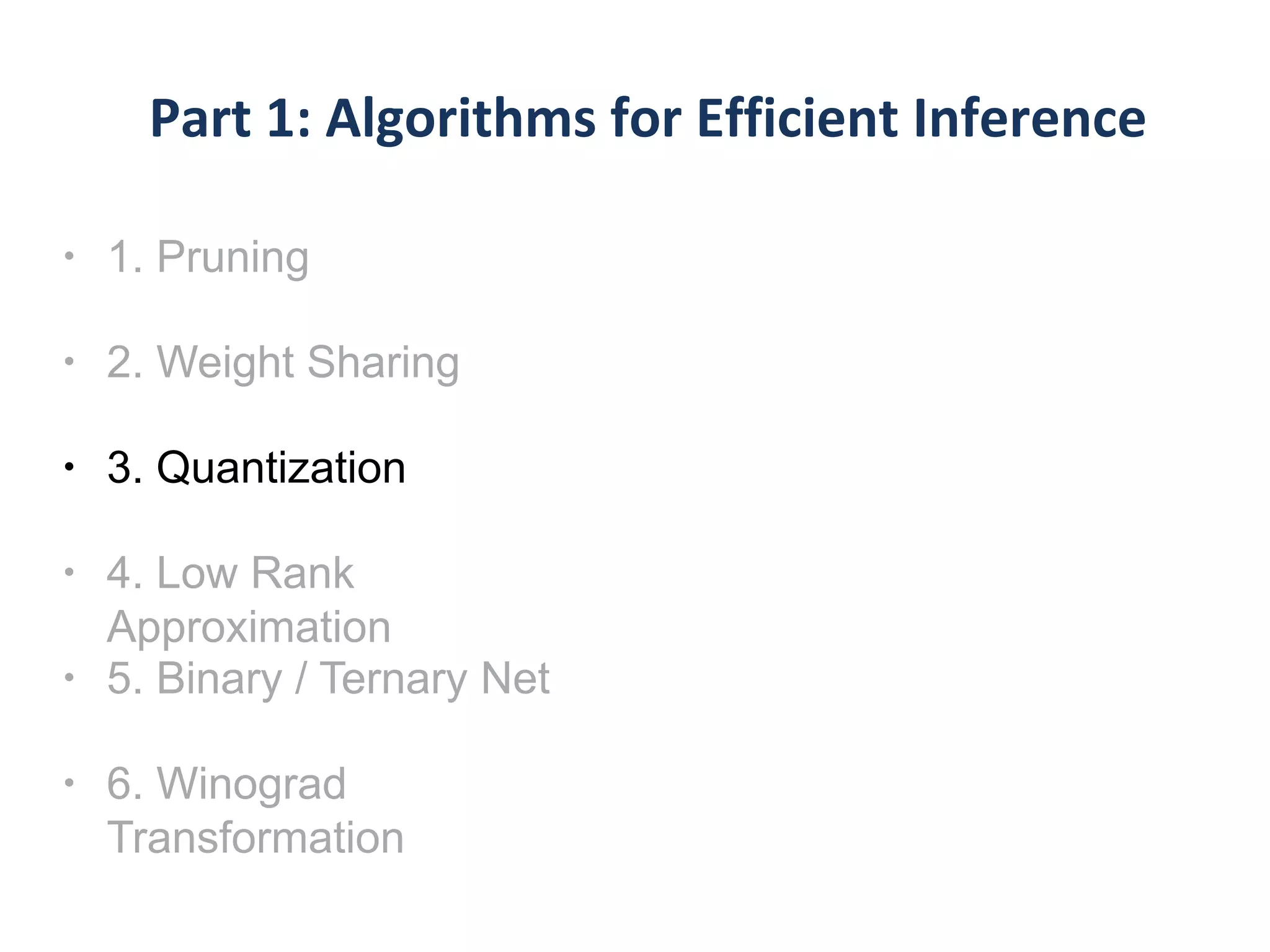
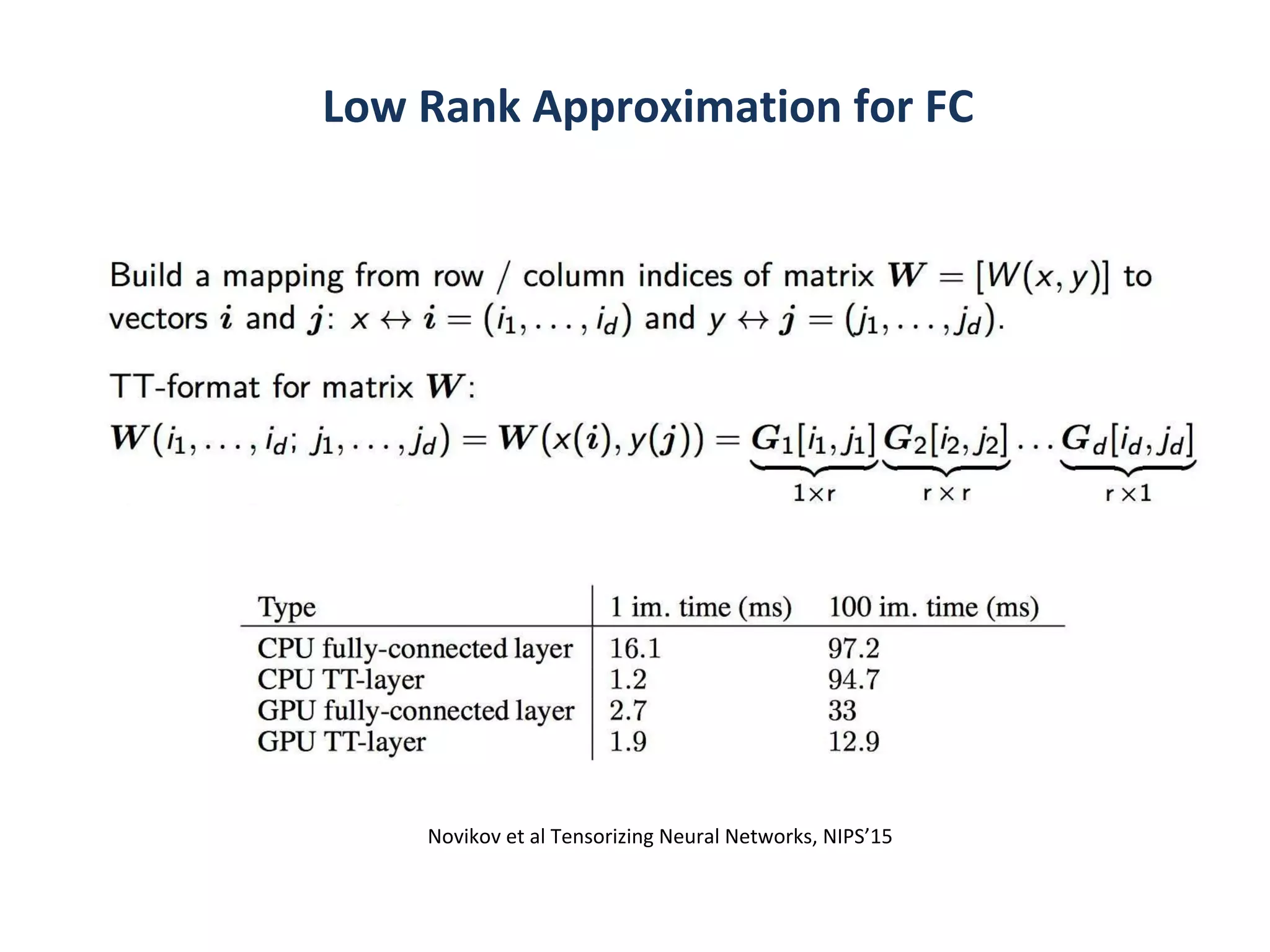
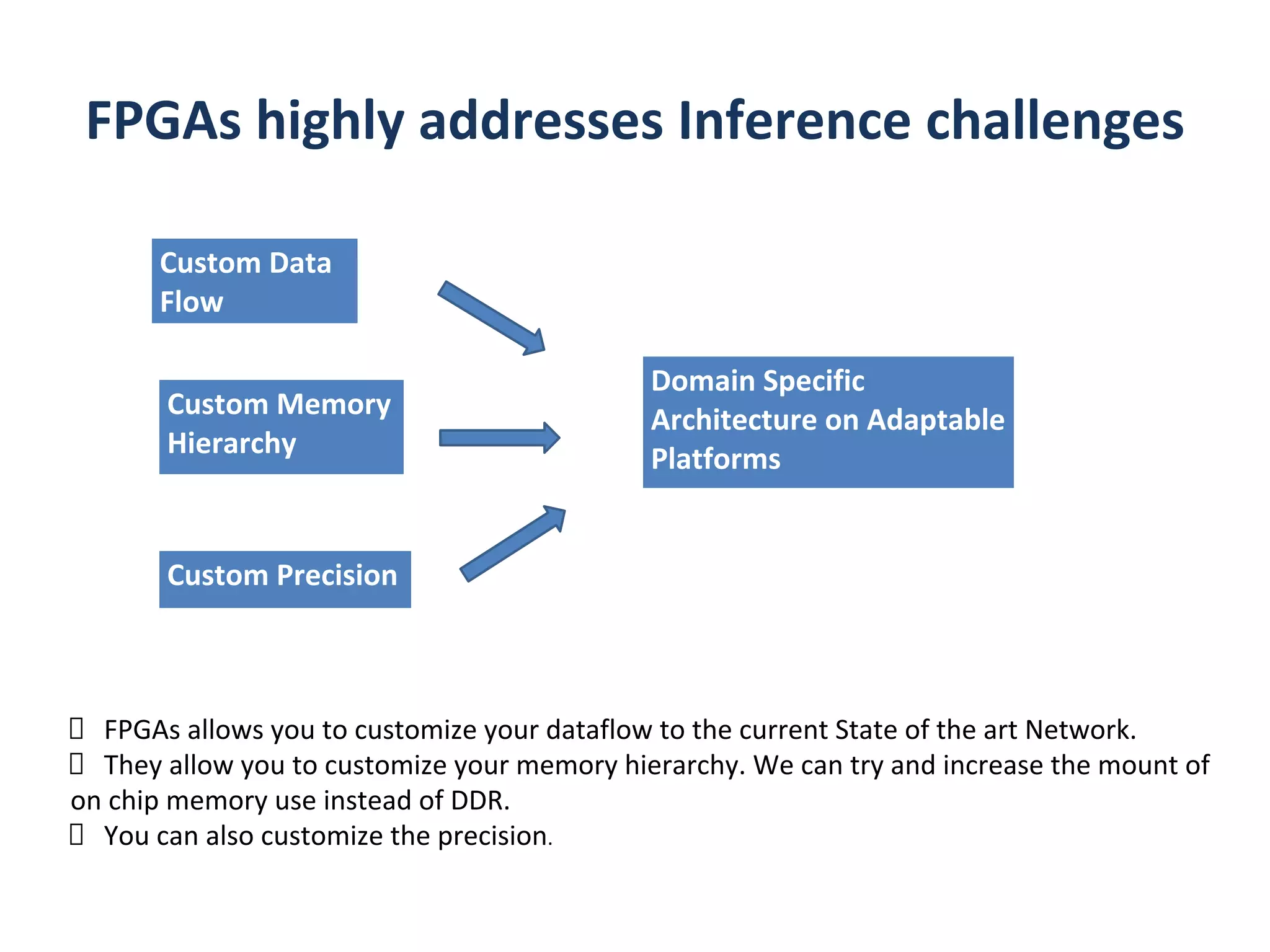
This document summarizes techniques for making deep learning models more efficient, including pruning, weight sharing, quantization, low-rank approximation, and Winograd transformations. It provides examples of applying these techniques to convolutional neural networks to reduce model size by up to 49x while maintaining accuracy. Specific techniques discussed include clustering weights to share values, quantizing weights to fewer bits, pruning low-impact connections, and iteratively retraining pruned models. Energy and computation reductions are achieved through smaller, lower-precision models with fewer operations.
3
This image islicensed under CC-BY 2.0
This image is in the public domain
This image is in the public domain
This image is licensed under CC-BY 2.0
3.
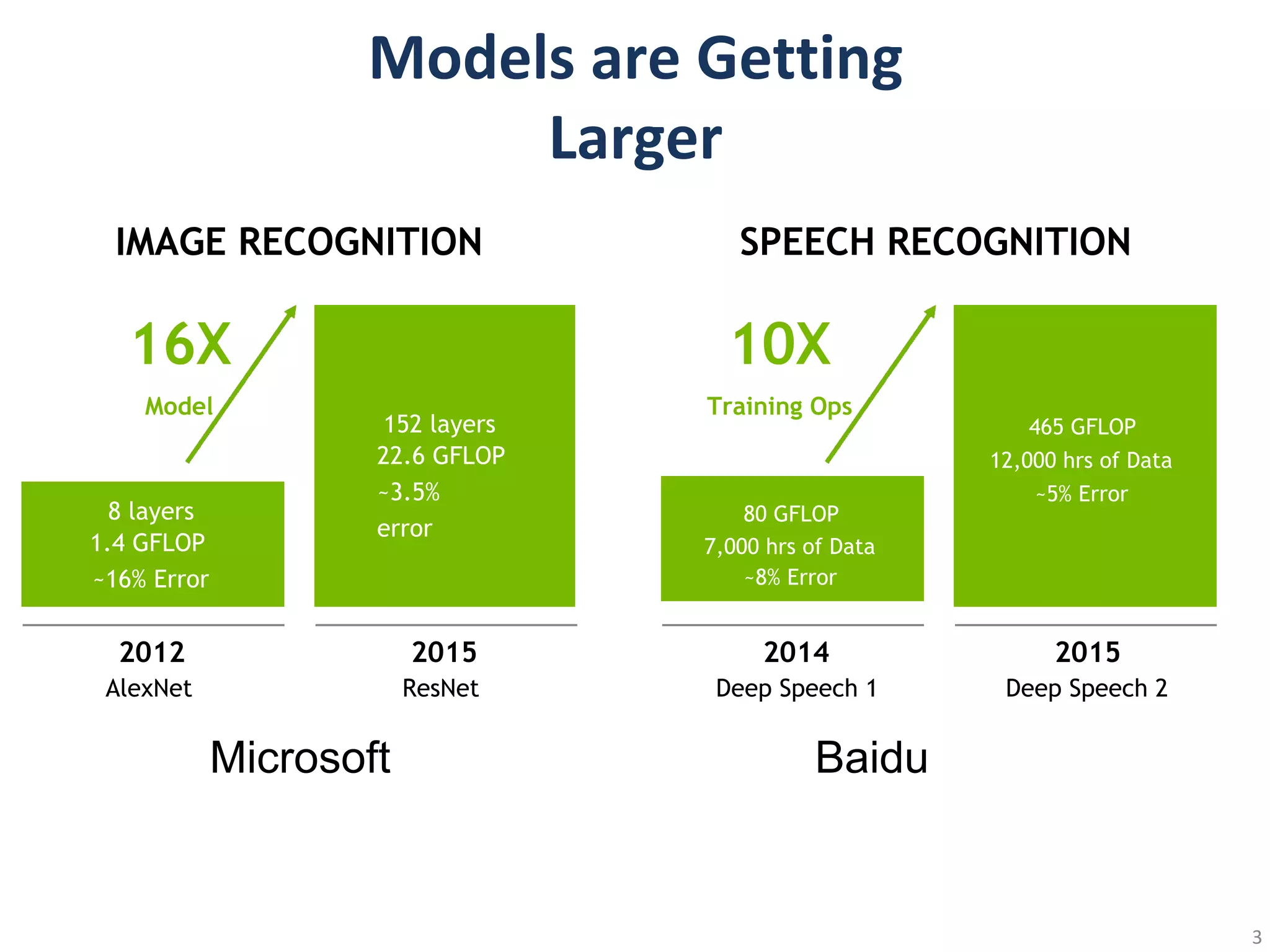
IMAGE RECOGNITION SPEECHRECOGNITION
2012
AlexNet
2015
ResNet
152 layers
22.6 GFLOP
~3.5%
error
8 layers
1.4 GFLOP
~16% Error
16X
Model
2014
Deep Speech 1
2015
Deep Speech 2
80 GFLOP
7,000 hrs of Data
~8% Error
10X
Training Ops
465 GFLOP
12,000 hrs of Data
~5% Error
Microsoft Baidu
4.
Hard to distributelarge models through over-the-air update
This image is licensed under CC-BY 2.0
App icon is in the public domain
Phone image is licensed under CC-BY 2.0
5.
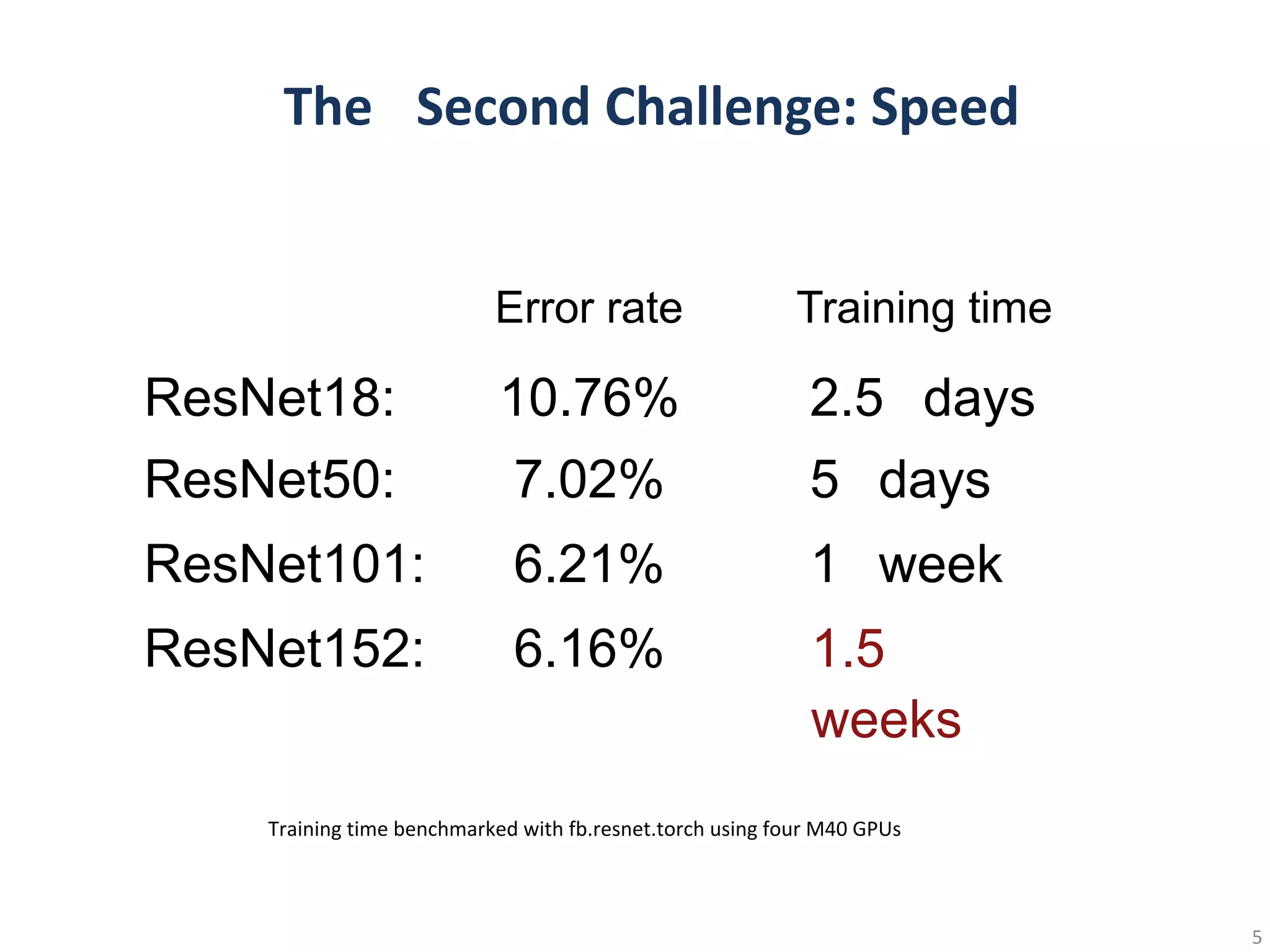
ResNet18: 10.76% 2.5days
ResNet50: 7.02% 5 days
ResNet101: 6.21% 1 week
ResNet152: 6.16% 1.5
weeks
Error rate Training time
6.
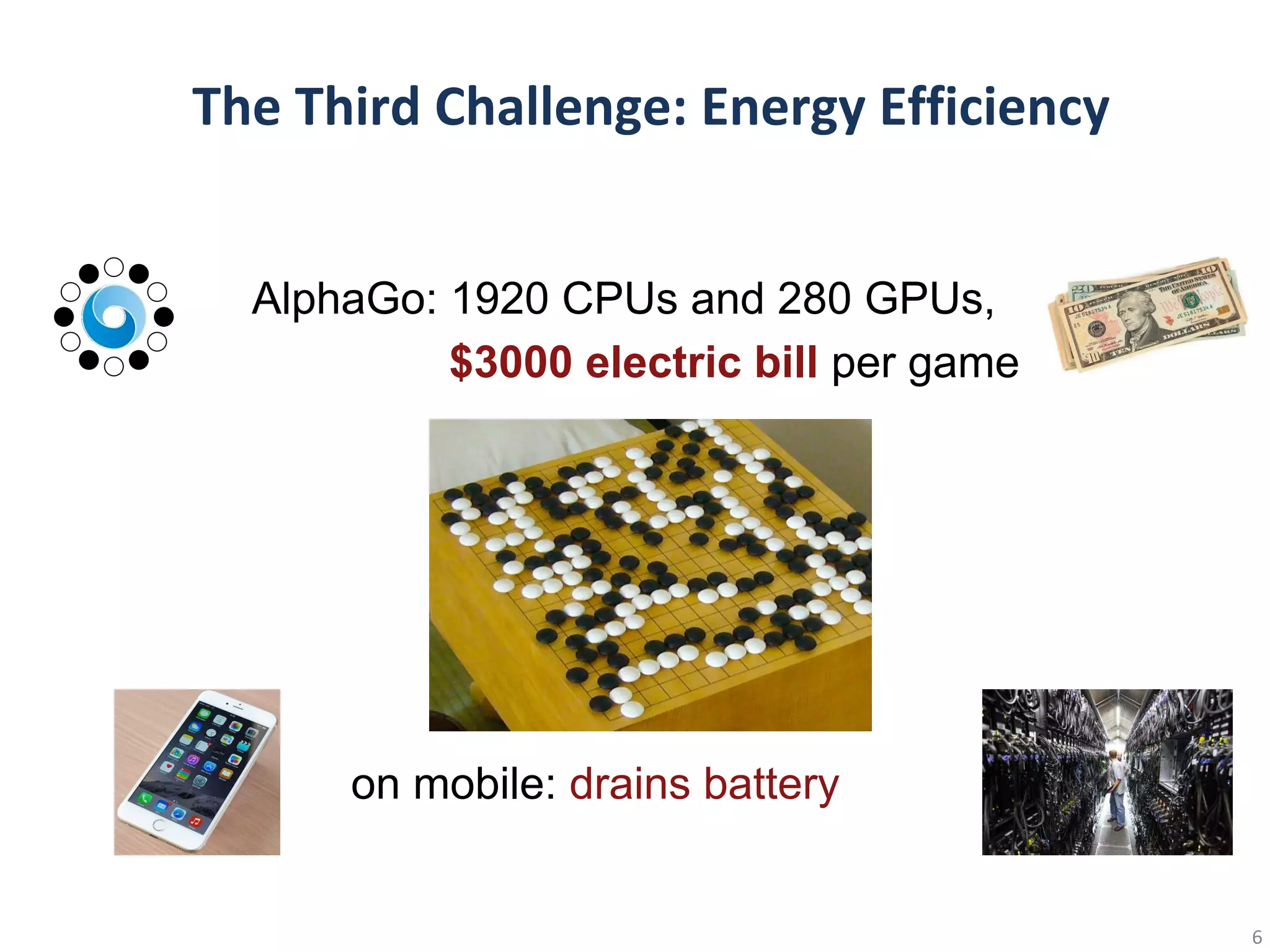
AlphaGo: 1920 CPUsand 280 GPUs,
$3000 electric bill per game
on mobile: drains battery
1
Operatio
n
Energy [pJ]
32 bitint ADD 0.1
32 bit float ADD 0.9
32 bit Register File 1
32 bit int MULT 3.1
32 bit float MULT 3.7
32 bit SRAM Cache 5
32 bit DRAM Memory 640
Relative Energy Cost
1 10
=1000
100 1000
10000
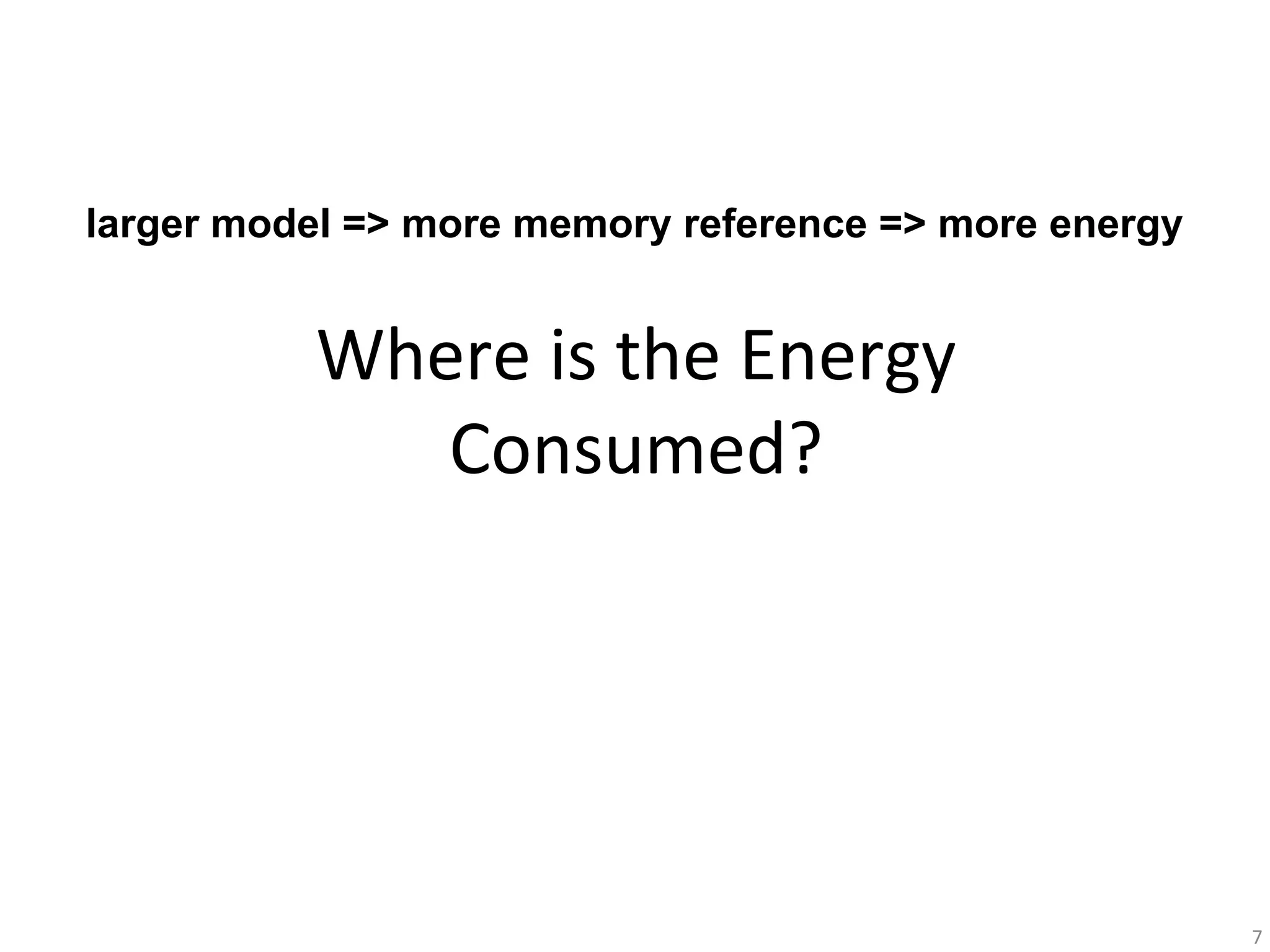
larger model => more memory reference => more energy
9.
Operation Energy[pJ
]
Relative EnergyCost
32 bit int AD 0.1
32 bit float ADD 0.9
32 bit Register File 1
32 bit int MULT 3.1
32 bit float MULT 3.7
32 bit SRAM Cache 5
32 bit DRAM Memory 640
1 10 100 1000 10000
how to make deep learning more efficient?
larger model => more memory reference => more energy
10.
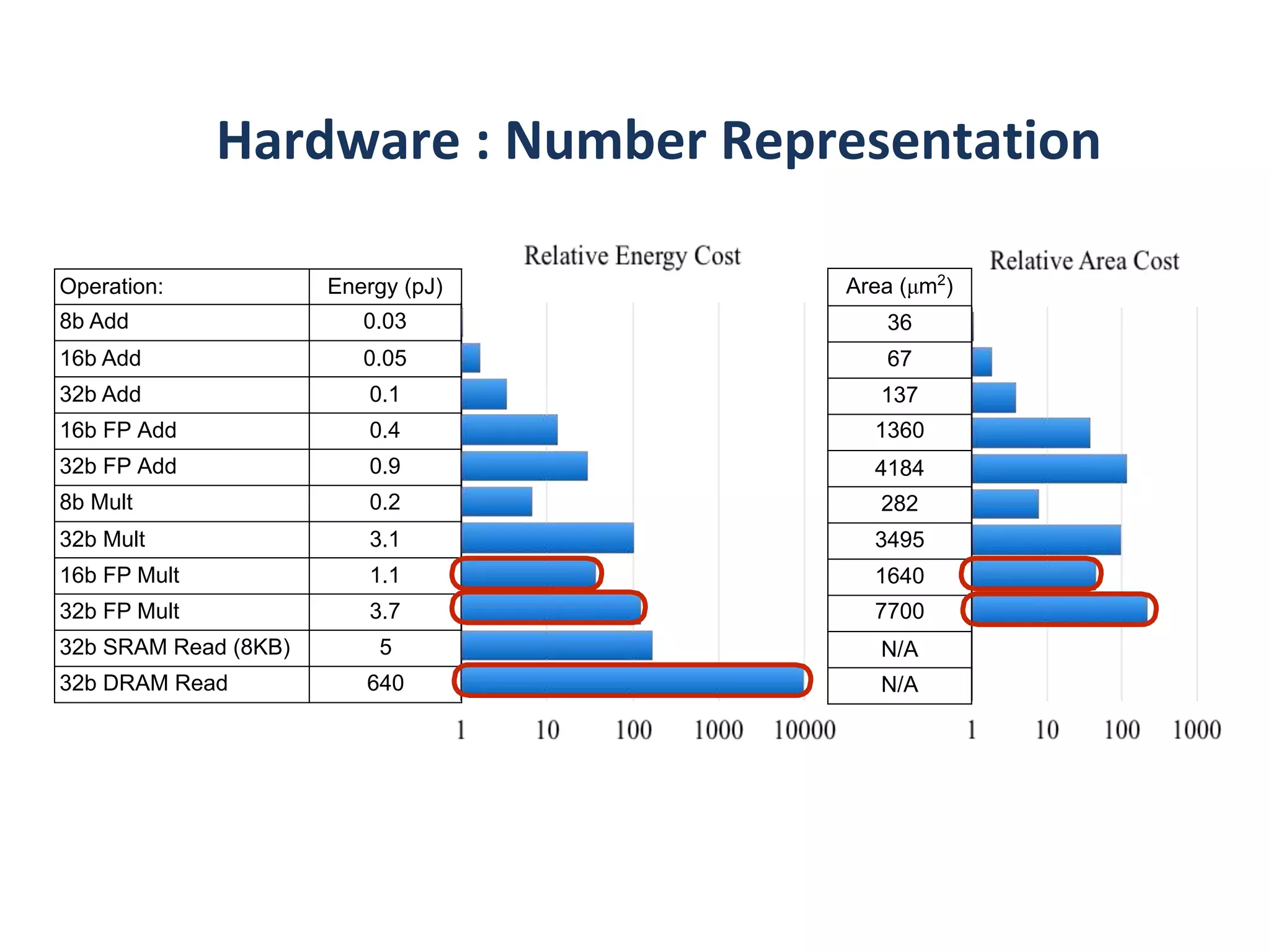
Operation: Energy (pJ)
8bAdd 0.03
16b Add 0.05
32b Add 0.1
16b FP Add 0.4
32b FP Add 0.9
8b Mult 0.2
32b Mult 3.1
16b FP Mult 1.1
32b FP Mult 3.7
32b SRAM Read (8KB) 5
32b DRAM Read 640
Area (μm2
)
36
67
137
1360
4184
282
3495
1640
7700
N/A
N/A
• Original:a basketballplayerin a white uniform
is playing with a ball
• Pruned 90%: a basketball player in a white uniform
is playing with a basketball
• Original : a brown dog is running through a grassy
field
• Pruned 90%: a brown dog is running through a
grassy area
•
•
Original : a soccer player in red is running in the field
Pruned 95%: a man in a red shirt and black and
white black shirt is running through a field
•
•
Original : a man is riding a surfboard on a wave
Pruned 90%: a man in a wetsuit is riding a wave on a
beach
95%
20
90%
90%
90%
•In-frequent weights: usemore bits to represent
•Frequent weights: use less bits to represent
,
Encode Weights
Encode Index
Huffman Encoding
41.
Train Connectivity
Prune Connections
TrainWeights
Cluster the Weights
Generate Code Book
Quantize the Weights
with Code Book
Retrain Code Book
Pruning: less number of weights
Quantization: less bits per weight
original
size
9x-13x
reduction
27x-31x
reduction
same
accuracy
same
accuracy
original
network
Encode Weights
Encode Index
Huffman Encoding
35x-49x
reduction
same
accuracy
Summaryof Deep Compression
42.
Network
Original
Size
Original
Accuracy
Compressed
Accuracy
LeNet-300 1070KB 98.36%98.42%
LeNet-5 1720KB 99.20% 99.26%
AlexNet 240MB 80.27% 80.30%
VGGNet 550MB 88.68% 89.09%
GoogleNet 28MB 88.90% 88.92%
ResNet-18 44.6MB
Compressed
Compression Size
Ratio
27KB 40x
44KB 39x
6.9MB 35x
11.3MB 49x
2.8MB 10x
4.0MB 11x
89.24% 89.28%
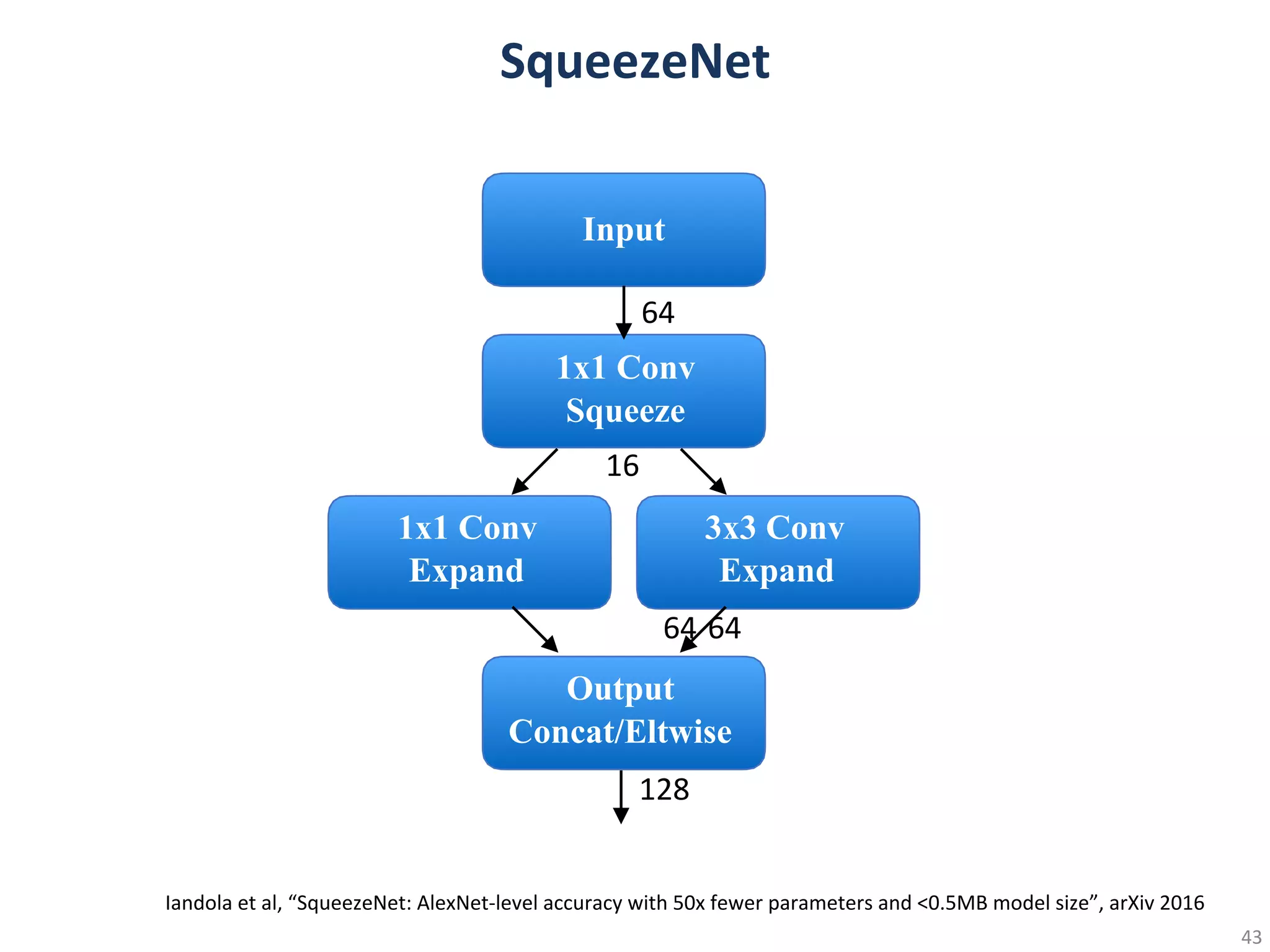
Can we make compact models to begin with?
.
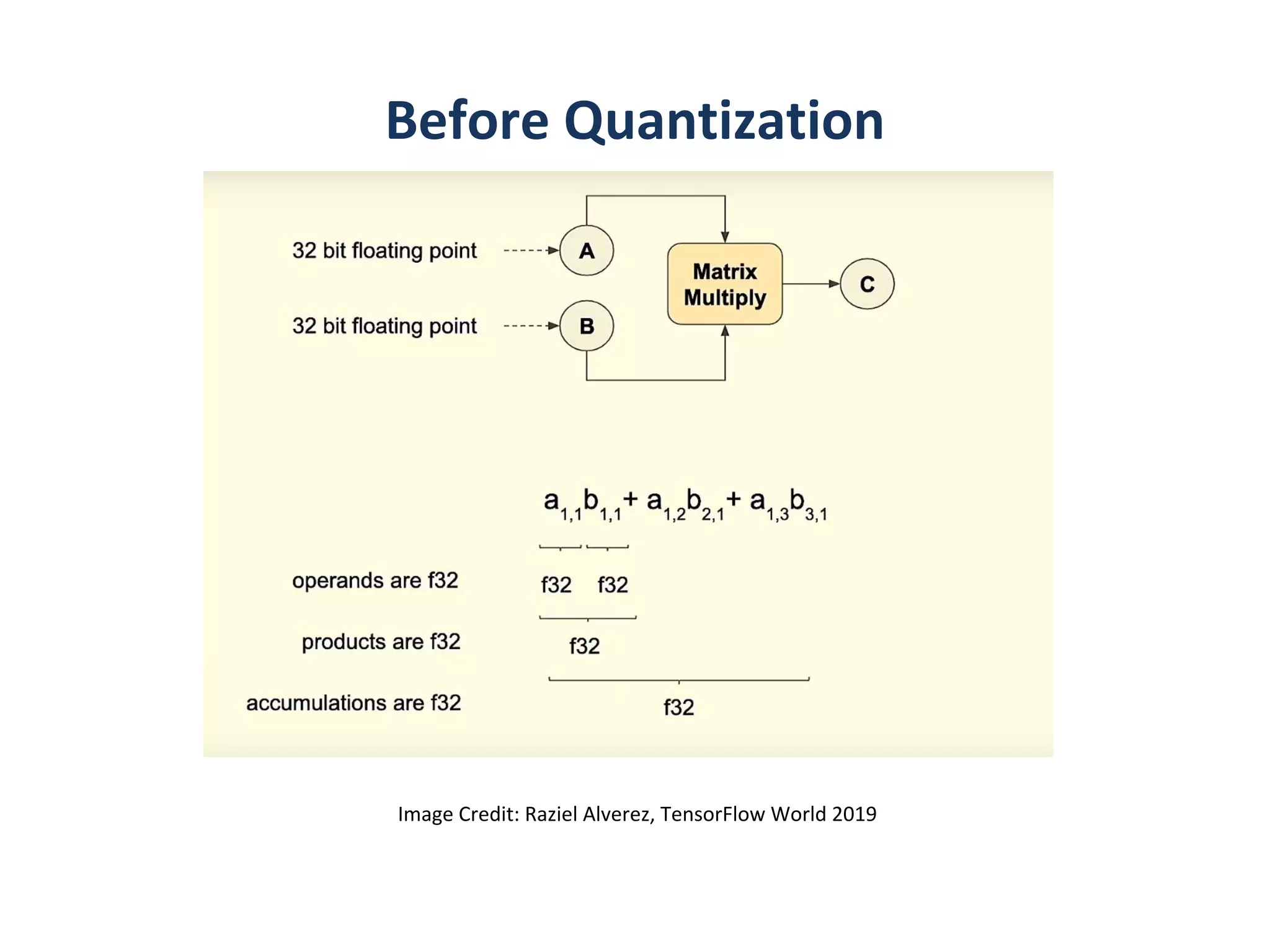
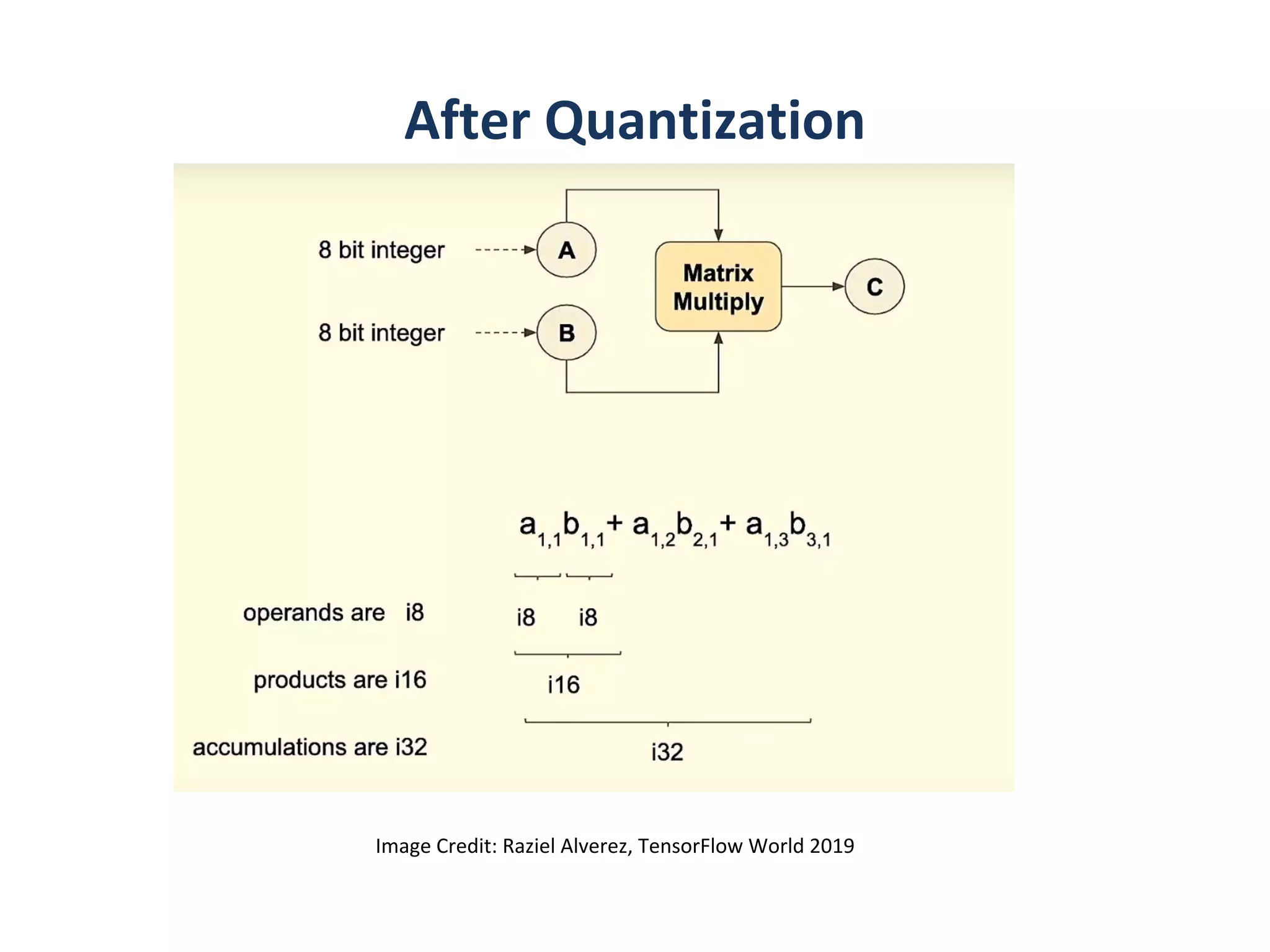
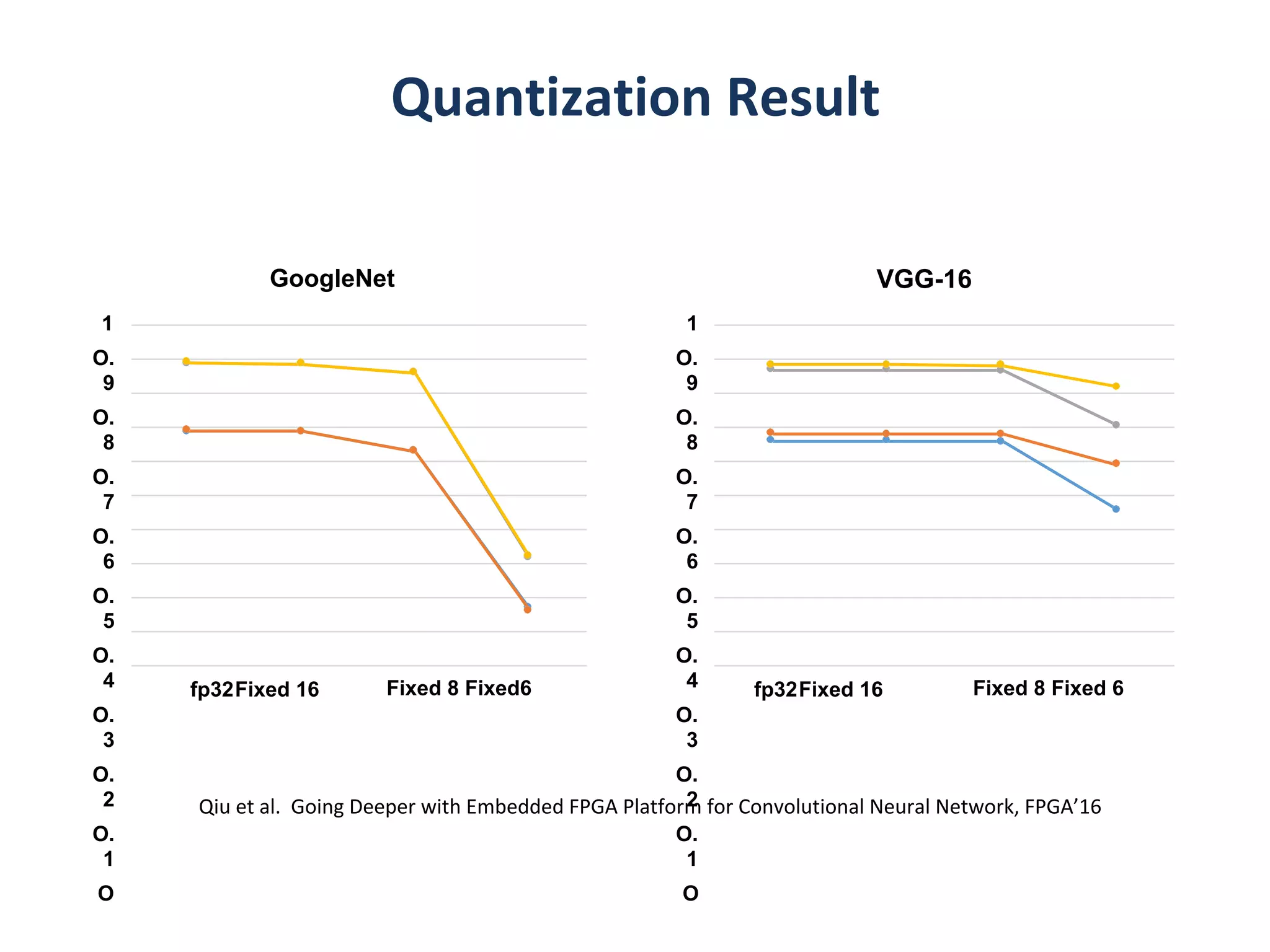
•Train with float
•Quantizingthe weight and
activation:
• Gather the statistics for
weight and activation
• Choose proper radix point
position
•Fine-tune in float format
•Convert to fixed-point format
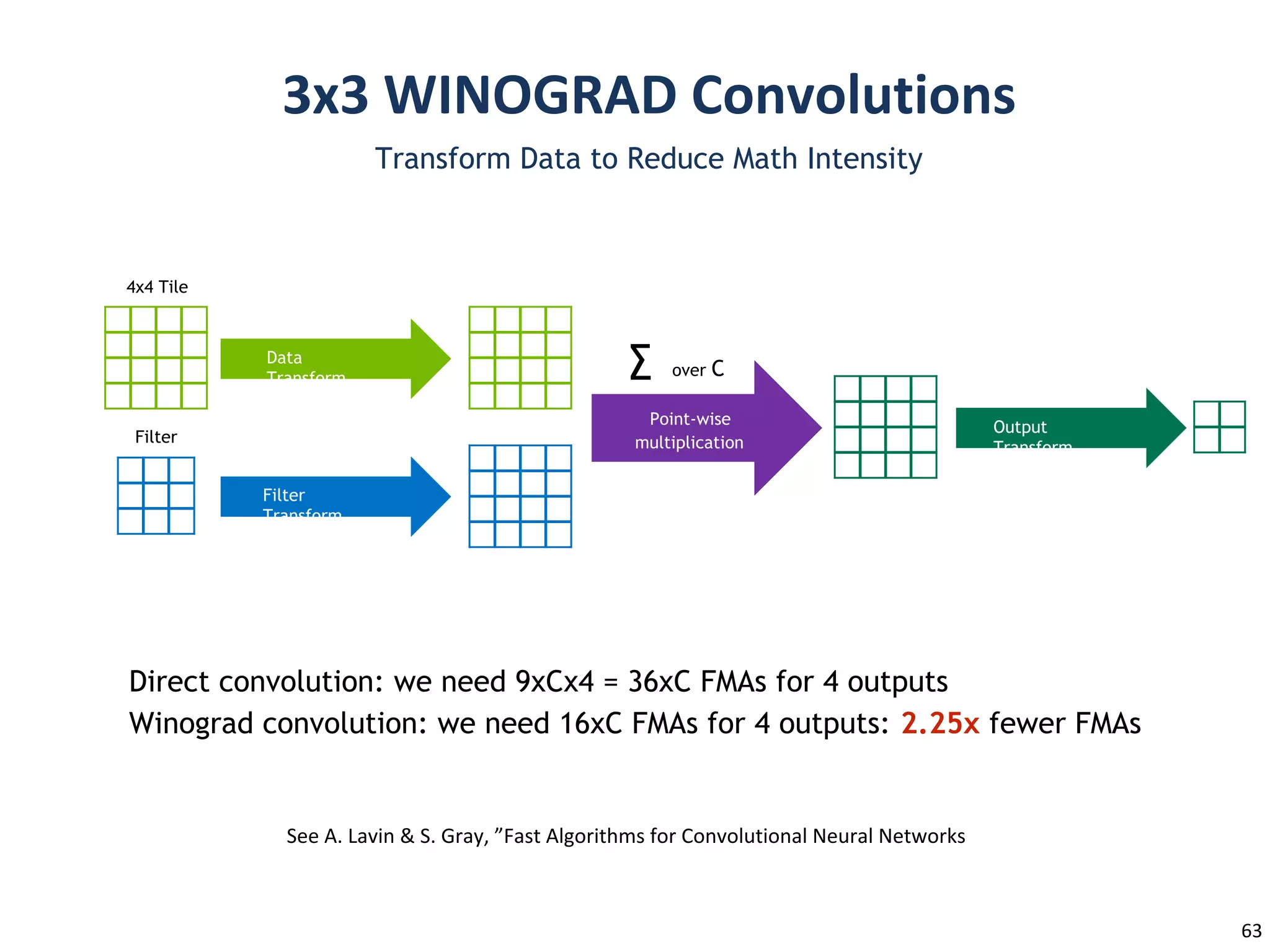
Transform Data toReduce Math Intensity
4x4 Tile
Output
Transform
Filter
Data
Transform
Filter
Transform
∑ over C
Point-wise
multiplication
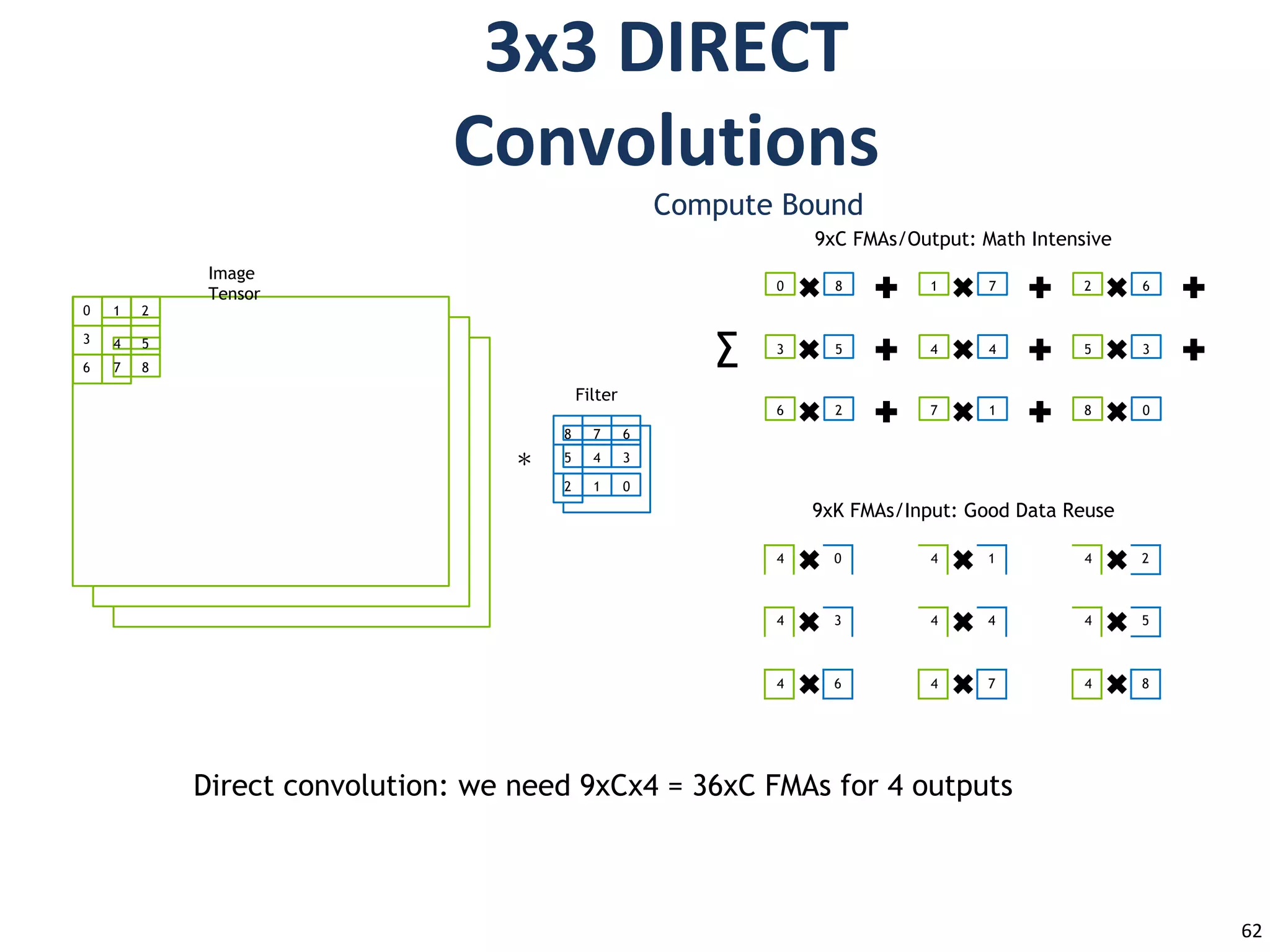
Direct convolution: we need 9xCx4 = 36xC FMAs for 4 outputs
Winograd convolution: we need 16xC FMAs for 4 outputs: 2.25x fewer FMAs


![1
Operatio
n
Energy [pJ]
32 bit int ADD 0.1
32 bit float ADD 0.9
32 bit Register File 1
32 bit int MULT 3.1
32 bit float MULT 3.7
32 bit SRAM Cache 5
32 bit DRAM Memory 640
Relative Energy Cost
1 10
=1000
100 1000
10000
larger model => more memory reference => more energy](https://image.slidesharecdn.com/cellstratwebinar1-200330193714/75/Model-Compression-8-2048.jpg)
![Operation Energy[pJ
]
Relative Energy Cost
32 bit int AD 0.1
32 bit float ADD 0.9
32 bit Register File 1
32 bit int MULT 3.1
32 bit float MULT 3.7
32 bit SRAM Cache 5
32 bit DRAM Memory 640
1 10 100 1000 10000
how to make deep learning more efficient?
larger model => more memory reference => more energy](https://image.slidesharecdn.com/cellstratwebinar1-200330193714/75/Model-Compression-9-2048.jpg)


























![Handwritten Digit Recognition and performance of various modelsation[autosaved]](https://cdn.slidesharecdn.com/ss_thumbnails/presentationautosaved-210810075721-thumbnail.jpg?width=640&height=640&fit=bounds)


![[第34回 WBA若手の会勉強会] Microsoft AI platform](https://cdn.slidesharecdn.com/ss_thumbnails/20180411wbamicrosoftai-180411111025-thumbnail.jpg?width=640&height=640&fit=bounds)


