26 March 2014
Optimising Mobile
#precsem | @precedentapac
6 sectorsEducation
Government
Membership
Not for profit
Destinations
Health
150 expertsStrategy & Research
User Centred Design
Branding & Communications
Digital Marketing
Development & Hosting
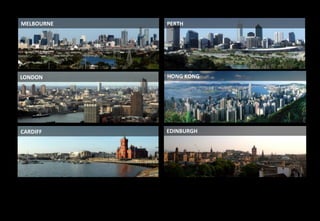
LONDON	
  
EDINBURGH	
  CARDIFF	
  
PERTH	
  MELBOURNE	
  
HONG	
  KONG	
  
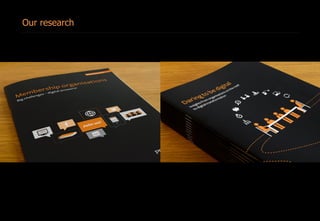
Our research
Who we work with
Optimising Mobile
1.  When one screen became many…
2.  Spotting the Opportunity
3.  Design considerations
-  Coffee break –
4.  Making it happen
5.  Considering the future
6.  Summary
What is a mobile device and how are people using them?
1. When one screen became many…
https://www.flickr.com/photos/pinguino/8527588008
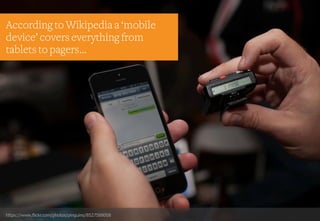
According to Wikipedia a ‘mobile
device’ covers everything from
tablets to pagers…
http://flickr.com/photos/74105777@N00/6153558098
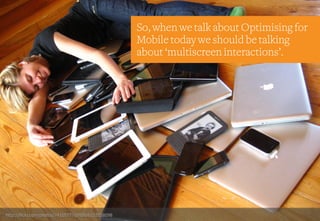
So, when we talk about Optimising for
Mobile today we should be talking
about ‘multiscreen interactions’.
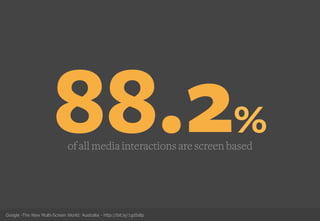
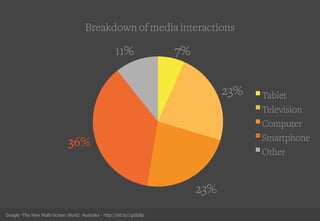
88.2%of all media interactions are screen based
Google -The New Multi-Screen World: Australia - http://bit.ly/1gdIs8p
7%
23%
23%
36%
11%
Tablet
Television
Computer
Smartphone
Other
Breakdown of media interactions
Google -The New Multi-Screen World: Australia - http://bit.ly/1gdIs8p
https://www.flickr.com/photos/spry/9845082153
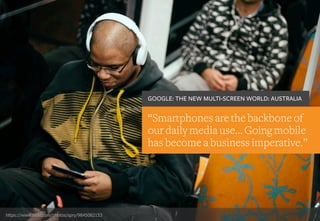
“Smartphones are the backbone of
our daily media use… Going mobile
has become a business imperative.”
GOOGLE: THE NEW MULTI-SCREEN WORLD: AUSTRALIA
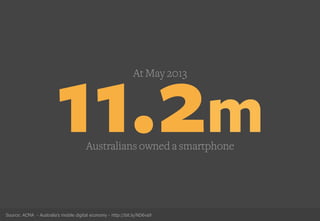
11.2m
At May 2013
Australians owned a smartphone
Source: ACMA - Australia’s mobile digital economy - http://bit.ly/ND6va9
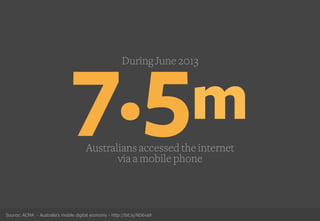
7.5m
During June 2013
Australians accessed the internet
via a mobile phone
Source: ACMA - Australia’s mobile digital economy - http://bit.ly/ND6va9
https://www.flickr.com/photos/shankaronline/9234917993
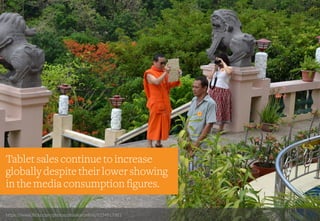
Tablet sales continue to increase
globally despite their lower showing
in the media consumption figures.
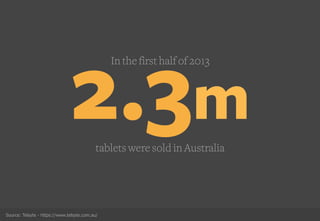
2.3m
In the first half of 2013
tablets were sold in Australia
Source: Telsyte - https://www.telsyte.com.au/
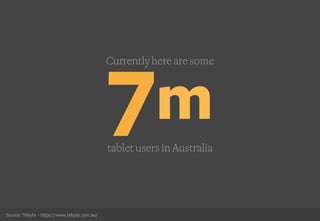
7m
Currently here are some
tablet users in Australia
Source: Telsyte - https://www.telsyte.com.au/
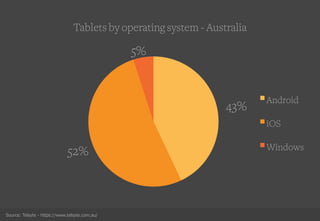
43%
52%
5%
Android
iOS
Windows
Tablets by operating system - Australia
Source: Telsyte - https://www.telsyte.com.au/
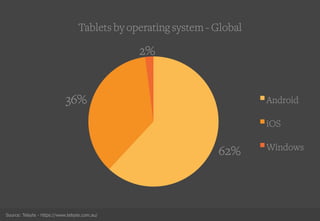
62%
36%
2%
Android
iOS
Windows
Tablets by operating system - Global
Source: Telsyte - https://www.telsyte.com.au/
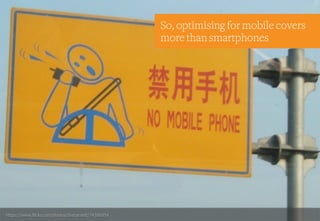
https://www.flickr.com/photos/bretarnett/74386954
So, optimising for mobile covers
more than smartphones
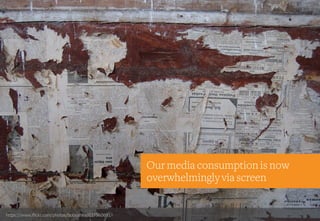
https://www.flickr.com/photos/bobushka/637560691
Our media consumption is now
overwhelmingly via screen
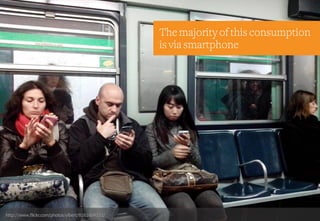
http://www.flickr.com/photos/ylbert/8161604331/
The majority of this consumption
is via smartphone
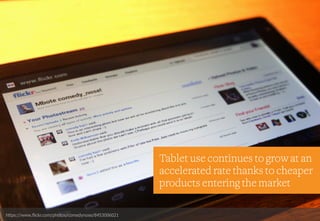
https://www.flickr.com/photos/comedynose/8453006021
Tablet use continues to grow at an
accelerated rate thanks to cheaper
products entering the market
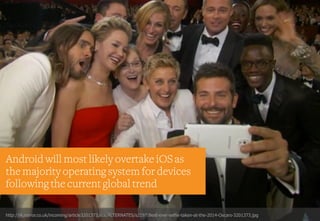
Android will most likely overtake iOS as
the majority operating system for devices
following the current global trend
http://i4.mirror.co.uk/incoming/article3201373.ece/ALTERNATES/s2197/Best-ever-selfie-taken-at-the-2014-Oscars-3201373.jpg
Multiple screens, multiple channels… where to start?
2. Spotting the Opportunity
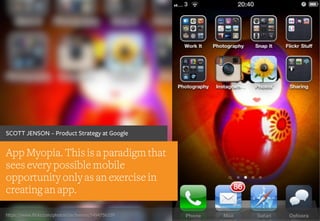
https://www.flickr.com/photos/dacheeses/5494756109
App Myopia. This is a paradigm that
sees every possible mobile
opportunity only as an exercise in
creating an app.
SCOTT JENSON – Product Strategy at Google
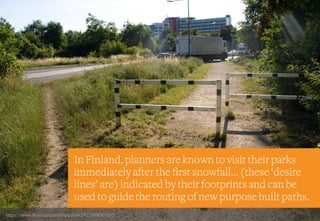
In Finland, planners are known to visit their parks
immediately after the first snowfall… (these ‘desire
lines’ are) indicated by their footprints and can be
used to guide the routing of new purpose built paths.
https://www.flickr.com/photos/ptenec242/5988307675
https://www.flickr.com/photos/antjeverena/10796080723
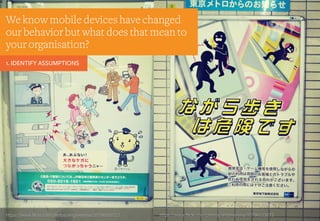
We know mobile devices have changed
our behavior but what does that mean to
your organisation?
https://www.flickr.com/photos/antjeverena/10796123073
1. IDENTIFY ASSUMPTIONS
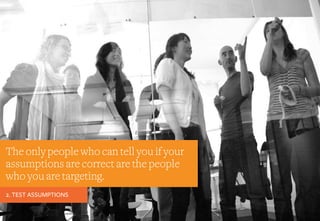
The only people who can tell you if your
assumptions are correct are the people
who you are targeting.
2. TEST ASSUMPTIONS
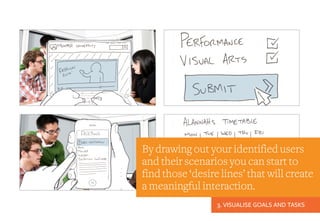
By drawing out your identified users
and their scenarios you can start to
find those ‘desire lines’ that will create
a meaningful interaction.
3. VISUALISE GOALS AND TASKS
https://www.flickr.com/photos/matsugoro/324841451
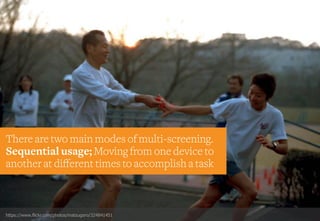
There are two main modes of multi-screening.
Sequential usage; Moving from one device to
another at di erent times to accomplish a task
https://www.flickr.com/photos/ladykat81/7571006540
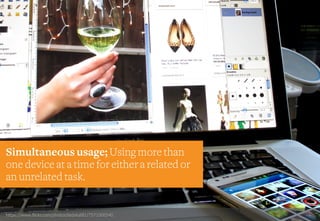
Simultaneous usage; Using more than
one device at a time for either a related or
an unrelated task.
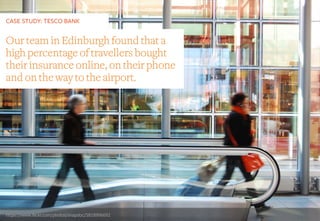
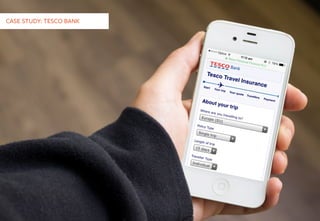
CASE STUDY: TESCO BANK
https://www.flickr.com/photos/snapdoc/5818996692
Our team in Edinburgh found that a
high percentage of travellers bought
their insurance online, on their phone
and on the way to the airport.
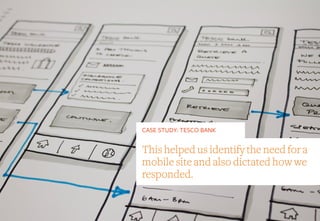
CASE STUDY: TESCO BANK
This helped us identify the need for a
mobile site and also dictated how we
responded.
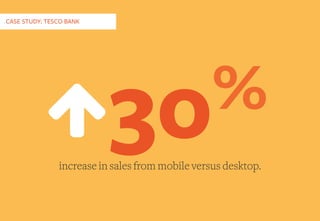
CASE STUDY: TESCO BANK
30%
increase in sales from mobile versus desktop.
Not just a pretty fascia.
3. Design Considerations
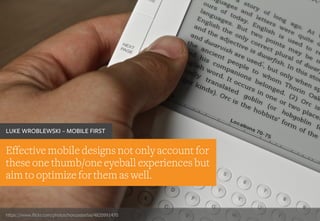
https://www.flickr.com/photos/honzasterba/4820991470
Effective mobile designs not only account for
these one thumb/one eyeball experiences but
aim to optimize for them as well.
LUKE WROBLEWSKI – MOBILE FIRST
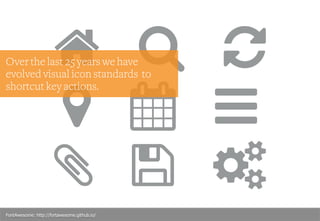
FontAwesome: http://fortawesome.github.io/
Over the last 25 years we have
evolved visual icon standards to
shortcut key actions.
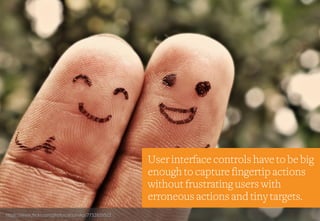
Design Considerations – Hit Areas
https://www.flickr.com/photos/arjunvkp/7732829512
User interface controls have to be big
enough to capture fingertip actions
without frustrating users with
erroneous actions and tiny targets.
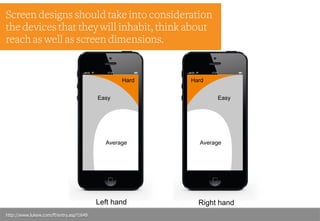
Right hand
Easy
Average
Hard
Left hand
Easy
Average
Hard
Screen designs should take into consideration
the devices that they will inhabit, think about
reach as well as screen dimensions.
http://www.lukew.com/ff/entry.asp?1649
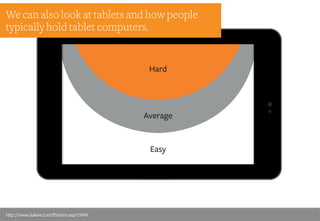
We can also look at tablets and how people
typically hold tablet computers.
http://www.lukew.com/ff/entry.asp?1649
Users are not sympathetic to poor
network coverage and don’t adjust their
expectations when WIFI isn’t available.
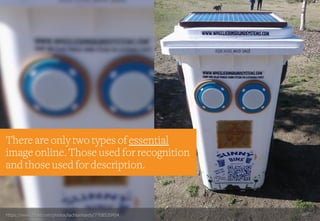
https://www.flickr.com/photos/lachlanhardy/7708520454
There are only two types of essential
image online. Those used for recognition
and those used for description.
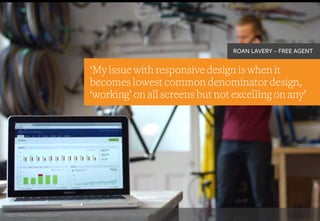
‘My issue with responsive design is when it
becomes lowest common denominator design,
‘working’ on all screens but not excelling on any’
ROAN LAVERY – FREE AGENT
http://www.freeagent.com/
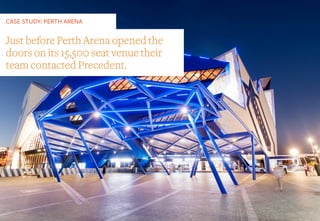
CASE STUDY: PERTH ARENA
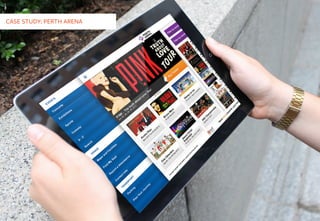
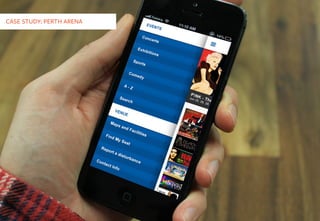
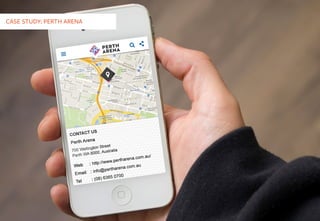
Just before Perth Arena opened the
doors on its 15,500 seat venue their
team contacted Precedent.
CASE STUDY: PERTH ARENA
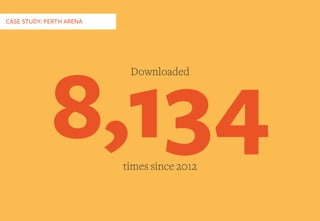
8,134
Downloaded
times since 2012
COFFEE BREAK
4. Making it happen
Faster development with an iterative roadmap
will kickstart any income stream and allow for
early understanding of benefits.
http://www.flickr.com/photos/angusf/2236023038
3core approaches to mobile development.
In reality there are
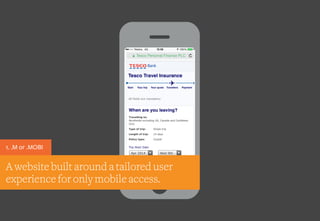
A website built around a tailored user
experience for only mobile access.
1. .M or .MOBI
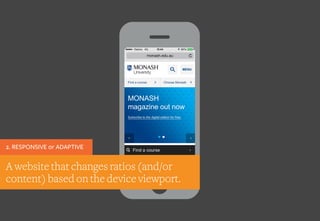
A website that changes ratios (and/or
content) based on the device viewport.
2. RESPONSIVE or ADAPTIVE
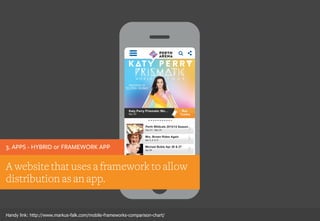
A website that uses a framework to allow
distribution as an app.
3. APPS - HYBRID or FRAMEWORK APP
Handy link: http://www.markus-falk.com/mobile-frameworks-comparison-chart/
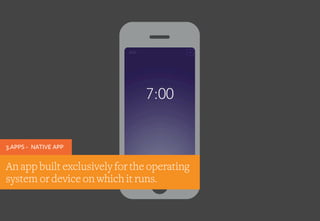
An app built exclusively for the operating
system or device on which it runs.
3.APPS - NATIVE APP
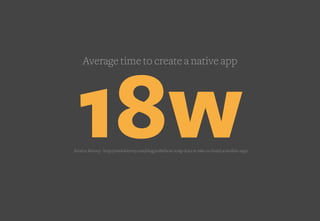
18w
Average time to create a native app
Source: Kinvey - http://www.kinvey.com/blog/2086/how-long-does-it-take-to-build-a-mobile-app/
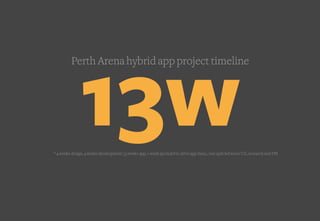
13w
Perth Arena hybrid app project timeline
* 4 weeks design, 4 weeks development (3 weeks app, 1 week api build to drive app data), rest split between UX, research and PM
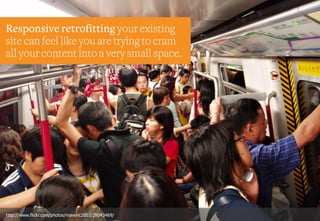
Responsive retrofitting your existing
site can feel like you are trying to cram
all your content into a very small space.
http://www.flickr.com/photos/maveric2003/28043469/
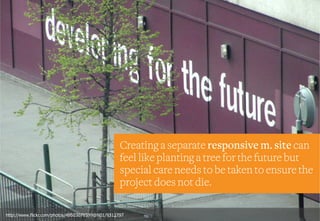
Creating a separate responsive m. site can
feel like planting a tree for the future but
special care needs to be taken to ensure the
project does not die.
http://www.flickr.com/photos/49503078599@N01/9312797
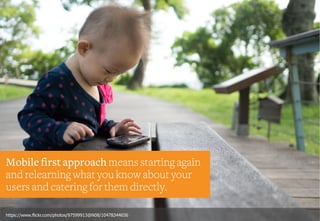
Mobile first approach means starting again
and relearning what you know about your
users and catering for them directly.
https://www.flickr.com/photos/97599913@N08/10478344656
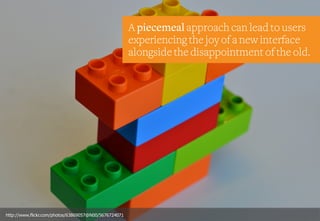
A piecemeal approach can lead to users
experiencing the joy of a new interface
alongside the disappointment of the old.
http://www.flickr.com/photos/63869057@N00/5676724071
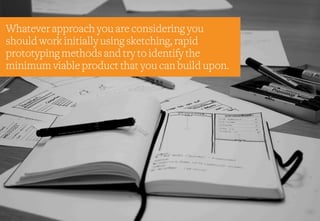
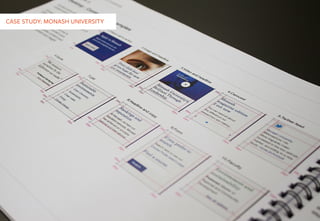
Whatever approach you are considering you
should work initially using sketching, rapid
prototyping methods and try to identify the
minimum viable product that you can build upon.
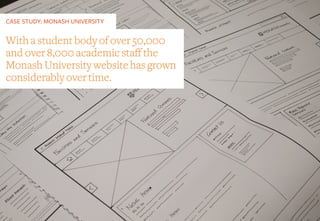
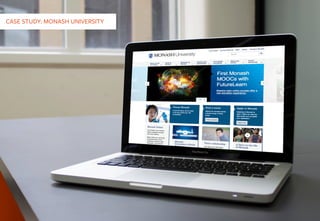
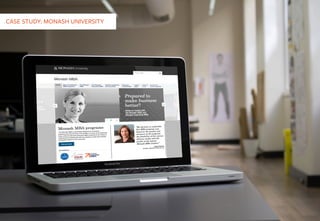
CASE STUDY: MONASH UNIVERSITY
With a student body of over 50,000
and over 8,000 academic staff the
Monash University website has grown
considerably over time.
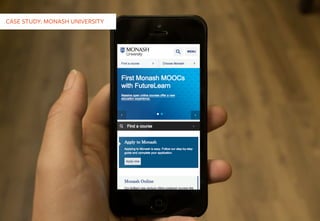
CASE STUDY: MONASH UNIVERSITY
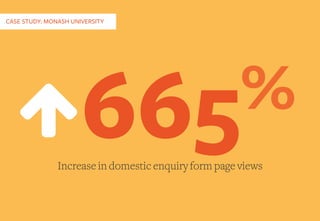
665%
Increase in domestic enquiry form page views
5. Considering the future
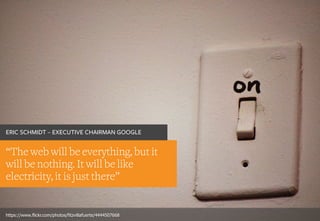
“The web will be everything, but it
will be nothing. It will be like
electricity, it is just there”
ERIC SCHMIDT – EXECUTIVE CHAIRMAN GOOGLE
https://www.flickr.com/photos/fitzvillafuerte/4444507668
“Services aren’t made on an assembly line…
you can’t predict precisely which
[touchpoint] each user will need… The
service is experienced differently by every
person, because every person is different”
ANDY POLAINE
http://www.projectara.com/
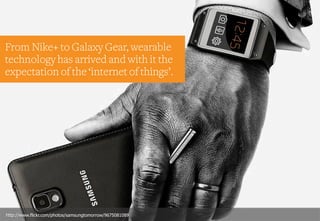
From Nike+ to Galaxy Gear, wearable
technology has arrived and with it the
expectation of the ‘internet of things’.
http://www.flickr.com/photos/samsungtomorrow/9675081089
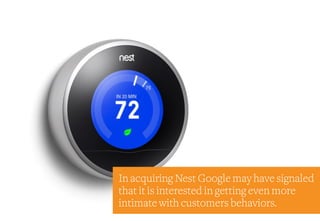
In acquiring Nest Google may have signaled
that it is interested in getting even more
intimate with customers behaviors.
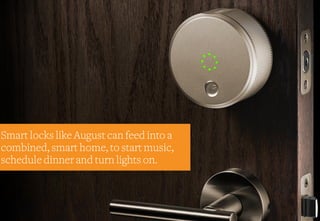
Smart locks like August can feed into a
combined, smart home, to start music,
schedule dinner and turn lights on.
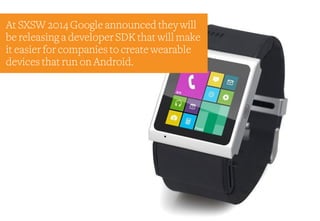
At SXSW 2014 Google announced they will
be releasing a developer SDK that will make
it easier for companies to create wearable
devices that run on Android.
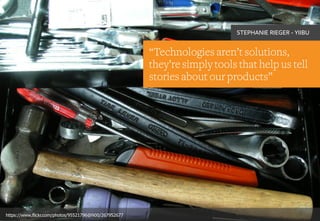
“Technologies aren’t solutions,
they’re simply tools that help us tell
stories about our products”
STEPHANIE RIEGER - YIIBU
https://www.flickr.com/photos/95521796@N00/267952677
6. Summary
1. RESEARCH
We now live in a multi device world where both
smartphones and tablets are increasingly becoming
the main touchpoints for consumers.
2. OPPORTUNITIES
Users will create their own paths to content, to create
engaging, meaningful and valuable experiences we
need to uncover our users motivations and journeys.
3. DESIGN
There is a rich and growing visual language that has
evolved over the last 25 years of the web. Use this as a
base for your presence rather than inventing new ones.
4. TECHNOLOGY
The ideal approach to optimising for mobile is to
prototype, test, implement and repeat. Learn from
successes and failures to continually adapt to change.
5. FUTURE
The future will revolve around the ability of users to
customise their experiences to their needs and for
businesses to record greater amounts of data from that.
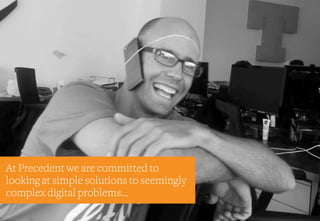
At Precedent we are committed to
looking at simple solutions to seemingly
complex digital problems…
UPCOMING REPORT
QUESTIONS?
Where referenced images have been used under the creative
commons attribution license. http://creativecommons.org

Mobilising Digital - Sydney 26/03/14