1
Mobile Website 
Your Secret Weapon in Gaining a Competitive Advantage 
Preface 3 
PART 1. Why Your Business Needs a Mobile Website 4 
A Brand New Breed of Consumer 5 
Mobile-Aided Shopping 7 
Mobile Users Going Local 9 
How to Boost Your Business’s Reach 10 
Non-Mobile Friendly 12 
PART 2. Mobile Website in a Nutshell 13 
Responsive Website vs. Mobile Site 14 
Mobile Site vs. Desktop Website 15 
Desktop Website 16 
Mobile Site 17 
Key Features of a Mobile Site 18 
Loading Speed 19 
Friendly Navigation 20 
Direct Contact 21 
Direction & Location Maps 22 
Essential Information 23 
Go Mobile 24 
Sources 25 
2
3 
Preface 
Over the recent years we have been witnessing a dynamic expansion of new technologies. Due to the 
convenience that mobile devices have ensured we began to adapt them to completing our daily routines. The 
model of a typical consumer has evolved, too. Consumers have changed their purchase behaviors and started 
to use smartphone as the primary medium in this process. 
In our e-book we aim to highlight and explain the need for small and medium businesses to get ready for 
a customer of a new type functioning in a different context than ever before – a mobile consumer. Business 
owners keep underestimating the potential of mobile devices and it seems that the lack of knowledge about 
their users might be the fundamental problem. 
We hope that our e-book will help better understand expectations of mobile consumers, which will let 
entrepreneurs achieve their business objectives within the most dynamically developing sales channel.
4 
PART 1 
Why Your Business Needs 
a Mobile Website
A Brand New Breed of Consumer 
5 
Have you noticed how consumers and their 
purchase behaviors have changed over the last few 
years? 
Today consumers have an unlimited access to 
information on products and services. Using free tools 
available on the Internet they can compare prices and 
purchase conditions, verify suppliers, or even create 
summaries of similar products. All this to get better 
prepared for making a purchase decision. The idea 
dates back to 1980, when Alvin Toffler, a futurologist, 
coined the term prosumer, contracting two words – 
producer and consumer, to describe the emerging type 
of proactive consumers. Prosumer, or a typical today’s 
consumer, is an active customer comparable to a 
professional. The new consumer no longer relies solely 
on traditional advertising, but looks for information on 
their own initiative.
A Brand New Breed of Consumer 
When making a purchase decision, they have a broad knowledge of the product and its features, the 
competition, as well as other consumers’ opinions. According to 71% of the respondents who participated in 
a research carried out by B2B Marketing portal in 2012 – the main source of this information is the Internet. 
Is your business’s website ready for the latest revolution among prosumers – a shift towards 
mobile devices? 
More and more people are resorting to smartphones and tablets for their daily activities. It is predicted that by 
2015 more users will be accessing the Internet on mobile devices than on desktop computers. If your strategy 
for gaining customers does not account for the behaviors of today’s consumers, you will be losing them month 
after month. 
6
7 
Mobile-Aided Shopping 
Consumers increasingly use mobile devices to search for information on products and, as a result, to 
make online purchases. This trend has been supported by a number of studies carried out by Google, 
among others, which show the great potential of the technological revolution for small and medium 
businesses. 
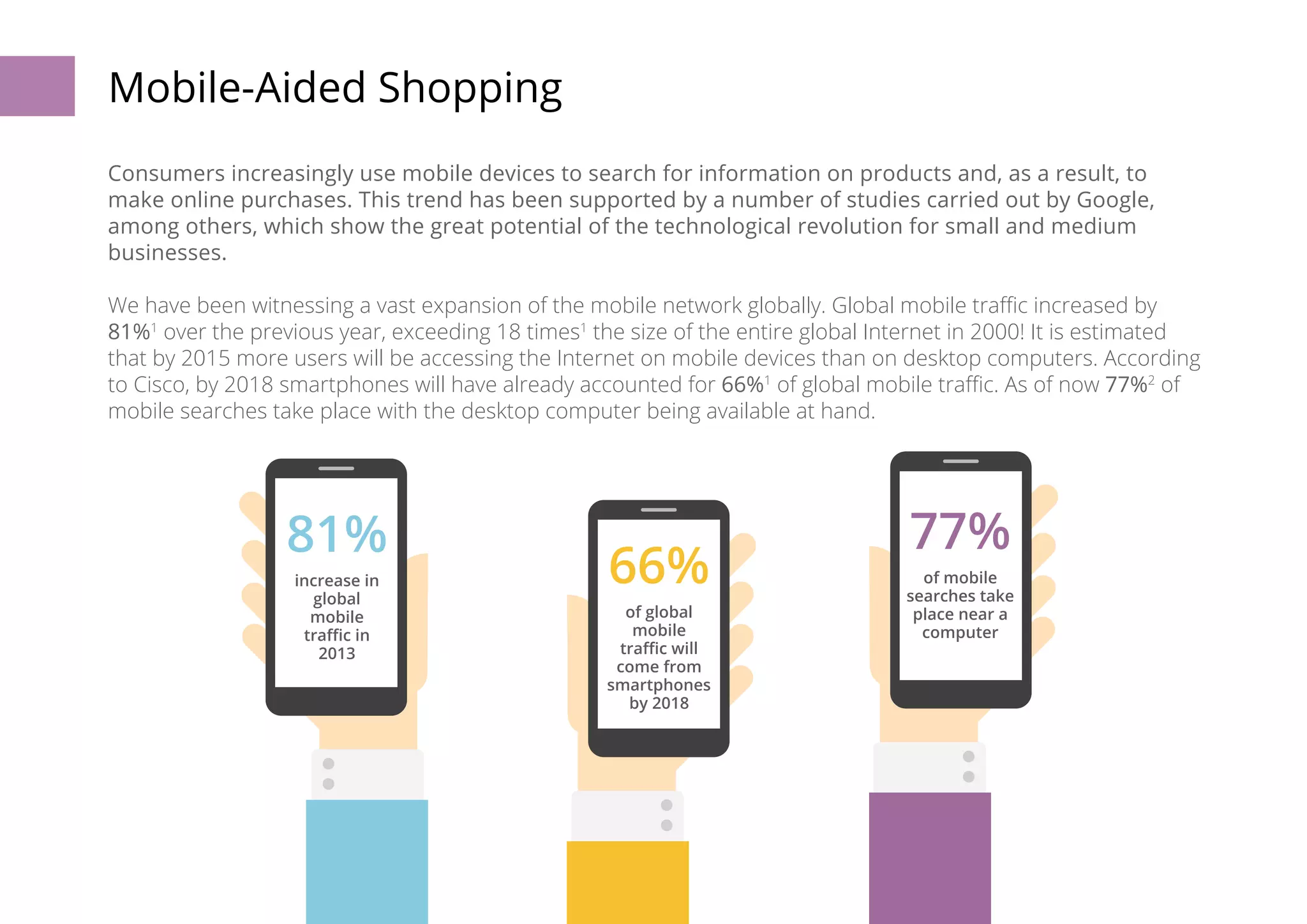
We have been witnessing a vast expansion of the mobile network globally. Global mobile traffic increased by 
81%1 over the previous year, exceeding 18 times1 the size of the entire global Internet in 2000! It is estimated 
that by 2015 more users will be accessing the Internet on mobile devices than on desktop computers. According 
to Cisco, by 2018 smartphones will have already accounted for 66%1 of global mobile traffic. As of now 77%2 of 
mobile searches take place with the desktop computer being available at hand. 
66% 
of global 
mobile 
traffic will 
come from 
smartphones 
by 2018 
77% 
of mobile 
searches take 
place near a 
computer 
24% 
of consumers 
tell others 
about local 
businesses 
found via 
smartphone 
81% 
increase in 
global 
mobile 
traffic in 
2013
8 
Mobile-Aided Shopping 
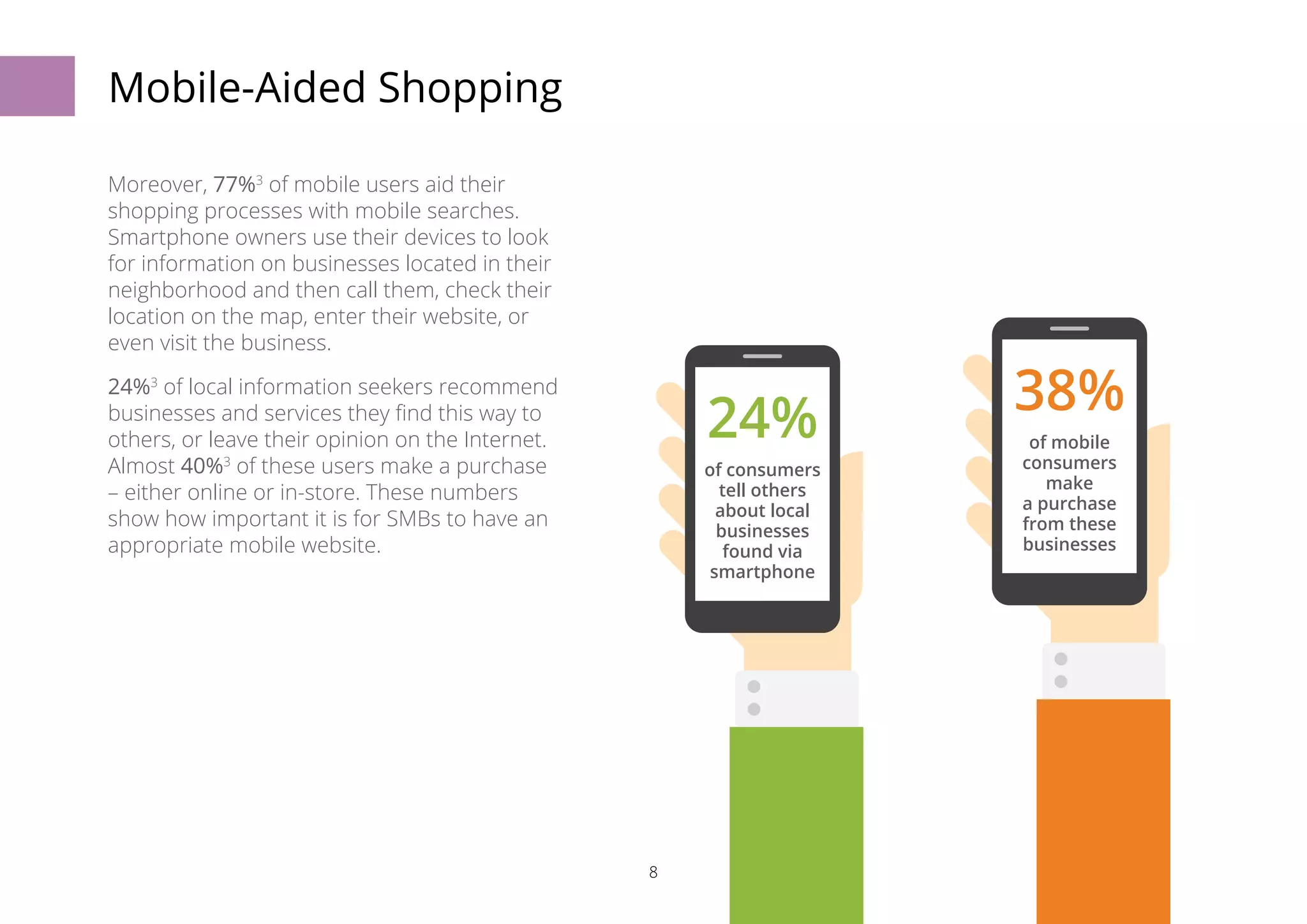
Moreover, 77%3 of mobile users aid their 
shopping processes with mobile searches. 
Smartphone owners use their devices to look 
for information on businesses located in their 
neighborhood and then call them, check their 
location on the map, enter their website, or 
even visit the business. 
24%3 of local information seekers recommend 
businesses and services they find this way to 
others, or leave their opinion on the Internet. 
Almost 40%3 of these users make a purchase 
– either online or in-store. These numbers 
show how important it is for SMBs to have an 
appropriate mobile website. 66% 
of global 
mobile 
traffic will 
come from 
smartphones 
by 2018 
77% 
of mobile 
searches take 
place near a 
computer 
24% 
of consumers 
tell others 
about local 
businesses 
found via 
smartphone 
38% 
of mobile 
consumers 
make 
a purchase 
from these 
businesses
9 
Mobile Users Going Local 
Smartphones provide us with an easy access to information on 
what we can find in the neighborhood. This is why optimizing 
businesses’ websites for viewing on mobile devices is crucial for 
their potential customers. 
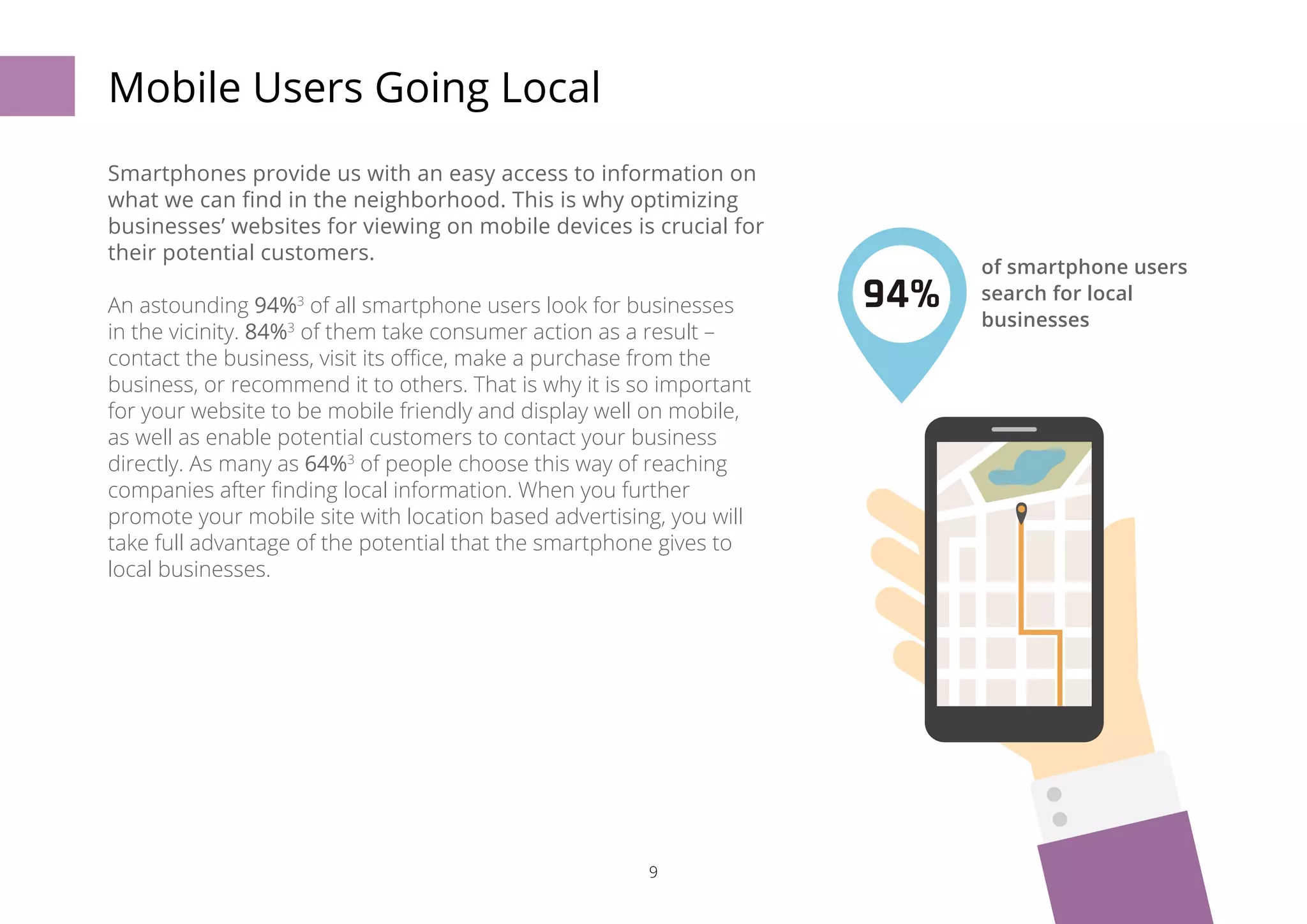
An astounding 94%3 of all smartphone users look for businesses 
in the vicinity. 84%3 of them take consumer action as a result – 
contact the business, visit its office, make a purchase from the 
business, or recommend it to others. That is why it is so important 
for your website to be mobile friendly and display well on mobile, 
as well as enable potential customers to contact your business 
directly. As many as 64%3 of people choose this way of reaching 
companies after finding local information. When you further 
promote your mobile site with location based advertising, you will 
take full advantage of the potential that the smartphone gives to 
local businesses. 
of smartphone users 
search for local 
businesses 94%
How to Boost Your Business’s Reach 
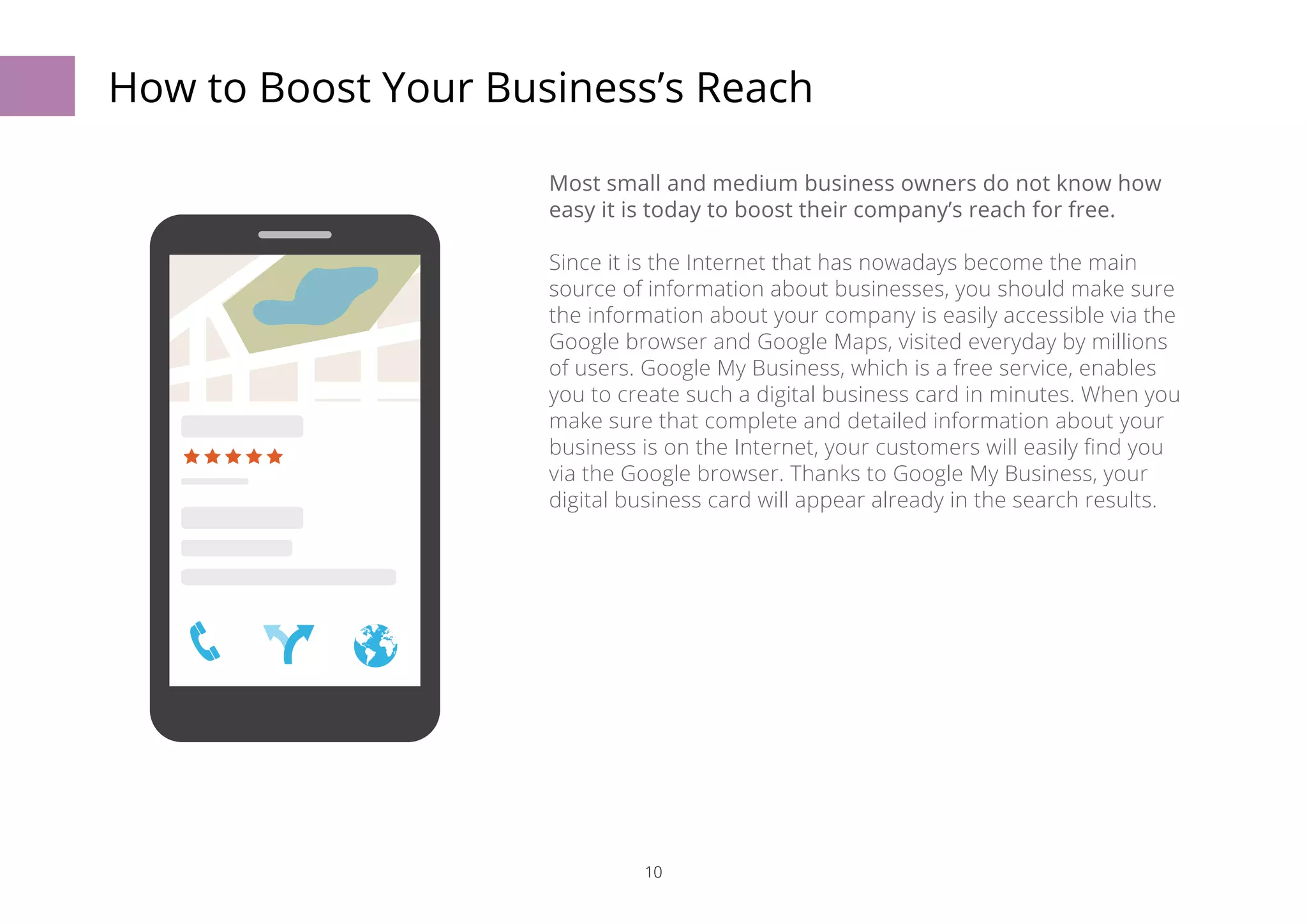
Most small and medium business owners do not know how 
easy it is today to boost their company’s reach for free. 
Since it is the Internet that has nowadays become the main 
source of information about businesses, you should make sure 
the information about your company is easily accessible via the 
Google browser and Google Maps, visited everyday by millions 
of users. Google My Business, which is a free service, enables 
you to create such a digital business card in minutes. When you 
make sure that complete and detailed information about your 
business is on the Internet, your customers will easily find you 
via the Google browser. Thanks to Google My Business, your 
digital business card will appear already in the search results. 
10
How to Boost Your Business’s Reach 
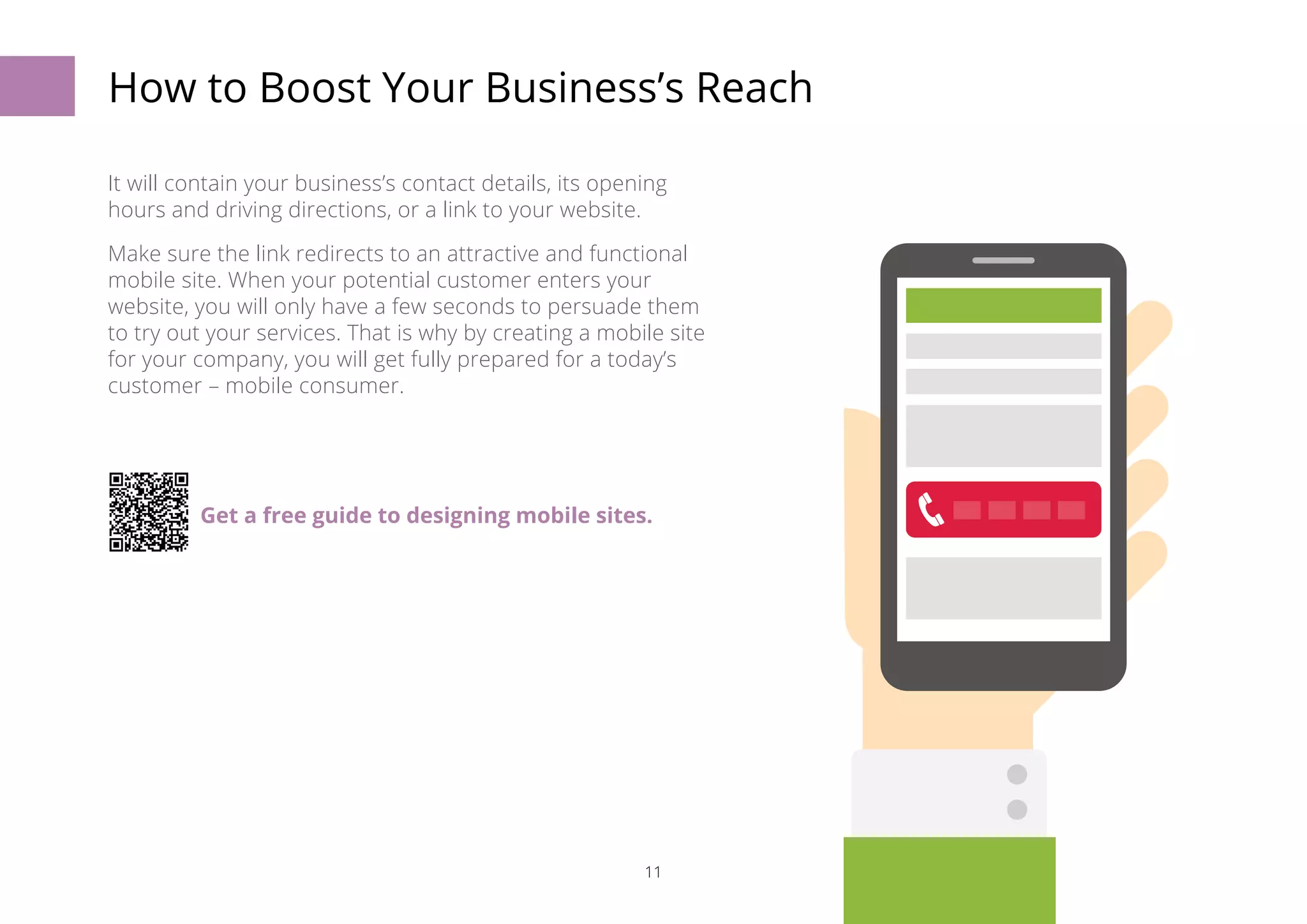
It will contain your business’s contact details, its opening 
hours and driving directions, or a link to your website. 
Make sure the link redirects to an attractive and functional 
mobile site. When your potential customer enters your 
website, you will only have a few seconds to persuade them 
to try out your services. That is why by creating a mobile site 
for your company, you will get fully prepared for a today’s 
customer – mobile consumer. 
Get a free guide to designing mobile sites. 
11
12 
Non-Mobile Friendly 
A research by Google shows what danger underestimating 
mobile users may bring. 
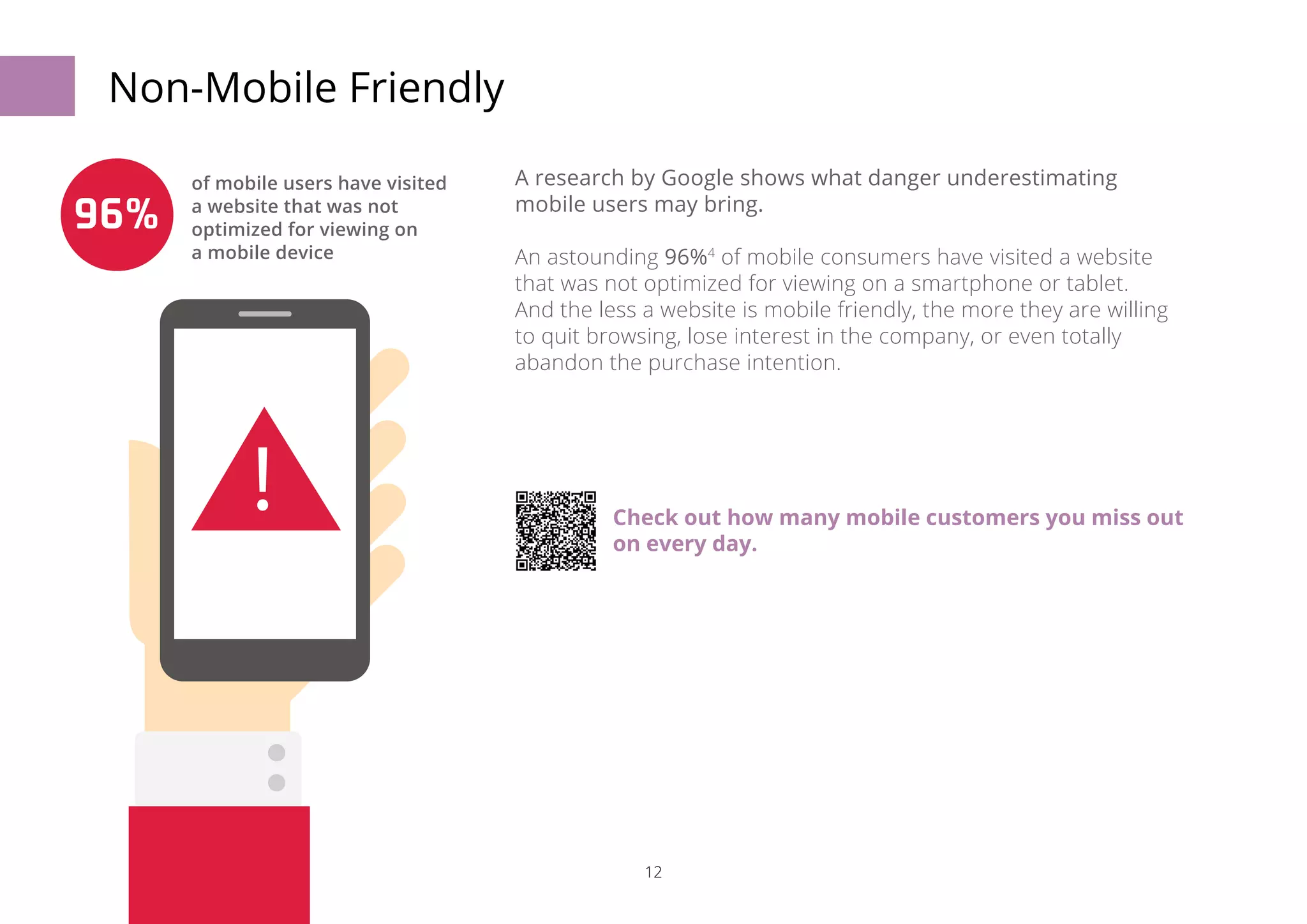
An astounding 96%4 of mobile consumers have visited a website 
that was not optimized for viewing on a smartphone or tablet. 
And the less a website is mobile friendly, the more they are willing 
to quit browsing, lose interest in the company, or even totally 
abandon the purchase intention. 
96% 
of mobile users have visited 
a website that was not 
optimized for viewing on 
a mobile device 
Check out how many mobile customers you miss out 
on every day.
13 
PART 2 
Mobile Website in a Nutshell
Responsive Website vs. Mobile Site 
Companies that are preparing for a mobile customer have a hard choice ahead: a responsive website (RWD), 
a separate mobile site, or a native application. Which way to go? It is not possible to give a one-for-all answer. 
The choice depends on the company’s strategy, complexity of the solution, available budget and programming 
resources or, finally, the time that they are ready to wait for a complete solution. Small and medium 
businesses that want to reduce costs and prepare for a mobile customer in a matter of days, may well create 
a professional mobile version of their website themselves, using ready builders available on the Internet. Using 
mobile website builders involves the cost of around €50 a year. Big companies will most probably decide on 
professional interactive agencies. The budgets for these solutions will approach several hundred Euros, on 
average. The price depends on various factors, such as the complexity of the solution, integration with external 
services, or the applied technique. 
Not sure which solution is the best for your company? Find out more about the dif-ferences 
between a responsive website, a mobile site and a native app. 
14
Mobile Site vs. Desktop Website 
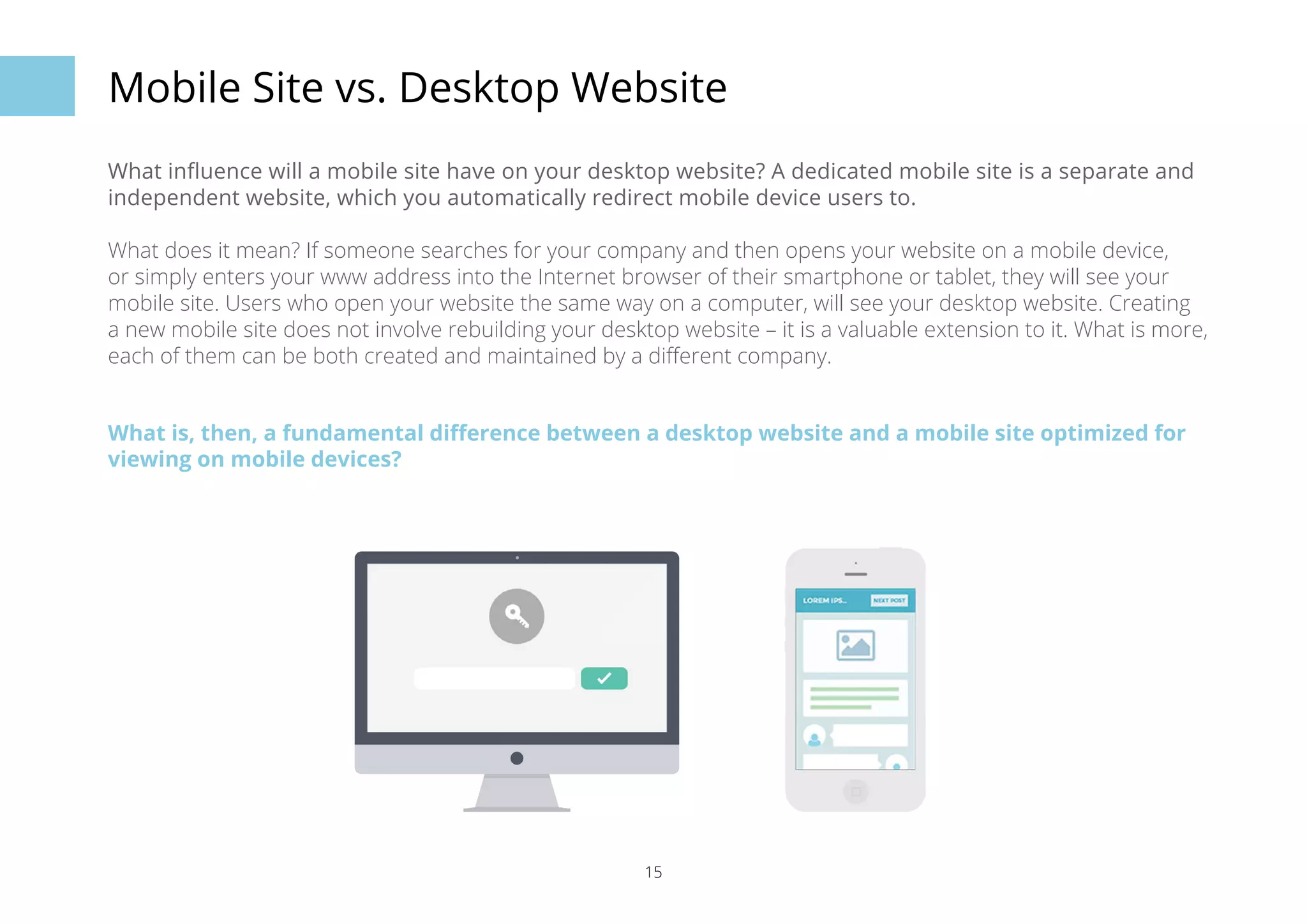
What influence will a mobile site have on your desktop website? A dedicated mobile site is a separate and 
independent website, which you automatically redirect mobile device users to. 
What does it mean? If someone searches for your company and then opens your website on a mobile device, 
or simply enters your www address into the Internet browser of their smartphone or tablet, they will see your 
mobile site. Users who open your website the same way on a computer, will see your desktop website. Creating 
a new mobile site does not involve rebuilding your desktop website – it is a valuable extension to it. What is more, 
each of them can be both created and maintained by a different company. 
What is, then, a fundamental difference between a desktop website and a mobile site optimized for 
viewing on mobile devices? 
15
16 
Desktop Website 
A desktop website is not suitable for viewing on a smartphone 
because: 
• it is “heavy” and loads too long on a smartphone 
• its navigation is intended for operating with a mouse 
• it is uncomfortable to view it on a small smartphone screen (you 
need to enlarge and swipe content) 
• it is overloaded with content, which makes it difficult to perform 
typical “mobile” actions, such as finding the company’s location or 
contacting its staff quickly
17 
Mobile Site 
A mobile site: 
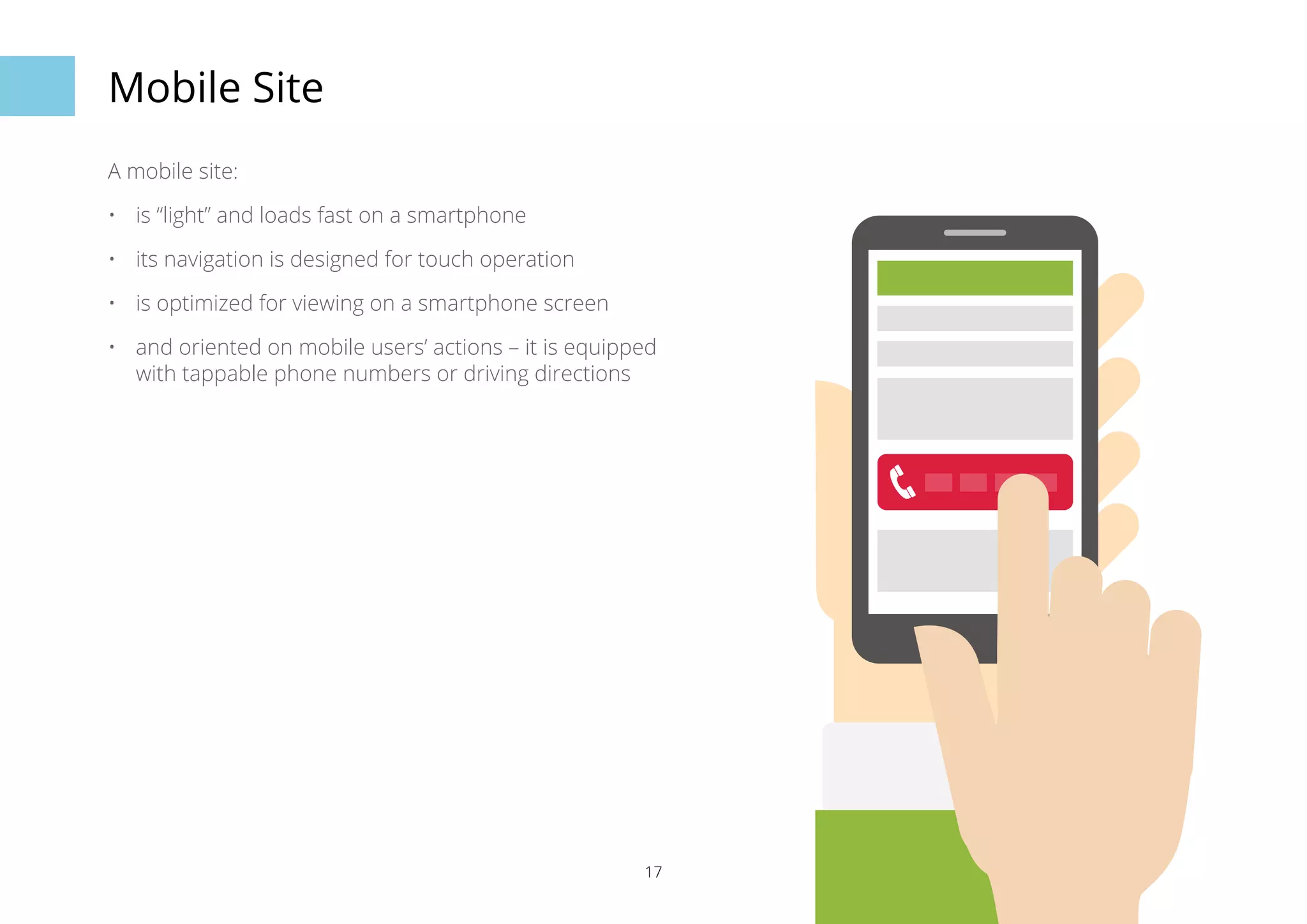
• is “light” and loads fast on a smartphone 
• its navigation is designed for touch operation 
• is optimized for viewing on a smartphone screen 
• and oriented on mobile users’ actions – it is equipped 
with tappable phone numbers or driving directions
Key Features of a Mobile Site 
The reasons for a shift from standard solutions to mobility are quite evident. Smartphones and tablets are irre-placeable 
when it comes to immediate access to information. Mobile users can connect to the Internet almost 
anywhere – in a traffic jam, on a bus, or in a queue. 
What are, then, the key features of a good mobile site from this perspective? 
• loading speed 
• friendly navigation 
• direct contact 
• direction & location maps 
• essential information 
Learn all features that consumers want on 
your mobile site. 
18
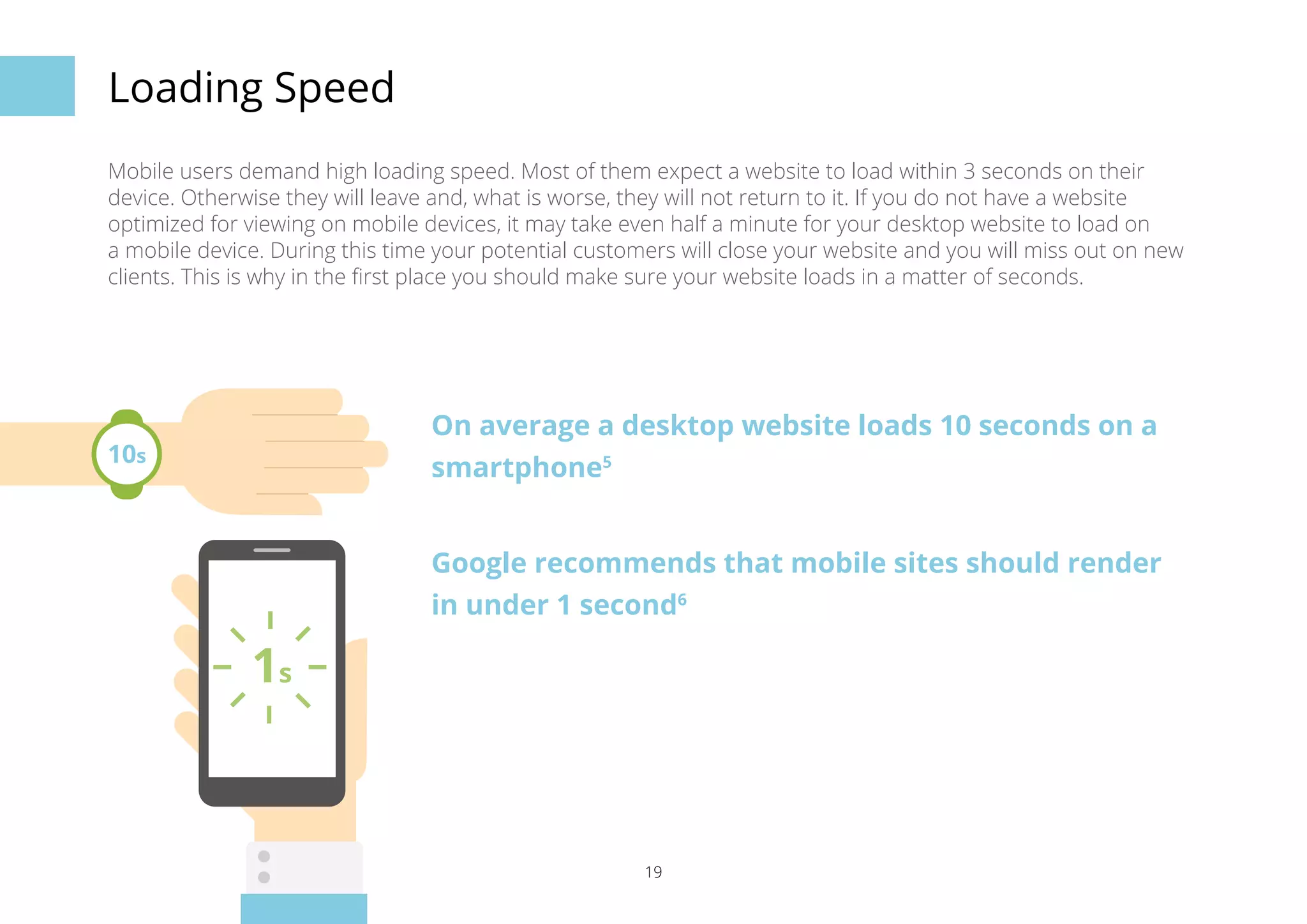
On average a desktop website loads 10 seconds on a 
19 
Loading Speed 
Mobile users demand high loading speed. Most of them expect a website to load within 3 seconds on their 
device. Otherwise they will leave and, what is worse, they will not return to it. If you do not have a website 
optimized for viewing on mobile devices, it may take even half a minute for your desktop website to load on 
a mobile device. During this time your potential customers will close your website and you will miss out on new 
clients. This is why in the first place you should make sure your website loads in a matter of seconds. 
10s smartphone5 
Google recommends that mobile sites should render 
in under 1 second6 
1s
20 
Friendly Navigation 
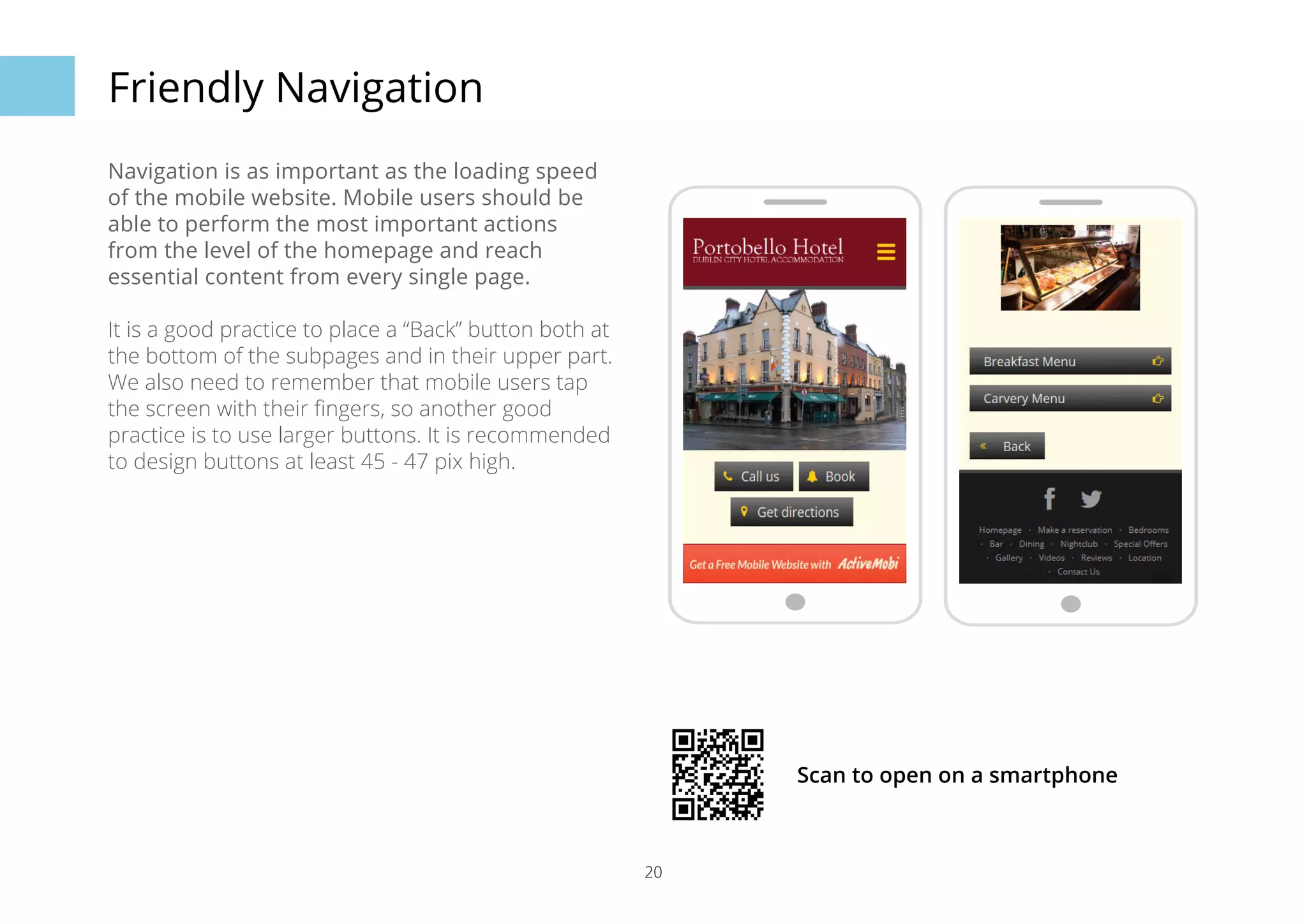
Navigation is as important as the loading speed 
of the mobile website. Mobile users should be 
able to perform the most important actions 
from the level of the homepage and reach 
essential content from every single page. 
It is a good practice to place a “Back” button both at 
the bottom of the subpages and in their upper part. 
We also need to remember that mobile users tap 
the screen with their fingers, so another good 
practice is to use larger buttons. It is recommended 
to design buttons at least 45 - 47 pix high. 
Scan to open on a smartphone
21 
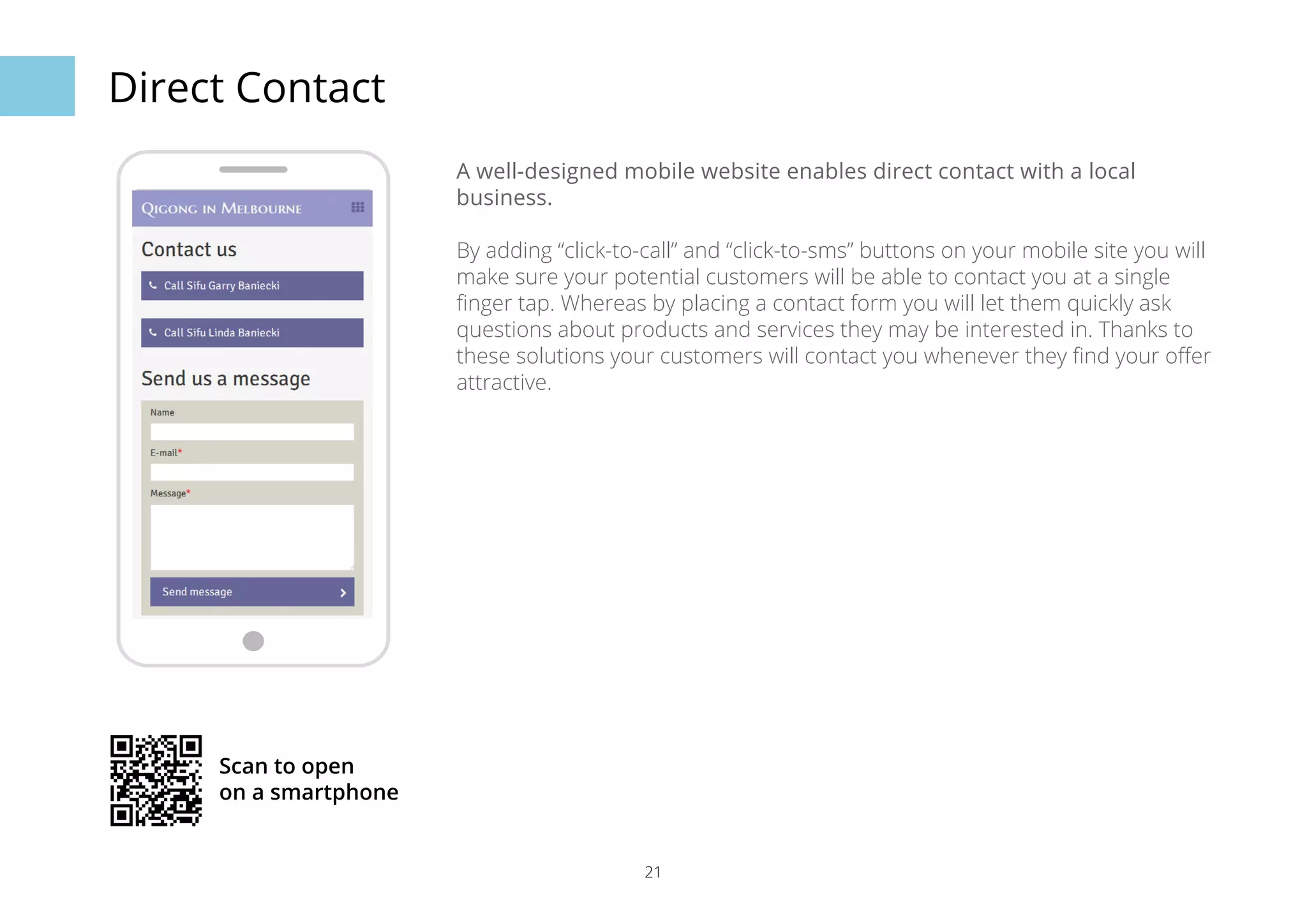
Direct Contact 
A well-designed mobile website enables direct contact with a local 
business. 
By adding “click-to-call” and “click-to-sms” buttons on your mobile site you will 
make sure your potential customers will be able to contact you at a single 
finger tap. Whereas by placing a contact form you will let them quickly ask 
questions about products and services they may be interested in. Thanks to 
these solutions your customers will contact you whenever they find your offer 
attractive. 
Scan to open 
on a smartphone
22 
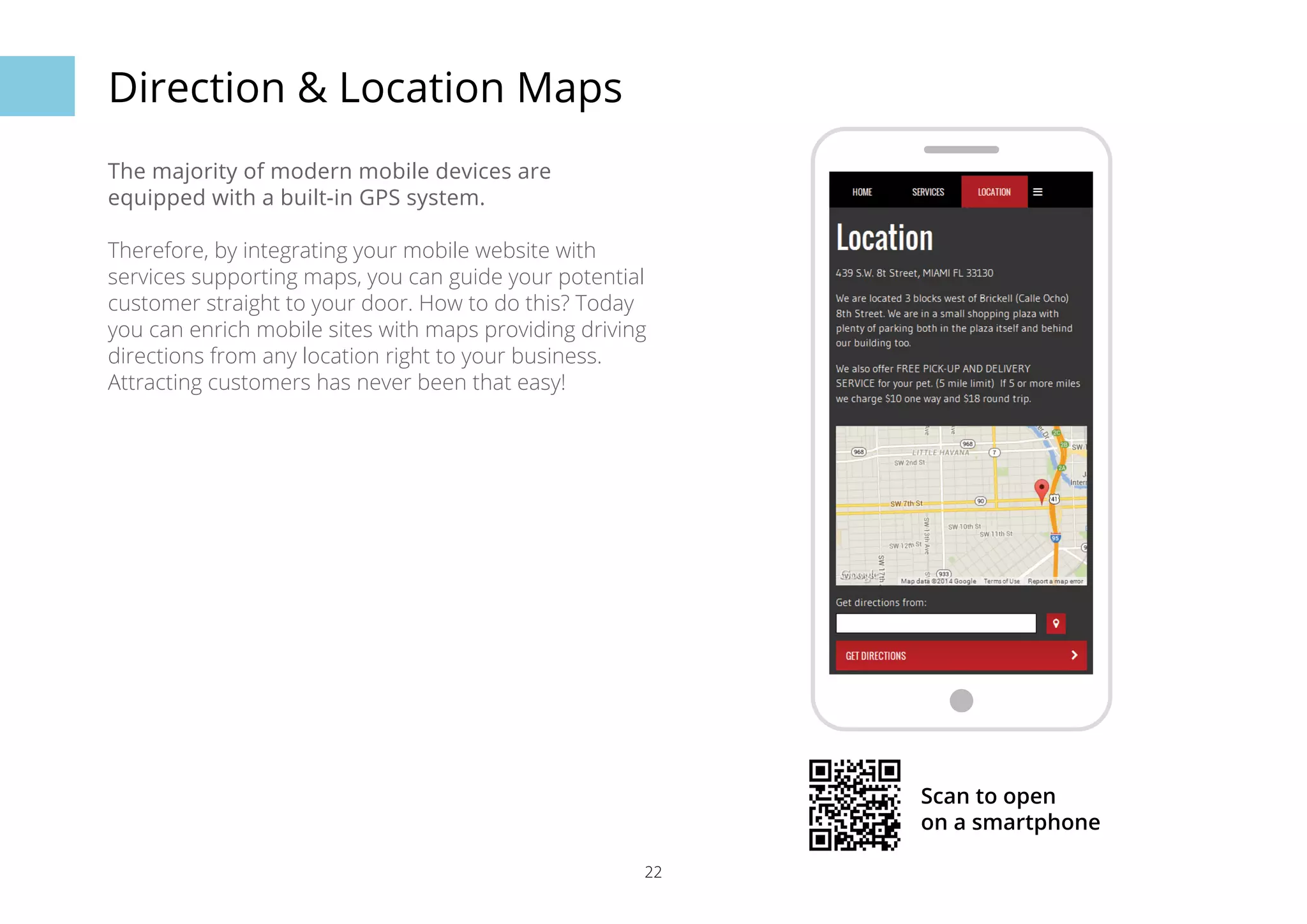
Direction & Location Maps 
The majority of modern mobile devices are 
equipped with a built-in GPS system. 
Therefore, by integrating your mobile website with 
services supporting maps, you can guide your potential 
customer straight to your door. How to do this? Today 
you can enrich mobile sites with maps providing driving 
directions from any location right to your business. 
Attracting customers has never been that easy! 
Scan to open 
on a smartphone
23 
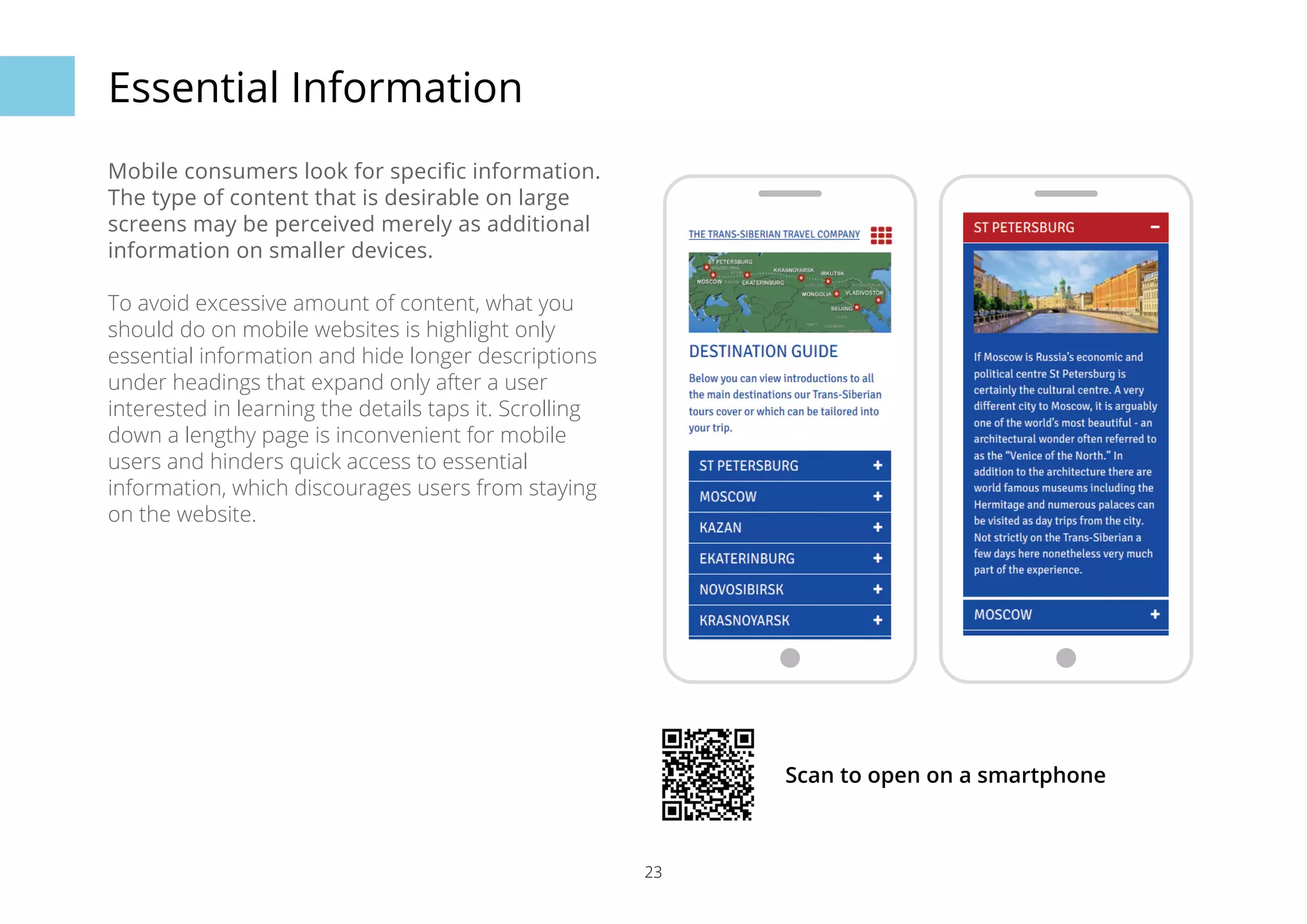
Essential Information 
Mobile consumers look for specific information. 
The type of content that is desirable on large 
screens may be perceived merely as additional 
information on smaller devices. 
To avoid excessive amount of content, what you 
should do on mobile websites is highlight only 
essential information and hide longer descriptions 
under headings that expand only after a user 
interested in learning the details taps it. Scrolling 
down a lengthy page is inconvenient for mobile 
users and hinders quick access to essential 
information, which discourages users from staying 
on the website. 
Scan to open on a smartphone
24 
Go Mobile 
We have presented sound reasons why you should adjust your business’s website to the needs of mobile 
device users. A desktop website is no longer enough. 
Today you can create a professional mobile website yourself, in a few minutes. Online builders available on the 
market allow anyone with an access to the Internet to quickly create a website on their own. Working with such 
builders involves actions that we are all familiar with from programs like Word and does not require advanced 
computer or programming skills. It turns out that modern technology does not necessarily involve technical 
knowledge and might be an inexpensive solution, affordable for any business owner. 
Do not wait until your competitors take away customers right from your doorstep – go mobile! Mobile sector is 
the future, therefore if your small or medium business is to survive, you need to adjust it to the new digital reality.
25 
Sources 
1. Cisco Visual Networking Index: Global Mobile Data Traffic Forecast Update, 2013-2018, February 2014, Cisco 
2. Mobile Search Moments Study, March 2013, Google 
3. Our Mobile Planet: United States of America – Understanding the Mobile Consumer, May 2013, Google 
4. What Users Want Most from Mobile Sites Today, September 2012, Google Think Insights 
5. Global Site Speed Overview: How Fast Are Websites Around The World?, April 2012, Google Analytics 
6. Common mistakes in smartphone sites, Google Developers
A quick and simple way to start selling mobile websites under your own brand or create a mobile website for 
your business. 
Web design agencies, developers, and marketing teams use ActiveMobi white label platform to create and 
sell mobile websites to small and medium businesses. 
Business owners may create a mobile website themselves using the DIY builder or have a professional site 
created by ActiveMobi’s team of designers in up to 5 days. 
www.activemobi.com 
26

Mobile Website - Your Secret Weapon in Gaining a Competitive Advantage

  • 1.
  • 2.
    Mobile Website YourSecret Weapon in Gaining a Competitive Advantage Preface 3 PART 1. Why Your Business Needs a Mobile Website 4 A Brand New Breed of Consumer 5 Mobile-Aided Shopping 7 Mobile Users Going Local 9 How to Boost Your Business’s Reach 10 Non-Mobile Friendly 12 PART 2. Mobile Website in a Nutshell 13 Responsive Website vs. Mobile Site 14 Mobile Site vs. Desktop Website 15 Desktop Website 16 Mobile Site 17 Key Features of a Mobile Site 18 Loading Speed 19 Friendly Navigation 20 Direct Contact 21 Direction & Location Maps 22 Essential Information 23 Go Mobile 24 Sources 25 2
  • 3.
    3 Preface Overthe recent years we have been witnessing a dynamic expansion of new technologies. Due to the convenience that mobile devices have ensured we began to adapt them to completing our daily routines. The model of a typical consumer has evolved, too. Consumers have changed their purchase behaviors and started to use smartphone as the primary medium in this process. In our e-book we aim to highlight and explain the need for small and medium businesses to get ready for a customer of a new type functioning in a different context than ever before – a mobile consumer. Business owners keep underestimating the potential of mobile devices and it seems that the lack of knowledge about their users might be the fundamental problem. We hope that our e-book will help better understand expectations of mobile consumers, which will let entrepreneurs achieve their business objectives within the most dynamically developing sales channel.
  • 4.
    4 PART 1 Why Your Business Needs a Mobile Website
  • 5.
    A Brand NewBreed of Consumer 5 Have you noticed how consumers and their purchase behaviors have changed over the last few years? Today consumers have an unlimited access to information on products and services. Using free tools available on the Internet they can compare prices and purchase conditions, verify suppliers, or even create summaries of similar products. All this to get better prepared for making a purchase decision. The idea dates back to 1980, when Alvin Toffler, a futurologist, coined the term prosumer, contracting two words – producer and consumer, to describe the emerging type of proactive consumers. Prosumer, or a typical today’s consumer, is an active customer comparable to a professional. The new consumer no longer relies solely on traditional advertising, but looks for information on their own initiative.
  • 6.
    A Brand NewBreed of Consumer When making a purchase decision, they have a broad knowledge of the product and its features, the competition, as well as other consumers’ opinions. According to 71% of the respondents who participated in a research carried out by B2B Marketing portal in 2012 – the main source of this information is the Internet. Is your business’s website ready for the latest revolution among prosumers – a shift towards mobile devices? More and more people are resorting to smartphones and tablets for their daily activities. It is predicted that by 2015 more users will be accessing the Internet on mobile devices than on desktop computers. If your strategy for gaining customers does not account for the behaviors of today’s consumers, you will be losing them month after month. 6
  • 7.
    7 Mobile-Aided Shopping Consumers increasingly use mobile devices to search for information on products and, as a result, to make online purchases. This trend has been supported by a number of studies carried out by Google, among others, which show the great potential of the technological revolution for small and medium businesses. We have been witnessing a vast expansion of the mobile network globally. Global mobile traffic increased by 81%1 over the previous year, exceeding 18 times1 the size of the entire global Internet in 2000! It is estimated that by 2015 more users will be accessing the Internet on mobile devices than on desktop computers. According to Cisco, by 2018 smartphones will have already accounted for 66%1 of global mobile traffic. As of now 77%2 of mobile searches take place with the desktop computer being available at hand. 66% of global mobile traffic will come from smartphones by 2018 77% of mobile searches take place near a computer 24% of consumers tell others about local businesses found via smartphone 81% increase in global mobile traffic in 2013
  • 8.
    8 Mobile-Aided Shopping Moreover, 77%3 of mobile users aid their shopping processes with mobile searches. Smartphone owners use their devices to look for information on businesses located in their neighborhood and then call them, check their location on the map, enter their website, or even visit the business. 24%3 of local information seekers recommend businesses and services they find this way to others, or leave their opinion on the Internet. Almost 40%3 of these users make a purchase – either online or in-store. These numbers show how important it is for SMBs to have an appropriate mobile website. 66% of global mobile traffic will come from smartphones by 2018 77% of mobile searches take place near a computer 24% of consumers tell others about local businesses found via smartphone 38% of mobile consumers make a purchase from these businesses
  • 9.
    9 Mobile UsersGoing Local Smartphones provide us with an easy access to information on what we can find in the neighborhood. This is why optimizing businesses’ websites for viewing on mobile devices is crucial for their potential customers. An astounding 94%3 of all smartphone users look for businesses in the vicinity. 84%3 of them take consumer action as a result – contact the business, visit its office, make a purchase from the business, or recommend it to others. That is why it is so important for your website to be mobile friendly and display well on mobile, as well as enable potential customers to contact your business directly. As many as 64%3 of people choose this way of reaching companies after finding local information. When you further promote your mobile site with location based advertising, you will take full advantage of the potential that the smartphone gives to local businesses. of smartphone users search for local businesses 94%
  • 10.
    How to BoostYour Business’s Reach Most small and medium business owners do not know how easy it is today to boost their company’s reach for free. Since it is the Internet that has nowadays become the main source of information about businesses, you should make sure the information about your company is easily accessible via the Google browser and Google Maps, visited everyday by millions of users. Google My Business, which is a free service, enables you to create such a digital business card in minutes. When you make sure that complete and detailed information about your business is on the Internet, your customers will easily find you via the Google browser. Thanks to Google My Business, your digital business card will appear already in the search results. 10
  • 11.
    How to BoostYour Business’s Reach It will contain your business’s contact details, its opening hours and driving directions, or a link to your website. Make sure the link redirects to an attractive and functional mobile site. When your potential customer enters your website, you will only have a few seconds to persuade them to try out your services. That is why by creating a mobile site for your company, you will get fully prepared for a today’s customer – mobile consumer. Get a free guide to designing mobile sites. 11
  • 12.
    12 Non-Mobile Friendly A research by Google shows what danger underestimating mobile users may bring. An astounding 96%4 of mobile consumers have visited a website that was not optimized for viewing on a smartphone or tablet. And the less a website is mobile friendly, the more they are willing to quit browsing, lose interest in the company, or even totally abandon the purchase intention. 96% of mobile users have visited a website that was not optimized for viewing on a mobile device Check out how many mobile customers you miss out on every day.
  • 13.
    13 PART 2 Mobile Website in a Nutshell
  • 14.
    Responsive Website vs.Mobile Site Companies that are preparing for a mobile customer have a hard choice ahead: a responsive website (RWD), a separate mobile site, or a native application. Which way to go? It is not possible to give a one-for-all answer. The choice depends on the company’s strategy, complexity of the solution, available budget and programming resources or, finally, the time that they are ready to wait for a complete solution. Small and medium businesses that want to reduce costs and prepare for a mobile customer in a matter of days, may well create a professional mobile version of their website themselves, using ready builders available on the Internet. Using mobile website builders involves the cost of around €50 a year. Big companies will most probably decide on professional interactive agencies. The budgets for these solutions will approach several hundred Euros, on average. The price depends on various factors, such as the complexity of the solution, integration with external services, or the applied technique. Not sure which solution is the best for your company? Find out more about the dif-ferences between a responsive website, a mobile site and a native app. 14
  • 15.
    Mobile Site vs.Desktop Website What influence will a mobile site have on your desktop website? A dedicated mobile site is a separate and independent website, which you automatically redirect mobile device users to. What does it mean? If someone searches for your company and then opens your website on a mobile device, or simply enters your www address into the Internet browser of their smartphone or tablet, they will see your mobile site. Users who open your website the same way on a computer, will see your desktop website. Creating a new mobile site does not involve rebuilding your desktop website – it is a valuable extension to it. What is more, each of them can be both created and maintained by a different company. What is, then, a fundamental difference between a desktop website and a mobile site optimized for viewing on mobile devices? 15
  • 16.
    16 Desktop Website A desktop website is not suitable for viewing on a smartphone because: • it is “heavy” and loads too long on a smartphone • its navigation is intended for operating with a mouse • it is uncomfortable to view it on a small smartphone screen (you need to enlarge and swipe content) • it is overloaded with content, which makes it difficult to perform typical “mobile” actions, such as finding the company’s location or contacting its staff quickly
  • 17.
    17 Mobile Site A mobile site: • is “light” and loads fast on a smartphone • its navigation is designed for touch operation • is optimized for viewing on a smartphone screen • and oriented on mobile users’ actions – it is equipped with tappable phone numbers or driving directions
  • 18.
    Key Features ofa Mobile Site The reasons for a shift from standard solutions to mobility are quite evident. Smartphones and tablets are irre-placeable when it comes to immediate access to information. Mobile users can connect to the Internet almost anywhere – in a traffic jam, on a bus, or in a queue. What are, then, the key features of a good mobile site from this perspective? • loading speed • friendly navigation • direct contact • direction & location maps • essential information Learn all features that consumers want on your mobile site. 18
  • 19.
    On average adesktop website loads 10 seconds on a 19 Loading Speed Mobile users demand high loading speed. Most of them expect a website to load within 3 seconds on their device. Otherwise they will leave and, what is worse, they will not return to it. If you do not have a website optimized for viewing on mobile devices, it may take even half a minute for your desktop website to load on a mobile device. During this time your potential customers will close your website and you will miss out on new clients. This is why in the first place you should make sure your website loads in a matter of seconds. 10s smartphone5 Google recommends that mobile sites should render in under 1 second6 1s
  • 20.
    20 Friendly Navigation Navigation is as important as the loading speed of the mobile website. Mobile users should be able to perform the most important actions from the level of the homepage and reach essential content from every single page. It is a good practice to place a “Back” button both at the bottom of the subpages and in their upper part. We also need to remember that mobile users tap the screen with their fingers, so another good practice is to use larger buttons. It is recommended to design buttons at least 45 - 47 pix high. Scan to open on a smartphone
  • 21.
    21 Direct Contact A well-designed mobile website enables direct contact with a local business. By adding “click-to-call” and “click-to-sms” buttons on your mobile site you will make sure your potential customers will be able to contact you at a single finger tap. Whereas by placing a contact form you will let them quickly ask questions about products and services they may be interested in. Thanks to these solutions your customers will contact you whenever they find your offer attractive. Scan to open on a smartphone
  • 22.
    22 Direction &Location Maps The majority of modern mobile devices are equipped with a built-in GPS system. Therefore, by integrating your mobile website with services supporting maps, you can guide your potential customer straight to your door. How to do this? Today you can enrich mobile sites with maps providing driving directions from any location right to your business. Attracting customers has never been that easy! Scan to open on a smartphone
  • 23.
    23 Essential Information Mobile consumers look for specific information. The type of content that is desirable on large screens may be perceived merely as additional information on smaller devices. To avoid excessive amount of content, what you should do on mobile websites is highlight only essential information and hide longer descriptions under headings that expand only after a user interested in learning the details taps it. Scrolling down a lengthy page is inconvenient for mobile users and hinders quick access to essential information, which discourages users from staying on the website. Scan to open on a smartphone
  • 24.
    24 Go Mobile We have presented sound reasons why you should adjust your business’s website to the needs of mobile device users. A desktop website is no longer enough. Today you can create a professional mobile website yourself, in a few minutes. Online builders available on the market allow anyone with an access to the Internet to quickly create a website on their own. Working with such builders involves actions that we are all familiar with from programs like Word and does not require advanced computer or programming skills. It turns out that modern technology does not necessarily involve technical knowledge and might be an inexpensive solution, affordable for any business owner. Do not wait until your competitors take away customers right from your doorstep – go mobile! Mobile sector is the future, therefore if your small or medium business is to survive, you need to adjust it to the new digital reality.
  • 25.
    25 Sources 1.Cisco Visual Networking Index: Global Mobile Data Traffic Forecast Update, 2013-2018, February 2014, Cisco 2. Mobile Search Moments Study, March 2013, Google 3. Our Mobile Planet: United States of America – Understanding the Mobile Consumer, May 2013, Google 4. What Users Want Most from Mobile Sites Today, September 2012, Google Think Insights 5. Global Site Speed Overview: How Fast Are Websites Around The World?, April 2012, Google Analytics 6. Common mistakes in smartphone sites, Google Developers
  • 26.
    A quick andsimple way to start selling mobile websites under your own brand or create a mobile website for your business. Web design agencies, developers, and marketing teams use ActiveMobi white label platform to create and sell mobile websites to small and medium businesses. Business owners may create a mobile website themselves using the DIY builder or have a professional site created by ActiveMobi’s team of designers in up to 5 days. www.activemobi.com 26