MOBILE SERVICE
INDUSTRY
Presented by:
B.Alekya (21564C1044)
N.Tarun (21564C1104)
B.Varun Raj (21564C1144)
Sana Asfia (21564C1160)
P.Aravind (21564C1039)
K.Akash (21564C1036)
C.Manasa (21564C1140)
P.Meghana (21564C1042)
Prashanth (21564C1113)
P.Navaneetha (21564C1159)
P.Nikhil Sai (21564c1139)
E.Ranjith (21564c1005)
CONTENTS
• INTRODUCTION
• MEANING AND DEFINITION
• ORIGIN AND GROWTH
• TOP ORGANISATIONS
• WORLD AND NATIONAL PICTURE
• GOVT POLICIES FOR REGULATING & CONTROLLING
• SWOT ANALYSIS
• CHALLENGES , TURNOVER , SPECIFICATIONS
• STRATEGIES
• EFFECTS & PROBLEMS
• IMPACT OF MOBILE SERVICE INDUSTRY
• ADVANTAGES
• KEY SUCCESS FACTORS
• REASONS FOR CHOOSING MOBILE SERVICE INDUSTRY
• CONCLUSION
INTRODUCTION
 Communication is the fastest growing sector within
the world .
 The Global Compound Annual Growth Rate (GCAGR)
is 7.05% .
 The history of mobile industry started in 1940s after
world war II .
 India is the world’s fastest growing mobile industry
and there are a large number of mobile industry such
as Airtel ,Reliance ,Vodafone etc .
MEANING
• The mobile industry is the fastest growing sector on
larger scale .
• In today’s world , the internet has largest number of
users around the globe.
• The mobile industry is primarily engaged in the
manufacturing of mobile phones, which includes
mobile phone hand-sets.
• The mobile industry is mainly concentrating on
adapting new technologies.
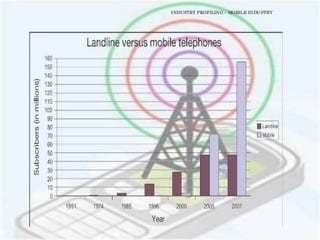
• Since 1994, the usage of mobile phones has been
increased from 24 million users to 800 million user .
DEFINITION
• The mobile industry is a subset of the
telecommunications industry which focuses
on mobile phones, phone service, and
peripheral devices.
• Manufacturers of smart phones, modern
computers, tablet computers with mobile
functionality , and similar devices are also part
of the mobile industry.
ORIGIN
• Till 1984, telecom services were under state
government control with the department of post
and telegraph which was later crafted out as
DEPARTMENT OF TELECOMMUNICATION (DOT)
• After government of india announced NATIONAL
TELECOM POLICY in 1994 to allow private players.
• In 1995 , mobile industry held ground way back
with few subscribers.
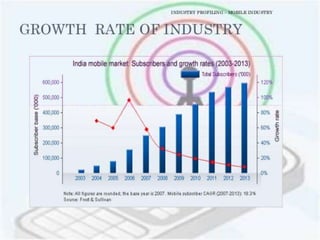
• The number of mobile phones crossed by 5
million in 2001 and doubled to 10 million by 2002
GROWTH
• Mobile phones have been a part of our daily lives
over a decade.
• The growing advent of mobile devices, along with
apps is perhaps the biggest technical phenomena
in the recent times. Smartphone with featured
apps has now become the remote control for our
lives and can easily boost our small business.
• Evolution of smart phones is also a giant growth
of mobile industry.
TOP ORGANISATIONS
• Basically, mobile industries are categorised
into 3 types : chinese , non-chinese , indian .
• Chinese companies: xiaomi , oppo , one plus,
vivo , huawei .
• Non-chinese : samsung , apple, google , sony,
htc & asus , nokia .
• Indian: micromax ,karbon , reliance jio lyf ,
celkon .
WORLD PICTURE
• The mobile phone manufacturing market is a big
industry, it has the potential to continue growing
and create more markets.
• The mobile manufacturing market is completely
different today when comparing to any stage in
the past.
• According to data from the International Data
Corporation (IDC), global smart phone exports
fell 11.7% in the first quarter of 2020.
•
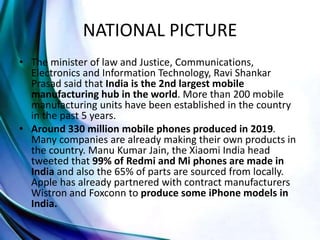
NATIONAL PICTURE
• The minister of law and Justice, Communications,
Electronics and Information Technology, Ravi Shankar
Prasad said that India is the 2nd largest mobile
manufacturing hub in the world. More than 200 mobile
manufacturing units have been established in the country
in the past 5 years.
• Around 330 million mobile phones produced in 2019.
Many companies are already making their own products in
the country. Manu Kumar Jain, the Xiaomi India head
tweeted that 99% of Redmi and Mi phones are made in
India and also the 65% of parts are sourced from locally.
Apple has already partnered with contract manufacturers
Wistron and Foxconn to produce some iPhone models in
India.
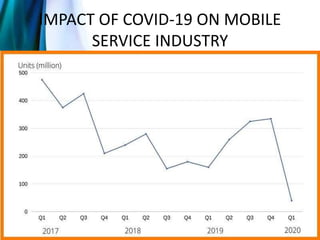
IMPACT OF COVID-19 ON MOBILE
SERVICE INDUSTRY
GOVERNMENT POLICIES FOR
REGULATING & CONTROLLING
• In 1994, the govt of india announced national
telecom policy.
• Anti dumping duty of up to 266% was
imposed on imports of IT equipments .
• The chinese mobile industry has disturbed the
whole indian market with it’s cheap mobiles .
• This regulation on chinese market made the
prices of mobiles comparable with the
domestic players.
SWOT ANALYSIS
1. STRENGTH:
• India is the 2nd largest mobile market after china .
• The revenue of indian mobile industry is rising at booming speed .
• It has a large customer base due to it’s huge population .
• Easier to create economics of scale .
• Increases returns on investment .
• Supported by government with many schemes .
2. Weakness:
• The company has poor telecommunication infrastructure resulting in large call
drops .
• It is difficult to enter because of the requirement of high financial resources .
• The country has a low manufacturing base .
• High resolution levels that affects the health .
SWOT ANALYSIS
3. Opportunities:
• Upcoming 5G technology.
• Rising data consumption.
• Customers interest towards new technologies.
• Growing rural numbers.
• Rising disposable income.
4. Threats:
• Heavy competition between the top players .
• Virus and malware attacks.
• Partiality of the government .
ex: allowing 3G services in a PSU (MTNL , BSNL) before auctioning to the
private players .
• Declining ARPU ( Average Revenue Per User) .
CHALLENGES, TURNOVER &
SPECIFICATIONS
1. Challenges: •Operators has to increase the spectral efficiency of
their networks.
•Finding the most flexible and cost-effective infrastructure for next
Generations.
•Increasing demand fore capacity.
• Advanced mobile services putting pressure on Mobile operaters.
2. Turnover: Projected amount of 1.14 trillion US Dollars by2020 .
 Android operating system market share worldwide 85.94%
 Market share expected to grow anually by 4.14%.
3. Specifications: ➢Fastest growing company.
➢Popularity to Mobile based services.
Eg: ONLINE TCKT BOOKING
➢Technological Achivement
Strategies of Mobile industries
Create mobile buyer Personals.
Set Goals.
Establish KPIs
1.Engagement
2.Acquisation
3.Customer service
Moniter mobile metrics.
EFFECTS & PROBLEMS
• Adjusting the Pace of Innovation
• Lack of Universal Standards
• Security and Privacy concerns
• Battery Mortality Issues
• Manufacturer Defects and No fault found
IMPACT OF MOBILE INDUSTRY
• Economic Impact:
Mobile markets plays an vital role in socioeconomic development.
• Provide access to new financial services such as mobile transfer as well
as other forms of business services. Thomas fried mann calls “Mobile tech
as one of the Top flatterners of our world, helping to bring more Equality
and opportunity to less fortunate people around the World.
• Willing to buy:
✓Creates Jobs in India and all around the world.
✓Contribute as much as 5.1% to Global GDP by 2020.
• Environment Impact:
The carbon footprint of Mobile phone
Urban Mining
Estimated about 4000tones of Silver Nearly 380 tones of Gold 200000
tones of Copper imprisoned
• Social Impacts:
Positive Impacts
Negative Impacts
Advantages Of Mobile Industry
ADVANTAGES
• Rich and Poor Platforms
• The Mobile app Spectrum
• Monetizing through Advertising
• Monetization Models
1. Direct Sales
2. Freemium
3.Subscriptions
4. In-app purchases
5. Crowd funding
6.Sponsorship
• Capitalize on Local Opportunities
• The Bottom line
Key Success Factors :
1.Technology
2.Marketing
3.Next genertion experience
4.Pricing
5.Skill & Capability
6.Design & Innovation Expertise
Reasons for Choosing Mobile Industry
in india :
1.Second largest Smart phone Market in the World
2.Home to one-fifth of the world’s mobile Subscribers
3.Down of the Digital Payment era
4.Expantion of 4G and High-speed broadband
5.Purchasing power of middle class INDIA
6.Mobile Solutions for India’s Hinterland
7.Expanding the Market for Mobile Commerce
8.Government Scheme and Policies
9.Indians Love their Apps
CONCLUSION
• The Mobile Service Industry has deep Impacts on the Environment .
This paper offered us a vision for a better future in these areas.
• In Order to Manage Growth wisely,
The Industry should embrace the Opportunities for positive impact
through the delivery of services.
while taking care of minimizing the Impacts through it’s supply chain
and Handsets.
• All Companies in the Mobile Services Industry should recognize that
Sustainability is a key component of Business Innovation.
• Based on the Industry players explored, the Industry is well positioned to
Capitalize on the potential for positive impacts in connectivity, Society and
Economy.
• However, In order to achieve maximum performance in the Areas of Metrics
identified Companies need to commit to a stronger Portfolio of Sustainability
measures.
References:
• Wireless Telecommunication services BRIC (Brazil,
Russia, India,China) Industry Guide 2014-2023.
• Worldwide Smart phone Market Forecast, 2018 - 2022.
• Global Smart phone Market size and Forecast to 2021
THANK YOU
STAY SAFE

Mobile industry ppt in India

  • 1.
  • 2.
    Presented by: B.Alekya (21564C1044) N.Tarun(21564C1104) B.Varun Raj (21564C1144) Sana Asfia (21564C1160) P.Aravind (21564C1039) K.Akash (21564C1036) C.Manasa (21564C1140) P.Meghana (21564C1042) Prashanth (21564C1113) P.Navaneetha (21564C1159) P.Nikhil Sai (21564c1139) E.Ranjith (21564c1005)
  • 3.
    CONTENTS • INTRODUCTION • MEANINGAND DEFINITION • ORIGIN AND GROWTH • TOP ORGANISATIONS • WORLD AND NATIONAL PICTURE • GOVT POLICIES FOR REGULATING & CONTROLLING • SWOT ANALYSIS • CHALLENGES , TURNOVER , SPECIFICATIONS • STRATEGIES • EFFECTS & PROBLEMS • IMPACT OF MOBILE SERVICE INDUSTRY • ADVANTAGES • KEY SUCCESS FACTORS • REASONS FOR CHOOSING MOBILE SERVICE INDUSTRY • CONCLUSION
  • 4.
    INTRODUCTION  Communication isthe fastest growing sector within the world .  The Global Compound Annual Growth Rate (GCAGR) is 7.05% .  The history of mobile industry started in 1940s after world war II .  India is the world’s fastest growing mobile industry and there are a large number of mobile industry such as Airtel ,Reliance ,Vodafone etc .
  • 5.
    MEANING • The mobileindustry is the fastest growing sector on larger scale . • In today’s world , the internet has largest number of users around the globe. • The mobile industry is primarily engaged in the manufacturing of mobile phones, which includes mobile phone hand-sets. • The mobile industry is mainly concentrating on adapting new technologies. • Since 1994, the usage of mobile phones has been increased from 24 million users to 800 million user .
  • 6.
    DEFINITION • The mobileindustry is a subset of the telecommunications industry which focuses on mobile phones, phone service, and peripheral devices. • Manufacturers of smart phones, modern computers, tablet computers with mobile functionality , and similar devices are also part of the mobile industry.
  • 7.
    ORIGIN • Till 1984,telecom services were under state government control with the department of post and telegraph which was later crafted out as DEPARTMENT OF TELECOMMUNICATION (DOT) • After government of india announced NATIONAL TELECOM POLICY in 1994 to allow private players. • In 1995 , mobile industry held ground way back with few subscribers. • The number of mobile phones crossed by 5 million in 2001 and doubled to 10 million by 2002
  • 9.
    GROWTH • Mobile phoneshave been a part of our daily lives over a decade. • The growing advent of mobile devices, along with apps is perhaps the biggest technical phenomena in the recent times. Smartphone with featured apps has now become the remote control for our lives and can easily boost our small business. • Evolution of smart phones is also a giant growth of mobile industry.
  • 11.
    TOP ORGANISATIONS • Basically,mobile industries are categorised into 3 types : chinese , non-chinese , indian . • Chinese companies: xiaomi , oppo , one plus, vivo , huawei . • Non-chinese : samsung , apple, google , sony, htc & asus , nokia . • Indian: micromax ,karbon , reliance jio lyf , celkon .
  • 12.
    WORLD PICTURE • Themobile phone manufacturing market is a big industry, it has the potential to continue growing and create more markets. • The mobile manufacturing market is completely different today when comparing to any stage in the past. • According to data from the International Data Corporation (IDC), global smart phone exports fell 11.7% in the first quarter of 2020. •
  • 13.
    NATIONAL PICTURE • Theminister of law and Justice, Communications, Electronics and Information Technology, Ravi Shankar Prasad said that India is the 2nd largest mobile manufacturing hub in the world. More than 200 mobile manufacturing units have been established in the country in the past 5 years. • Around 330 million mobile phones produced in 2019. Many companies are already making their own products in the country. Manu Kumar Jain, the Xiaomi India head tweeted that 99% of Redmi and Mi phones are made in India and also the 65% of parts are sourced from locally. Apple has already partnered with contract manufacturers Wistron and Foxconn to produce some iPhone models in India.
  • 14.
    IMPACT OF COVID-19ON MOBILE SERVICE INDUSTRY
  • 15.
    GOVERNMENT POLICIES FOR REGULATING& CONTROLLING • In 1994, the govt of india announced national telecom policy. • Anti dumping duty of up to 266% was imposed on imports of IT equipments . • The chinese mobile industry has disturbed the whole indian market with it’s cheap mobiles . • This regulation on chinese market made the prices of mobiles comparable with the domestic players.
  • 16.
    SWOT ANALYSIS 1. STRENGTH: •India is the 2nd largest mobile market after china . • The revenue of indian mobile industry is rising at booming speed . • It has a large customer base due to it’s huge population . • Easier to create economics of scale . • Increases returns on investment . • Supported by government with many schemes . 2. Weakness: • The company has poor telecommunication infrastructure resulting in large call drops . • It is difficult to enter because of the requirement of high financial resources . • The country has a low manufacturing base . • High resolution levels that affects the health .
  • 17.
    SWOT ANALYSIS 3. Opportunities: •Upcoming 5G technology. • Rising data consumption. • Customers interest towards new technologies. • Growing rural numbers. • Rising disposable income. 4. Threats: • Heavy competition between the top players . • Virus and malware attacks. • Partiality of the government . ex: allowing 3G services in a PSU (MTNL , BSNL) before auctioning to the private players . • Declining ARPU ( Average Revenue Per User) .
  • 18.
    CHALLENGES, TURNOVER & SPECIFICATIONS 1.Challenges: •Operators has to increase the spectral efficiency of their networks. •Finding the most flexible and cost-effective infrastructure for next Generations. •Increasing demand fore capacity. • Advanced mobile services putting pressure on Mobile operaters. 2. Turnover: Projected amount of 1.14 trillion US Dollars by2020 .  Android operating system market share worldwide 85.94%  Market share expected to grow anually by 4.14%. 3. Specifications: ➢Fastest growing company. ➢Popularity to Mobile based services. Eg: ONLINE TCKT BOOKING ➢Technological Achivement
  • 19.
    Strategies of Mobileindustries Create mobile buyer Personals. Set Goals. Establish KPIs 1.Engagement 2.Acquisation 3.Customer service Moniter mobile metrics.
  • 20.
    EFFECTS & PROBLEMS •Adjusting the Pace of Innovation • Lack of Universal Standards • Security and Privacy concerns • Battery Mortality Issues • Manufacturer Defects and No fault found
  • 21.
    IMPACT OF MOBILEINDUSTRY • Economic Impact: Mobile markets plays an vital role in socioeconomic development. • Provide access to new financial services such as mobile transfer as well as other forms of business services. Thomas fried mann calls “Mobile tech as one of the Top flatterners of our world, helping to bring more Equality and opportunity to less fortunate people around the World. • Willing to buy: ✓Creates Jobs in India and all around the world. ✓Contribute as much as 5.1% to Global GDP by 2020. • Environment Impact: The carbon footprint of Mobile phone Urban Mining Estimated about 4000tones of Silver Nearly 380 tones of Gold 200000 tones of Copper imprisoned • Social Impacts: Positive Impacts Negative Impacts
  • 22.
    Advantages Of MobileIndustry ADVANTAGES • Rich and Poor Platforms • The Mobile app Spectrum • Monetizing through Advertising • Monetization Models 1. Direct Sales 2. Freemium 3.Subscriptions 4. In-app purchases 5. Crowd funding 6.Sponsorship • Capitalize on Local Opportunities • The Bottom line
  • 23.
    Key Success Factors: 1.Technology 2.Marketing 3.Next genertion experience 4.Pricing 5.Skill & Capability 6.Design & Innovation Expertise
  • 24.
    Reasons for ChoosingMobile Industry in india : 1.Second largest Smart phone Market in the World 2.Home to one-fifth of the world’s mobile Subscribers 3.Down of the Digital Payment era 4.Expantion of 4G and High-speed broadband 5.Purchasing power of middle class INDIA 6.Mobile Solutions for India’s Hinterland 7.Expanding the Market for Mobile Commerce 8.Government Scheme and Policies 9.Indians Love their Apps
  • 25.
    CONCLUSION • The MobileService Industry has deep Impacts on the Environment . This paper offered us a vision for a better future in these areas. • In Order to Manage Growth wisely, The Industry should embrace the Opportunities for positive impact through the delivery of services. while taking care of minimizing the Impacts through it’s supply chain and Handsets. • All Companies in the Mobile Services Industry should recognize that Sustainability is a key component of Business Innovation. • Based on the Industry players explored, the Industry is well positioned to Capitalize on the potential for positive impacts in connectivity, Society and Economy. • However, In order to achieve maximum performance in the Areas of Metrics identified Companies need to commit to a stronger Portfolio of Sustainability measures.
  • 26.
    References: • Wireless Telecommunicationservices BRIC (Brazil, Russia, India,China) Industry Guide 2014-2023. • Worldwide Smart phone Market Forecast, 2018 - 2022. • Global Smart phone Market size and Forecast to 2021
  • 27.