7 ways the mobile 
consumer changes 
everything 
How always-on mobile and 
consumer feedback combine 
to create huge opportunities 
for brands
Shopper’s mobile use in research and buying is 
exploding. Currently, eight in ten1 smartphone owners 
are smartphone shoppers. And by 2016, 85% of all 
digital shoppers will be mobile shoppers as well.2 
It’s no longer enough to think of consumers as online vs. in-store. The 
mobile shopper is neither and both of these, fast becoming the norm 
rather than the exception. 
Reviews double mobile conversion 
Nearly half of mobile users actually rely exclusively on 
mobile3 for their pre-purchase research. But mobile devices 
aren’t around just for research anymore – people are 
quickly warming to buying via mobile as well. The number 
of people who buy via mobile will increase 65% between 
now and 20162.In Europe, Forrester predicts that mobile 
e-commerce revenues across will rise from €1.7 billion in 
2011 to €19.2 billion by 2017, reaching 6.8% of web sales. 
And that’s nothing compared to Australia, where mobile 
sales in 2012 accounted for ~30% of all digital sales4. That 
number continues to grow as more Australians obtain 
smartphones. 
Just like their desktop counterparts, mobile shoppers who 
read reviews and other customer-written content are far 
more likely to convert than those who don’t. Across the 
Bazaarvoice client network, mobile shoppers who view 
customer content like reviews show 133% higher 
conversion rate. Even brands that don’t sell online should 
gather reviews to syndicate across their retail networks’ 
mobile sites and apps, to capture more share. 
Mobile shoppers increasingly seek out reviews online. Year 
over year mobile traffic to customer content grew 60% from 
July 2012 to 2013 on our network. The share of shoppers 
who view reviews is about the same across devices – 12.8% 
of mobile shoppers view reviews, versus 14.3% of desktop 
shoppers. The difference may just be lag in the usability of 
review content on mobile sites. 
Include reviews and other customer content in your mobile experience, and format the 
content for mobile consumption. 
1 
1 Soc1i a l7 m weaeytss tfihnea mncoiabl:il eH coown csumstoemr cehra cnognevse ersvaetrioytnhsi ndgrive acquisition, retention, and innovation
Holidays attract new 
mobile shoppers – and 
permanently change 
behavior 
Across our client network, December typically sees a spike 
in mobile traffic. Shoppers who experiment in mobile during 
the holidays tend to convert to ongoing mobile shoppers 
– mobile traffic across our network doesn’t return to pre-holiday 
levels once the season ends. 
Push your mobile presence during the 
holiday season to convert new, lifelong 
mobile shoppers. 
Black Friday weekend 2013 (the heavy shopping weekend 
following Thanksgiving in the US), saw sharp growth in 
mobile use. Mobile traffic grew 61% year over year, and 
mobile sales reached 25.8% of total online sales5 for 
Thanksgiving. While smartphones drove more traffic than 
tablets (20% versus 9%), tablets drove a higher percentage 
of sales. 
The steady creep of mobile shopping into the holiday 
buying process has even changed the time of day deals get 
done. 2013 Christmas sales in the UK, for example, started 
earlier than ever, says Laura Wade-Gery, digital director at 
Marks & Spencer6: 
“Early morning has never before been 
a big shopping time, but an increasing 
number of sales are now made online 
between 6am and 8am. People use their 
phone as an alarm, then check their 
emails, follow a link, and are shopping 
before they even get out of bed.” 
2 
2 7 ways the mobile consumer changes everything
Apparel, beauty, and electronics 
top mobile research 
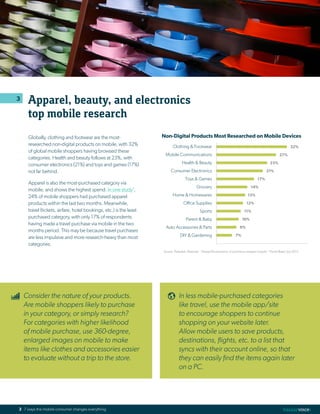
Globally, clothing and footwear are the most-researched 
non-digital products on mobile, with 32% 
of global mobile shoppers having browsed these 
categories. Health and beauty follows at 23%, with 
consumer electronics (21%) and toys and games (17%) 
not far behind. 
Apparel is also the most-purchased category via 
mobile, and shows the highest spend. In one study7, 
24% of mobile shoppers had purchased apparel 
products within the last two months. Meanwhile, 
travel (tickets, airfare, hotel bookings, etc.) is the least 
purchased category, with only 17% of respondents 
having made a travel purchase via mobile in the two 
months period. This may be because travel purchases 
are less impulsive and more research-heavy than most 
categories. 
3 
Consider the nature of your products. 
Are mobile shoppers likely to purchase 
in your category, or simply research? 
For categories with higher likelihood 
of mobile purchase, use 360-degree, 
enlarged images on mobile to make 
items like clothes and accessories easier 
to evaluate without a trip to the store. 
Non-Digital Products Most Researched on Mobile Devices 
Clothing & Footwear 32% 
27% 
Mobile Communications 
Health & Beauty 
Consumer Electronics 
Toys & Games 
Grocery 
Home & Homewares 
Office Supplies 
Sports 
Parent & Baby 
Auto Accessories & Parts 
DIY & Gardening 
23% 
21% 
17% 
14% 
13% 
12% 
11% 
10% 
9% 
7% 
Source: Pinkerton, Malcolm. “Global M-commerce: E-commerce shopper insights.” Planet Retail. July 2013. 
In less mobile-purchased categories 
like travel, use the mobile app/site 
to encourage shoppers to continue 
shopping on your website later. 
Allow mobile users to save products, 
destinations, flights, etc. to a list that 
syncs with their account online, so that 
they can easily find the items again later 
on a PC. 
3 7 ways the mobile consumer changes everything
4 Mobile showrooming drives in-store purchases 
Due to the obvious growth of mobile usage amongst 
consumers, brick and mortar businesses fear the impact of 
mobile-aided shopping in stores – of customers who can 
handle a product on the shelf with one hand while finding 
a lower price on a competitor’s mobile site on the other. 
But this version of showrooming is a myth, says Matthew 
Quint8, Director, Center on Global Brand Leadership at 
Columbia Business School: 
“Our findings debunk many of the 
common assumptions about the threat 
of showrooming. Many shoppers care 
about more than just the lowest price on 
every item.” 
Shoppers are certainly using their mobile devices in stores 
– 84% of smartphone owners1 admit it. And it’s not just 
Millennials; 74% of mobile shoppers9 are older than 29. 
They’re checking reviews (44%)10, looking for the product 
at other locations (36%), and, yes, the majority (61%) are 
checking competitors’ prices. That information does affect 
consumers’ eventual purchases: In Australia, for example, 
half of shoppers who use their phone in stores say that it’s 
changed their purchase decision11. 
Expounds Mark Lewis, Director of Online for EMEA retailer 
John Lewis: 
“Customers are already walking into the 
store with very sophisticated technology 
in the form of their smartphones. 
Increasingly they are using that 
technology as part of how they shop - be 
it to scan items, to get extra information 
about the items, to find reviews, or to pay 
for items. All those elements are coming 
our way very, very quickly.” 
But retailers shouldn’t dread these price checks, new 
research finds – they may actually drive in-store purchases. 
More than half of mobile shoppers9 are more likely to 
purchase a product in-store when their mobile device helps 
them find online reviews, information, or trusted advice. In 
fact, 77% of smartphone-driven purchases happen in stores3 
– not on the phone or later online. To capture that purchase-driving 
power, retailers should encourage shoppers to use 
phones in stores, keeping them in owned property. 
Offer free wifi in stores to speed mobile browsing. Use signage to 
promote the wifi and mobile site. 
4 7 ways the mobile consumer changes everything
Store-specific functionality encourages 
in-store mobile research 
Supporting in-store showrooming goes beyond just 
encouraging it. Recognize the different needs and use cases 
for mobile shoppers in-store, as opposed to couch surfers 
at home. While in-home shoppers browse the product 
catalogue, in-store shoppers are more likely to have a 
specific product in hand they’d like information on. Barcode 
scanners let shoppers immediately look up product specific 
information like additional sizes, reviews, how-to videos, 
Q&A, availability at another store, and more. 
Rewards programs are another way to encourage mobile 
activity in stores. Nearly half 9(48%) of mobile shoppers say 
being part of a store’s loyalty program makes them more 
likely to buy a product in the store, despite cheaper prices 
online. 
Mobile-enabled sales staff can work just as well. One in 
ten shoppers10 would rather engage with a salesperson 
using a smartphone to help them check prices, reviews, 
stock at other stores, or other information, rather than use 
their own device. Especially older and wealthier shoppers; 
while they’re less likely to check smartphones than younger 
shoppers, they appreciate assistance10 from mobile-equipped 
sales reps more. 
5 
Arm store staff with smartphones 
and tablets to provide additional 
information for in-store shoppers. 
Equip staff devices with mobile 
checkout for a quicker customer 
experience. 
Build in-store specific functionality 
into your mobile site or app, and call 
it out. Consider a separate mobile 
site for in-store shopping tools. 
Link mobile app usage to loyalty 
program points to encourage mobile 
activities that drive purchases, such 
as reading reviews and making 
mobile shopping lists. 
5 7 ways the mobile consumer changes everything
Responsive design creates an effective 
web experience on every screen size 
One size does not fit all in mobile. Many websites format 
poorly on smartphones – small text, images, and buttons; 
tiny menus impossible to navigate with thumbs; checkout 
experiences designed for desktops that don’t translate to 
the mobile user. It’s bad news for businesses, as 65% of 
shoppers1 prefer mobile sites to apps. These frustrations 
can send shoppers elsewhere, sometimes for good. 
On the flip side, when businesses present excellent 
mobile experiences, delighted shoppers may even spend 
more. Nearly half (46%)12 of Italian mobile shoppers are 
encouraged to increase spend online if the website is 
mobile optimized, and 39% of German mobile shoppers 
agree. 
But with the multitude of smartphone and tablet screen 
sizes, it is impossible to design for every screen size 
individually. Choosing to design for just some of the 
possibilities – the most popular or revenue-driving mobile 
devices, for example – is just as ineffective. Android 
has more market share (four of every five smartphones 
shipped in Q3 201313), but Apple owners spend more; 
iOS accounted for 12.8% of online sales5 on Black Friday in 
2013, versus 2.8% for Android. 
The answer: Responsive design. Responsive design 
automatically resizes websites to fit the screen – making the 
site display properly on any device. But effective mobile 
sites must do more than appear unbroken on smaller 
screens. The user interface significantly impacts the mobile 
shopping experience. 
To plan for an excellent 
small-screen experience: 
• Use large buttons for finger navigation on 
important calls to action, such as the main site 
navigation. 
• Simplify content. Use less text and more 
pictures. Recognizing that shoppers have different 
intentions on tablets and smartphones, be thoughtful 
about what content to show on each as your site 
recognizes the device used. 
• Choose scrolling over pagination. Scrolling 
saves shoppers the hassle of loading multiple pages 
on slower-speed data plans or wifi. 
• Scale important information like reviews 
and images. Make sure star ratings and links to full 
reviews are clear. Ensure that images scale down 
nicely, and hold up to retina displays when shoppers 
zoom. 
• Eliminate pop ups entirely. Clicking a photo 
for a larger size or a link to more product information 
should lead to a new page, not a difficult-to-close 
pop up window. 
6 
6 7 ways the mobile consumer changes everything
7 Mobile optimized emails double response rates 
Marketing emails and review submission forms are still 
largely designed for laptop/desktop use. But 38% of email 
is opened on mobile devices14, and 32% of reviews across 
our client network are submitted via mobile. Add in the 
fact that the vast majority of review submissions across 
our client network come from post-purchase email review 
requests sent by the retailer or brand, and the need for 
mobile-friendly email and review submission becomes 
critical. 
Designing email templates and subsequent landing pages 
for mobile goes against common design best practices. 
It leads to linear, practically image-free, text-based – in 
a word, boring – templates that most designers would 
frown at. Yet the result is a highly-readable, fast-loading, 
functional message or page for mobile readers. 
Which leads to conversions. In a test with our client Buckle, 
our designers reformatted the retailer’s review request 
emails, and the submission pages readers reached, to 
just such simple designs, and used responsive design 
to ensure that the pages appeared correctly on any size 
screen. 
The result was an astonishing 146% increase in review 
submissions15. The mobile-friendly, responsive templates 
outperformed the classic, desktop-based templates in 
every way, achieving 30.4% open rate (30.4%) and 11.25% 
click-through rate (11.25%). 
Simplify email and forms for 
mobile readers and visitors. 
Conclusion 
Mobile shoppers are always on. 
Their ability to research and buy 
any product at any time means that 
businesses can reach them any time as 
well. Businesses that cater to mobile 
shoppers needs by including reviews, 
in-store functionality, mobile-optimized 
sites and email templates, and more in 
their branded mobile efforts will win 
these “anytime shoppers” – and as their 
numbers grow, so will your revenues. 
7 7 ways the mobile consumer changes everything
About Bazaarvoice 
Bazaarvoice connects businesses together to amplify the authentic voices of people where they shop. Each month, 
more than 400 million people view and share opinions,questions and experiences about 20 million products in 
the Bazaarvoice network. The company’s technology platform channels these voices into the places that influence 
purchase decisions, helping businesses gain access to a wider audience of shoppers and trusted consumer content 
to improve sales and marketing. Headquartered in Austin, Texas, Bazaarvoice has offices across North America, 
Europe, and Asia-Pacific. 
For more info, visit... 
www.bazaarvoice.com 
www.bazaarvoice.com/blog 
www.twitter.com/bazaarvoice 
8 7 ways the mobile consumer changes everything
Sources 
1. “How Mobile Is Transforming the Shopping Experience in Stores.” Google. May 2013. 
http://www.thinkwithgoogle.com/research-studies/mobile-in-store.html 
2. “More Shoppers Reach for Mobile to Browse, Buy.” eMarketer. January 2013. 
http://www.emarketer.com/Article/More-Shoppers-Reach-Mobile-Browse-Buy/1009615#69kWrrPPi0BFgF4p.99 
3. Sterling, Greg. “Study: 77 Percent Of Smartphone-Driven Retail Purchases Happen In Stores.” Marketing Land. May 2013. 
http://marketingland.com/study-77-percent-of-smartphone-driven-retail-purchases-happen-in-stores-45068 
4. “Australia’s B2C Ecommerce Market Becomes More Competitive.” eMarketer. August 2013. 
http://www.emarketer.com/Article/Australias-B2C-Ecommerce-Market-Becomes-More-Competitive/1010124#CHzLrk7Kh 
ePd5rDz.99 
5. McCue, TJ. “Apple iOS Drives More Cyber Monday Online Sales Than Android.” Forbes. December 2013. 
http://www.forbes.com/sites/tjmccue/2013/12/02/apple-ios-drives-more-cyber-monday-online-sales-than-android/ 
6. Butler, Sara. “All we want for Christmas… we’ll be buying via phones and tablets this year.” The Guardian. October 2013. 
http://www.theguardian.com/business/2013/oct/20/christmas-shopping-by-mobile-phone-and-tablet 
7. Appleseed, Jamie. “Mobile Commerce Spending Patterns (2013 Survey Results).” Baymard Institute. August 2013. 
http://baymard.com/blog/mcommerce-spending-patterns-2013 
8. Searleman, Eric. “M-Shoppers Redefine the Mobile Shopping Experience.” Techonomy. December 2013. 
http://techonomy.com/2013/12/m-shoppers-redefine-mobile-shopping-experience/ 
9. “Showrooming and the Rise of the Mobile-Assisted Shopper.” Columbia Business School. September 2013. 
http://www8.gsb.columbia.edu/globalbrands/m-shopper-research 
10. Redding, Terry. “Holiday retailing: Cashing in on mobile merriment.” CFI Group. December 2013. 
http://www.retailers.com/guest-blog/holiday-retailing-cashing-in-on-mobile-merriment#.UvGPqrSJppA 
11. Jude, Gareth and Christena Singh. “How mobility is changing the rhythm of Australian retail.” Telstra. 
http://www.telstra.com.au/business-enterprise/download/document/business-enterprise-teg1398_mobility_retail_ 
white_pages_v08_hr_singles.pdf 
12. Pinkerton, Malcolm. “Global M-commerce: E-commerce shopper insights.” Planet Retail. July 2013. 
13. Bradley, Tony. “Android Dominates Market Share, But Apple Makes All The Money.” Forbes. November 2013. 
http://www.forbes.com/sites/tonybradley/2013/11/15/android-dominates-market-share-but-apple-makes-all-the-money/ 
14. Jordan, Justine. “Mobile Email Opens Increase 123% in 18 Months.” Litmus. October 2012. 
https://litmus.com/blog/mobile-email-opens-increase-123-in-18-months 
15. Litsa, A. “Throw out best practices, double email conversion – Part 1.” Bazaarvoice. August 2013. 
http://blog.bazaarvoice.com/2013/08/01/throw-out-best-practices-double-email-conversion-part-1/#sthash.4YerfJ3K. 
dpuf 
Unless otherwise specified, stats in this paper refer to US consumers. 
© Bazaarvoice, 2014 
9 7 ways the mobile consumer changes everything
Mobile consumer

Mobile consumer

  • 1.
    7 ways themobile consumer changes everything How always-on mobile and consumer feedback combine to create huge opportunities for brands
  • 2.
    Shopper’s mobile usein research and buying is exploding. Currently, eight in ten1 smartphone owners are smartphone shoppers. And by 2016, 85% of all digital shoppers will be mobile shoppers as well.2 It’s no longer enough to think of consumers as online vs. in-store. The mobile shopper is neither and both of these, fast becoming the norm rather than the exception. Reviews double mobile conversion Nearly half of mobile users actually rely exclusively on mobile3 for their pre-purchase research. But mobile devices aren’t around just for research anymore – people are quickly warming to buying via mobile as well. The number of people who buy via mobile will increase 65% between now and 20162.In Europe, Forrester predicts that mobile e-commerce revenues across will rise from €1.7 billion in 2011 to €19.2 billion by 2017, reaching 6.8% of web sales. And that’s nothing compared to Australia, where mobile sales in 2012 accounted for ~30% of all digital sales4. That number continues to grow as more Australians obtain smartphones. Just like their desktop counterparts, mobile shoppers who read reviews and other customer-written content are far more likely to convert than those who don’t. Across the Bazaarvoice client network, mobile shoppers who view customer content like reviews show 133% higher conversion rate. Even brands that don’t sell online should gather reviews to syndicate across their retail networks’ mobile sites and apps, to capture more share. Mobile shoppers increasingly seek out reviews online. Year over year mobile traffic to customer content grew 60% from July 2012 to 2013 on our network. The share of shoppers who view reviews is about the same across devices – 12.8% of mobile shoppers view reviews, versus 14.3% of desktop shoppers. The difference may just be lag in the usability of review content on mobile sites. Include reviews and other customer content in your mobile experience, and format the content for mobile consumption. 1 1 Soc1i a l7 m weaeytss tfihnea mncoiabl:il eH coown csumstoemr cehra cnognevse ersvaetrioytnhsi ndgrive acquisition, retention, and innovation
  • 3.
    Holidays attract new mobile shoppers – and permanently change behavior Across our client network, December typically sees a spike in mobile traffic. Shoppers who experiment in mobile during the holidays tend to convert to ongoing mobile shoppers – mobile traffic across our network doesn’t return to pre-holiday levels once the season ends. Push your mobile presence during the holiday season to convert new, lifelong mobile shoppers. Black Friday weekend 2013 (the heavy shopping weekend following Thanksgiving in the US), saw sharp growth in mobile use. Mobile traffic grew 61% year over year, and mobile sales reached 25.8% of total online sales5 for Thanksgiving. While smartphones drove more traffic than tablets (20% versus 9%), tablets drove a higher percentage of sales. The steady creep of mobile shopping into the holiday buying process has even changed the time of day deals get done. 2013 Christmas sales in the UK, for example, started earlier than ever, says Laura Wade-Gery, digital director at Marks & Spencer6: “Early morning has never before been a big shopping time, but an increasing number of sales are now made online between 6am and 8am. People use their phone as an alarm, then check their emails, follow a link, and are shopping before they even get out of bed.” 2 2 7 ways the mobile consumer changes everything
  • 4.
    Apparel, beauty, andelectronics top mobile research Globally, clothing and footwear are the most-researched non-digital products on mobile, with 32% of global mobile shoppers having browsed these categories. Health and beauty follows at 23%, with consumer electronics (21%) and toys and games (17%) not far behind. Apparel is also the most-purchased category via mobile, and shows the highest spend. In one study7, 24% of mobile shoppers had purchased apparel products within the last two months. Meanwhile, travel (tickets, airfare, hotel bookings, etc.) is the least purchased category, with only 17% of respondents having made a travel purchase via mobile in the two months period. This may be because travel purchases are less impulsive and more research-heavy than most categories. 3 Consider the nature of your products. Are mobile shoppers likely to purchase in your category, or simply research? For categories with higher likelihood of mobile purchase, use 360-degree, enlarged images on mobile to make items like clothes and accessories easier to evaluate without a trip to the store. Non-Digital Products Most Researched on Mobile Devices Clothing & Footwear 32% 27% Mobile Communications Health & Beauty Consumer Electronics Toys & Games Grocery Home & Homewares Office Supplies Sports Parent & Baby Auto Accessories & Parts DIY & Gardening 23% 21% 17% 14% 13% 12% 11% 10% 9% 7% Source: Pinkerton, Malcolm. “Global M-commerce: E-commerce shopper insights.” Planet Retail. July 2013. In less mobile-purchased categories like travel, use the mobile app/site to encourage shoppers to continue shopping on your website later. Allow mobile users to save products, destinations, flights, etc. to a list that syncs with their account online, so that they can easily find the items again later on a PC. 3 7 ways the mobile consumer changes everything
  • 5.
    4 Mobile showroomingdrives in-store purchases Due to the obvious growth of mobile usage amongst consumers, brick and mortar businesses fear the impact of mobile-aided shopping in stores – of customers who can handle a product on the shelf with one hand while finding a lower price on a competitor’s mobile site on the other. But this version of showrooming is a myth, says Matthew Quint8, Director, Center on Global Brand Leadership at Columbia Business School: “Our findings debunk many of the common assumptions about the threat of showrooming. Many shoppers care about more than just the lowest price on every item.” Shoppers are certainly using their mobile devices in stores – 84% of smartphone owners1 admit it. And it’s not just Millennials; 74% of mobile shoppers9 are older than 29. They’re checking reviews (44%)10, looking for the product at other locations (36%), and, yes, the majority (61%) are checking competitors’ prices. That information does affect consumers’ eventual purchases: In Australia, for example, half of shoppers who use their phone in stores say that it’s changed their purchase decision11. Expounds Mark Lewis, Director of Online for EMEA retailer John Lewis: “Customers are already walking into the store with very sophisticated technology in the form of their smartphones. Increasingly they are using that technology as part of how they shop - be it to scan items, to get extra information about the items, to find reviews, or to pay for items. All those elements are coming our way very, very quickly.” But retailers shouldn’t dread these price checks, new research finds – they may actually drive in-store purchases. More than half of mobile shoppers9 are more likely to purchase a product in-store when their mobile device helps them find online reviews, information, or trusted advice. In fact, 77% of smartphone-driven purchases happen in stores3 – not on the phone or later online. To capture that purchase-driving power, retailers should encourage shoppers to use phones in stores, keeping them in owned property. Offer free wifi in stores to speed mobile browsing. Use signage to promote the wifi and mobile site. 4 7 ways the mobile consumer changes everything
  • 6.
    Store-specific functionality encourages in-store mobile research Supporting in-store showrooming goes beyond just encouraging it. Recognize the different needs and use cases for mobile shoppers in-store, as opposed to couch surfers at home. While in-home shoppers browse the product catalogue, in-store shoppers are more likely to have a specific product in hand they’d like information on. Barcode scanners let shoppers immediately look up product specific information like additional sizes, reviews, how-to videos, Q&A, availability at another store, and more. Rewards programs are another way to encourage mobile activity in stores. Nearly half 9(48%) of mobile shoppers say being part of a store’s loyalty program makes them more likely to buy a product in the store, despite cheaper prices online. Mobile-enabled sales staff can work just as well. One in ten shoppers10 would rather engage with a salesperson using a smartphone to help them check prices, reviews, stock at other stores, or other information, rather than use their own device. Especially older and wealthier shoppers; while they’re less likely to check smartphones than younger shoppers, they appreciate assistance10 from mobile-equipped sales reps more. 5 Arm store staff with smartphones and tablets to provide additional information for in-store shoppers. Equip staff devices with mobile checkout for a quicker customer experience. Build in-store specific functionality into your mobile site or app, and call it out. Consider a separate mobile site for in-store shopping tools. Link mobile app usage to loyalty program points to encourage mobile activities that drive purchases, such as reading reviews and making mobile shopping lists. 5 7 ways the mobile consumer changes everything
  • 7.
    Responsive design createsan effective web experience on every screen size One size does not fit all in mobile. Many websites format poorly on smartphones – small text, images, and buttons; tiny menus impossible to navigate with thumbs; checkout experiences designed for desktops that don’t translate to the mobile user. It’s bad news for businesses, as 65% of shoppers1 prefer mobile sites to apps. These frustrations can send shoppers elsewhere, sometimes for good. On the flip side, when businesses present excellent mobile experiences, delighted shoppers may even spend more. Nearly half (46%)12 of Italian mobile shoppers are encouraged to increase spend online if the website is mobile optimized, and 39% of German mobile shoppers agree. But with the multitude of smartphone and tablet screen sizes, it is impossible to design for every screen size individually. Choosing to design for just some of the possibilities – the most popular or revenue-driving mobile devices, for example – is just as ineffective. Android has more market share (four of every five smartphones shipped in Q3 201313), but Apple owners spend more; iOS accounted for 12.8% of online sales5 on Black Friday in 2013, versus 2.8% for Android. The answer: Responsive design. Responsive design automatically resizes websites to fit the screen – making the site display properly on any device. But effective mobile sites must do more than appear unbroken on smaller screens. The user interface significantly impacts the mobile shopping experience. To plan for an excellent small-screen experience: • Use large buttons for finger navigation on important calls to action, such as the main site navigation. • Simplify content. Use less text and more pictures. Recognizing that shoppers have different intentions on tablets and smartphones, be thoughtful about what content to show on each as your site recognizes the device used. • Choose scrolling over pagination. Scrolling saves shoppers the hassle of loading multiple pages on slower-speed data plans or wifi. • Scale important information like reviews and images. Make sure star ratings and links to full reviews are clear. Ensure that images scale down nicely, and hold up to retina displays when shoppers zoom. • Eliminate pop ups entirely. Clicking a photo for a larger size or a link to more product information should lead to a new page, not a difficult-to-close pop up window. 6 6 7 ways the mobile consumer changes everything
  • 8.
    7 Mobile optimizedemails double response rates Marketing emails and review submission forms are still largely designed for laptop/desktop use. But 38% of email is opened on mobile devices14, and 32% of reviews across our client network are submitted via mobile. Add in the fact that the vast majority of review submissions across our client network come from post-purchase email review requests sent by the retailer or brand, and the need for mobile-friendly email and review submission becomes critical. Designing email templates and subsequent landing pages for mobile goes against common design best practices. It leads to linear, practically image-free, text-based – in a word, boring – templates that most designers would frown at. Yet the result is a highly-readable, fast-loading, functional message or page for mobile readers. Which leads to conversions. In a test with our client Buckle, our designers reformatted the retailer’s review request emails, and the submission pages readers reached, to just such simple designs, and used responsive design to ensure that the pages appeared correctly on any size screen. The result was an astonishing 146% increase in review submissions15. The mobile-friendly, responsive templates outperformed the classic, desktop-based templates in every way, achieving 30.4% open rate (30.4%) and 11.25% click-through rate (11.25%). Simplify email and forms for mobile readers and visitors. Conclusion Mobile shoppers are always on. Their ability to research and buy any product at any time means that businesses can reach them any time as well. Businesses that cater to mobile shoppers needs by including reviews, in-store functionality, mobile-optimized sites and email templates, and more in their branded mobile efforts will win these “anytime shoppers” – and as their numbers grow, so will your revenues. 7 7 ways the mobile consumer changes everything
  • 9.
    About Bazaarvoice Bazaarvoiceconnects businesses together to amplify the authentic voices of people where they shop. Each month, more than 400 million people view and share opinions,questions and experiences about 20 million products in the Bazaarvoice network. The company’s technology platform channels these voices into the places that influence purchase decisions, helping businesses gain access to a wider audience of shoppers and trusted consumer content to improve sales and marketing. Headquartered in Austin, Texas, Bazaarvoice has offices across North America, Europe, and Asia-Pacific. For more info, visit... www.bazaarvoice.com www.bazaarvoice.com/blog www.twitter.com/bazaarvoice 8 7 ways the mobile consumer changes everything
  • 10.
    Sources 1. “HowMobile Is Transforming the Shopping Experience in Stores.” Google. May 2013. http://www.thinkwithgoogle.com/research-studies/mobile-in-store.html 2. “More Shoppers Reach for Mobile to Browse, Buy.” eMarketer. January 2013. http://www.emarketer.com/Article/More-Shoppers-Reach-Mobile-Browse-Buy/1009615#69kWrrPPi0BFgF4p.99 3. Sterling, Greg. “Study: 77 Percent Of Smartphone-Driven Retail Purchases Happen In Stores.” Marketing Land. May 2013. http://marketingland.com/study-77-percent-of-smartphone-driven-retail-purchases-happen-in-stores-45068 4. “Australia’s B2C Ecommerce Market Becomes More Competitive.” eMarketer. August 2013. http://www.emarketer.com/Article/Australias-B2C-Ecommerce-Market-Becomes-More-Competitive/1010124#CHzLrk7Kh ePd5rDz.99 5. McCue, TJ. “Apple iOS Drives More Cyber Monday Online Sales Than Android.” Forbes. December 2013. http://www.forbes.com/sites/tjmccue/2013/12/02/apple-ios-drives-more-cyber-monday-online-sales-than-android/ 6. Butler, Sara. “All we want for Christmas… we’ll be buying via phones and tablets this year.” The Guardian. October 2013. http://www.theguardian.com/business/2013/oct/20/christmas-shopping-by-mobile-phone-and-tablet 7. Appleseed, Jamie. “Mobile Commerce Spending Patterns (2013 Survey Results).” Baymard Institute. August 2013. http://baymard.com/blog/mcommerce-spending-patterns-2013 8. Searleman, Eric. “M-Shoppers Redefine the Mobile Shopping Experience.” Techonomy. December 2013. http://techonomy.com/2013/12/m-shoppers-redefine-mobile-shopping-experience/ 9. “Showrooming and the Rise of the Mobile-Assisted Shopper.” Columbia Business School. September 2013. http://www8.gsb.columbia.edu/globalbrands/m-shopper-research 10. Redding, Terry. “Holiday retailing: Cashing in on mobile merriment.” CFI Group. December 2013. http://www.retailers.com/guest-blog/holiday-retailing-cashing-in-on-mobile-merriment#.UvGPqrSJppA 11. Jude, Gareth and Christena Singh. “How mobility is changing the rhythm of Australian retail.” Telstra. http://www.telstra.com.au/business-enterprise/download/document/business-enterprise-teg1398_mobility_retail_ white_pages_v08_hr_singles.pdf 12. Pinkerton, Malcolm. “Global M-commerce: E-commerce shopper insights.” Planet Retail. July 2013. 13. Bradley, Tony. “Android Dominates Market Share, But Apple Makes All The Money.” Forbes. November 2013. http://www.forbes.com/sites/tonybradley/2013/11/15/android-dominates-market-share-but-apple-makes-all-the-money/ 14. Jordan, Justine. “Mobile Email Opens Increase 123% in 18 Months.” Litmus. October 2012. https://litmus.com/blog/mobile-email-opens-increase-123-in-18-months 15. Litsa, A. “Throw out best practices, double email conversion – Part 1.” Bazaarvoice. August 2013. http://blog.bazaarvoice.com/2013/08/01/throw-out-best-practices-double-email-conversion-part-1/#sthash.4YerfJ3K. dpuf Unless otherwise specified, stats in this paper refer to US consumers. © Bazaarvoice, 2014 9 7 ways the mobile consumer changes everything