Mobile Computing
Lecture #02
By
Hannan Bin Liaqat
Department of CS& IT
University of Gujrat
Today’s Lecture Agenda
 What is Wireless Networks?
 Types of Wireless Networks
 History of Wireless Networks
 Advantages of Wireless Networks
 Disadvantages of Wireless Networks
What is Networks?
Definition:
Two or more computer or computing devices connected
together through connecting devices
Purpose of networking:
1- Communication
2- Sharing
Types of Networks
There are mainly two types of networks
1- Wired networks
2- wireless networks
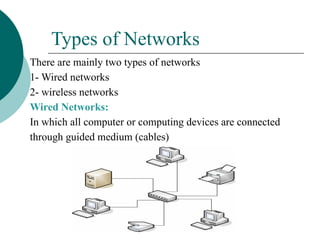
Wired Networks:
In which all computer or computing devices are connected
through guided medium (cables)
Types of Networks
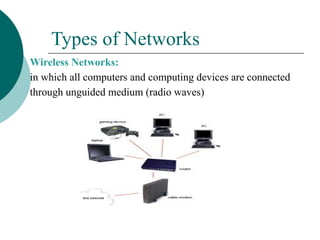
Wireless Networks:
in which all computers and computing devices are connected
through unguided medium (radio waves)
Wireless Networks …
 Wireless Networks operate in almost the same way
as wired Networks
 Using the same networking protocols
 Supporting almost the same applications
Types of Wireless Networks
There are mainly two types of wireless networks
1- Infrastructural wireless networks
2- Infrastructure less wireless networks
Infrastructural wireless networks:
Definition:
Infrastructure wireless networks are the wireless network that
contains wireless router/access point and enables other
computers connect to it wirelessly. This is the common
deployment to build a home wireless network.
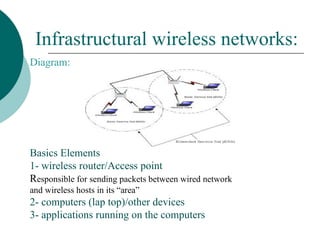
Infrastructural wireless networks:
Diagram:
Basics Elements
1- wireless router/Access point
Responsible for sending packets between wired network
and wireless hosts in its “area”
2- computers (lap top)/other devices
3- applications running on the computers
Infrastructure less wireless networks
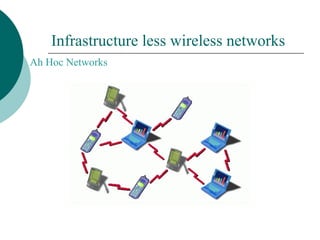
Ah Hoc Networks
 Infrastructure less networks are also called Ah hoc networks
 In this type of communication devices or computers
communicate directly with each other without the need for a
wireless router or access point
Basics Elements
1- computers (lap top)/other devices
Each computer is responsible for sending/forwarding packets
to other computers in its area (transmission range)
2- applications running on the computers
Infrastructure less wireless networks
Ah Hoc Networks
Early history of wireless
communication
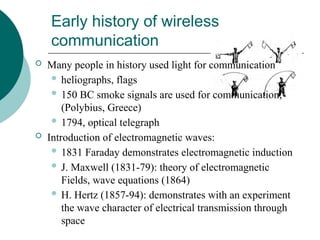
 Many people in history used light for communication
 heliographs, flags
 150 BC smoke signals are used for communication;
(Polybius, Greece)
 1794, optical telegraph
 Introduction of electromagnetic waves:
 1831 Faraday demonstrates electromagnetic induction
 J. Maxwell (1831-79): theory of electromagnetic
Fields, wave equations (1864)
 H. Hertz (1857-94): demonstrates with an experiment
the wave character of electrical transmission through
space
History of wireless communication
I
 1895 Marconi
 first demonstration of wireless telegraphy (digital!)
 long wave transmission
 1907 Commercial transatlantic connections
 huge base stations
 1915 Wireless voice transmission New York - San Francisco
 1920 Discovery of short waves by Marconi
 reflection at the ionosphere
 smaller sender and receiver, possible due to the invention of the
vacuum tube
 1926 Train-phone on the line Hamburg - Berlin
 wires parallel to the railroad track
History of wireless communication
 1928 many TV broadcast trials (across Atlantic, color TV, TV news)
 1933 Frequency modulation
 1958 A-Netz in Germany
 analog, 160MHz, connection setup only from the mobile station, no
handover, 80% coverage, 1971 11000 customers
 1972 B-Netz in Germany
 analog, 160MHz, connection setup from the fixed network too (but
location of the mobile station has to be known)
 1982 Start of GSM-specification
 1983 Start of the American AMPS (Advanced Mobile Phone
System, analog)
 1984 CT-1 standard (Europe) for cordless telephones
History of wireless communication
 1986 C-Netz in Germany
 analog voice transmission, 450MHz, hand-over possible, digital
signaling, automatic location of mobile device
 1991 Specification of DECT
 Digital European Cordless Telephone (today: Digital Enhanced
Cordless Telecommunications)
 1992 Start of GSM
 1994 E-Netz in Germany
 GSM with 1800MHz, smaller cells, supported by 11 countries
 1996 HiperLAN (High Performance Radio Local Area Network)
 1997 Wireless LAN - IEEE802.11
 1998 Specification of GSM successors
 for UMTS (Universal Mobile Telecommunication System
1.13.1
Advantages of Wireless Networks
 Minimum installation issues
 Freedom to roam
 Scalability
 No cables
Disadvantages of Wireless Networks
 Careful planning of network essential
 Environment generally unfriendly
 Security
 Safety
 Spectrum licenses
 Poor data rates

Mobile and wireless networking in mobile computing.pptx

  • 1.
    Mobile Computing Lecture #02 By HannanBin Liaqat Department of CS& IT University of Gujrat
  • 2.
    Today’s Lecture Agenda What is Wireless Networks?  Types of Wireless Networks  History of Wireless Networks  Advantages of Wireless Networks  Disadvantages of Wireless Networks
  • 3.
    What is Networks? Definition: Twoor more computer or computing devices connected together through connecting devices Purpose of networking: 1- Communication 2- Sharing
  • 4.
    Types of Networks Thereare mainly two types of networks 1- Wired networks 2- wireless networks Wired Networks: In which all computer or computing devices are connected through guided medium (cables)
  • 5.
    Types of Networks WirelessNetworks: in which all computers and computing devices are connected through unguided medium (radio waves)
  • 6.
    Wireless Networks … Wireless Networks operate in almost the same way as wired Networks  Using the same networking protocols  Supporting almost the same applications
  • 7.
    Types of WirelessNetworks There are mainly two types of wireless networks 1- Infrastructural wireless networks 2- Infrastructure less wireless networks Infrastructural wireless networks: Definition: Infrastructure wireless networks are the wireless network that contains wireless router/access point and enables other computers connect to it wirelessly. This is the common deployment to build a home wireless network.
  • 8.
    Infrastructural wireless networks: Diagram: BasicsElements 1- wireless router/Access point Responsible for sending packets between wired network and wireless hosts in its “area” 2- computers (lap top)/other devices 3- applications running on the computers
  • 9.
    Infrastructure less wirelessnetworks Ah Hoc Networks  Infrastructure less networks are also called Ah hoc networks  In this type of communication devices or computers communicate directly with each other without the need for a wireless router or access point Basics Elements 1- computers (lap top)/other devices Each computer is responsible for sending/forwarding packets to other computers in its area (transmission range) 2- applications running on the computers
  • 10.
    Infrastructure less wirelessnetworks Ah Hoc Networks
  • 11.
    Early history ofwireless communication  Many people in history used light for communication  heliographs, flags  150 BC smoke signals are used for communication; (Polybius, Greece)  1794, optical telegraph  Introduction of electromagnetic waves:  1831 Faraday demonstrates electromagnetic induction  J. Maxwell (1831-79): theory of electromagnetic Fields, wave equations (1864)  H. Hertz (1857-94): demonstrates with an experiment the wave character of electrical transmission through space
  • 12.
    History of wirelesscommunication I  1895 Marconi  first demonstration of wireless telegraphy (digital!)  long wave transmission  1907 Commercial transatlantic connections  huge base stations  1915 Wireless voice transmission New York - San Francisco  1920 Discovery of short waves by Marconi  reflection at the ionosphere  smaller sender and receiver, possible due to the invention of the vacuum tube  1926 Train-phone on the line Hamburg - Berlin  wires parallel to the railroad track
  • 13.
    History of wirelesscommunication  1928 many TV broadcast trials (across Atlantic, color TV, TV news)  1933 Frequency modulation  1958 A-Netz in Germany  analog, 160MHz, connection setup only from the mobile station, no handover, 80% coverage, 1971 11000 customers  1972 B-Netz in Germany  analog, 160MHz, connection setup from the fixed network too (but location of the mobile station has to be known)  1982 Start of GSM-specification  1983 Start of the American AMPS (Advanced Mobile Phone System, analog)  1984 CT-1 standard (Europe) for cordless telephones
  • 14.
    History of wirelesscommunication  1986 C-Netz in Germany  analog voice transmission, 450MHz, hand-over possible, digital signaling, automatic location of mobile device  1991 Specification of DECT  Digital European Cordless Telephone (today: Digital Enhanced Cordless Telecommunications)  1992 Start of GSM  1994 E-Netz in Germany  GSM with 1800MHz, smaller cells, supported by 11 countries  1996 HiperLAN (High Performance Radio Local Area Network)  1997 Wireless LAN - IEEE802.11  1998 Specification of GSM successors  for UMTS (Universal Mobile Telecommunication System 1.13.1
  • 15.
    Advantages of WirelessNetworks  Minimum installation issues  Freedom to roam  Scalability  No cables
  • 16.
    Disadvantages of WirelessNetworks  Careful planning of network essential  Environment generally unfriendly  Security  Safety  Spectrum licenses  Poor data rates