MMW
SECTION VIII. MATHEMATICAL SYSTEMS
PREPARED BY:
ENGR. MELOWIN M. PEÑA, ECT, MSIT
MODULAR ARITHMETIC
❑ Overview: Modular arithmetic, often referred to as "clock arithmetic," is a
system of arithmetic for integers, where numbers "wrap around" upon
reaching a certain value, known as the modulus. In this system, the numbers
are considered equivalent if they differ by a multiple of the modulus.
MODULAR ARITHMETIC
• Example: Consider a 12-hour clock. After 12 hours, the clock resets to 1. If
it's 10 o'clock now, in 5 hours, it will be 3 o'clock. Mathematically, this can
be expressed as: 10+5≡3 (mod 12)
• Key Concepts:
• Congruence Relation: Two integers a and b are congruent modulo n if
their difference a−b is divisible by n, denoted as a≡b (mod n)
• Modular Addition and Multiplication: Operations can be performed
under a modulus. For example, (7+8)mod 10=5 and (7×8)mod 10=6
MODULAR ARITHMETIC
• Applications: Modular arithmetic is foundational in various areas of
mathematics and its applications, including:
• Cryptography: Algorithms like RSA encryption rely heavily on modular
arithmetic for securing digital communication.
• Computer Science: Hash functions, cyclic redundancy checks (CRCs),
and many algorithms use modular arithmetic to manage overflow and
optimize operations.
• Number Theory: Solving congruences and understanding properties of
integers through modular systems is a key area of research.
MODULAR ARITHMETIC
• Applications of Modular Arithmetic
• Cryptography: One of the most critical applications of modular arithmetic is
in cryptography, particularly in public-key systems like RSA. The security of
RSA depends on the difficulty of factoring large numbers, which are derived
from modular arithmetic. The encryption and decryption process uses
modular exponentiation to encode and decode messages.
• Computer Algorithms: In computer science, modular arithmetic is used to
manage the overflow of data types with limited size, such as integers in
programming languages. For example, modular arithmetic helps in
implementing efficient hash functions where large inputs are reduced to a
manageable size (e.g., within a fixed number of buckets).
MODULAR ARITHMETIC
• Applications of Modular Arithmetic
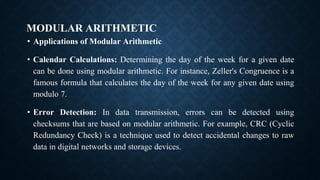
• Calendar Calculations: Determining the day of the week for a given date
can be done using modular arithmetic. For instance, Zeller's Congruence is a
famous formula that calculates the day of the week for any given date using
modulo 7.
• Error Detection: In data transmission, errors can be detected using
checksums that are based on modular arithmetic. For example, CRC (Cyclic
Redundancy Check) is a technique used to detect accidental changes to raw
data in digital networks and storage devices.
GROUP THEORY
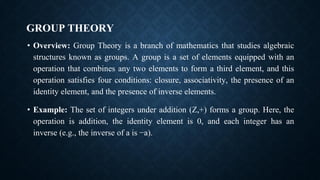
• Overview: Group Theory is a branch of mathematics that studies algebraic
structures known as groups. A group is a set of elements equipped with an
operation that combines any two elements to form a third element, and this
operation satisfies four conditions: closure, associativity, the presence of an
identity element, and the presence of inverse elements.
• Example: The set of integers under addition (Z,+) forms a group. Here, the
operation is addition, the identity element is 0, and each integer has an
inverse (e.g., the inverse of a is −a).
GROUP THEORY
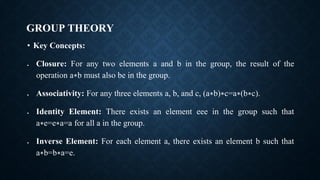
• Key Concepts:
• Closure: For any two elements a and b in the group, the result of the
operation a∗b must also be in the group.
• Associativity: For any three elements a, b, and c, (a∗b)∗c=a∗(b∗c).
• Identity Element: There exists an element eee in the group such that
a∗e=e∗a=a for all a in the group.
• Inverse Element: For each element a, there exists an element b such that
a∗b=b∗a=e.
GROUP THEORY
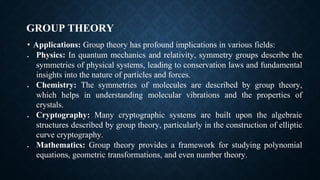
• Applications: Group theory has profound implications in various fields:
• Physics: In quantum mechanics and relativity, symmetry groups describe the
symmetries of physical systems, leading to conservation laws and fundamental
insights into the nature of particles and forces.
• Chemistry: The symmetries of molecules are described by group theory,
which helps in understanding molecular vibrations and the properties of
crystals.
• Cryptography: Many cryptographic systems are built upon the algebraic
structures described by group theory, particularly in the construction of elliptic
curve cryptography.
• Mathematics: Group theory provides a framework for studying polynomial
equations, geometric transformations, and even number theory.
GROUP THEORY
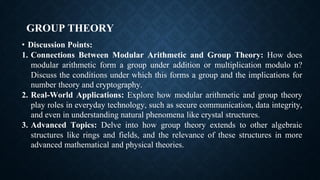
• Discussion Points:
1. Connections Between Modular Arithmetic and Group Theory: How does
modular arithmetic form a group under addition or multiplication modulo n?
Discuss the conditions under which this forms a group and the implications for
number theory and cryptography.
2. Real-World Applications: Explore how modular arithmetic and group theory
play roles in everyday technology, such as secure communication, data integrity,
and even in understanding natural phenomena like crystal structures.
3. Advanced Topics: Delve into how group theory extends to other algebraic
structures like rings and fields, and the relevance of these structures in more
advanced mathematical and physical theories.
• Conclusion: Modular arithmetic and group theory are powerful mathematical
tools with extensive applications across science, technology, and everyday life.
Understanding these concepts opens doors to deeper insights into both theoretical
and applied mathematics, with far-reaching consequences in fields ranging from
cryptography to quantum physics.
END

MMW_UNIT-10 (2).pdf mathematics modern world

  • 1.
    MMW SECTION VIII. MATHEMATICALSYSTEMS PREPARED BY: ENGR. MELOWIN M. PEÑA, ECT, MSIT
  • 2.
    MODULAR ARITHMETIC ❑ Overview:Modular arithmetic, often referred to as "clock arithmetic," is a system of arithmetic for integers, where numbers "wrap around" upon reaching a certain value, known as the modulus. In this system, the numbers are considered equivalent if they differ by a multiple of the modulus.
  • 3.
    MODULAR ARITHMETIC • Example:Consider a 12-hour clock. After 12 hours, the clock resets to 1. If it's 10 o'clock now, in 5 hours, it will be 3 o'clock. Mathematically, this can be expressed as: 10+5≡3 (mod 12) • Key Concepts: • Congruence Relation: Two integers a and b are congruent modulo n if their difference a−b is divisible by n, denoted as a≡b (mod n) • Modular Addition and Multiplication: Operations can be performed under a modulus. For example, (7+8)mod 10=5 and (7×8)mod 10=6
  • 4.
    MODULAR ARITHMETIC • Applications:Modular arithmetic is foundational in various areas of mathematics and its applications, including: • Cryptography: Algorithms like RSA encryption rely heavily on modular arithmetic for securing digital communication. • Computer Science: Hash functions, cyclic redundancy checks (CRCs), and many algorithms use modular arithmetic to manage overflow and optimize operations. • Number Theory: Solving congruences and understanding properties of integers through modular systems is a key area of research.
  • 5.
    MODULAR ARITHMETIC • Applicationsof Modular Arithmetic • Cryptography: One of the most critical applications of modular arithmetic is in cryptography, particularly in public-key systems like RSA. The security of RSA depends on the difficulty of factoring large numbers, which are derived from modular arithmetic. The encryption and decryption process uses modular exponentiation to encode and decode messages. • Computer Algorithms: In computer science, modular arithmetic is used to manage the overflow of data types with limited size, such as integers in programming languages. For example, modular arithmetic helps in implementing efficient hash functions where large inputs are reduced to a manageable size (e.g., within a fixed number of buckets).
  • 6.
    MODULAR ARITHMETIC • Applicationsof Modular Arithmetic • Calendar Calculations: Determining the day of the week for a given date can be done using modular arithmetic. For instance, Zeller's Congruence is a famous formula that calculates the day of the week for any given date using modulo 7. • Error Detection: In data transmission, errors can be detected using checksums that are based on modular arithmetic. For example, CRC (Cyclic Redundancy Check) is a technique used to detect accidental changes to raw data in digital networks and storage devices.
  • 7.
    GROUP THEORY • Overview:Group Theory is a branch of mathematics that studies algebraic structures known as groups. A group is a set of elements equipped with an operation that combines any two elements to form a third element, and this operation satisfies four conditions: closure, associativity, the presence of an identity element, and the presence of inverse elements. • Example: The set of integers under addition (Z,+) forms a group. Here, the operation is addition, the identity element is 0, and each integer has an inverse (e.g., the inverse of a is −a).
  • 8.
    GROUP THEORY • KeyConcepts: • Closure: For any two elements a and b in the group, the result of the operation a∗b must also be in the group. • Associativity: For any three elements a, b, and c, (a∗b)∗c=a∗(b∗c). • Identity Element: There exists an element eee in the group such that a∗e=e∗a=a for all a in the group. • Inverse Element: For each element a, there exists an element b such that a∗b=b∗a=e.
  • 9.
    GROUP THEORY • Applications:Group theory has profound implications in various fields: • Physics: In quantum mechanics and relativity, symmetry groups describe the symmetries of physical systems, leading to conservation laws and fundamental insights into the nature of particles and forces. • Chemistry: The symmetries of molecules are described by group theory, which helps in understanding molecular vibrations and the properties of crystals. • Cryptography: Many cryptographic systems are built upon the algebraic structures described by group theory, particularly in the construction of elliptic curve cryptography. • Mathematics: Group theory provides a framework for studying polynomial equations, geometric transformations, and even number theory.
  • 10.
    GROUP THEORY • DiscussionPoints: 1. Connections Between Modular Arithmetic and Group Theory: How does modular arithmetic form a group under addition or multiplication modulo n? Discuss the conditions under which this forms a group and the implications for number theory and cryptography. 2. Real-World Applications: Explore how modular arithmetic and group theory play roles in everyday technology, such as secure communication, data integrity, and even in understanding natural phenomena like crystal structures. 3. Advanced Topics: Delve into how group theory extends to other algebraic structures like rings and fields, and the relevance of these structures in more advanced mathematical and physical theories.
  • 11.
    • Conclusion: Modulararithmetic and group theory are powerful mathematical tools with extensive applications across science, technology, and everyday life. Understanding these concepts opens doors to deeper insights into both theoretical and applied mathematics, with far-reaching consequences in fields ranging from cryptography to quantum physics.
  • 12.