MODULAR
ARITHMETIC
CARL FRIEDRICH GAUSS
• He developed Modular Arithmetic and
introduced the modern approach in his
book "Disquisitiones Arithmeticae",
which was published in 1801.
WHAT DOES MODULAR ARITHMETIC MEAN?
• In Mathematics, modular arithmetic is special category of arithmetic that
makes use only integers.
• It is also considered as Arithmetic of any nontrivial homomorphic images
• Arithmetic of congruence.
• Modular Arithmetic is usually associated with prime numbers divided by
the unique is equal.
WHAT DOES MODULAR MEAN?
•Arithmetic of congruence.
•Modular Arithmetic is usually associated with
prime numbers divided by the unique is equal.
USES OF MODULAR ARITHMETIC:
•It is uses to calculate checksums for
international standard book numbers
and bank identifiers and to support
errors in them
APPLICATION OF MODULAR ARITHMETIC
•Is used extensively in pure mathematics where it
is cornerstone of number of theory but it also
has many practical application.
MODULO ARITHMETIC IN NAMING THE MONTHS
IN AYEAR
• Months in a year
JAN FEB MAR APR MAY JUN JUL AUG SEP OCT NOV DEC
1 2 3 4 5 6 7 8 9 10 11 12
MODULO ARITHMETIC IN NAMING THE DAYS IN A
WEEK
• Naming of Days in a Week
MON TUE WED THU FRI SAT SUN MON TUE WED
1 2 3 4 5 6 7 1 2 3
SET OF POSITIVE INTEGERS
ANDTHE ELEMENT
0 1 2 3 4 5 6 7 8 9 10 11
0 1 0 1 0 1 0 1 0 1 0 1
0 1 2 0 1 2 0 1 2 0 1 2
0 1 2 3 0 1 2 3 0 1 2 3
MODULAR ARITHMETIC
• The ‘clock arithmetic’
• System of arithmetic for
integers where the numbers
wrap after they reach a certain
value which is called as the
modulus.
FOR EXAMPLE :
a clock with the 12
replaced by a 0 would be
the circle for a modulus
of 12.
12
FOR EXAMPLE:
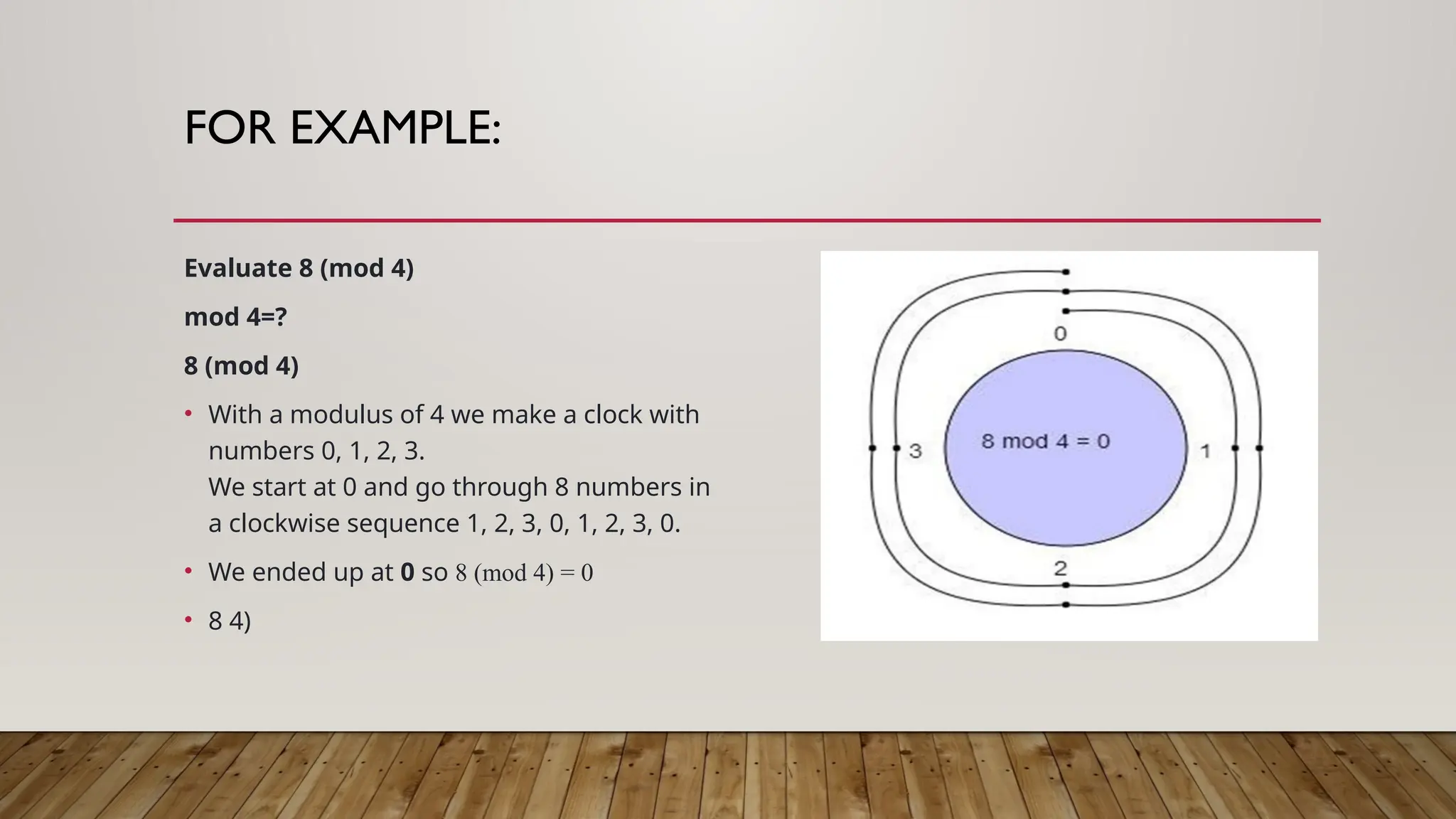
Evaluate 8 (mod 4)
mod 4=?
8 (mod 4)
• With a modulus of 4 we make a clock with
numbers 0, 1, 2, 3.
We start at 0 and go through 8 numbers in
a clockwise sequence 1, 2, 3, 0, 1, 2, 3, 0.
• We ended up at 0 so 8 (mod 4) = 0
• 8 4)
0
3 1
2
8 mod = 0
INTRODUCTION GROUP THEORY
• A group of theory which are systems consisting of a set
of elements and binary operation that can be applied to
two elements of set to satisfy the certain axioms.
• Group theory is the study of algebraic structures.
BRANCHES OF GROUP THEORY
• LINEAR ALGEBRAIC GROUP
- A subgroup or a matrix group that is also an affine variety.
- It may be defined over any field, including those of positive characteristics.
• LIE GROUP
A manifold is a space that locally resembles Euclidean space, where as groups define the abstract,
generic concept of multiplication and the taking if inverse(division)
Combining these two ideas, one obtains a continuous group where points can be multiplied
together, and their inverse can be taken.
ASSESSMENT:
• Modulo 12
1.Evaluate 13 Modulo 12
2. Evaluate 16 modulo 12
3. Evaluate 28 modulo 12

525330712-MODULAR-ARITHMETIC.pptx shshs hz

  • 1.
  • 2.
    CARL FRIEDRICH GAUSS •He developed Modular Arithmetic and introduced the modern approach in his book "Disquisitiones Arithmeticae", which was published in 1801.
  • 3.
    WHAT DOES MODULARARITHMETIC MEAN? • In Mathematics, modular arithmetic is special category of arithmetic that makes use only integers. • It is also considered as Arithmetic of any nontrivial homomorphic images • Arithmetic of congruence. • Modular Arithmetic is usually associated with prime numbers divided by the unique is equal.
  • 4.
    WHAT DOES MODULARMEAN? •Arithmetic of congruence. •Modular Arithmetic is usually associated with prime numbers divided by the unique is equal.
  • 5.
    USES OF MODULARARITHMETIC: •It is uses to calculate checksums for international standard book numbers and bank identifiers and to support errors in them
  • 6.
  • 7.
    APPLICATION OF MODULARARITHMETIC •Is used extensively in pure mathematics where it is cornerstone of number of theory but it also has many practical application.
  • 8.
    MODULO ARITHMETIC INNAMING THE MONTHS IN AYEAR • Months in a year JAN FEB MAR APR MAY JUN JUL AUG SEP OCT NOV DEC 1 2 3 4 5 6 7 8 9 10 11 12
  • 9.
    MODULO ARITHMETIC INNAMING THE DAYS IN A WEEK • Naming of Days in a Week MON TUE WED THU FRI SAT SUN MON TUE WED 1 2 3 4 5 6 7 1 2 3
  • 10.
    SET OF POSITIVEINTEGERS ANDTHE ELEMENT 0 1 2 3 4 5 6 7 8 9 10 11 0 1 0 1 0 1 0 1 0 1 0 1 0 1 2 0 1 2 0 1 2 0 1 2 0 1 2 3 0 1 2 3 0 1 2 3
  • 11.
    MODULAR ARITHMETIC • The‘clock arithmetic’ • System of arithmetic for integers where the numbers wrap after they reach a certain value which is called as the modulus.
  • 12.
    FOR EXAMPLE : aclock with the 12 replaced by a 0 would be the circle for a modulus of 12. 12
  • 13.
    FOR EXAMPLE: Evaluate 8(mod 4) mod 4=? 8 (mod 4) • With a modulus of 4 we make a clock with numbers 0, 1, 2, 3. We start at 0 and go through 8 numbers in a clockwise sequence 1, 2, 3, 0, 1, 2, 3, 0. • We ended up at 0 so 8 (mod 4) = 0 • 8 4) 0 3 1 2 8 mod = 0
  • 14.
    INTRODUCTION GROUP THEORY •A group of theory which are systems consisting of a set of elements and binary operation that can be applied to two elements of set to satisfy the certain axioms. • Group theory is the study of algebraic structures.
  • 15.
    BRANCHES OF GROUPTHEORY • LINEAR ALGEBRAIC GROUP - A subgroup or a matrix group that is also an affine variety. - It may be defined over any field, including those of positive characteristics. • LIE GROUP A manifold is a space that locally resembles Euclidean space, where as groups define the abstract, generic concept of multiplication and the taking if inverse(division) Combining these two ideas, one obtains a continuous group where points can be multiplied together, and their inverse can be taken.
  • 16.
    ASSESSMENT: • Modulo 12 1.Evaluate13 Modulo 12 2. Evaluate 16 modulo 12 3. Evaluate 28 modulo 12