जय गुरुदेव
•Organized sectors.
•Unorganized sectors
•Division of sectors on the basis of
ownership
 Public sector
 Private sector
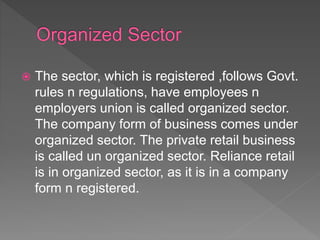
 The sector, which is registered ,follows Govt.
rules n regulations, have employees n
employers union is called organized sector.
The company form of business comes under
organized sector. The private retail business
is called un organized sector. Reliance retail
is in organized sector, as it is in a company
form n registered.
 The sector which is not following the
prescribed norms and the modus operandi
which is standardized and centralized. Many
industries fall into this segment which are
transacting on a pseudo industrial basis. It
more of a perceived factor rather being an
implied one.
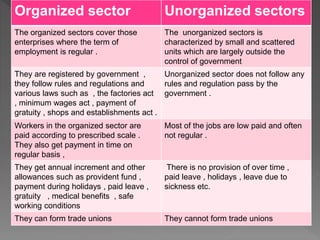
Organized sector Unorganized sectors
The organized sectors cover those
enterprises where the term of
employment is regular .
The unorganized sectors is
characterized by small and scattered
units which are largely outside the
control of government
They are registered by government ,
they follow rules and regulations and
various laws such as , the factories act
, minimum wages act , payment of
gratuity , shops and establishments act .
Unorganized sector does not follow any
rules and regulation pass by the
government .
Workers in the organized sector are
paid according to prescribed scale .
They also get payment in time on
regular basis ,
Most of the jobs are low paid and often
not regular .
They get annual increment and other
allowances such as provident fund ,
payment during holidays , paid leave ,
gratuity , medical benefits , safe
working conditions
There is no provision of over time ,
paid leave , holidays , leave due to
sickness etc.
They can form trade unions They cannot form trade unions
 They are paid low salaries , therefore they are not
able to fulfill even there basic needs .
 They are exploited .
 Employment is there but not on regular basis they
can be thrown out any time without any crime or
reason .
 Other than salary which is very low they don’t get
any other benefits .
 These workers also face social discrimination .
 protection and support to the unorganised sector is
both necessary for economic and social
development .
 Public sector
 Private sector
 The public sector is that part of the economy
whose primary concern is to provide the
basic government services. In most
countries around the world, the public sector
consists of services like the military, police,
public transport, roads, education, and
healthcare services. It has the responsibility
to provide services which will benefit all
including non payers.
 The part of national economy made up of
private enterprises. It includes the personal
sector (households) and corporate sector
(companies), and is responsible for
allocating most of the resources within an
economy. See also public sector.
Public sector Private sector
It is owned by state or central
government .
It is owned by private individuals .
They work with the main motive of
providing service to the public
They work for profit earning .
It is guided by social objectives like
development of backward regions ,
creation of employment , and
equitable distribution of wealth .
In this sector social objectives are
not important it is subjected to strict
financial control of the government .
For example , railways , air India ,
LIC , RBI , FCI .
For example , reliance industries
limited , Tata iron and steel
company limited .
 Infrastructure : construction of roads ,
bridges , generating electricity , irrigation ,
education etc. are several things needed by
society , but private sector could not invest
as large amount of money is required .
 Also collecting money from thousand of
people is not easy .
 Hence government has to undertake such
heavy spending and ensure creation of
infrastructure .
 Public welfare : providing health , housing
facilities , safe drinking water , food and
nutrition for poor are the primary
responsibilities of the government these
activites should be taken up the
government as private sector would like to
maximize there profits and has no interest
in public welfare .
•Abhishek Bharadwaj
•Abhishek Dubey
•Aman Vyas
•Deveshree Golwalkar
•Divya Jain
•Harshita Kumbhare
•Jayesh Pawar
•Mitesh Patidar
•Payaswini Rai
•Pradeep Meena

Sectors

  • 1.
  • 2.
    •Organized sectors. •Unorganized sectors •Divisionof sectors on the basis of ownership  Public sector  Private sector
  • 3.
     The sector,which is registered ,follows Govt. rules n regulations, have employees n employers union is called organized sector. The company form of business comes under organized sector. The private retail business is called un organized sector. Reliance retail is in organized sector, as it is in a company form n registered.
  • 4.
     The sectorwhich is not following the prescribed norms and the modus operandi which is standardized and centralized. Many industries fall into this segment which are transacting on a pseudo industrial basis. It more of a perceived factor rather being an implied one.
  • 6.
    Organized sector Unorganizedsectors The organized sectors cover those enterprises where the term of employment is regular . The unorganized sectors is characterized by small and scattered units which are largely outside the control of government They are registered by government , they follow rules and regulations and various laws such as , the factories act , minimum wages act , payment of gratuity , shops and establishments act . Unorganized sector does not follow any rules and regulation pass by the government . Workers in the organized sector are paid according to prescribed scale . They also get payment in time on regular basis , Most of the jobs are low paid and often not regular . They get annual increment and other allowances such as provident fund , payment during holidays , paid leave , gratuity , medical benefits , safe working conditions There is no provision of over time , paid leave , holidays , leave due to sickness etc. They can form trade unions They cannot form trade unions
  • 7.
     They arepaid low salaries , therefore they are not able to fulfill even there basic needs .  They are exploited .  Employment is there but not on regular basis they can be thrown out any time without any crime or reason .  Other than salary which is very low they don’t get any other benefits .  These workers also face social discrimination .  protection and support to the unorganised sector is both necessary for economic and social development .
  • 8.
     Public sector Private sector
  • 9.
     The publicsector is that part of the economy whose primary concern is to provide the basic government services. In most countries around the world, the public sector consists of services like the military, police, public transport, roads, education, and healthcare services. It has the responsibility to provide services which will benefit all including non payers.
  • 10.
     The partof national economy made up of private enterprises. It includes the personal sector (households) and corporate sector (companies), and is responsible for allocating most of the resources within an economy. See also public sector.
  • 11.
    Public sector Privatesector It is owned by state or central government . It is owned by private individuals . They work with the main motive of providing service to the public They work for profit earning . It is guided by social objectives like development of backward regions , creation of employment , and equitable distribution of wealth . In this sector social objectives are not important it is subjected to strict financial control of the government . For example , railways , air India , LIC , RBI , FCI . For example , reliance industries limited , Tata iron and steel company limited .
  • 13.
     Infrastructure :construction of roads , bridges , generating electricity , irrigation , education etc. are several things needed by society , but private sector could not invest as large amount of money is required .  Also collecting money from thousand of people is not easy .  Hence government has to undertake such heavy spending and ensure creation of infrastructure .
  • 15.
     Public welfare: providing health , housing facilities , safe drinking water , food and nutrition for poor are the primary responsibilities of the government these activites should be taken up the government as private sector would like to maximize there profits and has no interest in public welfare .
  • 17.
    •Abhishek Bharadwaj •Abhishek Dubey •AmanVyas •Deveshree Golwalkar •Divya Jain •Harshita Kumbhare •Jayesh Pawar •Mitesh Patidar •Payaswini Rai •Pradeep Meena