Machine Learning - A
walkthrough
By:
Akshada Bhandari
Data Scientist Intern
-Vasundharaa Geo Technologies
ML Lead at GDSC
Contents :
● Introduction to Machine
Learning
● Life cycle about Machine
Learning/Data Science
Projects
● Algorithms
● Use Cases
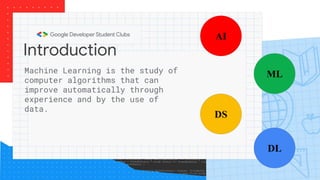
Introduction
Machine Learning is the study of
computer algorithms that can
improve automatically through
experience and by the use of
data.
AI
ML
DS
DL
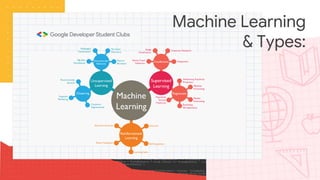
Machine Learning
& Types:
Life Cycle of ML/DS Projects :
● Data Selection
● Data Description
● Performing Statistical and Graphical Data Analysis
● Data Transformation (if necessary)
● Selection of ML algorithms based on patterns
observed in EDA
● Data Standardization and Normalization
● Train test split
● Model training
● Evaluation metrics
● Deployment
The Classification algorithm is a Supervised Learning technique that is
used to identify the category of new observations on the basis of
training data. In Classification, a program learns from the given
dataset or observations and then classifies new observation into a
number of classes or groups. Such as, Yes or No, 0 or 1, Spam or
Not Spam, cat or dog, etc. Classes can be called as targets/labels or
categories.
Classification
Regression in statistics is the process of predicting a Label(or Dependent
Variable) based on the features(Independent Variables) at hand. Regression
is used for time series modelling and finding the causal effect relationship
between the variables and forecasting. For example, the relationship
between the stock prices of the company and various factors like customer
reputation and company annual performance etc. can be studied using
regression.
Regression
Supervised ML :
● Linear Regression
● Logistic Regression
● SVM
● Naive Bayes
● Decision Trees
● Random Forest
● Ada Boost
● Gradient Boosting
● XG Boost
● KNN
● Time Series (Arimas, Sarinas)
Algorithms
Unsupervised ML :
● K means clustering
● DBScan
● K - Neigbours
● PCA (Principal Component Analysis)
Algorithms
Use Cases :
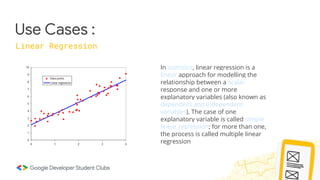
Linear Regression
In statistics, linear regression is a
linear approach for modelling the
relationship between a scalar
response and one or more
explanatory variables (also known as
dependent and independent
variables). The case of one
explanatory variable is called simple
linear regression; for more than one,
the process is called multiple linear
regression
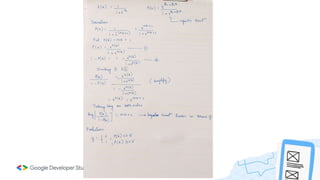
Logistic Regression
Logistic regression is a
statistical model that in its basic
form uses a logistic function to
model a binary dependent
variable, although many more
complex extensions exist. In
regression analysis, logistic
regression[1] (or logit regression)
is estimating the parameters of
a logistic model (a form of
binary regression).
● Healthcare
● Security
● NLP
● Robotics
● Recommendation Systems
● Finance Sectors
● E-commerce
● Automation
Applications :

Ml workshop

  • 1.
    Machine Learning -A walkthrough By: Akshada Bhandari Data Scientist Intern -Vasundharaa Geo Technologies ML Lead at GDSC
  • 2.
    Contents : ● Introductionto Machine Learning ● Life cycle about Machine Learning/Data Science Projects ● Algorithms ● Use Cases
  • 3.
    Introduction Machine Learning isthe study of computer algorithms that can improve automatically through experience and by the use of data. AI ML DS DL
  • 4.
  • 5.
    Life Cycle ofML/DS Projects : ● Data Selection ● Data Description ● Performing Statistical and Graphical Data Analysis ● Data Transformation (if necessary) ● Selection of ML algorithms based on patterns observed in EDA ● Data Standardization and Normalization ● Train test split ● Model training ● Evaluation metrics ● Deployment
  • 6.
    The Classification algorithmis a Supervised Learning technique that is used to identify the category of new observations on the basis of training data. In Classification, a program learns from the given dataset or observations and then classifies new observation into a number of classes or groups. Such as, Yes or No, 0 or 1, Spam or Not Spam, cat or dog, etc. Classes can be called as targets/labels or categories. Classification
  • 7.
    Regression in statisticsis the process of predicting a Label(or Dependent Variable) based on the features(Independent Variables) at hand. Regression is used for time series modelling and finding the causal effect relationship between the variables and forecasting. For example, the relationship between the stock prices of the company and various factors like customer reputation and company annual performance etc. can be studied using regression. Regression
  • 8.
    Supervised ML : ●Linear Regression ● Logistic Regression ● SVM ● Naive Bayes ● Decision Trees ● Random Forest ● Ada Boost ● Gradient Boosting ● XG Boost ● KNN ● Time Series (Arimas, Sarinas) Algorithms
  • 9.
    Unsupervised ML : ●K means clustering ● DBScan ● K - Neigbours ● PCA (Principal Component Analysis) Algorithms
  • 10.
    Use Cases : LinearRegression In statistics, linear regression is a linear approach for modelling the relationship between a scalar response and one or more explanatory variables (also known as dependent and independent variables). The case of one explanatory variable is called simple linear regression; for more than one, the process is called multiple linear regression
  • 11.
    Logistic Regression Logistic regressionis a statistical model that in its basic form uses a logistic function to model a binary dependent variable, although many more complex extensions exist. In regression analysis, logistic regression[1] (or logit regression) is estimating the parameters of a logistic model (a form of binary regression).
  • 13.
    ● Healthcare ● Security ●NLP ● Robotics ● Recommendation Systems ● Finance Sectors ● E-commerce ● Automation Applications :