Unit-3:
Clustering
Semiparametric Density Estimation
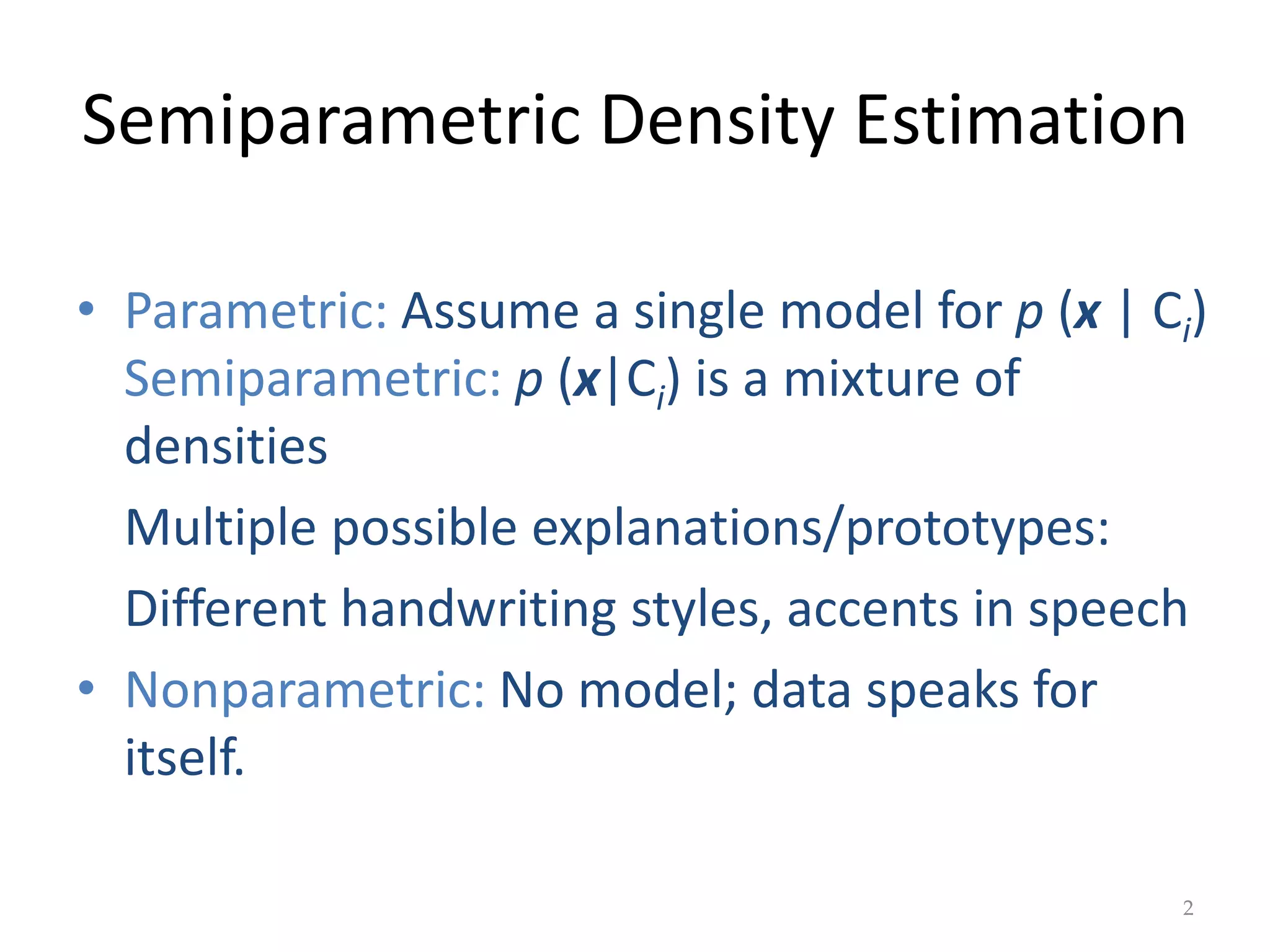
• Parametric: Assume a single model for p (x | Ci)
Semiparametric: p (x|Ci) is a mixture of
densities
Multiple possible explanations/prototypes:
Different handwriting styles, accents in speech
• Nonparametric: No model; data speaks for
itself.
2
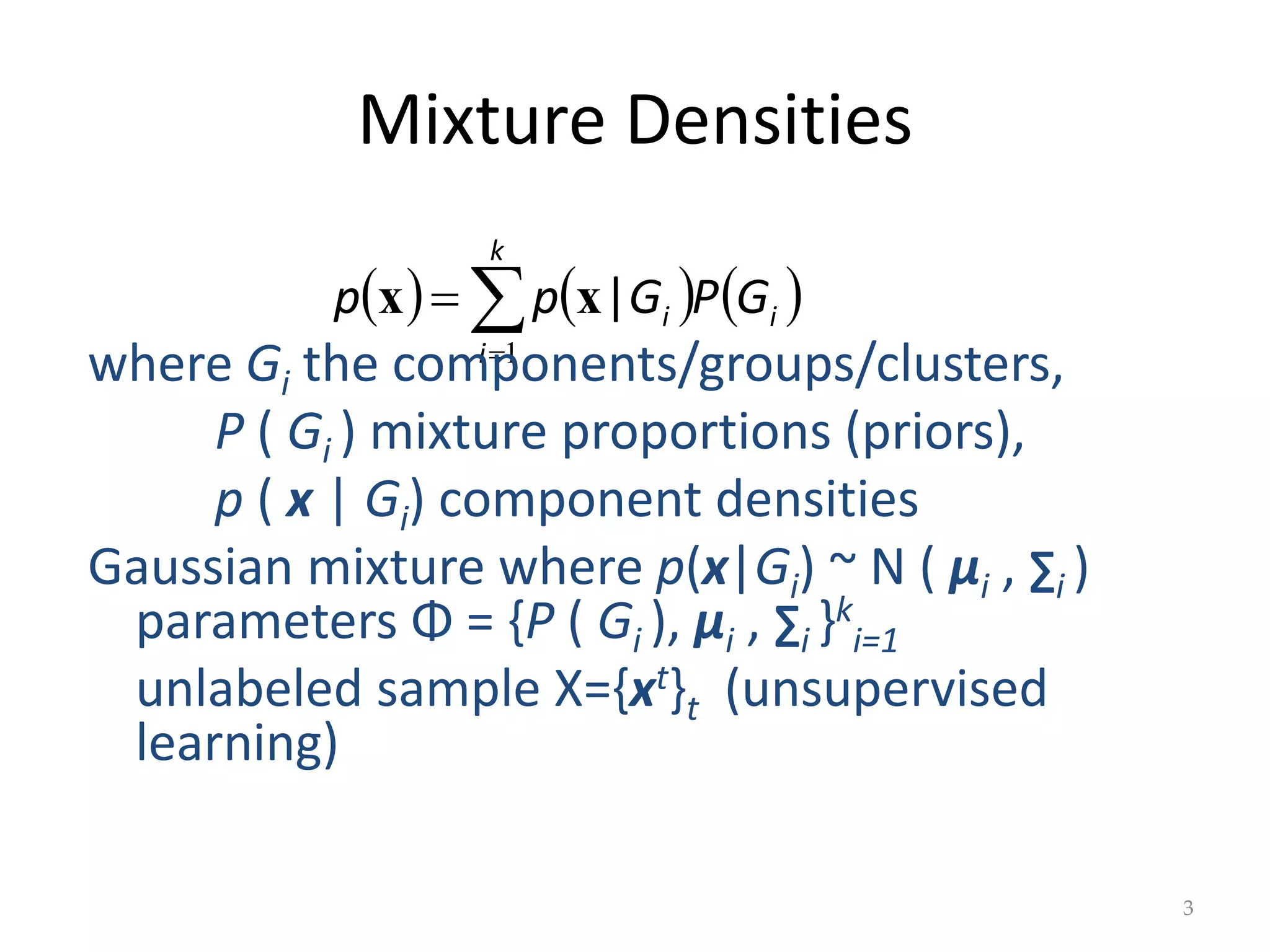
Mixture Densities
     



k
i
i
i G
P
G
p
p
1
|
x
x
3
where Gi the components/groups/clusters,
P ( Gi ) mixture proportions (priors),
p ( x | Gi) component densities
Gaussian mixture where p(x|Gi) ~ N ( μi , ∑i )
parameters Φ = {P ( Gi ), μi , ∑i }k
i=1
unlabeled sample X={xt}t (unsupervised
learning)
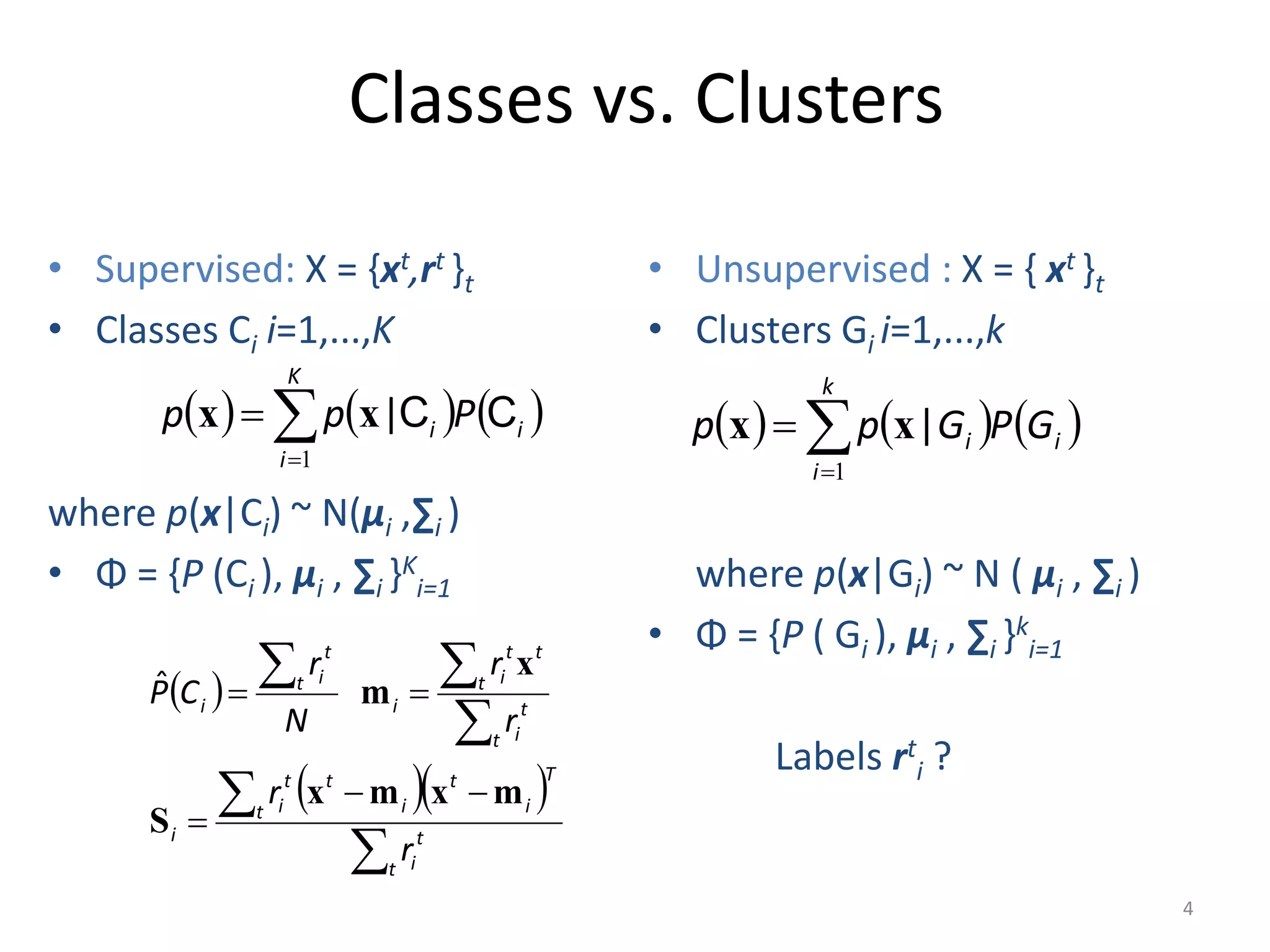
Classes vs. Clusters
• Supervised: X = {xt,rt }t
• Classes Ci i=1,...,K
where p(x|Ci) ~ N(μi ,∑i )
• Φ = {P (Ci ), μi , ∑i }K
i=1
• Unsupervised : X = { xt }t
• Clusters Gi i=1,...,k
where p(x|Gi) ~ N ( μi , ∑i )
• Φ = {P ( Gi ), μi , ∑i }k
i=1
Labels rt
i ?
4
     



k
i
i
i G
P
G
p
p
1
|
x
x
     



K
i
i
i P
p
p
1
C
C
|
x
x
 
  










t
t
i
T
i
t
t i
t
t
i
i
t
t
i
t
t
t
i
i
t
t
i
i
r
r
r
r
N
r
C
P
m
x
m
x
x
m
S
ˆ
k-Means Clustering
j
t
j
i
t
m
x
m
x 

 min
5
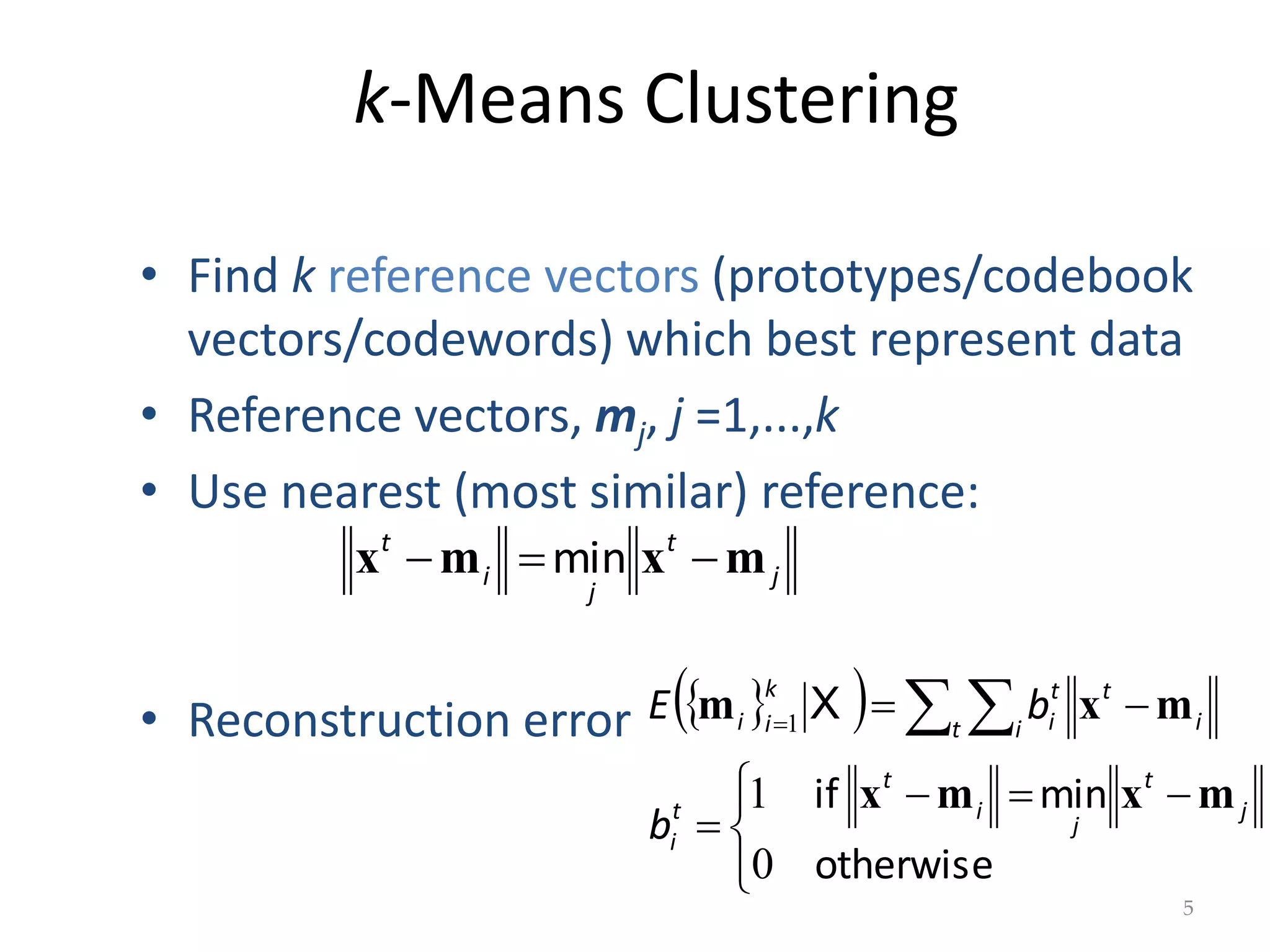
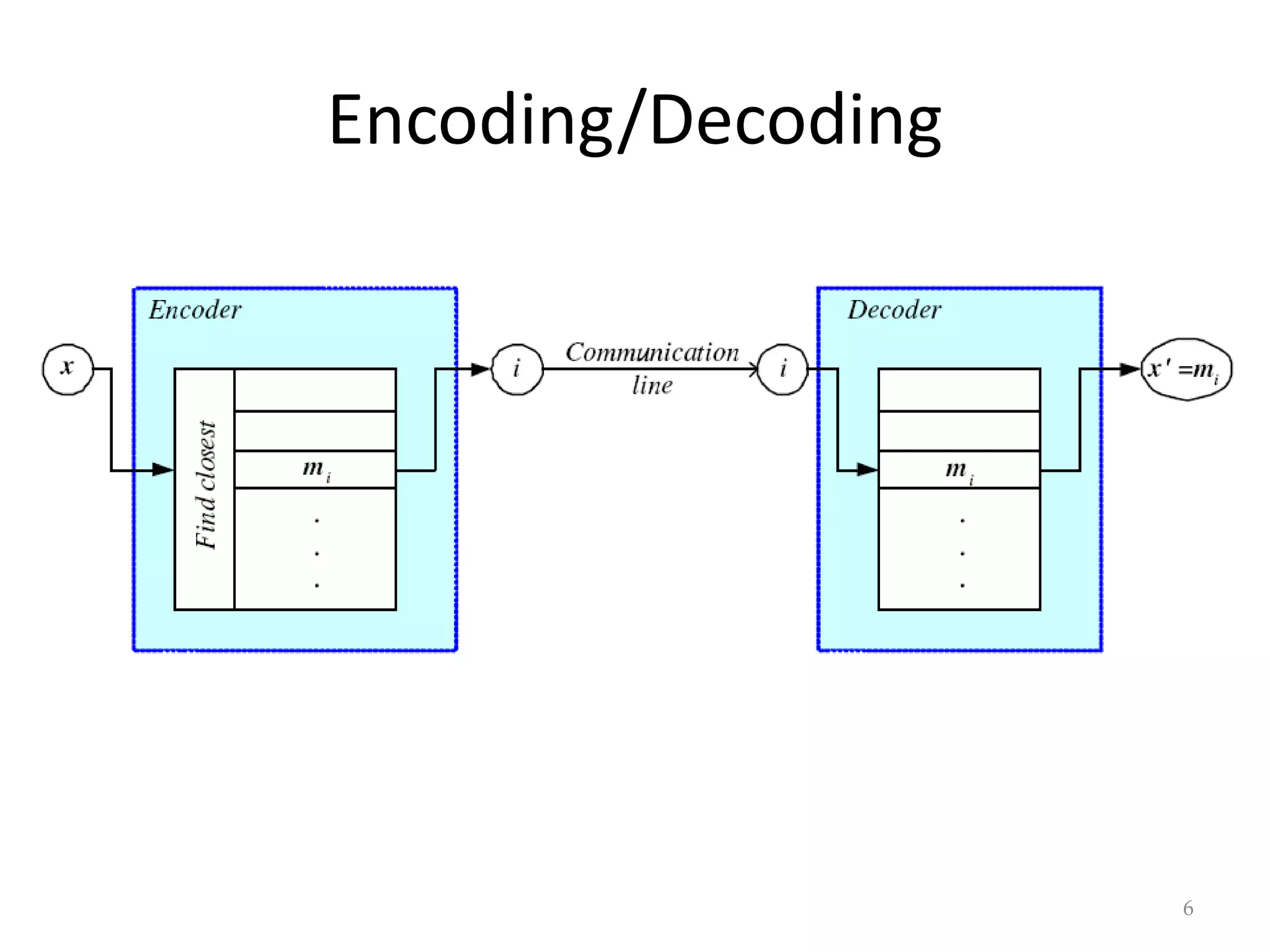
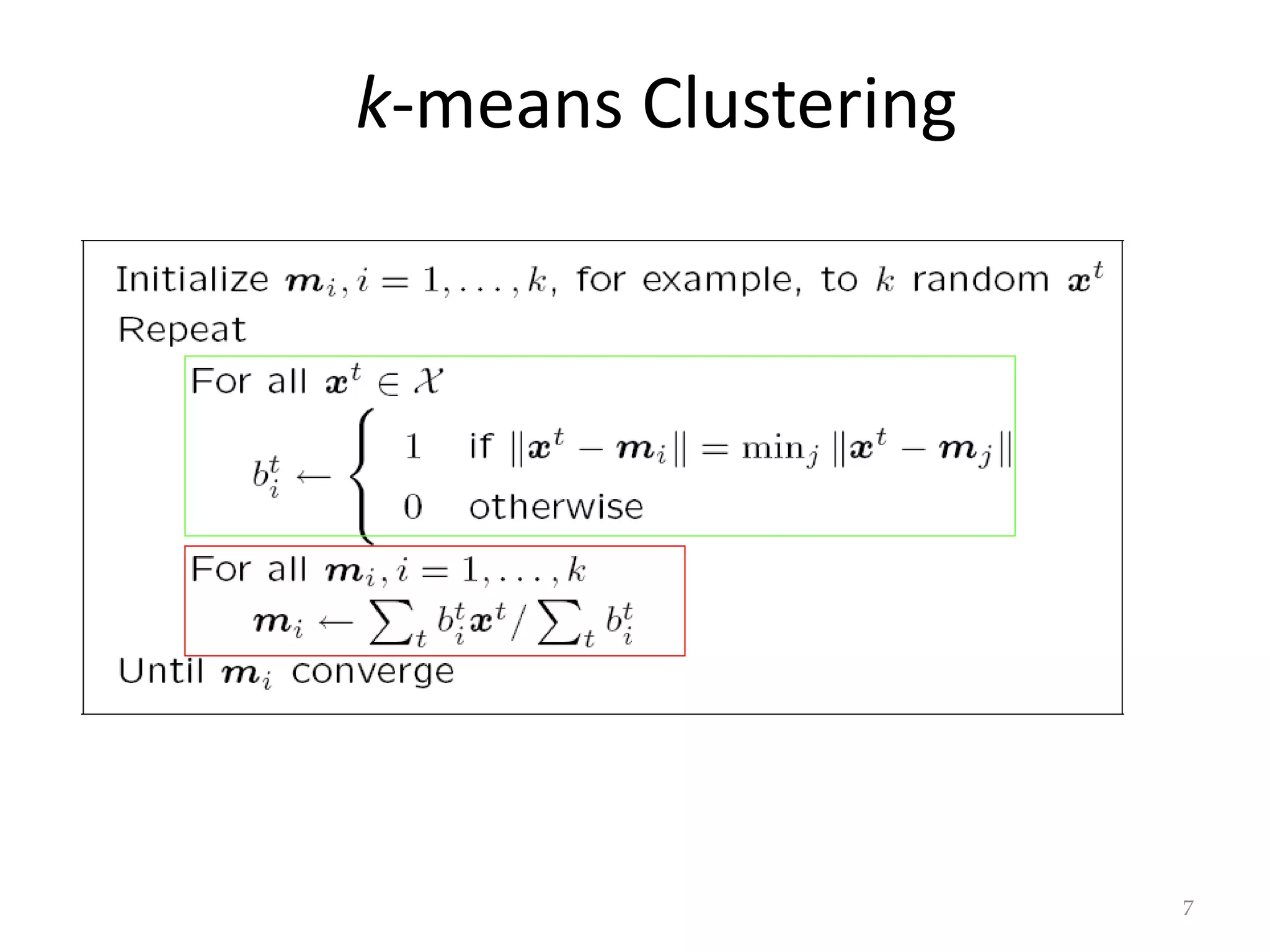
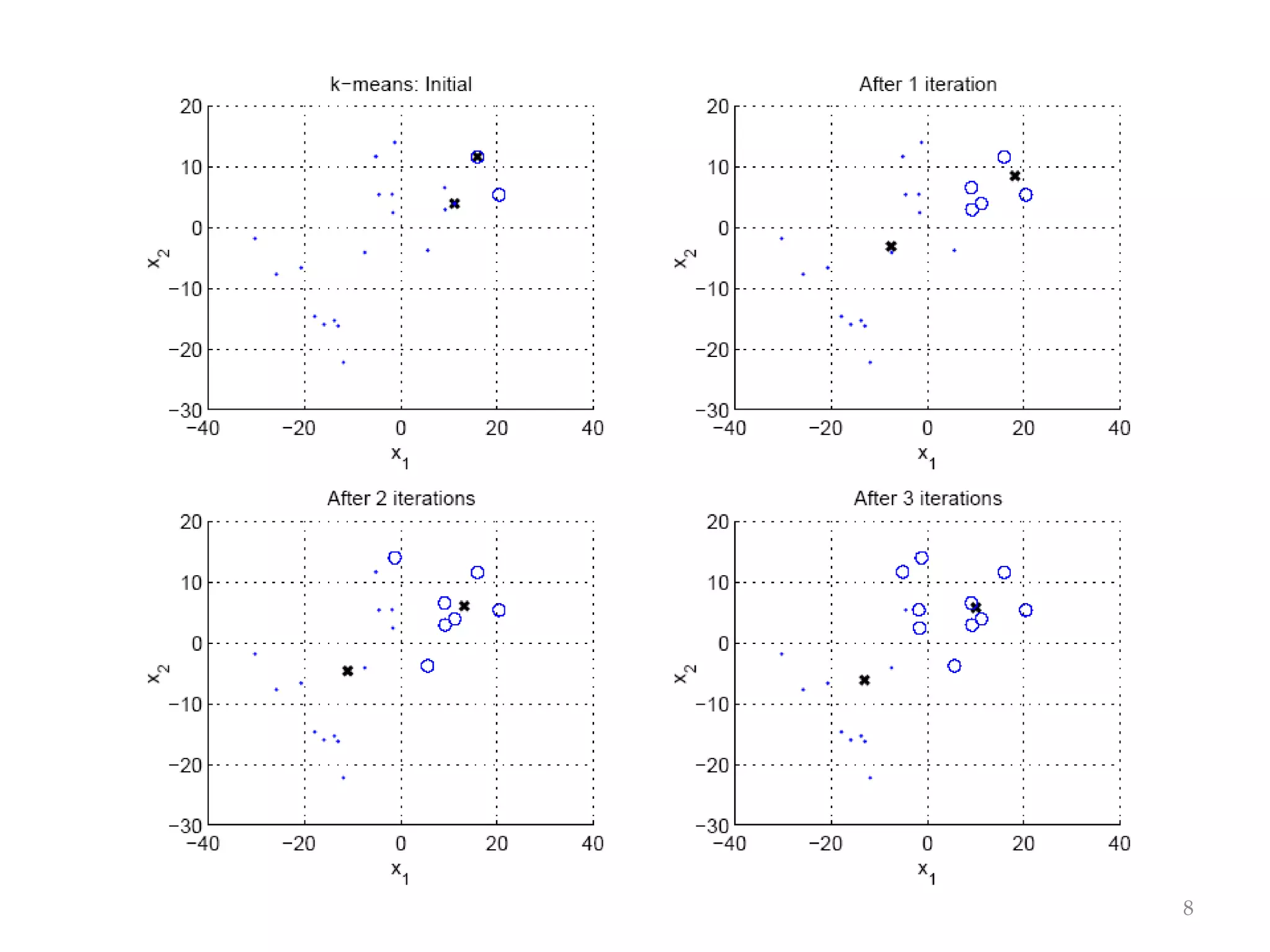
• Find k reference vectors (prototypes/codebook
vectors/codewords) which best represent data
• Reference vectors, mj, j =1,...,k
• Use nearest (most similar) reference:
• Reconstruction error  
 




 




  

otherwise
min
if
0
1
1
j
t
j
i
t
t
i
t i i
t
t
i
k
i
i
b
b
E
m
x
m
x
m
x
m X
Encoding/Decoding




 



otherwise
0
min
if
1 j
t
j
i
t
t
i
b
m
x
m
x
6
k-means Clustering
7
8
Expectation-Maximization (EM)
   
   
 






t
k
i
i
i
t
t
t
G
P
G
p
p
1
|
log
|
log
|
x
x
X
L
9
• Log likelihood with a mixture model
• Assume hidden variables z, which when known, make
optimization much simpler
• Complete likelihood, Lc(Φ |X,Z), in terms of x and z
• Incomplete likelihood, L(Φ |X), in terms of x
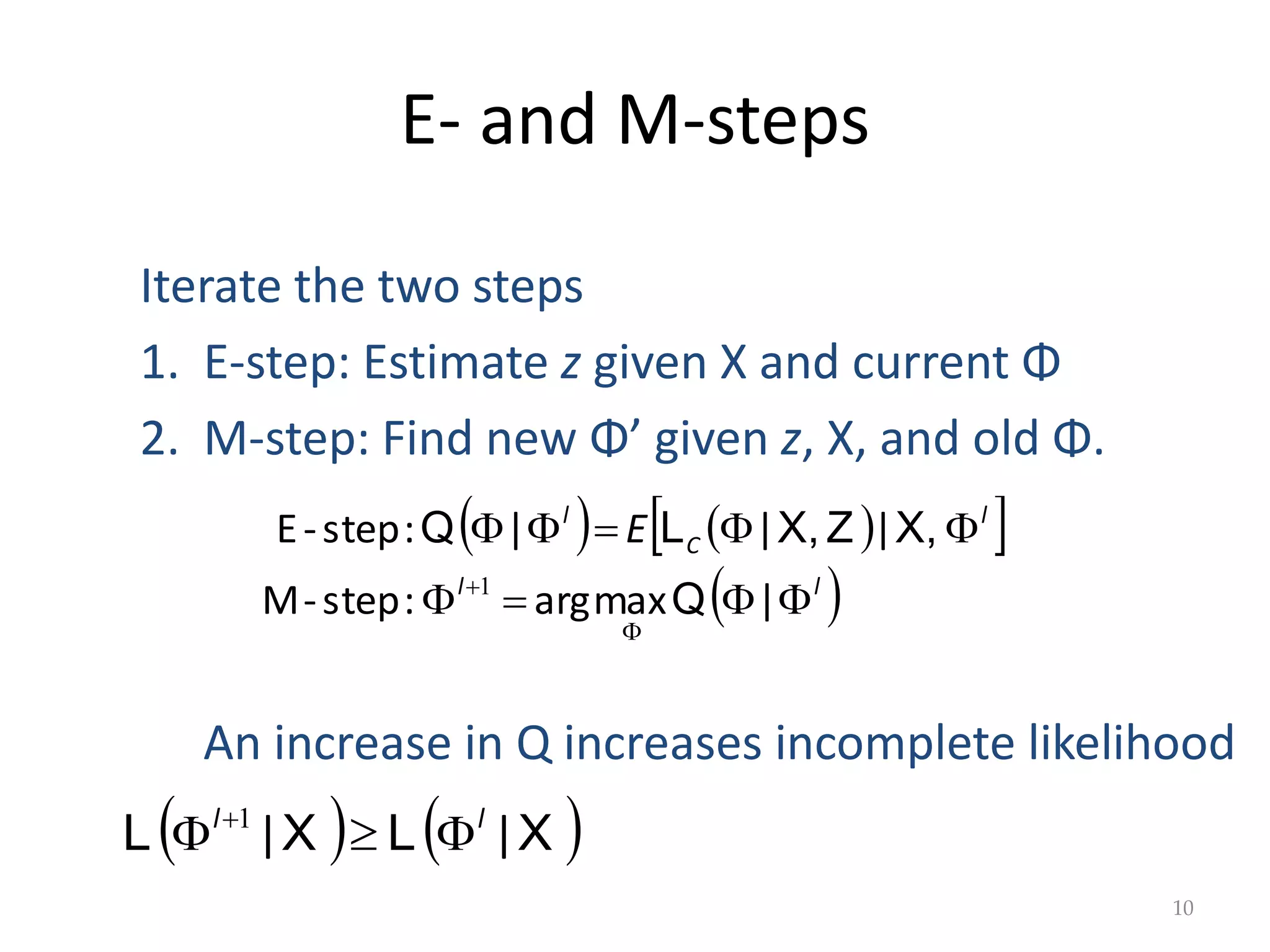
E- and M-steps
   
 
 
l
l
l
C
l
E











|
max
arg
:
step
-
M
|
|
|
:
step
-
E
Q
X,
Z
X,
L
Q
1
10
Iterate the two steps
1. E-step: Estimate z given X and current Φ
2. M-step: Find new Φ’ given z, X, and old Φ.
An increase in Q increases incomplete likelihood
   
X
L
X
L |
| l
l


 1
EM in Gaussian Mixtures
     
   
  t
i
l
t
i
j j
l
j
t
i
l
i
t
l
t
i
h
G
P
G
P
G
p
G
P
G
p
z
E








,
,
,
X
x
x
x
|
|
|
,
11
• zt
i = 1 if xt belongs to Gi, 0 otherwise (labels r t
i of
supervised learning); assume p(x|Gi)~N(μi,∑i)
• E-step:
• M-step:
 
  














t
t
i
T
l
i
t
t
l
i
t
t
i
l
i
t
t
i
t
t
t
i
l
i
t
t
i
i
h
h
h
h
N
h
P
1
1
1
1
m
x
m
x
x
m
S
G Use estimated labels in
place of unknown labels
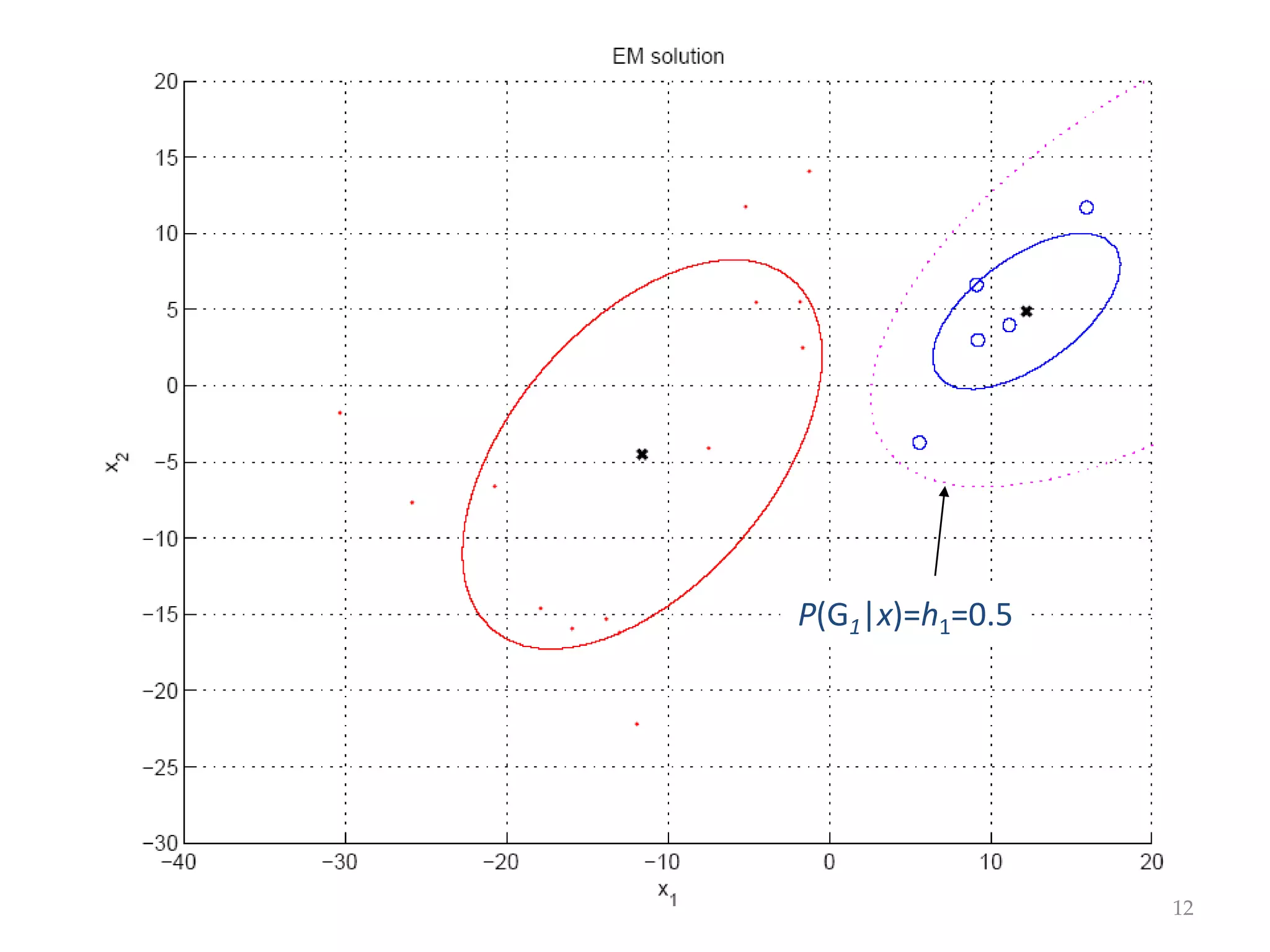
12
P(G1|x)=h1=0.5
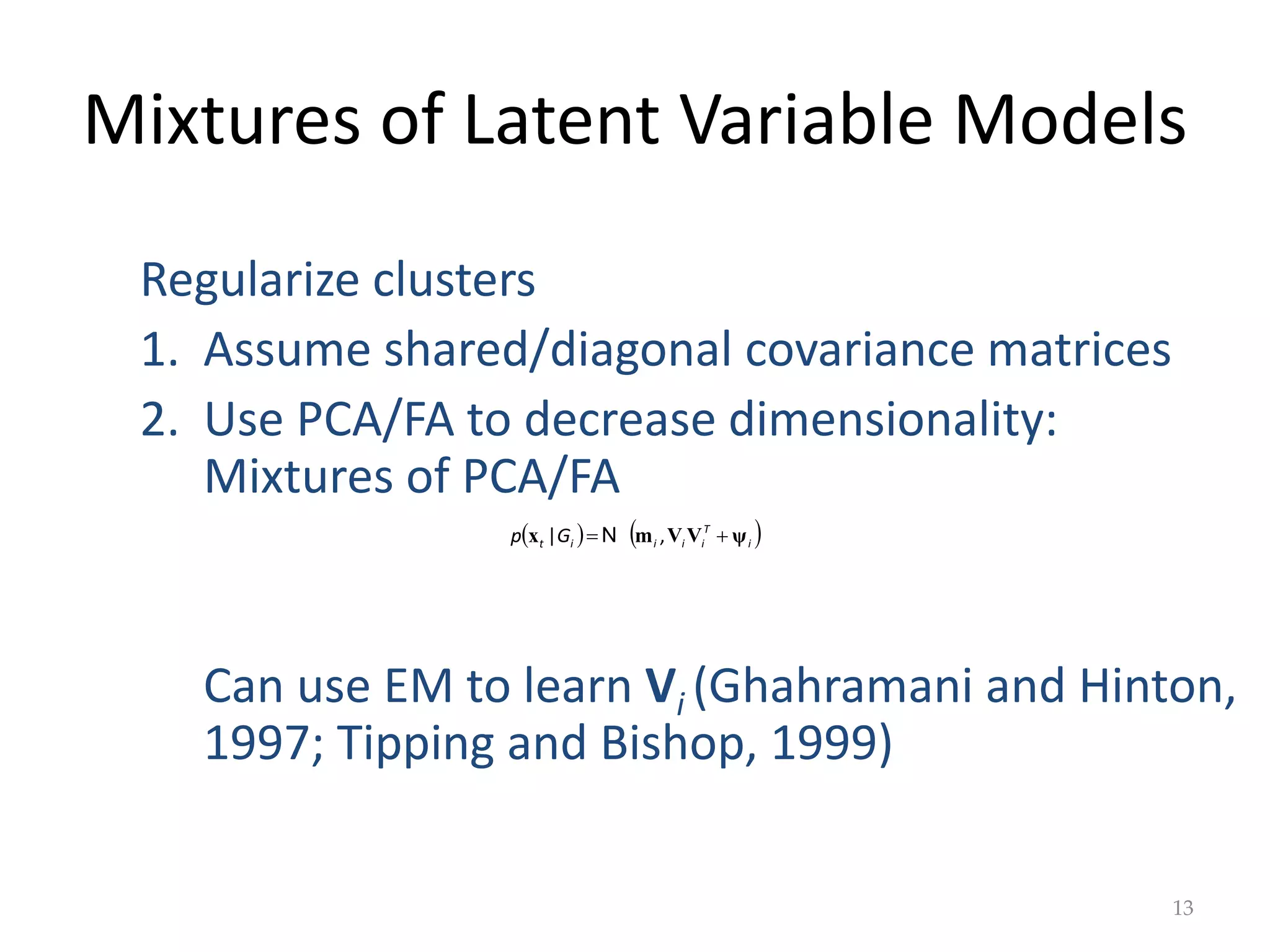
Mixtures of Latent Variable Models
   
i
T
i
i
i
i
t G
p ψ
m
x 
 V
V
,
| N
13
Regularize clusters
1. Assume shared/diagonal covariance matrices
2. Use PCA/FA to decrease dimensionality:
Mixtures of PCA/FA
Can use EM to learn Vi (Ghahramani and Hinton,
1997; Tipping and Bishop, 1999)
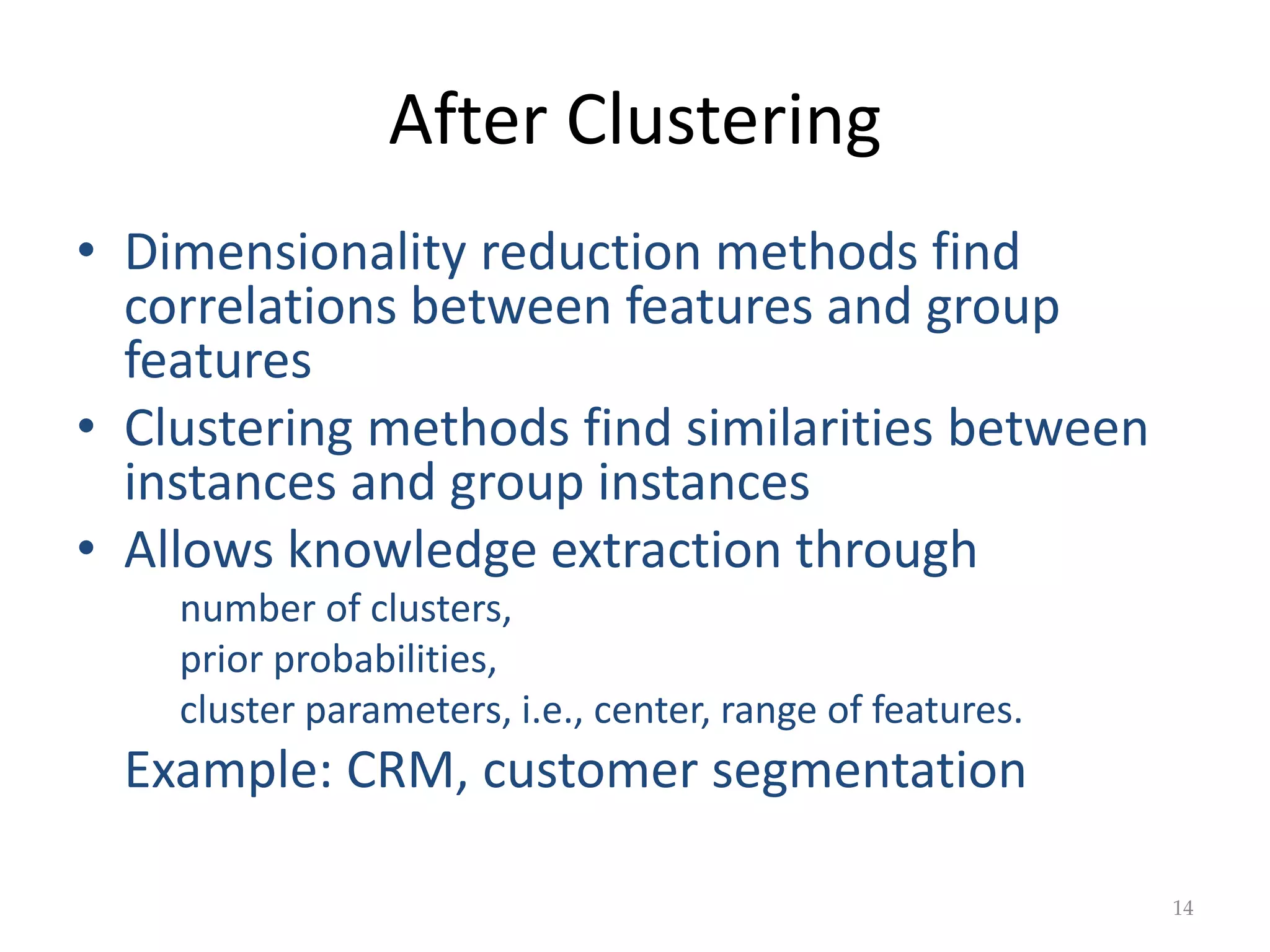
After Clustering
• Dimensionality reduction methods find
correlations between features and group
features
• Clustering methods find similarities between
instances and group instances
• Allows knowledge extraction through
number of clusters,
prior probabilities,
cluster parameters, i.e., center, range of features.
Example: CRM, customer segmentation
14
Clustering as Preprocessing
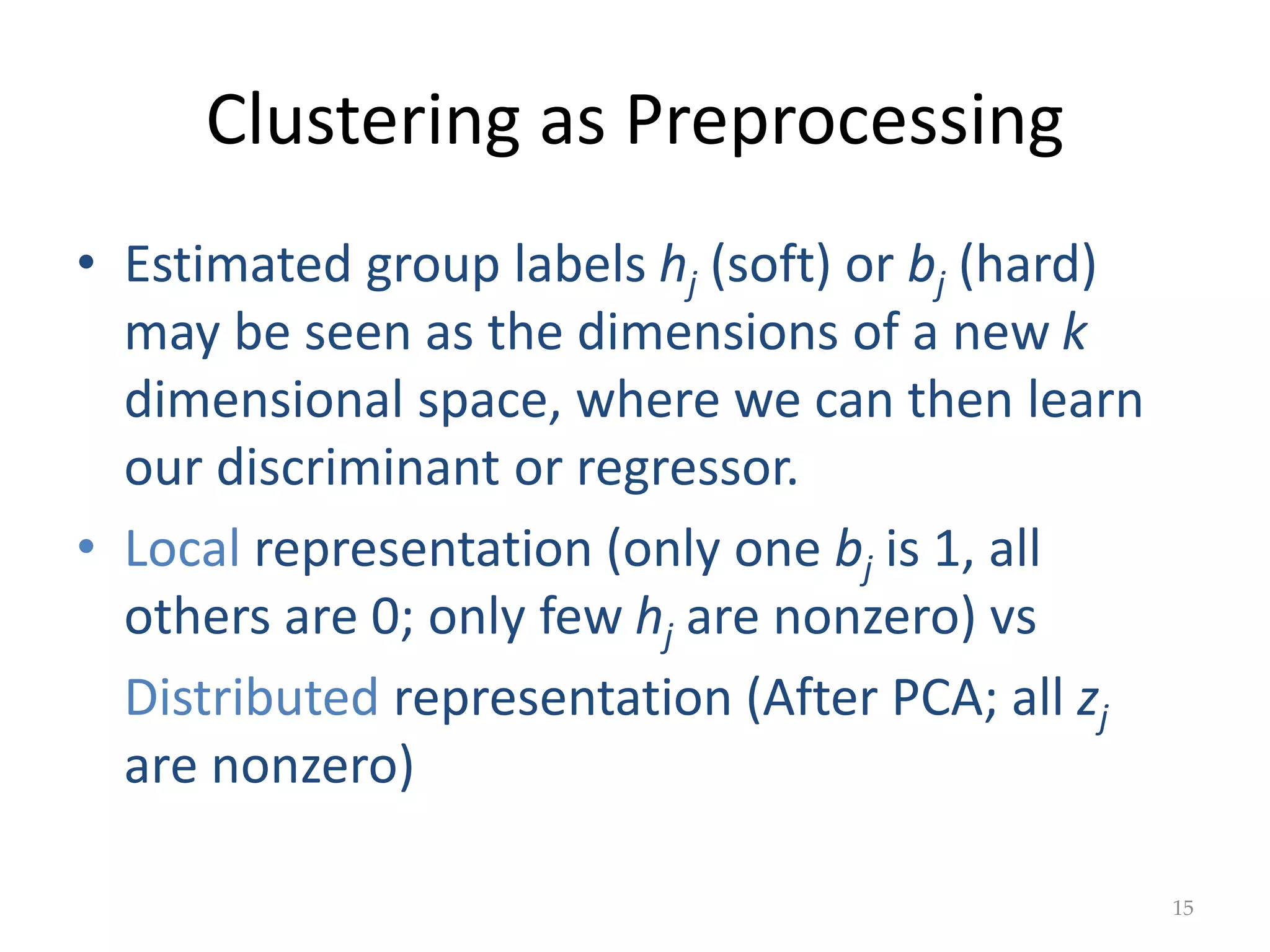
• Estimated group labels hj (soft) or bj (hard)
may be seen as the dimensions of a new k
dimensional space, where we can then learn
our discriminant or regressor.
• Local representation (only one bj is 1, all
others are 0; only few hj are nonzero) vs
Distributed representation (After PCA; all zj
are nonzero)
15
Mixture of Mixtures
     
     






K
i
i
i
k
j
ij
ij
i
P
p
p
G
P
G
p
p
i
1
1
C
C
C
|
|
|
x
x
x
x
16
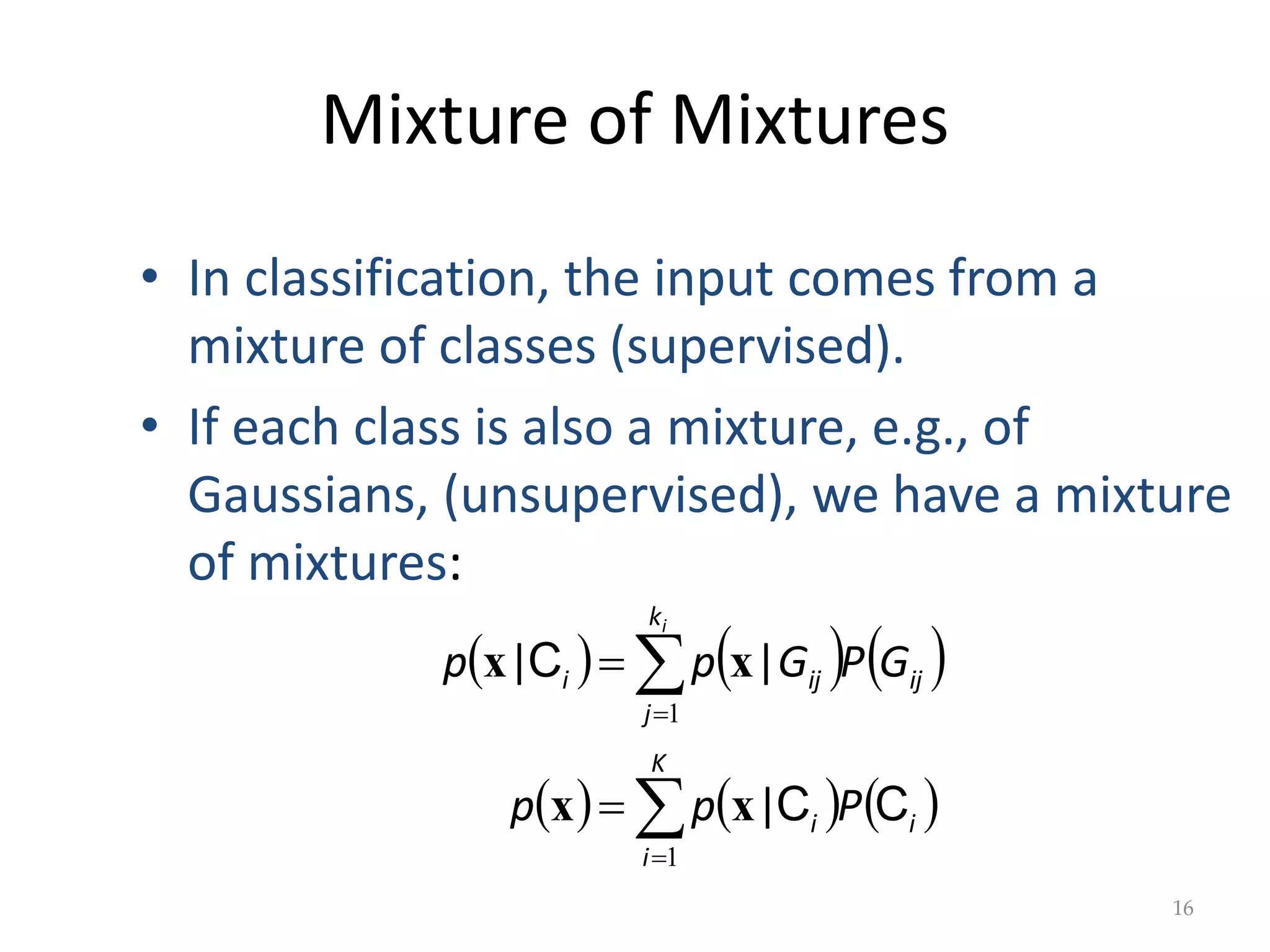
• In classification, the input comes from a
mixture of classes (supervised).
• If each class is also a mixture, e.g., of
Gaussians, (unsupervised), we have a mixture
of mixtures:
Spectral Clustering
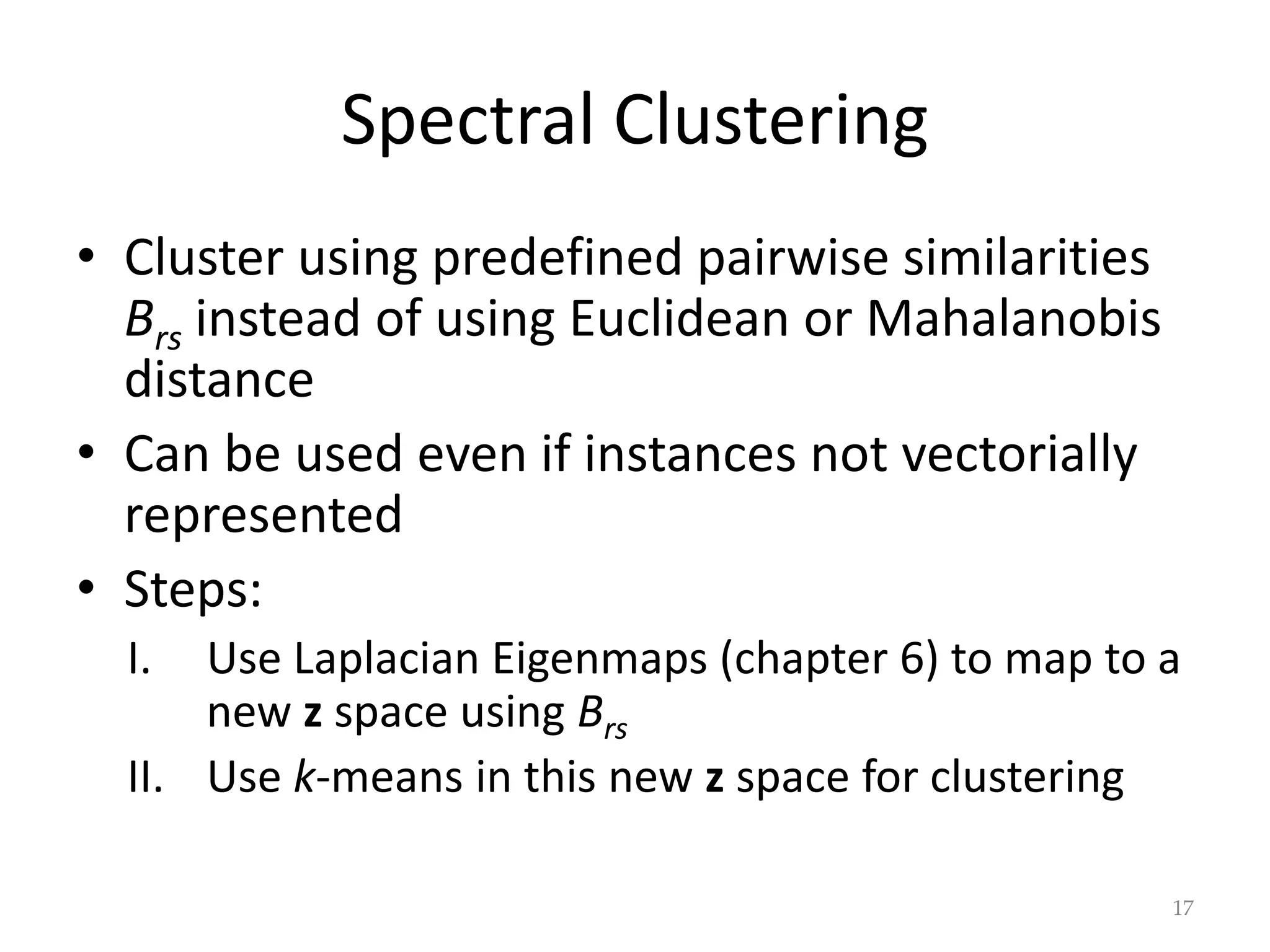
• Cluster using predefined pairwise similarities
Brs instead of using Euclidean or Mahalanobis
distance
• Can be used even if instances not vectorially
represented
• Steps:
I. Use Laplacian Eigenmaps (chapter 6) to map to a
new z space using Brs
II. Use k-means in this new z space for clustering
17
Hierarchical Clustering
   
  p
d
j
p
s
j
r
j
s
r
m x
x
d
/
,
1
1



x
x
18
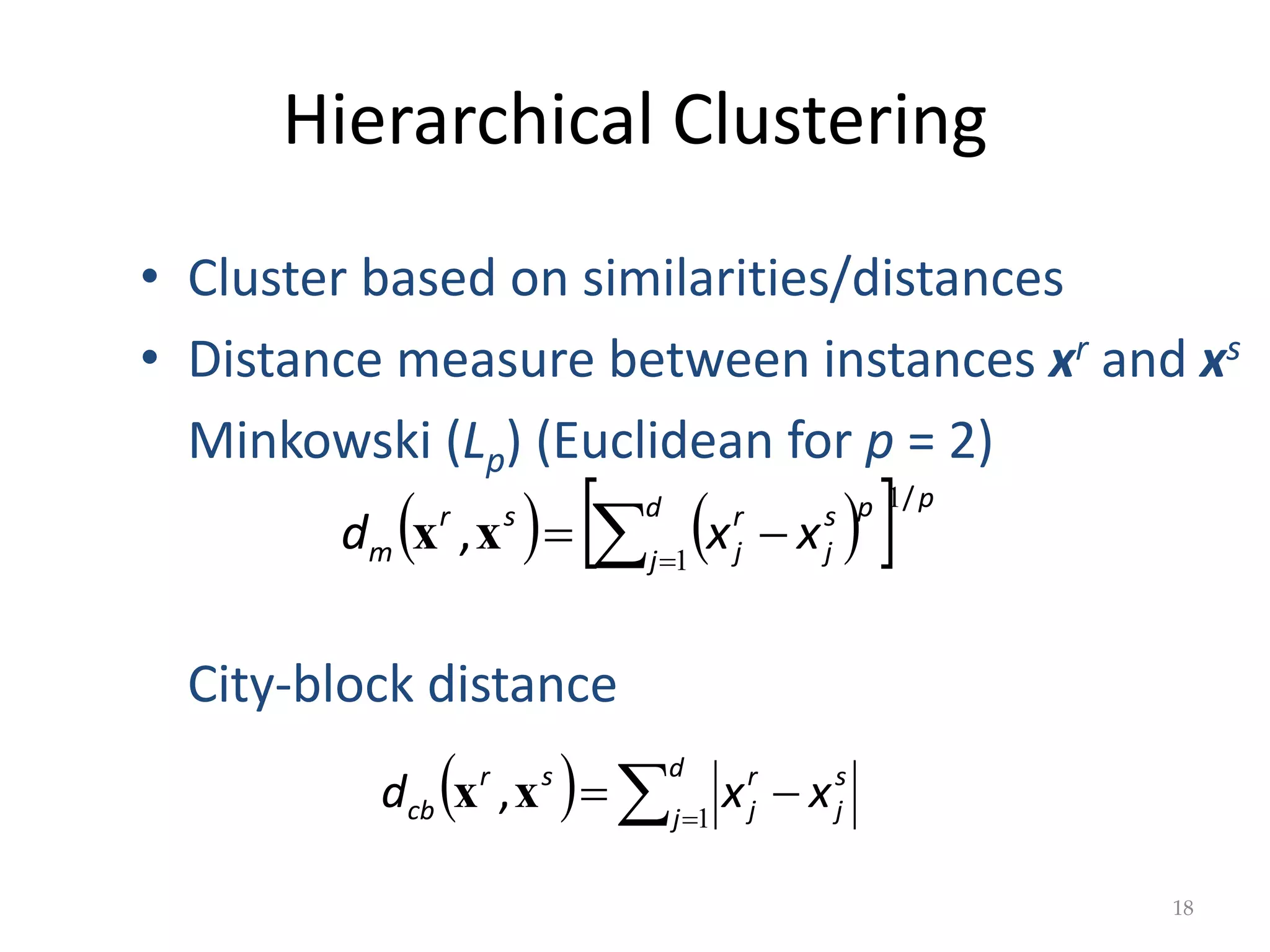
• Cluster based on similarities/distances
• Distance measure between instances xr and xs
Minkowski (Lp) (Euclidean for p = 2)
City-block distance
   


d
j
s
j
r
j
s
r
cb x
x
d 1
x
x ,
Agglomerative Clustering
   
s
r
j
i d
G
G
d
j
s
i
r
x
x
x
x
,
min
,
, G
G 


19
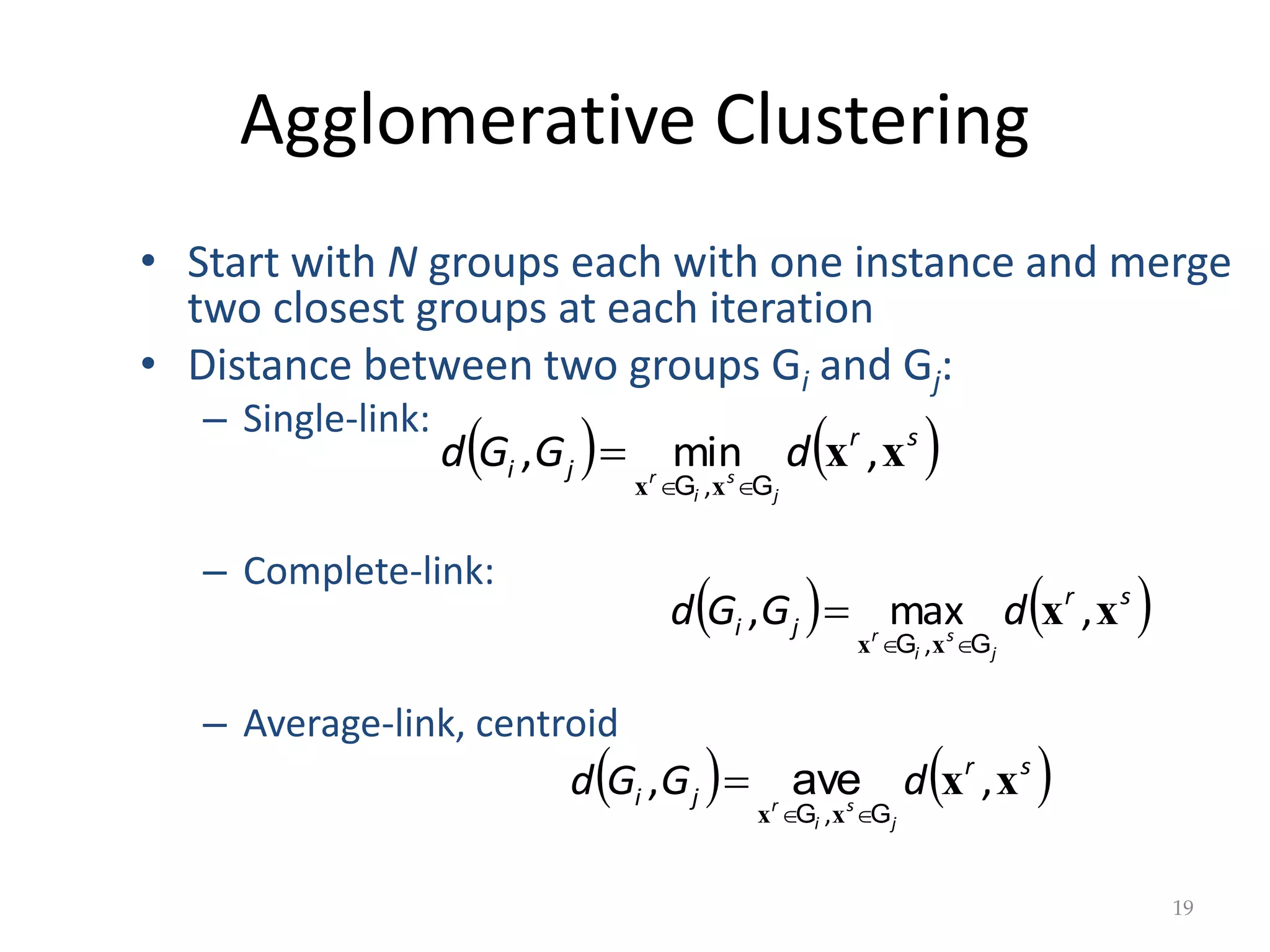
• Start with N groups each with one instance and merge
two closest groups at each iteration
• Distance between two groups Gi and Gj:
– Single-link:
– Complete-link:
– Average-link, centroid
   
s
r
j
i d
G
G
d
j
s
i
r
x
x
x
x
,
max
,
, G
G 


   
s
r
j
i d
G
G
d
j
s
i
r
x
x
x
x
,
,
, G
G 

 ave
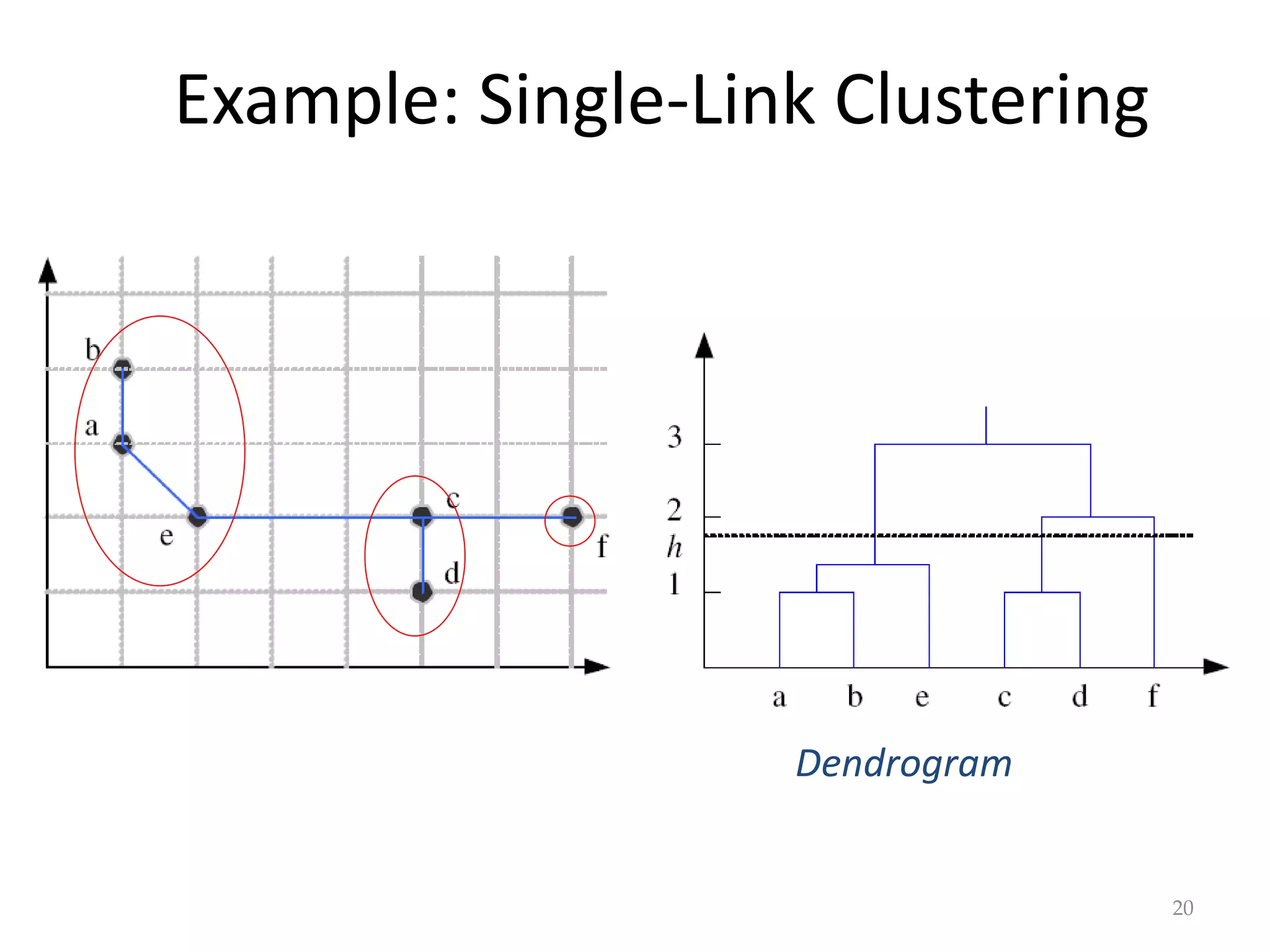
Example: Single-Link Clustering
20
Dendrogram
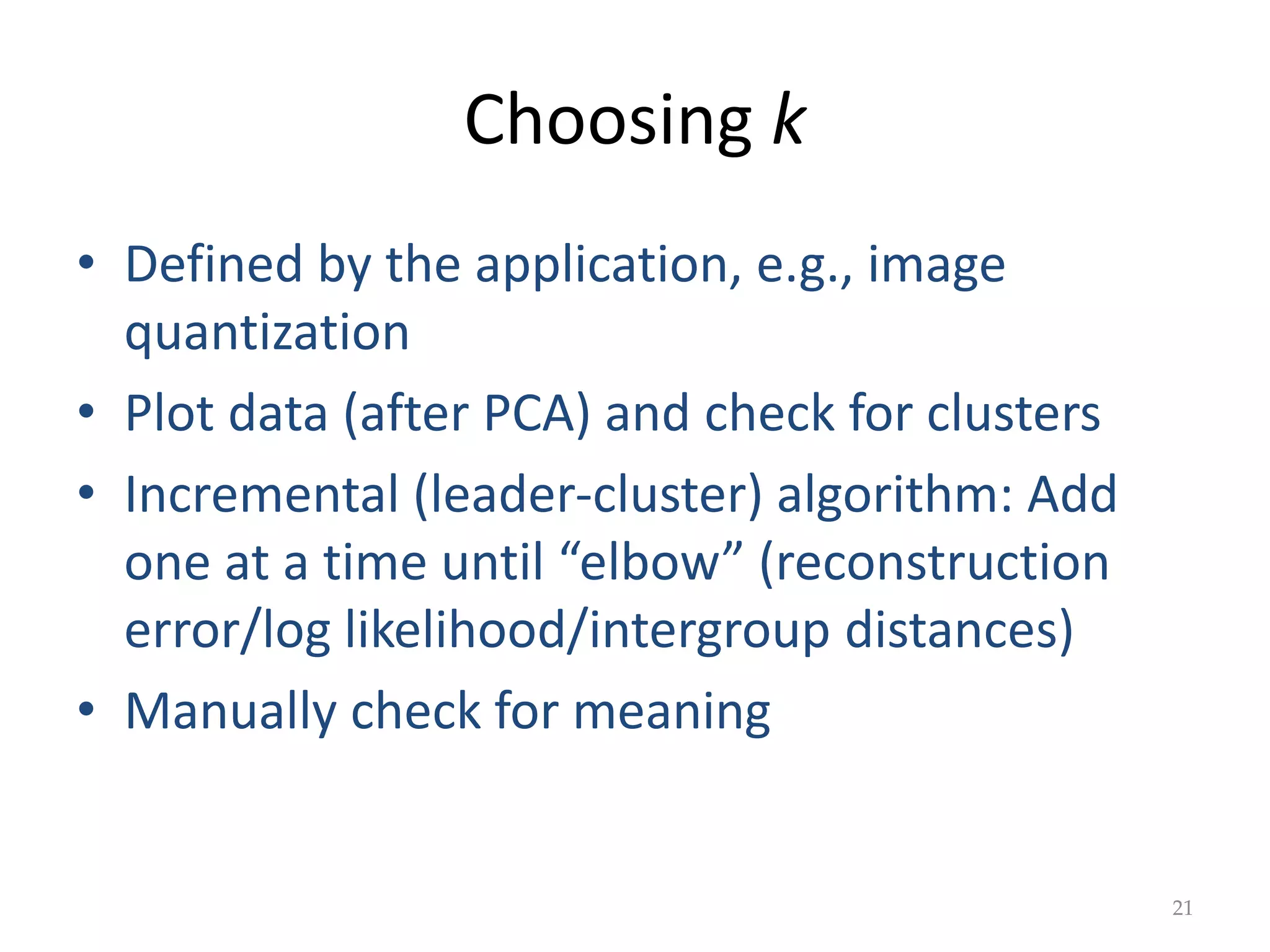
Choosing k
• Defined by the application, e.g., image
quantization
• Plot data (after PCA) and check for clusters
• Incremental (leader-cluster) algorithm: Add
one at a time until “elbow” (reconstruction
error/log likelihood/intergroup distances)
• Manually check for meaning
21
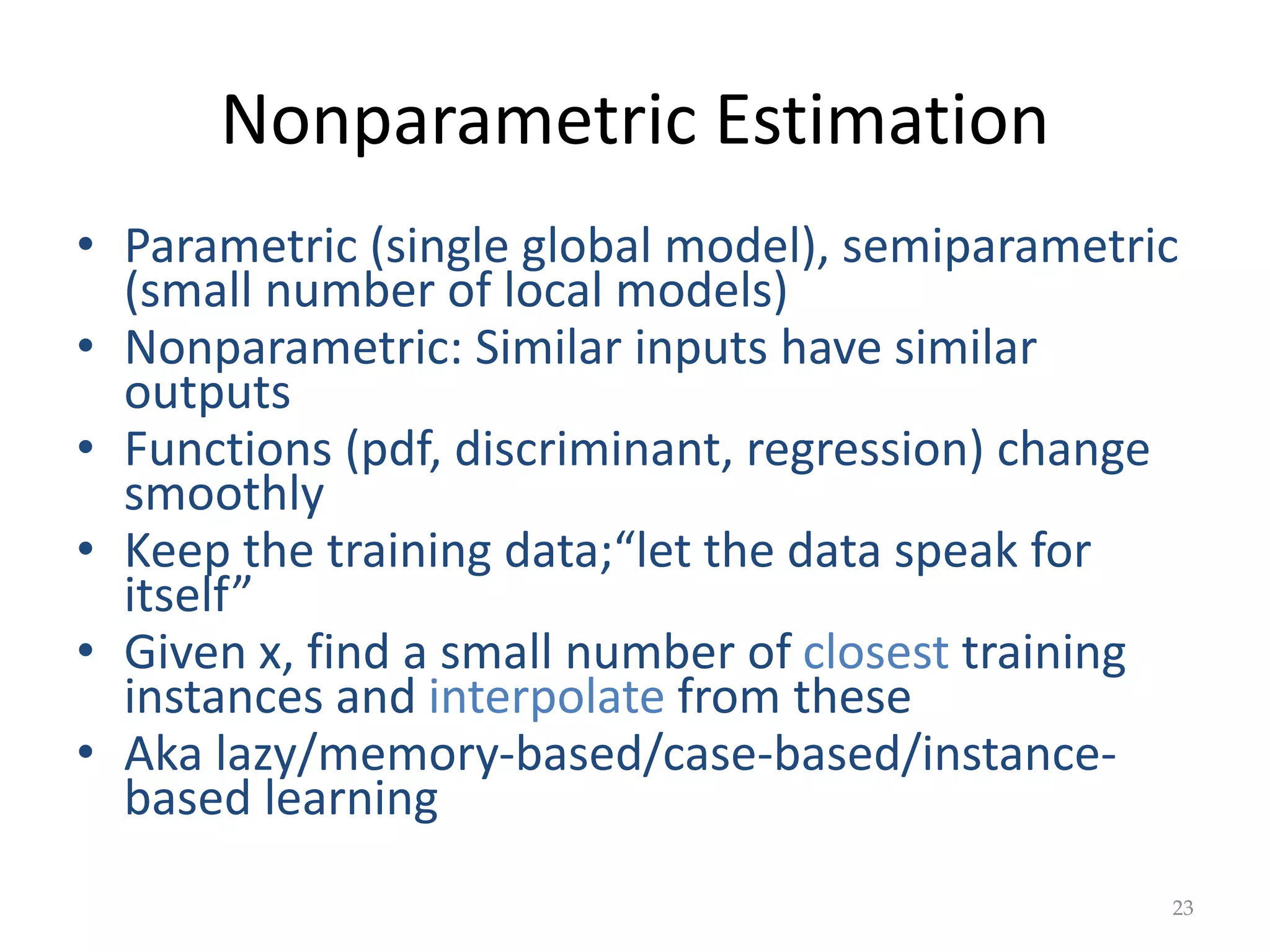
Nonparametric Methods
Nonparametric Estimation
• Parametric (single global model), semiparametric
(small number of local models)
• Nonparametric: Similar inputs have similar
outputs
• Functions (pdf, discriminant, regression) change
smoothly
• Keep the training data;“let the data speak for
itself”
• Given x, find a small number of closest training
instances and interpolate from these
• Aka lazy/memory-based/case-based/instance-
based learning
23
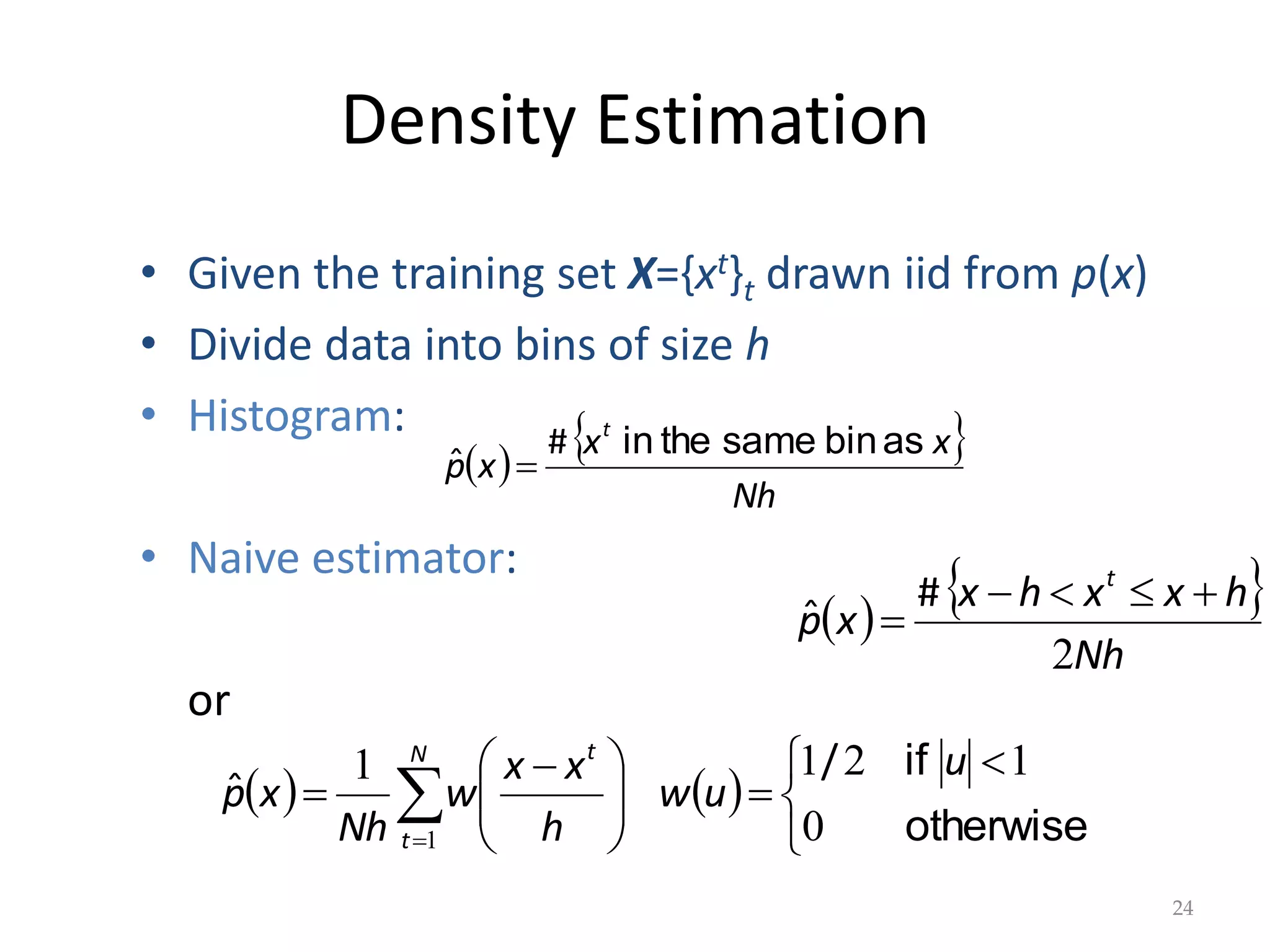
Density Estimation
 
 
Nh
x
x
x
p
t
as
bin
same
the
in
#
ˆ 
24
• Given the training set X={xt}t drawn iid from p(x)
• Divide data into bins of size h
• Histogram:
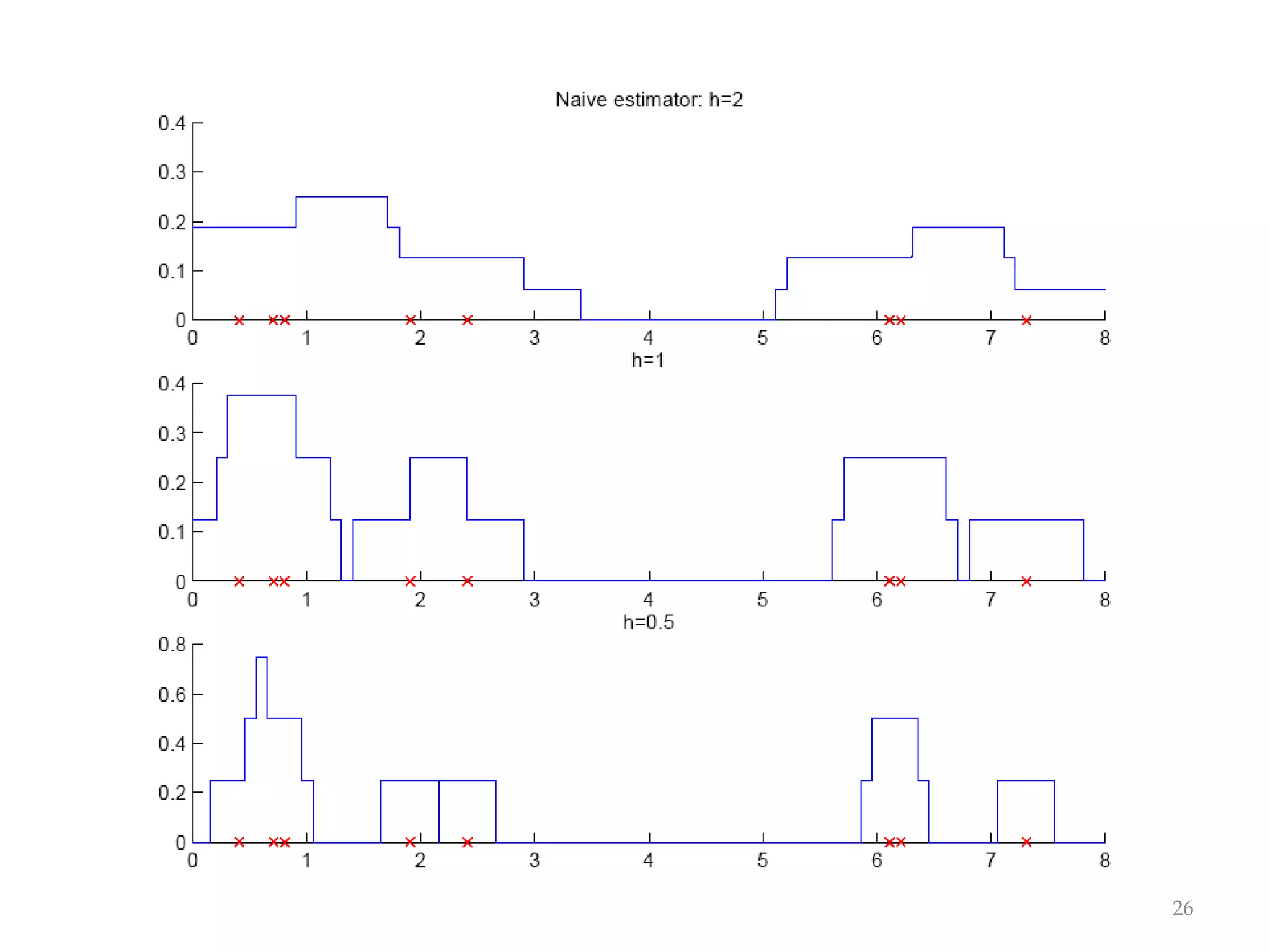
• Naive estimator:
or
 
 
Nh
h
x
x
h
x
x
p
t
2





#
ˆ
   


 








 
 
 otherwise
if
0
1
2
1
1
1
u
u
w
h
x
x
w
Nh
x
p
N
t
t
/
ˆ
25
26
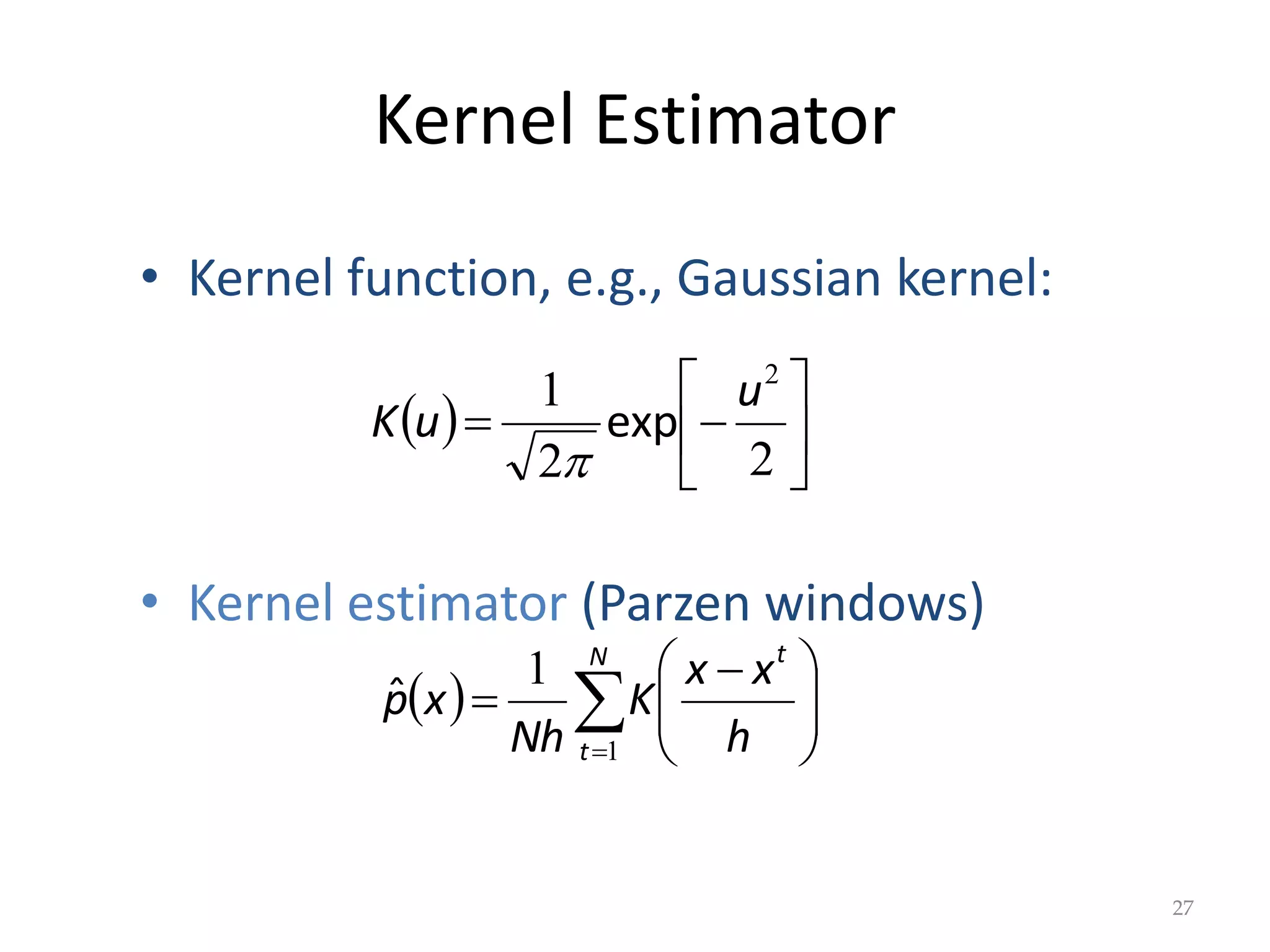
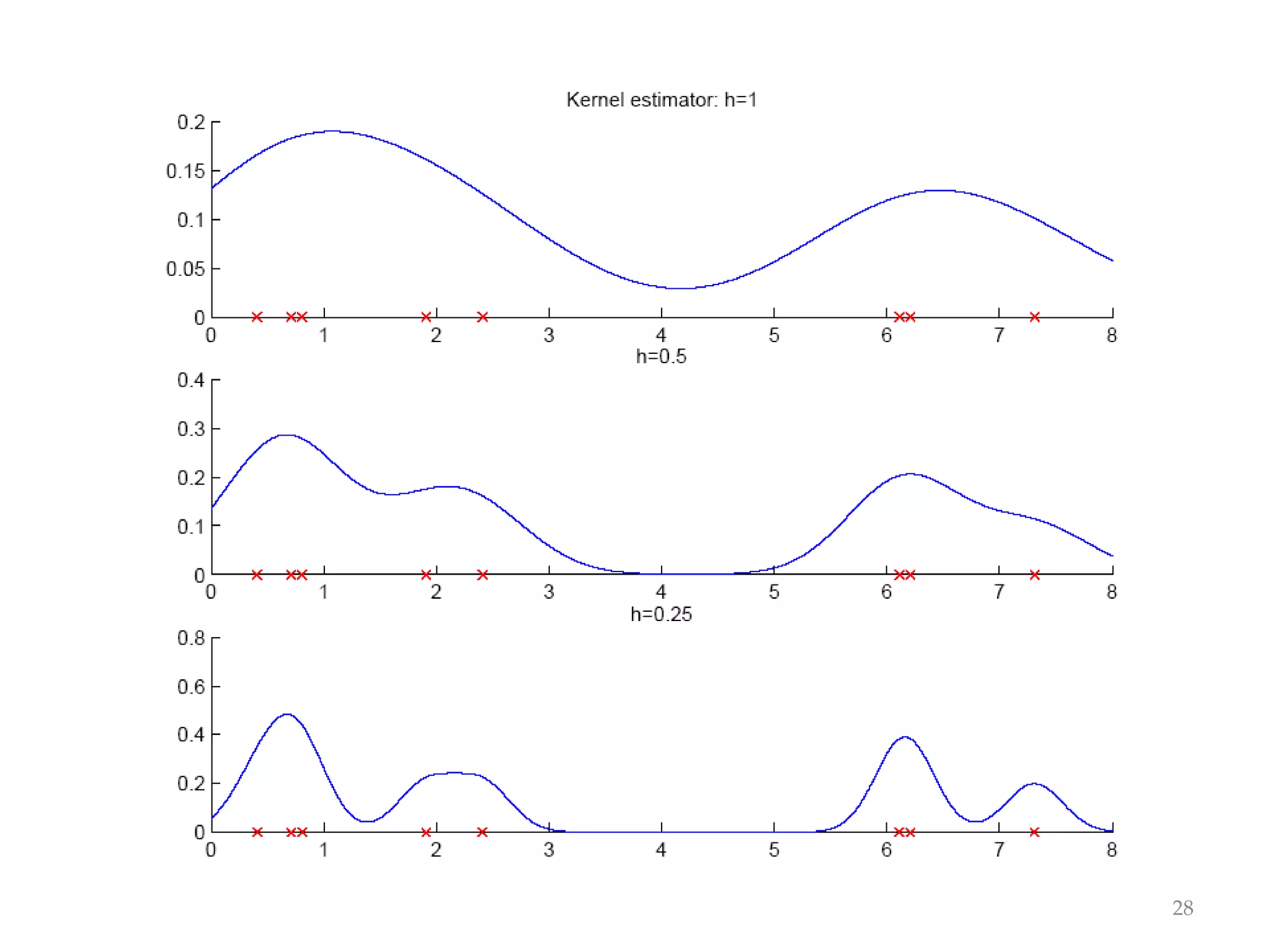
Kernel Estimator
  








 

N
t
t
h
x
x
K
Nh
x
p
1
1
ˆ
27
• Kernel function, e.g., Gaussian kernel:
• Kernel estimator (Parzen windows)
  







2
2
1 2
u
u
K exp

28
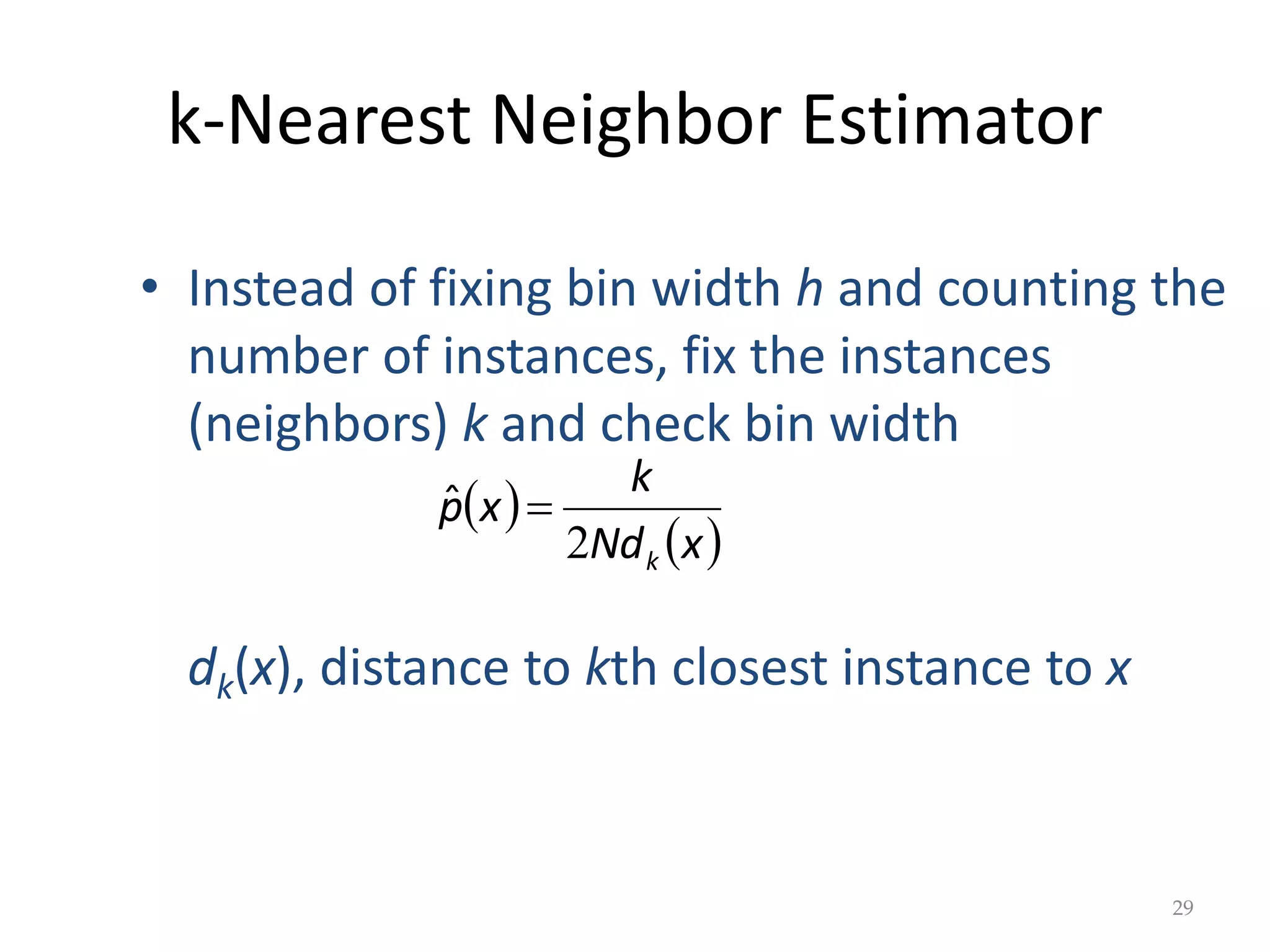
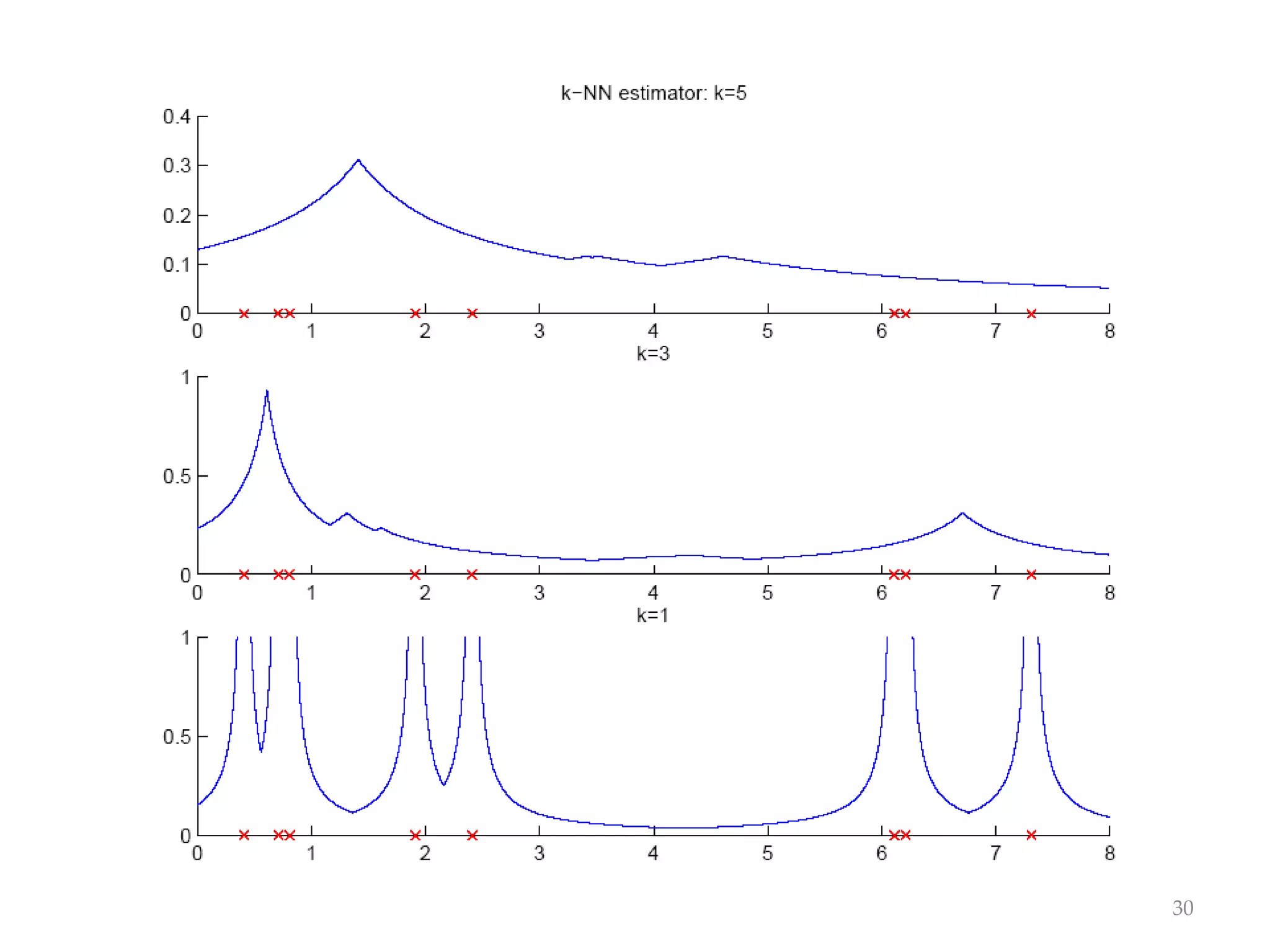
k-Nearest Neighbor Estimator
 
 
x
Nd
k
x
p
k
2

ˆ
29
• Instead of fixing bin width h and counting the
number of instances, fix the instances
(neighbors) k and check bin width
dk(x), distance to kth closest instance to x
30
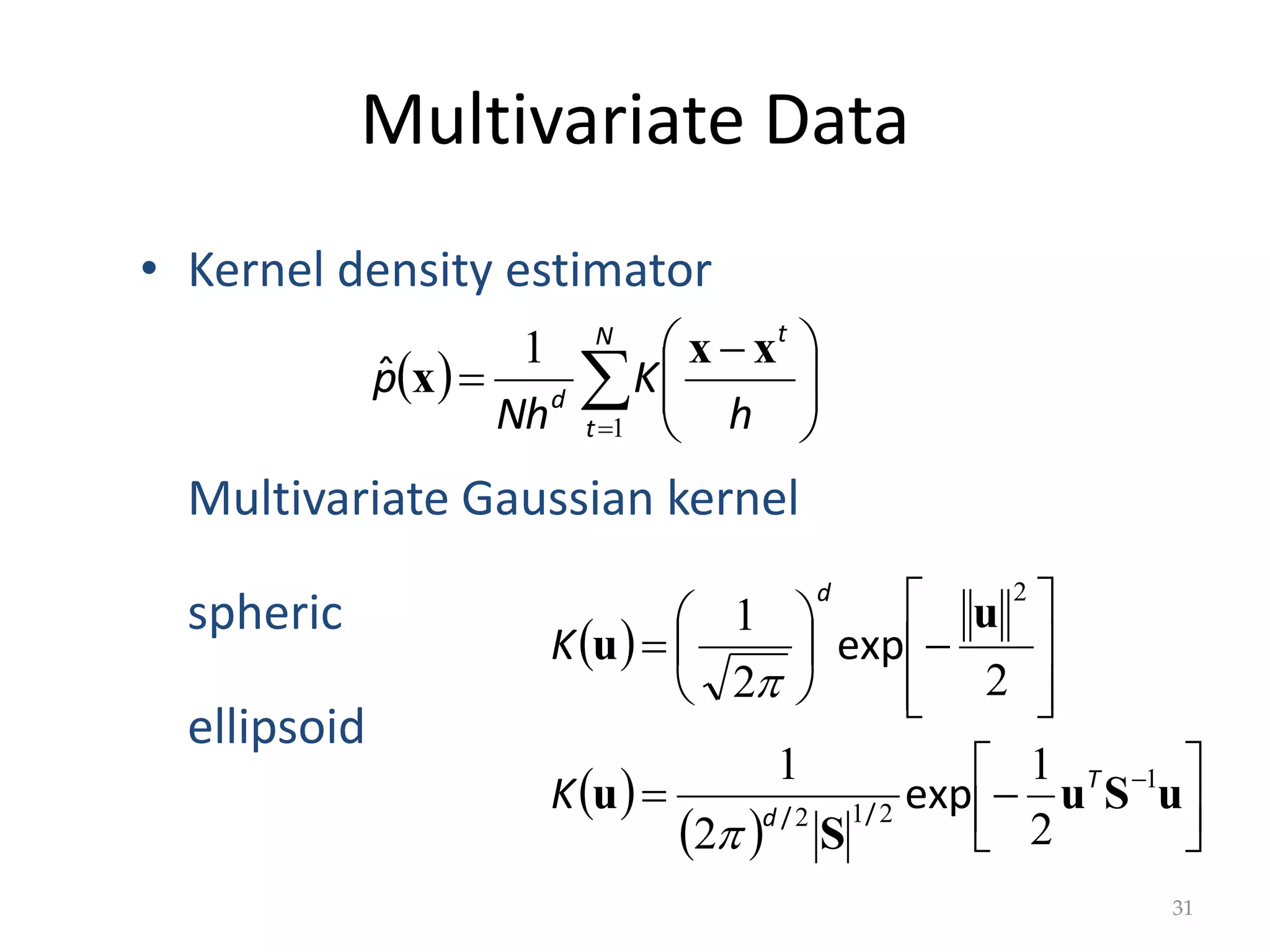
Multivariate Data
  








 

N
t
t
d
h
K
Nh
p
1
1 x
x
x
ˆ
31
• Kernel density estimator
Multivariate Gaussian kernel
spheric
ellipsoid
 
 
  
























u
u
u
u
u
1
2
1
2
2
2
1
2
1
2
2
1
S
S
T
d
d
K
K
exp
exp
/
/


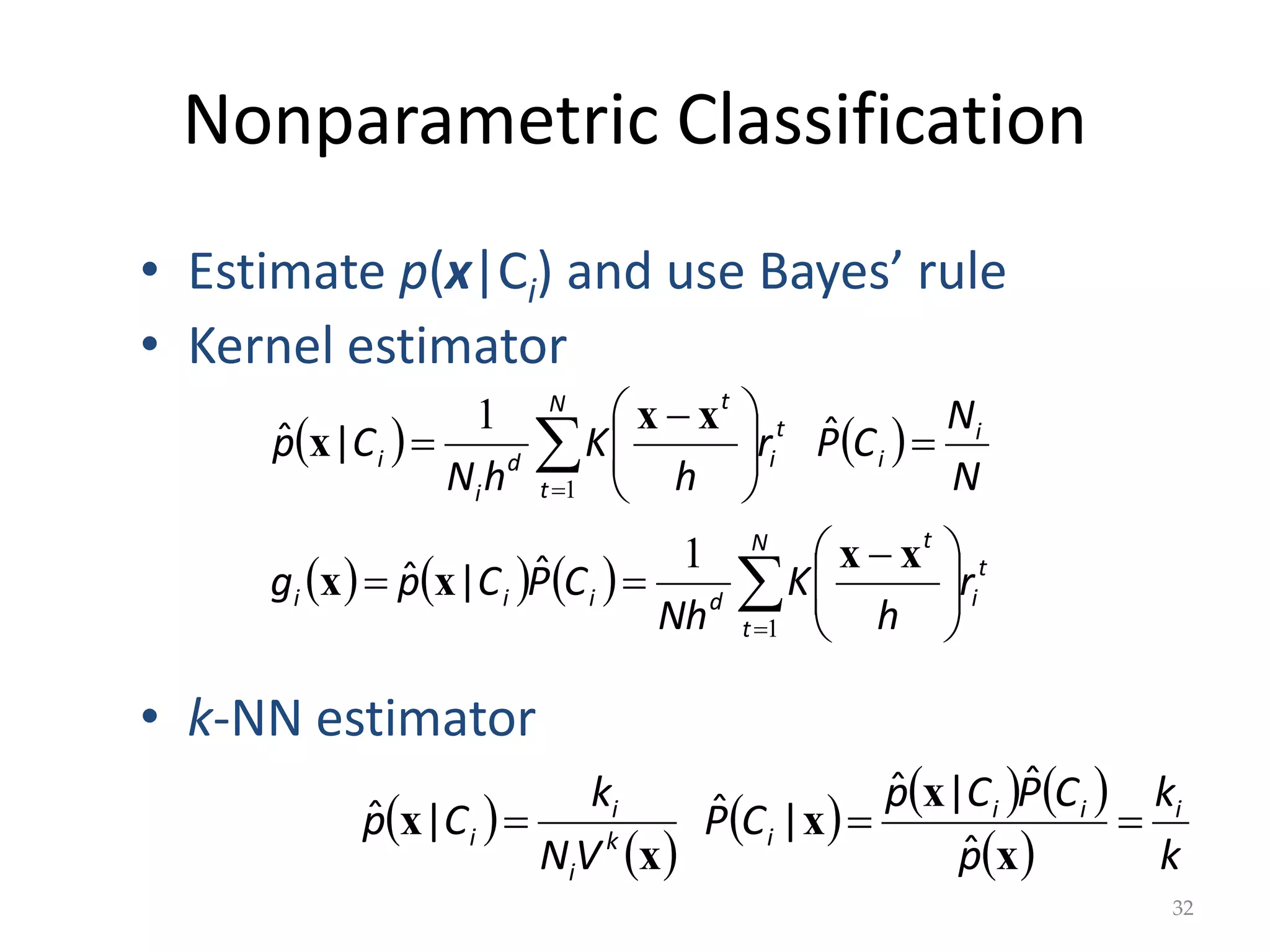
Nonparametric Classification
   
      t
i
N
t
t
d
i
i
i
i
i
t
i
N
t
t
d
i
i
r
h
K
Nh
C
P
C
p
g
N
N
C
P
r
h
K
h
N
C
p











 










 

1
1
1
1
x
x
x
x
x
x
x
ˆ
|
ˆ
ˆ
|
ˆ
32
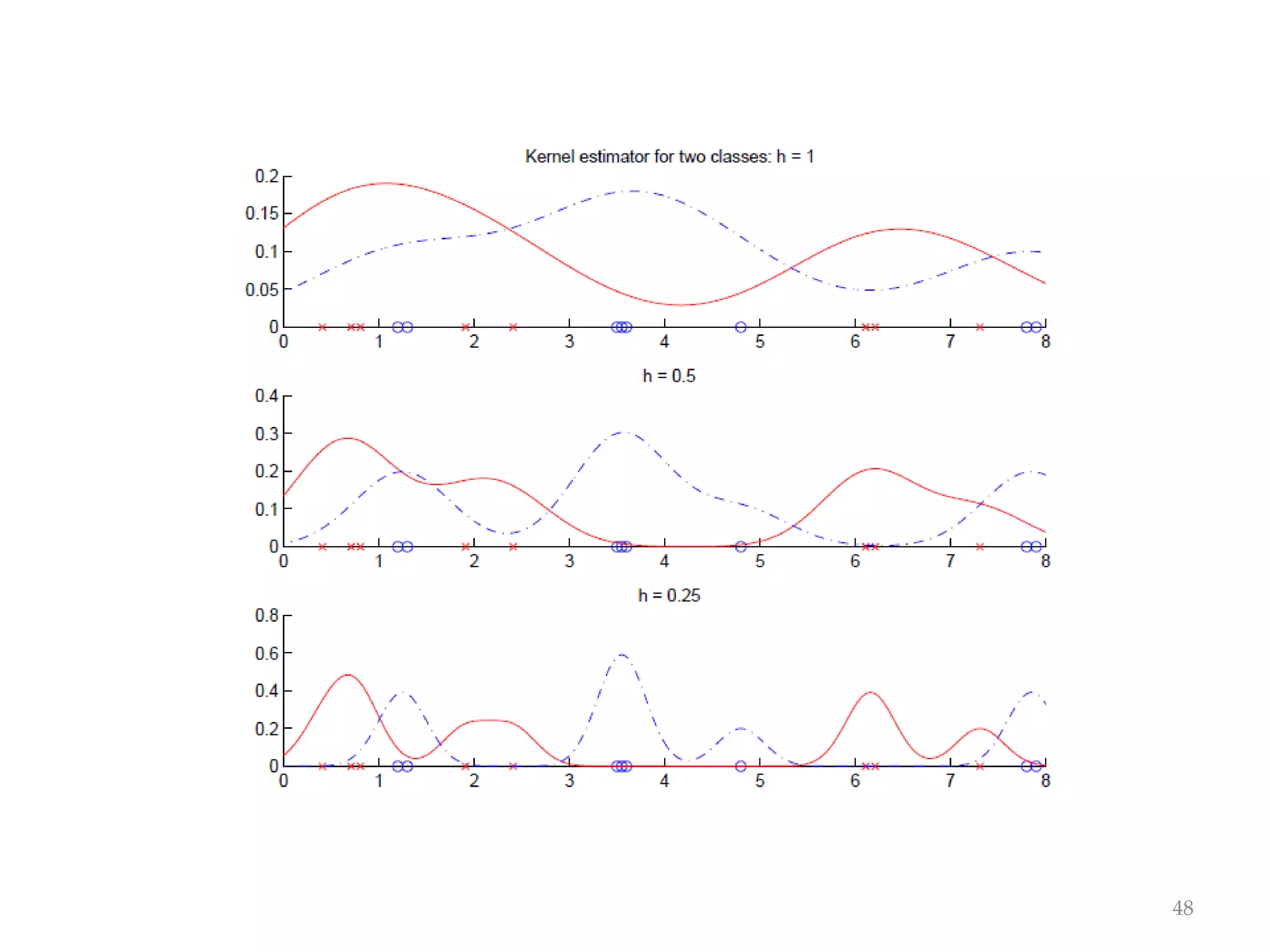
• Estimate p(x|Ci) and use Bayes’ rule
• Kernel estimator
• k-NN estimator
 
 
     
  k
k
p
C
P
C
p
C
P
V
N
k
C
p i
i
i
i
k
i
i
i 


x
x
x
x
x
ˆ
ˆ
|
ˆ
|
ˆ
|
ˆ
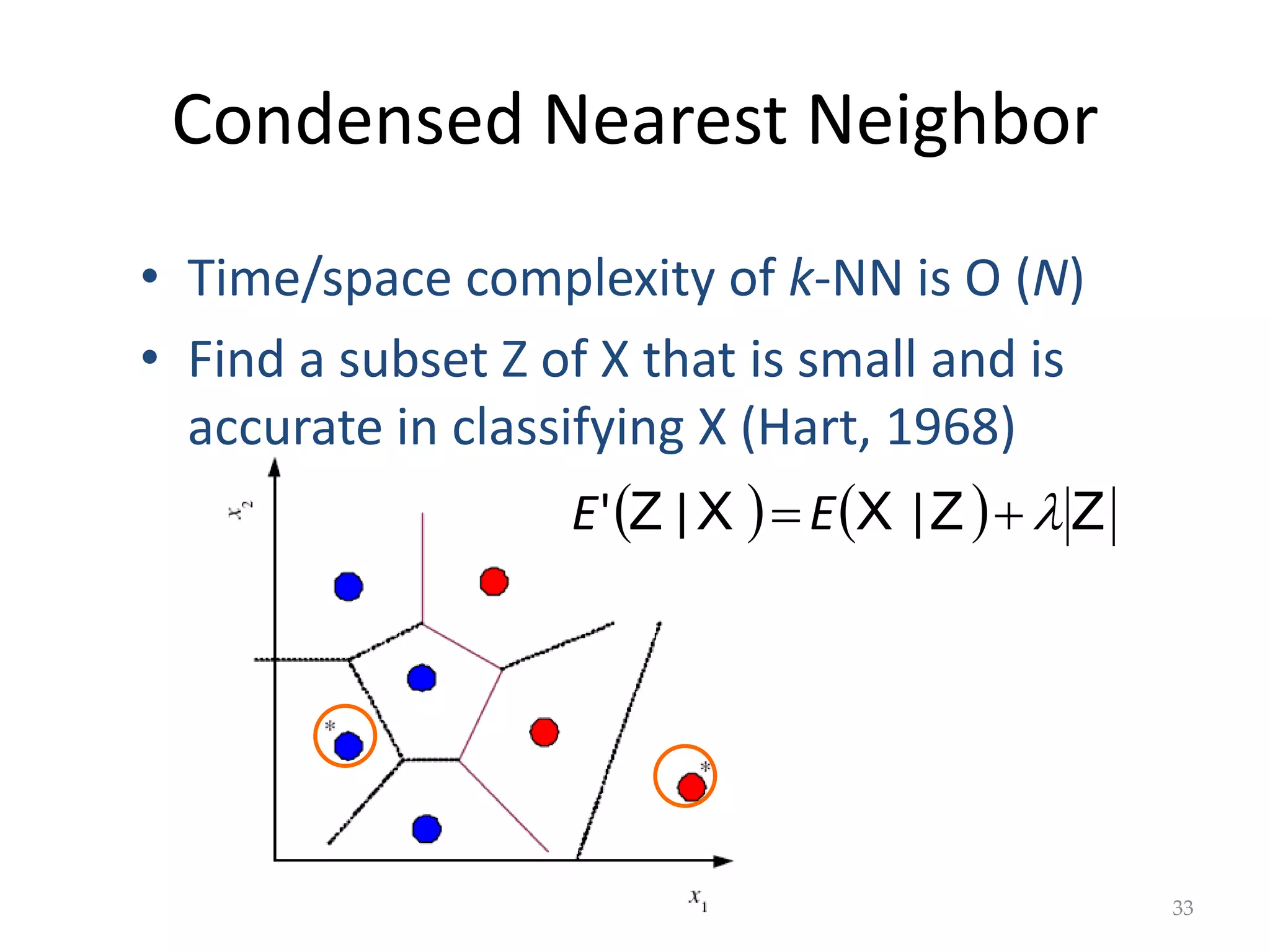
Condensed Nearest Neighbor
    Z
Z
X
X
Z 

 |
|
' E
E
33
• Time/space complexity of k-NN is O (N)
• Find a subset Z of X that is small and is
accurate in classifying X (Hart, 1968)
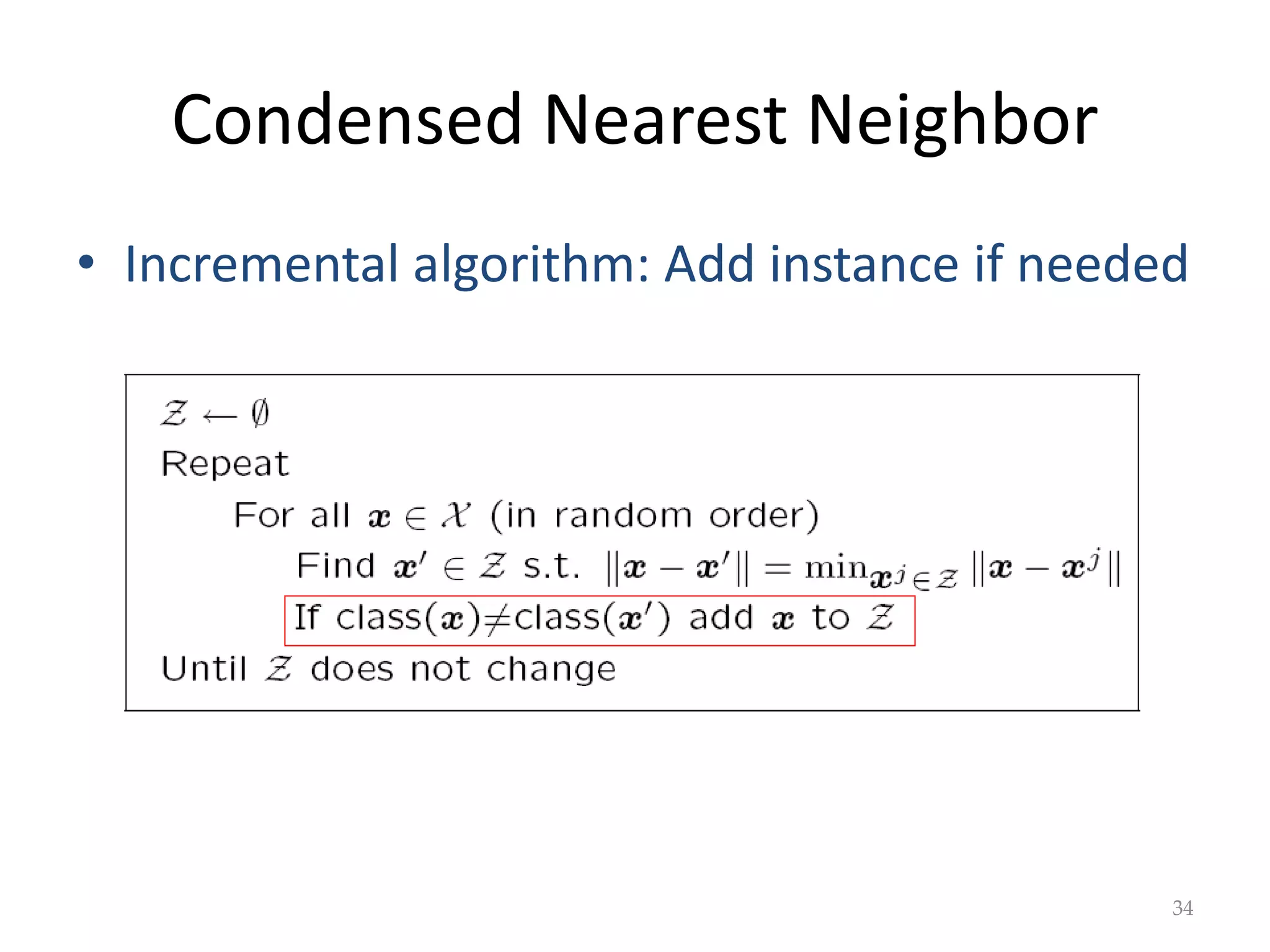
Condensed Nearest Neighbor
• Incremental algorithm: Add instance if needed
34
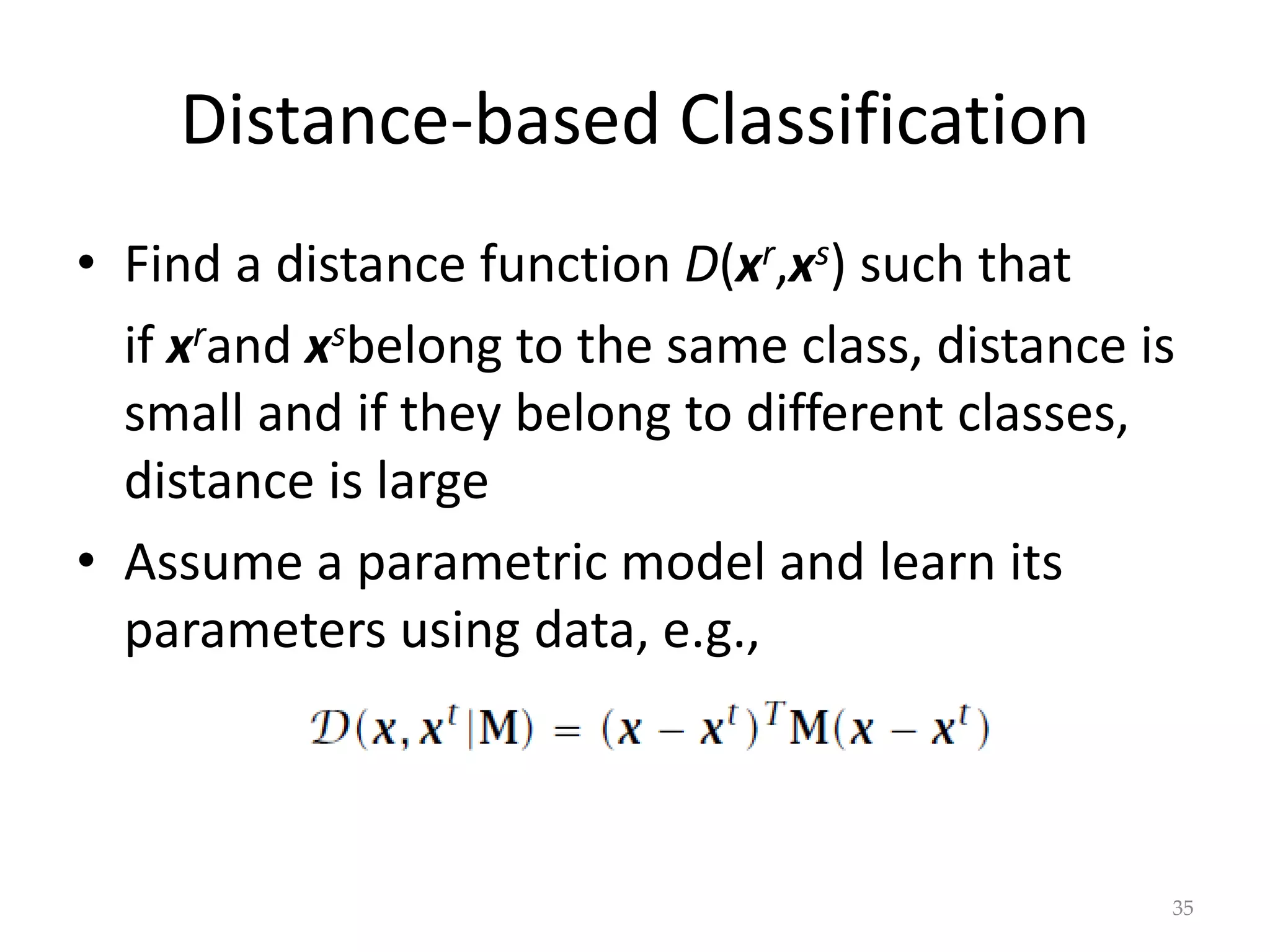
Distance-based Classification
• Find a distance function D(xr,xs) such that
if xrand xsbelong to the same class, distance is
small and if they belong to different classes,
distance is large
• Assume a parametric model and learn its
parameters using data, e.g.,
35
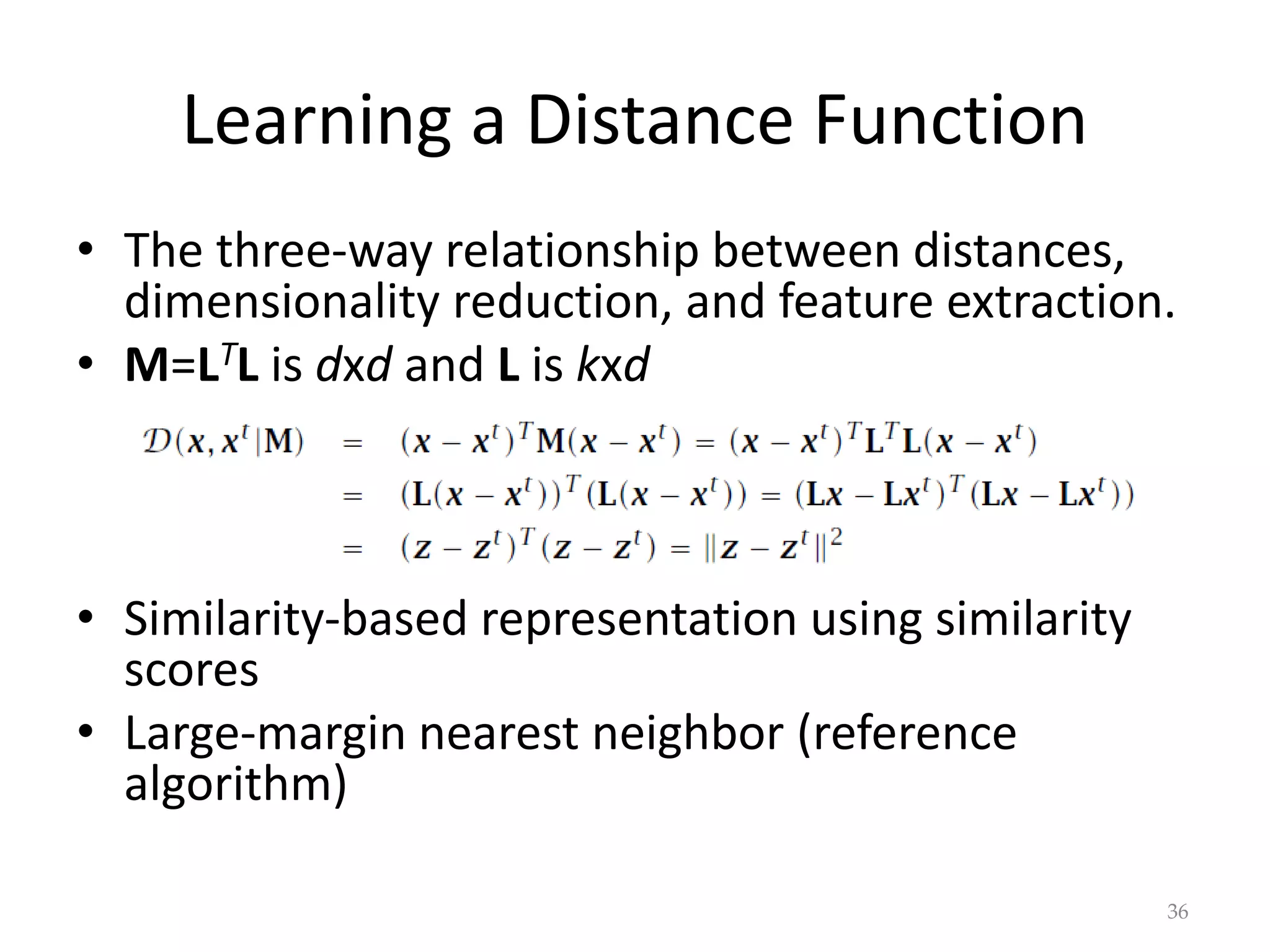
Learning a Distance Function
• The three-way relationship between distances,
dimensionality reduction, and feature extraction.
• M=LTL is dxd and L is kxd
• Similarity-based representation using similarity
scores
• Large-margin nearest neighbor (reference
algorithm)
36
37
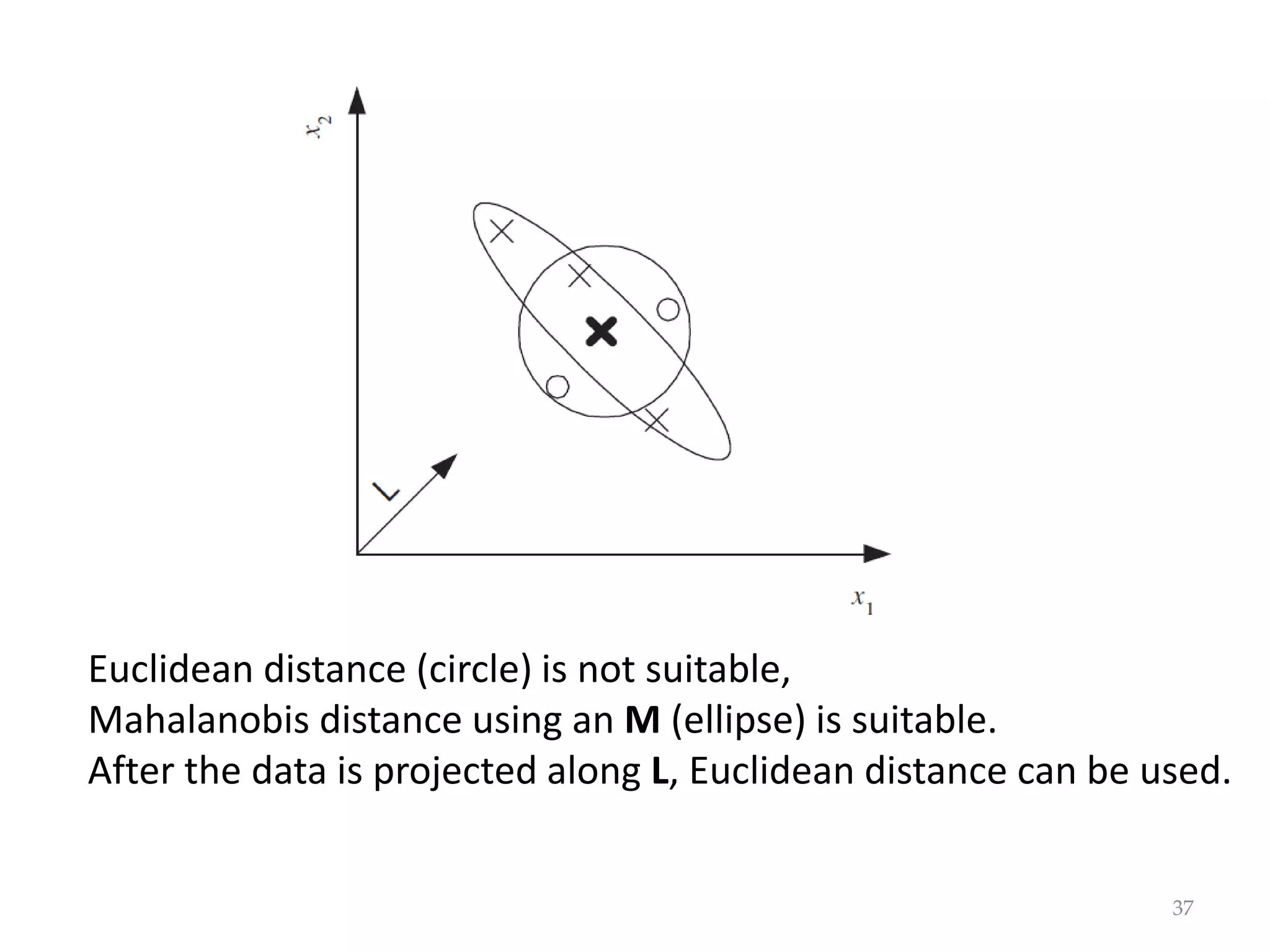
Euclidean distance (circle) is not suitable,
Mahalanobis distance using an M (ellipse) is suitable.
After the data is projected along L, Euclidean distance can be used.
Outlier Detection
• Find outlier/novelty points
• Not a two-class problem because outliers are
very few, of many types, and seldom labeled
• Instead, one-class classification problem: Find
instances that have low probability
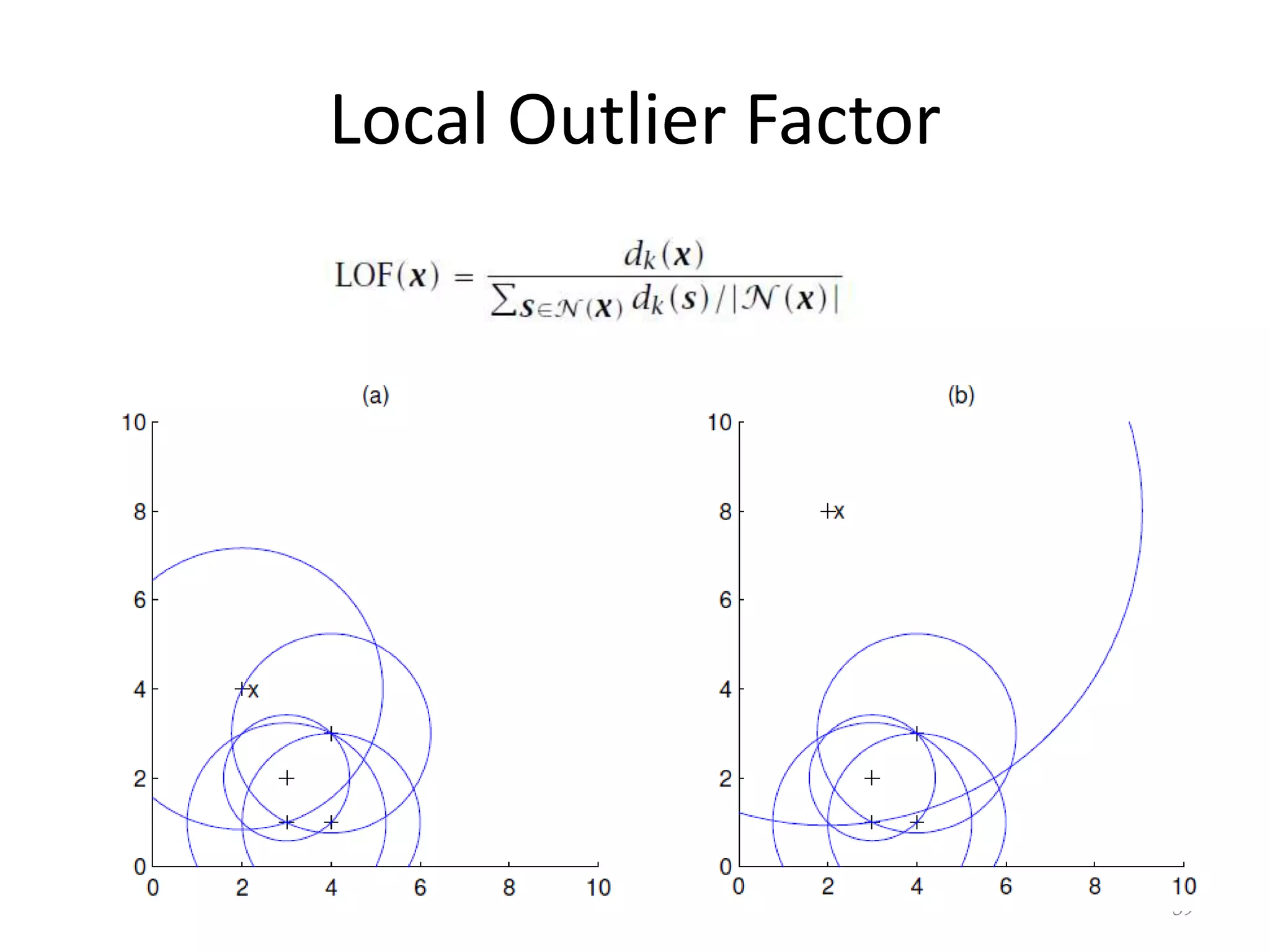
• In nonparametric case: Find instances far away
from other instances
38
Local Outlier Factor
39
Nonparametric Regression
 
 
 
 









otherwise
with
bin
same
the
in
is
if
where
0
1
1
1
x
x
x
x
b
x
x
b
r
x
x
b
x
g
t
t
N
t
t
t
N
t
t
,
,
,
ˆ
40
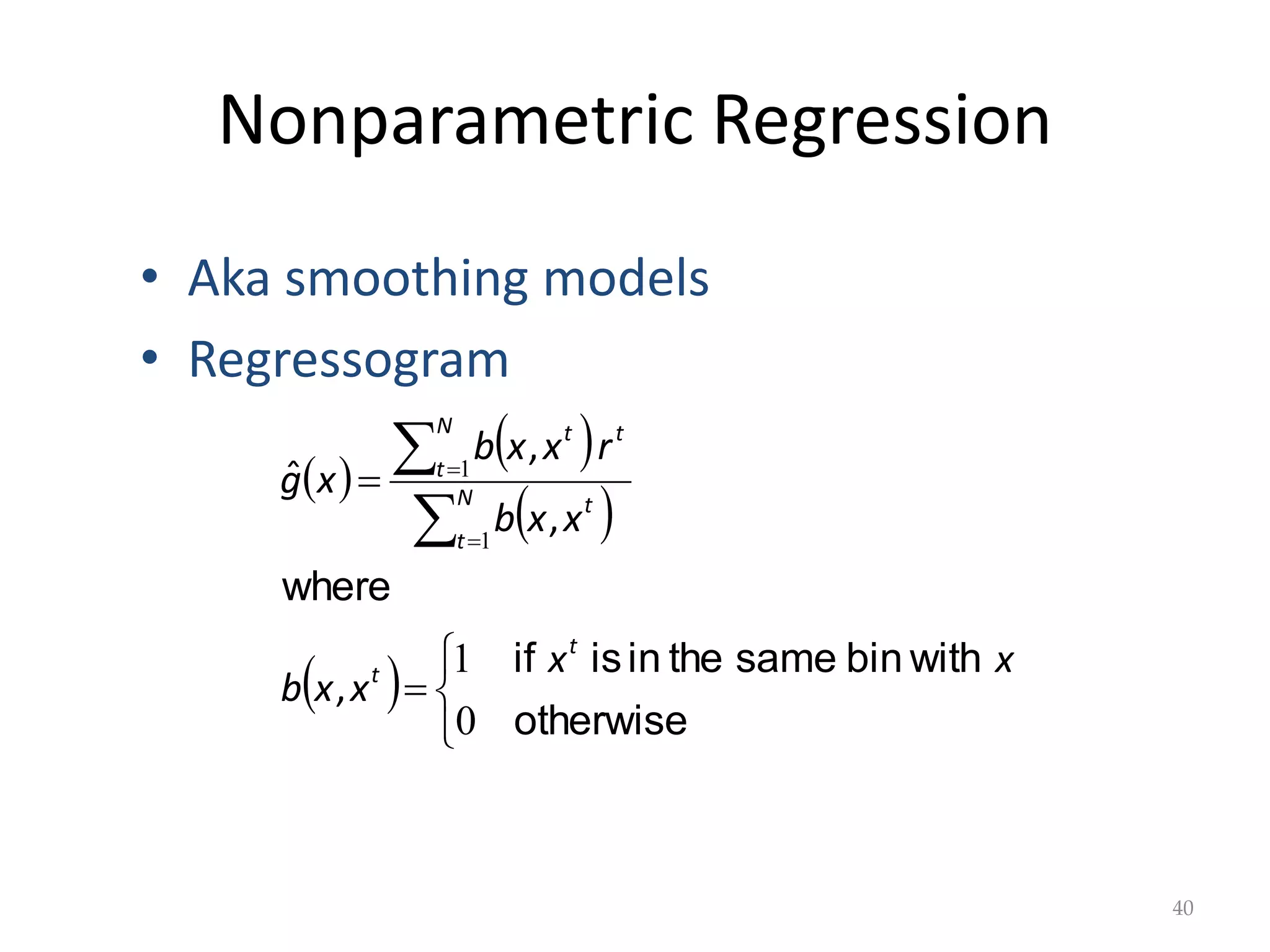
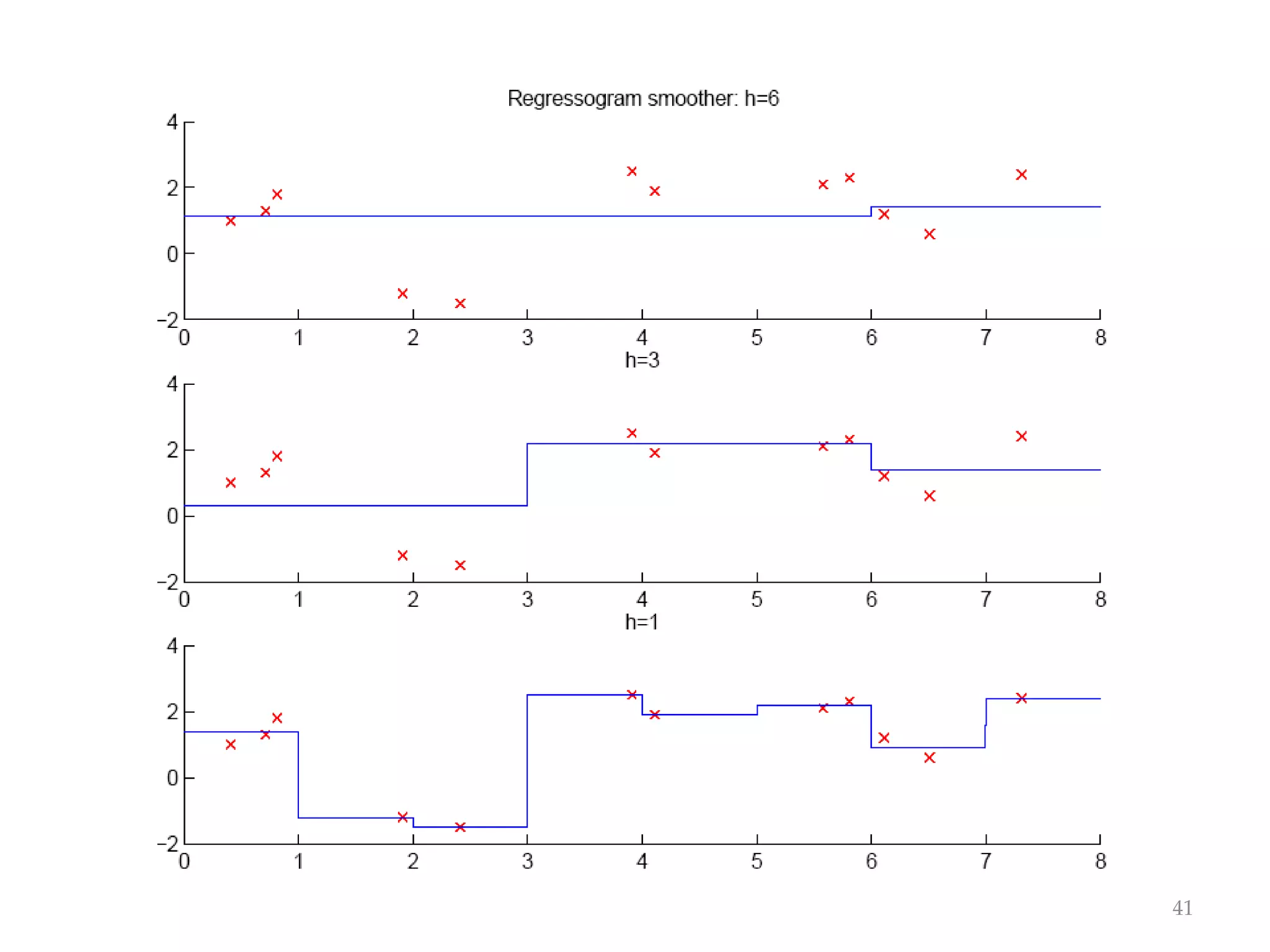
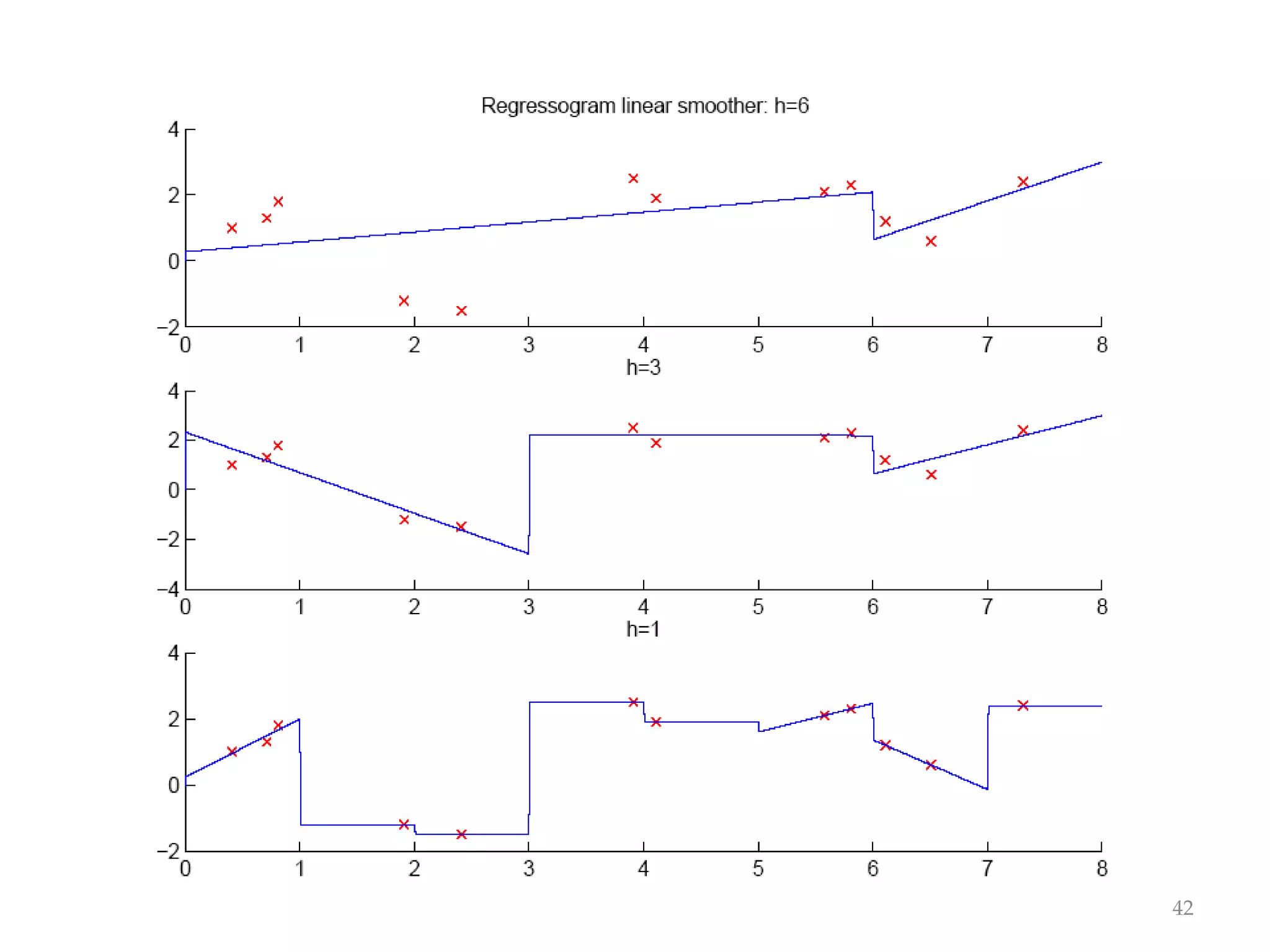
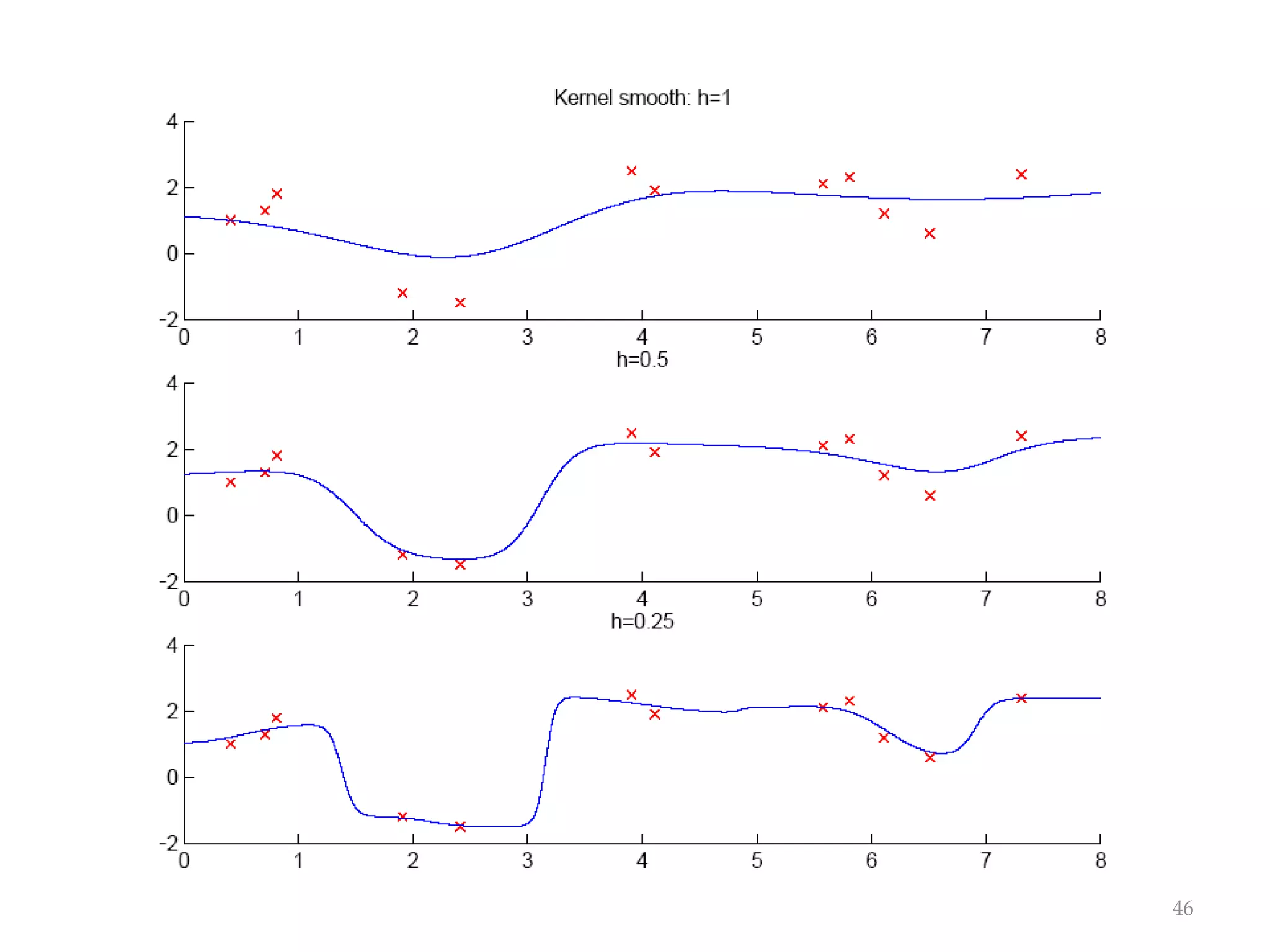
• Aka smoothing models
• Regressogram
41
42
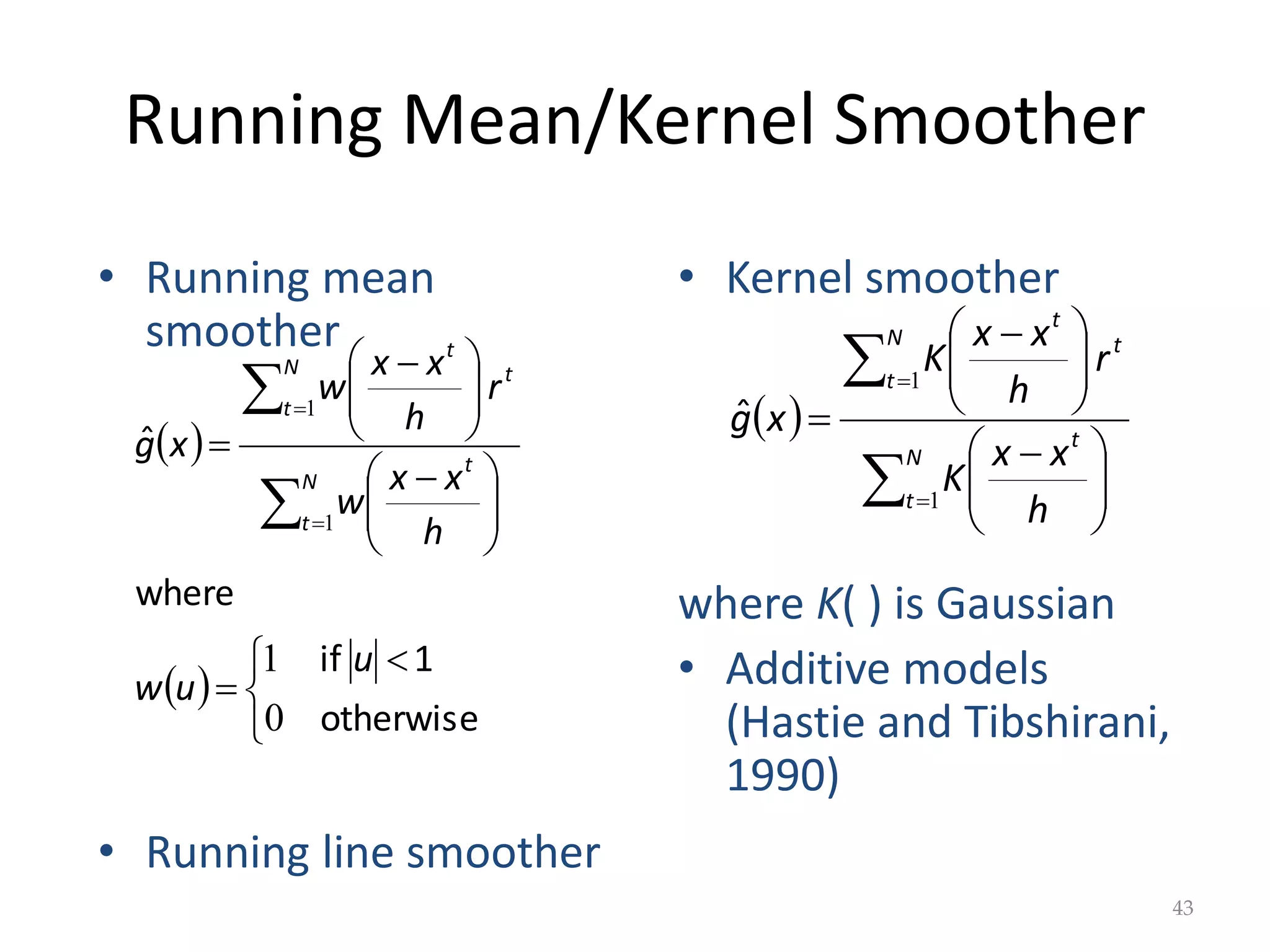
Running Mean/Kernel Smoother
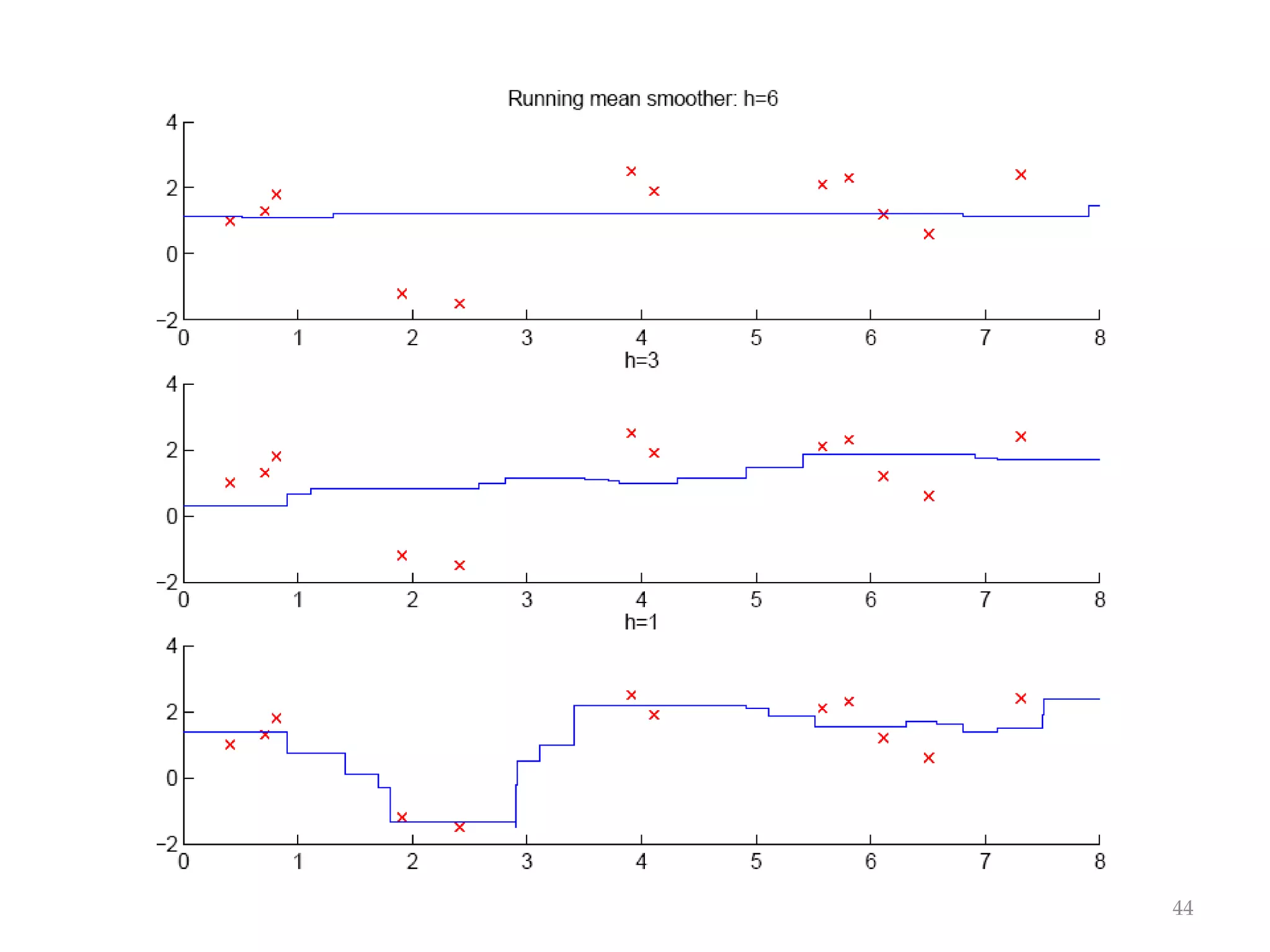
• Running mean
smoother
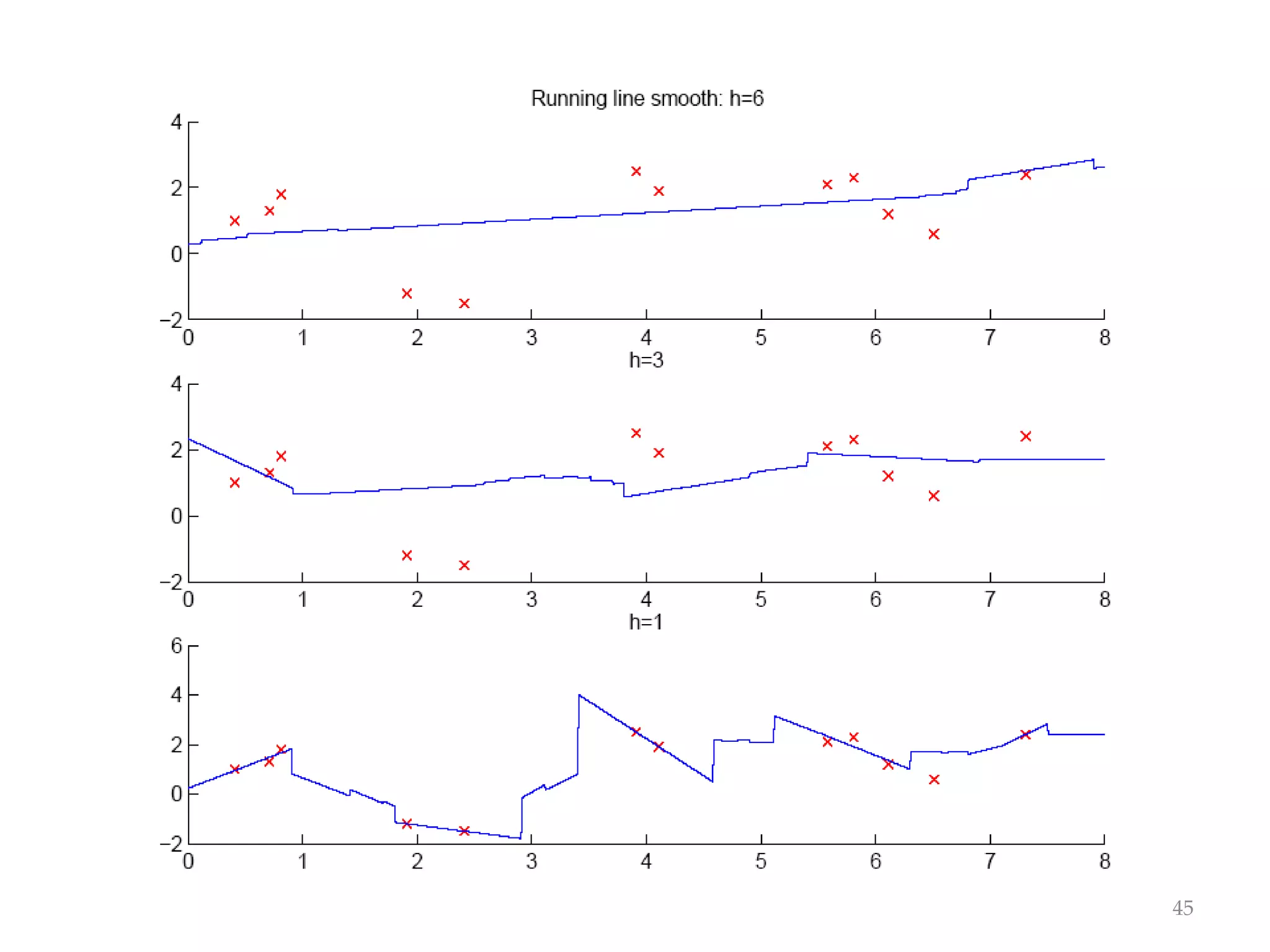
• Running line smoother
• Kernel smoother
where K( ) is Gaussian
• Additive models
(Hastie and Tibshirani,
1990)
43
 
 


 








 







 





otherwise
1
if
where
ˆ
0
1
1
1
u
u
w
h
x
x
w
r
h
x
x
w
x
g
N
t
t
t
N
t
t
 











 







 

N
t
t
t
N
t
t
h
x
x
K
r
h
x
x
K
x
g
1
1
ˆ
44
45
46
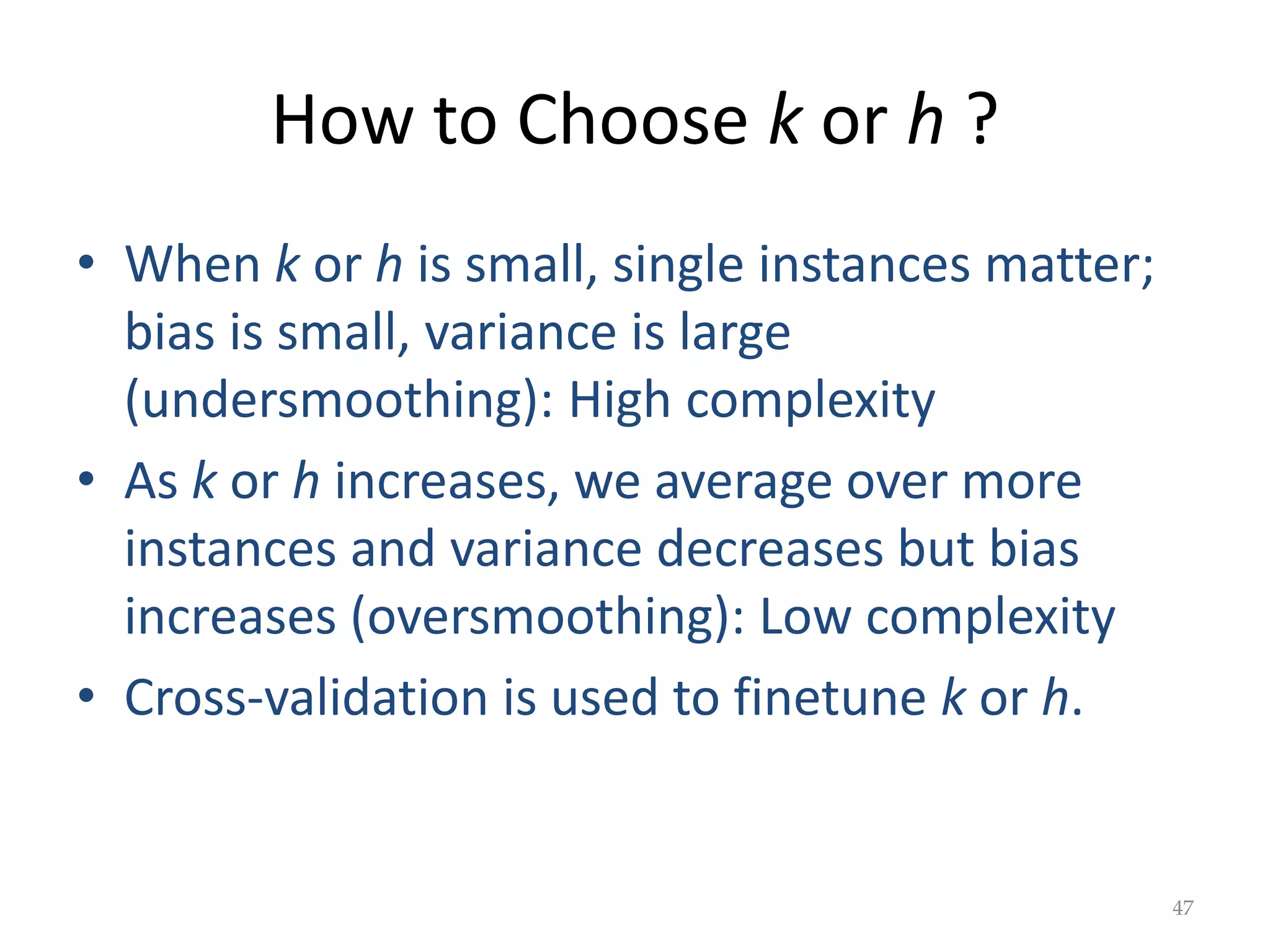
How to Choose k or h ?
• When k or h is small, single instances matter;
bias is small, variance is large
(undersmoothing): High complexity
• As k or h increases, we average over more
instances and variance decreases but bias
increases (oversmoothing): Low complexity
• Cross-validation is used to finetune k or h.
47
48

ML unit3.pptx

  • 1.
  • 2.
    Semiparametric Density Estimation •Parametric: Assume a single model for p (x | Ci) Semiparametric: p (x|Ci) is a mixture of densities Multiple possible explanations/prototypes: Different handwriting styles, accents in speech • Nonparametric: No model; data speaks for itself. 2
  • 3.
    Mixture Densities         k i i i G P G p p 1 | x x 3 where Gi the components/groups/clusters, P ( Gi ) mixture proportions (priors), p ( x | Gi) component densities Gaussian mixture where p(x|Gi) ~ N ( μi , ∑i ) parameters Φ = {P ( Gi ), μi , ∑i }k i=1 unlabeled sample X={xt}t (unsupervised learning)
  • 4.
    Classes vs. Clusters •Supervised: X = {xt,rt }t • Classes Ci i=1,...,K where p(x|Ci) ~ N(μi ,∑i ) • Φ = {P (Ci ), μi , ∑i }K i=1 • Unsupervised : X = { xt }t • Clusters Gi i=1,...,k where p(x|Gi) ~ N ( μi , ∑i ) • Φ = {P ( Gi ), μi , ∑i }k i=1 Labels rt i ? 4          k i i i G P G p p 1 | x x          K i i i P p p 1 C C | x x                t t i T i t t i t t i i t t i t t t i i t t i i r r r r N r C P m x m x x m S ˆ
  • 5.
    k-Means Clustering j t j i t m x m x   min 5 • Find k reference vectors (prototypes/codebook vectors/codewords) which best represent data • Reference vectors, mj, j =1,...,k • Use nearest (most similar) reference: • Reconstruction error                   otherwise min if 0 1 1 j t j i t t i t i i t t i k i i b b E m x m x m x m X
  • 6.
  • 7.
  • 8.
  • 9.
    Expectation-Maximization (EM)                t k i i i t t t G P G p p 1 | log | log | x x X L 9 • Log likelihood with a mixture model • Assume hidden variables z, which when known, make optimization much simpler • Complete likelihood, Lc(Φ |X,Z), in terms of x and z • Incomplete likelihood, L(Φ |X), in terms of x
  • 10.
    E- and M-steps        l l l C l E            | max arg : step - M | | | : step - E Q X, Z X, L Q 1 10 Iterate the two steps 1. E-step: Estimate z given X and current Φ 2. M-step: Find new Φ’ given z, X, and old Φ. An increase in Q increases incomplete likelihood     X L X L | | l l    1
  • 11.
    EM in GaussianMixtures             t i l t i j j l j t i l i t l t i h G P G P G p G P G p z E         , , , X x x x | | | , 11 • zt i = 1 if xt belongs to Gi, 0 otherwise (labels r t i of supervised learning); assume p(x|Gi)~N(μi,∑i) • E-step: • M-step:                    t t i T l i t t l i t t i l i t t i t t t i l i t t i i h h h h N h P 1 1 1 1 m x m x x m S G Use estimated labels in place of unknown labels
  • 12.
  • 13.
    Mixtures of LatentVariable Models     i T i i i i t G p ψ m x   V V , | N 13 Regularize clusters 1. Assume shared/diagonal covariance matrices 2. Use PCA/FA to decrease dimensionality: Mixtures of PCA/FA Can use EM to learn Vi (Ghahramani and Hinton, 1997; Tipping and Bishop, 1999)
  • 14.
    After Clustering • Dimensionalityreduction methods find correlations between features and group features • Clustering methods find similarities between instances and group instances • Allows knowledge extraction through number of clusters, prior probabilities, cluster parameters, i.e., center, range of features. Example: CRM, customer segmentation 14
  • 15.
    Clustering as Preprocessing •Estimated group labels hj (soft) or bj (hard) may be seen as the dimensions of a new k dimensional space, where we can then learn our discriminant or regressor. • Local representation (only one bj is 1, all others are 0; only few hj are nonzero) vs Distributed representation (After PCA; all zj are nonzero) 15
  • 16.
    Mixture of Mixtures                  K i i i k j ij ij i P p p G P G p p i 1 1 C C C | | | x x x x 16 • In classification, the input comes from a mixture of classes (supervised). • If each class is also a mixture, e.g., of Gaussians, (unsupervised), we have a mixture of mixtures:
  • 17.
    Spectral Clustering • Clusterusing predefined pairwise similarities Brs instead of using Euclidean or Mahalanobis distance • Can be used even if instances not vectorially represented • Steps: I. Use Laplacian Eigenmaps (chapter 6) to map to a new z space using Brs II. Use k-means in this new z space for clustering 17
  • 18.
    Hierarchical Clustering      p d j p s j r j s r m x x d / , 1 1    x x 18 • Cluster based on similarities/distances • Distance measure between instances xr and xs Minkowski (Lp) (Euclidean for p = 2) City-block distance       d j s j r j s r cb x x d 1 x x ,
  • 19.
    Agglomerative Clustering    s r j i d G G d j s i r x x x x , min , , G G    19 • Start with N groups each with one instance and merge two closest groups at each iteration • Distance between two groups Gi and Gj: – Single-link: – Complete-link: – Average-link, centroid     s r j i d G G d j s i r x x x x , max , , G G        s r j i d G G d j s i r x x x x , , , G G    ave
  • 20.
  • 21.
    Choosing k • Definedby the application, e.g., image quantization • Plot data (after PCA) and check for clusters • Incremental (leader-cluster) algorithm: Add one at a time until “elbow” (reconstruction error/log likelihood/intergroup distances) • Manually check for meaning 21
  • 22.
  • 23.
    Nonparametric Estimation • Parametric(single global model), semiparametric (small number of local models) • Nonparametric: Similar inputs have similar outputs • Functions (pdf, discriminant, regression) change smoothly • Keep the training data;“let the data speak for itself” • Given x, find a small number of closest training instances and interpolate from these • Aka lazy/memory-based/case-based/instance- based learning 23
  • 24.
    Density Estimation    Nh x x x p t as bin same the in # ˆ  24 • Given the training set X={xt}t drawn iid from p(x) • Divide data into bins of size h • Histogram: • Naive estimator: or     Nh h x x h x x p t 2      # ˆ                      otherwise if 0 1 2 1 1 1 u u w h x x w Nh x p N t t / ˆ
  • 25.
  • 26.
  • 27.
    Kernel Estimator              N t t h x x K Nh x p 1 1 ˆ 27 • Kernel function, e.g., Gaussian kernel: • Kernel estimator (Parzen windows)           2 2 1 2 u u K exp 
  • 28.
  • 29.
    k-Nearest Neighbor Estimator    x Nd k x p k 2  ˆ 29 • Instead of fixing bin width h and counting the number of instances, fix the instances (neighbors) k and check bin width dk(x), distance to kth closest instance to x
  • 30.
  • 31.
    Multivariate Data              N t t d h K Nh p 1 1 x x x ˆ 31 • Kernel density estimator Multivariate Gaussian kernel spheric ellipsoid                                u u u u u 1 2 1 2 2 2 1 2 1 2 2 1 S S T d d K K exp exp / /  
  • 32.
    Nonparametric Classification          t i N t t d i i i i i t i N t t d i i r h K Nh C P C p g N N C P r h K h N C p                           1 1 1 1 x x x x x x x ˆ | ˆ ˆ | ˆ 32 • Estimate p(x|Ci) and use Bayes’ rule • Kernel estimator • k-NN estimator             k k p C P C p C P V N k C p i i i i k i i i    x x x x x ˆ ˆ | ˆ | ˆ | ˆ
  • 33.
    Condensed Nearest Neighbor    Z Z X X Z    | | ' E E 33 • Time/space complexity of k-NN is O (N) • Find a subset Z of X that is small and is accurate in classifying X (Hart, 1968)
  • 34.
    Condensed Nearest Neighbor •Incremental algorithm: Add instance if needed 34
  • 35.
    Distance-based Classification • Finda distance function D(xr,xs) such that if xrand xsbelong to the same class, distance is small and if they belong to different classes, distance is large • Assume a parametric model and learn its parameters using data, e.g., 35
  • 36.
    Learning a DistanceFunction • The three-way relationship between distances, dimensionality reduction, and feature extraction. • M=LTL is dxd and L is kxd • Similarity-based representation using similarity scores • Large-margin nearest neighbor (reference algorithm) 36
  • 37.
    37 Euclidean distance (circle)is not suitable, Mahalanobis distance using an M (ellipse) is suitable. After the data is projected along L, Euclidean distance can be used.
  • 38.
    Outlier Detection • Findoutlier/novelty points • Not a two-class problem because outliers are very few, of many types, and seldom labeled • Instead, one-class classification problem: Find instances that have low probability • In nonparametric case: Find instances far away from other instances 38
  • 39.
  • 40.
    Nonparametric Regression                 otherwise with bin same the in is if where 0 1 1 1 x x x x b x x b r x x b x g t t N t t t N t t , , , ˆ 40 • Aka smoothing models • Regressogram
  • 41.
  • 42.
  • 43.
    Running Mean/Kernel Smoother •Running mean smoother • Running line smoother • Kernel smoother where K( ) is Gaussian • Additive models (Hastie and Tibshirani, 1990) 43                                 otherwise 1 if where ˆ 0 1 1 1 u u w h x x w r h x x w x g N t t t N t t                          N t t t N t t h x x K r h x x K x g 1 1 ˆ
  • 44.
  • 45.
  • 46.
  • 47.
    How to Choosek or h ? • When k or h is small, single instances matter; bias is small, variance is large (undersmoothing): High complexity • As k or h increases, we average over more instances and variance decreases but bias increases (oversmoothing): Low complexity • Cross-validation is used to finetune k or h. 47
  • 48.