
Slide © 2010 by Lovelock & Wirtz Services Marketing 7/e Chapter 6– Page 1
Chapter 6:
Setting Prices and
Implementing
Revenue Management
Services Marketing 7e, Global Edition
Slide © 2010 by Lovelock & Wirtz Services Marketing 7/e Chapter 6– Page 2
Overview Of Chapter 6
 Effective Pricing is Central to Financial Success
 Pricing Strategy as Represented by the Pricing Tripod
 Revenue Management: What it is and How it Works
 Ethical Concerns in Service Pricing
 Putting Service Pricing into Practice
Slide © 2010 by Lovelock & Wirtz Services Marketing 7/e Chapter 6– Page 3
Effective Pricing is
Central to Financial Success
Slide © 2010 by Lovelock & Wirtz Services Marketing 7/e Chapter 6– Page 4
What Makes Service Pricing
Strategy Different and Difficult?
 Harder to calculate financial costs of creating a service
process or performance than a manufactured good
 Variability of inputs and outputs:
 How can firms define a “unit of service” and establish basis for
pricing?
 Importance of time factor – same service may have more
value to customers when delivered faster
 Customers find service pricing difficult to understand, risky,
and sometimes even unethical
Slide © 2010 by Lovelock & Wirtz Services Marketing 7/e Chapter 6– Page 5
Objectives for Pricing of Services
 Revenue and Profit Objectives
 Seek profit
 Cover costs
 Patronage and User-Based Objectives
 Build demand
- Demand maximization
- Full capacity utilization
 Build a user base
- Stimulate trial and adoption of new service
- Build market share/large user base
Slide © 2010 by Lovelock & Wirtz Services Marketing 7/e Chapter 6– Page 6
Pricing Strategy
As Represented by the Pricing
Tripod
Slide © 2010 by Lovelock & Wirtz Services Marketing 7/e Chapter 6– Page 7
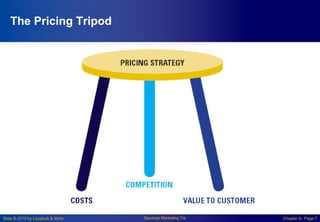
The Pricing Tripod
Slide © 2010 by Lovelock & Wirtz Services Marketing 7/e Chapter 6– Page 8
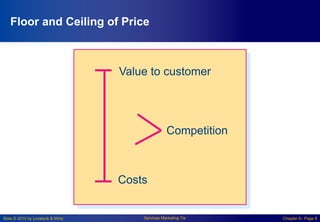
Costs
Value to customer
Competition
Floor and Ceiling of Price
Slide © 2010 by Lovelock & Wirtz Services Marketing 7/e Chapter 6– Page 9
Three Main Approaches to Pricing
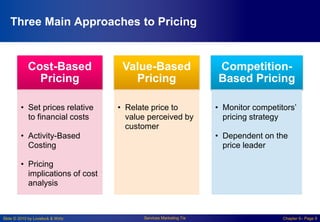
Cost-Based
Pricing
• Set prices relative
to financial costs
• Activity-Based
Costing
• Pricing
implications of cost
analysis
Value-Based
Pricing
• Relate price to
value perceived by
customer
Competition-
Based Pricing
• Monitor competitors’
pricing strategy
• Dependent on the
price leader
Slide © 2010 by Lovelock & Wirtz Services Marketing 7/e Chapter 6– Page 10
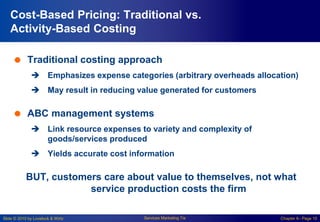
Cost-Based Pricing: Traditional vs.
Activity-Based Costing
 Traditional costing approach
 Emphasizes expense categories (arbitrary overheads allocation)
 May result in reducing value generated for customers
 ABC management systems
 Link resource expenses to variety and complexity of
goods/services produced
 Yields accurate cost information
BUT, customers care about value to themselves, not what
service production costs the firm
Slide © 2010 by Lovelock & Wirtz Services Marketing 7/e Chapter 6– Page 11
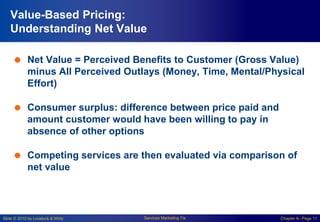
Value-Based Pricing:
Understanding Net Value
 Net Value = Perceived Benefits to Customer (Gross Value)
minus All Perceived Outlays (Money, Time, Mental/Physical
Effort)
 Consumer surplus: difference between price paid and
amount customer would have been willing to pay in
absence of other options
 Competing services are then evaluated via comparison of
net value
Slide © 2010 by Lovelock & Wirtz Services Marketing 7/e Chapter 6– Page 12
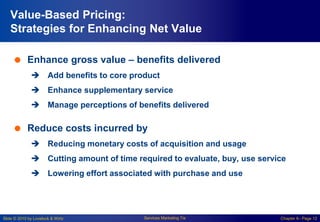
Value-Based Pricing:
Strategies for Enhancing Net Value
 Enhance gross value – benefits delivered
 Add benefits to core product
 Enhance supplementary service
 Manage perceptions of benefits delivered
 Reduce costs incurred by
 Reducing monetary costs of acquisition and usage
 Cutting amount of time required to evaluate, buy, use service
 Lowering effort associated with purchase and use
Slide © 2010 by Lovelock & Wirtz Services Marketing 7/e Chapter 6– Page 13
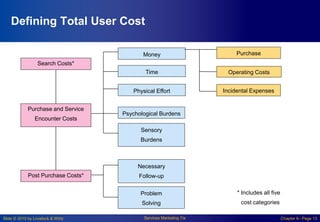
Defining Total User Cost
Physical Effort
Psychological Burdens
Sensory
Burdens
Incidental Expenses
Operating Costs
Purchase
Time
* Includes all five
cost categories
Purchase and Service
Encounter Costs
Search Costs*
Post Purchase Costs*
Necessary
Follow-up
Problem
Solving
Money
Slide © 2010 by Lovelock & Wirtz Services Marketing 7/e Chapter 6– Page 14
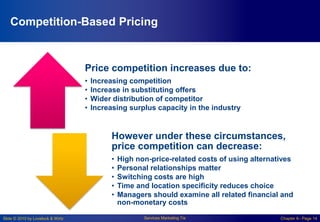
Competition-Based Pricing
Price competition increases due to:
• Increasing competition
• Increase in substituting offers
• Wider distribution of competitor
• Increasing surplus capacity in the industry
However under these circumstances,
price competition can decrease:
• High non-price-related costs of using alternatives
• Personal relationships matter
• Switching costs are high
• Time and location specificity reduces choice
• Managers should examine all related financial and
non-monetary costs
Slide © 2010 by Lovelock & Wirtz Services Marketing 7/e Chapter 6– Page 15
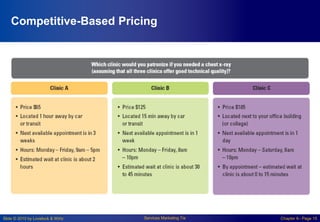
Competitive-Based Pricing
Slide © 2010 by Lovelock & Wirtz Services Marketing 7/e Chapter 6– Page 16
Revenue Management:
What it is and How it works
Slide © 2010 by Lovelock & Wirtz Services Marketing 7/e Chapter 6– Page 17
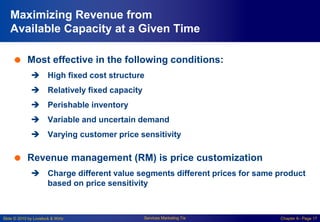
Maximizing Revenue from
Available Capacity at a Given Time
 Most effective in the following conditions:
 High fixed cost structure
 Relatively fixed capacity
 Perishable inventory
 Variable and uncertain demand
 Varying customer price sensitivity
 Revenue management (RM) is price customization
 Charge different value segments different prices for same product
based on price sensitivity
Slide © 2010 by Lovelock & Wirtz Services Marketing 7/e Chapter 6– Page 18
Maximizing Revenue from
Available Capacity at a Given Time
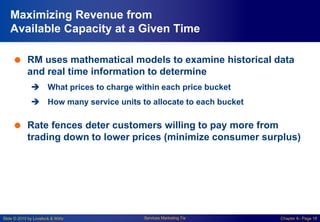
 RM uses mathematical models to examine historical data
and real time information to determine
 What prices to charge within each price bucket
 How many service units to allocate to each bucket
 Rate fences deter customers willing to pay more from
trading down to lower prices (minimize consumer surplus)
Slide © 2010 by Lovelock & Wirtz Services Marketing 7/e Chapter 6– Page 19
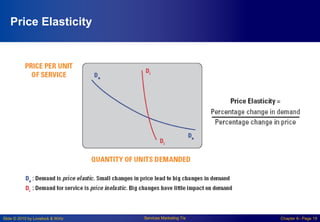
Price Elasticity
Slide © 2010 by Lovelock & Wirtz Services Marketing 7/e Chapter 6– Page 20
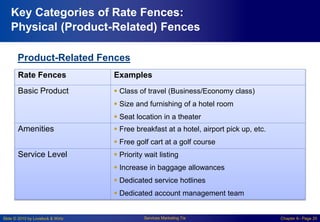
Key Categories of Rate Fences:
Physical (Product-Related) Fences
Rate Fences Examples
Basic Product  Class of travel (Business/Economy class)
 Size and furnishing of a hotel room
 Seat location in a theater
Amenities  Free breakfast at a hotel, airport pick up, etc.
 Free golf cart at a golf course
Service Level  Priority wait listing
 Increase in baggage allowances
 Dedicated service hotlines
 Dedicated account management team
Product-Related Fences
Slide © 2010 by Lovelock & Wirtz Services Marketing 7/e Chapter 6– Page 21
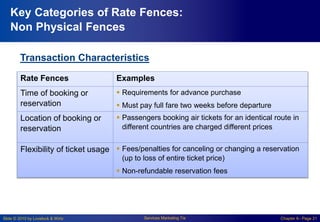
Key Categories of Rate Fences:
Non Physical Fences
Rate Fences Examples
Time of booking or
reservation
 Requirements for advance purchase
 Must pay full fare two weeks before departure
Location of booking or
reservation
 Passengers booking air tickets for an identical route in
different countries are charged different prices
Flexibility of ticket usage  Fees/penalties for canceling or changing a reservation
(up to loss of entire ticket price)
 Non-refundable reservation fees
Transaction Characteristics
Slide © 2010 by Lovelock & Wirtz Services Marketing 7/e Chapter 6– Page 22
Key Categories of Rate Fences:
Non Physical Fences
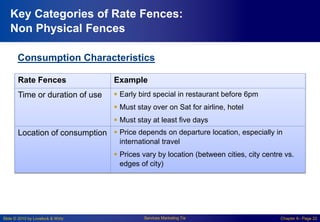
Rate Fences Example
Time or duration of use  Early bird special in restaurant before 6pm
 Must stay over on Sat for airline, hotel
 Must stay at least five days
Location of consumption  Price depends on departure location, especially in
international travel
 Prices vary by location (between cities, city centre vs.
edges of city)
Consumption Characteristics
Slide © 2010 by Lovelock & Wirtz Services Marketing 7/e Chapter 6– Page 23
Key Categories of Rate Fences:
Non Physical Fences
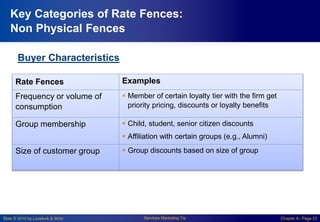
Rate Fences Examples
Frequency or volume of
consumption
 Member of certain loyalty tier with the firm get
priority pricing, discounts or loyalty benefits
Group membership  Child, student, senior citizen discounts
 Affiliation with certain groups (e.g., Alumni)
Size of customer group  Group discounts based on size of group
Buyer Characteristics
Slide © 2010 by Lovelock & Wirtz Services Marketing 7/e Chapter 6– Page 24
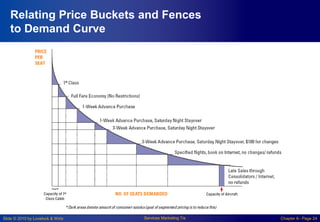
Relating Price Buckets and Fences
to Demand Curve
Slide © 2010 by Lovelock & Wirtz Services Marketing 7/e Chapter 6– Page 25
Ethical Concerns in Service
Pricing
Slide © 2010 by Lovelock & Wirtz Services Marketing 7/e Chapter 6– Page 26
Ethical Concerns in Pricing
 Many services have complex pricing schedules
 hard to understand
 difficult to calculate full costs in advance of service
 Unfairness and misrepresentation in price promotions
 misleading advertising
 hidden charges
 Too many rules and regulations
 customers feel constrained, exploited
 customers unfairly penalized when plans change
Slide © 2010 by Lovelock & Wirtz Services Marketing 7/e Chapter 6– Page 27
Designing Fairness into
Revenue Management
 Design clear, logical, and fair price schedules and fences
 Use high published prices and present fences as
opportunities for discounts
 Communicate consumer benefits of revenue management
 Use bundling to “hide” discounts
 Take care of loyal customers
 Use service recovery to compensate for overbooking
Slide © 2010 by Lovelock & Wirtz Services Marketing 7/e Chapter 6– Page 28
Putting Service
Pricing into Practice
Slide © 2010 by Lovelock & Wirtz Services Marketing 7/e Chapter 6– Page 29
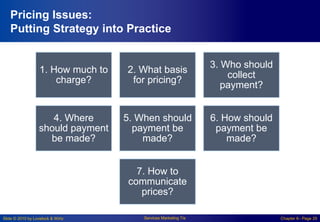
Pricing Issues:
Putting Strategy into Practice
1. How much to
charge?
2. What basis
for pricing?
3. Who should
collect
payment?
4. Where
should payment
be made?
5. When should
payment be
made?
6. How should
payment be
made?
7. How to
communicate
prices?
Slide © 2010 by Lovelock & Wirtz Services Marketing 7/e Chapter 6– Page 30
Putting Service Pricing into Practice
 How much to charge?
 Pricing tripod provides a useful starting point
 A specific figure must be set for the price
 Need to consider the pros and cons, and ethical issues
 What basis for pricing?
 Completing a task
 Admission to a service performance
 Time based
 Monetary value of service delivered (e.g., commission)
 Consumption of physical resources(e.g., food and beverages)
1. How much
to charge?
2. What basis
for pricing?
Slide © 2010 by Lovelock & Wirtz Services Marketing 7/e Chapter 6– Page 31
Putting Service Pricing into Practice
 Who should collect payment?
 Service provider or specialist intermediaries
 Direct or non-direct channels
 Where should payment be made?
 Conveniently located intermediaries
 Mail/bank transfer
 When should payment be made?
 In advance
 Once service delivery has been completed
3. Who should
collect
payment?
4. Where should
payment be
made?
5. When should
payment be
made?
Slide © 2010 by Lovelock & Wirtz Services Marketing 7/e Chapter 6– Page 32
 How should payment be made?
 Cash
 Token
 Stored value card
 Electronic fund transfer
 Charge Card (Debit/Credit)
 Vouchers
 How to communicate prices?
 Relate the price to that of competing products
 Ensure price is accurate and intelligible
6. How should
payment be
made?
7. How to
communicate
prices?
Putting Service Pricing into Practice
Slide © 2010 by Lovelock & Wirtz Services Marketing 7/e Chapter 6– Page 33
Summary
 Pricing objectives can include
 Generating revenues and profit, building demand, and developing
user base
 Three main foundations to pricing a service
 Cost-based pricing
 Competition-based pricing
 Value-based pricing
 Firm must be aware of competitive pricing but may be
harder to compare for services than for goods
Slide © 2010 by Lovelock & Wirtz Services Marketing 7/e Chapter 6– Page 34
Summary
 Revenue management
 Maximizes revenue from a given capacity at a point in time
 Manage demand and set prices for each segment closer to
perceived value
 Use of rate fences
 Ethical issues in pricing
 Complex pricing schedules
 Unfairness and misrepresentation in advertising
 Hidden charges
 Too many rules and regulations

Mktg 436 - Chapter 6

  • 1.
    Slide © 2010by Lovelock & Wirtz Services Marketing 7/e Chapter 6– Page 1 Chapter 6: Setting Prices and Implementing Revenue Management Services Marketing 7e, Global Edition
  • 2.
    Slide © 2010by Lovelock & Wirtz Services Marketing 7/e Chapter 6– Page 2 Overview Of Chapter 6  Effective Pricing is Central to Financial Success  Pricing Strategy as Represented by the Pricing Tripod  Revenue Management: What it is and How it Works  Ethical Concerns in Service Pricing  Putting Service Pricing into Practice
  • 3.
    Slide © 2010by Lovelock & Wirtz Services Marketing 7/e Chapter 6– Page 3 Effective Pricing is Central to Financial Success
  • 4.
    Slide © 2010by Lovelock & Wirtz Services Marketing 7/e Chapter 6– Page 4 What Makes Service Pricing Strategy Different and Difficult?  Harder to calculate financial costs of creating a service process or performance than a manufactured good  Variability of inputs and outputs:  How can firms define a “unit of service” and establish basis for pricing?  Importance of time factor – same service may have more value to customers when delivered faster  Customers find service pricing difficult to understand, risky, and sometimes even unethical
  • 5.
    Slide © 2010by Lovelock & Wirtz Services Marketing 7/e Chapter 6– Page 5 Objectives for Pricing of Services  Revenue and Profit Objectives  Seek profit  Cover costs  Patronage and User-Based Objectives  Build demand - Demand maximization - Full capacity utilization  Build a user base - Stimulate trial and adoption of new service - Build market share/large user base
  • 6.
    Slide © 2010by Lovelock & Wirtz Services Marketing 7/e Chapter 6– Page 6 Pricing Strategy As Represented by the Pricing Tripod
  • 7.
    Slide © 2010by Lovelock & Wirtz Services Marketing 7/e Chapter 6– Page 7 The Pricing Tripod
  • 8.
    Slide © 2010by Lovelock & Wirtz Services Marketing 7/e Chapter 6– Page 8 Costs Value to customer Competition Floor and Ceiling of Price
  • 9.
    Slide © 2010by Lovelock & Wirtz Services Marketing 7/e Chapter 6– Page 9 Three Main Approaches to Pricing Cost-Based Pricing • Set prices relative to financial costs • Activity-Based Costing • Pricing implications of cost analysis Value-Based Pricing • Relate price to value perceived by customer Competition- Based Pricing • Monitor competitors’ pricing strategy • Dependent on the price leader
  • 10.
    Slide © 2010by Lovelock & Wirtz Services Marketing 7/e Chapter 6– Page 10 Cost-Based Pricing: Traditional vs. Activity-Based Costing  Traditional costing approach  Emphasizes expense categories (arbitrary overheads allocation)  May result in reducing value generated for customers  ABC management systems  Link resource expenses to variety and complexity of goods/services produced  Yields accurate cost information BUT, customers care about value to themselves, not what service production costs the firm
  • 11.
    Slide © 2010by Lovelock & Wirtz Services Marketing 7/e Chapter 6– Page 11 Value-Based Pricing: Understanding Net Value  Net Value = Perceived Benefits to Customer (Gross Value) minus All Perceived Outlays (Money, Time, Mental/Physical Effort)  Consumer surplus: difference between price paid and amount customer would have been willing to pay in absence of other options  Competing services are then evaluated via comparison of net value
  • 12.
    Slide © 2010by Lovelock & Wirtz Services Marketing 7/e Chapter 6– Page 12 Value-Based Pricing: Strategies for Enhancing Net Value  Enhance gross value – benefits delivered  Add benefits to core product  Enhance supplementary service  Manage perceptions of benefits delivered  Reduce costs incurred by  Reducing monetary costs of acquisition and usage  Cutting amount of time required to evaluate, buy, use service  Lowering effort associated with purchase and use
  • 13.
    Slide © 2010by Lovelock & Wirtz Services Marketing 7/e Chapter 6– Page 13 Defining Total User Cost Physical Effort Psychological Burdens Sensory Burdens Incidental Expenses Operating Costs Purchase Time * Includes all five cost categories Purchase and Service Encounter Costs Search Costs* Post Purchase Costs* Necessary Follow-up Problem Solving Money
  • 14.
    Slide © 2010by Lovelock & Wirtz Services Marketing 7/e Chapter 6– Page 14 Competition-Based Pricing Price competition increases due to: • Increasing competition • Increase in substituting offers • Wider distribution of competitor • Increasing surplus capacity in the industry However under these circumstances, price competition can decrease: • High non-price-related costs of using alternatives • Personal relationships matter • Switching costs are high • Time and location specificity reduces choice • Managers should examine all related financial and non-monetary costs
  • 15.
    Slide © 2010by Lovelock & Wirtz Services Marketing 7/e Chapter 6– Page 15 Competitive-Based Pricing
  • 16.
    Slide © 2010by Lovelock & Wirtz Services Marketing 7/e Chapter 6– Page 16 Revenue Management: What it is and How it works
  • 17.
    Slide © 2010by Lovelock & Wirtz Services Marketing 7/e Chapter 6– Page 17 Maximizing Revenue from Available Capacity at a Given Time  Most effective in the following conditions:  High fixed cost structure  Relatively fixed capacity  Perishable inventory  Variable and uncertain demand  Varying customer price sensitivity  Revenue management (RM) is price customization  Charge different value segments different prices for same product based on price sensitivity
  • 18.
    Slide © 2010by Lovelock & Wirtz Services Marketing 7/e Chapter 6– Page 18 Maximizing Revenue from Available Capacity at a Given Time  RM uses mathematical models to examine historical data and real time information to determine  What prices to charge within each price bucket  How many service units to allocate to each bucket  Rate fences deter customers willing to pay more from trading down to lower prices (minimize consumer surplus)
  • 19.
    Slide © 2010by Lovelock & Wirtz Services Marketing 7/e Chapter 6– Page 19 Price Elasticity
  • 20.
    Slide © 2010by Lovelock & Wirtz Services Marketing 7/e Chapter 6– Page 20 Key Categories of Rate Fences: Physical (Product-Related) Fences Rate Fences Examples Basic Product  Class of travel (Business/Economy class)  Size and furnishing of a hotel room  Seat location in a theater Amenities  Free breakfast at a hotel, airport pick up, etc.  Free golf cart at a golf course Service Level  Priority wait listing  Increase in baggage allowances  Dedicated service hotlines  Dedicated account management team Product-Related Fences
  • 21.
    Slide © 2010by Lovelock & Wirtz Services Marketing 7/e Chapter 6– Page 21 Key Categories of Rate Fences: Non Physical Fences Rate Fences Examples Time of booking or reservation  Requirements for advance purchase  Must pay full fare two weeks before departure Location of booking or reservation  Passengers booking air tickets for an identical route in different countries are charged different prices Flexibility of ticket usage  Fees/penalties for canceling or changing a reservation (up to loss of entire ticket price)  Non-refundable reservation fees Transaction Characteristics
  • 22.
    Slide © 2010by Lovelock & Wirtz Services Marketing 7/e Chapter 6– Page 22 Key Categories of Rate Fences: Non Physical Fences Rate Fences Example Time or duration of use  Early bird special in restaurant before 6pm  Must stay over on Sat for airline, hotel  Must stay at least five days Location of consumption  Price depends on departure location, especially in international travel  Prices vary by location (between cities, city centre vs. edges of city) Consumption Characteristics
  • 23.
    Slide © 2010by Lovelock & Wirtz Services Marketing 7/e Chapter 6– Page 23 Key Categories of Rate Fences: Non Physical Fences Rate Fences Examples Frequency or volume of consumption  Member of certain loyalty tier with the firm get priority pricing, discounts or loyalty benefits Group membership  Child, student, senior citizen discounts  Affiliation with certain groups (e.g., Alumni) Size of customer group  Group discounts based on size of group Buyer Characteristics
  • 24.
    Slide © 2010by Lovelock & Wirtz Services Marketing 7/e Chapter 6– Page 24 Relating Price Buckets and Fences to Demand Curve
  • 25.
    Slide © 2010by Lovelock & Wirtz Services Marketing 7/e Chapter 6– Page 25 Ethical Concerns in Service Pricing
  • 26.
    Slide © 2010by Lovelock & Wirtz Services Marketing 7/e Chapter 6– Page 26 Ethical Concerns in Pricing  Many services have complex pricing schedules  hard to understand  difficult to calculate full costs in advance of service  Unfairness and misrepresentation in price promotions  misleading advertising  hidden charges  Too many rules and regulations  customers feel constrained, exploited  customers unfairly penalized when plans change
  • 27.
    Slide © 2010by Lovelock & Wirtz Services Marketing 7/e Chapter 6– Page 27 Designing Fairness into Revenue Management  Design clear, logical, and fair price schedules and fences  Use high published prices and present fences as opportunities for discounts  Communicate consumer benefits of revenue management  Use bundling to “hide” discounts  Take care of loyal customers  Use service recovery to compensate for overbooking
  • 28.
    Slide © 2010by Lovelock & Wirtz Services Marketing 7/e Chapter 6– Page 28 Putting Service Pricing into Practice
  • 29.
    Slide © 2010by Lovelock & Wirtz Services Marketing 7/e Chapter 6– Page 29 Pricing Issues: Putting Strategy into Practice 1. How much to charge? 2. What basis for pricing? 3. Who should collect payment? 4. Where should payment be made? 5. When should payment be made? 6. How should payment be made? 7. How to communicate prices?
  • 30.
    Slide © 2010by Lovelock & Wirtz Services Marketing 7/e Chapter 6– Page 30 Putting Service Pricing into Practice  How much to charge?  Pricing tripod provides a useful starting point  A specific figure must be set for the price  Need to consider the pros and cons, and ethical issues  What basis for pricing?  Completing a task  Admission to a service performance  Time based  Monetary value of service delivered (e.g., commission)  Consumption of physical resources(e.g., food and beverages) 1. How much to charge? 2. What basis for pricing?
  • 31.
    Slide © 2010by Lovelock & Wirtz Services Marketing 7/e Chapter 6– Page 31 Putting Service Pricing into Practice  Who should collect payment?  Service provider or specialist intermediaries  Direct or non-direct channels  Where should payment be made?  Conveniently located intermediaries  Mail/bank transfer  When should payment be made?  In advance  Once service delivery has been completed 3. Who should collect payment? 4. Where should payment be made? 5. When should payment be made?
  • 32.
    Slide © 2010by Lovelock & Wirtz Services Marketing 7/e Chapter 6– Page 32  How should payment be made?  Cash  Token  Stored value card  Electronic fund transfer  Charge Card (Debit/Credit)  Vouchers  How to communicate prices?  Relate the price to that of competing products  Ensure price is accurate and intelligible 6. How should payment be made? 7. How to communicate prices? Putting Service Pricing into Practice
  • 33.
    Slide © 2010by Lovelock & Wirtz Services Marketing 7/e Chapter 6– Page 33 Summary  Pricing objectives can include  Generating revenues and profit, building demand, and developing user base  Three main foundations to pricing a service  Cost-based pricing  Competition-based pricing  Value-based pricing  Firm must be aware of competitive pricing but may be harder to compare for services than for goods
  • 34.
    Slide © 2010by Lovelock & Wirtz Services Marketing 7/e Chapter 6– Page 34 Summary  Revenue management  Maximizes revenue from a given capacity at a point in time  Manage demand and set prices for each segment closer to perceived value  Use of rate fences  Ethical issues in pricing  Complex pricing schedules  Unfairness and misrepresentation in advertising  Hidden charges  Too many rules and regulations