1
Computer Networks: A Systems Approach, 5e
Larry L. Peterson and Bruce S. Davie
Chapter 4
Advanced Internetworking
Copyright © 2010, Elsevier Inc. All rights Reserved
2
Chapter
4
Problems
 How do we build a routing system that can
handle hundreds of thousands of networks and
billions of end nodes?
 How to handle address space exhaustion of
IPV4?
 How to enhance the functionalities of Internet?
3
Chapter
4
Chapter Outline
 Global Internet
 Multicast
 Mobile IP
4
Chapter
4
Chapter Goal
 Understanding the scalability of routing in the
Internet
 Discussing IPv6
 Understanding the concept of multicasting
 Discussing Mobile IP
5
Chapter
4
The Global Internet
The tree structure of the Internet in 1990
6
Chapter
4
The Global Internet
A simple multi-provider Internet
7
Chapter
4
Interdomain Routing (BGP)
 Internet is organized as autonomous systems
(AS) each of which is under the control of a
single administrative entity
 Autonomous System (AS)
 corresponds to an administrative domain
 examples: University, company, backbone network
 A corporation’s internal network might be a
single AS, as may the network of a single
Internet service provider
8
Chapter
4
Interdomain Routing
A network with two autonomous system
9
Chapter
4
Route Propagation
 Idea: Provide an additional way to hierarchically
aggregate routing information is a large internet.
 Improves scalability
 Divide the routing problem in two parts:
 Routing within a single autonomous system
 Routing between autonomous systems
 Another name for autonomous systems in the Internet is
routing domains
 Two-level route propagation hierarchy
 Inter-domain routing protocol (Internet-wide standard)
 Intra-domain routing protocol (each AS selects its own)
10
Chapter
4
EGP and BGP
 Inter-domain Routing Protocols
 Exterior Gateway Protocol (EGP)
 Forced a tree-like topology onto the Internet
 Did not allow for the topology to become general
 Tree like structure: there is a single backbone and autonomous systems
are connected only as parents and children and not as peers
 Border Gateway Protocol (BGP)
 Assumes that the Internet is an arbitrarily interconnected set of ASs.
 Today’s Internet consists of an interconnection of multiple backbone
networks (they are usually called service provider networks, and
they are operated by private companies rather than the government)
 Sites are connected to each other in arbitrary ways
11
Chapter
4
BGP
 Some large corporations connect directly to one
or more of the backbone, while others connect to
smaller, non-backbone service providers.
 Many service providers exist mainly to provide
service to “consumers” (individuals with PCs in
their homes), and these providers must connect
to the backbone providers
 Often many providers arrange to interconnect
with each other at a single “peering point”
12
Chapter
4
BGP-4: Border Gateway Protocol
 Assumes the Internet is an arbitrarily interconnected
set of AS's.
 Define local traffic as traffic that originates at or
terminates on nodes within an AS, and transit traffic
as traffic that passes through an AS.
 We can classify AS's into three types:
 Stub AS: an AS that has only a single connection to one other AS;
such an AS will only carry local traffic (small corporation in the
figure of the previous page).
 Multihomed AS: an AS that has connections to more than one other
AS, but refuses to carry transit traffic (large corporation at the top in
the figure of the previous page).
 Transit AS: an AS that has connections to more than one other AS,
and is designed to carry both transit and local traffic (backbone
providers in the figure of the previous page).
13
Chapter
4
 The goal of Inter-domain routing is to find
any path to the intended destination that is
loop free
 We are concerned with reachability than
optimality
 Finding path anywhere close to optimal is
considered to be a great achievement
 Why?
BGP
14
Chapter
4
 Scalability: An Internet backbone router must be able to
forward any packet destined anywhere in the Internet
 Having a routing table that will provide a match for any valid IP
address
 Autonomous nature of the domains
 It is impossible to calculate meaningful path costs for a path that
crosses multiple ASs
 A cost of 1000 across one provider might imply a great path but it
might mean an unacceptable bad one from another provid
 Issues of trust
 Provider A might be unwilling to believe certain advertisements
from provider B
BGP
15
Chapter
4
Each AS has:
 One BGP speaker that advertises:
 local networks
 other reachable networks (transit AS only)
 gives path information
 In addition to the BGP speakers, the AS has one or more
border “gateways” which need not be the same as the
speakers
 The border gateways are the routers through which
packets enter and leave the AS
BGP
16
Chapter
4
 BGP does not belong to either of the two
main classes of routing protocols (distance
vectors and link-state protocols)
 BGP advertises complete paths as an
enumerated lists of ASs to reach a
particular network
BGP
17
Chapter
4
BGP Example
Example of a network running BGP
18
Chapter
4
BGP Example
 Speaker for AS 2 advertises reachability
to P and Q
 Network 128.96, 192.4.153, 192.4.32, and
192.4.3, can be reached directly from AS 2.
 Speaker for backbone network then
advertises
 Networks 128.96, 192.4.153, 192.4.32, and
192.4.3 can be reached along the path <AS
1, AS 2>.
 Speaker can also cancel previously
advertised paths
19
Chapter
4
BGP Issues
 It should be apparent that the AS
numbers carried in BGP need to be
unique
 For example, AS 2 can only recognize
itself in the AS path in the example if no
other AS identifies itself in the same way
 AS numbers are 16-bit numbers assigned
by a central authority
20
Chapter
4
Integrating Interdomain and Intradomain
Routing
All routers run iBGP and an intradomain routing
protocol. Border routers (A, D, E) also run eBGP to
other ASs
21
Chapter
4
Integrating Interdomain and Intradomain
Routing
BGP routing table, IGP routing table, and combined
table at router B
22
Chapter
4
Routing Areas
A domain divided into area
Backbone area
Area border router
(ABR)
23
Chapter
4
Next Generation IP
(IPv6)
24
Chapter
4
Major Features
 128-bit addresses
 Multicast
 Real-time service
 Authentication and security
 Auto-configuration
 End-to-end fragmentation
 Enhanced routing functionality, including
support for mobile hosts
25
Chapter
4
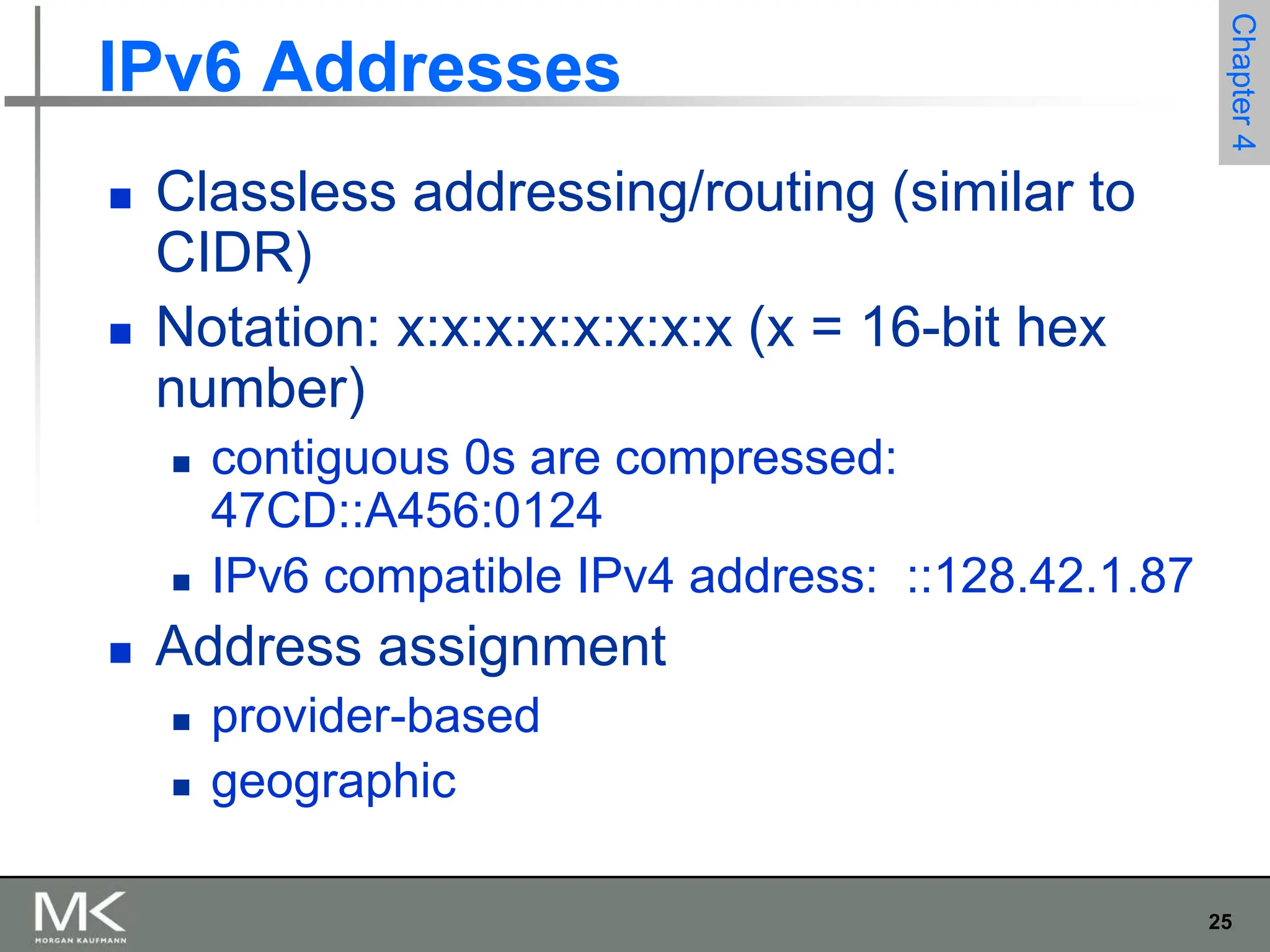
IPv6 Addresses
 Classless addressing/routing (similar to
CIDR)
 Notation: x:x:x:x:x:x:x:x (x = 16-bit hex
number)
 contiguous 0s are compressed:
47CD::A456:0124
 IPv6 compatible IPv4 address: ::128.42.1.87
 Address assignment
 provider-based
 geographic
26
Chapter
4
IPv6 Header
 40-byte “base” header
 Extension headers (fixed order, mostly
fixed length)
 fragmentation
 source routing
 authentication and
security
 other options
27
Chapter
4
Internet Multicast
28
Chapter
4
Overview
 IPv4
 class D addresses
 demonstrated with MBone
 uses tunneling
 Integral part of IPv6
 problem is making it scale
29
Chapter
4
Overview
 One-to-many
 Radio station broadcast
 Transmitting news, stock-price
 Software updates to multiple hosts
 Many-to-many
 Multimedia teleconferencing
 Online multi-player games
 Distributed simulations
30
Chapter
4
Overview
 Without support for multicast
 A source needs to send a separate packet with the
identical data to each member of the group
 This redundancy consumes more bandwidth
 Redundant traffic is not evenly distributed, concentrated near
the sending host
 Source needs to keep track of the IP address of each
member in the group
 Group may be dynamic
 To support many-to-many and one-to-many IP
provides an IP-level multicast
31
Chapter
4
Overview
 Basic IP multicast model is many-to-many
based on multicast groups
 Each group has its own IP multicast address
 Hosts that are members of a group receive
copies of any packets sent to that group’s
multicast address
 A host can be in multiple groups
 A host can join and leave groups
32
Chapter
4
Overview
 Using IP multicast to send the identical
packet to each member of the group
 A host sends a single copy of the packet
addressed to the group’s multicast address
 The sending host does not need to know the
individual unicast IP address of each member
 Sending host does not send multiple copies of
the packet
33
Chapter
4
Overview
 IP’s original many-to-many multicast has
been supplemented with support for a form
of one-to-many multicast
 One-to-many multicast
 Source specific multicast (SSM)
 A receiving host specifies both a multicast
group and a specific sending host
 Many-to-many model
 Any source multicast (ASM)
34
Chapter
4
Overview
 A host signals its desire to join or leave a
multicast group by communicating with its local
router using a special protocol
 In IPv4, the protocol is Internet Group Management
Protocol (IGMP)
 In IPv6, the protocol is Multicast Listener Discovery
(MLD)
 The router has the responsibility for making
multicast behave correctly with regard to the host
35
Chapter
4
Multicast Routing
 A router’s unicast forwarding tables indicate for
any IP address, which link to use to forward the
unicast packet
 To support multicast, a router must additionally
have multicast forwarding tables that indicate,
based on multicast address, which links to use to
forward the multicast packet
 Unicast forwarding tables collectively specify a
set of paths
 Multicast forwarding tables collectively specify a
set of trees
 Multicast distribution trees
36
Chapter
4
Multicast Routing
 To support source specific multicast, the
multicast forwarding tables must indicate
which links to use based on the
combination of multicast address and the
unicast IP address of the source
 Multicast routing is the process by which
multicast distribution trees are determined
37
Chapter
4
Distance-Vector Multicast
 Each router already knows that shortest path to
source S goes through router N.
 When receive multicast packet from S, forward
on all outgoing links (except the one on which
the packet arrived), iff packet arrived from N.
 Eliminate duplicate broadcast packets by only
letting
 “parent” for LAN (relative to S) forward
 shortest path to S (learn via distance vector)
 smallest address to break ties
38
Chapter
4
Reverse Path Broadcast (RPB)
 Goal: Prune networks that have no hosts in group G
 Step 1: Determine of LAN is a leaf with no members in
G
 leaf if parent is only router on the LAN
 determine if any hosts are members of G using IGMP
 Step 2: Propagate “no members of G here” information
 augment <Destination, Cost> update sent to neighbors
with set of groups for which this network is interested in
receiving multicast packets.
 only happens when multicast address becomes active.
Distance-Vector Multicast
39
Chapter
4
Protocol Independent Multicast (PIM)
Shared Tree
Source
specific tree
40
Chapter
4
Protocol Independent Multicast (PIM)
Delivery of a packet along a shared tree. R1 tunnels the
packet to the RP, which forwards it along the shared
tree to R4 and R5.
41
Chapter
4
Inter-domain Multicast
Multicast Source Discovery Protocol (MSDP)
42
Chapter
4
Routing for Mobile Hosts
 Mobile IP
 home agent
 Router located on the home network of the mobile hosts
 home address
 The permanent IP address of the mobile host.
 Has a network number equal to that of the home network and thus of
the home agent
 foreign agent
 Router located on a network to which the mobile node attaches itself
when it is away from its home network
43
Chapter
4
Routing for Mobile Hosts
 Problem of delivering a packet to the mobile node
 How does the home agent intercept a packet that is destined
for the mobile node?
 Proxy ARP
 How does the home agent then deliver the packet to the
foreign agent?
 IP tunnel
 Care-of-address
 How does the foreign agent deliver the packet to the mobile
node?
44
Chapter
4
Routing for Mobile Hosts
 Route optimization in Mobile IP
 The route from the sending node to mobile node can be
significantly sub-optimal
 One extreme example
 The mobile node and the sending node are on the same
network, but the home network for the mobile node is on the far
side of the Internet
 Triangle Routing Problem
 Solution
 Let the sending node know the care-of-address of the mobile
node. The sending node can create its own tunnel to the
foreign agent
 Home agent sends binding update message
 The sending node creates an entry in the binding cache
 The binding cache may become out-of-date
 The mobile node moved to a different network
 Foreign agent sends a binding warning message
45
Chapter
4
Summary
 We have looked at the issues of scalability in routing in
the Internet
 We have discussed IPV6
 We have discussed Multicasting
 We have discussed Mobile IP
#
Chapter
Subtitle

MK-PPT Chapter 4.ppt about the brief introduction to advanced internetworking

  • 1.
    1 Computer Networks: ASystems Approach, 5e Larry L. Peterson and Bruce S. Davie Chapter 4 Advanced Internetworking Copyright © 2010, Elsevier Inc. All rights Reserved
  • 2.
    2 Chapter 4 Problems  How dowe build a routing system that can handle hundreds of thousands of networks and billions of end nodes?  How to handle address space exhaustion of IPV4?  How to enhance the functionalities of Internet?
  • 3.
    3 Chapter 4 Chapter Outline  GlobalInternet  Multicast  Mobile IP
  • 4.
    4 Chapter 4 Chapter Goal  Understandingthe scalability of routing in the Internet  Discussing IPv6  Understanding the concept of multicasting  Discussing Mobile IP
  • 5.
    5 Chapter 4 The Global Internet Thetree structure of the Internet in 1990
  • 6.
    6 Chapter 4 The Global Internet Asimple multi-provider Internet
  • 7.
    7 Chapter 4 Interdomain Routing (BGP) Internet is organized as autonomous systems (AS) each of which is under the control of a single administrative entity  Autonomous System (AS)  corresponds to an administrative domain  examples: University, company, backbone network  A corporation’s internal network might be a single AS, as may the network of a single Internet service provider
  • 8.
  • 9.
    9 Chapter 4 Route Propagation  Idea:Provide an additional way to hierarchically aggregate routing information is a large internet.  Improves scalability  Divide the routing problem in two parts:  Routing within a single autonomous system  Routing between autonomous systems  Another name for autonomous systems in the Internet is routing domains  Two-level route propagation hierarchy  Inter-domain routing protocol (Internet-wide standard)  Intra-domain routing protocol (each AS selects its own)
  • 10.
    10 Chapter 4 EGP and BGP Inter-domain Routing Protocols  Exterior Gateway Protocol (EGP)  Forced a tree-like topology onto the Internet  Did not allow for the topology to become general  Tree like structure: there is a single backbone and autonomous systems are connected only as parents and children and not as peers  Border Gateway Protocol (BGP)  Assumes that the Internet is an arbitrarily interconnected set of ASs.  Today’s Internet consists of an interconnection of multiple backbone networks (they are usually called service provider networks, and they are operated by private companies rather than the government)  Sites are connected to each other in arbitrary ways
  • 11.
    11 Chapter 4 BGP  Some largecorporations connect directly to one or more of the backbone, while others connect to smaller, non-backbone service providers.  Many service providers exist mainly to provide service to “consumers” (individuals with PCs in their homes), and these providers must connect to the backbone providers  Often many providers arrange to interconnect with each other at a single “peering point”
  • 12.
    12 Chapter 4 BGP-4: Border GatewayProtocol  Assumes the Internet is an arbitrarily interconnected set of AS's.  Define local traffic as traffic that originates at or terminates on nodes within an AS, and transit traffic as traffic that passes through an AS.  We can classify AS's into three types:  Stub AS: an AS that has only a single connection to one other AS; such an AS will only carry local traffic (small corporation in the figure of the previous page).  Multihomed AS: an AS that has connections to more than one other AS, but refuses to carry transit traffic (large corporation at the top in the figure of the previous page).  Transit AS: an AS that has connections to more than one other AS, and is designed to carry both transit and local traffic (backbone providers in the figure of the previous page).
  • 13.
    13 Chapter 4  The goalof Inter-domain routing is to find any path to the intended destination that is loop free  We are concerned with reachability than optimality  Finding path anywhere close to optimal is considered to be a great achievement  Why? BGP
  • 14.
    14 Chapter 4  Scalability: AnInternet backbone router must be able to forward any packet destined anywhere in the Internet  Having a routing table that will provide a match for any valid IP address  Autonomous nature of the domains  It is impossible to calculate meaningful path costs for a path that crosses multiple ASs  A cost of 1000 across one provider might imply a great path but it might mean an unacceptable bad one from another provid  Issues of trust  Provider A might be unwilling to believe certain advertisements from provider B BGP
  • 15.
    15 Chapter 4 Each AS has: One BGP speaker that advertises:  local networks  other reachable networks (transit AS only)  gives path information  In addition to the BGP speakers, the AS has one or more border “gateways” which need not be the same as the speakers  The border gateways are the routers through which packets enter and leave the AS BGP
  • 16.
    16 Chapter 4  BGP doesnot belong to either of the two main classes of routing protocols (distance vectors and link-state protocols)  BGP advertises complete paths as an enumerated lists of ASs to reach a particular network BGP
  • 17.
  • 18.
    18 Chapter 4 BGP Example  Speakerfor AS 2 advertises reachability to P and Q  Network 128.96, 192.4.153, 192.4.32, and 192.4.3, can be reached directly from AS 2.  Speaker for backbone network then advertises  Networks 128.96, 192.4.153, 192.4.32, and 192.4.3 can be reached along the path <AS 1, AS 2>.  Speaker can also cancel previously advertised paths
  • 19.
    19 Chapter 4 BGP Issues  Itshould be apparent that the AS numbers carried in BGP need to be unique  For example, AS 2 can only recognize itself in the AS path in the example if no other AS identifies itself in the same way  AS numbers are 16-bit numbers assigned by a central authority
  • 20.
    20 Chapter 4 Integrating Interdomain andIntradomain Routing All routers run iBGP and an intradomain routing protocol. Border routers (A, D, E) also run eBGP to other ASs
  • 21.
    21 Chapter 4 Integrating Interdomain andIntradomain Routing BGP routing table, IGP routing table, and combined table at router B
  • 22.
    22 Chapter 4 Routing Areas A domaindivided into area Backbone area Area border router (ABR)
  • 23.
  • 24.
    24 Chapter 4 Major Features  128-bitaddresses  Multicast  Real-time service  Authentication and security  Auto-configuration  End-to-end fragmentation  Enhanced routing functionality, including support for mobile hosts
  • 25.
    25 Chapter 4 IPv6 Addresses  Classlessaddressing/routing (similar to CIDR)  Notation: x:x:x:x:x:x:x:x (x = 16-bit hex number)  contiguous 0s are compressed: 47CD::A456:0124  IPv6 compatible IPv4 address: ::128.42.1.87  Address assignment  provider-based  geographic
  • 26.
    26 Chapter 4 IPv6 Header  40-byte“base” header  Extension headers (fixed order, mostly fixed length)  fragmentation  source routing  authentication and security  other options
  • 27.
  • 28.
    28 Chapter 4 Overview  IPv4  classD addresses  demonstrated with MBone  uses tunneling  Integral part of IPv6  problem is making it scale
  • 29.
    29 Chapter 4 Overview  One-to-many  Radiostation broadcast  Transmitting news, stock-price  Software updates to multiple hosts  Many-to-many  Multimedia teleconferencing  Online multi-player games  Distributed simulations
  • 30.
    30 Chapter 4 Overview  Without supportfor multicast  A source needs to send a separate packet with the identical data to each member of the group  This redundancy consumes more bandwidth  Redundant traffic is not evenly distributed, concentrated near the sending host  Source needs to keep track of the IP address of each member in the group  Group may be dynamic  To support many-to-many and one-to-many IP provides an IP-level multicast
  • 31.
    31 Chapter 4 Overview  Basic IPmulticast model is many-to-many based on multicast groups  Each group has its own IP multicast address  Hosts that are members of a group receive copies of any packets sent to that group’s multicast address  A host can be in multiple groups  A host can join and leave groups
  • 32.
    32 Chapter 4 Overview  Using IPmulticast to send the identical packet to each member of the group  A host sends a single copy of the packet addressed to the group’s multicast address  The sending host does not need to know the individual unicast IP address of each member  Sending host does not send multiple copies of the packet
  • 33.
    33 Chapter 4 Overview  IP’s originalmany-to-many multicast has been supplemented with support for a form of one-to-many multicast  One-to-many multicast  Source specific multicast (SSM)  A receiving host specifies both a multicast group and a specific sending host  Many-to-many model  Any source multicast (ASM)
  • 34.
    34 Chapter 4 Overview  A hostsignals its desire to join or leave a multicast group by communicating with its local router using a special protocol  In IPv4, the protocol is Internet Group Management Protocol (IGMP)  In IPv6, the protocol is Multicast Listener Discovery (MLD)  The router has the responsibility for making multicast behave correctly with regard to the host
  • 35.
    35 Chapter 4 Multicast Routing  Arouter’s unicast forwarding tables indicate for any IP address, which link to use to forward the unicast packet  To support multicast, a router must additionally have multicast forwarding tables that indicate, based on multicast address, which links to use to forward the multicast packet  Unicast forwarding tables collectively specify a set of paths  Multicast forwarding tables collectively specify a set of trees  Multicast distribution trees
  • 36.
    36 Chapter 4 Multicast Routing  Tosupport source specific multicast, the multicast forwarding tables must indicate which links to use based on the combination of multicast address and the unicast IP address of the source  Multicast routing is the process by which multicast distribution trees are determined
  • 37.
    37 Chapter 4 Distance-Vector Multicast  Eachrouter already knows that shortest path to source S goes through router N.  When receive multicast packet from S, forward on all outgoing links (except the one on which the packet arrived), iff packet arrived from N.  Eliminate duplicate broadcast packets by only letting  “parent” for LAN (relative to S) forward  shortest path to S (learn via distance vector)  smallest address to break ties
  • 38.
    38 Chapter 4 Reverse Path Broadcast(RPB)  Goal: Prune networks that have no hosts in group G  Step 1: Determine of LAN is a leaf with no members in G  leaf if parent is only router on the LAN  determine if any hosts are members of G using IGMP  Step 2: Propagate “no members of G here” information  augment <Destination, Cost> update sent to neighbors with set of groups for which this network is interested in receiving multicast packets.  only happens when multicast address becomes active. Distance-Vector Multicast
  • 39.
    39 Chapter 4 Protocol Independent Multicast(PIM) Shared Tree Source specific tree
  • 40.
    40 Chapter 4 Protocol Independent Multicast(PIM) Delivery of a packet along a shared tree. R1 tunnels the packet to the RP, which forwards it along the shared tree to R4 and R5.
  • 41.
  • 42.
    42 Chapter 4 Routing for MobileHosts  Mobile IP  home agent  Router located on the home network of the mobile hosts  home address  The permanent IP address of the mobile host.  Has a network number equal to that of the home network and thus of the home agent  foreign agent  Router located on a network to which the mobile node attaches itself when it is away from its home network
  • 43.
    43 Chapter 4 Routing for MobileHosts  Problem of delivering a packet to the mobile node  How does the home agent intercept a packet that is destined for the mobile node?  Proxy ARP  How does the home agent then deliver the packet to the foreign agent?  IP tunnel  Care-of-address  How does the foreign agent deliver the packet to the mobile node?
  • 44.
    44 Chapter 4 Routing for MobileHosts  Route optimization in Mobile IP  The route from the sending node to mobile node can be significantly sub-optimal  One extreme example  The mobile node and the sending node are on the same network, but the home network for the mobile node is on the far side of the Internet  Triangle Routing Problem  Solution  Let the sending node know the care-of-address of the mobile node. The sending node can create its own tunnel to the foreign agent  Home agent sends binding update message  The sending node creates an entry in the binding cache  The binding cache may become out-of-date  The mobile node moved to a different network  Foreign agent sends a binding warning message
  • 45.
    45 Chapter 4 Summary  We havelooked at the issues of scalability in routing in the Internet  We have discussed IPV6  We have discussed Multicasting  We have discussed Mobile IP # Chapter Subtitle

Editor's Notes