Democratic implications of news: 
what can we learn from the use 
of different methodological 
approaches with young people? 
Maria José Brites (Media and Journalism Research Centre, Portuguese national 
Foundation for Science and Technology and Lusophone University of Porto) 
britesmariajose@gmail.com 
Cristina Ponte (Faculty of Human and Social Sciences/New University of Lisbon) 
ponte.cristina1@gmail.com 
Isabel Menezes (University of Porto) 
imenezes@fpce.up.pt 
ECREA 2012 Istanbul, 24-27 October 
1
Argument 
Methodological design can be 
improved with longitudinal process 
and if research participants 
have more voice. 
Accurate the construction 
of typologies (journalism and 
participation). 
2
Journalism and audiences 
Journalism has been much more 
considered from the point of view 
of production and contents, rather 
than from the point of view of news 
audiences (Bird, 2011). 
Buckingham recognizes the difficulty 
in researching journalism 
and youngsters (2006: 18). 
3
Longitudinal process 
Longitudinal research is more 
powerful with the same sample 
Kitzinger (2004: 177). 
This participatory research activity 
(Higgins et al, 2007) has the 
advantage of including young people’s 
vision of important aspects 
of the research. 
4
Methodological reflections 
Phase 1: began in 2010 with the first interviews conducted with 35 
Portuguese youngsters with diverse experiences of, broadly defined, 
civic and political participation. The second interviews occurred 
around five months later (2011) and involved 30 of the initial 
interviewees. 
Phase 2: in September-November 2011, the same participants were 
invited to participate in focus-groups discussions; we manage to 
constitute three different groups from the initial sample (n=15). 
(School Parliament Program, youth political parties, graffiti, school 
newspapers and assembly in a low income area, among others) 
How does the methodological options influence the typologies? 
PhD research on youth, participation and journalism in Portugal 
supported by the Portuguese Foundation of Science and Technology 
– FCT (SFRH/BD/47530/2008) 
5
Typologies 
News consumption 
Political news 
Participation 
Democratic representation 
of journalism 
6
Typologies 
1 – Consumption and prevention/risk. 
“I watch news with my mother and my brother. We comment on that, 
my mother talks about dangers.[...] A few days ago, we spoke 
about swimming pool dangers. She said: ‘Don't jump like that’. My 
mother alerts me and my brother.” (Girl, 15, low income area 
assembly, 1st Interview) 
2 – Relevance of television and journalism. 
“... television is the basis of my family life.” 
(Girl, 16, School Parliament Program, 3rd Focus Group) 
3 – Versatile news consumers and shared concerns. 
4 – Internet and the need of social change. 
“[I share on the web] Issues such as LGBT, racism, discrimination, 
contemporary issues such as Egypt, Tunisia, economical issues.” 
(Girl, Political Party/NGO on Racism, 2nd interview) 
5 – Personal interests: preferences rather than fight for causes. 
7
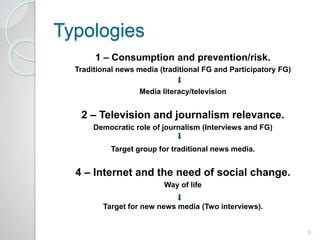
Typologies 
1 – Consumption and prevention/risk. 
Traditional news media (traditional FG and Participatory FG) 
Media literacy/television 
2 – Television and journalism relevance. 
Democratic role of journalism (Interviews and FG) 
Target group for traditional news media. 
4 – Internet and the need of social change. 
Way of life 
Target for new news media (Two interviews). 
8
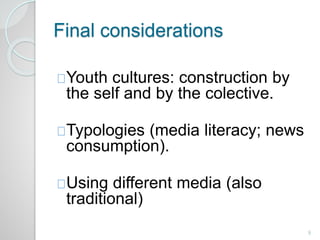
Final considerations 
Youth cultures: construction by 
the self and by the colective. 
Typologies (media literacy; news 
consumption). 
Using different media (also 
traditional) 
9
References 
Bird, S. E. (2011). Seeking the Audience for News: 
Response, news talk, and everyday practices. Virginia 
Nightingale. The handbook of media audiences. 
Chichester, Blackwell Publishing. 
Buckingham, David (2006 [2000]). The Making of 
Citizens: Young People, News and Politics. Londres e 
Nova Iorque, Taylor & Francis e-Library. 
Higgins, J., Nairn, K. and Sligo, J. (2007). Peer 
research with youth: negotiating (sub)cultural capital, 
place and participation in Aotearoa/New Zealand. 
Participatory Action Research, Approaches and 
Methods: Connecting people, participation and place. 
Sara Kindon. London and New York, Routledge. 
Kitzinger, Jenny (2004). Audience and Readership 
Research. The SAGE handbook of media studies. 
Downing, John D. Thousand Oaks, London and New 
Delhi, SAGE. 
10
Thank you! 
Maria José Brites | britesmariajose@gmail.com 
Cristina Ponte |ponte.cristina1@gmail.com 
Isabel Menezes | imenezes@fpce.up.pt 
11

Democratic implications of news: What can we learn from the use of different methodological approaches with young people?

  • 1.
    Democratic implications ofnews: what can we learn from the use of different methodological approaches with young people? Maria José Brites (Media and Journalism Research Centre, Portuguese national Foundation for Science and Technology and Lusophone University of Porto) britesmariajose@gmail.com Cristina Ponte (Faculty of Human and Social Sciences/New University of Lisbon) ponte.cristina1@gmail.com Isabel Menezes (University of Porto) imenezes@fpce.up.pt ECREA 2012 Istanbul, 24-27 October 1
  • 2.
    Argument Methodological designcan be improved with longitudinal process and if research participants have more voice. Accurate the construction of typologies (journalism and participation). 2
  • 3.
    Journalism and audiences Journalism has been much more considered from the point of view of production and contents, rather than from the point of view of news audiences (Bird, 2011). Buckingham recognizes the difficulty in researching journalism and youngsters (2006: 18). 3
  • 4.
    Longitudinal process Longitudinalresearch is more powerful with the same sample Kitzinger (2004: 177). This participatory research activity (Higgins et al, 2007) has the advantage of including young people’s vision of important aspects of the research. 4
  • 5.
    Methodological reflections Phase1: began in 2010 with the first interviews conducted with 35 Portuguese youngsters with diverse experiences of, broadly defined, civic and political participation. The second interviews occurred around five months later (2011) and involved 30 of the initial interviewees. Phase 2: in September-November 2011, the same participants were invited to participate in focus-groups discussions; we manage to constitute three different groups from the initial sample (n=15). (School Parliament Program, youth political parties, graffiti, school newspapers and assembly in a low income area, among others) How does the methodological options influence the typologies? PhD research on youth, participation and journalism in Portugal supported by the Portuguese Foundation of Science and Technology – FCT (SFRH/BD/47530/2008) 5
  • 6.
    Typologies News consumption Political news Participation Democratic representation of journalism 6
  • 7.
    Typologies 1 –Consumption and prevention/risk. “I watch news with my mother and my brother. We comment on that, my mother talks about dangers.[...] A few days ago, we spoke about swimming pool dangers. She said: ‘Don't jump like that’. My mother alerts me and my brother.” (Girl, 15, low income area assembly, 1st Interview) 2 – Relevance of television and journalism. “... television is the basis of my family life.” (Girl, 16, School Parliament Program, 3rd Focus Group) 3 – Versatile news consumers and shared concerns. 4 – Internet and the need of social change. “[I share on the web] Issues such as LGBT, racism, discrimination, contemporary issues such as Egypt, Tunisia, economical issues.” (Girl, Political Party/NGO on Racism, 2nd interview) 5 – Personal interests: preferences rather than fight for causes. 7
  • 8.
    Typologies 1 –Consumption and prevention/risk. Traditional news media (traditional FG and Participatory FG) Media literacy/television 2 – Television and journalism relevance. Democratic role of journalism (Interviews and FG) Target group for traditional news media. 4 – Internet and the need of social change. Way of life Target for new news media (Two interviews). 8
  • 9.
    Final considerations Youthcultures: construction by the self and by the colective. Typologies (media literacy; news consumption). Using different media (also traditional) 9
  • 10.
    References Bird, S.E. (2011). Seeking the Audience for News: Response, news talk, and everyday practices. Virginia Nightingale. The handbook of media audiences. Chichester, Blackwell Publishing. Buckingham, David (2006 [2000]). The Making of Citizens: Young People, News and Politics. Londres e Nova Iorque, Taylor & Francis e-Library. Higgins, J., Nairn, K. and Sligo, J. (2007). Peer research with youth: negotiating (sub)cultural capital, place and participation in Aotearoa/New Zealand. Participatory Action Research, Approaches and Methods: Connecting people, participation and place. Sara Kindon. London and New York, Routledge. Kitzinger, Jenny (2004). Audience and Readership Research. The SAGE handbook of media studies. Downing, John D. Thousand Oaks, London and New Delhi, SAGE. 10
  • 11.
    Thank you! MariaJosé Brites | britesmariajose@gmail.com Cristina Ponte |ponte.cristina1@gmail.com Isabel Menezes | imenezes@fpce.up.pt 11