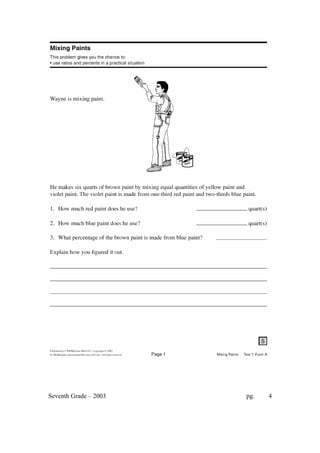
Seventh Grade – 2003 pg. 4
Seventh Grade – 2003 pg. 5
Seventh Grade – 2003 pg. 6
Looking at Student Work – Mixing Paints
Mixing Paints was a difficult task for students. A little more than half the students in
the sample scored no points on this task, even though 85% of the zeros attempted the
task. Therefore it is important to look carefully at strategies that helped successful
students and ways they clarified their explanations. Student A makes an area model
diagram to keep track of the parts and whole. It makes it easy to see the relative sizes
of the different components of the paint.
Student A
(c) Noyce Foundation 2012
Seventh Grade – 2003 pg. 7
Student B does a very thorough job of showing all the calculations necessary for each
step of the process, including the portioning of brown into yellow and violet. The
student shows an understanding operations and calculations with fractions.
Student B
(c) Noyce Foundation 2012
Seventh Grade – 2003 pg. 8
Student C has a good grasp of the problem, explaining the whole and which part is
blue. The student explains the process for calculating a percentage and rounding off.
Many students had difficulty keeping track of the whole. Student D loses the amount
of paint for blue in part 2. However the student seems to know the overall
relationships and has an interesting, but unusual way, of finding the percentage in part
3. Student D knows that blue is 2/3 of half the paint. To simplify this calculation the
student finds or knows 2/3 of 100 and divides that answer by 2.
(c) Noyce Foundation 2012
Seventh Grade – 2003 pg. 9
The most common error is to lose track of the total amount of paint. Student E
correctly finds the amount of red and blue paint, but forgets that the total amount of
paint is 6 quarts instead of two quarts.
Student E
Teacher Notes:
(c) Noyce Foundation 2012
Seventh Grade – 2003 pg. 10
Frequency Distribution for each Task – Grade 7
Grade 7 – Mixing Paints
Score: 0 1 2 3 4 5
% < = 50.7% 56.0% 73.5% 77.7% 81.3% 100.0%
% > = 100.0% 49.3% 44.0% 26.5% 22.3% 18.7%
The maximum score available on this task is 5 points.
The cut score for a level 3 response is 2 points.
A little less than half the students could find the amount of red or blue paint needed.
Less than 20% could find the amount of red and blue paint and calculate the
percentage of total paint that represented. A little more than 50% of the students
scored zero points on this task. About 7% of all the students did not attempt this task,
even though it was the first problem in the test. 43% of the students attempted the
task with no success.
Mixing Paints
Mean: 1.61, S.D.: 1.95
0
1000
2000
3000
4000
5000
6000
7000
Score
Frequency
Frequency 5940 616 2054 492 428 2185
0 1 2 3 4 5
(c) Noyce Foundation 2012
Seventh Grade – 2003 pg. 11
Mixing Paints
Points Understandings Misunderstandings
0 85% of the students with this
score attempted the task.
The most common error was to give
a fraction rather than convert to
quarts. About 1/5 of the students
gave the response 1/3 and 2/3. A
less frequent error was to put 2
quarts of red and 4 quarts of blue.
1 Students with this score could
either find the amount of red or
blue paint.
2 Students could find both the
amount for red or blue paint.
They had difficulty finding the
percent of blue paint. Students did
not recognize that the violet paint
was only half of the total paints.
Therefore most students thought the
percentage was 66% instead of
33%.
5 Students could keep track of
part/whole relationships,
calculate the amount of red and
blue paint needed, and find the
percentage of blue paint. Some
students were able to make
good use of diagrams. Other
students demonstrated a facility
with operations with fractions.
Based on teacher observations, this is what seventh grade students knew and were
able to do:
• Find the fractional amount of red or blue paint and use that to find the number
of quarts
Areas of difficulty for seventh graders, seventh grade students struggled with:
• Understanding the whole in a multi-step problem
• Calculating percentages
• Tracking part/whole relationships
• Using fractions instead of taking a fractional part of the whole
(c) Noyce Foundation 2012
Seventh Grade – 2003 pg. 12
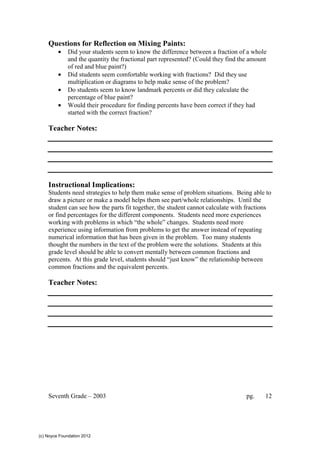
Questions for Reflection on Mixing Paints:
• Did your students seem to know the difference between a fraction of a whole
and the quantity the fractional part represented? (Could they find the amount
of red and blue paint?)
• Did students seem comfortable working with fractions? Did they use
multiplication or diagrams to help make sense of the problem?
• Do students seem to know landmark percents or did they calculate the
percentage of blue paint?
• Would their procedure for finding percents have been correct if they had
started with the correct fraction?
Teacher Notes:
Instructional Implications:
Students need strategies to help them make sense of problem situations. Being able to
draw a picture or make a model helps them see part/whole relationships. Until the
student can see how the parts fit together, the student cannot calculate with fractions
or find percentages for the different components. Students need more experiences
working with problems in which “the whole” changes. Students need more
experience using information from problems to get the answer instead of repeating
numerical information that has been given in the problem. Too many students
thought the numbers in the text of the problem were the solutions. Students at this
grade level should be able to convert mentally between common fractions and
percents. At this grade level, students should “just know” the relationship between
common fractions and the equivalent percents.
Teacher Notes:
(c) Noyce Foundation 2012
© 2012 Noyce Foundation
Performance Assessment Task
Mixing Paints
Grade 7
This task challenges a student to use ratios and percents to solve a practical problem. A student must
use knowledge of fractions and ratios to solve problems and represent fractions or ratios as
percentages. A student must be able to clearly define the whole in different situations in order to
represent the relationships numerically.
Common Core State Standards Math ‐ Content Standards
Ratios and Proportional Relationships
Analyze proportional relationships and use them to solve real­world mathematical problems.
7.RP.1 Compute unit rates associated with ratios of fractions, including ratios of lengths, areas and
other quantities measured in like or different units. For example, if a person walks ½ mile in each ¼
hour, compute the unit rate as the complex fraction 1/2/1/4 miles per hour, equivalently 2 miles per
hour.
7.RP.3 Use proportional relationships to solve multistep ratio and percent problems. Examples:
simple interest, tax, markups and markdowns, gratuities and commissions, fees, percent increase and
decrease, percent error.
Common Core State Standards Math – Standards of Mathematical Practice
MP.2 Reason abstractly and quantitatively.
Mathematically proficient students make sense of quantities and their relationships in problem
situations. They bring two complementary abilities to bear on problems involving quantitative
relationships: the ability to decontextualize – to abstract a given situation and represent it
symbolically and manipulate the representing symbols as if they have a life of their own, without
necessarily attending to their referents – and the ability to contextualize, to pause as needed during
the manipulation process in order to probe into the referents for the symbols involved. Quantitative
reasoning entails habits of creating a coherent representation of the problem at hand; considering
the units involved; attending to the meaning of quantities, not just how to compute them; and
knowing and flexibly using different properties of operations and objects.
MP. 7 Look for and make use of structure.
Mathematically proficient students try to look closely to discern a pattern or structure. Young
students, for example, might notice that three and seven more is the same amount as seven and three
more, or they may sort a collections of shapes according to how many sides the shapes have. Later,
students will see 7 x 8 equals the well‐remembered 7 x 5 + 7 x 3, in preparation for learning about
the distributive property. In the expression x2 + 9x + 14, older students can see the 14 as 2 x 7 and
the 9 as 2 + 7. They recognize the significance of an existing line in a geometric figure and can use the
strategy of drawing an auxiliary line for solving problems. They also can step back for an overview
and shift perspective. They can see complicated things, such as some algebraic expressions, as single
objects or being composed of several objects. For example, they can see 5 – 3(x ‐ y)2 as 5 minus a
positive number times a square and use that to realize that its value cannot be more than 5 for any
real numbers x and y.
Assessment Results
This task was developed by the Mathematics Assessment Resource Service and administered as part
of a national, normed math assessment. For comparison purposes, teachers may be interested in the
results of the national assessment, including the total points possible for the task, the number of core
points, and the percent of students that scored at standard on the task. Related materials, including
the scoring rubric, student work, and discussions of student understandings and misconceptions on
the task, are included in the task packet.
Grade Level Year Total Points Core Points % At Standard
7 2003 5 2 44%

mixing paints.pdf

  • 1.
  • 2.
  • 3.
    Seventh Grade –2003 pg. 6 Looking at Student Work – Mixing Paints Mixing Paints was a difficult task for students. A little more than half the students in the sample scored no points on this task, even though 85% of the zeros attempted the task. Therefore it is important to look carefully at strategies that helped successful students and ways they clarified their explanations. Student A makes an area model diagram to keep track of the parts and whole. It makes it easy to see the relative sizes of the different components of the paint. Student A (c) Noyce Foundation 2012
  • 4.
    Seventh Grade –2003 pg. 7 Student B does a very thorough job of showing all the calculations necessary for each step of the process, including the portioning of brown into yellow and violet. The student shows an understanding operations and calculations with fractions. Student B (c) Noyce Foundation 2012
  • 5.
    Seventh Grade –2003 pg. 8 Student C has a good grasp of the problem, explaining the whole and which part is blue. The student explains the process for calculating a percentage and rounding off. Many students had difficulty keeping track of the whole. Student D loses the amount of paint for blue in part 2. However the student seems to know the overall relationships and has an interesting, but unusual way, of finding the percentage in part 3. Student D knows that blue is 2/3 of half the paint. To simplify this calculation the student finds or knows 2/3 of 100 and divides that answer by 2. (c) Noyce Foundation 2012
  • 6.
    Seventh Grade –2003 pg. 9 The most common error is to lose track of the total amount of paint. Student E correctly finds the amount of red and blue paint, but forgets that the total amount of paint is 6 quarts instead of two quarts. Student E Teacher Notes: (c) Noyce Foundation 2012
  • 7.
    Seventh Grade –2003 pg. 10 Frequency Distribution for each Task – Grade 7 Grade 7 – Mixing Paints Score: 0 1 2 3 4 5 % < = 50.7% 56.0% 73.5% 77.7% 81.3% 100.0% % > = 100.0% 49.3% 44.0% 26.5% 22.3% 18.7% The maximum score available on this task is 5 points. The cut score for a level 3 response is 2 points. A little less than half the students could find the amount of red or blue paint needed. Less than 20% could find the amount of red and blue paint and calculate the percentage of total paint that represented. A little more than 50% of the students scored zero points on this task. About 7% of all the students did not attempt this task, even though it was the first problem in the test. 43% of the students attempted the task with no success. Mixing Paints Mean: 1.61, S.D.: 1.95 0 1000 2000 3000 4000 5000 6000 7000 Score Frequency Frequency 5940 616 2054 492 428 2185 0 1 2 3 4 5 (c) Noyce Foundation 2012
  • 8.
    Seventh Grade –2003 pg. 11 Mixing Paints Points Understandings Misunderstandings 0 85% of the students with this score attempted the task. The most common error was to give a fraction rather than convert to quarts. About 1/5 of the students gave the response 1/3 and 2/3. A less frequent error was to put 2 quarts of red and 4 quarts of blue. 1 Students with this score could either find the amount of red or blue paint. 2 Students could find both the amount for red or blue paint. They had difficulty finding the percent of blue paint. Students did not recognize that the violet paint was only half of the total paints. Therefore most students thought the percentage was 66% instead of 33%. 5 Students could keep track of part/whole relationships, calculate the amount of red and blue paint needed, and find the percentage of blue paint. Some students were able to make good use of diagrams. Other students demonstrated a facility with operations with fractions. Based on teacher observations, this is what seventh grade students knew and were able to do: • Find the fractional amount of red or blue paint and use that to find the number of quarts Areas of difficulty for seventh graders, seventh grade students struggled with: • Understanding the whole in a multi-step problem • Calculating percentages • Tracking part/whole relationships • Using fractions instead of taking a fractional part of the whole (c) Noyce Foundation 2012
  • 9.
    Seventh Grade –2003 pg. 12 Questions for Reflection on Mixing Paints: • Did your students seem to know the difference between a fraction of a whole and the quantity the fractional part represented? (Could they find the amount of red and blue paint?) • Did students seem comfortable working with fractions? Did they use multiplication or diagrams to help make sense of the problem? • Do students seem to know landmark percents or did they calculate the percentage of blue paint? • Would their procedure for finding percents have been correct if they had started with the correct fraction? Teacher Notes: Instructional Implications: Students need strategies to help them make sense of problem situations. Being able to draw a picture or make a model helps them see part/whole relationships. Until the student can see how the parts fit together, the student cannot calculate with fractions or find percentages for the different components. Students need more experiences working with problems in which “the whole” changes. Students need more experience using information from problems to get the answer instead of repeating numerical information that has been given in the problem. Too many students thought the numbers in the text of the problem were the solutions. Students at this grade level should be able to convert mentally between common fractions and percents. At this grade level, students should “just know” the relationship between common fractions and the equivalent percents. Teacher Notes: (c) Noyce Foundation 2012
  • 10.
    © 2012 NoyceFoundation Performance Assessment Task Mixing Paints Grade 7 This task challenges a student to use ratios and percents to solve a practical problem. A student must use knowledge of fractions and ratios to solve problems and represent fractions or ratios as percentages. A student must be able to clearly define the whole in different situations in order to represent the relationships numerically. Common Core State Standards Math ‐ Content Standards Ratios and Proportional Relationships Analyze proportional relationships and use them to solve real­world mathematical problems. 7.RP.1 Compute unit rates associated with ratios of fractions, including ratios of lengths, areas and other quantities measured in like or different units. For example, if a person walks ½ mile in each ¼ hour, compute the unit rate as the complex fraction 1/2/1/4 miles per hour, equivalently 2 miles per hour. 7.RP.3 Use proportional relationships to solve multistep ratio and percent problems. Examples: simple interest, tax, markups and markdowns, gratuities and commissions, fees, percent increase and decrease, percent error. Common Core State Standards Math – Standards of Mathematical Practice MP.2 Reason abstractly and quantitatively. Mathematically proficient students make sense of quantities and their relationships in problem situations. They bring two complementary abilities to bear on problems involving quantitative relationships: the ability to decontextualize – to abstract a given situation and represent it symbolically and manipulate the representing symbols as if they have a life of their own, without necessarily attending to their referents – and the ability to contextualize, to pause as needed during the manipulation process in order to probe into the referents for the symbols involved. Quantitative reasoning entails habits of creating a coherent representation of the problem at hand; considering the units involved; attending to the meaning of quantities, not just how to compute them; and knowing and flexibly using different properties of operations and objects. MP. 7 Look for and make use of structure. Mathematically proficient students try to look closely to discern a pattern or structure. Young students, for example, might notice that three and seven more is the same amount as seven and three more, or they may sort a collections of shapes according to how many sides the shapes have. Later, students will see 7 x 8 equals the well‐remembered 7 x 5 + 7 x 3, in preparation for learning about the distributive property. In the expression x2 + 9x + 14, older students can see the 14 as 2 x 7 and the 9 as 2 + 7. They recognize the significance of an existing line in a geometric figure and can use the strategy of drawing an auxiliary line for solving problems. They also can step back for an overview and shift perspective. They can see complicated things, such as some algebraic expressions, as single objects or being composed of several objects. For example, they can see 5 – 3(x ‐ y)2 as 5 minus a positive number times a square and use that to realize that its value cannot be more than 5 for any real numbers x and y. Assessment Results This task was developed by the Mathematics Assessment Resource Service and administered as part of a national, normed math assessment. For comparison purposes, teachers may be interested in the results of the national assessment, including the total points possible for the task, the number of core points, and the percent of students that scored at standard on the task. Related materials, including the scoring rubric, student work, and discussions of student understandings and misconceptions on the task, are included in the task packet. Grade Level Year Total Points Core Points % At Standard 7 2003 5 2 44%