11th AUTOSAR Open Conference
AUTOSAR 07-Nov-2018 1
Mixed-critical adaptive AUTOSAR stack based on VxWorks, Linux and virtualization
Andrei Kholodnyi
Wind River Systems
Type equation here.
AUTOSAR 07-Nov-2018 2
Automotive functions workload
consolidation and Adaptive AUTOSAR
Lessons learned of porting Adaptive
AUTOSAR stack to VxWorks RTOS
TOPICS OF MY TALK
TODAY
> Automotive OEM & OES
> ADAS/HAD, Connected Vehicle, IVI, OTA, Automotive Security
> Automotive engineering organization
> Products, Solutions & Partnerships
Andrei Kholodnyi
Principal Technologist
CTO Office
> First GENIVI based project development for BMW
> AdvancedTCA (Networking) for Alcatel and Lucent
> Led and delivered IVI, telematics and connectivity projects
> Thematic pathfinding for the new technologies (Deep Leaning,
Autonomous Robotics)
> Cross-business technology leadership
> Participation to alliances (GENIVI, FASTR, Adaptive AUTOSAR,
PICMG)
> Strategy and Vision for Wind River Automotive Products for ADAS,
HAD, IVI, In car connectivity and Cloud connectivity
FOCUS
RELEVANT PROJECTS (selection)
Chemical Sector Commercial Building Sector Communications Sector Critical Manufacturing
Dams Sector Defense Base Sector Emergency Services Sector Energy Sector
Financial Services Sector Food and Agriculture Sector Government Building Sector Health Care Sector
IT Sector Nuclear Sector Transportation Sector Water and Wastewater Sector
3 © 2018 WIND RIVER. ALL RIGHTS RESERVED.
AUTOSAR 07-Nov-2018 4
Partners
Tools
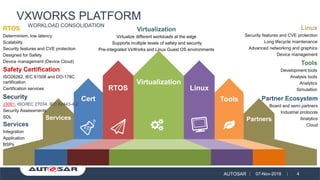
VXWORKS PLATFORM
Virtualization
Virtualize different workloads at the edge
Supports multiple levels of safety and security
Pre-integrated VxWorks and Linux Guest OS environments
Virtualization
LinuxRTOS
Cert
Services
RTOS
Determinism, low latency
Scalability
Security features and CVE protection
Designed for Safety
Device management (Device Cloud)
Safety Certification
ISO26262, IEC 61508 and DO-178C
certification
Certification services
Linux
Security features and CVE protection
Long lifecycle maintenance
Advanced networking and graphics
Device management
Tools
Development tools
Analysis tools
Analytics
Simulation
Partner Ecosystem
Board and semi partners
Industrial protocols
Analytics
Cloud
WORKLOAD CONSOLIDATION
Services
Integration
Application
BSPs
Security
J3061, ISO/IEC 27034, IEC 62443-4-2
Security Assessments
SDL
AUTOSAR 07-Nov-2018 5
ENGAGING & CHALLENGING APPLICATIONS WITH
LOTS OF SW & HW
• Driver assistant and autonomous driving systems
• Displays: Instrument Cluster, HUD, IVI, RSE, Augmented Reality
• Navigation: maps, route planning, traffic avoidance
• Connectivity: GPS, Bluetooth, OBD, CAN-FD, TCP/IP, Wi-Fi, LTE
• Security: trusted boot, encryption, attestation, firewall, packet inspection
• Insurance/liability: driver monitoring, system logging/reporting
• Infrastructure: resource mgmt, storage, key mgmt, orchestration
• Maintenance: Over-the-air, diagnostics, health monitoring, fallback
• Sensing, actuation, sensor fusion, sensor distribution/services
AUTOSAR 07-Nov-2018 6
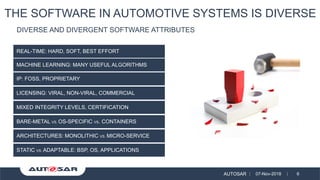
REAL-TIME: HARD, SOFT, BEST EFFORT
IP: FOSS, PROPRIETARY
LICENSING: VIRAL, NON-VIRAL, COMMERCIAL
MIXED INTEGRITY LEVELS, CERTIFICATION
BARE-METAL VS. OS-SPECIFIC VS. CONTAINERS
ARCHITECTURES: MONOLITHIC VS. MICRO-SERVICE
STATIC VS. ADAPTABLE: BSP, OS, APPLICATIONS
THE SOFTWARE IN AUTOMOTIVE SYSTEMS IS DIVERSE
DIVERSE AND DIVERGENT SOFTWARE ATTRIBUTES
MACHINE LEARNING: MANY USEFUL ALGORITHMS
AUTOSAR 07-Nov-2018 7
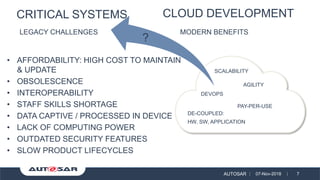
CRITICAL SYSTEMS
• AFFORDABILITY: HIGH COST TO MAINTAIN
& UPDATE
• OBSOLESCENCE
• INTEROPERABILITY
• STAFF SKILLS SHORTAGE
• DATA CAPTIVE / PROCESSED IN DEVICE
• LACK OF COMPUTING POWER
• OUTDATED SECURITY FEATURES
• SLOW PRODUCT LIFECYCLES
LEGACY CHALLENGES
SCALABILITY
AGILITY
DEVOPS
PAY-PER-USE
CLOUD DEVELOPMENT
DE-COUPLED:
HW, SW, APPLICATION
MODERN BENEFITS
?
AUTOSAR 07-Nov-2018 8
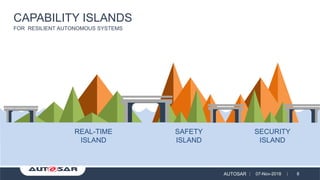
REAL-TIME
ISLAND
SAFETY
ISLAND
SECURITY
ISLAND
CAPABILITY ISLANDS
FOR RESILIENT AUTONOMOUS SYSTEMS
AUTOSAR 07-Nov-2018 9
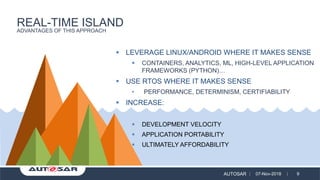
▪ LEVERAGE LINUX/ANDROID WHERE IT MAKES SENSE
▪ CONTAINERS, ANALYTICS, ML, HIGH-LEVEL APPLICATION
FRAMEWORKS (PYTHON)…
▪ USE RTOS WHERE IT MAKES SENSE
• PERFORMANCE, DETERMINISM, CERTIFIABILITY
▪ INCREASE:
▪ DEVELOPMENT VELOCITY
▪ APPLICATION PORTABILITY
▪ ULTIMATELY AFFORDABILITY
ADVANTAGES OF THIS APPROACH
REAL-TIME ISLAND
AUTOSAR 07-Nov-2018 10
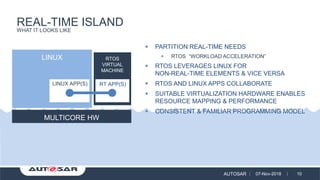
RTOS
VIRTUAL
MACHINE
▪ PARTITION REAL-TIME NEEDS
▪ RTOS “WORKLOAD ACCELERATION”
▪ RTOS LEVERAGES LINUX FOR
NON-REAL-TIME ELEMENTS & VICE VERSA
▪ RTOS AND LINUX APPS COLLABORATE
▪ SUITABLE VIRTUALIZATION HARDWARE ENABLES
RESOURCE MAPPING & PERFORMANCE
▪ CONSISTENT & FAMILIAR PROGRAMMING MODEL
RT APP(S)
REAL-TIME ISLAND
WHAT IT LOOKS LIKE
MULTICORE HW
LINUX
LINUX APP(S)
AUTOSAR 07-Nov-2018 11
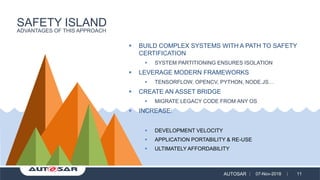
▪ BUILD COMPLEX SYSTEMS WITH A PATH TO SAFETY
CERTIFICATION
▪ SYSTEM PARTITIONING ENSURES ISOLATION
▪ LEVERAGE MODERN FRAMEWORKS
▪ TENSORFLOW, OPENCV, PYTHON, NODE.JS…
▪ CREATE AN ASSET BRIDGE
▪ MIGRATE LEGACY CODE FROM ANY OS
▪ INCREASE:
▪ DEVELOPMENT VELOCITY
▪ APPLICATION PORTABILITY & RE-USE
▪ ULTIMATELY AFFORDABILITY
ADVANTAGES OF THIS APPROACH
SAFETY ISLAND
AUTOSAR 07-Nov-2018 12
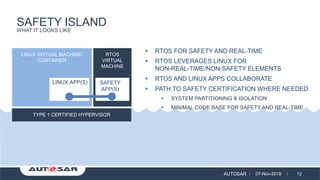
RTOS
VIRTUAL
MACHINE
LINUX VIRTUAL MACHINE/
CONTAINER
▪ RTOS FOR SAFETY AND REAL-TIME
▪ RTOS LEVERAGES LINUX FOR
NON-REAL-TIME/NON-SAFETY ELEMENTS
▪ RTOS AND LINUX APPS COLLABORATE
▪ PATH TO SAFETY CERTIFICATION WHERE NEEDED
▪ SYSTEM PARTITIONING & ISOLATION
▪ MINIMAL CODE BASE FOR SAFETY AND REAL-TIME
TYPE 1 CERTIFIED HYPERVISOR
LINUX APP(S) SAFETY
APP(S)
SAFETY ISLAND
WHAT IT LOOKS LIKE
AUTOSAR 07-Nov-2018 13
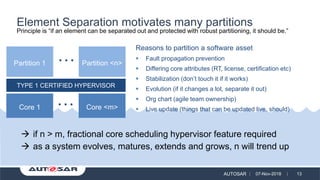
Partition 1
Reasons to partition a software asset
▪ Fault propagation prevention
▪ Differing core attributes (RT, license, certification etc)
▪ Stabilization (don’t touch it if it works)
▪ Evolution (if it changes a lot, separate it out)
▪ Org chart (agile team ownership)
▪ Live update (things that can be updated live, should)
TYPE 1 CERTIFIED HYPERVISOR
Element Separation motivates many partitions
Principle is “if an element can be separated out and protected with robust partitioning, it should be.”
Partition <n>
…
Core 1 Core <m>
…
 if n > m, fractional core scheduling hypervisor feature required
 as a system evolves, matures, extends and grows, n will trend up
AUTOSAR 07-Nov-2018 14
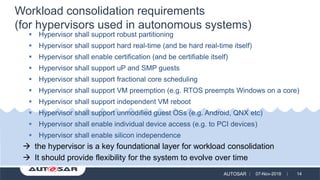
▪ Hypervisor shall support robust partitioning
▪ Hypervisor shall support hard real-time (and be hard real-time itself)
▪ Hypervisor shall enable certification (and be certifiable itself)
▪ Hypervisor shall support uP and SMP guests
▪ Hypervisor shall support fractional core scheduling
▪ Hypervisor shall support VM preemption (e.g. RTOS preempts Windows on a core)
▪ Hypervisor shall support independent VM reboot
▪ Hypervisor shall support unmodified guest OSs (e.g. Android, QNX etc)
▪ Hypervisor shall enable individual device access (e.g. to PCI devices)
▪ Hypervisor shall enable silicon independence
Workload consolidation requirements
(for hypervisors used in autonomous systems)
 the hypervisor is a key foundational layer for workload consolidation
 It should provide flexibility for the system to evolve over time
AUTOSAR 07-Nov-2018 15
▪ Hypervisor shall support robust partitioning
▪ Hypervisor shall support hard real-time (and be hard real-time itself)
▪ Hypervisor shall enable certification (and be certifiable itself)
▪ Hypervisor shall support uP and SMP guests
▪ Hypervisor shall support fractional core scheduling
▪ Hypervisor shall support VM preemption (e.g. RTOS preempts Windows on a core)
▪ Hypervisor shall support independent VM reboot
▪ Hypervisor shall support unmodified guest OSs (e.g. Android, QNX etc)
▪ Hypervisor shall enable individual device access (e.g. to PCI devices)
▪ Hypervisor shall enable silicon independence
Workload consolidation requirements
(for hypervisors used in autonomous systems)
 the hypervisor is a key foundational layer for workload consolidation
 It should provide flexibility for the system to evolve over time
AUTOSAR 07-Nov-2018 16
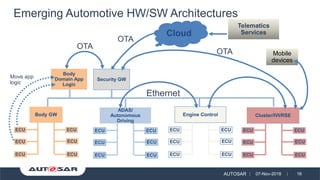
Emerging Automotive HW/SW Architectures
Ethernet
Body GW
ECU
ECU
ECU
ECU
Body
Domain App
Logic
ECUECU
ADAS/
Autonomous
Driving
ECU
ECU
ECU
ECU
ECUECU
Cluster/IVI/RSE
ECU
ECU
ECU
ECU
ECUECU
Engine Control
ECU
ECU
ECU
ECU
ECUECU
Cloud
OTA
Move app
logic
Lower uC costs
Security GW
OTA
OTA
Telematics
Services
Mobile
devices
AUTOSAR 07-Nov-2018 17
Super ADAS
VxWorks RTOS,
Safety Linux
Cluster/HUD
VxWorks RTOS
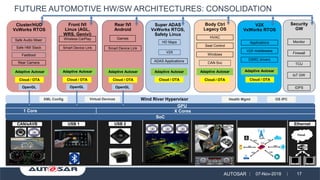
FUTURE AUTOMOTIVE HW/SW ARCHITECTURES: CONSOLIDATION
SoC
1 Core
GPU
Security
GW
Cloud
CAN/eAVB USB 2 Ethernet
Fastboot
OpenGL
Safe Audio Mixer
Rear IVI
Android
Games
TCU
IoT GW
Firewall
IDPS
Front IVI
Linux (AGL,
WRS, Genivi)
Smart Device Link
Wireless CarPlay
Safe HMI Stack
USB 1
Cloud / OTA
Adaptive Autosar
V2X
Wind River Hypervisor
OpenGL
Adaptive Autosar
OpenGL
Adaptive Autosar Adaptive Autosar
Body Ctrl
Legacy OS
ADAS Applications
Monitor
Adaptive Autosar
Windows
Seat Control
HVAC
HD Maps
CAN Svc
XML Config Health MgmtVirtual Devices OS IPC
X Cores
Smart Device Link
Rear Camera
V2X
VxWorks RTOS
Adaptive Autosar
DSRC drivers
V2X middleware
Applications
Cloud / OTACloud / OTACloud / OTACloud / OTACloud / OTA
AUTOSAR 07-Nov-2018 18
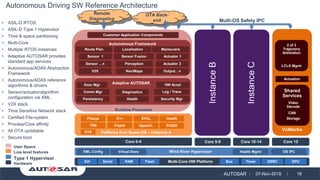
VxWorks
Autonomous Framework
Adaptive AUTOSAR
VxWorks Cert Guest OS – Instance AOTA
OTA Back-
end
Remote
Diagnostics
• ASIL-D RTOS
• ASIL-D Type 1 Hypervisor
• Time & space partitioning
• Multi-Core
• Multiple RTOS instances
• Adaptive AUTOSAR provides
standard app services
• Autonomous/ADAS Abstraction
Framework
• Autonomous/ADAS reference
algorithms & drivers
• Sensor/actuator/algorithm
configuration via XML
• V2X stack
• Time Sensitive Network stack
• Certified File-system
• Process/Core affinity
• All OTA updatable
• Secure boot
Multi-Core HW PlatformEth Serial RAM Flash Bus Timer DSRC GPU
Core 0-4 Core 5-9 Core 10-14 Core 15
TSN Crypto OpenCL POSIX
C++ SYCL Health
Persistency
Comm Mgr
Exec Mgr HW Accel
Log / Trace
Security Mgr
Diagnostics
Health
Filesys
V2X
Sensor …n
Sensor 1 Sensor Fusion
Perception
Nav/Maps
LocalizationRoute Plan Maneuvers
Output…n
Actuator 2
Actuator 1
Customer Application Components
Autonomous Driving SW Reference Architecture
InstanceB
InstanceC
Multi-OS Safety IPC
Runtime Processes
User Space
Low level features
Type 1 Hypervisor
Hardware
Wind River HypervisorXML Config Health MgmtVirtual Devs OS IPC
Actuation
2 of 3
Trajectory
Arbitration
LCLS Mgmt
Shared
Services
Video
Decode
CAN
Storage
AUTOSAR 07-Nov-2018 19
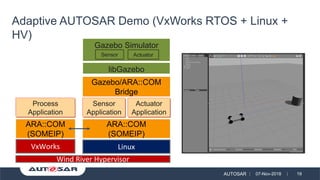
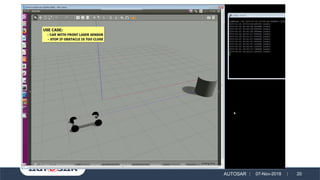
Adaptive AUTOSAR Demo (VxWorks RTOS + Linux +
HV)
ARA::COM
(SOMEIP)
VxWorks
Gazebo Simulator
ActuatorSensor
Gazebo/ARA::COM
Bridge
Sensor
Application
libGazebo
Process
Application
Actuator
Application
Linux
ARA::COM
(SOMEIP)
Wind River Hypervisor
AUTOSAR 07-Nov-2018 20
AUTOSAR 07-Nov-2018 21
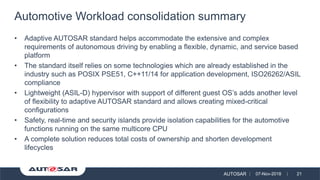
• Adaptive AUTOSAR standard helps accommodate the extensive and complex
requirements of autonomous driving by enabling a flexible, dynamic, and service based
platform
• The standard itself relies on some technologies which are already established in the
industry such as POSIX PSE51, C++11/14 for application development, ISO26262/ASIL
compliance
• Lightweight (ASIL-D) hypervisor with support of different guest OS’s adds another level
of flexibility to adaptive AUTOSAR standard and allows creating mixed-critical
configurations
• Safety, real-time and security islands provide isolation capabilities for the automotive
functions running on the same multicore CPU
• A complete solution reduces total costs of ownership and shorten development
lifecycles
Automotive Workload consolidation summary
AUTOSAR 07-Nov-2018 22
Part 2
Lessons learned of porting Adaptive AUTOSAR stack to
VxWorks RTOS
AUTOSAR 07-Nov-2018 23
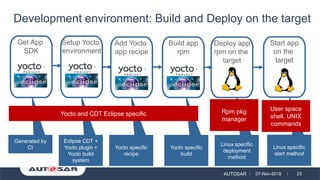
Development environment: Build and Deploy on the target
Build app
rpm
Get App
SDK
Setup Yocto
environment
Add Yocto
app recipe
Deploy app
rpm on the
target
Generated by
CI
Eclipse CDT +
Yocto plugin +
Yocto build
system
Yocto specific
recipe
Yocto specific
build
Linux specific
deployment
method
Start app
on the
target
Linux specific
start method
User space
shell, UNIX
commands
Rpm pkg
manager
Yocto and CDT Eclipse specific
AUTOSAR 07-Nov-2018 24
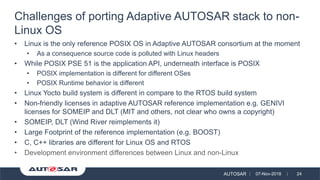
• Linux is the only reference POSIX OS in Adaptive AUTOSAR consortium at the moment
• As a consequence source code is polluted with Linux headers
• While POSIX PSE 51 is the application API, underneath interface is POSIX
• POSIX implementation is different for different OSes
• POSIX Runtime behavior is different
• Linux Yocto build system is different in compare to the RTOS build system
• Non-friendly licenses in adaptive AUTOSAR reference implementation e.g. GENIVI
licenses for SOMEIP and DLT (MIT and others, not clear who owns a copyright)
• SOMEIP, DLT (Wind River reimplements it)
• Large Footprint of the reference implementation (e.g. BOOST)
• C, C++ libraries are different for Linux OS and RTOS
• Development environment differences between Linux and non-Linux
Challenges of porting Adaptive AUTOSAR stack to non-
Linux OS
AUTOSAR 07-Nov-2018 25
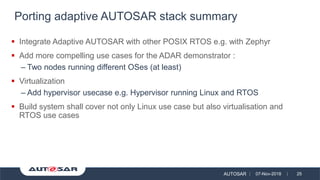
▪ Integrate Adaptive AUTOSAR with other POSIX RTOS e.g. with Zephyr
▪ Add more compelling use cases for the ADAR demonstrator :
– Two nodes running different OSes (at least)
▪ Virtualization
– Add hypervisor usecase e.g. Hypervisor running Linux and RTOS
▪ Build system shall cover not only Linux use case but also virtualisation and
RTOS use cases
Porting adaptive AUTOSAR stack summary
11th AUTOSAR Open Conference
Thank you for your attention!
AUTOSAR 2607-Nov-2018
www.windriver.com/auto
1-800-545-WIND
Andrei.Kholodnyi@windriver.com
https://www.linkedin.com/in/akholodnyi/ https://www.slideshare.net/AndreiKholodnyi
Andrei Kholodnyi, Principal Technologist,
Wind River Technology Office

Mixed-critical adaptive AUTOSAR stack based on VxWorks, Linux, and virtualization

  • 1.
    11th AUTOSAR OpenConference AUTOSAR 07-Nov-2018 1 Mixed-critical adaptive AUTOSAR stack based on VxWorks, Linux and virtualization Andrei Kholodnyi Wind River Systems Type equation here.
  • 2.
    AUTOSAR 07-Nov-2018 2 Automotivefunctions workload consolidation and Adaptive AUTOSAR Lessons learned of porting Adaptive AUTOSAR stack to VxWorks RTOS TOPICS OF MY TALK TODAY > Automotive OEM & OES > ADAS/HAD, Connected Vehicle, IVI, OTA, Automotive Security > Automotive engineering organization > Products, Solutions & Partnerships Andrei Kholodnyi Principal Technologist CTO Office > First GENIVI based project development for BMW > AdvancedTCA (Networking) for Alcatel and Lucent > Led and delivered IVI, telematics and connectivity projects > Thematic pathfinding for the new technologies (Deep Leaning, Autonomous Robotics) > Cross-business technology leadership > Participation to alliances (GENIVI, FASTR, Adaptive AUTOSAR, PICMG) > Strategy and Vision for Wind River Automotive Products for ADAS, HAD, IVI, In car connectivity and Cloud connectivity FOCUS RELEVANT PROJECTS (selection)
  • 3.
    Chemical Sector CommercialBuilding Sector Communications Sector Critical Manufacturing Dams Sector Defense Base Sector Emergency Services Sector Energy Sector Financial Services Sector Food and Agriculture Sector Government Building Sector Health Care Sector IT Sector Nuclear Sector Transportation Sector Water and Wastewater Sector 3 © 2018 WIND RIVER. ALL RIGHTS RESERVED.
  • 4.
    AUTOSAR 07-Nov-2018 4 Partners Tools VXWORKSPLATFORM Virtualization Virtualize different workloads at the edge Supports multiple levels of safety and security Pre-integrated VxWorks and Linux Guest OS environments Virtualization LinuxRTOS Cert Services RTOS Determinism, low latency Scalability Security features and CVE protection Designed for Safety Device management (Device Cloud) Safety Certification ISO26262, IEC 61508 and DO-178C certification Certification services Linux Security features and CVE protection Long lifecycle maintenance Advanced networking and graphics Device management Tools Development tools Analysis tools Analytics Simulation Partner Ecosystem Board and semi partners Industrial protocols Analytics Cloud WORKLOAD CONSOLIDATION Services Integration Application BSPs Security J3061, ISO/IEC 27034, IEC 62443-4-2 Security Assessments SDL
  • 5.
    AUTOSAR 07-Nov-2018 5 ENGAGING& CHALLENGING APPLICATIONS WITH LOTS OF SW & HW • Driver assistant and autonomous driving systems • Displays: Instrument Cluster, HUD, IVI, RSE, Augmented Reality • Navigation: maps, route planning, traffic avoidance • Connectivity: GPS, Bluetooth, OBD, CAN-FD, TCP/IP, Wi-Fi, LTE • Security: trusted boot, encryption, attestation, firewall, packet inspection • Insurance/liability: driver monitoring, system logging/reporting • Infrastructure: resource mgmt, storage, key mgmt, orchestration • Maintenance: Over-the-air, diagnostics, health monitoring, fallback • Sensing, actuation, sensor fusion, sensor distribution/services
  • 6.
    AUTOSAR 07-Nov-2018 6 REAL-TIME:HARD, SOFT, BEST EFFORT IP: FOSS, PROPRIETARY LICENSING: VIRAL, NON-VIRAL, COMMERCIAL MIXED INTEGRITY LEVELS, CERTIFICATION BARE-METAL VS. OS-SPECIFIC VS. CONTAINERS ARCHITECTURES: MONOLITHIC VS. MICRO-SERVICE STATIC VS. ADAPTABLE: BSP, OS, APPLICATIONS THE SOFTWARE IN AUTOMOTIVE SYSTEMS IS DIVERSE DIVERSE AND DIVERGENT SOFTWARE ATTRIBUTES MACHINE LEARNING: MANY USEFUL ALGORITHMS
  • 7.
    AUTOSAR 07-Nov-2018 7 CRITICALSYSTEMS • AFFORDABILITY: HIGH COST TO MAINTAIN & UPDATE • OBSOLESCENCE • INTEROPERABILITY • STAFF SKILLS SHORTAGE • DATA CAPTIVE / PROCESSED IN DEVICE • LACK OF COMPUTING POWER • OUTDATED SECURITY FEATURES • SLOW PRODUCT LIFECYCLES LEGACY CHALLENGES SCALABILITY AGILITY DEVOPS PAY-PER-USE CLOUD DEVELOPMENT DE-COUPLED: HW, SW, APPLICATION MODERN BENEFITS ?
  • 8.
  • 9.
    AUTOSAR 07-Nov-2018 9 ▪LEVERAGE LINUX/ANDROID WHERE IT MAKES SENSE ▪ CONTAINERS, ANALYTICS, ML, HIGH-LEVEL APPLICATION FRAMEWORKS (PYTHON)… ▪ USE RTOS WHERE IT MAKES SENSE • PERFORMANCE, DETERMINISM, CERTIFIABILITY ▪ INCREASE: ▪ DEVELOPMENT VELOCITY ▪ APPLICATION PORTABILITY ▪ ULTIMATELY AFFORDABILITY ADVANTAGES OF THIS APPROACH REAL-TIME ISLAND
  • 10.
    AUTOSAR 07-Nov-2018 10 RTOS VIRTUAL MACHINE ▪PARTITION REAL-TIME NEEDS ▪ RTOS “WORKLOAD ACCELERATION” ▪ RTOS LEVERAGES LINUX FOR NON-REAL-TIME ELEMENTS & VICE VERSA ▪ RTOS AND LINUX APPS COLLABORATE ▪ SUITABLE VIRTUALIZATION HARDWARE ENABLES RESOURCE MAPPING & PERFORMANCE ▪ CONSISTENT & FAMILIAR PROGRAMMING MODEL RT APP(S) REAL-TIME ISLAND WHAT IT LOOKS LIKE MULTICORE HW LINUX LINUX APP(S)
  • 11.
    AUTOSAR 07-Nov-2018 11 ▪BUILD COMPLEX SYSTEMS WITH A PATH TO SAFETY CERTIFICATION ▪ SYSTEM PARTITIONING ENSURES ISOLATION ▪ LEVERAGE MODERN FRAMEWORKS ▪ TENSORFLOW, OPENCV, PYTHON, NODE.JS… ▪ CREATE AN ASSET BRIDGE ▪ MIGRATE LEGACY CODE FROM ANY OS ▪ INCREASE: ▪ DEVELOPMENT VELOCITY ▪ APPLICATION PORTABILITY & RE-USE ▪ ULTIMATELY AFFORDABILITY ADVANTAGES OF THIS APPROACH SAFETY ISLAND
  • 12.
    AUTOSAR 07-Nov-2018 12 RTOS VIRTUAL MACHINE LINUXVIRTUAL MACHINE/ CONTAINER ▪ RTOS FOR SAFETY AND REAL-TIME ▪ RTOS LEVERAGES LINUX FOR NON-REAL-TIME/NON-SAFETY ELEMENTS ▪ RTOS AND LINUX APPS COLLABORATE ▪ PATH TO SAFETY CERTIFICATION WHERE NEEDED ▪ SYSTEM PARTITIONING & ISOLATION ▪ MINIMAL CODE BASE FOR SAFETY AND REAL-TIME TYPE 1 CERTIFIED HYPERVISOR LINUX APP(S) SAFETY APP(S) SAFETY ISLAND WHAT IT LOOKS LIKE
  • 13.
    AUTOSAR 07-Nov-2018 13 Partition1 Reasons to partition a software asset ▪ Fault propagation prevention ▪ Differing core attributes (RT, license, certification etc) ▪ Stabilization (don’t touch it if it works) ▪ Evolution (if it changes a lot, separate it out) ▪ Org chart (agile team ownership) ▪ Live update (things that can be updated live, should) TYPE 1 CERTIFIED HYPERVISOR Element Separation motivates many partitions Principle is “if an element can be separated out and protected with robust partitioning, it should be.” Partition <n> … Core 1 Core <m> …  if n > m, fractional core scheduling hypervisor feature required  as a system evolves, matures, extends and grows, n will trend up
  • 14.
    AUTOSAR 07-Nov-2018 14 ▪Hypervisor shall support robust partitioning ▪ Hypervisor shall support hard real-time (and be hard real-time itself) ▪ Hypervisor shall enable certification (and be certifiable itself) ▪ Hypervisor shall support uP and SMP guests ▪ Hypervisor shall support fractional core scheduling ▪ Hypervisor shall support VM preemption (e.g. RTOS preempts Windows on a core) ▪ Hypervisor shall support independent VM reboot ▪ Hypervisor shall support unmodified guest OSs (e.g. Android, QNX etc) ▪ Hypervisor shall enable individual device access (e.g. to PCI devices) ▪ Hypervisor shall enable silicon independence Workload consolidation requirements (for hypervisors used in autonomous systems)  the hypervisor is a key foundational layer for workload consolidation  It should provide flexibility for the system to evolve over time
  • 15.
    AUTOSAR 07-Nov-2018 15 ▪Hypervisor shall support robust partitioning ▪ Hypervisor shall support hard real-time (and be hard real-time itself) ▪ Hypervisor shall enable certification (and be certifiable itself) ▪ Hypervisor shall support uP and SMP guests ▪ Hypervisor shall support fractional core scheduling ▪ Hypervisor shall support VM preemption (e.g. RTOS preempts Windows on a core) ▪ Hypervisor shall support independent VM reboot ▪ Hypervisor shall support unmodified guest OSs (e.g. Android, QNX etc) ▪ Hypervisor shall enable individual device access (e.g. to PCI devices) ▪ Hypervisor shall enable silicon independence Workload consolidation requirements (for hypervisors used in autonomous systems)  the hypervisor is a key foundational layer for workload consolidation  It should provide flexibility for the system to evolve over time
  • 16.
    AUTOSAR 07-Nov-2018 16 EmergingAutomotive HW/SW Architectures Ethernet Body GW ECU ECU ECU ECU Body Domain App Logic ECUECU ADAS/ Autonomous Driving ECU ECU ECU ECU ECUECU Cluster/IVI/RSE ECU ECU ECU ECU ECUECU Engine Control ECU ECU ECU ECU ECUECU Cloud OTA Move app logic Lower uC costs Security GW OTA OTA Telematics Services Mobile devices
  • 17.
    AUTOSAR 07-Nov-2018 17 SuperADAS VxWorks RTOS, Safety Linux Cluster/HUD VxWorks RTOS FUTURE AUTOMOTIVE HW/SW ARCHITECTURES: CONSOLIDATION SoC 1 Core GPU Security GW Cloud CAN/eAVB USB 2 Ethernet Fastboot OpenGL Safe Audio Mixer Rear IVI Android Games TCU IoT GW Firewall IDPS Front IVI Linux (AGL, WRS, Genivi) Smart Device Link Wireless CarPlay Safe HMI Stack USB 1 Cloud / OTA Adaptive Autosar V2X Wind River Hypervisor OpenGL Adaptive Autosar OpenGL Adaptive Autosar Adaptive Autosar Body Ctrl Legacy OS ADAS Applications Monitor Adaptive Autosar Windows Seat Control HVAC HD Maps CAN Svc XML Config Health MgmtVirtual Devices OS IPC X Cores Smart Device Link Rear Camera V2X VxWorks RTOS Adaptive Autosar DSRC drivers V2X middleware Applications Cloud / OTACloud / OTACloud / OTACloud / OTACloud / OTA
  • 18.
    AUTOSAR 07-Nov-2018 18 VxWorks AutonomousFramework Adaptive AUTOSAR VxWorks Cert Guest OS – Instance AOTA OTA Back- end Remote Diagnostics • ASIL-D RTOS • ASIL-D Type 1 Hypervisor • Time & space partitioning • Multi-Core • Multiple RTOS instances • Adaptive AUTOSAR provides standard app services • Autonomous/ADAS Abstraction Framework • Autonomous/ADAS reference algorithms & drivers • Sensor/actuator/algorithm configuration via XML • V2X stack • Time Sensitive Network stack • Certified File-system • Process/Core affinity • All OTA updatable • Secure boot Multi-Core HW PlatformEth Serial RAM Flash Bus Timer DSRC GPU Core 0-4 Core 5-9 Core 10-14 Core 15 TSN Crypto OpenCL POSIX C++ SYCL Health Persistency Comm Mgr Exec Mgr HW Accel Log / Trace Security Mgr Diagnostics Health Filesys V2X Sensor …n Sensor 1 Sensor Fusion Perception Nav/Maps LocalizationRoute Plan Maneuvers Output…n Actuator 2 Actuator 1 Customer Application Components Autonomous Driving SW Reference Architecture InstanceB InstanceC Multi-OS Safety IPC Runtime Processes User Space Low level features Type 1 Hypervisor Hardware Wind River HypervisorXML Config Health MgmtVirtual Devs OS IPC Actuation 2 of 3 Trajectory Arbitration LCLS Mgmt Shared Services Video Decode CAN Storage
  • 19.
    AUTOSAR 07-Nov-2018 19 AdaptiveAUTOSAR Demo (VxWorks RTOS + Linux + HV) ARA::COM (SOMEIP) VxWorks Gazebo Simulator ActuatorSensor Gazebo/ARA::COM Bridge Sensor Application libGazebo Process Application Actuator Application Linux ARA::COM (SOMEIP) Wind River Hypervisor
  • 20.
  • 21.
    AUTOSAR 07-Nov-2018 21 •Adaptive AUTOSAR standard helps accommodate the extensive and complex requirements of autonomous driving by enabling a flexible, dynamic, and service based platform • The standard itself relies on some technologies which are already established in the industry such as POSIX PSE51, C++11/14 for application development, ISO26262/ASIL compliance • Lightweight (ASIL-D) hypervisor with support of different guest OS’s adds another level of flexibility to adaptive AUTOSAR standard and allows creating mixed-critical configurations • Safety, real-time and security islands provide isolation capabilities for the automotive functions running on the same multicore CPU • A complete solution reduces total costs of ownership and shorten development lifecycles Automotive Workload consolidation summary
  • 22.
    AUTOSAR 07-Nov-2018 22 Part2 Lessons learned of porting Adaptive AUTOSAR stack to VxWorks RTOS
  • 23.
    AUTOSAR 07-Nov-2018 23 Developmentenvironment: Build and Deploy on the target Build app rpm Get App SDK Setup Yocto environment Add Yocto app recipe Deploy app rpm on the target Generated by CI Eclipse CDT + Yocto plugin + Yocto build system Yocto specific recipe Yocto specific build Linux specific deployment method Start app on the target Linux specific start method User space shell, UNIX commands Rpm pkg manager Yocto and CDT Eclipse specific
  • 24.
    AUTOSAR 07-Nov-2018 24 •Linux is the only reference POSIX OS in Adaptive AUTOSAR consortium at the moment • As a consequence source code is polluted with Linux headers • While POSIX PSE 51 is the application API, underneath interface is POSIX • POSIX implementation is different for different OSes • POSIX Runtime behavior is different • Linux Yocto build system is different in compare to the RTOS build system • Non-friendly licenses in adaptive AUTOSAR reference implementation e.g. GENIVI licenses for SOMEIP and DLT (MIT and others, not clear who owns a copyright) • SOMEIP, DLT (Wind River reimplements it) • Large Footprint of the reference implementation (e.g. BOOST) • C, C++ libraries are different for Linux OS and RTOS • Development environment differences between Linux and non-Linux Challenges of porting Adaptive AUTOSAR stack to non- Linux OS
  • 25.
    AUTOSAR 07-Nov-2018 25 ▪Integrate Adaptive AUTOSAR with other POSIX RTOS e.g. with Zephyr ▪ Add more compelling use cases for the ADAR demonstrator : – Two nodes running different OSes (at least) ▪ Virtualization – Add hypervisor usecase e.g. Hypervisor running Linux and RTOS ▪ Build system shall cover not only Linux use case but also virtualisation and RTOS use cases Porting adaptive AUTOSAR stack summary
  • 26.
    11th AUTOSAR OpenConference Thank you for your attention! AUTOSAR 2607-Nov-2018 www.windriver.com/auto 1-800-545-WIND Andrei.Kholodnyi@windriver.com https://www.linkedin.com/in/akholodnyi/ https://www.slideshare.net/AndreiKholodnyi Andrei Kholodnyi, Principal Technologist, Wind River Technology Office