Mixed Method Research
Design
Joanna M. Noveno
Mixed Method Explained
 Mixed methods research—also known as multi-method,
combined methods, mixed research, or triangulation
(Mackey & Gass, 2015)—is a strategy of inquiry that allows
the researcher to explore a research question from
multiple angles potentially avoiding the limitations
inherent in using one approach, quantitative or
qualitative, independently.
Mixed Method Explained
 Mixed-methods research (MMR) is a new research
approach in which both quantitative and qualitative
data and analyses are used in a single study to address
more complex research issues.
 In applied linguistics research, the most common way
mixed methods are described is “triangulation” of multiple
sources or methods (Mackey & Gass, 2015).
Types of Mixed Methods Studies
Concurrent and Sequential Designs
Types of Mixed Methods Studies
Concurrent Design
 the researcher collects both
quantitative and qualitative
data at the same time and
uses the data collectively
as a means to interpret the
findings of the investigation
(Creswell, 2003).
Sequential Design
 involve the collection of
data in multiple phases or
in a set sequence.
Symbol System by Johnson and
Christensen (2014)
 A plus sign (+) represents a concurrent collection of data.
 An arrow ( →) represents a sequential collection of data.
 ‘QUAL’ or ‘qual’ stand for qualitative research.
 ‘QUAN’ or ‘quan’ stand for quantitative research.
 Capital letters denote priority or increased weight.
 Lowercase letters denote lower priority or weight.
For example:
QUAL → quan
Types of Mixed Methods Studies
Concurrent Designs
 Triangulation
 Concurrent Embedded
Sequential Designs
 Explanatory
 Exploratory
 Sequential Embedded
Concurrent Designs
Triangulation and Concurrent Embedded
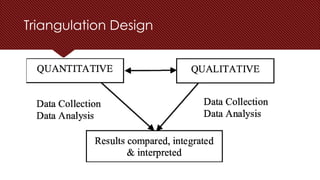
Triangulation Designs
 All the data are collected in one phase and receive
equal weight during analysis, allowing the researcher to
“compare and contrast quantitative statistical results with
qualitative findings or validate or explain quantitative
results with qualitative data” (Creswell & Plano Clark,
2011, p. 62).
Triangulation Design
Lee, E. (2016). Reducing international graduate
students’ language anxiety through oral
pronunciation corrections. System, 56(1), 78–95.
Research Background
This mixed methodology study investigates the link between the
type of oral corrective feedback used and language anxiety
level.
Research Method
Both quantitative data obtained from a pre- and post-survey and
classroom observations as well as qualitative data from follow-up
interviews and open-ended survey questions were collected.
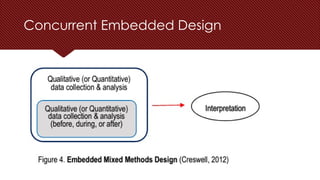
Concurrent Embedded Designs
 one type of data are embedded, generally meaning that
it plays a secondary role to the other data, rather than
both being weighed equally. In most research of this type,
the focus of the design is quantitative with qualitative
data collection added to support or better interpret the
quantitative findings (Creswell & Plano Clark, 2011).
Concurrent Embedded Design
Sequential Designs
Explanatory, Exploratory, and Sequential Embedded
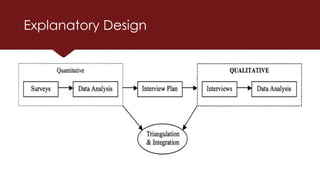
Explanatory Design
 Focus on quantitative data but use qualitative follow-up
data to explain quantitative results.
 Researchers might use an explanatory design to better
understand quantitative results, especially if those results
were not expected.
Explanatory Design
Example:
 If the outcomes of a task-based intervention showed no
changes in the fluency or complexity of learners’ speech
in the target language, a stimulated recall interview
conducted after the intervention might elucidate some of
the reasons for why no changes occurred.
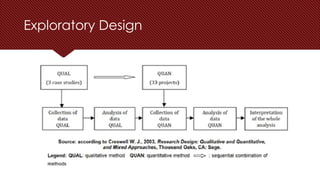
Exploratory Design
 Qualitative data are collected first in order to guide
subsequent collection of quantitative data.
 Researchers might use an exploratory design to
investigate an under-explored phenomenon and define
and describe variables before embarking on a
quantitative design.
Exploratory Design
Mroz, A. (2015). The development of second language
critical thinking in a virtual language learning environment:
A process-oriented mixed-method study. CALICO Journal,
32(3), 528–553.
Research Background
The researcher in this study utilized a mixed methods design to investigate
the emergence of L2 strategies in collaborative discourse produced by
university French learners interacting in a computer-mediated setting.
Research Method
Qualitative data included bi-weekly observations of French classes, a
focus group with five case-study students, and retrospective perception
data. Quantitative data were elicited from computer-generated logs of
students’ interactions in an online Second Life community.
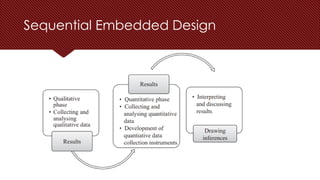
Sequential Embedded Design
 Quantitative and qualitative data are collected in multiple
phases to both inform and provide insights into potential
explanations for one another.
 Qualitative data collected before an intervention can aid
in participant selection, instrument verification, or to shape
the subsequent intervention. Qualitative data collected
after an intervention can help to illuminate patterns in
quantitative intervention data.
Sequential Embedded Design
Préfontaine, Y., & Kormos, J. (2015). The relationship
between task difficulty and second language
fluency in French: A mixed methods approach.
Modern Language Journal, 99(1), 96–112.
Research Background
The authors of this study utilized a mixed methods approach to shed light
on the relationship between task difficulty and fluency.
Research Method
Learners participated in three task conditions that varied in demands
posed on their creativity, content knowledge, and linguistic resources. Task
difficulty was measured both quantitatively with questionnaire data as well
as qualitatively with retrospective interview data. Fluency was measured
quantitatively using a variety of fluency measures analyzed in Praat.
Pros and Cons to Mixed Methods
Designs
Pros:
1. Comprehensive Understanding: Mixed-method
approaches allow researchers to gain a more
comprehensive understanding of linguistic phenomena
by combining the strengths of both quantitative and
qualitative methods. This can lead to richer insights that
might not be achievable through either method alone.
Pros:
2. Triangulation: By using multiple methods, researchers can
cross-validate findings, enhancing the reliability and validity
of their results. Triangulation helps mitigate the limitations of
individual methods and provides a more robust basis for
drawing conclusions.
Pros:
3. Flexibility: Mixed-method designs offer flexibility in
research design, allowing researchers to tailor their
approach to the specific research question and context.
This flexibility enables them to address complex linguistic
phenomena from multiple angles, adapting as needed
throughout the research process.
Cons:
1. Complexity: Mixed-method designs can be more
complex to implement and analyze compared to single-
method approaches. Integrating different methods
requires careful planning, and analyzing data from
multiple sources can be challenging, particularly when
trying to reconcile divergent findings.
Cons:
2. Resource Intensive: Conducting mixed-method research
may require more time, resources, and expertise compared
to using a single method. Researchers may need to invest in
training for both qualitative and quantitative methods, as
well as specialized software for data analysis.
Cons:
3. Integration Challenges: Integrating qualitative and
quantitative data can be difficult, particularly if the data
are collected and analyzed separately. Ensuring coherence
and consistency across methods requires careful attention
to research design, data collection instruments, and
analytical techniques.

Mixed Method Research Design - Language Research

  • 1.
  • 2.
    Mixed Method Explained Mixed methods research—also known as multi-method, combined methods, mixed research, or triangulation (Mackey & Gass, 2015)—is a strategy of inquiry that allows the researcher to explore a research question from multiple angles potentially avoiding the limitations inherent in using one approach, quantitative or qualitative, independently.
  • 3.
    Mixed Method Explained Mixed-methods research (MMR) is a new research approach in which both quantitative and qualitative data and analyses are used in a single study to address more complex research issues.  In applied linguistics research, the most common way mixed methods are described is “triangulation” of multiple sources or methods (Mackey & Gass, 2015).
  • 4.
    Types of MixedMethods Studies Concurrent and Sequential Designs
  • 5.
    Types of MixedMethods Studies Concurrent Design  the researcher collects both quantitative and qualitative data at the same time and uses the data collectively as a means to interpret the findings of the investigation (Creswell, 2003). Sequential Design  involve the collection of data in multiple phases or in a set sequence.
  • 6.
    Symbol System byJohnson and Christensen (2014)  A plus sign (+) represents a concurrent collection of data.  An arrow ( →) represents a sequential collection of data.  ‘QUAL’ or ‘qual’ stand for qualitative research.  ‘QUAN’ or ‘quan’ stand for quantitative research.  Capital letters denote priority or increased weight.  Lowercase letters denote lower priority or weight.
  • 7.
  • 8.
    Types of MixedMethods Studies Concurrent Designs  Triangulation  Concurrent Embedded Sequential Designs  Explanatory  Exploratory  Sequential Embedded
  • 9.
  • 10.
    Triangulation Designs  Allthe data are collected in one phase and receive equal weight during analysis, allowing the researcher to “compare and contrast quantitative statistical results with qualitative findings or validate or explain quantitative results with qualitative data” (Creswell & Plano Clark, 2011, p. 62).
  • 11.
  • 12.
    Lee, E. (2016).Reducing international graduate students’ language anxiety through oral pronunciation corrections. System, 56(1), 78–95. Research Background This mixed methodology study investigates the link between the type of oral corrective feedback used and language anxiety level. Research Method Both quantitative data obtained from a pre- and post-survey and classroom observations as well as qualitative data from follow-up interviews and open-ended survey questions were collected.
  • 13.
    Concurrent Embedded Designs one type of data are embedded, generally meaning that it plays a secondary role to the other data, rather than both being weighed equally. In most research of this type, the focus of the design is quantitative with qualitative data collection added to support or better interpret the quantitative findings (Creswell & Plano Clark, 2011).
  • 14.
  • 15.
  • 16.
    Explanatory Design  Focuson quantitative data but use qualitative follow-up data to explain quantitative results.  Researchers might use an explanatory design to better understand quantitative results, especially if those results were not expected.
  • 17.
  • 18.
    Example:  If theoutcomes of a task-based intervention showed no changes in the fluency or complexity of learners’ speech in the target language, a stimulated recall interview conducted after the intervention might elucidate some of the reasons for why no changes occurred.
  • 19.
    Exploratory Design  Qualitativedata are collected first in order to guide subsequent collection of quantitative data.  Researchers might use an exploratory design to investigate an under-explored phenomenon and define and describe variables before embarking on a quantitative design.
  • 20.
  • 21.
    Mroz, A. (2015).The development of second language critical thinking in a virtual language learning environment: A process-oriented mixed-method study. CALICO Journal, 32(3), 528–553. Research Background The researcher in this study utilized a mixed methods design to investigate the emergence of L2 strategies in collaborative discourse produced by university French learners interacting in a computer-mediated setting. Research Method Qualitative data included bi-weekly observations of French classes, a focus group with five case-study students, and retrospective perception data. Quantitative data were elicited from computer-generated logs of students’ interactions in an online Second Life community.
  • 22.
    Sequential Embedded Design Quantitative and qualitative data are collected in multiple phases to both inform and provide insights into potential explanations for one another.  Qualitative data collected before an intervention can aid in participant selection, instrument verification, or to shape the subsequent intervention. Qualitative data collected after an intervention can help to illuminate patterns in quantitative intervention data.
  • 23.
  • 24.
    Préfontaine, Y., &Kormos, J. (2015). The relationship between task difficulty and second language fluency in French: A mixed methods approach. Modern Language Journal, 99(1), 96–112. Research Background The authors of this study utilized a mixed methods approach to shed light on the relationship between task difficulty and fluency. Research Method Learners participated in three task conditions that varied in demands posed on their creativity, content knowledge, and linguistic resources. Task difficulty was measured both quantitatively with questionnaire data as well as qualitatively with retrospective interview data. Fluency was measured quantitatively using a variety of fluency measures analyzed in Praat.
  • 25.
    Pros and Consto Mixed Methods Designs
  • 26.
    Pros: 1. Comprehensive Understanding:Mixed-method approaches allow researchers to gain a more comprehensive understanding of linguistic phenomena by combining the strengths of both quantitative and qualitative methods. This can lead to richer insights that might not be achievable through either method alone.
  • 27.
    Pros: 2. Triangulation: Byusing multiple methods, researchers can cross-validate findings, enhancing the reliability and validity of their results. Triangulation helps mitigate the limitations of individual methods and provides a more robust basis for drawing conclusions.
  • 28.
    Pros: 3. Flexibility: Mixed-methoddesigns offer flexibility in research design, allowing researchers to tailor their approach to the specific research question and context. This flexibility enables them to address complex linguistic phenomena from multiple angles, adapting as needed throughout the research process.
  • 29.
    Cons: 1. Complexity: Mixed-methoddesigns can be more complex to implement and analyze compared to single- method approaches. Integrating different methods requires careful planning, and analyzing data from multiple sources can be challenging, particularly when trying to reconcile divergent findings.
  • 30.
    Cons: 2. Resource Intensive:Conducting mixed-method research may require more time, resources, and expertise compared to using a single method. Researchers may need to invest in training for both qualitative and quantitative methods, as well as specialized software for data analysis.
  • 31.
    Cons: 3. Integration Challenges:Integrating qualitative and quantitative data can be difficult, particularly if the data are collected and analyzed separately. Ensuring coherence and consistency across methods requires careful attention to research design, data collection instruments, and analytical techniques.