RealRealReal
World
in the
Letterfromthe
editors
Dear Readers,
This “Marist in the Real World” digital magazine is the result of a Communica-
tions Capping Project for spring 2015. As seniors preparing to soon embark on
real world endeavors, whether they be professional or academic in nature, we
hope to leave the Marist College Center for Career Services with an informa-
tional and personal online resource for years to come.
Over the course of the semester, we have contacted hundreds of Marist alum-
ni from all different fields of study, careers, and experiences. They shared their
tips, anecdotes, pictures and wisdom regarding how to best succeed both while
at Marist and after graduation day – and with this inspiration came numerous
stories. All of the research, writing and digital layout is entirely of our own doing
as part of the project, although we wish to extend a heartfelt thanks to Execu-
tive Director Stephen Cole and the Marist College Center for Career Services for
their support and partnership along the way, along with the amazing network of
Marist alumni who remain so eager to share their wisdom for the younger gen-
erations. Whether you wish to learn about post-graduate travel, networking do’s
and don’ts, or even about alumni who have created their own businesses, this
publication will be a helpful tool.
There is one thing for certain that we have learned throughout this process, and
we hope you, the readers, see that too – the post-graduate real world may seem
intimidating at first, but being forever part of the Marist Red Fox family presents
incredible opportunities and adventure.
Thank you, and enjoy!
Co-Editors Nadia Ahmed and Gillian Foss
4 5
Marist in the Real World
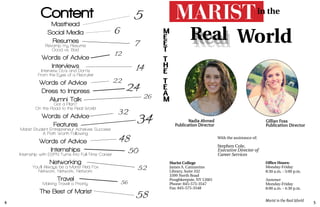
Content
Resumes
Masthead
Interviews
Dress to Impress
Alumni Talk
Internships
Travel
The Best of Marist
Revamp my Resume
Good vs. Bad
Interview Do’s and Don’ts
From the Eyes of a Recruiter
Got a Plan?
Words of Advice
Internship with ESPN Turns into Full-Time Career
You’ll Always be a Marist Red Fox
Networking
Network, Network, Network
Making Travel a Priority
Social Media
Marist Student Entrepreneur Acheives Success
A Path Worth Following
Features
Nadia Ahmed
Publication Director
Gillian Foss
Publication Director
With the assistance of:
Stephen Cole,
Marist College
James A. Cannavino
Library, Suite 332
3399 North Road
Poughkeepsie, NY 12601
Phone: 845-575-3547
Fax: 845-575-3548
Office Hours:
Monday-Friday
8:30 a.m. - 5:00 p.m.
Summer
Monday-Friday
8:00 a.m. - 4:30 p.m.
RealRealReal World
in the
M
E
E
T
T
H
E
T
E
A
M
Executive Director of
Career Services
On the Road to the Real World
Words of Advice
Words of Advice
Words of Advice
58
56
52
50
48
34
32
26
24
22
14
12
7
6
5
6 7
Marist in the Real World
http://maristcollegeca-
reerservices.tumblr.com/
Career Services collab-
orates with the college
community and exter-
nal partners to prepare
students for individual
career success.
career.services@marist.edu
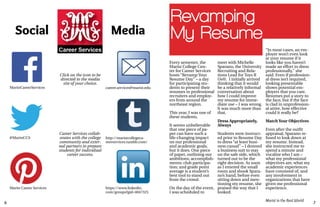
Social Media
MaristCareerServices
@MaristCCS
Marist Career Services https://www.linkedin.
com/groups?gid=4047325
Click on the icon to be
directed to the media
site of your choice.
Revamping
My Resume
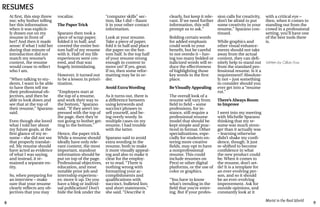
Every semester, the
Marist College Cen-
ter for Career Services
hosts “Revamp Your
Resume Day” – a day
for participating stu-
dents to present their
resumes to professional
recruiters and employ-
ers from around the
northeast region.
This year, I was one of
these students.
It seems unbelievable
that one piece of pa-
per can have such a
life-changing impact
on our professional
and academic goals,
but it does. One piece
of paper, outlining our
ambitions; accomplish-
ments; club participa-
tion; and grade point
average is a student’s
best tool to stand out
from the crowd.
On the day of the event,
I was scheduled to
“In most cases, an em-
ployer won’t even look
at your resume if it
looks like you haven’t
made an effort to dress
professionally,” she
said. Even if profession-
al dress isn’t required,
looking presentable
shows potential em-
ployers that you care.
Resumes put a story to
the face, but if the face
is clad in unprofession-
al attire, how effective
could it really be?
MatchYour Objectives
Even after the outfit
appraisal, Sparano re-
fused to look down at
my resume. Instead,
she instructed me to
spend a minute and
vocalize who I am –
what my professional
objectives are, what my
academic experiences
have consisted of, and
any involvement in
organizations that have
given me professional
experience.
meet with Michelle
Sparano, the University
Recruiting and Rela-
tions Lead for Toys R
Us®. I initially arrived
thinking that it would
be a relatively informal
conversation about
how I could improve
my resume for imme-
diate use – I was wrong.
It was much more than
that.
Dress Appropriately,
Always
Students were instruct-
ed prior to Resume Day
to dress “at least busi-
ness casual” – I donned
a business suit to stay
on the safe side, which
turned out to be the
right decision. As soon
as I entered the small
room and shook Spara-
no’s hand, before even
sitting down and men-
tioning my resume, she
praised the way that I
looked.
8 9
Marist in the Real World
At first, this step threw
me; why bother telling
her this information
when it was explicit-
ly drawn out on my
resume in front of
her? And then it made
sense: if what I told her
during that minute of
introduction did not
match my resume’s
content, the resume
would cease to reflect
who I am.
“When talking to stu-
dents, I want to be able
to have them tell me
their professional ob-
jectives, and then be
able to look down and
see that at the top of
their resume,” Sparano
said.
Even though she loved
what I told her about
my future goals, at the
first glance of my re-
sume – she did not see
that properly translat-
ed. My resume should
have acted as evidence
of what I was saying,
and instead, it re-
mained a separate en-
tity.
So, when preparing for
an interview – make
sure that your resume
clearly reflects any ob-
jectives that you may
vocalize.
The Paper Trick
Sparano then took a
piece of scrap paper,
folded it in half, and
covered the entire bot-
tom half of my resume
with it. Half of my life
experiences were cov-
ered, and that was
hugely intimidating.
However, it turned out
to be a lesson in priori-
tization.
“Employers start at
the top of a resume,
and work their way to
the bottom,” Sparano
said. “If they aren’t im-
pressed with the top of
the page, then they’re
not going to bother get-
ting to the bottom.”
Hence, the paper trick.
While a resume should
ideally have only rele-
vant content, the most
important, standout
information should be
put on top of the page.
Professional objectives,
education, and most
notable prior job and
internship experienc-
es: move it up. Do you
have a blog or individ-
ual publication? Don’t
hide the link under the
“computer skills” sec-
tion, like I did – flaunt
it in your other contact
information.
Look at your resume.
Take a piece of paper,
fold it in half and place
the paper on the bot-
tom half. Is the top half
of your resume strong
enough in content to
move on? If yes, great.
If no, then some refor-
matting may be in or-
der.
Avoid ExtraWording
As it turns out, there is
a difference between
using keywords and
succinct phrases to
sell yourself, and be-
ing overly wordy. In
multiple cases on my
resume, I had trouble
with the latter.
Sparano said to avoid
extra wording in the
resume, both to make
it more visually appeal-
ing and also to make it
clear for the employ-
er to read. “There is
nothing wrong with
formatting your ac-
complishments and
qualifications with
succinct, bulleted lists
and short statements,”
she said. “Describe it
RESUMES
clearly, but keep it rele-
vant. If we need further
information, this will
prompt us to ask.”
Bolding certain words
for added emphasis
could work to your
benefit, but be careful
to not overdo it – hav-
ing too many bolded or
italicized words will re-
duce the effectiveness
of highlighting those
key words in the first
place.
BeVisually Appealing
The overall look of a
resume will vary from
field to field – some
professions, for in-
stance, still require a
professional resume
model that should be
kept simple and prac-
ticed in format. Other
specializations, espe-
cially for students en-
tering more creative
fields, may opt to have
a nonprofessional
resume. This could
include resumes on
Prezi or other digital
platforms, or the use of
color or graphics.
“You have to know
what’s trending in the
field that you’re enter-
ing. But if your profes-
sion calls for creativity,
don’t be afraid to put
some creativity in your
resume,” Sparano con-
tinued.
While graphics and
other visual enhance-
ments should not take
away from the actual
content, they can defi-
nitely help to stand out
from the standard pro-
fessional resume. Is it a
requirement? Absolute-
ly not – just something
to consider should you
ever get into a “resume
rut.”
There’s Always Room
to Improve
I went into my meeting
with Michelle Sparano
thinking that my re-
sume was much stron-
ger than it actually was
– learning otherwise
didn’t shake my confi-
dence, though. It just
re-shifted to become
confidence in what
the new product could
be. When it comes to
the resume, don’t set-
tle! It is a template for
an ever-evolving per-
son, and so it should
be an ever-evolving
improvement. Ask for
outside opinions, and
constantly look at it
with a critical eye –
then, when it comes to
standing out from the
crowd in a professional
setting, you’ll have one
of the best tools there
is.
Written by Gillian Foss
10 11
Marist in the Real World
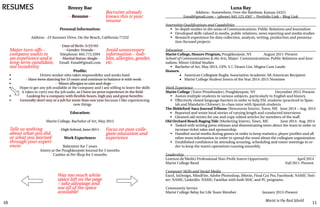
RESUMES Breezy Bae
Resume
Personal Information:
Address - 23 Summer Drive, On the Beach, California 77232
Date of Birth: 5/23/93
Gender: Female
Telephone: 845.773.3394
Marital Status: Single
Email: Email@gmail.com
Profile:
•	 	 Driven worker who takes responsibilty and works hard
•	 	 Have been dancing for 15 years and continue to balance it with work
•	 	 Minor allergies to cats and dogs
•	 	 Hope to get any job available at the company and I am willing to learn the skills
it takes to carry out the job tasks, as I have no prior experience in the field
•	 	 Looking for a company with flexible hours, high pay and great benefits
•	 	 Generally don’t stay at a job for more than one year because I like experiencing
new things
Education:
Marist College, Bachelor of Art, May 2015
High School, June 2011
Work Experience:
Babysitter for 7 years
Intern at the Poughkeepsie Journal for 3 months
Cashier at Pet Shop for 5 months
Way too much white
space left on the page
– take advatage and
use all of the space
available!
Avoid unnecessary
information – hob-
bies, allergies, gender,
etc.
Recruiter already
knows this is your
resume
Focus on post-colle-
giate education and
experience
Tells us nothing
about what you did
or what you learned
through your experi-
ences
Major turn-offs –
company wants to
see experience and a
long-term candidate,
not instability
Luna Ray
Address~ Somewhere, Over the Rainbow, Kansas 54321
Email@gmail.com ~ (phone) 845.123.4567 ~ Portfolio Link ~ Blog Link
Internship Qualifications and Capabilities
	In-depth studies in the areas of Communications: Public Relations and Journalism
	Developed skills valued in media, public relations, news reporting and media studies
	Research experience for data collection, analysis, writing, production and presenta-
tion-focused projects
		
Education
Marist College, Honors Program, Poughkeepsie, NY	 August 2011-Present
School of Communications & the Arts, Major- Communications: Public Relations and Jour-
nalism; Minor-Global Studies	
	Bachelor of Art, May 2015, GPA: 3.7, Dean’s List, Magna Cum Laude
Honors:
•	 American Collegiate Rugby Association Academic All-American Recipient
•	 Marist College Student Intern of the Year 2014-2015 Nominee
Work Experience
Marist College (Tutor/Proofreader), Poughkeepsie, NY 	December 2012-Present
	Assists multiple students in various subjects, particularly in English and history.
	Effectively closed language barriers in order to help ESL students (practiced in Span-
ish and Mandarin Chinese); in-class tutor with Spanish students.
The Biddeford-Saco Journal Tribune (Newsroom Intern), Town, ME 	 June 2014 – Aug. 2014
	Reported and wrote local stories of varying length and conducted interviews.
	Gleaned old stories for use and copy-edited articles for members of the staff.
Old Orchard Beach Raging Tide (Marketing Intern), Town, ME	 June 2014- Aug. 2014
	Tasked with writing press releases and disseminating news about the team in order to
increase ticket sales and sponsorship.
	Handled social media during games in order to keep statistics, player profiles and all
other team information in order to spread the word about the collegiate organization.
	Established confidence by attending scouting, scheduling and roster meetings in or-
der to keep the team’s operations running smoothly.
	
Leadership
Lorenzo de’Medici Professional Non-Profit Intern Opportunity April 2014
Marist College Band Fall 2011-Present	
	
Computer Skills and Social Media
Excel, InDesign, MindFire, Adobe Photoshop, iMovie, Final Cut Pro, Facebook: NAME; Twit-
ter: NAME; LinkedIn: NAME; Familiar with both MAC and PC programs.
Community Service
Marist College Relay for Life Team Member	 January 2013-Present
12 13
Marist in the Real World
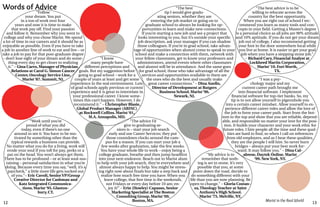
“Follow
your dream. You put
in a ton of work over four
years and now it is time to make
that work pay off. Find your passion
and follow it. Remember why you went to
college and why you chose Marist. We spend
a lot of time in our careers and it should be as
enjoyable as possible. Even if you have to take
a job in another line of work to eat and live – or
take a job to pay for that post-graduate degree
– don’t lose sight of your dream and do some-
thing every day to get closer to realizing
it.” – Gina Carro, Manager of Physician
Relations at Carol G. Simon Cancer
Center, Oncology Service Line.
Marist ‘87. Summit, NJ.
“The advice I’d
give to graduating se-
niors is – start your job search
early and use Career Services; they put
those countdown clocks around the cam-
pus for a reason. If you can start your job a
few weeks after graduation, take the few weeks.
You have your whole life to work – enjoy being a
college graduate, breathe and then jump headfirst
into your next endeavor. Reach out to Marist alum
to help with your job search, they’re everywhere and
almost always happy to help. You might be stress-
ing right now about finals but take a step back and
realize how much free time you have. When you
leave college, that free time is the weekends,
not Fridays or every day before 10 am; en-
joy it!” – Erin (Howley) Capasso, Senior
Marketing Specialist at The Boston
Consulting Group. Marist ‘09.
Boston, MA.
“Work until you’re
proud of what you did
today, even if there’s no one
around to see it. You have to be mo-
tivated by something other than the
typical rewards a business can provide.
No matter what you do for a living, work will
erode your soul if you toll for pay, perks or a
pat on the head. You won’t always get them.
There has to be profound – or at least soul-sus-
taining – personal satisfaction in what you’re
doing. Because every time you say, “well, it’s a
paycheck,” a little more life gets sucked out
of you.”– Eric Cavoli, SeniorVP/Group
Creative Director for Cashman and
Katz Integrated Communica-
tions. Marist ‘95. Glaston-
bury, CT.
“I know
many people have
different perceptions and
goals. But my suggestion before
going to grad school – work for a
couple of years at least and get some
experience in the real environment. Lots
of grad schools apply previous or current
experience and it is great to interrelate in
your professional career. I know some-
times this can’t happen. However, I do
recommend it.” – Christopher Blasie,
Global Product Manager (ARINC)
at Rockwell Collins. Marist ‘01,
M.A. Annapolis, MD.
Words of Advice “The best
tip I would give gradu-
ating seniors, whether they are
entering the job market or going on to
graduate school to always be looking for op-
portunities to learn and make new connections.
If you’re starting a new job and see a project that
looks interesting to you, but it’s outside your specific
job description, ask your manager if you can shadow
those colleagues. If you’re in grad school, take advan-
tage of opportunities when alumni come to speak to your
school and make a connection with them, network with
your fellow classmates, get to know your professors and
administrators, attend events where other classmates
and alumni will be in attendance. And the same goes
for grad school, those who take advantage of all the
services and opportunities available to them are
the ones who do the best and usually make
great career connections.” – Dina Anello,
Director of Development at Rutgers
Business School. Marist ‘96.
Newark, NJ.
“The best advice is to be
willing to relocate across the
country for the best opportunity.
When you are right out of school I rec-
ommend you learn as many tools and con-
cepts in your field. Getting a Master’s degree
is a personal choice as all jobs are 90% attitude
and 10% aptitude. If you do not get your dream
job out of college, I also recommend getting
your foot in the door somewhere local while
you live at home. It is easier to get your goal
job when you have a stepping stone job.”
– Richard Cary, Financial Analyst at
Lockheed Martin Corporation.
Marist ‘10. FortWorth,
TX.
“I was a psy-
chology major and my
current career path brought me
into financial software. I implement
financial software for top-tier banks. So, my
tip is to not allow yourself to pigeonhole you
into a certain career mindset. Allow yourself to ex-
perience different career roles and allow the love of
the job to form your career path. Start from the bot-
tom to the top and show that you are reliable, depend-
able, and responsible no matter your love for the posi-
tion. It builds your character and your work ethic for
future roles. I hire people all the time and these qual-
ities are hard to find, so when I call on references
from old employers, and as I hear these qualities,
they are the people I will hire. So never burn
bridges – always put your best work for-
ward. It may follow you.” – Dina Cal-
abrese, Daytek Online. Marist
‘99. NewYork, NY.
“My advice is to
remember that noth-
ing is set in stone. It’s very
possible that you, at some
point down the road, decide to
do something different with your
life than you are now planning. Be
open to change.” – Gloria Costan-
za,Theology Teacher at Saint
Anthony’s High School.
Marist ‘75. Melville, NY.
14 15
Marist in the Real World
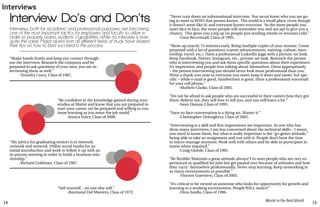
Interviews
“Shake hands firmly and keep eye contact through-
out the interview. Research the company and be
prepared to ask questions of your own, you are in-
terviewing them as well.”
	 -Timothy Curry, Class of 1987.
Interview Do’s and Don’ts
Interviews, both for academic and professional purposes, are becoming
one of the most important tactics for employers and faculty to utilize in
order to properly assess students’ capabilities. While no interview is ever
quite the same, Marist alumni from all different fields of study have shared
their tips on how to best succeed in the process.
“Be confident in the knowledge gained during your
studies at Marist and know that you are prepared to
start your career, yet be prepared and willing to con-
tinue learning as you enter the job world.”
	 -Jessica Foley, Class of 2006.
“My advice for graduating seniors is to network,
network and network. Utilize social media for an
initial introduction and work to follow it up with an
in-person meeting in order to build a business rela-
tionship.”
	 -Richard Goldman, Class of 1987.
“Sell yourself…no one else will.”
	 -Raymond Del Maestro, Class of 1972.
“Never turn down an informational interview. You never know who you are go-
ing to meet or WHO that person knows. The world is a small place (even though
it doesn’t seem like it) and everyone knows everyone. So the more people you
meet face to face, the more people will remember you and are apt to give you a
chance. This gives you a leg up on people just sending emails or resumes cold.”
	 -Gina Becconsall, Class of 1995.
“Show up exactly 15 minutes early. Bring multiple copies of your resume. Come
prepared with a lot of questions (career advancements, training, culture, men-
torship, travel, etc.). Have a professional LinkedIn page with a picture; we look.
Keep Facebook, Twitter, Instagram, etc., private; we look. Research the person
who is interviewing you and ask them specific questions about their experience.
It’s impressive, and people love talking about themselves. Dress appropriately
– the person interviewing you should never look more professional than you.
Write a thank-you note to everyone you meet; keep it short and sweet, but spe-
cific – while e-mail is good, handwritten is great. Have a professional voicemail
for your cell phone.”
	 -Mathew Clarke, Class of 2005.
“Do not be afraid to ask people who are successful in their careers how they got
there. Believe me, they will love to tell you, and you will learn a lot.”
	 -Sean Dumas, Class of 1995.
“Face-to-face conversation is a dying art. Master it.”
	 -Christopher Deloughery, Class of 2002.
“Interviewing is a skill and first impressions are important. As one who has
done many interviews, I am less concerned about the technical skills – I mean,
you need to know them, but what is really important is the “go-getter attitude,”
being able to take an assignment and run with it. People don’t have the time
to micro-manage anymore. Work well with others and be able to participate in
teams when required.”
	 -Craig Gloede, Class of 1992.
“Be flexible! Maintain a great attitude always! I’ve seen people who are very ex-
perienced or qualified for jobs but get passed over because of attitudes and how
they ‘carry’ themselves professionally. Never stop learning. Keep networking in
as many environments as possible.”
	 -Vincent Guerriero, Class of 2005.
“It’s critical to be viewed as someone who looks for opportunity for growth and
learning in a working environment. People WILL notice!”
	 -Dina Anello, Class of 1996.
16 17
Marist in the Real World
Daniel Gonzalez grad-
uated from Marist as a
transfer marketing major
in the class of 1994. With
no real plans as to what
he wanted to do post-
grad, Gonzalez made
sure to get his resume
posted online for poten-
tial opportunities. For-
tunately, Gonzalez was
scouted to be a recruit-
er, a career path he had
not been trained in. Al-
though Gonzalez did not
know his career plans
prior to this offer, he had
one thing in check; he
knew the characteristics
he wanted his future job
to have – he did not want
to do the same boring
tasks day after day and
he wanted to interact
with people, being a
recruiter satisfied these
requirements.
Gonzalez is now the
proud Founder and CEO
of PeopleVault, Inc., an
executive search firm
servicing the financial
services marketplace.
He spent 20 plus years in
executive recruiting with
a mission to create ca-
reers, not jobs. Gonzalez
is also the Co-Founder
of Facticiti, LLC. Over
ten years ago, Gonzalez
dreamt of a web-based
platform that assessed
what people enjoy and
located jobs in the mar-
ket for them. As one who
is inspired to help people
live out their passions
through their career and
avoid wasting their time
in a job that is not en-
joyable, that dream was
born when Gonzalez and
his partner created Fac-
ticiti.
So what should you know
from preparation to after
the interview, from the
eyes of a long-time re-
cruiter?
Social Media
From the Eyes of a Recruiter
Tips concerning interviews and preparation
for post-college life come from parents, family,
friends and advisors, but what does an actual
recruiter have to say about “the perfect candi-
date?” You’re about to find out.
Interviews
“No keg stands and no
crazy parties! [Com-
panies] try to get rid of
people easily to narrow
down an applicant pool,”
said Gonzalez in regards
to a candidate’s presence
on social media. De-
pending on one’s major,
social media may or may
not be a necessary plat-
form that recruiters want
to see activity on. How-
ever, no matter what, it
is unacceptable to post
excessive cursing, opin-
ions on politics, or pic-
tures that show partying
or any nudity. Without
a doubt, recruiters will
search for
you, so keep
it private,
clean and
hidden.
Interview
Preparation
Of course,
you have
to prepare,
prepare,
prepare.
Look over
your re-
sume.
Search
questions
online per-
taining to
your field of
interest. Jot
down potential answers
to questions you may
be asked and rehearse
them.
A critical point is to re-
search the company and,
if you are informed of
who the recruiter will
be, research the person
interviewing you. Linke-
dIn is the perfect source
for searching others, as
well as a useful tool to
stay connected after the
interview. Knowing basic
facts and accomplish-
ments about the com-
pany shows you have an
interest in working with
them and that you did
your homework, coming
prepared. Gonzalez rec-
ommends being famil-
iar with the CEO of the
company and the various
departments that exist.
Something most people
typically wouldn’t con-
sider researching, but
that Gonzalez strongly
suggests, especially as
you begin to apply for
higher level positions, is
to follow the stock of the
company. Find out where
it is publically traded and
understand the finances
and how well (or poorly)
18 19
Marist in the Real World
the company is doing
in the stock market by
using Google Finance
and Yahoo! Finance. Ad-
ditionally, be aware of
some of the main com-
petitors to the company
you are interviewing for.
Your knowledge will im-
press the recruiter, but
be sure not to confuse
yourself with too much
information overload.
Aside from knowing
about the company,
know about yourself
as well. What position
are you fighting for and
where do you see your-
self in the company in
three to five years? Re-
cruiters like Gonzalez
like to ask questions
that may seem simple
but have an underlying
message. For example,
Gonzalez said he tends
to ask a candidate what
books he or she is cur-
rently reading or what
his or her favorite food
to cook is and to explain
the process they take to
make it. Questions of this
sort show knowledge,
willingness to learn, and
how lazy or how proac-
tive you are.
The Interview
“I know right when the
person walks in if they
will be hired,” said Gon-
zalez, “based on a firm
handshake, a polished
look and if they make eye
contact.” From the words
of a recruiter who has
been in the business for
many years, “pretend you
are doing what you enjoy
most,” whether it is hik-
ing, doing yoga or cook-
ing a meal – get yourself
to a mind state where
you are comfortable and
relaxed enough to be
yourself and speak freely.
However, there is, Gon-
zalez clearly stated, a fine
line between speaking
freely and being profes-
sional – you should not
use slang words or be too
casual in conversation as
if talking to a friend.
Imagine the entire in-
terview goes well, you’ve
effectively answered all
of the questions and
(hopefully) left a great
impression. The inter-
viewer ends off with one
last question: “Is there
anything you want to ask
me?”
You freeze up, your mind
blanks and you can’t
think of a single thing
you want to know. Once
again, prepare questions
that you want to ask so
as to show your interest
in the company further.
Gonzalez recommends
some of the following as
potential questions to
ask at the end of an in-
terview:
Show the interviewer you
mean business and that
you truly are passionate
about the position. Af-
ter the interview, write a
handwritten thank you
note to the interviewer
for taking the time out
to meet with you. Some-
thing along the lines of:
“Thank you for your
time, I’ve learned a great
deal about the company.
I look forward to hear-
ing back and to any fol-
low-up meetings. I am
very interested in learn-
ing about the next steps
in the process.”
Interviews
One who exerts per-
sistency and effort is
more likely to stand out
than other candidates
who fall out of touch.
As Gonzalez said, “You
always want to go in for
the close.”
Resumes
Gonzalez is a strong ad-
vocate for getting across
challenges and progres-
sions within the context
of a resume. The resume
should articulate that the
candidate has a desired
skillset, confidence in his
or her work, and the abil-
ity to take on responsibil-
ity. “Quantify your results
by showing something
that gives me a sense of
what you achieved,” he
said.
Recruiters are interested
in seeing someone who
challenged themselves
throughout college, not
only focusing on a high
GPA but rather balanc-
ing community service,
sports, extra-curricular
activities and a job on
top of an education. If
grades sacrifice slight-
ly, it is compensated by
showing that the candi-
date was able and willing
to take on more than
just one responsibility.
Showing that your GPA
increased each semester
or that you picked up
several new activities or
an extra job when your
grades slipped just a little
supports that balance
and progression recruit-
ers want to see.
“At the end of the day,
your education is just
a key to get yourself
through the door,” said
Gonzalez. “Any experi-
ence you can get just in-
terfacing with company
leaders, absorbing any-
thing around you aside
“You always want
to go in for the
close.”
from the classroom will
benefit you. Education is
key, but what you are as
a person – the things you
do and balance – is how
you get hired.”
Believe it or not, said
Gonzalez, people show
up with unprofessional
resumes – providing per-
sonal information about
hobbies and interests or
forgetting to make gram-
matical corrections.
Extra tips to keep in
mind:
•	 An objective can
but does not have to be
on the resume.
•	 Minor job positions
are okay to put on your
resume until you build
it up further – don’t be
afraid to include that you
were a camp counselor,
this is one position Gon-
zalez admits he loves to
see on a candidate’s re-
sume.
•	 It is okay to have
the resume spill over to
the second page, if nec-
essary. If the recruiter is
interested enough, he or
she will read it.
•	 Include your tech-
nical experience and
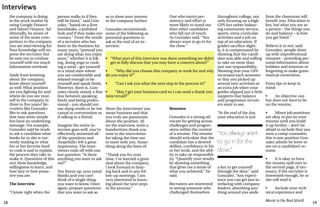
•	 “What part of this interview was there something we didn’t
get to fully discuss that you may have a concern about?”
•	 “Why did you choose this company to work for and why
do you enjoy it?”
•	 “Can I ask you what the next step in the process is?”
•	 “May I get your business card so I can send a thank you
note/email?”
20 21
Marist in the Real World
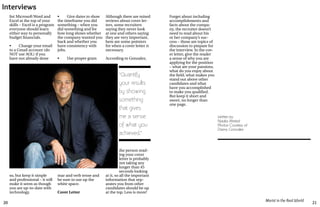
Written by
Nadia Ahmed
Photos Courtesy of
Danny Gonzalez
Interviews
list Microsoft Word and
Excel at the top of your
skills – Excel is a program
everyone should learn
either way to personally
budget financials.
•	 Change your email
to a Gmail account (do
NOT use AOL) if you
have not already done
so, but keep it simple
and professional – it will
make it seem as though
you are up-to-date with
technology.
•	 Give dates to show
the timeframe you did
something – when you
did something and for
how long shows whether
the company wanted you
back and whether you
have consistency with
jobs.
•	 Use proper gram
mar and verb tense and
be sure to use up the
white space.
Cover Letter
Although there are mixed
reviews about cover let-
ters, some recruiters
saying they never look
at one and others saying
they are very important,
here are some pointers
for when a cover letter is
necessary.
According to Gonzalez,
the person read-
ing your cover
letter is probably
not taking any
longer than 45
seconds looking
at it, so all the important
information that sep-
arates you from other
candidates should be up
at the top. Less is more!
Forget about including
accomplishments and
facts about the compa-
ny, the recruiter doesn’t
need to read about his
or her company’s suc-
cess – those are topics of
discussion to prepare for
the interview. In the cov-
er letter, give the reader
a sense of why you are
applying for the position
– what are your passions,
what do you enjoy about
the field, what makes you
stand out above other
candidates and what
have you accomplished
to make you qualified.
But keep it short and
sweet, no longer than
one page.
“Quantify
your results
by showing
something
that gives
me a sense
of what you
achieved.”
22 23
Marist in the Real World
“Don’t be afraid to
apply to jobs that require
a certain criteria that you may
not have. Tell them up front that
you are willing to learn, and that you
are a quick learner. If you are a good
fit with the company they will invest
money into training you.” – Cather-
ine Becker, Associate Director of
Communications for the New
York Athletic Club. Marist
’09. NewYork, New
York.
“My
biggest tip to grad-
uating seniors is to go after
your dreams by pursuing those
things that excite you and make your
heart sing. In other words, find your pas-
sion and pursue that, no matter what obstacles
come up. I know it sounds cliché but really that is
the best way to pursue a career because if you are
working in the field you love, then it is easier to go
to work every day and success is beyond your imagi-
nation. Remember obstacles may come but they will
always make you stronger, wiser and more mature
than you were before the obstacle. Lastly, have a
spiritual relationship whether that be with God or
another higher power; most times it is the only
thing that can give you strength when you
need it most.” – (Ms.)Yahairah Aristy,
Deputy Public Defender for the
County of San Diego. Marist
‘95. San Diego, CA.
“The
best advice I can
give is to aim for as high
as you want to in life, but be
prepared to work very hard for it.
Very rarely does one start at the top.
You start in the middle or the bottom.
Prove yourself, stay the course and you’ll
eventually get to where you want to be.
But don’t be afraid to change the plan.
Life happens.” – Jacqueline Emslie,
Systems Analyst at Dutchess Coun-
ty Office of Computer Infor-
mation. Marist ‘95. Pough-
keepsie, NY.
“When searching
for a job, focus on job
fit and passion for the busi-
ness over everything. If you have
the option, choose happiness and
quality of life over money. If you en-
joy what you do, you will be successful
and money will come in time or you
will not yearn for money because
happiness fills your soul.” – Gianni
DiMeglio, Relationship Man-
ager for TD Private Client
Group. Marist ‘02.Wil-
ton, CT.
“My ad-
vice on grad school
versus real world depends
on your field of study. The main
takeaway though is that graduate
school is a big decision, and generally
is intended to focus on a narrower field
of study so the individual should know
exactly what they want to do. That is, you
can’t just get an MBA in business or sales.
The programs are highly specialized and
catered toward a given field, and also
focus highly on real world experi-
ence.” – Nick Fierro, Senior Asso-
ciate at Ernst &Young, LLP.
Marist ‘11. Seacau-
cus, NJ.
Words of Advice “My advice would
be, believe it or not, focus
less on your grades and more on
gaining field experience. Internships,
internships, internships. I found that while
a high GPA is impressive, it does not help you
in the real world as much as field experience
does. I’m not saying to not worry about your grades
– obviously, they’re important – but I purposely did
not partake in many internships because I wanted to
focus on schoolwork. I spent hours in the library in-
stead of hours getting experience, and had I known
what employers would be looking for, I probably
would’ve done things a little differently. A better
balance of both, perhaps.” – Emily Cicca-
rello, Human Resources Coordinator at
Wafra Investment Advisory Group,
Inc. Marist ‘13. Staten Island,
NY.
“I wish that someone
had told me that many com-
panies and especially hospitals
help their full and part time employ-
ees with the cost of higher education. For
anyone wanting to continue to graduate
school, I would recommend checking to see
if there are any jobs in their field that have,
as one of their benefits, reimbursement for
school. You may not finish as quickly, but it’s
nice not to have to take more loans out.” –
Janette Bogdan M.T. (ASCP), Assistant
Blood Bank Supervisor at Phelps
Memorial Hospital Center.
Marist ‘95.Tarrytown,
NY.
“What I have
learned in my twenty years
post-college is: you do not ‘deserve’
anything. You need to work harder than
the other guy. Whether you are trying to get a
job, get a promotion, grow your business, nothing
beats hard work. I have noticed a shift in the younger
people entering the workforce. You will go very far by
working hard and EARNING your future. At the begin-
ning of your career, network. Meet and greet anyone and
everyone. People will appreciate the fact that you have am-
bitions. Also, don’t lose focus on what is most important in
life – your family. I am a very competitive person in a very
competitive industry and constantly have to check my-
self on the fact that I’m not over-consumed with work.
Work is great, but it is designed to pay the bills, ul-
timately. Take pride in your career but don’t let it
define you, I see it too often.” – Sean Dumas,
Principal Sales Representative at Bos-
ton Scientific. Marist ‘95. Pat-
chogue, NY.
“Don’t let
people tell you that
you can’t do something. If
you want it, go for it. Only you
know what you’re capable of. Stay
connected. The Marist Alumni net-
work is amazing. There is such pride in
our school and who we are as Red Fox-
es and that never goes away. Take ad-
vantage of that network, that’s what
it’s there for.” – Jennifer Dugan,
Retail Store Manager at The
Costumer. Marist ‘04.
Albany, NY.
24 25
Marist in the Real World
Know that there is a
line of professional-
ism in an interview
setting, but do not be
afraid to stand out with
a few pieces. “Wear an
eye-catching necktie,”
said Curry. “Don’t for-
get a new pair of shoes
with a good shine. By
looking good, you will
feel more confident!”
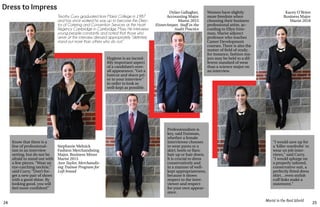
Stephanie Melnick
Fashion Merchandising
Major, Business Minor
Marist 2015
Ann Taylor, Merchandis-
ing Trainee Program for
Loft brand
Dress to Impress
Hygiene is an incred-
ibly important aspect
of a candidate’s over-
all appearance. “Get a
haircut and shave pri-
or to your interview”
in order to look as
well-kept as possible.
Timothy Curry graduated from Marist College in 1987
and has since worked his way up to become the Direc-
tor of Catering and Convention Services at the Hyatt
Regency Cambridge in Cambridge, Mass. He interviews
young people constantly and noted that those who
arrive at the interview dressed appropriately “definitely
stand out more than others who do not.”
“I would save up for
a ‘killer wardrobe’ to
wear on job inter-
views,” said Curry.
“I would splurge on
a properly tailored,
conservative suit, a
perfectly fitted dress
shirt…even stylish
cuff links make a
statement.”
Women have slightly
more freedom when
choosing their business
professional attire, ac-
cording to Ellyn Enis-
man, Marist adjunct
professor who teaches
Career Development
courses. There is also the
matter of field of study;
for instance, fashion ma-
jors may be held to a dif-
ferent standard of wear
than a science major on
an interview.
Dylan Gallagher,
Accounting Major
Marist 2015
EisnerAmper, Staff in the
Audit Practice
Kacey O’Brien
Business Major
Marist 2018
Professionalism is
key, said Enisman,
whether a female
interviewee chooses
to wear pants or a
skirt; heels or flats;
hair up or hair down.
It is crucial to dress
conservatively and
in a manner of well-
kept appropriateness,
because it shows
respect to the inter-
viewer and respect
for your own appear-
ance.
26 27
Marist in the Real World
Got a Plan?
Seniors graduating from
college are often asked
a single question: got a
plan?
For some, the question
is met with a definitive
answer – a job lined up,
or impending gradu-
ate studies, or another
planned endeavor. For
others, there could still
be immense uncertainty.
Those still figuring out
which direction they
plan to take their career
should take some advice
from Pamela Brangan,
however.
“Don’t be afraid of wrong
turns! They could end up
providing you with a life-
long career,” said Bran-
gan, a Marist graduate of
1991.
Her personal story is a
testament to this – Bran-
gan and her then-boy-
friend, now husband,
literally took a wrong
turn; a wrong turn that
resulted in her dream job
approximately one year
after graduating from
Marist.
Brangan, a Business
Administration major,
headed west upon grad-
uation with the intention
of landing a job with the
National Parks Associ-
ation. “We had sent in
dozens of applications,
but had no firm offer. But
we were determined to
go anyway,” she said.
Much of the trip con-
sisted of camping and
hiking; Brangan and her
husband were particu-
larly inspired by areas
near the Lochsa River in
Idaho, and initially con-
sidered trying to work
for the Forest Service at
Alumni Talk
Usually three left turns make a right – but sometimes in the career path, it
takes a wrong turn to turn into a right opportunity.
the ranger station in that
area.
“Well, we woke up late
and decided to keep
heading west…except we
took a wrong turn and
ended up at the ranger
station,” said Brangan.
“We talked to an employ-
ee who told us to put our
applications in at the
supervisor’s office ‘down
river,’ which was the di-
rection we were headed,
so we did just that.”
In retrospect, this wrong
turn was the best pos-
sible accident – even
though they continued
onto Glacier National
Park, a phone call home
informed them that there
were job openings back
at the ranger station in
Idaho.
“The person in charge of
the fire crew had wanted
to hire me – they needed
more women on the crew
– but the district planner
took a look at my resume
and saw all the computer
experience I had. A lot
was from working at the
Marist computer lab!”
she said. Her qualifica-
tions landed her with a
Geographic Information
Systems (GIS) job.
This was an unexpected
start to her career – it was
in an unexpected place,
in an unfamiliar field,
and came as a result of
one wrong turn. Howev-
er, it has provided Bran-
gan with immeasurable
professional fulfillment.
Written by Gillian Foss
Photo Courtesy of Pamela
Brangan
“Don’t be afraid of
wrong turns! They
could end up pro-
viding you with a
lifelong career,”
“While I had never heard
of GIS back then, I was
quick to learn and over
twenty years later, I am
still working in GIS and
loving it,” said Brangan.
It’s an unusual career
story, yes – but one with
a lasting message. Not
everyone has a plan by
graduation, but there’s
no need to give up.
Sometimes, as in Bran-
gan’s case, great oppor-
tunities are right around
the corner.
28 29
Marist in the Real World
Reality is, a camp coun-
selor position or cashier
position at your nearest
ice cream parlor isn’t
going to cut it when it
comes to preparing for
the “real world.” An in-
ternship that provides
hands-on experience in
the workplace is the clos-
est one gets to under-
standing the atmosphere
and work dynamics that
occur.
You may even go through
college in one field, only
to realize by the end that
it isn’t what you truly
want to pursue. Don’t be
afraid. Countless Marist
alumni have admitted
that they did a complete
180 after Marist and
landed careers in fields
they never prepared for
but turned out to be
more satisfying.
	
Back in his college days,
Edward O’Reilly, Marist
graduate of 1995, had a
passion for Radio/TV/
Film. Over the course of
his one year internship
with WRNN, a televi-
sion station in Kingston,
O’Reilly enjoyed the
hands-on experience
he received in the field.
Gradually he took on ex-
tra responsibilities, lucky
enough to gain on-air
time as well as to help
produce scripts and to
film and edit video pack-
ages for the station. “I re-
ally wanted to be a sports
anchor, that was my
end goal,” said O’Reilly.
Even with the end goal
in mind and a degree
in communications, he
was aware of the com-
petitiveness he would
face in the field trying to
get to where he wanted
to be at the top. “I wish I
could have stuck around
to follow a passion, but it
wasn’t enough of a salary
straight out of Marist,”
he admitted. Rather, he
tried to make his way
into sales, motivated by
making money. With no
success in obtaining a
job in sales due to his
low GPA, O’Reilly was
recognized by a recruit-
ment agency. After years
of training and working
his way to the top of two
different recruiting com-
panies, he pushed for
a partnership six indi-
vidual times, each time
being denied. Because
of the high revenue he
was bringing in, O’Reil-
ly decided it was finally
his time to branch off.
Already knowing how
successful he could be,
confident in his skills
and ability to produce
high revenue, O’Reilly
went for it, leaving his
job and opening his own
firm at the young age
of 26. Where is he now?
O’Reilly is the Founder
and CEO of Cyber Search
Global, an executive
search firm.
Entering the RealWorld
On the Road to
the Real World
The end is near and college
is coming to an end. It may be
months, weeks or days until you start
your first day at a “grown-up” job.
The question is: are you ready?
Alumni Talk
30 31
Marist in the Real World
ing up the ladder of suc-
cess.
Owning a Business
In his first year, O’Reilly
admitted his relief and
luck that the compa-
ny was able to survive
through the happenings
of 9/11 and the dotcom
market crash. Approxi-
mately 15 years later, the
company is still growing,
so what does O’Reilly
have to say to aspiring
entrepreneurs about
opening a business?
•	 “The failure rate is
very high because peo-
ple don’t know what they
are doing and don’t have
the skill set for that area.
It’s important to know
what you’re doing, do
something that you do
really well, have some-
thing that people want
and know you offer some
level of value.”
•	 “Be prepared to fail
and deal with the tough
times, it’s never going to
be easy.”
•	 “Be financially
prepared. You need the
money to run the busi-
ness and rent or buy the
area; need money to live
your normal life as well;
need at least one whole
year’s worth of savings, in
case your company does
not make money in the
first year. Know that peo-
ple don’t always pay you
on a timely basis, so you
need to be able to live
without the payments.”
•	 “Start small and
cheap at first – be nimble
and flexible to succeed at
the start. You need an ef-
fective business location
and to invest in hiring
new people rather than a
luxurious office space.”
If there’s anything to
motivate you and to take
away from O’Reilly’s ex-
perience, let it be this:
“Maximize the opportu-
nities given to you. Don’t
give up. We all fail, even
successful people. It’s
just one step closer to
success. There are going
to be times where the job
world is tough on you.
Some things you have
no control over. The one
thing you do have con-
trol over is yourself. Trust
what you do.”
Written by Nadia Ahmed
According to O’Reilly,
students tend to think
they are a finished prod-
uct when they finish col-
lege. The truth is, howev-
er, that you’ll always have
room for improvement
and you have to work
hard to get to the top.
“Your true value to an
organization is the skills
you bring with you,” said
O’Reilly, adding “you get
paid for the level of ex-
pertise and skill set you
bring.” Life is a constant
opportunity to advance
and grow, not only as a
person but in your career
as well. Each opportunity
that comes your way to
learn new skills should
be taken with open arms
because employers want
to see what you have to
offer and what you can
bring into their organiza-
tion.
When obtaining an in-
ternship, don’t take it
for granted; “treat it like
a real job, learn and ask
a lot of questions,” rec-
ommends O’Reilly. This
is the closest experience
you’ll get to being pre-
pared for the real world.
He ensures students or
graduates that it is okay
to ask for help if there is
an issue, whether at an
internship or when you
enter into the job world.
Doing so is going to help
you grow and gets you
recognition for complet-
ing a task properly rather
than trying to ineffec-
tively do it yourself. Even
if you don’t feel prepared
for the first day and a big
company, surrounded by
people who have been
there five, ten or 30 years,
be confident in what you
know and understand
that everyone else was
in the same position as
you at one point in their
lives. “Do your best to be
the best at what you do,”
O’Reilly suggested. “I
guarantee if you go into a
job and do your best and
work hard, most of the
time you will have a lot
more success than if you
don’t.”
Much too often, people
go into work counting
down the minutes un-
til they get to go home,
unmotivated to do any-
thing, just going through
the motions robotically.
Instead, said O’Reilly,
“You should work your
tail off while at work
– it’ll make the day go
faster and you have to
be there anyway.” Work
shouldn’t be considered
something torturous and
if it is, take advantage of
it anyway until you find
a job that makes you
happy. “When you leave
from one job to the next,
it shouldn’t be because it
pays more, but it should
be because you’ll be tak-
ing skills and experiences
from both and improving
yourself,” he said. Work
on your skills, advance
yourself in any way you
can and leave a positive
impression on the or-
ganization so they can
provide you with positive
feedback as a reference.
What it comes down to,
said O’Reilly, is to al-
ways have an end goal in
mind. “People who lose
their focus and path or
who don’t understand
what they have to do
to get to a certain level
makes them fail. Think
about where you’re going
in the long run, not just
the immediate future;
you won’t grow in a small
company.” If you think
about what you want out
of life and out of a ca-
reer – to be rich as a level
of security, to be inde-
pendent, to help others,
to enjoy going to work
every day, etc. – then it
helps in narrowing down
your options, following
the career path that is
right for you, and climb-
Alumni Talk
32 33
Marist in the Real World
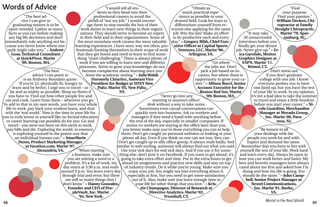
“Stop thinking
that you need to follow
this cookie-cutter mold that
society has forced us to believe in.
There is no such thing as the “real world,”
so don’t feel rushed to enter it. Companies
will always be hiring, so take some time to do
what you truly want. Do not do what your par-
ents want, or what is expected of you, but think
about what would make you genuinely happy and
go do it. Travel the world, teach English in South
Korea, move across the country, become a flight
attendant. Now is the time to do it, because you
will never be as young as you are right now.
You’ll have the rest of your life to make mon-
ey and settle down, enjoy your freedom
while you have it.” – Kelley Sullivan,
Graduate Student at Illinois
State University. Marist ‘13.
Normal, IL.
“My first bit of
advice to seniors is re-
lax, you will find a job and
have a career. My second bit
of advice is to spend as much
time searching and applying for
jobs as you would at a full-time
job. That is, looking for a job is
your full-time job.” – Christine
Daly, Senior Career Coun-
selor at SUNY New Paltz.
Marist ‘08. New Pal-
tz, NY.
“Find
your purpose.
Find your passion.”
– William Decken,
Chiropractor at Family
Straight Chiropractic.
Marist ‘79. Spartan-
burg, SC.
“The advice that
I am going to give you
is to network as much as pos-
sible. Meet as many people af-
ter school as you can. Join as many
groups, clubs, and get involved in your
community, not just for business reasons
but to build relationships with people in
your community. Be genuine when you do
this and it will help you in the long run.
It is very cliché, but ‘it’s not what you
know, it’s who you know.’” – Steven
Dardanello, Real Estate Sales at
Coldwell Banker Residential
Brokerage. Mountain-
side, NJ.
Words of Advice
“Life moves
pretty fast – if you
don’t stop and look
around every once in a
while, you could miss it.”
– James Errickson, City
of Everett. Marist ‘01.
Holliston, MA.
“I think my ad-
vice for Marist seniors
who are entering into the
professional world – especially
immediately after undergrad – is this
saying that someone told me my first
year out of college: ‘We have two ears
and one mouth; always remember to lis-
ten twice as much as you speak.’ Lots of
valuable lessons for us to learn from the
experience of others we encounter.”
– Michelle Francesconi, Compen-
sation Analyst at TowersWat-
son. Marist ‘11. New
York, NY.
“From a work
perspective I’d have to
convey that always having an
inquisitive nature – to keep ask-
ing questions – and to never be com-
fortable with status quo but to look to
continuously improve will take you far at
work! And in life, nurture your closest re-
lationships – whether from home, family
or developed at Marist and beyond, they
help you have an enriched life!” – Mi-
chael Gearing, Director of Payroll
Operations at Fidelity Invest-
ments. Marist ‘94. Durham,
NC.
“’Work
hard, say yes, and have
a little faith.’” I heard this piece
of advice when I was first starting out
in the TV industry after college. The sim-
ple, yet SO valuable piece of advice has always
stayed with me. Work really hard – be REALLY good
at what you do – be the best, be reliable, be account-
able, and be the kind of person you’d want to work with.
Say YES – I’ve had the lowest of low jobs, but people real-
ly take note when you keep a positive and upbeat attitude
no matter what your role is. And, have a little FAITH. Hello,
you’re awesome. You’re a RED FOX! So much of not being
able to survive the TV industry is not letting go of your pas-
sion. Remember why you want to work in TV and believe
that you’re meant to be in this industry! Please, don’t let
things like the hours or pay interfere with your future
ambitions. Believe that it’ll all fall into place as soon
as you let go of the need to control everything.
You got this!” – Angela Gallo, Media Plan-
ning and Strategy Manager at Nick-
elodeon. Marist ‘07. NewYork,
NY.
“Here’s my advice:
don’t look down on small
beginnings. A great career is
built over decades through small
steps, each one building upon the
other. Work hard each step of the way,
even when it may seem as if your cur-
rent situation isn’t your ultimate desti-
nation. Everything counts.” – Antho-
ny DeBarros, Director of Product
Development for Investigative
Reporters and Editors.
Marist ‘86.Waterford,
VA.
“Be able
to have conversa-
tions with people, proof-
read your writing, and be
careful with what you post on
social media – would you want
what you posted on the cover of
a newspaper?” – Louis Capora-
le,Teacher in the Brewster
Central School District.
Marist ‘99. Brew-
ster, NY.
34 35
Marist in the Real World
Marist Student
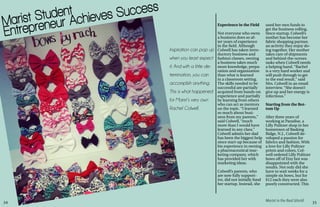
Entrepreneur Achieves Success
Inspiration can pop up
when you least expect
it. And with a little de-
termination, you can
accomplish anything.
This is what happened
for Marist’s very own
Rachel Colwell.
Experience in the Field
Not everyone who owns
a business does so af-
ter years of experience
in the field. Although
Colwell has taken intro-
ductory business and
fashion classes, owning
a business takes much
more knowledge, prepa-
ration and organization
than what is learned
in a classroom setting.
The skills needed to be
successful are partially
acquired from hands-on
experience and partially
by learning from others
who can act as mentors
on the topic. “I learned
so much about busi-
ness from my parents,”
said Colwell, “much
more than I would have
learned in any class.”
Colwell admits her dad
has been the biggest help
since start-up because of
his experience in owning
a pharmaceutical mar-
keting company, which
has provided her with
marketing ideas.
Colwell’s parents, who
are now fully support-
ive, did not initially fund
her startup. Instead, she
used her own funds to
get the business rolling.
Since startup, Colwell’s
mother has become her
fabric shopping partner,
an activity they enjoy do-
ing together. Her mother
takes care of shipments
and behind-the-scenes
tasks when Colwell needs
a helping hand. “Rachel
is a very hard worker and
will push through to get
to the end result,” said
Mrs. Colwell in an email
interview. “She doesn’t
give up and her energy is
infectious.”
Starting from the Bot-
tom Up
After three years of
working at Paradise, a
Lilly Pulitzer shop in her
hometown of Basking
Ridge, N.J., Colwell de-
veloped a passion for
fabrics and fashion. With
a love for Lilly Pulitzer
prints and colors, Col-
well ordered Lilly Pulitzer
bows off of Etsy but was
disappointed with the
results. Not only did she
have to wait weeks for a
simple six bows, but for
$12 each they were also
poorly constructed. This
36 37
Marist in the Real World
was the moment that started it all.
With the help of YouTube tutorials,
fabrics and basic supplies, Colwell was
able to begin making her very own
bows. Getting her inspiration from the
bright colors and prints that Lilly Pu-
litzer uses, Colwell strived to make an
improvement in the flawed bows she
received.
“I love having the ability to do whatev-
er I want with fabrics and prints,” she
said. “It’s just so much fun.”
Her goal was to produce good quality
bows that would not fall apart. Simply
by posting pictures of her handmade
bows on social media, Colwell received
bow requests from friends, which is
how she came to take personalized or-
ders. In December of 2013, what start-
ed as a small hobby took off within
only two weeks and turned into Bows
by Rach, which has only been growing
since then.
The Road to Business
When Colwell first began the business,
each bow order was hand delivered to
her friends’ houses. Of course, as the
orders piled up and expanded into dif-
ferent states, she developed a shipping
process.
The bow-making process is tedious
but also something that Colwell finds
relaxing. “The most stressful part of
the business is when I’m on a time
crunch,” said Colwell, adding how she
hates the stress she gets from being
rushed for time.
You could sense the passion she has
for her work as she described the steps
while so naturally showing the hand
movements it takes to make each in-
dividual bow. On bow-making days,
which are just about every day in the
summer, Colwell will spend hours at a
time in her makeshift “bow studio” in
the basement of her house. With some
music on, Colwell makes bow after
bow, reaching approximately 40 to 50
bows per day. Although she is relaxed
and focused at the time, Colwell said
she is typically exhausted afterward.
Her goal, however, is to provide good
customer service and to get bow or-
ders to the customer as soon as possi-
ble due to her poor experience on Etsy.
Danielle Hasandjekaj, a close friend,
has watched Colwell make bows
during her time at Marist, getting a
first-hand view on the focus and dedi-
cation Colwell puts into her work. “Ra-
chel makes her bows in a very positive
atmosphere. She plays a lot of upbeat
music which increases her productiv-
ity,” said Hasandjekaj. “Rachel is very
happy when making her bows, which I
think reflects her love for her work.”
Each bow is handmade and hot-glued
together and attached to a barrette.
Colwell says she typically uses cot-
ton fabrics because they are simple
to work with and cheaper than silk,
although she willingly accepts special
orders in any fabric.
“I have doubts sometimes about the
fabrics I choose,” she admitted. “It’s
hard with patterns knowing which
ones people will actually wear. For me,
I guess the hardest part
is not just shopping for
myself, but shopping for
what I think a lot of peo-
ple would actually wear.”
Moments of Success
Bows by Rach has solely
been dependent on word
of mouth and social me-
dia to get the business
known. For a girl who
began making personal-
ized bows for herself, she
now has over 320 likes
on Facebook and 480
followers on Instagram.
Much of her expansion to other states
has come from popular bloggers wear-
ing and promoting her bows. Colwell
provided blogger Kelly in the City with
several free bows and in return, Kelly
wrote a blog post endorsing Bows by
Rach, one of Colwell’s most exciting
moments in the business.
“My favorite part of the company as
a whole is just seeing how many dif-
ferent people are hearing about my
business and how they support it so
much,” said Colwell. “I’m so lucky to
have such a great support system.”
As an entrepreneur and small start-
up business, you appreciate any bit of
success that comes your way. “I was
so proud of myself when I made over
$800 for the Triple Negative Breast
Cancer Foundation,” expressed Col-
well. With the help of her Tri-Sigma
sorority sisters, over 200 pink bows
were made in support of Breast Cancer
“She puts every
ounce of herself
into her work and
works to make
sure she is meet-
ing the demands of
public.”
Awareness month and all
of the bows were sold.
“Rachel’s work in Bows
by Rach thus far is as-
tonishing. I think her
work is admirable espe-
cially with the amount
of success she’s had at
her age. Her bows are
high-quality, adorable
products that every girl
must have,” commented
proud friend, Hasand-
jekaj. “She puts every
ounce of herself into her
work and works to make
sure she is meeting the
demands of the public.”
It’s Not All Fun and Games
Endless thought, efforts and funding
go into the process of starting and
maintaining a business, something
Colwell came to learn right off the
bat. Although the business became
successful quickly due to support-
ive friends and family, organization
and improvements need to always be
made.
Colwell admits that running a busi-
ness becomes stressful; it leads to late
nights, busy days and many expenses.
However, when you are passionate
about what you do, the sacrifices made
are all worth it in the end.
“Although it is very time consuming
and exhausting, the outcome is very
rewarding. I love being free to do the
things I want and be kind of like a de-
38 39
Marist in the Real World
signer,” said Colwell. “Sometimes I re-
ally regret not being a fashion designer
because I love sewing and crafting, but
I feel the merchandising side is more
up my alley. It’s cool to be able to find
a balance in between designing and
merchandising.”
With a small business that gets off the
ground and begins to take off, getting
caught up in the excitement is nat-
ural. Orders come in, products are
sold, money is made and now you’re
thrilled. Of course, enjoy it. But Colwell
is the perfect example of one who ad-
mits to the chaos that can also come
from falling behind and not keeping
up with the responsibilities. Organiza-
tion is critical. Between keeping track
of the number of bows made and sold,
profit gain, money potentially lost, the
time it takes to create each bow and
how many bows can be made off of a
yard of fabric, Colwell admits her or-
ganization skills are sub-par; if it were
to go on for much longer the lack of
organization could negatively affect
the business. Rather than allowing it to
get out of hand, Colwell plans to take
charge and make big strides with Bows
by Rach.
The biggest challenge, said Colwell, is
catering to the needs of all her custom-
ers; although she wants to please ev-
eryone, she also has to take into con-
sideration the costs and benefits that
would come out of doing so. “It’s like
there is always something new to make
and keeping up with trends is hard,”
she said. “It’s really fun to shop for fab-
ric but what you like is sometimes not
what everyone else likes.”
What’s Next for Bows by Rach?
Colwell has set many goals for the near
future.
New Jersey; Marist College; Florence,
Italy; Paris, France; Amsterdam, Neth-
erlands and the list goes on. Bows by
Rach has gone international. Although
the bow-making is on hold while Col-
well travels around Europe for the
remainder of the spring semester, it
doesn’t mean Bows by Rach is com-
pletely forgotten and out-of-busi-
ness. A great entrepreneur is always
thinking, planning, expanding and
improving. During her travels, Colwell
finds herself searching for unique and
foreign fabric patterns and designs to
provide her customers with a wider
range of bow options in the near fu-
ture. Similar to how large businesses or
brands come out with a seasonal fla-
vor or limited edition shirt or product,
Colwell purchases these vibrant and
exclusive fabrics to create some excite-
ment, both for herself and for all her
customers.
Within only one day of her return back
to America, Colwell expects to have
already made one small and one large
“Make sure people are inter-
ested and know that making
mistakes is okay too.”
bow in each new pattern to photo-
graph and post on social media for ex-
isting – and hopefully new – customers
to be aware of and place orders right
away.
Speaking to Colwell, you can tell her
motivation, plans and actions all re-
volve around making Bows by Rach
the best it can be. Although she plans
to obtain a summer job, the motiva-
tion behind it lies in making money to
further fund new products.
“I really want to get started right when
I get home so I can take off and expand
rapidly,” said Colwell. “It’s so hard for
me because I love doing so much stuff
at once and I’m always thinking. When
I want to do something, I want to do it
now. It’s so hard not to buy a hot glue
gun here and just start already!” She
has, however, made steps in the right
direction to get to work immediately
after returning – barrettes have already
been ordered so she is ready to make
bows soon after arriving in America.
With the excitement for the future
shining through every word, Colwell
has nothing but positivity and motiva-
tion on her mind.
Something to be prepared for in your
own business endeavors? It never
stops.
“Tie yourself” men’s bow ties; men’s
ties; mini bows for babies; pony-tail
bows. Colwell has high hopes and has
become very ambitious for her busi-
ness. However, she is well aware of
the time commitment and challenges
she would face in trying to expand in
too many ways all at once. Men’s ties,
she said, are extremely challenging
although they would be fun to make.
Of course, parents love to dress their
young daughters with bows in their
hair, lending itself to a new market
for Colwell to enter. The key is to re-
search the market, discover where a
need exists and figure out where there
would be a customer base. Aside from
mini bows for babies, Colwell intends
to make bows attached to pony tail
holders, which are preferred to French
barrettes by many people and would
ideally increase the customer base as
well.
Aside from products, social media –
Facebook, Instagram, Twitter, Tumblr
– is critical to a business, especially in
this generation and when targeting a
product toward the younger, techno-
logically advanced generation. For this
reason, Colwell strives to soon reach
1,000 “likes” or “followers” on both
the Facebook and Instagram pages for
Bows by Rach. Something so simple
goes a long way, helping to spread the
word of the business one person and
one bow at a time.
To make the process of receiving or-
ders and mailing them out to cus-
tomers simpler, also in an attempt to
extend the customer base, Colwell’s
next main project and goal to achieve
involves creating an Etsy account. With
the help of a friend, a Bows by Rach
logo will soon be developed and the
Etsy account will be up and running
by summer 2015, the perfect location
for all those new international bows to
become public and sold. “I’m hoping
40 41
Marist in the Real World
for a great turnout,” said Colwell, “and
a lot of people have already placed
orders with the international fabrics
because they have traveled to those
places with me.”
It doesn’t stop there. In addition to
selling bows at Fashionology and in
the New Jersey boutique, Bling, Col-
well is in the process of setting up a
business deal to sell her products in
another boutique in her hometown.
Although past experiences at craft
fairs were not as successful as expect-
ed, Bows by Rach is likely to return to
craft fairs in the summer. Colwell sets
a perfect example of never giving up
on the business, always finding ways
to expand and improve without getting
carried away and taking on more tasks
than she can handle.
Lastly, packaging affects a product
– the way a product arrives not only
impacts one’s first impression, but it
also affects shipping costs and prof-
its made. The future of packaging for
Bows by Rach is for now a mystery, but
Colwell did hint that she already has
something up her sleeve.
With high hopes and goals for Bows by
Rach, nothing can stop this talented
and driven young woman, who still
has a long career to look forward to,
one full year of schooling left, and a
bright future ahead of her to continue
advancing in both her knowledge and
in her business.
A Bit of Inspiration
Take some advice from someone who
has already gone through the process:
JUST GO FOR IT.
Colwell recommends for any aspiring
entrepreneurs to start small with an
idea for a business and to slowly work
his or her way up. First test out prod-
ucts in small quantities to see if they
will sell. “Make sure people are inter-
ested and know that making mistakes
is okay too,” she said. Although you
may want to purchase things you are
personally interested in, make sure
other people, such as your friends and
the market you are targeting, will like it
too.
Check out Bows by Rach on Facebook
or Instagram. Small bows sell for $7
and large bows sell for $9. For questions
or bow orders, send an email to Bows-
byRach@gmail.com.
Written by Nadia Ahmed
Photos Courtesy of Rachel Colwell
42 43
Marist in the Real World
A Path Worth Following
Life is filled with surprises, especially in one’s career. Gino Ferrazzano, a
Marist College graduate of 2008, proves how unpredictable profes-
sional adventures can sometimes be a blessing in disguise.
Luigino Ferrazzano grew
up in a family of Ital-
ian immigrants; he un-
derstands change, and
understands that life is
meant to be a journey.
His educational and ca-
reer pursuits are a testa-
ment to his upbringing.
“To say that I knew I was
going to be in event mar-
keting would be a lie,”
said Ferrazzano, who
prefers the nickname
“Gino.” “I majored in In-
ternational Business [at
Marist College] to pur-
sue a career in imports/
exports or do something
that involved the U.S.
and international com-
panies.”
Admittedly, Ferrazzano
did not consider that his
true calling until his se-
nior year capping course
with “Professor Roth-
berger, who was amaz-
ing” when he discovered
a passion for strategic
44 45
Marist in the Real World
consulting. He was par-
ticularly drawn to “the
ability to look at a com-
pany at every angle, dis-
sect it from the inside out
and be able to recognize
its problem areas and
how you can fix them.
This was my calling,” he
continued. Now the only
step remaining was to
find a job in this field.
There was one problem:
there were no jobs to be
had.
“To make a long story
short, I came out of col-
lege at the worst time,”
said Ferrazzano, refer-
ring to his graduation
from Marist in 2008 – di-
rectly in the worst part of
the national recession.
Jobs in any field, espe-
cially for young college
graduates, were few, and
Ferrazzano’s immigrant
background left him with
limited connections.
“The reality is that only a
few [strategic consulting]
jobs exist and the ones
that do are hard to come
by or involve knowing
someone in that field
already,” he said. Denied
of following his passion
directly out of college,
Ferrazzano ended up
getting a job as a recruit-
er in NYC.
The subsequent five
years following Ferraz-
zano’s graduation from
Marist took him on a
path with more career
changes than some peo-
ple have in their entire
lifetimes – but, with un-
paralleled resilience, he
gradually moved up the
ladder of professional
success. He began as
a recruiter in an NYC
staffing agency before
becoming a Project and
Account Manager for a
print production com-
pany in northern New
Jersey; shortly after, he
moved up the ranks as a
Marketing Coordinator
for an event marketing
company in the south-
ern region of New Jersey.
Awhile after that posi-
tion, he headed another
event marketing com-
pany in central N.J. as a
Managing Partner and
Supervisor.
Little by little, as gradu-
al as the economy was
beginning to right itself
once more, Ferrazzano
worked to gain as much
experience at possible
– he went from recent
college graduate with no
connections, to a suc-
cessful marketing leader
with networks spanning
the Northeast region.
From New Jersey, he
moved back to New York
City; first as a Campaign
Marketing Manager for
an advertising distri-
bution company, and
then finally to his cur-
rent position: the Digital
Marketing Manager at
Sizmek, a national ad-
vertizing and marketing
agency. On the side, Fer-
razzano freelanced the
social media marketing
for the NYC-based com-
pany Salvione Music.
“I now run the market-
ing/advertising for the
“Just having it on
your resume is not
enough; but rather,
showing them that
you learned some-
thing applicable and
beneficial while you
were over there will
differentiate you
from the others.”
world’s largest ad distri-
bution company for TV
and Online; DG Media-
Mind – Sizmek. I want-
ed to see the other side
coming from the small,
boutique agency world.
I wanted to see what
the corporate side is all
about and I love it,” he
said.
“This may seem like a lot
of jobs over the last five
years, but to be honest,
I wouldn’t trade it for
the world,” continued
Ferrazzano proudly. “I
learned so much over
that time, essentially
taking a little something
from each of those jobs
to better prepare me for
the next.”
Ferrazzano is now 29 –
and despite the fact that
his career path took him
in a completely unex-
pected direction from
when he was an under-
graduate at Marist, he
believes that it is the
unpredictability of his
future despite having an
education that has made
him a better worker and
person.
But, he said, there is one
caveat – whatever you
do, and whichever un-
predictable direction
that you head in as you
pursue a career – do
something you love.
“The worst thing in the
world is waking up every
morning and dragging
your [butt] into work just
because it pays the bills,”
said Ferrazzano, entirely
blunt. “We don’t live in
Communist Russia – no
one but yourself is forc-
ing you to pursue a pro-
fession that conventional
wisdom says is the way
to go – we live in a wild
time where if you know
how to market yourself
and develop yourself as a
brand, you will go far, no
matter the career path
you take.”
With that said, Ferraz-
zano advises college
graduates to not only
work to go far, but to be
an all-star. Load up on
the internships; become
proficient in programs
such as Adobe InDesign,
Photoshop, or finan-
cial programs; become
comfortable with public
speaking; learn a lan-
guage, or two. Find that
niche that drives you, he
said, because that pas-
sion will result in a far
better quality of work.
Ferrazzano also ex-
pressed that a great deal
of what his post-grad-
uate life was like could
start occurring during
students’ time at Marist.
Studying abroad and
interning, according
to him, are a student’s
greatest allies. Ferrazza-
no, for instance, used his
internship experience
as a student to discover
career paths that he did
not want to pursue.
“I was still a finance
major and dead set on
becoming a financial
adviser until I had my
internship at Smith Bar-
ney Citi Group in NYC,”
he said. “I had an amaz-
ing experience…but I
knew it was not for me.
Just too dry, not enough
action, and starting from
the bottom was a lone-
ly place where very few
succeeded.” But, that
experience gave him the
ability to cross one more
46 47
Marist in the Real World
“
endeavor off of his list
and continue searching
to discover his passions,
according to Ferrazzano.
The same concepts went
for traveling abroad to
study. “Don’t ponder it;
Written by Gillian Foss
Photos Courtesy of
Gino Ferrazzano
DO it,” said Ferrazzano.
However, similarly to the
internship experience,
the value of the expe-
rience is entirely what
you choose to make of
it, he said. Because so
many students nowadays
have the ability to study
abroad for at least one
semester, Ferrazzano
advised to do more than
travel.
“Just having it on your
resume is not enough;
but rather, showing them
that you learned some-
thing applicable and
beneficial while you were
“We live in a wild time where if you
know how to market yourself and de-
velop yourself as a brand, you will go
far, no matter the career path you take.”
over there will differenti-
ate you from the others,”
he said, noting that his
one regret while studying
abroad in Florence, Italy
was not doing enough
to advance his dream of
working on the interna-
tional business front.
Ferrazzano’s final tip for
professional success is a
simple one: know your
stuff. Know what is go-
ing on in the world, and
what is going on with
people around you. For
underclassman in partic-
ular, know where money
is going – it will “keep
you ahead of the game
and ahead of those kids
who wait until senior
year to open their eyes,”
according to him.
Above all else, however,
know one thing – life is
fickle. It is full of change
and transition and, es-
pecially in one’s career,
can present its fair share
of obstacles. Those who
rise above to meet these
challenges, though, and
to make the most out of
any scenario, will be the
most successful.
This is the route that
Gino Ferrazzano chose.
This is the route that we
all can choose.
48 49
Marist in the Real World
“I would tell all stu-
dents as they head into their
professional careers to avoid the
pitfall of “not my job.” I would encour-
age them to step outside the box of their
work duties to learn new things in their organi-
zations. They should strive to become an expert
in their field and in their organizations. Some of
the most mundane work creates the most valuable
learning experiences. I have seen, way too often, pro-
fessionals limiting themselves in their scope of work
that they get bored and need to leave to find some-
thing “more challenging.” There is always plenty of
work if you are willing to learn new and different
processes. Strive to grow your knowledge; do not
become complacent about learning once you
leave the academic setting.” – JulieWalsh
(Formerly Chiarito), AssistantVice
President for Budget at SUNY New
Paltz. Marist ‘05. New Paltz,
NY.
“The best ad-
vice I can give to
graduating seniors is to be
open-minded. Gather as many
facts as you can before making
any big life decisions and don’t
immediately rule anything out be-
cause you never know where one
path might take you.” – Andrew
Goss,Technical Consultant
at QuickPivot. Marist
‘09. Boston, MA.
Words of Advice
“When starting
a business, make sure
you are solving a need or a
problem. It’s a lot of work; my
day starts at 5:30 a.m. and ends
around 9 p.m. You learn every day
through trial and error, but there
are still so many things that I
don’t know.” – Danny Gonzalez,
Founder and CEO of Peo-
pleVault, Inc. Marist
’94. NewYork.
	 “The best
advice I can point to
is an Anthony Bourdain quote:
‘If you’re 22, physically fit, hungry to
learn and be better, I urge you to travel – as
far and as widely as possible. Sleep on floors if
you have to. Find out how other people live and
eat and cook. Learn from them – wherever you go.’
To add to that in my own words, you have your whole
life to work, pay back your student loans, and deal
with the ‘real world.’ Now is the time in your life for
you to truly invest in yourself like no formal education
or career learning can possibly do for you. Go and
travel – you were not born on this earth to work,
pay bills and die. Exploring the world, in essence,
is exploring yourself in the purest way that
an individual human can.” – AnneMarie
Dezso, Product Marketing Manager
atVacation.com. Marist ‘07.
Alexandria,VA.
“It may take
20 unsuccessful
interviews before you
finally get your dream
job. Never give up.” – Er-
ica Garofalo, Motion
Graphics Designer at
ESPN. Marist ‘11.
Bristol, CT.
“Find
your purpose.
Find your passion.”
– William Decken, Chi-
ropractor at Family
Straight Chiropractic.
Marist ‘79. Spar-
tanburg, SC.
“Be honest in all
your dealings with the
people you work for and with.
Expect and demand the same.
Remember that you have to live with
yourself the rest of your life. Work hard
and learn every day. Always be open to
how you can work better and faster. My
best and favorite managers have always
cared about me first and asked how I’m
doing and how my life is going. You
should do the same.” – John Camp-
bell, Senior Project Manager at
Nextel Communications,
Inc. Marist ‘91. Burke,
VA.
Don’t stress out
if you don’t graduate
college with one job. I know
everyone pushes you to have
one lined up, but you have the rest
of your life to work. In my opinion,
it’s not a bad idea to take the summer
to travel and enjoy a little freedom
before you start your career.” – Ni-
cole Guardino, Merchandise
Manager at Movado Group,
Inc. Marist ‘08. Para-
mus, NJ.
“Never go into any
meeting or anyone’s office/
desk without a way to take notes.
Sometimes even casual conversations can
quickly turn into business. Ask co-workers and
managers if they need a hand with anything before
the end of the day, especially in smaller companies. If
senior co-workers are staying at the office later than you,
you better make sure you’ve done everything you can to help
them. Don’t get caught on personal websites or looking at your
phone all day. Even if you think no one can see you, they can.
Don’t get caught up in silly office gossip. It always ends badly. And
similar to web surfing, someone will always find out what you said.
Use your sick days for real sick days. And if you use it for some-
thing else, don’t post it on Facebook. If you want to get ahead, it’s
going to take extra effort and time. Put in the extra hours to get
ahead on assignments and practice new skills and stay on top
of industry trends. Do it while you’re young. Make sure you
enjoy your job. You might not love everything about it,
especially at first, but you need to get some satisfaction
out of it. Also, make sure you leave enough time in
your life for other things that you love.” – Kris-
tin Champagne, Director of Research at
Directive Analytics. Marist ‘02.
Trumbull, CT.
“Obtain as
much practical expe-
rience as possible in your
desired field. Look for ways to
differentiate yourself from ev-
eryone else applying for the same
job. Win the day! Make an effort
to be productive each and every
day.” – Gregory Bibb, Chief Exec-
utive Officer at Capital Sports
Ventures, LLC. Marist ‘96.
Arlington,VA.
“Go where
the jobs are. Don’t
pick a job based on lo-
cation, but where there is
opportunity to grow your ca-
reer.” – Allison Bucci, Senior
Account Executive for the
Boston Red Sox. Marist
‘09. Boston, MA.
50 51
Marist in the Real World
Internships
Unusual analogy, yes,
but according to Marist
alumnus Wendy Baron, it
is the best piece of career
advice that she was giv-
en.
“It basically means that
you can’t sit back and
wait for what you want
and need, you have to
ask for it, and make it
known what you are go-
ing for,” said Baron, who
graduated from Marist
“The squeaky wheel gets the grease.”
in 2008 as a Communi-
cations: Radio/TV/Film
major.
For Baron, this advice
started being applicable
even during her under-
graduate years when she
was searching for intern-
ship opportunities. The
“squeaky wheel” advice
motivated her to step out
from the crowd of qual-
ified students vying for
limited positions. While
she was still a student,
Baron set her sights on
one internship in partic-
ular – an incredibly com-
petitive internship with
ESPN.
“When I was applying
for my internship at
ESPN while I was still
at Marist, I not only ap-
plied through the ESPN
careers site, I also sent
e-mails and called the
recruiter that came to
Internship with ESPN
Turns into
Full-Time Career
Written by Gillian Foss
“You can’t sit back and wait for what
you want and need, you have to ask
for it, and make it known what you are
going for.”
ence.
Baron landed the intern-
ship of her dreams at
ESPN, which has since
led to a career as the
Coordinator of Contract
Administration with the
leading sports program
in the nation. Even now,
however, this advice
continues to help her
accomplish professional
goals, she said.
Marist to ensure I would
be able to get an inter-
view and would be able
to make an in-person
impression,” said Bar-
on. She noted that when
Marist provides on-cam-
pus recruiting opportu-
nities – whether it’s Re-
vamp Your Resume Day
or an actual Job Fair in
McCann – to take advan-
tage; to network, and use
these moments as the
“grease.” In many cases,
they make all the differ-
“It has helped me while
working at ESPN,” Bar-
on said. “I make sure to
ask for the tools I know I
will need to complete my
tasks instead of waiting
for someone in manage-
ment to ask me if I need
something.”
It’s only normal to have
a few “squeaky wheels”
as students; we’re all still
growing and learning,
after all. But take ini-
tiative; be aware of the
opportunities available
to act as the “grease” on
campus, and use them to
your advantage. Doing
so will set you apart from
the rest – and, like Baron,
could result in a dream
career.
52 53
Marist in the Real World
YOU’LLALWAYS
be a
RED FOX
MARIST
Marist seniors are fre-
quently coaxed into the
next stage of their lives
with the “you’ll always be
a Marist Red Fox” words
of encouragement.
If you ask 2005 Marist
graduate Caitlin Do-
nahue, this is true – al-
though the days of living
alongside the Hudson
River may be over, it only
presents the opportunity
to join the ever-growing,
connected network of
Marist graduates all over
the world.
“Stay connected! To your
friends, classmates, pro-
fessors, internship con-
tacts, former employers,
everyone you’ve met
along the way. Marist is
not the end,” said Do-
nahue, who majored in
Communications during
her time on campus be-
fore pursuing her goal of
becoming a lawyer.
“Keep your eye out for
other Marist grads in
your travels. We look out
for each other,” added
Donahue, who – ironical-
ly enough – met a fellow
former Red Fox while
working in court one
happenstance day.
The two alumni did not
even attend Marist at
the same time, but their
common experiences
bonded them. The two
soon became the “best
of friends and business
partners” and opened
Donahue’s first law office
together, according to
Donahue. This opportu-
nity came as a result of
staying connected and
continual networking,
even after graduating.
	
“You will also want to
make great lasting im-
pressions and maintain
relations with anyone
that could help you get
that dream job and you
just never know who that
may be,” said Donahue,
who credits her now suc-
cessful law career with
this first foraged partner-
ship and friendship. The
two business partners
even hung a Marist ban-
ner in the law office once
it was opened – a perpet-
ual sign of the Red Fox
connection.
Written by Gillian Foss
Networking
Network,
Network,
Network,
It is not always about the number of connec-
tions you have – more often than that, it’s more
about the quality of those connections.
Julia Graham has been a resource on the Marist
Alumni Network since her graduation from Marist in
2006. In the years that has followed, she prides her-
self on responding to every student who has reached
out to her, whether the undergraduate in question
was seeking career advice or help with a class proj-
ect. After all, these interactions are a fundamental
part of the networking process that Graham consid-
ers “so important.”
There have been great connections made with the
current Red Foxes – but also some “disappointing,
even rude interactions,” admitted Graham. This
presents the question: what are some ‘do’s’ and
‘don’ts’ of networking with alumni?
Perhaps the most important thing in networking is
to make a good first impression; show the alumni or
potential employer how much you appreciate their
help and how they can be a valuable connection to
54 55
Marist in the Real World
Networking
keep – set yourself apart
from the rest. According
to Graham, they’ll re-
member.
“I respond to every stu-
dent but keep a running
list in my head of who I
won’t go out of my way to
help, many based simply
on how they framed their
request,” said Graham.
“Many of my friends are
Marist alum and most of
us are still in NYC so we
have talked about our
interactions.”
Don’t be a horror story to
be circulated around the
alumni network. Case in
point – one of Graham’s
colleagues at VH1 once
received an e-mail from
a student that read: ‘Hey,
I want to be a host on
MTV. Can you pass along
my resume?’
“One, she doesn’t work
at MTV, and two, she’s a
promo writer and has no
hand in that process,”
said Graham, who con-
tinued by saying that she
and her colleague laugh
about it now, but at the
time were appalled.
“What that e-mail says is
‘I’m spamming you and
probably 50 others be-
cause I didn’t even take
five minutes to read your
job title or description
and try to understand
what you do’.”
Instead, Graham sug-
gested that current un-
dergraduates at Marist,
particularly upperclass-
men, utilize the alumni
directory to target people
in the fields they’re look-
ing to enter.
“Reach out and ask if you
can take them to lunch
or coffee for advice on
how to get into that field
and learn more about
their career; how they got
started and how they got
where they are today,”
Graham said. “DO NOT
mention you are look-
ing for a job and want to
know if they will pass on
your resume. That’s im-
plicit in the request.
“If you bring that up in
your first note,” she con-
tinued, “the message you
send is you want help
from someone without
taking the time to learn
about them and let them
learn about you.” Net-
working, in some re-
gards, has the potential
to be mutually beneficial
– and students need to
realize that.
Networking is also more
than ‘how’ – it also
should answer the ques-
tion of ‘when’. Accord-
ing to Graham, students
should make connec-
tions as early in college
as possible, and stay in
touch. As another exam-
ple: a Public Relations
Marist student reached
Graham works in the greater New York City area along with countless
other Marist Alumni, easily accessible for students who wish to make
connections. Photo Courtesy of Creative Commons.
out to Graham last year
and asked to grab coffee,
having interned at a PR
agency in the same NYC
building as Graham’s
office.
“I was, and remain im-
pressed, by her interest
in my career and advice,
her eagerness and how
proactive she was about
her career and making
connections,” said Gra-
ham. “[Although] she
went on to another in-
ternship, we have stayed
in touch with one anoth-
er every few months.”
Their physical paths may
never cross again, but
the impression that this
Marist student made on
Graham continues to
place her at the top of
her list when her com-
pany is hiring or sending
potential resumes to the
human resources depart-
ment.
Graham also offered one
last piece of networking
advice: if someone offers
to speak with you, take
them up on it. Network-
ing can only go so far
when the students nev-
er follow up or actually
make the connection.
“I’ve had upcoming
grads and alumni reach
out and ask to connect
with me, and yet they
didn’t respond when I
provided availability,”
she said. “Things may
pop up which makes
your schedule busier
than expected, but it’s
insulting when you ‘go
dark’.”
This, along with all of
Graham’s other advice,
can fundamentally be
narrowed down to one
word: respect. At the end
of the day, networking is
all about respect: respect
of the alumni, respect
of the job field, and the
mutual respect that is
gained by making these
connections.
Written by Gillian Foss
56 57
Marist in the Real World
Under ten percent of students nationally are able to study abroad, according to
a 2013 NAFSA survey. Marist is an exception, with more than half of their stu-
dents studying abroad at least once. For some majors, however, the demanding
and tightly scheduled curriculum makes this difficult.
Dan Miller, a 2013 Marist graduate, majored in Internet Technology (IT) with
a minor in Computer Science – this rigorous curriculum, paired with several
high-profile internships and teaching assistantships, did not allow enough free
space in his four-year plan to study abroad. But Marist’s emphasis on
seeing the world was not lost on Miller, who has since traveled
all over with his job.
“Just because you don’t study abroad, doesn’t mean
that you should give up on traveling,” said Miller. “If
anything, Marist helped me to find a career where
traveling is essential.”
	
Miller now works for Etsy – a rapidly growing on-
line marketplace connecting people all over the
world after first being founded in 2005. Miller
is a software engineer in the global company’s
Engineering department; more specifically, on
their Core Platform team. He’s responsible for
“large-scale data migrations, caching archi-
tecture, and image storage,” among many
other tasks.
It is a job that Miller loves, and upon
graduating from Marist he relocated
to Brooklyn, N.Y. where Etsy is head-
quartered. Because Etsy has over 600
employees, however, not to mention
that the commerce is being sold and
bought internationally, the company
has expanded to additional offices:
Berlin, Germany; Dublin, Ireland;
London, United Kingdom; Mel-
bourne, Australia; Paris, France;
San Francisco, Ca.; Toronto, Can-
ada; and Hudson, N.Y.
Already, Miller has had short-
term experience working in
Travel
Skye Fairy Pools of the UK, taken during Miller’s travels with Etsy
Making Travel
a Priority
“If you’re 22, physically fit, hungry to learn and be better,
I urge you to travel - as far and as widely as possible.” –
Anthony Bourdain
nearly all of these offices, with hopes to someday travel to the Paris, Toronto
and Melbourne locations.
	
“It has been a great experience to be able to travel to these locations for my
job,” he said. “Obviously I work on developing and improving software while
there, but I’ve also used the opportunity to sightsee and reconnect with inter-
national friends. Etsy has enabled me to begin to see the world.”
	
His favorite two locations have been San Francisco, where he fell in
love with the “artistic culture and eclectic style” of the city, and
Dublin, Ireland, where hiking around the wide green
lands allowed for him to trace his ancestry. Plus, he
added, “enjoy a Guinness while brainstorming with
colleagues!”
	
Miller advises graduating students to travel
as much as possible – whether they have
the opportunity to study abroad during
their undergraduate career, or else at-
tempt to incorporate traveling into their
professional endeavors.
	
“Make an effort to travel, and to see the
world,” said Miller. “My job is won-
derful, and I get to do what I love and
play with computers all day. But the
traveling…that’s what is helping me
grow.”
Written by Gillian Foss
Photo Courtesy of Dan Miller
“Just because you don’t study
abroad, doesn’t mean that you
should give up on traveling.”
58 59
Marist in the Real World
The Best of
MARIST
Photo Credit: Caitlin O’Connell - 2015 Graduate
PhotoCredit:KristenSomerville-2015Graduate
Photo Credit: Rachel Ringer - Class of 2016
Photo Credit: Danielle Busch - 2015 Graduate
Photo Courtesy of Brielle Reynolds,
Marist 2015 Graduate

MitRW Mag Spreads

  • 1.
  • 2.
    Letterfromthe editors Dear Readers, This “Maristin the Real World” digital magazine is the result of a Communica- tions Capping Project for spring 2015. As seniors preparing to soon embark on real world endeavors, whether they be professional or academic in nature, we hope to leave the Marist College Center for Career Services with an informa- tional and personal online resource for years to come. Over the course of the semester, we have contacted hundreds of Marist alum- ni from all different fields of study, careers, and experiences. They shared their tips, anecdotes, pictures and wisdom regarding how to best succeed both while at Marist and after graduation day – and with this inspiration came numerous stories. All of the research, writing and digital layout is entirely of our own doing as part of the project, although we wish to extend a heartfelt thanks to Execu- tive Director Stephen Cole and the Marist College Center for Career Services for their support and partnership along the way, along with the amazing network of Marist alumni who remain so eager to share their wisdom for the younger gen- erations. Whether you wish to learn about post-graduate travel, networking do’s and don’ts, or even about alumni who have created their own businesses, this publication will be a helpful tool. There is one thing for certain that we have learned throughout this process, and we hope you, the readers, see that too – the post-graduate real world may seem intimidating at first, but being forever part of the Marist Red Fox family presents incredible opportunities and adventure. Thank you, and enjoy! Co-Editors Nadia Ahmed and Gillian Foss
  • 3.
    4 5 Marist inthe Real World Content Resumes Masthead Interviews Dress to Impress Alumni Talk Internships Travel The Best of Marist Revamp my Resume Good vs. Bad Interview Do’s and Don’ts From the Eyes of a Recruiter Got a Plan? Words of Advice Internship with ESPN Turns into Full-Time Career You’ll Always be a Marist Red Fox Networking Network, Network, Network Making Travel a Priority Social Media Marist Student Entrepreneur Acheives Success A Path Worth Following Features Nadia Ahmed Publication Director Gillian Foss Publication Director With the assistance of: Stephen Cole, Marist College James A. Cannavino Library, Suite 332 3399 North Road Poughkeepsie, NY 12601 Phone: 845-575-3547 Fax: 845-575-3548 Office Hours: Monday-Friday 8:30 a.m. - 5:00 p.m. Summer Monday-Friday 8:00 a.m. - 4:30 p.m. RealRealReal World in the M E E T T H E T E A M Executive Director of Career Services On the Road to the Real World Words of Advice Words of Advice Words of Advice 58 56 52 50 48 34 32 26 24 22 14 12 7 6 5
  • 4.
    6 7 Marist inthe Real World http://maristcollegeca- reerservices.tumblr.com/ Career Services collab- orates with the college community and exter- nal partners to prepare students for individual career success. career.services@marist.edu Social Media MaristCareerServices @MaristCCS Marist Career Services https://www.linkedin. com/groups?gid=4047325 Click on the icon to be directed to the media site of your choice. Revamping My Resume Every semester, the Marist College Cen- ter for Career Services hosts “Revamp Your Resume Day” – a day for participating stu- dents to present their resumes to professional recruiters and employ- ers from around the northeast region. This year, I was one of these students. It seems unbelievable that one piece of pa- per can have such a life-changing impact on our professional and academic goals, but it does. One piece of paper, outlining our ambitions; accomplish- ments; club participa- tion; and grade point average is a student’s best tool to stand out from the crowd. On the day of the event, I was scheduled to “In most cases, an em- ployer won’t even look at your resume if it looks like you haven’t made an effort to dress professionally,” she said. Even if profession- al dress isn’t required, looking presentable shows potential em- ployers that you care. Resumes put a story to the face, but if the face is clad in unprofession- al attire, how effective could it really be? MatchYour Objectives Even after the outfit appraisal, Sparano re- fused to look down at my resume. Instead, she instructed me to spend a minute and vocalize who I am – what my professional objectives are, what my academic experiences have consisted of, and any involvement in organizations that have given me professional experience. meet with Michelle Sparano, the University Recruiting and Rela- tions Lead for Toys R Us®. I initially arrived thinking that it would be a relatively informal conversation about how I could improve my resume for imme- diate use – I was wrong. It was much more than that. Dress Appropriately, Always Students were instruct- ed prior to Resume Day to dress “at least busi- ness casual” – I donned a business suit to stay on the safe side, which turned out to be the right decision. As soon as I entered the small room and shook Spara- no’s hand, before even sitting down and men- tioning my resume, she praised the way that I looked.
  • 5.
    8 9 Marist inthe Real World At first, this step threw me; why bother telling her this information when it was explicit- ly drawn out on my resume in front of her? And then it made sense: if what I told her during that minute of introduction did not match my resume’s content, the resume would cease to reflect who I am. “When talking to stu- dents, I want to be able to have them tell me their professional ob- jectives, and then be able to look down and see that at the top of their resume,” Sparano said. Even though she loved what I told her about my future goals, at the first glance of my re- sume – she did not see that properly translat- ed. My resume should have acted as evidence of what I was saying, and instead, it re- mained a separate en- tity. So, when preparing for an interview – make sure that your resume clearly reflects any ob- jectives that you may vocalize. The Paper Trick Sparano then took a piece of scrap paper, folded it in half, and covered the entire bot- tom half of my resume with it. Half of my life experiences were cov- ered, and that was hugely intimidating. However, it turned out to be a lesson in priori- tization. “Employers start at the top of a resume, and work their way to the bottom,” Sparano said. “If they aren’t im- pressed with the top of the page, then they’re not going to bother get- ting to the bottom.” Hence, the paper trick. While a resume should ideally have only rele- vant content, the most important, standout information should be put on top of the page. Professional objectives, education, and most notable prior job and internship experienc- es: move it up. Do you have a blog or individ- ual publication? Don’t hide the link under the “computer skills” sec- tion, like I did – flaunt it in your other contact information. Look at your resume. Take a piece of paper, fold it in half and place the paper on the bot- tom half. Is the top half of your resume strong enough in content to move on? If yes, great. If no, then some refor- matting may be in or- der. Avoid ExtraWording As it turns out, there is a difference between using keywords and succinct phrases to sell yourself, and be- ing overly wordy. In multiple cases on my resume, I had trouble with the latter. Sparano said to avoid extra wording in the resume, both to make it more visually appeal- ing and also to make it clear for the employ- er to read. “There is nothing wrong with formatting your ac- complishments and qualifications with succinct, bulleted lists and short statements,” she said. “Describe it RESUMES clearly, but keep it rele- vant. If we need further information, this will prompt us to ask.” Bolding certain words for added emphasis could work to your benefit, but be careful to not overdo it – hav- ing too many bolded or italicized words will re- duce the effectiveness of highlighting those key words in the first place. BeVisually Appealing The overall look of a resume will vary from field to field – some professions, for in- stance, still require a professional resume model that should be kept simple and prac- ticed in format. Other specializations, espe- cially for students en- tering more creative fields, may opt to have a nonprofessional resume. This could include resumes on Prezi or other digital platforms, or the use of color or graphics. “You have to know what’s trending in the field that you’re enter- ing. But if your profes- sion calls for creativity, don’t be afraid to put some creativity in your resume,” Sparano con- tinued. While graphics and other visual enhance- ments should not take away from the actual content, they can defi- nitely help to stand out from the standard pro- fessional resume. Is it a requirement? Absolute- ly not – just something to consider should you ever get into a “resume rut.” There’s Always Room to Improve I went into my meeting with Michelle Sparano thinking that my re- sume was much stron- ger than it actually was – learning otherwise didn’t shake my confi- dence, though. It just re-shifted to become confidence in what the new product could be. When it comes to the resume, don’t set- tle! It is a template for an ever-evolving per- son, and so it should be an ever-evolving improvement. Ask for outside opinions, and constantly look at it with a critical eye – then, when it comes to standing out from the crowd in a professional setting, you’ll have one of the best tools there is. Written by Gillian Foss
  • 6.
    10 11 Marist inthe Real World RESUMES Breezy Bae Resume Personal Information: Address - 23 Summer Drive, On the Beach, California 77232 Date of Birth: 5/23/93 Gender: Female Telephone: 845.773.3394 Marital Status: Single Email: Email@gmail.com Profile: • Driven worker who takes responsibilty and works hard • Have been dancing for 15 years and continue to balance it with work • Minor allergies to cats and dogs • Hope to get any job available at the company and I am willing to learn the skills it takes to carry out the job tasks, as I have no prior experience in the field • Looking for a company with flexible hours, high pay and great benefits • Generally don’t stay at a job for more than one year because I like experiencing new things Education: Marist College, Bachelor of Art, May 2015 High School, June 2011 Work Experience: Babysitter for 7 years Intern at the Poughkeepsie Journal for 3 months Cashier at Pet Shop for 5 months Way too much white space left on the page – take advatage and use all of the space available! Avoid unnecessary information – hob- bies, allergies, gender, etc. Recruiter already knows this is your resume Focus on post-colle- giate education and experience Tells us nothing about what you did or what you learned through your experi- ences Major turn-offs – company wants to see experience and a long-term candidate, not instability Luna Ray Address~ Somewhere, Over the Rainbow, Kansas 54321 Email@gmail.com ~ (phone) 845.123.4567 ~ Portfolio Link ~ Blog Link Internship Qualifications and Capabilities  In-depth studies in the areas of Communications: Public Relations and Journalism  Developed skills valued in media, public relations, news reporting and media studies  Research experience for data collection, analysis, writing, production and presenta- tion-focused projects Education Marist College, Honors Program, Poughkeepsie, NY August 2011-Present School of Communications & the Arts, Major- Communications: Public Relations and Jour- nalism; Minor-Global Studies  Bachelor of Art, May 2015, GPA: 3.7, Dean’s List, Magna Cum Laude Honors: • American Collegiate Rugby Association Academic All-American Recipient • Marist College Student Intern of the Year 2014-2015 Nominee Work Experience Marist College (Tutor/Proofreader), Poughkeepsie, NY December 2012-Present  Assists multiple students in various subjects, particularly in English and history.  Effectively closed language barriers in order to help ESL students (practiced in Span- ish and Mandarin Chinese); in-class tutor with Spanish students. The Biddeford-Saco Journal Tribune (Newsroom Intern), Town, ME June 2014 – Aug. 2014  Reported and wrote local stories of varying length and conducted interviews.  Gleaned old stories for use and copy-edited articles for members of the staff. Old Orchard Beach Raging Tide (Marketing Intern), Town, ME June 2014- Aug. 2014  Tasked with writing press releases and disseminating news about the team in order to increase ticket sales and sponsorship.  Handled social media during games in order to keep statistics, player profiles and all other team information in order to spread the word about the collegiate organization.  Established confidence by attending scouting, scheduling and roster meetings in or- der to keep the team’s operations running smoothly. Leadership Lorenzo de’Medici Professional Non-Profit Intern Opportunity April 2014 Marist College Band Fall 2011-Present Computer Skills and Social Media Excel, InDesign, MindFire, Adobe Photoshop, iMovie, Final Cut Pro, Facebook: NAME; Twit- ter: NAME; LinkedIn: NAME; Familiar with both MAC and PC programs. Community Service Marist College Relay for Life Team Member January 2013-Present
  • 7.
    12 13 Marist inthe Real World “Follow your dream. You put in a ton of work over four years and now it is time to make that work pay off. Find your passion and follow it. Remember why you went to college and why you chose Marist. We spend a lot of time in our careers and it should be as enjoyable as possible. Even if you have to take a job in another line of work to eat and live – or take a job to pay for that post-graduate degree – don’t lose sight of your dream and do some- thing every day to get closer to realizing it.” – Gina Carro, Manager of Physician Relations at Carol G. Simon Cancer Center, Oncology Service Line. Marist ‘87. Summit, NJ. “The advice I’d give to graduating se- niors is – start your job search early and use Career Services; they put those countdown clocks around the cam- pus for a reason. If you can start your job a few weeks after graduation, take the few weeks. You have your whole life to work – enjoy being a college graduate, breathe and then jump headfirst into your next endeavor. Reach out to Marist alum to help with your job search, they’re everywhere and almost always happy to help. You might be stress- ing right now about finals but take a step back and realize how much free time you have. When you leave college, that free time is the weekends, not Fridays or every day before 10 am; en- joy it!” – Erin (Howley) Capasso, Senior Marketing Specialist at The Boston Consulting Group. Marist ‘09. Boston, MA. “Work until you’re proud of what you did today, even if there’s no one around to see it. You have to be mo- tivated by something other than the typical rewards a business can provide. No matter what you do for a living, work will erode your soul if you toll for pay, perks or a pat on the head. You won’t always get them. There has to be profound – or at least soul-sus- taining – personal satisfaction in what you’re doing. Because every time you say, “well, it’s a paycheck,” a little more life gets sucked out of you.”– Eric Cavoli, SeniorVP/Group Creative Director for Cashman and Katz Integrated Communica- tions. Marist ‘95. Glaston- bury, CT. “I know many people have different perceptions and goals. But my suggestion before going to grad school – work for a couple of years at least and get some experience in the real environment. Lots of grad schools apply previous or current experience and it is great to interrelate in your professional career. I know some- times this can’t happen. However, I do recommend it.” – Christopher Blasie, Global Product Manager (ARINC) at Rockwell Collins. Marist ‘01, M.A. Annapolis, MD. Words of Advice “The best tip I would give gradu- ating seniors, whether they are entering the job market or going on to graduate school to always be looking for op- portunities to learn and make new connections. If you’re starting a new job and see a project that looks interesting to you, but it’s outside your specific job description, ask your manager if you can shadow those colleagues. If you’re in grad school, take advan- tage of opportunities when alumni come to speak to your school and make a connection with them, network with your fellow classmates, get to know your professors and administrators, attend events where other classmates and alumni will be in attendance. And the same goes for grad school, those who take advantage of all the services and opportunities available to them are the ones who do the best and usually make great career connections.” – Dina Anello, Director of Development at Rutgers Business School. Marist ‘96. Newark, NJ. “The best advice is to be willing to relocate across the country for the best opportunity. When you are right out of school I rec- ommend you learn as many tools and con- cepts in your field. Getting a Master’s degree is a personal choice as all jobs are 90% attitude and 10% aptitude. If you do not get your dream job out of college, I also recommend getting your foot in the door somewhere local while you live at home. It is easier to get your goal job when you have a stepping stone job.” – Richard Cary, Financial Analyst at Lockheed Martin Corporation. Marist ‘10. FortWorth, TX. “I was a psy- chology major and my current career path brought me into financial software. I implement financial software for top-tier banks. So, my tip is to not allow yourself to pigeonhole you into a certain career mindset. Allow yourself to ex- perience different career roles and allow the love of the job to form your career path. Start from the bot- tom to the top and show that you are reliable, depend- able, and responsible no matter your love for the posi- tion. It builds your character and your work ethic for future roles. I hire people all the time and these qual- ities are hard to find, so when I call on references from old employers, and as I hear these qualities, they are the people I will hire. So never burn bridges – always put your best work for- ward. It may follow you.” – Dina Cal- abrese, Daytek Online. Marist ‘99. NewYork, NY. “My advice is to remember that noth- ing is set in stone. It’s very possible that you, at some point down the road, decide to do something different with your life than you are now planning. Be open to change.” – Gloria Costan- za,Theology Teacher at Saint Anthony’s High School. Marist ‘75. Melville, NY.
  • 8.
    14 15 Marist inthe Real World Interviews “Shake hands firmly and keep eye contact through- out the interview. Research the company and be prepared to ask questions of your own, you are in- terviewing them as well.” -Timothy Curry, Class of 1987. Interview Do’s and Don’ts Interviews, both for academic and professional purposes, are becoming one of the most important tactics for employers and faculty to utilize in order to properly assess students’ capabilities. While no interview is ever quite the same, Marist alumni from all different fields of study have shared their tips on how to best succeed in the process. “Be confident in the knowledge gained during your studies at Marist and know that you are prepared to start your career, yet be prepared and willing to con- tinue learning as you enter the job world.” -Jessica Foley, Class of 2006. “My advice for graduating seniors is to network, network and network. Utilize social media for an initial introduction and work to follow it up with an in-person meeting in order to build a business rela- tionship.” -Richard Goldman, Class of 1987. “Sell yourself…no one else will.” -Raymond Del Maestro, Class of 1972. “Never turn down an informational interview. You never know who you are go- ing to meet or WHO that person knows. The world is a small place (even though it doesn’t seem like it) and everyone knows everyone. So the more people you meet face to face, the more people will remember you and are apt to give you a chance. This gives you a leg up on people just sending emails or resumes cold.” -Gina Becconsall, Class of 1995. “Show up exactly 15 minutes early. Bring multiple copies of your resume. Come prepared with a lot of questions (career advancements, training, culture, men- torship, travel, etc.). Have a professional LinkedIn page with a picture; we look. Keep Facebook, Twitter, Instagram, etc., private; we look. Research the person who is interviewing you and ask them specific questions about their experience. It’s impressive, and people love talking about themselves. Dress appropriately – the person interviewing you should never look more professional than you. Write a thank-you note to everyone you meet; keep it short and sweet, but spe- cific – while e-mail is good, handwritten is great. Have a professional voicemail for your cell phone.” -Mathew Clarke, Class of 2005. “Do not be afraid to ask people who are successful in their careers how they got there. Believe me, they will love to tell you, and you will learn a lot.” -Sean Dumas, Class of 1995. “Face-to-face conversation is a dying art. Master it.” -Christopher Deloughery, Class of 2002. “Interviewing is a skill and first impressions are important. As one who has done many interviews, I am less concerned about the technical skills – I mean, you need to know them, but what is really important is the “go-getter attitude,” being able to take an assignment and run with it. People don’t have the time to micro-manage anymore. Work well with others and be able to participate in teams when required.” -Craig Gloede, Class of 1992. “Be flexible! Maintain a great attitude always! I’ve seen people who are very ex- perienced or qualified for jobs but get passed over because of attitudes and how they ‘carry’ themselves professionally. Never stop learning. Keep networking in as many environments as possible.” -Vincent Guerriero, Class of 2005. “It’s critical to be viewed as someone who looks for opportunity for growth and learning in a working environment. People WILL notice!” -Dina Anello, Class of 1996.
  • 9.
    16 17 Marist inthe Real World Daniel Gonzalez grad- uated from Marist as a transfer marketing major in the class of 1994. With no real plans as to what he wanted to do post- grad, Gonzalez made sure to get his resume posted online for poten- tial opportunities. For- tunately, Gonzalez was scouted to be a recruit- er, a career path he had not been trained in. Al- though Gonzalez did not know his career plans prior to this offer, he had one thing in check; he knew the characteristics he wanted his future job to have – he did not want to do the same boring tasks day after day and he wanted to interact with people, being a recruiter satisfied these requirements. Gonzalez is now the proud Founder and CEO of PeopleVault, Inc., an executive search firm servicing the financial services marketplace. He spent 20 plus years in executive recruiting with a mission to create ca- reers, not jobs. Gonzalez is also the Co-Founder of Facticiti, LLC. Over ten years ago, Gonzalez dreamt of a web-based platform that assessed what people enjoy and located jobs in the mar- ket for them. As one who is inspired to help people live out their passions through their career and avoid wasting their time in a job that is not en- joyable, that dream was born when Gonzalez and his partner created Fac- ticiti. So what should you know from preparation to after the interview, from the eyes of a long-time re- cruiter? Social Media From the Eyes of a Recruiter Tips concerning interviews and preparation for post-college life come from parents, family, friends and advisors, but what does an actual recruiter have to say about “the perfect candi- date?” You’re about to find out. Interviews “No keg stands and no crazy parties! [Com- panies] try to get rid of people easily to narrow down an applicant pool,” said Gonzalez in regards to a candidate’s presence on social media. De- pending on one’s major, social media may or may not be a necessary plat- form that recruiters want to see activity on. How- ever, no matter what, it is unacceptable to post excessive cursing, opin- ions on politics, or pic- tures that show partying or any nudity. Without a doubt, recruiters will search for you, so keep it private, clean and hidden. Interview Preparation Of course, you have to prepare, prepare, prepare. Look over your re- sume. Search questions online per- taining to your field of interest. Jot down potential answers to questions you may be asked and rehearse them. A critical point is to re- search the company and, if you are informed of who the recruiter will be, research the person interviewing you. Linke- dIn is the perfect source for searching others, as well as a useful tool to stay connected after the interview. Knowing basic facts and accomplish- ments about the com- pany shows you have an interest in working with them and that you did your homework, coming prepared. Gonzalez rec- ommends being famil- iar with the CEO of the company and the various departments that exist. Something most people typically wouldn’t con- sider researching, but that Gonzalez strongly suggests, especially as you begin to apply for higher level positions, is to follow the stock of the company. Find out where it is publically traded and understand the finances and how well (or poorly)
  • 10.
    18 19 Marist inthe Real World the company is doing in the stock market by using Google Finance and Yahoo! Finance. Ad- ditionally, be aware of some of the main com- petitors to the company you are interviewing for. Your knowledge will im- press the recruiter, but be sure not to confuse yourself with too much information overload. Aside from knowing about the company, know about yourself as well. What position are you fighting for and where do you see your- self in the company in three to five years? Re- cruiters like Gonzalez like to ask questions that may seem simple but have an underlying message. For example, Gonzalez said he tends to ask a candidate what books he or she is cur- rently reading or what his or her favorite food to cook is and to explain the process they take to make it. Questions of this sort show knowledge, willingness to learn, and how lazy or how proac- tive you are. The Interview “I know right when the person walks in if they will be hired,” said Gon- zalez, “based on a firm handshake, a polished look and if they make eye contact.” From the words of a recruiter who has been in the business for many years, “pretend you are doing what you enjoy most,” whether it is hik- ing, doing yoga or cook- ing a meal – get yourself to a mind state where you are comfortable and relaxed enough to be yourself and speak freely. However, there is, Gon- zalez clearly stated, a fine line between speaking freely and being profes- sional – you should not use slang words or be too casual in conversation as if talking to a friend. Imagine the entire in- terview goes well, you’ve effectively answered all of the questions and (hopefully) left a great impression. The inter- viewer ends off with one last question: “Is there anything you want to ask me?” You freeze up, your mind blanks and you can’t think of a single thing you want to know. Once again, prepare questions that you want to ask so as to show your interest in the company further. Gonzalez recommends some of the following as potential questions to ask at the end of an in- terview: Show the interviewer you mean business and that you truly are passionate about the position. Af- ter the interview, write a handwritten thank you note to the interviewer for taking the time out to meet with you. Some- thing along the lines of: “Thank you for your time, I’ve learned a great deal about the company. I look forward to hear- ing back and to any fol- low-up meetings. I am very interested in learn- ing about the next steps in the process.” Interviews One who exerts per- sistency and effort is more likely to stand out than other candidates who fall out of touch. As Gonzalez said, “You always want to go in for the close.” Resumes Gonzalez is a strong ad- vocate for getting across challenges and progres- sions within the context of a resume. The resume should articulate that the candidate has a desired skillset, confidence in his or her work, and the abil- ity to take on responsibil- ity. “Quantify your results by showing something that gives me a sense of what you achieved,” he said. Recruiters are interested in seeing someone who challenged themselves throughout college, not only focusing on a high GPA but rather balanc- ing community service, sports, extra-curricular activities and a job on top of an education. If grades sacrifice slight- ly, it is compensated by showing that the candi- date was able and willing to take on more than just one responsibility. Showing that your GPA increased each semester or that you picked up several new activities or an extra job when your grades slipped just a little supports that balance and progression recruit- ers want to see. “At the end of the day, your education is just a key to get yourself through the door,” said Gonzalez. “Any experi- ence you can get just in- terfacing with company leaders, absorbing any- thing around you aside “You always want to go in for the close.” from the classroom will benefit you. Education is key, but what you are as a person – the things you do and balance – is how you get hired.” Believe it or not, said Gonzalez, people show up with unprofessional resumes – providing per- sonal information about hobbies and interests or forgetting to make gram- matical corrections. Extra tips to keep in mind: • An objective can but does not have to be on the resume. • Minor job positions are okay to put on your resume until you build it up further – don’t be afraid to include that you were a camp counselor, this is one position Gon- zalez admits he loves to see on a candidate’s re- sume. • It is okay to have the resume spill over to the second page, if nec- essary. If the recruiter is interested enough, he or she will read it. • Include your tech- nical experience and • “What part of this interview was there something we didn’t get to fully discuss that you may have a concern about?” • “Why did you choose this company to work for and why do you enjoy it?” • “Can I ask you what the next step in the process is?” • “May I get your business card so I can send a thank you note/email?”
  • 11.
    20 21 Marist inthe Real World Written by Nadia Ahmed Photos Courtesy of Danny Gonzalez Interviews list Microsoft Word and Excel at the top of your skills – Excel is a program everyone should learn either way to personally budget financials. • Change your email to a Gmail account (do NOT use AOL) if you have not already done so, but keep it simple and professional – it will make it seem as though you are up-to-date with technology. • Give dates to show the timeframe you did something – when you did something and for how long shows whether the company wanted you back and whether you have consistency with jobs. • Use proper gram mar and verb tense and be sure to use up the white space. Cover Letter Although there are mixed reviews about cover let- ters, some recruiters saying they never look at one and others saying they are very important, here are some pointers for when a cover letter is necessary. According to Gonzalez, the person read- ing your cover letter is probably not taking any longer than 45 seconds looking at it, so all the important information that sep- arates you from other candidates should be up at the top. Less is more! Forget about including accomplishments and facts about the compa- ny, the recruiter doesn’t need to read about his or her company’s suc- cess – those are topics of discussion to prepare for the interview. In the cov- er letter, give the reader a sense of why you are applying for the position – what are your passions, what do you enjoy about the field, what makes you stand out above other candidates and what have you accomplished to make you qualified. But keep it short and sweet, no longer than one page. “Quantify your results by showing something that gives me a sense of what you achieved.”
  • 12.
    22 23 Marist inthe Real World “Don’t be afraid to apply to jobs that require a certain criteria that you may not have. Tell them up front that you are willing to learn, and that you are a quick learner. If you are a good fit with the company they will invest money into training you.” – Cather- ine Becker, Associate Director of Communications for the New York Athletic Club. Marist ’09. NewYork, New York. “My biggest tip to grad- uating seniors is to go after your dreams by pursuing those things that excite you and make your heart sing. In other words, find your pas- sion and pursue that, no matter what obstacles come up. I know it sounds cliché but really that is the best way to pursue a career because if you are working in the field you love, then it is easier to go to work every day and success is beyond your imagi- nation. Remember obstacles may come but they will always make you stronger, wiser and more mature than you were before the obstacle. Lastly, have a spiritual relationship whether that be with God or another higher power; most times it is the only thing that can give you strength when you need it most.” – (Ms.)Yahairah Aristy, Deputy Public Defender for the County of San Diego. Marist ‘95. San Diego, CA. “The best advice I can give is to aim for as high as you want to in life, but be prepared to work very hard for it. Very rarely does one start at the top. You start in the middle or the bottom. Prove yourself, stay the course and you’ll eventually get to where you want to be. But don’t be afraid to change the plan. Life happens.” – Jacqueline Emslie, Systems Analyst at Dutchess Coun- ty Office of Computer Infor- mation. Marist ‘95. Pough- keepsie, NY. “When searching for a job, focus on job fit and passion for the busi- ness over everything. If you have the option, choose happiness and quality of life over money. If you en- joy what you do, you will be successful and money will come in time or you will not yearn for money because happiness fills your soul.” – Gianni DiMeglio, Relationship Man- ager for TD Private Client Group. Marist ‘02.Wil- ton, CT. “My ad- vice on grad school versus real world depends on your field of study. The main takeaway though is that graduate school is a big decision, and generally is intended to focus on a narrower field of study so the individual should know exactly what they want to do. That is, you can’t just get an MBA in business or sales. The programs are highly specialized and catered toward a given field, and also focus highly on real world experi- ence.” – Nick Fierro, Senior Asso- ciate at Ernst &Young, LLP. Marist ‘11. Seacau- cus, NJ. Words of Advice “My advice would be, believe it or not, focus less on your grades and more on gaining field experience. Internships, internships, internships. I found that while a high GPA is impressive, it does not help you in the real world as much as field experience does. I’m not saying to not worry about your grades – obviously, they’re important – but I purposely did not partake in many internships because I wanted to focus on schoolwork. I spent hours in the library in- stead of hours getting experience, and had I known what employers would be looking for, I probably would’ve done things a little differently. A better balance of both, perhaps.” – Emily Cicca- rello, Human Resources Coordinator at Wafra Investment Advisory Group, Inc. Marist ‘13. Staten Island, NY. “I wish that someone had told me that many com- panies and especially hospitals help their full and part time employ- ees with the cost of higher education. For anyone wanting to continue to graduate school, I would recommend checking to see if there are any jobs in their field that have, as one of their benefits, reimbursement for school. You may not finish as quickly, but it’s nice not to have to take more loans out.” – Janette Bogdan M.T. (ASCP), Assistant Blood Bank Supervisor at Phelps Memorial Hospital Center. Marist ‘95.Tarrytown, NY. “What I have learned in my twenty years post-college is: you do not ‘deserve’ anything. You need to work harder than the other guy. Whether you are trying to get a job, get a promotion, grow your business, nothing beats hard work. I have noticed a shift in the younger people entering the workforce. You will go very far by working hard and EARNING your future. At the begin- ning of your career, network. Meet and greet anyone and everyone. People will appreciate the fact that you have am- bitions. Also, don’t lose focus on what is most important in life – your family. I am a very competitive person in a very competitive industry and constantly have to check my- self on the fact that I’m not over-consumed with work. Work is great, but it is designed to pay the bills, ul- timately. Take pride in your career but don’t let it define you, I see it too often.” – Sean Dumas, Principal Sales Representative at Bos- ton Scientific. Marist ‘95. Pat- chogue, NY. “Don’t let people tell you that you can’t do something. If you want it, go for it. Only you know what you’re capable of. Stay connected. The Marist Alumni net- work is amazing. There is such pride in our school and who we are as Red Fox- es and that never goes away. Take ad- vantage of that network, that’s what it’s there for.” – Jennifer Dugan, Retail Store Manager at The Costumer. Marist ‘04. Albany, NY.
  • 13.
    24 25 Marist inthe Real World Know that there is a line of professional- ism in an interview setting, but do not be afraid to stand out with a few pieces. “Wear an eye-catching necktie,” said Curry. “Don’t for- get a new pair of shoes with a good shine. By looking good, you will feel more confident!” Stephanie Melnick Fashion Merchandising Major, Business Minor Marist 2015 Ann Taylor, Merchandis- ing Trainee Program for Loft brand Dress to Impress Hygiene is an incred- ibly important aspect of a candidate’s over- all appearance. “Get a haircut and shave pri- or to your interview” in order to look as well-kept as possible. Timothy Curry graduated from Marist College in 1987 and has since worked his way up to become the Direc- tor of Catering and Convention Services at the Hyatt Regency Cambridge in Cambridge, Mass. He interviews young people constantly and noted that those who arrive at the interview dressed appropriately “definitely stand out more than others who do not.” “I would save up for a ‘killer wardrobe’ to wear on job inter- views,” said Curry. “I would splurge on a properly tailored, conservative suit, a perfectly fitted dress shirt…even stylish cuff links make a statement.” Women have slightly more freedom when choosing their business professional attire, ac- cording to Ellyn Enis- man, Marist adjunct professor who teaches Career Development courses. There is also the matter of field of study; for instance, fashion ma- jors may be held to a dif- ferent standard of wear than a science major on an interview. Dylan Gallagher, Accounting Major Marist 2015 EisnerAmper, Staff in the Audit Practice Kacey O’Brien Business Major Marist 2018 Professionalism is key, said Enisman, whether a female interviewee chooses to wear pants or a skirt; heels or flats; hair up or hair down. It is crucial to dress conservatively and in a manner of well- kept appropriateness, because it shows respect to the inter- viewer and respect for your own appear- ance.
  • 14.
    26 27 Marist inthe Real World Got a Plan? Seniors graduating from college are often asked a single question: got a plan? For some, the question is met with a definitive answer – a job lined up, or impending gradu- ate studies, or another planned endeavor. For others, there could still be immense uncertainty. Those still figuring out which direction they plan to take their career should take some advice from Pamela Brangan, however. “Don’t be afraid of wrong turns! They could end up providing you with a life- long career,” said Bran- gan, a Marist graduate of 1991. Her personal story is a testament to this – Bran- gan and her then-boy- friend, now husband, literally took a wrong turn; a wrong turn that resulted in her dream job approximately one year after graduating from Marist. Brangan, a Business Administration major, headed west upon grad- uation with the intention of landing a job with the National Parks Associ- ation. “We had sent in dozens of applications, but had no firm offer. But we were determined to go anyway,” she said. Much of the trip con- sisted of camping and hiking; Brangan and her husband were particu- larly inspired by areas near the Lochsa River in Idaho, and initially con- sidered trying to work for the Forest Service at Alumni Talk Usually three left turns make a right – but sometimes in the career path, it takes a wrong turn to turn into a right opportunity. the ranger station in that area. “Well, we woke up late and decided to keep heading west…except we took a wrong turn and ended up at the ranger station,” said Brangan. “We talked to an employ- ee who told us to put our applications in at the supervisor’s office ‘down river,’ which was the di- rection we were headed, so we did just that.” In retrospect, this wrong turn was the best pos- sible accident – even though they continued onto Glacier National Park, a phone call home informed them that there were job openings back at the ranger station in Idaho. “The person in charge of the fire crew had wanted to hire me – they needed more women on the crew – but the district planner took a look at my resume and saw all the computer experience I had. A lot was from working at the Marist computer lab!” she said. Her qualifica- tions landed her with a Geographic Information Systems (GIS) job. This was an unexpected start to her career – it was in an unexpected place, in an unfamiliar field, and came as a result of one wrong turn. Howev- er, it has provided Bran- gan with immeasurable professional fulfillment. Written by Gillian Foss Photo Courtesy of Pamela Brangan “Don’t be afraid of wrong turns! They could end up pro- viding you with a lifelong career,” “While I had never heard of GIS back then, I was quick to learn and over twenty years later, I am still working in GIS and loving it,” said Brangan. It’s an unusual career story, yes – but one with a lasting message. Not everyone has a plan by graduation, but there’s no need to give up. Sometimes, as in Bran- gan’s case, great oppor- tunities are right around the corner.
  • 15.
    28 29 Marist inthe Real World Reality is, a camp coun- selor position or cashier position at your nearest ice cream parlor isn’t going to cut it when it comes to preparing for the “real world.” An in- ternship that provides hands-on experience in the workplace is the clos- est one gets to under- standing the atmosphere and work dynamics that occur. You may even go through college in one field, only to realize by the end that it isn’t what you truly want to pursue. Don’t be afraid. Countless Marist alumni have admitted that they did a complete 180 after Marist and landed careers in fields they never prepared for but turned out to be more satisfying. Back in his college days, Edward O’Reilly, Marist graduate of 1995, had a passion for Radio/TV/ Film. Over the course of his one year internship with WRNN, a televi- sion station in Kingston, O’Reilly enjoyed the hands-on experience he received in the field. Gradually he took on ex- tra responsibilities, lucky enough to gain on-air time as well as to help produce scripts and to film and edit video pack- ages for the station. “I re- ally wanted to be a sports anchor, that was my end goal,” said O’Reilly. Even with the end goal in mind and a degree in communications, he was aware of the com- petitiveness he would face in the field trying to get to where he wanted to be at the top. “I wish I could have stuck around to follow a passion, but it wasn’t enough of a salary straight out of Marist,” he admitted. Rather, he tried to make his way into sales, motivated by making money. With no success in obtaining a job in sales due to his low GPA, O’Reilly was recognized by a recruit- ment agency. After years of training and working his way to the top of two different recruiting com- panies, he pushed for a partnership six indi- vidual times, each time being denied. Because of the high revenue he was bringing in, O’Reil- ly decided it was finally his time to branch off. Already knowing how successful he could be, confident in his skills and ability to produce high revenue, O’Reilly went for it, leaving his job and opening his own firm at the young age of 26. Where is he now? O’Reilly is the Founder and CEO of Cyber Search Global, an executive search firm. Entering the RealWorld On the Road to the Real World The end is near and college is coming to an end. It may be months, weeks or days until you start your first day at a “grown-up” job. The question is: are you ready? Alumni Talk
  • 16.
    30 31 Marist inthe Real World ing up the ladder of suc- cess. Owning a Business In his first year, O’Reilly admitted his relief and luck that the compa- ny was able to survive through the happenings of 9/11 and the dotcom market crash. Approxi- mately 15 years later, the company is still growing, so what does O’Reilly have to say to aspiring entrepreneurs about opening a business? • “The failure rate is very high because peo- ple don’t know what they are doing and don’t have the skill set for that area. It’s important to know what you’re doing, do something that you do really well, have some- thing that people want and know you offer some level of value.” • “Be prepared to fail and deal with the tough times, it’s never going to be easy.” • “Be financially prepared. You need the money to run the busi- ness and rent or buy the area; need money to live your normal life as well; need at least one whole year’s worth of savings, in case your company does not make money in the first year. Know that peo- ple don’t always pay you on a timely basis, so you need to be able to live without the payments.” • “Start small and cheap at first – be nimble and flexible to succeed at the start. You need an ef- fective business location and to invest in hiring new people rather than a luxurious office space.” If there’s anything to motivate you and to take away from O’Reilly’s ex- perience, let it be this: “Maximize the opportu- nities given to you. Don’t give up. We all fail, even successful people. It’s just one step closer to success. There are going to be times where the job world is tough on you. Some things you have no control over. The one thing you do have con- trol over is yourself. Trust what you do.” Written by Nadia Ahmed According to O’Reilly, students tend to think they are a finished prod- uct when they finish col- lege. The truth is, howev- er, that you’ll always have room for improvement and you have to work hard to get to the top. “Your true value to an organization is the skills you bring with you,” said O’Reilly, adding “you get paid for the level of ex- pertise and skill set you bring.” Life is a constant opportunity to advance and grow, not only as a person but in your career as well. Each opportunity that comes your way to learn new skills should be taken with open arms because employers want to see what you have to offer and what you can bring into their organiza- tion. When obtaining an in- ternship, don’t take it for granted; “treat it like a real job, learn and ask a lot of questions,” rec- ommends O’Reilly. This is the closest experience you’ll get to being pre- pared for the real world. He ensures students or graduates that it is okay to ask for help if there is an issue, whether at an internship or when you enter into the job world. Doing so is going to help you grow and gets you recognition for complet- ing a task properly rather than trying to ineffec- tively do it yourself. Even if you don’t feel prepared for the first day and a big company, surrounded by people who have been there five, ten or 30 years, be confident in what you know and understand that everyone else was in the same position as you at one point in their lives. “Do your best to be the best at what you do,” O’Reilly suggested. “I guarantee if you go into a job and do your best and work hard, most of the time you will have a lot more success than if you don’t.” Much too often, people go into work counting down the minutes un- til they get to go home, unmotivated to do any- thing, just going through the motions robotically. Instead, said O’Reilly, “You should work your tail off while at work – it’ll make the day go faster and you have to be there anyway.” Work shouldn’t be considered something torturous and if it is, take advantage of it anyway until you find a job that makes you happy. “When you leave from one job to the next, it shouldn’t be because it pays more, but it should be because you’ll be tak- ing skills and experiences from both and improving yourself,” he said. Work on your skills, advance yourself in any way you can and leave a positive impression on the or- ganization so they can provide you with positive feedback as a reference. What it comes down to, said O’Reilly, is to al- ways have an end goal in mind. “People who lose their focus and path or who don’t understand what they have to do to get to a certain level makes them fail. Think about where you’re going in the long run, not just the immediate future; you won’t grow in a small company.” If you think about what you want out of life and out of a ca- reer – to be rich as a level of security, to be inde- pendent, to help others, to enjoy going to work every day, etc. – then it helps in narrowing down your options, following the career path that is right for you, and climb- Alumni Talk
  • 17.
    32 33 Marist inthe Real World “Stop thinking that you need to follow this cookie-cutter mold that society has forced us to believe in. There is no such thing as the “real world,” so don’t feel rushed to enter it. Companies will always be hiring, so take some time to do what you truly want. Do not do what your par- ents want, or what is expected of you, but think about what would make you genuinely happy and go do it. Travel the world, teach English in South Korea, move across the country, become a flight attendant. Now is the time to do it, because you will never be as young as you are right now. You’ll have the rest of your life to make mon- ey and settle down, enjoy your freedom while you have it.” – Kelley Sullivan, Graduate Student at Illinois State University. Marist ‘13. Normal, IL. “My first bit of advice to seniors is re- lax, you will find a job and have a career. My second bit of advice is to spend as much time searching and applying for jobs as you would at a full-time job. That is, looking for a job is your full-time job.” – Christine Daly, Senior Career Coun- selor at SUNY New Paltz. Marist ‘08. New Pal- tz, NY. “Find your purpose. Find your passion.” – William Decken, Chiropractor at Family Straight Chiropractic. Marist ‘79. Spartan- burg, SC. “The advice that I am going to give you is to network as much as pos- sible. Meet as many people af- ter school as you can. Join as many groups, clubs, and get involved in your community, not just for business reasons but to build relationships with people in your community. Be genuine when you do this and it will help you in the long run. It is very cliché, but ‘it’s not what you know, it’s who you know.’” – Steven Dardanello, Real Estate Sales at Coldwell Banker Residential Brokerage. Mountain- side, NJ. Words of Advice “Life moves pretty fast – if you don’t stop and look around every once in a while, you could miss it.” – James Errickson, City of Everett. Marist ‘01. Holliston, MA. “I think my ad- vice for Marist seniors who are entering into the professional world – especially immediately after undergrad – is this saying that someone told me my first year out of college: ‘We have two ears and one mouth; always remember to lis- ten twice as much as you speak.’ Lots of valuable lessons for us to learn from the experience of others we encounter.” – Michelle Francesconi, Compen- sation Analyst at TowersWat- son. Marist ‘11. New York, NY. “From a work perspective I’d have to convey that always having an inquisitive nature – to keep ask- ing questions – and to never be com- fortable with status quo but to look to continuously improve will take you far at work! And in life, nurture your closest re- lationships – whether from home, family or developed at Marist and beyond, they help you have an enriched life!” – Mi- chael Gearing, Director of Payroll Operations at Fidelity Invest- ments. Marist ‘94. Durham, NC. “’Work hard, say yes, and have a little faith.’” I heard this piece of advice when I was first starting out in the TV industry after college. The sim- ple, yet SO valuable piece of advice has always stayed with me. Work really hard – be REALLY good at what you do – be the best, be reliable, be account- able, and be the kind of person you’d want to work with. Say YES – I’ve had the lowest of low jobs, but people real- ly take note when you keep a positive and upbeat attitude no matter what your role is. And, have a little FAITH. Hello, you’re awesome. You’re a RED FOX! So much of not being able to survive the TV industry is not letting go of your pas- sion. Remember why you want to work in TV and believe that you’re meant to be in this industry! Please, don’t let things like the hours or pay interfere with your future ambitions. Believe that it’ll all fall into place as soon as you let go of the need to control everything. You got this!” – Angela Gallo, Media Plan- ning and Strategy Manager at Nick- elodeon. Marist ‘07. NewYork, NY. “Here’s my advice: don’t look down on small beginnings. A great career is built over decades through small steps, each one building upon the other. Work hard each step of the way, even when it may seem as if your cur- rent situation isn’t your ultimate desti- nation. Everything counts.” – Antho- ny DeBarros, Director of Product Development for Investigative Reporters and Editors. Marist ‘86.Waterford, VA. “Be able to have conversa- tions with people, proof- read your writing, and be careful with what you post on social media – would you want what you posted on the cover of a newspaper?” – Louis Capora- le,Teacher in the Brewster Central School District. Marist ‘99. Brew- ster, NY.
  • 18.
    34 35 Marist inthe Real World Marist Student Entrepreneur Achieves Success Inspiration can pop up when you least expect it. And with a little de- termination, you can accomplish anything. This is what happened for Marist’s very own Rachel Colwell. Experience in the Field Not everyone who owns a business does so af- ter years of experience in the field. Although Colwell has taken intro- ductory business and fashion classes, owning a business takes much more knowledge, prepa- ration and organization than what is learned in a classroom setting. The skills needed to be successful are partially acquired from hands-on experience and partially by learning from others who can act as mentors on the topic. “I learned so much about busi- ness from my parents,” said Colwell, “much more than I would have learned in any class.” Colwell admits her dad has been the biggest help since start-up because of his experience in owning a pharmaceutical mar- keting company, which has provided her with marketing ideas. Colwell’s parents, who are now fully support- ive, did not initially fund her startup. Instead, she used her own funds to get the business rolling. Since startup, Colwell’s mother has become her fabric shopping partner, an activity they enjoy do- ing together. Her mother takes care of shipments and behind-the-scenes tasks when Colwell needs a helping hand. “Rachel is a very hard worker and will push through to get to the end result,” said Mrs. Colwell in an email interview. “She doesn’t give up and her energy is infectious.” Starting from the Bot- tom Up After three years of working at Paradise, a Lilly Pulitzer shop in her hometown of Basking Ridge, N.J., Colwell de- veloped a passion for fabrics and fashion. With a love for Lilly Pulitzer prints and colors, Col- well ordered Lilly Pulitzer bows off of Etsy but was disappointed with the results. Not only did she have to wait weeks for a simple six bows, but for $12 each they were also poorly constructed. This
  • 19.
    36 37 Marist inthe Real World was the moment that started it all. With the help of YouTube tutorials, fabrics and basic supplies, Colwell was able to begin making her very own bows. Getting her inspiration from the bright colors and prints that Lilly Pu- litzer uses, Colwell strived to make an improvement in the flawed bows she received. “I love having the ability to do whatev- er I want with fabrics and prints,” she said. “It’s just so much fun.” Her goal was to produce good quality bows that would not fall apart. Simply by posting pictures of her handmade bows on social media, Colwell received bow requests from friends, which is how she came to take personalized or- ders. In December of 2013, what start- ed as a small hobby took off within only two weeks and turned into Bows by Rach, which has only been growing since then. The Road to Business When Colwell first began the business, each bow order was hand delivered to her friends’ houses. Of course, as the orders piled up and expanded into dif- ferent states, she developed a shipping process. The bow-making process is tedious but also something that Colwell finds relaxing. “The most stressful part of the business is when I’m on a time crunch,” said Colwell, adding how she hates the stress she gets from being rushed for time. You could sense the passion she has for her work as she described the steps while so naturally showing the hand movements it takes to make each in- dividual bow. On bow-making days, which are just about every day in the summer, Colwell will spend hours at a time in her makeshift “bow studio” in the basement of her house. With some music on, Colwell makes bow after bow, reaching approximately 40 to 50 bows per day. Although she is relaxed and focused at the time, Colwell said she is typically exhausted afterward. Her goal, however, is to provide good customer service and to get bow or- ders to the customer as soon as possi- ble due to her poor experience on Etsy. Danielle Hasandjekaj, a close friend, has watched Colwell make bows during her time at Marist, getting a first-hand view on the focus and dedi- cation Colwell puts into her work. “Ra- chel makes her bows in a very positive atmosphere. She plays a lot of upbeat music which increases her productiv- ity,” said Hasandjekaj. “Rachel is very happy when making her bows, which I think reflects her love for her work.” Each bow is handmade and hot-glued together and attached to a barrette. Colwell says she typically uses cot- ton fabrics because they are simple to work with and cheaper than silk, although she willingly accepts special orders in any fabric. “I have doubts sometimes about the fabrics I choose,” she admitted. “It’s hard with patterns knowing which ones people will actually wear. For me, I guess the hardest part is not just shopping for myself, but shopping for what I think a lot of peo- ple would actually wear.” Moments of Success Bows by Rach has solely been dependent on word of mouth and social me- dia to get the business known. For a girl who began making personal- ized bows for herself, she now has over 320 likes on Facebook and 480 followers on Instagram. Much of her expansion to other states has come from popular bloggers wear- ing and promoting her bows. Colwell provided blogger Kelly in the City with several free bows and in return, Kelly wrote a blog post endorsing Bows by Rach, one of Colwell’s most exciting moments in the business. “My favorite part of the company as a whole is just seeing how many dif- ferent people are hearing about my business and how they support it so much,” said Colwell. “I’m so lucky to have such a great support system.” As an entrepreneur and small start- up business, you appreciate any bit of success that comes your way. “I was so proud of myself when I made over $800 for the Triple Negative Breast Cancer Foundation,” expressed Col- well. With the help of her Tri-Sigma sorority sisters, over 200 pink bows were made in support of Breast Cancer “She puts every ounce of herself into her work and works to make sure she is meet- ing the demands of public.” Awareness month and all of the bows were sold. “Rachel’s work in Bows by Rach thus far is as- tonishing. I think her work is admirable espe- cially with the amount of success she’s had at her age. Her bows are high-quality, adorable products that every girl must have,” commented proud friend, Hasand- jekaj. “She puts every ounce of herself into her work and works to make sure she is meeting the demands of the public.” It’s Not All Fun and Games Endless thought, efforts and funding go into the process of starting and maintaining a business, something Colwell came to learn right off the bat. Although the business became successful quickly due to support- ive friends and family, organization and improvements need to always be made. Colwell admits that running a busi- ness becomes stressful; it leads to late nights, busy days and many expenses. However, when you are passionate about what you do, the sacrifices made are all worth it in the end. “Although it is very time consuming and exhausting, the outcome is very rewarding. I love being free to do the things I want and be kind of like a de-
  • 20.
    38 39 Marist inthe Real World signer,” said Colwell. “Sometimes I re- ally regret not being a fashion designer because I love sewing and crafting, but I feel the merchandising side is more up my alley. It’s cool to be able to find a balance in between designing and merchandising.” With a small business that gets off the ground and begins to take off, getting caught up in the excitement is nat- ural. Orders come in, products are sold, money is made and now you’re thrilled. Of course, enjoy it. But Colwell is the perfect example of one who ad- mits to the chaos that can also come from falling behind and not keeping up with the responsibilities. Organiza- tion is critical. Between keeping track of the number of bows made and sold, profit gain, money potentially lost, the time it takes to create each bow and how many bows can be made off of a yard of fabric, Colwell admits her or- ganization skills are sub-par; if it were to go on for much longer the lack of organization could negatively affect the business. Rather than allowing it to get out of hand, Colwell plans to take charge and make big strides with Bows by Rach. The biggest challenge, said Colwell, is catering to the needs of all her custom- ers; although she wants to please ev- eryone, she also has to take into con- sideration the costs and benefits that would come out of doing so. “It’s like there is always something new to make and keeping up with trends is hard,” she said. “It’s really fun to shop for fab- ric but what you like is sometimes not what everyone else likes.” What’s Next for Bows by Rach? Colwell has set many goals for the near future. New Jersey; Marist College; Florence, Italy; Paris, France; Amsterdam, Neth- erlands and the list goes on. Bows by Rach has gone international. Although the bow-making is on hold while Col- well travels around Europe for the remainder of the spring semester, it doesn’t mean Bows by Rach is com- pletely forgotten and out-of-busi- ness. A great entrepreneur is always thinking, planning, expanding and improving. During her travels, Colwell finds herself searching for unique and foreign fabric patterns and designs to provide her customers with a wider range of bow options in the near fu- ture. Similar to how large businesses or brands come out with a seasonal fla- vor or limited edition shirt or product, Colwell purchases these vibrant and exclusive fabrics to create some excite- ment, both for herself and for all her customers. Within only one day of her return back to America, Colwell expects to have already made one small and one large “Make sure people are inter- ested and know that making mistakes is okay too.” bow in each new pattern to photo- graph and post on social media for ex- isting – and hopefully new – customers to be aware of and place orders right away. Speaking to Colwell, you can tell her motivation, plans and actions all re- volve around making Bows by Rach the best it can be. Although she plans to obtain a summer job, the motiva- tion behind it lies in making money to further fund new products. “I really want to get started right when I get home so I can take off and expand rapidly,” said Colwell. “It’s so hard for me because I love doing so much stuff at once and I’m always thinking. When I want to do something, I want to do it now. It’s so hard not to buy a hot glue gun here and just start already!” She has, however, made steps in the right direction to get to work immediately after returning – barrettes have already been ordered so she is ready to make bows soon after arriving in America. With the excitement for the future shining through every word, Colwell has nothing but positivity and motiva- tion on her mind. Something to be prepared for in your own business endeavors? It never stops. “Tie yourself” men’s bow ties; men’s ties; mini bows for babies; pony-tail bows. Colwell has high hopes and has become very ambitious for her busi- ness. However, she is well aware of the time commitment and challenges she would face in trying to expand in too many ways all at once. Men’s ties, she said, are extremely challenging although they would be fun to make. Of course, parents love to dress their young daughters with bows in their hair, lending itself to a new market for Colwell to enter. The key is to re- search the market, discover where a need exists and figure out where there would be a customer base. Aside from mini bows for babies, Colwell intends to make bows attached to pony tail holders, which are preferred to French barrettes by many people and would ideally increase the customer base as well. Aside from products, social media – Facebook, Instagram, Twitter, Tumblr – is critical to a business, especially in this generation and when targeting a product toward the younger, techno- logically advanced generation. For this reason, Colwell strives to soon reach 1,000 “likes” or “followers” on both the Facebook and Instagram pages for Bows by Rach. Something so simple goes a long way, helping to spread the word of the business one person and one bow at a time. To make the process of receiving or- ders and mailing them out to cus- tomers simpler, also in an attempt to extend the customer base, Colwell’s next main project and goal to achieve involves creating an Etsy account. With the help of a friend, a Bows by Rach logo will soon be developed and the Etsy account will be up and running by summer 2015, the perfect location for all those new international bows to become public and sold. “I’m hoping
  • 21.
    40 41 Marist inthe Real World for a great turnout,” said Colwell, “and a lot of people have already placed orders with the international fabrics because they have traveled to those places with me.” It doesn’t stop there. In addition to selling bows at Fashionology and in the New Jersey boutique, Bling, Col- well is in the process of setting up a business deal to sell her products in another boutique in her hometown. Although past experiences at craft fairs were not as successful as expect- ed, Bows by Rach is likely to return to craft fairs in the summer. Colwell sets a perfect example of never giving up on the business, always finding ways to expand and improve without getting carried away and taking on more tasks than she can handle. Lastly, packaging affects a product – the way a product arrives not only impacts one’s first impression, but it also affects shipping costs and prof- its made. The future of packaging for Bows by Rach is for now a mystery, but Colwell did hint that she already has something up her sleeve. With high hopes and goals for Bows by Rach, nothing can stop this talented and driven young woman, who still has a long career to look forward to, one full year of schooling left, and a bright future ahead of her to continue advancing in both her knowledge and in her business. A Bit of Inspiration Take some advice from someone who has already gone through the process: JUST GO FOR IT. Colwell recommends for any aspiring entrepreneurs to start small with an idea for a business and to slowly work his or her way up. First test out prod- ucts in small quantities to see if they will sell. “Make sure people are inter- ested and know that making mistakes is okay too,” she said. Although you may want to purchase things you are personally interested in, make sure other people, such as your friends and the market you are targeting, will like it too. Check out Bows by Rach on Facebook or Instagram. Small bows sell for $7 and large bows sell for $9. For questions or bow orders, send an email to Bows- byRach@gmail.com. Written by Nadia Ahmed Photos Courtesy of Rachel Colwell
  • 22.
    42 43 Marist inthe Real World A Path Worth Following Life is filled with surprises, especially in one’s career. Gino Ferrazzano, a Marist College graduate of 2008, proves how unpredictable profes- sional adventures can sometimes be a blessing in disguise. Luigino Ferrazzano grew up in a family of Ital- ian immigrants; he un- derstands change, and understands that life is meant to be a journey. His educational and ca- reer pursuits are a testa- ment to his upbringing. “To say that I knew I was going to be in event mar- keting would be a lie,” said Ferrazzano, who prefers the nickname “Gino.” “I majored in In- ternational Business [at Marist College] to pur- sue a career in imports/ exports or do something that involved the U.S. and international com- panies.” Admittedly, Ferrazzano did not consider that his true calling until his se- nior year capping course with “Professor Roth- berger, who was amaz- ing” when he discovered a passion for strategic
  • 23.
    44 45 Marist inthe Real World consulting. He was par- ticularly drawn to “the ability to look at a com- pany at every angle, dis- sect it from the inside out and be able to recognize its problem areas and how you can fix them. This was my calling,” he continued. Now the only step remaining was to find a job in this field. There was one problem: there were no jobs to be had. “To make a long story short, I came out of col- lege at the worst time,” said Ferrazzano, refer- ring to his graduation from Marist in 2008 – di- rectly in the worst part of the national recession. Jobs in any field, espe- cially for young college graduates, were few, and Ferrazzano’s immigrant background left him with limited connections. “The reality is that only a few [strategic consulting] jobs exist and the ones that do are hard to come by or involve knowing someone in that field already,” he said. Denied of following his passion directly out of college, Ferrazzano ended up getting a job as a recruit- er in NYC. The subsequent five years following Ferraz- zano’s graduation from Marist took him on a path with more career changes than some peo- ple have in their entire lifetimes – but, with un- paralleled resilience, he gradually moved up the ladder of professional success. He began as a recruiter in an NYC staffing agency before becoming a Project and Account Manager for a print production com- pany in northern New Jersey; shortly after, he moved up the ranks as a Marketing Coordinator for an event marketing company in the south- ern region of New Jersey. Awhile after that posi- tion, he headed another event marketing com- pany in central N.J. as a Managing Partner and Supervisor. Little by little, as gradu- al as the economy was beginning to right itself once more, Ferrazzano worked to gain as much experience at possible – he went from recent college graduate with no connections, to a suc- cessful marketing leader with networks spanning the Northeast region. From New Jersey, he moved back to New York City; first as a Campaign Marketing Manager for an advertising distri- bution company, and then finally to his cur- rent position: the Digital Marketing Manager at Sizmek, a national ad- vertizing and marketing agency. On the side, Fer- razzano freelanced the social media marketing for the NYC-based com- pany Salvione Music. “I now run the market- ing/advertising for the “Just having it on your resume is not enough; but rather, showing them that you learned some- thing applicable and beneficial while you were over there will differentiate you from the others.” world’s largest ad distri- bution company for TV and Online; DG Media- Mind – Sizmek. I want- ed to see the other side coming from the small, boutique agency world. I wanted to see what the corporate side is all about and I love it,” he said. “This may seem like a lot of jobs over the last five years, but to be honest, I wouldn’t trade it for the world,” continued Ferrazzano proudly. “I learned so much over that time, essentially taking a little something from each of those jobs to better prepare me for the next.” Ferrazzano is now 29 – and despite the fact that his career path took him in a completely unex- pected direction from when he was an under- graduate at Marist, he believes that it is the unpredictability of his future despite having an education that has made him a better worker and person. But, he said, there is one caveat – whatever you do, and whichever un- predictable direction that you head in as you pursue a career – do something you love. “The worst thing in the world is waking up every morning and dragging your [butt] into work just because it pays the bills,” said Ferrazzano, entirely blunt. “We don’t live in Communist Russia – no one but yourself is forc- ing you to pursue a pro- fession that conventional wisdom says is the way to go – we live in a wild time where if you know how to market yourself and develop yourself as a brand, you will go far, no matter the career path you take.” With that said, Ferraz- zano advises college graduates to not only work to go far, but to be an all-star. Load up on the internships; become proficient in programs such as Adobe InDesign, Photoshop, or finan- cial programs; become comfortable with public speaking; learn a lan- guage, or two. Find that niche that drives you, he said, because that pas- sion will result in a far better quality of work. Ferrazzano also ex- pressed that a great deal of what his post-grad- uate life was like could start occurring during students’ time at Marist. Studying abroad and interning, according to him, are a student’s greatest allies. Ferrazza- no, for instance, used his internship experience as a student to discover career paths that he did not want to pursue. “I was still a finance major and dead set on becoming a financial adviser until I had my internship at Smith Bar- ney Citi Group in NYC,” he said. “I had an amaz- ing experience…but I knew it was not for me. Just too dry, not enough action, and starting from the bottom was a lone- ly place where very few succeeded.” But, that experience gave him the ability to cross one more
  • 24.
    46 47 Marist inthe Real World “ endeavor off of his list and continue searching to discover his passions, according to Ferrazzano. The same concepts went for traveling abroad to study. “Don’t ponder it; Written by Gillian Foss Photos Courtesy of Gino Ferrazzano DO it,” said Ferrazzano. However, similarly to the internship experience, the value of the expe- rience is entirely what you choose to make of it, he said. Because so many students nowadays have the ability to study abroad for at least one semester, Ferrazzano advised to do more than travel. “Just having it on your resume is not enough; but rather, showing them that you learned some- thing applicable and beneficial while you were “We live in a wild time where if you know how to market yourself and de- velop yourself as a brand, you will go far, no matter the career path you take.” over there will differenti- ate you from the others,” he said, noting that his one regret while studying abroad in Florence, Italy was not doing enough to advance his dream of working on the interna- tional business front. Ferrazzano’s final tip for professional success is a simple one: know your stuff. Know what is go- ing on in the world, and what is going on with people around you. For underclassman in partic- ular, know where money is going – it will “keep you ahead of the game and ahead of those kids who wait until senior year to open their eyes,” according to him. Above all else, however, know one thing – life is fickle. It is full of change and transition and, es- pecially in one’s career, can present its fair share of obstacles. Those who rise above to meet these challenges, though, and to make the most out of any scenario, will be the most successful. This is the route that Gino Ferrazzano chose. This is the route that we all can choose.
  • 25.
    48 49 Marist inthe Real World “I would tell all stu- dents as they head into their professional careers to avoid the pitfall of “not my job.” I would encour- age them to step outside the box of their work duties to learn new things in their organi- zations. They should strive to become an expert in their field and in their organizations. Some of the most mundane work creates the most valuable learning experiences. I have seen, way too often, pro- fessionals limiting themselves in their scope of work that they get bored and need to leave to find some- thing “more challenging.” There is always plenty of work if you are willing to learn new and different processes. Strive to grow your knowledge; do not become complacent about learning once you leave the academic setting.” – JulieWalsh (Formerly Chiarito), AssistantVice President for Budget at SUNY New Paltz. Marist ‘05. New Paltz, NY. “The best ad- vice I can give to graduating seniors is to be open-minded. Gather as many facts as you can before making any big life decisions and don’t immediately rule anything out be- cause you never know where one path might take you.” – Andrew Goss,Technical Consultant at QuickPivot. Marist ‘09. Boston, MA. Words of Advice “When starting a business, make sure you are solving a need or a problem. It’s a lot of work; my day starts at 5:30 a.m. and ends around 9 p.m. You learn every day through trial and error, but there are still so many things that I don’t know.” – Danny Gonzalez, Founder and CEO of Peo- pleVault, Inc. Marist ’94. NewYork. “The best advice I can point to is an Anthony Bourdain quote: ‘If you’re 22, physically fit, hungry to learn and be better, I urge you to travel – as far and as widely as possible. Sleep on floors if you have to. Find out how other people live and eat and cook. Learn from them – wherever you go.’ To add to that in my own words, you have your whole life to work, pay back your student loans, and deal with the ‘real world.’ Now is the time in your life for you to truly invest in yourself like no formal education or career learning can possibly do for you. Go and travel – you were not born on this earth to work, pay bills and die. Exploring the world, in essence, is exploring yourself in the purest way that an individual human can.” – AnneMarie Dezso, Product Marketing Manager atVacation.com. Marist ‘07. Alexandria,VA. “It may take 20 unsuccessful interviews before you finally get your dream job. Never give up.” – Er- ica Garofalo, Motion Graphics Designer at ESPN. Marist ‘11. Bristol, CT. “Find your purpose. Find your passion.” – William Decken, Chi- ropractor at Family Straight Chiropractic. Marist ‘79. Spar- tanburg, SC. “Be honest in all your dealings with the people you work for and with. Expect and demand the same. Remember that you have to live with yourself the rest of your life. Work hard and learn every day. Always be open to how you can work better and faster. My best and favorite managers have always cared about me first and asked how I’m doing and how my life is going. You should do the same.” – John Camp- bell, Senior Project Manager at Nextel Communications, Inc. Marist ‘91. Burke, VA. Don’t stress out if you don’t graduate college with one job. I know everyone pushes you to have one lined up, but you have the rest of your life to work. In my opinion, it’s not a bad idea to take the summer to travel and enjoy a little freedom before you start your career.” – Ni- cole Guardino, Merchandise Manager at Movado Group, Inc. Marist ‘08. Para- mus, NJ. “Never go into any meeting or anyone’s office/ desk without a way to take notes. Sometimes even casual conversations can quickly turn into business. Ask co-workers and managers if they need a hand with anything before the end of the day, especially in smaller companies. If senior co-workers are staying at the office later than you, you better make sure you’ve done everything you can to help them. Don’t get caught on personal websites or looking at your phone all day. Even if you think no one can see you, they can. Don’t get caught up in silly office gossip. It always ends badly. And similar to web surfing, someone will always find out what you said. Use your sick days for real sick days. And if you use it for some- thing else, don’t post it on Facebook. If you want to get ahead, it’s going to take extra effort and time. Put in the extra hours to get ahead on assignments and practice new skills and stay on top of industry trends. Do it while you’re young. Make sure you enjoy your job. You might not love everything about it, especially at first, but you need to get some satisfaction out of it. Also, make sure you leave enough time in your life for other things that you love.” – Kris- tin Champagne, Director of Research at Directive Analytics. Marist ‘02. Trumbull, CT. “Obtain as much practical expe- rience as possible in your desired field. Look for ways to differentiate yourself from ev- eryone else applying for the same job. Win the day! Make an effort to be productive each and every day.” – Gregory Bibb, Chief Exec- utive Officer at Capital Sports Ventures, LLC. Marist ‘96. Arlington,VA. “Go where the jobs are. Don’t pick a job based on lo- cation, but where there is opportunity to grow your ca- reer.” – Allison Bucci, Senior Account Executive for the Boston Red Sox. Marist ‘09. Boston, MA.
  • 26.
    50 51 Marist inthe Real World Internships Unusual analogy, yes, but according to Marist alumnus Wendy Baron, it is the best piece of career advice that she was giv- en. “It basically means that you can’t sit back and wait for what you want and need, you have to ask for it, and make it known what you are go- ing for,” said Baron, who graduated from Marist “The squeaky wheel gets the grease.” in 2008 as a Communi- cations: Radio/TV/Film major. For Baron, this advice started being applicable even during her under- graduate years when she was searching for intern- ship opportunities. The “squeaky wheel” advice motivated her to step out from the crowd of qual- ified students vying for limited positions. While she was still a student, Baron set her sights on one internship in partic- ular – an incredibly com- petitive internship with ESPN. “When I was applying for my internship at ESPN while I was still at Marist, I not only ap- plied through the ESPN careers site, I also sent e-mails and called the recruiter that came to Internship with ESPN Turns into Full-Time Career Written by Gillian Foss “You can’t sit back and wait for what you want and need, you have to ask for it, and make it known what you are going for.” ence. Baron landed the intern- ship of her dreams at ESPN, which has since led to a career as the Coordinator of Contract Administration with the leading sports program in the nation. Even now, however, this advice continues to help her accomplish professional goals, she said. Marist to ensure I would be able to get an inter- view and would be able to make an in-person impression,” said Bar- on. She noted that when Marist provides on-cam- pus recruiting opportu- nities – whether it’s Re- vamp Your Resume Day or an actual Job Fair in McCann – to take advan- tage; to network, and use these moments as the “grease.” In many cases, they make all the differ- “It has helped me while working at ESPN,” Bar- on said. “I make sure to ask for the tools I know I will need to complete my tasks instead of waiting for someone in manage- ment to ask me if I need something.” It’s only normal to have a few “squeaky wheels” as students; we’re all still growing and learning, after all. But take ini- tiative; be aware of the opportunities available to act as the “grease” on campus, and use them to your advantage. Doing so will set you apart from the rest – and, like Baron, could result in a dream career.
  • 27.
    52 53 Marist inthe Real World YOU’LLALWAYS be a RED FOX MARIST Marist seniors are fre- quently coaxed into the next stage of their lives with the “you’ll always be a Marist Red Fox” words of encouragement. If you ask 2005 Marist graduate Caitlin Do- nahue, this is true – al- though the days of living alongside the Hudson River may be over, it only presents the opportunity to join the ever-growing, connected network of Marist graduates all over the world. “Stay connected! To your friends, classmates, pro- fessors, internship con- tacts, former employers, everyone you’ve met along the way. Marist is not the end,” said Do- nahue, who majored in Communications during her time on campus be- fore pursuing her goal of becoming a lawyer. “Keep your eye out for other Marist grads in your travels. We look out for each other,” added Donahue, who – ironical- ly enough – met a fellow former Red Fox while working in court one happenstance day. The two alumni did not even attend Marist at the same time, but their common experiences bonded them. The two soon became the “best of friends and business partners” and opened Donahue’s first law office together, according to Donahue. This opportu- nity came as a result of staying connected and continual networking, even after graduating. “You will also want to make great lasting im- pressions and maintain relations with anyone that could help you get that dream job and you just never know who that may be,” said Donahue, who credits her now suc- cessful law career with this first foraged partner- ship and friendship. The two business partners even hung a Marist ban- ner in the law office once it was opened – a perpet- ual sign of the Red Fox connection. Written by Gillian Foss Networking Network, Network, Network, It is not always about the number of connec- tions you have – more often than that, it’s more about the quality of those connections. Julia Graham has been a resource on the Marist Alumni Network since her graduation from Marist in 2006. In the years that has followed, she prides her- self on responding to every student who has reached out to her, whether the undergraduate in question was seeking career advice or help with a class proj- ect. After all, these interactions are a fundamental part of the networking process that Graham consid- ers “so important.” There have been great connections made with the current Red Foxes – but also some “disappointing, even rude interactions,” admitted Graham. This presents the question: what are some ‘do’s’ and ‘don’ts’ of networking with alumni? Perhaps the most important thing in networking is to make a good first impression; show the alumni or potential employer how much you appreciate their help and how they can be a valuable connection to
  • 28.
    54 55 Marist inthe Real World Networking keep – set yourself apart from the rest. According to Graham, they’ll re- member. “I respond to every stu- dent but keep a running list in my head of who I won’t go out of my way to help, many based simply on how they framed their request,” said Graham. “Many of my friends are Marist alum and most of us are still in NYC so we have talked about our interactions.” Don’t be a horror story to be circulated around the alumni network. Case in point – one of Graham’s colleagues at VH1 once received an e-mail from a student that read: ‘Hey, I want to be a host on MTV. Can you pass along my resume?’ “One, she doesn’t work at MTV, and two, she’s a promo writer and has no hand in that process,” said Graham, who con- tinued by saying that she and her colleague laugh about it now, but at the time were appalled. “What that e-mail says is ‘I’m spamming you and probably 50 others be- cause I didn’t even take five minutes to read your job title or description and try to understand what you do’.” Instead, Graham sug- gested that current un- dergraduates at Marist, particularly upperclass- men, utilize the alumni directory to target people in the fields they’re look- ing to enter. “Reach out and ask if you can take them to lunch or coffee for advice on how to get into that field and learn more about their career; how they got started and how they got where they are today,” Graham said. “DO NOT mention you are look- ing for a job and want to know if they will pass on your resume. That’s im- plicit in the request. “If you bring that up in your first note,” she con- tinued, “the message you send is you want help from someone without taking the time to learn about them and let them learn about you.” Net- working, in some re- gards, has the potential to be mutually beneficial – and students need to realize that. Networking is also more than ‘how’ – it also should answer the ques- tion of ‘when’. Accord- ing to Graham, students should make connec- tions as early in college as possible, and stay in touch. As another exam- ple: a Public Relations Marist student reached Graham works in the greater New York City area along with countless other Marist Alumni, easily accessible for students who wish to make connections. Photo Courtesy of Creative Commons. out to Graham last year and asked to grab coffee, having interned at a PR agency in the same NYC building as Graham’s office. “I was, and remain im- pressed, by her interest in my career and advice, her eagerness and how proactive she was about her career and making connections,” said Gra- ham. “[Although] she went on to another in- ternship, we have stayed in touch with one anoth- er every few months.” Their physical paths may never cross again, but the impression that this Marist student made on Graham continues to place her at the top of her list when her com- pany is hiring or sending potential resumes to the human resources depart- ment. Graham also offered one last piece of networking advice: if someone offers to speak with you, take them up on it. Network- ing can only go so far when the students nev- er follow up or actually make the connection. “I’ve had upcoming grads and alumni reach out and ask to connect with me, and yet they didn’t respond when I provided availability,” she said. “Things may pop up which makes your schedule busier than expected, but it’s insulting when you ‘go dark’.” This, along with all of Graham’s other advice, can fundamentally be narrowed down to one word: respect. At the end of the day, networking is all about respect: respect of the alumni, respect of the job field, and the mutual respect that is gained by making these connections. Written by Gillian Foss
  • 29.
    56 57 Marist inthe Real World Under ten percent of students nationally are able to study abroad, according to a 2013 NAFSA survey. Marist is an exception, with more than half of their stu- dents studying abroad at least once. For some majors, however, the demanding and tightly scheduled curriculum makes this difficult. Dan Miller, a 2013 Marist graduate, majored in Internet Technology (IT) with a minor in Computer Science – this rigorous curriculum, paired with several high-profile internships and teaching assistantships, did not allow enough free space in his four-year plan to study abroad. But Marist’s emphasis on seeing the world was not lost on Miller, who has since traveled all over with his job. “Just because you don’t study abroad, doesn’t mean that you should give up on traveling,” said Miller. “If anything, Marist helped me to find a career where traveling is essential.” Miller now works for Etsy – a rapidly growing on- line marketplace connecting people all over the world after first being founded in 2005. Miller is a software engineer in the global company’s Engineering department; more specifically, on their Core Platform team. He’s responsible for “large-scale data migrations, caching archi- tecture, and image storage,” among many other tasks. It is a job that Miller loves, and upon graduating from Marist he relocated to Brooklyn, N.Y. where Etsy is head- quartered. Because Etsy has over 600 employees, however, not to mention that the commerce is being sold and bought internationally, the company has expanded to additional offices: Berlin, Germany; Dublin, Ireland; London, United Kingdom; Mel- bourne, Australia; Paris, France; San Francisco, Ca.; Toronto, Can- ada; and Hudson, N.Y. Already, Miller has had short- term experience working in Travel Skye Fairy Pools of the UK, taken during Miller’s travels with Etsy Making Travel a Priority “If you’re 22, physically fit, hungry to learn and be better, I urge you to travel - as far and as widely as possible.” – Anthony Bourdain nearly all of these offices, with hopes to someday travel to the Paris, Toronto and Melbourne locations. “It has been a great experience to be able to travel to these locations for my job,” he said. “Obviously I work on developing and improving software while there, but I’ve also used the opportunity to sightsee and reconnect with inter- national friends. Etsy has enabled me to begin to see the world.” His favorite two locations have been San Francisco, where he fell in love with the “artistic culture and eclectic style” of the city, and Dublin, Ireland, where hiking around the wide green lands allowed for him to trace his ancestry. Plus, he added, “enjoy a Guinness while brainstorming with colleagues!” Miller advises graduating students to travel as much as possible – whether they have the opportunity to study abroad during their undergraduate career, or else at- tempt to incorporate traveling into their professional endeavors. “Make an effort to travel, and to see the world,” said Miller. “My job is won- derful, and I get to do what I love and play with computers all day. But the traveling…that’s what is helping me grow.” Written by Gillian Foss Photo Courtesy of Dan Miller “Just because you don’t study abroad, doesn’t mean that you should give up on traveling.”
  • 30.
    58 59 Marist inthe Real World The Best of MARIST Photo Credit: Caitlin O’Connell - 2015 Graduate PhotoCredit:KristenSomerville-2015Graduate Photo Credit: Rachel Ringer - Class of 2016 Photo Credit: Danielle Busch - 2015 Graduate
  • 31.
    Photo Courtesy ofBrielle Reynolds, Marist 2015 Graduate